Questions · Page 1 of 2

[2 Mark Questions]

🎯

Test yourself on this topic

50 questions · timed · auto-graded

Question 12 Marks
The function $f$ and $g$ are defined by $f(x)=6 x+8 ; g(x)=\frac{x-2}{3}$
Write an expression for $g f(x)$ in its simplest form
Answer
$g f(x)=g[f(x)]$
$=g(6 x+8)$
$=\frac{6 x+8-2}{3} $
$ =\frac{6 x+6}{3} $
$ =\frac{6(x+1)}{3} $
$g f(x)=2(x+1)$
View full question & answer
Question 22 Marks
Find the domain of the function $f(x)=\sqrt{1+\sqrt{1-\sqrt{1-x^2}}}$
Answer
$f(x)=\sqrt{1+\sqrt{1-\sqrt{1-x^2}}} $
$ \sqrt{1-x^2}=\sqrt{(1+x)(1-x)} $
$ \Rightarrow x=-1 \text { or } x=1 $
$ =-1 \leq x \leq 1 $
$ \text { Domain of } f(x)=\{-1,0,1\}$
View full question & answer
Question 32 Marks
Let A = {9, 10, 11, 12, 13, 14, 15, 16, 17} and let f : A → N be defined by f(n) = the highest prime factor of n ∈ A. Write f as a set of ordered pairs and find the range of f.
Answer
A = {9, 10, 11, 12, 13, 14, 15, 16, 17}
f : A → N
f(n) = the highest prime factor of n ∈ A
f = {(9, 3), (10, 5), (11, 11), (12, 3), (13, 13), (14, 7), (15, 5), (16, 2), (17, 17)}
Range = {3, 5, 11, 13, 7, 2, 17}
= {2, 3, 5, 7, 11, 13, 17}
View full question & answer
Question 42 Marks
The Cartesian product A × A has 9 elements among which (– 1, 0) and (0, 1) are found. Find the set A and the remaining elements of A × A
Answer
n(A × A) = 9
n(A) = 3
A = {–1, 0, 1}
A × A = {–1, 0, 1} × {–1, 0, 1}
A × A = {(–1, –1) (–1, 0) (–1, 1) (0, –1) (0, 0) (0, 1) (1, –1) (1, 0) (1, 1)}
The remaining elements of A × A = {(–1, –1) (–1, 1) (0, –1) (0, 0) (1, –1) (1, 0) (1, 1)}1
View full question & answer
Question 52 Marks
If $f: R \rightarrow R$ and $g: R \rightarrow R$ are defined by $f(x)=x^5$ and $g(x)=x^4$ then check if $f, g$ are one-one and fog is one-one?
Answer
$f(x)=x^5$ - It is one-one function
$g(x)=x^4-$ It is one-one function
$\text { fog }=f[g(x)]$
$=f\left(x^4\right)$
$=\left(x^4\right)^5$
$\text { fog }=x^{20}$
It is also one-one function.
View full question & answer
Question 62 Marks
If $f(x)=x^2-1$. Find fof
Answer
$f(x)=x^2-1$
$f \circ f(x)=f(f x))=f\left(x^2-1\right)$
$=\left(x^2-1\right)^2-1 ;$
$=x^4-2 x^2+1-1$
$=x^4-2 x^2$
View full question & answer
Question 72 Marks
If $f(x)=x^2-1$. Find fof of
Answer
$fofof =\text { fof }(f(x))$
$= \text { fof }\left(x^4-2 x^2\right)$
$= f\left(f\left(x^4-2 x^2\right)\right)$
$= \left(x^4-2 x^2\right)^2-1$
$= x^8-4 x^6+4 x^4-1$
View full question & answer
Question 82 Marks
If $f(x)=x^2-1, g(x)=x-2$ find $a$, if $g \circ f(a)=1$
Answer
$f(x)=x^2-1, g(x)=x-2$
Given $\operatorname{gof}(a)=1$
$g \circ f(x)=g(f(x))$
$=g\left(x^2-1\right)=x^2-1-2$
$=x^2-3$
$g \circ f(a) \Rightarrow a^2-3=1$
$a^2=1+3$
$=4$
$a= \pm 2$
View full question & answer
Question 92 Marks
Find k, if f(k) = 2k – 1 and fof(k) = 5
Answer
f(k) = 2k – 1
fof(k) = 5
f(f(k))m = f(2k – 1) = 5
⇒ 2(2k – 1) – 1 = 5
4k – 2 – 1 = 5
⇒ 4k = 8
k = 2
View full question & answer
Question 102 Marks
Find the value of k, such that fog = gof
f(x) = 3x + 2, g(x) = 6x – k
Answer
f(x) = 3x + 2, g(x) = 6x – k
fog(x) = f(g(x)) = f(6x – k) = 3(6x – k) + 2
= 18x – 3k + 2 … (1)
gof(x) = g(f(x)) = g(3x + 2) = 6(3x + 2) – k
= 18x + 12 – k ... (2)
(1) = (2)
⇒ 18x – 3k + 2 = 18x + 12 – k
2k = – 10
k = – 5
View full question & answer
Question 112 Marks
Find the value of k, such that fog = gof
$f(x) = 2x – k, g(x) = 4x + 5$
Answer
$f(x)=2 x-k, g(x)=4 x+5 $
$fog(x)=f(g(x))=f(4 x+5)=2(4 x+5)-k $
$ =8 x+10-k \ldots(1) $
$ gof(x)=g(f(x))=g(2 x-k)=4(2 x-k)+5 $
$ =8 x-4 k+5 \ldots(2) $
$ (1)=(2) $
$\Rightarrow 8 x+10-k=8 x-4 k+5$
$ 3 k=-5 $
$k=\frac{-5}{3}$
View full question & answer
Question 122 Marks
In electrical circuit theory, a circuit $C(t)$ is called a linear circuit if it satisfies the superposition principle given by $C\left(a t_1+b t_2\right)=a C\left(t_1\right)+b C\left(t_2\right)$, where $a , b$ are constants. Show that the circuit $C(t)=3 t$ is linear.
Answer
Given $C(t)=3 t$
To prove that the function is linear
$C\left(a t_1\right)=3 a\left(t_1\right)$
$C\left(b t_2\right)=3 b\left(t_2\right)$
$C\left(a t_1+b t_2\right)=3\left[a t_1+b t_2\right]=3 a t_1+3 b t_2$
$=a\left(3 t_1\right)+b\left(3 t_2\right)=a\left[C\left(t_1\right)+b\left(C t_2\right)\right]$
$\therefore$ Superposition principle is satisfied.
Hence $C(t)=3 t$ is linear function.
View full question & answer
Question 132 Marks
If the function $f$ is defined by $f ( x )=\left\{\begin{array}{ll}x+2 ; & x>1 \\ 2 ; & -1 \leq x \leq 1 \\ x-1 ; & -3
Answer
f(x) = x + 2 when x = {2, 3, 4, ……}
f(x) = 2
f(x) = x – 1 when x = {– 2}
f(x) = x + 2
f(2) = 2 + 2 = 4
f(x) = x – 1
f(– 2) = – 2 – 1 = – 3
f(2) + f(– 2) = 4 – 3
= 1
View full question & answer
Question 142 Marks
If the function $f$ is defined by $f ( x )=\left\{\begin{array}{ll}x+2 ; & x>1 \\ 2 ; & -1 \leq x \leq 1 \\ x-1 ; & -3
Answer
f(x) = x + 2 when x = {2, 3, 4, ……}
f(x) = 2
f(x) = x – 1 when x = {– 2}
f(x) = x + 2
f(3) = 3 + 2 = 5
View full question & answer
Question 152 Marks
If the function $f$ is defined by $f ( x )=\left\{\begin{array}{ll}x+2 ; & x>1 \\ 2 ; & -1 \leq x \leq 1 \\ x-1 ; & -3
Answer
f(x) = x + 2 when x = {2, 3, 4, ……}
f(x) = 2
f(x) = x – 1 when x = {– 2}
f(x) = 2
f(0) = 2
View full question & answer
Question 162 Marks
If the function $f$ is defined by $f ( x )=\left\{\begin{array}{ll}x+2 ; & x>1 \\ 2 ; & -1 \leq x \leq 1 \\ x-1 ; & -3
Answer
f(x) = x + 2 when x = {2, 3, 4, ……}
f(x) = 2
f(x) = x – 1 when x = {– 2}
f(x) = x – 1
f(– 1.5) = – 1.5 – 1
= – 2.5
View full question & answer
Question 172 Marks
In the following case state whether the function is bijective or not. Justify your answer
f: R → R defined by f(x) = 2x + 1
Answer
f(x) = 2x + 1
f(0) = 2(0) + 1 = 0 + 1 = 1
f(1) = 2(1) + 1 = 2 + 1 = 3
f(2) = 2(2) + 1 = 4 + 1 = 5
f(3) = 2(3) + 1 = 6 + 1 = 7
Different elements has different images
∴ It is an one-one function.
It is also an onto function.
The function is one-one and onto function.
∴ It is a bijective function.
View full question & answer
Question 182 Marks
In the following case state whether the function is bijective or not. Justify your answer
$f: R \rightarrow R$ defined by $f(x)=3-4 x^2$
Answer
$f(x)=3-4 x^2$
$f(1)=3-4(1)^2=3-4=-1$
$f(2)=3-4(2)^2=3-16=-13$
$f(3)=3-4(3)^2=3-36=-33$
$f(4)=3-4\left(4^2\right)=3-64=-61$
It is not a bijective function.
The positive numbers " $R$ " does not have a negative pre-image in $X$ in $R$.
View full question & answer
Question 192 Marks
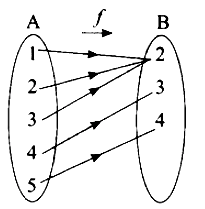
Represent the function f = {(1, 2), (2, 2), (3, 2), (4, 3), (5, 4)} through an arrow diagram
Answer
f = {(1, 2) (2, 2) (3, 2) (4, 3) (5, 4)}
Let A = {1, 2, 3, 4, 5}
B = {2, 3, 4}
Arrow diagram
View full question & answer
Question 202 Marks
Represent the function f = {(1, 2), (2, 2), (3, 2), (4, 3), (5, 4)} through a table form
Answer
f = {(1, 2) (2, 2) (3, 2) (4, 3) (5, 4)}
Let A = {1, 2, 3, 4, 5}
B = {2, 3, 4}
X 1 2 3 4 5
f(x) 2 2 2 3 4
View full question & answer
Question 212 Marks
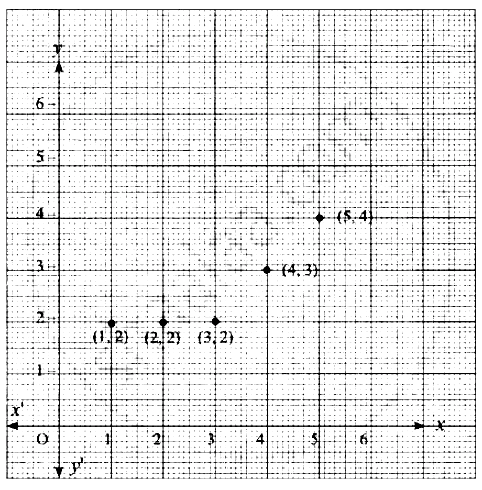
Represent the function f = {(1, 2), (2, 2), (3, 2), (4, 3), (5, 4)} through a graph
Answer
f = {(1, 2) (2, 2) (3, 2) (4, 3) (5, 4)}
Let A = {1, 2, 3, 4, 5}
B = {2, 3, 4}
View full question & answer
Question 222 Marks
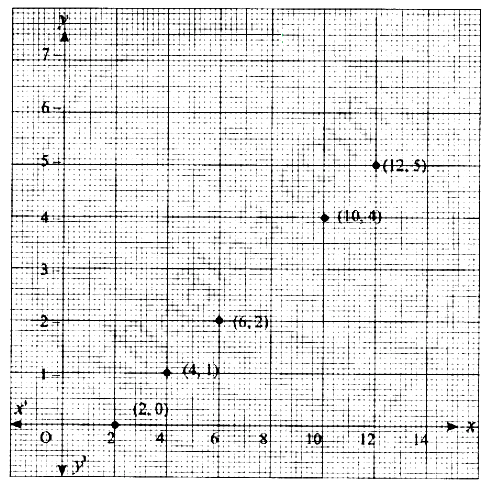
Let $f : A \rightarrow B$ be a function defined by $f ( x )=\frac{x}{2}-1$, where $A =\{2,4,6,10,12\}, B =\{0,1,2,4,5,9\}$.
Represent $f$ by a graph
Answer
$A=\{2,4,6,10,12\} $
$ B=\{0,1,2,4,5,9\} $
$ f(x)=\frac{x}{2}-1 $
$f(2)=\frac{2}{2}-1=1-1=0 $
$ f(4)=\frac{4}{2}-1=2-1=1 $
$ f(6)=\frac{6}{2}-1=3-1=2 $
$ f(10)=\frac{10}{2}-1=5-1=4$
$ f(12)=\frac{12}{2}-1=6-1=5$
View full question & answer
Question 232 Marks
Let $f : A \rightarrow B$ be a function defined by $f ( x )=\frac{x}{2}-1$, where $A =\{2,4,6,10,12\}, B =\{0,1,2,4,5,9\}$.
Represent f by set of ordered pairs
Answer
$A =\{2,4,6,10,12\} \\B =\{0,1,2,4,5,9\} $
$f ( x )=\frac{x}{2}-1$
$f(2)=\frac{2}{2}-1=1-1=0$
$f(4)=\frac{4}{2}-1=2-1=1$
$f(6)=\frac{6}{2}-1=3-1=2$
$f(10)=\frac{10}{2}-1=5-1=4$
$f(12)=\frac{12}{2}-1=6-1=5$
Set of ordered pairs
$f=\{(2,0)(4,1)(6,2)(10,4)(12,5)\}$
View full question & answer
Question 242 Marks
Let $f: A \rightarrow B$ be a function defined by $f(x)=\frac{x}{2}-1$, where $A=\{2,4,6,10,12\}, B=\{0,1,2,4,5,9\}$.
Represent $f$ by a table
Answer
$ A =\{2,4,6,10,12\} $
$ B =\{0,1,2,4,5,9\} $
$ f ( x )=\frac{x}{2}-1 $
$f (2)=\frac{2}{2}-1=1-1=0$
$ f (4)=\frac{4}{2}-1=2-1=1 $
$ f (6)=\frac{6}{2}-1=3-1=2 $
$ f (10)=\frac{10}{2}-1=5-1=4 $
$ f (12)=\frac{12}{2}-1=6-1=5$
X $2$ $4$ $6$ $10$ $12$
f(x) $0$ $1$ $2$ $4$ $5$
View full question & answer
Question 252 Marks
Let $f: A \rightarrow B$ be a function defined by $f(x)=\frac{x}{2}-1$, where $A=\{2,4,6,10,12\}, B=\{0,1,2,4,5,9\}$
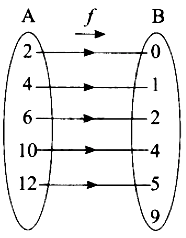
. Represent $f$ by an arrow diagram
Answer
$A=\{2,4,6,10,12\} $
$ B=\{0,1,2,4,5,9\} $
$ f(x)=\frac{x}{2}-1 $
$f(2)=\frac{2}{2}-1=1-1=0 $
$ f(4)=\frac{4}{2}-1=2-1=1$
$ f(6)=\frac{6}{2}-1=3-1=2 $
$ f(10)=\frac{10}{2}-1=5-1=4$
$ f(12)=\frac{12}{2}-1=6-1=5$​​​​​​​
Arrow diagra
View full question & answer
Question 262 Marks
The function ' $t$ ' which map temperature in Celsius $( C )$ into temperature in Fahrenheit $( F )$ is defined by $t ( C )= F$ where $F =\frac{9}{5} C +32$. Find, the temperature when the Celsius value is equal to the Fahrenheit value
Answer
Given $t(C)=\frac{9}{5} C+32$
consider the value of C be “x”
$t(C)=\frac{9}{5} C+32 $
$ x=\frac{9}{5} x+32$
$ 5 x=9 x+160$
$ -160=9 x-5 x$
$-160=4 x$
$ x=\frac{-160}{4}=-40$
The temperature when the Celsius value is equal to the fahrenheit value is $– 40^\circ$
View full question & answer
Question 272 Marks
The function ' $t$ ' which map temperature in Celsius $(C)$ into temperature in Fahrenheit $(F)$ is defined by $t(C)=F$ where $F=\frac{9}{5} C+32$. Find, the value of $C$ when $t(C)=212$
Answer
$\text { Given } t(C)=\frac{9}{5} C +32 $
$ t( C )=212 $
$\frac{9}{5} C +32=212$
$ \frac{9}{5} C =212-32 $
$ =180 $
$ 9 C =180 \times 5 $
$C =\frac{180 \times 5}{9} $
$=100^{\circ} C$
View full question & answer
Question 282 Marks
The function ' $t$ ' which map temperature in Celsius $( C )$ into temperature in Fahrenheit $( F )$ is defined by $t(C)=F$ where $F=\frac{9}{5} C+32$. Find, $t(0)$
Answer
Given $t(C)=\frac{9}{5} C+32$
$t(0)=\frac{9}{5}(0)+32$
$=32^{\circ} F$
View full question & answer
Question 292 Marks
The function ' $t$ ' which map temperature in Celsius $(C)$ into temperature in Fahrenheit $(F)$ is defined by $t(C)=F$ where $F=\frac{9}{5} C+32$. Find, $t(28)$
Answer
$\text { Given } t(C)=\frac{9}{5} C +32$
$ t (28)=\frac{9}{5}(28)+32$
$=\frac{252}{5}+32$
$ =50.4+32 $
$=82.4^{\circ} F $
View full question & answer
Question 302 Marks
The function ' $t$ ' which map temperature in Celsius $(C)$ into temperature in Fahrenheit $(F)$ is defined by $t(C)=F$ where $F=\frac{9}{5} C+32$. Find, $t(-10)$
Answer
$\text { Given } t(C)=\frac{9}{5} C +32$
$ t (-10)=\frac{9}{5}(-10)+32 $
$ =-18+32 $
$=14^{\circ} F$
View full question & answer
Question 312 Marks
The distance $S$ object travel under the influence of gravity in time $t$ seconds is given by $S ( t )=\frac{1}{2} gt ^2+$ $at + b$ where, ( $g$ is the acceleration due to gravity), $a , b$ are constant. Verify whether the function $S ( t )$ is one-one or not.
Answer
$S ( t )=\frac{1}{2} gt t ^2+ at + b$Let t be 1, 2, 3, ………, seconds
$S(1)=\frac{1}{2} g\left(1^2\right)+a(1)+b=\frac{1}{2} g+a+b $
$ S(2)=\frac{1}{2} g\left(2^2\right)+a(2)+b=2 g+2 a+b$
Yes, for every different value of $t$, there will be different values as images.
And there will be different pre-images for the different values of the range.
Therefore it is the one-one function.
View full question & answer
Question 322 Marks
A function $f :[-5,9] \rightarrow R$ is defined as follow:
$f(x)=\left\{\begin{array}{ll}6 x+1 ; & -5 \leq x<2 \\5 x^2-1 ; & 2 \leq x<6 \\3 x-4 ; & 6 \leq x \leq 9\end{array} \text { Find } f(-3)+f(2)\right.$
Answer
$f(x)=6 x+1 ; x=\{-5,-4,-3,-2,-1,0,1\}$
$f(x)=5 x^2-1 ; x=\{2,3,4,5\}$
$f(x)=3 x-4 ; x=\{6,7,8,9\}$
$f(-3)+f(2)$
$f(x)=6 x+1$
$f(-3)=6(-3)+1=-18+1=-17$
$f(x)=5 x^2-1$
$f(2)=5(2)^2-1=20-1=19$
$f(-3)+f(2)=-17+19=2$
View full question & answer
Question 332 Marks
A function $f:[-5,9] \rightarrow R$ is defined as follow:
$f(x)=\left\{\begin{array}{ll}6 x+1 ; & -5 \leq x<2 \\5 x^2-1 ; & 2 \leq x<6 \\3 x-4 ; & 6 \leq x \leq 9\end{array} \text { Find } f(7)-f(1)\right.$
Answer
$f(x)=6 x+1 ; x=\{-5,-4,-3,-2,-1,0,1\}$
$f(x)=5 x^2-1 ; x=\{2,3,4,5\}$
$f(x)=3 x-4 ; x=\{6,7,8,9\}$
$f(7)-f(1)$
$f(x)=3 x-4$
$f(7)=3(7)-4=21-4=17$
$f(x)=6 x+1$
$f(1)=6(1)+1=6+1=7$
$f(7)-f(1)=17-7=10$
View full question & answer
Question 342 Marks
A function $f:[-5,9] \rightarrow R$ is defined as follow:
$f(x)=\left\{\begin{array}{ll}6 x+1 ; & -5 \leq x<2 \\5 x^2-1 ; & 2 \leq x<6 \\3 x-4 ; & 6 \leq x \leq 9\end{array} \text { Find } 2 f(4)+f(8)\right.$
Answer
$f(x)=6 x+1 ; x=\{-5,-4,-3,-2,-1,0,1\}$
$f(x)=5 x^2-1 ; x=2,3,4,5$
$f(x)=3 x-4 ; x=\{6,7,8,9\}$
$2 f(4)+f(8)$
$f(x)=5 x^2-1$
$f(4)=5(4)^2-1=5(16)-1$
$=80-1=79$
$f(x)=3 x-4$
$f(8)=3(8)-4=24-4=20$
$2 f(4)+f(8)=2(79)+20$
$=158+20$
$=178$
View full question & answer
Question 352 Marks
A plane is flying at a speed of $500$ km per hour. Express the distance ‘d’ travelled by the plane as function of time t in hour
Answer
$\text { Speed }=\frac{\text { distance covered }}{\text { time taken }} $
$ \Rightarrow \text { distance }=\text { Speed } \times \text { time } $
$ \Rightarrow d=500 \times t \ldots \ldots . .[\because \text { time }= t hrs ] $
$ \Rightarrow d=500 t $
View full question & answer
Question 362 Marks
A function f is defined by $f(x) = 2x – 3$ find x such that $f(x) = f(1 – x)$
Answer
$f(1-x)=2(1-x)-3$
$=2-2 x-3$
$ =-2 x-1$
$ f(x)=f(1-x) $
$ 2 x-3=-2 x-1$
$ 2 x+2 x=3-1 $
$ 4 x=2 $
$ x=\frac{2}{4}=\frac{1}{2}$
View full question & answer
Question 372 Marks
A function $f$ is defined by $f(x)=2 x-3$ find $\frac{f(0)+f(1)}{2}$
Answer
$f(x)=2 x-3 $
$ f(0)=2(0)-3=-3 $
$ f(1)=2(1)-3=2-3=-1 $
$ \frac{f(0)+f(1)}{2}=\frac{-3-1}{2}=\frac{-4}{2}$
$ \frac{f(0)+f(1)}{2}=-2$
View full question & answer
Question 382 Marks
A function f is defined by $f(x) = 2x – 3$ find x such that $f(x) = 0$
Answer
$f(x)=0$
$ 2 x-3=0 $
$ 2 x=3$
$x=\frac{3}{2}$
View full question & answer
Question 392 Marks
A function f is defined by f(x) = 2x – 3 find x such that f(x) = x
Answer
f(x) = x
2x – 3 = x
2x – x = 3
x = 3
View full question & answer
Question 402 Marks
Let $f ( x )=2 x +5$. If $x \neq 0$ then find $\frac{f(x+2)- f (2)}{r}$
Answer
$f(x)=2 x+5$
$ f(x+2)=2(x+2)+5$
$ =2 x+4+5$
$ =2 x+9$
$ f(2)=(2)+5 $
$ =4+5 $
$ =9 $
$ \frac{f(x+2)-f(2)}{x}=\frac{2 x+9-9}{x} $
$ =\frac{2 x}{x} $
$ =2$
$\frac{f(x+2)-f(2)}{x}=2$
View full question & answer
Question 412 Marks
Let $X=\{3,4,6,8\}$. Determine whether the relation $R=\left\{(x, f(x)) \mid x \in X, f(x)=x^2+1\right\}$ is a function from $X$ to $N$ ?
Answer
$f(x)=x^2+1$
$f(3)=3^2+1=9+1=10$
$f(4)=4^2+1=16+1=17$
$f(6)=6^2+1=36+1=37$
$f(8)=8^2+1=64+1=65$
yes, $R$ is a function from $X$ to $N$
View full question & answer
Question 422 Marks
Let f = {(x, y) | x, y ∈ N and y = 2x} be a relation on N. Find the domain, co-domain and range. Is this relation a function?
Answer
X = {1, 2, 3, ….}
Y = {1, 2, 3, ….}
f = {(1, 2) (2, 4) (3, 6) (4, 8) ….}
Domain = {1, 2, 3, 4 ….}
Co-domain = {1, 2, 3, 4 ….}
Range = {2, 4, 6, 8}
Yes, this relation is a function.
View full question & answer
Question 432 Marks
The data in the adjacent table depicts the length of a person's forehand and their corresponding height. Based on this data, a student finds a relationship between the height (y) and the forehand length (x) as y = ax + b, where a, b are constant.
Length ‘x’ of
forehand (in cm)
Height 'y'
(in inches)
35 56
45 65
50 69.5
55 74
Find the height of a person whose forehand length is 40 cm
Answer
The relation is y = 0.9x + 24.5
When the forehand length is 40 cm, then height is 60.5 inches.
y = 0.9x + 24.5
= 0.9 × 40 + 24.5
= 36 + 24.5
= 60.5 feet
View full question & answer
Question 442 Marks
Let A = {1, 2, 3, 4, …, 45} and R be the relation defined as “is square of ” on A. Write R as a subset of A × A. Also, find the domain and range of R
Answer
A = {1, 2, 3, 4, ..., 45}, A × A = {(1, 1), (2, 2) ….. (45, 45)}
R – is square of’
R = {(1, 1), (2, 4), (3, 9), (4, 16), (5, 25), (6, 36)}
R ⊂ (A × A)
Domain of R = {1, 2, 3, 4, 5, 6}
Range of R = {1, 4, 9, 16, 25, 36}
View full question & answer
Question 452 Marks
Let A = {x ∈ W | x < 2}, B = {x ∈ N | 1 < x < 4} and C = {3, 5}. Verify that A × (B ∪ C) = (A × B) ∪ (A × C)
Answer
A = {x ∈ W | x < 2} = {0, 1}
B = {x ∈ N | 1 < x < 4} = {2, 3, 4}
C = {3, 5}
L.H.S. = A × (B ∪ C)
B ∪ C = {2, 3, 4} ∪ {3, 5}
= {2, 3, 4, 5}
A × (B ∪ C) = {(0, 2), (0, 3), (0, 4), (0, 5), (1, 2), (1, 3), (1, 4), (1, 5)} ……….(1)
R.H.S. = (A × B) ∪ (A × C)
(A × B) = {(0, 2), (0, 3), (0, 4), (1, 2), (1, 3), (1, 4)}
(A × C) = {(0, 3), (0, 5), (1, 3), (1, 5)}
(A × B) ∪ (A × C) = {(0, 2), (0, 3), (0, 4), (1, 2), (1, 3), (1, 4), (0, 5), (1, 5)} ….(2)
(1) = (2), L.H.S. = R.H.S.
Hence it is proved.
View full question & answer
Question 462 Marks
Let A = {x ∈ W | x < 2}, B = {x ∈ N | 1 < x < 4} and C = {3, 5}. Verify that A × (B ∩ C) = (A × B) ∩ (A × C)
Answer
A = {x ∈ W | x < 2} = {0, 1}
B = {x ∈ N | 1 < x < 4} = {2, 3, 4}
C = {3, 5}
A × (B ∩ C) = (A × B) ∩ (A × C)
L.H.S. = A × (B ∩ C)
(B ∩ C) = {3}
A × (B ∩ C) = {(0, 3), (1, 3)} …(1)
R.H.S. = (A × B) ∩ (A × C)
(A × B) = {(0, 2), (0, 3), (0, 4), (1, 2), (1, 3), (1, 4)}
(A × C) = {(0, 3), (0, 5), (1, 3), (1, 5)}
(A × B) ∩ (A × C) = {(0, 3), (1, 3)} ……….. (2)
(1) = (2) ⇒ L.H.S. = R.H.S.
Hence it is verified.
View full question & answer
Question 472 Marks
Let A = {x ∈ W | x < 2}, B = {x ∈ N | 1 < x < 4} and C = {3, 5}. Verify that (A ∪ B) × C = (A × C) ∪ (B × C)
Answer
A = {x ∈ W | x < 2} = {0, 1}
B = {x ∈ N | 1 < x < 4} = {2, 3, 4}
C = {3, 5}
(A ∪ B) × C = (A × C) ∪ (B × C)
L.H.S. = (A ∪ B) × C
A ∪ B = {0, 1, 2, 3, 4}
(A ∪ B) × C = {(0, 3), (0, 5), (1, 3), (1, 5), (2, 3), (2, 5), (3, 3), (3, 5), (4, 3), (4, 5)} …………. (1)
R.H.S. = (A × C) ∪ (B × C)
(A × C) = {(0, 3), (0, 5), (1, 3), (1, 5)}
(B × C) = {(2, 3), (2, 5), (3, 3), (3, 5), (4, 3), (4, 5)}
(A × C) ∪ (B × C) = {(0, 3), (0, 5), (1, 3), (1, 5), (2, 3), (2, 5), (3, 3), (3, 5), (4, 3), (4, 5)} ………… (2)
(1) = (2)
∴ L.H.S. = R.H.S.
Hence it is verified.
View full question & answer
Question 482 Marks
If A = {5, 6}, B = {4, 5, 6}, C = {5, 6, 7}, Show that A × A = (B × B) ∩ (C × C)
Answer
A = {5, 6}, B = {4, 5, 6}, C = {5, 6, 7}
A × A = {(5, 5), (5, 6), (6, 5), (6, 6)} ……….. (1)
B × B = {(4, 4), (4, 5), (4, 6), (5, 4), (5, 5), (5, 6), (6, 4), (6, 5), (6, 6)} …(2)
C × C = {(5, 5), (5, 6), (5, 7), (6, 5), (6, 6), (6, 7), (7, 5), (7, 6), (7, 7)} …(3)
(B × B) ∩ (C × C) = {(5, 5), (5, 6), (6, 5), (6, 6)} …(4)
(1) = (4)
A × A = (B × B) ∩ (C × C)
It is proved.
View full question & answer
Question 492 Marks
Let A = {1, 2, 3} and B = {x | x is a prime number less than 10}. Find A × B and B × A
Answer
A = {1, 2, 3}, B = {2, 3, 5, 7}
A × B = {(1, 2), (1, 3), (1, 5), (1, 7), (2, 2), (2, 3), (2, 5), (2, 7), (3, 2), (3, 3), (3, 5), (3, 7)}
B × A = {(2, 1), (2, 2), (2, 3), (3, 1), (3, 2), (3, 3), (5, 1), (5, 2), (5, 3), (7, 1), (7, 2), (7, 3)}
View full question & answer
Question 502 Marks
Find A × B, A × A and B × A :
A = {2, −2, 3} and B = {1, −4}
Answer
A = {2, −2, 3} and B = {1, −4}
A × B = {2, −2, 3} × {1, −4}
= {(2, 1) (2, −4) (−2, 1) (−2, −4) (3, 1) (3, −4)}
A × A = {2, −2, 3} × {2, −2, 3}
= {(2, 2) (2, −2) (2, 3) (−2, 2) (−2, −2) (−2, 3) (3, 2) (3, −2) (3, 3)}
B × A = {1, −4} × {2, −2, 3}
= {(1, 2) (1, −2) (1, 3) (−4, 2) (−4, −2) (−4, 3)}
View full question & answer
[2 Mark Questions] - MATHS STD 10 Questions - Vidyadip