Questions · Page 1 of 2

5 Marks Questions

🎯

Test yourself on this topic

50 questions · timed · auto-graded

Question 15 Marks
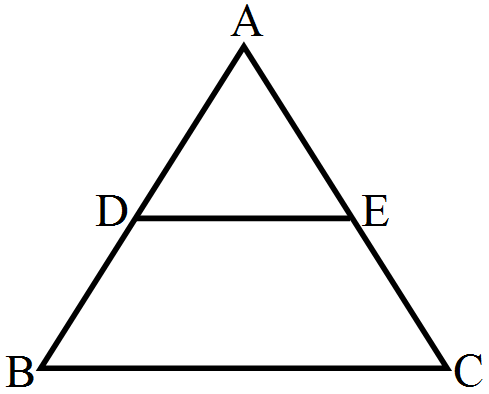
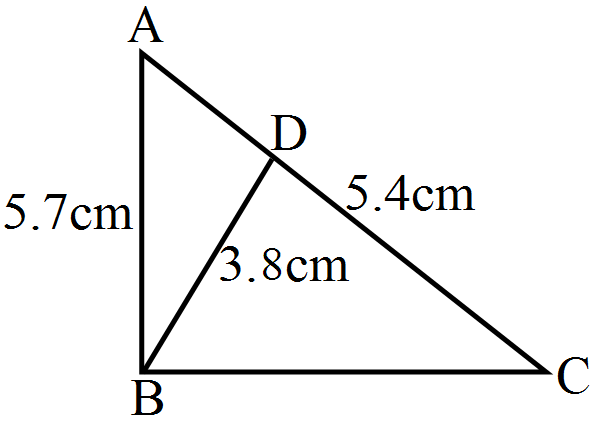
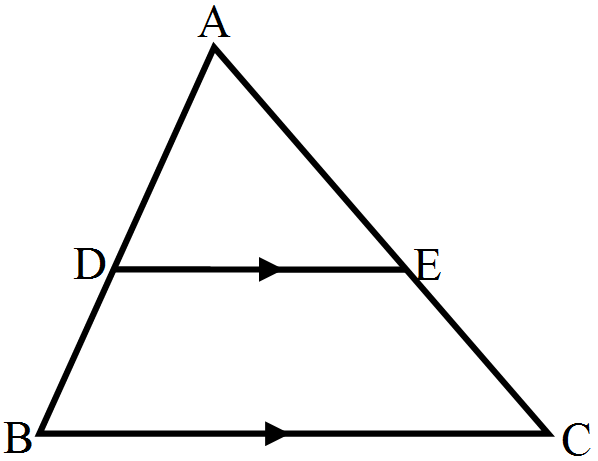
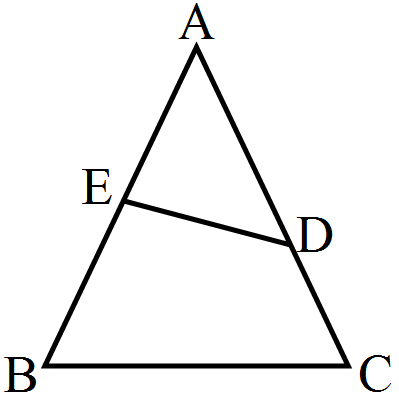
In the given figure, if $\angle\text{ADE}=\angle\text{B},$ show that $\triangle\text{ADE}\sim\triangle\text{ABC}.$ If AD = 3.8cm, AE = 3.6cm, BE = 2.1cm and BC = 4.2cm, find DE.
Answer
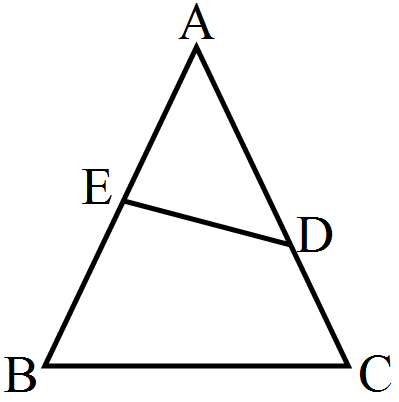
Given: $\angle\text{ADE}=\angle\text{B},$ AD = 3.8cm, AE = 3.6cm, BE = 2.1cm, BC = 4.2cm
Proof:
In $\triangle\text{ADE}$ and $\triangle\text{ABC},$
$\angle\text{A}=\angle\text{A}$ (common)
$\angle\text{ADE}=\angle\text{B}$ (given)
Therefore, $\triangle\text{ADE}\sim\triangle\text{ABC}$ (AA Criterion)
$\Rightarrow\frac{\text{AD}}{\text{AB}}=\frac{\text{DE}}{\text{BC}}$
$\Rightarrow\frac{3.8}{(3.6+2.1)}=\frac{\text{x}}{4.2 }(\text{DE}=\text{x})$
$\Rightarrow\frac{3.8}{5.7}=\frac{\text{x}}{4.2}$
$\text{x}=\frac{3.8\times4.2}{5.7}=2.8\text{cm}$
Hence, DE = 2.8cm
View full question & answer
Question 25 Marks
State the AAA-similarity criterion.
Answer
If is any two triangles, the corresponding angles are equal, then their corresponding sides are proportional and hence the triangles are similar.
View full question & answer
Question 35 Marks
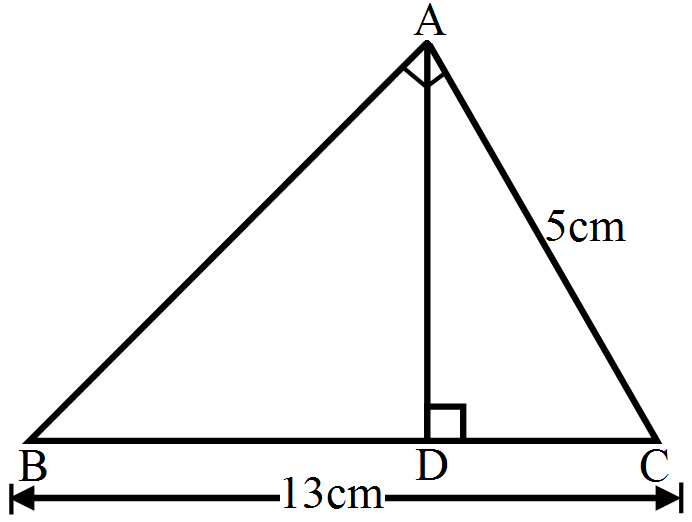
$\triangle\text{ABC}$ is right-angled at A and $\text{AD}\perp\text{BC}.$ If BC = 13cm and AC =5cm, find the ratio of the areas of $\triangle\text{ABC}$ and $​​​​$$\triangle\text{ADC}.$
Answer
In $\triangle\text{ABC}$ and $\triangle\text{ADC},$ we have:
$\angle\text{BAC}=\angle\text{ADC}=90^\circ$
$\angle\text{ACB}=\angle\text{ACD}$ (common)
By AA similarity, we can conclude that $\triangle\text{BAC}\sim\triangle\text{ADC}.$
Hence, the ratio of the areas of these triangles is equal to the ratio of squares of their corresponding sides.
$\therefore\frac{\text{ar}(\triangle\text{BAC})}{\text{ar}(\triangle\text{ADC})}=\frac{\text{BC}^2}{\text{AC}^2}$
$\Rightarrow\frac{\text{ar}(\triangle\text{BAC})}{\text{ar}(\triangle\text{ADC})}=\frac{\text{13}^2}{\text{5}^2}$
$=\frac{169}{25}$
Hence, the ratio of both the triangles is 169 : 25
View full question & answer
Question 45 Marks
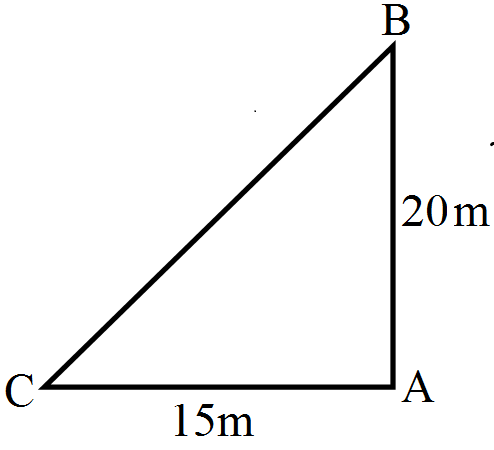
A ladder is placed in such a way that its foot is at a distance of 15m from a wall and its top reaches a window 20m above the ground. Find the length of the ladder.
Answer
Let AB be the well where window is at B, CB be the ladder and AC be the distance between the foot of the ladder and wall. Then, $\text{AB}=20\text{m},\text{AC}=15\text {m},$ and $\angle\text{CAB}=90^\circ$
By Pythagoras theorem, we have $\text{CB}^2=\text{AB}^2+\text{AC}^2$ $=\Big[(20)^2+(15)^2\Big]\text{m}^2$ $=(400+225)\text{m}^2$ $=625\text{m}^2$ $\text{CB}=\sqrt{625}\text{m}=25\text{m}$ Hence, the length of ladder is 25 m.
View full question & answer
Question 55 Marks
For the following statments state whether true (T) or false(F):
Two circles with different radii are similar.
Answer
True.
Solution:
Similar figures have the same shape but need not have the same size.
Since all circles irrespective of the radii will have the same shape, all be similar.
View full question & answer
Question 65 Marks
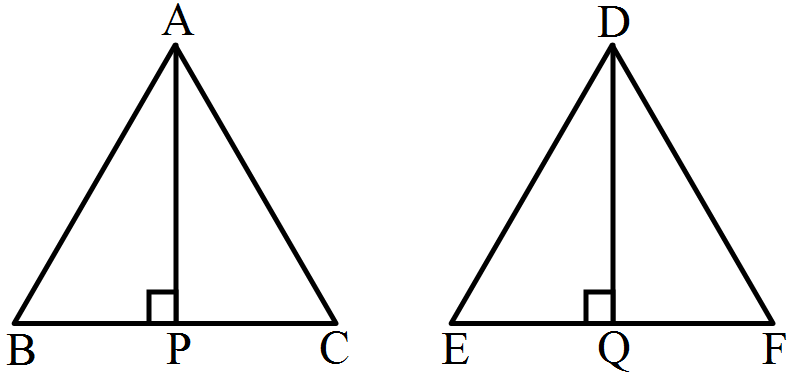
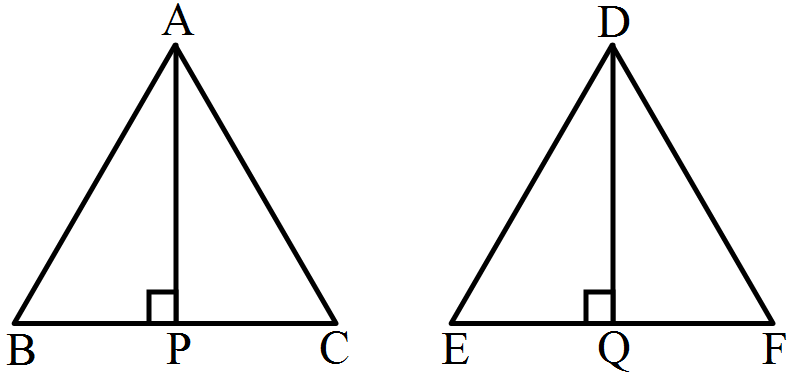
$\triangle ABC \sim \triangle DEF$ and their areas are respectively $100 cm^2$ and $49 cm^2$. If the altitude of $\triangle ABC$ is 5 cm , the corresponding altitude of $\triangle DEF$.
Answer

It is given that $\triangle\text{ABC}\sim\triangle\text{DEF}.$
Therefore, the ratio of the areas of these triangles will be equal to the ratio of squares of their corresponding sides.
Also, the ratio of areas of two similar triangles is equal to the ratio of squares of their corresponding altitudes.
Let the altitude of $\triangle\text{ABC}$ be AP, drawn from A to BC to meet BC at P and the altitude of $\triangle\text{DEF}$ be DQ, drawn from D to meet EF at Q
Then,
$\frac{\text{ar}(\triangle\text{ACB})}{\text{ar}(\triangle\text{DEF})}=\frac{\text{AP}^2}{\text{DQ}^2}$
$\Rightarrow\frac{100}{49}=\frac{\text{5}^2}{\text{DQ}^2}$
$\Rightarrow\frac{100}{49}=\frac{\text{25}}{\text{DQ}^2}$
$\Rightarrow\text{DQ}^2=\frac{49\times25}{100}$
$\Rightarrow\text{DQ}=\sqrt{\frac{49\times25}{100}}$
$\Rightarrow\text{DQ}=3.5\text{cm}$
Hence, the altitude of $\triangle\text{DEF}$ is 3.5cm
View full question & answer
Question 75 Marks
State the converse of Thales' theorem.
Answer
If a line divides any two sides of a triangle in the same ratio then the line must be parallel to the third side.
View full question & answer
Question 85 Marks
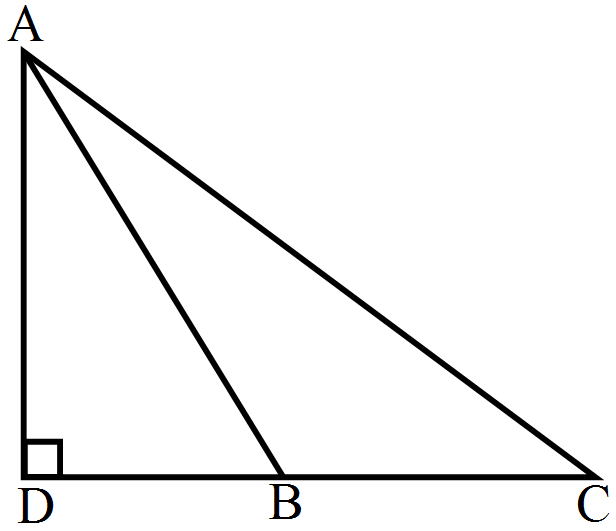
In the given figure, $\triangle\text{ABC}$ is an obtuse triangle, obtuse-angled at B. If $\text{AD}\perp\text{CB}$ (produced) prove that $AC^2 = AB^2+ BC^2 +2BC.BD.$
Answer

Applying Pythagoras theorem in right-angled triangle ADC, we get:
$AC^2= AD^2 + DC^2$
$\Rightarrow AC^2 - DC^2 = AD^2$
$\Rightarrow AD^2 = AC^2- DC^2 .....(1)$
Applying Oythagoras theorem in right-triangle ADB, we get:
$AB^2 = AD^2 + DB^2$
$\Rightarrow AB^2 - DB^2= AD^2$
$\Rightarrow AD^2 = AB^2 - DB^2 .....(2)$
From equation (1) and (2), we have:
$AC^2 - DC^2 = AB^2 - DB^2$
$\Rightarrow AC^2 = AB^2 + DC^2 - DB^2$
$\Rightarrow AC^2 = AB^2 + (DB + BC)^2- DB^2$ $(\therefore\text{DB}+\text{BC}=\text{DC})$
$\Rightarrow AC^2 = AB^2 + DB^2 + BC^2 + 2DB.BC - DB^2$
$\Rightarrow AC^2 = AB^2 + BC^2 + 2BC.BD$
This completes the proof.
View full question & answer
Question 95 Marks
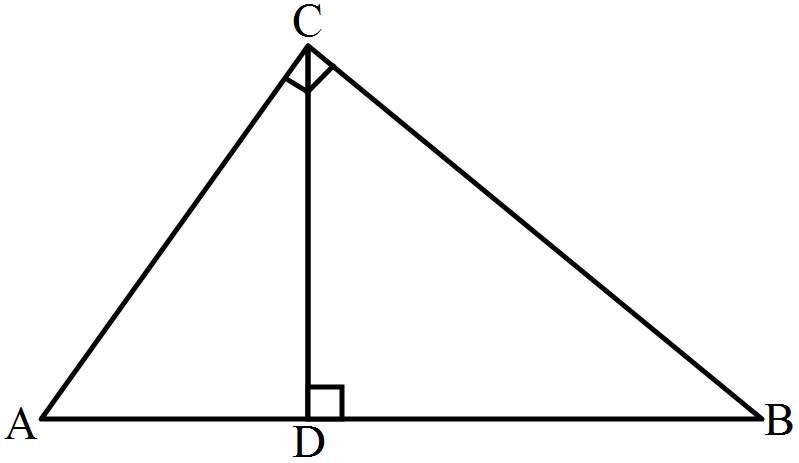
In the given figure, $\angle\text{ACB}=90^\circ$ and $\text{CD}\perp\text{AB}.$
Prove that $\frac{\text{BC}^2}{\text{AC}^2}=\frac{\text{BD}}{\text{AD}}.$
Answer
Given: $\angle\text{ACB}=90^\circ$ and $\text{CD}\perp\text{AB}$
To Prove: $\frac{\text{BC}^2}{\text{AC}^2}=\frac{\text{BD}}{\text{AD}}$
Proof:
In $\triangle\text{ACB}$ and $\triangle\text{CDB}$
$\angle\text{ACB}=\angle\text{CDB}=90^\circ$ (Given)
$\angle\text{ABC}=\angle\text{CBD}$ (common)
By AA similarity-criterion $\triangle\text{ACB}\sim\triangle\text{CDB}$
When two triangles are similar, the ratios of the lengths of their corresponding sides are proportional.
$\therefore\frac{\text{BC}}{\text{BD}}=\frac{\text{AB}}{\text{BC}}$
$\Rightarrow\text{BC}^2=\text{BD}.\text{AB}\ .....(1)$
In $\triangle\text{ACB}$ and $\triangle\text{ADC}$
$\angle\text{ACB}=\angle\text{ADC}=90^\circ$ (Given)
$\angle\text{CAB}=\angle\text{DAC}$ (common)
By AA similarity-criterion $\triangle\text{ACB}\sim\triangle\text{ADC}$
When two triangles are similar, then the ratios of the lengths of their corresponding sides are proportional.
$\therefore\frac{\text{AC}}{\text{AD}}=\frac{\text{AB}}{\text{AC}}$
$\Rightarrow\text{AC}^2=\text{AD}.\text{AB}\ .....(2)$
Divinding (2) by (1), we get
$\frac{\text{BC}^2}{\text{AC}^2}=\frac{\text{BD}}{\text{AD}}$
View full question & answer
Question 105 Marks
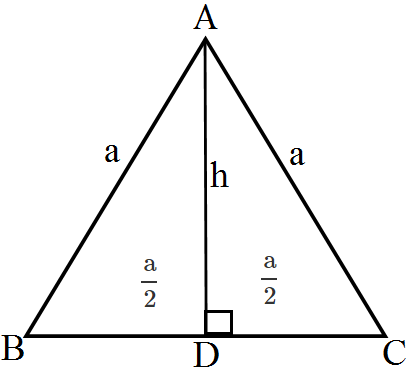
In an equilateral triangle with side a, prove that area $=\frac{\sqrt{3}}{4}\text{a}^2.$
Answer

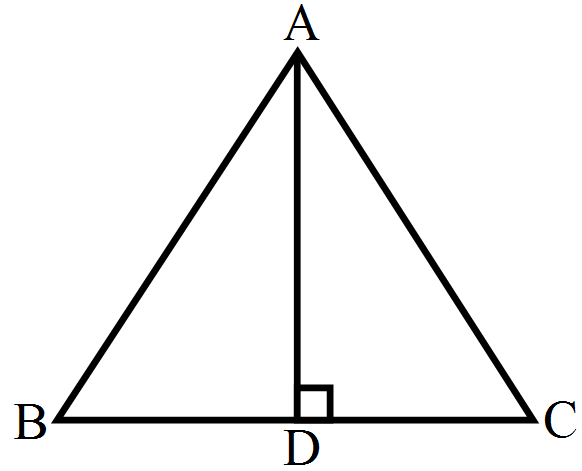
Let ABC be the equilateral triangle with each side equal to a.
Let AD be the altitude from A, meeting BC at D.
Therefore, D is the midpoint of BC.
Let AD be h.
Applying Pythagoras theorem in right-angled triangle ABD, we have:
$AB^2 = AD^2 + BD^2$
$\Rightarrow\text{a}^2=\text{h}^2+\big(\frac{\text{a}}{2}\big)^2$
$\Rightarrow\text{h}^2=\text{a}^2-\frac{\text{a}}{4}=\frac{3}{4}\text{a}^2$
$\Rightarrow\text{h}=\frac{\sqrt{3}}{2}\text{a}$
Therefore,
Area of triangle $\text{ABC}=\frac{1}{2}\times\text{base}\times\text{height}=\frac{1}{2}\times\text{a}\times\frac{\sqrt{3}}{2}\text{a}$
$=\frac{\sqrt{3}}{4}\text{a}^2$
This completes the proof.
View full question & answer
Question 115 Marks
State the AA-similarity criterion.
Answer
If two angles of one triangle are respectively equal to two angles of another triangle then the two triangles are similar.
View full question & answer
Question 125 Marks
$\triangle\text{ABC}\sim\triangle\text{DEF}$ such that $\text{ar}(\triangle\text{ABC})=64\text{cm}^2$ and $\text{ar}(\triangle\text{DEF})=169\text{cm}^2.$ If BC = 4cm, find EF.
Answer
$\triangle\text{ABC}\sim\triangle\text{DEF}$
$\Rightarrow\frac{\text{ar}(\triangle\text{ABC})}{\text{ar}(\triangle\text{DEF})}=\frac{\text{BC}^2}{\text{EF}^2}$
$\Rightarrow\frac{64}{169}=\frac{4^2}{\text{EF}^2}$
$\Rightarrow\text{EF}^2=\frac{16\times169}{64}$
$\Rightarrow\text{EF}=\sqrt{\frac{16\times169}{64}}$
$\Rightarrow\text{EF}=\frac{4\times13}{8}$
$\Rightarrow\text{EF}=6.5\text{cm}$
View full question & answer
Question 135 Marks
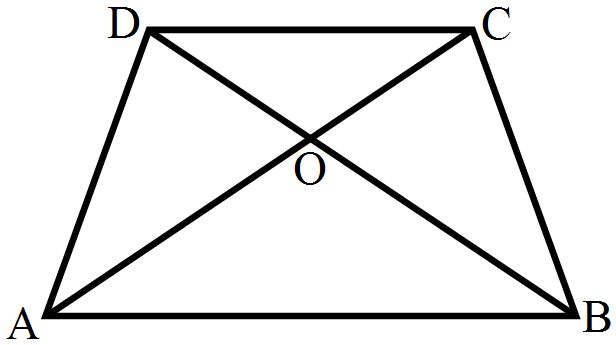
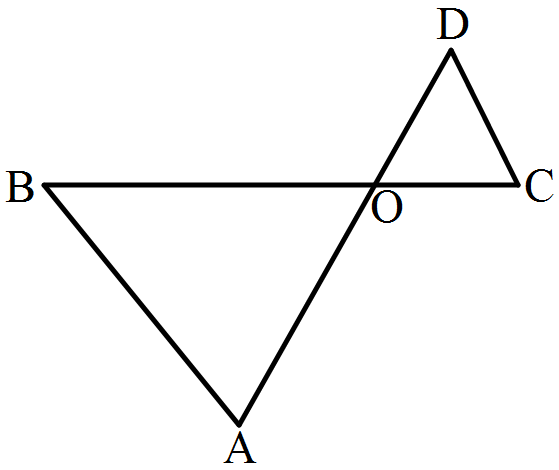
In the adjoining figure, ABCD is a trapezium in which CD || AB and its digonals intersect at O. If AO = (2x + 1)cm, OC = (5x - 7)cm, DO = (7x - 5)cm and OB = (7x + 1)cm, find the value of x.
Answer
In trapezium ABCD, AB || CD and the diagonals AC and BD intersect O.
Therefore,
$\frac{\text{AO}}{\text{OC}}=\frac{\text{BO}}{\text{OD}}$
$\Rightarrow\frac{5\text{x}-7}{2\text{x}+1}=\frac{7\text{x}-5}{7\text{x}+1}$
$\Rightarrow(5\text{x}-7)(7\text{x}+1)=(7\text{x}-5)(2\text{x}+1)$
$\Rightarrow35\text{x}^2+5\text{x}-49\text{x}-7=14\text{x}^2-10\text{x}+7\text{x}-5$
$\Rightarrow21\text{x}^2-41\text{x}-2=0$
$\Rightarrow21\text{x}^2-42\text{x}+\text{x}-2=0$
$\Rightarrow21\text{x}(\text{x}-2)+1(\text{x}-2)=0$
$\Rightarrow(\text{x}-2)+(21\text{x}+1)=0$
$\Rightarrow\text{x}=2,-\frac{1}{21}$
$\therefore\text{x}\not=-\frac{1}{21}$
$\therefore\text{x}=2$
View full question & answer
Question 145 Marks
D and E are points on the sides AB and AC respectively of a $\triangle\text{ABC}.$ In the following cases, determine whether DE || BC or not. AB = 11.7cm, AC = 11.2cm, BD = 6.5cm and AE = 4.2cm.
Answer
We have:
AB = 11.7cm, DB = 6.5cm
Therefore,
AD = 11.7 - 6.5 = 5.2cm
Similarly,
AC = 11.2cm, AE = 4.2cm
Therefore,
EC = 11.2 - 4.2 = 7cm
Now,
$\frac{\text{AD}}{\text{DB}}=\frac{5.2}{6.5}=\frac{4}{5}$
$\frac{\text{AE}}{\text{EC}}=\frac{4.2}{7}$
Thus, $\frac{\text{AD}}{\text{DB}}\not=\frac{\text{AE}}{\text{EC}}$
Applying the converse of Thalse' theorem, we conclude thet DE is not parallel to BC.
View full question & answer
Question 155 Marks
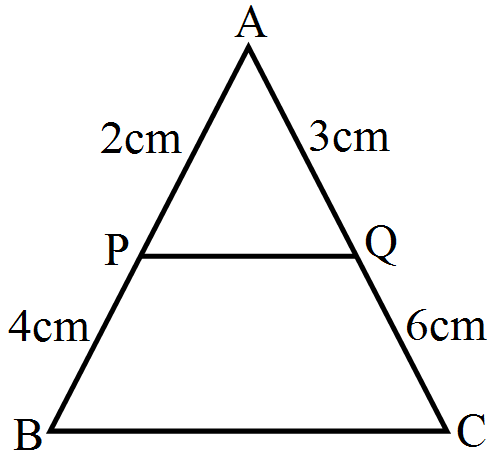
P and Q are points on the sides AB and AC respectively of a $\triangle\text{ABC}.$ If AP = 2cm, PB = 4cm, AQ = 3cm and QC = 6cm, show that BC = 3PQ.
Answer

Given: P is a point on AB.
Then, AB = AP + PB = (2 + 4)cm = 6cm
Also Q is a point on AC.
Then, AC = AQ + QC = (3 + 6)cm = 9cm
$\therefore\frac{\text{AP}}{\text{AB}}=\frac{2}{6}=\frac{1}{3}$
and $\frac{\text{AQ}}{\text{AC}}=\frac{3}{9}=\frac{1}{3}$
$\therefore\frac{\text{AP}}{\text{AB}}=\frac{\text{AQ}}{\text{AC}}$
Thus, in $\triangle\text{APQ}$ and $\triangle\text{ABC}$
$\angle\text{A}=\angle\text{A}$ (common)
And $\frac{\text{AP}}{\text{AB}}=\frac{\text{AQ}}{\text{AC}}$
$\therefore\triangle\text{APQ}\sim\triangle\text{ABC}$ (by SAS similarity)
$\Rightarrow\frac{\text{AP}}{\text{AB}}=\frac{\text{PQ}}{\text{BC}}=\frac{\text{AQ}}{\text{AC}}$
$\therefore\frac{\text{PQ}}{\text{BC}}=\frac{\text{AQ}}{\text{AC}}\Rightarrow\frac{\text{PQ}}{\text{BC}}=\frac{3}{9}=\frac{1}{3}$
$\therefore\text{BC}=3\text{PQ}$
Hence proved.
View full question & answer
Question 165 Marks
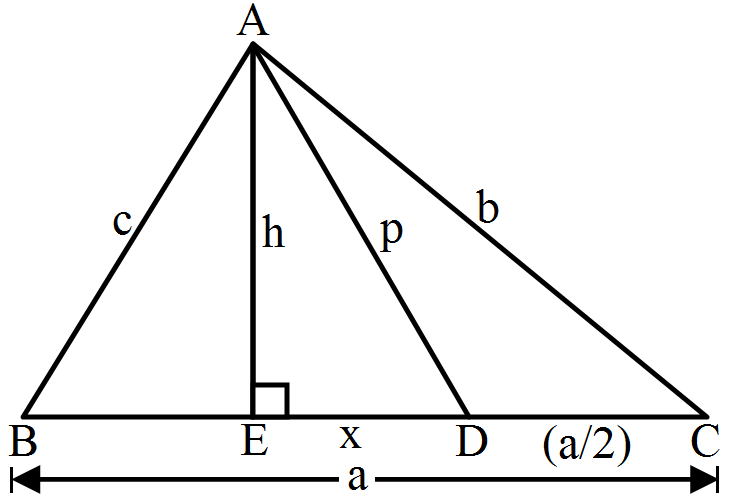
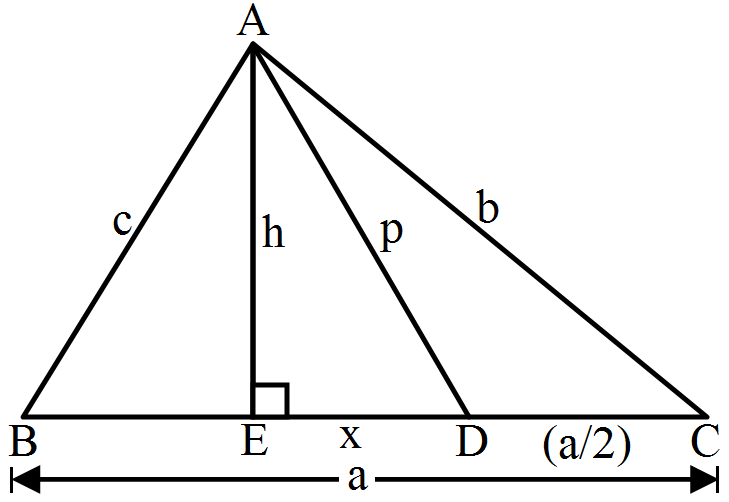
In the given figure, D is the midpoint of side BC and $\text{AE}\perp\text{BC}.$ If BC = a, AC = b, AB = c, ED = x, AD = p and AE = h, prove that.
$\text{c}^2=\text{p}^2-\text{ax}+\frac{\text{a}^2}{4}$
Answer
Given: D is the midpoint of side $\text{BC},\text{AE}\perp\text{BC},\text{BC}=\text{a},\text{AC}=\text{b},\text{AB}=\text{c},\text{ED}=\text{x},\text{AD}=\text{p}$ and $\text{AE}=\text{h}$
In $\triangle\text{AEC},\angle\text{AEC}=90^\circ$
$\text{AD}^2=\text{AE}^2+\text{ED}^2$ (by pythagoras theorem)
$\Rightarrow\text{p}^2=\text{h}^2+\text{x}^2$
In $\triangle\text{ABE},\angle\text{ABE}=90^\circ$
$\text{AB}^2=\text{AE}^2+\text{BE}^2$ (by pythagoras theorem)
$\Rightarrow\text{c}^2=\text{h}^2+\Big(\frac{\text{a}}{2}-\text{x}\Big)^2\dots(2)$
$=\big(\text{h}^2+\text{x}^2\big)-\text{ax}+\frac{\text{a}^2}{4}$
$=\text{p}^2-\text{ax}+\frac{\text{a}^2}{4}$
Hence, $\text{c}^2=\text{p}^2-\text{ax}+\frac{\text{a}^2}{4}$
View full question & answer
Question 175 Marks
In an equilateral triangle with side a, prove that area $=\frac{\sqrt{3}}{4}\text{a}^2.$
Answer

Let $\triangle\text{ABC}$ be an equilateral triangle with side a.
Then, AB = AC = BC = a.
Draw $\text{AD}\perp\text{BC}.$
In $\triangle\text{ADB}$ and $\triangle\text{A},$ we have
$\text{AB}=\text{AC}(\text{given}),\angle\text{B}=\angle\text{C}=60^\circ$
and $\angle\text{ADB}=\angle\text{ADC}=90^\circ$
$\therefore\triangle\text{ADB}\cong\triangle\text{ADC}$
$\therefore\text{BD}=\text{DC}=\frac{\text{a}}{2}$
From right $\triangle\text{ADB},$ we have
$\text{AB}^2=\text{AD}^2+\text{BD}^2$ ....(By Pythagoras theorem)
$\Rightarrow\text{AD}=\sqrt{\text{AB}^2-\text{AB}^2}$
$\Rightarrow\text{AD}=\sqrt{\text{a}^2-\Big(\frac{\text{a}}{2}\Big)^2}$
$\Rightarrow\text{AD}=\sqrt{\text{a}^2-\frac{\text{a}}{4}^2}$
$\Rightarrow\text{AD}=\sqrt{\frac{3\text{a}}{4}^2}$
$\Rightarrow\text{AD}=\frac{\sqrt{3}\text{a}}{2}$
So, the altitude is $\frac{\sqrt{3\text{a}}}{2},$
Area of $\triangle\text{ABC}=\frac{1}{2}\times\text{BC}\times\text{AD}$
$=\frac{1}{2}\times\text{a}\times\frac{\sqrt{3\text{a}}}{2}$
$=\frac{\sqrt{3}\text{a}^2}{4}$
Hence proved.
View full question & answer
Question 185 Marks
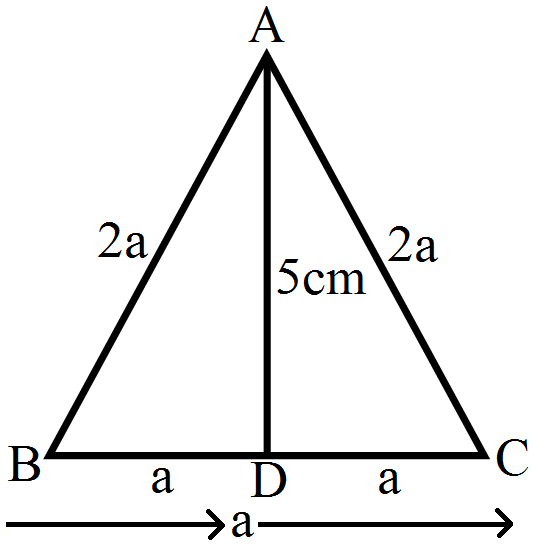
Find the lenght of the altitude of an equilateral triangle of side 2a cm.
Answer

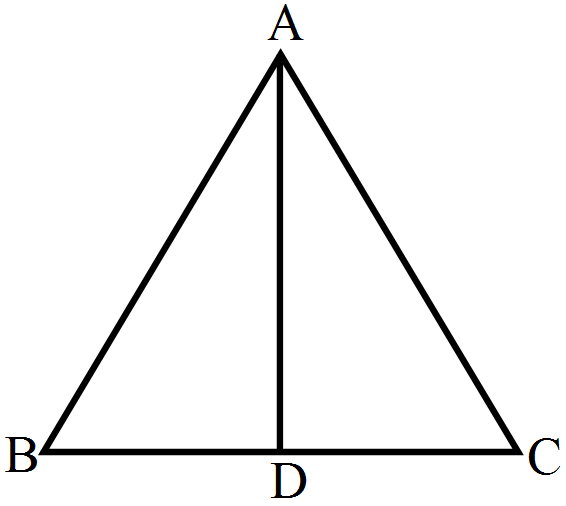
Let $\triangle\text{ABC}$ be an equilateral triangle.
We know that,
in an equilateral triangle the altitube is same as the median.
So, BD = DC = a cm
By Pythagoras theorem,
$AC^2 = AD^2 + DC^2$
$\Rightarrow AD^2 = AC^2- DC^2$
$\Rightarrow AD^2 = (2a)^2 - a^2$
$\Rightarrow AD^2 = 4a^2 - a^2$
$\Rightarrow AD^2 = 3a^2$​​​​​​​
$\Rightarrow\text{AD}=\sqrt{3}\text{a cm}$
So, lendth of the altitude is $\sqrt{3}\text{a cm}.$
View full question & answer
Question 195 Marks
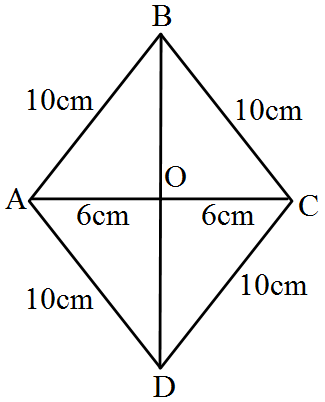
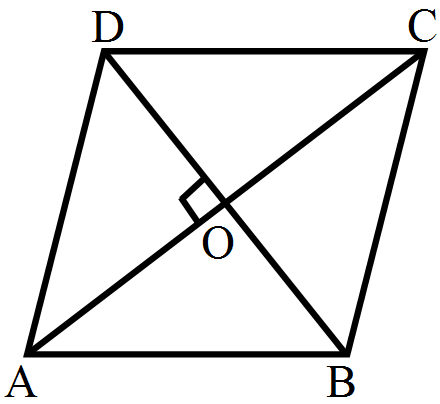
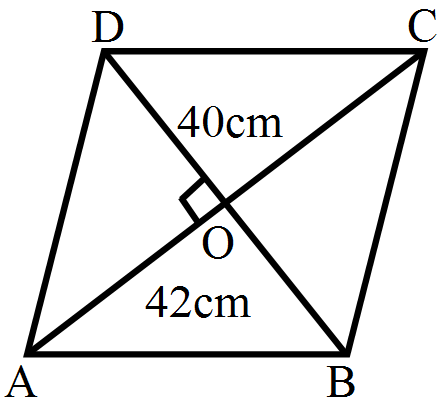
The lengths of the diagonals of a rhobbus are 40cm and 42cm. find the length of each side of the rhombus.
Answer

In an rhombus, the diagonals are perpendicular bisectors of each other, and sides are equal to eachother.
So, $\text{AO}=\frac{1}{2}\text{AC}=21\text{cm}$
$\text{OD}=\frac{1}{2}\text{BD}=20\text{cm}$
In right-angled $\triangle\text{AOD},$
$\text{AD}^2=\text{AO}^2+\text{OD}^2$
$\Rightarrow\text{AD}^2=21^2+20^2$
$\Rightarrow\text{AD}^2=441+400$
$\Rightarrow\text{AD}^2=841$
$\Rightarrow\text{AD}=29\text{cm}$
So, the length of the each side of the rhombus is 29cm.
View full question & answer
Question 205 Marks
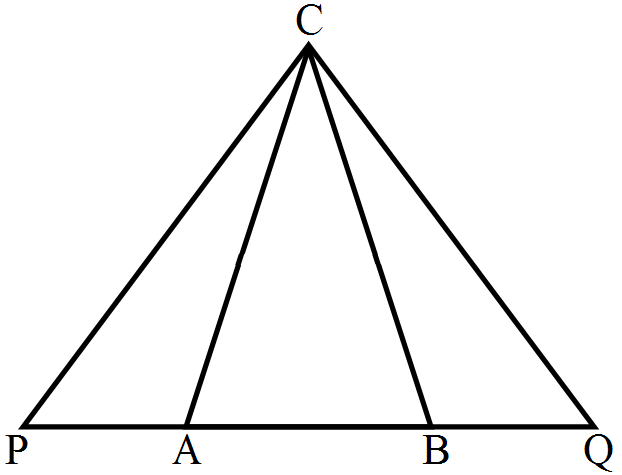
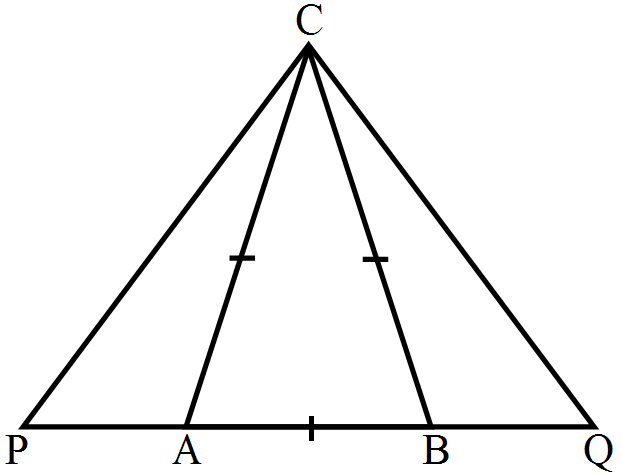
In an isosceles $\triangle\text{ABC},$ the base AB is produced both ways in P and Q such that $AP \times BQ = AC^2.$
Prove that $\triangle\text{ACP}\sim\triangle\text{BCQ}.$
Answer

In $\triangle\text{ACP}$ and $\triangle\text{BCQ}$
CA = CB
$\Rightarrow\angle\text{CAB}=\angle\text{CBA}$
$\Rightarrow180^\circ-\angle\text{CAB}=180^\circ-\angle\text{CAB}$
$\Rightarrow\angle\text{CAP}=\angle\text{CBQ}$
Now,$AP \times BQ = AC^2$
$\Rightarrow\frac{\text{AP}}{\text{AC}}=\frac{\text{AC}}{\text{BQ}}$
$\Rightarrow\frac{\text{AP}}{\text{AC}}=\frac{\text{BC}}{\text{BQ}}$
Thus,$\angle\text{CAP}=\angle\text{CBQ}$ and$\frac{\text{AP}}{\text{AC}}=\frac{\text{BC}}{\text{BQ}}$
$\therefore\triangle\text{ACP}\sim\triangle\text{BCQ}$
View full question & answer
Question 215 Marks
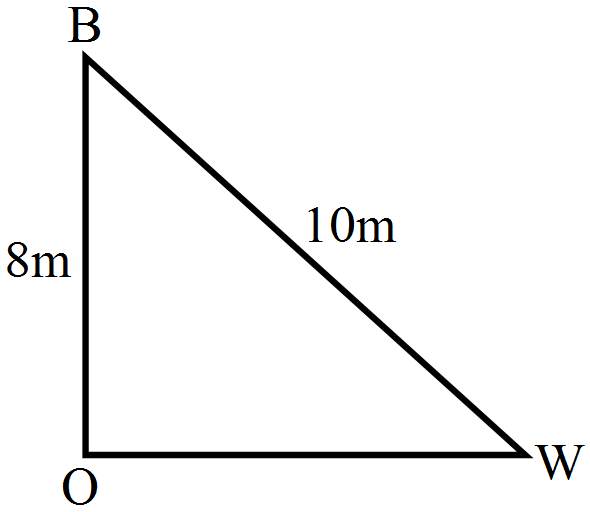
A ladder 10m long reaches the window of a house 8m above the ground. Find the distance of the foot of the ladder from the base of the wall.
Answer

Let BW be the ladder and OB be the house.
$\triangle\text{BOW}$ forms a right-angled triangle.
By Pythagoras theorem,
$BW^2 = OW^2 + OB^2$
$OW^2 = BW^2 - OB^2$
$OW^2 = 10^2 - 8^2$
$OW^2 = 100 - 64$
$OW = 6m$
So the distance of the foot of the ladder from the house is 6m.
View full question & answer
Question 225 Marks
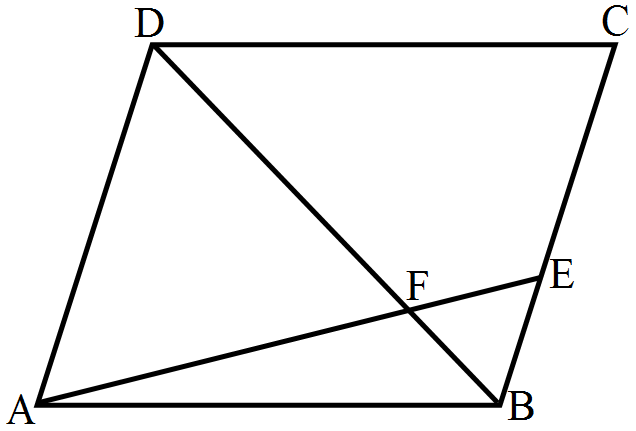
ABCD is a parallelogram and E is a point on BC. If the diagonal BD intersect AE at F, prove that AF × FB = EF × FD.
Answer

Given: ABCD is a parallelogram and E is point on BC. Diagonals DB intersects AE at F.
To Prove: AF × FB = EF × FD
Proof: In $\triangle\text{AFD}$ and $\triangle\text{EFD}$
$\angle\text{AFD}=\angle\text{EFB}$ $($vertically opposite $\angle\text{s})$
$\angle\text{DAF}=\angle\text{BEF}$ $($ Alternate $\angle\text{s})$
$\therefore\triangle\text{AFD}\approx\triangle\text{EFD}$ [By AAA similarity]
$\therefore\frac{\text{AF}}{\text{EF}}=\frac{\text{FD}}{\text{FB}}$
$\text{AF}\times\text{FB}=\text{EF}\times\text{FD}$
Hence proved.
View full question & answer
Question 235 Marks
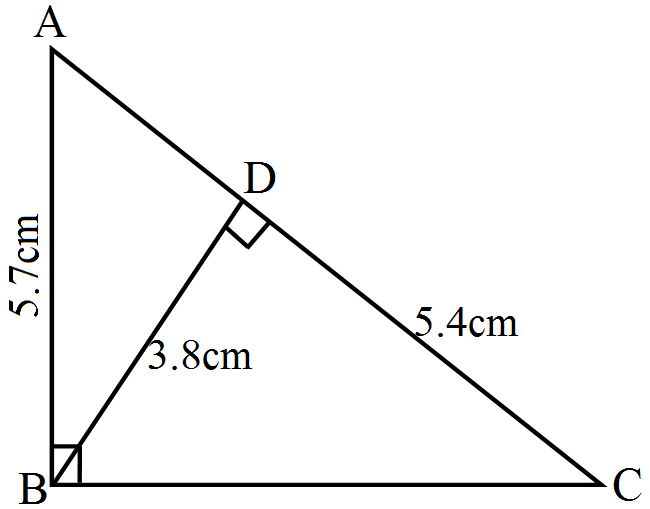
In the given figure, $\angle\text{ABC}=90^\circ$ and $\text{BD}\perp\text{AC}.$ If AB = 5.7cm, BD = 3.8cm, and CD = 5.4cm find BC.
Answer

Given that AB = 5.7cm, BD = 3.8cm, and CD = 5.4cm
In $\triangle\text{CBA}$ and $\triangle\text{CDB}$
$\angle\text{CBA}=\angle\text{CDB}=90^\circ$
$\angle\text{C}=\angle\text{C}$ (common)
Therefore, $\triangle\text{CBA}\sim\triangle\text{CDB}$ (by AA similarities)
$\Rightarrow\frac{\text{BC}}{\text{CD}}=\frac{\text{BA}}{\text{BD}}$
$\Rightarrow\frac{\text{BC}}{\text{5.4}}=\frac{\text{5.7}}{\text{3.8}}$
$\Rightarrow\text{BC}=\frac{\text{5.7}\times5.4}{\text{3.8}}$
$\therefore\text{BC}=8.1\text{cm}$
Hence, BC= 8.1cm
View full question & answer
Question 245 Marks
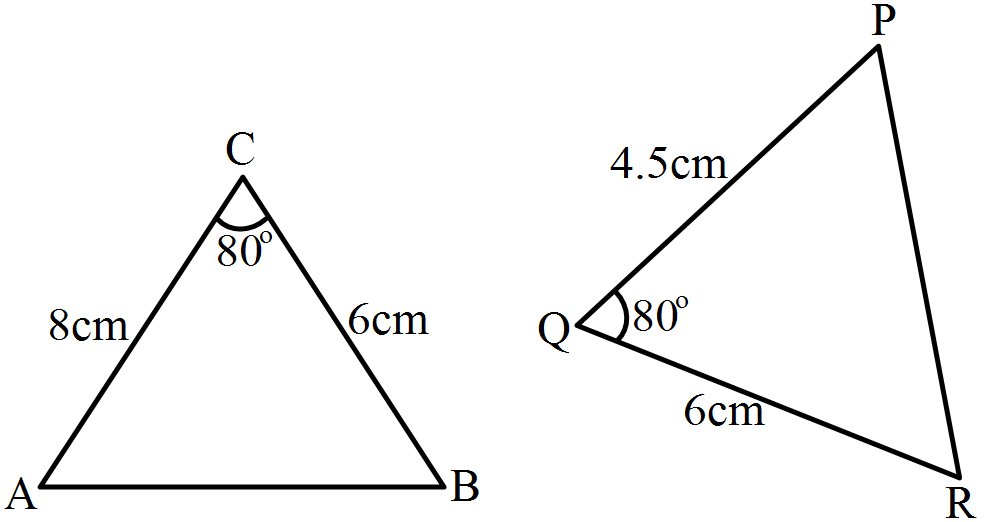
In the given pairs of triangles, find which pair of triangles are similar. State the similarity criterior and write the similarity relation in symbolic from.
Answer
$\triangle\text{CAB}\sim\triangle\text{QRP}$ (SAS Similarity)
as $\frac{\text{CA}}{\text{QR}}=\frac{\text{CB}}{\text{QP}}$ and $\angle\text{C}=\angle\text{Q}$
View full question & answer
Question 255 Marks
The sides of certain triangles are given below. Determine them are right triangles:
7cm, 24cm, 25cm.
Answer
For a given triangle to be a right angled, the sum of the squares of the two sides must be equal to the square of the largest side.
Let a = 7cm, b = 24cm and c = 25cm, Then
$\big(\text{a}^2+\text{b}^2\big)=\big[7^2+(24)^2\big]\text{cm}^2$
$=(49+576)\text{cm}^2$
$=625\text{cm}^2$
$\text{c}^2=(25\text{cm})^2=625\text{cm}^2$
$\therefore\big(\text{a}^2+\text{b}^2\big)-\text{c}^2$
Hence, the given triangle is a right triangle.
View full question & answer
Question 265 Marks
The areas of two similar triangles are $169 cm^2$ and $121 cm^2$ respectively. If the longest side of the larger triangle is 26 cm , find the longest side of the smaller triangle.
Answer
It is given that the triangle are similar.
Therefore, the ratio of the areas of these triangle will be equal to the ratio of squares of their corresponding sides.
Let the longest side of smaller triangle be x cm.
$\frac{\text{ar(Larger triangle)}}{\text{ar(Smalles triangle)}}=\frac{(\text{Longest side of larger triangle})^2}{(\text{Longest side of smaller triangle})^2}$
$\Rightarrow\frac{169}{121}=\frac{26^2}{\text{x}^2}$
$\Rightarrow\text{x}=\sqrt{\frac{26\times26\times121}{169}}$
$=22$
Hence, the longest side of the smaller triangle is 22cm.
View full question & answer
Question 275 Marks
State the converse of Pythagpras' theorem.
Answer
In a triangle, if the square of one side is equal to the sum of the squeares of the other two sides then the angle opposite to the first side is a right angle.
View full question & answer
Question 285 Marks
In the given figure, $\triangle\text{OAB}\sim\triangle\text{OCD}.$ If AB = 8cm, BO = 6.4cm, OC = 3.5cm and CD = 5cm, find.
  1. OA
  2. DO
Answer
  1. Let OA be x cm.
$\therefore\triangle\text{OAB}\sim\triangle\text{OCD}$

$\therefore\frac{\text{OA}}{\text{OC}}=\frac{\text{AB}}{\text{CD}}$

$\Rightarrow\frac{\text{x}}{\text{3.5}}=\frac{\text{8}}{\text{5}}$ and

$\Rightarrow\text{x}=\frac{8\times3.5}{5}=5.6$

hence, OA = 5.6cm
  1. Let OD be y cm
$\therefore\triangle\text{OAB}\sim\triangle\text{OCD}$

$\therefore\frac{\text{AB}}{\text{CD}}=\frac{\text{OB}}{\text{OD}}$

$\Rightarrow\frac{\text{8}}{\text{5}}=\frac{\text{6.4}}{\text{y}}$

$\Rightarrow\text{y}=\frac{6.4\times5}{8}=4$
View full question & answer
Question 295 Marks
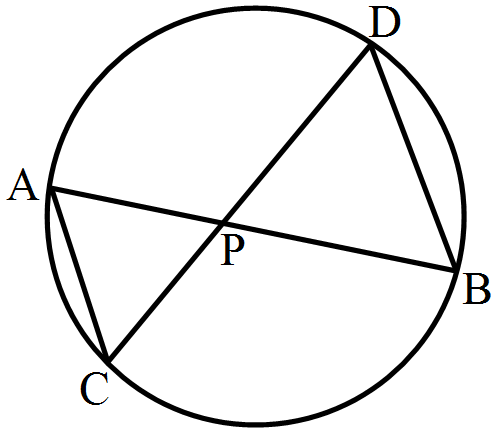
In a circle, two chords AB and CD intersect a point P inside the circle. Prove that
  1. $\triangle\text{PAC}\sim\triangle\text{PDB}$
  2. $\text{PA}.\text{PB}=\text{PC}.\text{PD}$
Answer
In $\triangle\text{PAC}$ and $\triangle\text{BPD},$
$\angle\text{APC}=\angle\text{BPD}$ .....(Vertically opposite angles)
$\angle\text{CAP}=\angle\text{BDP}$ ......(Angels inscribed in the same are equal)
$\therefore\triangle\text{PAC}\sim\triangle\text{PDB}$ .....(AA similarity criterion)
$\Rightarrow\frac{\text{PA}}{\text{PD}}=\frac{\text{PC}}{\text{PB}}$
$\Rightarrow\text{PA}.\text{PB}=\text{PC}.\text{PD}$
View full question & answer
Question 305 Marks
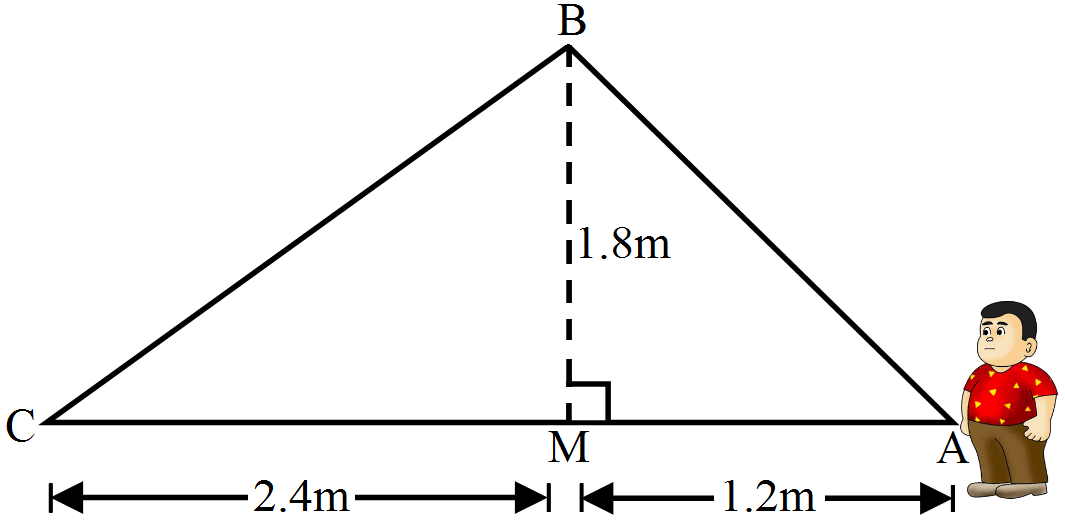
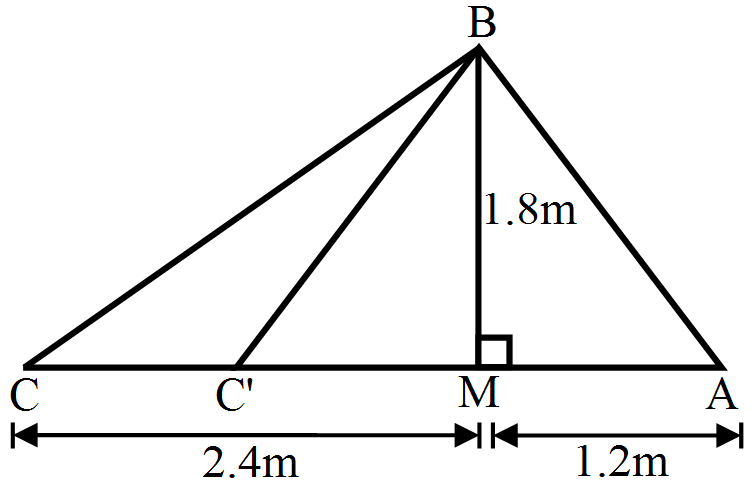
Naman is diing fly-fishing in a stream. The tip of his fishing rod is 1.8m above the surface of the water and the fly at the eand of the string rests on the water 3.6m away from him and 2.4m from the point directly under the tip of the rod Assuming that the string (from tip of his rod to the fly) is taut, how much string does he have out (see the adjoining figure)? If he pulls in the string at the rate of 5cm per second, what will be the horizontal distance of the fly from him after 12 seconds?
Answer
Given that Naman pulls is the string at the rate of 5cm per second. Hence, after 12 second the lenght of the string he pulls = 12 × 5 = 60cm = 0.6m In right $\triangle\text{BMC},$ By Pythagoras theorem,
$BC^2 = CM^2 + MB^2$
$\Rightarrow BC^2 = (2.4)^2 + (1.8)^2$
$\Rightarrow BC^2 = 5.76 + 3.24$
$\Rightarrow BC^2= 9$
$\Rightarrow BC^2 = 3m$
$So, BC' = BC $- lenght of the string he pulled after 12 seconds
$\Rightarrow BC' = BC - 0.6$
$\Rightarrow BC' = 3 - 0.6$
$\Rightarrow BC' = 2$.4m In right $\triangle\text{ABC}'\text{M},$
By Pythagoras theorem,
$C'M^2 = BC'^2- MB^2$
$\Rightarrow C'M^2 = (2.4)^2 - (1.8)^2$
$\Rightarrow C'M^2 = 5.76 - 3.24$
$\Rightarrow C'M^2 = 2.52 \Rightarrow C'M^2 = 1.59m $ .....(approximately)
The horizontal distance of the fly from him after 12 second
= C' A = C' M + MA = 1.59 + 1.2 = 2.79m approximately = 2.8m approximately
View full question & answer
Question 315 Marks
In triangles BMP and CNR it is given that PB = 5cm, MP = 6cm, BM = 9cm and NR = 9cm. If $\triangle\text{BMP}\sim\triangle\text{CNR}$ then find the perimeter of $\triangle\text{CNR}.$
Answer
$\triangle\text{BMP}\sim\triangle\text{CNR}$
$\Rightarrow\frac{\text{Perimeters of }\triangle\text{BMP}}{\text{Perimeters of }\triangle\text{CNR}}=\frac{\text{PB}}{\text{RC}}=\frac{\text{MP}}{\text{NR}}=\frac{\text{MB}}{\text{NC}}$
$\Rightarrow\frac{\text{BM+MP+PB }}{\text{Perimeters of }\triangle\text{CNR}}=\frac{\text{PB}}{\text{RC}}=\frac{\text{MP}}{\text{NR}}=\frac{\text{MB}}{\text{NC}}$
$\Rightarrow\frac{\text{9+6+5 }}{\text{Perimeters of }\triangle\text{CNR}}=\frac{\text{5}}{\text{RC}}=\frac{\text{6}}{\text{9}}=\frac{\text{9}}{\text{NC}}$
$\Rightarrow\frac{\text{20}}{\text{Perimeters of }\triangle\text{CNR}}=\frac{\text{6}}{9}$
$\Rightarrow\text{Perimeters of }\triangle\text{CNR}=\frac{\text{20}\times9}{9}$
$\Rightarrow\text{Perimeters of }\triangle\text{CNR}=30\text{cm}$
View full question & answer
Question 325 Marks
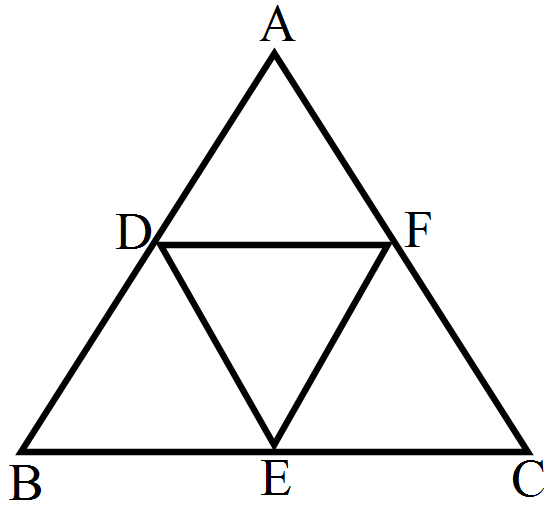
If D, E and F are respectively the midpoint of sides AB, BC and CA of $\triangle\text{ABC}$ then what is the ratio of the areas of $\triangle\text{DEF}$ and $\triangle\text{ABC}?$
Answer

Given: A $\triangle\text{ABC}$ in which D, E and F are respectively the midpoints of sides AB, BC and CA
To find: $\text{ar}(\triangle\text{DEF}):\text{ar}(\triangle\text{ABC})$
Since E and F are the mid-points of BC and CA respectively,
so EF || AB and $\text{EF}=\frac{1}{2}\text{AB}$
...(By the converse of Basic Proportionality theorem)
In particular, EF || BD.
$\therefore$ BDFE is a || gm.
Similarly, EDAF is a || gm.
Now, in $\triangle\text{DEF}$ and $\triangle\text{ABC},$
$\angle\text{E}=\angle\text{A}$ ...(opposite angles of a || gm are equal)
$\angle\text{F}=\angle\text{B}$ ...(opposite angles of a || gm are equal)
$\therefore\triangle\text{DEF}\sim\triangle\text{CAB}$ ...(AA criterion for similarity)
We know that, the ratio of the areas of two similar triangles is equal to the ratio of the squares of their corresponding sides.
$\therefore\frac{\text{ar}(\triangle\text{DEF})}{\text{ar}(\triangle\text{CAB})}=\frac{\text{EF}^2}{\text{AB}^2}=\frac{\Big(\frac{1}{2}\text{AB}\Big)^2}{\text{AB}^2}=\frac{1}{4}$
Hence, $\text{ar}(\triangle\text{DEF}):\text{ar}(\triangle\text{ABC})\text{ is }1:4.$
View full question & answer
Question 335 Marks
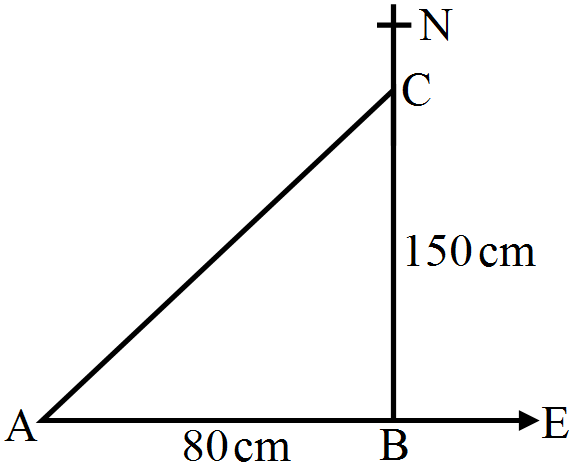
A man goes 80m due east and then 150m due north. How far is he from the starting point?
Answer
starting from A, let the man goas from A to B and from B to C, as shows in the figure. Then, $\text{AB}=80\text{m,}\text { BC}=150\text{m}$ and $\angle\text{ABC}=90^\circ$
From right $\triangle\text{ABC},$ we have $\text{AC}^2=\big(\text{AB}^2+\text{BC}^2\big)\text{m}^2$ $=\big[(80)^2+(150)^2\big]\text{m}^2$ $=(6400+22500)\text{m}^2$ $=28900\text{m}^2$ $\therefore\text{AC}=\sqrt{28900}\text{m}=170\text{m}$ Hence, the man is 170m north-east from the starting point.
View full question & answer
Question 345 Marks
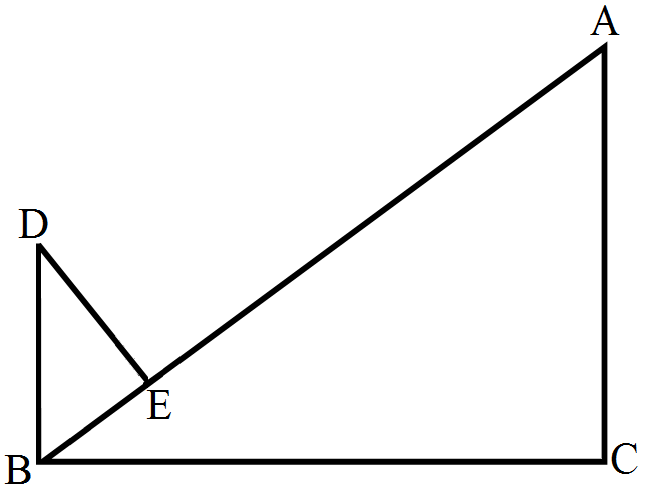
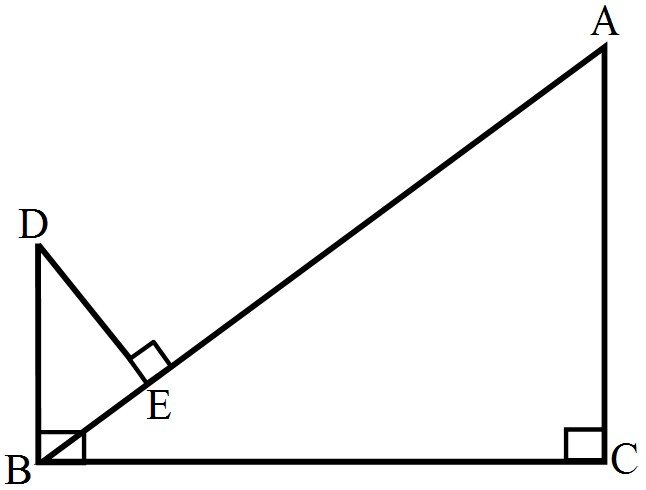
In the given figure, $\text{DB}\perp\text{BC},\text{DE}\perp\text{AB}$ and $\text{AC}\perp\text{BC}.$
Prove that $\frac{\text{BE}}{\text{DE}}=\frac{\text{AC}}{\text{BC}}.$
Answer

In the given figure : $\text{DB}\perp\text{AB},\text{AC}\perp\text{BC}$ and DB || AC
$\therefore\angle\text{DBC}=\angle\text{ACB}$
AB is the transversal
$\therefore\angle\text{DBE}=\angle\text{BAC}$ $\big[\text{Alternate }\angle\text{s}\big]$
In $\triangle\text{DBE}$ and $\triangle\text{ABC}$
$\angle\text{DEB}=\angle\text{ACB}=90^\circ$
$\angle\text{DBE}=\angle\text{BAC}$
$\triangle\text{DBE}\sim\triangle\text{ABC}$ [By AA similarity]
$\Rightarrow\frac{\text{BE}}{\text{DE}}=\frac{\text{AC}}{\text{BC}}$
Hence proved.
View full question & answer
Question 355 Marks
For the following statments state whether true (T) or false(F):
The sum of the squares on the sides of a rhombus is equal to the sum of the squares on its diagonals.
Answer
True.Solution:

Given: A rhombus ABCD whose diagonals AC and BD intersect at O.
To prove: $(AB^2 + BC^2 + CD^2 + AD^2) = (AC^2 + BD^2)$
Proof:
We know that the diagonals of a rhombus are perpendicular bisectors of each other,
$\therefore\angle\text{AOB}=\angle\text{BOC}=\angle\text{COD}=\angle\text{DOA}=90^\circ$
$\text{OA}=\frac{1}{2}\text{AC}$ and $\text{OB}=\frac{1}{2}\text{BD}$
From right $\triangle\text{AOB},$
$\text{AB}^2=\text{OA}^2+\text{OB}^2$
$\Rightarrow\text{AB}^2=\Big(\frac{1}{2}\text{AC}\Big)^2+\Big(\frac{1}{2}\text{BD}\Big)^2$
$\Rightarrow\text{AB}^2=\frac{1}{4}(\text{AC}^2+\text{BD}^2)$
$\Rightarrow4\text{AB}^2=\text{AC}^2+\text{BD}^2\dots(\text{i})$
Similarly, we have
$4\text{BC}^2-\text{AC}^2+\text{BD}^2\dots(\text{ii})$
$4\text{CD}^2=\text{AC}^2+\text{BD}^2\dots(\text{iii})$
$4\text{DA}^2=\text{AC}^2+\text{BD}^2\dots(\text{iv})$
Addind (i), (ii), (iii) and (iv), we get
$\text{AB}^2+\text{BC}^2+\text{CD}^2+\text{DA}^2=\text{AC}^2+\text{BD}^2$
View full question & answer
Question 365 Marks
D and E are points on the sides AB and AC respectively of a $\triangle\text{ABC}$ such that DE || BC:
If $\frac{\text{AD}}{\text{DB}}=\frac{4}{7}$ and AC = 6.6cm, find AE.
Answer
In $\triangle\text{ABC},$ it is given that DE || BC.
Applying Thales' theorem, we get:
$\frac{\text{AD}}{\text{DB}}=\frac{\text{AE}}{\text{EC}}$
$\Rightarrow\frac{\text{4}}{\text{7}}=\frac{\text{AE}}{\text{EC}}$
Adding 1 to both sides, we get:
$\Rightarrow\frac{\text{11}}{\text{7}}=\frac{\text{AE}}{\text{EC}}$
$\text{EC}=\frac{6.6\times7}{11}=4.2\text{cm}$
Therefore, $\text{AE}=\text{AC}-\text{EC}=6.6-4.2=2.4\text{cm}$
View full question & answer
Question 375 Marks
State the basic proportionality theorem.
Answer
If a line is drawn parallel to one side of a triangle to intersect the other two sides in distinct point, then the other sides are divided in the same ratio.
View full question & answer
Question 385 Marks
For the following statments state whether true (T) or false(F):
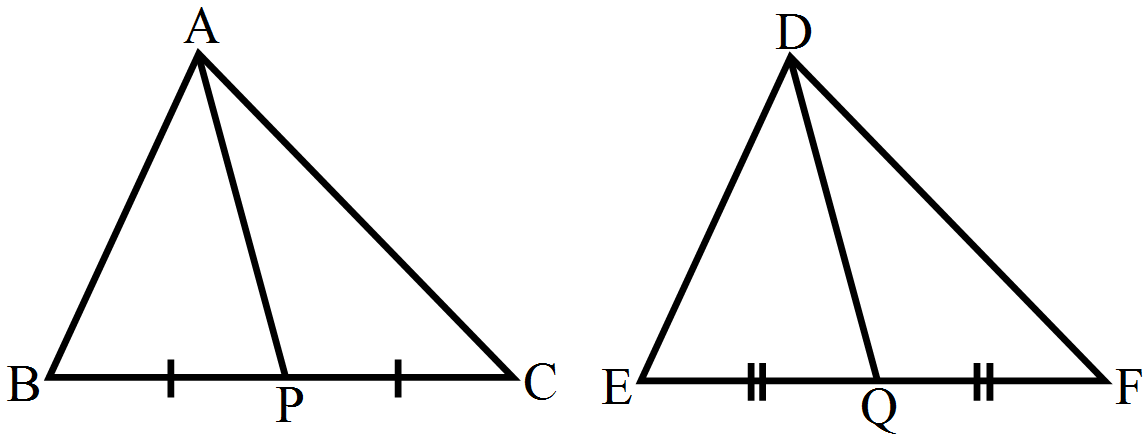
The ratio of the perimeters of two similar triangles is the same as the ratio of their corresponding medians.
Answer
True. Solution:
Given $\triangle\text{ABC}\sim\triangle\text{DEF}$ $\Rightarrow\frac{\text{AB}}{\text{DE}}=\frac{\text{BC}}{\text{EF}}=\frac{\text{AC}}{\text{DF}}$ $\Rightarrow\frac{\text{AB}}{\text{DE}}=\frac{2\text{BP}}{2\text{EQ}}=\frac{\text{BP}}{\text{EQ}}$ and $\angle\text{B}=\angle\text{E}$ Now, in $\triangle\text{APB}$ and $\triangle\text{DQE},$ $\angle\text{B}=\angle\text{E}$ $\frac{\text{AB}}{\text{DE}}=\frac{\text{BP}}{\text{EQ}}$ $\Rightarrow\triangle\text{APB}\sim\triangle\text{DQE}$ .....(SAS criterion for similarity) $\therefore\frac{\text{AB}}{\text{DE}}=\frac{\text{AP}}{\text{DQ}}$ So, $\frac{\text{AB}}{\text{DE}}=\frac{\text{BC}}{\text{EF}}=\frac{\text{AC}}{\text{DF}}=\frac{\text{AP}}{\text{DQ}}$ We now that, The ratio of the perimeters of two similar triangles is the same as the ratio of their corresponding sides. That is, $\frac{\text{AB}+\text{BC}+\text{AC}}{\text{DE+EF+DF}}=\frac{\text{AP}}{\text{DQ}}$
View full question & answer
Question 395 Marks
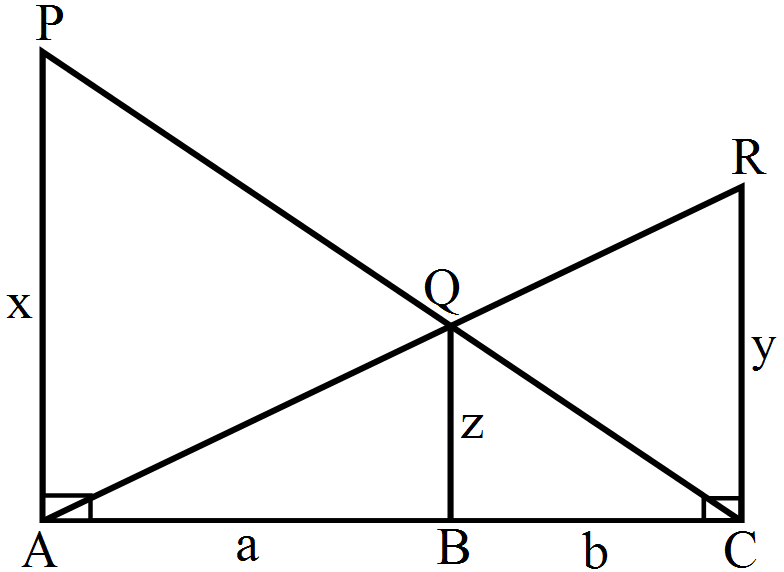
In the given figure, each one of PA , QB and RC is perpendicular to AC. If AP = x, QB = z, RC = y, AB = a and BC = b, show that $\frac{1}{\text{x}}+\frac{1}{\text{y}}=\frac{1}{\text{z}}.$
Answer
In $\triangle\text{PAC}$ and $\triangle\text{QBC},$ we have:
$\angle\text{A}=\angle\text{B}$ (Both angles are 90º)
$\angle\text{P}=\angle\text{Q}$ (Corresponding angle)
and
Therefore, $\triangle\text{PAC}\sim\triangle\text{QBC}$
$\frac{\text{AP}}{\text{BQ}}=\frac{\text{AC}}{\text{BC}}$
$\Rightarrow\frac{\text{x}}{\text{z}}=\frac{\text{a+b}}{\text{b}}$
$\Rightarrow\text{a}+\text{b}=\frac{\text{bx}}{\text{z}}\dots(1)$
In $\triangle\text{RCA}$ and $\triangle\text{QBA},$ we have:
$\angle\text{C}=\angle\text{B}$ (Both angles are 90º)
$\angle\text{R}=\angle\text{Q}$ (Corresponding angles)
and
$\angle\text{A}=\angle\text{A}$ (common angles)
Therefore, $\triangle\text{RCA}\sim\triangle\text{QBA}$
$\frac{\text{RC}}{\text{BQ}}=\frac{\text{AC}}{\text{AB}}$
$\Rightarrow\frac{\text{y}}{\text{z}}=\frac{\text{a+b}}{\text{a}}$
$\Rightarrow\text{a}+\text{b}=\frac{\text{ay}}{\text{z}}\dots(2)$
From equation (1) and (2), we have:
$\frac{\text{bx}}{\text{z}}=\frac{\text{ay}}{\text{z}}$
$\Rightarrow\text{bx}=\text{ay}$
$\frac{\text{a}}{\text{b}}=\frac{\text{x}}{\text{y}}\dots(3)$
Also,
$\Rightarrow\frac{\text{x}}{\text{z}}=\frac{\text{a+b}}{\text{b}}$
$\Rightarrow\frac{\text{x}}{\text{z}}=\frac{\text{a}}{\text{b}}+1$
Using the value of $\frac{\text{a}}{\text{b}}$ from equation (3), we have:
$\Rightarrow\frac{\text{x}}{\text{z}}=\frac{\text{x}}{\text{y}}+1$
Dividing both side by x, we get:
$\frac{\text{1}}{\text{z}}=\frac{\text{1}}{\text{y}}+\frac{\text{1}}{\text{z}}$
$\therefore\frac{\text{1}}{\text{x}}+\frac{\text{1}}{\text{y}}=\frac{\text{1}}{\text{z}}$
This completes the proof.
View full question & answer
Question 405 Marks
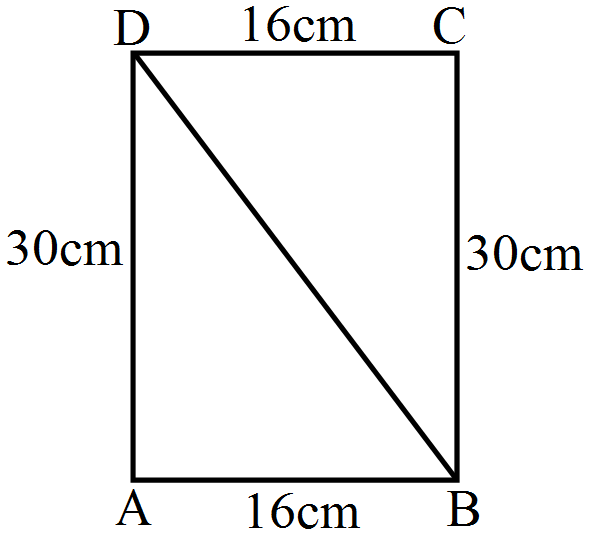
Find the lenght of a diagonal of a rectangle whose adjacent side are 30cm and 16cm.
Answer
Let ABCD is the given rectangle let BD is a diagonal making a $\triangle\text{ADB}.$ $\Rightarrow\angle\text{BAD}=90^\circ$
Using Pythagoras theorem: $(\text{DB})^2=\text{AB}^2+\text{AD}^2$ $\text{DB}^2=\big(16^2+30^2\big)\text{cm}^2$ $\text{DB}=\sqrt{16^2+30^2}\text{cm}$ $=\sqrt{256+900}$ $=34\text{cm}$ Hence, lenght of diagonal DB is 34cm.
View full question & answer
Question 415 Marks
$\triangle\text{ABC}$ is an equilateral triangle of side 2a units. Find each of its altitudes.
Answer
In an equilateral triangle all sides are equal. Then, AB = BC = AC = 2a uints Const: Draw an altitude $\text{AD}\perp\text{BC}$ Given BC = 2a Then, BD = a
In $\triangle\text{ABD},$ $\angle\text{ADB}=90^\circ$ $(\text{AB})^2=\text{(AD)}^2+\text{(BD})^2$ (by pythagoras theorem) $\text{(AD})^2=\big(\text{AB}^2-\text{BD}^2\big)$ $=\Big[(2\text{a})^2-(\text{a})^2\Big]\text{sq}.\text{units}$ $=\big(4\text{a}^2-\text{a}^2\big)\text{sq}.\text{unit}=3\text{a}^2\text{sq}.\text{unit}$ $\text{AD}=\sqrt{3\text{a}^2}\text{unit}=\text{a}\sqrt{3}\text{ unit}$ Hence, lenght of each altitude is $\text{a}\sqrt{3}\text{ units}$
View full question & answer
Question 425 Marks
The areas of two similar triangles are $81 cm^2$ and $49 cm^2$ respectively. If the altitudes of the first triangle is 6.3 cm , find the corresponding altitude of the other.
Answer
It is given that the triangles are similar.
Therefore, the ratio of the areas of these triangles is will be equal to the ratio of squares of their corresponding sides.
Also, the ratio of areas of two similar triangles is equal to the ratio of square of their correspondind altitudes.
Let the two triangles be ABC and DEF with altitudes AP and DQ, respectively.

$\frac{\text{ar}(\triangle\text{ABC})}{\text{ar}(\triangle\text{PQR})}=\frac{\text{AP}^2}{\text{DQ}^2}$
$\Rightarrow\frac{81}{49}=\frac{\text{6.3}^2}{\text{DQ}^2}$
$\Rightarrow\text{DQ}^2=\frac{49}{81}\times6.3^2$
$\Rightarrow\text{DQ}^2=\sqrt{\frac{49}{81}\times6.3\times6.3}$
$=4.9\text{cm}$
Hence, the altitude of the other triangle is 4.9cm.
View full question & answer
Question 435 Marks
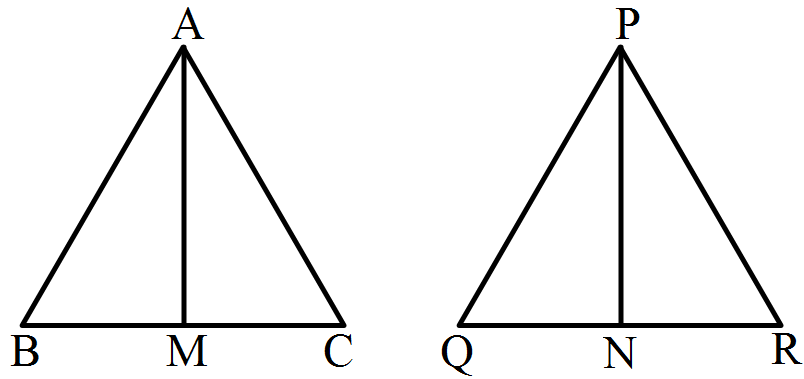
The areas of two similar triangles are $100 cm^2$ and $64 cm^2$ respectively. If a median of the smaller triangle is 5.6 cm , find the correspondin median of the other.
Answer
Let the two triangles be ABC and PQR with median AM and PN, respectively.

Therefore, the ratio of areas of two similar triangles will be equal to the ratio of squares of their corrrsponding medians.
$\therefore\frac{\text{ar}(\triangle\text{ABC})}{\text{ar}(\triangle\text{PQR})}=\frac{\text{AM}^2}{\text{PN}^2}$
$\Rightarrow\frac{64}{100}=\frac{\text{5.6}^2}{\text{PN}^2}$
$\Rightarrow\text{PN}^2=\frac{64}{100}\times5.6^2$
$\Rightarrow\text{PN}^2=\sqrt{\frac{100}{64}\times5.6\times5.6}$
$=7\text{cm}$
Hence, the median of the larger triangle is 7cm.
View full question & answer
Question 445 Marks
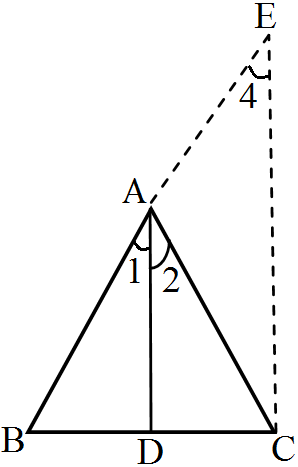
Prove that the internal bisector of an angle of a triangle divides the opposite side internally in the ratio of the sides containing the angle.
Answer
Let the triangle be ABC with AD as the bisector of $\angle\text{A}$ which meets BC at D.
We have to prove:
$\frac{\text{BD}}{\text{DC}}=\frac{\text{AB}}{\text{AC}}$

Draw CE || DA, meeting BA produced at E
CE || DA
Therefore,
$\angle2=\angle3$ (Alternate angles)
and $\angle1=\angle4$ (Corresponding angles)
But,
$\angle1=\angle2$
Therefore,
$\angle3=\angle4$
$\Rightarrow\text{AE}=\text{AC}$
In $\triangle\text{BCE},\text{DA }||\text{ CE}.$
Applying Thales' theorem, we have:
$\frac{\text{BD}}{\text{DC}}=\frac{\text{AB}}{\text{AE}}$
$\Rightarrow\frac{\text{BD}}{\text{DC}}=\frac{\text{AB}}{\text{AC}}$
This completes the proof.
View full question & answer
Question 455 Marks
State the SAS-similarity criterion.
Answer
If one angle of a triangle is equal to one angle of the other triangle and the sides including these angles are proportional then the two triangles are similar.
View full question & answer
Question 465 Marks
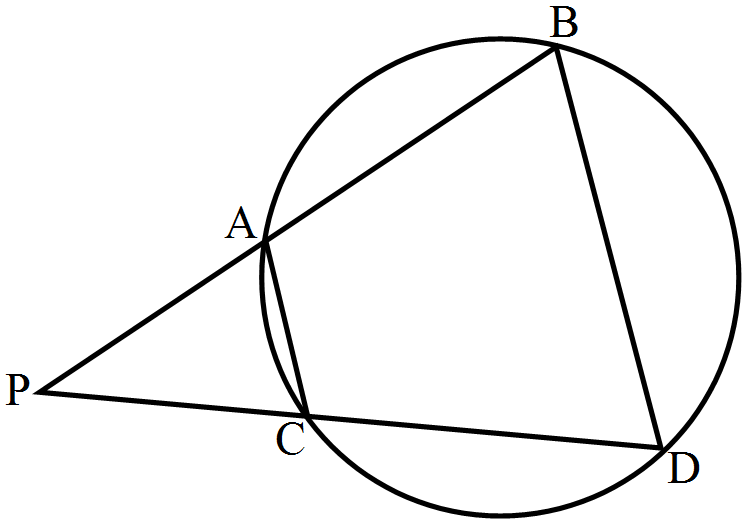
Two chords AB and CD of a circle intersect at a point P outside the ciecle. Prove that.
  1. $\triangle\text{PAC}\sim\triangle\text{PDB}$
  2. $\text{PA}.\text{PB}=\text{PC}.\text{PD}$
Answer
In $\triangle\text{PAC}$ and $\triangle\text{PDB},$
$\angle\text{APC}=\angle\text{BPD}$ .....(common angle)
Since ABCD is a cyclic quadrilateral,
$\angle\text{PAC}=\angle\text{BDP}$
$\therefore\triangle\text{PAC}\sim\triangle\text{PDB}$ .....(AA similarity criterion)
$\Rightarrow\frac{\text{PA}}{\text{PD}}=\frac{\text{PC}}{\text{PB}}$
$\Rightarrow\text{PA}.\text{PB}=\text{PC}.\text{PD}$
View full question & answer
Question 475 Marks
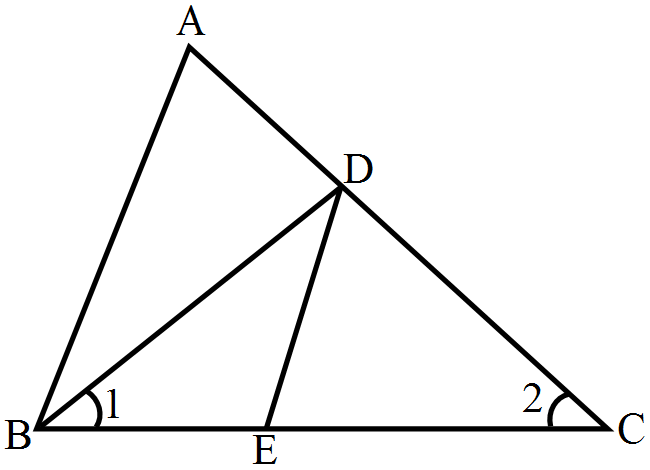
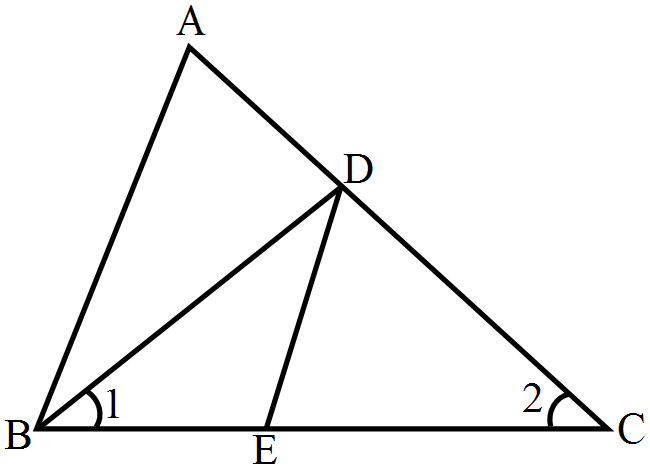
In the given figure, $\angle1=\angle2$ and $\frac{\text{AC}}{\text{BD}}=\frac{\text{CB}}{\text{CE}}$
Prove that $\triangle\text{ACB}\sim\triangle\text{DCE}.$
Answer

$\angle1=\angle2$ (given)
$\frac{\text{AC}}{\text{BD}}=\frac{\text{CB}}{\text{CE}}\Rightarrow\frac{\text{AC}}{\text{CB}}=\frac{\text{BD}}{\text{CE}}$ (given)
Also, $\angle2=\angle1$ $\big[\therefore\text{BD}=\text{DC}\big]$
Thus, $\frac{\text{AC}}{\text{CB}}=\frac{\text{BD}}{\text{CE}}$
and $\angle2=\angle1$
Therefore, by SAS similarity criterion $\triangle\text{ACB}\sim\triangle\text{DCE}$
View full question & answer
Question 485 Marks
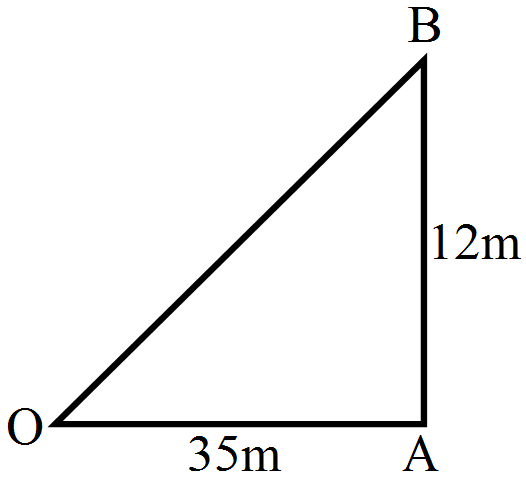
A man goes 12m due south and then 35m due west. How far is he from the starting point?
Answer

Let the starting point be B.
Since $\triangle\text{OAB}$ forms a right-angled triangle,
By Pythagoras theorem,
$OB^2 = OA^2 + AB^2$
$\Rightarrow OB^2 = 35^2 + 12^2$
$\Rightarrow OB^2 = 1225 + 144$
$\Rightarrow OB^2 = 1369$
$\Rightarrow OB = 37m$
So, he is 37m away from the starting point.
View full question & answer
Question 495 Marks
In the given figure, D is the midpoint of side BC and $\text{AE}\perp\text{BC}.$ If BC = a, AC = b, AB = c, ED = x, AD = p and AE = h, prove that.
$(\text{b}^2+\text{c}^2)=2\text{p}^2+\frac{1}{2}\text{a}^2$
Answer
Given: D is the midpoint of side $\text{BC},\text{AE}\perp\text{BC}$
$\text{BC}=\text{a},\text{AC}=\text{b},\text{AB}=\text{c},\text{ED}=\text{x},\text{AD}=\text{p}$ and $\text{AE}=\text{h}$
In $\triangle\text{AEC},\angle\text{AEC}=90^\circ$
$\text{AD}^2=\text{AE}^2+\text{ED}^2$ (by pythagoras theorem)
$\Rightarrow\text{p}^2=\text{h}^2+\text{x}^2$
Adding (1) and (2), we get
$\text{b}^2+\text{c} ^2=\text{p}^2+\text{ax}+\frac{\text{a}^2}{4}+\text{p}^2-\text{ax}+\frac{\text{a}^2}{4}$
$\big(\text{b}^2+\text{c}^2\big)=2\text{p}^2+\frac{1}{2}\text{a}^2$
View full question & answer
Question 505 Marks
For the following statments state whether true (T) or false(F):
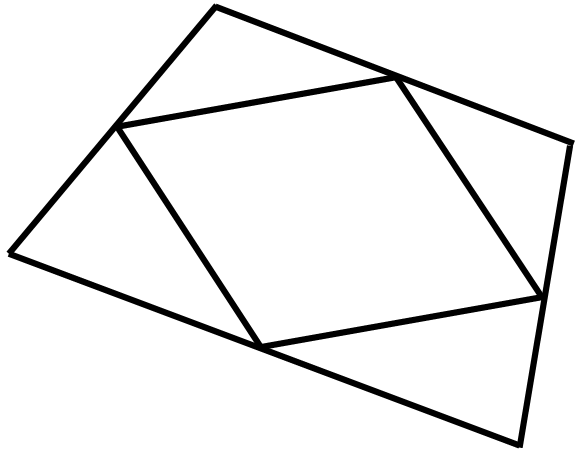
The polygon formed by joining the midpoit of the sides of a quadrilateral is a rhombus.
Answer
False. Solution:
The line segments joining the midpoint of the adjacent sides of a quadrilateral form a parallelogram as shown. It may or may not be a rhombus.
View full question & answer
5 Marks Questions - MATHS STD 10 Questions - Vidyadip