Question 13 Marks
A man of mass $70kg$ stands on a weighing scale in a lift which is moving. Upwards with a uniform acceleration of $5ms^{-2}$. What would be the readings on the scale in each case?
AnswerMass of the man, m = 70kg Acceleration, $a = 5m/s^2$ upward Using Newton’s second law of motion, we can write the equation of motion as: R - mg = ma R = m(g + a) = 7(10 + 5) = 70 × 15 = 1050N
$\therefore$ Reading on the weighing scale $=\frac{1050}{\text{g}}=\frac{1050}{10}=105\text{kg}$
View full question & answer→Question 23 Marks
A constant retarding force of $50N$ is applied to a body of mass $20kg$ moving initially with a speed of $15ms^{-1}$. How long does the body take to stop?
AnswerRetarding force, F = –50N Mass of the body, m = 20kg Initial velocity of the body, u = 15m/s Final velocity of the body, v = 0 Using Newton’s second law of motion, the acceleration (a) produced in the body can be calculated as: F = ma –50 = 20 × a
$\therefore\text{a}=\frac{-50}{20}=-2.5\text{ms}^{-2}$ Using the first equation of motion, the time (t) taken by the body to come to rest can be calculated as: v = u + at $\therefore\text{t}=\frac{-\text{u}}{\text{a}}=\frac{-15}{-2.5}=6\text{s}$
View full question & answer→Question 33 Marks
A man of mass $70kg$ stands on a weighing scale in a lift which is moving. Downwards with a uniform acceleration of $5ms^{-2}$.
AnswerMass of the man, $m = 70kg$ Acceleration, $a = 5m/s^2$ downward Using Newton’s second law of motion, we can write the equation of motion as: R + mg = ma R = m(g - a) = 70(10 - 5) = 70 × 5 = 350N
$\therefore$ Reading on the weighing scale $=350\text{g}=\frac{350}{10}=35\text{kg}$
View full question & answer→Question 43 Marks
A bob of mass $0.1\ kg$ hung from the ceiling of a room by a string $2m$ long is set into oscillation. The speed of the bob at its mean position is $1ms^{-1}$ . What is the trajectory of the bob if the string is cut when the bob is $(a)$ at one of its extreme positions, $(b)$ at its mean position.
Answer
- Vertically downward: At the extreme position, the velocity of the bob becomes zero. If the string is cut at this moment, then the bob will fall vertically on the ground.
- Parabolic path: At the mean position, the velocity of the bob is $1m/s$. The direction of this velocity is tangential to the arc formed by the oscillating bob. If the bob is cut at the mean position, then it will trace a projectile path having the horizontal component of velocity only. Hence, it will follow a parabolic path.
View full question & answer→Question 53 Marks
A man of mass $70kg$ stands on a weighing scale in a lift which is moving. Upwards with a uniform speed of $10 ms^{-1}$.
AnswerMass of the man, m = 70kg Acceleration, a = 0 Using Newton’s second law of motion, we can write the equation of motion as: R - mg = ma Where, ma is the net force acting on the man. As the lift is moving at a uniform speed, acceleration a = 0 $\therefore$ R = mg = 70 × 10 = 700N
$\therefore$ Reading on the weighing scale $=\frac{700}{\text{g}}=\frac{700}{10}=70\text{kg}$
View full question & answer→Question 63 Marks
A rocket with a lift-off mass $20,000kg$ is blasted upwards with an initial acceleration of $5.0ms^{-2}$. Calculate the initial thrust (force) of the blast.
AnswerGiven: Mass of the rocket, $\mathrm{m}=20,000 \mathrm{~kg}$ Initial acceleration, $a=5 \mathrm{~m} / \mathrm{s}^2$ Acceleration due to gravity, $\mathrm{g}=10 \mathrm{~m} / \mathrm{s}^2$ Using Newton's second law of motion, the net force (thrust) acting on the rocket is given by the relation: ( $F-\mathrm{mg}$ ) = ma $\mathrm{F}=$ $m(g+a)=(20000 \times(10+5))=(20000 \times 15)=3 \times 10^5 \mathrm{~N}$
View full question & answer→Question 73 Marks
A man of mass 70kg stands on a weighing scale in a lift which is moving. What would be the reading if the lift mechanism failed and it hurtled down freely under gravity?
AnswerWhen the lift moves freely under gravity, acceleration a = g Using Newton’s second law of motion, we can write the equation of motion as: R + mg = ma R = m(g – a) = m(g - g) = 0 $\therefore$ Reading on the weighing scale $\frac{0}{\text{g}}=0\text{kg}$ The man will be in a state of weightlessness.
View full question & answer→MCQ 83 Marks
One end of a string of length $l$ is connected to a particle of mass $m$ and the other to a small peg on a smooth horizontal table. If the particle moves in a circle with speed $v$ the net force on the particle $($directed towards the centre$)$ is : $T$ is the tension in the string. $[$Choose the correct alternative$].$
AnswerCorrect option: A. $\text{T}.$
The net force $T$ on the particle is directed towards the centre. When a particle connected to a string revolves in a circular path around a centre,
the centripetal force is provided by the tension produced in the string. Hence, in the given case, the net force on the particle is the tension $T$, i.e.
$\text{F}=\text{T}=\frac{\text{m}\nu^2}{\text{l}}$; Where $F$ is the net force acting on the particle
View full question & answer→Question 93 Marks
Two blocks $3kg$ and $2kg$ are suspended from a rigid support by two inextensible wires, each of length $1m$ and having linear mass density $0.2kg/ m$. Find the tension at the mid-point of each wire as the arrangement gets an upward acceleration of $2m/ s^2$.
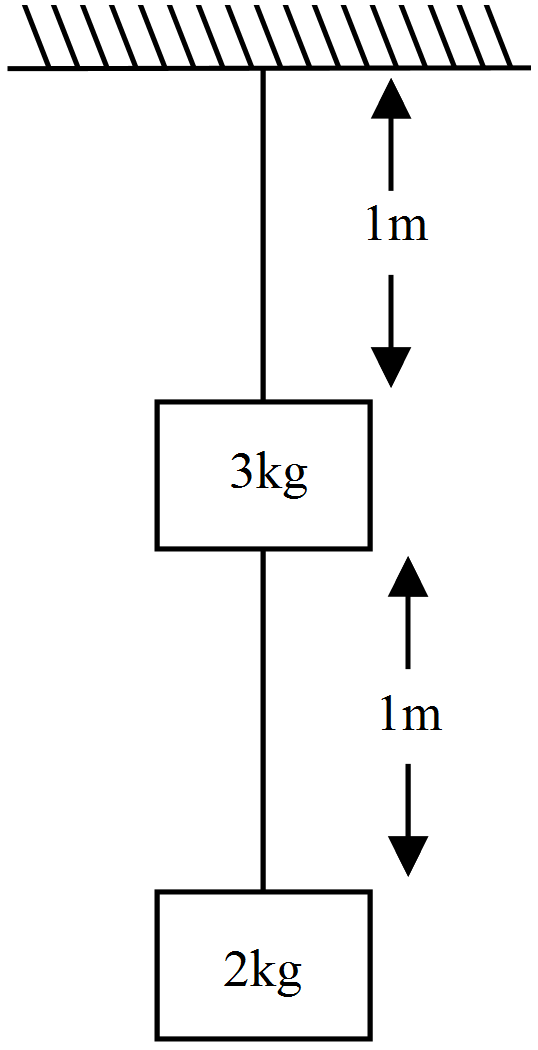
AnswerSince the strings carry mass there will be varying tension at different points. At the middle of the string attached to the roof, the forces are as shown.
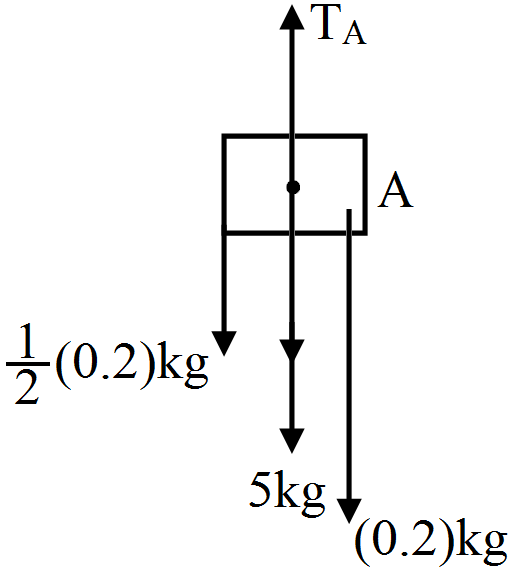
The tension $T_A$ when the array is at rest is, $\text{T}_\text{A}=\frac{1}{2}(0.2)+5+(0.2)$
$\Rightarrow\ \text{T}_\text{A}=5.3\text{kg}$
The tension $T_B$ when the array stays at rest is,
$T_B = 2kg + 0.1kg = 2.1kg$
At the middle of the lower string the forces are
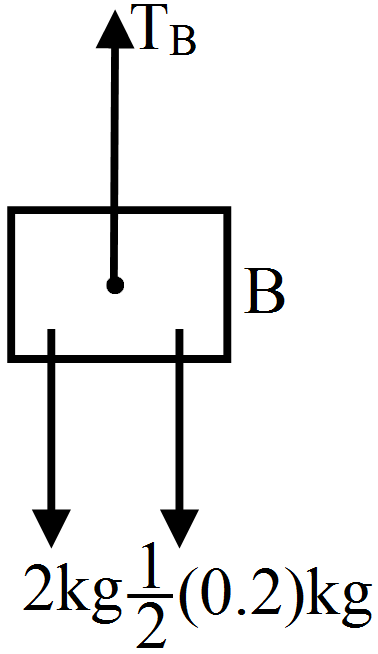
When the arrangement is accelerated, $T_A = 5.3(g + a) = 62.54N$ and $T_B = (2.1)(g + a) = 24.78N$ View full question & answer→Question 103 Marks
A table with smooth horizontal surface is fixed in a cabin that rotates with angular speed o in a circular path of radius R. A smooth groove AB of length L(< < R) is made on the surface of table as shown in figure.
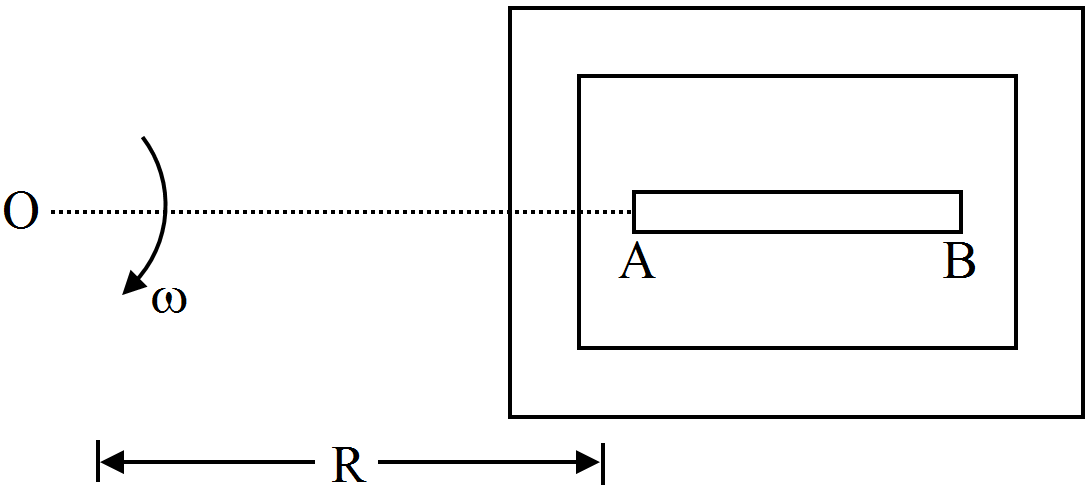
A small particle is kept at the point A in the groove and is released to move, find the time taken by the particle to reach the point B.
AnswerLet us analyse the motion of particle with respect to table which is moving with cabin with an angular speed of $\omega.$ Along AB centrifugal force of magnitude $\text{m}\omega^2\text{R}$ will act at A on the particle which can be treated as constant from A to B as L << R. $\therefore$ Acceleration of particle along AB with respect to cabin $\text{a}=\omega^2\text{R}$ (constant) Required time 't’ is given by, $\text{S}=\text{ut}+\frac{1}{2}\text{at}^2$ $\Rightarrow\text{L}=0+\frac{1}{2}\times\omega^2\text{Rt}^2$ $\Rightarrow\text{t}=\sqrt{\frac{2\text{L}}{\omega^2\text{R}}}$
View full question & answer→Question 113 Marks
A cricket ball of mass $150g$ is moving with a velocity of $12ms^{-1}$, and is hit by a bat, so that the ball is turned back with a velocity of $20ms^{-1}$. The force of the blow acts for $0.01$ second on the ball. Find the average force exerted by the bat on the ball.
AnswerChange in momentum $=150 \times 10^{-3}[20-12]=1200 \times 10^{-3} \mathrm{~kg} \mathrm{~ms}^{-1}$ Since $t=0.01$ second
$\therefore\ \text{Average force}=\frac{1200\times10^{-3}}{10^{-2}}=120\text{N}$
View full question & answer→Question 123 Marks
A man of mass $70kg$ stands on a weighing scale in a lift which is moving. Upwards with a uniform acceleration of $5ms^{-2}$. What would be the readings on the scale in each case?
AnswerMass of the man, $m = 70kg$ Acceleration, $a = 5m/s^2$ upward Using Newton’s second law of motion, we can write the equation of motion as: R - mg = ma R = m(g + a) = 7(10 + 5) = 70 × 15 = 1050N
$\therefore$ Reading on the weighing scale $=\frac{1050}{\text{g}}=\frac{1050}{10}=105\text{kg}$
View full question & answer→Question 133 Marks
A helicopter of mass $500\ kg$ rises with a vertical acceleration of $10ms ^{-2}$. The weight of pilot is $60\ kg$. Give the magnitude and direction of :
- force on the floor of the helicopter by the pilot
- action of the rotor of the helicopter on the surrounding air
- force on the helicopter due to the surrounding air.
$($Take $g = 10 ms^{-2}).$ Answer$i.$ Force on the floor by the pilot
$=m g+m a=m(8+a)=60(10+10)=1200 N($downward$)$
$ii.$ Force of helicopter on the surrounding air $=\left(m_1+m_2\right)(g+a)$
$=(500+60)(10+10)=11200 N ($downwards$)$
$iii.$ According to Newton's third law of motion, action and reaction are equal and opposite.
$\therefore$ Force on the helicopter due to surrounding air $= 11200N ($upwards$)$.
View full question & answer→Question 143 Marks
A truck starts from rest and accelerates uniformly at $2.0ms^{-2}$. At $t = 10s$, a stone is dropped by a person standing on the top of the truck $(6m$ high from the ground$)$. What are the $(a)$ velocity, and $(b)$ acceleration of the stone at $t = 11s$? $($Neglect air resistance$)$.
Answer$\mathrm{u}=0, \mathrm{a}=2 \mathrm{~ms}^{-2}, \mathrm{t}=10 \mathrm{sec} ., \mathrm{h}=6 \mathrm{~m}$ At $\mathrm{t}=10 \mathrm{sec}$, the velocity of the truck $=\mathrm{v}_{10}=0+2 \times 10=20 \mathrm{~ms}^{-1}$
$a.$ At $t=11 \mathrm{sec}$, the stone will have horizontal velocity of $u_x=20 \mathrm{~ms}^{-1}$
and vertical velocity
$\mathrm{u}_{\mathrm{y}}=0+\mathrm{g} \times 1$
$=10 \mathrm{~ms}^{-1}$
$\therefore$ Velocity of stone at $t=11 \mathrm{~s}$ will be
$\sqrt{\text{u}^2_\text{x}+\text{u}^2_\text{y}}=\sqrt{20^2+10^2}$
$=\sqrt{500}=10\sqrt{5}\text{ ms}^{-1}$
$b.$ Acceleration of stone at $t = 11 \text{sec}$ will be equal to the acceleration due to gravity.
View full question & answer→Question 153 Marks
Name a varying mass system. Derive an expression for velocity of propulsion of a rocket at any instant.
AnswerRocket propelled up in space.Let u be the velocity of exhaust gas (burnt) and $\frac{\text{dM}}{\text{dt}}$ be the rate at which fuel is burnt.
Let M be the mass at any instant and dv be the change in velocity of the rocket at that instant.
From conservation of momentum, we have,
Change in momentum of rocket = Change in momentum of burnt gases.
i.e., Mdv = -udM
$\therefore\ \text{dv}=-\frac{\text{udM}}{\text{M}}$Integrating we get, $\text{v}=-\text{u}\log_\text{e}\text{M}+\text{C}$ where C is a constant.
View full question & answer→Question 163 Marks
A truck of mass $1000\ kg$ is pulling a trailer of mass $2000\ kg$ as shown. The retarding $($frictional$)$ force on the truck is $500N$ and that on the trailer is $1000N$. The truck engine exerts a force of $6000N$. Calculate:
- The acceleration of the truck and the trailer.
- The tension in the connecting rope.
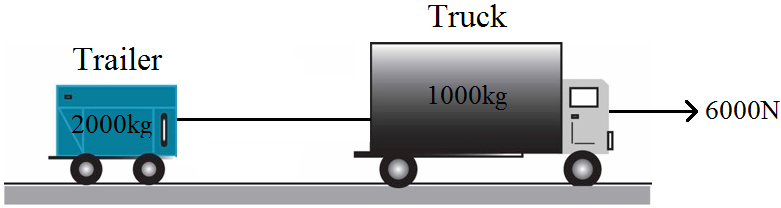
Answer$i.$ The net force $f_1$ exerted on the trailer in the direction of $f_1=(T-1000) N$, where $T$ is tension in the connecting rope.
$\therefore \mathrm{T}-1000=2000 \mathrm{a} \ldots(\mathrm{i})$
Similarly, the net force $\mathrm{f}_2$ exerted by the engine of the truck is given by,
$\mathrm{f}_2=(6000-500-T)=1000 \mathrm{a}$
or $5500-T=1000 \mathrm{a} \ldots \text {..(ii) }$
Adding $(i)$ and $(ii)$, we have
$4500=3000 \mathrm{a}$
or $\mathrm{a}=\frac{4500}{3000}=1.5 \mathrm{~ms}^{-2}$
$ii.$ Putting the value of ' $a$ ' in $(i)$ we have,
$T=1000+2000 a$
$=1000+2000 \times 1.5$
$=4500 N$
View full question & answer→Question 173 Marks
Explain how momentum conservation explains explosion of a mass at rest.
AnswerExploding mass is initially at rest. The momentum is zero. When the explosion takes place, since there is no external force acting, the momentum associated with all parts should vectorially add up to zero. The velocity associated with each part is due to the conversion of internal energy into kinetic energy.
View full question & answer→Question 183 Marks
Two mutually perpendicular forces of $8N$ and $6N$ acts on the same body of mass $10\ kg$. Calculate
- Net force acting on the body,
- Magnitude of the acceleration of the body,
- Direction of acceleration of the body.
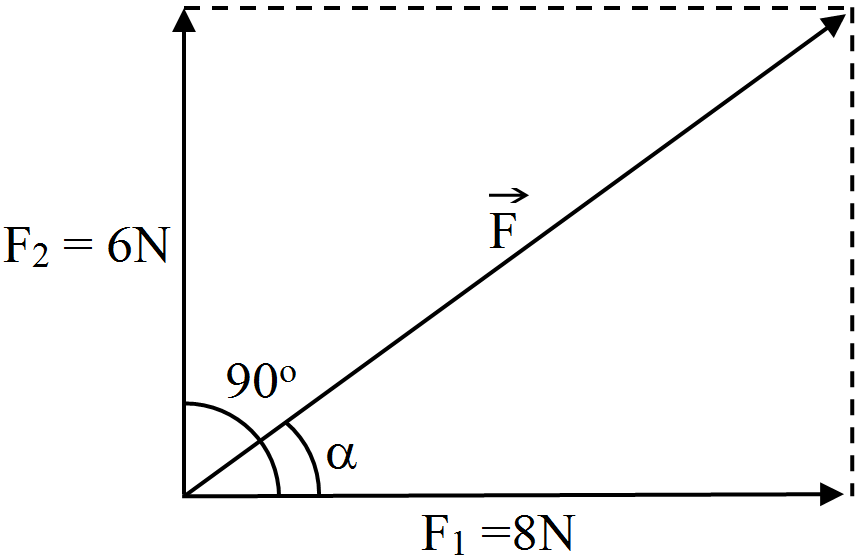
AnswerHere $\text{m}=10\text{kg},\text{F}_1=8\text{N},$
$\text{F}_2=6\text{N},\theta=90^\circ$
- Net force action on the body is,
$\text{F}=\big[\text{F}^2_1+\text{F}^2_2+2\text{F}_1\text{F}_2\cos\theta\big]^\frac{1}{2}$
$=\big[\text{F}^2_1+\text{F}^2_2\big]^\frac{1}{2}$
$[\because\cos\theta=\cos90^\circ=02]$
$=\big[8^2+6^2\big]^\frac{1}{2}=10$ or $\text{F}=10\text{N}$
- Now, $\text{F}=\text{m},\text{a}$
$\therefore\text{a}=\frac{\text{F}}{\text{m}}=\frac{10\text{N}}{10\text{kg}}=1\text{ms}^{-2}$
- Let $\alpha$ be the angle made by resultant force $(F)$ or the acceleration with $F_1$
$\therefore\tan\alpha=\frac{\text{F}_2}{\text{F}_1}=\frac{6}{8}=\frac{3}{4}=0.7500$
$\alpha=36^\circ53'$
$\therefore$ Magnitude of acceleration = $1ms^{-2}$ and it makes an angle of $36^\circ 53'$ with $8N$ force. View full question & answer→Question 193 Marks
A body placed on a rough inclined plane just begins to slide, when the slope of the plane equal to 1 in 4. Calculate the coefficient of friction.
AnswerThe slope of the plane equal to 1 in 4 implies that if BC = 4 and AB = 1. Suppose that the plane is inclined at angle 0 with the horizontal AC. From the relation between the coefficient of friction and angle of repose, we have, 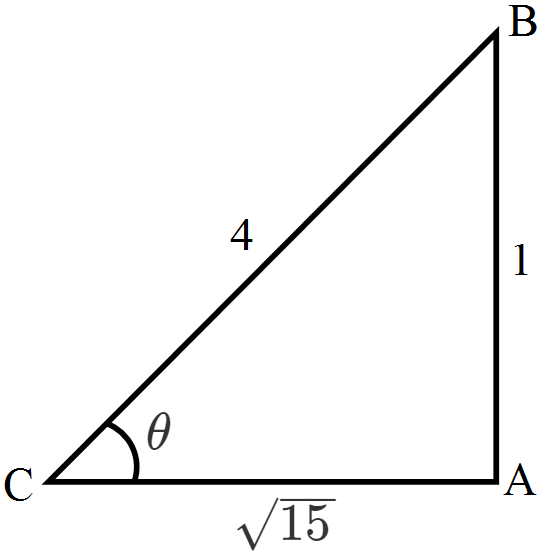 $\mu=\tan\theta$ [here, $\theta$ is angle of repose] $\mu=\frac{\text{AB}}{\text{AC}}=\frac{\text{AB}}{\sqrt{\text{BC}^2-\text{AB}^2}}$ $=\frac{1}{\sqrt{4^2-1^2}}=\frac{1}{\sqrt{16-1}}$ $\mu=\frac{1}{\sqrt{15}}$ $\mu=0.258$
 View full question & answer→Question 203 Marks
A cricket bowler releases the ball in two different ways.
- Giving it only horizontal velocity, and
- Giving it horizontal velocity and a small downward velocity. The speed $v_s$ at the time of release is the same. Both are released at a height H from the ground. Which one will have greater speed when the ball hits the ground? Neglect air resistance.
AnswerFor (a) $\frac{1}{2}\text{v}_\text{z}^2=\text{gH}\Rightarrow\text{v}_\text{z}\sqrt{2\text{gH}}$ Speed at ground $=\sqrt{\text{v}_\text{s}^2+\text{v}_\text{z}^2}=\sqrt{\text{v}_\text{s}^2+2\text{gH}}$ For (b) also $[\frac{1}{2}\text{mv}_\text{s}^2+\text{mg}\text{H}]$ is the total energy of the ball when it hits the ground So the speed would be the same for both (a) and (b).
View full question & answer→Question 213 Marks
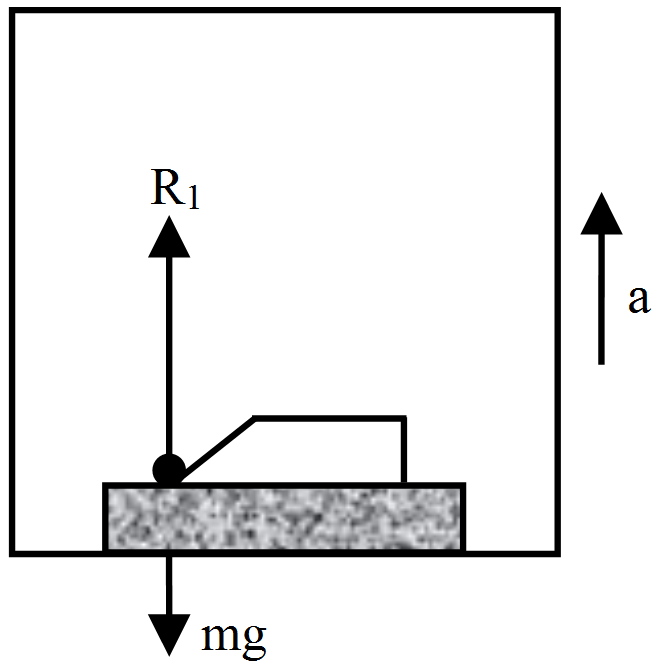
A body of mass m is placed on the floor of a lift. Find its apparent weight when the lift is:
- Moving upward with uniform acceleration.
- Moving downward with uniform acceleration.
- Moving upward with constant speed.
AnswerMass of body is ‘m placed on the floor of a lift.
- When the lift is moving upward with uniform acceleration: Suppose uniform upward acceleration of the person in the lift = a
$\therefore$ Net upward force on the person f = ma
$f = R_1 - mg$ (from fig.)
$\Rightarrow R_1 = mg + f$
$\Rightarrow R_1 = mg + ma$
$\Rightarrow R_1 = m(g + a)$
- When the lift is moving downward with uniform acceleration: Suppose uniform downward acceleration of the person in the lift = a
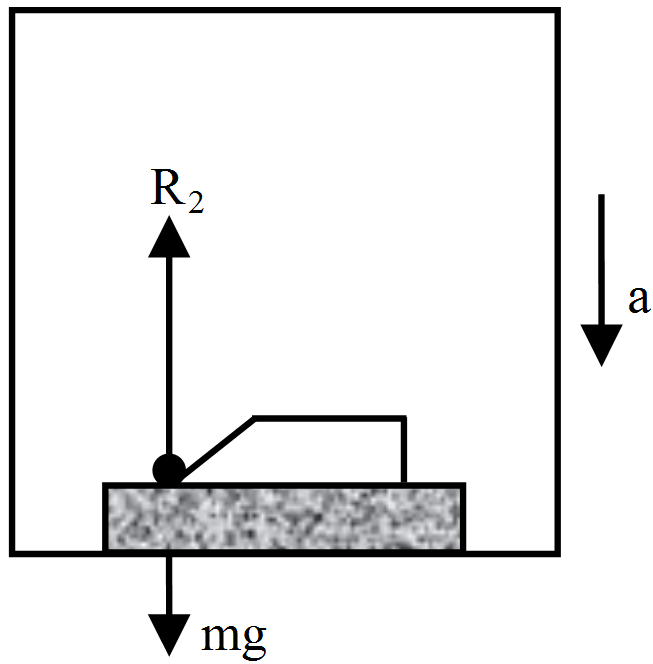
$\therefore$ Net downward force on the person, f = ma
From Figure it is clear that
$f = mg - R_2$
$R_2 = mg - f = mg - ma$
$R_2 = m(g - a)$
$Thus, R_2 < mg$
Apparent weight of the person becomes less than the actual weight.
- When the lift is moving upward with constant speed: Acceleration of the person = 0
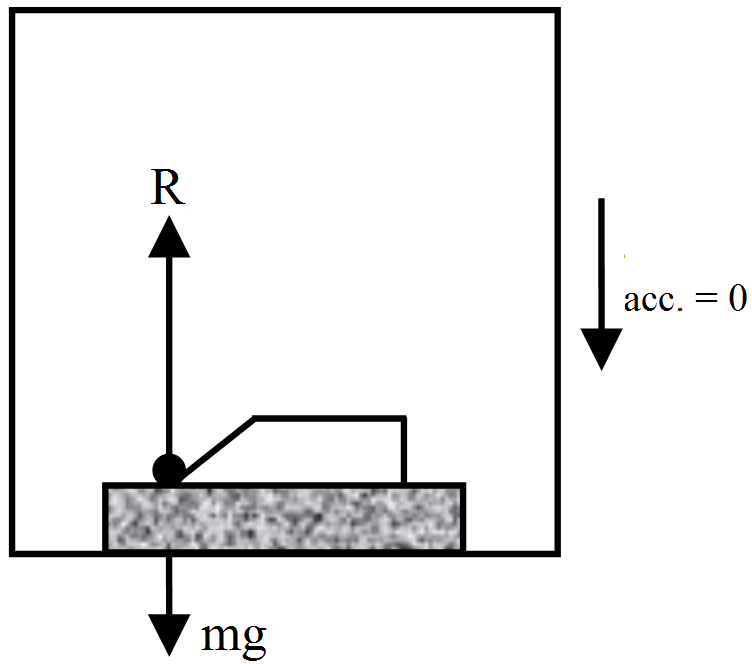
$\therefore$ Net force on the person $f = 0$
i.e., $R - mg = 0$
$\Rightarrow R = mg.$ View full question & answer→Question 223 Marks
A particle of mass $0.2kg$ attached to a massless string is moving in a vertical circle of radius $1.2m$. It is imparted a speed of $8ms^{-1}$ at the lowest point of its circular path. Does the particle complete the vertical circle? What is the change is tension in the string when the particle moves from the position where the string is vertical to the position where the string is horizontal?
AnswerHere $m = 0.2kg r = 1.2m V_1 = 8ms^{-1} $
$\therefore$ Min speed required to the particle at the lowest point of the circular path $=\sqrt{\text{5gr}}=\sqrt{5\times10\times1.2}$
$=\sqrt{60}=7.7\text{ms}^{-1}$ As the speed given to the particle at the lowest point of the circular path is $8ms^{-1}$ which is more than $7.7ms^{-1}$, therefore, the particlewill certainly complete the circle. Now the change of tension in the string at the lowest point and the point where the string is horizontal = 3mg = 3 × 0.2 × 10 = 6N
View full question & answer→Question 233 Marks
Weights of $50g$ and $40g$ are connected by a stringpassing over a smooth pulley. If the system travels $2.18m$ in the first $2$ seconds, find the value of g.
AnswerDistance travelled by the system, $S = 2.18m, t_1 = 2s \text{m}_1=\frac{50}{1000}=0.05\text{kg}$
$\text{m}_2=\frac{40}{1000}=0.04\text{kg}$ Initial velocity, u = 0 Using, $\text{S}=\text{ut}+\frac{1}{2}\text{at}^2$
$\Rightarrow\ 2.18=\frac{1}{2}\times\text{a}\times4$
$\text{or a}=1.09\text{ms}^{-2}$
$\text{Also, a}=\Big(\frac{\text{m}_1-\text{m}_2}{\text{m}_1+\text{m}_2}\Big)\text{g}$
$1.09=\Big(\frac{0.05-0.04}{0.05+0.04}\Big)\times\text{g}$
$\text{or g}=\frac{1.09\times0.09}{0.01}=9.81\text{ms}^{-2}$
View full question & answer→Question 243 Marks
A man of mass $70kg$ stands on a weighing scale in a lift which is:
- Moving upwards with a uniform speed of $10m/ s$.
- Moving down with a uniform acceleration of $5m/ s^2$.
- Freely falling under gravity.
What would be reading on the scale in each case? Answer$\mathrm{m}=70 \mathrm{~kg}$
a. Uniform speed of $10 \mathrm{~ms}^{-1}$.
Since $a=0$, weight $=m g=700 \mathrm{~N}$.
b. For uniform downward acceleration,
$\mathrm{N}=\mathrm{mg}-\mathrm{ma}$.
$\therefore$ Weight $=\mathrm{mg}-\mathrm{ma}=700-70 \times 5=350 \mathrm{~N}$.
c. Force free fall $\mathrm{N}=0$.
$\therefore$ Weight felt is zero.
View full question & answer→Question 253 Marks
A constant retarding force of $50N$ is applied to a body of mass $20kg$ moving initially with a speed of $15ms^{-1}$. How long does the body take to stop?
AnswerRetarding force, F = –50N Mass of the body, m = 20kg Initial velocity of the body, u = 15m/s Final velocity of the body, v = 0 Using Newton’s second law of motion, the acceleration (a) produced in the body can be calculated as: F = ma –50 = 20 × a $\therefore\text{a}=\frac{-50}{20}=-2.5\text{ms}^{-2}$ Using the first equation of motion, the time (t) taken by the body to come to rest can be calculated as: v = u + at $\therefore\text{t}=\frac{-\text{u}}{\text{a}}=\frac{-15}{-2.5}=6\text{s}$
View full question & answer→Question 263 Marks
A man of mass $70kg$ stands on a weighing scale in a lift which is moving. Downwards with a uniform acceleration of $5ms^{-2}$.
AnswerMass of the man, $\mathrm{m}=70 \mathrm{~kg}$ Acceleration, $a=5 \mathrm{~m} / \mathrm{s}^2$ downward Using Newton's second law of motion, we can write the equation of motion as: $R+m g=m a R=m(g-a)=70(10-5)=70 \times 5=350 \mathrm{~N}$
$\therefore$ Reading on the weighing scale $=350\text{g}=\frac{350}{10}=35\text{kg}$
View full question & answer→Question 273 Marks
A truck tows a trailer of mass $1200kg$ at a speed of $10ms^{-1} $ on a level road. The tension in the coupling is $1000N$. What is the power extended on the trailer? Find the tension in the coupling when the truck ascends a road having an inclination of $1$ in $6$. Assume that the frictional resistance on the inclined plane is the same as that on the level road. 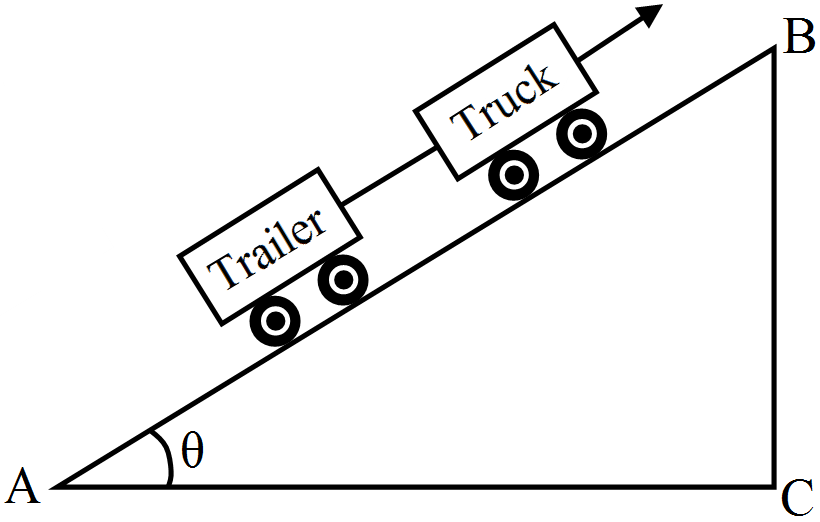
AnswerForce applied by the truck = 1000N Power or work done per second$=\frac{\text{F}\times\text{S}}{\text{t}}=1000\times\frac{10}{1}=10^4\text{W}$
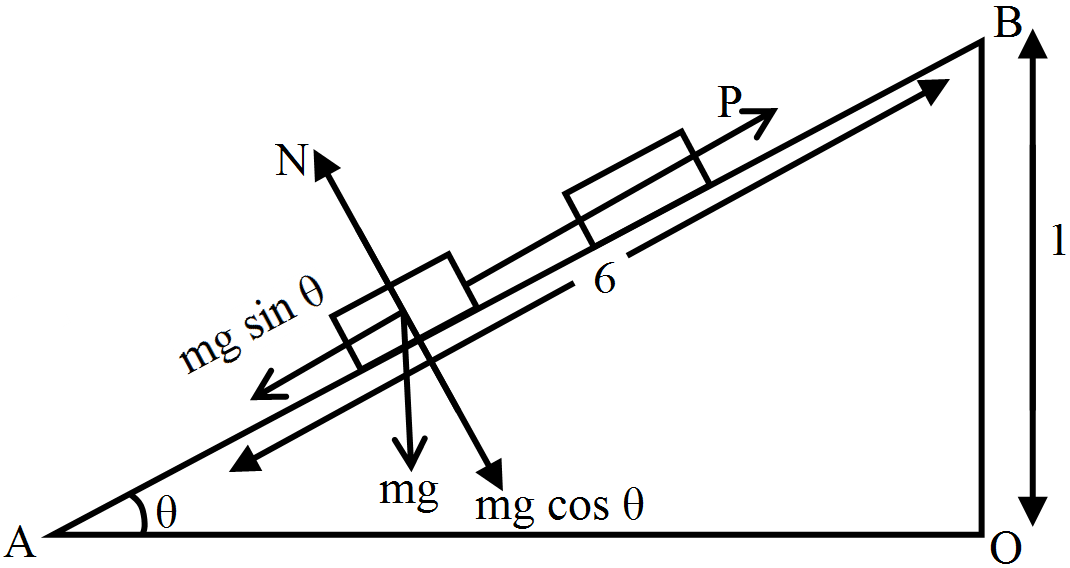
When the truck ascends a road having an inclination of 1 in 6, i.e., if $OB = 1, AB = 6$,
then it has to apply not only a forward force of $1000N$ to overcome friction, but also
will have to overcome downward component of weight, i.e., $\text{mg }\sin\theta.$
$\therefore$ Tension in the coupling, P = forward force $=1000+\text{mg}\sin\theta$
$=1000+1200\times9.8\times\frac{1}{6}$ or $P = 2960N$
Thus, the required tension in the coupling is $2960N.$ View full question & answer→Question 283 Marks
A person of mass m is standing in a lift. Find his apparent weight when the lift is:
- Moving upward with uniform acceleration a.
- Moving downward with uniform acceleration a (< g).
- Falls freely. (g is the acceleration due to gravity).
Answer
- Apparent weight = mg + ma
- Apparent weight = mg - ma
- Apparent weight = 0
View full question & answer→Question 293 Marks
State the laws of limiting friction. Hence define coefficient of friction.
AnswerThe laws of limiting friction are as follows:
- The value of limiting friction depends on the nature of the two surfaces in contact and on the state of their smoothness.
- The force of friction acts tangential to the surfaces in contact in a direction opposite to the direction of relative motion.
- The value of limiting friction is directly proportional to the normal reaction between the two given surfaces.
- For any two given surfaces and for a given value of normal reaction the force of limiting friction is independent of the shape and surface area of surfaces in contact. Coefficient of limiting friction for two given surfaces in contact is defined as the ratio of the force of limiting friction $f_1$ between them and the force of normal reaction N.
$\therefore\mu_\text{l}=\frac{\int_\text{l}}{\text{N}}$. View full question & answer→Question 303 Marks
A bob of mass $0.1kg$ hung from the ceiling of a room by a string $2m$ long is set into oscillation. The speed of the bob at its mean position is $1ms^{-1}$ . What is the trajectory of the bob if the string is cut when the bob is (a) at one of its extreme positions, (b) at its mean position.
Answer
- Vertically downward: At the extreme position, the velocity of the bob becomes zero. If the string is cut at this moment, then the bob will fall vertically on the ground.
- Parabolic path: At the mean position, the velocity of the bob is 1m/s. The direction of this velocity is tangential to the arc formed by the oscillating bob. If the bob is cut at the mean position, then it will trace a projectile path having the horizontal component of velocity only. Hence, it will follow a parabolic path.
View full question & answer→Question 313 Marks
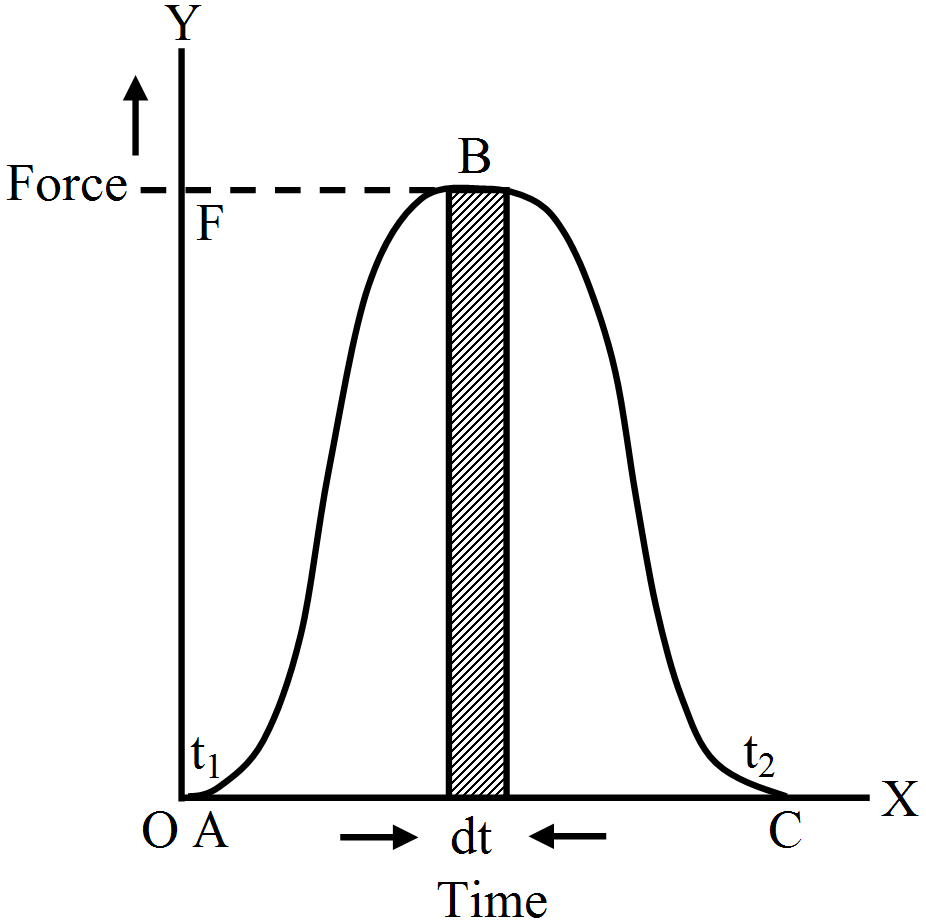
- Explain the term impulse. Show that impulse of a variable force is equal to the area enclosed by the force-time curve.
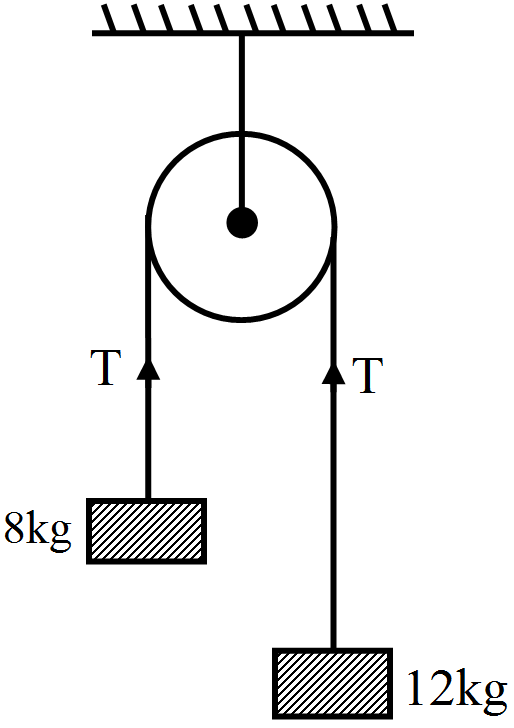
- Two masses $8kg$ and $12kg$ are connected at the two ends of a light inextensible string that passes over a frictionless pulley. Find the acceleration of the masses and tension in the string, when the masses are released.
Answer
- The product of the force and the time interval on which it acts or change in momentum is called impulse.
$\vec{\text{I}}-\vec{\text{F}}_\text{av}\times\text{t}=\text{dp}=\text{F.dt}=$ Area of shaded portion
Net impulse $=\int\limits_{\text{t}_1}^{\text{t}_2}\vec{\text{F}}\times\text{dt}=$ area under graph ABC and time axis.
- Consider two masses $m_1$ and $m_2$ are connected to the ends of an inextensible string passing over a smooth frictionless pulley.
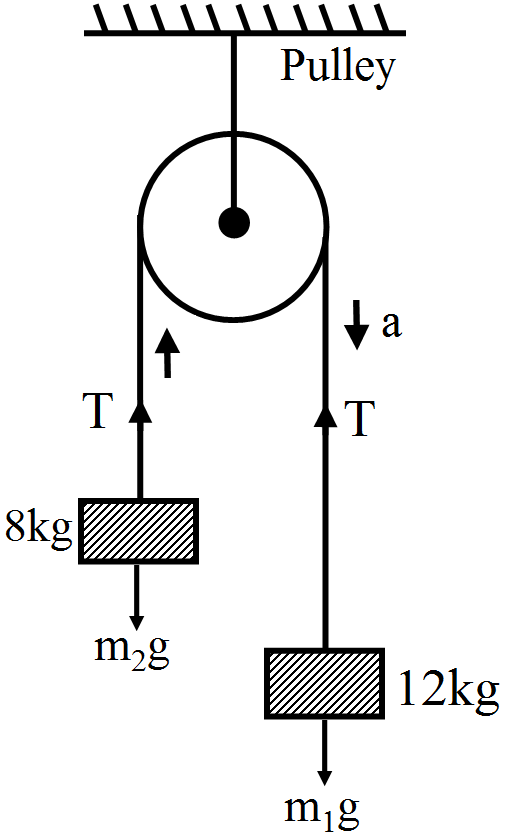
Let T be the tension in the string which is uniform throughout.
The heavier mass $m_1$ moves downward with an acceleration a.
The resultant downward force while considering the heavier mass m, is given by
$m_1g - T = m_1a ...(i)$
The resultant upward force while considering the lighter mass $m_2$ is given by
$T - m_2g = m_2a ...(ii)$
Adding (i) and (ii), we have
$(m_1 - m_2)g = (m_1 + m_2)a$
$\Rightarrow\ \text{a}=\Big(\frac{\text{m}_1-\text{m}_2}{\text{m}_1+\text{m}_2}\Big)\text{g}\dots(\text{iii})$
Putting the value of a in (i) and simplifying we get
$\text{T}=\frac{2\text{m}_1\text{m}_2}{\text{m}_1+\text{m}_2}\text{g}\dots(\text{iv})$
Substituting the given values, we have
$\Rightarrow\ \text{a}=\Big(\frac{12-8}{12+8}\Big)\times9.8=1.96\text{ms}^{-2}$
$\text{T}=\frac{2\times12\times8\times9.8}{12+8}=\frac{1881.6}{20}$
$=64.08\text{N}$ View full question & answer→Question 323 Marks
Discuss graphical method for the measurement of impulse in the following case:
- When constant force acts on the body.
- When a variable force acts on the body.
Answer
-
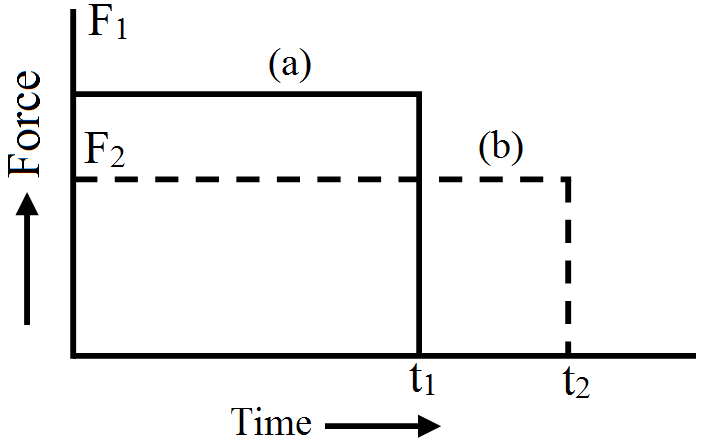
$F_1$ for curve (a) is greater than $F_2$ for curve (b). The time $t_2$ for which $F_2$ acts is greater for curve (b) than time $t_1$ in case of curve (a).
$F_1 \times t_1=F_2 \times t_2$
-
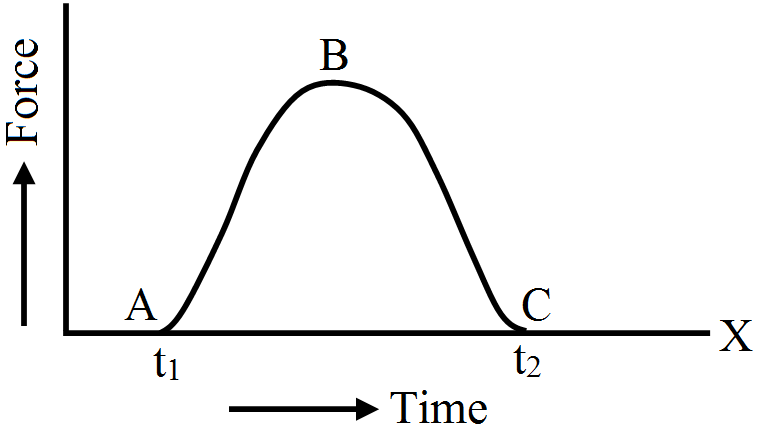
Impulse of variable force
$=\int\limits^{\text{t}_2}_{\text{t}_1}\vec{\text{F}}\text{dt}=\text{aera of }\Delta\text{BCA}$
View full question & answer→Question 333 Marks
A block placed on a rough horizontal surface is pulled by a horizontal force F. Let f be the force applied by the rough surface on the block. Plot a graph of f versus F.
AnswerWhen a small force $F_1$ is applied on a heavier box, it does not move At this state force of friction $f_1$ is equal to $F_1$. On increasing force box does not move till $F = F_s$ the maximum static frictional or limiting force. Its corresponding frictional force $f_s$ on Y-axis.
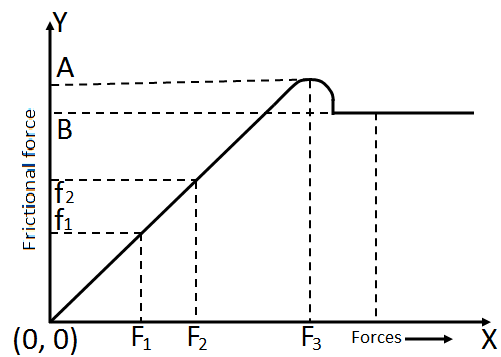
After force $F_s$, the frictional force decrease i.e., less force $\text{F}_\text{k}<\text{F}_\text{s}$ is applied on body and it starts to move with less friction $\text{f}_\text{k}<\text{f}_\text{s}$A = limiting frictional force and at B = kinetic frictional force. View full question & answer→Question 343 Marks
A body of mass $60kg$ is dragged with just enough force to start moving on a rough surface with coefficients of static and kinetic friction $0.5$ and $0.4$ respectively on applying the same force. What is the acceleration?
AnswerStatic friction $\text{f}_\text{ms}=\mu_\text{s}\text{R}$ Kinetic friction $\text{f}_\text{k}=\mu_\text{k}\text{R}$ When the body is in motion and tle applied force is $f_{ms}$, net force acting on the body i.e., $\text{F}=\text{f}_\text{ms}-\text{f}_\text{k}=\mu_\text{s}\text{R}-\mu_\text{k}\text{R}$
$=(\mu_\text{s}-\mu_\text{k})\text{mg}$
$\text{a}=\frac{\text{F}}{\text{m}}=\frac{(\mu_\text{s}-\mu_\text{k})}{\text{m}}\text{mg}$
$=(0.5-0.4)\times9.8$
$=0.98\text{ m/s}^2$
View full question & answer→Question 353 Marks
A body of mass 2 kg is being dragged with a uniform velocity of $2 \mathrm{~ms}^{-1}$ on a rough horizontal plane. The coefficient of friction between the body and the surface is 0.2 . Calculate the amount of heat generated per second.
Take $\mathrm{g}=9.8 \mathrm{~ms}^{-2}$ and $\mathrm{J}=4.2 \mathrm{~J} / \mathrm{cal}^{-1}$.
AnswerGiven, $\text{m}=2\text{kg},\text{u}=2\text{ms}^{-1},\mu=0.2$ Force of friction, $\text{F}=\mu\text{R}$
$\text{F}=\mu\text{mg}$
$[\because\text{R}=\text{mg}]$
$\text{F}=0.2\times2\times9.8$
$\text{F}=3.92\text{N}$ Distance moved per second s = ut, $\text{s}=2\times1 = 2$ Work done by friction per second, W = Fs $\text{W}=3.92\times2=7.84\text{J}$ Heat produced, $\text{H}=\frac{\text{W}}{\text{J}}\Rightarrow\text{H}=\frac{7.84}{4.2}$
$\text{h}=1.87\text{cal}.$
View full question & answer→Question 363 Marks
A bomb at rest explodes into three parts of the same mass. The moments of the two parts is $-2 p_{\mathrm{i}}$ and $\mathrm{p}_{\mathrm{j}}$. What will be the momentum of the third part?
AnswerSince initial momentum is zero, the final momentum should also be zero. Let the momentum of third part be p_3. $\therefore\ -2\text{p}_\text{i}+\text{p}_\text{j}+\text{p}_3=0$
$\Rightarrow\ \text{P}_3=2\text{p}_\text{i}-\text{p}_\text{j}$
$\Rightarrow\ |\text{p}_3|=\text{p}\sqrt{2^2+(-1)^2}$
$=\sqrt{5}\text{p}$and is directed at an angle $\theta=\tan^{-1}\Big(\frac{-1}{2}\Big)$ with the x-axis.
View full question & answer→Question 373 Marks
A person in an elevator accelerating upwards with an acceleration of $2 \mathrm{~m} \mathrm{~s}^{-2}$, tosses a coin vertically upwards with a speed of $20 \mathrm{~m} \mathrm{~s}^1$. After how much time will the coin fall back into his hand? ( $\mathrm{g}=10 \mathrm{~m} \mathrm{~s}^{-2}$ )
AnswerUpward acceleration of elevator $(\mathrm{a})=2 \mathrm{~m} / \mathrm{s}^2$ Acceleration due to gravity $(\mathrm{g})=10 \mathrm{~ms}^{-2} \therefore$ Net effective acceleration $\mathrm{a}^{\prime}$
$=(a+g)=(2+10) a^{\prime}=12 \mathrm{~ms}$ Consider the effective motion of coin $v=0 t=$ time of coin to achieve maximum height $\mathrm{U}=20 \mathrm{~ms}^{-1} \mathrm{a}^{\prime}=12 \mathrm{~ms}^{-2} \therefore \mathrm{v}=\mathrm{u}+$ at here $\mathrm{a}=\mathrm{a}^{\prime} 0=20-12 \mathrm{t}$ (upward motion) $\mathrm{t}=\frac{20}{12} \mathrm{~s}=\frac{5}{3} \mathrm{~s}$ Time of ascent is equal to the time of decent.
$\therefore$ Total time to return in hand after achieving maximum height $\frac{5}{3}+\frac{5}{3}=\frac{10}{3}=3 \frac{1}{3} \mathrm{sec}$.
View full question & answer→Question 383 Marks
A block is gently placed at the top of an inclined plane $6.4m$ long. Find the time taken by the block to slide down to the bottom of plane. The plane makes an angle $30°$ with the horizontal. Coefficient of friction between the block and the plane is $0.2$. Take $g = 10m/sec^2$.
Answer$\text{a}=\text{g}(\sin\theta-\mu_\text{k}\cos\theta)$$=9.8(\sin30^\circ-0.2\cos30^\circ)=3.20\text{m/ s}^2$
$\text{S}=\text{ut}+\frac{1}{2}\text{at}^2$
$6.4=0+\frac{1}{2}\times3.2\times\text{t}^2$
$\text{t}=2\text{ sec.}$
View full question & answer→Question 393 Marks
A string of length L and mass M is lying on a horizontal table. A force F is applied at one of its end. What is the tension in string at a distance x from the end at which force is applied?
AnswerIf $\rho$ is the mass per unit length of the string, mass of entire string $\text{m}=\text{L}\rho.$ Acceleration produced in the string, $\text{a}=\frac{\text{F}}{\text{m}}=\frac{\text{F}}{\text{L}\rho}$ Force acting on the length (L - x) of the string = mass of (L - x) length of string × acceleration (a) $=(\text{L}-\text{x})\frac{\rho\times\text{F}}{\text{L}\rho}=\frac{\text{F}(\text{L}-\text{x})}{\text{L}}$
View full question & answer→Question 403 Marks
In a circus, the diameter of globe of death is 30m. From what minimum height must a cyclist start in order to roll down the inclined and go round the globe successfully?
AnswerDiameter of globe = 30m Radius of globe, r = 15m Let 'h' be the minimum height from which the cyclist after rolling down an incline will acquire velocity $=\sqrt{2\text{gh}}$ For looping the loop, the minimum velocity at the lowest point should be $\sqrt{5\text{gr}}$. $\therefore\sqrt{5\text{gr}}=\sqrt{\text{2gh}}$ or $\text{h}=\frac{5\text{r}}{2}=\frac{5\times15}{2}=37.5\text{m}.$
View full question & answer→Question 413 Marks
A $20kg$ box is gently placed on a rough inclined plane of inclination $30°$ with horizontal. The coefficient of sliding friction between the box and the plane is $0.4$. Find the acceleration of the box down the incline.
Answer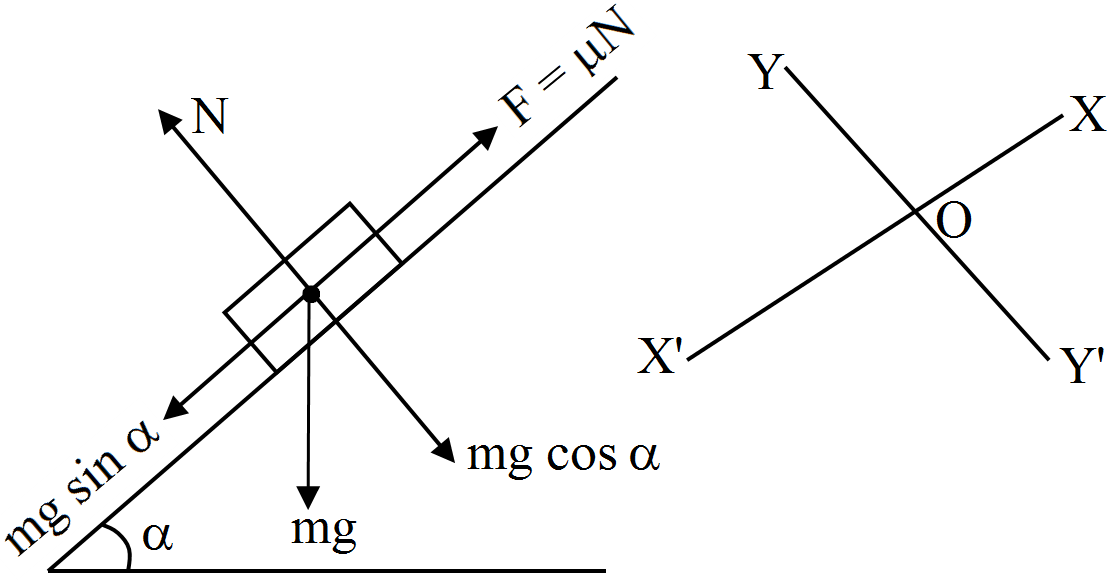
In solving inclined plane problems, the x and y directions along which the forces are to be considered, may be taken as shown.The components of weight of the box are:
- mg sin a acting down the plane.
- mg cos a acting perpendicular to the plane.
$\text{N}=\text{mg}\cos\alpha$
$\text{mg}\sin\alpha-\mu\text{N}=\text{ma}$
$\text{mg}\sin\alpha-\mu\text{mg}\cos\alpha=\text{ma}$
$\text{a}=\text{g}\sin\alpha-\mu\text{g}\cos\alpha$
$=\text{g}(\sin\alpha-\mu\cos\alpha)$
$=9.8\Big(\frac{1}{2}-0.4\times\frac{\sqrt{3}}{2}\Big)$
$=4.9\times0.3072=1.505\text{m/ }{\text{s}}^2$ The box accelerates down the plane at $1.505m/ s^2$. View full question & answer→Question 423 Marks
A woman throws an object of mass $500g$ with a speed of $25m s^1$. If the object hits a wall and rebounds with half the original speed, what is the change in momentum of the object?
Answer$\text{m}=0.5\text{kg}\ \ \text{u}=+25\text{ms}^{-1}\text{(Forword)}$
$\text{v}=\frac{-25}{2}\text{ms}^{-1}$ (as backward) $\therefore\Delta\text{p}=\text{m}(\text{v}-\text{u})=0.5\Big[\frac{-25}{2}-25\Big]$
$=0.5[-12.5-25] = 0.5\times(-37.5)$
$\Delta\text{p}=-18.75\text{kg}\ \text{ms}^{-1}$ or N-s Hence, the $\Delta\text{p}$ or $\frac{\Delta\text{p}}{\Delta\text{t}}$ or force is opposite to the initial velocity of ball.
View full question & answer→Question 433 Marks
A stone of mass $0.2kg$ is tied to one end of a string of length $80cm$. Holding the other end, the stone is whiled into a vertical circle. What is the minimum speed of the stone at the lowest point so that it just completes the circle. What is the tension in the string at the lowest point of the circular path? ($g = 10ms^{-2}$)
AnswerHere m = 0.2kg r = 80cm = 0.8m
$\therefore V_{min}$ at the lowest point so that the stone is just able to complete the circle. $=\sqrt{\text{5gr}}=\sqrt{5\times10\times0.8}$
$=\sqrt{40}=6.32\text{ms}^{-1}$ Now tension in the string at the lower point of the circular path, $=\frac{\text{mV}^2_{\text{min}}}{\text{r}}+\text{mg}$
$\text{5mg}+\text{mg}\Big[\because\frac{\text{mV}^2_\text{min}}{\text{r}}=\text{5}\text{mg}\Big]$
$=6\text{m}=6\times0.2\times10=12\text{N}.$
View full question & answer→Question 443 Marks
Prove that the coefficient of static friction is “tangent” of the angle of repose.
AnswerThe angle of repose is defined as the maximum inclination of the plane for which the mass kept over it can stay at rest. Let $\phi$ be the angle of repose. Then,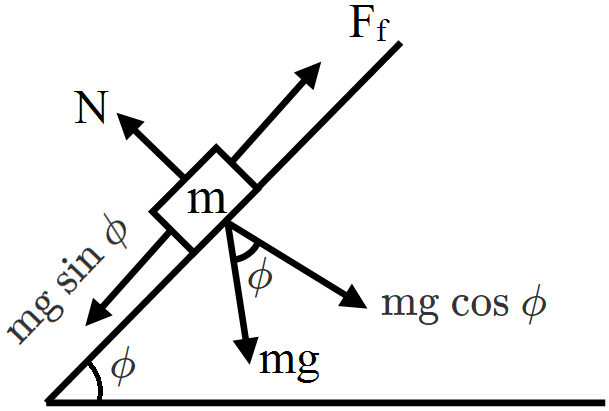
$\text{N}=\text{mg}\cos\phi,\text{ F}_\text{f}=\text{mg}\sin\phi$
Also, $\text{F}_\text{f}=\mu\text{N}$
$\therefore\ \mu\text{ mg}\cos\phi=\text{mg}\sin\phi$
i.e., $\mu=\tan\phi.$
Since the body is at rest, the friction is static friction and the coefficient is for static case. View full question & answer→Question 453 Marks
A cricket ball of mass $150g$ is moving with a velocity of $12ms^{-1}$ and is hit by a bat so that the ball is turned back with a velocity of $20ms^{-1}$. The force of the blow acts for $0.01s$. Find the average force exerted on the ball by the bat.
AnswerThe impulse of the force exerted by the bat is given by the change in the momentum of the ball. Now, Initial momentum of the ball $=\frac{150}{1000}\times12\text{kg/ }\text{ms}^{-1}$ Final momentum of the ball $=-\frac{150}{1000}\times20\text{kg/ ms}^{-1}=-3.0\text{kg/ ms}^{-1}$ Change in the momentum of the ball $=\big[1.8-(-3.0)\big]\text{kg/ ms}^{-1}$
$=4.8\text{kg/ ms}^{-1}$ This equals the impulse of the force exerted by the bat. Since Impulse = force \times time We have, Average force exerted $=\frac{\text{Impulse}}{\text{time}}=\frac{4.8\text{kg/ ms}^{-1}}{0.01\text{s}}$
$=480\text{kg/ ms}^{-2}=480\text{N}.$
View full question & answer→Question 463 Marks
A man of mass $70kg$ stands on a weighing scale in a lift which is moving. Upwards with a uniform speed of $10 ms^{-1}$.
AnswerMass of the man, $m=70 \mathrm{~kg}$ Acceleration, $a=0$ Using Newton's second law of motion, we can write the equation of motion as: $\mathrm{R}-\mathrm{mg}=\mathrm{ma}$ Where, ma is the net force acting on the man. As the lift is moving at a uniform speed, acceleration $\mathrm{a}=0 \therefore \mathrm{R}=\mathrm{mg}=70 \times 10=700 \mathrm{~N}$
$\therefore$ Reading on the weighing scale $=\frac{700}{\mathrm{~g}}=\frac{700}{10}=70 \mathrm{~kg}$
View full question & answer→Question 473 Marks
A ball moving with a momentum of $15kg ms^{-1}$ strikes against the wall at an angle of $30°$ and is reflected with the same momentum at the same angle. Calculate impulse.
AnswerInitial momentum $\vec{\text{P}}=15\text{kg m/s}$
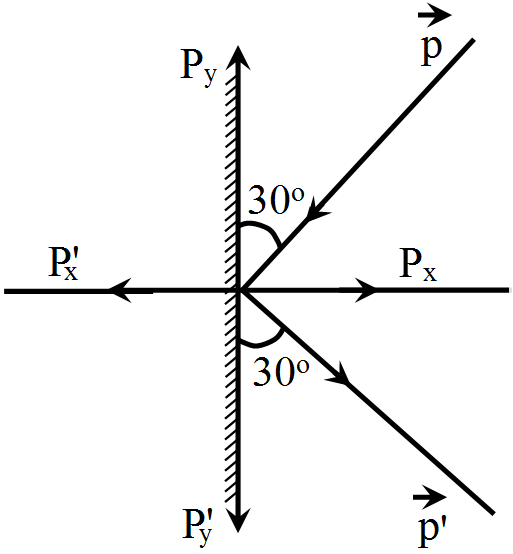
Resolving it into two components$\text{p}_\text{y}=\text{p}\cos30^\circ,\text{ p}_\text{x}=\text{p}\sin30^\circ$
Final momentum $\overrightarrow{\text{p}'}=15\text{kg m/s}$ $\therefore\ \vec{\text{p}}=-\overrightarrow{\text{p}'}$ Resolving $\vec{\text{p}}$ into two components $\text{p}'_\text{y}=\text{p}'\cos30^\circ,\text{p}'_\text{x}=\text{p}'\sin30^\circ$ The two x-components are in opposite direction so they cancel out.
$\therefore$ Impulse = change in momentum$=\text{p}_\text{y}+\text{p}'_\text{y}=2\times\text{p}\cos30^\circ$
$=30\times\frac{\sqrt{3}}{2}=15\sqrt{3}\text{kg m/s}$ View full question & answer→Question 483 Marks
In the given arrangement, if the points P and Q move down with a velocity u, find the velocity of M?
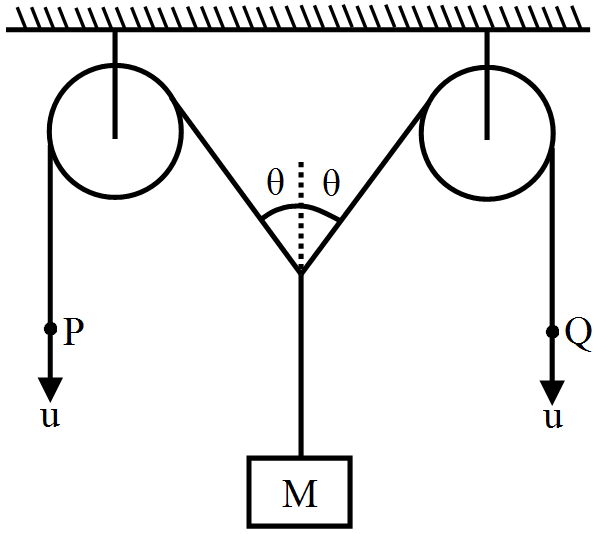
AnswerUsing Pythagoras theorem, $l^2 = x^2 + y^2$. Differentiating both sides, (w.r.t. time)
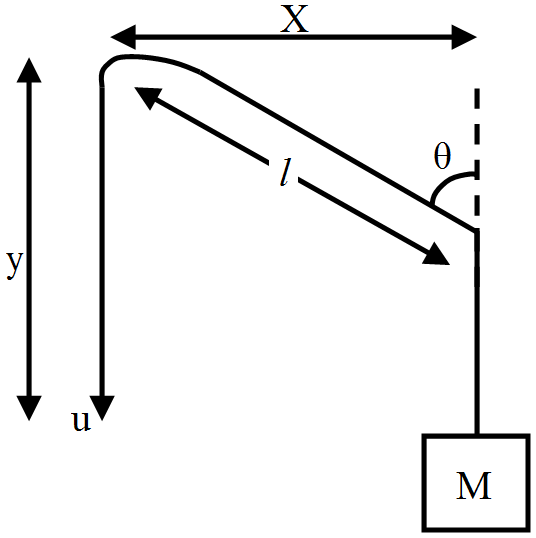
$2\text{l}\frac{\text{dl}}{\text{dt}}=2\text{y}\frac{\text{dy}}{\text{dt}}$ since x is constant.
$\frac{\text{dy}}{\text{dt}}=\frac{\text{l}}{\text{y}}\frac{\text{dl}}{\text{dt}}=\frac{1}{\cos\theta}.\text{u}$
$\therefore$ Velocity of M going up $=\frac{\text{u}}{\cos\theta}$ View full question & answer→Question 493 Marks
A cyclist goes round a circular track of 440 metres length in 20 seconds. Find the angle that the cycle makes with the vertical.
AnswerLength of the track = 440m $\therefore\ \text{Radius}=\frac{440}{2\pi}\text{m}$ $\text{Speed}=\frac{2\pi\text{r}}{\text{t}}=\frac{440}{20}=22\text{ ms}^{-1}$ 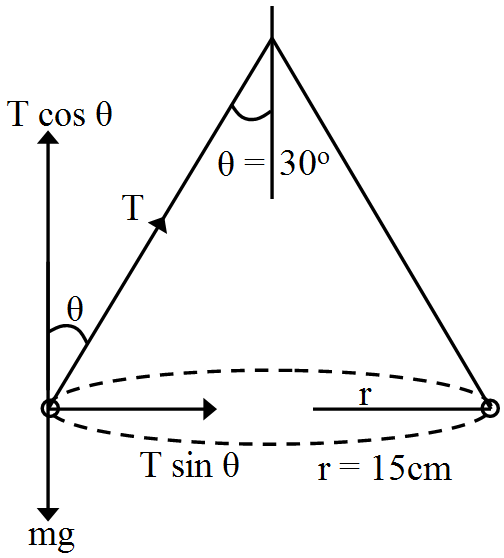 $\tan\theta=\frac{\text{v}^2}{\text{rg}}$ $\therefore\ \theta=\tan^{-1}\Bigg[\frac{(22)^2}{\frac{440}{2\pi}\times\text{g}}\Bigg]=35^\circ12'$
 View full question & answer→Question 503 Marks
Two masses $m_1$ and $m_2$ are connected to the ends of a string passing over a pulley. Find the tension and acceleration associated.
AnswerThe pulley is frictionless, massless and fixed. The free body diagram for the two masses are shown along with the equation.$\text{m}_2\text{g}-\text{T}=\text{m}_2\text{a},$
$\text{T}-\text{m}_1\text{g}=\text{m}_1\text{a}$
Solve the equations to get,
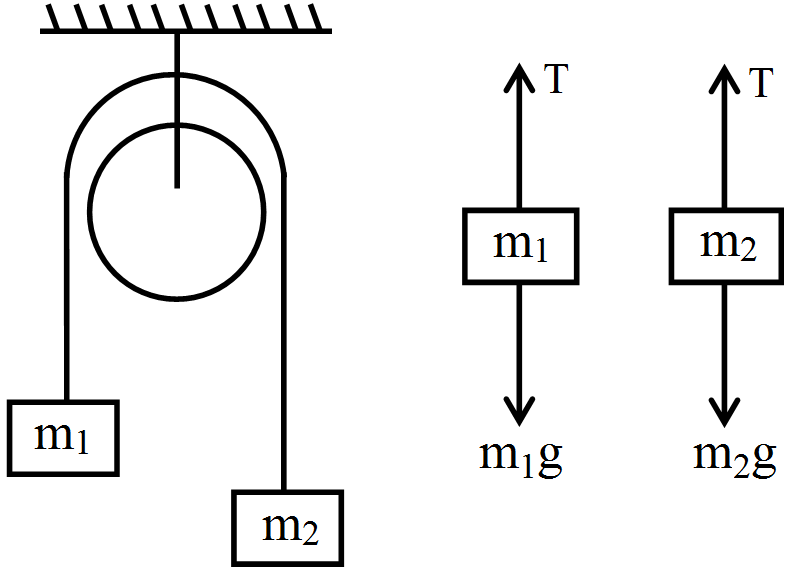
$\text{a}=\frac{(\text{m}_2-\text{m}_1)\text{g}}{(\text{m}_2+\text{m}_1)}$ and $\text{T}=\frac{2\text{m}_1\text{m}_2\text{g}}{(\text{m}_1+\text{m}_2)}.$ View full question & answer→Question 513 Marks
A ball is held at rest at position A in Fig., by two light strings. The horizontal string is cut and the ball starts swinging as a pendulum. Point B is the farthest to the right where the ball goes as it swings back and forth. What is the ratio of the tension in the supporting string in position B to its value at A before the horizontal string was cut?A ball is held at rest at position A in Fig., by two light strings. The horizontal string is cut and the ball starts swinging as a pendulum. Point B is the farthest to the right where the ball goes as it swings back and forth. What is the ratio of the tension in the supporting string in position B to its value at A before the horizontal string was cut?
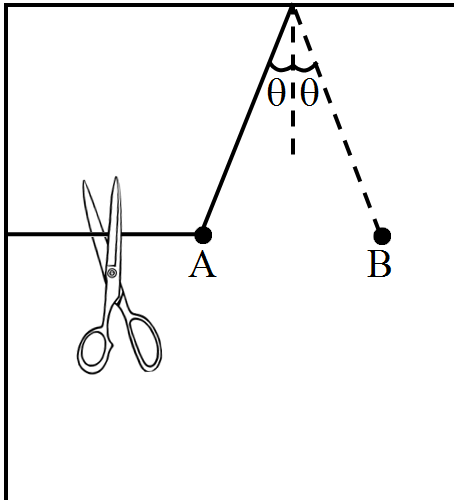
AnswerIn the first case, ball is in equilibrium. So, the net force on the body in any direction should be zero. $\therefore \sum \ \vec{\text{F}}$ in the vertical direction = 0 $\therefore \text{T}_{1} \cos \theta = \text{mg}\Rightarrow \text{T}_{1} = \frac{\text{mg}}{\cos \theta}$
View full question & answer→Question 523 Marks
A block of wood of mass 3kg is resting on the surface of a rough inclined surface, inclined at an angle $\theta$ as shown in the figure: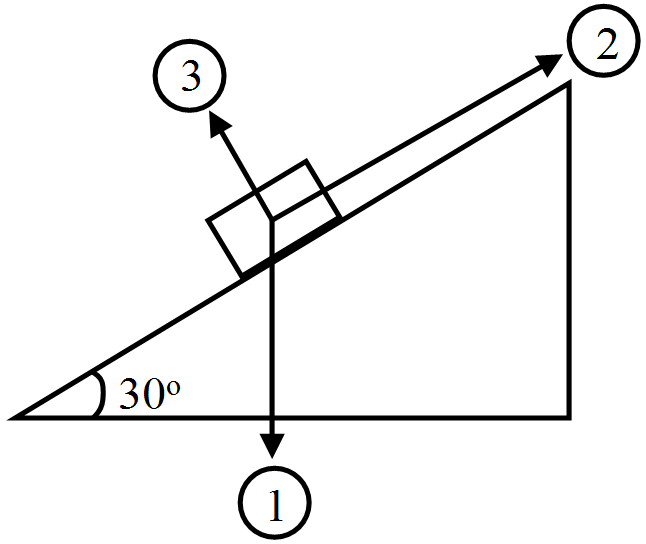
- Name the forces $(1, 2, 3).$
- If the coefficient of static friction is 0.2, calculate the value of all the three forces. (may use $g = 10m/ s^2)$
Answer
- Force $1$ = weight = mg
Force $2$ = force of limiting friction
Force $3$ = Normal Reaction R
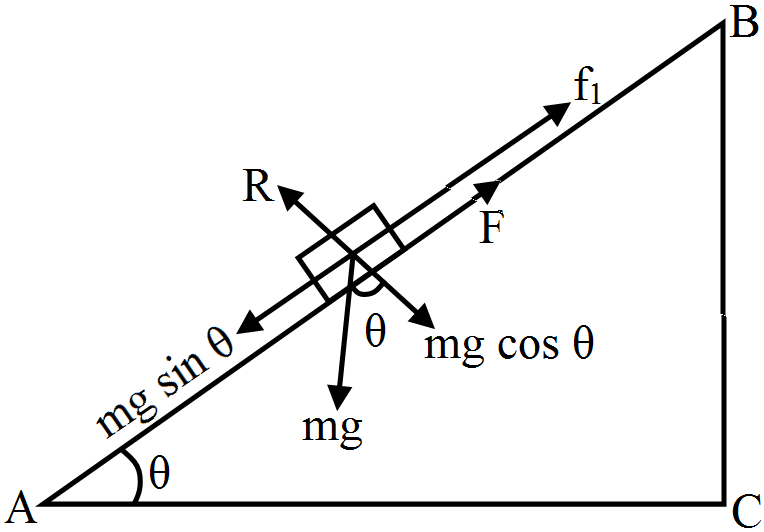
- $\mu=0.2,\text{ m}=3\text{kg},\theta=30^\circ$
Force 1 = weight = mg
$= 3 \times 10 = 30N$
$\text{Force }2=\text{f}_1=\text{mg}\sin\theta-\text{F}$
$\therefore\ \text{mg}\sin\theta=3\times10\times\sin30^\circ=15\text{N}$
And force of friction $\text{F}=\mu\text{R}$
$=\mu\text{mg}\cos\theta$
$=0.2\times3\times10\cos30^\circ=3\sqrt{3}\text{N}$
then force $2=\text{f}_1=15-3\sqrt{3}\approx9.8\text{N}$
Force 3 = Normal reaction R
$\therefore\ \text{R}=\text{mg}\cos\theta=3\times10\cos30^\circ$
$=15\sqrt{3}\text{N}$ View full question & answer→Question 533 Marks
For three moving objects the distances are found to be directly proportional to the times $t, t^2$ and $t^3$. What is the nature of the net force on each object?
AnswerAs F = ma $=\frac{\text{mv}}{\text{t}}=\text{m}\frac{\big(\frac{\text{x}}{\text{t}}\big)}{\text{t}}=\frac{\text{mx}}{\text{t}^2}$ When, $\text{x}\propto\text{t},\ \text{x}=\text{kt}$
$\Rightarrow\ \text{F}=\frac{\text{m}(\text{kt})}{\text{t}^2}=\frac{\text{km}}{\text{t}}$
$\text{i.e., F}\propto\frac{1}{\text{t}}$
$\therefore$ Net force on the object is inversely proportional to t. Similarly, when $\text{x}\propto\text{t}^2,$
$\therefore$ Net force on the object is independent of t.When $\text{x}\propto\text{t}^3,$
$\text{F}\propto\text{t}$
So, net force F on the object is directly proportional to the time.
View full question & answer→Question 543 Marks
State the law of conservation of momentum. Establish the same for a 'n' body system.
AnswerWhen no external force acts on a system the momentum will remain conserved. Consider a system of n bodies of masses $m_1, m_2, m_3 .... m_n$.
If $P_1, P_2, P_3 .... P_n$ are the momentum associated then the rate of change of momentum with the system, $\frac{\text{dp}}{\text{dt}}=\frac{\text{dp}_1}{\text{dt}}+\frac{\text{dp}_2}{\text{dt}}+\frac{\text{dp}_3}{\text{dt}}+......+\frac{\text{dp}_\text{n}}{\text{dt}}$ $=\frac{\text{d}}{\text{dt}}(\text{p}_1+\text{p}_2+\text{p}_3+.....\text{p}_\text{n})$ If no external force acts, $\frac{\text{dp}}{\text{dt}}=0$
$\therefore$ p = constant i.e.,$p_1 + p_2 + .....+ p_n$ = constant.
View full question & answer→Question 553 Marks
A motor car is travelling at $30m/ s$ on a circular road of radius $500m$. It is increasing its speed at the rate of $2ms^2$. What is the acceleration?
AnswerSpeed is $30m/ s$, radius = $500m$ Tangential acceleration $a_t = 2m/ s^2$ Centripetal acceleration, $\text{a}_\text{r}=\frac{\text{v}^2}{\text{r}}=\frac{900}{500}=1.8\text{ms}^{-2}$ Net acceleration $=\sqrt{\text{a}^2_\text{r}+\text{a}^2_\text{t}}$ $=\sqrt{2^2+(1.8)^2}=2.7\text{m/s}^2$
View full question & answer→Question 563 Marks
State law of conservation of momentum and prove it using third law of motion.
AnswerWhen no external force acts on the body, the momentum remains conserved. According to third law, for every action there is an equal and opposite reaction. So if $\mathrm{dp}_1$ and $\mathrm{dp}_2$ are change in momentum of two masses $\mathrm{m}_1$ and $\mathrm{m}_2$ then, $\frac{\mathrm{dp}_1}{\mathrm{dt}}=-\frac{\mathrm{dp}_2}{\mathrm{dt}}$, Since $\mathrm{F}_1=-\mathrm{F}_2 \therefore-\frac{\mathrm{d}}{\mathrm{dt}}\left(\mathrm{p}_1+\mathrm{p}_2\right)=0$, i.e., $\mathrm{p}_1+\mathrm{p}_2=$ constant.
View full question & answer→Question 573 Marks
For ordinary terrestrial experiments, which of the observers below are inertial and which are non-inertial:
- A child revolving in a giant wheel.
- A driver in a sports car moving with a constant high speed of $200kmh^{-1}$ on a straight road.
- The pilot of an aeroplane which is taking off.
- A cyclist negotiating a sharp turn.
- The guard of a train which is slowing down to stop at a station.
Answer
- A giant revolving wheel has accelerated (radially) motion. Therefore, a child revolving in a giant wheel is non-inertial.
- The sports car is moving with a constant speed on a straight road. Therefore, the driver in a sports car moving with a constant high speed $(200kmh^{-1})$ on a straight road is inertial.
- As the aeroplane takes off, it has accelerated motion. Therefore, the pilot of an aeroplane, which is taking off is non-inertial.
- While negotiating a sharp turn, there is change in the direction of motion of the cyclist and hence the motion is accelerated. Therefore, a cyclist negotiating a sharp turn is non-inertial.
- When a train is slowing down to stop at a station, its motion is retarding. Therefore the guard of a train which is slowing down to stop at a station acts as non-inertial observer.
View full question & answer→Question 583 Marks
Consider the bodies of mass $m _1$ and $m _2$ in contact placed on a frictionless table as shown. When force F is applied on mass $m_1$, calculate the acceleration produced, and the force of contact between the bodies. What will be the force of contact when the force $F$ is applied on mass $m_2$ ?

AnswerCase (a): Let $F$ be applied on $m_1$ and $f$ is the force of contact between the two bodies.
$\therefore F-f=m_1 a \ldots . . .(i)$
Also, $f=m _2 a \ldots$...(ii) Adding (i) and (ii),
we have $F =\left( m _1+ m _2\right)$ a or $a =\frac{ F }{\left( m _1+ m _2\right)}$
Again, $f = F - m _1 a$
$=\text{F}-\frac{\text{m}_1\text{F}}{(\text{m}_1+\text{m}_2)}=\frac{\text{m}_2\text{F}}{(\text{m}_1+\text{m}_2)}$
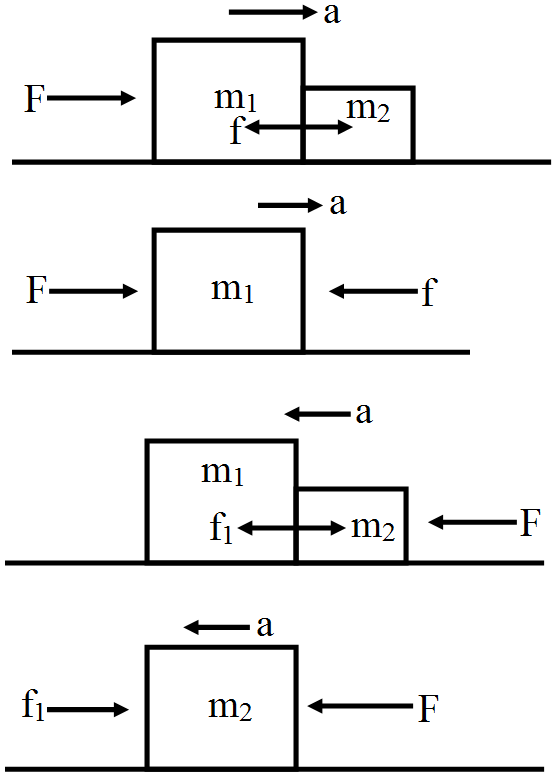
Case (b): Similarly, in the 2nd case.
$F - f_1 = m_2a$ and $f_1 = m_1a$
$\therefore F = (m_1 + m_2)$ aor,
$\text{a}=\frac{\text{F}}{(\text{m}_1+\text{m}_2)}$
$\therefore\ \text{f}_1=\frac{\text{m}_1\text{F}}{(\text{m}_1+\text{m}_2)}$ View full question & answer→Question 593 Marks
Show that the total linear momentum of an isolated system of interacting particles is conserve
AnswerConsider two bodies A and B, with inital momenta $\vec{\text{p}}_\text{A}$ and $\vec{\text{p}}_\text{B}$ respectively. Let the two bodies collide, get apart and have final momenta $\vec{\text{p}'}$ and $\vec{\text{p}'_\text{B}}$ respectively. By the second law of motion: Change in momentum of body $\text{A},\vec{\text{p}'_\text{A}}-\vec{\text{p}}_\text{A}=\vec{\text{F}}_\text{AB}\Delta\text{t}\dots\text{(i)}$ A where $\vec{\text{F}}_\text{AB}$ is the force acting on A due to action of B for a time $\Delta\text{t.}$ Similarly change in momentum of body, $\text{B},\vec{\text{p}}'-\text{B}-\vec{\text{p}}_\text{B}=\vec{\text{F}}_\text{BA}\Delta\text{t}\dots\text{(ii)}$ Here time $\Delta\text{t}$ the time for which two bodies A and B are in contact and interact, is same for both the forces. Moreover, from third law of motion $\vec{\text{F}}_\text{AB}=-\vec{\text{F}}_\text{BA}$ Hence, adding (i) and (ii), we obtain $\Big(\vec{\text{p}}_\text{A}-\vec{\text{p}}_\text{A}\Big)+\Big(\vec{\text{p}}_\text{B}-\vec{\text{p}}_\text{B}\Big)\text{s}$ $=\vec{\text{F}}_\text{AB=}\Delta\text{t}+\vec{\text{F}}_\text{BA}\Delta\text{t}=-\vec{\text{F}}_\text{BA}\Delta\text{t}+\vec{\text{F}}_\text{BA}\Delta\text{t}=0$ $\Rightarrow\vec{\text{p}'_\text{A}}+\vec{\text{p}'_\text{B}}=\vec{\text{p}}_\text{A}+\vec{\text{p}}_\text{B}$ Which shows that the total final momentum of the isolated system is exactly same as its initial momentum. Thus, it is proved that total momentum of an isolated system remains conserved.
View full question & answer→Question 603 Marks
The driver of a truck travelling with a velocity v suddenly notices a brick wall in front of him at a distance d. Is it better for him to apply brakes or to make a circular turn without applying brakes in order to just avoid crashing into the wall? Why?
AnswerIn applying brakes, suppose $F_B$ is the force required to stop the truck in distance (d)
$\therefore\text{F}_\text{B}\times\text{d}=\frac{1}{2}\text{mv}^2$ or $\text{F}_\text{B}=\frac{\text{mv}^2}{\text{2d}}$
In taking a turn of redius d, the force required is
$\text{F}_\text{T}=\frac{\text{mv}^2}{\text{d}}=\text{2F}_\text{B}$ or $\text{F}_\text{B}=\frac{1}{2}\text{F}_\text{T}$
Therefore, it is better to apply brakes.
View full question & answer→Question 613 Marks
Define impulse. A cricket ball of mass $150gm$ moving with speed of $12m/ s$ is hit by a bat so that the ball is turned back with a velocity of $20m/ s$. Calculate the impulse received by the ball.
AnswerThe product of force and the time on which it acts or change in momentum is called Impulse. Momentum before the hit $=150 \times 12 \times 10^{-3}=1.8 \mathrm{~kg} \mathrm{~ms}^{-1}$ Momentum after the hit $=150 \times 10^{-3} \times-20=-3 \mathrm{~kg} \mathrm{~ms}^{-1}$
$\therefore$ Impulse $=$ change in momentum $=-4.8 \mathrm{~kg} \mathrm{~ms}^{-1}$
View full question & answer→Question 623 Marks
A piece of ice slides down a $45°$ incline in twice the time it takes to slide down a frictionless $45°$ incline. What is the coefficient of friction between the ice and the incline?
AnswerHere, $\theta = 45^\circ, \text{S}_1 = \text{S}_{2}; \text{u} = 0$ On the rough incline, $\text{a}_{1} = \text{g}(\sin \theta - \mu \cos \theta )$ $t_1$= time taken On the frictionless incline, $\text{a}_{2} = \text{g} \sin \theta t_2$ = time taken From $\text{S} = \text{ut} + \frac{1}{2} \text{at} ^{2}$
$\text{S}_{1} = 0 \frac{1}{2} \text{g} (\sin \theta = \mu \cos \theta) \text{t}_{1}^{2}$ and $\text{S}_{2} = 0 +\frac{1}{2} \text{g} \ \sin \theta. \text{t}_{2}^{2}$ As $\text{S}_{1} = \text{S}_{2}$
$\therefore \frac{1}{2} \text{g} (\sin \theta - \mu \cos \theta) \text{t}_{1}^2 = \frac{1}{2} \text{g} \sin \theta. \text{t}^2_1$
$\frac{\sin \theta - \mu \cos \theta }{\sin \theta} = \frac{\text{t}^1_2}{\text{t}^2_1} = \frac{\text{t}^2_2}{(2\text{t}_2)^2} = \frac{1}{4}$
$1 - \mu \cot \theta = \frac{1}{4}$ or $\mu \cot \theta = 1 -\frac{1}{4}$
$\Rightarrow\mu \cot \theta = \frac{3}{4} \Rightarrow \mu \frac{3}{4\cot \theta}.$
View full question & answer→Question 633 Marks
A rocket with a lift-off mass $20,000kg$ is blasted upwards with an initial acceleration of $5.0ms^{-2}$. Calculate the initial thrust (force) of the blast.
AnswerGiven: Mass of the rocket, $m=20,000 \mathrm{~kg}$ Initial acceleration, $a=5 \mathrm{~m} / \mathrm{s}^2$ Acceleration due to gravity, $g=10 \mathrm{~m} / \mathrm{s}^2 U$ sing Newton's second law of motion, the net force (thrust) acting on the rocket is given by the relation: ( $F-\mathrm{mg}$ ) = ma $\mathrm{F}=$ $m(g+a)=(20000 \times(10+5))=(20000 \times 15)=3 \times 10^5 \mathrm{~N}$
View full question & answer→Question 643 Marks
Define the term 'coefficient of limiting friction' between two surfaces. A body of mass 10kg is placed on an inclined surface of angle 30°. If the coefficient of limiting friction is $\frac{1}{\sqrt{3}}$ find the force required to just push the body up the inclined surface. The force is being applied parallel to the inclined surface.
AnswerCoefficient of limiting friction between two surfaces in contact is defined as the ratio of force of limiting friction and normal reaction between them. 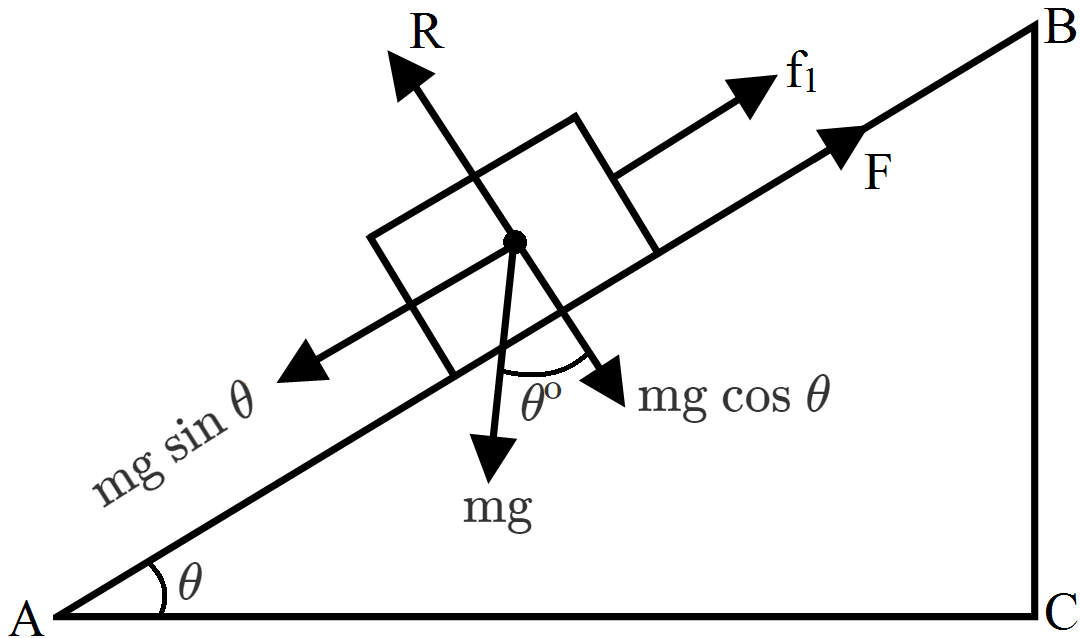 $\text{m}=10\text{kg}$ $\theta=30^\circ$ $\mu=\frac{1}{\sqrt{3}}.$ $\text{R}=\text{mg}\cos\theta$ Force of friction $\text{F}=\mu\text{R}=\mu\text{ mg }\cos\theta$ $=\frac{1}{\sqrt{3}}\times10\times9.8\times\cos30^\circ$ $=\frac{1}{\sqrt{3}}\times98\times\frac{\sqrt{3}}{2}=49\text{N}$ $\text{mg }\sin\theta=10\times9.8\times\sin30^\circ$ $=49\text{N}$ Force required to push the body up inclined surface = (49 + 49) = 98N.
 View full question & answer→Question 653 Marks
The barrel of a gun is $1m$ long and it fires a bullet of mass $0.05kg$ with a muzzle velocity of $400ms^{-1}.$ Find:
- The acceleration,
- The force, and
- The impulse given to the bullet by the gun.
AnswerHere mass of bullet, $m =0.05 kg$, initial velocity of bullet before firing $u =0$, length of barrel of gun, moving through which the bullet is accelerated $s=1 m$, final muzzle velocity of bullet $v=400 ms^{-1}$.
- Using the relation $v^2 - u^2 =2as$, we have,
$(400)^2-(0)^2=2\times\text{a}\times1$,
$\Rightarrow\text{a}=\frac{400\times400}{2\times1}=8\times10^4\text{ms}^{-2}$,
- Force $\text{F}=\text{ma}=0.05\times8\times10^4=4000\text{N}$
- Impulse given to the bullet by the gun, J = change in momentum of bullet
$=\text{m}(\text{v}-\text{u})=0.05\times(400-0)=20\text{Ns}.$ View full question & answer→Question 663 Marks
The force required to just move a body up an inclined plane is double the force required to prevent the body from sliding down. Find the coefficient of friction.
AnswerForce required to just move the body of mass m up to an inclined plane $\text{F}_1=\text{mg}\sin\theta+\mu\text{ mg}\cos\theta$ Force required to stop the body from sliding down $\text{F}_2=\text{mg}\sin\theta-\mu\text{ mg}\cos\theta$ Given that, $F_1 = 2F_2$
$\text{mg}(\sin\theta+\mu\cos\theta)=2(\sin\theta-\mu\cos\theta)\text{mg}$
$3\mu\cos\theta=3\sin\theta\Rightarrow\ \mu=\tan\theta$
View full question & answer→Question 673 Marks
Compute the acceleration of the block and trolley system as shown. If the coefficient of kinetic friction between the trolley and the surface is $0.04$, what is the tension in the string? [Take $g = 10ms^{-2}]$
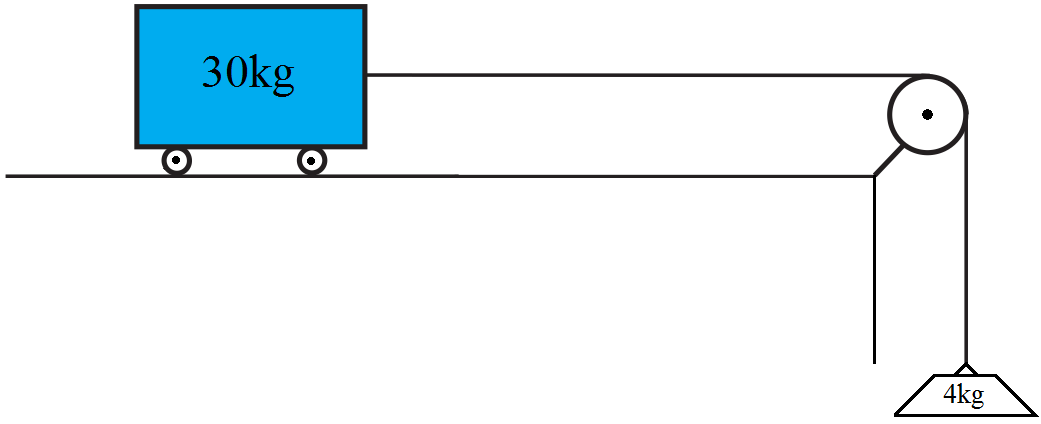
AnswerLet a be the acceleration produced in the block-trolley system.
Considering forces acting on the weight $30kg$ $30 - T = 4a ...(i)$
Kinetic friction, $F_k =$ $\mu$(mass of trolley) $\times g = 0.04 \times 30 \times 10 = 12N$
Considering forces acting on trolley of mass $30kg,$
we have $T - F_1 = 30a$ or $T - 12 = 30a ...(ii)$ Adding (i) and (ii),
we get 28 = 34aor $\text{a}=\frac{28}{34}=0.82\text{ ms}^{-2}$
Putting this value in (i), we get $T = 30 - 4 \times 0.82 = 30 - 3.28 = 26.72N$
View full question & answer→Question 683 Marks
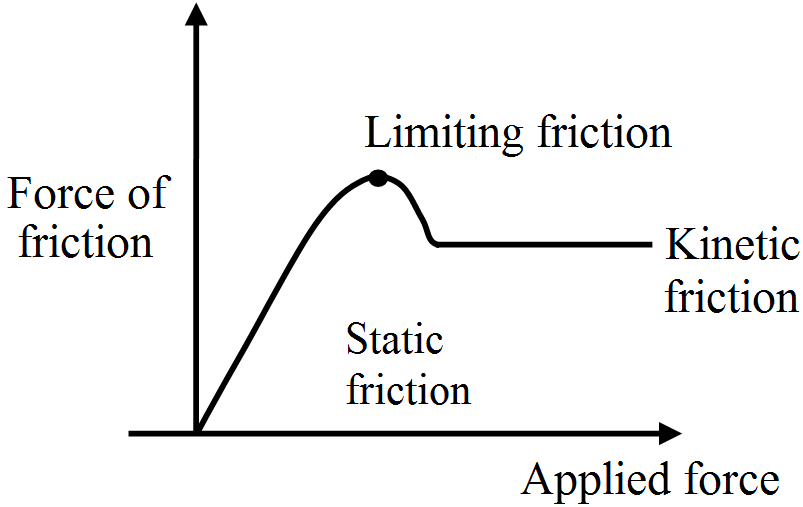
Distinguish between static friction, limiting friction and kinetic friction. How do they vary with the applied force, explain by diagram.
AnswerStatic friction exists as long as the body stays at rest. It increases with the force applied. Limiting friction is the maximum value of static friction. Kinetic friction is the friction when the body is on the move. This will be a constant and depends on the nature of surface only. The variation of frictional force is shown below.
View full question & answer→Question 693 Marks
Why does a gun recoil on firing? What is recoil velocity? Find the expression for it.
AnswerSince no external force acts on the gun the momentum has to be conserved. So, the gun recoils. Recoil velocity: Velocity of the gun at the instant bullet is fired is known as recoil velocity. Gun recoil back opposite to direction of motion of bullet. If $m_g$ and $m_b$ are mass of gun and bullet, with velocity of bullet being $V_b$ then $m_gv_g + m_bV_b = 0\text{V}_\text{g}=-\frac{\text{m}_\text{b}\text{V}_\text{b}}{\text{m}}$
-ve sign shows that gun moves in opposite direction and $V_g$ is called recoil velocity.
View full question & answer→Question 703 Marks
A man of mass 70kg stands on a weighing scale in a lift which is moving. What would be the reading if the lift mechanism failed and it hurtled down freely under gravity?
AnswerWhen the lift moves freely under gravity, acceleration a = g Using Newton’s second law of motion, we can write the equation of motion as: R + mg = ma R = m(g – a) = m(g - g) = 0 $\therefore$ Reading on the weighing scale $\frac{0}{\text{g}}=0\text{kg}$ The man will be in a state of weightlessness.
View full question & answer→Question 713 Marks
An electron and a proton are detected in a cosmic ray experiment, electron with kinetic energy 10 keV and proton with kinetic energy 100 keV . Which is faster: the electron or the proton? Obtain the ratio of their speeds. (Take mass of electron $=9.11 \times 101^{-31} \mathrm{~kg}$, mass of proton $\left.=1.67 \times 10^{-27} \mathrm{~kg}, \mathrm{IeV}=1.60 \times 10^{-19} \mathrm{~J}\right)$
Answer$\text{K}_\text{e}=10\text{ keV},\text{ K}_\text{p}=100\text{ keV}$$\frac{\text{K}_\text{e}}{\text{K}_\text{p}}=\frac{\text{m}_\text{e}\text{v}^2_\text{e}}{\text{m}_\text{p}\text{v}^2_\text{p}}$
$\Big(\frac{\text{v}_\text{e}}{\text{v}_\text{p}}\Big)^2=\Big(\frac{\text{m}_\text{p}}{\text{m}_\text{e}}\Big)\Big(\frac{\text{K}_\text{e}}{\text{K}_\text{p}}\Big)$
$=\frac{1.67\times10^{-27}}{9.11\times10^{-31}}\times\frac{1}{10}$
$\frac{\text{v}_\text{e}}{\text{v}_\text{p}}=\sqrt{183.31}$
$\text{v}_\text{e}=13.5\text{ v}_\text{p}$
View full question & answer→Question 723 Marks
A car is moving in a circular horizontal track of radius 10m with constant speed of 10m/s. A plumb bob is suspended from roof by a light rigid rod of length 1m. Find the angle made by the rod with the track.
AnswerThe different forces acting on the bob are shown in figure. Resolving the forces along the length and perpendicular to the rod, we have $\text{mg}\cos\theta+\frac{\text{mv}^2}{R}\sin\theta=\text{T}$ $\text{mg}\sin\theta=\frac{\text{mv}^2}{\text{R}}\cos\theta$ Now,$\tan\theta=\frac{\text{v}^2}{\text{Rg}}=\frac{(10)^2}{10\times10}=1$ $\Rightarrow\tan\theta=1\Rightarrow\theta=\tan^{-1}(1)=45^\circ.$ 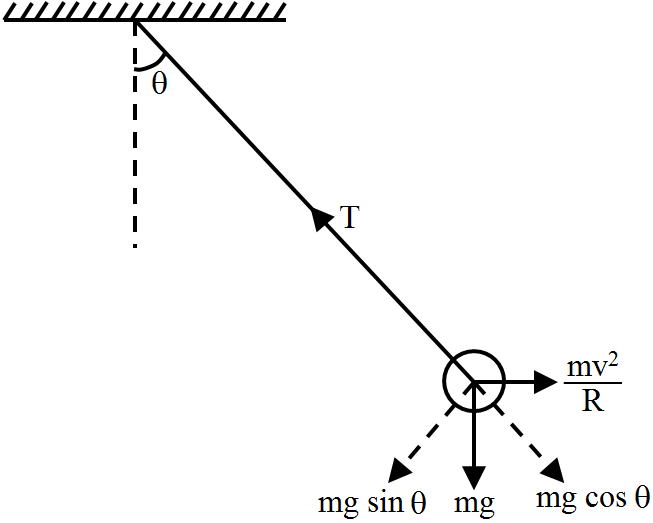
View full question & answer→Question 733 Marks
A train runs along an unbanked circular track of radius $30m$ at a speed of $54km/ h$. The mass of the train is $10^6kg$. What is the centripetal force required for this purpose? What is the angle of banking required to prevent wearing out of the rail?
AnswerGiven: $r=30 \mathrm{~m}, \mathrm{v}=54 \mathrm{~km} / \mathrm{h}=15 \mathrm{~ms}^{-1}, \mathrm{~m} 10^6 \mathrm{~kg}$ Centripetal force $=\frac{\text{mv}^2}{\text{r}}=\frac{10^6\times15^2}{30}=75\times10^5\text{N}$ Angle of banking, $\theta=\tan^{-1}\Big(\frac{\text{v}^2}{\text{rg}}\Big)=\tan^{-1}\Big(\frac{225}{30\times9.8}\Big)$ $\theta\simeq37^\circ$
View full question & answer→Question 743 Marks
Arocket with a lift off mass $20,000 \mathrm{~kg}$ is blasted upwards with an initial acceleration of $5.0 \mathrm{~ms}^{-2}$. Calculate the initial thrust (force) of the blast.
AnswerMass of the rocket, $\mathrm{m}=20,000 \mathrm{~kg}$ Acceleration to be produced in the rocket $\mathrm{a}=\mathrm{ms}^{-2}$ upward thrust required to overcome the gravitational pull, $\mathrm{F}_1=\mathrm{mg}=20,000 \times 9.8=1.96 \times 10^5 \mathrm{~N}$ Upward thrust required to impart acceleration, a $F_2=\mathrm{ma}, \mathrm{F}_2=20,000 \times 5=10^5 \mathrm{~N}$ Hence, net initial thrust on the blast $=1.96 \times 10^5 \mathrm{~N}+10^5 \mathrm{~N}=2.96 \times$ $10^5 \mathrm{~N}$
View full question & answer→Question 753 Marks
A horizontal force of $500N$ pulls two masses $10kg$ and $20kg$ (lying on a frictionless table) connected by a light string as shown. What is the tension in the string? Does the answer depend on which mass the pull is applied? 
AnswerThe acceleration produced in the body of mass $10 + 20 = 30kg$ is
given by, $\text{a}=\frac{\text{F}}{\text{m}}=\frac{500}{30}=\frac{50}{3}\text{ ms}^{-2}$
When $500N$ pull is applied on $20kg$, tension, T, produced is given by, $T_1 = m_1a$
$=10\times\frac{50}{3}=\frac{500}{3}=166.7\text{ N}$
When $500N$ pull is applied on 10kg, tension T, produced is given by, $T_2 = m_2a $
$=20\times\frac{50}{3}=\frac{1000}{3}=333.4\text{ N}$
Thus the tension depends mass-end on which the pull is applied.
View full question & answer→Question 763 Marks
A curved road of diameter $1.8km$ is banked, so that no friction is required at a speed of $30ms^{-1}$. What is the banking angle?
AnswerRadius = $0.9km = 900m$ Speed =$v = 30ms^{-1}$, $\mu=0$ We know, $\tan\theta=\frac{\text{v}^2}{\text{rg}}$
$\therefore\ \theta=\tan^{-1}\Big(\frac{\text{v}^2}{\text{rg}}\Big)$
$=\tan^{-1}(0.102)=6^\circ$
View full question & answer→Question 773 Marks
State law of conservation of linear momentum. Derive the law of conservation of momentum from Newton's third law of motion.
AnswerWhen no external force acts on a body, there is no change in linear momentum or the total momentum of an isolated system of interacting particles remain conserved. Let us consider an isolated system (which is free from the influence of any external forces) comprising of two bodies A and B with initial momentum $\vec{\text{P}}_\text{A}$ and $\vec{\text{P}}_\text{B}.$ Let them collide for a small time $\Delta\text{t}$ and separate with final momentum $\vec{\text{P}'}_\text{A}$ and $\vec{\text{P}'}_\text{B}$ respectively. During collisioin, If $\vec{\text{F}}_\text{AB}$ is force on A exerted by B, and $\vec{\text{F}}_\text{BA}$ is force on B exerted by A, then according to Newton's second law.$\vec{\text{F}}_\text{AB}\times\Delta\text{t}=$ Change in momentum of A
$=\vec{\text{P}'}_\text{A}-\vec{\text{P}}_\text{A}\dots(\text{i})$
$\vec{\text{F}}_\text{BA}\times\Delta\text{t}=$ Change in momentum of B
$=\vec{\text{P}'}_\text{B}-\vec{\text{P}}_\text{B}\dots(\text{ii})$
According to Newton's third law,$\vec{\text{F}}_\text{AB}=-\vec{\text{F}}_\text{AB}$
$\therefore$ Forms (i) and (ii),
$\vec{\text{P}'}_\text{A}-\vec{\text{P}}_\text{A}=-(\vec{\text{P}'}_\text{B}-\vec{\text{P}}_\text{B})$
Which shows that total final momentum of the isolated system is equal to its total initial momentum.$\Rightarrow\ \vec{\text{P}'}_\text{A}+\vec{\text{P}'}_\text{B}=\vec{\text{P}}_\text{A}+\vec{\text{P}}_\text{B}$
This proves the law of conservation of linear momentum.
View full question & answer→Question 783 Marks
Show that the total linear momentum of an isolated system of interacting particles is conserved.
AnswerConsider two bodies A and B, with inital momenta $\vec{\text{p}}_\text{A}$ and $\vec{\text{p}}_\text{B}$ respectively. Let the two bodies collide, get apart and have final momenta $\vec{\text{p}'}_\text{A}$ and $\vec{\text{p}'}_\text{B}$ respectively. By the second law of motion: Change in momentum of body $\text{A},\vec{\text{p}'}_\text{A}-\vec{\text{p}}_\text{A}=\vec{\text{F}}_\text{BA}\Delta\text{t}$ ...(i) Where $\vec{\text{F}}_\text{AB}$ is the force acting on A due to action of B for a time $\Delta\text{t}$. Similarly change in momentum of body $\text{B},\vec{\text{p}'}_\text{B}-\vec{\text{p}}_\text{B}=\vec{\text{F}}_\text{BA}\Delta\text{t}$ ...(ii) Here time $\Delta\text{t}$ the time for which two bodies A and B are in contact and interact, is same for both the forces. Moreover, from third law of motion $\vec{\text{F}}_\text{AB}=\vec{\text{F}}_\text{BA}$ Hence, adding (i) and (ii), we obtain $(\vec{\text{p}'}-\vec{\text{p}}_\text{A})+(\vec{\text{p}'}_\text{B}-\vec{\text{p}}_\text{B})\text{s}$ $=\vec{\text{F}}_\text{AB}\Delta\text{t}+\vec{\text{F}}_\text{BA}\Delta\text{t}$ $=-\vec{\text{F}}_\text{BA}\Delta\text{t}+\vec{\text{F}}_\text{BA}\Delta\text{t}=0$ $\Rightarrow\vec{\text{p}'}_\text{A}+\vec{\text{p}'}_\text{B}=\vec{\text{p}}_\text{A}+\vec{\text{p}}_\text{B}$ Which shows that the total final momentum of the isolated system is exactly same as its initial momentum. Thus, it is proved that total momentum of an isolated system remains conserved
View full question & answer→Question 793 Marks
A box of wood is placed on a 30° slope. If the coefficient of friction be 0.1, what is the downward acceleration of the wooden box?
Answer
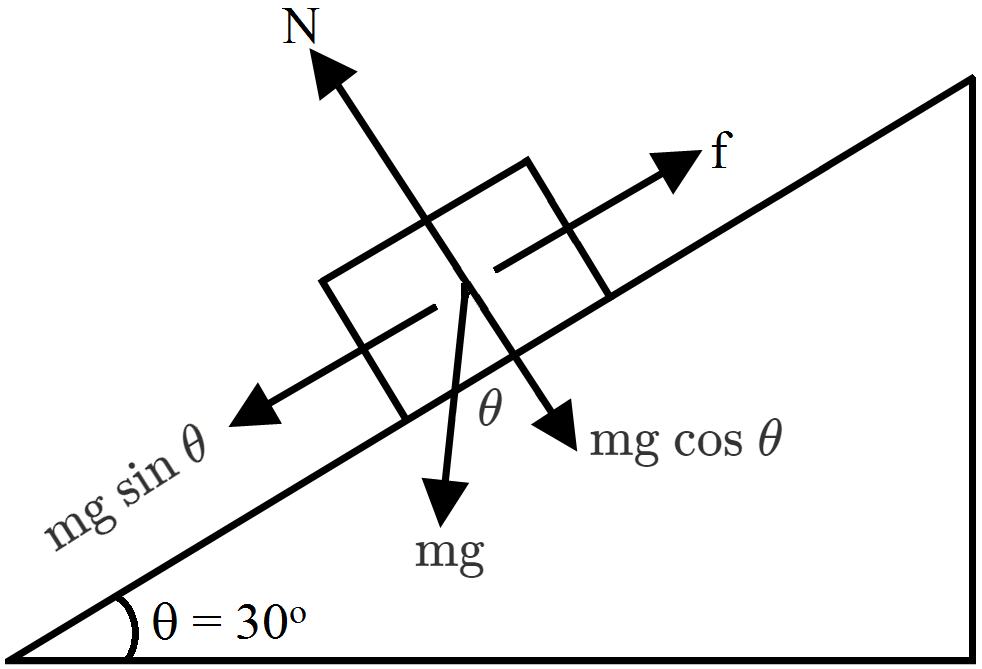 Here $\theta = 30^{\circ} \text{ and } \mu = 0.1$
As shown in following figure, net accelerating force along the inclined plane is
$\text{F = m g} \sin \theta - f = \text{m g} \sin \theta - \mu \text{N}$
$= \text{m g}\sin \theta - \mu \text{ mg}\cos \theta$
But F = ma
$\Rightarrow \text{a} = \text{g}(\sin \theta - \mu \cos \theta ) $
$=9.8 \times (\sin 30^ \circ - 0.1 \times \cos 30^\circ) \simeq 4 \text{ms}^{-2}$ View full question & answer→Question 803 Marks
The displacement vector of a particle of mass m is given by $\text{r}\text{(t})=\hat{\text{i}}\text{A}\cos\omega\text{t}+\hat{\text{j}}\text{B}\sin\omega\text{t}.$Show that the trajectory is an ellipse.
AnswerThe Main concept used: To plot the graph ( r - t ) or trajectory we relate x and y coordinates. $\vec{\text{r}}\text{(t)}=\hat{\text{i}}\text{A}\cos\omega\text{t}+\hat{\text{j}}\text{B}\sin\omega\text{t}$ $\text{x}=\text{A}\cos\omega\text{t}$ and $\text{y}=\sin\omega\text{t}$ $\frac{\text{x}}{\text{A}}=\cos\omega\text{t}\ ...(\text{i})\ \frac{\text{y}}{\text{}B}=\sin\omega\text{t}\ ...(\text{ii})$ Squaring and adding (i), (ii) $\frac{\text{x}^2}{\text{A}^2}+\frac{\text{y}^2}{\text{B}^2}=\cos^2\omega\text{t}+\sin^2\omega\text{t}$ $\frac{\text{x}^2}{\text{A}^2}+\frac{\text{y}^2}{\text{B}^2}=1$ it is the equation of an ellipse. So the trajectory is an ellipse.
View full question & answer→Question 813 Marks
A particle moves in a circle of radius $20cm$. Its linear speed at any time is given by $v = 2t$ where v is in m/s and t is in seconds. Find the radial and tangential accelerations at $t = 3$ seconds and hence calculate the total acceleration at this time.
AnswerThe linear speed at 3 seconds is $v = 2 \times 3 = 6m/s$ The radial acceleration at 3 seconds $=\frac{\text{v}^2}{\text{r}}=\frac{6\times6}{0.2=180}=180\text{m/s}^2$ The tangential acceleration is given by $\frac{\text{dv}}{\text{dt}}=2,$ since $\text{v}=2\text{t}$
$\therefore$ tangential acceleration is $2/s^2$. Total acceleraton $\sqrt{\text{a}^2_\text{r}+\text{a}^2_\text{t}}=\sqrt{180^2+2^2}$
$=\sqrt{32400+4}=\sqrt{32404}\text{ms}^{-2}.$
View full question & answer→Question 823 Marks
A particle of mass $100mg$ is moving in a circular vertical path of radius $2m$. The particle is just 'looping the loop'. What is the speed of particle and the tension in the string at the highest point of the circular path? ($g = 10ms^{-2}$)
AnswerHere, m = 100g = 0.1kg r = 2m
$\therefore$ Minimum speed of the particle at the highest point for just looping the loop $=\sqrt{\text{gr}}=\sqrt{10\times2}=\sqrt{20}=4.47\text{ms}^{-1}$ Tension in the string at highest point $=\frac{\text{mV}^2_1}{\text{r}}-\text{5mg}$ $=\text{5mg}-\text{5mg}=0$
View full question & answer→Question 833 Marks
A man weighing $60kg$ is sitting in a lift which is moving vertically with an acceleration of $2ms^{-2}$. Prove that the reaction on the base of the lift is greater when it is ascending than when it is descending. (Given $g = 9.8ms^{-2}$).
AnswerWe know, when the lift accelerates upward, the reaction $R$, on the base is given by $R_1=M g+M a=M(8+a) \Rightarrow R_1=$ $60(9.8+2)=60 \times 11.8=708 \mathrm{~N}$ When the lift accelerates downward with acceleration a, the reaction $R$, on the base given by $R_2=M g-M a=M(g-a) \Rightarrow R_2=60(9.8-2)=60 \times 7.8=468 \mathrm{~N}$ Therefore, $R_1>R_2$.
View full question & answer→Question 843 Marks
The centre of gravity of a loaded taxi is 1.5m above the ground, and the distance between wheels is 2m. What is the maximum speed with which it can go round an unbanked curve of radius 100m without being turned upside down? What minimum value of coefficient of friction is needed at this speed?
AnswerFor rotational equilibrium, $\frac{\text{mv}^2}{\text{r}}\times\text{h}=\text{mg}(\text{x})$Given: 2x = 2m, h = 1.5m
$\therefore\ \text{v}=\sqrt{\frac{\text{gxr}}{\text{h}}}=\sqrt{\frac{9.8\times1\times100}{1.5}}$ $=25.56\text{ ms}^{-1}$ $\mu=\frac{\text{v}^2}{\text{rg}}=\frac{(25.56)^2}{100\times9.8}=0.67$
View full question & answer→Question 853 Marks
A body of mass m is suspended by two strings making angles $\alpha$ and $\beta$ with the horizonal as shown in Fig. Calculate the tensions in the two strings.
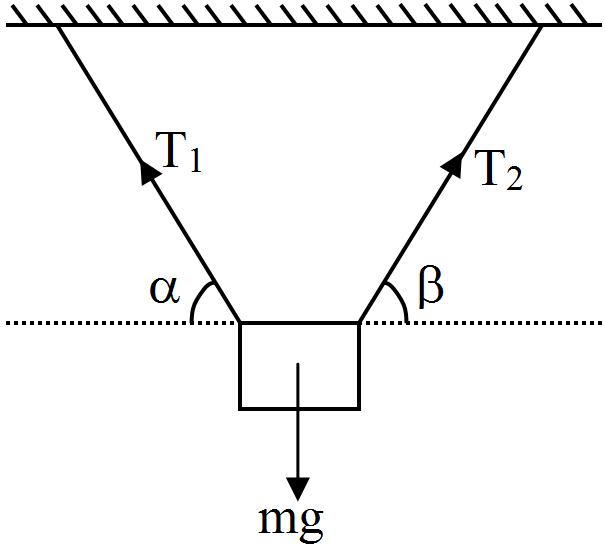
AnswerConsidering components of tensions $T_1$ and $T_2$ along the horizontal and vertical directions, We have, $-\text{T}_1\cos\alpha+\text{T}_2\cos\beta=0$
$\text{T}_1\cos\alpha=\text{T}_2\cos\beta\dots\text{(i)}$ and $\text{T}_1\sin\alpha+\text{T}_2\sin\beta=\text{mg}...\text{(ii)}$ From (i) $\text{T}_2=\frac{\text{T}_1\cos\alpha}{\cos\beta}$ and substituting it in (ii), we get $\text{T}_1\sin\alpha+\Big(\frac{\text{T}_1\cos\alpha}{\cos\beta}\Big)\sin\beta$
$=\text{mg}$ or $\text{T}_1\Big(\frac{\sin\alpha\cos\beta+\cos\alpha\sin\beta}{\cos\beta}\Big)=\text{mg}$ or $\text{T}_1\frac{\sin(\alpha+\beta)}{\cos\beta}=\text{mg}$
$\Rightarrow\text{T}_1=\frac{\text{mg}\cos\beta}{\sin(\alpha+\beta)}$ and hence $\text{T}_2=\frac{\text{T}_1\cos\alpha}{\cos\beta}$
$=\frac{\text{mg}\cos\beta}{\sin(\alpha+\beta)}.\frac{\cos\alpha}{\cos\beta}$
$=\frac{\text{mg}\cos\alpha}{\sin(\alpha+\beta)}$
View full question & answer→Question 863 Marks
Prove that Newton's second law of motion is the real law of motion.
AnswerNewton's second law is the real law of motion, as it can explain both first and third laws of motion.
- First law can be explained by using the second law.
$\because\ \text{Force, }\vec{\text{F}}=\text{m}\vec{\text{a}}$ if external force is equal to zero then $\vec{\text{a}}=0$ since $\text{m}\neq0$
$\therefore\ \vec{\text{v}}-\vec{\text{u}}=0\Rightarrow\ \vec{\text{v}}=\vec{\text{u}}$
It shows that if an object is at rest, it will remain at rest and if it is moving, then it will continue to move in uniform motion unless some external force is applied. This is Newton's first law of motion.
- Third law can also be explained by the second law. Consider an isolated system of two bodies A and B. Suppose the two bodies interact mutually with each other.
Let $\vec{\text{F}}_{\text{AB}}=\frac{\vec{\text{dp}}_\text{A}}{\text{dt}}=$ force on A exerted by B (Newton's Second law)
$\vec{\text{F}}_{\text{BA}}=\frac{\vec{\text{dp}}_\text{B}}{\text{dt}}=$ force on B exerted by A, then
$\vec{\text{F}}_\text{AB}+\vec{\text{F}}_\text{BA}=\frac{\vec{\text{dp}}_\text{A}}{\text{dt}}+\frac{\vec{\text{dp}}_\text{B}}{\text{dt}}$
$=\frac{\text{d}}{\text{dt}}(\vec{\text{p}}_\text{A}+\vec{\text{p}}_\text{B})$
Since linear momentum is conserved. therefore
$\frac{\text{d}}{\text{dt}}(\vec{\text{p}}_\text{A}+\vec{\text{p}}_\text{B})=0$ $\Big[\because\vec{\text{P}}_\text{A}+\vec{\text{P}}_\text{B}=\text{const}\Big]$
$\therefore\ \vec{\text{F}}_\text{AB}+\vec{\text{F}}_\text{BA}=0$
or $\vec{\text{F}}_\text{AB}=-\vec{\text{F}}_\text{BA}$ (Newton's Third law) View full question & answer→Question 873 Marks
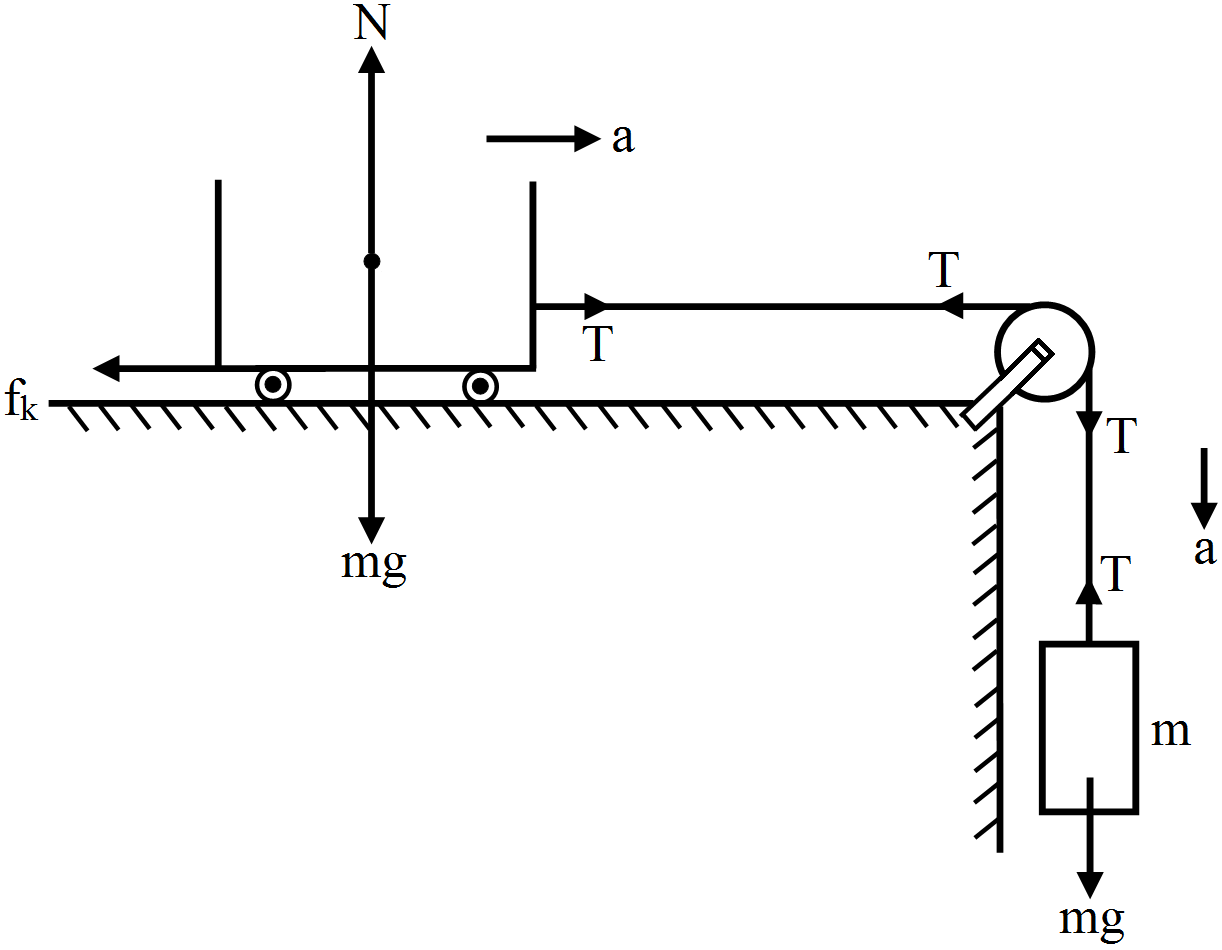
A trolley of mass $20kg$ rests on a horizontal surface. A massless string tied to the trolley passes over a frictionless pulley and a load of $5kg$ is suspended from other end of string. If coefficient of kinetic friction between trolley and surface be $0.1$, find the acceleration of trolley and tension in the string. (Take $g = 10ms^{-2}$).
AnswerThe free body diagram has been shown in Fig. below, Here, $\text{M}=20\text{kg},\text{m}=5\text{kg}$ and $\mu_\text{k}=0.1$ Here net pulling force, $\text{F}=\text{mg}-\text{f}_\text{k}=\text{mg}-\mu_\text{k}.\text{N}$
$=\text{mg}-\mu_\text{k}.\text{Mg}=5\times10-0.1\times20\times10$
$=50-20=30\text{N}$
$\therefore$ Acceleration of the system $\text{a}=\frac{\text{F}}{(\text{m}+\text{M})}$
$=\frac{30\text{N}}{(5+20)\text{kg}}=1.2\text{ms}^{-2}$
$\therefore$ Tension in string $T = mg - ma = 5 \times 10 - 5 \times 10 - 5 \times 1.2 = 50 - 6 = 44N$.
View full question & answer→Question 883 Marks
When walking on ice, one should take short steps rather than long steps. Why?
Answer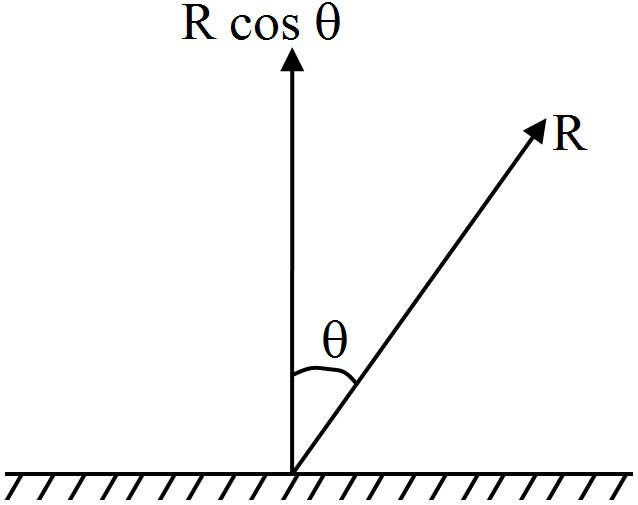 Let R represent the reaction offered by the ground. The vertical component $\text{R}\cos\theta$will balance the weight of the person and the horizontal component $\text{R}\sin\theta$ will help the person to walk forward. Now, normal reaction $=\text{R}\cos\theta$ Friction force $=\text{R}\sin\theta$ Coefficient of friction, $\mu=\frac{\text{R}\sin\theta}{\text{R}\cos\theta}=\tan\theta$ In a long step, $\theta$ is more. So tan $\theta$ is more. But µ has a fixed value. So, there is danger of slipping in a long step.
 View full question & answer→Question 893 Marks
What is the need for banking of road? Write the expression for the maximum speed with which a vehicle can safely negotiate a curved road banked at an angle $\theta.$ The coefficient of friction between the wheels and the road is $\mu.$
AnswerNeed for banking of road: Banking of road compensate necessary centripetal force and reduce wear and tear of the tyres. When a curved road is unbanked, force of friction between the tyres and the road provides the necessary centripetal force. Friction has to be increased suitably, that cause wear and tear of the tyres.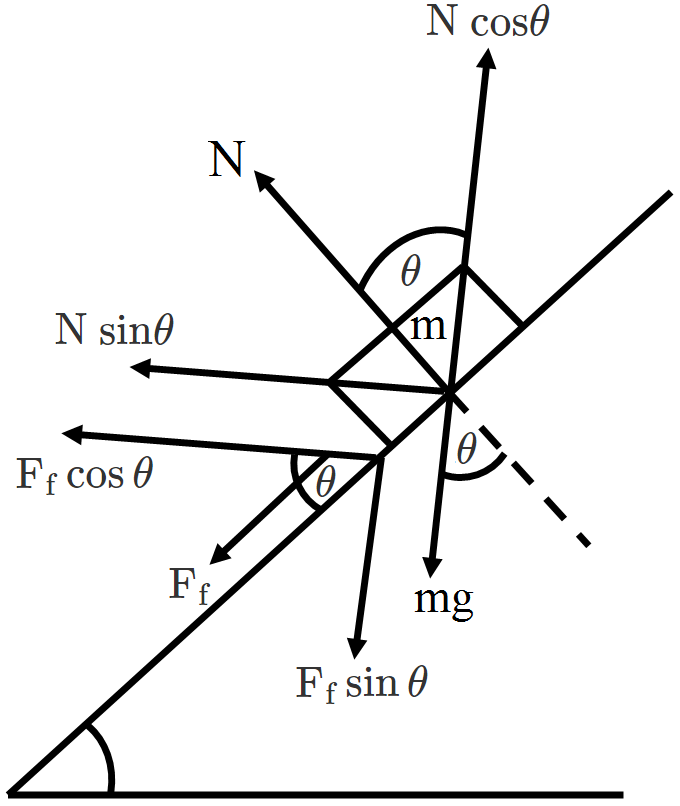
From the force acting on the vehicle in a banked curve $(\theta).$ $\text{N}\cos\theta-\text{F}_\text{f}\sin\theta=\text{mg}$ $\text{N}\sin\theta+\text{F}_\text{f}\cos\theta=\frac{\text{mv}^2}{\text{r}}$ $\text{F}_\text{f}=\mu\text{N}$ Dividing the equations, we have $\frac{\text{V}^2}{\text{rg}}=\frac{\text{N}\sin\theta+\mu\text{N}\cos\theta}{\text{N}\cos\theta-\mu\text{N}\sin\theta}$ [Dividing each term of right side by $\text{N}\cos\theta]$$\text{V}^2=\text{rg}\Big(\frac{\tan\theta+\mu}{1-\mu\tan\theta}\Big)$
$\text{V}=\sqrt{\text{rg}\Big(\frac{\tan\theta+\mu}{1-\mu\tan\theta}\Big)}$
This is the maximum speed on a banked road. View full question & answer→Question 903 Marks
A cyclist is riding with a speed of $27km/ h$ as he approaches a circular turn (on the road) of radius $80m$, he applies brakes and reduces his speed at the constant rate $0.50m/ s^2$. Find the magnitude and direction of the net acceleration of the cyclist on circular turn?
AnswerSpeed of cyclist 'v' = 27km/ h $=27\times\frac{5}{18}\text{ms}^{-1} = 7.5ms^{-1}, r = 80m$ Centripetal acceleration ‘$a_c$' which changes the direction of linear velocity and acts along the radius towards the centre of circular path.
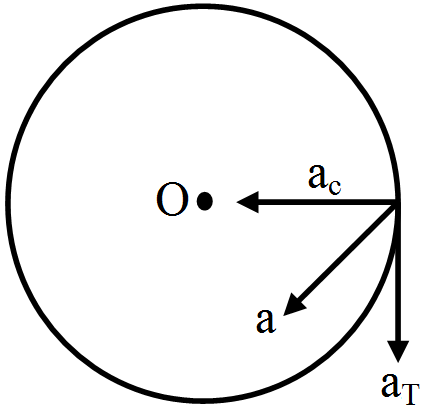
Also, $a_T$ = Tangential acceleration which acts along the tangential to the circular path. Resultant acceleration is given by $\text{a}=\sqrt{\text{a}^2_\text{c}+\text{a}^2_\text{T}}$ $=\sqrt{(0.7)^2+(0.5)^2}=0.86\text{ms}^{-2}$ $\tan\beta=\frac{\text{a}_\text{c}}{\text{a}_\text{T}}=\frac{0.7}{0.5}=1.4$ $\beta=\tan^{-1}(1.4)\cong54^\circ28'$ View full question & answer→Question 913 Marks
A hammer of mass $1kg$ moving with a speed of $6ms^{-1}$ strikes a wall and comes to rest in $0.1s$. Calculate:
- The impulse of force.
- The retardation of the hammer.
- The retarding force that stops the hammer.
AnswerMass of the hammer $m = 1kg$ Initial velocity, $u = 6ms^{-1}$, final velocity, $v = 0$ and $t = 0.1s$
- Impulse = Ft = m(v - u)
= 1(0 - 6) = -6Ns
- Retarding force that stops the hammer,
$\text{F}=\frac{\text{Impulse}}{\text{time}}=\frac{6}{0.1}=60\text{N}$
- Retardation of the hammer
$=\frac{\text{F}}{\text{m}}=\frac{60}{1}=60\text{ ms}^{-2}$ View full question & answer→Question 923 Marks
In the system of three blocks $A , B$ and C shown in figure,
(i) how large a force $F$ is needed to give the blocks an acceleration of $3 m / s ^2$, if the coefficient of friction between blocks and table is $0.27$
(ii) how large a force does the block $A$ exert on the block $B$ ?
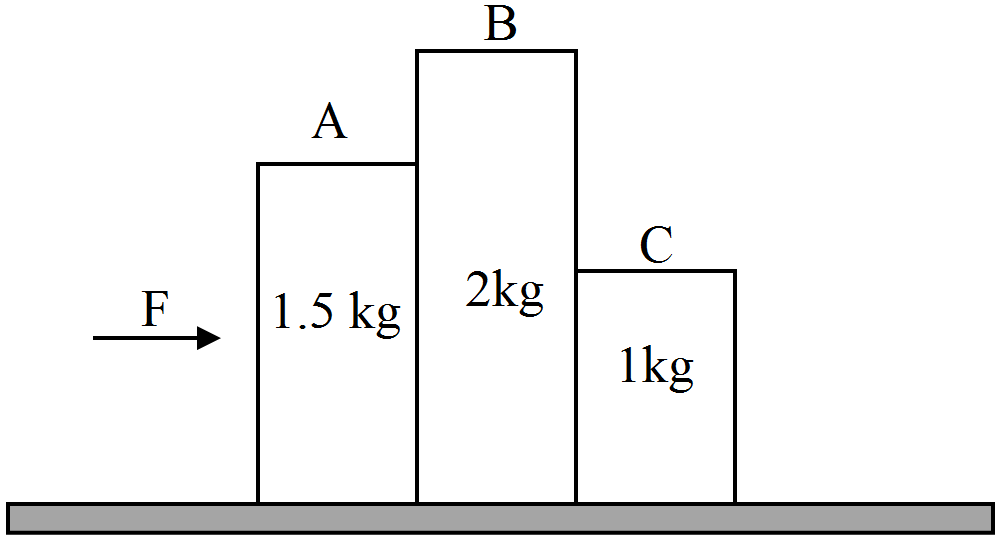
AnswerIrt a be the acceleration of the system to right. All the three frictional forces $f_1 = \mu \text{m}_1\text{g}, f_2 = \mu \text{m}_2\text{g} \text{ and }f_3 = \mu \text{m}_3\text{g}$ will be directed to the left as the motion of bodies is to the right.
Hence, for the whole system
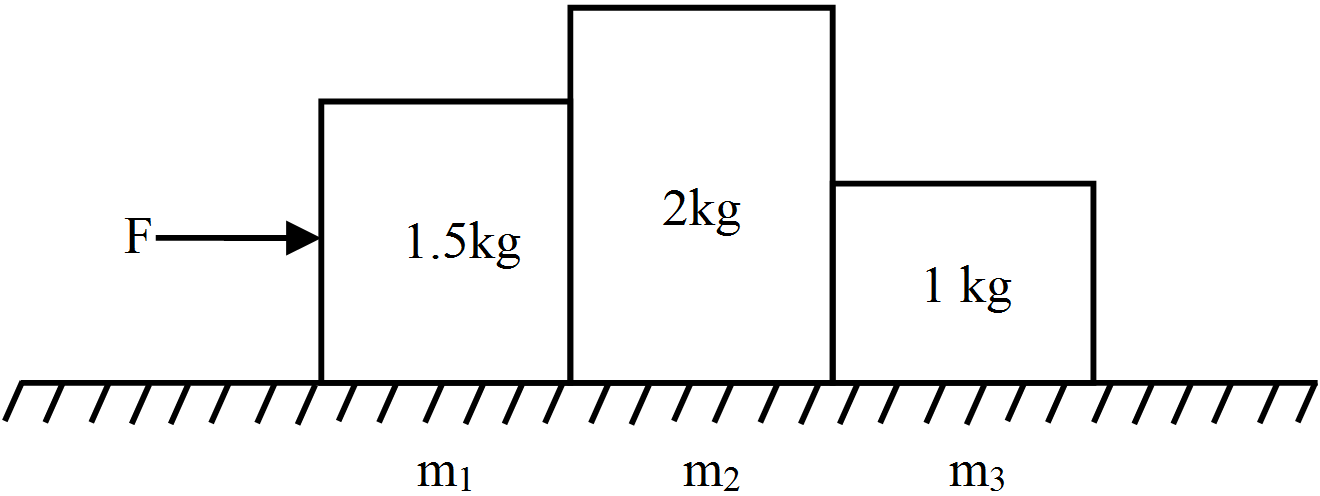
$\text{F} - \mu \text{m}_1\text{g} - \mu \text{m}_2\text{g} - \mu \text{m}_3\text{g} = (\text{m}_1 + \text{m}_2 + \text{m}_3) \text{a}$
$\text{F} = (\text{m}_1 + \text{m}_2 + \text{m}_3) (\text{a} + \mu \text{g}) $
$= (7.5 + 2 + 1)(3 + 0.2 \times 9.8) = 22.3N $
The force exerted by the 1.5kg block on the 2kg block = $\text{F} - \text{m}_1(\text{a} + \mu \text{g})$
$= 22.3 - 1.5 (3 + 0.2 \times 9.8) = 22.3 - 7.44 = 14N$ View full question & answer→Question 933 Marks
State the law of conservation of momentum. Establish the same for a 'n' body system.
AnswerWhen no external force acts on a system the momentum will remain conserved. Consider a system of a n bodies of masses $\text{m}_1,\text{m}_2,\text{m}_3....,\text{m}_\text{n}.$If $\text{p}_1,\text{p}_2,\text{p}_3,...\text{p}_\text{n}$ are the momentum associated then, the rate of change of momentum with the system, $\frac{\text{dp}}{\text{dt}}=\frac{\text{dp}_1}{\text{dt}}+\frac{\text{dp}_2}{\text{dt}}+\frac{\text{dp}_3}{\text{dt}}\\+...+\frac{\text{dp}_\text{n}}{\text{dt}}$ $\frac{\text{d}}{\text{dt}}(\text{p}_1+\text{p}_2+\text{p}_3+...+\text{p}_\text{n})$ If no external force acts, $\frac{\text{dp}}{\text{dt}}=0$ $\therefore$ p = constant, i.e., $\text{p}_1+\text{p}_2+\text{p}_3+....+\text{p}_\text{n}=$ constant.
View full question & answer→Question 943 Marks
A force of 400N acting horizontal pushes up a $20kg$ block placed on a rough inclined plane which makes an angle of $45^\circ$ with the horizontal. The acceleration experienced by the block is $0.6m/ s^2$. Find the coefficient of sliding friction between the box and incline.
Answer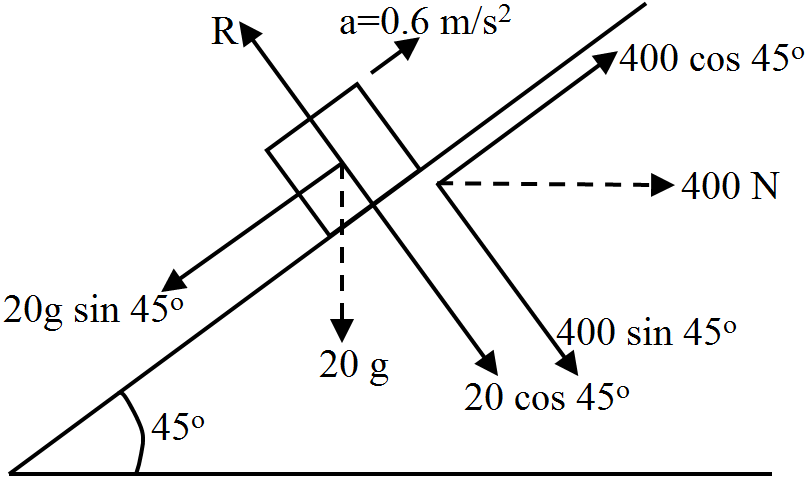
The horizontally directed force $400N$ and weight $20kg$ of the block are resolved into two mutually perpendicular components,
parallel and perpendicular to the plane as shown. $\text{N}=20\text{g}\cos45^\circ+400\sin45^\circ=421.4\text{N}$
The frictional force experienced by the block F $=\mu\text{N}=\mu\times421.4=421.4\mu\text{N}$.
As the accelerated motion is taking place up the plane. $400\cos45^\circ-20\text{g}\sin45^\circ-\int=20\text{a}$
$\frac{400}{\sqrt{2}}-\frac{20\times9.8}{\sqrt{2}}-421.4\mu=20\text{a}=20$
$\mu=\Big(\frac{400}{\sqrt{2}}-\frac{196}{\sqrt{2}}-12\Big)\times\frac{1}{421.4}$
$=\frac{282.8-138.6-12}{421.4}=0.3137$
The coefficient of sliding friction between the block and the incline $= 0.3137.$ View full question & answer→Question 953 Marks
A cricket ball of mass $150g$ is moving with a velocity of $12ms^{-1}$, and is hit by a bat, so that the ball is turned back with a velocity of $20ms^{-1}$. The force of the blow acts for $0.01s$ on the ball. Find the average force exerted by the bat on the ball.
AnswerMass of the ball, $\mathrm{m}=0.15 \mathrm{~kg}$ Initial velocity, $u=12 \mathrm{~ms}^{-1}$ final velocity $v=-20 \mathrm{~ms}^{-1}, t=0.01 \mathrm{~s}$ Initial momentum of the ball $=0.15 \times 12=1.8 \mathrm{~kg} \mathrm{~ms}^{-1}$ Final momentum of the ball $=0.15 \times(-20)=-3.0 \mathrm{~kg} \mathrm{~ms}^{-1}$ Change in momentum $=$
$4.8 \mathrm{~kg} \mathrm{~ms}^{-1}$ Average force exerted by the bat on the ball $=\frac{4.8 \mathrm{~kg} \mathrm{~ms}^{-1}}{0.01 \mathrm{~s}}=480 \mathrm{~N}$
View full question & answer→Question 963 Marks
What is the acceleration of the block and trolley system shown in a Fig. 4.12(a), if the coefficient of kinetic friction between the trolley and the surface is 0.04 ? What is the tension in the string? (Take $g=$ $10 m s ^{-2}$ ). Neglect the mass of the string.
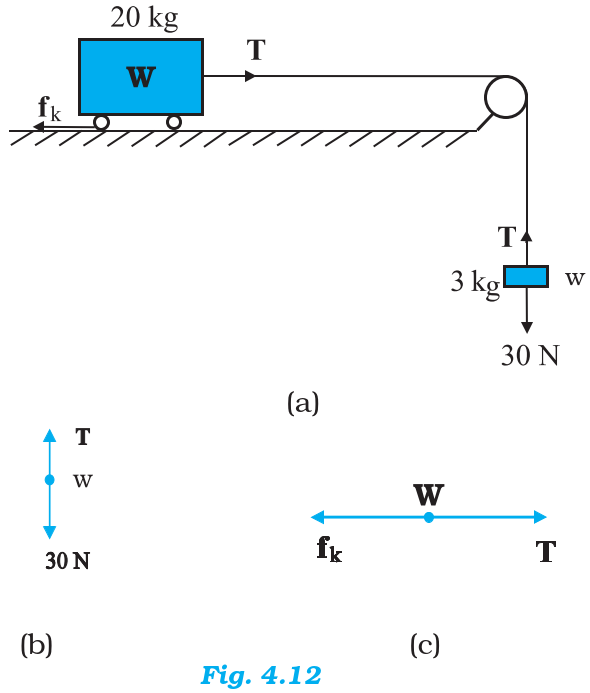
AnswerAs the string is inextensible, and the pully is smooth, the $3 kg$ block and the $20 kg$ trolley both have same magnitude of acceleration. Applying second law to motion of the block (Fig. 4.12(b)),
$
30-T=3 a
$
Apply the second law to motion of the trolley (Fig. 4.12(c)),
Now
$
T-f_{ k }=20 a \text {. }
$
Here
$
\begin{aligned}
f_k & =\mu_k N, \\
\mu_k & =0.04, \\
N & =20 \times 10 \\
& =200 N .
\end{aligned}
$
Thus the equation for the motion of the trolley is
$
T-0.04 \times 200=20 a
$
Or $T-8=20 a$.
These equations give $a=\frac{22}{23} m s ^{-2}=0.96 m s ^{-2}$ and $T=27.1 N$.
View full question & answer→Question 973 Marks
See Fig. 4.11. A mass of 4 kg rests on a horizontal plane. The plane is gradually inclined until at an angle θ = 15° with the horizontal, the mass just begins to slide. What is the coefficient of static friction between the block and the surface ?
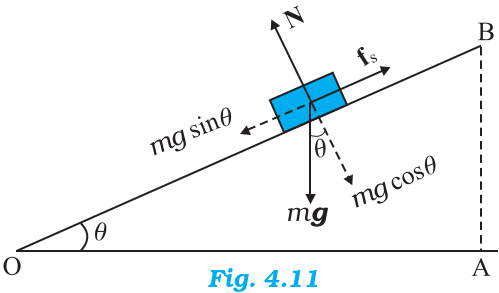
AnswerThe forces acting on a block of mass $m$ at rest on an inclined plane are (i) the weight $mg$ acting vertically downwards (ii) the normal force $N$ of the plane on the block, and (iii) the static frictional force $f_{ s }$ opposing the impending motion. In equilibrium, the resultant of these forces must be zero. Resolving the weight $mg$ along the two directions shown, we have
$
m g \sin \theta=f_s, \quad m g \cos \theta=N
$
As $\theta$ increases, the self-adjusting frictional force $f_{ s }$ increases until at $\theta=\theta_{\max }, f_{ s }$ achieves its maximum value, $\left(f_{ s }\right)_{\max }=\mu_{ s } N$.
Therefore,
$
\tan \theta_{\max }=\mu_{ s } \text { or } \theta_{\max }=\tan ^{-1} \mu_{ s }
$
When $\theta$ becomes just a little more than $\theta_{\max }$, there is a small net force on the block and it begins to slide. Note that $\theta_{\max }$ depends only on $\mu_{ s }$ and is independent of the mass of the block.
For
$
\begin{aligned}
\theta_{\text {max }} & =15^{\circ} \\
\mu_s & =\tan 15^{\circ} \\
& =0.27
\end{aligned}
$
View full question & answer→Question 983 Marks
See Fig. $4.8.$ A mass of $6 \ kg$ is suspended by a rope of length $2 m$ from the ceiling. A force of $50 N$ in the horizontal direction is applied at the midpoint $P$ of the rope, as shown. What is the angle the rope makes with the vertical in equilibrium? $($Take $g=10 m s ^{-2} )$. Neglect the mass of the rope.
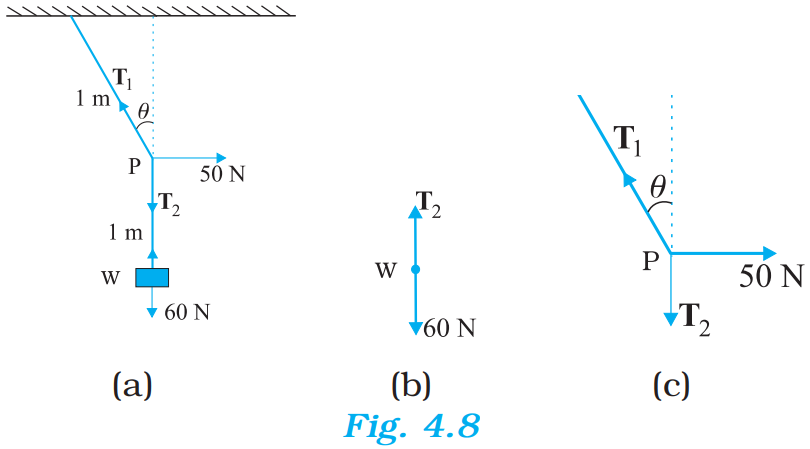
AnswerFigures $4.8(b)$ and $4.8(c)$ are known as free$-$body diagrams. Figure $4.8(b)$ is the free-body diagram of $W$ and Fig. $4.8(c)$ is the free-body diagram of point $P$.
Consider the equilibrium of the weight $W$. Clearly, $T_2=6 \times 10=60 N$.
Consider the equilibrium of the point $P$ under the action of three forces - the tensions $T_1$ and $T_2$, and the horizontal force $50 N$. The horizontal and vertical components of the resultant force must vanish separately :
$T_1 \cos \theta=T_2=60 N$
$T_1 \sin \theta=50 N$
which gives that
$\tan \theta=\frac{5}{6} \text { or } \theta=\tan ^{-1}\left(\frac{5}{6}\right)=40^{\circ}$
Note the answer does not depend on the length of the rope $($assumed massless$)$ nor on the point at which the horizontal force is applied.
View full question & answer→