Question 15 Marks
Construct a parallelogram $PQRS$ in which $QR = 6\ cm, PQ = 4\ cm$ and $\angle\text{PQR}=60^\circ.$
Answer
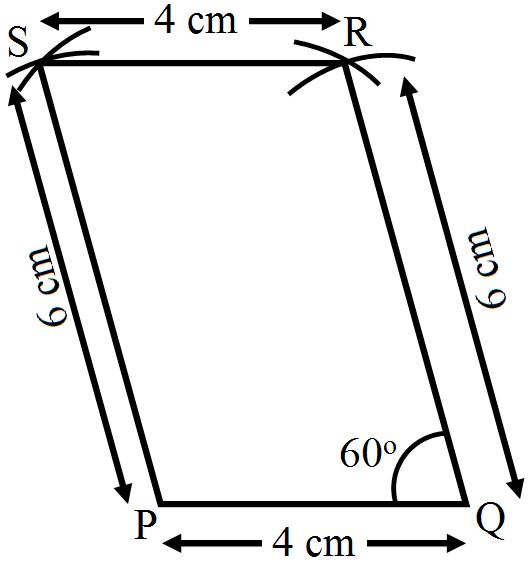
Steps of construction:
Step 1: Draw $PQ = 4cm.$
Step 2: Make $\angle\text{PQR}=60^\circ.$
Step 2: With $Q$ as the centre, draw an arc of $6cm$ and name that point as $R.$
Step 3: With $R$ as the centre, draw an arc of $4cm$ and name that point as $S.$
Step 4: Join $SR$ and $PS.$
Then, $PQRS$ is the required parallelogram. View full question & answer→Question 25 Marks
Construct a quadrilateral $PQRS$ in which $PQ = 5.4\ cm, QR = 4.6\ cm, RS = 4.3\ cm, SP = 3.5\ cm$ and diagonal $PR = 4\ cm.$
Answer
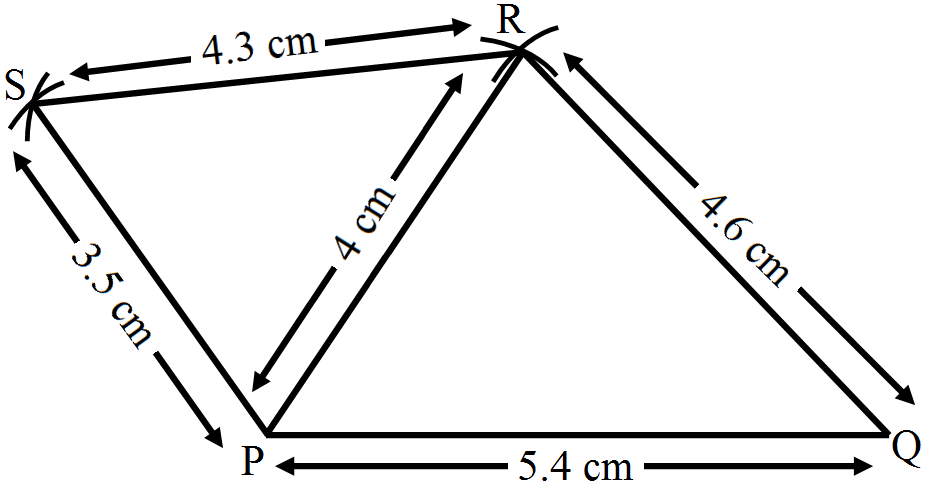
Steps of construction:
Step 1: Draw $PQ = 5.4\ cm$
Step 2: With $P$ as the centre and radius equal to $4\ cm,$ draw an arc.
Step 3: With $Q$ as the centre and radius equal to $4.6\ cm,$ draw another arc, cutting the previous arc at $R.$
Step 4: Join $QR.$
Step 5: With $P$ as the centre and radius equal to $3.5\ cm,$ draw an arc.
Step 6: With $R$ as the centre and radius equal to $4.3\ cm,$ draw another arc, cutting the previous arc at $S.$
Step 7: Join $PS$ and $RS.$
Thus, $PQRS$ is the required quadrilateral. View full question & answer→Question 35 Marks
Construct a quadrilateral $PQRS$ in which $PQ = 6\ cm, QR = 5.6\ cm, RS = 2.7\ cm,$ $\angle\text{Q}=45^\circ$ and $\angle\text{R}=90^\circ.$
Answer
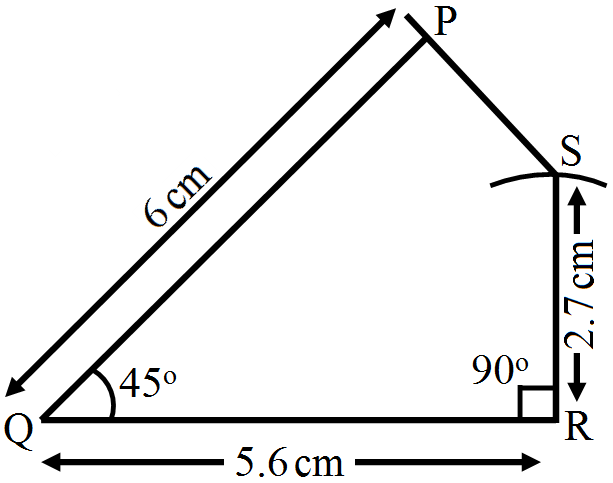
Steps of construction:
Step 1: Draw $QR = 5.6\ cm.$
Step 2: Make $\angle\text{Q}=45^\circ$ and $\angle\text{R}=90^\circ.$
Step 3: With $Q$ as the centre, draw an arc of $6\ cm.$ Name that point as $P.$
Step 4: With $R$ as the centre, draw an arc of $2.7\ cm.$ Name that point as $S.$
Step 6: Join $P$ and $S.$
Then, $PQRS$ is the required quadrilateral. View full question & answer→Question 45 Marks
construct a quadrilateral $ABCD$ in which $AB = 3.4\ cm, CD = 3\ cm, DA = 5.7\ cm, AC = 8\ cm$ and $BD = 4\ cm.$
Answer
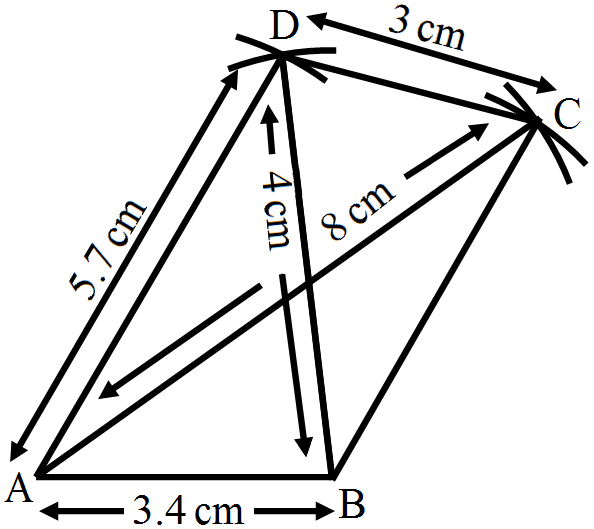
Steps of construction:
Step 1: Draw $AB = 3.4\ cm.$
Step 2: With $B$ as the centre and radius equal to $4\ cm,$ draw an arc.
Step 3: With $A$ as the centre and radius equal to $5.7\ cm,$ draw another arc, cutting the previous arc at $D.$
Step 4: Join $BD$ and $AD.$
Step 5: With $A$ as the centre and radius equal to $8\ cm,$ draw an arc.
Step 6: With $D$ as the centre and radius equal to $3\ cm,$ draw another arc, cutting the previous arc at $C.$
Step 7: Join $AC, CD$ and $BC.$
Thus, $ABCD$ is the required quadrilateral. View full question & answer→Question 55 Marks
Construct a parallelogram, one of whose sides is $4.4\ cm$ and whose diagonals are $5.6\ cm$ and $7\ cm.$ Measure the other side.
AnswerWe know that the diagonals of a parallelogram bisect each other.
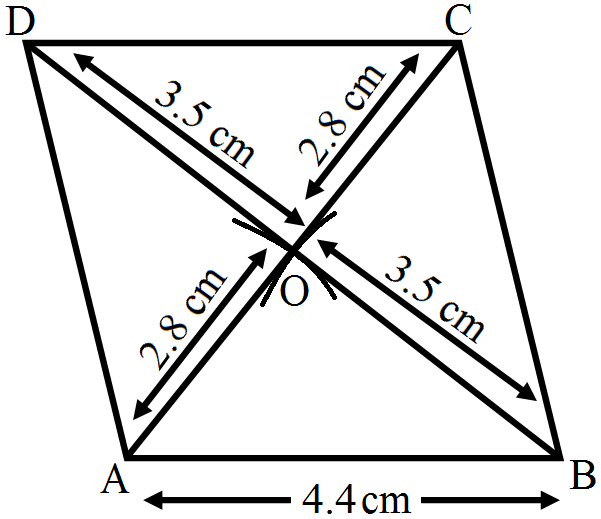
Steps of construction:
Step 1: Draw $AB = 4.4\ cm.$
Step 2: With $A$ as the centre and radius $2.8\ cm$, draw an arc.
Step 3: With $B$ as the centre and radius $3.5\ cm,$ draw another arc, cutting the previous arc at point $O.$
Step 4: Join $OA$ and $OB.$
Step 5: Produce $OA$ to $C,$ such that $OC = AO.$ Produce $OB $ to $D,$ such that $OB = OD.$
Step 6: Join $AD, BC,$ and $CD.$ Thus, $ABCD$ is the required parallelogram.
The other side is $4.5\ cm$ in length. View full question & answer→Question 65 Marks
Construct a rectangle $ABCD$ whose adjacent sides are $11\ cm$ and $8.5\ cm.$
Answer
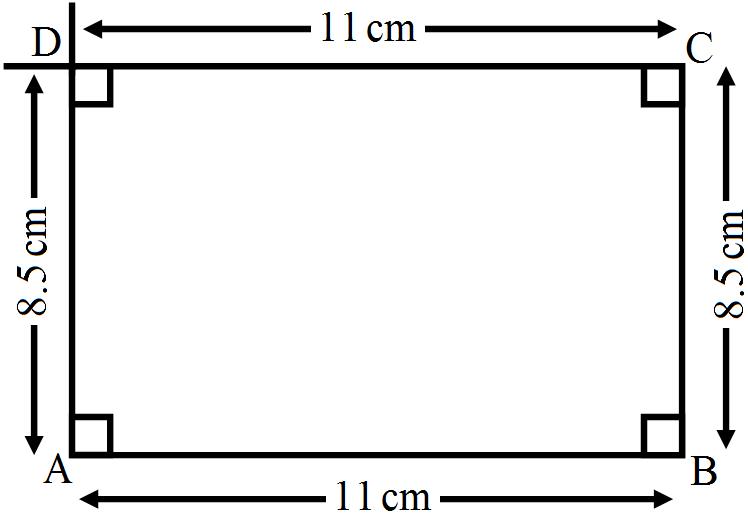
Steps of construction:
Step 1: Draw $AB = 11\ cm.$
Step 2: Make
$\angle\text{A}=90^\circ$
$\angle\text{B}=90^\circ$
Step 3: Draw an arc of $8.5\ cm$ from point $A$ and name that point as $D.$
Step 4: Draw an arc of $8.5\ cm$ from point $B$ and name that point as $C.$
Step 5: Join $C$ and $D.$
Thus, $ABCD$ is the required rectangle. View full question & answer→Question 75 Marks
Prove that the diagonals of a rhombus bisect each other at right angles.
AnswerRhombus is a parallelogram.
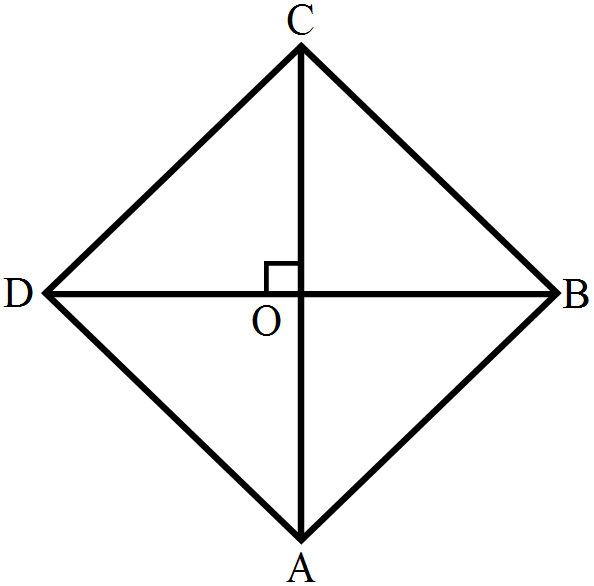
Consider: $\triangle\text{AOB}$ and $\triangle\text{COD}$
$\angle\text{OAB}=\angle\text{COD}$ (alternate angle)
$\angle\text{ODC}=\angle\text{OBA}$ (alternate angle)
$\angle\text{DOC}=\angle\text{AOB}$ (vertically opposite angles)
$\triangle\text{AOB}\cong\text{COB}$
$\therefore\text{AO}=\text{CO}$
$\text{OB}=\text{OD}$ Therefore, the diagonals bisects at $O$.
Now, let us prove that the diagonals intersect each other at right angles.
Consider $\triangle\text{COD}$ and $\triangle\text{COB}:$ $CD = CB ($all sides of a rhombus are equal$)$
$CO = CO ($common side$) OD = OB ($point $O$ bisects $BD)$
$\therefore\triangle\text{COD}\cong\triangle\text{COB}$
$\therefore\angle\text{COD}= \angle\text{COB}$ (corresponding parts of congruent triangles)
Further, $\angle\text{COD}+\angle\text{COB}=180^\circ$ (l inear pair)
$\therefore\angle\text{COD}=\angle\text{COB}=90^\circ$
It is proved that the diagonals of a rhombus are perpendicular bisectors of each other. View full question & answer→Question 85 Marks
Construct a quadrilateral $ABCD$ in which $AB = 3.6\ cm, BC = 3.3\ cm, AD = 2.7\ cm,$ diagonal $AC = 4.6\ cm$ and diagonal $BD = 4\ cm.$
Answer
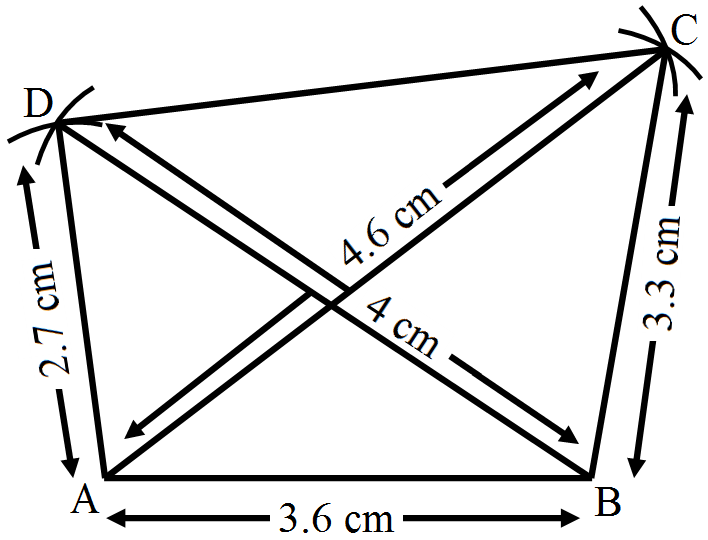
Steps of construction:
Step 1: Draw $AB = 3.6\ cm.$
Step 2: With $B$ as the centre and radius equal to $4\ cm$, draw an arc.
Step 3: With $A$ as the centre and radius equal to $2.7\ cm,$ draw another arc, cutting the previous arc at $D.$
Step 4: Join $BD $ and $AD.$
Step 5: With $A$ as the centre and radius equal to $4.6\ cm,$ draw an arc.
Step 6: With $B$ as the centre and radius equal to $3.3\ cm,$ draw another arc, cutting the previous arc at $C.$
Step 7: Join $AC, BC$ and $CD.$
Thus, $ABCD$ is the required quadrilateral. View full question & answer→Question 95 Marks
Construct a quadrilateral $ABCD$ in which $AB = 3.5\ cm, BC = 3.8\ cm, CD = DA = 4.5\ cm$ and diagonal $BD = 5.6\ cm.$
Answer
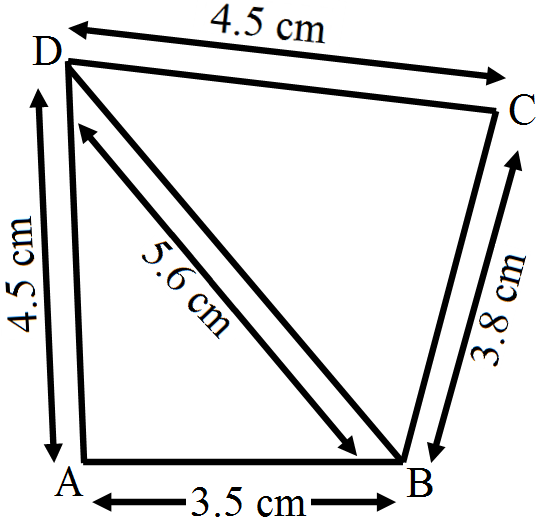
Steps of construction:
Step 1: Draw $AB = 3.5\ cm$
Step 2: With $B$ as the centre and radius equal to $5.6\ cm, $ draw an arc.
Step 3: With $A$ as the centre and radius equal to $4.5\ cm,$ draw another arc, cutting the previous arc at $D.$
Step 4: Join $BD$ and $AD.$
Step 5: With $D$ as the centre and radius equal to $4.5\ cm,$ draw an arc.
Step 6: With $B$ as the centre and radius equal to $3.8\ cm,$ draw another arc, cutting the previous arc at $C.$
Step 7: Join $BC$ and $CD.$
Thus, $ABCD$ is the required quadrilateral. View full question & answer→Question 105 Marks
Construct a quadrilateral $ABCD$ in which $AB = BC = 3.5\ cm, AD = CD = 5.2\ cm$ and $\angle\text{ABC}=120^\circ.$
Answer
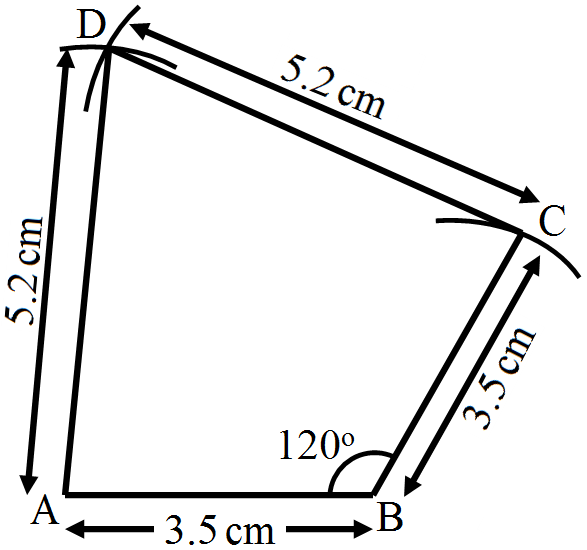
Steps of construction:
Step 1: Draw $AB = 3.5\ cm.$
Step 2: Make $\angle\text{ABC}=120^\circ.$
Step 3: With $B$ as the centre, draw an arc $3.5\ cm$ and name that point $C.$
Step 4: With $C$ as the centre, draw an arc $5.2\ cm.$
Step 5: With $A$ as the centre, draw another arc $5.2\ cm,$ cutting the previous arc at $D.$
Step 6: Join $CD$ and $AD.$
Thus, $ABCD$ is the required quadrilateral. View full question & answer→Question 115 Marks
Construct a rhombus $ABCD$ in which $AB = 4\ cm$ and diagonal $AC$ is $6.5\ cm.$
Answer
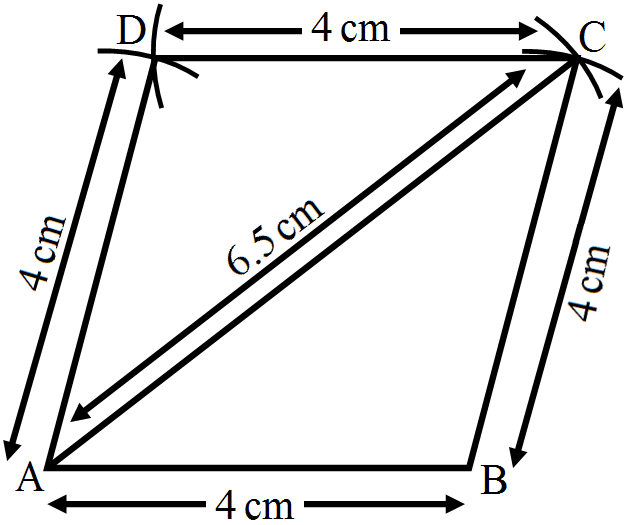
Steps of construction:
Step 1: Draw $AB = 4\ cm.$
Step 2: With $B$ as the centre, draw an arc of $4\ cm.$
Step 3: With $A$ as the centre, draw another arc of $6.5\ cm,$ cutting the previous arc at $C.$
Step 4: Join $AC$ and $BC.$
Step 5: With $C$ as the centre, draw an arc of $4\ cm$.
Step 6: With $A$ as the centre, draw another arc of $4\ cm,$ cutting the previous arc at $D.$
Step 7: Join $AD$ and $CD.$
$ABCD$ is the required rhombus. View full question & answer→Question 125 Marks
Construct a square, each of whose sides measures $6.4\ cm.$
AnswerAll the sides of a square are equal.
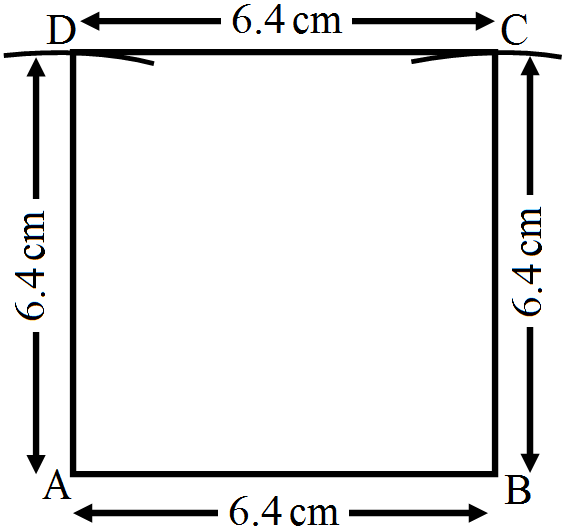
Steps of construction:
Step 1: Draw $AB = 6.4\ cm.$
Step 2: Make $\angle\text{A}=90^\circ$ $\angle\text{B}=90^\circ$
Step 3: Draw an arc of length $6.4\ cm$ from point $A$ and name that point as $D.$
Step 4: Draw an arc of length $6.4\ cm$ from point $B$ and name that point as $C.$
Step 5: Join $C$ and $D$. Thus, $ABCD$ is a required square. View full question & answer→Question 135 Marks
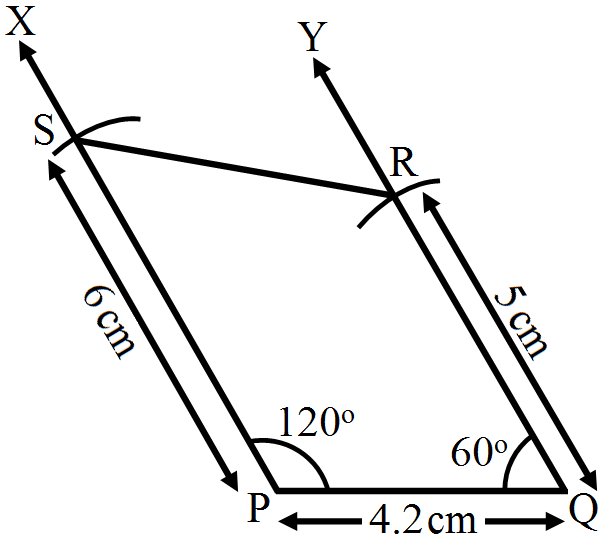
Construct a quadrilateral $PQRS$ in which $PQ = 4.2\ cm,$ $\angle\text{PQR}=60^\circ,\angle\text{QPS}=120^\circ,$ $QR = 5\ cm$ and $PS = 6\ cm.$
AnswerSteps of construction:
Step 1: Take $PQ = 4.2\ cm$
Step 2: Make $\angle\text{XPQ}=120^\circ,\angle\text{YQP}=60^\circ$
Step 3: Cut an arc of length $5\ cm$ from point $Q.$ Name that point as $R.$
Step 4: From $P,$ make an arc of length $6\ cm.$ Name that point as $S.$
Step 5: Join $P$ and $S.$ Thus, $PQRS$ is a quadrilateral.
View full question & answer→Question 145 Marks
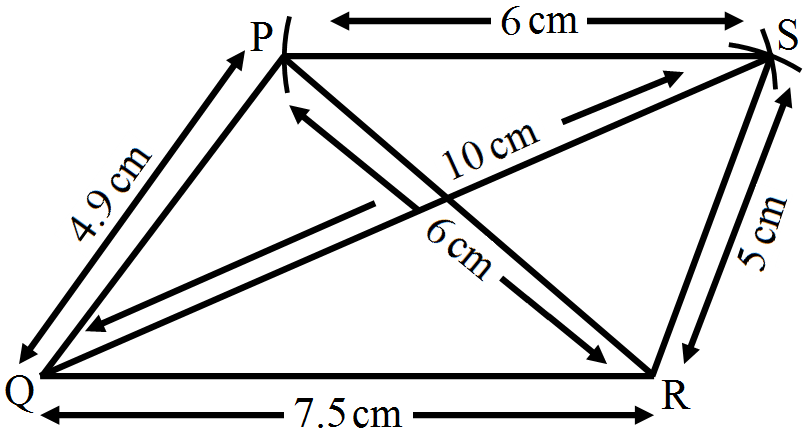
Construct a quadrilateral $PQRS$ in which $QR = 7.5\ cm, PR = PS = 6\ cm, RS = 5\ cm$ and $QS = 10\ cm$. Measure the fourth side.
Answer
Steps of construction:
Step 1: Draw $QR = 7.5 \ cm.$
Step 2: With $Q$ as the centre and radius equal to $10\ cm$, draw an arc.
Step 3: With $R$ as the centre and radius equal to $5\ cm$, draw another arc, cutting the previous arc at $S.$
Step 4: Join $QS$ and $RS.$
Step 5: With $S$ as the centre and radius equal to $6\ cm$, draw an arc.
Step 6: With $R$ as the centre and radius equal to $6\ cm,$ draw another arc, cutting the previous arc at $P.$
Step 7: Join $PS$ and $PR.$
Step 8: $PQ = 4.9\ cm.$
Thus, $PQRS$ is the required quadrilateral. View full question & answer→Question 155 Marks
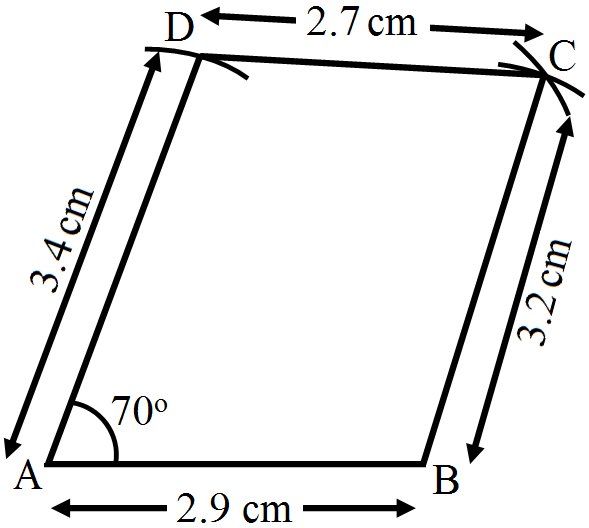
Construct a quadrilateral $ABCD$ in which $AB = 2.9\ cm, BC = 3.2\ cm, CD = 2.7\ cm, DA = 3.4\ cm$ and $\angle\text{A}=70^\circ.$
Answer
Steps of construction:
Step 1: Draw $AB = 2.9\ cm.$
Step 2: Make $\angle\text{A}=70^\circ$
Step 3: With $A$ as the centre, draw an arc of $3.4\ cm.$ Name that point as $D.$
Step 4: With $D$ as the centre, draw an arc of $2.7\ cm.$
Step 5: With $B$ as the centre, draw an arc of $3.2\ cm,$ cutting the previous arc at $C.$
Step 6: Join $CD$ and $BC.$
Then, $ABCD$ is the required quadrilateral. View full question & answer→Question 165 Marks
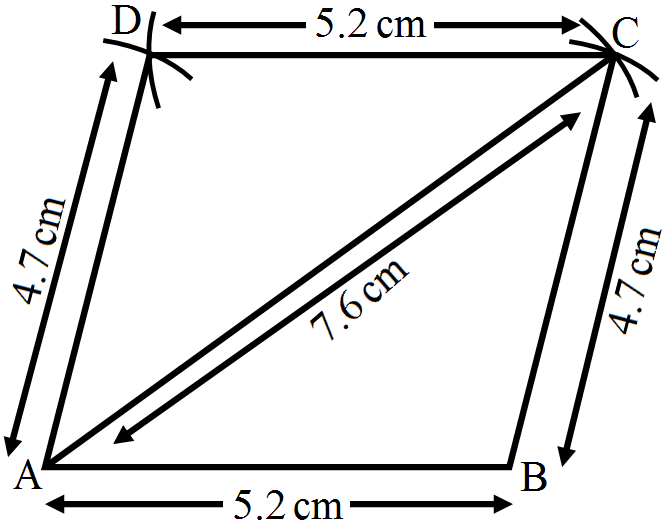
Construct a parallelogram $ABCD$ in which $AB = 5.2\ cm, BC = 4.7\ cm$ and $AC = 7.6\ cm$
Answer
Steps of construction:
Step 1: Draw $AB = 5.2\ cm.$
Step 2: With $B$ as the centre, draw an arc of $4.7\ cm.$
Step 3: With $A$ as the centre, draw another arc of $7.6\ cm,$ cutting the previous arc at $C.$
Step 4: Join $A$ and $C.$
Step 5: We know that the opposite sides of a parallelogram are equal. Thus, with $C$ as the centre, draw an arc of $5.2\ cm.$
Step 6: With $A$ as the centre, draw another arc of $4.7\ cm,$ cutting the previous arc at $D.$
Step 7: Join $CD$ and $AD.$
Then, $ABCD$ is the required parallelogram. View full question & answer→Question 175 Marks
Construct a parallelogram $ABCD$ in which $BC = 5\ cm,$ $\angle\text{BCD}=120^\circ$ and $CD = 4.8\ cm.$
Answer
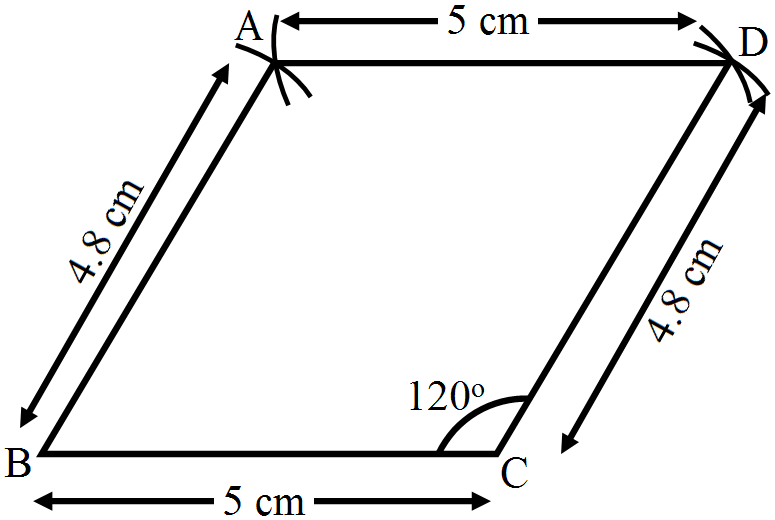
Steps of construction:
Step 1: Draw $BC = 5\ cm.$
Step 2: Make an $\angle\text{BCD}=120^\circ.$
Step 2: With $C$ as centre draw an arc of $4.8\ cm,$ name that point as $D.$
Step 3: With $D$ as centre draw an arc $5\ cm, $ name that point as $A.$
Step 4: With $B$ as centre draw another arc $4.8\ cm$ cutting the previous arc at $A$.
Step 5: Join $AD$ and $AB.$
Then, $ABCD$ is a required parallelogram. View full question & answer→Question 185 Marks
Construct a quadrilateral $ABCD$ in which $AB = 4.2\ cm, BC = 6\ cm, CD = 5.2\ cm, DA = 5\ cm$ and $AC = 8\ cm.$
Answer
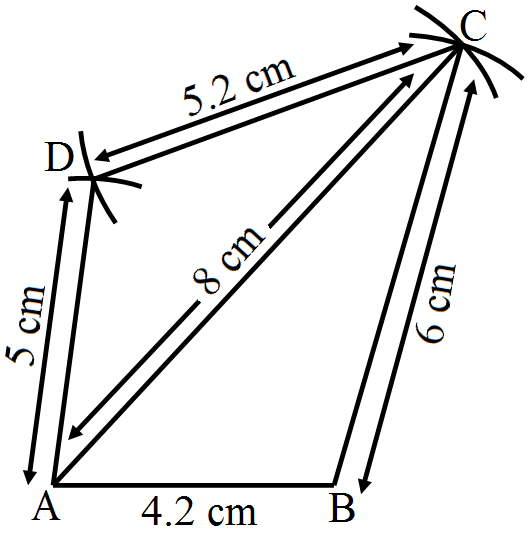
Steps of construction:
Step 1: Draw $AB = 4.2\ cm.$
Step 2: With $A$ as the centre and radius equal to $8\ cm,$ draw an arc.
Step 3: With $B$ as the centre and radius equal to $6\ cm,$ draw another arc, cutting the previous arc at $C.$
Step 4: Join $BC.$
Step 5: With $A$ as the centre and radius equal to $5\ cm,$ draw an arc.
Step 6: With $C$ as the centre and radius equal to $5.2\ cm,$ draw another arc, cutting the previous arc at $D.$
Step 7: Join $AD$ and $CD.$
Thus, $ABCD$ is the required quadrilateral. View full question & answer→Question 195 Marks
Construct a quadrilateral $ABCD$ in which $AB = 3.5\ cm, BC = 5\ cm, CD = 4.6\ cm,$ $\angle\text{B}=125^\circ$ and $\angle\text{C}=60^\circ.$
Answer
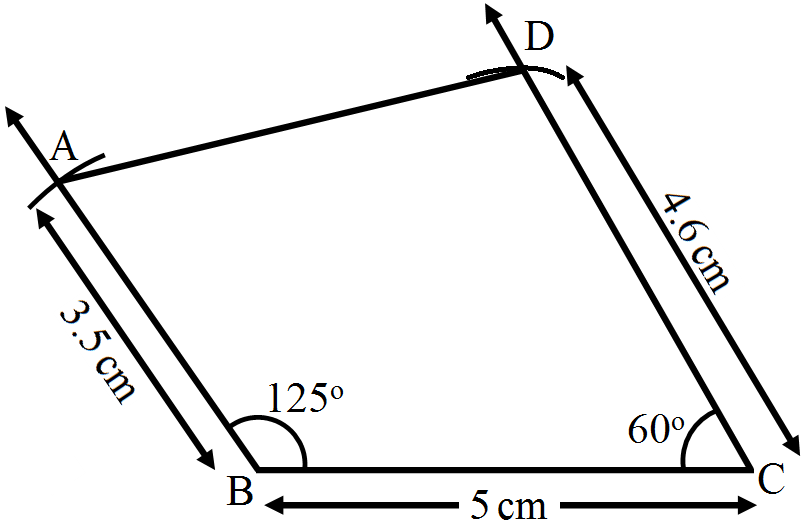
Steps of construction:
Step 1: Draw $BC = 5\ cm.$
Step 2: Make $\angle\text{B}=125^\circ$ and $\angle\text{C}=60^\circ.$
Step 3: With $B$ as the centre, draw an arc of $3.5\ cm.$ Name that point as $A.$
Step 4: With $C$ as the centre, draw an arc of $4.6\ cm.$ Name that point as $D.$
Step 5: Join $A$ and $D.$
Then, $ABCD$ is the required quadrilateral. View full question & answer→Question 205 Marks
Construct a parallelogram $ABCD$ in which $AB = 6.5\ cm, AC = 3.4\ cm$ and the altitude $AL$ from $A$ is $2.5\ cm.$ Draw the altitude from $C$ and measure lt.
Answer
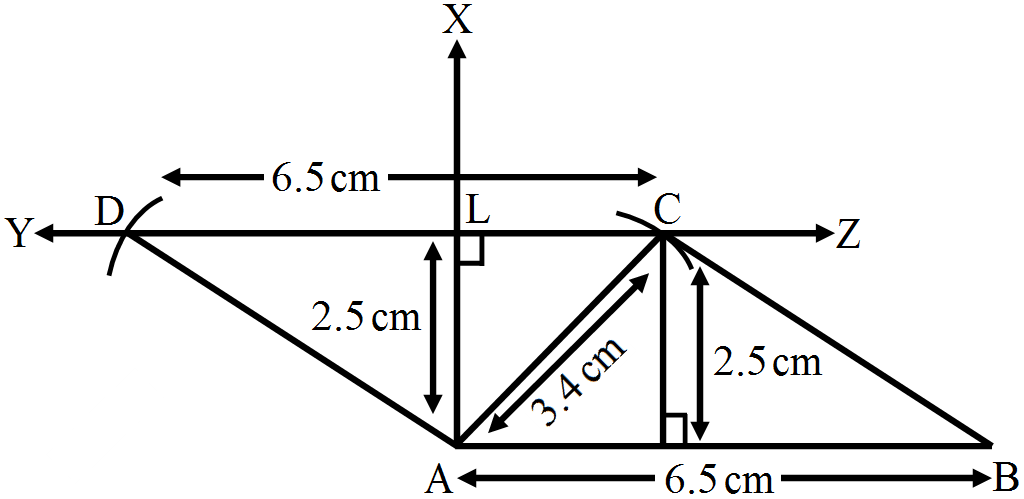
Steps of construction:
Step 1: Draw $AB = 6.5\ cm.$
Step 2: Draw a perpendicular at point $A.$ Name that ray as $AX$. From point $A,$ draw an arc of length $2.5\ cm,$ on the ray $AX$ and name that point as $L.$
Step 3: On point $L,$ make a perpendicular. Draw a straight line $YZ$ passing through $L,$ which is perpandicular to the ray $AX.$
Step 4: Cut an arc of length $3.4\ cm$ on the line $YZ$ and name it as $C.$
Step 5: From point $C,$ cut an arc of length $6.5\ cm$ on the line $YZ.$ Name that point as $D.$
Step 6: Join $BC$ and $AD.$
Therefore, quadrilateral $ABCD$ is a parallelogram. View full question & answer→Question 215 Marks
Construct a parallelogram $ABCD$ in which $AB = 4.3\ cm, AD = 4\ cm$ and $BD = 6.8\ cm.$
Answer
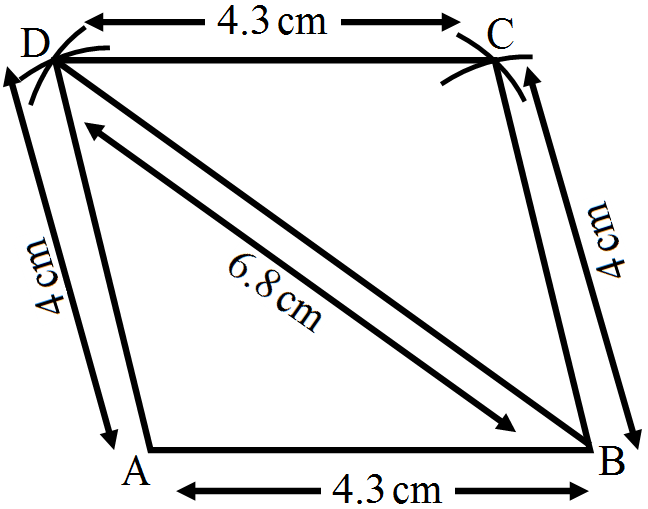
Steps of construction:
Step 1: Draw $AB = 4.3\ cm.$
Step 2: With $B$ as the centre, draw an arc of $6.8\ cm.$
Step 3: With $A$ as the centre, draw another arc of $4\ cm,$ cutting the previous arc at $D.$
Step 4: Join $BD$ and $AD.$
Step 5: We know that the opposite sides of a parallelogram are equal.
Thus, with $D$ as the centre, draw an arc of $4.3\ cm.$
Step 6: With $B$ as the centre, draw another arc of $4\ cm,$ cutting the previous arc at $C.$
Step 7: Join $CD$ and $BC.$
Then, $ABCD$ is the required parallelogram. View full question & answer→Question 225 Marks
Construct a trapezium $ABCD$ in which $AB = 6\ cm, BC = 4\ cm, CD = 3.2\ cm,$ $\angle\text{B}=75^\circ$ and $DC || AB.$
Answer
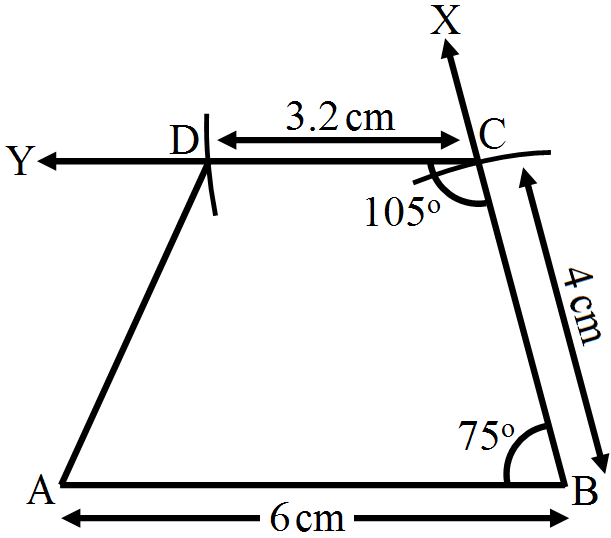
Steps of construction:
Step 1: Draw $AB=6 \ cm.$
Step 2: Make $\angle\text{ABX}=75^\circ$
Step 3: With $B$ as the centre, draw an arc at $4\ cm.$ Name that point as $C.$
Step 4: $AB || CD$
$\therefore\angle\text{ABX}+\angle\text{BCY}=180^\circ$
$\Rightarrow\angle\text{BCY}=180^\circ-75^\circ=105^\circ$
Make $\angle\text{BCY}=105^\circ$
At $C,$ draw an arc of length $3.2\ cm.$
Step 5: Join $A$ and $D.$
Thus, $ABCD$ is the required trapezium. View full question & answer→Question 235 Marks
Draw a trapezium $ABCD$ in which $AB || DC, AB = 7\ cm, BC = 5\ cm, AD = 6.5\ cm$ and $\angle\text{B}=60^\circ.$
Answer
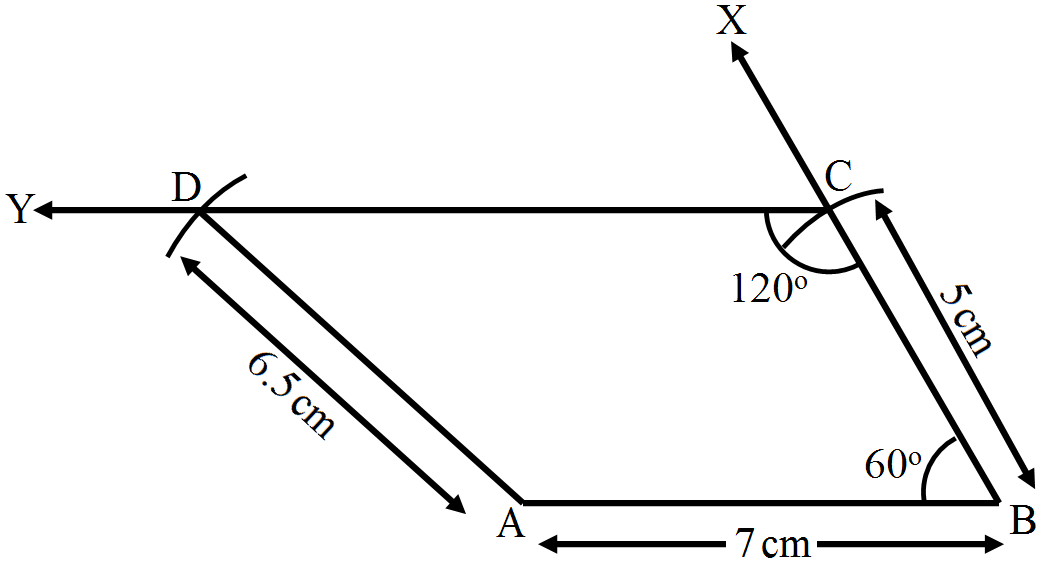
Steps of construction:
Step 1: Draw $AB$ equal to $7\ cm.$
Step 2: Make an angle, $\angle\text{ABX},$ equal to $60^\circ .$
Step 3: With $B$ as the centre, draw an arc of $5\ cm.$ Name that point as $C$. Join $B$ and $C.$
Step 4: $AB || DC$
$\therefore\angle\text{ABX}+\angle\text{BCY}=180^\circ$
$\Rightarrow\angle\text{BCY}=180^\circ-60^\circ=120^\circ$
Draw an angle, $\angle\text{BCY},$ equal to $120^\circ .$
Step 5: With $A$ as the centre, draw an arc of length $6.5\ cm,$ which cuts $CY.$ Mark that point as $D.$
Step 6: Join $A$ and $D.$
Thus, $ABCD$ is the required trapezium. View full question & answer→Question 245 Marks
Construct a parallelogram $ABCD,$ in which diagonal $AC = 3.8\ cm,$ diagonal $BD = 4.6\ cm$ and the angle between $AC$ and $BD$ is $60^\circ .$
AnswerWe know that the diagonals of a parallelogram bisect each other.
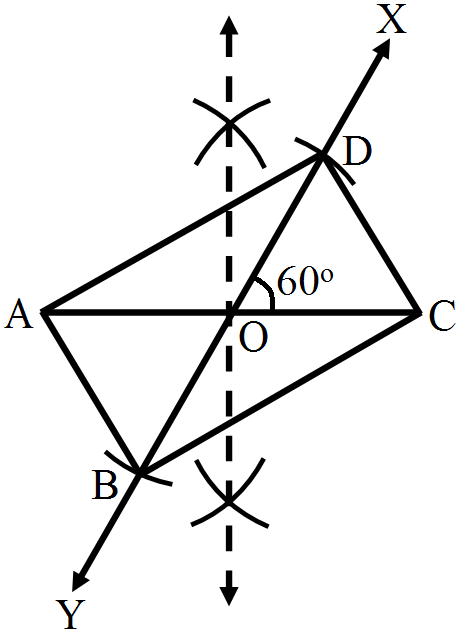
Steps of construction:
Step 1: Draw $AC = 3.8\ cm.$
Step 2: Bisect $AC$ at $O.$
Step 3: Make $\angle\text{COX}=60^\circ$ Produce $XO$ to $Y.$
Step 4:
$\text{OB}=\frac{1}{2}(4.6)\text{cm}$
$\text{OB}=2.3\text{cm}$ and $\text{OD}=\frac{1}{2}(4.6)\text{cm}$
$\text{OD}=2.3\text{cm}$
Step 5: Join $AB, BC, CD$ and $AD.$
Thus, $ABCD$ is the required parallelogram. View full question & answer→Question 255 Marks
Construct a quadrilateral $ABCD$ in which $AB = 4\ cm, AC = 5\ cm, AD = 5.5\ cm$ and $\angle\text{ABC}=\angle\text{ACD}=90^\circ.$
Answer
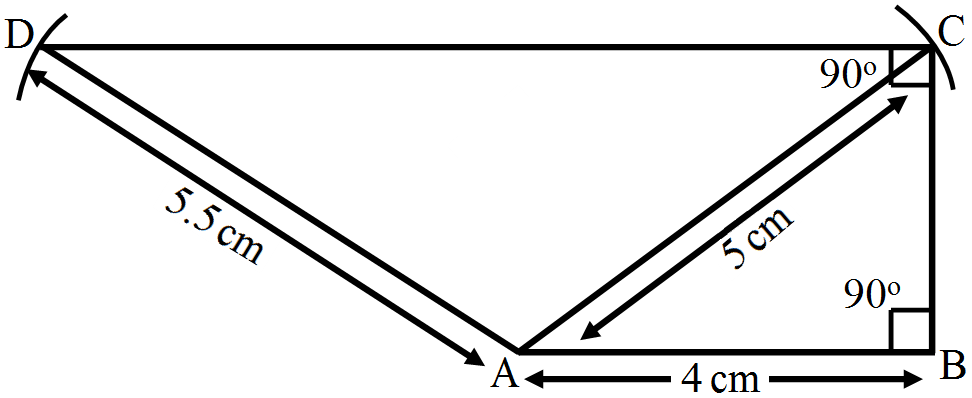
Steps of construction:
Step 1: Draw $AB = 4\ cm.$
Step 2: Make $\angle\text{B}=90^\circ.$
Step 3:
$AC^2 = AB^2 + BC^2$
$5^2 = 4^2 + BC^2$
$25 - 16 = BC^2$
$BC = 3\ cm$
With $B$ as the centre, draw an arc equal to $3\ cm.$
Step 4: Make $\angle\text{C}=90^\circ.$
Step 5: With $A$ as the centre and radius equal to $5.5\ cm,$ draw an arc and name that point as $D.$
Then, $ABCD$ is the required quadrilateral. View full question & answer→Question 265 Marks
Construct a rhombus the lengths of whose diagonals are $6\ cm$ and $8\ cm.$
AnswerWe know that the diagonals of a rhombus bisect each other.
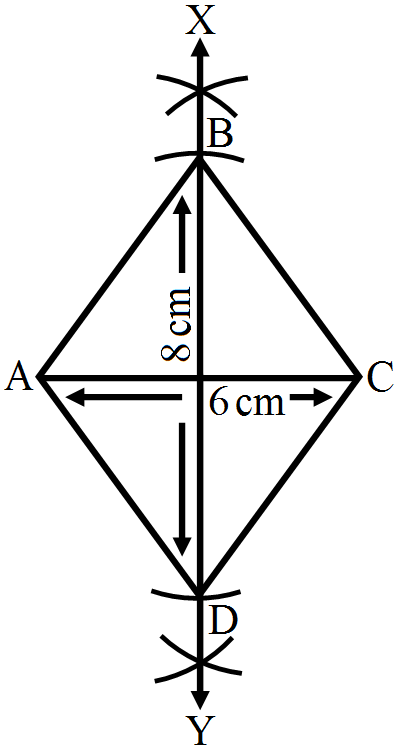
Steps of construction:
Step 1: Draw $AC = 6\ cm.$
Step 2: Draw a perpendicular bisector $(XY)$ of $AC,$ which bisects $AC$ at $O.$
Step 3: $\text{OB}=\frac{1}{2}(8)\text{cm}$ $\text{OB}=4\text{cm}$ and $\text{OD}=\frac{1}{2}(8)\text{cm}$ Draw an arc of length $4\ cm$ on $OX$ and name that point as $B.$ Draw an arc of length $4\ cm$ on $OY$ and name that point as $D.$
Step 4: Join $AB, BC, CD$ and $AD.$ Thus, $ABCD$ is the required rhombus, as shown in the figure. View full question & answer→Question 275 Marks
Construct a square, each of whose diagonals measures $5.8\ cm.$
AnswerWe know that the diagonals of a square bisect each other at right angles.
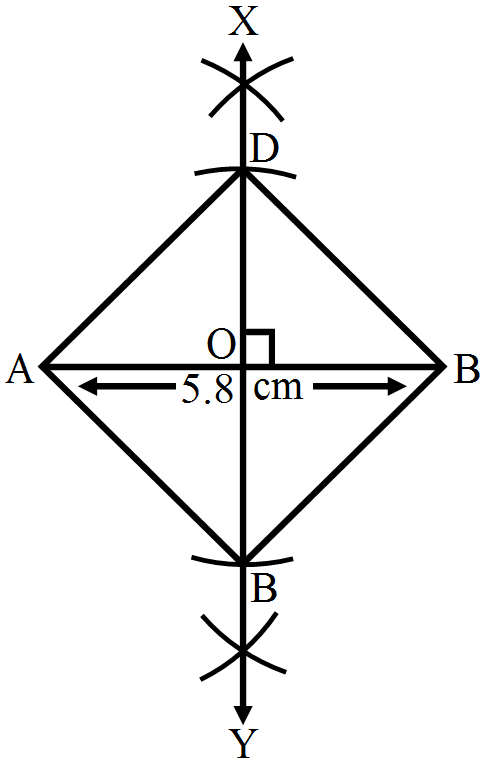
Steps of construction:
Step 1: Draw $AC = 5.8\ cm.$
Step 2: Draw the perpendicular bisector $XY$ of $AC,$ meeting it at $O.$
Step 3: From $O: \text{OB}=\frac{1}{2}(5.8)\text{cm}=2.9\text{cm}$
$\text{OD}=\frac{1}{2}(5.8)\text{cm}=2.9\text{cm}$
Step 4: Join $AB, BC, CD$ and $DA.$
$ABCD$ is the required square. View full question & answer→Question 285 Marks
Construct a quadrilateral $PQRS$ in which $PQ = 5\ cm, QR = 6.5\ cm,$ $\angle\text{P}=\angle\text{R}=100^\circ$ and $\angle\text{S}=75^\circ.$
Answer
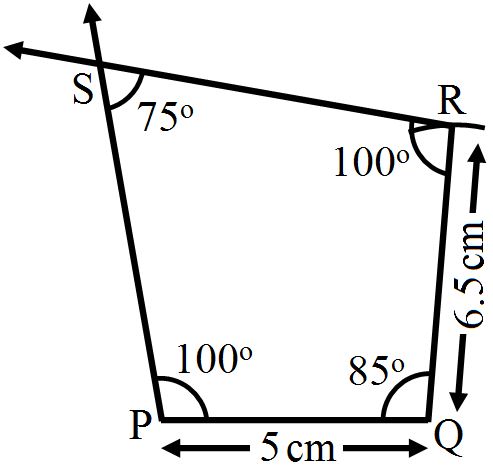
Steps of construction:
Step 1: Draw $PQ = 5\ cm.$
Step 2:
$\angle\text{P}+\angle\text{Q}+\angle\text{R}+\angle\text{S}=360^\circ$
$100^\circ+\angle\text{Q}+100^\circ+75^\circ=360^\circ$
$275^\circ+\angle\text{Q}=360^\circ$
$\angle\text{Q}=360^\circ-275^\circ$
$\angle\text{Q}=85^\circ$
Step 3: Make $\angle\text{P}=100^\circ$ and $\angle\text{Q}=85^\circ$
Step 4: With $Q$ as the centre, draw an arc of $6.5\ cm.$
Step 5: Make $\angle\text{R}=100^\circ$
Step 6: Join $R$ and $S.$
Step 7: Measure $\angle\text{S}=75^\circ$
Then, $PQRS$ is the required quadrilateral. View full question & answer→Question 295 Marks
Construct a quadrilateral $ABCD$ in which $AB = 5.6\ cm, BC = 4\ cm,$ $\angle\text{A}=50^\circ,\angle\text{B}=80^\circ$ and $\angle\text{D}=80^\circ.$
Answer
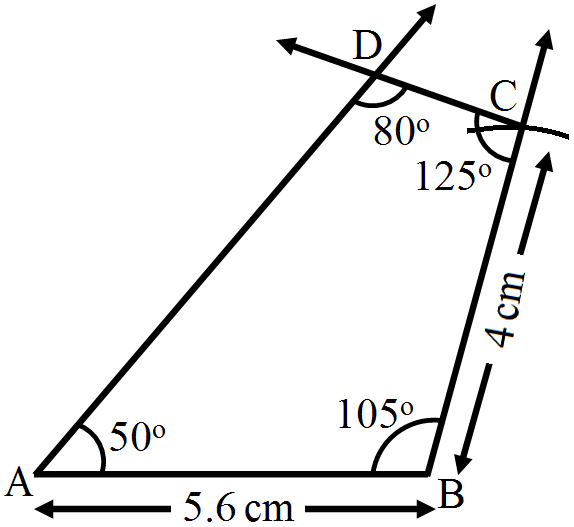
Steps of construction:
Step 1: Draw $AB = 5.6\ cm.$
Step 2: Make $\angle\text{A}=50^\circ$ and $\angle\text{B}=105^\circ.$
Step 3: With $B$ as the centre, draw an arc of $4\ cm.$
Step 4: Sum of all the angles of the quadrilateral is $360^\circ .$
$\angle\text{A}+\angle\text{B}+\angle\text{C}+\angle\text{D}=360^\circ$
$50^\circ+105^\circ+\angle\text{C}+80^\circ=360^\circ$
$235^\circ+\angle\text{C}=360^\circ$
$\angle\text{C}=360^\circ-235^\circ$
$\angle\text{C}=125^\circ$
Step 5: With $C$ as the centre, make $\angle\text{C}$ equal to $\angle125^\circ.$
Step 6: Join $C$ and $D.$
Step 7: Measure $\angle\text{D}=80^\circ.$
Then, $ABCD$ is the required quadrilateral. View full question & answer→Question 305 Marks
Draw a rhombus whose side is $7.2\ cm$ and one angle is $60^\circ .$
Answer
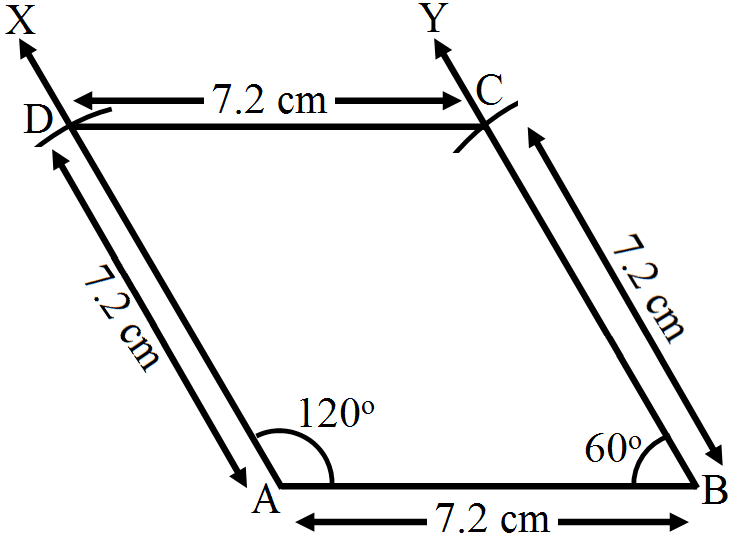
Steps of construction:
Step 1: Draw $AB = 7.2\ cm.$
Step 2: Draw
$\angle\text{ABY}=60^\circ$
$\angle\text{BAX}=120^\circ$
Sum of the adjacent angles is $180^\circ .$
$\angle\text{BAX}+\angle\text{ABY}=180^\circ$
$\Rightarrow\angle\text{BAX}=180^\circ-60^\circ=120^\circ$
Step 3:
Set off $AD (7.2\ cm)$ along $AX$ and $BC (7.2\ cm)$ along $BY.$
Step 4: Join $C$ and $D.$
Then, $ABCD$ is the required rhombus. View full question & answer→Question 315 Marks
Construct a rectangle $PQRS$ in which $QR = 3.6\ cm$ and diagonal $PR = 6\ cm.$ Measure the other side of the rectangle.
Answer
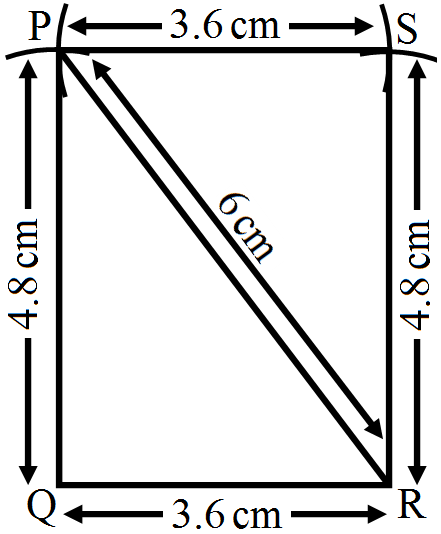
Steps of construction:
Step 1: Draw $QR = 3.6\ cm.$
Step 2: Make
$\angle\text{Q}=90^\circ$
$\angle\text{R}=90^\circ$
Step 3:
$PR^2= PQ ^2+ QR ^2$
$6^2= PQ ^2+3.6^2 $
$ PQ ^2=23.04 $
$PQ =4.8 \ cm$
Step 4: Draw an arc of length $4.8\ cm$ from point $Q$ and name that point as $P.$
Step 5: Draw an arc of length $6\ cm$ from point $R,$ cutting the previous arc at $P.$
Step 6: Join $PQ.$
Step 7: Draw an arc of length $4.8\ cm$ from point $R.$
From point $P,$ draw an arc of length $3.6\ cm,$ cutting the previous arc. Name that point as $S.$
Step 8: Join $P$ and $S.$
Thus, $PQRS$ is the required rectangle. The other side is $4.8\ cm$ in length. View full question & answer→