Question 513 Marks
A particle is projected with a velocity of $40m s^{-1}$. After 2s it just crosses a vertical pole of height $20m$. Calculate the angle of projection and the horizontal range.
AnswerIt is given that $u = 40m s^{-1}$, vertical distance travelled in 2s is 20m. Using the relation, $\text{y}=\text{ut}\sin\theta-\frac{1}{2}\text{gt}^2,$ we have $20=40\sin\theta\times2-\frac{1}{2}\times10\times(2)^2$
$=80\sin\theta-20$
$\Rightarrow\ 80\sin\theta=20+20=40$
$\Rightarrow\ \sin\theta=\frac{40}{80}=\frac{1}{2}$
$\therefore\ \theta=\sin^{-1}\Big(\frac{1}{2}\Big)=30^\circ$
$\therefore$ Horizontal range of projectile, $\text{R}=\frac{\text{u}^2\sin2\theta}{\text{g}}$
$=\frac{(40)^2\times\sin(2\times30^\circ)}{10}=\frac{1600\times\sin60^\circ}{10}$
$=160\times\frac{\sqrt{3}}{2}=138.6\text{m}$
View full question & answer→Question 523 Marks
Shows that the projection angle $\theta_0$ for a projectile launched from the origin is given by, $\theta_0=\tan^{-1}\Big(\frac{4\text{h}_\text{m}}{\text{R}}\Big)$ where the symbols have their usual meaning.
AnswerMaximum vertical height, $\text{h}_\text{m}=\frac{\text{u}_0^2\sin^2\theta}{2\text{g}}\ ...(\text{i})$ Horizontal range, $\text{R}=\frac{\text{u}_0^2\sin^22\theta}{\text{g}}\ ...(\text{ii})$ $\frac{\text{h}_\text{m}}{\text{R}}=\frac{\sin^2\theta}{2\sin^22\theta}$ $=\frac{\sin\theta\times\sin\theta}{2\times\sin\theta\cos\theta}$ $=\frac{\sin\theta}{4\cos\theta}=\frac{\tan\theta}{4}$ $\tan\theta=\frac{4\text{h}_\text{m}}{\text{R}}$ $\theta=\tan^{-1}\frac{4\text{h}_\text{m}}{\text{R}}$
View full question & answer→Question 533 Marks
Given a + b + c + d = 0, which of the following statements are correct: The magnitude of a can never be greater than the sum of the magnitudes of b, c, and d.
AnswerCorrect.Explanation:
a + b + c + d = 0 a = -(b + c + d) Taking modulus both sides, we get, |a| = |b + c + d| |a| ≤ |a| + |b| + |c| .....(i) Equation (i) shows that the magnitude of a is equal to or less than the sum of the magnitudes of b, c, and d. Hence, the magnitude of vector a can never be greater than the sum of the magnitudes of b, c, and d.
View full question & answer→Question 543 Marks
From the top of a building 19.6m high, a ball is projected horizontally. After how long does it strike the ground? If the line joining the point of projection to the point where it hits the ground makes an angle of 45° with the horizontal, what is the initial velocity of the ball?
Answer
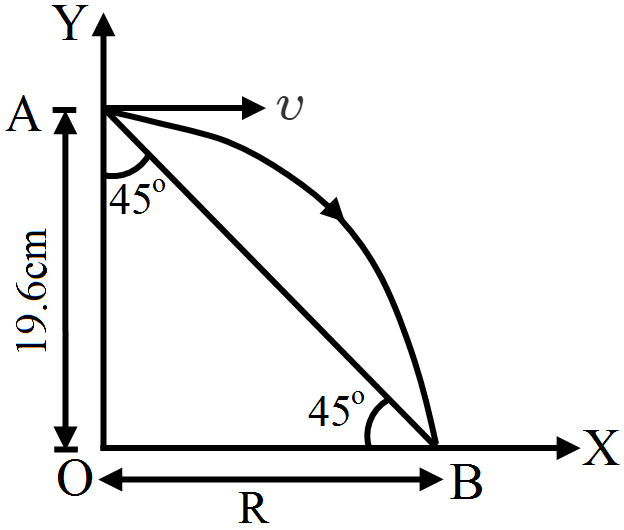 Initial horizontal velocity v = ?
Initial vertical velocity u = 0
$\text{h}=19.6\text{m};\ \text{a}=\text{g}=9.8\text{ ms}^{-2}$
$\text{h}=\text{ut}+\frac{1}{2}\text{gt}^2$
$\Rightarrow\ 19.6=0+\frac{1}{2}\times9.8+\text{t}^2$
or $\text{t}=\sqrt{\frac{2\times19.6}{9.8}}=2\text{sec}$
Let B be the point where the ball strikes,
$\text{OA}=\text{OB}=\text{R}=\text{v}\times\text{t}$
or $19.6=\text{v}\times2$ or $\text{v}=9.8\text{ ms}^{-1}$ View full question & answer→Question 553 Marks
There are two displacement vectors, one of magnitude $3m$ and the other of $4m$. How would the two vectors be added so that the magnitude of the resultant vector be $(i)\ 7m\ (ii)\ 1m$ and $(iii)\ 5m$?
AnswerThe magnitude of Resultant $R$ of two vecto$Rs \ A$ and $B$ is given by,given by, $\text{$R$}=\sqrt{\text{A}^2+\text{B}^2+2\text{AB}\cos\theta}$
$=\sqrt{3^2+4^2+2\times3\times4\cos\theta}$
- $R$ is $7m$, if $\theta=0^\circ$
- $R$ is $1m$, if $\theta=180^\circ$
- $R$ is $5m$, if $\theta=90^\circ$
View full question & answer→Question 563 Marks
Earth can be thought of as a sphere of radius $6400km$. Any object (or a person) is performing circular motion around the axis of earth due to earth’s rotation (period 1 day). What is acceleration of object on the surface of the earth (at equator) towards its centre? what is it at latitude $\theta?$ How does these accelerations compare with $g = 9.8m/ s^2$?
AnswerAccording to the problem, Radius of the earth $(R) = 6400km = 6.4 \times 10^6m$. Time period $(T) = 1 day = 24 \times 60 \times 60s = 86400s$ Centripetal acceleration, $(\text{a}_\text{c})=\omega^2\text{R}=\frac{4\pi^2\text{R}}{\text{T}}=\frac{4\times\big(\frac{22}{7}\big)^2\times6.4\times10^6}{(24\times60\times60)^2}$
$=\frac{4\times484\times6.4\times10^6}{49\times(24\times3600)^2}=0.034\text{m/s}^2$ At equator, latitude $\theta=0^\circ$
$\therefore\ \frac{\text{a}_\text{c}}{\text{g}}=\frac{0.034}{9.8}=\frac{1}{288}$
View full question & answer→Question 573 Marks
A man can swim at the rate of $5km/ h$ in still water. A river $1km$ wide flows at the rate of $3km/ h$. A swimmer wishes to cross the river straight.
- Along what direction must he strike?
- What should be his resultant velocity?
- How much time he would take to cross?
Answer
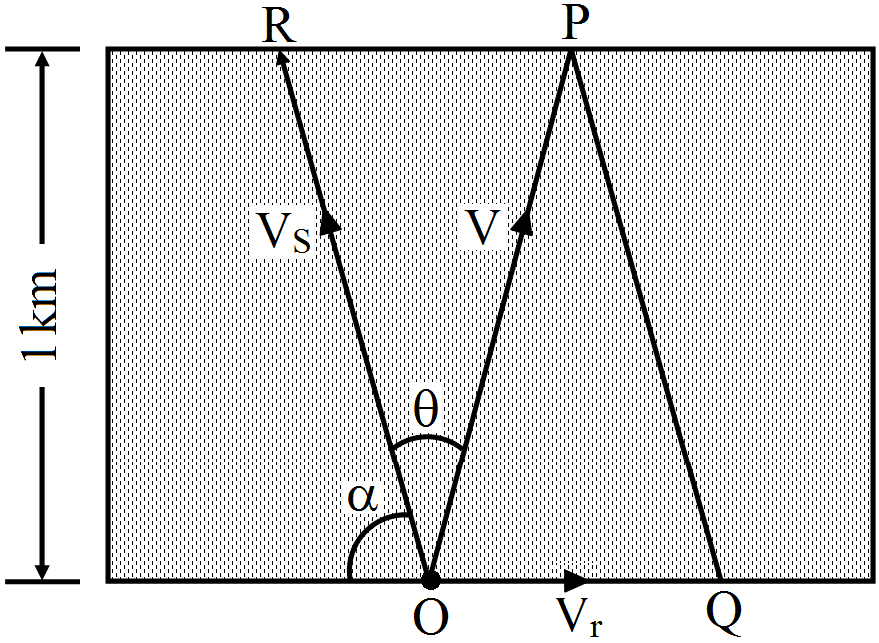
Width of the river, $d = 1km$
Velocity of swimmer, $v_s = 5km/ h$
Velocity of water flowing in river,
$v_r = 3km/ h$ along OQ.
- The swimmer wants to cross the river straight if the resultant velocity of the river flow and swimmer acts perpendicular to the direction of the river flow i.e. along OP. This will be so if the swimmer moves making an angle a with upstream i.e. along OR.
But, $\alpha+\theta=90^\circ$ or $\theta=90^\circ-\alpha$
From $\triangle\text{OPR},$ we have
$\sin\theta=\sin(90^\circ-\alpha)=\cos\alpha$
$=\frac{\text{RP}}{\text{RO}}=\frac{3}{5}=0.6$
$\therefore\ \cos\alpha=\cos53^\circ8'$
$\Rightarrow\ \alpha=53^\circ8'\ \text{upstream}$
- The resultant velocity along OP is given by
$\text{v}=\sqrt{\text{v}^2_\text{s}-\text{v}^2_\text{r}}=\sqrt{5^2-3^2}=4\text{km/h}$
- Time taken by swimmer to cross the river
$\text{t}=\frac{\text{d}}{\text{v}}=\frac{1}{4}=0.25\text{h}=15\text{ min}$ View full question & answer→Question 583 Marks
Derive an expression for the acceleration of a body of mass 'm' moving with a uniform speed 'v' in a circular path of radius ‘r'.
AnswerConsider a body in a circular path of radius r, with a speed v. The velocity direction is tangential at any point in the path.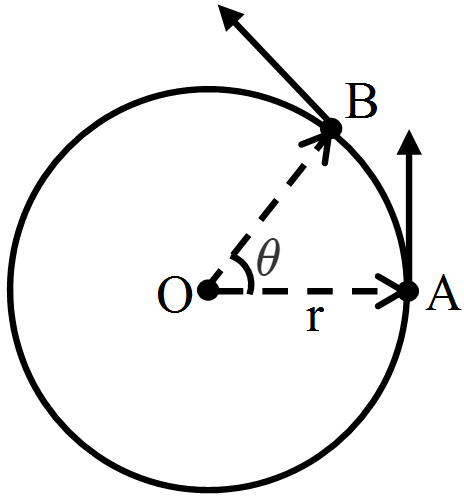
The position vectors at A and B are represented by two sides of an isosceles triangle first. The change in position vector is indicated by $\overline{\text{AB}}=\Delta\text{r}.$ The velocity at A and B are along the tangents at these points and the change in velocity will complete an isosceles triangle of velocities.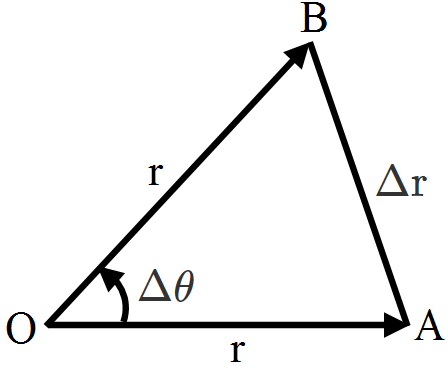
$\overline{\text{MN}}=\overline{\Delta\text{v}}$ Since the triangles are similar,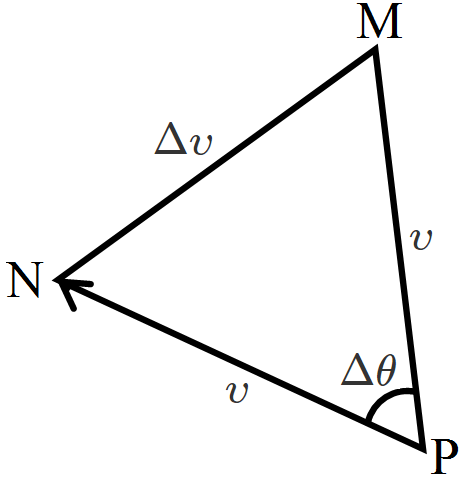
$\frac{\Delta\text{v}}{\Delta\text{r}}=\frac{\text{v}}{\text{r}}\Rightarrow\ \Delta\text{v}=\frac{\text{v}}{\text{r}}.\Delta\text{r}$
$^{\ \ \text{Lt}}_{\Delta\text{t}\rightarrow0}\frac{\Delta\text{v}}{\Delta\text{t}}=^{\ \ \text{Lt}}_{\Delta\text{t}\rightarrow0}\frac{\text{v}}{\text{r}}\frac{\Delta\text{r}}{\Delta\text{t}}$
$\therefore\ \frac{\text{dv}}{\text{dt}}=\frac{\text{v}}{\text{r}}.\text{v}\Rightarrow\ \text{a}=\frac{\text{v}^2}{\text{r}}$ View full question & answer→Question 593 Marks
A stone tied to the end of a string 80cm long is whirled in a horizontal circle with a constant speed. If the stone makes 14 revolutions in 25s, what is the magnitude and direction of acceleration of the stone?
AnswerLength of the string, l = 80cm = 0.8m Number of revolutions = 14 Time taken = 25s Frequency, v $=\frac{\text{= Number of revolutions}}{\text{Time taken}}$ $=\frac{14}{25}\text{hz}$ Angular frequency, $\omega=2\pi\text{v}$ $=2\times\frac{22}{7}\times\frac{14}{25}=\frac{88}{25}\text{ rad s}^{-1}$ Centripetal acceleration, $\text{a}_\text{c}=\omega^2\text{r}$ $=\Big(\frac{88}{25}\Big)^2\times0.8$ $=9.91\text{ms}^{-2}$ The direction of centripetal acceleration is always directed along the string, toward the centre, at all points.
View full question & answer→Question 603 Marks
A bullet P is fired from a gun when the angle of elevation of the gun is 30°. Another bullet Q is fired from the gun when the angle of elevation is 60°. The vertical height attained in the second case is x times the vertical height attained in the first case. What is the value of x?
Answer$\text{h}_2=\frac{\text{u}^2\sin^260^\circ}{2\text{g}}=\frac{3\text{u}^2}{8\text{g}}$ and $\text{h}_1=\frac{\text{u}^2\sin^230^\circ}{2\text{g}}=\frac{\text{u}^2}{8\text{g}}$Clearly, $h_2 = 3h_1$
$\therefore$ x = 3.
View full question & answer→Question 613 Marks
Derive a relation for the time taken by a projectile to reach the highest point and the maximum height attained.
AnswerConsider a projectile projected at an angle $\theta$ to the horizontal with velocity u, the horizontal and vertical components initially with velocity $\text{u}\cos\theta$ and $\text{u}\sin\theta$ respectively. Vertical velocity at highest point is zero, due to gravity acting vertically downwards.Using, $\text{v}=\text{u}+\text{at}$
We have, $0=\text{u}\sin\theta-\text{gt}\Rightarrow\ \text{t}=\frac{\text{u}\sin\theta}{\text{g}}$
The time to reach topmost point, $\text{t}=\frac{\text{u}\sin\theta}{\text{g}}$Using, $\text{v}^2=\text{u}^2+2\text{as}$
We have, $0=\text{u}^2\sin^2\theta-2\text{gh}_\text{max}$
$\Rightarrow\ \text{h}_\text{max}=\frac{\text{u}^2\sin^2\theta}{2\text{g}}.$
View full question & answer→Question 623 Marks
Show that the projection angle $\theta_0$ for a projectile launched from the origin is given by, $\theta_0=\tan^{-1}\Big(\frac{4\text{H}}{\text{R}}\Big)$ where, H is the maximum height attained by the projectile and R is the range of the projectile.
Answer
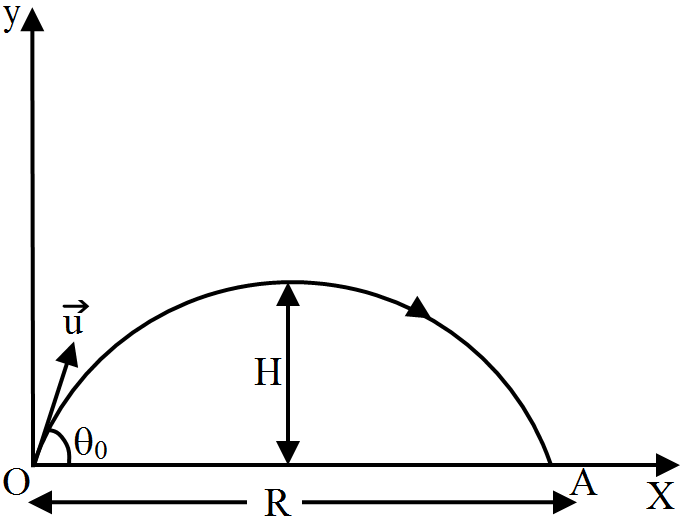 The path followed by a proiectile prolected at an angle $\theta_0$ with velocity $\vec{\text{u}}$ is shown in figure. The maximum height attained by the projectile is given by
$\text{H}=\frac{\text{u}^2\sin^2\theta_0}{2\text{g}}\dots(\text{i})$
The range of the projectile is given by
$\text{R}=\frac{\text{u}^2\sin2\theta_0}{\text{g}}$
$=\frac{2\text{u}^2\sin\theta_0\cos\theta_0}{\text{g}}\dots(\text{ii})$
Dividing eq. (i) by eq. (ii), we get
$\tan\theta_0=\frac{4\text{H}}{\text{R}}\Rightarrow\ \theta_0=\tan^{-1}\Big(\frac{4\text{H}}{\text{R}}\Big).$ View full question & answer→Question 633 Marks
Prove that the path of a projectile is a parabola.
AnswerConsider a projectile thrown at an angle $\theta$ with a velocity u. The components of velocity horizontal and vertical are $\text{u}\cos\theta$ and $\text{u}\sin\theta.$ After time t, the horizontal displacement $\text{x}=\text{u}\cos\theta\text{t}$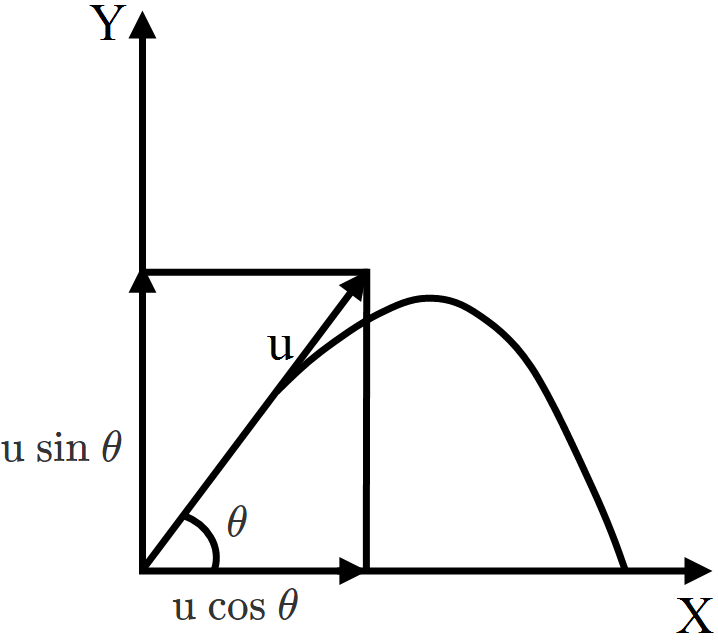
The vertical displacement, $\text{y}=\text{u}\sin\theta\text{ t}-\frac{1}{2}\text{gt}^2$ $\therefore\ \text{y}=\text{u}\sin\theta.\Big(\frac{\text{x}}{\text{u}\cos\theta}\Big)-\frac{1}{2}\text{g}\Big(\frac{\text{x}}{\text{u}\cos\theta}\Big)^2$ $\text{y}\propto\text{x}^2,$ the path of a projectile is a parabola. View full question & answer→Question 643 Marks
An aeroplane is flying in a horizontal direction with a velocity of $600km/ h$ and at a height of $1960m$. When it is vertically above the point A on the ground, a body is dropped from it. The body strikes the ground at point B. Calculate the distance AB.
AnswerVelocity of the aeroplane in the horizontal direction is$\text{u}_{0\text{y}}=600\text{km/ h}=600\times\frac{5}{18}=\frac{500}{3}\text{m/ s}$
Velocity remains constant throughout the flight of the body. $u_{0y} = 0$ and $y = h = 1960m$ Let t = time taken by the body to reach the ground Now, $\text{y}=\text{u}_{0\text{y}}\text{t}+\frac{1}{2}\text{gt}^2$ Here, $\text{y}=\text{h}=1960\text{m}, \text{ u}_{\text{0y}}=0$
$\therefore\ 1960=\frac{1}{2}\times9.8\times\text{t}^2$
$\Rightarrow\ \text{t}=\sqrt{\frac{1960}{4.9}}=\sqrt{400}=20\text{s}$ Distance travelled by the body in the horizontal direction, $\text{AB}=\text{x}=\text{v}_\text{ax}\text{t}=\frac{500}{3}\times20$
$=\frac{10000}{3}=3333\text{m}=3.33\text{km}$
View full question & answer→Question 653 Marks
Show that vectors $\text{A}=2\hat{\text{i}}-3\hat{\text{j}}-\hat{\text{k}}$ and $\text{B}=-6\hat{\text{i}}+9\hat{\text{j}}+3\hat{\text{k}}$
are parallel.
AnswerThe given vectors are $\text{A}=2\hat{\text{i}}-3\hat{\text{j}}-\hat{\text{k}}$ and $\text{B}=-6\hat{\text{i}}+9\hat{\text{j}}+3\hat{\text{k}}$ Then, the vecotrs are parallel, if A × B = 0 $\therefore\ \text{A}\times\text{B}=\begin{vmatrix}\hat{\text{i}}&\hat{\text{j}}&\hat{\text{k}}\\2&-3&-1\\-6&9&3\end{vmatrix}$ $\hat{\text{i}}(-9+9)-\hat{\text{j}}(6-6)+\hat{\text{k}}(18-18)=0$ But |A × B| = 0 $\text{AB}\sin\theta=0\ \ [\because\text{A}\neq0\text{ and B}\neq0]$ $\therefore\ \sin\theta=0\ \text{or }\theta=0$ Hence, the vectors A and B are parallel.
View full question & answer→Question 663 Marks
A cricket ball is thrown at a speed of $28m/ s$ in a direction $30^\circ$ above the horizontal. Calculate: $(a)$ the maximum height $(b)$ the time taken by the ball to return to the same level $(c)$ the horizontal distance from the thrower to the point where the ball returns to the same level.
Answer$\text{u}=28\text{ ms}^{-1},\theta=30^\circ$
- Maximum height $=\frac{\text{u}^2\sin\theta}{2\text{g}}$
$=\frac{28^2\times\sin^230^\circ}{2\times10}=9.8\text{m}$
- Time taken to reach same level $=$ Time of flight
$\frac{2\text{u}\sin\theta}{\text{g}}=\frac{2\times28\times\sin30^\circ}{10}=2.8\text{ sec}$
- Range $=\frac{\text{u}^2\sin2\theta}{\text{g}}=\frac{28^2\times\sin60^\circ}{\text{g}}$
$=\frac{28^2\times\sqrt{\frac{3}{2}}}{10}=96.02\text{ m}$ View full question & answer→Question 673 Marks
A boy travelling in an open car moving on a levelled road with constant speed tosses a ball vertically up in the air and catches it back. Sketch the motion of the ball as observed by a boy standing on the footpath. Give explanation to support your diagram.
Answerv = vertical velocity of the ball given by the boy u = velocity of the car which is equal to the horizontal velocity of the ball.
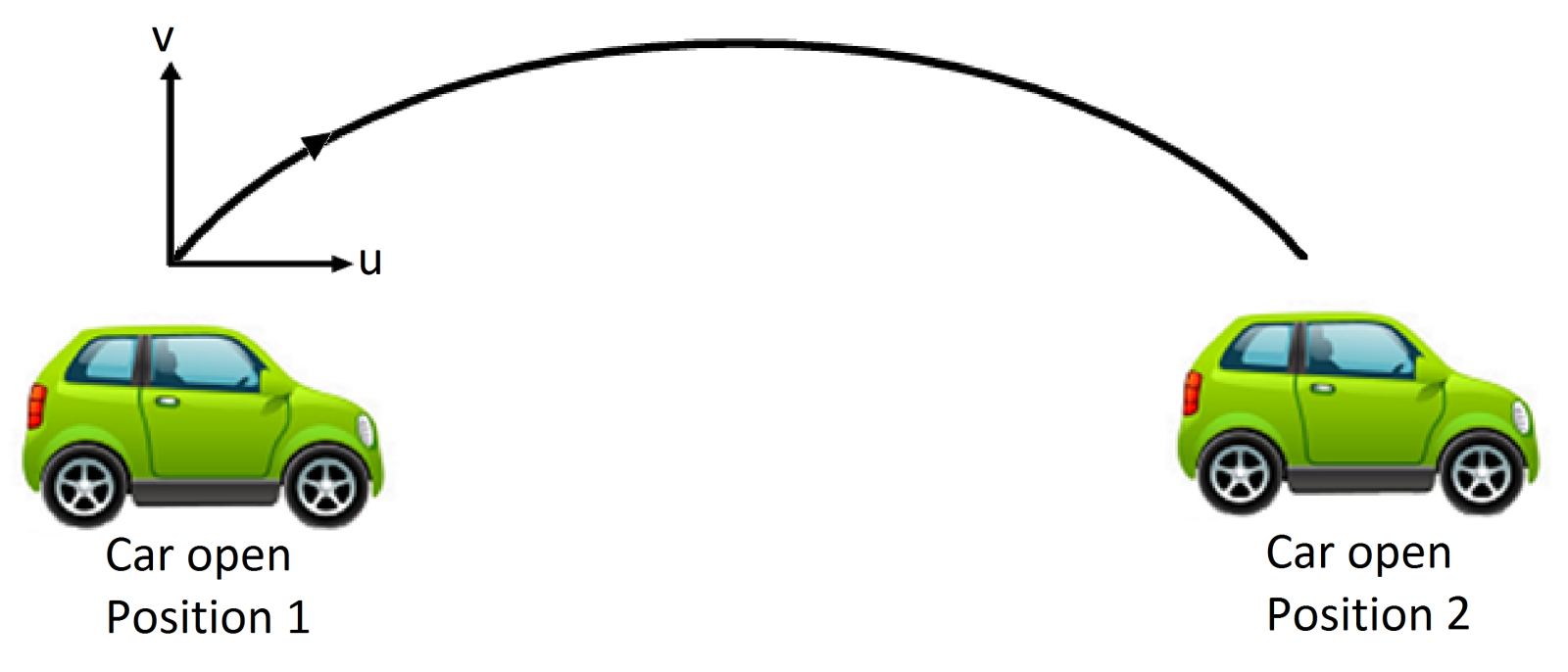
As the ball has both vertical and horizontal components of velocities it’s path will be parabolic as observed by a person standing on the footpath.
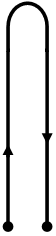
Path of the ball as seen by the boy sitting in the same car will be only vertically up-down under gravity and will catch up by the boy if car if moving with constant velocity.
View full question & answer→Question 683 Marks
A man can jump on moon about six times as high as on the earth. Why?
AnswerWe know that value of g on surface of moon is nearly $\frac{1}{6}\text{th}$ of its value at earth. We also know that maximum height which a man can cover is given by $\text{h}=\frac{\text{u}^2\sin^2\theta}{2\text{g}}$ i.e., $\text{h}\propto\frac{1}{\text{g}}$ Therefore, $\frac{\text{h}_\text{moon}}{\text{h}_\text{earth}}=\frac{\text{g}_\text{earth}}{\text{g}_\text{moon}}=\frac{\text{g}}{\frac{\text{g}}{6}}=6$ or $h_{moon} = 6h_{earth}$.
View full question & answer→Question 693 Marks
In long jump, does it matter how high you jump? What factors determine the span of the jump?
AnswerIn order to have long jump, it is necessary to have the horizontal component of velocity more than the vertical component. The height does not matter. The angle of elevation at the time of jumping and the magnitude of the speed will determine the span of the jump.
View full question & answer→Question 703 Marks
A football is kicked into the air vertically upwards. What is its
- acceleration, and
- velocity at the highest point?
Answer
- As the motion of body is under gravity and no any external force acts on the body, so the direction of force $($gravitational$)$. Hence, the direction of acceleration is always towards the centre of earth i.e, downward.
- As the ball is thrown vertically upward so its component of horizontal velocity become zero. At the highest point, the velocity of the body $= 0$. Hence, net velocity of the body at the highest point is zero.
View full question & answer→Question 713 Marks
An accelerating train is passing over a high bridge. A stone is dropped from the train at an instant when its speed is $10m/ s$ and acceleration is $1m/ s^2$. Find the horizontal and vertical components of the velocity and acceleration of the stone one second after it is dropped. Take $g = 10m/ s^2$.
AnswerHorizontal acceleration of the train is not carried by the stone. Horizontal velocity of the stone will remain constant, during the fall of the stone.
|
|
Horizontal component
|
Vertical component
|
|
Velocity
|
$10m/ s$
|
$10m/ s$
|
|
Acceleration
|
$0m/ s^2$
|
$10m/ s^2$
|
View full question & answer→Question 723 Marks
Figure shows a pirateship $560m$ from a fort defending a harbour entrance. A defence cannon, located at sea level, fires balls at initial speed, $u_0 = 82m/ s$.
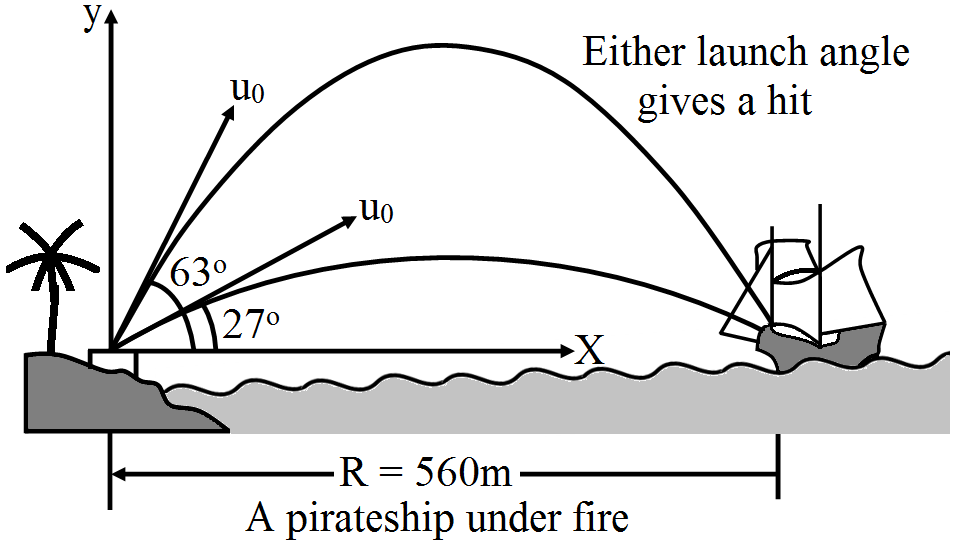
- At what angle, $\theta_0$ from the horizontal must a ball be fired to hit the ship?
- What is the maximum range of the cannon balls?
Answer
- A fired cannon ball is a projectile and we want an equation that relates the launch angle, to the ball horizontal displacement i.e. range as it moves from the cannon to the ship.
$\therefore\ \theta_0=\frac{1}{2}\sin^{-1}\Big(\frac{\text{gR}}{\text{u}_0^2}\Big)$
$=\frac{1}{2}\sin^{-1}\Big(\frac{9.8\times560}{(82)^2}\Big)$
If one angle is $27^\circ$ , then other angle $(90^\circ-\theta_0)$ is
$=90^\circ-27^\circ=63^\circ$
- Maximum range at $\theta_0=45^\circ$
$\therefore\ \text{R}=\frac{\text{u}^2}{\text{g}}\sin2\theta_0$
$=\frac{(82)^2}{9.8}\times\sin90^\circ$
$=686\text{m}$ View full question & answer→Question 733 Marks
In dealing with motion of projectile in air, we ignore effect of air resistance on motion. This gives trajectory as a parabola as you have studied. What would the trajectory look like if air resistance is included? Sketch such a trajectory and explain why you have drawn it that way.
AnswerWhen air resistance acts on projectile then its vertical and horizontal both velocity will decrease due to air resistance. Hence its maximum height becomes smaller than when there is no force of friction (resistance) of air. By formula $\text{R}=\frac{\text{u}^2}{\text{g}}\sin2\theta$ and $\text{H}_\text{max}=\frac{\text{u}^2\sin^2\theta}{2\text{g}}$
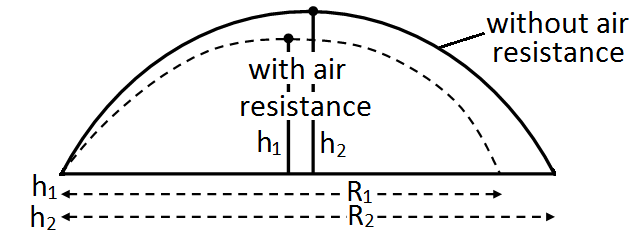
$\therefore\ \text{h}_1<\text{h}_2\text{ and }\text{R}_1<\text{R}_2$ But time of flight for both will remain same as the body in case II (with air resistance) $h_1< h_2$ takes smaller time to rise. View full question & answer→Question 743 Marks
The maximum height attained by a projectile is increased by 10% by increasing its speed of projection, without changing the angle of projection. What will the percentage increase in the horizontal range?
AnswerAs, maximum height, $\text{H}=\frac{\text{u}^2}{2\text{g}}\sin^2\theta$ Consider $\Delta\text{H}$ be the increase in H when u changes by $\Delta\text{u},$ it can be obtained by differentiating the above equation, we get $\Delta\text{H}=\frac{2\text{u}\Delta\text{u}\sin^2\theta}{2\text{g}}=\frac{2\Delta\text{u}}{\text{u}}\text{H}$ $\Rightarrow\ \frac{\Delta\text{H}}{\text{H}}=\frac{2\Delta\text{u}}{\text{u}}$ Given, % increase in H is 10%, so $\frac{\Delta\text{H}}{\text{H}}=\frac{10}{100}=0.1\Rightarrow\ \frac{2\Delta\text{u}}{\text{u}}=0.1$ As, $\text{R}=\frac{\text{u}^2\sin2\theta}{\text{g}}$ $\because\ \Delta\text{R}=\frac{2\text{u}\Delta\text{u}}{\text{g}}\sin2\theta$ $\Rightarrow\ \frac{\Delta\text{R}}{\text{R}}=\frac{2\Delta\text{u}}{\text{u}}=0.1$ $\therefore$ % increase in horizontal range $=\frac{\Delta\text{R}}{\text{R}}\times100$ $=0.1\times100=10\%$
View full question & answer→Question 753 Marks
Find a unit vector parallel to the vector $3\hat{\text{i}}+7\hat{\text{j}}+4\hat{\text{k}}.$
AnswerLet $3\hat{\text{i}}+7\hat{\text{j}}+4\hat{\text{k}}=\vec{\text{a}}.$ $|\vec{\text{a}}|=\sqrt{3^2+7^2+4^2}$ $=\sqrt{9+49+16}=\sqrt{74}$ Using vector in the direction of $\vec{\text{a}}=\frac{\vec{\text{a}}}{|\vec{\text{a}}|}=\frac{3\hat{\text{i}}+7\hat{\text{j}}+4\hat{\text{k}}}{\sqrt{74}}$
View full question & answer→Question 763 Marks
A man capable of swimming with a velocity u in still water, wants to cross a river of width 'd' flowing with a velocity v. Find the angle in which he should be directed to reach at the exactly opposite point? To cross by the shortest time, in which direction, he should swim? What is the value of shortest time?
AnswerTo opposite point (A to B). Since the river is flowing, to reach the opposite point the man should direct himself to C, i.e., at angle $\theta$ with AB. We know, $\sin\theta=\frac{\text{CB}}{\text{AC}}=\frac{\text{v}}{\text{u}}$ $\therefore\ \theta=\sin^{-1}\Big(\frac{\text{v}}{\text{u}}\Big),$ i.e., at an angle $\frac{\pi}{2}+\theta$ with the direction of river.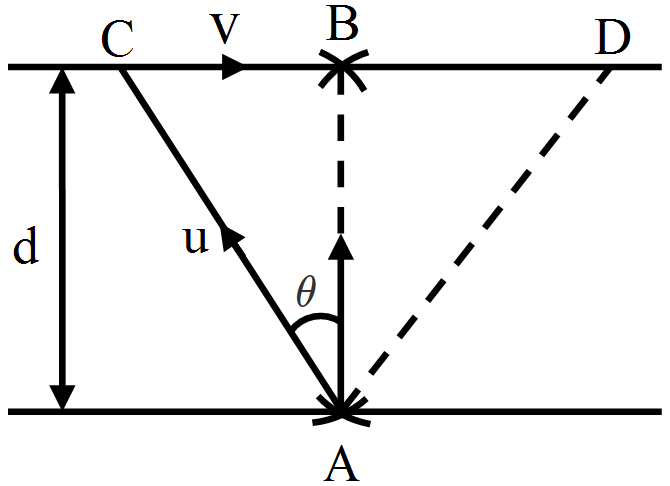
Shortest time: To travel by shortest time, he should swim perpendicular to river current. The river will drag him to the point D. The time taken $\text{t}=\frac{\text{AB}}{\text{u}}$ or $\frac{\text{BD}}{\text{v}}$ or $\frac{\text{AD}}{\sqrt{\text{u}^2+\text{v}^2}}$ View full question & answer→Question 773 Marks
Calculate the angular speed of the seconds hand of a clock. If the length of the seconds hand is 4cm, calculate the speed of the tip of the seconds hand.
AnswerSeconds hand of a clock completes one rotation in 60s i.e. $\text{T}=60\text{s}, \ \theta=2\pi\text{ rad}$ $\therefore$ Angular speed, $\omega=\frac{\theta}{\text{T}}=\frac{2\pi\text{ rad}}{60\text{s}}$ $=\frac{\pi}{30}\text{rad s}^{-1}$ Length of the seconds hand, R = 4cm.$\therefore$ Speed of the tip of second's hand is $\text{v}=\omega\text{R}=\frac{\pi}{30}\times4=\frac{2\pi}{15}\text{cm s}^{-1}.$
View full question & answer→Question 783 Marks
Find the angle between force $\vec{\text{F}}=(3\vec{\text{i}}+4\vec{\text{j}}-5\vec{\text{k}})$ unit and displacement $\vec{\text{d}}=(5\vec{\text{i}}+4\vec{\text{j}}+3\vec{\text{k}})$ unit. Also find the projection of $\vec{\text{F}}$ on $\vec{\text{d}}.$
Answer$\vec{\text{F}}=(3\vec{\text{i}}+4\vec{\text{j}}-5\vec{\text{k}})$$\vec{\text{d}}=(5\vec{\text{i}}+4\vec{\text{j}}+3\vec{\text{k}})$
$\text{F}=\sqrt{9+16+25}=\sqrt{50}$
$\text{d}=\sqrt{25+16+9}=\sqrt{50}$
$\vec{\text{F}}.\vec{\text{d}}=(3\hat{\text{i}}+4\hat{\text{j}}-5\hat{\text{k}}).(5\hat{\text{i}}+4\hat{\text{j}}+3\hat{\text{k}})$
$=15+16-15=16$
Let Q be the angle between $\vec{\text{F}}$ and $\vec{\text{d}}$
$\text{W}=\vec{F}.\vec{\text{d}}=\text{Fd}\cos\theta$
$16=\sqrt{50}\sqrt{50}\cos\theta$
$\frac{16}{50}=\cos\theta$
$\Rightarrow\ \theta=\cos^{-1}(0.32)=71.3^\circ$
Unit vector along $\vec{\text{d}}$ is
$\hat{\text{d}}=\frac{5\hat{\text{i}}+4\hat{\text{j}}+3\hat{\text{k}}}{\sqrt{5^2+4^2+3^2}}=\frac{5\hat{\text{i}}+4\hat{\text{j}}+3\hat{\text{k}}}{\sqrt{50}}$ $\vec{\text{F}}.\vec{\text{d}}=\frac{16}{\sqrt{50}}$ Component vector of $\vec{\text{F}}$ along $\vec{\text{d}}$ is $(\vec{\text{F}}.\vec{\text{d}})\hat{\text{d}}=\frac{16}{\sqrt{50}}\Big(\frac{5\hat{\text{i}}+4\hat{\text{j}}+3\hat{\text{k}}}{\sqrt{50}}\Big)$ $=0.32(5\hat{\text{i}}+4\hat{\text{j}}+3\hat{\text{k}})$
View full question & answer→Question 793 Marks
Two vectors $\vec{\text{A}}$ and $\vec{\text{B}}$ are of equal lengths (A = B) and mutually perpendicular. Show by vector diagram that their vector sum $(\vec{\text{A}}+\vec{\text{B}})\text{s}$ and vector difference $(\vec{\text{A}}-\vec{\text{B}})$ will be of the same length and mutually perpendicular.
Answer
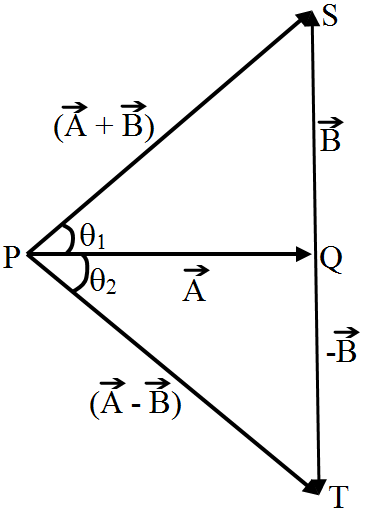 Draw $(\overrightarrow{\text{PQ}})=\vec{\text{A}}$ and from the arrow head of $\vec{\text{A}},$ draw $(\overrightarrow{\text{QS}})=\vec{\text{B}},$ of the same length (i.e., QS = PQ) and perpendicular to $\vec{\text{A}}$ Fig.
Now $(\overrightarrow{\text{PS}})$ will represent $(\vec{\text{A}}+\vec{\text{B}}).$ Here,
$\tan\theta_1=\frac{\text{QS}}{\text{PQ}}=1\text{ or }\theta_1=45^\circ$
Now draw $(\overrightarrow{\text{QT}})=-\vec{\text{B}},$ where QT = QS. Now $(\overrightarrow{\text{PT}})$ will represent $(\vec{\text{A}}-\vec{\text{B}}).$ Here,
$\tan\theta_2=\frac{\text{QT}}{\text{PQ}}=1\text{ or }\theta_2=45^\circ$
On measuring, the lengths of $(\vec{\text{A}}+\vec{\text{B}})$ and $(\vec{\text{A}}-\vec{\text{B}})$ come out to be the same and angle between them $(\theta_1+\theta_2)=45^\circ+45^\circ=90^\circ.$ View full question & answer→Question 803 Marks
Derive an expression for the centripetal acceleration of a particle moving with uniform speed V along a circular path of radius r.
AnswerConsider a particle of mass m, moving with a constant speed v and uniform angular velocity w, on a circular path of radius r with centre at O. Let at any time, the particle be at P, where $\vec{\text{OP}}=\vec{\text{r}}_1$ and at time $\text{t}+\Delta\text{t},$ the particle be at Q, where $\vec{\text{OQ}}=\vec{\text{r}}_2$ and $\angle\text{POQ}=\Delta\text{Q}$ Angular speed of the particle, $\omega=\frac{\Delta\text{Q}}{\Delta\text{t}}\dots(\text{i})$ Let $\vec{\text{v}}_1$ and $\vec{\text{v}}_2$ be the velocity vectors of the particle at locations P and Q respectively. In circular motion, the direction of velocity vector at a location is always along the tangent to the circular path at that location, hence $\vec{\text{v}}_1$ and $\vec{\text{v}}_2$ can be represented in magnitude and direction by the tangents $\vec{\text{PA}}$ and $\vec{\text{QB}}.$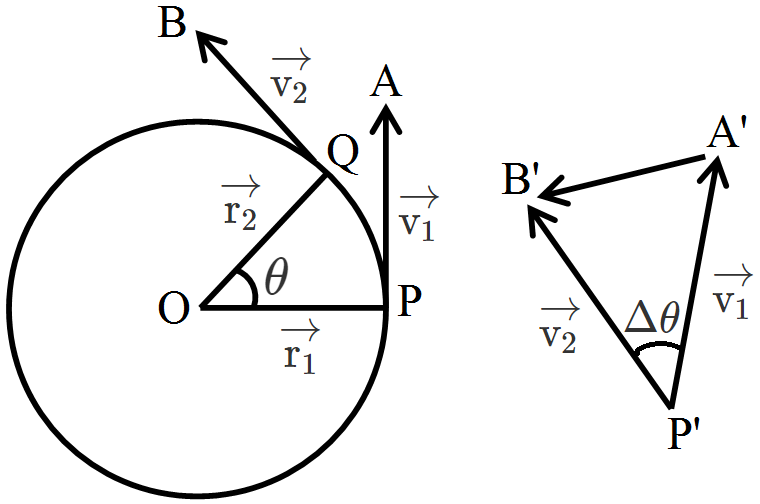
$|\vec{\text{PA}}|=|\vec{\text{QB}}|=|\vec{\text{v}}|$ Clearly, $\angle\text{A}'\text{P}'\text{B}'=\Delta\theta$ From $\Delta$ law of vectors $\overrightarrow{\text{P}'\text{A}'}+\overrightarrow{\text{A}'\text{B}'}=\overrightarrow{\text{P}'\text{B}'}$ $\Rightarrow\ \overrightarrow{\text{A}'\text{B}'}=\overrightarrow{\text{P}'\text{B}'}-\overrightarrow{\text{P}'\text{A}'}$ $=\vec{\text{v}_2}-\vec{\text{v}_1}=\Delta\text{v}\ (\text{Say})$ As $\Delta\text{t}\rightarrow0,$ Aa lies close to B'. Then A'B' can be taken as arc A'B' of the circle of radius $\text{P}'\text{A}'=|\vec{\text{v}}|$ $\therefore\ \Delta\theta=\frac{\text{A}'\text{B}'}{\text{P}'\text{A}'}=\frac{|\Delta\vec{\text{v}}|}{|\vec{\text{v}}|}$ or $\omega\Delta\text{t}=\frac{|\Delta\vec{\text{v}}|}{|\vec{\text{v}}|}$ From (i) $\frac{|\Delta\vec{\text{v}}|}{|\vec{\text{v}}|}=|\vec{\text{v}}|\omega$ $=(\omega\text{r})\omega=\omega^2\text{r}\ [\because\ \text{v}=\omega\text{r}]$ When $\Delta\text{t}\rightarrow0,$ then $\frac{|\Delta\vec{\text{v}}|}{\text{t}}$ represents the magnitude of centripetal acceleration at P, which is given by $\vec{\text{a}}=\frac{|\Delta\vec{\text{v}}|}{\Delta\text{t}}=\omega^2\text{r}$ $=\Big(\frac{\text{v}}{\text{r}}\Big)^2\text{r}=\frac{\text{v}^2}{\text{r}}$ Thus, $|\vec{\text{a}}|=\omega^2\text{r}=\frac{\text{v}^2}{\text{r}}$ View full question & answer→Question 813 Marks
Earth also moves in circular orbit around sun once every year with on orbital radius of $1.5 \times 10^{11}m$. What is the acceleration of earth (or any object on the surface of the earth) towards the centre of the sun? How does this acceleration compare with $g = 9.8m/ s^2$? $\Big(\text{Hint: acceleration}\frac{\text{V}^2}{\text{R}}=\frac{4\pi^2\text{R}}{\text{T}^2}\Big)$
AnswerOrbital radius of the earth around the sun $(R) = 1.5 \times 10^{11}m$
Time period = 1 year = 365 days = $365 \times 24 \times 60 \times 60s = 3.15 \times 10^7s$
Centripetal acceleration
$(\text{a}_\text{c})=\text{R}\omega^2=\frac{4\pi^2\text{R}}{\text{T}^2}=\frac{4\times\big(\frac{22}{7}\big)^2\times1.5\times10^{11}}{(3.15\times10^7)^2}$
$=5.97\times10^{-3}\text{m/s}^2$
$\frac{\text{a}_\text{C}}{\text{g}}=\frac{5.97\times10^{-3}}{9.8}=\frac{1}{1642}$
View full question & answer→Question 823 Marks
From the top of a tower $100m$ in height, a ball is dropped and at the same time another ball is projected vertically upwards from the ground with a velocity of $25ms^{-1}$. Find when and where the two balls will meet? $g = 9.8ms^{-2}$?
Answer$\text{x}=0+\frac{1}{2}\times9.8\text{t}^2=4.9\text{t}^2\dots(\text{i})$$100-\text{x}=25\text{t}+\frac{1}{2}\times(-9.8)\text{t}^2\dots(\text{ii})$
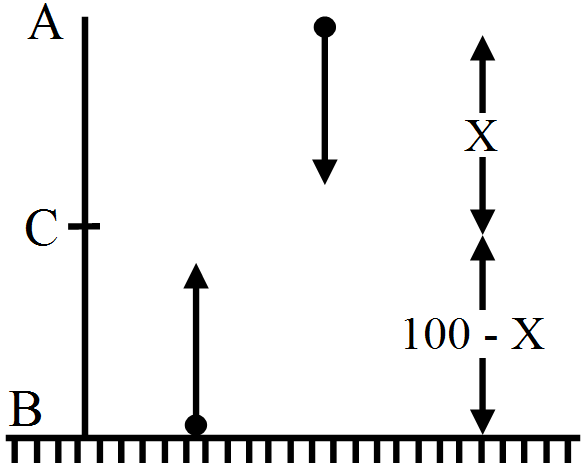
Solving equation (i) and (ii), we get
t = 4 second
x = 4.9 × 16 = 78.4m View full question & answer→Question 833 Marks
A shell bursts on contact with the ground and the fragments fly in all directions with speeds upto $39.2m/ s$. Show that a man $78.4m$ away is in danger for $4\sqrt{2}$ seconds.
AnswerGiven $u = 39.2ms^{-1}$ and $R = 78.4m$ Horizontal Range,$\text{R}=\frac{\text{u}^2\sin2\theta}{\text{g}}$
or $\sin2\theta=\frac{\text{Rg}}{\text{u}^2}=\frac{78.4\times9.8}{(39.2)^2}=\frac{1}{2}$
or $\theta=15^\circ\text{ or }75^\circ$
It gives two times of flight, i.e., $\text{t}_1=\frac{2\text{u}\sin75^\circ}{\text{g}}$
$\text{t}_2=\frac{2\text{u}\sin75^\circ}{\text{g}}$ The man will be in danger for time ($t_2 - t_1$), i.e.,$\text{t}_2-\text{t}_1=\frac{2\text{u}}{\text{g}}(\sin75^\circ-\sin15^\circ)$
$=\frac{4\text{u}}{\text{g}}\sin30^\circ\cos45^\circ$
$=\frac{4\times39.2}{9.8}\times\frac{1}{2}\times\frac{1}{\sqrt{2}}$
$=2.83\text{ seconds}$
View full question & answer→Question 843 Marks
A man runs across the roof-top of a tall building and jumps horizontally with the hope of landing on the roof of next building which is of lower height than the first. If his speed is 9m/ s, the (horizontal) distance between the two building is 10m and the height difference is 9m, will he able to land on the next building? Substantiate your answer. Take $g = 10m/ s^2$.
AnswerTime taken by the man to fall through a vertical height of 9m should be greater than time taken in horizontal distance for safe landing on the lower building. Time taken to fall through a vertical height $\text{t}_1=\sqrt{\frac{2\text{h}}{\text{g}}}$
$=\sqrt{\frac{2\times9}{10}}=1.34\text{ sec.}$ Time taken to cover horizontal distance $\text{t}_2=\frac{\text{d}}{\text{v}}=\frac{10}{9}=1.11\text{ sec}$ Thus, $t_1 > t_2$ Hence he will land safely on lower building.
View full question & answer→Question 853 Marks
The range of a rifle bullet is 1000m, when e is the angle of projection. If the bullet is fired with the same angle from a car travelling at 36km/ h towards the target, show that the range will be increased by $142.9\sqrt{\tan\theta}\text{m}.$
AnswerGiven, R = 1000m $\therefore$ Horizontal range of the bullet fired at an angle $\theta$ is $\text{R}=\frac{\text{u}^2\sin2\theta}{\text{g}}$ $\Rightarrow\ 1000=\frac{\text{u}^22\sin\theta\cos\theta}{\text{g}}\dots(\text{i})$ Bullet is fired from the car moving with 36km/ h i.e.10m/ s, then horizontal component of the velocity of bullet $=\text{u}\sin\theta+10$ Vertical component of the velocity of the bullet $=\text{u}\sin\theta$ Then, new range of the bullet is $\text{R}_1=\frac{2}{\text{g}}(\text{u}\sin\theta)(\text{u}\cos\theta+10)$ $=\frac{2}{\text{g}}\text{u}^2\sin\theta\cos\theta+\frac{20}{\text{g}}\text{u}\sin\theta$ $\Rightarrow\ \text{R}_1=\text{R}+\frac{20}{\text{g}}\text{u}\sin\theta$ $\Rightarrow\ \text{R}_1-\text{R}=\frac{20}{\text{g}}\text{u}\sin\theta\dots(\text{ii})$ From Eq. (i), we have $\text{u}=\sqrt{\frac{1000\times\text{g}}{2\sin\theta\cos\theta}}\dots(\text{iii})$ Now substituting the value of u in Eq. (ii), we get $\text{R}_1-\text{R}=\frac{20}{\text{g}}\sqrt{\frac{1000\times\text{g}}{2\sin\theta\cos\theta}}\sin\theta$ $=20\sqrt{\frac{500\times\sin\theta}{\text{g}\cos\theta}}$ $=20\sqrt{\frac{500}{9.8}\tan\theta}=142.9\sqrt{\tan\theta}$
View full question & answer→Question 863 Marks
Find the magnitude and direction of the resultant of two forces $\vec{\text{P}}$ and $\vec{\text{Q}}$ in terms of their magnitudes and angle $\theta$ between them.
AnswerLet $\vec{\text{P}}$ and $\vec{\text{Q}}$ be two vectors at an angle between them. According to the law of parallelogram of vectors, the diagonal of the parallelogram indicates the sum of the other two sides/ vectors $\vec{\text{P}}$ and $\vec{\text{Q}}.$ $|\vec{\text{OQ}}|=|\vec{\text{P}}+\vec{\text{Q}}|=\sqrt{\text{OT}^2+\text{TQ}^2}$ $=\sqrt{(\text{P}+\text{Q}\cos\theta)^2+(\text{Q}\sin\theta)^2}$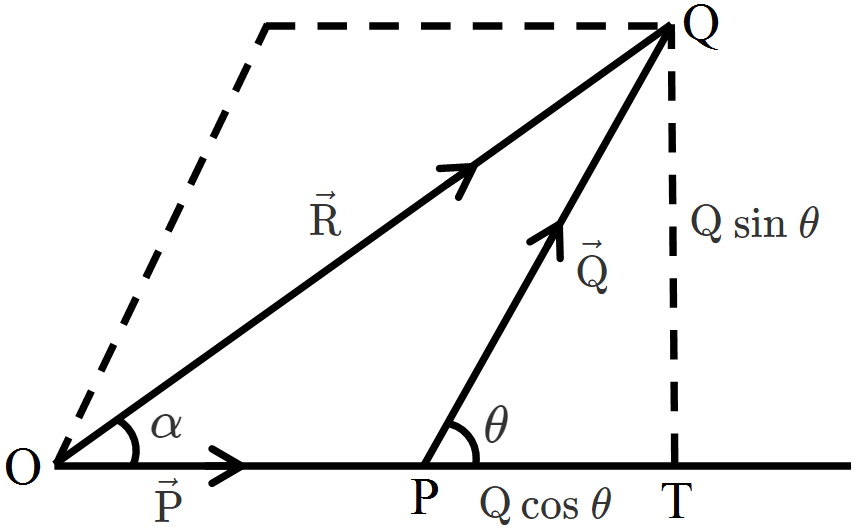
$\text{R}=\sqrt{\text{P}^2+\text{Q}^2+2\text{PQ}\cos\theta}$
The resultant R is at an angle $\alpha$ to $\vec{\text{P}}$ given by,
$\alpha=\tan^{-1}\Big(\frac{\text{Q}\sin\theta}{\text{P}+\text{Q}\cos\theta}\Big)$ View full question & answer→Question 873 Marks
A particle has a displacement of $12m$ towards east and $5m$ towards north and 6m vertically upwards. Find the magnitude of the sum of these displacements.
AnswerThe resultant displacement due to 12m towards east and 5m towards north lies in the plane of paper, and the angle between the displacements 90°, is given by $\text{R}_1=\sqrt{12^2+5^2}=13\text{m}$ Displacement 6m is vertically upward perpendicular to the plane of paper. Therefore, the angle between $R_1$ and 6m is 90°. The resultant of these two, $R_2$, will be $\text{R}_2=\sqrt{13^2+6^2}$ $=\sqrt{205}=14.32\text{m}$
View full question & answer→Question 883 Marks
From the top of a tower 100m in height, a ball is dropped and at the same time another ball is projected vertically upwards from the ground with a velocity of $25ms^{-1}$. Find when and where the two balls will meet? $g = 9.8ms^{-2}$?
Answer$\text{x}=0+\frac{1}{2}\times9.8\text{t}^2=4.9\text{t}^2\dots(\text{i})$$100-\text{x}=25\text{t}+\frac{1}{2}\times(-9.8)\text{t}^2\dots(\text{ii})$
image
Solving equation (i) and (ii), we get
t = 4 second
x = 4.9 × 16 = 78.4m
View full question & answer→Question 893 Marks
When two vectors $\vec{\text{A}}$ and $\vec{\text{B}}$ inclined at angle $\theta$ act on a body, the resultant is $(2\text{k}+1)\sqrt{\text{A}^2+\text{B}^2}.$ When the vectors are inclined at an angle $(90^\circ-\theta),$ the resultant is $(2\text{k}-1)\sqrt{\text{A}^2+\text{B}^2},$ prove that $\tan\theta=\frac{\text{k}-1}{\text{k}+1}.$
AnswerAs $\text{R}^2=\text{A}^2+\text{B}^2+2\text{AB}\cos\theta$ In first case, $(2\text{k}+1)^2(\text{A}^2+\text{B}^2)=\text{A}^2+\text{B}^2+2\text{AB}\cos\theta$ $2\text{AB}\cos\theta=(\text{A}^2+\text{B}^2)[(2\text{k}+1)^2-1]$ $=(\text{A}^2+\text{B}^2)[2\text{k}(2\text{k}+2)]\dots(\text{i})$ In second case, $(2\text{k}-1)^2(\text{A}^2+\text{B}^2)=\text{A}^2+\text{B}^2+2\text{AB}\cos(90^\circ-\theta)$ $=\text{A}^2+\text{B}^2+2\text{AB}\sin\theta$ $2\text{AB}\sin\theta=(\text{A}^2+\text{B}^2)[(2\text{k}-1)^2-1]$ $=(\text{A}^2+\text{B}^2)[2\text{k}(2\text{k}-2)]\dots(\text{ii})$ Dividing (ii) by (i), we have$\tan\theta=\frac{2\text{k}-2}{2\text{k}+2}=\frac{\text{k}-1}{\text{k}+1}$
View full question & answer→Question 903 Marks
The position of a particle is given by $\vec{\text{r}}=9\text{t}\hat{\text{i}}+6\text{t}^2\hat{\text{j}}+8\hat{\text{k}},$ where $t$ is in seconds and the coefficients have the proper units for $\vec{\text{r}}$ to be in metres.
- Find velocity $\vec{\text{v}}(\text{t})$ of particle and $\vec{\text{a}}(\text{t})$ acceleration of the particle.
- Find the magnitude and direction of $\vec{\text{v}}(\text{t})$ at $t = 2sec.$
Answer$\vec{\text{r}}=9\text{t}\hat{\text{i}}+6\text{t}^2\hat{\text{j}}+8\hat{\text{k}}$ $\vec{\text{v}}(\text{t})=\frac{\vec{\text{dr}}}{\text{dt}}=9\hat{\text{i}}+12\text{t}\hat{\text{j}}$ $\vec{\text{a}}(\text{t})=\frac{\vec{\text{dv}}}{\text{dt}}=12\hat{\text{j}} = 12m/ s$ along $y-$axis At $t = 2 \vec{\text{v}}=9\hat{\text{i}}+12(2)\hat{\text{j}}$
or, $\vec{\text{v}}=9\hat{\text{i}}+24\hat{\text{j}}$
magnitude, $|\vec{\text{v}}|=\sqrt{(9)^2+(24)^2}=25\text{ m/s}$ direction $\theta=\tan^{-1}\Big(\frac{25}{9}\Big)$ with $x-$axis
View full question & answer→Question 913 Marks
Can you associate vectors with $(a)$ the length of a wire bent into a loop, $(b)$ a plane area, $(c)$ a sphere? Explain
Answer
- No, one cannot associate a vector with the length of a wire bent into a loop.
- Yes, one can associate an area vector with a plane area. The direction of this vector is normal, inward or outward to the plane area.
- No, one cannot associate a vector with the volume of a sphere. However, an area vector can be associated with the area of a sphere.
View full question & answer→Question 923 Marks
What would be the effect on a vector if all its components are reversed in direction?
AnswerConsider a vector $\vec{\text{F}}.$ $\vec{\text{F}}=\text{F}_\text{x}\hat{\text{i}}+\text{F}_\text{y}\hat{\text{j}}+\text{F}_\text{z}\hat{\text{k}}$ When x, y and z components are reversed, we get $\text{F}_\text{x}(-\hat{\text{i}})+\text{F}_\text{y}(-\hat{\text{j}})+\text{F}_\text{z}(-\hat{\text{k}})$ $-[\text{F}_\text{x}\hat{\text{i}}+\text{F}_\text{y}\hat{\text{j}}+\text{F}_\text{z}\hat{\text{k}}]=-\vec{\text{F}}$ Therefore, the vector itself is reversed.
View full question & answer→Question 933 Marks
The time of flight of an object projected at an angle $\theta$ is T. What will be its time of flight, if the object be projected at an angle $(90-\theta)^\circ?$
AnswerWhen an object is projected with an initial velocity u at an angle $\theta$ with horizontal, its time of flight is given by $\text{T}=\frac{2\text{u}\sin\theta}{\text{g}}$ When the same object is projected with the same initial velocity at an angle $(90-\theta)^\circ,$ the time of flight is given by $\text{T}'=\frac{2\text{u}}{\text{g}}\sin(90-\theta)=\frac{2\text{u}}{\text{g}}\cos\theta$ Dividing (ii) by (i), we find that $\frac{\text{T}'}{\text{T}}=\frac{\cos\theta}{\sin\theta}=\cot\theta$ $\Rightarrow\ \text{T}'=\text{T}\cot\theta$
View full question & answer→Question 943 Marks
A glass marble slides from rest from the topmost point of a vertical circle of radius r along a smooth chord. Does the time of descent depend upon the chord chosen?
Answer
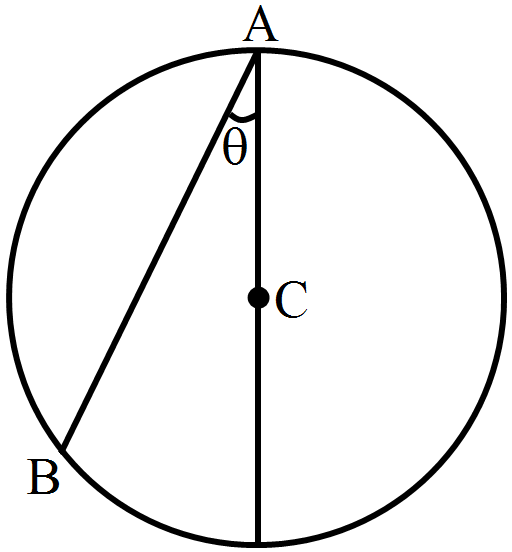 Consider a chord AB which makes an angle $\theta$ with the vertical. C is the centre of the circle.
Let t be the time taken by the glass marble to slide along AB.
Then, $\text{AB}=0\times\text{t}+\frac{1}{2}\text{g}\cos\theta\times\text{t}^2$
or $\text{t}^2=\frac{\text{AB}}{\text{g}\cos\theta}$
$=\frac{2\times2\text{r}\cos\theta}{\text{g}\cos\theta}=\frac{4\text{r}}{\text{g}}$
or $\text{t}=2\sqrt{\frac{\text{r}}{\text{g}}}$
Clearly, the time of descent does not depend upon $\theta.$ In other words, the time of descent does not depend upon the choice of chord. View full question & answer→Question 953 Marks
A body is projected with the velocity $u_1$ from the point A as shown in figure. At the same time another body is projected vertically upwards with the velocity $u_2$ from the point B. What should be the value of $\frac{\text{u}_1}{\text{u}_2}$ for both the bodies to collide?
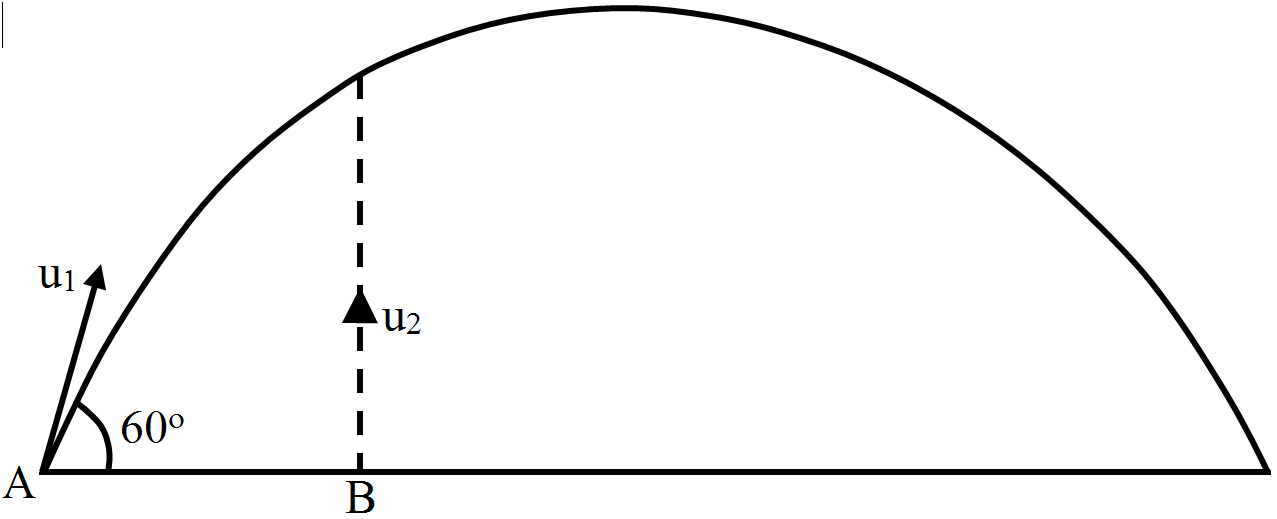
AnswerThe two bodies will collide, if they reach at a point acquiring the same vertical distance in the same time.
Therefore $\text{y}=\text{u}_1\sin60^\circ\times\text{t}-\frac{1}{2}\text{gt}^2$ $=\text{u}_2\text{t}-\frac{1}{2}\text{gt}^2$ $\Rightarrow\ \text{u}_1\sin60^\circ\times\text{t}=\text{u}_2\text{t}$ or $\frac{\text{u}_1}{\text{u}_2}=\frac{1}{\sin60^\circ}=\frac{2}{\sqrt{3}}$
View full question & answer→Question 963 Marks
Two particles are moving with common speed v such that they are always at a constant distance ‘d' apart and their velocities are always equal and opposite. After what time, they turn to their initial positions?
AnswerThe two particles should be moving in a circular path of radius $\frac{\text{d}}{2}$ with same speed. Since tangent at any point gives the direction of velocity, they will always be opposite. They will turn to their initial position after completing one circular path i.e., $\text{T}=\frac{2\pi\text{d}}{2\text{v}}=\frac{\pi\text{d}}{\text{v}}.$
View full question & answer→Question 973 Marks
A cyclist moving with a velocity of $7.5m s^{-1}$ approaches a U-turn of radius $80m$. He applies brakes to slow down his speed at a rate of $0.5m s^{-2}$. Calculate the acceleration of the cyclist on the turn.
Answer
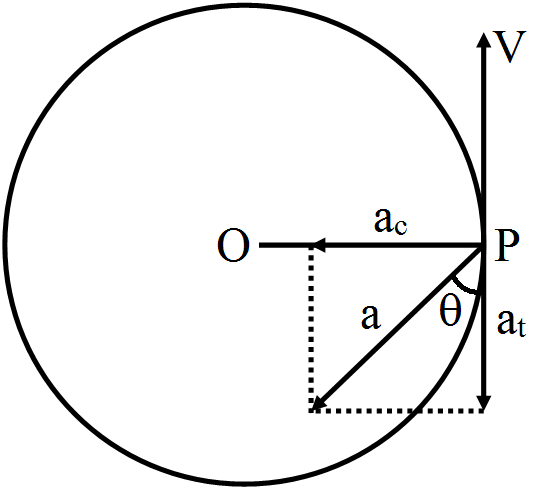
$v = 7.5m s^{-1}, r = 80m$
Centripetal acceleration is
$\text{a}_\text{c}=\frac{\text{v}^2}{\text{r}}=\frac{7.5\times7.5}{80}=0.7\text{m s}^{-2}$
When the cyclist applies brakes at P of the circular turn, then the tangential acceleration will act opposite to the velocity
i.e., $a_t = 0.5m s^{-2}$
$\therefore$ Net acceleration, $\text{a}=\sqrt{\text{a}_\text{c}^2+\text{a}^2_\text{t}}=\sqrt{(0.7)^2+(0.5)^2}$
$= 0.86m s^{-2}$
Let $\theta$ be the angle made by net acceleration with the velocity of the cylist, then
$\tan\theta=\frac{\text{a}_\text{c}}{\text{a}_\text{t}}=\frac{0.7}{0.5}=1.4$
$\therefore\ \theta=\tan^{-1}(1.4)=54^\circ-27'$ View full question & answer→Question 983 Marks
If the horizontal range of projectile be a and the maximum height attained by it is b, then prove that the velocity of projectile is $\Big[2\text{g}\Big(\text{b}+\frac{\text{a}^2}{16\text{b}}\Big)\Big]^\frac{1}{2}.$
AnswerMaximum height $=\text{b}=\frac{\text{b}^2\sin^2\theta}{2\text{g}}$ $\sin^2\theta=\frac{2\text{bg}}{\text{u}^2}$ Horizontal range, $\text{a}=\frac{\text{u}^2\sin2\theta}{\text{g}}=\frac{2\text{u}^2\sin\theta\cos\theta}{\text{g}}$ $\Rightarrow\ 2\sin\theta\cos\theta=\frac{\text{ag}}{\text{u}^2}$ $\Rightarrow\ 4\sin^2\theta\cos^2\theta=\frac{\text{a}^2\text{g}^2}{\text{u}^4}$ $\Rightarrow\ 4\sin^2\theta(1-\sin^2\theta)=\frac{\text{a}^2\text{g}^2}{\text{u}^4}$$4\Big(\frac{2\text{bg}}{\text{u}^2}\Big)\Big[1-\frac{2\text{bg}}{\text{u}^2}\Big]=\frac{\text{a}^2\text{g}^2}{\text{u}^4}$
$\frac{8\text{bg}}{\text{u}^2}-\frac{16\text{b}^2\text{g}^2}{\text{u}^4}=\frac{\text{a}^2\text{g}^2}{\text{u}^4}$
$\text{a}^2\text{g}^2+16\text{b}^2\text{g}^2=\text{u}^28\text{bg}$
$\text{u}^2=\frac{\text{a}^2\text{g}^2+16\text{b}^2\text{g}^2}{8\text{bg}}$
$\text{u}=\Big[2\text{g}\Big(\text{b}+\frac{\text{a}^2}{16\text{b}}\Big)\Big]^\frac{1}{2}.$
View full question & answer→Question 993 Marks
State polygon law of vectors and show that it can be deduced from triangle law of vectors.
AnswerAccording to polygon law of vectors, the sum of all vectors representing the sides of a regular polygon is zero. According to triangle law, if $\vec{\text{A}}$ and $\vec{\text{B}}$ are two vectors on the two sides of a triangle, their sum is represented by AC, i.e., $\vec{\text{R}}.$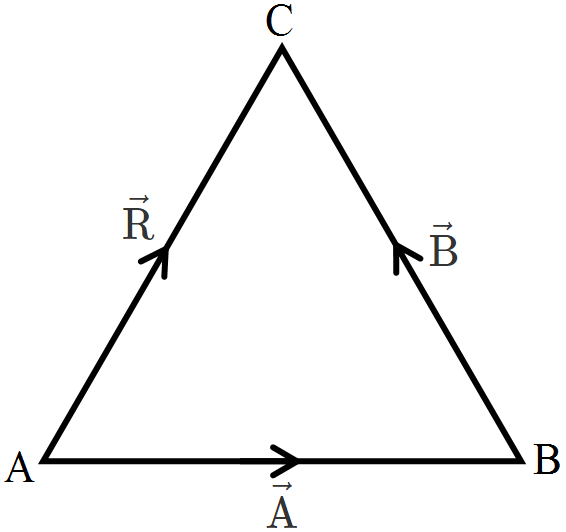
i.e., $\vec{\text{A}}+\vec{\text{B}}=\vec{\text{R}}$ $\vec{\text{AB}}+\vec{\text{BC}}=\vec{\text{AC}}$ If $\vec{\text{CA}}$ is a vector, then $\vec{\text{AB}}+\vec{\text{BC}}+\vec{\text{CA}}=\vec{\text{AC}}+\vec{\text{CA}}=0$ Therefore the sum of three vectors representing the three sides of a triangle is also zero. So the polygon law is proved. View full question & answer→Question 1003 Marks
A projectile is thrown at an angle of 60° with the horizontal. After how much time will its inclination with the horizontal be 45°? [Given $|\vec{\text{v}}|=147\text{ m/s}]$
Answer$\text{v}_\text{x}=\text{v}\cos60^\circ$$\text{v}_\text{y}=\text{v}\sin60^\circ$
let v' be the velocity of projection when the inclination is 45°. Since horizontal velocity is same everywhere, $\text{v}\cos60^\circ=\text{v}'\cos45^\circ$
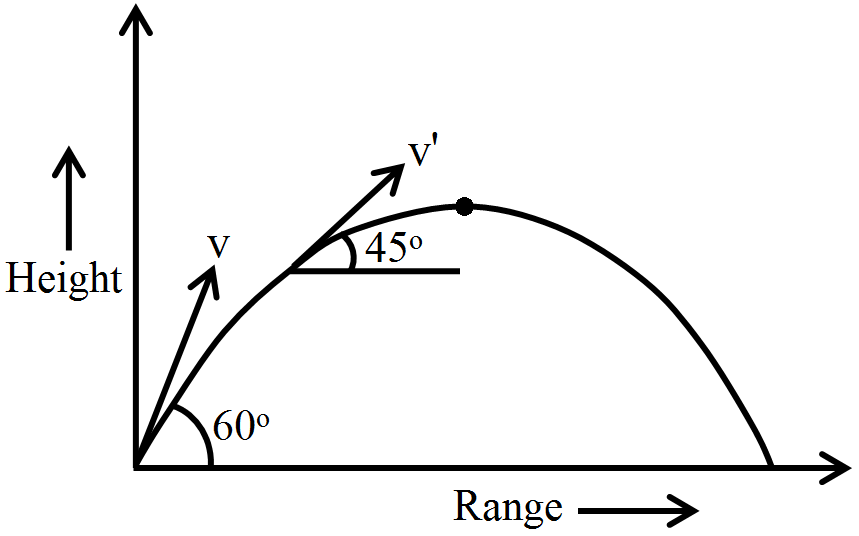
$\text{v}\frac{1}{2}=\text{v}'\times\frac{1}{\sqrt{2}}$
$\text{v}'=\frac{147}{\sqrt{2}}\ (\text{v}=147\text{ m/s})$
$\text{v}_\text{y}=\text{v}\sin60^\circ$
$=\frac{147\sqrt{3}}{2}=127.3\text{ m/s}$
$\text{v}'_\text{y}=\text{v}'\sin45^\circ=\frac{147}{\sqrt{2}}\times\frac{1}{\sqrt{2}}$
$=\frac{147}{2}=73.5\text{ m/s}$
$\text{v}'_\text{y}-\text{v}_\text{y}=\text{gt}$
$\text{t}=\frac{\text{v}'_\text{y}-\text{v}_\text{y}}{\text{g}}$
$=\frac{73.5-127.3}{-9.8}=5.9\text{ sec}$ View full question & answer→