Question 15 Marks
$\hat{\text{i}}$ and $\hat{\text{j}}$ are unit vectors along x- and y- axis respectively. What is the magnitude and direction of the vectors $\hat{\text{i}}+\hat{\text{j}},$ and $\hat{\text{i}}-\hat{\text{j}}$? What are the components of a vector $\text{A}=2\hat{\text{i}}+3\hat{\text{j}}$ along the directions of $\hat{\text{i}}+\hat{\text{j}}$ and $\hat{\text{i}}-\hat{\text{j}}$? [You may use graphical method]
AnswerConsider a vector $\vec{\text{P}}$ given as,$\text{P}=\hat{\text{i}}+\hat{\text{j}}$
$\text{P}_\text{x}\hat{\text{i}}+\text{P}_\text{y}\hat{\text{j}}=\hat{\text{i}}+\hat{\text{j}}$
On comparing the components on both sides, we get,
$\text{P}_\text{x}=\text{P}_\text{y}=1$
$|\vec{\text{P}}|=\sqrt{\text{P}_\text{x}^2+\text{P}_\text{y}^2}=\sqrt{(1)^2+(1)^2}=\sqrt{2}\ ...(\text{i})$
Hence, the magnitude of the vector $\hat{\text{i}}+\hat{\text{j}}\ \text{is}\ \sqrt{2}$
Let $\theta$ be the angle made by he vector $\vec{\text{P}},$ With
The x-axis, as shows in the following figure.
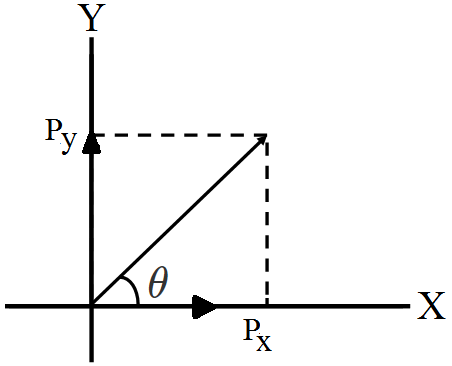
$\therefore\tan\theta=\Big(\frac{\text{P}_\text{y}}{\text{P}_\text{x}}\Big)$
$\Rightarrow\theta=\tan^{-1}\Big(\frac{1}{1}\Big)=45^\circ\ ...(\text{ii})$
Hence, vector $\hat{\text{i}}+\hat{\text{j}}$ makes an angle of 45° with the x-axis.
Let,
$\text{i.e.,}\text{Q}_\text{x}\ \hat{\text{i}}-\text{Q}_\text{y}\hat{\text{j}}=\hat{\text{i}}-\hat{\text{j}}$
$\text{Q}_\text{x}=\text{Q}_\text{y}=1$
$|\text{Q}|=\sqrt{\text{Q}_\text{x}^2+\text{Q}_\text{y}^2}=\sqrt{2}\ ...(\text{iii})$
Hence, the magnitude of the vector $\hat{\text{i}}-\hat{\text{j}}\ \text{is}\ \sqrt{2}.$ View full question & answer→Question 25 Marks
A particle starts from the origin at t = 0s with a velocity of $10.0\hat{\text{j}}\text{m/s}$ and moves in the x - y plane with a constant acceleration of $(8.0\hat{\text{i}}+2.0\hat{\text{j}})\text{ms}^{-2}.$ (a) At what time is the x- coordinate of the particle 16m? What is the y-coordinate of the particle at that time? (b) What is the speed of the particle at the time?
AnswerVelocity of the particle, $\vec{\nu}=10.0\hat{\text{j}}\text{m/s}$ Acceleration of the particle, $\vec{\text{a}}=(8.0\hat{\text{i}}+2.0\hat{\text{j}})$ Also, But, $\vec{\text{a}}=\frac{\text{d}\vec{\nu}}{\text{dt}}=8.0\hat{\text{i}}+2.0\vec{\text{j}}$ $\text{d}\vec{\nu}=(8.0\hat{\text{i}}+2.0\hat{\text{j}})\text{dt}$ Integrating both sides: $\vec{\nu}(\text{t})=8.0\text{t}\hat{\text{i}}+2.0\text{t}\hat{\text{j}}+\vec{u}$ Where, $\vec{u}$ = Velocity vector of the particle at t = 0 $\vec{\nu}$ = Velocity vector of the particle at time t Integrating the equations with the conditions: at t = 0, r = 0, and at t = t, r = r $\vec{\text{r}}=\vec{u}\text{t}+\frac{1}{2}8.0\text{t}^2\hat{\text{i}}+\frac{1}{2}\times2.0\text{t}^2\hat{\text{j}}$ $=\vec{u}\text{t}+4.0\text{t}^2\hat{\text{i}}+\text{t}^2\hat{\text{j}}$ $=(10.0\hat{\text{j}})\text{t}+4.0\text{t}^2\hat{\text{i}}+\text{t}^2\hat{\text{j}}$ $\text{x}\hat{\text{i}}+\text{y}\hat{\text{j}}=4.0\text{t}^2\hat{\text{i}}+(10\text{t}+\text{t}^2)\hat{\text{j}}$ We observe that the motion of the particle is in x - y plane, So, on equating the coefficients of $\hat{\text{i}}$ and $\hat{\text{j}}$ we get, $\text{x}=4\text{t}^2$ $\text{t}=\Big(\frac{\text{x}}{4}\Big)^{1/2}$ and $\text{y} = 10\text{t} + \text{t}^2$
- When y = 16m:
$\text{t}=\Big(\frac{16}{4}\Big)^{1/2}=2\text{s}$
$\therefore\text{y}=10\times2+(2)^2=24\text{m}$
- Velocity of the particle is given by:
$\vec{\nu}(\text{t})=8.0\text{t}\hat{\text{i}}+2.0\text{t}\hat{\text{j}}+\vec{u}$
$\text{At t}=2\text{s}$
$\vec{\nu}(2)=8.0\times2\hat{\text{i}}+2.0\times2\hat{\text{j}}+10\hat{\text{j}}$
$=16\hat{\text{i}}=14\hat{\text{j}}$
$\therefore$ Speed of the particle,
$\text{V}=\sqrt{(16)^2+(14)^2}$
$=\sqrt{256+196}=\sqrt{452}$
$=21.26\text{m/s}$ View full question & answer→Question 35 Marks
The position of a particle is given by $\text{r}=3.0\text{t}\hat{\text{i}}-2.0\text{t}^2\hat{\text{j}}+4.0\hat{\text{k }}\text{m}$ Where t is in seconds and the coefficients have the proper units for r to be in metres. (a) Find the v and a of the particle? (b) What is the magnitude and direction of velocity of the particle at t = 2.0s?
Answer
- $\vec{\nu}(\text{t})=(3.0\hat{\text{i}}-4.0\text{t}\hat{\text{J}});\text{a}=-4.0\hat{\text{j}}$
The position of the particle is given by:
$\vec{\text{r}}=3.0\text{t}\hat{\text{i}}-2.0\text{t}^2\hat{\text{J}}+4.0\hat{\text{k}}$
Velocity $\vec{\nu},$ of the particle given as:
$\vec{\nu}=\frac{\text{d}\vec{\text{r}}}{\text{dt}}=\frac{\text{d}}{\text{dt}}(3.0\text{t}\hat{\text{i}}-2.0\text{t}^2\hat{\text{J}}+4.0\hat{\text{k}})$
$\therefore\vec{\nu}=3.0\hat{\text{i}}-4.0\text{t}\hat{\text{J}}$
Acceleration, $\vec{\text{a}},$ of the particle is given as:
$\vec{\text{a}}=\frac{\text{d}\vec{\nu}}{\text{dt}}=\frac{\text{d}}{\text{dt}}(3.0\hat{\text{i}}-4.0\text{t}\hat{\text{J}})$
$\therefore\vec{\text{a}}=-4.0\hat{\text{J}}$
- 8.54m/s, 69.45° below the x - axis
We have velocity vector, $\vec{\nu}=3.0\hat{\text{i}}-4.0\text{t}\hat{\text{J}}$
$\text{At t}=2.0\text{s}:$
$\vec{\nu}=3.0\hat{\text{i}}-8.0\hat{\text{J}}$
The magnitude of veocity is given by:
$|\vec{\nu}|\sqrt{3^2+(-8)^2}=\sqrt{73}=8.54\text{m/s}$
Direction, $\theta=\tan^{-1}\Big(\frac{\nu_\text{y}}{\nu_\text{x}}\Big)$
$=\tan^{-1}\Big(\frac{-8}{3}\Big)=-\tan^{-1}(2.667)$
$=-69.45^\circ$
The negative sing indicates that the direction of velocity is below the x - axis. View full question & answer→Question 45 Marks
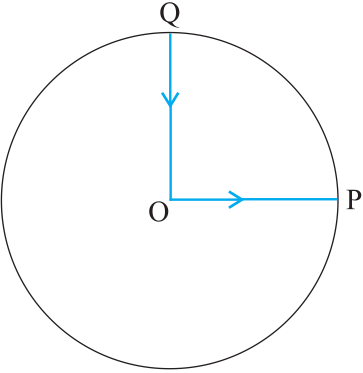
A cyclist starts from the centre O of a circular park of radius 1km, reaches the edge P of the park, then cycles along the circumference, and returns to the centre along QO as shown in Fig. If the round trip takes 10 min, what is the (a) net displacement, (b) average velocity, and (c) average speed of the cyclist?
Answer
- Displacement is given by the minimum distance between the initial and final positions of a body. In the given case, the cyclist comes to the starting point after cycling for 10 minutes. Hence, his net displacement is zero.
- Average velocity is given by the relation:
$\text{Average velocity}=\frac{\text{Net Displacement}}{\text{Total time}}$
Since the net displacement of the cyclist is zero, his average velocity will also be zero.
- Average speed of the cyclist is given by the relation:
$\text{Average speed}=\frac{\text{Total path length}}{\text{Total time}}$
Total path length = OP + PQ + QO
$=1+\frac{1(2\pi\times1)}{4}+1$
$=2+\frac{\pi}{2}$
= 3.570km
Time taken = 10 min $=\frac{10}{60}=\frac{1}{6}\text{h}$
$\therefore$ Average speed = $\frac{3.570}{\frac{1}{6}}=21.42\text{km/h}$ View full question & answer→Question 55 Marks
On an open ground, a motorist follows a track that turns to his left by an angle of 600 after every 500m. Starting from a given turn, specify the displacement of the motorist at the third, sixth and eighth turn. Compare the magnitude of the displacement with the total path length covered by the motorist in each case.
AnswerThe path followed by the motorist is a regular hexagon with side 500 m, as shown in the given figure 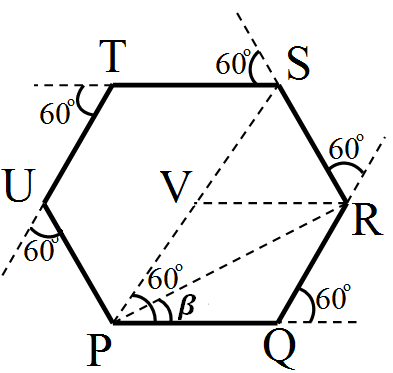 Let the motorist start from point P. The motorist takes the third turn at S. $\therefore$ Magnitude of displacement = PS = PV + VS = 500 + 500 = 1000m Total path length = PQ + QR + RS = 500 + 500 + 500 = 1500m The motorist takes the sixth turn at point P, which is the starting point. $\therefore$ Magnitude of displacement = 0 Total path length = PQ + QR + RS + ST + TU + UP = 500 + 500 + 500 + 500 + 500 + 500 = 3000m The motorist takes the eight turn at point R $\therefore$ Magnitude of displacement = PR $=\sqrt{\text{PQ}^2+\text{QR}^2+2(\text{PQ}).(\text{QR})\cos60^\circ}$ $=\sqrt{500^2+500^2+(2\times500\times\cos60^\circ)}$ $\sqrt{2,50,000+2,50,000+\Big(5,00,000\times\frac{1}{2}\Big)}$ $=866.03\text{m}$ $\beta=\tan^{-1}\Big(\frac{500\sin60^\circ}{500+500\cos60^\circ}\Big)=30^\circ$ Therefore, the magnitude of displacement is 866.03m at an angle of 30° with PR. Total path length = Circumference of the hexagon + PQ + QR = 6 × 500 + 500 + 500 = 4000m The magnitude of displacement and the total path length corresponding to the required turns is shown in the given table:
|
Turn
|
Magnitude of displacement (m)
|
Total path length (m)
|
|
Third
|
1000
|
1500
|
|
Sixth
|
0
|
3000
|
|
Eighth
|
866.03; 30°
|
4000
|
View full question & answer→Question 65 Marks
In a harbour, wind is blowing at the speed of $72km/h$ and the flag on the mast of a boat anchored in the harbour flutters along the N-E direction. If the boat starts moving at a speed of $51km/h$ to the north, what is the direction of the flag on the mast of the boat?
AnswerVelocity of the boat, $v_b = 51km/h$ Velocity of the wind, $v_w = 72km/h$ The flag is fluttering in the north-east direction. It shows that the wind is blowing toward the north-east direction. When the ship begins sailing toward the north, the flag will move along the direction of the relative velocity $(v_{wb})$ of the wind with respect to the boat.
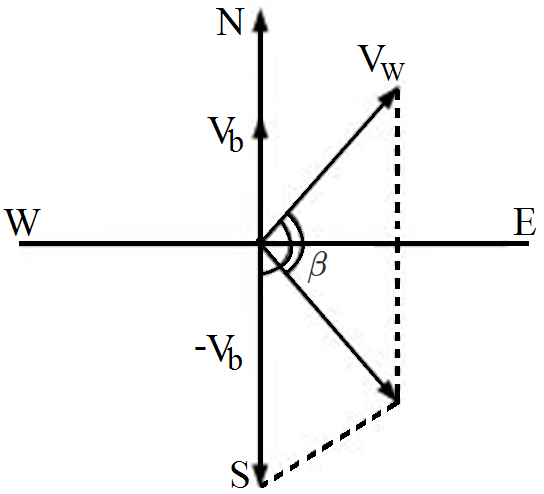
The angle between $v_w$ and $(-v_b) = 90^\circ + 45^\circ \tan\beta=\frac{51\sin(90+45)}{72+51\cos(90+45)}$ $=\frac{51\sin45}{72+51(-\cos45)}=\frac{51\times\frac{1}{\sqrt{2}}}{72-51\times\frac{1}{\sqrt{2}}}$ $=\frac{51}{72\sqrt{2}-51}=\frac{51}{72\times1.414-51}=\frac{51}{50.800}$ $\therefore\beta=\tan^{-1}(1.0038)=45.11^\circ$ Angle with respect to the east direction = 45.11° – 45° = 0.11° Hence, the flag will flutter almost due east. View full question & answer→Question 75 Marks
A fighter plane flying horizontally at an altitude of $1.5km$ with speed $720km/h$ passes directly overhead an anti-aircraft gun. At what angle from the vertical should the gun be fired for the shell with muzzle speed $600ms^{-1}$ to hit the plane? At what minimum altitude should the pilot fly the plane to avoid being hit? (Take $g = 10ms^{-2}$).
AnswerHeight of the fighter plane = 1.5km = 1500m Speed of the fighter plane, v = 720km/h = 200m/s Let $\theta$ be the angle with the vertical so that the shell hits the plane. The situation is shown in the given figure.
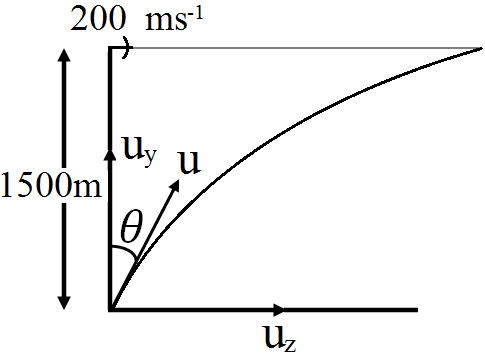
Muzzle velocity of the gun, u = 600m/s Time taken by the shell to hit the plane = t Horizontal distance travelled by the shell = $u_xt$ Distance travelled by the plane = vt The shell hits the plane. Hence, these two distances must be equal. $\text{u}_\text{x}\text{t}=\text{vt}$ $\text{u}\sin\theta=\text{v}$ $\sin\theta=\frac{\text{v}}{\text{u}}$ $=\frac{200}{600}=\frac{1}{3}=0.33$ $\theta=\sin^{-1}(0.33)=19.5^\circ$
In order to avoid being hit by the shell, the pilot must fly the plane at an altitude (H) higher than the maximum height achieved by the shell. $\therefore\text{H}=\frac{\text{u}^2\sin^2(90-\theta)}{2\text{g}}$ $=\frac{(600)^2\cos^2\theta}{2\text{g}}$ $=\frac{3,60,000\times\cos^219.5}{2\times10}$ $=16,006.482\text{m}$ $=16\text{km}$ View full question & answer→Question 85 Marks
A cyclist is riding with a speed of $27km/h$. As he approaches a circular turn on the road of radius $80m$, he applies brakes and reduces his speed at the constant rate of $0.50m/s$ every second. What is the magnitude and direction of the net acceleration of the cyclist on the circular turn?
Answer$0.86m/s^2; 54.46^\circ$ with the direction of velocity Speed of the cyclist, v = 27km/h = 7.5m/s Radius of the circular turn, r = 80m Centripetal acceleration is given as: $\text{a}_\text{c}=\frac{\text{v}^2}{\text{r}}$ $=\frac{7.5^2}{80}=0.7\text{ms}^{-2}$ The situation is shown in the given figure:
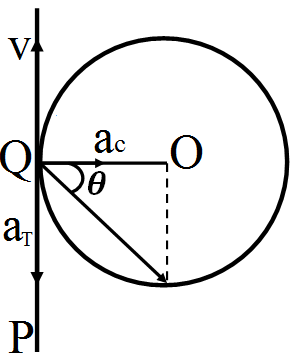
Suppose the cyclist begins cycling from point P and moves toward point Q. At point Q, he applies the breaks and decelerates the speed of the bicycle by $0.5m/s^2$. This acceleration is along the tangent at Q and opposite to the direction of motion of the cyclist. Since the angle between $a_c$ and $a_T$ is $90^0$, the resultant acceleration a is given by: $\text{a}=\Big(\text{a}_\text{c}^2+\text{a}_\text{T}^2\Big)^{1/2}$ $=\Big((0.7)^2+(0.5)^2\Big)^{1/2}$ $=(0.74)^{1/2}$ $\tan\theta=\frac{\text{a}_\text{c}}{\text{a}_\text{T}}$ where $\theta$ is the angle of the resultant with the direction of velocity. $\tan\theta=\frac{0.7}{0.5}=1.4$ $\theta=\tan^{-1}(1.4)=54.56^\circ$ View full question & answer→Question 95 Marks
An aircraft is flying at a height of 3400m above the ground. If the angle subtended at a ground observation point by the aircraft positions 10.0s apart is 30°, what is the speed of the aircraft?
AnswerThe positions of the observer and the aircraft are shown in the given figure. 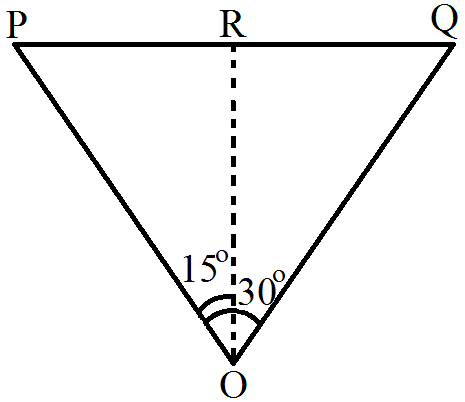 Height of the aircraft from ground, OR = 3400m Angle subtended between the positions, $\angle\text{POQ}=30^\circ$ Time = 10s In $\triangle\text{PRO}:$ $\tan15^\circ=\frac{\text{PR}}{\text{OR}}$ $\text{PR}=\text{OR}\tan15^\circ$ $=34000\times\tan15^\circ$ $\triangle\text{PRO}$ is similar to $\triangle\text{RQO.}$ $\therefore\text{PR}=\text{RQ}$ $\text{PQ} = \text{PR} + \text{RQ}$ $=2\text{PR}=2\times3400\tan15^\circ$ $=6800\times0.268=1822.4\text{m}$ $\therefore$ Speed of the aircraft $=\frac{1822.4}{10}=182.24\text{m/s}$
 View full question & answer→Question 105 Marks
Establish the following vector inequalities geometrically or otherwise: $|\text{a}+\text{b}|\le|\text{a}|+|\text{b}|$ When does the equality sign above apply?
AnswerLet two vectors $\vec{\text{a}}$ and $\vec{\text{b}}$ be represented by the adjacent sides of a parallelogram OMNP, as shown in the figure. 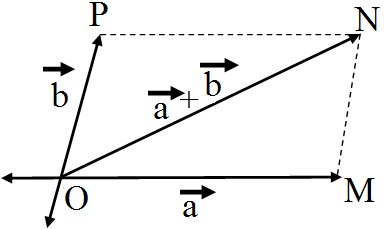 $|\vec{\text{OM}}|=|\vec{\text{a}}|\ ...(\text{i})$ $|\vec{\text{MN}}|=|\vec{\text{OP}}|=|\vec{\text{b}}|\ ...(\text{ii})$ $|\vec{\text{ON}}|=|\vec{\text{a}}+\vec{\text{b}}|\ ...(\text{iii})$ In a triangle, each side is smaller than the sum of the other two sides. Therefore, in $\triangle\text{OMN},$ we have: $\text{ON}<(\text{OM}+\text{MN})$ $|\vec{\text{a}}+\vec{\text{b}}|<|\vec{\text{a}}|+|\vec{\text{b}}|\ ...(\text{iv})$ If the two vectors $\vec{\text{a}}$ and $\vec{\text{b}}$ act along a straight line in the same direction, then we can write: $|\vec{\text{a}}+\vec{\text{b}}|=|\vec{\text{a}}|+|\vec{\text{b}}|\ ...(\text{v})$ Combining equations (iv) and (v), we get: $|\vec{\text{a}}+\vec{\text{b}}|\le|\vec{\text{a}}|+|\vec{\text{b}}|$
 View full question & answer→Question 115 Marks
A cricketer can throw a ball to a maximum horizontal distance of 100m. How much high above the ground can the cricketer throw the same ball?
AnswerMaximum horizontal distance, R = 100m The cricketer will only be able to throw the ball to the maximum horizontal distance when the angle of projection is $45^\circ,\text{i.e.,}\theta=45^\circ.$ The horizontal range for a projection velocity v, is given by the relation: $\text{R}=\text{u}^2\sin2\theta/\text{g}$ $100=\text{u}^2\sin90^\circ/\text{g}$ $\frac{\text{u}^2}{\text{g}}=100\ ...(\text{i})$ The ball will achieve the maximum height when it is thrown vertically upward. For such motion, the final velocity v is zero at the maximum height H. Acceleration, a = -g Using the third equation of motion: $\text{v}^2-\text{u}^2=-2\text{gH}$ $\text{H}=\frac{\text{u}^2}{2\text{g}}=\frac{100}{2}=50\text{m}$
View full question & answer→Question 125 Marks
A vector has magnitude and direction. Does it have a location in space? Can it vary with time? Will two equal vectors a and b at different locations in space necessarily have identical physical effects? Give examples in support of your answer.
AnswerDoes it have a location in space? No; Can it vary with time? Yes; Will two equal vectors a and b at different locations in space necessarily have identical physical effects? No Generally speaking, a vector has no definite locations in space. This is because a vector remains invariant when displaced in such a way that its magnitude and direction remain the same. However, a position vector has a definite location in space. A vector can vary with time. For example, the displacement vector of a particle moving with a certain velocity varies with time. Two equal vectors located at different locations in space need not produce the same physical effect. For example, two equal forces acting on an object at different points can cause the body to rotate, but their combination cannot produce an equal turning effect.
View full question & answer→Question 135 Marks
Establish the following vector inequalities geometrically or otherwise: $|\text{a}-\text{b}|\le|\text{a}|+|\text{b}|$ When does the equality sign above apply?
AnswerLet two vectors $\vec{\text{a}}$ and $\vec{\text{b}}$ be represented by the adjacent sides of a parallelogram PORS, as shown in the given figure.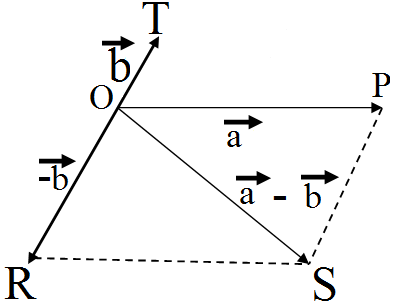
$|\vec{\text{OR}}|=|\vec{\text{PS}}|=|\vec{\text{b}}|\ ...(\text{i})$ $|\vec{\text{OP}}|=|\vec{\text{a}}|\ ...(\text{ii})$ In a triangle, each side is smaller than the sum of the other two sides. Therefore, in $\triangle\text{OPS},$ $\text{OS}<\text{OP}+\text{PS}$ $|\vec{\text{a}}-\vec{\text{b}}|<|\vec{\text{a}}|+|-\vec{\text{b}}|$ $|\vec{\text{a}}-\vec{\text{b}}|<|\vec{\text{a}}|+|\vec{\text{b}}|\ ...(\text{iii})$ If the two vectors act in a straight line but in opposite directions, then we can write: $|\vec{\text{a}}-\vec{\text{b}}|=|\vec{\text{a}}|+|\vec{\text{b}}|\ ...(\text{iv})$ Combining equations (iii) and (iv), we get: $|\vec{\text{a}}-\vec{\text{b}}|\le|\vec{\text{a}}|+|\vec{\text{b}}|$ View full question & answer→Question 145 Marks
Show that for a projectile the angle between the velocity and the x-axis as a function of time is given by, $\theta(\text{t})=\tan^{-1}\Big(\frac{\text{u}_\text{oy}-\text{gt}}{\text{u}_\text{ox}}\Big)$
AnswerLet $v_{ox}$ and $v_{0y}$ respectively be the initial components of the velocity of the projectile along horizontal (x) and vertical (y) directions. Let $v_x$ and $v_y$ respectively be the horizontal and vertical components of velocity at a point P. 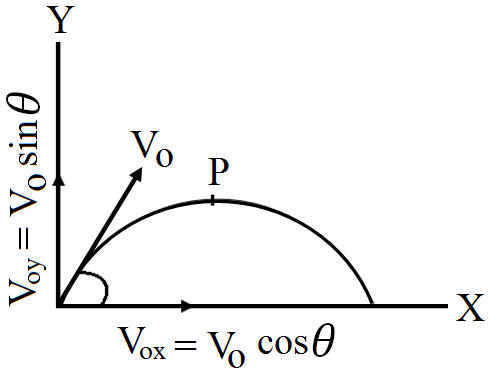
Time taken by the projectile to reach point P = t Applying the first equation of motion along the vertical and horizontal directions, we get: $v_y = v_{oy} = gt$ And $v_x = v_{ox}$
$\therefore\tan\theta=\frac{\text{v}_\text{y}}{\text{v}_\text{x}}=\frac{\text{v}_\text{oy}-\text{gt}}{\text{v}_\text{ox}}$ $\theta=\frac{\tan^{-1}(\text{v}_\text{oy}-\text{gt})}{\text{v}_\text{ox}}$ View full question & answer→Question 155 Marks
A vector has both magnitude and direction. Does it mean that anything that has magnitude and direction is necessarily a vector? The rotation of a body can be specified by the direction of the axis of rotation, and the angle of rotation about the axis. Does that make any rotation a vector?
AnswerNo. A physical quantity having both magnitude and direction need not be considered a vector. For example, despite having magnitude and direction, current is a scalar quantity. The essential requirement for a physical quantity to be considered a vector is that it should follow the law of vector addition. Generally speaking, the rotation of a body about an axis is not a vector quantity as it does not follow the law of vector addition. However, a rotation by a certain small angle follows the law of vector addition and is therefore considered a vector.
View full question & answer→Question 165 Marks
The ceiling of a long hall is $25m$ high. What is the maximum horizontal distance that a ball thrown with a speed of $40ms^{-1}$ can go without hitting the ceiling of the hall?
AnswerGiven: Speed of the ball, u = 40m/s Maximum height, h = 25m In projectile motion, the maximum height reached by a body projected at an angle $\theta$, is given by the relation: $\text{h}=(\text{u}^2\sin^2\theta)$
$25=\frac{40^2\sin^2\theta}{2\times9.8}$
$\sin^2\theta=0.30625$
$\sin\theta=0.5534$
$\theta=\sin^{-1}(0.5534)=33.60^\circ$ Horizontal range, $\text{R}=\frac{(\text{u}^2\sin^2\theta)}{\text{g}}$
$=\frac{40^2\times\sin2\times33.60}{9.8}$
$=\frac{1600\times\sin67.2)}{9.8}$
$=\frac{1600\times0.922}{9.8}$
$=150.53\text{m}.$
View full question & answer→Question 175 Marks
A bullet fired at an angle of $30°$ with the horizontal hits the ground $3.0km$ away. By adjusting its angle of projection, can one hope to hit a target $5.0km$ away? Assume the muzzle speed to be fixed, and neglect air resistance.
AnswerRange, R = 3km Angle of projection, $\theta=30^\circ$ Acceleration due to gravity, $g = 9.8m/s^2$ Horizontal range for the projection velocity $u_0$_, is given by the relation: $\text{R}=\frac{\text{u}_0^2\sin60^\circ}{\text{g}}$
$3=\frac{\text{u}_0^2\sin60^\circ}{\text{g}}$
$\frac{\text{u}_0^2}{\text{g}}=2\sqrt{3}\ ...(\text{i})$ The maximum range $(R_{max})$ is achieved by the bullet when it is fired at an angle of 45^\circ with the horizontal, that is, $\text{R}_\text{max}=\frac{\text{u}_0^2}{\text{g}}\ ...(\text{ii})$ On comparing equations (i) and (ii), we get: $\text{R}_\text{max}=3\sqrt{3}$
$=2\times1.732=3.46\text{km}$ Hence, the bullet will not hit a target 5km away.
View full question & answer→Question 185 Marks
State, for each of the following physical quantities, if it is a scalar or a vector : volume, mass, speed, acceleration, density, number of moles, velocity, angular frequency, displacement, angular velocity.
Answer
- Volume - scalar quantity
- Speed - scalar quantity
- Acceleration - vector quantity
- Density - scalar quantity
- Number of moles - scalar quantity
- Velocity - vector quantity
- Angular frequency - scalar quantity
- Angular velocity - vector quantity
View full question & answer→Question 195 Marks
Establish the following vector inequalities geometrically or otherwise: $|\text{a}+\text{b}|\ge||\text{a}|-|\text{b}||$ When does the equality sign above apply?
AnswerLet two vectors $\vec{\text{a}}$ and $\vec{\text{b}}$ be represented by the adjacent sides of a parallelogram OMNP, as shown in the given figure. 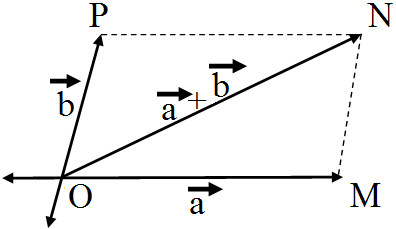 $|\vec{\text{OM}}|=|\vec{\text{a}}|\ ...(\text{i})$ $|\vec{\text{MN}}|=|\vec{\text{OP}}|=|\vec{\text{b}}|\ ...(\text{ii})$ $|\vec{\text{ON}}|=|\vec{\text{a}}+\vec{\text{b}}|\ ...(\text{iii})$ In a triangle, each side is smaller than the sum of the other two sides. Therefore, in $\triangle\text{OMN},$ we have: $(\text{ON}+\text{MN})>\text{OM}$ $(\text{ON}+\text{OM})>\text{MN}$ $|\vec{\text{ON}}|>\vec{\text{OM}}-\vec{\text{OP}}|$ (because OP = MN) $|\vec{\text{a}}+\vec{\text{b}}|>||\vec{\text{a}}|-|\vec{\text{b}}||\ ...(\text{iv})$ If the two vectors $\vec{\text{a}}$ and $\vec{\text{b}}$ act along a straight line in the same direction, then we can write: $|\vec{\text{a}}+\vec{\text{b}}|=||\vec{\text{a}}|-|\vec{\text{b}}||\ ...(\text{v})$ Combining equations (iv) and (v), we get: $|\vec{\text{a}}+\vec{\text{b}}|\ge||\vec{\text{a}}|-|\vec{\text{b}}||$
 View full question & answer→Question 205 Marks
Establish the following vector inequalities geometrically or otherwise: $|\text{a}-\text{b}|\ge||\text{a}|-|\text{b}||$When does the equality sign above apply?
AnswerLet two vectors $\vec{\text{a}}$ and $\vec{\text{b}}$ be represented by the adjacent sides of a parallelogram PORS, as shown in the given figure. 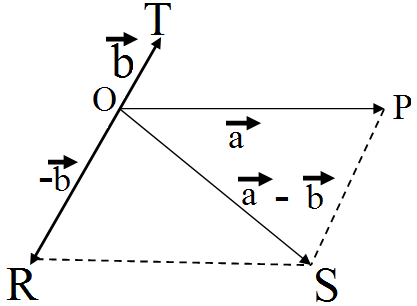 The following relations can be written for the given parallelogram. (OS + PS) > OP .....(i) OS < (OP - PS) .....(ii) $|\vec{\text{a}}-\vec{\text{b}}|>|\vec{\text{a}}|-|\vec{\text{b}}|\ ...(\text{iii})$ The quantity on the LHS is always positive and that on the RHS can be positive or negative. To make both quantities positive, we take modulus on both sides as: $||\vec{\text{a}}-\vec{\text{b}}||>||\vec{\text{a}}|-|\vec{\text{b}}||$ $|\vec{\text{a}}-\vec{\text{b}}|>||\vec{\text{a}}|-|\vec{\text{b}}||\ ...(\text{iv})$ If the two vectors act in a straight line but in opposite directions, then we can write: $|\vec{\text{a}}-\vec{\text{b}}|=||\vec{\text{a}}|-|\vec{\text{b}}||\ ...(\text{v})$ Combining equations (iv) and (v), we get: $|\vec{\text{a}}-\vec{\text{b}}|\ge||\vec{\text{a}}|-|\vec{\text{b}}||$
 View full question & answer→Question 215 Marks
A cricketer can throw a ball to a maximum horizontal distance of 100m. How much high above the ground can the cricketer throw the same ball?
AnswerMaximum horizontal distance, R = 100m The cricketer will only be able to throw the ball to the maximum horizontal distance when the angle of projection is $45^\circ,\text{i.e.,}\theta=45^\circ.$ The horizontal range for a projection velocity v, is given by the relation: $\text{R}=\text{u}^2\sin2\theta/\text{g}$ $100=\text{u}^2\sin90^\circ/\text{g}$ $\frac{\text{u}^2}{\text{g}}=100\ ...(\text{i})$ The ball will achieve the maximum height when it is thrown vertically upward. For such motion, the final velocity v is zero at the maximum height H. Acceleration, a = -g Using the third equation of motion: $\text{v}^2-\text{u}^2=-2\text{gH}$ $\text{H}=\frac{\text{u}^2}{2\text{g}}=\frac{100}{2}=50\text{m}$
View full question & answer→Question 225 Marks
A vector has magnitude and direction. Does it have a location in space? Can it vary with time? Will two equal vectors a and b at different locations in space necessarily have identical physical effects? Give examples in support of your answer.
AnswerDoes it have a location in space? No; Can it vary with time? Yes; Will two equal vectors a and b at different locations in space necessarily have identical physical effects? No Generally speaking, a vector has no definite locations in space. This is because a vector remains invariant when displaced in such a way that its magnitude and direction remain the same. However, a position vector has a definite location in space. A vector can vary with time. For example, the displacement vector of a particle moving with a certain velocity varies with time. Two equal vectors located at different locations in space need not produce the same physical effect. For example, two equal forces acting on an object at different points can cause the body to rotate, but their combination cannot produce an equal turning effect.
View full question & answer→Question 235 Marks
Establish the following vector inequalities geometrically or otherwise: $|\text{a}-\text{b}|\le|\text{a}|+|\text{b}|$ When does the equality sign above apply?
AnswerLet two vectors $\vec{\text{a}}$ and $\vec{\text{b}}$ be represented by the adjacent sides of a parallelogram PORS, as shown in the given figure.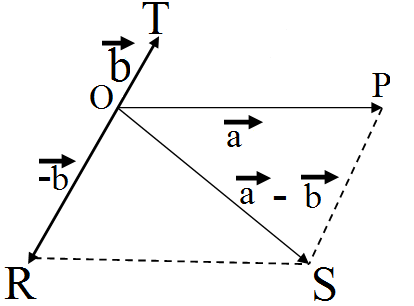
$|\vec{\text{OR}}|=|\vec{\text{PS}}|=|\vec{\text{b}}|\ ...(\text{i})$ $|\vec{\text{OP}}|=|\vec{\text{a}}|\ ...(\text{ii})$ In a triangle, each side is smaller than the sum of the other two sides. Therefore, in $\triangle\text{OPS},$ $\text{OS}<\text{OP}+\text{PS}$ $|\vec{\text{a}}-\vec{\text{b}}|<|\vec{\text{a}}|+|-\vec{\text{b}}|$ $|\vec{\text{a}}-\vec{\text{b}}|<|\vec{\text{a}}|+|\vec{\text{b}}|\ ...(\text{iii})$ If the two vectors act in a straight line but in opposite directions, then we can write: $|\vec{\text{a}}-\vec{\text{b}}|=|\vec{\text{a}}|+|\vec{\text{b}}|\ ...(\text{iv})$ Combining equations (iii) and (iv), we get: $|\vec{\text{a}}-\vec{\text{b}}|\le|\vec{\text{a}}|+|\vec{\text{b}}|$ View full question & answer→Question 245 Marks
Show that for a projectile the angle between the velocity and the x-axis as a function of time is given by, $\theta(\text{t})=\tan^{-1}\Big(\frac{\text{u}_\text{oy}-\text{gt}}{\text{u}_\text{ox}}\Big)$
AnswerLet $v_{ox}$ and $v_{0y}$ respectively be the initial components of the velocity of the projectile along horizontal (x) and vertical (y) directions. Let $v_x$ and $v_y$ respectively be the horizontal and vertical components of velocity at a point P. 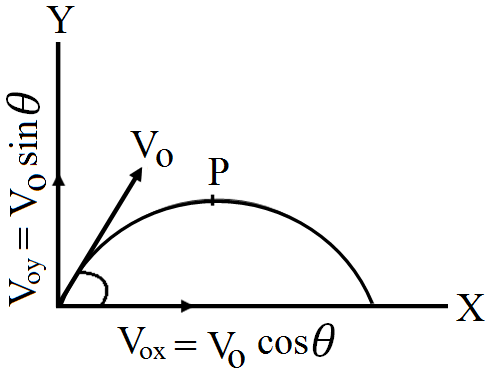
Time taken by the projectile to reach point P = t Applying the first equation of motion along the vertical and horizontal directions, we get: $v_y = v_{oy} = gt$ And $v_x = v_{ox}$
$\therefore\tan\theta=\frac{\text{v}_\text{y}}{\text{v}_\text{x}}=\frac{\text{v}_\text{oy}-\text{gt}}{\text{v}_\text{ox}}$ $\theta=\frac{\tan^{-1}(\text{v}_\text{oy}-\text{gt})}{\text{v}_\text{ox}}$ View full question & answer→Question 255 Marks
A vector has both magnitude and direction. Does it mean that anything that has magnitude and direction is necessarily a vector? The rotation of a body can be specified by the direction of the axis of rotation, and the angle of rotation about the axis. Does that make any rotation a vector?
AnswerNo. A physical quantity having both magnitude and direction need not be considered a vector. For example, despite having magnitude and direction, current is a scalar quantity. The essential requirement for a physical quantity to be considered a vector is that it should follow the law of vector addition. Generally speaking, the rotation of a body about an axis is not a vector quantity as it does not follow the law of vector addition. However, a rotation by a certain small angle follows the law of vector addition and is therefore considered a vector.
View full question & answer→Question 265 Marks
The ceiling of a long hall is $25m$ high. What is the maximum horizontal distance that a ball thrown with a speed of $40ms^{-1}$ can go without hitting the ceiling of the hall?
AnswerGiven: Speed of the ball, u = 40m/s Maximum height, h = 25m In projectile motion, the maximum height reached by a body projected at an angle $\theta$, is given by the relation: $\text{h}=(\text{u}^2\sin^2\theta)$
$25=\frac{40^2\sin^2\theta}{2\times9.8}$
$\sin^2\theta=0.30625$
$\sin\theta=0.5534$
$\theta=\sin^{-1}(0.5534)=33.60^\circ$ Horizontal range, $\text{R}=\frac{(\text{u}^2\sin^2\theta)}{\text{g}}$
$=\frac{40^2\times\sin2\times33.60}{9.8}$
$=\frac{1600\times\sin67.2)}{9.8}$
$=\frac{1600\times0.922}{9.8}$
$=150.53\text{m}.$
View full question & answer→Question 275 Marks
A bullet fired at an angle of $30°$ with the horizontal hits the ground $3.0km$ away. By adjusting its angle of projection, can one hope to hit a target $5.0km$ away? Assume the muzzle speed to be fixed, and neglect air resistance.
AnswerRange, R = 3km Angle of projection, $\theta=30^\circ$ Acceleration due to gravity, $g = 9.8m/s^2$ Horizontal range for the projection velocity $u_0$_, is given by the relation: $\text{R}=\frac{\text{u}_0^2\sin60^\circ}{\text{g}}$
$3=\frac{\text{u}_0^2\sin60^\circ}{\text{g}}$
$\frac{\text{u}_0^2}{\text{g}}=2\sqrt{3}\ ...(\text{i})$ The maximum range (R_{max}) is achieved by the bullet when it is fired at an angle of $45^\circ$ with the horizontal, that is, $\text{R}_\text{max}=\frac{\text{u}_0^2}{\text{g}}\ ...(\text{ii})$ On comparing equations (i) and (ii), we get: $\text{R}_\text{max}=3\sqrt{3}$
$=2\times1.732=3.46\text{km}$ Hence, the bullet will not hit a target 5km away.
View full question & answer→Question 285 Marks
State, for each of the following physical quantities, if it is a scalar or a vector : volume, mass, speed, acceleration, density, number of moles, velocity, angular frequency, displacement, angular velocity.
Answer
- Volume - scalar quantity
- Speed - scalar quantity
- Acceleration - vector quantity
- Density - scalar quantity
- Number of moles - scalar quantity
- Velocity - vector quantity
- Angular frequency - scalar quantity
- Angular velocity - vector quantity
View full question & answer→Question 295 Marks
Establish the following vector inequalities geometrically or otherwise: $|\text{a}-\text{b}|\ge||\text{a}|-|\text{b}||$When does the equality sign above apply?
AnswerLet two vectors $\vec{\text{a}}$ and $\vec{\text{b}}$ be represented by the adjacent sides of a parallelogram PORS, as shown in the given figure. 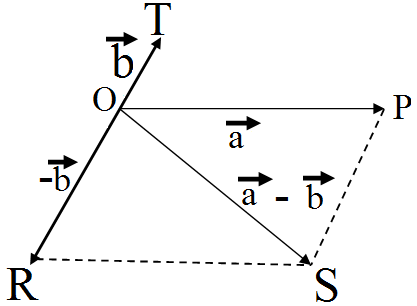 The following relations can be written for the given parallelogram. (OS + PS) > OP .....(i) OS < (OP - PS) .....(ii) $|\vec{\text{a}}-\vec{\text{b}}|>|\vec{\text{a}}|-|\vec{\text{b}}|\ ...(\text{iii})$ The quantity on the LHS is always positive and that on the RHS can be positive or negative. To make both quantities positive, we take modulus on both sides as: $||\vec{\text{a}}-\vec{\text{b}}||>||\vec{\text{a}}|-|\vec{\text{b}}||$ $|\vec{\text{a}}-\vec{\text{b}}|>||\vec{\text{a}}|-|\vec{\text{b}}||\ ...(\text{iv})$ If the two vectors act in a straight line but in opposite directions, then we can write: $|\vec{\text{a}}-\vec{\text{b}}|=||\vec{\text{a}}|-|\vec{\text{b}}||\ ...(\text{v})$ Combining equations (iv) and (v), we get: $|\vec{\text{a}}-\vec{\text{b}}|\ge||\vec{\text{a}}|-|\vec{\text{b}}||$
 View full question & answer→Question 305 Marks
Find the component of $\vec{\text{a}}=2\hat{\text{i}}+3\hat{\text{j}}$ along the directions of vectors $\hat{\text{i}}+\hat{\text{j}}$ and $\hat{\text{i}}-\hat{\text{j}}.$
AnswerComponent of $\vec{\text{a}}=2\hat{\text{i}}+3\hat{\text{j}}$ along $\vec{\text{b}}=\hat{\text{i}}+\hat{\text{j}}$ is $(\text{a}\cos\theta)\hat{\text{b}}$ $=\frac{\vec{\text{a}}\vec{\text{b}}\cos\theta}{\text{b}}.\frac{\text{b}}{\text{b}}=\frac{\vec{\text{a}}.\vec{\text{b}}}{|\vec{\text{b}}|^2}.\text{b}$ $=\frac{(2\hat{\text{i}}+3\hat{\text{j}}).(\hat{\text{i}}+\hat{\text{j}})}{\Big\{\sqrt{(1)^2+(1)^2}\Big\}^2}.(\hat{\text{i}}+\hat{\text{j}})$ $=\frac{2+3}{2}(\hat{\text{i}}+\hat{\text{j}})=\frac{5}{2}(\hat{\text{i}}+\hat{\text{j}})$ Similarly, component of $\vec{\text{a}}=2\hat{\text{i}}+3\hat{\text{j}}$ and $\vec{\text{c}}=\hat{\text{i}}-\hat{\text{j}}$$=\frac{\vec{\text{a}}.\vec{\text{c}}\cos\theta}{\text{c}}.\frac{\text{c}}{\text{c}}=\frac{\vec{\text{a}}.\vec{\text{c}}}{|\vec{\text{c}}|^2}.\vec{\text{c}}$
$=\frac{(2\hat{\text{i}}+3\hat{\text{j}}).(\hat{\text{i}}-\hat{\text{j}})}{\Big(\sqrt{(1)^2+(-1)^2}\Big)^2}.(\hat{\text{i}}-\hat{\text{j}})$
$=\frac{2-3}{2}.(\hat{\text{i}}-\hat{\text{j}})=\frac{-1}{2}(\hat{\text{i}}-\hat{\text{j}})$
View full question & answer→Question 315 Marks
An airline passenger late for a flight walks on an airport moving sidewalk at a speed of $5.00km/ h$ relative to the sidewalk in the direction ofits motion. The sidewalkis moving at $3.00km/ h$ relative to the ground and has a total length of $135m$.
- What is the passenger's speed relative to the ground?
- How long does it take him to reach the end of the sidewalk?
- How much of the sidewalk has he covered by the time he reaches the end?
AnswerThe situation is sketched in figure. We assign a letter to each body in relative motion, P passenger, S sidewalk, G ground. The relative velocities $V_{PS}$ and $v_{SG}$ are given,$V_{PS} = 5.00km/ h$, to the right
$V_{SG} = 3.00km/ h$, to the right
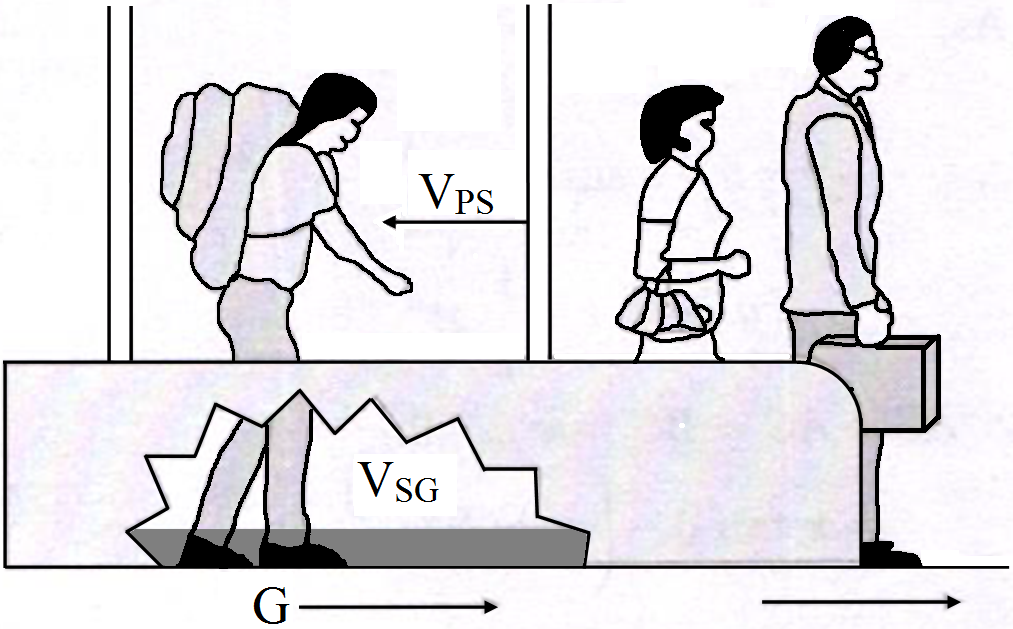
- Here we must find the magnitude of the vector $v_{PG}$, given the magnitude and direction of two other vectors. We find the velocity $v_{PG}$ by using the relation
$v_{PG} = v_{PS} + v_{SG}$
Here the vectors are parallel, and so the vector addition is quite simple see figure. We add vectors by adding magnitudes.
$v_{PG} = v_{PS} + v_{SG}$
$= 5.00km/ h + 3.00km/ h$
$= 8.00km/ h$
- The length of the sidewalk is 135m, and so this is the distance $\Delta\text{x}_\text{G}$ the passenger travels relative to the ground. So, our problem is to find $\Delta\text{t}$ when $\Delta\text{x}_\text{G}=135\text{m}.$ The rate at which this distance along the ground is covered by the passenger is $V_{PG}$, where
$\text{v}_\text{PG}=\frac{\Delta\text{x}_\text{G}}{\Delta\text{t}}$
Therefore,
$\Delta\text{t}=\frac{\Delta\text{x}_\text{G}}{\text{v}_\text{PG}}=\frac{135\text{m}}{8.00\text{km/h}\big(\frac{1.00\text{m/s}}{3.60\text{km/h}}\big)}=60.8\text{s}$
- The problem here is to determine how much of the sidewalk's surface the passenger moves over. If he was standing still and not walking along the surface, he would cover none of it. Because he is moving relative to the surface at velocity $v_{PS}$, he does move some distance $\Delta\text{x}_\text{s}$ relative to the surface. The problem is to find $\Delta\text{x}_\text{s}$ when $\Delta\text{x}=60.8\text{s},$ since we found in part (b) that this is the time interval during which he is on the moving sidewalk. His velocity relative to the sidewalk is $\text{v}_\text{PS}=\frac{\Delta\text{x}_\text{s}}{\Delta\text{t}},$ and so
$\Delta\text{x}_\text{s}=\text{v}_\text{PS}\Delta\text{t}$
$=(5.00\text{km/h})\Big(\frac{1.00\text{m/s}}{3.60\text{km/h}}\Big)(60.8\text{s})$
$=84.4\text{m}$ View full question & answer→Question 325 Marks
A gun kept on a straight horizontal road is used to hit a car travelling along the same road away from the gun with a uniform speed of 72km/ h. The car is at a distance of 500m from the gun when the gun is fired at an angle of 45° to the horizontal. Find,
- The distance of the car from the gun when the shell hits it.
- The speed of projection of the shell from the gun.
AnswerThe gun and the car are at O and A respectively at t = 0 (fig below). Let us say that at t = t, the shell and the car reach B simultaneously so that the shell hits the car when it is at a distance OB from the gun.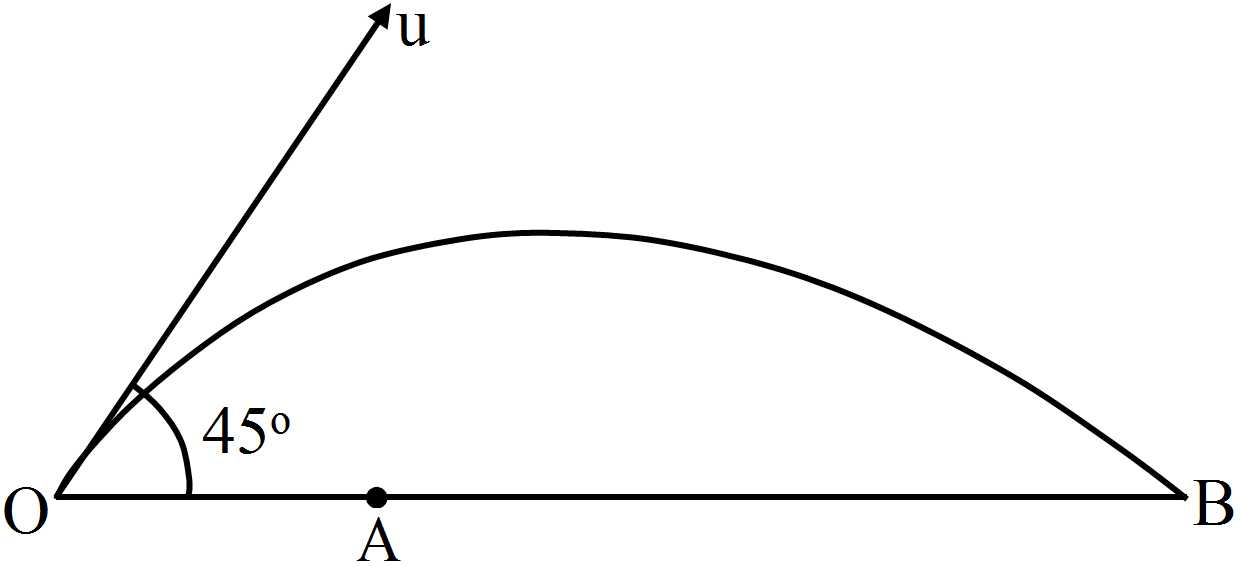
Let u be the speed of projection of the shell from the gun. Then the initial horizontal component of the velocity of the shell $=\text{u}\cos45^\circ=\frac{\text{u}}{\sqrt{2}}$ and the initial vertical component of the velocity of the shell $=\text{u}\sin45^\circ=\frac{\text{u}}{\sqrt{2}}.$ Time of flight of the shell $=\frac{2\big(\frac{\text{u}}{\sqrt{2}}\big)}{\text{g}}=\sqrt{2}\Big(\frac{\text{u}}{\text{g}}\Big).$ The car takes this time to cover the distance AB while the shell covers the distance OB in this time. But OB = OA + AB = 500 + AB Also, $\text{OB}=\frac{\text{u}}{\sqrt{2}}.\frac{\sqrt{2}\text{u}}{\text{g}}=\frac{\text{u}^2}{\text{g}}$and $\text{AB}=20\times\sqrt{2}\Big(\frac{\text{u}}{\text{g}}\Big)=20\sqrt{2}\frac{\text{u}}{\text{g}}$ $(\therefore72\text{km/ h}=20\text{ms}^{-1})$
$\therefore\ \frac{\text{u}^2}{\text{g}}=500+20\sqrt{2}\frac{\text{u}}{\text{g}}$
$\text{or }\ \text{u}^2-20\sqrt{2}\text{u}-500\times9.8=0$
$\text{or }\ \text{u}^2-20\sqrt{2}\text{u}-4900=0$
$\text{or }\text{ u}=\frac{20\sqrt{2}\pm\sqrt{400\times4+4\times4900}}{2}\text{ms}^{-1}$
$=(10\sqrt{2}\pm\sqrt{5300})\text{ms}^{-1}$
$=10[\sqrt{2}\pm\sqrt{53}]\text{ms}^{-1}$
$=10[1.414+7.280]\text{ms}^{-1}=86.94\text{ms}^{-1}$
This is the speed of projection of the shell from the gun. The distance of the car from the gun when the shell hits it is OB where, $\text{OB}=\frac{\text{u}^2}{\text{g}}=\frac{(86.94)^2}{9.8}\text{m}\approx771.3\text{m}$ View full question & answer→Question 335 Marks
A projectile, launched with a speed v at an angle $\theta$ to the horizontal, hits a plane inclined at an angle a to the horizontal $(\alpha<\theta)$ and passing through the point of launching. Obtain an expression for the range r of the projectile on this inclined plane. When does the projectile hit this plane?
AnswerLet OAB be the inclined plane making an angle $\alpha$ to the horizontal and let the projectile hit it at a point A where OA = r (Fig.).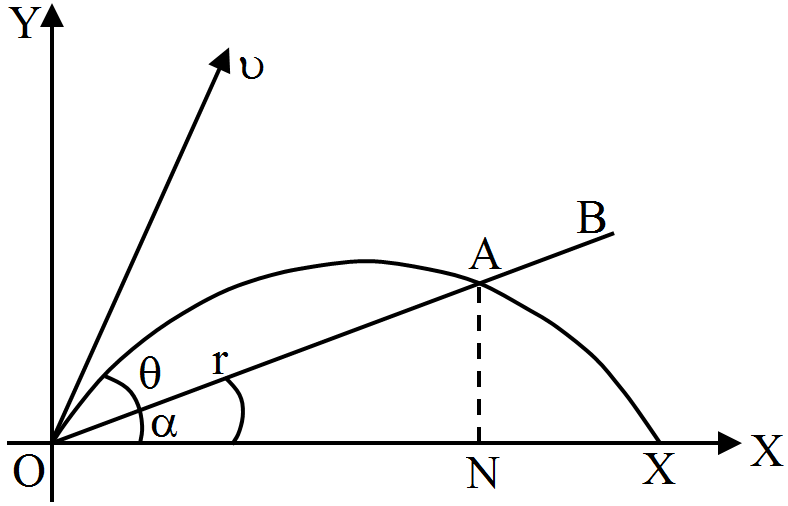
At the instant the projectile hits the inclined plane, its horizontal and vertical displacements are $\text{ON}(=\text{r}\cos\alpha)$ and $\text{NA}(=\text{r}\sin\alpha)$ respectively. Now the time taken to cover a horizontal distance $\text{r}\cos\alpha$ is clearly $\frac{\text{r}\cos\alpha}{\text{v}\cos\theta}.$ The vertical distance moved in this time being $\text{r}\sin\alpha,$ we have $\text{r}\sin\alpha=(\text{v}\sin\theta)\Big(\frac{\text{r}\cos\alpha}{\text{v}\cos\theta}\Big)-\frac{1}{2}\text{g}\Big(\frac{\text{r}\cos\alpha}{\text{v}\cos\theta}\Big)^2$ $\text{r}(\sin\alpha-\tan\theta\cos\alpha)=-\frac{1}{2}\text{g}\frac{\cos^2\alpha}{\text{v}^2\cos^2\theta}\text{r}^2$ $\therefore\ \text{r}=\frac{2\text{v}^2\cos^2\theta}{\text{g}\cos^2\alpha}[\tan\theta\cos\alpha-\sin\alpha]$ $=\frac{2\text{v}^2\cos^2\theta}{\text{g}\cos^2\alpha}\Big[\frac{\sin\theta\cos\alpha-\cos\theta\sin\alpha}{\cos\theta}\Big]$ $=\frac{2\text{v}^2\cos\theta}{\text{g}\cos^2\alpha}\sin(\theta-\alpha)$ Thus the range of the projectile on the inclined plane is $\frac{2\text{v}^2\cos\theta}{\text{g}\cos^2\alpha}\sin(\theta-\alpha)$ The time at which the projectile hits the inclined plane being $\Big(\frac{\text{r}\cos\alpha}{\text{v}\cos\theta}\Big),$ we have $\text{t}=\frac{\text{r}\cos\alpha}{\text{v}\cos\theta}=\frac{2\text{v}^2\cos\theta}{\text{g}\cos^2\alpha}\sin(\theta-\alpha)\frac{\cos\alpha}{\text{v}\cos\theta}$ $\text{t}=\frac{2\text{v}\sin(\theta-\alpha)}{\text{g}\cos\alpha}$ A confirmation of these results is obtained by putting $\alpha=0$ for which case we get $\text{r}=\frac{2\text{v}^2\cos\theta\sin\theta}{\text{g}}=\frac{\text{v}^2\sin2\theta}{\text{g}}$ and $\text{t}=\frac{2\text{v}\sin\theta}{\text{g}}$the usual expressions for the range and time of flight of a projectile. View full question & answer→Question 345 Marks
A projectile is fired at an angle with the horizontal.
- Show that its trajectory is a parabola.
- Obtain expression for:
- The maximum height attained.
- The time of its flight and
- The horizontal range.
- At what value of $\theta$ is the horizontal range maximum?
- Prove that, for a given velocity of projection, the horizontal range is same for $\theta$ and $(90^\circ-\theta).$
AnswerWhen a body is projected in the air in any direction, then the body is called a projectile.
- Suppose a body is projected with velocity u at an angle $\theta$ with the horizontal, P(x, y) is any point on its trajectory at time t.
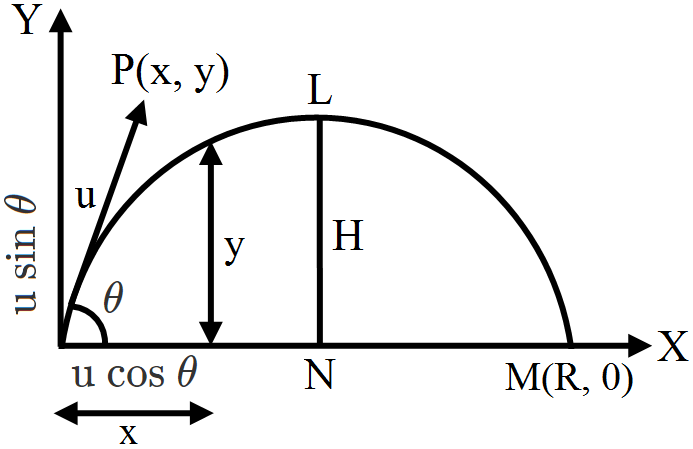
Horizontal component of velocity is unaffected by gravity, but the vertical component $(\text{u}\sin\theta)$ changes due to gravity
$\therefore\ \text{x}=(\text{u}\cos\theta)\text{t}.$
$\text{y}=(\text{u}\sin\theta)\text{t}-\frac{1}{2}\text{gt}^2$
$=\text{u}\sin\theta\times\frac{\text{x}}{\text{u}\cos\theta}-\frac{1}{2}\text{g}\Big(\frac{\text{x}}{\text{u}\cos\theta}\Big)^2$
$\text{y}=\text{x}\tan\theta-\frac{\text{gx}^2}{2\text{u}^2\cos^2\theta}\dots(\text{i})$
It represents the equation of a parabola, hence the path followed by a projectile is a parabola.
- The greatest vertical distance attained by the projectile above the horizontal plane from the point of projection is called maximum height.
Maximum height, LN = H
- At maximum height,
v = 0
$\therefore\ \text{v}^2-\text{u}_\text{y}^2=-2\text{gH},$ where
$\text{u}_\text{y}=\text{u}\sin\theta$
or $(\text{u}\sin\theta)^2=2\text{gH}$
or $\text{H}=\frac{\text{u}^2\sin^2\theta}{2\text{g}}$
- At maximum height,
v = 0
$\therefore\ 0=\text{u}\sin\theta-\text{gt}$
or $\text{t}=\frac{\text{u}\sin\theta}{\text{g}}$
But time of flight,
$\text{T}=2\text{t}=\frac{2\text{u}\sin\theta}{\text{g}}$
- When the body returns to the same horizontal level y = 0
$\therefore\ 0=\text{x}\tan\theta-\frac{\text{gx}^2}{2\text{u}^2\cos^2\theta}$ [From (i)]
or $\text{x}\tan\theta=\frac{\text{gx}^2}{2\text{u}^2\cos^2\theta}$
or $\text{x}=\frac{2\text{u}^2\sin\theta\cos\theta}{\text{g}}=\frac{\text{u}^2\sin2\theta}{\text{g}}$
But coordinates of M are (R, 0). Putting x = R,
we have,
$\text{R}=\frac{\text{u}^2\sin2\theta}{\text{g}}.$
- $\theta=45^\circ$
- When an object is projected with velocity u making an angle $\theta$ with horizontal direction.
$\text{R}_1=\frac{\text{u}^2\sin2\theta}{\text{g}}\dots(\text{i})$
When an object is projected with u making an angle $(90^\circ-\theta)$
$\text{R}_2=\frac{\text{u}^2\sin2(90^\circ-\theta)}{\text{g}}$
$=\frac{\text{u}^2}{\text{g}}\sin(180^\circ-2\theta)$
$=\frac{\text{u}^2}{\text{g}}\sin2\theta\dots(\text{ii})$
form (i) and (ii) $R_1 = R_2$
$\therefore$ The horizontal range is same for two complementary angles. View full question & answer→Question 355 Marks
A marble rolls along a table at a constant speed of $1.00m/ s$ and then falls off the edge of the table to the floor $1.00m$ below.
- How long does the marble take to reach the floor?
- At what horizontal distance from the edge of the table does the marble land?
- What is its velocity as it strikes the floor?
AnswerProjectile motion of the marble begins as it leaves the table as shown. Since, the marble is initially moving horizontally, $\text{v}_{\text{y}_0}=0$ and $\text{v}_{\text{x}_0}=1.00\text{m/s.}$ We must consider the origin to be at the edge of the table, so that $x_0 = y_0 = 0$
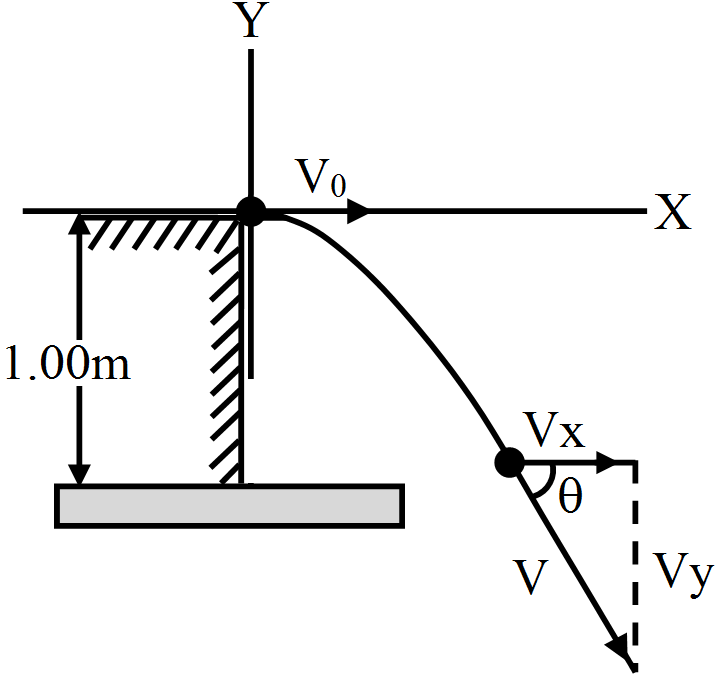
- t = ? if y = -1.00m; $\text{y}=\frac{-1}{2}\text{gt}^2$ $[\because\ \text{v}_{\text{x}_0}=0]$
$\Rightarrow\ \text{t}=\sqrt{\frac{-2\text{y}}{\text{g}}}=\sqrt{\frac{(-2)(-1.00)}{9.8}}=0.452\text{s}$
- x = ?, when t = 0.452s
$\therefore\text{x}=\text{v}_{\text{x}_0}\text{t}=1.00\times0.452\text{s}=0.452\text{m}$
- v = ?, $\theta=?$ at t = 0.452s
The x-component of velocity is constant throughout the motion, $\text{v}_\text{x}=\text{v}_{\text{x}_0}=1.00\text{m/s}$
The y-component of velocity $\text{v}_\text{y}=\text{v}_{\text{y}_0}-\text{gt}$
$=0-9.8\times0452=-4.43\text{m/s}$
$\therefore\ \text{v}=\sqrt{\text{v}^2_\text{x}+\text{v}^2_\text{y}}$
$=\sqrt{(1.00)^2+(-4.43)^2}=4.54\text{m/s}$
$\theta=\tan^{-1}\Big|\frac{\text{v}_\text{y}}{\text{v}_\text{x}}\Big|=\frac{4.43}{1.00}=77.3^\circ$
As the velocity hits the floor, its velocity is 4.54m/ s directed 77.3° below the horizontal. View full question & answer→Question 365 Marks
Prove the following:
- For two angles of projection $\theta$ and $(90-\theta)$ with same velocity v,
- Range is same.
- Heights are in the ratio $\tan^2: 1$.
- If the range and maximum height are equal, the angle of projection is $\tan^{-1}(4)$.
Answer
-
- When an object is projected with velocity u making an angle $\theta$ with horizontal direction.
$\text{R}_1=\frac{\text{u}^2\sin2\theta}{\text{g}}\dots(\text{i})$
When an object is projected with u making an angle $(90^\circ-\theta)$
$\text{R}_2=\frac{\text{u}^2\sin2(90^\circ-\theta)}{\text{g}}$
$=\frac{\text{u}^2}{\text{g}}\sin(180^\circ-2\theta)$
$=\frac{\text{u}^2}{\text{g}}\sin2\theta\dots(\text{ii})$
From (i) and (ii)
$R_1 = R_2$
$\therefore$ The horizontal range is same for two complementary angles.
- For angle of projection $\theta$
Height attained $=\frac{\text{u}^2\sin^2\theta}{2\text{g}}=\text{H}$
for angle of projection $(90^\circ-\theta)$
Height attained $=\frac{\text{u}^2\sin^2(90^\circ-\theta)}{2\text{g}}$
$=\frac{\text{u}^2\cos^2\theta}{2\text{g}}=\text{H}'$
$\frac{\text{H}}{\text{H}'}=\frac{\text{u}^2\sin^2\theta}{2\text{g}}\times\frac{2\text{g}}{\text{u}^2\cos^2\theta}$
$=\tan^2\theta:1$
- Horizontal range $=\frac{\text{u}^2\sin2\theta}{\text{g}}$
Maximum height $=\frac{\text{u}^2\sin^2\theta}{2\text{g}}$
Horizontal range = Maximum height
$\frac{\text{u}^2\sin2\theta}{\text{g}}=\frac{\text{u}^2\sin^2\theta}{2\text{g}}$
$2\times2\sin\theta\cos\theta=\sin^2\theta$
$4=\tan\theta$
or $\theta=\tan^{-1}4$ View full question & answer→Question 375 Marks
A ball is thrown vertically upwards with a velocity of 20m/ s from the top of a building of height 25m from the ground,
- How high will the ball reach?
- How long will it take for the ball to reach the ground?
- Trace the trajectory of motion of this ball.
Answer
- $\text{h}_1=\frac{\text{u}^2}{2\text{g}}=\frac{20^2}{2\times10}=20\text{m}$
Total height $=25+20=45\text{m}$
- $\text{h}=\text{ut}-\frac{1}{2}\text{gt}^2$
$-25=20\text{t}-\frac{1}{2}\times10\times\text{t}^2$
$5\text{t}^2-20\text{t}-25=0$
$(\text{t}-5)(\text{t}+1)=0$
$\Rightarrow\ \text{t}=5\text{ sec.}$
- Trajectory will be a vertical line
$\text{y}=\text{ut}+\frac{1}{2}\text{gt}^2$
$\text{x}=0,\text{y}\neq0$ View full question & answer→Question 385 Marks
State parallelogram law of vector addition and find the magnitude and direction of resultant of two vectors $\vec{\text{A}}$ and $\vec{\text{B}}$ in terms of their magnitude and angle between them.
AnswerStatement of parallelogram law of vectors addition: If two vectors acting on a particle at the same time are represented in magnitude and direction by the two adjacent sides of a parallelogram drawn from a point, their resultant vector is represented in magnitude and direction by the diagonal of the parallelogram drawn from the same point. Let two vectors $\vec{\text{A}}$ and $\vec{\text{B}},$ inclined at an angle be acting on a particle at the same time. Let they be represented in magnitude and direction by two adjacent sides $\vec{\text{OP}}$ and $\vec{\text{OS}}$ of parallelogram OPQRS, drawn from a point 0. According to the parallelogram law of vectors, their resultant vector $\vec{\text{R}}$ will be represented by the diagonal $\vec{\text{OQ}}$ of the parallelogram.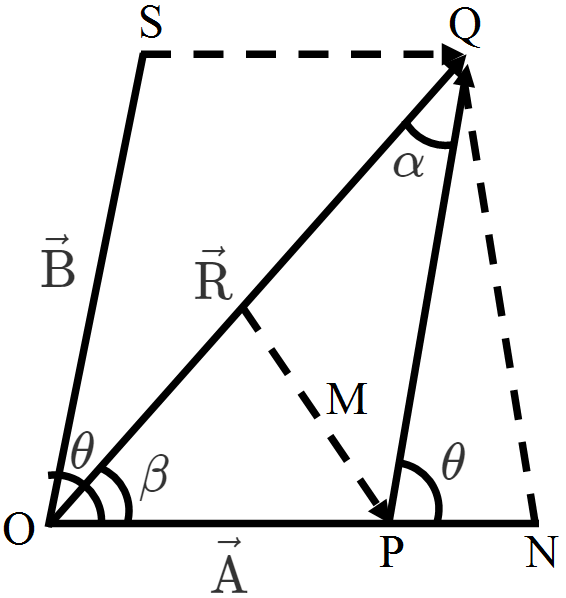
Magnitude of $\vec{\text{R}}:$ Draw $\text{QN}\perp\text{OP}$ Produced
$\text{OP}=\vec{\text{A}},\text{OS}=\text{PQ}=\vec{\text{B}},\text{OQ}=\vec{\text{R}},$ and $\angle\text{SOP}=\angle\text{QPN}=\theta.$ In $\triangle\text{QNP},\text{ PN}=\text{PQ}\cos\theta=\vec{\text{B}}\cos\theta$ $\text{ QN}=\text{PQ}\sin\theta=\vec{\text{B}}\sin\theta$In right-angled triangle ONQ, we have
$\text{OQ}^2=\text{ON}^2+\text{NQ}^2$
$\Rightarrow\ (\text{OQ})^2=(\text{OP}+\text{PN})^2+(\text{NQ})^2$
$\Rightarrow\ \text{R}^2=(\vec{\text{A}}+\vec{\text{B}}\cos\theta)^2+(\vec{\text{B}}\sin\theta)^2$
$\Rightarrow\ \text{R}^2=\vec{\text{A}^2}+2\overrightarrow{\text{AB}}\cos\theta+\vec{\text{B}^2}(\cos^2\theta+\sin^2\theta)$
$\Rightarrow\ \text{R}=\sqrt{\vec{\text{A}^2}+\vec{\text{B}^2}+2\overrightarrow{\text{AB}}\cos\theta}$
Direction of $\vec{\text{R}}:$ Let resultant vector $\vec{\text{R}}$ makes on angle $\beta$ with the direction of $\vec{\text{A}}.$ Then from right angled $\triangle\text{QNO,}$
$\tan\beta=\frac{\text{QN}}{\text{ON}}=\frac{\text{QN}}{\text{OP}+\text{PN}}$
$=\frac{\vec{\text{B}}\sin\theta}{\vec{\text{A}}+\vec{\text{B}}\cos\theta}$ View full question & answer→Question 395 Marks
The height y and the distance x along the horizontal plane of a projectile on a certain plane (with no atmosphere) are given by $x = (6t)$ metre; $y = (8t - 5r^2)$ metre. where t is in seconds. What is the velocity with which the projectile is projected?
Answer$\text{x}=6\text{t}$$\therefore\ \frac{\text{dx}}{\text{dt}}=6\dots(\text{i})$
$\text{y}=8\text{t}-5\text{t}^2$
$\therefore\ \frac{\text{dy}}{\text{dt}}=8-10\text{t}\dots(\text{ii})$
Velocity with which it is projected can be written as:
$\text{v}^2=\Big(\frac{\text{dx}}{\text{dt}}\Big)^2+\Big(\frac{\text{dy}}{\text{dt}}\Big)^2$
Putting, t = 0 in equations (i) and (ii);
$\Big(\frac{\text{dy}}{\text{dt}}\Big)_{\text{t}=0}=8;\Big(\frac{\text{dx}}{\text{dt}}\Big)_{\text{t}=0}=6$
$\therefore\ \text{v}^2=6^2+8^2=36+64,\ \text{v}=10\text{m/s}$
View full question & answer→Question 405 Marks
A fighter plane is flying horizontally at an altitude of 1.5km with speed 720km/ h. At what angle of sight (w.r.t. horizontal) when the target is seen, should the pilot drop the bomb in order to attack the target?
Answer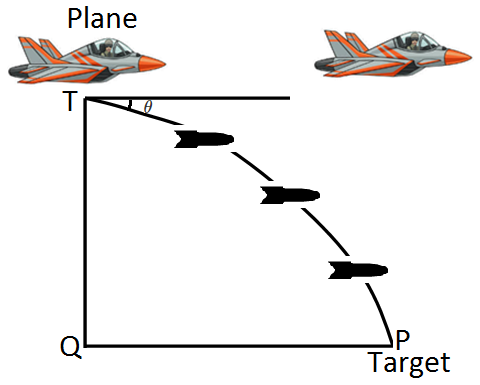 Let pilot drops the bomb t sec before the point Q vertically up the target T. The horizontal velocity of the bomb will to equal to the velocity of the fighter plane, but vertical component of it is zero. So in time t bomb must cover the vertical distance TQ as free fall with initial velocity zero. $\text{u}=0,\text{H}=1.5\text{km}=1500\text{m, g}=+10\text{m/s}^2$ $\text{H}=\text{ut}+\frac{1}2\text{gt}^2$ $1500=0+\frac{1}210\text{t}^2$ $\text{t}=\sqrt{\frac{1500}{5}}=\sqrt{300}=10\sqrt3\text{ second}.$ $\therefore$ Distance covered by plane or bomb PQ = ut $\text{PQ}=200\times10\sqrt3=2000\sqrt3\text{m}$ $\tan\theta=\frac{\text{TQ}}{\text{PQ}}=\frac{1500}{2000\sqrt3}.\frac{\sqrt3}{\sqrt3}=\frac{15\sqrt3}{20\times3}=\frac{\sqrt3}{4}$ $\tan\theta=\frac{1.732}{4}=0.433=\tan^{-1}23^\circ42'$ $\Rightarrow\ \theta=23^\circ42'.$
 View full question & answer→Question 415 Marks
On an open ground, a motorist follows a track that turns to his left by an angle of 60° after every 500m. Starting from a given turn, specify the displacement of the motorist at the third, sixth and eighth turn. Compare the magnitude of the displacement with the total path length covered by the motorist in each case.
AnswerThe distance after which motorist take a turn = 500m As motorist takes a turn at an angle of 60° each time, therefore motorist is moving on a regular hexagonal path. Let the motorist starts from point A and reaches at point D at the end of third turn and at initial point A at the end of sixth turn and at point C at the end of eighth turn. 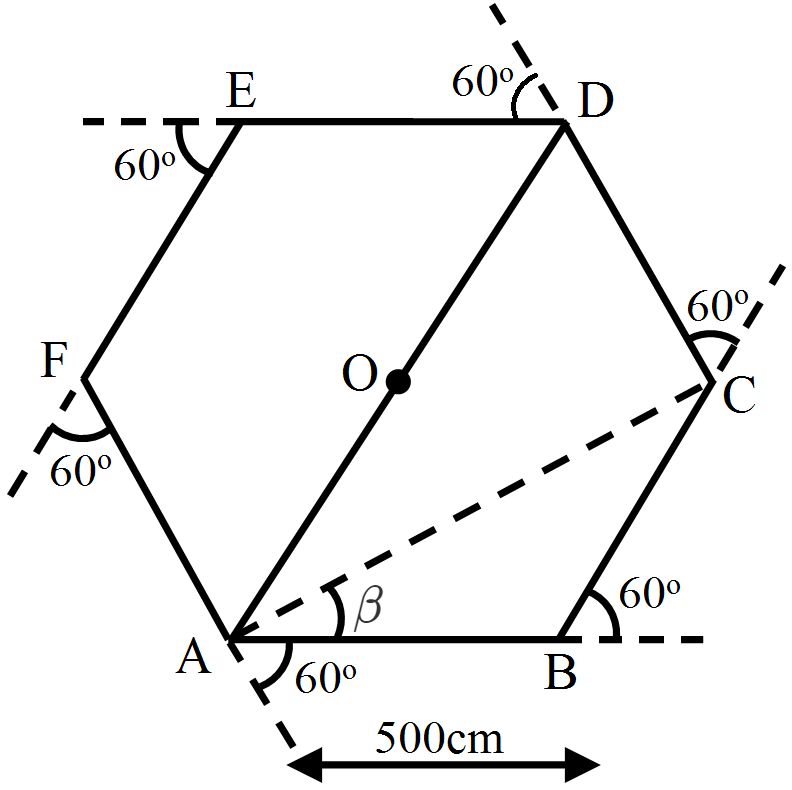 Displacement of the motorist at the third turn = AD = A + OD = 500 + 500 = 1000m Total path length = AB + BC + CD = 500 + 500 + 500 = 1500m $\therefore\ \frac{\text{Magnitude of displacement}}{\text{Total path length}}=\frac{1000}{1500}=\frac{2}{3}=0.67$At the sixth turn motorist is at the starting point A.
$\therefore$ Displacement of the motorist at the sixth turn = 0Total path length = AB + BC + CD + DE + EF + FA
= 500 + 500 + 500 + 500 + 500 + 500 = 3000m $\therefore\ \frac{\text{Magnitude of displacement}}{\text{Total path length}}=\frac{0}{3000}=0$ At the eighth turn, the motorist is at point C. $\therefore$ Displacement of the motorist = AC Using triangle law of vector addition, $\text{AC}=\sqrt{\text{AB}^2+\text{BC}^2+2\text{AB.BC}\cos60^\circ}$ $=\sqrt{(500)^2+(500)^2+2\times500\times500\times\frac{1}{2}}$ $=\sqrt{3\times(500)^2}=500\sqrt{3}\text{m}$ $\text{AC}=500\times1.732\text{m}=866\text{m}$ If it is inclined at an angle $\beta$ from the direction of AB, then $\tan\beta=\frac{500\sin60^\circ}{500+500\cos60^\circ}$ $=\frac{500\times\frac{\sqrt{3}}{2}}{500+500\times\frac{1}{2}}=\frac{500\times\frac{\sqrt{3}}{2}}{500\big(1+\frac{1}{2}\big)}$$=\frac{\frac{\sqrt{3}}{2}}{\frac{3}{2}}=\frac{1}{\sqrt{3}}=\tan30^\circ$
$\beta=30^\circ$
$\therefore$ Displacement of the motorist at the end of eighth turn is 866m making an angle 30 with the initial direction of motion.
Total path length = 8 × 500 = 4000m
$\therefore\ \frac{\text{Magnitude of displacement}}{\text{Total path length}}=\frac{500\sqrt{3}}{4000}=\frac{\sqrt{3}}{8}=0.22$ View full question & answer→Question 425 Marks
A large mass 'M' and a small mass ‘m' hang at the two ends of a string that passes over a smooth tube. The mass m moves around in a circular path which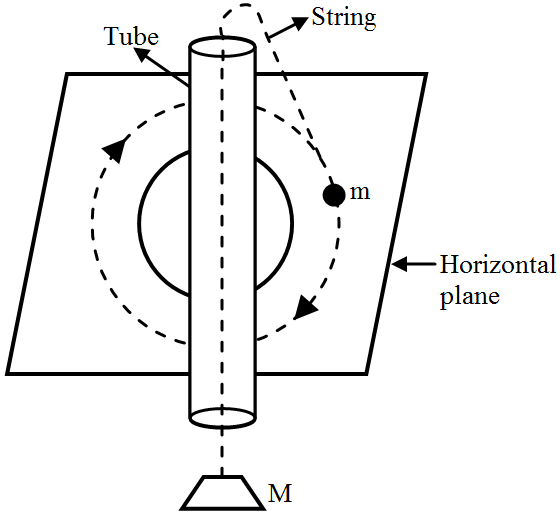
lies in the horizontal plane. The length of the string from the mass m to the top of the tube is l and $\theta$ is the angle this length makes with the vertical. What should be the frequency of rotation of the mass m so that mass M remains stationary? AnswerThe various forces acting on M and m are, $\text{T}=\text{Mg}\dots(\text{i})$ $\text{T}\cos\theta=\text{mg}\dots(\text{ii})$ $\text{T}\sin\theta=\frac{\text{mv}^2}{\text{r}}=\text{mr}\omega^2\dots(\text{iii})$ where r is the radius of the circular path and $\omega$ is the angular velocity. $\text{r}=\text{l}\sin\theta$ From (iii) $\text{T}\sin\theta=\text{mr}\omega^2=\text{m}(\text{l}\sin\theta)\omega^2,$ But $\text{T}=\text{Mg}$
$\therefore\ \text{Mg}\sin\theta=\text{ml}\sin\theta\omega^2$ or, $\omega^2=\frac{\text{Mg}}{\text{ml}}$ or, $\text{v}=\frac{\omega}{2\pi}=\frac{1}{2\pi}\sqrt{\frac{\text{Mg}}{\text{ml}}}$ Thus, the frequency of rotation of m, so that M remains stationary is given by $\text{v}=\frac{1}{2\pi}\sqrt{\frac{\text{Mg}}{\text{ml}}}$
View full question & answer→Question 435 Marks
A cricketer can throw a ball to a maximum horizontal distance of 100m. How much high above the ground can the cricketer throw the same ball.
AnswerA cricketer can throw a ball to a maximum horizontal distance of 100m. $\therefore\ \text{R}_\text{max}=\frac{\text{u}^2}{\text{g}}=100\text{m}$ $\Rightarrow\ \text{u}=\sqrt{100\text{g}}$For upward throw of the ball, we have
$\text{v}=0,\text{ a}=-\text{g},\text{ s}=?$ We know that $\text{v}^2-\text{u}^2=2\text{as}$ $\Rightarrow\ \text{s}=\frac{\text{v}^2-\text{u}^2}{2\text{a}}=\frac{0-(100\text{g})}{2\times(-\text{g})}=50\text{m}$ Hence, 50m high above the ground can the cricketer throw the same ball.
View full question & answer→Question 445 Marks
A body is projected horizontally from the top of a building of height h. Velocity of projection is u. Find:
- The time it will take to reach the ground.
- Horizontal distance from foot of building where it will strike the ground.
- Velocity with which the body reach the ground.
Answer
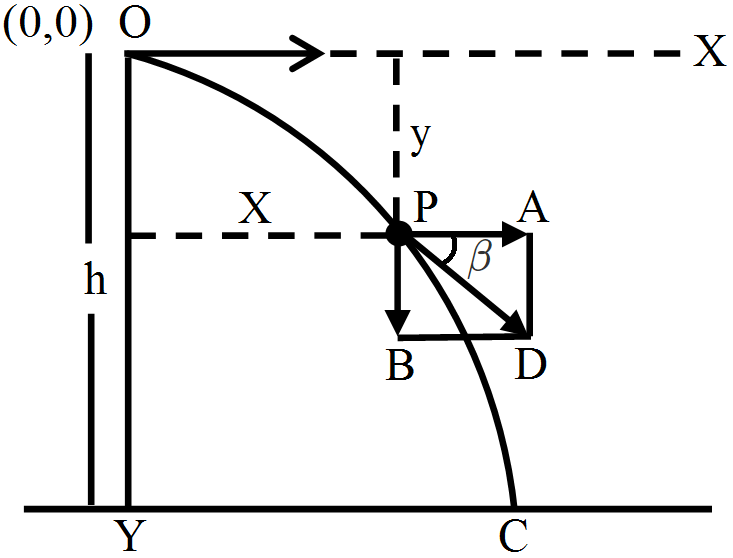
- Time taken to reach the ground (Time of flight)
Let it be T, and h = vertical height of point of projection O from C
Taking motion of object along OY direction
$\text{y}_0=0,\text{ y}=\text{h},\text{ u}_\text{y}=0,$ $\text{a}_\text{y}=\text{g},\text{ t}=\text{T}$
$\text{y}=\text{y}_0+\text{u}_\text{y}\text{t}+\frac{1}{2}\text{a}_\text{y}\text{t}^2$
Putting values of $y_0, y$ and $u_y, a_y$,
we have
$\text{h}=\frac{1}{2}\text{gT}^2$
$\Rightarrow\ \text{T}=\sqrt{\frac{2\text{h}}{\text{g}}}$
- Horizontal distance from foot of building where it will strike the ground (Horizontal range R). Taking motion of object along OX-direction; we have
$\text{x}_0=0,\text{ x}=\text{R},\text{ u}_\text{x}=\text{u},\text{ a}_\text{x}=0$
$\text{t}=\text{T}=\sqrt{\frac{2\text{h}}{\text{g}}}$
As $\text{x}=\text{x}_0+\text{u}_\text{x}\text{t}+\frac{1}{2}\text{a}_\text{x}\text{t}^2$
putting the values we have
$\text{R}=\text{u}\sqrt{\frac{2\text{h}}{\text{g}}}$
- Velocity with which body reach the ground. At any instant to the object posses two perpendicular velocities.
Horizontal velocity $v_x = u$ represented by PA.
Vertical velocity v_y represented by PB.
$v_y = u_y + a_yt$
$u_y = 0, a_y = g$, we have
$v_y = gt$
Resultant velocity $\vec{\text{v}}$ of $\vec{\text{v}_\text{x}}$ and $\vec{\text{v}_\text{y}}$ is given by
$\text{v}=\sqrt{\text{v}^2_\text{x}+\text{v}^2_\text{y}}$
$\text{v}=\sqrt{\text{u}^2+\text{g}^2\text{t}^2}$
Let $\vec{\text{v}}$ makes an angle $\beta$ with horizontal direction then,
$\tan\beta=\frac{\text{v}_\text{y}}{\text{v}_\text{x}}=\frac{\text{gt}}{\text{u}}$
or $\beta=\tan^{-1}\Big(\frac{\text{gt}}{\text{u}}\Big)$ View full question & answer→Question 455 Marks
A body is projected with some initial velocity making an angle $\theta$ with the horizontal. Show that its path is a parabola. Find the maximum height attained, time for maximum height, horizontal range, maximum horizontal range and the time of flight.
AnswerLet the body be projected with velocity u inclined at angle with the horizontal. The horizontal and vertical components of velocity and acceleration are $u_x, a_x$ and $u_y, a_y$
where $\text{u}_\text{x}=\text{u}\cos\theta,\text{ u}_\text{y}=\text{u}\sin\theta,$
$a_x = 0, a_y = -g\ g$ is the acceleration due to gravity.
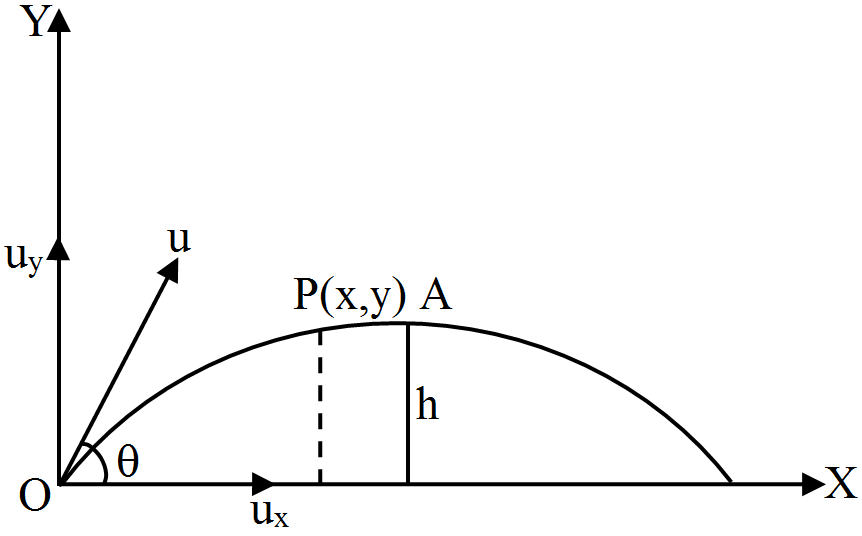
The coordinates of O are (0, 0) considering horizontal motion. The position of the body after time t has coordinate (x, y); where $\text{x}(\text{t})=\text{x}_0+\text{u}_\text{x}\text{t}+\frac{1}{2}\text{a}_\text{x}\text{t}^2$ Substituting for various factors $\text{x (t)}=0+\text{u}\cos\theta.\text{t}+\frac{1}{2}\times0\times\text{t}^2$ or $\text{x (t)}=\text{u}\cos\theta.\text{t}$$\text{t}=\frac{\text{x (t)}}{\text{u}\cos\theta}\dots(\text{i})$
Considering the vertical motion $\text{y (t)}=\text{y}(0)+\text{u}_\text{y}+\frac{1}{2}\text{a}_\text{y}\text{t}^2$ or $\text{y (t)}=0+\text{u}\sin\theta.\text{t}-\frac{1}{2}\text{gt}^2$ or $\text{y (t)}=\text{u}\sin\theta.\text{t}-\frac{1}{2}\text{gt}^2\dots(\text{ii})$ Substituting for t from equation (i) in equation (ii), we get $\text{y (t)}=\text{u}\sin\theta\Big(\frac{\text{x (t)}}{\text{u}\cos\theta}\Big)-\frac{1}{2}\text{g}\Big(\frac{\text{x (t)}}{\text{u}\cos\theta}\Big)^2\text{s}$
$\Rightarrow\ \text{y (t)}=\text{x (t)}\tan\theta-\frac{1}{2}\text{g}\Big(\frac{\text{x}^2(\text{t})}{\text{u}^2\cos^2\theta}\Big)\dots(\text{iii})$ This is an equation of parabola. Thus, the path of a projectile is a parabola. Maximum height attained: At the maximum height, the vertical component of velocity becomes zero. Now using the equation of motion. $\text{h}=\frac{\text{v}^2_\text{y}-\text{u}^2_\text{y}}{2\text{a}_\text{y}}$ We have maximum height$\therefore\ \text{h}_\text{max}=\frac{0^2-(\text{u}\sin\theta)^2}{2(-\text{g})}$
or $\text{H}=\frac{\text{u}^2\sin^2\theta}{2\text{g}}\dots(\text{iv})$
Time for maximum height: Using equation of motion $v = u + at$ or $v_x = u_x + a_yt$ we have $0=\text{u}\sin\theta-\text{gt}$ or $\text{t}=\frac{\text{u}\sin\theta}{\text{g}}\dots(\text{v})$ Horizontal range: Let the horizontal range be x. Since there is no acceleration in the horizontal direction so $\text{x}=\text{x}(0)+\text{u}_\text{x}\text{t}+\frac{1}{2}\text{a}_\text{x}\text{t}^2$As x(0) = 0, $\text{u}_\text{x}=\text{u}\cos\theta, a_x = 0$ and it is the total time of the flight which is twice the time for maximum height because body takes same time in rising to and falling from the highest point.
Hence, $\text{t}=\frac{2\text{u}\sin\theta}{\text{g}}$
$\therefore \ \text{x}=0+\text{u}\cos\theta.\text{t}$
$=\text{u}\cos\theta\Big(\frac{2\text{u}\sin\theta}{\text{g}}\Big)$
or $\text{x}=\frac{\text{u}^2}{\text{g}}(2\sin\theta\cos\theta)$
$\Rightarrow\ \text{x}=\frac{\text{u}^2}{\text{g}}\sin2\theta\dots(\text{vi})$
Maximum horizontal range: From equation (vi) for x to be maximum, the value of $\sin2\theta$ should be maximum which is 1, Hence, $\text{x}_\text{max}=\frac{\text{u}^2}{\text{g}}\dots(\text{vii})$ For this x_{max}, $\sin2\theta=1\Rightarrow\ \theta=45^\circ$ Therefore, the horizontal range will be maximum if the angle of projection is $45^\circ$ or $\frac{\pi}{4}$ radians. Time of flight of the projectiles: The projectile after completing its flight returns back to the same horizontal level from which it was projected. Therefore, the vertical displacement in the whole flight is zero. Considering vertical motion. $\text{y (t)}=\text{y}(0)+\text{u}_\text{y}\text{t}+\frac{1}{2}\text{a}_\text{y}\text{t}^2$ Now, y(t) = 0, y(0) = 0, $\text{u}_\text{y}=\text{u}\sin\theta, a_y = -g$ Then $0=0+\text{u}\sin\theta.\text{T}-\frac{1}{2}\text{gT}^2$
$\Rightarrow\ \text{T}\Big(\text{u}\sin\theta-\frac{1}{2}\text{gT}\Big)\text{s}=0$ Therefore T = 0 and $\text{u}\sin\theta-\frac{1}{2}\text{gT}=0$
$\Rightarrow\ \text{u}\sin\theta=\frac{1}{2}\text{gT}$ or $\text{gT}=2\text{u}\sin\theta$
$\text{T}=\frac{2\text{u}\sin\theta}{\text{g}}\dots(\text{viii})$ Equation (viii) gives the total time of flight. This is twice the time for maximum height. View full question & answer→Question 465 Marks
A ball is thrown from a point in level with and at a horizontal distance r from the top of a tower of height H. How must the speed and angle of projection of the ball be related to r in order that the ball may just go grazing past the top edge of the tower? At what horizontal distance x from the foot of the tower does the ball hit the ground ? For a given speed of projection, obtain an equation for finding the angle of projection so that x is at a minimum.
AnswerLet AB be the tower of height H and O the point of projection at a horizontal distance r from A as shown in Fig. 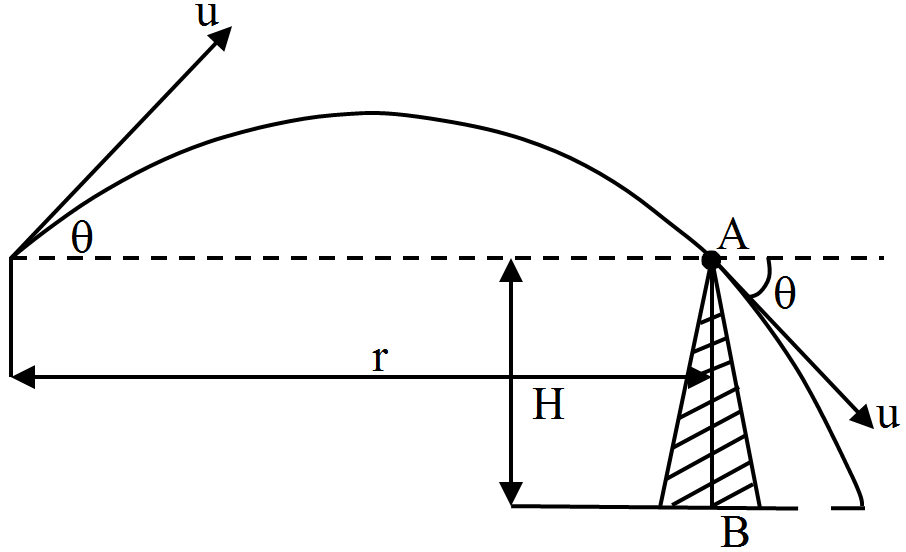 Let u and $\theta$ be the speed and the angle of projection of the ball. The ball will go just grazing past the top edge of the tower if r equals the horizontal range of the projectile, i.e., if $\text{r}=\text{u}\cos\theta.\frac{2\text{u}\sin\theta}{\text{g}}=\frac{\text{u}^2\sin2\theta}{\text{g}}$ Thus r, u and $\theta$ must be related according to the relation$\text{gr}=\text{u}^2\sin2\theta$
At point A, the velocity of the ball is again u at an angle $\theta$ to the horizontal. The horizontal distance x at which the ball strikes the ground from the foot of the tower is the horizontal distance covered with a horizontal velcoity $\text{u}\cos\theta$ in the time the ball falls vertically through a distance H starting with an initial vertically downward velocity $\text{u}\sin\theta$ and having a vertically downward acceleration g. If t is this time, we have $\text{H}=(\text{u}\sin\theta)\text{t}+\frac{1}{2}\text{gt}^2$ $\text{gt}^2+2\text{u}\sin\theta\text{t}-2\text{H}=0$ $\text{t}=\frac{-2\text{u}\sin\theta\pm\sqrt{4\text{u}^2\sin^2\theta+8\text{gH}}}{2\text{g}}$ $\text{t}=\frac{-2\text{u}\sin\theta\pm2\sqrt{\text{u}^2\sin^2\theta+2\text{gH}}}{2\text{g}}$ $=\frac{1}{\text{g}}\bigg[-\text{u}\sin\theta\pm\sqrt{\text{u}^2\sin^2\theta+2\text{gH}}\bigg]$ Taking only the positive sign, we have $\text{t}=\frac{1}{\text{g}}\bigg[\sqrt{\text{u}^2\sin^2\theta+2\text{gH}}-\text{u}\sin\theta\bigg]$ Thus, $\text{x}=\text{u}\cos\theta\text{ t}$ $=\frac{\text{u}\cos\theta}{\text{g}}\bigg[\sqrt{\text{u}^2\sin^2\theta+2\text{gH}}-\text{u}\sin\theta\bigg]$ The angle of projection $\theta$ for which x is minimum for a given value of u is given by$\frac{\text{dx}}{\text{d}\theta}=0$
Thus, $\frac{\text{u}\cos\theta}{\text{g}}\Bigg[\frac{\text{u}^22\sin\theta\cos\theta}{\sqrt{\text{u}^2\sin^2\theta+2\text{gH}}}-\text{u}\cos\theta\Bigg]\\+\bigg[\sqrt{\text{u}^2\sin^2\theta+2\text{gH}}-\text{u}\sin\theta\bigg]\Big(\frac{-\text{u}\sin\theta}{\text{g}}\Big)=0$$\frac{\text{u}^2\sin2\theta\cos\theta}{\text{g}\sqrt{\text{u}^2\sin^2\theta+2\text{gH}}}-\frac{\text{u}\cos^2\theta}{\text{g}}\\-\frac{\sin\theta}{\text{g}}\sqrt{\text{u}^2\sin^2\theta+2\text{gH}}+\frac{\text{u}\sin^2\theta}{\text{g}}=0$
$\frac{\text{u}^2\sin2\theta\cos\theta}{\sqrt{\text{u}^2\sin^2\theta+2\text{gH}}}-\sin\theta\sqrt{\text{u}^2\sin^2\theta+2\text{gH}}\\-\text{u}\cos2\theta=0$
$\text{u}^2\sin2\theta\cos\theta-\sin\theta(\text{u}^2\sin^2\theta+2\text{gH})\\-\text{u}\cos2\theta\sqrt{\text{u}^2\sin^2\theta+2\text{gH}}=0$
The angle of projection for which x is minimum is a solution of this equation. View full question & answer→Question 475 Marks
A projectile is fired horizontally with a velocity of $98ms^{-1}$ from the hill 490m high. Find (i) time taken to reach the ground (ii) the distance of the target from the hill and (iii) the velocity with which the body strikes the ground.
Answer
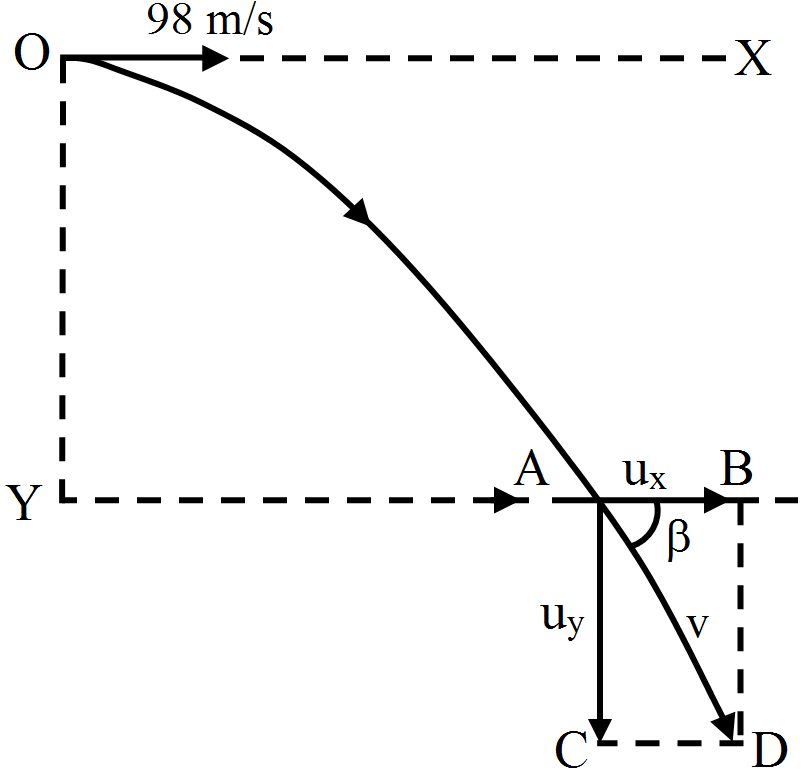
Let OX and OY be two perpendicular axes and YO = 490m. A body projected horizontally from O with velocity u (= $98ms^{-1}$) meets the ground at A following a parabolic path shown in figure.
- Let T be the time of flight of the projectile i.e. time taken by projectile to go from O to A.
Taking vertical downward motion (i.e. motion along OY axis) of projectile fiom O to A, we have
$y_0 = 0, y = 490m, u_y = 0, a_y = 9.8m/ s^2, t = T$
As $\text{y}=\text{y}_0+\text{u}_\text{y}\text{t}+\frac{1}{2}\text{a}_\text{y}\text{t}^2$
$\therefore\ 490=0+0\times\text{T}+\frac{1}{2}\times9.8\times\text{T}^2=4.9\text{T}^2$
$\text{T}=\sqrt{\frac{490}{4.9}}=10\text{s}$
- Taking horizontal motion (i.e. motion along OX axis) of projectile from O to A, we have
$x_0 = 0, x = R (say), u_x = 98m/ s, t = T = 10s, a_x = 0$
As, $\text{x}=\text{x}_0+\text{u}_\text{x}\text{t}+\frac{1}{2}\text{a}_\text{x}\text{t}^2$
$\therefore\ \text{R}=0+98\times10+\frac{1}{2}\times0\times10^2=980\text{m}$
- Let $v_x, v_y$ be the horizontal and vertical component velocity of the projectile at A.
Using the relation,
$v_x = u_x + a_xt = 98 + 0 \times 10 = 98m/ s$
Represented by AB.
Using the relation,
$v_y = u_y + a_yt = 0 + 9.8 \times 10 = 98m/ s$
Represented by AC.
$\therefore$ Resultant velocity $\text{v}=\sqrt{\text{v}^2_\text{x}+\text{v}^2_\text{y}}=\sqrt{98^2+98^2}$
$=98\sqrt{2}\text{m/s}$
If $\beta$ is the angle which v makes with the horizontal direction then $\tan\beta=\frac{\text{v}_\text{y}}{\text{v}_\text{x}}=\frac{98}{98}=1$ or $\beta=45^\circ$ with the horizontal. View full question & answer→Question 485 Marks
A particle is projected in air at an angle $\beta$ to a surface which itself is inclined at an angle $\alpha$ to the horizontal (Fig.).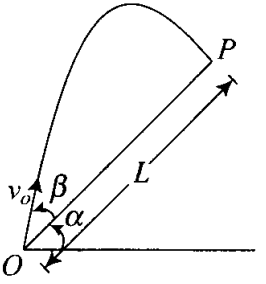
- Time of flight.
(Hint: This problem can be solved in two different ways:
- Point P at which particle hits the plane can be seen as intersection of its trajectory (parobola) and straight line. Remember particle is projected at an angle $(\alpha+\beta)$ w.r.t. horizontal.
- We can take x-direction along the plane and y-direction perpendicular to the plane. In that case resolve g (acceleration due to gravity) in two differrent components, $g_x$ along the plane and $g_y$ perpendicular to the plane. Now the problem can be solved as two independent motions in x and y directions respectively with time as a common parameter.)
AnswerConsider new cartesian coordinates in which X-axis is along inclined plane OP and OY axis perpendicular to it as shown in the figure. Consider the motion of the projectile from OAP. $\text{a}_\text{y}=-\text{g}\cos\alpha$
$\text{a}_\text{x}=\text{g}\sin\alpha$
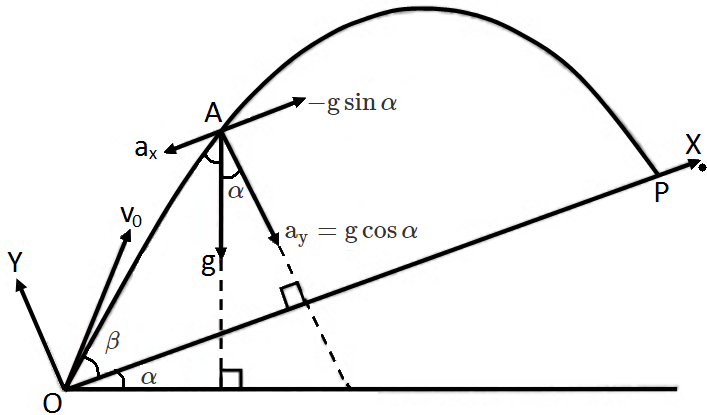
At O and PY = 0 $\text{u}_\text{y}=\text{v}_0\sin\beta,\text{t}=\text{T}$ The motion of projectile along New OY axis. $\text{s} = \text{u}\text{t}+\frac{1}{2}\text{g}\text{t}^{2}$
$\text{s}=0, \text{u}=\text{u}_\text{y}=\text{v}_0\sin\beta \ \text{g}=\text{g}_\text{y}=-\text{g}\cos\alpha \ \text{t}=\text{T}$
$0=\text{v}_0\sin\beta(\text{T})+\frac{1}{2}(-\text{g}\cos\alpha)\text{T}^2$
$0=\text{v}_0\sin\beta(\text{T})+\frac{\text{g}}{2}\cos\alpha\text{(T)}^2$
$\text{T}=\Big[\text{v}_0\sin\beta-\text{T}\frac{\text{g}}{2}\cos\alpha\Big]=0$ Either $\text{T}=0$ or $\text{v}_0\sin\beta-\frac{\text{gt}}{2}\cos\alpha=0$
$\frac{\text{gt}}{2}\cos\alpha=\text{v}_0\sin\beta$
$\therefore$ Time of flight from O to P is $\text{T}=\frac{2\text{v}_0\sin\beta}{\text{g}\cos\alpha}$ At $\text{T}=0$ projectile is at O and at $\text{T}=\frac{2\text{v}_0\sin\beta}{\text{g}\cos\alpha}$ it is at P. View full question & answer→Question 495 Marks
A projectile shot at an angle of 60° above the horizontal ground strikes a vertical wall 30m away at a point 15m above the ground. Find the speed with which the projectile was launched and the speed with which it strikes the wall.
AnswerLet the projectile be shot at angle 60° with velocity u. Velocity 'u' will have two components: Horizontal component.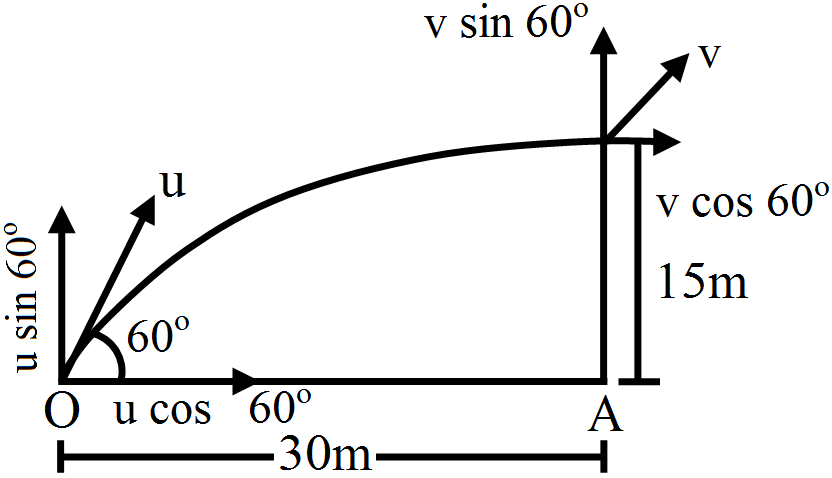
$\text{u}_\text{x}=\text{u}\cos60^\circ=\frac{30}{\text{t}}$ $\text{t}=\frac{60}{\text{u}}$ Vertical component$\text{u}_\text{y}=\text{u}\sin60^\circ$
Distance travelled by the projectile$\text{S}=\text{u}_\text{y}\text{t}+\frac{1}{2}\text{gt}^2$
$15=\text{u}\sin60^\circ\text{t}-\frac{1}{2}\times10\text{t}^2$
$15=\frac{\sqrt{3}}{2}\text{ut}-5\text{t}^2$
$15=30\sqrt{3}-5\Big(\frac{60}{\text{u}}\Big)^2$
$\text{u}=\frac{18000}{(30\sqrt{3}-15)}=22.07\text{ m/s}$
$\therefore$ Initial velocity of projectile = 22.07m/ s
Let the projectile strike the wall at point B above the ground with velocity 'V' which will have horizontal and vertical components. Horizontal component $\text{v}_\text{H}=\text{u}\cos60^\circ$ $=22.07\times\frac{1}{2}=11.03\text{ m/s}$ Vertical component $\text{v}_\text{V}=\text{u}-\text{gt}$ $=22.07-10\times2.72=-5.13\text{ m/s}$ $\Big[\because\ \text{t}=\frac{60}{22.07}=2.72\text{ sec}\Big]$ Resultant velocity $\text{v}=\sqrt{\text{v}_\text{V}^2+\text{v}^2_\text{H}}$ $=\sqrt{(-5.13)^2+(11.03)^2}$ $\text{v}=12.16\text{ m/s}$ View full question & answer→Question 505 Marks
A particle is thrown over a triangle from one end of a horizontal base that grazing the vertex falls on the other end of the base. If $\alpha$ and $\beta$ be the base angles and $\theta$ the angle of projection; prove that: $\tan\theta=\tan\alpha+\tan\beta.$
AnswerThe statement in the question is shown in the diagram,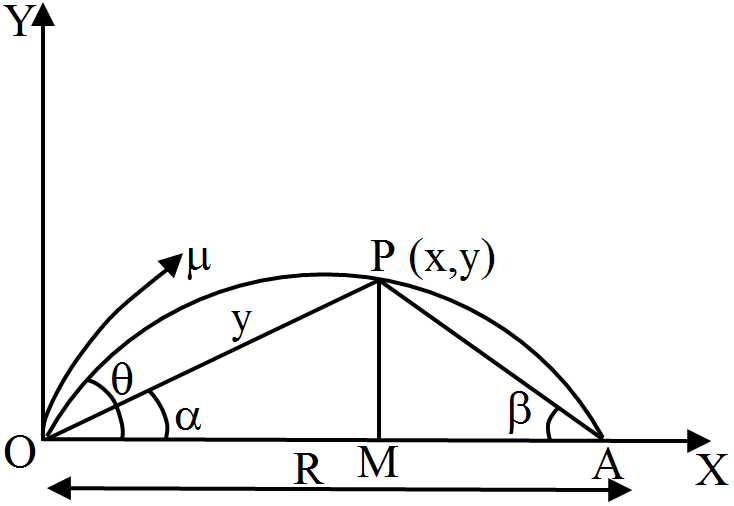
$\tan\alpha=\frac{\text{y}}{\text{x}}$ and $\tan\beta=\frac{\text{y}}{\text{MA}}=\frac{\text{y}}{\text{R}-\text{x}},$ where R is horizontal range. $\therefore\ \tan\alpha+\tan\beta=\frac{\text{y}}{\text{x}}+\frac{\text{y}}{\text{R}-\text{x}}$ $=\frac{(\text{R}-\text{x}+\text{x})\text{y}}{\text{x}(\text{R}-\text{x})}=\frac{\text{yR}}{\text{x}(\text{R}-\text{x})}$ $\tan\alpha+\tan\beta=\frac{\text{yR}}{\text{x}(\text{R}-\text{x})}\dots(\text{i})$ Again, $\text{x}=(\text{u}\cos\theta)\text{t}\dots(\text{ii})$ $\text{y}=(\text{u}\sin\theta)\text{t}-\frac{1}{2}\text{gt}^2\dots(\text{iii})$From (ii) and (iii), we have
$\text{y}=\text{x}\tan\theta\Big[1-\frac{\text{xg}}{2\text{u}^2\cos^2\theta\tan\theta}\Big]$
Putting, $\text{R}=\frac{2\text{u}^2\sin\theta\cos\theta}{\text{g}}$
we get $\text{y}=\text{x}\tan\theta\Big[1-\frac{\text{xg}}{2\text{u}^2\cos\theta\sin\theta}\Big]$
$=\text{x}\tan\theta\Big[1-\frac{\text{x}}{\text{R}}\Big]$$\frac{\text{y}}{\text{x}}=\tan\theta\Big(\frac{\text{R}-\text{x}}{\text{R}}\Big)\dots(\text{iv})$
Putting (iv) in (i), we get $\tan\alpha+\tan\beta=\frac{\text{yR}}{\text{x}(\text{R}-\text{x})}=\tan\theta$ $\therefore\ \tan\alpha+\tan\beta=\tan\theta$ View full question & answer→