Question 15 Marks
Read statement below carefully and state with reasons and examples, if it is true or false; A particle in one-dimensional motion. With positive value of acceleration must be speeding up.
AnswerFalse. Explanation: This statement is false in the situation when acceleration is positive and velocity is negative at the instant time taken as origin. Then, for all the time before velocity becomes zero, there is slowing down of the particle. Such a case happens when a particle is projected upwards. This statement is true when both velocity and acceleration are positive, at the instant time taken as origin. Such a case happens when a particle is moving with positive acceleration or falling vertically downwards from a height.
View full question & answer→Question 25 Marks
Gives the x-t plot of a particle executing one-dimensional simple harmonic motion. (You will learn about this motion in more detail in Chapter 14). Give the signs of position, velocity and acceleration variables of the particle at t = 0.3 s, 1.2 s, – 1.2 s.
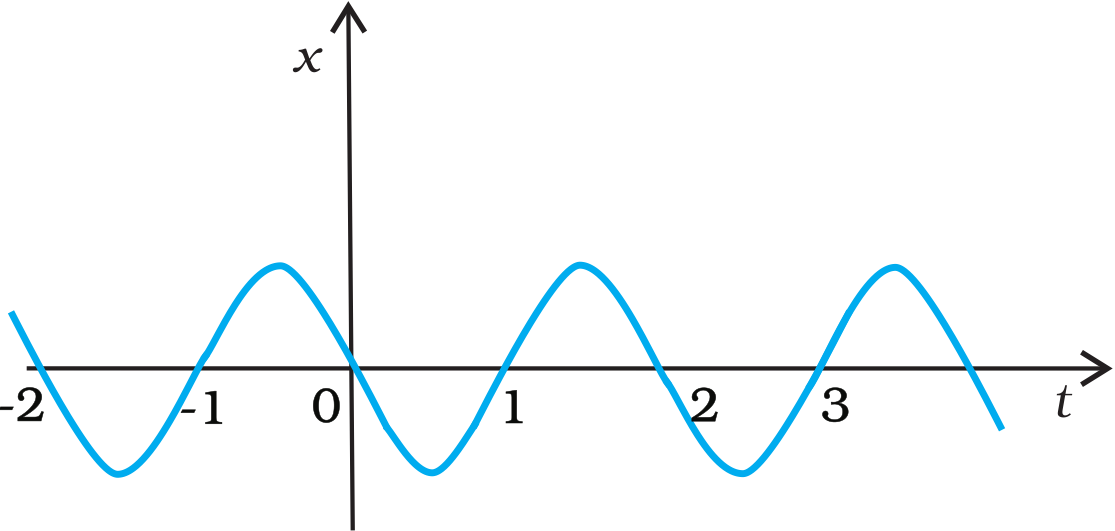
AnswerFor simple harmonic motion (SHM) of a particle, acceleration (a) is given by the relation: $\text{a}=-\omega^2\text{x}$ Where $\omega$ = angular frequency t = 0.3s In this time interval, x is negative. Now the slope of the x-t plot is negative. Therefore, both position and velocity are negative. Acceleration of the particle using (i) will be positive. t = 1.2s In this time interval, x is positive. Now the slope of the x-t plot is positive. Therefore, both position and velocity are positive. Acceleration of the particle using (i) will be negative. t = – 1.2s In this time interval, x is negative. Now the slope of the x-t plot is positive. Therefore, position is negative and velocity is positive. Acceleration of the particle using (i) will be positive.
View full question & answer→Question 35 Marks
A car moving along a straight highway with speed of $126km\ h^{–1}$ is brought to a stop within a distance of $200m$. What is the retardation of the car (assumed uniform), and how long does it take for the car to stop?
AnswerInitial velocity of the car, $u=126 \mathrm{~km} / \mathrm{h}=35 \mathrm{~m} / \mathrm{s}$ Final velocity of the car, $\mathrm{v}=0$ Distance covered by the car before coming to rest, $\mathrm{s}=200 \mathrm{~m}$ Retardation produced in the car $=$ a From third equation of motion, a can be calculated as: $\mathrm{v}^2-\mathrm{u}^2=2$ as $(0)^2-(35)^2=2 \times \mathrm{a} \times 200 \mathrm{a}=-35 \times 35 / 2 \times 200=-3.06 \mathrm{~ms}^{-2}$ From first equation of motion, time $(\mathrm{t})$ taken by the car to stop can be obtained as: $v=u+$ at $t=(v-u) / a=(-35) /(-3.06)=11.44 \mathrm{~s}$
View full question & answer→Question 45 Marks
Gives the x-t plot of a particle in one-dimensional motion. Three different equal intervals of time are shown. In which interval is the average speed greatest, and in which is it the least? Give the sign of average velocity for each interval.
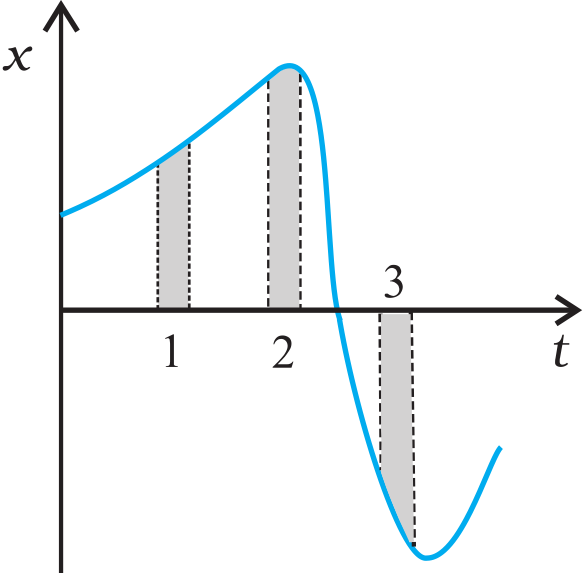
AnswerInterval 3(Greatest), Interval 2(Least) Positive (Intervals 1 & 2), Negative (Interval 3) The average speed of a particle shown in the x-t graph is obtained from the slope of the graph in a particular interval of time. It is clear from the graph that the slope is maximum and minimum restively in intervals 3 and 2 respectively. Therefore, the average speed of the particle is the greatest in interval 3 and is the least in interval 2. The sign of average velocity is positive in both intervals 1 and 2 as the slope is positive in these intervals. However, it is negative in interval 3 because the slope is negative in this interval.
View full question & answer→Question 55 Marks
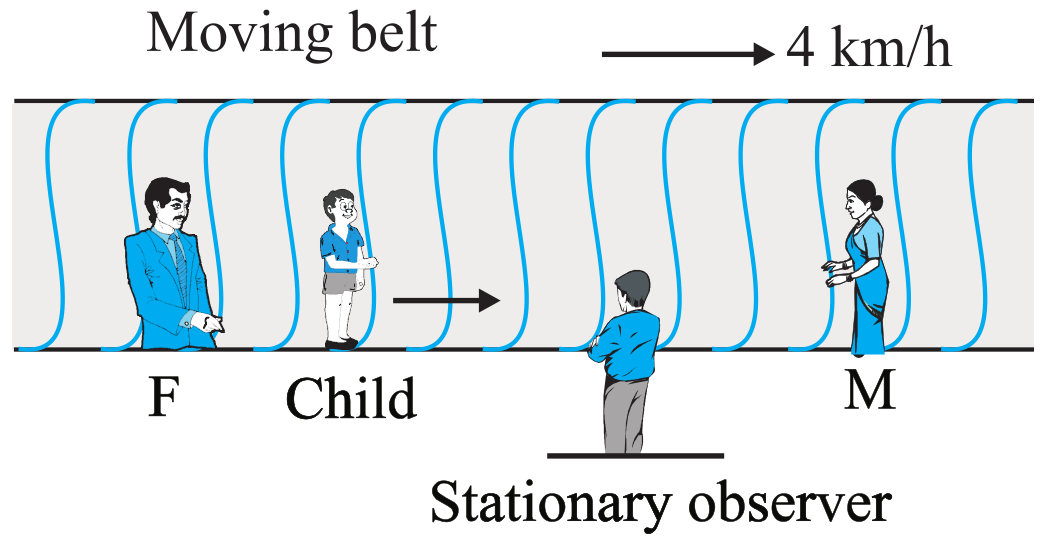
On a long horizontally moving belt a child runs to and fro with a speed $9\ km h^{–1} ($with respect to the belt$)$ between his father and mother located $50 m$ apart on the moving belt. The belt moves with a speed of $4\ km h^{–1}$. For an observer on a stationary platform outside, what is the
- speed of the child running in the direction of motion of the belt?.
- speed of the child running opposite to the direction of motion of the belt?
- time taken by the child in $(a)$ and $(b)?$
Which of the answers alter if motion is viewed by one of the parents?
Answer
- Speed of the belt, $V_B = 4\ km/ h$
Speed of the boy, $V_b = 9\ km/ h$
Since the boy is running in the same direction of the motion of the belt, his speed $($as observed by the stationary observer$)$ can be obtained as:
$V_{bB} = V_b + V_B = 9 + 4 = 13\ km/ h$
- Since the boy is running in the direction opposite to the direction of the motion of the belt, his speed $($as observed by the stationary observer$)$ can be obtained as:
$V_{bB} = V_b + (– V_B) = 9 – 4 = 5\ km/ h$
- Distance between the child’s parents $= 50m$
As both parents are standing on the moving belt, the speed of the child in either direction as observed by the parents will remain the same i.e., $9\ km/ h = 2.5m/s.$
Hence, the time taken by the child to move towards one of his parents is $50/2.5 = 20s$
- If the motion is viewed by any one of the parents, answers obtained in $(a)$ and $(b)$ get altered. This is because the child and his parents are standing on the same belt and hence, are equally affected by the motion of the belt. Therefore, for both parents $($irrespective of the direction of motion$)$ the speed of the child remains the same i.e., $9\ km/ h.$
For this reason, it can be concluded that the time taken by the child to reach any one of his parents remains unaltered. View full question & answer→Question 65 Marks
Two stones are thrown up simultaneously from the edge of a cliff $200m$ high with initial speeds of $15m s^{–1}$ and $30m s^{–1}$. Verify that the graph shown in correctly represents the time variation of the relative position of the second stone with respect to the first. Neglect air resistance and assume that the stones do not rebound after hitting the ground. Take $g = 10m s^{–2}$. Give the equations for the linear and curved parts of the plot.
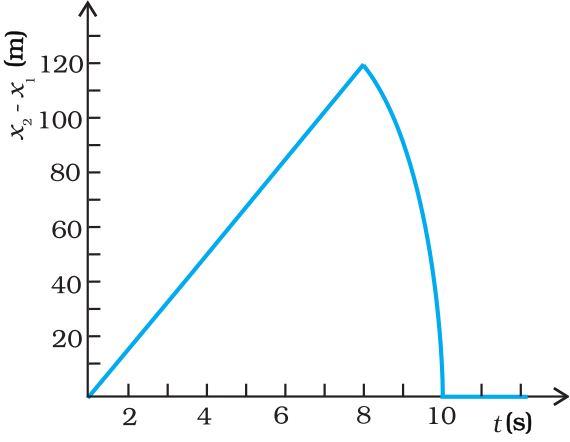
AnswerFor first stone: Initial velocity, $u_I = 15m/s$ Acceleration, $a = –g = –10m/s^2$ Using the relation, $x_1 = x_0 + u_1t + (1/2)at^2$ Where, height of the cliff, $x_0 = 200m x_1 = 200 + 15t – 5t^2 ……(i)$ When this stone hits the ground, $x_1 = 0 $\therefore$ –5t^2+ 15t + 200 = 0 t^2 – 3t – 40 = 0 t^2 – 8t + 5t – 40 = 0 t(t – 8) + 5(t – 8) = 0 t = 8 s or t = –5s$ Since the stone was projected at time t = 0, the negative sign before time is meaningless. $\therefore$ t = 8s For second stone: Initial velocity, $u_{II}= 30m/s$ Acceleration, $a = –g = –10m/s^2$ Using the relation, $x_2 = x_0 + u_{II}t + (1/2)at^2 = 200 + 30t – 5t^2 ……(ii)$ At the moment when this stone hits the ground; $x_2 = 0 –5t^2 + 30 t + 200 = 0 t^2 – 6t – 40 = 0 t^2 – 10t + 4t + 40 = 0 t(t – 10) + 4(t – 10) = 0 t(t – 10)(t + 4) = 0 t = 10s or t = –4s$ Here again, the negative sign is meaningless.$\therefore$ t = 10s Subtracting equations (i) and (ii), we get $x_2 – x_1 = (200 + 30t -5t^2) – (200 + 15t -5t^2) x_2 – x_1 =15t ……(iii)$ Equation (iii) represents the linear path of both stones. Due to this linear relation between $(x_2 - x_1)$ and t, the path remains a straight line till 8s. Maximum separation between the two stones is at $t = 8s. (x_2 – x_1)_{max} = 15 \times 8 = 120m$ This is in accordance with the given graph. After 8s, only second stone is in motion whose variation with time is given by the quadratic equation: $x_2 – x_1= 200 + 30t – 5t^2$ Hence, the equation of linear and curved path is given by $x_2– x_1 = 15t$ (Linear path) $x_2 – x_1 = 200 + 30t – 5t^2$ (Curved path)
View full question & answer→Question 75 Marks
The speed$-$time graph of a particle moving along a fixed direction is shown in. Obtain the distance traversed by the particle between.
- $t = 0s$ to $10s$,
- $t = 2s$ to $6s$.
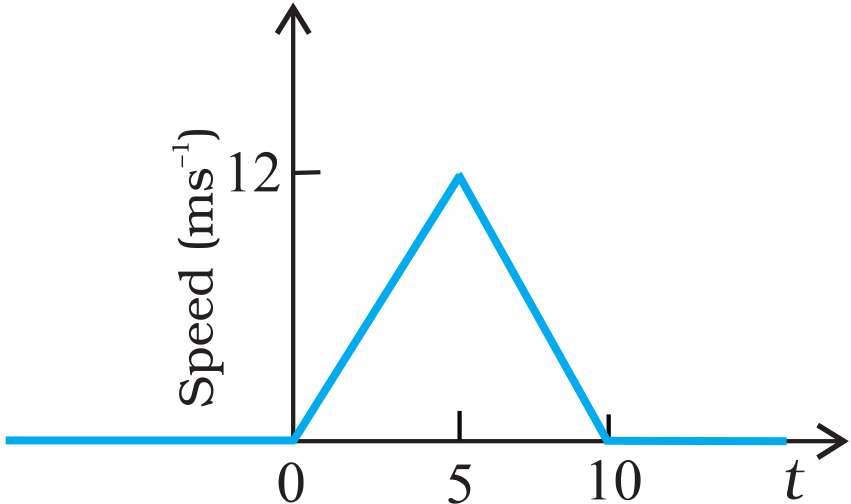
What is the average speed of the particle over the intervals in $(a)$ and $(b)?$ Answer
- Distance travelled by the particle $=$ Area under the given graph
$= 1/2 \times (10 - 0) \times (12 - 0) = 60m$
Average speed $=$ Distance/Time $= 60/10 = 6\ m/s$
- Let $s_1$ and $s_2$ be the distances covered by the particle between time
$t = 2s$ to $5s$ and $t = 5s$ to $6s$ respectively.
Total distance $(s)$ covered by the particle in time $t = 2s$ to $6s$
$s = s_1 + s_2 …(i)$
For distance $s_1$:
Let $u′$ be the velocity of the particle after $2s$ and $a′$ be the acceleration of the particle in $t = 0$ to $t = 5s.$
Since the particle undergoes uniform acceleration in the interval $t = 0$ to $t = 5s$, from first equation of motion, acceleration can be obtained as:
$v = u + at$
Where,
$v =$ Final velocity of the particle
$12 = 0 + a′ \times 5$
$a′ = 12/5 = 2.4m/s^2$
Again, from first equation of motion, we have
$v = u + at$
$= 0 + 2.4 \times 2 $
$= 4.8m/s$
Distance travelled by the particle between time $2s$ and $5s$ i.e., in $3s$
$s_1 = u′ t + 1/2 a′t^2$
$= 4.8x^3 + 1/2 x^2.4 x (3)^2$
$= 25.2m ...(ii)$
For distance $s_2$:
Let $a″$ be the acceleration of the particle between time $t = 5s$ and $t = 10s.$
From first equation of motion,
$v = u + at ($where $v = 0$ as the particle finally comes to rest$)$
$0 = 12 + a″ \times 5$
$a″ = -12/5$
$= -2.4m/s^2$
Distance travelled by the particle in $1s ($i.e., between $t = 5s$ and $t = 6s)$
$s_2 = u′' t + 1/2 a'′t^2$
$= 12 \times a + 1/2(-2.4) \times (1)^2$
$= 12 - 1.2$
$= 10.8m .......(iii)$
From equations $(i), (ii),$ and $(iii),$ we get
$s = 25.2 + 10.8 = 36m$
$\therefore$ Average speed $= 36/4 = 9m/s$ View full question & answer→Question 85 Marks
Two towns A and B are connected by a regular bus service with a bus leaving in either direction every T minutes. A man cycling with a speed of $20km h^{–1}$ in the direction A to B notices that a bus goes past him every $18$ min in the direction of his motion, and every $6$ min in the opposite direction. What is the period T of the bus service and with what speed (assumed constant) do the buses ply on the road?
AnswerLet V be the speed of the bus running between towns A and B. Speed of the cyclist, v = 20km/ h Relative speed of the bus moving in the direction of the cyclist = V – v = (V – 20)km/ h The bus went past the cyclist every 18 min i.e., 18/60 h (when he moves in the direction of the bus). Distance covered by the bus = (V - 20) × 18/60km ......(i) Since one bus leaves after every T minutes, the distance travelled by the bus will be equal to V × T/60 ......(ii) Both equations (i) and (ii) are equal. (V - 20) × 18/60 = VT/60 ......(iii) Relative speed of the bus moving in the opposite direction of the cyclist = (V + 20)km/ h Time taken by the bus to go past the cyclist = 6 min = 6/60h $\therefore$ (V + 20) × 6/60 = VT/60 ......(iv) From equations (iii) and (iv), we get (V + 20) × 6/60 = (V - 20) × 18/60 V + 20 = 3V - 60 2V = 80 V = 40km/ h Substituting the value of V in equation (iv), we get (40 + 20) × 6/60 = 40T/60 T = 360/40 = 9 min
View full question & answer→Question 95 Marks
On a two-lane road, car A is travelling with a speed of $36km h^{–1}$. Two cars B and C approach car A in opposite directions with a speed of $54km h^{–1}$ each. At a certain instant, when the distance AB is equal to AC, both being 1km, B decides to overtake A before C does. What minimum acceleration of car B is required to avoid an accident?
AnswerVelocity of car A, $V_A = 36km/ h = 10m/s$ Velocity of car B, $V_B = 54km/ h = 15m/s$ Velocity of car C, $V_C = 54km/ h = 15m/s$ Situation is depicted below
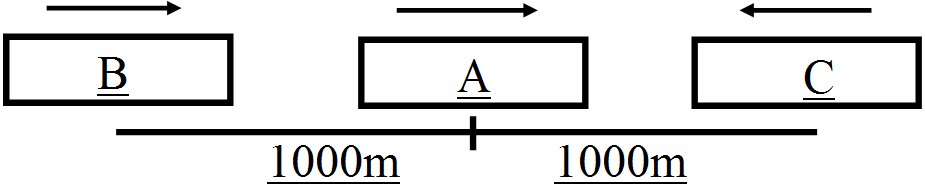
Taking direction of Car A as positive Hence Relative velocity of car B with respect to car A, $V_{BA} = V_B – V_A = 15 – 10 = 5m/s$ Relative velocity of car C with respect to car A, $V_{CA} = V_C– V_A = -15 - 10 = -25m/s$ At a certain instance, both cars B and C are at the same distance from car A i.e., $s = 1km = 1000m$ Time taken (t) by car C to cover 1000m = 1000/25 = 40s Hence, to avoid an accident, car B must cover the same distance in a maximum of 40s. From second equation of motion, minimum acceleration (a) produced by car B can be obtained as: $s = ut + (1/2)at^2 1000 = 5 \times 40 + (1/2) \times a \times (40)^2 a = 1600/1600 = 1m/s$ View full question & answer→Question 105 Marks
A three-wheeler starts from rest, accelerates uniformly with $1m s^{–2}$ on a straight road for $10s$, and then moves with uniform velocity. Plot the distance covered by the vehicle during the nth second $(n = 1, 2, 3….)$ versus n. What do you expect this plot to be during accelerated motion : a straight line or a parabola?
AnswerStraight line Distance covered by a body in nth second is given by the relation $\text{D}_\text{n} = \text{u}+\frac{\text{a}}{2}(2\text{n}-1)\ \dots(1)$ u = Initial velocity a = Acceleration n = Time = 1, 2, 3, ....., n In the given case, u = 0 and $a = 1m/s^2$ $\therefore\ \text{D}_\text{n}=\frac{1}{2}(2\text{n}-1)\ \dots(2)$ This relation shows that: $\text{D}_\text{n} \propto \text{n}\ \dots(3)$ Now, substituting different values of n in equation (iii), we get the following table:
|
n
|
1
|
2
|
3
|
4
|
5
|
6
|
7
|
8
|
9
|
10
|
|
$D_n$
|
0.5
|
1.5
|
2.5
|
3.5
|
4.5
|
5.5
|
6.5
|
7.5
|
8.5
|
9.5
|
The plot between n and Dn will be a straight line as shown: 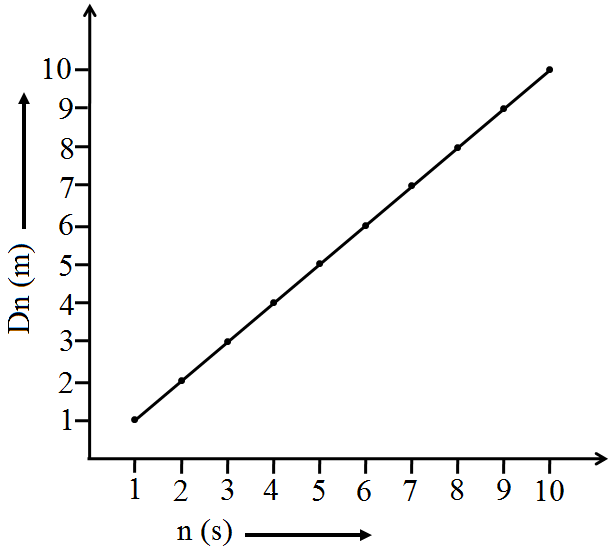 Since the given three-wheeler acquires uniform velocity after 10s, the line will be parallel to the time-axis after n = 10s.
 View full question & answer→Question 115 Marks
Two trains A and B of length $400m$ each are moving on two parallel tracks with a uniform speed of $72km h^{–1}$ in the same direction, with A ahead of B. The driver of B decides to overtake A and accelerates by $1m s^{–2}$. If after $50s$, the guard of B just brushes past the driver of A, what was the original distance between them?
AnswerFor train A: Initial velocity, $u = 72km/ h = 20m/s Time, t = 50s$ Acceleration, $a_I = 0$ (Since it is moving with a uniform velocity) From second equation of motion, distance (sI) covered by train A can be obtained as: $s_I = ut + ½ a_It^2 = 20 \times 50 + 0 = 1000m$ For train B: Initial velocity, $u = 72km/ h = 20m/s$ Acceleration, $a = 1m/s^2 Time, t = 50s$ From second equation of motion, distance (sII) covered by train A can be obtained as: $s_{Il} = ut + ½ a t^2 = 20 \times 50 \times ½ \times 1\times (50)^2 = 2250m$ Hence, the original distance between the driver of train A and the guard of train $B = 2250 – 1000 = 1250m$.
View full question & answer→Question 125 Marks
Gives a speed-time graph of a particle in motion along a constant direction. Three equal intervals of time are shown. In which interval is the average acceleration greatest in magnitude? In which interval is the average speed greatest? Choosing the positive direction as the constant direction of motion, give the signs of v and a in the three intervals. What are the accelerations at the points A, B, C and D?
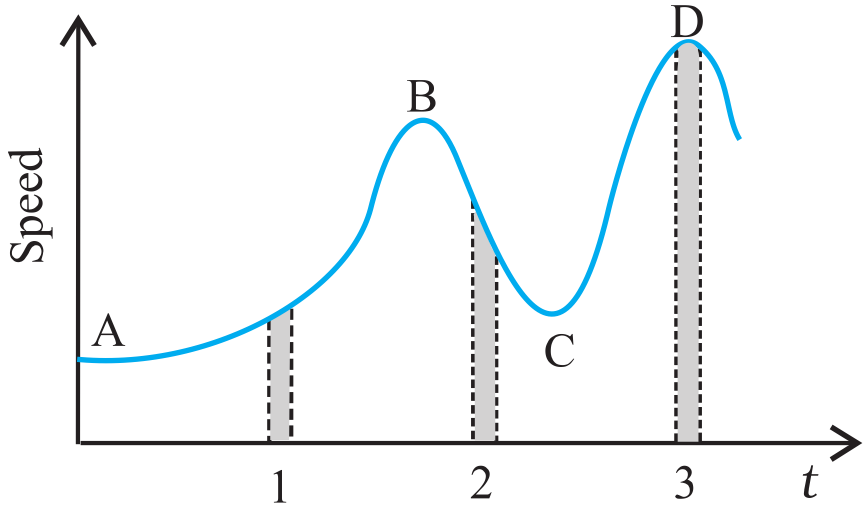
AnswerAverage acceleration is greatest in interval 2 Average speed is greatest in interval 3 v is positive in intervals 1, 2, and 3 a is positive in intervals 1 and 3 and negative in interval 2 a = 0 at A, B, C, D Acceleration is given by the slope of the speed-time graph. In the given case, it is given by the slope of the speed-time graph within the given interval of time. Since the slope of the given speed-time graph is maximum in interval 2, average acceleration will be the greatest in this interval. Height of the curve from the time-axis gives the average speed of the particle. It is clear that the height is the greatest in interval 3. Hence, average speed of the particle is the greatest in interval 3. In interval 1: The slope of the speed-time graph is positive. Hence, acceleration is positive. Similarly, the speed of the particle is positive in this interval. In interval 2: The slope of the speed-time graph is negative. Hence, acceleration is negative in this interval. However, speed is positive because it is a scalar quantity. In interval 3: The slope of the speed-time graph is zero. Hence, acceleration is zero in this interval. However, here the particle acquires some uniform speed. It is positive in this interval. Points A, B, C, and D are all parallel to the time-axis. Hence, the slope is zero at these points. Therefore, at points A, B, C, and D, acceleration of the particle is zero.
View full question & answer→Question 135 Marks
A boy standing on a stationary lift (open from above) throws a ball upwards with the maximum initial speed he can, equal to $49m s^{–1}$. How much time does the ball take to return to his hands? If the lift starts moving up with a uniform speed of $5m s^{-1}$ and the boy again throws the ball up with the maximum speed he can, how long does the ball take to return to his hands?
AnswerInitial velocity of the ball, u = 49m/s Acceleration, $a = –g = –9.8m/s^2$ Case I: When the lift was stationary, the boy throws the ball. Taking upward motion of the ball, Final velocity, v of the ball becomes zero at the highest point. From first equation of motion, time of ascent (t) is given as: v = u + at t = (v - u)/a = -49/-9.8 = 5s But, the time of ascent is equal to the time of descent. Hence, the total time taken by the ball to return to the boy’s hand = 5 + 5 = 10s. Case II: The lift was moving up with a uniform velocity of 5m/s. In this case, the relative velocity of the ball with respect to the boy remains the same i.e., 49m/s. Therefore, in this case also, the ball will return back to the boy’s hand after 10s.
View full question & answer→Question 145 Marks
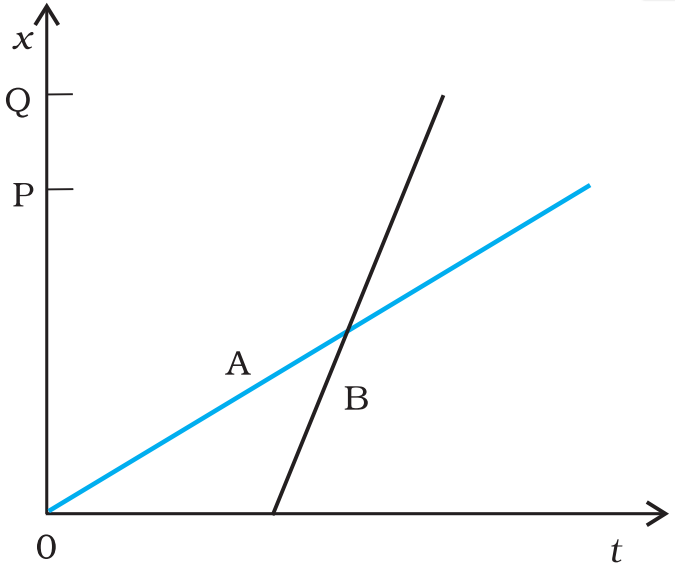
The position$-$time $(x-t)$ graphs for two children $A$ and $B$ returning from their school $O$ to their homes $P$ and $Q$ respectively are shown in Choose the correct entries in the brackets below;
- $(A/B)$ lives closer to the school than $(B/A)$.
- $(A/B)$ starts from the school earlier than $(B/A)$.
- $(A/B)$ walks faster than $(B/A)$.
- A and B reach home at the $($same$/$different$)$ time.
- $(A/B)$ overtakes $(B/A)$ on the road $($once$/$twice$)$.
Answer
- As $OP < OQ, A$ lives closer to the school than $B$.
- For $x = 0, t = 0$ for $A$; while $t$ has some finite value for $B$. Therefore, $A$ starts from the school earlier than $B$.
- Since the velocity is equal to slope of $x-t$ graph in case of uniform motion and slope of $x-t$ graph for $B$ is greater that that for $A =$, hence $B$ walks faster than $A$.
- It is clear from the given graph that both $A$ and $B$ reach their respective homes at the same time.
- B moves later than $A$ and his$/$ her speed is greater than that of $A$. From the graph, it is clear that Bovertakes $A$ only once on the road.
View full question & answer→Question 155 Marks
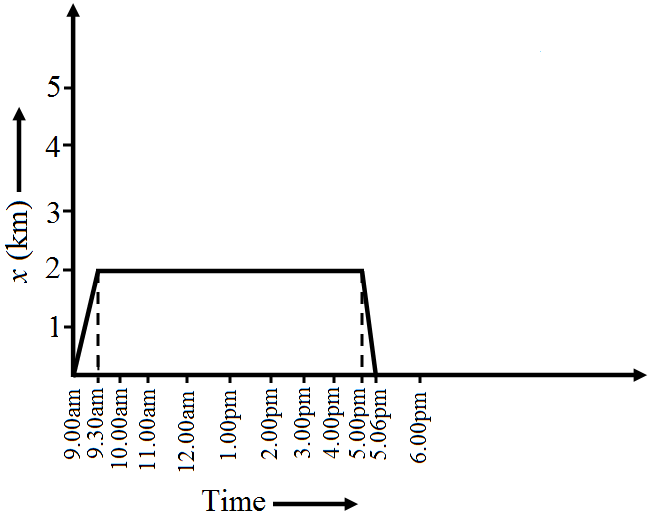
A woman starts from her home at 9.00 am , walks with a speed of $5 \mathrm{~km} \mathrm{~h}^{-1}$ on a straight road up to her office 2.5 km away, stays at the office up to 5.00 pm , and returns home by an auto with a speed of $25 \mathrm{~km} \mathrm{~h}^{-1}$. Choose suitable scales and plot the x-t graph of her motion.
AnswerSpeed of the woman = 5km/h Distance between her office and home = 2.5km Time Taken = Distance/Speed = 2.5/5 = 0.5h = 30 min It is given that she covers the same distance in the evening by an auto. Now, speed of the auto = 25km/h Time Taken = Distance/Speed = 2.5/25 = 1/10h = 0.1h = 6 min The suitable x-t graph of the motion of the woman is shown in the given figure.
View full question & answer→Question 165 Marks
A drunkard walking in a narrow lane takes 5 steps forward and 3 steps backward, followed again by 5 steps forward and 3 steps backward, and so on. Each step is 1m long and requires 1s. Plot the x-t graph of his motion. Determine graphically and otherwise how long the drunkard takes to fall in a pit 13m away from the start.
AnswerWe can see from the question Distance covered with 1 step = 1m Time taken = 1s Time taken to move first 5m forward = 5s Time taken to move 3m backward = 3s So net distance after 8 secs = 2m Similarly, we can find the data point for values also The position of the drunkard taking starting point as position with respect to time is given the below table.
|
T(s)
|
0
|
5
|
8
|
13
|
16
|
21
|
24
|
29
|
32
|
37
|
|
X(m)
|
0
|
5
|
2
|
7
|
4
|
9
|
6
|
11
|
8
|
13
|
The x-t graph based on the above data points is given by
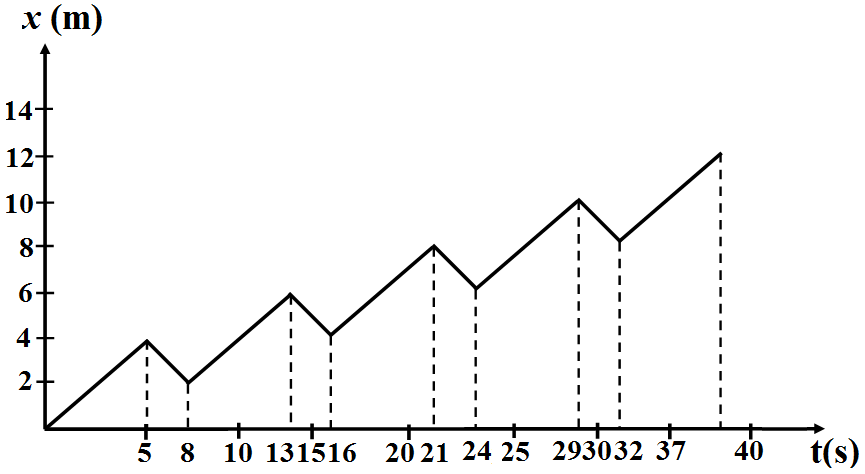
So, we can see that, drunkard will fall in pit at 37 sec
Analytical method Net distance covered after 8sec = 5 – 3 = 2m Net time taken to cover 2m = 8s So Drunkard covered 8m in = 4 × 8 = 32s. In the next 5s, the drunkard will cover a distance of 5m and a total distance of 13m and falls into the pit. Net time taken by the drunkard to cover 13m = 32 + 5 = 37s
View full question & answer→Question 175 Marks
An object falling through a fluid is observed to have acceleration given by a = g - bv where g = gravitational acceleration and b is constant. After a long time of release, it is observed to fall with constant speed. What must be the value of constant speed?
AnswerKey concept: If a spherical body of radius r is dropped in a viscous fluid, it is first accelerated and then its acceleration becomes zero and it attains a constant velocity called terminal velocity. According to the problem, acceleration of object is given by the relation a = g - bv When speed becomes constant acceleration $\text{a}=\frac{\text{dv}}{\text{dt}}=0$ (uniform motion). where, g = gravitational acceleration Clearly, from above equation as speed increases acceleration will decrease. At a certain speed say $v_0$, acceleration will be zero and speed will remain constant. Hence, $\text{a}=\text{g}-\text{bv}_0=0$ $\Rightarrow\text{v}_0=\frac{\text{g}}{\text{b}}$
View full question & answer→Question 185 Marks
Give example of a motion where x > 0, v < 0, a > 0 at a particular instant.
AnswerLet us consider function of motion $\text{x}(\text{t})=\text{A}+\text{Be}^{-\text{yt}}\ \ \ ...(\text{i})$ Where $\gamma$ and A, is a constant B is amplitude x(t) is displacement at time t, where A > B and $\gamma>0$ $\text{v}(\text{t})=\frac{\text{dx(t)}}{\text{dt}}=0+(-\gamma)\text{Be}^{-\gamma\text{t}}=-\gamma\text{Be}^{-\gamma\text{t}}$ $\text{a}(\text{t})=\frac{\text{d}}{\text{dt}}[\text{v}(\text{t})]=\frac{\text{d}}{\text{dt}}(-\gamma\text{Bexp}^{-\gamma\text{t}})=(\gamma\text{B}^2\text{exp}^{-\gamma\text{t}})$ From (i) $\because$ A > B so x is always + ve i.e., x > 0. From (ii) v is always negative from (ii) v < 0 From (iii) a is always again positive a > 0 As the value of $\gamma^2\text{Be}^{-\gamma\text{t}}$ can varies from 0 to $+\infty$.
View full question & answer→Question 195 Marks
A hundred metre sprinter increases his speed from rest uniformly at the rate of $1m/s^2$ for three quarters of the length and covers the last quarter with a uniform speed. How long does he take to cover the first half and second half of the run?
Answer$u = 0, a = 1m/s^2$^ upto 75m. $\text{v}^2_{50}=0+2\times\text{a}\times50$
$\text{v}_{50}=\sqrt{2\times1\times50}=10\text{ms}^{-1}$
$\text{v}^2_{75}=0+2\times\text{a}\times75$
$\text{v}_{75}=\sqrt{150\times1}=\sqrt{150}\text{ms}^{-1}$
$\text{t}_{50}=\frac{\text{v}_{50}}{\text{a}}=10\text{ seconds}$
$\text{t}_{75}=\frac{\text{v}_{75}}{\text{a}}=\sqrt{150}\text{ seconds}$ Time taken to move from 50 - 75m mark $=(\sqrt{150}-10)$ Time taken to move from 75 - 100m can be found by using v_{75} $25=\sqrt{150}\text{t}+0$ [$\because$ There is no acceleration in the last 25m length.] $\text{t}=\frac{25}{\sqrt{150}}\text{ seconds}$ Time for first 50m = 10 seconds, second 50m $=(\sqrt{150}-10)+\frac{25}{\sqrt{150}}$
View full question & answer→Question 205 Marks
Gives the x-t plot of a particle executing one-dimensional simple harmonic motion. (You will learn about this motion in more detail in Chapter 14). Give the signs of position, velocity and acceleration variables of the particle at t = 0.3 s, 1.2 s, – 1.2 s.
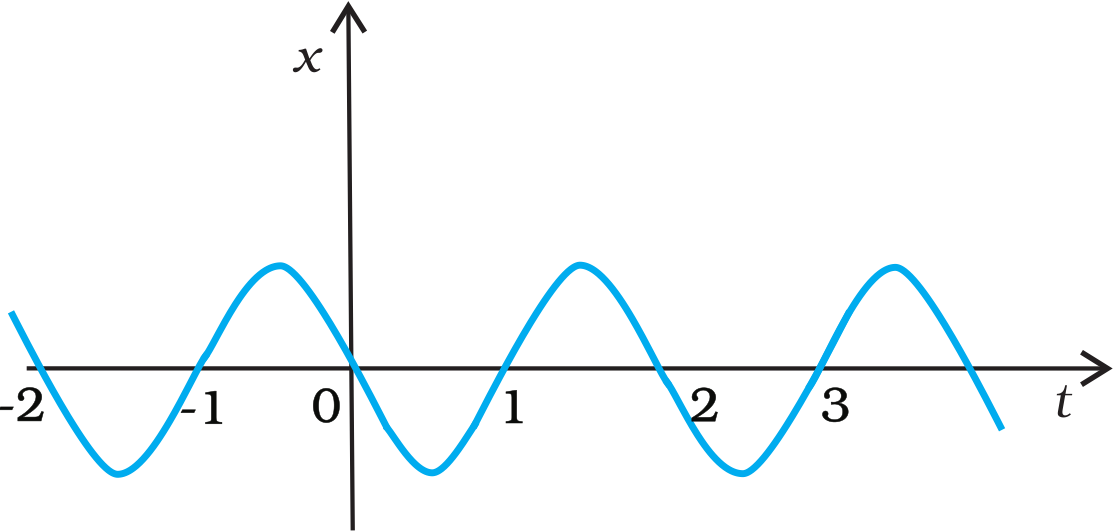
AnswerFor simple harmonic motion (SHM) of a particle, acceleration (a) is given by the relation: $\text{a}=-\omega^2\text{x}$ Where $\omega$ = angular frequency t = 0.3s In this time interval, x is negative. Now the slope of the x-t plot is negative. Therefore, both position and velocity are negative. Acceleration of the particle using (i) will be positive. t = 1.2s In this time interval, x is positive. Now the slope of the x-t plot is positive. Therefore, both position and velocity are positive. Acceleration of the particle using (i) will be negative. t = – 1.2s In this time interval, x is negative. Now the slope of the x-t plot is positive. Therefore, position is negative and velocity is positive. Acceleration of the particle using (i) will be positive.
View full question & answer→Question 215 Marks
A car moving along a straight highway with speed of $126km h^{–1}$ is brought to a stop within a distance of $200m$. What is the retardation of the car (assumed uniform), and how long does it take for the car to stop?
AnswerInitial velocity of the car, $u=126 \mathrm{~km} / \mathrm{h}=35 \mathrm{~m} / \mathrm{s}$ Final velocity of the car, $\mathrm{v}=0$ Distance covered by the car before coming to rest, $\mathrm{s}=200 \mathrm{~m}$ Retardation produced in the car $=$ a From third equation of motion, a can be calculated as: $\mathrm{v}^2-\mathrm{u}^2=2 \mathrm{as}(0)^2-(35)^2=2 \times \mathrm{a} \times 200 \mathrm{a}=-35 \times 35 / 2 \times 200=-3.06 \mathrm{~ms}^{-2}$ From first equation of motion, time $(\mathrm{t})$ taken by the car to stop can be obtained as: $\mathrm{v}=\mathrm{u}+$ at $\mathrm{t}=(\mathrm{v}-\mathrm{u}) / \mathrm{a}=(-35) /(-3.06)=11.44 \mathrm{~s}$
View full question & answer→Question 225 Marks
A stone loses $\frac{1}{10}\text{th}$ of its velocity on passing through a sand bag of length x. For its velocity to be made zero, how many more similar bags are to be placed on its path?
AnswerLet u be the initial velocity Loss in velocity $=\frac{1}{100}\text{u}$ Velocity (final) $=\Big(1-\frac{1}{10}\Big)\text{u}=\frac{9}{10}\text{u}$ Ifr is the length travelled in a bag with retardation 'a', then $\Big(\frac{9}{10}\text{u}\Big)^2=\text{u}^2-2\text{ax}\ \dots(\text{i})$ To make velocity (final) zero, let 'n' bags of same width x be placed. Then, $0=\text{u}^2-2\text{anx}\ \dots(\text{ii})$ Solve (i) and (ii) and we get $\text{n}= 5.2\cong6\text{ bags}$
View full question & answer→Question 235 Marks
Gives the x-t plot of a particle in one-dimensional motion. Three different equal intervals of time are shown. In which interval is the average speed greatest, and in which is it the least? Give the sign of average velocity for each interval.
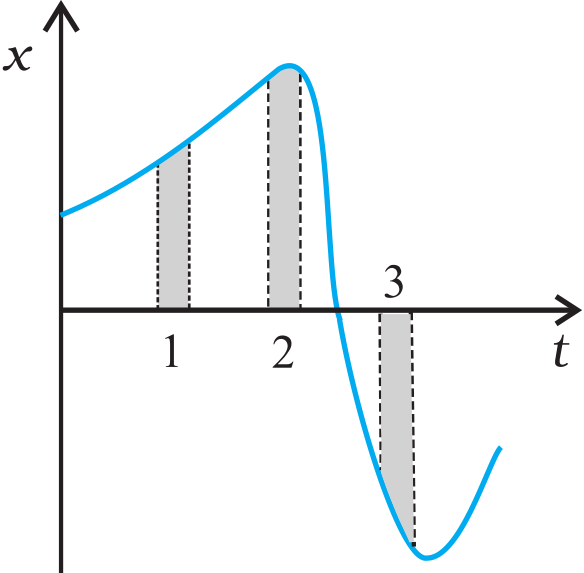
AnswerInterval 3(Greatest), Interval 2(Least) Positive (Intervals 1 & 2), Negative (Interval 3) The average speed of a particle shown in the x-t graph is obtained from the slope of the graph in a particular interval of time. It is clear from the graph that the slope is maximum and minimum restively in intervals 3 and 2 respectively. Therefore, the average speed of the particle is the greatest in interval 3 and is the least in interval 2. The sign of average velocity is positive in both intervals 1 and 2 as the slope is positive in these intervals. However, it is negative in interval 3 because the slope is negative in this interval.
View full question & answer→Question 245 Marks
Refer to the graphs in Fig. Match the following.
|
Graph
|
|
Characteristic
|
|
a.
|
i.
|
has v > 0 and a < 0 throughout.
|
|
b.
|
ii.
|
has x > 0 throughout and has a point with v = 0 and a point with a = 0.
|
|
c.
|
iii.
|
has a point with zero displacement for t > 0.
|
|
d.
|
iv.
|
has v < 0 and a > 0.
|
Answer
|
Graph
|
|
Characteristic
|
|
a.
|
iii.
|
has a point with zero displacement for t > 0.
|
|
b.
|
ii.
|
has x > 0 throughout and has a point with v = 0 and a point with a = 0.
|
|
c.
|
iv.
|
has v < 0 and a > 0.
|
|
d.
|
i.
|
has v > 0 and a < 0 throughout.
|
Explanation:
In graph (a),
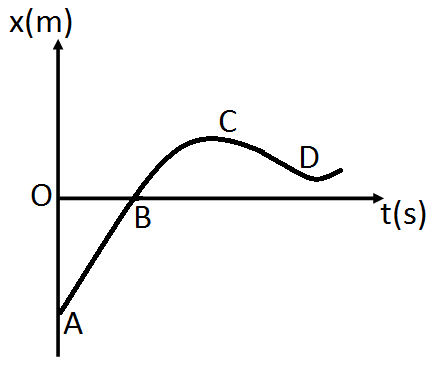
There is a point (B) on the curve for which displacement is zero. So curve, (a) matches with (iii).
In graph (b),
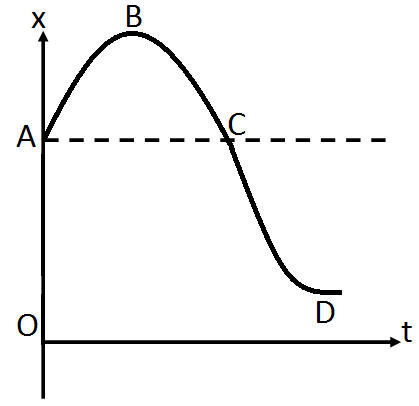
In this graph, x is positive (> 0) throughout and at point B the highest point of curve the slope of curve is zero. It means at
this point $\text{v}=\frac{\text{dx}}{\text{dt}}=0.$ Also at point C the dt
Curvature changes, it means at this point the acceleration of the particle should be zero or a = 0, So curve (b) matches with (ii).
In graph (c),
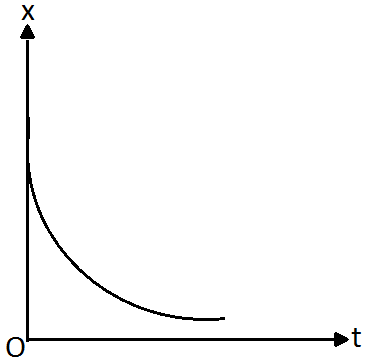
In this graph the slope is always negative, hence velocity will be negative or v < 0. Also x - t graph opens up, it represents positive acceleration. So curve (c) matches with (iv).
In graph (d),
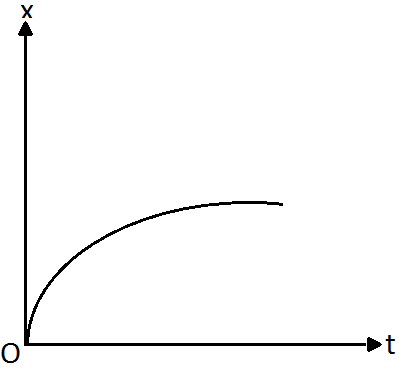
In this graph the slope is always positive, hence velocity will be positive or v > 0. Also x - t graph opens down, it represents negative acceleration. So curve (d) matches with (i). View full question & answer→Question 255 Marks
A boy standing on a stationary lift (open from above) throws a ball upwards with the maximum initial speed he can, equal to $49m s^{–1}$. How much time does the ball take to return to his hands? If the lift starts moving up with a uniform speed of $5m s^{-1}$ and the boy again throws the ball up with the maximum speed he can, how long does the ball take to return to his hands?
AnswerInitial velocity of the ball, u = 49m/s Acceleration, $a = –g = –9.8m/s^2$ Case I: When the lift was stationary, the boy throws the ball. Taking upward motion of the ball, Final velocity, v of the ball becomes zero at the highest point. From first equation of motion, time of ascent (t) is given as: v = u + at t = (v - u)/a = -49/-9.8 = 5s But, the time of ascent is equal to the time of descent. Hence, the total time taken by the ball to return to the boy’s hand = 5 + 5 = 10s. Case II: The lift was moving up with a uniform velocity of 5m/s. In this case, the relative velocity of the ball with respect to the boy remains the same i.e., 49m/s. Therefore, in this case also, the ball will return back to the boy’s hand after 10s.
View full question & answer→Question 265 Marks
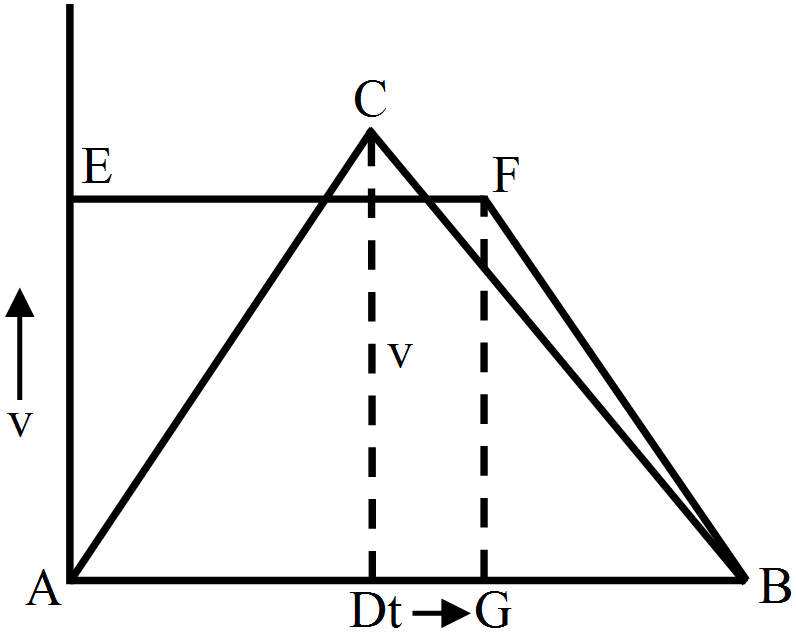
A train passes a station A at $40kmh^{-1}$ and maintains its speed for 7km and is then uniformly retarded, stopping at B which is 8.5km from A. A second train starts from A at the instant the first train passes and being accelerated some part of the journey and uniformly retarded for the rest, stops at B at the same times as the first train. Calculate the maximum speed of the second train, use only the graphical method.
AnswerArea $\text{AEFG}=\text{AE}\times\text{AG}$ $\Rightarrow 7=40\times \text{AG}$ $\text{AG}=\frac{7}{40}\text{h}$ Area FGB gives the distance covered under retardation, it is (8.5 - 7)km = 1.5km Area of $\Delta \text{FGB}=\frac{1}{2}\text{GB}\times \text{FG}$ $\Rightarrow \text{GB}=\frac{2\times1.5}{40}\text{h}$ $=\frac{3}{40}\text{h}$ Total time $=\Big(\frac{7}{40}+\frac{3}{40}\Big)\text{h}=\frac{1}{4}\text{h}$ Area of $\Delta \text{ACB}=\frac{1}{2}\times \text{AB}\times \text{CD}$ $8.5=\frac{1}{2}\times\frac{1}{4}\times \text{v}$ $\text{v}=8.5\times8\text{kmh}^{-1}=68\text{kmh}^{-1}$
View full question & answer→Question 275 Marks
An object is moving along $x-$axis in such a way that its displacement is given by $x = 30 + 20t^2$
where $x$ is in metres and $t$ is in seconds.
- Find the velocity and acceleration.
- What are the initial position and the velocity of the object?
AnswerGiven $\text{x}=30+20\text{t}^2\ \dots(\text{i})$
- Differentiating eqn. $\text{(r) w.r.t. 't'}$, we get
$\frac{\text{dx}}{\text{dt}}=\text{v}=\frac{\text{d}}{\text{dt}}(30+20\text{t}^2)$
$=\frac{\text{d}}{\text{dx}}(30)+\frac{\text{d}}{\text{dt}}(20\text{t}^2)$
$=0+20\times2\text{t}$
$\text{v}=40\text{t}\text{ms}^{-1}\ \dots(\text{ii}) $
Now, differentiating eqn $\text{(ii) w.r.t. 't'}$, we get
$\frac{\text{dv}}{\text{dt}}=\text{a}=\frac{\text{d}}{\text{dt}}(40\text{t})\text{s}$
$=40\times1=40\text{ms}^{-2}$
- Put $t = 0$ in eqn. $(i)$, we get the initial position
$\therefore $ Initial position, $x_0 = 30m$
Putting $t = 2$ in eqn. $(ii)$, we get the initial velocity
$\therefore $ Initial velocity, $u = 40 \times 0 = 0$ View full question & answer→Question 285 Marks
If a body moving with uniform acceleration in straight line describes successive equal distance in time interval $t_1, t_2$ and $t_3$, then show that $\frac{1}{\text{t}_1}-\frac{1}{\text{t}_2}+\frac{1}{\text{t}_3}=\frac{3}{\text{t}_1+\text{t}_2+\text{t}_3}$
AnswerAs shown in figure, let three succesive qual distances be represented by AB, BC, and CD
\
Let each distance be x m. Let $v_A, v_B, v_C$ and $v_D$ be the velocities at points A, B, C and D respectively. Average velocity between A and B $=\frac{\text{v}_\text{A}+\text{v}_\text{B}}{2}$
$\frac{\text{v}_\text{A}+\text{v}_\text{B}}{2}\times\text{t}_1=\text{x}$
$\Rightarrow \text{v}_\text{A}+\text{v}_\text{B}=\frac{2\text{x}}{\text{t}_1}$ Similarly, $\text{v}_\text{B}+\text{v}_\text{C}=\frac{2\text{x}}{\text{t}_2}$
$\Rightarrow \text{v}_\text{C}+\text{v}_\text{D}=\frac{2\text{x}}{\text{t}_3}$ Average velocity between A and D $=\frac{\text{v}_\text{A}+\text{v}_\text{D}}{2}$
$\therefore \frac{\text{v}_\text{A}+\text{v}_\text{D}}{2}(\text{t}_1+\text{t}_2+\text{t}_3)=\text{x}+\text{x}+\text{x}$
$\text{v}_\text{A}+\text{v}_\text{D}=\frac{6\text{x}}{\text{t}_1+\text{t}_2+\text{t}_3}$ Hence, $\text{v}_\text{A}+\text{v}_\text{D}=(\text{v}_\text{A}+\text{v}_\text{B})-(\text{v}_\text{B}+\text{v}_\text{C})+(\text{v}_\text{C}+\text{v}_\text{D})$
$=\frac{6\text{x}}{\text{t}_1+\text{t}_2+\text{t}_3}=\frac{2\text{x}}{\text{t}_1}-\frac{2\text{x}}{\text{t}_2}+\frac{2\text{x}}{\text{t}_3}$
$=\frac{3}{\text{t}_1+\text{t}_2+\text{t}_3}=\frac{1}{\text{t}_1}-\frac{1}{\text{t}_2}+\frac{1}{\text{t}_3}$ View full question & answer→Question 295 Marks
Derive the position$-$velocity relation for uniformly accelerated motion from $v-t$ graph. $OR$
- Acceleration is defined as the rate of change of velocity. Suppose we call the rate of change of acceleration as $\text{SLAP}$, then what is the unit of $\text{SLAP}$?
- A body travels a distance $s_1$ with velocity $v_1$ and distance $s_2$ with velocity $v_2$ in the same direction. Calculate the average velocity of the body.
AnswerPosition$-$velocity relation: Consider an object, moving with a uniform acceleration a along a straight line $OX$, with origin at $0$.
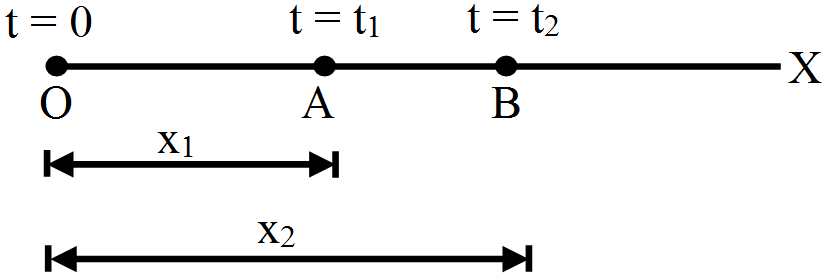
Let the object reach at points $A$ and $B$ at instants $t_1$ and $t_2$.
Let $x_1$ and $x_2$ be the displacements of the objects at time $t_1$ and $t_2$ respectively and $v_1$ and $v_2$ be the velocities of the object at positions $A$ and $B$ respectively.
Acceleration of the object $=\frac{\text{Change in velocity}}{\text{time taken}}$
$\text{a}=\frac{\text{v}_2-\text{v}_1}{\text{t}_2-\text{t}_1}$
$\Rightarrow \text{v}_2-\text{v}_1=\text{a}(\text{t}_2-\text{t}_1)$
$\Rightarrow\text{t}_2-\text{t}_1=\frac{(\text{v}_2-\text{v}_1)}{\text{a}}\ \dots(\text{i})$
From position$-$time relation,
we have $\text{x}_2-\text{x}_1=\Big(\frac{\text{v}_1-\text{v}_2}{2}\Big)(\text{t}_2-\text{t}_2)\ \dots(\text{ii})$
Substituting the value of $(t_2 - t_1)$ in the above equation $(ii)$,
we get $\text{x}_2-\text{x}_1=\Big(\frac{\text{v}_2+\text{v}_1}{2}\Big)\Big(\frac{\text{v}_2-\text{v}_1}{\text{a}}\Big)=\frac{\text{v}^2_2-\text{v}^2_1}{2\text{a}}$
$\text{v}^2_2-\text{v}^2_1=2\text{a}(\text{x}_2-\text{x}_1)\ \dots(\text{iii})$
If $u$ and $v$ are the velocities of an object at position $x_0$ and $x$ respectively,
then using $v_1 = u, v_2= v, x_1 = x_0$ and $x_2 = x$ in $(iii)$,
we get $\text{v}^2-\text{u}^2=2\text{a}(\text{x}_0-\text{x})\ \dots(\text{iv})$ If $\text{x}_0-\text{x}=\text{s},$
then $\text{v}^2-\text{u}^2=2\text{as}$
The above equation is the required position velocity relation.Alternate answer
- Given $\text{SLAP} =\frac{\text{Change in acceleration}}{\text{time taken}}$
Unit of $\text{SLAP} =\frac{\text{ms}^{-2}}{\text{s}}=\text{ms}^{-3}$
- Given: distanve $-\text{s}_1,\text{s}_2$
Velocities $-\text{v}_1,\text{v}_2$
$\because \text{v}=\frac{\text{s}}{\text{t}}$
$\therefore \text{t}_1=\frac{\text{s}_1}{\text{v}_1},\text{t}_2=\frac{\text{s}_2}{\text{v}_2}$
Total time, t $=\text{t}_1+\text{t}_2=\frac{\text{s}_1}{\text{v}_1}+\frac{\text{s}_2}{\text{v}_2}$
Total distance, $\text{s}=\text{s}_1+\text{s}_2$
$\therefore$ Average velocity $(\text{v}_\text{avg})=\frac{\text{s}}{\text{t}}$
$\Rightarrow \text{v}_\text{avg}=\frac{\text{s}_1+\text{s}_2}{\frac{\text{s}_1}{\text{v}_1}+\frac{\text{s}_2}{\text{v}_2}}$ View full question & answer→Question 305 Marks
Two trains each having a speed of $30\ km/ hr$ are headed at each other on the same track. A bird that can fly at $60\ km/ hr$ flies off from one train, when they are $60\ km$ apart, and heads directly for the other train. On reaching the other train, it flies directly back to the first, and so forth.
- How many trips can the bird make from one train to the other before they crash?
- What is the total distance the bird travels?
Answer
- Relative velocity of one train $\text{w.r.t.}$ the other
$= 30 + 30 = 60\ Km/ hr$
Distance between two trains $= 60\ km.$
$\therefore$ Time to meet the two trains
$\frac{60}{60}=1\text{hr}.\ \dots(\text{i})$
The speed of the bird relative to the train towards which it flies
$=60+30=90\text{km/ h}$
$\therefore$ Time taken for the $1^{st}$ trip,
$\text{t}_1=\frac{60}{90}=\frac{2}{3}\text{hr.}\ \dots(\text{ii})$
The separation between the trains after the $1^{st}$ trip
$=60-60\times\frac{2}{3}=20\text{km}$
$\therefore$ Time taken for the $2^{nd}$ trip,
$\text{t}_2=\frac{20}{90}=\frac{2}{3^2}\text{hr}.\ \dots(\text{iii})$
The separation between the train after the $2^{nd}$ trip
$=20-60\times\frac{2}{3^2}=\frac{60}{3^2}\text{km}.$
$\therefore$ Time taken for the $3^{rd}$ trip
$\text{t}_3=\frac{60}{3^2\times90}=\frac{2}{3^3}\text{hr}\ \dots(\text{iv})$
Similarly, $\text{t}_\text{n}=\frac{2}{3\text{n}}\text{hr}.$
But, $\text{t}_1+\text{t}_2+\text{t}_3+\text{t}_4+...+\text{t}_\text{n}=1 [$From $(i)]$
$2\Big[\frac{1}{3}+\frac{1}{3^2}+\frac{1}{3^3}+...+\frac{1}{3^\text{n}}\Big]=1$
$\frac{2}{3}\frac{\Bigg[1-\Big(\frac{1}{3}\Big)^\text{n}\Bigg]}{\Big(1-\frac{1}{3}\Big)}=1$
$1-\Big(\frac{1}{3}\Big)^\text{n}=1$
$\Big(\frac{1}{3}\Big)^\text{n}=0$
$\Rightarrow$ Number of trips, $n =$ infinite.
- Total distance travelled by the bied $= 60 \times 1$
$= 60\ km.$ View full question & answer→Question 315 Marks
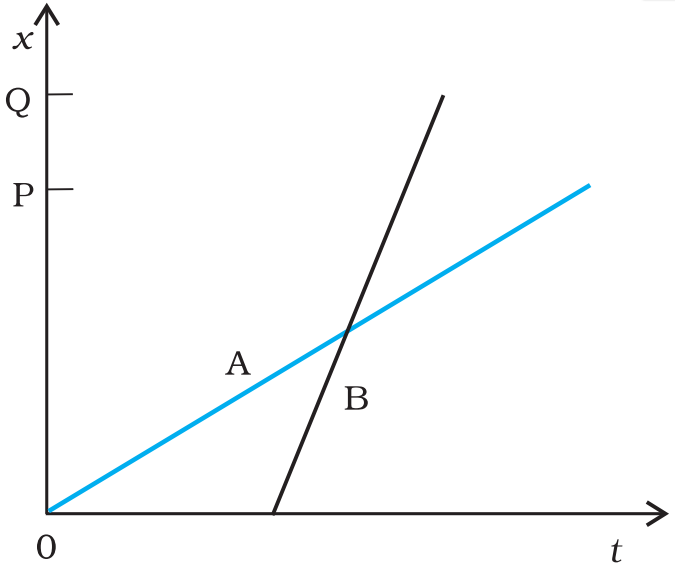
The position$-$time $(x-t)$ graphs for two children $A$ and $B$ returning from their school $O$ to their homes $P$ and $Q$ respectively are shown in Choose the correct entries in the brackets below;
- $(A/B)$ lives closer to the school than $(B/A)$.
- $(A/B)$ starts from the school earlier than $(B/A)$.
- $(A/B)$ walks faster than $(B/A)$.
- A and B reach home at the $($same$/$different$)$ time.
- $(A/B)$ overtakes $(B/A)$ on the road $($once$/$twice$)$.
Answer
- As $OP < OQ, A$ lives closer to the school than $B.$
- For $x = 0, t = 0$ for $A;$ while t has some finite value for $B$. Therefore, $A$ starts from the school earlier than $B$.
- Since the velocity is equal to slope of $x-t$ graph in case of uniform motion and slope of $x-t$ graph for $B$ is greater that that for $A =$, hence $B$ walks faster than $A$.
- It is clear from the given graph that both $A$ and $B$ reach their respective homes at the same time.
- $B$ moves later than $A$ and his/ her speed is greater than that of $A$. From the graph, it is clear that Bovertakes $A$ only once on the road.
View full question & answer→Question 325 Marks
A train starts from a station P with a uniform acceleration a, for some distance and then goes with the uniform retardation $a_1$ for some more distance to come to rest at the station Q. The distance between the stations P and Q is $4km$ and the train takes $4 minutes$ to complete this journey. If the accelerations are in km per $min^2$. Show that $\frac{1}{\text{a}_1}+\frac{1}{\text{a}_2}=2.$
AnswerSuppose the train moves from P to R with uniformacceleration a, and then from R to Q with retardation $a_2$. Taking $PR = S_1$ and $RQ = S_2$ and $t_1, t_2$ be the times taken for these two parts respectively, we can write, $S_1 + S_2 = 4km, t_1 + t_2 = 4 min$ For the part PR, We can write $\text{S}_1=\Big(\frac{\text{u}+\text{v}}{2}\Big)\text{t}_1\ \dots(\text{i})$ For the part RQ, we can write $\text{S}_2=\Big(\frac{\text{u}+\text{v}}{2}\Big)\text{t}_2\ \dots(\text{ii})$ From (i) and (ii), we have, $\text{S}_1+\text{S}_2=\frac{1}{2}\text{v}(\text{t}_1+\text{t}_2)$ [Since u = v_1 = 0] $4=\frac{1}{2}\text{v}\times4 $ or $\text{v}=2\text{km/ min}$ Also, $\text{v}=0+\text{a}_1\text{t}_1$ and $0=\text{v}-\text{a}_2\text{t}_2$
$\text{t}_1=\frac{\text{v}}{\text{a}_1}$
$\text{t}_2=\frac{\text{v}}{\text{a}_2}$
$\therefore \frac{1}{\text{a}_1}=\text{t}_1$
$\frac{2}{\text{a}_2}=\text{t}_2$
$\frac{2}{\text{a}_1}+\frac{2}{\text{a}_2}=\text{t}_1+\text{t}_2=4$
$\frac{1}{\text{a}_1}+\frac{1}{\text{a}_2}=2$ Thus, $\frac{1}{\text{a}_1}+\frac{1}{\text{a}_2}=2,$ which is the required relation.
View full question & answer→Question 335 Marks
A ball is thrown upward with an initial velocity of $100m/s$. After how much time will it return? Draw velocity$-$time graph for the ball and find from the graph.
- Maximum height attained by ball.
- Height of the ball after $15s$. Take, $g = 10ms^{-2}$
AnswerHere, $u = 100ms^{-1}, g = -10ms^{-1}$ At highest point, $v = 0$ As $v = u + gt $
$\Rightarrow 0 = 100 - 10 \times t$
$\therefore$ Time taken to reach highest point $\text{t}=\frac{100}{10}=10\text{s}$
The ball will return to the ground at $t = 20 s.$ Velocities of the ball at different instants of time will be as follows.
At $t = 0, v = 100 - 10 \times 0 = 100ms^{-1}$
At $t = 5s, v = 100 - 10 \times 5 = 50ms^{-1}$
At $t = 10s, v = 100 - 10 \times 10 = 0$
At $= 15s, v = 100 - 10 \times 15 = -50ms^{-1}$
At $t = 20s, v = 100 - 10 \times 20 = -100ms^{-1}$
The velocity time$-$graph will be as shown in figure.
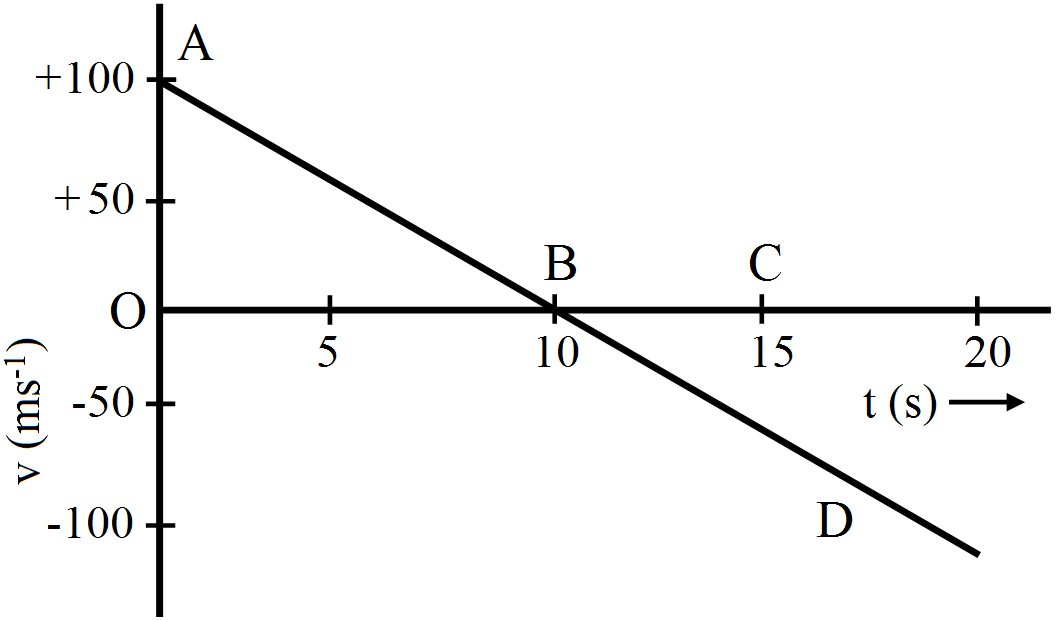
- Maximm height attained by ball $=$ Area of $\Delta \text{AOB}$
$=\frac{1}{2}\times10\text{s}\times100\text{ms}^{-1}=500\text{m}$
- Height attained after $15s =$ Area of $\Delta\text{AOB} +$ Area of $\Delta \text{BCD}$
$=500+\frac{1}{2}(15-10)\times(-50)$
$=500-125=375\text{m}$ View full question & answer→Question 345 Marks
If $x, y$ and $z$ are distances moved by a particle moving with a constant acceleration during the $l^{th}, m^{th}$ and $n^{th}$ second of its motion respectively. Show that, $x(m - n) + y(n - l) + z(l - m) = 0$
AnswerDistance covered in $l^{th}$ second, $\text{x}=\text{u}+\frac{\text{a}}{2}(2\text{l}-1)\ \dots(\text{i})$ Distance covered in $m^{th}$ second, $\text{y}=\text{u}+\frac{\text{a}}{2}(2\text{m}-1)\ \dots(\text{ii})$ Subtracting equation (ii) from (i) $\text{x}-\text{y}=\frac{\text{a}}{2}\times2(\text{l}-\text{m})=\text{a}(\text{l}-\text{m})$
$(\text{x}-\text{y})\text{z}=\text{a}(\text{l}-\text{m})\text{z}\ \dots(\text{iii})$ Distance covered in $n^{th}$ second, $\text{z}=\text{u}+\frac{\text{a}}{2}(2\text{n}-1)\ \dots(\text{iv})$ Subtracting equation (iv) from (ii), we get $\text{y}-\text{z}=\frac{\text{a}}{2}\times2(\text{m}-\text{n})=\text{a}(\text{m}-\text{n})$
$(\text{y}-\text{z})\text{x}=\text{a}(\text{m}-\text{n})\times\text{x}\ \dots(\text{v})$ and $\text{z}-\text{x}=\text{a}(\text{n}-\text{l})$
$(\text{z}-\text{x})\text{y}=\text{a}(\text{n}-\text{l})\text{y}\ \dots(\text{vi})$ By adding equations (iii), (v) and (vi), we get $\text{z}(\text{x}-\text{y})+\text{x}(\text{y}-\text{z})+\text{y}(\text{z}-\text{x})$
$=\text{a}[(\text{l}-\text{m})\text{z}+(\text{m}-\text{n})\text{x}+(\text{n}-\text{l})\text{y}]$
$\Rightarrow 0=\text{a}[(\text{m}-\text{n})\text{x}+(\text{n}-\text{l})\text{y}+(\text{l}-\text{m})\text{z}]$
$\text{x}(\text{m}-\text{n})+\text{y}(\text{n}-\text{l})+\text{z}(\text{l}-\text{m})=0$
View full question & answer→Question 355 Marks
A car accelerates from rest at a constant rate α for some time, after which it decelerates at a constant rate $\beta$ to come to rest. If t is the total time elapsed, then calculate.
- The maximum velocity attained by the car.
- The total distance travelled by the car.
Answer
- Let the car accelerate at a rate $\alpha$ for time $t_1$ and attain a maximum velocity $v$. Then the car decelerates at a constant rate $\beta$ for remaining time $(t - t_1)$ and again comes to rest. Then from adjoining figure, it is clear that
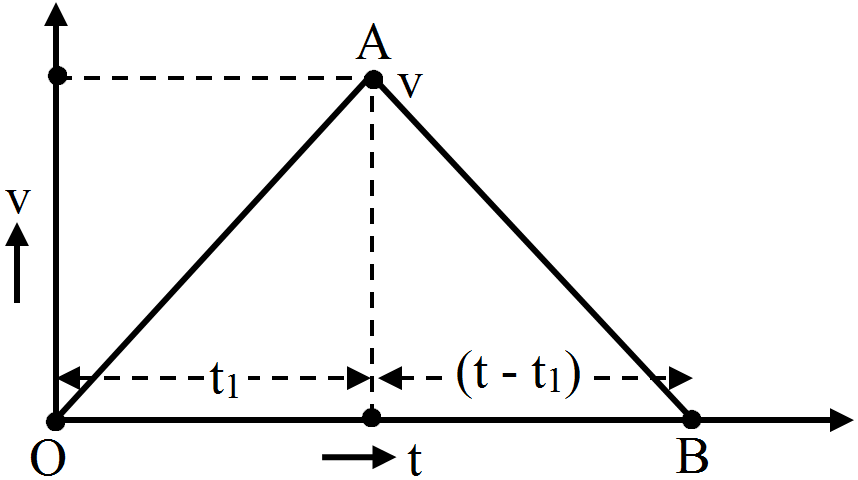
$\text{v}=\alpha\text{t}_1=\beta(\text{t}-\text{t}_1)$
$\therefore \text{t}_1=\frac{\text{v}}{\alpha}$
$(\text{t}-\text{t}_1)=\frac{\text{v}}{\beta}$
Adding these two, we have
$\text{t}=\frac{\text{v}}{\alpha}+\frac{\text{v}}{\beta}=\text{v}\Big(\frac{\alpha+\beta}{\alpha\beta}\Big)$
$\Rightarrow \text{v}=\frac{\alpha\beta\text{t}}{(\alpha+\beta)}$
- Total distance travelled by the car $s =$ area $\text{OAB} =\frac{1}{2}(\text{t})\times(\text{v})$
$\therefore \text{s}=\frac{1}{2}\text{t}\times\frac{\alpha\beta\text{t}}{(\alpha+\beta)}$
$=\frac{1}{2}\frac{\alpha\beta}{(\alpha+\beta)}\text{t}^2$ View full question & answer→Question 365 Marks
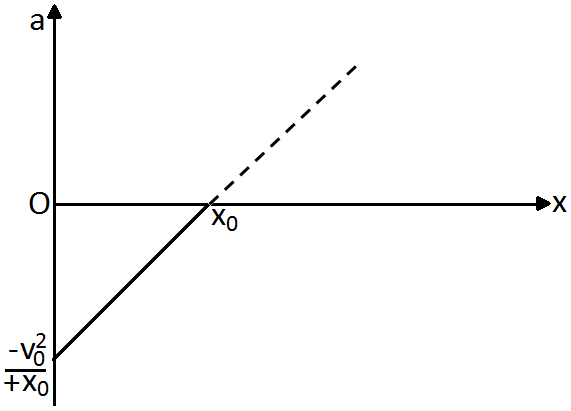
The velocity$-$displacement graph of a particle is shown in Fig.
- Write the relation between $v$ and $x$.
- Obtain the relation between acceleration and displacement and plot it.
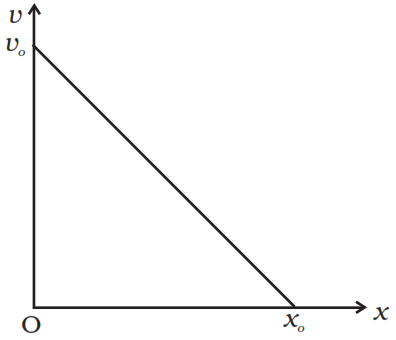
AnswerIn this problem, we will use equation of straight line graph $($linear equation$). y = mx + c$. In this equation, $m$ is the slope of the graph and $c$ is the interception on $y-$axis.
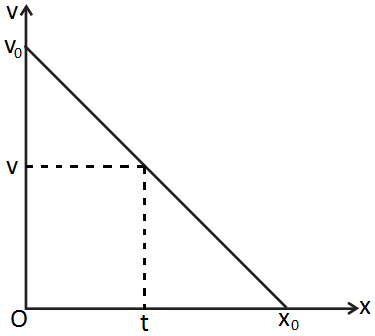
Now according to the problem, initial velocity $= v_0$ Let the distance travelled in time $t = x_0$. For the graph $\tan\theta=\frac{\text{v}_0}{\text{x}_01}=\frac{\text{v}_0-\text{v}}{\text{x}}\ \ ...(\text{i})$ where, $v$ is velocity and $x$ is displacement at any instant of time $t.$ From Eq. $(i), \text{v}_0-\text{v}=\frac{\text{v}_0}{\text{x}_0}\text{x} $
$\Rightarrow\text{v}=\frac{-\text{v}_0}{\text{x}_0}\text{x}+\text{v}_0$ We know that Acceleration $\text{a}=\frac{\text{dv}}{\text{dt}}=\frac{-\text{v}_0}{\text{x}_0}\frac{\text{dx}}{\text{dt}}+0$
$\Rightarrow\text{a}=\frac{-\text{v}_0}{\text{x}_0}(\text{v})$ $=\frac{-\text{v}_0}{\text{x}_0}\Big(\frac{-\text{v}_0}{\text{x}_0}\text{x}+\text{v}_0\Big)=\frac{\text{v}_0^2}{\text{x}_0^2}\text{x}-\frac{\text{v}_0^2}{\text{x}_0}$ Graph of a versus $x$ is given below.
View full question & answer→Question 375 Marks
A ball of mass $100g$ is projected vertically upwards from the ground with a velocity of $49m/s$. At the same time another identical ball is dropped from a height of $98m$ to fall freely along the same path as followed by the first ball. After sometime, the two balls collide and stick together and finally fall together. Find the time of flight of the masses.
Answer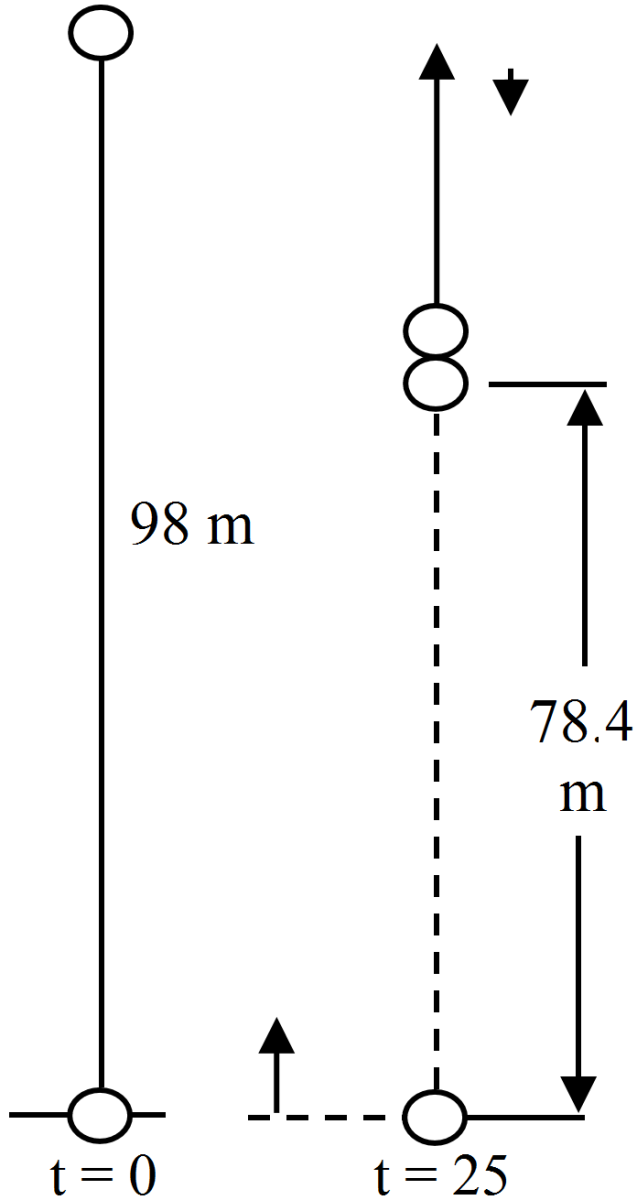
We first find when and where the two balls collide. Let them collide at an instant t seconds after they start their respective motion. Clearly the two balls are at the same height above the ground at this instant. The height of the first ball after t seconds $=49\text{t}-\frac{1}{2}\times9.8\text{t}^2$
$=4.9\text{t}(10-\text{t})$ Also the height of the second ball after t seconds = 98 - downward distance moved by it in t seconds. $=98-\frac{1}{2}\times9.8\text{t}^2=4.9(20-\text{t}^2)\text{s}$
$\therefore 4.9\text{t}(100-\text{t})=4.9(20-\text{t}^2)$
$10\text{t}-\text{t}^2=20-\text{t}^2$
$\text{t}=2\text{s}$ The balls thus collide two seconds after the start of their motion. Their velocities at this instant are First ball: $\text{v}_1=(49-9.8\times2)\text{m/s}$
$=29.4\text{m/s}$ directed upwards Second ball: $\text{v}_2=(0+9.8\times2)\text{m/s} $
$=19.6\text{m/s}$ directed downwards If v is the velocity of the combined mass of the two balls after they stick together following their collision, we have, by principle of conservation of momentum. $200\times\text{v}=100\times29.4-100\times19.6$
$\therefore \text{v}=4.9\text{m/s}$ The 'combined mass' thus moves upward, after collision with a velocity of 4.9m/s. Its height above the ground at this instant is considering the position of either of the two balls before collision) $\Big(98-\frac{1}{2}\times9.8\times2^2\Big)\text{m}$
$=(98-19.6)\text{m}$
$=78.4\text{m}$ We can now find the time t' taken by the ‘combined mass’ of the two balls to fall to ground. We have for this 'combined mass', $u = 4.9m/s, s = -78.4m, a = -g = -9.8ms^{-2}$
^ $\therefore -78.4=4.9\text{t}'+\frac{1}{2})(-9.8)\text{t}'^2$
$\text{t}'^2-\text{t}'-16=0$
$\therefore \text{t}'=\frac{1\pm\sqrt{1+64}}{2}=\frac{1\pm8.06}{2}$
$=4.532\text{s}$ (leaving out the negative solution) The 'combined mass' thus takes 4.53s to fall to the ground. Since the balls collided 2s after they started their motion, their total time of flight is (2 + 4.53)s = 6.53s. View full question & answer→Question 385 Marks
A point object is thrown vertically upwards at such a speed that it returns to the thrower after 6 seconds. With what speed was it thrown up and how high did it rise? Plot speed time graph for the object and use it to find the distance travelled by it in the last second of its journey.
Answer$\text{v}=\text{u}+\text{at}$ with $\text{v}=-\text{u},\text{a}=-9.8\text{m/s}^2$ $\text{t}=6\text{s}$ $\therefore \text{u}=29.4\text{m/s}$ 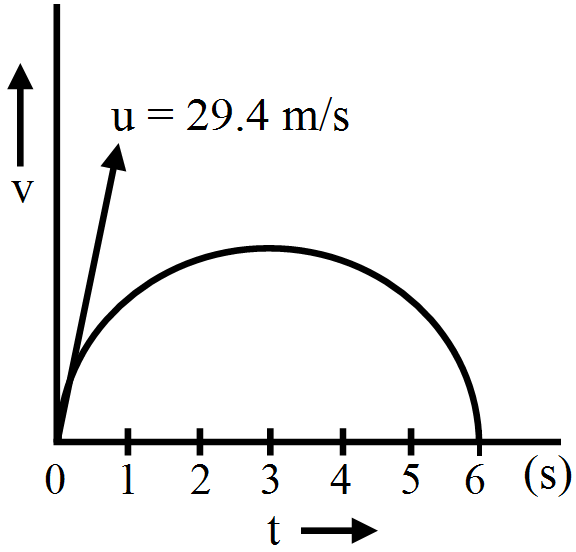 Time of ascent + Time of descent = 6s $\text{t}_1+\text{t}_2=6\text{s}$ and $\text{t}_1=\text{t}_2=\text{t}$ $\text{s}=\text{ut}+\frac{1}{2}\text{at}^2$ $\text{t}=3\text{s}$ $\text{s}=(29.4\text{m/s})(3\text{s})+\frac{1}{2}(-9.8\text{m/s}^2)(3)^2$ $=88.2\text{m}-44.1\text{m}$ $=44.1\text{m}$ Distance travelled by it in last second = area under the curve = 24.5m.
 View full question & answer→Question 395 Marks
A ball is dropped and its displacement vs time graph is as shown Fig. $($displacement $x$ is from ground and all quantities are $+ve$ upwards$)$.
- Plot qualitatively velocity vs time graph.
- Plot qualitatively acceleration vs time graph.
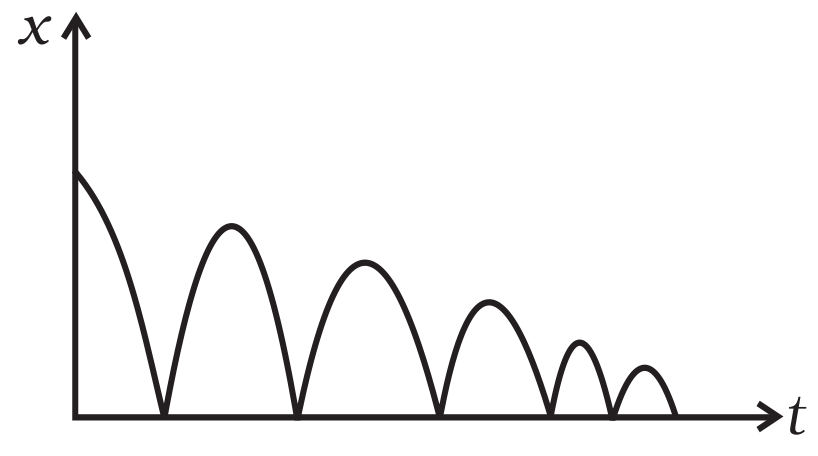
AnswerKey concept: To calculate velocity we will find slope which is calculated by $\frac{\text{dx}}{\text{dt}}$ for displacement time curve and to find acceleration we will find slope $\frac{\text{dV}}{\text{dt}}$ of velocity times curve. Sign convention : We are taking downward as negative and upward as positive. Ball is bouncing on the ground and it is clear from the graph that displacement $x$ is positive throughout. Ball is dropped from a height and its velocity increases in downward direction due to gravity pull. In this condition $v$ is negative but accleration of the ball is equal to acceleration due to gravity i.e., $a = -g.$ When ball rebounds in upward direction its velocity is positive but acceleration is $a = -g$. The velocity$-$time graph of the ball is shown in fig. 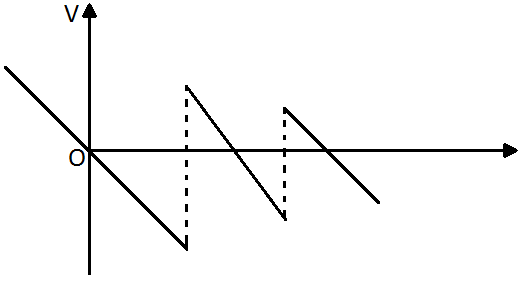 The acceleration$-$time graph of the ball is shown in fig.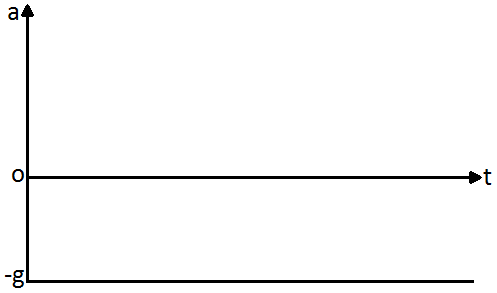
View full question & answer→Question 405 Marks
Derive an equation for the distance covered by a uniformly accelerated body in $n^{th}$ second of its motion. A body travels half its total path in the last second of its fall from rest. Calculate the time of its fall.
AnswerFor a body having a uniform acceleration ‘a’ in a straight line, starting with an initial velocity u, the displacement in ‘n’ seconds is given by, $\text{S}_\text{n}=\text{nu}+\frac{1}{2}\text{an}^2$ In (n - 1) seconds, $\text{S}_{\text{n}-1}=(\text{n}-1)\text{u}+\frac{1}{2}\text{a}(\text{n}-1)^2$
$\therefore$ Displacement in $n^{th}$ secound $=\text{S}_\text{n}-\text{S}_{\text{n}-1}$ Let S be the complere length of fall and t be the time taken for it. Then, $\text{S}=\frac{1}{2}\text{gt}^2$
$(\because \text{u}=0)\ \dots(\text{i})$ Also, $\frac{\text{S}}{2}$ is covered in the last second.
$\therefore \frac{\text{S}}{2}=0+\frac{\text{g}}{2}(2\text{t}-1)\ \dots(\text{ii})$ Using (i) and (ii), solve for t to be, $\text{S}=\text{g}(2\text{t}-1)=\frac{1}{2}\text{gt}^2,$ i.e., $4\text{tg}-2\text{g}=\text{gt}^2$
$\text{gt}^2-4\text{tg}+2\text{g}=0$
$\Rightarrow \text{t}^2-4\text{t}+2=0$ i.e., $\text{t}=\frac{4\pi\sqrt{16-8}}2{}=\frac{4\pm2\sqrt{2}}{2}$
$\text{t}=2\pm\sqrt{2}$
View full question & answer→Question 415 Marks
A body covers $12m$ in $2^{nd}$ second and $20m$ in $4^{th}$ second. Find what distance the body will cover in $4$ second after $5^{th}$ second.
Answer12m in $2^{nd}$^ second i.e., $12=\text{u}+\frac{\text{a}}{2}(2.2-1)$ 20m in $4^{th}$ second $20=\text{u}+\frac{\text{a}}{2}(2.4-1)$ i.e., $2\text{u}+3\text{a}=24\ \dots(\text{i})$
$2\text{u}+7\text{a}=40\ \dots(\text{ii})$ Solving, $-4\text{a}=-16$
$\Rightarrow \text{a}=4\text{ms}^{-2},$
$\text{u}=\frac{40-7\times4}{2}=\frac{12}{2}$
$=6\text{ms}^{-1}$ Distance covered in 4 second after $5^{th}$ second. $\text{S}=\text{S}_9-\text{S}_5$
$=9\text{u}+\frac{1}{2}\text{a}9^2-\Big(5\text{u}+\frac{1}{2}\text{a}5^2\big)$
$=9\text{u}+\frac{1}{2}\text{a}81-5\text{u}-\frac{1}{2}\text{a}25$
$\Rightarrow \text{S}=4\text{u}+\frac{1}{2}\text{a}56$
$=4\times6+\frac{1}{2}\times4\times56$
$=24+112=136\text{m}$
View full question & answer→Question 425 Marks
A car travels $30km$, at a uniform speed of $40km/ h^{-1}$ and the next $30km$ at a uniform speed of $20km/ h^{-1}$. Find its average speed.
AnswerHere, In the first case, Distance travelled, $x_1 = 30km$ Speed of car, $v_1 = 40km/ h-1$ Time, $t_1$ = ? (to be calculater) From relation, Speed $=\frac{\text{Distance}}{\text{Time}}$ We have, Time $=\frac{\text{Distance}}{\text{Speed}}$ i.e., $\text{t}_1=\frac{\text{x}_1}{\text{v}_1}$ Substituting verious values, we get, $\text{t}_1=\frac{30\text{km}}{40\text{km/ h}^{-1}}=\frac{3}{4}\text{h}$
$=0.75\text{h}$ In second case, $x_2 = 30km v_2 = 20km/ h^{-1} t_2$ = ? (to be calculated) As, $\text{t}_2=\frac{\text{x}_2}{\text{v}_2}$
$\therefore$ Substituting various values, we get, $\text{t}_2=\frac{20\text{km}}{20\text{km/ h}^{-1}}=\frac{3}{2}\text{h}$
$=1.5\text{h}$ Now total distance travelled, $\text{x}=\text{x}_1+\text{x}_2$
$=(30+30)\text{km}$
$=60\text{km}$ Total time taken $\text{t}=\text{t}_1+\text{t}_2=\Big(\frac{3}{4}+\frac{3}{2}\Big)\text{h}$
$(0.75+1.5)\text{h}=\frac{9}{4}\text{h}$
$=2.25\text{h}$
$\therefore$ Average speed $=\frac{\text{Total distance travelled}}{\text{Total time taken}}$ Substituting various values, we get, $\text{v}_{\text{av}}=\frac{60\text{km}}{\Big(\frac{9}{4}\Big)\text{h}}=\frac{60\times4}{9}\text{km/ h}^{-1}$
$=\frac{80}{3}\text{km/ h}^{-1}$
$\text{v}_{\text{av}}=26.7\text{km/ h}^{-1}$
View full question & answer→Question 435 Marks
A train takes $4 min$ to go between stations $2.25km$ apart starting and finishing at rest. The acceleration is uniform for the first $40s$ and the deceleration is uniform for the last $20s$. Assuming the velocity to be constant for the remaining time, calculate the maximum speed, acceleration and retardation, use only the graphical method.
AnswerThe velocity-time graph of the train's motion is shown in the following figure
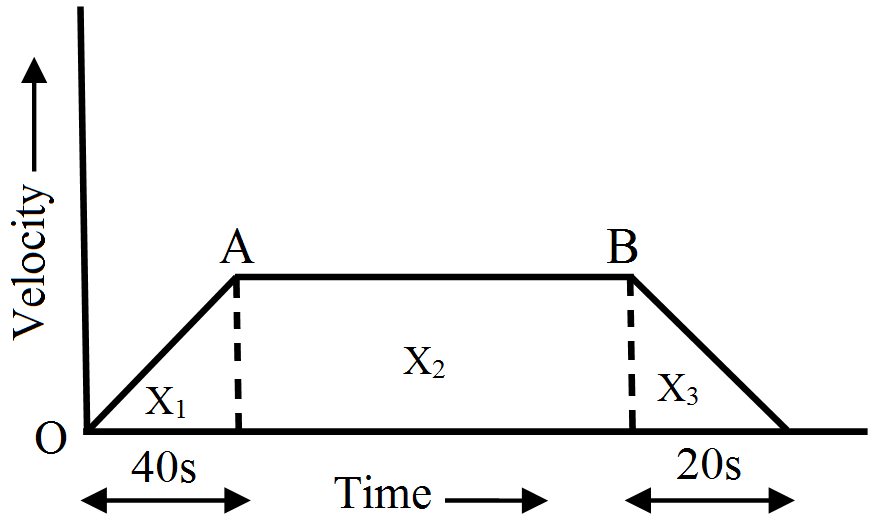
Let v represents the maximum speed of the train if $x_1$ be the distance covered during the first 40s, then $\frac{\text{v}}{2}\times40=\text{x}_1$ $\text{x}_1=20\text{v}$ Since total time is 4 min, i.e. 240s therefore, the time corresponding to velocity-time graph AB is (240 - 40 - 20)s i.e. 180s. If $x_2$ be the distance covered during this time, then $x_2 = 180v$. If $x_3$ be the distance covered during the last 20s, then $\text{x}_3=\frac{\text{v}}{2}\times20=10\text{v}$ Now, $\text{x}_1+\text{x}_2+\text{x}_3$ $=20\text{v}+180\text{v}+10\text{v}$ $\text{v}=\frac{225}{21}\text{ms}^{-1}=10.7\text{ms}^{-1}$ Acceleration $=\frac{\text{v}}{40}=\frac{10.7}{40}\text{ms}^{-2}=0.2675\text{ms}^{-2}$ Retardation $=\frac{\text{v}}{20}=\frac{10.7}{20}\text{ms}^{-2}=0.535\text{ms}^{-2}$ View full question & answer→Question 445 Marks
A woman starts from her home at $9.00$ am, walks with a speed of $5km h^{–1}$ on a straight road up to her office $2.5km$ away, stays at the office up to $5.00$ pm, and returns home by an auto with a speed of $25km h^{–1}$. Choose suitable scales and plot the x-t graph of her motion.
AnswerSpeed of the woman = 5km/h Distance between her office and home = 2.5km Time Taken = Distance/Speed = 2.5/5 = 0.5h = 30 min It is given that she covers the same distance in the evening by an auto. Now, speed of the auto = 25km/h Time Taken = Distance/Speed = 2.5/25 = 1/10h = 0.1h = 6 min The suitable x-t graph of the motion of the woman is shown in the given figure.
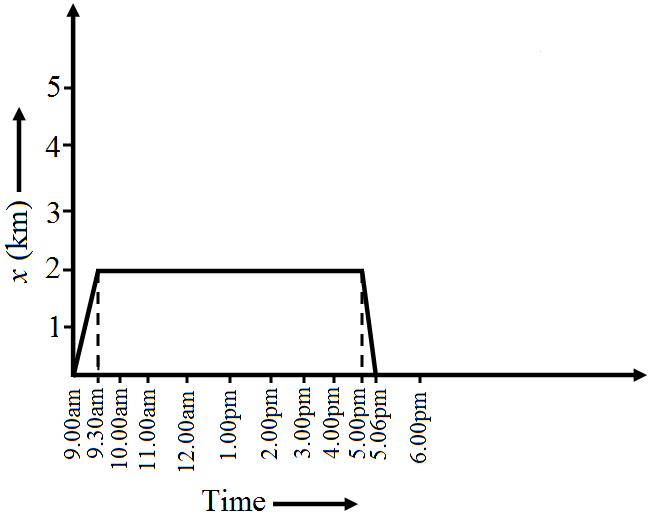
View full question & answer→Question 455 Marks
Draw velocity$-$time graph of uniformly accelerated motion in one dimension. From the velocity time graph of uniform accelerated motion, deduce the equations of motion in distance and time.
AnswerConsider an object moving along a straight line with uniform acceleration a. Let u be the initial velocity at $t = 0$ and $y$ be the final
velocity after time $t$.
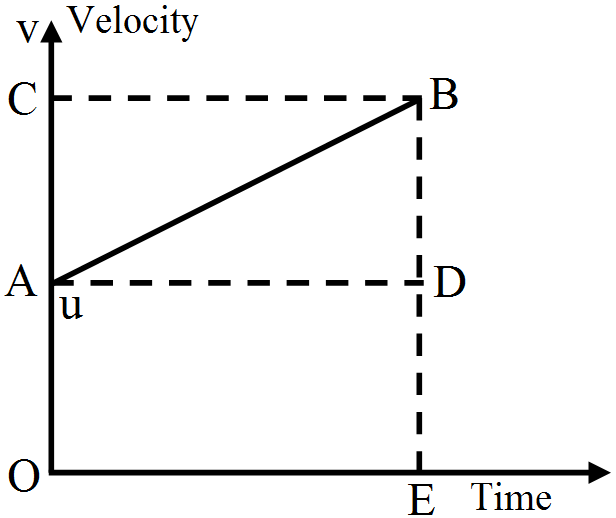
From graph $OA = ED = u OC = EB = v OE = t = AD$
- $\text{s}=\text{ut}+\frac{1}{2}\text{at}^2$
area under velocity time graph for a given time interval represents the distance covered by a uniformly accelerated object in a given time interval.
From graph, acceleration,
$a =$ slope of velocity$-$time graph $AB$.
$\therefore \text{a}=\frac{\text{BD}}{\text{AD}}=\frac{\text{DB}}{\text{t}}$
$\text{DB}=\text{at}$
Distance travelled by object in time $t$ is
$s =$ area of trapezium $\text{OABE}$
$=$ area of rectangle $\text{OADE} +$ Area of triangle $\text{ADB}$
$=\text{OA}\times\text{OE}+\frac{1}{2}\text{DB}\times\text{AD}$
$=\text{ut}+\frac{1}{2}\text{at}\times\text{t}=\text{ut}+\frac{1}{2}\text{at}^2$
- $\text{v}^2-\text{u}^2=2\text{as}$
Distance travelled by an object in time interval $t$ is
$s =$ area of aapezium $\text{OABE}$
$=\frac{1}{2}(\text{EB}+\text{OA})\times\text{OE}$
$=\frac{1}{2}(\text{EB}+\text{ED})\times\text{OE}$ $(\because\text{OA}=\text{ED})$
Acceleration,
$a =$ slope of velocity time graph $AB$
$\text{a}=\frac{\text{DB}}{\text{AD}}=\frac{\text{EB}-\text{ED}}{\text{OE}}$
$\text{OE}=\frac{\text{EB}-\text{ED}}{\text{a}}$
$\text{s}=\frac{1}{2}(\text{EB}+\text{ED})\times\frac{\text{(EB}-\text{ED})}{\text{a}}$
$=\frac{1}{2\text{a}}(\text{EB}^2-\text{ED}^2)$
$=\frac{1}{2\text{a}}(\text{v}^2-\text{u}^2)$
$\text{v}^2-\text{u}^2=2\text{as}$ View full question & answer→Question 465 Marks
Derive the following equations of motion for uniformly accelerated motion from velocity$-$time graph $($symbols have their usual meaning$)$ :
- $\text{v}=\text{u}+\text{at}$
- $\text{s}=\text{ut}+\frac{1}{2}\text{at}^2$
- $\text{v}^2-\text{u}^2=2\text{as}$
AnswerConsider an object, moving with a uniform acceleration $'a\ '$ along a straight line $OX$ , with origin at $O$ . Let the object reach at points $A$ and $B$ at instants $t_1$ and $t_2$. Let $x_1$ and $x_2$ be the displacements of the object at times $t_1$ and $t_2$ respectively and $v_1$ and $v_2$ be the velocities of the object at positions $A$ and $B$ respectively.
- Acceleration of the object $=\frac{\text{Change in velocity}}{\text{Time taken}}$
$\therefore \text{a}=\frac{\text{v}_2-\text{v}_1}{\text{t}_2-\text{t}_1}$
$\Rightarrow \text{v}_2-\text{v}_1=\text{a}(\text{t}_2-\text{t}_1)$
$\Rightarrow \text{v}_2=\text{v}_1+\text{a}(\text{t}_2-\text{t}_1)\ \dots(\text{i})$
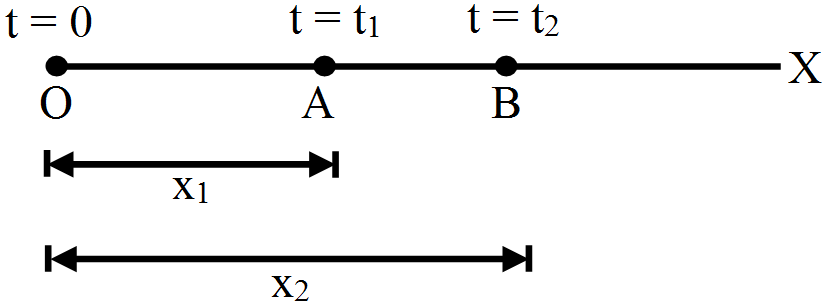
Let the origin of time axis be taken at $A$ and $u$ be the velocity of the object $A. v$ be the velocity of the object at $B$ after time $t.$ Then
$\text{v}_1=\text{u};1_1=0;\text{v}_2=\text{v}$ and $\text{t}_2=\text{t}$
Putting in $(i)$, we get
$\Rightarrow \text{v}=\text{u}+\text{at}$
- Let vąv be average velocity of the object during the motion of object from $A$ to $B$,
Then, $\text{v}_{\text{av}}=\frac{\text{Displacement}}{\text{Time taken}}=\frac{\text{x}_2-\text{x}_1}{\text{t}_2-\text{t}_1}$
$(\text{x}_2-\text{x}_1)=\frac{\text{v}_1+\text{v}_2}{2}(\text{t}_2-\text{t}_1)$
$\Rightarrow \text{x}_1=\text{v}_1(\text{t}_2-\text{t}_1)+\frac{1}{2}\text{a}(\text{t}_2-\text{t}_1)^2\ \dots(\text{ii}) [$Using $(i)]$
If $x_0, u$ are the displacement and velocity of the object at $t_1 = 0$
$\text{x}_1=\text{x}_0,\text{v}_1=\text{u},\text{t}_2=\text{t}$ and $\text{x}_2=\text{x}.$
From $(ii)$.
$\text{x}=\text{x}_0+\text{ut}+\frac{1}{2}\text{at}^2$
$\text{x}-\text{x}_0=\text{ut}+\frac{1}{2}\text{at}^2\ \dots(\text{iii})$
Using, $x - x_0 = s =$ Distance travelled in time $t$, we have
$\text{s}=\text{ut}+\frac{1}{2}\text{at}^2$
- From $(i),$ we have
$(\text{t}_2-\text{t}_1)=\frac{\text{v}_2-\text{v}_1}{\text{a}}$
Putting the above value in
$\text{x}_2-\text{x}_1=\frac{\text{v}_1+\text{v}_2}{2}(\text{t}_2-\text{t}_1),$ we get
$\text{x}_2-\text{x}_1=\Big(\frac{\text{v}_1+\text{v}_2}{2}\Big)\Big(\frac{\text{v}_2-\text{v}_1}{\text{a}}\Big)=\frac{\text{v}^2_2-\text{v}^2_1}{2\text{a}}$
$\text{v}^2_2-\text{v}^2_1=2\text{a}(\text{x}_2-\text{x}_1)\ \dots(\text{iv})$
If $u$ and $v$ are the velocities of an object at positions $x_0$ and $x$ respectively, then using $\text{v}_1=\text{u},\text{v}_2=\text{v},=\text{x}_1=\text{x}+0$ and $\text{x}_2=\text{x}$ in equation $(iv)$, we get
$\text{v}^2-\text{u}^2=2\text{a}(\text{x}_0-\text{x})$
$\Rightarrow\text{v}^2-\text{u}^2=2\text{as}$ View full question & answer→Question 475 Marks
The speed time graph of a particle moving along a fixed direction is as shown below. Obtain the distance traversed by the particle between:
- $t = 0s$ to $5s$
- $t = 2s$ to $6s$
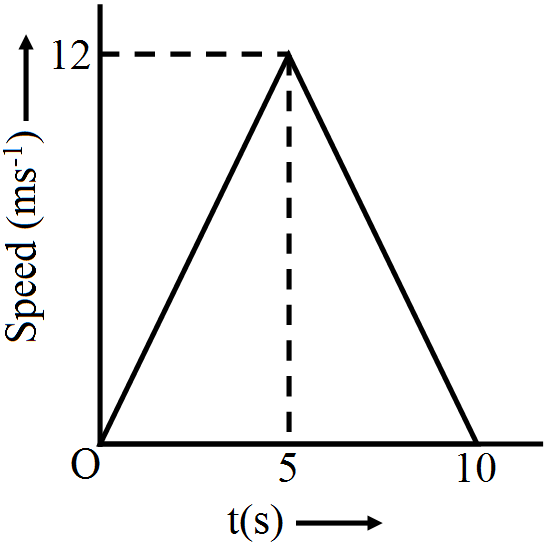
Answer
- Distance travelled by the particle between $t = 0s$ to $5 sec$
$=$ Area of $\Delta \text{OAC}$
$=\frac{1}{2}\times5\times12=30\text{m}$
- Acceleration along $OA$
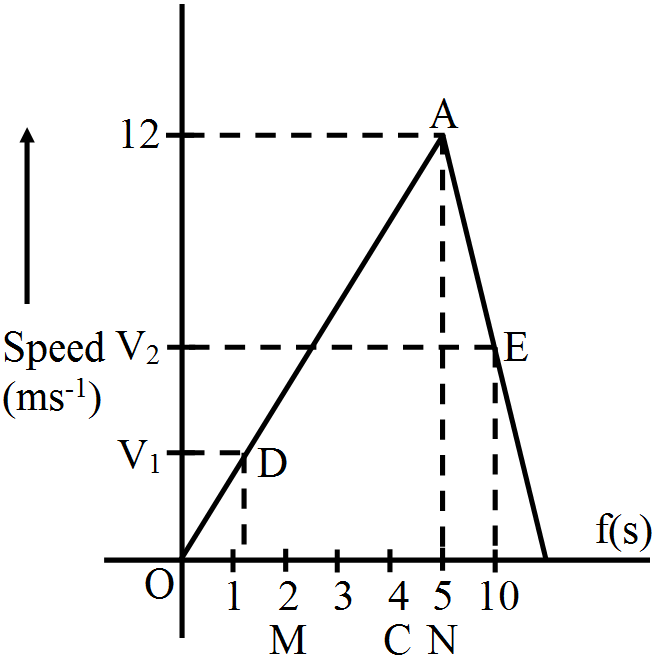
$\text{v}=\text{u}+\text{at}$
$\text{a}=\frac{12-0}{5-0}=\frac{12}{5}$
$=+2.4\text{ms}^{-2}$
Acceleration along $AB, a = -2.4ms^{-2}$
Distance travelled by the particle between
$t = 2s$ to $t = 5s$
$=$ Area of trapezium $\text{MDAC}$
$= 25.2m$
Distance travelled by the particle between
$t = 5s$ to $6s$
$=$ Area of trapezium $\text{CAEN}$
$= 10.8m$ View full question & answer→Question 485 Marks
Derive the three equations of motion by calculus method. Express conditions under which they can be used.
AnswerConsider an object moving in straight line with uniform acceleration $= a$. Let at $t = 0$ velocity of the body $= u$ at $t = t$ velocity of the body $= v$
- Velocity$-$time relation : Let $dv$ be the change in velocity in time interval. dt. Then acceleration
$\text{a}=\frac{\text{dv}}{\text{dt}}$
$\text{dv}=\text{a dt}$
Integrating from $0 \rightarrow t$ when velocity changes from $u \rightarrow v$
$\int\limits^\text{v}_\text{u}\text{dv}=\text{a}\int\limits^{\text{t}}_\text{0}\text{dt}$
$\text{v}-\text{u}=\text{at}$
$\text{v}=\text{u}+\text{at}\ \dots(\text{i})$
- Distance$-$time relation: Consider an object moving in a straight line with uniform acceleration $'a\ '$. Let at any instant $t, dx$ be the displacement of the object in time interval at., Then instantaneous velocity $v$ is given by:
$\text{v}=\frac{\text{dx}}{\text{dt}}$
$\text{dx}=\text{vdt}$
$\text{dx}=(\text{u}+\text{at})\text{dt} [$from $(i) \text{v}=\text{u}+\text{at}]$
Let $x_0 =$ displacement at $t = 0$
$x =$ displacement at $t = t$
Integrating within limits
$\int\limits^\text{x}_{\text{x}_0}\text{dx}=\int\limits^{\text{t}}_0(\text{u}+\text{at})\text{dt}$
$=\text{u}\int\limits^{\text{t}}_0\text{dt}+\text{a}\int\limits^{\text{t}}\text{tdt}$
$\text{x}-\text{x}_0=\text{ut}+\frac{1}{2}\text{at}^2$
$\text{x}=\text{x}_0+\text{ut}+\frac{1}{2}\text{at}^2\ \dots(\text{ii})$
If $x - x_0 = s$ = distance covered by an object in time $t$ then
$\text{s}=\text{ut}+\frac{1}{2}\text{at}^2$
- Velocity-displacement relation.
Consider a particle moving in a straight line with initial velocity $u$, and uniform acceleration $'a\ '.$
then $\text{a}=\frac{\text{dv}}{\text{dt}}=\frac{\text{dv}}{\text{dx}}\times\frac{\text{dx}}{\text{dt}}=\text{v}\frac{\text{dv}}{\text{dx}}$
$\text{adx}=\text{vdv}$
Let $u$ be the velocity of object at position $x_0\ v$ be the velocity of object at position $x$
Integrating above within limits
$\int\limits^{\text{x}}_{\text{x}_0}\text{a dx} = \int\limits^{\text{c}}_{\text{u}}\text{v dv}$
$\text{a}(\text{x}-\text{x}_0)=\frac{\text{v}^2}{2}-\frac{\text{u}^2}{2}$
$\text{v}^2-\text{u}^2=2\text{a}(\text{x}-\text{x}_0)$
Putting $x - x_0=s$ we get
$\text{v}^2+-\text{u}^2=2\text{as}\ \dots(\text{iii})$
The above three laws are valid under the conditions, only when the acceleration is uniform. View full question & answer→Question 495 Marks
Two cars, A and B are travelling in the same direction with the velocities $v_a$ and $v_b$ respectively. When the car A is at a distance d, and behind the car B, the brakes are applied on A, causing a deceleration at the rate 'a'. Show that to prevent a collision between A and B, it is necessary that $\text{v}_\text{a}-\text{v}_\text{b}<\sqrt{2\text{ad}}.$
AnswerThe initial velocity of car A, $v_a$ is greater than the velocity $v_b$ of the car B. The car A is behind the car B at a distance d. In order to prevent the collision, at least the velocity of the car A should be reduced to $v_b$. Suppose during time t, the velocity is reduced from $v_a$ to $v_b$ and during this time the car B moves through the distance x. $\therefore \text{v}^2_\text{a}-\text{v}^2_\text{b}=-2\text{a}(\text{d}+\text{x}),$ where a is retardation $\therefore (\text{d}+\text{x})=\frac{\text{v}^2_\text{a}-\text{v}^2_\text{b}}{2\text{a}}\ \dots(\text{i})$ Also, $\text{v}_\text{b}=\text{a}_\text{a}-\text{at}$
$\text{t}=\frac{\text{v}_\text{a}-\text{v}_\text{b}}{\text{a}}$ During this time, the distance x covered by the car B can be wriften as $\text{x}=\text{v}_\text{b}\times\text{t}=\text{v}_\text{b}\times \Big(\frac{\text{v}_\text{a}-\text{v}_\text{b}}{\text{a}}\Big)\ \dots(\text{ii})$ Putting this value in (i), we get $\text{d}+\text{v}_\text{b}\Big(\frac{\text{v}_\text{a}-\text{v}_\text{b}}{\text{a}}\Big)=\Big(\frac{\text{v}^2_\text{a}-\text{v}^2_\text{b}}{2\text{a}}\Big)$
$\text{d}=\frac{\text{v}^2_\text{a}-\text{v}^2_\text{b}}{2\text{a}}-\frac{\text{v}_\text{b}(\text{v}_\text{a}-\text{v}_\text{b})}{\text{a}}$
$=\frac{\text{v}^2_\text{a}+\text{v}^2_\text{b}-2\text{v}_\text{a}\text{v}_\text{b}}{2\text{a}}$
$\Rightarrow \text{d}=\frac{(\text{v}_\text{a}-\text{v}_\text{b})^2}{2\text{a}}$ ln order to prevent collision, d should be greater than $\frac{(\text{v}_\text{a}-\text{v}_\text{b})^2}{2\text{a}}$
$\therefore \text{d}>\frac{(\text{v}_\text{a}-\text{v}_\text{b})^2}{2\text{a}}$
$(\text{v}_\text{a}-\text{v}_\text{b})<\sqrt{2\text{ad}}$
View full question & answer→Question 505 Marks
The speed of a motor launch w.r.t still water is $7ms^{-1}$ and the speed of the stream is $3ms^{-1}$. When the launch began travelling upstream, a float was dropped from it. The launch travelled $4.2km$ upstream, turned about and caught up with the float. How long is it, before the launch reached the float?
AnswerRelative velocity of the launch while travelling upstream = launch velocity - stream velocity =$ (7 - 3)ms^{-1} = 4ms^{-1}$ Time taken by the launch for travelling a distance of 4.2km. $\Rightarrow \text{t}_1=\frac{4.2\times10^3}{4\text{ms}^{-1}}\text{m}=1.05\times10^3\text{s}$ Suppose t is the time taken by the launch after dropping the float and meeting it again.
Distance travelled by the float during time $t = 3ms^{-1} \times t s = 3t$ metres Relative velocity of the launch while travelling downstream = $(7 + 3)ms^{-1} = 10ms^{-1}$ Distance travelled down the stream = $(4.2 \times 10^3 + 3t)m$ If $t_2$ is the time taken to cover this distance, then $\text{t}_2=\frac{4.2\times10^3+3\text{t}}{10}\text{s}$ Again, $\text{t}=\text{t}_1+\text{t}_2$
$\therefore \text{t}=1.05\times10^3+\frac{4.2\times10^3+3\text{t}}{10}$ On simplification t = 2100s = 35 min
View full question & answer→Question 515 Marks
- With the help of a simple case of an object moving with constant velocity show that the area under velocity$-$time curve represents the displacement over a given time interval.
- Establish the relation
$\text{c}=\text{v}_0\text{t}+\frac{1}{2}\text{at}^2$ graphically.
- A car moving with a speed of $126\ km/ h$ is brought to a stop within a distance of $200m$. Calculate the retardation of the car and the time required to stop it.
Answer
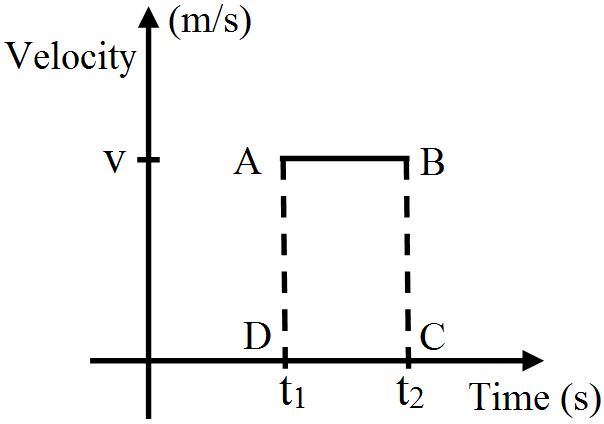
- Let a body with constant velocity $v$, between time $t_1$ and $t_2$ as shown in graph.
Area below $=$ area $\text{ABCD} = v(t_2 - t_1)$
Also, the displacement $=$ velocity $\times $ time = $y(t_2 - t_1)$.
Thus proved.
- Slope of $v - t$ graph is constant. So there is uniform acceleration. Area below the graph gives the displacement $(x).$
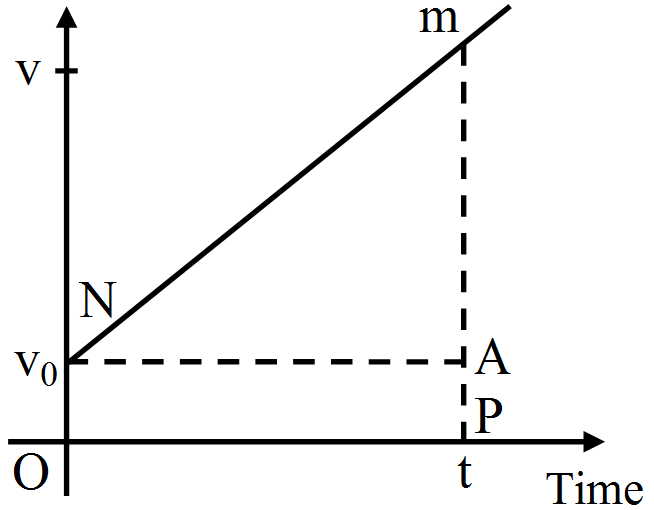
Displacement $=$ Area of trapezium
$=\text{ON}\times\text{OP}+\frac{1}{2}\text{NA}\times\text{MA}$
$=\text{v}_0\times\text{t}+\frac{1}{2}(\text{t})(\text{v}-\text{v}_0)$
Since $\text{a}=\frac{\text{v}-\text{v}_0}{\text{t}}$
We have, $\text{x}=\text{v}_0\text{t}+\frac{1}{2}\text{t at}=\text{v}_0\text{t}+\frac{1}{2}\text{at}^2$
- $u 126\ km/hr = 35m/ sec, v = 0, s = 200m.$
using, $\text{v}^2=\text{u}^2+2\text{as},$
$\text{a}=\frac{\text{v}^2-\text{u}^2}{2\text{s}}=\frac{35^2}{2\times200}$
$=-3.00\ \text{ms}^{-2}$
$\text{v}=\text{u}+\text{at}$
$0=35-3\times\text{t}$
$\text{t}=\frac{35}{3}=11.66\text{ sec.}$ View full question & answer→Question 525 Marks
A drunkard walking in a narrow lane takes 5 steps forward and 3 steps backward, followed again by 5 steps forward and 3 steps backward, and so on. Each step is 1m long and requires 1s. Plot the x-t graph of his motion. Determine graphically and otherwise how long the drunkard takes to fall in a pit 13m away from the start.
AnswerWe can see from the question Distance covered with 1 step = 1m Time taken = 1s Time taken to move first 5m forward = 5s Time taken to move 3m backward = 3s So net distance after 8 secs = 2m Similarly, we can find the data point for values also The position of the drunkard taking starting point as position with respect to time is given the below table.
|
T(s)
|
0
|
5
|
8
|
13
|
16
|
21
|
24
|
29
|
32
|
37
|
|
X(m)
|
0
|
5
|
2
|
7
|
4
|
9
|
6
|
11
|
8
|
13
|
The x-t graph based on the above data points is given by
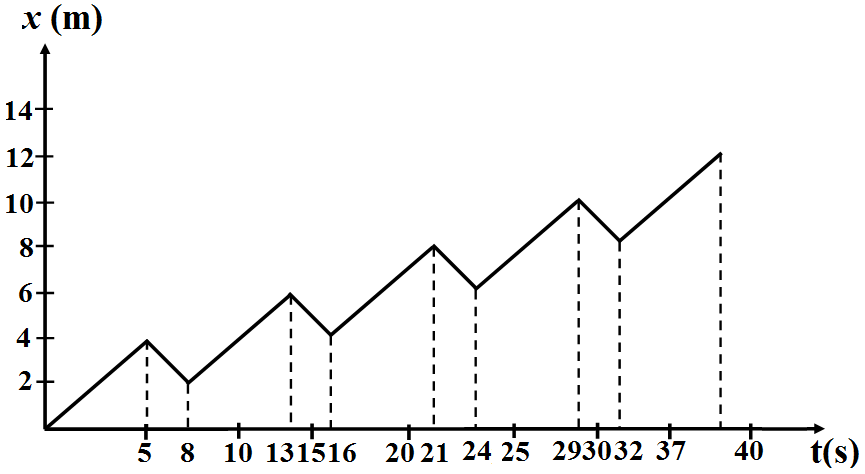
So, we can see that, drunkard will fall in pit at 37 sec
Analytical method Net distance covered after 8sec = 5 – 3 = 2m Net time taken to cover 2m = 8s So Drunkard covered 8m in = 4 × 8 = 32s. In the next 5s, the drunkard will cover a distance of 5m and a total distance of 13m and falls into the pit. Net time taken by the drunkard to cover 13m = 32 + 5 = 37s
View full question & answer→Question 535 Marks
A ball is dropped from a building of height 45m. Simultaneously another ball is thrown up with a speed 40m/s. Calculate the relative speed of the balls as a function of time.
AnswerFor the first ball falling from top $V=v_1=?, U=0, h=45 m, a=g, t=t V=u+a t V_1=0+g t$ or $v_1=g t$ downward $\therefore v_1=-g t$ for the second ball thrown upward $\mathrm{V}=\mathrm{v}_2, \mathrm{u}=40 \mathrm{~m} / \mathrm{s}, \mathrm{a}=\mathrm{g}, \mathrm{t}=\mathrm{t} \mathrm{V}=\mathrm{u}+$ at $\mathrm{V}_2=(40-\mathrm{gt})$ upward $\therefore \mathrm{v}_2=$ $(40-\mathrm{gt})$ Relative velocity of ball $1^{\text {st }}$ with respect to $2^{\text {nd }} v_{12}=v_1-v_2=-g t-(40-g t)=-g t-40+g t=-40 \mathrm{~m} / \mathrm{s}$ (downward) Relative velocity of ball first with the respect to second is $40 \mathrm{~m} / \mathrm{s}$ downward. In this problem due to acceleration the speed of one increases and of other decreases with the same rate. So their relative speed remains $(40-0)=40 \mathrm{~m} / \mathrm{s}$.
View full question & answer→Question 545 Marks
An object starts from rest and covers a total distance X in the following manner: It first has a uniform acceleration $a_1$ for some time $t_1$, moves with the speed acquired at the end of $t_1$ for some distance and is then given a uniform retardation $a_2$ so that it is again at rest at the end of the journey. Show that the journey is covered in least time if the body is accelerated for a time of $\Big[\frac{2\text{X a}_2}{\text{a}_1(\text{a}_1+\text{a}_2)}\Big]^{\frac{1}{2}}$ and this minimum time is $\Bigg[2\text{X}\Big(\frac{1}{\text{a}_1}+\frac{1}{\text{a}_2}\Big)\Bigg]^{\frac{1}{2}}.$
AnswerLet $x_1$ be the distance travelled by the object in $t_1$ second (starting from rest with uniform acceleration $a_1$). Then $v_1$ the speed acquired after travelling distance $x_1$ is $\text{v}=\text{a}_1\text{t}_1\ \dots(1)$ Also $2\text{a}_1\text{x}_1=\text{v}_2-0^2=\text{v}^2$
$\therefore \text{x}_1=\frac{\text{v}_2}{2\text{a}_1}\ \dots(2)$ Let $x_2$ and $x_3$ denote the distance travelled in the second and third leg of the journey of the particle extending over time $t_2$ and $t_3$ respectively, Then, $\text{x}_2=\text{v t}_2\ \dots(3)$ and $-2\text{a}_2\text{x}_3=0^2-\text{v}^2=-\text{v}^2\ \dots(4)$ Also $=0=\text{v}-\text{a}_2\text{t}_3$
$\Rightarrow \text{v}=\text{a}_2\text{t}_3\ \dots(5)$ The total time f of the ioumey is $\text{t}=\text{t}_1+\text{t}_2+\text{t}_3=\frac{\text{v}}{\text{a}_1}+\frac{\text{x}_2}{\text{v}}+\frac{\text{v}}{\text{a}_2}\ \dots(6)$ Also $\text{X}=\text{x}_1+\text{x}_2+\text{x}_3=\frac{\text{v}^2}{2\text{a}_1}+\text{x}_2+\frac{\text{v}^2}{2\text{a}_2}$
$\therefore \text{x}_2=\text{X}-\frac{\text{v}^2}{2}\Big(\frac{1}{\text{a}_1}+\frac{1}{\text{a}_2}\Big)\text{s}\ \dots(7)$ From Equs. (6) and (7) we have $\text{t}=\frac{\text{v}}{\text{a}_1}+\frac{\text{X}}{\text{v}}-\frac{\text{v}}{2}\Big(\frac{1}{\text{a}_1}+\frac{1}{\text{a}_2}\Big)+\frac{\text{v}}{\text{a}_2}$
$=\frac{\text{X}}{\text{v}}+\frac{\text{v}}{2}\Big(\frac{1}{\text{a}_1}+\frac{1}{\text{a}_2}\Big)\ \dots(8)$ Using Eqns. (8) and (1), we have $\text{t}=\frac{\text{X}}{\text{a}_1\text{t}_1}+\frac{\text{a}_1\text{t}_1}{2}\Big(\frac{1}{\text{a}_1}+\frac{1}{\text{a}_2}\Big)\ \dots(9)$ For a particular value of X, t is least if, $\frac{\text{dt}}{\text{dt}_1}=0\ \dots(10)$ Differentiating Eqn. (9), we get, for least t $\frac{\text{dt}}{\text{dt}_1}=-\frac{\text{Xf}}{\text{a}_1\text{t}^2_1}+\frac{\text{a}_1}{2}\Big(\frac{1}{\text{a}_1}+\frac{1}{\text{a}_2}\Big)=0$
$\frac{\text{X}}{\text{a}_1\text{t}^2_1}=\frac{\text{a}_1(\text{a}_1+\text{a}_2)}{2\text{a}_1\text{a}_2}$
$\text{t}_1=\Big[\frac{\text{X}.2\text{a}_2}{\text{a}_1(\text{a}_1+\text{a}_2)}\Big]^{\frac{1}{2}}\text{s}$ Corresponding to this values of t_1 we get from Eqn. (9), $\text{t}=\Bigg[2\text{X}\Big(\frac{1}{\text{a}_1}+\frac{1}{\text{a}_2}\Big)\Bigg]^\frac{1}{2}$
View full question & answer→Question 555 Marks
State the kinematic equations for uniformly accelerated motion.
AnswerFor uniformly accelerated motion, we can derive some simple equations that relate displacement $(x)$, time taken $(t)$, Initial velocity $(u)$, final velocity $(v)$ and acceleration $(a)$.
- Velocity attained after time $t$: The velocity$-$time graph for positive constant acceleration of a particle is shown in the figure.
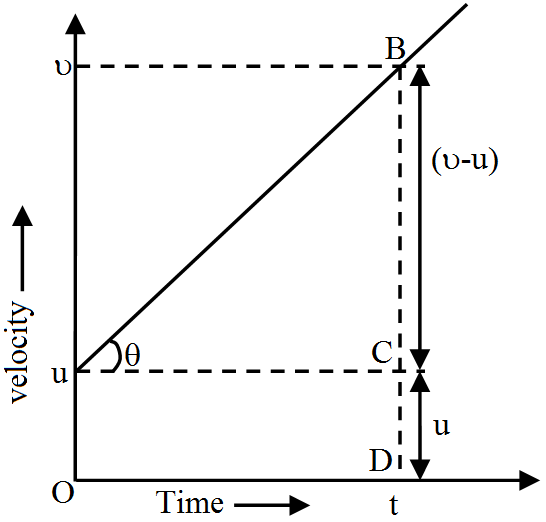
Let $u$ be the initial velocity of the particle at $t = 0$ and $v$ is the final velocity of the particle after time $t$. Consider two points $A$ and $B$ on the curve corresponding to $t = 0$ and $t = t$ respectively.
Draw $BD$ perpendicular to time axis. Also draw $AC$ perpendicular to $BD$.
$\therefore OA = CD = u;$
$BC = (v - u)$ and $OD = t$
Now slope of $v-t$ graph $=$ acceleration $(a)$
$\therefore a =$ slope of $v-t$ graph $=\tan\theta=\frac{\text{BC}}{\text{AC}}=\frac{\text{BC}}{\text{OD}} [\because AC= OD]$
$\therefore \text{a}=\frac{\text{v}-\text{u}}{\text{t}}$
$\text{v}-\text{u}=\text{at}$
or $\text{v}=\text{u}+\text{at}$
- Distance travelled in time $t$:
Let, $x_0 =$ position of the particle at $t = 0$ from the origin.
$x =$ position of the particle at $t = t$ from the origin.
$\therefore (x - x_0) = S =$ distance travelled by the particle in the time interval $(t - 0) = t$
We know, distance travelled by a particle in the given time
Interval $=$ area under velocity$-$time graph
$\therefore (x – x_0) =$ Area $\text{OABD} ($see fig, above$) =$ Area of trapezium $\text{OABD}$
$=\frac{1}{2}[$ Sum of parallel sides$ \times$ perpendicular distance between parallel sides$]$
$=\frac{1}{2}(\text{OA}+\text{BD})\times\text{AC}=\frac{1}{2}(\text{u}+\text{v})\times\text{t}$
Since $\text{v}=\text{u}+\text{at}$
$\therefore(\text{x}-\text{x}_0)=\frac{1}{2}(\text{u}+\text{u}+\text{at})\times\text{t}$
$=\frac{1}{2}(2\text{u}+\text{at})\times\text{t}=\text{ut}+\frac{1}{2}\text{at}^2$
Since $\text{x}-\text{x}_0=\text{S}$
$\therefore \text{S}=\text{ut}+\frac{1}{2}\text{at}^2$
- Velocity attained after travelling a distance $S$: We know, distance travelled by a particle in time $t$ is equal to the area under velocity$-$time graph. Therefore, the distance $(s)$ travelled by a particle during time interval $t$ is given by
$S =$ Area under $v-t$ graph $($see fig.$)$ or
$S =$ area of trapenium $\text{OABD}$
$=\frac{1}{2} ($sum of parallel sides$) \times$ perpendicular distance between these para
$\text{S}=\frac{1}{2}(\text{OA}+\text{BD})\times\text{ACs}\ \dots(\text{i})$
Now, acceleratiory $a =$ slope of $v- t$ graph
$\text{a}=\frac{\text{BC}}{\text{AC}}=\frac{\text{BD}-\text{CD}}{\text{AC}}=\frac{\text{v}-\text{u}}{\text{AC}}$
$\text{AC}=\Big(\frac{\text{v}-\text{u}}{\text{a}}\Big)\text{s}$
Also, $OA = u$ and $BD = v$
Using equations $(ii)$ and $(iii)$ in equation $(i)$, we get
$\text{S}=\frac{1}{2}(\text{v}+\text{u})\frac{(\text{v}-\text{u})}{\text{a}}=\frac{\text{v}^2-\text{u}^2}{2\text{a}}$
$\text{v}^2-\text{u}^2=2\text{as}$ View full question & answer→Question 565 Marks
A car starting from rest, accelerates uniformly with $5m/s^2$ for sometime and then decelerates to come to rest with $3m/s^2$. Find the maximum velocity attained during the motion and the distance covered in a total time of 6 seconds of the journey.
AnswerDuring acceleration, $\text{v}_\text{m}=0+5\times\text{t}_\text{a}$
$\Rightarrow \text{t}_\text{a}=\frac{\text{v}_\text{m}}{5}$
$\text{v}^2_\text{m}=0+2\times5\times\text{s}_\text{a}$
$\Rightarrow \text{s}_\text{a}=\frac{\text{v}^2_\text{m}}{10}$
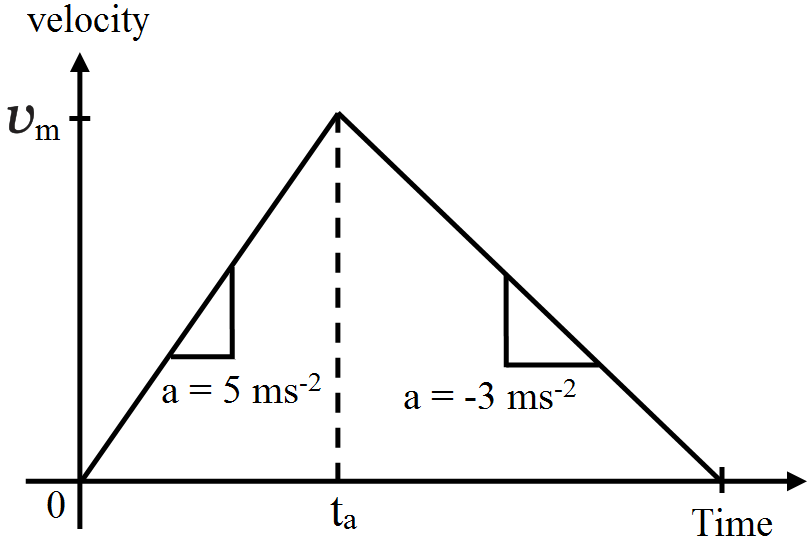
During deceleration, $0=\text{v}_\text{m}-3\text{t}_\text{d}$
$\Rightarrow \text{t}_\text{d}=\frac{\text{v}_\text{m}}{3}$
$0=\text{v}^2_\text{m}-2\times3\times\text{s}_\text{d}$
$\Rightarrow \text{s}_\text{d}=\frac{\text{v}^2_\text{m}}{6}$ Total time $=6=\text{t}_\text{a}+\text{t}_\text{d}$
$\therefore \text{v}_\text{m}=\frac{6\times5\times3}{8}=11.25\text{ms}^{-1}$ Total length covered $=\text{s}_\text{a}+\text{s}_\text{d}=\text{v}^2_\text{m}\Big(\frac{1}{10}+\frac{1}{6}\Big)$
$=(11.25)^2\frac{16}{60}$
$=33.75\text{m}$ View full question & answer→Question 575 Marks
The speed of a train increases at a constant rate a from zero to $\nu$ and then remains constant for an interval, and finally decreases to zero at a constant rate $\beta.$ If L be the total distance described prove that the total time taken is $\frac{\text{L}}{\nu}+\frac{\nu}{2}\Big(\frac{1}{\alpha}+\frac{1}{\beta}\Big).$
AnswerThe problem can be graphically represented as shown below: 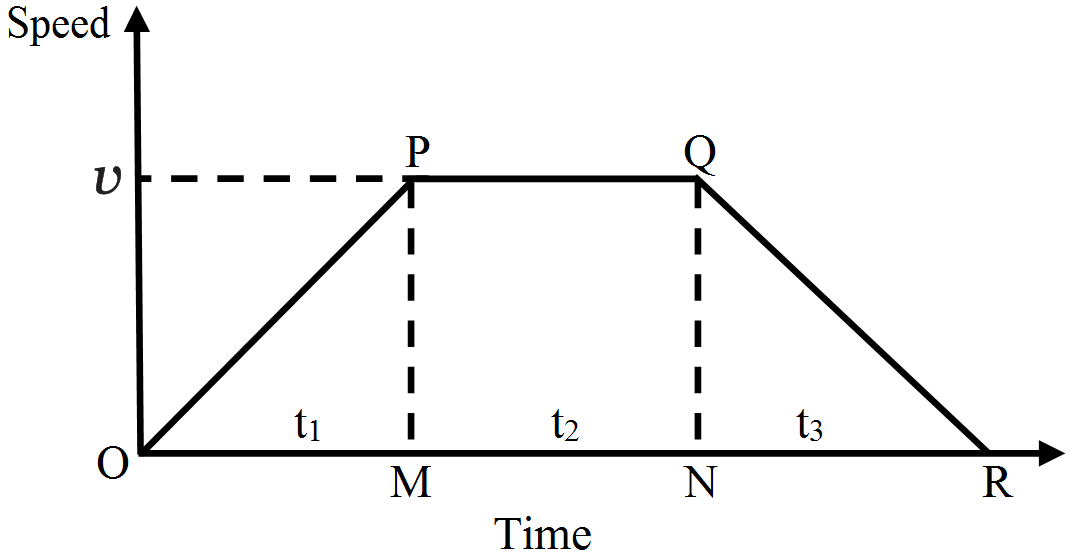 $\alpha=\frac{\nu}{\text{t}_1}$ or $\text{t}_1=\frac{\nu}{\alpha};\beta=\frac{\nu}{\text{t}_3}$ or $\text{t}_3=\frac{\nu}{\beta}$ Total distance (L) travelled by the train is equal to the area under the v-t graph on the time axis. $\therefore \text{L}=\text{Area of }\triangle \text{OPM}+\text{Area of}\ \Box\text{MPQN}\\+\text{Area of}\ \triangle\text{NQR}$ $=\frac{1}{2}\text{t}_1\nu+\text{t}_2\nu+\frac{1}{2}\text{t}_3\nu$ $=\nu\big(\frac{\text{t}_1+\text{t}_3}{2}+\text{t}_2\Big)$ $\frac{\text{L}}{\nu}=\frac{\text{t}_1+\text{t}_3}{2}+\text{t}_2$ $=\frac{\nu}{2}\Big(\frac{1}{\alpha}+\frac{1}{\beta}\Big)+\text{t}_2$ $\therefore$ Total time taken $=(\text{t}_1+\text{t}_3)+\text{t}_2$ $=\nu\Big(\frac{1}{\alpha}+\frac{1}{\beta}\Big)+\Big[\frac{1}{\nu}-\frac{\nu}{2}\Big(\frac{1}{\alpha}+\frac{1}{\beta}\Big)\Big]$ $=\frac{\text{L}}{\nu}+\frac{\nu}{2}\Big(\frac{1}{\alpha}+\frac{1}{\beta}\Big)$ [From (i)]
 View full question & answer→Question 585 Marks
A perfectly elastic rubber ball is dropped from the top of a building. A man standing in front of a window $2m$ high notes that the ball takes a time of $0.2s$ in crossing the window. The ball strikes the ground suffering a perfectly elastic collision and reappears at the bottom of the window during its upward journey again after $2$ seconds. What is (1) the height of the building and (2) the height of the bottom of the window above the ground? Take $g = 10ms^{-2}$.
AnswerLet A be the top of the building at a height X above the ground. BC is the window of height 2m. Let $t_1$ be the time taken by the ball to fall from A to B.
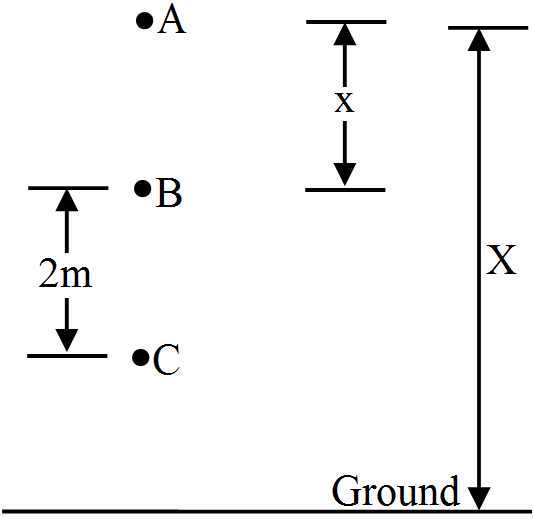
Then the time taken to fall through a distance $(x + 2) m$ is $(t_1 + 0.2) s$. Then $\text{x}=\frac{1}{2}\times10\times\text{t}^2_1\ \dots(1)$ and $\text{x}+2=\frac{1}{2}\times10\times(\text{t}_2+0.2)^2$ From Eqns. (1) and (2), we have $5\text{t}^2_1+2=5\text{t}^2_1+0.2+2\text{t}_1$
$1.8=2\text{t}_1$
$\therefore \text{t}_1=0.9\text{s}$
$\therefore \text{x}=\frac{1}{2}\times10\times(0.9)^2=4.05\text{m}$ Let v_1 be the speed acquired by the ball as it reaches the bottom C of the window. Then $\text{v}_1=0 + 10\times1.1 = 11\text{ms}^{-1}$ During the downward journey the ball experiences an acceleration equal to g and strikes the ground with speed V. Since it undergoes a perfectly elastic collision its speed reverses. The time taken in falling from C to ground to back is 2s. Therefore, time taken to fall from C to ground must be 1s. Hence $\text{X}-(\text{x}+2)=11\times1+\frac{1}{2}\times10(1)^2$
$\text{X}-6.05=11+5=16$
$\therefore \text{X}=22.05\text{m}$ The height of the building is 22.05m and the bottom of the window is at height of 16m from the ground. View full question & answer→Question 595 Marks
Two towns A and B are connected by a regular bus service with a bus leaving in either direction every T minutes. A man cycling with a speed of $20km h^{–1}$ in the direction A to B notices that a bus goes past him every $18$ min in the direction of his motion, and every $6$ min in the opposite direction. What is the period T of the bus service and with what speed (assumed constant) do the buses ply on the road?
AnswerLet V be the speed of the bus running between towns A and B. Speed of the cyclist, v = 20km/ h Relative speed of the bus moving in the direction of the cyclist = V – v = (V – 20)km/ h The bus went past the cyclist every 18 min i.e., 18/60 h (when he moves in the direction of the bus). Distance covered by the bus = (V - 20) × 18/60km ......(i)
Since one bus leaves after every T minutes, the distance travelled by the bus will be equal to V × T/60 ......(ii) Both equations (i) and (ii) are equal. (V - 20) × 18/60 = VT/60 ......(iii)
Relative speed of the bus moving in the opposite direction of the cyclist = (V + 20)km/ h Time taken by the bus to go past the cyclist = 6 min = 6/60h
$\therefore$ (V + 20) × 6/60 = VT/60 ......(iv) From equations (iii) and (iv), we get (V + 20) × 6/60 = (V - 20) × 18/60 V + 20 = 3V - 60 2V = 80 V = 40km/ h Substituting the value of V in equation (iv), we get (40 + 20) × 6/60 = 40T/60 T = 360/40 = 9 min
View full question & answer→Question 605 Marks
On a two-lane road, car $A$ is travelling with a speed of $36 \mathrm{~km} \mathrm{~h}^{-1}$. Two cars B and C approach car A in opposite directions with a speed of $54 \mathrm{~km} \mathrm{~h}^{-1}$ each. At a certain instant, when the distance $A B$ is equal to $A C$, both being 1 km , $B$ decides to overtake $A$ before $C$ does. What minimum acceleration of car $B$ is required to avoid an accident?
AnswerVelocity of car A, $V_A = 36km/ h = 10m/s$ Velocity of car B,$ V_B = 54km/ h = 15m/s$ Velocity of car C,$ V_C = 54km/ h = 15m/s$ Situation is depicted below
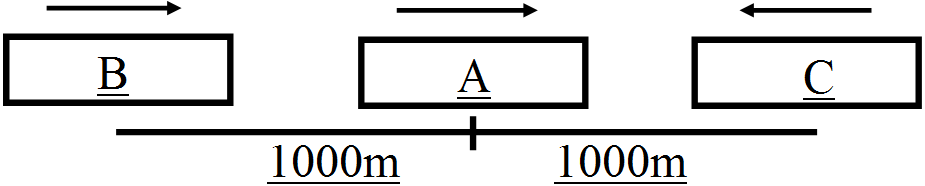
Taking direction of Car $A$ as positive Hence Relative velocity of car $B$ with respect to car $A, V_{B A}=V_B-V_A=15-10=$ $5 \mathrm{~m} / \mathrm{s}$ Relative velocity of car C with respect to car $\mathrm{A}, \mathrm{V}_{\mathrm{CA}}=\mathrm{V}_{\mathrm{C}}-\mathrm{V}_{\mathrm{A}}=-15-10=-25 \mathrm{~m} / \mathrm{s}$ At a certain instance, both cars B and C are at the same distance from car A i.e., $s=1 \mathrm{~km}=1000 \mathrm{~m}$ Time taken ( t ) by car C to cover $1000 \mathrm{~m}=$ 1000/25 = 40s Hence, to avoid an accident, car B must cover the same distance in a maximum of 40s. From second equation of motion, minimum acceleration (a) produced by car B can be obtained as: $s=u t+(1 / 2) a^2 1000=5 \times 40$ $+(1 / 2) \times a \times(40)^2 a=1600 / 1600=1 \mathrm{~m} / \mathrm{s}$ View full question & answer→Question 615 Marks
A three-wheeler starts from rest, accelerates uniformly with 1m $s^{–2}$ on a straight road for 10s, and then moves with uniform velocity. Plot the distance covered by the vehicle during the nth second $(n = 1, 2, 3….)$ versus n. What do you expect this plot to be during accelerated motion : a straight line or a parabola?
AnswerStraight line Distance covered by a body in nth second is given by the relation $\text{D}_\text{n} = \text{u}+\frac{\text{a}}{2}(2\text{n}-1)\ \dots(1)$ u = Initial velocity a = Acceleration n = Time = 1, 2, 3, ....., n In the given case, u = 0 and $a = 1m/s^2$ $\therefore\ \text{D}_\text{n}=\frac{1}{2}(2\text{n}-1)\ \dots(2)$ This relation shows that: $\text{D}_\text{n} \propto \text{n}\ \dots(3)$ Now, substituting different values of n in equation (iii), we get the following table:
|
n
|
1
|
2
|
3
|
4
|
5
|
6
|
7
|
8
|
9
|
10
|
|
$D_n$
|
0.5
|
1.5
|
2.5
|
3.5
|
4.5
|
5.5
|
6.5
|
7.5
|
8.5
|
9.5
|
The plot between n and Dn will be a straight line as shown: 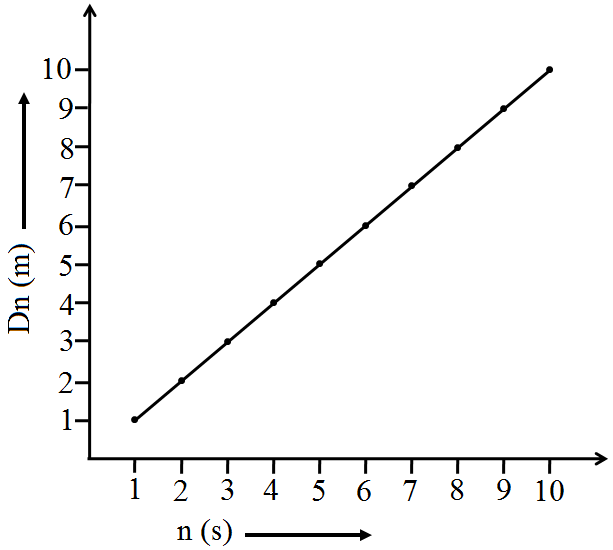 Since the given three-wheeler acquires uniform velocity after 10s, the line will be parallel to the time-axis after n = 10s.
 View full question & answer→Question 625 Marks
Two trains A and B of length $400m$ each are moving on two parallel tracks with a uniform speed of $72km h^{–1}$ in the same direction, with A ahead of B. The driver of B decides to overtake A and accelerates by $1m s^{–2}$. If after $50s$, the guard of B just brushes past the driver of A, what was the original distance between them?
AnswerFor train A: Initial velocity, $\mathrm{u}=72 \mathrm{~km} / \mathrm{h}=20 \mathrm{~m} / \mathrm{s}$ Time, $\mathrm{t}=50 \mathrm{~s}$ Acceleration, $\mathrm{a}_{\mathrm{l}}=0$ (Since it is moving with a uniform velocity) From second equation of motion, distance (sl) covered by train $A$ can be obtained as: $s_1=u t+1 / 2 a_1 t^2=20$ × $50+0=1000 \mathrm{~m}$
For train B: Initial velocity, $u=72 \mathrm{~km} / \mathrm{h}=20 \mathrm{~m} / \mathrm{s}$ Acceleration, $a=1 \mathrm{~m} / \mathrm{s}^2$ Time, $\mathrm{t}=50 \mathrm{~s}$ From second equation of motion, distance (sll) covered by train $A$ can be obtained as: $s_{\|}=u t+1 / 2$ a t ${ }^2=20 \times 50 \times 1 / 2 \times$ $1 \times(50)^2=2250 \mathrm{~m}$ Hence, the original distance between the driver of train $A$ and the guard of train $B=2250-1000$ $=1250 \mathrm{~m}$.
View full question & answer→Question 635 Marks
Gives a speed-time graph of a particle in motion along a constant direction. Three equal intervals of time are shown. In which interval is the average acceleration greatest in magnitude? In which interval is the average speed greatest? Choosing the positive direction as the constant direction of motion, give the signs of v and a in the three intervals. What are the accelerations at the points A, B, C and D?
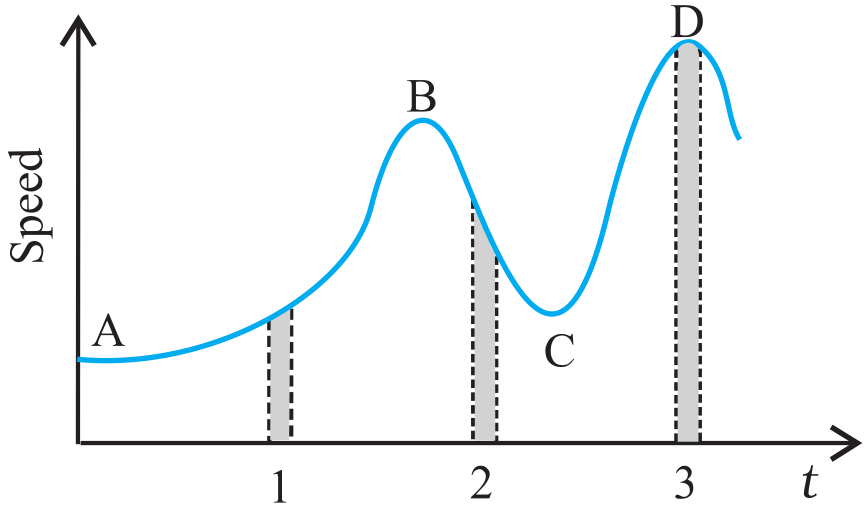
AnswerAverage acceleration is greatest in interval 2 Average speed is greatest in interval 3 v is positive in intervals 1, 2, and 3 a is positive in intervals 1 and 3 and negative in interval 2 a = 0 at A, B, C, D Acceleration is given by the slope of the speed-time graph. In the given case, it is given by the slope of the speed-time graph within the given interval of time. Since the slope of the given speed-time graph is maximum in interval 2, average acceleration will be the greatest in this interval. Height of the curve from the time-axis gives the average speed of the particle. It is clear that the height is the greatest in interval 3. Hence, average speed of the particle is the greatest in interval 3. In interval 1: The slope of the speed-time graph is positive. Hence, acceleration is positive. Similarly, the speed of the particle is positive in this interval. In interval 2: The slope of the speed-time graph is negative. Hence, acceleration is negative in this interval. However, speed is positive because it is a scalar quantity. In interval 3: The slope of the speed-time graph is zero. Hence, acceleration is zero in this interval. However, here the particle acquires some uniform speed. It is positive in this interval. Points A, B, C, and D are all parallel to the time-axis. Hence, the slope is zero at these points. Therefore, at points A, B, C, and D, acceleration of the particle is zero.
View full question & answer→Question 645 Marks
A man runs across the roof-top of a tall building and jumps horizontally with the hope of landing on the roof of the next building which is of a lower height than the first. If his speed is $9m/s$, the (horizontal) distance between the two buildings is 10m and the height difference is $9m$, will he be able to land on the next building? (take $g = 10m/s^2$).
AnswerKey concept: Horizontal Projectile: When a body is projected horizontally from a certain height ‘y’ vertically above the ground with initial velocity u. If friction is considered to be absent, then there is no other horizontal force which can affect the horizontal motion. The horizontal velocity therefore remains constant and so the object covers equal distance in horizontal direction in equal intervals of time. Time of flight: If a body is projected horizontally from a height h with velocity u and time taken by the body to reach the ground is T, then. $\text{h}=0+\frac{1}{2}\text{gT}^2$ (for vertical motion) $\text{T}-\sqrt{\frac{2\text{h}}{\text{g}}}$ Horizontal range: Let R be the horizontal distance travelled by the body $\text{R}=\text{uT}+\frac{1}{2}0\text{T}^2$ (for horizontal motion a = 0) $\text{R}=\text{u}\sqrt{\frac{2\text{h}}{\text{g}}}$ We will apply kinematic one by one along downward and along horizontal. We first consider motion along horizontal and there is no horizontal force which can affect the horizontal motion. The horizontal velocity therefore remains constant and so the object covers equal distance in horizontal direction in equal intervals of time.
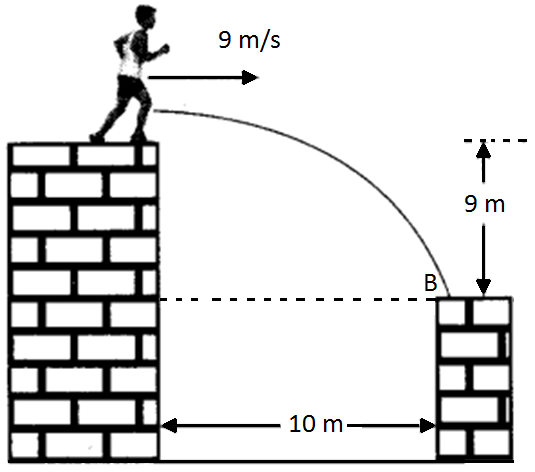
According the problem, horizontal speed of the man $(u_x) = 9m/s$ Horizontal distance between the two buildings = 10m Height difference between the two buildings = 9m and $g = 10m/s^2$ and $g = 10ms^2$ Let the man jumps from point A and land on the roof of the next building at point B. Taking motion in vertical direction, $\text{y}=\text{ut}+\frac{1}{2}\text{at}^2$ $9=0\times\text{t}+\frac{1}{2}\times10\times\text{t}^2$ $9=5\text{t}^2$ or $\text{t}=\sqrt{\frac{9}{5}}=\frac{3}{\sqrt{5}}$ $\therefore$ Horizontal distance travelled $=\text{u}_\text{x}\times\text{t}=9\times\frac{3}{\sqrt{5}}=\frac{27}{\sqrt{5}}\text{m}=12\text{m}$ Horizontal distance travelled by the man is greater than 10m, therefore, he will land on the next building. View full question & answer→Question 655 Marks
Two stones are thrown up simultaneously from the edge of a cliff $200m$ high with initial speeds of $15m s^{–1}$ and $30m s^{–1}$. Verify that the graph shown in correctly represents the time variation of the relative position of the second stone with respect to the first. Neglect air resistance and assume that the stones do not rebound after hitting the ground. Take $g = 10m s^{–2}$. Give the equations for the linear and curved parts of the plot.
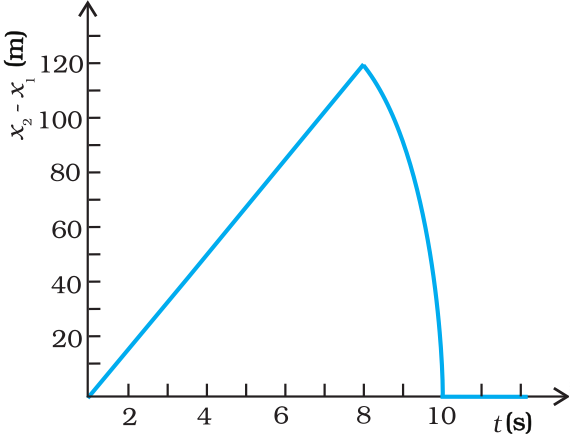
AnswerFor first stone: Initial velocity, $u_I = 15m/s$ Acceleration, $a = –g = –10m/s^2$ Using the relation, $x_1 = x_0 + u_1t + (1/2)at^2$ Where, height of the cliff, $x_0 = 200m x_1 = 200 + 15t – 5t^2$ ……(i) When this stone hits the ground, $x_1 = 0 $\therefore$ –5t^2+ 15t + 200 = 0 t^2 – 3t – 40 = 0 t^2 – 8t + 5t – 40 = 0 t(t – 8) + 5(t – 8) = 0 t = 8 s or t = –5s$ Since the stone was projected at time t = 0, the negative sign before time is meaningless. $\therefore t = 8s$ For second stone: Initial velocity, $u_{II}= 30m/s$ Acceleration, $a = –g = –10m/s^2$ Using the relation, $x_2 = x_0 + u_{II}t + (1/2)at^2 = 200 + 30t – 5t^2 ……(ii)$
At the moment when this stone hits the ground; $x_2 = 0 –5t^2 + 30 t + 200 = 0 t^2 – 6t – 40 = 0 t^2 – 10t + 4t + 40 = 0 t(t – 10) + 4(t – 10) = 0 t(t – 10)(t + 4) = 0 t = 10s$ or $t = –4s$ Here again, the negative sign is meaningless. $\therefore$ t = 10s Subtracting equations (i) and (ii), we get $x_2 – x_1 = (200 + 30t -5t^2) – (200 + 15t -5t^2) x_2 – x_1 =15t ……(iii)$ Equation (iii) represents the linear path of both stones. Due to this linear relation between $(x_2 - x_1)$ and t, the path remains a straight line till 8s. Maximum separation between the two stones is at $t = 8s. (x_2 – x_1)_{max} = 15 \times 8 = 120m$ This is in accordance with the given graph. After 8s, only second stone is in motion whose variation with time is given by the quadratic equation: $x_2 – x_1= 200 + 30t – 5t^2$ Hence, the equation of linear and curved path is given by $x_2– x_1 = 15t$ (Linear path) $x_2 – x_1 = 200 + 30t – 5t^2$ (Curved path)
View full question & answer→Question 665 Marks
The speed-time graph of a particle moving along a fixed direction is shown in. Obtain the distance traversed by the particle between.
- $t = 0s$ to $10s,$
- $t = 2s$ to $6s.$
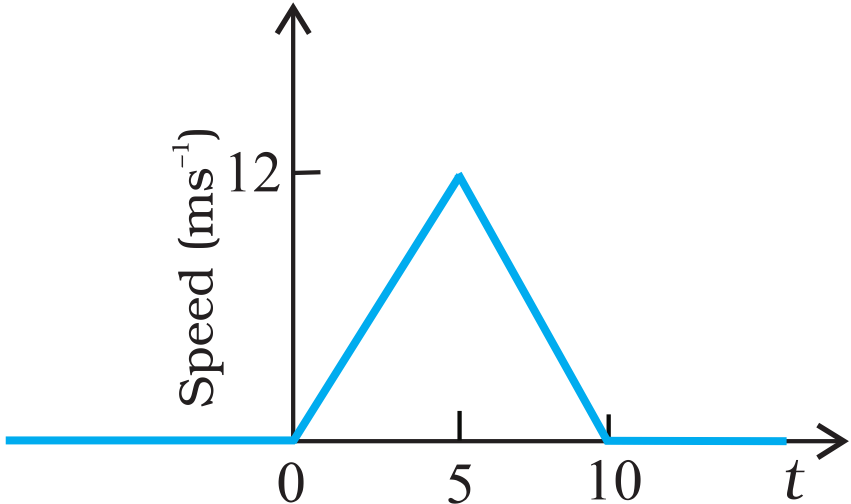
What is the average speed of the particle over the intervals in $(a)$ and $(b)$? Answer$a.$Distance travelled by the particle $=$ Area under the given graph
$= 1/2 \times (10 - 0) \times (12 - 0) = 60m$
Average speed $=$ Distance $/$ Time $=60 / 10=6 m / s$
$b.$ Let $s_1$ and $s_2$ be the distances covered by the particle between time
$t =2 s$ to $5 s$ and $t =5 s$ to $6 s$ respectively.
Total distance $(s)$ covered by the particle in time $t =2 s$ to $6 s$
$s=s_1+s_2 \ldots \text { (i) }$
For distance $s_1$ :
Let $u^{\prime}$ be the velocity of the particle after $2 s$ and $a ^{\prime}$ be the acceleration of the particle in $t=0$ to $t=5 s$.
Since the particle undergoes uniform acceleration in the interval $t=0$ to $t=5 s$, from first equation of motion, acceleration can be obtained as:
$v=u+a t$
Where,
$v=$ Final velocity of the particle
$12=0+a^{\prime} \times 5$
$a^{\prime}=12 / 5=2.4 m / s^2$
Again, from first equation of motion, we have
$v=u+a t$
$=0+2.4 \times 2=4.8 m / s$
Distance travelled by the particle between time $2 s$ and $5 s$ i.e., in $3 s$
$s_1=u^{\prime} t+1 / 2 a^{\prime} t^2$
$=4.8 \times 3+1 / 2 \times 2.4 \times(3)^2$
$=25.2 m \ldots(ii)$
For distance $s_2$ :
Let $a^{\prime \prime}$ be the acceleration of the particle between time $t=5 s$ and $t=10 s$.
From first equation of motion,
$v=u+$ at $($where $v=0$ as the particle finally comes to rest$)$
$0 = 12 + a″ \times 5$
$a″ = -12/5$
$= -2.4m/s^2$
Distance travelled by the particle in $1s ($i.e., between $t = 5s$ and $t = 6s)$
$s_2 = u′^n t + 1/2 a'′t^2$
$= 12 \times a + 1/2(-2.4) \times (1)^2$
$= 12 - 1.2 = 10.8m .......(iii)$
From equations $(i), (ii),$ and $(iii),$ we get
$s = 25.2 + 10.8 = 36m$
$\therefore$Average speed $= 36/4 = 9m/s$
View full question & answer→Question 675 Marks
A motor car moving at a speed of 72km/h can not come to a stop in less than 3.0s while for a truck this time interval is 5.0s. On a higway the car is behind the truck both moving at 72km/h. The truck gives a signal that it is going to stop at emergency. At what distance the car should be from the truck so that it does not bump onto (collide with) the truck. Human response time is 0.5s.
AnswerAccording to the problem, speed of car as well as truck = 72km/h $=72\times\frac{5}{18}\text{m/s}=20\text{m/s}$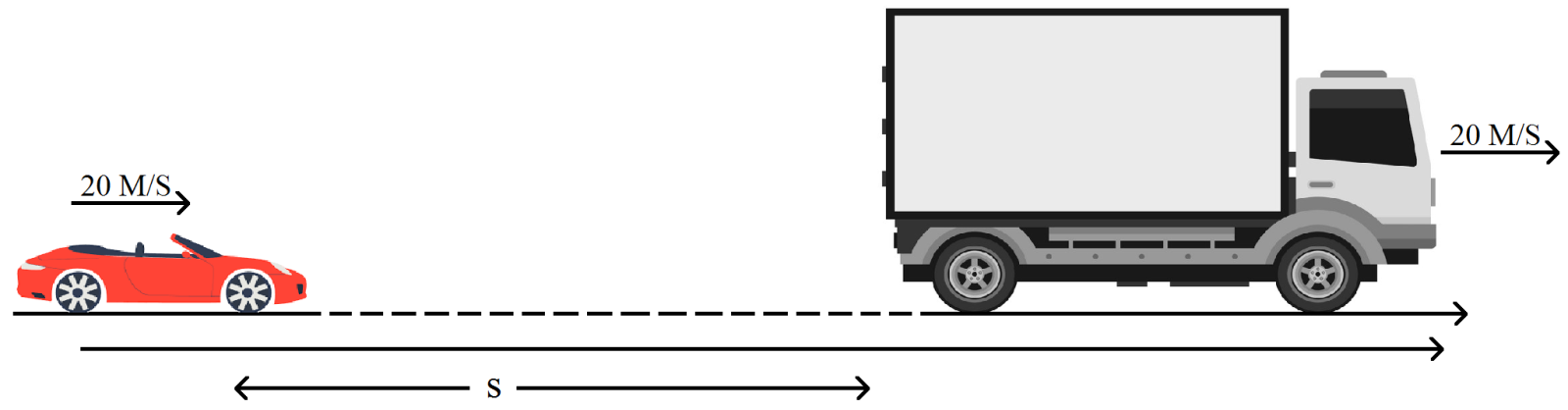
Time required to stop the truck = 5s Finally the truck comes to rest, so final velocity of truck will be zero. Retardation produced by truck: $\text{v}=\text{u}+\text{a}_\text{t}\text{t}$ $0=20+\text{a}_\text{t}\times5$ Or $\text{a}_\text{t}=-4\text{m/s}^2$ Time required to stop the car = 3s Finally the car comes to rest just behind the truck in the same time to avoid collision, so final velocity of car will also be zero. Retardation produced by car is $\text{v}=\text{u}+\text{a}_\text{c}\text{t}$ $0=20+\text{a}_\text{c}\times3$ Or $\text{a}_\text{c}=-\frac{20}{3}\text{m/s}^2$ Let car be at a distance s from the truck, when truck gives the signal and t be the time taken to cover this distance. As human response time is 0.5s, in this car will cover some distance with uniform velocity. Therefore, time of retarded motion of car is (t - 0.5)s. Velocity of truck after time t, $\text{v}_c=\text{u}-\text{at}=20-\Big(\frac{20}{3}\Big)(\text{t}-0.5)$ Velocity of truck after time t, $\text{v}_\text{t}=20-4\text{t}$ To avoid the car bump onto the truck $20-\frac{20}{3}(\text{t}-0.5)=20-4\text{t}$ $4\text{t}=\frac{20}{3}(\text{t}-0.5)$ $\Rightarrow\text{t}=\frac{2.5}{2}=\frac{5}{4}\text{s}$ Distance travelled by the truck in time t, $\text{s}_\text{t}=\text{u}_\text{t}\text{t}+\frac{1}{2}\text{a}_\text{t}\text{t}^2$ $\Rightarrow\text{s}_\text{t}=20\times\frac{5}{4}+\frac{1}{2}\times(-4)\times\Big(\frac{5}{4}\Big)^2=21.875\text{m}$ Distance travelled by car in time t = Distance travelled by car in 0.5s (without retardation) + Distance travelled by car in (t - 0.5)s (with retardation) $\text{s}_\text{c}=(20\times0.5)+20\Big(\frac{5}{4}-0.5\Big)\\-\frac{1}{2}\Big(\frac{20}{3}\Big)\Big(\frac{5}{4}-0.5\Big)^2=23.125\text{m}$ $\therefore\text{s}_\text{c}-\text{s}_\text{t}=23.125-21.875=1.250\text{m}$ Therefore, to avoid the collision with the truck, the car must maintain a distance from the truck more than 1.250m. View full question & answer→Question 685 Marks
On a long horizontally moving belt a child runs to and fro with a speed $9km h^{–1}$ (with respect to the belt) between his father and mother located $50$ m apart on the moving belt. The belt moves with a speed of $4km h^{–1}$. For an observer on a stationary platform outside, what is the
- speed of the child running in the direction of motion of the belt?.
- speed of the child running opposite to the direction of motion of the belt?
- time taken by the child in (a) and (b)?
Which of the answers alter if motion is viewed by one of the parents?
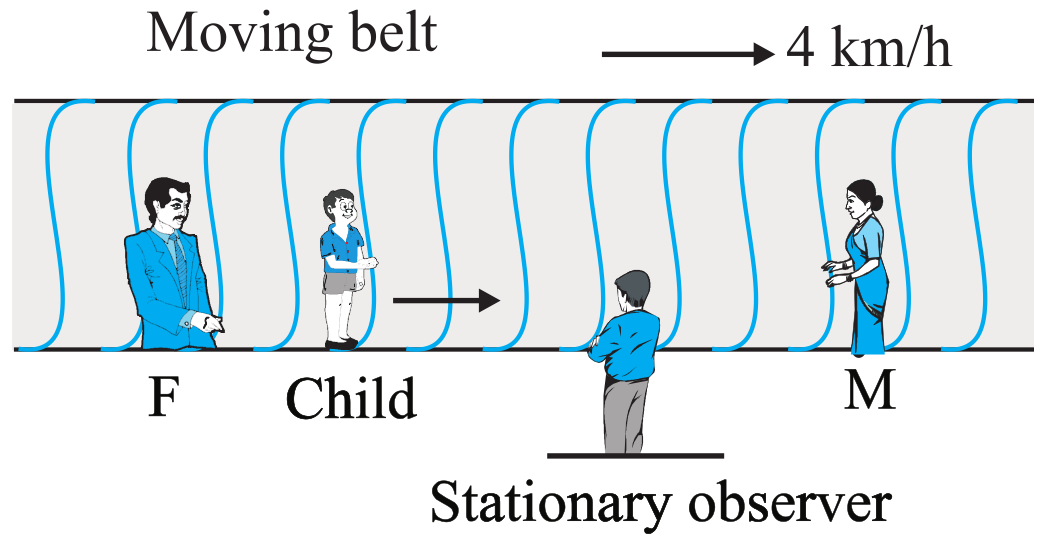
Answer
- Speed of the belt, $V_B = 4km/ h$
Speed of the boy, $V_b = 9km/ h$
Since the boy is running in the same direction of the motion of the belt, his speed (as observed by the stationary observer) can be obtained as:
$V_{bB} = V_b + V_B = 9 + 4 = 13km/ h$
- Since the boy is running in the direction opposite to the direction of the motion of the belt, his speed (as observed by the stationary observer) can be obtained as:
$V_{bB} = V_b + (– V_B) = 9 – 4 = 5km/ h$
- Distance between the child’s parents = 50m
As both parents are standing on the moving belt, the speed of the child in either direction as observed by the parents will remain the same i.e., 9km/ h = 2.5m/s.
Hence, the time taken by the child to move towards one of his parents is 50/2.5 = 20s
- If the motion is viewed by any one of the parents, answers obtained in (a) and (b) get altered. This is because the child and his parents are standing on the same belt and hence, are equally affected by the motion of the belt. Therefore, for both parents (irrespective of the direction of motion) the speed of the child remains the same i.e., 9km/ h.
For this reason, it can be concluded that the time taken by the child to reach any one of his parents remains unaltered. View full question & answer→Question 695 Marks
Free-fall : Discuss the motion of an object under free fall. Neglect air resistance.
AnswerAn object released near the surface of the Earth is accelerated downward under the influence of the force of gravity. The magnitude of acceleration due to gravity is represented by g. If air resistance is neglected, the object is said to be in free fall. If the height through which the object falls is small compared to the earth's radius, $g$ can be taken to be constant, equal to $9.8 m s ^{-2}$. Free fall is thus a case of motion with uniform acceleration.
We assume that the motion is in $y$-direction, more correctly in $-y$-direction because we choose upward direction as positive. Since the acceleration due to gravity is always downward, it is in the negative direction and we have
$
a=-g=-9.8 m s ^{-2}
$
The object is released from rest at $y=0$. Therefore, $v_0=0$ and the equations of motion become:
$
\begin{array}{lll}
v=0-g t & =-9.8 t & m s ^{-1} \\
y=0-1 / 2 g t^2 & =-4.9 t^2 & m \\
v^2=0-2 g y & =-19.6 y & m ^2 s ^{-2}
\end{array}
$
These equations give the velocity and the distance travelled as a function of time and also the variation of velocity with distance. The variation of acceleration, velocity, and distance, with time have been plotted in Fig. 2.7(a), (b) and (c).
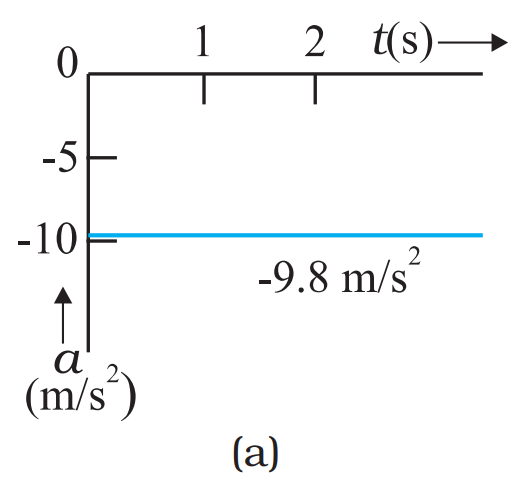
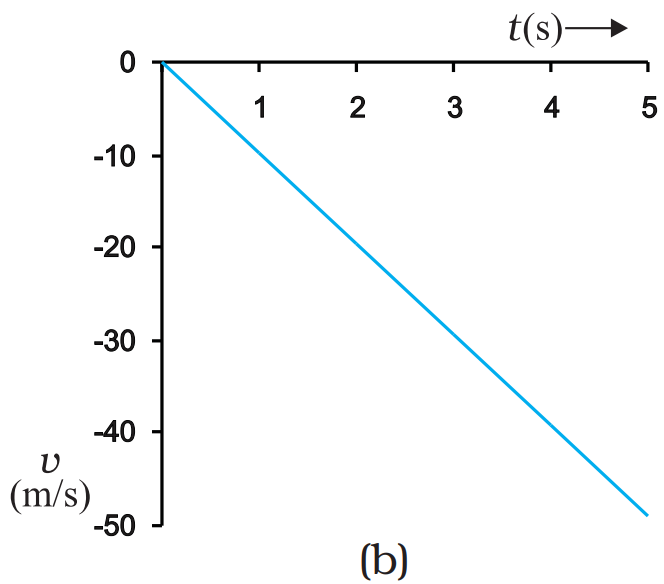
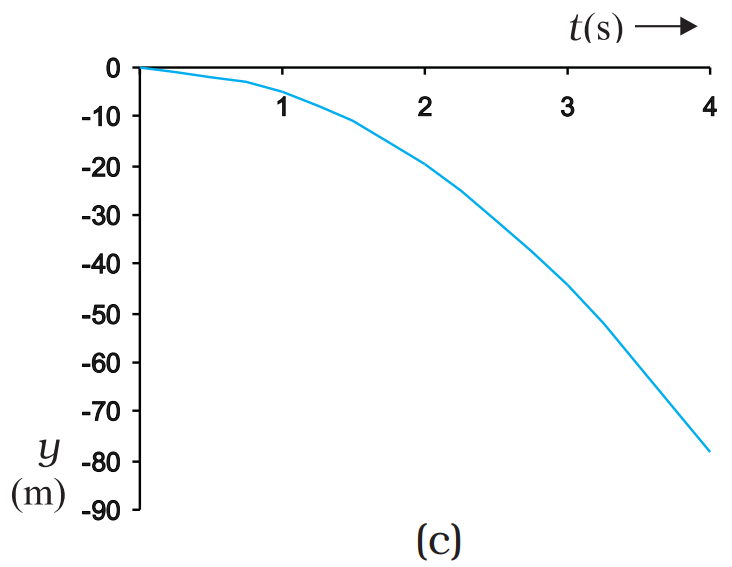
Fig. 2.7 Motion of an object under free fall.
(a) Variation of acceleration with time.
(b) Variation of velocity with time.
(c) Variation of distance with time View full question & answer→Question 705 Marks
A ball is thrown vertically upwards with a velocity of $20 m s ^{-1}$ from the top of a multistorey building. The height of the point from where the ball is thrown is $25.0 m$ from the ground. (a) How high will the ball rlse? and (b) how long will it be before the ball hits the ground? Take $g =10 m s ^{-2}$.
Answer(a) Let us take the $y$-axis in the vertically upward direction with zero at the ground, as shown in Fig. 2.6.
Now
$
\begin{aligned}
v_o & =+20 m s ^{-1}, \\
a & =-g=-10 m s ^{-2}, \\
v & =0 m s ^{-1}
\end{aligned}
$
If the ball rises to height $y$ from the point of launch, then using the equation
we get
$
v^2=v_0^2+2 a\left(y-y_0\right)
$
$
0=(20)^2+2(-10)\left(y-y_0\right)
$
Solving, we get, $\left(y-y_0\right)=20 m$.
(b) We can solve this part of the problem in two ways.
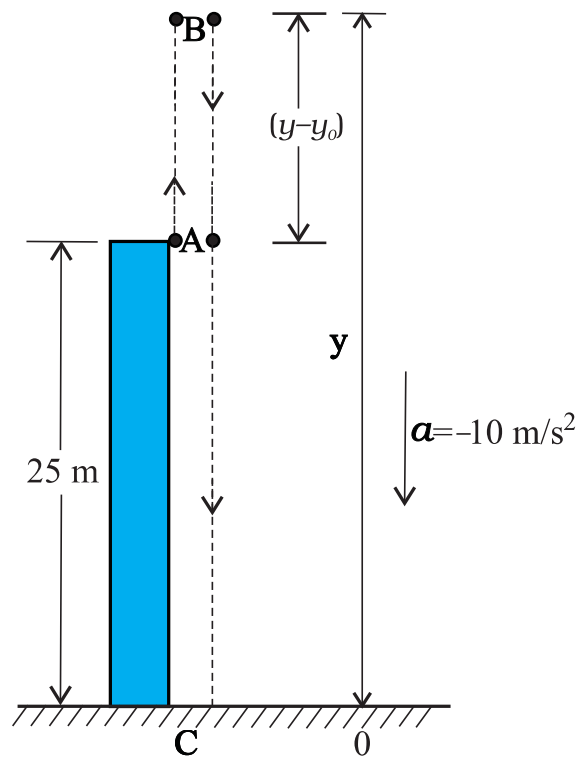
FIRST METHOD : In the first method, we split the path in two parts : the upward motion (A to $B )$ and the downward motion ( $B$ to $C$ ) and calculate the corresponding time taken $t_1$ and $t_2$. Since the velocity at $B$ is zero, we have :
$
\begin{array}{c}
v=v_o+a t \\
0=20-10 t_1 \\
t_1=2 s
\end{array}
$
Or,
This is the time in going from $A$ to $B$. From $B$, or the point of the maximum height, the ball falls freely under the acceleration due to gravity. The ball is moving in negative $y$ direction. We use equation
$
y=y_0+v_0 t+\frac{1}{2} a t^2
$
We have, $y_0=45 m , y=0, v_0=0, a=-g=-10 m s ^{-2}$
$
0=45+(1 / 2)(-10) t_2^2
$
Solving, we get $t_2=3 s$
Therefore, the total time taken by the ball before it hits the ground $=t_1+t_2=2 s +3 s =5 s$.
SECOND METHOD : The total time taken can also be calculated by noting the coordinates of initial and final positions of the ball with respect to the origin chosen and using equation
$
y=y_0+v_0 t+\frac{1}{2} a t^2
$
Now
$
\begin{array}{ll}
y_0=25 m & y=0 m \\
v_o=20 m s ^{-1}, & a=-10 m s ^{-2}, \quad t=?
\end{array}
$
$
\begin{array}{ll}
& 0=25+20 t+(1 / 2)(-10) t^2 \\
\text { Or, } & 5 t^2-20 t-25=0
\end{array}
$
Solving this quadratic equation for $t$, we get
$
t=5 s
$
Note that the second method is better since we do not have to worry about the path of the motion as the motion is under constant acceleration. View full question & answer→Question 715 Marks
Obtain equations of motion for constant acceleration using method of calculus.
AnswerBy definition
$a=\frac{ d v}{ d t}$
$d v=a d t$
Integrating both sides
$\int_{t_0}^v d v =\int_0^t a d t$
$ =a \int_0^t d t \text{(a is constant)}$
$v-v_0 =a t$
$v =v_0+a t$
Further,
$v =\frac{ d x}{ d t}$
$d x =v d t$
Integrating both sides
$\int_{x_0}^x d x=\int_0^t v d t$
$=\int_0^t\left(v_0+a t\right) d t$
$x-x_0 =v_0 t+\frac{1}{2} a t^2$
$x =x_0+v_0 t+\frac{1}{2} a t^2$
We can write
$a=\frac{ d v}{ d t}=\frac{ d v}{ d x} \frac{ d x}{ d t}=v \frac{ d v}{ d x}$
or, $v d v=a d x$
Integrating both sides,
$\int_{ L _0}^v v d v=\int_{x_0}^x a d x$
$\frac{v^2-v_0^2}{2}=a\left(x-x_0\right)$
$v^2=v_0^2+2 a\left(x-x_0\right)$
View full question & answer→