Questions

5 Marks Questions

Take a timed test

26 questions · self-marked practice — reveal the answer and mark yourself.

Question 15 Marks
Can you list 10 recombinant proteins which are used in medical practice? Find out where they are used as therapeutics (use the internet).
Answer
  Recombinant Proteins Therapeutic uses
(a) Insulin Used for diabetes mellitus
(b) OKT-3 Therapeutic antibody, used for reversal of transplantation rejection
(c) DNase Treatment of cystic fibrosis
(d) Reo Pro Prevention of blood clots
(e) Blood clotting factor VIII Treatment of haemophilia A
(f) Blood clotting factor IX Treatment of haemophiiia B
(g) Tissue plasminogen activator For acute myocardial infarction
(h) Interferon alpha (INF alpha) Used for hepatitis C
(i) Interferon beta (INF beta) Used for multiple sclerosis
(j) Interferon gamma (INF gamma) Used for granulomatous disease
View full question & answer
Question 25 Marks
  1. Describe the characteristics a cloning vector must possess.
  2. Why DNA cannot pass through the cell membrane? Explain. How is a bacterial cell made ‘competent’ to take up recombinant DNA from the medium?
Answer
  1.  
  • Should have ori/origin of replication,
  • Has selectable marker, genes encoding for an antibiotic resistance/genes encoding for a - galactosidase,
  • Has cloningsite/recognition site, for the restriction enzyme to recognise.
  1. DNA is a hydrophilic molecule
Bacterial cell is made competent by treating with specific concentration of Ca++ ion/divalent ions, incubating the mon ice, heat shock for a short period and placing it back on ice again.
View full question & answer
Question 35 Marks
If a desired gene is identified in an organism for some experiments, explain the process of the following:
  1. Cutting this desired gene at specific location.
  2. Synthesis of multiple copies of this desired gene.
Answer
  1.  
  • Identifying the restriction endonuclease that recognises the palindromic nucleotide sequence of the desired gene.
  • The restriction endonuclease inspects the DNA sequences - finds and recognises the site.
  • Cuts each of the double helix at the specific point - a little away from the centre of the palindromic site - between the same two bases on the opposite strand
  • Makes the over hanging stretch single stranded portion as a sticky end.
  1.  
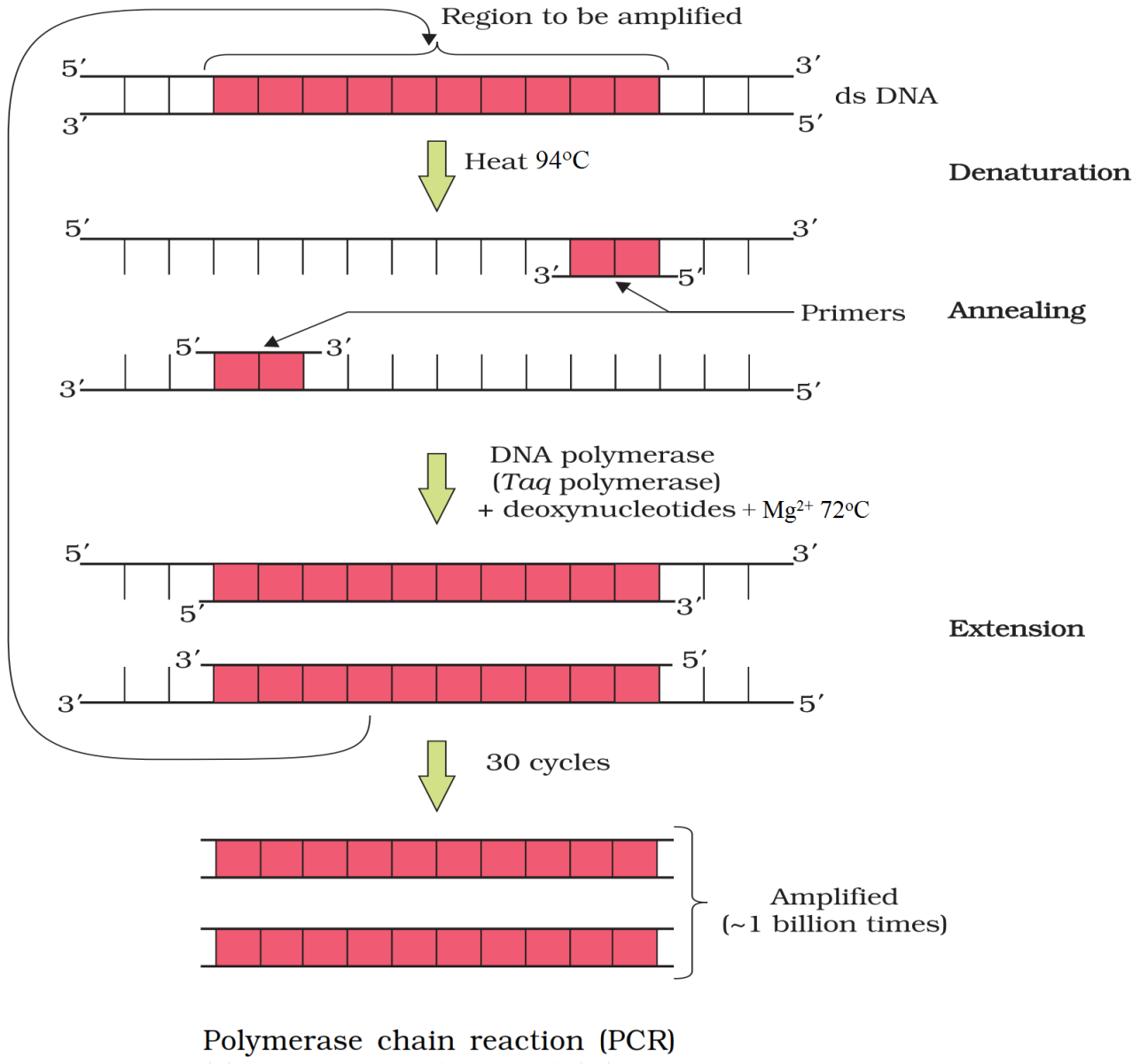
  • By PCR/Polymerase Chain Reaction.
  • Desired gene is synthesised in vitro.
  • DNA is denatured.
  • Annealed using two sets of primers.
  • Thermostable Taq polymerase extends the primers using nucleotides (provided in the reaction and genomic DNAas template).
  • Amplified fragments are ligated.
View full question & answer
Question 45 Marks
No evidence was found on a crime scene, other than only a few hair strands. The inspector wants to proceed for DNA fingerprinting, but the amount of DNA is very less.
  1. In your opinion what could be the solution to this problem?
  2. Write the basic steps of this technique.
  3. Name the scientist who developed this technique.
  4. What values shown by the inspector?
Answer
  1. Amplification of gene of interest using PCR is required.
  2. Denaturation, annealing and extension are the basic steps of PCR.
  3. Kary Mull is developed PCR in 1985.
  4. Honesty and sense of responsibility towards his duty.
View full question & answer
Question 55 Marks
Taking examples under each category, discuss upstream and downstream processing.
Answer
Upstream processing: Biotechnological processes can be separated into upstream processes and downstream processes. The upstream process is defined as the entire process from DNA isolation and culture expansion of the cells until final product.
Downstream processing: After completion of the biosynthetic stage, the product has to be subjected through a series of processes before it Is ready for marketing as a finished product. The processes include separation and purification, which are collectively referred to as downstream processing. The product has to be formulated with suitable preservatives. Such formulation has to undergo through clinical trials as in case of drugs. Strict quality control testing for each product is also required. The downstream processing and quality control testing vary from product to product.
View full question & answer
Question 65 Marks
Which vectors can be used to clone a fragment of DNA with the following lengths?
  1. 4Kb
  2. 35Kb
  3. 20Kb
  4. 250Kb
Answer
  1. Plasmid.
  2. Cosmid.
  3. Bacteriophage lambda.
  4. BAC.
View full question & answer
Question 75 Marks
The biology teacher was explaining about restriction enzymes and came to a point explaining that these enzymes are extracted from bacteria and are called as molecular scissors. Varun got curious and asked some questions for more clarity on the concept to his teacher.
  1. From which part of microorganisms are restriction enzymes derived?
  2. Why are restriction enzymes called molecular scissors?
  3. What if some strands are needed to be cut from within. Would that lead to wastage of DNA?
  4. What values are shown by Varun?
Answer
  1. Restriction enzymes are derived from a defence unit called restriction modification system which protects the microorganisms from harm.
  2. They are called as molecular scissors because they cut DNA molecules at specified location indicated by presence of specific recognition sequence.
  3. No, the strands cut from within are then joined by another enzyme called DNA ligase. This joining is either with self or with another different strand.
  4. Varun is curious, has scientific temperament and asks quick and intelligent questions.
View full question & answer
Question 85 Marks
Following is the sequence of nucleotide in two strands of DNA. Observe the strands and answer the preceding questions.
5' - GAATTC - 3'
3' - CTTAAG - 5'
  1. Name the special term used for such an arrangement of nucleotide.
  2. Name the special type of enzymes which work/ function at this specific points.
  3. Name the enzyme, that cut DNA between GA sequence.
  4. Name the single strands produced after the action of the enzyme.
Answer
  1. Palindromes.
  2. Restriction endonucleases.
  3. EcoRI.
  4. Sticky/ overhanding strands.
View full question & answer
Question 95 Marks
Explain insertional inactivation.
Answer
The selection of recombinants due to inactivation of antibiotic gene is a cumbersome procedure, because it requires simultaneous plating on two plates having different antibiotics. Therefore, the alternative selectable markers have been developed, Which differentiate recombinants from non- recombinants. It is based on their ability to produce colour in the presence of chromogenic substrate.
In this process, a recombinant DNA is inserted within the coding sequence of an enzyme $\beta-$galactosidase. This result into inactivation of the enzyme, which is referred to as insertional inactivation. Therefore, the bacterial colonies having inserted plasmid, shows no colouration (recombinant colonies) while, those without ptasmid will show blue colour. Here $\beta-$galactosidase works as a reporter enzyme (produced by reporter gene) whose inactivity helps to identify transformed and non-transformed bacterial colonies.
View full question & answer
Question 105 Marks
  1. Why are engineered vectors preferred?
  2. A vector is engineered with three features, which facilitate its cloning within the host cell. List the three features and explain each one of them.
Answer
  1.  
  1. Engineered vectors help easy linking of foreign DNA.
  2. They facilitate selection of recombinants from non-recombinants.
  1. Features of Cloning vectors:
  1. Origin of Replication (Ori):
  • This is the sequence of DNA from where replication starts.
  • Any piece of alien/ foreign DNA linked to it is made to replicate within host cell; it also decides the copy number of the linked DNA.
  1. Selectable marker: A marker is a gene, which helps in selecting the host cells, which are transformants/ recombinants from the non-recombinant ones, eg ampicillin and tetracycline resistant genes in E.coli
  2. Cloning site: The vector should have a few, preferably one unique recognition site to link the foreign DNA, presence of a particular cloning/ recognition site enables the particular restriction enzyme to cut the vector DNA.
View full question & answer
Question 115 Marks
What is rDNA? Explain the technique of cloning rDNA.
Answer
rDNA is the DNA formed by combining DNAs from two different organisms. In bacterial cell, rDNA can be transferred by using a vector where it multiplies into many copies. These copies are preserved as gene library.
Recombinant DNA technology involves the following steps:
  1. Isolation of DNA.
  2. Fragmentation of DNA by restriction endonucleases.
  3. Isolation of a desired DNA fragment.
  4. Amplification of the gene of interest.
  5. Ligation of the DNA fragment into a vector.
  6. Insertion of recombinant DNA into the host.
  7. Culturing the host cells on a suitable medium at a large scale.
  8. Extraction of the desired gene product.
  9. Downstream processing of the products as finished product, ready for marketing.
View full question & answer
Question 125 Marks
Unless the vector and source DNAs are cut, fragments separated and joined, the desired recombinant vector molecules cannot be created.
  1. How are the desired DNA sequences cut?
  2. Explain the technique used to separate the cut fragments.
  3. How are the resultant fragments joined to the vector molecule?
Answer
  1.  
  • The purified DNA molecule containing the desired gene is incubated with the specific restriction endonuclease, at optimal conditions of pH, temperature, etc. of that enzyme.
  • Similarly, the vector DNA is also incubated with the same restriction endonuclease under optimal conditions.
  • This results into cutting of the DNA into fragments.
  1.  
  • Gel electrophoresis is used to separate the DNA fragments produced by restriction digestion.
  • The DNA fragments resolve according to their sizes, through the sieving effect provided bythe agarose gel.
  1. The resultant fragments are joined to the vector by use of DNA-ligases.
View full question & answer
Question 135 Marks
What is genetic engineering? List the steps involved in rDNA technology.
Answer
Genetic engineering is a manipulation of genetic material in vitro. It involves the techniques to alter the chemistry of genetic material (DNA and RNA), to introduce the host organisms and thereby change the phenotype of the host organism.
Steps of DNA technology are:
  1. Isolation of DNA.
  2. Fragmentation of DNA by restriction endonucleases.
  3. Isolation of the desired DNA fragments.
  4. Amplification of the gene of interest.
  5. Ligation of the DNA fragment into the vector using DNA ligase.
  6. Transfer of the recombinant DNA into the host.
  7. Culturing the host cell on a suitable medium on a large scale.
  8. Extraction of the desired product.
  9. Downstream processing of the products as finished products.
View full question & answer
Question 145 Marks
Represent diagrammatically the steps in amplification of a DNA segment. Who designed the process?
Answer

This process was designed by K. Mullis.
View full question & answer
Question 155 Marks
Explain the different steps in the construction of recombinant DNA.
Answer
Isolation of the genetic material (DNA):
  • RNA is removed by treatment with ribonuclease and proteins are removed by treatment with protease.
  • After several treatments, the purified DNA is precipitated by adding chilled ethanol.
  • The bacterial/ plant/ animal cell is broken down by enzymes to release DNA, along with RNA, proteins, polysaccharides and lipids.
  • Bacterial cell is treated with enzyme lysozyme.
  • Plant cell is treated with enzyme cellulase.
  • Fungal cell is treated with chitinase.
Cutting of DNA at specific locations:
  • The DNA is cut using restriction enzymes.
  • The purified DNA is incubated, with the specific restriction enzyme at conditions optimum for the enzyme to act. Isolation of desired DNA fragment
  • Using agarose gel electrophoresis, the activity of the restriction enzymes can be checked.
  • Since the DNA is negatively charged, it moves towards the positive electrode or anode and in the process, DNA fragments separate out based on their sizes.
  • The desired DNA fragment is eluted out.
Amplification of gene of interest using PCR:
  • The Polymerase Chain Reaction (PCR) is a reaction in which amplification of specific DNA sequences is carried out in vitro.
View full question & answer
Question 165 Marks
Answer the following questions:
Describe the temperature treatment that enhances the bacteria to take up the rDNA.
Answer
  1. Host cells are incubated with rDNA on ice.
  2. Followed by placing them briefly at 42°C.
  3. Then transfer them back on ice.
This enables the host cells (bacteria) to take up the rDNA.
View full question & answer
Question 175 Marks
Which methodology is used while sequencing the total DNA from a cell? Explain it in detail.
Answer
Methodology used:
  • Sequence Annotation-total DNA from a cell is isolated, converted into random fragments of relatively smaller sizes, and cloned in suitable host using specialized vectors.
  • The cloning resulted into amplification of each piece of DNA fragment.
  • The fragments were sequenced using automated DNA sequencers, these sequences are then arranged based on some overlapping regions (present in them).
  • This requires generation of overlapping fragments (for sequencing).
  • Specialised computer based programmes were developed, and these sequences were subsequently annotated and assigned to each chromosome.
View full question & answer
Question 185 Marks
For selection of recombinants, insertional inactivation of antibiotic marker has been superceded by insertional inactivation of a marker gene coding for a chromogenic substrate. Give reasons.
Answer
Selection of recombinants due to inactivation of antibiotics is a laborious process as it requires:
  1. A vector with two antibiotic resistance markers.
  2. Preparation of two kinds of media plates, with one antibiotic each.
Transformed cells are first plated on the antibiotic plate which has not been insertionally inactivated (say, ampicillin) and incubated overnight for growth of transformants. For selection of recombinants, these transformants are replica-plated on second antibiotic (say, tetracycline) plate (which got inactivated due to insertion of gene). Non-recombinants grow on both the plates (one carrying ampicillin and the other carrying tetracycline) while recombinants will grow only on ampicillin plate.
This entire exercise is laborious and takes more time (two overnight incubation) as well. However, if we choose insertional inactivation of a marker that produces colour in the presence of a chromogenic compound, we can distinguish between the recombinants and non-recombinants on a single medium plate (containing one antibiotic and the chromogenic compound) after overnight growth.
View full question & answer
Question 195 Marks
Explain the principle of insertional inactivation by giving a suitable example.
Answer
In this method a recombinant DNA is inserted in the gene which inactivates the functioning of gene. Insertional inactivation is a efficient method to identify transformants.
Example:
Blue-white selection method: In this method, cloned DNA is inserted into the lac Z gene present on the vector. After insertion the lac Z gene is inactivated. The lac Z gene forms β−galactosidase enzyme which can break X-gal (a synthetic colourless substrate) into a blue coloured product. Thus, transformants will contain interrupted lac Z gene which will not produce β−galactosidase, appear in white colonies in the presence of X-gal.
View full question & answer
Question 205 Marks
Answer the following questions:
Explain how recombinants and non-recombinants are differentiated on the basis of colour production in the presence of a chromogenic substrate. Name that procedure.
Answer
The procedure is called insertional inactivation.
In this method recombinants and non-recombinants are differentiated on the basis of the ability to produce colour in the presence of a chromosomic substrate. In this method, a rDNA is inserted in an enzyme- $\beta-$galactosidase which leads to inactivation of the enzyme which does not produce colour due to insertion.
View full question & answer
Question 215 Marks
How bacterial cells are made competent to take up DNA?
Answer
Bacterial cell is made competent so that it can take up DNA. Taking up DNA is not easy as it is hydrophilic molecule and cannot pass through cell membrane. Bacterial cell can be made competent by treating it with a specific concentration of a divalent cation such as calcium as it increases the efficiency with which DNA can enter the bacteria through it the pores of cell wall.
View full question & answer
Question 225 Marks
What essential features must be present in a cloning vector?
Answer
Most commercial cloning vectors have key features that have made their use in molecular biology so widespread.
Control of Expressions: In the case of expression vectors, the main purpose of these vehicles is the controlled expression of a particular gene inside a convenient host organism (e.g. E. coli). Control of expression can be very important; it is usually desirable to insert the target DNA into a site that is under the control of a particular promoter. Some commonly used promoters are T7 promoters, lac promoters and cauliflower mosaic virus's 35s promoter (for plant vectors).
Selectable Marker: To allow for convenient and favorable insertions, most cloning vectors have had nearly all their restriction sites engineered out of them and a synthetic multiple cloning site (MCS) inserted that contains many restriction sites. MCSs allow for insertions of DNA into the vector to be targeted and possibly directed in a chosen orientation. A selectable marker, such as an antibiotic resistance is often carried by the vector to allow the selection of positively transformed cells. All plasmids must carry a functional origin of replication (ori).
View full question & answer
Question 235 Marks
For selection of recombinants, insertional inactivation of antibiotic marker has been superceded by insertional inactivation of a marker gene coding for a chormogenic substrate. Give reasons.
Answer
A marker gene helps in differentiating between transformant genes and non-transformant genes. This helps in selecting the suitable recombinants. In case of E.coli; pBR322 is the vector for resistance to antibiotic tetracycline. The insertional inactivation of pBR322 will result in loss of resistance to tetracycline by E.coli. This can be found out by growing the recombinants on two plates; one containing tetracycline and another containing ampicillin. The recombinant will grow in ampicillin but not in tetracycline. A marker gene for chromogenic substrate helps in identifying the recombinant DNA on the basis of gain or loss of colour from the chromogenic substrate. Insertional inactivation of a marker gene coding for a chromogenic substrate will result in no blue colour imparted in the colony.
These steps are taken for easy identification of recombinants from non-recombinants.
View full question & answer
Question 245 Marks
Any recombinant DNA with desired gene is required in billion copies for commercial use. How is this amplification done? Explain.
View full question & answer
Question 255 Marks
Give the technical terms for the following:
  1. Molecular Scissors.
  2. Molecular Sieve.
  3. Molecular Glue.
  4. Autonomous replicating circular DNA.
  5. First isolated restriction endonuclease.
  6. Extraction of DNA fragments from gel.
Answer
  1. Restriction endonucleases.
  2. Agarose gel.
  3. DNA - ligase.
  4. Plasmid.
  5. Hind II.
  6. Elution.
View full question & answer
Question 265 Marks
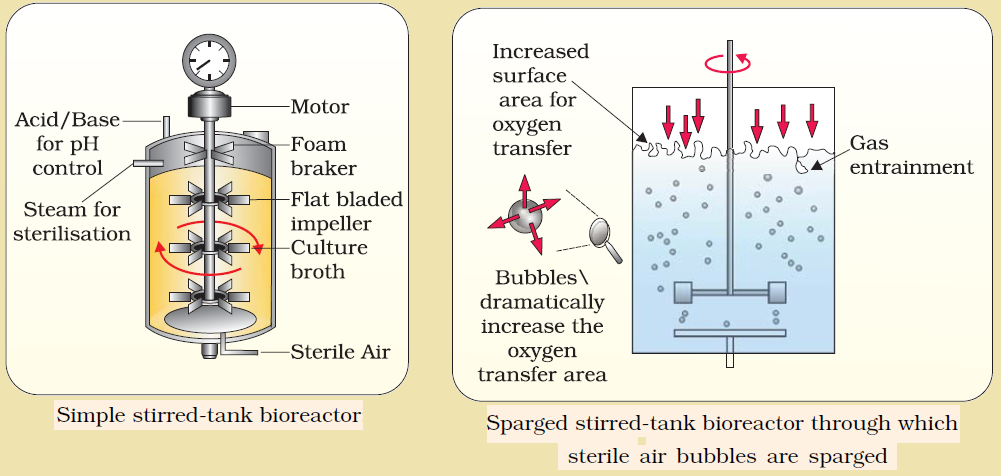
Illustrate the design of a bioreactor. Highlight the difference between a flask in your laboratory and a bioreactor which allows cells to grow in a continuous culture system.
Answer
Small volume cultures cannot yield appreciable quantities of products. To produce in large quantities, the development of bioreactors, where large volumes (100-1000 litres) of culture can be processed, was required. Thus, bioreactors can be thought of as vessels in which raw materials are biologically converted into specific products, individual enzymes, etc., using microbial plant, animal or human cells. A bioreactor provides the optimal conditions for achieving the desired product by providing optimum growth conditions (temperature, pH, substrate, salts, vitamins, oxygen).
Structure of Bioreactor:
  • It is a cylindrical structure with a curved base.
  • A stirrer is present for even mixing and oxygen availability throughout the reactor.
  • There is an agitator system, an oxygen delivery system, a foam control system, a temperature control system, etc.
  • There is a sampling port through which small volumes of culture can be taken out periodically.
A flask in a laboratory cannot be used for producing recombinant DNA on large scale. Unlike a bioreactor; a flask cannot be used to grow culture continuously.
Difference:
 
Flask
 
Bioreactor
i.
Flask is used to small laboratory scale testing of a culture.
i.
Bioreactor is used for commercial scale production.
ii.
The cells harbouring cloned genes of interest may be grown on a small scale in the laboratory.
ii.
The cells can also be multiplied in a continuous culture system wherein the used medium is drained out from one side while fresh medium is added from the other to maintain the cells in their physiologically most active log/ exponential phase. This type of culturing method produces a larger biomass leading to higher yields of desired protein.
iii.
Small volume cultures cannot yield appreciable quantities of products.
iii.
To produce in large quantities, the development of bioreactors, where large volumes (100–1000 litres) of culture can be processed, was required.
View full question & answer