Question 13 Marks
Calculate the distance between $Na^+$ and $Cl^-$ ions in $NaCl$ crystal if its density is $2.165\ g\ cm^{-3}. [$Molar mass of $NaCl=58.5\ g\ mol^{-1};\ N_A=6.02 x 10^{-23}\ mol^{-1}].$
AnswerLet the length of edge of unit cell be $= a$
Volume of unit cell $= a^3$
Molar mass of $NaCl = 58.5g\ mol^{-1}; Z = 4$
Mass of unit cell = $\frac{\text{Z}\times\text{Molar Mass}}{\text{N}_{A}}$
$=\frac{\text{4}\times\text{58.5g mol}^{-1}}{\text{0.022}\times\text{10}^{23}\text{mol}^{-1}}=\text{3.886}\times\text{10}^{-22}\text{g}$
$\text{Density}=\text{2.165g cm}^{-3},$
$\text{Density of unit cell}=\frac{\text{Mass of unit cell}}{\text{Volume}}$
$\therefore\text{ 2.165g cm}^{-3}=\frac{\text{3.886}\times\text{10}^{-22}{g}}{\text{a}^{3}}\text{ or}$
$\text{ a}^{3}=\frac{\text{3.836}\times\text{10}^{-22}\text{cm}^{3}}{\text{2.165}}=\text{1.795}\times\text{10}^{-22}\text{cm}^{3}$
Edge length, $\text{a}=\text{(1.795}\times{10}^{-22}\text{cm}^{3})^{1/3}=\text{5.64}\times\text{10}^{-8}=564\text{ pm}$
Edge length of $Na^+$ and $Cl^- = a/2 = 564pm/2 = 282\ pm.$
View full question & answer→Question 23 Marks
If the radius of the octahedral void is r and radius of the atoms in closepacking is R, derive relation between r and R.
Answer A sphere is fitted into the octahedral void as shown in the diagram.$\Delta\text{ABC}$ is a r ight angle triangle.
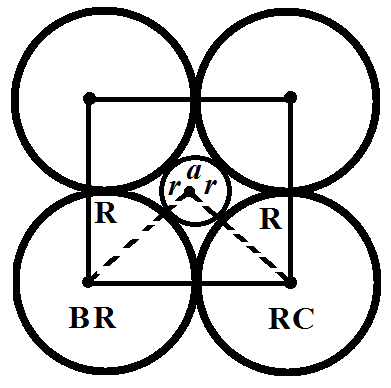
$\therefore\ \text{BC}^2=\text{AB}^2+\text{AC}^2$ $(2\text{R})^2=(\text{R}+\text{r})^2+(\text{R}+\text{r})^2$ $(2\text{R})^2=2(\text{R}+\text{r})^2$ $\Rightarrow\ \frac{(2\text{R})^2}{2}=(\text{R}+\text{r})^2$ $(\sqrt{2}\text{ R})^2=(\text{R}+\text{r})^2$ $\Rightarrow\ \sqrt{2}\text{ R}=\text{R}+\text{r}$ $\text{r}=\sqrt{2}\text{ R}-\text{R}$ $\text{r}=\text{R}(\sqrt{2}-1)$ $\text{r}=\text{R}(1.414-1)$ $\text{r}=0.414\text{ R}$ View full question & answer→Question 33 Marks
Analysis shows that nickel oxide has the formula $NiO_{.98}O_{1.00}.$ What fractions of nickel exist as $Ni^{2+}$ and $Ni^{3+}$ ions$?$
AnswerThe formula of nickel oxide is $\mathrm{NiO}{_.98} \mathrm{O}_{1.00}$.
Therefore, the ratio of the number of Ni atoms to the number of $O$ atoms, $\mathrm{Ni}: \mathrm{O}=0.98: 1.00=98: 100$
Now, total charge on $100 \mathrm{~O}_2$-ions $=100 \times(-2)$
$=-200$
Let the number of $\mathrm{Ni}^{2+}$ ions be $x$ .
So, the number of $\mathrm{Ni}^{3+}$ ions is $98-\mathrm{x}$.
Now, total charge on $\mathrm{Ni}^{2+}$ ions $=\mathrm{x}(+2)$
$=+2 x$
And, total charge on $\mathrm{Ni}^{3+}$ ions $=(98-\mathrm{x})(+3)$
$=294-3 x$
Since, the compound is neutral, we can write:
$ 2 x+(294-3 x)+(-200)=0$
$ \Rightarrow-x+94=0 $
$ \Rightarrow x=94$
Therefore, number of $\mathrm{Ni}^{2+}$ ions $=94$
And, number of $\mathrm{Ni}^{3+}$ ions $=98-94=4$
Hence, fraction of nickel that exists as $\mathrm{Ni}^{2+}=9498$
$=0.959$
And, fraction of nickel that exists as $\mathrm{Ni}^{3+}=498$
$=0.041$
Alternatively, fraction of nickel that exists as $\mathrm{Ni}^{3+}=1-0.959$
$=0.041$
View full question & answer→Question 43 Marks
What type of substances would make better permanent magnets, ferromagnetic or ferrimagnetic. Justify your answer.
Answer Ferromagnetic substances would make better permanent magnets. In solid state, the metal ions of ferromagnetic substances are grouped together into small regions called domains. Thus, each domain acts as a tiny magnet. In an unmagnetised piece of a ferromagnetic substance the domains are randomly oriented and their magnetic moments get cancelled. When the substance is placed in a magnetic field all the domains get oriented in the direction of the magnetic field and a strong magnetic effect is produced. This ordering of domains persists even when the magnetic field is removed and the ferromagnetic substance becomes a permanent magnet.
View full question & answer→Question 53 Marks
If NaCl is doped with $10^{–3}\ mol\ \%$ of $SrCl_2,$ what is the concentration of cation vacancies?
AnswerWe know that two $\mathrm{Na}^{+}$ions are replaced by each of the $\mathrm{Sr}^{2+}$ ions while $\mathrm{SrCl}_2$ is doped with $NaCl .$ But in this case, only one lattice point is occupied by each of the $\mathrm{Sr}^{2+}$ ions and produce one cation vacancy.
Here $10^{-3}$ mole of $\mathrm{SrCl}_2$ is doped with $100$ moles of $NaCl$ Thus, cation vacancies produced by $\mathrm{NaCl}=10^{-3} \mathrm{~mol}$ Since, $100$ moles of $NaCl$ produces cation vacancies after doping $=10^{-3} \mathrm{~mol}$
Therefore, 1 mole of NaCl will produce cation vacancies after doping
$ \frac{10^{-3}}{100}=10^{-5} \mathrm{~mol} $
$ \text { therefore, total cationic vacancies } $
$ =10^{-5} \times \text { Avogadro's number } $
$ =10^{-5} \times 6.023 \times 10^{23} $
$ =6.023 \times 10^{-18} \text { vacancies. }$
View full question & answer→Question 63 Marks
How can you determine the atomic mass of an unknown metal if you know its density and the dimension of its unit cell? Explain.
Answer By knowing the density of an unknown metal and the dimension of its unit cell, the atomic mass of the metal can be determined.
Let ‘a’ be the edge length of a unit cell of a crystal, ‘d’ be the density of the metal, ‘m’ be the mass of one atom of the metal and ‘z’ be the number of atoms in the unit cell.
Now, density of the unit cell = Mass of the unit cell Volume of the unit cell d = zma3 ………(i)
[Since mass of the unit cell = Number of atoms in the unit cell mass × of one atom]
[Volume of the unit cell = (Edge length of the cubic unit cell)3]
From equation (i), we have:
m = da3z ………(ii)
Now, mass of one atom of metal (m) = Atomic mass (M) Avogadro's number (NA)
Therefore, M = da3NAz ………(iii)
If the edge lengths are different (say a, b and c), then equation (ii) becomes:
m = d(abc)NAz ………(iv)
View full question & answer→Question 73 Marks
'Stability of a crystal is reflected in the magnitude of its melting points'. Comment. Collect melting points of solid water, ethyl alcohol, diethyl ether and methane from a data book. What can you say about the intermolecular forces between these molecules?
AnswerHigher the melting point, greater is the intermolecular force of attraction and greater is the stability. A substance with higher melting point is more stable than a substance with lower melting point.
The melting points of the given substances are:
Solid water = 273 K
Ethyl alcohol = 158.8 K
Diethyl ether = 156.85 K
Methane = 89.34 K
Now, on observing the values of the melting points, it can be said that among the given substances, the intermolecular force in solid water is the strongest and that in methane is the weakest.
View full question & answer→Question 83 Marks
Explain:
- The basis of similarities and differences between metallic and ionic crystals.
- Ionic solids are hard and brittle.
Answer
- The basis of similarities between metallic and ionic crystals is that both these crystal types are held by the electrostatic force of attraction. In metallic crystals, the electrostatic force acts between the positive ions and the electrons. In ionic crystals, it acts between the oppositely-charged ions. Hence, both have high melting points.
The basis of differences between metallic and ionic crystals is that in metallic crystals, the electrons are free to move and so, metallic crystals can conduct electricity. However, in ionic crystals, the ions are not free to move. As a result, they cannot conduct electricity. However, in molten state or in aqueous solution, they do conduct electricity.
- The constituent particles of ionic crystals are ions. These ions are held together in threedimensional arrangements by the electrostatic force of attraction. Since the electrostatic force of attraction is very strong, the charged ions are held in fixed positions. This is the reason why ionic crystals are hard and brittle.
View full question & answer→Question 93 Marks
Define the term 'amorphous'. Give a few examples of amorphous solids.
AnswerAmorphous solids are the solids whose constituent particles are of irregular shapes and have short range order. These solids are isotropic in nature and melt over a range of temperature. Therefore, amorphous solids are sometimes called pseudo solids or super cooled liquids. They do not have definite heat of fusion. When cut with a sharp-edged tool, they cut into two pieces with irregular surfaces. Examples of amorphous solids include glass, rubber, and plastic.
View full question & answer→Question 103 Marks
Examine the given defective crystal:
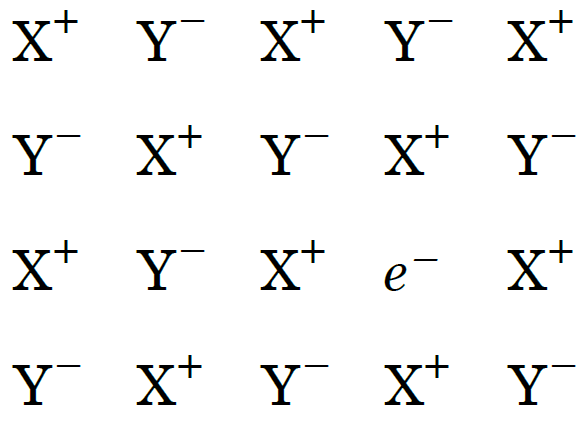
Answer the following questions:
- Is the above defect stoichiometric or non-stoichiometric?
- write the term used for the electron occupied site.
- Give an example of the compound which shows this type of defect.
Answer
- Non–Stoichiometric defect.
- F–Centre/Farbe Centre.
- NaCl is heated in an atmosphere of Na vapour/LiCl is heated in an atmosphere of Li vapour/KCl is heated in an atmosphere of K vapour.
View full question & answer→Question 113 Marks
- Based on the nature of intermolecular forces, classify the following solids:
Sodium sulphate, Hydrogen
- What happens when $CdCl2$ is doped with $AgCl ?$
- Why do ferrimagnetic substances show better magnetism than antiferromagnetic substances?
Answer
- $Na_2\ SO_4 :$ Ionic, $H_2 :$ Molecular.
- Impurity defect / Schottky defect.
- In ferrimagnetism, domains / magnetic moments are aligned in opposite direction in unequal numbers while in antiferromagnetic the domains align in opposite direction in equal numbers so they cancel magnetic moments completely, net magnetism is zero / diagrammatic explanation.
View full question & answer→Question 123 Marks
Examine the given defective crystal:
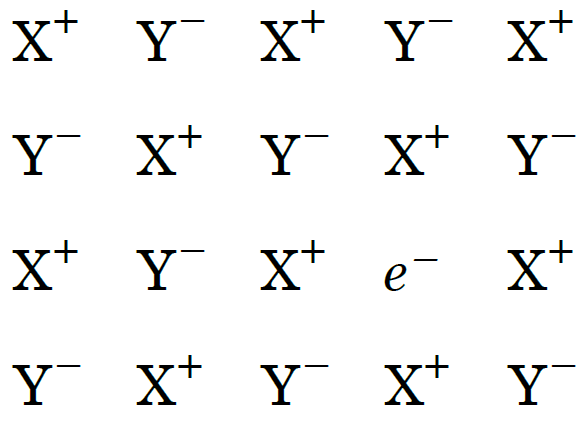
Answer the following questions:
- Is the above defect stoichiometric or non-stoichiometric?
- write the term used for the electron occupied site.
- Give an example of the compound which shows this type of defect.
Answer
- Non–Stoichiometric defect.
- F–Centre/Farbe Centre.
- NaCl is heated in an atmosphere of Na vapour/LiCl is heated in an atmosphere of Li vapour/KCl is heated in an atmosphere of K vapour.
View full question & answer→Question 133 Marks
- Based on the nature of intermolecular forces, classify the following solids: Benzene, Silver.
- $AgCl$ shows Frenkel defect while $NaCl$ does not. Give reason.
- What type of semiconductor is formed when Ge is doped with Al?
Answer
- Benzene - molecular solid.
Silver - metallic solid.
- Size of $Ag^+$ ion is smaller than $Na^+$ ion.
- $p -$ type.
View full question & answer→Question 143 Marks
An element crystallizes in a bcc. lattice with cell edge of $500$ pm. The density of the element is $7.5g\ cm^{-3}.$ How many atoms are present in $300$ g of the element?
Answer$z=2$
$\text{d} =\frac{\text{z}\times\text{M}}{\text{a}^{3}\times\text{N}_{o}}$
$N= z \times M/d \times a^3$
$N= 2 \times 300\ g / [7.5\ g\ cm^{-3}\ (5 \times 10^{-8}cm)^3]$
$N= 6.4 \times 10^{23}$ atoms
Alternate Answer
$\text{d} =\frac{\text{z}\times\text{M}}{\text{a}^{3}\times\text{N}_{o}}$
$7.5 = \frac{2\times\text{M}}{(500)^{3}\times10^{-30}\times6.022\times10^{23}}$
$\text{M} = \frac{7.5\times125\times10^{-24}\times6.022\times10^{23}}{2}$
$= 282.3$ g/mol
$282.3\ g = 6.022 \times 10^{23}$ atoms
$300\text{g} =\frac{6.022}{282.3}\frac{\times10^{23}\times}{}300$
$= 6.4 \times 10^{23}$ atoms.
View full question & answer→Question 153 Marks
Examine the given defective crystal:
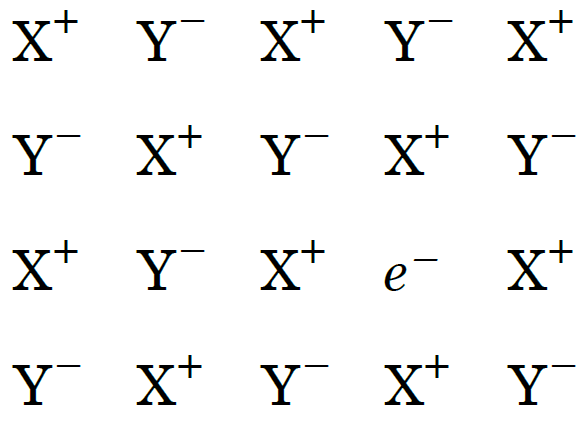
Answer the following questions:
- Is the above defect stoichiometric or non-stoichiometric?
- write the term used for the electron occupied site.
- Give an example of the compound which shows this type of defect.
Answer
- Non–Stoichiometric defect.
- F–Centre/Farbe Centre.
- NaCl is heated in an atmosphere of Na vapour/LiCl is heated in an atmosphere of Li vapour/KCl is heated in an atmosphere of K vapour.
View full question & answer→Question 163 Marks
- Based on the nature of intermolecular forces, classify the following solids:
Silicon carbide, Argon
- $ZnO$ turns yellow on heating. Why?
- What is meant by groups $12-16$ compounds? Give an example.
Answer
- Covalent solid/network solid, molecular solid
$\text{ZnO}\xrightarrow{\text{ }\text{ }\text{Heating}\text{ }\text{ }\text{ }}\text{ }\text{Zn}^{2+}+1/2\text{ }\text{O}_2+2\text{e}^-$
- Because excess $Zn^{2+}$ ions move to interstitial sites and the electrons move to neighbouring voids.
- Compounds prepared by combination of groups $12$ and $16$ behave like semiconductors. For eg $ZnS,\ CdS,\ CdSe,\ HgTe.$
View full question & answer→Question 173 Marks
The density of copper metal is $8.95\ g\ cm^{–3}.$ If the radius of copper atom be $127.8$ pm, is the copper unit cell simple cubic, body-centred cubic or face-centred cubic$?\ ($Given: Atomic mass of $Cu = 63.54\ g\ mol^{–1}$ and $N_A = 6.02 \times 10^{23}\ mol^{–1}).$
Answer$\text{d}=\frac{\text{z}\times\text{M}}{\text{a}^{3}\times\text{N}_{A}}$
Assuming fcc lattice for copper
$a = 2v2\ r$
$a^3 = (2v2\ r)^3 = 8 \times 2v2 (1.27 \times 10^{-8}cm)^3$
$= 4.723 \times 10^{-23}cm^3$
$\text{d}=\frac{\text{4}\times\text{63.54 g mol}^{-1}}{\text{4.723}\times\text{10}^{-23}\text{cm}^{3}\times\text{6.02}\times\text{10}^{23}\text{mol}^{-1}}$
$= 8.94\ g\ cm^{-3}.$
View full question & answer→Question 183 Marks
Silver crystallises with face-centred cubic unit cells. Each side of the unit cell has a length of 409 pm. What is the radius of an atom of silver? (Assume that each face atom is touching the four corner atoms.)
AnswerFor fcc unit cell
$\text{r}=\frac{\text{d}}{2}=\frac{\text{a}}{2\sqrt{2}}$
Given a = 409 pm
∴ r = 409/2√2
r = 144.62 pm.
View full question & answer→Question 193 Marks
Silver crystallises in an fcc lattice. The edge length of its unit cell is $4.077 \times 10^{–8}\ cm$ and its density is $10.5\ g\ cm^{–3}.$ Calculate on this basis the atomic mass of silver. $(N_A = 6.02 \times 10^{23}\ mol^{–1}).$
Answer$\text{d}=\frac{\text{Z }\times\text{ M}}{\text{ a}^{3}\times\text{ N}_{A}}$For fcc lattice $Z= 4$
$10.5 \text{g cm}^{-3} =\frac{4\ \times\text{ M}}{(4.077\ \times\ 10^{-8}\text{cm)}^{3}\times\ 6.022\ \times\ 10^{23}\text{mol}^{-1}}$
$\text{M} = \frac{10.5\text{g cm}^{-3}\ \times\ (4.077\ \times\ 10^{-8}\text{cm)}^{3}\ \times\ 6.022\ \times\ 10^{23}\text{mol}^{-1}}{4}$
$M = 107.12\ g\ mol^{-1}.$
View full question & answer→Question 203 Marks
Assign reasons for the following:
- Phosphorus doped silicon is a semiconductor.
- Schottky defect lowers the density of a solid.
- Some of the very old glass objects appear slightly milky instead of being transparent.
Answer
- Due to presence of free electrons on doping phosphorus.
- Due to the presence of holes or vacancies in the solid.
- Because of some crystallization in that region.
View full question & answer→Question 213 Marks
- What is the radius of sodium atom if it crystallises in bcc structure with the cell edge of $400$ pm?
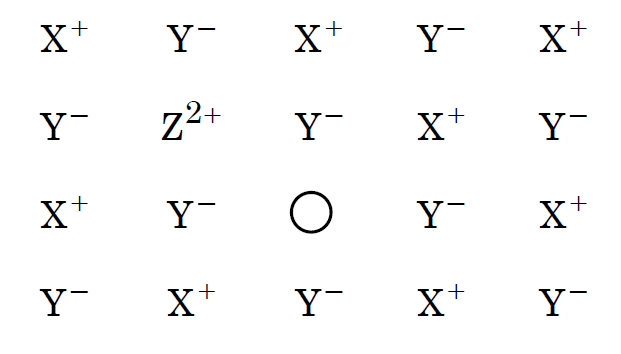
- Examine the given defective crystal:
- Write the term used for this type of defect.
- What is the result when $XY$ crystal is doped with divalent $(Z^{2+})$ impurity$?$
Answer
- For bcc structure
$\text{a}=4\text{r}/\sqrt{3}\text{ }\text{ }\text{or}\text{ }\text{ }\text{r}=\sqrt{3}\text{a}/4$
$\text{r}=\sqrt{3}\times400\text{ }\text{pm}/4$
$=1.732\times400\text{ }\text{pm}/4$
$= 173.2$ pm
-
- Impurity defect.
- Cationic vacancies are created.
View full question & answer→Question 223 Marks
- What is the radius of sodium atom if it crystallises in bcc structure with the cell edge of $400$ pm?
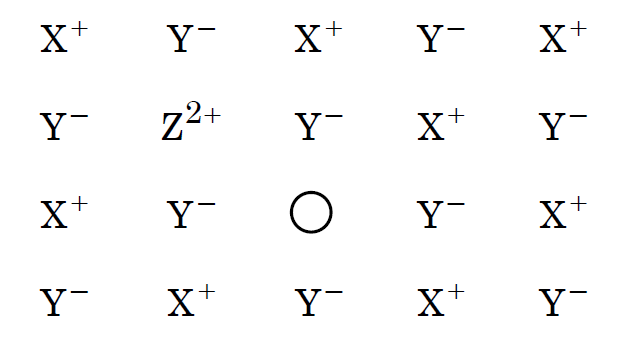
- Examine the given defective crystal:
- Write the term used for this type of defect.
- What is the result when $XY$ crystal is doped with divalent $(Z^{2+})$ impurity?
Answer
- For bcc structure
$\text{a}=4\text{r}/\sqrt{3}\text{ }\text{ }\text{or}\text{ }\text{ }\text{r}=\sqrt{3}\text{a}/4$
$\text{r}=\sqrt{3}\times400\text{ }\text{pm}/4$
$=1.732\times400\text{ }\text{pm}/4$
$= 173.2$ pm
-
- Impurity defect.
- Cationic vacancies are created.
View full question & answer→Question 233 Marks
- What is the radius of sodium atom if it crystallises in bcc structure with the cell edge of $400$ pm?
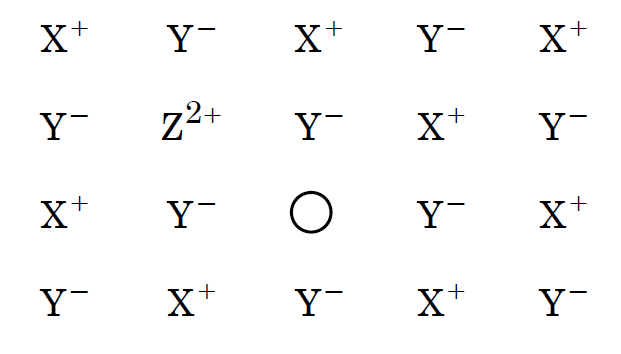
- Examine the given defective crystal:
- Write the term used for this type of defect.
- What is the result when $XY$ crystal is doped with divalent $(Z^{2+})$ impurity?
Answer
- For bcc structure
$\text{a}=4\text{r}/\sqrt{3}\text{ }\text{ }\text{or}\text{ }\text{ }\text{r}=\sqrt{3}\text{a}/4$
$\text{r}=\sqrt{3}\times400\text{ }\text{pm}/4$
$=1.732\times400\text{ }\text{pm}/4$
$= 173.2$ pm
-
- Impurity defect
- Cationic vacancies are created.
View full question & answer→Question 243 Marks
An element crystallizes in a f.c.c. lattice with cell edge of $400$ pm. Calculate the density if $200$ g of this element contain $2.5 \times 10^{24}$ atoms.
Answer$\text{d}=\frac{\text{z}\times\text{M}}{\text{N}_{\text{A}}\times\text{a}^3}$
Or
$\text{d}=\frac{\text{z}\times\text{w}}{\text{N}\times\text{a}^3}$ Where w is weight and N is no. of atoms.
$\text{d}=\frac{4\times200\text{g}}{2.5\times10^{24}\times(400\times10^{-10}\text{cm})^3}$
$d = 5\ g\ cm^{-3}$
View full question & answer→Question 253 Marks
An element crystallizes in a f.c.c. lattice with cell edge of $250$ pm. Calculate the density if 300 g of this element contain $2\times 10^{24}$ atoms.
Answer$ 2 \times 10^{24} \text { atoms weigh }=300 \mathrm{~g} $
$ \left.6.022 \times 10^{23} \text { atoms weigh }=\left(300 \times 6.022 \times 10^{23}\right) / 2 \times 10^{24}\right) $
$ =90.3 \mathrm{~g} $
$ \mathrm{~d}=\frac{\mathrm{z} \times \mathrm{M}}{\mathrm{a}^3 \mathrm{~N}_A} $
$ =4 \times 90.3 /\left(250 \times 10^{-10}\right)^3 \times \mathrm{N}_0 $
$ =38.4 \mathrm{~gcm}^{-3}$
View full question & answer→Question 263 Marks
An element with molar mass $27\ g\ mol^{–1}$ forms a cubic unit cell with edge length $ 4.05 \times 10^{–8}\ cm$. If its density is $2.7\ g\ cm^{–3}$, what is the nature of the cubic unit cell?
Answer$\text{d}=\frac{\text{z}\times\text{M}}{\text{a}^{3}\text{N}_{A}}$
$\text{z}=\frac{\text{d a}^{3}\text{N}_{A}}{\text{M}}$
$\text{z}=\frac{\text{2.7g cm}^{-3}\times\text{6.022}\times\text{10}^{23}\text{mol}^{-1}\times\text{(4.05}\times\text{10}^{-8}\text{cm)}^{3}}{\text{27 g mol}^{-1}}$
$=3.999 \approx 4$
Face centered cubic cell/fcc.
View full question & answer→Question 273 Marks
- What type of semiconductor is obtained when silicon is doped with boron?
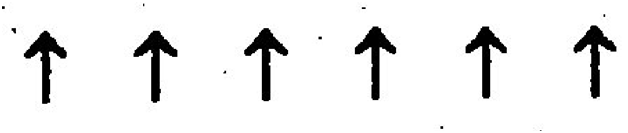
- What type of magnetism is shown in the following alignment of magnetic moments?
- What type of point defect is produced when $AgCl$ is doped with $CdCl_2?$
Answer
- p-type semiconductor.
- Ferromagnetism.
- Impurity defect/Cation vacancy defect.
View full question & answer→Question 283 Marks
Silver crystallizes in face-centered cubic unit cell. Each side of this unit cell has a length of 400 pm. Calculate the radius of the silver atom. (Assume the atoms just touch each other on the diagonal across the face of the unit cell. That is each face atomis touching the four comer atoms.)
AnswerFor fcc unit cell
$\text{r}=\frac{\text{a}}{2\sqrt{2}}$
Given a = 400 pm
$\therefore\text{r}=400/2\sqrt{2}\text{pm}$
$\text{r} =141.4 \text{pm}.$
View full question & answer→Question 293 Marks
The well known mineral fluorite is chemically calcium fluoride. It is known that in one unit cell of this mineral there are $4 \mathrm{Ca}^{2+}$ ions and $8 \mathrm{F}^{-}$ions and that $\mathrm{Ca}^{2+}$ ions are arranged in a fcc lattice. The $\mathrm{F}^{-}$ions fill all the tetrahedral holes in the face centred cubic lattice of $\mathrm{Ca}^{2+}$ ions. The edge of the unit cell is $5.46 \times 10^{-8} \mathrm{~cm}$ in length. The density of the solid is $3.18 \mathrm{~g} \mathrm{~cm}^{-3}$. Use this information to calculate Avogadro's number $($Molar mass of $\mathrm{CaF}_2=78.08 \mathrm{~g} \mathrm{~mol}^{-1} ).$
Answer$\text{d}=\frac{\text{z}\ \times\ \text{M}}{\text{a}^{3}\ \times\ \text{N}_{A}}$
$\text{For fcc lattice z} = 4$
$\text{3.18g cm}^{-3}=\frac{\text{4}\ \times\ \text{78.08g mol}^{-1}}{\text{(5.46}\ \times\ {10}^{-8}\text{cm})^{3}\times\text{N}_{A}}$
$\text{N}_{A}=\frac{\text{4}\ \times\ {78.08}\text{g mol}^{-1}}{\text{(5.46}\ \times\ {10}^{-8}\text{cm)}^{3}\ \times\ {3.18}\text{g cm}^{3}}$
$\text{N}_{\text{A}} = 6.033\times1023\text{ mol}^{-1}.$
$\text{N}_{\text{A}} =6171.75\text{ mol}^{-1}.$
View full question & answer→Question 303 Marks
Iron has a body centred cubic unit cell with a cell edge of 286.65 pm. The density of iron is $7.87\ g\ cm^{–3}.$ Use this information to calculate Avogadro’s number $($At mass of $Fe = 56\ g\ mol^{–1}).$
Answer$\text{d}=\frac{\text{Z }\times\text{ M}}{\text{a}^{3}\ \times\text{ N}_{a}}$
For bcc lattice $Z =2$
$\text{7.87g cm}^{-3}=\frac{\text{2}\ \times\ \text{56g mol}^{-1}}{\text{(286.65 }\times\text{ 10}^{-10}\text{cm})\ \times\ \text{N}_{A}}$
$\text{N}_{A}=\frac{\text{2 }\times\ \text{56g mol}^{-1}}{\text{(286.65 }\times\ \text{10}^{-10}\text{cm})^{3}\ \times\ \text{7.87g cm}^{-3}}$
$N_A = 6.04 \times 10^{23}\ mol^{-1}$
View full question & answer→Question 313 Marks
What is a semiconductor? Describe the two main types of semiconductors and explain mechanisms for their conduction.
AnswerThe solids with intermediate conductivities between insulators and conductors are termed semiconductors.
- n-type semiconductor: It is obtained by doping Si or Ge with a group 15 element like $P.$ Out of $5$ valence electrons, only $4$ are involved in bond formation and the fifth electron is delocalized and can be easily provided to the conduction band. The conduction is thus mainly caused by the movement of electron.
- p–type semi conductor: It is obtained by doping Si or Ge with a group $13$ element like Gallium which contains only $3$ valence electrons. Due to missing of $4^{th}$ valence electron, electron hole or electron vacancy is created The movement of these positively charged holes is responsible for the conduction.
View full question & answer→Question 323 Marks
Explain each of the following with a suitable example:
- Paramagnetism.
- Piezoelectric effect.
- Frenkel defect in crystals.
Answer
- Paramagnetism: due to the presence of unpaired electron, these materials are attracted by a magnetic field e.g. $O_2,\ Cu^{2+},\ Fe^{3+}.$
- Piezoelectric effect: The crystals where dipoles may align themselves in an ordered manner such that there is a net dipole moment in the crystal, show electrical conductivity on application of pressure, e.g., lead zirconate, quartz, ammonium dihydrogen phosphate.
- Frenkel defect in crystals: In a Frenkel defect an ion leaves its position in the lattice and occupies an interstitial site, e.g.,$ AgCl,\ AgBr.$
View full question & answer→Question 333 Marks
An element has a body centred cubic structure with a cell edge of 288 pm. The density of the element is 7.2 $\text{gcm}^{-3}$. Calculate the number of atoms present in 208 g of the element.
View full question & answer→Question 343 Marks
An element $‘X’ ($At. mass $= 40g\ mol^{-1})$ having f.c.c. structure, has unit cell edge length of $400$pm. Calculate the density of $‘X’$ and the number of unit cells in $4$g of $‘X’ (N_A = 6.022 \times 10^{23}\ mol^{-1}).$
AnswerUnit cell edge length $=400 \mathrm{pm}$
$=400 \times 10^{-10} \mathrm{~cm}$
Volume of unit cells $=a^3$
$ =\left(400 \times 10^{-10} \mathrm{~cm}\right)^3 $
$ =64 \times 10^{-24} \mathrm{~cm}^3$
Mass of unit cell $=$ No. of atoms in the unit cell $\times$ Mass of each atom Number of atoms in the fcc unit cell $=4$
Mass of one atom $=\frac{\text { Atomic mass }}{\text { Avagadro's no. }}$
$ =\frac{40}{6.022 \times 10^{23}} $
$ \text { Mass of unit cell }=\frac{4 \times 40}{6.022 \times 10^{23}} $
$ =26.57 \times 10^{-23} \mathrm{~g} \mathrm{~mol}^{-1}$
$ \text { Density of unit cell }=\frac{\text { Mass of unit cell }}{\text { Volume of unit cell }} $
$ =\frac{26.57 \times 10^{-23}}{64 \times 10^{24}}=4.15 \mathrm{~g} \mathrm{~cm}^{-3} $
$ 26.57 \times 10^{-23} \mathrm{~g} \text { contains } 1 \text { unit cell } $
$ 4 \mathrm{~g}=-\frac{1 \times 4}{26.57 \times 10^{-23}} $
$ =0.15 \times 10^{23} $
$ =1.5 \times 10^{22}$
aNumber of unit cells are $1.5 \times 10^{22}$
View full question & answer→Question 353 Marks
An element crystallizes in fcc lattice with a cell edge of $300$ pm. The density of the element is $10.8g\ cm^{-3}.$ Calculate the number of atoms in $108g$ of the element.
AnswerGiven, Mass of the element,$ W = 108\ g$
Z(fcc) $= 4$
Edge length, $(a) = 300\ pm\ (1\ pm = 10^{-10}\ cm)$
Density, $(\rho)=10.8\text{g}$
$\rho=\frac{\text{z }\times\text{ M}}{\text{a }^{3}\times\text{ N}_\text{A}}$
$10.8=\frac{4\ \times\ \text{M}}{(300\ \times\ 10^{-10})^3\ \times\ 6.022\ \times\ 10^{23}}$
$\text{M}=\frac{10.8\ \times\ 2.7\times10^{-23}\ \times\ 6.022\ \times\ 10^{23}}{4}\text{g}$
$\text{n}=\frac{\text{N}}{\text{N}_\text{A}}=\frac{\text{W}}{\text{M}}$
$\text{N}=\frac{\text{W}}{\text{M}}\times\text{N}_\text{A}$
$\text{N}=\frac{108\ \times\ 4\ \times\ 6.022\ \times\ 10^{23}}{10.8\ \times\ 2.7\ \times\ 10^{-23}\ \times\ 6.022\ \times\ 10^{23}}$
$\text{N}=14.8\times10^{23}\text{atoms}$
View full question & answer→Question 363 Marks
What is the coordination number of:
- Zinc in zinc blende $(ZnS)?$
- Oxide ion in sodium oxide $(Na_2O)?$
- Calcium in calcium fluoride $(CaF_2)?$
View full question & answer→Question 373 Marks
In corundum, oxide ions are arranged in hexagonal close packing and aluminium ions occupy two-third of the octahedral voids. What is the formula of corundum?
AnswerLet the number of oxide ions in the packing be $N.$
Then octabedral voids $= N.$ Therefore $AI^{3+}$ ions $=\frac{2}{3}\times\text{N}=\frac{2\text{N}}{3}.$
$\therefore$ Ratio of $AI^{3+} : O^2 =\frac{2\text{N}}{3}:\text{N}=2:3$
Hence, formula of corundum is $AI_2O_3.$
View full question & answer→Question 383 Marks
Calculate the following:
- Number of $NaCl$ units in a unit cell of $NaCl.$
- Number of $CsCl$ unit in a unit cell of $CsCl.$
Answer
- Number of $Na^+$ ions $= 12($at edge centres$) \times\frac{1}{4}+1 ($at body centre$) × 1 = 4,$
Number of $Cl^–$ ions $= 8($at the corners$) \times\frac{1}{8}+6 ($at face centres$) \times\frac{1}{2}=4$
$\therefore$ umber of NaCl units per unit cell $(z) = 4$
- Number of $Cs+$ ion $= 1($at the body centre$) × 1 = 1$ Number of $Cl^–$ ions $= 8 ($at the corners$) \times\frac{1}{8}=1,$
$\therefore$ umber of CsCl units per unit cell $(z) = 1.$ View full question & answer→Question 393 Marks
Inspite of long range order in the arrangement of particles why are the crystals usually not perfect?
AnswerCrystals have long range in the arrangement of particles but usually the crystals are not perfect this is because when crystallisation occurs at a fast rate or moderate rate, the constituent particles may not get sufficient time to arrange themselves in a perfect order.
View full question & answer→Question 403 Marks
A crystalline solid has a cubic structure in which tungsten $(W)$ atoms are located at cube corners of the unit cell, oxygen atoms at the cube edges and sodium atom at the centre. What is the molecular formula of the compound?
AnswerNumber of W atoms per unit cell $= 8($at the corners$) \times\frac{1}{8}=1$
Number of O atoms per unit cell $= 12($at the edge centres$) \times\frac{1}{4}=3$
Number of sodium atoms per unit cell $= 1($at the cube centre$) × 1 = 1,$
Nence, the formula of the compound $= NaWO_3.$
View full question & answer→Question 413 Marks
In a cubic close packed structure of a mixed oxide one-eighth of tetrahedral voids are occupied by divalent ions $X^{2+},$ while one half of the octahedral voids are occupied by trivalent ions $Y^{3+}.$ What is the formula of the compound?
AnswerLet the number of $O^{2-}$ ions in the crystal $= N$
$\therefore$ Number of tetrahedral voids $= 2N$
Number of octahedral voids $= N$
$\therefore$ Number of $X^{2+}$ ions $=\frac{1}{8}\times2\text{N}=\frac{\text{N}}{4}$
Number of $Y^{2+}$ ions $=\frac{1}{8}\times\text{N}=\frac{\text{N}}{2}$
$\text{X}^{2+}:\text{Y}^{3+}:\text{O}^{2-}=\frac{\text{N}}{4}:\frac{\text{N}}{2}:\text{N}=1:2:4$
Hence, the formula of the compound is $XY_2O_4.$
View full question & answer→Question 423 Marks
Why does table salt, $NaCl,$ some times appear yellow in colour?
AnswerYellow colour in sodium chloride is due to metal excess defect. Iin metal excess defect anionic vacancies are created due to diffusion of $Cl^-$ to the surface of the crystal and there after unpaired electrons occupy anionic sites. These sites are called $F-$centres. The electrons at $F-$cetres then absorb energy from the visible region for the excitation which makes crystal appear yellow.
View full question & answer→Question 433 Marks
A compound formed by elements $A$ and $B$ has a cubic structure in which $A$ atoms are at the corners of the cube and $B$ atoms are at the face centres. Derive the formula of the compound.
AnswerNumber of $A$ atoms per unit cell $= 8($at the corners$) \times\frac{1}{8}=1$
Number of $B$ atoms per unit cell $= 6($at the centres$) \times\frac{1}{2}=3$
$A : = 1 : 3$
$\therefore$ The formula of the compound $= AB_3.$
View full question & answer→Question 443 Marks
- Why are crystalline solids anisotropic?
- What type of semiconductor is formed when silicon is doped with boron?
- Define the term coordination number. What is the coordination number of atoms in a cubic closed packed structure?
Answer
- It arises from different arrangement of particles in different direction.
- Silicon is group 14 element and boron is group 13 element, therefore, an electron deficient hole is created. Thus, semiconductor is of p-type.
- Coordination number is defined as the number of nearest neighbours in a closed packed structure. The coordination number of an atom in ccp structure is 12.
View full question & answer→Question 453 Marks
Match the types of defect given in Column I with the statement given in Column II.
| |
Column I |
|
Column II |
| (i) |
Impurity defect |
(a) |
$NaCl$ with anionic sites called $F-$centres. |
| (ii) |
Metal excess defect |
(b) |
$FeO $with $Fe^{3+}.$ |
| (iii) |
Metal deficiency defect |
(c) |
$NaCl$ with $Sr^{2+}$ and some cationic sites vacant. |
Answer
| |
Column I |
|
Column II |
| (i) |
Impurity defect |
(c) |
$NaCl$ with $Sr^{2+}$ and some cationic sites vacant. |
| (ii) |
Metal excess defect |
(a) |
$NaCl$ with anionic sites called F-centres. |
| (iii) |
Metal deficiency defect |
(b) |
$FeO$ with $Fe^{3+}.$ |
View full question & answer→Question 463 Marks
Sodium metal crystallises in bcc lattice with the cell edge, $4.29\mathring{\text{A}}.$ What is the radius of sodium metal? What is the length of the body diagonal of the unit cell?
AnswerFor bcc lattice,
$\text{r}=\frac{\sqrt{3}}{4}\text{a}$
$\text{r}=\frac{1.732}{4}\times4.29\mathring{\text{A}}=1.86\mathring{\text{A}}$
Length of the body diagonal = 4r.
$4\times186\mathring{\text{A}}=7.44\mathring{\text{A}}$
View full question & answer→Question 473 Marks
Why does the electrical conductivity of semiconductors increase with rise in temperature?
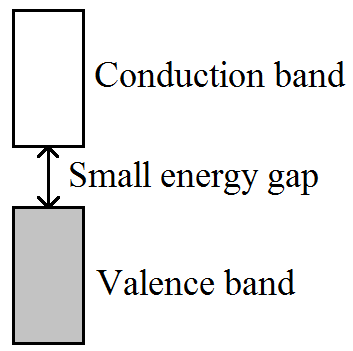
AnswerThe energy gap between valence band and conduction band is small. At room temperature, they do not conduct electricity but when temperature is raised large number of electron from valence band get sufficient energy to jump to conduction band. This is known as thermodynamic conduction in intrinsic semiconductors. Thus, they become more conducting as the temperature increases.
View full question & answer→Question 483 Marks
An ionic compound made of atoms $X$ and $Y$ has a face centred cubic arrangement in which atoms $A$ are at the corners and atoms $Y$ are at the face centres. If one of the atoms is missing from the corner, what is the simplest formula of the compound?
AnswerNumber of X atoms per unit cell = 7(at the corners) $\times\frac{1}{8}=\frac{7}{8}$
Number of Y atoms per unit cell = 6(at the centres) $\times\frac{1}{2}=3$
$\text{X}:\text{Y}=\frac{7}{8}:3=7:24$
$\frac{7} 8{ }:3=7:24$
$\therefore$ Formula of the comound $= X_7Y_{24}.$
View full question & answer→Question 493 Marks
What are the reasons of electrical conductivity in:
- Metals,
- Ionic solids,
- Smiconductors?
Answer
- It is due to flow of electrons.
- It is due to flow of ions in solution or molten state and defects in the solid state.
- It is due to the presence of impurities and defects.
View full question & answer→Question 503 Marks
Calculate the following:
- Number of $ZnS$ units in a unit cell of $ZnS.$
- Number of $CaF_2$ units in a unit cell of $CaF_2.$
Answer
- Number of $Zn^{2+}$ ions $= 4($within the body$) \times 1 = 4,$
Number of $S^{2–}$ ions $= 8($at the corners$) \times\frac{1}{8}+6 ($at face centres$) \times\frac{1}{2}=4$
$\therefore$ Umber of $ZnS$ units per unit cell $(z) = 4.$
- Number of $Ca^{2+}$ ions $= 8($at the corners$) \times\frac{1}{8}+6 ($at face centres$) \times\frac{1}{2}=4,$
Number of $F^-$ ions $= 8($within the body$) \times 1 = 8$
Number of $CaF^2$ ions per unit cell $(z) = 4.$ View full question & answer→Question 513 Marks
Write the coordination number of each ion in the following crystals:
- $ZnS$
- $CaF_2$
- $Na_2O$
Answer
- $Zn^{2+} = 4,\ S^{2-} = 4$
- $Ca^{2+} = 8,\ F^- = 4$
- $Na^+ = 4,\ O^{2-} = 8$
View full question & answer→Question 523 Marks
The radius of an atom of an element is 75pm. If it crystallizes as a body-centred cubic lattice, what is the length of the side of the unit cell?
AnswerFor bcc, $\text{a}=\frac{4}{\sqrt{3}}\text{r}=\frac{4}{\sqrt{3}}\times75$
$=\frac{4}{\sqrt{3}}\times75\times\frac{\sqrt{3}}{\sqrt{3}}=100\times1.732=173.2\text{pm}$
View full question & answer→Question 533 Marks
A solid is made up of two elements $P$ and $Q.$ Atoms of $Q$ are in ccp arrangement while atoms of $P$ occupy all the tetrahedral sites. What is the formula of the compound?
AnswerSuppose number of atoms of $Q$ in ccp arrangement $= N,$
So, number of tetrahedral sites $= 2N,$
$\therefore$ Number of $P$ atoms $= 2N,$
$\therefore P : Q = 2N : N = 2 : 1$
Hence, formula of compound is $P_2Q.$
View full question & answer→Question 543 Marks
A compound is formed by two elements X and Y. Atoms of the element Y(as anions) make ccp and those of the element X(as cations) occupy all the octahedral voids. What is the formula of the compound?
AnswerSuppose the number of atoms Y in ccp = N
$\therefore$ Number of octahedral voids = N × 1 = N
$\therefore$ Number of atoms of X = N
Ratio of X : Y = N : N = 1 : 1
Hence, formula of the compound = XY
View full question & answer→Question 553 Marks
If three elements $A,\ B$ and $C$ crystallise in a cubic solid lattice with $A$ atoms at the corners, $B$ atoms at the cube centres and $C$ atoms at the centre of the faces of the cube, then write the formula of the compound.
AnswerAtoms of $A$ per unit cell $=8\times\frac{1}{8}=1$
Atoms of $B$ per unit cell $= 1$
Atoms of $C$ per unit cell $=6\times\frac{1}{2}=3$
Hence, the formula is $ABC_3.$
View full question & answer→Question 563 Marks
A cubic solid is made up of two elements A and B. Atoms A are present at the corners of the cube and B are at the alternate face centres. What is the formula of the solid?
AnswerNumber of A atoms per unit cell $=8\times\frac{1}{8}=1$
Number of B atoms per unit cell $=2\times\frac{1}{2}=1$
$\therefore$ Formula of the compound = AB.
View full question & answer→Question 573 Marks
Explain why does conductivity of germanium crystals increase on doping with galium.
AnswerOn doping tetravalent germanium with trivalent galium some of the positions of lattice of germanium are occupied by galium. Galium atom has only three valence electrons. Therefore, fourth valency of nearby germanium atom is not satisfied. The place remains vacant. This place is deficient of electrons and is therefore called electron hole or electron vacancy. Electron from neighbouring atom comes and fills the gap, thereby creating a hole in its original position. Under the influence of electric field electrons move towards positively charged plates through these holes and conduct electricity. The holes appear to move towards negatively charged plates.
View full question & answer→Question 583 Marks
. Match the type of packing given in Column I with the items given in Column II.
| |
Column I
|
|
Column II
|
|
(i)
|
Square close packing in two dimensions
|
(a)
|
Triangular voids. |
|
(ii)
|
Hexagonal close packing in two dimensions |
(b)
|
Pattern of spheres is repeated in every fourth layer. |
|
(iii)
|
Hexagonal close packing in three dimensions |
(c)
|
Coordination number 4. |
|
(iv)
|
Cubic close packing in three dimensions |
(d)
|
Pattern of sphere is repeated in alternate layers. |
Answer
| |
Column I
|
|
Column II
|
|
(i)
|
Square close packing in two dimensions
|
(c)
|
Coordination number 4. |
|
(ii)
|
Hexagonal close packing in two dimensions |
(a)
|
Triangular voids. |
|
(iii)
|
Hexagonal close packing in three dimensions |
(d)
|
Pattern of sphere is repeated in alternate layers. |
|
(iv)
|
Cubic close packing in three dimensions |
(b)
|
Pattern of spheres is repeated in every fourth layer. |
View full question & answer→Question 593 Marks
Match the items given in Column I with the items given in Column II.
| |
Column I
|
|
Column II
|
|
$(i)$
|
$Mg$ in solid state
|
$(a)$
|
$p-$Type semiconductor.
|
|
$(ii)$
|
$MgCl_2$ in molten state
|
$(b)$
|
$n-$Type semiconductor.
|
|
$(iii)$
|
Silicon with phosphorus
|
$(c)$
|
Electrolytic conductors.
|
|
$(iv)$
|
Germanium with boron
|
$(d)$
|
Electronic conductors.
|
Answer
| |
Column I
|
|
Column II
|
|
$(i)$
|
$Mg$ in solid state
|
$(d)$
|
Electronic conductors.
|
|
$(ii)$
|
$MgCl_2$ in molten state
|
$(c)$
|
Electrolytic conductors.
|
|
$(iii)$
|
Silicon with phosphorus
|
$(b)$
|
$n-$Type semiconductor.
|
|
$(iv)$
|
Germanium with boron
|
$(a)$
|
$p-$Type semiconductor.
|
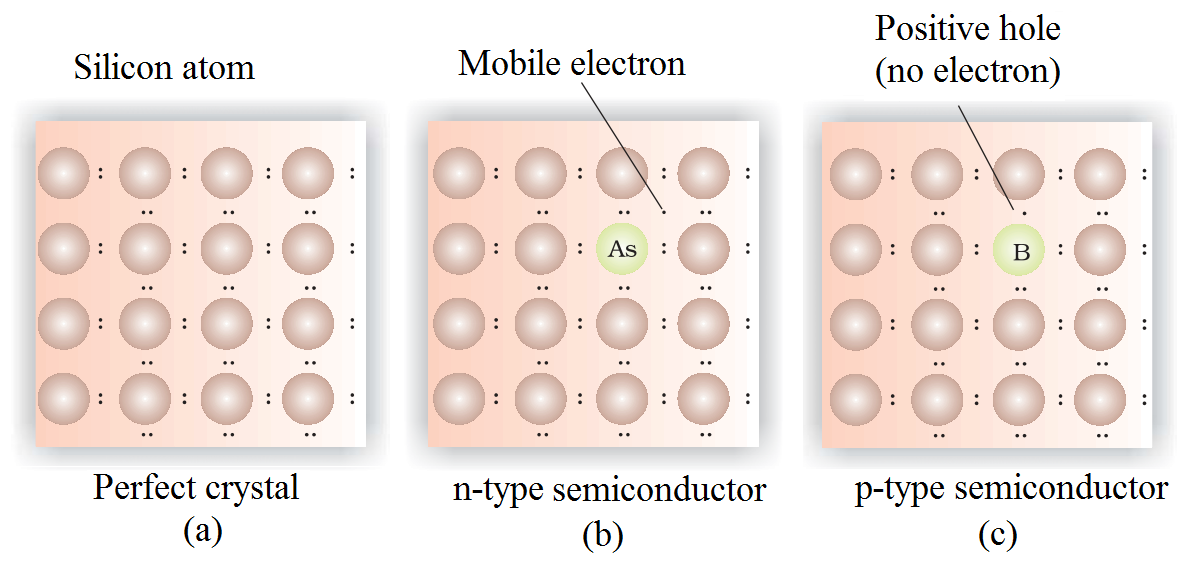
- $Mg$ in solid state show electronic conductivity due to presence of free electrons hence, they are known as electronic conductors.
- $MgCl_2$ in molten state show electrolytic conductivity due to presence of electrolytes in molten state.
- Silicon doped with phosphorus contain one extra electron due to which it shows conductivity under the influence of electric field and known as $p-$type semiconductor.
- Germanium doped with boron contains one hole due to which it shows conductivity under the influence of electric field and known as $n-$type semiconductor.
View full question & answer→Question 603 Marks
Match the defects given in Column I with the statements in given Column II.
| |
Column I |
|
Column II |
|
(i)
|
Simple vacancy defect
|
(a)
|
Shown by non-ionic solids and increases density of the solid.
|
|
(ii)
|
Simple interstitial defect
|
(b)
|
Shown by ionic solids and decreases density of the solid.
|
|
(iii)
|
Frenkel defect
|
(c)
|
Shown by non ionic solids and density of the solid decreases.
|
|
(iv)
|
Schottky defect
|
(d)
|
Shown by ionic solids and density of the solid remains the same.
|
Answer
| |
Column I |
|
Column II |
|
(i)
|
Simple vacancy defect
|
(c)
|
Shown by non ionic solids and density of the solid decreases.
|
|
(ii)
|
Simple interstitial defect
|
(a)
|
Shown by non-ionic solids and increases density of the solid.
|
|
(iii)
|
Frenkel defect
|
(d)
|
Shown by ionic solids and density of the solid remains the same.
|
|
(iv)
|
Schottky defect
|
(b)
|
Shown by ionic solids and decreases density of the solid.
|
View full question & answer→Question 613 Marks
Match the type of unit cell given in Column I with the features given in Column II.
| |
Column I |
|
Column I |
|
(i)
|
Primitive cubic unit cell
|
(a)
|
Each of the three perpendicular edges compulsorily have the different edge length i.e; a ≠ b ≠ c.
|
|
(ii)
|
Body centred cubic unit cell
|
(b)
|
Number of atoms per unit cell is one.
|
|
(iii)
|
Face centred cubic unit cell
|
(c)
|
Each of the three perpendicular edges compulsorily have the same edge length i.e.; a = b = c
|
|
(iv)
|
End centred orthorhombic unit cell
|
(d)
|
In addition to the contribution from the corner atoms the number of atoms present in a unit cell is one.
|
|
|
|
(e)
|
In addition to the contribution from the corner atoms the number of atoms present in a unit cell is three.
|
Answer
| |
Column I |
|
Column I |
|
(i)
|
Primitive cubic unit cell
|
(b)
(c)
|
Number of atoms per unit cell is one.
Each of the three perpendicular edges compulsorily have the same edge length i.e.; a = b = c
|
|
(ii)
|
Body centred cubic unit cell
|
(C)
(d)
|
Each of the three perpendicular edges compulsorily have the same edge length i.e.; a = b = c
In addition to the contribution from the corner atoms the number of atoms present in a unit cell is one.
|
|
(iii)
|
Face centred cubic unit cell
|
(c)
(e)
|
Each of the three perpendicular edges compulsorily have the same edge length i.e.; a = b = c
In addition to the contribution from the corner atoms the number of atoms present in a unit cell is three.
|
|
(iv)
|
End centred orthorhombic unit cell
|
(a)
(d)
|
Each of the three perpendicular edges compulsorily have the different edge length i.e; a ≠ b ≠ c.
In addition to the contribution from the corner atoms the number of atoms present in a unit cell is one.
|
Explaination:
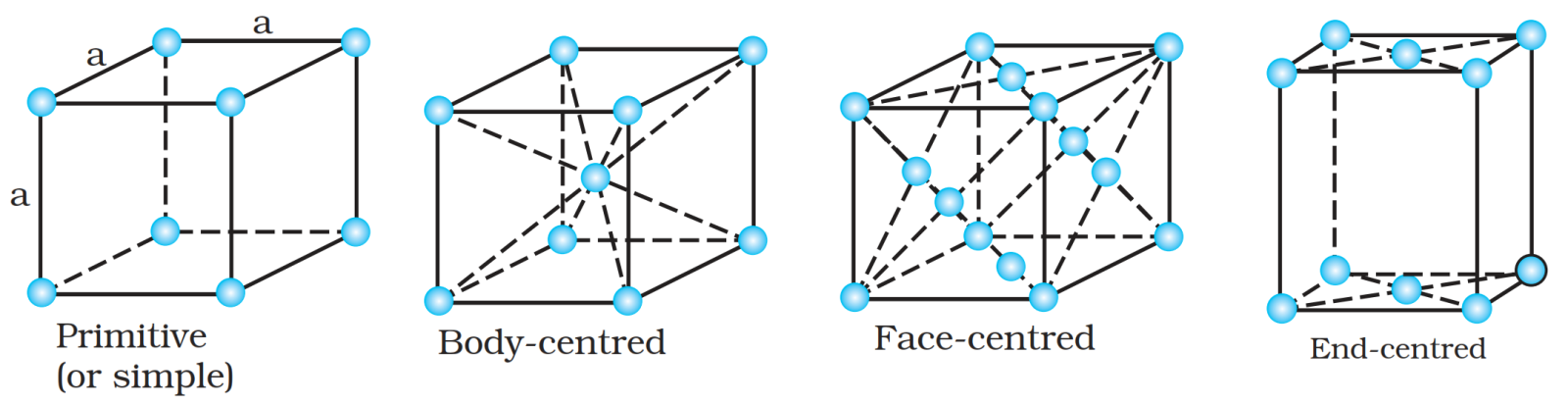
- For primitive unit cell, a = b = c
Total number of atoms per unit cell $= \frac{1}{8}\times 8 = 1$
Here, $\frac{1}{8}$ is due to contribution of each atom present at corner.
- For body centred cubic unit cell, a = b = c
This lattice contain atoms at corner as well as body centre. Contribution due to atoms at corner $= \frac{1}{8}\times 8 = 1$
contribution due to atoms at body centre = 8
- For face centred unit cell, a = b = c
Total constituent ions per unit cell present at corners $= \frac{1}{8}\times 8 = 1$
Total constituent ions per unit cell present at face centre $= \frac{1}{2}\times 6 = 3$
- For end centered orthorhombic unit cell, $\text{a}\neq\text{b}\neq\text{c}$ Total contribution of atoms present at corner $= \frac{1}{8}\times 8 = 1$
Total contribution of atoms present at end centre $=\frac{1}{2}\times2=1$
Hence, other than corner it contain total one atom per unit cell.
View full question & answer→