- ANuclear fission
- BNuclear fusion
- CNuclear fission & fusion
- DNuclear decay
- Nuclear fusion
Explanation:
Stellar and solar energy is due to fusion reactions. So, source of stellar energy is Nuclear fusion.
Explanation:
Stellar and solar energy is due to fusion reactions. So, source of stellar energy is Nuclear fusion.
Explanation:
The binding energy is a energy that holds the nucleus together.
Thus, more binding energy will give more stable nuclei. Here alpha particle has more binding energy so it will be more stable than deutron.
Explanation:
Protons and neutrons are present inside the nucleus and they exert strong attractive nuclear forces on each other, which are equal in magnitude. Due to their positive charge, protons repel each other. Hence the net attractive force between two protons gets reduced, but the nuclear force is stronger than the electrostatic force at a separation of 1fm.
Explanation:
Isotopes of an element must have same atomic number (Z) but different mass number A.
Number of protons is equal to the atomic number.
So, isotopes of an element have same number of protons.
Mass number is equal to the sum of number of protons and neutrons i.e. A = p + n
As isotopes of an element have different mass number but same number of protons, thus they must have different number of neutrons.
Explanation:
When an alpha particle is emitted from the nucleus the nucleus losses two protons and two neutrons. This means that the atomic number is decreased by 2.
Sloution:
Key concept: Q value or energy of nuclear reaction: The energy absorbed or released during a nuclear reaction is known as Q-value of nuclear reaction.
Q-value = (Mass of reactants – mass of products)c2 Joules = (Mass of reactants – mass of products) amu
If Q < 0, the nuclear reaction is known as endothermic. (The energy is absorbed in the reaction).
If Q > 0, the nuclear reaction is known as exothermic. (The energy is released in the reaction).
Let the nucleus be ZXA.
$\beta$ decay is respresented as: $_\text{Z}\text{X}^\text{A}\rightarrow_{\text{z}+1}\text{Y}^{\text{A}}+_{-1}\text{e}^0+\overline{\text{v}}+\text{Q}_2$
Q1 = [mn(zXA) - mn (z+1YA) - me]c2
= [mn (zXA) + Zme - mn (z+1YA) - (Z + 1)me]c2
= [m(zXA) - m(z-1YA)]c2
⇒ Q1 = (Mx - My)c2
$\beta^+$ decay is represented as; $_\text{Z}\text{X}^\text{A}\rightarrow_{\text{z}-1}\text{Y}^{\text{A}}+_{+1}\text{e}^0+{\text{v}}+\text{Q}_2$
Q2 = [mn(zXA) - mn (z-1YA) - me]c2
= [mn (zXA) + Zme - Mn (z-1YA) - (Z - 1)me - 2me]c2
= [m(zXA)' - m(z-1YA) - 2me] c2
⇒ Q2 = (Mx - My - 2me)c2.
Explanation:
Packing fraction is the mass defect per nucleon i.e. elementary particle in the nucleus. The difference between atomic weight and mass number i.e. mass of elementary particle in the nucleus is known as mass defect. Hence,
$\text{p}=\frac{\Delta\text{m}}{\text{A}}$
$\text{p}=\frac{\text{M - A}}{\text{A}}$
Explanation:
Carbon has three isotopes $12\text{C}\\ \ 6$, $13\text{C}\\ \ 6$ and $14\text{C}\\ \ 6$
Explanation:
The difference between the sum of the masses of the constituent particles and the mass of an atom is called mass defect.
The energy released due to mass defect was given by Einstein
E = $△$mc2
Explanation:
BE)Hc = 28MeV, A of He = 4
BE)He = $\frac{28}{4}$MeV
= 7 MeV
Explanation:
Fusion reaction is the combining of atom to form heavier nuclei. Fusion reaction requires high temperature. God fusion to occur on earth a, we need a temperature of at least 100 million degree Celsius. It is also an uncontrollable reaction.
Explanation:
Protons and neutrons are present inside the nucleus and they exert strong attractive nuclear force on each other. These forces are equal in magnitude, irrespective of the charge present on the nucleons.
$\therefore$ Fpp = Fpn = Fnn
Here, Fpp = Fpn = Fnn denote the magnitudes of the nuclear force by a proton on a proton, by a proton on a neutron and by a neutron on a neutron, respectively.
Explanation:
Chlorine is a chemical element with the symbol Cl and atomic number 17. The second-lightest of the halogens, it appears between fluorine and bromine in the periodic table and its properties are mostly intermediate between them.
Explanation:
The average nuclear radius (R) and the mass number of the element (A) has the following relation:
$\text{R}=\text{R}_{0}\text{A}^{\frac{1}{2}}$
$\frac{\text{R}}{\text{R}_{0}}=\text{A}^{\frac{1}{3}}$
In $\Big(\frac{\text{R}}{\text{R}_0}\Big)=\frac{1}{3}$ In A
Therefore, the graph of ln$\Big(\frac{\text{R}}{\text{R}_0}\Big)$ versus ln A is a straight line passing through the origin with slope $\frac{1}{3}.$
Explanation:
Modern atomic weight scale is based on C−12.
The standard unit for expressing the mass of atom is amu (atomic mass unit).
It is equal to $\frac{1}{12}$ of the mass of an atom of carbon-12 equal to 1.6605×10⁻¹⁹g.
amu is also called as avogram.
Avogram is a unit of mass and weight equal to one gram divided by the Avogadro's number.
Explanation:
Two protons exert strong attractive nuclear force and repulsive electrostatic force on each other. Nuclear forces are short range forces existing in the range of a few fms. Therefore, at a separation of 10nm, the electromagnetic force is greater than the nuclear force, i.e. Fe >> Fn.
Explanation:
$\beta^-$ decay: $_\text{Z}^\text{A}\text{X}→_{\text{Z}+1}^{\text{A}}\text{Y} + _{−1}^0\text{e}$
Thus, the atomic number is increased in $\beta^-$ decay.
Solution:
The nucleus of Tritium (1H3) contains 1 proton and 2 neutrons.
A neutron decays as $\text{n}\rightarrow\ \text{p}+\overline{\text{e}}+\overline{\text{v}},$ the nucleus may have 2 protons and one neutron i.e., tritium will transform into 2He3. It means triton energy is less that of 2He3 nucleaus. Tirton energy is less than that of 2He3 nucleus, which simple mean transformation is not allowed energetically.
Explanation:
The average life is the mean life time for a nuclei to decay.
It is given as
$\tau=\frac{1}{\lambda}=\frac{\text{T}_{\frac{1}{2}}}{0.693}$
Here, $\tau,\lambda$ and $\text{T}_{\frac{1}{2}}$ are the average life, decay constant and half life-time of the active nuclei, respectively. The value of the average lifetime comes to be more than the average lifetime. Therefore, in one average life, more than half the active nuclei decay.
Explanation:
A nuclear reaction is a process, such as fission, fusion or radioactive decay, in which the structure of an atomic nucleus is altered through release of energy or mass or by being broken apart. The number of nuclei in the element atom changes resulting in release of energy.

Solution:
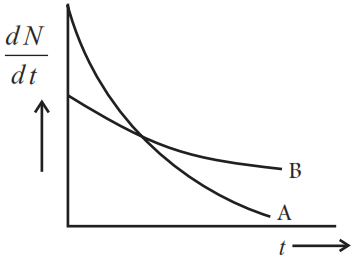
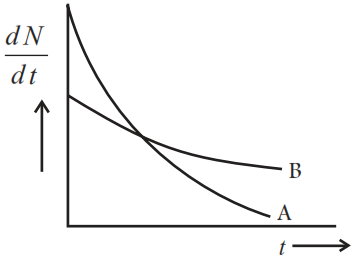
It can be observed from the figure that the slope of curve A is greater that thet of curve B, it means the rate of decay is faster for A than that of B.
According to Rutherford and Soddy law for radioactive decay $-\Big(\frac{\text{dN}}{\text{dt}}\Big)\propto\lambda$, where decay,

Hence at point P, rate of decay for both A and B is the same.
Explanation:
The atomic number = Z = no. of protons = p
The mass no. = A = no. of protons (p) + no. of neutrons(n) = n + p
Explanation:
Deuterium: $\frac{2}{1}$H
Mass number: A = 2
Atomic number (or number of protons), Z = 1
Number of neutrons, Nn = A − Z = 2 − 1 = 1
Explanation:
Binding energy of a nucleus is defined as the energy required to break the nucleus into its constituents. It is also measured as the Q-value of the breaking of nucleus, i.e. the difference between the rest energies of reactants (nucleus) and the products (nucleons) or the difference between the kinetic energies of the products and the reactants.
Explanation:
Nuclear binding energy can be computed from the difference in mass of a nucleus, and the sum of the masses of the number of free neutrons and protons that make up the nucleus. Once this mass difference, called the mass defect or mass deficiency, is known, Einstein's mass-energy equivalence formula can be used to compute the binding energy of any nucleus.
Early nuclear physicists used to refer to computing this value as a "packing fraction" calculation.
Explanation:
Negative beta decay is given as
$\text{n}\rightarrow\text{p + e}^-+\bar{\text{v}}$
Neutron decays to produce proton, electron and anti-neutrino.
Explanation:
Binding energy per nucleon varies in a way that it depends on the actual value of mass number (A). As the mass number (A) increases, the binding energy also increases and reaches its maximum value of 8.7MeV for A(50-80) and for A > 100. The binding energy per nucleon decreases as A increases and the nucleus breaks into two or more atoms of roughly equal parts so as to attain stability and binding energy of mass number between 50-80.
$\alpha-\text{decay}$
$\beta^+-\text{decay}$
Explanation:
In alpha particle decay, the unstable nucleus emits an alpha particle reducing its proton number (atomic number) Z as well as neutron number N by 2.
$\text{ }^{\text{A}}_{\text{Z}}\text{X}\rightarrow\text{ }^{\text{A}-4}_{\text{Z}-2}\text{Y}+\text{ }^4_2\text{He}$
During $\beta^--\text{decay},$ a neutron is converted to a proton, an electron and an antineutrino. Thus, there is an increase in the atomic number.
$\text{ }^{\text{A}}_{\text{Z}}\text{X}\rightarrow\text{ }^{\text{A}}_{\text{Z}+1}\text{Y}+\text{e}^-+\bar{\text{v}}$
During $\beta^+-\text{decay},$ a proton in the nucleus is converted to a neutron, a positron and a neutrino in order to maintain the stability of the nucleus. Thus, there is a decrease in the atomic number.
$\text{ }^{\text{A}}_{\text{Z}}\text{X}\rightarrow\text{ }^{\text{A}}_{\text{Z}-1}\text{Y}+\beta^++\text{v}$
When a nucleus is in higher excited state or has excess of energy, it comes to the lower state in order to become stable and release energy in the form of electromagnetic radiation called gamma ray. The element in the gamma decay doesn't change.
Therefore, alpha and beta plus decay suffer decrease in atomic number.
Solution:
Given, $\text{F}=\frac{\text{GMm}}{\text{r}^2}$
M = Effective mass of hydrogen atom = mass of electron + mass of proton - $\frac{\text{B}^2}{\text{C}}$
Where B is BE of hydrogen atom = 13.6eV.
Explanation:
One a.m.u. is defined as mass of $\frac{1}{12}$th the mass of one carbon-12 atom.
Explanation:
Fusion reaction takes place at temperatures around 107k. It requires this high temperature so that nucleus start moving at rapidly speed, which in turn increases their kinetic, so that they overcome the repulsion between them and can come together.
Explanation:
When the train is stationary, the separation between the alpha particle and recoiling uranium nucleus is x in time t after the decay. Even if the decay is taking place in a moving train and the separation is measured by the passenger sitting in it, the separation between the alpha particle and nucleus will be x. This is because the observer is also moving with the same speed with which the alpha particle and recoiling nucleus are moving, i.e. they all are in the same frame that is moving at a uniform speed.
Explanation:
Atomic number = number of protons = 16
Mass number = Number of protons + number of neutrons
So the mass number of sulfur = 32
Explanation:
$\beta^-$ emission is due to decay of neutron in the nucleus n → p + e−.
Explanation:
22Ne decays
$\alpha$particle = He2+
Mass No = 4
p = 2, n = 2
So, New mass no. = 22 − 8 = 14
Atomic No. = 10 − 4 = 6
So, the new element is 6C14
Explanation:
Because thermal energy decreases, therefore mass should increase.
Explanation:
In a Bainbridge mass spectrometer positive rays of the same element produce different traces. The traces correspond to isotopes. Isotopes are atoms of same element. They have same atomic number (nuclear charge) but different mass number (number of neutrons). Positive rays (or anode rays or canal rays) contains ions obtained by knocking out electrons from gaseous atoms.
Explanation:
Cobalt therapy or cobalt -60 therapy is the medical use of gamma rays from the radioisotope cobalt 60 to treat conditions such as cancer.
Explanation:
From conservation of charge
7 + 2 = x + 1
9 = x + 1
x = 8