Questions

5 Marks Questions

Take a timed test

48 questions · self-marked practice — reveal the answer and mark yourself.

Question 15 Marks
Among the second period elements the actual ionization enthalpies are in the order $Li < B < Be < C < O < N < F < Ne$. Explain why,
  1. Be has higher $\Delta_{\text{t}}\text{H}$ than B
  2. O has lower $\Delta_{\text{t}}\text{H}$ than N and F?
Answer
  1. During ionization process, the electron that can be expelled from Be (beryllium) – atom is 2s – electron, but the electron that can be expelled from boron is 2p – electron.The attractive force between a 2s – electron and nucleus is higher than between a 2s – electron and nucleus.Thus, the energy required to expel 2s –electron is higher than the energy required to expel 2p –electron.Thus, $\Delta_\text{i}\text{H}$ for Be is higher than $\Delta_\text{i}\text{H}$ than B
  2. In nitrogen, there are three 2p-electrons and all of these 3 occupy 3 distinct atomic orbital. While in oxygen 2 out of 4, 2p – electrons occupy same 2p-orbital, so the repulsion between the electrons in the oxygen atom increases.Thus, the energy required to expel $2^{nd}$ 2p –electron in oxygen atom is higher than the energy required to expel $4^{th}$ 2p –electron in nitrogen atom.Thus, $\Delta_\text{i}\text{H}$ for O is lower than $\Delta_\text{i}\text{H}$ of N.
View full question & answer
Question 25 Marks
What does atomic radius and ionic radius really mean to you?
Answer
Atomic radius is the radius of an atom. It measures the size of an atom. If the element is a metal, then the atomic radius refers to the metallic radius, and if the element is a non-metal, then it refers to the covalent radius. Metallic radius is calculated as half the internuclear distance separating the metal cores in the metallic crystal. For example, the internuclear distance between two adjacent copper atoms in solid copper is 256 pm. Thus, the metallic radius of copper is taken as.
Covalent radius is measured as the distance between two atoms when they are found together by a single bond in a covalent molecule. For example, the distance between two chlorine atoms in chlorine molecule is 198 pm. Thus, the covalent radius of chlorine is taken as.
Ionic radius means the radius of an ion (cation or anion). The ionic radii can be calculated by measuring the distances between the cations and anions in ionic crystals.
Since a cation is formed by removing an electron from an atom, the cation has fewer electrons than the parent atom resulting in an increase in the effective nuclear charge. Thus, a cation is smaller than the parent atom. For example, the ionic radius of ion is 95 pm, whereas the atomic radius of Na atom is 186 pm. On the other hand, an anion is larger in size than its parent atom. This is because an anion has the same nuclear charge, but more electrons than the parent atom resulting in an increased repulsion among the electrons and a decrease in the effective nuclear charge. For example, the ionic radius of F-ion is 136 pm, whereas the atomic radius of F atom is 64 pm.
View full question & answer
Question 45 Marks
In terms of period and group where would you locate the element with $Z=114$?
Answer
Elements whose atomic number is from $Z=87$ to $Z=114$ are available in the seventh period of periodic table. Therefore, the element having $Z=114$ is available in the seventh period in periodic table.
In the seventh period, initial 2 elements with $Z=87$ and $Z=88$ are the elements of s-block and the following 14 elements except $Z=89$ i.e., those from $Z=90$ to $Z=103$ are elements of $f$ - block, and next 10 elements from $Z=$ 89 and $Z=104$ to $Z=112$ are elements of d-block, next the elements from $Z=113$ to $Z=118$ are elements of $p$ block. In this manner, the element $Z=114$ is the $2^{\text {nd }}$ element of $p$-block in the seventh period of the periodic table.
Therefore, the element $Z=114$ is available in the seventh period and fourth group in the periodic table.
View full question & answer
Question 55 Marks
On the basis of quantum numbers, justify that the sixth period of the periodictable should have 32 elements.
Answer
In the periodic table of the elements, a period indicates the value of the principal quantum number (n) for the outermost shells. Each period begins with the filling of principal quantum number (n). The value of n for the sixth period is 6. For n = 6, azimuthal quantum number (l) can have values of 0, 1, 2, 3, 4.
According to Aufbau’s principle, electrons are added to different orbitals in order of their increasing energies. The energy of the 6d subshell is even higher than that of the 7s subshell.
In the $6^{th}$ period, electrons can be filled in only 6s, 4f, 5d, and 6 p subshells. Now, 6s has one orbital, 4f has seven orbitals, 5d has five orbitals, and 6p has three orbitals. Therefore, there are a total of sixteen (1 + 7 + 5 + 3 = 16) orbitals available. According to Pauli’s exclusion principle, each orbital can accommodate a maximum of 2 electrons. Thus, 16 orbitals can accommodate a maximum of 32 electrons.
Hence, the sixth period of the periodic table should have 32 elements.
View full question & answer
Question 65 Marks
The first ionization enthalpy values (in $\mathrm{kJ} \mathrm{~mol}^{-1}$ ) of group 13 elements are:
B Al Ga In Tl
801 577 579 558 589
How would you explain this deviation from the general trend?
Answer
On moving down a group, ionization enthalpy generally decreases due to an increase in the atomic size and shielding. Thus, on moving down group 13, ionization enthalpy decreases from B to Al. But, Ga has higher ionization enthalpy than Al. Al follows immediately after s–block elements, whereas Ga follows after d–block elements. The shielding provided by d-electrons is not very effective. These electrons do not shield the valence electrons very effectively. As a result, the valence electrons of Ga experience a greater effective nuclear charge than those of Al. Further, moving from Ga to In, the ionization enthalpy decreases due to an increase in the atomic size and shielding. But, on moving from In to Tl, the ionization enthalpy again increases. In the periodic table, Tl follows after 4f and 5d electrons. The shielding provided by the electrons in both these orbitals is not very effective. Therefore, the valence electron is held quite strongly by the nucleus. Hence, the ionization energy of Tl is on the higher side.
View full question & answer
Question 75 Marks
How do atomic radius vary in a period and in a group? How do you explain the variation?
Answer
  1. Variation of atomic radii in a period: As we move from left to right across a period, there is regular decrease in atomic radii of representative elements. This can be explained on the basis of effective nuclear charge which increases gradually in a period, i.c, electron cloud is attracted more strongly towards nucleus as the effective nuclear charge becomes more and more along the period. The increased force of attraction brings contraction in size.
  2. Variation of atomic radii in a group: Atomic radii in a group increase as the atomic number increases. The increase in size is due to extra energy shell which outweighs the effect of increased nuclear charge.
View full question & answer
Question 85 Marks
What are the various factors due to which the ionization enthalpy of the main group elements tends to decrease down a group?
Answer
The factors responsible for the ionization enthalpy of the main group elements to decrease down a group are listed below:
  1. Increase in the atomic size of elements: As we move down a group, the number of shells increases. As a result, the atomic size also increases gradually on moving down a group. As the distance of the valence electrons from the nucleus increases, the electrons are not held very strongly. Thus, they can be removed easily. Hence, on moving down a group, ionization energy decreases.
  2. Increase in the shielding effect: The number of inner shells of electrons increases on moving down a group. Therefore, the shielding of the valence electrons from the nucleus by the inner core electrons increases down a group. As a result, the valence electrons are not held very tightly by the nucleus. Hence, the energy required to remove a valence electron decreases down a group.
View full question & answer
Question 95 Marks
What is the basic difference in approach between the Mendeleev’s Periodic Lawand the Modern Periodic Law?
Answer
According to Mendeleev’s periodic law, the physical and chemical properties of the elements are periodic functions of their atomic masses, but according to modern periodic law, the physical and chemical properties of the elements are periodic functions of their atomic numbers.
View full question & answer
Question 105 Marks
Write the general outer electronic configuration of s-, p-, d- and f- block elements.
Answer
  1. s-Block elements: $\mathrm{ns}^{1-2}$ where $\mathrm{n}=2-7$.
  2. p-Block elements: $n s^2 n p^{1-6}$ where $n=2-6$.
  3. d-Block elements: $(n-1) d^{1-10} n s^{0-2}$ where $n=4-7$.
  4. f-Block elements: $(n-2) f^{0-14}(n-1) d^{0-1} n s^2$ where $n=6-7$.
View full question & answer
Question 115 Marks
Consider the following species:
$N^{3–}, O^{2–}, F^–, Na^+, Mg^{2+}$ and $Al^{3+}$
  1. What is common in them?
  2. Arrange them in the order of increasing ionic radii.
Answer
  1. Each of the given species (ions) has the same number of electrons (10 electrons). Hence, the given species are isoelectronic.
  2. The ionic radii of isoelectronic species increases with a decrease in the magnitudes of nuclear charge.
The arrangement of the given species in order of their increasing nuclear charge is as follows:
$N^{3–} < O^{2–} < F^– < Na^+ < Mg^{2+} < Al^{3+}$
Nuclear charge = +7 +8 +9 +11 +12 +13
Therefore, the arrangement of the given species in order of their increasing ionic radii is as follows:
$Al^{3+} < Mg^{2+} < Na^+ < F^– < O^{2–} < N^{3–c}$
View full question & answer
Question 125 Marks
What are the major differences between metals and non-metals?
Answer
  Metals   Non-metals
1. Have a strong tendency to lose electrons to from cations. 1. Non-metals are strong tendecy to accept electrons to from anions.
2. Metals are strong reducing agents. 2. Non-matels are strong oxidising agent.
3. Metal have low ionization enthalpies. 3. Non-metals have high ionization enthalpies.
4. Metals form basic oxides and ionic compounds. 4. Non-metals from acidic oxides and covalents compounds.
View full question & answer
Question 135 Marks
Which important property did Mendeleev use to classify the elements in his periodictable and did he stick to that?
Answer
Mendeleev organized the components in his periodic table, according to the order of their atomic weight. Mendeleev organized the components in groups and periods according to the increasing atomic weight. Mendeleev set the elements which are having comparative properties in the similar groups.
Nonetheless, he didn’t adhere to arrangement that he gave for long. He discovered that if the elements were organized according to their increasing atomic weights, then a few elements did not match within this plan of characterization.
In this manner, he overlooked the order of atomic weights now and again. For instance, the atomic mass of iodine is lower than atomic mass of tellurium.
Still Mendeleev set tellurium (in Group 6) ahead of iodine (in Group 7) essentially in light of the fact that iodine’s properties are so comparable to fluorine, chlorine, and bromine.
View full question & answer
Question 145 Marks
What is the significance of the terms — ‘isolated gaseous atom’ and ‘ground state’
while defining the ionization enthalpy and electron gain enthalpy?
Hint : Requirements for comparison purposes.
Answer
Significance of term ‘isolated gaseous atom’. The atoms in the gaseous state are far separated in the sense that they do not have any mutual attractive and repulsive interactions. These are therefore regarded as isolated atoms. In this state the value of ionization enthalpy and electron gain enthalpy are not influenced by the presence of the other atoms. It is not possible to express these when the atoms are in the ; liquid or solid state due to the presence of inter atomic forces.
Significance of ground state. Ground state of the atom represents the normal – energy state of an atom. It means electrons in a particular atom are in the lowest energy state and they neither lose nor gain electron. Both ionisation enthalpy and I electron gain enthalpy are generally expressed with respect to the ground state ofan atom only.
View full question & answer
Question 155 Marks
How would you explain the fact that the first ionization enthalpy of sodium is lower than that of magnesium but its second ionization enthalpy is higher than that of magnesium?
Answer
Electronic configuration of Na and Mg are,
$\mathrm{Na}=1 s^2 2 s^2 2 p^6 3 s^1$
$\mathrm{Mg}=1 s^2 2 s^2 2 p^6 3 s^2$
First electron in both cases has to be removed from 3 s - orbital but the nuclear charge of $\mathrm{Na}(+11)$ is lower than that of $\mathrm{Mg}(+12)$ therefore first ionization energy of sodium is lower than that of magnesium.
After the loss of first electron, the electronic configuration of,
$\mathrm{Na}^{+}=1 \mathrm{~s}^2 2 \mathrm{~s}^2 2 \mathrm{p}^6$
$\mathrm{Mg}^{+}=1 \mathrm{~s}^2 2 \mathrm{~s}^2 2 \mathrm{p}^6 3 \mathrm{~s}^1$
Here electron is to be removed from inert (neon) gas configuration which is very stable and hence removal of second electron requires more energy in comparison to Mg.
Therefore, second ionization enthalpy of sodium is higher than that of magnesium.
View full question & answer
Question 165 Marks
Explain why cation are smaller and anions larger in radii than their parent atoms?
Answer
Cations are formed by expelling an electron from outermost orbit of an atom, thus cation has less electrons compared to parent atom which results in increased effective nuclear charge but the total nuclear charge remains same which results in increased attraction of electrons towards nucleus than that of parent atom. Thus, cations are having smaller radii then that of their parent atom.
Anions are formed by gaining an electron in the outermost orbit of an atom, thus anion has more electrons compared to parent atom which results in decreased effective nuclear charge but the total nuclear charge remains same which results in increased distance the nucleus and the valence electrons as the attraction of electrons towards nucleus decreases than that of parent atom. Thus, anions are having larger radii then that of their parent atom.
View full question & answer
Question 175 Marks
Match the species in Column I with the type of hybrid orbitals in Column II.
 
Column I
 
Column II
i.
$H_3O^+$
a.
Linear
ii.
$HC = CH$
b.
Angular
iii.
$\text{ClO}^{-}_{2}$
c.
Tetrahedral
iv.
$\text{NH}^{+}_{4}$
d.
Trigonal bipyramidal
 
 
e.
Pyramidal
Answer
 
Column I
 
Column II
i.
$H_3O^+$ e. Pyramidal
ii.
$HC = CH$ a. Linear
iii.
$\text{ClO}^{-}_{2}$ b. Angular
iv.
$\text{NH}^{+}_{4}$ c. Tetrahedral
Explanation:
  1. $H_3O^+$ - Pyramidal.
  2. $HC = CH$ - linear.
  3. $\text{ClO}^{-}_{2}$ - Angular.
  4. $\text{NH}^{+}_{4}$ - Tetrahedral.
View full question & answer
Question 185 Marks
How do atomic radius vary in a period and in a group? How do you explain the variation?
Answer
  1. Variation of atomic radii in a period: As we move from left to right across a period, there is regular decrease in atomic radii of representative elements. This can be explained on the basis of effective nuclear charge which increases gradually in a period, i.c, electron cloud is attracted more strongly towards nucleus as the effective nuclear charge becomes more and more along the period. The increased force of attraction brings contraction in size.
  2. Variation of atomic radii in a group: Atomic radii in a group increase as the atomic number increases. The increase in size is due to extra energy shell which outweighs the effect of increased nuclear charge.
View full question & answer
Question 195 Marks
All transition elements are d-block elements, but all d-block elements are not transition elements. Explain.
Answer
There are general characteristic properties of transition elements which can only exhibit if they have partially filled d-orbitals.
These properties are:
  1. Variable oxidation states: Due to relatively low reactivity of umpaired d-orbital electrons, transition elements can exihibit two or more oxidation states.
  2. Formation of coloured compounds: Due to partially filled d-orbitals they can undergo d-d electronic transitions which results into formation of coloured compounds.
  3. Paramagnetism: Due to unpaired d-orbital electrons, the compounds of transition metals are generally found paramagnetic.
But there are few d-block elements which have fully filled d-orbital for example zinc, cadmium and mercury which cannot exhibit these properties. Thus they are not considered as transition elements.
View full question & answer
Question 205 Marks
What are the various factors due to which the ionization enthalpy of the main group elements tends to decrease down a group?
Answer
The factors responsible for the ionization enthalpy of the main group elements to decrease down a group are listed below:
  1. Increase in the atomic size of elements: As we move down a group, the number of shells increases. As a result, the atomic size also increases gradually on moving down a group. As the distance of the valence electrons from the nucleus increases, the electrons are not held very strongly. Thus, they can be removed easily. Hence, on moving down a group, ionization energy decreases.
  2. Increase in the shielding effect: The number of inner shells of electrons increases on moving down a group. Therefore, the shielding of the valence electrons from the nucleus by the inner core electrons increases down a group. As a result, the valence electrons are not held very tightly by the nucleus. Hence, the energy required to remove a valence electron decreases down a group.
View full question & answer
Question 215 Marks
What is the basic difference in approach between the Mendeleev’s Periodic Lawand the Modern Periodic Law?
Answer
According to Mendeleev’s periodic law, the physical and chemical properties of the elements are periodic functions of their atomic masses, but according to modern periodic law, the physical and chemical properties of the elements are periodic functions of their atomic numbers.
View full question & answer
Question 225 Marks
First member of each group of representative elements (i.e., s and p-block elements) shows anomalous behaviour. Illustrate with two examples.
Answer
First member of each group of s and p-block elements shows anomalous behavior due to the following reasons:
  1. Small size.
  2. High ionization enthalpy.
  3. High electronegativity.
  4. Absence of d-orbitals.
Examples: Li in the first group shows different properties from the rest of elements like covalent nature of its compounds, formation of nitrides.
Similarly, beryllium, the first element of second group differs from its own group in the following ways:
  • Beryllium carbide reacts With water to produce methane gas while carbides of other elements give acetylene.
  • Beryllium shows a coordination number of four while other elements show a coordination number of six.
View full question & answer
Question 235 Marks
Write the general outer electronic configuration of s-, p-, d- and f- block elements.
Answer
i. s-Block elements: $\mathrm{ns}{ }^{1-2}$ where $\mathrm{n}=2-7$.
ii. p-Block elements: $n s^2 n p^{1-6}$ where $n=2-6$.
iii. d-Block elements: $(n-1) d^{1-10} \mathrm{~ns}^{0-2}$ where $n=4-7$.
iv. f-Block elements: $(n-2) f^{0-14}(n-1) d^{0-1} n s^2$ where $n=6-7$.
View full question & answer
Question 245 Marks
Consider the following species:
$N^{3–}, O^{2–}, F^–, Na^+, Mg^{2+}$ and $Al^{3+}$​​​​​​​
  1. What is common in them?
  2. Arrange them in the order of increasing ionic radii.
Answer
  1. Each of the given species (ions) has the same number of electrons (10 electrons). Hence, the given species are isoelectronic.
  2. The ionic radii of isoelectronic species increases with a decrease in the magnitudes of nuclear charge.
The arrangement of the given species in order of their increasing nuclear charge is as follows:
$N^{3–} < O^{2–} < F^– < Na^+ < Mg^{2+} < Al^{3+}$
Nuclear charge = +7 +8 +9 +11 +12 +13
Therefore, the arrangement of the given species in order of their increasing ionic radii is as follows:
$Al^{3+} < Mg^{2+} < Na^+ < F^– < O^{2–} < N^{3–c}$​​​​​​​
View full question & answer
Question 255 Marks
What are the major differences between metals and non-metals?
Answer
  Metals   Non-metals
1. Have a strong tendency to lose electrons to from cations. 1. Non-metals are strong tendecy to accept electrons to from anions.
2. Metals are strong reducing agents. 2. Non-matels are strong oxidising agent.
3. Metal have low ionization enthalpies. 3. Non-metals have high ionization enthalpies.
4. Metals form basic oxides and ionic compounds. 4. Non-metals from acidic oxides and covalents compounds.
View full question & answer
Question 265 Marks
Nitrogen has positive electron gain enthalpy whereas oxygen has negative. However, oxygen has lower ionisation enthalpy than nitrogen. Explain.
Answer
Electronic configuration:
$\mathrm{N}=1 s^2 2 s^2 2 p^3$
$\mathrm{O}=1 s^2 2 s^2 2 p^4$
Nitrogen has a stable configuration with half filled 2p orbitals. Therefore, its ionisation enthalpy is more than oxygen.
Due to the presence of half filled 2p orbitals, nitrogen donot possess the tendency to gain electrons. Thus energy has to be supplied to nitrogen atom for gaining an electron. Thus, it has a positive electron gain enthalpy.
Oxygen on the other hand has a tendency to gain electrons. Thus energy would be released while gaining an electron. So, electron gain enthlapy of oxygen is negative.
​So, it can be concluded that an atom having higher ionisation enthalpy does not necessarily have a negative electron gain enthalpy.
View full question & answer
Question 275 Marks
How would you explain the fact that first ionisation enthalpy of sodium is lower than that of magnesium but its second ionisation enthalpy is higher than that of magnesium?
Answer
Electronic configuration of Na is $1 s^2 2 s^2 2 p^6 3 s^1$. After losing one electron from its outermost shell, sodium easily attains stable electronic configuration $\left(1 s^2 2 s^2 2 p^6\right)$, while magnesium does not lose its electron easily due to presence of two electrons in s-orbital $\left(1 s^2 2 s^2 2 p^6 3 s^2\right)$. Hence first ionisation energy of sodium is less than magnesium.
When one electron is removed from Na and Mg , their configurations become $1 s^2 2 s^2 2 p^6$ and $1 s^2 2 s^2$ $2 p^6 3 s^1$ respectively. Now it is easier to remove one electron from $3 s$ of $\mathrm{Mg}^{+}$than $2 p^6$ of $\mathrm{Na}^{+}$. Hence, second ionisation energy of Mg is less than Na .
View full question & answer
Question 285 Marks
Which important property did Mendeleev use to classify the elements in his periodictable and did he stick to that?
Answer
Mendeleev organized the components in his periodic table, according to the order of their atomic weight. Mendeleev organized the components in groups and periods according to the increasing atomic weight. Mendeleev set the elements which are having comparative properties in the similar groups.
Nonetheless, he didn’t adhere to arrangement that he gave for long. He discovered that if the elements were organized according to their increasing atomic weights, then a few elements did not match within this plan of characterization.
In this manner, he overlooked the order of atomic weights now and again. For instance, the atomic mass of iodine is lower than atomic mass of tellurium.
Still Mendeleev set tellurium (in Group 6) ahead of iodine (in Group 7) essentially in light of the fact that iodine’s properties are so comparable to fluorine, chlorine, and bromine.
View full question & answer
Question 295 Marks
How would you explain the fact that the first ionization enthalpy of sodium is lower than that of magnesium but its second ionization enthalpy is higher than that of magnesium?
Answer
Electronic configuration of Na and Mg are,
$\mathrm{Na}=1 s^2 2 s^2 2 p^6 3 s^1$
$\mathrm{Mg}=1 s^2 2 s^2 2 p^6 3 s^2$
First electron in both cases has to be removed from 3 s - orbital but the nuclear charge of $\mathrm{Na}(+11)$ is lower than that of $\mathrm{Mg}(+12)$ therefore first ionization energy of sodium is lower than that of magnesium.
After the loss of first electron, the electronic configuration of,
$\mathrm{Na}^{+}=1 \mathrm{~s}^2 2 \mathrm{~s}^2 2 p^6$
$\mathrm{Mg}^{+}=1 \mathrm{~s}^2 2 \mathrm{~s}^2 2 \mathrm{p}^6 3 \mathrm{~s}^1$
Here electron is to be removed from inert (neon) gas configuration which is very stable and hence removal of second electron requires more energy in comparison to Mg.
Therefore, second ionization enthalpy of sodium is higher than that of magnesium.
View full question & answer
Question 305 Marks
Explain why cation are smaller and anions larger in radii than their parent atoms?
Answer
Cations are formed by expelling an electron from outermost orbit of an atom, thus cation has less electrons compared to parent atom which results in increased effective nuclear charge but the total nuclear charge remains same which results in increased attraction of electrons towards nucleus than that of parent atom. Thus, cations are having smaller radii then that of their parent atom.
Anions are formed by gaining an electron in the outermost orbit of an atom, thus anion has more electrons compared to parent atom which results in decreased effective nuclear charge but the total nuclear charge remains same which results in increased distance the nucleus and the valence electrons as the attraction of electrons towards nucleus decreases than that of parent atom. Thus, anions are having larger radii then that of their parent atom.
View full question & answer
Question 315 Marks
Illustrate by taking examples of transition elements and non-transition elements that oxidation states of elements are largely based on electronic configuration.
Answer
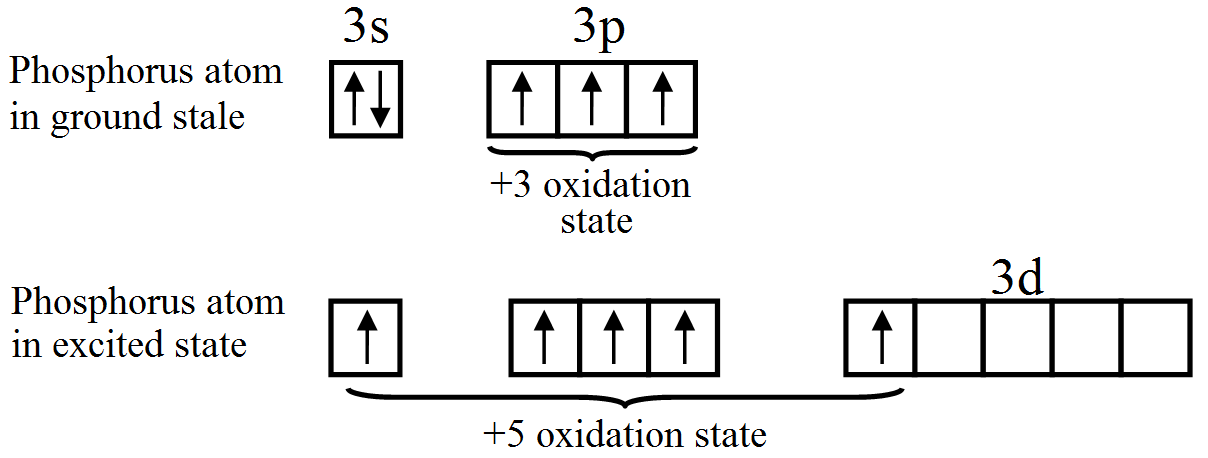
The transition elements show a large number of oxidation states. The various oxidation states are related to the electronic configuration of their atoms. The various oxidation states of a transition metal is due to the involvement of ( $\mathrm{n}-1) \mathrm{d}$ and outer ns electrons in bonding. The lower oxidation state is generally shown when ns electrons participate and higher oxidation states are exhibited when $n s$ and $(n-1) d$ electrons take part in bonding. For example, manganese, electronic configuration $(n-1) d^5 n s^2$, can show $+2,+3,+4,+6$ and +7 oxidation states. In the first five elements of the first transition series, i.e., up to manganese, the maximum oxidation state is equal to the sum of 4 s and 3 d electrons. For remaining five elements, the maximum state is not related to their electronic configurations. The non-transition elements mainly the p-block elements can show a number of oxidation states from +n to $(\mathrm{n}-8$ ) where n is the number of electrons present in the outermost shell. For example, phosphorus can show $-3,+3$ and +5 oxidation states while sulphur can show $-2,+2,+4$ and +6 oxidation states. lodine can show $-1,+1,+3,+5$ and +7 oxidation states. Lower oxidation states are ionic as the atom accepts the electron or electrons to achieve stable configuration while higher oxidation states are achieved by unpairing the paired orbitals and shifting the electrons to vacant d-orbitals.
View full question & answer
Question 325 Marks
The amount of energy released when one million of atoms of iodine in vapour state are converted to $I^{-}$ions is $4.9 \times$ $10^{-13}$ J according to the reaction:
$\mathrm{I}(\mathrm{~g})+\mathrm{e}^{-} \rightarrow \mathrm{I}^{-}(\mathrm{g})$
Express the electron gain enthalpy of iodine in terms of $\mathrm{kJ} \mathrm{mol}^{-1}$ and $\mathrm{eV}^{-2}$ per atom.
Answer
The amount of energy released for the conversion of 1 million, i.e. $1 \times 10^6$ atoms of iodine is $4.9 \times 10^{-13}$ ) according to the reaction, $\mathrm{I}(\mathrm{g})+\mathrm{e}^{-} \rightarrow \mathrm{I}^{-}(\mathrm{g})$ The amount of energy released for the conversion of one mole ( $6.02 \times 10^{23}$ ) of atoms of iodine into $\mathrm{I}^{-}$ions can be calculated. This corresponds to electron gain enthalpy. Thus, amount of energy released for $1 \times 10^6$ atoms of iodine $=4.9 \times 10^{-13}$ J Amount of energy released for $6.02 \times 10^{23}$ atoms of iodine $=\frac{4.9 \times 10^{-13}}{1 \times 10^6} \times 6.02 \times 10^{23}=29.5 \times 10^4 \mathrm{~J}=295 \mathrm{~kJ} / \mathrm{mol} \mathrm{Now}, 1 \mathrm{eV} /$ atom $=96.3 \mathrm{~kJ} \mathrm{~mol}^{-1} \therefore$ Electron gain enthalpy $=-295 \mathrm{~kJ} \mathrm{~mol}^{-1}$
$=\frac{295}{96.3}=-3.06 \mathrm{eV} / \text { atom }$
View full question & answer
Question 335 Marks
Write the drawbacks in Mendeleev’s periodic table that led to its modification.
Answer
Drawbacks of Mendeleev's table:
  1. Position of hydrogen: Hydrogen is placed in group I-A of the periodic table. However, it resembles the elements of both group I A (alkali metals) and group VII A (halogens). Therefore, the position of hydrogen in the periodic table is not clear.
  2. Anomalous pairs of elements: In some cases, elements of higher atomic masses are placed before those having lower atomic masses.
Examples:
  • $\text{Ar}\ \ \ \ \ \ \ \ \text{ and }\ \ \ \ \ \ \text{K}\\39.95\ \ \ \ \ \ \ \ \ \ \ \ \ \ \ \ \ 39.1$
  • $\text{CO}\ \ \ \ \ \ \text{ and}\ \ \ \ \ \text{Ni}\ \ \ \ \ \ \ \ \ \ \text{Te}\ \ \ \ \ \text{and}\ \ \ \ \text{I}\\58.93\ \ \ \ \ \ \ \ \ \ \ \ \ 58.71\ \ \ \ \ \ 127.6\ \ \ \ \ \ \ \ \ \ 126.9$
  1. Metals and non-metals: No attempt has been made to place metals and non-metals separately in it.
  2. Lanthanoides and Actinodes: Fifteen elements are placed in one position.
Group (III) B
  • $6^{th}$ period: La + 14 lathanoide elements. $(_{58}Ce$ to $_{71}Lu)$.
  • $7^{th}$ period: Ac + 14 actinoide elements. $(_{90}Th$ to $_{103}Lr)$
Thus, lanthanoids and actinoides have not been provided separate and proper places in the Mendeleev's periodic table.
  1. Position of isotopes: Isotopes of elements are placed in the same position in the table though according to their atomic masses they should have been placed in different positions.
  2. Similar elements separated in the table: Certain elements such as copper and mercury or gold and platinum which possess similar chemical properties are placed in different groups.
  3. Dissimilar elements placed together in the same group: Alkali metals such as Li, Na, K etc. (group IA) are grouped together with coinage metals such as Cu, Ag and Au (group IB) though their properties are quite different.
Number of elements in the periods. The presence of only 2 elements in the first period, 8 in the second and third etc. cannot be explained.
View full question & answer
Question 345 Marks
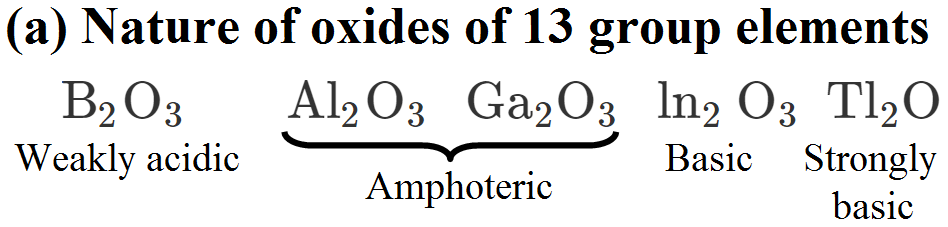
p-Block elements form acidic, basic and amphoteric oxides. Explain each property by giving two examples and also write the reactions of these oxides with water.
Answer
In p-block, when we move from left to right in a period, the acidic character of the oxides increases due to increase in electronegativity. For example,
In $2^{nd}$ period $B_2O_3 < CO_2 < N_2O_3$ (acidic nature increases).
In $3^{rd}$ period $A1_2O_3 < SiO_2 < P_4O_{10} < SO_3 < C1_2O_7$ (acidic character increases).
On moving down the group, acidic character decreases and basic character increases, e.g.,
  1. Nature of oxides of 15 group elements.
$\text{N}_2\text{O}_5\ \ \ \ \ \ \ \ \ \ \ \ \ \ \ \ \ \ \ \ \ \ \text{P}_4\text{O}_{10}\ \ \ \ \ \ \ \ \ \ \ \ \ \ \ \ \ \ \ \text{As}_4\text{O}_{10}\ \ \ \ \ \ \ \ \ \ \text{Sb}_4\text{O}_{10}\ \ \ \ \ \ \ \ \ \ \text{Bl}_2\text{O}_3\\ ^\text{Strongly acidic}\ \ \ \ \ \ \ \ \ ^\text{Moderately acidic}\ \ \ \ \ \ \ \ \ \ \ ^\text{Amphoteric}\ \ \ \ \ \ \ \ ^\text{Amphoteric}\ \ \ \ \ \ \ \ \ \ ^\text{Basic}$
Among the oxides of same element, higher the oxidation state of the element, stronger is the acid. For example, $SO_3$ is a stronger acid than $SO_2$.
$B_2O_3$ is weakly acidic and on dissolution in water, it forms orthoboric acid. Orthoboric acid does not act as a protonic acid (it does not ionise) but acts as a weak Lewis acid.
$\text{B}_2\text{O}_3\ \ \ \ \ \ \ \ \ \ +\ \ \ \ \ \ \ 3\text{H}_2\text{O}\ \ \ \rightleftharpoons\ \ \ \ 2\text{H}_3\text{BO}_3\\^\text{Boron trioxide}\ \ \ \ \ \ \ \ \ \ \ \ \ \ \ \ \ \ \ \ \ \ \ \ \ \ \ \ \ \ \ \ \ \ \ \ ^\text{Orthoboric acid}$
$\text{B(OH)}_3\ +\ \text{H}-\text{OH}\xrightarrow{\ \ \ \ \ \ \ \ \ \ \ \ }\big[\text{B}(\text{OH})_4\big]^{-}+\text{H}^+$
$Al_2O_3$ is amphoteric in nature. It is insoluble in water but dissolves in alkalies and reacts with acids.
$\text{Al}_2\text{O}_3\ \ +\ \ 2\text{NaOH}\ \xrightarrow{\ \ \ \ \ \ \ {\Delta} \ \ \ \ \ \ \ \ }\ 2\text{NaAlO}_2\ \ +\ \ \text{H}_2\text{O}\\ ^\text{Aluminium}\ \ \ \ \ \ \ \ \ \ \ \ \ \ \ \ \ \ \ \ \ \ \ \ \ \ \ \ \ \ \ \ \ \ \ \ \ \ ^\text{Sodium meta}\\ \ \ ^\text{trioxide}\ \ \ \ \ \ \ \ \ \ \ \ \ \ \ \ \ \ \ \ \ \ \ \ \ \ \ \ \ \ \ \ \ \ \ \ \ \ \ \ \ \ \ ^\text{chloride}$
$\text{Al}_2\text{O}_3\ \ +\ \ 6\text{HCl}\ \xrightarrow{\ \ \ \ \ \ \ {\Delta} \ \ \ \ \ \ \ \ }\ 2\text{AlCl}_3\ \ +\ \ 3\text{H}_2\text{O}\\ \ \ \ \ \ \ \ \ \ \ \ \ \ \ \ \ \ \ \ \ \ \ \ \ \ \ \ \ \ \ \ \ \ \ \ \ \ \ \ \ \ \ \ \ \ \ \ \ ^\text{Aluminium}\\ \ \ \ \ \ \ \ \ \ \ \ \ \ \ \ \ \ \ \ \ \ \ \ \ \ \ \ \ \ \ \ \ \ \ \ \ \ \ \ \ \ \ \ \ \ \ \ \ \ \ ^\text{chloride}$
$Tl_2O$ is as basic as NaOH due to its lower oxidation state (+1).
$\text{Tl}_2\text{O}\ +\ 2\text{HCl}\ \xrightarrow{\ \ \ \ \ \ \ \ \ \ \ \ }2\text{TlCl}\ +\ \text{H}_2\text{O}$
View full question & answer
Question 355 Marks
In what manner is the long form of periodic table better than Mendeleev’s periodic table? Explain with examples.
Answer
Superiority of the Long form of the Table over Mendeleev’s Table:
  1. This table is based on a more fundamental property, i. e atomic number.
  2. It correlates the position of the elements with its electronic configuration more clearly.
  3. The completion of each period is more logical. In a period as the atomic number increases, the energy shells are gradually filled up until an inert gas configuration is reached. It eliminates the even and odd series of IV, V, VI and VII periods of Mendeleev's periodic table.
  4. The position of VIII$^{\text {th }}$ group is appropriate in this table. All the transition elements have been brought in the middle as the properties of transition elements are intermediate between s- and p-block elements.
  5. Due to separation of two subgroups, dissimilar elements do not fall together. One vertical column accommodates elements with same electronic configuration thereby showing same properties.
  6. In this table a complete separation between metals and non-metals has been achieved. The non metals are present in the upper right comer of the periodic table.
  7. There is a gradual change in properties of the elements with increase in their atomic numbers, i.e., periodicity of properties can be easily visualised. The same properties of recurrence in properties occur after the intervals of 2, 8, 8, 18, 18 and 32 elements which indicate the capacity of various periods of the table.
  8. This arrangement of elements is easy to remember and reproduce.
View full question & answer
Question 365 Marks
Electronic configuration of some elements is given in Column I and their electron gain enthalpies are given in Column II. Match the electronic configuration with electron gain enthalpy:
 
Column (I)
 
Column (II)
 
Electronic configuration
 
Electron gain enthalpy/ kJ $mol^{-1}$
i.
$1s^2 2s^2 sp^6$
A.
-53
ii.
$1s^2 2s^2 2p^6 3s^1$
B.
-328
iii.
$1s^2 2s^2 2p^5$
C.
-141
iv.
$1s^2 2s^2 2p^4​​​​​​​$
D.
+48
Answer
 
Column (I)
 
Column (II)
 
Electronic configuration
 
Electron gain enthalpy/ kJ $mol^{-1}$
i.
$1s^2 2s^2 sp^6$
A.
+48
ii.
$1s^2 2s^2 2p^6 3s^1$
B.
-53
iii.
$1s^2 2s^2 2p^5$
C.
-328
iv.
$1s^2 2s^2 2p^4$
D.
-141
View full question & answer
Question 375 Marks
Match the correct atomic radius with the element.
 
Element
 
Atomic radius
i.
Be
A.
74
ii.
C
B.
88
iii.
O
C.
111
iv.
B
D.
77
v.
N
E.
66
Answer
 
Element
 
Atomic radius
i.
Be
A.
111
ii.
C
B.
77
iii.
O
C.
66
iv.
B
D.
88
v.
N
E.
74
View full question & answer
Question 385 Marks
In terms of period and group where would you locate the element with $Z=114$?
Answer
Elements whose atomic number is from $Z=87$ to $Z=114$ are available in the seventh period of periodic table. Therefore, the element having $Z=114$ is available in the seventh period in periodic table.
In the seventh period, initial 2 elements with $Z=87$ and $Z=88$ are the elements of $s$-block and the following 14 elements except $Z=89$ i.e., those from $Z=90$ to $Z=103$ are elements of $f$ - block, and next 10 elements from $Z=89$ and $Z=104$ to $Z=112$ are elements of d-block, next the elements from $Z=113$ to $Z=118$ are elements of $p$-block. In this manner, the element $Z=114$ is the $2^{\text {nd }}$ element of p-block in the seventh period of the periodic table.
Therefore, the element $Z=114$ is available in the seventh period and fourth group in the periodic table.
View full question & answer
Question 395 Marks
Match the correct ionisation enthalpies and electron gain enthalpies of the following elements:
 
Elements
 
$\Delta\text{H}_1$
$\Delta\text{H}_2$
$\Delta_{\text{eg}}\text{H}$
i.
Most reactive non metal
A.
419
3051
-48
ii.
Most reactive metal
B.
1681
3374
-328
iii.
Least reactive element
C.
738
1451
-40
iv.
Metal forming binary halide
D.
2372
5251
+8
Answer
 
Elements
 
$\Delta\text{H}_1$
$\Delta\text{H}_2$
$\Delta_{\text{eg}}\text{H}$
i.
Most reactive non metal
B.
1681 3374 -328
ii.
Most reactive metal
a.
419 3051 -48
iii.
Least reactive element
d.
2372 5251 +48
iv.
Metal forming binary halide
c.
728 1451 -40
View full question & answer
Question 405 Marks
Discuss the factors affecting electron gain enthalpy and the trend in its variation in the periodic table.
Answer
Factors affecting electron gain enthalpy:
  1. Nuclear charge: The electron gain enthalpy become more negative as the nuclear charge increases. This is due to greater attraction for the incoming electron if nuclear charge is high.
  2. Size of the atom: With the increase in size of the atom, the distance between the nucleus and the incoming electron increases and this results in lesser attraction. Consequently, the electron gain enthalpy become less negative with increase in size of the atom of the element.
  3. Electronic configuration: The elements having stable electronic configurations of half filled and completely filled valence subshells show very small tendency to accept additional electron and thus electron gain enthalpies are less negative.
Variation of electron gain enthalpies in periodic table:
Electron gain enthalpy, in general, becomes more negative from left to right in a period and becomes less negative as we go from top to bottom in a group.
  1. Variation down a group: On moving down a group, the size and nuclear charge increases. But the effect of increase in atomic size is much more pronounced than that of nuclear charge and thus the additional electron feels less attraction by the large atom. Consequently, electron gain enthalpy becomes less negative. This is clear from decrease of electron gain enthalpy in going from chlorine to bromine and to iodine.
  2. Variation along a period: On moving across a period, the size of the atom decreases and nuclear charge increases. Both these factors result in greater attraction for the incoming electron, therefore, electron gain enthalpy, in general, becomes more negative in a period from left to right. However, certain irregularities are observed in the general trend. These are mainly due to the stable electronic configurations of certain atoms.
Important Trends in Electron Gain Enthalpies. There are some important features of electron gain enthalpies of elements. These are:
  • Halogens have the highest negative electron gain enthalpies.
  • Electron gain enthalpy values of noble gases are positive while those of Be, Mg, N and P are almost zero.
  • Electron gain enthalpy of fluorine is unexpectedly less negative than that of chlorine.
View full question & answer
Question 415 Marks
Discuss and compare the trend in ionisation enthalpy of the elements of group1 with those of group17 elements.
Answer

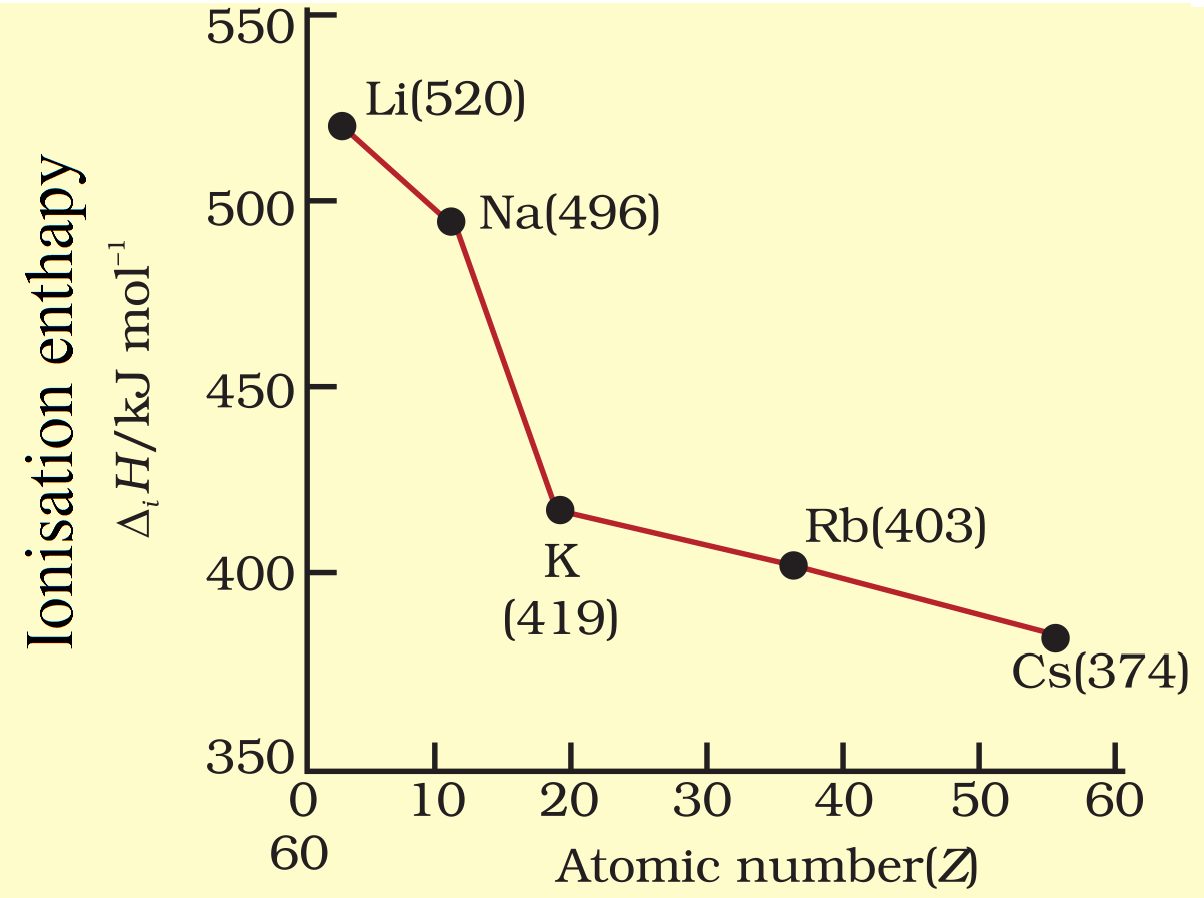
The ionization enthalpies decrease regularly as we move down a group from one element to the other. This is evident from the values of the first ionisation enthalpies of the elements of group 1 (alkali metals) and group 17 elements as given in table and figure.
Group (1)
First ionisation enthalpies ($\mathrm{kJ} \mathrm{mol}^{-1}$)
Group (17)
First ionisation enthalpies ($\mathrm{kJ} \mathrm{mol}^{-1}$)
H
1312
F
1681
Li
520
Cl
1255
Na
496
Br
1142
K
419
I
1009
Rb
403
At
917
Cs 374    

Given trend can be easily explained on the basis of increasing atomic size and screening effect as follows:
  1. On moving down the group, the atomic size increases gradually due to the addition of one new principal energy shell at each succeeding element. Hence, the distance of the valence electrons from the nucleus increases. Consequently, the force of attraction by the nucleus for the valence electrons decreases and hence the ionisation enthalpy should decrease.
  2. With the addition of new shells, the shielding or the screening effect increases. As a result, the force of attraction of the nucleus for the valence electrons further decreases and hence the ionisation enthalpy should decrease.
  3. Nuclear charge increases with increase in atomic number. As a result, the force of attraction by the nucleus for the valence electrons should increase and accordingly the ionisation enthalpy should increase. The combined effect of the increase in the atomic size and the screening effect more than compensate the effect of the increased nuclear charges. Consequently, the valence electrons become less and less firmly held by the nuclear and hence the ionisation enthalpies gradually decrease as move down the group.
View full question & answer
Question 425 Marks
Ionisation enthalpies of elements of second period are given below:
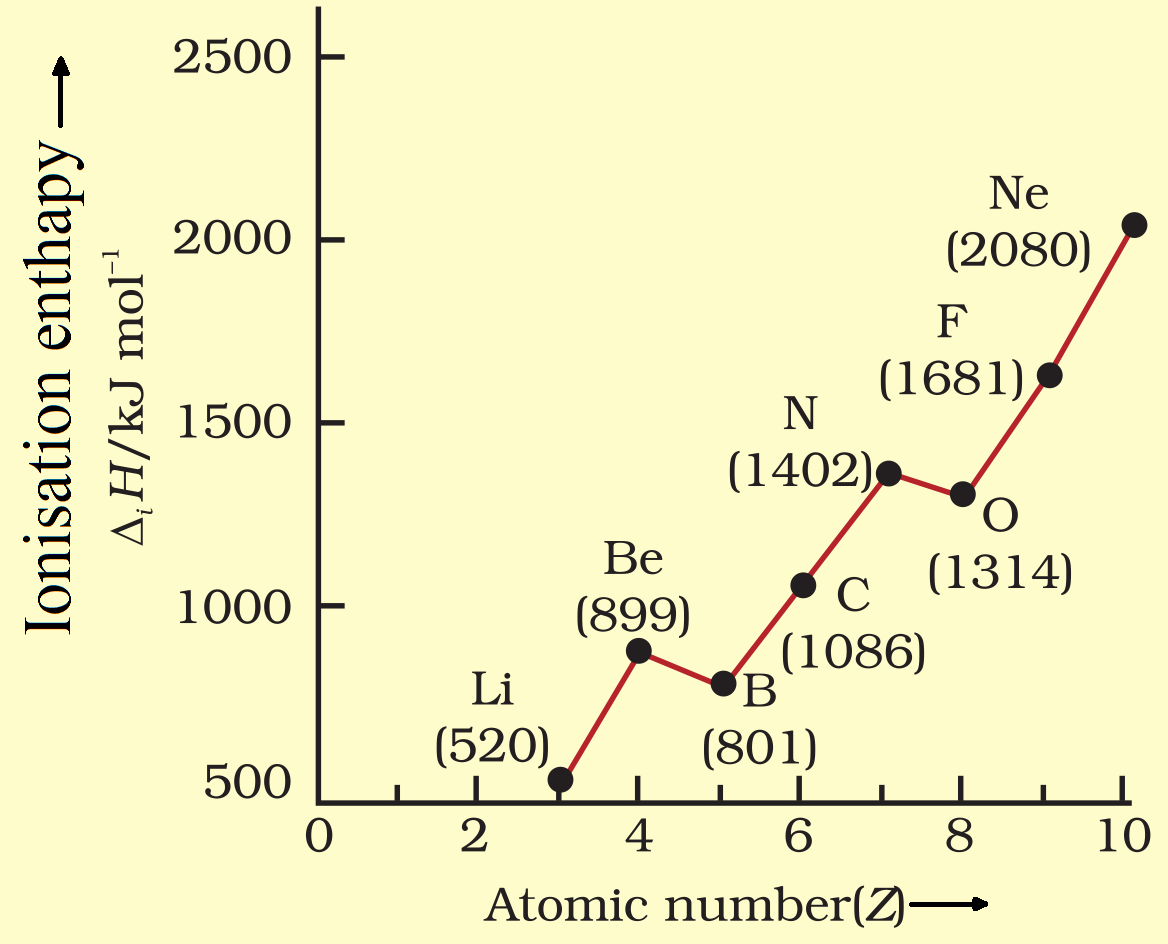
Ionisation enthalpy/ kcal $mol^{-1}, 520, 899, 801, 1086, 1402, 1314, 1681, 2080$.
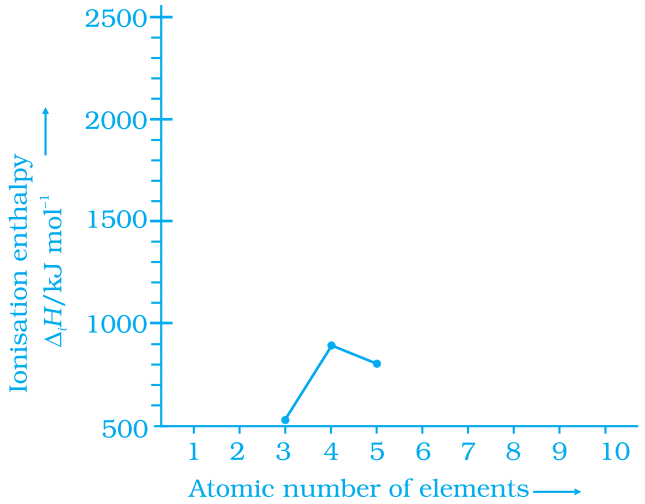
Match the correct enthalpy with the elements and complete the graph given in also write symbols of elements with their atomic number.
Answer
To match the correct enthalpy with the elements and to complete the graph, the following points are taken into consideration. As we move from left to right across a period, the ionization enthalpy keeps on increasing due to increased nuclear charge and simultaneous decrease in atomic radius. However, there are some exceptions given below:
  1. In spite of increased nuclear charge, the first ionisation enthalpy of B is lower than that of Be. This is due to the presence of fully filled 2s-orbital of Be $[1s^22s^2]$ which is a stable electronic arrangement. Thus, higher energy is required to knock out the electron from fully filled 2.v-orbital. While $B [1s^2 2s^2 2p^1]$ contains valence electrons in 2s and 2p-orbitals. It can easily lose its one e– from 2p-orbital in order to achieve noble gas configuration. Thus, first ionisation enthalpy of B is lower than that of Be.
Since the electrons in 2s-orbital are more tightly held by the nucleus than those present in 2p-orbital, therefore, ionisation enthalpy of B is lower than that of Be.
  1. The first ionisation enthalpy of N is higher than that of O though the nuclear charge of O is higher than that of N. This is due to the reason that in case of N, the electron is to be removed from a more stable, exactly half-filled electronic configuration $\big(1\text{s}^2\ 2\text{s}^2\ 2\text{p}^1_\text{x}\ 2\text{p}^1_\text{y}\ 2\text{p}^1_\text{z}\big)$ which is not present in $\text{O}\big(1\text{s}^2\ 2\text{s}^2\ 2\text{p}^2_\text{x}\ 2\text{p}^1_\text{y}\ 2\text{p}^1_\text{z}\big).$
Therefore, the first ionisation enthalpy of N is higher than that of O. The symbols of elements along with their atomic numbers are given in the following graph.
View full question & answer
Question 435 Marks
Which elements have the following electronic configurations? (Use only the periodic table.)
i. $1 s^2, 2 s^2, 2 p^5$
ii. $[\operatorname{Ar}] 4 s^2, 3 d^{10}, 4 p ^1$
iii. $[ Xe ] 6 s^2$
iv. $[ Xe ] 6 s^2, 5 d^1, 4 f ^7$
v. $[ Ar ] 4 s^1, 3 d^{10}$ (exception to rules)
Answer
  1. The outer electronic configuration of $1s^2, 2s^2, 2p^5$ is $2s^2, 2p^5$. Therefore, this element is a p-block element and belongs to the second period and group $17$. Thus, the element is fluorine, F.
  2. The outer electronic configuration of $[Ar]4s^2, 3d^{10}, 4p^1$ is $4s^2 4p^1$, therefore, it is a p-block element. It belongs to the fourth period and $13$ group. Therefore, the element is gallium, Ga.
  3. The outer electronic configuration of $[Xe]6s^2$ is $6s^2$, therefore, it is a s-block element and belongs to the sixth period and group $2$ of the periodic table.
Therefore, the element is barium, Ba.
  1. In the electronic configuration $[Xe]6s^2, 5d^1, 4f^7$ the electrons are in 4f shell, therefore, it is a f-block element and belongs to the sixth period and third group therefore, the element is gadolinium, Gd.
  2. The outer electronic configuration of $[Ar]4s^1, 3d^{10} is 4s^1, 3d^{10},$ therefore, it is a d-block element and belongs to the fourth period and group $11$. Therefore, the element is copper, Cu.
View full question & answer
Question 445 Marks
Define ionisation enthalpy. Discuss the factors affecting ionisation enthalpy of the elements and its trends in the periodic table.
Answer
Ionization energy is defined as the energy required to remove an electron from the outermost shell of an isolated gaseous atom. Ionization energy depends on the following factors:
  1. Atomic radius: Smaller the atomic radius, the higher is the atomic energy. This is because the Coulombic attractive forces on the negatively charged valence electrons by the positively charged nucleus is much higher in the case of smaller atom-the force of attraction decreases with the increase in atomic radius, i.e separation between the electrons and the nucleus in accordance with the inverse square law.
  2. Nuclear charge: the higher the positive charge of the nucleus, stronger is it's attraction for the electrons, and hence the harder it is to remove the electrons.
  3. Orbital penetration: It's easier to remove electrons from p orbitals than from s orbitals, because the s orbitals penetrate towards the nucleus more closely than the p orbitals, thus making the electrons in the s orbital feel greater nuclear attraction.
  4. Electron pairing: within a subshell, paired electrons are easier to remove than unpaired ones. This is because repulsion between electrons in the same orbital is higher than repulsion between electrons in different orbitals.
  5. Shielding or screening effect of the inner orbitals: Due to the electrons present in the inner orbitals, the electrons in the outermost orbitals feel lesser attraction for the nucleus than expected. In other words, the inner electron orbitals effectively screen or shield the outermost electrons from the nucleus, due to which the ionization energy decreases.
View full question & answer
Question 455 Marks
On the basis of quantum numbers, justify that the sixth period of the periodictable should have 32 elements.
Answer
In the periodic table of the elements, a period indicates the value of the principal quantum number $(\mathrm{n})$ for the outermost shells. Each period begins with the filling of principal quantum number $(\mathrm{n})$. The value of n for the sixth period is 6 . For $n=6$, azimuthal quantum number ( I ) can have values of $0,1,2,3,4$.
According to Aufbau's principle, electrons are added to different orbitals in order of their increasing energies. The energy of the 6 d subshell is even higher than that of the 7 s subshell.
In the $6^{\text {th }}$ period, electrons can be filled in only $6 \mathrm{~s}, 4 \mathrm{f}, 5 \mathrm{~d}$, and 6 p subshells. Now, 6 s has one orbital, 4 f has seven orbitals, $5 d$ has five orbitals, and $6 p$ has three orbitals. Therefore, there are a total of sixteen ( $1+7+5+3=16)$ orbitals available. According to Pauli's exclusion principle, each orbital can accommodate a maximum of 2 electrons.
Thus, 16 orbitals can accommodate a maximum of 32 electrons.
Hence, the sixth period of the periodic table should have 32 elements.
View full question & answer
Question 465 Marks
The first ionization enthalpy values (in $\mathrm{kJ} \mathrm{~mol}^{-1}$) of group 13 elements are:
B Al Ga In Tl
801 577 579 558 589
How would you explain this deviation from the general trend?
Answer
On moving down a group, ionization enthalpy generally decreases due to an increase in the atomic size and shielding. Thus, on moving down group 13, ionization enthalpy decreases from B to Al. But, Ga has higher ionization enthalpy than Al. Al follows immediately after s–block elements, whereas Ga follows after d–block elements. The shielding provided by d-electrons is not very effective. These electrons do not shield the valence electrons very effectively. As a result, the valence electrons of Ga experience a greater effective nuclear charge than those of Al. Further, moving from Ga to In, the ionization enthalpy decreases due to an increase in the atomic size and shielding. But, on moving from In to Tl, the ionization enthalpy again increases. In the periodic table, Tl follows after 4f and 5d electrons. The shielding provided by the electrons in both these orbitals is not very effective. Therefore, the valence electron is held quite strongly by the nucleus. Hence, the ionization energy of Tl is on the higher side.
View full question & answer
Question 475 Marks
Among the second period elements the actual ionization enthalpies are in the order Li < B < Be < C < O < N < F < Ne.Explain why,
  1. Be has higher $\Delta_{\text{t}}\text{H}$ than B
  2. O has lower $\Delta_{\text{t}}\text{H}$ than N and F?
Answer
  1. During ionization process, the electron that can be expelled from Be (beryllium) – atom is 2s – electron, but the electron that can be expelled from boron is 2p – electron.The attractive force between a 2s – electron and nucleus is higher than between a 2s – electron and nucleus.Thus, the energy required to expel 2s –electron is higher than the energy required to expel 2p –electron.Thus, $\Delta_\text{i}\text{H}$ for Be is higher than $\Delta_\text{i}\text{H}$ than B
  2. In nitrogen, there are three 2p-electrons and all of these 3 occupy 3 distinct atomic orbital. While in oxygen 2 out of 4, 2p – electrons occupy same 2p-orbital, so the repulsion between the electrons in the oxygen atom increases.Thus, the energy required to expel $2^{nd}$ 2p –electron in oxygen atom is higher than the energy required to expel $4^{th}$ 2p –electron in nitrogen atom.Thus, $\Delta_\text{i}\text{H}$ for O is lower than $\Delta_\text{i}\text{H}$ of N.
View full question & answer
Question 485 Marks
What does atomic radius and ionic radius really mean to you?
Answer
Atomic radius is the radius of an atom. It measures the size of an atom. If the element is a metal, then the atomic radius refers to the metallic radius, and if the element is a non-metal, then it refers to the covalent radius. Metallic radius is calculated as half the internuclear distance separating the metal cores in the metallic crystal. For example, the internuclear distance between two adjacent copper atoms in solid copper is 256 pm. Thus, the metallic radius of copper is taken as.
Covalent radius is measured as the distance between two atoms when they are found together by a single bond in a covalent molecule. For example, the distance between two chlorine atoms in chlorine molecule is 198 pm. Thus, the covalent radius of chlorine is taken as.
Ionic radius means the radius of an ion (cation or anion). The ionic radii can be calculated by measuring the distances between the cations and anions in ionic crystals.
Since a cation is formed by removing an electron from an atom, the cation has fewer electrons than the parent atom resulting in an increase in the effective nuclear charge. Thus, a cation is smaller than the parent atom. For example, the ionic radius of ion is 95 pm, whereas the atomic radius of Na atom is 186 pm. On the other hand, an anion is larger in size than its parent atom. This is because an anion has the same nuclear charge, but more electrons than the parent atom resulting in an increased repulsion among the electrons and a decrease in the effective nuclear charge. For example, the ionic radius of F-ion is 136 pm, whereas the atomic radius of F atom is 64 pm.
View full question & answer