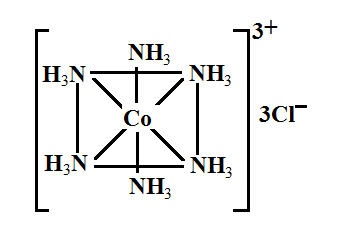
Question 13 Marks
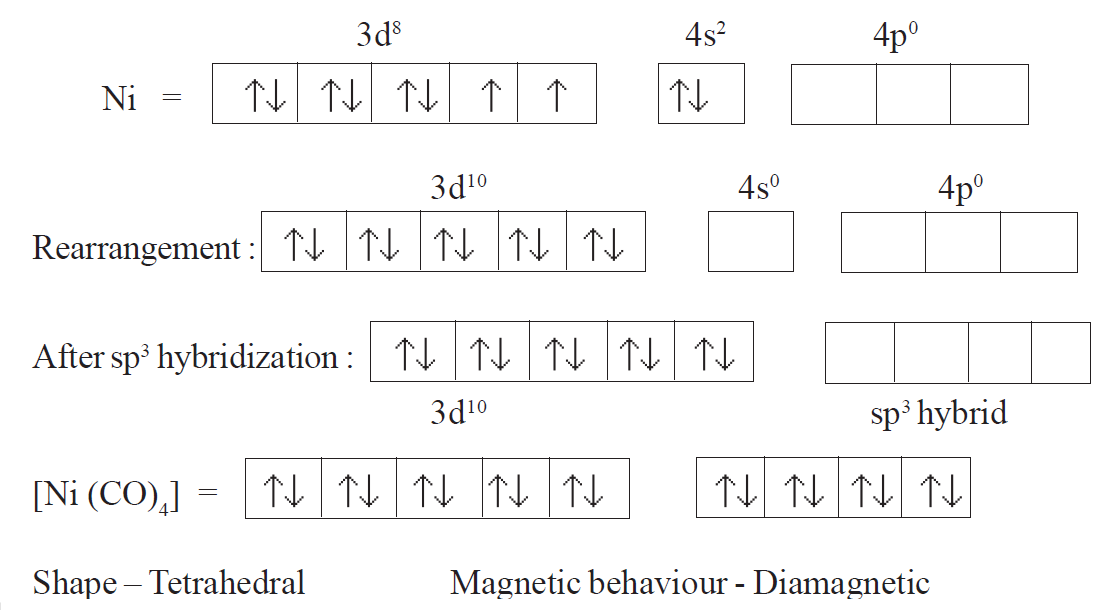
- Using valence bond theory, predict the shape and magnetic character of
$[Ni(CO)_4]. [Ni = 28].$
- Give one example of application of coordination compounds-in medicine.
Answer
- $\text{Ni(28)}\rightarrow\text{[Ar]3d}^{8}\text{4s}^{2}$
$\text{In[Ni(CO)}_{4}],\text{Ni is in zero oxidation state}$
- cis-platin.
View full question & answer→Question 23 Marks
- For the complex $[Fe(H_2O)_6]^{3+},$ write the hybridization, magnetic character and spin of the complex. $($At. number: $Fe = 26)$
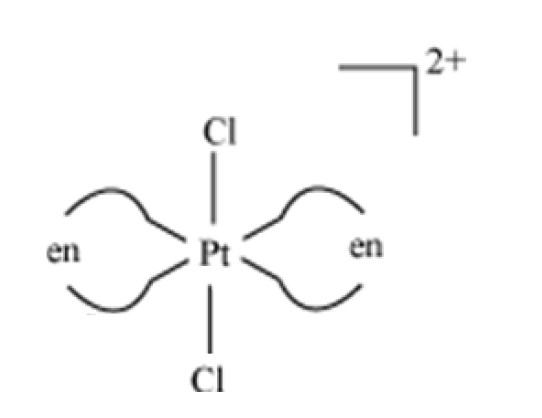
- Draw one of the geometrical isomers of the complex $[Pt(en)_2Cl_2]^{2+}$ which is optically inactive.
Answer
- $sp^3d^2, $ paramagnetic, high spin.
-
View full question & answer→Question 33 Marks
- What type of isomerism is shown by $[Co(NH_3)_5ONO]Cl_2?$
- On the basis of crystal field theory, write the electronic configuration for $d^4$ ion if $\Delta_o < P.$
- Write the hybridization and shape of $[Fe(CN)_6]^{_{3-}}.$
$($Atomic number of $Fe = 26)$Answer
- Linkage isomerism.
- ${t_{2g}}^{_3}eg^1/$Diagrammatic representation.
- $d^2sp^3,$ Octahedral.
View full question & answer→Question 43 Marks
- What type of isomerism is shown by the complex $[Co(NH_3)_5 (SCN)]^{2+}?$
- Why is $[NiCl_4]^{2-}$ paramagnetic while $[Ni(CN)_4]^{2-}$ is diamagnetic$? ($Atomic number of $Ni = 28)$
- Why are low spin tetrahedral complexes rarely observed?
Answer
- Linkage isomerism.
- In $[NiCl4]^{2-},$ due to the presence of $Cl^-,$ a weak field ligand no pairing occurs whereas in $[Ni(CN)_4]^{2-},$ $CN^-$ is a strong field ligand and pairing takes place/diagrammatic representation.
- Because of very low $CFSE$ which is not able to pair up the electrons.
View full question & answer→Question 53 Marks
- Write the IUPAC name of the complex $[Cr(NH_3)_4 Cl_2]Cl.$
- What type of isomerism is exhibited by the complex $[Co(en)_3]^{3+}?$
$($en$=$ ethane$-1,2-$diamine$)$
- Why is $[NiCl_4]^{2–}$ paramagnetic but $[Ni(CO)_4]$ is diamagnetic?
$($At. nos.: $Cr= 24, Co=27, Ni= 28)$Answer
- Tetraamminedichloridochromium $(III)$ chloride.
- Optical isomerism.
- In $[NiCl_4]^{2–}; Cl–$acts as weak ligand therefore, does not cause forced pairing, thus electrons will remain unpaired hence paramagnetic.
In $[Ni(CO)_4]; CO$ acts as strong ligand therefore, causes forced pairing, thus electrons will become paired hence diamagnetic. View full question & answer→Question 63 Marks
For the complex $[NiCI_4]^{2-},$ write
- The IUPAC name.
- The hybridization type.
- The shape of the complex.
$($Atomic no. of $Ni = 28)$ Answer
- Tetrachloridonickelate(II) ion.
- $sp^3.$
- Tetrahedral.
View full question & answer→Question 73 Marks
What is meant by crystal field splitting energy? On the basis of crystal field theory, write the electronic configuration of $\mathrm{d}^4$ in terms of $t_{2 g}$ and $e_g$ in an octahedral field when
i. $\Delta_0>\mathrm{P}$
ii. $\Delta_0$
AnswerThe energy involved in splitting the degenerate d-orbitals into two sets $\mathrm{t}_{2 \mathrm{~g}}$ and $\mathrm{e}_{\mathrm{g}}$ is called crystal field splitting energy.
i. $t_{2 g}{ }^4 e^{\circ}$
ii. $\mathrm{t}_{2 g}{ }^3 e_g{ }^1$
View full question & answer→Question 83 Marks
Name the following coordination entities and draw the structures of their stereoisomers:
i. $\left[\mathrm{Co}(e n)_2 \mathrm{Cl}_2\right]^{+}$(en = ethan-l, 2-diamine).
ii. $\left[\mathrm{Cr}\left(\mathrm{C}_2 \mathrm{O}_4\right)_3\right]^{3-}$.
iii. $\left[\mathrm{Co}\left(\mathrm{NH}_3\right)_3 \mathrm{Cl}_3\right]$.
(Atomic numbers $\mathrm{Cr}=24, \mathrm{Co}=27$ ).
View full question & answer→Question 93 Marks
Explain the following terms giving a suitable example in each case:
- Ambident ligand.
- Denticity of a ligand.
- Crystal field splitting in an octahedral field.
Answeri. Ambident ligand: a unidentate ligand which can co-ordinate to the central metal atom through more than one co-ordinating bond.e.g. $\mathrm{NO}_2{ }^{-}, \mathrm{SCN}^{-}$.
ii. The number of donor atoms in ligating groups is known as denticity of that ligand. e.g. in $\mathrm{C}_2 \mathrm{O}_4{ }^{2-}$ denticity is 2 .
iii. Crystal field splitting in an Octahedral field: The splitting of d-orbitals under the influence of approaching ligand is known as crystal field splitting for example for $\mathrm{d}^4$, configuration is $\mathrm{t}_{2 g}{ }^3 \mathrm{eg}^1$ /or diagrammatic representation.
View full question & answer→Question 103 Marks
Explain the following cases giving appropriate reasons:
- Nickel does not form low spin octahedral complexes.
- The $\pi$-complexes are known for the transition metals only.
- $Co^{2+}$ is easily oxidised to $Co^{3+}$ in the presence of a strong ligand.
Answer
- Because two inner d-orbitals are not available in Ni.
- Because only d-electrons can be involved in ð-complex.
- Because crystal field splitting energy is more than compensated for the third ionisation enthalpy.
View full question & answer→Question 113 Marks
Compare the following complexes with respect to structural shapes of units, magnetic behaviour and hybrid orbitals involved in units:
$[Co(NH_3)_6]^{3+}, [Cr(NH_3)_6]^{3+}, Ni(CO)_4.$
(At. Nos.: Co = 27, Cr = 24, Ni = 28).
Answer
| $[Co(NH_2)_6]^{3+}$ |
Octahedral |
Diamagnetic |
$d^2sp^3$ |
| $[Cr(NH_3)_6]^{3+}$ |
Octahedral |
Paramagnetic |
$d^2sp^3$ |
| $[Ni(CO)_4]$ |
Tetrahedral |
Diamagnetic |
$sp^3$ |
View full question & answer→Question 123 Marks
- What is the basis of formation of the spectro-chemical series?
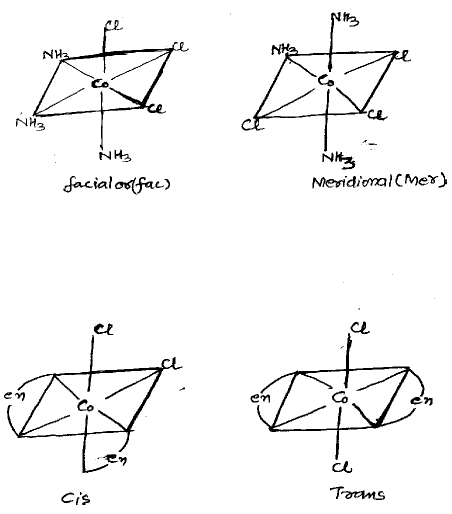
- Draw the structures of geometrical isomers of the following coordination complexes:
$[Co(NH_3)_3Cl_3]$ and $ [CoCl_2(en)_2]^+.$
(en = ethylenediamine and atomic number of Co is 27).Answer
- Ligands are arranged in the increasing order of field strength/based on absorption of light of complexes with different ligands- (extent of splitting).
View full question & answer→Question 133 Marks
Describe for any two of the following complex ions, the type of hybridization, shape and magnetic property:
- $[Fe(H_2O_6)]^{2+}$
- $[Co(NH_3)_6]^{3+}$
- $[NiCl_4]^{2-}$
(At. Nos. Fe = 26, Co = 27, Ni = 28). View full question & answer→Question 143 Marks
- Define crystal field splitting energy. On the basis of crystal field theory, write the electronic configuration for $d^4$ ion if $\triangle_0>\text{P}.$
- Write the hybridization and magnetic character of $[CoF_6]^{3–}$. (At. no. of Co = 27)
Answer
- It is the magnitude of difference in energy between the two sets of d orbital i.e. $t_2g$ and $eg ~t^4{}_{2g} eg^0$
- $sp^3d^2$ , paramagnetic
View full question & answer→Question 153 Marks
a. Define crystal field splitting energy. On the basis of crystal field theory, write the electronic configuration for d4 ion if $\Delta_0>P$.
b. $\left[ Ni ( CN )_4\right]^{2-}$ is diamagnetic whereas $\left[ NiCl _4\right]^{2-}$ is paramagnetic. Give reason. (At. no. of $Ni =28$ )
Answera. It is the magnitude of difference in energy between the two sets of $d$ orbital i.e. $t_2 g$ and eg $t^4 2 g eg ^0$
b. In $\left[ Ni ( CN )_4\right]^{2-}, CN$ - is a strong field ligand and pairing takes place whereas in $\left[ NiCl _4\right]^{2-}$, due to the presence of $Cl ^{-}$, a weak field ligand no pairing occurs / diagrammatic representation.
View full question & answer→Question 163 Marks
i. Define crystal field splitting energy. On the basis of crystal field theory, write the electronic configuration for $d^4$ ion if $\triangle_0<P$.
ii. $\left[\mathrm{Ni}(\mathrm{CN})_4\right]^{2-}$ is colourless whereas $\left[\mathrm{Ni}\left(\mathrm{H}_2 \mathrm{O}\right)_6\right]^{2+}$ is green. Why? (At. no. of $\mathrm{Ni}=28$ )
Answeri. It is the magnitude of difference in energy between the two sets of $d$ orbital i.e. $\mathrm{t}_2 \mathrm{~g}$ and $\mathrm{t}^3{ }_{2 \mathrm{~g}} \mathrm{eg}^1$.
ii. In $\left[\mathrm{Ni}\left(\mathrm{H}_2 \mathrm{O}\right)_6\right]^{2+}, \mathrm{Ni}^{+2}\left(3 \mathrm{~d}^8\right)$ has two unpaired electrons which do not pair up in the presence of weak field ligand $\mathrm{H}_2 \mathrm{O}$.
View full question & answer→Question 173 Marks
- For the complex $[Fe(CO)_5],$ write the hybridization, magnetic character and spin of the complex. $($At. number : $Fe = 26)$
- Define crystal field splitting energy.
Answer
- $dsp^3,$ Diamagnetic, low spin.
- The energy used to split degenerate d-orbitals due to the presence of ligands in a definite geometry is called crystal field splitting energy.
View full question & answer→Question 183 Marks
- What type of isomerism is shown by the complex $[Co(en)_3]Cl_3$?
- Write the hybridisation and magnetic character of $[Co(C_2O_4)_3]_3{}^–$.
(At. no. of Co = 27)
- Write IUPAC name of the following Complex $[Cr(NH_3)_3Cl_3]$
Answer
- Optical isomerism
- $d^2sp^3$, diamagnetic
- Triamminetrichloridochromium (III)
View full question & answer→Question 193 Marks
- For the complex $[Fe(CN)_6]^{3–}$, write the hybridization type, magnetic character and spin nature of the complex.
(At. number: Fe=26).
- Draw one of the geometrical isomers of the complex $[Pt(en)_2Cl_2]^{2+}$ which is optically active.
Answer
- $d^2sp^3$, Paramagnetic, low spin.
-
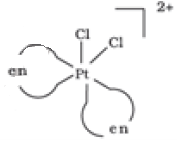
View full question & answer→Question 203 Marks
i. What type of isomerism is shown by the complex $\left[\mathrm{Co}\left(\mathrm{NH}_3\right)_6\right]\left[\mathrm{Cr}(\mathrm{CN})_6\right]$ ?
ii. Why a solution of $\left[\mathrm{Ni}\left(\mathrm{H}_2 \mathrm{O}\right)_6\right]^{2+}$ is green while a solution of $\left[\mathrm{Ni}(\mathrm{CN})_4\right]^{2-}$ is colourless? (At. no. of $\mathrm{Ni}=28$ )
iii. Write the IUPAC name of the following complex: $\left[\mathrm{Co}\left(\mathrm{NH}_3\right)_5\left(\mathrm{CO}_3\right)\right] \mathrm{Cl}$.
Answeri. Coordination isomerism.
ii. Unpaired electrons in $\left[\mathrm{Ni}\left(\mathrm{H}_2 \mathrm{O}\right)_6\right]^{2+} / \mathrm{d}$-d transition.
iii. Pentaamminecarbonatocobalt (III) Chloride.
View full question & answer→Question 213 Marks
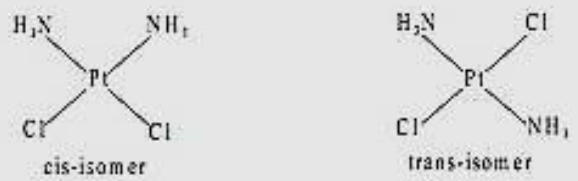
- Draw the geometrical isomers of complex $[Pt(NH_3)_2Cl_2]$.
- On the basis of crystal field theory, write the electronic configuration for $d^4$ ion if $\Delta_0< P.$
- Write the hybridization and magnetic behaviour of the complex $[Ni(CO)_4].$
(At. no. of Ni $= 28$)Answer
-
- $t_2g^3e_g^1.$
- $sp^3$, diamagnetic.
View full question & answer→Question 223 Marks
Complete the following chemical equations:
- $\mathrm{Cr}_2 \mathrm{O}_7{ }^{2-}+6 \mathrm{Fe}^{2+}+14 \mathrm{H}^{+} \rightarrow$
- $2 \mathrm{CrO}_4^{2-}+2 \mathrm{H}^{+} \rightarrow$
- $2 \mathrm{MnO}_4^{-}+5 \mathrm{C}_2 \mathrm{O}_4{ }^{2-}+16 \mathrm{H}^{+} \rightarrow$
Answer
- $\mathrm{Cr}_2 \mathrm{O}_7{ }^{2-}+6 \mathrm{Fe}^{2+}+14 \mathrm{H}^{+} \rightarrow 2 \mathrm{Cr}^{3+}+6 \mathrm{Fe}^{3+}+7 \mathrm{H}_2 \mathrm{O}$
- $2 \mathrm{CrO}_4^{2-}+2 \mathrm{H}^{+} \rightarrow \mathrm{Cr}_2 \mathrm{O}_7^{2-}+\mathrm{H}_2 \mathrm{O}$
- $2 \mathrm{MnO}^{4-}+5 \mathrm{C}_2 \mathrm{O}_4{ }^{2-}+16 \mathrm{H}^{+} \rightarrow 2 \mathrm{Mn}^{2+}+10 \mathrm{CO}_2+8 \mathrm{H}_2 \mathrm{O}$
View full question & answer→Question 233 Marks
Write the IUPAC names of the following coordination compounds:
- $[Cr(NH_3)_3cl_3]$
- $K3[Fe(CN)_6]$
- $[CoBr_2(em)_2]^+, $(en= ethylenediamine)
Answer
- Triamminetrichloridochromium(III).
- Potassium hexacynoferrate(III).
- Dibromidobis-(ethane-1,2-diamine)cobalt(III)/Dibromidobis-(ethylenediamine)cobalt(III).
View full question & answer→Question 243 Marks
Give the formula of each of the following coordination entities:
- $Co^{3+}$ ion is bound to one $Cl^–,$ one $NH_3$ molecule and two bidentate ethylenediamine (en) molecules.
- $Ni^{2+}$ ion is bound to two water molecules and two oxalate ions.
Write the name and magnetic behaviour of each of the above coordination entities.
(At. nos. Co = 27, Ni = 28). Answer
- $[Co(en)_2 (NH_3)Cl]^{2+}:$ Amminechloridobis-(ethane-1,2-diamine) cobalt(III),
Diamagnetic.
- $[Ni(C_2O_4)_2(H_2O)_2]^{–2}:$ Diaquadioxalatonickelate(II),
Paramagnetic. View full question & answer→Question 253 Marks
Write the name, stereochemistry and magnetic behaviour of the following:
(At. nos. Mn = 25, Co = 27, Ni = 28)
- $K_4[Mn(CN)_6].$
- $[Co(NH_3)_5Cl]Cl_{2.}$
- $K_2[Ni(CN)_4].$
Answer
- $K_4[Mn(CN)_2]:$ Potassium hexacyanomanganate (II),Octahedral/paramagnetic.
- $[Co(NH_3)_5Cl]Cl_2:$ Pentaamminechloridocobalt(III) chloride, octahederal/diamagnetic.
- $K_2[Ni(CN)_4):$ Potassium tetracyanonickelate(II), square planar/diamagnetic.
View full question & answer→Question 263 Marks
For the complex $[Fe(en)_2Cl_2]Cl,$ (en = ethylene diamine), identify.
- The oxidation number of iron,
- The hybrid orbitals and the shape of the complex,
- The magnetic behaviour of the complex,
- The number of geometrical isomers,
- Whether there is an optical isomer also, And
- Name of the complex. (At. no. of Fe = 26).
Answer
- Oxidation number: +3.
- $d^2sp^3$ or octahedral.
- Paramagnetic.
- Two/Cis & trans isomers.
- Yes.
- Dichlorobis (ethylenediamine) iron (III) chloride or Dichlorobis (ethane-1,2 diamine) iron (III) chloride or Dichloridobis (ethane-1,2 diamine) iron (III) chloride.
View full question & answer→Question 273 Marks
a. What is a ligand? Give an example of a bidentate ligand.
b. Explain as to how the two complexes of nickel, $\left[ Ni ( CN )_4\right]^{2-}$ and $Ni ( CO )_4$, have different structures but do not differ in their magnetic behaviour. $( Ni =28)$.
Answer
- Ligand: The ions or molecules bound to the central atom/ ion in the coordination entity are called ligands.
ex. of bidentate ligand- ethane-1,2-diamine or oxalate ion.
- $[Ni(CN)_4]^{2-}, dsp^2$ hybridization-
- Structure square planar.
- Diamagnetic in nature as its 3d-orbitals contain paired electrons.
$Ni(CO)_4, sp^3 $hybridization-
- Structure tetrahedral.
- Diamagnetic in nature as its 3d-orbitals contain paired electrons.
View full question & answer→Question 283 Marks
Write the name and draw the structure of each of the following complex:
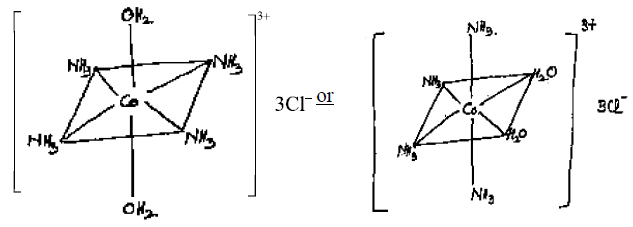
- $\text{[Co(NH}_{3})_{4}\text{(H}_{2}\text{O})_{2}]\text{Cl}_{3}$
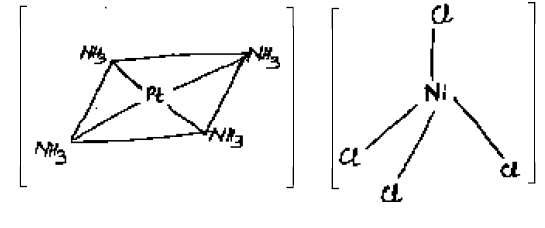
- $\text{[Pt(NH}_{3})_{4}]\text{[NiCl}_{4}]$
Answer
- Tetraamminediaquacobalt (III) chloride.
Structure:
- Tetraammineplatinum (II) tetrachloronickelate (II)
Structure:
View full question & answer→Question 293 Marks
- Using valence bond theory predict the geometry and magnetic behaviour of $[Cr(NH_3)_6]^{3+}ion[Cr=24].$
- Write IUPAC name of:
$[Pt(NH_3)_2Cl_2].$Answer
-
$[Cr(NH_3)_6]^{3+}$
$Cr= [Ar]3d^54s^1$
$Cr^{3+}= [Ar]3d^34s^o$
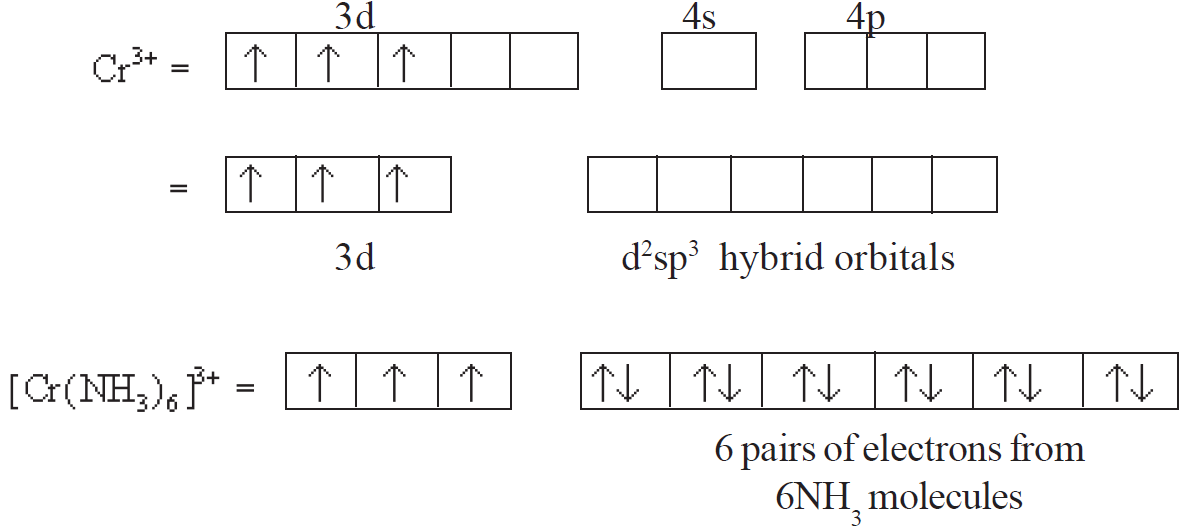
Shape – Octahedral or $d^2sp^3$.
Magnetic behaviour - Paramagnetic.
- Diamminedichloroplatinum (II).
View full question & answer→Question 303 Marks
- Write the formula of the following coordination compound:
Iron(III) hexacyanoferrate(II)
- What type of isomerism is exhibited by the complex $[Co(NH_3)_5Cl]SO_4$?
- Write the hybridisation and number of unpaired electrons in the complex $[CoF_6]^{3-}$. (Atomic No. of Co = 27)
Answer
- $Fe_4[Fe(CN)_6]_3$
- Ionisation isomerism $[Co(NH_3)_5Cl]SO_4$
- $[CoF_6]^{3-}$:
Hybridisation: $sp^3d^2$
No. of unpaired electrons: 4. View full question & answer→Question 313 Marks
Complete the following reactions:
-
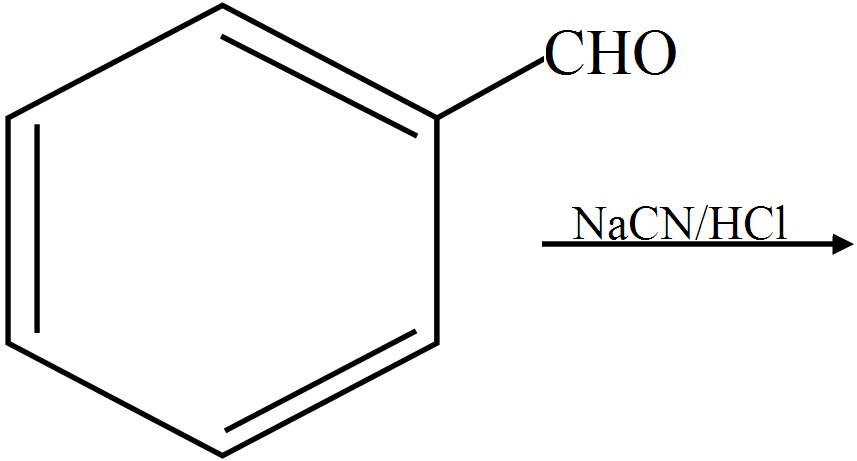
- $(\text{C}_6\text{H}_5\text{CH}_2)_2\text{Cd}+2\text{CH}_3\text{COCl}\xrightarrow{\ \ \ \ \ \ \ }$
- $\text{CH}_3-\text{CH}-\text{COOH}\xrightarrow[(\text{ii})\ \text{H}_2\text{O}]{\ \ \ \ \ \ {(\text{i})\ \text{Br}_2/ \text{ Red P}_4} \ \ \ \ \ \ \ }$
Answer
- Reaction of benzaldehyde with NaCN/ HCl gives cyanohydrin.

- Treatment of acyl chlorides with dialkylcadmium gives a ketone.
$2\text{CH}_3-\text{CO}-\text{Cl}+(\text{C}_6\text{H}_5-\text{CH})\xrightarrow{\ \ \ \ \ \ \ \ \ \ \ }2\text{CH}_3-\text{CO}-\text{CH}_2-\text{C}_6\text{H}_5+\text{CdCl}_2\\\ \ \ \ \ \ \ \ \ \ \ \ \ \ \ \ \ \ \ \ \ \ \ \ \ \ \ \ \ \ \ \ \ \ \ \ \ \ \ \ \ \ \ \ \ \ \ \ \ \ \ \ \ \ \ \ \ \ \ \ \ \ \ \ \ \ \ \ \ ^{ \text{1}-\text{Phenylpropan}-2-\text{One}}$
- Carboxylic acid having α-hydrogen are halogenated at α-position on treatment with $Br_2$ in presence of red phosphorous to give α -halocarboxylic acids. This is Hell Volhard-Zelinsky reaction.
$\ \ \ \ \ \ \ \ \ \ \ \ \text{CH}_3\ \ \ \ \ \ \ \ \ \ \ \ \ \ \ \ \ \ \ \ \ \ \ \ \ \ \ \ \ \ \ \ \ \ \ \ \ \ \ \ \ \ \ \ \ \ \ \ \ \ \ \ \ \ \ \ \ \ \text{CH}_3\ \ \\ \ \ \ \ \ \ \ \ \ \ \ \ \ \ \ \ |\ \ \ \ \ \ \ \ \ \ \ \ \ \ \ \ \ \ \ \ \ \ \ \ \ \ \ \ \ \ \ \ \ \ \ \ \ \ \ \ \ \ \ \ \ \ \ \ \ \ \ \ \ \ \ \ \ \ \ \ \ \ \ |\\\text{CH}_3-\text{CH}-\text{COOH}\xrightarrow[(\text{ii})\ \text{H}_2\text{O}]{\ \ \ \ \ \ {(\text{i})\ \text{Br}_2/ \text{ Red P}_4} \ \ \ \ \ \ \ }\text{CH}_3-\text{C}-\text{COOH}\\ \ \ \ \ \ \ \ \ \ \ \ \ \ \ \ \ \ \ \ \ \ \ \ \ \ \ \ \ \ \ \ \ \ \ \ \ \ \ \ \ \ \ \ \ \ \ \ \ \ \ \ \ \ \ \ \ \ \ \ \ \ \ \ \ \ \ \ \ \ \ \ \ \ \ \ \ \ \ \ \ \ |\\ \ \ \ \ \ \ \ \ \ \ \ \ \ \ \ \ \ \ \ \ \ \ \ \ \ \ \ \ \ \ \ \ \ \ \ \ \ \ \ \ \ \ \ \ \ \ \ \ \ \ \ \ \ \ \ \ \ \ \ \ \ \ \ \ \ \ \ \ \ \ \ \ \ \ \ \ \ \ \ \text{Br}$ View full question & answer→Question 323 Marks
Write chemical equations for the following reactions:
i. Propanone is treated with dilute $Ba ( OH )_2$.
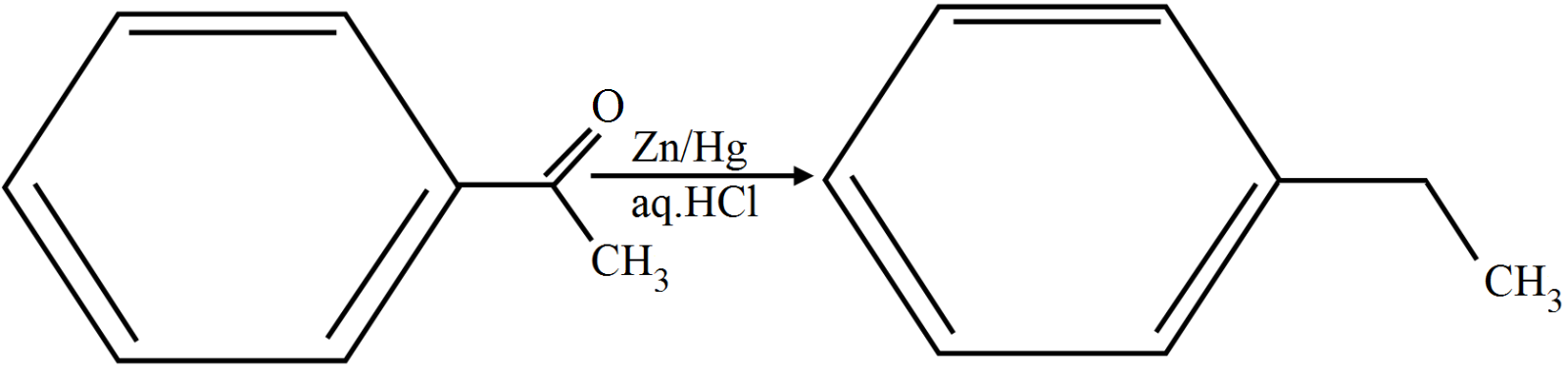
ii. Acetophenone is treated with $Zn ( Hg ) / Conc . HCl$
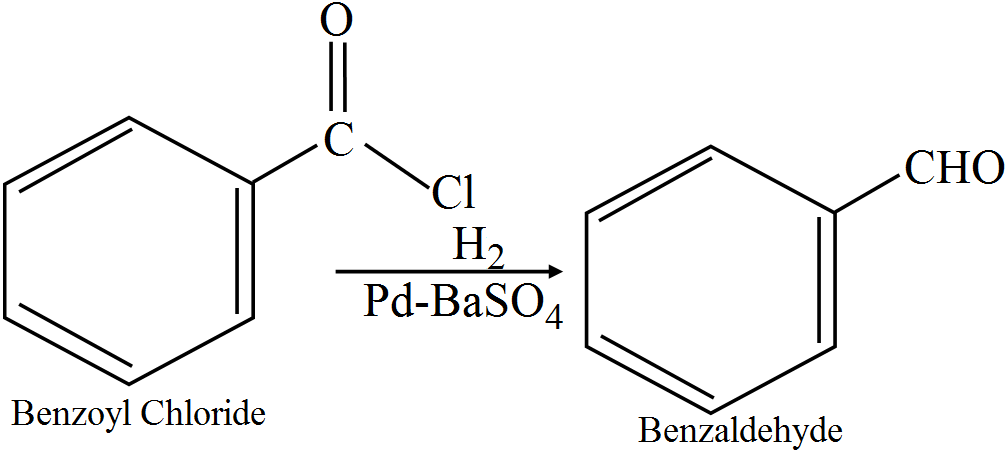
iii. Benzoyl chloride is hydrogenated in presence of $Pd / BaSO _4$.
Answer
- This is a self-aldol condensation reaction.

- The reaction of aldehydes and ketones with zinc amalgam (Zn/ Hg) in concentrated HCl, reduces the aldehyde or ketone to a hydrocarbon,and is called Clemmensen reduction.
- Benzoyl chloride is hydrogenated over catalyst $Pd-BaSO_4$ to give benzaldehyde. This reaction is called Rosenmund Reaction.
View full question & answer→Question 333 Marks
Explain why $[Fe(H_2O)_6]^{3+}$ has magnetic moment value of $5.92BM$ whereas $[Fe(CN)_6]^{3-}$ has a value of only $1.74BM$.
Answer
$[\text{Fe}(\text{CN})_6]^{3-}:$
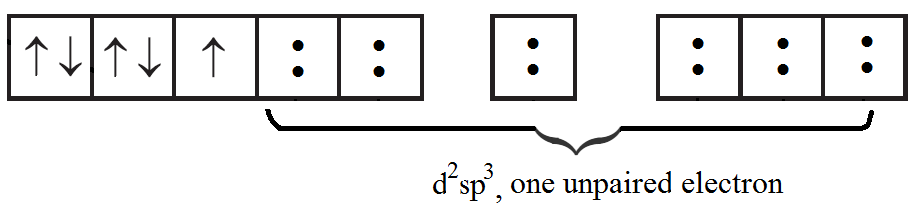
$[\text{Fe}(\text{H}_2\text{O})_6]^{3+}:$

Due to presence of $5$ unpaired electrons $[Fe(H_2O)_6]^{3+}$ has magnetic moment 5.92BM whereas $[Fe(CN)_6]^{3-}$ has $1.74BM$ magnetic moment due to presence of one unpaired electron. View full question & answer→Question 343 Marks
Write down the IUPAC name for the following complex and indicate the oxidation state, electronic configuration and coordination number. Also give stereochemistry and magnetic moment of the complex: $K[Cr(H_2O)_2(C_2O_4)_2].3H_2O$
Answer$\mathrm{K}\left[\mathrm{Cr}\left(\mathrm{H}_2 \mathrm{O}\right)_2\left(\mathrm{C}_2 \mathrm{O}_4\right)_2\right] \cdot 3 \mathrm{H}_2 \mathrm{O}$
Potassium diaquadioxalatochromate (III) trihydrate.
Oxidation state of chromium $=3$
Electronic configuration: $3 d^3: \mathrm{t}_{2 \mathrm{~g}}{ }^3$
Coordination number $=6$
Shape: octahedral
Stereochemistry:
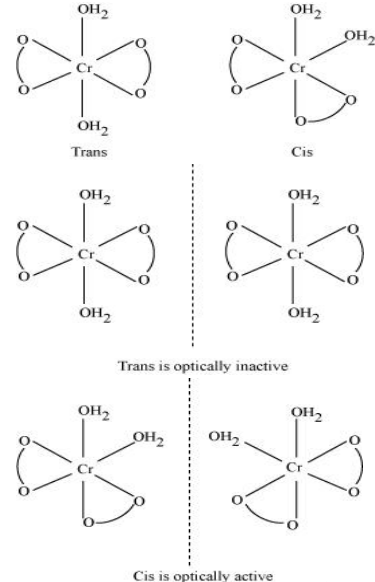
Magnetic moment, µ = $\sqrt{\text{n}(\text{n}+2)}$
$=\sqrt{3(3+2)}$
$=\sqrt{15}$
$=\text{~}4\text{BM}$ View full question & answer→Question 353 Marks
Write down the IUPAC name for the following complex and indicate the oxidation state, electronic configuration and coordination number. Also give stereochemistry and magnetic moment of the complex:
$K_4[Mn(CN)_6]$
Answer$K_4[Mn(CN)_6]$ IUPAC name: Potassium hexacyanomanganate(II). Oxidation state of manganate = +2 Electronic configuration of $d^{5+} : t_{2g}{}^5$ Coordination number = 6 Shape: : octahedral. Stereochemistry: optically inactive Magnetic moment:µ$=\sqrt{\text{n}(\text{n}+2)}$
$=\sqrt{1(1+2)}$
$=\sqrt{3}$
$=1.732$
View full question & answer→Question 363 Marks
Why do compounds having similar geometry have different magnetic moment?
AnswerThe compounds having similar geometry may have different number of unpaired electrons due to the presence of weak and strong field ligands in complexes. If CFSE is high, the complex will show low value of magnetic moment and if CFSE is low, the complex will show high value of magnetic moment. For example, the $\left[\mathrm{CoF}_6\right]^3$ is paramagnetic moment. For example, the $\left[\mathrm{COF}_6\right]^3$ is paramagnetic but $\left[\mathrm{Co}\left(\mathrm{NH}_3\right)_6\right]^{3+}$ is diamagnetic.
View full question & answer→Question 373 Marks
Write formula of a chelate complex and give its IUPAC name.
Question 383 Marks
What is crystal field splitting energy? How does the magnitude of Δo decide the actual configuration of d orbitals in a coordination entity?
Answer
The degenerate d-orbitals (in a spherical field environment) split into two levels i.e., $e_g $ and $t_{2g}$ in the presence of ligands. The splitting of the degenerate levels due to the presence of ligands is called the crystal-field splitting while the energy difference between the two levels $(eg$ and $t2g)$ is called the crystal-field splitting energy. It is denoted by $\triangle _o.$
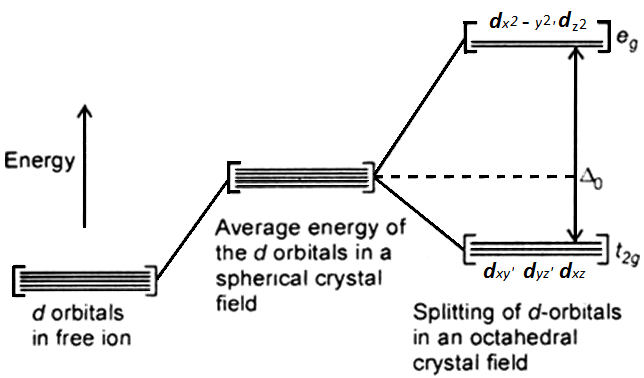
Fig. d-orbital splitting in an octahedral crystal field.
The formation of complex depend on the crystal field splitting, $\triangle _o$ and pairing energy $(P).$
- If $\triangle _o < P,$ the fourth electron enters one of the eg orbitals giving theconfiguration $t_{2g}^3$. Ligands for which $\triangle _o < P$ are known as weak field ligands and form high spin complexes.
- If $\triangle _o > P,$ it becomes more energetically favourable for the fourth electron to occupy a $t_{2g}$ orbital with configuration $t^{2g4}$ $e_g^0.$
- Ligands which produce this effect are known as strong field ligands and form low spin complexes.
View full question & answer→Question 393 Marks
Write down the IUPAC name for the following complex and indicate the oxidation state, electronic configuration and coordination number. Also give stereochemistry and magnetic moment of the complex:
$Cs[FeCl_4]$
Answer$\mathrm{Cs}\left[\mathrm{FeCl}_4\right]$
IUPAC name: Caesium tetrachloroferrate (III).
Oxidation state of $\mathrm{Fe}=+3$
Electronic configuration of $d^6=e_g t_{2 g}{ }^3$
Coordination number $=4$
Shape: : tetrahedral.
Stereochemistry: optically inactive
Magnetic moment:
µ$=\sqrt{\text{n}(\text{n}+2)}$
$=\sqrt{5(5+2)}$
$=\sqrt{35}\text{~}6\text{BM}$
View full question & answer→Question 403 Marks
Write down the IUPAC name for the following complex and indicate the oxidation state, electronic configuration and coordination number. Also give stereochemistry and magnetic moment of the complex:
$[Co(NH_3)_5Cl-]Cl_2$
Answer$[Co(NH_3)_5Cl]Cl_2$
IUPAC name: Pentaamminechloridocobalt(III) chloride
Oxidation state of Co = +3
Coordination number = 6
Shape: octahedral.
Electronic configuration: $d^6 : t_{2g}^6$.
Stereochemistry:
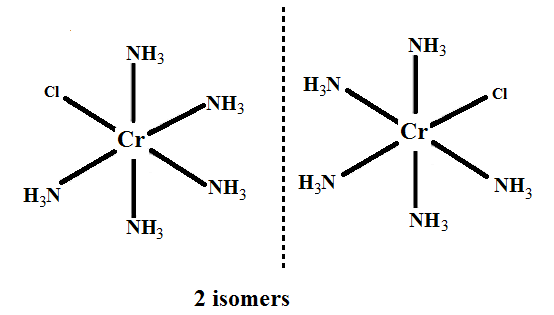
Magnetic Moment = 0 View full question & answer→Question 413 Marks
What is meant by chelate effect?
AnswerWhen a bidentate or polydentate ligand is bonded through two or more donor sites to a metal ion and forms a ring structure then it is said to be chelating ligand. Chelating ligands form more stable complexes than monodentate analogs. This is called chelating effect.
View full question & answer→Question 423 Marks
Write IUPAC names of the following coordination compounds:
- $K_3[Fe(C_2O_4)_3]$
- $K_2[PdCl_4]$
Answer
- Potassium trioxalatoferrate(III).
- Potassium tetrachloridopalladate(II).
View full question & answer→Question 433 Marks
Square complexes of $MX_2A_2$ type with coordination number of $4$ exhibit geometrical isomerism whereas tetrahedral complexes with similar composition do not. Why?
AnswerSquare planar complexes of $MA_2X_2$ type with coordination number $4$ exhibit geometrical isomerism because any of the two ligand may be arranged adjacent to each other in a cis form or opposite to each other in a trans- form. Tetrahedral complexes of this type do not show geometrical isomerism because the relative positions of the monodentate ligands attached to the central metal atom are same with respect to each other.
View full question & answer→Question 443 Marks
Answer the following questions:
Draw the geometrical isomers of complex$[Pt(NH_3)_2Cl_2]$.
View full question & answer→Question 453 Marks
Explain the bonding in coordination compounds in terms of Werner’s postulates.
AnswerThe main postulates of Werner's theory of coordination compounds are as follows:
-
Metals possess two types of valencies called
-
Primary valency which are ionisable;
-
secondary valency which are non- ionisable
-
Primary valency is satisfied by the negative ions and it is that which a metal exhibits in the formation of its simple salts.
-
Secondary valencies are satisfied by neutral ligand or negative ligand and are those which metal exercises in the formation of its complex ions. Every cation has a fixed number of secondary valencies which are directed in space about central metal ion in certain fixed directions, e.g,, In $CoCl_3-6NH_3$, valencies between Co and Cl are primary valencies and valencies between Co and NH_3are secondary. In $COCl_3-6NH_3$, six ammonia molecules linked to Co by secondary valencies are directed to six corners of a regular octahedron and thus account for structure of $COCl_3-6NH_3$ as follows:
In modern theory, it is now referred as coordination number of central metal atom or ion. View full question & answer→Question 463 Marks
Name two complexes which are used in medicines.
Answer
- The platinum complex, $cis-[Pt(NH_3)_2Cl_2]$ known as cisplatin is used in the treatment of cancer.
- Ca–EDTA complex is used in the treatment of lead poisoning.
View full question & answer→Question 473 Marks
Write IUPAC names of the following coordination compounds:
i. $\left[\mathrm{Co}\left(\mathrm{NH}_3\right)_6\right] \mathrm{Cl}_3$
ii. $\left[\mathrm{Co}\left(\mathrm{NH}_3\right) 5 \mathrm{Cl}^2 \mathrm{Cl}_2\right.$
iii. $\mathrm{K}_3\left[\mathrm{Fe}(\mathrm{CN})_6\right]$
Answer
- Hexaamminecobalt(III)chloride.
- Pentaamminechloridocobalt(III)chloride.
- Potassium hexacyanoferrate(III).
View full question & answer→Question 483 Marks
Explain with two examples each of the following: coordination entity, ligand, coordination number, coordination polyhedron, homoleptic and heteroleptic.
AnswerCoordination entity: It constitutes of a central atom/ion bonded to fixed number of ions or molecules by coordinate bonds e.g. $\left[\mathrm{COCl}_3\left(\mathrm{NH}_3\right)_3\right]$, $\left[\mathrm{Ni}(\mathrm{CO})_4\right]$ etc.
Ligand: The ions/molecules bound to central atom/ion in coordination entity are called ligands. Ligands in above examples are $\mathrm{CL}, \mathrm{NH}_3, \mathrm{CO}$
Coordination number: This is the number of bond formed by central atom/ion with ligands.
Coordination polyhedron: Spatial arrangement of ligands defining the shape of complex. In above cases Co and Ni polyhedron are octahedral and tetrahedral in $\left[\mathrm{CoCl}_3\left(\mathrm{NH}_3\right)_3\right]$ and $\left[\mathrm{Ni}(\mathrm{CO})_4\right]$ respectively.
Homoleptic: Metal is bound to only one kind of ligands eg Ni in $\left[\mathrm{Ni}(\mathrm{CO})_4\right]$
Heteroletric: Metal is bound to more than one kind of ligandseg Coin $\left[\mathrm{CoCl}_3\left(\mathrm{NH}_3\right)_3\right]$
View full question & answer→Question 493 Marks
Write the IUPAC name of $Fe_4 [Fe(CN)_6]_3$.
AnswerIron (III) hexacyanoferrate (II).
View full question & answer→Question 503 Marks
An octahedral complex is prepared by mixing $\mathrm{CoCl}_3$ and $\mathrm{NH}_3$ in the molar ratio $1: 4,0.1 \mathrm{~m}$ solution of this complex was found to freeze at $0.372^{\circ} \mathrm{C}$. What is the formula of the complex? Given that molal depression constant ( Kf ) for water $=1.86^{\circ} \mathrm{C} / \mathrm{m}$.
AnswerTheoretical value of
$\triangle\text{T}_\text{f}=\text{K}_\text{f}\times\text{m}=1.86^\circ\text{C/m}=0.1\text{m}=0.186^\circ\text{C}$
Observed value of $\triangle\text{T} _\text{f }=0.372^\circ\text{C}$.
As observed $\triangle\text{T}_\text{f}$ is twice the theoretical value, this shows that each molecule of the complex dissociate to form two ions. This can be possible only if the formula of the complex is $[Co(NH_3)_4Cl_2]Cl$.
View full question & answer→Question 513 Marks
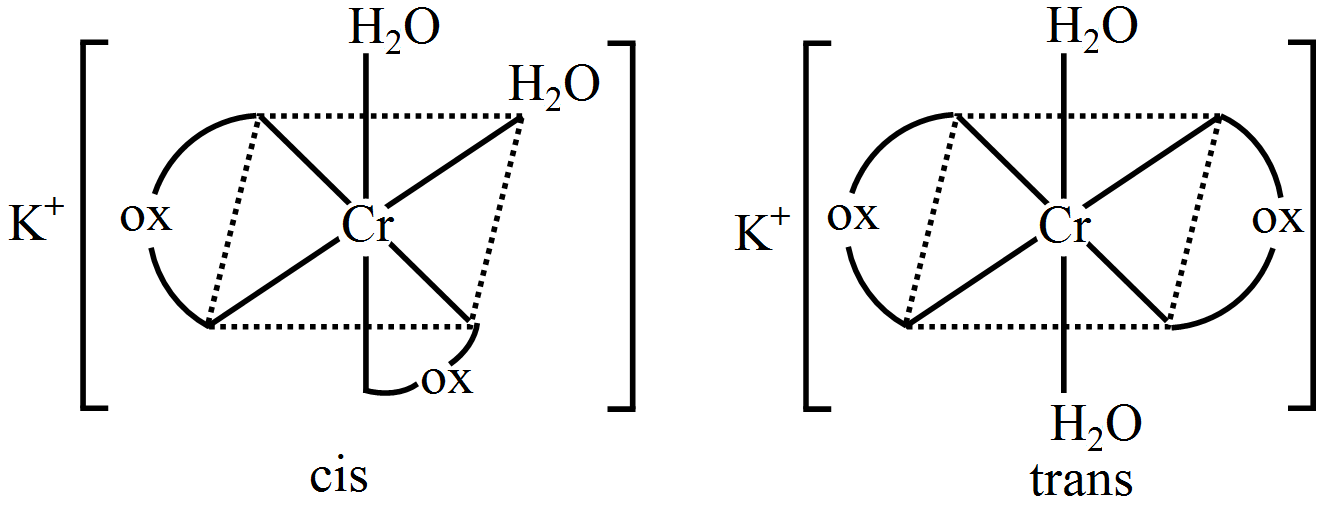
Indicate the types of isomerism exhibited by the following complexes and draw the structures for these isomers:
- $[Pt(NH_3)(H_2O)Cl_2].$
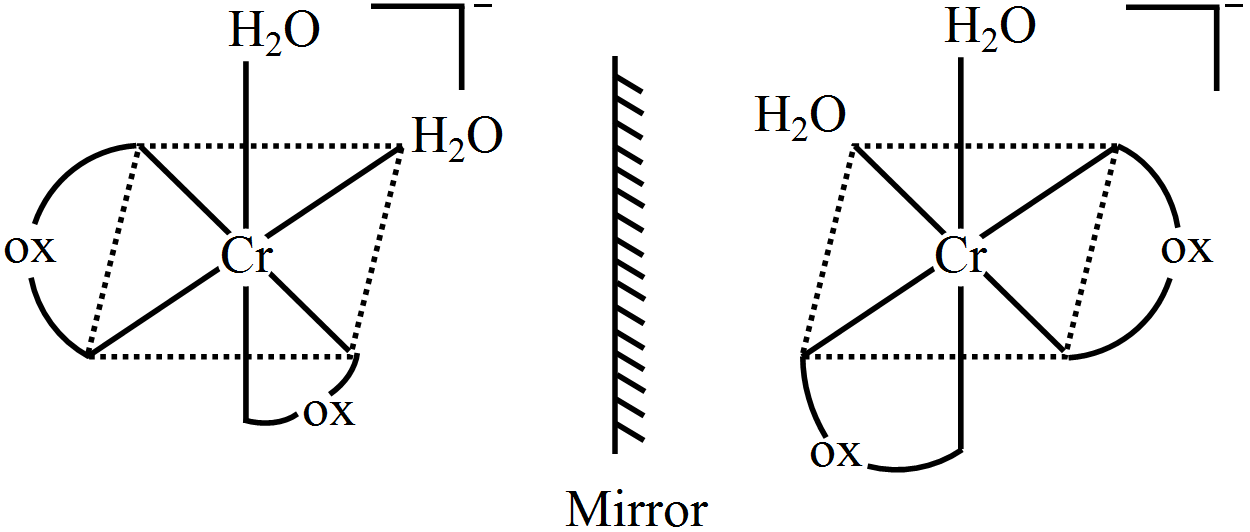
- $K[Cr(H_2O)_2(C_2O_4)_2].$
Answer
- Geometrical isomers can exist.
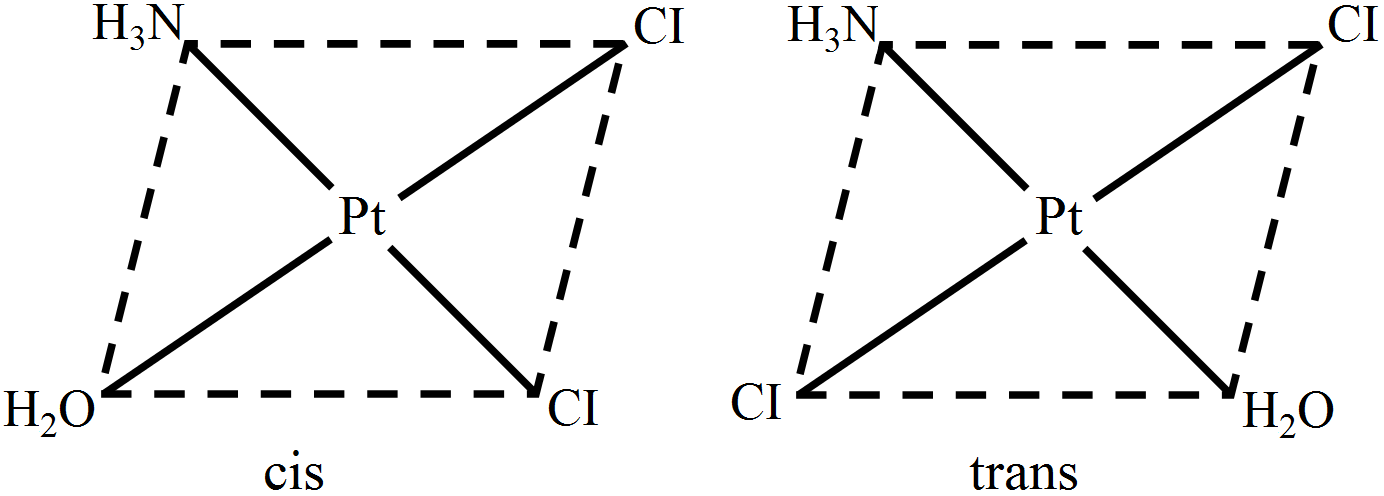
- Both geometrical (cis–trans) and optical isomers for cis can exist.
- Geometrical isomers of $K[Cr(H_2O)_2(C_2O_4)_2]$
- Optical isomers (d- and l-) of cis$-K[Cr(H_2O)_2(C_2O_4)_2]$
View full question & answer→Question 523 Marks
Write all the possible isomers of $[Co(NH_3)_5(SCN)]Cl$.
Answer$\left[\mathrm{Co}\left(\mathrm{NH}_3\right)_5(\mathrm{SCN})\right] \mathrm{Cl},\left[\mathrm{Co}\left(\mathrm{NH}_3\right)_5(\mathrm{NCS})\right] \mathrm{Cl},\left[\mathrm{Co}\left(\mathrm{NH}_3\right)_5 \mathrm{Cl}\right] \mathrm{SCN},\left[\mathrm{Co}\left(\mathrm{NH}_3\right)_5 \mathrm{Cl}\right] \mathrm{NCS}$.
$MA_5B$ type complexes do not show geometrical or optical isomerism.
View full question & answer→Question 533 Marks
List various types of isomerism possible for coordination compounds, giving an example of each.
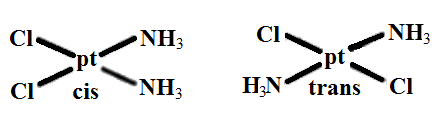
AnswerCoordination compounds exhibit stereo isomerism and structural isomerism. Two types of stereoisomerism and their examples are as follows.
- Geometrical isomerism.
- Optical isomerism.
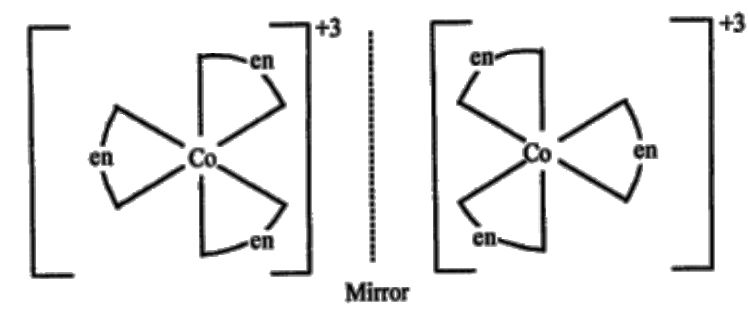
Four types of structural isomerism are as follows:
i. Linkage isomerism $\left[\mathrm{Co}\left(\mathrm{NH}_3\right)_5 \mathrm{NO}_2\right] \mathrm{Cl}_2$ and $\left[\mathrm{Co}\left(\mathrm{NH}_3\right)_5 \mathrm{ONO}\right] \mathrm{Cl}_2$
ii. Coordination isomerism $\left[\mathrm{Co}\left(\mathrm{NH}_3\right)_6\right]\left[\mathrm{Cr}(\mathrm{CN})_6\right]$ and $\left[\mathrm{Cr}\left(\mathrm{NH}_3\right)_6\right]\left[\mathrm{Co}(\mathrm{CN})_6\right]$
iii. lonisation isomerism $\left[\mathrm{Co}\left(\mathrm{NH}_3\right)_5 \mathrm{SO}_4\right] \mathrm{Br}$ and $\left[\mathrm{Co}\left(\mathrm{NH}_3\right)_5 \mathrm{Br}\right] \mathrm{SO}_4$
iv. Solvate or hydrate isomerism $\left[\mathrm{Cr}\left(\mathrm{H}_2 \mathrm{O}\right)_6\right] \mathrm{Cl}_2$ and $\left[\mathrm{Cr}\left(\mathrm{H}_2 \mathrm{O}\right)_5 \mathrm{Cl}\right] \mathrm{Cl} . \mathrm{H}_2 \mathrm{O}$ View full question & answer→Question 543 Marks
Write the formulae of the following coordination compounds:
- Tetraamminediaquacobalt(III)chloride .
- Tris (ethane-1,2-diamine)chromium(III)chloride.
Answeri. $\left[\mathrm{Co}\left(\mathrm{NH}_3\right)_4\left(\mathrm{H}_2 \mathrm{O}\right) 2\right] \mathrm{Cl}_3$
ii. $\left[\mathrm{Cr}(\mathrm{en})_3\right] \mathrm{Cl}_3$
View full question & answer→Question 553 Marks
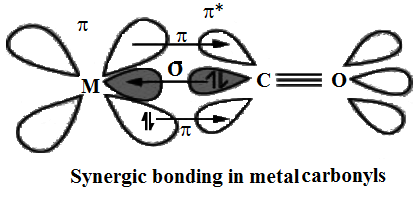
Discuss the nature of bonding in metal carbonyls.
AnswerThe metal-carbon bonds in metal carbonyls have both σ and Π characters. σ bond is formed when the carbonyl carbon donates a lone pair of electrons to the vacant orbital of the metal. AΠ bond is formed by the donation of a pair of electrons from the filled metal d orbital into the vacant anti-bonding $Π^*$ orbital (also known as back bonding of the carbonyl group). The σ bond strengthens the Π bond and vice-versa. Thus, a synergic effect is created due to this metal-ligand bonding. This synergic effect strengthens the bond between CO and the metal.
View full question & answer→Question 563 Marks
Draw figure to show the splitting of d orbitals in an octahedral crystal field.
Answer
Crystal field effects in octahedral coordination entities:
- Let us assume that the six ligands are positioned symmetrically along the cartesian axes, with metal atom at the origin. As the ligands approach first there is an increase in energy of d-orbitals relative to that of the free ion just as would be the case in a spherical field.
- The orbitals lying along the axes $(d_z^2$, and $d_x^2– y^2)$ get repelled more strongly than $d_{xy}, d_{yz}$ and $d_{zx}$ orbitals which have lobes directed between the axes.
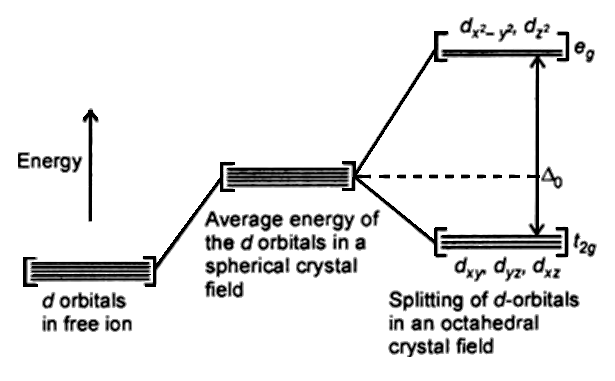
Fig. d-orbital splitting in an octahedral crystal field.
The $d_z^2$, and $d_x^2– y^2$ orbitals get raised in energy and $d_{xy}, d_{yz}, d_{xz}$ orbitals are lowered in energy relative to the average energy in the spherical crystal field.
Thus, the degenerate set of d-orbitals get split into two sets: the lower energy orbitals set $t_{2g}$ and the higher field energy orbitals $e_g$ set. The energy is separated by $\triangle _0$. View full question & answer→Question 573 Marks
Answer the following questions:
Write the formulae for the following coordination compounds:
- Tetraammineaquachloridocobalt (III)chloride.
- Potassiumtetracyanonickelate (II).
Answera. $\left[\mathrm{Co}\left(\mathrm{NH}_3\right)_4\left(\mathrm{H}_2 \mathrm{O}\right) \mathrm{Cl}\right] \mathrm{Cl}_2$
b. $\mathrm{K}_2\left[\mathrm{Ni}(\mathrm{CN})_4\right]$
View full question & answer→Question 583 Marks
The $\pi$-complexes are known for transition metals only. Why?
AnswerTransition metals have vacant d-orbitals in their atoms or ions into which the electron pairs can be donated by ligands containing $\pi$-electrons, e.g., $C_6H_6, CH_2=CH_2$, etc. Thus, $\text{d}$$\pi$ – $\text{p}\pi$ bonding is possible.
View full question & answer→Question 593 Marks
A chloride of fourth group cation in qualitative analysis gives a green coloured complex [A] in aqueous solution which when treated with ethane-1, 2-diamine (en) gives pale-yellow solution [B] which on subsequent addition of ethane-1, 2-diamine turns to blue/purple [C] and finally to violet [D]. Write the structures of complexes [A], [B], [C] and [D].
Answer$\mathrm{A}=\left[\mathrm{Ni}\left(\mathrm{H}_2 \mathrm{O}\right)_6\right]^{2+}$
$\mathrm{B}=\left[\mathrm{Ni}\left(\mathrm{H}_2 \mathrm{O}\right)_4(\mathrm{en})\right]^{2+}$
$\mathrm{C}=\left[\mathrm{Ni}\left(\mathrm{H}_2 \mathrm{O}\right)_2(\mathrm{en})_2\right]^{2+}$
$\mathrm{D}=\left[\mathrm{Ni}(\mathrm{en})_3\right]^{2+}$
View full question & answer→Question 603 Marks
What is spectrochemical series? Explain the difference between a weak field ligand and a strong field ligand.
AnswerSpectro-chemical series is a series in which the ligands have been arranged in order of increasing magnitude of splitting they produce. The order is,
$I– < Br^– < SCN^– < Cl^–< S^{2–} < F ^– < OH^– < C_2O_4^{2–} < H_2O < NCS^–< edta^{4–} < NH_3 < en < CN^– < CO$
The ligand present on the R.H.S of the series are strong field ligand while L.H.S are weak field ligand. Also, strong field ligand cause higher splitting in the d- orbitals than weak field ligand.
| |
Weak field ligand |
Strong field ligand |
| 1. |
They are formed when the crystal field stabilisation energy $(\triangle _0)$ in octahedral complexes is less than the energy required for an electron pairing in a single orbital (p). |
They are formed when the crystal field stabilisation energy $(\triangle _0)$ is greater than the p. |
| 2. |
They are also called high spin complexes. |
They are called low spin complexes. |
| 3. |
They are mostly paramagnetic in nature complex. |
They are mostly diamagnetic or less paramagnetic than weak field. |
View full question & answer→Question 613 Marks
How would you account for the following? $[Ti(H_2O)_6]^{3+}$ is coloured while $[Sc(H_2O)_6]^{3+}$ is colourless.
Answer
The outer electronic structure of $[Ti(H_2O)_6]^{3+}$ and $[Sc(H_2O)_6]^{3+}$ are given below:
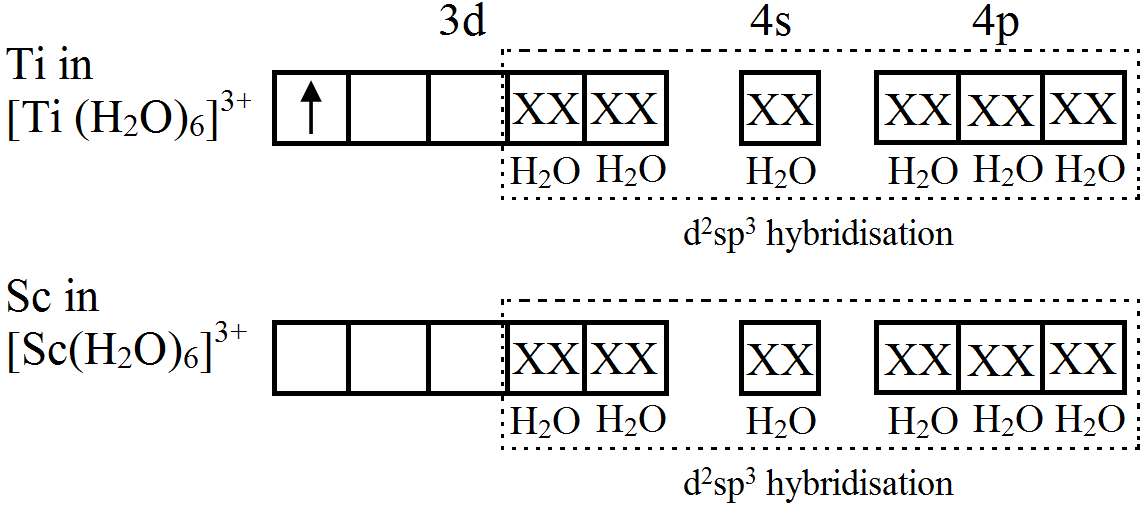
Due to the presence of one electron in 3d-subshell in $[Ti(H_2O)_6]^{3+}$ complex d-d transition takes place by the absorption of visible light. Hence, the complex appears coloured.
On the other hand, $[Sc(H_2O)_6]^{3+}$ does not possess any unpaired electron. Hence, d-d transition (which is responsible for colour) in this complex is not possible. Therefore, it is colourless. View full question & answer→Question 623 Marks
Write the IUPAC name of the ionisation isomer of the coordination compound $[Co(NH_{3)5}Br]SO_4$. Give one chemical test to distinguish between the two compounds.
AnswerIonisation isomer is $\left[\mathrm{Co}\left(\mathrm{NH}_3\right)_5 \mathrm{SO}_4\right] \mathrm{Br}$. The IUPAC name is Pentaamminesulphatocobalt(III)bromide. The isomer $\left[\mathrm{Co}\left(\mathrm{NH}_3\right)_5 \mathrm{Br}\right] \mathrm{SO}_4$ will give $\mathrm{SO}_2-4$ ions in the solution which gives white precipitate with $\mathrm{BaCl}_2$ solution. The isomer $\left[\mathrm{Co}\left(\mathrm{NH}_3\right)_5 \mathrm{SO}_4\right] \mathrm{Br}$ will give Br - ions in the solution which gives yellow precipitate with $\mathrm{AgNO}_3$ solution.
View full question & answer→Question 633 Marks
Write down the IUPAC name for the following complex and indicate the oxidation state, electronic configuration and coordination number. Also give stereochemistry and magnetic moment of the complex:
$CrCl_3(py)_3$
Answer$CrCl_3(py)_3$
IUPAC name: Trichloridotripyridinechromium (III).
Oxidation state of chromium = $+3$
Electronic configuration for $d^3 = t_{2g}^3$
Coordination number = $6$
Shape: octahedral.
Stereochemistry:
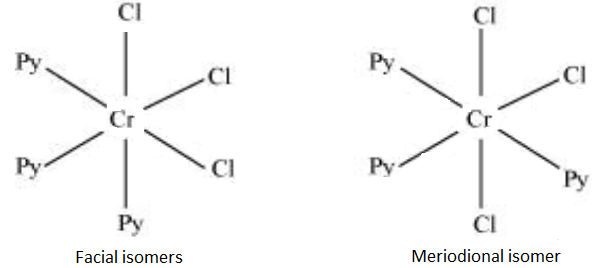
Both isomers are optically active. Therefore, a total of 4 isomers exist.
Magnetic moment, µ$=\sqrt{\text{n}(\text{n}+2)}$
$=\sqrt{3(3+2)}$
$=\sqrt{15}$
$=∼4\text{BM}$ View full question & answer→Question 643 Marks
What is meant by unidentate, didentate and ambidentate ligands? Give two examples for each.
AnswerA molecule or an ion which has only one donor atom to form one coordinate bond with the central metal atom is called unidentate ligand, e.g,, $Cl-$ and $NH_3$.
A molecule or ion which contains two donor atoms and hence forms two coordinate bonds with the central metal atom is called adidentate ligend, e.g.,
$\text{CH}_{2}\text{NH}_{2}\ \ \text{and}\ \ \text{COO}^{-}\\| \ \ \ \ \ \ \ \ \ \ \ \ \ \ \ \ \ \ \ \ \ \ \ \ \ \ | \\\text{CH}_{2}\text{NH}_{2}\ \ \ \ \ \ \ \ \ \ \text{COO}^{-}$
A molecule or an ion which contains two donor atoms but only one of them forms a coordinate bond at a time with the central metal atom is called ambidentate ligands, e.g.,:
$\text{CN}^{-}\text{or}\ \ \text{NC}^{-}\text{and}\ \ \ \text{NO}_{2}^{-}\text{or}\ \ \text{ONO}^{-}$
View full question & answer→Question 653 Marks
Why are different colours observed in octahedral and tetrahedral complexes for the same metal and same ligands?
AnswerThe colour in coordination compounds is readily explained in terms of crystal field theory. It is noteworthy that in tetrahedral coordination entity formation, the d orbital splitting is inverted and is smaller as compared to the octahedral field splitting. So the d-d electrons transition energies differ. This holds good even when the complex is formed with same metal and same ligands and metal-ligand distances.
View full question & answer→