Question 13 Marks
$3(5x - 7) + 2(9x - 11) = 4(8x - 7) - 111$
AnswerGiven, $3(5x - 7) + 2(9x - 11) = 4(8x - 7) - 11115x - 21 + 18x - 22 = 32x - 28 - 111$
$33x - 43 = 32x - 139$
$33x - 32x = -139 + 43$
$x = -96$
View full question & answer→Question 23 Marks
$\frac{2\text{x}-1}{5}=\frac{3\text{x}+1}{3}$
AnswerGiven, $\frac{2\text{x}-1}{5}=\frac{3\text{x}+1}{3}$$3(2x - 1) = 5(3x + 1)$
$6x - 3 = 15x + 5$
$6x - 15x = 3 + 5$
$-9x = 8$
$\frac{-9\text{x}}{-9}=\frac{8}{-9}$ $\text{x}=\frac{-8}{9}$
View full question & answer→Question 33 Marks
$\frac{\text{y}-(4-3\text{y})}{2\text{y}-(3+4\text{y})}=\frac{1}{5}$
AnswerGiven, $\frac{\text{y}-(4-3\text{y})}{2\text{y}-(3+4\text{y})}=\frac{1}{5}$$5(y - 4 + 3y) = 2y - 3 - 4y$
$5(4y - 4) = -3 - 2y$
$20y - 20 = -3 - 2y$
$20y + 2y = 20 - 3$
$22y = 17$
$\frac{22\text{y}}{22}=\frac{17}{22}$
$\text{y}=\frac{17}{22}$
View full question & answer→Question 43 Marks
After $12$ years, Kanwar shall be $3$ times as old as he was $4$ years ago. Find his present age.
AnswerLet Kanwar’s present age be $x$ years After $12$ years,
Kawar’s age $= (x + 12)y \& 4 $years ago, Kanwar’s age $= (x - 4)$
years According to the question,$ x + 12 = 3(x - 4) x + 12 = 3x - 12 3x - x = 12 + 2 2x = 24$
$\text{x}=\frac{24}{2}=12$
Hence, Kanwar’s present age is $12$ years.
View full question & answer→Question 53 Marks
Anushka and Aarushi are friends. They have equal amount of money in their pockets. Anushka gave $\frac{1}{3}$ of her money to Aarushi as her birthday gift. Then Aarushi gave a party at a restaurant and cleared the bill by paying half of the total money with her. If the remaining money in Aarushi’s pocket is Rs. $1600$, find the sum gifted by Anushka.
AnswerLet Anushka & Aarushi $=\text{Rs. }\Big(\text{x}+\frac{\text{x}}{3}\Big)$According to the question,
$\Big(\text{x}+\frac{\text{x}}{3}\Big)-\frac{1}{2}\times\Big(\text{x}+\frac{\text{x}}{3}\Big)=1600$
$\Big(\text{x}+\frac{\text{x}}{3}\Big)\Big(1-\frac{1}{2}\Big)=1600$
$\frac{3\text{x}+\text{x}}{3}=1600\times2$
$\frac{4\text{x}}{3}=3200$
$\text{x}=3200\times\frac{3}{4}=2400$
So, money gifted by Anushka $=\frac{1}{3}$ of $2400=\frac{1}{3}\times2400=\text{Rs. }800$
View full question & answer→Question 63 Marks
$\frac{5(1-\text{x})+3(1+\text{x})}{1-2\text{x}}=8$
AnswerGiven, $\frac{5(1-\text{x})+3(1+\text{x})}{1-2\text{x}}=8 5(1 - x) + 3(1 + x) = 8(1 - 2x)$
$5 - 5x + 3 + 3x = 8 - 16x$
$8 - 2x = 8 - 16x$
$16x - 2x = 8 - 8$
$14x = 0$
$\frac{14\text{x}}{14}=\frac{0}{14}$
$x = 0$
View full question & answer→Question 73 Marks
$3\text{x}-\frac{\text{x}-2}{3}=4-\frac{\text{x}-1}{4}$
AnswerGiven, $3\text{x}-\frac{\text{x}-2}{3}=4-\frac{\text{x}-1}{4}$
$\frac{9\text{x}-(\text{x}-2)}{3}=\frac{16-(\text{x}-1)}{4}4(9x - x + 2) = 3(16 - x + 1)$
$4(8x + 2) = 3(-x + 17)$
$32x + 8 = -3x + 51$
$32x + 3x = 51 - 8$
$35x = 43$
$\frac{35\text{x}}{35}=\frac{43}{35}$
$\text{x}=\frac{43}{35}$
View full question & answer→Question 83 Marks
$0.16(5x - 2) = 0.4x + 7$
AnswerGiven,$ 0.16(5x - 2) = 0.4x + 70.8x - 0.32 = 0.4x + 7$
$0.8x - 0.4x = 0.32 + 7$
$0.4x = 7.32$
$\frac{0.4\text{x}}{0.4}=\frac{7.32}{0.4}x = 18.3$
View full question & answer→Question 93 Marks
The age of $A$ is five years more than that of $B. 5$ years ago, the ratio of their ages was $3 : 2$. Find their present ages.
AnswerLet the present age of $B$ be $x$ years.
Then, the present age of $A = (x + 5)$ years Five years ago, age of
$A = x + 5 - 5 = x$ years & age of
$B = (x - 5)$ years According to the question,
$\frac{\text{x}}{\text{x}-5}=\frac{3}{2}$
$2x = 3(x - 5) 2x = 3x - 15 3x - 2x = 15 x = 15$
Hence, the present age of $B$ is $15$ years and the present age of $A$ is $(15 + 5)$ i.e., $20$ years.
View full question & answer→Question 103 Marks
A steamer goes downstream and covers the distance between two ports in $3$ hours. It covers the same distance in $5$ hours when it goes upstream. If the stream flows at $3 km/hr$, then find what is the speed of the steamer upstream?
AnswerLet speed of the steamer in still water be $x km/h$ Speed of the stream $= 3 km/h$
Now, speed of the steamer downstream $= (x + 3)km/h$ & speed of the steamer upstream $= (x - 3)km/h$
According to the question, Distance covered in $3h$ by steamer downstream = Distance covered in $5h$ by steamer upstream $3(x + 3) = 5(x - 3) 3x + 9 = 5x - 15 3x - 5x = -15 - 9 -2x = -24$
$\text{x}=-24\times\Big(-\frac{1}{2}\Big)=12\text{km/h}$
Hence, the speed of the steamer upstream is $(12 - 3)$ i.e., $9km/h.$
View full question & answer→Question 113 Marks
$\frac{3\text{t}-2}{3}+\frac{2\text{t}+3}{2}=\text{t}+\frac{7}{6}$
AnswerGiven, $\frac{3\text{t}-2}{3}+\frac{2\text{t}+3}{2}=\text{t}+\frac{7}{6}$ $\frac{2(3\text{t}-2)+3(2\text{t}+3)}{6}=\frac{6\text{t}+7}{6} 6t - 4 + 6t + 9 = 6t + 7$
$12t + 5 = 6t + 7$
$12t - 6t = 7 - 5$
$6t = 2$
$\frac{6\text{t}}{6}=\frac{2}{6}$ $\text{t}=\frac{1}{3}$
View full question & answer→Question 123 Marks
An employee works in a company on a contract of $30$ days on the condition that he will receive Rs. $120$ for each day he works and he will be fined Rs. $10$ for each day he is absent. If he receives Rs. $2300$ in all, for how many days did he remain absent?
AnswerGiven, the number of days in contract $= 30$
Money received per day for working $= Rs. 120$
Money deducted per day for being absent = Rs. $10$ & amount received by employee as salary = Rs. $2300$
Let the employee remained absent for $x$ days.
Then, employee worked for $(30 - x)$days.
According to the question, $120(30 - x) = 10x = 2300 3600 - 12x - 10x = 2300 -130x = -3600 + 2300 -130x = -1300$ $\text{x}=-1300\times\Big(-\frac{1}{130}\Big) x = 10$
Therefore, employee remained absent for $10$ days.
View full question & answer→Question 133 Marks
Kusum buys some chocolates at the rate of Rs. $10$ per chocolate. She also buys an equal number of candies at the rate of Rs. $5$ per candy. She makes a $20\%$ profit on chocolates and $8%$ profit on candies. At the end of the day, all chocolates and candies are sold out and her profit is Rs. $240$. Find the number of chocolates purchased.
AnswerLet Kusum purchased $x$ chocolates.
Then, total cost of chocolates = Rs. $10x$ Similarly, she purchased $x$ candies.
Then, total cost of candies = Rs. $5x$
According to the question, Profit on chocolates $= 20\%$ of $10x =\frac{20}{100}\times10\text{x}=\text{Rs. }2\text{x}$ & profit on candies $= 8\%$ of 5x $=\frac{8}{100}\times5\text{x}=\text{Rs. }0.4\text{x}$Total profit $= 2x + 0.4x = Rs. 2.4x$
But it is given that total profit is Rs. $240$
Again, according to the question,
$2.4x = 240$
$\text{x}=\frac{240}{2.4}=100$
Hence, she purchased $100$ chocolates.
View full question & answer→Question 143 Marks
$\frac{2\text{y}-3}{4}-\frac{3\text{y}-5}{2}=\text{y}+\frac{3}{4}$
AnswerGiven, $\frac{2\text{y}-3}{4}-\frac{3\text{y}-5}{2}=\text{y}+\frac{3}{4}$ $\frac{2\text{y}-3-2(3\text{y}-5)}{4}=\frac{4\text{y}+3}{4}$$2y - 3 - 6y + 10 = 4y + 3$
$-4y + 7 = 4y + 3$
$-4y - 4y = 3 - 7$
$-8y = -4$
$\frac{-8\text{y}}{-8}=\frac{-4}{-8}$ $\text{y}=\frac{1}{2}$
View full question & answer→Question 153 Marks
On dividing Rs. $200$ between $A$ and $B$ such that twice of A’s share is less than $3$ times $B$’s share by $200, B$’s share is?
AnswerLet $B'$ s share be Rs. $x$ Then, $A'$ s share = Rs. $(200 - x)$
According to the question, $2 \times (A$' share $) = 3 \times (B′$ share) $- 200 2 \times (200 - x) = 3x - 200 400 - 2x$
$= 3x - 200 -2x - 2x = -200 - 400 -5x = -600$
$\text{x}=-600\times\Big(-\frac{1}{5}\Big) x = 120$
Hence, $B$’ s share is Rs .$120$
Then, $A'$ s Share $= Rs. (200 - 120) = Rs. 80$
View full question & answer→Question 163 Marks
The volume of water in a tank is twice of that in the other. If we draw out $25$ litres from the first and add it to the other, the volumes of the water in each tank will be the same. Find the volume of water in each tank.
AnswerLet the volume of water in one tank be $xL$.Then, volume of the water in another tank $= 2xL.$
According to the question,
Volume of the water in first tank $+25 =$ Volume of the water in another tank $-25$
$x + 25 = 2x - 25$
$2x - x = 25 + 25$
$x = 50$
Hence, volume of water in one tank $= 50L$
& volume of the water in another tank $= 2 \times 50 = 100L$
View full question & answer→Question 173 Marks
$4(3p + 2) - 5(6p - 1) = 2(p - 8) - 6(7p - 4)$
AnswerGiven, $4(3p + 2) - 5(6p - 1) = 2(p - 8) - 6(7p - 4)12p + 8 - 30p + 5 = 2p - 16 - 42p + 24$
$-18p + 13 = -40p + 8$
$-18p + 40p = 8 - 13$
$22p = -5$
$\frac{22\text{p}}{22}=-\frac{5}{22}$ $\text{p}=-\frac{5}{22}$
View full question & answer→Question 183 Marks
Sum of the digits of a two-digit number is $11$. The given number is less than the number obtained by interchanging the digits by $9.$ Find the number.
AnswerLet the unit’s digit be $x$
Then, the ten’s digit $= 11 - x$
Number $= 10(11 - x) + x$
$= 110 - 10x + x = 110 - 9x$
Number obtained by interchanging the digits $= 10x + (11 - x) = 9x + 11$
According to the question,
$9x + 11 - (110 - 9x) = 9$
$9x + 11 - 110 + 9x = 9$
$18x = 9 - 11 + 110$
$18x = 108$
$\text{x}=\frac{108}{18}$
$x = 6$
Hence, unit’s digit $= 6$ & ten’s digit $= 11 - 6 = 5$
Therefore, the required number is $56.$
View full question & answer→Question 193 Marks
$\frac{3\text{x}+2}{2\text{x}-3}=-\frac{3}{4}$
AnswerGiven, $\frac{3\text{x}+2}{2\text{x}-3}=-\frac{3}{4} 4(3x + 2) = -3(2x - 3)$
$12x + 8 = -6x + 9$
$12x + 6x = 9 - 8$
$18x = 1$
$\frac{18\text{x}}{18}=\frac{1}{18}$ $\text{x}=\frac{1}{18}$
View full question & answer→Question 203 Marks
For what value of $x$ is the perimeter of shape $186\ cm?$
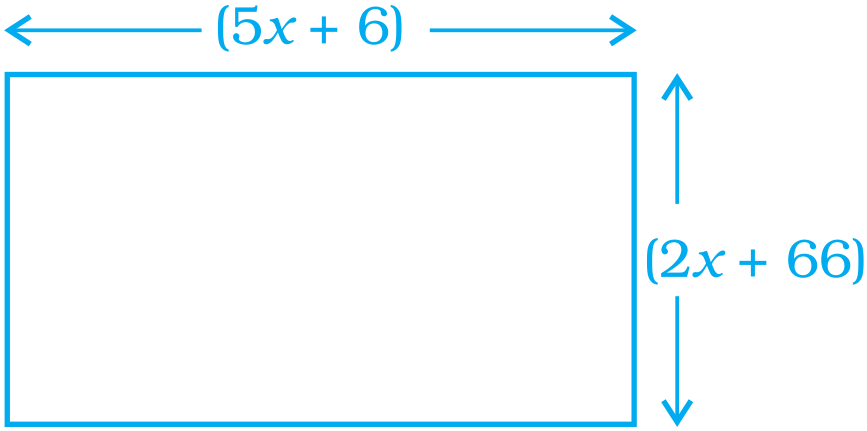
AnswerGiven, length of the given figure $= (5x + 8)$ & breadth of the given figure $= (2x + 66)$
Perimeter of shape $= 186cm 2 \times $ (Length + Breadth) $= 186 2 \times [(5x + 6) + (2x + 66)] = 186 2 \times [7x + 72] = 186 14x + 144 = 186 14x = 186 - 144 14x = 42$
$\text{x}=\frac{42}{14}=3$
Hence, the value of $x$ is $3\ cm.$
View full question & answer→Question 213 Marks
Madhulika thought of a number, doubled it and added $20$ to it. On dividing the resulting number by $25$, she gets $4.$ What is the number?
AnswerLet the number be x According to the question, $\frac{2\text{x}+20}{25}=4 2x + 20 = 25 × 4 2x + 20 = 100 2x = 100 - 20 2x = 80$
$\text{x}=\frac{80}{2}=40$
Hence, the required number is $40.$
View full question & answer→Question 223 Marks
Anima left one-half of her property to her daughter, one-third to her son and donated the rest to an educational institute. If the donation was worth Rs. $1,00,000$, how much money did Anima have?
AnswerLet Anima’s property be Rs. $x$ Property left for her daughter $=\text{Rs. }\frac{\text{x}}{2}$
Remaining property $=\text{x}-\frac{\text{x}}{2}=\frac{2\text{x}-\text{x}}{2}=\text{Rs. }\frac{\text{x}}{2}$
Property left for her son $=\frac{1}{3}$ of remaining property $=\frac{1}{3}\times\frac{\text{x}}{2}=\text{Rs.}\frac{\text{x}}{6}$
Remaining property $=\Big[\text{x}-\Big(\frac{\text{x}}{2}+\frac{\text{x}}{6}\Big)\Big]=\text{x}-\Big(\frac{3\text{x}+\text{x}}{6}\Big)$
$=\frac{6\text{x}-4\text{x}}{6}=\frac{2\text{x}}{6}=\text{Rs.}\frac{\text{x}}{3}$
Since, the remaining property donated to an educational institute.
But donation property$ = Rs. 100000$
$\frac{\text{x}}{3}=100000x = 300000$
Hence, Anima has $Rs. 300000$
View full question & answer→Question 233 Marks
The sum of three consecutive odd natural numbers is $69$. Find the prime number out of these numbers.
AnswerLet the three consecutive odd natural numbers be $x, (x + 2)$ and $(x + 4)$ According to the question,
$x + (x + 2) + (x + 4) = 69$
$3x + 6 = 69$
$3x = 69 - 6$
$\text{x}=63\times\frac{1}{3}=21$
Thus, the three consecutive odd natural numbers are $21, (21 + 2)$ and $(21 + 4)$ i.e., $21, 23$ and $25$. Out of these, only $23$ is the prime number.
View full question & answer→Question 243 Marks
Two equal sides of a triangle are each $4m$ less than three times the third side. Find the dimensions of the triangle, If its perimeter is $55m.$
AnswerLet the third side of triangle be $x m$
Then, two equal sides of triangle $=(3 x-4) m$
Given, perimeter of triangle $=55 m$
Perimeter of a triangle $=$ Sum of the sides of the triangle $x+3 x-4+3 x-4=557 x-8=557 x=55+87 x=63$
$x=\frac{63}{7}=9$
Hence, the dimensions of the triangle are $9 m,(3 \times 9-4) m$ and ( $3 \times 9-4$ )m
i.e., $9, (27-4)m$ and $(27- 4)m$,
i.e., $9 m, 23 m$ and $23 m$.
View full question & answer→Question 253 Marks
A carpenter charged Rs. $2500$ for making a bed. The cost of materials used is Rs. $1100$ and the labour charges are Rs. $200/hr.$ For how many hours did the carpenter work?
AnswerLet the carpenter worked for $x h$ Given, labour charge $=$ Rs. $200$ per hour Then, total labour charge $=$ Rs. $200 \times$ As, amount charged by carpenter for making a bed = Cost of materials + Total labour charge $2500=1100+200 x 200 x$ $=2500-1100200 x=1400$
$\text{x}=\frac{1400}{200}=7$
Hence, the carpenter worked for 7h.
View full question & answer→Question 263 Marks
If numerator is $2$ less than denominator of a rational number and when $1$ is subtracted from numerator and denominator both, the rational number in its simplest form is $\frac{1}{2}.$What is the rational number?
AnswerDenominator of a rational number be $x$
Numerator = Denominator $-2 = x - 2$
According to the question, $\frac{(\text{x}-2)-1}{\text{x}-1}=\frac{1}{2}$
$2(x - 2 - 1) = x - 1 2(x - 3) = x - 1 2x - 6 = x - 1 2x - x = 6 - 1 x = 5$
Hence, denominator $= 5$ and numerator $= 5 - 2 = 3$
Thus, the rational number is $\frac{3}{5}.$
View full question & answer→Question 273 Marks
Divide $54$ into two parts such that one part is $\frac{2}{7}$ of the other.
AnswerLet the other part be $x$ Then, first part will be $\frac{2\text{x}}{7}$
According to the question,
$\text{x}+\frac{2\text{x}}{7}=54$
$\frac{7\text{x}+2\text{x}}{7}=54$
$9\text{x}=7\times54$
$\text{x}=\frac{7\times54}{9}$
$x = 7 × 6$
$x = 42$
Hence, the first part $=\frac{2\times42}{7}=12$
& the other part $= 42$
View full question & answer→Question 283 Marks
$\frac{5\text{x}+1}{2\text{x}}=-\frac{1}{3}$
AnswerGiven, $\frac{5\text{x}+1}{2\text{x}}=-\frac{1}{3}$$3(5x + 1) = -2x$
$15x + 3 = -2x$
$15x + 2x = -3$
$17x = -3$
$\frac{17\text{x}}{17}=-\frac{3}{17}$ $\text{x}=-\frac{3}{17}$
View full question & answer→Question 293 Marks
Find a number whose fifth part increased by $30$ is equal to its fourth part decreased by $30.$
AnswerLet the number be xAccording to the question,
$\frac{\text{x}}{5}+30=\frac{\text{x}}{4}-30$
$\frac{\text{x}}{5}-\frac{\text{x}}{4}=-30-30$
$\frac{4\text{x}-5\text{x}}{20}=-60$
$-x = -60 × 20$
$x = 1200$
Hence, the required number is$ 1200.$
View full question & answer→Question 303 Marks
$\text{m}-\frac{\text{m}-1}{2}=1-\frac{\text{m}-2}{3}$
AnswerGiven, $\text{m}-\frac{\text{m}-1}{2}=1-\frac{\text{m}-2}{3}$ $\frac{2\text{m}-(\text{m}-1)}{2}=\frac{3-(\text{m}-2)}{3} 3(2m - m + 1) = 2(3 - m + 2)$
$3(m + 1) = 2(5 - m)$
$3m + 3 = 10 - 2m$
$3m + 2m = 10 - 3$
$5m = 7$
$\frac{5\text{m}}{5}=\frac{7}{5}$ $\text{m}=\frac{7}{5}$
View full question & answer→Question 313 Marks
Denominator of a number is $4$ less than its numerator. If $6$ is added to the numerator it becomes thrice the denominator. Find the fraction.
AnswerLet the numerator of the number be $x$
Then, denominator of the number $= x - 4$
Fraction $=\frac{\text{x}}{\text{x}-4}$According to the question,
If 6 is added to numerator, it becomes thrice the denominator.
$x + 6 = 3(x - 4)$
$3x - 12 = x + 6$
$3x - x = 6 + 12$
$2x = 18$
$\text{x}=\frac{18}{2}=9$Hence, fraction $=\frac{\text{x}}{\text{x}-4}=\frac{9}{9-4}=\frac{9}{5}$
View full question & answer→Question 323 Marks
$\frac{9-3\text{y}}{1-9\text{y}}=\frac{8}{5}$
AnswerGiven, $\frac{9-3\text{y}}{1-9\text{y}}=\frac{8}{5}5(9 - 3y) = 8(1 - 9y)$
$45 - 15y = 8 - 72y$
$72y - 15y = 8 - 45$
$57y = -37$
$\frac{57\text{y}}{57}=\frac{-37}{57}$ $\text{y}=-\frac{37}{57}$
View full question & answer→Question 333 Marks
The sum of three consecutive even natural numbers is $48$. Find the greatest of these numbers.
AnswerLet the three consecutive even natural numbers be $x, (x + 2)$ and $(x + 4)$According to the question,
$x + (x + 2) + (x + 4) = 48$
$3x + 6 = 48$
$3x = 48 - 8$
$3x = 42$
$\text{x}=\frac{42}{3}=14$
Hence, the three consecutive even natural numbers are $14, (14 + 2)$ and $(14 + 4)$
i.e., $14, 16$ and $18$
Therefore, the greatest number is $18.$
View full question & answer→Question 343 Marks
$\frac{0.2\text{x}+5}{3.5\text{x}-3}=\frac{2}{5}$
AnswerGiven, $\frac{0.2\text{x}+5}{3.5\text{x}-3}=\frac{2}{5} 5(0.2x + 5) = 2(3.5x - 3)$
$x + 25 = 7x - 6$
$x - 7x = -6 - 25$
$-6x = -31$
$-\frac{6\text{x}}{6}=-\frac{31}{-6}$
$\text{x}=\frac{31}{6}$
View full question & answer→Question 353 Marks
The sum of three consecutive numbers is $156$. Find the number which is a multiple of $13$ out of these numbers.
AnswerLet three consecutive numbers be $x, (x + 1)$ and $(x + 2)$.
According to the question, $x + (x + 1) + (x + 2) = 156$
$3x + 3 = 156$
$3x = 156 - 3 = 153$
$\text{x}=153\times\frac{1}{3}=51$
Thus, we get the numbers $51, 51 + 1 & 512$, i.e., $51, 52 & 53.$ Out of these, only $52$ is a multiple of $13.$
View full question & answer→Question 363 Marks
A steamer goes downstream and covers the distance between two ports in $5$ hours while it covers the same distance upstream in $6$ hours. If the speed of the stream is $1 km/hr$, find the speed of the steamer in still water.
AnswerGiven, speed of stream $= 1km/h$
Let speed of the steamer in still water be $x km/h$ Then, speed of steamer downstream $= (x + 1)km/h$ & speed of steamer upstream $= (x - 1)km/h $
According to question, Distance covered upstream = Distance covered downstream (Speed of steamer in upstream) $x$
Time taken upstream (speed of steamer downstream) $x$
Time taken downstream $(x - 1) \times 6 = (x + 1) \times 5 6x - 6 = 5x + 5 6x - 5x = 6 + 5 x = 11$
Therefore, the speed of steamer in still water is $11km/h$
View full question & answer→Question 373 Marks
$0.25(4x - 5) = 0.75x + 8$
AnswerGiven, $0.25(4x - 5) = 0.75x + 8 x - 1.25 = 0.75x + 8 x - 0.75x = 1.25 + 8 0.25x = 9.25$
$\frac{0.25\text{x}}{0.25}=\frac{9.25}{0.25} x = 37$
View full question & answer→Question 383 Marks
$\frac{2\text{x}-3}{4\text{x}+5}=\frac{1}{3}$
AnswerGiven, $\frac{2\text{x}-3}{4\text{x}+5}=\frac{1}{3} 3(2x - 3) = 4x + 5$
$6x - 9 = 4x + 5$
$6x - 4x = 9 + 5$
$2x = 14$
$\frac{2\text{x}}{2}=\frac{14}{2} x = 7$
View full question & answer→Question 393 Marks
$\frac{\text{x}}{2}-\frac{1}{4}\Big(\text{x}-\frac{1}{3}\Big)=\frac{1}{6}(\text{x}+1)+\frac{1}{12}$
AnswerGiven, $\frac{\text{x}}{2}-\frac{1}{4\Big(\text{x}-\frac{1}{3}\Big)}=\frac{1}{6}(\text{x}+1)+\frac{1}{12}$$\frac{\text{x}}{2}-\frac{\text{x}}{4}+\frac{1}{12}=\frac{\text{x}}{6}+\frac{1}{6}+\frac{1}{12}$
$\frac{2\text{x}-\text{x}}{4}+\frac{1}{12}=\frac{\text{x}}{6}+\frac{2+1}{12}$
$\frac{\text{x}}{4}+\frac{1}{12}=\frac{\text{x}}{6}+\frac{3}{12}$
$\frac{\text{x}}{4}-\frac{\text{x}}{6}=\frac{3}{12}-\frac{1}{12}$
$\frac{6\text{x}-4}{24}=\frac{3-1}{12}$
$\frac{2\text{x}}{24}=\frac{2}{12}$
$2 \times 12\text{x} = 2 \times 24$
$24\text{x}= 48$
$\frac{24\text{x}}{24}=\frac{48}{24}$
$\text{x} = 2$
View full question & answer→Question 403 Marks
$1 - (x - 2) - [(x - 3) - (x - 1)] = 0$
AnswerGiven, $1 - (x - 2) - [(x - 3) - (x - 1)] = 01 - x + 2 - [x - 3 + x + 1] = 0$
$3 - x - [-2] = 0$
$3 - x + 2 = 0$
$-x + 5 = 0$
$-x = -5$
$\frac{-\text{x}}{-1}=\frac{-5}{-1}$x = 5
View full question & answer→Question 413 Marks
There are $40$ passengers in a bus, some with Rs. $3$ tickets and remaining with Rs. $10$ tickets. The total collection from these passengers is Rs. $295$. Find how many passengers have tickets worth Rs. $3?$
AnswerGiven, total number of passengers $= 40$
Let the number of passengers having tickets worth Rs. $3$ be $x$.
Then, the number of passengers having tickets worth Rs. $10 = (40 - x)$
Total collection from passengers $= Rs. 295$
According to the question, $3x + 10(40 - x) = 295 3x + 400 - 10x = 295 -7x = 295 - 400 -7x = -105 \text{x}=-105\times\Big(-\frac{1}{7}\Big) x = 15$
Hence, the number of passengers having tickets worth Rs. $3$ is $15.$
View full question & answer→Question 423 Marks
Distance between two places $A$ and $B$ is $210km$. Two cars start simultaneously from $A$ and $B$ in opposite direction and distance between them after $3$ hours is $54\ km$. If speed of one car is less than that of other by $8\ km/hr$, find the speed of each.
AnswerLet the speed of car starts from $A$ be $x km/h$ Then, speed of car starts from $B = (x + 8)km/h$
Given, distance between cars after $3h = 54km$
According to the question, Total distance between $A$ and $B$ – Total distance covered by both cars in $3h = 54 210 - [3x + 3(x + 8)] = 54 210 - 3x - 3x - 24 = 54 -6x = -210 + 24 + 54 -6x = -210 + 78 -6x = -132 \text{x}=-132\times\Big(-\frac{1}{6}\Big) x = 22$
Hence, the speed of car starts from $A = 22km/h$ & the speed of car starts from $B = 22 + 8 = 30km/h$
View full question & answer→Question 433 Marks
In a two digit number, digit in units place is twice the digit in tens place. If $27$ is added to it, digits are reversed. Find the number.
AnswerLet ten’s digit of two-digit number be $x$ Then, unit’s digit $= 2x$
Number $= 10x \times +2x = 10x + 2x = 12x$
On reserving the digits, New number $= 10 \times (2x) + x = 20x + x = 21x$
According to the question, $12x + 27 = 21x 21x - 12x = 27 9x = 27 x = 3$
Hence, the required number is $12 \times 3$ i.e., $36.$
View full question & answer→Question 443 Marks
$\frac{3\text{t}+5}{4}-1=\frac{4\text{t}-3}{5}$
AnswerGiven, $\frac{3\text{t}+5}{4}-1=\frac{4\text{t}-3}{5}$ $\frac{3\text{t}+5-4}{4}=\frac{4\text{t}-3}{5}5(3)t + 5 - 4 = 4(4t - 3)$
$5(3t + 1) = 4(4t - 3)$
$15t + 5 = 16t - 12$
$15t - 16t = -12 - 5$
$-t = -17$
$\frac{-\text{t}}{-1}=\frac{-17}{-1} t = 17$
View full question & answer→Question 453 Marks
$\frac{\text{x}+1}{4}=\frac{\text{x}-2}{3}$
AnswerGiven, $\frac{\text{x}+1}{4}=\frac{\text{x}-2}{3}3(x + 1) = 4(x - 2)$
$3x + 3 = 4x - 8$
$3x - 4x = -8 - 3$
$-x = -11$
$\frac{-\text{x}}{-1}=\frac{-11}{-1}$
$x = 11$
View full question & answer→Question 463 Marks
$\frac{8}{\text{x}}=\frac{5}{\text{x}-1}$
AnswerGiven, $\frac{8}{\text{x}}=\frac{5}{\text{x}-1}8(x - 1) = 5x$
$8x - 8 = 5x$
$8x - 5x = 8$
$3x = 8$
$\frac{3\text{x}}{3}=\frac{8}{3}$ $\text{x}=\frac{8}{3}$
View full question & answer→Question 473 Marks
The perimeter of a rectangle is $240 \ cm$. If its length is increased by $10\%$ and its breadth is decreased by $20\%$, we get the same perimeter. Find the length and breadth of the rectangle.
AnswerLet the number of flowers offered by Kaustubh in the temple be $x$.
Then, remaining flowers $= 60 - x$
According to the question,
$\frac{\text{Number of remaining flowers}}{\text{Number of flowers in beginning}}=\frac{3}{5}$
$\frac{60-\text{x}}{60}=\frac{3}{5}$
$300 - 5x = 180$
$5x = 300 - 180$
$5x = 120$
$\text{x}=\frac{120}{5}=24$
Hence, the number of flowers offered by Kaustubh in the temple is $24.$
View full question & answer→Question 483 Marks
$\frac{1}{2}\Big(\text{x}+1\Big)+\frac{1}{3}(\text{x}-1)=\frac{5}{12}(\text{x}-2)$
AnswerGiven, $\frac{1}{2}\Big(\text{x}+1\Big)+\frac{1}{3}(\text{x}-1)=\frac{5}{12}(\text{x}-2)$$\frac{\text{x}}{2}+\frac{1}{2}+\frac{\text{x}}{3}-\frac{1}{3}=\frac{5\text{x}}{12}-\frac{5}{6}$
$\frac{\text{x}}{2}+\frac{\text{x}}{3}-\frac{5\text{x}}{12}=\frac{1}{3}-\frac{1}{2}-\frac{5}{6}$
$\frac{6\text{x}+4\text{x}-5\text{x}}{12}=\frac{2-3-5}{6}$
$\frac{5\text{x}}{12}=-\frac{6}{6}$
$5\text{x}\times6=(-6)\times12$
$\text{x}=\frac{(-6)\times12}{5\times6}$
$\text{x}=-\frac{12}{5}$
View full question & answer→Question 493 Marks
A lady went to a bank with Rs. $1,00,000$. She asked the cashier to give her Rs. $500$ and Rs. $1,000$ currency notes in return. She got $175$ currency notes in all. Find the number of each kind of currency notes.
AnswerGiven, total number of currency notes $=175$
Let the total number of notes of Rs. $500$ be $\times$ Then, total number of notes of Rs. $1000=175-x$
Total amount which lady had $= Rs. 100000$
According to the question, $500x +(175-$
$\text { x) } 1000=100000500 x+175000-1000 x=100000-500 x=100000-175000-500 x=-75000$
$x=-75000 \times\left(-\frac{1}{500}\right) x=150$
Therefore, total number of notes of Rs. $500=150 \&$
total number of notes of Rs.$1000=175-150=250$
View full question & answer→Question 503 Marks
The perimeter of a rectangle is $240 \ cm$. If its length is increased by $10\%$ and its breadth is decreased by $20\%$, we get the same perimeter. Find the length and breadth of the rectangle.
AnswerLet the man worked as a typist for x days in the month of February $2009$.
Then, absent in the month of February $2009 = (29 - x)$
days Per day payment $= Rs. 500$
Total paid amount for working days = Rs. $500x \&$ per day deduction, when the remained absent $= Rs. 100$
Total amount deducted for being absent $= Rs. 100 × (29 - x)$
Given, salary received by man for the month of February is Rs. $9100$
According to the question, $500x - 100(29 - x) = 9100 500x - 2900 + 100x = 9100 600x = 9100 + 2900 600x = 12000$ $\text{x}=\frac{12000}{600}=20$
Therefore, the man worked for $20$ days.
View full question & answer→