Questions

1 Marks Question

Take a timed test

72 questions · self-marked practice — reveal the answer and mark yourself.

Question 11 Mark
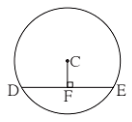
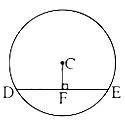
In the adjoining figure, seg DE is the chord of the circle with center C. seg CF⊥ seg DE and DE = 16 cm, then find the length of DF?
Answer
In given figure, seg $C F \perp$ Chord $D E$
$\therefore DF \cong DE$
[[A perpendicular drawn from the centre of a circle on its chord bisects the chord]
$\therefore DF =\frac{1}{2} DE$
$=\frac{1}{2} \times 16$
[Given]
$\therefore DF =8 cm$
View full question & answer
Question 21 Mark
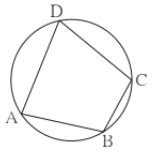
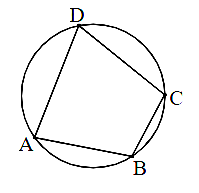
In the figure, quadrilateral ABCD is a cyclic. If ∠DAB = 75°, then find measure of ∠DCB.

Answer
In ▢ABCD,

∠DAB = 75° .....[Given]

∠DAB + ∠DCB = 180° ......[Opposite angle of cyclic quadrilateral are supplementary]

∴ 75° + ∠ DCB = 180°

∴ ∠ DCB = 180° – 75°

∴ ∠ DCB = 105°

View full question & answer
Question 31 Mark
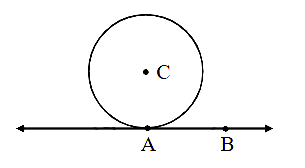
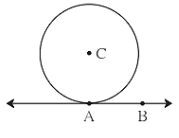
In the adjoining figure the radius of a circle with centre C is 6 cm, line AB is a tangent at A. What is the measure of ∠CAB? Why?

Answer
Line AB is the tangent to the circle with centre C and radius AC. ......[Given]

∴ ∠CAB = 90° ......(i) [Tangent theorem]

View full question & answer
Question 41 Mark
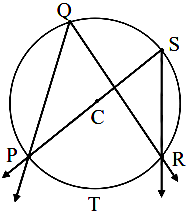
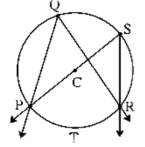
In the figure if ∠PQR = 50°, then find ∠PSR.
Answer
In given figure,

∠PQR ≅ ∠PSR ......[Angles inscribed in the same arc are congruent]

∴ ∠PSR = 50°

View full question & answer
Question 51 Mark
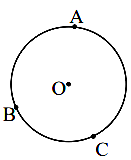
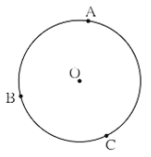
A, B, C are any points on the circle with centre O. If m(arc BC) = 110° and m(arc AB) = 125°, find measure arc AC.
Answer
m(arc AB) + m(arc BC) + m(arc AC) = 360° ......[Measure of complete circle is 360°]

∴ 125° + 110° + m(arc AC) = 360°

∴ m(arc AC) = 360° – 125° – 110°

= 125°

View full question & answer
Question 71 Mark
Two circles having radii 3.5 cm and 4.8 cm touch each other internally. Find the distance between their centres.
Answer
It is given that two circle having radii 3.5 cm and 4.8 cm touch each other internally.

We know, the distance between the centres of the circles touching internally is equal to the difference of their radii.

∴ Distance between the centres of the two circles = 4.8 cm − 3.5 cm = 1.3 cm

Thus, the distance between their centres is 1.3 cm.

View full question & answer
Question 81 Mark
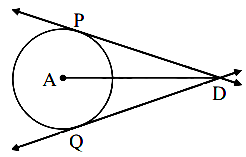
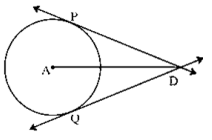
Segment DP and segment DQ are tangent segments to the circle with center A. If DP = 7 cm. So find the length of the segment DQ.
Answer
seg DP and seg DQ are the tangents to the circle.

∴ DP = DQ ......[Tangent segment theorem]

∴ DQ = 7 cm ......[Given]

View full question & answer
Question 91 Mark
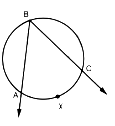
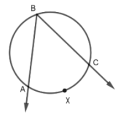
In the figure, if ∠ABC = 35°, then find m(arc AXC)?
Answer
In the figure, arc $A X C$ is intercepted by $\angle A B C$.
$\therefore \angle ABC =\frac{1}{2} m ( ar AXC )$ ...[[The measure of an inscribed angle is half of the measure of the arc intercepted by it]
$\therefore m(\operatorname{arc} A X C)=2 \angle A B C$
$\therefore m (\operatorname{arc} AXC )=2 \times 35^{\circ}$
$\therefore m (\operatorname{arc} AXC )=70^{\circ}$
View full question & answer
Question 101 Mark
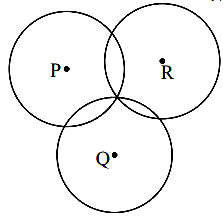
How many circles can be drawn passing through a point?
Answer
Infinite number of circles pass through a point.

View full question & answer
Question 111 Mark
If tan θ X  A = sin θ then A = ?
Answer
$\tan \theta \times A=\sin \theta \quad \text {.... [Given] }$

$\therefore \frac{\sin \theta}{\cos \theta} \times A=\sin \theta$

$\therefore \frac{1}{\cos \theta} \times A=1$

$\therefore A=\cos \theta$


View full question & answer
Question 121 Mark
Find distance between point O(0, 0) and B (-5 , 12).
Answer
Let $O\left(x_1, y_1\right)=O(0,0)$ and $B\left(x_2, y_2\right)=B(-5,12)$

$\therefore \mathrm{x}_1=0, \mathrm{y}_1=0, \mathrm{x}_2=-5, \mathrm{y}_2=12$

By distance formula,

$d(O, B)=\sqrt{\left(x_2-x_1\right)^2+\left(y_2-y_1\right)^2}$

$=\sqrt{(-5-0)^2+(12-0)^2}$

$=\sqrt{(-5)^2+12^2}$

$=\sqrt{25+144}$

$=\sqrt{169}$

$\therefore d(O, B)=13 \text { units }$

$\therefore$ The distance between the points $O$ and $B$ is 13 units.

View full question & answer
Question 131 Mark
In the adjoining figure, seg DE is the chord of the circle with center C. seg CF⊥ seg DE and DE = 16 cm, then find the length of DF?

Image

Answer
$\therefore \mathrm{DF} \cong \mathrm{DE}$ $\quad$$\ldots$ [ perpendicular drawn from the centre of a circle on its chord bisects the chord]

$\therefore D F=\frac{1}{2} D E$

$=\frac{1}{2} \times 16$ $\quad$$\ldots$[ Given ]

$\therefore D F=8 \mathrm{~cm}$

View full question & answer
Question 141 Mark
If a triangle having sides 8 cm., 15 cm., and 17 cm., then state wheather given triangle is right angled triangle or not.
Answer
The sides of the triangle are $8 \mathrm{~cm}, 15 \mathrm{~cm}$, and $17 \mathrm{~cm}$.

The longest side of the triangle is $17 \mathrm{~cm}$.

$\therefore(17)^2=289$

Now, sum of the squares of the remaining sides is,

$(8)^2+(15)^2=64+225=289$

$\therefore(17)^2=(8)^2+(15)^2$

$\therefore$ Square of the longest side is equal to the sum of the squares of the remaining two sides.

$\therefore$ The given sides will form a right-angled triangle.$\quad$ $\ldots$[Converse of Pythagoras theorem]

View full question & answer
Question 151 Mark
Ratio of corresponding sides of two similar triangles is 4:7 then find the ratio of their areas = ?
Answer
Let the corresponding sides of similar triangles be $s_1$ and $s_2$.

Let $A_1$ and $A_2$ be their corresponding areas.

$s_1: s_2=4: 7 \quad \ldots \text{[Given]}$

$\therefore \frac{s_1}{s_2}=\frac{4}{7}\quad \ldots \text{(i)}$

by theorem of areas of similar triangles,

$\frac{A_1}{A_2}=\frac{s_1^2}{s_2^2}$

$\frac{A_1}{A_2}=\left(\frac{s_1}{s_2}\right)^2$

$\frac{A_1}{A_2}=\left(\frac{4}{7}\right)^2 \quad \ldots \ldots . .[\text { From (i)] } $

$\frac{A_1}{A_2}=\frac{16}{49}$

$\therefore$ Ratio of areas of similar triangles $=16: 49$

View full question & answer
Question 161 Mark
Prove that $\frac{\cos (90-A)}{\sin A}=\frac{\sin (90-A)}{\cos A}$.
Answer
$\text { L.H.S }=\frac{\cos (90-A)}{\sin A}$

$=\frac{\sin A}{\sin A}$

$=1$

$\text { R.H.S }=\frac{\sin (90-A)}{\cos A}$

$=\frac{\cos A}{\cos A}$

$=1$

$\therefore \text { L.H.S }=\text { R.H.S }$

View full question & answer
Question 171 Mark
Find the coordinates of centroid of a triangle whose vertices are (4, 7) , (8, 4) and (7 ,11).
Answer
Let $A\left(x_1, y_1\right)=A(4,7), B\left(x_2, y_2\right)=B(8,4), C\left(x_3, y_3\right)=C(7,11)$

$\therefore$ By centroid formula,

$\mathrm{x}=\frac{x_1+x_2+x_3}{3}$

$=\frac{4+8+7}{3}$

$=\frac{19}{3}$

$\mathrm{y}=\frac{y_1+y_2+y_3}{3}$

$=\frac{7+4+11}{3}$

$=\frac{22}{3}$

$\therefore$ The co-ordinates of the centroid are $\left(\frac{19}{3}, \frac{22}{3}\right)$

View full question & answer
Question 181 Mark
In the figure quadrilateral ABCD is a cyclic , if ∠DAB = 75° then find measure of ∠DCB

Image

Answer
In $\square A B C D$,

$\angle D A B=75^{\circ} \ldots . . .[\text { Given }]$

$\angle D A B+\angle D C B=180^{\circ}\ldots [\text { Opposite angle of cyclic quadrilateral are supplementary] }$

$\therefore 75^{\circ}+\angle D C B=180^{\circ}$

$\therefore \angle D C B=180^{\circ}-75^{\circ}$

$\therefore \angle D C B=105^{\circ}$

View full question & answer
Question 191 Mark
If a triangle having sides 50 cm., 14 cm, and 48 cm., then state wheather given triangle is right angled triangle or not.
Answer
The sides of the triangle are $50 \mathrm{~cm}, 14 \mathrm{~cm}$ and $48 \mathrm{~cm}$.

The longest side of the triangle is $50 \mathrm{~cm}$.

$\therefore(50)^2=2500$

Now, sum of the squares of the remaining sides is,

$(14)^2+(48)^2=196+2304=2500$

$\therefore(50)^2=(14)^2+(48)^2$

$\therefore$ Square of the longest side is equal to the sum of the squares of the remaining two sides.

$\therefore$ The given sides will form a right angled triangle. ...[Converse of Pythagoras theorem]

View full question & answer
Question 201 Mark
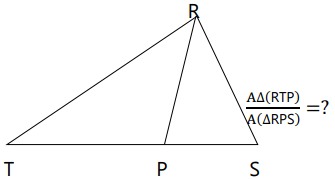
In fig. TP =10 cm PS=6 cmImage
Answer

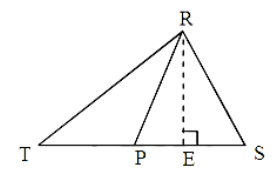
Draw $R E \perp T S, T-E-S$
Image
$\triangle R T P$ and $\triangle R P S$ have same height RE.
$\frac{A(\triangle R T P)}{A(\triangle R P S)}=\frac{T P}{P S} \quad \ldots . . .[\text { Triangles having equal height }]$
$\frac{A(\triangle R T P)}{A(\triangle R P S)}=\frac{10}{6} \quad \ldots ..[\text { Given }]$
$\therefore \frac{A(\triangle R T P)}{A(\triangle R P S)}=\frac{5}{3}$
View full question & answer
Question 211 Mark
If $1-\cos ^2 \theta=\frac{1}{4}$ then $\theta=?$
Answer
$1-\cos ^2 \theta=\frac{1}{4} .......[$Given $]$
$\therefore \sin ^2 \theta=\frac{1}{4} .......\left[\begin{array}{l}\because \sin ^2 \theta+\cos ^2 \theta=1 \\ \therefore 1-\cos ^2 \theta=\sin ^2 \theta\end{array}\right]$
$\therefore \sin \theta=\frac{1}{2} ......[$ Taking square root of both sides $]$
$\therefore \theta=30^{\circ}.......\left[\because \sin 30^{\circ}=\frac{1}{2}\right]$
View full question & answer
Question 221 Mark
Find coordinates of midpoint joining ( -2 ,6 ) and ( 8 ,2 )
Answer
Let $A\left(x_1, y_1\right)=A(-2,6), B\left(x_2, y_2\right)=B(8,2), C\left(x_1, y\right)$ be the midpoint of seg $A B$.

$\therefore \mathrm{x}_1=-2, \mathrm{y}_1=6, \mathrm{x}_2=8, \mathrm{y}_2=2$

By midpoint formula,

$C(x, y)=\left(\frac{x_1+x_2}{2}, \frac{y_1+y_2}{2}\right)$

$=\left(\frac{-2+8}{2}, \frac{6+2}{2}\right)$

$=\left(\frac{6}{2}, \frac{8}{2}\right)$

$=(3,4)$

$\therefore$ Coordinates of midpoint of segment joining $(-2,6)$ and $(8,2)$ are $(3,4)$.

View full question & answer
Question 231 Mark
In the adjoining figure the radius of a circle with centre C is 6 cm, line AB is a tangent at A. What is the measure of ∠ CAB? Why?

Image

Answer
Line $A B$ is the tangent to the circle with centre $C$ and radius $A C$. $\quad$$\ldots$ [Given]

$\therefore \angle C A B=90^{\circ}$ $\quad$$\ldots$ (i) [Tangent theorem]

View full question & answer
Question 241 Mark
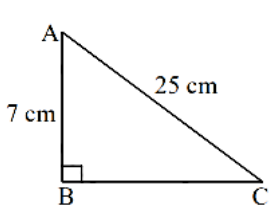
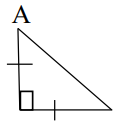
In right angled triangle, if length of hypotenuse is 25 cm. and height is 7 cm. then what is the length of its base ?
Answer

Image
Let $\triangle A B C$ be the given right angled triangle.
$A C=25 \mathrm{~cm}, A B=7 \mathrm{~cm}$
$\text { In } \triangle A B C, \angle B=90^{\circ} \quad \ldots \ldots\text{[Given]}$
$\therefore A C^2=A B^2+B C^2 \quad \ldots \ldots[\text {Pythagoras theorem]}$
$\therefore 25^2=7^2+B C^2$
$\therefore 625=49+B C^2$
$\therefore B C^2=625-49$
$\therefore B C^2=576$
$\therefore \mathrm{BC}=24 \mathrm{~cm}\quad \ldots \ldots\text{[Taking square root of both sides]}$
$\therefore$ The length of the base of the given right angle triangle is $24 \mathrm{~cm}$.
View full question & answer
Question 251 Mark
∆ABC~ ∆DEF write ratio of their corresponding sides.
Answer
$\triangle \mathrm{ABC} \sim \triangle \mathrm{DEF} \quad \ldots[$ Given]

$\therefore$ The ratios of corresponding sides of the given triangles are $\frac{A B}{D E}, \frac{B C}{E F}$ and $\frac{A C}{D F}$

View full question & answer
Question 261 Mark
If $\cot (90-A)=1$, then $\angle A=$ ?
Answer
$\cot (90-A)=1 \quad \ldots .\text {[Given]}$

$\therefore \tan A=1$

$\therefore A=45^{\circ} \quad \ldots \ldots\left[\because \tan 45^{\circ}=1\right]$

View full question & answer
Question 271 Mark
Find distance of point A( 6, 8 ) from origin:
Answer
$\text { Let } A\left(x_1, y_1\right)=A(6,8), O\left(x_2, y_2\right)=O(0,0)$

$\therefore x_1=6, y_1=8, x_2=0, y_2=0$

By distance formula,

$d(A, O)=\sqrt{\left(x_2-x_1\right)^2+\left(y_2-y_1\right)^2}$

$=\sqrt{(0-6)^2+(0-8)^2}$

$=\sqrt{36+64}$

$=\sqrt{100}$

$=10 \mathrm{~cm}$

$\therefore$ The distance of point $A(6,8)$ from origin is $10 \mathrm{~cm}$.

View full question & answer
Question 291 Mark
In the figure if ∠PQR = 50° then find ∠PSR

Image

Answer
In given figure,

$\angle P Q R \cong \angle P S R$ $\quad$ $\ldots$ [Angles inscribed in the same arc are congruent]

$\therefore \angle P S R=50^{\circ}$

View full question & answer
Question 301 Mark
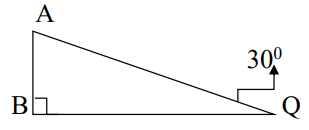
From given figure, In ∆ ABQ, If AQ = 8 cm. then AB = ?

Image

Answer
In $\triangle \mathrm{ABQ}$

$\angle B=90^{\circ}, \angle Q=30^{\circ} \quad \ldots [ Given ]$

$\therefore \angle A=60^{\circ} \quad \ldots[\text { Remaining angle of a triangle ] }$

$\therefore \triangle A B Q \text { is a } 30^{\circ}-60^{\circ}-90^{\circ} \text { triangle. }$

$\therefore A B=\frac{1}{2} A Q$ $\quad$ $\ldots$[ Side opposite to $30^{\circ}$ ]

$\therefore A B=\frac{1}{2} \times 8$

$\therefore A B=4 \mathrm{~cm}$

View full question & answer
Question 311 Mark
∆PQR~ ∆SUV write pair of congruent angle.
Answer
$\triangle P Q R \sim \triangle S U V \quad \ldots \ldots .[$ Given ]

$\therefore \angle \mathrm{P} \cong \angle \mathrm{S}, \angle \mathrm{Q} \cong \angle \mathrm{U}, \angle \mathrm{R} \cong \angle \mathrm{V} \quad \ldots \ldots$ [ Corresponding angles of similar triangles ]

View full question & answer
Question 321 Mark
If 2 sin θ = 3 cos θ then tan θ = ?
Answer
$2 \sin \theta=3 \cos \theta$

$\therefore \frac{\sin \theta}{\cos \theta}=\frac{3}{2}$

$\therefore \tan \theta=\frac{3}{2}$

View full question & answer
Question 341 Mark
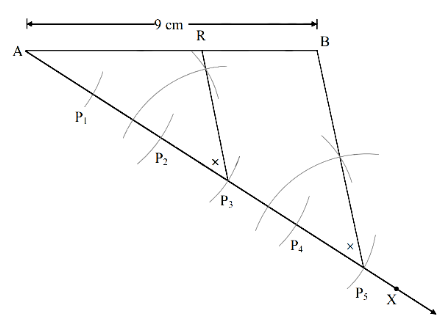
Draw seg AB of length 9 cm and divide it in the ratio 3:2.
Answer

Image
Point $R$ divides seg $A B$ in ratio $3: 2$
View full question & answer
Question 351 Mark
A, B, C are any points on the circle with centre O. If m arc (BC) = 110° and m arc (AB) =125°, find measure arc AC

Image

Answer
$m(\operatorname{arc} A B)+m(\operatorname{arc} B C)+m(\operatorname{arc} A C)=360^{\circ}$ $\quad$ $\ldots$ [Measure of complete circle is $360^{\circ}$ ]

$\therefore 125^{\circ}+110^{\circ}+m(\operatorname{arc} A C)=360^{\circ}$

$\therefore m(\operatorname{arc} A C)=360^{\circ}-125^{\circ}-110^{\circ}$

$=125^{\circ}$ $\quad$ $\ldots$ [Measure of complete circle is $360^{\circ}$ ]

View full question & answer
Question 361 Mark
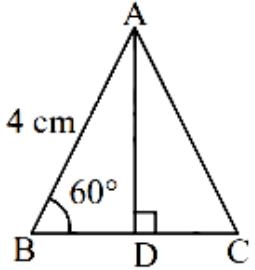
Find the height of an equilateral triangle having side 4 cm. ?
Answer

Image
Let $\triangle A B C$ be the given equilateral triangle.
$\therefore \angle B=60^{\circ}$ $\quad$ $\ldots$[Angle of an equilateral triangle]
Let $A D \perp B C, B-D-C$.
In $\triangle A B D, \angle B=60^{\circ}, \angle A D B=90^{\circ}$
$\therefore \angle \mathrm{BAD}=30^{\circ}$ $\quad$ $\ldots$[Remaining angle of a triangle]
$\therefore \triangle \mathrm{ABD}$ is a $30^{\circ}-60^{\circ}-90^{\circ}$ triangle.
$\therefore A D=\frac{\sqrt{3}}{2} A B$ $\quad$ $\ldots$ [Side opposite to $60^{\circ}$ ]
$=\frac{\sqrt{3}}{2} \times 4$
$=2\sqrt{3} \text { units }$
$\therefore$ The height of the equilateral triangle is $2 \sqrt{3}$ units.
View full question & answer
Question 371 Mark
Areas of two simlar triangles are in the ratio 144:49. Find the ratio of their corresponding sides.
Answer
Let the areas of two similar triangles be $A_1, A_2$ and their corresponding sides be $S_1, S_2$ respectively.

$\therefore \frac{\mathrm{A}_1}{\mathrm{~A}_2}=\frac{144}{49} \quad \ldots \text {(i)[Given]}$

$\therefore$ by the theorem of areas of similar triangles,

$\therefore \frac{\mathrm{A}_1}{\mathrm{~A}_2}=\frac{\mathrm{S}_1^2}{\mathrm{~S}_2^2}$

$\therefore \frac{144}{49}=\frac{\mathrm{S}_1^2}{\mathrm{~s}_2^2} \quad \ldots[\text {From (i)]}$

$\therefore$ by taking square root of both sides,

$\therefore \frac{\mathrm{S}_1}{\mathrm{~S}_2}=\frac{12}{7}$

$\therefore$ The ratio of the corresponding sides of the given triangles is $12 : 7$.

View full question & answer
Question 381 Mark
If tan θ = 1 then sin θ . cos θ = ?
Answer
$\tan \theta=1 \quad \ldots. . .[\text { Given }]$

$\therefore \theta=45^{\circ} \quad \ldots . .\left[\because \tan 45^{\circ}=1\right]$

$\therefore \sin \theta \cdot \cos \theta=\sin 45^{\circ} \cos 45^{\circ}$

$=\frac{1}{\sqrt{2}} \cdot \frac{1}{\sqrt{2}}$

$=\frac{1}{2}$

View full question & answer
Question 391 Mark
Write the X-coordinate and Y-coordinate of point P(- 5 , 4).
Answer
$X$-co-ordinate of point $\mathrm{P}(-5,4)$ is -5

$Y$-co-ordinate of point $P(-5,4)$ is 4

View full question & answer
Question 421 Mark
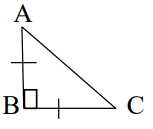
From given figure, In ∆ ABC, AB⊥BC, AB =BC, AC = 5√2 then what is the height of ∆ ABC ?

Image

Answer
$A B=B C$ $\quad$ $\ldots$[Given]

$\therefore \angle \mathrm{A}=\angle \mathrm{C}$ $\quad$ $\ldots$[Isosceles triangle theorem]

$\text { Let } \angle \mathrm{A}=\angle \mathrm{C}=\mathrm{x}$$\quad$ $\ldots$(i)

$\text { In } \triangle A B C, \angle A+\angle B+\angle C=180^{\circ}$$\ldots$ (Sum of the measures of the angles of a triangle is $180^\circ$)

$\therefore \mathrm{x}+90^{\circ}+\mathrm{x}=180^{\circ}$ $\quad$ $\ldots$ [From (i)]

$\therefore 2 \mathrm{x}=90^{\circ}$

$\therefore \mathrm{x}=\frac{90^{\circ}}{2}$ $\quad$ $\ldots$ [From (i)]

$\therefore \mathrm{x}=45^{\circ}$

$\therefore \angle \mathrm{A}=\angle \mathrm{C}=45^{\circ}$

$\therefore \triangle \mathrm{ABC} \text { is a } 45^{\circ}-45^{\circ}-90^{\circ} \text { triangle. }$

$\therefore A B=B C=\frac{1}{\sqrt{2}} \times A C$ $\quad$ $\ldots$ [Side opposite to $45^\circ$]

$=\frac{1}{\sqrt{2}} \times 5 \sqrt{2}$

$\therefore \mathrm{AB}=\mathrm{BC}=5 \text { units }$

$\therefore$ The height of $\triangle \mathrm{ABC}$ is 5 units.

View full question & answer
Question 431 Mark
If ∆ABC~ ∆LMN & ⦟B = 40° then ⦟M =? Give reason .
Answer
$\triangle \mathrm{ABC} \sim \Delta \mathrm{LMN}$$\quad$ .....[Given]

$\therefore \angle \mathrm{B} \cong \angle \mathrm{M}$$\quad$........(i) [Corresponding angles of similar triangles]

But $\angle B=40^{\circ}$ $\quad$ .....[Given]

$\therefore \angle \mathrm{M}=40^{\circ}$ $\quad$ .......[From (i)]

View full question & answer
Question 441 Mark
Prove that $\ce{cosec} \ \theta  \sqrt{1-\cos ^2 \theta}=1$
Answer
$\text { L.H.S }=\operatorname{cosec} \theta \times \sqrt{1-\cos ^2 \theta}$
$=\operatorname{cosec} \theta \times \sqrt{\sin ^2 \theta}   \ldots\left[\begin{array}{l}\because \sin ^2 \theta+\cos ^2 \theta=1 \\ \therefore 1-\cos ^2 \theta=\sin ^2 \theta\end{array}\right]$
$=\operatorname{cosec} \theta \times \sin \theta$
$=1 \ldots \ldots[\because \sin \theta \times \operatorname{cosec} \theta=1]$
$=\text { R.H.S }$
View full question & answer
Question 451 Mark
The coordinates of diameter AB of a circle are A (2, 7) and B (4 , 5) then find the coordinates of the centre.
Answer
Let $C(x, y)$ be the centre of the circle,

$A\left(x_1, y_1\right)=A(2,7), B\left(x_2, y_2\right)=B(4,5)$

$\therefore x_1=2, y_1=7, x_2=4, y_2=5$

$C$ is the mid-point of seg $A B$.

$\therefore$ By midpoint formula,

$C\left(x_r, y\right)=\left(\frac{x_1+x_2}{2}, \frac{y_1+y_2}{2}\right)$

$=\left(\frac{2+4}{2}, \frac{7+5}{2}\right)$

$=\left(\frac{6}{2}, \frac{12}{2}\right)$

$\therefore C(x, y)=C(3,6)$

$\therefore$ The co-ordinates of the centre of the circle are $(3,6)$.

View full question & answer
Question 461 Mark
Draw Seg AB of lenght 9.7cm. Take point P on it such that AP = 3.5 cm and A-P-B. Construct perpendicular to seg AB from point P.
View full question & answer
Question 471 Mark
Two circles having radii 3.5 cm and 4.8 cm touch each other internally. Find the distance between their centres.
Answer

SOLUTION : 1
It is given that two circle having radii $3.5 \mathrm{~cm}$ and $4.8 \mathrm{~cm}$ touch each other internally.
We know, the distance between the centres of the circles touching internally is equal to the difference of their radii.
$\therefore$ Distance between the centres of the two circles $=4.8 \mathrm{~cm}-3.5 \mathrm{~cm}=1.3 \mathrm{~cm}$
Thus, the distance between their centres is $1.3 \mathrm{~cm}$.
SOLUTION : 2
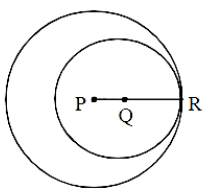
Let the two circles having centres $P$ and $Q$ touch each other internally at point $R$.
Image
Here, $Q R=3.5 \mathrm{~cm}, P R=4.8 \mathrm{~cm}$
The two circles touch each other internally.
By theorem of touching circles,
$\mathrm{P}-\mathrm{Q}-\mathrm{R}$
$P Q=P R-Q R$ $\quad$ $\ldots$ [The distance between the centres of circles touching internally is equal to the difference in their radii]
$=4.8-3.5$
$=1.3 \mathrm{~cm}$
$\therefore$ The distance between the centres of the circles is $1.3 \mathrm{~cm}$.
View full question & answer
Question 481 Mark
From given figure, In ∆ ABC, AB⊥ BC, AB =BC, $AC =2 \sqrt{2}$ then Ɩ (AB) = ?

Image

Answer
$A B=B C$ $\quad$ $\ldots$[Given]

$\therefore \angle \mathrm{A}=\angle \mathrm{C}$ $\quad$ $\ldots$[Isosceles triangle theorem]

$\text { Let } \angle A=\angle C=x$

$\text { In } \triangle \mathrm{ABC}, \angle \mathrm{A}+\angle \mathrm{B}+\angle \mathrm{C}=180^{\circ}$ $\quad$ $\ldots$[Sum of the measures of the angles of a triangle is $180^\circ]$

$\therefore \mathrm{x}+90^{\circ}+\mathrm{x}=180^{\circ}$ $\quad$ $\ldots$[From (i)]

$\therefore 2 \mathrm{x}=90^{\circ}$

$\therefore \mathrm{x}=\frac{90^{\circ}}{2}$ $\quad$ $\ldots$[From (i)]

$\therefore \mathrm{x}=45^{\circ}$

$\therefore \angle \mathrm{BAC}=\angle \mathrm{BCA}=45^{\circ}$

$\therefore \triangle A B C \text { is a } 45^{\circ}-45^{\circ}-90^{\circ} \text { triangle. }$

$\therefore A B=B C=\frac{1}{\sqrt{2}} \times A C$$\quad$ $\ldots$[Side opposite to $45^\circ$]

$=\frac{1}{\sqrt{2}} \times 2 \sqrt{2}$

$\therefore l(\mathrm{AB})=2 \text { units }$

View full question & answer
Question 491 Mark
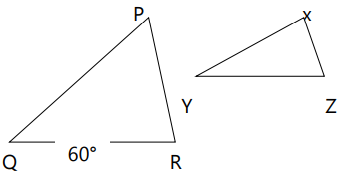
State whether the following triangles are similar or not : If yes , then write the test of similarity.
⦟P = 35° , ⦟x = 35° and ⦟Q = 60°, ⦟Y =

Image

Answer
In $\triangle P Q R$ and $\triangle X Y Z$,

$\angle \mathrm{P}=35^{\circ}, \angle \mathrm{X}=35^{\circ}, \angle \mathrm{Q}=60^{\circ}$ and $\angle \mathrm{Y}=60^{\circ}$ $\quad$......[Given]

$\therefore \angle \mathrm{P} \cong \angle \mathrm{X}$ and $\angle \mathrm{Q} \cong \angle \mathrm{Y}$

$\therefore \triangle P Q R \sim \triangle X Y Z$ $\quad$...[AA test of similarity]

$\therefore$ The triangles in the figure are similar by AA test of similarity.

View full question & answer
Question 501 Mark
If $\tan \theta=\frac{13}{12}$ then $\cot \theta=?$
Answer
$\cot \theta=\frac{1}{\tan \theta}$

$=\frac{1}{\frac{13}{12}}$

$\therefore \cot \theta=\frac{12}{13}$

View full question & answer
Question 511 Mark
Find distance between point A (7, 5) and B (2, 5).
Answer
Let $A\left(x_1, y_1\right)=A(7,5)$ and $B\left(x_2, y_2\right)=B(2,5)$

$\therefore$ By distance formula,

$d(A, B)=\sqrt{\left(x_2-x_1\right)^2+\left(y_2-y_1\right)^2}$

$=\sqrt{(2-7)^2+(5-5)^2}$

$=\sqrt{(-5)^2+0^2}$

$=\sqrt{25}$

$=5 \mathrm{~cm}$

$\therefore$ The distance between points $A$ and $B$ is $5 \mathrm{~cm}$.

View full question & answer
Question 531 Mark
Segment DP and segment DQ are tangent segments to the circle with center A, If DP = 7 cm. So find the length of the segment DQ?

Image

Answer
seg $D P$ and seg $D Q$ are the tangents to the circle.

$\therefore D P=D Q \quad \ldots . . .[\text { Tangent segment theorem ] }$

$\therefore D Q=7 \mathrm{~cm} \quad \ldots . .[\text { Given ] }$

View full question & answer
Question 541 Mark
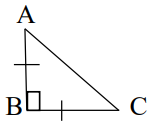
From given figure, In ∆ ABC, AB⊥ BC, AB =BC then $m \angle A =$ ?

Image

Answer
$A B=B C \quad \ldots . . .[\text { Given }]$

$\therefore \angle A=\angle C \quad \ldots . . .[\text { Isosceles triangle theorem }]$

$\text { Let } \angle A=\angle C=x$

$\text { In } \triangle A B C$

$\angle A+\angle B+\angle C=180^{\circ}\ldots\left[\text { Sum of the measures of the angles of a triangle is } 180^{\circ}\right]$

$\therefore x+90^{\circ}+x=180^{\circ}$

$\therefore 2 x=90^{\circ}$

$\therefore x=\frac{90^{\circ}}{2}$

$\therefore x=45^{\circ}$

$\therefore m \angle A=45^{\circ}$

View full question & answer
Question 551 Mark
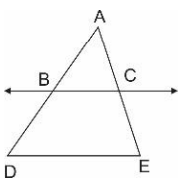
In fig line $B C \|$ line $D E, A B=2, B D=3, A C=4$ and $C E=x$, then find the value of $x$.

Image

Answer
In $\triangle A D E$,

line BC \|| $\operatorname {seg DE} $

$\therefore$ by Basic proportionality theorem

$\therefore \frac{A B}{B D}=\frac{A C}{C E}$

$\therefore \frac{2}{3}=\frac{4}{x}$

$\therefore x=4 \times \frac{3}{2}$

$\therefore x=2 \times 3$

$\therefore x=6$

View full question & answer
Question 561 Mark
$\frac{1-\tan ^2 45^{\circ}}{1+\tan ^2 45^{\circ}}=?$
Answer
$\frac{1-\tan ^2 45^{\circ}}{1+\tan ^2 45^{\circ}}=\frac{1-(1)^2}{1+(1)^2}\ldots\ldots \left[\because \tan 45^{\circ}=1\right]$

$=\frac{1-1}{1+1}$

$=\frac{0}{2}$

$=0$

View full question & answer
Question 571 Mark
Find the coordinates of the point of intersection of the graph of the equation X = 2 and y = -3.
Answer
The coordinates of the point of intersection of the graph of the equation $x=2$ and $y=-3$ are $(2,-3)$.
View full question & answer
Question 591 Mark
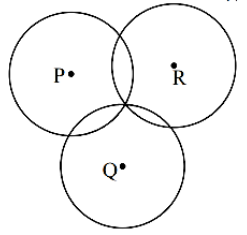
How many circles can be drawn passing through a point?
Answer

Infinite number of circles pass through a point.
Image
View full question & answer
Question 601 Mark
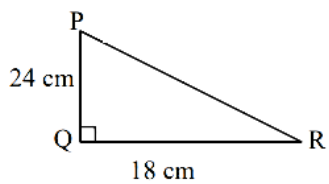
Height and base of a right angled triangle are 24 cm and 18 cm find the length of its hypotenus ?
Answer

Image
In $\triangle A B C$ and $\triangle P Q R$
$\angle \mathrm{ABC} \cong \angle \mathrm{PQR}$ $\quad$ $\ldots$[Each of measure $60^{\circ}$]
$\angle \mathrm{ACB} \cong \angle \mathrm{PRQ}$ $\quad$ $\ldots$[Each of measure $30^{\circ}$]
$\therefore \triangle \mathrm{ABC} \sim \triangle \mathrm{PQR}$ $\quad$$\ldots$[ AA test of similarity ]
View full question & answer
Question 611 Mark
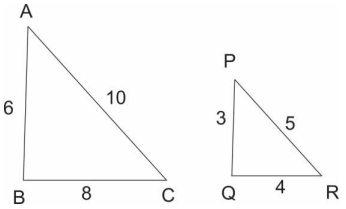
Are triangles in figure similar ? If yes then write the test of similarity.

Image

Answer
In $\triangle A B C$ and $\triangle P Q R$,

$\frac{\mathrm{AB}}{\mathrm{PQ}}=\frac{6}{3}=\frac{2}{1} \quad \quad \ldots . . . \text {(i)}$

$\frac{\mathrm{BC}}{\mathrm{QR}}=\frac{8}{4}=\frac{2}{1} \quad \quad \ldots \ldots \text{(ii)}$

$\frac{\mathrm{AC}}{\mathrm{PR}}=\frac{10}{5}=\frac{2}{1} \quad \quad \ldots \ldots \text {(iii)}$

$\therefore \frac{\mathrm{AB}}{\mathrm{PQ}}=\frac{\mathrm{BC}}{\mathrm{QR}}=\frac{\mathrm{AC}}{\mathrm{PR}} \ldots \ldots . .[\text { From (i), (ii) and (iii) ] }$

$\therefore \triangle \mathrm{ABC} \sim \triangle \mathrm{PQR} \quad \ldots . . .[\ \mathrm{ SSS } \text { test of similarity ] }$

$\therefore$ The triangles in the figure are similar by SSS test of similarity.

View full question & answer
Question 621 Mark
$\frac{\sin 75^{\circ}}{\cos 15^{\circ}}=?$
Answer
$\frac{\sin 75^{\circ}}{\cos 15^{\circ}}=\frac{\sin \left(90^{\circ}-15^{\circ}\right)}{\cos 15^{\circ}}$

$=\frac{\cos 15^{\circ}}{\cos 15^{\circ}} \quad \ldots .\left[\because \sin \left(90^{\circ}-\theta\right)=\cos \theta\right]$

$=1$

View full question & answer
Question 631 Mark
$(\sec \theta + \tan \theta ) . (\sec \theta - \tan \theta ) =$ ?
Answer
$(\sec \theta+\tan \theta)(\sec \theta-\tan \theta)$
$=\sec ^2 \theta-\tan ^2 \theta \ldots \ldots\left[\because(a+b)(a-b)=a^2-b^2\right]$
$=1 \ldots \ldots\left[\begin{array}{l}\because 1+\tan ^2 \theta=\sec ^2 \theta \\ \therefore \sec ^2 \theta-\tan ^2 \theta=1\end{array}\right]$
View full question & answer
Question 641 Mark
Find coordinates of midpoint of point (0, 2) and (12, 14).
Answer
Let $A\left(x_1, y_1\right)=A(0,2), B\left(x_2, y_2\right)=B(12,14)$

Let the co-ordinates of the midpoint be $P(x, y)$.

$\therefore$ By midpoint formula,

$\mathrm{x}=\frac{x_1+x_2}{2}=\frac{0+12}{2}=6$

$\mathrm{y}=\frac{y_1+y_2}{2}=\frac{2+14}{2}=\frac{16}{2}=8$

$\therefore$ The co-ordinates of the midpoint of the segment joining $(0,2)$ and $(12$, 14) are $(6,8)$.

View full question & answer
Question 651 Mark
In the figure, if $\angle ABC = 35^\circ$ then find $m(??? AXC ) ?$
Image
Answer
In the figure, arc $A X C$ is intercepted by $\angle A B C$.
$\therefore \angle ABC =\frac{1}{2} m ($ ar $AXC )$
...[[The measure of an inscribed angle is half of the measure of the arc intercepted by it]
$ \therefore m(\operatorname{arc} A X C)=2 \angle A B C$
$\therefore m(\operatorname{arc} A X C)=2 \times 35^{\circ}$
$\therefore m(\operatorname{arc} A X C)=70^{\circ} $
View full question & answer
Question 661 Mark
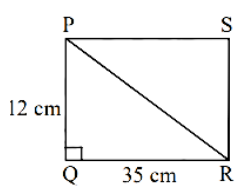
A rectangle having dimensions 35 m X 12 m, then what is the length of its diagonal ?
Answer

Image
Let $\square P Q R S$ be the given rectangle.
In $\triangle P Q R$,
$angle \mathrm{Q}=90^{\circ} \quad \ldots . .[\text { Angle of a rectangle }]$
$\therefore \mathrm{PR}^2=\mathrm{PQ}^2+\mathrm{QR}^2 \quad \ldots\ldots[\text{Pythagoras theorem]}$
$=12^2+35^2$
$=144+1225$
$=1369$
$\therefore \mathrm{PR}=\sqrt{1369} \quad \ldots \ldots[\text { Taking square root of both sides] }$
$=37 \mathrm{~cm}$
$\therefore$ The length of the diagonal of the given rectangle is $37 \mathrm{~cm}$.
View full question & answer
Question 671 Mark
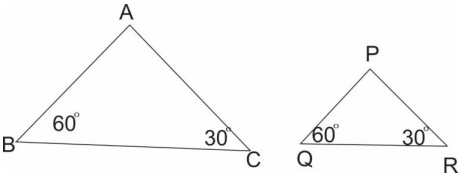
Write the test of similarity for triangles given in figure.

Image

Answer
In $\triangle A B C$ and $\triangle P Q R$

$\angle \mathrm{ABC} \cong \angle \mathrm{PQR}$ $\quad$ $\ldots$[Each of measure $60^{\circ}$]

$\angle \mathrm{ACB} \cong \angle \mathrm{PRQ}$ $\quad$ $\ldots$[Each of measure $30^{\circ}$]

$\therefore \triangle \mathrm{ABC} \sim \triangle \mathrm{PQR}$ $\quad$$\ldots$[ AA test of similarity ]

View full question & answer
Question 681 Mark
The radii of circular ends of frustum of a cone are 20 cm and 12 cm and its height is 6 cm. Find the Slant height of frustum.
Answer
self study
View full question & answer
Question 701 Mark
Radius of sector of a circle is 5 cm and length of its arc is 2.8 cm. Find the area of the sector.
Answer
self study
View full question & answer
Question 711 Mark
Area of a sector of a circle of radius 15 cm is 30 $cm ^2$. Find the length of the arc of the sector.
Answer
self study
View full question & answer
Question 721 Mark
Find the area of the segment of a circle of radius 7 cm whose corresponding sector has a central angle of $60^{\circ}(\pi=3.14)$
Answer
self study
View full question & answer