Questions

2 Marks Questions

Take a timed test

62 questions · self-marked practice — reveal the answer and mark yourself.

Question 12 Marks
Why are vitamin A and vitamin C essential to us? Give their important sources.
Answer
  1. The chemical name of vitamin A is retinol.
The deficiency of vitamin A leads to xerophthalmia and night blindness. Important Sources of Vitamin ‘A’: Milk, butter, egg, fish, and fish oil (Cod liver oil). It can also be synthesised in the body from carotenoids present in carrots, tomatoes, ripe mangoes etc. Carotenoids are the precursors of vitamin A.
  1. The chemical name of vitamin C is ascorbic acid. The deficiency of vitamin C leads to scurvy.
Important Sources of Vitamin C: Citrus fruits (oranges, lemon, grape fruit, lime etc.), amla, cabbage, guava etc.
View full question & answer
Question 22 Marks
What are essential and non - essential amino acids? Give two examples of each type.
Answer
Essential amino acids : Those amino acids which are not synthesised by our body are called essential amino acids. They must be part of our diet. Their deficiency leads to diseases such as Kwashiorkor (water balance in the body is disturbed). Valine, leucine, isoleucine, phenyl alanine, methionine, tryptophan, threonine, lyslne, arginine and histadine are ten essential amino acids.
Non-essential amino acids: The amino acids, which can be synthesised in the body, are known as non - essential amino acid. They are also called dispersable amino acids e.g., glycine, alanine, seriqe, cysteine, glutamine, tyrosine, proline, aspartic acid, asparagine, glutamic acid.
View full question & answer
Question 32 Marks
Enumerate the reactions of $D -$ glucose which cannot be explained by its open chain structure.
Answer
  1. $D (+) -$ glucose does not undergo certain characteristic reactions of aldehydes, e.g., glucose does not form $NaHSO_3$ addition product.
  2. Glucose reacts with $NH_2OH$ to form an oxime but glucose pentaacetate does not. This implies that the aldehydic group is absent in glucose pentaacetate.
  3. $D - (+) -$ glucose exists in two stereoisomeric forms, i.e., $\alpha$ - glucose and $\beta$ - glucose.
  4. Both $\alpha - D -$ glucose and $\beta - D -$ glucose undergo mutarotation in aqueous solution. Although the crystalline forms of $\alpha$ - and $\beta - D (+) -$ glucose are quite stable in aqueous solution but each form slowly changes into an equilibrium mixture of both.
$D (+) -$ glucose forms two isomeric methyl glucosides. Aldehydes normally react with two moles of methanol per mole of the aldehyde to form an acetal but $D (+) -$ glucose when treated with methanol in presence of dry HCI gas, reacts with only one mole of methanol per mole of glucose to form a mixture of two methyl $D -$ glucosides i.e., methyl $- \alpha - D -$ glucoside $($melting point $438\ K,$ specific rotation $+ 158°)$ and methyl $- \beta - D -$ glucoside $($melting point $308\ K,$ specific rotation $- 33°).$
View full question & answer
Question 42 Marks
Differentiate between globular and fibrous proteins.
Answer
Difference between globular protein and fibrous protein:
 
Fibrous protein
Globular protein
1.
It is a fibre-like structure formed by the polypeptide chain. These proteins are held together by strong hydrogen and disulphide bonds.
The polypeptide chain in this protein is folded around itself, giving rise to a spherical Structure.
2.
It is usually insoluble in water, but soluble in strong acids and bases.
It is usually soluble in water, acids, bases and salts.
3.
They have comparatively stronger intermolecular forces of attraction.
They have weak intermolecular hydrogen bonding.
4.
Example: Collagen, fibroin, myosin, hair, skin,silk, wool, etc.
Egg, albumin, casein of milk, insulin.
View full question & answer
Question 52 Marks
What are the hydrolysis products of (i) sucrose, and (ii) lactose?
Answer
Both sucrose and lactose are disaccharides. Sucrose on hydrolysis gives one molecule each of glucose and fructose but lactose on hydrolysis gives one molecule each of glucose and galactose.
$\text{C}_{12}\text{H}_{22}\text{O}_{11}+\text{H}_2\text{O}\xrightarrow[]{\text{H}_3\text{O}^+}\text{C}_6\text{H}_{12}\text{O}_6 \ \ \ \ \ \ \ \ \ \ + \ \ \ \ \ \ \text{C}_6\text{H}_{12}\text{O}_6\\\text{Sucrose} \ \ \ \ \ \ \ \ \ \ \ \ \ \ \ \ \ \ \ \ \ \ \text{D}-(+)-\text{Glucose} \ \ \ \ \ \ \ \text{D}-(-)\text{fructose} \ \ \ \ \ \ \ \ \ \ \ \ $
$\text{C}_{12}\text{H}_{22}\text{O}_{11}+\text{H}_2\text{O}\xrightarrow[]{\text{H}_3\text{O}^+}\text{C}_6\text{H}_{12}\text{O}_6 \ \ \ \ \ \ \ \ \ \ + \ \ \ \ \ \ \text{C}_6\text{H}_{12}\text{O}_6\\\text{Lactose} \ \ \ \ \ \ \ \ \ \ \ \ \ \ \ \ \ \ \ \ \ \ \text{D}-(+)-\text{Glucose} \ \ \ \ \ \ \ \text{D}-(+)\text{Galactose} \ \ \ \ \ \ \ \ \ \ \ \ $
View full question & answer
Question 62 Marks
Classify the following into monosaccharides and disaccharides. Ribose, 2-deoxyribose, maltose, galactose, fructose and lactose.
Answer
Monosaccharides: Ribose, 2-deoxyribose, galactose and fructose.
Disaccharides: Maltose and lactose.
View full question & answer
Question 72 Marks
Write two main functions of carbohydrates in plants.
Answer
Two major functions of carbohydrates in plants are following:
  1. Structural material for plant cell walls: The polysaccharide cellulose acts as the chief structural material of the plant cell walls.
  2. Reserve food material: The polysaccharide starch is the major reserve food material in the plants. It is stored in seeds and act as the reserve food material for the tiny plant till it is capable of making its own food by photosynthesis.
View full question & answer
Question 92 Marks
When RNA is hydrolysed, there is no relationship among the quantities of different bases obtained. What does this fact suggest about the structure of RNA?
Answer
Complete hydrolysis of RNA yields a pentose sugar (D-ribose), phosphoric acid and nitrogen containing heterocyclic compounds (called bases). Such as guanine (G), cytosine (C), Uracil (U), Adenine (A).
There is no relationship among the quantities of four bases obtained on complete hydrolysis of RNA. It is because base sequence in RNA is not fixed but depends on base sequence in DNA i.e., the base sequence in a specific RNA is controlled by that of DNA which is controlling RNA synthesis (i.e., transcription). The base sequence in DNA indirectly controls the sequence of amino acids in the protein.
View full question & answer
Question 102 Marks
What is glycogen? How is it different from starch?
Answer
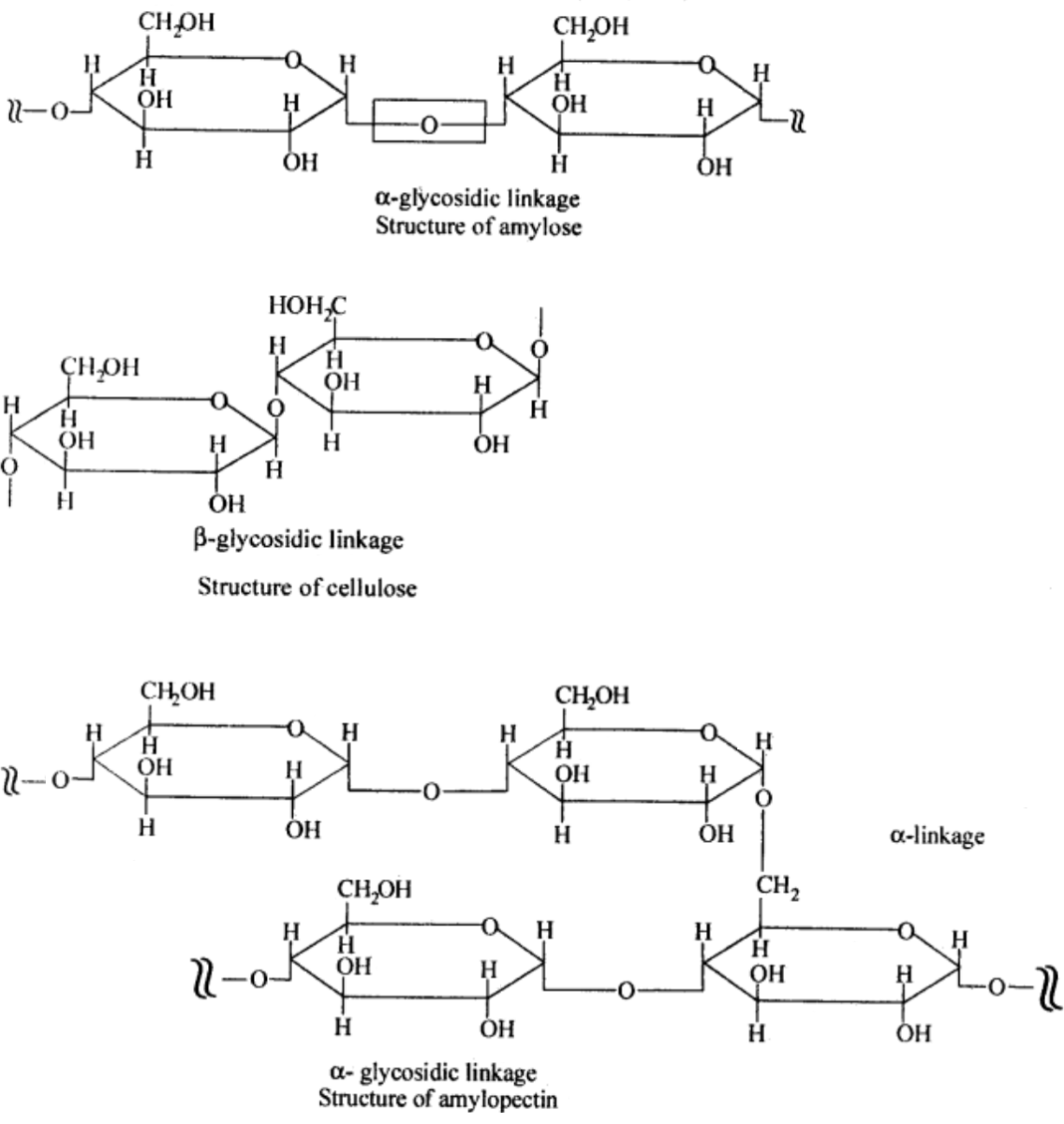
Glycogen is a condensation polymer of $\alpha$ - D glucose. Starch is not a single compound but is a mixture of two components-a water soluble component called amyldse (15 - 20%) and water insoluble component amylopectin (80 - 85%). Amylose is a linear polymer of $\alpha$ - D - glucose. But both glycogen and amylopectin are branched polymers of $\alpha$ - D - glucose; father glycogen is more highly branched than amylopectin as amylopectin chains consists of 20 - 25 glucose units, glycogen chains consist of 10 - 14 glucose units.
View full question & answer
Question 112 Marks
How are vitamins classified? Name the vitamin responsible for the coagulation of blood.
Answer
Vitamins are classified into two groups depending upon their solubility in water or fat.
  1. Fat soluble vitamins: Vitamins which are soluble in fat and oils but insoluble in water. These are Vitamins A, D, E, and K.
  2. Water soluble vitamins: Vitamins which are soluble in water. These are B group vitamin and vitamin C.
Vitamin K is responsible for the coagulation of blood.
View full question & answer
Question 122 Marks
Write the important structural and functional differences between DNA and RNA.
Answer
The structural differences between DNA and RNA are as follows:
The functional differences between DNA and RNA are as follows:
  DNA RNA
1. DNA is the chemical basis of heredity. RNA is not responsible for heredity.
2. DNA molecules do not synthesise proteins, but transfer coded message for the synthesis of proteins in the cells. Proteins are synthesised by RNA molecules in the cells.
View full question & answer
Question 132 Marks
What is the basic structural difference between starch and cellulose?
Answer

Starch consists of amylase and amylopectin. Amylase is a linear polymer of $\alpha-\text{D}-$ glucose while cellulose is a linear polymer of $\beta-\text{D}-$ glucose. In amylase, C - 1 of one glucose unit is connected to C - 4 of the other through $\alpha-$glycosidic linkage. However in cellulose, C - 1 of one glucose unit is connected to C - 4 of the other through $\beta-$ glycosidic linkage. Amylopectin on the other hand has highly branched structure .
View full question & answer
Question 142 Marks
What are nucleic acids? Mention their two important functions.
Answer
Nucleic acids are biomolecules found in the nuclei of all living cells, as one of the constituents of chromosomes. There are mainly two types of nucleic acids - deoxyribonucleic acid (DNA) and ribonucleic acid (RNA). Nucleic acids are also known as polynucleotides as they are longchain polymers of nucleotides.
Two main functions of nucleic acids are:
  1. DNA is responsible for the transmission of inherent characters from one generation to the next. This process of transmission is called heredity.
  2. Nucleic acids (both DNA and RNA) are responsible for protein synthesis in a cell. Even though the proteins are actually synthesised by the various RNA molecules in a cell, the message for the synthesis of a particular protein is present in DNA.
View full question & answer
Question 152 Marks
Write the main structural difference between DNA and RNA. Of the four bases, name those which are common to both DNA and RNA.
Answer
In DNA, sugar is Deoxyribose while in RNA, it is ribose./DNA is as double stranded while RNA is single stranded. The common bases present in both are adenine, cytosine & guanine.
View full question & answer
Question 162 Marks
Explain what is meant by the following:
  1. Peptide linkage.
  2. Pyranose structure of glucose.
Answer
  1. Peptide linkage: A link between two amino acids with loss of water/–CO-NH –.
  2. The six-membered cyclic structure of glucose is called pyranose structure in analogy with pyran heterocyclic compound/or structure.
View full question & answer
Question 172 Marks
Name two fat soluble vitamins, their sources and the diseases caused due to their deficiency in diet.
Answer
Fat soluble; Vitamin A, D, E and K.
Name Sources Deficiency diseases
Vit. A Milk, butter, kidneys, egg yolk, liver, fish oil, etc. Xerophthalmia-night-blindness.
Vit. D Butter, liver, kidneys, egg yolk, fish oil, etc. Rickets, osteomalacia.
Vit. E group Green vegetables, oil, egg yolk, wheat, animal tissues. Sterility (impotency) and muscular atrophy.
Vit. K Carrots, lettuce, cabbage, tomatoes, liver, egg yolk, cheese; synthesized by colon bacteroa. Haemorrhages, excessive bleeding in injury, poor coagulation of blood.
View full question & answer
Question 182 Marks
Name the four bases present in DNA. Which one of these is not present in RNA?
Answer
The four bases present in DNA are Adenine, Guanine, Thymine and Cytosine Thymine is not present in RNA.
View full question & answer
Question 192 Marks
Write any two reactions of glucose which cannot be explained by the open chain structure of glucose molecule.
Answer
  1. Despite having the aldehyde group, glucose does not give $2,4-DNP$ test or Schiff’s test.
  2. It does not form the hydrogensulphite addition product with $NaHSO_3.$
  3. The pentaacetate of glucose does not react with hydroxylamine indicating the absence of free $–CHO$ group.
View full question & answer
Question 202 Marks
What is meant by (i) Peptide linkage (ii) Biocatalysts?
Answer
  1. Peptide linkage: A link between two amino acid with loss of water.
-CO-NH-

Peptide Linkage
  1. Biocatalysts: Are the catalysts which increase the rate of metabolism./biochemicalreactions.
View full question & answer
Question 212 Marks
Describe what you understand by primary structure and secondary structure of proteins.
Answer
Primary structure of proteins: The protein in which amino acids are linked with each other in a specific sequence is said to be the primary structure of that protein.
Secondary structure of proteins: It refers to the shape in which a long polypeptide chain can exist i.e. $\alpha$- helix and $\beta$-pleated structure.
View full question & answer
Question 222 Marks
What is essentially the difference between a-form of glucose and b-form of glucose? Explain.
Answer
$\alpha-$ form of glucose and $\beta$-form of glucose differ only in the configuration of the hydroxyl group at $C_1$ in cvclic structure of glucose/hemiacetal form of glucose/pyranose structure of glucose.
View full question & answer
Question 232 Marks
What are essential and non-essential amino acids in human food? Give one example of each type.
Answer
Amino acids which must be supplied in our diet are called Essential Amino Acids eg. Leucine, Isoleucine, Valine.
Amino acids which can be made by our bodies and not required in our diet are called non-essential Amino Acids eg. Glycine, Alanine.
View full question & answer
Question 242 Marks
Name the products of hydrolysis of sucrose. Why is sucrose not a reducing sugar?
Answer
Products of hydrolysis of sucrose are: Glucose and Fructose. Becuase Carbonyl group of sucrose is not free.
View full question & answer
Question 252 Marks
Explain the following terms:
  1. Invert sugar.
  2. Polypeptides.
Answer
  1. Invert sugar: Hydrolysis of sucrose brings about a change in a sign of rotation from dextro (+) to laevo (-) and the product is named as invert sugar.
  2. Polypeptides are the polymers of amino acids.
View full question & answer
Question 262 Marks
Name two water soluble vitamins, their sources and the diseases caused due to their deficiency in diet.
Answer
Vitamin B and vitamin C are soluble in water.Deficiency diseases due to vitamin B are: Beri Beri, Cheilosis, Convulsions, Pernicious anaemia
Deficiency diseases due to vitamin C is: Scurvy
Sources of vitamin B: milk/yeast/green vegetables/cereals.
Source of vitamin C: citrus fruits.
View full question & answer
Question 272 Marks
Explain what is meant by:
  1. A peptide linkage.
  2. A glycosidic linkage.
Answer
  1. Peptide linkage: A link formed between two amino acids with loss of water.
- CO - NH -

Peptide linkage.
  1. Glycosidic linkage: A link in two monosaccharides units through oxygen atom. For ex. in a disaccharide.
View full question & answer
Question 282 Marks
List the reactions of glucose which cannot be explained by its open chain structure.
Answer
  1. Despite having the aldehyde group, glucose does not give $2,\ 4-DNP$ test or Schiff’s test.
  2. It does not form the hydrogensulphite addition product with $NaHSO_3.$
  3. The pentaacetate of glucose does not react with hydroxylamine indicating the absence of free $–CHO$ group.
View full question & answer
Question 292 Marks
Define the following terms in relation to proteins:
  1. Peptide linkage.
  2. Denaturation.
Answer
  1. Peptide linkage: Peptide linkage is an amide $(-CO-NH-)$ bond formed between $–COOH$ and $–NH_2$ group in protein formation.
  2. Denaturation: When a protein in its native form, is subjected to physical change like change in temperature or chemical change like change in $pH$, protein loses its biological activity. This is called denaturation of protein.
View full question & answer
Question 302 Marks
What are zwitter ions?
Answer
A zwitter ion is a dipolar ion formed by neutralisation of acidic and basic centres present within the molecule.
View full question & answer
Question 312 Marks
Which monosaccharide units are present in starch, cellulose and glucose and which linkages link these units?
Answer
In starch D-glucose units are present, in cellulose $\beta-\text{D}\text { glucose}$ D-glucose units are present. In starch and glycogen glycosidic $\beta-\text{linkage}$ linkage is present and in cellulose glycosidic linkage is present between glucose units.
View full question & answer
Question 322 Marks
What is meant by tertiary structure of proteins?
Answer
Tertiary structure of protein includes folding and twisting of secondary structure of proteins. It has compact and folded structure. It involves H-bonding, disulphide linkage, ionic or salt bridges and hydrophobic interactions.
View full question & answer
Question 332 Marks
Explain the following items:
Avitaminosis.
Answer
Avitaminosis: Lack of more than one vitamin causes multiple deficiency diseases called avitaminosis.
View full question & answer
Question 342 Marks
What is nucleoside?
Answer
Nucleoside consists of a base joined to sugar molecule, e.g., adenosine contains adenine and ribose, guanosine contains guanine and ribose, cytidine contains cytosine and ribose.
View full question & answer
Question 352 Marks
Which sugar is called invert sugar? Why is it called so?
Answer
Sucrose is called invert sugar. The sugar obtained from sugar beet is a colourless, crystalline and sweet substance. It is very soluble in water and its aqueous solution is dextrorotatory having. $[\alpha]_\text{D}=+66.5^\circ$ On hydrolysis with dilute acids or enzyme invertase, cane sugar gives equimolar mixture of D-(+)-glucose and D-(-)-fructose.
$\text{C}_{12}\text{H}_{22}\text{O}_{11}+\text{H}_{2}\text{O}\ \xrightarrow{\ \ \ \ \ \ \ \ \ \ \ \text{HCl}}\text{C}_{6}\text{H}_{12}\text{O}_{6}+\text{C}_{6}\text{H}_{12}\text{O}_{6}$
So, sucrose is dextrorotatory but after hydrolysis gives dextrorotatory glucose and laevorotatory fructose. D-(-)-fructose has a greater specific rotation than D-(+)-glucose. Therefore, the resultant solution upon hydrolysis is laevorotatory in nature with specific rotation. Since there is change in the sign of rotation from dextro before hydrolysis to laevo after hydrolysis, the reaction is called inversion reaction and the mixture (glucose and fructose) is called invert sugar.
View full question & answer
Question 362 Marks
What is isoelectric point?
Answer
The pH at which there is no net migration of the amino acid under the influence of an applied electric field is called isoelectric point. For example, the isoelectric point of glycine is 6.1.
View full question & answer
Question 372 Marks
Sucrose is dextrorotatory but the mixture obtained after hydrolysis is laevorotatory. Explain.
Answer
Sucrose is dextrorotatory having. $[\alpha]_\text{D}=+66.5^\circ$ on hydrolysis with dilute acids or enzymes, it gives equimolar D-(+)-glucose and D-(-)- fructose.
$\text{C}_{12}\text{H}_{22}\text{O}_{11}+\text{H}_{2}\text{O}\ \xrightarrow{\ \ \ \ \ \ \ \ \ }\text{C}_{6}\text{H}_{12}\text{O}_{6}+\text{C}_{6}\text{H}_{12}\text{O}_{6}$
Since D-(-)-fructose has larger specific rotation than D-(-)-fructose has largre specific retation than D-(+)-glucose, the resulting mixture has specific. Therefore, the mixture is laevorotatory.
View full question & answer
Question 382 Marks
Describe the term $D-$ and $L-$ configuration used for amino acids with examples.
Answer
The sugars are divided into two families: the $D-$family and $L-$family which have definite configurations. These configurations are represented with respect to glyceraldehyde as the standard. The glyceraldehydes may be presented by two forms as:
$D-(+)-$Glyceraldehyde $L-(-)-$Glyceraldehyde The $D-$configuration has $-OH$ attached to the carbon adjacent to $-CH_2OH$ on right while $L-$configuration has $-OH$ attached to the carbon adjacent to $-CH_2OH$ on left. The sugars are called $D-$ or $L-$depending upon whether the configuration of the molecule is related to $D-$glyceraldehyde or $L-$glyceraldehyde. It has been found that all naturally occurring sugars belong to $D-$series, e.g., $D-$glucose $D-$ribose and $D-$fructose.
View full question & answer
Question 392 Marks
Polypeptides.
Answer
Polypeptide: If more than ten a-amino acids are joined together by peptide bond (-CONH-) the polyamide thus formed is called polypeptide.
View full question & answer
Question 402 Marks
What is mutarotation?
Answer
The spontaneous change of specific rotation of an optically active substance with time is called mutarotation.
View full question & answer
Question 412 Marks
Amino acids behave like salts rather than simple amines or carboxylic acids. Explain.
Answer
Amino acids behave like salts rather than simple amines or carboxylic acids. This behaviour is due to the presence of both acidic (carboxyl group) and basic (amino group) groups in the same molecule. In aqueous solution, the carboxyl group can lose a proton and amino group can accept a proton, giving rise to a dipolar ion known as zwitter ion.
View full question & answer
Question 422 Marks
What are polysaccharides? Give one example.
Answer
Polysaccharides are the carbohydrates which on hydrolysis give a large number of molecules of monosaccharides. For example, starch or cellulose.
View full question & answer
Question 432 Marks
The $K_a$ and $K_b$ values of a-amino acids are very low. Why?
Answer
In a-amino acids the acidic group is $-^+NH3,$ instead of $-COOH$ group as in carboxylic acids and basic group is $-COO-$ instead of $-NH_2$ group as in amines. That is why they have low values of $K_a$ and $K_b.$
View full question & answer
Question 442 Marks
What type of bonding occurs in globular proteins?
Answer
Van der Waals interactions, disulphide bridges, dipolar interactions (ionic) and hydrogen bonding.
View full question & answer
Question 452 Marks
State two main functions of carbohydrates.
Answer
  1. Carbohydrates act as biofuel to provide energy for functioning of living organisms.
  2. They act as constituents of cell walls.
View full question & answer
Question 462 Marks
How will you distinguish 1° and 2° hydroxyl groups present in glucose? Explain with reactions.
Answer
On oxidation with nitric acid, glucose as well as gluconic acid both yield a dicarboxylic acid, saccharic acid. This indicates the presence of a primary alcoholic (—OH) group in glucose.
$\ \text{CHO} \ \ \ \ \ \ \ \ \ \ \ \ \ \ \ \ \ \ \ \ \ \ \ \ \ \ \ \ \ \ \ \ \text{COOH} \\ \ \ {|} \ \ \ \ \ \ \ \ \ \ \ \ \ \ \ \ \ \ \ \ \ \ \ \ \ \ \ \ \ \ \ \ \ \ \ \ \ \ \ \ {|} \\ \text{(CHOH)}_4 \xrightarrow{\text{Br}_2/\text{H}_2\text{O}}(\text{CHOH})_4\\ \ \ {|} \ \ \ \ \ \ \ \ \ \ \ \ \ \ \ \ \ \ \ \ \ \ \ \ \ \ \ \ \ \ \ \ \ \ \ \ \ \ \ \ \ \ {|} \\ \ \text{CH}_2\text{OH} \ \ \ \ \ \ \ \ \ \ \ \ \ \ \ \ \ \ \ \ \ \ \ \ \ \ \ \ \ \text{CH}_2\text{OH} \\ \text{Glucose} \ \ \ \ \ \ \ \ \ \ \ \ \ \ \ \ \ \ \ \ \ \ \ \ \ \ \ $
Acetylation of glucose with acetic anhydride gives glucose pentaacetate which confirms the presence of five —OH groups. Since it exists as a stable compound, five —OH groups should be attached to different carbon atoms.
View full question & answer
Question 472 Marks
Answer the following.
  1. What type of linkage is responsible for the primary structure of proteins?
  2. Name the location where protein synthesis occurs in our body.
Answer
  1. Peptide linkage.
  2. Protein synthesis occurs at the ribosome in the cytoplasm.
View full question & answer
Question 482 Marks
What are constituent units of cellulose?
Answer
Cellulose is a linear polymer made up of D-(+)-glucose molecules linked by bglycosidic bonds.
View full question & answer
Question 492 Marks
Answer the following questions.
a-amino acids have relatively higher melting points than the corresponding halo acids. Explain.
Answer
$\alpha-\text{Amino}$ acids act as zwitter ions, $(H_3N^+-CHR-COO- )$ or dipolar ions. Due to this dipolar salt-like structure, they have strong dipole-dipole interactions. Therefore, their melting points are higher than the corresponding halo acids which do not exist as zwitter ions.
View full question & answer
Question 502 Marks
What is the importance of amino acids to us?
Answer
Amino acids are the building blocks of proteins which are essential for the growth and maintenance of life.
View full question & answer
Question 512 Marks
What is difference between amylose and amylopectin?
Answer
Amylose is water soluble linear polymer of a-glucose. Amylopectin is water insoluble branched chain polymer of a-glucose.
View full question & answer
Question 522 Marks
Define native state in reference to protein.
Answer
The sequence in which amino acids are linked together with the help of peptide bonds form native state of protein.
View full question & answer
Question 532 Marks
Protein found in a biological system with a unique three-dimensional structure and biological activity is called a native protein. When a protein in its native form, is subjected to a physical change like change in temperature or a chemical change like, change in pH, denaturation of protein takes place. Explain the cause.
Answer
Protein found in a biological system with a unique three-dimensional structure and biological activity is called a native protein. When a protein in its native form, is subjected to physical change like change in temperature or chemical change like change in pH, the hydrogen bonds are disturbed. Due to this, Globules unfold and helix gets uncoiled and protein loses its biological activity. This is called denaturation of protein.
View full question & answer
Question 542 Marks
Answer the following questions.
Give one structural difference between amylose and amylopectin.
Answer
Amylose is a long unbranched chain polymer of $\alpha-\text{D(+)}$ glucose. Amylopectin is a branched chain polymer of $\alpha-\text{D}$ glucose.
View full question & answer
Question 552 Marks
Coagulation of egg white on boiling is an example of denaturation of protein. Explain it in terms of structural changes.
Answer
When an egg is boiled, the soluble globular protein, albumin present in it is converted into insoluble fibrous protein. During this denaturation (i) biological activity is lost and (ii) secondary and tertiary structures of albumin protein are destroyed while the primary structure (representing the sequence of amino acids) remains intact.
View full question & answer
Question 562 Marks
What are anomers? Give one example.
Answer
Anomers are stereoisomers which differ in orientation of -OH only around C-l, e.g., a-glucose and b-glucose.
View full question & answer
Question 572 Marks
What is meant by inversion of sugar?
Answer
Sucrose is dextrorotatory but on hydrolysis it gives an equimolar mixture of D-(+)- glucose and D-(-)-fructose which is laevorotatory. This change of specific rotation from dextrorotation to laevorotation is known as inversion of sugar.
View full question & answer
Question 582 Marks
Give reasons for the following:
Glucose and fructose give the same osazone.
Answer
During osazone formation, the reaction occurs only at C-1 and C-2. As glucose and fructose differ from each other only in the arrangement of atoms at C-1 and C-2, therefore they give the same osazone.
View full question & answer
Question 592 Marks
What are enzymes?
Answer
Enzymes are globular proteins which are biological catalysts. They are highly specific in their action.
View full question & answer
Question 602 Marks
Write the reactions of D-glucose which can’t be explained by its open-chain structure. How can cyclic structure of glucose explain these reactions?
Answer
Following reactions and facts could not be explained by open chain structure of glucose.
  • Despite having the aldehyde group, glucose does not give $2,4-DNP$ test, Schiff’s test and it does not form the hydrogensulphite addition product with $NaHSO_3.$
  • The pentaacetate of glucose does not react with hydroxylamine indicating the absence of free $—CHO$ group.
It was proposed that one of the $—OH$ groups may add to the $—CHO$ group and form a cyclic hemiacetal structure. It was found that glucose forms a six-membered ring in which $—OH$ at $C-5$ is involved in ring formation.
View full question & answer
Question 612 Marks
What purine and pyrimidine bases are present in DNA and RNA?
Answer
  • Purines: adenine and guanine.
  • Pyrimidines: cytosine and thymine in DNA and cytosine and uracil in RNA.
View full question & answer
Question 622 Marks
What are amino acids?
Answer
Amino acids are biomolecules which contain an amino $(-NH_2)$ group and a carboxylic acid group $(-COOH)$ at a-carbon.
View full question & answer