MCQ 11 Mark
The adsorption of hydrogen by platinum black is called:
AnswerWhen adsorption happens on metals, it is called occlusion. Occlusion happens on a variety of metals, including iron, platinum and palladium, but hydrogen gas is the only adsorbate.
View full question & answer→MCQ 21 Mark
Gallium is in $.......$ state at room temperature.
AnswerGallium is in liquid state at room temperature. The melting point of gallium is $303K.$
View full question & answer→MCQ 31 Mark
Which one of the following statements about lanthanides is false ?
AnswerCorrect option: B. The ionic radii of trivalent lanthanides steadily increases with increase in atomic number.
The ionic radii of trivalent lanthanides steadily decreases with increase in atomic number due to lanhanide contraction.
View full question & answer→MCQ 41 Mark
Lanthanides and actinides resemble in:
- ✓
Electronic configuration.
- B
- C
- D
AnswerCorrect option: A. Electronic configuration.
Lanthanides and actinides resemble in electronic configuration:
$(n-2) f^{1-14}(n-1) d^{1-10} n s^{1-2}$
View full question & answer→MCQ 51 Mark
Transition metals make the most efficient catalysts because of their ability to:
- ✓
Adopt multiple oxidation states and to form complexes.
- B
- C
Show paramagnetism due to unpaired electrons.
- D
Form a large number of oxides.
AnswerCorrect option: A. Adopt multiple oxidation states and to form complexes.
Transition metals have partially filled $d-$ orbitals so they can easily withdraw the electrons from the reagents or give electrons to them depending on the nature of the reaction. They also have a tendency to show large no. of oxidation states and the ability to form complexes which makes them a good catalyst.
View full question & answer→MCQ 61 Mark
Which ine of the following statement about lanthanides is false?
AnswerCorrect option: B. The ionic radii of trivalent lanthanides steadily increases with increase in atomic number.
View full question & answer→MCQ 71 Mark
The color of $\mathrm{Cu}^{+}$ compounds is?
Answer$\mathrm{Cu}^{+}$ compounds are generally colourless $($white$).$ The electronic configuration is $3 \mathrm{d}^{10} 4 \mathrm{~s}^0.$ So there is no unpaired electron present in the ion. So the electronic transition between two energy levels $\mathrm{t}_{2 \mathrm{~g}}$ and $\mathrm{e}_{\mathrm{g}} ($responsible for the colour of transition metals$)$ is not possible.
View full question & answer→MCQ 81 Mark
Which element among the Lanthanides has the smallest atomic radius?
AnswerLutetium is the last element of the Lanthanides, so it will have the smallest ionic radius due to Lanthanide contraction.
View full question & answer→MCQ 91 Mark
Cholrine gas is produced from $\text{HCI}$ by the addition of:
AnswerCorrect option: D. $ \mathrm{KMnO}_4 $
$ \mathrm{KMnO}_4 $ being strong oxidising agent will oxidise $CI^-$ ion present in $\text{HCl}$ to form chlorine gas.
$2 \mathrm{KMnO}_4+16 \mathrm{HCl} \rightarrow 2 \mathrm{KCl}+2 \mathrm{MnCl}_2+8 \mathrm{H}_2 \mathrm{O}+5 \mathrm{Cl}_2$
View full question & answer→MCQ 101 Mark
Which of the following has highest value of magnetic moment?
- ✓
$ \mathrm{Fe}^{2+} $
- B
$ \mathrm{Co}^{3+} $
- C
$ \mathrm{V}^{3+} $
- D
$ \mathrm{Ti}^{3+} $
AnswerCorrect option: A. $ \mathrm{Fe}^{2+} $
Magnetic moment $=\sqrt{\text{n(n+2)}}$
$n=$ no. of unpaired electrons, $ \mathrm{Fe}^{+2} $ has $4$ unpaired electrons.
Other compound have less unpaired electrons.
More the number of electron, more the magnetic moment.
Thus $ \mathrm{Fe}^{2+} $ has the highest value of the magnetic moment among the given elements.
View full question & answer→MCQ 111 Mark
Generally transition elements form coloured salts due to the presence of unpaired electrons. Which of the following compounds will be coloured in solid state?
AnswerCorrect option: D. $ \mathrm{Cu}_2 \mathrm{Cl} $
$\mathrm{Cu}^{2+}$ has $1$ unpaired electron in $ \mathrm{Cu}_2 \mathrm{Cl} $ hence, it is coloured in solid state.
View full question & answer→MCQ 121 Mark
Colour in transition metal compounds is attributed to:
- A
Small size of metal ions.
- B
Absorption of light in $UV$ region.
- C
Complete $(ns)$ subshell.
- ✓
Incomplete $(n−1)d$ subshell.
AnswerCorrect option: D. Incomplete $(n−1)d$ subshell.
Any compound or ion showing colour is due to presence of unpaired electron. Transition metal compounds have incomplete $(n-1)d$ sub shell and because of that they have unpaired electron and thus they show colour.
View full question & answer→MCQ 131 Mark
Which of the following is amphoteric oxide$?\ \mathrm{Mn}_2 \mathrm{O}_7, \mathrm{CrO}_3, \mathrm{Cr}_2 \mathrm{O}_3, \mathrm{CrO}, \mathrm{V}_2 \mathrm{O}_5, \mathrm{V}_2 \mathrm{O}_4$
- ✓
$\text{V}_5\text{O}_5, \text{Cr}_2\text{O}_3$
- B
$\text{Mn}_2\text{O}_7, \text{Cr}\text{O}_3$
- C
$\text{Cr}\text{O}, \text{V}_2\text{O}_5$
- D
$\text{V}_2\text{O}_5, \text{V}_2\text{O}_4$
AnswerCorrect option: A. $\text{V}_5\text{O}_5, \text{Cr}_2\text{O}_3$
Since they react with acid as well as base.
View full question & answer→MCQ 141 Mark
Transition metals are good electrical conductor because $.......$
- A
- B
- ✓
They have free electrons in outer energy levels.
- D
AnswerCorrect option: C. They have free electrons in outer energy levels.
Transition metals have free electrons in outer energy levels because $d-$orbitals shields poorly and due to this they acts as good conductor of electricity.
View full question & answer→MCQ 151 Mark
Generally transition elements and their salts are coloured due to the presence of unpaired electrons in metal ions. Which of the following compounds are coloured?
$a. \mathrm{KMnO}_4$
$b. \mathrm{Ce}\left(\mathrm{SO}_4\right)_2$
$c. \mathrm{TiCl}_4$
$d. \mathrm{Cu}_2 \mathrm{Cl}_2$
- ✓
$a$ and $b$
- B
$a$ and $c$
- C
$b$ and $c$
- D
$a$ and $d$
AnswerCorrect option: A. $a$ and $b$
It is due to charge transfer. In $\ce{MnO{_4}{^-}}$ an electron is momentarily transferred from $O$ to the metal, thus momentarily $O^{2-}$ is changed to $O-$ and reducing the oxidation state of the metal from $\text{Mn (VII)}$ to $\text{Mn (VI)}.$
View full question & answer→MCQ 161 Mark
Which one of the following paramagnetic in nature?
- ✓
$\ce{CuCl_2}$
- B
$\ce{CaCl_2}$
- C
$\ce{CdCl_2}$
- D
AnswerCorrect option: A. $\ce{CuCl_2}$
In $\ce{CuCl_2}, Cu$ is in $+2$ oxidation state. Electronic configuration of $\ce{Cu^{2+}}$ is $\ce{[Ar],3d^9},$ and is coloured and paramagnetic due to presence of an unpaired electron in the $3d$ sub$-$orbital.
View full question & answer→MCQ 171 Mark
The magnetic nature of elements depends on the presence of unpaired electrons. Identify the configuration of transition element, which shows highest magnetic moment.
- A
$3 d^7$
- ✓
$3 d^5$
- C
$3 d^8$
- D
$3 d^2$
AnswerCorrect option: B. $3 d^5$
The greater the number of unpaired electron, the higher will be its value of magnetic moment. Since$, 3 d^5$ has $5$ unpaired electrons hence highest magnetic moment.
$\mu=\sqrt{5(5+2)}$
$=\sqrt{35}$
$=5.95\text{ BM}$
View full question & answer→MCQ 181 Mark
The ionic charges on chromate ion and dichromate ion respectively is:
- ✓
$-2, -2$
- B
$-3, -2$
- C
$-2, -4$
- D
$-4, -2$
AnswerCorrect option: A. $-2, -2$
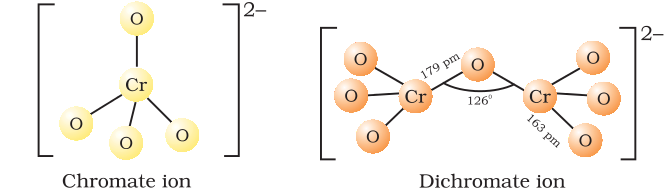
Chromate salts contain the chromate anion$, \text{CrO}^{2-}_4$ with $-2$ ionic charge.
Dichromate salts contain the dichromate anion$, \text{CrO}^{2-}_7$ with $-2$ ionic charge.
They are oxoanions of chromium in the $+6$ oxidation state.
View full question & answer→MCQ 191 Mark
Which of the following oxidation state is common for all lanthanoids?
AnswerIn the lanthanoids$, \text{La(II)}$ and $\text{Ln(III)}$ compounds are predominant species. However, occasionally $+2$ and $+4$ ions in solution or in solid compounds are also obtained. This irregularity $($as in ionisation enthalpies$)$ arises mainly from the extra stability of empty, half$-$filled or filled $f$ subshell.
View full question & answer→MCQ 201 Mark
Which forms coloured salts?
- A
- B
Non$-$metals
- C
$p-$block elements
- ✓
AnswerTransitional elements form coloured salts due to the presence of unpaired electrons of $d-$orbital.
View full question & answer→MCQ 211 Mark
Maximum ferromagnetism is found in?
AnswerAs Iron have highest value of saturation, Magnetization $M_s$ which is defined as the magnetic moment density when the material is subjected to a field strong enough to align all its moments.
$\ce{Fe 1707 M_s}$
$\ce{Co 1400 M_s}$
$\ce{Ni 485 M_s}$
View full question & answer→MCQ 221 Mark
Many Lanthanoid elements are used to prepare:
- A
- B
- ✓
Superconducting materials.
- D
AnswerCorrect option: C. Superconducting materials.
Many Lanthanoid elements are used to prepare superconducting materials.
Examples include Lanthanum sesquicarbide superconductor $\mathrm{La}_2 \mathrm{C}_3.$ Gadolinium at very low temperatures becomes highly magnetic and may function as a superconductor.
View full question & answer→MCQ 231 Mark
Which of the following will not act as oxidising agents?
$a. \text{CrO}_3$
$b. \text{MoO}_3$
$c. \text{MoO}_3$
$d. \text{CrO}_4^{2-}$
- A
$a$ and $b$
- B
$a$ and $c$
- ✓
$b$ and $c$
- D
$a$ and $d$
AnswerCorrect option: C. $b$ and $c$
Higher oxidation states of $W$ and $Mo$ are more stable that is why they will not act as oxidizing agent.
View full question & answer→MCQ 241 Mark
Which of the following compounds will not give +ve chromyl chloride test?
- A
$\ce{CuCl_2}$
- ✓
$\ce{HgCl_2}$
- C
$\ce{ZnCl_2}$
- D
$\ce{C_6H_5NH_2HCl}$
AnswerCorrect option: B. $\ce{HgCl_2}$
View full question & answer→MCQ 251 Mark
Which of the following has smallest ionic radius ?
- A
$Nd^{3+}$
- B
$Dy^{3+}$
- ✓
$Lu^{3+}$
- D
$Pm^{3+}$
AnswerCorrect option: C. $Lu^{3+}$
As we move from left to right in a raw, radii decreases.
So radii of $Lu^{+3}$ is smallest among all.
View full question & answer→MCQ 261 Mark
In which pair highest oxidation states of transition metals are found?
AnswerThe highest oxidation states of transition metals are found in fluorides and oxides since fluorine and oxygen are the most electronegative elements and small in size.
View full question & answer→MCQ 271 Mark
The metal capable of gaining as well as losing an electron is:
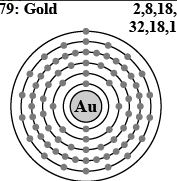
AnswerAs shown in image, Gold has $2$ electrons in level $1, 8$ electrons in level $2, 18$ in level $3, 32$ in level $4, 18$ in level $5$ and $1$ electron in level $6.$ Gold is having $1$ eletcron in last level, so it can lost $1$ electron to complete their valency or it can also gain $1$ electron thus $2$ electron will come in outer cell and will complete the last level.
View full question & answer→MCQ 281 Mark
Catalytic activity of transition elements and their compounds is due to their $.......$
AnswerCorrect option: B. Vacant $d-$orbitals.
The catalytic activity of transition elements is ascribed to their ability to adopt multiple oxidation states and to form complexes.
View full question & answer→MCQ 291 Mark
Metallic radii of some transition elements are given below. Which of these elements will have highest density?
| Element |
$Fe$ |
$Co$ |
$Ni$ |
$Cu$ |
| Metallic radii/pm |
$126$ |
$125$ |
$125$ |
$128$ |
AnswerOn moving across the period in the periodic table the atomic radii of the element decreases towards right that is why density increases towards right in a period.
View full question & answer→MCQ 301 Mark
On addition of small amount of $\mathrm{KMnO}_4$ to concentrated $\mathrm{H}_2 \mathrm{SO}_4,$ a green oily compound is obtained which is highly explosive in nature. Identify the compound from the following.
AnswerCorrect option: A. $\mathrm{Mn}_2 \mathrm{O}_7$
$\mathrm{KMnO}_4$ reacts with conc. $\mathrm{H}_2 \mathrm{SO}_4$ as:
$2 \mathrm{KMnO}_4+2 \mathrm{H}_2 \mathrm{SO}_4 \rightarrow \mathrm{Mn}_2 \mathrm{O}_7+2 \mathrm{KHSO}_4+\mathrm{H}_2 \mathrm{O}$
$\mathrm{Mn}_2 \mathrm{O}_7$ is highly explosive in nature.
View full question & answer→MCQ 311 Mark
There are $14$ elements in actinoid series. Which of the following elements does not belong to this series?
Answer$Tm\ ($thulium$)$ atomic no$. = 69$ belongs to Lanthanoids $(4f)$ series.
View full question & answer→MCQ 321 Mark
Which of the following group belongs to actinide series ?
- ✓
$\text{Th, Pa, U}$
- B
$\text{Ce Pr, Nd}$
- C
$\text{Ba, La, Hf}$
- D
$\text{Pt, Au, Ag}$
AnswerCorrect option: A. $\text{Th, Pa, U}$
$Th\ ($thorium$), Pa\ ($proactinium$)$ and $U\ ($uranium$)$ belongs to actinoid series.
$\text{CePr, Nd}$ are lanthanoids.
$\text{Ba, La, Hf}$ belongs to the sixth period.
$\text{Pt, Au, Ag}$ are transition elements.
View full question & answer→MCQ 331 Mark
The magnetic moment of $\left[\mathrm{Cu}\left(\mathrm{NH}_3\right)_4\right]^{2+}$ was found to be $1.73\ B.M.$ The number of unpaired electrons in the complex is:
AnswerMagnetic moment of a complex having $n-$unpaired electrons is given by$:\ \sqrt{\text{n(n+2)}}$ where $n$ is the number of unpaired electrons.
$\sqrt{\text{n(n+2)}}=1.73$
$\therefore \text{n}=1.$
View full question & answer→MCQ 341 Mark
Transition elements form binary compounds with halogens. Which of the following elements will form $\mathrm{MF}_3$ type compounds?
$a. Cr$
$b. Co$
$c. Cu$
$d. Ni$
- ✓
$a$ and $b$
- B
$a$ and $c$
- C
$b$ and $c$
- D
$a$ and $d$
AnswerCorrect option: A. $a$ and $b$
$Cr$ and $Co$ form $\mathrm{MF}_3$ type of compounds. The ability of fluorine to stabilize the highest oxidation state is due to higher lattice energy in $\mathrm{CoF}_3$ and higher bopnd enthalpy for the higher covalent compound like $\mathrm{CrF}_6$.
View full question & answer→MCQ 351 Mark
Which of the following lanthanoids show $+2$ oxidation state besides the characteristic oxidation state $+3$ of lanthanoids?
$a. Ce$
$b. Eu$
$c. Yb$
$d. Ho$
- A
$a$ and $b$
- B
$a$ and $c$
- ✓
$b$ and $c$
- D
$a$ and $d$
AnswerCorrect option: C. $b$ and $c$
- Cerium $(Z = 57) \Rightarrow $ Electronic configuration $=[\text{Xe}]4\text{f}^55\text{d}^06\text{s}^2$
Oxidation state of $Ce +3, +4.$
- Europium $(Z = 63) \Rightarrow $ Electronic configuration $=[\text{Xe}]4\text{f}^75\text{d}^06\text{s}^2$
Oxidation state of $Eu = +2, +3.$
- Ytterbium $(Z = 70) \Rightarrow $ Electronic configuration $=[\text{Xe}]4\text{f}^{14}5\text{d}^06\text{s}^2$
Oxidation state of $Yb = +2, +3.$
- Holmium $(Z = 67) \Rightarrow $ Electronic configuration $=[\text{Xe}]4\text{f}^{11}5\text{d}^06\text{s}^2$
Oxidation state of $Ho = +3.$ View full question & answer→MCQ 361 Mark
Experimental value of magnetic momentum of $\mathrm{Mn}^{2+}$ complex is $5.96\ B.M.$ This indicates:
- ✓
Axial and orbital motion of electron in same direction.
- B
Axial and orbital motion of electron in opposite direction.
- C
Electron does not exhibit orbital motion, it only exhibits axial motion.
- D
Electron does not exhibit axial motion, it only exhibits orbital motion.
AnswerCorrect option: A. Axial and orbital motion of electron in same direction.
$\sqrt{\text{n(n+2)}}=5.96$
$n = 5$
The axial motion of electron is clockwise because $\text{S}=\frac{+1}{2}$ and the orbital motion will also be in clockwise direction.
View full question & answer→MCQ 371 Mark
Chromium $-$ plated steel is a material of popular use. During its process of manufacture, the effluent contains chromate and cyanide ions as impurities. After these are chemically removed, carbon dioxide and salt $($sodium chloride$)$ still remain as impurities. This salt solution is purified electrolytically by adding carbonaceous matter which acts as:
AnswerThe above$-$given salt$-$solution is purified electrolytically by adding carbonaceous matter which acts as a microcell.
View full question & answer→MCQ 381 Mark
The only radioactive element among the lanthanoids is:
AnswerPromethium is a lanthanoid element with the symbol $Pm$ and atomic number $61.$ All of its isotopes are radioactive. Gadolinium, holmium and neodynium are lanthanoids but are not radio active.
View full question & answer→MCQ 391 Mark
AnswerMonazite is a prosphate material containing rare earth metals. It is reddish in colour. It is an important ore for throium, lanthanum, cerium.
View full question & answer→MCQ 401 Mark
Which sub shell is filled up progressively in actinoids?
Answer$5f$ sub shell is filled up progressively in actinoids.
View full question & answer→MCQ 411 Mark
Which of the following reactions are disproportionation reactions?
- $ \mathrm{Cu}^{+} \rightarrow \mathrm{Cu}^{2+}+\mathrm{Cu} $
- $ 3 \mathrm{MnO}_4{^-}+4 \mathrm{H}^{+} \rightarrow 2 \mathrm{MnO}_4{^-}+\mathrm{MnO}_2+2 \mathrm{H}_2 \mathrm{O} $
- $ 2 \mathrm{KMnO}_4 \rightarrow \mathrm{K}_2 \mathrm{MnO}_4+\mathrm{MnO}_2+\mathrm{O}_2 $
- $2 \mathrm{MnO}_4{^-}+3 \mathrm{Mn}^{2+}+2 \mathrm{H}_2 \mathrm{O} \rightarrow 5 \mathrm{MnO}_2+4 \mathrm{H}^{+} $
- ✓
$a, b$
- B
$a, b, c$
- C
$b, c, d$
- D
$a, d$
AnswerCorrect option: A. $a, b$
Copper $(I)$ compounds are unstable in aqueous solution and undergo disproportionation:
$2 \mathrm{Cu}^{+} \rightarrow \mathrm{Cu}^{2+}+\mathrm{Cu}$
In a disproportionation reaction, an element is simultaneously oxidized and reduced.
View full question & answer→MCQ 421 Mark
Transuranic elements begin with:
AnswerThe transuranic elements are the chemical elemnts with atomic numbers greater than $92\ ($the atomic number of Uranium$).$ Neptunium is the first element of transuranic series with atomic number $93..$
View full question & answer→MCQ 431 Mark
$\ce{KMnO_4}$ acts as an oxidising agent in acidic medium. The number of moles of $\ce{KMnO_4}$ that will be needed to react with one mole of sulphide ions in acidic solution is
- ✓
$\frac{2}{5}$
- B
$\frac{3}{5}$
- C
$\frac{4}{5}$
- D
$\frac{1}{5}$
AnswerCorrect option: A. $\frac{2}{5}$
$2\text{MnO}_4^-+5\text{S}^{2-}+16\text{H}^+\rightarrow2\text{Mn}^{2+}+5\text{s}+8\text{H}_2\text{O}$
For $5$ moles of $S$ the number of moles of $\text{KMnO}_4=2$
For $1$ moles of $S$ the number of moles of $\text{KMnO}_4=\frac{2}{5}$
View full question & answer→MCQ 441 Mark
$5f$ series elements are known as $.......?$
AnswerActinides are also called the $5f$ series.
Filling up of the $5f$ orbitals after actinium $(Z = 89)$ gives the $5f-$inner transition series known as the actinoid series.
View full question & answer→MCQ 451 Mark
The radius of $\mathrm{La}^{3+} ($atomic number of $La = 57)$ is $1.06A.$ Which one of the following given values will be closest to the radius of $\mathrm{Lu}^{3+}?\ ($atomic number of $Lu = 71)$
- A
$1.40A$
- B
$1.06A$
- ✓
$0.85A$
- D
$1.60A$
AnswerCorrect option: C. $0.85A$
As we move from left to right in a raw, radii decreases.
So radii of $\mathrm{Lu}^{+3}$ should be lesser than $1.06A.$
View full question & answer→MCQ 461 Mark
The first ionisation potential of $N, P, O$ and $S$ are in the order of:
- A
$\ce{S > P < O > N}$
- ✓
$\ce{N > O > P > S}$
- C
$\ce{N > O < P > S}$
- D
$\ce{N < O < P < S}$
AnswerCorrect option: B. $\ce{N > O > P > S}$
Moving left to right within a period or upward within a group, the first ionization energy generally increases with a few discrepancies $($aluminum and nitrogen group$).$
Nitrogen group to oxygen group$, I.P.$ decreases instead of increasing because of the stable half$-$filled configuration of nitrogen family.
$\ce{N(1400) > O(1313) > P(1011) > S(999)}$
View full question & answer→MCQ 471 Mark
Which of the following is true regarding derivation of the name of californium?
- ✓
The name of californium was derived from the name of the place.
- B
The name of californium was derived from its color.
- C
The name of californium was derived from the name of the scientist who discovered it.
- D
The name of californium was derived from mythological character name.
AnswerCorrect option: A. The name of californium was derived from the name of the place.
The name of californium was derived from the name of the state and University of California.
View full question & answer→MCQ 481 Mark
Which of the following transition metal ions has highest magnetic moment?
- A
$\mathrm{Cu}^{2+}$
- B
$\mathrm{Ni}^{2+}$
- C
$\mathrm{Co}^{2+}$
- ✓
$\mathrm{Fe}^{2+}$
AnswerCorrect option: D. $\mathrm{Fe}^{2+}$
Magnetic moment depends on number of unpaired electrons, in $\mathrm{Fe}^{2+}$ has $4$ unpaired electrons while $\mathrm{Co}^{+2}, \mathrm{Ni}^{+2}, \mathrm{Cu}^{+2}$ has $3, 2, 1$ unpaired electrons respectively.
View full question & answer→MCQ 491 Mark
Most copper $(I)$ compounds are found to be colourless. This is due to:
AnswerCorrect option: B. Completely filled $d-$level in $Cu(I).$
In copper $(I)$ ion there are no vacant $d$ orbitals as it is diamagnetic. Copper$(I)$ ion being less charged has small ligand field effect and the transition is in the infrared region in which no color is perceived by human eye.
View full question & answer→MCQ 501 Mark
Atomic number of three elements $A, B,$ and $C$ are respectively$,\ce{Pm (Z = 61), Sm (Z = 62), Eu (Z = 63)}.$Which one has a maximum atomic radius?
- ✓
$A$
- B
$B$
- C
$C$
- D
All have the same radius.
View full question & answer→MCQ 511 Mark
It is sometimes necessary to remove colouring matter contained as an impurity in glass. Glass is decolourised by:
AnswerGlass is decolourised by manganese dioxide.
View full question & answer→MCQ 521 Mark
An aqueous solution containing $\mathrm{V}^{\mathrm{x}+}$ ion has magnetic moment equal to $\sqrt{15\text{BM}}$ Therefore, the $x$ is:
AnswerLet n be the number of unpaired electrons.
Magnetic moment $=\sqrt{\text{n(n+2)}}=\sqrt{15}$
$\Rightarrow n = 3$
Atomic number of Vanadium is $23.$ So, it must loose all its $4s$ electrons to get $3$ unpaired $d$ electrons.
$\therefore$ value of $x$ will be $2$
View full question & answer→MCQ 531 Mark
The element californium belongs to a family of:
AnswerIn the periodic table, Actinoid element or the actinide element, any of a series of $15$ consecutive chemical elements from actinium to lawrencium $($atomic numbers $(89−103)).$
The atomic number of californium is $98$
Let's write an electronic configuration for this.
Its electronic configuration is $\mathrm{Rn}^{86} 7 \mathrm{s}^2 5 \mathrm{f}^{10}$
View full question & answer→MCQ 541 Mark
The elements which exhibit both vertical and horizontal similarities are $......$
AnswerElements which exhibit both vertical and horizontal similarities are transition elements. They show vertical similarity because of same electronic configuration. They show horizontal similarity because of similar size.
View full question & answer→MCQ 551 Mark
Which of the following belongs to actinoid series of elements?
AnswerUranium belongs to actinoid series of elements. Neodymium and Samarium belongs to lanthanide series. Gold belongs to $d-$block.
View full question & answer→MCQ 561 Mark
Of the following metals, the most reactive metal is:
AnswerAccording to reactive series, Most reactive metal is Iron $(Fe)$
Reactivity order is$:\ Fe > Ni > Au > Pt$
View full question & answer→MCQ 571 Mark
Transitional elements exhibit variable valencies because they release electrons from the following orbits:
- A
$Ns$ orbit
- B
$Ns$ and $np$ orbits
- ✓
$(n−1)d$ and $ns$ orbits
- D
$(n−1)d$ orbit
AnswerCorrect option: C. $(n−1)d$ and $ns$ orbits
The ability of the transition metals to exhibit variable valency is generally attributed to the availability of more electrons in the $(n−1)d$ orbitals which are closer to the outermost ns orbital in energy levels.
View full question & answer→MCQ 581 Mark
Some compounds turn dark when exposed to light. They are, therefore, used in photography. A metal used for making such compounds is:
AnswerA silver halide $($or silver salt$)$ is one of the chemical compounds that can form between the element silver and one of the halogens. Silver halides are used in photographic film and photographic paper, including graphic art film and paper, where silver halide crystals in gelatin are coated on to a film base, glass or paper substrate. The gelatin is a vital part of the emulsion as the protective colloid of appropriate physical and chemical properties.
View full question & answer→MCQ 591 Mark
Why is $\text{HCl}$ not used to make the medium acidic in oxidation reactions of $\mathrm{KMnO}_4$ in acidic medium?
- A
Both $\text{HCl}$ and $\mathrm{KMnO}_4$ act as oxidising agents.
- ✓
$\mathrm{KMnO}_4$ oxidises $\text{HCl}$ into $\mathrm{Cl}_2$ which is also an oxidising agent.
- C
$\mathrm{KMnO}_4$ is a weaker oxidising agent than $\text{HCl}.$
- D
$\mathrm{KMnO}_4$ acts as a reducing agent in the presence of $\text{HCl}.$
AnswerCorrect option: B. $\mathrm{KMnO}_4$ oxidises $\text{HCl}$ into $\mathrm{Cl}_2$ which is also an oxidising agent.
$\text{HCl}$ is not used to make the medium acidic in oxidation reactions of $\mathrm{KMnO}_4$ in acidic medium. The reason is that if $\text{HCl}$ is used, the oxygen produced from $\mathrm{KMnO}_4 + \text{HCl}$ is partly utilized in oxidizing $\text{HCl}$ to $Cl,$ which itself acts as an oxidizing agent and partly oxidises the reducing agent.
View full question & answer→MCQ 601 Mark
Elements which generally exhibit variable oxidation states and form colored ions are $........$
AnswerTransition elements have vacant $d$ orbitals and the energy gap between $d$ orbitals is very less. So transition elements exhibit variable oxidation state and form coloured ions as these elements emit radiations due to excitation of $d$ electrons.
View full question & answer→MCQ 611 Mark
Titanium oxide is added in interior paints for walls of rooms, halls and galleries to give:
AnswerTitanium oxide is added in intercor paints for walls of room, halls and galleries to give a whiter white.
View full question & answer→MCQ 621 Mark
An atom of element has $2K, 8L$ and $3M$ electrons. Then the element belongs to:
- A
$4$ group
- B
$\text{IIA}$ group
- ✓
$\text{IIIA}$ group
- D
$\text{IVA}$ group
AnswerCorrect option: C. $\text{IIIA}$ group
The total number of electrons present in all the shells are $2 + 8 + 3 = 13,$ hence the atomic number of element is $13$ and the electronic configuration would be $\ce{1 s^2 2 s^2 2 p^6 3 s^2 3 p^1}.$
View full question & answer→MCQ 631 Mark
Which of the following statement regarding transition elements is incorrect?
AnswerCorrect option: C. All of their ions are colourless.
Properties of transition elements include:
- Have large charge/ radius ratio.
- Are hard and have high densities.
- Have high melting and boiling points.
- Form compounds which are often paramagnetic.
- Show variable oxidation states.
- Form coloured ions and compounds.
- Form compounds with profound catalytic activity.
- Form stable complexes.
View full question & answer→MCQ 641 Mark
Transition metal compounds are usually colored. This is due to the electronic transition:
- A
From $p-$orbital to $s-$orbital.
- B
From $d-$orbital to $s-$orbital.
- C
From $d-$orbital to $p-$orbital.
- ✓
Within the $d-$orbitals.
AnswerCorrect option: D. Within the $d-$orbitals.
Colour in transition series metal compounds arises due to two types of transitions. they are:
$(a)$ Charge transfer transitions $[$Ligand$-$to$-$metal charge transfer $(\text{LMCT}),$ Metal$-$to$-$ligand charge transfer$]$
$(b) d−d$ transition
In transition metal complexes, all the $d−$ orbitals do not possess same energy. So, electrons can jump from a lower energy $d−$ orbital to a higher energy $d−$ orbital, by absorbing energy. When it returns to the ground state, excess energy is released, and a corresponding wavelength is found in the visible region.
View full question & answer→MCQ 651 Mark
The color of $\mathrm{CoCl}_3 \cdot 5 \mathrm{NH}_3 \cdot \mathrm{H}_2 \mathrm{O}$ is:
Answer$\mathrm{CoCl}_3 \cdot 5 \mathrm{NH}_3 \cdot \mathrm{H}_2 \mathrm{O}$ is pink in colour.It has $Co^{3+}$ ion with $\ce{[Ar]3d^6}$ electronic configuration. It has $4$ unpaired electrons.
View full question & answer→MCQ 661 Mark
The magnetic nature of elements depends on the presence of unpaired electrons. Identify the configuration of transition elements which shows highest magnetic moment?
- A
$3d^2$
- B
$3d^8$
- C
$3d^7$
- ✓
$3d^5$
AnswerCorrect option: D. $3d^5$
The magnetic nature of elements depends on the presence of unpaired electrons$. 3d^5$ configuration of transition elements which shows highest magnetic moment as it has maximum number of unpaired electrons $(5$ unpaired electrons$).$
View full question & answer→MCQ 671 Mark
The Lanthanoid contraction refers to decrease in the:
- A
Valence electrons of the Lanthanide series.
- ✓
Ionic radius of the series.
- C
The density of the series.
- D
Nuclear mass of the series.
AnswerCorrect option: B. Ionic radius of the series.
The Lanthanoid contraction refers to decrease in the ionic radius of the series. It is a reduction in atomic/ionic size with increase in atomic number. This is due to poor shielding of $4f$ electrons.
View full question & answer→MCQ 681 Mark
Which compound is volatile on heating?
- A
$\ce{MgCl_2}$
- ✓
$\ce{HgCl_2}$
- C
$\ce{ZnCl_2}$
- D
AnswerCorrect option: B. $\ce{HgCl_2}$
$Hg$ metal is present in liquid state, hence $\ce{HgCl_2}$ is volatile in nature.
View full question & answer→MCQ 691 Mark
Although Zirconium belongs to $4d$ transition series and Hafnium to $5d$ transition series even then they show similar physical and chemical properties because $.......$
AnswerCorrect option: C. Both have similar atomic radius.
The almost identical radii of $Zr (160\ pm)$ and $Hf (159\ pm),$ a consequence of the lanthanoid contraction, account of their occurrence together in nature and for the similar physical and chemical properties.
View full question & answer→MCQ 701 Mark
Which of the following becomes paramagnetic on heating?
- A
$\text{MnO}$
- B
$\mathrm{Fe_3O_4}$
- C
$\mathrm{ZnFe_2O_4}$
- ✓
$B$ and $C$ both
AnswerCorrect option: D. $B$ and $C$ both
Ferrimagnetic change their nature on heating and become paramagnetic
eg. $\mathrm{Fe}_3 \mathrm{O}_4, \mathrm{ZnFe}_2 \mathrm{O}_4, \mathrm{MgFe}_2 \mathrm{O}_4$
View full question & answer→MCQ 711 Mark
The property seen in $f-$block elements is:
- A
- B
- ✓
Both $(A)$ and $(B).$
- D
AnswerCorrect option: C. Both $(A)$ and $(B).$
The property seen in $f-$block elements are Lanthanoid contraction and Actinide contraction. Lanthanide contraction is a term used in chemistry to describe the greater than expected decrease in ionic radii of the elements in the lanthanide series.
View full question & answer→MCQ 721 Mark
If each one of the above ionic species is in turn kept in a magnetic field, which one will get attracted ?
- ✓
$ \mathrm{Co}^{+2} $
- B
$ \mathrm{Mn}^{+7} $
- C
$ \mathrm{Sc}^{+3} $
- D
$ \mathrm{Ti}^{+4} $
AnswerCorrect option: A. $ \mathrm{Co}^{+2} $
$ \mathrm{Co}^{+2}= [Ar]3d^7n = 3$ attracted by a magnetic field due to presence of $3$ unpaired electron.
View full question & answer→MCQ 731 Mark
Transition metals are less reactive because of their:
- A
High ionization potential and low melting point.
- ✓
High ionization potential and high melting point.
- C
Low ionization potential and low melting point.
- D
Low ionization potential and high melting point.
AnswerCorrect option: B. High ionization potential and high melting point.
Transition metals are less reactive relative to $I$ and $II$ group due to higher ionization potential and high melting point $($due to greater no of bonding electrons$).$
View full question & answer→MCQ 741 Mark
Which of the following is diamagnetic ion?
- ✓
$Zn^{2+}$
- B
$Ni^{2+}$
- C
$Co^{2+}$
- D
$Cu^{2+}$
AnswerCorrect option: A. $Zn^{2+}$
$\mathrm{Zn}^{2+}=[\mathrm{Ne}] 3 s^2 3 p^6 4 s^0 3 d^{10}$
It is diamagnetic, so no unpaired $e^-s.$
View full question & answer→MCQ 751 Mark
The catalytic activity of the transition metals and their compounds is ascribed to their:
- A
- B
- C
Unfilled $d-$orbitals.
- ✓
Ability to adopt multiple oxidation states and their complexing ability.
AnswerCorrect option: D. Ability to adopt multiple oxidation states and their complexing ability.
The catalytic activity of the transition metals and their compounds is ascribed to their ability to adopt multiple oxidation states and their complexing ability.
Catalysis at a solid surface involve the formation of bonds between reactant molecules and atoms of the surface of the catalyst $($first row transition metals utilise $3d$ and $4s$ electrons for bonding$).$
This has the effect of increasing theconcentration of the reactants at the catalyst surface and also weakening of the bonds in the reacting molecules $($the activation energy is lowering$).$
Also because the transition metal ions can change their oxidation states, they become more effective as catalysts. For example, iron$(\text{III})$ catalyses the reaction between iodide and persulphate ions.
View full question & answer→MCQ 761 Mark
The transition metals are mostly:
- A
- ✓
- C
Neither diamagnetic nor paramagnetic.
- D
Both diamagnetic and paramagnetic.
AnswerMost of trasition metls have unpaired electron $(d-$configuration$)$ in their electronic configuration so they are paramagnetic in nature.
View full question & answer→MCQ 771 Mark
The electronic configuration of $\text{Cu(II)}$ is $3d^9$ whereas that of $\text{Cu(I)}$ is $3d^{10}$. Which of the following is correct?
- ✓
$\text{Cu(II)}$ is more stable
- B
$\text{Cu(II)}$ is less stable
- C
$\text{Cu(I)}$ and $\text{Cu(II)}$ are equally stable
- D
Stability of $\text{Cu(I)}$ and $\text{Cu(II)}$ depends on nature of copper salts
AnswerCorrect option: A. $\text{Cu(II)}$ is more stable
$\text{Cu(II)}$ is more stable due to greater effective nuclear charge of $\text{Cu(II)}.$
View full question & answer→MCQ 781 Mark
Magnetic moment of diamagnetic substance in Bohr Magnetons is:
AnswerMagnetic moment of diamagnetic substance is zero.
View full question & answer→MCQ 791 Mark
Which of following ion has the maximum theoretical magnetic moment?
- A
$ \mathrm{Cr}^{3+} $
- ✓
$ \mathrm{Fe}^{3+} $
- C
$ \mathrm{Ti}^{3+} $
- D
$ \mathrm{Co}^{3+} $
AnswerCorrect option: B. $ \mathrm{Fe}^{3+} $
$ \mathrm{Fe}^{3+} $
$n = 5\ ($unparied electrons$)$
$\therefore\mu=\sqrt{\text{n(n+2)}\text{ BM}}$
$=\sqrt{5(5+2)}$
$=\sqrt{35}=5.91\text{ BM}$
View full question & answer→MCQ 801 Mark
Oil is converted into fat by using $.....$ as a catalyst.
- ✓
$Ni$
- B
$Fe$
- C
$Mn$
- D
$\ce{V_2O_5}$
AnswerNickel is used as catalyst in oil industry. It is used in catalytic hydrogenation.
View full question & answer→MCQ 811 Mark
When $\mathrm{MnO}_2$ is fused with $\text{KOH}$ in the presence of air, a coloured compound is formed, the product and its colour is:
- ✓
$\mathrm{K}_2 \mathrm{MnO}_4,$ dark green
- B
$\mathrm{KMnO}_4,$ purple
- C
$\mathrm{Mn}_2 \mathrm{O}_3,$ brown
- D
$\mathrm{Mn}_3 \mathrm{O}_4,$ black.
AnswerCorrect option: A. $\mathrm{K}_2 \mathrm{MnO}_4,$ dark green
The reaction between $\mathrm{MnO}_2$ and $\text{KOH}$ in presence of air is given as:
$2 \mathrm{MNO}_2+4 \mathrm{KOH}+\mathrm{O}_2 \rightarrow 2 \mathrm{\sim K}_2 \mathrm{MnO}_4+2 \mathrm{H}_2 \mathrm{O}$
$($potassium manganate$)$
The $\mathrm{K}_2 \mathrm{MnO}_4$ formed is dark green in colour.
View full question & answer→MCQ 821 Mark
A reduction in atomic size with increase in atomic number is a characteristic of elements of:
AnswerCorrect option: B. $F-$block.
A reduction in atomic size with increase in atomic number is a characteristic of $f-$block elements.
This is due to poor shielding of $f$ electrons. The extent of actinoid contraction is greater than lanthanoid contraction. With increase in atomic number i.e. in moving down a group, the number of the principal shell increases and therefore, the size of the atom increases. But in case of $f$ block elements there is a steady decrease in atomic size with increase in atomic number due to lanthanide contraction. As we move through the lanthanide series$, 4f$ electrons are being added one at each step.
The mutual shielding effect of $f$ electrons is very little. This is due to the shape of the $f$ orbitals. The nuclear charge, however increases by one at each step. Hence, the inward pull experienced by the $4f$ electrons increases. This causes a reduction in the size of the entire 4fn shell.
View full question & answer→MCQ 831 Mark
Transition metals are often paramagnetic owing to:
- A
High $m.p.$ and $b.p.$ of transition metals.
- B
Presence of vacant $d-$orbitals.
- ✓
Presence of one or more unpaired $d-$electrons.
- D
Their less electropositive nature as compared to the elements of groups $IA$ and $\text{IIA}.$
AnswerCorrect option: C. Presence of one or more unpaired $d-$electrons.
The general outer electronic configuration of $d-$block elements is $(n-1) d^{1-10} n s^{1-2}.$ Hence$, d -$ block elements often have one or more unpaired $d -$ electrons.
Due to presence of these unpaired electrons, transition elements show paramagnetism.
Therefore transition elements are often paramagnetic due to presence of one or more unpaired $d$ electrons.
View full question & answer→MCQ 841 Mark
$\text{ll Cu(II)}$ halides are known except the iodide. The reason for it is that:
- A
- ✓
$Cu^{2+}$ oxidizes iodide to iodine.
- C
$\text{Cu}^{2+}_\text{(aq)}$ has much more negative hydration enthalpy.
- D
$Cu^{2+}$ ion has smaller size.
AnswerCorrect option: B. $Cu^{2+}$ oxidizes iodide to iodine.
All $\text{Cu(II)}$ halides are known except the iodine because $Cu^{2+}$ oxidizes iodine to iodine.
$2 \mathrm{Cu}^{2+}+4 \mathrm{I}^{-1} \rightarrow 2 \mathrm{CuI}_{(\mathrm{S})}+\mathrm{I}_2$.
View full question & answer→MCQ 851 Mark
The following is not a noble metal:
AnswerThe noble metals are those metals that are resistant to corrosion and oxidation in moist air, unlike most base metals. The noble metals are most commonly considered to be ruthenium, rhodium, palladium, silver, platinum and gold. Copper is not considered to be a noble metal.
View full question & answer→MCQ 861 Mark
Which lanthanide compound is used as a pigment?
- ✓
$ \mathrm{CeO}_2 $
- B
$ \mathrm{Ce}(\mathrm{OH})_3 $
- C
$ \mathrm{Lu}(\mathrm{OH})_3 $
- D
$ \mathrm{\sim Tb}(\mathrm{OH})_3 $
AnswerCorrect option: A. $ \mathrm{CeO}_2 $
Ceria or cerium oxide$,\mathrm{CeO}_2,$ a lanthanide compound is used as a pigment and as a polishing agent for glass.
View full question & answer→MCQ 871 Mark
Which one is false in the following statement:
AnswerCorrect option: D. $Ni$ is used as catalyst in the manufacture of ammonia in the redox reaction.
known as Born$-$Haber's cycle catalyst $Fe$ is used not $Ni.$
View full question & answer→MCQ 881 Mark
Transition elements show magnetic moment due to spin and orbital motion of electrons. Which of the following metallic ions have almost same spin only magnetic moment?
$a. Co^{2+}$
$b. Cr^{2+}$
$c. Mn^{2+}$
$d. Cr^{3+}$
- A
$a$ and $b$
- B
$b$ and $c$
- C
$a$ and $c$
- ✓
$a$ and $d$
AnswerCorrect option: D. $a$ and $d$
$Co^{2+}\ (3d^{7})$ and $Cr^{3+}\ (3d^{3})$ have $3$ unpaired electrons.
Hence they have almost same spin only magnetic moment.
View full question & answer→MCQ 891 Mark
Number of $\text{Cr−O}$ bonds in dichromate ion $(\text{Cr}_2\text{O}_7^{2-})$ is:
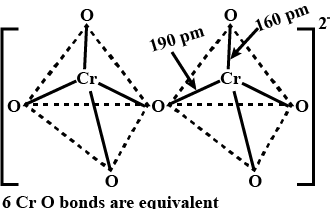
AnswerFrom structure, it is clear that it has $\text{8 Cr−O}$ bond, out of which $\text{6 Cr−O}$ bonds are equal.
View full question & answer→MCQ 901 Mark
Which of the following statements concerning lanthanide elements is false?
AnswerCorrect option: D. Ionic radii of trivalent lanthanides steadily increase with an increase in the atomic number.
Ionic radii decreases with increasing atomic number in Lanthanide series. So, the ionic radii of trivalent Lanthanide will also follow the same property.
View full question & answer→MCQ 911 Mark
Which of the following is ferromagnetic.
- A
$\text{Cu, Ag, Au}$
- ✓
$\text{Fe, Co, Ni}$
- C
$\text{Zn, Cd, Hg}$
- D
$\text{Ca, Sr, Ba}$
AnswerCorrect option: B. $\text{Fe, Co, Ni}$
Ferromagnetic substances are those which get strongly magnetized in the presence of a magnetic field.
These substances have domains that get aligned in the magnetic field, thus increasing their strength.
These are strongly attracted by a magnet.
Examples include iron, cobalt, nickel, etc.
View full question & answer→MCQ 921 Mark
Raney nickel, which is used as a catalyst, is obtained:
AnswerCorrect option: B. By treating nickelaluminium alloy with dilute $\text{NaOH}.$
Raney nickel, s solid catalyst composed of fine grains of a nickel Aluminium alloy which is used in many industrial process. It is obtained by treating nickel$-$Aluminium alloy with dilute $\text{NaOH}.$
View full question & answer→MCQ 931 Mark
Which of the following types of metals forms the most efficient catalysts:
AnswerTransition metals can form unstable intermediate products with suitable reactants. These intermediate products lower the activation energy of the reaction which makes the reaction faster. So, transition elements are the most efficient catalysts.
View full question & answer→MCQ 941 Mark
$D-$block elements form complexes because they have:
AnswerTransition metals has incompletely filled $d$ orbital. They have vacant orbitals to accept coordination bond. Complex compounbs are those in which the metal ion bind a number of anions or neutral molecules giving complex species with characteristics properties. The transition metals form a large no. of complex compounds.
This is due to the comparatively smaller size of the metal ions,their high ionic charges and the availability of $d$ orbitals for bond formation.
View full question & answer→MCQ 951 Mark
Among the following metals, interatomic forces are probably the weakest in:
AnswerAmong the metals, interatomic forces are probably the weakest in $Hg.$
This can be understand from the fact that $Hg$ is liquid whereas $\text{Cu, Ag}$ and $Zn$ are solids at room temperature.
View full question & answer→MCQ 961 Mark
When $\ce{KMnO_4}$ solution is added to oxalic acid solution, the decolourisation is slow in the beginning but becomes instantaneous after some time because
- A
$\text{CO}_2$is formed as the product.
- B
- C
$\text{MnO}_4^-$ catalyses the reaction.
- ✓
$\text{Mn}^{2+}$acts as autocatalyst.
AnswerCorrect option: D. $\text{Mn}^{2+}$acts as autocatalyst.
When $\ce{KMnO_4}$ solution is added to oxalic acid solution, the decolourisation is slow in the beginning but becomes instantaneous after some time because $Mn^{2+}$ acts as an autocatalyst.
Reduction half $[\text{MnO}^-_4+8\text{H}^++5\text{e}^-\rightarrow\text{Mn}^{2+}+4\text{H}_2\text{O]}\times2$
Oxidation half $[\text{C}_2\text{O}_4^{2-}\rightarrow2\text{CO}_2+2\text{e}^-]\times5$
Overall equation $2\text{MnO}_4^-+16\text{H}^++5\text{C}_2\text{O}_4^{2-}\rightarrow2\text{Mn}^{2+}+10\text{CO}_2+8\text{H}_2\text{O}$
End point of this reaction Colourless to light pink
View full question & answer→MCQ 971 Mark
Out of the following transition elements, the maximum number of oxidation states are shown by:
- A
$Sc\ (Z = 21)$
- B
$Cr\ (Z = 24)$
- ✓
$Mn\ (Z = 25)$
- D
$Fe\ (Z = 26)$
AnswerCorrect option: C. $Mn\ (Z = 25)$
The maximum oxidation state is the number of $4s$ electrons plus the number of unpaired $3d$ electrons.
View full question & answer→MCQ 981 Mark
There are $14$ elements in actinoid series. Which of the following elements does not belong to this series?
AnswerThulium $(Tm)$ has atomic number $69,$ and actinoid series has elements from atomic number $90-103.$
Thulium belongs to lanthanoid series.
View full question & answer→MCQ 991 Mark
The transition metal used in $X-$rays tube is:
AnswerAmong given metals, molybdenum is used in $X-$rays tube. In medical $X-$ray tubes the target is usually tungsten or a more crack$-$resistant alloy of rhenium $(5\%)$ and tungsten $(95\%),$ but sometimes molybdenum is used for more specialized applications, such as when softer $X-$rays are needed as in mammography.
View full question & answer→MCQ 1001 Mark
The following belongs to $d-$block but it is not transition element:
AnswerZinc is not a transition element due to complete $d-$orbital.
View full question & answer→MCQ 1011 Mark
Metals are usually used as catalysts belong to:
- A
$S-$block
- B
$P-$block
- ✓
$D-$block
- D
$F-$block
AnswerCorrect option: C. $D-$block
$D-$block metals, e.g. $\text{Ni, Pt, Fe},$ etc, are used as catalysts.
View full question & answer→MCQ 1021 Mark
The catalytic activity of the transition metals and their compounds is ascribed to their
- A
- B
- C
Unfilled $d-$orbitals.
- ✓
Ability to adopt multiple oxidation states and their complexing ability.
AnswerCorrect option: D. Ability to adopt multiple oxidation states and their complexing ability.
The catalytic activity of the transition metals and their compounds is ascribed to their ability to adopt multiple oxidation states and their complexing ability. Catalysis at a solid surface involve the formation of bonds between reactant molecules and atoms of the surface of the catalyst $($first row transition metals utilise $3d$ and $4s$ electrons for bonding$).$ This has the effect of increasing theconcentration of the reactants at the catalyst surface and also weakening of the bonds in the reacting molecules $($the activation energy is lowering$).$ Also because the transition metal ions can change their oxidation states, they become more effective as catalysts. For example, iron$(\text{III})$ catalyses the reaction between iodide and persulphate ions.
View full question & answer→MCQ 1031 Mark
The atomic numbers of elements of second inner transition elements lie in the range of:
- A
$88$ to $101$
- B
$89$ to $102$
- ✓
$90$ to $103$
- D
$91$ to $104$
AnswerCorrect option: C. $90$ to $103$
Second inner transition elements are from thorium to lawrencium, i.e., from atomic numbers $90$ to $103.$
View full question & answer→MCQ 1041 Mark
How many electron present in penultimate shell of $d-$block element?
- ✓
$9 - 18$
- B
$8 - 18$
- C
$1 - 10$
- D
$1 - 32$
AnswerCorrect option: A. $9 - 18$
View full question & answer→MCQ 1051 Mark
Lanthanoid contraction occurs because:
- A
The $4f$ electrons, which are gradually added, create strong shielding effect.
- B
The $4f$ orbitals are greater in size than the 3d and 3f orbitals.
- C
The $5f$ orbitals strongly penetrate into the 4f orbitals.
- ✓
The poor shielding effect of $4f$ electrons is coupled with increased attraction between the nucleus and the added electrons.
AnswerCorrect option: D. The poor shielding effect of $4f$ electrons is coupled with increased attraction between the nucleus and the added electrons.
Lanthanoid contraction occurs because the poor shielding effect of $4f$ electrons is coupled with increased attraction between the nucleus and the added electrons.
The atomic and ionic radii $(M^{3+}$ ions$)$ of Lanthanide elements decrease with increase in atomic number.
View full question & answer→MCQ 1061 Mark
The separation of Lanthanides by ion exchange method is based on:
- A
Asicity of the hydroxides.
- ✓
- C
The solubility of their nitrates.
- D
Oxidation state of the ion.
AnswerThe separation of Lanthanoids by ion$-$exchange method is based on the size of the ions.
Separation can also be attained by size exclusion or gel permeation chromatography.
View full question & answer→MCQ 1071 Mark
Which of the following elements belongs to actinide series?
Answer$\text{Lu, Gd}$ and $La$ belongs to lanthanide series and $Th$ belongs to actinide series.
View full question & answer→MCQ 1081 Mark
Although $+3$ is the characteristic oxidation state for lanthanoids but cerium also shows $+4$ oxidation state because $........$
$a.$ It has variable ionisation enthalpy
$b.$ It has a tendency to attain noble gas configuration
$c.$ It has a tendency to attain $f^0$ configuration
$d.$ It resembles $\mathrm{Pb}^{4+}$
- A
$a$ and $b$
- B
$a$ and $c$
- ✓
$b$ and $c$
- D
$a$ and $d$
AnswerCorrect option: C. $b$ and $c$
Cerium shows $+4$ oxidation state also because it has a tendency to attain noble gas configuration and attain $\mathrm{f}^0$ configuration.
$\mathrm{Ce}-4 \mathrm{f}^1 5 \mathrm{\sim d}^{\prime} 6 \mathrm{s}^2\left(\mathrm{Ce}^{4+}-4 \mathrm{f}^{\circ}\right)$
View full question & answer→MCQ 1091 Mark
Which of the following is not an interstitial compound?
AnswerCorrect option: D. $\mathrm{Cr}_2 \mathrm{O}_3$
$\text{TiC, MoC}$ and $\mathrm{Fe}_{0.82} \mathrm{O}$ are interstitial compounds. However, $\mathrm{Cr}_2 \mathrm{O}_3$ is not an interstitial compound. Interstitial compounds are those compounds which are formed when small atoms like $H, C$ or $N$ are trapped inside the interstitial spaces in the crystal lattice of metals. They are usually non$-$stoichiometric in nature and cannot be represented by a definite composition and are neither typically ionic nor covalent.
View full question & answer→MCQ 1101 Mark
$IP$ values of $\text{Sc, Y}$ and $La$ are in the order:
- ✓
$\text{Sc > Y > La}$
- B
$\text{Sc < Y < La}$
- C
$\text{Sc = Y = La}$
- D
$\text{La > Sc > Y}$
AnswerCorrect option: A. $\text{Sc > Y > La}$
$IP$ values of $\text{Sc, Y}$ and $La$ are in the order $\text{Sc > Y > La}$ On moving down the group, the $IP$ values decreases as the effective nuclear charge decreases due to poor shielding by inner electrons.
View full question & answer→MCQ 1111 Mark
Generally transition elements and their salts are coloured due to presence of $......?$
- A
Coloured compounds and ions.
- B
Coloured anions and cations.
- C
Coloured particles and ions.
- ✓
View full question & answer→MCQ 1121 Mark
Magnetic moment of $\mathrm{X}^{3+}$ion od $3d$ series is $\sqrt{35\text{BM}}$ What is atomic number of $\mathrm{X}^{3+}$?
View full question & answer→MCQ 1131 Mark
Variable valency is characteristic of:
AnswerIn transition metals$, (n−1) d$ and $ns$ electrons have nearly same energy level. Hence, most of these electrons take part in chemical bonding. Hence, transition metals show variable valency.
View full question & answer→MCQ 1141 Mark
Transition metals are often para magnetic owing to $.......$
- A
High melting point and boiling point.
- B
The presence of vacant orbitals.
- ✓
The presence of unpaired electrons.
- D
Malleability and ductility.
AnswerCorrect option: C. The presence of unpaired electrons.
Any metal or ion having unpaired electron will show paramagnetism.
View full question & answer→MCQ 1151 Mark
$\ce{KMnO_4}$ acts as an oxidising agent in alkaline medium. When alkaline $\ce{KMnO_4}$ is treated with $KI,$ iodide ion is oxidised to $.......$
- A
$\text{I}_2$
- B
$\text{IO}^-$
- ✓
$\text{IO}_3^-$
- D
$\text{IO}_4^-$
AnswerCorrect option: C. $\text{IO}_3^-$
Iodide ion neutral of faintly alkaline solutions converts iodide to iodate:
$2\text{MnO}_4^-+\text{H}_2\text{O}+\text{I}^-\rightarrow2\text{MnO}_2+2\text{OH}^-+\text{IO}_3^-$
View full question & answer→MCQ 1161 Mark
Most of the radio active elements are present in:
AnswerThe actinoids are radioactive elements and the earlier members have relatively long half-lives.
The most common and known element is Uranium, which is used as nuclear fuel when its converted into plutonium, through a nuclear reaction.
View full question & answer→MCQ 1171 Mark
Gadolinium belongs to $4f$ series. It’s atomic number is $64.$ Which of the following is the correct electronic configuration of gadolinium?
- ✓
$[\text{Xe}]\ 4\text{f}^7\ 5\text{d}^1\ 6\text{s}^2$
- B
$[\text{Xe}]\ 4\text{f}^6\ 5\text{d}^2\ 6\text{s}^2$
- C
$[\text{Xe}]\ 4\text{f}^8\ 6\text{d}^2$
- D
$[\text{Xe}]\ 4\text{f}^9\ 5\text{s}^1$
AnswerCorrect option: A. $[\text{Xe}]\ 4\text{f}^7\ 5\text{d}^1\ 6\text{s}^2$
Gadolinium belongs to $4f$ series it has atomic no$. = 64.$ It has extra stability due to half$-$filled $4f$ sub shell.
View full question & answer→MCQ 1181 Mark
Choose the correct statement.
- A
Only few transition metal complexes are coloured.
- B
$d-$orbital are degenerated hence, they form complexes.
- ✓
Transition metal complexes reflect the complimentary colour of absorbed colour.
- D
Energy difference between $\mathrm{t}_{2(\mathrm{g})}$ and $\mathrm{t}_{\mathrm{g}}$ level is very large.
AnswerCorrect option: C. Transition metal complexes reflect the complimentary colour of absorbed colour.
During this $d-d$ transition process, the electrons absorb certain energy from the radiation and emit the remainder of energy as colored light. The color of ion is complementary of the color absorbed by it.
View full question & answer→MCQ 1191 Mark
The number of elements in the transition metal series $Sc$ through $Zn$ that have four unpaired electrons in their $+2$ state are:
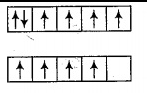
Answer$\mathrm{Fe}^2+(\mathrm{z}=26)=[\mathrm{Ar}] 3 \mathrm{d}^6$
$\mathrm{Cr}^2+(\mathrm{z}=24)=[\operatorname{Ar}] 3 \mathrm{d}^4$
View full question & answer→MCQ 1201 Mark
In the following electronic configuration $n s^2(n-1) d^{0-1}(n-2) f^{1-14}.$ If value of $(n - 1) = 6$ the configuration will be of:
- A
- B
$d -$ block
- ✓
- D
$s -$ block
AnswerIn the following electronic configuration $n s^2(n-1) d^{0-1}(n-2) f^{1-14}$ If value of $(n-1) = 6$ the configuration will be of Actinides.
$n - 1 = 6$ then $n = 7$ and $n − 2 = 5.$ The electronic configuration will be $7 \mathrm{s}^2 6 \mathrm{d}^{0-1} 5 \mathrm{f}^{1-14}$ which is characteristic of actinides.
View full question & answer→MCQ 1211 Mark
Which of the following is not an actinide?
AnswerErbium with atomic number 68, electronic configuration $[\mathrm{Xe}] 4 \mathrm{f}^{12} 6 \mathrm{s}^2$ belongs to lanthanides.
$\therefore$ Erbium is not an actinide.
View full question & answer→MCQ 1221 Mark
Which of the following belongs to the actinide series of elements?
AnswerUranium belongs to actinide series. Yttrium and tantalum belons to $d-$block. Lutetium belongs to lanthanide series.
View full question & answer→MCQ 1231 Mark
Metal cation which is coloured in its aqueous solution is:
- A
$Sc^{3+}$
- B
$Zn^{2+}$
- ✓
$V^{3+}$
- D
$Ti^{4+}$
AnswerCorrect option: C. $V^{3+}$
View full question & answer→MCQ 1241 Mark
Which of the following statements is not correct?
AnswerCorrect option: A. Copper liberates hydrogen from acids.
$\text{Cu}+2\text{H}_2\text{SO}_4\rightarrow\text{CuSO}_4+\text{SO}_2+2\text{H}_2\text{O}$
$3\text{Cu}+8\text{H}\text{NO}_3\rightarrow3\text{Cu(NO}_3)_2+2\text{NO}+4\text{H}_2\text{O}$
View full question & answer→MCQ 1251 Mark
Which of the following pairs of atom have the most similar radii ?
- ✓
$\text{Zr, Hf}$
- B
$\text{Cu, Ag}$
- C
$\text{Sc, Ti}$
- D
$\text{Pd, Pt}$
AnswerCorrect option: A. $\text{Zr, Hf}$
View full question & answer→MCQ 1261 Mark
Chemically Zinc group elements closely resemble $........$
- A
$\text{I A}$ group
- ✓
$\text{II A}$ group
- C
$\text{III A}$ group
- D
$\text{IV A}$ group
AnswerCorrect option: B. $\text{II A}$ group
Zinc belongs to $\text{IIB}$ and it closely resembles $\text{IIA}$ because of the completely filled valence orbitals. The reason is in $\text{IIA}$ group all the elements have completely filled $s-$orbital while in $\text{IIB}$ group the elements have completely filled $s$ orbital along with $d-$orbital.
View full question & answer→MCQ 1271 Mark
Identify the metal that forms colourless compounds.
- A
Iron $(Z = 26)$
- B
Chromium $(Z = 24)$
- C
Vanadium $(Z = 23)$
- ✓
Scandium $(Z = 21)$
AnswerCorrect option: D. Scandium $(Z = 21)$
Scandium$(Z = 21)$ forms colourless compounds.
Scandium$(Z = 21)$ has valence shell electron configuration of $\ce{3d^14s^2}$
In its $+3$ oxidation state, it looses $3$ electrons and has valence shell electron configuration of $3d^\circ 4s^\circ .$ Since no unpaired electron is present, it forms colourless compounds.
View full question & answer→MCQ 1281 Mark
Which metal oxide is used to obtain blue coloured glass?
AnswerCobalt oxide is used to obtain blue coloured glass.
View full question & answer→MCQ 1291 Mark
The first and last elements of actinides are:
- A
- B
- C
Actinium and Mendelevium.
- ✓
AnswerWe have $15$ elements in actinides. They are from atomic number $89$ to $103$ Actinium, Thorium, Protactinium, Uranium, Neptunium, Plutonium, Americium, Curium, Berkelium, Californium, Einsteinium, Fermium, Mendelevium, Nobelium, Lawrencium. Hence, from these list we could say that Actinium is the first and Lawrencium is the last element in actinides.
View full question & answer→MCQ 1301 Mark
What is the atomic number of the element with $M^{2+}$ ion having electronic configuration $\ce{[Ar]3d^8}?$
Answer$E.C$ of $M :\ \ce{[Ar]4s^23d^8}$
$E.C$ of $M^{2+}:\ \ce{[Ar]4s^03d^8}$
Total electrons $= 28 =$ atomic number.
View full question & answer→MCQ 1311 Mark
Differentiating electron in inner transition elements enters the $.......$ orbital.
AnswerIn inner transition elements, the differentiating electron enters into $f$ orbitals. So these elements are called $f-$block elements.
The $'f\ ’ –$ block elements are also known by the name of inner transition elements. In these elements, the last electron usually enters the penultimate i.e. $(n – 2) f$ of the orbital.
View full question & answer→MCQ 1321 Mark
The magnetic moment is associated with its spin angular momentum and orbital angular momentum. Spin only magnetic moment value of $Cr^{3+}$ ion is $........$
- A
$2.87\ B.M.$
- ✓
$3.87\ B.M.$
- C
$3.47\ B.M.$
- D
$3.57\ B.M.$
AnswerCorrect option: B. $3.87\ B.M.$
The magnetic moment is associated with its spin angular momentum and orbital angular momentum.
Spin only magnetic moment value of $Cr^{3+}.$ ion is $3d^{3+}$
Hence, magnatic moment
$(\mu)=\sqrt{\text{n(n+2)}}\text{ BM}$
$=\sqrt{3(3+2)}=\sqrt{15}$
$=3.87\text{ BM}$
View full question & answer→MCQ 1331 Mark
The Lanthanoids contraction relates to:
AnswerCorrect option: B. Atomic as well as $\mathrm{M}^{3+}$ radii.
The Lanthanoids contraction relates to atomic as well as $\mathrm{M}^{3+}$ radii.
The atomic and ionic radii $(\mathrm{M}^{3+}$ ions$)$ of Lanthanide elements decrease with increase in atomic number. This effect is called Lanthanoid contraction. This is due to poor shielding of $4f$ electrons.
View full question & answer→MCQ 1341 Mark
Actinoids belongs to following type of elements:
- A
$S -$ block element
- B
$D -$ block element
- ✓
$F -$ block element
- D
$P -$ block element
AnswerCorrect option: C. $F -$ block element
The two rows that are generally placed underneath the main Periodic Table are called the lanthanide series and the actinide series.
These two rows are produced when electrons are being added to $f$ orbitals.
View full question & answer→MCQ 1351 Mark
Zinc chromate and lead chromate are used as:
AnswerZinc Chromate $\left(\mathrm{ZnCrO}_4\right)$ and Lead Chromate $\left(\mathrm{PbCrO}_4\right)$ are used as pigments, paints, spray paints, artist paints, etc.
View full question & answer→MCQ 1361 Mark
Which one of the following elements forms compounds that are all coloured?
AnswerMost of the chromium compounds are coloured due to excitation of an electron from a lower energy $d-$orbital to higher energy $d-$orbital, the energy of excitation corresponds to the frequency of light absorbed. This frequency lies in a visible region. The colour observed corresponds to the complementary colour of light absorbed.
View full question & answer→MCQ 1371 Mark
When acidified $\ce{K_2Cr_2O_7}$ solution is added to $Sn^{2+}$ salts then $Sn^{2+}$ changes to
- A
$Sn$
- B
$Sn^{3+}$
- ✓
$Sn^{4+}$
- D
$Sn^{+}$
AnswerCorrect option: C. $Sn^{4+}$
Thus, Acidified potassium dichromate will oxidize tin$(II)$ to tin$(IV)$
$\text{Cr}_2\text{O}_7^{2-}+14\text{H}^++3\text{Sn}^{2+}\rightarrow2\text{Cr}^{3+}+3\text{Sn}^{4+}+7\text{H}_2\text{O}$
View full question & answer→MCQ 1381 Mark
The atomic and ionic radii $(M^{3+}$ ions$)$ of Lanthanide elements decrease with increase in atomic number. This effect is called as:
AnswerThe atomic and ionic radii $(M^{3+}$ ions$)$ of Lanthanide elements decrease with increase in atomic number.
This effect is called Lanthanoid contraction. This is due to poor shielding of $f$ electrons.
View full question & answer→MCQ 1391 Mark
Variable valency of transition elements is on account of:
- A
Incomplete $s -$ orbitals.
- ✓
Incomplete $d -$ orbitals.
- C
Completely filled $d -$ orbitals.
- D
Incomplete $p -$ orbitals.
AnswerCorrect option: B. Incomplete $d -$ orbitals.
$D-$block elements show variable valency due to their incomplete $d-$orbitals.
View full question & answer→MCQ 1401 Mark
General electronic configuration of actionoids is $\text{(n}-2)\text{f}^{1-14}\text{(n}-1)\text{d}^{0-2}\text{ns}^2$.Which of the following actinoids have one electron in $6d$ orbital?
$a. U\ ($Atomic no$.92)$
$b. Np\ ($Atomic no$.93)$
$c. Pu\ ($Atomic no$. 94)$
$d. Am\ ($Atomic no.$ 95)$
- ✓
$a$ and $b$
- B
$a$ and $c$
- C
$b$ and $c$
- D
$b$ and $d$
AnswerCorrect option: A. $a$ and $b$
$(a, b)$
$92\ \text{U}-5\text{f}^{36}\text{d}^17\text{s}^2$
$93 \text{Np}-5\text{f}^{46}\text{d}^17\text{s}^2$
View full question & answer→MCQ 1411 Mark
Colour of $Fe^{2+}$ ions is:
AnswerColour of $Fe^{2+}$ is light green.
Due to this many salts having $Fe^{2+}$ ion are also green in colour.
For ex$:\ \ce{FeSO_4}$
View full question & answer→MCQ 1421 Mark
The Lanthanoid contraction refers to:
- ✓
Vlence electrons of the Lanthanide series.
- B
Ionic radius of the series.
- C
The density of the series.
- D
Nuclear mass of the series.
AnswerCorrect option: A. Vlence electrons of the Lanthanide series.
Lanthanide contraction is a term used to describe the greater than expected decrease in ionic radii of the elements in the lanhtanide series from atomic number $57$ i.e. lanthanum to $71$ lutetium, which results in smaller than otherwise expected ionic radii for the subsequent elements starting with $72$ i.e. hafnium.
View full question & answer→MCQ 1431 Mark
Which one of the following ionic species will impart colour to an aqueous solution?
- A
$Sc^{+3}$
- B
$Cd^{+2}$
- C
$Zn^{+2}$
- ✓
$Cr^{+3}$
AnswerCorrect option: D. $Cr^{+3}$
Among given ions only $Cr^{+3} (d_3$ configuration of $Cr)$ has unpair electron so it will show colour. $Cd^{+2}, Zn^{+2}$ and $Sc^{+3}$ have no valence free electron so they are colourless.
View full question & answer→MCQ 1441 Mark
Highest oxidation state of manganese in fluoride is $+4 (\ce{MnF_4})$ but highest oxidation state in oxides is $+7\ (\ce{Mn_2O_7})$ because $.......$
- A
Fluorine is more electronegative than oxygen.
- B
Fluorine does not possess d-orbitals.
- C
Fluorine stabilises lower oxidation state.
- ✓
In covalent compounds fluorine can form single bond only while oxygen forms double bond.
AnswerCorrect option: D. In covalent compounds fluorine can form single bond only while oxygen forms double bond.
The highest oxidation state of manganese in fluoride is $+4 (\ce{MnF_4})$ but in oxides it is $+7 (\ce{Mn_2O_7})$ because in covalent compounds fluorine can form single bond only while oxygen forms double bond.
View full question & answer→MCQ 1451 Mark
In the form of dichromate$, \text{Cr (VI)}$ is a strong oxidising agent in acidic medium but $\text{Mo (VI)}$ in $\ce{MoO_3}$ and $\text{W(VI)}$ in $\ce{WO_3}$ are not because $.......$
$a. \text{Cr (VI)}$ is more stable than $\text{Mo (VI)}$ and $\text{W(VI)}$
$b. \text{Mo (VI)}$ and $\text{W(VI)}$ are more stable than $\text{Cr (VI)}.$
$c.$ Higher oxidation states of heavier members of group$-6$ of transition series are more stable.
$d.$ Lower oxidation states of heavier members of group$-6$ of transition series are more stable.
- A
$a$ and $b$
- B
$a$ and $c$
- ✓
$b$ and $c$
- D
$b$ and $d$
AnswerCorrect option: C. $b$ and $c$
In the groups of $d-$block element higher oxidation states are favourable by heavier element. For example, in group $6, \text{Mo (VI)}$ and $\text{W(VI)}$ are found to be more stable than $\text{Cr (VI)}$. Thus $\text{Cr (VI)}$ in the form of dichromate in acidic medium is a strong oxidising agent, whereas $\ce{MoO_3}$ and $\ce{WO_3}$ are not.
View full question & answer→MCQ 1461 Mark
Iron sheets are covered with a layer of zinc i.e., galvanized mainly to:
- A
- B
- C
Prevent action of water only.
- ✓
Prevent action of oxygen and water.
AnswerCorrect option: D. Prevent action of oxygen and water.
Iron sheets are covered with a layer of Zinc i.e. galvanized mainly to prevent action of oxygen and water.
View full question & answer→MCQ 1471 Mark
Transition metals show paramagnetism due to:
- A
Characteristic configuration.
- B
- C
Variable oxidation states.
- ✓
AnswerMagnetic moment is $\sqrt{\text{n(n+2)}}$ where n is no of unpaired electron so transition metals show paramagnetism due to unpaired electron.
View full question & answer→MCQ 1481 Mark
Identify a 'Chemical twin' among the followings.
- A
$Zr - Ta$
- B
$Nb - Tc$
- C
$Hf - Re$
- ✓
$Nb - Ta$
AnswerCorrect option: D. $Nb - Ta$
Chemical twins are those in which the properties of some elements are same. Atomic size of $Zr$ and $\text{Hf , Nb}$ and $Ta$ are similar. This is due to lanthanide contraction.
View full question & answer→MCQ 1491 Mark
Transition elements show positive oxidation state, generally, due to:
MCQ 1501 Mark
Which of the following is used as Catalyst in the hydrogenation of oil?
- A
$\ce{V_2O_5}$
- B
$Pd$
- C
$Fe$
- ✓
$Ni$
AnswerNon$-$precious metal catalysts, especially those based on nickel $($such as Raney Nickel and Urushibara Nickel$)$ are generally used as catalyst in the hydrogenation of oils. Palladium can also be used but it is very costly.
View full question & answer→MCQ 1511 Mark
The tendency towards complex formation is maximum in:
- A
$S-$block elements.
- B
$P-$block elements.
- ✓
$D-$block elements.
- D
AnswerCorrect option: C. $D-$block elements.
The tendency towards complex formation is maximum in $d−$block elements as they have maximum vacant orbitals and thus shows variable oxidation state.
View full question & answer→MCQ 1521 Mark
The highest magnetic moment is shown by the transition metal ion with which of the following outermost electronic configuration?
- A
$3d^2$
- ✓
$3d^5$
- C
$3d^7$
- D
$3d^9$
AnswerCorrect option: B. $3d^5$
As magnetic moment is $\sqrt{\text{n(n+2)}}$ where $n$ is no. of unpair electron, so greater the no. of unpair electron and greater will be the magnetic moment of a ion$. 3d^2$ has $2$ unpair electron$, 3d^5$ has $5$ unpair electron$, 3d^7$ has $3$ unpair electron and $3d^9$ has $1$ unpair electron. So$, 3d^5$ has highest magnetic moment.
View full question & answer→MCQ 1531 Mark
Smallest ionic radius is:
- A
$La^{3+}$
- B
$U^{3+}$
- ✓
$Yb^{3+}$
- D
$Cf^{3+}$
AnswerCorrect option: C. $Yb^{3+}$
Atomic and ionic radius of lanthanides decreases from $La$ to $Lu.$ Due to the contraction of lanthanide the decrease in ionic radius of the element in the lanthanide series from lanthanum to lutetium occurs.
View full question & answer→MCQ 1541 Mark
Interstitial compounds are formed when small atoms are trapped inside the crystal lattice of metals. Which of the following is not the characteristic property of interstitial compounds?
- A
They have high melting points in comparison to pure metals.
- B
- C
They retain metallic conductivity.
- ✓
They are chemically very reactive.
AnswerCorrect option: D. They are chemically very reactive.
Interstitial compounds are chemically inert.
View full question & answer→MCQ 1551 Mark
Which of the following statements is not correct about magnetic behaviour of substances?
AnswerCorrect option: C. Magnetic moment of n unpaired electrons is given by $\mu\sqrt{\text{n(n-2)}}$B.M.
Diamasnetic substances are repelled by an applied magnetic field$.[$since,it has no unpaired electrons$]$
Paramagnetic substances,due to presence of unpaired free electrons in them,are attracted by an applied magnetic field.
Magnetic moment of nunpaired electrons is given by the formula,magnetic moment $\mu\sqrt{\text{n(n+2)}}.$
View full question & answer→MCQ 1561 Mark
Which of the following actinoids show oxidation states upto $+7\ ?$
$a. Am$
$b. Pu$
$c. U$
$d. Np$
- A
$a$ and $b$
- B
$a$ and $c$
- C
$b$ and $c$
- ✓
$b$ and $d$
AnswerCorrect option: D. $b$ and $d$
Oxidation states of the actinoids are as follows:
- Americium $(Z = 95)$
Electronic configuration $= [\text{R}_\text{n}]^5\text{f}^76\text{d}^07\text{s}^2$
Oxidation states $= + 3, + 4, + 5, + 6$
- Plutonium $(Z = 94)$
Electronic configuration $= [\text{R}_\text{n}]5\text{f}^66\text{d}^07\text{s}^2$
Oxidation states $= + 3, + 4, + 5, + 6, + 7$
- Uranium $(Z = 92)$
Electronic configuration $= [\text{R}_\text{n}]5\text{f}^36\text{d}^17\text{s}^2$
Oxidation states $= + 3, + 4, + 5, + 6, + 7$
- Neptunium $(Z = 93)$
Electronic configuration $= [\text{R}_\text{n}]5\text{f}^46\text{d}^17\text{s}^2$
Oxidation states $= + 3, + 4, + 5, + 6, + 7$ View full question & answer→MCQ 1571 Mark
Which of the following ions show higher spin only magnetic moment value?
$Ti^{3+}$
$Mn^{2+}$
$Fe^{2+}$
$Co^{3+}$
- A
$a$ and $b$
- ✓
$b$ and $c$
- C
$a$ and $c$
- D
$a$ and $d$
AnswerCorrect option: B. $b$ and $c$
- $\text{Mn}^{2+}=[\text{Ar}]3\text{d}^5.[\text{t}^3_\text{2g}\text{e}^2_\text{g})$
- $\text{Fe}^{2+}=[\text{Ar}]3\text{d}^6[\text{t}^4_\text{2g}\text{e}^2_\text{2g})$
View full question & answer→MCQ 1581 Mark
What would be magnetic moment of $Gd^{+3}\ (Z = 64)?$
- ✓
$7.9\ BM$
- B
$3.62\ BM$
- C
$10.60\ BM$
- D
$9.72\ BM$
AnswerCorrect option: A. $7.9\ BM$
Electronic configuration of $[Gd]^{3+}:\ [Xe]4f^7$
Hence number of unpaired electron $n = 7$
Hence, magnetic moment $=\sqrt{\text{n(n+2)}}=\sqrt{63}=7.9\text{ BM}$
View full question & answer→MCQ 1591 Mark
Fuel used in nuclear power plants is:
- ✓
Uranium $- 235$
- B
Plutonium $- 235$
- C
Plutonium $- 238$
- D
Uranium $- 238$
AnswerCorrect option: A. Uranium $- 235$
Nuclear fuel is a substance that is used in nuclear power stations to produce heat to power turbines. Heat is created when nuclear fuel undergoes nuclear fission.
Most nuclear fuels contain heavy fissile elements that are capable of nuclear fission, such as uranium $- 235$ or plutonium $- 239.$ When the unstable nuclei of these atoms are hit by a slow$-$moving neutron, they split, creating two daughter nuclei and two or three more neutrons. These neutrons then go on to split more nuclei. This creates a self$-$sustaining chain reaction that is controlled in a nuclear reactor, or uncontrolled in a nuclear weapon.
View full question & answer→MCQ 1601 Mark
The Lanthanide contraction relates to:
AnswerDue to the poor shielding effect of $4f$ electrons the outer electrons experience more attractive force from nucleus.
Due to this attraction, the size of elements contracts. This contraction is known as lanthanide contraction. In this way, lanthanide contraction is related to atomic radii.
View full question & answer→MCQ 1611 Mark
hich of the following statement is not correct?
- ✓
$\ce{La(OH)_3}$ is less basic than $\ce{Lu(OH)_3}.$
- B
In Lanthanide series ionic radius of $Ln^{+3}$ ions decreases.
- C
$La$ is actually an element of transition series rather Lanthanide.
- D
Aomic radius of $Zr$ and $Hf$ are same because of Lanthanide contraction.
AnswerCorrect option: A. $\ce{La(OH)_3}$ is less basic than $\ce{Lu(OH)_3}.$
$\ce{La(OH)_3}$ is less basic than $\ce{Lu(OH)_3}$ is an incorrect statement.
Basic strength $\ce{La(OH)_3 > Lu(OH)_3}$
Due to Lanthanide contraction as the size of the lanthanide ions decreases from $La^{+3}$ to $Lu^{+3},$ the covalent character of hydroxides increases and hence basic strength decreases.
View full question & answer→MCQ 1621 Mark
Which of the following is paramagnetic as well as coloured ion?
- A
$\mathrm{Cu}^{+}$
- ✓
$\mathrm{Cu}^{2+}$
- C
$\mathrm{Sc}^{3+}$
- D
$\mathrm{Zn}^{2+}$
AnswerCorrect option: B. $\mathrm{Cu}^{2+}$
$ 27 \mathrm{Cu} \longrightarrow 4 \mathrm{s}^2 3 \mathrm{d}^7$
$ \mathrm{Cu}^{2+} \longrightarrow 4 \mathrm{s}^0 3 \mathrm{d}^7$
Due to the presence of unpaired electrons, the transition of $e^-$ is easier hence it shows color.
View full question & answer→MCQ 1631 Mark
Which of the following species do not exist?
- A
$\mathrm{PbF}_4$
- B
$\mathrm{PbCl}_4$
- C
$\mathrm{PbO}_2$
- ✓
$\mathrm{PbI}_4$
AnswerCorrect option: D. $\mathrm{PbI}_4$
$\mathrm{PbF}_4$ exists but $\mathrm{Pbl}_4$ does not exist as $\mathrm {I_2}$ reduces $\text{Pb(II)}$ to $Pb$ and oxidizes $I$ to $\mathrm {I_2}$. Since, $\mathrm {I_2}$ is not strong reducing agent to reduce Pb(II) to $Pb.$
View full question & answer→MCQ 1641 Mark
$.......$ is used in gas lamp material.
AnswerCorrect option: B. $\mathrm{CeO}_2$
Cerium dioxide $\mathrm{CeO}_2$ is used in gas lamp material. The oxides of lanthanum, cerium, yttrium and magnesium are used for gas lamp materials.
View full question & answer→MCQ 1651 Mark
Which one of the following ion exhibits colour in aqueous solution ?
- A
$\mathrm{Sc}^{3+}$
- ✓
$\mathrm{Ni}^{2+}$
- C
$\mathrm{Ti}^{4+}$
- D
$\mathrm{Zn}^{+2}$
AnswerCorrect option: B. $\mathrm{Ni}^{2+}$
Only $\mathrm{Ni}^{+2}$ has incomplete $d -$orbitals $\mathrm{d}^8$ so it is colourfull. $\mathrm{Sc}^{+3}, \mathrm{Ti}^{+4} ; \mathrm{d} 0$ configuration and $\mathrm{Zn}^{+2}, \mathrm{\sim d}^{10}$ configuration so they are colourless.
View full question & answer→