MCQ 511 Mark
Choose the correct answer from the given four options.A die is thrown and a card is selected at random from a deck of $52$ playing cards. The probability of getting an even number on the die and a spade card is:
- A
$\frac{1}{2}$
- B
$\frac{1}{4}$
- ✓
$\frac{1}{8}$
- D
$\frac{3}{4}$
AnswerCorrect option: C. $\frac{1}{8}$
Let $E_1 =$ Event for getting an even number on the die
And $E_2 =$ Event that a spade card is selected.
$\therefore\text{P}(\text{E}_1)=\frac{3}{6}=\frac{1}{2}$ and $\text{P}(\text{E}_2)=\frac{13}{52}=\frac{1}{4}$
Then, $\text{P}(\text{E}_1\cap\text{E}_2)=\text{P}(\text{E}_1)\cdot\text{P}(\text{E}_2)$
$=\frac{1}{2}\cdot\frac{1}{4}=\frac{1}{8}$
View full question & answer→MCQ 521 Mark
One ticket is drawn from a bag containing 70 tickets numbered 1 to 70 Find the probability that it is a multiple of 5 or 7:
- A
$\frac{1}{10}$
- ✓
$\frac{1}{70}$
- C
$\frac{6}{70}$
- D
$\frac{11}{35}$
AnswerCorrect option: B. $\frac{1}{70}$
Out of the 70 numbers, numbers that are a multiple of 5 or 7 are 5, 7, 10, 14, 15, 20, 21, 25, 28, 30, 35, 40, 42, 45, 49, 50, 55, 56, 60, 63, 65, 70
So, probability that the number is even $=\frac{22}{70}=\frac{22}{70}=\frac{11}{35}$
View full question & answer→MCQ 531 Mark
Two persons $A$ and $B$ take turns in throwing a pair of dice.The first person to throw $9$ from both dice will be awarded the prize. If $A$ throws first, then the probability that $B$ wins the game is.
- A
$\frac{9}{17}$
- ✓
$\frac{8}{17}$
- C
$\frac{8}{9}$
- D
$\frac{1}{9}$
AnswerCorrect option: B. $\frac{8}{17}$
$9$ can be obtained from throw of two dice in only $4$ cases as given below:
$\{[(3, 6), (4, 5), (5, 4), (6, 3)]\}$
$\Rightarrow\ \text{P}($getting $9)=\frac{4}{36}=\frac{1}{9}$
$\text{P}($not getting $9)=\frac{32}{36}=\frac{8}{9}$
Now,
$P(B$ is winning$) = P($getting $9$ in $2^{nd}$ throw$) + P($getting $p$ in $4^{th}$ throw$) + P($getting $9$ in $6^{th}$ throw$) + .....$
$=\frac{8}{9}\times\frac{1}{9}+\frac{8}{9}\times\frac{8}{9}\times\frac{8}{9}\times\frac{1}{9}+\ .....$
$=\frac{8}{81}\Big[1+\frac{64}{81}+\Big(\frac{64}{81}\Big)^2+\ ......\Big]$
$=\frac{8}{81}\times\frac{1}{1-\frac{64}{81}}$
$=\frac{8}{81}\times\frac{81}{17}$
$=\frac{8}{17}$
View full question & answer→MCQ 541 Mark
Choose the correct answer from the given four options$.A$ and $B$ are two students. Their chances of solving a problem correctly are $\frac{1}{3}$ and $\frac{1}{4},$ respectively. If the probability of their making a common error is$, \frac{1}{20}$ and they obtain the same answer, then the probability of their answer to be correct is:
- A
$\frac{1}{12}$
- B
$\frac{1}{40}$
- C
$\frac{13}{120}$
- ✓
$\frac{10}{13}$
AnswerCorrect option: D. $\frac{10}{13}$
Let $E_1 =$ Event that both $A$ and $B$ solve the problem
$\therefore\text{P}(\text{E}_1)=\frac{1}{3}\times\frac{1}{4}=\frac{1}{12}$
Let $E_2 =$ Event that both $A$ and $B$ got incorrect solution of the problem
$\therefore\text{P}(\text{E}_2)=\frac{2}{3}\times\frac{3}{4}=\frac{1}{2}$
Here, $\text{P}\Big(\frac{\text{E}_1}{\text{E}}\Big)=1,\text{P}\Big(\frac{\text{E}}{\text{E}_2}\Big)=\frac{1}{20}$
$\therefore\text{P}\Big(\frac{\text{E}_1}{\text{E}}\Big)=\frac{\text{P}(\text{E}_1\cap\text{E})}{\text{P}(\text{E})}=\frac{\text{P}(\text{E}_1)\cdot\text{P}\Big(\frac{\text{E}_1}{\text{E}}\Big)}{\text{P}(\text{E}_1)\cdot\text{P}\Big(\frac{\text{E}_1}{\text{E}}\Big)+\text{P}(\text{E}_2)\cdot\text{P}\Big(\frac{\text{E}_1}{\text{E}}\Big)} $
$=\frac{\frac{1}{12}\times1}{\frac{1}{12}\times1+\frac{1}{2}\times\frac{1}{20}}=\frac{10}{30}$
View full question & answer→MCQ 551 Mark
If $\text{P}(\text{A}\cup\text{B})=0.8$ and $\text{P}(\text{A}\cap\text{B})=0.3$ then $\text{P}(\overline{\text{A}})=\text{P}(\overline{\text{B}})=$
AnswerIf $\text{P}(\text{A}\cup\text{B})=0.8\text{ P}(\text{A}\cap\text{B})=0.3,$
$\text{P}(\text{A}\cup\text{B})=\text{P(A)}+\text{P(B)}-\text{P}(\text{A}\cap\text{B})$
$\Rightarrow\ \text{P(A)}+\text{P(B)}=\text{P}(\text{A}\cup\text{B})-\text{P}(\text{A}\cap\text{B})$
$\Rightarrow\ \text{P(A)}+\text{P(B)}=1.1$
$\Rightarrow\ \text{P}(\overline{\text{A}})+\text{P}(\overline{\text{B}})=1-\text{P(A)}+1-\text{P(B)}$
$\Rightarrow\ \text{P}(\overline{\text{A}})+\text{P}(\overline{\text{B}})=\big[\text{P(A)}+\text{P(B)}\big]$
$\Rightarrow\ \text{P}(\overline{\text{A}})+\text{P}(\overline{\text{B}})=2-1.1$
$\Rightarrow\ \text{P}(\overline{\text{A}})+\text{P}(\overline{\text{B}})=0.9$
View full question & answer→MCQ 561 Mark
A rifleman is firing at a distant target and has only 10% chance of hiting it. the least number of round he must fire in order to have more than 50% chance of hitting it at least once is:
AnswerGiven $\text{p}=\frac{1}{10}\Rightarrow\text{q}=\frac{9}{10}$
Let n be the number of rounds.
$\text{P(X}\geq1)=1-\text{P(X}=0)$
$\Rightarrow\text{P(X}\geq1)\geq0.5$
$\Rightarrow1-\text{P(X}=0)\geq0.5$
$\Rightarrow\text{P(X}=0)\leq0.5$
$\Rightarrow0.9^{\text{n}}\leq0.5$
Using log table,
$\text{n}\leq6.572\approx7$
He must fire in order to have more than
50% chance of hitting the target at least once.
View full question & answer→MCQ 571 Mark
A bag $X$ contains $2$ white and $3$ black balls and another bag $Y$ contains $4$ white and $2$ black balls. One bag is selected at random and a ball is drawn from it. Then, the probability chosen to be white is,
- A
$\frac{2}{15}$
- B
$\frac{7}{15}$
- C
$\frac{8}{15}$
- ✓
$\frac{14}{15}$
AnswerCorrect option: D. $\frac{14}{15}$
A white ball can be drawn in two mutually exclusive ways:
- Selecting bag $X$ and then drawing a white ball from it.
- Selecting bag $Y$ ane then drawing a white ball from it.
Let $E_1, E_2$ and $A$ be the three evenes as defined below:
$E_1 =$ Selecting bag $X$
$E_2 =$ Selecting bag $Y$
$A =$ Drawing a white ball
We know that one bag is selected randomly. View full question & answer→MCQ 581 Mark
Let A and B be two events such that P(A) = 0.6, P(B) = 0.2, P(A|B) = 0.5. Then $\text{P}(\overline{\text{A}}|\overline{\text{B}})$ equals.
- A
$\frac{1}{10}$
- B
$\frac{3}{10}$
- ✓
$\frac{3}{8}$
- D
$\frac{6}{7}$
AnswerCorrect option: C. $\frac{3}{8}$
Given that,
$\text{P(A)}=0.6,\text{P(B)}=0.2,\text{P}\Big(\frac{\text{A}}{\text{B}}\Big)=0.5$
Consider,
$\text{P}\Big(\frac{\text{A}}{\text{B}}\Big)=0.5$
$\Rightarrow\frac{\text{P}(\text{A}\cap\text{B})}{\text{P(B)}}=0.5$
$\Rightarrow\frac{\text{P}(\text{A}\cap\text{B})}{0.2}=0.5$
$\Rightarrow \text{P}(\text{A}\cap\text{B})=0.1$
$\Rightarrow \text{P(A)}+\text{P(B)}-\text{P}(\text{A}\cup\text{B})=0.1$
$\Rightarrow \text{P}(\text{A}\cup\text{B})=\text{P(A)}+\text{P(B)}-0.1$
$\Rightarrow\text{P}(\text{A}\cup\text{B})=0.7$
Now, $\text{P}(\overline{\text{A}}\cap\overline{\text{B}})=\text{P}(\overline{\text{A}\cup\text{B}})$
$\text{P}(\overline{\text{A}}\cap\overline{\text{B}})=1-\text{P}(\text{A}\cup\text{B})$
$\Rightarrow \text{P}(\overline{\text{A}}\cap\overline{\text{B}})=0.3$
To find
$\text{P}\Big(\frac{\overline{\text{A}}}{\overline{\text{B}}}\Big)=\frac{\text{P}(\overline{\text{A}\cap\text{B}})}{\text{P}(\overline{\text{B}})}$
$\text{P}\Big(\frac{\overline{\text{A}}}{\overline{\text{B}}}\Big)=\frac{0.3}{0.8}$
$\text{P}\Big(\frac{\overline{\text{A}}}{\overline{\text{B}}}\Big)=\frac{3}{8}$
View full question & answer→MCQ 591 Mark
A coin is tossed n times. The probability of geting at least once is greater than 0.8. Then, the least value of n, is:
AnswerA fair coin is tossed $\Rightarrow\text{p = q}=\frac{1}{2}$
$\text{P(X}\geq1)\geq0.8$
$\Rightarrow1-\text{P}(0)\geq0.8$
$\Rightarrow\text{P(0)}=0.2$
$\Rightarrow\big(\frac{1}{2}\big)^{\text{n}}=0.2$
$\Rightarrow2^{-\text{n}}=0.2$
$\Rightarrow2^{\text{n}}\geq5$
$\Rightarrow\text{n}\geq3$
View full question & answer→MCQ 601 Mark
One hundred idential coins, each with probability p of showing heads are tossed once. If 0 < p < 1 and the probability of heads showing on 50 coins is equal to that of heads showing on 51 coins, the value of p is:
- A
$\frac{1}{2}$
- ✓
$\frac{51}{101}$
- C
$\frac{49}{101}$
- D
$\text{None of these}$
AnswerCorrect option: B. $\frac{51}{101}$
Let X denote the number of coins showing head.
Therefore, X follows a binomial distribution with p and n as parameters.
Given that $\text{P(X}=50)=\text{P(X}=51)$
$\Rightarrow\text{ }^{100}\text{C}_{50}\text{p}^{50}\text{q}^{50}=\text{ }^{100}\text{C}_{51}\text{p}^{51}\text{q}^{49}$
on simplifying we get,
$\frac{51}{50}=\frac{\text{p}}{\text{q}}$
$\Rightarrow\frac{51}{50}=\frac{\text{p}}{1-\text{p}}$ (Since p + q = 1)
$\Rightarrow\text{p}=\frac{51}{101}$
View full question & answer→MCQ 611 Mark
If A and B are two events, then $\text{P}(\overline{\text{A}}\cap\text{B})=$
- A
$\text{P}(\overline{\text{A}})\text{ P}(\overline{\text{B}})$
- B
$1-\text{P}(\text{A})-\text{P}(\text{B})$
- C
$\text{P}(\text{A})+\text{P}(\text{B})-\text{P}(\text{A}\cap\text{B})$
- ✓
$\text{P}(\text{B})-\text{P}(\text{A}\cap\text{B})$
AnswerCorrect option: D. $\text{P}(\text{B})-\text{P}(\text{A}\cap\text{B})$
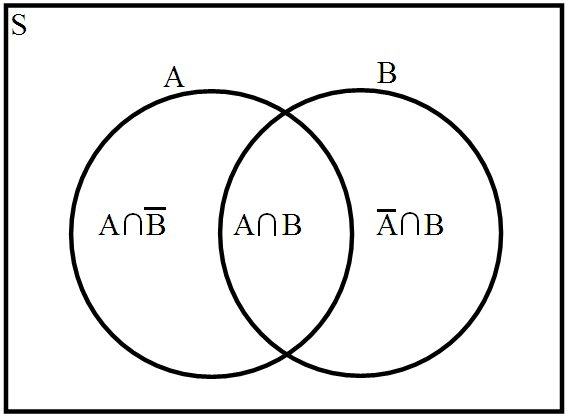
From the diagram, we get $\text{A}\cap\text{B}$ and $\overline{\text{A}}\cap\text{B}$ are mutually exclusive events such that $(\text{A}\cap\text{B})\cup(\overline{\text{A}}\cap\text{B})=\text{B}.$ therefore by
$\text{P}(\text{A}\cap\text{B})+\text{P}(\overline{\text{A}}\cap\text{B})=\text{P(B)}$
$\therefore\ \text{P}(\overline{\text{A}}\cap\text{B})=\text{P(B)}-\text{P}(\text{A}\cap\text{B})$ View full question & answer→MCQ 621 Mark
For the following probability distribution:
| X: |
-4 |
-3 |
-2 |
-1 |
0 |
| P(X): |
0.1 |
0.2 |
0.3 |
0.2 |
0.2 |
The value of E(X) is:
AnswerThe probability distribution of X is given below:
| X: |
-4 |
-3 |
-2 |
-1 |
0 |
| P(X): |
0.1 |
0.2 |
0.3 |
0.2 |
0.2 |
E(X) = (-4) × 0.1 + (-3) × 0.2 + (-2) × 0.3 + (-1) × 0.2 + 0 × 0.2
= -0.4 - 0.6 - 0.6 - 0.2
= -1.8
Hence, the correct alternative is option (d).
View full question & answer→MCQ 631 Mark
Mark the correct alternative in the following question:Which one is not a requirement of a binomial dstribution?
- A
There are 2 outcomes for each trial.
- B
There is a fixed number of trials.
- ✓
The outcomes must be dependent on each other.
- D
The probability of success must be the same for all the trials.
AnswerCorrect option: C. The outcomes must be dependent on each other.
In binomial distribution trails are independent.
View full question & answer→MCQ 641 Mark
Choose the correct answer from the given four options.Which one is not a requirement of a binomial distribution?
AnswerCorrect option: C. The outcomes must be dependent on each othere.
We know that, in a Binomial distribution:
- There are $2$ outcomes of each trail.
- There is a fixed number of trails.
- The probability of success must be the same for all the trails.
View full question & answer→MCQ 651 Mark
The probability that in a year of $22^{nd}$ century chosen at random, there will be $53$ Sunday, is
- A
$\frac{3}{28}$
- B
$\frac{2}{28}$
- ✓
$\frac{7}{28}$
- D
$\frac{5}{28}$
AnswerCorrect option: C. $\frac{7}{28}$
We know a leap year is fallen within $4$ years,
So its probability is $\frac{25}{100}=\frac{1}{4}$
$53^{rd}$ Sunday leap year $=\frac{1}{4}\times\frac{2}{7}=\frac{2}{28}$
Similarly probability of $53^{rd}$ Sunday in a non leap year $=\frac{75}{100}\times\frac{1}{7}=\frac{3}{4}\times\frac{1}{7}=\frac{3}{28}$
Required probability $=\frac{2}{28}+\frac{3}{28}=\frac{5}{28}$.
View full question & answer→MCQ 661 Mark
Choose the correct answer from the given four options.
If A and B are two events such that $\text{P}(\text{A})=\frac{1}{2},\text{P}(\text{B})=\frac{1}{3},$ $\text{P}\Big(\frac{\text{A}}{\text{B}}\Big)=\frac{1}{4},$ then $\text{P}(\text{A}'\cap\text{B}')$ equals:
- A
$\frac{1}{12}$
- B
$\frac{3}{4}$
- ✓
$\frac{1}{4}$
- D
$\frac{3}{16}$
AnswerCorrect option: C. $\frac{1}{4}$
We have, $\text{P}(\text{A})=\frac{1}{2},\text{P}(\text{B})=\frac{1}{3}$ and $\text{P}\Big(\frac{\text{A}}{\text{B}}\Big)=\frac{1}{4}$
$\Rightarrow\text{P}(\text{A}\cap\text{B})=\text{P}\Big(\frac{\text{A}}{\text{B}}\Big)\cdot\text{P}(\text{B})$
$=\frac{1}{4}\cdot\frac{1}{3}=\frac{1}{12}$
Now, $\text{P} ({\text{A}'}\cap{\text{B}'})=1-\text{P}(\text{A}\cup{\text{B}})$
$=1-\big[\text{P}(\text{A})+\text{P}(\text{B})-\text{P}(\text{A}\cap\text{B})\big]$
$=1-\Big[\frac{1}{2}+\frac{1}{3}-\frac{1}{12}\Big]=1-\frac{9}{12}$
$=\frac{3}{12}=\frac{1}{4}$
View full question & answer→MCQ 671 Mark
Probability that A speaks truth is $\frac{4}{5}.$ A coin is tossed. A reports that a head appears. The probability that actually there was head is
- ✓
$\frac{4}{5}$
- B
$\frac{1}{2}$
- C
$\frac{1}{5}$
- D
$\frac{2}{5}$
AnswerCorrect option: A. $\frac{4}{5}$
a.$\frac{4}{5}$
Let A be the event that the man reports that head occurs in tossing a coin and let $E_1$ be the event that head occurs and $E_2$ be the event head does not occur.
$\text{P}(\text{E}_1)=\frac{1}{2},\ \text{P}(\text{E}_2)=\frac{1}{2}$
$\text{P}(\text{A}|\text{E}_1)$ = P(A reports that head occurs when head had actually occur red on the coin) = $\frac{4}{5}$
$\text{P}(\text{A}|\text{E}_2)=$ P(A reports that head occurs when head had not occur red on the coin) $=1-\frac{4}{5}=\frac{1}{5}$
By Bayes’ theorem,
$ \text{P}(\text{E}_1|\text{A})=\frac{\text{P}(\text{E}_1)\text{P}(\text{A}|\text{E}_1)}{\text{P}(\text{E}_1)\text{P}(\text{A}|\text{E}_1)+{\text{P}(\text{E}_2)\text{P}(\text{A}|\text{E}_2)}}=\frac{\frac{1}{2}\times\frac{4}{5}}{\frac{1}{2}\times\frac{4}{5}+\frac{1}{2}\times\frac{1}{5}}=\frac{4}{4+1}=\frac{4}{5}$
Hence, option (A) is correct.
View full question & answer→MCQ 681 Mark
Choose the correct answer from the given four options.
You are given that A and B are two events such that $\text{P}(\text{B})=\frac{3}{5},\text{P}\Big(\frac{\text{A}}{\text{B}}\Big)=\frac{1}{2}$ and $\text{P}(\text{A}\cup\text{B})=\frac{4}{5},$ then P(A) equals:
- A
$\frac{3}{10}$
- B
$\frac{1}{5}$
- ✓
$\frac{1}{2}$
- D
$\frac{3}{5}$
AnswerCorrect option: C. $\frac{1}{2}$
We have, $\text{P}(\text{B})=\frac{3}{5},\text{P}\Big(\frac{\text{A}}{\text{B}}\Big)=\frac{1}{2}$ and $\text{P}(\text{A}\cup\text{B})=\frac{4}{5}$
$\therefore\text{P}(\text{A}\cap\text{B})=\Big(\frac{\text{A}}{\text{B}}\Big)\cdot\text{P}(\text{B})$
$=\frac{1}{2}\cdot\frac{3}{5}=\frac{3}{10}$
Now $\text{P}(\text{A}\cup\text{B})=\text{P}({\text{A}})+\text{P}({\text{B}})\cdot\text{P}(\text{A}\cap\text{B})$
$\Rightarrow\frac{4}{5}=\text{P}(\text{A})+\frac{3}{5}-\frac{3}{10}$
$\therefore\text{P}(\text{A})=\frac{4}{5}-\frac{3}{5}+\frac{3}{10}=\frac{1}{2}$
View full question & answer→MCQ 691 Mark
India play two matches each with West indies and Australia. In any match the probability of india getting $0,1$ and $2$ points are $0.45, 0.05$ and $0.50$ respectively. Assuming that the outcomes are indepecdent, the probability of india getting at least $7$ point.s is
- ✓
$0.0875$
- B
$\frac{1}{16}$
- C
$0.1125$
- D
AnswerCorrect option: A. $0.0875$
Here, there are total $5$ ways by which India can get at least $7$ points.
- $2$ points $+ 2$ points $+ 2$ points $+ 2$ points $= (0.5 \times 0.5 \times 0.5 \times 0.5)$
- $1$ points $+ 2$ points $+ 2$ points $+ 2$ points $= (0.05 \times 0.5 \times 0.5 \times 0.5)$
- $2$ points $+ 1$ points $+ 2$ points $+ 2$ points $= (0.5 \times 0.05 \times 0.5 \times 0.5)$
- $2$ points $+ 2$ points $+ 1$ points $+ 2$ points $= (0.5 \times 0.5 \times 0.05 \times 0.5)$
- $2$ points $+ 2$ points $+ 2$ points $+ 1$ points $= (0.5 \times 0.5 \times 0.5 \times 0.05)$
View full question & answer→MCQ 701 Mark
A bouquet from $11$ different flowers is to be made so that it contains not less then three flowers. Then the number of the different ways of selecting flowers to from the bouquet.
- ✓
$1972$
- B
$1952$
- C
$1981$
- D
$1947$
AnswerCorrect option: A. $1972$
No. of ways $={ }^{11} C_3+{ }^{11} C_4+{ }^{11} C_5+{ }^{11} C_6+{ }^{11} C_7+{ }^{11} C_8+{ }^{11} C_9+{ }^{11} C_{10}+{ }^{11} C_{11}$
$\Rightarrow 165+330+462+462+330+165+55+11+1$
$\Rightarrow 1981$
View full question & answer→MCQ 711 Mark
Choose the correct answer from the given four options. Two dice are thrown. If it is known that the sum of numbers on the dice was less than $6,$ the probability of getting a sum $3,$ is:
- A
$\frac{1}{18}$
- B
$\frac{5}{18}$
- ✓
$\frac{1}{5}$
- D
$\frac{2}{5}$
AnswerCorrect option: C. $\frac{1}{5}$
Let $E_1 =$ Event that the sum of numbers on the dice was less than $6$
And $E_2=$ Event that the sum of numbers on the dice is $3.$
$\therefore E_1 = \{(1, 4), (4, 1), (2, 3), (3, 2), (2, 2), (1, 3), (3, 1), (1, 2), (2, 1), (1, 1)\}$
$\Rightarrow n(E_1) = 10$
And $E_2 = \{(1, 2), (2, 1)\}$
$\Rightarrow n(E_2) = 2$
$\therefore$ Required Probability $=\frac{2}{10}=\frac{1}{5}$
View full question & answer→MCQ 721 Mark
A box contains 3 orange balls, 3 green balls and 2 blue balls. Three balls are drawn at random from the box without replacement. The probability of drawing 22 green balls and one blue ball is
- A
$\frac{167}{168}$
- B
$\frac{1}{28}$
- C
$\frac{2}{21}$
- ✓
$\frac{3}{28}$
AnswerCorrect option: D. $\frac{3}{28}$
Total balls in a box - 3orange + 3green + 2blue = 8
Three balls are drawn at random from the box then samplw space $\text{n(S)}= {^{8}}\text{C}_3=\frac{8\times7\times6}{3\times2\times1}=56$
Let A be the event that drawing 2 green and one blue ball.
$\text{n(A)}={^{3}}\text{C}_2\times{^{2}}\text{C}_2=6$
$\text{P(A)}=\frac{6}{56}=\frac{3}{28}$
View full question & answer→MCQ 731 Mark
A box contain 100 pens of which 10 are defective. What is the probability that out of a sample of 5 pens draws one by one with replacement at most one is defective?
- A
$\big(\frac{9}{10}\big)^5$
- B
$\frac{1}{2}\big(\frac{9}{10}\big)^4$
- C
$\frac{1}{2}\big(\frac{9}{10}\big)^5$
- ✓
$\big(\frac{9}{10}\big)^5+\frac{1}{2}\big(\frac{9}{10}\big)^4$
AnswerCorrect option: D. $\big(\frac{9}{10}\big)^5+\frac{1}{2}\big(\frac{9}{10}\big)^4$
$\text{p}=\frac{10}{100}=\frac{1}{10},\text{q}=\frac{90}{100}=\frac{9}{10},\text{n}=5$
$\text{P(X}\leq1)=\text{P(0)}+\text{P(1)}$
$\text{P(X}\leq1)=\big(\frac{9}{10}\big)^{5}+\text{ }^5\text{C}_1\big(\frac{1}{10}\big)\big(\frac{9}{10}\big)^{4}$
$\text{P(X}\leq1)=\big(\frac{9}{10}\big)^{5}+\big(\frac{1}{2}\big)\big(\frac{9}{10}\big)^4$
View full question & answer→MCQ 741 Mark
If $X$ is a random variable with probability distribution as given below:
| $X = x_i$ |
$0$ |
$1$ |
$2$ |
$3$ |
| $P(X = X_i)$ |
$k$ |
$3k$ |
$3k$ |
$k$ |
The value of $k$ and its variance are: - A
$\frac{1}{8},\frac{22}{27}$
- B
$\frac{1}{8},\frac{23}{27}$
- C
$\frac{1}{8},\frac{24}{27}$
- ✓
$\frac{1}{8},\frac{3}{4}$
AnswerCorrect option: D. $\frac{1}{8},\frac{3}{4}$
$\sum\limits_0^3\text{P}(\text{x})=1$
$\text{k}+3\text{k}+3\text{k}+\text{k}=1$
$\text{k}=\frac{1}{8}$
| $\text{x}$ |
$\text{P}(\text{x})$ |
$\text{x}\text{P}(\text{x})$ |
$\text{x}^2\text{P}(\text{x})$ |
| $0$ |
$\frac{1}{8}$ |
$0$ |
$0$ |
| $1$ |
$\frac{3}{8}$ |
$\frac{3}{8}$ |
$\frac{3}{8}$ |
| $2$ |
$\frac{3}{8}$ |
$\frac{6}{8}$ |
$\frac{12}{8}$ |
| $3$ |
$\frac{1}{8}$ |
$\frac{3}{8}$ |
$\frac{9}{8}$ |
| Total |
|
$\text{E(x)}=\frac{12}{8}=1.5$ |
$\text{E}(\text{x}^2)=3$ |
$\text{V(x)}=\text{E}(\text{x}^2)-[\text{E}(\text{x})^2]$
$\text{V(x)}=3-(1.5)^2$
$\text{V(x)}=0.75=\frac{3}{4}$ View full question & answer→MCQ 751 Mark
A box contains 6 nails and 10 nuts. Half of the nails and half of the nuts are rusted. If one iten is chosen ar random, the probability that it is rusted or is nail is
- A
$\frac{3}{16}$
- B
$\frac{5}{16}$
- ✓
$\frac{11}{16}$
- D
$\frac{14}{16}$
AnswerCorrect option: C. $\frac{11}{16}$
Rusted items = 3 + 5 = 8
Rusted nails = 3
Total nails = 6
P(getting a rusted item or a nail) = P(getting a rusted item) + P(getting a nail) - P(getting a rusted item and a nail)
$=\frac{8}{16}+\frac{6}{16}-\frac{3}{16}$
$=\frac{8+6-3}{16}$
$=\frac{11}{16}$
View full question & answer→MCQ 761 Mark
Let $X$ denote the number of times heads occur in $n$ tosses of a fair coin. If $P(X = 4), P(X = 5)$ and $P(X = 6)$ are in $AP,$ the value of $n$ is:
- ✓
$7, 14$
- B
$10, 14$
- C
$12, 7$
- D
$14, 12$
AnswerCorrect option: A. $7, 14$
$X$ denotes the number of times heads occurs.
$P(X = 4),P(X = 5),P(X = 6)$ are in $AP$
$\Rightarrow2\text{P(X = 4),P(X = 5),P(X = 6)}$
$\Rightarrow2\text{ }^{\text{n}}\text{C}_5\big(\frac{1}{2}\big)^5\big(\frac{1}{2}\big)^{\text{n}-5}=\text{ }^{\text{n}}\text{C}_4\big(\frac{1}{2}\big)^4\big(\frac{1}{2}\big)^{\text{n}-4}\times\text{ }^{\text{n}}\text{C}_6\big(\frac{1}{2}\big)^6\big(\frac{1}{2}\big)^{\text{n}-6}$
$\Rightarrow2\text{ }^{\text{n}}\text{C}_5\big(\frac{1}{2}\big)^{\text{n}}=\text{ }^{\text{n}}\text{C}_4\big(\frac{1}{2}\big)^{\text{n}}+\text{ }^{\text{n}}\text{C}_6\big(\frac{1}{2}\big)^{\text{n}}$
$\Rightarrow2\text{ }^{\text{n}}\text{C}_5=\text{ }^{\text{n}}\text{C}_4+\text{ }^{\text{n}}\text{C}_6$
$\Rightarrow\frac{2\text{n}!}{5!(\text{n}-5)!}=\frac{\text{n}!}{4!(\text{n}-4)!}+\frac{\text{n}!}{6!(\text{n}-6)!}$
$\Rightarrow\frac{2}{5\times4!(\text{n}-5)(\text{n}-6)!}=\frac{1}{4!(\text{n}-4)(\text{n}-5)(\text{n}-6)!}+\frac{1}{6\times5\times4!(\text{n}-6)!}$
$\Rightarrow\frac{2}{5(\text{n}-5)}=\frac{1}{(\text{n}-4)(\text{n}-5)}+\frac{1}{6\times5}$
$\Rightarrow\frac{2}{5(\text{n}-5)}=\frac{30+(\text{n}-4)(\text{n}-5)}{30(\text{n}-4)(\text{n}-5)}$
$\Rightarrow12(\text{n}-4)=30+(\text{n}-4)(\text{n}-5)$
$\Rightarrow12(\text{n}-4)-(\text{n}-4)(\text{n}-5)=30$
$\Rightarrow(\text{n}-4)(12-\text{n}+5)=30$
$\Rightarrow(\text{n}-4)(17-\text{n})=30$
Check with options by putting value of $n.$
$\Rightarrow\text{n}=7,14$
View full question & answer→MCQ 771 Mark
If the events A and B are independent, then $\text{P}(\text{A}\cap\text{B})$ is equal to,
Answer$\text{P}(\text{A}\cap\text{B})=\text{P(A)} \text{ P(B)}$ for independent events.
View full question & answer→MCQ 781 Mark
If the random variable X has the following distribution:
| X: |
0 |
1 |
2 |
3 |
4 |
5 |
6 |
7 |
8 |
| P(X): |
a |
3a |
5a |
7a |
9a |
11a |
13a |
15a |
17a |
then the value of a is:
- A
$\frac{7}{81}$
- B
$\frac{5}{81}$
- C
$\frac{2}{81}$
- ✓
$\frac{1}{81}$
AnswerCorrect option: D. $\frac{1}{81}$
We know that the sum of probsabilities in a probability distribution is always 1.
$\therefore$ P(X = 0) + P(X = 1) + P(X = 2) + P(X = 3) + P(X = 4) + P(X = 5) + P(X = 6) + P(X = 7) + P(X = 8) = 1
⇒ a + 3a+ 5a+ 7a+ 9a + 11a + 13a + 15a + 17a = 1
⇒ 81a = 1
$\Rightarrow\text{a}=\frac{1}{81}$
View full question & answer→MCQ 791 Mark
If A and B are two events associated to a random experiment such that $\text{P}(\text{A}\cap\text{B})=\frac{7}{10}$ and $\text{P(B)}=\frac{17}{20}$, then P(A|B) =
- ✓
$\frac{14}{17}$
- B
$\frac{17}{20}$
- C
$\frac{7}{8}$
- D
$\frac{1}{8}$
AnswerCorrect option: A. $\frac{14}{17}$
$\text{P}(\text{A}\cap\text{B})=-\frac{7}{10},\text{P(B)}=\frac{17}{20}$
$\text{P}\Big(\frac{\text{A}}{\text{B}}\Big)=\frac{\text{P}(\text{A}\cap\text{B})}{\text{P(B)}}$
$\text{P}\Big(\frac{\text{A}}{\text{B}}\Big)=\frac{\frac{7}{10}}{\frac{17}{20}}=\frac{14}{17}$
View full question & answer→MCQ 801 Mark
A biased coin with probabilty p, 0 < p < 1, of heads is tossed until a head appears for the first time. If the probability that the number of tosses required is even is $\frac{2}{5},$ then p equals:
- ✓
$\frac{1}{3}$
- B
$\frac{2}{3}$
- C
$\frac{2}{5}$
- D
$\frac{3}{5}$
AnswerCorrect option: A. $\frac{1}{3}$
p is the probability of getting head.
q = 1 - p is the probability of getting tail.
The number of tosses required is even.
$\Rightarrow\text{qp+q}^3\text{p+q}^5\text{p+q}^7\text{p+q}^9\text{p}\dots$
$\Rightarrow\text{qp}\Big(\frac{1}{1-\text{q}^2}\Big)$
$\Rightarrow\frac{(1-\text{p})\text{p}}{1-(1-\text{p})^2}$
$\Rightarrow\frac{(1-\text{p})\text{p}}{1-(1-2\text{p + p}^2)}$
$\Rightarrow\frac{1-\text{p}}{2-\text{p}}$
Given $\frac{1-\text{p}}{2-\text{p}}=\frac{2}{5}$
$\Rightarrow\text{p}=\frac{1}{3}$
View full question & answer→MCQ 811 Mark
If A and B are two events such that $\text{P}(\text{A}|\text{B})=\text{p},\text{P(A)}=\text{p},\text{P(B)}=\frac{1}{3}$ and $\text{P}(\text{A}\cup\text{B})=\frac{5}{9},$ then p =
- A
$\frac{2}{3}$
- B
$\frac{3}{5}$
- ✓
$\frac{1}{3}$
- D
$\frac{3}{4}$
AnswerCorrect option: C. $\frac{1}{3}$
$\text{P}\Big(\frac{\text{A}}{\text{B}}\Big)=\text{p},\text{P(A)}=\text{p},\text{P(B)}=\frac{1}{3},\text{P}(\text{A}\cup\text{B})=\frac{5}{9}$
Consider,
$\text{P}\Big(\frac{\text{A}}{\text{B}}\Big)=\text{p}$
$\Rightarrow \frac{\text{P}(\text{A}\cap\text{B})}{\text{P(B)}}=\text{P}$
$\Rightarrow \frac{\text{P(A)}+\text{P(B)}-\text{P}(\text{A}\cup\text{B})}{\text{P(B)}}=\text{P}$
$\Rightarrow\frac{\text{p}+\frac{1}{3}-\frac{5}{9}}{\frac{1}{3}}=\text{p}$
$\Rightarrow\text{p}+\frac{1}{3}-\frac{5}{9}=\frac{\text{p}}{3}$
$\Rightarrow\frac{-2}{9}=\frac{\text{p}}{3}-\text{p}$
$=\frac{-2}{3}\text{p}=\frac{-2}{9}$
$\Rightarrow\text{p}=\frac{1}{3}$
View full question & answer→MCQ 821 Mark
Choose the correct answer from the given four options.
If A and B are two events and $\text{A}\neq\phi,\text{B}\neq\phi,$ then:
- A
$\text{P}\Big(\frac{\text{A}}{\text{B}}\Big)=\text{P}(\text{A})\cdot\text{P}(\text{B})$
- ✓
$\text{P}\Big(\frac{\text{A}}{\text{B}}\Big)=\frac{\text{P}(\text{A}\cap\text{B})}{\text{P}(\text{B})}$
- C
$\text{P}\Big(\frac{\text{A}}{\text{B}}\Big)\cdot\text{P}\Big(\frac{\text{B}}{\text{A}}\Big)=1$
- D
$\text{P}\Big(\frac{\text{A}}{\text{B}}\Big)=\text{P}\Big(\frac{\text{A}}{\text{B}}\Big)$
AnswerCorrect option: B. $\text{P}\Big(\frac{\text{A}}{\text{B}}\Big)=\frac{\text{P}(\text{A}\cap\text{B})}{\text{P}(\text{B})}$
If $\text{A}\neq\phi,\text{B}\neq\phi,$ then $\text{P}\Big(\frac{\text{A}}{\text{B}}\Big)=\frac{\text{P}(\text{A}\cap\text{B})}{\text{P}(\text{B})}$
View full question & answer→MCQ 831 Mark
A pack of playing cards was found to contain only 51 cards. If the first 13 cards which are examined are all red, then the probability thatthe missing card is black, is:
AnswerCorrect option: B. $\frac23$
Total number of cards = 52
Number of lost cards = 1
13 cards are surley red therfore, from the remaining 39 cards 26 are black and 13 are red.
So probabilityof lost card being black $=\frac{(261)}{(391)}=\frac{26}{39}=\frac{2}{3}$
View full question & answer→MCQ 841 Mark
Choose the correct answer from the given four options:
let $\text{P}(\text{A})=\frac{7}{13},\text{P}(\text{B})=\frac{9}{13}$ and $\text{P}(\text{A}\cup\text{B})=\frac{4}{13}.$ Then $\text{P}\Big(\frac{\text{A'}}{\text{B}}\Big)$ is equal to:
- A
$\frac{6}{13}$
- B
$\frac{4}{13}$
- C
$\frac{4}{9}$
- ✓
$\frac{5}{9}$
AnswerCorrect option: D. $\frac{5}{9}$
Here, $\text{P}(\text{A})=\frac{7}{13},\text{P}(\text{B})=\frac{9}{13}$ and $\text{P}(\text{A}\cup\text{B})=\frac{4}{13}$
$\therefore\text{P}\Big(\frac{\text{A}'}{\text{B}}\Big)=\frac{\text{P}(\text{A}'\cap\text{B})}{\text{P}(\text{B})}=\frac{\text{P}(\text{B})-\text{P}(\text{A}\cap\text{B})}{\text{P}(\text{B})}$
$=\frac{\frac{9}{13}-\frac{4}{13}}{\frac{9}{13}}=\frac{\frac{5}{13}}{\frac{9}{13}}=\frac{5}{9}$
View full question & answer→MCQ 851 Mark
A flash light has 8 batteries out of which 3 are dead. IF two batteries are selected without replacement and tested, then the probability that both are dead is,
- ✓
$\frac{3}{28}$
- B
$\frac{1}{14}$
- C
$\frac{9}{64}$
- D
$\frac{33}{56}$
AnswerCorrect option: A. $\frac{3}{28}$
We have,
The total number of batteries = 8
The number of dead batteries = 3
Let A be the event of selecting the first dead battery and B be the event of selecting the second dead battery.
Now,
P(both dead batteries are selected) $=\text{P}(\text{A}\cap\text{B})$
$=\text{P(A)}\times\text{P}(\text{B}|\text{A})$
$=\frac{3}{8}\times\frac{2}{7}$
$=\frac{3}{28}$
Hence, the correct alternative is option (a).
View full question & answer→MCQ 861 Mark
Associated to a random experiment two events A and B are such that $\text{P(B)}=\frac{3}{5},\text{P}(\text{A}|\text{B})=\frac{1}{2}$ and $\text{P}(\text{A}\cup\text{B})=\frac{4}{5}$. The value pf P(A) is
- A
$\frac{3}{10}$
- ✓
$\frac{1}{2}$
- C
$\frac{1}{10}$
- D
$\frac{3}{5}$
AnswerCorrect option: B. $\frac{1}{2}$
$\text{P(B)}=\frac{3}{5},\text{P}\Big(\frac{\text{A}}{\text{B}}\Big)=\frac{1}{2},\text{P}(\text{A}\cup\text{B})=\frac{4}{5}$
$\text{P}\Big(\frac{\text{A}}{\text{B}}\Big)=\frac{1}{2}$
$\frac{\text{P}(\text{A}\cap\text{B})}{\text{P(B)}}=\frac{1}{2}$
$\frac{\text{P}(\text{A}\cap\text{B})}{\frac{3}{5}}=\frac{1}{2}$
$\text{P}(\text{A}\cap\text{B})=\frac{3}{10}$
$\text{P(A)}+\text{P(B)}-\text{P}(\text{A}\cup\text{B})=\frac{3}{10}$
$\text{P(A)}+\frac{3}{5}-\frac{4}{5}=\frac{3}{10}$
$\text{P(A)}=\frac{1}{2}$
View full question & answer→MCQ 871 Mark
Let X represent the difference between the number of heads and the number of tails obtained when a coin is tossed 6 times. What are possible values of X?
AnswerA coin is tossed six times and X represents the difference between the number of heads and the number of tails.
$\therefore$ X(6H, 0T)=∣6 - 0∣ = 6
X(5H, 1T) = ∣5 - 1∣ = 4
X(4H, 2T) = ∣4 - 2∣ = 2
X(3H, 3T) = ∣3 - 3∣ = 0
X(2H, 4T) = ∣2 - 4∣ = 2
X(1H, 5T) = ∣1 - 5∣ = 4
X(0H, 6T) = ∣0 - 6∣ = 6
Thus, the possible values of X are 0, 2, 4 and 6.
View full question & answer→MCQ 881 Mark
Fifteen coupons are numbered $1$ to $15$. Seven coupons are selected at random one at a time with replacement. The probability that the largest number appearing on a selected coupon is $9$ is:
- A
$\big(\frac{3}{7}\big)^7$
- B
$\big(\frac{1}{15}\big)^7$
- C
$\big(\frac{8}{15}\big)^7$
- ✓
AnswerThe sample space $= 15^7$ for selecting seven coupons from $15$ coupons.
Maximum number on selected coupon is $9$ can be made by $9^7$ ways.
A number selected on second card is less than $9$ can be made by $8^7$ ways.
Required probability $=\frac{9^7-8^7}{15^7}$
View full question & answer→MCQ 891 Mark
A box contains 10 good articles and 6 with defects. One item is drawn at random. The probability that it is either good or has a defect is,
- ✓
$\frac{64}{64}$
- B
$\frac{49}{64}$
- C
$\frac{40}{64}$
- D
$\frac{24}{64}$
AnswerCorrect option: A. $\frac{64}{64}$
P(good item) $=\frac{10}{16}$
P(defected item) $=\frac{6}{16}$
P(eitherr good or defected item) = P(good item) + P(defected item)
$=\frac{10}{16}+\frac{6}{16}$
$=\frac{16}{16}$
$=1$
$=\frac{64}{64}$
View full question & answer→MCQ 901 Mark
If A and B are two events such that $\text{P(A)}=\frac{1}{2},\text{P(B)}=\frac{1}{3},\text{P}(\text{A}|\text{B})=\frac{1}{4},$ then $\text{P}(\overline{\text{A}}\cap\overline{\text{B}})$ equals.
- ✓
$\frac{1}{12}$
- B
$\frac{3}{4}$
- C
$\frac{1}{4}$
- D
$\frac{3}{16}$
AnswerCorrect option: A. $\frac{1}{12}$
$\text{P(A)}=\frac{1}{2},\text{P(B)}=\frac{1}{3},\text{P}\Big(\frac{\text{A}}{\text{B}}\Big)=\frac{1}{4}$
$\text{P}\Big(\frac{\text{A}}{\text{B}}\Big)=\frac{1}{4}$
$\frac{\text{P}(\text{A}\cap\text{B})}{\text{P(B)}}=\frac{1}{4}$
$\frac{\text{P}(\text{A}\cap\text{B})}{\frac{1}{3}}=\frac{1}{4}$
$\text{P}(\text{A}\cap\text{B})=\frac{1}{12}$
$\text{P}\Big(\frac{\text{A}}{\text{B}}\Big)=\frac{\text{P}(\text{A}\cap\text{B})}{\text{P(B)}}$
$\Rightarrow\ \text{P}\Big(\frac{\text{A}}{\text{B}}\Big)=\frac{\frac{1}{12}}{\frac{1}{3}}=\frac{1}{4}$
$\text{P}(\overline{\text{A}}\cap\overline{\text{B}})=\text{P}(\overline{\text{A}\cup\text{B}})$
$\text{P}(\overline{\text{A}}\cap\overline{\text{B}})=1-\text{P}(\text{A}\cup\text{B})$
$\text{P}(\overline{\text{A}}\cap\overline{\text{B}})=-1\big[\text{P(A)}+\text{P(B)}-\text{P}(\text{A}\cap\text{B})\big]$
$\text{P}(\overline{\text{A}}\cap\overline{\text{B}})=1-\Big[\frac{1}{2}+\frac{1}{3}-\frac{1}{12}\Big]$
$\text{P}(\overline{\text{A}}\cap\overline{\text{B}})=\frac{1}{4}$
View full question & answer→MCQ 911 Mark
A and B draw two cards each, one after another, from a pack of well-shuffled pack of 52 cards. The probability that all the four cards drawn are of the same suit is
AnswerCorrect option: A. $\frac{44}{85\times49}$
Total cards = 52 There are four suits of cards in a pack, i.e. diamond, heart, spade and club.
Pall 4 cards are of same suit = Pall 4 cards are of diamond + Pall 4 cards are of heart + Pall 4 cards are of spade + Pall 4 cards are of club.
$=4\times\frac{13}{52}\times\frac{12}{51}\times\frac{11}{50}\times\frac{10}{59}$
$=4\times\frac{11}{85\times49}$
$=\frac{44}{85\times49}$
View full question & answer→MCQ 921 Mark
Mark the correct alternative in the following question:The probability of guessing correctly at least 8 out of 10 answers of a true false type examination is:
- A
$\frac{7}{64}$
- ✓
$\frac{7}{128}$
- C
$\frac{45}{1024}$
- D
$\frac{7}{41}$
AnswerCorrect option: B. $\frac{7}{128}$
$\text{n}=10,\text{p = q}=\frac{1}{2}$
$\text{P(X}\geq8)=\text{P(8) + P(9) + P(10)}$
$\text{P(X}\geq8)=\text{ }^{10}\text{C}_8\big(\frac{1}{2}\big)^{10}+\text{ }^{10}\text{C}_{9}\big(\frac{1}{2}\big)^{10}+\text{ }^{10}\text{C}_{10}\big(\frac{1}{2}\big)^{10}$
$\text{P(X}\geq8)=\frac{45+10+1}{2^8}$
$\text{P(X}\geq8)=\frac{56}{256}=\frac{7}{128}$
View full question & answer→MCQ 931 Mark
Choose the correct answer from the given four options. A box contains 3 orange balls, 3 green balls and 2 blue balls. Three balls are drawn at random from the box without replacement. The probability of drawing 2 green balls and one blue ball is:
- ✓
$\frac{3}{28}$
- B
$\frac{2}{21}$
- C
$\frac{1}{28}$
- D
$\frac{167}{168}$
AnswerCorrect option: A. $\frac{3}{28}$
Probability of drawing 2 green balls and one blue ball
$=\text{P}_\text{G}\cdot\text{P}_\text{G}\cdot\text{P}_\text{B}+\text{P}_\text{B}\cdot\text{P}_\text{G}\cdot\text{P}_\text{G}+\text{P}_\text{G}\cdot\text{P}_\text{B}\cdot\text{P}_\text{G}$
$=\frac{3}{8}\cdot\frac{2}{7}\cdot\frac{2}{6}+\frac{2}{8}\cdot\frac{3}{7}\cdot\frac{2}{6}+\frac{3}{8}\cdot\frac{2}{7}\cdot\frac{2}{6}$
$=\frac{1}{28}+\frac{1}{28}+\frac{1}{28}=\frac{3}{28}$
View full question & answer→MCQ 941 Mark
If A and B are two events such that $\text{P(A)}=\frac{4}{5},$ and $\text{P}(\text{A}\cap\text{B})=\frac{7}{10},$ then P(B|A) =
- A
$\frac{1}{10}$
- B
$\frac{1}{8}$
- ✓
$\frac{7}{8}$
- D
$\frac{17}{20}$
AnswerCorrect option: C. $\frac{7}{8}$
We have,
$\text{P(A)}=\frac{4}{5}$ and $\text{P}(\text{A}\cap\text{B})=\frac{7}{10}$
Now,
$\text{P}(\text{B}|\text{A})=\frac{\text{P}(\text{A}\cap\text{B})}{\text{P(A)}}$
$=\frac{\Big(\frac{7}{10}\Big)}{\Big(\frac{4}{5}\Big)}$
$=\frac{7\times5}{10\times4}$
$=\frac{7}{8}$
Hence, the correct alternative is option (c).
View full question & answer→MCQ 951 Mark
If A and B are two independent events such that P(A) = 0.3 and $\text{P}(\text{A}\cup\text{B})=0.5,$ then P(A|B) - P(B|A) =
- A
$\frac{2}{7}$
- B
$\frac{3}{35}$
- ✓
$\frac{1}{70}$
- D
$\frac{1}{7}$
AnswerCorrect option: C. $\frac{1}{70}$
We have,
$\text{P(A)}=0.3$ and $\text{P}(\text{A}\cup\text{B})=0.5$
As, A and B are independent events
So, $\text{P}(\text{A}\cap\text{B})=\text{P(A)}\times\text{P(B)}$
$=0.3\times\text{P(B)}$
$=0.3\text{ P(B)}\ .....\text{(i)}$
Also, $\text{P}(\text{A}\cup\text{B})=\text{P(A)}+\text{P(B)}-\text{P}(\text{A}\cap\text{B})$
$\Rightarrow 0.5 = 0.3+\text{P(B)}-0.3\text{ P(B)}$ [Using (i)]
$\Rightarrow 0.5-0.3 = 0.7\text{ P(B)}$
$\Rightarrow0.7\text{ P(B)}=0.2$
$\Rightarrow\text{ P(B)}=\frac{0.2}{0.7}$
$\Rightarrow\text{ P(B)}=\frac{2}{7}$
Using (i), we get
$\text{P}(\text{A}\cap\text{B})=0.3\times\frac{2}{7}=\frac{6}{70}$
Now,
$\text{P}(\text{A}|\text{B})-\text{P}(\text{B}|\text{A})=\frac{\text{P}(\text{A}\cap\text{B})}{\text{P(B)}}-\frac{\text{P}(\text{A}\cap\text{B})}{\text{P(A)}}$
$=\frac{\Big(\frac{6}{70}\Big)}{\Big(\frac{2}{7}\Big)}-\frac{\Big(\frac{6}{70}\Big)}{0.3}$
$=\frac{6\times7}{70\times2}-\frac{6}{70\times0.3}$
$=\frac{3}{10}-\frac{2}{7}$
$=\frac{21-20}{70}$
$=\frac{1}{70}$
Hence, the correct alternative is option (c).
View full question & answer→MCQ 961 Mark
A fair die is tossed eight times. The probability that a third six is observed in the eight throw is:
- A
$\frac{\text{ }^7\text{C}_2\times5^5}{6^7}$
- ✓
$\frac{\text{ }^7\text{C}_2\times5^5}{6^8}$
- C
$\frac{\text{ }^7\text{C}_2\times5^5}{6^6}$
- D
$\text{None of these}$
AnswerCorrect option: B. $\frac{\text{ }^7\text{C}_2\times5^5}{6^8}$
probability of getting $6=\text{p}=\frac{1}{6},\text{q}=\frac{5}{6}$
probability of getting third six in eight throw.
= probability of getting 2 sixes in first seven throw + probability of getting six in eight throw
$=\Big(\text{ }^7\text{C}_2\big(\frac{1}{6}\big)^2\big(\frac{5}{6}\big)^5\Big)\big(\frac{1}{6}\big)$
$=\frac{\text{ }^7\text{C}_2\times5^5}{6^8}$
View full question & answer→MCQ 971 Mark
A bag contain 4 white and 2 black balls. Two balls are drawn at random. The probability that they are of the same colour is ________.
- A
$\frac{5}{7}$
- B
$\frac{1}{7}$
- ✓
$\frac{7}{15}$
- D
$\frac{1}{15}$
AnswerCorrect option: C. $\frac{7}{15}$
We assume that there are 4 white balls and 2 black balls.
There are $\big(\frac{6}{2}\big)=15$ total possible ways of drawing two balls from these given 6 balls.
We are interested in the event where the two drawn balls are of the same colour.
For this, we note that the number of ways of drawing 2 white balls is $\big(\frac{4}{2}\big)=6$ whereas the number of ways of drawing 2 black balls is$\big(\frac{2}{2}\big)=1.$
So, the probability that the two drawn balls are of the same colour is $\frac{6+1}{15}=\frac{7}{15}.$
View full question & answer→MCQ 981 Mark
If in a binomial distribution $\text{n}=4,\text{P(X}=0)=\frac{16}{81},$ then $\text{P(X}=4)$ equals:
- A
$\frac{1}{16}$
- ✓
$\frac{1}{81}$
- C
$\frac{1}{27}$
- D
$\frac{1}{8}$
AnswerCorrect option: B. $\frac{1}{81}$
Given $\text{n}=4,\text{P(X}=0)=\frac{16}{81}$
$\text{P(X}=0)=\frac{16}{81}$
$\text{ }^5\text{C}_0\text{p}^0\text{q}^4=\frac{16}{81}$
$\text{q}^4=\frac{16}{81}$
$\text{q}=\frac{2}{3}\Rightarrow\text{p}=\frac{1}{3}$
$\Rightarrow\text{P(X}=4)=\text{ }^5\text{C}_4\big(\frac{1}{4}\big)^4=\frac{1}{81}$
View full question & answer→MCQ 991 Mark
Choose the correct answer from the given four options.Three persons, A, B and C, fire at a target in turn, starting with A. Their probability
of hitting the target are 0.4, 0.3 and 0.2 respectively. The probability of two hits
is:
AnswerWe have
$\text{P}(\text{A})=0.4,\text{P}(\bar{\text{A}})=0.6,\text{P}(\text{B})=0.3,\text{P}(\bar{\text{B}})=0.7$
$\text{P}(\text{C})=0.2$ and $\text{P}(\bar{\text{C}})=0.8$
$\therefore$ Probability of two hits $=\text{P}_{\text{A}}\cdot\text{P}_{\text{B}}\cdot\text{P}_{\bar{\text{C}}}+\text{P}_{\text{A}}\cdot\text{P}{_\bar{\text{B}}}\cdot\text{P}_{\text{C}}+\text{P}{_\bar{\text{A}}}\cdot\text{P}_{\text{B}}\cdot\text{P}_{\text{C}}$
$=0.4\times0.3\times0.8+0.4\times0.7\times0.2+0.6\times0.3\times0.2$
$=0.096+0.056+0.036=0.188$
View full question & answer→MCQ 1001 Mark
In a class, 40% of the students study math and science. 60% of the students study math. What is the probability of a student studying science given he/she is already studying math?
AnswerP(M and S) = 0.40
P(M) = 0.60
$\text{P(S|M})=\frac{\text{P (M and S)}}{\text{P(S)}}=\frac{0.40}{0.60}=\frac23=0.67$
View full question & answer→