MCQ 11 Mark
Assertion : For the scattering of a-particles at a large angles, only the nucleus of the atom is responsible.
Reason : Nucleus is very heavy in comparison to electrons.
- ✓
If both assertion and reason are true and the reason is the correct explanation of the assertion.
- B
If both assertion and reason are true but reason is not the correct explanation of the assertion.
- C
If assertion is true but reason is false.
- D
If the assertion and reason both are false.
AnswerCorrect option: A. If both assertion and reason are true and the reason is the correct explanation of the assertion.
If both assertion and reason are true and the reason is the correct explanation of the assertion.
View full question & answer→MCQ 21 Mark
Assertion : Electron capture occurs more often than positron emission in heavy elements.
Reason : Heavy elements exhibit radioactivity.
- A
If both assertion and reason are true and the reason is the correct explanation of the assertion.
- ✓
If both assertion and reason are true but reason is not the correct explanation of the assertion.
- C
If assertion is true but reason is false.
- D
If the assertion and reason both are false.
AnswerCorrect option: B. If both assertion and reason are true but reason is not the correct explanation of the assertion.
If both assertion and reason are true but reason is not the correct explanation of the assertion.
View full question & answer→MCQ 31 Mark
Assertion : Fragments produced in the fission of $\mathrm{U}^{235}$ are radioactive.
Reason : The fragments have abnormally high proton to neutron ratio.
- A
If both assertion and reason are true and the reason is the correct explanation of the assertion.
- B
If both assertion and reason are true but reason is not the correct explanation of the assertion.
- ✓
If assertion is true but reason is false.
- D
If the assertion and reason both are false.
AnswerCorrect option: C. If assertion is true but reason is false.
(c) If assertion is true but reason is false.
View full question & answer→MCQ 41 Mark
Assertion : Radioactivity of $10^8$ undecayed radioactive nuclei of half life of 50 days is equal to that of $1.2 \times 10^8$ number of undecayed nuclei of some other material with half life of 60 days
Reason : Radioactivity is proportional to half-life.
- A
If both assertion and reason are true and the reason is the correct explanation of the assertion.
- B
If both assertion and reason are true but reason is not the correct explanation of the assertion.
- ✓
If assertion is true but reason is false.
- D
If the assertion and reason both are false.
AnswerCorrect option: C. If assertion is true but reason is false.
(c) If assertion is true but reason is false.
View full question & answer→MCQ 51 Mark
Assertion : The mass of b-particles when they are emitted is higher than the mass of electrons obtained by other means.
Reason : b-particle and electron, both are similar particles.
- A
If both assertion and reason are true and the reason is the correct explanation of the assertion.
- ✓
If both assertion and reason are true but reason is not the correct explanation of the assertion.
- C
If assertion is true but reason is false.
- D
If the assertion and reason both are false.
AnswerCorrect option: B. If both assertion and reason are true but reason is not the correct explanation of the assertion.
If both assertion and reason are true but reason is not the correct explanation of the assertion.
View full question & answer→MCQ 61 Mark
Assertion : The ionising power of b-particle is less compared to a-particles but their penetrating power is more.
Reason : The mass of b-particle is less than the mass of a-particle.
- A
If both assertion and reason are true and the reason is the correct explanation of the assertion.
- ✓
If both assertion and reason are true but reason is not the correct explanation of the assertion.
- C
If assertion is true but reason is false.
- D
If the assertion and reason both are false.
AnswerCorrect option: B. If both assertion and reason are true but reason is not the correct explanation of the assertion.
If both assertion and reason are true but reason is not the correct explanation of the assertion.
View full question & answer→MCQ 71 Mark
Assertion : Amongst alpha, beta and gamma rays, a-particle has maximum penetrating power.
Reason : The alpha particle is heavier than beta and gamma rays.
- A
If both assertion and reason are true and the reason is the correct explanation of the assertion.
- B
If both assertion and reason are true but reason is not the correct explanation of the assertion.
- C
If assertion is true but reason is false.
- ✓
If the assertion and reason both are false.
AnswerCorrect option: D. If the assertion and reason both are false.
If the assertion and reason both are false.
View full question & answer→MCQ 81 Mark
Assertion : All the radioactive elements are ultimately converted in lead.
Reason : All the elements above lead are unstable.
- A
If both assertion and reason are true and the reason is the correct explanation of the assertion.
- B
If both assertion and reason are true but reason is not the correct explanation of the assertion.
- ✓
If assertion is true but reason is false.
- D
If the assertion and reason both are false.
AnswerCorrect option: C. If assertion is true but reason is false.
If assertion is true but reason is false.
View full question & answer→MCQ 91 Mark
The ratio of radii of nuclei $13^{\mathrm{Al}^{27}}$ and $52^{x^A}$ is 3 : 5. The number of neutrons in the nuclei of X will be
View full question & answer→MCQ 101 Mark
Assertio : Hydrogen atom consists of only one electron but its emission spectrum has many lines.
Reason : Only Lyman series is found in the absorption spectrum of hydrogen atom whereas in the emission spectrum, all the series are found.
- A
If both assertion and reason are true and the reason is the correct explanation of the assertion.
- ✓
If both assertion and reason are true but reason is not the correct explanation of the assertion.
- C
If assertion is true but reason is false.
- D
If the assertion and reason both are false.
AnswerCorrect option: B. If both assertion and reason are true but reason is not the correct explanation of the assertion.
If both assertion and reason are true but reason is not the correct explanation of the assertion.
View full question & answer→MCQ 111 Mark
Assertion : The electron in the hydrogen atom passes from energy level n = 4 to the n = 1 level. The maximum and minimum number of photon that can be emitted are six and one respectively.
Reason : The photons are emitted when electron make a transition from the higher energy state to the lower energy state.
- A
If both assertion and reason are true and the reason is the correct explanation of the assertion.
- ✓
If both assertion and reason are true but reason is not the correct explanation of the assertion.
- C
If assertion is true but reason is false.
- D
If the assertion and reason both are false.
AnswerCorrect option: B. If both assertion and reason are true but reason is not the correct explanation of the assertion.
If both assertion and reason are true but reason is not the correct explanation of the assertion.
View full question & answer→MCQ 121 Mark
Assertion : According to classical theory, the proposed path of an electron in Rutherford atom model will be parabolic.
Reason : According to electromagnetic theory an accelerated particle continuously emits radiation.
- A
If both assertion and reason are true and the reason is the correct explanation of the assertion.
- B
If both assertion and reason are true but reason is not the correct explanation of the assertion.
- C
If assertion is true but reason is false.
- ✓
If assertion is false but reason is true.
AnswerCorrect option: D. If assertion is false but reason is true.
If assertion is false but reason is true.
View full question & answer→MCQ 131 Mark
Assertion : The positively charged nucleus of an atom has a radius of almost $10^{-15} \mathrm{~m}$.
Reason : In a-particle scattering experiment, the distance of closest approach for a-particles is $\simeq 10^{-15} \mathrm{~m}$
- ✓
If both assertion and reason are true and the reason is the correct explanation of the assertion.
- B
If both assertion and reason are true but reason is not the correct explanation of the assertion.
- C
If assertion is true but reason is false.
- D
If the assertion and reason both are false.
AnswerCorrect option: A. If both assertion and reason are true and the reason is the correct explanation of the assertion.
(a) If both assertion and reason are true and the reason is the correct explanation of the assertion.
View full question & answer→MCQ 141 Mark
Assertion : The force of repulsion between atomic nucleus and a-particle varies with distance according to inverse square law.
Reason : Rutherford did a-particle scattering experiment.
- A
If both assertion and reason are true and the reason is the correct explanation of the assertion.
- ✓
If both assertion and reason are true but reason is not the correct explanation of the assertion.
- C
If assertion is true but reason is false.
- D
If the assertion and reason both are false.
AnswerCorrect option: B. If both assertion and reason are true but reason is not the correct explanation of the assertion.
If both assertion and reason are true but reason is not the correct explanation of the assertion.
View full question & answer→MCQ 151 Mark
Assertion : Isobars are the element having same mass number but different atomic number.
Reason : Neutrons and protons are present inside nucleus.
- A
If both assertion and reason are true and the reason is the correct explanation of the assertion.
- ✓
If both assertion and reason are true but reason is not the correct explanation of the assertion.
- C
If assertion is true but reason is false.
- D
If the assertion and reason both are false.
AnswerCorrect option: B. If both assertion and reason are true but reason is not the correct explanation of the assertion.
If both assertion and reason are true but reason is not the correct explanation of the assertion.
View full question & answer→MCQ 161 Mark
Assertion : Density of all the nuclei is same.
Reason : Radius of nucleus is directly proportional to the cube root of mass number.
- ✓
If both assertion and reason are true and the reason is the correct explanation of the assertion.
- B
If both assertion and reason are true but reason is not the correct explanation of the assertion.
- C
If assertion is true but reason is false.
- D
If the assertion and reason both are false.
AnswerCorrect option: A. If both assertion and reason are true and the reason is the correct explanation of the assertion.
If both assertion and reason are true and the reason is the correct explanation of the assertion.
View full question & answer→MCQ 171 Mark
Assertion : Radioactive nuclei emit $\beta^{-1}$ particles.
Reason : Electrons exist inside the nucleus.
- A
If both assertion and reason are true and the reason is the correct explanation of the assertion.
- B
If both assertion and reason are true but reason is not the correct explanation of the assertion.
- ✓
If assertion is true but reason is false.
- D
If the assertion and reason both are false.
AnswerCorrect option: C. If assertion is true but reason is false.
(c) If assertion is true but reason is false.
View full question & answer→MCQ 181 Mark
Assertion : Bohr had to postulate that the electrons in stationary orbits around the nucleus do not radiate.
Reason : According to classical physics all moving electrons radiate.
- A
If both assertion and reason are true and the reason is the correct explanation of the assertion.
- ✓
If both assertion and reason are true but reason is not the correct explanation of the assertion.
- C
If assertion is true but reason is false.
- D
If the assertion and reason both are false.
AnswerCorrect option: B. If both assertion and reason are true but reason is not the correct explanation of the assertion.
If both assertion and reason are true but reason is not the correct explanation of the assertion.
View full question & answer→MCQ 191 Mark
Assertion : Neutrons penetrate matter more readily as compared to protons.
Reason : Neutrons are slightly more massive than protons.
- A
If both assertion and reason are true and the reason is the correct explanation of the assertion.
- ✓
If both assertion and reason are true but reason is not the correct explanation of the assertion.
- C
If assertion is true but reason is false.
- D
If the assertion and reason both are false.
AnswerCorrect option: B. If both assertion and reason are true but reason is not the correct explanation of the assertion.
If both assertion and reason are true but reason is not the correct explanation of the assertion.
View full question & answer→MCQ 201 Mark
Assertion : $90_{\mathrm{Sr}}$ from the radioactive fall out from a nuclear bomb ends up in the bones of human beings through the milk consumed by them. It causes impairment of the production of red blood cells.
Reason : The energetics b-particles emitted in the decay of $90_{\mathrm{Sr}}$ damage the bone marrow.
- ✓
If both assertion and reason are true and the reason is the correct explanation of the assertion.
- B
If both assertion and reason are true but reason is not the correct explanation of the assertion.
- C
If assertion is true but reason is false.
- D
If the assertion and reason both are false.
AnswerCorrect option: A. If both assertion and reason are true and the reason is the correct explanation of the assertion.
(a) If both assertion and reason are true and the reason is the correct explanation of the assertion.
View full question & answer→MCQ 211 Mark
The figure shows a graph between ln$\left|\frac{A_n}{A_1}\right|$ and ln|n|, where $A_n$ is the area enclosed by the nth orbit in a hydrogen like atom. The correct curve is
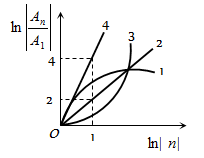
View full question & answer→MCQ 221 Mark
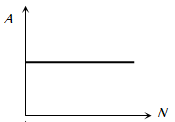
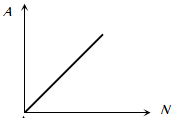
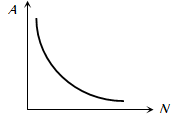
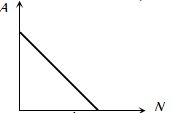
The curve between the activity A of a radioactive sample and the number of active atoms N is
Answer(b)
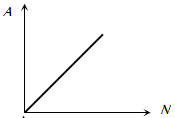
View full question & answer→MCQ 231 Mark
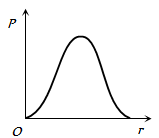
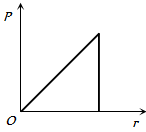
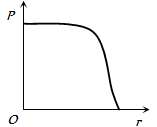
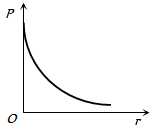
The charge density in a nucleus varies with distance from the centre of the nucleus according to the curve in Fig.
Answer(c)
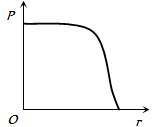
View full question & answer→MCQ 241 Mark
In Fig. X represents time and Y represent activity of a radioactive sample. Then the activity of sample, varies with time according to the curve
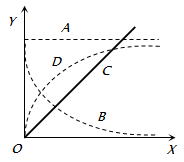
MCQ 251 Mark
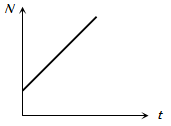
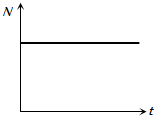
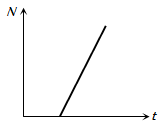
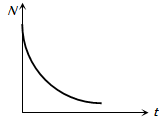
The graph between the instantaneous concentration (N) of a radioactive element and time (t) is
Answer(d)
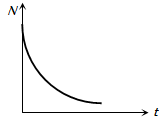
View full question & answer→MCQ 261 Mark
Binding energy per nucleon verses mass number curve for nuclei is shown in the figure. W, X, Y and Z are four nuclei indicated on the curve. The process that would release energy is
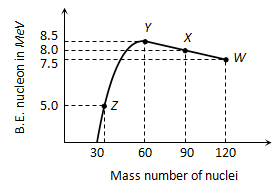
MCQ 271 Mark
The fraction f of radioactive material that has decayed in time t, varies with time t. The correct variation is given by the curve
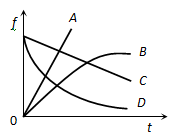
MCQ 281 Mark
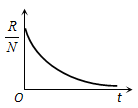
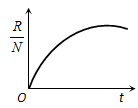
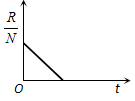
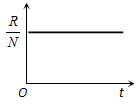
A radioactive sample has $\mathrm{N}_0$ active atoms at t = 0. If the rate of disintegration at any time is R and the number of atoms is N, then the ratio R/N varies with time as
Answer(d)
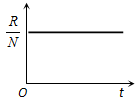
View full question & answer→MCQ 291 Mark
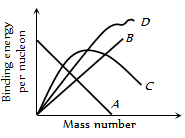
Binding energy per nucleon plot against the mass number for stable nuclei is shown in the figure. Which curve is correct
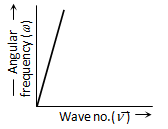
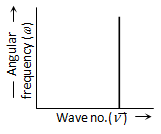
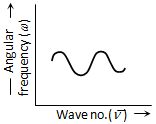
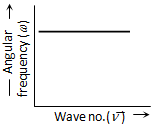
MCQ 301 Mark
The graph between wave number ($(\bar{v})$) and angular frequency (w) is
View full question & answer→MCQ 311 Mark
Rest mass energy of an electron is 0.54 MeV. If velocity of the electron is 0.8 c, then K.E. of the electron is
MCQ 321 Mark
A radioactive isotope X with a half-life of $1.37\times 10^9$ years decays to Y which is stable. A sample of rock from the moon was found to contain both the elements X and Y which were in the ratio of 1 : 7. The age of the rock is
- A
$1.96 \times 10^8$ years
- B
$3.85 \times 10^9$ years
- ✓
$4.11 \times 10^9$ years
- D
$9.59 \times 10^9$ years
AnswerCorrect option: C. $4.11 \times 10^9$ years
(c) $4.11 \times 10^9$ years
View full question & answer→MCQ 331 Mark
If 10% of a radioactive material decays in 5 days, then the amount of original material left after 20 days is approximately
MCQ 341 Mark
A radioactive nucleus is being produced at a constant rate a per second. Its decay constant is l. If $\mathrm{N}_0$ are the number of nuclei at time t = 0, then maximum number of nuclei possible are
AnswerCorrect option: A. $\frac{\alpha}{\lambda}$
(a) $\frac{\alpha}{\lambda}$
View full question & answer→MCQ 351 Mark
A radioactive sample is $a-$emitter with half life $138.6$ days is observed by a student to have $2000$ disintegration$/\sec.$ The number of radioactive nuclei for given activity are
- ✓
$ 3.45 \times 10^{10} $
- B
$ 1 \times 10^{10} $
- C
$ 3.45 \times 10^{15} $
- D
$ 2.75 \times 10^{11}$
AnswerCorrect option: A. $ 3.45 \times 10^{10} $
$ 3.45 \times 10^{10} $
View full question & answer→MCQ 361 Mark
The wavelength $K_a \ X-$rays produced by an $X-$ray tube is $0.76 \mathring A .$ The atomic number of anticathode material is
View full question & answer→MCQ 371 Mark
A radioactive sample of $U^{238}$ decay to $Pb$ through a process for which half life is $4.5 \times 10^9$ years. The ratio of number of nuclei of Pb to $\mathrm{U}^{238}$ after a time of $1.5 \times 10^9$ years $($given $2^{1 / 3}=1.26 )$
- A
$ 0.12$
- ✓
$ 0.26$
- C
$1.2$
- D
$0.37$
AnswerCorrect option: B. $ 0.26$
$0.26$
View full question & answer→MCQ 381 Mark
A hydrogen like atom of atomic number Z is in an excited state of quantum number 2n. It can emit a maximum energy photon of 204 eV. If it makes a transition to quantum state n, a photon of energy 40.8 eV is emitted. The value of n will be
MCQ 391 Mark
The first excited state of hydrogen atom is 10.2 eV above its ground state. The temperature is needed to excite hydrogen atoms to first excited level, is
- ✓
$7.9 \times 10^4 \mathrm{~K}$
- B
$3.5 \times 10^4 \mathrm{~K}$
- C
$5.8 \times 10^4 \mathrm{~K}$
- D
$14 \times 10^4 \mathrm{~K}$
AnswerCorrect option: A. $7.9 \times 10^4 \mathrm{~K}$
(a) $7.9 \times 10^4 \mathrm{~K}$
View full question & answer→MCQ 401 Mark
An atomic power nuclear reactor can deliver 300 MW. The energy released due to fission of each nucleus of uranium atom $\mathrm{U}^{238}$ is 170 MeV. The number of uranium atoms fissioned per hour will be
- A
$30 \times 10^{25}$
- ✓
$4 \times 10^{22}$
- C
$10 \times 10^{20}$
- D
$5 \times 10^{15}$
AnswerCorrect option: B. $4 \times 10^{22}$
(b) $4 \times 10^{22}$
View full question & answer→MCQ 411 Mark
The rate of disintegration was observed to be $10^{17}$ disintegrations per sec when its half life period is 1445 years. The original number of particles are
- A
$8.9 \times 10^{27}$
- ✓
$6.6 \times 10^{27}$
- C
$1.4 \times 10^{16}$
- D
$1.2 \times 10^{17}$
AnswerCorrect option: B. $6.6 \times 10^{27}$
(b) $6.6 \times 10^{27}$
View full question & answer→MCQ 421 Mark
Excitation energy of a hydrogen like ion in its first excitation state is 40.8 eV. Energy needed to remove the electron from the ion in ground state is
MCQ 431 Mark
After 280 days, the activity of a radioactive sample is 6000 dps. The activity reduces to 3000 dps after another 140 days. The initial activity of the sample in dps is
MCQ 441 Mark
Half life of a radio-active substance is 20 minutes. The time between 20% and 80% decay will be
MCQ 451 Mark
A and B are two radioactive substances whose half lives are 1 and 2 years respectively. Initially 10 gm of A and 1 gm of B is taken. The time (approximate) after which they will have same quantity remaining is
MCQ 461 Mark
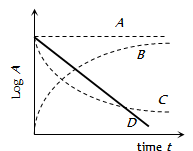
The graph which represents the correct variation of logarithm of activity (log A) versus time, in figure is
MCQ 471 Mark
Two radioactive materials $\mathrm{X}_1$ and $\mathrm{X}_2$ have decay constants 10λ and λ respectively. If initially they have the same number of nuclei, then the ratio of the number of nuclei of $\mathrm{X}_1$ to that of $\mathrm{X}_2$ will be 1/e after a time
View full question & answer→MCQ 481 Mark
Half-life of a radioactive substance is 20 minutes. Difference between points of time when it is 33% disintegrated and 67% disintegrated is approximately
MCQ 491 Mark
A radioactive nucleus undergoes a-emission to form a stable element. What will be the recoil velocity of the daughter nucleus if V is the velocity of a-emission and A is the atomic mass of radioactive nucleus
- ✓
$\frac{4 V}{A-4}$
- B
$\frac{2 V}{A-4}$
- C
$\frac{4 V}{A+4}$
- D
$\frac{2V}{A+4}$
AnswerCorrect option: A. $\frac{4 V}{A-4}$
(a) $\frac{4 V}{A-4}$
View full question & answer→MCQ 501 Mark
The half-life of radioactive Polonium (Po) is 138.6 days. For ten lakh Polonium atoms, the number of disintegrations in 24 hours is
MCQ 511 Mark
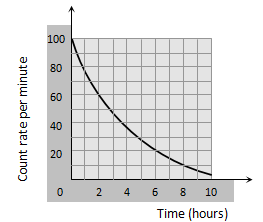
The count rate of 10g of radioactive material was measured at different times and this has been shown in the figure. The half life of material and the total counts (approximately) in the first half life period, respectively are
MCQ 521 Mark
For a substance the average life for a-emission is 1620 years and for b emission is 405 years. After how much time the 1/4 of the material remains after a and b emission
MCQ 531 Mark
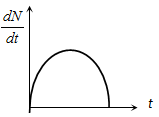
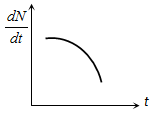
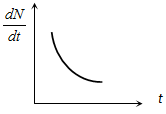
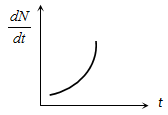
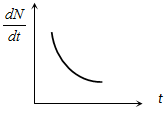
Radioactive element decays to form a stable nuclide, then the rate of decay of reactant $\left(\frac{\mathrm{dN}}{\mathrm{dt}}\right)$ will vary with time (t) as shown in figure
Answer(c)
View full question & answer→MCQ 541 Mark
The half life period of a radioactive element X is same as the mean life time of another radioactive element Y. Initially both of them have the same number of atoms. Then
- A
X and Y have the same decay rate initially
- B
X and Y decay at the same rate always
- ✓
Y will decay at a faster rate than X
- D
X will decay at a faster rate than Y
AnswerCorrect option: C. Y will decay at a faster rate than X
(c) Y will decay at a faster rate than X
View full question & answer→MCQ 551 Mark
A freshly prepared radioactive sample of half- life 1 hour emits radiations that are 128 times as intense as the permissible safe limit. The minimum time after which this sample can be safely used is
MCQ 561 Mark
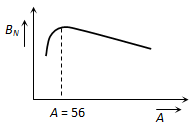
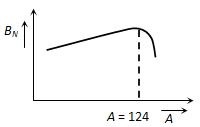
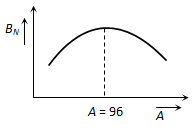
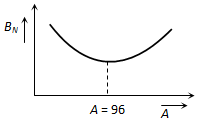
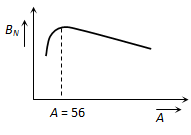
The dependence of binding energy per nucleon, $\mathrm{B}_{\mathrm{N}}$ on the mass number, A, is represented by
Answer(a)
View full question & answer→MCQ 571 Mark
A radioactive material decays by simultaneous emission of two particles with respective half lives 1620 and 810 years. The time (in years) after which one- fourth of the material remains is
MCQ 581 Mark
From a newly formed radioactive substance (Half life 2 hours), the intensity of radiation is 64 times the permissible safe level. The minimum time after which work can be done safely from this source is
MCQ 591 Mark
α - particles of energy 400 KeV are bombarded on nucleus of $82^{\mathrm{Pb}}$. In scattering of α - particles, its minimum distance from nucleus will be
View full question & answer→MCQ 601 Mark
Consider an electron $\left(\mathrm{m}=9.1 \times 10^{-31} \mathrm{~kg}\right)$ confined by electrical forces to move between two rigid walls separated by $1.0 \times 10^{-9}$ metre, which is about five atomic diameters. The quantised energy value for the lowest stationary state is
- A
$12 \times 10^{-20}$ Joule
- ✓
$6.0 \times 10^{-20}$ Joule
- C
$6.0 \times 10^{-18}$ Joule
- D
AnswerCorrect option: B. $6.0 \times 10^{-20}$ Joule
(b) $6.0 \times 10^{-20}$ Joule
View full question & answer→MCQ 611 Mark
The half life of radioactive Radon is 3.8 days. The time at the end of which 1/20 th of the Radon sample will remain undecayed is (Given $\log _{10} e=0.4343$)
View full question & answer→MCQ 621 Mark
A nucleus with mass number 220 initially at rest emits an a-particle. If the Q value of the reaction is 5.5 MeV, calculate the kinetic energy of the a-particle
MCQ 631 Mark
The rest mass of an electron as well as that of positron is 0.51 MeV. When an electron and positron are annihilate, they produce gamma-rays of wavelength(s)
MCQ 641 Mark
For uranium nucleus how does its mass vary with volume
- ✓
$m \propto V$
- B
$m \propto 1 / V$
- C
$m \propto \sqrt{V}$
- D
$m \propto V^2$
AnswerCorrect option: A. $m \propto V$
$m \propto V$
View full question & answer→MCQ 651 Mark
A heavy nucleus at rest breaks into two fragments which fly off with velocities in the ratio 8 : 1. The ratio of radii of the fragments is
MCQ 661 Mark
The rest energy of an electron is 0.511 MeV. The electron is accelerated from rest to a velocity 0.5 c. The change in its energy will be
MCQ 671 Mark
The binding energy per nucleon of $0^{16}$ is 7.97 MeV and that of $O ^{17}$ is 7.75 MeV . The energy (in MeV ) required to remove a neutron from $O ^{17}$ is
- A
$3.52$
- B
$3.64 $
- ✓
$4.23$
- D
$7.86$
AnswerCorrect option: C. $4.23$
$4.23$
View full question & answer→MCQ 681 Mark
The sun radiates energy in all directions. The average radiations received on the earth surface from the sun is 1.4 kilowatt $/ \mathrm{m}^2$.The average earth- sun distance is $1.5 \times 10^{11}$ metres. The mass lost by the sun per day is (1 day = 86400 seconds)
- A
$4.4\times 10^9 \mathrm{~kg}$
- B
$7.6 \times 10^{14} \mathrm{~kg}$
- C
$3.8 \times 10^{12}\mathrm{~kg}$
- ✓
$3.8 \times 10^{14}\mathrm{~kg}$
AnswerCorrect option: D. $3.8 \times 10^{14}\mathrm{~kg}$
(d) $3.8 \times 10^{14}\mathrm{~kg}$
View full question & answer→MCQ 691 Mark
If the atom $100^{ Fm ^{257}}$ follows the Bohr model and the radius of $100^{ Fm ^{257}}$ is n times the Bohr radius, then find n
- A
$100$
- B
$200$
- C
$4$
- ✓
$\frac{1}{4}$
AnswerCorrect option: D. $\frac{1}{4}$
$\frac{1}{4}$
View full question & answer→MCQ 701 Mark
The wavelengths involved in the spectrum of deuterium $\left(\frac{2}{1}\right) D$ are slightly different from that of hydrogen spectrum, because
- A
The attraction between the electr on and the nucleus is different in the two cases
- B
The size of the two nuclei are different
- C
The nuclear forces are different in the two cases
- ✓
The masses of the two nuclei are different
AnswerCorrect option: D. The masses of the two nuclei are different
The masses of the two nuclei are different
View full question & answer→MCQ 711 Mark
Which of the following atoms has the lowest ionization potential
- A
$_8^{16}O$
- B
$_7^{14} {~N}$
- ✓
$_{55}^{133}{Cs}$
- D
$_{18}^{40}{Ar}$
AnswerCorrect option: C. $_{55}^{133}{Cs}$
(c) $_{55}^{133}{Cs}$
View full question & answer→MCQ 721 Mark
In the Bohr model of the hydrogen atom, let R, v and E represent the radius of the orbit, the speed of electron and the total energy of the electron respectively. Which of the following quantity is proportional to the quantum number n
MCQ 731 Mark
An electron passing through a potential difference of 4.9 V collides with a mercury atom and transfers it to the first excited state. What is the wavelength of a photon corresponding to the transition of the mercury atom to its normal state
MCQ 741 Mark
The transition from the state n = 4 to n = 3 in a hydrogen-like atom results in ultraviolet radiation. Infrared radiation will be obtained in the transition
MCQ 751 Mark
Imagine an atom made up of a proton and a hypothetical particle of double the mass of the electron but having the same charge as the electron. Apply the Boh’r atom model and consider all possible transitions of this hypothetical particle to the first excited level. The longest wavelength photon that will be emitted has wavelength l (given in terms of the Rydberg constant R for the hydrogen atom) equal to
MCQ 761 Mark
A neutron with velocity V strikes a stationary deuterium atom, its kinetic energy changes by a factor of
- A
$\frac{15}{16}$
- B
$\frac{1}{2}$
- C
$\frac{2}{1}$
- ✓
View full question & answer→MCQ 771 Mark
The ionisation potential of H-atom is 13.6 V. When it is excited from ground state by monochromatic radiations of $970.6 \mathring A$ the number of emission lines will be (according to Bohr’s theory)
View full question & answer→MCQ 781 Mark
A double charged lithium atom is equivalent to hydrogen whose atomic number is 3. The wavelength of required radiation for emitting electron from first to third Bohr orbit in $Li^{++}$ will be (Ionisation energy of hydrogen atom is 13.6eV)
- A
$182.51 \mathring A$
- B
$177.17 \mathring A$
- C
$142.25 \mathring A$
- ✓
$113.74 \mathring A$
AnswerCorrect option: D. $113.74 \mathring A$
$113.74 \mathring A$
View full question & answer→MCQ 791 Mark
If in Rutherford’s experiment, the number of particles scattered at 90° angle are 28 per min, then number of scattered particles at an angle 60° and 120° will be
MCQ 801 Mark
What is the radius of iodine atom (at. no. 53, mass number 126)
- ✓
$2.5 \times 10^{-11} m$
- B
$2.5 \times 10^{-9} m$
- C
$7 \times 10^{-9} m$
- D
$7 \times 10^{-6} m$
AnswerCorrect option: A. $2.5 \times 10^{-11} m$
(a) $2.5 \times 10^{-11} m$
View full question & answer→MCQ 811 Mark
In a hypothetical Bohr hydrogen, the mass of the electron is doubled. The energy $E_0$ and the radius $r_0$ of the first orbit will be ($a_0$ is the Bohr radius)
- ✓
${E}_0=-27.2 {eV} ; {r}_0={a}_0 / 2$
- B
$E_0=-27.2{eV} ; r_0=a_0$
- C
$E_0=-13.6 {eV} ; r_0=a_0 / 2$
- D
${E}_0=-13.6{eV} ; {r}_0={a}_0$
AnswerCorrect option: A. ${E}_0=-27.2 {eV} ; {r}_0={a}_0 / 2$
(a) ${E}_0=-27.2 {eV} ; {r}_0={a}_0 / 2$
View full question & answer→MCQ 821 Mark
A radioactive material has a half-life of 8 years. The activity of the material will decrease to about 1/8 of its original value in
MCQ 831 Mark
The number of revolutions per second made by an electron in the first Bohr orbit of hydrogen atom is of the order of 3
- A
$10^{20}$
- B
$10^{19}$
- C
$10^{17}$
- ✓
$10^{15}$
AnswerCorrect option: D. $10^{15}$
(d) $10^{15}$
View full question & answer→MCQ 841 Mark
Hydrogen (H), deuterium (D), singly ionized helium ($He^+$) and doubly ionized lithium (Li) all have one electron around the nucleus. Consider n =2 to n = 1 transition. The wavelengths of emitted radiations are $\lambda 1,\lambda 2, \lambda 3$ and $\lambda 4$ respectively. Then approximately
- ✓
$\lambda_1=\lambda_2=4 \lambda_3=9 \lambda_4$
- B
${ }_4 \lambda_1=2 \lambda_2=2 \lambda_3=\lambda_4$
- C
$\lambda_1=2 \lambda_2=2 \sqrt{2} \lambda_3=3 \sqrt{2} \lambda_4$
- D
$\lambda_1=\lambda_2=2 \lambda_3=3 \sqrt{2} \lambda_4$
AnswerCorrect option: A. $\lambda_1=\lambda_2=4 \lambda_3=9 \lambda_4$
(a) $\lambda_1=\lambda_2=4 \lambda_3=9 \lambda_4$
View full question & answer→MCQ 851 Mark
A hydrogen atom in its ground state absorbs 10.2 eV of energy. The orbital angular momentum is increased by (Given Planck constant $h=6.6 \times 10^{-34} \mathrm{~J}-\mathrm{sec}$)
- ✓
$1.05 \times 10^{-34} \mathrm{~J}-\mathrm{sec}$
- B
$3.16 \times 10^{-34} \mathrm{~J}-\mathrm{sec}$
- C
$2.11 \times 10^{-34} \mathrm{~J}-\mathrm{sec}$
- D
$4.22 \times 10^{-34} \mathrm{~J}-\mathrm{sec}$
AnswerCorrect option: A. $1.05 \times 10^{-34} \mathrm{~J}-\mathrm{sec}$
(a) $1.05 \times 10^{-34} \mathrm{~J}-\mathrm{sec}$
View full question & answer→MCQ 861 Mark
A hydrogen atom in its ground state absorbs 10.2 eV of energy. The orbital angular momentum is increased by
- ✓
$1.05 \times 10^{-34} \mathrm{~J}-\mathrm{sec}$
- B
$3.16 \times 10^{-34} \mathrm{~J}-\mathrm{sec}$
- C
$2.11 \times 10^{-34} \mathrm{~J}-\mathrm{sec}$
- D
$4.22 \times 10^{-34} \mathrm{~J}-\mathrm{sec}$
AnswerCorrect option: A. $1.05 \times 10^{-34} \mathrm{~J}-\mathrm{sec}$
(a) $1.05 \times 10^{-34} \mathrm{~J}-\mathrm{sec}$
View full question & answer→MCQ 871 Mark
An energy of 24.6 eV is required to remove one of the electrons from a neutral helium atom. The energy (in eV) required to remove both the electrons from a neutral helium atom is
MCQ 881 Mark
A sodium atom is in one of the states labeled 'Lowest excited levels'. It remains in that state for an average time of $10^{-8} \mathrm{sec}$, before it makes a transition back to a ground state. What is the uncertainty in energy of that excited state
- ✓
$ 6.56 \times 10^{-8} \mathrm{eV} $
- B
$ 2 \times 10^{-8} \mathrm{eV} $
- C
$ 10^{-8} \mathrm{eV} $
- D
$ 8 \times 10^{-8} \mathrm{eV}$
AnswerCorrect option: A. $ 6.56 \times 10^{-8} \mathrm{eV} $
$ 6.56 \times 10^{-8} \mathrm{eV} $
View full question & answer→MCQ 891 Mark
In hydrogen atom, electron makes transition from n=4 to n=1 level. Recoil momentum of the H atom will be
- A
$3.4 \times 10^{-27} \mathrm{~N}-\mathrm{sec}$
- ✓
$6.8 \times 10^{-27} \mathrm{~N}-\mathrm{sec}$
- C
$3.4 \times 10^{-24} \mathrm{~N}-\mathrm{sec}$
- D
$6.8 \times 10^{-24} \mathrm{~N}-\mathrm{sec}$
AnswerCorrect option: B. $6.8 \times 10^{-27} \mathrm{~N}-\mathrm{sec}$
(b) $6.8 \times 10^{-27} \mathrm{~N}-\mathrm{sec}$
View full question & answer→MCQ 901 Mark
The ratio of the speed of the electrons in the ground state of hydrogen to the speed of light in vacuum is
MCQ 911 Mark
An a-particle of 5 MeV energy strikes with a nucleus of uranium at stationary at an scattering angle of $180^{\circ}$. The nearest distance upto which a-particle reaches the nucleus will be of the order of
- A
- B
$10^{-10} \mathrm{~cm}$
- ✓
$10^{-12} \mathrm{~cm}$
- D
$10^{-15} \mathrm{~cm}$
AnswerCorrect option: C. $10^{-12} \mathrm{~cm}$
(c) $10^{-12} \mathrm{~cm}$
View full question & answer→MCQ 921 Mark
In a sample of radioactive material, what fraction of the initial number of active nuclei will remain undisintegrated after half of a half-life of the sample
- A
$\frac{1}{4}$
- B
$\frac{1}{2 \sqrt{2}}$
- ✓
$\frac{1}{\sqrt{2}}$
- D
$2\sqrt{2}$
AnswerCorrect option: C. $\frac{1}{\sqrt{2}}$
(c)$\frac{1}{\sqrt{2}}$
View full question & answer→MCQ 931 Mark
In a radioactive reaction $92^{ X ^{232}} \rightarrow 82^{ Y ^{204}}$ , the number of α - particles emitted is
View full question & answer→MCQ 941 Mark
If half life of radium is 77 days. Its decay constant in day will be
AnswerCorrect option: B. $9 \times 10^{-3} /$ day
(b) $9 \times 10^{-3} /$ day
View full question & answer→MCQ 951 Mark
The phenomenon of radioactivity is
- A
Exothermic change which increases or decreases with temperature
- B
Increases on applied pressure
- ✓
Nuclear process does not depend on external factors
- D
AnswerCorrect option: C. Nuclear process does not depend on external factors
(c) Nuclear process does not depend on external factors
View full question & answer→MCQ 961 Mark
$86^{\mathrm{A}^{222}} \rightarrow 84^{\mathrm{B}^{210}}$ In this reaction how many α and β particles are emitted
View full question & answer→MCQ 971 Mark
Mean life of a radioactive sample is $100$ seconds. Then its half life $($in minutes$)$ is
- A
$ 0.693$
- B
$1$
- C
$10^{-4}$
- ✓
$1.155$
AnswerCorrect option: D. $1.155$
$1.155$
View full question & answer→MCQ 981 Mark
$C^{14}$ has half life 5700 years. At the end of 11400 years, the actual amount left is
- A
- ✓
- C
- D
0.0625 of original amount
Answer(b) 0.25 of original amount
View full question & answer→MCQ 991 Mark
Nuclear fusion is common to the pair
- A
Thermonuclear reactor, uranium based nuclear reactor
- B
Energy production in sun, uranium based nuclear reactor
- ✓
Energy production in sun, hydrogen bomb
- D
Disintegration of heavy nuclei, hydrogen bomb
AnswerCorrect option: C. Energy production in sun, hydrogen bomb
(c) Energy production in sun, hydrogen bomb
View full question & answer→MCQ 1001 Mark
The particle that possesses half integral spin as
MCQ 1011 Mark
A nucleus of mass 218 amu in free state decays to emit an a-particle. Kinetic energy of the a-particle emitted is 6.7 MeV. The recoil energy (in MeV) of the daughter nucleus is
MCQ 1021 Mark
The composition of an a -particle can be expressed as
MCQ 1031 Mark
$_{90}^{232} $ Than isotope of thorium decays in ten stages emitting six a-particles and four b-particles in all. The end product of the decay is
- A
$_{82}^{206}{~Pb}$
- B
$_{82}^{209} {~Pb}$
- ✓
$_{82}^{208} {~Pb}$
- D
$_{83}^{209} {Br}$
AnswerCorrect option: C. $_{82}^{208} {~Pb}$
(c) $_{82}^{208} {~Pb}$
View full question & answer→MCQ 1041 Mark
A nucleus decays by $\beta^{+}$ emission followed by a gamma emission. If the atomic and mass numbers of the parent nucleus are Z and A respectively, the corresponding numbers for the daughter nucleus are respectively.
View full question & answer→MCQ 1051 Mark
The ratio activity of an element becomes $1/64^{th}$ of its original value in $60 \sec.$ Then the half life period is
- A
$5 \sec$
- ✓
$10 \sec$
- C
$20 \sec$
- D
$30 \sec$
AnswerCorrect option: B. $10 \sec$
$10 \sec$
View full question & answer→MCQ 1061 Mark
Starting with a sample of pure $66_{\mathrm{Cu}}, \frac{7}{8}$ of it decays into Zn in 15 min. The corresponding half-life is
View full question & answer→MCQ 1071 Mark
The equation $\mathrm z^{\mathrm{X}^{\mathrm{A}}} \rightarrow \mathrm{z}+1^{\mathrm{Y}^{\mathrm{A}}}+-1^{\mathrm{e}^0}+\bar{\mathrm{v}}$ is
- ✓
- B
- C
$\mathrm{e}^{-}$ capture
- D
View full question & answer→MCQ 1081 Mark
The half-life of a radioactive substance is 3.6 days. How much of 20 mg of this radioactive substance will remain after 36 days
MCQ 1091 Mark
The half-life of a radioactive substance is 40 years. How long will it take to reduce to one fourth of its original amount and what is the value of decay constant
MCQ 1101 Mark
Activity of radioactive element decreased to one third of original activity $\mathrm{R}_0$ in 9 years. After further 9 years, its activity will be
- A
$\mathrm{R}_0$
- B
$\frac{2}{3} R_0$
- ✓
$\mathrm{R}_0 / 9$
- D
$\mathrm{R}_0 / 6$
AnswerCorrect option: C. $\mathrm{R}_0 / 9$
(c) $\mathrm{R}_0 / 9$
View full question & answer→MCQ 1111 Mark
The half-life of radium is about 1600 years. Of 100 g of radium existing now, 25 g will remain unchanged after
MCQ 1121 Mark
A count rate meter shows a count of 240 per minute from a given radioactive source. One hour later the meter shows a count rate of 30 per minute. The half-life of the source is
MCQ 1131 Mark
Carbon dating is best suited for determining the age of fossils if their age in years is of the order of
- A
$10^3$
- ✓
$10^4$
- C
$10^5$
- D
$10^6$
AnswerCorrect option: B. $10^4$
(b) $10^4$
View full question & answer→MCQ 1141 Mark
The half-life of a sample of a radioactive substance is 1 hour. If $8 \times 10^{10}$ atoms are present at t = 0, then the number of atoms decayed in the duration t = 2 hour to t = 4 hour will be
- A
$2 \times 10^{10}$
- ✓
$1.5 \times 10^{10}$
- C
- D
AnswerCorrect option: B. $1.5 \times 10^{10}$
(b) $1.5 \times 10^{10}$
View full question & answer→MCQ 1151 Mark
A radioactive decay chain starts from ${93^{Np}}^{237}$and produces ${93^{Np}}^{237}$ by successive emissions. The emitted particles can be
- ✓
Two a-particles and one b-particle
- B
Three $\beta^{+}$ particles
- C
One a particle and two $\beta^{+}$ particles
- D
One a particle and two $\beta^{-}$ particles
AnswerCorrect option: A. Two a-particles and one b-particle
(a) Two a-particles and one b-particle
View full question & answer→MCQ 1161 Mark
Radioactive nuclei that are injected into a patient collect at certain sites within its body, undergoing radioactive decay and emitting electromagnetic radiation. These radiations can then be recorded by a detector. This procedure provides an important diagnostic tool called
MCQ 1171 Mark
A radioactive sample at any instant has its disintegration rate 5000 disintegration per minute. After 5 minutes, the rate is 1250 disintegrations per minute. Then, the decay constant (per minute) is
MCQ 1181 Mark
Which of the following radiations has the least wavelength
MCQ 1191 Mark
A sample of radioactive element has a mass of 10 gm at an instant t = 0.The approximate mass of this element in the sample after two mean lives is
MCQ 1201 Mark
Which of the following rays are not electromagnetic waves
MCQ 1211 Mark
A radioactive substance has an average life of 5 hours. In a time of 5 hours
- A
Half of the active nuclei decay
- B
Less than half of the active nuclei decay
- ✓
More than half of the active nuclei decay
- D
AnswerCorrect option: C. More than half of the active nuclei decay
More than half of the active nuclei decay
View full question & answer→MCQ 1221 Mark
he half-life of a radioactive substance is 48 hours. How much time will it take to disintegrate to its $\frac {1}{16}$ th part
View full question & answer→MCQ 1231 Mark
The half-life of $215_{ At }$ is $100 \mu s$. The time taken for the radioactivity of a sample of $215_{ At }$ to decay to $1 / 16^{\text {th }}$ of its initial value is
- ✓
$400\ \mu s$
- B
$6.3\ \mu s$
- C
$40\ \mu s$
- D
$300\ \mu s$
AnswerCorrect option: A. $400\ \mu s$
$400\ \mu s$
View full question & answer→MCQ 1241 Mark
When ${90^{Th}}^{228}$ transforms to ${83^{Bi}}^{212}$ , then the number of the emitted a- and b-particles is, respectively
View full question & answer→MCQ 1251 Mark
Nucleus produced due to a-decay of the nucleus ${Z^X}^A$ is
- A
${Z+2^Y}^{A{+4}}$
- B
${Z^Y}^A$
- ✓
${Z-2^Y}^{A{-4}}$
- D
${Z-4^Y}^{A{-2}}$
AnswerCorrect option: C. ${Z-2^Y}^{A{-4}}$
(c) ${Z-2^Y}^{A{-4}}$
View full question & answer→MCQ 1261 Mark
The activity of a sample of a radioactive material is A, at time $t_1$ and $A_2$ at time ${t}_2\left({t}_2>{t}_1\right)$. If its mean life T, then
AnswerCorrect option: C. $A_2=A_1 e^{\left(t_1-t_2\right) / T}$
(c) $A_2=A_1 e^{\left(t_1-t_2\right) / T}$
View full question & answer→MCQ 1271 Mark
If $92^{\mathrm{U}^{238}}$ undergoes successively 8 a-decays and 6 b-decays, then resulting nucleus is
- A
$82^{U^{206}}$
- ✓
$82^{\mathrm{Pb}^{206}}$
- C
$82^{\mathrm{U}^{210}}$
- D
$82^{\mathrm{U}^{214}}$
AnswerCorrect option: B. $82^{\mathrm{Pb}^{206}}$
(b) $82^{\mathrm{Pb}^{206}}$
View full question & answer→MCQ 1281 Mark
A radioactive substance emits
- A
Electromagnetic radiation
- B
Electrons revolving around the nucleus
- C
- ✓
View full question & answer→MCQ 1291 Mark
During mean life of a radioactive element, the fraction that disintegrates is
- A
- B
$\frac{1}{e}$
- ✓
$\frac{e-1}{e}$
- D
$\frac{e}{e-1}$
AnswerCorrect option: C. $\frac{e-1}{e}$
(c) $\frac{e-1}{e}$
View full question & answer→MCQ 1301 Mark
Three fourth of the active decays in a radioactive sample in 3/4 sec. The half life of the sample is
- A
$\frac{1}{2}\ sec$
- B
$1\ sec$
- ✓
$\frac{3}{8}\ sec$
- D
$\frac{3}{4}\ sec$
AnswerCorrect option: C. $\frac{3}{8}\ sec$
$\frac{3}{8}\ sec$
View full question & answer→MCQ 1311 Mark
If $N_0$ is the original mass of the substance of half life period $T_{1/2}=5$ years, then the amount of substance left after 15 years is
- ✓
$N_0/8$
- B
$N_0/16$
- C
$N_0/2$
- D
$N_0/4$
AnswerCorrect option: A. $N_0/8$
(a) $N_0/8$
View full question & answer→MCQ 1321 Mark
Half-life of a substance is 10 years. In what time, it becomes $\frac{1}{4}$ th part of the initial amount
- A
$5$ years
- B
$10$ years
- ✓
$20$ years
- D
AnswerCorrect option: C. $20$ years
(c) $20$ years
View full question & answer→MCQ 1331 Mark
A radioactive material has an initial amount 16gm. After 120 days it reduces to 1gm, then the half-life of radioactive material is
MCQ 1341 Mark
The S.I. unit of radioactivity is
MCQ 1351 Mark
In a sample of radioactive material, what percentage of the initial number of active nuclei will decay during one mean life
MCQ 1361 Mark
10 gm of radioactive material of half-life 15 year is kept in store for 20 years. The disintegrated material is
MCQ 1371 Mark
The half-life of a radioactive substance against a-decay is $1.2\times 10^7 s$ . What is the decay rate for $4\times 10^{15}$ atoms of the substance
- A
$4.6 \times 10^{12}$ atoms/s
- B
$2.3 \times 10^{11}$ atoms/s
- C
$4.6 \times 10^{10}$ atoms/s
- ✓
$2.3 \times 10^8$ atoms/s
AnswerCorrect option: D. $2.3 \times 10^8$ atoms/s
(d) $2.3 \times 10^8$ atoms/s
View full question & answer→MCQ 1381 Mark
The decay constant of a radioactive element is $1.5 \times 10^{-9}$ per second. Its mean life in seconds will be
- A
$1.5 \times 10^{9}$
- B
$4.62 \times 10^8$
- ✓
$6.67 \times 10^8$
- D
$10.35 \times 10^8$
AnswerCorrect option: C. $6.67 \times 10^8$
(c) $6.67 \times 10^8$
View full question & answer→MCQ 1391 Mark
In the disintegration series ${ }_{92}^{238} U \xrightarrow{\alpha} X \xrightarrow{\beta^{-}}{ }_{ Z }^{ A _{ Y }}$ The value of Z and A respectively will be
- A
$92,236$
- B
$88,230$
- C
$90,234$
- ✓
$91,234$
AnswerCorrect option: D. $91,234$
(d) $91,234$
View full question & answer→MCQ 1401 Mark
Certain radio-active substance reduces to 25% of its value in 16 days. Its half-life is
MCQ 1411 Mark
1 mg gold undergoes decay with 2.7 days half-life period, amount left after 8.1 days is
MCQ 1421 Mark
99% of a radioactive element will decay between
MCQ 1431 Mark
A radioactive nucleus with Z protons and N neutrons emits an a-particle, 2b-particles and 2 gamma rays. The number of protons and neutrons in the nucleus left after the decay respectively, are
MCQ 1441 Mark
If a radioactive substance reduces to $\frac {1}{16}$ of its original mass in 40 days, what is its half-life
View full question & answer→MCQ 1451 Mark
A radioactive nucleus emits a beta particle. The parent and daughter nuclei are
MCQ 1461 Mark
View full question & answer→MCQ 1471 Mark
During negative b - decay
- ✓
Neutron converts into proton
- B
Proton converts into neutron
- C
Neutron proton ratio increases
- D
AnswerCorrect option: A. Neutron converts into proton
Neutron converts into proton
View full question & answer→MCQ 1481 Mark
When a radioactive substance emits an a -particle, its position in the periodic table is lowered by
MCQ 1491 Mark
The electron emitted in beta radiation originates from
- A
- B
Free electrons existing in nuclei
- ✓
Decay of a neutron in a nucleus
- D
Photon escaping from the nucleus
AnswerCorrect option: C. Decay of a neutron in a nucleus
Decay of a neutron in a nucleus
View full question & answer→MCQ 1501 Mark
In the given nuclear reaction, how many a and b particles are emitted $92^{ X ^{235}} \rightarrow 82^{ Y ^{207}}$
- A
3a particles and 2b particle
- B
4a particles and 3b particle
- C
6a particles and 4b particle
- ✓
7a particles and 4b particle
AnswerCorrect option: D. 7a particles and 4b particle
(d) 7a particles and 4b particle
View full question & answer→MCQ 1511 Mark
- A
$3 \times 10^7$ disintegrations/sec
- B
$3.7 \times 10^7$ disintegrations/sec
- C
$5 \times 10^7$ disintegrations/sec
- ✓
$3.7 \times 10^{10}$ disintegrations/sec
AnswerCorrect option: D. $3.7 \times 10^{10}$ disintegrations/sec
(d) $3.7 \times 10^{10}$ disintegrations/sec
View full question & answer→MCQ 1521 Mark
A radio isotope has a half life of 75 years. The fraction of the atoms of this material that would decay in 150 years will be
MCQ 1531 Mark
A radioactive element $90^{ X ^{288}}$ decay into $83^{ Y ^{222}}$. The number of $\beta$ - particles emitted are
View full question & answer→MCQ 1541 Mark
If half-life of a radioactive atom is 2.3 days, then its decay constant would be
MCQ 1551 Mark
In a mean life of a radioactive sample
- A
About 1/3 of substance disintegrates
- ✓
About 2/3 of the substance disintegrates
- C
About 90% of the substance disintegrates
- D
Almost all the substance disintegrates
AnswerCorrect option: B. About 2/3 of the substance disintegrates
About 2/3 of the substance disintegrates
View full question & answer→MCQ 1561 Mark
The activity of a radioactive sample is 1.6 curie and its half-life is 2.5 days. Its activity after 10 days will be
MCQ 1571 Mark
What fraction of a radioactive material will get disintegrated in a period of two half-lives
MCQ 1581 Mark
After five half lives what will be the fraction of initial substance
- A
$\left(\frac{1}{2}\right)^{10}$
- ✓
$\left(\frac{1}{2}\right)^5$
- C
$\left(\frac{1}{2}\right)^4$
- D
$\left(\frac{1}{2}\right)^3$
AnswerCorrect option: B. $\left(\frac{1}{2}\right)^5$
(b) $\left(\frac{1}{2}\right)^5$
View full question & answer→MCQ 1591 Mark
If half-life of a substance is 3.8 days and its quantity is 10.38 gm. Then substance quantity remaining left after 19 days will be
MCQ 1601 Mark
A radioactive sample has half-life of 5 years. Probability of decay in 10 years will be
MCQ 1611 Mark
The activity of a radioactive sample
- A
Can be increased by heating it
- B
Is independent of physical parameter
- C
Cannot be increased by any method
- ✓
View full question & answer→MCQ 1621 Mark
A radioactive substance has a half-life of 1 year. The fraction of this material, that would remain after 5 years will be
- ✓
$\frac{1}{32}$
- B
$\frac{1}{5}$
- C
$\frac{1}{2}$
- D
$\frac{4}{5}$
AnswerCorrect option: A. $\frac{1}{32}$
$\frac{1}{32}$
View full question & answer→MCQ 1631 Mark
- A
The parent and daughter nuclei have same number of protons
- B
The daughter nucleus has one proton less than the parent nucleus
- ✓
The daughter nucleus has one proton more than the parent nucleus
- D
The daughter nucleus has one neutron more than the parent nucleus
AnswerCorrect option: C. The daughter nucleus has one proton more than the parent nucleus
The daughter nucleus has one proton more than the parent nucleus
View full question & answer→MCQ 1641 Mark
An atomic nucleus ${90^{Th}}^{232}$ emits several a and b radiations and finally reduces to ${82^{Pb}}^{208}$. It must have emitted
View full question & answer→MCQ 1651 Mark
The large scale destruction, that would be caused due to the use of nuclear weapons is called
- ✓
- B
- C
Nuetron reproduction factor
- D
View full question & answer→MCQ 1661 Mark
A radioactive substance emits
MCQ 1671 Mark
Plutonium decays with a half-life of 24000 years. If the plutonium is stored for 72000 years, then the fraction of plutonium that remains is
- A
$\frac{1}{2}$
- B
$\frac{1}{3}$
- C
$\frac{1}{4}$
- ✓
$\frac{1}{8}$
AnswerCorrect option: D. $\frac{1}{8}$
$\frac{1}{8}$
View full question & answer→MCQ 1681 Mark
3.8 days is the half-life period of a sample. After how many days, the sample will become 1/8th of the original substance
MCQ 1691 Mark
A nucleus of an element $84^{ X ^{202}}$ emits an a-particle first, a b-particle next and then a gamma photon. The final nucleus formed has an atomic number
View full question & answer→MCQ 1701 Mark
The half-life of radon is 3.8 days. Three forth of a radon sample decay in
MCQ 1711 Mark
The activity of a sample is $64 \times 10^{-5} Ci.$ Its half$-$life is $3 $ days. The activity will become $5 \times 10^{-6} Ci$ after
- A
$12$ days
- B
$7$ days
- C
$18$ days
- ✓
$21$ days
AnswerCorrect option: D. $21$ days
$21$ days
View full question & answer→MCQ 1721 Mark
Consider the following two statements
A. Energy spectrum of a-particles emitted in radioactive decay is discrete
B. Energy spectrum of b-particles emitted in radioactive decay is continuous
- A
- ✓
- C
A is correct but B is wrong
- D
View full question & answer→MCQ 1731 Mark
An artificial radioactive decay series begins with unstable $_{94}^{241} {Pu}$. The stable nuclide obtained after eight α - decays and five β- decays is
- ✓
$_{83}^{209} {Bi}$
- B
$_{82}^{209}{~Pb}$
- C
$_{82}^{205}{Ti}$
- D
$_{82}^{201}{Hg}$
AnswerCorrect option: A. $_{83}^{209} {Bi}$
(a) $_{83}^{209} {Bi}$
View full question & answer→MCQ 1741 Mark
The activity of a radioactive sample is measured as 9750 counts per minute at t = 0 and as 975 counts per minute at t = 5 minutes. The decay constant is approximately
MCQ 1751 Mark
Decay constant of radium is λ. By a suitable process its compound radium bromide is obtained. The decay constant of radium bromide will be
MCQ 1761 Mark
Radon (Ra) decays into Polonium $(p_{0})$ by emitting an α - particle with half-life of 4 days. A sample contains $6.4 \times 10^{10}$ atoms of Rn. After 12 days, the number of atoms of $R_n$ left in the sample will be
- A
$3.2\times 10^{10}$
- B
$ 0.53 \times 10^{10}$
- C
$ 2.1 \times 10^{10}$
- ✓
$ 0.8 \times 10^{10}$
AnswerCorrect option: D. $ 0.8 \times 10^{10}$
(d) $ 0.8 \times 10^{10}$
View full question & answer→MCQ 1771 Mark
Which of the following isotopes is used for the treatment of cancer
- A
$\mathrm{K}^{40}$
- ✓
$\mathrm{Co}^{60}$
- C
$\mathrm{Sr}^{90}$
- D
$\mathrm I^{131}$
AnswerCorrect option: B. $\mathrm{Co}^{60}$
(b) $\mathrm{Co}^{60}$
View full question & answer→MCQ 1781 Mark
At any instant the ratio of the amount of radioactive substances is 2 : 1. If their half lives be respectively 12 and 16 hours, then after two days, what will be the ratio of the substances
MCQ 1791 Mark
An element A decays into element C by a two step process :
A → B + ${2^{He}}^4$
B → C + ${2^e}^{-}$
Then
View full question & answer→MCQ 1801 Mark
A radioactive sample with a half life of 1 month has the label : “Activity=2 micro curies on 1.8.1991.'' What will be its activity two months later
MCQ 1811 Mark
The nucleus $_{48}^{115}{Cd}$ after two successive $\beta^{-}$ decays will give
- A
$_{46}^{115} {Pa}$
- B
$_{49}^{114} {In}$
- C
$_{50}^{113} {Sn}$
- ✓
$_{5}^{115}{Sn}$
AnswerCorrect option: D. $_{5}^{115}{Sn}$
(d) $_{5}^{115}{Sn}$
View full question & answer→MCQ 1821 Mark
In the given nuclear reaction A, B, C, D, E represents



- ✓
A = 234, B = 90, C = 234, D = 91, E = β
- B
A = 234, B = 90, C = 238, D = 94, E = α
- C
A = 238, B = 93, C = 234, D = 91, E = β
- D
A = 234, B = 90, C = 234, D = 93, E = α
AnswerCorrect option: A. A = 234, B = 90, C = 234, D = 91, E = β
(a) A = 234, B = 90, C = 234, D = 91, E = β
View full question & answer→MCQ 1831 Mark
Half life of a radioactive element is 10 days. The time during which quantity remains 1/10 of initial mass will be
MCQ 1841 Mark
The particles emitted by radioactive decay are deflected by magnetic field. The particles will be
- A
Protons and α - particles
- B
Electrons, protons and α -particles
- C
Electrons, protons and neutrons
- ✓
Electrons and α -particles
AnswerCorrect option: D. Electrons and α -particles
Electrons and α -particles
View full question & answer→MCQ 1851 Mark
In the disintegration series

the values of Z and A respectively will be
MCQ 1861 Mark
Which of the following statements are true regarding radioactivity
(I) All radioactive elements decay exponentially with time
(II) Half life time of a radioactive element is time required for one half of the radioactive atoms to disintegrate
(III) Age of earth can be determined with the help of radioactive dating
(IV) Half life time of a radioactive element is 50% of its average life period
Select correct answer using the codes given below
Codes :
MCQ 1871 Mark
An atom of mass number 15 and atomic number 7 captures an α - particle and then emits a proton. The mass number and atomic number of the resulting product will respectively be
MCQ 1881 Mark
Carbon -14 decays with half-life of about 5,800 years. In a sample of bone, the ratio of carbon -14 to carbon -12 is found to be $\frac {1}{4}$ of what it is in free air. This bone may belong to a period about x centuries ago, where x is nearest to
View full question & answer→MCQ 1891 Mark
The half life of $131_\mathrm I$ is 8 days. Given a sample of $131_\mathrm I$ at time t = 0, we can assert that
- A
No nucleus will decay before t = 4 days
- B
No nucleus will decay before t = 8 days
- C
All nuclei will decay before t = 16 days
- ✓
A given nucleus may decay at any time after t = 0
AnswerCorrect option: D. A given nucleus may decay at any time after t = 0
(d) A given nucleus may decay at any time after t = 0
View full question & answer→MCQ 1901 Mark
If the radioactive decay constant of radium is $1.07 \times 10^{-4}$ per year, then its half life period is approximately equal to
- A
$8,900\ years$
- B
$7,000\ years$
- ✓
$6,476\ years$
- D
$2,500\ years$
AnswerCorrect option: C. $6,476\ years$
6,476\ years$
View full question & answer→MCQ 1911 Mark
A nucleus ${n^X}^m$ emits one α and one β particles. The resulting nucleus is
- A
$\mathrm{n}^{\mathrm{x}^{\mathrm{m}-4}}$
- B
$\mathrm{n}-2^{\mathrm{Y}^{\mathrm{m}-4}}$
- C
$\mathrm{n}-4^{\mathrm{z}^{\mathrm{m}-4}}$
- ✓
$\mathrm{n}-1^{\mathrm{z}^{\mathrm{m}-4}}$
AnswerCorrect option: D. $\mathrm{n}-1^{\mathrm{z}^{\mathrm{m}-4}}$
(d) $\mathrm{n}-1^{\mathrm{z}^{\mathrm{m}-4}}$
View full question & answer→MCQ 1921 Mark
Half lives of two radioactive substances A and B are respectively 20 minutes and 40 minutes. Initially the sample of A and B have equal number of nuclei. After 80 minutes, the ratio of remaining number of A and B nuclei is
MCQ 1931 Mark
$22_{ Ne }$ nucleus after absorbing energy decays into two $\alpha$ - particles and an unknown nucleus. The unknown nucleus is
View full question & answer→MCQ 1941 Mark
Which of the following is a correct statement
- ✓
Beta rays are same as cathode rays
- B
Gamma rays are high energy neutrons
- C
Alpha particles are singly ionized helium atoms
- D
Protons and neutrons have exactly the same mass
AnswerCorrect option: A. Beta rays are same as cathode rays
Beta rays are same as cathode rays
View full question & answer→MCQ 1951 Mark
After 1α and 2β emissions
- A
- ✓
- C
- D
Atomic number remains unchanged
View full question & answer→MCQ 1961 Mark
In the uranium radioactive series, the initial nucleus is ${92^U}^{238}$ and the final nucleus is ${82^{pb}}^{206}$ . When the uranium nucleus decays to lead, the number of α - particles emitted will be
View full question & answer→MCQ 1971 Mark
Half life of a radioactive substance is $T.$ The time taken for all the nuclei to disintegrate will be
View full question & answer→MCQ 1981 Mark
The half life period of a radioactive substance is 5 min. The amount of substance decayed in 20 min will be
MCQ 1991 Mark
The half life (T) and the disintegration constant (λ) of a radioactive substance are related as
MCQ 2001 Mark
The rate of disintegration of fixed quantity of a radioactive element can be increased by
- A
Increasing the temperature
- B
- C
- ✓
View full question & answer→MCQ 2011 Mark
In a radioactive decay, neither the atomic number nor the mass number changes. Which of the following would be emitted in the decay process
MCQ 2021 Mark
The radioactive decay of uranium into thorium is expressed by the equation
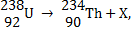
where ‘X’ is
MCQ 2031 Mark
The counting rate observed from a radioactive source at t = 0 second was 1600 counts per second and at t = 8 seconds it was 100 counts per second. The counting rate observed, as counts per second at t = 6 seconds, will be
MCQ 2041 Mark
A radioactive nucleus $92^{\mathrm{X}^{235}}$ decays to $91^{\mathrm{Y}^{231}}$ . Which of the following particles are emitted
- ✓
One alpha and one electron
- B
Two deuterons and one positron
- C
- D
One proton and four neutrons
AnswerCorrect option: A. One alpha and one electron
(a) One alpha and one electron
View full question & answer→MCQ 2051 Mark
N atoms of a radioactive element emit n alpha particles per second. The half life of the element is
- A
$\frac{n}{N}$ sec
- B
$\frac{N}{n}$ sec
- ✓
$\frac{0.693}{n}$ sec
- D
$\frac{0.693\ n}{N}$ sec
AnswerCorrect option: C. $\frac{0.693}{n}$ sec
(c) $\frac{0.693}{n}$ sec
View full question & answer→MCQ 2061 Mark
A element used for radioactive carbon dating for more than 5600 years is
MCQ 2071 Mark
A radioactive substance has a half life of 60 minutes. After 3 hours, the fraction of atom that have decayed would be
MCQ 2081 Mark
A radioactive reaction is $92^{\mathrm{U}^{238}} \rightarrow 82^{\mathrm{Pb}^{206}}$. How many α and β particles are emitted
View full question & answer→MCQ 2091 Mark
What is the respective number of α and β particles emitted in the following radioactive decay $90^{\mathrm{X}^{200}} \rightarrow 80^{\mathrm{Y}^{168}}$
View full question & answer→MCQ 2101 Mark
The count rate of a Geiger- Muller counter for the radiation of a radioactive material of half life of 30 minutes decreases to $5 s^{-1}$ after 2 hours. The initial count rate was
- A
$25 s^{-1}$
- ✓
$80 s^{-1}$
- C
$625 s^{-1}$
- D
$20 s^{-1}$
AnswerCorrect option: B. $80 s^{-1}$
(b) $80 s^{-1}$
View full question & answer→MCQ 2111 Mark
Unit of radioactivity is Rutherford. Its value is
- A
$3.7\times 10^{10}$ disi tegrations/sec
- B
$3.7 \times 10^{6}$ disintegrations/sec
- C
$1.0 \times 10^{10}$ disintegrations/sec
- ✓
$1.0 \times 10^{6}$ disintegrations/sec
AnswerCorrect option: D. $1.0 \times 10^{6}$ disintegrations/sec
(d) $1.0 \times 10^{6}$ disintegrations/sec
View full question & answer→MCQ 2121 Mark
16 gm sample of a radioactive element is taken from Bombay to Delhi in 2 hour and it was found that 1 gm of the element remained (undisintegrated). Half life of the element is
- A
- B
- ✓
$\frac {1}{2}$ hour
- D
$\frac {1}{4}$ hour
AnswerCorrect option: C. $\frac {1}{2}$ hour
(c) $\frac {1}{2}$ hour
View full question & answer→MCQ 2131 Mark
If 20 gm of a radioactive substance due to radioactive decay reduces to 10 gm in 4 minutes, then in what time 80 gm of the same substance will reduce to 10 gm
MCQ 2141 Mark
The half life of the isotope $11^{\mathrm{Na}^{24}}$ is 15 hrs. How much time does it take for $\frac{7}{8} \mathrm{th}$ of a sample of this isotope to decay
View full question & answer→MCQ 2151 Mark
Consider a radioactive material of half-life 1.0 minute. If one of the nuclei decays now, the next one will decay(a) (b)(c) (d)
- A
- B
After $\frac{1}{loge {2}}$ minute
- C
After $\frac{1}{N}$ minute, where N is the number of nuclei present at that moment
- ✓
View full question & answer→MCQ 2161 Mark
The decay constant of a radioactive element is 0.01 per second. Its half life period is
MCQ 2171 Mark
A radioactive element emits 200 particles per second. After three hours 25 particles per second are emitted. The half life period of element will be
MCQ 2181 Mark
The correct order of ionizing capacity of α, β and γ - rays is
MCQ 2191 Mark
The half life of polonium is 140 days. After how many days, 16 gm polonium will be reduced to 1 gm (or 15g will decay)
MCQ 2201 Mark
Which can pass through 20 cm thickness of the steel
MCQ 2211 Mark
Three α - particles and one β - particle decaying takes place in series from an isotope ${88^{Ra}}^{238}$
. Finally the isotope obtained will be
- A
$84^{X^{220}}$
- B
$86^{X^{222}}$
- ✓
$83^{X^{224}}$
- D
$83^{X^{215}}$
AnswerCorrect option: C. $83^{X^{224}}$
(c) $83^{X^{224}}$
View full question & answer→MCQ 2221 Mark
Some radioactive nucleus may emit
- ✓
Only one α,β or γ at a time
- B
All the three α,β and γ one after another
- C
All the three α,β and γ simultaneously
- D
Only α and β simultaneously
AnswerCorrect option: A. Only one α,β or γ at a time
Only one α,β or γ at a time
View full question & answer→MCQ 2231 Mark
View full question & answer→MCQ 2241 Mark
A radio-isotope has a half- life of 5 years. The fraction of the atoms of this material that would decay in 15 years will be
MCQ 2251 Mark
The relationship between λ and half life $T_{1/2}$ of a radioactive substance is
- A
$λ =\frac{\log _{10} 2}{\mathrm{~T}_{1 / 2}}$
- ✓
$λ =\frac{\log _{e} 2}{\mathrm{~T}_{1 / 2}}$
- C
$λ =\frac{\log _{e} 10}{\mathrm{~T}_{1 / 2}}$
- D
$λ =\frac{\log _{2} e}{\mathrm{~T}_{1 / 2}}$
AnswerCorrect option: B. $λ =\frac{\log _{e} 2}{\mathrm{~T}_{1 / 2}}$
(b) $λ =\frac{\log _{e} 2}{\mathrm{~T}_{1 / 2}}$
View full question & answer→MCQ 2261 Mark
A sample contains 16 gm of a radioactive material, the half life of which is two days. After 32 days, the amount of radioactive material left in the sample is
MCQ 2271 Mark
Atomic mass number of an element thorium is 232 and its atomic number is 90. The end product of this radioactive element is an isotope of lead (atomic mass 208 and atomic number 82). The number of alpha and beta particles emitted is
MCQ 2281 Mark
The radioactive nucleus $7^{\mathrm{N}^{18}}$ decays to $6^{\mathrm{C}^{18}}$ through the emission of
View full question & answer→MCQ 2291 Mark
Which of the following is not a mode of radioactive decay
MCQ 2301 Mark
Half life of radioactive element depends upon
- A
Amount of element present
- B
- C
- ✓
View full question & answer→MCQ 2311 Mark
- A
- B
Self disintegration process
- C
- ✓
View full question & answer→MCQ 2321 Mark
A radioactive nucleus undergoes a series of decay according to the scheme A 
 If the mass number and atomic number of A are 180 and 72 respectively, then what are these number for $\mathrm{A}_4$
 View full question & answer→MCQ 2331 Mark
The half-life of $\mathrm{Bi}^{210}$ is 5 days. What time is taken by $(7 / 8)^{\mathrm{th}}$ part of the sample to decay
View full question & answer→MCQ 2341 Mark
The half life of a radioactive element which has only $\frac {1}{32}$ of its original mass left after a lapse of 60 days is
View full question & answer→MCQ 2351 Mark
If the decay or disintegration constant of a radioactive substance is λ, then its half life and mean life are respectively
- A
$\frac{1}{\lambda}$ and $\frac{\log _e 2}{\lambda}$
- ✓
$\frac{\log _e 2}{\lambda}$ and $\frac{1}{\lambda}$
- C
$\lambda \log _{e} 2$ and $\frac{1}{\lambda}$
- D
$\frac{\lambda}{\log _e 2}$ and $\frac{1}{\lambda}$
AnswerCorrect option: B. $\frac{\log _e 2}{\lambda}$ and $\frac{1}{\lambda}$
(b) $\frac{\log _e 2}{\lambda}$ and $\frac{1}{\lambda}$
View full question & answer→MCQ 2361 Mark
In which radioactive disintegration, neutron dissociates into proton and electron
MCQ 2371 Mark
The average life T and the decay constant λ of a radioactive nucleus are related as
AnswerCorrect option: A. $T \lambda=1$
(a) $T \lambda=1$
View full question & answer→MCQ 2381 Mark
The decay constant λ of the radioactive sample is the probability of decay of an atom in unit time, then
- A
λ decreases as atoms become older
- B
λ increases as the age of atoms increases
- ✓
λ is independent of the age
- D
Behaviour of λ with time depends on the nature of the activity
AnswerCorrect option: C. λ is independent of the age
λ is independent of the age
View full question & answer→MCQ 2391 Mark
Radioactivity was discovered by
MCQ 2401 Mark
If the half life of a radioactive sample is 10 hours, its mean life is
MCQ 2411 Mark
The radioactivity of a certain radioactive element drops to 1/64 of its initial value in 30 seconds. Its half life is
MCQ 2421 Mark
A nucleus of atomic mass A and atomic number Z emits β - particles. The atomic mass and atomic number of the resulting nucleus are
MCQ 2431 Mark
Half life of $\mathrm{Bi}^{210}$ is 5 days. If we start with 50,000 atoms of this isotope, the number of atoms left over after 10 days is
View full question & answer→MCQ 2441 Mark
In the given reaction $\mathrm{z}^{\mathrm{X}^{\mathrm{A}}} \rightarrow \mathrm{z}+1^{\mathrm{Y}^{\mathrm{A}}} \rightarrow \mathrm{z}-1^{\mathrm{K}^{\mathrm{A}-4}} \rightarrow \mathrm{z}-1^{\mathrm{K}^{\mathrm{A}-4}}$ Radioactive radiations are emitted in the sequence
View full question & answer→MCQ 2451 Mark
Beta rays emitted by a radioactive material are
- A
Electromagnetic radiation
- B
The electrons orbiting around the nucleus
- ✓
Charged particles emitted by nucleus
- D
AnswerCorrect option: C. Charged particles emitted by nucleus
Charged particles emitted by nucleus
View full question & answer→MCQ 2461 Mark
An archaeologist analyses the wood in a prehistoric structure and finds that $C^{14}$ (Half life = 5700 years) to $C^{12}$ is only one- fourth of that found in the cells buried plants. The age of the wood is about
- A
$5700\ year$
- B
$2850\ year$
- ✓
$11,400\ year$
- D
$22,800\ year$
AnswerCorrect option: C. $11,400\ year$
$11,400\ year$
View full question & answer→MCQ 2471 Mark
What percentage of original radioactive atoms is left after five half lives
MCQ 2481 Mark
The half-life period of radium is 1600 years. Its average life time will be
MCQ 2491 Mark
Complete the reaction $\mathrm{n}+{ }_{92}^{235} \mathrm{U} \rightarrow{ }_{56}^{144} \mathrm{Ba}+\cdots+3 \mathrm{n}$
- ✓
$_{36}^{89} \mathrm{Kr}$
- B
$_{36}^{90} \mathrm{Kr}$
- C
$_{36}^{91} \mathrm{Kr}$
- D
$_{36}^{92} \mathrm{Kr}$
AnswerCorrect option: A. $_{36}^{89} \mathrm{Kr}$
(a) $_{36}^{89} \mathrm{Kr}$
View full question & answer→MCQ 2501 Mark
$_{6}^{12} C$absorbs an energetic neutron and emits beta particles. The resulting nucleus is
- A
$_7^{14} {~N}$
- ✓
$_{7}^{13}N$
- C
$_{5}^{13}B$
- D
$_{6}^{13}C$
AnswerCorrect option: B. $_{7}^{13}N$
(b) $_{7}^{13}N$
View full question & answer→MCQ 2511 Mark
During a negative beta decay
- A
An atomic electron is ejected
- B
An electron which is already present within the nucleus is ejected
- ✓
A neutron in the nucleus decays emitting an electron
- D
A part of the binding energy is converted into electron
AnswerCorrect option: C. A neutron in the nucleus decays emitting an electron
A neutron in the nucleus decays emitting an electron
View full question & answer→MCQ 2521 Mark
The half life period of radium is 1600 years. The fraction of a sample of radium that would remain after 6400 years is
- A
$\frac{1}{4}$
- B
$\frac{1}{2}$
- C
$\frac{1}{8}$
- ✓
$\frac{1}{16}$
AnswerCorrect option: D. $\frac{1}{16}$
(d) $\frac{1}{16}$
View full question & answer→MCQ 2531 Mark
In a radioactive substance at t = 0, the number of atoms is $8 \times 10^4$. Its half life period is 3 years. The number of atoms $1 \times 10^4$ will remain after interva
View full question & answer→MCQ 2541 Mark
The example of nuclear fusion is
- A
Formation of $Ba$ and $Kr$ from $U^{235}$
- ✓
Formation of $He$ from $H$
- C
Formation of $Pu – 235$ from $U - 235$
- D
Formation of water from hydrogen and oxygen
AnswerCorrect option: B. Formation of $He$ from $H$
Formation of $He$ from $H$
View full question & answer→MCQ 2551 Mark
The decay constant of radium is $4.28 \times 10^{-4}$ per year. Its half life will be
View full question & answer→MCQ 2561 Mark
If radius of the $_{13}^{27} \mathrm{Al}$ nucleus is estimated to be 3.6 Fermi then the radius of $_{52}^{125} \mathrm{Te}$ nucleus be nearly
View full question & answer→MCQ 2571 Mark
In any fission process the ratio
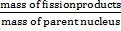
is
- ✓
- B
- C
- D
Depends on the mass of the parent nucleus
View full question & answer→MCQ 2581 Mark
Fission of nuclei is possible because the binding energy per nucleon in them
- A
Increases with mass number at high mass numbers
- ✓
Decreases with mass number at high mass numbers
- C
Increases with mass number at low mass numbers
- D
Decreases with mass number at low mass numbers
AnswerCorrect option: B. Decreases with mass number at high mass numbers
Decreases with mass number at high mass numbers
View full question & answer→MCQ 2591 Mark
Which of the following is most unstable
MCQ 2601 Mark
If the mass number of an atom is A = 40 and its electron configuration is $1 s^2, 2 s^2, 2 p^6, 3 s^2, 3 p^6$ , the number of neutrons and protons in its nucleus will be
- ✓
$22,18$
- B
$18,22$
- C
$20,20$
- D
$18,18$
AnswerCorrect option: A. $22,18$
$22,18$
View full question & answer→MCQ 2611 Mark
When $\mathrm{U}^{235}$ is bombarded with one neutron, the fission occurs and the products are three neutrons, $36^{\mathrm{Kr}^{94}}$ and
- A
$53^{1^{142}}$
- ✓
$56^{\mathrm{Ba}^{189}}$
- C
$58^{\mathrm{Ce}^{189}}$
- D
$54^{\mathrm{Xe}^{189}}$
AnswerCorrect option: B. $56^{\mathrm{Ba}^{189}}$
(b) $56^{\mathrm{Ba}^{189}}$
View full question & answer→MCQ 2621 Mark
If T is the half life of a radioactive material, then the fraction that would remain after a time $\frac{T}{2}$ is
AnswerCorrect option: C. $\frac{1}{\sqrt{2}}$
(c) $\frac{1}{\sqrt{2}}$
View full question & answer→MCQ 2631 Mark
If in a nuclear fission, piece of uranium of mass 0.5 g is lost, the energy obtained in kWh is
- ✓
$1.25 \times 10^7$
- B
$2.25 \times 10^7$
- C
$3.25 \times 10^7$
- D
$0.25 \times 10^7$
AnswerCorrect option: A. $1.25 \times 10^7$
$1.25 \times 10^7$
View full question & answer→MCQ 2641 Mark
The energy in MeV is released due to transformation of 1 kg mass completely into energy $\left(\mathrm{c}=3 \times 10^8 \mathrm{~m} / \mathrm{s}\right)$
- A
$7.625 \times 10 \mathrm{MeV}$
- B
$10.5 \times 10^{29} \mathrm{MeV}$
- C
$2.8 \times 10^{-28} \mathrm{MeV}$
- ✓
$5.625 \times 10^{29} \mathrm{MeV}$
AnswerCorrect option: D. $5.625 \times 10^{29} \mathrm{MeV}$
(d) $5.625 \times 10^{29} \mathrm{MeV}$
View full question & answer→MCQ 2651 Mark
Which of the following cannot cause fission in a heavy nucleus
MCQ 2661 Mark
The curve of binding energy per nucleon as a function of atomic mass number has a sharp peak for helium nucleus. This implies that helium
- A
- ✓
- C
Can be used as fissionable material
- D
View full question & answer→MCQ 2671 Mark
A nucleus is bombarded with a high speed neutron so that resulting nucleus is a radioactive one. This phenomenon is called
MCQ 2681 Mark
What is used as a moderator in a nuclear reactor
MCQ 2691 Mark
In a nuclear reactor, the fuel is consumed at the rate of 1 mg/s. The power generated in kilowatt is
- A
$9 \times 10^4$
- ✓
$9 \times 10^7$
- C
$9 \times 10^8$
- D
$9 \times 10^{12}$
AnswerCorrect option: B. $9 \times 10^7$
$9 \times 10^7$
View full question & answer→MCQ 2701 Mark
A nucleus of $_{84}^{210}PO$ originally at rest emits a particle with speed v. What will be the recoil speed of the daughter nucleus
View full question & answer→MCQ 2711 Mark
The nucleus ${92^U}^{234}$ splits exactly in half in a fission reaction in which two neutrons are released. The resultant nuclei are
- ✓
${46^{pd}}^{116}$
- B
${45^{Rh}}^{117}$
- C
${45^{Rh}}^{116}$
- D
${46^{pd}}^{117}$
AnswerCorrect option: A. ${46^{pd}}^{116}$
(a) ${46^{pd}}^{116}$
View full question & answer→MCQ 2721 Mark
1 atomic mass unit is equal to
- A
$\frac{1}{25} \ll$ (mass of $\mathrm{F}_2$ molecules)
- B
$\frac{1}{14}$ (mass of $\mathrm{N}_2$ molecules)
- ✓
$\frac{1}{12}$ (mass of one C -atom)
- D
$\frac{1}{16}$ (mass of $\mathrm{O}_2$ molecules)
AnswerCorrect option: C. $\frac{1}{12}$ (mass of one C -atom)
(c) $\frac{1}{12}$ (mass of one C -atom)
View full question & answer→MCQ 2731 Mark
Nuclear fusion is common to the pair
- A
Thermonuclear reactor, uranium based nuclear reactor
- B
Energy production in sun, uranium based nuclear reactor
- ✓
Energy production in sun, hydrogen bomb
- D
Disintegration of heavy nuclei, hydrogen bomb
AnswerCorrect option: C. Energy production in sun, hydrogen bomb
Energy production in sun, hydrogen bomb
View full question & answer→MCQ 2741 Mark
The principle of controlled chain reaction is used in
MCQ 2751 Mark
If in a nuclear fusion process the masses of the fusing nuclei be $\mathrm{m}_1$ and $\mathrm{m}_2$ and the mass of the resultant nucleus be $\mathrm{m}_3$, then
- A
$\mathrm{m}_3=\mathrm{m}_1+\mathrm{m}_2$
- B
$\mathrm{m}_3=\left|\mathrm{m}_1+\mathrm{m}_2\right|$
- ✓
$\mathrm{m}_3<\left(\mathrm{m}_1+\mathrm{m}_2\right)$
- D
$\mathrm{m}_3>\left(\mathrm{m}_1+\mathrm{m}_2\right)$
AnswerCorrect option: C. $\mathrm{m}_3<\left(\mathrm{m}_1+\mathrm{m}_2\right)$
(c) $\mathrm{m}_3<\left(\mathrm{m}_1+\mathrm{m}_2\right)$
View full question & answer→MCQ 2761 Mark
$M_p$ denotes the mass of a proton and $M_n$ that of a neutron. A given nucleus, of binding energy B, contains Z protons and N neutrons. The mass M(N, Z) of the nucleus is given by (c is the velocity of light)
- A
${M}({N}, {Z})={NM}_{n}+{ZM}_{p}-{Bc}^2$
- B
${M}({N}, {Z})={NM}_{n}+{ZM}_{p}+{Bc}^2$
- ✓
${M}({N}, {Z})={NM}_{n}+{ZM}_{p}-B/c^2$
- D
${M}({N}, {Z})={NM}_{n}+{ZM}_{p}+B/c^2$
AnswerCorrect option: C. ${M}({N}, {Z})={NM}_{n}+{ZM}_{p}-B/c^2$
(c) ${M}({N}, {Z})={NM}_{n}+{ZM}_{p}-B/c^2$
View full question & answer→MCQ 2771 Mark
If M is the atomic mass and A is the mass number, packing fraction is given by
- A
$\frac{A}{M-A}$
- B
$\frac{A-M}{A}$
- C
$\frac{M}{M-A}$
- ✓
$\frac{M-A}{A}$
AnswerCorrect option: D. $\frac{M-A}{A}$
(d) $\frac{M-A}{A}$
View full question & answer→MCQ 2781 Mark
- A
- ✓
Compound of deuterium and oxygen
- C
Compound of heavy oxygen and heavy hydrogen
- D
Water, in which soap does not lather
AnswerCorrect option: B. Compound of deuterium and oxygen
Compound of deuterium and oxygen
View full question & answer→MCQ 2791 Mark
Mark the correct statement
- ✓
Nuclei of different elements can have the same number of neutrons
- B
Every element has only two stable isotopes
- C
Only one isotope of each element is stable
- D
All isotopes of every element are radioactive
AnswerCorrect option: A. Nuclei of different elements can have the same number of neutrons
Nuclei of different elements can have the same number of neutrons
View full question & answer→MCQ 2801 Mark
The binding energy of nucleus is a measure of its
MCQ 2811 Mark
Solar energy is mainly caused due to
- A
Fission of uranium present in the sun
- ✓
Fusion of protons during synthesis of heavier elements
- C
Gravitational contraction
- D
Burning of hydrogen in the oxygen
AnswerCorrect option: B. Fusion of protons during synthesis of heavier elements
Fusion of protons during synthesis of heavier elements
View full question & answer→MCQ 2821 Mark
Light energy emitted by stars is due to
- A
- ✓
- C
- D
Reflection of solar light
View full question & answer→MCQ 2831 Mark
- ✓
To control the velocity of neutrons
- B
- C
- D
AnswerCorrect option: A. To control the velocity of neutrons
To control the velocity of neutrons
View full question & answer→MCQ 2841 Mark
A nuclear reaction given by $Z^{X^A} \rightarrow Z+1^{Y^A}+-1^{e^0}+\bar{p}$ represents
View full question & answer→MCQ 2851 Mark
A deutron is bombarded on $8^{0^{16}}$ nucleus and a-particle is emitted. The product nucleus is
- A
$7^{\mathrm{~N}^{18}}$
- B
$5^{\mathrm{N}^{10}}$
- C
$4^{B c^9}$
- ✓
$7^{N^{14}}$
AnswerCorrect option: D. $7^{N^{14}}$
(d) $7^{N^{14}}$
View full question & answer→MCQ 2861 Mark
Which of the following are suitable for the fusion process
MCQ 2871 Mark
A $\pi^0$ at rest decays into 2γ rays $\pi^0 \rightarrow \gamma+\gamma$. Then which of the following can happen
AnswerCorrect option: B. The two $\gamma^{\prime} s$ move in opposite direction
(b) The two $\gamma^{\prime} s$ move in opposite direction
View full question & answer→MCQ 2881 Mark
In the following reaction the value of ‘X’ is $7^{\mathrm{N}^{14}}+2^{\mathrm{He}^4} \rightarrow \mathrm{X}+1^{\mathrm{H}^1}$
- A
${8^N}^{17}$
- ✓
${8^O}^{17}$
- C
${7^O}^{16}$
- D
${7^N}^{16}$
AnswerCorrect option: B. ${8^O}^{17}$
(b) ${8^O}^{17}$
View full question & answer→MCQ 2891 Mark
The nuclear reaction $2_{\mathrm{H}}+2_{\mathrm{H}} \rightarrow 4_{\mathrm{He}}$ (mass of deuteron = 2.0141 a.m.u. and mass of He = 4.0024 a.m.u.) is
- ✓
Fusion reaction releasing 24 MeV energy
- B
Fusion reaction absorbing 24 MeV energy
- C
Fission reaction releasing 0.0258 MeV energy
- D
Fission reaction absorbing 0.0258 MeV energy
AnswerCorrect option: A. Fusion reaction releasing 24 MeV energy
(a) Fusion reaction releasing 24 MeV energy
View full question & answer→MCQ 2901 Mark
In a material medium, when a positron meets an electron both the particles annihilate leading to the emission of two gamma ray photons. This process forms the basis of an important diagnostic procedure called
MCQ 2911 Mark
In nuclear fission the percentage of mass converted into energy is about
MCQ 2921 Mark
Which one of the following statements about uranium is correct
- ✓
$235_U$ is fissionable by thermal neutrons
- B
Fast neutrons trigger the fission process in $235_U$
- C
$238_U$ breaks up into fragments when bombarded by slow neutrons
- D
$235_U$ is an unstable isotope and undergoes spontaneous fission
AnswerCorrect option: A. $235_U$ is fissionable by thermal neutrons
(a) $235_U$ is fissionable by thermal neutrons
View full question & answer→MCQ 2931 Mark
The energy liberated on complete fission of 1 kg of $92^{\mathrm{U}^{285}}$ is (Assume 200 MeV energy is liberated on fission of 1 nucleus)
- A
$8.2 \times 10^{10} \mathrm{~J}$
- B
$8.2 \times 10^9 \mathrm{~J}$
- ✓
$8.2 \times 10^{13} \mathrm{~J}$
- D
$8.2 \times 10^{16} \mathrm{~J}$
AnswerCorrect option: C. $8.2 \times 10^{13} \mathrm{~J}$
(c) $8.2 \times 10^{13} \mathrm{~J}$
View full question & answer→MCQ 2941 Mark
The binding energy per nucleon of deuterium and helium atom is 1.1 MeV and 7.0 MeV. If two deuterium nuclei fuse to form helium atom, the energy released is
MCQ 2951 Mark
If an electron and a positron annihiliate, then the energy released is
- A
$3.2 \times 10^{-13} \mathrm{~J}$
- ✓
$1.6 \times 10^{-13} \mathrm{~J}$
- C
$4.8 \times 10^{-13} \mathrm{~J}$
- D
$6.4 \times 10^{-13} \mathrm{~J}$
AnswerCorrect option: B. $1.6 \times 10^{-13} \mathrm{~J}$
(b) $1.6 \times 10^{-13} \mathrm{~J}$
View full question & answer→MCQ 2961 Mark
The energy released in a typical nuclear fusion reaction is approximately
MCQ 2971 Mark
In the nuclear reaction: X(n, α) $3^{\mathrm{Li}^7}$ the term X will be 3
- ✓
$5^{\mathrm{B}^{10}}$
- B
$5^{B^9}$
- C
$5^{B^{11}}$
- D
$2^{\mathrm{He}^4}$
AnswerCorrect option: A. $5^{\mathrm{B}^{10}}$
(a) $5^{\mathrm{B}^{10}}$
View full question & answer→MCQ 2981 Mark
The average number of prompt neutrons produced per fission of $U^{235}$ is
View full question & answer→MCQ 2991 Mark
To generate a power of 3.2 mega watt, the number of fissions of $\mathrm{U}^{235}$ per minute is (Energy released per fission = 200MeV, 1eV = 1.6 $\times 10^{-19} \mathrm{~J}$)
- ✓
$1.6 \times 10^{18}$
- B
$6 \times 10^{17}$
- C
$10^{17}$
- D
$6 \times 10^{16}$
AnswerCorrect option: A. $1.6 \times 10^{18}$
(a) $1.6 \times 10^{18}$
View full question & answer→MCQ 3001 Mark
Neutrino is a particle, which is
- A
- B
- ✓
- D
Charge less and has no spin
View full question & answer→MCQ 3011 Mark
If the energy released in the fission of one nucleus is 200 MeV. Then the number of nuclei required per second in a power plant of 16 kW will be
- A
$0.5 \times 10^{14}$
- B
$0.5 \times 10^{12}$
- C
$5 \times 10^{12}$
- ✓
$5 \times 10^{14}$
AnswerCorrect option: D. $5 \times 10^{14}$
$5 \times 10^{14}$
View full question & answer→MCQ 3021 Mark
Boron rods in nuclear reactor are used as a
MCQ 3031 Mark
Which of the following particle has similar mass to electron
MCQ 3041 Mark
Nuclear fission was discovered by
- ✓
Auto Hahn and F. strassmann
- B
- C
- D
AnswerCorrect option: A. Auto Hahn and F. strassmann
Auto Hahn and F. strassmann
View full question & answer→MCQ 3051 Mark
Best neutron moderator is
MCQ 3061 Mark
Energy released in fusion of 1 kg of deuterium nuclei
- A
$8 \times 10^{13} J$
- B
$6 \times 10^{27} J$
- C
$2 \times 10^7 KwH$
- ✓
$8 \times 10^{23} MeV$
AnswerCorrect option: D. $8 \times 10^{23} MeV$
$8 \times 10^{23} MeV$
View full question & answer→MCQ 3071 Mark
The number of neutrons released when ${}_{92} U ^{235}$ undergoes fission by absorbing $0^{ n ^1}$ and $\left(56^{ Ba ^{144}}+36^{ Kr ^{89}}\right)$ are formed, is
View full question & answer→MCQ 3081 Mark
In a nuclear fission reaction
- A
Two light nuclei combine to produce a heavier nucleus
- B
A light nucleus bombarded by thermal neutrons breaks up
- ✓
A heavy nucleus bombarded by thermal neutrons breaks up
- D
A heavy nucleus breaks up by itself
AnswerCorrect option: C. A heavy nucleus bombarded by thermal neutrons breaks up
A heavy nucleus bombarded by thermal neutrons breaks up
View full question & answer→MCQ 3091 Mark
Which of these is a fusion reaction
- ✓
${ }_3^1 \mathrm{H}+{ }_2^1 \mathrm{H}={ }_4^2 \mathrm{He}+{ }_1^0 \mathrm{n}$
- B
${ }_{92}^{238} \mathrm{U} \rightarrow{ }_{82}^{206} \mathrm{~Pb}+8\left({ }_2^4 \mathrm{He}\right){+6}\left(_{-1}^0 \beta\right)$
- C
${ }_7^{12} \mathrm{C} \rightarrow{ }_6^{12} \mathrm{C}+\beta^{+}+\gamma$
- D
AnswerCorrect option: A. ${ }_3^1 \mathrm{H}+{ }_2^1 \mathrm{H}={ }_4^2 \mathrm{He}+{ }_1^0 \mathrm{n}$
(a) ${ }_3^1 \mathrm{H}+{ }_2^1 \mathrm{H}={ }_4^2 \mathrm{He}+{ }_1^0 \mathrm{n}$
View full question & answer→MCQ 3101 Mark
If a proton and anti-proton come close to each other and annihilate, how much energy will be released
- A
$1.5 \times 10^{-10} \mathrm{~J}$
- ✓
$3 \times 10^{-10} \mathrm{~J}$
- C
$4.5 \times 10^{-10} \mathrm{~J}$
- D
AnswerCorrect option: B. $3 \times 10^{-10} \mathrm{~J}$
(b) $3 \times 10^{-10} \mathrm{~J}$
View full question & answer→MCQ 3111 Mark
When a slow neutron goes sufficiently close to a $\mathrm{U}^{235}$ nucleus, then the process that takes place is
AnswerCorrect option: A. Fission of $\mathrm{U}^{235}$
Fission of $U^{235}$
View full question & answer→MCQ 3121 Mark
Energy in the sun is generated mainly by
- A
Fusion of radioactive material
- B
- C
- ✓
View full question & answer→MCQ 3131 Mark
Which of the following is used as a moderator in nuclear reactors
MCQ 3141 Mark
A free neutron decays into a proton, an electron and
MCQ 3151 Mark
In a nuclear reaction, which of the following is conserved
- A
- B
- ✓
Atomic number, mass number and energy
- D
AnswerCorrect option: C. Atomic number, mass number and energy
Atomic number, mass number and energy
View full question & answer→MCQ 3161 Mark
$1^{ H ^1}+1^{ H ^1}+1^{ H ^2} \rightarrow X +-1^{ e ^0}+$energy. The emitted particle is
AnswerCorrect option: C. $\alpha -$particle
$\alpha -$particle
View full question & answer→MCQ 3171 Mark
Nuclear fission experiments show that the neutrons split the uranium nuclei into two fragments of about same size. This process is accompanied by the emission of several
MCQ 3181 Mark
Heavy water is used as moderator in a nuclear reactor. The function of the moderator is
- A
To control the energy released in the reactor
- B
To absorb neutrons and stop chain reaction
- C
To cool the reactor faster
- ✓
To slow down the neutrons to thermal energies
AnswerCorrect option: D. To slow down the neutrons to thermal energies
To slow down the neutrons to thermal energies
View full question & answer→MCQ 3191 Mark
Which one of the following nuclear reactions is a source of energy in the sun
- A
${ }_4^9 \mathrm{Be}+{ }_2^4 \mathrm{He} \rightarrow{ }_6^{12} \mathrm{C}+{ }_0^{-1} \mathrm{n}$
- ✓
${ }_2^3 \mathrm{He}+{ }_2^3 \mathrm{He} \rightarrow{ }_2^4 \mathrm{He}+{ }_1^1 \mathrm{H}+{ }_1^1 \mathrm{H}$
- C
${ }_{56}^{144} \mathrm{Ba}+{ }_{56}^{92} \mathrm{Kr} \rightarrow{ }_{92}^{235} \mathrm{U}+{ }_0^{-1} \mathrm{n}$
- D
${ }_{26}^{56} \mathrm{Fe}+{ }_{48}^{112} \mathrm{Ca} \rightarrow{ }_{74}^{167} \mathrm{~W}+{ }_0^{-1} \mathrm{n}$
AnswerCorrect option: B. ${ }_2^3 \mathrm{He}+{ }_2^3 \mathrm{He} \rightarrow{ }_2^4 \mathrm{He}+{ }_1^1 \mathrm{H}+{ }_1^1 \mathrm{H}$
(b) ${ }_2^3 \mathrm{He}+{ }_2^3 \mathrm{He} \rightarrow{ }_2^4 \mathrm{He}+{ }_1^1 \mathrm{H}+{ }_1^1 \mathrm{H}$
View full question & answer→MCQ 3201 Mark
In a fission process, nucleus A divides into two nuclei B and C, their binding energies being $E_a,E_b$ and $E_c$ respectively. Then
- A
$E_b+E_c=E_a$
- ✓
$E_b+E_c>E_a$
- C
$E_b+E_c<E_a$
- D
$E_b.E_c=E_a$
AnswerCorrect option: B. $E_b+E_c>E_a$
(b) $E_b+E_c>E_a$
View full question & answer→MCQ 3211 Mark
Thermal neutrons are those which
- A
Are at very high temperature
- B
Move with high velocities
- ✓
Have kinetic energies similar to those of surrounding molecules
- D
AnswerCorrect option: C. Have kinetic energies similar to those of surrounding molecules
Have kinetic energies similar to those of surrounding molecules
View full question & answer→MCQ 3221 Mark
Energy released in the fission of a single $92^{\mathrm{U}^{235}}$ nucleus is 200 MeV. The fission rate of a $92^{\mathrm{U}^{235}}$ fuelled reactor operating at a power level of 5W is
- A
$1.56 \times 10^{+10} \mathrm{~s}^{-1}$
- ✓
$1.56 \times 10^{+11} \mathrm{~s}^{-1}$
- C
$1.56 \times 10^{+16} \mathrm{~s}^{-1}$
- D
$1.56 \times 10^{+17} \mathrm{~s}^{-1}$
AnswerCorrect option: B. $1.56 \times 10^{+11} \mathrm{~s}^{-1}$
(b) $1.56 \times 10^{+11} \mathrm{~s}^{-1}$
View full question & answer→MCQ 3231 Mark
When neutrons are bombarded on nucleus of $92^{ U ^{235}}$, the number of emitted neutrons will be
View full question & answer→MCQ 3241 Mark
In the nuclear reaction $6^{\mathrm{C}^{11}} \rightarrow 5^{\mathrm{B}^{11}}+\beta^{+}+\mathrm{X}$, what does X stand for
View full question & answer→MCQ 3251 Mark
Thermal neutrons can cause fission in
- ✓
$\mathrm{U}^{235}$
- B
$\mathrm{U}^{238}$
- C
$\mathrm{Pu}^{238}$
- D
$\mathrm{Th}^{232}$
AnswerCorrect option: A. $\mathrm{U}^{235}$
(a) $\mathrm{U}^{235}$
View full question & answer→MCQ 3261 Mark
In the following reaction $12^{\mathrm{Mg}^{24}}+2^{\mathrm{He}^4} \rightarrow 14^{\mathrm{Si}^{\mathrm{X}}}+0^{\mathrm{n}^1}, \mathrm{X}$ is
View full question & answer→MCQ 3271 Mark
In the nuclear reaction ${85^{X}}^{297} \rightarrow {Y}+4 \alpha, {Y}$ is
- A
${76^Y}^{287}$
- B
${77^Y}^{285}$
- ✓
${77^Y}^{281}$
- D
${77^Y}^{289}$
AnswerCorrect option: C. ${77^Y}^{281}$
(c) ${77^Y}^{281}$
View full question & answer→MCQ 3281 Mark
1 g of hydrogen is converted into 0.993 g of helium in a thermonuclear reaction. The energy released is
- A
$63 \times 10^{7}\ J$
- ✓
$63 \times 10^{10}\ J$
- C
$63 \times 10^{14}\ J$
- D
$63 \times 10^{20}\ J$
AnswerCorrect option: B. $63 \times 10^{10}\ J$
$63 \times 10^{10}\ J$
View full question & answer→MCQ 3291 Mark
Name of the India's first nuclear reactor is
MCQ 3301 Mark
When two deuterium nuclei fuse together to form a tritium nuclei, we get a
MCQ 3311 Mark
In nuclear fission, the fission reactions proceeds with a projectile. Which of the following suits the best
MCQ 3321 Mark
The example of nuclear fusion is
- A
Formation of barium and krypton from uranium
- ✓
Formation of helium from hydrogen
- C
Formation of plutonium 235 from uranium 235
- D
Formation of water from hydrogen and oxygen
AnswerCorrect option: B. Formation of helium from hydrogen
Formation of helium from hydrogen
View full question & answer→MCQ 3331 Mark
Complete the equation for the following fission process $92^{\mathrm{U}^{235}}+0^{\mathrm{n}^1} \rightarrow 38^{ \mathrm{Sr}^{90}}+\ldots$
- ✓
$54^{\mathrm{Xe}^{148}}+30^{\mathrm{n}^1}$
- B
$54^{\mathrm{Xe}^{145}}$
- C
$57^{\mathrm {Xe}^{142}}$
- D
$54^{\mathrm{Xe}^{142}}+0^{\mathrm{n}^1}$
AnswerCorrect option: A. $54^{\mathrm{Xe}^{148}}+30^{\mathrm{n}^1}$
(a) $54^{\mathrm{Xe}^{148}}+30^{\mathrm{n}^1}$
View full question & answer→MCQ 3341 Mark
A chain reaction is continuous due to
- A
- B
- ✓
Production of more neutrons in fission
- D
AnswerCorrect option: C. Production of more neutrons in fission
Production of more neutrons in fission
View full question & answer→MCQ 3351 Mark
If 200 MeV energy is released in the fission of a single $U^{235}$ nucleus, the number of fissions required per second to produce 1 kilowatt power shall be (Given $1eV = 1.6 \times 10^{-19}J$)
- ✓
$3.125 \times 10^{13}$
- B
$3.125\times 10^{14}$
- C
$3.125 \times 10^{15}$
- D
$3.125 \times 10^{16}$
AnswerCorrect option: A. $3.125 \times 10^{13}$
(a) $3.125 \times 10^{13}$
View full question & answer→MCQ 3361 Mark
In the nuclear reaction $92^{\mathrm{U}^{288}} \rightarrow \mathrm{z}^{\mathrm{Th}^{\mathrm{A}}}+2^{\mathrm{He}^4}$, the values of A and Z are
View full question & answer→MCQ 3371 Mark
200 MeV of energy may be obtained per fission of $\mathrm{U}^{235}$. A reactor is generating 1000 kW of power. The rate of nuclear fission in the reactor is
- A
- B
$2 \times 10^8$
- ✓
$3.125 \times 10^{16}$
- D
AnswerCorrect option: C. $3.125 \times 10^{16}$
(c) $3.125 \times 10^{16}$
View full question & answer→MCQ 3381 Mark
A reaction between a proton and ${8^O}^{18}$ that produces ${9^F}^{18}$ must also liberate
- A
${0^n}^1$
- B
${1^e}^0$
- ✓
${1^n}^0$
- D
${0^e}^1$
AnswerCorrect option: C. ${1^n}^0$
${1^n}^0$
View full question & answer→MCQ 3391 Mark
γ-rays radiation can be used to create electron-positron pair. In this process of pair production, γ-rays energy cannot be less than
MCQ 3401 Mark
When $92^{\mathrm{U}^{285}}$ undergoes fission, 0.1% of its original mass is changed into energy. How much energy is released if 1kg of $92^{\mathrm{U}^{285}}$ undergoes fission
- A
$9 \times 10^{10} \mathrm{~J}$
- B
$9 \times 10^{11} \mathrm{~J}$
- C
$9 \times 10^{12} \mathrm{~J}$
- ✓
$9 \times 10^{13} \mathrm{~J}$
AnswerCorrect option: D. $9 \times 10^{13} \mathrm{~J}$
(d) $9 \times 10^{13} \mathrm{~J}$
View full question & answer→MCQ 3411 Mark
The mass equivalent of 931 MeV energy is
- ✓
$1.66 \times 10^{-24} \mathrm{~kg}$
- B
$6.02 \times 10^{-24} \mathrm{~kg}$
- C
$1.66 \times 10^{-20} \mathrm{~kg}$
- D
$6.02 \times 10^{-27} \mathrm{~kg}$
AnswerCorrect option: A. $1.66 \times 10^{-24} \mathrm{~kg}$
(a) $1.66 \times 10^{-24} \mathrm{~kg}$
View full question & answer→MCQ 3421 Mark
Fast neutrons can easily be slowed down by
- A
The use of lead shielding
- ✓
Passing them through water
- C
Elastic collisions with heavy nuclei
- D
Applying a strong electric field
AnswerCorrect option: B. Passing them through water
Passing them through water
View full question & answer→MCQ 3431 Mark
A nuclear bomb exploded 200 km above the surface of moon. The sound of explosion on the moon
- A
Will heard before the explosion is seen
- B
Will be heard at the same time
- C
Will be heard after explosion
- ✓
View full question & answer→MCQ 3441 Mark
On the bombardment of neutron with Boron. a-particle is emitted and product nuclei formed is
- A
$6^{\mathrm{C}^{12}}$
- B
$3^{\mathrm{Li}^6}$
- ✓
$3^{\mathrm{Li}^7}$
- D
$4^{\mathrm{Be}^9}$
AnswerCorrect option: C. $3^{\mathrm{Li}^7}$
(c) $3^{\mathrm{Li}^7}$
View full question & answer→MCQ 3451 Mark
What was the fissionable material used in bomb dropped at Nagasaki (Japan) in the year 1945 ?
MCQ 3461 Mark
Which of the following statement is true
- A
$78^{\mathrm{Pt}^{192}}$ has 78 neutrons
- B
$84^{\mathrm{PO}^{214}} \rightarrow 82^{\mathrm{Pb}^{210}}+\beta^{-}$
- ✓
$92^{\mathrm{U}^{238}} \rightarrow 90^{\mathrm{Th}^{234}}+2^{\mathrm{He}^4}$
- D
$90^{\mathrm{Th}^{234}} \rightarrow 91^{\mathrm{Pa}^{234}}+2^{\mathrm{He}^4}$
AnswerCorrect option: C. $92^{\mathrm{U}^{238}} \rightarrow 90^{\mathrm{Th}^{234}}+2^{\mathrm{He}^4}$
(c) $92^{\mathrm{U}^{238}} \rightarrow 90^{\mathrm{Th}^{234}}+2^{\mathrm{He}^4}$
View full question & answer→MCQ 3471 Mark
A gamma ray photon creates an electron- positron pair. If the rest mass energy of an electron is 0.5 MeV and the total K.E. of the electron- positron pair is 0.78 MeV, then the energy of the gamma ray photon must be
MCQ 3481 Mark
The main source of solar energy is
MCQ 3491 Mark
The mechanism of the hydrogen bomb is based on
- A
Fission of isotopes of hydrogen
- B
- ✓
Fusion of deutrium and tritium
- D
AnswerCorrect option: C. Fusion of deutrium and tritium
Fusion of deutrium and tritium
View full question & answer→MCQ 3501 Mark
In nuclear reactions, we have the conservation of
- A
- B
- C
- ✓
Mass, energy and momentum
AnswerCorrect option: D. Mass, energy and momentum
Mass, energy and momentum
View full question & answer→MCQ 3511 Mark
Fusion reaction takes place at high temperature because
- A
Atoms are ionised at high temperature
- B
Molecules break-up at high temperature
- C
Nuclei break-up at high temperature
- ✓
Kinetic energy is high enough to overcome repulsion between nuclei
AnswerCorrect option: D. Kinetic energy is high enough to overcome repulsion between nuclei
Kinetic energy is high enough to overcome repulsion between nuclei
View full question & answer→MCQ 3521 Mark
In a working nuclear reactor, Cadmium rods, (control rods) are used to
MCQ 3531 Mark
During the nuclear fusion reaction
- A
A heavy nucleus breaks into two fragments by itself
- B
A light nucleus bombarded by thermal neutrons breaks up
- C
A heavy nucleus bombarded by thermal neutrons breaks up
- ✓
Two light nuclei combine to give a heavier nucleus and possibly other products
AnswerCorrect option: D. Two light nuclei combine to give a heavier nucleus and possibly other products
Two light nuclei combine to give a heavier nucleus and possibly other products
View full question & answer→MCQ 3541 Mark
From the following equations, pick out the possible nuclear reactions
- A
$92^{\mathrm{U}^{235}}+0^{\mathrm{n}^1}\rightarrow54^{\mathrm{X}^{140}}+38^{\mathrm{Si}^{94}}+20^{\mathrm{n}^1}+\gamma+200 \mathrm{MeV}$
- B
$6^{\mathrm{C}^{12}}+1^{\mathrm{H}^1} \rightarrow 7^{\mathrm{N}^{13}}+2 \mathrm{MeV}$
- C
$7^{\mathrm{N}^{14}}+1^{\mathrm{H}^1} \rightarrow 8^{\mathrm{O}^{15}}+7.3 \mathrm{MeV}$
- ✓
$b,c$
View full question & answer→MCQ 3551 Mark
Atom bomb consists of two pieces of $92^{\mathrm{U}^{285}}$ and a source of
View full question & answer→MCQ 3561 Mark
When a $4^{B e^9}$ atom is bombarded with α - particles, one of the product of nuclear transmutation is $6^{\mathrm{C}^{12}}$. The other is
- A
$-1^{e^0}$
- B
$1^{\mathrm{H}^1}$
- C
$1^{\mathrm{D}^2}$
- ✓
$0^{\mathrm{n}^1}$
AnswerCorrect option: D. $0^{\mathrm{n}^1}$
(d) $0^{\mathrm{n}^1}$
View full question & answer→MCQ 3571 Mark
Fusion reaction is initiated with the help of
MCQ 3581 Mark
If the speed of light were 2/3 of its present value, the energy released in a given atomic explosion will be decreased by a fraction
MCQ 3591 Mark
Which of the following is the fusion reaction
- ✓
$1^{\mathrm{H}^2}+1^{\mathrm{H}^2} \rightarrow 2^{\mathrm{He}^4}$
- B
$0^{\mathrm{n}^1}+7^{\mathrm{N}^{14}} \rightarrow 6^{\mathrm{C}^{14}}+1^{\mathrm{H}^1}$
- C
$0^{\mathrm{n}^1}+92^{\mathrm{U}^{238}} \rightarrow 93^{\mathrm{Np}^{259}}+\beta^{-1}+\gamma$
- D
$1^{\mathrm{H}^8} \rightarrow 2^{\mathrm{He}^8}+\beta^{-1}+\gamma$
AnswerCorrect option: A. $1^{\mathrm{H}^2}+1^{\mathrm{H}^2} \rightarrow 2^{\mathrm{He}^4}$
(a) $1^{\mathrm{H}^2}+1^{\mathrm{H}^2} \rightarrow 2^{\mathrm{He}^4}$
View full question & answer→MCQ 3601 Mark
Energy generation in stars is mainly due to
MCQ 3611 Mark
In nuclear reaction $2^{ He ^4}+ z ^{ X ^{ A }} \rightarrow z +2^{ Y ^{ A + 3 }}+ A$ A denotes
View full question & answer→MCQ 3621 Mark
The explosion of the atomic bomb takes place due to
MCQ 3631 Mark
The process by which a heavy nucleus splits into light nuclei is known as
MCQ 3641 Mark
The control rod in a nuclear reactor is made of
MCQ 3651 Mark
Which of the following isotopes is normally fissionable ?
- A
${92^U}^{238}$
- B
${93^{Np}}^{289}$
- ✓
${92^U}^{235}$
- D
${2^{He}}^4$
AnswerCorrect option: C. ${92^U}^{235}$
(c) ${92^U}^{235}$
View full question & answer→MCQ 3661 Mark
The average kinetic energy of the thermal neutrons is of the order of (Boltzmann's constant $(K _{ B }=8 \times 10^{-5} eV /$ Kelvin)
- ✓
$0.03\ eV$
- B
$3\ eV$
- C
$3\ KeV$
- D
$3\ MeV$
AnswerCorrect option: A. $0.03\ eV$
$0.03\ eV$
View full question & answer→MCQ 3671 Mark
In helium nucleus, there are
- A
2 protons and 2 electrons
- B
2 neutrons, 2 protons and 2 electrons
- ✓
- D
2 positrons and 2 protons
View full question & answer→MCQ 3681 Mark
$\pi$ mesons can be
AnswerCorrect option: D. $\pi^{+},\pi^{-}$or $\pi^0$
(d) $\pi^{+},\pi^{-}$or $\pi^0$
View full question & answer→MCQ 3691 Mark
Which of the following statement(s) is/(are) correct
- A
The rest mass of a stable nucleus is less than the sum of the rest masses of its separated nucleons
- B
In nuclear fission, energy is released by fragmentation of a very heavy nucleus
- C
The rest mass of a stable nucleus is greater than the sum of the rest masses of its separated nucleons.
- ✓
View full question & answer→MCQ 3701 Mark
The mass defect in a particular nuclear reaction is 0.3 grams. The amount of energy liberated in kilowatt hours is (Velocity of light = $3 \times 10^8 \mathrm{~m} / \mathrm{s}$)
- A
$1.5 \times 10^6$
- B
$2.5 \times 10^6$
- C
$3 \times 10^6$
- ✓
$7.5 \times 10^6$
AnswerCorrect option: D. $7.5 \times 10^6$
(d) $7.5 \times 10^6$
View full question & answer→MCQ 3711 Mark
If $m, m_n$ and $m_p$ are the masses of $\mathrm{z}^{\mathrm{X}^A}$ nucleus, neutron and proton respectively
- ✓
$m<(A-Z) m_n+Z m_p$
- B
$m=(A-Z) m_n+Z m_p$
- C
$m=(A-Z) m_p+Z m_n$
- D
$m>(A-Z) m_n+Z m_p$
AnswerCorrect option: A. $m<(A-Z) m_n+Z m_p$
(a) $m<(A-Z) m_n+Z m_p$
View full question & answer→MCQ 3721 Mark
Two protons exerts a nuclear force on each other, the distance between them is
- ✓
$10^{-14}\ m$
- B
$10^{-10}\ m$
- C
$10^{-12}\ m$
- D
$10^{-8}\ m$
AnswerCorrect option: A. $10^{-14}\ m$
$10^{-14}\ m$
View full question & answer→MCQ 3731 Mark
As compared $^{12}C$ atom, $^{14}C$ atom has
- A
Two extra protons and two extra electrons
- B
Two extra protons but no extra electrons
- ✓
Two extra neutrons and no extra electrons
- D
Two extra neutrons and two extra electrons
AnswerCorrect option: C. Two extra neutrons and no extra electrons
Two extra neutrons and no extra electrons
View full question & answer→MCQ 3741 Mark
The sodium nucleus ${ }_{11}^{23} Na$ contains
- A
$11$ electrons
- B
$12$ protons
- C
$23$ protons
- ✓
$12$ neutrons
AnswerCorrect option: D. $12$ neutrons
$12$ neutrons
View full question & answer→MCQ 3751 Mark
The mass and energy equivalent to 1 a.m.u. respectively
- A
$1.67 \times 10^{-27} gm , 9.30 MeV$
- ✓
$1.67 \times 10^{-27} kg, 9.30 MeV$
- C
$1.67 \times 10^{-27} kg, 1 MeV$
- D
$1.67 \times 10^{-34} kg, 1 MeV$
AnswerCorrect option: B. $1.67 \times 10^{-27} kg, 9.30 MeV$
(b) $1.67 \times 10^{-27} kg, 9.30 MeV$
View full question & answer→MCQ 3761 Mark
The radius of a nucleus of a mass number A is directly proportional to
- A
$A^3$
- B
$A$
- C
$A^{2/3}$
- ✓
$A^{1/3}$
AnswerCorrect option: D. $A^{1/3}$
$A^{1/3}$
View full question & answer→MCQ 3771 Mark
$M_n$ and $M_p$ represent mass of neutron and proton respectively. If an element having atomic mass $M$ has $N$-neutron and Z -proton, then the correct relation will be
- ✓
$M <\left[ NM _{ n }+ ZM _{ p }\right]$
- B
$M >\left[ NM _{ n }+ ZM _{ p }\right]$
- C
$M =\left[ NM _{ n }+ ZM _{ p }\right]$
- D
$M=N\left[M_n+M_p\right]$
AnswerCorrect option: A. $M <\left[ NM _{ n }+ ZM _{ p }\right]$
(a) $M <\left[ NM _{ n }+ ZM _{ p }\right]$
View full question & answer→MCQ 3781 Mark
Two nucleons are at a separation of $1 \times 10^{-15} m$. The net force between them is $F_1$, if both are neutrons, $F_2$ if both are protons and $F_3$ if one is a proton and other is a neutron. In such a case
- A
$F_2>F_1>F_3$
- ✓
$F_1=F_2=F_3$
- C
$F_1=F_2>F_3$
- D
$F_1=F_3>F_2$
AnswerCorrect option: B. $F_1=F_2=F_3$
(b) $F_1=F_2=F_3$
View full question & answer→MCQ 3791 Mark
For a nucleus to be stable, the correct relation between neutron number N and Proton number Z is
MCQ 3801 Mark
The force acting between proton and proton inside the nucleus is
MCQ 3811 Mark
The a-particle is the nucleus of an atom of
MCQ 3821 Mark
Atomic number of a nucleus is Z and atomic mass is M. The number of neutron is
MCQ 3831 Mark
In a fission reaction $_{92}^{236} \mathrm{U} \rightarrow 117_{\mathrm{X}}+117_{\mathrm{Y}}+\mathrm{n}+\mathrm{n}$, the binding energy per nucleon of X and Y is 8.5 MeV whereas of $236_U$ is 7.6 MeV. The total energy liberated will be about
View full question & answer→MCQ 3841 Mark
Energy of 1g uranium is equal to
- ✓
$9 \times 10^{13}\ J$
- B
$9 \times 10^{19}\ J$
- C
$6 \times 10^{16}\ J$
- D
$3 \times 10^{17}\ J$
AnswerCorrect option: A. $9 \times 10^{13}\ J$
$9 \times 10^{13}\ J$
View full question & answer→MCQ 3851 Mark
A nucleus ruptures into two nuclear parts which have their velocity ratio equal to $2: 1$. What will be the ratio of their nuclear size (nuclear radius)
- A
$2^{1 / 3}: 1$
- ✓
$1: 2^{1 / 3}$
- C
$3^{1 / 2}: 1$
- D
$1: 3^{1 / 2}$
AnswerCorrect option: B. $1: 2^{1 / 3}$
(b) $1: 2^{1 / 3}$
View full question & answer→MCQ 3861 Mark
The mass number of He is 4 and that for sulphur is 32. The radius of sulphur nucleus is larger than that of helium, by times
MCQ 3871 Mark
The mass of an a-particle is
- ✓
Less than the sum of masses of two protons and two neutrons
- B
Equal to mass of four protons
- C
Equal to mass of four neutrons
- D
Equal to sum of masses of two protons and two neutrons
AnswerCorrect option: A. Less than the sum of masses of two protons and two neutrons
Less than the sum of masses of two protons and two neutrons
View full question & answer→MCQ 3881 Mark
Isotopes are atoms having
- ✓
Same number of protons but different number of neutrons
- B
Same number of neutrons but different number of protons
- C
Same number of protons and neutrons
- D
AnswerCorrect option: A. Same number of protons but different number of neutrons
Same number of protons but different number of neutrons
View full question & answer→MCQ 3891 Mark
The binding energy per nucleon is maximum in the case of
- A
${ }_4^2 He$
- ✓
${ }_{26}^{56} Fe$
- C
${ }_{141}^{56} Ba$
- D
${ }_{92}^{235} Fe$
AnswerCorrect option: B. ${ }_{26}^{56} Fe$
${ }_{26}^{56} Fe$
View full question & answer→MCQ 3901 Mark
Antiparticle of electron is
MCQ 3911 Mark
Size of nucleus is of the order of
- A
$10^{-10} \mathrm{~m}$
- ✓
$10^{-15} \mathrm{~m}$
- C
$10^{-12} \mathrm{~m}$
- D
$10^{-19} \mathrm{~m}$
AnswerCorrect option: B. $10^{-15} \mathrm{~m}$
(b) $10^{-15} \mathrm{~m}$
View full question & answer→MCQ 3921 Mark
- ✓
Short ranged attractive and charge independent
- B
Short ranged attractive and charge dependent
- C
Long ranged repulsive and charge independent
- D
Long ranged repulsive and charge dependent
AnswerCorrect option: A. Short ranged attractive and charge independent
Short ranged attractive and charge independent
View full question & answer→MCQ 3931 Mark
Which of the following has the mass closest in value to that of the positron (1 a.m.u = 931 Mev)
MCQ 3941 Mark
The mass defect per nucleon is called
MCQ 3951 Mark
The mass of a neutron is the same as that of
MCQ 3961 Mark
Atomic weight of boron is 10.81 and it has two isotopes $5^{\mathrm{B}^{10}}$ and $5^{\mathrm{B}^{11}}$. Then ratio of $5^{\mathrm{B}^{10}}: 5^{\mathrm{B}^{11}}$ in nature would be
View full question & answer→MCQ 3971 Mark
Nucleus of an atom whose atomic mass is 24 consists of
- A
11 electrons, 11 protons and 13 neutrons
- B
11 electrons, 13 protons and 11 neutrons
- ✓
11 protons and 13 neutrons
- D
11 protons and 13 electrons
AnswerCorrect option: C. 11 protons and 13 neutrons
11 protons and 13 neutrons
View full question & answer→MCQ 3981 Mark
Radius of $_2^4 \mathrm{He}$ nucleus is 3 Fermi. The radius of $_{82}^{206} \mathrm{~Pb}$ nucleus will be
View full question & answer→MCQ 3991 Mark
Order of magnitude of density of uranium nucleus is $(m_p=1.67 \times 10^{-27} \mathrm{~kg})$
- ✓
$10^{20} \mathrm{~kg} / \mathrm{m}^3$
- B
$10^{17} \mathrm{~kg} / \mathrm{m}^3$
- C
$10^{14} \mathrm{~kg} / \mathrm{m}^3$
- D
$10^{11} \mathrm{~kg} / \mathrm{m}^3$
AnswerCorrect option: A. $10^{20} \mathrm{~kg} / \mathrm{m}^3$
$10^{20} \mathrm{~kg} / \mathrm{m}^3$
View full question & answer→MCQ 4001 Mark
- A
- B
Proton and neutron both are stable
- ✓
- D
Neither neutron nor proton is stable
View full question & answer→MCQ 4011 Mark
In ${88^{Ra}}^{226}$ nucleus, there are
- A
138 protons and 88 neutrons
- ✓
138 neutrons and 88 protons
- C
226 protons and 88 electrons
- D
226 neutrons and 138 electrons
AnswerCorrect option: B. 138 neutrons and 88 protons
(b) 138 neutrons and 88 protons
View full question & answer→MCQ 4021 Mark
The rest energy of an electron is
MCQ 4031 Mark
The mass number of a nucleus is equal to the number of
MCQ 4041 Mark
The binding energies per nucleon for a deuteron and an α- particle are $x_1$ and $x_2$ respectively. What will be the energy Q released in the reaction $1^{\mathrm{H}^2}+1^{\mathrm{H}^2} \rightarrow 2^{\mathrm{He}^4}+\mathrm{Q}$
- A
$4\left(\mathrm{x}_1+\mathrm{x}_2\right)$
- ✓
$4\left(\mathrm x_2-\mathrm x_1\right)$
- C
$2\left(\mathrm x_1+\mathrm x_2\right)$
- D
$2\left(\mathrm{x}_2-\mathrm{x}_1\right)$
AnswerCorrect option: B. $4\left(\mathrm x_2-\mathrm x_1\right)$
(b) $4\left(\mathrm x_2-\mathrm x_1\right)$
View full question & answer→MCQ 4051 Mark
Equivalent energy of mass equal to 1 a.m.u. is
MCQ 4061 Mark
Which of the following pairs is an isobar
- A
$1^{\mathrm{H}^1}$ and $1^{\mathrm{H}^2}$
- B
$1^{\mathrm{H}^2}$ and $1^{\mathrm{H}^3}$
- C
$6^{\mathrm{C}^{12}}$ and $6^{\mathrm{C}^{13}}$
- ✓
$15^{\mathrm{P}^{30}}$ and $14^{\mathrm{Si}^{30}}$
AnswerCorrect option: D. $15^{\mathrm{P}^{30}}$ and $14^{\mathrm{Si}^{30}}$
(d) $15^{\mathrm{P}^{30}}$ and $14^{\mathrm{Si}^{30}}$
View full question & answer→MCQ 4071 Mark
One requires energy $E_n$ to remove a nucleon from a nucleus and an energy ' $E_e{ }^{\prime}$ to remove an electron from the orbit of an atom. Then
- A
$E_n=E_e$
- B
$E_n=E_e$
- ✓
$E_n=E_e$
- D
$E_n \geq E_e$
AnswerCorrect option: C. $E_n=E_e$
(c) $E_n=E_e$
View full question & answer→MCQ 4081 Mark
Binding energy of a nucleus is
- A
Energy given to its nucleus during its formation
- B
Total mass of nucleus converted to energy units
- ✓
Loss of energy from the nucleus during its formation
- D
Total K.E. and P.E. of the nucleons in the nucleus
AnswerCorrect option: C. Loss of energy from the nucleus during its formation
Loss of energy from the nucleus during its formation
View full question & answer→MCQ 4091 Mark
The average binding energy per nucleon in the nucleus of an atom is approximately
MCQ 4101 Mark
One microgram of matter converted into energy will give
- A
$90\ J$
- B
$9 \times 10^{3}\ J$
- ✓
$9 \times 10^{10}\ J$
- D
$9 \times 10^{5}\ J$
AnswerCorrect option: C. $9 \times 10^{10}\ J$
$9 \times 10^{10}\ J$
View full question & answer→MCQ 4111 Mark
Atomic power station at Tarapore has a generating capacity of 200 MW. The energy generated in a day by this station is
- A
$200\ MW$
- B
$200\ J$
- C
$4800 \times 10^6\ J$
- ✓
$1728 \times 10^{10}\ J$
AnswerCorrect option: D. $1728 \times 10^{10}\ J$
$1728 \times 10^{10}\ J$
View full question & answer→MCQ 4121 Mark
The mass defect for the nucleus of helium is 0.0303 a.m.u. What is the binding energy per nucleon for helium in MeV
MCQ 4131 Mark
The masses of neutron and proton are 1.0087 a.m.u. and 1.0073 a.m.u. respectively. If the neutrons and protons combine to form a helium nucleus (alpha particles) of mass 4.0015 a.m.u. The binding energy of the helium nucleus will be (1 a.m.u.= 931 MeV)
MCQ 4141 Mark
The kinetic energy of electron in the first Bohr orbit of the hydrogen atom is
MCQ 4151 Mark
Taking Rydberg’s constant $R_H=1.097 \times 10^7\ m$first and second wavelength of Balmer series in hydrogen spectrum is
- A
$2000 \mathring A, 3000 \mathring A$
- B
$1575 \mathring A, 2960 \mathring A$
- C
$6529 \mathring A, 4280 \mathring A$
- ✓
$6552 \mathring A, 4863 \mathring A$
AnswerCorrect option: D. $6552 \mathring A, 4863 \mathring A$
$6552 \mathring A, 4863 \mathring A$
View full question & answer→MCQ 4161 Mark
The kinetic energy of an electron revolving around a nucleus will be
MCQ 4171 Mark
If the binding energy of the deutrium is 2.23 MeV. The mass defect given in a.m.u. is
MCQ 4181 Mark
Nuclear binding energy is equivalent to
MCQ 4191 Mark
The energy equivalent of 1 kilogram of matter is about
- A
$10^{-15}\ J$
- B
$1\ J$
- C
$10^{-12}\ J$
- ✓
$10^{17}\ J$
AnswerCorrect option: D. $10^{17}\ J$
$10^{17}\ J$
View full question & answer→MCQ 4201 Mark
The mass number of a nucleus is
- A
Always less than its atomic number
- B
Always more than its atomic number
- C
Always equal to its atomic number
- ✓
Sometimes more than and sometimes equal to its atomic number
AnswerCorrect option: D. Sometimes more than and sometimes equal to its atomic number
Sometimes more than and sometimes equal to its atomic number
View full question & answer→MCQ 4211 Mark
The neutron was discovered by
MCQ 4221 Mark
The particles which can be added to the nucleus of an atom without changing its chemical properties are called
MCQ 4231 Mark
Which of the following particles are constituents of the nucleus
MCQ 4241 Mark
Radius of first Bohr orbit is r. What is the radius of $2^{\text {nd }}$ Bohr orbit?
View full question & answer→MCQ 4251 Mark
Bohr's atom model assumes
- A
The nucleus is of infinite mass and is at rest
- B
Electrons in a quantized orbit will not radiate energy
- C
Mass of electron remains constant
- ✓
View full question & answer→MCQ 4261 Mark
The magnetic moment (μ) of a revolving electron around the nucleus varies with principal quantum number n as
MCQ 4271 Mark
As the electron in Bohr orbit of Hydrogen atom passes from state n = 2 to n = 1, the kinetic energy K and potential energy U change as
- A
- B
- ✓
K four-fold, U also four-fold
- D
K two-fold, U also two-fold
AnswerCorrect option: C. K four-fold, U also four-fold
K four-fold, U also four-fold
View full question & answer→MCQ 4281 Mark
The ground state energy of hydrogen atom is – 13.6 eV. What is the potential energy of the electron in this state
MCQ 4291 Mark
The energy of electron in the nth orbit of hydrogen atom is expressed as $E_n = -\frac{13.6}{n^2}eV$. The shortest and longest wavelength of Lyman series will be
- ✓
$910 \mathring A, 1213 \mathring A$
- B
$5463 \mathring A, 7858 \mathring A$
- C
$1315 \mathring A, 1530 \mathring A$
- D
AnswerCorrect option: A. $910 \mathring A, 1213 \mathring A$
$910 \mathring A, 1213 \mathring A$
View full question & answer→MCQ 4301 Mark
What is the ratio of wavelength of radiations emitted when an electron in hydrogen atom jump from fourth orbit to second orbit and from third orbit to second orbit
MCQ 4311 Mark
The binding energy of deuteron ${ }_1^2 H$ is 1.112 MeV per nucleon and an $\alpha$-particle ${ }_2^4 He$ has a binding energy of 7.047 MeV per nucleon. Then in the fusion reaction ${ }_1^2 H +{ }_1^2 H \rightarrow{ }_2^4 He + Q$, the energy Q released is
- A
$1 \ MeV$
- B
$11.9 \ MeV$
- ✓
$23.8 \ MeV$
- D
$931 \ MeV$
AnswerCorrect option: C. $23.8 \ MeV$
(c) $23.8 \ MeV$
View full question & answer→MCQ 4321 Mark
If the energy of a hydrogen atom in $n$th orbit is $E _{ n }$, then energy in the $n$th orbit of a singley ionized helium atom will be
- ✓
$4 E _{ n }$
- B
$E_n / 4$
- C
$2 E _{ n }$
- D
$E_n / 2$
AnswerCorrect option: A. $4 E _{ n }$
(a) $4 E _{ n }$
View full question & answer→MCQ 4331 Mark
An electron changes its position from orbit n = 4 to the orbit n = 2 of an atom. The wavelength of the emitted radiation’s is (R = Rydberg’s constant)
- A
$\frac{16}{R}$
- ✓
$\frac{16}{3R}$
- C
$\frac{16}{5R}$
- D
$\frac{16}{7R}$
AnswerCorrect option: B. $\frac{16}{3R}$
$\frac{16}{3R}$
View full question & answer→MCQ 4341 Mark
Which one of the relation is correct between time period and number of orbits while an electron is revolving in a orbit
- A
$n^2$
- B
$\frac{1}{n^2}$
- ✓
$n^3$
- D
$\frac{1}{n}$
View full question & answer→MCQ 4351 Mark
The energy of the highest energy photon of Balmer series of hydrogen spectrum is close to
MCQ 4361 Mark
In Bohr’s model of hydrogen atom, which of the following pairs of quantities are quantized
- A
Energy and linear momentum
- B
Linear and angular momentum
- ✓
Energy and angular momentum
- D
AnswerCorrect option: C. Energy and angular momentum
Energy and angular momentum
View full question & answer→MCQ 4371 Mark
In the spectrum of hydrogen atom, the ratio of the longest wavelength in Lyman series to the longest wavelength in the Balmer series is
MCQ 4381 Mark
The wavelength of light emitted from second orbit to first orbits in a hydrogen atom is
- ✓
$1.215 \times 10^{-7}\ m$
- B
$1.215 \times 10^{-5}\ m$
- C
$1.215 \times 10^{-4}\ m$
- D
$1.215 \times 10^{-3}\ m$
AnswerCorrect option: A. $1.215 \times 10^{-7}\ m$
$1.215 \times 10^{-7}\ m$
View full question & answer→MCQ 4391 Mark
The ratio of areas within the electron orbits for the first excited state to the ground state for hydrogen atom is
MCQ 4401 Mark
Which state of triply ionised Baryllium $(Be^{+++})$ has the same orbital radius as that of the ground state of hydrogen
View full question & answer→MCQ 4411 Mark
The colour of the second line of Balmer series is
MCQ 4421 Mark
- ✓
Assumes that the angular momentum of electrons is quantized
- B
Uses Einstein’s photo-electric equation
- C
Predicts continuous emission spectra for atoms
- D
Predicts the same emission spectra for all types of atoms
AnswerCorrect option: A. Assumes that the angular momentum of electrons is quantized
Assumes that the angular momentum of electrons is quantized
View full question & answer→MCQ 4431 Mark
The shortest wavelength in the Lyman series of hydrogen spectrum is 912 Å corresponding to a photon energy of 13.6 eV. The shortest wavelength in the Balmer series is about
MCQ 4441 Mark
Which of the following is quantised according to Bohr’s theory of hydrogen atom
- A
Linear momentum of electron
- ✓
Angular momentum of electron
- C
Linear velocity of electron
- D
Angular velocity of electron
AnswerCorrect option: B. Angular momentum of electron
Angular momentum of electron
View full question & answer→MCQ 4451 Mark
If the binding energy of the electron in a hydrogen atom is 13.6 eV, the energy required to remove the electron from the first excited state of $Li^{++}$ is
View full question & answer→MCQ 4461 Mark
In which of the following systems will the radius of the first orbit (n = 1) be minimum
MCQ 4471 Mark
With the increase in principle quantum number, the energy difference between the two successive energy levels
- A
- B
- ✓
- D
Sometimes increases and sometimes decreases
View full question & answer→MCQ 4481 Mark
When the wave of hydrogen atom comes from infinity into the first orbit then the value of wave number is
AnswerCorrect option: A. $ 109700 \mathrm{~cm}^{-1} $
$ 109700 \mathrm{~cm}^{-1} $
View full question & answer→MCQ 4491 Mark
Which of the following transition will have highest emission wavelength
MCQ 4501 Mark
The diagram shows-the energy levels for an electron in a certain atom. Which transition shown represents the emission of a photon with the most energy
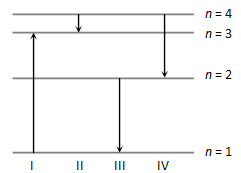
MCQ 4511 Mark
The radius of the first (lowest) orbit of the hydrogen atom is $a_0$.The radius of the second (next higher) orbit will be
- ✓
4$a_0$
- B
6$a_0$
- C
8$a_0$
- D
10$a_0$
AnswerCorrect option: A. 4$a_0$
(a) 4$a_0$
View full question & answer→MCQ 4521 Mark
The possible quantum number for 3 d electron are
- A
$n =3, l =1, m_{ l }=+1, m_{ s }=-\frac{1}{2}$
- ✓
$n =3, I =2, m_1=+2, m_{ s }=-\frac{1}{2}$
- C
$n =3, l =1, m_{ l }=-1, m_{ s }=+\frac{1}{2}$
- D
$n =3, I =0, m_1=+1, m_{ s }=-\frac{1}{2}$
AnswerCorrect option: B. $n =3, I =2, m_1=+2, m_{ s }=-\frac{1}{2}$
(b) $n =3, l =2, m_1=+2, m_{ s }=-\frac{1}{2}$
View full question & answer→MCQ 4531 Mark
When the electron in the hydrogen atom jumps from $2^{\text {nd }}$ orbit to $1^{\text {st }}$ orbit, the wavelength of radiation emitted is?. When the electrons jump from $3^{\text {rd }}$ orbit to $1^{\text {st }}$ orbit, the wavelength of emitted radiation would be
- ✓
$\frac{27}{32} \lambda$
- B
$\frac{32}{27} \lambda$
- C
$\frac{2}{3} \lambda$
- D
$\frac{3}{2} \lambda$
AnswerCorrect option: A. $\frac{27}{32} \lambda$
(a) $\frac{27}{32} \lambda$
View full question & answer→MCQ 4541 Mark
The frequency of $1^{\text {st }}$ line of Balmer series in $H _2$ atom is $v _0$. The frequency of line emitted by singly ionised He atom is
- A
$2 v_0$
- ✓
$4 v_0$
- C
$v_0 / 2$
- D
$v_0 / 4$
AnswerCorrect option: B. $4 v_0$
(b) $4 v_0$
View full question & answer→MCQ 4551 Mark
Minimum energy required to takeout the only one electron from ground state of $He^+$ is
View full question & answer→MCQ 4561 Mark
In hydrogen atom, when electron jumps from second to first orbit, then energy emitted is
MCQ 4571 Mark
The de-Broglie wavelength of an electron in the first Bohr orbit is
- A
Equal to one fourth the circumference of the first orbit
- B
Equal to half the circumference of the first orbit
- C
Equal to twice the circumference of the first orbit
- ✓
Equal to the circumference of the first orbit
AnswerCorrect option: D. Equal to the circumference of the first orbit
Equal to the circumference of the first orbit
View full question & answer→MCQ 4581 Mark
Whenever a hydrogen atom emits a photon in the Balmer series
- A
It need not emit any more photon
- B
It may emit another photon in the Paschen series
- ✓
It must emit another photon in the Lyman series
- D
It may emit another photon in the Balmer series
AnswerCorrect option: C. It must emit another photon in the Lyman series
It must emit another photon in the Lyman series
View full question & answer→MCQ 4591 Mark
The ratio of speed of an electron in ground state in Bohrs first orbit of hydrogen atom to velocity of light in air is
- ✓
$\frac{e^2}{2 \varepsilon_0 h c}$
- B
$\frac{2 e^2 \varepsilon_0}{h c}$
- C
$\frac{e^s}{2 \varepsilon_0 h c}$
- D
$\frac{2 \varepsilon_0 h c}{e^2}$
AnswerCorrect option: A. $\frac{e^2}{2 \varepsilon_0 h c}$
(a) $\frac{ e ^2}{2 \varepsilon_0 hc }$
View full question & answer→MCQ 4601 Mark
Energy of the electron in $n^{\text {th }}$ orbit of hydrogen atom is given by $E_n=-\frac{13.6}{n^2} e V$. The amount of energy needed to transfer electron from first orbit to third orbit is
View full question & answer→MCQ 4611 Mark
The first member of the Paschen series in hydrogen spectrum is of wavelength 18,800 Å. The short wavelengths limit of Paschen series is
MCQ 4621 Mark
The ratio of the wavelengths for $2 \rightarrow 1$ transition in $Li^{++} , He^+$ and $H$ is
- A
$1 : 2 : 3$
- B
$1 : 4 : 9$
- ✓
$4 : 9 : 36$
- D
$3 : 2 : 1$
AnswerCorrect option: C. $4 : 9 : 36$
$4 : 9 : 36$
View full question & answer→MCQ 4631 Mark
Energy of an electron in an excited hydrogen atom is – 3.4 eV. Its angular momentum will be: $h=6.626 \times 10^{-34} \mathrm{~J}-\mathrm{s}$
- A
$1.11 \times 10^{34} \mathrm{~J} \mathrm{sec}$
- B
$1.51 \times 10^{-31} \mathrm{~J} \mathrm{sec}$
- ✓
$2.11 \times 10^{-34} \mathrm{~J} \mathrm{sec}$
- D
$3.72 \times 10^{-34} \mathrm{~J} \mathrm{sec}$
AnswerCorrect option: C. $2.11 \times 10^{-34} \mathrm{~J} \mathrm{sec}$
(c) $2.11 \times 10^{-34} \mathrm{~J} \mathrm{sec}$
View full question & answer→MCQ 4641 Mark
The order of the size of nucleus and Bohr radius of an atom respectively are
- ✓
$10^{-14} \mathrm{~m}, 10^{-10} \mathrm{~m}$
- B
$10^{-10} \mathrm{~m}, 10^{-8} \mathrm{~m}$
- C
$10^{-20} \mathrm{~m}, 10^{-16} \mathrm{~m}$
- D
$10^{-8} \mathrm{~m}, 10^{-6} \mathrm{~m}$
AnswerCorrect option: A. $10^{-14} \mathrm{~m}, 10^{-10} \mathrm{~m}$
(a) $10^{-14} \mathrm{~m}, 10^{-10} \mathrm{~m}$
View full question & answer→MCQ 4651 Mark
For principal quantum number n = 3, the possible values of orbital quantum number ‘l’ are
MCQ 4661 Mark
An electron jumps from $5^{\text {th }}$ orbit to $4^{\text {th }}$ orbit of hydrogen atom. Taking the Rydberg constant as $10^7$ per metre. What will be the frequency of radiation emitted
- A
$6.75 \times 10^{12} \mathrm{~Hz}$
- B
$6.75 \times 10^{14} \mathrm{~Hz}$
- ✓
$6.75 \times 10^{13} \mathrm{~Hz}$
- D
AnswerCorrect option: C. $6.75 \times 10^{13} \mathrm{~Hz}$
(c) $6.75 \times 10^{13} \mathrm{~Hz}$
View full question & answer→MCQ 4671 Mark
In the following transitions, which one has higher frequency
MCQ 4681 Mark
In hydrogen atom which quantity is integral multiple of $\frac{h}{2\pi}$
View full question & answer→MCQ 4691 Mark
The first line in the Lyman series has wavelength l. The wavelength of the first line in Balmer series is
- A
$\frac{2}{9} \lambda$
- B
$\frac{9}{2} \lambda$
- C
$\frac{5}{27} \lambda$
- ✓
$\frac{27}{5} \lambda$
AnswerCorrect option: D. $\frac{27}{5} \lambda$
(d) $\frac{27}{5} \lambda$
View full question & answer→MCQ 4701 Mark
Radius of the first orbit of the electron in a hydrogen atom is 0.53 Å. So, the radius of the third orbit will be
MCQ 4711 Mark
The wavelength of yellow line of sodium is $5896 \mathring A$ . Its wave number will be
AnswerCorrect option: B. $16961 \ per \ cm$
$16961 \ per \ cm$
View full question & answer→MCQ 4721 Mark
Which of the following is true for number of spectral lines in going form Layman series to Pfund series
- A
- ✓
- C
- D
May decreases or increases
View full question & answer→MCQ 4731 Mark
Orbital acceleration of electron is
- ✓
$\frac{n^2 h^2}{4 \pi^2 m^2 r^3}$
- B
$\frac{n^2 h^2}{2 n^2 r^3}$
- C
$\frac{4 n^2 h^2}{\pi^2 m^2 r^3}$
- D
$\frac{4 n^2 h^2}{\pi^2 m^2 r^3}$
AnswerCorrect option: A. $\frac{n^2 h^2}{4 \pi^2 m^2 r^3}$
(a) $\frac{n^2 h^2}{4 \pi^2 m^2 r^3}$
View full question & answer→MCQ 4741 Mark
Rutherford’s a - particle experiment showed that the atoms have
MCQ 4751 Mark
According to classical theory, the circular path of an electron in Rutherford atom is
MCQ 4761 Mark
The energy of hydrogen atom in its ground state is – 13.6 eV. The energy of the level corresponding to the quantum number n is equal 5 is
MCQ 4771 Mark
According to the Rutherford’s atomic model, the electrons inside the atom are
MCQ 4781 Mark
The ratio of the speed of the electron in the first Bohr orbit of hydrogen and the speed of light is equal to (where e, h and c have their usual meanings)
- A
$2 \pi h c / e^2$
- B
$e^2 h / 2 \pi c$
- C
$e^2 c / 2 \pi h$
- ✓
$2 \pi e^2 / h c$
AnswerCorrect option: D. $2 \pi e^2 / h c$
(d) $2 \pi e^2 / h c$
View full question & answer→MCQ 4791 Mark
The radius of the Bohr orbit in the ground state of hydrogen atom is 0.5 Å. The radius of the orbit of the electron in the third excited state of $He^+$ will be
View full question & answer→MCQ 4801 Mark
The ratio of minimum to maximum wavelength in Balmer series is
MCQ 4811 Mark
The electron in a hydrogen atom makes a transition from an excited state to the ground state. Which of the following statements is true
- ✓
Its kinetic energy increases and its potential and total energies decrease
- B
Its kinetic energy decreases, potential energy increases and its total energy remains the same
- C
Its kinetic and total energies decrease and its potential energy increases
- D
Its kinetic, potential and total energies decreases
AnswerCorrect option: A. Its kinetic energy increases and its potential and total energies decrease
Its kinetic energy increases and its potential and total energies decrease
View full question & answer→MCQ 4821 Mark
The ratio of the longest to shortest wavelengths in Brackett series of hydrogen spectra is
- ✓
$\frac{25}{9}$
- B
$\frac{17}{6}$
- C
$\frac{9}{5}$
- D
$\frac{4}{3}$
AnswerCorrect option: A. $\frac{25}{9}$
$\frac{25}{9}$
View full question & answer→MCQ 4831 Mark
In Bohr model of hydrogen atom, the ratio of periods of revolution of an electron in n = 2 and n = 1 orbits is
MCQ 4841 Mark
The ratio of the largest to shortest wavelengths in Lyman series of hydrogen spectra is
- A
$\frac{25}{9}$
- B
$\frac{17}{6}$
- C
$\frac{9}{5}$
- ✓
$\frac{4}{3}$
AnswerCorrect option: D. $\frac{4}{3}$
$\frac{4}{3}$
View full question & answer→MCQ 4851 Mark
Which of the following statements are true regarding Bohr's model of hydrogen atom
(I) Orbiting speed of electron decreases as it shifts to discrete orbits away from the nucleus
(II) Radii of allowed orbits of electron are proportional to the principal quantum number
(III) Frequency with which electrons orbits around the nucleus in discrete orbits is inversely proportional to the principal quantum number
(IV) Binding force with which the electron is bound to the nucleus increases as it shifts to outer orbits Select correct answer using the codes given below
Codes :
MCQ 4861 Mark
Minimum excitation potential of Bohr's first orbit in hydrogen atom is
MCQ 4871 Mark
In hydrogen atom, if the difference in the energy of the electron in n = 2 and n = 3 orbits is E, the ionization energy of hydrogen atom is
MCQ 4881 Mark
Four lowest energy levels of H-atom are shown in the figure. The number of possible emission lines would be
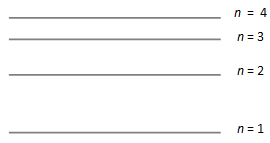
MCQ 4891 Mark
If R is the Rydberg’s constant for hydrogen the wave number of the first line in the Lyman series will be
- A
$\frac{R}{4}$
- ✓
$\frac{3R}{4}$
- C
$\frac{R}{2}$
- D
$2R$
AnswerCorrect option: B. $\frac{3R}{4}$
$\frac{3R}{4}$
View full question & answer→MCQ 4901 Mark
In Bohr's model, if the atomic radius of the first orbit is $r_0$, then the radius of the fourth orbit is
- A
$r_0$
- B
$4 r_0$
- C
$r_0 / 16$
- ✓
$16 r _0$
AnswerCorrect option: D. $16 r _0$
(d) $16 r _0$
View full question & answer→MCQ 4911 Mark
The diagram shows the path of four a-particles of the same energy being scattered by the nucleus of an atom simultaneously. Which of these are/is not physically possible
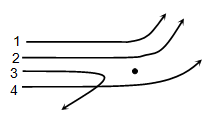
MCQ 4921 Mark
The time of revolution of an electron around a nucleus of charge Ze in $n^{\text {th }}$ Bohr orbit is directly proportional to
- A
$n$
- ✓
$\frac{ n ^3}{ Z ^2}$
- C
$\frac{ n ^2}{ Z }$
- D
$\frac{Z}{ n}$
AnswerCorrect option: B. $\frac{ n ^3}{ Z ^2}$
$\frac{ n ^3}{ Z ^2}$
View full question & answer→MCQ 4931 Mark
The wavelength of the energy emitted when electron come from fourth orbit to second orbit in hydrogen is $20.397 \ cm$ . The wavelength of energy for the same transition in $He ^{+}$is
- ✓
$5.099 cm^{-1}$
- B
$20.497 cm^{-1}$
- C
$40.994 cm^{-1}$
- D
$81.988 cm^{-1}$
AnswerCorrect option: A. $5.099 cm^{-1}$
(a) $5.099 cm^{-1}$
View full question & answer→MCQ 4941 Mark
In Bohr's model, the atomic radius of the first orbit is $r_0$, then the radius of the third orbit is
- A
$\frac{r_0}{9}$
- B
$r_0$
- ✓
$9r_0$
- D
$3r_0$
AnswerCorrect option: C. $9r_0$
$9r_0$
View full question & answer→MCQ 4951 Mark
Who discovered spin quantum number
MCQ 4961 Mark
What will be the angular momentum of a electron, if energy of this electron in H-atom is 1.5eV (in J-sec)
- A
$1.05 \times 10^{-34}$
- B
$2.1 \times 10^{-34}$
- ✓
$3.15 \times 10^{-34}$
- D
$-2.1 \times 10^{-34}$
AnswerCorrect option: C. $3.15 \times 10^{-34}$
$3.15 \times 10^{-34}$
View full question & answer→MCQ 4971 Mark
When hydrogen atom is in its first excited level, its radius is .... its ground state radius
MCQ 4981 Mark
The wavelength of Lyman series is
- ✓
$\frac{4}{3 \times 10967} cm$
- B
$\frac{3}{4 \times 10967} cm$
- C
$\frac{4 \times 10967}{3} cm$
- D
$\frac{3}{4} \times 10967 cm$
AnswerCorrect option: A. $\frac{4}{3 \times 10967} cm$
(a) $\frac{4}{3 \times 10967} cm$
View full question & answer→MCQ 4991 Mark
$\lambda_{max}$ is $6563\ \mathring A$, then wave length of second line for Balmer series will be
AnswerCorrect option: A. $\lambda = \frac{16}{3R}$
$\lambda = \frac{16}{3R}$
View full question & answer→MCQ 5001 Mark
In a hydrogen atom, the distance between the electron and proton is $2.5 \times 10^{-11} N$. The electrical force of attraction between them will be
- A
$2.8 \times 10^{-7} N$
- ✓
$3.7 \times 10^{-7} N$
- C
$6.2 \times 10^{-7} N$
- D
$9.1 \times 10^{-7} N$
AnswerCorrect option: B. $3.7 \times 10^{-7} N$
$3.7 \times 10^{-7} N$
View full question & answer→