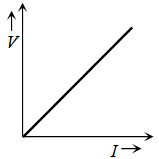
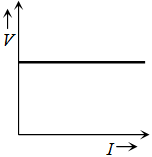
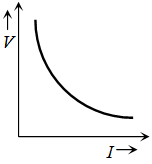
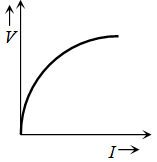
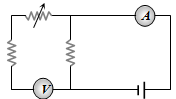
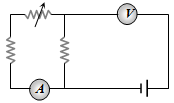
MCQ 11 Mark
The V-i graph for a conductor makes an angle θ with V-axis. Here V denotes the voltage and i denotes current. The resistance of conductor is given by
MCQ 21 Mark
Assertion : A person touching a high power line gets stuck with the line.
Reason : The current carrying wires attract the man towards it.
- A
If both assertion and reason are true and the reason is the correct explanation of the assertion.
- B
If both assertion and reason are true but reason is not the correct explanation of the assertion.
- C
If assertion is true but reason is false.
- ✓
If the assertion and reason both are false.
AnswerCorrect option: D. If the assertion and reason both are false.
If the assertion and reason both are false.
View full question & answer→MCQ 31 Mark
Assertion : A potentiometer of longer length is used for accurate measurement.
Reason : The potential gradient for a potentiometer of longer length with a given source of e.m.f. becomes small.
- ✓
If both assertion and reason are true and the reason is the correct explanation of the assertion.
- B
If both assertion and reason are true but reason is not the correct explanation of the assertion.
- C
If assertion is true but reason is false.
- D
If the assertion and reason both are false.
AnswerCorrect option: A. If both assertion and reason are true and the reason is the correct explanation of the assertion.
If both assertion and reason are true and the reason is the correct explanation of the assertion.
View full question & answer→MCQ 41 Mark
Assertion : The resistance of super-conductor is zero.
Reason : The super-conductors are used for the transmission of electric power.
- A
If both assertion and reason are true and the reason is the correct explanation of the assertion.
- ✓
If both assertion and reason are true but reason is not the correct explanation of the assertion.
- C
If assertion is true but reason is false.
- D
If the assertion and reason both are false.
AnswerCorrect option: B. If both assertion and reason are true but reason is not the correct explanation of the assertion.
If both assertion and reason are true but reason is not the correct explanation of the assertion.
View full question & answer→MCQ 51 Mark
Assertion : Electric field outside the conducting wire which carries a constant current is zero.
Reason : Net charge on conducting wire is zero.
- ✓
If both assertion and reason are true and the reason is the correct explanation of the assertion.
- B
If both assertion and reason are true but reason is not the correct explanation of the assertion.
- C
If assertion is true but reason is false.
- D
If the assertion and reason both are false.
AnswerCorrect option: A. If both assertion and reason are true and the reason is the correct explanation of the assertion.
If both assertion and reason are true and the reason is the correct explanation of the assertion.
View full question & answer→MCQ 61 Mark
Assertion : In meter bridge experiment, a high resistance is always connected in series with a galvanometer.
Reason : As resistance increases current through the circuit increases.
- A
If both assertion and reason are true and the reason is the correct explanation of the assertion.
- B
If both assertion and reason are true but reason is not the correct explanation of the assertion.
- ✓
If assertion is true but reason is false.
- D
If the assertion and reason both are false.
AnswerCorrect option: C. If assertion is true but reason is false.
If assertion is true but reason is false.
View full question & answer→MCQ 71 Mark
Assertion : Bending a wire does not effect electrical resistance.
Reason : Resistance of wire is proportional to resistivity of material.
- ✓
If both assertion and reason are true and the reason is the correct explanation of the assertion.
- B
If both assertion and reason are true but reason is not the correct explanation of the assertion.
- C
If assertion is true but reason is false.
- D
If the assertion and reason both are false.
AnswerCorrect option: A. If both assertion and reason are true and the reason is the correct explanation of the assertion.
If both assertion and reason are true and the reason is the correct explanation of the assertion.
View full question & answer→MCQ 81 Mark
Assertion : The electric bulbs glows immediately when switch is on.
Reason : The drift velocity of electrons in a metallic wire is very high.
- A
If both assertion and reason are true and the reason is the correct explanation of the assertion.
- B
If both assertion and reason are true but reason is not the correct explanation of the assertion.
- ✓
If assertion is true but reason is false.
- D
If the assertion and reason both are false.
AnswerCorrect option: C. If assertion is true but reason is false.
If assertion is true but reason is false.
View full question & answer→MCQ 91 Mark
Assertion : The drift velocity of electrons in a metallic wire will decrease, if the temperature of the wire is increased.
Reason : On increasing temperature, conductivity of metallic wire decreases.
- A
If both assertion and reason are true and the reason is the correct explanation of the assertion.
- ✓
If both assertion and reason are true but reason is not the correct explanation of the assertion.
- C
If assertion is true but reason is false.
- D
If the assertion and reason both are false.
AnswerCorrect option: B. If both assertion and reason are true but reason is not the correct explanation of the assertion.
If both assertion and reason are true but reason is not the correct explanation of the assertion.
View full question & answer→MCQ 101 Mark
Assertion : Electric appliances with metallic body have three connections, whereas an electric bulb has a two pin connection.
Reason : Three pin connections reduce heating of connecting wires.
- A
If both assertion and reason are true and the reason is the correct explanation of the assertion.
- B
If both assertion and reason are true but reason is not the correct explanation of the assertion.
- ✓
If assertion is true but reason is false.
- D
If the assertion and reason both are false.
AnswerCorrect option: C. If assertion is true but reason is false.
If assertion is true but reason is false.
View full question & answer→MCQ 111 Mark
Assertion : In a simple battery circuit the point of lowest potential is positive terminal of the battery
Reason : The current flows towards the point of the higher potential as it flows in such a circuit from the negative to the positive terminal.
- A
If both assertion and reason are true and the reason is the correct explanation of the assertion.
- B
If both assertion and reason are true but reason is not the correct explanation of the assertion.
- C
If assertion is true but reason is false.
- ✓
If the assertion and reason both are false.
AnswerCorrect option: D. If the assertion and reason both are false.
If the assertion and reason both are false.
View full question & answer→MCQ 121 Mark
Assertion : The temperature coefficient of resistance is positive for metals and negative for p-type semiconductor.
Reason : The effective charge carriers in metals are negatively charged whereas in p-type semiconductor they are positively charged.
- A
If both assertion and reason are true and the reason is the correct explanation of the assertion.
- ✓
If both assertion and reason are true but reason is not the correct explanation of the assertion.
- C
If assertion is true but reason is false.
- D
If the assertion and reason both are false.
AnswerCorrect option: B. If both assertion and reason are true but reason is not the correct explanation of the assertion.
If both assertion and reason are true but reason is not the correct explanation of the assertion.
View full question & answer→MCQ 131 Mark
Assertion : In the following circuit emf is 2V and internal resistance of the cell is 1$\Omega$ and R = 1$\Omega$, then reading of the voltmeter is 1V.
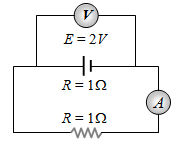
Reason : V = E - ir where E = 2V, i = $\frac{2}{2}=1 \mathrm{~A}$ and R = 1 $\Omega$ - ✓
If both assertion and reason are true and the reason is the correct explanation of the assertion.
- B
If both assertion and reason are true but reason is not the correct explanation of the assertion.
- C
If assertion is true but reason is false.
- D
If the assertion and reason both are false.
AnswerCorrect option: A. If both assertion and reason are true and the reason is the correct explanation of the assertion.
(a) If both assertion and reason are true and the reason is the correct explanation of the assertion.
View full question & answer→MCQ 141 Mark
Assertion : There is no current in the metals in the absence of electric field.
Reason : Motion of free electron are randomly.
- ✓
If both assertion and reason are true and the reason is the correct explanation of the assertion.
- B
If both assertion and reason are true but reason is not the correct explanation of the assertion.
- C
If assertion is true but reason is false.
- D
If the assertion and reason both are false.
AnswerCorrect option: A. If both assertion and reason are true and the reason is the correct explanation of the assertion.
If both assertion and reason are true and the reason is the correct explanation of the assertion.
View full question & answer→MCQ 151 Mark
In an experiment, a graph was plotted of the potential difference V between the terminals of a cell against the circuit current i by varying load rheostat. Internal conductance of the cell is given by
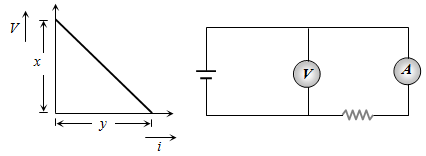
- A
- ✓
$\frac {y}{x}$
- C
$\frac {x}{y}$
- D
AnswerCorrect option: B. $\frac {y}{x}$
(b) $\frac {y}{x}$
View full question & answer→MCQ 161 Mark
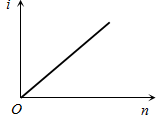
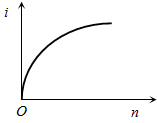
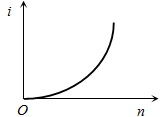
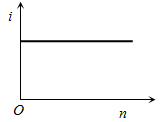
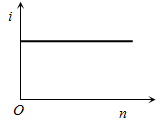
A battery consists of a variable number 'n' of identical cells having internal resistances connected in series. The terminals of battery are short circuited and the current i is measured. Which of the graph below shows the relation ship between i and n
Answer(d)
View full question & answer→MCQ 171 Mark
A wire of resistor R is bent into a circular ring of radius r. Equivalent resistance between two points X and Y on its circumference, when angle XOY is a, can be given by
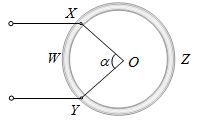
- ✓
$\frac{R \alpha}{4 \pi^2}(2 \pi-\alpha)$
- B
$\frac{R}{2 \pi}(2 \pi-\alpha)$
- C
$R(2 \pi-\alpha)$
- D
$\frac{4 \pi}{\mathrm{R} \alpha}(2 \pi-\alpha)$
AnswerCorrect option: A. $\frac{R \alpha}{4 \pi^2}(2 \pi-\alpha)$
(a) $\frac{R \alpha}{4 \pi^2}(2 \pi-\alpha)$
View full question & answer→MCQ 181 Mark
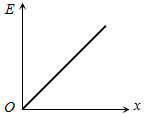
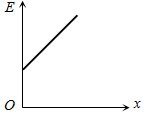
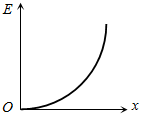
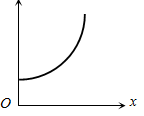
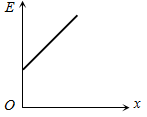
A cylindrical conductor has uniform cross-section. Resistivity of its material increase linearly from left end to right end. If a constant current is flowing through it and at a section distance x from left end, magnitude of electric field intensity is E, which of the following graphs is correct
Answer(b)
View full question & answer→MCQ 191 Mark
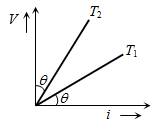
The V-i graph for a conductor at temperature $T_1$ and $T_2$ are as shown in the figure. $(T_1-T_2)$ is proportional to
View full question & answer→MCQ 201 Mark
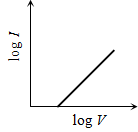
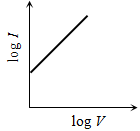
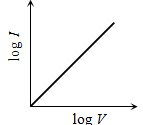
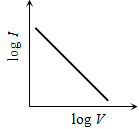
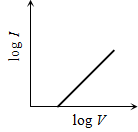
When a current I is passed through a wire of constant resistance, it produces a potential difference V across its ends. The graph drawn between log I and log V will be
Answer(a)
View full question & answer→MCQ 211 Mark
The graph which represents the relation between the total resistance R of a multi range moving coil voltmeter and its full scale deflection V is

MCQ 221 Mark
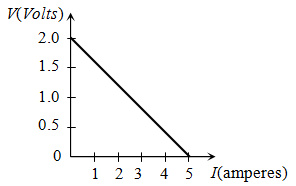
For a cell, the graph between the potential difference (V) across the terminals of the cell and the current (I) drawn from the cell is shown in the figure. The e.m.f. and the internal resistance of the cell are
MCQ 231 Mark
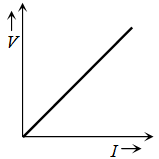
Which of the adjoining graphs represents ohmic resistance
Answer(a)
View full question & answer→MCQ 241 Mark
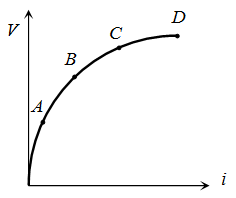
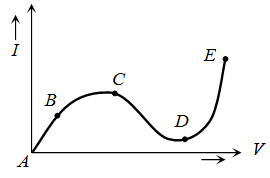
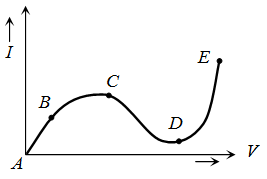
Variation of current passing through a conductor as the voltage applied across its ends as varied is shown in the adjoining diagram. If the resistance (R) is determined at the points A, B, C and D, we will find that
- A
$R_C = R_D$
- B
$R_B > R_A$
- C
$R_C > R_B$
- ✓
View full question & answer→MCQ 251 Mark
The voltage V and current I graph for a conductor at two different temperatures $\mathrm T_1$ and $\mathrm T_2$ are shown in the figure. The relation between $\mathrm T_1$ and $\mathrm T_2$ is
- ✓
$\mathrm{T}_1>\mathrm{T}_2$
- B
$\mathrm{T}_1 \approx \mathrm{T}_2$
- C
$\mathrm{T}_1=\mathrm{T}_2$
- D
$\mathrm{T}_1<\mathrm{T}_2$
AnswerCorrect option: A. $\mathrm{T}_1>\mathrm{T}_2$
(a) $\mathrm{T}_1>\mathrm{T}_2$
View full question & answer→MCQ 261 Mark
From the graph between current I and voltage V shown below, identify the portion corresponding to negative resistance
MCQ 271 Mark
I-V characteristic of a copper wire of length L and area of cross-section A is shown in figure. The slope of the curve becomes
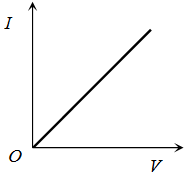
- A
More if the experiment is performed at higher temperature
- B
More if a wire of steel of same dimension is used
- C
More if the length of the wire is increased
- ✓
Less if the length of the wire is increased
AnswerCorrect option: D. Less if the length of the wire is increased
(d) Less if the length of the wire is increased
View full question & answer→MCQ 281 Mark
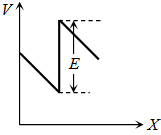
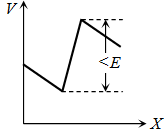
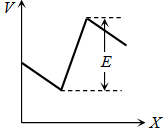
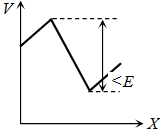
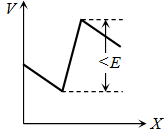
The two ends of a uniform conductor are joined to a cell of e.m.f. E and some internal resistance. Starting from the midpoint P of the conductor, we move in the direction of current and return to P. The potential V at every point on the path is plotted against the distance covered (x). Which of the following graphs best represents the resulting curve
Answer(b)
View full question & answer→MCQ 291 Mark
The resistance $R_t$ of a conductor varies with temperature t as shown in the figure. If the variation is represented by$R_t=R_0\left[1+\alpha t+\beta t^2\right]$, then
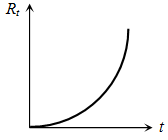
- A
α and β are both negative
- ✓
α and β are both positive
- C
α is positive and β is negative
- D
α is negative and β are positive
AnswerCorrect option: B. α and β are both positive
(b) α and β are both positive
View full question & answer→MCQ 301 Mark
Variation of current and voltage in a conductor has been shown in the diagram below. The resistance of the conductor is
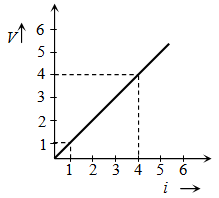
MCQ 311 Mark
A moving coil galvanometer has 150 equal divisions. Its current sensitivity is 10 divisions per milliampere and voltage sensitivity is 2 divisions per millivolt. In order that each division reads 1 volt, the resistance in ohms needed to be connected in series with the coil will be
MCQ 321 Mark
The resistance of the series combination of two resistance is S. When they are joined in parallel the total resistance is P. If S = nP, then the minimum possible value of n is
MCQ 331 Mark
The reading of the ideal voltmeter in the adjoining diagram will be
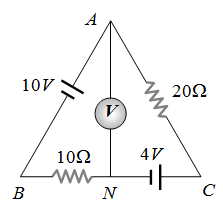
MCQ 341 Mark
In the adjoining circuit diagram each resistance is of 10 W. The current in the arm AD will be
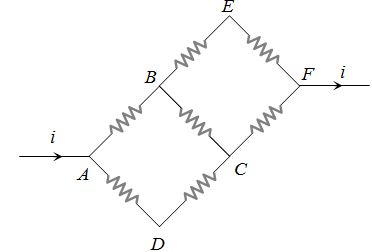
- ✓
$\frac{2 i}{5}$
- B
$\frac{3 i}{5}$
- C
$\frac{4 i}{5}$
- D
$\frac{i}{5}$
AnswerCorrect option: A. $\frac{2 i}{5}$
(a) $\frac{2 i}{5}$
View full question & answer→MCQ 351 Mark
Following figure shows cross-sections through three long conductors of the same length and material, with square cross-section of edge lengths as shown. Conductor B will fit snugly within conductor A, and conductor C will fit snugly within conductor B. Relationship between their end to end resistance is
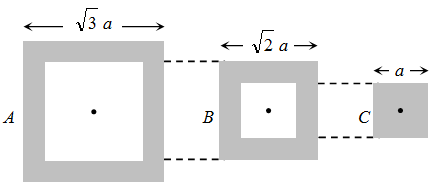
- ✓
$R_A = R_B = R_C$
- B
$R_A > R_B > R_C$
- C
$R_A < R_B < R$
- D
Information is not sufficient
AnswerCorrect option: A. $R_A = R_B = R_C$
(a) $R_A = R_B = R_C$
View full question & answer→MCQ 361 Mark
12 cells each having same emf are connected in series with some cells wrongly connected. The arrangement is connected in series with an ammeter and two cells which are in series. Current is 3 A when cells and battery aid each other and is 2 A when cells and battery oppose each other. The number of cells wrongly connected is
MCQ 371 Mark
In the circuit shown in figure reading of voltmeter is $V_1$ when only $S_1$ is closed, reading of voltmeter is $V_2$ when only $\mathrm{S}_2$ is closed and reading of voltmeter is $\mathrm{V}_3$ when both $\mathrm{S}_1$ and $\mathrm{S}_2$ are closed. Then
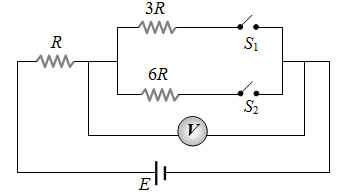
- A
$V_3>V_2>V_1$
- ✓
$V_2>V_1>V_3$
- C
$V_3>V_1>V_2$
- D
$V_1>V_2>V_3$
AnswerCorrect option: B. $V_2>V_1>V_3$
(b) $V_2>V_1>V_3$
View full question & answer→MCQ 381 Mark
V-i graphs for parallel and series combination of two identical resistors are as shown in figure. Which graph represents parallel combination
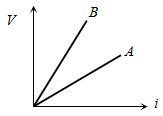
MCQ 391 Mark
In order to quadruple the resistance of a uniform wire, a part of its length was uniformly stretched till the final length of the entire wire was 1.5 times the original length, the part of the wire was fraction equal to
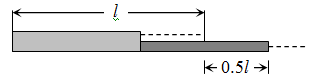
MCQ 401 Mark
In the following circuit, bulb rated as 1.5 V, 0.45 W. If bulbs glows with full intensity then what will be the equivalent resistance between X and Y
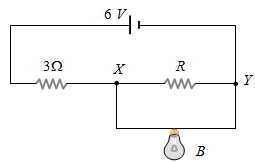
- A
0.45 $\Omega$
- ✓
1 $\Omega$
- C
3 $\Omega$
- D
5 $\Omega$
AnswerCorrect option: B. 1 $\Omega$
(b) 1 $\Omega$
View full question & answer→MCQ 411 Mark
Potential difference across the terminals of the battery shown in figure is (r = internal resistance of battery)
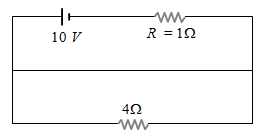
MCQ 421 Mark
Two cells of equal e.m.f. and of internal resistances $\mathrm{r}_1$ and $\mathrm{r}_2\left(\mathrm{r}_1>\mathrm{r}_2\right)$ are connected in series. On connecting this combination to an external resistance R, it is observed that the potential difference across the first cell becomes zero. The value of R will be
- A
$r_1+r_2$
- ✓
$r_1-r_2$
- C
$\frac{r_1+r_2}{2}$
- D
$\frac{r_1-r_2}{2}$
AnswerCorrect option: B. $r_1-r_2$
(b) $r_1-r_2$
View full question & answer→MCQ 431 Mark
Length of a hollow tube is 5m, it’s outer diameter is 10 cm and thickness of it’s wall is 5 mm. If resistivity of the material of the tube is $1.7 \times 10^{-8} \Omega \times \mathrm{m}$ then resistance of tube will be
- ✓
$5.6 \times 10^{-5} \Omega$
- B
$2 \times 10^{-5} \Omega$
- C
$4 \times 10^{-5} \Omega$
- D
AnswerCorrect option: A. $5.6 \times 10^{-5} \Omega$
(a) $5.6 \times 10^{-5} \Omega$
View full question & answer→MCQ 441 Mark
In the circuit shown here, the readings of the ammeter and voltmeter are
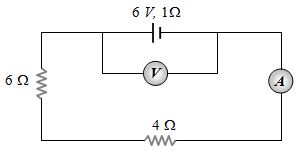
MCQ 451 Mark
A battery of internal resistance 4W is connected to the network of resistances as shown. In order to give the maximum power to the network, the value of R (in Ω) should be
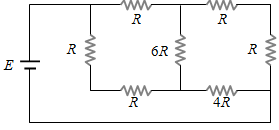
MCQ 461 Mark
Two wires of resistance $\mathrm{R}_1$ and $\mathrm{R}_2$ have temperature coefficient of resistance $\alpha_1$ and $\alpha_2$, respectively. These are joined in series. The effective temperature coefficient of resistance is
- A
$\frac{\alpha_1+\alpha_2}{2}$
- B
$\sqrt{\alpha_1 \alpha_2}$
- ✓
$\frac{\alpha_1 R_1+\alpha_2 R_2}{R_1+R_2}$
- D
$\frac{\sqrt{R_1 R_2 \alpha_1 \alpha_2}}{\sqrt{R_1{ }^2+R_2{ }^2}}$
AnswerCorrect option: C. $\frac{\alpha_1 R_1+\alpha_2 R_2}{R_1+R_2}$
(c) $\frac{\alpha_1 R_1+\alpha_2 R_2}{R_1+R_2}$
View full question & answer→MCQ 471 Mark
Seven resistances are connected as shown in the figure. The equivalent resistance between A and B is
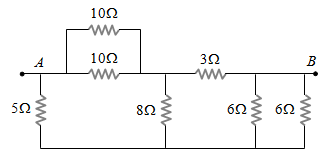
MCQ 481 Mark
The resistance of a wire of iron is 10 ohms and temp. coefficient of resistivity is $5^{\times 10^{-3} /{ }^{\circ} \mathrm{C}}$ . At $20^{\circ} \mathrm{C}$ it carries 30 milliamperes of current. Keeping constant potential difference between its ends, the temperature of the wire is raised to $120^{\circ} \mathrm{C}$. The current in milliamperes that flows in the wire is
View full question & answer→MCQ 491 Mark
In the shown arrangement of the experiment of the meter bridge if AC corresponding to null deflection of galvanometer is x, what would be its value if the radius of the wire AB is doubled
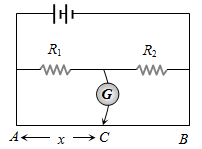
MCQ 501 Mark
A group of N cells whose emf varies directly with the internal resistance as per the equation $E_N=1.5 r_N$ are connected as shown in the figure below. The current I in the circuit is
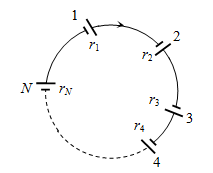
View full question & answer→MCQ 511 Mark
The current in a conductor varies with time t as $I=2 t+3 t^2$ where I is in ampere and t in seconds. Electric charge flowing through a section of the conductor during t = 2 sec to t = 3 sec is
View full question & answer→MCQ 521 Mark
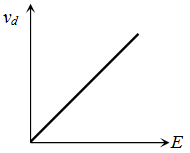
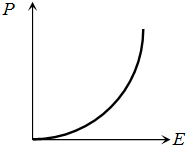
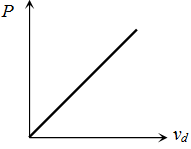
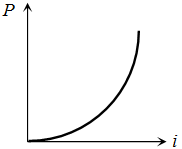
E denotes electric field in a uniform conductor, I corresponding current through it, $V_d$ drift velocity of electrons and P denotes thermal power produced in the conductor, then which of the following graph is incorrect
Answer(c)
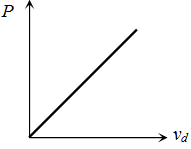
View full question & answer→MCQ 531 Mark
The equivalent resistance between the points P and Q in the network given here is equal to (given r = $\frac{3}{2} \Omega$)
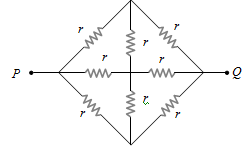
- A
$\frac{1}{2} \Omega$
- ✓
$1 \Omega$
- C
$\frac{3}{2} \Omega$
- D
$2 \Omega$
AnswerCorrect option: B. $1 \Omega$
(b) 1 $\Omega$
View full question & answer→MCQ 541 Mark
In the circuit element given here, if the potential at point B, $V_B=0$, then the potentials of A and D are given as
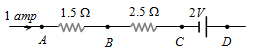
- A
$\mathrm{V}_{\mathrm{A}}=-1.5 \mathrm{~V}, \mathrm{~V}_{\mathrm{D}}=+2 \mathrm{~V}$
- B
$\mathrm{V}_{\mathrm{A}}=+1.5 \mathrm{~V}, \mathrm{~V}_{\mathrm{D}}=+2 \mathrm{~V}$
- C
$\mathrm{V}_{\mathrm{A}}=+1.5 \mathrm{~V}, \mathrm{~V}_{\mathrm{D}}=+0.5 \mathrm{~V}$
- ✓
$\mathrm{V}_{\mathrm{A}}=+1.5 \mathrm{~V}, \mathrm{~V}_{\mathrm{D}}=-0.5 \mathrm{~V}$
AnswerCorrect option: D. $\mathrm{V}_{\mathrm{A}}=+1.5 \mathrm{~V}, \mathrm{~V}_{\mathrm{D}}=-0.5 \mathrm{~V}$
(d) $\mathrm{V}_{\mathrm{A}}=+1.5 \mathrm{~V}, \mathrm{~V}_{\mathrm{D}}=-0.5 \mathrm{~V}$
View full question & answer→MCQ 551 Mark
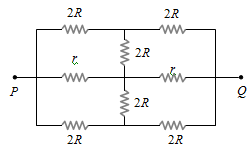
The effective resistance between points P and Q of the electrical circuit shown in the figure is
MCQ 561 Mark
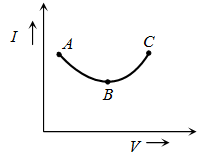
Resistance as shown in figure is negative at
MCQ 571 Mark
What is the equivalent resistance between the points A and B of the network
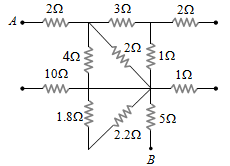
- A
$\frac{57}{7}\Omega$
- ✓
- C
- D
$\frac{57}{5}\Omega$
View full question & answer→MCQ 581 Mark
A wire of length L and 3 identical cells of negligible internal resistances are connected in series. Due to current, the temperature of the wire is raised by ∆ T in a time t. A number N of similar cells is now connected in series with a wire of the same material and cross – section but of length 2 L. The temperature of the wire is raised by the same amount ∆ T in the same time t. the value of N is
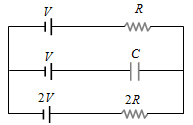
MCQ 591 Mark
In the given circuit, with steady current, the potential drop across the capacitor must be
MCQ 601 Mark
In the given circuit, it is observed that the current I is independent of the value of the resistance $R_6$. Then the resistance values must satisfy
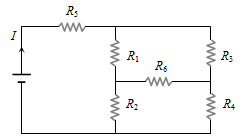
- A
$R_1 R_2 R_5=R_3 R_4 R_6$
- B
$\frac{1}{R_5}+\frac{1}{R_6}=\frac{1}{R_1+R_2}+\frac{1}{R_3+R_4}$
- ✓
$R_1 R_4=R_2 R_3$
- D
$R_1 R_3=R_2 R_4=R_5 R_6$
AnswerCorrect option: C. $R_1 R_4=R_2 R_3$
(c)$R_1 R_4=R_2 R_3$
View full question & answer→MCQ 611 Mark
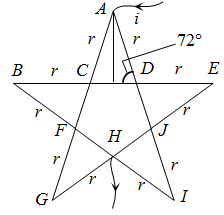
In the following star circuit diagram (figure), the equivalent resistance between the points A and H will be
MCQ 621 Mark
A wire of resistance 10 W is bent to form a circle. P and Q are points on the circumference of the circle dividing it into a quadrant and are connected to a Battery of 3 V and internal resistance 1 W as shown in the figure. The currents in the two parts of the circle are
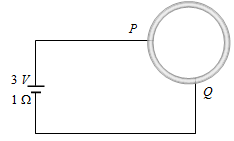
- ✓
$\frac{6}{23}A$ and $\frac{18}{23}A$
- B
$\frac{5}{26}A$ and $\frac{15}{26}A$
- C
$\frac{4}{25}A$ and $\frac{12}{25}A$
- D
$\frac{3}{25}A$ and $\frac{9}{25}A$
AnswerCorrect option: A. $\frac{6}{23}A$ and $\frac{18}{23}A$
(a) $\frac{6}{23}A$ and $\frac{18}{23}A$
View full question & answer→MCQ 631 Mark
An ionization chamber with parallel conducting plates as anode and cathode has $5 \times 10^7$ electrons and the same number of singly-charged positive ions per $\mathrm{cm}^3$. The electrons are moving at 0.4 m/s. The current density from anode to cathode is $4 \mu \mathrm{A} / \mathrm{m}^2$. The velocity of positive ions moving towards cathode is
View full question & answer→MCQ 641 Mark
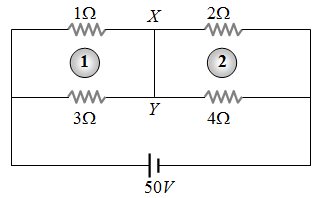
Current through wire XY of circuit shown is
MCQ 651 Mark
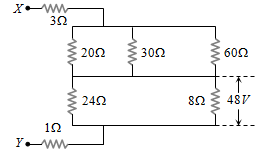
The potential difference across 8 ohm resistance is 48 volt as shown in the figure. The value of potential difference across X and Y points will be
MCQ 661 Mark
A microammeter has a resistance of 100Ω and full scale range of 50μA. It can be used as a voltmeter or as a higher range ammeter provided a resistance is added to it. Pick the correct range and resistance combination
- A
50 V range with 10kΩ resistance in series
- ✓
10 V range with 200kΩ resistance in series
- C
mA range with 1Ω resistance in parallel
- D
10 mA range with 0.1Ω resistance in parallel
AnswerCorrect option: B. 10 V range with 200kΩ resistance in series
10 V range with 200kΩ resistance in series
View full question & answer→MCQ 671 Mark
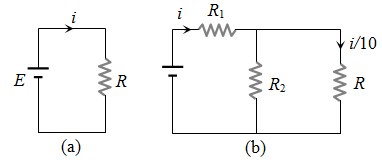
Consider the circuits shown in the figure. Both the circuits are taking same current from battery but current through R in the second circuit is $\frac{1}{10}$ th of current through R in the first circuit. If R is 11 $\Omega$, the value of $R_1$
- ✓
9.9 $\Omega$
- B
11 $\Omega$
- C
8.8 $\Omega$
- D
7.7 $\Omega$
AnswerCorrect option: A. 9.9 $\Omega$
(a) 9.9 $\Omega$
View full question & answer→MCQ 681 Mark
In the circuit shown below $E_1$ = 4.0 V, $R_1$ = 2 W, $E_2$ = 6.0 V, $R_2$ = 4 W and $R_3$ = 2 W. The current $I_1$ is
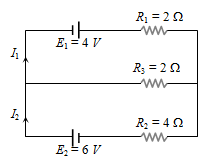
View full question & answer→MCQ 691 Mark
In the following circuit a 10 m long potentiometer wire with resistance 1.2 ohm/m, a resistance $R_1$ and an accumulator of emf 2 V are connected in series. When the emf of thermocouple is 2.4 mV then the deflection in galvanometer is zero. The current supplied by the accumulator will be
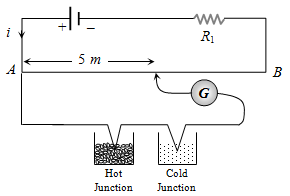
- ✓
$ 4 \times 10^{-4} \mathrm{~A} $
- B
$ 8 \times 10^{-4} \mathrm{~A} $
- C
$ 4 \times 10^{-3} \mathrm{~A} $
- D
$ 8 \times 10^{-3} \mathrm{~A} $
AnswerCorrect option: A. $ 4 \times 10^{-4} \mathrm{~A} $
(a) $ 4 \times 10^{-4} \mathrm{~A} $
View full question & answer→MCQ 701 Mark
As the switch S is closed in the circuit shown in figure, current passed through it is
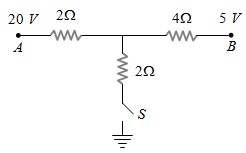
MCQ 711 Mark
In the circuit shown here, $E_1=E_2=E_3=2 V$ and $R_1=R_2=4$ ohms. The current flowing between points A and B through battery $E_2$ is
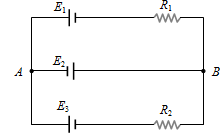
View full question & answer→MCQ 721 Mark
When connected across the terminals of a cell, a voltmeter measures 5V and a connected ammeter measures 10 A of current. A resistance of 2 ohms is connected across the terminals of the cell. The current flowing through this resistance will be
MCQ 731 Mark
A galvanometer coil of resistance 50 W, show full deflection of 100 μA. The shunt resistance to be added to the galvanometer, to work as an ammeter of range 10 mA is
MCQ 741 Mark
In the circuit given, the correct relation to a balanced Wheatstone bridge is
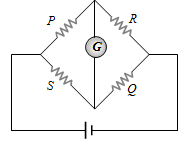
- A
$\frac {P}{Q}=\frac{R}{S}$
- B
$\frac{P}{Q}=\frac{S}{R}$
- ✓
$\frac{P}{R}=\frac{S}{Q}$
- D
AnswerCorrect option: C. $\frac{P}{R}=\frac{S}{Q}$
(c) $\frac{P}{R}=\frac{S}{Q}$
View full question & answer→MCQ 751 Mark
In a metre bridge experiment null point is obtained at 20 cm from one end of the wire when resistance X is balanced against another resistance Y. If X < Y, then where will be the new position of the null point from the same end, if one decides to balance a resistance of 4X against Y
MCQ 761 Mark
A galvanometer of $50$ ohm resistance has $25$ divisions. A current of $4 × 10^{-4}$ ampere gives a deflection of one division. To convert this galvanometer into a voltmeter having a range of $25$ volts, it should be connected with a resistance of
- A
$ 2500 \ W$ as a shunt
- B
$2450 \ W$ as a shunt
- C
$2550 \ W$ in series
- ✓
$2450 \ W$ in series
AnswerCorrect option: D. $2450 \ W$ in series
$2450 \ W$ in series
View full question & answer→MCQ 771 Mark
If in the circuit shown below, the internal resistance of the battery is 1.5 W and $V_P$ and $V_Q$ are the potentials at P and Q respectively, what is the potential difference between the points P and Q
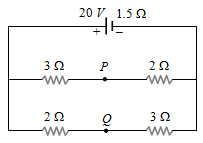
- A
- B
4 volts $\left(\mathrm{V}_{\mathrm{P}}>\mathrm{V}_{\mathrm{Q}}\right)$
- C
4 volts $\left(\mathrm{V}_{\mathrm{Q}}>\mathrm{V}_{\mathrm{P}}\right)$
- ✓
2.5 volts $\left(V_Q>V_P\right)$
AnswerCorrect option: D. 2.5 volts $\left(V_Q>V_P\right)$
(d) 2.5 volts $\left(V_Q>V_P\right)$
View full question & answer→MCQ 781 Mark
In the circuit shown, the value of each resistance is r, then equivalent resistance of circuit between points A and B will be
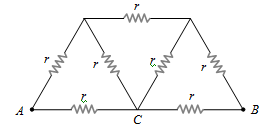
MCQ 791 Mark
There are three resistance coils of equal resistance. The maximum number of resistances you can obtain by connecting them in any manner you choose, being free to use any number of the coils in any way is
MCQ 801 Mark
A torch bulb rated as 4.5 W, 1.5 V is connected as shown in the figure. The e.m.f. of the cell needed to make the bulb glow at full intensity is
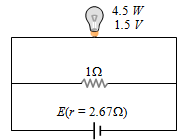
MCQ 811 Mark
When the key K is pressed at time t = 0, which of the following statements about the current I in the resistor AB of the given circuit is true
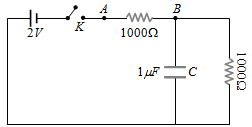
- A
- B
I oscillates between 1 mA and 2mA
- C
- ✓
At t = 0 , I = 2 mA and with time it goes to 1 mA
AnswerCorrect option: D. At t = 0 , I = 2 mA and with time it goes to 1 mA
(d) At t = 0 , I = 2 mA and with time it goes to 1 mA
View full question & answer→MCQ 821 Mark
In the figure shown, the capacity of the condenser C is 2μF. The current in 2Ω resistor is
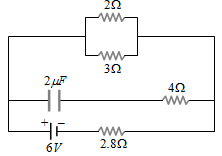
- A
- ✓
- C
$\frac{1}{9}A$
- D
$\frac{1}{0.9}A$
View full question & answer→MCQ 831 Mark
In an electrical cable there is a single wire of radius 9 mm of copper. Its resistance is 5Ω. The cable is replaced by 6 different insulated copper wires, the radius of each wire is 3mm. Now the total resistance of the cable will be
MCQ 841 Mark
Two uniform wires A and B are of the same metal and have equal masses. The radius of wire A is twice that of wire B. The total resistance of A and B when connected in parallel is
- ✓
4 Ω when the resistance of wire A is 4.25 Ω
- B
5 Ω when the resistance of wire A is 4.25 Ω
- C
4 Ω when the resistance of wire B is 4.25 Ω
- D
4 Ω when the resistance of wire B is 4.25 Ω
AnswerCorrect option: A. 4 Ω when the resistance of wire A is 4.25 Ω
4 Ω when the resistance of wire A is 4.25 Ω
View full question & answer→MCQ 851 Mark
Twelve wires of equal length and same cross-section are connected in the form of a cube. If the resistance of each of the wires is R, then the effective resistance between the two diagonal ends would be
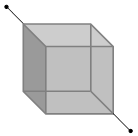
AnswerCorrect option: C. $\frac{5}{6}$R
(c) $\frac{5}{6}$R
View full question & answer→MCQ 861 Mark
You are given several identical resistances each of value R = 10 Ω and each capable of carrying maximum current of 1 ampere. It is required to make a suitable combination of these resistances to produce a resistance of 5 Ω which can carry a current of 4 amperes. The minimum number of resistances of the type R that will be required for this job
MCQ 871 Mark
The resistance of a wire is $10^{-6}\Omega$ per metre. It is bend in the form of a circle of diameter 2 m. A wire of the same material is connected across its diameter. The total resistance across its diameter AB will be
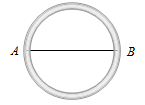
- A
$\frac{4}{3} \pi \times 10^{-6} \Omega$
- B
$\frac{2}{3} \pi \times 10^{-6} \Omega$
- ✓
$0.88\times 10^{-6}\Omega$
- D
$14π\times 10^{-6}\Omega$
AnswerCorrect option: C. $0.88\times 10^{-6}\Omega$
(c) $0.88\times 10^{-6}\Omega$
View full question & answer→MCQ 881 Mark
If resistance of voltmeter is 10000 W and resistance of ammeter is 2 W then find R when voltmeter reads 12V and ammeter reads 0.1 A
MCQ 891 Mark
Two resistances are connected in two gaps of a metre bridge. The balance point is 20 cm from the zero end. A resistance of 15 ohms is connected in series with the smaller of the two. The null point shifts to 40 cm. The value of the smaller resistance in ohms is
MCQ 901 Mark
A moving coil galvanometer of resistance 100 is used as an ammeter using a resistance 0.1 The maximum deflection current in the galvanometer is 100A. Find the minimum current in the circuit so that the ammeter shows maximum deflection
MCQ 911 Mark
With a potentiometer null point were obtained at 140 cm and 180 cm with cells of emf 1.1 V and one unknown X volts. Unknown emf is
MCQ 921 Mark
In a potentiometer experiment the balancing with a cell is at length 240 cm. On shunting the cell with a resistance of 2 W, the balancing length becomes 120 cm. The internal resistance of the cell is
MCQ 931 Mark
A voltmeter essentially consists of
- ✓
A high resistance, in series with a galvanometer
- B
A low resistance, in series with a galvanometer
- C
A high resistance in parallel with a galvanometer
- D
A low resistance in parallel with a galvanometer
AnswerCorrect option: A. A high resistance, in series with a galvanometer
A high resistance, in series with a galvanometer
View full question & answer→MCQ 941 Mark
A potentiometer consists of a wire of length 4 m and resistance 10 W. It is connected to cell of emf 2 V. The potential difference per unit length of the wire will be
MCQ 951 Mark
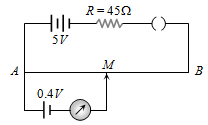
In given figure, the potentiometer wire AB has a resistance of 5 W and length 10 m. The balancing length AM for the emf of 0.4 V is
MCQ 961 Mark
To convert a galvanometer into a voltmeter, one should connect a
- ✓
High resistance in series with galvanometer
- B
Low resistance in series with galvanometer
- C
High resistance in parallel with galvanometer
- D
Low resistance in parallel with galvanometer
AnswerCorrect option: A. High resistance in series with galvanometer
High resistance in series with galvanometer
View full question & answer→MCQ 971 Mark
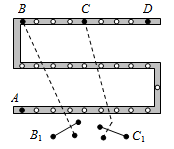
For the post office box arrangement to determine the value of unknown resistance the unknown resistance should be connected between
MCQ 981 Mark
The maximum current that can be measured by a galvanometer of resistance 40 W is 10 mA. It is converted into a voltmeter that can read upto 50 V. The resistance to be connected in series with the galvanometer is ... (in ohm)
MCQ 991 Mark
The current flowing in a coil of resistance 90 W is to be reduced by 90%. What value of resistance should be connected in parallel with it
MCQ 1001 Mark
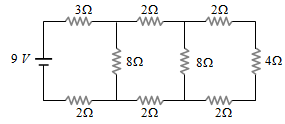
In the circuit shown in the figure, the current through
- A
The 3 W resistor is 0.50A
- B
The 3 W resistor is 0.25 A
- C
The 4 W resistor is 0.50A
- ✓
The 4 W resistor is 0.25 A
AnswerCorrect option: D. The 4 W resistor is 0.25 A
(d) The 4 W resistor is 0.25 A
View full question & answer→MCQ 1011 Mark
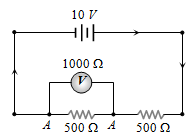
What is the reading of voltmeter in the following figure
MCQ 1021 Mark
The e.m.f. of a standard cell balances across 150 cm length of a wire of potentiometer. When a resistance of 2 Ω is connected as a shunt with the cell, the balance point is obtained at 100 cm. The internal resistance of the cell is
MCQ 1031 Mark
Resistance of 100 cm long potentiometer wire is 10 W, it is connected to a battery (2 volt) and a resistance R in series. A source of 10 mV gives null point at 40 cm length, then external resistance R is
MCQ 1041 Mark
The length of a wire of a potentiometer is 100 cm, and the emf of its standard cell is E volt. It is employed to measure the e.m.f of a battery whose internal resistance is 0.5 $\Omega$. If the balance point is obtained at l = 30 cm from the positive end, the e.m.f. of the battery is (where i is the current in the potentiometer)
- ✓
$\frac{30 \mathrm{E}}{100}$
- B
$\frac{30 \mathrm{E}}{100.5}$
- C
$\frac{30 \mathrm{E}}{(100-0.5)}$
- D
$\frac{30(\mathrm{E}-0.5 \mathrm{i})}{100}$
AnswerCorrect option: A. $\frac{30 \mathrm{E}}{100}$
(a) $\frac{30 \mathrm{E}}{100}$
View full question & answer→MCQ 1051 Mark
An ammeter reads upto 1 ampere. Its internal resistance is 0.81 ohm. To increase the range to 10 A the value of the required shunt is
MCQ 1061 Mark
A galvanometer, having a resistance of 50 W gives a full scale deflection for a current of 0.05 A. The length in meter of a resistance wire of area of cross-section $2.97 \times 10^{-2} \mathrm{~cm}^2$ that can be used to convert the galvanometer into an ammeter which can read a maximum of 5 A current is (Specific resistance of the wire = $5 \times 10^{-7} \Omega \mathrm{m}$)
View full question & answer→MCQ 1071 Mark
Two resistances of 400 W and 800 W are connected in series with 6 volt battery of negligible internal resistance. A voltmeter of resistance 10,000 W is used to measure the potential difference across 400 W. The error in the measurement of potential difference in volts approximately is
MCQ 1081 Mark
A potentiometer has uniform potential gradient. The specific resistance of the material of the potentiometer wire is $10^{-7}$ ohm–meter and the current passing through it is 0.1 ampere; cross-section of the wire is $10^{-6} \mathrm{~m}^2$. The potential gradient along the potentiometer wire is
- A
$10^{-4}$ V/m
- B
$10^{-6}$ V/m
- ✓
$10^{-2}$ V/m
- D
$10^{-8}$ V/m
AnswerCorrect option: C. $10^{-2}$ V/m
(c) $10^{-2}$ V/m
View full question & answer→MCQ 1091 Mark
Resistance in the two gaps of a meter bridge are 10 ohm and 30 ohm respectively. If the resistances are interchanged the balance point shifts by
MCQ 1101 Mark
A 50 ohm galvanometer gets full scale deflection when a current of 0.01 A passes through the coil. When it is converted to a 10 A ammeter, the shunt resistance is
MCQ 1111 Mark
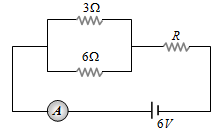
If the ammeter in the given circuit reads 2 A, the resistance R is
MCQ 1121 Mark
A galvanometer of resistance 36 W is changed into an ammeter by using a shunt of 4 W. The fraction $f_0$ of total current passing through the galvanometer is
- A
$\frac{1}{40}$
- B
$\frac{1}{4}$
- C
$\frac{1}{140}$
- ✓
$\frac{1}{10}$
AnswerCorrect option: D. $\frac{1}{10}$
(d) $\frac{1}{10}$
View full question & answer→MCQ 1131 Mark
An ammeter of 100 W resistance gives full deflection for the current of $10^{-5}$ amp. Now the shunt resistance required to convert it into ammeter of 1 amp. range, will be
- A
$10^{-4}$ W
- B
$10^{-5}$ W
- ✓
$10^{-3}$ W
- D
$10^{-1}$ W
AnswerCorrect option: C. $10^{-3}$ W
(c) $10^{-3}$ W
View full question & answer→MCQ 1141 Mark
A cell of internal resistance 3 ohm and emf 10 volt is connected to a uniform wire of length 500 cm and resistance 3 ohm. The potential gradient in the wire is
MCQ 1151 Mark
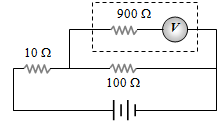
The potential difference across the 100 W resistance in the following circuit is measured by a voltmeter of 900 W resistance. The percentage error made in reading the potential difference is
MCQ 1161 Mark
A 100 ohm galvanometer gives full scale deflection at 10 mA. How much shunt is required to read 100 mA
MCQ 1171 Mark
To convert a 800 mV range milli voltmeter of resistance 40 W into a galvanometer of 100 mA range, the resistance to be connected as shunt is
MCQ 1181 Mark
Voltmeters $\mathrm{V}_1$ and $\mathrm{V}_2$ are connected in series across a $D.C.$ line. $\mathrm{V}_1$ reads $80$ volts and has a per volt resistance of $200$ ohms. $\mathrm{V}_2$ has a total resistance of $32$ kilo ohms. The line voltage is
- A
$120$ volts
- B
$160$ volts
- C
$220$ volts
- ✓
$240$ volts
AnswerCorrect option: D. $240$ volts
$240$ volts
View full question & answer→MCQ 1191 Mark
The material of wire of potentiometer is
MCQ 1201 Mark
A potentiometer has uniform potential gradient across it. Two cells connected in series
(i) to support each other and
(ii) to oppose each other are balanced over 6m and 2m respectively on the potentiometer wire.
The e.m.f.’s of the cells are in the ratio of
MCQ 1211 Mark
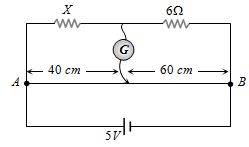
In the circuit shown, a meter bridge is in its balanced state. The meter bridge wire has a resistance 0.1 ohm/cm. The value of unknown resistance X and the current drawn from the battery of negligible resistance is
- A
6 $\Omega$, 5 amp
- B
10 $\Omega$, 0.1 amp
- ✓
4 $\Omega$, 1.0 amp
- D
12 $\Omega$, 0.5 amp
AnswerCorrect option: C. 4 $\Omega$, 1.0 amp
(c) 4 $\Omega$, 1.0 amp
View full question & answer→MCQ 1221 Mark
A galvanometer has a resistance of 25 ohm and a maximum of 0.01 A current can be passed through it. In order to change it into an ammeter of range 10 A, the shunt resistance required is
MCQ 1231 Mark
A galvanometer of 25 W resistance can read a maximum current of 6mA. It can be used as a voltmeter to measure a maximum of 6 V by connecting a resistance to the galvanometer. Identify the correct choice in the given answers
MCQ 1241 Mark
The resistance of an ideal ammeter is
MCQ 1251 Mark
A galvanometer with a resistance of 12 W gives full scale deflection when a current of 3 mA is passed. It is required to convert it into a voltmeter which can read up to 18 V. the resistance to be connected is
MCQ 1261 Mark
A 10 m long wire of 20W resistance is connected with a battery of 3 volt e.m.f. (negligible internal resistance) and a 10 W resistance is joined to it is series. Potential gradient along wire in volt per meter is
MCQ 1271 Mark
If an ammeter is to be used in place of a voltmeter then we must connect with the ammeter a
- A
Low resistance in parallel
- B
High resistance in parallel
- ✓
High resistance in series
- D
AnswerCorrect option: C. High resistance in series
High resistance in series
View full question & answer→MCQ 1281 Mark
There are three voltmeters of the same range but of resistances 1000Ω, 8000 Ω and 4000 Ω respectively. The best voltmeter among these is the one whose resistance is
MCQ 1291 Mark
A galvanometer of resistance 20 W is to be converted into an ammeter of range 1 A. If a current of 1 mA produces full scale deflection, the shunt required for the purpose is
MCQ 1301 Mark
A wire of length 100 cm is connected to a cell of emf 2 V and negligible internal resistance. The resistance of the wire is 3 W. The additional resistance required to produce a potential drop of 1 milli volt per cm is
MCQ 1311 Mark
An ammeter and a voltmeter of resistance R are connected in series to an electric cell of negligible internal resistance. Their readings are A and V respectively. If another resistance R is connected in parallel with the voltmeter
- A
Both A and V will increase
- B
Both A and V will decrease
- C
A will decrease and V will increase
- ✓
A will increase and V will decrease
AnswerCorrect option: D. A will increase and V will decrease
A will increase and V will decrease
View full question & answer→MCQ 1321 Mark
A 36 W galvanometer is shunted by resistance of 4W. The percentage of the total current, which passes through the galvanometer is
MCQ 1331 Mark
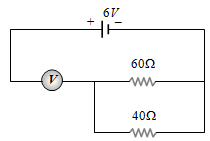
The measurement of voltmeter in the following circuit is
MCQ 1341 Mark
A voltmeter has a range 0-V with a series resistance R. With a series resistance 2R, the range is 0-V¢. The correct relation between V and V¢ is
- A
$\mathrm{V}^{\prime}=2 \mathrm{~V}$
- B
$\mathrm{V}^{\prime}>2 \mathrm{~V}$
- C
$\mathrm{V}^{\prime}>>2 \mathrm{~V}$
- ✓
$\mathrm{V}^{\prime}<2 \mathrm{~V}$
AnswerCorrect option: D. $\mathrm{V}^{\prime}<2 \mathrm{~V}$
(d) $\mathrm{V}^{\prime}<2\mathrm{~V}$
View full question & answer→MCQ 1351 Mark
A milliammeter of range 10 mA has a coil of resistance 1 W. To use it as voltmeter of range 10 volt, the resistance that must be connected in series with it, will be
MCQ 1361 Mark
In a potentiometer experiment two cells of e.m.f. $E_1$ and $E_2$ are used in series and in conjunction and the balancing length is found to be 58 cm of the wire. If the polarity of $E_2$ is reversed, then the balancing length becomes 29 cm. The ratio $\frac{E_1}{E_2}$ of the e.m.f. of the two cells is
View full question & answer→MCQ 1371 Mark
A voltmeter having resistance of $50 \times 10^3$ ohm is used to measure the voltage in a circuit. To increase the range of measurement $3$ times the additional series resistance required is
AnswerCorrect option: A. $10^5 \mathrm{ohm}$
$10^5 \mathrm{ohm}$
View full question & answer→MCQ 1381 Mark
In a circuit 5 percent of total current passes through a galvanometer. If resistance of the galvanometer is G then value of the shunt is
- A
- B
- C
$\frac{G}{20}$
- ✓
$\frac{G}{19}$
AnswerCorrect option: D. $\frac{G}{19}$
(d) $\frac{G}{19}$
View full question & answer→MCQ 1391 Mark
An ammeter gives full deflection when a current of 2 amp. flows through it. The resistance of ammeter is 12 ohms. If the same ammeter is to be used for measuring a maximum current of 5 amp., then the ammeter must be connected with a resistance of
MCQ 1401 Mark
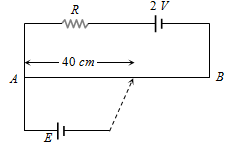
AB is a potentiometer wire of length 100 cm and its resistance is 10 ohms. It is connected in series with a resistance R = 40 ohms and a battery of e.m.f. 2 V and negligible internal resistance. If a source of unknown e.m.f. E is balanced by 40 cm length of the potentiometer wire, the value of E is
MCQ 1411 Mark
A potentiometer having the potential gradient of 2 mV/cm is used to measure the difference of potential across a resistance of 10 ohm. If a length of 50 cm of the potentiometer wire is required to get the null point, the current passing through the 10 ohm resistor is (in mA)
MCQ 1421 Mark
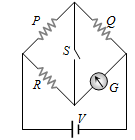
In the circuit shown P ≠ R, the reading of the galvanometer is same with switch S open or closed. Then
- ✓
$I_R=I_G$
- B
$I_P=I_G$
- C
$I_Q=I_G$
- D
$I_Q=I_R$
AnswerCorrect option: A. $I_R=I_G$
(a) $I_R=I_G$
View full question & answer→MCQ 1431 Mark
In a meter bridge, the balancing length from the left end (standard resistance of one ohm is in the right gap) is found to be 20 cm. The value of the unknown resistance is
MCQ 1441 Mark
A potentiometer consists of a wire of length 4 m and resistance 10Ω. It is connected to a cell of e.m.f. 2 V. The potential difference per unit length of the wire will be
MCQ 1451 Mark
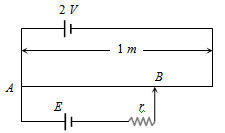
In the given figure, battery E is balanced on 55 cm length of potentiometer wire but when a resistance of 10 W is connected in parallel with the battery then it balances on 50 cm length of the potentiometer wire then internal resistance r of the battery is
- ✓
1 $\Omega$
- B
3 $\Omega$
- C
10 $\Omega$
- D
5 $\Omega$
AnswerCorrect option: A. 1 $\Omega$
(a) 1 $\Omega$
View full question & answer→MCQ 1461 Mark
If an ammeter is connected in parallel to a circuit, it is likely to be damaged due to excess
MCQ 1471 Mark
The resistance of a galvanometer coil is R. What is the shunt resistance required to convert it into an ammeter of range 4 times
- A
$\frac{R}{5}$
- B
$\frac{R}{4}$
- ✓
$\frac{R}{3}$
- D
AnswerCorrect option: C. $\frac{R}{3}$
(c) $\frac{R}{3}$
View full question & answer→MCQ 1481 Mark
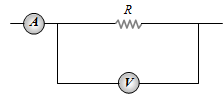
The ammeter A reads 2 A and the voltmeter V reads 20 V. the value of resistance R is (Assuming finite resistance's of ammeter and voltmeter)
MCQ 1491 Mark
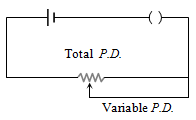
The arrangement as shown in figure is called as
MCQ 1501 Mark
For a cell of e.m.f. 2V, a balance is obtained for 50 cm of the potentiometer wire. If the cell is shunted by a 2Ω resistor and the balance is obtained across 40 cm of the wire, then the internal resistance of the cell is
MCQ 1511 Mark
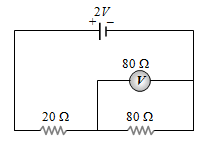
In the adjoining circuit, the e.m.f. of the cell is 2 volt and the internal resistance is negligible. The resistance of the voltmeter is 80 ohm. The reading of the voltmeter will be
MCQ 1521 Mark
We have a galvanometer of resistance 25 Ω. It is shunted by a 2.5 Ω wire. The part of total current that flows through the galvanometer is given as
- ✓
$\frac{I}{I_0}=\frac{1}{11}$
- B
$\frac{I}{I_0}=\frac{1}{10}$
- C
$\frac{I}{I_0}=\frac{3}{11}$
- D
$\frac{I}{I_0}=\frac{4}{11}$
AnswerCorrect option: A. $\frac{I}{I_0}=\frac{1}{11}$
(a) $\frac{I}{I_0}=\frac{1}{11}$
View full question & answer→MCQ 1531 Mark
The resistance of 10 metre long potentiometer wire is 1ohm/meter. A cell of e.m.f. 2.2 volts and a high resistance box are connected in series to this wire. The value of resistance taken from resistance box for getting potential gradient of 2.2 millivolt/metre will be
MCQ 1541 Mark
A voltmeter of resistance 1000 Ω gives full scale deflection when a current of 100 mA flow through it. The shunt resistance required across it to enable it to be used as an ammeter reading 1 A at full scale deflection is
MCQ 1551 Mark
In a potentiometer experiment, the galvanometer shows no deflection when a cell is connected across 60 cm of the potentiometer wire. If the cell is shunted by a resistance of 6Ω, the balance is obtained across 50 cm of the wire. The internal resistance of the cell is
MCQ 1561 Mark
A galvanometer whose resistance is 120 Ω gives full scale deflection with a current of 0.05 A so that it can read a maximum current of 10 A. A shunt resistance is added in parallel with it. The resistance of the ammeter so formed is
MCQ 1571 Mark
An ammeter whose resistance is 180 Ω gives full scale deflection when current is 2 mA. The shunt required to convert it into an ammeter reading 20 mA (in ohms) is.
MCQ 1581 Mark
A potentiometer wire has length 10 m and resistance 20Ω. A 2.5 V battery of negligible internal resistance is connected across the wire with an 80 Ω series resistance. The potential gradient on the wire will be
AnswerCorrect option: A. $5\times 10^{-5}$ V/mm
(a) $5\times 10^{-5}$ V/mm
View full question & answer→MCQ 1591 Mark
A galvanometer having a resistance of 8 ohm is shunted by a wire of resistance 2 ohm. If the total current is 1 amp, the part of it passing through the shunt will be
MCQ 1601 Mark
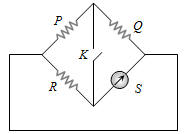
In the following Wheatstone bridge P/Q = R/S. If key K is closed, then the galvanometer will show deflection
MCQ 1611 Mark
A moving coil galvanometer has a resistance of 50 Ω and gives full scale deflection for 10 mA. How could it be converted into an ammeter with a full scale deflection for 1A.
MCQ 1621 Mark
The net resistance of a voltmeter should be large to ensure that
- A
It does not get overheated
- B
It does not draw excessive current
- C
It can measure large potential difference
- ✓
It does not appreciably change the potential difference to be measured
AnswerCorrect option: D. It does not appreciably change the potential difference to be measured
It does not appreciably change the potential difference to be measured
View full question & answer→MCQ 1631 Mark
Constantan wire is used in making standard resistances because its.
- A
Specific resistance is low
- B
- ✓
Temperature coefficient of resistance is negligible
- D
AnswerCorrect option: C. Temperature coefficient of resistance is negligible
Temperature coefficient of resistance is negligible
View full question & answer→MCQ 1641 Mark
A 100 V voltmeter of internal resistance 20 kQ in series with a high resistance R is connected to a 110 V line. The voltmeter reads 5 V, the value of R is
MCQ 1651 Mark
The resistance of an ideal voltmeter is
MCQ 1661 Mark
If only 2% of the main current is to be passed through a galvanometer of resistance G, then the resistance of shunt will be
- A
$\frac{G}{50}$
- ✓
$\frac{G}{49}$
- C
- D
AnswerCorrect option: B. $\frac{G}{49}$
(b) $\frac{G}{49}$
View full question & answer→MCQ 1671 Mark
The resistivity of a potentiometer wire is $40 \times 10^{-8}$ ohm -m and its area of cross-section is $8{\times 10^{-6} \mathrm{~m}^2}$. If 0.2 amp current is flowing through the wire, the potential gradient will be
- ✓
$10^{-2} \mathrm{volt} / \mathrm{m}$
- B
$10^{-1}$ volt $/ \mathrm{m}$
- C
$3.2 \times 10^{-2} \mathrm{volt} / \mathrm{m}$
- D
AnswerCorrect option: A. $10^{-2} \mathrm{volt} / \mathrm{m}$
(a) $10^{-2} \mathrm{volt} / \mathrm{m}$
View full question & answer→MCQ 1681 Mark
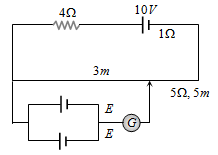
A resistance of 4$\Omega$ and a wire of length 5 metres and resistance 5$\Omega$ are joined in series and connected to a cell of e.m.f. 10 V and internal resistance 1$\Omega$. A parallel combination of two identical cells is balanced across 300 cm of the wire. The e.m.f. E of each cell is
View full question & answer→MCQ 1691 Mark
The resistance of a galvanometer is 50 ohms and the current required to give full scale deflection is 100μA. In order to convert it into an ammeter, reading upto 10A, it is necessary to put a resistance of
- A
$5 \times 10^{-3}\Omega$ in parallel
- ✓
$5 \times 10^{-4}\Omega$ in parallel
- C
$10^5\Omega$ in series
- D
99,950 $\Omega$ in series
AnswerCorrect option: B. $5 \times 10^{-4}\Omega$ in parallel
(b) $5 \times 10^{-4}\Omega$ in parallel
View full question & answer→MCQ 1701 Mark
A potentiometer wire of length 1 m and resistance 10 W is connected in series with a cell of emf 2V with internal resistance 1 W and a resistance box including a resistance R. If potential difference between the ends of the wire is 1 mV, the value of R is
MCQ 1711 Mark
A potentiometer circuit shown in the figure is set up to measure e.m.f. of a cell E. As the point P moves from X to Y the galvanometer G shows deflection always in one direction, but the deflection decreases continuously until Y is reached. In order to obtain balance point between X and Y it is necessary to
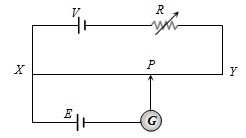
- ✓
Decreases the resistance R
- B
Increase the resistance R
- C
Reverse the terminals of battery V
- D
Reverse the terminals of cell E
AnswerCorrect option: A. Decreases the resistance R
(a) Decreases the resistance R
View full question & answer→MCQ 1721 Mark
In an experiment to measure the internal resistance of a cell by potentiometer, it is found that the balance point is at a length of 2m when the cell is shunted by a 5 Ω resistance; and is at a length of 3m when the cell is shunted by a 10 Ω resistance. The internal resistance of the cell is, then
MCQ 1731 Mark
A voltmeter has resistance of 2000 ohms and it can measure upto 2V. If we want to increase its range to 10 V, then the required resistance in series will be
MCQ 1741 Mark
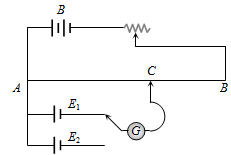
The circuit shown here is used to compare the e.m.f. of two cells $E_1$ and $E_2\left(E_1>E_2\right)$. The null point is at C when the galvanometer is connected to $E_1$. When the galvanometer is connected to $E_2$, the null point will be
View full question & answer→MCQ 1751 Mark
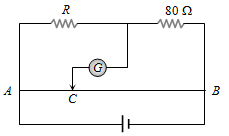
AB is a wire of uniform resistance. The galvanometer G shows no current when the length AC = 20cm and CB = 80 cm. The resistance R is equal to
MCQ 1761 Mark
An ammeter with internal resistance 90 Ω reads 1.85 A when connected in a circuit containing a battery and two resistors 700 Ω and 410 Ω in series. Actual current will be
MCQ 1771 Mark
Which of the following is correct
- ✓
Ammeter has low resistance and is connected in series
- B
Ammeter has low resistance and is connected in parallel
- C
Voltmeter has low resistance and is connected in parallel
- D
AnswerCorrect option: A. Ammeter has low resistance and is connected in series
Ammeter has low resistance and is connected in series
View full question & answer→MCQ 1781 Mark
For comparing the e.m.f.'s of two cells with a potentiometer, a standard cell is used to develop a potential gradient along the wires. Which of the following possibilities would make the experiment unsuccessful
- A
The e.m.f. of the standard cell is larger than the E e.m.f.'s of the two cells
- B
The diameter of the wires is the same and uniform throughout
- C
The number of wires is ten
- ✓
The e.m.f. of the standard cell is smaller than the e.m.f.'s of the two cells
AnswerCorrect option: D. The e.m.f. of the standard cell is smaller than the e.m.f.'s of the two cells
The e.m.f. of the standard cell is smaller than the e.m.f.'s of the two cells
View full question & answer→MCQ 1791 Mark
A voltmeter having a resistance of 998 ohms is connected to a cell of e.m.f. 2 volt and internal resistance 2 ohm. The error in the measurement of e.m.f. will be
- A
$4 \times 10^{-1}$ volt
- B
$2 \times 10^{-3}$ volt
- ✓
$4 \times 10^{-3}$ volt
- D
$2 \times 10^{-1}$ volt
AnswerCorrect option: C. $4 \times 10^{-3}$ volt
(c) $4 \times 10^{-3}$ volt
View full question & answer→MCQ 1801 Mark
Which is a wrong statement
- A
The Wheatstone bridge is most sensitive when all the four resistances are of the same order
- ✓
In a balanced Wheatstone bridge, interchanging the positions of galvanometer and cell affects the balance of the bridge
- C
Kirchhoff's first law (for currents meeting at a junction in an electric circuit) expresses the conservation of charge
- D
The rheostat can be used as a potential divider
AnswerCorrect option: B. In a balanced Wheatstone bridge, interchanging the positions of galvanometer and cell affects the balance of the bridge
In a balanced Wheatstone bridge, interchanging the positions of galvanometer and cell affects the balance of the bridge
View full question & answer→MCQ 1811 Mark
The resistance of a galvanometer is 25 ohm and it requires 50μA for full deflection. The value of the shunt resistance required to convert it into an ammeter of 5 amp is
AnswerCorrect option: A. $2.5 \times 10^{-4} \mathrm{ohm}$
(a) $2.5 \times 10^{-4} \mathrm{ohm}$
View full question & answer→MCQ 1821 Mark
In a potentiometer circuit there is a cell of e.m.f. 2 volt, a resistance of 5 ohm and a wire of uniform thickness of length 1000 cm and resistance 15 ohm. The potential gradient in the wire is
- A
$\frac{1}{500} \mathrm{~V} / \mathrm{cm}$
- ✓
$\frac{3}{2000} \mathrm{~V} / \mathrm{cm}$
- C
$\frac{3}{5000} \mathrm{~V} / \mathrm{cm}$
- D
$\frac{1}{1000} \mathrm{~V} / \mathrm{cm}$
AnswerCorrect option: B. $\frac{3}{2000} \mathrm{~V} / \mathrm{cm}$
(b) $\frac{3}{2000} \mathrm{~V} / \mathrm{cm}$
View full question & answer→MCQ 1831 Mark
A galvanometer of resistance 25 Ω gives full scale deflection for a current of 10 milliampere, is to be changed into a voltmeter of range 100 V by connecting a resistance of ‘R’ in series with galvanometer. The value of resistance R in Ω is
MCQ 1841 Mark
The current flowing through a coil of resistance 900 ohms is to be reduced by 90%. What value of shunt should be connected across the coil
MCQ 1851 Mark
50 Ω and 100 Ω resistors are connected in series. This connection is connected with a battery of 2.4 volts. When a voltmeter of 100 Ω resistance is connected across 100 Ω resistor, then the reading of the voltmeter will be
MCQ 1861 Mark
A 2 volt battery, a 15 Ω resistor and a potentiometer of 100 cm length, all are connected in series. If the resistance of potentiometer wire is 5 Ω, then the potential gradient of the potentiometer wire is
MCQ 1871 Mark
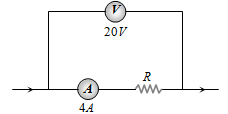
In the diagram shown, the reading of voltmeter is 20 V and that of ammeter is 4 A. The value of R should be (Consider given ammeter and voltmeter are not ideal)
- A
- B
- ✓
- D
Greater or less than 5 Ω depends on the material of R
View full question & answer→MCQ 1881 Mark
Which of the following statement is wrong
- A
Voltmeter should have high resistance
- B
Ammeter should have low resistance
- ✓
Ammeter is placed in parallel across the conductor in a circuit
- D
Voltmeter is placed in parallel across the conductor in a circuit
AnswerCorrect option: C. Ammeter is placed in parallel across the conductor in a circuit
Ammeter is placed in parallel across the conductor in a circuit
View full question & answer→MCQ 1891 Mark
A voltmeter has a resistance of G ohms and range V volts. The value of resistance used in series to convert it into a voltmeter of range nV volts is
- A
- ✓
- C
$\frac{\mathrm{G}}{n}$
- D
$\frac{G}{(n-1)}$
View full question & answer→MCQ 1901 Mark
Two cells when connected in series are balanced on 8m on a potentiometer. If the cells are connected with polarities of one of the cell is reversed, they balance on 2m. The ratio of e.m.f.'s of the two cells is
MCQ 1911 Mark
The resistance of a galvanometer is 90 ohms. If only 10 percent of the main current may flow through the galvanometer, in which way and of what value, a resistor is to be used
MCQ 1921 Mark
If in the experiment of Wheatstone's bridge, the positions of cells and galvanometer are interchanged, then balance points will
- A
- ✓
- C
Depend on the internal resistance of cell and resistance of galvanometer
- D
View full question & answer→MCQ 1931 Mark
In the experiment of potentiometer, at balance, there is no current in the
- A
- ✓
- C
- D
Both main and galvanometer circuits
View full question & answer→MCQ 1941 Mark
If the length of potentiometer wire is increased, then the length of the previously obtained balance point will
MCQ 1951 Mark
The figure shows a circuit diagram of a ‘Wheatstone Bridge’ to measure the resistance G of the galvanometer. The relation $\frac{P}{Q}=\frac{R}{G}$ will be satisfied only when
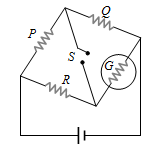
- A
The galvanometer shows a deflection when switch S is closed
- B
The galvanometer shows a deflection when switch S is open
- ✓
The galvanometer shows no change in deflection whether S is open or closed
- D
The galvanometer shows no deflection
AnswerCorrect option: C. The galvanometer shows no change in deflection whether S is open or closed
(c) The galvanometer shows no change in deflection whether S is open or closed
View full question & answer→MCQ 1961 Mark
In the Wheatstone's bridge (shown in figure) X = Y and A > B. The direction of the current between ab will be
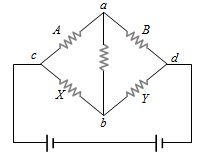
MCQ 1971 Mark
In an experiment of meter bridge, a null point is obtained at the centre of the bridge wire. When a resistance of 10 ohm is connected in one gap, the value of resistance in other gap is
MCQ 1981 Mark
Potential gradient is defined as
- ✓
Fall of potential per unit length of the wire
- B
Fall of potential per unit area of the wire
- C
Fall of potential per unit area of the wire
- D
Potential at any one end of the wire
AnswerCorrect option: A. Fall of potential per unit length of the wire
Fall of potential per unit length of the wire
View full question & answer→MCQ 1991 Mark
A galvanometer of 10 ohm resistance gives full scale deflection with 0.01 ampere of current. It is to be converted into an ammeter for measuring 10 ampere current. The value of shunt resistance required will be
AnswerCorrect option: A. $\frac{10}{999}$ ohm
(a) $\frac{10}{999}$ ohm
View full question & answer→MCQ 2001 Mark
A battery of 6 volts is connected to the terminals of a three metre long wire of uniform thickness and resistance of the order of 100 Ω. The difference of potential between two points separated by 50 cm on the wire will be
MCQ 2011 Mark
A potentiometer is an ideal device of measuring potential difference because
- A
It uses a sensitive galvanometer
- ✓
It does not disturb the potential difference it measures
- C
It is an elaborate arrangement
- D
It has a long wire hence heat developed is quickly radiated
AnswerCorrect option: B. It does not disturb the potential difference it measures
It does not disturb the potential difference it measures
View full question & answer→MCQ 2021 Mark
A Daniel cell is balanced on 125 cm length of a potentiometer wire. Now the cell is short-circuited by a resistance 2 ohm and the balance is obtained at 100 cm. The internal resistance of the Daniel cell is
MCQ 2031 Mark
In Wheatstone's bridge P = 9 ohm, Q = 11 ohm, R = 4 ohm and S = 6 ohm. How much resistance must be put in parallel to the resistance S to balance the bridge
MCQ 2041 Mark
The tangent galvanometer, when connected in series with a standard resistance can be used as
- A
- ✓
- C
- D
Both an ammeter and a voltmeter
View full question & answer→MCQ 2051 Mark
A galvanometer can be used as a voltmeter by connecting a
- ✓
High resistance in series
- B
- C
High resistance in parallel
- D
Low resistance in parallel
AnswerCorrect option: A. High resistance in series
High resistance in series
View full question & answer→MCQ 2061 Mark
When a 12 Ω resistor is connected with a moving coil galvanometer then its deflection reduces from 50 divisions to 10 divisions. The resistance of the galvanometer is
MCQ 2071 Mark
A galvanometer can be converted into an ammeter by connecting
- A
- B
High resistance in parallel
- ✓
Low resistance in parallel
- D
High resistance in series
AnswerCorrect option: C. Low resistance in parallel
Low resistance in parallel
View full question & answer→MCQ 2081 Mark
A cell of internal resistance 1.5Ω and of e.m.f. 1.5 volt balances 500 cm on a potentiometer wire. If a wire of 15 Ω is connected between the balance point and the cell, then the balance point will shift
MCQ 2091 Mark
$10^{-3}$ amp is flowing through a resistance of 1000Ω. To measure the correct potential difference, the voltmeter is to be used of which the resistance should be
View full question & answer→MCQ 2101 Mark
A galvanometer of 100 Ω resistance gives full scale deflection when 10 mA of current is passed. To convert it into 10 A range ammeter, the resistance of the shunt required will be
MCQ 2111 Mark
Eels are able to generate current with biological cells called electroplaques. The electroplaques in an eel are arranged in 100 rows, each row stretching horizontally along the body of the fish containing 5000 electroplaques. The arrangement is suggestively shown below. Each electroplaques has an emf of 0.15 V and internal resistance of 0.25 W
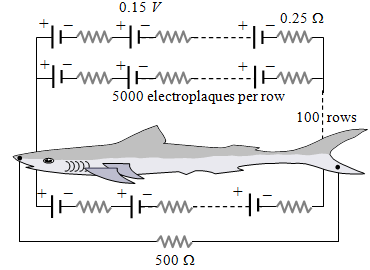
The water surrounding the eel completes a circuit between the head and its tail. If the water surrounding it has a resistance of 500 W, the current an eel can produce in water is about
MCQ 2121 Mark
An ammeter gives full scale deflection when current of 1.0 A is passed in it. To convert it into 10 A range ammeter, the ratio of its resistance and the shunt resistance will be
MCQ 2131 Mark
By ammeter, which of the following can be measured
MCQ 2141 Mark
The resistance of 1 A ammeter is 0.018 Ω . To convert it into 10 A ammeter, the shunt resistance required will be
MCQ 2151 Mark
For measurement of potential difference, potentiometer is preferred in comparison to voltmeter because
- A
Potentiometer is more sensitive than voltmeter
- B
The resistance of potentiometer is less than voltmeter
- C
Potentiometer is cheaper than voltmeter
- ✓
Potentiometer does not take current from the circuit
AnswerCorrect option: D. Potentiometer does not take current from the circuit
Potentiometer does not take current from the circuit
View full question & answer→MCQ 2161 Mark
In order to pass 10% of main current through a moving coil galvanometer of 99 ohm, the resistance of the required shunt is
MCQ 2171 Mark
For measurement of potential difference, potentiometer is preferred in comparison to voltmeter because
- A
Potentiometer is more sensitive than voltmeter
- B
The resistance of potentiometer is less than voltmeter
- C
Potentiometer is cheaper than voltmeter
- ✓
Potentiometer does not take current from the circuit
AnswerCorrect option: D. Potentiometer does not take current from the circuit
(d) Potentiometer does not take current from the circuit
View full question & answer→MCQ 2181 Mark
In order to pass 10% of main current through a moving coil galvanometer of 99 ohm, the resistance of the required shunt is
MCQ 2191 Mark
In the circuit, the reading of the ammeter is (assume internal resistance of the battery be zero)
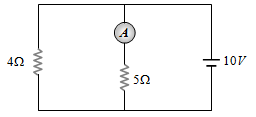
- A
$\frac{40}{29}A$
- B
$\frac{10}{9}A$
- C
$\frac{5}{3}A$
- ✓
View full question & answer→MCQ 2201 Mark
An ammeter of 5 ohm resistance can read 5 mA. If it is to be used to read 100 volts, how much resistance is to be connected in series
MCQ 2211 Mark
The potential gradient along the length of a uniform wire is 10 volt/metre. B and C are the two points at 30 cm and 60 cm point on a meter scale fitted along the wire. The potential difference between B and C will be
MCQ 2221 Mark
100 mA current gives a full scale deflection in a galvanometer of 2Ω resistance. The resistance connected with the galvanometer to convert it into a voltmeter to measure 5V is
MCQ 2231 Mark
The figure shows a network of currents. The magnitude of currents is shown here. The current I will be
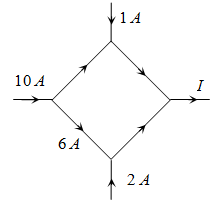
MCQ 2241 Mark
To draw maximum current from a combination of cells, how should the cells be grouped
- A
- B
- C
- ✓
Depends upon the relative values of external and internal resistance
AnswerCorrect option: D. Depends upon the relative values of external and internal resistance
(d) Depends upon the relative values of external and internal resistance
View full question & answer→MCQ 2251 Mark
The magnitude of i in ampere unit is
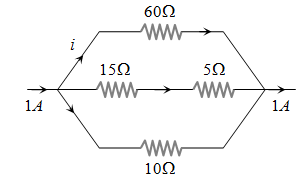
MCQ 2261 Mark
Two sources of equal emf are connected to an external resistance R. The internal resistances of the two sources are $R_1$ and $R_2\left(R_2>R_1\right)$ . If the potential difference across the source having internal resistance $R_2$ is zero, thenZ
- A
$\mathrm{R}=\mathrm{R}_1 \mathrm{R}_2 /\left(\mathrm{R}_1+\mathrm{R}_2\right)$
- B
$\mathrm{R}=\mathrm{R}_1 \mathrm{R}_2 /\left(\mathrm{R}_2-\mathrm{R}_1\right)$
- C
$\mathrm{R}=\mathrm{R}_2 \times\left(\mathrm{R}_1+\mathrm{R}_2\right) /\left(\mathrm{R}_2-\mathrm{R}_1\right)$
- ✓
$\mathrm{R}=\mathrm{R}_2-\mathrm{R}_1$
AnswerCorrect option: D. $\mathrm{R}=\mathrm{R}_2-\mathrm{R}_1$
(d) $\mathrm{R}=\mathrm{R}_2-\mathrm{R}_1$
View full question & answer→MCQ 2271 Mark
Two batteries, one of emf 18 volts and internal resistance 2Ω and the other of emf 12 volt and internal resistance 1 Ω, are connected as shown. The voltmeter V will record a reading of
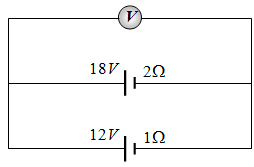
MCQ 2281 Mark
Find out the value of current through 2Ω resistance for the given circuit
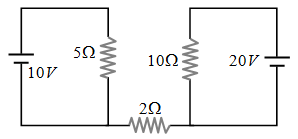
MCQ 2291 Mark
The maximum power drawn out of the cell from a source is given by (where r is internal resistance)
- A
$\mathrm{E}^2 / 2 \mathrm{r}$
- ✓
$\mathrm{E}^2 / 4 \mathrm{r}$
- C
$\mathrm{E}^2 / \mathrm{r}$
- D
$\mathrm{E}^2 / 3 \mathrm{r}$
AnswerCorrect option: B. $\mathrm{E}^2 / 4 \mathrm{r}$
(b) $\mathrm{E}^2 / 4 \mathrm{r}$
View full question & answer→MCQ 2301 Mark
When the resistance of 9 W is connected at the ends of a battery, its potential difference decreases from 40 volt to 30 volt. The internal resistance of the battery is
MCQ 2311 Mark
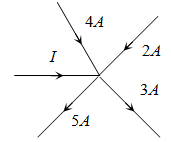
In the given current distribution what is the value of I
MCQ 2321 Mark
A battery is charged at a potential of 15 V for 8 hours when the current flowing is 10 A. The battery on discharge supplies a current of 5 A for 15 hours. The mean terminal voltage during discharge is 14 V. The "Watt-hour" efficiency of the battery is
MCQ 2331 Mark
Current provided by a battery is maximum when
- ✓
Internal resistance equal to external resistance
- B
Internal resistance is greater than external resistance
- C
Internal resistance is less than external resistance
- D
AnswerCorrect option: A. Internal resistance equal to external resistance
(a) Internal resistance equal to external resistance
View full question & answer→MCQ 2341 Mark
Electromotive force is the force, which is able to maintain a constant
MCQ 2351 Mark
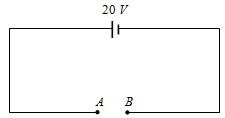
In the shown circuit, what is the potential difference across A and B
MCQ 2361 Mark
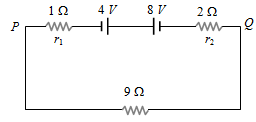
Two batteries of e.m.f. 4V and 8 V with internal resistances 1 W and 2 W are connected in a circuit with a resistance of 9 W as shown in figure. The current and potential difference between the points P and Q are
- ✓
$\frac{1}{3}A$ and 3V
- B
$\frac{1}{6}A$ and 4V
- C
$\frac{1}{9}A$ and 9V
- D
$\frac{1}{2}A$ and 12 V
AnswerCorrect option: A. $\frac{1}{3}A$ and 3V
(a) $\frac{1}{3}A$ and 3V
View full question & answer→MCQ 2371 Mark
For driving a current of 2 A for 6 minutes in a circuit, 1000 J of work is to be done. The e.m.f. of the source in the circuit is
MCQ 2381 Mark
Emf is most closely related to
MCQ 2391 Mark
The number of dry cells, each of e.m.f. 1.5 volt and internal resistance 0.5 ohm that must be joined in series with a resistance of 20 ohm so as to send a current of 0.6 ampere through the circuit is
MCQ 2401 Mark
A storage battery has e.m.f. 15 volts and internal resistance 0.05 ohm. Its terminal voltage when it is delivering 10 ampere is
MCQ 2411 Mark
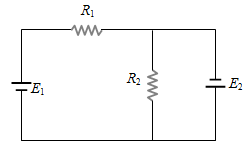
Two resistances $R_1$ and $R_2$ are joined as shown in the figure to two batteries of e.m.f. $E_1$ and $E_2$ . If $E_2$ is short-circuited, the current through $R_1$ is
AnswerCorrect option: A. $E_1/R_1$
(a) $E_1/R_1$
View full question & answer→MCQ 2421 Mark
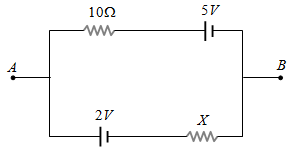
If $V_{A B}=4 \mathrm{~V}$ in the given figure, then resistance X will be
View full question & answer→MCQ 2431 Mark
Kirchoff’s I law and II law of current, proves the
- ✓
Conservation of charge and energy
- B
Conservation of current and energy
- C
Conservation of mass and charge
- D
AnswerCorrect option: A. Conservation of charge and energy
(a) Conservation of charge and energy
View full question & answer→MCQ 2441 Mark
The emf of a battery is 2 V and its internal resistance is 0.5 W. The maximum power which it can deliver to any external circuit will be
MCQ 2451 Mark
The n rows each containing m cells in series are joined in parallel. Maximum current is taken from this combination across an external resistance of 3W resistance. If the total number of cells used are 24 and internal resistance of each cell is 0.5 W then
MCQ 2461 Mark
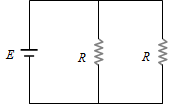
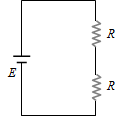
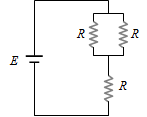
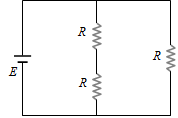
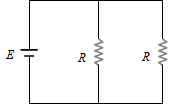
Consider four circuits shown in the figure below. In which circuit power dissipated is greatest (Neglect the internal resistance of the power supply)
Answer(a)
View full question & answer→MCQ 2471 Mark
How much work is required to carry a 6 mC charge from the negative terminal to the positive terminal of a 9 V battery
- A
$54 \times 10^{-3} \mathrm{~J}$
- ✓
$54 \times 10^{-6} \mathrm{~J}$
- C
$54 \times 10^{-9} \mathrm{~J}$
- D
$54 \times 10^{-12} \mathrm{~J}$
AnswerCorrect option: B. $54 \times 10^{-6} \mathrm{~J}$
(b) $54 \times 10^{-6} \mathrm{~J}$
View full question & answer→MCQ 2481 Mark
The internal resistance of a cell is the resistance of
- A
- B
- ✓
Electrolyte used in the cell
- D
Material used in the cell
AnswerCorrect option: C. Electrolyte used in the cell
(c) Electrolyte used in the cell
View full question & answer→MCQ 2491 Mark
When a resistor of 11 W is connected in series with an electric cell, the current flowing in it is 0.5 A. Instead, when a resistor of 5 W is connected to the same electric cell in series, the current increases by 0.4 A. The internal resistance of the cell is
MCQ 2501 Mark
Two batteries A and B each of e.m.f. 2 V are connected in series to an external resistance R = 1 ohm. If the internal resistance of battery A is 1.9 ohms and that of B is 0.9 ohm, what is the potential difference between the terminals of battery A
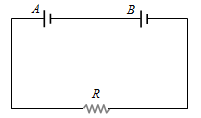
MCQ 2511 Mark
A current of 2.0 ampere passes through a cell of e.m.f. 1.5 volts having internal resistance of 0.15 ohm. The potential difference measured, in volts, across both the ends of the cell will be
MCQ 2521 Mark
The current in the given circuit is
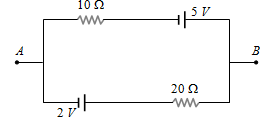
MCQ 2531 Mark
The internal resistance of a cell of e.m.f. 12V is $5\times 10^{-2}\Omega$ . It is connected across an unknown resistance. Voltage across the cell, when a current of 60 A is drawn from it, is
View full question & answer→MCQ 2541 Mark
A capacitor is connected to a cell of emf E having some internal resistance r. The potential difference across the
MCQ 2551 Mark
In the given circuit the current $I_1$ is
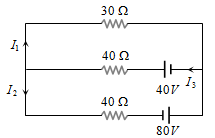
View full question & answer→MCQ 2561 Mark
A battery having e.m.f. 5V and internal resistance 0.5 W is connected with a resistance of 4.5 W then the voltage at the terminals of battery is
MCQ 2571 Mark
A storage cell is charged by 5 amp D.C. for 18 hours. Its strength after charging will be
MCQ 2581 Mark
A cell of emf 6 V and resistance 0.5 ohm is short circuited. The current in the cell is
MCQ 2591 Mark
When cells are connected in parallel, then
Answer(b) The current increases
View full question & answer→MCQ 2601 Mark
If six identical cells each having an e.m.f. of 6V are connected in parallel, the e.m.f. of the combination is
MCQ 2611 Mark
Two non-ideal identical batteries are connected in parallel. Consider the following statements
(i) The equivalent e.m.f. is smaller than either of the two e.m.f.s
(ii) The equivalent internal resistance is smaller than either of the two internal resistances
- A
Both (i) and (ii) are correct
- B
(i) is correct but (ii) is wrong
- ✓
(ii) is correct but (i) is wrong
- D
Both (i) and (ii) are wrong
AnswerCorrect option: C. (ii) is correct but (i) is wrong
(c) (ii) is correct but (i) is wrong
View full question & answer→MCQ 2621 Mark
When a resistance of 2 ohm is connected across the terminals of a cell, the current is 0.5 A. When the resistance is increased to 5 ohm, the current is 0.25 A. The e.m.f. of the cell is
MCQ 2631 Mark
The current in the arm CD of the circuit will be
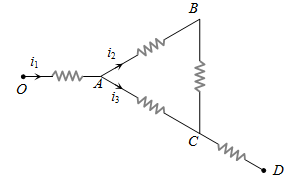
- A
$i_1+i_2$
- ✓
$i_2+i_3$
- C
$i_1+i_3$
- D
$i_1-i_2+i_3$
AnswerCorrect option: B. $i_2+i_3$
(b) $i_2+i_3$
View full question & answer→MCQ 2641 Mark
100 cells each of e.m.f. 5 V and internal resistance 1 ohm are to be arranged so as to produce maximum current in a 25 ohms resistance. Each row is to contain equal number of cells. The number of rows should be
MCQ 2651 Mark
A current of two amperes is flowing through a cell of e.m.f. 5 volts and internal resistance 0.5 ohm from negative to positive electrode. If the potential of negative electrode is 10V, the potential of positive electrode will be
MCQ 2661 Mark
Consider the circuit given here with the following parameters E.M.F. of the cell = 12 V. Internal resistance of the cell = 2 Ω. Resistance R = 4 Ω
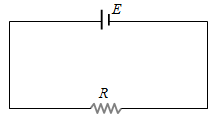
Which one of the following statements in true
- ✓
Rate of energy loss in the source is = 8 W
- B
Rate of energy conversion in the source is 16 W
- C
- D
Potential drop across R is = 16 V
AnswerCorrect option: A. Rate of energy loss in the source is = 8 W
(a) Rate of energy loss in the source is = 8 W
View full question & answer→MCQ 2671 Mark
A dry cell has an e.m.f. of 1.5 V and an internal resistance of 0.05Ω. The maximum current obtainable from this cell for a very short time interval is
MCQ 2681 Mark
The figure shows a network of currents. The magnitude of currents is shown here. The current i will be
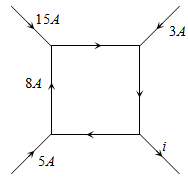
MCQ 2691 Mark
A torch battery consisting of two cells of 1.45 volts and an internal resistance 0.15Ω, each cell sending currents through the filament of the lamps having resistance 1.5ohms. The value of current will be
MCQ 2701 Mark
Two identical cells send the same current in 2Ω resistance, whether connected in series or in parallel. The internal resistance of the cell should be
MCQ 2711 Mark
To get the maximum current from a parallel combination of n identical cells each of internal resistance r in an external resistance R, when
MCQ 2721 Mark
A cell of internal resistance r is connected to an external resistance R. The current will be maximum in R, if
MCQ 2731 Mark
n identical cells each of e.m.f. E and internal resistance r are connected in series. An external resistance R is connected in series to this combination. The current through R is
- ✓
$\frac{nE}{R+nr}$
- B
$\frac{nE}{nr+R}$
- C
$\frac{E}{R+nr}$
- D
$\frac{nE}{R+r}$
AnswerCorrect option: A. $\frac{nE}{R+nr}$
(a) $\frac{nE}{R+nr}$
View full question & answer→MCQ 2741 Mark
The internal resistance of a cell depends on
- A
The distance between the plates
- B
The area of the plates immersed
- C
The concentration of the electrolyte
- ✓
View full question & answer→MCQ 2751 Mark
A parallel combination of two resistors, of 1W each, is connected in series with a 1.5 W resistor. The total combination is connected across a 10 V battery. The current flowing in the circuit is
MCQ 2761 Mark
The reading of a high resistance voltmeter when a cell is connected across it is 2.2 V. When the terminals of the cell are also connected to a resistance of 5Ω the voltmeter reading drops to 1.8 V. Find the internal resistance of the cell
MCQ 2771 Mark
A new flashlight cell of e.m.f. 1.5 volts gives a current of 15 amps, when connected directly to an ammeter of resistance 0.04Ω. The internal resistance of cell is
MCQ 2781 Mark
The potential difference in open circuit for a cell is 2.2 volts. When a 4 ohm resistor is connected between its two electrodes the potential difference becomes 2 volts. The internal resistance of the cell will be
MCQ 2791 Mark
A 50V battery is connected across a 10 ohm resistor. The current is 4.5 amperes. The internal resistance of the battery is
MCQ 2801 Mark
A primary cell has an e.m.f. of 1.5 volts, when short-circuited it gives a current of 3 amperes. The internal resistance of the cell is
MCQ 2811 Mark
The terminal potential difference of a cell when short-circuited is (E = E.M.F. of the cell)
MCQ 2821 Mark
When a resistance of 2ohm is connected across the terminals of a cell, the current is 0.5 amperes. When the resistance is increased to 5 ohm, the current is 0.25 amperes. The internal resistance of the cell is
MCQ 2831 Mark
Consider the circuit shown in the figure. The current $I_3$ is equal to
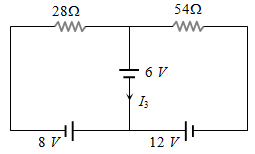
View full question & answer→MCQ 2841 Mark
In the circuit shown, A and V are ideal ammeter and voltmeter respectively. Reading of the voltmeter will be
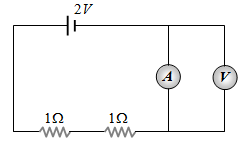
MCQ 2851 Mark
In the circuit shown, potential difference between X and Y will be
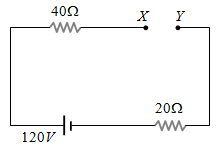
MCQ 2861 Mark
The magnitude and direction of the current in the circuit shown will be
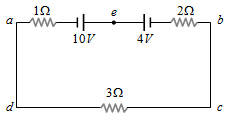
AnswerCorrect option: D. 1 A from a to b through e
(d) 1 A from a to b through e
View full question & answer→MCQ 2871 Mark
A cell of e.m.f 1.5 V having a finite internal resistance is connected to a load resistance of 2Ω. For maximum power transfer the internal resistance of the cell should be
MCQ 2881 Mark
By a cell a current of 0.9 A flows through 2 ohm resistor and 0.3 A through 7 ohm resistor. The internal resistance of the cell is
MCQ 2891 Mark
The e.m.f. of a cell is E volts and internal resistance is r ohm. The resistance in external circuit is also r ohm. The p.d. across the cell will be
MCQ 2901 Mark
A cell of e.m.f. E is connected with an external resistance R, then p.d. across cell is V. The internal resistance of cell will be
- A
$\frac{(E-V) R}{E}$
- ✓
$\frac{(E-V) R}{V}$
- C
$\frac{(V-E) R}{V}$
- D
$\frac{(V-E) R}{E}$
AnswerCorrect option: B. $\frac{(E-V) R}{V}$
(b) $\frac{(E-V) R}{V}$
View full question & answer→MCQ 2911 Mark
Two cells, e.m.f. of each is E and internal resistance r are connected in parallel between the resistance R. The maximum energy given to the resistor will be, only when
MCQ 2921 Mark
A battery of e.m.f. E and internal resistance r is connected to a variable resistor R as shown here. Which one of the following is true
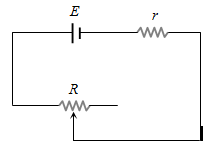
- A
Potential difference across the terminals of the battery is maximum when R = r
- ✓
Power delivered to the resistor is maximum when R = r
- C
Current in the circuit is maximum when R = r
- D
Current in the circuit is maximum when R >> r
AnswerCorrect option: B. Power delivered to the resistor is maximum when R = r
(b) Power delivered to the resistor is maximum when R = r
View full question & answer→MCQ 2931 Mark
Kirchhoff's first law i.e. $\Sigma \mathrm{i}=0$ at a junction is based on the law of conservation of
View full question & answer→MCQ 2941 Mark
Kirchhoff's second law is based on the law of conservation of
MCQ 2951 Mark
The internal resistances of two cells shown are 0.1 Ω and 0.3 Ω. If R = 0.2 Ω, the potential difference across the cell
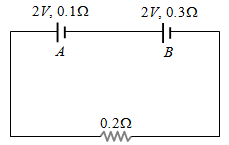
- ✓
- B
- C
- D
A will be > 2V and B will be < 2V
View full question & answer→MCQ 2961 Mark
In the circuit given E = 6.0 V, $R_1$ = 100 ohms, $R_2=R_3=50$ ohms, $R_4=75$ ohms. The equivalent resistance of the circuit, in ohms, is
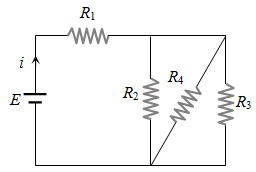
View full question & answer→MCQ 2971 Mark
The current in a simple series circuit is 5.0 amp. When an additional resistance of 2.0 ohms is inserted, the current drops to 4.0 amp. The original resistance of the circuit in ohms was
MCQ 2981 Mark
When a wire of uniform cross-section a, length l and resistance R is bent into a complete circle, resistance between any two of diametrically opposite points will be
- ✓
$\frac{R}{4}$
- B
$\frac{R}{8}$
- C
- D
$\frac{R}{2}$
AnswerCorrect option: A. $\frac{R}{4}$
(a) $\frac{R}{4}$
View full question & answer→MCQ 2991 Mark
For the network shown in the figure the value of the current i is
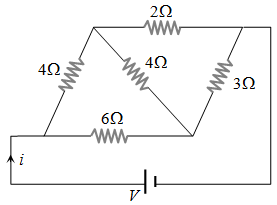
- A
$\frac{9v}{35}$
- ✓
$\frac{5v}{18}$
- C
$\frac{5v}{9}$
- D
$\frac{18v}{5}$
AnswerCorrect option: B. $\frac{5v}{18}$
(b) $\frac{5v}{18}$
View full question & answer→MCQ 3001 Mark
Five equal resistances each of resistance R are connected as shown in the figure. A battery of V volts is connected between A and B. The current flowing in AFCEB will be
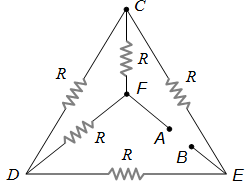
- A
$\frac{3V}{R}$
- ✓
$\frac{V}{R}$
- C
$\frac{V}{2R}$
- D
$\frac{2V}{R}$
AnswerCorrect option: B. $\frac{V}{R}$
(b) $\frac{V}{R}$
View full question & answer→MCQ 3011 Mark
If you are provided three resistances 2 $\Omega$, 3 $\Omega$ and 6 $\Omega$. How will you connect them so as to obtain the equivalent resistance of 4 $\Omega$
Answer(c)
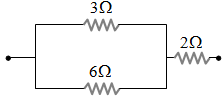
View full question & answer→MCQ 3021 Mark
In the circuit shown below, The reading of the voltmeter V is
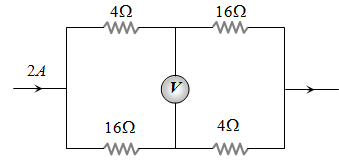
MCQ 3031 Mark
In circuit shown below, the resistances are given in ohms and the battery is assumed ideal with emf equal to 3 volt. The voltage across the resistance $R_4$ is
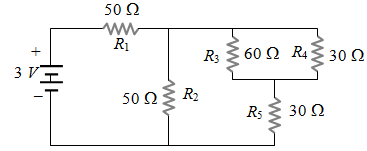
View full question & answer→MCQ 3041 Mark
If a rod has resistance 4 W and if rod is turned as half cycle then the resistance along diameter
MCQ 3051 Mark
An electric current is passed through a circuit containing two wires of the same material, connected in parallel. If the lengths and radii of the wires are in the ratio of 4/3 and 2/3, then the ratio of the currents passing through the wire will be
MCQ 3061 Mark
Six equal resistances are connected between points P, Q and R as shown in the figure. Then the net resistance will be maximum between
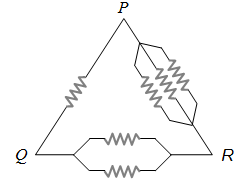
MCQ 3071 Mark
A wire has a resistance of 6 W. It is cut into two parts and both half values are connected in parallel. The new resistance is ....
MCQ 3081 Mark
An unknown resistance $R_1$ is connected in series with a resistance of $10 W$ . This combinations is connected to one gap of a metre bridge while a resistance $R_2$ is connected in the other gap. The balance point is at $50 \ cm$ . Now, when the $10 W$ resistance is removed the balance point shifts to $40 \ cm$ . The value of $R_1$ is $($in ohm$)$
View full question & answer→MCQ 3091 Mark
Which arrangement of four identical resistances should be used to draw maximum energy from a cell of voltage V
Answer(b)
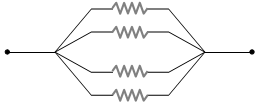
View full question & answer→MCQ 3101 Mark
In the above question, potential difference across the 40Ω resistance will be
MCQ 3111 Mark
In a Wheatstone’s bridge all the four arms have equal resistance R. If the resistance of the galvanometer arm is also R, the equivalent resistance of the combination as seen by the battery is
- A
$\frac{R}{2}$
- ✓
- C
- D
$\frac{R}{4}$
View full question & answer→MCQ 3121 Mark
In the adjoining circuit, the battery $E_1$ has an e.m.f of 12 volt and zero internal resistance while the battery E has an e.m.f of 2 volt. If the galvanometer G reads zero, then the value of the resistance X in ohm is
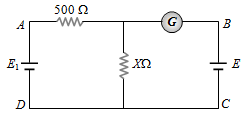
View full question & answer→MCQ 3131 Mark
Thirteen resistances each of resistance R ohm are connected in the circuit as shown in the figure below. The effective resistance between A and B is
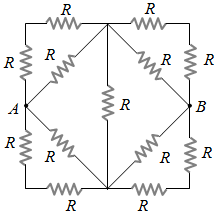
AnswerCorrect option: C. $\frac{2 \mathrm{R}}{3} \Omega$
(c) $\frac{2 \mathrm{R}}{3} \Omega$
View full question & answer→MCQ 3141 Mark
The equivalent resistance of the following diagram A and B is
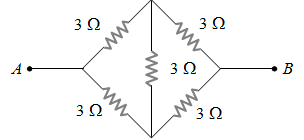
- A
$\frac{2}{3} \Omega$
- B
9 $\Omega$
- C
6 $\Omega$
- ✓
View full question & answer→MCQ 3151 Mark
The equivalent resistance between P and Q in the given figure, is
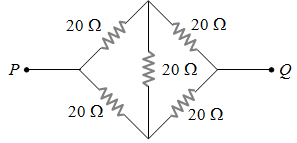
MCQ 3161 Mark
Calculate the equivalent resistance between A and B
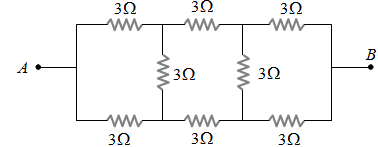
- ✓
$\frac{9}{2}$ W
- B
- C
- D
$\frac{5}{3}$ W
AnswerCorrect option: A. $\frac{9}{2}$ W
(a) $\frac{9}{2}$ W
View full question & answer→MCQ 3171 Mark
In the circuit shown in figure, the current drawn from the battery is 4A. If 10 W resistor is replaced by 20 W resistor, then current drawn from the circuit will be
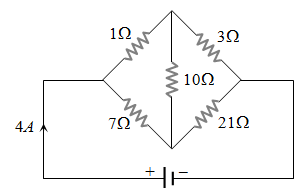
MCQ 3181 Mark
In a typical Wheatstone network, the resistances in cyclic order are A = 10 W, B = 5 W, C = 4 W and D = 4 W for the bridge to be balanced
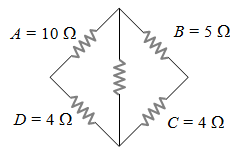
- ✓
10 W should be connected in parallel with A
- B
10 W should be connected in series with A
- C
5 W should be connected in series with B
- D
5 W should be connected in parallel with B
AnswerCorrect option: A. 10 W should be connected in parallel with A
(a) 10 W should be connected in parallel with A
View full question & answer→MCQ 3191 Mark
In the given figure, equivalent resistance between A and B will be
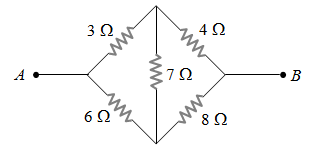
- ✓
$\frac{14}{3} \Omega$
- B
$\frac{3}{14} \Omega$
- C
$\frac{9}{14} \Omega$
- D
$\frac{14}{9} \Omega$
AnswerCorrect option: A. $\frac{14}{3} \Omega$
(a) $\frac{14}{3} \Omega$
View full question & answer→MCQ 3201 Mark
In the circuit shown below the resistance of the galvanometer is 20 W. In which case of the following alternatives are the currents arranged strictly in the decreasing order
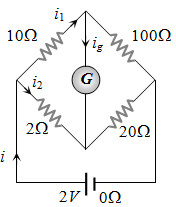
- A
$i, i_1, i_2, i_g$
- ✓
$i, i_2, i_1, i_g$
- C
$i, i_2, i_g, i_1$
- D
$i, i_1, i_g, i_2$
AnswerCorrect option: B. $i, i_2, i_1, i_g$
(b) $i, i_2, i_1, i_g$
View full question & answer→MCQ 3211 Mark
The figure below shows currents in a part of electric circuit. The current i is
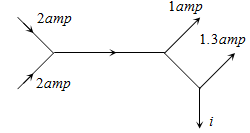
MCQ 3221 Mark
In the given circuit, the voltmeter records 5 volts. The resistance of the voltmeter in ohms is
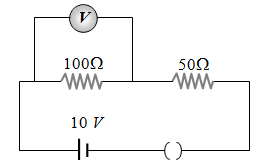
MCQ 3231 Mark
In the Wheatstone's bridge shown, P = 2 Ω, Q = 3Ω, R = 6Ω and S = 8Ω. In order to obtain balance, shunt resistance across 'S' must be
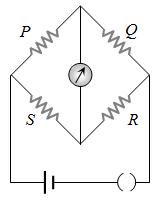
MCQ 3241 Mark
In the given figure, when galvanometer shows no deflection, the current (in ampere) flowing through 5Ω resistance will be
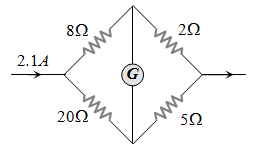
MCQ 3251 Mark
Five resistances are connected as shown in the figure. The effective resistance between the points A and B is
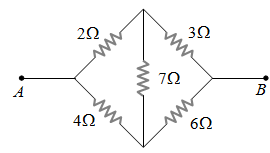
- ✓
$\frac{10}{3}\Omega$
- B
$\frac{20}{3}\Omega$
- C
- D
AnswerCorrect option: A. $\frac{10}{3}\Omega$
(a) $\frac{10}{3}\Omega$
View full question & answer→MCQ 3261 Mark
In the network shown in the figure, each of the resistance is equal to 2Ω. The resistance between the points A and B is
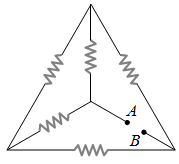
MCQ 3271 Mark
In the figure given the value of X resistance will be, when the p.d. between B and D is zero
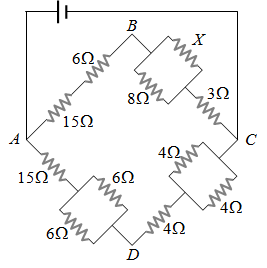
MCQ 3281 Mark
The equivalent resistance and potential difference between A and B for the circuit is respectively
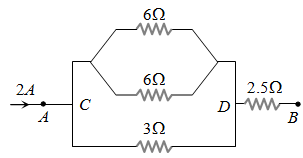
- ✓
4 $\Omega$, 8 V
- B
8 $\Omega$, 4 V
- C
2 $\Omega$, 2 V
- D
16 $\Omega$, 8 V
AnswerCorrect option: A. 4 $\Omega$, 8 V
(a) 4 $\Omega$, 8 V
View full question & answer→MCQ 3291 Mark
In the circuit shown in the adjoining figure, the current between B and D is zero, the unknown resistance is of
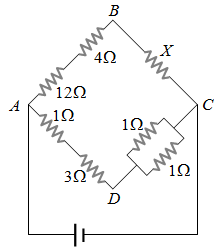
- A
- ✓
- C
- D
em.f. of a cell is required to find the value of X
View full question & answer→MCQ 3301 Mark
A series combination of two resistors 1 W each is connected to a 12 V battery of internal resistance 0.4 W. The current flowing through it will be
MCQ 3311 Mark
In the given figure, the equivalent resistance between the points A and B is
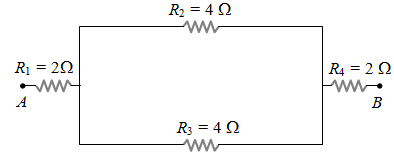
- A
8 $\Omega$
- ✓
6 $\Omega$
- C
4 $\Omega$
- D
2 $\Omega$
AnswerCorrect option: B. 6 $\Omega$
(b) 6 $\Omega$
View full question & answer→MCQ 3321 Mark
The equivalent resistance of the circuit shown in the figure is
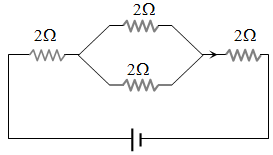
- A
8 $\Omega$
- B
6 $\Omega$
- ✓
5 $\Omega$
- D
4 $\Omega$
AnswerCorrect option: C. 5 $\Omega$
(c) 5 $\Omega$
View full question & answer→MCQ 3331 Mark
The potential difference between point A & B is
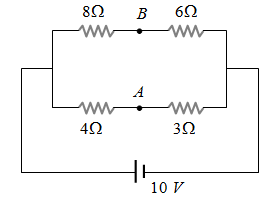
- A
$\frac{20}{7}V$
- B
$\frac{40}{7}V$
- C
$\frac{10}{7}V$
- ✓
View full question & answer→MCQ 3341 Mark
The total current supplied to the circuit by the battery is
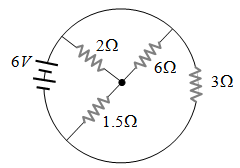
MCQ 3351 Mark
Find the equivalent resistance between the points a and b
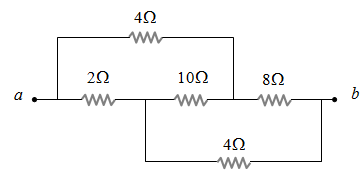
MCQ 3361 Mark
10 wires (same length, same area, same material) are connected in parallel and each has 1 Ω resistance, then the equivalent resistance will be
MCQ 3371 Mark
Three unequal resistors in parallel are equivalent to a resistance 1 ohm. If two of them are in the ratio 1 : 2 and if no resistance value is fractional, the largest of the three resistances in ohms is
MCQ 3381 Mark
The equivalent resistance between the points P and Q of the circuit given is
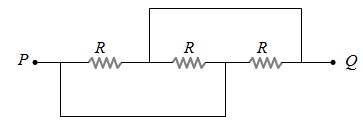
- A
$\frac{R}{4}$
- ✓
$\frac{R}{3}$
- C
- D
AnswerCorrect option: B. $\frac{R}{3}$
(b) $\frac{R}{3}$
View full question & answer→MCQ 3391 Mark
For what value of unknown resistance X, the potential difference between B and D will be zero in the circuit shown in the figure
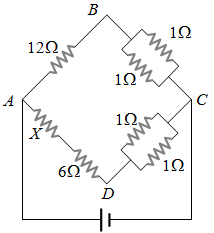
- A
4 $\Omega$
- ✓
6 $\Omega$
- C
2 $\Omega$
- D
5 $\Omega$
AnswerCorrect option: B. 6 $\Omega$
(b) 6 $\Omega$
View full question & answer→MCQ 3401 Mark
Find the equivalent resistance across AB
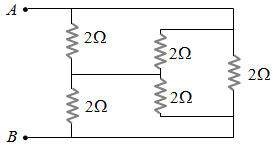
- ✓
1 $\Omega$
- B
2 $\Omega$
- C
3 $\Omega$
- D
4 $\Omega$
AnswerCorrect option: A. 1 $\Omega$
(a) 1 $\Omega$
View full question & answer→MCQ 3411 Mark
Three resistors are connected to form the sides of a triangle ABC, the resistance of the sides AB, BC and CA are 40 ohms, 60 ohms and 100 ohms respectively. The effective resistance between the points A and B in ohms will be
MCQ 3421 Mark
In the circuit, the potential difference across PQ will be nearest to
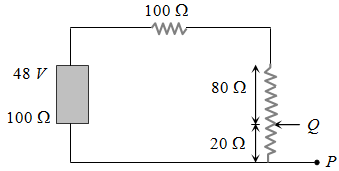
MCQ 3431 Mark
If each of the resistance of the network shown in the figure is R, the equivalent resistance between A and B is
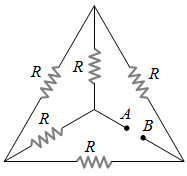
MCQ 3441 Mark
Two resistance wires on joining in parallel the resultant resistance is $\frac{6}{5}$ohm. One of the wire breaks, the effective resistance is 2 ohms. The resistance of the broken wire is
- A
$\frac{3}{5}$ohm
- B
- C
$\frac{6}{5}$ohm
- ✓
View full question & answer→MCQ 3451 Mark
The effective resistance of two resistors in parallel is $\frac{12}{7} \Omega$. If one of the resistors is disconnected the resistance becomes 4 $\Omega$. The resistance of the other resistor is
- A
4 $\Omega$
- ✓
3 $\Omega$
- C
$\frac{12}{7} \Omega$
- D
$\frac{7}{12} \Omega$
AnswerCorrect option: B. 3 $\Omega$
(b) 3 $\Omega$
View full question & answer→MCQ 3461 Mark
Effective resistance between A and B is
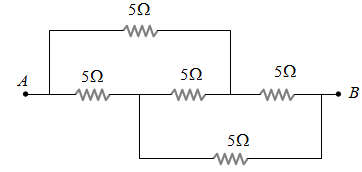
- A
15 $\Omega$
- ✓
5 $\Omega$
- C
$\frac{5}{2} \Omega$
- D
20 $\Omega$
AnswerCorrect option: B. 5 $\Omega$
(b) 5 $\Omega$
View full question & answer→MCQ 3471 Mark
A uniform wire of resistance 9 W is cut into 3 equal parts. They are connected in the form of equilateral triangle ABC. A cell of e.m.f. 2 V and negligible internal resistance is connected across B and C. Potential difference across AB is
MCQ 3481 Mark
In the circuit shown here, what is the value of the unknown resistor R so that the total resistance of the circuit between points P and Q is also equal to R
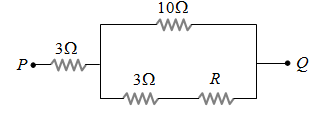
- A
- B
$\sqrt{39}$ ohms
- ✓
$\sqrt{69}$ ohms
- D
AnswerCorrect option: C. $\sqrt{69}$ ohms
(c) $\sqrt{69}$ ohms
View full question & answer→MCQ 3491 Mark
The current between B and D in the given figure is
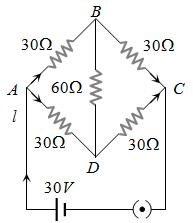
MCQ 3501 Mark
Potential difference between the points P and Q in the electric circuit shown is
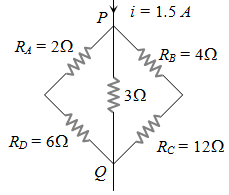
MCQ 3511 Mark
Two wires of the same material and equal length are joined in parallel combination. If one of them has half the thickness of the other and the thinner wire has a resistance of 8 ohms, the resistance of the combination is equal to
- A
$\frac{5}{8}$ohm
- ✓
$\frac{8}{5}$ohm
- C
$\frac{3}{8}$ohm
- D
$\frac{8}{3}$ohm
AnswerCorrect option: B. $\frac{8}{5}$ohm
(b) $\frac{8}{5}$ohm
View full question & answer→MCQ 3521 Mark
Five equal resistances each of value R are connected in a form shown alongside. The equivalent resistance of the network
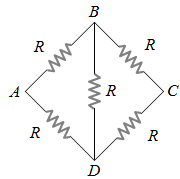
MCQ 3531 Mark
Equivalent resistance between the points A and B is (in W)
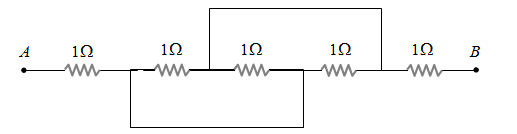
- A
$\frac{1}{5}$
- B
$1\frac{1}{4}$
- ✓
$2\frac{1}{3}$
- D
$ 3\frac{1}{2}$
AnswerCorrect option: C. $2\frac{1}{3}$
(c) $2\frac{1}{3}$
View full question & answer→MCQ 3541 Mark
Four resistances of 100 W each are connected in the form of square. Then, the effective resistance along the diagonal points is
MCQ 3551 Mark
Two wires of equal diameters, of resistivities $\rho_1$ and $\rho_2$ and lengths $l_1$ and $l_2$, respectively, are joined in series. The equivalent resistivity of the combination is
- ✓
$\frac{\rho_1 l_1+\rho_2 1_2}{l_1+1_2}$
- B
$\frac{\rho_1 l_1+\rho_2 1_2}{1_1-1_2}$
- C
$\frac{\rho_1 l_2+\rho_2 l_1}{l_1+l_2}$
- D
$\frac{\rho_1 l_1-\rho_2 l_2}{l_1-l_2}$
AnswerCorrect option: A. $\frac{\rho_1 l_1+\rho_2 1_2}{l_1+1_2}$
(a) $\frac{\rho_1 l_1+\rho_2 1_2}{l_1+1_2}$
View full question & answer→MCQ 3561 Mark
In the arrangement of resistances shown below, the effective resistance between points A and B is
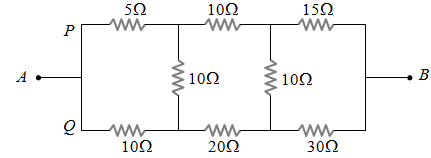
MCQ 3571 Mark
Four resistances 10 W, 5 W, 7 W and 3 W are connected so that they form the sides of a rectangle AB, BC, CD and DA respectively. Another resistance of 10 W is connected across the diagonal AC. The equivalent resistance between A and B is
MCQ 3581 Mark
Five resistors of given values are connected together as shown in the figure. The current in the arm BD will be
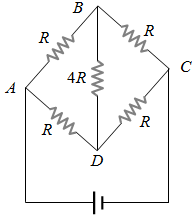
- A
Half the current in the arm ABC
- ✓
- C
Twice the current in the arm ABC
- D
Four times the current in the arm ABC
View full question & answer→MCQ 3591 Mark
The effective resistance between points A and B is
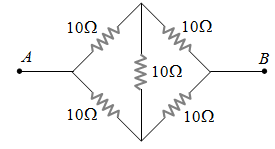
- ✓
- B
- C
- D
None of the above three values
View full question & answer→MCQ 3601 Mark
If each resistance in the figure is of 9 W then reading of ammeter is
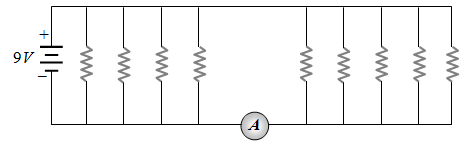
MCQ 3611 Mark
Five resistors are connected as shown in the diagram. The equivalent resistance between A and B is
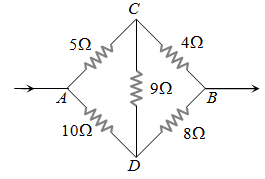
MCQ 3621 Mark
In the circuit shown in the figure, the current flowing in 2 Ω resistance
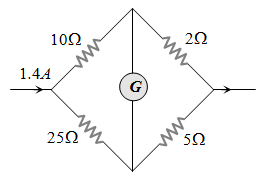
MCQ 3631 Mark
The potential drop across the 3W resistor is
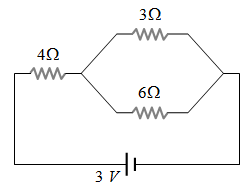
MCQ 3641 Mark
A battery of emf 10 V and internal resistance 3Ω is connected to a resistor as shown in the figure. If the current in the circuit is 0.5 A. then the resistance of the resistor will be
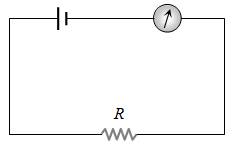
MCQ 3651 Mark
A wire has a resistance of 12 ohm. It is bent in the form of equilateral triangle. The effective resistance between any two corners of the triangle is
MCQ 3661 Mark
If all the resistors shown have the value 2 ohm each, the equivalent resistance over AB is
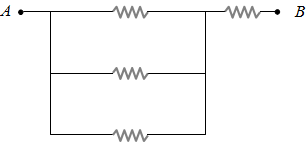
AnswerCorrect option: D. $2 \frac{2}{3} \mathrm{ohm}$
(d) $2 \frac{2}{3} \mathrm{ohm}$
View full question & answer→MCQ 3671 Mark
Three equal resistances each of value R are joined as shown in the figure. The equivalent resistance between M and N is
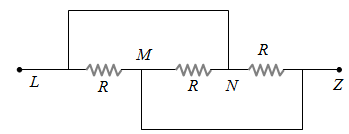
- A
- B
- C
$\frac {R}{2}$
- ✓
$\frac {R}{3}$
AnswerCorrect option: D. $\frac {R}{3}$
(d) $\frac {R}{3}$
View full question & answer→MCQ 3681 Mark
In the figure given below, the current passing through 6 Ω resistor is
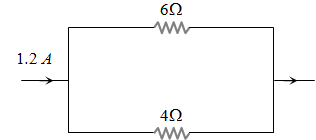
MCQ 3691 Mark
A 3volt battery with negligible internal resistance is connected in a circuit as shown in the figure. The current I, in the circuit will be
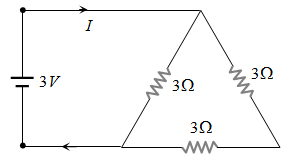
MCQ 3701 Mark
The equivalent resistance of the following infinite network of resistances is
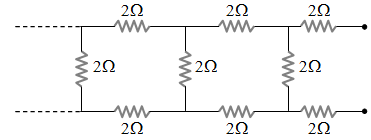
- A
- B
- ✓
More than 4 Ω but less than 12 Ω
- D
AnswerCorrect option: C. More than 4 Ω but less than 12 Ω
(c) More than 4 Ω but less than 12 Ω
View full question & answer→MCQ 3711 Mark
What is the equivalent resistance of the circuit
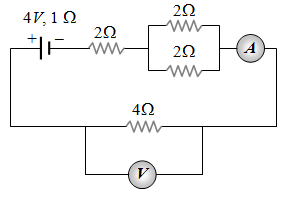
MCQ 3721 Mark
The equivalent resistance between x and y in the circuit shown is
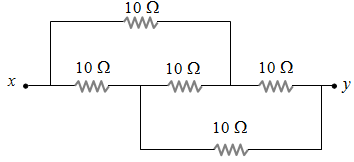
- ✓
10 $\Omega$
- B
40 $\Omega$
- C
20 $\Omega$
- D
$\frac{5}{2} \Omega$
AnswerCorrect option: A. 10 $\Omega$
(a) 10 $\Omega$
View full question & answer→MCQ 3731 Mark
The current in the following circuit is
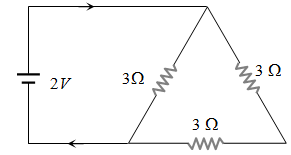
- A
$\frac{1}{8} \mathrm{~A}$
- B
$\frac{2}{9} \mathrm{~A}$
- C
$\frac{2}{3} \mathrm{~A}$
- ✓
View full question & answer→MCQ 3741 Mark
What is the equivalent resistance between A and B
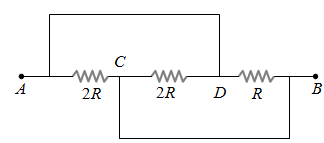
- A
$\frac{2}{3} R$
- B
$\frac{3}{2} R$
- ✓
$\frac{R}{2}$
- D
AnswerCorrect option: C. $\frac{R}{2}$
(c) $\frac{R}{2}$
View full question & answer→MCQ 3751 Mark
What is the equivalent resistance between A and B in the figure below if R = 3Ω
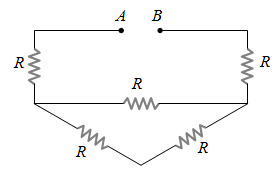
MCQ 3761 Mark
What will be the equivalent resistance between the two points A and D
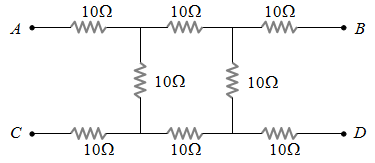
MCQ 3771 Mark
Three resistances 4Ω each of are connected in the form of an equilateral triangle. The effective resistance between two corners is
- A
- B
- C
$\frac{3}{8}\Omega$
- ✓
$\frac{8}{3}\Omega$
AnswerCorrect option: D. $\frac{8}{3}\Omega$
(d) $\frac{8}{3}\Omega$
View full question & answer→MCQ 3781 Mark
In the figure, current through the 3 Ω resistor is 0.8 ampere, then potential drop through 4 Ω resistor is
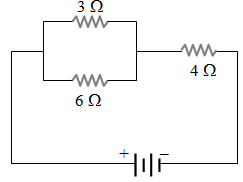
MCQ 3791 Mark
For what value of R the net resistance of the circuit will be 18 ohms
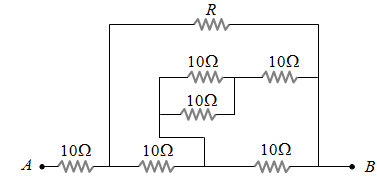
MCQ 3801 Mark
A uniform wire of 16 Ω is made into the form of a square. Two opposite corners of the square are connected by a wire of resistance 16 Ω. The effective resistance between the other two opposite corners is
MCQ 3811 Mark
n equal resistors are first connected in series and then connected in parallel. What is the ratio of the maximum to the minimum resistance
- A
- B
$\frac{1}{n^2}$
- ✓
$n^2$
- D
$\frac{1}{n}$
View full question & answer→MCQ 3821 Mark
What is the current (i) in the circuit as shown in figure
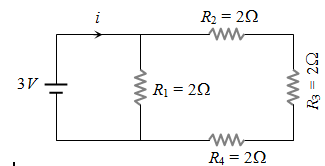
MCQ 3831 Mark
The current in the given circuit is
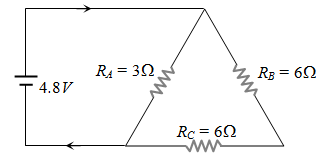
MCQ 3841 Mark
The resistance between the terminal points A and B of the given infinitely long circuit will be
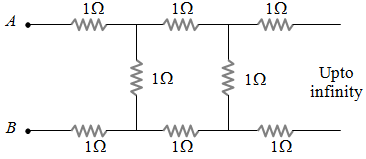
- A
$(\sqrt{3}-1)$
- B
$(1 - \sqrt{3})$
- ✓
$(1 + \sqrt{3})$
- D
$(2 + \sqrt{3})$
AnswerCorrect option: C. $(1 + \sqrt{3})$
(c) $(1 + \sqrt{3})$
View full question & answer→MCQ 3851 Mark
In the circuit shown below, the cell has an e.m.f. of 10 V and internal resistance of 1 ohm. The other resistances are shown in the figure. The potential difference $V_A-V_B$ is
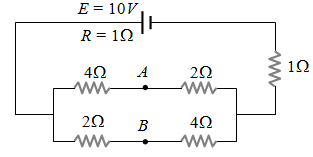
View full question & answer→MCQ 3861 Mark
Three resistors each of 4Ω are connected together to form a network. The equivalent resistance of the network cannot be
MCQ 3871 Mark
In the given figure, potential difference between A and B is
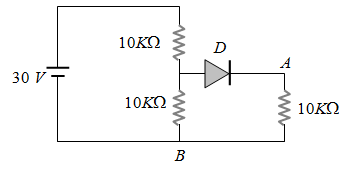
MCQ 3881 Mark
In the circuit shown, the point ‘B’ is earthed. The potential at the point ‘A’ is
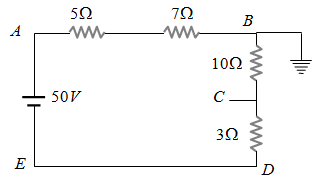
MCQ 3891 Mark
A wire has resistance 12 Ω. It is bent in the form of a circle. The effective resistance between the two points on any diameter is equal to
MCQ 3901 Mark
A copper wire of resistance R is cut into ten parts of equal length. Two pieces each are joined in series and then five such combinations are joined in parallel. The new combination will have a resistance
- A
- B
$\frac{R}{4}$
- C
$\frac{R}{5}$
- ✓
$\frac{R}{25}$
AnswerCorrect option: D. $\frac{R}{25}$
(d) $\frac{R}{25}$
View full question & answer→MCQ 3911 Mark
An infinite ladder network is arranged with resistances R and 2 R as shown. The effective resistance between terminals A and B is
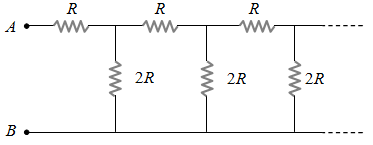
MCQ 3921 Mark
The equivalent resistance between points A and B of an infinite network of resistances each of 1Ω connected as shown, is
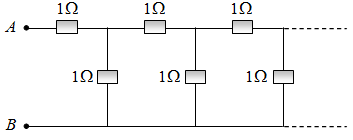
AnswerCorrect option: C. $\frac{1+\sqrt{5}}{2} \Omega$
(c) $\frac{1+\sqrt{5}}{2} \Omega$
View full question & answer→MCQ 3931 Mark
The equivalent resistance of resistors connected in series is always
- A
Equal to the mean of component resistors
- B
Less than the lowest of component resistors
- C
In between the lowest and the highest of component resistors
- ✓
Equal to sum of component resistors
AnswerCorrect option: D. Equal to sum of component resistors
(d) Equal to sum of component resistors
View full question & answer→MCQ 3941 Mark
Lamps used for household lighting are connected in
MCQ 3951 Mark
A student has 10 resistors of resistance ‘r’. The minimum resistance made by him from given resistors is
- A
- ✓
$\frac{r}{10}$
- C
$\frac{r}{100}$
- D
$\frac{r}{5}$
AnswerCorrect option: B. $\frac{r}{10}$
(b) $\frac{r}{10}$
View full question & answer→MCQ 3961 Mark
Three resistances, each of 1 ohm, are joined in parallel. Three such combinations are put in series, then the resultant resistance will be
MCQ 3971 Mark
A battery of e.m.f. 10 V is connected to resistance as shown in figure. The potential difference $V_A-V_B$ between the points A and B is
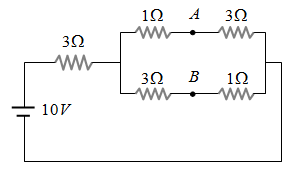
View full question & answer→MCQ 3981 Mark
Four wires AB, BC, CD, DA of resistance 4 ohm each and a fifth wire BD of resistance 8 ohm are joined to form a rectangle ABCD of which BD is a diagonal. The effective resistance between the points A and B is
- A
- B
- C
$\frac{4}{3}$ohm
- ✓
$\frac{8}{3}$ohm
AnswerCorrect option: D. $\frac{8}{3}$ohm
(d) $\frac{8}{3}$ohm
View full question & answer→MCQ 3991 Mark
If a resistance $R_2$ is connected in parallel with the resistance R in the circuit shown, then possible value of current through R and the possible value of $R_2$ will be
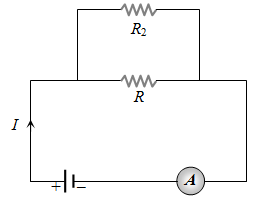
- A
$\frac{I}{3}, \mathrm{R}$
- B
- C
$\frac{I}{3}, \mathrm{2R}$
- ✓
$\frac{I}{2}, \mathrm{R}$
AnswerCorrect option: D. $\frac{I}{2}, \mathrm{R}$
(d) $\frac{I}{2}, \mathrm{R}$
View full question & answer→MCQ 4001 Mark
In the given circuit, the potential of the point E is
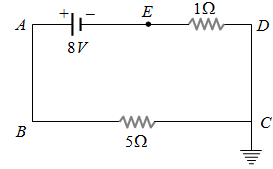
MCQ 4011 Mark
In the given figure, when key K is opened, the reading of the ammeter A will be
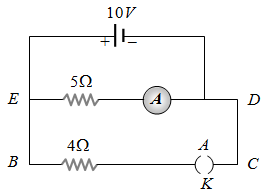
MCQ 4021 Mark
The current from the battery in circuit diagram shown is
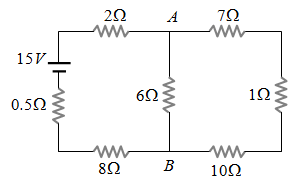
MCQ 4031 Mark
In the figure shown, the total resistance between A and B is
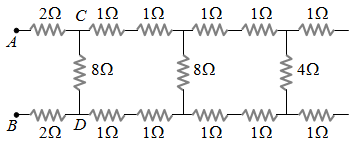
MCQ 4041 Mark
In the figure, the value of resistors to be connected between C and D so that the resistance of the entire circuit between A and B does not change with the number of elementary sets used is
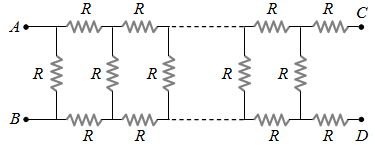
- A
$R$
- ✓
$R(\sqrt{3}-1)$
- C
$3\ R$
- D
$R(\sqrt{3}+1)$
AnswerCorrect option: B. $R(\sqrt{3}-1)$
(b) $R(\sqrt{3}-1)$
View full question & answer→MCQ 4051 Mark
An infinite sequence of resistance is shown in the figure. The resultant resistance between A and B will be, when $R_1=1$ ohm and $R_2=2$ ohm
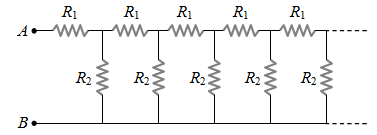
View full question & answer→MCQ 4061 Mark
Four resistances are connected in a circuit in the given figure. The electric current flowing through 4 ohm and 6 ohm resistance is respectively
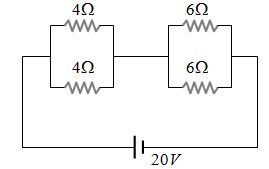
MCQ 4071 Mark
A wire is broken in four equal parts. A packet is formed by keeping the four wires together. The resistance of the packet in comparison to the resistance of the wire will be
AnswerCorrect option: D. $\frac{1}{16}$ th
(d) $\frac{1}{16}$ th
View full question & answer→MCQ 4081 Mark
In the network of resistors shown in the adjoining figure, the equivalent resistance between A and B is
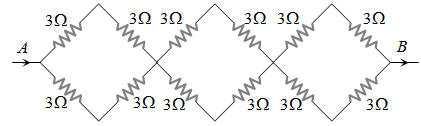
MCQ 4091 Mark
The equivalent resistance of the arrangement of resistances shown in adjoining figure between the points A and B is
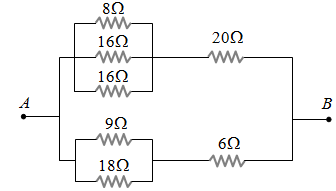
MCQ 4101 Mark
Resistances of 6 ohm each are connected in the manner shown in adjoining figure. With the current 0.5 ampere as shown in figure, the potential difference $V_P - V_Q$ is
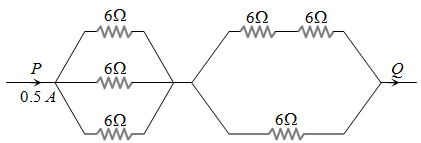
View full question & answer→MCQ 4111 Mark
Resistors of 1, 2, 3 ohm are connected in the form of a triangle. If a 1.5 volt cell of negligible internal resistance is connected across 3 ohm resistor, the current flowing through this resistance will be
MCQ 4121 Mark
Two resistors are connected (a) in series (b) in parallel. The equivalent resistance in the two cases are 9 ohm and 2 ohm respectively. Then the resistances of the component resistors are
MCQ 4131 Mark
Four wires of equal length and of resistances 10 ohms each are connected in the form of a square. The equivalent resistance between two opposite corners of the square is
MCQ 4141 Mark
A cell of negligible resistance and e.m.f. 2 volts is connected to series combination of 2, 3 and 5 ohm. The potential difference in volts between the terminals of 3 ohm resistance will be
MCQ 4151 Mark
A wire of diameter $0.02$ metre contains $10^{28}$ free electrons per cubic metre. For an electrical current of $100 \ A$ , the drift velocity of the free electrons in the wire is nearly
- A
$1 \times 10^{-19} \mathrm{~m} / \mathrm{s}$
- B
$5 \times 10^{-10} \mathrm{~m} / \mathrm{s}$
- ✓
$2 \times 10^{-4} \mathrm{~m} / \mathrm{s}$
- D
$8 \times 10^3 \mathrm{~m} / \mathrm{s}$
AnswerCorrect option: C. $2 \times 10^{-4} \mathrm{~m} / \mathrm{s}$
$2 \times 10^{-4} \mathrm{~m} / \mathrm{s}$
View full question & answer→MCQ 4161 Mark
Given three equal resistors, how many different combination of all the three resistors can be made
MCQ 4171 Mark
Two resistances are joined in parallel whose resultant is $\frac {6}{8}$ ohm. One of the resistance wire is broken and the effective resistance becomes 2Ω. Then the resistance in ohm of the wire that got broken was
View full question & answer→MCQ 4181 Mark
Referring to the figure below, the effective resistance of the network is
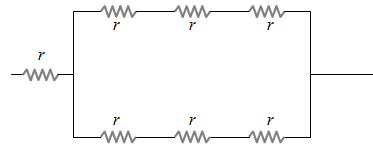
MCQ 4191 Mark
A current of 2 A flows in a system of conductors as shown. The potential difference $(V_A - V_B)$ will be
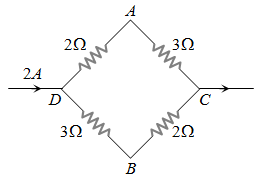
View full question & answer→MCQ 4201 Mark
Three resistances of magnitude 2, 3 and 5 ohm are connected in parallel to a battery of 10 volts and of negligible resistance. The potential difference across 3 Ω resistance will be
MCQ 4211 Mark
The effective resistance between the points A and B in the figure is
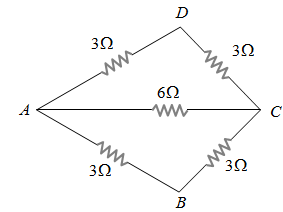
MCQ 4221 Mark
A wire has a resistance of 12 ohm. It is bent in the form of equilateral triangle. The effective resistance between any two corners of the triangle is
MCQ 4231 Mark
Equivalent resistance between A and B will be
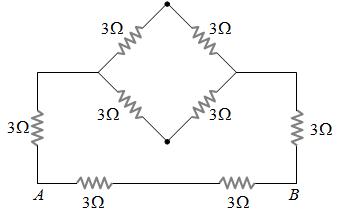
MCQ 4241 Mark
There are n similar conductors each of resistance R. The resultant resistance comes out to be x when connected in parallel. If they are connected in series, the resistance comes out to be
AnswerCorrect option: B. $n^2x$
(b) $n^2x$
View full question & answer→MCQ 4251 Mark
Three resistors each of 2 ohm are connected together in a triangular shape. The resistance between any two vertices will be
MCQ 4261 Mark
The reading of the ammeter as per figure shown is
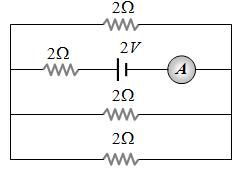
- A
$\frac{1}{8}A$
- ✓
$\frac{3}{4}A$
- C
$\frac{1}{2}A$
- D
AnswerCorrect option: B. $\frac{3}{4}A$
(b) $\frac{3}{4}A$
View full question & answer→MCQ 4271 Mark
The lowest resistance which can be obtained by connecting 10 resistors each of 1/10 ohm is
MCQ 4281 Mark
Three resistances of one ohm each are connected in parallel. Such connection is again connected with 2/3 Ω resistor in series. The resultant resistance will be
- A
$\frac{5}{3} \Omega$
- B
$\frac{3}{2} \Omega$
- ✓
- D
$\frac{2}{3} \Omega$
View full question & answer→MCQ 4291 Mark
The potential difference between points A and B of adjoining figure is
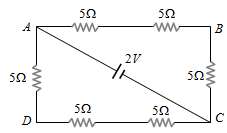
- A
$\frac{2}{3} \mathrm{~V}$
- B
$\frac{8}{9} \mathrm{~V}$
- ✓
$\frac{4}{3} \mathrm{~V}$
- D
$2 \mathrm{~V}$
AnswerCorrect option: C. $\frac{4}{3} \mathrm{~V}$
(c) $\frac{4}{3} \mathrm{~V}$
View full question & answer→MCQ 4301 Mark
Two resistors of resistance $R_1$ and $R_2$ having $R_1 > R_2$ are connected in parallel. For equivalent resistance R, the correct statement is
- A
$R>R_1+R_2$
- B
$R1<R<R_2$
- C
$R_2<R<(R_1+R_2)$
- ✓
$R<R_1$
AnswerCorrect option: D. $R<R_1$
(d) $R<R_1$
View full question & answer→MCQ 4311 Mark
A wire of resistance R is divided in 10 equal parts. These parts are connected in parallel, the equivalent resistance of such connection will be
MCQ 4321 Mark
The current in the adjoining circuit will be
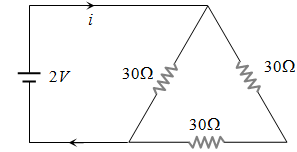
- A
$\frac{1}{45}$ ampere
- B
$\frac{1}{15}$ ampere
- ✓
$\frac{1}{10}$ ampere
- D
$\frac{1}{5}$ ampere
AnswerCorrect option: C. $\frac{1}{10}$ ampere
(c) $\frac{1}{10}$ ampere
View full question & answer→MCQ 4331 Mark
There are 8 equal resistances R. Two are connected in parallel, such four groups are connected in series, the total resistance of the system will be
MCQ 4341 Mark
The electric field E, current density J and conductivity s of a conductor are related as
MCQ 4351 Mark
A thick wire is stretched so that its length become two times. Assuming that there is no change in its density, then what is the ratio of change in resistance of wire to the initial resistance of wire
MCQ 4361 Mark
The colour sequence in a carbon resistor is red, brown, orange and silver. The resistance of the resistor is
- ✓
$ 21 \times 10^3 \pm 10 \% $
- B
$ 23 \times 10^1 \pm 10 \%$
- C
$ 21 \times 10^3 \pm 5 \% $
- D
$ 12 \times 10^3 \pm 5 \%$
AnswerCorrect option: A. $ 21 \times 10^3 \pm 10 \% $
$ 21 \times 10^3 \pm 10 \% $
View full question & answer→MCQ 4371 Mark
The following four wires are made of the same material and are at the same temperature. Which one of them has highest electrical resistance
- ✓
Length = 50 cm, diameter = 0.5 mm
- B
Length = 100 cm, diameter = 1 mm
- C
Length = 200 cm, diameter = 2 mm
- D
Length = 300 cm, diameter = 3 mm
AnswerCorrect option: A. Length = 50 cm, diameter = 0.5 mm
(a) Length = 50 cm, diameter = 0.5 mm
View full question & answer→MCQ 4381 Mark
A wire of radius r has resistance R. If it is stretched to a radius of $\frac{3r}{4}$ , its resistance becomes
- A
$\frac{9R}{16}$
- B
$\frac{16R}{9}$
- C
$\frac{81R}{256}$
- ✓
$\frac{256R}{81}$
AnswerCorrect option: D. $\frac{256R}{81}$
(d) $\frac{256R}{81}$
View full question & answer→MCQ 4391 Mark
The drift velocity of free electrons in a conductor is ‘v’ when a current ‘i’ is flowing in it. If both the radius and current are doubled, then drift velocity will be
- A
- ✓
$\frac{v}{2}$
- C
$\frac{v}{4}$
- D
$\frac{v}{8}$
AnswerCorrect option: B. $\frac{v}{2}$
(b) $\frac{v}{2}$
View full question & answer→MCQ 4401 Mark
A current of 1 mA is flowing through a copper wire. How many electrons will pass a given point in one second $ [e = 1.6 × 10^{-19}$ Coulomb$]$
- A
$6.25 × 10^{19}$
- ✓
$ 6.25 × 10^{15}$
- C
$ 6.25 × 10^{31}$
- D
$6.25 × 10^{8}$
AnswerCorrect option: B. $ 6.25 × 10^{15}$
(b)$ 6.25 × 10^{15}$
View full question & answer→MCQ 4411 Mark
Masses of 3 wires of same metal are in the ratio 1 : 2 : 3 and their lengths are in the ratio 3 : 2 : 1. The electrical resistances are in ratio
MCQ 4421 Mark
Which of the following is vector quantity
MCQ 4431 Mark
In the figure a carbon resistor has bands of different colours on its body as mentioned in the figure. The value of the resistance is
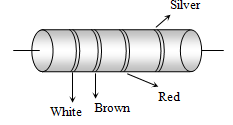
MCQ 4441 Mark
The electric resistance of a certain wire of iron is R. If its length and radius are both doubled, then
- A
The resistance will be doubled and the specific resistance will be halved
- ✓
The resistance will be halved and the specific resistance will remain unchanged
- C
The resistance will be halved and the specific resistance will be doubled
- D
The resistance and the specific resistance, will both remain unchanged
AnswerCorrect option: B. The resistance will be halved and the specific resistance will remain unchanged
(b) The resistance will be halved and the specific resistance will remain unchanged
View full question & answer→MCQ 4451 Mark
When a potential difference is applied across the ends of a linear metallic conductor
- A
The free electrons are accelerated continuously from the lower potential end to the higher potential end of the conductor
- B
The free electrons are accelerated continuously from the higher potential end to the lower potential end of the conductor
- ✓
The free electrons acquire a constant drift velocity from the lower potential end to the higher potential end of the conductor
- D
The free electrons are set in motion from their position of rest
AnswerCorrect option: C. The free electrons acquire a constant drift velocity from the lower potential end to the higher potential end of the conductor
(c) The free electrons acquire a constant drift velocity from the lower potential end to the higher potential end of the conductor
View full question & answer→MCQ 4461 Mark
The alloys constantan and manganin are used to make standard resistance due to they have
- A
- B
- C
Low temperature coefficient of resistance
- ✓
View full question & answer→MCQ 4471 Mark
The lead wires should have
- ✓
Larger diameter and low resistance
- B
Smaller diameter and high resistance
- C
Smaller diameter and low resistance
- D
Larger diameter and high resistance
AnswerCorrect option: A. Larger diameter and low resistance
(a) Larger diameter and low resistance
View full question & answer→MCQ 4481 Mark
What is the resistance of a carbon resistance which has bands of colours brown, black and brown
MCQ 4491 Mark
The new resistance of wire of R W, whose radius is reduced half, is
MCQ 4501 Mark
A source of e.m.f. E = 15 V and having negligible internal resistance is connected to a variable resistance so that the current in the circuit increases with time as i = 1.2 t + 3. Then, the total charge that will flow in first five second will be
MCQ 4511 Mark
The length of the wire is doubled. Its conductance will be
- A
- ✓
- C
- D
1/4 of the original value
View full question & answer→MCQ 4521 Mark
A steady current i is flowing through a conductor of uniform cross-section. Any segment of the conductor has
- ✓
- B
- C
- D
Charge proportional to current
View full question & answer→MCQ 4531 Mark
In a hydrogen discharge tube it is observed that through a given cross-section $3.13\times 10^{15}$ electrons are moving from right to left and $3.12\times 10^{15}$ protons are moving from left to right. What is the electric current in the discharge tube and what is its direction
View full question & answer→MCQ 4541 Mark
We have two wires A and B of same mass and same material. The diameter of the wire A is half of that B. If the resistance of wire A is 24 ohm then the resistance of wire B will be
MCQ 4551 Mark
Express which of the following setups can be used to verify Ohm’s law
Answer(a)
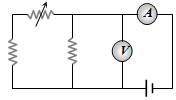
View full question & answer→MCQ 4561 Mark
The length of a given cylindrical wire is increased by 100 %. Due to the consequent decrease in diameter the change in the resistance of the wire will be
MCQ 4571 Mark
A strip of copper and another of germanium are cooled from room temperature to 80 K. The resistance o
- A
- B
- C
Copper strip increases and that of germanium decreases
- ✓
Copper strip decreases and that of germanium increases
AnswerCorrect option: D. Copper strip decreases and that of germanium increases
Copper strip decreases and that of germanium increases
View full question & answer→MCQ 4581 Mark
What length of the wire of specific resistance $48\times 10^{-8}\Omega m$ is needed to make a resistance of $4.2\Omega$ (diameter of wire = 0.4 mm)
View full question & answer→MCQ 4591 Mark
Two wires of same material have length L and 2L and cross–sectional areas 4A and A respectively. The ratio of their specific resistance would be
MCQ 4601 Mark
A copper wire has a square cross-section, 2.0 mm on a side. It carries a current of 8 A and the density of free electrons is $8\times10^{28}m^{-3}$ . The drift speed of electrons is equal to
- ✓
$ 0.156 × 10^{-3}$ m.s$^{-1}$
- B
$ 0.156 × 10^{-2}$ m.s$^{-1}$
- C
$ 3.12 × 10^{-3}$ m.s$^{-1}$
- D
$3.12 × 10^{-2} $m.s$^{-1}$
AnswerCorrect option: A. $ 0.156 × 10^{-3}$ m.s$^{-1}$
(a)$ 0.156 × 10^{-3} $m.s$^{-1}$
View full question & answer→MCQ 4611 Mark
The resistance of a conductor increases with
- A
- B
- C
Decrease in cross–sectional area
- ✓
View full question & answer→MCQ 4621 Mark
A uniform wire of resistance R is uniformly compressed along its length, until its radius becomes n times the original radius. Now resistance of the wire becomes
- ✓
$\frac{R}{n^4}$
- B
$\frac{R}{n^2}$
- C
$\frac{R}{n}$
- D
AnswerCorrect option: A. $\frac{R}{n^4}$
(a) $\frac{R}{n^4}$
View full question & answer→MCQ 4631 Mark
The resistance of an incandescent lamp is
- A
Greater when switched off
- B
- ✓
- D
The same whether it is switched off or switched on
View full question & answer→MCQ 4641 Mark
The resistance of a 5 cm long wire is 10 W. It is uniformly stretched so that its length becomes 20 cm. The resistance of the wire is
MCQ 4651 Mark
At room temperature, copper has free electron density of $ 8.4 \times 10^{28}$ per $m^3$. The copper conductor has a cross-section of $10^{-6}$ m$^2$ and carries a current of 5.4 A. The electron drift velocity in copper is
View full question & answer→MCQ 4661 Mark
There is a current of 40 ampere in a wire of $10^{-6}m^2$ area of cross-section. If the number of free electron per $m^3$ is $10^{29}$, then the drift velocity will be
- A
$1.25 × 10^{3} m/s$
- ✓
$2.50 × 10^{-3} m/s$
- C
$25.0 × 10^{-3} m/s$
- D
$250 × 10^{-3} m/s$
AnswerCorrect option: B. $2.50 × 10^{-3} m/s$
(b) $2.50 × 10^{-3} m/s$
View full question & answer→MCQ 4671 Mark
The drift velocity does not depend upon
- A
Cross-section of the wire
- ✓
- C
- D
View full question & answer→MCQ 4681 Mark
If a wire of resistance R is melted and recasted to half of its length, then the new resistance of the wire will be
MCQ 4691 Mark
Calculate the amount of charge flowing in 2 minutes in a wire of resistance 10 W when a potential difference of 20 V is applied between its ends
MCQ 4701 Mark
If an observer is moving with respect to a stationary electron, then he observes
MCQ 4711 Mark
A nichrome wire 50 cm long and one square millimetre cross-section carries a current of 4A when connected to a 2V battery. The resistivity of nichrome wire in ohm metre is
- ✓
$1 \times10^{-6}$
- B
$4 \times10^{-7}$
- C
$ 3 \times10^{-7}$
- D
$2 \times10^{-7}$
AnswerCorrect option: A. $1 \times10^{-6}$
(a)$1 \times10^{-6}$
View full question & answer→MCQ 4721 Mark
If potential V = 100 ± 0.5 Volt and current I = 10 ± 0.2 amp are given to us. Then what will be the value of resistance
MCQ 4731 Mark
The charge of an electron is $1.6 \times 10^{-19} C$. How many electrons strike the screen of a cathode ray tube each second when the beam current is $16 \ mA$
- ✓
$10^{17} $
- B
$10^{19} $
- C
$ 10^{-19}$
- D
$10^{-17}$
AnswerCorrect option: A. $10^{17} $
$10^{17}$
View full question & answer→MCQ 4741 Mark
An electron revolves $6 × 10^{15}$ times/sec in circular loop. The current in the loop is
- ✓
$ 0.96 \ mA $
- B
$0.96 \ m A $
- C
$28.8 A $
- D
AnswerCorrect option: A. $ 0.96 \ mA $
$0.96 \ mA$
View full question & answer→MCQ 4751 Mark
At what temperature will the resistance of a copper wire become three times its value at $0^{\circ} \mathrm{C} ($Temperature coefficient of resistance for copper $=4 \times 10^{-3}$ per ${ }^{\circ} \mathrm{C} )$
- A
$400^{\circ} \mathrm{C}$
- B
$450^{\circ} \mathrm{C}$
- ✓
$500^{\circ} \mathrm{C}$
- D
$550^{\circ} \mathrm{C}$
AnswerCorrect option: C. $500^{\circ} \mathrm{C}$
$500^{\circ} \mathrm{C}$
View full question & answer→MCQ 4761 Mark
A rod of a certain metal is 1.0 m long and 0.6 cm in diameter. Its resistance is $3.0 × 10^{-3}$ ohm. Another disc made of the same metal is 2.0 cm in diameter and 1.0 mm thick. What is the resistance between the round faces of the disc
- A
$1.35 × 10^{-6}$ ohm
- ✓
$2.70 × 10^{-7}$ ohm
- C
$4.05 × 10^{-6}$ ohm
- D
$8.10 × 10^{-5}$ ohm
AnswerCorrect option: B. $2.70 × 10^{-7}$ ohm
(b) $2.70 × 10^{-7}$ ohm
View full question & answer→MCQ 4771 Mark
An electron $\left(\right.$ charge $=1.6 \times 10^{-19}$ coulomb) is moving in a circle of radius $5.1 \times 10^{-11} \mathrm{~m}$ at a frequency of $6.8 \times 10^{15}$ revolutions/sec. The equivalent current is approximately
- A
$5.1 \times10^{-3}$ amp
- B
$ 6.8 \times10^{-3}$ amp
- ✓
$ 1.1 \times10^{-3}$ amp
- D
$2.2 \times10^{-3}$ amp
AnswerCorrect option: C. $ 1.1 \times10^{-3}$ amp
(c) $ 1.1 \times10^{-3}$ amp
View full question & answer→MCQ 4781 Mark
Equal potentials are applied on an iron and copper wire of same length. In order to have the same current flow in the two wires, the ratio r (iron)/r (copper) of their radii must be (Given that specific resistance of iron = $1.0 \times 10^{-7}$ ohm–m and specific resistance of copper = $1.7 \times 10^{-8}$ ohm-m)
View full question & answer→MCQ 4791 Mark
If an electron revolves in the path of a circle of radius of $0.5 \times 10^{-10} \mathrm{~m}$ at frequency of $5 \times 10^{15} \mathrm{cycles} / \mathrm{s}$ the electric current in the circle is (Charge of an electron $=1.6 \times 10^{-19} \mathrm{C}$ )
View full question & answer→MCQ 4801 Mark
The resistance of a conductor is $5 \ \mathrm{ohm}$ at $50^{\circ} \mathrm{C}$ and $6$ hm at $100^{\circ} \mathrm{C}$. Its resistance at $0^{\circ} \mathrm{C}$ is
- A
$1 \ \mathrm{ohm}$
- B
$2 \ \mathrm{ohm}$
- C
$3 \ \mathrm{ohm}$
- ✓
$4 \ \mathrm{ohm}$
AnswerCorrect option: D. $4 \ \mathrm{ohm}$
$4 \ \mathrm{ohm}$
View full question & answer→MCQ 4811 Mark
For a metallic wire, the ratio V/i (V = the applied potential difference, i = current flowing) is
- A
Independent of temperature
- ✓
Increases as the temperature rises
- C
Decreases as the temperature rises
- D
Increases or decreases as temperature rises, depending upon the metal
AnswerCorrect option: B. Increases as the temperature rises
Increases as the temperature rises
View full question & answer→MCQ 4821 Mark
Masses of three wires of copper are in the ratio of 1 : 3 : 5 and their lengths are in the ratio of 5 : 3 : 1. The ratio of their electrical resistances are
MCQ 4831 Mark
The resistance of a coil is $4.2 \Omega$ at $100{ }^{\circ} \mathrm{C}$ and the temperature coefficient of resistance of its material is $0.004 /{ }^{\circ} \mathrm{C}$. Its resistance at $0^{\circ} \mathrm{C}$ is
- A
$6.5 \Omega$
- B
$5 \Omega$
- ✓
$3 \Omega$
- D
$4 \Omega$
AnswerCorrect option: C. $3 \Omega$
$3 \Omega$
View full question & answer→MCQ 4841 Mark
If an electric current is passed through a nerve of a man, then man
- A
- B
- ✓
- D
Becomes insensitive to pain
View full question & answer→MCQ 4851 Mark
A copper wire of length 1 m and radius 1 mm is joined in series with an iron wire of length 2 m and radius 3 mm and a current is passed through the wires. The ratio of the current density in the copper and iron wires is
MCQ 4861 Mark
A metal wire of specific resistance $64 \times 10^{-6} \mathrm{ohm}-\mathrm{cm}$ and length 198 cm has a resistance of 7 ohm, the radius of the wire will be
View full question & answer→MCQ 4871 Mark
A current I is passing through a wire having two sections P and Q of uniform diameters d and d/2 respectively. If the mean drift velocity of electrons in sections P and Q is denoted by $v_P$ and $v_Q$ respectively, then
AnswerCorrect option: C. $v_P$ = $\frac {1}{4}$ $v_Q$
(c) $v_P$ = $\frac {1}{4}$ $v_Q$
View full question & answer→MCQ 4881 Mark
$1.6 \ mA$ current is flowing in conducting wire then the number of electrons flowing per second is
- A
$10^{11}$
- ✓
$10^{16}$
- C
$10^{19}$
- D
$10^{15}$
AnswerCorrect option: B. $10^{16}$
$10^{16}$
View full question & answer→MCQ 4891 Mark
$\sigma_1$ and $\sigma_1$ are the electrical conductivities of Ge and Na respectively. If these substances are heated, then(a)(b) (c) (d)
- A
Both $\sigma_1$ and $\sigma_2$ increase
- ✓
$\sigma_1$ increases and $\sigma_2$ decreases
- C
$\sigma_1$ decreases and $\sigma_2$ increases
- D
Both $\sigma_1$ and $\sigma_2$ decrease
AnswerCorrect option: B. $\sigma_1$ increases and $\sigma_2$ decreases
(b) $\sigma_1$ increases and $\sigma_2$ decreases
View full question & answer→MCQ 4901 Mark
20 μA current flows for 30 seconds in a wire, transfer of charge will be
- A
$2 \times 10^{-4} \mathrm{C}$
- B
$4 \times 10^{-4} \mathrm{C}$
- ✓
$6 \times 10^{-4} \mathrm{C}$
- D
$8 \times 10^{-4} \mathrm{C}$
AnswerCorrect option: C. $6 \times 10^{-4} \mathrm{C}$
(c) $6 \times 10^{-4} \mathrm{C}$
View full question & answer→MCQ 4911 Mark
Two rods of same material and length have their electric resistance in ratio 1 : 2. When both rods are dipped in water, the correct statement will be
- ✓
A has more loss of weight
- B
B has more loss of weight
- C
Both have same loss of weight
- D
Loss of weight will be in the ratio 1 : 2
AnswerCorrect option: A. A has more loss of weight
A has more loss of weight
View full question & answer→MCQ 4921 Mark
Two wires A and B of same material and same mass have radius 2rand r. If resistance of wire A is 34 Ω, then resistance of B will be
MCQ 4931 Mark
A steady current flows in a metallic conductor of non-uniform cross-section. The quantity/ quantities constant along the length of the conductor is/are
- A
Current, electric field and drift speed
- B
- C
- ✓
View full question & answer→MCQ 4941 Mark
The conductivity of a superconductor is
MCQ 4951 Mark
The resistivity of a wire depends on its
MCQ 4961 Mark
In a wire of circular cross-section with radius r, free electrons travel with a drift velocity V when a current I flows through the wire. What is the current in another wire of half the radius and of the same material when the drift velocity is 2V
MCQ 4971 Mark
We are able to obtain fairly large currents in a conductor because
- A
The electron drift speed is usually very large
- ✓
The number density of free electrons is very high and this can compensate for the low values of the electron drift speed and the very small magnitude of the electron charge
- C
The number density of free electrons as well as the electron drift speeds are very large and these compensate for the very small magnitude of the electron charge
- D
The very small magnitude of the electron charge has to be divided by the still smaller product of the number density and drift speed to get the electric current
AnswerCorrect option: B. The number density of free electrons is very high and this can compensate for the low values of the electron drift speed and the very small magnitude of the electron charge
The number density of free electrons is very high and this can compensate for the low values of the electron drift speed and the very small magnitude of the electron charge
View full question & answer→MCQ 4981 Mark
The resistance of a discharge tube is
Ohmic
MCQ 4991 Mark
If the resistance of a conductor is $5 W$ at $50^{\circ} \mathrm{C}$ and $7 W$ at $100^{\circ} \mathrm{C}$ then the mean temperature coefficient of resistance of the material is
- ✓
$0.008 /{ }^{\circ} \mathrm{C}$
- B
$0.006 /{ }^{\circ} \mathrm{C}$
- C
$0.004 /{ }^{\circ} \mathrm{C}$
- D
$0.001 /{ }^{\circ} \mathrm{C}$
AnswerCorrect option: A. $0.008 /{ }^{\circ} \mathrm{C}$
$0.008 /{ }^{\circ} \mathrm{C}$
View full question & answer→MCQ 5001 Mark
All of the following statements are true except
- A
Conductance is the reciprocal of resistance and is measured in Siemens
- B
Ohm's law is not applicable at very low and very high temperatures
- ✓
Ohm's law is applicable to semiconductors
- D
Ohm's law is not applicable to electron tubes, discharge tubes and electrolytes
AnswerCorrect option: C. Ohm's law is applicable to semiconductors
Ohm's law is applicable to semiconductors
View full question & answer→