MCQ 11 Mark
Assertion : A direct current flows through a metallic rod, produced magnetic field only outside the rod.
Reason : There is no flow of charge carriers inside the rod.
- A
If both assertion and reason are true and the reason is the correct explanation of the assertion.
- B
If both assertion and reason are true but reason is not the correct explanation of the assertion.
- C
If assertion is true but reason is false.
- ✓
If the assertion and reason both are false.
AnswerCorrect option: D. If the assertion and reason both are false.
If the assertion and reason both are false.
View full question & answer→MCQ 21 Mark
Assertion : A current I flows along the length of an infinitely long straight and thin walled pipe. Then the magnetic field at any point inside the pipe is zero.
Reason : $\oint \vec{B} \cdot d \vec{l}=\mu_0 I$
- ✓
If both assertion and reason are true and the reason is the correct explanation of the assertion.
- B
If both assertion and reason are true but reason is not the correct explanation of the assertion.
- C
If assertion is true but reason is false.
- D
If the assertion and reason both are false.
AnswerCorrect option: A. If both assertion and reason are true and the reason is the correct explanation of the assertion.
(a) If both assertion and reason are true and the reason is the correct explanation of the assertion.
View full question & answer→MCQ 31 Mark
Assertion : If two long wires, hanging freely are connected to a battery in series, they come closer to each other.
Reason : Force of attraction acts between the two wires carrying current.
- A
If both assertion and reason are true and the reason is the correct explanation of the assertion.
- B
If both assertion and reason are true but reason is not the correct explanation of the assertion.
- C
If assertion is true but reason is false.
- ✓
If the assertion and reason both are false.
AnswerCorrect option: D. If the assertion and reason both are false.
If the assertion and reason both are false.
View full question & answer→MCQ 41 Mark
Assertion : If a charged particle is moving on a circular path in a perpendicular magnetic field, the momentum of the particle is not changing,.
Reason : Velocity of the particle in not changing in the magnetic field.
- A
If both assertion and reason are true and the reason is the correct explanation of the assertion.
- B
If both assertion and reason are true but reason is not the correct explanation of the assertion.
- C
If assertion is true but reason is false.
- ✓
If the assertion and reason both are false.
AnswerCorrect option: D. If the assertion and reason both are false.
If the assertion and reason both are false.
View full question & answer→MCQ 51 Mark
Assertion : The magnetic filed at the ends of a very long current carrying solenoid is half of that at the center.
Reason : If the solenoid is sufficiently long, the field within it is uniform.
- A
If both assertion and reason are true and the reason is the correct explanation of the assertion.
- ✓
If both assertion and reason are true but reason is not the correct explanation of the assertion.
- C
If assertion is true but reason is false.
- D
If the assertion and reason both are false.
AnswerCorrect option: B. If both assertion and reason are true but reason is not the correct explanation of the assertion.
If both assertion and reason are true but reason is not the correct explanation of the assertion.
View full question & answer→MCQ 61 Mark
Assertion : A loosely round helix made of stiff wire is suspended vertically with the lower end just touching a dish of mercury. When a current is passed through the wire, the helical wire executes oscillatory motion with the lower end jumping out of and inside of mercury.
Reason : When electric current is passed through helix, a magnetic field is produced both inside and outside the helix.
- A
If both assertion and reason are true and the reason is the correct explanation of the assertion.
- ✓
If both assertion and reason are true but reason is not the correct explanation of the assertion.
- C
If assertion is true but reason is false.
- D
If the assertion and reason both are false.
AnswerCorrect option: B. If both assertion and reason are true but reason is not the correct explanation of the assertion.
If both assertion and reason are true but reason is not the correct explanation of the assertion.
View full question & answer→MCQ 71 Mark
Assertion : Torque on the coil is the maximum, when coil is suspended in a radial magnetic field.
Reason : The torque tends to rotate the coil on its own axis.
- A
If both assertion and reason are true and the reason is the correct explanation of the assertion.
- ✓
If both assertion and reason are true but reason is not the correct explanation of the assertion.
- C
If assertion is true but reason is false.
- D
If the assertion and reason both are false.
AnswerCorrect option: B. If both assertion and reason are true but reason is not the correct explanation of the assertion.
(b) If both assertion and reason are true but reason is not the correct explanation of the assertion.
View full question & answer→MCQ 81 Mark
Assertion : An electron and proton enters a magnetic field with equal velocities, then, the force experienced by the proton will be more than electron.
Reason : The mass of proton is 1837 times more than electron.
- A
If both assertion and reason are true and the reason is the correct explanation of the assertion.
- B
If both assertion and reason are true but reason is not the correct explanation of the assertion.
- C
If assertion is true but reason is false.
- ✓
If assertion is false but reason is true.
AnswerCorrect option: D. If assertion is false but reason is true.
(d) If assertion is false but reason is true.
View full question & answer→MCQ 91 Mark
A uniform conducting wire ABC has a mass of 10g. A current of 2A flows through it. The wire is kept in a uniform magnetic field B = 2T. The acceleration of the wire will be
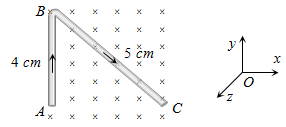
- A
- ✓
$12 \mathrm{ms}^{-2}$ along y-axis
- C
$1.2 \times 10^{-3} \mathrm{~ms}^{-2}$ along $y$-axis
- D
$0.6 \times 10^{-3} \mathrm{~ms}^{-2}$ along y - axis
AnswerCorrect option: B. $12 \mathrm{ms}^{-2}$ along y-axis
(b) $12 \mathrm{ms}^{-2}$ along y-axis
View full question & answer→MCQ 101 Mark
Assertion : The energy of charged particle moving in a uniform magnetic field does not change.
Reason : Work done by magnetic field on the charge is zero.
- ✓
If both assertion and reason are true and the reason is the correct explanation of the assertion.
- B
If both assertion and reason are true but reason is not the correct explanation of the assertion.
- C
If assertion is true but reason is false.
- D
If the assertion and reason both are false.
AnswerCorrect option: A. If both assertion and reason are true and the reason is the correct explanation of the assertion.
(a) If both assertion and reason are true and the reason is the correct explanation of the assertion.
View full question & answer→MCQ 111 Mark
Assertion : A circular loop carrying current lies in XY plane with its center at origin having a magnetic flux in negative Z-axis.
Reason : Magnetic flux direction is independent of the direction of current in the conductor.
- A
If both assertion and reason are true and the reason is the correct explanation of the assertion
- B
If both assertion and reason are true but reason is not the correct explanation of the assertion.
- ✓
If assertion is true but reason is false.
- D
If the assertion and reason both are false.
AnswerCorrect option: C. If assertion is true but reason is false.
(c) If assertion is true but reason is false.
View full question & answer→MCQ 121 Mark
Assertion : The coil is bound over the metallic frame in moving coil galvanometer.
Reason : The metallic frame help in making steady deflection without any oscillation.
- ✓
If both assertion and reason are true and the reason is the correct explanation of the assertion.
- B
If both assertion and reason are true but reason is not the correct explanation of the assertion.
- C
If assertion is true but reason is false.
- D
If the assertion and reason both are false.
AnswerCorrect option: A. If both assertion and reason are true and the reason is the correct explanation of the assertion.
(a) If both assertion and reason are true and the reason is the correct explanation of the assertion.
View full question & answer→MCQ 131 Mark
Assertion : The ion cannot move with a speed beyond a certain limit in a cyclotron.
Reason : As velocity increases time taken by ion increases.
- A
If both assertion and reason are true and the reason is the correct explanation of the assertion.
- B
If both assertion and reason are true but reason is not the correct explanation of the assertion.
- ✓
If assertion is true but reason is false.
- D
If the assertion and reason both are false.
AnswerCorrect option: C. If assertion is true but reason is false.
(c) If assertion is true but reason is false.
View full question & answer→MCQ 141 Mark
Assertion : Cyclotron is a device which is used to accelerate the positive ion.
Reason : Cyclotron frequency depends upon the velocity.
- A
If both assertion and reason are true and the reason is the correct explanation of the assertion.
- B
If both assertion and reason are true but reason is not the correct explanation of the assertion.
- ✓
If assertion is true but reason is false.
- D
If the assertion and reason both are false.
AnswerCorrect option: C. If assertion is true but reason is false.
(c) If assertion is true but reason is false.
View full question & answer→MCQ 151 Mark
Assertion : Magnetic field interacts with a moving charge and not with a stationary charge.
Reason : A moving charge produces a magnetic field.
- ✓
If both assertion and reason are true and the reason is the correct explanation of the assertion.
- B
If both assertion and reason are true but reason is not the correct explanation of the assertion.
- C
If assertion is true but reason is false.
- D
If the assertion and reason both are false.
AnswerCorrect option: A. If both assertion and reason are true and the reason is the correct explanation of the assertion.
(a) If both assertion and reason are true and the reason is the correct explanation of the assertion.
View full question & answer→MCQ 161 Mark
Assertion : If an electron is not deflected while passing through a certain region of space, then only possibility is that there is no magnetic region.
Reason : Force is directly proportional to the magnetic field applied.
- A
If both assertion and reason are true and the reason is the correct explanation of the assertion.
- B
If both assertion and reason are true but reason is not the correct explanation of the assertion.
- C
If assertion is true but reason is false.
- ✓
If assertion is false but reason is true.
AnswerCorrect option: D. If assertion is false but reason is true.
If assertion is false but reason is true.
View full question & answer→MCQ 171 Mark
Assertion : Free electron always keep on moving in a conductor even then no magnetic force act on them in magnetic field unless a current is passed through it.
Reason : The average velocity of free electron is zero.
- ✓
If both assertion and reason are true and the reason is the correct explanation of the assertion.
- B
If both assertion and reason are true but reason is not the correct explanation of the assertion.
- C
If assertion is true but reason is false.
- D
If the assertion and reason both are false.
AnswerCorrect option: A. If both assertion and reason are true and the reason is the correct explanation of the assertion.
If both assertion and reason are true and the reason is the correct explanation of the assertion.
View full question & answer→MCQ 181 Mark
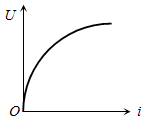
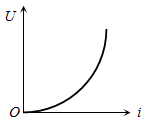
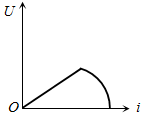
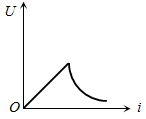
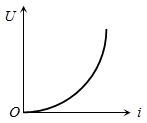
If current flowing through shell of previous objective is equal to i, then energy density at a point distance 2R from axis of the shell varies according to the graph
Answer(b)
View full question & answer→MCQ 191 Mark
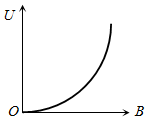
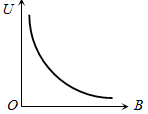
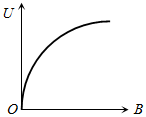
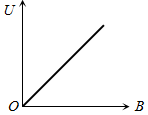
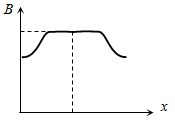
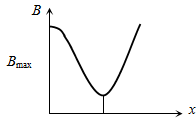
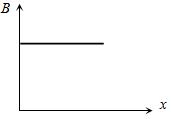
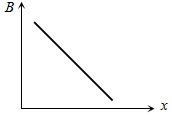
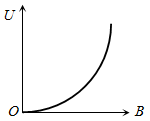
If induction of magnetic field at a point is B and energy density is U then which of the following graphs is correct
Answer(a)
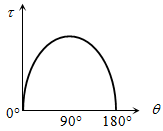
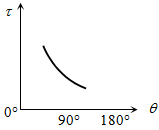
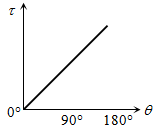
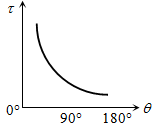
View full question & answer→MCQ 201 Mark
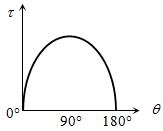
The (? – ?) graph for a coil is
Answer(a)
View full question & answer→MCQ 211 Mark
A wire carrying a current i is placed in a uniform magnetic field in the form of the curve y = asin$\left(\frac{\pi x}{L}\right)$ 0 ≤ x ≤ 2L. The force acting on the wire is
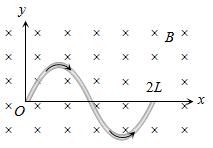
- A
$\frac{i B I}{\pi}$
- B
$\mathrm{iBL}_\pi$
- ✓
- D
View full question & answer→MCQ 221 Mark
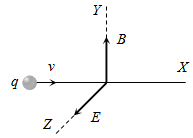
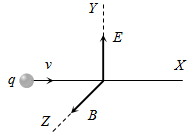
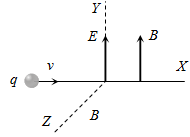
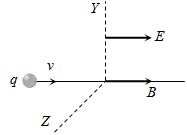
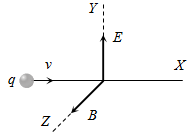
A particle of charge q and mass m is moving along the x -axis with a velocity v and enters a region of electric field E and magnetic field B as shown in figure below for which figure the net force on the charge may be zero
Answer(b)
View full question & answer→MCQ 231 Mark
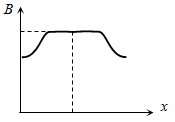
The correct curve between the magnetic induction (B) along the axis of a long solenoid due to current flow i in it and distance x from one end is
Answer(a)
View full question & answer→MCQ 241 Mark
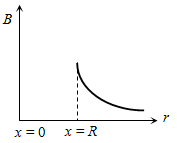
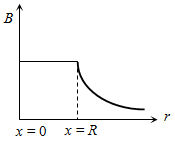
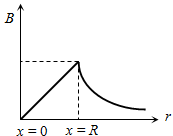
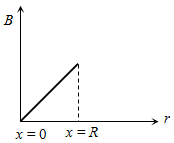
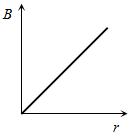
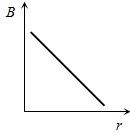
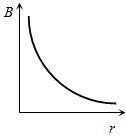
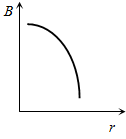
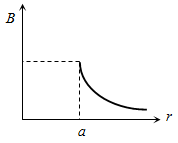
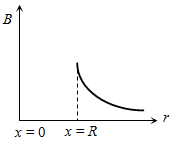
A long thin hollow metallic cylinder of radius 'R' has a current i ampere. The magnetic induction 'B'-away from the axis at a distance r from the axis varies as shown in
Answer(a)
View full question & answer→MCQ 251 Mark
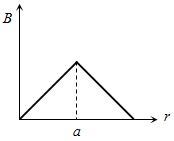
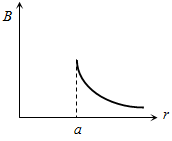
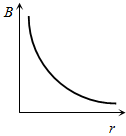
Which of the following graphs shows the variation of magnetic induction B with distance r from a long wire carrying current
Answer(c)
View full question & answer→MCQ 261 Mark
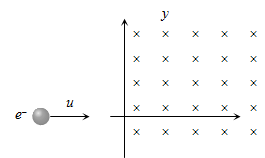
An electron moving with a speed u along the positive x-axis at y = 0 enters a region of uniform magnetic field $\vec{B}=B_0 \vec{k}$ which exists to the right of y-axis. The electron exits from the region after some time with the speed v at co-ordinate y, then
View full question & answer→MCQ 271 Mark
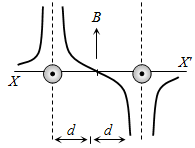
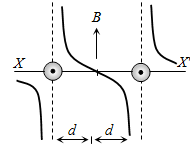
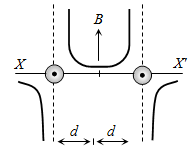
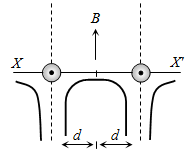
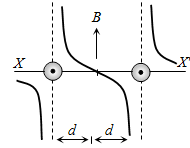
Two long parallel wires are at a distance 2d apart. They carry steady equal currents flowing out of the plane of the paper, as shown. The variation of the magnetic field B along the line XX’ is given by
Answer(b)
View full question & answer→MCQ 281 Mark
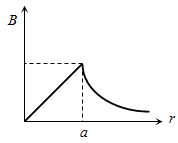
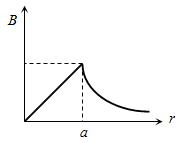
The magnetic field due to a straight conductor of uniform cross section of radius a and carrying a steady current is represented by
Answer(a)
View full question & answer→MCQ 291 Mark
An electron is moving along the positive X-axis. You want to apply a magnetic field for a short time so that the electron may reverse its direction and move parallel to the negative X-axis. This can be done by applying the magnetic field along
MCQ 301 Mark
AB and CD are long straight conductor, distance d apart, carrying a current I. The magnetic field at the midpoint of BC is
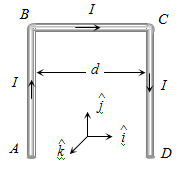
- A
$\frac{-\mu_0 \mathrm{I}}{2 \pi \mathrm{d}} \widehat{\mathrm{k}}$
- ✓
$\frac{-\mu_0 \mathrm{I}}{\pi \mathrm{d}} \widehat{\mathrm{k}}$
- C
$\frac{-\mu_0 \mathrm{I}}{4 \pi \mathrm{d}} \widehat{\mathrm{k}}$
- D
$\frac{-\mu_0 \mathrm{I}}{8 \pi \mathrm{d}} \widehat{\mathrm{k}}$
AnswerCorrect option: B. $\frac{-\mu_0 \mathrm{I}}{\pi \mathrm{d}} \widehat{\mathrm{k}}$
(b) $\frac{-\mu_0 \mathrm{I}}{\pi \mathrm{d}} \widehat{\mathrm{k}}$
View full question & answer→MCQ 311 Mark
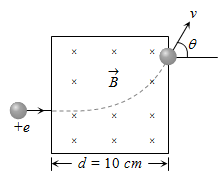
A proton accelerated by a potential difference 500 KV moves though a transverse magnetic field of 0.51T as shown in figure. The angle θ through which the proton deviates from the initial direction of its motion is
MCQ 321 Mark
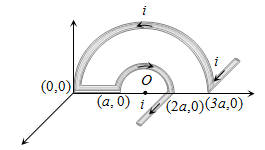
In the given figure net magnetic field at O will be
- A
$\frac{2 \mu_0 \mathrm{i}}{3 \pi \mathrm{a}} \sqrt{4-\pi^2}$
- ✓
$\frac{\mu_0 \mathrm{i}}{3 \pi \mathrm{a}} \sqrt{4+\pi^2}$
- C
$\frac{2 \mu_0 \mathrm{i}}{3 \pi a^2} \sqrt{4+\pi^2}$
- D
$\frac{2 \mu_0 \mathrm{i}}{3 \pi \mathrm{a}} \sqrt{4-\pi^2}$
AnswerCorrect option: B. $\frac{\mu_0 \mathrm{i}}{3 \pi \mathrm{a}} \sqrt{4+\pi^2}$
(b) $\frac{\mu_0 \mathrm{i}}{3 \pi \mathrm{a}} \sqrt{4+\pi^2}$
View full question & answer→MCQ 331 Mark
A horizontal rod of mass 10 gm and length 10 cm is placed on a smooth plane inclined at an angle of 60° with the horizontal, with the length of the rod parallel to the edge of the inclined plane. A uniform magnetic field of induction B is applied vertically downwards. If the current through the rod is 1.73 ampere, then the value of B for which the rod remains stationary on the inclined plane is
- A
- B
$\frac{1}{1.73}$ Tesla
- ✓
- D
View full question & answer→MCQ 341 Mark
A particle of mass m and charge q moves with a constant velocity v along the positive x direction. It enters a region containing a uniform magnetic field B directed along the negative z direction, extending from x = a to x = b. The minimum value of v required so that the particle can just enter the region x > b is
MCQ 351 Mark
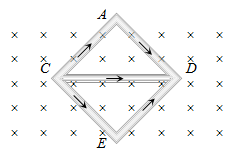
Same current i = 2A is flowing in a wire frame as shown in figure. The frame is a combination of two equilateral triangles ACD and CDE of side 1m. It is placed in uniform magnetic field B = 4T acting perpendicular to the plane of frame. The magnitude of magnetic force acting on the frame is
MCQ 361 Mark
A particle with charge q, moving with a momentum p, enters a uniform magnetic field normally. The magnetic field has magnitude B and is confined to a region of width d, where d < $\frac{p}{Bq}$ , The particle is deflected by an angle θ in crossing the field
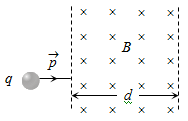
- ✓
sinθ = $\frac{Bqd}{p}$
- B
sinθ = $\frac{p}{Bqd}$
- C
sinθ = $\frac{bp}{qd}$
- D
sinθ = $\frac{pd}{Bq}$
AnswerCorrect option: A. sinθ = $\frac{Bqd}{p}$
(a) sinθ = $\frac{Bqd}{p}$
View full question & answer→MCQ 371 Mark
Two thick wires and two thin wires, all of the same materials and same length form a square in the three different ways P, Q and R as shown in fig with current connection shown, the magnetic field at the centre of the square is zero in cases

MCQ 381 Mark
A steady current i flows in a small square loop of wire of side L in a horizontal plane. The loop is now folded about its middle such that half of it lies in a vertical plane. Let $\overrightarrow{\mu_1}$ and $\overrightarrow{\mu_2}$ respectively denote the magnetic moments due to the current loop before and after folding. Then
- A
$\overrightarrow{\mu_2}=0$
- B
$\overrightarrow{\mu_1}$ and $\overrightarrow{\mu_2}$ are in the same direction
- ✓
$\frac{\left|\overrightarrow{\mu_1}\right|}{\left|\mu_2\right|}=\sqrt{2}$
- D
$\frac{\left|\mu_2\right|}{\left|\mu_2\right|}=\left(\frac{1}{\sqrt{2}}\right)$
AnswerCorrect option: C. $\frac{\left|\overrightarrow{\mu_1}\right|}{\left|\mu_2\right|}=\sqrt{2}$
(c) $\frac{\left|\overrightarrow{\mu_1}\right|}{\left|\mu_2\right|}=\sqrt{2}$
View full question & answer→MCQ 391 Mark
A long wire AB is placed on a table. Another wire PQ of mass 1.0 g and length 50 cm is set to slide on two rails PS and QR. A current of 50A is passed through the wires. At what distance above AB, will the wire PQ be in equilibrium
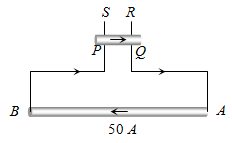
MCQ 401 Mark
Figure shows the cross-sectional view of the hollow cylindrical conductor with inner radius 'R' and outer radius '2R', cylinder carrying uniformly distributed current along it's axis. The magnetic induction at point 'P' at a distance $\frac{3R}{2}$ from the axis of the cylinder will be
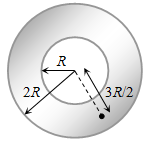
- A
- B
$\frac{5 \mu_0 \mathrm{i}}{72 \pi R}$
- C
$\frac{7 \mu_0 \mathrm{i}}{18 \pi R}$
- ✓
$\frac{5 \mu_0 \mathrm{i}}{36\pi R}$
AnswerCorrect option: D. $\frac{5 \mu_0 \mathrm{i}}{36\pi R}$
(d) $\frac{5 \mu_0 \mathrm{i}}{36\pi R}$
View full question & answer→MCQ 411 Mark
Two infinite length wires carries currents 8A and 6A respectively and placed along X and Y-axis. Magnetic field at a point P(0, 0, d)m will be
- A
$\frac{7\mu_0}{\pi d}$
- B
$\frac{10\mu_0}{\pi d}$
- C
$\frac{14\mu_0}{\pi d}$
- ✓
$\frac{5\mu_0}{\pi d}$
AnswerCorrect option: D. $\frac{5\mu_0}{\pi d}$
(d) $\frac{5\mu_0}{\pi d}$
View full question & answer→MCQ 421 Mark
The ratio of the magnetic field at the centre of a current carrying circular wire and the magnetic field at the centre of a square coil made from the same length of wire will be
AnswerCorrect option: B. $\frac{\pi^2}{8 \sqrt{2}}$
(b) $\frac{\pi^2}{8 \sqrt{2}}$
View full question & answer→MCQ 431 Mark
What will be the resultant magnetic field at origin due to four infinite length wires. If each wire produces magnetic field 'B' at origin
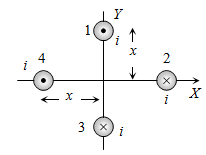
- A
- B
$\sqrt {2}B$
- ✓
$2\sqrt {2}B$
- D
AnswerCorrect option: C. $2\sqrt {2}B$
(c) $2\sqrt {2}B$
View full question & answer→MCQ 441 Mark
A ring of radius R, made of an insulating material carries a charge Q uniformly distributed on it. If the ring rotates about the axis passing through its centre and normal to plane of the ring with constant angular speed ω, then the magnitude of the magnetic moment of the ring is
- A
$QωR^2$
- ✓
$\frac{1}{2}QωR^2$
- C
$Q\omega^2R$
- D
$\frac{1}{2}Q\omega^2R$
AnswerCorrect option: B. $\frac{1}{2}QωR^2$
(b) $\frac{1}{2}QωR^2$
View full question & answer→MCQ 451 Mark
Two particles each of mass m and charge q are attached to the two ends of a light rigid rod of length 2R. The rod is rotated at constant angular speed about a perpendicular axis passing through its centre. The ratio of the magnitudes of the magnetic moment of the system and its angular momentum about the centre of the rod is
- ✓
$\frac{q}{2m}$
- B
$\frac{q}{m}$
- C
$\frac{2q}{m}$
- D
$\frac{q}{\pi m}$
AnswerCorrect option: A. $\frac{q}{2m}$
(a) $\frac{q}{2m}$
View full question & answer→MCQ 461 Mark
Two insulated rings, one of slightly smaller diameter than the other are suspended along their common diameter as shown. Initially the planes of the rings are mutually perpendicular. When a steady current is set up in each of them
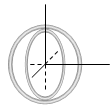
- ✓
The two rings rotate into a common plane
- B
The inner ring oscillates about its initial position
- C
The inner ring stays stationary while the outer one moves into the plane of the inner ring
- D
The outer ring stays stationary while the inner one moves into the plane of the outer ring
AnswerCorrect option: A. The two rings rotate into a common plane
(a) The two rings rotate into a common plane
View full question & answer→MCQ 471 Mark
A metallic block carrying current I is subjected to a uniform magnetic induction $\vec B$ as shown in the figure. The moving charges experience a force $\vec F$ given by ........... which results in the lowering of the potential of the face ........ Assume the speed of the carriers to be v
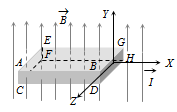
- ✓
eVB$\hat{k}$, ABCD
- B
eVB$\hat{k}$, EFGH
- C
-eVB$\hat{k}$, ABCD
- D
-eVB$\hat{k}$, EFGH
AnswerCorrect option: A. eVB$\hat{k}$, ABCD
(a) eVB$\hat{k}$, ABCD
View full question & answer→MCQ 481 Mark
A current carrying loop is placed in a uniform magnetic field in four different orientations, I,II, III & IV arrange them in the decreasing order of potential Energy
(a)
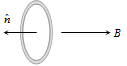
(b)
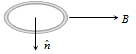
(c)

(d)
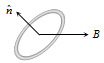
MCQ 491 Mark
A conducting loop carrying a current I is placed in a uniform magnetic field pointing into the plane of the paper as shown. The loop will have a tendency to
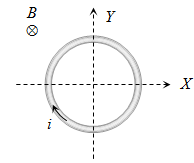
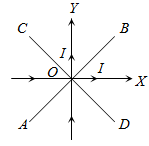
MCQ 501 Mark
Two very thin metallic wires placed along X and Y-axis carry equal currents as shown here. AB and CD are lines at 45° with the axes with origin of axes at O. The magnetic field will be zero on the line
- ✓
- B
- C
Segment OB only of line AB
- D
Segment OC only of line CD
View full question & answer→MCQ 511 Mark
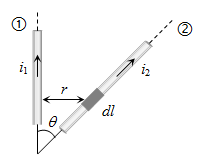
Wires 1 and 2 carrying currents $i_1$ and $i_2$ respectively are inclined at an angle θ to each other. What is the force on a small element dl of wire 2 at a distance of r from wire 1 (as shown in figure) due to the magnetic field of wire1
- A
$\frac{\mu_0}{2 \pi \mathrm{r}} \mathrm{i}_1 \mathrm{i}_2 \mathrm{dl} \tan \theta$
- B
$\frac{\mu_0}{2 \pi r} i_1 i_2 \mathrm{dl} \sin$
- ✓
$\frac{\mu_0}{2 \pi \mathrm{r}} \mathrm{i}_1 \mathrm{i}_2 \mathrm{dl} \cos$
- D
$\frac{\mu_0}{4 \pi r} i_1 i_2 \mathrm{dl} \sin$
AnswerCorrect option: C. $\frac{\mu_0}{2 \pi \mathrm{r}} \mathrm{i}_1 \mathrm{i}_2 \mathrm{dl} \cos$
(c) $\frac{\mu_0}{2 \pi \mathrm{r}} \mathrm{i}_1 \mathrm{i}_2 \mathrm{dl} \cos$
View full question & answer→MCQ 521 Mark
A and B are two conductors carrying a current i in the same direction. x and y are two electron beams moving in the same direction
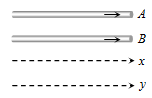
- A
There will be repulsion between A and B attraction between x and y
- ✓
There will be attraction between A and B, repulsion between x and y
- C
There will be repulsion between A and B and also x and y
- D
There will be attraction between A and B and also x and y
AnswerCorrect option: B. There will be attraction between A and B, repulsion between x and y
(b) There will be attraction between A and B, repulsion between x and y
View full question & answer→MCQ 531 Mark
An elastic circular wire of length l carries a current I. It is placed in a uniform magnetic field $\vec B$ (Out of paper) such that its plane is perpendicular to the direction of $\vec B$. The wire will experience
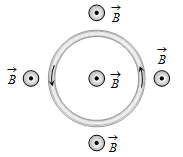
View full question & answer→MCQ 541 Mark
A particle of charge q and mass m moves in a circular orbit of radius r with angular speed ω. The ratio of the magnitude of its magnetic moment to that of its angular momentum depends on
MCQ 551 Mark
A thin circular wire carrying a current I has a magnetic moment M. The shape of the wire is changed to a square and it carries the same current. It will have a magnetic moment
- A
- B
$\frac{4}{\pi^2}M$
- C
$\frac{4}{\pi}M$
- ✓
$\frac{\pi}{4}M$
AnswerCorrect option: D. $\frac{\pi}{4}M$
(d) $\frac{\pi}{4}M$
View full question & answer→MCQ 561 Mark
A wire of length L metre carrying a current of I ampere is bent in the form of a circle. Its magnitude of magnetic moment will be
- A
$\frac{IL}{4\pi}$
- ✓
$\frac{IL^2}{4\pi}$
- C
$\frac{I^2L^2}{4\pi}$
- D
$\frac{I^2L}{4\pi}$
AnswerCorrect option: B. $\frac{IL^2}{4\pi}$
(b) $\frac{IL^2}{4\pi}$
View full question & answer→MCQ 571 Mark
Two long wires are hanging freely. They are joined first in parallel and then in series and then are connected with a battery. In both cases, which type of force acts between the two wires
- ✓
Attraction force when in parallel and repulsion force when in series
- B
Repulsion force when in parallel and attraction force when in series
- C
Repulsion force in both cases
- D
Attraction force in both cases
AnswerCorrect option: A. Attraction force when in parallel and repulsion force when in series
Attraction force when in parallel and repulsion force when in series
View full question & answer→MCQ 581 Mark
A straight conductor carries a current of 5A. An electron travelling with a speed of $5\times 10^6 ms^{-1}$ parallel to the wire at a distance of 0.1m from the conductor, experiences a force of
- A
$8\times 10^{-20} N$
- B
$3.2 \times 10^{-19} N$
- ✓
$8 \times 10^{-18} N$
- D
$1.6 \times 10^{-19} N$
AnswerCorrect option: C. $8 \times 10^{-18} N$
(c) $8 \times 10^{-18} N$
View full question & answer→MCQ 591 Mark
An ionized gas contains both positive and negative ions. If it is subjected simultaneously to an electric field along the +x direction and a magnetic field along the +z direction, then
- A
Positive ions deflect towards +y direction and negative ions towards –y direction
- B
All ions deflect towards +y direction
- ✓
All ions deflect towards –y direction
- D
Positive ions deflect towards –y direction and negative ions towards +y direction
AnswerCorrect option: C. All ions deflect towards –y direction
All ions deflect towards –y direction
View full question & answer→MCQ 601 Mark
$H^+,He^+$ and $O^{++}$ ions having same kinetic energy pass through a region of space filled with uniform magnetic field B directed perpendicular to the velocity of ions. The masses of the ions $H^+,He^+$ and $O^{++}$ are respectively in the ratio 1 : 4 : 16. As a result
View full question & answer→MCQ 611 Mark
A particle of charge +q and mass m moving under the influence of a uniform electric field $E\hat I$ and a uniform magnetic field $ B\hat K$ follows trajectory from P to Q as shown in figure. The velocities at P and Q are v$\hat I$ and -2v$\hat J$ respectively. Which of the following statement(s) is/are correct
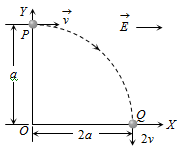
View full question & answer→MCQ 621 Mark
An infinitely long, straight conductor AB is fixed and a current is passed through it. Another movable straight wire CD of finite length and carrying current is held perpendicular to it and released. Neglect weight of the wire
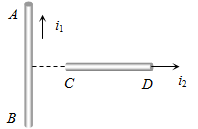
- A
The rod CD will move upwards parallel to itself
- B
The rod CD will move downward parallel to itself
- ✓
The rod CD will move upward and turn clockwise at the same time
- D
The rod CD will move upward and turn anti –clockwise at the same time
AnswerCorrect option: C. The rod CD will move upward and turn clockwise at the same time
(c) The rod CD will move upward and turn clockwise at the same time
View full question & answer→MCQ 631 Mark
A non-planar loop of conducting wire carrying a current I is placed as shown in the figure. Each of the straight sections of the loop is of length 2a. The magnetic field due to this loop at the point P (a,0,a) points in the direction
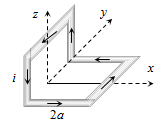
- A
$\frac{1}{\sqrt{2}}(-\hat{J}+\hat{k})$
- B
$\frac{1}{\sqrt{3}}(-\hat{J}+\hat{k}+\hat{\imath})$
- C
$\frac{1}{\sqrt{3}}(\hat{\imath}+\hat{J}+\hat{k})$
- ✓
$\frac{1}{\sqrt{2}}(\hat{\imath}+\hat{k})$
AnswerCorrect option: D. $\frac{1}{\sqrt{2}}(\hat{\imath}+\hat{k})$
(d) $\frac{1}{\sqrt{2}}(\hat{\imath}+\hat{k})$
View full question & answer→MCQ 641 Mark
A coil having N turns is wound tightly in the form of a spiral with inner and outer radii a and b respectively. When a current I passes through the coil, the magnetic field at the centre is
- A
$\frac{\mu_0 \mathrm{NI}}{\mathrm{b}}$
- B
$\frac{2 \mu_0 \mathrm{NI}}{a}$
- ✓
$\frac{\mu_0 N I}{2(b-a)} \ln \frac{b}{a}$
- D
$\frac{\mu_{0 I }{N}}{2(b-a)} \ln \frac{b}{a}$
AnswerCorrect option: C. $\frac{\mu_0 N I}{2(b-a)} \ln \frac{b}{a}$
(c) $\frac{\mu_0 N I}{2(b-a)} \ln \frac{b}{a}$
View full question & answer→MCQ 651 Mark
Two coaxial solenoids 1 and 2 of the same length are set so that one is inside the other. The number of turns per unit length are $n_1$ and $n_2$. The currents $i_1$ and $i_2$ are flowing in opposite directions. The magnetic field inside the inner coil is zero. This is possible when
View full question & answer→MCQ 661 Mark
An infinitely long conductor PQR is bent to form a right angle as shown. A current I flows through PQR The magnetic field due to this current at the point M is $H_1$. Now another infinitely long straight conductor QS is connected at Q so that the current is I/2 in QR as well as in QS, The current in PQ remaining unchanged. The magnetic field at M is now $H_2$. The ratio $H_1/H_2$ is given by
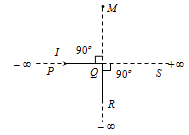
- A
$\frac{1}{2}$
- B
- ✓
$\frac{2}{3}$
- D
AnswerCorrect option: C. $\frac{2}{3}$
(c) $\frac{2}{3}$
View full question & answer→MCQ 671 Mark
A circular current carrying coil has a radius R. The distance from the centre of the coil on the axis where the magnetic induction will be $\frac{1}{8}th$ to its value at the centre of the coil, is
- A
$\frac{R}{\sqrt 3}$
- ✓
${R}{\sqrt 3}$
- C
$2{\sqrt 3}{R}$
- D
$\frac{2}{\sqrt 3}R$
AnswerCorrect option: B. ${R}{\sqrt 3}$
(b) ${R}{\sqrt 3}$
View full question & answer→MCQ 681 Mark
The field normal to the plane of a wire of n turns and radius r which carries a current i is measured on the axis of the coil at a small distance h from the centre of the coil. This is smaller than the field at the centre by the fraction
- ✓
$\frac{3}{2} \frac{\mathrm{h}^2}{\mathrm{r}^2}$
- B
$\frac{2}{3} \frac{\mathrm{h}^2}{\mathrm{r}^2}$
- C
$\frac{3}{2} \frac{\mathrm{r}^2}{\mathrm{~h}^2}$
- D
$\frac{2}{3} \frac{r^2}{h^2}$
AnswerCorrect option: A. $\frac{3}{2} \frac{\mathrm{h}^2}{\mathrm{r}^2}$
(a) $\frac{3}{2} \frac{\mathrm{h}^2}{\mathrm{r}^2}$
View full question & answer→MCQ 691 Mark
The magnetic field at the centre of a circular coil of radius r is π times that due to a long straight wire at a distance r from it, for equal currents. Figure here shows three cases : in all cases the circular part has radius r and straight ones are infinitely long. For same current the B field at the centre P in cases 1, 2, 3 have the ratio
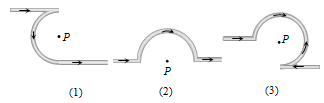
- ✓
$\left(-\frac{\pi}{2}\right):\left(\frac{\pi}{2}\right) :\left(\frac{3 \pi}{4}-\frac{1}{2}\right)$
- B
$\left(-\frac{\pi}{2}+1\right):\left(\frac{\pi}{2}+1\right):\left(\frac{3 \pi}{4}+\frac{1}{2}\right)$
- C
$-\frac{\pi}{2}: \frac{\pi}{2}: 3 \frac{\pi}{4}$
- D
$\left(-\frac{\pi}{2}-1\right):\left(\frac{\pi}{2}-\frac{1}{4}\right):\left(\frac{3 \pi}{4}+\frac{1}{2}\right)$
AnswerCorrect option: A. $\left(-\frac{\pi}{2}\right):\left(\frac{\pi}{2}\right) :\left(\frac{3 \pi}{4}-\frac{1}{2}\right)$
(a) $\left(-\frac{\pi}{2}\right):\left(\frac{\pi}{2}\right) :\left(\frac{3 \pi}{4}-\frac{1}{2}\right)$
View full question & answer→MCQ 701 Mark
Two straight long conductors AOB and COD are perpendicular to each other and carry currents $i_1$ and $i_2$. The magnitude of the magnetic induction at a point P at a distance a from the point O in a direction perpendicular to the plane ACBD is
- A
$\frac{\mu_0}{2 \pi \mathrm{I}}\left(\mathrm{i}_1+\mathrm{i}_2\right)$
- B
$\frac{\mu_0}{2 \pi \mathrm{I}}\left(\mathrm{i}_1-\mathrm{i}_2\right)$
- ✓
$\frac{\mu_0}{2 \pi \mathrm{I}}\left({i_1}^2+\mathrm{i_2}^2\right)^{1 / 2}$
- D
$\frac{\mu_0}{2 \pi I} \frac{i_1 i_2}{\left(i_1+i_2\right)}$
AnswerCorrect option: C. $\frac{\mu_0}{2 \pi \mathrm{I}}\left({i_1}^2+\mathrm{i_2}^2\right)^{1 / 2}$
(c) $\frac{\mu_0}{2 \pi \mathrm{I}}\left({i_1}^2+\mathrm{i_2}^2\right)^{1 / 2}$
View full question & answer→MCQ 711 Mark
Three long, straight parallel wires carrying current, are arranged as shown in figure. The force experienced by a 25 cm length of wire C is
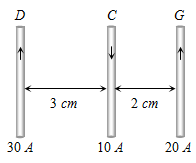
MCQ 721 Mark
In ballistic galvanometer, the frame on which the coil is wound is non-metallic to
- A
Avoid the production of induced e.m.f.
- ✓
Avoid the production of eddy currents
- C
Increase the production of eddy currents
- D
Increase the production of induced e.m.f.
AnswerCorrect option: B. Avoid the production of eddy currents
Avoid the production of eddy currents
View full question & answer→MCQ 731 Mark
Current i is carried in a wire of length L. If the wire is turned into a circular coil, the maximum magnitude of torque in a given magnetic field B will be
- A
$\frac{\mathrm{LiB}^2}{2}$
- B
$\frac{\mathrm{LiB}^2}{2}$
- ✓
$\frac{\mathrm{Li}^2 \mathrm{~B}}{4 \pi}$
- D
$\frac{\mathrm{Li}^2 \mathrm{~B}}{4 \pi}$
AnswerCorrect option: C. $\frac{\mathrm{Li}^2 \mathrm{~B}}{4 \pi}$
(c) $\frac{\mathrm{Li}^2 \mathrm{~B}}{4 \pi}$
View full question & answer→MCQ 741 Mark
Two parallel wires of length $9 m$ each are separated by a distance $0.15 m$. If they carry equal currents in the same direction and exerts a total force of $30 \times 10^{-7} N$ on each other, then the value of current must be
- A
$2.5$ amp
- B
$3.5$ amp
- C
$1.5$ amp
- ✓
$0.5$ amp
AnswerCorrect option: D. $0.5$ amp
$0.5$ amp
View full question & answer→MCQ 751 Mark
A beam of electrons and protons move parallel to each other in the same direction, then they
- ✓
- B
- C
- D
Neither attract nor repel
View full question & answer→MCQ 761 Mark
A one metre long wire is lying at right angles to the magnetic field. A force of 1 kg wt. is acting on it in a magnetic field of 0.98 Tesla. The current flowing in it will be
MCQ 771 Mark
The resultant magnetic moment of neon atom will be
MCQ 781 Mark
Two long conductors, separated by a distance d carry current $I_1$ and $I_2$ in the same direction. They exert a force F on each other. Now the current in one of them is increased to two times and its directions is reversed. The distance is also increased to $3d.$ The new value of the force between them is
- A
$–2F$
- B
$F/3$
- ✓
$2F/3$
- D
$– F/3$
AnswerCorrect option: C. $2F/3$
$2F/3$
View full question & answer→MCQ 791 Mark
If the current is doubled, the deflection is also doubled in
- A
- ✓
A moving coil galvanometer
- C
- D
AnswerCorrect option: B. A moving coil galvanometer
A moving coil galvanometer
View full question & answer→MCQ 801 Mark
Two long straight parallel conductors separated by a distance of 0.5m carry currents of 5A and 8A in the same direction. The force per unit length experienced by each other is
- ✓
$1.3 \times 10^{-5} \mathrm{~N}$ (attractive)
- B
$1.6 \times 10^{-5} \mathrm{~N}$ (repulsive)
- C
$16 \times 10^{-5} \mathrm{~N}$ (attractive)
- D
$16 \times 10^{-5} \mathrm{~N}$ (repulsive)
AnswerCorrect option: A. $1.3 \times 10^{-5} \mathrm{~N}$ (attractive)
(a) $1.3 \times 10^{-5} \mathrm{~N}$ (attractive)
View full question & answer→MCQ 811 Mark
Two galvanometers A and B require 3mA and 5mA respectively to produce the same deflection of 10 divisions. Then
- ✓
A is more sensitive than B
- B
B is more sensitive than A
- C
A and B are equally sensitive
- D
Sensitiveness of B is 5/3 times that of A
AnswerCorrect option: A. A is more sensitive than B
A is more sensitive than B
View full question & answer→MCQ 821 Mark
A circular loop carrying a current is replaced by an equivalent magnetic dipole. A point on the axis of the loop is
MCQ 831 Mark
A, B and C are parallel conductors of equal length carrying currents I, I and 2I respectively. Distance between A and B is x. Distance between B and C is also x. $F_1$ is the force exerted by B on A and $F_2$ is the force exerted by B on A choose the correct answer
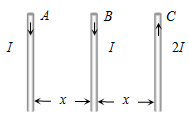
- A
$\mathrm{F}_1=2 \mathrm{~F}_2$
- B
$\mathrm{F}_2=2 \mathrm{~F}_1$
- C
$\mathrm{F}_1=\mathrm{~F}_2$
- ✓
$\mathrm{F}_1=-\mathrm{~F}_2$
AnswerCorrect option: D. $\mathrm{F}_1=-\mathrm{~F}_2$
(d) $\mathrm{F}_1=-\mathrm{~F}_2$
View full question & answer→MCQ 841 Mark
A small cylindrical soft iron piece is kept in a galvanometer so that
- A
A radial uniform magnetic field is produced
- B
A uniform magnetic field is produced
- C
There is a steady deflection of the coil
- ✓
View full question & answer→MCQ 851 Mark
A circular coil having N turns is made from a wire of length L meter. If a current I ampere is passed through it and is placed in a magnetic field of B Tesla, the maximum torque on it is
AnswerCorrect option: A. Directly proportional to N
(a) Directly proportional to N
View full question & answer→MCQ 861 Mark
An arbitrary shaped closed coil is made of a wire of length L and a current I ampere is flowing in it. If the plane of the coil is perpendicular to magnetic field $\vec{B}$, the force on the coil is
View full question & answer→MCQ 871 Mark
If a wire of length 1 meter placed in uniform magnetic field 1.5 Tesla at angle 30° with magnetic field. The current in a wire 10 amp. Then force on a wire will be
MCQ 881 Mark
What is shape of magnet in moving coil galvanometer to make the radial magnetic field
MCQ 891 Mark
The relation between voltage sensitivity ($\sigma_v$) and current sensitivity ($\sigma_i$) of a moving coil galvanometer is (Resistance of Galvanometer = G)
- ✓
$\frac{\sigma_{\mathrm{i}}}{\mathrm{G}}=\sigma_{\mathrm{v}}$
- B
$\frac{\sigma_{\mathrm{v}}}{\mathrm{G}}=\sigma_{\mathrm{i}}$
- C
$\frac{\mathrm{G}}{\sigma \mathrm{V}}=\sigma_{\mathrm{i}}$
- D
$\frac{\mathrm{G}}{\sigma_{\mathrm{i}}}=\sigma_{\mathrm{V}}$
AnswerCorrect option: A. $\frac{\sigma_{\mathrm{i}}}{\mathrm{G}}=\sigma_{\mathrm{v}}$
(a) $\frac{\sigma_{\mathrm{i}}}{\mathrm{G}}=\sigma_{\mathrm{v}}$
View full question & answer→MCQ 901 Mark
A stream of electrons is projected horizontally to the right. A straight conductor carrying a current is supported parallel to electron stream and above it. If the current in the conductor is from left to right then what will be the effect on electron stream
- A
The electron stream will be pulled upward
- ✓
The electron stream will be pulled downward
- C
The electron stream will be retarted
- D
The electron beam will be speeded up towards the right
AnswerCorrect option: B. The electron stream will be pulled downward
The electron stream will be pulled downward
View full question & answer→MCQ 911 Mark
A long wire A carries a current of 10 amp. Another long wire B, Which is parallel to A and separated by 0.1m from A, carries a current of 5 amp, in the opposite direction to that in A. what is the magnitude and nature of the force experienced per unit length of B $\left(\mu_0=4 \pi \times 10^{-7}\right.$ weber/amp -m$)$
- ✓
Repulsive force of $10^{-4} \mathrm{~N} / \mathrm{m}$
- B
Attractive force of $10^{-4} \mathrm{~N} / \mathrm{m}$
- C
Repulsive force of $2 \pi \times 10^{-5} \mathrm{~N} / \mathrm{m}$
- D
Attractive force of $2 \pi \times 10^{-5} \mathrm{~N} / \mathrm{m}$
AnswerCorrect option: A. Repulsive force of $10^{-4} \mathrm{~N} / \mathrm{m}$
(a) Repulsive force of $10^{-4} \mathrm{~N} / \mathrm{m}$
View full question & answer→MCQ 921 Mark
The magnetic moment of a circular coil carrying current is
- A
Directly proportional to the length of the wire in the coil
- B
Inversely proportional to the length of the wire in the coil
- ✓
Directly proportional to the square of the length of the wire in the coil
- D
Inversely proportional to the square of the length of the wire in the coil
AnswerCorrect option: C. Directly proportional to the square of the length of the wire in the coil
Directly proportional to the square of the length of the wire in the coil
View full question & answer→MCQ 931 Mark
Due to the flow of current in a circular loop of radius R, the magnetic induction produced at the centre of the loop is B. The magnetic moment of the loop is ($\mu_0=$ permeability constant )
- A
$\mathrm{BR}^3 / 2 \pi \mu_0$
- ✓
$2 \pi \mathrm{BR}^3 / \mu_0$
- C
$\mathrm{BR}^2 / 2 \pi \mu_0$
- D
$2 \pi \mathrm{BR}^2 / \mu_0$
AnswerCorrect option: B. $2 \pi \mathrm{BR}^3 / \mu_0$
(b) $2 \pi \mathrm{BR}^2 / \mu_0$
View full question & answer→MCQ 941 Mark
A circular loop has a radius of 5 cm and it is carrying a current of 0.1 amp. Its magnetic moment is
- A
$1.32\times 10^{-4}$ amp $-m^2$
- B
$ 2.62 \times 10^{-4}$ amp $-m^2$
- C
$ 5.25 \times 10^{-4}$ amp $-m^2$
- ✓
$7.85 \times 10^{-4}$ amp $-m^2$
AnswerCorrect option: D. $7.85 \times 10^{-4}$ amp $-m^2$
(d) $7.85 \times 10^{-4}$ amp $-m^2$
View full question & answer→MCQ 951 Mark
In order to increase the sensitivity of a moving coil galvanometer, one should decrease
- A
The strength of its magnet
- ✓
The torsional constant of its suspension
- C
The number of turns in its coil
- D
AnswerCorrect option: B. The torsional constant of its suspension
The torsional constant of its suspension
View full question & answer→MCQ 961 Mark
What is the net force on the square coil
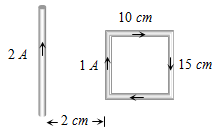
- ✓
$ 25 \times 10^{-7}$ N moving towards wire
- B
$25 \times 10^{-7}$ N moving away from wire
- C
$35 \times 10^{-7}$ N moving towards wire
- D
$ 35 \times 10^{-7}$ N moving away from wire
AnswerCorrect option: A. $ 25 \times 10^{-7}$ N moving towards wire
(a) $25 \times 10^{-7}$ N moving away from wire
View full question & answer→MCQ 971 Mark
If m is magnetic moment and B is the magnetic field, then the torque is given by
- A
$\overrightarrow{\mathrm{m}} \overrightarrow{\mathrm{B}}$
- B
$\frac{|\mathrm{m}|}{|\vec{B}|}$
- ✓
$\vec{m} \times \vec{B}$
- D
$|\overrightarrow{\mathrm{m}}| \cdot|\overrightarrow{\mathrm{B}}|$
AnswerCorrect option: C. $\vec{m} \times \vec{B}$
(c) $\vec{m} \times \vec{B}$
View full question & answer→MCQ 981 Mark
Magnetic dipole moment of a rectangular loop is
- A
Inversely proportional to current in loop
- B
Inversely proportional to area of loop
- C
Parallel to plane of loop and proportional to area of loop
- ✓
Perpendicular to plane of loop and proportional to area of loop
AnswerCorrect option: D. Perpendicular to plane of loop and proportional to area of loop
Perpendicular to plane of loop and proportional to area of loop
View full question & answer→MCQ 991 Mark
A circular loop of area $0.001$m$^2$ carrying a current of 10 A, is held perpendicular to a magnetic field of intensity 0.1T. The torque acting on the loop is
View full question & answer→MCQ 1001 Mark
Two parallel beams of electrons moving in the same direction produce a mutual force
- A
Of attraction in plane of paper
- ✓
Of repulsion in plane of paper
- C
Upwards perpendicular to plane of paper
- D
Downwards perpendicular to plane of paper
AnswerCorrect option: B. Of repulsion in plane of paper
Of repulsion in plane of paper
View full question & answer→MCQ 1011 Mark
Two long parallel wires carrying equal current separated by 1m, exert a force of $2\times 10^{-7}$ N/m on one another. The current flowing through them is
- A
- B
$2.0\times 10^{-7}$ A
- ✓
- D
$1.0\times 10^{-7}$ A
View full question & answer→MCQ 1021 Mark
There long straight wires A, B and C are carrying current as shown figure. Then the resultant force on B is directed .....
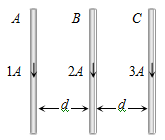
- A
- ✓
- C
Perpendicular to the plane of paper and outward
- D
Perpendicular to the plane of paper and inward
View full question & answer→MCQ 1031 Mark
A circular coil of diameter 7cm has 24 turns of wire carrying current of 0.75A. The magnetic moment of the coil is
AnswerCorrect option: A. $ 6.9\times 10^{-2}$ amp$-m^2$
(a) $ 6.9\times 10^{-2}$ amp$-m^2$
View full question & answer→MCQ 1041 Mark
The current sensitivity of a moving coil galvanometer can be increased by
- A
Increasing the magnetic field of the permanent magnet
- B
Increasing the area of the deflecting coil
- C
Increasing the number of turns in the coil
- ✓
View full question & answer→MCQ 1051 Mark
Two parallel wires in free space are 10 cm apart and each carries a current of 10 A in the same direction. The force one wire exerts on the other per metre of length is
- ✓
$2\times 10^{-4}$ N, attractive
- B
$2\times 10^{-4}$ N, repulsive
- C
$2\times 10^{-7}$ N, attractive
- D
$2\times 10^{-7}$ N , repulsive
AnswerCorrect option: A. $2\times 10^{-4}$ N, attractive
(a) $2\times 10^{-4}$ N, attractive
View full question & answer→MCQ 1061 Mark
A power line lies along the east-west direction and carries a current of 10 ampere. The force per metre due to the earth's magnetic field of $10^{-4}$ Tesla is
- A
$10^{-5}$ N
- B
$10^{-4}$ N
- ✓
$10^{-3}$ N
- D
$10^{-2}$ N
AnswerCorrect option: C. $10^{-3}$ N
(c) $10^{-3}$ N
View full question & answer→MCQ 1071 Mark
A small coil of N turns has area A and a current I flows through it. The magnetic dipole moment of this coil will be
MCQ 1081 Mark
A small coil of N turns has an effective area A and carries a current I. It is suspended in a horizontal magnetic field $\vec B$ such that its plane is perpendicular to $\vec B$. The work done in rotating it by 180° about the vertical axis is
View full question & answer→MCQ 1091 Mark
A coil carrying electric current is placed in uniform magnetic field, then
- ✓
- B
- C
Both (a) and (b) are correct
- D
View full question & answer→MCQ 1101 Mark
A vertical wire carrying a current in the upward direction is placed in horizontal magnetic field directed towards north. The wire will experience a force directed towards
MCQ 1111 Mark
Three long, straight and parallel wires carrying currents are arranged as shown in the figure. The wire C which carries a current of 5.0 amp is so placed that it experiences no force. The distance of wire C from wire D is then
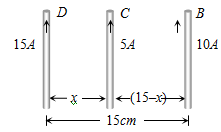
MCQ 1121 Mark
A triangular loop of side l carries a current I. It is placed in a magnetic field B such that the plane of the loop is in the direction of B. The torque on the loop is
AnswerCorrect option: D. $\frac{\sqrt{3}}{4}IBI^2$
(d) $\frac{\sqrt{3}}{4}IBI^2$
View full question & answer→MCQ 1131 Mark
In hydrogen atom, the electron is making $6.6 \times 10^{15} \mathrm{rev} / \mathrm{sec}$ around the nucleus in an orbit of radius 0.528 Å. The magnetic moment $\left(A-m^2\right)$ will be
- A
$1 \times 10^{-15}$
- B
$1 \times 10^{-10}$
- ✓
$1 \times 10^{-23}$
- D
$1 \times 10^{-27}$
AnswerCorrect option: C. $1 \times 10^{-23}$
(c) $1 \times 10^{-23}$
View full question & answer→MCQ 1141 Mark
A current carrying small loop behaves like a small magnet. If A be its area and M its magnetic moment, the current in the loop will be
MCQ 1151 Mark
If a current is passed in a spring, it
MCQ 1161 Mark
A rectangular coil 20 cm × 20 cm has 100 turns and carries a current of 1 A. It is placed in a uniform magnetic field B = 0.5 T with the direction of magnetic field parallel to the plane of the coil. The magnitude of the torque required to hold this coil in this position is
MCQ 1171 Mark
A conductor in the form of a right angle ABC with AB = 3 cm and BC = 4 cm carries a current of 10 A. There is a uniform magnetic field of 5 T perpendicular to the plane of the conductor. The force on the conductor will be
MCQ 1181 Mark
A current of 5 ampere is flowing in a wire of length 1.5 metres. A force of 7.5 N acts on it when it is placed in a uniform magnetic field of 2 Tesla. The angle between the magnetic field and the direction of the current is
MCQ 1191 Mark
A 100 turns coil shown in figure carries a current of 2 amp in a magnetic field $\mathrm{B}=0.2 \mathrm{wb} / \mathrm{m}^2$. The torque acting on the coil is
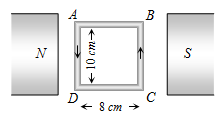
- ✓
0.32 Nm tending to rotate the side AD out of the page
- B
0.32 Nm tending to rotate the side AD into the page
- C
0.0032 Nm tending to rotate the side AD out of the page
- D
0.0032 Nm tending to rotate the side AD into the page
AnswerCorrect option: A. 0.32 Nm tending to rotate the side AD out of the page
(a) 0.32 Nm tending to rotate the side AD out of the page
View full question & answer→MCQ 1201 Mark
Three long, straight and parallel wires carrying currents are arranged as shown in figure. The force experienced by 10 cm length of wire Q is
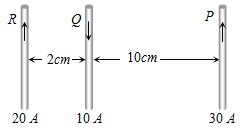
- ✓
$1.4 \times 10^{-4} \mathrm{~N}$ towards the right
- B
$1.4 \times 10^{-4} \mathrm{~N}$ towards the left
- C
$2.6 \times 10^{-4} \mathrm{~N}$ to the right
- D
$2.6 \times 10^{-4} \mathrm{~N}$ to the left
AnswerCorrect option: A. $1.4 \times 10^{-4} \mathrm{~N}$ towards the right
(a) $1.4 \times 10^{-4} \mathrm{~N}$ towards the right
View full question & answer→MCQ 1211 Mark
Two parallel conductors A and B of equal lengths carry currents I and 10 I, respectively, in the same direction. Then
- A
A and B will repel each other with same force
- ✓
A and B will attract each other with same force
- C
A will attract B, but B will repel A
- D
A and B will attract each other with different forces
AnswerCorrect option: B. A and B will attract each other with same force
A and B will attract each other with same force
View full question & answer→MCQ 1221 Mark
A metallic loop is placed in a magnetic field. If a current is passed through it, then
- A
The ring will feel a force of attraction
- B
The ring will feel a force of repulsion
- C
It will move to and fro about its centre of gravity
- ✓
View full question & answer→MCQ 1231 Mark
The sensitiveness of a moving coil galvanometer can be increased by decreasing
- A
The number of turns in the coil
- B
- C
- ✓
The couple per unit twist of the suspension
AnswerCorrect option: D. The couple per unit twist of the suspension
The couple per unit twist of the suspension
View full question & answer→MCQ 1241 Mark
The pole pieces of the magnet used in a pivoted coil galvanometer are
- A
Plane surfaces of a bar magnet
- B
Plane surfaces of a horse-shoe magnet
- C
Cylindrical surfaces of a bar magnet
- ✓
Cylindrical surfaces of a horse-shoe magnet
AnswerCorrect option: D. Cylindrical surfaces of a horse-shoe magnet
Cylindrical surfaces of a horse-shoe magnet
View full question & answer→MCQ 1251 Mark
A current carrying loop is free to turn in a uniform magnetic field. The loop will then come into equilibrium when its plane is inclined at
- A
0° to the direction of the field
- B
45 ° to the direction of the field
- ✓
90° to the direction of the field
- D
135° to the direction of the field
AnswerCorrect option: C. 90° to the direction of the field
90° to the direction of the field
View full question & answer→MCQ 1261 Mark
A current carrying circular loop is freely suspended by a long thread. The plane of the loop will point in the direction
- A
- B
- ✓
- D
At 45° with the east-west direction
View full question & answer→MCQ 1271 Mark
A current carrying rectangular coil is placed in a uniform magnetic field. In which orientation, the coil will not tend to rotate
AnswerCorrect option: B. The magnetic field is perpendicular to the plane of the coil
The magnetic field is perpendicular to the plane of the coil
View full question & answer→MCQ 1281 Mark
Four wires each of length 2.0 metres are bent into four loops P, Q, R and S and then suspended into uniform magnetic field. Same current is passed in each loop. Which statement is correct
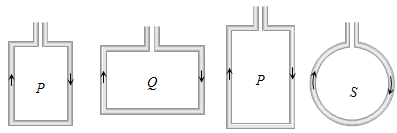
- A
Couple on loop P will be the highest
- B
Couple on loop Q will be the highest
- C
Couple on loop R will be the highest
- ✓
Couple on loop S will be the highest
AnswerCorrect option: D. Couple on loop S will be the highest
(d) Couple on loop S will be the highest
View full question & answer→MCQ 1291 Mark
An electron moves with a constant speed v along a circle of radius r. Its magnetic moment will be (e is the electron's charge)
AnswerCorrect option: B. $\frac{1}{2} \mathrm{evr}$
(b) $\frac{1}{2} \mathrm{evr}$
View full question & answer→MCQ 1301 Mark
A current of 10 ampere is flowing in a wire of length 1.5 m. A force of 15 N acts on it when it is placed in a uniform magnetic field of 2 tesla. The angle between the magnetic field and the direction of the current is
MCQ 1311 Mark
A charged particle of mass m and charge q travels on a circular path of radius r that is perpendicular to a magnetic field B. The time taken by the particle to complete one revolution is
AnswerCorrect option: B. $\frac{2 \pi \mathrm{m}}{\mathrm{qB}}$
(b) $\frac{2 \pi \mathrm{m}}{\mathrm{qB}}$
View full question & answer→MCQ 1321 Mark
A moving coil galvanometer has N number of turns in a coil of effective area A, it carries a current I. The magnetic field B is radial. The torque acting on the coil is
- A
$N A^2 B^2 I$
- B
$N A B I^2$
- C
$N^2 ABI$
- ✓
View full question & answer→MCQ 1331 Mark
In a moving coil galvanometer, the deflection of the coil θ is related to the electrical current i by the relation
- A
- ✓
- C
i ∝ θ$^2$
- D
i ∝ $\sqrt θ$
View full question & answer→MCQ 1341 Mark
A moving coil sensitive galvanometer gives at once much more deflection. To control its speed of deflection
- A
A high resistance is to be connected across its terminals
- ✓
A magnet should be placed near the coil
- C
A small copper wire should be connected across its terminals
- D
The body of galvanometer should be earthed
AnswerCorrect option: B. A magnet should be placed near the coil
A magnet should be placed near the coil
View full question & answer→MCQ 1351 Mark
The deflection in a moving coil galvanometer is
- A
Directly proportional to the torsional constant
- ✓
Directly proportional to the number of turns in the coil
- C
Inversely proportional to the area of the coil
- D
Inversely proportional to the current flowing
AnswerCorrect option: B. Directly proportional to the number of turns in the coil
Directly proportional to the number of turns in the coil
View full question & answer→MCQ 1361 Mark
To make the field radial in a moving coil galvanometer
- A
The number of turns in the coil is increased
- B
Magnet is taken in the form of horse-shoe
- ✓
Poles are cylindrically cut
- D
Coil is wounded on aluminium frame
AnswerCorrect option: C. Poles are cylindrically cut
Poles are cylindrically cut
View full question & answer→MCQ 1371 Mark
The radius of a circular loop is r and a current i is flowing in it. The equivalent magnetic moment will be
- A
- B
- ✓
$i \pi r^2$
- D
$\frac{1}{r^2}$
AnswerCorrect option: C. $i \pi r^2$
(c) $i \pi r^2$
View full question & answer→MCQ 1381 Mark
3 A of current is flowing in a linear conductor having a length of 40 cm. The conductor is placed in a magnetic field of strength 500 gauss and makes an angle of 30° with the direction of the field. It experiences a force of magnitude
AnswerCorrect option: C. $3 \times 10^{-2}$ newton
(c) $3 \times 10^{-2}$ newton
View full question & answer→MCQ 1391 Mark
A circular coil of radius 4 cm has 50 turns. In this coil a current of 2 A is flowing. It is placed in a magnetic field of 0.1 webwe/m$^2$. The amount of work done in rotating it through 180° from its equilibrium position will be
View full question & answer→MCQ 1401 Mark
Two free parallel wires carrying currents in opposite direction
- A
- ✓
- C
Neither attract nor repel
- D
Get rotated to be perpendicular to each other
View full question & answer→MCQ 1411 Mark
A rectangular loop carrying a current i is situated near a long straight wire such that the wire is parallel to the one of the sides of the loop and is in the plane of the loop. If a steady current I is established in wire as shown in figure, the loop will
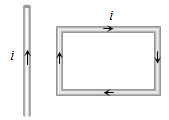
- A
Rotate about an axis parallel to the wire
- B
Move away from the wire or towards right
- ✓
- D
Answer(c) Move towards the wire
View full question & answer→MCQ 1421 Mark
A circular coil of radius 4 cm and of 20 turns carries a current of 3 amperes. It is placed in a magnetic field of intensity of 0.5 weber/m$^2$. The magnetic dipole moment of the coil is
- A
0.15 ampere$-$m$^2$
- ✓
0.3 ampere$-$m$^2$
- C
0.45 ampere$-$m$^2$
- D
0.6 ampere$-$m$^2$
AnswerCorrect option: B. 0.3 ampere$-$m$^2$
(b) 0.3 ampere$-$m$^2$
View full question & answer→MCQ 1431 Mark
A conducting circular loop of radius r carries a constant current i. It is placed in a uniform magnetic field $\vec B$, such that $\vec B$ is perpendicular to the plane of the loop. The magnetic force acting on the loop is
- A
ir$\vec B$
- B
2πri$\vec B$
- ✓
- D
πri$\vec B$
View full question & answer→MCQ 1441 Mark
Through two parallel wires A and B, 10 and 2 ampere of currents are passed respectively in opposite direction. If the wire A is infinitely long and the length of the wire B is 2 m, the force on the conductor B, which is situated at 10 cm distance from A will be
- ✓
$8\times 10^{-5}$N
- B
$8\times 10^{-6}$N
- C
$4\times 10^{-5}$N
- D
$4\pi \times 10^{-7}$N
AnswerCorrect option: A. $8\times 10^{-5}$N
(a) $8\times 10^{-5}$N
View full question & answer→MCQ 1451 Mark
If two streams of protons move parallel to each other in the same direction, then they
- A
Do not exert any force on each other
- ✓
- C
- D
Get rotated to be perpendicular to each other
View full question & answer→MCQ 1461 Mark
A straight wire carrying a current $i_1$ amp runs along the axis of a circular current $i_2$ amp. Then the force of interaction between the two current carrying conductors is
View full question & answer→MCQ 1471 Mark
Two parallel wires are carrying electric currents of equal magnitude and in the same direction. They exert
- ✓
An attractive force on each other
- B
A repulsive force on each other
- C
- D
A rotational torque on each other
AnswerCorrect option: A. An attractive force on each other
An attractive force on each other
View full question & answer→MCQ 1481 Mark
Two long and parallel wires are at a distance of 0.1 m and a current of 5 A is flowing in each of these wires. The force per unit length due to these wires will be
- ✓
$5\times 10^{-5}$N/m
- B
$5\times 10^{-3}$N/m
- C
$2.5\times 10^{-5}$N/m
- D
$2.5\times 10^{-4}$N/m
AnswerCorrect option: A. $5\times 10^{-5}$N/m
(a) $5\times 10^{-5}$N/m
View full question & answer→MCQ 1491 Mark
Two straight parallel wires, both carrying 10 ampere in the same direction attract each other with a force of $1\times 10^{-3}$N. If both currents are doubled, the force of attraction will be
- A
$ 1\times 10^{-3}$N
- B
$2 \times 10^{-3}$N
- ✓
$ 4 \times 10^{-3}$N
- D
$ 0.25 \times 10^{-3}$N
AnswerCorrect option: C. $ 4 \times 10^{-3}$N
(c)$ 4\times 10^{-3}$N
View full question & answer→MCQ 1501 Mark
An electron (mass = $9.1\times 10^{-19}$ kg; charge = $1.6 \times 10^{-19}$ C) experiences no deflection if subjected to an electric field of $3.2 \times 10^{5}$ V/m, and a magnetic fields of $2.0 \times 10^{-3}$ Wb/m$^2$. Both the fields are normal to the path of electron and to each other. If the electric field is removed, then the electron will revolve in an orbit of radius
View full question & answer→MCQ 1511 Mark
An electric field of $1500 V / m$ and a magnetic field of $0.40$ weber / meter$^2$ act on a moving electron. The minimum uniform speed along a straight line the electron could have is
- A
$ 1.6 \times 10^{15} \mathrm{~m} / \mathrm{s} $
- B
$ 6 \times 10^{-16} \mathrm{~m} / \mathrm{s} $
- ✓
$ 3.75 \times 10^3 \mathrm{~m} / \mathrm{s} $
- D
$ 3.75 \times 10^2 \mathrm{~m} / \mathrm{s}$
AnswerCorrect option: C. $ 3.75 \times 10^3 \mathrm{~m} / \mathrm{s} $
$ 3.75 \times 10^3 \mathrm{~m} / \mathrm{s} $
View full question & answer→MCQ 1521 Mark
The electron in the beam of a television tube move horizontally from south to north. The vertical component of the earth's magnetic field points down. The electron is deflected towards
MCQ 1531 Mark
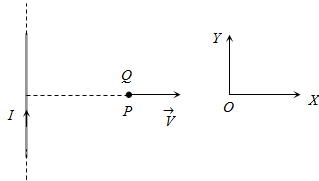
A very long straight wire carries a current I. At the instant when a charge +Q at point P has velocity $\overrightarrow V$, as shown, the force on the charge is
View full question & answer→MCQ 1541 Mark
A particle of mass 0.6 g and having charge of 25 nC is moving horizontally with a uniform velocity $1.2\times 10^4$ ms$^{-1}$ in a uniform magnetic field, then the value of the magnetic induction is (g = 10 ms$^{-2}$)
View full question & answer→MCQ 1551 Mark
A electron $(q = 1.6 \times 10^{-19}C)$ is moving at right angle to the uniform magnetic field $3.534 \times 10^{-5}T$. The time taken by the electron to complete a circular orbit is
- A
$2 \ ms$
- B
$4 \ ms$
- C
$3 \ ms$
- ✓
$1 \ ms$
AnswerCorrect option: D. $1 \ ms$
$1 \ ms$
View full question & answer→MCQ 1561 Mark
A very high magnetic field is applied to a stationary charge. Then the charge experiences
- A
A force in the direction of magnetic field
- B
A force perpendicular to the magnetic field
- C
A force in an arbitrary direction
- ✓
View full question & answer→MCQ 1571 Mark
An electron is projected along the axis of a circular conductor carrying some current. Electron will experience force
MCQ 1581 Mark
An electron moving with a uniform velocity along the positive x-direction enters a magnetic field directed along the positive y-direction. The force on the electron is directed along
MCQ 1591 Mark
An electron, a proton, a deuteron and an alpha particle, each having the same speed are in a region of constant magnetic field perpendicular to the direction of the velocities of the particles. The radius of the circular orbits of these particles are respectively $R_e, R_p, R_d$ and R$\alpha$. It follows that
- A
$R_e=R_p$
- B
$R_p=R_d$
- ✓
$R_d=R_\alpha$
- D
$R_p=R_\alpha$
AnswerCorrect option: C. $R_d=R_\alpha$
(c) $R_d=R_\alpha$
View full question & answer→MCQ 1601 Mark
A proton of energy 8 eV is moving in a circular path in a uniform magnetic field. The energy of an alpha particle moving in the same magnetic field and along the same path will be
MCQ 1611 Mark
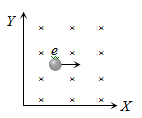
In the given figure, the electron enters into the magnetic field. It deflects in ...... direction
MCQ 1621 Mark
The cyclotron frequency of an electron grating in a magnetic field of 1 T is approximately
MCQ 1631 Mark
Electrons move at right angles to a magnetic field of $1.5 \times 10^{-2}$ Tesla with a speed of $6 \times 10^7 \mathrm{~m} / \mathrm{s}$. If the specific charge of the electron is $1.7 \times 10^{11} \mathrm{C} / \mathrm{kg}$. The radius of the circular path will be
View full question & answer→MCQ 1641 Mark
An electron is travelling along the x-direction. It encounters a magnetic field in the y-direction. Its subsequent motion will be
- A
Straight line along the x-direction
- ✓
- C
- D
View full question & answer→MCQ 1651 Mark
Two ions having masses in the ratio 1 : 1 and charges 1 : 2 are projected into uniform magnetic field perpendicular to the field with speeds in the ratio 2 : 3. The ratio of the radii of circular paths along which the two particles move is
MCQ 1661 Mark
A particle of charge $ -16 \times 10^{-8}$ coulomb moving with velocity 10 ms$^{-1}$ along the x-axis enters a region where a magnetic field of induction B is along the y-axis, and an electric field of magnitude $10^4$V/m is along the negative z-axis. If the charged particle continues moving along the x-axis, the magnitude of B is
- A
$10^{-3}$wb/m$^2$
- ✓
$10^{3}$wb/m$^2$
- C
$10^{5}$wb/m$^2$
- D
$10^{16}$wb/m$^2$
AnswerCorrect option: B. $10^{3}$wb/m$^2$
(b) $10^{3}$wb/m$^2$
View full question & answer→MCQ 1671 Mark
A particle of mass M and charge Q moving with velocity $\vec{v}$ describes a circular path of radius R when subjected to a uniform transverse magnetic field of induction B. The work done by the field when the particle completes one full circle is
View full question & answer→MCQ 1681 Mark
A charged particle is released from rest in a region of steady uniform electric and magnetic fields which are parallel to each other the particle will move in a
MCQ 1691 Mark
An electron enters a region where electrostatic field is 20N/C and magnetic field is 5T. If electron passes undeflected through the region, then velocity of electron will be
- A
$0.25$ms$^{-1}$
- B
$2$ms$^{-1}$
- ✓
$4$ms$^{-1}$
- D
$8$ms$^{-1}$
AnswerCorrect option: C. $4$ms$^{-1}$
(c) $4$ms$^{-1}$
View full question & answer→MCQ 1701 Mark
An electron $($mass $=9 \times 10^{-31} \mathrm{~kg}$. Charge $=1.6 \times 10^{-19} \mathrm{C}$ ) whose kinetic energy is $7.2 \times 10^{-18}$ joule is moving in a circular orbit in a magnetic field of $9 \times 10^{-5} \mathrm{weber} / \mathrm{m}^2$. The radius of the orbit is
- A
$1.25 \ cm$
- B
$2.5 \ cm$
- C
$12.5 \ cm$
- ✓
$25.0 \ cm$
AnswerCorrect option: D. $25.0 \ cm$
$25.0 \ cm$
View full question & answer→MCQ 1711 Mark
Mixed $He^+$ and $O^{2+}$ ions (mass of $He^+ =4$ amu and that of $O^{2+}=16$ amu ) beam passes a region of constant perpendicular magnetic field. If kinetic energy of all the ions is same then
AnswerCorrect option: C. All the ions will be deflected equally
(c) All the ions will be deflected equally
View full question & answer→MCQ 1721 Mark
Which particles will have minimum frequency of revolution when projected with the same velocity perpendicular to a magnetic field
- ✓
$\mathrm{Li}^{+}$
- B
- C
- D
$\mathrm{He}^{+}$
AnswerCorrect option: A. $\mathrm{Li}^{+}$
(a) $\mathrm{Li}^{+}$
View full question & answer→MCQ 1731 Mark
At a specific instant emission of radioactive compound is deflected in a magnetic field. The compound can emit
(i) Electrons (ii) Protons (iii) $\mathrm{He}^{2+}$ (iv) Neutrons
The emission at the instant can be
View full question & answer→MCQ 1741 Mark
If cathode rays are projected at right angles to a magnetic field, their trajectory is
MCQ 1751 Mark
When a charged particle enters a uniform magnetic field its kinetic energy
MCQ 1761 Mark
Motion of a moving electron is not affected by
- A
An electric field applied in the direction of motion
- ✓
Magnetic field applied in the direction of motion
- C
Electric field applied perpendicular to the direction of motion
- D
Magnetic field applied perpendicular to the direction of motion
AnswerCorrect option: B. Magnetic field applied in the direction of motion
Magnetic field applied in the direction of motion
View full question & answer→MCQ 1771 Mark
An α particle and a proton travel with same velocity in a magnetic field perpendicular to the direction of their velocities, find the ratio of the radii of their circular path
MCQ 1781 Mark
A proton of energy 200 MeV enters the magnetic field of 5 T. If direction of field is from south to north and motion is upward, the force acting on it will be
- A
- ✓
$1.6 \times 10^{-10}$ N
- C
$3.2 \times 10^{-8}$ N
- D
$1.6 \times 10^{-6}$ N
AnswerCorrect option: B. $1.6 \times 10^{-10}$ N
(b) $1.6 \times 10^{-10}$ N
View full question & answer→MCQ 1791 Mark
A proton and an alpha particle are separately projected in a region where a uniform magnetic field exists. Their initial velocities are perpendicular to direction of magnetic field. If both the particles move around magnetic field in circles of equal radii, the ratio of momentum of proton to alpha particle $\left(\frac{\mathrm{p}_{\mathrm{p}}}{\mathrm{p}_\alpha}\right)$ is
- A
- ✓
$\frac{1}{2}$
- C
- D
$\frac{1}{4}$
AnswerCorrect option: B. $\frac{1}{2}$
(b) $\frac{1}{2}$
View full question & answer→MCQ 1801 Mark
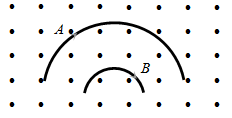
Two particles A and B of masses $m_{A}$ and $m_{B}$ respectively and having the same charge are moving in a plane. A uniform magnetic field exists perpendicular to this plane. The speeds of the particles are $v_A$ and $v_B$ respectively, and the trajectories are as shown in the figure. Then
AnswerCorrect option: B. $m_A v_A > m_B v_B$
(b) $m_A v_A > m_B v_B$
View full question & answer→MCQ 1811 Mark
Cyclotron is used to accelerate
MCQ 1821 Mark
The radius of circular path of an electron when subjected to a perpendicular magnetic field is
- ✓
$\frac{mv}{Be}$
- B
$\frac{me}{Be}$
- C
$\frac{mE}{Be}$
- D
$\frac{Be}{mv}$
AnswerCorrect option: A. $\frac{mv}{Be}$
(a) $\frac{mv}{Be}$
View full question & answer→MCQ 1831 Mark
A homogeneous electric field E and a uniform magnetic field $\vec{B}$ are pointing in the same direction. A proton is projected with its velocity parallel to $\vec{E}$. It will
- ✓
Go on moving in the same direction with increasing velocity
- B
Go on moving in the same direction with constant velocity
- C
- D
AnswerCorrect option: A. Go on moving in the same direction with increasing velocity
(a) Go on moving in the same direction with increasing velocity
View full question & answer→MCQ 1841 Mark
An electron (charge q coulomb) enters a magnetic field of Hweber/$\mathrm{m}^2$ with a velocity of vm/s in the same direction as that of the field the force on the electron is
- A
Hqv Newton’s in the direction of the magnetic field
- B
Hqv dynes in the direction of the magnetic field
- C
Hqv Newton’s at right angles to the direction of the magnetic field
- ✓
View full question & answer→MCQ 1851 Mark
An electron moving towards the east enters a magnetic field directed towards the north. The force on the electron will be directed
MCQ 1861 Mark
A particle of mass m and charge q enters a magnetic field B perpendicularly with a velocity v, The radius of the circular path described by it will be
MCQ 1871 Mark
If an electron enters a magnetic field with its velocity pointing in the same direction as the magnetic field, then
- A
The electron will turn to its right
- B
The electron will turn to its left
- C
The velocity of the electron will increase
- ✓
The velocity of the electron will remain unchanged
AnswerCorrect option: D. The velocity of the electron will remain unchanged
The velocity of the electron will remain unchanged
View full question & answer→MCQ 1881 Mark
An electron of mass m and charge q is travelling with a speed v along a circular path of radius r at right angles to a uniform of magnetic field B. If speed of the electron is doubled and the magnetic field is halved, then resulting path would have a radius of
- A
$\frac {r}{4}$
- B
$\frac {r}{2}$
- C
- ✓
View full question & answer→MCQ 1891 Mark
A charge of 1C is moving in a magnetic field of 0.5Tesla with a velocity of 10m/sec Perpendicular to the field. Force experienced is
MCQ 1901 Mark
An electron is travelling in east direction and a magnetic field is applied in upward direction then electron will deflect in
MCQ 1911 Mark
A charge q is moving in a magnetic field then the magnetic force does not depend upon
MCQ 1921 Mark
A proton moving with a velocity, $2.5 \times 10^7 \mathrm{~m} / \mathrm{s}$ , enters a magnetic field of intensity 2.5T making an angle 30° with the magnetic field. The force on the proton is
- A
$3 \times 10^{-12} \mathrm{~N}$
- ✓
$5 \times 10^{-12} \mathrm{~N}$
- C
$6 \times 10^{-12} \mathrm{~N}$
- D
$9 \times 10^{-12} \mathrm{~N}$
AnswerCorrect option: B. $5 \times 10^{-12} \mathrm{~N}$
(b) $5 \times 10^{-12} \mathrm{~N}$
View full question & answer→MCQ 1931 Mark
A charged particle is moving in a uniform magnetic field in a circular path. Radius of circular path is R. When energy of particle is doubled, then new radius will be
- ✓
$\mathrm{R} \sqrt{2}$
- B
$\mathrm{R} \sqrt{3}$
- C
- D
AnswerCorrect option: A. $\mathrm{R} \sqrt{2}$
(a) $\mathrm{R} \sqrt{2}$
View full question & answer→MCQ 1941 Mark
In a cyclotron, the angular frequency of a charged particle is independent of
MCQ 1951 Mark
One proton beam enters a magnetic field of $10^{-4}$ T normally, Specific charge = $10^{11}$C/kg. velocity = $10^7$m/s. What is the radius of the circle described by it
View full question & answer→MCQ 1961 Mark
A particle is moving in a uniform magnetic field, then
- ✓
Its momentum changes but total energy remains the same
- B
Both momentum and total energy remain the same
- C
- D
Total energy changes but momentum remains the same
AnswerCorrect option: A. Its momentum changes but total energy remains the same
Its momentum changes but total energy remains the same
View full question & answer→MCQ 1971 Mark
A particle moving in a magnetic field increases its velocity, then its radius of the circle
MCQ 1981 Mark
A positively charged particle moving due east enters a region of uniform magnetic field directed vertically upwards. The particle will
- A
Get deflected vertically upwards
- B
Move in a circular orbit with its speed increased
- ✓
Move in a circular orbit with its speed unchanged
- D
Continue to move due east
AnswerCorrect option: C. Move in a circular orbit with its speed unchanged
Move in a circular orbit with its speed unchanged
View full question & answer→MCQ 1991 Mark
An electron and a proton with equal momentum enter perpendicularly into a uniform magnetic field, then
- A
The path of proton shall be more curved than that of electron
- B
The path of proton shall be less curved than that of electron
- ✓
- D
Path of both will be straight line
View full question & answer→MCQ 2001 Mark
A charge moving with velocity v in X-direction is subjected to a field of magnetic induction in the negative X-direction. As a result, the charge will
- ✓
- B
Start moving in a circular path Y-Z plane
- C
- D
Move along a helical path around X-axis
View full question & answer→MCQ 2011 Mark
An electron enters a region where magnetic (B) and electric (E) fields are mutually perpendicular to one another, then
- A
It will always move in the direction of B
- B
It will always move in the direction of E
- C
It always possess circular motion
- ✓
It can go undeflected also
AnswerCorrect option: D. It can go undeflected also
It can go undeflected also
View full question & answer→MCQ 2021 Mark
A proton and a deutron both having the same kinetic energy, enter perpendicularly into a uniform magnetic field B. For motion of proton and deutron on circular path of radius $R_p$ and $R_d$ respectively, the correct statement is
- ✓
$R_d=\sqrt{2} R_p$
- B
$R_d=R_p / \sqrt{2}$
- C
$R_d=R_p$
- D
$R_d=2R_p$
AnswerCorrect option: A. $R_d=\sqrt{2} R_p$
(a) $R_d=\sqrt{2} R_p$
View full question & answer→MCQ 2031 Mark
A proton of mass $1.67\times 10^{-27}$ kg and charge $1.6 \times 10^{-19}$C is projected with a speed of $ 2\times 10^6$ C m/s at an angle of 60° to the X - axis. If a uniform magnetic field of 0.104 Tesla is applied along Y - axis, the path of proton is
- A
A circle of radius = 0.2 m and time period $\pi\times 10^{-7}$ s
- B
A circle of radius = 0.1 m and time period $2\pi\times 10^{-7}$ s
- ✓
A helix of radius = 0.1 m and time period $2\pi\times 10^{-7}$ s
- D
A helix of radius = 0.2 m and time period $4\pi\times 10^{-7}$ s
AnswerCorrect option: C. A helix of radius = 0.1 m and time period $2\pi\times 10^{-7}$ s
(c)A helix of radius = 0.1 m and time period $2\pi\times 10^{-7}$ s
View full question & answer→MCQ 2041 Mark
A charge moves in a circle perpendicular to a magnetic field. The time period of revolution is independent of
MCQ 2051 Mark
When a magnetic field is applied in a direction perpendicular to the direction of cathode rays, then their
- A
- B
- C
- ✓
Momentum and energy remain unchanged
AnswerCorrect option: D. Momentum and energy remain unchanged
Momentum and energy remain unchanged
View full question & answer→MCQ 2061 Mark
A proton, a deuteron and an α - particle having the same kinetic energy are moving in circular trajectories in a constant magnetic field. If $r_p,r_d$ and $r_{\alpha}$ denote respectively the radii of the trajectories of these particles, then
- ✓
$r_{\alpha}=r_p<r_d$
- B
$r_{\alpha}>r_p>r_d$
- C
$r_{\alpha}=r_p>r_d$
- D
$r_p=r_d=r_{\alpha}$
AnswerCorrect option: A. $r_{\alpha}=r_p<r_d$
(a) $r_{\alpha}=r_p<r_d$
View full question & answer→MCQ 2071 Mark
A moving charge will gain energy due to the application of
MCQ 2081 Mark
An electron is moving along positive x-axis. To get it moving on an anticlockwise circular path in x-y plane, a magnetic filed is applied
MCQ 2091 Mark
A charged particle moves in a uniform magnetic field. The velocity of the particle at some instant makes an acute angle with the magnetic field. The path of the particle will be
- A
- B
- ✓
A helix with uniform pitch
- D
A helix with non-uniform pitch
AnswerCorrect option: C. A helix with uniform pitch
A helix with uniform pitch
View full question & answer→MCQ 2101 Mark
An electron and a proton enter a magnetic field perpendicularly. Both have same kinetic energy. Which of the following is true
- A
Trajectory of electron is less curved
- ✓
Trajectory of proton is less curved
- C
Both trajectories are equally curved
- D
Both move on straight-line path
AnswerCorrect option: B. Trajectory of proton is less curved
Trajectory of proton is less curved
View full question & answer→MCQ 2111 Mark
A charged particle is moving with velocity v in a magnetic field of induction B. The force on the particle will be maximum when
- A
v and B are in the same direction
- B
v and B are in opposite directions
- ✓
v and B are perpendicular
- D
v and B are at an angle of 45°
AnswerCorrect option: C. v and B are perpendicular
v and B are perpendicular
View full question & answer→MCQ 2121 Mark
A particle of charge q and mass m moving with a velocity v along the x-axis enters the region x > 0 with uniform magnetic field B along the $\hat k$ direction. The particle will penetrate in this region in the x-direction upto a distance d equal to
AnswerCorrect option: B. $\frac{\mathrm{mv}}{\mathrm{qB}}$
(b) $\frac{\mathrm{mv}}{\mathrm{qB}}$
View full question & answer→MCQ 2131 Mark
A particle with $10^{-11}$ coulomb of charge and $10^{-7}$ kg mass is moving with a velocity of $10^8$ m/s along the y-axis. A uniform static magnetic field B = 0.5 Tesla is acting along the x-direction. The force on the particle is
- A
$5 \times 10^{-11} \mathrm{~N}$ along $ \mathrm{\hat{I}}$
- B
$5 \times 10^{3} \mathrm{~N}$ along $ \mathrm{\hat{k}}$
- C
$5 \times 10^{-11} \mathrm{~N}$ along $ \mathrm{\hat{-J}}$
- ✓
$5 \times 10^{-4} \mathrm{~N}$ along $ \mathrm{\hat{-k}}$
AnswerCorrect option: D. $5 \times 10^{-4} \mathrm{~N}$ along $ \mathrm{\hat{-k}}$
(d) $5 \times 10^{-4} \mathrm{~N}$ along $ \mathrm{\hat{-k}}$
View full question & answer→MCQ 2141 Mark
The charge on a particle Y is double the charge on particle X. These two particles X and Y after being accelerated through the same potential difference enter a region of uniform magnetic field and describe circular paths of radii $R_1$ and $R_2$ respectively. The ratio of the mass of X to that of Y is
- A
$\left(\frac{2 \mathrm{R}_1}{\mathrm{R}_2}\right)^2$
- B
$\left(\frac{R_1}{2 R_2}\right)^2$
- ✓
$\frac{R_1{ }^2}{2 R_2{ }^2}$
- D
$\frac{2 R_1}{R_2}$
AnswerCorrect option: C. $\frac{R_1{ }^2}{2 R_2{ }^2}$
(c) $\frac{R_1{ }^2}{2 R_2{ }^2}$
View full question & answer→MCQ 2151 Mark
An electron is accelerated by a potential difference of 12000 volts. It then enters a uniform magnetic field of $10^{-3} \mathrm{~T}$ applied perpendicular to the path of electron. Find the radius of path. Given mass of electron = $9 \times 10^{-31} \mathrm{~kg}$ and charge on electron = $1.6 \times 10^{-19} \mathrm{C}$
View full question & answer→MCQ 2161 Mark
A charged particle of mass m and charge q describes circular motion of radius r in a uniform magnetic field of strength B. The frequency of revolution is
- ✓
$\frac{\mathrm{Bq}}{2 \pi \mathrm{m}}$
- B
$\frac{\mathrm{Bq}}{2 \pi \mathrm{rm}}$
- C
$\frac{2 \pi \mathrm{m}}{\mathrm{Bq}}$
- D
$\frac{\mathrm{Bm}}{2 \pi \mathrm{q}}$
AnswerCorrect option: A. $\frac{\mathrm{Bq}}{2 \pi \mathrm{m}}$
(a) $\frac{\mathrm{Bq}}{2 \pi \mathrm{m}}$
View full question & answer→MCQ 2171 Mark
A current carrying long solenoid is placed on the ground with its axis vertical. A proton is falling along the axis of the solenoid with a velocity v. When the proton enters into the solenoid, it will
- A
Be deflected from its path
- B
Be accelerated along the same path
- C
Be decelerated along the same path
- ✓
Move along the same path with no change in velocity
AnswerCorrect option: D. Move along the same path with no change in velocity
Move along the same path with no change in velocity
View full question & answer→MCQ 2181 Mark
An electron is moving in the north direction. It experiences a force in vertically upward direction. The magnetic field at the position of the electron is in the direction of
MCQ 2191 Mark
An electron enters a magnetic field whose direction is perpendicular to the velocity of the electron. Then
- A
The speed of the electron will increase
- B
The speed of the electron will decrease
- ✓
The speed of the electron will remain the same
- D
The velocity of the electron will remain the same
AnswerCorrect option: C. The speed of the electron will remain the same
The speed of the electron will remain the same
View full question & answer→MCQ 2201 Mark
A beam of well collimated cathode rays travelling with a speed of $5 \times 10^6 \mathrm{~ms}^{-1}$ enter a region of mutually perpendicular electric and magnetic fields and emerge undeviated from this region. If |B| = 0.02T, the magnitude of the electric field is
- ✓
$10^5 \mathrm{Vm}^{-1}$
- B
$2.5 \times 10^8 \mathrm{Vm}^{-1}$
- C
$1.25 \times 10^{10} \mathrm{Vm}^{-1}$
- D
$2 \times 10^3 \mathrm{Vm}^{-1}$
AnswerCorrect option: A. $10^5 \mathrm{Vm}^{-1}$
(a) $10^5 \mathrm{Vm}^{-1}$
View full question & answer→MCQ 2211 Mark
n electron is moving on a circular path of radius r with speed v in a transverse magnetic field B. e/m for it will be
- ✓
$\frac{v}{B r}$
- B
$\frac{B}{r v}$
- C
- D
$\frac{vr}{B}$
AnswerCorrect option: A. $\frac{v}{B r}$
(a) $\frac{v}{B r}$
View full question & answer→MCQ 2221 Mark
A charge +Q is moving upwards vertically. It enters a magnetic field directed to the north. The force on the charge will be towards
MCQ 2231 Mark
The path executed by a charged particle whose motion is perpendicular to magnetic field i
MCQ 2241 Mark
A proton and an electron both moving with the same velocity v enter into a region of magnetic field directed perpendicular to the velocity of the particles. They will now move in circular orbits such that
- A
Their time periods will be same
- ✓
The time period for proton will be higher
- C
The time period for electron will be higher
- D
Their orbital radii will be same
AnswerCorrect option: B. The time period for proton will be higher
The time period for proton will be higher
View full question & answer→MCQ 2251 Mark
A proton (or charged particle) moving with velocity v is acted upon by electric field E and magnetic field B. The proton will move undeflected if
AnswerCorrect option: C. E, B and v are mutually perpendicular and $V=\frac{E}{B}$
(c) E, B and v are mutually perpendicular and $V=\frac{E}{B}$
View full question & answer→MCQ 2261 Mark
A 2 MeV proton is moving perpendicular to a uniform magnetic field of 2.5 tesla. The force on the proton is
- A
$2.5\times 10^{-10}$ N
- B
$7.6 \times 10^{-10}$ N
- C
$2.5 \times 10^{-10}$ N
- ✓
$7.6 \times 10^{-10}$ N
AnswerCorrect option: D. $7.6 \times 10^{-10}$ N
(d) $7.6 \times 10^{-10}$ N
View full question & answer→MCQ 2271 Mark
An electron and a proton enter region of uniform magnetic field in a direction at right angles to the field with the same kinetic energy. They describe circular paths of radius $r_e$ and $r_p$ respectively. Then
AnswerCorrect option: B. $r_e<r_p$
(b) $r_e<r_p$
View full question & answer→MCQ 2281 Mark
A proton is moving along Z-axis in a magnetic field. The magnetic field is along X-axis. The proton will experience a force along
MCQ 2291 Mark
Which of the following statement is true
- A
The presence of a large magnetic flux through a coil maintains a current in the coil if the circuit is continuous
- B
A coil of a metal wire kept stationary in a non-uniform magnetic field has an e.m.f. induced in it
- C
A charged particle enters a region of uniform magnetic field at an angle of 85° to the magnetic lines of force;the path of the particle is a circle
- ✓
There is no change in the energy of a charged particle moving in a magnetic field although a magnetic force is acting on it
AnswerCorrect option: D. There is no change in the energy of a charged particle moving in a magnetic field although a magnetic force is acting on it
There is no change in the energy of a charged particle moving in a magnetic field although a magnetic force is acting on it
View full question & answer→MCQ 2301 Mark
A proton enters a magnetic field of flux density 1.5 weber/m$^2$ with a velocity of $2\times 10^7$ m/sec at an angle of 30° with the field. The force on the proton will be
AnswerCorrect option: A. $2.4\times 10^{-12}$ N
(a) $2.4\times 10^{-12}$ N
View full question & answer→MCQ 2311 Mark
- A
Always exerts a force on a charged particle
- B
Never exerts a force on a charged particle
- ✓
Exerts a force, if the charged particle is moving across the magnetic field lines
- D
Exerts a force, if the charged particle is moving along the magnetic field lines
AnswerCorrect option: C. Exerts a force, if the charged particle is moving across the magnetic field lines
Exerts a force, if the charged particle is moving across the magnetic field lines
View full question & answer→MCQ 2321 Mark
An electron is travelling horizontally towards east. A magnetic field in vertically downward direction exerts a force on the electron along
MCQ 2331 Mark
If a proton is projected in a direction perpendicular to a uniform magnetic field with velocity v and an electron is projected along the lines of force, what will happen to proton and electron
- A
The electron will travel along a circle with constant speed and the proton will move along a straight line
- ✓
Proton will move in a circle with constant speed and there will be no effect on the motion of electron
- C
There will not be any effect on the motion of electron and proton
- D
The electron and proton both will follow the path of a parabola
AnswerCorrect option: B. Proton will move in a circle with constant speed and there will be no effect on the motion of electron
Proton will move in a circle with constant speed and there will be no effect on the motion of electron
View full question & answer→MCQ 2341 Mark
A uniform magnetic field acts at right angles to the direction of motion of electrons. As a result, the electron moves in a circular path of radius 2 cm. If the speed of the electrons is doubled, then the radius of the circular path will be
MCQ 2351 Mark
A uniform magnetic field B is acting from south to north and is of magnitude 1.5 wb/m$^2$. If a proton having mass = $1.7 \times 10^{-19}$ kg and charge = $1.6 \times 10^{-19}$ C moves in this field vertically downwards with energy 5 MeV, then the force acting on it will be
- A
$7.4\times 10^{12}$ N
- ✓
$7.4 \times 10^{-12}$ N
- C
$7.4 \times 10^{19}$ N
- D
$7.4 \times 10^{-19}$ N
AnswerCorrect option: B. $7.4 \times 10^{-12}$ N
(b) $7.4 \times 10^{-12}$ N
View full question & answer→MCQ 2361 Mark
An α- particle travels in a circular path of radius 0.45 m in a magnetic field B = 1.2 Wb/m$^2$ with a speed of $2.6\times 10^7$ m/sec. The period of revolution of the α - particle is
- A
$1.1 \times 10^{-5}$ sec
- B
$1.1 \times 10^{-6}$ sec
- ✓
$1.1 \times 10^{-7}$ sec
- D
$1.1 \times 10^{-8}$ sec
AnswerCorrect option: C. $1.1 \times 10^{-7}$ sec
(c) $1.1 \times 10^{-7}$ sec
View full question & answer→MCQ 2371 Mark
A proton and an α - particle enter a uniform magnetic field perpendicularly with the same speed. If proton takes 25 μ sec to make 5 revolutions, then the periodic time for the α - particle would be
MCQ 2381 Mark
An electron is moving with a speed of $10^8 \mathrm{~m} / \mathrm{sec}$ perpendicular to a uniform magnetic field of intensity B. Suddenly intensity of the magnetic field is reduced to B/2. The radius of the path becomes from the original value of r
View full question & answer→MCQ 2391 Mark
A uniform electric field and a uniform magnetic field are produced, pointed in the same direction. An electron is projected with its velocity pointing in the same direction
- A
The electron will turn to its right
- B
The electron will turn to its left
- C
The electron velocity will increase in magnitude
- ✓
The electron velocity will decrease in magnitude
AnswerCorrect option: D. The electron velocity will decrease in magnitude
The electron velocity will decrease in magnitude
View full question & answer→MCQ 2401 Mark
Two particles X and Y having equal charges, after being accelerated through the same potential difference, enter a region of uniform magnetic field and describes circular path of radius $R_1$ and $R_2$ respectively. The ratio of mass of X to that of Y is
AnswerCorrect option: C. $\left(\frac{R_1}{R_2}\right)^2$
(c) $\left(\frac{R_1}{R_2}\right)^2$
View full question & answer→MCQ 2411 Mark
A beam of ions with velocity $2\times 10^5$ m/s enters normally into a uniform magnetic field of $4\times 10^{-2}$ tesla. If the specific charge of the ion is $5\times 10^7$ C/kg , then the radius of the circular path described will be
View full question & answer→MCQ 2421 Mark
The radius of curvature of the path of the charged particle in a uniform magnetic field is directly proportional to
- A
The charge on the particle
- ✓
The momentum of the particle
- C
The energy of the particle
- D
The intensity of the field
AnswerCorrect option: B. The momentum of the particle
The momentum of the particle
View full question & answer→MCQ 2431 Mark
An electron has mass $ 9\times 10^{-31}$ kg and charge $1.6\times 10^{-19}$ C is moving with a velocity of $10^6$ m/s , enters a region where magnetic field exists. If it describes a circle of radius 0.10 m, the intensity of magnetic field must be
- A
$1.8\times 10^{-4}\ T$
- ✓
$ 5.6 \times 10^{-5}\ T$
- C
$14.4 \times 10^{-5}\ T$
- D
$1.3 \times 10^{-6}\ T$
AnswerCorrect option: B. $ 5.6 \times 10^{-5}\ T$
(b) $ 5.6 \times 10^{-5}\ T$
View full question & answer→MCQ 2441 Mark
A proton (mass m and charge +e) and an α - particle (mass 4m and charge +2e) are projected with the same kinetic energy at right angles to the uniform magnetic field. Which one of the following statements will be true
- A
The α - particle will be bent in a circular path with a small radius that for the proton
- B
The radius of the path of the α - particle will be greater than that of the proton
- ✓
The α - particle and the proton will be bent in a circular path with the same radius
- D
The α - particle and the proton will go through the field in a straight line
AnswerCorrect option: C. The α - particle and the proton will be bent in a circular path with the same radius
The α - particle and the proton will be bent in a circular path with the same radius
View full question & answer→MCQ 2451 Mark
A charged particle moving in a magnetic field experiences a resultant force
- A
In the direction of field
- B
In the direction opposite to that field
- ✓
In the direction perpendicular to both the field and its velocity
- D
AnswerCorrect option: C. In the direction perpendicular to both the field and its velocity
In the direction perpendicular to both the field and its velocity
View full question & answer→MCQ 2461 Mark
If the direction of the initial velocity of the charged particle is neither along nor perpendicular to that of the magnetic field, then the orbit will be
MCQ 2471 Mark
Particles having positive charges occasionally come with high velocity from the sky towards the earth. On account of the magnetic field of earth, they would be deflected towards the
MCQ 2481 Mark
A wire in the form of a circular loop of one turn carrying a current produces a magnetic field B at the centre. If the same wire is looped into a coil of two turns and carries the same current, the new value of magnetic induction at the centre is
MCQ 2491 Mark
A current of 10A is passing through a long wire which has semicircular loop of the radius 20cm as shown in the figure. Magnetic field produced at the centre of the loop is
MCQ 2501 Mark
The magnetic field near a current carrying conductor is given by
MCQ 2511 Mark
A proton of mass m and charge +e is moving in a circular orbit in a magnetic field with energy 1 MeV. What should be the energy of α - particle (mass = 4m and charge = + 2e), so that it can revolve in the path of same radius
MCQ 2521 Mark
For the magnetic field to be maximum due to a small element of current carrying conductor at a point, the angle between the element and the line joining the element to the given point must be
MCQ 2531 Mark
Two long parallel wires P and Q are both perpendicular to the plane of the paper with distance 5 m between them. If P and Q carry current of 2.5 amp and 5 amp respectively in the same direction, then the magnetic field at a point half way between the wires is
AnswerCorrect option: D. $\frac{\sqrt{3 \mu_0}}{\pi}$
(d) $\frac{\sqrt{3 \mu_0}}{\pi}$
View full question & answer→MCQ 2541 Mark
A wire carrying current I and other carrying 2I in the same direction produces a magnetic field B at the mid point. What will be the field when 2I wire is switched off
MCQ 2551 Mark
Two concentric coils each of radius equal to 2π cm are placed at right angles to each other. 3 ampere and 4 ampere are the currents flowing in each coil respectively. The magnetic induction in $\mathrm{weber/m}^2$ at the centre of the coils will be $\left(\mu_0=4 \pi \times 10^{-7} \mathrm{wb} / \mathrm{A} . \mathrm{m}\right)$
- ✓
$5 \times 10^{-5}$
- B
$7 \times 10^{-5}$
- C
$12 \times 10^{-5}$
- D
$10^{-5}$
AnswerCorrect option: A. $5 \times 10^{-5}$
(a) $5 \times 10^{-5}$
View full question & answer→MCQ 2561 Mark
The field due to a long straight wire carrying a current I is proportional to
MCQ 2571 Mark
$20$ ampere current is flowing in a long straight wire. The intensity of magnetic field at a distance $10 \ cm$ from the wire will be
- ✓
$ 4 \times 10^{-5} \mathrm{~Wb} / \mathrm{m}^2 $
- B
$ 9 \times 10^{-5} \mathrm{~Wb} / \mathrm{m}^2 $
- C
$ 8 \times 10^{-5} \mathrm{~Wb} / \mathrm{m}^2 $
- D
$ 6 \times 10^{-5} \mathrm{~Wb} / \mathrm{m}^2$
AnswerCorrect option: A. $ 4 \times 10^{-5} \mathrm{~Wb} / \mathrm{m}^2 $
$ 4 \times 10^{-5} \mathrm{~Wb} / \mathrm{m}^2 $
View full question & answer→MCQ 2581 Mark
An electron is revolving round a proton, producing a magnetic field of $16 \text{ weber/m}^2$ in a circular orbit of radius $1 \mathring A$ . It’s angular velocity will be
- ✓
$10^{17} \mathrm{rad} / \mathrm{sec}$
- B
$1 / 2 \pi \times 10^{12} \mathrm{rad} / \mathrm{sec}$
- C
$2 \pi \times 10^{12} \mathrm{rad} / \mathrm{sec}$
- D
$1 / 2 \pi \times 14^{12} \mathrm{rad} / \mathrm{sec}$
AnswerCorrect option: A. $10^{17} \mathrm{rad} / \mathrm{sec}$
$10^{17} \mathrm{rad} / \mathrm{sec}$
View full question & answer→MCQ 2591 Mark
When the current flowing in a circular coil is doubled and the number of turns of the coil in it is halved, the magnetic field at its centre will become
MCQ 2601 Mark
Two wires of same length are shaped into a square and a circle. If they carry same current, ratio of the magnetic moment is
MCQ 2611 Mark
The current is flowing in south direction along a power line. The direction of magnetic field above the power line (neglecting earth's field) is
MCQ 2621 Mark
The magnetic field due to a current carrying circular loop of radius 3 cm at a point on the axis at a distance of 4 cm from the centre is 54 mT. What will be its value at the centre of the loop
MCQ 2631 Mark
A long wire carries a steady current. It is bent into a circle of one turn and the magnetic field at the centre of the coil is $B$. It is then bent into a circular loop of n turns. The magnetic field at the centre of the coil will be
- A
$nB$
- ✓
$n^2B$
- C
$2nB$
- D
$2n^2B$
AnswerCorrect option: B. $n^2B$
$n^2B$
View full question & answer→MCQ 2641 Mark
A current flows in a conductor from east to west. The direction of the magnetic field at a points above the conductor is .....
MCQ 2651 Mark
The magnetic moment of a current $(i)$ carrying circular coil of radius $(r)$ and number of turns $(n)$ varies as
- A
$1/ r^2$
- B
$1/ r$
- C
$r$
- ✓
$r^2$
View full question & answer→MCQ 2661 Mark
Two similar coils are kept mutually perpendicular such that their centres coincide. At the centre, find the ratio of the magnetic field due to one coil and the resultant magnetic field by both coils, if the same current is flown
- ✓
$1: \sqrt{2}$
- B
- C
- D
$\sqrt{3}: 1$
AnswerCorrect option: A. $1: \sqrt{2}$
(a) $1: \sqrt{2}$
View full question & answer→MCQ 2671 Mark
A coil having N turns carry a current I as shown in the figure. The magnetic field intensity at point P is
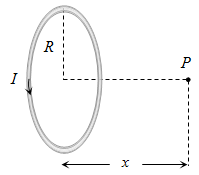
- ✓
$\frac{\mu_0 \text { NIR }^2}{2\left(R^2+x^2\right)^{3 / 2}}$
- B
$\frac{\mu_0 \mathrm{NI}}{2 \mathrm{R}}$
- C
$\frac{\mu_0 \text { NIR }^2}{(R+x)^2}$
- D
AnswerCorrect option: A. $\frac{\mu_0 \text { NIR }^2}{2\left(R^2+x^2\right)^{3 / 2}}$
(a) $\frac{\mu_0 \text { NIR }^2}{2\left(R^2+x^2\right)^{3 / 2}}$
View full question & answer→MCQ 2681 Mark
The earth’s magnetic field at a given point is $0.5\times 10^{-5}\ Wb-m^2$ . This field is to be annulled by magnetic induction at the center of a circular conducting loop of radius 5.0cm. The current required to be flown in the loop is nearly
View full question & answer→MCQ 2691 Mark
A long straight wire carrying current of $30A$ is placed in an external uniform magnetic field of induction $4 \times 10^{-4}$ T. The magnetic field is acting parallel to the direction of current. The magnitude of the resultant magnetic induction in tesla at a point $2.0 \ cm$ away from the wire is
- A
$ 10^{-4} $
- B
$ 3 \times 10^{-4} $
- ✓
$ 5 \times 10^{-4} $
- D
$ 6 \times 10^{-4}$
AnswerCorrect option: C. $ 5 \times 10^{-4} $
$ 5 \times 10^{-4} $
View full question & answer→MCQ 2701 Mark
A long solenoid carrying a current produces a magnetic field B along its axis. If the current is doubled and the number of turns per cm is halved, the new value of the magnetic field is
MCQ 2711 Mark
An electric current passes through a long straight wire. At a distance 5 cm from the wire, The magnetic field is B. The field at 20 cm from the wire would be
- A
$\frac{B}{6}$
- ✓
$\frac{B}{4}$
- C
$\frac{B}{3}$
- D
$\frac{B}{2}$
AnswerCorrect option: B. $\frac{B}{4}$
(b) $\frac{B}{4}$
View full question & answer→MCQ 2721 Mark
“On flowing current in a conducting wire the magnetic field produces around it.” It is a law of
MCQ 2731 Mark
A part of a long wire carrying a current i is bent into a circle of radius r as shown in figure. The net magnetic field at the centre O of the circular loop is
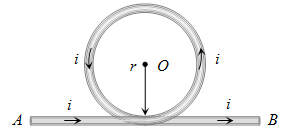
- A
$\frac{\mu_0 \mathrm{i}}{4 r}$
- B
$\frac{\mu_0 i}{2 \mathrm{r}}$
- ✓
$\frac{\mu_0 \mathrm{i}}{2 \pi \mathrm{r}}(\pi+1)$
- D
$\frac{\mu_0 \mathrm{i}}{2 \pi \mathrm{r}}(\pi-1)$
AnswerCorrect option: C. $\frac{\mu_0 \mathrm{i}}{2 \pi \mathrm{r}}(\pi+1)$
(c) $\frac{\mu_0 \mathrm{i}}{2 \pi \mathrm{r}}(\pi+1)$
View full question & answer→MCQ 2741 Mark
The ratio of the magnetic field at the centre of a current carrying coil of the radius a and at a distance ‘a’ from centre of the coil and perpendicular to the axis of coil is
- A
$\frac{1}{\sqrt 2}$
- B
$\sqrt 2$
- C
$\frac{1}{2\sqrt 2}$
- ✓
$2\sqrt 2$
AnswerCorrect option: D. $2\sqrt 2$
(d) $2\sqrt 2$
View full question & answer→MCQ 2751 Mark
On connecting a battery to the two corners of a diagonal of a square conductor frame of side a the magnitude of the magnetic field at the centre will be
MCQ 2761 Mark
Gauss is unit of which quantity
MCQ 2771 Mark
When a certain length of wire is turned into one circular loop, the magnetic induction at the centre of coil due to some current flowing is $B_1$ If the same wire is turned into three loops to make a circular coil, the magnetic induction at the center of this coil for the same current will be
- A
$B_1$
- ✓
$9B_1$
- C
$3B_1$
- D
$27B_1$
AnswerCorrect option: B. $9B_1$
(b) $9B_1$
View full question & answer→MCQ 2781 Mark
A long straight wire carries a current of π amp. The magnetic field due to it will be $5 \times 10^{-5} weber/ \mathrm{m}^2$ at what distance from the wire [$\mu_0=$ permeability of air]
AnswerCorrect option: A. $10^4 \mu_0$ metre
(a) $10^4 \mu_0$ metre
View full question & answer→MCQ 2791 Mark
Unit of magnetic permeability is
MCQ 2801 Mark
A magnetic field can be produced by
- A
- B
A changing electric field
- C
- ✓
View full question & answer→MCQ 2811 Mark
Two long straight wires are set parallel to each other. Each carries a current i in the same direction and the separation between them is 2r. The intensity of the magnetic field midway between them is
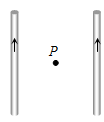
- A
$\mu_0 \mathrm{i} / \mathrm{r}$
- B
$4 \mu_0 \mathrm{i} / \mathrm{r}$
- ✓
- D
$\mu_0 \mathrm{i} / 4 \mathrm{r}$
View full question & answer→MCQ 2821 Mark
A wire carrying current i is shaped as shown. Section AB is a quarter circle of radius r. The magnetic field is directed
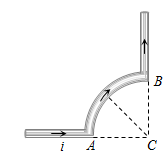
- A
At an angle π/4 to the plane of the paper
- ✓
Perpendicular to the plane of the paper and directed in to the paper
- C
Along the bisector of the angle ACB towards AB
- D
Along the bisector of the angle ACB away from AB
AnswerCorrect option: B. Perpendicular to the plane of the paper and directed in to the paper
(b) Perpendicular to the plane of the paper and directed in to the paper
View full question & answer→MCQ 2831 Mark
A long solenoid has n turns per meter and current I A is flowing through it. The magnetic field at the ends of the solenoid is
AnswerCorrect option: A. $\frac{\mu_0 \mathrm{nI}}{2}$
(a) $\frac{\mu_0 \mathrm{nI}}{2}$
View full question & answer→MCQ 2841 Mark
An electron moving in a circular orbit of radius r makes n rotation per second. The magnetic field produced at the centre has a magnitude of
- ✓
$\frac{\mu_0 n e}{2 \mathrm{r}}$
- B
$\frac{\mu_0 n^2 e}{2 r}$
- C
$\frac{\mu_0 n e}{2 \pi r}$
- D
AnswerCorrect option: A. $\frac{\mu_0 n e}{2 \mathrm{r}}$
(a) $\frac{\mu_0 n e}{2 \mathrm{r}}$
View full question & answer→MCQ 2851 Mark
A current of $0.1 A$ circulates around a coil of $100$ turns and having a radius equal to $5\ cm$. The magnetic field set up at the centre of the coil is $(m_0= 4π × 10^{-7}$ weber/amp-metre$)$
AnswerCorrect option: D. $4\pi \times 10^{-5}$ Tesla
$4\pi \times 10^{-5}$ Tesla
View full question & answer→MCQ 2861 Mark
What should be the current in a circular coil of radius 5cm to annul $\mathrm{B}_{\mathrm{H}}=5 \times 10^{-5} \mathrm{~T}$
View full question & answer→MCQ 2871 Mark
A wire in the form of a square of side ‘a’ carries a current i. Then the magnetic induction at the centre of the square wire is (Magnetic permeability of free space = $\mu_0$)
- A
$\frac{\mu_0 \mathrm{i}}{2 \pi a}$
- B
$\frac{\mu_0 \mathrm{i} \sqrt{2}}{\pi a}$
- ✓
$\frac{2 \sqrt{2} \mu_0 \mathrm{i}}{\pi a}$
- D
$\frac{\mu_0 \mathrm{i}}{\sqrt{2 \pi a}}$
AnswerCorrect option: C. $\frac{2 \sqrt{2} \mu_0 \mathrm{i}}{\pi a}$
(c) $\frac{2 \sqrt{2} \mu_0 \mathrm{i}}{\pi a}$
View full question & answer→MCQ 2881 Mark
Two infinitely long parallel wires carry equal current in same direction. The magnetic field at a mid point in between the two wires is
- A
Twice the magnetic field produced due to each of the wires
- B
Half of the magnetic field produced due to each of the wires
- C
Square of the magnetic field produced due to each of the wires
- ✓
View full question & answer→MCQ 2891 Mark
1A current flows through an infinitely long straight wire. The magnetic field produced at a point 1 metres away from it is
AnswerCorrect option: C. $2 \times 10^{-7}$ Tesla
(c) $2 \times 10^{-7}$ Tesla
View full question & answer→MCQ 2901 Mark
The magnetic field at the centre of a circular coil of radius r carrying current I is $B_1$. The field at the centre of another coil of radius 2 r carrying same current I is $B_2$. The ratio $\frac{B_1}{B_2}$ is
View full question & answer→MCQ 2911 Mark
The dimension of the magnetic field intensity B is
- A
MLT$^{-2}$A$^{-1}$
- ✓
MT$^{-2}$A$^{-1}$
- C
ML$^{2}$TA$^{-2}$
- D
M$^{2}$LT$^{-2}$A$^{-1}$
AnswerCorrect option: B. MT$^{-2}$A$^{-1}$
(b) MT$^{-2}$A$^{-1}$
View full question & answer→MCQ 2921 Mark
A closely wound flat circular coil of 25 turns of wire has diameter of 10 cm and carries a current of 4 ampere. Determine the flux density at the centre of a coil
- A
$1.679\times 10^{-5}$ Tesla
- B
$2.028 \times 10^{-4}$ Tesla
- ✓
$1.257 \times 10^{-3}$ Tesla
- D
$1.512 \times 10^{-6}$ Tesla
AnswerCorrect option: C. $1.257 \times 10^{-3}$ Tesla
(c) $1.257 \times 10^{-3}$ Tesla
View full question & answer→MCQ 2931 Mark
In a current carrying long solenoid, the field produced does not depend upon
- A
Number of turns per unit length
- B
- ✓
- D
View full question & answer→MCQ 2941 Mark
Magnetic fields at two points on the axis of a circular coil at a distance of 0.05m and 0.2m from the centre are in the ratio 8 : 1. The radius of the coil is
MCQ 2951 Mark
PQRS is a square loop made of uniform conducting wire the current enters the loop at P and leaves at S. Then the magnetic field will be
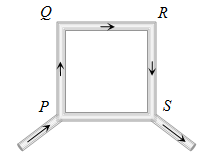
- A
Maximum at the centre of the loop
- ✓
Zero at the centre of loop
- C
Zero at all points inside the loop
- D
Zero at all points outside of the loop
AnswerCorrect option: B. Zero at the centre of loop
(b) Zero at the centre of loop
View full question & answer→MCQ 2961 Mark
Two concentric coplanar circular loops of radii $r_1$ and $r_2$ carry currents of respectively $i_1$ and $i_2$ in opposite directions (one clockwise and the other anticlockwise.) The magnetic induction at the centre of the loops is half that due to $i_1$ alone at the centre. If $r_2=2r_1$. the value of $i_2/i_1$ is
View full question & answer→MCQ 2971 Mark
A long solenoid has 200 turns per cm and carries a current of 2.5 amps. The magnetic field at its centre is($\mu_0=4 \pi \times 10^{-7}$ weber/amp-m)
- A
$3.14 \times 10^{-2}$ weber/m$^2$
- ✓
$6.28 \times 10^{-2}$ weber/m$^2$
- C
$9.42 \times 10^{-2}$ weber/m$^2$
- D
$12.56 \times 10^{-2}$ weber/m$^2$
AnswerCorrect option: B. $6.28 \times 10^{-2}$ weber/m$^2$
(b) $6.28 \times 10^{-2}$ weber/m$^2$
View full question & answer→MCQ 2981 Mark
A circular loop of radius 0.0157m carries a current of 2.0 amp. The magnetic field at the centre of the loop is ($\mu_0=4 \pi \times 10^{-7}$ weber/amp-m)
- A
$1.57 \times 10^{-5}$ weber/m$^2$
- ✓
$8.0 \times 10^{-5}$ weber/m$^2$
- C
$2.5 \times 10^{-5}$ weber/m$^2$
- D
$3.14 \times 10^{-5}$ weber/m$^2$
AnswerCorrect option: B. $8.0 \times 10^{-5}$ weber/m$^2$
(b) $8.0 \times 10^{-5}$ weber/m$^2$
View full question & answer→MCQ 2991 Mark
A long solenoid of length L has a mean diameter D. It has n layers of windings of N turns each. If it carries a current ‘i’ the magnetic field at its centre will be
- A
- B
Inversely proportional to D
- ✓
- D
View full question & answer→MCQ 3001 Mark
A straight wire carrying a current 10 A is bent into a semicircular arc of radius 5 cm. The magnitude of magnetic field at the center is
- A
$1.5 \times 10^{-5}T$
- B
$ 3.14 \times 10^{-5}T$
- ✓
$6.28 \times 10^{-5}T$
- D
$19.6 \times 10^{-5}T$
AnswerCorrect option: C. $6.28 \times 10^{-5}T$
(c) $6.28 \times 10^{-5}T$
View full question & answer→MCQ 3011 Mark
A long straight wire carries an electric current of 2A. The magnetic induction at a perpendicular distance of 5m from the wire is
- A
$4\times 10^{-8}T$
- ✓
$8\times 10^{-8}T$
- C
$12\times 10^{-8}T$
- D
$16\times 10^{-8}T$
AnswerCorrect option: B. $8\times 10^{-8}T$
(b) $8\times 10^{-8}T$
View full question & answer→MCQ 3021 Mark
A and B are two concentric circular conductors of centre O and carrying currents $i_1$ and $i_2$ as shown in the adjacent figure. If ratio of their radii is 1 : 2 and ratio of the flux densities at O due to A and B is 1 : 3, then the value of $i_1/i_2$ is
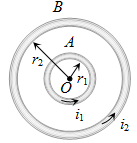
- ✓
$\frac{1}{6}$
- B
$\frac{1}{4}$
- C
$\frac{1}{3}$
- D
$\frac{1}{2}$
AnswerCorrect option: A. $\frac{1}{6}$
(a) $\frac{1}{6}$
View full question & answer→MCQ 3031 Mark
Magnetic field due to a ring having n turns at a distance x on its axis is proportional to (if r = radius of ring)
- A
$\frac{r}{\left(x^2+r^2\right)}$
- B
$\frac{r^2}{\left(x^2+r^2\right)^{3 / 2}}$
- ✓
$\frac{n r^2}{\left(x^2+r^2\right)^{3 / 2}}$
- D
$\frac{n^2 r^2}{\left(x^2+r^2\right)^{3 / 2}}$
AnswerCorrect option: C. $\frac{n r^2}{\left(x^2+r^2\right)^{3 / 2}}$
(c)$\frac{n r^2}{\left(x^2+r^2\right)^{3 / 2}}$
View full question & answer→MCQ 3041 Mark
A toroid has number of turns per unit length n, current i, then the magnetic field is
AnswerCorrect option: A. $\mu_0 \mathrm{ni}$
(a) $\mu_0 \mathrm{ni}$
View full question & answer→MCQ 3051 Mark
Which of the following gives the value of magnetic field according to, Biot-Savart’s law’
- A
$\frac{i \Delta \operatorname{lsin} \theta}{r^2}$
- B
$\frac{\mu_0}{4 \pi} \frac{i \Delta l \sin \theta}{r}$
- ✓
$\frac{\mu_0}{4 \pi} \frac{i \Delta l \sin \theta}{r^2}$
- D
$\frac{\mu_0}{4 \pi} \mathrm{i} \Delta l \sin \theta$
AnswerCorrect option: C. $\frac{\mu_0}{4 \pi} \frac{i \Delta l \sin \theta}{r^2}$
(c) $\frac{\mu_0}{4 \pi} \frac{i \Delta l \sin \theta}{r^2}$
View full question & answer→MCQ 3061 Mark
The magnetic induction in air at a point 1cm away from a long wire that carries a current of 1A, will be
- A
$1\times 10^{-5}T$
- ✓
$2\times 10^{-5}T$
- C
$3\times 10^{-5}T$
- D
$4\times 10^{-5}T$
AnswerCorrect option: B. $2\times 10^{-5}T$
(b) $2 \times 10^{-5}T$
View full question & answer→MCQ 3071 Mark
View full question & answer→MCQ 3081 Mark
A current carrying wire in the neighborhood produces
- A
- B
- ✓
- D
Electric and magnetic fields
View full question & answer→MCQ 3091 Mark
- A
$10^7$ gauss
- B
$10^{-4}$ gauss
- ✓
$10^4$ gauss
- D
$10^{-8}$ gauss
AnswerCorrect option: C. $10^4$ gauss
(c) $10^4$ gauss
View full question & answer→MCQ 3101 Mark
A straight wire of diameter 0.5 mm carrying a current of 1 A is replaced by another wire of 1 mm diameter carrying the same current. The strength of magnetic field far away is
- A
- B
Half of the earlier value
- C
Quarter of its earlier value
- ✓
View full question & answer→MCQ 3111 Mark
A current I flows along the length of an infinitely long, straight and thin-walled pipe. Then
- A
The magnetic field at all points inside the pipe is the same but not zero
- ✓
The magnetic field at any point inside the pipe is zero
- C
The magnetic field is zero only on the axis of the pipe
- D
The magnetic field is different at different points inside the pipe
AnswerCorrect option: B. The magnetic field at any point inside the pipe is zero
The magnetic field at any point inside the pipe is zero
View full question & answer→MCQ 3121 Mark
The magnetic field at a distance r from a long wire carrying current i is 0.4 Tesla. The magnetic field at a distance 2r is
MCQ 3131 Mark
A circular coil ‘A’ has a radius R and the current flowing through it is I. Another circular coil ‘B’ has a radius 2R and if 2I is the current flowing through it, then the magnetic fields at the centre of the circular coil are in the ratio of (i.e. $B_A$ to $B_B$ )
View full question & answer→MCQ 3141 Mark
Magnetic field intensity at the centre of coil of 50 turns, radius 0.5 m and carrying a current of 2 A is
- A
$0.5 \times 10^{-5}T$
- ✓
$1.25\times 10^{-4}T$
- C
$3\times 10^{-5}T$
- D
$4\times 10^{-5}T$
AnswerCorrect option: B. $1.25\times 10^{-4}T$
(b) $1.25\times 10^{-4}T$
View full question & answer→MCQ 3151 Mark
Magnetic field due to 0.1 A current flowing through a circular coil of radius 0.1 m and 1000 turns at the centre of the coil is
- A
$2\times 10^{-1}T$
- B
$4.31 \times 10^{-2}T$
- ✓
$6.28 \times 10^{-4}T$
- D
$9.81 \times 10^{-4}T$
AnswerCorrect option: C. $6.28 \times 10^{-4}T$
(c) $6.28 \times 10^{-4}T$
View full question & answer→MCQ 3161 Mark
The earth's magnetic induction at a certain point is $7 \times 10^{-5} \mathrm{~Wb} / \mathrm{m}^2$. This is to be annulled by the magnetic induction at the centre of a circular conducting loop of radius 5 cm. The required current in the loop is
View full question & answer→MCQ 3171 Mark
The magnetic moment of a current carrying loop is $2.1 \times 10^{-25} \mathrm{amp} \times \mathrm{m}^2$. The magnetic field at a point on its axis at a distance of 1 $A^0$ is
- ✓
$4.2 \times 10^{-2}$ weber $/ \mathrm{m}^2$
- B
$4.2 \times 10^{-3}$ weber $/ \mathrm{m}^2$
- C
$4.2 \times 10^{-4}$ weber $/ \mathrm{m}^2$
- D
$4.2 \times 10^{-5}$ weber $/ \mathrm{m}^2$
AnswerCorrect option: A. $4.2 \times 10^{-2}$ weber $/ \mathrm{m}^2$
(a) $4.2 \times 10^{-2}$ weber $/ \mathrm{m}^2$
View full question & answer→MCQ 3181 Mark
The expression for magnetic induction inside a solenoid of length L carrying a current I and having N number of turns is
- A
$\frac{\mu_0}{4 \pi} \frac{\mathrm{N}}{\mathrm{LI}}$
- B
$\mu_0 \mathrm{NI}$
- C
$\frac{\mu_0}{4 \pi} \mathrm{NLI}$
- ✓
$\mu_0 \frac{\mathrm{N}}{\mathrm{L}} \mathrm{I}$
AnswerCorrect option: D. $\mu_0 \frac{\mathrm{N}}{\mathrm{L}} \mathrm{I}$
(d) $\mu_0 \frac{\mathrm{N}}{\mathrm{L}} \mathrm{I}$
View full question & answer→MCQ 3191 Mark
The magnetic induction at any point due to a long straight wire carrying a current is
- A
Proportional to the distance from the wire
- ✓
Inversely proportional to the distance from wire
- C
Inversely proportional to the square of the distance from the wire
- D
Does not depend on distance
AnswerCorrect option: B. Inversely proportional to the distance from wire
Inversely proportional to the distance from wire
View full question & answer→MCQ 3201 Mark
A uniform wire is bent in the form of a circle of radius R. A current I enters at A and leaves at C as shown in the figure :
If the length ABC is half of the length ADC, the magnetic field at the centre O will be
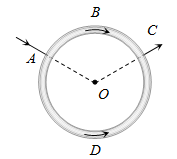
- ✓
- B
$\frac{\mu_0 I}{2 R}$
- C
$\frac{\mu_0 I}{4 R}$
- D
$\frac{\mu_0 I}{6 R}$
View full question & answer→MCQ 3211 Mark
At a distance of 10 cm from a long straight wire carrying current, the magnetic field is 0.04 T. At the distance of 40 cm, the magnetic field will be
MCQ 3221 Mark
An arc of a circle of radius R subtends an angle $\frac{\pi}{2}$ at the centre. It carries a current i. The magnetic field at the centre will be
- A
$\frac{\mu_0 i}{2 R}$
- ✓
$\frac{\mu_0 i}{8 R}$
- C
$\frac{\mu_0 i}{4 R}$
- D
$\frac{2\mu_0 i}{5 R}$
AnswerCorrect option: B. $\frac{\mu_0 i}{8 R}$
(b) $\frac{\mu_0 i}{8 R}$
View full question & answer→MCQ 3231 Mark
In a hydrogen atom, an electron moves in a circular orbit of radius $5.2\times 10^{-11}$m and produces a magnetic induction of 12.56 T at its nucleus. The current produced by the motion of the electron will be (Given $\mu_0=4\pi\times 10^{-7}$Wb/A-m)
- A
$ 6.53\times 10^{-3}$ ampere
- B
$13.25 \times 10^{-10}$ ampere
- C
$ 9.6 \times 10^{6}$ ampere
- ✓
$1.04 \times 10^{-3}$ ampere
AnswerCorrect option: D. $1.04 \times 10^{-3}$ ampere
(d) $1.04 \times 10^{-3}$ ampere
View full question & answer→MCQ 3241 Mark
One metre length of wire carries a constant current. The wire is bent to form a circular loop. The magnetic field at the centre of this loop is B. The same is now bent to form a circular loop of smaller radius to have four turns in the loop. The magnetic field at the centre of this new loop is
MCQ 3251 Mark
A vertical wire kept in Z-X plane carries a current from Q to P (see figure). The magnetic field due to current will have the direction at the origin O along
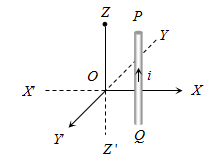
- A
- B
$\mathrm{OX}^{-}$
- C
- ✓
$\mathrm{OY}^{-}$
AnswerCorrect option: D. $\mathrm{OY}^{-}$
(d) $\mathrm{OY}^{-}$
View full question & answer→MCQ 3261 Mark
A solenoid is 1.0 metre long and it has 4250 turns. If a current of 5.0 ampere is flowing through it, what is the magnetic field at its centre [$\mu_0=4\pi\times 10^{-7}$weber/amp$-$m]
- A
$5.4 \times 10^{-2} $weber/m$^2$
- ✓
$2.7 \times 10^{-2} $weber/m$^2$
- C
$1.35 \times 10^{-2} $weber/m$^2$
- D
$0.675 \times 10^{-2} $weber/m$^2$
AnswerCorrect option: B. $2.7 \times 10^{-2} $weber/m$^2$
(b) $2.7 \times 10^{-2} $weber/m$^2$
View full question & answer→MCQ 3271 Mark
Due to 10 ampere of current flowing in a circular coil of 10 cm radius, the magnetic field produced at its centre is $3.34 \times 10^{-3} weber/ \mathrm{m}^2$. The number of turns in the coil will be
View full question & answer→MCQ 3281 Mark
If the strength of the magnetic field produced 10cm away from a infinitely long straight conductor is $10^{-5} weber/ \mathrm{m}^2$ , the value of the current flowing in the conductor will be
View full question & answer→MCQ 3291 Mark
A straight wire of length ($\pi^2$) metre is carrying a current of 2A and the magnetic field due to it is measured at a point distant 1 cm from it. If the wire is to be bent into a circle and is to carry the same current as before, the ratio of the magnetic field at its centre to that obtained in the first case would be
View full question & answer→MCQ 3301 Mark
A long copper tube of inner radius R carries a current i. The magnetic field B inside the tube is
- A
$\frac{\mu_0 \mathrm{i}}{2 \pi R}$
- B
$\frac{\mu_0 \mathrm{i}}{4 \pi R}$
- C
$\frac{\mu_0 \mathrm{i}}{2 R}$
- ✓
View full question & answer→MCQ 3311 Mark
A current of 1 ampere is passed through a straight wire of length 2.0 metres. The magnetic field at a point in air at a distance of 3 metres from either end of wire and lying on the axis of wire will be
- A
$\frac{\mu_0}{2 \pi}$
- B
$\frac{\mu_0}{4 \pi}$
- C
$\frac{\mu_0}{8 \pi}$
- ✓
View full question & answer→MCQ 3321 Mark
A battery is connected between two points A and B on the circumference of a uniform conducting ring of radius r and resistance R. One of the arcs AB of the ring subtends an angle θ at the centre. The value of the magnetic induction at the centre due to the current in the ring is
- A
Proportional to 2(180° - θ)
- B
Inversely proportional to r
- C
- ✓
View full question & answer→MCQ 3331 Mark
A cell is connected between two points of a uniformly thick circular conductor. The magnetic field at the centre of the loop will be (Here $i_1$ and $i_2$ are the currents flowing in the two parts of the circular conductor of radius ‘a’ and $\mu_0$ has the usual meaning)
- ✓
- B
$\frac{\mu_0}{2 a}\left(i_1-i_2\right)$
- C
$\frac{\mu_0}{2 a}\left(i_1+i_2\right)$
- D
$\frac{\mu_0}{ a}\left(i_1+i_2\right)$
View full question & answer→MCQ 3341 Mark
A long solenoid has a radius a and number of turns per unit length is n. If it carries a current i, then the magnetic field on its axis is directly proportional to
MCQ 3351 Mark
Two concentric circular coils of ten turns each are situated in the same plane. Their radii are 20 and 40 cm and they carry respectively 0.2 and 0.3 ampere current in opposite direction. The magnetic field in weber/m$^2$ at the centre is
- A
$\frac{35}{4} \mu_0$
- B
$\frac{\mu_0}{80}$
- C
$\frac{7}{80} \mu_0$
- ✓
$\frac{5}{4} \mu_0$
AnswerCorrect option: D. $\frac{5}{4} \mu_0$
(d) $\frac{5}{4} \mu_0$
View full question & answer→MCQ 3361 Mark
Magnetic effect of current was discovered by
MCQ 3371 Mark
In hydrogen atom, an electron is revolving in the orbit of radius 0.53$A^0$ with $6.6\times 10^{15}$ rotations/second. Magnetic field produced at the centre of the orbit is
- A
0.125 wb/m$^2$
- B
1.25 wb/m$^2$
- ✓
12.5 wb/m$^2$
- D
125 wb/m$^2$
AnswerCorrect option: C. 12.5 wb/m$^2$
(c) 12.5 wb/m$^2$
View full question & answer→MCQ 3381 Mark
A circular coil of radius R carries an electric current. The magnetic field due to the coil at a point on the axis of the coil located at a distance r from the centre of the coil, such that r >> R, varies as
- A
$\frac{1}{r}$
- B
$\frac{1}{r^{3 / 2}}$
- C
$\frac{1}{\mathrm{r}^2}$
- ✓
$\frac{1}{r^3}$
AnswerCorrect option: D. $\frac{1}{r^3}$
(d) $\frac{1}{r^3}$
View full question & answer→MCQ 3391 Mark
Two straight horizontal parallel wires are carrying the same current in the same direction, d is the distance between the wires. You are provided with a small freely suspended magnetic needle. At which of the following positions will the orientation of the needle be independent of the magnitude of the current in the wires
- A
At a distance d/2 from any of the wires
- B
At a distance d/2 from any of the wires in the horizontal plane
- C
Anywhere on the circumference of a vertical circle of radius d and centre halfway between the wires
- ✓
At points halfway between the wires in the horizontal plane
AnswerCorrect option: D. At points halfway between the wires in the horizontal plane
At points halfway between the wires in the horizontal plane
View full question & answer→MCQ 3401 Mark
In the figure shown there are two semicircles of radii $r_1$ and $r_1$ in which a current i is flowing. The magnetic induction at the centre O will be
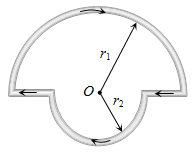
- A
$\frac{\mu_0 i}{r}\left(r_1+r_2\right)$
- B
$\frac{\mu_0 i}{r}\left(r_1-r_2\right)$
- ✓
$\frac{\mu_0 i}{4}\left(\frac{r_2+r_1}{r_1 r_2}\right)$
- D
$\frac{\mu_0 i}{4}\left(\frac{r_2-r_1}{r_1 r_2}\right)$
AnswerCorrect option: C. $\frac{\mu_0 i}{4}\left(\frac{r_2+r_1}{r_1 r_2}\right)$
(c) $\frac{\mu_0 i}{4}\left(\frac{r_2+r_1}{r_1 r_2}\right)$
View full question & answer→MCQ 3411 Mark
In the figure, shown the magnetic induction at the centre of there arc due to the current in portion AB will be
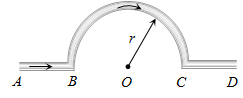
- A
$\frac{\mu_0 i}{r}$
- B
$\frac{\mu_0 i}{2r}$
- C
$\frac{\mu_0 i}{4r}$
- ✓
View full question & answer→MCQ 3421 Mark
Field inside a solenoid is
- A
Directly proportional to its length
- ✓
Directly proportional to current
- C
Inversely proportional to total number of turns
- D
Inversely proportional to current
AnswerCorrect option: B. Directly proportional to current
Directly proportional to current
View full question & answer→MCQ 3431 Mark
The magnetic induction at the centre O in the figure shown is
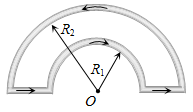
- ✓
$\frac{\mu_0 i}{4}\left(\frac{1}{R_1}-\frac{1}{R_2}\right)$
- B
$\frac{\mu_0 i}{4}\left(\frac{1}{R_1}+\frac{1}{R_2}\right)$
- C
$\frac{\mu_0 i}{4}$
- D
$\frac{\mu_0 i}{4}\left(R_1+R_2\right)$
AnswerCorrect option: A. $\frac{\mu_0 i}{4}\left(\frac{1}{R_1}-\frac{1}{R_2}\right)$
(a) $\frac{\mu_0 i}{4}\left(\frac{1}{R_1}-\frac{1}{R_2}\right)$
View full question & answer→MCQ 3441 Mark
The magnetic field B with in the solenoid having n turns per metre length and carrying a current of i ampere is given by
AnswerCorrect option: B. $\mu_0 n i$
(b) $\mu_0 n i$
View full question & answer→MCQ 3451 Mark
A vertical straight conductor carries a current vertically upwards. A point P lies to the east of it at a small distance and another point Q lies to the west at the same distance. The magnetic field at P is
- A
- ✓
- C
- D
Greater or less than at Q depending upon the strength of the current
View full question & answer→MCQ 3461 Mark
If a copper rod carries a direct current, the magnetic field associated with the current will be
- A
- B
- ✓
Both inside and outside the rod
- D
Neither inside nor outside the rod
AnswerCorrect option: C. Both inside and outside the rod
Both inside and outside the rod
View full question & answer→MCQ 3471 Mark
If a long hollow copper pipe carries a direct current, the magnetic field associated with the current will be
- A
- ✓
- C
Neither inside nor outside the pipe
- D
Both inside and outside the pipe
View full question & answer→MCQ 3481 Mark
A charge q coulomb moves in a circle at n revolutions per second and the radius of the circle is r metre. Then magnetic field at the centre of the circle is
- A
$\frac{2 \pi \mathrm{q}}{\mathrm{nr}} \times 10^{-7}$ N/amp/metre
- B
$\frac{2 \pi \mathrm{q}}{\mathrm{r}} \times 10^{-7}$ N/amp/metre
- ✓
$\frac{2 \pi n \mathrm{q}}{\mathrm{r}} \times 10^{-7}$ N/amp/metre
- D
$\frac{2 \pi \mathrm{q}}{\mathrm{r}}$ N/amp/metre
AnswerCorrect option: C. $\frac{2 \pi n \mathrm{q}}{\mathrm{r}} \times 10^{-7}$ N/amp/metre
(c) $\frac{2 \pi n \mathrm{q}}{\mathrm{r}} \times 10^{-7}$ N/amp/metre
View full question & answer→MCQ 3491 Mark
An infinitely long straight conductor is bent into the shape as shown in the figure. It carries a current of i ampere and the radius of the circular loop is r metre. Then the magnetic induction at its centre will be
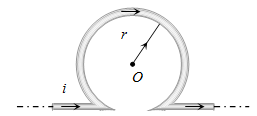
AnswerCorrect option: B. $\frac{\mu_0}{4 \pi} \frac{2 i}{r}(\pi-1)$
(b) $\frac{\mu_0}{4 \pi} \frac{2 i}{r}(\pi-1)$
View full question & answer→MCQ 3501 Mark
A current i ampere flows in a circular arc of wire whose radius is R, which subtend an angle 3π/2 radian at its centre. The magnetic induction B at the centre is
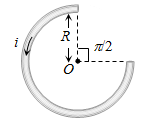
- A
$\frac{\mu_0 i}{R}$
- B
$\frac{\mu_0 \mathrm{i}}{2 R}$
- C
$\frac{2 \mu_0 \mathrm{i}}{R}$
- ✓
$\frac{3 \mu_0 \mathrm{i}}{8 R}$
AnswerCorrect option: D. $\frac{3 \mu_0 \mathrm{i}}{8 R}$
(d) $\frac{3 \mu_0 \mathrm{i}}{8 R}$
View full question & answer→MCQ 3511 Mark
A current i ampere flows along the inner conductor of a coaxial cable and returns along the outer conductor of the cable, then the magnetic induction at any point outside the conductor at a distance r metre from the axis is
MCQ 3521 Mark
A helium nucleus makes a full rotation in a circle of radius 0.8 metre in two seconds. The value of the magnetic field B at the centre of the circle will be
AnswerCorrect option: B. $10^{-19} \mu_0$
(b) $10^{-19} \mu_0$
View full question & answer→MCQ 3531 Mark
A solenoid of 1.5 metre length and 4.0 cm diameter posses 10 turn per cm. A current of 5 ampere is flowing through it. The magnetic induction at axis inside the solenoid is
- ✓
$2 \pi \times 10^{-3}$ Tesla
- B
$2 \pi \times 10^{-5}$ Tesla
- C
$4 \pi \times 10^{-2}$ Gauss
- D
$2 \pi \times 10^{-5}$ Gauss
AnswerCorrect option: A. $2 \pi \times 10^{-3}$ Tesla
(a) $2 \pi \times 10^{-3}$ Tesla
View full question & answer→MCQ 3541 Mark
The magnetic induction at a point P which is distant 4 cm from a long current carrying wire is $10^{-18}$ Tesla. The field of induction at a distance 12 cm from the same current would be
AnswerCorrect option: A. $3.33 \times 10^{-9}$ Tesla
(a) $3.33 \times 10^{-9}$ Tesla
View full question & answer→MCQ 3551 Mark
The strength of the magnetic field at a point r near a long straight current carrying wire is B. The field at a distance $\frac{r}{2}$ will be
- A
$\frac{B}{2}$
- B
$\frac{B}{4}$
- ✓
- D
View full question & answer→MCQ 3561 Mark
Field at the centre of a circular coil of radius r, through which a current I flows is
AnswerCorrect option: C. Directly proportional to I
(c) Directly proportional to I
View full question & answer→