Question 11 Mark
The value of $\Big(\frac{1}{2^3}\Big)^3$ is equal to _________.
AnswerThe value of $\Big(\frac{1}{2^3}\Big)^2$ is equal to $\frac{1}{2^6}$.
Solution:
Using law of exponents, $(am)n = (a)mn [$$\because$ a is non-zero integer$]$
$\because$ $\Big(\frac{1}{2^3}\Big)^2=\Big(\frac{1^3}{2^3}\Big)^2=\Big(\frac{1}{2}\Big)^{3\times2}$
$=\Big(\frac{1}{2}\Big)^6=\frac{1}{2^6}$ [$\because$ $(1)^m= 1]$
Hence,
$\Big(\frac{1}{2^3}\Big)^2$ = $\frac{1}{2^6}$
View full question & answer→Question 21 Mark
The value of $3 \times 10^{-7}$ is equal to ________.
AnswerThe value of $3 \times 10^{-7}$ is equal to $0.0000003.$
Solution:
Given,
$3 \times 10^{-7}= 3.0 × 10^{-7}$
Now, placing decimal seven place towards left of original position, we get $0.0000003.$
Hence,
The value of $3 \times 10^{-7}$ is equal to $0.0000003.$
View full question & answer→Question 31 Mark
The usual form for $2 × 10^{-2}$ is not equal to $0.02.$
AnswerFalse.Solution:
For usual form, $2\times10^{-2}=2\times\frac{1}{10^2}$ $\Big[\because\text{a}^{-\text{m}}=\frac{1}{\text{a}^\text{m}}\Big]$ $=\frac{2}{100}=0.02$
View full question & answer→Question 41 Mark
To add the numbers given in standard form, we first convert them into numbers with ________ exponents.
AnswerTo add the numbers given in standard form, we first convert them into numbers with Equal exponents.
Solution:
To add the numbers given in standard form, we first convert them into numbers with equal exponents.
$2.46 \times 10^6+24.6 \times 105 $
$ =2.46 \times 10^5+2.46 \times 10^6 $
$ =4.92 \times 10^6 $
View full question & answer→Question 51 Mark
$\left[2^{-1}+3^{-1}+4^{-1}\right]^0=$________.
Answer$\left[2^{-1}+3^{-1}+4^{-1}\right]^0=1$.
Solution:
Using law of exponents, $a^0= 1$ [$\because$ a is non-zero integer]
$\therefore$ $\left[2^{-1}+3^{-1}+4^{-1}\right]^0=1$
Hence,
$\left[2^{-1}+3^{-1}+4^{-1}\right]^0=1$
View full question & answer→Question 61 Mark
$\Big(\frac{1}{2}\Big)^{-2}\div\Big(\frac{1}{2}\Big)^{-3}$
Answer$\Big(\frac{1}{2}\Big)^{-2}\div\Big(\frac{1}{2}\Big)^{-3}$
$=\Big(\frac{1}{2}\Big)^{-2+3}$ $=\frac{1}{2}$
$\left[\because a^m \div a^n=(a)^{m-n}\right]$
View full question & answer→Question 71 Mark
On multiplying _________ by $2^{-5}$ we get $2^5$.
AnswerOn multiplying $2^{10}$ by $2^{-5}$ we get $2^5$.
Solution:
Let $x$ be multiplied by $2^{-5}$ we get $2^5$.
So, $x × 2^{-5}= 2^5$
$\Rightarrow\text{x}\times\frac{1}{2^5}=2^5\ \Big[\because\text{a}^{-\text{m}}=\frac{1}{\text{a}^{-\text{m}}}\Big]$ $\therefore$ $\text{x}=2^5\times2^5=(2)^{5+5}=2^{10}$ [$\because$ $a^m× a^n= (a)^{m+n}$]
View full question & answer→Question 81 Mark
Find two repeater machines that will do the same work as $a(x81)$ machine.
AnswerTwo repeater machines that do the same work as $(x81)$ are $(x3^4)$ and $(x9^2)$. Since, factor of $81$ are.$3$ and $9.$
View full question & answer→Question 91 Mark
Simplify: $\frac{49\times\text{z}^{-3}}{7^{-3}\times10\times\text{z}^{-5}}(\text{z}\neq0)$
Answer$\frac{49\times\text{z}^{-3}}{7^{-3}\times10\times\text{z}^{-5}}$
$=\frac{(7)^2\times\text{z}^{-3}}{7^{-3}\times10\times\text{z}^{-5}}$
$=\frac{(7)^{2+3}\times\text{z}^{-3+5}}{10}$ $\left[\because a^m \div a^n=(a)^{m-n}\right]$
$=\frac{(7)^5\text{z}^2}{10}=\frac{7^5}{10}\text{z}^2$
View full question & answer→Question 101 Mark
Find a single repeater machine that will do the same work as hook-up.
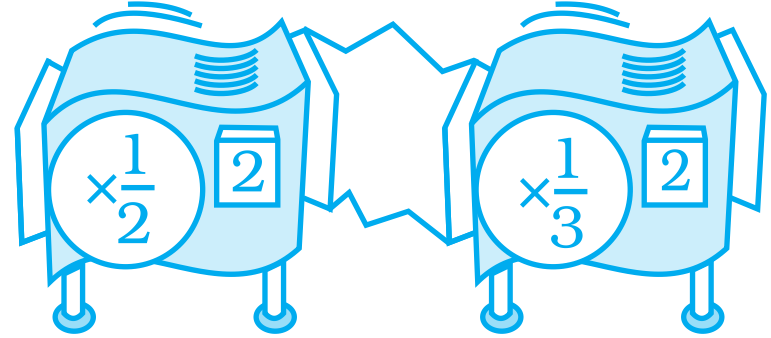
AnswerUsing law of exponents, $\left(a^m \times a^n=a^{m+n}\right)$$[\therefore$ a is non-zero integer$]$
Repeator machine can do the work is equal to $\big(\frac{1}{2}\big)^2\times\big(\frac{1}{3}\big)^2$
$=\frac{1}{2}\times\frac{1}{2}\times\frac{1}{3}\times\frac{1}{3}=\frac{1}{2\times3\times2\times3}=\frac{1}{(6)^2}$
so, $\Big(\text{x}\big(\frac{1}{6}\big)^2\Big)$ single machine can do the same work.
View full question & answer→Question 111 Mark
$5^0$= ___________.
Answer$5^0= 1.$
Solution:
Using law of exponents, $a^0= 1$ [$\because$ a is non-zero integer] $\therefore$ $5^0= 1$ Hence, $5^0= 1$
View full question & answer→Question 121 Mark
Very small numbers can be expressed in standard form by using _________ exponents.
AnswerVery small numbers can be expressed in standard form by using negative exponents.
Solution:
Very small numbers can be expressed in standard form by using negative exponents.
i.e. $0.000023=2.3 \times 10^{-3}$
View full question & answer→Question 131 Mark
Neha needs to stretch some sticks to $25^2$ times their original lengths, but her $(×25)$ machine is broken. Find a hook-up of two repeater machines that will do the same work as $a(×25^2)$ machine. To get started, think about the hookup you could use to replace the $(×25) $ machine.

AnswerWork done by single machine $(x25^2) = 25 \times 25 = 625$ or $5 \times 5 \times 5 \times 5$ or $52 \times 52.$
Hence, $(x5^2)$ and $(x5^2)$ hook-up machine can replace the $(x25)$ machine.
View full question & answer→Question 141 Mark
Use the properties of exponents to verify that each statement is true. $4^{\text{n}-1}=\frac{1}{4}(4)^{\text{n}}$
Answer$4^{\text{n}-1}=\frac{1}{4}(4)^{\text{n}}$ $\text{LHS} = 4^{\text{n} - 1} = 4^\text{n} + 4^1$ $[\because\text{a}^{\text{m}}+\text{a}^{\text{n}}=(\text{a})^{\text{m}-\text{n}}]$ $=\frac{4^{\text{n}}}{4}=\text{RHS}$
View full question & answer→Question 151 Mark
A half-life is the amount of time that it takes for a radioactive substance to decay to one half of its original quantity. Suppose radioactive decay causes $300$ grams of a substance to decrease to $300 × 2^{-3}$ grams after $3$ half-lives. Evaluate $300 × 2^{-3}$ to determine how many grams of the substance are left.
AnswerSince, $300g$ of a substance is decrease to $300 × 2^{-3}g$ after $3$ half-lives.
So, we have to evalute $300\times2^{-3}=\frac{300}{8}=37.5\text{g}$ $[\because2^3=8]$
View full question & answer→Question 161 Mark
Write $0.000005678$ in the standard form.
AnswerFor standard form, $0.000005678$
$ =0.5678 \times 10^{-5} $
$ =5.678 \times 10^{-5} \times 10^{-1} $
$ =5.678 \times 10^{-6} $
Hence, $ =5.678 \times 10^{-6} $ is the standard form of $0.000005678.$
View full question & answer→Question 171 Mark
$a^p× b^q= (ab)^{pq}$
Answer$RHS = (ab)^{pq}$
Using law of exponents, $(ab)^m= a^m× b^m$ [$\because$ a is non-zero integer]
$\therefore$ $(ab)^{pq}= (a)^{pq}× (b)^{pq}$
$LHS ≠ RHS$
View full question & answer→Question 181 Mark
The expression for $3^5$ with a negative exponent is _________.
AnswerThe expression for $3^5$ with a negative exponent is $\frac{1}{3}^{-5}$.
Solution:
Using law of exponents, $\text{a}^{-\text{m}}=\frac{1}{\text{a}^\text{m}}$[$\because$ a is non-zero integer]
$\therefore$ $3^5=\frac{1}{3}^{-5}$
Hence,
The expression for $3^5$ with a negative exponents is $\frac{1}{3}^{-5}$
View full question & answer→Question 191 Mark
The value of $\left[2^{-1} \times 3^{-1}\right]^{-1}$ is _________.
AnswerThe value of $\left[2^{-1} \times 3^{-1}\right]^{-1}$ is 6.
Solution:
Using law of exponents, $\text{a}^{-\text{m}}=\frac{1}{\text{a}^{\text{m}}}$ [$\because$ a is non-zero integer]
$\therefore$ $\big[2^{-1}\times3^{-1}\big]^{-1}=\Big(\frac{1}{2}\times\frac{1}{3}\Big)^{-1}$
$=\Big(\frac{1}{6}\Big)^{-1}=6$
Hence,
$\big[2^{-1}\times3^{-1}\big]^{-1}=6$
View full question & answer→Question 201 Mark
Find a single repeater machine that will do the same work as hook-up.
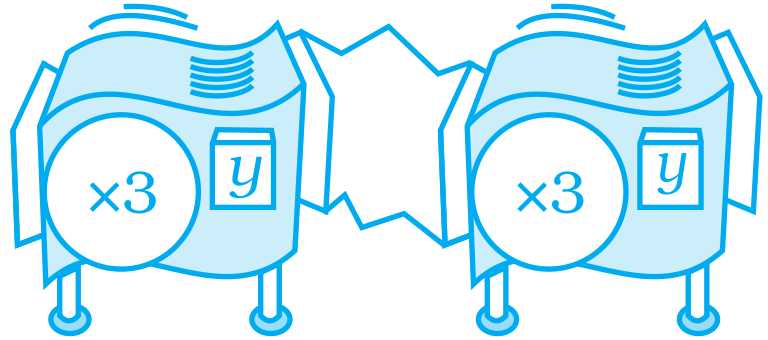
AnswerUsing law of exponents, $\left(a^m \times a^n=a^{m+n}\right)$$[\therefore$ a is non-zero integer$]$Repeator machine can do the work is equal to $3^y \times 3^y=3^{2 y}$.
so, $(x3^{2y})$ single machine can do the same work.
View full question & answer→Question 211 Mark
For hook-up, determine whether there is a single repeater machine that will do the same work. If so, describe or draw it.
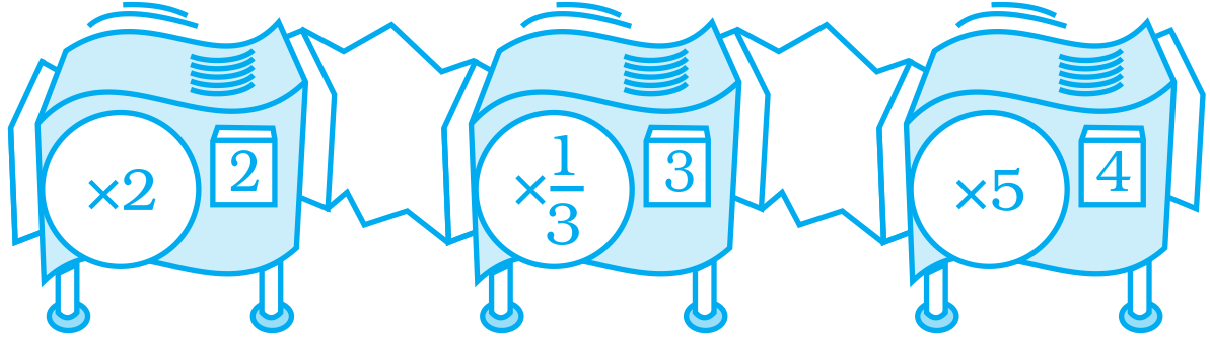
AnswerUsing law of exponents, $\left(a^m \times a^n=a^{m+n}\right)$$[\because$ a is non-zero integer$]$
Hook-up machine work $=2^2\times\big(\frac{1}{3}\big)^3\times5^4=4\times\frac{1}{27}\times625 $$=\frac{2500}{27}=92.59$
So, it is not possible for a single machine can do the same work.
View full question & answer→Question 221 Mark
Find a single repeater machine that will do the same work as hook-up.
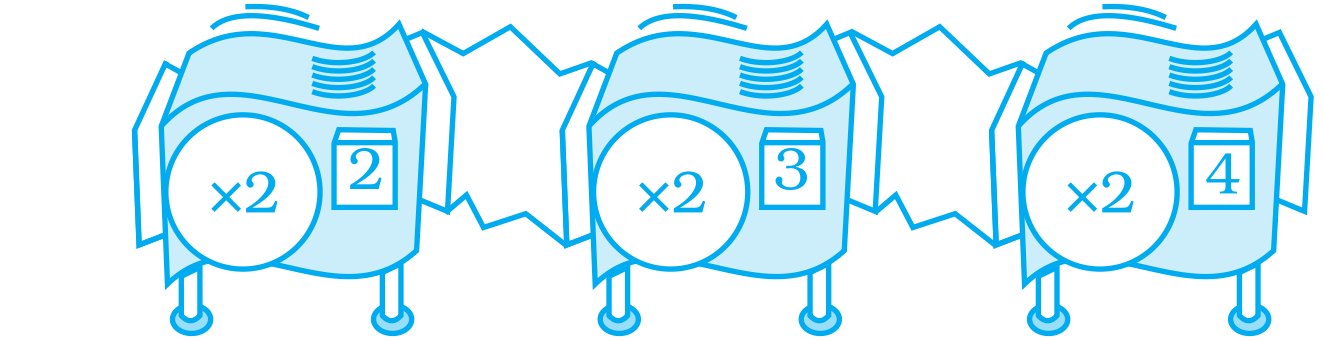
AnswerUsing law of exponents, $\left(a^m \times a^n=a^{m+n}\right)$$[\therefore$ a is non-zero integer$]$
Repeator machine can do the work is equal to $2^2× 2^3× 2^4= 2^9$
so, $(x2^9)$ single machine can do the same work.
View full question & answer→Question 231 Mark
Supply the missing information for diagram.
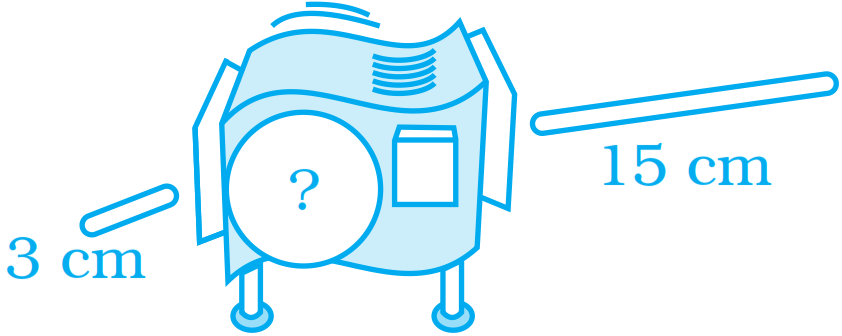
AnswerIf $5\ cm$ long piece is inserted in single machine, then it produce same $15\ cm$ long piece. So, it is $(x5)$ repeated machine. $\because \ ?=5$
View full question & answer→Question 241 Mark
$24.58 = 2 \times 10 + 4 \times 1 + 5 \times 10 + 8 \times 100$
Answer$R H S = 2 \times 10 + 4 \times 1+ 5 \times 10 + 8 \times 100$
$= 20 + 4 + 50 + 800 = 874$
$L H S \neq R H S$
View full question & answer→Question 251 Mark
The value of $\frac{1}{4^{-2}}$ is equal to $16.$
AnswerUsing law of exponents, $\text{a}^{-\text{m}}=\frac{1}{\text{a}^{\text{m}}}$ [$\because$ a is non-zero integer] $\therefore \frac{1}{4^{-2}}=4^2$
$=4\times4=16$
View full question & answer→Question 261 Mark
Simplify: $\Big[\big(\frac{4}{3}\big)^{-2}-\big(\frac{3}{4}\big)^2\Big]^{(-2)}$
Answer$\Big[\big(\frac{4}{3}\big)^{-2}-\big(\frac{3}{4}\big)^2\Big]^{(-2)}$$=\Big[\big(\frac{3}{4}\big)^{2}-\big(\frac{3}{4}\big)^2\Big]^{(-2)}=[0]^{-2}=0$
View full question & answer→Question 271 Mark
Find a single repeater machine that will do the same work as hook-up.
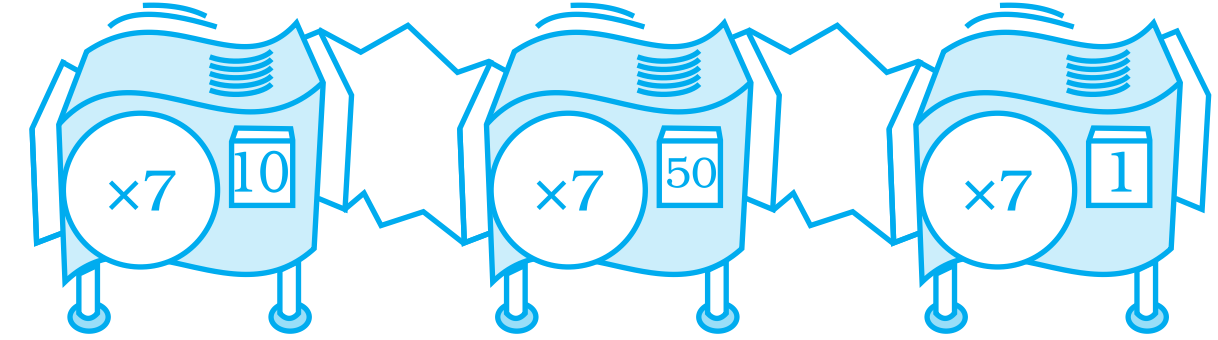
AnswerUsing law of exponents, $\left(a^m \times a^n=a^{m+n}\right)$$[\therefore$ a is non-zero integer$]$
Repeator machine can do the work is equal to $7^{10}× 7^{50}×7^{1}= 7^{61}$.
so, $(x7^{61})$ single machine can do the same work.
View full question & answer→Question 281 Mark
The multiplicative inverse of $\Big(\frac{3}{2}\Big)^2$ is not equal to $\Big(\frac{2}{3}\Big)^{-2}$.
AnswerTrue. Solution:
a is called the multiplicative inverse of $b,$ if $a \times b = 1.$
put $b =\Big(\frac{3}{2}\Big)^2$
So, $\text{a}\times\Big(\frac{3}{2}\Big)^2=1$
$\Rightarrow\text{a}=\Big(\frac{3}{2}\Big)^{-2}$
View full question & answer→Question 291 Mark
The value of $\left[1^{-2}+2^{-2}+3^{-2}\right] \times 6^2$ is ________ .
AnswerThe value of $\left[1^{-2}+2^{-2}+3^{-2}\right] \times 6^2$ is $49.$
Solution:
Using law of exponents, $\text{a}^{-\text{m}}=\frac{1}{\text{a}^\text{m}}$ [$\because$ a is non-zero integer]
$\therefore \big[1^{-2}+2^{-2}+3^{-2}\big]\times6^2$
$=\Big[\frac{1}{2^2}+\frac{1}{2^2}+\frac{1}{3^3}\Big]\times6^2$
$=\Big[1+\frac{1}{4}+\frac{1}{9}\Big]\times6^2$
$=\Big(\frac{36+9+4}{36}\Big)\times6^2$
$=\Big(\frac{49}{36}\Big)\times6^2=\Big(\frac{7}{6}\Big)^2\times6^2$
$(7)^2\times6^{-2}\times6^2$
$=(7)^2\times6^{2-2}=(7)^2\times6^0=49$
$[a^0= 1]$
Hence,$ [1^{-2}+ 2^{-2}+ 3^{-2}] \times 6^2= 49$
View full question & answer→Question 301 Mark
If possible, find a hook-up of prime base number machine that will do the same work as the given stretching machine. Do not use $(x1)$ machines.
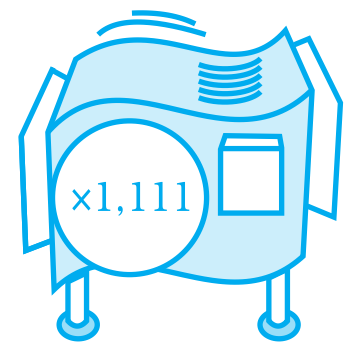
Answer$x1111 = 101 \times 11$ hook-up machine.
View full question & answer→Question 311 Mark
If $a = -1, b = 2,$ then find the value of the following:
$a^b× b^2$
AnswerGiven, $a^b× b^2$
If $a = -1$ and $b = 2,$ then $(-1)^2 \times(-2)^{-1}=1\times\frac{1}{2}=\frac{1}{2}$ $\Big[\because\text{a}^{-\text{m}}=\frac{1}{\text{a}^{\text{m}}}\Big]$
View full question & answer→Question 321 Mark
The standard form of $12340000$ is ______.
AnswerThe standard form of $12340000$ is $1.234 × 10^7$.
Solution:
For standard form, $12340000 = 1234 × 10^4$
$= 1234 × 10^4× 10^3$
$= 1234 × 10^7$
Hence, The standard form of $12340000$ is $1.234 × 10^7$.
View full question & answer→Question 331 Mark
The value of $5^{-2}$ is equal to $25.$
AnswerFalse.Solution:
Using law of exponents, $\text{a}^{-\text{m}}=\frac{1}{\text{a}^\text{m}}$ [$\because$ a is non-zero integer] $\therefore$ $5^{-2}=\frac{1}{5^2}=\frac{1}{25}$
View full question & answer→Question 341 Mark
If possible, find a hook-up of prime base number machine that will do the same work as the given stretching machine. Do not use $(x1)$ machines.

AnswerSingle machine work $= 100$
Hook-up machine of prime base number that do the same work down by $x100$
$= 2^2× 5^2$
$= 4 × 25$
$= 100$
View full question & answer→Question 351 Mark
Find a single repeater machine that will do the same work as hook-up.
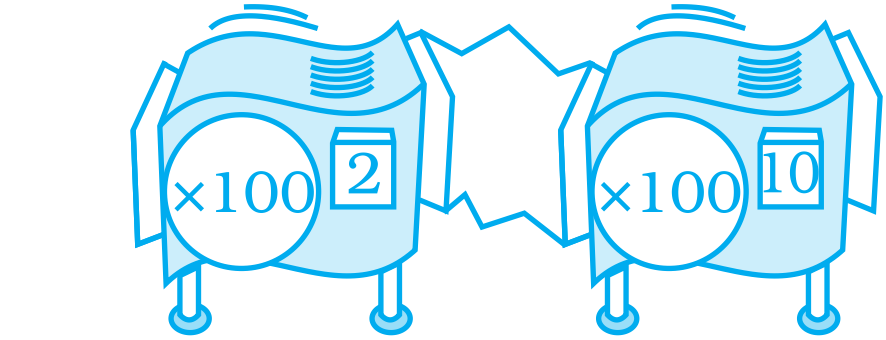
AnswerUsing law of exponents, $(a^m× a^n= a^{m+n})$ $[\therefore$ a is non-zero integer$]$
Repeator machine can do the work is equal to $100^2× 100^{10}$.
so, $(x100^{12})$ single machine can do the same work.
View full question & answer→Question 361 Mark
The standard form for $32,50,00,00,000$ is __________.
AnswerThe standard form for $32,50,00,00,000$ is $3.25 × 10^{10}$
Solution:
For standard form, $32500000000 = 3250 × 10^2× 10^2× 10^3= 3250 × 10^7= 3.250 × 10^{10}$ or $3.25 × 10^{10}$
Hence, The standard form for $32500000000$ is $3.25 × 10^{10}$.
View full question & answer→Question 371 Mark
An inch is approximately equal to $0.02543$ metres. Write this distance in standard form.
AnswerStandard form of $0.02543m = 0.2543\ x\ 10^{-1}m = 2.543\ x\ 10^{-2}m$.
Hence, standard form of $0.025434s$ $2.543\ x\ 10^{-2}$ m.
View full question & answer→Question 381 Mark
$10^{-2}=\frac{1}{100}$
AnswerTrue.Solution:
Using law of exponents, $\text{a}^{-\text{m}}=\frac{1}{\text{}\text{a}^\text{m}}$ [$\because$ a is non-zero integer] $\therefore$ $10^{-2}=\frac{1}{10^2}$ $[\because10^2=10\times10]$ $=\frac{1}{10\times10}=\frac{1}{100}$
View full question & answer→Question 391 Mark
The value of $\left[3^{-1} \times 4^{-1}\right]^2$ is _________.
AnswerThe value of $\left[3^{-1} \times 4^{-1}\right]^2$ Is $\frac{1}{144}$.
Solution:
Using law of exponents, $\text{a}^{-\text{m}}=\frac{1}{\text{a}^\text{m}}$ [$\because$ a is non-zero integer]
$\therefore$ $\big[3^{-1}\times4^{-1}\big]^2=\Big(\frac{1}{3}\times\frac{1}{4}\Big)^2=\Big(\frac{1}{12}\Big)^2$
$=12^{-2}=\frac{1}{144}$
Hence,
$\big[3^{-1}\times4^{-1}\big]^2=\frac{1}{144}$
View full question & answer→Question 401 Mark
$100^{-10}$
Answer$100^{-10}$
$=\frac{1}{100^{10}}$ $\Big[\because\text{a}^{-\text{m}}=\frac{1}{\text{a}^\text{m}}\Big]$
View full question & answer→Question 411 Mark
The usual form for $2.3 \times 10^{-10}$ is ____________.
AnswerThe usual form for $2.3 \times 10^{-10}$ is $0.00000000023.$
Solution:
For usual form, $2.3 \times 10^{-10}=0.23 \times 10^{-11}=0.00000000023$
Hence,
The usual form for $2.3 \times 10^{-10}$ is $0.00000000023.$
View full question & answer→Question 421 Mark
If possible, find a hook-up of prime base number machine that will do the same work as the given stretching machine. Do not use $(x1)$ machines.

Answer$x99 = 3^2× 111$ hook-up machine.
View full question & answer→Question 431 Mark
If $a = -1, b = 2,$ then find the value of the following:
$a^b- b^a$
AnswerGiven, $a^b- b^a$
If $a = -1$ and $b = 2,$ then $(-1)^2 + (2)^{-1}=1-\frac{1}{2^1}$ $\Big[\because\text{a}^{-\text{m}}=\frac{1}{\text{a}^{\text{n}}}\Big]$
$=\frac{2-1}{2}=\frac{1}{2}$
View full question & answer→Question 441 Mark
If $a = -1, b = 2,$ then find the value of the following:
$a^b+ b^a$
AnswerGiven, $a^b+ b^a$
If $a = -1$ and $b = 2,$ then $(-1)^2 + (-2)^{-1}=1+\frac{1}{2}$ $\Big[\because\text{a}^{-\text{m}}=\frac{1}{\text{a}^{\text{m}}}\Big]$
$=\frac{2+1}{2}=\frac{3}{2}$
View full question & answer→Question 451 Mark
Shikha has an order from a golf course designer to put palm trees through a $(x23)$ machine and then through a $(x33)$ machine. Shethinks she can do the job with a single repeater machine. What single repeater machine should she use$?$ 
AnswerThe work done by hook-up machine is equal to $2 × 2 × 2 × 3 × 3 × 3 = 216 = 6^3$ So, she should use $(x6^3)$ single machine for the purpose.
View full question & answer→Question 461 Mark
Express $16^{-2}$ as a power with the base $2.$
Answer$\because$ $2 × 2 × 2 × 2 = 16 = 2^4$
$\because$ $16^{-2}= (2^4)^{-2}= (2)^{4\times {(-2)}}$
[$\because$ $(a^m)^n= (a)^{mn}] = (2)^{-8}$
View full question & answer→Question 471 Mark
$(-5)^{-2} \times(-5)^{-3}=(-5)^{-6}$
AnswerFalse.
Solution:
$LHS =(-5)^{-2} \times(-5)^{-3}$
Using law of exponents, $a^m \times a^n=(a)^{m+n}$ [$\because$ a is non-zero integer]
$\therefore(-5)^{-2} \times(-5)^{-3}=(-5)^{-2-3}=(-5)^{-5}$
$LHS ≠ RHS$
View full question & answer→Question 481 Mark
The usual form of $3.41 × 10^6$ is ___________.
AnswerThe usual form of $3.41 × 10^6$ is $3410000.$
Solution:
For usual form, $3.41 × 10^6= 3.41 × 10 × 10 × 10 × 10 × 10 × 10 = 3410000$
Hence, The usual form of $3.41 × 10^6$ is $3410000.$
View full question & answer→Question 491 Mark
If possible, find a hook-up of prime base number machine that will do the same work as the given stretching machine. Do not use (x1) machines.
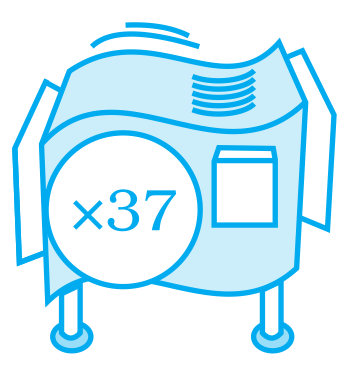
Answer$x37$ machine cannot do the same work.
View full question & answer→Question 501 Mark
$2^{-2} \times 2^{-3}$
Answer$2^{-2} \times 2^{-3}$
$=(2)^{-2-3}\left[\because a^m \times a^n=(a)^{m+n}\right] $
$=(2)^{-5}$
View full question & answer→