Questions

5 Marks Questions

Take a timed test

40 questions · self-marked practice — reveal the answer and mark yourself.

Question 15 Marks
Discuss the principle of estimation of halogens, sulphur and phosphorus present in an organic compound.
Answer
Estimation of halogens
Halogens are estimated by the Carius method. In this method, a known quantity of organic compound is heated with fuming nitric acid in the presence of silver nitrate, contained in a hard glass tube called the Carius tube, taken in a furnace. Carbon and hydrogen that are present in the compound are oxidized to form $CO_2$ and $H_2O$ respectively and the halogen present in the compound is converted to the form of AgX. This AgX is then filtered, washed, dried, and weighed.
Let the mass of organic compound be mg.
Mass of AgX formed = $m_1g$
1 mol of Agx contains 1mol of X.
Therefore,
Mass of halogen in $m_1g$ of $\text{AgX}=\frac{\text{Atomic mass of X}\times\text{m}_1\text{g}}{\text{Molecular mass of AgX}}$
$\text{Thus},\%\text{ of halogen will be}=\frac{\text{Atomic mass of X}\times\text{m}_1\times 100}{\text{Molecular mass of AgX}\times\text{m}}$
Estimation of Sulphur
In this method, a known quantity of organic compound is heated with either fuming nitric acid or sodium peroxide in a hard glass tube called the Carius tube. Sulphur, present in the compound, is oxidized to form sulphuric acid. On addition of excess of barium chloride to it, the precipitation of barium sulphate takes place. This precipitate is then filtered, washed, dried, and weighed.
Let the mass of organic compound be mg.
Mass of $BaSO_4$ formed = $m_1g$
1 mol of $BaSO_4 = 233g ~BaSO_4 = 32g$ of Sulphur
Therefore, $m_1g$ of $BaSO_4$ contains $\frac{32\times\text{m}_1}{233}\text{g}$ of sulphur.
Thus, $\text{percentage of sulphur}=\frac{32\times\text{m}_2\times100}{233\times\text{m}}$
Estimation of phosphorus
In this method, a known quantity of organic compound is heated with fuming nitric acid. Phosphorus, present in the compound, is oxidized to form phosphoric acid. By adding ammonia and ammonium molybdate to the solution, phosphorus can be precipitated as ammonium phosphomolybdate.
Phosphorus can also be estimated by precipitating it as $MgNH_4PO_4$ by adding magnesia mixture, which on ignition yields $Mg_2P_2O_7$.
Let the mass of organic compound be mg.
Mass of ammonium phosphomolybdate formed = $m_1g$
Molar mass of ammonium phosphomolybdate = $1877g$
Thus, $\text{Percentage of phosphorus}=\frac{31\times\text{m}_1\times100}{1877\times\text{m}}\%$
If P is estimated as $Mg_2P_2O_7$,
Then, $\text{Percentage of phosporus}=\frac{62\times\text{m}_1\times100}{222\times\text{m}}\%$

View full question & answer
Question 25 Marks
Explain the terms Inductive and Electromeric effects. Which electron displacement effect explains the following correct orders of acidity of the carboxylic acids?
  1. $Cl_3CCOOH > Cl_2CHCOOH > ClCH_2COOH$.
  2. $CH_3CH_2COOH > (CH_3)_2CHCOOH > (CH_3)_3C.COOH$.
Answer
Inductive Effect: The inductive effect refers to the polarity produced in a molecule as a result of higher electronegativity of one atom compared to another.Atoms or groups which lose electron towards a carbon atom are said to have +1 Effect.
Those atoms or groups which draw electron away from a carbon atom are said to have -I Effect.
Common examples of -I effect are:
$NO_2, F, Cl, Br, I, OH$ etc.
Examples of +1 effect are (Electron releasing)
$(CH_3)_2C- , (CH_3)_2CH-, CH_3CH_2- CH_3-$ etc.
Electromeric effect: The electromeric effect refers to the polarity produced in a multiple bonded compound as it is approached by a reagent.

The atom A has lost its share in the electron pair and B has gained this share.
As a result A acquires a positive charge and B a negative charge. It is a temporary effect and takes place only in the presence of a reagent.
  1. -I-effect as shown below: As the number of halogen atoms decreases, the overall -I- effect decreases and the acid strength decreases accordingly.
  1. +I-effect as shown below: As the number of alkyl groups increases, the +I-effect increases and the acid strength decreases accordingly.
View full question & answer
Question 35 Marks
Discuss the chemistry of Lassaigne's test.
Answer
The elements nitrogen, sulphur and halogens are tested in an organic compound by Lassaigne’s test. The organic compound (N, S or halogens) is fused with sodium metal as to convert these elements into ionisable inorganic substances, i.e., nitrogen into sodium cyanide, sulphur into sodium sulphide and halogens into sodium halides.
$2\text{Na}+\text{S}\xrightarrow{\Delta}\text{Na}_2\text{S}$
$\text{Na}+\text{C}+\text{N}\xrightarrow{\Delta}\text{NaCN}$
$\text{Na}+\text{X}\xrightarrow{\Delta}\text{NaX}(\text{x}=\text{Cl},\text{Br},\text{I})$
Once the ions are formed, the inorganic tests can be applied to them and the compound can be analysed.
  1. Test for Nitrogen: The sodium fusion extract is boiled with iron(II) sulphate and then acidified with acid. The formation of Prussian blue colour confirms the presence of nitrogen.
$6CN^- + Fe^{2+} \rightarrow [Fe(CN)6]^{4-}$
$3[Fe(CN)_6]^{4-} + 4Fe^{3+} \rightarrow Fe_4[Fe(CN)_6]_3.xH_2O$
  1. Test for Sulphur: The sodium fusion extract is acidified with acetic acid and lead acetate is added to it. Ablack precipitate of lead sulphide indicates the presence of sulphur.
$\text{S}^{2+}+\text{Pb}^{2+}\rightarrow\text{PbS}\downarrow \\ \ \ \ \ \ \ \ \ \ \ \ \ \ \ \ \ \ \ \ \ \ \ \ \ \ \ \text{Black}$
  1. Test for Halogens: The sodium fusion extract is acidified with nitric acid and then treated with silver nitrate. A white precipitate, soluble in ammonium hydroxide shows the presence of chlorine, a yellowish precipitate, sparingly soluble in ammonium hydroxide shows the. presence of bromine and a yellow precipitate, insoluble in ammonium hydroxide shows the presence of iodine.
$X^- + Ag^+ \rightarrow AgX$
X represents a halogen -Cl, Br or I.
  1. Test for Phosphorus: The compound is heated with an oxidising agent (sodium peroxide). The phosphorus present in the compound is oxidised to phosphate. The solution is boiled with nitric add and then treated with ammonium molybdate. A yellow colouration or precipitate indicates the presence of phosphorus.
$Na_3PO_4 + 3HNO_3 \rightarrow H_3PO_4 + 3NaNO_3​​​​​​​$

$\text{H}_3\text{PO}_4 \ \ \ \ + \ \ \ \ 12(\text{NH}_4)_2\text{MoO}_4 \ \ \ \ + \ \ \ \ 21\text{HNO}_3 \ \ \ \ \rightarrow \ \ \ \ (\text{NH}_4)_3\text{PO}_4.12\text{MoO}_3 \ \ \ \ + \ \ \ \ 21\text{NH}_4\text{NO}_3 \ \ \ \ + \ \ \ \ 12\text{H}_2\text{O} \\ \ \ \ \ \ \ \ \ \ \ \ \ \ \ \ \ \ \ \ \text{Ammonium molybdate} \ \ \ \ \ \ \ \ \ \ \ \ \ \ \ \ \ \ \ \ \ \ \ \ \ \ \ \ \ \text{Ammonium phosphomoybdate} \\ \ \ \ \ \ \ \ \ \ \ \ \ \ \ \ \ \ \ \ \ \ \ \ \ \ \ \ \ \ \ \ \ \ \ \ \ \ \ \ \ \ \ \ \ \ \ \ \ \ \ \ \ \ \ \ \ \ \ \ \ \ \ \ \ \ \ \ \ \ \ \ \ \ \ \ \ \ \ \ \ \ \ \ \ \ \ \ \ \ \ \ \ \ \ \ \ \ \ \text{(yellow ppt.)}$
View full question & answer
Question 45 Marks
Describe the method, which can be used to separate two compounds with different solubilities in a solvent S.
Answer
Fractional crystallisation is the method used for separating two compounds with different solubility’s in a solvent S. The process of fractional crystallisation is carried out in four steps.
  1. Preparation of the solution: The powdered mixture is taken in a flask and the solvent is added to it slowly and stirred simultaneously. The solvent is added till the solute is just dissolved in the solvent. This saturated solution is then heated.
  2. Filtration of the solution: The hot saturated solution is then filtered through a filter paper in a China dish.
  3. Fractional crystallisation: The solution in the China dish is now allowed to cool. The less soluble compound crystallises first, while the more soluble compound remains in the solution. After separating these crystals from the mother liquor, the latter is concentrated once again. The hot solution is allowed to cool and consequently, the crystals of the more soluble compound are obtained.
  4. Isolation and drying: These crystals are separated from the mother liquor by filtration. Finally, the crystals are dried.
View full question & answer
Question 55 Marks
Explain why alkyl groups act as electron donors when attached to a $\pi$ system.
Answer
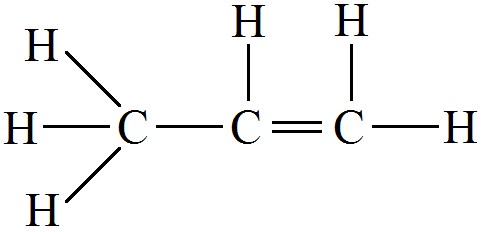
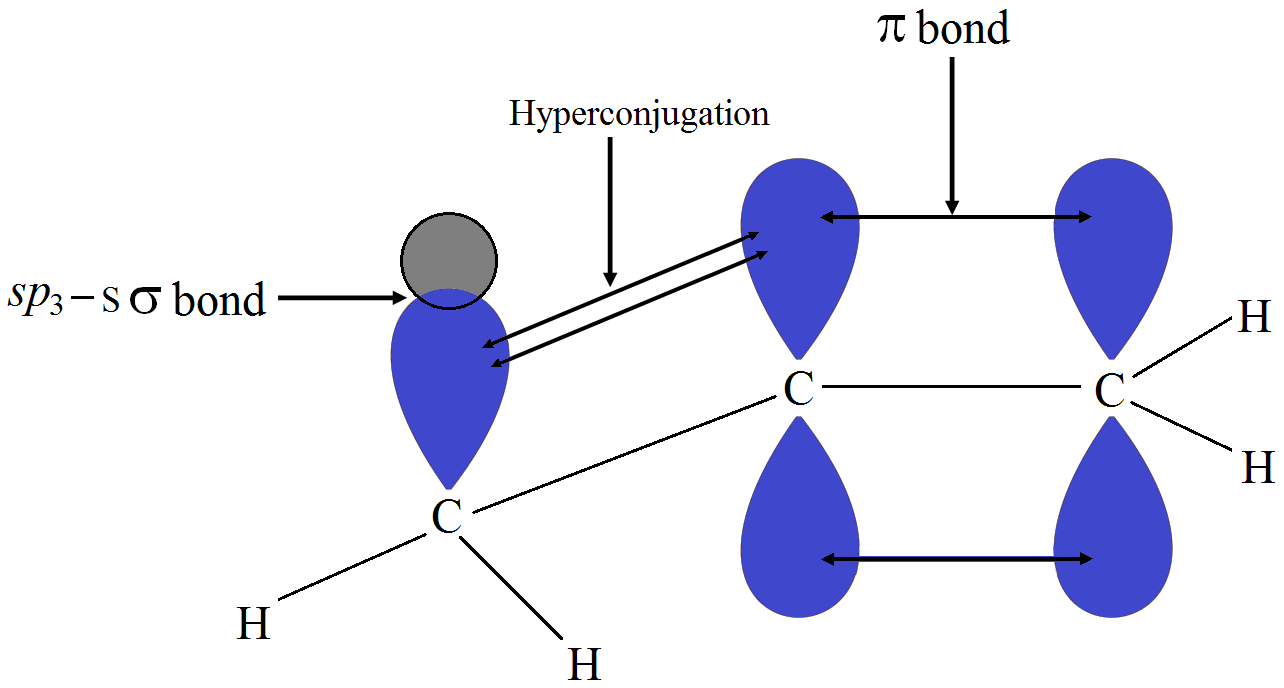
When an alkyl group is attached to a $\pi$ system, it acts as an electron-donor group by the process of hyperconjugation. To understand this concept better, let us take the example of propene.

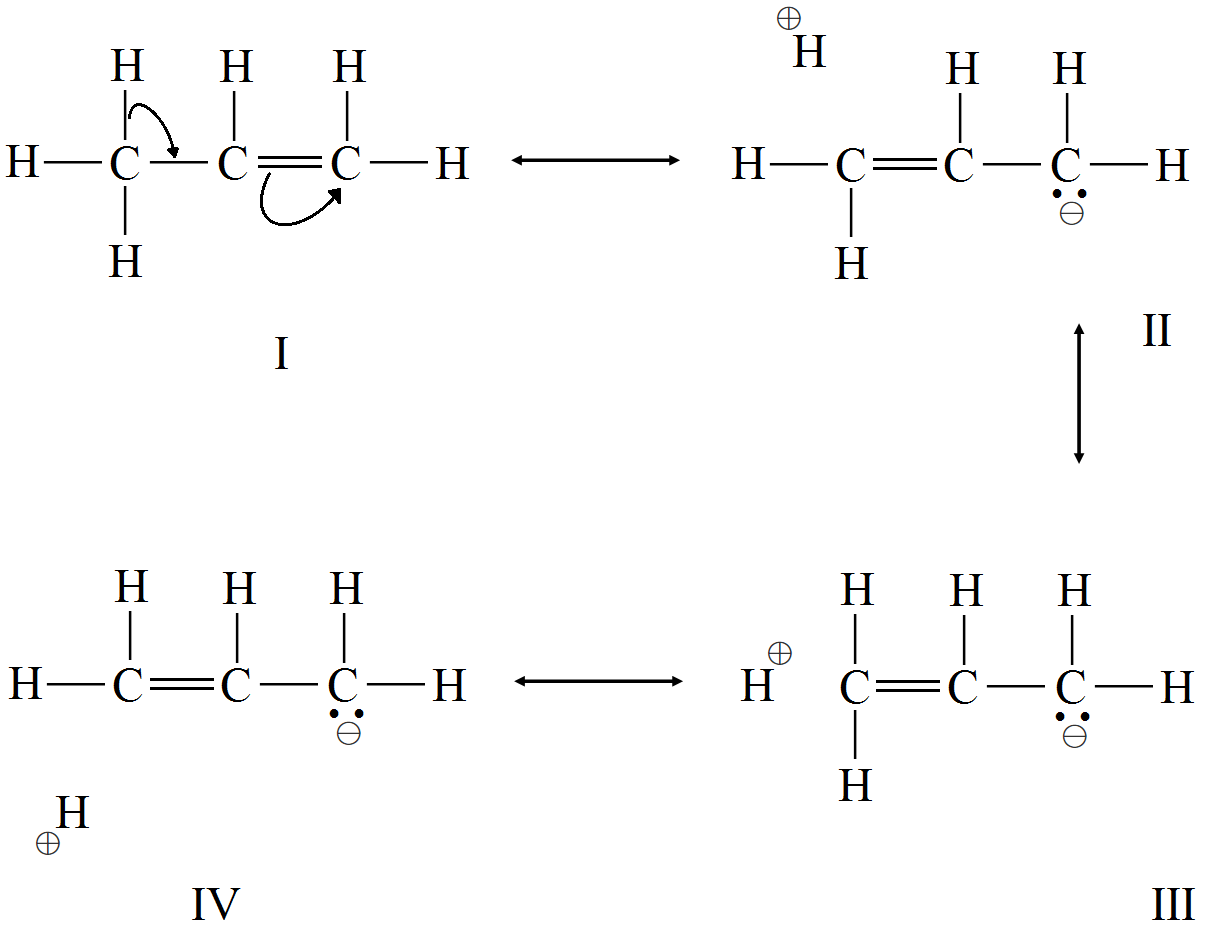
In hyperconjugation, the sigma electrons of the C-H bond of an alkyl group are delocalised. This group is directly attached to an atom of an unsaturated system. The delocalisation occurs because of a partial overlap of a $sp^3 -s$ sigma bond orbital with an empty p orbital of the $\pi$ bond of an adjacent carbon atom.
The process of hyperconjugation in propene is shown as follows:

This type of overlap leads to a delocalisation (also known as no-bond resonance) of the $\pi$ electrons, making the molecule more stable.
View full question & answer
Question 65 Marks
Differentiate between the principle of estimation of nitrogen in an organic compound by,
  1. Dumas method.
  2. Kjeldahl’s method.
Answer
In Dumas method, a known quantity of nitrogen containing organic compound is heated strongly with excess of copper oxide in an atmosphere of carbon dioxide to produce free nitrogen in addition to carbon dioxide and water. The chemical equation involved in the process can be represented as
$\text{CxHyNz}+\Big(2\text{x}+\frac{\text{y}}{2}\Big)\text{CuO}\rightarrow \text{xCO}_2+\frac{\text{y}}{2}\text{H}_2\text{O}+\frac{\text{z}}{2}\text{N}_2\Big(2\text{x}+\frac{\text{y}}{2}\Big)\text{Cu}$
The traces of nitrogen oxides can also be produced in the reaction, which can be reduced to dinitrogen by passing the gaseous mixture over a heated copper gauge. The dinitrogen produced is collected over an aqueous solution of potassium hydroxide. The volume of nitrogen produced is then measured at room temperature and atmospheric pressure.
On the other hand, in Kjeldahl’s method, a known quantity of nitrogen containing organic compound is heated with concentrated sulphuric acid. The nitrogen present in the compound is quantitatively converted into ammonium sulphate. It is then distilled with excess of sodium hydroxide. The ammonia evolved during this process is passed into a known volume of $H_2SO_4$. The chemical equations involved in the process are
$\text{Organic compound}\xrightarrow{\text{Conc. H}_2\text{So}_4}(\text{NH}_4)_2\text{SO}_4$
$(\text{NH}_4)_2\text{SO}_4+2\text{NaOH}\rightarrow\text{Na}_2\text{SO}_4+2\text{NH}_3+2\text{H}_2\text{O}$
$2\text{NH}_3+\text{H}_2\text{SO}_4\rightarrow(\text{NH}_4)_2\text{SO}_4$
The acid that is left unused is estimated by volumetric analysis (titrating it against a standard alkali) and the amount of ammonia produced can be determined. Thus, the percentage of nitrogen in the compound can be estimated. This method cannot be applied to the compounds, in which nitrogen is present in a ring structure, and also not applicable to compounds containing nitro and azo groups.
View full question & answer
Question 75 Marks
Which of the following represents the correct IUPAC name for the compounds concerned?
  1. 2,2-Dimethylpentane or 2-Dimethylpentane.
  2. 2,4,7- Trimethyloctane or 2,5,7-Trimethyloctane.
  3. 2-Chloro-4-methylpentane or 4-Chloro-2-methylpentane.
  4. But-3-yn-1-ol or But-4-ol-1-yne.
Answer
  1. The prefix di in the IUPAC name indicates that two identical substituent groups are present in the parent chain. Since two methyl groups are present in the C-2 of the parent chain of the given compound, the correct IPUAC name of the given compound is 2, 2-dimethylpentane.
  2. Locant number 2, 4, 7 is lower than 2, 5, 7. Hence, the IUPAC name of the given compound is 2, 4, 7-trimethyloctane.
  3. If the substituents are present in the equivalent position of the parent chain, then the lower number is given to the one that comes first in the name according to the alphabetical order. Hence, the correct IUPAC name of the given compound is 2-Chloro-4-methylpentane.
  4. Two functional groups - alcoholic and alkyne - are present in the given compound. The principal functional group is the alcoholic group. Hence, the parent chain will be suffixed with ol. The alkyne group is present in the C-3 of the parent chain. Hence, the correct IUPAC name of the given compound is But-3-yn-1-ol.
View full question & answer
Question 85 Marks
Explain the principle of paper chromatography.
Answer
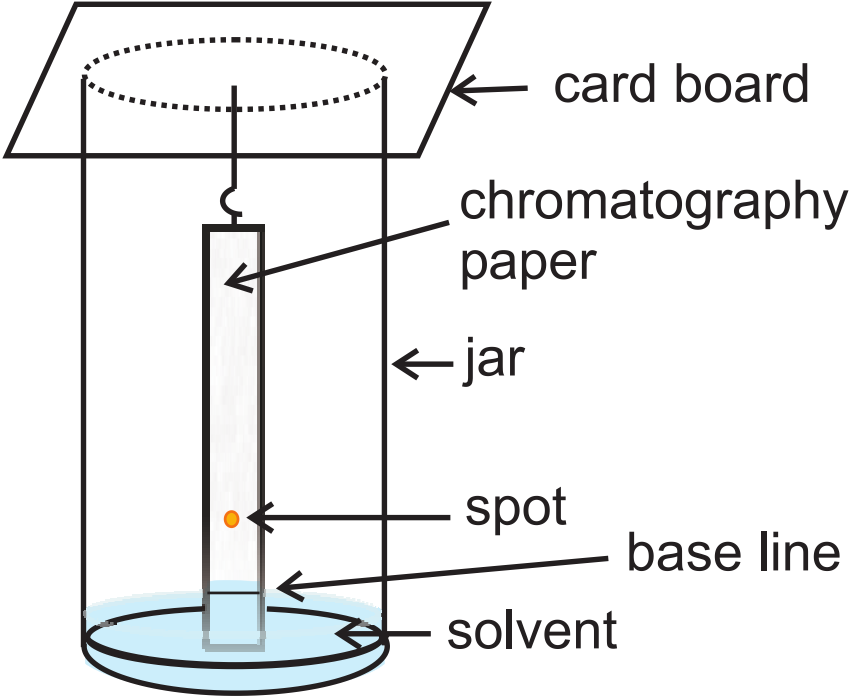
In paper chromatography, chromatography paper is used. This paper contains water trapped in it, which acts as the stationary phase. On the base of this chromatography paper, the solution of the mixture is spotted. The paper strip is then suspended in a suitable solvent, which acts as the mobile phase. This solvent rises up the chromatography paper by capillary action and in the procedure, it flows over the spot. The components are selectively retained on the paper (according to their differing partition in these two phases). The spots of different components travel with the mobile phase to different heights. The paper so obtained (shown in the given figure) is known as a chromatogram.
View full question & answer
Question 95 Marks
An organic compound contains 69% carbon and 4.8% hydrogen, the remainder being oxygen. Calculate the masses of carbon dioxide and water produced when 0.20g of this substance is subjected to complete combustion.
Answer
Percentage of carbon in organic compound $=69 \%$
That is, 100 g of organic compound contains 69 g of carbon.
$\therefore 0.2 \mathrm{~g}$ of organic compound will contain $=\frac{69 \times 0.2}{100}=0.138 \mathrm{~g}$ of C
Molecular mass of carbon dioxide, $\mathrm{CO}_2=44 \mathrm{~g}$
That is, 12 g of carbon is contained in 44 g of $\mathrm{CO}_2$.
Therefore, 0.138 g of carbon will be contained in $\frac{44 \times 0.138}{12}=0.506 \mathrm{~g}$ of $\mathrm{CO}_2$
Thus, 0.506 g of $\mathrm{CO}_2$ will be produced on complete combustion of 0.2 g of organic compound.
Percentage of hydrogen in organic compound is 4.8 .
i.e., 100 g of organic compound contains 4.8 g of hydrogen.
Therefore, 0.2 g of organic compound will contain $\frac{4.8 \times 0.2}{100}=0.0096 \mathrm{~g}$ of H
It is known that molecular mass of water $\left(\mathrm{H}_2 \mathrm{O}\right)$ is 18 g .
Thus, 2 g of hydrogen is contained in 18 g of water.
$\therefore 0.0096 \mathrm{~g}$ of hydrogen will be contained in $\frac{18 \times 0.0096}{2}=0.0864 \mathrm{~g}$ of water.
Thus, 0.0864 g of water will be produced on complete combustion of 0.2 g of the organic compound.
View full question & answer
Question 105 Marks
A sample of $0.50 g$ of an organic compound was treated according to Kjeldahl's method. The ammonia evolved was absorbed in $50 ml$ of $0.5 \mathrm{M} \mathrm{H}_2 \mathrm{SO}_4$. The residual acid required $60 mL$ of $0.5 M$ solution of NaOH for neutralisation. Find the percentage composition of nitrogen in the compound.
Answer
Given,
Mass of compound takne $=0.50 \mathrm{~g}$
Vol. of $\mathrm{H}_2 \mathrm{SO}_4=50 \mathrm{~mL}$
Molarity of $\mathrm{H}_2 \mathrm{SO}_4=0.5 \mathrm{M}$
Vol. of NaOH required $=60 \mathrm{~mL}$
Molarity of NaOH required $=0.5 \mathrm{M}$
Method adopted: Kjeldahl's method
Formula used:
$\%\text{ of N}=\frac{1.4\times\text{M}\times2\Big[\text{V}+\frac{\text{V}_1}{2}\Big]}{\text{m}}\ .....\text{(i)}$
M = 0.5M(Molarity of $H_2SO_4$)
$V = 50mL$
$V_1 = 60mL$
m - 0.5g(Mass of compound)
By substituting the values in the formula, we get,
$\%\text{of N}=\frac{1.4\times0.5\times2\Big(50-\frac{60}{2}\Big)}{0.5}=56$
$\therefore$ % of N in the given compound - 56%
View full question & answer
Question 115 Marks
What are hybridisation states of each carbon atom in the following compounds?
$CH_2=C=O, CH_3CH=CH_2, (CH_3)_2CO, CH_2=CHCN, C_6H_6$.
Answer
  1. $1 \ \ \ \ \ \ \ \ \ \ \ 2 \\ \text{CH}_2 = \text{C}=0$
$C-1$ is $sp^2$ hybridised.
$C-2$ is $sp$ hybridised.
  1. $1 \ \ \ \ \ \ \ \ \ \ \ 2 \ \ \ \ \ \ \ \ \ 3 \\ \text{CH}_3-\text{CH}=\text{CH}_2$
$C-1$ is $sp^3$ hybridised.
$C-2$ is $sp^2$​​​​​​​ hybridised.
$C-3$ is $sp^2​​​​​​​$​​​​​​​ hybridised.
  1. $\ \ \ \ \ \ \ \ \ \ \ \text{O} \\ \ \ \ \ \ \ \ \ \ \ \ {||} \\ \text{CH}_3{-}\text{C} {-}\text{CH}_3 \\ 1 \ \ \ \ \ \ \ \ \ 2 \ \ \ \ 3$
$C-1$ and $C-3$ are $sp^3​​​​​​​$​​​​​​​ hybridised.
$C-2$ is $sp^2​​​​​​​$​​​​​​​ hybridised.
  1. $1 \ \ \ \ \ \ \ \ \ 2 \ \ \ \ \ \ \ 3 \\ \text{CH}_2{=}\text{CH}{-}\text{C}\equiv\text{N}$
$C-1$ is $sp^2$​​​​​​​ hybridised.
$C-2$ is $sp^2​​​​​​​$​​​​​​​ hybridised.
$C-3$ is $sp$ hybridised.
  1. $C_6H_6​​​​​​​$​​​​​​​
All the 6 carbon atoms in benzene are $sp^2$​​​​​​​ hybridised.
View full question & answer
Question 125 Marks
Give a brief description of the principles of the following techniques taking an example in each case.
Chromatography.
Answer
Chromatography:
  1. It is applicable for the separation of virtually all inorganic and organic materials, except very insoluble polymers.
  2. In this technique, the mixture of compounds which needs to be separated is applied onto a stationary phase, which may be a solid or a liquid. Another phase which may be a pure solvent, a mixture of solvents or a gas is allowed to more slowly over the stationary phase.
  3. The components of the mixture which have different solubility in the moving phase, start moving. Since, they have different solubility, they move to different lengths on the stationary phase and become stable there,
  4. Thus, the different components of the mixture are separated.
View full question & answer
Question 135 Marks
Explain the reason for the fusion of an organic compound with metallic sodium for testing nitrogen, sulphur and halogens.
Answer
Nitrogen, sulphur, and halogens are covalently bonded in organic compounds. For their detection, they have to be first converted to ionic form. This is done by fusing the organic compound with sodium metal. This is called "Lassaigne's test". The chemical equations involved in the test are
$\mathrm{Na}+\mathrm{C}+\mathrm{N} \rightarrow \mathrm{NaCN}$
$\mathrm{Na}+\mathrm{S}+\mathrm{C}+\mathrm{N} \rightarrow \mathrm{NaSCN}$
$2 \mathrm{Na}+\mathrm{S} \rightarrow \mathrm{Na}_2 \mathrm{~S}$
$\mathrm{Na}+\mathrm{X} \rightarrow \mathrm{NaX}$
$(\mathrm{X}=\mathrm{Cl}, \mathrm{Br}, \mathrm{l})$
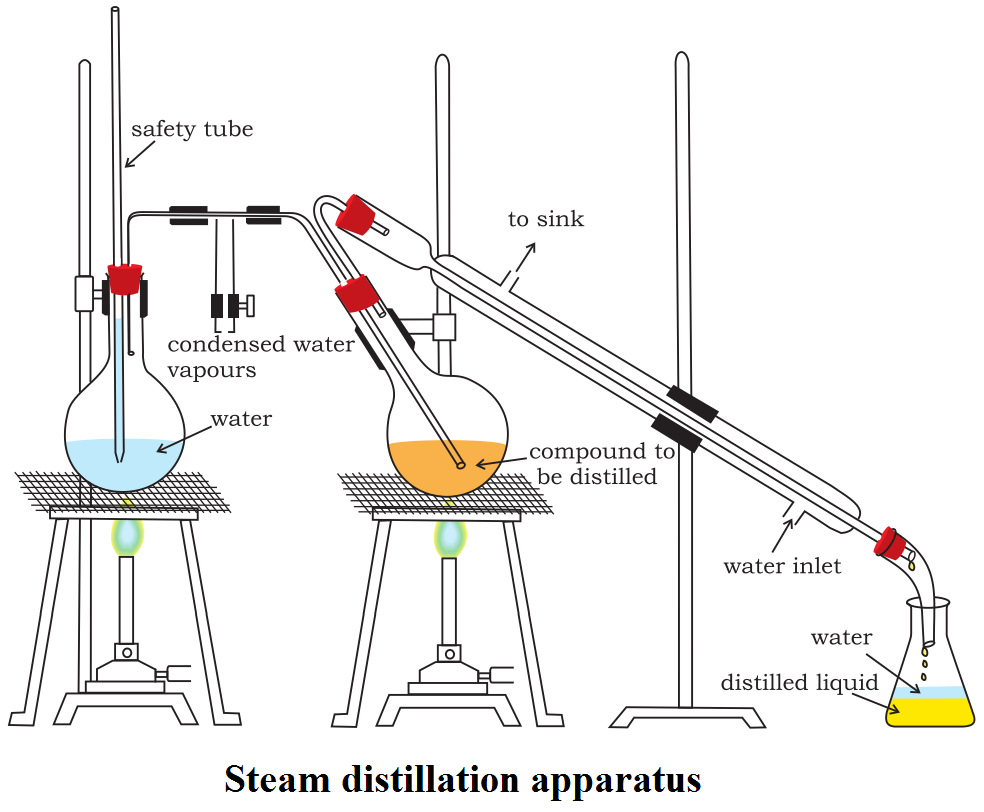
Carbon, nitrogen, sulphur, and halogen come from organic compounds.
View full question & answer
Question 145 Marks
Give a brief description of the principles of the following techniques taking an example in each case.
Distillation.
Answer
Distillation: This method is used to separate either:
  1. Volatile liquids from non-volatile impurities.
  2. Two liquids with different boiling points. The liquid mixture such as that of chloroform and aniline is taken in a round bottom flask fitted with a condenser.
Upon heating, the vapours of lower boiling liquid are formed first and collected through the condenser. The vapours of the higher boiling liquid are formed later. Thus, the two are separated.
View full question & answer
Question 155 Marks
Why is a solution of potassium hydroxide used to absorb carbon dioxide evolved during the estimation of carbon present in an organic compound?
Answer
Carbon dioxide is acidic in nature and potassium hydroxide is a strong base. Hence, carbon dioxide reacts with potassium hydroxide to form potassium carbonate and water as
$3 \mathrm{KOH}+\mathrm{CO}_2 \rightarrow \mathrm{~K}_2 \mathrm{CO}_3+\mathrm{H}_2 \mathrm{O}$
Thus, the mass of the U -tube containing KOH increases. This increase in the mass of U -tube gives the mass of $\mathrm{CO}_2$ produced. From its mass, the percentage of carbon in the organic compound can be estimated.
View full question & answer
Question 165 Marks
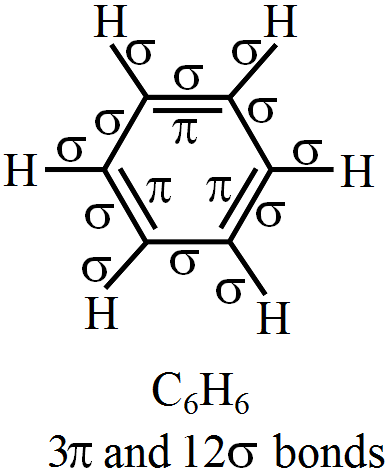
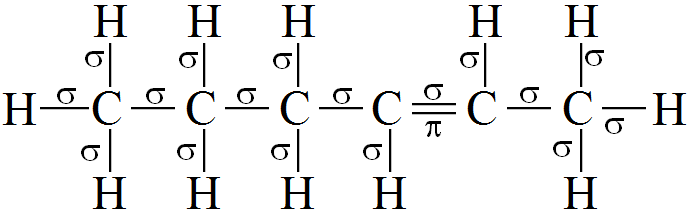
Indicate the $\sigma$ and $\pi$ bonds in the following molecules:
$C_6H_6$,
Answer
The $\sigma$ and $\pi$ bonds are indicated below:

$C_6H_{12}$ can be either:
Straight chain compound
$H_3C-H_2C-H_2C-HC+CH-CH_3$​​​​​​​

$\begin{matrix}6\text{C} - \text{C} & \sigma- \text{ bonds}\\12 \text{C} - \text{H} & \sigma-\text{bonds} \\ 1\text{C}-\text{C} & \pi-\text{bond}\end{matrix}\Bigg\}$ Other straight chain isomers will also have the same no. of $\sigma$ and $\pi$-bonds.
View full question & answer
Question 175 Marks
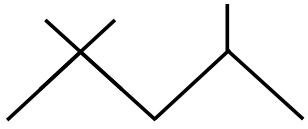
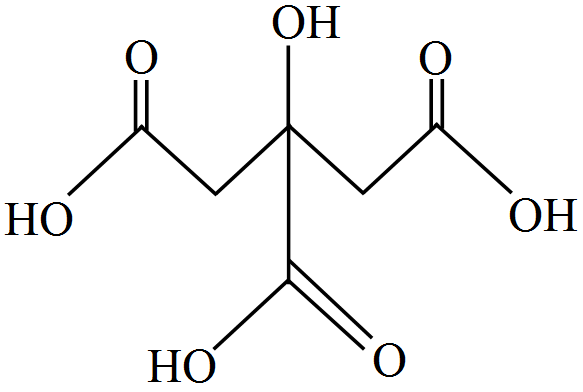
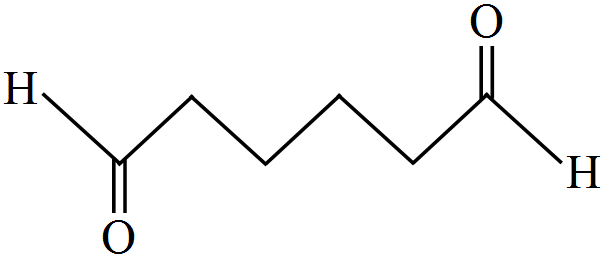
Give condensed and bond line structural formulas and identify the functional group(s) present, if any, for:
  1. 2, 2, 4-Trimethylpentane.
  2. 2-Hydroxy-1, 2, 3-propanetricarboxylic acid.
  3. Hexanedial.
Answer
 
Molecular formula
Bond live structure
Condensed structure
Functional groups
(a)
2, 2, 4-Trimethyl pentane
$(CH_3)_3CCH_2CH(CH_3)_2$
-
(b)
2-Hydroxy-1, 2, 3,-propanetri-carboxylic acid
$HOOCCH_2C(OH)(COOH)CH_2COOH$
-OH(hydroxyl)
-COOH (Carboxyl) group
(c)
Hexanedial
$OHC(CH_2)_4CHO$
-CHO aldehyde group
View full question & answer
Question 185 Marks
Give a brief description of the principles of the following techniques taking an example in each case.
Crystallisation
Answer
Crystallisation: It is based on the difference in solubility of the compound and the impurities in a suitable solvent. While at room temperature, the compound is sparingly soluble and crystallizes out of solution but the impurities do not. As a result, they remain in solution and the compound is obtained as a crystal.
The impure compound is dissolved in a solvent and heated. At elevated temperature the compound dissolves as do the impurities. This solution is then gradually cooled. Being less soluble at room temperature it precipitates out in the form of crystals and pure compound is obtained.
View full question & answer
Question 195 Marks
Explain, why an organic liquid vaporises at a temperature below its boiling point in its steam distillation?
Answer
We know that any liquid boils when its vapour pressure is equal to the atmospheric pressure. There are certain liquids such as aniline which need very high temperature in order to start boiling. It is quite likely that at such elevated temperatures the molecules may just disintegrate. Therefore, to prevent this, steam distillation is employed. Here, the mixture of organic liquids containing the high boiling liquid say, aniline is mixed with water and heated. On doing so, at a temperature close to but less than 100ºC (b.p. of water) the vapour pressure of water equals the atmospheric pressure and it boils. Since, in the mixture, aniline is present in conjugation with water it vapourises and moves out of the mixture.
The mixture of water and aniline is separated using a separating funnel. Steam distillation is used extensively in perfumery to separate essential oils.
View full question & answer
Question 205 Marks
In the estimation of sulphur by Carius method, 0.468g of an organic sulphur compound afforded 0.668g of barium sulphate. Find out the percentage of sulphur in the given compound.
Answer
Total mass of organic compound $=0.468 \mathrm{~g}$ [Given]
Mass of barium sulphate formed $=0.668 \mathrm{~g}$ [Given]
1 mol of $\mathrm{BaSO}_4=233 \mathrm{~g}$ of $\mathrm{BaSO}_4=32 \mathrm{~g}$ of sulphur
Thus, 0.668 g of $\mathrm{BaSO}_4$ contains $\frac{32 \times 0.668}{233} \mathrm{~g}$ of sulphur $=0.0917 \mathrm{~g}$ of sulphur
Therefore, percentage of sulphur $=\frac{0.0197}{0.468} \times 100=19.59 \%$
Hence, the percentage of sulphur in the given compound is $19.59 \%$.
View full question & answer
Question 215 Marks
Classify the following reactions in one of the reaction type studied in this unit.
i. $\mathrm{CH}_3 \mathrm{CH}_2 \mathrm{Br}+\mathrm{HS}^{-} \rightarrow \mathrm{CH}_3 \mathrm{CH}_2 \mathrm{SH}+\mathrm{Br}^{-}$
ii. $(\mathrm{CH})_2 2 \mathrm{C}=\mathrm{CH} 2+\mathrm{HCl} \rightarrow\left(\mathrm{CH}_3\right)_2 \mathrm{ClC}-\mathrm{CH}_3$
iii. $\mathrm{CH}_3 \mathrm{CH}_2 \mathrm{Br}+\mathrm{HO}^{-} \rightarrow \mathrm{CH}=\mathrm{CH}_2+\mathrm{H}_2 \mathrm{O}+\mathrm{Br}^{-}$
iv. $\left(\mathrm{CH}_3\right)_3 \mathrm{C}-\mathrm{CH}_3 \mathrm{OH}+\mathrm{HBr} \rightarrow\left(\mathrm{CH}_3\right)_2 \mathrm{CBrCH}_2 \mathrm{CH}_2 \mathrm{CH}+\mathrm{H}_2 \mathrm{O}$
Answer
  1. It is an example of substitution reaction as in this reaction the bromine group in bromoethane is substituted by the -SH group.
  2. It is an example of addition reaction as in this reaction two reactant molecules combine to form a single product.
  3. It is an example of elimination reaction as in this reaction hydrogen and bromine are removed from bromoethane to give ethene.
  4. In this reaction, substitution takes place, followed by a rearrangement of atoms and groups of atoms.
View full question & answer
Question 225 Marks
What is the difference between distillation, distillation under reduced pressure and steam distillation?
Answer
The differences among distillation, distillation under reduced pressure, and steam distillation are given in the following table.
Distillation
Distillation under reduced pressure
Steam distillation
It is used for the purification of compounds that are associated with non-volatile impurities or those liquids, which do not decompose on boiling. In other words, distillation is used to separate volatile liquids from non-volatile impurities or a mixture of those liquids that have sufficient difference in boiling points.
This method is used to purify a liquid that tends to decompose on boiling. Under the conditions of reduced pressure, the liquid will boil at a low temperature than its boiling point and will, therefore, not decompose.
It is used to purify an organic compound, which is steam volatile and immiscible in water. On passing steam, the compound gets heated up and the steam gets condensed to water. After some time, the mixture of water and liquid starts to boil and passes through the condenser. This condensed mixture of water and liquid is then separated by using a separating funnel.
Mixture of petrol and kerosene is separated by this method.
Glycerol is purified by this method. It boils with decomposition at a temperature of 593K. At a reduced pressure, it boils at 453K without decomposition.
A mixture of water and aniline is separated by steam distillation.
View full question & answer
Question 235 Marks
  1. What are nucleophiles? Give one example of nucleophilic addition reaction.
  2. Give one example of functional isomerism.
  3. Explain the principle of paper chromatography.
Answer
  1. Nucleophiles are those species which are either negatively charged or electron rich i.e. have lone pair of electrons e.g. $\mathrm{Br}^{-}, \mathrm{CN}^{-}, \mathrm{OH}^{-}$.
$\text{C}_2\text{H}_5\text{Cl}+\text{NaOH(aq)}\xrightarrow{\ \ \ \ \ \ \ \ \ \ }\text{C}_2\text{H}_5\text{OH}+\text{NaCl}\\\text{Ethyl chloride}\ \ \ \ \ \ \ \ \ \ \ \ \ \ \ \ \ \ \ \ \ \ \ \ \text{Ethanol}$
  1. $\mathrm{CH}_3 \mathrm{CH}_2 \mathrm{OH}$ and $\mathrm{CH}_3 \mathrm{OCH}_3$ are examples of functional isomers.
  2. In paper chromatography, chromatographic paper dipped in solvent acts as stationary phase whereas mixture of compounds dissolved in suitable solvent forms the mobile phase. Different compounds have different adsorbing power, therefore, they move with different speeds and get separated.
View full question & answer
Question 245 Marks
Match the ions given in Column I with their nature given in Column II.
 
Column I
 
Column II
(i)
(a)
Stable due to resonance.
(ii)
$\text{F}_3-\text{C}^\oplus$
(b)
Destabilised due to inductive effect.
(iii)
$\ \ \ \ \ \ \ \ \ \ \ \ \text{CH}_3\\\ \ \ \ \ \ \ \ \ \ \ \ \ |\\\text{CH}_3-\text{C}^\ominus\\\ \ \ \ \ \ \ \ \ \ \ \ \ \ |\\\ \ \ \ \ \ \ \ \ \ \ \ \ \text{CH}_3$
(c)
Stabilised by hyperconjugation.
(iv)
$\ \ \ \ \ \ \ \ \ \ \ \ \ _\oplus\\\text{CH}_3-\text{CH}-\text{CH}_3$
(d)
A secondary carbocation.
Answer
 
Column I
 
Column II
(i)
(a)
Stable due to resonance.
(ii)
$\text{F}_3-\text{C}^\oplus$
(b)
Destabilised due to inductive effect.
(iii)
$\ \ \ \ \ \ \ \ \ \ \ \ \text{CH}_3\\\ \ \ \ \ \ \ \ \ \ \ \ \ |\\\text{CH}_3-\text{C}^\ominus\\\ \ \ \ \ \ \ \ \ \ \ \ \ \ |\\\ \ \ \ \ \ \ \ \ \ \ \ \ \text{CH}_3$
(b)
Destabilised due to inductive effect.
(iv)
$\ \ \ \ \ \ \ \ \ \ \ \ \ _\oplus\\\text{CH}_3-\text{CH}-\text{CH}_3$
(c)
Stabilised by hyperconjugation.
(d)
A secondary carbocation.
View full question & answer
Question 255 Marks
Note: Consider structures I to VII and answer the questions:
  1. $\text{CH}_3-\text{CH}_2-\text{CH}_2-\text{CH}_2-\text{OH}$
  2. $\text{CH}_3-\text{CH}_2-\text{CH}-\text{CH}_3\\\ \ \ \ \ \ \ \ \ \ \ \ \ \ \ \ \ \ \ \ \ \ \ \ \ \ |\\\ \ \ \ \ \ \ \ \ \ \ \ \ \ \ \ \ \ \ \ \ \ \ \ \ \text{OH}$
  3. $\ \ \ \ \ \ \ \ \ \ \ \ \text{CH}_3\\\ \ \ \ \ \ \ \ \ \ \ \ \ |\\\text{CH}_3-\text{C}-\text{CH}_3\\\ \ \ \ \ \ \ \ \ \ \ \ \ |\\\ \ \ \ \ \ \ \ \ \ \ \ \text{OH}$
  4. $\text{CH}_3-\text{CH}-\text{CH}_2-\text{OH}\\\ \ \ \ \ \ \ \ \ \ \ \ \ \ \ \ \ \ \ \ \ \ \ \ |\\\ \ \ \ \ \ \ \ \ \ \ \ \ \ \ \ \ \ \ \ \ \ \ \text{CH}_3$
  5. $\text{CH}_3-\text{CH}_2-\text{O}-\text{CH}_2-\text{CH}_3$
  6. $\text{CH}_3-\text{O}-\text{CH}_2-\text{CH}_2-\text{CH}_3$
  7. $\text{CH}_3-\text{O}-\text{CH}-\text{CH}_3\\\ \ \ \ \ \ \ \ \ \ \ \ \ \ \ \ \ \ \ \ \ \ |\\\ \ \ \ \ \ \ \ \ \ \ \ \ \ \ \ \ \ \ \ \ \text{CH}_3$
Which of the above compounds form pairs of metamers?
Answer
When two or more compounds have same molecular formula but different alkyl groups on either side of the functional group, the compounds are called metameres. In the given structures V and VI or VI and VII form a pair of metameres because alkyl groups are different on either side of the functional group -0.,
  1. $\text{CH}_3-\text{CH}_2-\text{O}-\text{CH}_2-\text{CH}_3${Metameres}
  2. $\text{CH}_3-\text{O}-\text{CH}_2-\text{CH}_2-\text{CH}_3${Metameres}
and
  1. $\text{CH}_3-\text{O}-\text{CH}_2-\text{CH}_2-\text{CH}_3${Metameres}
  2. $\text{CH}_3-\text{O}-\text{CH}-\text{CH}_3\\\ \ \ \ \ \ \ \ \ \ \ \ \ \ \ \ \ \ \ \ \ \ |\\\ \ \ \ \ \ \ \ \ \ \ \ \ \ \ \ \ \ \ \ \ \text{CH}_3$(Metameres}
View full question & answer
Question 265 Marks
The ratio of mass percent of C and H of an organic compound $\mathrm{C}_{\mathrm{x}} \mathrm{H}_y \mathrm{O}_z$ is $6: 1$. If one molecule of the above compound $\left(\mathrm{C}_x \mathrm{H}_y \mathrm{O}_z\right)$ contains half much oxygen of required to burn one molecule of compound $\mathrm{C}_x \mathrm{H}_y$ completely to $\mathrm{CO}_2$ and $\mathrm{H}_2 \mathrm{O}$. What is empirical formula of $\mathrm{C}_{\mathrm{x}} \mathrm{H}_y \mathrm{O}_z$ ?
Answer
The empirical formula of compound is $\mathrm{C}_2 \mathrm{H}_4 \mathrm{O}_3$. Because ratio of mass percent is $6: 1$.
$\%\text{ of C}=\frac{24}{76}\times100$
$\%\text{ of H}=\frac{4}{76}\times100$
$\text{Ratio}\frac{2400}{76}:\frac{400}{76}$
$\text{Ratio }6:1$
$\text{C}_2\text{H}_4+3\text{O}_2\xrightarrow{\ \ \ \ \ \ \ }\text{CO}_2+2\text{H}_2\text{O}$
$\mathrm{C}_2 \mathrm{H}_2 \mathrm{O}_3$ has half of oxygen $\left(6 \times \frac{1}{2}\right)$ needed of burning $\mathrm{C}_2 \mathrm{H}_4$ as given by. above equation.
View full question & answer
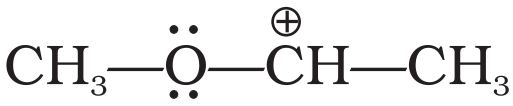
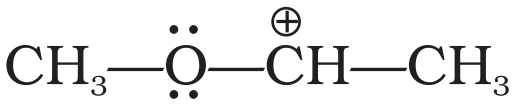
Question 275 Marks
  1. Arrange the following according to given property
$\text{CH}_3\stackrel{\oplus \ \ \ }{\text{CH}}_2,\text{C}_6\text{H}_5-\stackrel{\oplus\ \ \ \ }{\text{CH}}_2,(\text{CH}_3)_3\stackrel{\oplus \ \ \ \ }{\text{CH}},$
$\text{CH}_2=\text{CH}-\stackrel{\oplus\ \ \ \ }{\text{CH}}_2$ (decreasing order of stability)
  1. $\text{HC}\equiv\text{C}^{\ominus},\text{Ch}_2=\stackrel{\ominus\ \ \ \ \ \ }{\text{CH}_2},\text{CH}_3-\stackrel{\ominus\ \ \ \ \ }{\text{CH}_2},\stackrel{\ominus \ \ \ \ \ }{\text{CH}_3}$ (increasing order of stabillity)
  2. $\text{C}_6\text{H}_5\stackrel{\bf. \ \ \ \ }{\text{CHCH}_3},\text{C}_6\text{H}_5\text{CH}_2\stackrel{\bf.\ \ \ \ \ }{\text{CH}_2},\text{C}_6\text{H}_5\stackrel{\bf.}{\text{C}}_3(\text{CH}_3)_2$ (increasing order of stabillity)
  3. $\text{CH}_3-\stackrel{\oplus \ \ \ \ }{\text{CH}}-\text{O}-\text{CH}_3,\text{CH}_3-\stackrel{\oplus \ \ \ \ }{\text{CH}},-\text{OCH}_3,$
${\ \ \ \ \ \ \ \ \ \ \ \ \ \ \ \ \ \ \ \ \text{O}}\\{\ \ \ \ \ \ \ \\ \ \ \ \ \ \ \ \ \ \ \ \ \ \\ \|}\\\ \text{CH}_3-\stackrel{\oplus \ \ \ \ }{\text{CH}}\text{C}-\text{OCH}_3$ (decreasing order of stability)
  1.  
Answer
  1. $\text{C}_6\text{H}_5\stackrel{\oplus \ \ \ }{\text{CH}}_2>\text{C}\text{H}_2=\text{CH}-\stackrel{\oplus\ \ \ \ }{\text{CH}}_2>(\text{CH}_3)_3\stackrel{\oplus \ \ \ \ }{\text{C}}>\text{CH}_3-\stackrel{\oplus \ \ \ \ }{\text{CH}_2}$
  2. $\stackrel{\ominus \ \ \ \ \ }{\text{CH}_3}<\text{CH}_3-\stackrel{\ominus \ \ \ \ \ }{\text{CH}_2}<\text{CH}_2=\stackrel{\ominus \ \ \ \ \ }{\text{CH}}<\text{HC}\equiv\stackrel{\ominus \ \ \ \ \ }{\text{C}}$
  3. $\text{C}_6\text{H}_5\stackrel{\bf. \ \ \ \ }{\text{CH}_2}<\text{C}_6\text{H}_5\stackrel{\bf.\ \ \ \ \ }{\text{CHCH}_3}<\text{C}_6\text{H}_5\stackrel{\bf.}{\text{C}}_3(\text{CH}_3)_2$
  4. $\text{CH}_3-\stackrel{\oplus \ \ \ \ }{\text{CH}}-\text{O}-\text{CH}_3>\text{CH}_3-\stackrel{\oplus \ \ \ \ }{\text{CH}}>\text{CH}_3>\stackrel{\oplus \ \ \ \ }{\text{CH}}$
${\ \ \ \ \ \ \ \ \ \ \ \ \ \ \ \ \ \ \ \ \text{O}}\\{\ \ \ \ \ \ \ \\ \ \ \ \ \ \ \ \ \ \ \ \ \ \\ \|}\\\ >\text{CH}_3-\stackrel{\oplus \ \ \ \ }{\text{CH}}\text{C}-\text{OCH}_3$
  1.  
View full question & answer
Question 285 Marks
$0.2325g$ of an organic compound was analysed for nitrogen by Duma's method $0.0317L$ of moist nitrogen was collected at $25^\circ C$ and $755.8mm$ pressure. Calculate the percentage of nitrogen. [Aq. tension of water at $25^\circ C$ is $23.8mm$ Hg.)
Answer
Mass of organic compound = $0.2325g V_1 = 0.0317L, V_2 = ? P_1 = 755.8 - 23.8mm = 730mm P_2 = 760mm T_1 = 25^\circ C + 273 = 298K T_2 = 273K $$\frac{\text{P}_1\text{V}_1}{\text{T}_1}=\frac{\text{P}_2\text{V}_2}{\text{T}_2}$ $\frac{730\times0.0317}{298}=\frac{760\times\text{V}_2}{273}$ $\text{V}_2=\frac{730\times0.0317\times273}{760\times298}$ $=\frac{6317.49}{226480}=0.0279\text{L}$ $22.4\text{L of N}_2 \text{ at STP weighs}=28\text{g}$ $0.0279\text{L of N}_2\text{ at STP weighs}=\frac{28}{22.4}\times0.0279\text{g}$$\%\text{ of N}=\frac{\text{Mass of nitrogen}}{\text{Mass pf organic compound}}\times100$
$\%\text{ of N}=\frac{28}{22.4}\times0.0279\times\frac{100}{\text{Mass of organic compound}}$
$=\frac{28}{22.4}\times\frac{0.0279\times100}{0.02325}$
$=\frac{78.12}{5.208}=15\%$
View full question & answer
Question 295 Marks
  1. Two solids which have different solubilities in a solvent and which do not react when dissolved in it.
  2. Liquid that decompose at its boiling point.
  3. Steam volatile liquid and immiscible with water.
  4. Two liquids which have boiling points close to each other.
  5. Two liquids with large difference in their boiling points.
Answer
  1. Fractional crystallisation.
  2. Distillation under reduced pressure.
  3. Steam distillation.
  4. Fractional distillation.
  5. Simple distillation.
View full question & answer
Question 305 Marks
Three students, Manish, Ramesh and Rajni were determining the extra elements present in an organic compound given by their teacher. They prepared the Lassaigne’s extract (L.E.) independently by the fusion of the compound with sodium metal. Then they added solid $\mathrm{FeSO}_4$ and dilute sulphuric acid to a part of Lassaigne’s extract. Manish and Rajni obtained prussian blue colour but Ramesh got red colour. Ramesh repeated the test with the same Lassaigne’s extract, but again got red colour only. They were surprised and went to their teacher and told him about their observation. Teacher asked them to think over the reason for this. Can you help them by giving the reason for this observation. Also, write the chemical equations to explain the formation of compounds of different colours.
Answer
In the Lassaigne's test for nitrogen in an organic compound, the Prussian blue colour is obtained due to the formation of,
ferry ferrocyanide.
$6 \mathrm{NaCN}+\mathrm{FeSO}_4 \rightarrow \mathrm{Na}_4\left[\mathrm{Fe}(\mathrm{CN})_6\right]+\mathrm{Na}_2 \mathrm{SO}_4$
$3 \mathrm{Na}_4\left[\mathrm{Fe}(\mathrm{CN})_6\right]+2 \mathrm{Fe}_2\left(\mathrm{SO}_4\right) 3 \rightarrow \mathrm{Fe}_4\left[\mathrm{Fe}(\mathrm{CN})_6\right]_3+6 \mathrm{Na}_2 \mathrm{SO}_4$
In compounds containing nitrogen and sulphur together, the sodium metal should be in slight excess otherwise in Lassaigne's test, sodium thiocyanate ( NaCNS ) is formed which gives red colour with $\mathrm{Fe}^{3+}$ ions and decomposes as follows:
View full question & answer
Question 315 Marks
  1. What type of intermediate species are formed by homolytic fission?
  2. Which substance is used as adsorbent in thin layer chromatography?
  3. Why is resonance hybrid is more stable than resonating structures?
  4. In Kjeldahl's method, which compound is formed during digestion i.e., reaction of organic compound with conc. $H_2SO_4$ on heating?
  5. Why is HCOOH more acidic than $CH_3COOH$?
Answer
  1. Free radicals are formed by homolytic fission.
  2. Silica gel is used in thin layer chromatography.
  3. It is because resonance hybrid has lower energy as compared to resonating structures.
  4. $NH_3$ liberated by organic compounds reacts with $H_2SO_4$ to form ammonium sulphate.
  5. It is because $\ \ \ \ \ \ \ {\text{O}}\\\ \ \ \ \ \ \ \ \|\\\text{H}-\text{C}-\text{O}^{\ominus}$ is more stable than $\ \ \ \ \ \ \ \ \ \ \ \ \ \text{O}\\\ \ \ \ \ \ \ \ \ \ \ \ \ \|\\\text{CH}_3-\text{C}-\text{O}^{\ominus}$
group is electron releasing, it will increase negative charge on acetate ion making it unstable.
View full question & answer
Question 325 Marks
Match the type of mixture of compounds in Column I with the technique of separation/purification given in Column II.
 
Column I
 
Column II
(i)
Two solids which have different solubilities in a solvent and which do not undergo reaction when dissolved in it.
(a)
Steam distillation.
(ii)
Liquid that decomposes at its boiling point.
(b)
Fractional distillation.
(iii)
Steam volatile liquid.
(c)
Simple distillation.
(iv)
Two liquids which have boiling points close to each other.
(d)
Distillation under reduced pressure.
(v)
Two liquids with large difference in boiling points.
(e)
Crystallisation.
Answer
 
Column I
 
Column II
(i)
Two solids which have different solubilities in a solvent and which do not undergo reaction when dissolved in it.
(e)
Crystallisation.
(ii)
Liquid that decomposes at its boiling point.
(d)
Distillation under reduced pressure.
(iii)
Steam volatile liquid.
(a)
Steam distillation.
(iv)
Two liquids which have boiling points close to each other.
(b)
Fractional distillation.
(v)
Two liquids with large difference in boiling points.
(c)
Simple distillation.
View full question & answer
Question 335 Marks
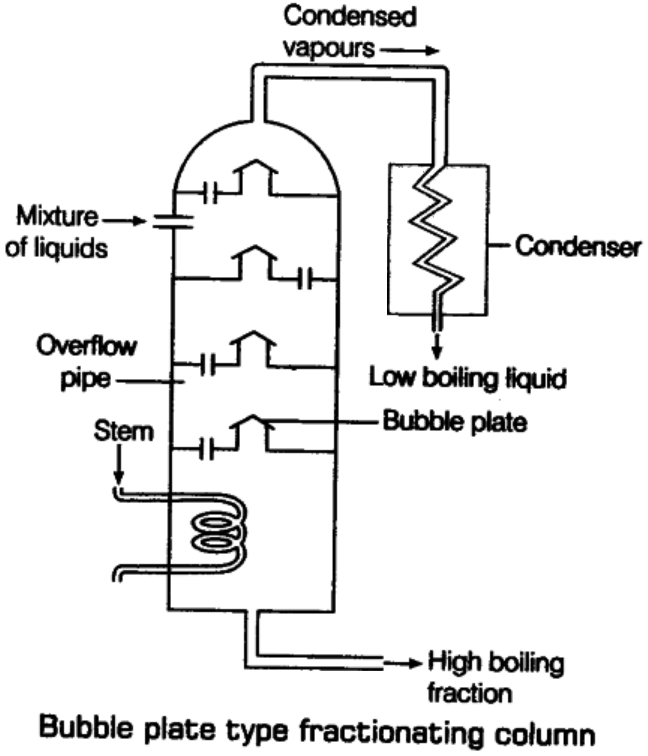
Draw a diagram of bubble plate type fractionating column. When do we require such type of a column for separating two liquids. Explain the principle involved in the separation of components of a mixture of liquids by using fractionating column. What industrial applications does this process have?
Answer
The bubble plate type fractionating column is shown in the figure. The tower is divided into number of compartments by mean as of shelves having openings. The openings are covered with caps called bubble caps. Each shelf is provided with an overflow pipe which keeps the liquid to a certain level and then allows the rest to trickle down to the lower shelf. Such type of column is used for continuous separation of bulk quantities of liquids, e.g., distillation of fermented liquid for manufacture of rectified spirit.
Industrial application.
  1. Separation of crude oil in petroleum industry into various useful fractions such as gasoline, kerosene oil, diesel oil, lubricating oil, etc.
  2. Separation of acetone and methanol from pyroligneous acid obtained by destructive distillation of wood.
View full question & answer
Question 345 Marks
Give three points of differences between inductive effect and resonance effect.
Answer
Inductive effect vs Resonance effect.
Inductive effect Resonance effect
Based on electronegativity. Based on Conjugation.
Electron moves via sigma bonds. Electron moves via pi bonds or lone pairs.
It involves displacement of only $\sigma$ electrons and hence occurs only in saturated compounds. It involves delocalization of $\pi$ (pi) or n lone pairs of electrons and hence occurs in unsaturated and conjugated systems.
During inductive effect the electron pair is only slightly displaced towards the more electronegative atom and hence only partial positive and negative charges appear. During resonance effect, the electron pair I completely transferred and hence full positive and negative charges appear.
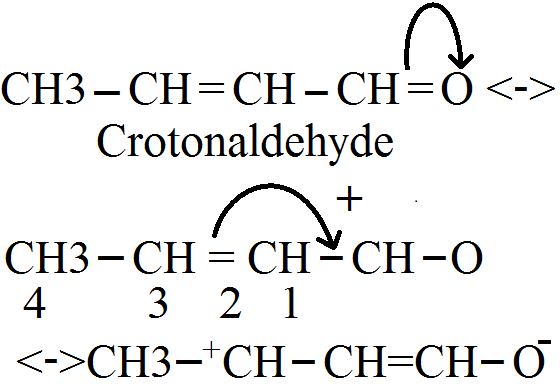
Inductive effect are transmitted over short distance over short distances in saturated carbon chains and the magnitude of the effect decreases rapidly as distance from the heteroatom increases. The effects almost become negligible beyond three carbon atoms from the heteroatom. The resonance effect is transmitted all along the length of the conjugated system without suffering much change in magnitude.

$\mathrm{C}_3$ in crotonaldehyde is almost as positive as $\mathrm{C}_1$.
Distance short range. Distance may be long range.
View full question & answer
Question 355 Marks
  1. Out of different gases formed in Duma's method, which gas is not absorbed over an aqueous solution?
  2. What is function of $K_2SO_4$ and a little of $CuSO_4$​​​​​​​ added in Kjeldahl's flask?
  3. 0.4g of compound was Kjeldahl's and ammonia evolved was absorbed into 50mL of $\frac{\text{M}}{4}\text{ H}_2\text{SO}_4$ The residual acid was diluted with distilled water and made up to 150mL. 20mL of this diluted acid required 31mL of $\frac{\text{M}}{4}\text{ NaOH}$ solution for complete neutralisation. Calculate % of N in compound.
Answer
  1. $N_2$ gas is not absorbed by KOH.
  2. $K_2SO_4$ increases boiling point of $H_2SO_4$ and $CuSO_4$ acts as catalyst.
  3. $2\text{M}_1\text{V}_1=\text{M}_2\text{V}_2\$\text{H}_2\text{SO}_4)\ \ \ (\text{NaOH})$
$\Rightarrow2\times\text{M}_1\times20=31\times\frac{1}{20}$
$\Rightarrow\text{M}_1=\frac{31}{800}$
$\text{M}_1\text{V}_1=\text{M}_2\text{V}_2$
$\frac{31}{800}\times150=\frac{1}{4}\times\text{V}_2$
⇒ $V_2$​​​​​​​ = 23.25mL is residual acid. Volume of $\frac{\text{M}}{4}\text{ H}_2\text{SO}_4$ neutralised with $NH_3$​​​​​​​
$=50-23.25=26.75\text{mL}$
$\%\text{of N}=\frac{1.4\times\text{M}\times2\times\text{V}_1}{\text{m}}$
$=\frac{1.4\times\frac{1}{4}\times2\times26.75}{0.4}$
$=\frac{74.9}{1.6}=46.8\%$
View full question & answer
Question 365 Marks
  1. Write two important differences between inductive effect and resonance effect.
  2. Give reasons to explain the following observations:
  1. Carbon atom number $2$ in $CH_3CH_2Cl$ has more positive charge than that in $CH_3-CH_2-Br$.
  2. $CH_3-CH=CH-CH=CH_2(I)$ is more stable than $CH_3-CH=CH-CH_2-CH=CH_2(II)$
Answer
  1.  
S. No
Inductive effect
Resonance effect
1.
It involves o electrons.
It involves $\pi-$ electrons or lone pair of electrons.
2.
It decreases with distance and vanishes after $4^{th}$ carbon atom.
It is all along the length if system is conjugated (alternate double bonds).
3.
It is shown by even non-planar compounds.
It is shown by only planar compounds.
  1.  
  1. Polarisation of $CH_3CH_2Cl$ and $CH_3CH_2$ Br can be shown as follows.
$\stackrel{\delta\delta+}{\text{CH}_3}-\stackrel{\delta+}{\text{CH}_2}-\stackrel{\delta-}{\text{Cl}}\ \ \ \ \ \ \ \ \stackrel{\delta\delta+}{\text{CH}_3}-\stackrel{\delta+}{\text{CH}_2}-\stackrel{\delta-}{\text{Br}}$

Chlorine is more electronegative than Bromine. C-Cl bond is more polar than C-Br bond. Hence, inductive effect of 'Cl' is greater on the second carbon than Br.
  1. Resonating structures of (I)


It is more stable due to resonance effect due to conjugation i.e., alternate double bonds than II in which there is no resonance due to absence of conjugation.
View full question & answer
Question 375 Marks
Match Column I with Column II.
 
Column I
 
Column II
(i)
Dumas method.
(a)
$\mathrm{AgNO}_3$
(ii)
Kjeldahl’s method.
(b)
Silica gel.
(iii)
Carius method.
(c)
Nitrogen gas.
(iv)
Chromatography
(d)
Free radicals.
(v)
Homolysis
(e)
Ammonium sulphate.
Answer
 
Column I
 
Column II
(i)
Dumas method.
(c)
Nitrogen gas.
(ii)
Kjeldahl’s method.
(e)
Ammonium sulphate.
(iii)
Carius method.
(a)
$\mathrm{AgNO}_3$
(iv)
Chromatography
(b)
Silica gel.
(v)
Homolysis
(d)
Free radicals.
View full question & answer
Question 385 Marks
You have a mixture of three liquids A, B and C. There is a large difference in the boiling points of A and rest of the two liquids i.e., B and C. Boiling point of liquids B and C are quite close. Liquid A boils at a higher temperature than B and C and boiling point of B is lower than C. How will you separate the components of the mixture. Draw a diagram showing set up of the apparatus for the process.
Answer
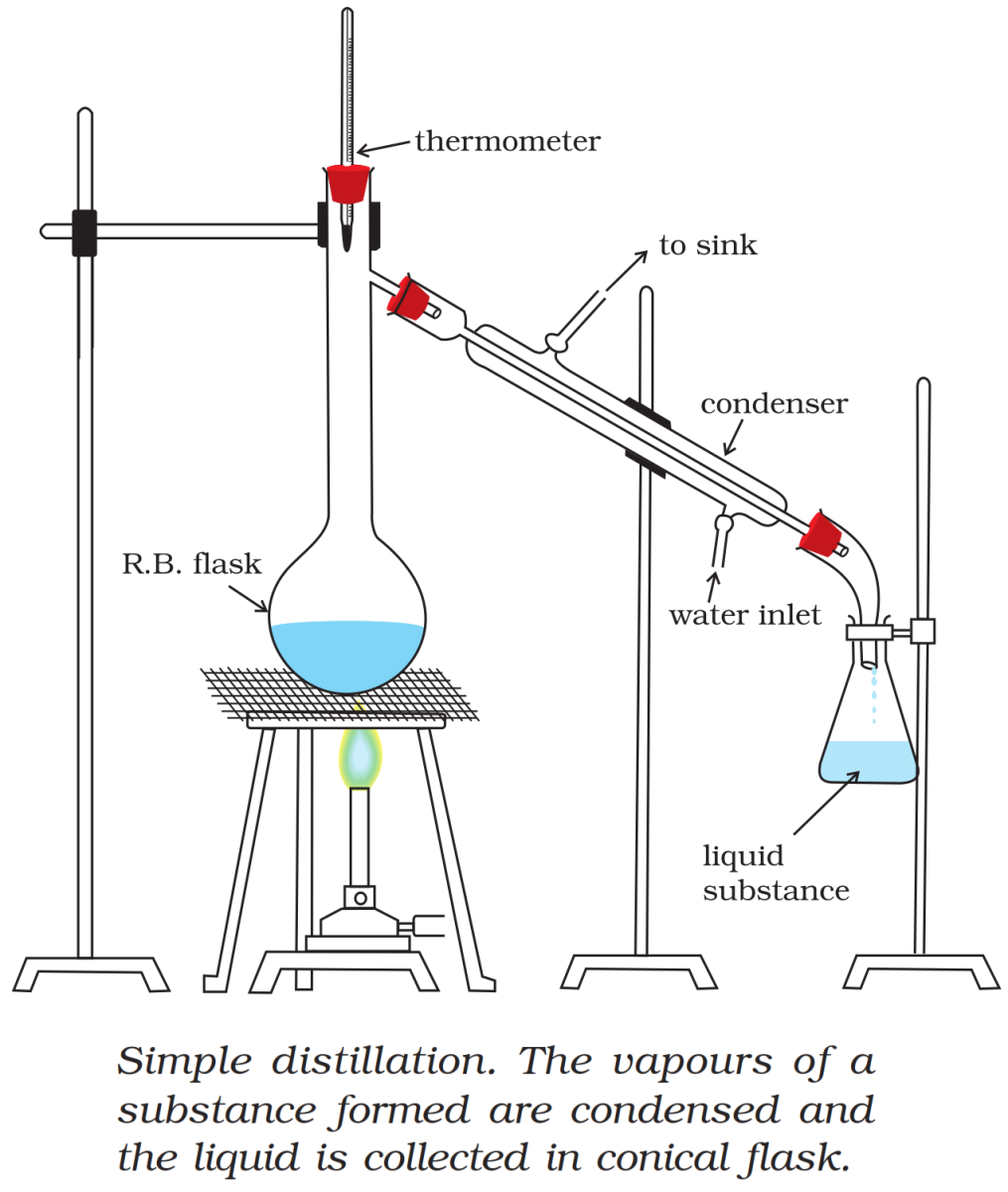
Liquids having different boiling points vaporize at different temperatures. The vapours are cooled and then liquids so formed are collected separately. Liquid A can be separated from B and C because of large difference in boiling point. Liquid B and C have boiling points very close to each other and cannot be separated by simple distillation hence separated by fractional distillation. Liquid B distilled first because the order of boiling points of A, B and Care as follows: B

View full question & answer
Question 395 Marks
A liquid with high boiling point decomposes on simple distillation but it can be steam distilled for its purification. Explain how is it possible?
Answer
Steam distillation: This type of distillation is essentially a co-distillation with water and is carried out when a solid or liquid, practically insoluble in water, is volatile with steam, possess a vapour pressure of about 10-15 mm of mercury but the impurities are non-volatile. The principle of steam distillation is based on Dalton’s law of partial pressures. Let $p_1$ and $p_2$ be the vapour pressures of water vapour and the organic liquid at the distillation temperature. The liquid boils when total pressure is equal to the atmospheric pressure p, i.e.,
$p=p_1+p_2$ or $p_2=p-p_1$

This process is used in the purification of compounds such as chlorotoluenes, aniline and nitrobenzene. It is also employed in the isolation of essential oils from flowers.
View full question & answer
Question 405 Marks
Match the terms mentioned in Column I with the terms in Column II.
 
Column I
 
Column II
(i)
Carbocation
(a)
Cyclohexane and 1- hexene.
(ii)
Nucleophile
(b)
Conjugation of electrons of C–H σ bond with empty p-orbital present at adjacent positively charged carbon.
(iii)
Hyperconjugation
(c)
$\text{sp}^2$ hybridised carbon with empty p-orbital.
(iv)
Isomers
(d)
Ethyne
(v)
sp hybridisation
(e)
Species that can receive a pair of electrons.
(vi)
Electrophile
(f)
Species that can supply a pair of electrons.
Answer
 
Column I
 
Column II
(i)
Carbocation
(c)
$\text{sp}^2$ hybridised carbon with empty p-orbital.
(ii)
Nucleophile
(f)
Species that can supply a pair of electrons.
(iii)
Hyperconjugation
(b)
Conjugation of electrons of C–H σ bond with empty p-orbital present at adjacent positively charged carbon.
(iv)
Isomers
(a)
Cyclohexane and 1- hexene.
(v)
sp hybridisation
(d)
Ethyne
(vi)
Electrophile
(e)
Species that can receive a pair of electrons.
View full question & answer