Question 15 Marks
The current in a discharging LR circuit without the battery drops from 2.0A to 1.0A in 0.10s.
- Find the time constant of the circuit.
- If the inductance of the circuit is 4.0H, what is its resistance?
Answer
- For discharging circuit
$\text{i}=\text{i}_0\text{e}^\frac{-\text{t}}{\tau}$
$\Rightarrow1=2\text{e}^\frac{-0.1}{\tau}$
$\Rightarrow\Big(\frac{1}{2}\Big)=\text{e}^\frac{-0.1}{\tau}$
$\Rightarrow\text{ln}\Big(\frac{1}{2}\Big)=\text{ln}\Big(\text{e}^\frac{-0.1}{\tau}\Big)$
$\Rightarrow-0.693=\frac{-0.1}{\tau}$
$\Rightarrow\tau=\frac{0.1}{0.693}=0.144=0.14.$
- $\text{L}=4\text{H},\text{i}=\frac{\text{L}}{\text{R}}$
$\Rightarrow0.14=\frac{4}{\text{R}}$
$\Rightarrow\text{R}=\frac{4}{0.14}=28.57=28\Omega.$ View full question & answer→Question 25 Marks
Figure shows a situation similar to the previous problem. All parameters are the same except that a battery of emf $\in$ and a variable resistance R are connected between O and C. The connecting wires have zero resistance. No external force is applied on the rod (except gravity, forces by the magnetic field and by the pivot). In what way should the resistance R be changed so that the rod may rotate with uniform angular velocity in the clockwise direction? Express your answer in terms of the given quantities and the angle $\theta$ made by the rod OA with the horizontal.
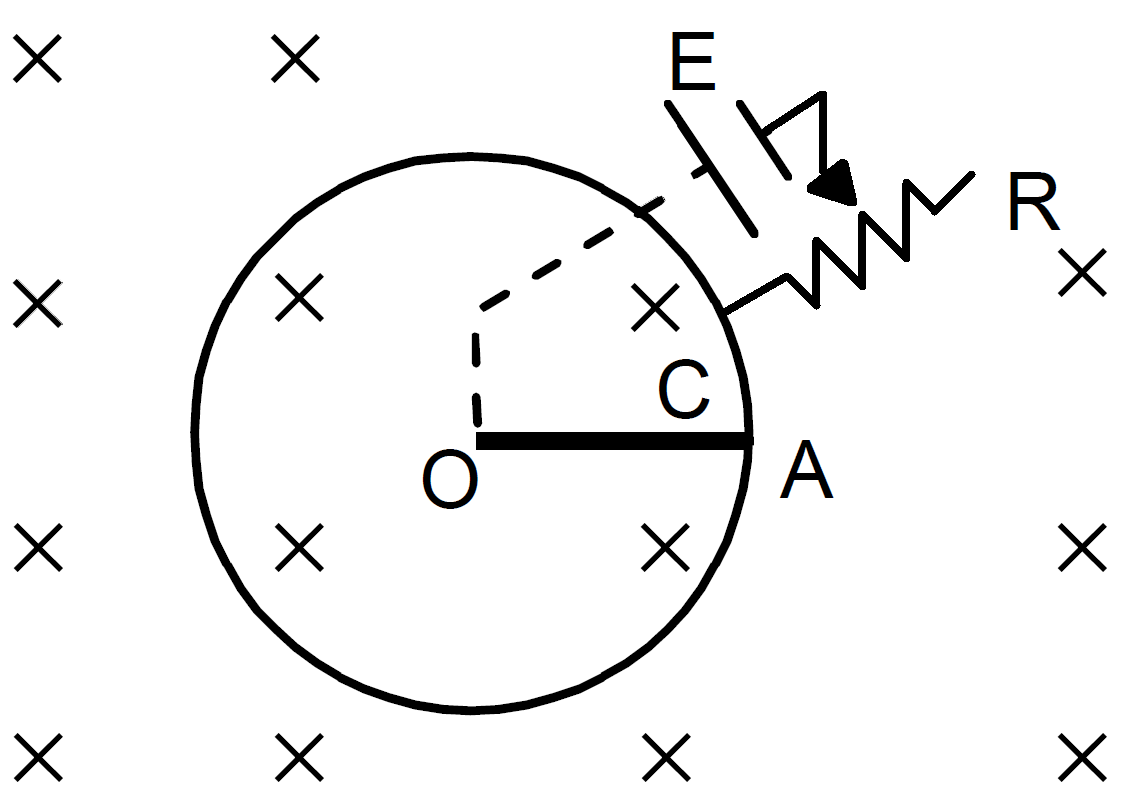
Answer
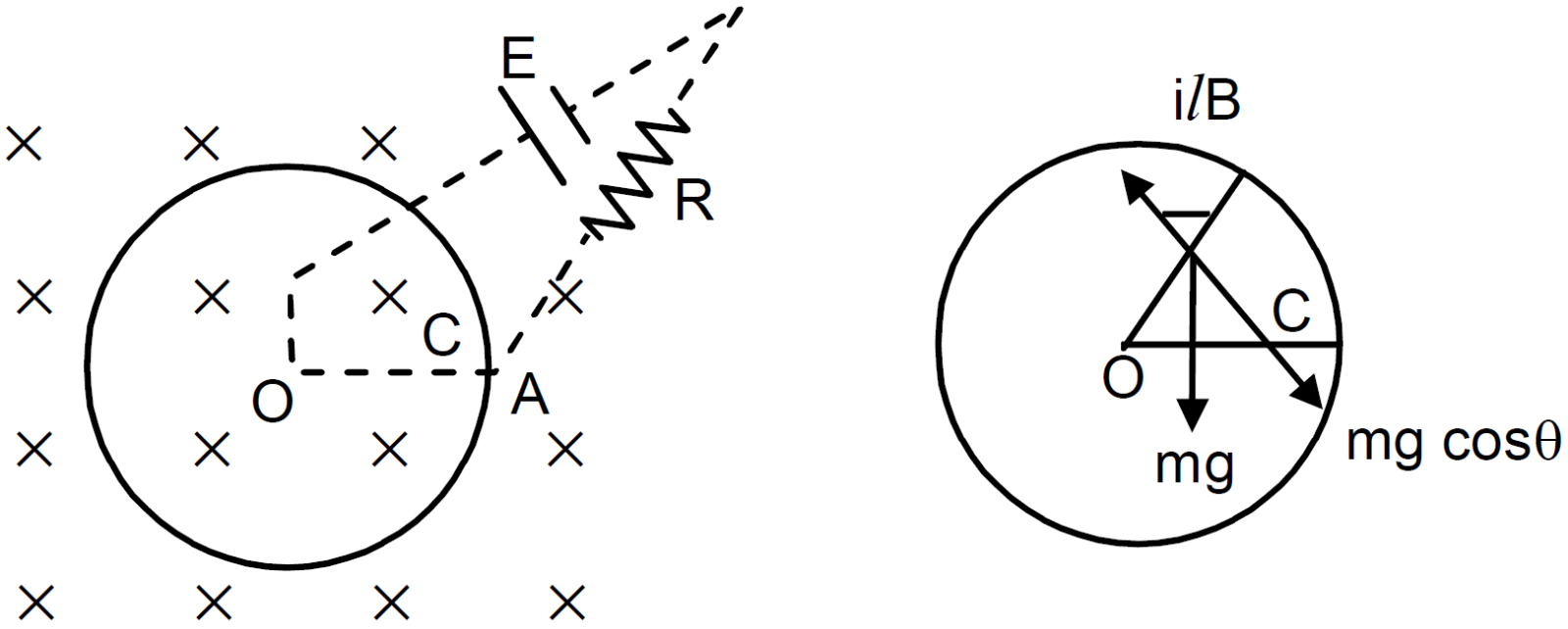 $\text{emf}=\frac{1}{2}\text{B}\omega\text{a}^2$ [from previous problem]
Current $= \frac{\text{e}+\text{E}}{\text{R}}=\frac{\frac{1}{2}\times\text{B}\omega\text{a}^2+\text{E}}{\text{R}}$
$=\frac{\text{B}\omega\text{a}^2 +2\text{E}}{2\text{R}}$
$\Rightarrow \text{mg} \cos \theta =\text{ilB}$ [Net force acting on the rod is O]
$\Rightarrow \text{mg}\cos\theta =\frac{\text{B}\omega\text{a}^2+2\text{E}}{2\text{R}}\text{a}\times\text{B}$
$\Rightarrow \text{R}=\frac{\big(\text{B}\omega\text{a}^2+2\text{E}\big)\text{ab}}{2\text{mg}\cos\theta}$ View full question & answer→Question 35 Marks
What are the values of the self-induced emf in the circuit of the previous problem at the times indicated therein?
Answer
- For first case at $\text{t}=100 \ \text{ms}$
$\frac{\text{di}}{\text{dt}}=0.27$
Induced emf $=\text{L}\frac{\text{di}}{\text{dt}}=1\times0.27=0.27 \ \text{V }$
- For the second case at $\text{t}=200 \ \text{ms}$
$\frac{\text{di}}{\text{dt}}=0.036$
Induced emf $=\text{L}\frac{\text{di}}{\text{dt}}=1\times0.036=0.036 \ \text{V}$
- For the third case at $\text{t}=1 \text{s}$
$\frac{\text{di}}{\text{dt}}=4.1\times10^{-9}\text{V}$
Induced emf $=\text{L}\frac{\text{di}}{\text{dt}}=4.1\times10^{-9}\text{V}$ View full question & answer→Question 45 Marks
A wire of length $10cm$ translates in a direction making an angle of $60°$ with its length. The plane of motion is perpendicular to a uniform magnetic field of $1.0T$ that exists in the space. Find the emf induced between the ends of the rod if the speed of translation is $20cm/s^{-1}$.
Answer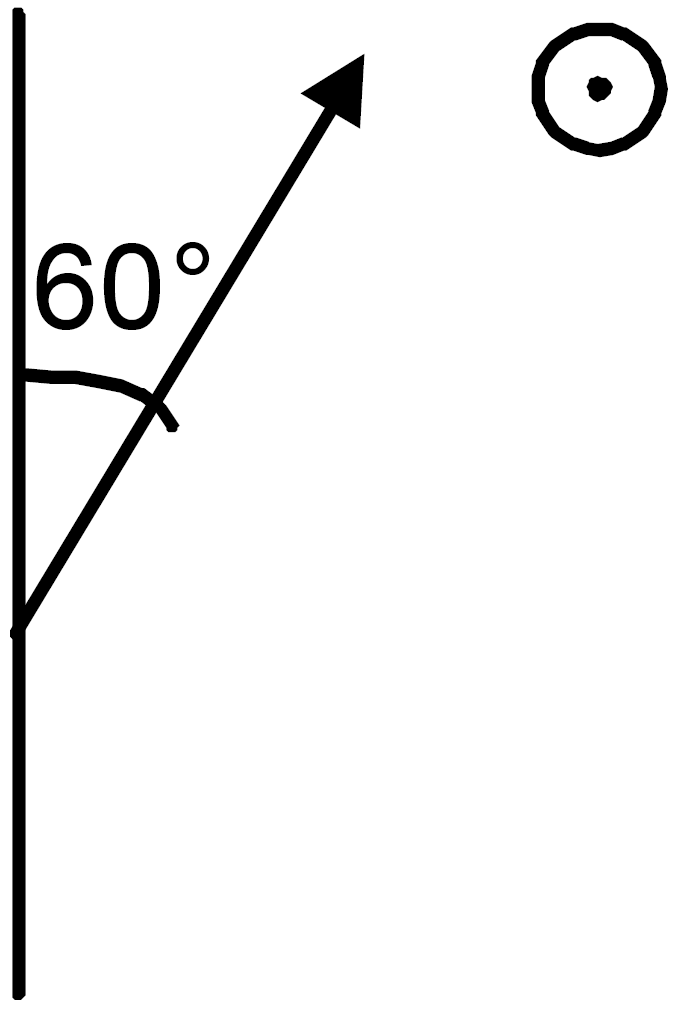
$\text{l}=10\text{cm}=0.1\text{m};$
$\theta=60^{\circ}; \ \text{B}=1\text{T}$
$\text{V}=20\text{cm}/\text{s}=0.2\text{m}/\text{s}$
$\text{E}=\text{Bvl}\sin60^{\circ}$
[As we have to take that component of length vector which is $\perp\text{r}$ to the velocity vector]
$=1\times0.2\times0.1\times\frac{\sqrt{3}}{2}$
$=1.732\times10^{-2}=17.32\times10^{-3}\text{V}.$ View full question & answer→Question 55 Marks
The magnetic field in a region is given by $\vec{\text{B}}=\vec{\text{k}}\frac{\text{B}_0}{\text{L}}\text{y}$ where L is a fixed length. A conductihg rod of of length lies along the Y-axis between the origin and the point (0, L, 0). If the rod moves with a velocity $\text{v}=\text{v}_0\vec{\text{i}},$ find the emf induced between the ends of the rod.
Answer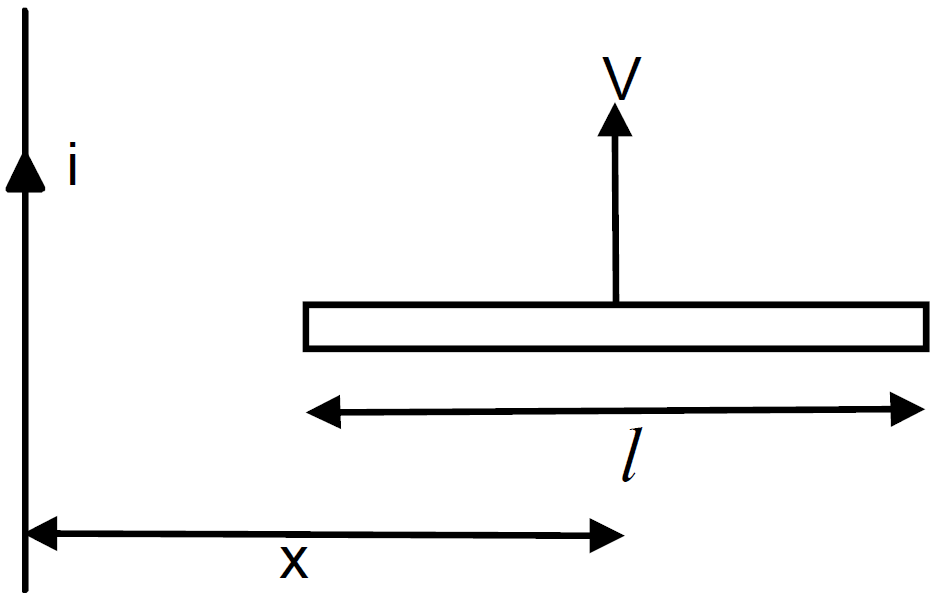 $\vec{\text{B}}=\frac{\text{B}_0}{\text{L}}\text{y}\hat{\text{k}}$
L = Length of rod on y-axis
$\text{V}=\text{V}_{0}\hat{\text{i}}$
Considering a small length by of the rod
$\text{dE}=\text{B V}\text{dy}$
$\Rightarrow\text{dE}=\frac{\text{B}_0}{\text{L}}\text{y}\times\text{V}_0\times\text{dy}$
$\Rightarrow\text{dE}=\frac{\text{B}_0\text{V}_0}{\text{L}}\text{ydy}$
$\Rightarrow\text{E}=\frac{\text{B}_0\text{V}_0}{\text{L}}\int\limits_0^\text{L}\text{ydy}$
$=\frac{\text{B}_0\text{V}_0}{\text{L}}\Big[\frac{\text{y}^2}{2}\Big]^\text{L}_0=\frac{\text{B}_0\text{V}_0}{\text{L}}\frac{\text{L}^2}{2}=\frac{1}{2}\text{B}_0\text{V}_0\text{L}$ View full question & answer→Question 65 Marks
A coil of resistance $40\Omega$ is connected across a 4.0V battery 0.10s after the battery is connected, the current in the coil is 63mA. Find the inductance of the coil.
Answer$\text{R} = 40\ \Omega, \ \text{E}=4\text{V}, \ \text{t}=0.1, \ \text{i}=63\text {mA}$${\text{i}}=\text{i}_0-\ \Big(1-\text{e}^\frac{\text{tR}}{\text{2}}\Big) $
$\Rightarrow \ 63\ \times10^{-3}=\frac{4}{40}\ \Big(1-\text{e}^{0.1\times\ \frac{40}{\text{L}}}\Big) $
$\Rightarrow\ 63\ \times\ 10^{-3}\ =10^{-1}\Big(1-\text{e}^{\frac{-4}{\text{L}}}\Big) $
$\Rightarrow\ 63\ \times\ 10^{-2}=\Big(1-\text{e}^\frac{-4}{\text{L}}\Big) $
$\Rightarrow\ 1\ -0.63=\text{e}^{\frac{-4}{\text{L}}}\Rightarrow\text{e}^\frac{-4}{\text{L}}=0.37 $
$\Rightarrow\frac{-4}{\text{L}}=\text{In}(0.37)=-0.994 $
$\Rightarrow\text{L}=\ \frac{-4}{-0994}=4.024\text{H}=4\text{H.} $
View full question & answer→Question 75 Marks
An inductor of inductance 5.0H, having a negligible resistance, is connected in series with a $100\Omega$ resistor and a battery of emf 2.0V. Find the potential difference across the resistor 20ms after the circuit is switched on.
Answer
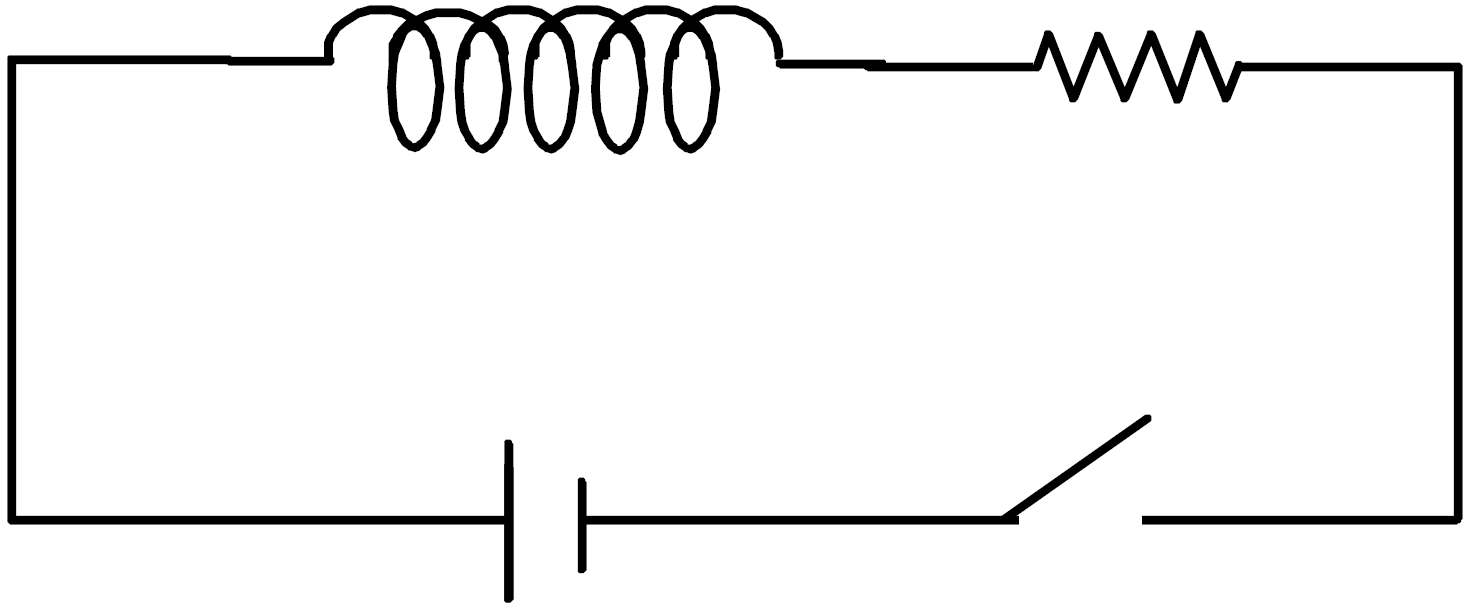 $\text{L}=5.0\text{H}, \ \text{R}=100\Omega, \ \text{emf}=2.0\text{v}$
$\text{t}=20\text{ms}=20\times10^{-3}\text{s}=2\times10^{-2}\text{s }$
$\text{i}_0=\frac{2}{100} \ \text{now} \ \text{i}=\text{i}_0\Big(1-\text{e}^\frac{-t}{\tau}\Big) $
$\tau=\frac{\text{L}}{\text{R}}=\frac{5}{100} $
$\Rightarrow\text{i}=\frac{2}{100}\Big(1-\text{e}^\frac{-2\times10^2\times100}{5}\Big)$
$\Rightarrow\text{i}=\frac{2}{100}\Big(1-\text{e}^\frac{-2}{5}\Big) $
$\Rightarrow 0.00659=0.0066 $
$\text{V}=\text{iR}=0.006 \times100\ =0.66\text{V. }$ View full question & answer→Question 85 Marks
Figure shows a straight, long wire carrying a current i and a rod of length l coplanar with the wire and perpendicular to it. The rod moves with a constant velocity v in a direction parallel to the wire. The distance of the wire from the centre of the rod is x. Find motional emf induced in the rod.
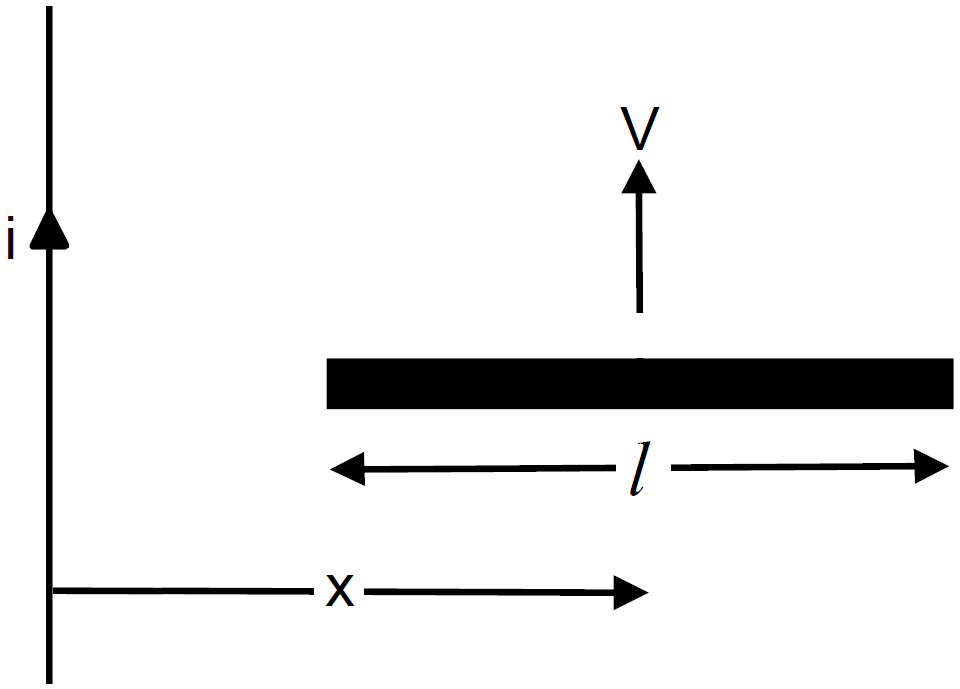
AnswerIn this case $\vec{\text{B}}$ varies Hence considering a small element at centre of rod of length dx at a dist x from the wire.$\vec{\text{B}}=\frac{\mu_0\text{i}}{2\pi\text{X}}$
so, $\text{de}=\frac{\mu_0\text{i}}{2\pi\text{x}}\times\text{vxdx}$$\text{e}=\int\limits^\text{e}_0\text{de}=\frac{\mu_0\text{iv}}{2\pi}=\int\limits^{\text{x}+\frac{\text{t}}{2}}_{\text{x}-\frac{\text{t}}{2}}\frac{\text{dx}}{\text{x}}$
$=\frac{\mu_0\text{iv}}{2\pi}\bigg[\text{In}\Big(\text{x}+\frac{\text{l}}{2}\Big)\text{In}-\Big(\text{x}-\frac{\text{l}}{2}\Big)\bigg]$
$\frac{\mu_0\text{iv}}{2\pi}\text{In}\Bigg[\frac{\text{x}+\frac{\text{l}}{2}}{\text{x}-\frac{\text{l}}{2}}\Bigg]=\frac{\mu_0\text{iv}}{2\pi}\text{In}\Big(\frac{2\text{x}+\text{l}}{2\text{x}-\text{l}}\Big)$
View full question & answer→Question 95 Marks
A long wire carries a current of 4.00A. Find the energy stored in the magnetic field inside a volume ot 1.00mm at a distance of 10.0cm from the wire.
Answer$\text{l}=4.00\text{A}, \ \text{V}=1\text{mm}^3$$\text{d}=10\text{cm} =0.1 \text{m}$
$\vec{\text{B}}=\frac{\mu_0\text{i}}{2\pi\text{r}} $
Now magnetic energy stored $=\frac{\text{B}^2}{2\mu_0}\text{V}$
$\frac{\mu_0\text{i}^2}{4\pi\text{r}}\times\frac{1}{2\mu_0}\times\text{V}=\frac{4\pi\times10^{-7}\times16\times1\times1\times10^{-9}}{4\times1\times10^{-2}\times2}$
$=\frac{8}{\pi}\times10^{-14}\text{J}$
$=2.55\times10^{-14} \text{J}$
View full question & answer→Question 105 Marks
A conducting square loop having edges of length 2.0cm is rotated through 180° about a diagonal in 0.20s. A magnetic field B exists in the region which is perpendicular to the loop in its initial position. If the average induced emf during the rotation is 20mV, find the magnitude of the magnetic field.
Answer$\text{E}=20\text{mV}=20\times10^{-3}\text{V}$$\text{A}=(2\times10^{-2})^2=4\times10^{-4}$
$\text{Dt}=0.2\text{s}, \ \theta=180^{\circ}$
$\phi_1=\text{BA}, \ \phi_2=-\text{BA}$
$\text{d}\phi=2\text{BA}$
$\text{E}=\frac{\text{d}\phi}{\text{dt}}=\frac{2\text{BA}}{\text{dt}}$
$\Rightarrow20\times10^{-3}=\frac{2\times\text{B}\times2\times10^{-4}}{2\times10^{-1}}$
$\Rightarrow20\times10^{-3}=4\times\text{B}\times10^{-3}$
$\Rightarrow\text{B}=\frac{20\times10^{-3}}{42\times10^{-3}}=5\text{T}$
View full question & answer→Question 115 Marks
Consider the situation shown in the figure of the previous problem. Suppose the wire connecting O and C has zero resistance but the circular loop has a resistance R uniformly distributed along its length. The rod OA is made to rotate with a uniform angular speed $\omega$ shown in the figure. Find the current in the rod when $\angle\text{AOC}=90^{\circ}$
Answer
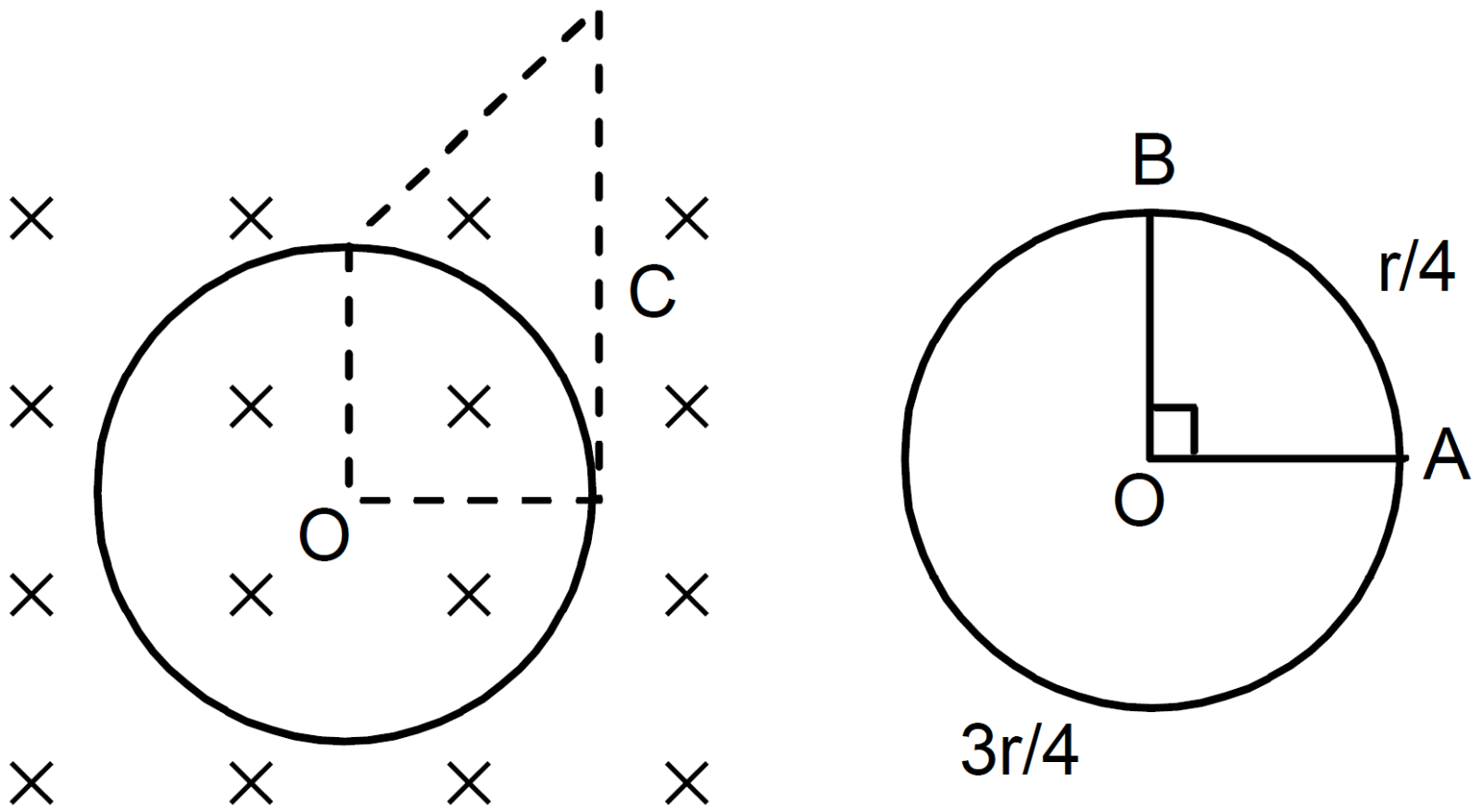 The 2 resistances $\frac{\text{r}}{4}$ and $\frac{3\text{r}}{4}$ are in parallel.
$\text{R}'=\frac{\frac{\text{r}}{4}\times\frac{3\text{r}}{4}}{\text{r}}=\frac{3\text{r}}{16} $
$\text{e}=\text{Bvl}$
$=\text{B}\times\frac{\text{a}}{2}\omega\times\text{a}=\frac{\text{B}\text{a}^2\omega}{2}$
$\text{i}=\frac{\text{e}}{\text{R}'}=\frac{\text{B}\text{a}^2\omega}{2\text{R}'}=\frac{\text{B}\text{a}^2\omega}{2\times\frac{3\text{r}}{16}}$
$=\frac{\text{ba}^2\omega16}{2\times\text{3}\text{r}}=\frac{8}{3}\frac{\text{Ba}^2\omega}{\text{r}}$ View full question & answer→Question 125 Marks
Consider the circuit shown in figure:
- Find the current through the battery a long time after the switch S is closed.
- Suppose the switch is again opened at $t = 0$. What is the time constant of the discharging circuit?
- Find the current through the inductor after one time constant.
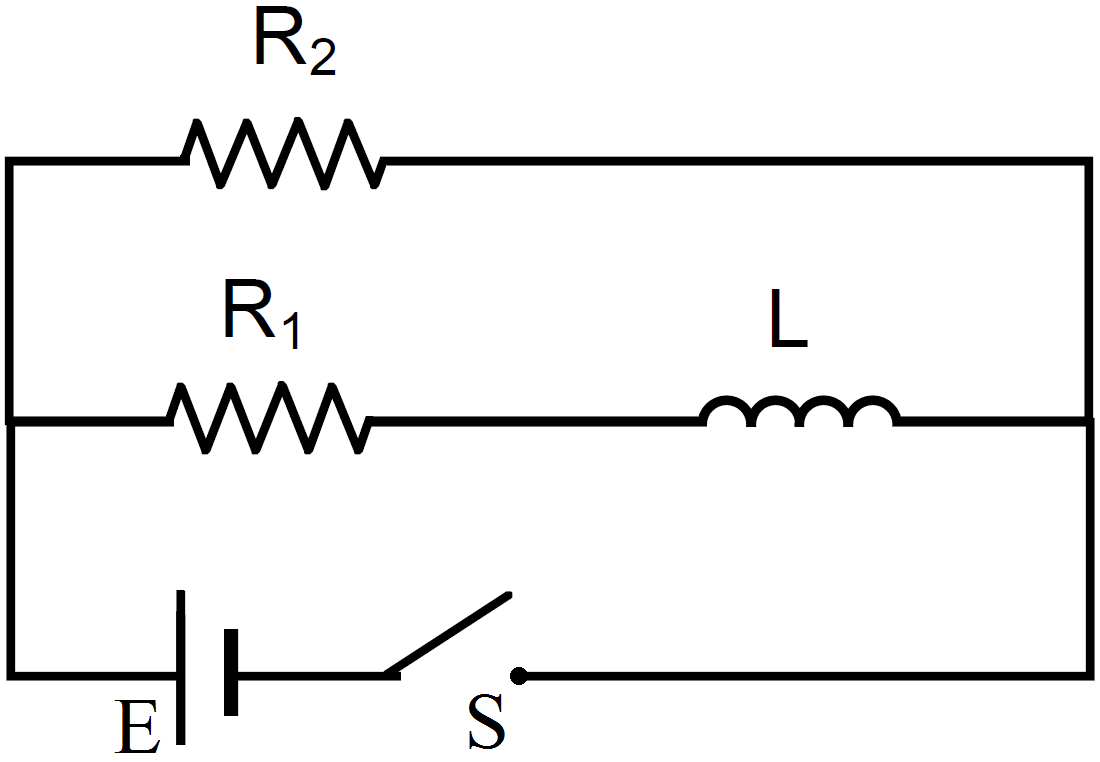
Answer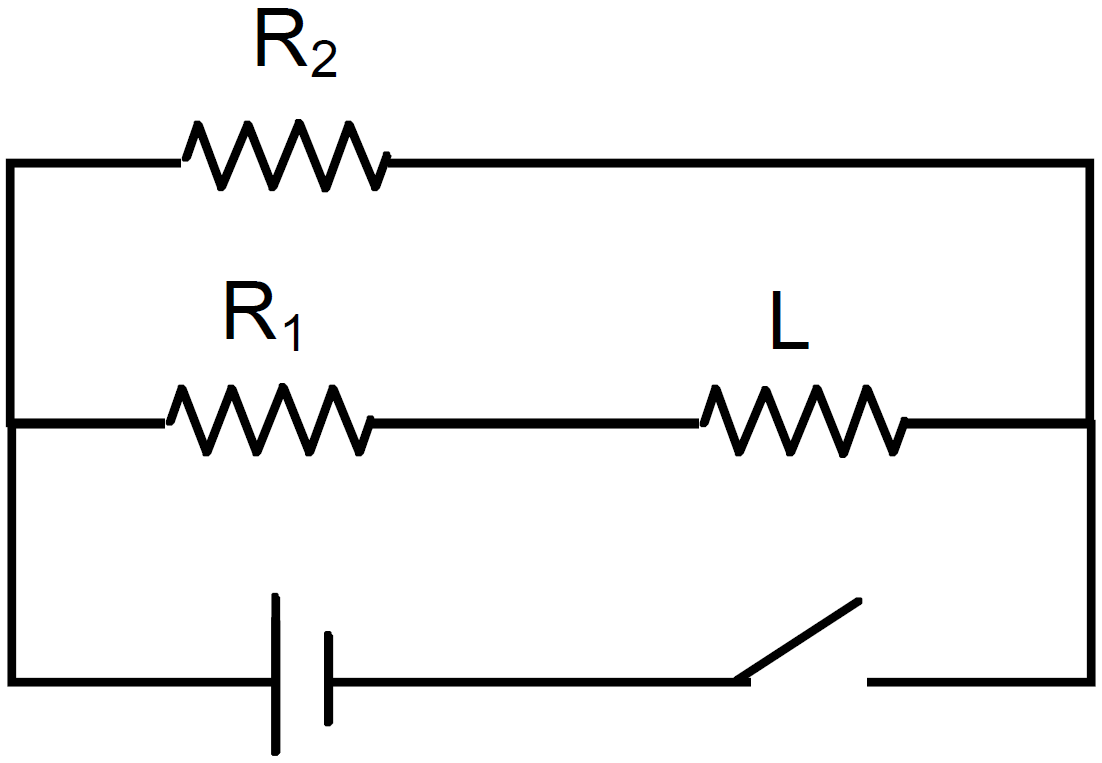
- Because the switch is closed, the battery gets connected across the L‒R circuit. The current in the L‒R circuit after t seconds after connecting the battery is given by
$\text{i}=\text{i}_0\Big(\text{e}^{\frac{-\text{t}}{\tau}}\Big)$
$i_0$ = Steady state current
$\tau=$ Time constant $=\frac{\text{L}}{\text{R}}$
After a long time, $\text{t}\rightarrow\infty$
Now,
Current in the inductor, $i = i_0 (1 - e^0) = 0$
Thus, the effect of inductance vanishes.
$\text{i}=\frac{\text{E}}{\text{R}_{\text{net}}}$
$=\frac{\in}{\frac{\text{R}_1\times\text{R}_2}{\text{R}_1+\text{R}_2}}=\frac{\in\big(\text{R}_1+\text{R}_2\big)}{\text{R}_1\text{R}_2}$
- When the switch is opened the resistors are in series.
The time constant is given by
$\tau=\frac{\text{L}}{\text{R}_\text{net}}=\frac{\text{L}}{\text{R}_1+\text{R}_2}.$
- The inductor will discharge through resistors $R_1$ and $R_2$.
The current through the inductor after one time constant is given by
$\text{t}=\tau$
$\therefore$ Current, $\text{i}=\text{i}_0\Big(\text{e}^{\frac{-\text{t}}{\tau}}\Big)$
Here,
$\text{i}_0=\frac{\in}{\text{R}_1+{\text{R}_2}}$
$\therefore \ \text{i}=\frac{\in}{\text{R}_1+{\text{R}_2}}\times\frac{1}{\text{e}}$ View full question & answer→Question 135 Marks
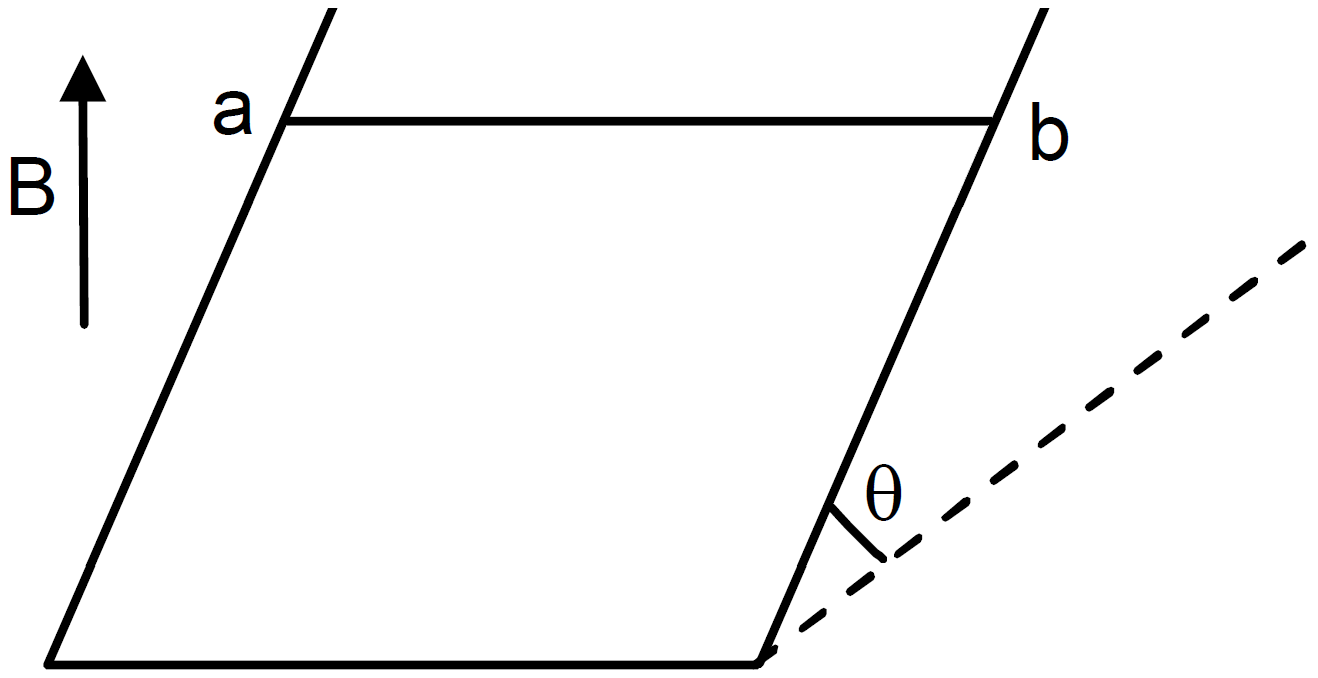
A wire ab of length l, mass m and resistance R slides on a smooth, thick pair of metallic rails joined at the bottom as shown in figure. The plane of the rails makes an angle θ with the horizontal. A vertical magnetic field B exists in the region. If the wire slides on the rails at a constant speed v, show that$\text{B}=\sqrt{\frac{\text{mgR}\sin\theta}{\text{vl}^2\cos^2\theta}}$
Answer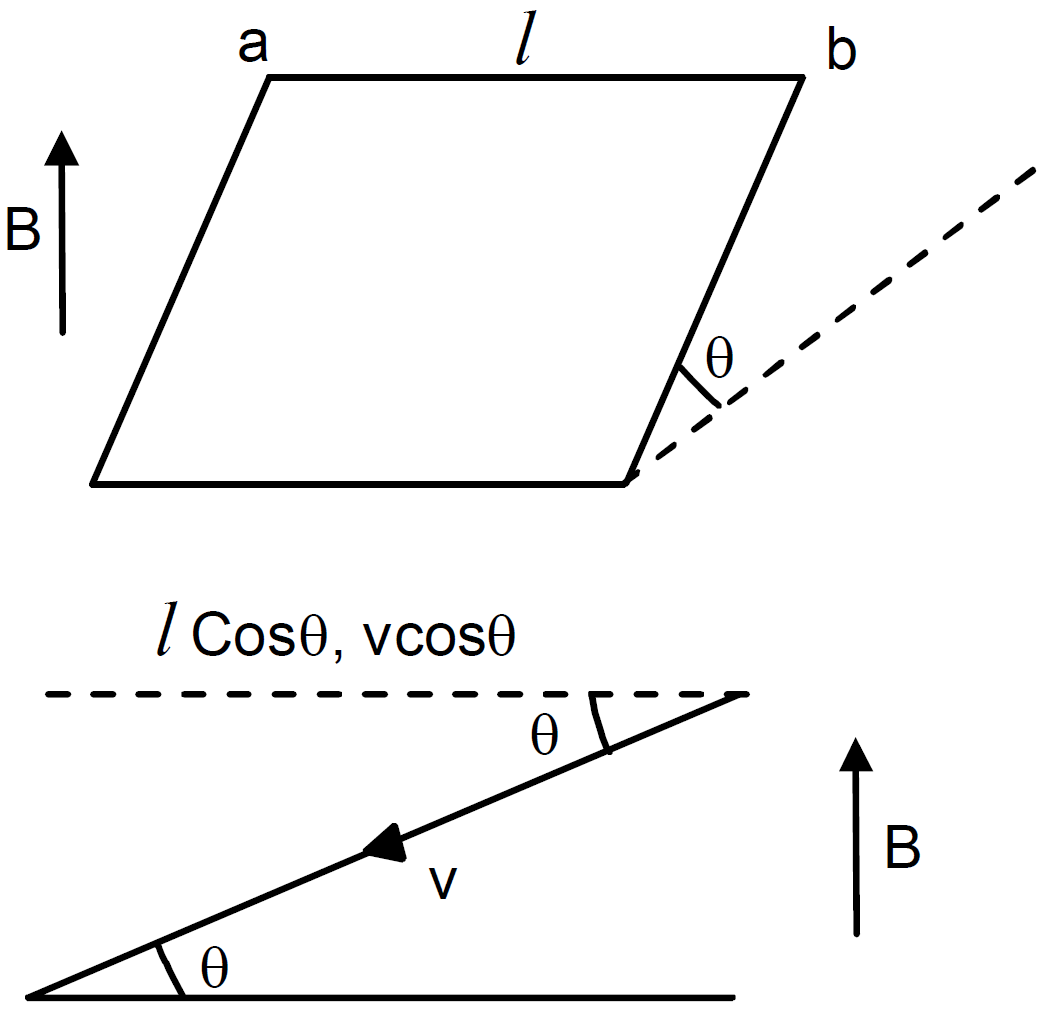 $\text{I}=\frac{\text{Blv}}{\text{R}}=\frac{\text{B}\times\text{l}\cos\theta\times\text{v}\cos\theta}{\text{R}}$
$=\frac{\text{Blv}}{\text{R}}\cos^2\theta$
$\text{F}=\text{ilB}=\frac{\text{Blv}\cos^2\theta\times\text{lB}}{\text{R}}$
Now, $\text{F}=\text{mg} \ \sin\theta$ [Force due to gravity which pulls downwards] Now, $\frac{\text{B}^2\text{l}^2\text{v}\cos^2\theta}{\text{R}}=\text{mg} \ \sin\theta$$\Rightarrow\text{B}=\sqrt{\frac{\text{Rmg}\sin\theta}{\text{vl}^2\cos^2\theta}}$ View full question & answer→Question 145 Marks
The system containing the rails and the wire of the previous problem is kept vertically in a uniform horizontal magnetic field B that is perpendicular to the plane of the rails (figure). It is found that the wire stays in equilibrium. If the wire ab is replaced by another wire of double its mass, how long will it take in falling through a distance equal to its length?
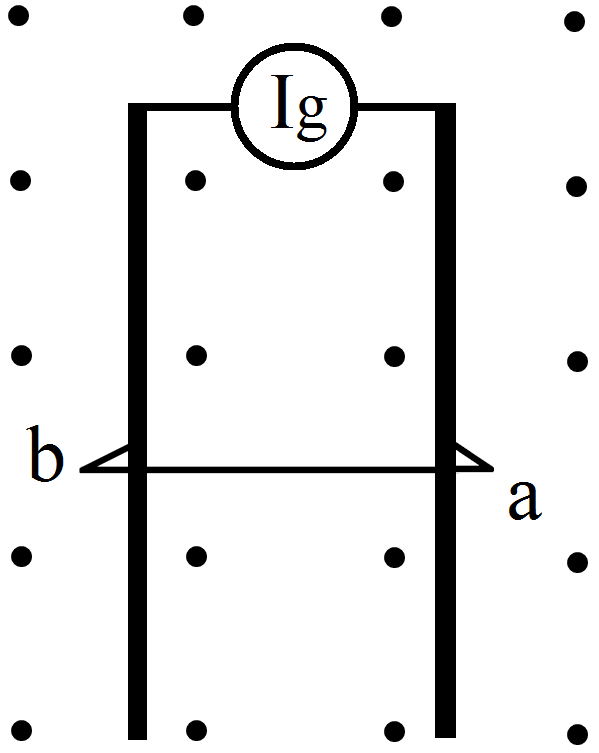
Answer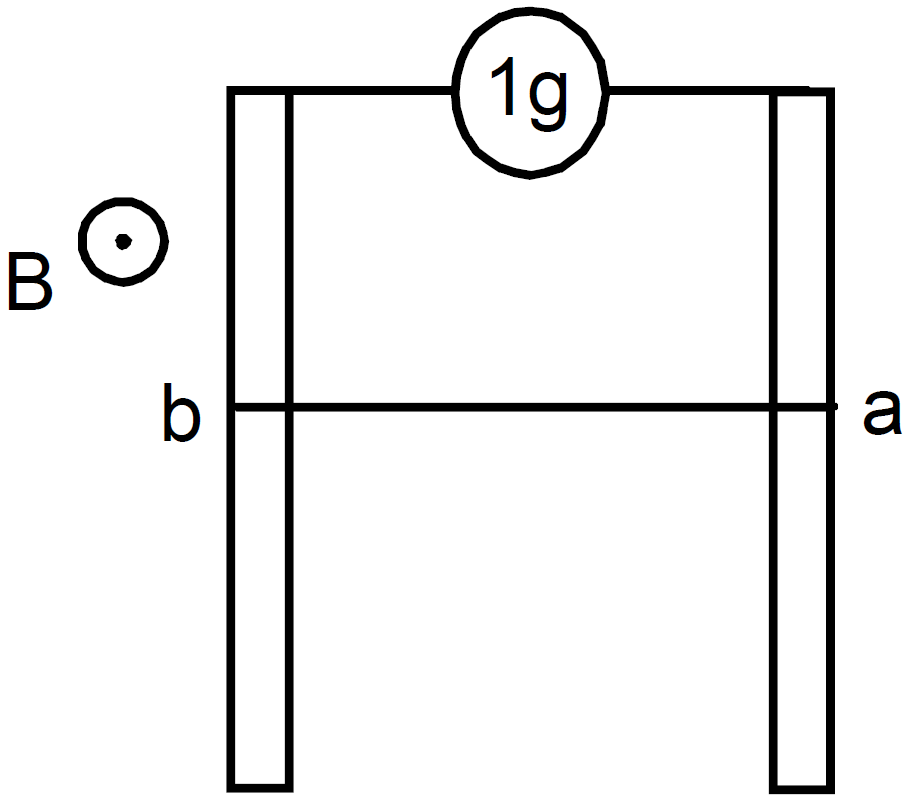 Given Blv = mg …(1) When wire is replaced we have 2mg - Blv = 2ma [where a → acceleration]$\Rightarrow\text{a}=\frac{2\text{mg}-\text{Blv}}{2\text{m}}$
Now, $\text{s}=\text{ut}+\frac{1}{2}\text{at}^2$$\Rightarrow\text{l}=\frac{1}{2}\times\frac{2\text{mg}-\text{Blv}}{2\text{m}}\times\text{t}^2 \ \big[\therefore \ \text{s}=\text{l}\big]$
$\Rightarrow\text{t}=\sqrt{\frac{4\text{ml}}{2\text{mg}-\text{Blv}}}=\sqrt{\frac{4\text{ml}}{2\text{mg}-\text{mg}}}=\sqrt{\frac{2\text{l}}{\text{g}}}$ [from (1)] View full question & answer→Question 155 Marks
Figure shows a square loop of side 5cm being moved towards right at a constant speed of 1cm/s. The front edge enters the 20cm wide magnetic field at t = 0. Find the emf induced in the loop at:
- t = 2s
- t = 10s
- t = 22s
- t = 30s.
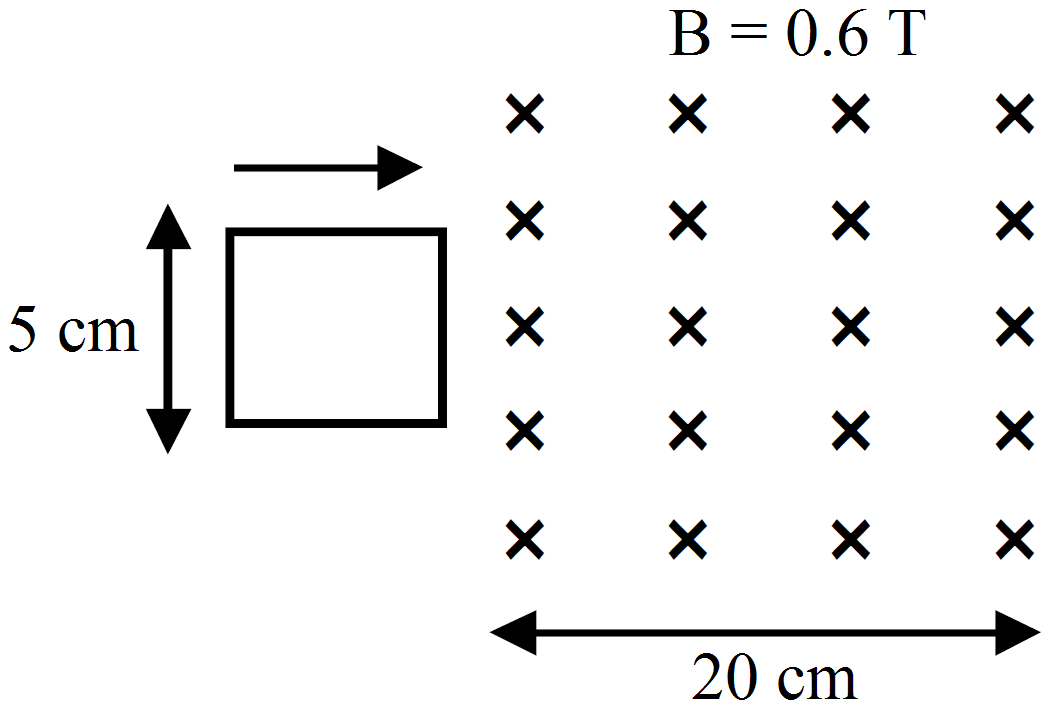
Answeru = 1cm/', B = 0.6T
- At t = 2sec, distance moved = 2 × 1cm/s = 2cm
$\text{E}=\frac{\text{d}\phi}{\text{dt}}=\frac{0.6\times(2\times5- 0)\times10^{-4}}{2}=3\times10^{-4}\text{V}$
- At t = 10sec
distance moved = 10 × 1 = 10cm
The flux linked does not change with time
$\therefore$ E = 0
- At t = 22sec
distance = 22 × 1 = 22cm
The loop is moving out of the field and 2cm outside.
$\text{E}=\frac{\text{d}\phi}{\text{dt}}=\text{B}\times\frac{\text{dA}}{\text{dt}}$
$=\frac{0.6\times(2\times5\times10^{-4})}{2}=3\times10^{-4}\text{V}$
- At t = 30sec
The loop is total outside and flux linked = 0
$\therefore$ E = 0. View full question & answer→Question 165 Marks
A bicycle is resting on its stand in the east-west direction and the rear wheel is rotated at an angular speed of $100$ revolutions per minute. If the length of each spoke is $30.0cm$ and the horizontal component of the earth's magnetic field is $2.0 \times 10^{-5} T$, find the emf induced between the axis and the outer end of a spoke. Neglect centripetal force acting on the free electrons of the spoke.
Answer
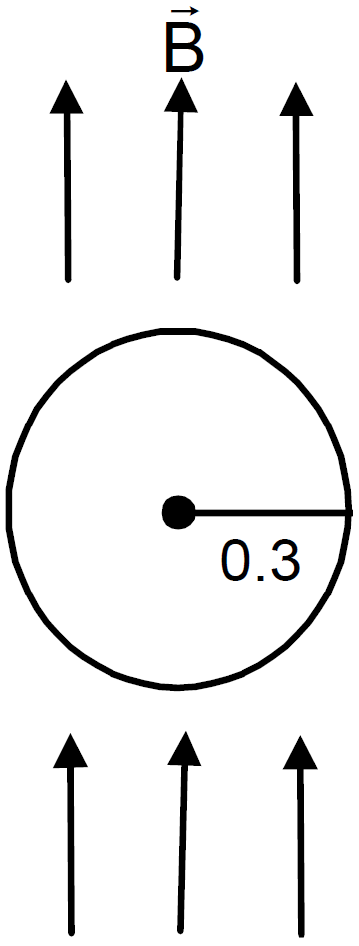
$\text{l}=0.3\text{m},\vec{\text{B}}=2.0\times10^{-5}\text{T},\omega=100 \ \text{rpm}$
$\text{v}=\frac{100}{60}\times2\pi=\frac{10}{3}\pi \ \text{rad}/\text{s}$
$\text{v}=\frac{\text{l}}{2}\times\omega=\frac{0.3}{2}\times\frac{10}{3}\pi$
$\text{Emf}=\text{e}=\text{BlV}$
$=2.0\times10^{-5}\times0.3\times\frac{0.33}{2}\times\frac{10}{3}\pi$
$=3\pi\times10^{-6}\text{V}=3\times3.14\times10^{-6}\text{V}=9.42\times10^{-6}\text{V}.$ View full question & answer→Question 175 Marks
Consider the situation shown in figure. The wire PQ has a negligible resistance and is made to slide on the three rails with a constant speed of 5cm/s. Find the current in the $10\Omega$ resistor when the switch S is thrown to:
- The middle rail.
- The bottom rail.
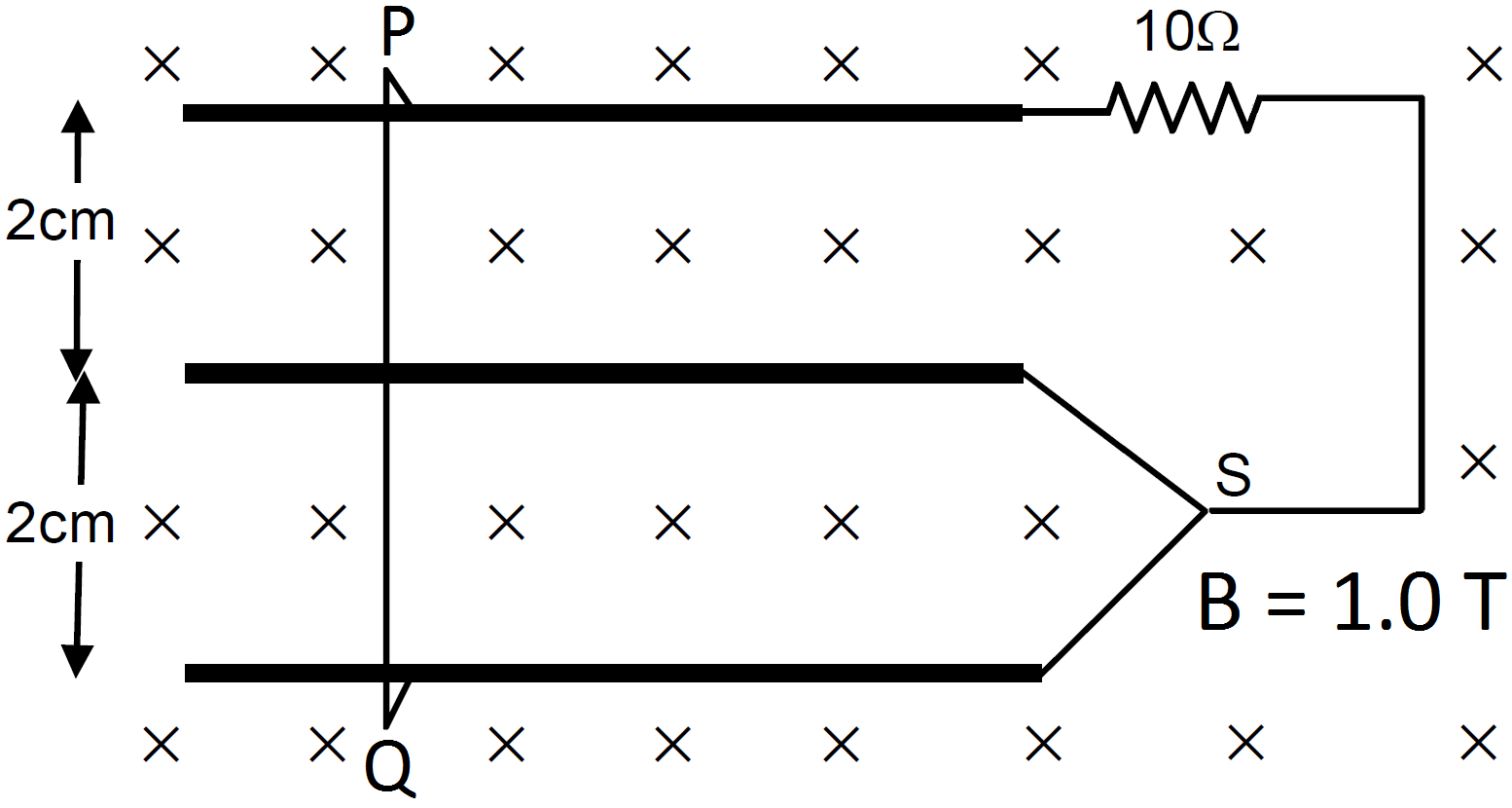
Answer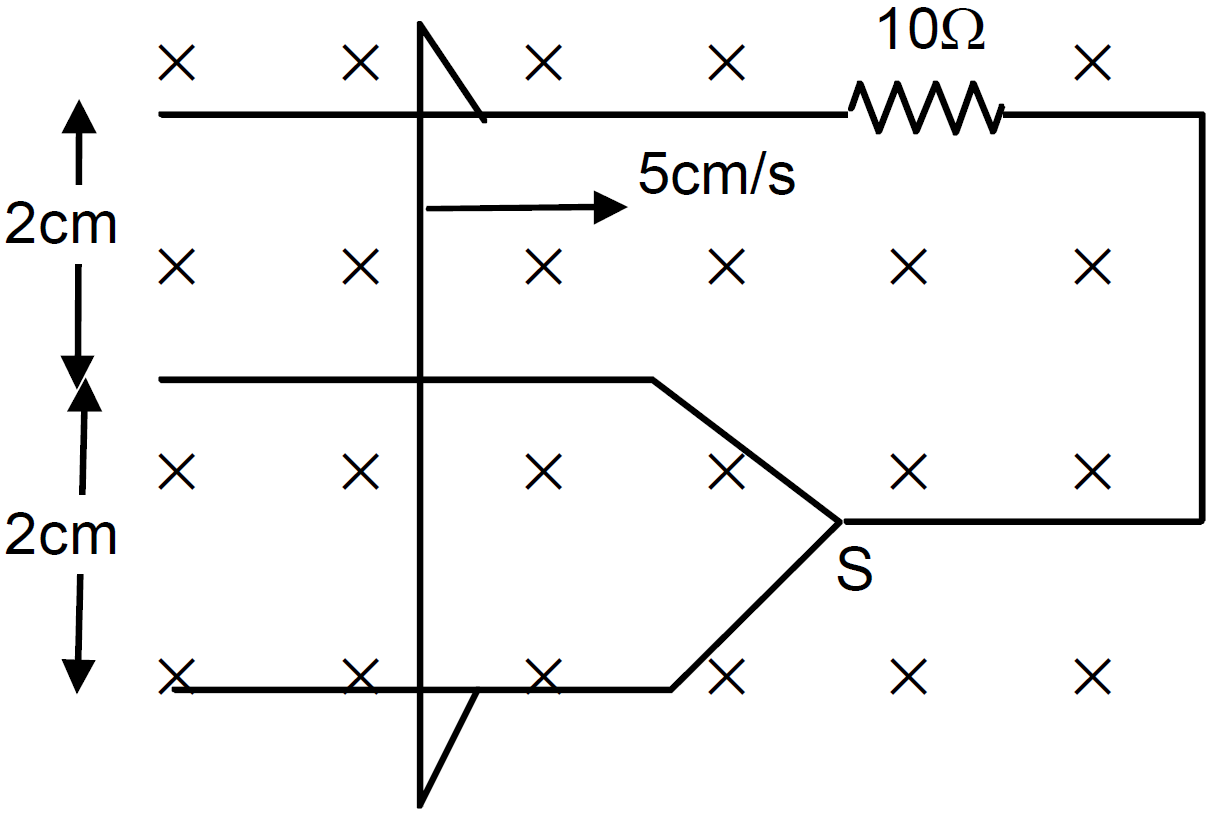 $\text{B}=1\text{T}, \ \text{V}=5\text{l} \ 10^{-2}\text{m}/',\text{R}=10\Omega$
- When the switch is thrown to the middle rail
$\text{E}=\text{Bvl}$
$=1\times5\times10^{-2}\times2\times10^{-2}=10^{-3}$
Current in the $10\Omega$ resistor $=\frac{\text{E}}{\text{R}}$
$=\frac{10^{-3}}{10}=10^{-4}=0.1\text{mA}$
- The switch is thrown to the lower rail
$\text{E}=\text{Bvl}$
$=1\times5\times10^{-2}\times2\times10^{-2}=20\times10^{-4}$
Current $=\frac{20\times10^{-4}}{10}=20\times10^{-4}=0.2\text{mA}$ View full question & answer→Question 185 Marks
Find the total heat produced in the loop of the previous problem during the interval $0$ to $30s$ if the resistance of the loop is $4.5\text{m}\Omega.$
AnswerAs heat produced is a scalar prop. So, net heat produced = $H_a + H_b + H_c + H_d$$\text{R}=4.5\text{m}\Omega=4.5\times10^{-3}\Omega$
$\text{e}=3\times10^{-4}\text{V}$
$\text{i}=\frac{\text{e}}{\text{R}}=\frac{3\times10^{-4}}{4.5\times10^{-3}}=6.7\times10^{-2}\text{Amp}$
$\text{H}_{\text{a}}=(6.7\times10^{-2})^2\times4.5\times10^{-3}\times5$
$\text{H}_{\text{b}}=\text{H}_{\text{d}}=0$ [since emf is induced for 5sec]
$\text{H}_{\text{c}}=(6.7\times10^{-2})^2\times4.5\times10^{-3}\times5$
So Total heat $=\text{H}_{\text{a}}+\text{H}_{\text{c}}$$=2\times(6.7\times10^{-2})^2\times4.5\times10^{-3}\times5=2\times10^{-4}\text{J}.$
View full question & answer→Question 195 Marks
A $20cm$ long conducting rod is set into pure translation with a uniform velocity of $10cm/s^{-1}$ perpendicular to its length. A uniform magnetic field of magnitude $0.10T$ exists in a direction perpendicular to the plane of motion.
- Find the average magnetic force on the free electrons of the rod.
- For what electric field inside the rod, the electric force on a free elctron will balance the magnetic force? How is this electric field created?
- Find the motional emf between the ends of the rod.
Answer$\mathrm{I}=20 \mathrm{~cm}=0.2 \mathrm{~m}$
$\mathrm{v}=10 \mathrm{~cm} / \mathrm{s}=0.1 \mathrm{~m} / \mathrm{s}$
$\mathrm{~B}=0.10 \mathrm{~T}$
a. $F=q v B=1.6 \times 10^{-19} \times 1 \times 10^{-1} \times 1 \times 10^{-1}=1.6 \times 10^{-21} \mathrm{~N}$
b. $q E=q v B$
$\Rightarrow \mathrm{E}=1 \times 10^{-1} \times 1 \times 10^{-1}=1 \times 10^{-2} \mathrm{~V} / \mathrm{m}$
This is created due to the induced emf.
c. Motional emf $=\mathrm{Bvl}$
$=0.1 \times 0.1 \times 0.2=2 \times 10^{-3} \mathrm{~V}$
View full question & answer→Question 205 Marks
The flux of magnetic field through a closed conducting loop changes with time according to the equation, $\phi=\text{at}^2+\text{bt}+\text{c}.$
- Write the SI units of a, band c.
- If the magnitudes of a, b and c are 0.20, 0.40 and 0.60 respectively, find the induced emf at t = 2s.
Answer$\phi=\text{at}^2+\text{bt}+\text{c}$
- $\text{a}=\Big[\frac{\phi}{\text{t}^2}\Big]=\bigg[\frac{\frac{\phi}{\text{t}}}{\text{t}}\bigg]=\frac{\text{Volt}}{\text{Sec}}$
$\text{b}=\Big[\frac{\phi}{\text{t}}\Big]=\text{Volt}$
$\text{c}=\phi=\text{Weber}$
- $\text{E}=\frac{\text{d}\phi}{\text{dt}} \ \big[\text{a}=0.2, \ \text{b}=0.4, \ \text{c}=0.6, \ \text{t}=2\text{s}\big]$
$=2\text{at}+\text{b}$
$=2\times0.2\times2+0.4=1.2 \ \text{volt}$ View full question & answer→Question 215 Marks
Consider the situation of the previous problem.
- Calculate the force needed to keep the sliding wire moving with a constant velocity $v$.
- If the force needed just after $t = 0$ is $F_0$, find the time at which the force needed will be $\frac{\text{F}_0}{2}.$
Answer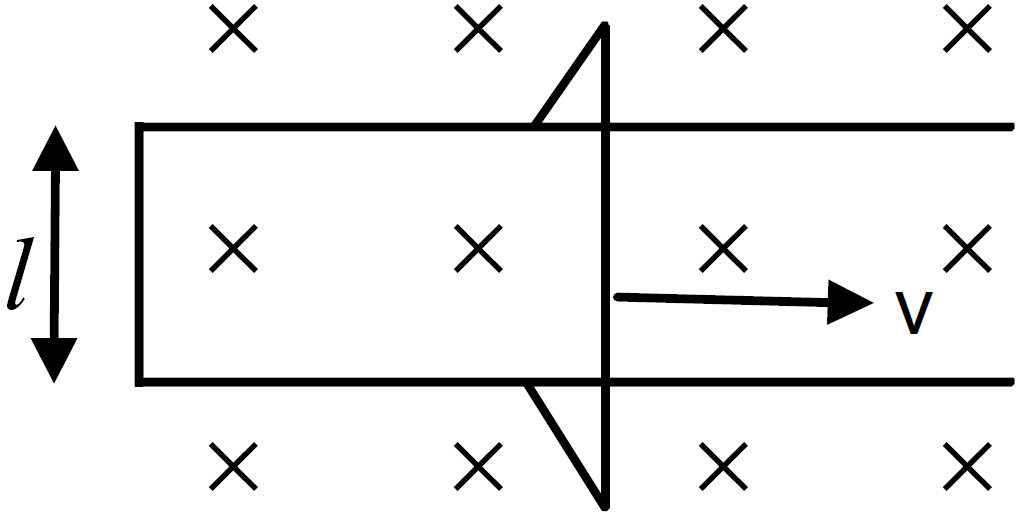
$\text{e}=\text{Bvl}$
$\text{i}=\frac{\text{e}}{\text{R}}=\frac{\text{Bvl}}{2\text{r}(\text{l}+\text{vt})}$
- $\text{F}=\text{ilB}=\frac{\text{Bvl}}{2\text{r}(\text{l}+\text{vt})}\times\text{lB}=\frac{\text{B}^2\text{l}^2\text{v}}{2\text{r}(\text{l}+\text{vt})}$
- Just after $\text{t}=0$
$\text{f}_0=\text{ilB}=\text{lB}\Big(\frac{\text{lBv}}{2\text{rl}}\Big)=\frac{\text{l}\text{B}^2\text{v}}{2\text{r}}$
$\frac{\text{f}_0}{2}=\frac{\text{l}\text{B}^2\text{v}}{4\text{r}}=\frac{\text{l}^2\text{B}^2\text{v}}{2\text{r}(\text{l}+\text{vt})}$
$\Rightarrow2\text{l}=\text{l}+\text{vt}$
$\Rightarrow\text{T}=\frac{\text{l}}{\text{v}}$ View full question & answer→Question 225 Marks
A right-angled triangle abc, made from a metallic wire, moves at a uniform speed v in its plane as shown in figure. A uniform magnetic field B exists in the perpendicular direction. Find the emf induced:
- In the loop abc.
- In the segment bc.
- In the segment ac.
- In the segment ab.
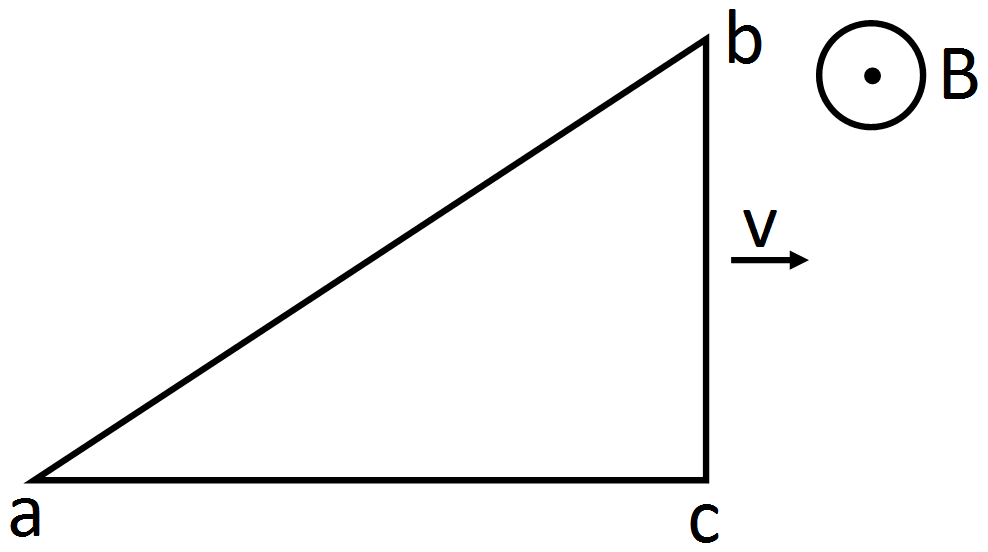
Answer
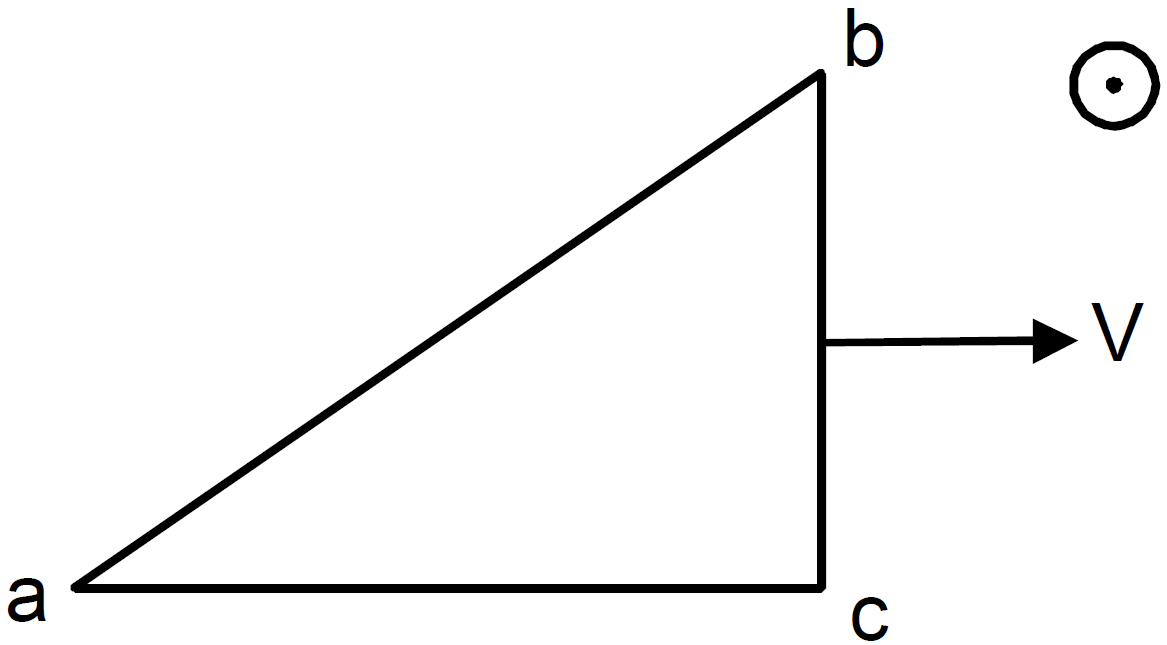
- Zero as the components of ab are exactly opposite to that of bc. So they cancel each other. Because velocity should be perpendicular to the length.
- e = Bv × l
= Bv(bc) + ve at C
- e = 0 as the velocity is not perpendicular to the length.
- e = Bv(bc) positive at ‘a’.
i.e. the component of ‘ab’ along the perpendicular direction.
View full question & answer→Question 235 Marks
A current of 1.0A is established in a tightly wound solenoid of radius 2cm having 1000 turns/ metre. Find the magnetic energy stored in each metre of the solenoid.
Answeri = 1.0A, r = 2cm, n = 1000 turn/m Magnetic energy stored $=\frac{\text{B}^2\text{V}}{2\mu_0}$ Where B → Magnetic field, V → Volume of Solenoid.$=\frac{\mu_0\text{n}^2\text{i}^2}{2\mu_0}\times\pi\text{r}^2\text{h}$
$=\frac{4\pi\times10^{-7}\times10^6\times1\times\pi\times4\times10^{-4}\times1}{2} \ [\text{h}=1\text{m}]$
$=8\pi\times10^{-5}$
$78.956\times10^{-5}=7.9\times10^{-4}\text{J}$.
View full question & answer→Question 245 Marks
Suppose the $19\Omega$ resistor of the previous problem is disconnected. Find the current through $P_2Q_2$ in the two situations:
- Both the wires move towards right.
- If $P_1Q_1$ moves towards left but $P_2Q_2$ moves towards right.
Answer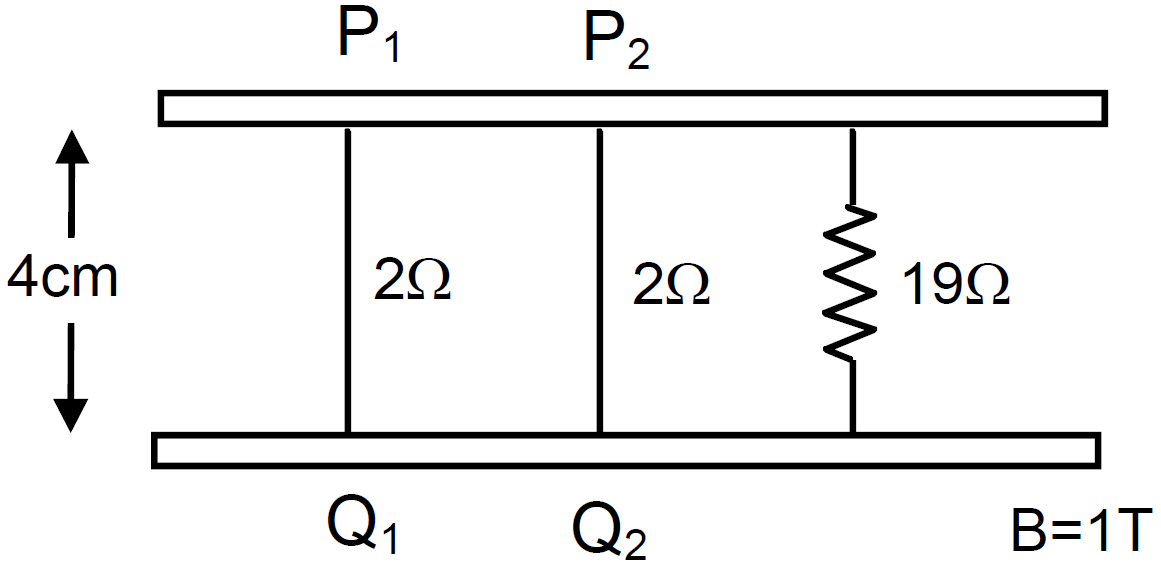
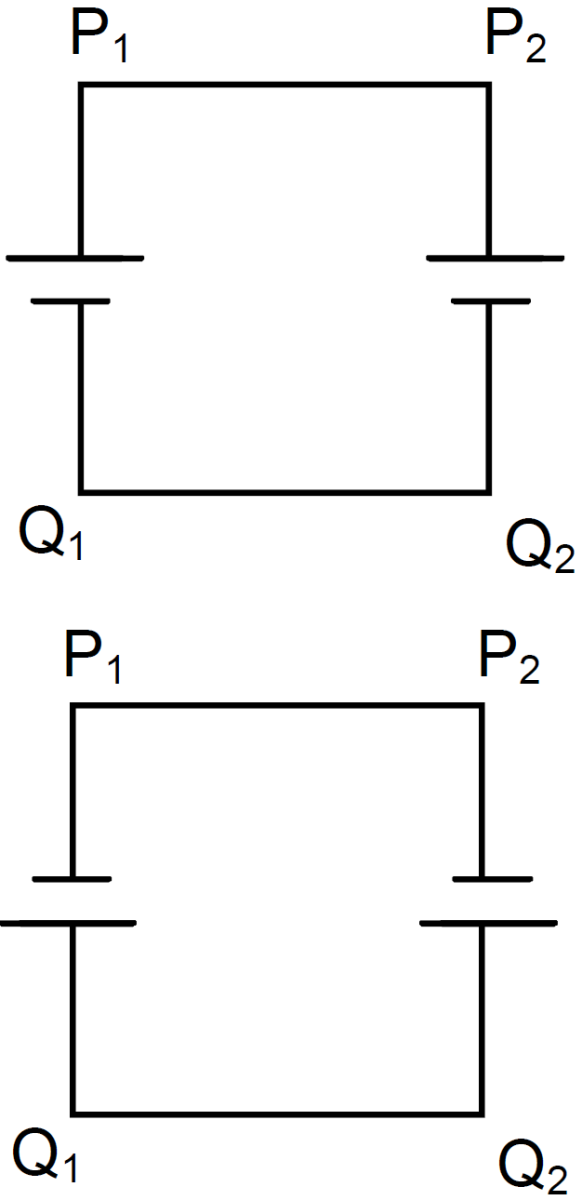
- No current will pass as circuit is incomplete.
- As circuit is complete.
$\text{VP}_2\text{Q}_2=\text{Blv}$
$=1\times0.04\times0.05=2\times10^{-3}\text{V}$
$\text{R}=2\Omega$
$\text{i}=\frac{2\times10^{-3}}{2}=1\times10^{-3}\text{A}=1\text{mA}$ View full question & answer→Question 255 Marks
A solenoid of length $20cm$, area of cross-section $4.0cm^2$ and having $4000$ turns is placed inside another solenoid of $2000$ turns having a cross-sectional area $8.0cm^2$ and length $10cm$. Find the mutual inductance between the solenoids.
Answer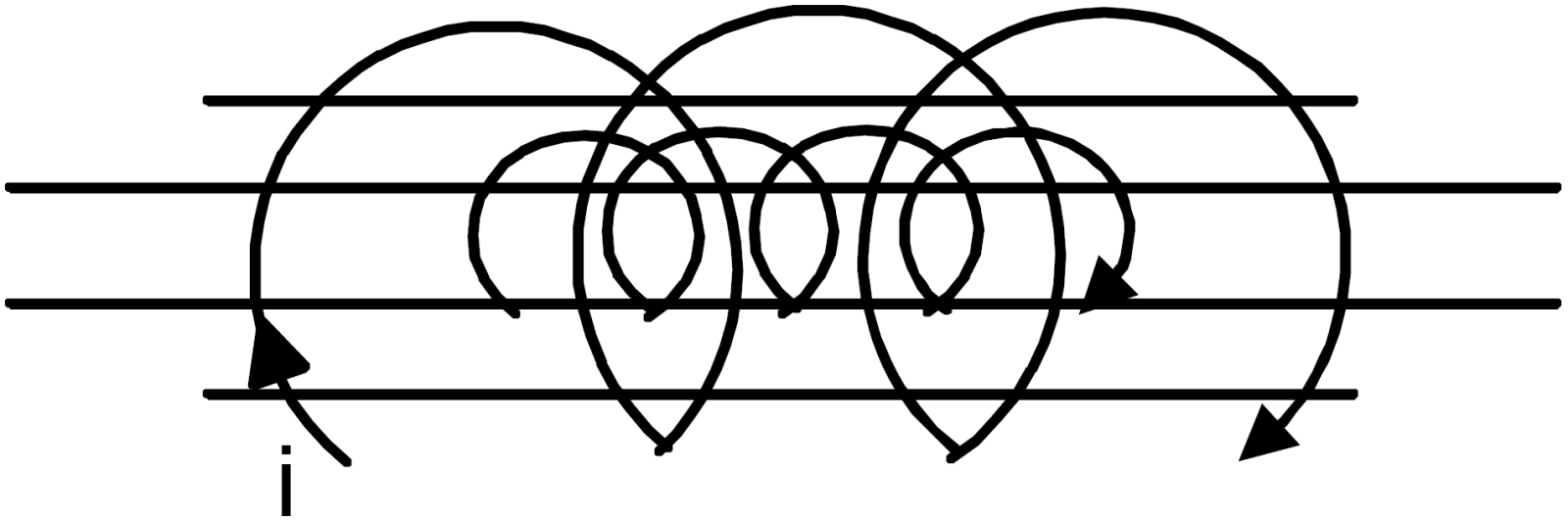
Solenoid I:$\text{a}_1=4\text{cm}^2; \ \text{n}_1=\frac{4000}{0.2}\text{m}; \ \text{l}_1=20\text{cm}=0.20\text{m}$
Solenoid II:$\text{a}_1=8\text{cm}^2; \ \text{n}_2=\frac{2000}{0.1}\text{m}; \ \text{l}_2=10\text{cm}=0.10\text{m}$
$\text{B}=\mu_0\text{n}_2\text{i}$ let the current through outer solenoid be i.
$\phi=\text{n}_1\text{B.A}=\text{n}_1\text{n}_2\mu_0\text{i}\times\text{a}_1$
$=2000\times\frac{2000}{0.1}\times4\pi\times10^{-7}\times\text{i}\times4\times10^{-4}$
$\text{E}=\frac{\text{d}\phi}{\text{dt}}=64\pi\times10^{-4}\times\frac{\text{di}}{\text{dt}}$
$\Big[\text{As E}=\frac{\text{mdi}}{\text{dt}}\Big]$
Now $\text{M}=\frac{\text{E}}{\frac{\text{di}}{\text{dt}}}=64\pi\times10^{-4}\text{H}=2\times10^{-2}\text{H}.$ View full question & answer→Question 265 Marks
A wire of mass m and length l can slide freely on a pair of smooth, vertical rails (figure). A magnetic field B exists in the region in the direction perpendicular to the plane of the rails. The rails are connected at the top end by a capacitor of capacitance C. Find the acceleration of the wire neglecting any electric resistance.
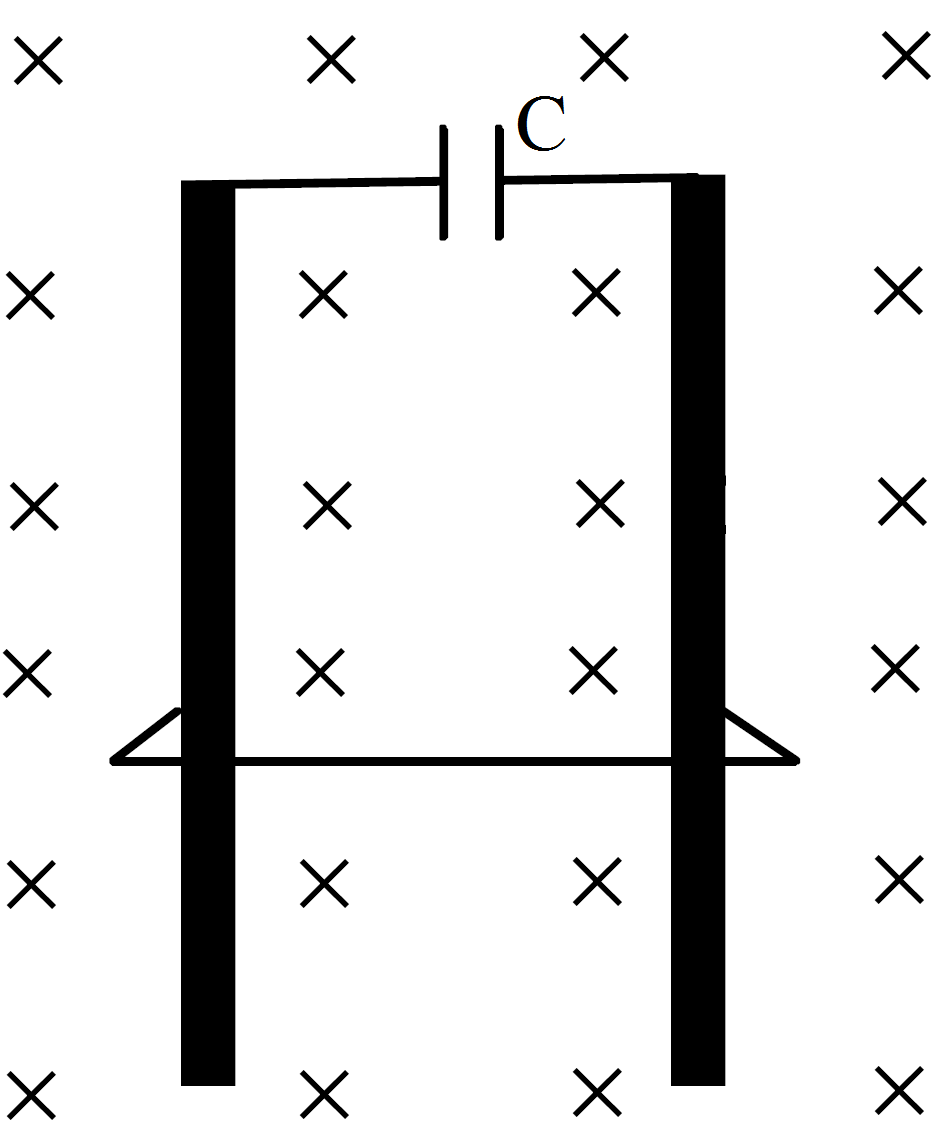
Answer
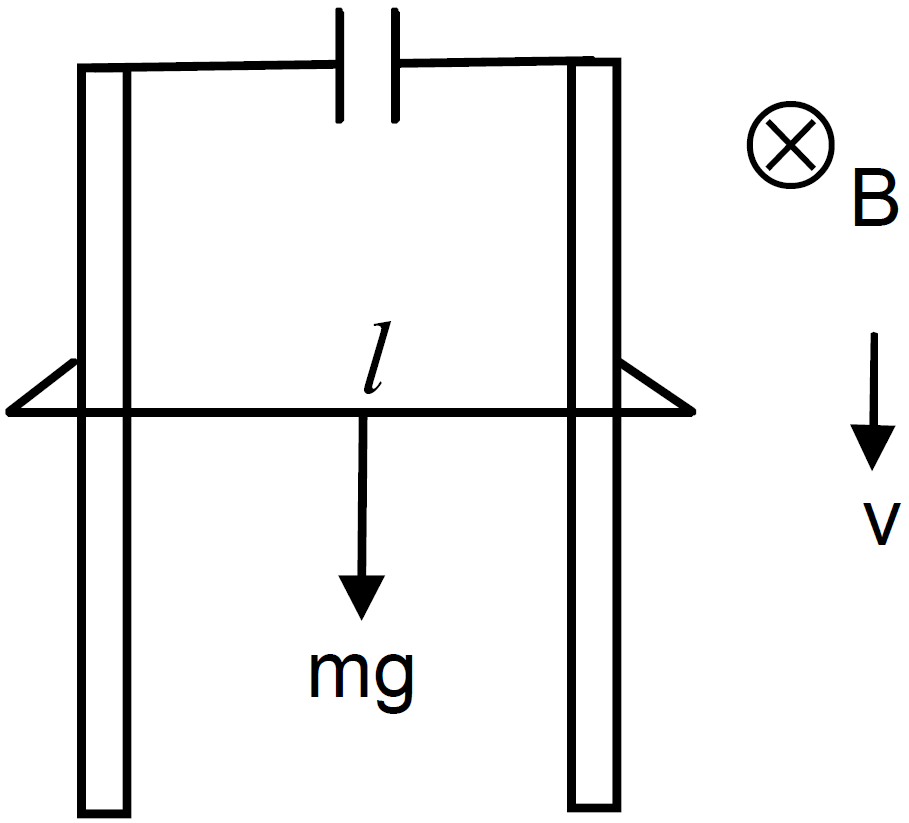 Let the rod has a velocity v at any instant,
Then, at the point,
e = Blv
Now, q = c × potential = ce = CBlv
Current $\text{l}=\frac{\text{dq}}{\text{dt}}=\frac{\text{d}}{\text{dt}}\text{CBlv}$
$\text{CBl}\frac{\text{dv}}{\text{dt}}=\text{CBla}$ (where a → acceleration)
From figure, force due to magnetic field and gravity are opposite to each other.
So, mg – IlB = ma
$\Rightarrow\text{mg}-\text{CBla}\times\text{lB}=\text{ma}$
$\Rightarrow\text{ma}+\text{CB}^2\text{l}^2\text{a}=\text{mg}$
$\Rightarrow\text{a}\big(\text{m}+\text{CB}^2\text{l}^2\big)=\text{mg}$
$\Rightarrow \text{a}=\frac{\text{mg}}{\text{m}+\text{CB}^2\text{l}^2}$ View full question & answer→Question 275 Marks
Figure shows a metallic wire of resistance $0.20\Omega$ sliding on a horizontal, U-shaped metallic rail. The separation between the parallel arms is $20cm$. An electric current of $2.0\mu\text{A}$ passes through the wire when it is slid at a rate of $20cms^{-1}$. If the horizontal component of the earth's magnetic field is $3.0 \times 10^{-5} T$, calculate the dip at the place.
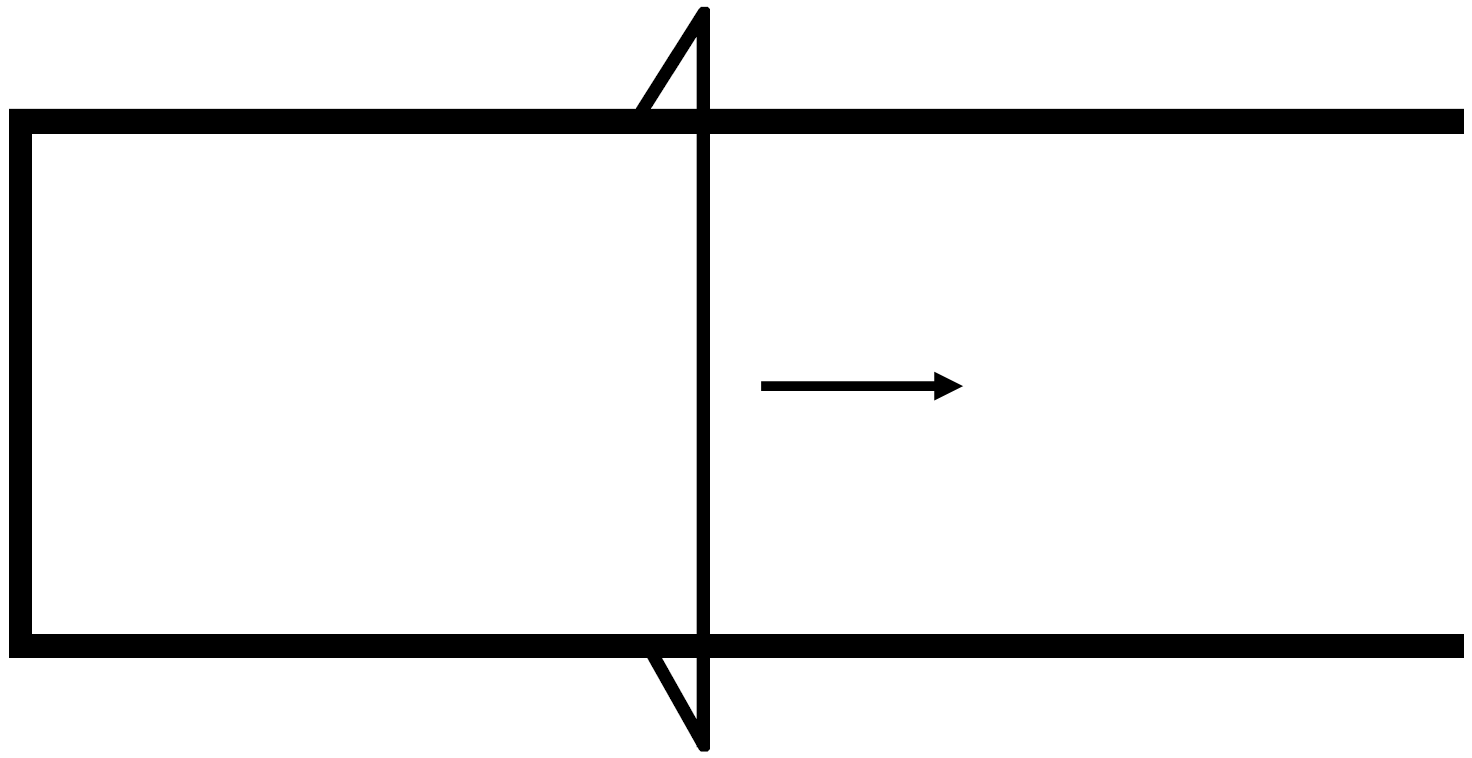
Answer$\text{l}=20\text{cm}=20\times10^{-2}\text{m}$$\text{v}=20\text{cm}/\text{s}=20\times10^{-2}\text{m}/\text{s}$
$\text{B}_{\text{H}}=3\times10^{-5}\text{T}$
$\text{i}=2\mu\text{A}=2\times10^{-5}\text{A}$
$\text{R}=0.2\Omega$
$\text{i}=\frac{\text{B}_\text{v}\text{lv}}{\text{R}}$
$\Rightarrow\text{B}_{\text{v}}=\frac{\text{iR}}{\text{lv}}=\frac{2\times10^{-6}\times2\times10^{-1}}{20\times10^{-2}\times20\times10^{-2}}=1\times10^{-5} \ \text{Tesla}$
$\tan\delta=\frac{\text{B}_\text{v}}{\text{B}_\text{H}}=\frac{1\times10^{-5}}{3\times10^{-5}}=\frac{1}{3}\Rightarrow\delta(\text{dip})=\tan^{-1}\Big(\frac{1}{3}\Big)$
View full question & answer→Question 285 Marks
A square-shaped copper coil has edges of length 50cm and contains 50 turns. It is placed perpendicular to a 1.0T magnetic field. It is removed from the magnetic field in 0·25s and restored in its original place in the next 0·25s. Find the magnitude of the average emf induced in the loop during:
- Its removal.
- Its restoration.
- Its motion.
Answer
- During its removal.
$\phi_1=\text{B.A.}=1\times50\times0.5-25\times0.5=12.5 \ \text{Tesla-m}^2$
$\phi_2=0, \ \tau=0.25$
$\text{e}=-\frac{\text{d}\phi}{\text{dt}}=\frac{\phi_2-\phi_1}{\text{dt}}=\frac{12.5}{0.25}=\frac{125\times10^{-1}}{25\times10^{-2}}=50\text{V}$
- During its restoration.
$\phi_1=0; \ \phi_2=12.5 \ \text{Tesla-m}^2; \ \text{t}=0.25\text{s}$
$\text{E}=\frac{12.5-0}{0.25}=50\text{V}$
- During its motion.
$\phi_1=0, \ \phi_2=0$
$\text{E}=\frac{\text{d}\phi}{\text{dt}}=0$ View full question & answer→Question 295 Marks
A constant current exists in an inductor-coil connected to a battery. The coil is short-circuited and the battery is removed. Show that the charge flown through the coil after the short-circuiting is the same as that which flows in one time constant before the short-circuiting.
Answer
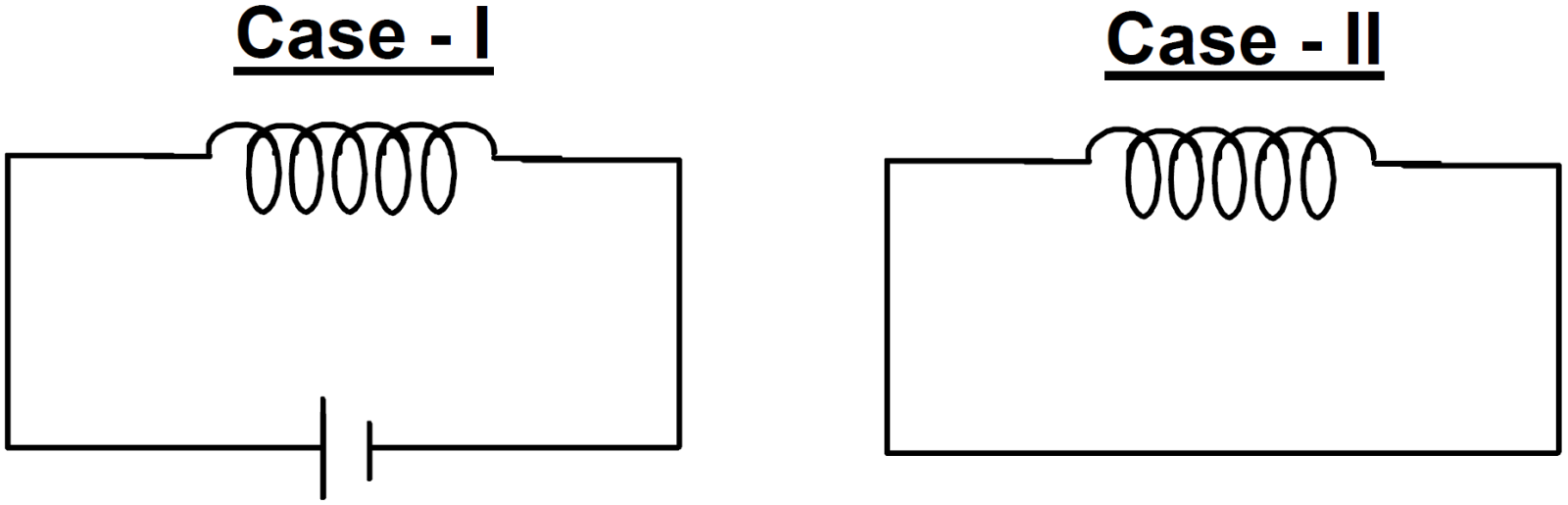 In this case there is no resistor in the circuit.
So, the energy stored due to the inductor before and after removal of battery remains same. i.e.
$\text{V}_1=\text{V}_2=\frac{1}{2}\text{Li}^2$
So, the current will also remain same.
Thus charge flowing through the conductor is the same. View full question & answer→Question 305 Marks
Find the mutual inductance between the straight wire and the square loop of figure.
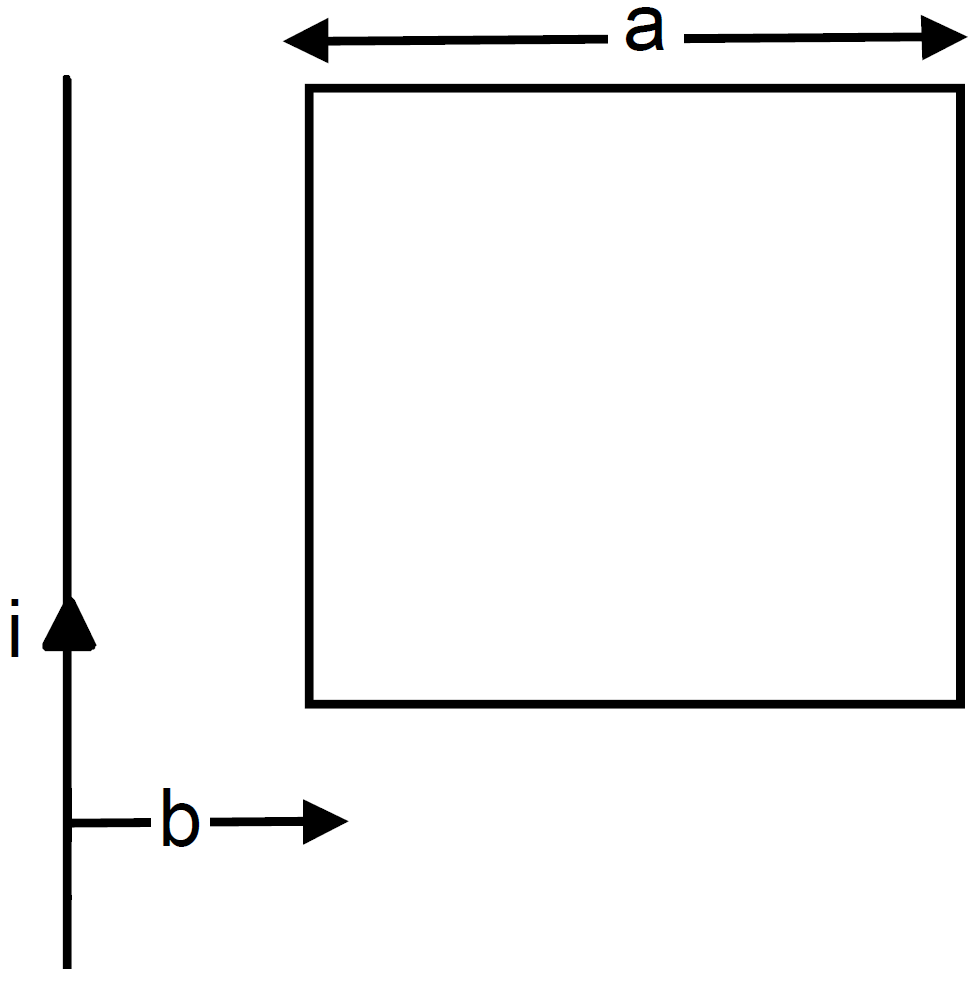
Answer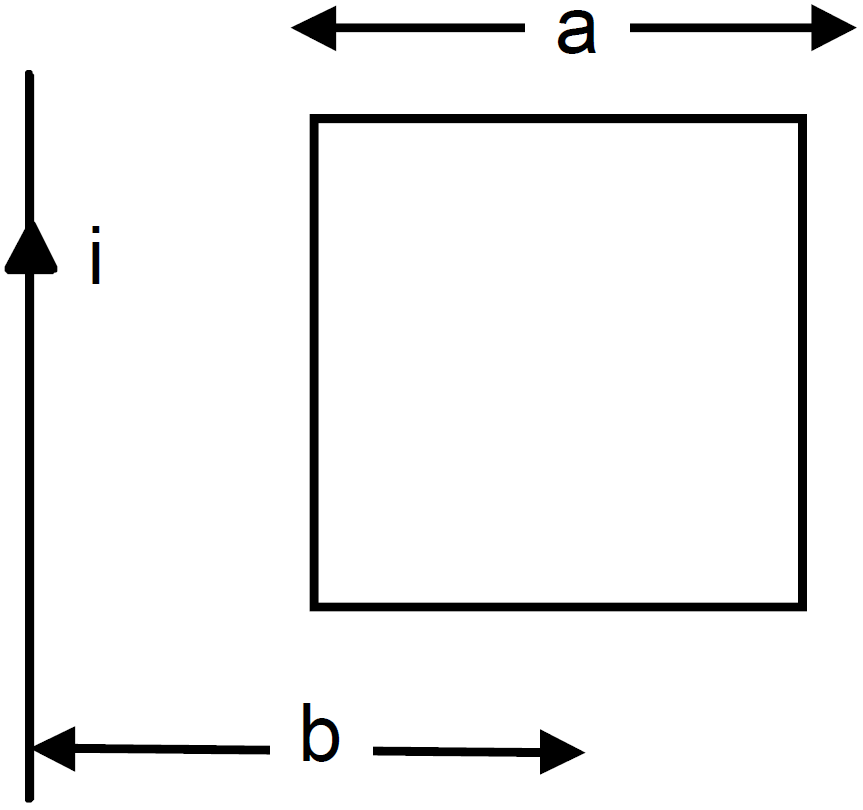 We know,
$\frac{\text{d}\phi}{\text{dt}}=\text{E}=\text{M}\times\frac{\text{di}}{\text{dt}}$
From the question,
$\frac{\text{di}}{\text{dt}}=\frac{\text{d}}{\text{dt}}(\text{i}_0\sin\omega\text{t})=\text{i}_0\omega\cos\omega\text{t}$
$\frac{\text{d}\phi}{\text{dt}}=\text{E}\frac{\mu_0\text{ai}_0\omega\cos\omega\text{t}}{2\pi}\text{ln}\Big[1+\frac{\text{a}}{\text{b}}\Big]$
Now, $\text{E}=\text{M}\times\frac{\text{di}}{\text{dt}}$
$\frac{\mu_0\text{ai}_0\omega\cos\omega\text{t}}{2\pi}\text{ln}\Big[1+\frac{\text{a}}{\text{b}}\Big]=\text{M}\times\text{i}_0\omega\cos\omega\text{t}$
$\Rightarrow\text{M}=\frac{\mu_0\text{a}}{2\pi}\text{ln}\Big[1+\frac{\text{a}}{\text{b}}\Big]$ View full question & answer→Question 315 Marks
A coil of radius 10cm and resistance $40\Omega$ has 1000 turns. It is placed with its plane vertical and its axis parallel to the magnetic meridian. The coil is connected to a galvanometer and is rotated about the vertical dimeter through an angle of 180°. Find the charge which flows through the galvanometer if the horizontal component of the earth's magnetic field is $\text{B}_{\text{H}}=3.0\times10^{-5}\text{T}.$
Answer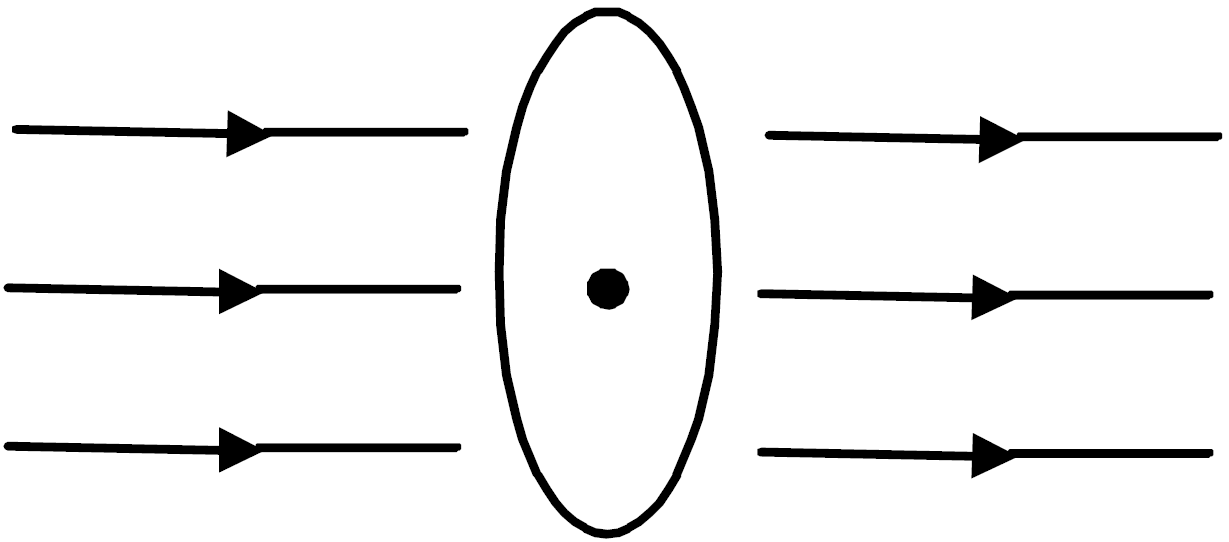 $\text{r}=10\text{cm}=0.1\text{m}$
$\text{R}=40\Omega, \ \text{N}=1000$
$\theta=180^{\circ}, \ \text{B}_\text{H}=3\times10^{-5}\text{T}$
$\theta=\text{N(B.A)}=\text{NBA}\cos180^\circ \ \text{or}=-\text{NBA}$
$=1000\times3\times10^{-5}\times\pi\times1\times10^{-2}=3\pi\times10^{-4} \ \text{where}$
$\text{d}\phi=2\text{NBA}=6\pi\times10^{-4}\text{weber}$
$\text{e}=\frac{\text{d}\phi}{\text{dt}}=\frac{6\pi\times10^{-4}\text{V}}{\text{dt}}$
$\text{i}=\frac {6\pi\times10^{-4}}{40\text{dt}}=\frac {4.71\times10^{-5}}{\text{dt}}$
$\text{Q}=\frac{4.71\times10^{-5}\times\text{dt}}{\text{dt}}=4.71\times10^{-5}\text{C}.$ View full question & answer→Question 325 Marks
- The magnetic field in a region varies as shown in figure. Calculate the average induced emf in a conducting loop of area $2.0 \times 10^{-3}m^2$ placed perpendicular to the field in each of the $10ms$ intervals shown.
- In which intervals is the emf not constant? Neglect the behaviour near the ends of 10ms intervals.
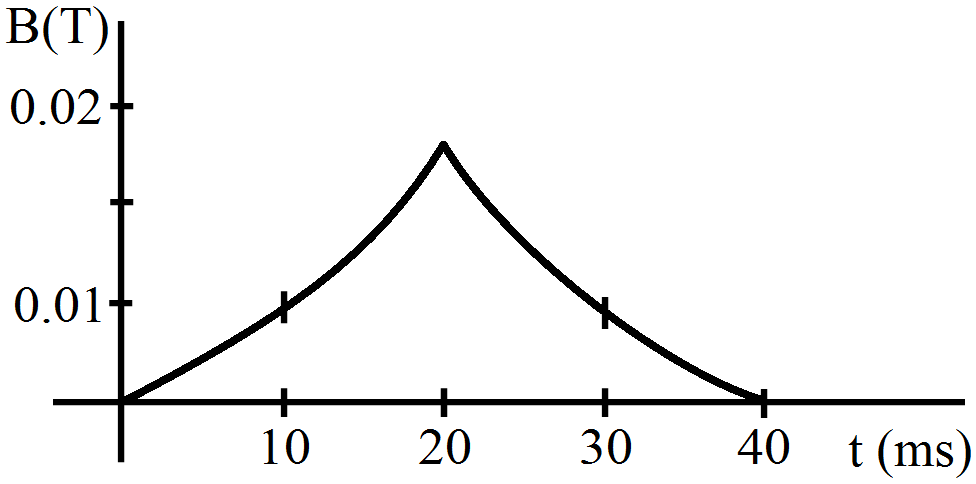
Answer
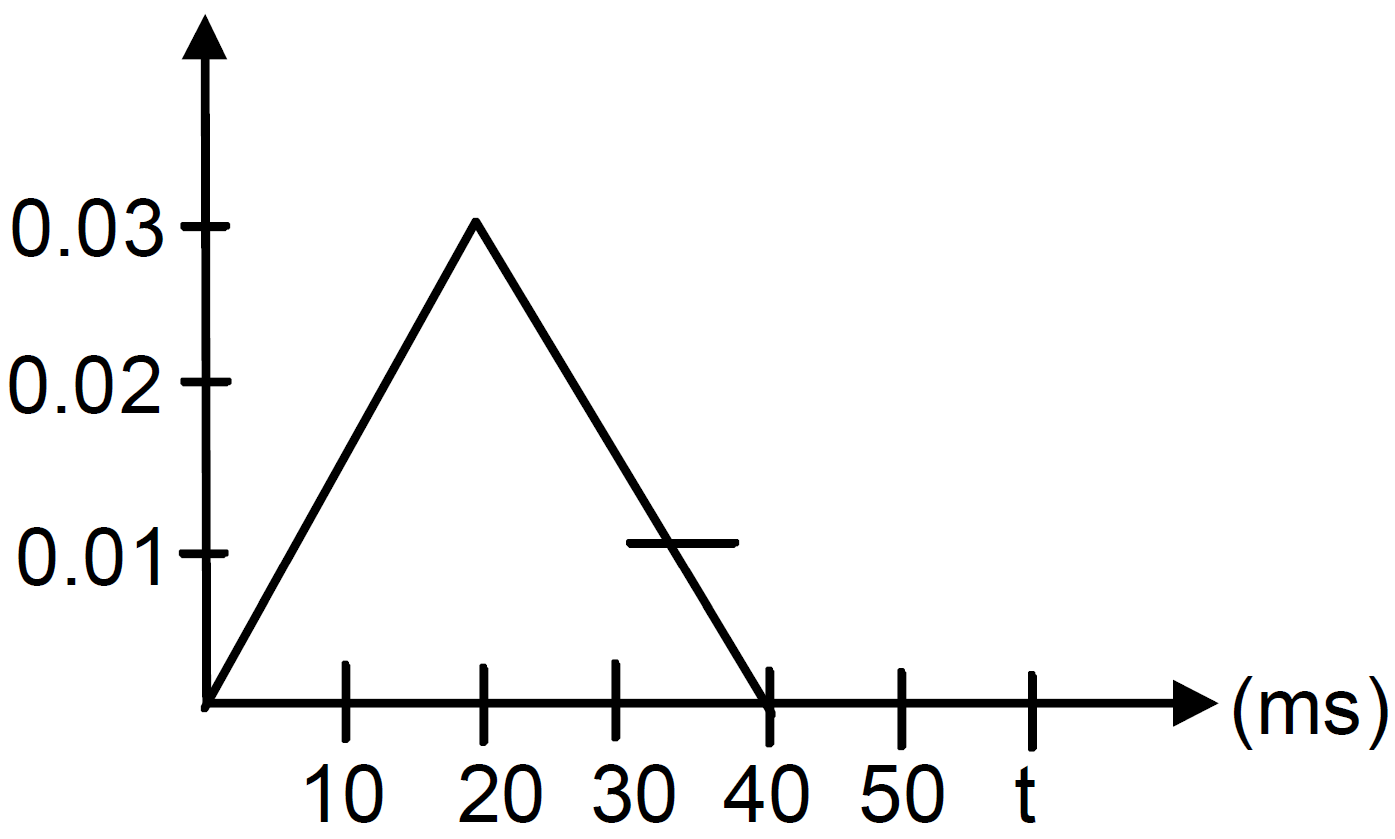
- $\phi_2=\text{B}.\text{A}=0.01\times2\times10^{-3}=2\times10^{-5}$
$\phi_1=0$
$\text{e}=-\frac{\text{d}\phi}{\text{dt}}=\frac{-2\times10^{-5}}{10\times10^{-3}}=-2\text{mV}$
$\phi_3=\text{B}.\text{A}=0.03\times2\times10^{-3}=6\times10^{-5}$
$\text{d}\phi=4\times10^{-5}$
$\text{e}=-\frac{\text{d}\phi}{\text{dt}}=-4\text{mV}$
$\phi_4=\text{B}.\text{A}=0.01\times2\times10^{-3}=2\times10^{-5}$
$\text{d}\phi=-4\times10^{-5}$
$\text{e}=-\frac{\text{d}\phi}{\text{dt}}=4\text{mV}$
$\phi_5=\text{B}.\text{A}=0$
$\text{d}\phi=-2\times10^{-5}$
$\text{e}=-\frac{\text{d}\phi}{\text{dt}}=2\text{mV}$
- emf is not constant in case of → 10 - 20ms and 20 - 30ms as -4mV and 4mV.
View full question & answer→Question 335 Marks
Suppose the ends of the coil in the previous problem are connected to a resistance of $100\Omega.$ Neglecting the reaiatance of the coil, find the heat produced in the circuit in one minute.
Answer$\text{H}=\int\limits^{\text{t}}_{0}\text{i}^2\text{Rdt}=\int\limits^\text{t}_{0}\frac{\text{B}^2\text{A}^2\omega^2}{\text{R}^2}\sin\omega\text{t}\text{ Rdt}$$=\frac{\text{B}^2\text{A}^2\omega^2}{2\text{R}^2}\int\limits^\text{t}_0(1-\cos2\omega\text{t})\text{dt}$
$=\frac{\text{B}^2\text{A}^2\omega^2}{2\text{R}^2}\Big(\text{t}-\frac{\sin2\omega\text{t}}{2\omega}\Big)^{1\text{ minute}}$
$=\frac{\text{B}^2\text{A}^2\omega^2}{2\text{R}}\Bigg(60-\frac{\sin2\times8-\frac{2\pi}{60}\times60}{2\times80\times\frac{2\pi}{60}}\Bigg)$
$=\frac{60}{200}\times\pi^2\text{r}^2\times\text{B}^2\times\Big(80^4\times\frac{2\pi}{60}\Big)^2$
$=\frac{60}{200}\times10\times\frac{64}{9}\times10\times625\times10^{-8}\times10^{-4}$
$=\frac{625\times6\times64}{9\times2}\times10^{-11}=1.33\times10^{-7}\text{J}.$
View full question & answer→Question 345 Marks
A coil having an inductance L and a resistance R is connected to a battery of emf $\in.$ Find the time taken for the magnetic energy stored in the circuit to change from one fourth of the steady-state value to half of the steady-state value.
AnswerMaximum current $=\frac{\text{E}}{\text{R}}$ In steady state magnetic field energy stored $=\frac{1}{2}\text{L}\frac{\text{E}^2}{\text{R}^2}$ The fourth of steady state energy $=\frac{1}{8}\text{L}\frac{\text{E}^2}{\text{R}^2}$ One half of steady energy $=\frac{1}{4}\text{L}\frac{\text{E}^2}{\text{R}^2}$$\frac{1}{8}\text{L}\frac{\text{E}^2}{\text{R}^2}=\frac{1}{2}\text{L}\frac{\text{E}^2}{\text{R}^2}\Big(1-\text{e}\frac{\text{-t}_1\text{R}}{\text{L}}\Big)^2$
$\Rightarrow1-\text{e} \ \frac{\text{t}_1\text{R}}{\text{L}}=\frac{1}{2}$
$\Rightarrow\text{e}\frac{\text{t}_1\text{R}}{\text{L}}=\frac{1}{2}\Rightarrow\text{t}_1\frac{\text{R}}{\text{L}}=\text{ln}2\Rightarrow\text{t}_1=\tau\text{ln}2$
Again $\frac{1}{4}\text{L}\frac{\text{E}^2}{\text{R}^2}=\frac{1}{2}\text{L}\frac{\text{E}^2}{\text{R}^2}\Big(1-\text{e}\frac{\text{-t}_2\text{R}}{\text{L}}\Big)^2$$\Rightarrow\text{e}\frac{\text{t}_2\text{R}}{\text{L}}=\frac{\sqrt2-1}{\sqrt2}=\frac{2-\sqrt2}{2}$
$\Rightarrow\text{t}_2=\tau\Bigg[\text{ln}\Big(\frac{1}{2-\sqrt2} \Big)+\text{ln2}\Bigg]$
So, $\text{t}_2-\text{t}_1=\tau\text{ln}\frac{1}{2-\sqrt2}$
View full question & answer→Question 355 Marks
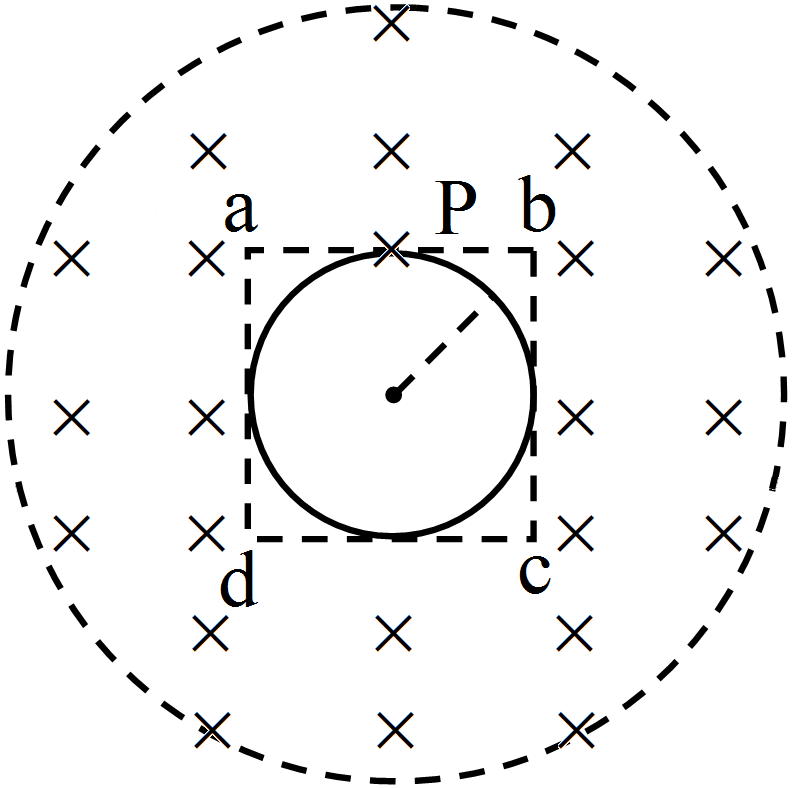
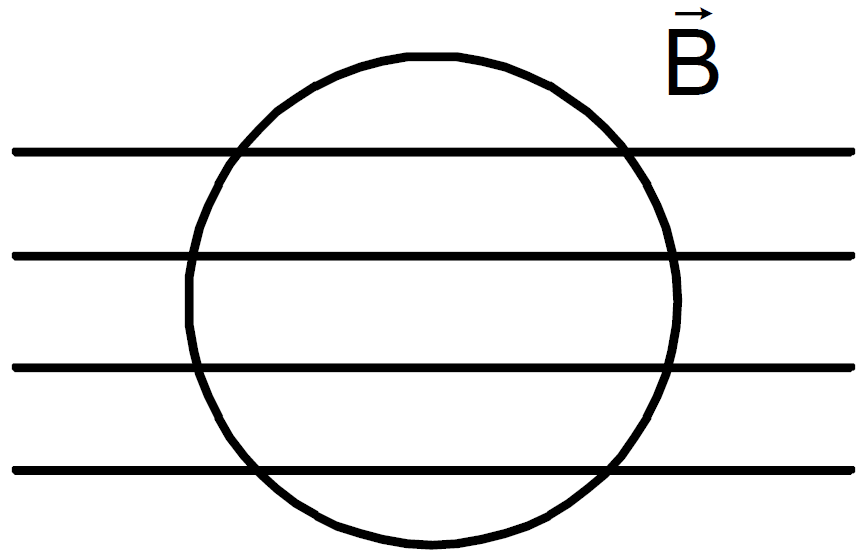
A uniform magnetic field B exists in a cylindrical region, shown dotted in figure. The magnetic field increases at a constant rate $\frac{\text{dB}}{\text{dt}}.$ Consider a circle of radius r coaxial with the cylindrical region.
- Find the magnitude of the electric field E at a point on the circumference of the circle.
- Consider a point P on the side of the square circumscribing the circle. Show that the component of the induced electric field at P along ba is the same as the magnitude found in part (a).
Answer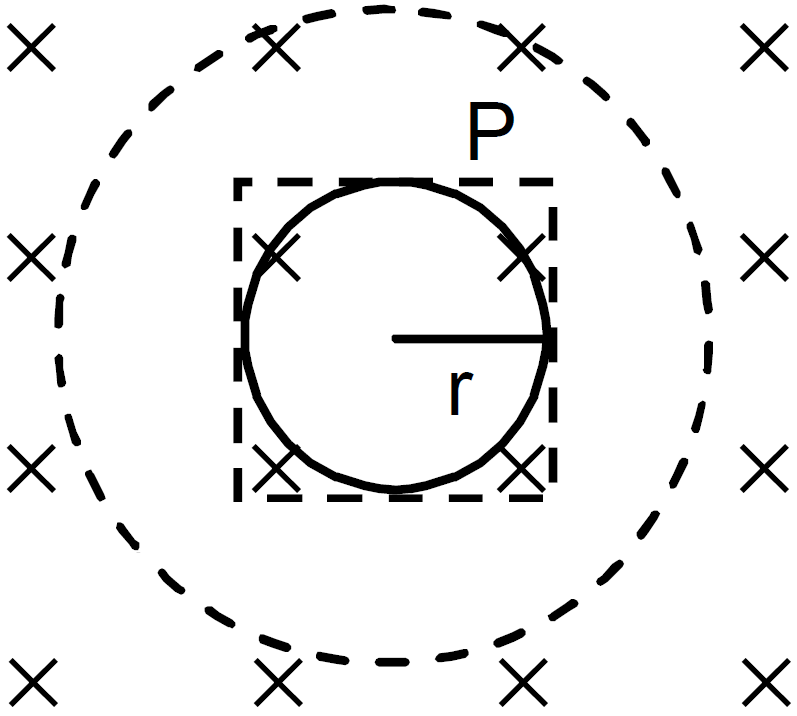
- Work done per unit test charge
$=\phi\text{E}.\text{dl}$ (E = electric field)
$\phi\text{E}.\text{dl}=\text{e}$
$\Rightarrow\text{E}\ \phi\ \text{dl}=\frac{\text{d}\phi}{\text{dt}}$
$\Rightarrow\text{E}\ 2\pi\text{r}=\frac{\text{dB}}{\text{dt}}\times\text{A}$
$\Rightarrow\text{E}\ 2\pi\text{r}=\pi\text{r}^2\frac{\text{dB}}{\text{dt}}$
$\Rightarrow\text{E}\ =\frac{\pi\text{r}^2}{2\pi}\frac{\text{dB}}{\text{dt}}=\frac{\text{r}}{2}\frac{\text{dB}}{\text{dt}}$
- When the square is considered
$\phi\text{E}\ \text{dl}\ =\text{e}$
$\Rightarrow\text{E}\ \times\ 2\text{r}\ \times\ 4=\frac{\text{dB}}{\text{dt}}\big(2\text{r}\big)^2$
$\Rightarrow\text{E}\ =\frac{\text{dB}}{\text{dt}}\frac{4\text{r}^2}{8\text{r}^2}$
$\Rightarrow\text{E}\ =\frac{\text{r}}{2}\frac{\text{dB}}{\text{dt}}$
$\therefore$ The electric field at the point p has the same value as (a). View full question & answer→Question 365 Marks
A circular coil of radius 2.00cm has 50 turns. A uniform magnetic field B - 0.200T exists in the space in a direction parallel to the axis of the loop. The coil is now rotated about a diameter through an angle of 60.0°. The operation takes 0.100s.
- Find the average emf induced in the coil.
- If the coil is a closed one (with the two ends joined together) and has a resistance of $4.00\Omega.$ calculate the net charge crossing a cross-section of the wire of the coil.
Answer$\text{N}=50, \ \text{B}=0.200\text{T}; \ \text{r}=2.00\text{cm}=0.02\text{m}$$\theta=60^{\circ}, \text{t}=0.100\text{s}$
- $\text{e}=\frac{\text{Nd}\phi}{\text{t}}=\frac{\text{N}\times\text{B.A}}{\text{T}}=\frac{\text{NBA}\cos60^{\circ}}{\text{T}}$
$=\frac{50\times2\times10^{-1}\times\pi\times(0.02)^2}{0.1}=5\times4\times10^{-3}\times\pi$
$=2\pi\times10^{-2}\text{V}=6.28\times10^{-2}\text{V}$
- $\text{i}=\frac{\text{e}}{\text{R}}=\frac{6.28\times10^{-2}}{4}=1.57\times10^{-2}\text{A}$
$\text{Q}=\text{it}-1.57\times10^{-2}\times10^{-1}=1.57\times10^{-3}\text{C}$ View full question & answer→Question 375 Marks
The current in an ideal, long solenoid is varied at a uniform rate of 0.01A/s. The solenoid has 2000 turns/m and its radius is 6.0cm.
- Consider a circle of radius 1.0cm inside the solenoid with its axis coinciding with the axis of the solenoid. Write the change in the magnetic flux through this circle in 2.0 seconds.
- Find the electric field induced at a point on the circumference of the circle.
- Find the electric field induced at a point outside the solenoid at a distance 8.0cm from its axis.
Answer$\frac{\text{di}}{\text{dt}}=0.01\text{A}/\text{s}$For $2\text{s}\frac{\text{di}}{\text{dt}}=0.02\text{A}/\text{s}$
n = 2000 turn/m, R = 6.0cm = 0.06m
r = 1cm = 0.01m
- $\phi=\text{BA}$
$\Rightarrow\frac{\text{d}\phi}{\text{dt}}=\mu_0\text{na}\frac{\text{di}}{\text{dt}}$
$=4\pi\times10^{-7}\times2\times10^2\times\pi\times1\times10^{-4}\times2\times10^{-2}$
$\big[\text{A}=\pi\times1\times10^{-4}\big]$
$=16\pi^2\times10^{-10}\omega$
$=157.91\times10^{-10}\omega$
$=1.6\times10^{-8}\omega$
or, $\frac{\text{d}\phi}{\text{dt}}$ for $1\text{s} = 0.785\omega$
- $\int\text{E}.\text{dl}=\frac{\text{d}\phi}{\text{dt}}$
$\Rightarrow\text{E}\phi\text{dl}=\frac{\text{d}\phi}{\text{dt}}$
$\Rightarrow\text{E}=\frac{0.785\times10^{-8}}{2\pi\times10^{-2}}$
$=1.2\times10^{-7}\text{v}/\text{m}$
- $\frac{\text{d}\phi}{\text{dt}}=\mu_0\text{n}\frac{\text{di}}{\text{dt}}\text{A}$
$=4\pi\times10^{-7}\times2000\times0.01\times\pi\times\big(0.06\big)^2$
$\text{E}\phi\text{dl}=\frac{\text{d}\phi}{\text{dt}}$
$\Rightarrow\text{E}=\frac{\frac{\text{d}\phi}{\text{dt}}}{2\pi\text{r}}$
$=\frac{4\pi\times10^{-7}\times2000\times0.01\times\pi\times(0.06)^2}{\pi\times8\times10^{-2}}$
$=5.64\times10^{-7}\text{v}/\text{m}$ View full question & answer→Question 385 Marks
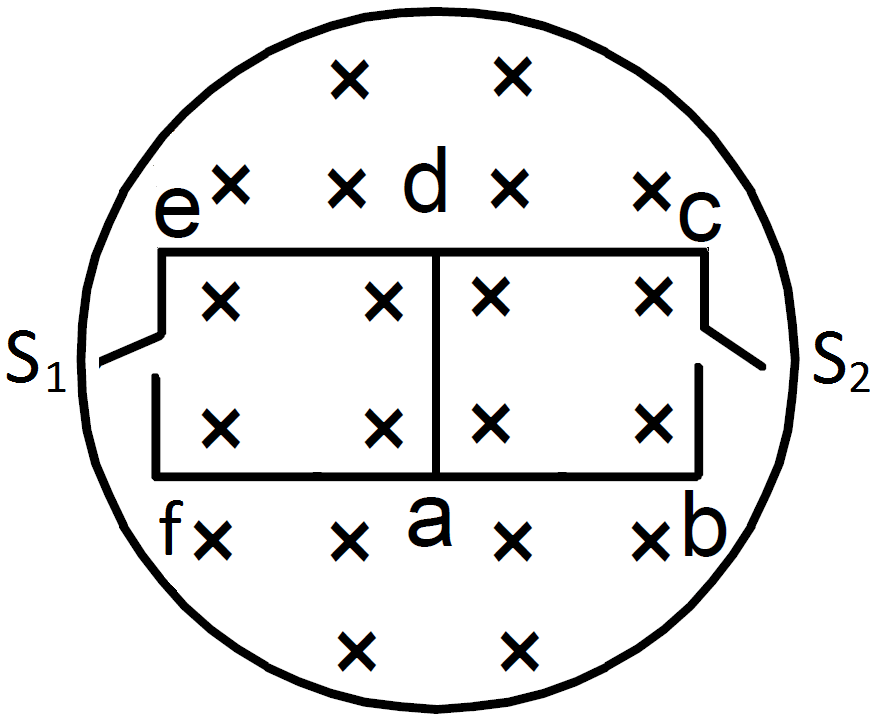
The magnetic field in the cylindrical region shown in figure increases at a constant rate of $20.0mT/s$. Each side of the square loop abcd and defa has a length of $1.00cm$ and a resistance of $4.00\Omega.$ Find the current (magnitude and sense) in the wire ad if:
- The switch $S_1$ is closed but $S_2$ is open.
- $S_1$ is open but $S_2$ ia closed.
- Both $S_1$ and $S_2$ are open.
- Both $S_1$ and $S_2$ are closed.
Answer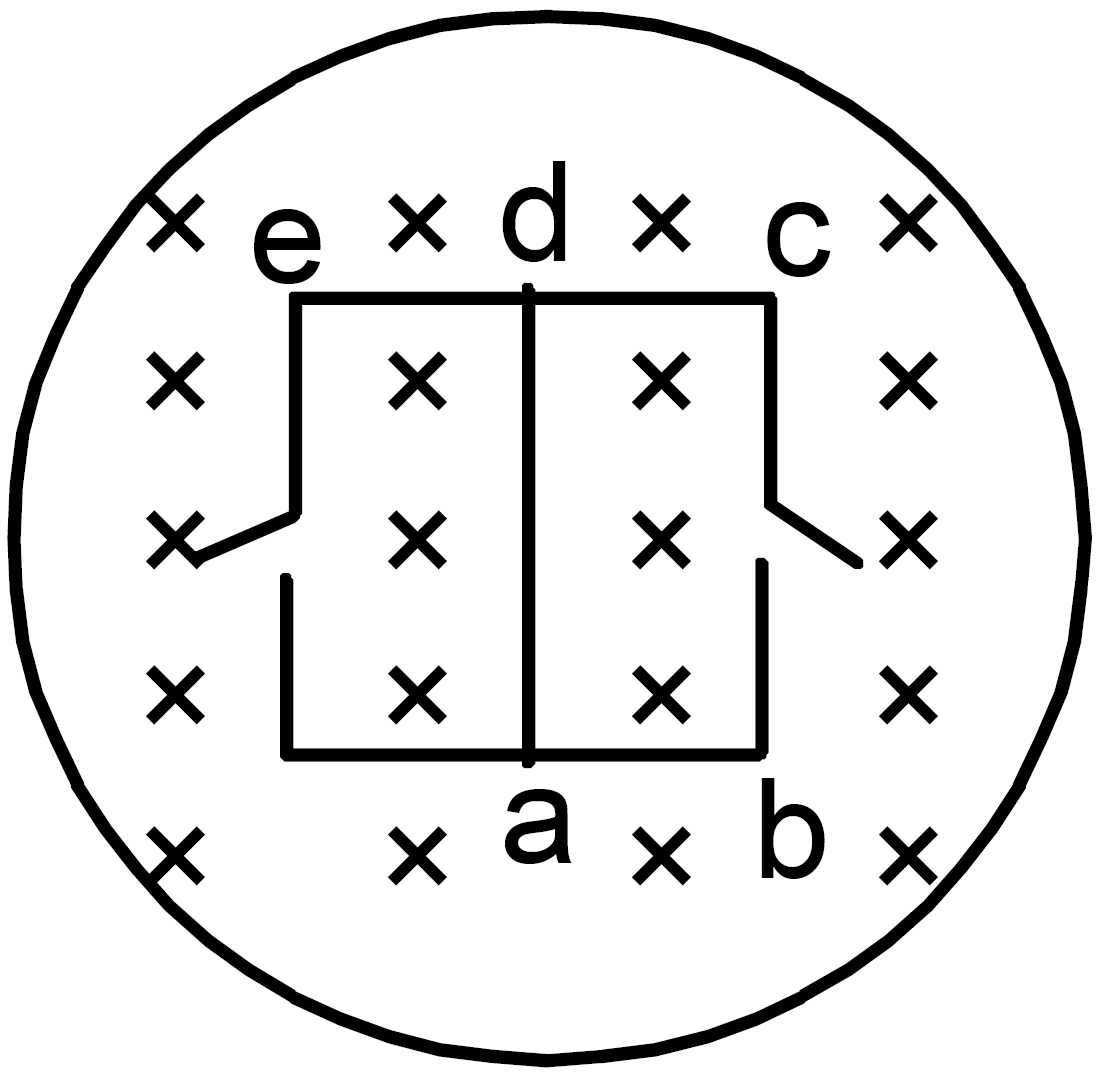
- $S_1$ closed $S_2$ open
net $\text{R}=4\times4=16\Omega$
$\text{e}=\frac{\text{d}\phi}{\text{dt}}=\text{A}\frac{\text{dB}}{\text{dt}}=10^{-4}\times2\times10^{-2}=2\times10^{-6}\text{V}$
i through ad $\frac{\text{e}}{\text{R}}=\frac{2\times10^{-6}}{16}=1.25\times10^{-7}\text{A}$ along ad
- $\text{R}=10\Omega$
$\text{e}=\text{A}\times\frac{\text{dB}}{\text{dt}}=2\times0^{-5}\text{V}$
$\text{i}=\frac{2\times10^{-6}}{16}=1.25\times10^{-7}$ A along da
- Since both $S_1$ and $S_2$ are open, no current is passed as circuit is open i.e. i = 0
- Since both $S_1$ and $S_2$ are closed, the circuit forms a balanced wheat stone bridge and no current will flow along ad i.e. i = 0.
View full question & answer→Question 395 Marks
An LR circuit having a time constant of 50ms is connected with an ideal battery of emf $\in.$ Find the time elapsed before:
- The current reaches half its maximum value.
- The power dissipated in heat reaches half its maximum value.
- The magnetic field energy stored in the circuit reaches half its maximum value.
Answer$\tau=\frac{\text{L}}{\text{R}}=50 \ \text{ms}=0.05$
- $ \ \frac{\text{i}_0}{2}=\text{i}_0\Big(1-\text{e}^{\frac{\text{-t}}{0.06}}\Big)$
$\Rightarrow\frac{1}{2}=1-\text{e}^{\frac{\text{-t}}{0.05}}=\text{e}^{\frac{\text{-t}}{0.05}}=\frac{1}{2}$
$\Rightarrow\text{ln }\text{e}^{\frac{\text{-t}}{0.05}}=\text{ln}^{\frac{1}{2}}$
$\Rightarrow\text{t}=0.05\times0.693 =0.3465 = 34.6 \text{ms}=35 \text{ms}.$
- $\text{P}=\text{i}^2\text{R}=\frac{\text{E}^2}{\text{R}}\Big(1-\text{E}{\frac{\text{-t.R}}{\text{L}}}\Big)^2$
Maximum power $=\frac{\text{E}^2}{\text{R}}$
So, $ \frac{\text{E}^2}{2\text{R}}=\frac{\text{E}^2}{\text{R}}\Big(1-\text{e}\frac{\text{-t.R}}{\text{L}}\Big)^2$
$\Rightarrow 1-\text{e}\frac{\text{-tR}}{\text{L}}=\frac{1}{\sqrt2}=0.707$
$\Rightarrow\text{e}\frac{\text{-tR}}{\text{L}}=0.293$
$\Rightarrow\frac{\text{tR}}{\text{L}}=-\text{In} \ 0.239=1.2275$
$\Rightarrow \text{t}=50 \times1.2275 \ \text{ms}=61.2 \text{ms}.$ View full question & answer→Question 405 Marks
An inductor-coil of resistance $10\Omega$ and induetanes 120mH is connected across a battery of emf 6V and Internal resistance $2\Omega.$ Find the charge which flows through the inductor in:
- 10ms
- 20ms
- 100 ms after the connections are made.
Answer$\text{L}=120\text{mH}=0.120\text{H}$$\text{R}=10\Omega, \ \text{emf}=6,\ \text{r}=2$
$\text{i}=\text{i}_0\Big(1-\text{e}^{\frac{\text{-t}}{\tau}}\Big)$
Now, $\text{dQ}=\text{idt}$
$=\text{i}_0\Big(1-\text{e}^{\frac{\text{t}}{\tau}}\Big)\text{dt}$
$\text{Q}=\int\text{dQ}=\int\limits^1_0\text{i}_0\Big(1-\text{e}^{\frac{\text{-t}}{\tau}}\Big)\text{dt}$
$=\text{i}_0\bigg[\int\limits^{\text{t}}_0\text{dt}-\int\limits^{1}_0\text{e}^{\frac{\text{-t}}{\tau}}\text{dt}\bigg]=\text{i}_0\bigg[\text{t}-(-\tau)\int\limits^{\text{t}}_0\text{e}^{\frac{\text{-t}}{\tau}}\text{dt}\bigg]$
$=\text{i}_0\Big[\text{t}=\tau\Big(\text{e}^{\frac{\text{-t}}{\tau-1}}\Big)\Big]=\text{i}_0\Big[\text{t}+\tau\text{e}^{\frac{\text{-t}}{\tau}}\tau\Big]$
Now,$\text{i}_0=\frac{6}{10+2}=\frac{6}{12}=0.5\text{A}$
$\tau=\frac{\text{L}}{\text{R}}=\frac{0.120}{12}=0.01$
- $\text{t}=0.01 \ \text{s}$
So,$\text{Q}=0.5\Big[0.01+0.01\text{e}^{\frac{-0.01}{0.01}}-0.01\Big]$
$=0.00183=1.8\times10^{-3}\text{C}=1.8\text{mC}$
- $\text{t}=20\text{ms}=2\times10^{-2} ,=0.02\text{s}$
So, $\text{Q}=0.5\Big[0.02+0.01\text{e}^{\frac{-0.02}{0.01}}-0.01\Big]$
$=0.005676=5.6\times10^{-3}\text{C}=5.6\text{mC}$
- $\text{t}=100\text{ms}=0.1\text{s}$
So, $\text{Q}=0.5\Big[0.1+0.01\text{e}^{\frac{-0.1}{0.01}}-0.01\Big]$
$=0.045\text{C}=45\text{mC}$ View full question & answer→Question 415 Marks
A conducting loop of area $5.0cm^2$ is placed in a magnetic field which varies sinusoidally with time as $\text{B}=\text{B}_0\sin\omega\text{t}$ wherer $\text{B}_0=0.20\text{T}$ and $\omega=300\text{s}^{-1}.$ The normal to the coil makes an angle of 60° with the field. Find
- The maximum emf induced in the coil.
- The emf induced at $\text{t}=\Big(\frac{\pi}{900}\Big)\text{s}$
- $\text{t}=\Big(\frac{\pi}{600}\Big)\text{s}.$
- The emf induced at $\text{t}=\Big(\frac{\pi}{600}\Big)\text{s}.$
Answer$\text{A}=5\text{cm}^2=5\times10^{-4}\text{m}^2$$\text{B}=\text{B}_0\sin\omega\text{t}=0.2\sin(300\text{t})$
$\theta=60^{\circ}$
- Max emf induced in the coil
$\text{E}=-\frac{\text{d}\phi}{\text{dt}}=\frac{\text{d}}{\text{dt}}(\text{BA}\cos\theta)$
$=\frac{\text{d}}{\text{dt}}\Big(\text{B}_0\sin\omega\text{t}\times5\times10^{-4}\times\frac{1}{2}\Big)$
$=\text{B}_0\times\frac{5}{2}\times10^{-4}\frac{\text{d}}{\text{dt}}\big(\sin\omega\text{t}\big)=\frac{\text{B}_05}{2}\times10^{-4}\cos\omega\text{t}.\omega$
$=\frac{0.2\times5}{2}\times300\times10^{-4}\times\cos\omega\text{t}=15\times10^{-3}\cos\omega\text{t}$
$\text{E}_{\text{max}}=15\times10^{-3}=0.015\text{V}$
- Induced emf at $\text{t}=\Big(\frac{\pi}{900}\Big)\text{s}$
$\text{E}=15\times10^{-3}\cos\omega\text{t}$
$\text{E}=15\times10^{-3}\cos\Big(300\times\frac{\pi}{900}\Big)=15\times10^{-3}\times\frac{1}{2}$
$=\frac{0.015}{2}=0.0075=7.5\times10^{-3}\text{V}$
- Induced emf at $\text{t}=\Big(\frac{\pi}{600}\Big)\text{s}$
$\text{E}=15\times10^{-3}\cos\Big(300\times\frac{\pi}{600}\Big)$
$=15\times10^{-3}\times0=0\text{V}.$ View full question & answer→Question 425 Marks
An LR circuit has L = 1.0H and $\text{R}=20\Omega.$ It is connected across an emf of 2.0V at t = 0. Find $\frac{\text{di}}{\text{dt}}$ at:
- t = 100ms
- t = 200ms
- t = 1.0s
Answer$\text{L}=1.0 \text{H}, \ \text{R}=20 \Omega, \ \text{emf}=2.0\text{V }$$\tau=\frac{\text{L}}{\text{R}}=\frac{1}{20}=0.05 $
$\text{i}_0=\frac{\text{e}}{\text{R}}=\frac{2}{20}=0.1\text{A} $
$\text{i}=\text{i}_0(1-\text{e}^{-\text{t}})=\text{i}_0-\text{i}_0\text{e}^{-\text{t}} $
$\Rightarrow\frac{\text{di}}{\text{dt}}=\frac{\text{di}_0}{\text{dt}}\Big(\text{i}_0\times-\frac{1}{\tau}\times\text{e}^\frac{-\text{t}}{\tau}\Big)=\frac{\text{i}_0}{\tau}\text{e}^\frac{-\text{e}}{\tau }$
So,
- $\text{t}=100\text{ms}\Rightarrow\frac{\text{di}}{\text{dt}}=\frac{0.1}{0.05}\times\text{e}^\frac{-0.1}{0.0.05}=0.27 \text{A}$
- $\text{t}=200\text{ms}\Rightarrow\frac{\text{di}}{\text{dt}}=\frac{0.1}{0.05}\times\text{e}^\frac{-0.2}{0.05}=0.0366 \text{A }$
- $\text{t}=1\text{s}\Rightarrow\frac{\text{di}}{\text{dt}}=\frac{0.1}{0.05}\times\text{e}^\frac{-1}{0.05}=4\times10^{-9}\text{A }$
View full question & answer→Question 435 Marks
Figure shows a circular coil of N turns and radius a, connected to a battery of emf ϵ through a rheostat. The rheostat has a total length L and resistance R. The resistance of the coil is r. A small circular loop of radius a' and resistance r' is pl-aced coaxially with the coil. The centre of the loop is at a distance x from the centre of coil. the In the beginning, the sliding contact of the rheostat is at the left end and then onwards it is moved towards right at a constant speed u. Find the emf induced in the small circular loop at the instant:
- The contact begins to slide.
- It has slide through half the length of the rheostat.
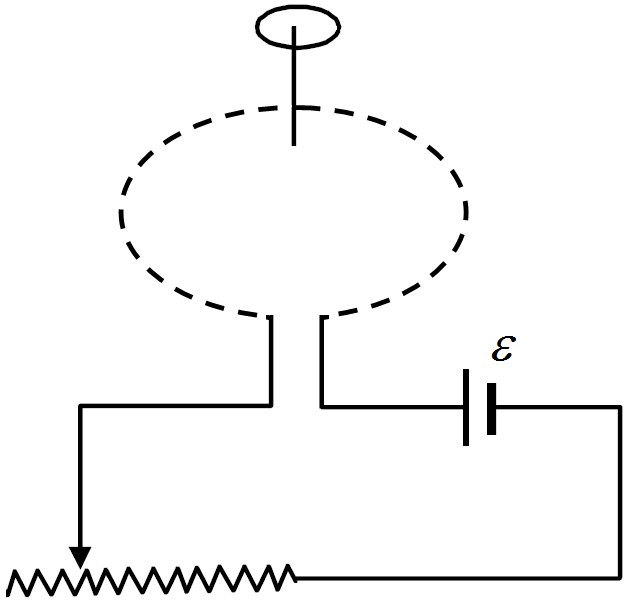
Answer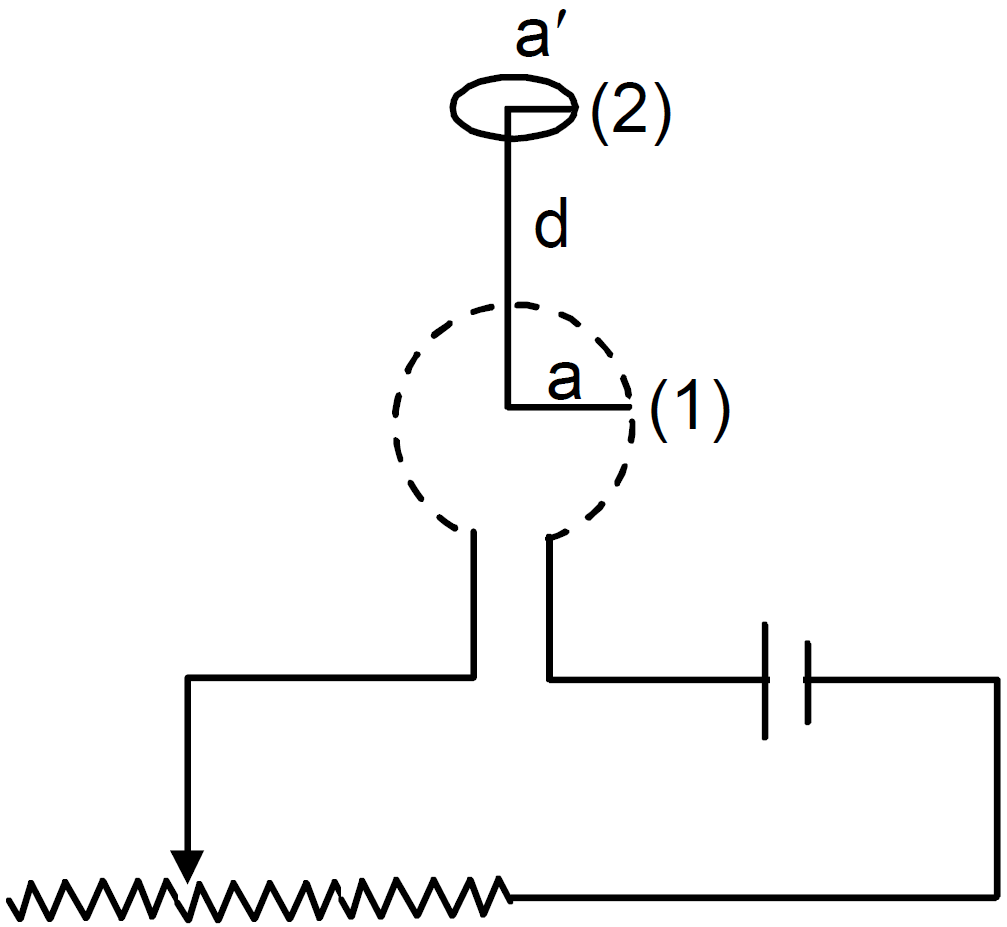
 Magnetic field due to the coil (1) at the center of (2) is $\text{B}=\frac{\mu_0\text{Nia}^2}{2(\text{a}^2+\text{x}^2)^{\frac{3}{2}}}$ Flux linked with the second,$=\text{B}.\text{A}_{(2)}=\frac{\mu_0\text{Nia}^2}{2(\text{a}^2+\text{x}^2)^{\frac{3}{2}}}\pi\text{a}'^2$
E.m.f. induced $\frac{\text{d}\phi}{\text{dt}}=\frac{\mu_0\text{Na}^2\text{a}'^2\pi}{2(\text{a}^2+\text{x}^2)^{\frac{3}{2}}}\frac{\text{di}}{\text{dt}}$$=\frac{\mu_0\text{N}\pi\text{a}^2\text{a}'^2}{2(\text{a}^2+\text{x}^2)^{\frac{3}{2}}}\frac{\text{d}}{\text{dt}}\frac{\text{E}}{\Big(\Big(\frac{\text{R}}{\text{L}}\Big)\text{x}+\text{r}\Big)}$
$=\frac{\mu_0\text{N}\pi\text{a}^2\text{a}'^2}{2(\text{a}^2+\text{x}^2)^{\frac{3}{2}}}\text{E}\frac{-1\frac{\text{R}}{\text{L}}\text{v}}{\Big(\Big(\frac{\text{R}}{\text{L}}\Big)\text{x}+\text{r}\Big)^2}$
- For $\text{x}=\text{L}$
$\text{E}=\frac{\mu_0\text{N}\pi\text{a}^2\text{a}'^2\text{RvE}}{2(\text{a}^2+\text{x}^2)^{\frac{3}{2}}\big(\text{R}+\text{r}\big)^2}$
- $=\frac{\mu_0\text{N}\pi\text{a}^2\text{a}'^2}{2(\text{a}^2+\text{x}^2)^{\frac{3}{2}}}\frac{\text{ERV}}{\text{L}\Big(\frac{\text{R}}{2}+\text{r}\Big)^2} \ \Big(\text{for} \ \text{x}=\frac{\text{L}}{2},\frac{\text{R}}{\text{L}}\text{x}=\frac{\text{R}}{2}\Big)$
View full question & answer→Question 445 Marks
An LR circuit contains an inductor of 500mH, a resistor of $25.0\Omega$ and emf 5.00 V in series. Find the potential difference across the resistor at.
- 20.0ms
- 100ms and
- 1.00s
Answer$\text{L}=500\text{mH}, \ \text{R}=25\Omega, \ \text{E}=5 \ \text{V}$
- $\text{t}=20\text{ms}$
$\text{i}=\text{i}_0\Big(1-\text{e}^{\frac{\text{-tR}}{\text{L}}}\Big)=\frac{\text{E}}{\text{R}}\Big(1-\text{E}^{\frac{\text{-tR}}{\text{L}}}\Big)$
$=\frac{5}{25}\Big(1-\text{e}^{-20\times10^{-3}\times\frac{25}{100}\times10^{-3}}\Big)=\frac{1}{5}\big(1-\text{e}^{-1}\big)$
$=\frac{1}{5}(1-0.3678)=0.1264$
Potential difference $=\text{iR}=0.1264\times25=3.1606\text{V}=3.16 \ \text{V}.$
- $\text{t}=100\text{ms}$
$\text{i}=\text{i}_0\Big(1-\text{e}^{\frac{\text{-tR}}{L}}\Big)=\frac{\text{E}}{\text{R}}\Big(1-\text{E}^{\frac{\text{-tR}}{L}}\Big)$
$=\frac{5}{25}\Big(1-\text{e}^{-100\times10^{-3\frac{25}{100}\times10^{-3}}}\Big)=\frac{1}{5}\big(1-\text{e}^{-5}\big)$
$=\frac{1}{5}(1-0.0067)=0.19864$
Potential difference $=\text{iR}=0.19864\times25=4.9665=4.97\text{V}$
- $\text{t}=1\text{sec} $
$\text{i}=\text{i}_0\Big(1-\text{e}^{\frac{\text{-tR}}{L}}\Big)=\frac{\text{E}}{\text{R}}\Big(1-\text{E}^{\frac{\text{-tR}}{L}}\Big)$
$=\frac{5}{25}\Big(1-\text{e}^{-1\frac{25}{100}\times10^{-3}}\Big)=\frac{1}{5}\big(1-\text{e}^{-50}\big)$
$=\frac{1}{5}\times1=\frac{1}{5}\text{A}$
Potential difference $=\text{iR}=\Big(\frac{1}{5}\times25\Big)\text{V}=5\text{V}$ View full question & answer→Question 455 Marks
An inductor-coil of inductance 20mH having resistance $10\Omega$ is joined to an ideal battery of emf 5.0V. Find the rate of chenge of the induced emf at:
- t = 0
- t = 10ms
- t = 1.0s.
Answer$\text{L}=20\text{mH} ; \ \text{e}=5.0\text{V},\text{R}=10 \ \Omega$$\tau=\frac{\text{L}}{\text{R}}=\frac{20\times10^{-3}}{10},\text{i}_0=\frac{5}{10}$
$\text{i}=\text{i}_0(1-\text{e}^{\frac{\text{t}}{\tau}})^2$
$\Rightarrow \ \text{i}=\text{i}_0-\text{i}_0\text{e}^{\frac{\text{-t}}{\tau^2}}$
$\Rightarrow\text{iR}=\text{i}_0\text{R}-\text{i}_0\text{R}\text{e}^{\frac{\text{-t}}{\tau^2}}$
- $10\times\frac{\text{di}}{\text{dt}}=\frac{\text{d}}{\text{dt}}\text{i}_0\text{R}+10\times\frac{5}{10}\times\frac{10}{20\times10^{-3}}\times\text{e}^{0\times\frac{10}{2\times10^{-2}}}$
$\frac{5}{2}\times10^{-3}\times1=\frac{5000}{2}=2500=2.5\times10^{-3}\text{V}/\text{s}.$
- $\frac{\text{Rdi}}{\text{dt}}=\text{R}\times\text{i}^0\times\frac{1}{\tau}\times\text{e}^{\frac{\text{-t}}{\tau}}$
$\text{t}=10\text{ms}=10\times10^{-3}\text{s}$
$\frac{\text{dE}}{\text{dt}}=10\times\frac{5}{10}\times\frac{10}{20\times10^{-3}}\times\text{e}^{-0.01\times\frac{2}{10^{-2}}}$
$=16.844=17\text{V}/'$
- $\text{For} \ \text{t} =1\text{s}$
$\frac{\text{dE}}{\text{dt}}=\frac{\text{Rdi}}{\text{dt}}=\frac{5}{2}10^3\times\text{e}^{\frac{10}{2\times10^{-2}}}=0.00\text{V}/\text{s}.$ View full question & answer→Question 465 Marks
The time constant of an LR circuit is 40ms. The circuit is connected at t = 10 and the steady-state current is found to be 2.0A. Find the current at:
- t = 10ms
- t = 20ms
- t = 100ms
- t = 1s.
Answer$\tau=40\text{ms} $$\text{i}_0=2\text{A} $
- $\text{t }=10\text{ms}$
$\text{i}=\text{i}_0\Big(1-\text{e}^\frac{-\text{t}}{\tau}\Big)=2\Big(1-\text{e}^\frac{-10}{40}\Big)=2(1-\text{e}^\frac{-1}{4}\Big) $
$= 2(1-0.7788)=2(0.2211)^\text{A} =0.4422\text{A} =0.44\text{A }$
- $\text{t}=20\text{ms }$
$\text{i}\ =\text{i}_0\Big(1-\text{e}^\frac{-\text{t}}{\tau}\Big)=2\Big(1-\text{e}^\frac{-20}{40}\Big) =2\Big(1-\text{e}^\frac{-1}{2}\Big) $
$=2(1-0.606) =0.7869\text{A}=0.79\text{A} $
- $\text{t}\ =100\text{ms }$
$\text{i}\ =\text{i}_0\Big(1-\text{e}^\frac{-\text{t}}{\tau}\Big)\ =2\Big(1-\text{e}^\frac{-100}{40}\Big)\ =2\Big(1-\text{e}^\frac{-10}{4}\Big) $
$=2(1-0.082)=1.835\text{A}=1.8\text{A }$
- $\text{t}=1\text{s }$
$\text{i}=\text{i}_0\Big(1-\text{e}^\frac{-\text{t}}{\tau}\Big)=2\Big(1-\text{e}\frac{-1}{40\times10^3}\Big)=2\Big(1-\text{e}^\frac{-10}{40}\Big) $
$=2\big(1-\text{e}^{- 25}\big)=2\times1=2\text{A}$ View full question & answer→Question 475 Marks
Find the value of $\frac{\text{t}}{\tau}$ for which the current in an LR circuit builds up to:
- 90%,
- 99%
- 99·9% of the steady-state value.
AnswerWe know $\text{i}=\text{i}_0\Big(1-\text{e}^\frac{-\text{t}}{\text{r}}\Big)$
- $\frac{90}{100}\text{i}_0=\text{i}_0\Big(1-\text{e}^\frac{-\text{t}}{\text{r}}\big)$
$\Rightarrow0.9=1-\text{e}^\frac{-\text{t}}{\text{r}}$
$\Rightarrow\text{e}^\frac{-\text{t}}{\text{r}}=0.1$
Taking in from both sides
$\text{ln}\ \text{e}^\frac{-\text{t}}{\text{r}}=\text{ln}\ 0.1 $
$\Rightarrow-\text{t}=-2.3$
$\Rightarrow\frac{\text{t}}{\text{r}}=2.3$
- $\frac{99}{100}\text{i}_0=\text{i}_0\Big(1-\text{e}^\frac{-\text{t}}{\text{r}}\Big)$
$\Rightarrow\text{e}^\frac{-\text{t}}{\text{r}}=0.01$
$\text{lne}^\frac{-\text{t}}{\text{r}}=\text{ln}\ 0.01$
$\frac{-\text{t}}{\text{r}}=-4.6$
$\frac{\text{t}}{\text{r}}=4.6$
- $\frac{99.9}{100}\text{i}_0\Big(1-\text{e}^\frac{-\text{t}}{\text{r}}\Big)$
$\text{e}^\frac{-\text{t}}{\text{r}}=0.01$
$\Rightarrow\text{lne}^\frac{-\text{t}}{\text{r}}=\text{ln}0.001$
$\Rightarrow\text{e}^\frac{-\text{t}}{\text{r}}=-6.9$
$\Rightarrow\frac{\text{t}}{\text{r}}=6.9.$ View full question & answer→Question 485 Marks
A long solenoid of radius $2cm$ has $100$ turns/cm and carries a current of $5A$. A coil of radius 1cm having $100$ turns and a total resistance of $2\Omega$ is placed inside the solenoid coaxially. The coil is connected to a galvanometer. If the current in the solenoid is reversed in direction, find the charge flown through the galvanometer.
Answer$\mathrm{r}=2 \mathrm{~cm}=2 \times 10^{-2} \mathrm{~m} \mathrm{n}=100$ turns $/ \mathrm{cm}=10000$ turns $/ \mathrm{mi}=5 \mathrm{AB}=\mu_0 \mathrm{ni}$
$=4\pi\times10^{-7}\times10000\times5=20\pi\times10^{-3}=62.8\times10^{-3}\text{T}$
$\text{n}_2=100 \ \text{turns}$
$\text{R}=20\Omega$
$\text{r}=1\text{cm}=10^{-2}\text{m}$
Flux linking per turn of the second coil $=\text{B}\pi\text{r}^2=\text{B}\pi\times10^{-4}$$\phi_1=$ Total flux linking
$=\text{B}\text{n}_2\pi\text{r}^2=100\times\pi\times10^{-4}\times20\pi\times10^{-3}$
When current is reversed.$\phi_2=-\phi_1$
$\text{d}\phi=\phi_2-\phi_1=2\times100\times\pi\times10^{-4}\times20\pi\times10^{-3}$
$\text{E}=-\frac{\text{d}\phi}{\text{dt}}=\frac{4\pi^2\times10^{-4}}{\text{dt}}$
$\text{I}=\frac{\text{E}}{\text{R}}=\frac{4\pi^2\times10^{-4}}{\text{dt}\times20}$
$\text{q}=\text{Idt}=\frac{4\pi^2\times10^{-4}}{\text{dt}\times20}\times\text{dt}=2\times10^{-4}\text{C}.$
View full question & answer→Question 495 Marks
A solenoid having inductance 4.0H and resistance $10\Omega$ is connected to a 4.0V battery at t = 0. Find
- The time constant.
- The time elapsed before the current reaches 0.63 of its steady-state value.
- The power delivered by the battery at this instant.
- The power dissipated in Joule heating at this instant.
Answer$\text{L}=4.0\text{H}, \ \text{R}=10\Omega, \ \text{E}=4\text{V}$
- Time constant $=\tau=\frac{\text{L}}{\text{R}}=\frac{4}{10}=0.4\text{ s}.$
- $\text{i}=0.63\text{ i}_0$
Now, $0.63\text{ i}_0=\text{i}_0\Big(1-\text{e}^\frac{-\text{t}}{\tau}\Big)$
$\Rightarrow\text{e}\frac{-\text{t}}{\tau}=1-0.63=0.37$
$\Rightarrow\text{lne}^\frac{-\text{t}}{\tau}=\text{ln }0.37$
$\Rightarrow\frac{-\text{t}}{\tau}=-0.9942$
$\Rightarrow\text{t}=0.9942\times0.4=0.3977=0.40\text{s}.$
- $\text{i}=\text{i}_0\Big(1-\text{e}^\frac{-\text{t}}{\tau}\Big)$
$\Rightarrow\frac{4}{10}\Big(1-\text{e}^\frac{-0.4}{0.4}\Big)=0.4\times0.6321=0.2528\text{A}.$
Power delivered $=\text{Vl}$
$=4\times0.2528=1.01=1\omega.$
- Power dissipated in Joule heating $=\text{I}^2\text{R}$
$=(0.2528)^2\times10=0.639=0.64\omega$ View full question & answer→Question 505 Marks
A closed coil having 100 turns is rotated in a uniform magnetic field $B=4.0 \times 10^{-4} \mathrm{~T}$ about a diameter which is perpendicular to the field. The angular velocity of rotation is $300$ revolutions per minute. The area of the coil is $25 \mathrm{~cm}^2$ and its resistance is $4.0 \Omega$. Find
a. The average emf developed in half a turn from a position where the coil is perpendicular to the magnetic field.
b. The average emf in a full turn.
c. The net charge displaced in part (a).
Answer$\text{n}=100 \ \text{turns}, \ \text{B}=4\times10^{-4}\text{T}$$\text{A}=25\text{cm}^2=25\times10^{-4}\text{m}^2$
- When the coil is perpendicular to the field
$\phi=\text{nBA}$
When coil goes through half a turn
$\phi=\text{BA}\cos18^{\circ}=0-\text{nBA}$
$\text{d}\phi=2\text{nBA}$
The coil undergoes 300 rev, in 1 min
$300\times2\pi \ \text{rad/min}=10\pi \ \text{rad/sec}$
$10\pi \ \text{rad}$ is swept in 1 sec.
$\frac{\pi}{\pi} \ \text{rad}$ is swept $\frac{1}{10}\pi\times\pi=\frac{1}{10}\text{sec}$
$\text{E}=\frac{\text{d}\phi}{\text{dt}}=\frac{2\text{nBA}}{\text{dt}}=\frac{2\times100\times4\times10^{-4}\times25\times10^{-4}}{\frac{1}{10}}=2\times10^{-3}\text{V}$
- $\phi_1=\text{nBA}, \ \phi_2=\text{nBA}(\theta=360^{\circ})$
$\text{d}\phi=0$
- $\text{i}=\frac{\text{E}}{\text{R}}=\frac{2\times10^{-3}}{4}=\frac{1}{2}\times10^{-3}$
$\text{q}=\text{idt}=5\times10^{-4}\times\frac{1}{10}=5\times10^{-5}\text{C}$ View full question & answer→Question 515 Marks
An inductor of inductance 2.00H is joined in series with a resistor of resistance $200\Omega$ and a battery of emf 2.00V. At t = 10ms, find
- The current in the circuit.
- The power delivered by the battery.
- The power dissipated in heating the resistor.
- The rate at which energy is being stored in magnetic field.
Answer$\text{L}=2\text{H}, \ \text{R}=200\Omega, \ \text{E}=2\text{V}, \ \text{t}=10\text{ms}$
- $\text{l}=\text{l}_0\Big(1-\text{e}^\frac{-\text{t}}{\tau}\Big)$
$=\frac{2}{200}\Big(1-\text{e}^{-10\times10^{-3}\times\frac{200}{2}}\Big)$
$=0.01\Big(1-\text{e}^{-1}\Big)=0.01\Big(1-0.3678\Big)$
$=0.01\times0.632=6.3\text{A}$
- Power delivered by the battery.
$=\text{Vl}$
$=\text{El}_0\Big(1-\text{e}^\frac{-\text{t}}{\tau}\Big)=\frac{\text{E}^2}{\text{R}}\Big(1-\text{e}^\frac{-\text{t}}{\tau}\Big)$
$=\frac{2\times2}{200}\Big(1-\text{e}^{-10\times10^{-3}\times\frac{200}{2}}\Big)$
$=0.02\Big(1-\text{e}^{-1}\Big)=0.1264=12\text{mw}.$
- Power dissepited in heating the resistor $=\text{l}^2\text{R}$
$=\Big[\text{i}_0\Big(1-\text{e}^\frac{-\text{t}}{\tau}\Big)\Big]^2\text{R}$
$=\big(6.3\text{mA}\big)^2\times200=6.3\times6.3\times200\times10^{-6}$
$=79.38\times10^{-4}=7.938\times10^{-3}=8\text{mA}.$
- Rate at which energy is stored in the magnetic field.
$\frac{\text{d}}{\text{dt}}\Big(\frac{1}{2}\text{Ll}^2\Big)$
$=\frac{\text{Ll}^2_0}{\tau}\Big(\text{e}^\frac{-\text{t}}{\tau}-\text{e}^\frac{-2\text{t}}{\tau}\Big)$
$=\frac{2\times10^{-4}}{10^{-2}}\Big(\text{e}^{-1}-\text{e}^{-2}\Big)$
$2\times10^{-2}\Big(0.2325\Big)=0.465\times10^{-2}$
$=4.6\times10^{-3}=4.6\text{mW}.$ View full question & answer→Question 525 Marks
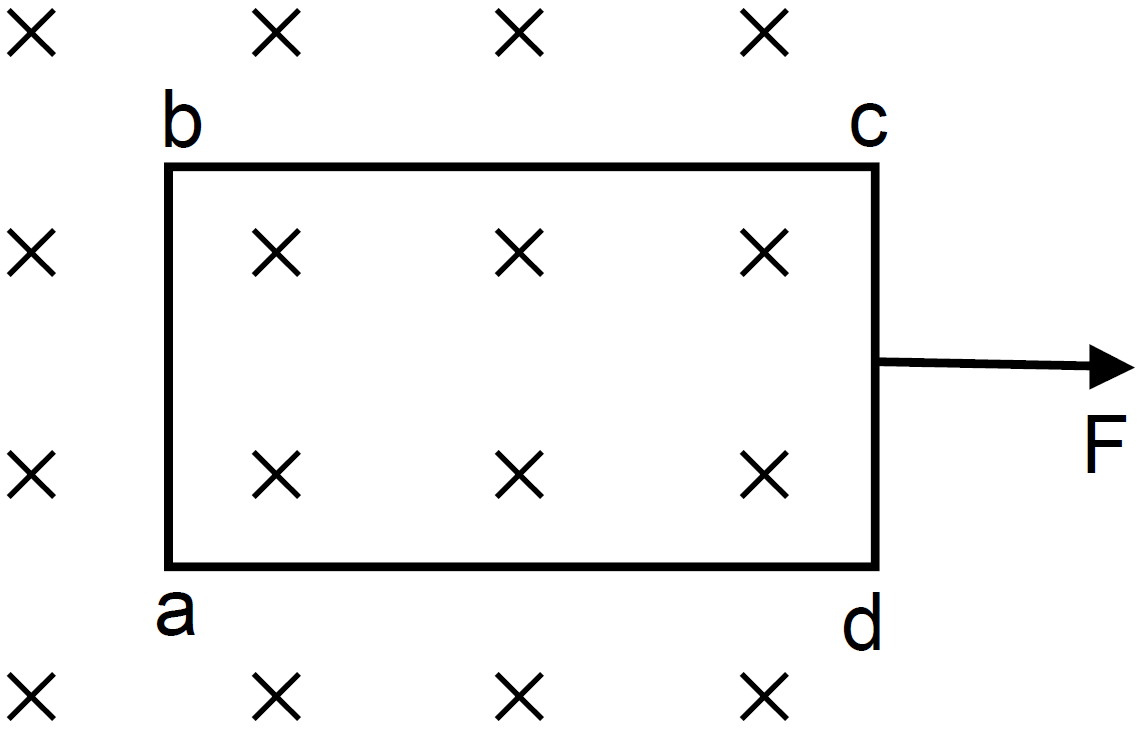
A rectangular frame of wire abcd has dimensions $32cm × 8.0cm$ and a total resistance of $2.0\Omega.$ It is pulled out of a magnetic field $B = 0.020T$ by applying a force of $3.2 \times 10^{-5}N$ (figure). It is found that the frame moves with constant speed. Find
- This constant speed.
- The emf induced in the loop.
- The potential difference between the points a and b.
- The potential difference between the points c and d.
Answer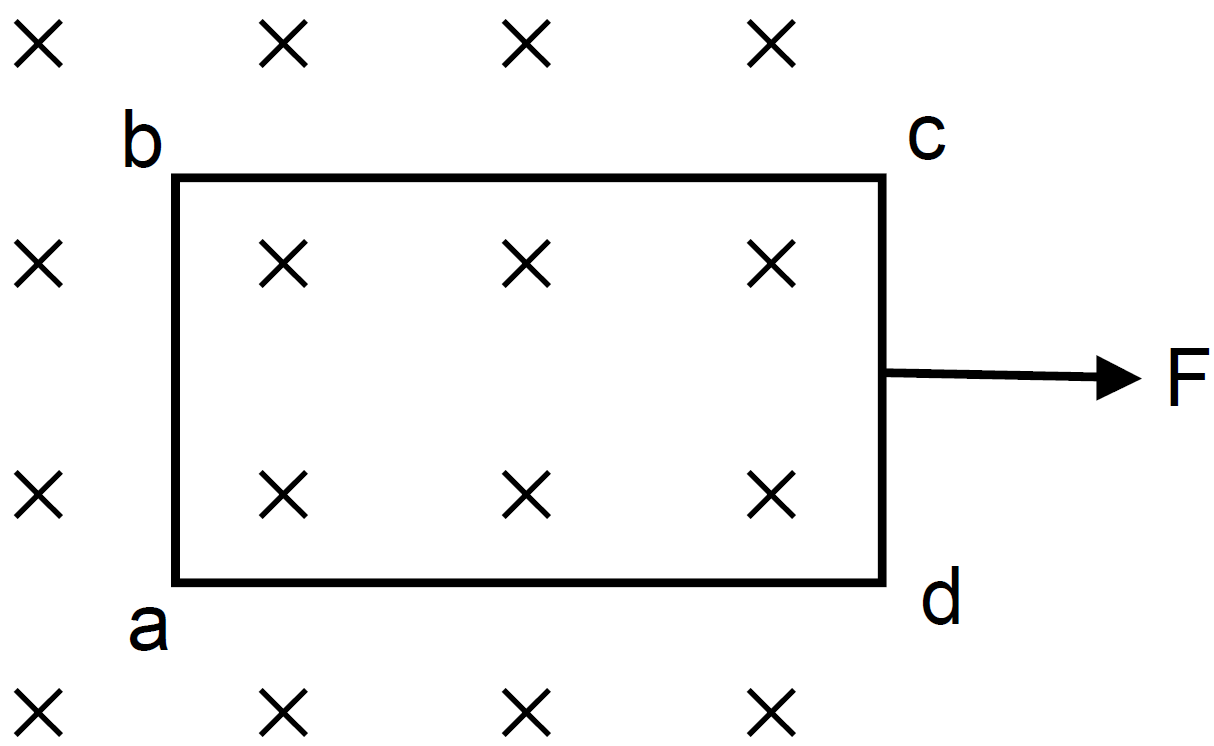
$\text{R}=2.0\Omega, \ \text{B}=0.020\text{T}, \ \text{I}=32\text{cm}=0.32\text{m}$
$\text{B}=8\text{cm}=0.08\text{m}$
- $\text{F}=\text{ilB}=3.2\times10^{-5}\text{N}$
$=\frac{\text{B}^2\text{l}^2\text{v}}{\text{R}}=3.2\times10^5$
$\Rightarrow\frac{(0.020)^2\times(0.08)^2\times\text{v}}{2}=3.2\times10^{-5}$
$\Rightarrow\text{v}=\frac{3.2\times10^{-5}\times2}{6.4\times10^{-3}\times4\times10^{-4}}=25\text{m}/\text{s}$
- Emf $\text{E}=\text{vBl}=25\times0.02\times0.08=4\times10^{-2}\text{V}$
- Resistance per unit length $=\frac{2}{0.8}$
Resistance of part ad/ cb $=\frac{2\times0.72}{0.8}=1.8\Omega$
$\text{V}_{\text{ab}}=\text{iR}=\frac{\text{Blv}}{2}\times1.8=\frac{0.02\times0.08\times25\times1.8}{2}$
$=0.036\text{V}=3.6\times10^{-2}\text{V}$
- Resistance of cd $=\frac{2\times0.08}{0.8}=0.2\Omega$
$\text{V}=\text{iR}=\frac{0.02\times0.08\times25\times0.2}{2}=4\times10^{-3}\text{V}$ View full question & answer→Question 535 Marks
Consider a situation similar to that of the previous problem except that the ends of the rod slide on a pair of thick metallic rails laid parallel to the wire. At one end the rails are connected by resistor of resistance R.
- What force is needed to keep the rod sliding at a constant speed v?
- In this situation what is the current in the resistance R?
- Find the rate of heat developed in the resistor.
- Find the power delivered by external agent exerting the force on the rod.
Answer
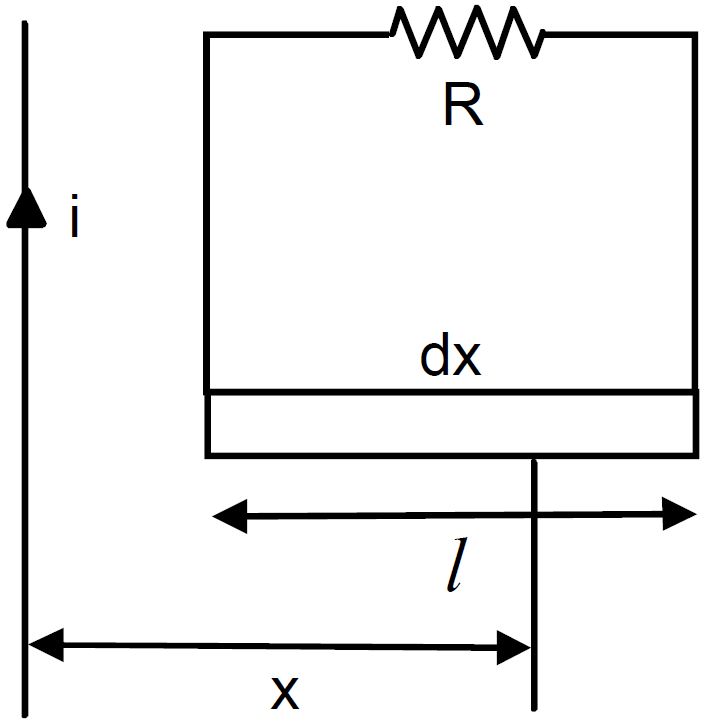
- Emf produced due to the current carrying wire $=\frac{\mu_0\text{vi}}{2\pi}\text{In}\Big(\frac{2\text{x}+\text{l}}{2\text{x}-\text{l}}\Big)$
Let current produced in the rod $=\text{i}'=\frac{\mu_0\text{iv}}{2\pi\text{R}}\text{In}\Big(\frac{2\text{x}+\text{l}}{2\text{x}-\text{l}}\Big)$
Force on the wire considering a small portion dx at a distance x
$\text{dF}=\text{i}'\text{B}\text{l} $
$\Rightarrow\text{dF}=\frac{\mu_0\text{iv}}{2\pi\text{r}}\text{In}\Big(\frac{2\text{x}+\text{l}}{2\text{x}-\text{l}}\Big)\times\frac{\mu_0\text{i}}{2\pi\text{x}}\times\text{dx}$
$\Rightarrow\text{dF}=\Big(\frac{\mu_0\text{i}}{2\pi}\Big)^2\frac{\text{V}}{\text{R}}\text{In}\Big(\frac{2\text{x}+\text{l}}{2\text{x}-\text{l}}\Big)\frac{\text{dx}}{\text{x}}$
$\Rightarrow\text{F}=\Big(\frac{\mu_0\text{i}}{2\pi}\Big)^2\frac{\text{V}}{\text{R}}\text{In}\Big(\frac{2\text{x}+\text{l}}{2\text{x}-\text{l}}\Big)\int\limits^{\text{x}+\frac{\text{t}}{2}}_{\text{x}-\frac{\text{t}}{2}}\frac{\text{dx}}{\text{x}}$
$=\Big(\frac{\mu_0\text{i}}{2\pi}\Big)^2\frac{\text{V}}{\text{R}}\text{In}\Big(\frac{2\text{x}+\text{l}}{2\text{x}-\text{l}}\Big)\text{In}\Big(\frac{2\text{x}+\text{l}}{2\text{x}-\text{l}}\Big)$
$=\frac{\text{V}}{\text{R}}\Big[\frac{\mu_0\text{i}}{2\pi}\text{In}\Big(\frac{2\text{x}+\text{l}}{2\text{x}-\text{l}}\Big)\Big]^2$
- Current $=\frac{\mu_0\text{In}}{2\pi\text{R}}\text{In}\Big(\frac{2\text{x}+\text{l}}{2\text{x}-\text{l}}\Big)$
- Rate of heat developed $=\text{i}^2\text{R}$
$=\Big[\frac{\mu_0\text{iv}}{2\pi\text{R}}\Big(\frac{2\text{x}+\text{l}}{2\text{x}-\text{l}}\Big)\Big]^2\text{R}=\frac{1}{\text{R}}\Big[\frac{\mu_0\text{iv}}{2\pi}\text{In}\Big(\frac{2\text{x}+\text{l}}{2\text{x}-\text{l}}\Big)^2\Big]$
- Power developed in rate of heat developed $=\text{i}^2\text{R}$
$=\frac{1}{\text{R}}\Big[\frac{\mu_0\text{vi}}{2\pi}\text{In}\Big(\frac{2\text{x}+\text{l}}{2\text{x}-\text{l}}\Big)\Big]^2$ View full question & answer→Question 545 Marks
Two coils A and B have inductances 1.0H and 2.0H respectively. The resistance of each coil is $10\Omega.$ Each coil is connected to an ideal battery of emf $2.0V$ at $t = 0$ Let $i_A$ and $i_B$ be the currents in the two circuit at time t. Find the ratio $\frac{\text{i}_\text{A}}{\text{i}_\text{B}}$
- t = 100ms
- t = 200ms
- t = 1s.
Answer$\text{L}_\text{a}=1.0\text{ H }; \text{ L}_\text{B}=2.0\text{H}; \ \text{R}=10\omega$
- $\text{t}=0.1\text{s}, \ \tau_\text{A}=0.1, \ \tau_\text{B}=\frac{\text{L}}{\text{R}}=0.2$
$\text{i}_{\text{A}}=\text{i}_0\Big(1-\text{e}^\frac{-\text{t}}{\tau}\Big)$
$=\frac{2}{10}\Big(1-\text{e}^\frac{-0.1\times10}{1}\Big)=0.2\Big(1-\text{e}^{-1}\Big)=0.126424111$
$\text{i}_\text{B}=\text{i}_0\Big(1-\text{e}\frac{-\text{t}}{\tau}\Big)$
$=\frac{2}{10}\Big(1-\text{e}^\frac{-0.1\times10}{2}\Big)=0.2\Big(1-\text{e}^\frac{-1}{2}\Big)=0.078693$
$\frac{\text{i}_\text{A}}{\text{i}_\text{B}}=\frac{0.12642411}{0.78693}=1.6$
- $\text{t}=200\text{ms}=0.2\text{s}$
$\text{i}_\text{A}=\text{i}_0\Big(1-\text{e}^\frac{-\text{t}}{\tau}\Big)$
$=0.2\Big(1-\text{e}^\frac{-0.2\times10}{1}\Big)=0.2\times0.864664716=0.172932943$
$\text{i}_\text{B}=0.2\Big(1-\text{e}^\frac{-0.2\times10}{2}\Big)=0.2\times0.632120=0.126424111$
$\frac{\text{i}_\text{a}}{\text{i}_\text{B}}=\frac{0.172932943}{0.126424111}=1.36=1.4$
- $\text{t}=1\text{s}$
$\text{i}_\text{A}=0.2\Big(1-\text{e}^\frac{-1\times10}{1}\Big)=0.2\times0.9999546=0.19999092$
$\text{i}_\text{B}=0.2\Big(1-\text{e}^\frac{-1\times10}{2}\Big)=0.2\times0.99326=0.19865241$
$\frac{\text{i}_\text{A}}{\text{i}_\text{B}}=\frac{0.19999092}{19865241}=1.0$ View full question & answer→Question 555 Marks
The rectangular wire-frame, shown in figure, has a width d, mass m, resistance R and a large length. A uniform magnetic field B exists to the left of the frame. A constant force F starts pushing the frame into the magnetic field at $t = 0$.
- Find the acceleration of the frame when its speed has increased to v.
- Show that after some time the frame will move with a constant velocity till the whole frame enters into the magnetic field. Find this velocity $v_0$.
- Show that the velocity at time t is given by $\text{v}=\text{v}_0\Big(1-\text{e}^{-\frac{\text{ft}}{\text{mv}_0}}\Big)$
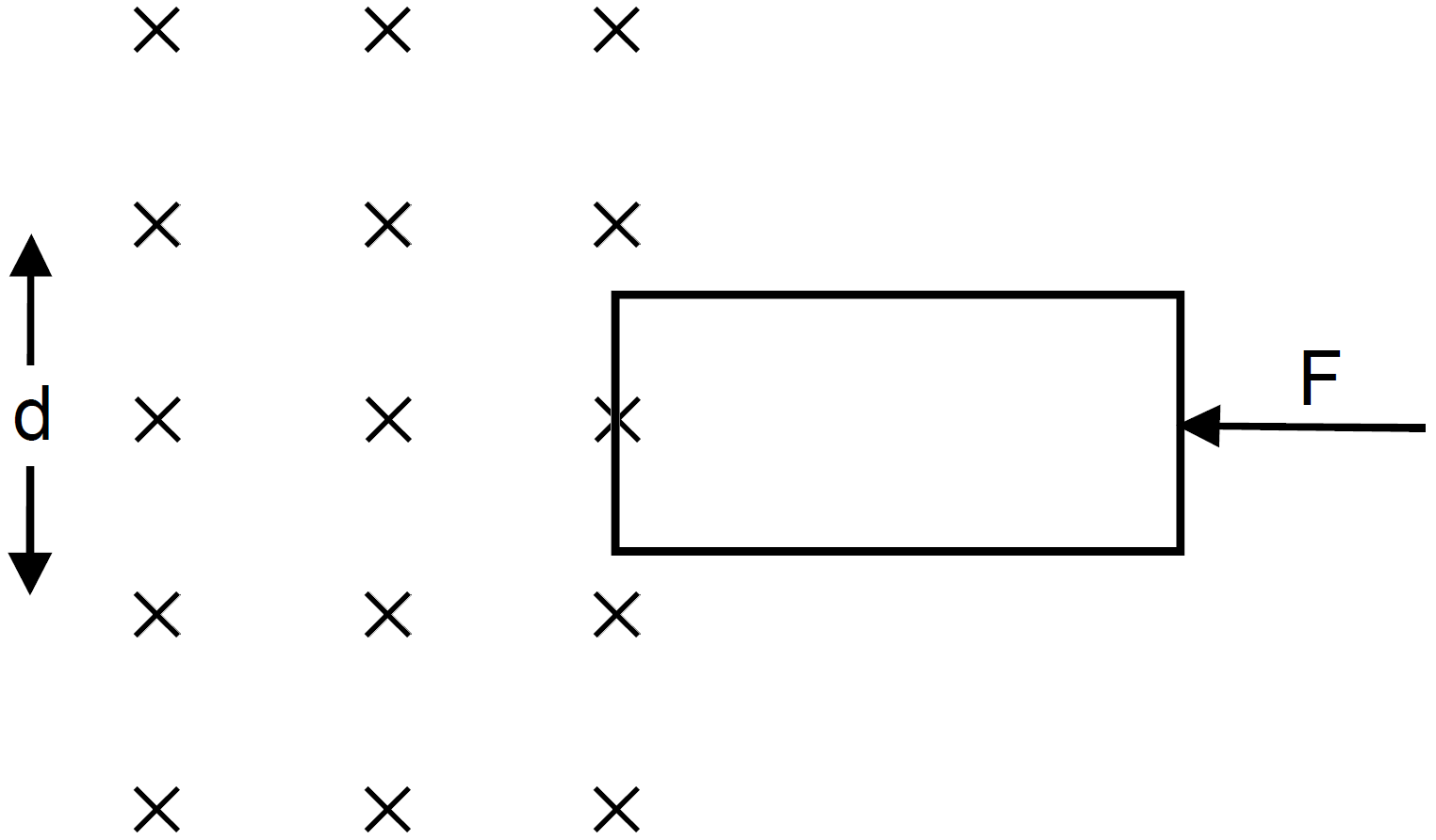
Answer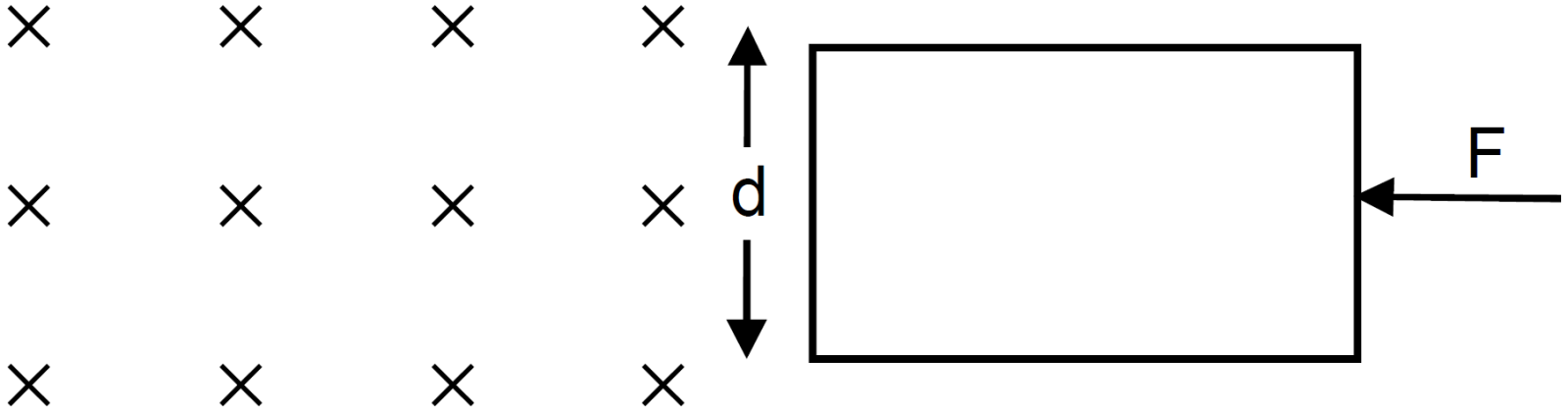
- emf developed = Bdv (when it attains a speed v)
Current $=\frac{\text{Bdv}}{\text{R}}$
Force $=\frac{\text{B}\text{d}^2\text{v}^2}{\text{R}}$
This force opposes the given force
Net F $=\text{F}-\frac{\text{B}\text{d}^2\text{v}^2}{\text{R}}=\text{RF}-\frac{\text{B}\text{d}^2\text{v}^2}{\text{R}}$
Net acceleration $=\frac{\text{RF}-\text{B}^2\text{d}^2\text{v}}{\text{mR}}$
- Velocity becomes constant when acceleration is 0.
$\frac{\text{F}}{\text{m}}-\frac{\text{B}^2\text{d}^2\text{v}_0}{\text{mR}}=0$
$\Rightarrow\frac{\text{F}}{\text{m}}=\frac{\text{B}^2\text{d}^2\text{v}_0}{\text{mR}}$
$\Rightarrow\text{v}_0=\frac{\text{FR}}{\text{B}^2\text{d}^2}$
- Velocity at line t
$\text{a}=-\frac{\text{dv}}{\text{dt}}$
$\Rightarrow\int_{0}^{\text{v}}\frac{\text{dv}}{\text{RF}-\text{l}^2\text{B}^2\text{v}}=\int_{0}^{\text{t}}\frac{\text{dt}}{\text{mR}}$
$\Rightarrow\Big[\text{l}_\text{n}\big[\text{RF}-\text{l}^2\text{B}^2\text{v}\big]\frac{1}{-\text{l}^2\text{B}^2}\Big]_0^{\text{v}} \ \Big[\frac{\text{t}}{\text{Rm}}\Big]_0^{\text{t}} $
$\Rightarrow\Big[\text{l}_\text{n}\big(\text{RF}-\text{l}^2\text{B}^2\text{v}\big)\Big]_{0}^{\text{v}}=\frac{-\text{tl}^2\text{B}^2}{\text{Rm}}$
$\Rightarrow\text{l}_\text{n}\big(\text{RF}-\text{l}^2\text{B}^2\text{v}\big)-\text{ln}(\text{RF})=\frac{-\text{t}^2\text{B}^2\text{t}}{\text{Rm}}$
$\Rightarrow1-\frac{\text{l}^2\text{B}^2\text{v}}{\text{Rf}}=\text{e}^{\frac {-\text{l}^2\text{B}^2\text{t}}{\text{Rm}}}$
$\Rightarrow\frac{\text{l}^2\text{B}^2\text{v}}{\text{Rf}}=1-\text{e}^{\frac {-\text{l}^2\text{B}^2\text{t}}{\text{Rm}}}$
$\Rightarrow\text{v}=\frac{\text{FR}}{\text{l}^2\text{B}^2}\Big(1-\text{e}^{\frac{-\text{l}^2\text{B}^2\text{v}_0\text{t}}{\text{Rv}_0\text{m}}}\Big)=\text{v}_0(1-\text{e}^{-\text{Fv}_0\text{m}})$ View full question & answer→Question 565 Marks
Figure shows a square frame of wire having a total resistance r placed coplanarly with a long, straight wire. The wire carries a current i given by $\text{i}=\text{i}_0\sin\omega\text{t}.$ Find
- The flux of the magnetic field through the square frame.
- The emf induced in the frame.
- The heat developed in the frame in the time interval 0 to $\frac{20\pi}{\omega}.$
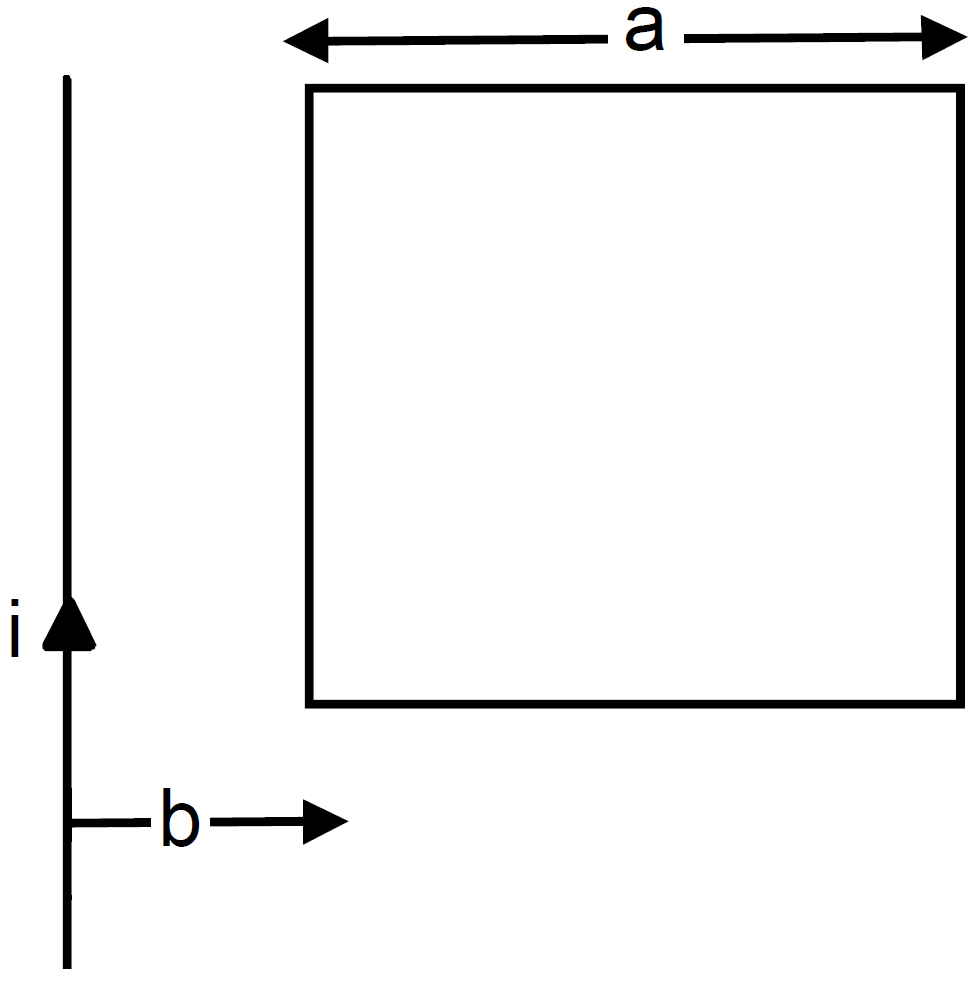
Answer
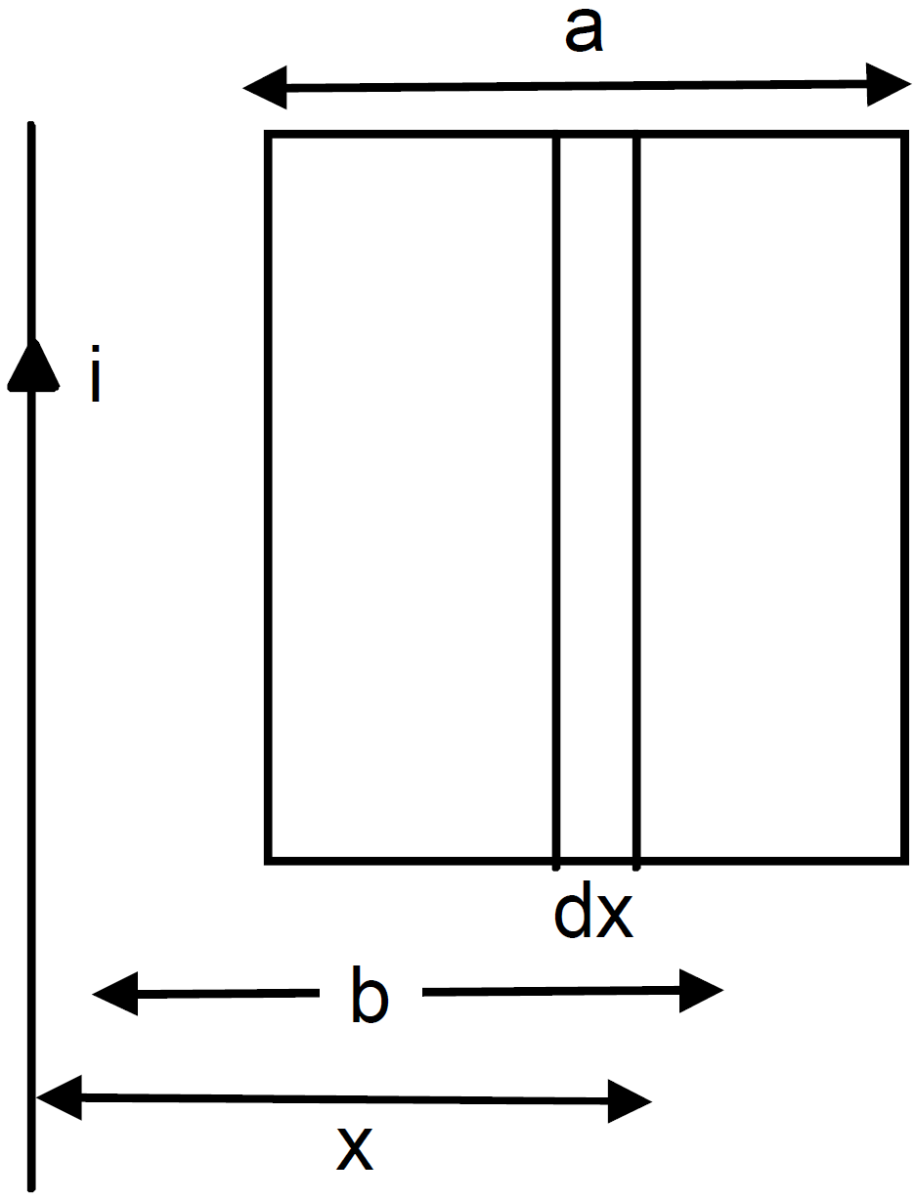 Considering an element dx at a dist x from the wire. We have
- $\phi=\text{B.A.}$
$\text{d}\phi=\frac{\mu_0\text{i}\times\text{adx}}{2\pi\text{x}}$
$\phi=\int\limits^\text{a}_0\text{d}\phi=\frac{\mu_0\text{ia}}{2\pi}\int\limits^{\text{a}+\text{b}}_\text{b}\frac{\text{dx}}{\text{x}}=\frac{\mu_0\text{ia}}{2\pi}\text{In}\left\{1+\frac{\text{a}}{\text{b}}\right\}$
- $\text{e}=\frac{\text{d}\phi}{\text{dt}}=\frac{\text{d}}{\text{dt}}\frac{\mu_0\text{ia}}{2\pi}\text{In}\Big[1+\frac{\text{a}}{\text{b}}\Big]$
$=\frac{\mu_0\text{a}}{2\pi}\text{In}\Big[1+\frac{\text{a}}{\text{n}}\Big]\frac{\text{d}}{\text{dt}}(\text{i}_0\sin\omega\text{t})$
$=\frac{\mu_0\text{ai}_0\omega\cos\omega\text{t}}{2\pi}\text{In}\Big[1+\frac{\text{a}}{\text{b}}\Big]$
- $\text{i}=\frac{\text{e}}{\text{r}}=\frac{\mu_0\text{ai}_0\omega\cos\omega\text{t}}{2\pi\text{r}}\text{In}\Big[1+\frac{\text{a}}{\text{b}}\Big]$
$\text{H}=\text{i}^2\text{rt}$
$=\Big[\frac{\mu\text{ai}_0\omega\cos\omega\text{t}}{2\pi\text{r}}\text{In}\Big(1+\frac{\text{a}}{\text{b}}\Big)\Big]^2\times\text{r}\times\text{t}$
$=\frac{\mu_0^2\times\text{a}^2\times\text{i}^2_0\times\omega^2}{4\pi\times\text{r}^2}\text{In}^2\Big[1+\frac{\text{a}}{\text{b}}\Big]\times\text{r}\times\text{}\frac{20\pi}{\omega}$
$=\frac{5\mu_0^2\text{a}^2\text{i}^2_0\times\omega}{2\pi\text{r}}\text{In}^2\Big[1+\frac{\text{a}}{\text{b}}\Big] \ \Big[\therefore\text{t}=\frac{20\pi}{\omega}\Big]$ View full question & answer→Question 575 Marks
A rectangular metallic loop of length l and width b is placed coplanarly with a long wire carrying a current i. The loop is moved perpendicular to the wire with a speed v in the plane containing the wire and the loop. Calculate the emf induced in the loop when the rear end of the loop is at a distance a from the wire. Solve by using Faraday's law for the flux through the loop and also by replacing different segments with equivalent batteries.
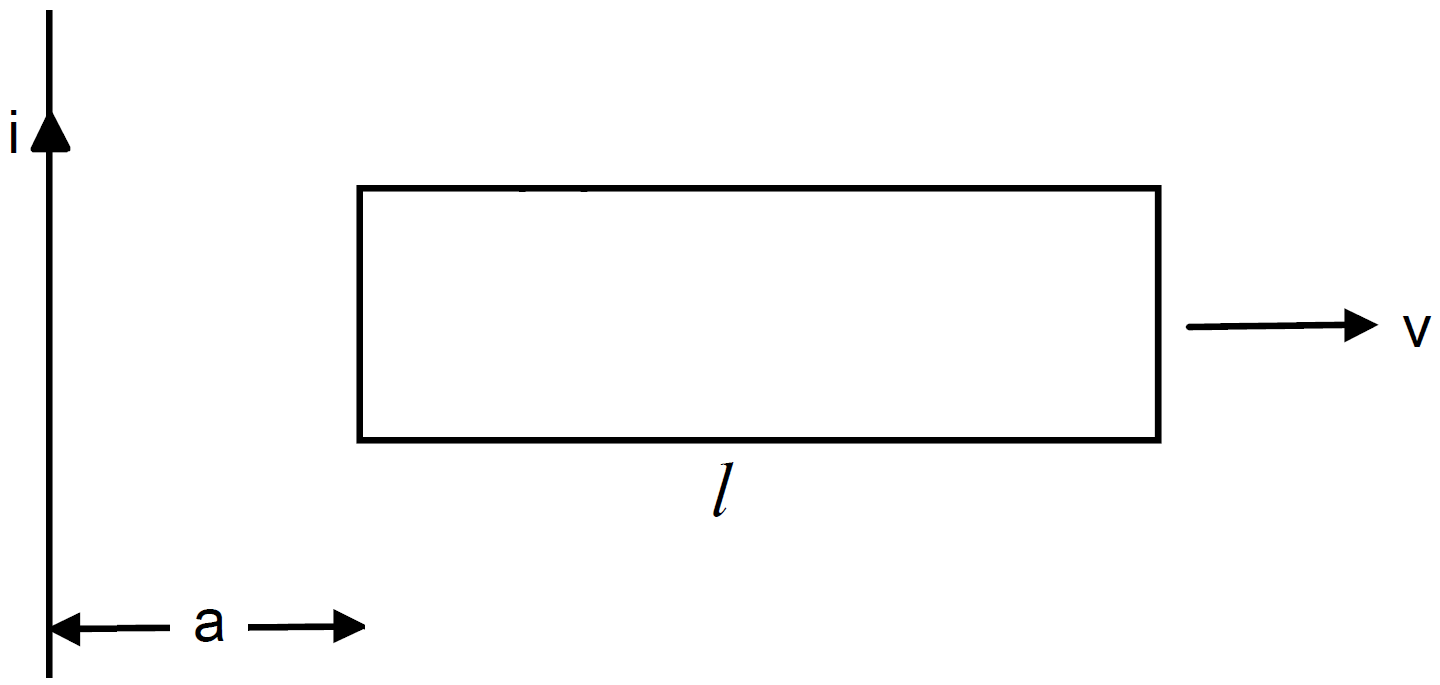
Answer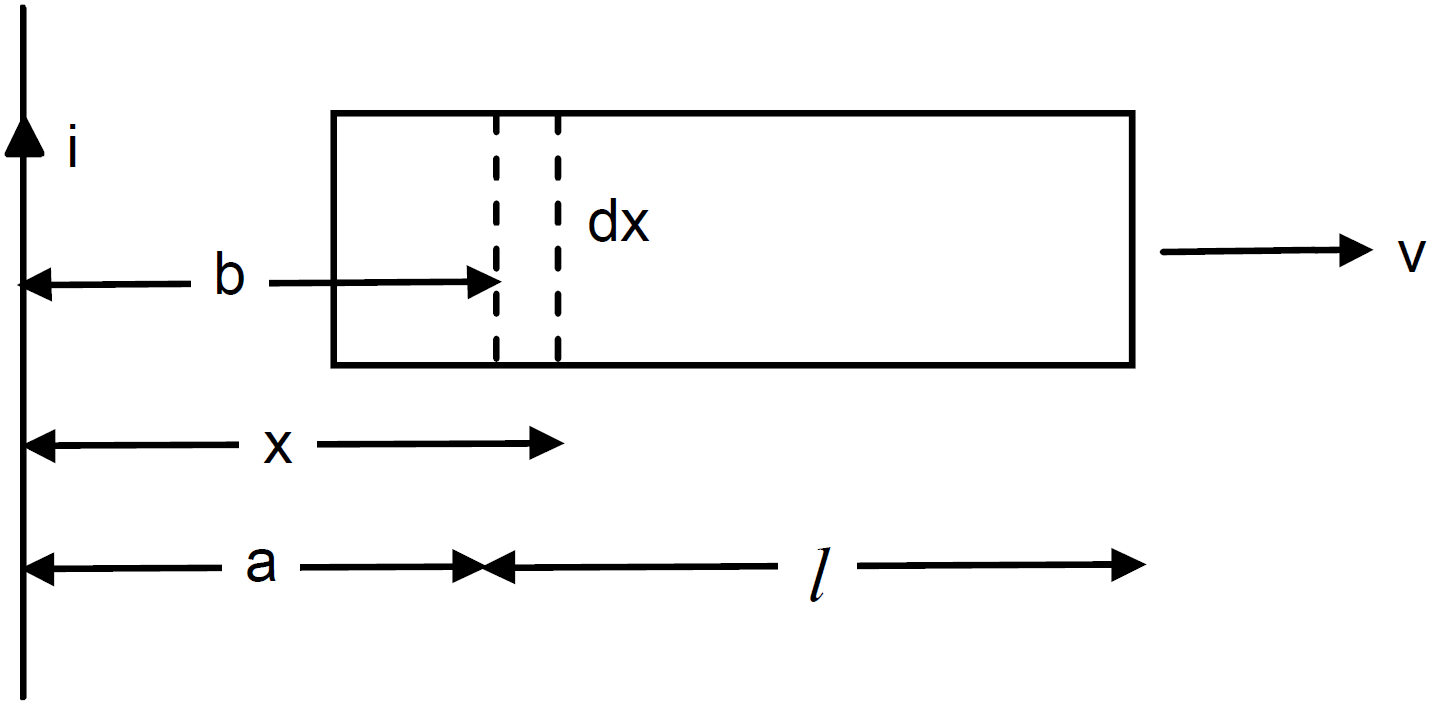 Using Faraday’' law Consider a unit length dx at a distance x$\text{B}=\frac{\mu_0\text{i}}{2\pi\text{x}}$
Area of strip $=\text{b} \ \text{dx}$$\text{d}\phi=\frac{\mu_0\text{i}}{2\pi\text{x}}\text{dx}$
$\Rightarrow\phi=\int\limits^{\text{a}+1}_\text{a}\frac{\mu_0\text{i}}{2\pi\text{x}}\text{bdx}$
$=\frac{\mu_o\text{i}}{2\pi}\text{b}\int\limits^{\text{a}+1}_\text{a}\Big(\frac{\text{dx}}{\text{x}}\Big)=\frac{\mu_0\text{ib}}{2\pi}\log\Big(\frac{\text{a}+\text{l}}{\text{a}}\Big)$
$\text{Emf}=\frac{\text{d}\phi}{\text{dt}}=\text{dt}\Big[\frac{\mu_0\text{ib}}{2\pi}\text{log}\Big(\frac{\text{a}+\text{l}}{\text{a}}\Big)\Big]$
$=\frac{\mu_0\text{ib}}{2\pi}\frac{\text{a}}{\text{a}+\text{l}}\Big(\frac{\text{va}-(\text{a}+\text{l})\text{v}}{\text{a}^2}\Big)$ $\Big($ Where $\frac{\text{da}}{\text{dt}}=\text{V}\Big)$
$=\frac{\mu_0\text{ib}}{2\pi}\frac{\text{a}}{\text{a}+\text{l}}\frac{\text{vl}}{\text{a}^2}=\frac{\mu_0\text{ibvl}}{2\pi(\text{a}+\text{l})\text{a}}$
The velocity of AB and CD creates the emf. since the emf due to AD and BC are equal and opposite to each other. 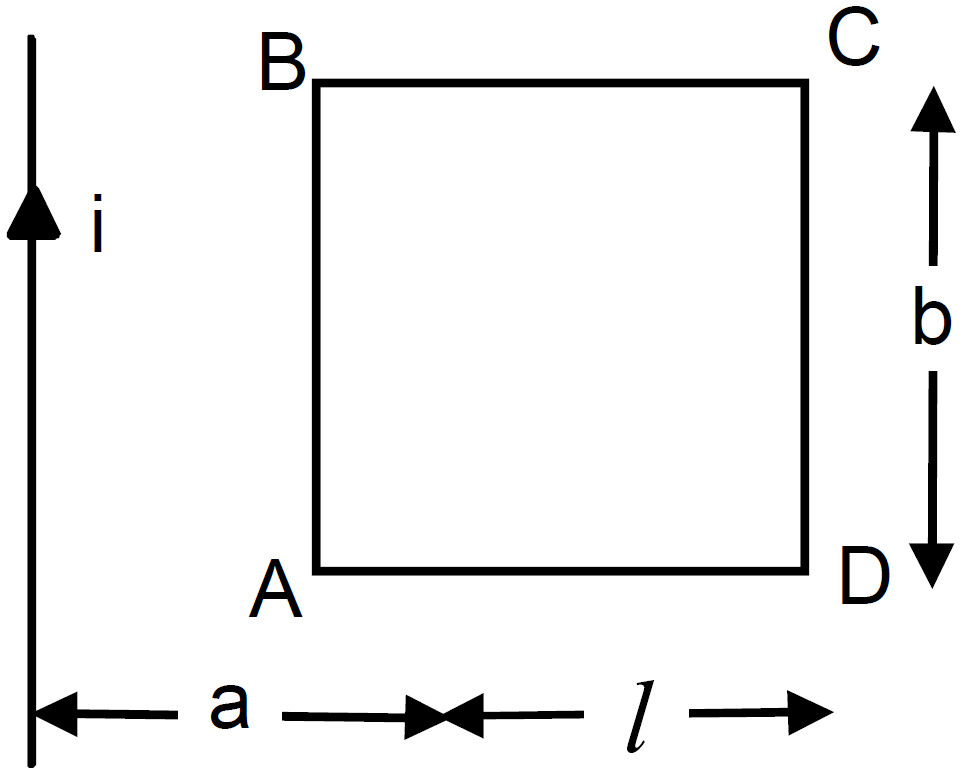 $\text{B}_{\text{AB}}=\frac{\mu_o\text{i}}{2\pi\text{a}} \ \Rightarrow \ \text{E.m.f.} \ \text{AB}=\frac{\mu_0\text{i}}{2\pi\text{a}}\text{bv}$
Length b, velocity v.$\text{B}_{\text{CD}}=\frac{\mu_0\text{i}}{2\pi(\text{a}+\text{l})}$
$\Rightarrow \text{E.m.f.} \ \text{CD}=\frac{\mu_0\text{ibv}}{2\pi(\text{a}+\text{l})}$
Length b, velocity v.Net emf $=\frac{\mu_0\text{i}}{2\pi\text{a}}\text{bv}-\frac{\mu_0\text{ibv}}{2\pi\text{a}(\text{a}+\text{l})}=\frac{\mu_0\text{ibvl}}{2\pi\text{a}(\text{a}+\text{l})}$ View full question & answer→Question 585 Marks
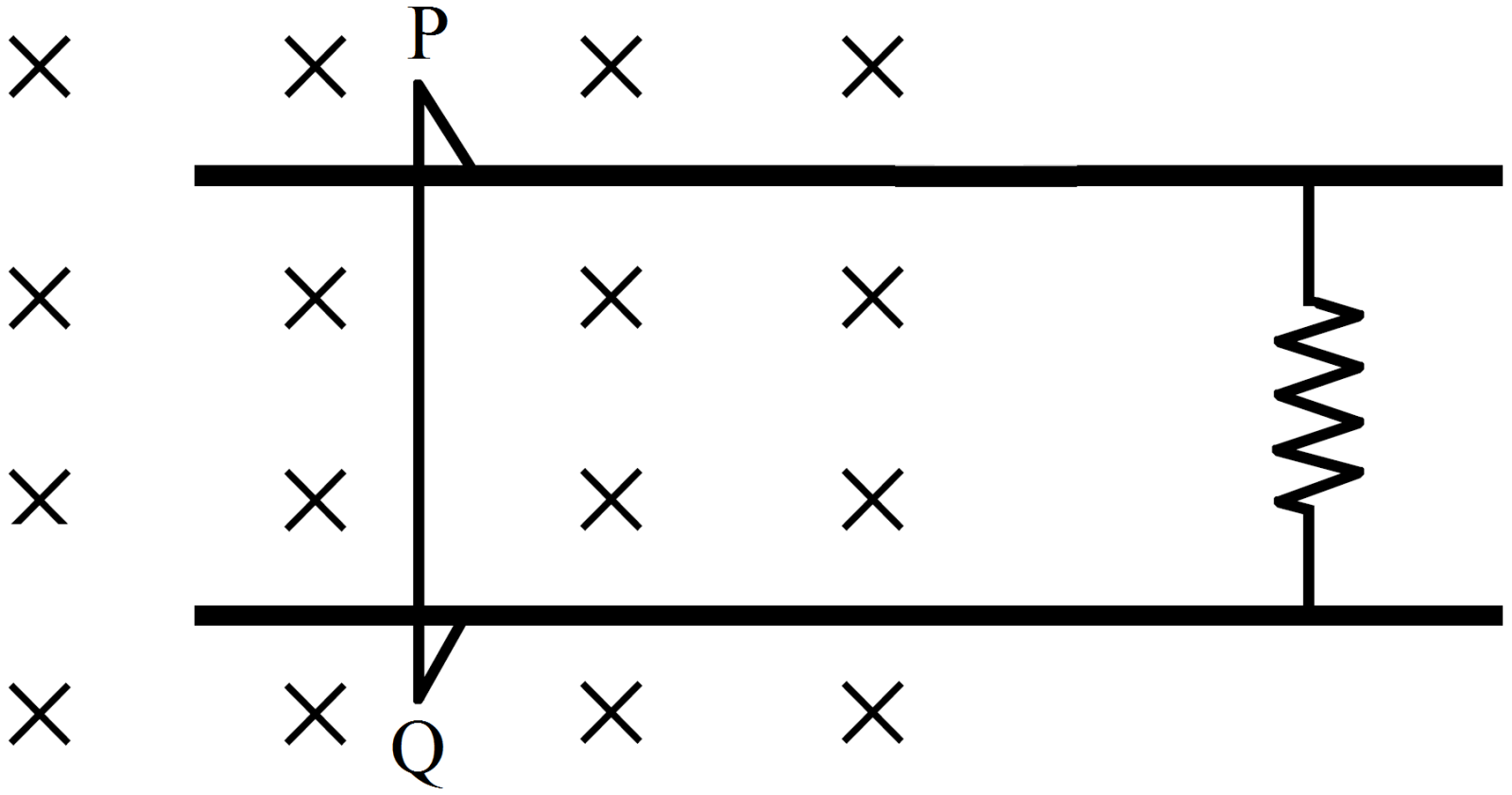
Consider the situation shown in figure. The wire PQ has mass m, resistance r and can slide on the smooth, horizontal parallel rails separated by a distance l. The resistance of the rails is negligible. A uniform magnetic field B exists in the rectangular region and a resistance R connects the rails outside the field region. At $t = 0$, the wire PQ is pushed towards right with a speed $v_0$. Find
- The current in the loop at an instant when the speed of the wire PQ is v.
- The acceleration of the wire at this instant.
- The velocity vas a functions of x.
- The maximum distance the wire will move.
Answer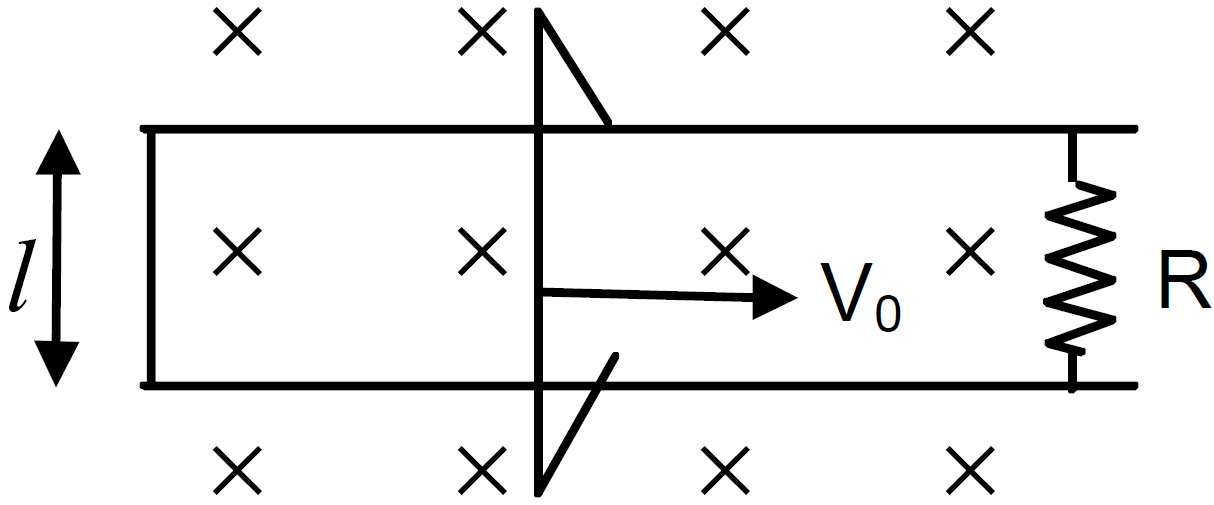
- When the speed is V
Emf = Blv
Resistance = r + r
Current $=\frac{\text{Blv}}{\text{r}+\text{R}}$
- Force acting on the wire =ilB
$=\frac{\text{BlvlB}}{\text{r}+\text{R}}=\frac{\text{B}^2\text{l}^2\text{v}}{\text{r}+\text{R}}$
Acceleration on the wire $=\frac{\text{B}^2\text{l}^2\text{v}}{\text{m}(\text{r}+\text{R})}$
- $\text{v}=\text{v}_0+\text{at}=\text{v}_0 -\frac{\text{B}^2\text{l}^2\text{v}}{\text{m}(\text{r}+\text{R})}\text{t}$ [force is opposite to velocity]
$=\text{v}_0 -\frac{\text{B}^2\text{l}^2\text{x}}{\text{m}(\text{r}+\text{R})}$
- $\text{a}=\text{v}\frac{\text{dv}}{\text{dx}}=\frac{\text{B}^2\text{l}^2\text{x}}{\text{m}(\text{r}+\text{R})}$
$\Rightarrow\text{dx}=\frac{\text{dvm}(\text{R}+\text{r})}{\text{B}^2\text{l}^2}$
$\Rightarrow\text{x}=\frac{\text{m}(\text{R}+\text{r})\text{v}_0}{\text{B}^2\text{l}^2}$ View full question & answer→Question 595 Marks
A conducting wire ab of length l, resistance r and mass m starts sliding at $t = 0$ down a smooth, vertical, thick pair of connected rails as shown in figure. A uniform magnetic field B exists in the space in a direction perpendicular to the plane of the rails.
- Write the induced emf in the loop at an instant t when the speed of the wire is v.
- What would be the magnitude and direction of the induced current in the wire?
- Find the downward acceleration of the wire at this instant.
- After sufficient time, the wire starts moving with a constant velocity. Find this velocity $v_m$.
- Find the velocity of the wire as a function of time.
- Find the displacement of the wire as a function of time.
- Show that the rate of heat developed in the wire is equal to the rate at which the gravitational potential energy is decreased after steady state is reached.
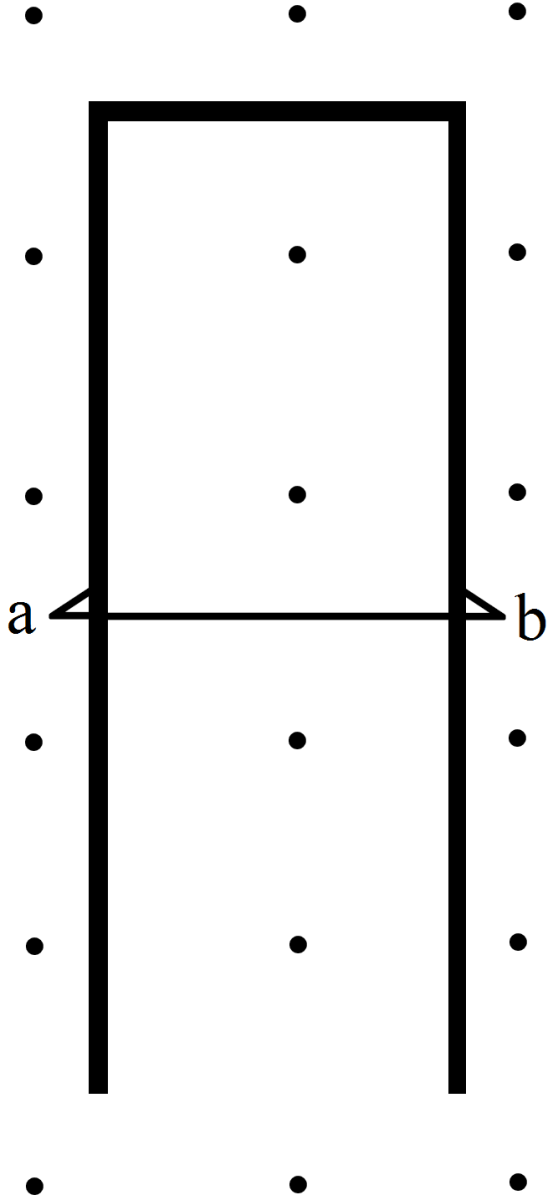
Answer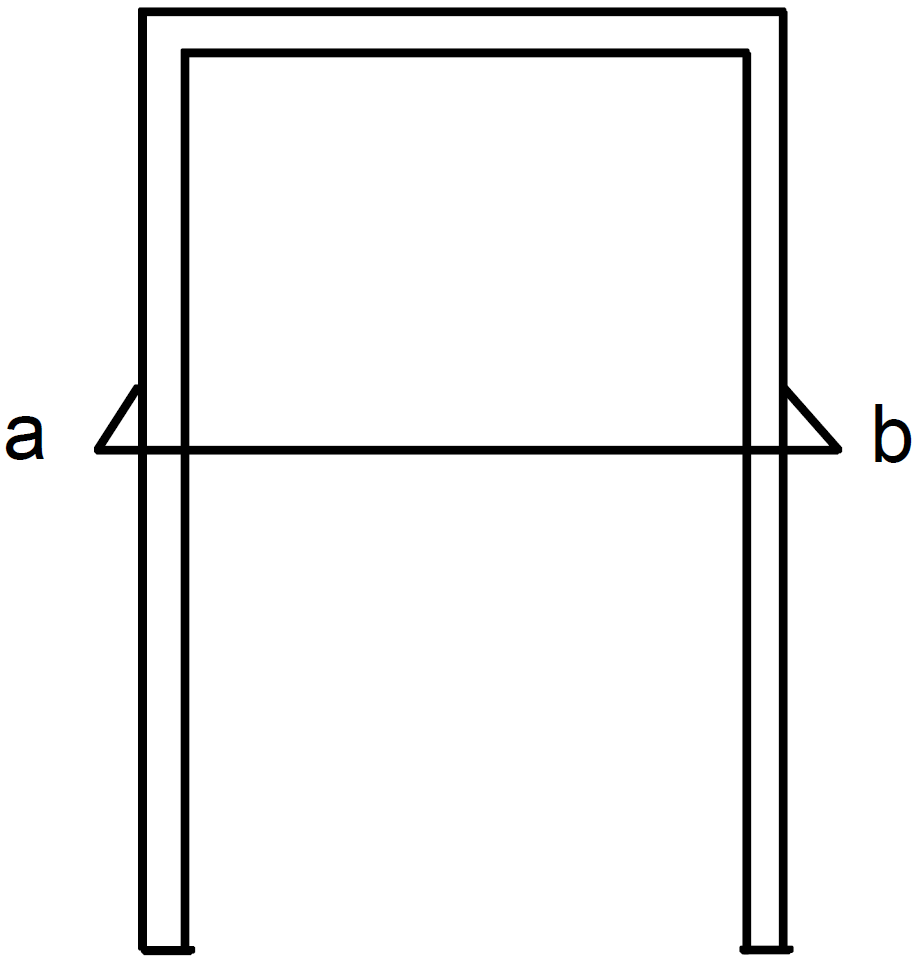
- When the speed of wire is V
emf developed = BlV
- Induced current is the wire $=\frac{\text{Blv}}{\text{R}}$ (from b to a)
- Down ward acceleration of the wire
$=\frac{\text{mg}-\text{F}}{\text{m}}$ due to the current
$=\text{mg}-\text{il}\frac{\text{B}}{\text{m}}=\text{g}-\frac{\text{B}^2\text{l}^2\text{V}}{\text{Rm}}$
- Let the wire start moving with constant velocity. Then acceleration = 0
$\frac{\text{B}^2\text{l}^2\text{V}}{\text{Rm}}\text{m}=\text{g}$
$\Rightarrow\text{V}_\text{m}=\frac{\text{gRm}}{\text{B}^2\text{l}^2}$
- $\frac{\text{dV}}{\text{dt}}=\text{a}$
$\Rightarrow\frac{\text{dV}}{\text{dt}}=\frac{\text{mg}-\text{B}^2\text{l}^2\frac{\text{v}}{\text{R}}}{\text{m}}$
$\Rightarrow\frac{\text{dv}}{\frac{\text{mg}-\frac{\text{B}^2\text{l}^2\frac{\text{v}}{\text{R}}}{\text{R}}}{\text{m}}}=\text{dt}$
$\Rightarrow\int\limits_{0}^{\text{v}}\frac{\text{mdv}}{\text{mg}-\frac{\text{B}^2\text{l}^2\text{v}}{\text{R}}}=\int\limits_{0}^{\text{t}}\text{dt}$
$\Rightarrow\frac{\text{m}}{\frac{-\text{B}^2\text{l}^2}{\text{R}}}\Big(\log\text{mg}-\frac{\text{B}^2\text{l}^2\text{v}}{\text{R}}\Big)_{0}^{\text{v}}=\text{t}$
$\Rightarrow\frac{-\text{mR}}{\text{B}^2\text{l}^2}=\log\Big[\log\Big(\text{mg}-\frac{\text{B}^2\text{l}^2\text{v}}{\text{R}}\Big)-\log(\text{mg})\Big]=\text{t}$
$\Rightarrow\log\Bigg[\frac{\text{mg}-\frac{\text{B}^2\text{l}^2\text{v}}{\text{R}}}{\text{mg}}\Bigg]=\frac{-\text{tB}^2\text{l}^2}{\text{mR}}$
$\Rightarrow\log\Big[1-\frac{\text{B}^2\text{l}^2\text{v}}{\text{Rmg}}\Big]=\frac{-\text{tB}^2\text{l}^2}{\text{mR}}$
$\Rightarrow1-\frac{\text{B}^2\text{l}^2\text{v}}{\text{Rmg}}=\text{e}^{\frac{-\text{t}\text{B}^2\text{l}^2}{\text{mR}}}$
$\Rightarrow\bigg(1-\text{e}^{\frac{-\text{B}^2\text{l}^2}{\text{mR}}}\bigg)=\frac{\text{B}^2\text{l}^2\text{v}}{\text{Rmg}}$
$\Rightarrow\text{v}=\frac{\text{Rmg}}{\text{B}^2\text{l}^2}\Big(1-\text{e}^{-\frac{\text{B}^2\text{l}^2}{\text{mR}}}\Big)$
$\Rightarrow\text{v}=\text{v}_{\text{m}}\Big(1-\text{e}^{\frac{-\text{gt}}{\text{vm}}}\Big) \ \Big[\text{v}_\text{m}=\frac{\text{Rmg}}{\text{B}^2\text{l}^2}\Big]$
- $\frac{\text{ds}}{\text{dt}}=\text{v}\Rightarrow\text{ds}=\text{v} \ \text{dt}$
$\Rightarrow\text{s}=\text{vm}\int\limits_0^\text{t}\Big(1-\text{e}^{\frac{-\text{gt}}{\text{vm}}}\Big)\text{dt}$
$=\text{V}_\text{m}\Big(\text{t}-\frac{\text{V}_\text{m}}{\text{g}}\text{e}^\frac{\text{-gt}}{\text{vm}}\Big)=\Big(\text{V}_\text{m}\text{t}+\frac{\text{V}^2_\text{m}}{\text{g}}\text{e}^\frac{\text{-gt}}{\text{vm}}\Big)-\frac{\text{V}^2_\text{m}}{\text{g}}$
$=\text{V}_\text{m}\text{t}-\frac{\text{V}^2_\text{m}}{\text{g}}\Big(1-\text{e}^\frac{\text{-gt}}{\text{vm}}\Big)$
- $\frac{\text{d}}{\text{dt}}=\text{mgs}=\text{mg}\frac{\text{ds}}{\text{dt}}=\text{mgV}_\text{m}\Big(1-\text{e}^\frac{\text{-gt}}{\text{vm}}\Big)$
$\frac{\text{d}_\text{H}}{\text{dt}}=\text{i}^2\text{R}=\text{R}\Big(\frac{\text{LBV}}{\text{R}}\Big)^2=\frac{\text{L}^2\text{B}^2\text{V}^2}{\text{R}}$
$\Rightarrow\frac{\text{L}^2\text{B}^2}{\text{R}}\text{V}^2_\text{m}\Big(1-\text{e}^\frac{\text{-gt}}{\text{vm}}\Big)^2$
After steady state i.e. $\text{T}\rightarrow\infty$
$\frac{\text{d}}{\text{dt}}\text{mgs}=\text{mgV}_\text{m}$
$\frac{\text{dH}}{\text{dt}}=\frac{\text{L}^2\text{B}^2}{\text{R}}\text{V}^2_\text{m}=\frac{\text{L}^2\text{B}^2}{\text{R}}\text{V}_\text{m}\frac{\text{mgR}}{\text{L}^2\text{B}^2}=\text{mgV}_\text{m}$
Hence after steady state $\frac{\text{dH}}{\text{dt}}=\frac{\text{d}}{\text{dt}}\text{mgs}$ View full question & answer→Question 605 Marks
An LR circuit with emf $\in$ is connected at t = 0.
- Find the charge Q which flows through the battery during 0 to t.
- Calculate the work done by the battery during this period.
- Find the heat developed during this period.
- Find the magnetic field energy stored in the circuit at time t.
- Verify that the results in the three parts above are consistent with energy conservation.
AnswerEmf = E LR circuit
- $\text{dq}=\text{idt}$
$=\text{i}_0\Big(1-\text{e}^\frac{-\text{t}}{\tau}\Big)\text{dt} $
$=\text{i}_0\Big(1-\text{e}^{\text{-IR.L}}\Big)\text{dt} \ \Big[\therefore \ \tau=\frac{\text{L}}{\text{R}}\Big]$
$\text{Q}=\int\limits_\text{0}^\text{t}\text{dq}=\text{i}_0\Bigg[\int\limits_{0}^\text{t}\text{dt}-\int\limits_0^\text{t}\text{e}^\frac{\text{tR}}{\text{L}}\text{dt}\Bigg] $
$=\text{i}_0\Big[\text{t}\Big(\frac{-\text{L}}{\text{R}}\Big)\Big(\text{e}^\frac{-\text{IR}}{\text{L}}\Big)\text{t}_0\Big]$
$=\text{i}_0\Big[\text{t}-\frac{\text{L}}{\text{R}}\Big(1-\text{e}^\frac{-\text{IR}}{\text{L}}\Big)\Big] $
$\text{Q}=\frac{\text{E}}{\text{R}}\Big[\text{t}-\frac{\text{L}}{\text{R}}\Big(1-\text{e}^\frac{-\text{IR}}{\text{L}}\Big)\Big] $
- Similarly as we know work done $=\text{Vl}=\text{El}$
$=\text{E}\text{ i}_0 \Big[\text{t}-\frac{\text{L}}{\text{R}}\Big(1-\text{e}^\frac{-\text{lR}}{\text{L}}\Big)\Big]$
$=\frac{\text{E}^2}{\text{R}}\Big[\text{t}-\frac{\text{L}}{\text{R}}\Big(1-\text{e}^\frac{-\text{lR}}{\text{L}}\Big)\Big]$
- $\text{H}=\int\limits^\text{t}_0\text{i}^2\text{R}.\text{dt}=\frac{\text{E}^2}{\text{R}^2}.\text{R}.\int\limits^\text{t}_0\Big(1-\text{e}^\frac{-\text{tR}}{\text{L}}\Big)^2.\text{dt}$
$=\frac{\text{E}^2}{\text{R}}\int\limits^\text{t}_0\Big(1+\text{e}^\frac{\big(-2+\text{B}\big)}{\text{L}}-2\text{e}^\frac{-\text{tR}}{\text{L}}\Big).\text{dt}$
$=\frac{\text{E}^2}{\text{R}}\bigg(\text{t}-\frac{\text{L}}{2\text{R}}\text{e}^\frac{-2\text{tR}}{\text{L}}+\frac{2\text{L}}{\text{R}}.\text{e}^\frac{-\text{tR}}{\text{L}}\bigg)^\text{t}_0$
$=\frac{\text{E}^2}{\text{R}}\bigg(\text{t}-\frac{\text{L}}{-2\text{R}}\text{e}^\frac{-2\text{tR}}{\text{L}}+\frac{2\text{L}}{\text{R}}.\text{e}^\frac{-\text{tR}}{\text{L}}\bigg)-\bigg(-\frac{\text{L}}{2\text{R}}+\frac{2\text{L}}{\text{R}}\bigg)$
$=\frac{\text{E}^2}{\text{R}}\bigg[\bigg(\text{t}-\frac{\text{L}}{2\text{R}}\text{x}^2+\frac{2\text{L}}{\text{R}}.\text{x}\bigg)-\frac{3}{2}\frac{\text{L}}{\text{R}}\bigg]$
$=\frac{\text{E}^2}{2}\bigg(\text{t}-\frac{\text{L}}{2\text{R}}\big(\text{x}^2-4\text{x}+3\big)\bigg)$
- $\text{E}=\frac{1}{2}\text{Li}^2$
$=\frac{1}{2}\text{L}.\frac{\text{E}^2}{\text{R}^2}.\Big(1-\text{e}^\frac{-\text{tR}}{\text{L}}\Big)^2$ $\bigg[\text{x}=\text{e}^\frac{-\text{tR}}{\text{L}}\bigg]$
$=\frac{\text{LE}^2}{2\text{R}^2}\Big(1-\text{x}\Big)^2$
- Total energy used as heat as stored in magnetic field
$=\frac{\text{E}^2}{\text{R}}\text{T}-\frac{\text{E}^2}{\text{R}}.\frac{\text{L}}{2\text{R}}\text{x}^2+\frac{\text{E}^2}{\text{R}}\frac{\text{L}}{\text{r}}.4\text{x}^2$
$-\frac{3\text{L}}{2\text{R}}.\frac{\text{E}^2}{\text{R}}+\frac{\text{LE}^2}{2\text{R}^2}+\frac{\text{LE}^2}{2\text{R}^2}\text{x}^2-\frac{\text{LE}^2}{\text{R}^2}\text{x}$
$=\frac{\text{E}^2}{\text{R}}\text{t}+\frac{\text{E}^2\text{L}}{\text{R}^2}\text{x}-\frac{\text{LE}^2}{\text{R}^2}$
$=\frac{\text{E}^2}{\text{R}}\Big(\text{t}-\frac{\text{L}}{\text{R}}\big(1-\text{x}\big)\Big)$
= Energy drawn from battery
(Hence conservation of energy holds good). View full question & answer→