MCQ 11 Mark
A mass of $1\ kg$ attached to the bottom of a spring has a certain frequency of vibration. The following mass has to be added to it in order to reduce the frequency by half:
- A
$1\ kg$
- B
$2\ kg$
- ✓
$3\ kg$
- D
$4\ kg$
AnswerCorrect option: C. $3\ kg$
$\text{v}=\frac{1}{2\pi}\sqrt{\frac{\text{k}}{\text{m}}}$ and $\frac{\text{v}}{2}=\frac{1}{2\pi}\sqrt{\frac{\text{k}}{\text{m}_1}}$
$\therefore2=\sqrt{\frac{\text{m}_1}{\text{m}_2}}$
$\text{m}_1=4\text{m}=4\times1=4\ \text{kg}$
Hence mass added $=\text{m}_1-\text{m}=4-1=3\ \text{kg}$
View full question & answer→MCQ 21 Mark
The total energy of particle performing $\text{S.H.M.}$ is depends on:
- A
$\text{k, A, m}$
- ✓
$\text{k, A}$
- C
$\text{k, A, x}$
- D
$\text{k, x}$
AnswerCorrect option: B. $\text{k, A}$
Total energy of a particle performing $\text{S.H.M.}$ is
$\text{E}=\frac{1}{2}\text{kA}^2$
View full question & answer→MCQ 31 Mark
The motion of a swing is:
- A
Periodic but not oscillatory.
- ✓
- C
- D
View full question & answer→MCQ 41 Mark
The acceleration due to gravity on the surface of the moon is $1.7\ ms^{-2}$. The time period of a simple pendulum on the moon, if its time period on the earth is $3.5s$ is:
- A
$2.2s$
- B
$4.4s$
- ✓
$8.4s$
- D
$16.8s$
AnswerCorrect option: C. $8.4s$
View full question & answer→MCQ 51 Mark
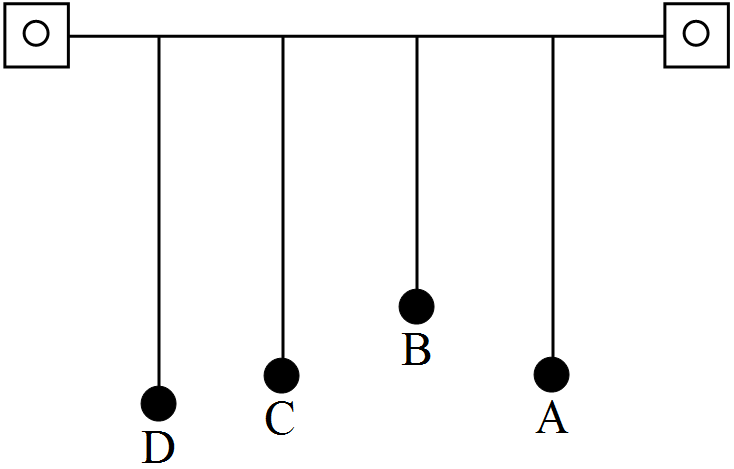
Four pendulums $A, B, C$ and $D$ are suspended from the same elastic support as shown in Fig $A$ and $C$ are of the same length, while $B$ is smaller than $A$ and $D$ is larger than $A$. If $A$ is given a transverse displacement,
- A
$D$ will vibrate with maximum amplitude.
- ✓
$C$ will vibrate with maximum amplitude.
- C
$B$ will vibrate with maximum amplitude.
- D
All the four will oscillate with equal amplitude.
AnswerCorrect option: B. $C$ will vibrate with maximum amplitude.
Here $A$ is given a transverse displacement. Through the elastic support the disturbance is transferred to all the pendulums.
$A$ and $C$ are having same length, hence they will be in resonance, because of their time period of oscillation. Since length of pendulums $A$ and $C$ is same and $\text{T}=2\pi\sqrt{\frac{\text{L}}{\text{g}}}$ hence their time period is same and they will have frequency of vibration. Due to it, a resonance will take place and the pendulum $C$ will vibrate with maximum amplitude.
View full question & answer→MCQ 61 Mark
Which of the following equations does not represent a simple harmonic motion?
- A
$\text{y = a}\sin\omega\text{t}$
- B
$\text{y = b}\cos\omega\text{t}$
- C
$\text{y = a}\sin\omega\text{t + b}\cos\omega\text{t}$
- ✓
$\text{y = a}\tan\omega\text{t}$
AnswerCorrect option: D. $\text{y = a}\tan\omega\text{t}$
$\text{S.H.M.}$ is one which is bounded within well defined limits, periodic and oscillatory. The first four equations represent $\text{S.H.M.}$ but the fifth equation does not represent $\text{S.H.M.}$
View full question & answer→MCQ 71 Mark
A particle executing $\text{SHM}$ has a maximum speed of $30\ cm/ s$ angular frequency $10\text{rad/ s}$. The amplitude of oscillation is:
- ✓
$3\ cm$
- B
$6\ cm$
- C
$1\ cm$
- D
$60\ cm$
AnswerCorrect option: A. $3\ cm$
View full question & answer→MCQ 81 Mark
A particle doing simple harmonic motion, amplitude $= 4\ cm,$ time period $= 12\sec.$ Ratio of time taken by it in going from its mean position to $2\ cm$ and from $2\ cm$ to extreme position is:
- A
$1$
- B
$\frac{1}{3}$
- C
$\frac{1}{4}$
- ✓
$\frac{1}{2}$
AnswerCorrect option: D. $\frac{1}{2}$
Here, $a = 4\ cm; T = 12s.$ If t is the time takeo by particle in going fiom mean position to $2\ cm,$ then using
$\text{y}=\text{a}\sin\omega\text{t},$ we have $2=4\sin\frac{2\pi}{\text{T}}\text{t}$
$\sin\frac{2\pi}{\text{T}}\text{t}=\frac{2}{4}=\frac{1}{2}=\sin\frac{\pi}{6}$
$\text{t}=1\text{sec}.$
Time taken by particle to go from mean position to extreme position $=\frac{\text{T}}{4}=\frac{12}{4}=3\text{s}$
Therefore, time taken by Particle in going from $2\ cm$ to $4\ cm ($i.e., extreme position$)$
$\text{t}'=3-1=2\text{s}$
$\therefore$ So $\frac{\text{t}}{\text{t}'}=\frac{1}{2}$
View full question & answer→MCQ 91 Mark
Displacement between maximum potential energy position and maximum kinetic energy position for a particle exciting $\text{S.H.M.}$ is:
- A
$\pm\frac{\text{a}}{2}$
- B
$\pm1$
- ✓
$\pm\text{a}$
- D
$-1$
AnswerCorrect option: C. $\pm\text{a}$
In $\text{S.H.M.}$, the maximum $\text{P.E.}$ is at the extreme position and maximum $\text{K.E.}$ is at the mean position.
View full question & answer→MCQ 101 Mark
When frequency of oscillations is high then motion is called:
MCQ 111 Mark
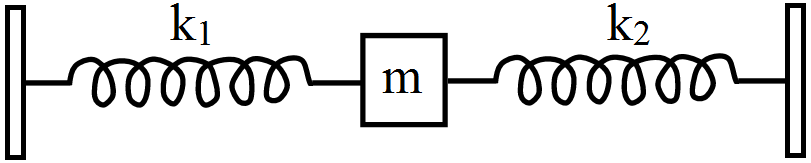
Two spring of force constants $k_1$ and $k_2$ are connected to a mass $m$ as shown in figure. The frequency of oscillation of the mass is $f.$ If both $k_1$ and $k_2$ are made four times their original values, the frequency of oscillation becomes
- A
$\frac{\text{f}}{2}$
- B
$\frac{\text{f}}{4}$
- C
$4f$
- ✓
$2f$
AnswerFrequency of oscillation,
$\text{f}=\frac{1}{2\pi}\sqrt{\frac{\text{k}_1+\text{k}_2}{\text{m}}}$
$\text{f}'=\frac{1}{2\pi}.2\sqrt{\frac{\text{k}_1+\text{k}_2}{\text{m}}}=2\text{f}$
View full question & answer→MCQ 121 Mark
A particle of mass $m$ is executing oscillation about the origin about the origin on the $x-$axis, its potential energy is $U = kx^3$, where $k$ is a positive constant. If the amplitude of oscillation is a, then its time period $T$ is:
- ✓
Proportional to $\frac{1}{\sqrt{\text{a}}}$
- B
Independent of $\text{a}$
- C
Proportional to $\sqrt{\text{a}}$
- D
Proportional to $\text{a}^{\frac{3}{2}}$
AnswerCorrect option: A. Proportional to $\frac{1}{\sqrt{\text{a}}}$
Potential energy, $\text{U = kx}^3$
Force, $\text{F}=\frac{-\text{dU}}{\text{dx}}=-3\text{kx}^2$
max. force $=\text{F}_{\text{max}}-3\text{kx}^2=-\text{m}\omega^2\text{a}$
$\omega^2=\frac{3\text{ka}^2}{\text{ma}}=\frac{3\text{ka}}{\text{m}}$
$\frac{4\pi^2}{\text{T}^2}=\frac{3\text{ka}}{\text{m}}$
$\text{T}^2\propto\frac{1}{\text{a}}$
$\text{T}\propto\frac{1}{\sqrt{\text{a}}}$
View full question & answer→MCQ 131 Mark
At extreme position, velocity of the particle executing $\text{SHM}$ that has amplitude $A$ is:
AnswerVelocity of the particle executing $\text{SHM}$ is given as $\text{v}=\omega\sqrt{\text{A}^2-\text{x}^2}$
At extreme position, $x = A$
$\Rightarrow v = 0$
View full question & answer→MCQ 141 Mark
For a particle executing $\text{SHM}$ along $x-$axis force is given by:
- ✓
$-kx$
- B
$A \cos kx$
- C
$A\ exp (-kx)$
- D
$A kx$
View full question & answer→MCQ 151 Mark
Motion of a ball bearing inside a smooth curved bowl, when released from a point slightly above the lower point is:
- A
- B
Non$-$periodic motion.
- C
- ✓
Both $A$ and $C$
AnswerCorrect option: D. Both $A$ and $C$
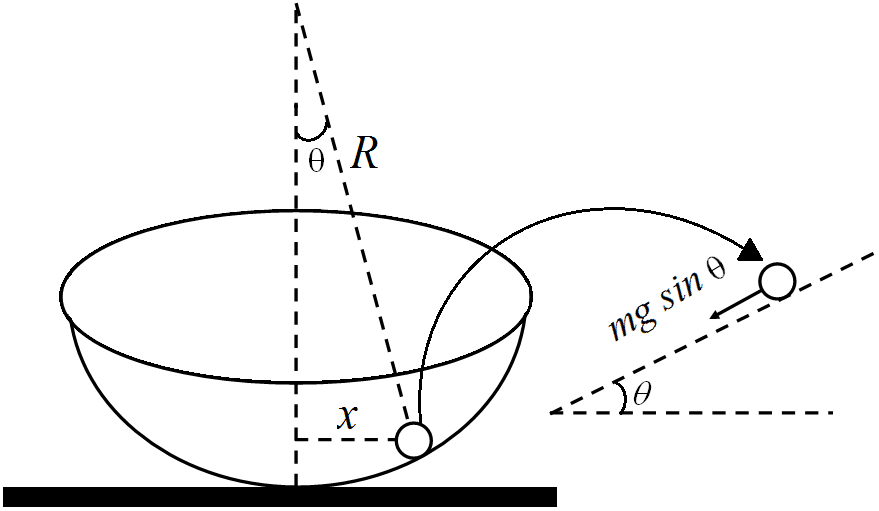
For small angular displacement, the situation is shown in the figure. Only one restoring force creates.
motion in ball inside bowl.
Only one restoring force creates motion in ball inside bowl.
$\text{F}=-\text{mg}\sin\theta$
As $\theta$ is small $,\sin\theta=\theta$
So, $\text{ma}=-\text{mg}\frac{\text{x}}{\text{R}}$
Or, $\text{a}=-\Big(\frac{\text{g}}{\text{R}}\Big)\text{x}\Rightarrow\text{a}\propto-\text{x}$
So, motion of the ball is $\text{S.H.M}$ and periodic.
View full question & answer→MCQ 161 Mark
A body of mass $400g$ connected to a spring with spring constant $10Nm^{-1}$, executes simple harmonic motion, time period of oscillation is
AnswerCorrect option: A. $4\pi\times10^{-1}\text{s}$
Here, $m = 400g$
$400 \times 10^{-3}kg$
As $R = 10\ Nm,^{-1}$
$\text{T}=2\pi\sqrt{\frac{\text{m}}{\text{R}}}$
$=2\pi\sqrt{\frac{400\times10^{-3}}{10}}$
$=4\pi\times10^{-1}\text{s}$
View full question & answer→MCQ 171 Mark
The displacement of a particle in $\text{SHM}$ varies according to the relation $\text{x}=4(\cos\pi\text{t}+\sin\pi\text{t})$ The amplitude of the particle is:
- A
$-4$
- B
$4$
- ✓
$4\sqrt{2}$
- D
$8$
AnswerCorrect option: C. $4\sqrt{2}$
Given equation $\text{x(t)}=4(\cos\pi\text{t}+\sin\pi\text{t})$
Now comparing cbove equation with general form $\text{x(t)}=\text{A}\cos\omega\text{t}+\text{B}\sin\omega\text{t}$
We get $A = 4$ and $B = 4$
As, the resultant amplitude for such a equation is
$=\sqrt{\text{A}^2+\text{B}^2}$
$\therefore$ Amplitude $=\sqrt{4^2+4^2}=4\sqrt{2}$
View full question & answer→MCQ 181 Mark
The rotation of earth about its axis is:
- A
- B
- C
Periodic but not simple harmonic motion.
- ✓
Both $A$ and $C$
AnswerCorrect option: D. Both $A$ and $C$
Rotation of earth about its axis repeats its motion after a fixed interval of lime, so its motion is periodic.
The rotation of earth is obviously not a to and fro type of motion about a fixed point, hence its motion is not an oscillation. Also this motion does not follow $\text{S.H.M}$ equation, $\text{a}\propto-\text{x}$
Hence, this motion is not a $\text{S.H.M.}$
View full question & answer→MCQ 191 Mark
For a $\text{SHM},$ if the maximum potential energy become double, choose the correct option.
- A
Maximum kinetic energy will become double.
- B
The total mechanical energy will become double.
- ✓
Both $(a)$ and $(b)$
- D
Neither $(a)$ nor $(b)$.
AnswerCorrect option: C. Both $(a)$ and $(b)$
View full question & answer→MCQ 201 Mark
In simple harmonic motion, the force:
- A
Is constant in magnitude only.
- B
Is constant in direction only.
- ✓
Varies in magnitude as well as in direction.
- D
Is constant in both magnitude and direction.
AnswerCorrect option: C. Varies in magnitude as well as in direction.
In $\text{SHM,}$ force varies in magnitude as well as in direction. As, for the particle executing $\text{SHM,}$ the force subjected to it is always proportional to the displacement of the particle and is directed towards the mean position.
View full question & answer→MCQ 211 Mark
The displacement of a particle is represented by the equation : $\text{y}=3\cos\Big(\frac{\pi}{4}-2\omega\text{t}\Big)$
The motion of the particle is:
AnswerCorrect option: B. Simple harmonic with period $\frac{\pi}{\omega}.$
A simple harmonic motion is produced when a force $($called restoring force$)$ proportional to the displacement acts on a particle.
All sine and cosine functions of $t$ are simple harmonic in nature.
Hence the motion is simple harmonic motion.
A simple harmonic motion is always periodic.
the motion is simple harmonic with time period $\frac{\pi}{\omega}.$
View full question & answer→MCQ 221 Mark
Two masses $m_1$ and $m_2$ are suspended together by a massless spring of spring constant $k.$ When the masses are in equilibrium $m_1$ is removed without disturbing the system, then the angular velocity of oscillation of $m_2$ is:
- A
$\sqrt{\frac{\text{k}}{\text{m}_1}}$
- ✓
$\sqrt{\frac{\text{k}}{\text{m}_2}}$
- C
$\sqrt{\Big(\frac{\text{k}}{\text{m}_2}\Big)+\text{m}_1}$
- D
$\sqrt{\frac{\text{k}}{(\text{m}_1+\text{m}_2)}}$
AnswerCorrect option: B. $\sqrt{\frac{\text{k}}{\text{m}_2}}$
When mass $m_1$, is removd there is only mass $m_2$ attached to the spring of spring constant $k.$ Then spring factor $= k$ and inertia factor $= m_2$.
Angular frequency, $\omega=\sqrt{\frac{\text{Spring factor}}{\text{Inertia factor}}}=\sqrt{\frac{\text{k}}{\text{m}_2}}$
View full question & answer→MCQ 231 Mark
A particle executes simple harmonic motion between $x = -A$ and $x = +A.$ The time taken for it to go from $0$ to $\frac{\text{A}}{2}$ is $T_1$ and to go from $\frac{\text{A}}{2}$ to $A$ is $T_2$ Then:
- ✓
$T_1 < T_2$
- B
$T_1 > T_2$
- C
$T_1 = T_2$
- D
$T_1 = 2T_2$
AnswerCorrect option: A. $T_1 < T_2$
View full question & answer→MCQ 241 Mark
Choose the correct option:
- A
Every periodic motion is oscillatory.
- ✓
Every oscillatory motion is periodic.
- C
Both $(a)$ and $(b).$
- D
Neither $(a)$ nor $(b).$
AnswerCorrect option: B. Every oscillatory motion is periodic.
View full question & answer→MCQ 251 Mark
A rectangular block of mass $m$ and area of cross section $A$ floats in a liquid of density $\rho$ If it is given a small vertical displacement from equilibrium, it undergoes oscillations with a time period $T,$ then:
- A
$\text{T}\propto\frac{1}{\sqrt{\text{m}}}$
- B
$\text{T}\propto\sqrt{\rho}$
- ✓
$\text{T}\propto\frac{1}{\sqrt{\text{A}}}$
- D
$\text{T}\propto\frac{1}{\rho}$
AnswerCorrect option: C. $\text{T}\propto\frac{1}{\sqrt{\text{A}}}$
View full question & answer→MCQ 261 Mark
The density $\rho$ of a liquid varies with depth $h$ from the free surface as $\rho=\text{kh.}$ A small body of density $\rho_1$ is released from the surface of liquid. The body will:
- A
Come to a momentary rest at a depth $\frac{2\rho_1}{\text{k}}$ from the free surface.
- B
Execute $\text{S.H.M}$. about a point at a depth $\frac{\rho_1}{\text{k}}$ from the surface.
- C
Execute $\text{S.H.M}$. of amplitude $\frac{\rho_1}{\text{k}}.$
- ✓
View full question & answer→MCQ 271 Mark
The following are the quantities associated with a body performing $\text{SHM.}$
- The velocity of the body.
- The accelerating of the body.
- The accelerating force acting on the body.
Which of these quantities are exactly in phase with each other? - ✓
$2$ and $3$ only.
- B
$1$ and $2$ only.
- C
$1$ and $3$ only.
- D
AnswerCorrect option: A. $2$ and $3$ only.
View full question & answer→MCQ 281 Mark
The ratio of frequencies of two pendulums oscillating are $2 : 3,$ then their lengths are in ratio:
- A
$\sqrt{\frac{2}{3}}$
- B
$\sqrt{\frac{3}{2}}$
- C
$\frac{4}{9}$
- ✓
$\frac{9}{4}$
AnswerCorrect option: D. $\frac{9}{4}$
View full question & answer→MCQ 291 Mark
The function $\text{log}_\text{a}(\omega\text{t})$
AnswerCorrect option: B. Is a non$-$periodic function.
View full question & answer→MCQ 301 Mark
The nature of damped oscillation is:
MCQ 311 Mark
A block is left in the equilibrium position as shown in the figure.
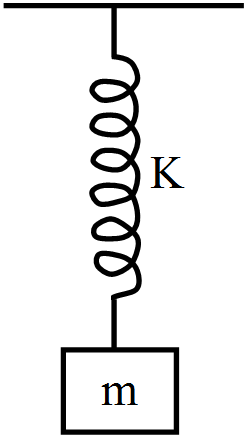
If now it is stretched by $\frac{\text{mg}}{\text{k}}$, the net stretch of the spring is: - A
$\frac{\text{mg}}{\text{k}}$
- B
$\frac{\text{mg}}{2\text{k}}$
- ✓
$\frac{2\text{mg}}{\text{k}}$
- D
$\frac{\text{mg}}{4\text{k}}$
AnswerCorrect option: C. $\frac{2\text{mg}}{\text{k}}$
View full question & answer→MCQ 321 Mark
A particle executing simple harmonic motion of amplitude $5\ cm$ has maximum speed $31.4\ cm/s.$ the frequency of its oscillations is:
AnswerMax speed $\text{v}_{\text{m}}=\text{r}\omega=\text{r}.2\pi\text{v}$
Max speed $\text{v}=\frac{\text{v}_{\text{m}}}{2\pi\text{r}}=\frac{31.4}{2\times3.14\times5}=1\text{Hz}$
View full question & answer→MCQ 331 Mark
The bob of a pendulum of length $1$ is pulled aside from its equilibrium position through an angle $\theta$ and then released. The bob will then pass through its equilibrium position with a speed $v,$ where $v$ equals:
- A
$\sqrt{2\text{gl}(1-\sin\theta)}$
- B
$\sqrt{2\text{g}(1-\cos\theta)}$
- ✓
$\sqrt{2\text{gl}(1-\cos\theta)}$
- D
$\sqrt{2\text{gl}(1+\sin\theta)}$
AnswerCorrect option: C. $\sqrt{2\text{gl}(1-\cos\theta)}$
The height of fall of pendulum, $\text{h = l}(1-\cos\theta)$ and $\text{v}=\sqrt{2\text{gh}}$
View full question & answer→MCQ 341 Mark
When a mass in is connected individually to two springs $S_1$ and $S_2$, the oscillation frequencies are $V_1$ and $V_2$. If the same mass is attached to the two springs as shown in figure, the oscillation frequency would be:
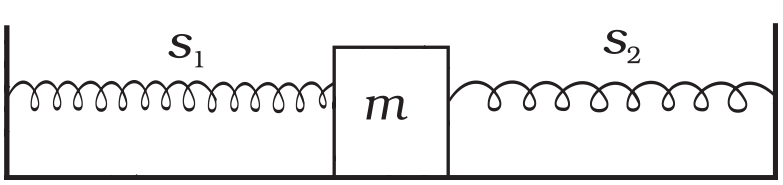
- ✓
$\text{v}_1+\text{v}_2$
- B
$\sqrt{\text{v}_1^2+\text{v}_2^2}$
- C
$\Big(\frac{1}{\text{v}_1}+\frac{1}{\text{v}_2}\Big)^{-1}$
- D
$\sqrt{\text{v}_1^2-\text{v}_2^2}$
AnswerCorrect option: A. $\text{v}_1+\text{v}_2$
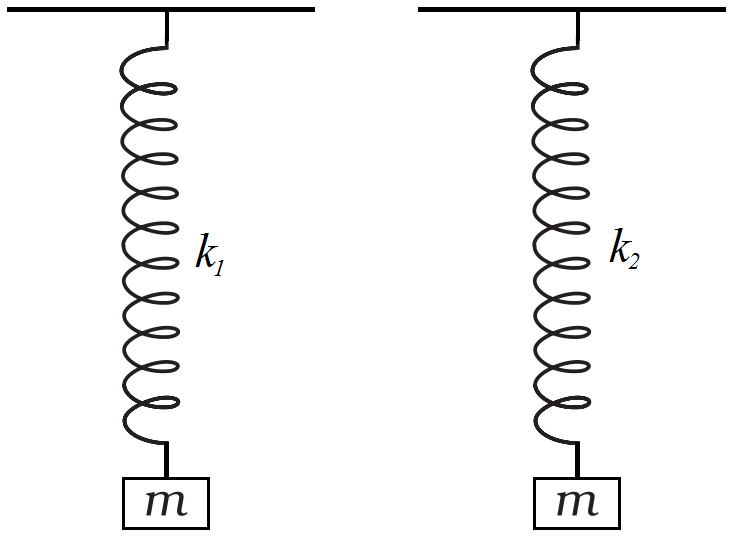
When the mass is connected to the two springs individually.
$\text{v}_1=\frac{1}{2\pi}\sqrt{\frac{\text{k}_1}{\text{m}}}\ ...(1)$
$\text{v}_2=\frac{1}{2\pi}\sqrt{\frac{\text{k}_2}{\text{m}}}\ ...(2)$
Now, the block is connected with two springs considered as parallel.
Here equivalent spring constant $\text{K}_\text{eq}=\text{K}_1+\text{K}_2$
Time period of oscillation of the spring block$-$system is
$\text{T}=2\pi\sqrt{\frac{\text{m}}{\text{k}_\text{eq}}}=2\pi\sqrt{\frac{\text{m}}{\text{k}_1+\text{k}_2}}$
Hence frequency,
$\text{v}=\frac{1}{\text{T}}=\frac{1}{2\pi}\times\sqrt{\frac{\text{k}_1+\text{k}_2}{\text{m}}}\ ...(3)$
$\text{v}=\frac{1}{2\pi}\Big[\frac{\text{k}_1}{\text{m}}+\frac{\text{k}_2}{\text{m}}\Big]^{\frac{1}{2}}$
From Eq. $(i) \frac{\text{k}_1}{\text{m}}=4\pi^2\text{v}_1^2$ and from Eq.$(ii) \frac{\text{k}_2}{\text{m}}=4\pi^2\text{v}_2^2$
$\Rightarrow\text{v}=\frac{1}{2\pi}\Big[\frac{4\pi^2\text{v}_1^2}{1}+\frac{4\pi^2\text{v}_2^2}{1}\Big]^\frac{1}{2}=\frac{2\pi}{2\pi}[\text{v}_1^2+\text{v}_2^2]^\frac{1}{2}$
$\Rightarrow\text{v}=\sqrt{\text{v}_1^2+\text{v}_2^2}$ View full question & answer→MCQ 351 Mark
A particle is in linear simple harmonic motion between two points $A$ and $B, 10\ cm$ apart Take the direction from $A$ to $B$ as the $+ ve$ direction and choose the correct statements:

- A
The sign of velocity, acceleration and force on the particle when it is $3\ cm$ away from $A$ going towards $B$ are positive.
- B
The sign of acceleration and force on the particle when it is at point $B$ is negative.
- C
The sign of velocity, acceleration and force on the particle when it is $4\ cm$ away from $B$ going towards $A$ are negative.
- ✓
Answer
- when the particle is going from $A$ to $B (+ve$ direction$)$ and it is $3 \ cm$ from $A$ velocity increases up to $O$ so velocity is positive. Acceleration in $\text{SHM}$ is towards $+ve.$ So both $v$ and a are $+ve.$
- As the particle is going towards $B$ so velocity is Positive not negative.
- As the particle is at $4\ cm$ from $B$ and $B$ and going towards $A$ i.e. $(-)ve$ side, so velocity and acceleration towards mean position at $O$. So both are negative.
- When particle is at $B$ force and acceleration both are towards $'O\ '$, so both are negative.
View full question & answer→MCQ 361 Mark
A particle executing simple harmonic motion with an amplitude $A$ and angular frequency $\omega$ The ratio of maximum acceleration to the maximum velocity of the particle is:
AnswerCorrect option: C. $\omega$
View full question & answer→MCQ 371 Mark
The equation of motion of a particle is $\text{x}=\text{a}\cos(\alpha\text{t})^2.$ The motion is:
- ✓
Periodic but not oscillatory.
- B
Periodic and oscillatory.
- C
Oscillatory but not periodic.
- D
Neither periodic nor oscillatory.
AnswerCorrect option: A. Periodic but not oscillatory.
$\text{x}=\text{a}\cos(\propto\text{t})^2$ is a cosine function and $x$ varies between $-a$ and $+a,$ the motion is oscillatory. Now checking for periodic motion, putting $t + T$ in place of $t.$
$T$ is supposed as period of the function $ω(t).$
$\text{x}(\text{t}+\text{T})=\text{a}\cos[\alpha(\text{t}+\text{T})]^2$
$=\text{a}\cos[\alpha^2\text{t}^2+\text{a}^2\text{T}^2+2\alpha^2\text{tT}]\neq\text{x}(\text{t})$
Hence, it is not periodic.
View full question & answer→MCQ 381 Mark
The periodic function $\text{f(t)}=\text{A}\sin(\omega\text{t})$ repeats itself with periodic function of:
- ✓
$2\pi$
- B
$3\pi$
- C
$\pi$
- D
$\frac{\pi}{2}$
AnswerCorrect option: A. $2\pi$
A periodic function repeats itself after a time period $T.$ and $\text{f(t) = f(t + T)}$ As $\sin(\omega\text{t}+2\omega\pi)$
$\therefore$ Period of function is
View full question & answer→MCQ 391 Mark
In $\text{SHM:}$
- A
$\text{PE}$ is stored due to elasticity of system.
- B
$\text{KE}$ is stored due to inertia of system.
- C
Both $\text{KE}$ and $\text{PE}$ are stored by virtue of elasticity of system.
- ✓
Both $(a)$ and $(b).$
AnswerCorrect option: D. Both $(a)$ and $(b).$
In $\text{SHM},$ potential energy depends on its elastic behaviour and kinetic energy on its inertial behavior. In case of mass m oscillating on spring. $\text{KE}$ is due to motion of $m$ and $\text{PE}$ is due to stretching of spring.
View full question & answer→MCQ 401 Mark
Two particles $P$ and $Q$ describe $\text{SHM}$ of same amplitude a and frequency $v$ along the same straight line. The maximum distance between two particles is $\sqrt{2} a.$ The phase difference between the particles is:
- ✓
- B
$\frac{\pi}{2}$
- C
$\frac{\pi}{6}$
- D
$\frac{\pi}{3}$
View full question & answer→MCQ 411 Mark
A particle is executing simple harmonic motion with frequency $f.$ The frequency at which its kinetic energy changes into potential energy is:
- A
$\frac{\text{f}}{2}$
- B
$f$
- ✓
$2f$
- D
$4f$
AnswerFrequency of kinetic energy or potential energy is double than that of particle executing $\text{S.H.M.}$
View full question & answer→MCQ 421 Mark
The displacement of a particle varies with time according to the relation : $\text{y}=\text{a}\sin\omega\text{t}+\text{b}\cos\omega\text{t}$
- A
The motion is oscillatory but not $\text{S.H.M.}$
- B
The motion is $\text{S.H.M.}$ with amplitude $a + b.$
- C
The motion is $\text{S.H.M.}$ with amplitude $a^2 + b^2$
- ✓
The motion is $\text{S.H.M.}$ with amplitude $\sqrt{\text{a}^2+\text{b}^2}.$
AnswerCorrect option: D. The motion is $\text{S.H.M.}$ with amplitude $\sqrt{\text{a}^2+\text{b}^2}.$
key concept: The sum of two $\text{S.H.Ms}$ of same frequencies is a $\text{S.H.M.}$
According to the question, the displacement
$\text{y}=\text{a}\sin\omega\text{t}+\text{b}\cos\omega\text{t}$
Given $\text{x}=\text{a}\sin\omega\text{t}+\text{b}\cos\omega\text{t}$
Let $\text{a}=\text{A}\cos\phi$
And $\text{b}=\text{A}\sin\phi$
Squaring and adding $(ii)$ and $(iii),$ we get
$\text{a}^2+\text{b}^2=\text{A}^2\cos^2\phi+\text{A}^2\sin^2\phi=\text{A}^2$
$=\text{A}^2\Rightarrow\text{A}=\sqrt{\text{a}^2+\text{b}^2}$
$\text{y}=\text{A}\sin\phi.\sin\omega\text{t}+\text{A}\cos\phi.\cos\omega\text{t}$
$=\text{A}\sin(\omega\text{t}+\phi)$
$\frac{\text{dy}}{\text{dt}}=\text{A}\omega\cos(\omega\text{t}+\phi)$
$\frac{\text{d}^2\text{y}}{\text{dt}^2}=-\text{A}\omega^2\sin(\omega\text{t}+\phi)$
$=-\text{A}\text{y}\omega^2=(-\text{A}\omega^2)\text{y}$
$\Rightarrow\frac{\text{d}^2\text{y}}{\text{dt}^2}\propto(-\text{y})$
Hence, it is an equation of $\text{SHM}$ with amplitude
$\text{A}=\sqrt{\text{a}^2+\text{b}^2}$
View full question & answer→MCQ 431 Mark
A particle executing $\text{S.H.M.}$ has a maximum speed of $30\ cm/s$ and a maximum acceleration of $60\ cm/ s^2$.The period of oscillation is:
AnswerCorrect option: A. $\pi\text{s}.$
Key concept: Let equation of an $\text{SHM}$ is represented by $\text{y}=\text{a}\sin\omega\text{t}$
$\text{v}=\frac{\text{dy}}{\text{dt}}=\text{a}\omega\cos\omega\text{t}$
Hence $(\text{v})_{\text{max}}=\text{a}\omega$
Acceleration $(\text{A})=\frac{\text{dx}^2}{\text{dt}^2}=-\text{a}\omega^2\sin\omega\text{t}$
Hence $\text{A}_{\text{max}}=\omega^2\text{a}$
Maximum speed, $\text{v}_\text{max}=\omega\text{A}$
Maximum acceleration, $\text{a}_{\text{max}}=\omega^2\text{A}$
Divide eqn. $(ii)$ by eqn. $(i),$ we get
$\frac{\text{a}_\text{max}}{\text{v}_\text{max}}=\frac{\omega^2\text{A}}{\omega\text{A}}=\omega$
$\therefore\frac{\text{a}_\text{max}}{\text{v}_\text{max}}=\frac{2\pi}{\text{T}}$
Here, $\text{v}_\text{max}=30\text{cms}^{-1},\text{a}_\text{max}=60\text{cms}^2$
$\therefore\text{T}=2\pi\Big(\frac{30\text{cms}^{-1}}{60\text{cms}^{-2}}\Big)=\pi\text{s}$
View full question & answer→MCQ 441 Mark
Motion of an oscillating liquid column in a $U-$tube is:
AnswerCorrect option: C. Simple harmonic and time period is independent of the density of the liquid.
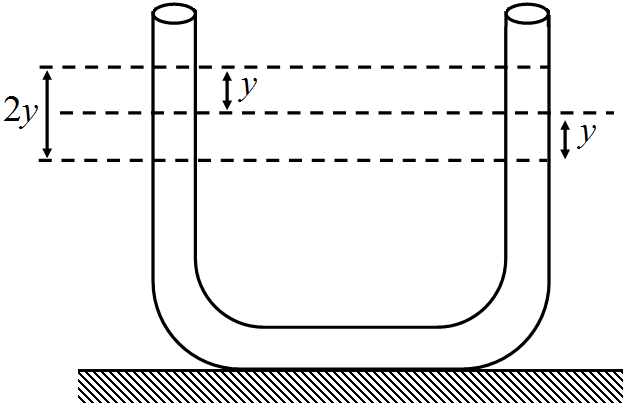
Restoring Force $F =$ Weight of liquid column of height $2y$
$\Rightarrow\text{FF}=-(\text{A}\times2\text{y}\times\rho)\times\text{g}=-2\text{A}\rho\text{gy}$
$\Rightarrow\text{F}\propto-\text{y}$
Motion is $\text{SHM}$ with force constant
$\text{K}=2\text{A}\rho\text{g}$
$\Rightarrow$ Time period $\text{T}$
$=2\pi\sqrt{\frac{\text{m}}{\text{k}}}$
$=2\pi\sqrt{\frac{\text{A}\times2\text{h}\times\rho}{2\text{A}\rho\text{g}}}$
$=2\pi\sqrt{\frac{\text{h}}{\text{g}}}$
Which is independent of the density of the liquid. View full question & answer→MCQ 451 Mark
A simple pendulum suspended from the roof of a lift oscillates with frequency $v$ when the lift is at rest. If the lift falls freely under gravity, its frequency of oscillations becomes:
View full question & answer→MCQ 461 Mark
Two simple harmonic motions of angular frequency 100rad/s$^{-1}$ and 1000rad/s$^{-1}$ have the same displacement amplitude. The ratio of their maximum acceleration is:
- A
$2 : 10$
- ✓
$1 : 10$
- C
$3 : 10$
- D
$4 : 10$
AnswerCorrect option: B. $1 : 10$
b. $1 : 10$
View full question & answer→MCQ 471 Mark
A particle executing a simple harmonic motion has a period of $6s.$ The time taken by the particle to move from the mean position to half the amplitude, starting from the mean position is:
- A
$\frac{1}{4}\text{s}$
- B
$\frac{3}{4}\text{s}$
- ✓
$\frac{1}{2}\text{s}$
- D
$\frac{3}{2}\text{s}$
AnswerCorrect option: C. $\frac{1}{2}\text{s}$
View full question & answer→MCQ 481 Mark
A simple pendulum of frequency $n$ is taken upto a certain height above the ground and then dropped along with its support so that it falls freely under gravity. The frequency of oscillations of the falling pendulum will:
- A
Become greater than $n.$
- ✓
- C
Remain equal to $n.$
- D
Become less than $n.$
View full question & answer→MCQ 491 Mark
In case of a forced vibration, the resonance wave becomes very sharp when the:
- ✓
- B
Restoring force is small.
- C
Applied periodic force is small.
- D
AnswerWhen damping force is small, the resonance peak becomes taller and narrower.
View full question & answer→MCQ 501 Mark
For simple harmonic motion of an object of mass $m,$
AnswerCorrect option: D. Both $(a)$ and $(c)$
View full question & answer→