Sample QuestionsChemical Bonding and Molecular Structure questions
One sample from each question group in this chapter. Select any group above to see the full set with answer keys.
Which of the following angle corresponds to $\ce{sp2}$ hybridisation?
- A
$90^\circ $
- ✓
$120^\circ$
- C
$180^\circ$
- D
$109^\circ$
Answer: B.
View full solution →Which of the following molecule has net dipole moment zero?
- A
$\ce{HF}$
- B
$\ce{H_2O}$
- ✓
$\ce{BF_3}$
- D
$\ce{CHCl_3}$
Answer: C.
View full solution →Diagonal hybridisation is the another name of :
- A
$\ce{sp^3}\ -$ hybridization.
- B
$\ce{sp^2}\ -$ hybridisation.
- ✓
$\ce{sp}\ -$ hybridisation.
- D
Answer: C.
View full solution →In the following questions two or more options may be correct : Which of the following have identical bond order?
- ✓
$\text{CN}^-$
- B
$\text{NO}^+$
- C
$\text{O}^-_2$
- D
$\text{O}^{2-}_2$
Answer: A.
View full solution →Predict the correct order : $($where bp is bonded paper and $\ce{lp}$ is lone pair of electrons$)$
- A
$\ce{bp - bp > lp - bp > lp - bp} $
- B
$\ce{lp - bp > bp - bp > lp - lp}$
- ✓
$\ce{lp - lp > lp - bp > bp - bp}$
- D
$\ce{lp - lp > bp - bp > lp - bp}$
Answer: C.
View full solution →Direction in the following Questions, the Assertion and Reason have been put forward. Read the statements carefully and choose the correct alternative from the following :
Assertion : The molecular orbitals with higher energy is called anti bonding orbitals.
Reason : The anti bonding nature of a molecular orbital is indicated by an asterisk over its designation.
- ✓
Both Assertion and Reason are true and Reason is the correct explanation of Assertion.
- B
Both Assertion and Reason are true but Reason is not the correct explanation of Assertion.
- C
Assertion is true but Reason is false.
- D
Both Assertion and Reason are false.
Answer: A.
View full solution →Direction in the following Questions, the Assertion and Reason have been put forward. Read the statements carefully and choose the correct alternative from the following :
Assertion : Ionic compounds usually have high melting and boiling points.
Reason : A large amount of energy is needed to overcome the strong interionic electrostatic attractive forces.
- ✓
Both Assertion and Reason are true and Reason is the correct explanation of Assertion.
- B
Both Assertion and Reason are true but Reason is not the correct explanation of Assertion.
- C
Assertion is true but Reason is false.
- D
Both Assertion and Reason are false.
Answer: A.
View full solution →Note : In the following questions a statement of Assertion $(A)$ followed by a statement of Reason $(R)$ is given. Choose the correct option out of the choices given below each question.
Assertion $(A)$ : Among the two $O–H$ bonds in $\mathrm{H}_2\mathrm{O}$ molecule, the energy required to break the first $O – H$ bond and other $O – H $ bond is the same.
Reason $(R)$ : This is because the electronic environment around oxygen is the same even after breakage of one $O – H$ bond.
- A
Both $A$ and $R$ are true but $R$ is not the correct explanation of $A.$
- B
$A$ is true but $R$ is false.
- C
$A$ is false but $R$ is true.
- ✓
Both $A$ and $R$ are false.
Answer: D.
View full solution →Note : In the following questions a statement of Assertion $(A)$ followed by a statement of Reason $(R)$ is given. Choose the correct option out of the choices given below each question.
Assertion $(A)$ : Sodium chloride formed by the action of chlorine gas on sodium metal is a stable compound.
Reason $(R)$ : This is because sodium and chloride ions acquire octet in sodium chloride formation.
- ✓
$A$ and $R$ both are correct, and $R$ is the correct explanation of $A.$
- B
$A$ and $R$ both are correct, but $R$ is not the correct explanation of $A$.
- C
$A$ is true but $R$ is false.
- D
$A$ and $R$ both are false.
Answer: A.
View full solution →Note : In the following questions a statement of Assertion $(A)$ followed by a statement of Reason $(R)$ is given. Choose the correct option out of the choices given below each question.
Assertion $(A)$ : Though the central atom of both $\mathrm{NH}_3$ and $\mathrm{H}_2 \mathrm{O}$ molecules are $\mathrm{sp}^3$ hybridised, yet $\mathrm{H}-\mathrm{N}-\mathrm{H}$ bond angle is greater than that of $\mathrm{H}-\mathrm{O}-\mathrm{H}$.
Reason $(R)$ : This is because nitrogen atom has one lone pair and oxygen atom has two lone pairs.
- ✓
$A$ and $R$ both are correct, and $R$ is the correct explanation of $A.$
- B
$A$ and $R$ both are correct, but $R$ is not the correct explanation of $A$.
- C
$A$ is true but $R$ is false.
- D
$A$ and $R$ both are false.
Answer: A.
View full solution →Write Lewis dot symbols for atoms of the following elements: Na.
Which hybrid orbitals are used by carbon atoms in the following molecules?
$\mathrm{CH}_3 \mathrm{COOH}$
View full solution →Write the resonance structures for$\text{NO}^-_3$
View full solution →Write Lewis dot symbols for atoms of the following elements: Br.
Discuss the shape of the following molecules using the VSEPR model:
$\text{AsF}_5$
View full solution →The skeletal structure of CH3COOH as shown below is correct, but some of the bonds are shown incorrectly.Write the correct Lewis structure for acetic acid.
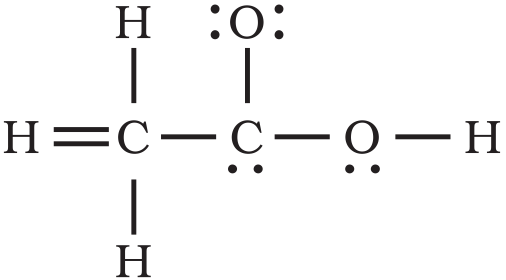
Write Lewis symbols for the following atoms and ions: $H$ and $H^{-}$
View full solution →Write Lewis symbols for the following atoms and ions: $S$ and $S^{2-}$.
View full solution →$\mathrm{H}_3 \mathrm{PO}_3$ can be represented by structures 1 and 2 shown below. Can these two structures be taken as the canonical forms of the resonance hybrid representing $\mathrm{H}_3 \mathrm{PO}_3$? If not, give reasons for the same.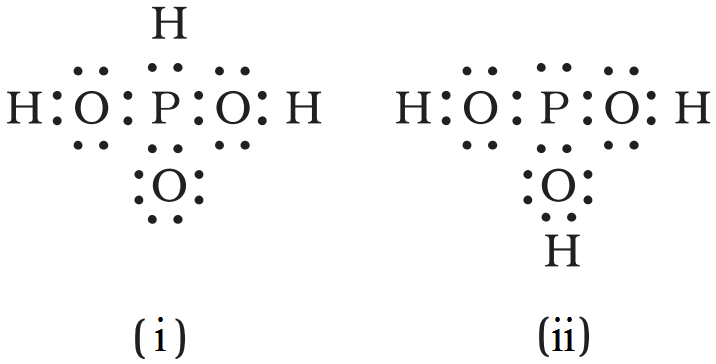
View full solution →Write Lewis symbols for the following atoms and ions: Al and $\text{Al}^{3+}$
View full solution →Use Lewis symbols to show electron transfer between the following atoms to form cations and anions: Ca and O
Use molecular orbital theory to explain why the $\mathrm{Be}_2$ molecule does not exist.
View full solution →Arrange the bonds in order of increasing ionic character in the molecules: $\mathrm{LiF}, \mathrm{K}_2 \mathrm{O}, \mathrm{N}_2, \mathrm{SO}_2$ and $\mathrm{ClF}_3$.
View full solution →Explain why $\mathrm{BeH}_2$ molecule has a zero dipole moment although the Be–H bonds are polar.
View full solution →Use Lewis symbols to show electron transfer between the following atoms to form cations and anions:
Al and N.
Read the passage given below and answer the following questions from (i) to (v).
The covalent bond may be classified into twotypes depending upon the types ofoverlapping:(i) Sigma(σ) bond, and (ii) pi($\pi$) bond
- Sigma(σ) bond: This type of covalent bondis formed by the end to end (head-on)overlap of bonding orbitals along theinternuclear axis. This is called as headon overlap or axial overlap. This can beformed by any one of the following typesof combinations of atomic orbitals.
s-s overlapping: In this case, there isoverlap of two half filled s-orbitals alongthe internuclear axis.
s-p overlapping: This type of overlapoccurs between half filled s-orbitals of oneatom and half filled p-orbitals of anotheratom.
p–p overlapping: This type of overlaptakes place between half filled p-orbitalsof the two approaching atoms.
- pi($\pi$) bond: In the formation of $\pi$ bondthe atomic orbitals overlap in such a waythat their axes remain parallel to each otherand perpendicular to the internuclear axis.The orbitals formed due to sidewiseoverlapping consists of two saucer type charged clouds above and below the planeof the participating atoms.
Basically the strength of a bond depends uponthe extent of overlapping. In case of sigma bond,the overlapping of orbitals takes place to alarger extent. Hence, it is stronger as comparedto the pi bond where the extent of overlappingoccurs to a smaller extent. Further, it isimportant to note that in the formation ofmultiple bonds between two atoms of amolecule, pi bond(s) is formed in addition to asigma bond. In order to explain the characteristicgeometrical shapes of polyatomic moleculeslike $CH_4,NH_3$ and $H_2O$ etc., Pauling introducedthe concept of hybridisation. According to himthe atomic orbitals combine to form new set ofequivalent orbitals known as hybrid orbitals.Unlike pure orbitals, the hybrid orbitals areused in bond formation. The phenomenon isknown as hybridisation which can be definedas the process of intermixing of the orbitals ofslightly different energies so as to redistributetheir energies, resulting in the formation of newset of orbitals of equivalent energies and shape.For example when one 2s and three 2p-orbitalsof carbon hybridise, there is the formation offour new $sp_3$ hybrid orbitals. Salient features of hybridisation: The mainfeatures of hybridisation are as under:
- The number of hybrid orbitals is equal tothe number of the atomic orbitals that gethybridised.
- The hybridised orbitals are alwaysequivalent in energy and shape.
- The hybrid orbitals are more effective informing stable bonds than the pure atomicorbitals.
- These hybrid orbitals are directed in spacein some preferred direction to haveminimum repulsion between electronpairs and thus a stable arrangement.Therefore, the type of hybridisationindicates the geometry of the molecules. Important conditions for hybridisation
- The orbitals present in the valence shell of the atom are hybridised.
- The orbitals undergoing hybridisation should have almost equal energy.
- Promotion of electron is not essential condition prior to hybridisation.
- It is not necessary that only half filled orbitals participate in hybridisation.
some cases, even filled orbitals of valence shell take part in hybridisation.
There are various types of hybridisationinvolving s, p and d orbitals. The differenttypes of hybridisation are as under:
some cases, even filled orbitals of valence shell take part in hybridisation.
There are various types of hybridisationinvolving $s , p$ and d orbitals. The differenttypes of hybridisation are as under:
1. sp hybridisation: This type ofhybridisation involves the mixing of one $s$ andone $p$ orbital resulting in the formation of twoequivalent $s p$ hybrid orbitals. The suitableorbitals for sp hybridisation are $s$ and pz , ifthe hybrid orbitals are to lie along the $z$-axis. Example of molecule having sphybridisationBeCl2: The ground state electronicconfiguration of Be is $1 s^2 2 s^2$. In the exited stateone of the 2 s -electrons is promoted to vacant 2 p orbital to account for its bivalency.One 2 s and one 2 p -orbital gets hybridised toform two sp hybridised orbitals.
2. sp2 hybridisation: In this hybridisationthere is involvement of one s and twop-orbitals in order to form three equivalent sp2hybridised orbitals. For example, in BCI 3 molecule, the ground state electronicconfiguration of central boron atom is $1 s^2 2 s^2 2 p^1$. In the excited state, one of the 2 selectrons is promoted to vacant $2 p$ orbital as a result boron has three unpaired electrons. These three orbitals (one 2 s and two 2 p )hybridise to form three sp2 hybrid orbitals.
3. $sp ^3$ hybridisation: This type ofhybridisation can be explained by taking theexample of $CH _4$ molecule in which there ismixing of one $s$-orbital and three p -orbitals ofthe valence shell to form four $sp ^3$ hybrid orbitalof equivalent energies and shape. There is $25 \% s$-character and $75 \% p$-character in each $sp ^3$ hybrid orbital. The four $sp ^3$ hybrid orbitals soformed are directed towards the four cornersof the tetrahedron. The angle between $sp ^3$ hybrid orbital is $109.5^{\circ}$.
- ....ntroduced the concept of hybridisation.
- Pauling
- Lewis
- Nyholm
- Gillespie
- Which of the following is an example of sp3 hybridization?
- BeCl2
- Ch4
- BCl3
- C2H4
- The angle between sp3 hybrid orbital is ….
- $5^\circ$
- $9^\circ$
- $109.5^\circ$
- $120^\circ$
- A sigma bond is formed by the overlapping of …
- s−s,
- s−p
- p−p
- All the above
- When one 2s and three 2p-orbitals of carbon hybridise, there is the formation of four new … hybrid orbitals.
- sp3
- sp2
- sp
- None of above
View full solution →Read the passage given below and answer the following questions from (i) to (v).
When covalent bond is formed betweentwo similar atoms, for example in $H _2, O _2, Cl _2, N_2 Or F _2$, the shared pair of electrons is equally Attracted by the two atoms. As a result electronPair is situated exactly between the twoldentical nuclei. The bond so formed is calledNonpolar covalent bond. As a result of polarisation, the moleculePossesses the dipole moment which can be defined as the productof the magnitude of the charge and theDistance between the centres of positive andNegative charge. It is usually designated by aGreek letter ' $\mu$ '. Mathematically, it is expressedAs follows :Dipole moment $(\mu)=$ charge $( Q ) \times$ distance ofSeparationDipole moment is usually expressed inDebye units (D). The conversion factor is $1 D =3.33564 \times 10^{-30} C$ mWhere C is coulomb and m is meter. Just as all the covalent bonds haveSome partial ionic character, the ionicBonds also have partial covalentCharacter. The partial covalent character of ionic bonds was discussed by Fajans in terms of the following rules:
- The smaller the size of the cation and theLarger the size of the anion, the greater theCovalent character of an ionic bond.
- The greater the charge on the cation, theGreater the covalent character of the ionic bond.
- For cations of the same size and charge, The one, with electronic configuration( $n -1) d ^0 n s ^0$, typical of transition metals, isMore polarising than the one with a nobleGas configuration, ns2 np6, typical of alkali and alkaline earth metal cations.
Sidgwick and Powell in 1940, proposed a simple theoryBased on the repulsive interactions of theElectron pairs in the valence shell of the atoms.It was further developed and redefined byNyholm and Gillespie (1957).The main postulates of VSEPR theory areAs follows:
- The shape of a molecule depends uponThe number of valence shell electron pairs(bonded or nonbonded) around the centralAtom.
- Pairs of electrons in the valence shell repelone another since their electron clouds arenegatively charged.
- These pairs of electrons tend to occupySuch positions in space that minimiseRepulsion and thus maximise distanceBetween them.
- The valence shell is taken as a sphere withThe electron pairs localising on theSpherical surface at maximum distanceFrom one another.
- A multiple bond is treated as if it is a singleElectron pair and the two or three electronPairs of a multiple bond are treated as aSingle super pair.
- Where two or more resonance structuresCan represent a molecule, the VSEPRModel is applicable to any such structure.
The arrangement of electron pairs and the atoms around the central atom can be : linear,Trigonal planar, tetrahedral, trigonal-Bipyramidal and octahedral. Valence bond theory was introduced byHeitler and London (1927) and developedFurther by Pauling and others. A discussionOf the valence bond theory is based on the knowledge of atomic orbitals, electronicConfigurations of elements.partialmerging of atomic orbitals is called overlappingof atomic orbitals which results in the pairingof electrons. The extent of overlap decides thestrength of a covalent bond. according toorbital overlap concept, the formation of acovalent bond between two atoms results bypairing of electrons present in the valence shellhaving opposite spins. When orbitals of two atoms come close to formbond, their overlap may be positive, negativeor zero depending upon the sign anddirection of orientation of amplitude of orbitalwave function in space. Positive andnegative sign on boundary surface diagramsin the show the sign (phase) of orbitalwave function and are not related to charge.Orbitals forming bond should have same sign(phase) and orientation in space. This is calledpositive overlap. The criterion of overlap, as the main factorfor the formation of covalent bonds appliesuniformly to the homonuclear/heteronucleardiatomic molecules and polyatomic molecules.
- Dipole moment is usually expressed in….
- Debye
- Centimeter
- Columbs
- Ergs
- 1D = .....
- $33564\times 10^{–28}Cm$
- $3.3564\times 10^{–30}Cm$
- $33564\times 10^{–32}Cm$
- $33564\times 10^{–34}Cm$
- Valence bond theory was introduced by ….
- Pauling and lewis
- Nyholm and Gillespie
- Heitler and London
- Sidgwick and Powell
- Pair is situated exactly between the two Identical nuclei the bond so formed is called …. covalent bond.
- Unipolar
- Bipolar
- Polar
- Nonpolar
- Pairs of electrons in the valence shell … one another since their electron clouds are negatively charged.
- Attract
- Repel
- Both a) & b)
- None if above
View full solution →Read the passage given below and answer the following questions from (i) to (v).

The attractive force which holds variousconstituents (atoms, ions, etc.) together in differentchemical species is called a chemical bond. In order to explain the formation of chemicalbond in terms of electrons, a number ofattempts were made, but it was only in 1916 when Kössel and Lewis succeededindependently in giving a satisfactoryexplanation. They were the first to providesome logical explanation of valence which wasbased on the inertness of noble gases. Lewis postulated that atoms achieve thestable octet when they are linked bychemical bonds. In the formation of amolecule, only the outer shell electrons takepart in chemical combination and they areknown as valence electrons. The inner shellelectrons are well protected and are generallynot involved in the combination process.G.N. Lewis, an American chemist introducedsimple notations to represent valenceelectrons in an atom. These notations arecalled Lewis symbols. For example, the Lewissymbols for the elements of second period areas under:
The bond formed, as a result of theelectrostatic attraction between thepositive and negative ions was termed as the electrovalent bond. The electrovalenceis thus equal to the number of unitcharge(s) on the ion.
Kössel and Lewis in 1916 developed animportant theory of chemical combinationbetween atoms known as electronic theoryof chemical bonding. According to this,atoms can combine either by transfer ofvalence electrons from one atom to another(gaining or losing) or by sharing of valenceelectrons in order to have an octet in theirvalence shells. This is known as octet rule. when two atoms share oneelectron pair they are said to be joined bya single covalent bond. In many compoundswe have multiple bonds between atoms. Theformation of multiple bonds envisagessharing of more than one electron pairbetween two atoms. If two atoms share twopairs of electrons, the covalent bondbetween them is called a double bond. Forexample, in the carbon dioxide molecule, wehave two double bonds between the carbonand oxygen atoms. Similarly in ethenemolecule the two carbon atoms are joined bya double bond. The Lewis dot structures provide a pictureof bonding in molecules and ions in termsof the shared pairs of electrons and theoctet rule. The Lewis dotstructures can be written by adopting thefollowing steps:
- The total number of electrons required forwriting the structures are obtained byadding the valence electrons of thecombining atoms. For example, in the $CH _4$ molecule there are eight valence electronsavailable for bonding.
- For anions, each negative charge wouldmean addition of one electron. Forcations, each positive charge would result in subtraction of one electron from the totalnumber of valence electrons. For example,for the $CO _3{ }^{2-}$ ion, the two negative chargesindicate that there are two additionalelectrons than those provided by theneutral atoms.
- Knowing the chemical symbols of thecombining atoms and having knowledgeof the skeletal structure of the compound, it is easyto distribute the total number of electronsas bonding shared pairs between theatoms in proportion to the total bonds.
- In general the least electronegative atomoccupies the central position in themolecule/ion. For example in the $NF _3$ andCO ${ }_3{ }^{2-}$, nitrogen and carbon are the centralatoms whereas fluorine and oxygenoccupy the terminal positions.
- After accounting for the shared pairs ofelectrons for single bonds, the remainingelectron pairs are either utilized for multiplebonding or remain as the lone pairs. Thebasic requirement being that each bondedatom gets an octet of electrons.
i. ... postulated that atoms achieve the stable octet when they are linked by chemical bonds.
- … postulated that atoms achieve the stable octet when they are linked by chemical bonds.
- Lewis
- Debye
- Charles
- Sidgwick
- … in 1916 developed an important theory of chemical combination between atoms known as electronic theory of chemical bonding.
- Kössel
- Lewis
- Both a) & b)
- Sidgwick
- In the formation of a molecule, only the outer shell electrons take part in chemical combination and they are known as …
- Backscattered electrons
- Valence electrons
- Primary electrons
- Secondary electrons
- In the $CH_4$ molecule there are … valence electrons available for bonding.
- 4
- 6
- 8
- 10
- The type of bond between atoms in a molecule of CO2 is:
- Ionic bond
- Metallic bond
- Hydrogen bond
- Covalent bond.
View full solution →Lewis dot structures, in general, do notrepresent the actual shapes of the molecules.In case of polyatomic ions, the net charge ispossessed by the ion as a whole and not by aparticular atom. It is, however, feasible toassign a formal charge on each atom. Theformal charge of an atom in a polyatomicmolecule or ion may be defined as thedifference between the number of valenceelectrons of that atom in an isolated or freestate and the number of electrons assignedto that atom in the Lewis structure. It isexpressed as :Generally the lowest energystructure is the one with the smallestformal charges on the atoms. The formalcharge is a factor based on a pure covalentview of bonding in which electron pairsare shared equally by neighbouring atoms. The octet rule, though useful, is not universal.It is quite useful for understanding thestructures of most of the organic compoundsand it applies mainly to the second periodelements of the periodic table. There are threetypes of exceptions to the octet rule.
- The incomplete octet of the central atom
- Odd-electron molecules
- The expanded octetFrom the Kössel and Lewis treatment of theformation of an ionic bond, it follows that theformation of ionic compounds wouldprimarily depend upon:
- The ease of formation of the positive andnegative ions from the respective neutralatoms;
- The arrangement of the positive andnegative ions in the solid, that is, thelattice of the crystalline compound.
The Lattice Enthalpy of an ionic solid is defined as the energy required to completely separate one mole of a solid ionic compound into gaseous constituent ions. For example, the lattice enthalpy of NaCl is 788 kJ mol–1. This means that 788 kJ of energy is required to separate one mole of solid NaCl into one mole of Na+ (g) and one mole of Cl– (g) to an infinite distance.Bond length is defined as the equilibriumdistance between the nuclei of two bondedatoms in a molecule. Bond lengths aremeasured by spectroscopic, X-ray diffractionand electron-diffraction techniques . The covalent radius is measuredapproximately as the radius of an atom’score which is in contact with the core ofan adjacent atom in a bonded situation. The vander Waals radius represents the overall sizeof the atom which includes its valence shellin a nonbonded situation. Bond Angle is defined as the angle between the orbitalscontaining bonding electron pairs around thecentral atom in a molecule/complex ion. Bondangle is expressed in degree which can beexperimentally determined by spectroscopicmethods. It gives some idea regarding thedistribution of orbitals around the centralatom in a molecule/complex ion and hence ithelps us in determining its shape. Forexample H–O–H bond angle in water can berepresented as under:
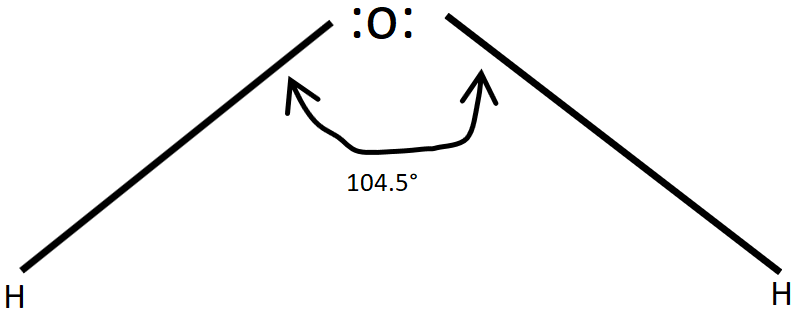
Bond Enthalpy It is defined as the amount of energy required to break one mole of bonds of a particular type between two atoms in a gaseous state. The unit of bond enthalpy is $kJ mol ^{-1}$. For example, the $H - H$ bond enthalpy in hydrogen molecule is $435.8 kJ mol ^{-1} \cdot H _2(g) \rightarrow H ( g )+ H ( g ) ; \Delta_{ a } H =435.8 kJ mol ^{-1}$. Bond Orderln the Lewis description of covalent bond, the Bond Order is given by the number ofbonds between the two atoms in amolecule. The bond order, for example in $H _2$ (with a single shared electron pair), in $O _2$ (with two shared electron pairs) and in $N _2$ (with three shared electron pairs) is 1,2,3respectively. A general correlation useful forunderstanding the stablities of moleculesis that: with increase in bond order, bondenthalpy increases and bond lengthdecreases. The concept of resonance was introducedto deal with the type of difficulty experiencedin the depiction of accurate structures ofmolecules like $O _3$. According to the conceptof resonance, whenever a single Lewis structure cannot describe a moleculeaccurately, a number of structures with similar energy, positions of nuclei, bonding and non-bonding pairs of electrons are taken as the canonical structures of the hybrid which describes the molecule accurately.
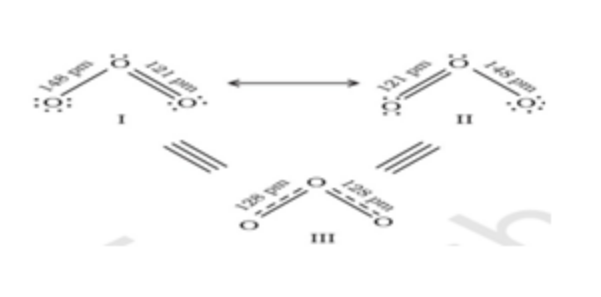
Thus for $O_3$, the two structures shown above constitute the canonical structures or resonance structures and their hybrid i.e., theIII structure represents the structure of $O_3$ more accurately. This is also called resonance hybrid. Resonance is represented by a double headed arrow. In general, it may be stated that
- Resonance stabilizes the molecule as the energy of the resonance hybrid is lessthan the energy of any single cannonical structure; and,
- Resonance averages the bond characteristics as a whole. Thus the energy of the$O_3$ .
resonancehybrid is lower than either of the two cannonical froms I and II.
- Which of the following techniques used to measure bond length?
- Spectroscopic techniques
- X-ray diffraction
- Electron-diffraction techniques
- All the above
- The unit of bond enthalpy is …
- $kJ mol^{–1}$
- $Cal mol^{-1}$
- $Cal$ mol
- $kJ$ mol
- With increase in bond order, bond enthalpy… and bond length ….
- Decreases, decreases
- Increases, decreases
- Increases, increases
- Decreases, increases
- The …. is measured approximately as the radius of an atom’s core which is in contact with the core of an adjacent atom in a bonded situation.
- Ionic radius
- Metallic radius
- Covalent radius
- None of above
- … is given by the number of bonds between the two atoms in a molecule.
- Bond Order
- Bond size
- Bond enthalpy
- Bond angle
View full solution →Describe the hybridisation in case of $PCl_5$ . Why are the axial bonds longer as compared to equatorial bonds?
View full solution →What is meant by the term bond order? Calculate the bond order of : $\text{N}_2,\text{O}_2,\text{O}_2^+$ and $\text{O}_2^-$
View full solution →Compare the relative stability of the following species and indicate their magnetic properties;$\text{O}_2,\text{O}_2^+,\text{O}^-_2$ (superoxide), $\text{O}^{2-}_2$ (peroxide)
View full solution →What is meant by hybridisation of atomic orbitals? Describe the shapes of $sp, sp^2 , sp^3$ hybrid orbitals.
View full solution →Draw diagrams showing the formation of a double bond and a triple bond between carbon atoms in $\mathrm{C}_2 \mathrm{H}_4$ and $\mathrm{C}_2 \mathrm{H}_2$ molecules.
View full solution →