Questions

3 Marks Question

Take a timed test

31 questions · self-marked practice — reveal the answer and mark yourself.

Question 13 Marks
Why does benzene undergo electrophilic substitution reactions easily and nucleophilic substitutions with difficulty?
Answer
Benzene is a planar molecule having delocalized electrons above and below the plane of ring. Hence, it is electron-rich. As a result, it is highly attractive to electron deficient species i.e., electrophiles.
Therefore, it undergoes electrophilic substitution reactions very easily. Nucleophiles are electron-rich. Hence, they are repelled by benzene. Hence, benzene undergoes nucleophilic substitutions with difficulty.
View full question & answer
Question 23 Marks
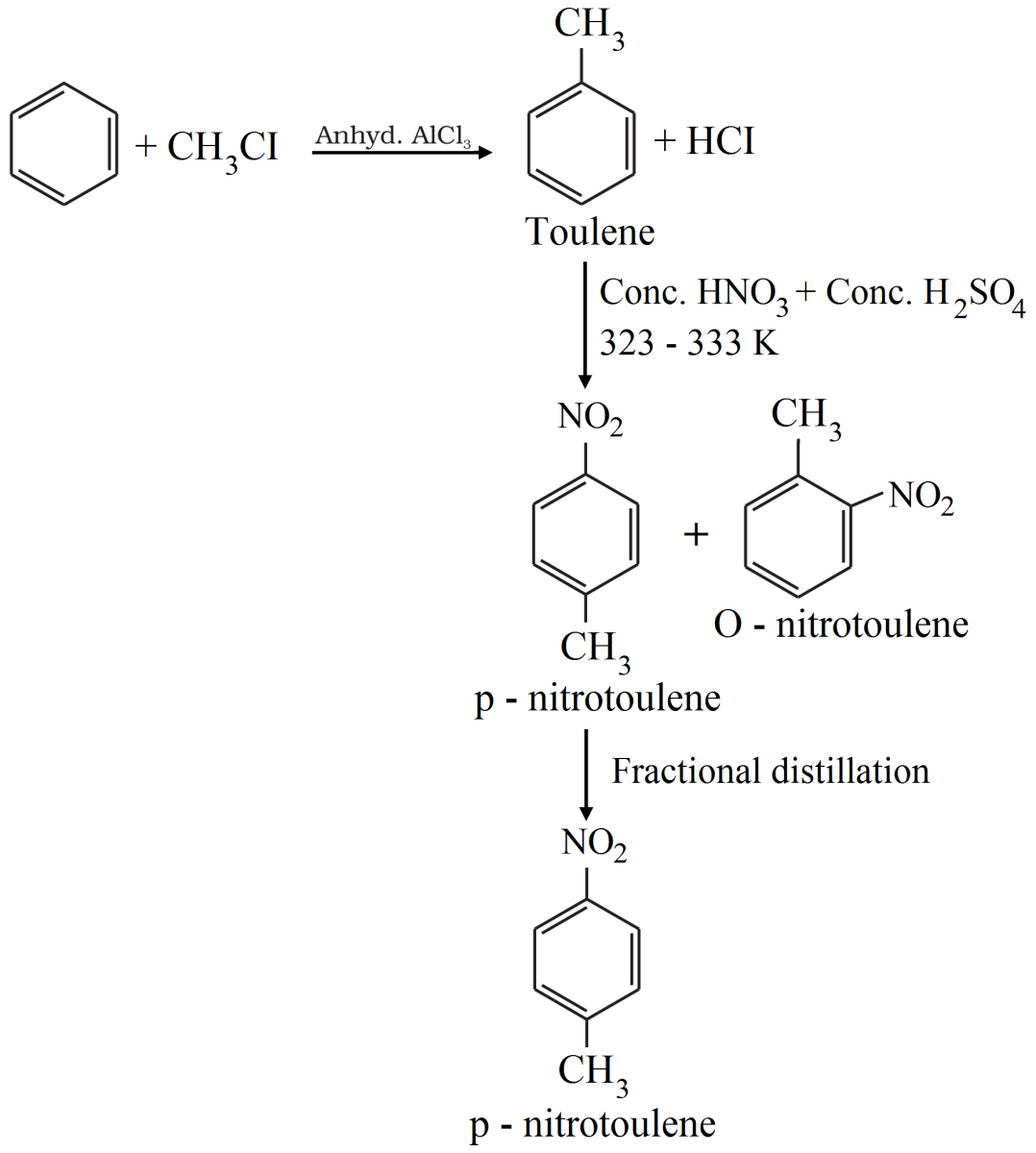
How will you convert benzene into:
p-nitrotoluene.
Answer
Benzene can be converted into p-nitrotoulene as:
View full question & answer
Question 33 Marks
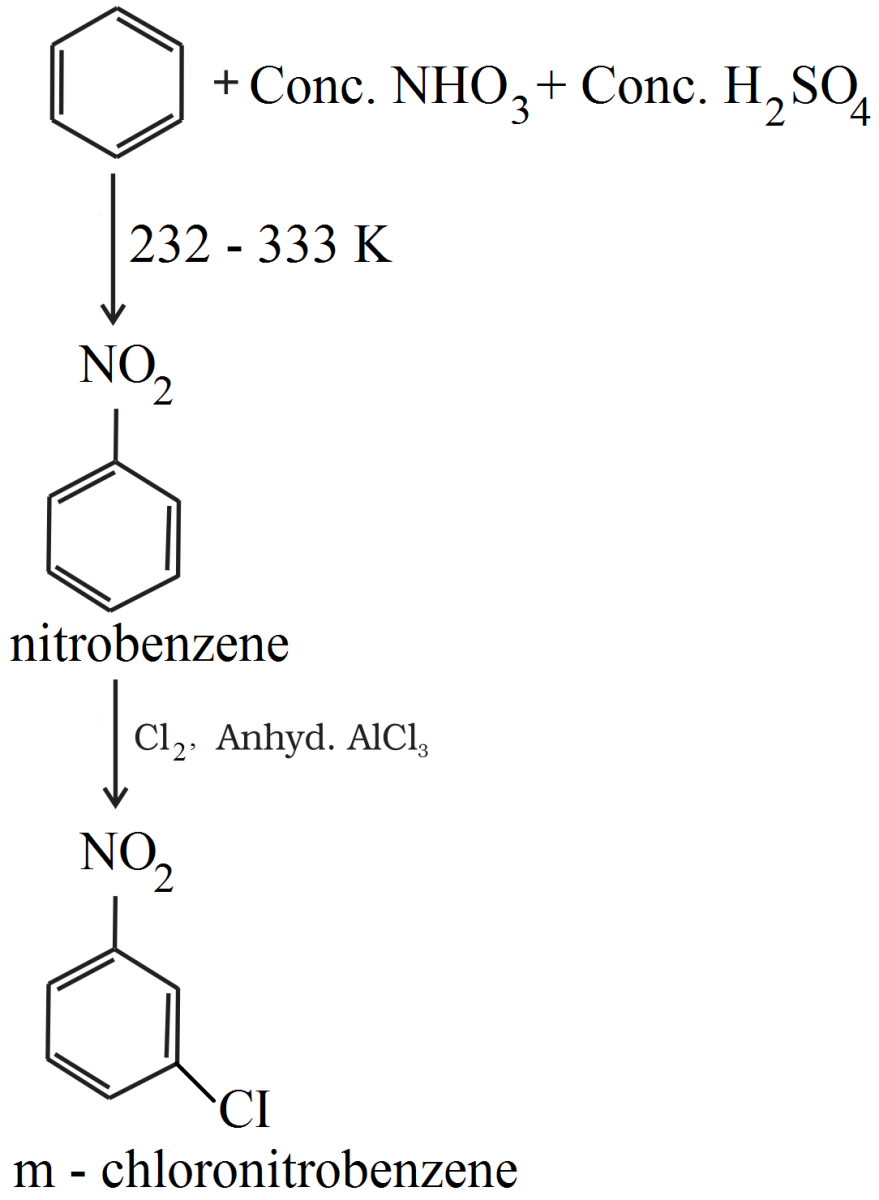
How will you convert benzene into:
m-nitrochlorobenzene.
Answer
Benzene can be converted into m-nitrochlorobenzene as:
View full question & answer
Question 43 Marks
2 Arrange the following set of compounds in order of their decreasing relative reactivity with an electrophile, $\mathrm{E}^{+}$. Chlorobenzene, 2,4-dinitrochlorobenzene, p-nitrochlorobenzene.
Answer
Electrophiles are reagents that participate in a reaction by accepting an electron pair in order to bond to nucleophiles.
The higher the electron density on a benzene ring, the more reactive is the compound towards an electrophile, $\mathrm{E}^{+}$ (Electrophilic reaction).
The presence of an electron withdrawing group (i.e., $\mathrm{NO}_2{}^{-}$and $\mathrm{Cl}^{-}$) deactivates the aromatic ring by decreasing the electron density.
Since $\mathrm{NO}_2{}^{-}$group is more electron withdrawing (due to resonance effect) than the $\mathrm{Cl}^{-}$group (due to inductive effect), the decreasing order of reactivity is as follows:
Chlorobenzene > p-nitrochlorobenzene > 2,4-dinitrochlorobenzene.
View full question & answer
Question 53 Marks
Write structures of all the alkenes which on hydrogenation give 2-methylbutane.
Answer
The basic skeleton of 2-methylbutane is shown below:
$\stackrel{1}{\hbox{C}}-\stackrel{2}{\hbox{C}}-\stackrel{3}{\hbox{C}}-\stackrel{4}{\hbox{C}}\\\ \ \ \ \ \ \ \ \ |\\\ \ \ \ \ \ \ \ \text{C}$
On the basis of this structure, various alkenes that will give 2-methylbutane on hydrogenation are:
  1. $\text{H}_3\text{C}-\text{CH}-\text{CH}=\text{CH}_2\\\ \ \ \ \ \ \ \ \ \ \ \ \ \ |\\\ \ \ \ \ \ \ \ \ \ \ \ \ \text{CH}_3$
  2. $\ \ \ \ \ \ \ \ \ \ \ \ \text{CH}_3\\\ \ \ \ \ \ \ \ \ \ \ \ \ \ |\\\text{CH}_3-\text{C}=\text{CH}-\text{CH}_3$
  3. $\text{CH}_2=\text{C}-\text{CH}-\text{CH}_3\\\ \ \ \ \ \ \ \ \ \ \ \ \ |\\\ \ \ \ \ \ \ \ \ \ \ \ \text{CH}_3$
View full question & answer
Question 63 Marks
Suggest the name of a Lewis acid other than anhydrous aluminium chloride which can be used during ethylation of benzene.
Answer
The ethylation reaction of benzene involves the addition of an ethyl group on the benzene ring. Such a reaction is called a Friedel-Craft alkylation reaction. This reaction takes place in the presence of a Lewis acid. Any Lewis acid like anhydrous $\mathrm{FeCl}_3, \mathrm{SnCl}_4, \mathrm{BF}_3$ etc. can be used during the ethylation of benzene.
View full question & answer
Question 73 Marks
What effect does branching of an alkane chain has on its boiling point?
Answer
As the branching in an alkane increases, the shape of the molecule approaches a sphere and size of the branched chain alkane becomes less than that of its straight chain counterpart. The reduced surface area results in decreased van der Waals' interaction and finally leads to lower boiling point as compared to straight chain alkanes of comparable molar mass.
View full question & answer
Question 83 Marks
For the following compound, write structural formulas and IUPAC names for all possible isomers having the number of double or triple bond as indicated:
$\mathrm{C}_4 \mathrm{H}_8$ (one double bond).
Answer
$\text{H}_2\stackrel{1}{\hbox{C}}=\stackrel{2}{\hbox{C}}\text{H}-\stackrel{3}{\hbox{C}}\text{H}_2-\stackrel{4}{\hbox{C}}\text{H}_3\\\ \ \ \ \ \ \ \ \ \ \ \ \ \ \ \ \ \ \ \ \ \text{(I)}$
$\stackrel{1}{\hbox{C}}\text{H}_3-\stackrel{2}{\hbox{C}}\text{H}=\stackrel{3}{\hbox{C}}\text{H}-\stackrel{4}{\hbox{C}}\text{H}_3\\\ \ \ \ \ \ \ \ \ \ \ \ \ \ \ \ \ \ \ \ \text{(II)}$
$\stackrel{1}{\hbox{C}}\text{H}_2=\stackrel{2}{\hbox{C}}-\stackrel{3}{\hbox{C}}\text{H}_3\\\ \ \ \ \ \ \ \ \ \ \ \ \ \ |\\\ \ \ \ \ \ \ \ \ \ \ \ \text{CH}_3\\\ \ \ \ \ \ \ \ \ \ \ \text{(III)}$
The IUPAC name of
Compound (I) is But-1-ene.
Compound (II) is But-2-ene.
Compound (III) is 2-Methylprop-1-ene.
View full question & answer
Question 93 Marks
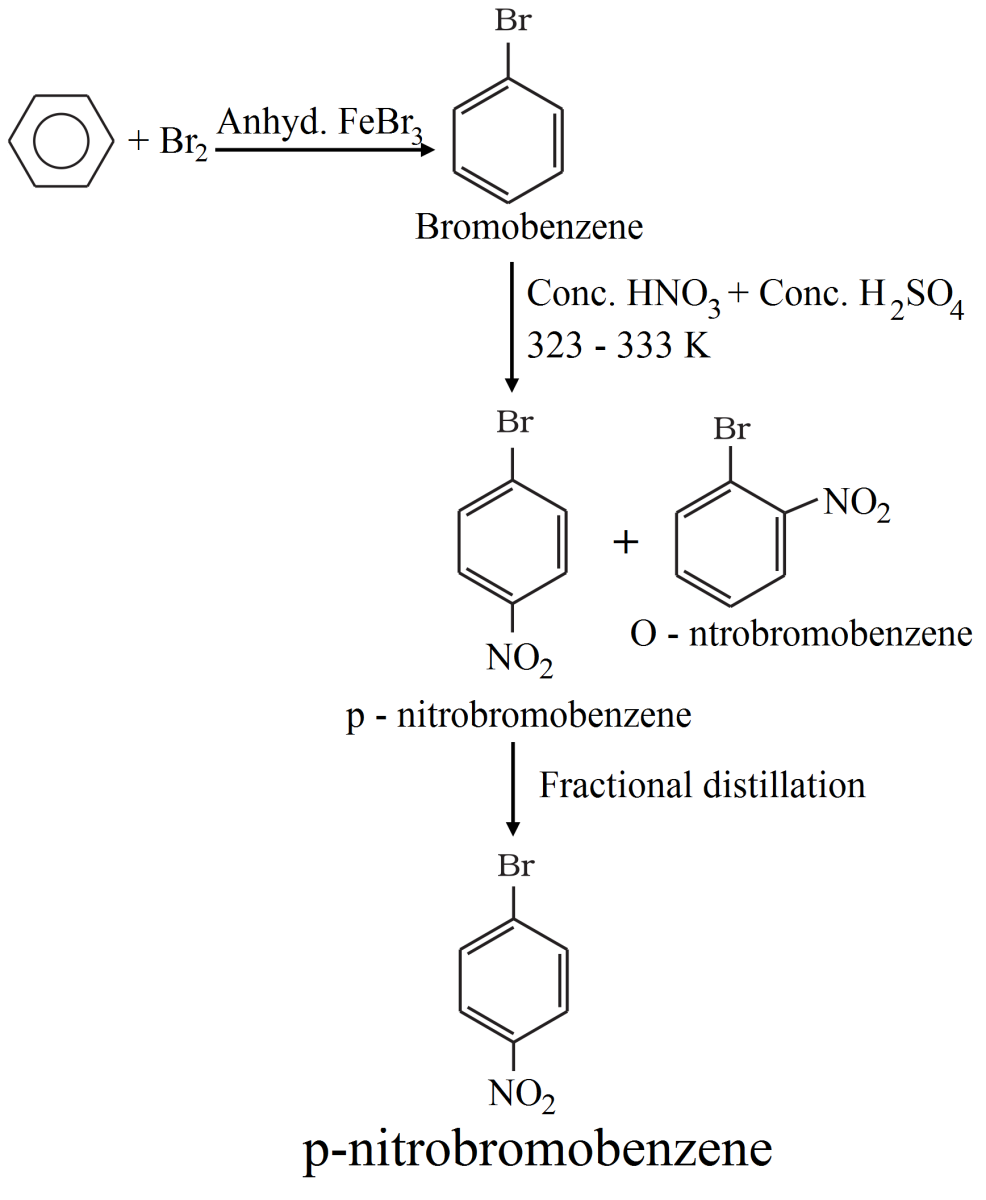
How will you convert benzene into:
p-nitrobromobenzene.
Answer
Benzene can be converted into p-nitrobromobenzene as:
View full question & answer
Question 103 Marks
For the following compound, write structural formulas and IUPAC names for all possible isomers having the number of double or triple bond as indicated:
$\mathrm{C}_5 \mathrm{H}_8$(one triple bond).
Answer
$\text{H}\stackrel{1}{\hbox{C}}\equiv\stackrel{2}{\hbox{C}}-\stackrel{3}{\hbox{C}}\text{H}_2-\stackrel{4}{\hbox{C}}\text{H}_2-\stackrel{5}{\hbox{C}}\text{H}_3\\\ \ \ \ \ \ \ \ \ \ \ \ \ \ \ \ \ \ \ \ \ \ \ \ \ \ \ \text{(I)}$
$\text{H}_3\stackrel{1}{\hbox{C}}-\stackrel{2}{\hbox{C}}\equiv\stackrel{3}{\hbox{C}}-\stackrel{4}{\hbox{C}}\text{H}_2-\stackrel{5}{\hbox{C}}\text{H}_3\\\ \ \ \ \ \ \ \ \ \ \ \ \ \ \ \ \ \ \ \ \ \ \ \text{(II)}$
$\text{H}_3\stackrel{4}{\hbox{C}}-\stackrel{3}{\hbox{C}}\text{H}-\stackrel{2}{\hbox{C}}\equiv\stackrel{1}{\hbox{C}}\text{H}\\\ \ \ \ \ \ \ \ \ \ \ \ \ \ \ \ |\\\ \ \ \ \ \ \ \ \ \ \ \ \ \ \text{CH}_3\\\ \ \ \ \ \ \ \ \ \ \ \ \ \ \ \text{(III)}$
The IUPAC name of
Compound (I) is pent-1-yne,
Compound (II) is pent-2-yne, and
Compound (III) is 3-Methylbut-1-1-yne.
View full question & answer
Question 113 Marks
2 Arrange the following set of compounds in order of their decreasing relative reactivity with an electrophile, $\mathrm{E}^{+}$.
Toluene, $\mathrm{p}-\mathrm{H}_3 \mathrm{C}-\mathrm{C}_6 \mathrm{H}_4-\mathrm{NO}_2, \mathrm{p}-\mathrm{O}_2 \mathrm{~N}-\mathrm{C}_6 \mathrm{H}_4-\mathrm{NO}_2$.
Answer
Electrophiles are reagents that participate in a reaction by accepting an electron pair in order to bond to nucleophiles.
The higher the electron density on a benzene ring, the more reactive is the compound towards an electrophile, $\mathrm{E}^{+}$ (Electrophilic reaction).
While $\mathrm{CH}_3$ is an electron donating group, $\mathrm{NO}_2$ - group is electron withdrawing. Hence, toluene will have the maximum electron density and is most easily attacked by $\mathrm{E}^{+}$.
$\mathrm{NO}_2$ - is an electron withdrawing group. Hence, when the number of $\mathrm{NO}_2$ - substituents is greater, the order is as follows:
Toluene $>\mathrm{p}-\mathrm{CH}_3-\mathrm{C}_6 \mathrm{H}_4-\mathrm{NO}_2, \mathrm{p}-\mathrm{O}_2 \mathrm{~N}-\mathrm{C}_6 \mathrm{H}_4-\mathrm{NO}_2$.
View full question & answer
Question 123 Marks
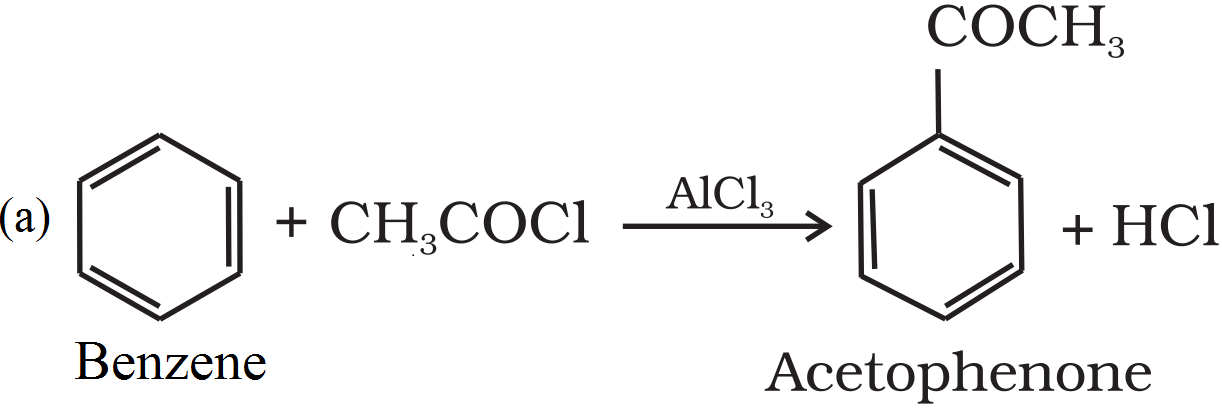
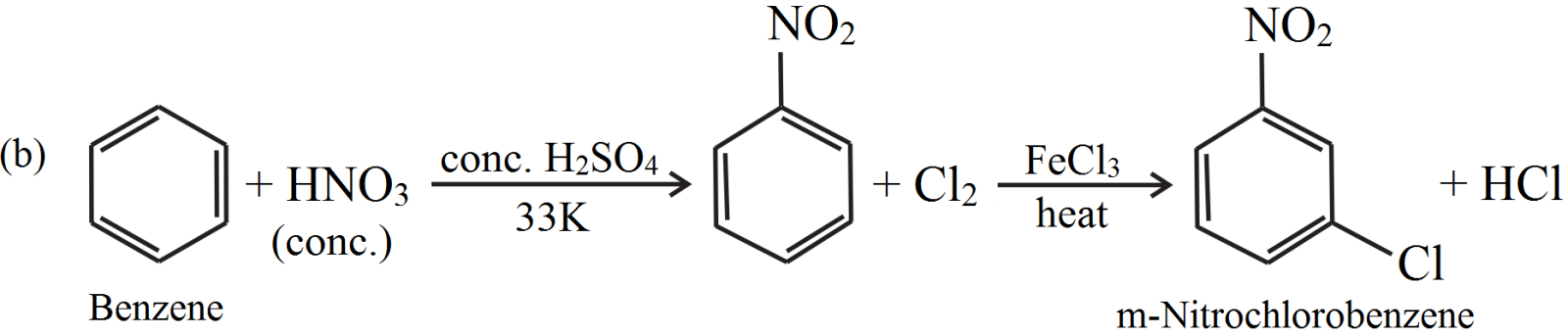
  1. How will you convert benzene into:
  1. Acetophenone?
  2. m-nitrochlorobenzene?
  1. Write the structures of products obtained by ozonolysis of pent-2-ene.
Answer


  1. $\text{CH}_3-\text{CH}=\text{CH}-\text{CH}_2-\text{CH}_3\xrightarrow[(\text{i})\ \text{Zn/H}_2\text{O}]{(\text{i})\ \text{O}_3}\\ \ \ \ \ \ \ \ \ \ \ \ \ \ \text{O}\\ \ \ \ \ \ \ \ \ \ \ \ \ \ ||\\\text{CH}_3-\text{C}-\text{H}+\text{CH}_3\text{CH}_2\text{CHO}\\\ \ \ \ \ \ \ \ \ _{\text{Ethanal}}\ \ \ \ \ \ \ \ \ \ \ \ \ \ _{\text{Propanal}}$
View full question & answer
Question 133 Marks
An alkane has a molecular mass of 72. Give all the possible structural isomers along with their IUPAC names.
Answer
The general formula of alkanes is $\text{C}_\text{n}\text{H}_{2\text{n}+2}\Rightarrow$ 12 × n + 1 × (2n + 2) = 72 or 12n + 2n + 2 = 72 or n = 5
Thus, the molecular formula of the alkane is $\mathrm{C}_5 \mathrm{H}_{12}$.
  1. $\text{CH}_3-\text{CH}_2-\text{CH}_2-\text{CH}_2-\text{CH}_2-\text{CH}_3\\ \ \ \ \ \ \ \ \ \ \ \ \ \ \ \ \ \ \ \ \ \ _{\text{n-hexane}}$
  2. $\text{CH}_3-\text{CH}-\text{CH}_2-\text{CH}_2-\text{CH}_3\\ \ \ \ \ \ \ \ \ \ \ \ \ \ |\\ \ \ \ \ \ \ \ \ \ \ \ \ \ \text{CH}_3\\ \ \ \ \ \ \ \ \ \ _{2-\text{methylpentane}}$
  3. $\text{CH}_3-\text{CH}_2-\text{CH}-\text{CH}_2-\text{CH}_3\\ \ \ \ \ \ \ \ \ \ \ \ \ \ \ \ \ \ \ \ \ \ \ \ \ \ \ |\\ \ \ \ \ \ \ \ \ \ \ \ \ \ \ \ \ \ \ \ \ \ \ \ \ \ \text{CH}_3\\ \ \ \ \ \ \ \ \ \ \ _{3-\text{methylpentane}}$
  4. $\text{CH}_3-\text{CH}-\text{CH}-\text{CH}_3\\ \ \ \ \ \ \ \ \ \ \ \ \ \ |\ \ \ \ \ \ \ \ \ \ |\\ \ \ \ \ \ \ \ \ \ \ \ \ \text{CH}_3\ \ \ \ \text{CH}_3\\ \ \ \ \ _{2,\ 3-\text{dimethylbutane}}$
  5. $ \ \ \ \ \ \ \ \ \ \ \ \ \ \text{CH}_3\\ \ \ \ \ \ \ \ \ \ \ \ \ \ \ |\\\text{CH}_3-\text{C}-\text{CH}_2-\text{CH}_3\\ \ \ \ \ \ \ \ \ \ \ \ \ \ |\\ \ \ \ \ \ \ \ \ \ \ \ \ \text{CH}_3\\ \ \ \ \ \ _{2,\ 2-\text{dimethylbutane}}$
View full question & answer
Question 143 Marks
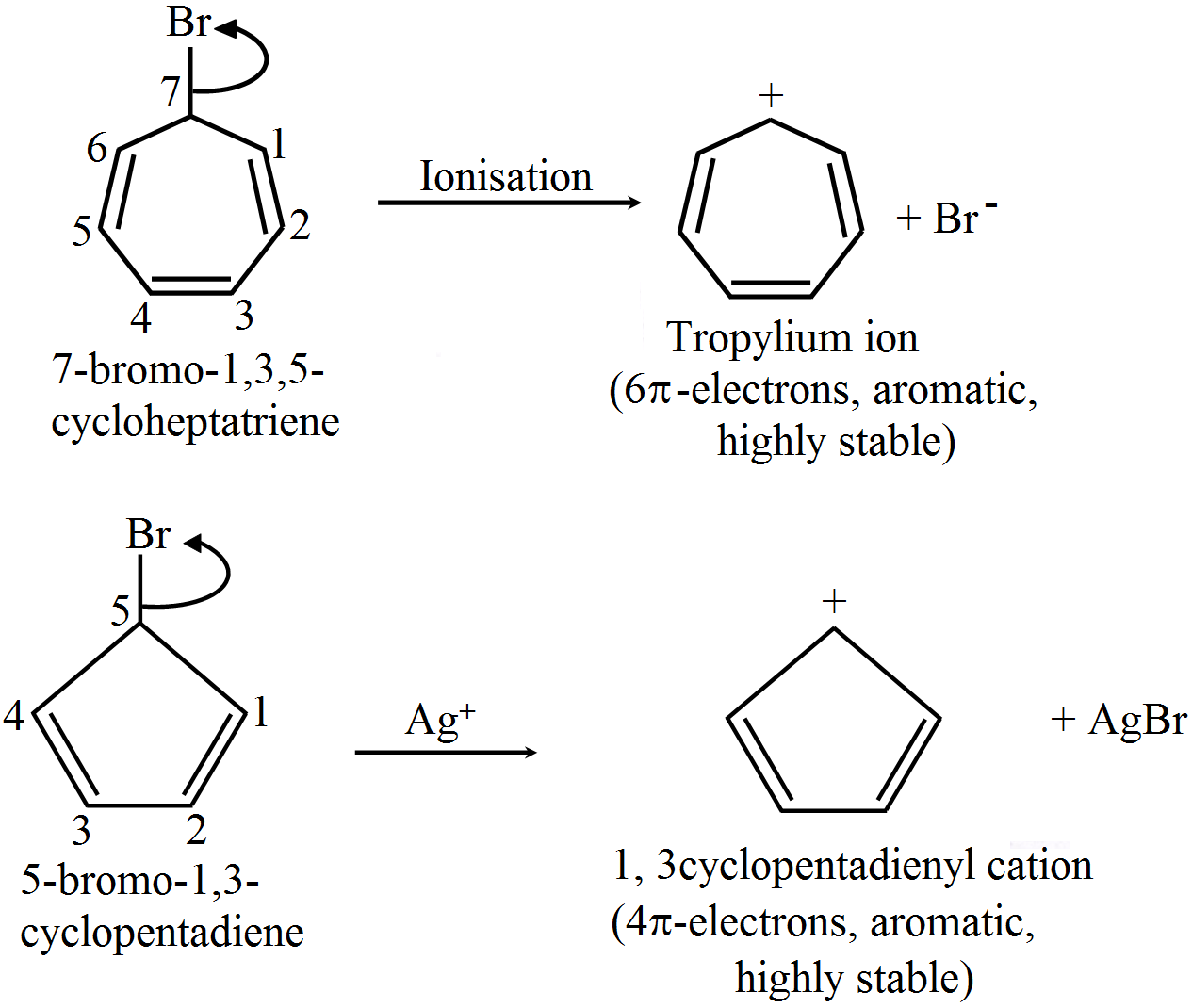
7-bromo-1, 3, 5-cycloheptatriene exists as an ion whereas 5-bromo-1, 3-cyclopentadiene does not form an ion even in presence of $\mathrm{Ag}^{+}$. Explain.
Answer
7-bromo-1, 3, 5-cycloheptatriene, on ionisation, gives tropylium ion. Since, tropylium ion contains $6\pi-$electrons which are completely delocalised, therefore, according to Huckel rule, it is aromatic and hence stable. Being highly stable, it is easily formed.

In contrast, 5-bromo-1, 3-cyclopentadiene, on ionisation, will give 1, 3-cyclopentadienyl cation which contains $4\pi-$electrons and hence, is anti-aromatic. Being anti-aromatic, it is highly unstable and hence is not formed even in the presence of $\mathrm{Ag}^{+}$ ion which otherwise facilitates ionisation.
View full question & answer
Question 153 Marks
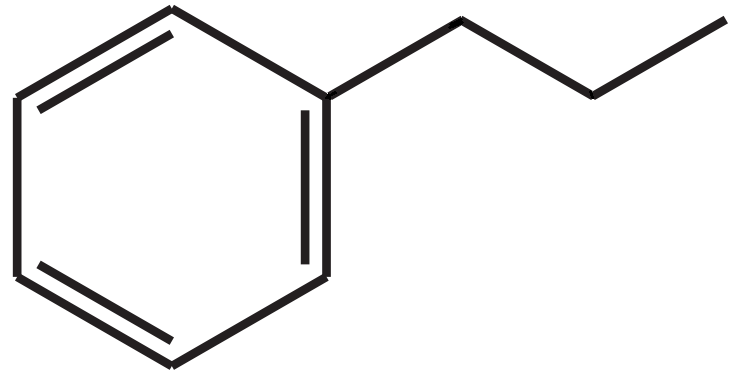
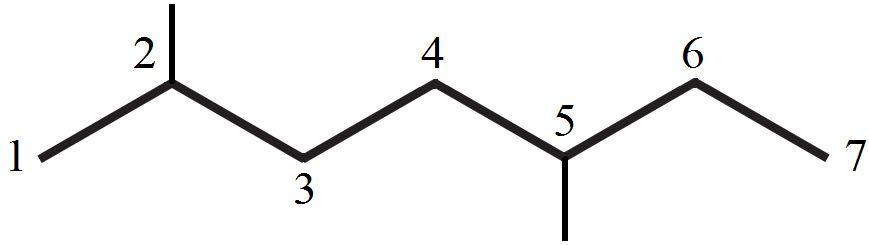
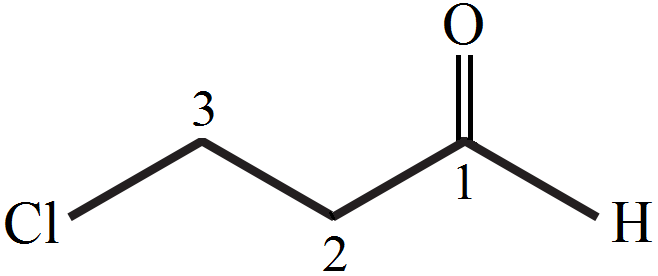
Write IUPAC names of the following:
  1.  
  1.  
  1.  
Answer
  1. Propyl benzene.
  2. 2, 5-Dimethyl heptanes.
  3. 3-Chloropropanal.
View full question & answer
Question 163 Marks
An unknown alkene ‘A’ on reductive ozonolysis gives two isomeric carbonyl compounds 'B' and 'C' having molecular formula $\mathrm{C}_3 \mathrm{H}_6 \mathrm{O}$. Write the structures of A, B and C.
Answer
$\stackrel{{1}}{\ \hbox{ CH}}_3-\stackrel{{2}}{ \hbox{C}}=\stackrel{{3}}{\ \hbox{ CH}}-\stackrel{{4}}{\ \hbox{ CH}}_2-\stackrel{{5}}{\ \hbox{ CH}}_3\xrightarrow[(\text{ii})\text{ Zn/H}_2\text{O}]{(\text{i})\text{ O}_3}\\ \ \ \ \ \ \ \ \ \ \ \ \ \ \ |\\ \ \ \ \ \ \ \ \ \ \ \ \ \ \text{CH}_3\\ \ \ \ \ \ \ \ _{2-\text{Methylpent-2-ene}}\\\ \ \ \ \ \ \ \ \ \ \ \ \ \text{‘A’}\\ \ \ \ \ \ \ \ \ \ \ \ \ \ \ \ \ \ \ \ \ \ \ \ \ \ \text{O}\ \ \ \ \ \ \ \ \ \ \ \ \ \ \ \ \ \ \ \ \ \ \ \ \ \text{O}\\ \ \ \ \ \ \ \ \ \ \ \ \ \ \ \ \ \ \ \ \ \ \ \ \ \ || \ \ \ \ \ \ \ \ \ \ \ \ \ \ \ \ \ \ \ \ \ \ \ \ \ \ ||\\ \text{CH}_3-\text{CH}_2-\text{C}-\text{H}+\text{CH}_3-\text{C}-\text{CH}_3\\ \ \ \ \ \ \ \ \ \ \ \ \ \ \ \ \text{‘B’}\ \ \ \ \ \ \ \ \ \ \ \ \ \ \ \ \ \ \ \ \ \ \ \ \ \ \ \ \ \ \ \ \ \text{‘C’}\\\ \ \ \ \ \ \ \ \ \ \ \ _{\text{Propanal}}\ \ \ \ \ \ \ \ \ \ \ \ \ \ \ \ _{\text{Acetone (Propanone)}}\\\ \ \ \ \ \ \ \ \ (\text{C}_3\text{H}_6\text{O})\ \ \ \ \ \ \ \ \ \ \ \ \ \ \ \ \ \ \ (\text{C}_3\text{H}_6\text{O})$
View full question & answer
Question 173 Marks
Write chemical reactions of:
  1. Wurtz-Fittig reaction.
  2. Kolbe's electrolytic method.
  3. B-Elimination reaction.
Answer
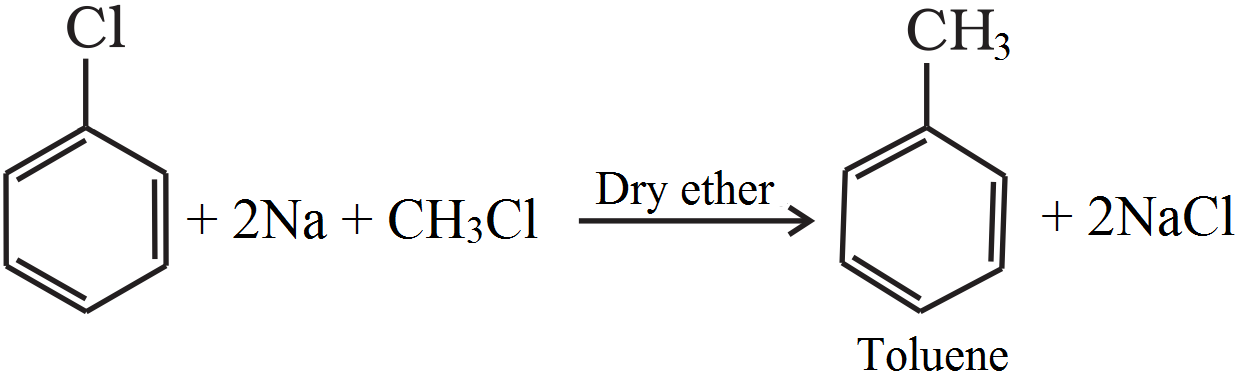
  1. Wurtz-Fittig reaction:
  1. Kolbe's electrolytic method:
$\text{CH}_3\text{COONa(aq)}\xrightarrow{\text{electrolysis}}\text{CH}_3\text{COO}^-+\text{Na}^+$
$\text{H}_2\text{O}\overrightarrow{\ \ \ \ \ \ \ }\ \text{H}^++\text{OH}^-$
At cathode: $2\text{H}^++2\text{e}^-\overrightarrow{\ \ \ \ \ }\text{H}_2(\text{g})$
At anode: $2\text{CH}_3\text{COO}^--2\text{e}^-\overrightarrow{\ \ \ \ \ \ \ \ }\ \text{CH}_3+2\text{CO}_2\\ \ \ \ \ \ \ \ \ \ \ \ \ \ \ \ \ \ \ \ \ \ \ \ \ \ \ \ \ \ \ \ \ \ \ \ \ \ \ \ \ \ \ |\\ \ \ \ \ \ \ \ \ \ \ \ \ \ \ \ \ \ \ \ \ \ \ \ \ \ \ \ \ \ \ \ \ \ \ \ \ \ \ \ \ \ \text{CH}_3$
  1. $\beta-$ Elimination reaction:
$\text{CH}_3-\stackrel{{\beta}}{\hbox{ CH}}_2-\stackrel{{\alpha}}{\hbox{ CH}}-\text{CH}_2-\text{CH}_3+\text{KOH(alc.)}\overrightarrow{\ \ \ \ \ \ \ }\\ \ \ \ \ \ \ \ \ \ \ \ \ \ \ \ \ \ \ \ \ \ \ \ \ \ \ \ |\\ \ \ \ \ \ \ \ \ \ \ \ \ \ \ \ \ \ \ \ \ \ \ \ \ \ \ \text{Cl}\\ \ \ \ \ \ \ \ \ \ \ \ \ \ \ \ _{3-\text{Chloropentane}}\\\text{CH}_3-\text{CH}=\text{CH}-\text{CH}_2-\text{CH}_3+\text{KCl}+\text{H}_2\text{O}\\ \ \ \ \ \ \ \ \ \ \ \ \ \ \ _{\text{Pent-2-ene}}$
View full question & answer
Question 183 Marks
  1. Name a compound that will be required to obtain butane using Kolbe's electrolytic method.
  2. Why does benzene show electrophilic substitution easily?
  3. Complete the following:
$\text{CH}_3-\text{C}=\text{CH}_2+\text{H}_2\text{O}\xrightarrow{\text{H}^+}\\ \ \ \ \ \ \ \ \ \ \ \ \ \ |\\ \ \ \ \ \ \ \ \ \ \ \ \ \text{CH}_3$
Answer
  1. $\mathrm{CH}_3 \mathrm{CH}_2 \mathrm{COONa}$ (sodium propanoate), on electrolysis will give butane.
  2. It is because benzene has $6\pi$ electrons, therefore, it attracts electrophile and undergo electrophilic substitution reactions.
  3. $\text{CH}_3-\text{C}=\text{CH}_2+\text{H}_2\text{O}\xrightarrow{\text{H}^+}\\ \ \ \ \ \ \ \ \ \ \ \ \ \ |\\ \ \ \ \ \ \ \ \ \ \ \ \ \text{CH}_3\\ \ \ \ \ \ _{2-\text{Methyl propene}}\\ \ \ \ \ \ \ \ \ \ \ \ \ \text{OH}\\ \ \ \ \ \ \ \ \ \ \ \ \ \ |\\ \text{CH}_3-\text{C}-\text{CH}_3\\ \ \ \ \ \ \ \ \ \ \ \ \ \ |\\ \ \ \ \ \ \ \ \ \ \ \ \ \text{CH}_3\\ \ \ \ \ \ _{2-\text{Methyl propan-2-ol}}$
View full question & answer
Question 193 Marks
Arrange 2, 2-dimethylbutane, 3-methylpentane and n-hexane in increasing order of their boiling point.
Answer
$ \ \ \ \ \ \ \ \ \ \ \ \ \ \ \ \ \ \ \ \ \ \ \ \ \ \text{CH}_3\\ \ \ \ \ \ \ \ \ \ \ \ \ \ \ \ \ \ \ \ \ \ \ \ \ \ \ |\\\text{H}_3\text{C}-\text{CH}_2-\text{C}-\text{CH}_3,\\ \ \ \ \ \ \ \ \ \ \ \ \ \ \ \ \ \ \ \ \ \ \ \ \ \ \ |\\ \ \ \ \ \ \ \ \ \ \ \ \ \ \ \ \ \ \ \ \ \ \ \ \ \ \text{CH}_3\\ \ \ \ _{2,\ 2-\text{dimethylbutane}}\\_{\text{Molecular formula}=(\text{C}_6\text{H}_{14})}$ $\ \ \ \ \ \ \ \ \ \ \ \ \ \ \ \ \ \ \ \ \ \ \ \ \ \text{CH}_3\\ \ \ \ \ \ \ \ \ \ \ \ \ \ \ \ \ \ \ \ \ \ \ \ \ \ \ |\\\text{CH}_3-\text{CH}_2-\text{CH}-\text{CH}_2-\text{CH}_3\\ \ \ \ \ \ \ \ \ \ \ \ \ \ \ \ \ _{3-\text{methylpentane}}\\ \ \ \ \ \ \ \ \ \ \ _{\text{Molecular formula}=(\text{C}_6\text{H}_{14})}$
$ \ \ \ \ \ \ \ \ \ \ \ \ \ \ \ \ \ \ \ \ \ \ \ \text{CH}_3\\ \ \ \ \ \ \ \ \ \ \ \ \ \ \ \ \ \ \ \ \ \ \ \ \ |\\ \ \ \ \ \ \ \ \ \ \ \ \ \ \ \ \ \ \ \ \ \ \ \ \text{CH}_2\\ \ \ \ \ \ \ \ \ \ \ \ \ \ \ \ \ \ \ \ \ \ \ \ \ |\\\text{CH}_3\text{CH}_2\text{CH}_2\text{CH}_2\\ \ \ \ \ \ \ \ \ \ \ _{\text{n-hexane}}\\ \ _{\text{Molecular formula}=(\text{C}_6\text{H}_{14})}$
The three given compounds are isomers if molecular formula $\mathrm{C}_6 \mathrm{H}_{14}, \mathrm{n}$-hexane has the longest chain and therefore has the highest boiling point. 2, 2-dimethylbutane is the most spherical and has the smallest surface area. In this case the van der Waal's force will be weakest and so it has the lowest boiling point.
Thus, the increasing order of boiling point of the three isomers in as follows.
2, 2-dimethylbutane < 3-methylpentane < n-hexane.
View full question & answer
Question 203 Marks
An alkyl halide ' A ' of formula $\mathrm{C}_6 \mathrm{H}_{13} \mathrm{Cl}$ on treatment with alcoholic KOH gives two isomeric alkenes ' B ' and ' C ' with molecular formula $\mathrm{C}_6 \mathrm{H}_{12}$. Both alkenes on hydrogenation give 2, 3-dimethyl butane. Predict the structure of 'A', 'B' and ' C '.
View full question & answer
Question 213 Marks
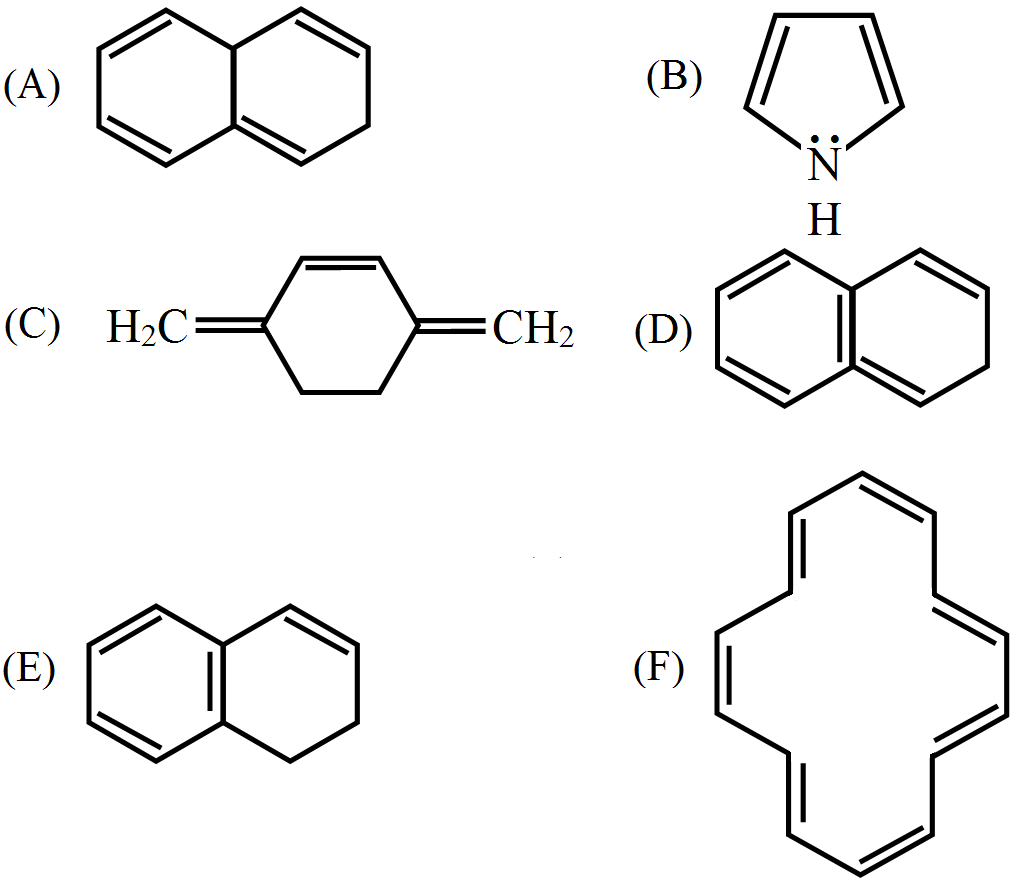
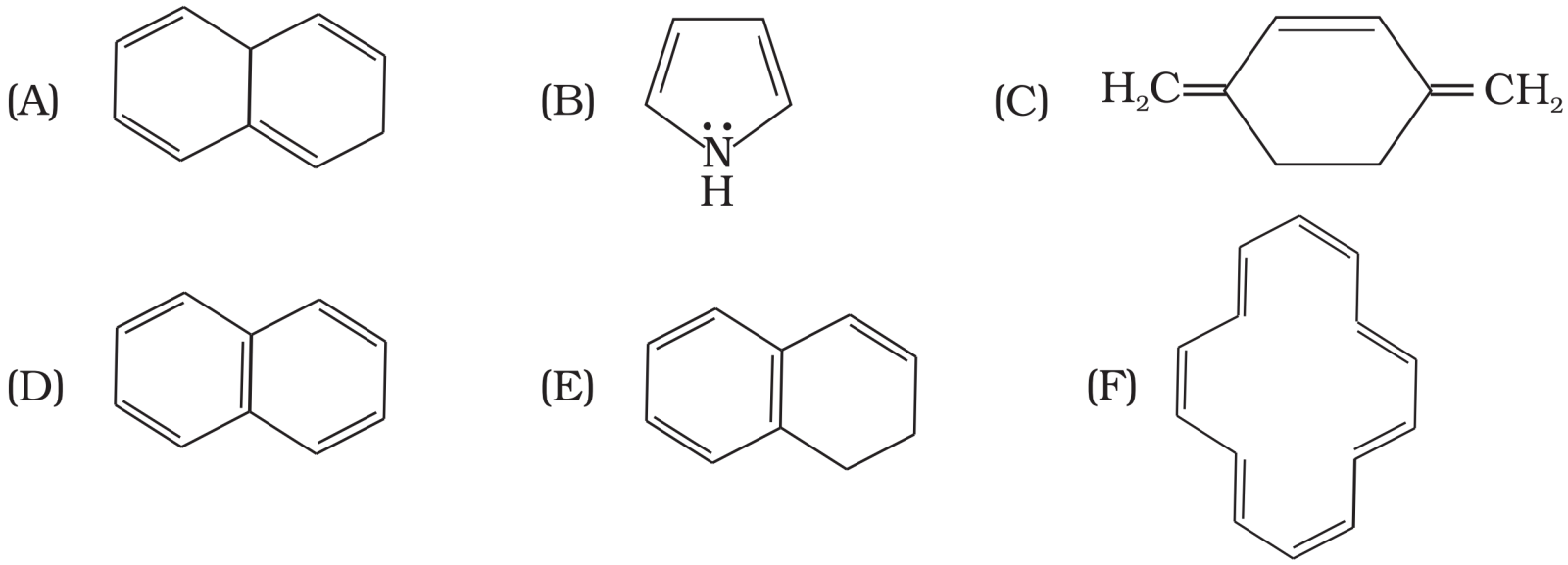
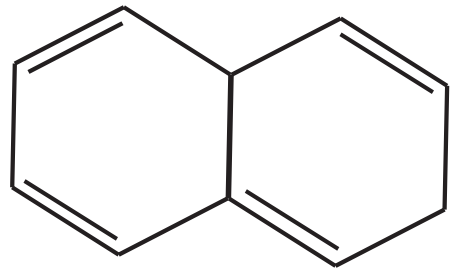
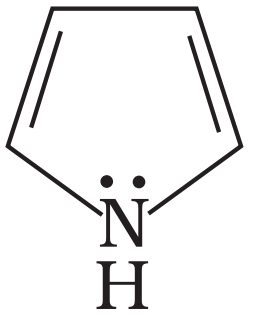
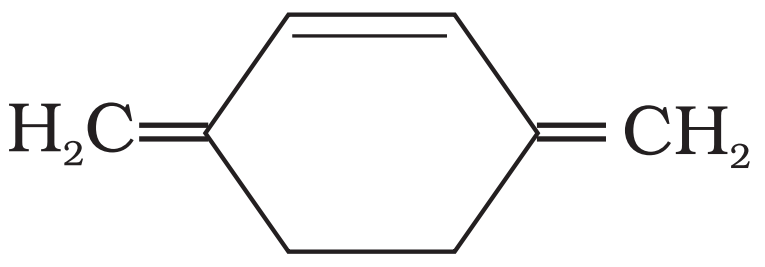
Which of the following compounds are aromatic according to Huckel's rule?
Answer
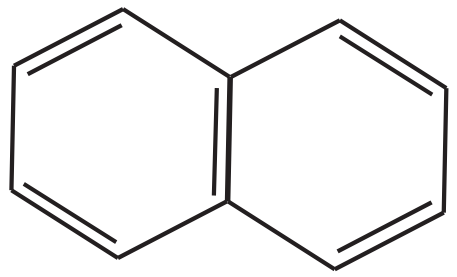
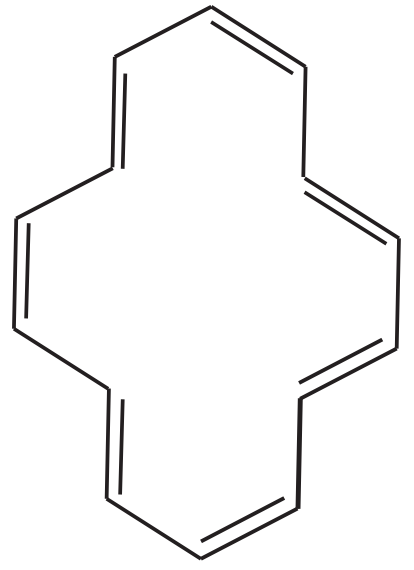
  1. The compound has $8\pi-$electrons. It will be non-aromatic. Both rings are non-benzenoid.
  2. The compound is aromatic. It has $6\pi\text{e}^-$ delocalized electron ($4\pi\text{e}^-$ + 2 lone pair electrons), all the four carbon atoms and the N-atom are $\text{sp}^2$-hybridised.
  3. The compound contains $6\pi-$electrons but not in the ring hence it is non-aromatic
  4. $10\pi-$electron obeying Huckel rule and the ring is planar. It is aromatic.
  5. In this compound, one six membered planar ring has $6\pi-$electron although it has $8\pi-$electrons in two rings. It is therefore aromatic.
  6. It has $14\pi-$electrons in conjugation and in the planar ring. Huckel rule is verified. It will be aromatic.
View full question & answer
Question 223 Marks
Give the reactions involved in the preparation of propane from the following:
  1. $\text{CH}_3-\text{CH}=\text{CH}_2$
  2. $\text{CH}_3-\text{CH}_2-\text{CH}_2\text{Cl}$
  3. $\text{CH}_3\text{CH}_2\text{CH}_2\text{COO}^-\text{Na}^+$
Answer
  1. $\text{CH}_3-\text{CH}=\text{CH}_2+\text{H}_2\xrightarrow{\text{Pd/pt/Ni}}\text{CH}_3-\text{CH}_2-\text{CH}_3\\ \ \ \ \ \ \ \ \ \ \ \ _{\text{Propene}} \ \ \ \ \ \ \ \ \ \ \ \ \ \ \ \ \ \ \ \ \ \ \ \ \ \ \ \ \ \ \ \ \ \ \ \ \ \ \ \ \ \ \ \ _{\text{Propane}}$
  2. $\text{CH}_3-\text{CH}_2-\text{CH}_2-\text{Cl}+2[\text{H}]\xrightarrow{\text{Zn/HCl}}\text{CH}_3\text{CH}_2\text{CH}_3+\text{HCl}$
  3. $\text{CH}_3-\text{CH}_2-\text{CH}_2-\text{COO}^-\text{Na}^++\text{NaOH(CaO)}\\\xrightarrow{\text{heat}}\text{CH}_3-\text{CH}_2-\text{CH}_3+\text{Na}_2\text{CO}_3$
View full question & answer
Question 233 Marks
An alkyl halide $(\mathrm{X})$ of formula $\mathrm{C}_3 \mathrm{H}_{13} \mathrm{Cl}$ on treatment with alcoholic KOH or potassium tert-butoxide gives two isomeric alkenes Yand $\mathrm{Z}\left(\mathrm{C}_6 \mathrm{H}_{12}\right)$. Both alkenes on hydrogenation give 2, 3-dimethylbutane. Predict the structure of $X$ , $Y$ and $Z$.
Answer
$ \ \ \ \ \ \ \ \ \ \ \ \ \text{CH}_3 \ \text{CH}_3\\ \ \ \ \ \ \ \ \ \ \ \ \ \ | \ \ \ \ \ \ \ |\\\text{CH}_3-\text{C}-\text{C}-\text{CH}_3+\text{KOH}\xrightarrow{\text{Heat}}\\ \ \ \ \ \ \ \ \ \ \ \ \ \ | \ \ \ \ \ \ \ |\ \ \ \ \ \ \ \ \ \ \ \ \ \ \ \ \ \ (\text{alc.})\\ \ \ \ \ \ \ \ \ \ \ \ \ \text{Cl} \ \ \ \ \text{H}\\ \ \ \ \ \ \ \ \ \ \ \ \ \ \ \ (\text{X})$$ \ \ \ \ \ \ \ \ \ \ \ \ \text{CH}_3 \ \text{CH}_3 \ \ \ \ \ \ \ \ \ \ \ \ \ \ \ \ \ \ \ \ \ \ \ \ \ \text{CH}_3 \ \text{CH}_3\\ \ \ \ \ \ \ \ \ \ \ \ \ \ | \ \ \ \ \ \ \ | \ \ \ \ \ \ \ \ \ \ \ \ \ \ \ \ \ \ \ \ \ \ \ \ \ \ \ \ \ \ \ \ | \ \ \ \ \ \ \ |\\\text{CH}_3-\text{C}=\text{C}-\text{CH}_3+\text{CH}_2=\text{C}-\text{C}-\text{CH}_3\\_\text{2,3-dimethyl but-2-ene} \ \ \ \ \ \ \ \ \ \ \ \ \ \ \ \ \ \ \ \ \ \ \ \ \ \ \ \ \ \ \ \ \ \ |\\\ \ \ \ \ \ \ \ \ \ \ \ \ \ \ \ \ \ \ \ \ \ \ \ \ \ \ \ \ \ \ \ \ \ \ \ \ \ \ \ \ \ \ \ \ \ \ \ \ \ \ \ \ \ \ \ \ \ \ \ \ \text{H}\\ \ \ \ \ \ \ \ \ \ \ \ \ \ \ \ \ \ \ \ \ \ \ \ \ \ \ \ \ \ \ \ \ \ \ \ \ \ \ \ \ \ \ _{2,3-\text{dimethyl-1-butene}}\\ \ \ \ \ \ \ \ \ \ \ \ \ \ \ \ \ \ \ \ \ \ \ \ \ \ \ \ \ \ \ \ \ \ \ \ \ \ \ \ \ \ \ \ \ \ \ \ \ \ \ \ \ \ \ \ (\text{Z})$
View full question & answer
Question 243 Marks
For the following reactions, complete and Identify the type of reactions:
  1. $\text{CH}_3-\text{CH}_2-\text{CH}_2\text{Br}+\text{KOH(alc.)}\overrightarrow{\ \ \ \ \ \ }$
  2. $\text{CH}_3-\text{CH}-\text{CH}_3+\text{KOH(aq)}\overrightarrow{ \ \ \ \ \ \ }\\ \ \ \ \ \ \ \ \ \ \ \ \ \ |\\ \ \ \ \ \ \ \ \ \ \ \ \ \text{Br}$
  3.  
Answer
  1. $\text{CH}_3\text{CH}_2\text{CH}_2\text{Br}+\text{KOH(alc.)}\overrightarrow{\ \ \ \ \ \ }\\\text{CH}_3-\text{CH}=\text{CH}_2+\text{KBr}+\text{H}_2\text{O}$
Nucleophilic Elimination is taking place.
  1. $\text{CH}_3-\text{CH}-\text{CH}_3+\text{KOH(aq)}\overrightarrow{ \ \ \ \ \ \ }\\ \ \ \ \ \ \ \ \ \ \ \ \ \ |\\ \ \ \ \ \ \ \ \ \ \ \ \ \text{Br}\\\text{CH}_3-\text{CH}-\text{CH}_3+\text{KBr}\\ \ \ \ \ \ \ \ \ \ \ \ \ \ |\\ \ \ \ \ \ \ \ \ \ \ \ \ \text{OH}\\ \ \ \ \ \ \ \ \ _{2-\text{Propanol}}$
​​​​​​​Nucleophilic substitution reaction is taking place.
  1.  

Addition reaction is taking place.
View full question & answer
Question 253 Marks
Which of the following compounds are aromatic according to Huckel’s rule?
Answer
(A) The compound has $8\pi$ electrons. It is non aromatic.
(B) This compound has delocalised $6\pi$ electrons, follows Huckel rule. It is aromatic.
(C) In this compound $6\pi$ electrons are not present in the ring hence nonaromatic.
(D) It is aromatic obeying Huckel's rule. It has 10 delocalised $\pi$-electrons.
(E) It has $8\pi$-electrons, out of which $6\pi$-electrons are delocalised. Follows Huckel rule. It is aromatic.
(F) In this compound $14\pi$ electrons are in conjugation and in the planar ring. It is also aromatic, It follows Huckel's rule.
View full question & answer
Question 263 Marks
Convert:
  1. Ethylene to Nitrobenzene.
  2. Write short note on Markovnikov's Rule.
Answer
  1.  
  1. Markovnikov's Rule: When a polar compound is a unsymmetrical alkene or alkyne, negative part goes to least substituted carbon e.g., $\ \ \ \ \ \ \ \ \ \ \ \ \ \ \ \ \ \ \ \ \ \ \ \ \ \ \ \ \ \ \ \ \ \ \ \ \ \ \ \ \ \ \ \ \ \ \ \ \ \ \ \ \ \ \ \ \ \ \ \ \ \ \text{Cl}\\ \ \ \ \ \ \ \ \ \ \ \ \ \ \ \ \ \ \ \ \ \ \ \ \ \ \ \ \ \ \ \ \ \ \ \ \ \ \ \ \ \ \ \ \ \ \ \ \ \ \ \ \ \ \ \ \ \ \ \ \ \ \ |\\\text{CH}_3-\text{CH}=\text{CH}_2+\text{HCl}\rightarrow\text{CH}_3-\text{CH}-\text{CH}_3$
View full question & answer
Question 273 Marks
$\text{Pent-1-yne}\xrightarrow[(\text{ii})\ \text{CH}_3-\text{I}]{(\text{i})\ \text{NaNH}_2/\text{NH}_3}\text{A}\xrightarrow[\text{Lindlar's catalyst}]{\text{H}_2}\text{B}\xrightarrow{\text{Br}_2}\text{‘C’}$Identify A, B and C compounds and give their reactions.
Answer
$\text{HC}\equiv\text{C}-\text{CH}_2-\text{CH}_3\xrightarrow[(\text{i})\ \text{CH}_3-\text{I}]{(\text{i})\ \text{NaNH}_2/\text{NH}_3}\\\text{CH}_3-\text{C}\equiv\text{C}-\text{CH}_2-\text{CH}_2-\text{CH}_3\xrightarrow[\text{H}_2]{\text{Lindlar's catalyst}}\\\ \ \ \ \ \ \ \ \ \ \ \ \ \ \ \ \ \ \ \ \ \ \ \ \ \ \ \ \text{‘A’}$
$\text{CH}_3-\text{CH}=\text{CH}-\text{CH}_2-\text{CH}_2-\text{CH}_3\xrightarrow{\text{Br}_2}\\ \ \ \ \ \ \ \ \ \ \ \ \ \ \ \ \ \ \ \ \ \ \ \ \ \ \ \ \ \text{‘B’}\\\text{CH}_3-\text{CH}-\text{CH}-\text{CH}_2-\text{CH}_2-\text{CH}_3\\ \ \ \ \ \ \ \ \ \ \ \ \ \ \ |\ \ \ \ \ \ \ \ \ |\\ \ \ \ \ \ \ \ \ \ \ \ \ \ \text{Br}\ \ \ \ \ \ \text{Br}\\\ \ \ \ \ \ \ \ \ \ \ \ \ \ \ \ \ \ \ \ \ \text{‘C’}$
View full question & answer
Question 283 Marks
  1. Write the major product of the following reaction.
  1. Arrange the following in increasing order of acidic character.
$\ \ \ \ \ \ \ \ \ \ \ \ \text{CH}_3\ \text{O} \ \ \ \ \ \ \ \ \ \ \ \ \ \ \ \ \ \ \ \ \ \ \ \ \ \ \text{O}\\ \ \ \ \ \ \ \ \ \ \ \ \ \ | \ \ \ \ \ \ \ || \ \ \ \ \ \ \ \ \ \ \ \ \ \ \ \ \ \ \ \ \ \ \ \ \ \ \ ||\\\text{CH}_3-\text{C}-\text{C}-\text{OH},\ \text{CH}_3-\text{C}-\text{OH},\\ \ \ \ \ \ \ \ \ \ \ \ \ \ |\\ \ \ \ \ \ \ \ \ \ \ \ \ \text{CH}_3$ $ \ \ \ \ \ \ \ \ \ \ \ \ \ \ \ \ \ \ \ \ \ \ \ \ \ \text{O}\ \ \ \ \ \ \ \ \ \ \ \ \ \ \ \ \ \ \ \ \ \ \ \ \ \ \text{O}\\ \ \ \ \ \ \ \ \ \ \ \ \ \ \ \ \ \ \ \ \ \ \ \ \ \ || \ \ \ \ \ \ \ \ \ \ \ \ \ \ \ \ \ \ \ \ \ \ \ \ \ \ \ ||\\\text{CH}_3-\text{CH}_2-\text{C}-\text{OH},\ \text{CH}_3-\text{C}-\text{COOH}$
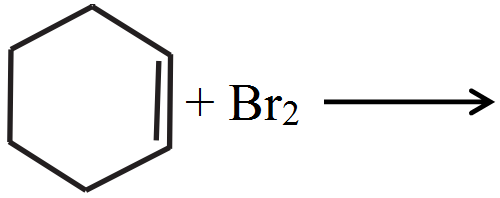
  1. What is the product obtained when but-2-ene reacts with $Br_2$​​​​​​​?
Answer
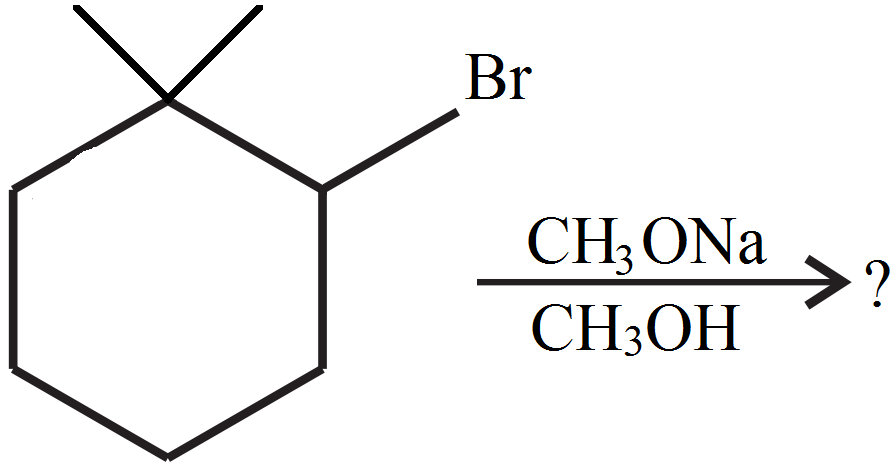
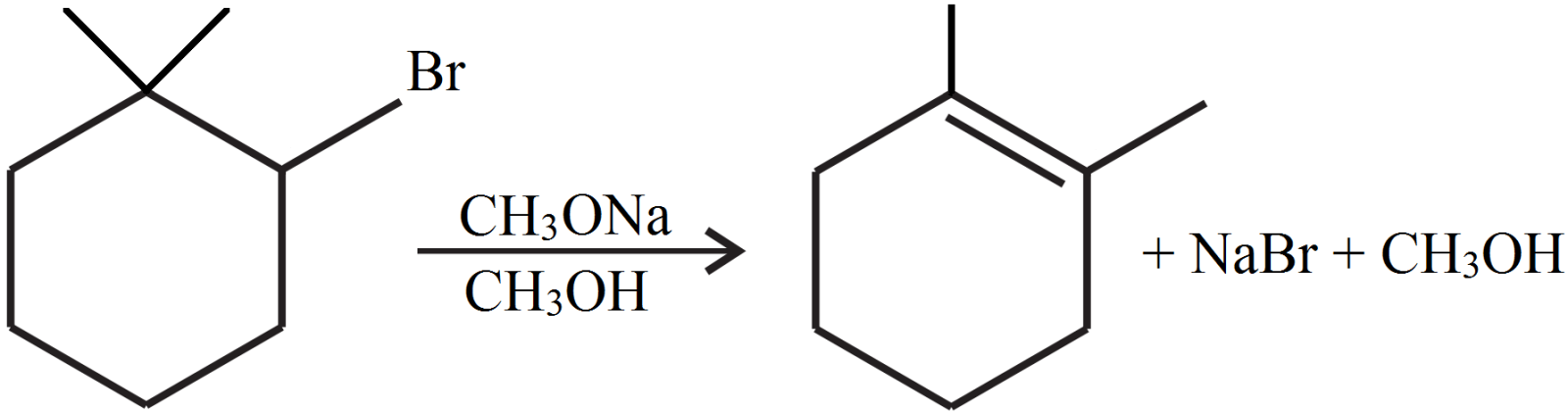
  1.  


$CH_3ONa$ will carry out nucleophilic elimination reaction like KOH (alc) and will give more alkyl substituted alkene will be major product.
  1. $\ \ \ \ \ \ \ \ \ \ \ \ \text{CH}_3\ \text{O} \ \ \ \ \ \ \ \ \ \ \ \ \ \ \ \ \ \ \ \ \ \ \ \ \ \ \ \ \ \ \ \ \ \ \ \ \ \ \ \ \text{O}\\ \ \ \ \ \ \ \ \ \ \ \ \ \ | \ \ \ \ \ \ \ || \ \ \ \ \ \ \ \ \ \ \ \ \ \ \ \ \ \ \ \ \ \ \ \ \ \ \ \ \ \ \ \ \ \ \ \ \ \ \ \ \ ||\\\text{CH}_3-\text{C}-\text{C}-\text{OH}< \text{CH}_3-\text{CH}_2-\text{C}-\text{OH}<\\ \ \ \ \ \ \ \ \ \ \ \ \ \ |\\ \ \ \ \ \ \ \ \ \ \ \ \ \text{CH}_3$ $ \ \ \ \ \ \ \ \ \ \ \ \ \ \ \ \ \ \text{O}\ \ \ \ \ \ \ \ \ \ \ \ \ \ \ \ \ \ \ \ \ \ \ \ \ \ \ \ \ \ \ \ \ \text{O}\\ \ \ \ \ \ \ \ \ \ \ \ \ \ \ \ \ \ || \ \ \ \ \ \ \ \ \ \ \ \ \ \ \ \ \ \ \ \ \ \ \ \ \ \ \ \ \ \ \ \ \ \ ||\\<\text{CH}_3-\text{C}-\text{OH}<\text{CH}_3-\text{C}-\text{COOH}$
Because $CH_3-$ groups are electron releasing, will destabilise carboxylate ion whereas $ \ \ \ \ \text{O}\\ \ \ \ \ ||\\-\text{C}-$ group is electron withdrawing, will stabilise the carboxylate ion.
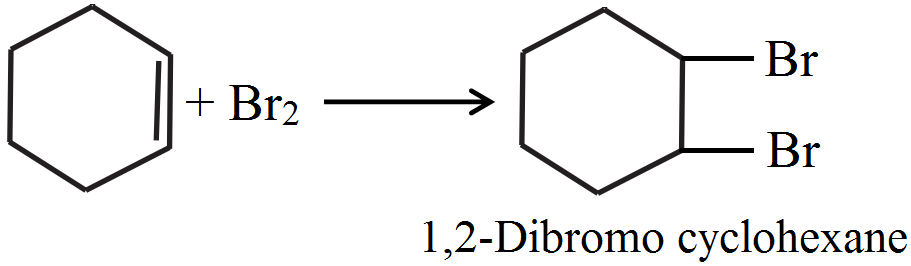
  1. $\text{CH}_3-\text{CH}=\text{CH}-\text{CH}_3\xrightarrow{\text{Br}_2}\\ \ \ \ \ \ \ \ \ _{\text{But-2-ene}}\\\text{CH}_3-\text{CH}-\text{CH}-\text{CH}_3\\ \ \ \ \ \ \ \ \ \ \ \ \ \ | \ \ \ \ \ \ \ \ \ \ |\\ \ \ \ \ \ \ \ \ \ \ \ \ \text{Br} \ \ \ \ \ \ \ \text{Br}\\ \ \ \ \ \ _{2,\ 3-\text{Dibromo butane}}$
​​​​​​​But-2-ene will undergo addition reaction to form 2, 3-Dibromo butane.
View full question & answer
Question 293 Marks
Complete the reactions:
  1. $\text{CH}_3\text{CH}_2\text{CH}_3+\text{HNO}_3\xrightarrow{\text{Vapour phase}}$
  2. $\text{CH}_4+\text{O}_2\xrightarrow[723-773\text{K}]{\text{Copper tube}}$
  3. $\text{C}_2\text{H}_5\stackrel{{\ \ \ \ \ \ \ \ \ -}}{\hbox{COO} }\stackrel{{+}}{\hbox{Na}}+\text{NaOH}\xrightarrow{\text{CaO}}$
Answer
  1. $\text{CH}_3\text{CH}_2\text{CH}_3+\text{HNO}_3\xrightarrow{\text{Vapour phase}}\\\text{CH}_3\text{CH}_2\text{NO}_2+\text{CH}_3\text{CH}_2\text{CH}_2\text{NO}_2+\text{CH}_3\text{NO}_2+\text{H}_2\text{O}\\ \ \ \ _{\text{Nitroethane}} \ \ \ \ \ \ \ \ \ \ \ \ \ \ _{\text{Nitropropane}} \ \ \ \ \ \ \ \ \ \ \ \ \ \ _{\text{Nitromethane}}$
  2. $\text{CH}_4+\text{O}_2\xrightarrow[723-773\text{K}]{\text{Copper tube}}2\text{CH}_3\text{OH}\\ \ \ \ \ \ \ \ \ \ \ \ \ \ \ \ \ \ \ \ \ \ \ \ \ \ \ \ \ \ \ \ \ \ \ \ \ \ _{\text{Methanol}}$
  3. $\text{C}_2\text{H}_5\text{COONa}+\text{NaOH}\xrightarrow{\text{CaO}}\text{C}_2\text{H}_6+\text{Na}_2\text{CO}_3\\ \ \ \ \ \ \ \ \ \ \ \ \ \ \ \ \ \ \ \ \ \ \ \ \ \ \ \ \ \ \ \ \ \ \ \ \ \ \ \ \ \ \ \ \ \ \ \ \ \ \ \ _{\text{Ethane}}$
View full question & answer
Question 303 Marks
Complete the following reactions:
  1. $\text{CH}_3-\text{CH}=\text{CH}_2+\text{HBr}\xrightarrow{\text{Peroxide}}?$
  2. $\text{CH}_3-\text{Cl}+\text{Na}\xrightarrow{\text{Dry ether}}?$
  3. $\text{CH}_3-\text{CH}-\text{CH}_2-\text{CH}_3\xrightarrow[\Delta]{\text{alc. KOH}}\\ \ \ \ \ \ \ \ \ \ \ \ \ \ |\\ \ \ \ \ \ \ \ \ \ \ \ \ \text{Cl}$
Answer
  1. $\text{CH}_3-\text{CH}=\text{CH}_2+\text{HBr}\xrightarrow{\text{Peroxide}}\\\text{CH}_3-\text{CH}_2-\text{CH}_2\text{Br}$
  2. $\text{CH}_3-\text{Cl}+\text{Na}\xrightarrow{\text{Dry ether}}\text{CH}_3-\text{CH}_3+2\text{NaCl}$
  3. $\text{CH}_3-\text{CH}-\text{CH}_2-\text{CH}_3\xrightarrow[\Delta]{\text{alc. KOH}}\\ \ \ \ \ \ \ \ \ \ \ \ \ \ |\\ \ \ \ \ \ \ \ \ \ \ \ \ \text{Cl}\\\text{CH}_3-\text{CH}=\text{CH}-\text{CH}_3+\text{KCl}+\text{H}_2\text{O}$
View full question & answer
Question 313 Marks
Give the structures of A and B.
Answer
(B) and (C) are $\mathrm{CH}_3 \mathrm{CH}_2 \mathrm{CHO}$ (propanal) and $\mathrm{CH}_3 \mathrm{COCH}_3$ (propanone). Hence, A is
$\ \ \ \ \ \ \ \ \ \ \ \ \ \ \ \ \ \ \ \ \text{H}\\ \ \ \ \ \ \ \ \ \ \ \ \ \ \ \ \ \ \ \ \ \ |\\\text{CH}_3\text{CH}_2-\text{C}=\text{O}+\text{O}=\text{C}-\text{CH}_3\rightarrow\\ \ \ \ \ \ \ \ \ \ \ \ \ \ \ \ \ \ \ \ \ \ \ \ \ \ \ \ \ \ \ \ \ \ \ \ \ \ \ \ \ \ \ \ \ \ \ |\\ \ \ \ \ \ \ \ \ \ \ \ \ \ \ \ \ \ \ \ \ \ \ \ \ \ \ \ \ \ \ \ \ \ \ \ \ \ \ \ \ \ \ \ \ \ \text{CH}_3\\ \ \ \ \ \ \ \ \ \ \ \ \ \ \ \ \ \ \ \ \ \ \ \ \ \ \ \text{CH}_3\\ \ \ \ \ \ \ \ \ \ \ \ \ \ \ \ \ \ \ \ \ \ \ \ \ \ \ \ |\\\text{CH}_3\text{CH}_2\text{CH}=\text{C}-\text{CH}_3\\ \ \ \ \ _{2-\text{methyl pent-2ene}}$
$ \ \ \ \ \ \ \ \ \ \ \ \ \ \ \ \ \ \ \ \ \ \ \ \ \ \ \ \ \ \ \ \ \ \ \ \ \ \ \ \ \ \ \ \ \ \ \ \ \ \ \ \ \ \ \ \ \ \ \ \ \ \ \ \ \ \ \ \ \ \ \ \ \ \ \ \ \ \ \ \ \ \ \ \ \ \ \ \ \ \ \ \ \ \text{CH}_3\\ \ \ \ \ \ \ \ \ \ \ \ \ \ \ \ \ \ \ \ \ \ \ \ \ \ \ \ \ \ \ \ \ \ \ \ \ \ \ \ \ \ \ \ \ \ \ \ \ \ \ \ \ \ \ \ \ \ \ \ \ \ \ \ \ \ \ \ \ \ \ \ \ \ \ \ \ \ \ \ \ \ \ \ \ \ \ \ \ \ \ \ \ \ \ |\\\text{CH}_3\text{CH}_2\text{CHO}+\text{CH}_3\text{COCH}_3\xleftarrow{\text{Ozonolysis}}\text{CH}_3\text{CH}_2\text{CH}=\text{C}-\text{CH}_3\\ \ \ \ \ \ \ \ \ (\text{B}) \ \ \ \ \ \ \ \ \ \ \ \ \ \ \ \ \ \ \ \ \ \ \ (\text{C}) \ \ \ \ \ \ \ \ \ \ \ \ \ \ \ \ \ \ \ \ \ \ \ \ \ \ \ \ \ \ \ \ \ (\text{A})$
$ \ \ \ \ \ \ \ \ \ \ \ \ \ \ \ \ \ \ \ \ \ \ \ \ \ \ \text{CH}_3\\ \ \ \ \ \ \ \ \ \ \ \ \ \ \ \ \ \ \ \ \ \ \ \ \ \ \ \ |\\\text{CH}_3\text{CH}_2\text{CH}=\text{C}-\text{CH}_3\xrightarrow{\text{Hot KMnO}_4}\\ \ \ \ \ \ (\text{A})\\ \ \ \ \ \ \ \ \ \ \ \ \ \ \ \ \ \ \ \ \ \ \ \ \ \ \ \ \ \ \ \ \ \ \ \ \ \ \ \ \ \ \ \ \ \text{CH}_3\\ \ \ \ \ \ \ \ \ \ \ \ \ \ \ \ \ \ \ \ \ \ \ \ \ \ \ \ \ \ \ \ \ \ \ \ \ \ \ \ \ \ \ \ \ \ |\\\text{CH}_3\text{CH}_2\text{COOH}+\text{CH}_3-\text{C}=\text{O}\\ \ \ \ \ \ \ \ \ \ (\text{D}) \ \ \ \ \ \ \ \ \ \ \ \ \ \ \ \ \ \ \ \ \ \ \ \ \ \ \ (\text{C})$
View full question & answer