Question 15 Marks
A geyser heats water flowing at the rate of $3.0$ litres per minute from $27°C$ to $77°C$. If the geyser operates on a gas burner, what is the rate of consumption of the fuel if its heat of combustion is $4.0 × 10⁴J/g$?
AnswerWater is flowing at a rate of 3.0 litre/min. The geyser heats the water, raising the temperature from $27^{\circ} \mathrm{C}$ to $77^{\circ} \mathrm{C}$. Initial temperature, $\mathrm{T}_1=27^{\circ} \mathrm{C}$ Final temperature, $\mathrm{T}_2=77^{\circ} \mathrm{C} . \therefore$ Rise in temperature, $\Delta \mathrm{T}=\mathrm{T}_2-\mathrm{T}_1$ $=77-27=50^{\circ} \mathrm{C}$ Heat of combustion $=4 \times 10^4 \mathrm{~J} / \mathrm{g}$ Specific heat of water, $\mathrm{c}=4.2 \mathrm{~J} \mathrm{~g}^{-10} \mathrm{C}^{-1}$ Mass of flowing water, $\mathrm{m}=$ 3.0 litre $/ \mathrm{min}=3000 \mathrm{~g} / \mathrm{min}$ Total heat used, $\Delta Q=\mathrm{mc} \Delta \mathrm{T}=3000 \times 4.2 \times 50=6.3 \times 10^5 \mathrm{~J} / \mathrm{min} . \therefore$. Rate of consumption $=\frac{6.3 \times 0^5}{4 \times 10^4}=15.75 \mathrm{~g} / \mathrm{min}$
View full question & answer→Question 25 Marks
A cylinder with a movable piston contains $3$ moles of hydrogen at standard temperature and pressure. The walls of the cylinder are made of a heat insulator, and the piston is insulated by having a pile of sand on it. By what factor does the pressure of the gas increase if the gas is compressed to half its original volume?
AnswerThe cylinder is completely insulated from its surroundings. As a result, no heat is exchanged between the system (cylinder) and its surroundings. Thus, the process is adiabatic. Initial pressure inside the cylinder $=\mathrm{P}_1$ Final pressure inside the cylinder $=\mathrm{P}_2$ Initial volume inside the cylinder $=\mathrm{V}_1$ Final volume inside the cylinder $=\mathrm{V}_2$ Ratio of specific heats, $\gamma=1.4$ For an adiabatic process, we have: $\mathrm{P}_1 \mathrm{~V}_1^\gamma=\mathrm{P}_2 \mathrm{~V}_2{ }^\gamma$ The final volume is compressed to half of its initial volume. $\therefore \mathrm{V}_2=\mathrm{V}_1 / 2$ $P_1 V_1 \gamma^\gamma=P_2\left(V_1 / 2\right)^\gamma P_2 / P_1=V_1^\gamma /\left(V_1 / 2\right)^\gamma=2^\gamma=2^{1.4}=2.639$ Hence, the pressure increases by a factor of 2.639.
View full question & answer→Question 35 Marks
In changing the state of a gas adiabatically from an equilibrium state A to another equilibrium state B, an amount of work equal to 22.3J is done on the system. If the gas is taken from state A to B via a process in which the net heat absorbed by the system is 9.35 cal, how much is the net work done by the system in the latter case? (Take 1 cal = 4.19J)
AnswerThe work done (W) on the system while the gas changes from state A to state B is 22.3J. This is an adiabatic process. Hence, change in heat is zero.$\therefore\Delta\text{Q} = 0$
$\Delta\text{W} = -22.3\text{ J}$ (Since the work is done on the system)
From the first law of thermodynamics, we have: $\Delta\text{Q}=\Delta\text{U}+\Delta\text{W}$ Where, ΔU = Change in the internal energy of the gas$\therefore\ \Delta\text{U}=\Delta\text{Q}-\Delta\text{W}=-(-22.3\text{ J})$
$\Delta\text{U} = +22.3\text{ J}$
When the gas goes from state A to state B via a process, the net heat absorbed by the system is:$\Delta\text{Q} = 9.35\text{ cal}$
= 9.35 × 4.19 = 39.1765J Heat absorbed, $\Delta\text{Q}=\Delta\text{U}+\Delta\text{Q}$$\therefore\ \Delta\text{W}=\Delta\text{Q}-\Delta\text{U}$
= 39.1765 - 22.3 = 16.8765 Therefore, 16.88J of work is done by the system.
View full question & answer→Question 45 Marks
What amount of heat must be supplied to $2.0 \times 10^{-2} \mathrm{~kg}$ of nitrogen (at room temperature) to raise its temperature by $45^{\circ} \mathrm{C}$ at constant pressure? (Molecular mass of $\mathrm{N}_2=28 ; \mathrm{R}=8.3 \mathrm{~J} \mathrm{~mol}^{-1} \mathrm{~K}^{-1}$.)
AnswerMass of nitrogen, $m = 2.0 \times 10^{-2}kg = 20g$ Rise in temperature, $\Delta\text{T}=45^\circ\text{C}$ Molecular mass of $N_2$, M = 28 Universal gas constant, $R = 8.3J mol^{-1}K^{-1}$ Number of moles, $\text{n}=\frac{\text{m}}{\text{M}}$$=\frac{20.\times10^{-2}\times10^3}{28}=0.714$
Molar specific heat at constant pressure for nitrogen $C_p = (7/2)R = 7/2 \times 8.3 = 29.05J mol^{-1} K^{-1}$ The total amount of heat to be supplied is given by the relation:$\Delta\text{Q}=\text{nC}_\text{p}\Delta\text{T}$
$=0.714\times29.05\times45$
$=933.38\text{ J}$
Therefore, the amount of heat to be supplied is 933.38J.
View full question & answer→Question 55 Marks
A geyser heats water flowing at the rate of $3.0$ litres per minute from $27°C$ to $77°C$. If the geyser operates on a gas burner, what is the rate of consumption of the fuel if its heat of combustion is $4.0 × 10⁴J/g$?
AnswerWater is flowing at a rate of $3.0$ litre/min. The geyser heats the water, raising the temperature from $27^\circ C$ to $77^\circ C$. Initial temperature, $T_1 = 27^\circ C$ Final temperature, $T_2 = 77^\circ C$
$\therefore$ Rise in temperature, $\triangle T = T_2 - T_1 = 77 – 27= 50^\circ C$ Heat of combustion $= 4 \times 10^4J/g$ Specific heat of water, $c = 4.2J {g^{-1}{^\circ C}^{-1}}$ Mass of flowing water, m = 3.0 litre/min = 3000g/min Total heat used, $\Delta\text{Q} =\text{mc}\Delta\text{T}$ = $3000 \times 4.2 \times 50 = 6.3 \times 10^5J/min$
$\therefore$ Rate of consumption $=\frac{6.3\times0^5}{4\times10^4}=15.75\text{g/min}$
View full question & answer→Question 65 Marks
Specific heat capacity of argon at constant pressure is $0.125$ cal/ g/ k and at constant volume is $0.075$ cal/ g/ k. Calculate the density of argon at STP. Given $J = 4.18 J/ cal$ and the normal pressure = $1.01 \times 10^5 Nm^{-2}$.
AnswerHere, $C_p = 0.125 cal/ g/ K C_V= 0.075 cal/ g/ K J = 4.18 J/ cal$ or $4.18 \times 10^7$ erge/ cal Normal pressure = $1.01 \times 10^5 N/ m^2$ or $1.01 \times 10^6 dyne/ cm^2$ Absolute temprerature T = 273K Let p be the density of argon at S.T.P. for one mole $\therefore\ \text{PV}=\text{RT}$ (gas equation) or $\text{R}=\frac{\text{PV}}{\text{T}}=\frac{\text{P}}{\rho\text{T}}$ for a 1 mole of gas Now $\text{C}_\text{p}-\text{C}_\text{V}=\frac{\text{R}}{\text{J}}$
$\text{R}=\text{J}(\text{C}_\text{P}-\text{C}_\text{V})$
$\frac{\text{P}}{\rho\text{T}}=4.18\times10^7(0.125-0.075)$
$\Rightarrow\ \frac{1.01\times10^6}{\rho\times273}$
$=4.18\times10^7\times0.05$
$\therefore\ \rho=\frac{1.01\times10^6}{273\times4.18\times10^7\times0.05}$ Hence $\rho=1.77\times10^{-3}\text{g}/\text{cm}^3$ or $1.77\times10^3\ \text{Kg}/\text{m}^3$
View full question & answer→Question 75 Marks
There is a layer of ice 10cm thick over the surface of a pond. Temperature above the surface is -5°C. How long will it take for the next 1mm of ice to form? The thermal conductivity of ice is 0.008 CGS units and its latent heat is 80 cal/g. Density of ice = 0.9 g/cc.
AnswerThickness of layer = 10cm, Temperature = -5°C, K = 0.008 CCS units, $\text{L}=80\text{cal g}^{-1},\rho=0.9\text{ gcc}^{-1}$ Suppose the area of the surface of ice to be 1 sq. cm. Volume of 1 mm thickness of layer = Area × Thickness $= 1 \times 0.1 = 0.1cm^3$
mass of the new layer formed = Volume × Density = 0.1 × 0.9 = 0.09g Amount of heat radiated by the water to freeze 0.09g of ice $= 0.09 \times 80 = 7.2 cal.$
We know that, $\frac{\text{Q}}{\text{t}}=\text{KA}\frac{\Delta\text{T}}{\Delta\text{x}}$
Here, $\text{Q}=7.2\text{ cal},\text{K}=0.008,$
$\Delta\text{T}=0-(-5)=5^\circ\text{C},\text{A}=1\text{sq. cm}$
$\Delta\text{x}=\frac{10+10.1}2=10.05\text{cm}$ Putting these value,
we have, $\frac{7.2}{\text{t}}=0.008\times\frac{1\times5}{10.05}$
$\text{t}=\frac{7.2\times10.05}{0.008\times5}=30\text{min 9s.}$
View full question & answer→Question 85 Marks
A carnot engine works between ice point and steam point. It is desired to increase the efficiency by 20% by (a) making temperature of the source as constant (b) making temperature of the sink as constant. Calculate the change in temperature in the two cases. Which one of these will you prefer and why?
Answer$\eta=1-\frac{\text{T}_1}{\text{T}_1}=1-\frac{273}{373}=\frac{100}{373}$ Adding 20% i.e. $\big(\frac15\big)$ to the existing $\eta,$ $\eta=\frac{100}{3+3}+20\%=\frac{100}{373}+\frac15=\frac{873}{1865}$
- If the temperature of the sink corresponding to $\eta'$ be $\text{T}'_2$ (source at 373k), then,
Thus, $\eta'=1-\frac{\text{T}_2'}{373}$
$\frac{\text{T}_2'}{373}=1-\eta'=1-\frac{873}{1865}=\frac{992}{1865}$
$\text{T}'_2=198.4\text{K}$
$\text{T}_2'-\text{T}_2=198.4\text{K}-273\text{K}=-74.6\text{K}$
- If the temperature of the source corresponding to $\eta'$ be $\text{T}'_2$ (sinkb at 273K), then
$\eta'=1-\frac{\text{T}'_2}{\text{T}'_1}$ or $\frac{873}{1865}=1-\frac{273}{\text{T}'_1}$
$\frac{273}{\text{T}'_1}=1-\frac{873}{1865}=\frac{992}{1865}$
$\text{T}'_2=513\text{K}$
$\text{T}'_1-\text{T}_1=513\text{K}-373\text{K}$
$=149.25\text{K}=140^\circ\text{C}$ View full question & answer→Question 95 Marks
A cylinder with a movable piston contains $3$ moles of hydrogen at standard temperature and pressure. The walls of the cylinder are made of a heat insulator, and the piston is insulated by having a pile of sand on it. By what factor does the pressure of the gas increase if the gas is compressed to half its original volume?
AnswerThe cylinder is completely insulated from its surroundings. As a result, no heat is exchanged between the system (cylinder) and its surroundings. Thus, the process is adiabatic. Initial pressure inside the cylinder = $P_1$ Final pressure inside the cylinder = $P_2$ Initial volume inside the cylinder = $V_1$_ Final volume inside the cylinder = $V_2$ Ratio of specific heats, γ = 1.4 For an adiabatic process, we have: $P_1V_1^γ = P_2V_2^γ$ The final volume is compressed to half of its initial volume. $\therefore V_2 = V_1/2 P_1V_1^γ = P_2(V_1/2)^γ P_2/P_1 = V_1^γ/(V_1/2)^γ = 2^γ = 2^{1.4} = 2.639$ Hence, the pressure increases by a factor of $2.639$.
View full question & answer→Question 105 Marks
In a refrigerator one removes heat from a lower temperature and deposits to the surroundings at a higher temperature. In this process, mechanical work has to be done which is provided by an electric motor. If the motor is of $1KW$ power, and heat is transferred from $–3°C to 27°C$, find the heat taken out of the refrigerator per second assuming its efficiency is $50\%$ of a perfect engine.
AnswerCarton's engine is perfect heat engine operating between two tempreature $T_1$ and $T_2$ (source and sink). Refrigerator is aiso carnot's engine working in reverse order its efficiency in $\eta$
$\eta=1-\frac{\text{T}_{2}}{\text{T}_{2}}=1-\frac{273-3}{273+27}=1-\frac{270}{300}=-.9=1=\frac{1}{10}$ Efficiency of refrigerator's 50 % of perfect engine $\therefore$ Efficiency of refrigerator = 50% of 1 = 0.5 Net efficiency = $\eta' = 0.5 \times 0.1 = 0.05$
$\therefore$ Cofficient of performence $\beta=\frac{\text{Q}_{2}}{\text{W}}=\frac{1-\eta'}{\eta'}$
$\beta=\frac{1-0.05}{0.05} =\frac{0.95}{0.05}=19$ Q2 = 19% W .D. by motor on refrigerator = 19 \times 1KW =19KJ/ s
View full question & answer→Question 115 Marks
The difference between the two specific heat capacities (at constant pressure and volume) of a gas is $5000J\ kg^{-1} k^{-1}$ and the ratio of these specific heat capacities is $1.6$. Find the two specific heat capacities i.e. $C_p$ and $C_v$.
AnswerWe Know that, $\text{C}_\text{P}-\text{C}_\text{V}=\text{R}$
$\text{C}_\text{P}-\text{C}_\text{V}=5000$ Dividing by $C_V$ we get, $\frac{\text{C}_\text{P}}{\text{C}_\text{V}}-1=\frac{5000}{\text{C}_\text{V}}$
$1.6-1=\frac{5000}{\text{C}_\text{V}}$
$0.6=\frac{5000}{\text{C}_\text{V}}$
$\therefore\text{C}_\text{V}=\frac{5000}{\text{0.6}}$
$=8333.33\text{J/}\ \text{Kg}^{-1}\text{K}^{-1}$ Now, $\text{C}_\text{P}-\text{C}_\text{V}=5000$
$\text{C}_\text{P}-8333.33+5000$
$=13333.33\ \text{J}\ \text{Kg}^{-1}\text{K}^{-1}$
View full question & answer→Question 125 Marks
The P-V diagram for a cyclic process is a triangle ABC drawn in order. The co-ordinates of A, B, C are $(4,1),(2,4)$ and $(2,1)$. The co-ordinates are in the order ( $\mathrm{P}-\mathrm{V}$ ). Pressure is in $\mathrm{Nm}^{-2}$ and volume is in litre. Calculate work done during the process from A to $\mathrm{B}, \mathrm{B}$ to C and C to A . Also, calculate work done in the complete cycle.
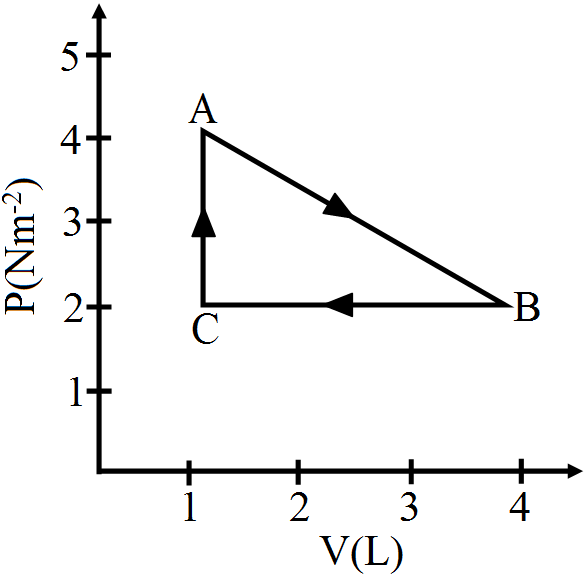
AnswerThe P-V diagram drawn as per the question is show in figure (adjacent).
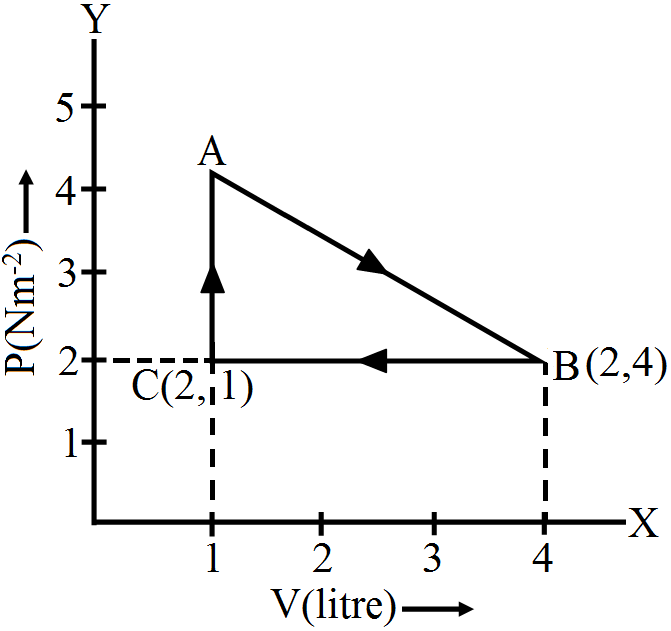
- Work done during the process from A to B (expansion),
$\text{W}_{\text{AB}}=+\text{area ABKLA}$
= area of $\Delta\text{ABC}+\text{area or rectangle BCLK}$
$\text{W}_{\text{AB}}=\frac{1}{2}\text{BC}\times\text{AC}+\text{KL}\times\text{LC}$
Now, BC = KC = 4 - 1 = 3 litre
$= 3 \times 10^{-3}m^3$
$AC = 4 - 2 = 2 Nm^{-2}$
$LC = 2 - 0 = 2 Nm^{-2}$
$\therefore\text{W}_{\text{AB}}=\frac{1}{2}\times3\times10^{-3}\times2+3\times10^{-3}\times2$
$\text{W}_{\text{AB}}=9\times10^{-3}\text{J}$
- Work done during the process from B to C (compression) is,
$\text{W}_{\text{BC}}=-\text{area BCLK}=-\text{KL}\times\text{LC}$
$=-3\times10^{-3}\times2=-6\times10^{-3}\text{J}$
- Work done during the process from C to A. As there is no change in volume of the gas in this process, therefore,
$\text{W}_{\text{CA}}=0.$
Net work done in the complete cycle,
$\text{W}=\text{W}_{\text{AB}}+\text{W}_\text{BC}+\text{W}_\text{CA}$
$=9\times10^{-3}+(-6\times10^{-3})+0$
$=3\times10^{-3}\text{J}$ View full question & answer→Question 135 Marks
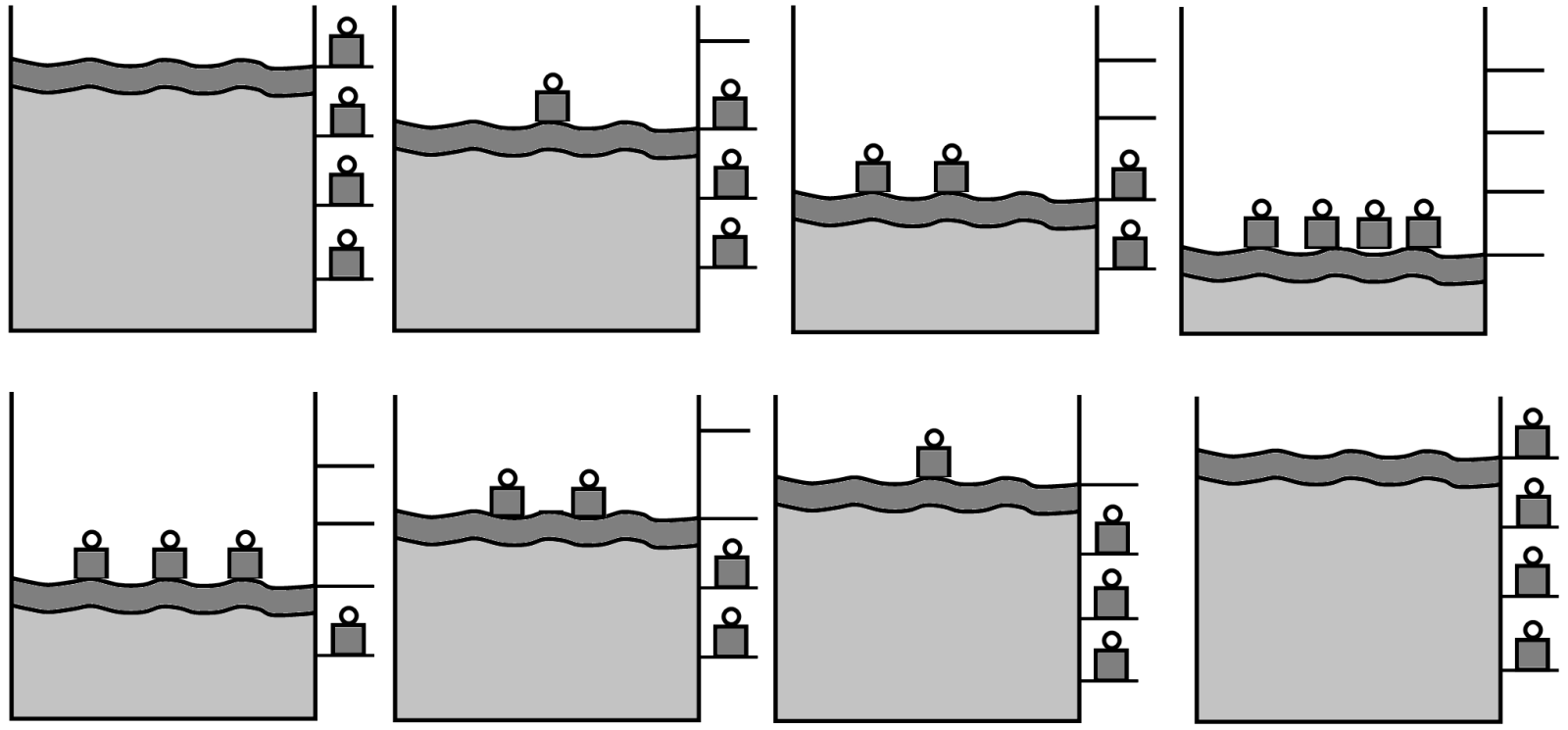
Explain with the suitable example that a reversible process must be carried slowly and a fast process is necessarily irreversible.
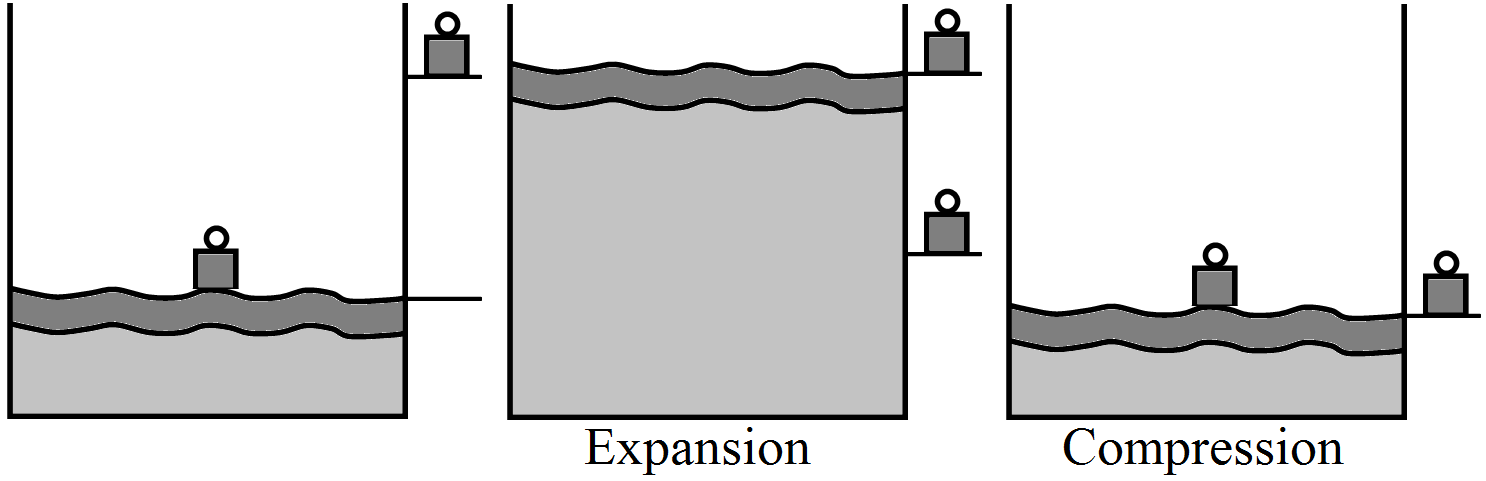
AnswerA reversible process must pass through equilibrium states which are very close to each other so that when process is reversed, it passes back through these equilibrium states. Then, it is again decompressed or it passes through same equilibrium states, system can be restored to its initial state without any change in surroundings. e.g. If a gas is compressed as shown
But a reversible process can proceeds without reaching equilibrium in intermediate states.
View full question & answer→Question 145 Marks
Define molar specific heat capacities at constant volume and pressure. Considering thermodynamical process in a cylinder with parameters P, V and T, derive the Mayer's relation.
AnswerMolar specific heat capacity is the heat energy required to raise the temperature of 1 mole of a substance by 1K and expressed in $J mol^{-1} K^{-1}$. $\text{C}=\frac{\text{Q}}{1\text{mole 1}\text{K}}$ Depending on the condition that whether volume or pressure is constant, molar specific heat is written as $C_v$ and $C_p$. Relation between $C_p$ and $C_v$: Suppose one mole of a gas is heated so that its temperature rises by dT. Heat supplied $=1\times\text{C}_\text{V}\times\text{C}_\text{V}\text{dT}\dots(\text{i})$ Since the volume is constant, the gas will not perform external work in accordance with the first law of thermodynamics and the heat supplied will be just equal to the increase in the internal energy of the gas. $\therefore\text{dU}=\text{C}_{\text{V}}\text{dT}\dots\text{(ii)}$ Let the gas be heated at constant pressure to again increase its temperature by dT, and dQ be the amount of heat supplied, therefore, $dQ = 1 \times C_P \times dT = C_PdT $...(iii) The heat supplied at a constant pressure increases the temperature by dT hence increases its internal energy by $dU = C_vdT$ as well as enables the gas to perform work dW. dW = PdV ...(iv) From the first law of thermodynamics, we have $dQ = dU + dW$ Substituting the values, we get, $\text{C}_\text{P}\text{dT}=\text{C}_\text{v}\text{dT}+\text{PdV}$ But PV = RT (For one mole of the gas) or PdV = RdT $\therefore\text{C}_\text{P}\text{dT}=\text{C}_\text{V}\text{dT}$
$\text{C}_\text{P}-\text{C}_\text{V}=\text{R}$ This is the relation between two principal specific heats of the gas when $C_{p,} C_v$ and R are measured in the units of either heat or of work.
View full question & answer→Question 155 Marks
Three moles of an ideal gas of $300K$ are isothermally expanded to five times its volume and heated at this constant volume so that the pressure is raised to its initial value before expansion. In the whole process $83.14\ kJ$ heat is required. Calculate the ratio $\frac{\text{C}_\text{P}}{\text{C}_\text{V}}$ of gas $(\log_\text{e}5=1.61).$
AnswerFor isothermal expansion $P_1V_1 = P_2V_2$
$\therefore\frac{\text{P}_1}{\text{P}_2}=\frac{\text{V}_2}{\text{V}_1}=\frac{\text{5V}_1}{\text{V}_1}=5$ From gas law at constant volume $\frac{\text{P}_2}{\text{T}_2}=\frac{\text{P}_3}{\text{T}_3}=\frac{\text{P}_1}{\text{P}_3}(\because\text{P}_3=\text{P}_1)$ $\therefore\frac{\text{P}_2}{\text{P}_1}=\frac{\text{T}_2}{\text{T}_3}=\frac{\text{T}_1}{\text{T}_3}$ or $\frac{\text{T}_3}{\text{T}_1}=\frac{\text{P}_1}{\text{P}_2}=5$ Now $\text{T}_3=5\text{T}_1=5\times300$ $=1500\text{K}$ We know that $\text{dQ}=\text{dU}+\text{dW}$ $\therefore\text{dQ}=\text{nC}_\upsilon\Delta\text{T}+\int\limits^{\text{V}_2}_{\text{V}_1}\text{PdV}$ where, $\text{P}=\frac{\text{nRT}_1}{\text{V}}$ $\text{dQ}=\text{nC}_\upsilon\Delta\text{T}+\text{nRT}_1\log_\text{e}\Big(\frac{\text{V}_2}{\text{V}_1}\Big)$ $\text{C}_\text{P}-\text{C}_\upsilon=\text{R}$ and $\frac{\text{C}_\text{P}}{\text{C}_\upsilon}=\gamma\ $ $\therefore\text{C}_\upsilon=\Big(\frac{\text{R}}{\gamma}-1\Big)$ $\therefore\text{dQ}=\frac{\text{nR}}{\gamma-1}\Delta\text{T}+\text{nRT}_1\log_\text{e}\Big(\frac{\text{V}_2}{\text{V}_1}\Big)$ $83.14\times10^3=\frac{3\times8.3}{\gamma-1}\times(1500-300)+3\times8.3\times\log_\text{e}5$ Solving we get $\gamma=1.42$
View full question & answer→Question 165 Marks
Write Kelvin-Planck and Clausius statements for second law of thermodynamics. Define coefficient of efficiency and coefficient of performance. Show the heat flow in case of an engine and refrigerator using schematic diagrams.
AnswerKelvin-Planck Statement of Second Law of Thermodynamics: It is impossible to realise a heat engine which works in a cyclic process performing the single job of taking heat from a body at a constant temperature and converting it completely into mechanical work. The law stresses the fact that work done on the system can facilitate to convert heat into work, however with some unavoidable loss. Clausius Statement: It is impossible for a self-acting machine, unaided by any external agency, to transfer heat from a body at lower temperature to another at higher temperature. 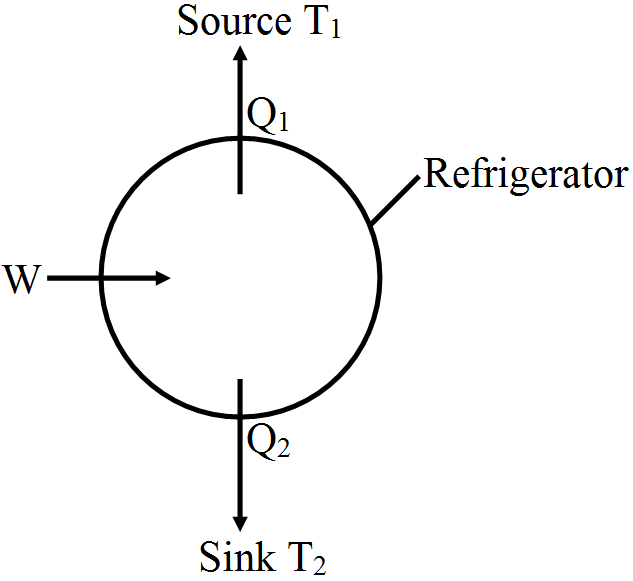 Efficiency in forward cycle, $=\frac{\text{Work done}}{\text{Heat supplied}}=\frac{\text{Q}_1-\text{Q}_2}{\text{Q}_2}=1-\frac{\text{Q}_2}{\text{Q}_1}=1-\frac{\text{T}_2}{\text{T}_1}$ Coeffiecient of performance, $=\frac{\text{Heat drawn from sink}}{\text{Work on the system}}=\frac{\text{Q}_2}{\text{Q}_1-\text{Q}_2}=\frac{\text{T}_2}{\text{T}_1-\text{T}_2}$
 View full question & answer→Question 175 Marks
Explain how Carnot's cycle works with the heat flow diagram. Using the same, explain the working of a refrigerator. Also, give its coefficient of performance.
AnswerRefrigerator absorbs heat from the body at a low temperature and liberates it to a body at a high temperature by doing work. It can be shown by the given diagram. $Q_2 \rightarrow$ Energy absorbed from sink. $Q_1 \rightarrow$ Energy liberated to source. $W \rightarrow$ Work done on the system.
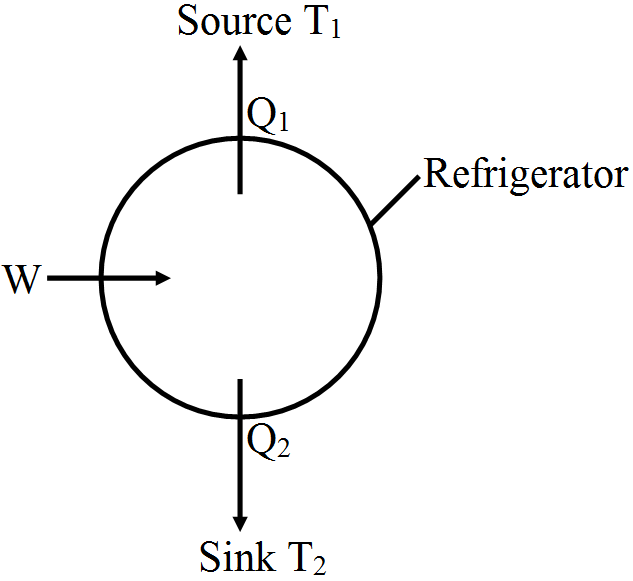
Coefficient of performance $=\frac{\text{Q}_2}{\text{Q}_1-\text{Q}_2}$
$Q_1 – Q_2$ refers to the work done on the system/refrigerator. Coefficient of performance (COP) $=\frac{\text{Q}_2}{\text{Q}_1-\text{Q}_2}=\frac{\text{T}_2}{\text{T}_1-\text{T}_2}$ Refrigerator: It works in the reverse Carnot's cycle. Heat is absorbed from sink at low temperature $T_2$ and given to the source at higher temperature $T_1$ with the help of an external agency doing work on the system. $(W = Q_1 - Q_2)$.
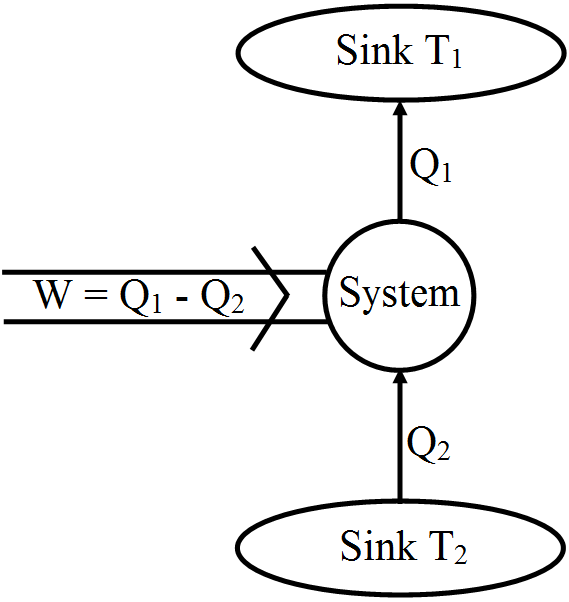
The compressor in the refrigerator uses electrical energy and does work on the system. The coefficient of performance is defined as the heat energy absorbed from low temperature sink $Q_2$ to the amount of work done. $\text{W}=\text{Q}_1-\text{Q}_2$ $\text{COP}=\frac{\text{Q}_2}{\text{Q}_1-\text{T}_2}=\frac{\text{T}_2}{\text{T}_1-\text{T}_2}$ View full question & answer→Question 185 Marks
Define 1st law of thermodynamics. By using this law, derive relationship between $C_p$ and $C_v.$
AnswerFirst Law of Thermodynamics: It is based on the conservation of energy. The total heat energy change in any system is the sum of the internal energy change and the work done, i.e., dQ = dU + dW where dU → internal energy change and dW = PdV is the work done by/ on the system, dU is a state function and depends on dT. ($dU = nC_vdT$). dW depends on the path followed and so, is different in various processes.
Relationship between $C _{ p }$ and $C _{ v }$ : Suppose one mole of a gas is heated at constant volume so that its temperature rises by dT . Heat supplied $=1 \times C _{ V } \times dT = C _{ V } dT$..,(i) Since the volume is costant, the gas will not perform external work in accordance with the first law of thermodynamics and the heat supplied will be just equal to the increase in the internal energy of the gas. $\therefore dU = C _{ V } dT \ldots$. (ii) Let the gas be heated at constant pressure to again increase its temperature by $d T$, and $d Q$ be the amount of heat supplied, therefore, $d Q=1 \times C_P \times d T=C_P d T \ldots$ (iii) The heat supplied at a constant pressure increases the temperature by dT hence increases its internal energy by $dU = C _{ v } dT$ as well as enables the gas to perform work $dW . dW = PdV$...(iv) From the first law of thermodynamics, we have $d Q=d U+d w$ S Substituting the values, we get, $C_P d T=C_V d T+P d V$ But PV = RT (For one mole of an ideal gas) or $PdV = RdT , \therefore C _{ Pd } T = C _{ VdT }+ RdT C _{ P }- C _{ V }= R \ldots( v ) This$ is the relationship between two principal specific heats of the gas when $C_p, C_v$ and $R$ are measured in the units of either heat or of work.
View full question & answer→Question 195 Marks
Consider a cycle tyre being filled with air by a pump. Let V be the volume of the tyre (fixed) and at each stroke of the pump $\Delta\text{V}(<<\text{V})$ of air is transferred to the tube adiabatically. What is the work done when the pressure in the tube is increased from $P_1$ to $P_2$?
AnswerAir is transferred into tyre adiabatically let initial volume of air in tyre V and after pumping one stroke it become (V + dV) and pressure increase from P to (P + dP) then $\text{P}_{1}\text{V}_{1}^\gamma=\text{P}_{2}\text{V}_{2}^\gamma$ $\text{P}(\text{d}+\text{dv})^\gamma=(\text{P}+\text{dp})\text{V}^\gamma$ $\text{PV}\Big[1+\frac{\text{dV}}{\text{V}}\Big]^\gamma=\text{P}\Big[1+\frac{\text{dP}}{\text{P}}\Big]\text{V}^\gamma$ As volume of tyre V remains constant $\text{PV}^\gamma\Big[1+\gamma\frac{\text{dV}}{\text{V}}\Big]=\text{PV}^\gamma\Big[1+\frac{\text{dP}}{\text{P}}\Big]$ $\big[$on expanding by binomial theorm neglecting the higher terms of $\Delta\text{V}$ as $\Delta\text{V}<<\text{V}\big]$ $1+\gamma\frac{\text{dV}}{\text{V}}=1+\frac{\text{dP}}{\text{P}}$ $\text{dV}=\frac{\text{VdP}}{\gamma\text{P}}$ Integrating both side in limits $W_1$ to $W_2$ and $P_1\rightarrow P_2$ $\int\text{pdV}=\int\limits^{\text{p}_2}_{\text{p}_1}\frac{\text{VdP}}{\gamma}$ $\int\limits^{\text{w}_2}_{\text{w}_1}\text{dw}=\frac{\text{V}}{\gamma}(\text{P}_{2}-\text{P}_{1})(\text{V}=\text{constant})$ $\text{W}=\frac{(\text{P}_{2}-\text{P}_{1})\text{V}}{\gamma}$
View full question & answer→Question 205 Marks
Calculate the heat required to convert 0.6 kg of ice at $-20^{\circ} \mathrm{C}$, kept in a calorimeter to steam at $100^{\circ} \mathrm{C}$ at atmospheric pressure. Given the specific heat capacity of ice $=2100 \mathrm{~J} \mathrm{~kg}^{-1} \mathrm{~K}^{-1}$, specific heat capacity of water is $4186 \mathrm{~J} \mathrm{~kg}^{-1} \mathrm{~K}^{-1}$, latent heat of ice $=3.35 \times 10^5 \mathrm{~J} \mathrm{~kg}^{-1}$, and latent heat of steam $=2.256 \times 106 \mathrm{~J} \mathrm{~kg}^{-1}$.
AnswerHeat required to convert ice at $-20^\circ C$ to $0^\circ C$ $\text{Q}_1=\text{m s}_\text{ice}\Delta\text{T}_1=0.6\times2100\times[0-(-20)]$
$=25200\text{J}$ Heat required to melt ice at $0^\circ C$ to water at $0^\circ C$
$\text{Q}_2=\text{m L}_\text{ice}=0.6\times(3.35\times10^5)$
$=201000\text{J}$ Heat required to convert water at $0^\circ C$ to water at $100^\circ C$ $\text{Q}-3=\text{ms}_\text{w}\Delta\text{T}-2=0.6\times4186\times(100-0)$
$=251160\text{J}$ Heat required to convert water at $100^\circ C$ to steam at $100^\circ C$. $\text{Q}_4=\text{m L}_\text{steam}=0.6\times2.256\times10^6$
$=1353600\text{J}$ Total heat spent $\text{Q}_1+\text{Q}_2+\text{Q}_3+\text{Q}_4$
$=1830960=1.8\times10^6\text{J}$
View full question & answer→Question 215 Marks
A cylinder fitted with a movable piston contains hydrogen at a pressure of $3.5 \times 10^5 \mathrm{~N}-\mathrm{m}^2$ and temperature 366 K . Hydrogen expands adiabatically until the pressure in the cylinder falls to $0.7 \times 10^5 \mathrm{~N}-\mathrm{m}^{-2}$. The piston is then fixed and the gas is heated until the temperature becomes 366 K . The pressure in the cylinder is now found to be $1.1 \times$ $10^5 \mathrm{~N}-\mathrm{m}^{-2}$. Determine the specific heats of hydrogen. $\left(R=8.3 \mathrm{~J} \mathrm{~mol}^{-1} \mathrm{~K}^{-1}\right)$.
Answer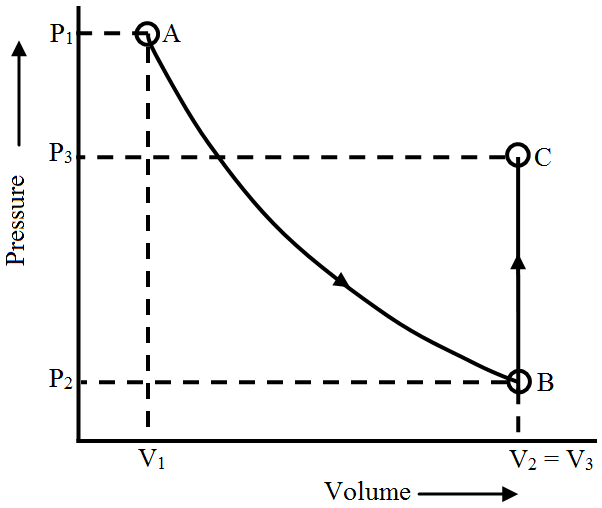
The processes are shown in Fig. The process B to C is at constant volume, hence $\frac{\text{P}_3}{\text{P}_2}=\frac{\text{T}_3}{\text{T}_2}$ or $\text{T}_2=\text{T}_3\times\frac{\text{P}_2}{\text{P}_3}$
$=366\times\frac{7\times10^4}{1.1\times10^5}$
$=233\text{K}$ The process A to B is adiabatic, hance $\frac{\text{T}_1}{\text{T}_2}=\Big(\frac{\text{P}_1}{\text{P}_2}\Big)^{\frac{(\gamma-1)}{\gamma}}$ or $\frac{366}{233}=\Big(\frac{3.5\times10^5}{7\times10^4}\Big)^{\frac{(\gamma-1)}{\gamma}}$ Solving we get $\gamma=1.39$ Now, $\frac{\text{C}_\text{P}}{\text{C}_\text{V}}=1.39\Big(\because\gamma=\frac{\text{C}_\text{P}}{\text{C}_\text{V}}\Big)\dots\text{(i)}$ Again $\text{C}_\text{P}-\text{C}_\text{V}=\text{R}\text{}$ or $\text{C}_\text{P}-\text{C}_\text{V}=8.3\dots\text{(ii)}$ From equation (i) $\text{C}_\text{P}=1.39\text{C}_\text{V}$ Substituting the value of $C_P$ in equation (2), we have $1.39\text{C}_\text{V}-\text{C}_\text{V}=8.3$ or $0.39\text{C}_\text{V}=8.3$
$\therefore\text{C}_\text{V}=\frac{8.3}{0.39}$
$=21.28\text{J mol}^{-1}\text{K}^{-1}$ Now $\text{C}_\text{P}=8.3+\text{C}_\text{V}$
$=8.3+21.28$
$=29.58\text{J}\text{ mol}^{-1}\text{K}^{-1}$ Hence, $\text{C}_\text{P}=29.58\text{J mol}^{-1}\text{K}^{-1}$ and $\text{C}_\text{V}=21.28\text{J mol}^{-1}\text{K}^{-1}$ View full question & answer→Question 225 Marks
When a system is taken from state i to state f along the path iaf (see fig. below), it is found that the heat Q absorbed by the system is $50$ cal. and work done W by the system is equal to $20$ cal. along the path ibf; $Q = 36$ cal.
- What is W along the path ibf?
- If $W = -13$ cal. for the curved return path fi, what is for this path?
- Take $U_i= 10$ cal, what is $U_f$?
- If $U_b = 22$ cal. what are Q for the processes bf and ib?
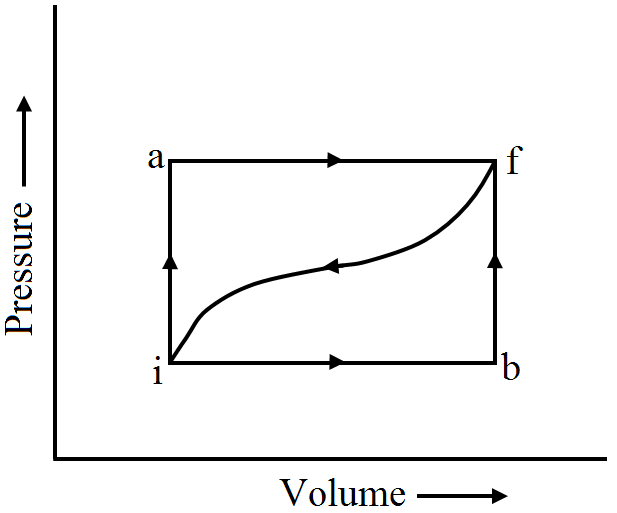
AnswerAccording to first law of thermdynamics, $dQ = dU + dW$ or $Q = U_f - U_i + W U_f$ = internal energy In final state and $U_i$ internal energy in initial state. For path i a f, Q = +50cal. and W = 20cal $\because\text{U}_\text{f}-\text{U}_\text{i}=\text{Q}-\text{W}$ $=50-20=30\text{cal}$ Here it should be remembered that the change in internal energy between i and f state remains the same i.e., 20 cal. whatever path is followed.
- For path ibf,
Q = 36cal. and $dU = U_f - U_i = 30cal$
$\therefore\text{W}=\text{Q}-(\text{U}_\text{f}-\text{U}_\text{i})$
$=36-30=6\text{cal}$
- For path fi.
$\text{W}=-13\text{cal}\text{ dU}=30\text{cal}$
$\therefore\text{Q}=\text{W}+(\text{U}_\text{f}-\text{U}_\text{i})$
- $\text{U}_\text{i}=10\text{cal}$
$\text{dU}=\text{U}_\text{f}-\text{U}_\text{i}=30$
$\therefore\text{U}_\text{f}=30+\text{U}_\text{i}$
$=30+10=40\text{cal}$
- For process bf, volume is constant i.e., work done is zero.
$\therefore\text{Q}=\text{dU}=\text{U}_\text{f}-\text{U}_\text{b}$
$=40-22=18\text{cal}$
For path ib,
$\therefore\text{Q}=\text{Q}_{\text{ibf}}-\text{Q}_\text{bf}$
$=36-18=18\text{cal}$ View full question & answer→Question 235 Marks
A gas undergoes reduction in volume (i) adiabatically, (ii) isothermally. Find the work done in the process.
Answer
- For an adiabatic process of thermodynamics,
$dQ = 0$
Since $dU = n C_v dT$ irrespective of the process, from 1st law, we get,
$dW = -dU = -n C_V dT$
So work done,
$W = -nC_V(T_f - T_i)$
$=-\frac{\text{C}_\text{V}}{\text{R}}(\text{P}_\text{f}\text{V}_\text{f}-\text{P}_\text{i}\text{V}_\text{i})$
- For an isothermal process, dT = 0
So, $\text{dW}\int\limits{\text{PdV}}=\int\limits\frac{\text{nRT}}{\text{V}}\text{dV}$
Work done $=\text{W}=\text{nRT}|\log_\text{e}\text{V}|_{\text{V}_\text{i}}^{\text{V}_\text{f}}$
$\text{W}=\text{n}\text{RT}\log_\text{e}\Big(\frac{\text{V}_\text{f}}{\text{V}_\text{i}}\Big)$ View full question & answer→Question 245 Marks
A lead bullet penetrates into a solid object and melts. Assuming that $50\%$ of the K.E. was used to heat it, calculate the initial speed of the bullet. The initial temperature of bullet is $27°C$ and its melting point is $327°C$. Latent heat of fusion of lead = $2.5 \times 10^4J kg^{-1}$ and specific heat capacity of lead = $125J kg^{-1}K^{-1}$.
AnswerHere, let m be the mass of the bullet. Heat required to raise its temperature fiom $27^\circ C$ to $327^\circ C$. $\because372^\circ\text{C}=600\text{K}$
$27^\circ\text{C}=300\text{K}$
$\Delta\text{Q}_1=\text{mc}\Delta\text{T}=125\times\text{m}\times(600-300)$
$=(3.75\times10^4)\text{m J}$ If v is initial velocity of the bullet, then K.E. of bullet $=\frac12\text{mv}^2$ As heat developed $=\frac12\text{K.E.}=\frac12\times\frac12\text{mv}^2$
$\therefore3.75\times10^4\text{m}+2.5\times10^4\text{m}=\frac14\text{mv}^2$
$6.25\times10^4\text{m}=\frac{1}{4}\text{mv}^2$
$\Rightarrow\text{v}=\sqrt{4\times6.25\times10^4}$
$\Rightarrow\text{v}=5\times10^2\text{m/s}$
View full question & answer→Question 255 Marks
The motor in a refrigerator has power output $250$ watt. The freezing compartment is at $270K$ and outside air at $300K$. Assuming ideal efficiency, what is the amount of heat that can be extracted from the freezing compartment in $10$ minutes? What is the shortest time in which $10kg$ of water at $273K$ can be converted into ice? $J = 4.2 \times 10^3 kcal^{-1}$.
AnswerWe know that $\beta=\frac{\text{Q}_2}{\text{W}}=\frac{\text{Q}_2}{\text{Q}_1-\text{Q}_2}=\frac{\text{T}_2}{\text{T}_1-\text{T}_2}$ Here, $\text{T}_1=300\text{K},\ \text{T}_2=270\text{K}$ $\text{W}=250\text{W}=250\text{Js}^{-1}$ $\text{Q}=?,\text{t}=?$ $\therefore\text{Q}_2=\text{W}\beta=\text{W}\Big(\frac{\text{T}_2}{\text{T}_1-\text{T}_2}\Big)$ $=250\Big(\frac{270}{300-270}\Big)$ $=250\times\frac{270}{30}=2250\text{Js}^{-1}$
- Let Q be the heat etracted from the freezing compertment in 10 minutes
$\therefore\text{Q}=\text{Q}_2\times10\text{min}$
$=2250\times10\times60$
$=1350000\text{J}$
$=\frac{135\times10^4}{4.2\times10^3}\text{kcal}$
$=321.4\text{ kcal}$
- Heat required to convert 1kg of water at 273K into ice,
$\text{Q}'=\text{m}\times\text{L}$
$=1\times80\text{ kcal}$
$=80\times4.2\times10^3\text{J}$
Let Q' be etraction of heat from freezing compartment
$=\frac{80\times4.2\times10^3}{\text{t}}\text{Js}^{-1}$
This rate must be equal to $Q_2$.
i.e., $2250=\frac{80\times1.2\times10^3}{\text{t}}$
$\therefore\text{t}=\frac{80\times4.2\times10^3}{2250}=149.33\text{s}.$ View full question & answer→Question 265 Marks
A Carnot engine is working between ice point and steam point. It is desired to increase its efficiency by $20\%$ (a) by changing temperature of hot reservoir alone, (b) by changing temperature of colder reservoir only. Calculate the change in temperature in each case.
AnswerHere, $T_1 = 100^\circ C = 373K$ and $T_2 = 0^\circ C = 273K$ $\eta=\frac{\text{T}_1-\text{T}_2}{\text{T}_1}=\frac{373-273}{373}$ $=\frac{100}{373}=0.268$ As we want to increase its efficiency by 20%, hence new efficiency is, $\eta'=26.\%+20\%=46.8\%$
- If keeping temperature of colder reservoir fixed the temperature of hot reservoir is changed to $\text{T}_1'$ then
$46.8=\frac{\text{T}_1'-273}{\text{T}'_1}\times100$
$\Rightarrow46.8\text{T}_1'=100$
$\text{T}_1'-27300$
$\Rightarrow53.2\text{T}'_2=27300$ or $\frac{27300}{53.2}=\text{513.2}\text{K}$
$\therefore\text{T}_1'-\text{T}_1=513.2-373=140.2\text{K}$
It means that temprature of hot resevoir be raised by 140.2K
- If keeping temperature of hot reservoir fixed, the temperature of colder reservoir is changed to $\text{T}_2',$ then
$46.8=\frac{\text{T}_1-\text{T}_2'}{\text{T}_1}\times100$
$=\frac{373-\text{T}'_2}{373}\times100$
$\therefore373\times46.8=373\times100-100\text{T}_2'$
$\Rightarrow100\text{T}_2'=373\times(100-46.8)$
$=373\times53.2$
$\Rightarrow\text{T}'_2=\frac{373-53.2}{100}=198.4\text{K}$
$\therefore\text{T}_2-\text{T}_2'=273-198.4$
$=74.6\text{K}=74.6^\circ\text{C.}$
It means that temparture of colder reservoir be lowered by 74.6°C. View full question & answer→Question 275 Marks
$0.32g$ of oxygen is kept in a rigid container and is heated. Find the amount of heat needed to raise the temperature from $25°C$ to $35°C$. The molar heat capacity of oxygen at constant volume is $20J\ mole^{-1}K^{-1}$.
AnswerHere, molecular wt. of oxygen = 32g/ mole
$\therefore$ Amount of oxygen in moles (n) $=\frac{0.32}{32}=0.01\text{mole}$
$\therefore$ Amount of heat required $\Delta\text{Q}=\text{n}\text{C}_\nu\Delta\text{T}=0.01\times20(35-25)=2.0\text{J}$
View full question & answer→Question 285 Marks
- What is an adiabatic process? Derive expression for the work done during such process.
- A refrigerator is to maintain eatable kept inside at $9^\circ C$. If the room temperature is $36^\circ C$. Calculate the co-efficient of performance.
Answer
- Adiabatic process: A change in pressure and volume of a gas in which temperature also changes is called an adiabatic change. In such a change, no heat is allowed to enter into or escape from the gas (i.e., there is no exchange of heat between the gas and its surroundings).
Derivation: Consider one gram mole of an ideal gas enclosed in a cylinder with perfectly non-conducting walls, and fitted with a perfectly frictionless, non-conducting piston. $P_1=$ Let be the initial pressure, $v _1$ be the volume and $T_1$ be the temperature of the gas.
Force exerted by the gas on the piston of area of cross-section ‘A’ is given by
F = P × A ...(i)
Where P is the pressure at any instant during expansion.
If we assume that pressure of the gas during an infinitesimally small outward displacement dx of the piston remains constant, then small amount of work done during expansion,
dW = F × dx = (P × A)dx
dW = PdV ...(ii)
Where dV = A(dx) = small increase in the volume of the gas. Total work done by the gas in adiabatic expansion from volume $v_1$ to $v_2$ is
$\text{W}=\int\limits^{\text{V}_2}_{\text{V}_1}\text{P dV}\dots\text{(iii)}$
The equation of adiabatic changes is
PV' = K, a constant ...(iv)
Where, $\gamma=\frac{\text{C}_\text{P}}{\text{C}_\text{V}}$
$=\frac{\text{Specific heat of gas at constant pressure}}{\text{Specific heat of gas at constant volume}}$
For equation (iv)
$\text{P}=\frac{\text{K}}{\text{V}^\gamma}=\text{KV}^{-\gamma},$ put in equation (iii)
$\text{W}=\int\limits^{\text{V}_2}_{\text{v}_1}\text{KV}^{-\gamma}\text{dV}=\text{K}\Big[\frac{\text{V}^{(1-\gamma)}}{1-\gamma}\Big]^{\text{v}_2}_{\text{v}_1}$
$\text{W}=\frac{\text{K}}{1-\gamma}\Big[\text{K}\nu^{(1-\gamma)}_2-\text{K}\nu^{(1-\gamma)}_1\Big]$
$\text{W}=\frac{1}{1-\gamma}\Big[\text{K}\nu^{(1-\gamma)}_2-\text{K}\nu^{(1-\gamma)}_1\Big]\dots\text{(v)}$
From standard gas equation $P_1 V_1 = RT, P_2V_2 = RT_2$
$\text{W}=\frac{1}{1-\gamma}[\text{RT}_2-\text{RT}_1]$
[Putting above in equation (v)]
$\text{W}=\frac{\text{R}(\text{T}_2-\text{T}_1)}{1-\gamma}$
- Here, $T_2 = 9^\circ C = 9 + 273K = 282K,$
$T_1 = 36^\circ C = 36 + 273 = 309K$
Coeffiecient of performance
$=\frac{\text{T}_2}{\text{T}_1-\text{T}_2}=\frac{282}{309-282}=\frac{282}{27}=10.4$ View full question & answer→Question 295 Marks
- Define isothermal process. Derive an expression for work done during isothermal process.
- A refrigerator is to remove heat from the eatables kept inside at $10°C$. Calculate the coefficient of performance if room temperature is $36°C$.
Answer
- Isothermal process is a change in pressure and volume of a gas without any change in its temperature. In such a change, there is a free exchange of heat between the gas and its surroundings.
For a small change in volume, work done is given by
dW = PdV
We know, PV = nRT
$\therefore\text{P}=\frac{\text{nRT}}{\text{V}}$
For T = constant,
$\text{dW}=\text{nRT}\frac{\text{dV}}{\text{V}}$
Net work done under isothermal condition to change the volume from $V_i$ to $V_f$ is,
$\text{W}=\int\limits^{\text{V}_\text{f}}_{\text{V}_\text{i}}\text{dW}=\text{nRT}\int\limits^{\text{V}_\text{f}}_{\text{V}_\text{i}}\frac{\text{dV}}{\text{V}}$
$=\text{nRT}\big|\log_\text{e}\text{V}\big|^{\text{V}_\text{f}}_{\text{V}_\text{i}}$
$\text{W}=\text{nRT }\log_\text{e}\Big(\frac{\text{V}_\text{f}}{\text{V}_\text{i}}\Big)$
$\therefore\text{W}=2.3026\text{ nRT }\log_\text{10}\Big(\frac{\text{V}_\text{f}}{\text{V}_\text{i}}\Big)$
Where n is the number of moles. If $P_f$ and $P_i$ are the pressures, we can also write,
$\text{W}=2.3026\ \text{nRT }\log_{10}\Big(\frac{\text{P}_\text{i}}{\text{P}_\text{f}}\Big)$
- Coefficient of performance, $\beta=\frac{\text{T}_2}{\text{T}_1-\text{T}_2}$
$\because\text{T}_1=36 +273=309\text{K}$
and $\text{T}_2=10+273=283\text{K}$
$\therefore\beta=\frac{283}{309-283}=\frac{283}{26}=10.8$ View full question & answer→Question 305 Marks
Show analytically that work done by one mole of an ideal gas during isothermal expansion from volume $V_1$ to volume $V_2$ is given by, $\text{W}=\text{RT}\log_\text{e}\Big(\frac{\text{V}_2}{\text{V}_1}\Big)$
AnswerConsider 1 g mole of an ideal gas enclosed in a cylinder with perfectly conducting Walls and fitted with a perfectly frictionless and conducting piston. Let $P_1 ,V_1$ T be the initial pressure, volume and temperature of the gas. Let the gas expand to a volume $V_2$ when pressure reduces to $P_2$ and temperature remains constant at T. At any instant during expansion, let the pressure of the gas be P. If A is the area of cross-section of the piston, then force exerted by the gas on the piston is, $F = P \times A$ ...(i) If we assume that pressure of the gas during an infinitestimally small outward displacement dx of the piston remains constant, then small amount of work done during expansion $dW = F \times dx = P \times A \times dx dW = P(dv)$ where dV = A(dx) = Small increase in volume of the gas Total work done by the gas in expansion from initial volume. Volume $V_1$ to final volume $V_2$ is, $\text{W}=\int\limits^{\text{V}_2}_{\text{V}_1}\text{P}(\text{dV})$ From standard gas equation, PV = RT or $\text{P}=\frac{\text{RT}}{\text{V}}$ $\text{W}=\int\limits^{\text{V}_2}_{\text{V}_1}\frac{\text{RT}}{\text{V}}\text{dV}$ $=\text{RT}\int\limits^{\text{V}_2}_{\text{V}_1}\frac{1}{\text{V}}\text{dV}=\text{RT}[\log_s\text{V}]^{\text{V}_2}_{\text{V}_1}$ $\text{W}=\text{RT}[\log_\text{e}\text{V}_2-\log\text{V}_1]$ $\text{W}=\text{RT}\log_\text{e}\Big(\frac{\text{V}_2}{\text{V}_1}\Big)$
View full question & answer→Question 315 Marks
State first law of thermodynamics. On the basis of this establish the relation between two molar specific heats for an ideal gas.
AnswerFirst Law of Thermodynamics: We know that the internal energy U of a system can change through two modes of energy transfer : heat and work. Let dQ = a small amount of heat supplied to the system by the surrounding. dW = a small amount of work done by the system on the surrounding According to the general principle of conservation of energy dQ = dU + dW is known as the first law of thermodynamics. U- Internal energy of the system is a state variable depends only on the final and the initial state of the system. dQ, dW depend upon the path taken by the gas to go from one state to the other.
Derivation: Consider 1g mole of an ideal gas enclosed in a cylinder fitted with a piston, which is perfectly frictionless. Let P, V, T be the pressure, volume and temperature of the gas. Let the gas be heated at constant volume through a small range of temperature dT. $\therefore$ Amount of heat energy supplied to the gas $dQ = C_v. 1. dT ...(i)$
$C_v =$ Molar specific heat of the gas at constant volume As volume remains constant $dV = 0$
$\therefore dW = P(dV) = 0$ According to the first law of thermodynamics,
$dQ = dU + DW $
$C_vdT = DU + 0 $
$\Rightarrow dU = C_vdT ….(ii)$
Let the gas be now heated at constant pressure through the same range of temperature dt, when its volume increases by a small amount dV. Amount of heat energy supplied to the gas,
$dQ' = C_p.1. dT ...(iii)$
Where, $C_p $ is molar specific heat of the gas at constant pressure.
$dW' = P(dV)) ...(iv)$
According to the first law of thermodynamics,
$dQ' = dU' + dW’ $
$C_pdT = dU' + PdV ...(v)$
As rise in temperature of the gas in the two cases is the same $(= dT),$
therefore increase in its internal energy (which depends only on temperature in case of ideal gas) must be the same in the two cases;
i.e. $dU' = dU$
Using $(ii), dU' = dU = C_vdT ....(vi)$
Putting in $(v), C_pdT = C_v dT + PdV $
$(C_p- C_v)dt = PdV ...(vii)$
According to the standard equation of gas, PV = RT PDV = RDT
[by differentiating on both sides] Where, P and R are constants.
$\therefore(\text{C}_\text{P}-\text{C}_\text{V})\text{dT}=\text{RdT}$
[Putting PdV = RdT in (vii)]
$\Rightarrow C_P - C_V = R$
View full question & answer→Question 325 Marks
- In a carnot engine, temperature of sink is increased. What will happen to its efficiency?
- A carnot engine absorbs $1000J$ of heat from a reservoir at $127°C$ and rejects $600J$ of heat during each cycle. Calculate the
- Efficiency of engine.
- Temperature of the sink.
- Amount of the useful work done during each cycle.
Answer
- Since $\eta=1-\frac{\text{T}_2}{\text{T}_1}$ On increasing $T_2$, effieciecy drops.
- $Q_1 = 1000J, T_1 = 127 + 273 = 400K, Q_2 = 600J$.
- Effciency $=\eta=\frac{\text{Q}_1-\text{Q}_2}{\text{Q}_1}=1-\frac{\text{T}_2}{\text{T}_1}$
$=\frac{400}{1000}=0.4\text{ or }40\%$
- Using $\eta=\frac{\text{Q}_1-\text{Q}_2}{\text{Q}_1}=1-\frac{\text{T}_2}{\text{T}_1}$
We get $\frac{400}{1000}=1-\frac{\text{T}_2}{\text{T}_1}$
$\Rightarrow\text{T}_2=400\times\frac{600}{1000}=240\text{K}$
- Work done = $Q_1 - Q_2 = 400J$
View full question & answer→Question 335 Marks
In an experiment on the specific heat of a metal, a 0.20kg block of the metal at 150°C is dropped in a copper calorimeter (of water equivalent 0.025kg) containing 150 c.c. of water at 27°C. The final temperature is 40°C. Calculate the specific heat of the metal. If heat losses to the surroundings are not negligible, is your answer greater or smaller than the actual value of specific heat of the metal?
AnswerHere, mass of metal, m = 0.20kg = 200g Fall in temperature of metal, $\Delta\text{T}=150-40=110^\circ\text{C}$ If C is specific heat of the metal, then heat lost by the metal, $\Delta\text{Q}=\text{mC}\Delta\text{T}=200\times\text{C}\times110\dots\text{(i)}$ Volume of water = 150 c.c. $(\because$ density of water is 1g/ cc$)$ $\therefore$ Mass of water, m' = 150g Water equivalent of calorimete W = 0.025kg = 25g Rise in temperature of water and calorimeter $\Delta\text{T}'=40-27=13^\circ\text{C}$ Heat gained by water and calorimeter, $\Delta\text{Q}'=(\text{m}'+\text{W})\Delta\text{T}'$ $=(150+25)\times13$ $=175\times13\dots\text{(ii)}$ As $\Delta\text{Q}=\text{Q}'$ $\therefore$ From (i) and (ii), 200 × C × 110 = 175 × 13 $\text{C}=\frac{175\times13}{200\times110}=0.1$ If some heat is lost to the surroundings, value of C so obtained will be less than the actual value of C.
View full question & answer→Question 345 Marks
In changing the state of a gas adiabatically from an equilibrium state A to another equilibrium state B, an amount of work equal to 22.3J is done on the system. If the gas is taken from state A to B via a process in which the net heat absorbed by the system is 9.35 cal, how much is the net work done by the system in the latter case? (Take 1 cal = 4.19J)
AnswerThe work done (W) on the system while the gas changes from state A to state B is 22.3J. This is an adiabatic process. Hence, change in heat is zero.$\therefore\Delta\text{Q} = 0$
$\Delta\text{W} = -22.3\text{ J}$ (Since the work is done on the system) From the first law of thermodynamics, we have: $\Delta\text{Q}=\Delta\text{U}+\Delta\text{W}$ Where, ΔU = Change in the internal energy of the gas$\therefore\ \Delta\text{U}=\Delta\text{Q}-\Delta\text{W}=-(-22.3\text{ J})$
$\Delta\text{U} = +22.3\text{ J}$
When the gas goes from state A to state B via a process, the net heat absorbed by the system is:$\Delta\text{Q} = 9.35\text{ cal}$
= 9.35 × 4.19 = 39.1765J Heat absorbed, $\Delta\text{Q}=\Delta\text{U}+\Delta\text{Q}$$\therefore\ \Delta\text{W}=\Delta\text{Q}-\Delta\text{U}$
= 39.1765 - 22.3 = 16.8765 Therefore, 16.88J of work is done by the system.
View full question & answer→Question 355 Marks
- State first law of thermodynamics. What are its limitations? Why $C_p > C_v$?
- An electric heater supplies heat to a system at a rate 100W. If the system performs work at a rate of 75 joules per second at what rate is the internal energy increases.
OR
- Derive an expression for the work done during the isothermal expression of x mole of an ideal gas.
- A steam engine delivers $5.4 \times 10^8J$ of work per minute and services $3.6 \times 10^9J$ of heat per minute from its boiler. What is the efficiency of the engine? How much heat is wasted per minute?
Answer
- According to the first law of thermodynamics, the total heat energy change dQ is the sum of the internal energy change dU and work done dW,
i.e. dQ = dU + dW
Limitations of the first law of thermodynamics:
- The first law does not indicate the direction in which the heat change can occur.
- The first law does not give any idea about the extent of heat change.
- The first law of thermodynamics gives no information about the source of heat, i.e. whether it is a hot or cold body.
The relation between two specific heats of a gas, i.e. $C_p$ and $C_v$ is given by $C_p - C_v = R$ where, R is the molar gas constant and is equal to $8.31J ~mole^{-1}K^{-1}$.
$C_p > C_v$ because a part of the energy supplied in the isobaric process goes to increase the volume of the gas and the remaining increases the temperature.
- According to first law of thermodynamics,
dQ = dU + dW
Differentiating w.r.t., time (t)
$\frac{\text{dQ}}{\text{dt}}=\frac{\text{dU}}{\text{dt}}+\frac{\text{dW}}{\text{dt}}$
$100\text{W}=\frac{\text{dU}}{\text{dt}}+75$
$[\because$ Given, system performs work at a rate of 75J/ sec.$]$
$\frac{\text{dU}}{\text{dt}}\rightarrow$ Rate of change of internal energy
$\frac{\text{dU}}{\text{dt}}=100-75=25\text{W}$
Alternate Answer
- For a small change in volume, work done is given by dW = PdV.
We know, PV = nRT
For T = Constant
$\text{dW}=\text{nRt}\cdot\frac{\text{dV}}{\text{V}}$
$\therefore\text{P}=\frac{\text{nRT}}{\text{V}}$
Net work done under isothermal condition to change the volume from $Y_i$ to $V_f$ is,
$\text{W}=\int\limits^{\text{V}_\text{f}}_{\text{V}_\text{i}}\text{dW}$
$=\text{nRT}\int\limits^{\text{V}_\text{f}}_{\text{V}_\text{i}}\frac{\text{dV}}{\text{V}}=\text{nRT}|\log_\text{e}\text{V}|^{\text{V}_\text{f}}_{\text{V}_\text{i}}$
$=\text{nRT }\log_\text{e}\Big(\frac{\text{V}_\text{f}}{\text{V}_\text{i}}\Big)$
$\therefore\text{W}=2.3026\text{ nRT }\log_{10}\Big(\frac{\text{V}_\text{f}}{\text{V}_\text{i}}\Big)$
- Work done by a steam energy,
$W = 5.4 \times 10^8J, Q_1 = 3.6 \times 10^9J$
Efficiency of the engine, $\eta=?,\text{Q}_2=?$
$\eta=\frac{\text{W}}{\text{Q}_1}=\frac{5.4\times10^8\text{J}} {3.6\times10^9\text{J}}$
$=\frac{54}{36}\times10^{-1}=\frac{3}{20}=0.15$ or 15%
Heat wasted per minute,
$\text{Q}_2=\text{Q}_1-\text{W}$
$\text{Q}_2=3.6\times10^9\text{J}-5.4\times10^8\text{J}$
$=36\times10^8\text{J}-5.4\times10^8\text{J}$
$=10^8(36-5.4)\text{J}=30.6\times10^9\text{J}$ View full question & answer→Question 365 Marks
Two Carnot engines A and B are operated in series. The first one A receives heat at $900K$ and rejects it to a reservoir at temperature T. The second engine B operates on this reservoir and rejects heat to a reservoir at $400K$. Calculate temperature T when,
- Efficiencies of both A and B are equal.
- The work outputs of both A and B are equal.
Answer
- Efficiency of A = efficiency of B
$\eta_\text{A}=\eta_\text{B}$
$\Rightarrow1-\frac{\text{T}}{900}=1-\frac{400}{\text{T}}$
$\Rightarrow\text{T}^2=900\times400$
$\Rightarrow\text{T}=600\text{K}$
- Let the first engine take $Q_1$ heat as input at temperature, T1 = 800 K and gives out heat $Q_2$ at temperature $T_0$. The second engine receive $Q_2$ as input and ive is out heat $Q_3$ at temprature $T_3 = 300K$ to the sink.
Work done by first (A) engine = work done by second (B) engine.
Thus, $Q_1 - Q_2 = Q_2 - Q_3$
Dividing both sides by $Q_1$
$1-\frac{\text{Q}_2}{\text{Q}_1}=\frac{\text{Q}_2}{\text{Q}_1}-\frac{\text{Q}_3}{\text{Q}_1}$
$\Rightarrow1-\frac{\text{T}}{\text{T}_1}=\frac{\text{Q}_2}{\text{Q}_1}\Big(1-\frac{\text{Q}_3}{\text{Q}_2}\Big)$
$\Rightarrow1-\frac{\text{T}}{\text{T}_1}=\frac{\text{T}}{\text{T}_1}\Big(1-\frac{\text{T}_3}{\text{T}}\Big)$
$\Rightarrow\frac{\text{T}_1}{\text{T}}-1=1-\frac{\text{T}_3}{\text{T}}$
$\Rightarrow\frac{\text{T}_1}{\text{T}}+\frac{\text{T}_3}{\text{T}}=2$
$\Rightarrow\frac{1}{\text{T}}\Big(\text{T}_1+\text{T}_3)=2$
$\Rightarrow\text{T}=\frac{\text{T}_1+\text{T}_3}{2}$
$\Rightarrow\text{T}=\frac{900+400}{2}=650\text{K}$ View full question & answer→Question 375 Marks
Calculate the work done for adiabatic expansion of a gas.
AnswerConsider (say u mole) an ideal gas, which is undergoing an adiabatic expansion. Let the gas expands by an infinitesimally small volume dV, at pressure p, then the infinitesimally small work done given by dW = pdV The net work done from an initial volume $V_1$ to final volume $V_2$ is given by, $\text{W}=\int\limits^{\text{V}_2}_{\text{V}_1}\text{pdV}$ For an adiabatic process, $\text{pV}^\gamma=\text{constant}=\text{K}$
$\text{p}=\frac{\text{K}}{\text{V}^\gamma}=\text{KV}^{-\gamma}$
$\therefore\text{W}=\int\limits^{\text{V}_2}_{\text{V}_1}(\text{KV}^{-\gamma})\text{dV}=\text{K}\Big[\frac{\text{V}^{-\gamma+1}}{-\gamma+1}\Big]^{\text{V}_2}_{\text{V}_2}$
$=\frac{\text{KV}^{-\gamma+1}_2-\text{KV}_1^{-\gamma+1}}{(1-\gamma)}$ For an adiabatic process, $\text{K}=\text{p}_1\text{V}_1^\gamma=\text{p}_2\text{V}_2^\gamma$
$\Rightarrow\text{W}=\frac{\text{p}_2\text{V}_2^\gamma\cdot\text{V}^{-\gamma+1}-\text{p}_1\text{V}_1^\gamma\cdot\text{V}_2^{-\gamma+1}}{(1-\gamma)}$
$=\frac{1}{(1-\gamma)}(\text{p}_2\text{V}_2-\text{p}_1\text{V}_1)$ For an ideal gas, $\text{p}_1\text{V}_1=\mu\text{RT}_1$ and $\text{p}_2\text{V}_2=\mu\text{RT}_2.$ So, we have $\text{W}=\frac{1}{(1-\gamma)}[\mu\text{RT}_2-\mu\text{RT}_1]$
$=\frac{\mu\text{R}}{(\gamma-1)}[\text{T}_1-\text{T}_2]$
View full question & answer→Question 385 Marks
What amount of heat must be supplied to $2.0 \times 10^{-2} \mathrm{~kg}$ of nitrogen (at room temperature) to raise its temperature by $45^{\circ} \mathrm{C}$ at constant pressure? (Molecular mass of $\mathrm{N}_2=28 ; \mathrm{R}=8.3 \mathrm{~J} \mathrm{~mol}^{-1} \mathrm{~K}^{-1}$.)
AnswerMass of nitrogen, $m = 2.0 \times 10^{-2}kg = 20g$ Rise in temperature, $\Delta\text{T}=45^\circ\text{C}$ Molecular mass of $N_2, M = 28$ Universal gas constant, $R = 8.3J mol^{-1}K^{-1}$ Number of moles, $\text{n}=\frac{\text{m}}{\text{M}}$ $=\frac{20.\times10^{-2}\times10^3}{28}=0.714$ Molar specific heat at constant pressure for nitrogen $C_p = (7/2)R = 7/2 \times 8.3 = 29.05J mol^{-1} K^{-1}$ The total amount of heat to be supplied is given by the relation: $\Delta\text{Q}=\text{nC}_\text{p}\Delta\text{T}$ $=0.714\times29.05\times45$ $=933.38\text{ J}$ Therefore, the amount of heat to be supplied is $933.38J$.
View full question & answer→Question 395 Marks
$1$ gram of water at $373K$ is converted into steam at the same temperature. The volume of $1cm^3$ of water becomes $1671cm^3$ on boiling. Calculate change in internal energy of the system, if heat of vapourisation is $540cal\ g^{-1}$. Given standard atmospheric pressure is $1.013 \times 10% Nm^{-2}$.
AnswerHere, mass of water, $\mathrm{m}=1 \mathrm{~g} \therefore$ Initial volume of water, $\mathrm{V}_1=1 \mathrm{~cm}^3$ Volume of steam, $\mathrm{V}_2=1671 \mathrm{~cm}^3 \therefore$ Change in volume, $\mathrm{dV}=\mathrm{V}_2-\mathrm{V}_1 1671-1=1670 \mathrm{~cm}^3=1670 \times 10^{-6} \mathrm{~m}^3$ standard atmospheric pressure $\mathrm{P}=1.013 \times 10^5 \mathrm{Nm}^{-2} \mathrm{As}$ change of state is invoved, $\therefore \mathrm{dQ}=\mathrm{mL}=1 \times 4.18 \mathrm{~J}=2257 \mathrm{~J}$ Change in internal energy, dU is aked. $\mathrm{dW}=\mathrm{PdV}=$ $1.013 \times 10^5 \times 1670 \times 10^{-6}=169.17 \mathrm{~J}$ From $\mathrm{dQ}=\mathrm{dU}+\mathrm{dW} \Rightarrow \mathrm{dU}=\mathrm{dQ}-\mathrm{dW}=2257-169.17 \mathrm{dU}=2087.83 \mathrm{~J}$
View full question & answer→Question 405 Marks
A person of mass $60kg$ wants to lose $5kg$ by going up and down a $10m$ high stairs. Assume he burns twice as much fat while going up than coming down. If $1kg$ of fat is burnt on expending $7000$ kilo calories, how many times must he go up and down to reduce his weight by $5kg$?
AnswerGravitational potential energy (PE) of an object at height (h) is mgh. The energy losses by person in the form of fat will be utilised to increase PE of the person. As it is given that he burns twice as much fat while going up than coming down. Thus, the calorie consumed by the person in going up is mgh, and calorie consumed by the person in comming down is 1/ 2 mgh According to the problem, height of the stairs = h = 10 m Work done to burn $5kg$ of fat = $(5kg) (7000 \times 10^3 cal) (4.2J/ cal) = 147 \times 10^6J$ Work done towards burning of fat in one trip (up and down the stairs ) $=\text{mgh}+\frac{1}{2}\text{mgh}=\frac{3}{2}\text{mgh}$ $=\frac{3}{2}(60\text{kg})(10\text{m/ s}^2)(10m)=9\times10^3\text{J}$ (as only half the work done while coming down is useful in burning fat ) $\therefore$ Number of times, the person has to go up and down the stairs (no. of trips required) $\text{N}=\frac{147\times10^6\text{J}}{9\times10^3\text{J}}=16.3\times10^3\text{times}$
View full question & answer→Question 415 Marks
Describe the working of Carnot engine. Obtain an expression for its efficiency.
AnswerCarnot used a set of four devices—a source at a high temperature (say $T_1$), a sink at a low temperature (say $T_2$), a non-conducting base and a cylinder with a working substance, frictionless piston made of conducting base and non-conducting walls and piston. He carried the system through a step of four processes to complete a cycle as shown here. Process I-HW is an isothermal expansion. $Q_1$ energy flows in and temperature is maintained at $T_1$ by placing the cylinder over the source.
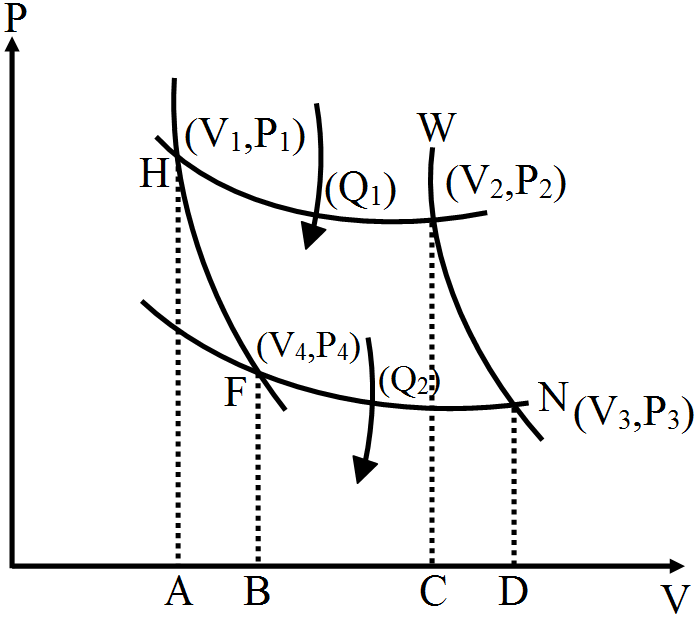
Process II-WN is an adiabatic processes at a temperature flow from $T_1$ to $T_2$ conducted with cylinder over (NCB = Non conducting base). Process III-NF is an isothermal process at $T_2$ which gives out an energy $Q_2$ with cylinder over sink Process IV-FH is an adiabatic process which changes the temperature from $T_2$ to $T_1$ conducted with the cylinder placed over (NCB = Non conducting base).
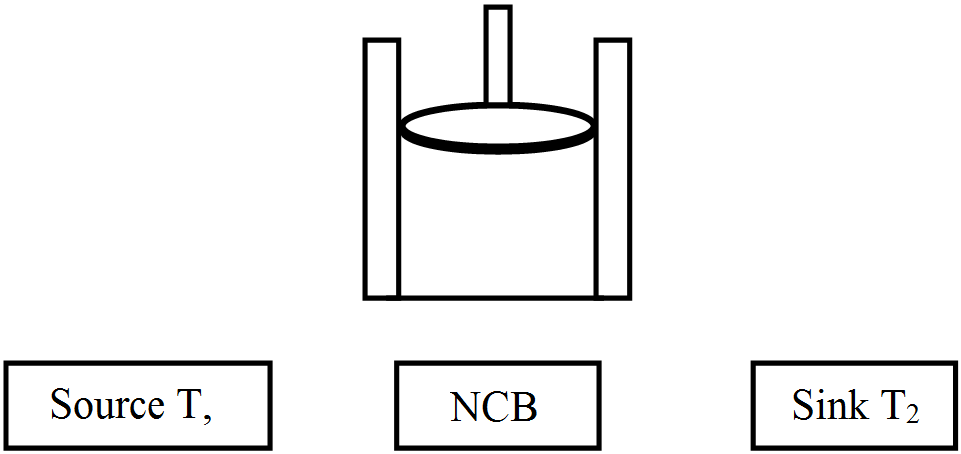
In the process, a net work equalling the area HWNFH is done with the net heat intake, $Q_1 - Q_2$ So, Efficiency $=\frac{\text{Work done}}{\text{heat supplied}}$ $=\frac{\text{Q}_1-\text{Q}_2}{\text{Q}_1}=1-\frac{\text{Q}_2}{\text{Q}_1}=1-\frac{\text{T}_2}{\text{T}_1}$ View full question & answer→Question 425 Marks
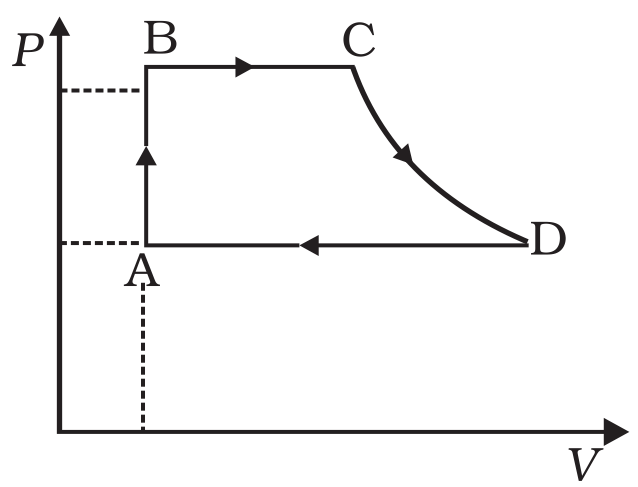
A cycle followed by an engine (made of one mole of an ideal gas in a cylinder with a piston) is shown in Fig. Find heat exchanged by the engine, with the surroundings for each section of the cycle. $(C_v = (3/2) R)$
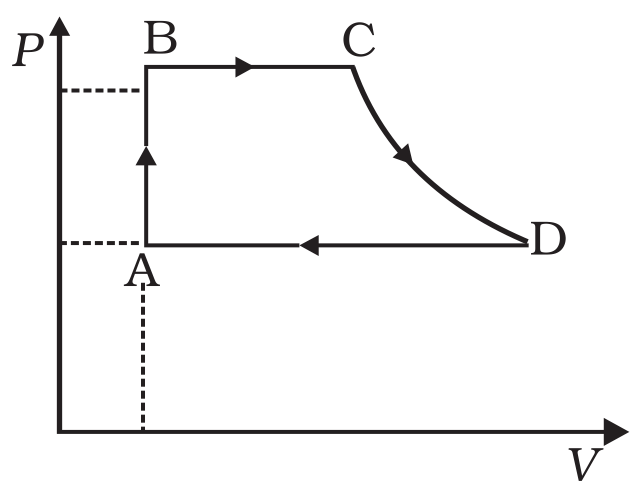
AB : constant volume
BC : constant pressur CD : adiabati DA : constant pressure Answer
- : For A → B, dV = 0
so,$\text{dW}=\int\text{P}.\text{dV}=\int\text{p}\times0=0$
$\text{dW}=0$
By $1^\text{st}$ law of thermodynamics
$\text{dQ}=\text{dU}+\text{dW}=\text{dU}+0$
$\therefore\ \text{dQ} =\text{dU}$
$\big(\text{dQ}=\text{n}\text{C}_\text{V}\text{dT}\big)$
So, $\text{dQ}-1\frac{3}{2}\text{R}\big(\text{T}_\text{B}-\text{T}_\text{A}\big).....(\text{i})$
$\text{dU}=\text{dQ}=\frac{3}{2}\big(\text{R}\text{T}_\text{}B-\text{R}\text{T}_\text{A}\big)=\frac{3}{2}\big(\text{P}_\text{B}\text{V}_\text{B}-\text{P}_\text{A}\text{}V_\text{A}\big)$
$\therefore$ Heat exchange [to system]
$\text{dQ}_1=\text{dU}=\frac{3}{2}\big(\text{P}_\text{s}\text{V}_\text{s}-\text{P}_\text{A}\text{V}_\text{A}\big)$
- For B to C, $\Delta\text{P}=0\ \text{n}=1$
$\text{dQ}=\text{dU}+\text{dW}=\text{C}_\text{V}\text{(dT)}+\text{P}_\text{S}\text{dV}$
$\text{dQ}_2=\frac{3}{2}\text{R}\big(\text{T}_\text{C}-\text{T}_\text{B}\big)+\text{P}_\text{B}\big(\text{V}_\text{C}-\text{V}_\text{B}\big)$
$=\frac{3}{2}\big(\text{T}_\text{C}\text{R}-\text{RT}_\text{B}\big)+\text{P}_\text{B}\text{V}_\text{C}-\text{P}_\text{B}\text{V}_\text{B}$
$=\frac{3}{2}[\text{P}_\text{C}\text{V}_\text{C}]-\frac{3}{2}[\text{P}_\text{B}\text{V}_\text{B}]-\text{P}_\text{B}\text{V}_\text{B}-\text{P}_\text{B}\text{V}_\text{C}$
$\text{V}_\text{A}=\text{V}_\text{B}\ \text{and}\ \text{P}_\text{B}=\text{P}_\text{C}$
$\therefore\text{dQ}_2=\frac{3}{2}\text{P}_\text{B}\text{V}_\text{C}-\frac{3}{2}\text{P}_\text{B}\text{V}_\text{A}-\text{P}_\text{B}\text{V}_\text{A}+\text{P}_\text{B}\text{V}_\text{C}$
$=\frac{5}{2}\text{P}_\text{B}\text{V}_\text{C}-\frac{5}{2}\text{P}_\text{B}\text{V}_\text{A}$
$\text{dQ}_2=\frac{5}{2}\text{P}_\text{B}[\text{V}_\text{C}-\text{V}_\text{A}]$
- For diagram C → B, adiabatic change
$\text{dQ}_3=0$ (No exchange of heat )
- For diagram D → A, $\Delta\text{P}=0$ Compression of gas from volume $V_D$ to $V_A$ pressure hence heat exchange similar to part (b) i.e. Heat exchange$\text{dQ}_3=\frac{5}{2}\text{P}_\text{A}\big(\text{V}_\text{A}-\text{V}_\text{D}\big)$
View full question & answer→Question 435 Marks
Consider one mole of perfect gas in a cylinder of unit cross section with a piston attached (Fig.) A spring (spring constant k) is attached (unstretched length L) to the piston and to the bottom of the cylinder. Initially the spring is unstretched and the gas is in equilibrium. A certain amount of heat Q is supplied to the gas causing an increase of volume from $V_o$ to $V_1$.
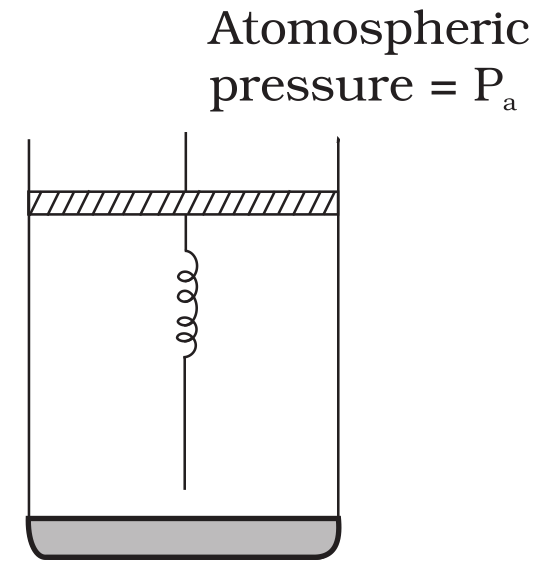
- What is the initial pressure of the system.
- What is the final pressure of the system.
- Uing the first law of thermodynamics, write down a relation between $Q, P_a, V, V_o$ and $k$.
Answer
- It is considered that piston is mass less and piston is balanced by atmospheric pressure $(P_a)$. So the initial pressure of system inside the cylinder $= P_a$,
- On supply heat Q. Volume of gas increase from $V_0$ to $V_1$ and spring stretched also.So increase in volume $= V_1 - V_0$
If displacement of piston is x then volume increase in cylinder )
= Aera of base × height = A × x
$A \times x = V_1 - V_0$ (A = area of cross section of cylinder)
$\therefore\ \text{x}=\frac{\text{V}_1-\text{V}_0}{\text{A}}$
Force exerted by spring $\text{F}_\text{s}=\text{K}_\text{x}=\frac{\text{K}(\text{V}_1-\text{V}_0)}{\text{A}}$
As the piston is of unit area of cross - section $\therefore\ \text{A}=1$
Force due to spring =$\text{K}(\text{V}_1-\text{V}_0)$ on unit area can be say press due to spring = $\text{K}(\text{V}_1-\text{V}_0)$
Final total pressure on gas $\text{P}_\text{f}=\text{P}_\text{a}+\text{K}(\text{V}_1-\text{V}_0)$
- by 1st law of thermodynamics $\text{dQ}=\text{dU}+\text{dW}$
Now $\text{DQ}=\text{dU}+\text{dW}$
$=\text{c}_\text{v}(\text{T}-\text{T}_0)+\text{P}_\text{a}(\text{V}_1-\text{V}_0)+\frac{1}{2}\text{kx}^2$
$\text{dQ}=\text{C}_\text{V}(\text{T}-\text{T}_0)+\text{P}_\text{a}(\text{V}_1-\text{V}_0)+\frac{1}{2}\text{k}(\text{V}_1-\text{V}_0)^2$
It is required relation. View full question & answer→Question 445 Marks
Consider that an ideal gas ( $n$ moles) is expanding in a process given by $P=f(V)$, which passes through a point $\left(V_0\right.$ $\left.P_0\right)$. Show that the gas is absorbing heat at $\left(P_0, V_0\right)$ if the slope of the curve $P=f(V)$ is larger than the slope of the adiabat passing through $\left(\mathrm{P}_0, \mathrm{~V}_0\right)$.
Answerslope of graph at $\big(\text{V}_0,\text{P}_0\big)=\Big(\frac{\text{dP}}{\text{dV}}\Big)_{(\text{V}_0\text{P}_0)}$
$\text{P}=\text{f}(\text{V})$ for adiabatic process $\text{PV}^\gamma$ = constant (K) $\text{Or}\ \text{P}=\frac{\text{K}}{\text{V}^\gamma}\ \text{or}\ \frac{\text{dP}}{\text{dV}}=\text{K}\big(-\gamma\big)\text{V}^{-\gamma-1}$
$\frac{\text{dP}}{\text{dV}}=-\gamma\text{PV}^\gamma\text{V}^{-\gamma}\text{V}^{-1}=-\frac{\gamma\text{P}}{\text{V}}$
$\Big(\frac{\text{dP}}{\text{dV}}\Big)_{\text{(P}_0\text{V}_0)}=\frac{-\gamma\text{P}_0}{\text{V}_0}$ Heat absorbed by in the process $\text{P}=\text{f}(\text{V})$
$\text{dQ}=\text{dU}+\text{dW}$
$\text{dQ}=\text{n}\text{C}_\text{V}\text{dT}+\text{PdV}\ .....(\text{i})$
$\text{PV}=\text{nRT}$
$\text{T}=\frac{\text{PV}}{\text{nR}}=\frac{\text{V}}{\text{nR}}\text{f}(\text{V})$
$\frac{\text{dT}}{\text{dV}}=\frac{1}{\text{nR}}\big[\text{f}(\text{V})+\text{Vf}\ '(\text{V})\big]$
$\frac{\text{dQ}}{\text{dV}}=\text{nC}_\text{V}\frac{\text{dT}}{\text{dV}}+\text{P}.\frac{\text{dV}}{\text{dV}}=\frac{\text{nC}_\text{V}}{\text{nR}}$$\big[\text{f(V)}+\text{Vf}\ '\text{(V)}\big]+\text{P}$
$\Big(\frac{\text{dQ}}{\text{dV}}\Big)_{\text{V}-\text{V}_0}=\frac{\text{C}_\text{V}}{\text{R}}$
$\big[\text{f}(\text{V}_0)+\text{V}_0\text{f}\ '(\text{V}_0)\big]+\text{f}_0\text{V})$$\big[\because\text{P}=\text{f}(\text{V})\text{ given}\big]$
$=\text{f}(\text{V}_0)\Big[\frac{\text{C}_\text{V}}{\text{R}}+1\Big]+\text{V}_0\text{f}\ '(\text{V}_0)\frac{\text{C}_\text{V}}{\text{R}}$
$\text{C}_\text{P}-\text{C}_\text{V}=\text{R}\Rightarrow\frac{\text{C}_\text{P}}{\text{C}_\text{V}}-1=\frac{\text{R}}{\text{C}_\text{V}}$
$\therefore\gamma-1=\frac{\text{R}}{\text{C}_\text{V}}\Rightarrow\text{C}_\text{V}=\frac{\text{R}}{\gamma-1}\Rightarrow\frac{\text{C}_\text{V}}{\text{R}}=\frac{1}{\gamma-1}$
$\Big(\frac{\text{dQ}}{\text{dV}}\Big)_{\text{V-V}_0}=\text{f}(\text{V}_0)\Big[\frac{1}{\gamma-1}\Big]+\text{V}_0\text{f}\ '(\text{V}_0)\frac{1}{\gamma-1}$
$=\text{f}(\text{V}_0)\Big[\frac{1+\gamma-1}{\gamma-1}\Big]+\frac{\text{V}_0\text{f}\ '(\text{V}_0)}{\gamma-1}$
$=\frac{\gamma}{(\gamma-1)}\text{f}(\text{V}_0)+\text{V}_0\frac{\text{f}\ '(\text{V}_0)}{\gamma-1}$
$=\frac{1}{(\gamma-1)}\big[\gamma\ \text{f}(\text{V}_0)+\text{V}_0\text{f}\ '(\text{V}_0)\big]$$\big(\because\ \text{f}(\text{V}_0)=\text{P}_0\big)$
$\Big(\frac{\text{dQ}}{\text{dV}}\Big)_{\text{V}-\text{V}_0}=\frac{1}{\gamma-1}$$\big[\gamma\ \text{P}_0+\text{V}_0\text{f}\ '(\text{V}_0)\big]$
$\therefore\ \Big(\frac{\text{dQ}}{\text{dV}}\Big)_{\text{V}-\text{V}_0}>1\therefore\ \text{and}\ \gamma>1\ \text{so}\ \frac{1}{\gamma-1}\text{is}+\text{ve}$
$\therefore\ \gamma\text{P}_0+\text{V}_0\text{f}\ '(\text{V}_0)>0$
$\text{V}_0\text{f}\ '(\text{V}_0)>-\gamma\text{P}_0$
$\text{f}\ '(\text{V}_0)>\frac{-\gamma\text{P}_0}{\text{V}_0}$
View full question & answer→Question 455 Marks
A cycle followed by an engine (made of one mole of perfect gas in a cylinder with a piston) is shown in Fig.
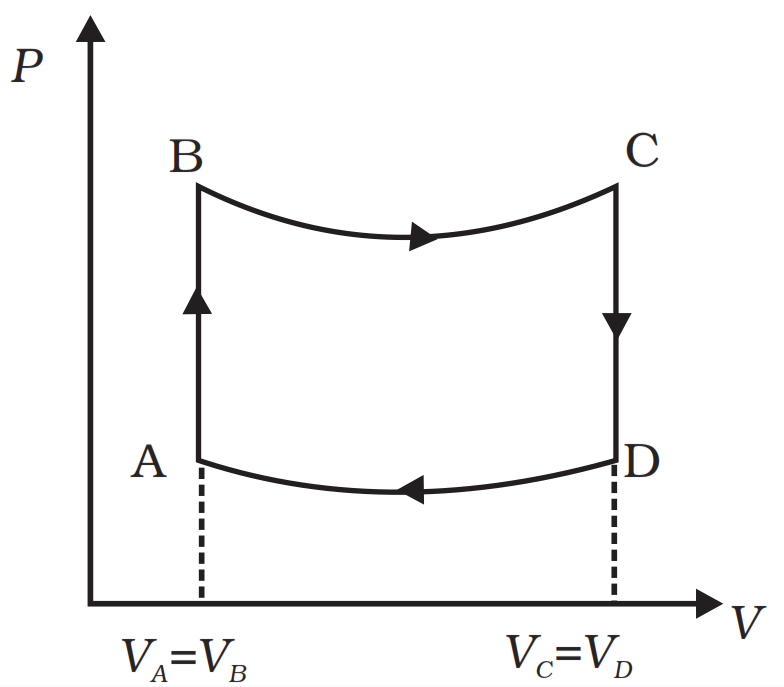
A to B : volume constant B to C : adiabatic C to D : volume constant D to A : adiabatic $V_C= V_D= 2V_A= 2V_B$
- In which part of the cycle heat is supplied to the engine from outside?
- In which part of the cycle heat is being given to the surrounding by the engine?
- What is the work done by the engine in one cycle? Write your answer in term of $P_A, P_B, V_A$.
- What is the efficiency of the engine?[$\gamma=\frac{5}{3}$ for the gas], $\big(\text{C}_\text{v}=\frac{3}{2}\text{R for one mole}\big)$
Answer(a) A to B
(b) C to D
(c) $\text{W}_\text{AB}=\int\limits^\text{B}_\text{A}\text{pdV}=0;\text{W}_\text{CD}=0.$
Simillarly. $\text{W}_\text{BC}=\Big[\int\limits^\text{C}_\text{B}\text{pdV}=\text{k}\int\limits^\text{C}_\text{B}\frac{\text{dV}}{\text{V}^\text{r}}=\text{k}\frac{\text{V}^\text{-r+1}}{-\text{R}+1}\Big]^{\text{V}_{\text{C}}}_{\text{V}_\text{B}}$
$= \frac{1}{1-\gamma}(\text{P}_\text{c}\text{V}_\text{c}-\text{P}_\text{B}\text{V}_\text{B})$
Simillarly, $\text{W}_\text{DA}=\frac{1}{1-\gamma}(\text{P}_\text{A}\text{V}_\text{A}-\text{P}_\text{D}\text{V}_\text{D})$
Now $\text{P}_\text{C}=\text{P}_\text{B}\Big(\frac{\text{V}_\text{B}}{\text{V}_\text{C}}\Big)^\gamma=2^{-\gamma}\text{P}_\text{B}$
Simillarly, $\text{P}_\text{D}=\text{P}_\text{A}2^{-\gamma}$
Total work done $=\text{W}_\text{BC}+\text{W}_\text{DA}$
$=\frac{1}{1-\gamma}\big[\text{P}_\text{B}\text{V}_\text{B}\big(2^{-\gamma+1}-1\big)-\text{P}_\text{A}\text{V}_\text{A}\big(2^{-\gamma+1}-1\big)\big]$
$=\frac{1}{1-\gamma}\big(2^{1-\gamma}-1\big)\big(\text{P}_\text{B}-\text{P}_\text{A}\big)\text{V}_\text{A}$
$=\frac{3}{2}\big(1-\Big(\frac{1}{2}\Big)^\frac{2}{3}\big)\big(\text{P}_\text{B}-\text{P}_\text{A}\big)\text{V}_\text{A}$
- Heat supplied during process A, B
$\text{d}\text{Q}_\text{AB}=\text{d}\text{U}_\text{AB}$
$\text{Q}_\text{AB}=\frac{3}{2}\text{n}\text{R}\big(\text{T}_\text{B}-\text{T}_\text{A}\big)\text{V}_\text{A}$
$\text{Efficiency}=\frac{\text{Net Work done }}{\text{Heat Supplied}}=\Big[1-\Big(\frac{1}{2}\Big)^\frac{2}{3}\Big]$ View full question & answer→