MCQ 11 Mark
Coefficient of performance for heat pump is $($when heat supplied by system is $Q_1):$
- ✓
$\alpha=\frac{\text{Q}_2}{\text{W}}$
- B
$\alpha=\frac{\text{Q}_1}{\text{W}}$
- C
$\alpha=\frac{\text{Q}_1}{\text{Q}_2}$
- D
$\alpha=\frac{\text{Q}_2}{\text{Q}_1}$
AnswerCorrect option: A. $\alpha=\frac{\text{Q}_2}{\text{W}}$
View full question & answer→MCQ 21 Mark
Consider $P-V$ diagram for an ideal gas shown in:
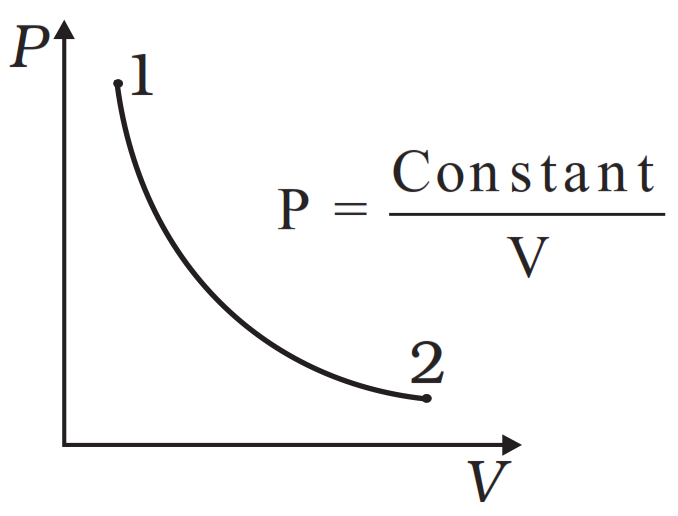
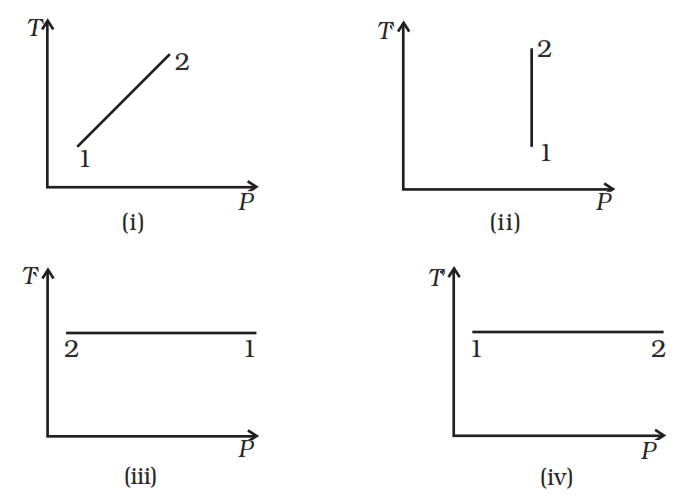
Out of the following diagrams which represents the $T-P$ diagram?
- A
$(iv)$
- B
$(ii)$
- ✓
$(iii)$
- D
$(i)$
AnswerCorrect option: C. $(iii)$
According to $P-V$ diagram at constant tempreature, $P$ increase as $V$ decrease.
So, it is Boyei's law in option $(iii)$ and $(iv).$ If $P$ increase at constant tempreature, volume $V$ decrease. as in $(iii) T-P$ diagram, $P$ is smaller at $2$ and larger at $1$, which tallies with option $c.$
View full question & answer→MCQ 31 Mark
If the coefficient of performance of a refrigerator is $5$ and operates at the room temperature $(27^\circ C),$ find the temperature inside the refrigerator.
- ✓
$-23^\circ C.$
- B
$23^\circ C.$
- C
$40^\circ C.$
- D
$-40^\circ C.$
AnswerCorrect option: A. $-23^\circ C.$
View full question & answer→MCQ 41 Mark
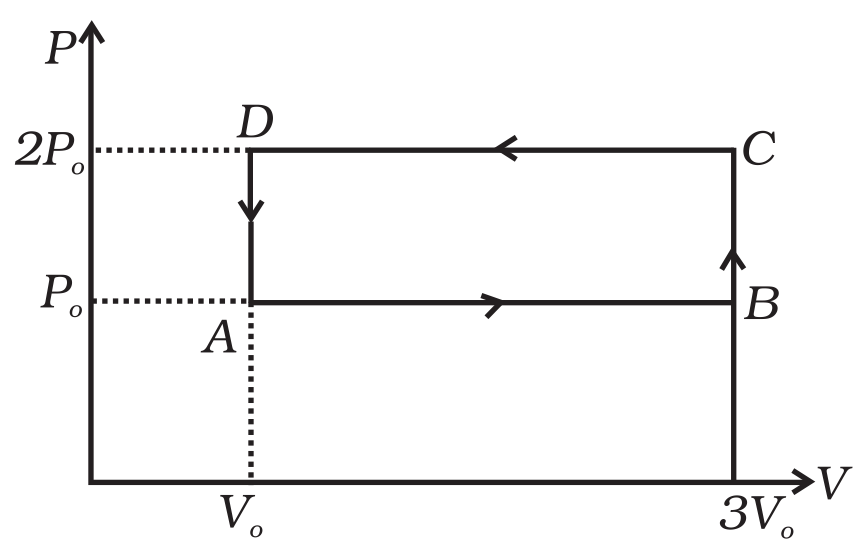
An ideal gas undergoes cyclic process $\text{ABCDA}$ as shown in given $PV$ diagram. The amount of work done by the gas is:
- A
$6\text{P}_0\text{V}_0$
- B
$-2\text{P}_0\text{V}_0$
- C
$+2\text{P}_0\text{V}_0$
- ✓
$+4\text{P}_0\text{V}_0$
AnswerCorrect option: D. $+4\text{P}_0\text{V}_0$
The direction of arrows is anticlockwise so work done is negative equal to the area of loop $=-(3\text{V}_0-\text{V}_0)(2\text{P}_0-\text{P}_0)=-2\text{P}_0\text{V}_0$ verifies the option $(b).$
New work implies external work is done on the system.
View full question & answer→MCQ 51 Mark
In an adiabatic change, the pressure $P$ and temperature $T$ of a diatomic gas are related by the relation $\text{P}\propto\text{T}^{\text{c}}$ where $c$ equals:
- A
$\frac53$
- B
$\frac25$
- C
$\frac35$
- ✓
$\frac72$
AnswerCorrect option: D. $\frac72$
Equation of adiabatic change is,
$\therefore\text{P}\propto\text{T}^{\frac{-\gamma}{(1-\gamma)}}$
For diatomic gas, $\gamma=\frac75$
$\text{P}\propto\text{T}^{\frac72}$
View full question & answer→MCQ 61 Mark
$110J$ of heat are added to a gaseous system and its internal energy increases by $40J,$ then the amount of work done is:
- A
$150J$
- ✓
$70J$
- C
$110J$
- D
$40J$
AnswerForm $\text{dU + DW = dQ}$
$\text{dW = dQ - du}$
$= 110 - 40$
$= 70J$
View full question & answer→MCQ 71 Mark
A system is provided with $200$ cal of heat and the work done by the system on the surroundings is $40J.$ Then, its internal energy:
- A
Increases by $600J.$
- B
Decreases by $800J.$
- ✓
Increases by $800J.$
- D
Decreases by $50J.$
AnswerCorrect option: C. Increases by $800J.$
Given, $\text{dQ = +200cal}$
$= 200 \times 4.2$
$= 840\text{J, dW}$
$= +40J$
From first law of thermodynamics,
$\text{dQ = dW + dW}$
$\text{dU = dQ - dW}$
$= 840 - 40$
$= 800J.$
View full question & answer→MCQ 81 Mark
An ideal heat engine exhausting heat at $27^\circ C$ is to have $25\%$ efficiency. It must take heat at:
- ✓
$127^\circ C.$
- B
$227^\circ C.$
- C
$327^\circ C$.
- D
$673^\circ C.$
AnswerCorrect option: A. $127^\circ C.$
View full question & answer→MCQ 91 Mark
In an adiabatic change, the pressure $P$ and temperature $T$ of a diatomic gas are related by the relation $\text{P}\propto\text{T}^\text{C}$ where $C$ equals:
- A
$\frac{5}{3}$
- B
$\frac25$
- C
$\frac35$
- ✓
$\frac72$
AnswerCorrect option: D. $\frac72$
View full question & answer→MCQ 101 Mark
The $SI$ unit of mechanical equivalent of heat $(J)$ is:
- ✓
- B
- C
Calorie $\times$ erg.
- D
Answer$SI$ unit of $J$ is joule/ calorie.
View full question & answer→MCQ 111 Mark
According to first law of thermodynamics:
AnswerCorrect option: C. Both $(a)$ and $(b).$
View full question & answer→MCQ 121 Mark
A black body is at $727^\circ C.$ It emits energy at a rate which is proportional to:
- ✓
$(1000)]^4$
- B
$(1000)^2$
- C
$(727)^4$
- D
$(1000)^2$
AnswerCorrect option: A. $(1000)]^4$
View full question & answer→MCQ 131 Mark
Which condition is true for an ideal Carnot engine which have 100% efficiency?
- A
Temperature of sink source $T_1$ = 0K.
- ✓
Temperature of sink $T_2$ = 0K.
- C
Temperature of sink source $T_1$ = 1.0K.
- D
AnswerCorrect option: B. Temperature of sink $T_2$ = 0K.
b. Temperature of sink $T_2$ = 0K
View full question & answer→MCQ 141 Mark
Heat and work are equivalent. This means,
- ✓
The temperature of a body can be increased by doing work on it.
- B
A body kept at rest may be set into motion along a line by supplying heat to it.
- C
When we do work on a body, we supply heat to it.
- D
When we supply heat to a body, we do work on it.
AnswerCorrect option: A. The temperature of a body can be increased by doing work on it.
As heat and work are equivalent, temperature of a body can be increased by doing work on it.
View full question & answer→MCQ 151 Mark
A carnot engine working between $300K$ and $600K$ has work output of $800J$ per cycle. The amount of heat energy supplied to the engine from source in each cycle is:
- A
$800J.$
- ✓
$1600J.$
- C
$3500J.$
- D
$6400J.$
AnswerCorrect option: B. $1600J.$
View full question & answer→MCQ 161 Mark
A heat engine has an efficiency $\eta.$ Temperatures of source and sink are each decreased by $100K.$ The efficiency of the engine:
View full question & answer→MCQ 171 Mark
A gas is expanded isothermally from volume $V_1$ to $V_2$ at a constant temperature $T,$ the work done by the gas in this expansion is:
- A
$\mu\text{RT}\log\frac{\text{V}_1}{\text{V}_2}$
- B
$\mu\text{RT}\times\frac{\text{V}_1}{\text{V}_2}$
- ✓
$\mu\text{RT}\log\frac{\text{V}_2}{\text{V}_1}$
- D
$\mu\text{RT}\times\frac{\text{V}_2}{\text{V}_1}$
AnswerCorrect option: C. $\mu\text{RT}\log\frac{\text{V}_2}{\text{V}_1}$
View full question & answer→MCQ 181 Mark
An ideal gas is taken through a cycle $\text{ABCA}$ as shown in Fig. The work done during the cycle is: 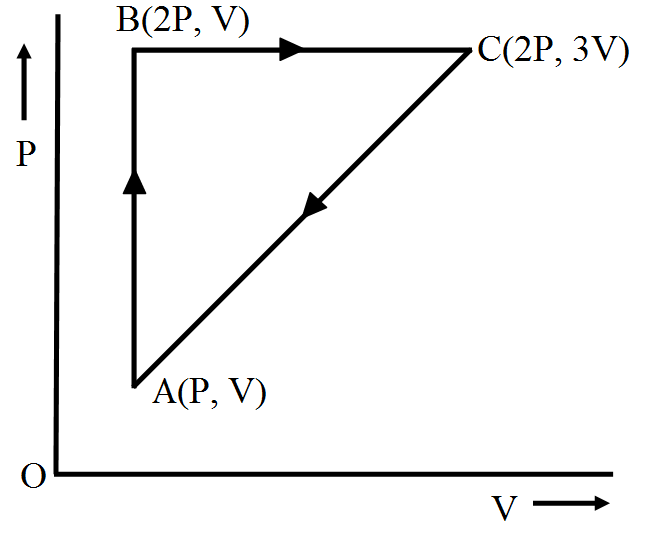
- A
$\frac12\text{PV}$
- B
$2PV$
- C
$4PV$
- ✓
$PV$
AnswerWork done $=$ Area of $\Delta\text{ABC}$
$=\frac12\text{BC}\times\text{AB}$
$=\frac12(3\text{V}-\text{V})(\text{2P}-\text{P})$
$\text{W}=\text{PV}$
View full question & answer→MCQ 191 Mark
During melting of a slab of ice at $273^\circ K$ at atmospheric pressure:
- A
Positive work is done by ice water system on the atmosphere.
- ✓
Positive work is done on ice water system by the atmosphere.
- C
Internal energy of ice water system increases.
- D
Internal energy of ice water system decreases.
AnswerCorrect option: B. Positive work is done on ice water system by the atmosphere.
During melting of ice, volume decreases.
Therefore, positive work is done on the system by the atmosphere.
Also heat spent in melting increases the internal energy of ice$-$water system.
View full question & answer→MCQ 201 Mark
The door of a running refrigerator inside a room is left open. The correct statement out of the following ones is:
- A
The room will be cooled slightly.
- ✓
The room will be warmed up gradually.
- C
The room will be cooled to the temperature inside the refrigerator.
- D
The temperature of the room will remain unaffected.
AnswerCorrect option: B. The room will be warmed up gradually.
Coefficient of performance of refrigerator is,
$\frac{\text{Q}_2}{\text{W}}=\frac{\text{T}_2}{\text{T}_1-\text{T}_2}$
When the door of a running refrigerator inside a room is left open, $T_2 \rightarrow T_1$.
Coefficient of performance increases. $Q_2$ increases.
Therefore, heat energy given to the room increases.
Hence the room will be warmed up gradually.
View full question & answer→MCQ 211 Mark
Choose the state variable from the given options:
MCQ 221 Mark
If a system is in thermodynamic equilibrium with its surroundings, it means:
- ✓
Temperature of system and surroundings must be same.
- B
Pressure, volume and temperature of system and surroundings must be same.
- C
Pressure, volume and temperature of system and surroundings may be different.
- D
AnswerCorrect option: A. Temperature of system and surroundings must be same.
View full question & answer→MCQ 231 Mark
A given system undergoes a change in which work done by the system equals the decrease in its internal energy. The system must have undergone:
AnswerWhen a gas expands suddenly, $($adiabatic change$)$ work is done by the gas. Therefore, internal energy of the system decreases.
View full question & answer→MCQ 241 Mark
A gas performs minimum work when it expands:
AnswerIn isochoric process, $V =$ constant, $dV = 0$
$\text{dW = P(dv)} = 0$ and hence minimum.
View full question & answer→MCQ 251 Mark
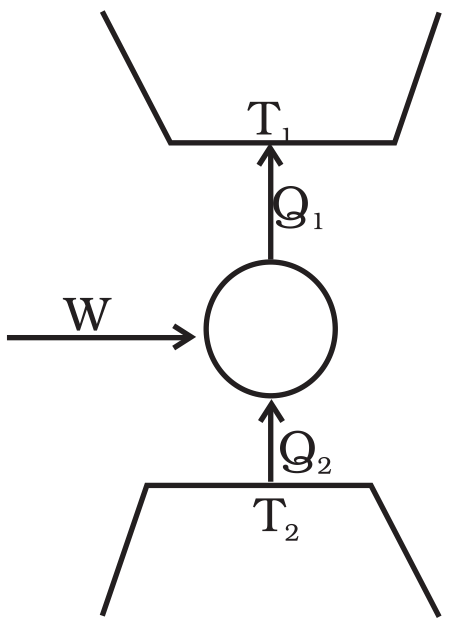
Consider a heat engine as shown in $Q_1$ and $Q_2$ are heat added to heat bath $T_1$ and heat taken from $T_2$ in one cycle of engine. W is the mechanical work done on the engine. If $W > 0,$ then possibilities are:
- A
$\text{Q}_1>\text{Q}_2>0$
- B
$\text{Q}_2>\text{Q}_1>0$
- C
$\text{Q}_2<\text{Q}_1<0$
- ✓
Both $A$ and $C$
AnswerCorrect option: D. Both $A$ and $C$
From $\text{Q}_{1}=\text{W}+\text{Q}_{2}$
$\therefore\text{W}>0$
So $\therefore\text{Q}_{1}-\text{Q}_{2}$ or $\text{Q}_{1}>0$
$\therefore\text{Q}_{1}>\text{Q}_{2}>0$ if both $\text{Q}_{1},\text{Q}_{2}$ position verifies option $(a).$
Or $\text{Q}_{2}<\text{Q}_{1}<0$ if both $\text{Q}_{1}\text{Q}_{2}$ negative verifies option $(c).$
View full question & answer→MCQ 261 Mark
According to second law of thermodynamics:
AnswerCorrect option: A. A heat engine cannot have efficiency equal to $1.$
Second law puts limitation on the efficiency of a heat engine and on the coefficient of performance of a refrigerator. Heat engine cannot have efficiency equal to $1$ and a refrigerator cannot have infinite value of coefficient of performance.
View full question & answer→MCQ 271 Mark
If $m$ is the mass, $\theta$ is temperature and $'a\ '$ is specific heat, then thermal capacity $K$ is given by:
- A
$\text{K}=\text{ms}\theta$
- B
$\text{K}=\text{m}\theta$
- C
$\text{K}=\frac{\text{ms}}{\theta}$
- ✓
$\text{K}=\text{ms}$
AnswerCorrect option: D. $\text{K}=\text{ms}$
Thermal capacity $=$ Mass $\times$ Specific heat $= m \times s$
View full question & answer→MCQ 281 Mark
An ideal gas undergoes isothermal process from some initial state $i$ to final state $f.$ Choose the correct alternatives.
- A
$dU = 0$
- B
$\text{dQ = dW}$
- C
$\text{dQ = dU}$
- ✓
Both $A$ and $B$
AnswerCorrect option: D. Both $A$ and $B$
Key concept: First Law of Thermodynamics.
It is a statement of conservation of energy in thermodynamical process.
According to it heat given to a system $(\Delta\text{Q})$ is equal to the sum of increase in its internal energy $\text{(AIT)}$ and the work done $\text{(AW)}$ by the system against the surroundings.
$\Delta\text{Q}=\Delta\text{U}+\Delta\text{W}$
According to the first law of thermodynamics. $\Delta\text{A}\text{Q}=\Delta\text{U}+\Delta\text{W}$ but
$\Delta\text{U}\propto\Delta\text{T}$
$\Delta\text{U}=0[$As $\Delta\text{T}=0]$
$\Delta\text{Q}=\Delta\text{W}$,
i.e., heat supplied in an isothermal change is used to do work against external surrounding or if the work is done on the system then equal amount of heat energy will be liberated by the system
View full question & answer→MCQ 291 Mark
An ideal gas having molar specific heat capacity at constant volume is $\frac32\text{R}$ the molar specific heat capacities at constant pressure is:
- A
$\frac12\text{R}$
- ✓
$\frac52\text{R}$
- C
$\frac72\text{R}$
- D
$\frac92\text{R}$
AnswerCorrect option: B. $\frac52\text{R}$
b. $\frac52\text{R}$
View full question & answer→MCQ 301 Mark
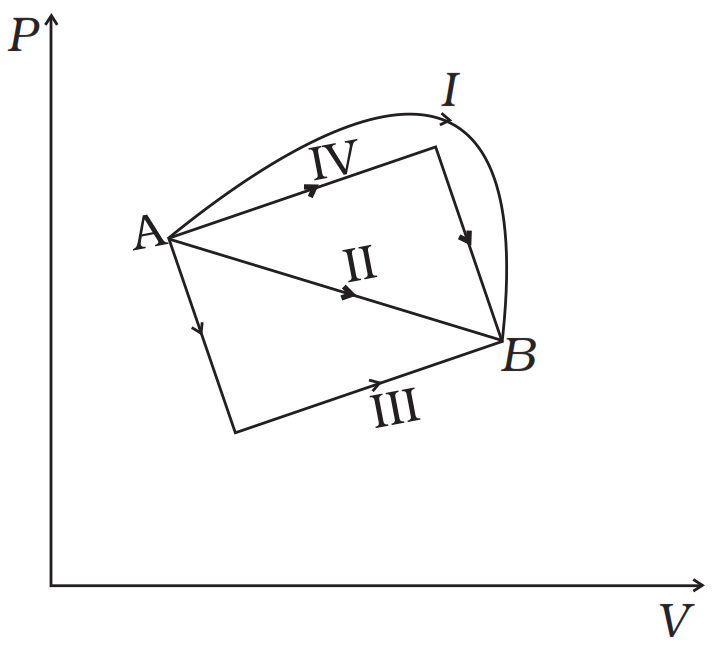
Figure. shows the $P-V$ diagram of an ideal gas undergoing a change of state from $A$ to $B$. Four different parts $\text{I, II, III}$ and $\text{IV}$ as shown in the figure may lead to the same change of state.
- A
Change in internal energy is same in $IV$ and $III$ cases, but not in $I$ and $II.$
- B
Change in internal energy is same in all the four cases.
- C
Work done is maximum in case $I$
- ✓
Both $B$ and $C$
AnswerCorrect option: D. Both $B$ and $C$
Main concept used : $dU$ does not depend on $P-V$ path, it depends on initial and final position.
$WD$ is $P-V$ is equal to area enclosed with $V-$axis
The initial and final position are same for different parts $\text{I, II, III, IV.}$
So is same.
Hence option $(a)$ rejected verifies option $(b)$.
As the area enclosed by path $I$ is maximum with $V-$axis,
So $W.D.$ during path $I$ is maximum and minimum is in $III$
Hence option $(c)$ verifies and option $(d)$ rejected.
View full question & answer→MCQ 311 Mark
One mole of an ideal gas at an initial temperature of $T, K$ does $6R$ joule of work adiabatically. If the ratio of specific heats of this gas at constant pressure and at constant volume is $\frac53,$ the final temperature of the gas will be:
- A
$(T + 4)K$
- ✓
$(T - 4)K$
- C
$(T + 2.4)K$
- D
$(T - 2.4)$
AnswerCorrect option: B. $(T - 4)K$
Here, $T_1 = T, W = 6R$
$\gamma=\frac{\text{C}_\text{P}}{\text{C}_\text{V}}=\frac53,\text{T}_2=?$
In and adiabatic process,
$\text{W}=\frac{\text{R}(\text{T}_2-\text{T}_1}{1-\gamma}$
$\text{6R}=\frac{\text{R}(\text{T}_2-\text{T}_1)}{1-\frac53}$
$\text{T}_2-\text{T}=6\Big(-\frac23\Big)=-4$
$\text{T}_2-\text{(T}-4)\text{K}$
View full question & answer→MCQ 321 Mark
For a heat engine the heat taken from the hot source is $Q_1$. So,
- A
$Q_1 = Q_2 - Q$
- B
$Q_2 = W$
- C
$Q_1 = Q_2$
- ✓
View full question & answer→MCQ 331 Mark
According to Carnot, which type of engine working between two temperatures $T$ and $T_2$ have maximum efficiency?
- ✓
- B
- C
External combustion engine.
- D
AnswerFor reversible engine, according to Carnot, efficiency is maximum.
View full question & answer→MCQ 341 Mark
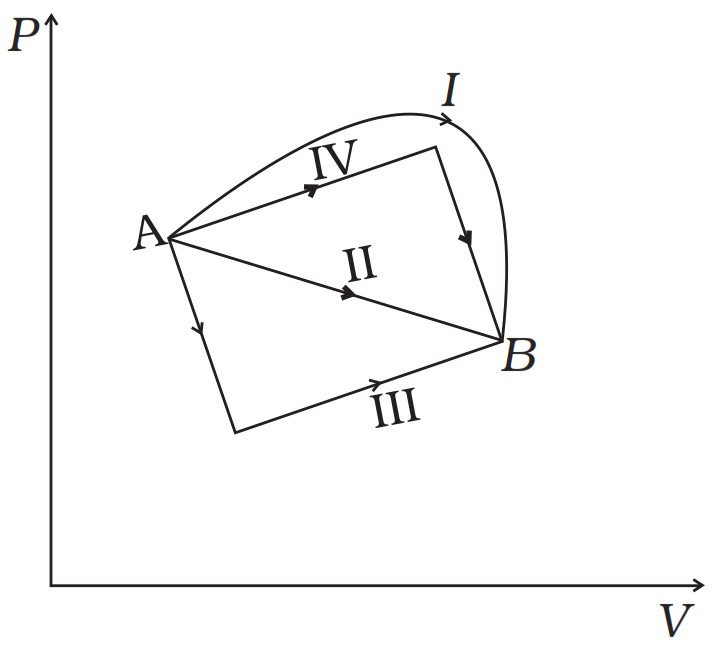
Consider a cycle followed by an engine: $1$ to $2$ is isothermal. $2$ to $3$ is adiabatic. $3$ to $1$ is adiabatic. Such a process does not exist because:
- A
heat is completely converted to mechanical energy in such a process, which is not possible.
- B
mechanical energy is completely converted to heat in this process, which is not possible.
- ✓
Both $A$ and $B$
- D
curves representing an adiabatic process and an isothermal process don’t intersect.
AnswerCorrect option: C. Both $A$ and $B$
The given process is a cyclic process, i.e. it returns to the original state $1.$
And change in internal energy in a cyclic process is always zero as for cyclic process $\text{U}_\text{f}=\text{U}_\text{i}$
So,$\Delta\text{U}=\text{U}_\text{f}-\text{U}_\text{i}=0$
Hence, total heat is completely converted to mechanical energy.
Such a process is not possible by second law of thermodynamics.
Here, two curves are intersecting, when the gas expands adiabatically from $2$ to $3.$
It is not possible to return to the same state without being heat supplied,
hence the process $3$ to $1$ cannot be adiabatic.
So, we conclude that such a process does not exist because curves representing two adiabatic processes do not intersect.
View full question & answer→MCQ 351 Mark
Consider two containers $A$ and $B$ containing identical gases at the same pressure, volume and temperature. The gas in container $A$ is compressed to half of its original volume isothermally while the gas in container $B$ is compressed to half of its original value adiabatically. The ratio of final pressure of gas in $B$ to that of gas in $A$ is
- ✓
$2^{\gamma-1}$
- B
$\Big(\frac{1}{2}\Big)^{\gamma-1}$
- C
$\Big(\frac{1}{1-\gamma}\Big)^2$
- D
$\Big(\frac{1}{\gamma-1}\Big)^2$
AnswerCorrect option: A. $2^{\gamma-1}$
According to the $P-V$ diagram shown for the container $A ($which is going through isothermal process$)$ and for container $B ($which is going through adiabatic process$).$
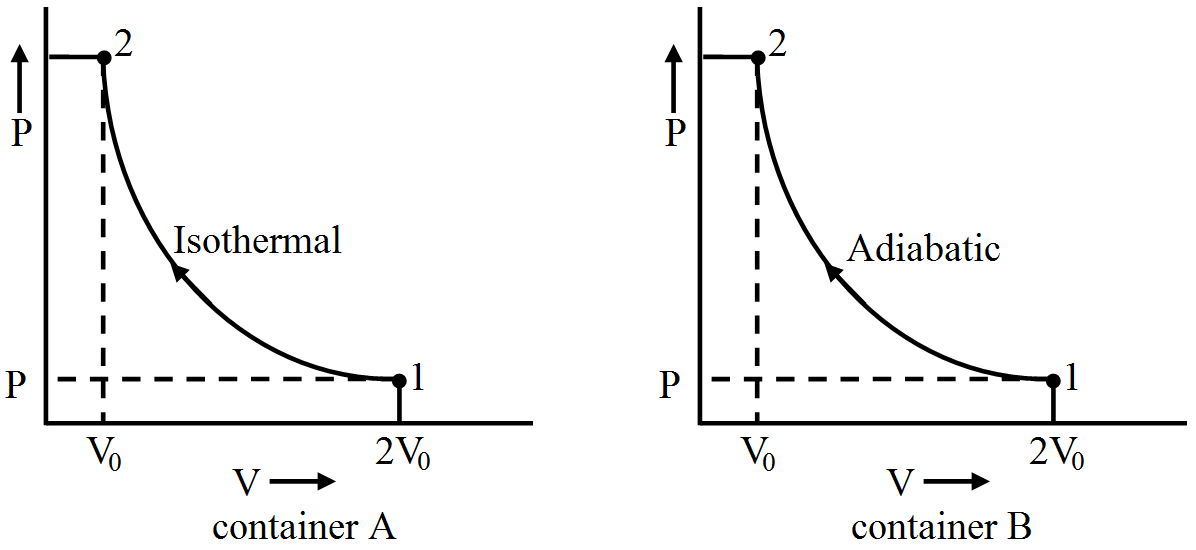
Both the process involves compression of the gas.
$(I)$ Isothermal compression $($gas $A) ($during $1 \rightarrow 2)$
$\text{P}_{1}\text{V}_{1}=\text{P}_{2}\text{V}_{2}$
$\Rightarrow\text{P}_{0}(2\text{V}_{0})^\gamma=\text{P}_{2}(\text{V}_{0})^\gamma$
$\Rightarrow\text{P}_{0}(2\text{V}_{0})=\text{P}_{2}(\text{V}_{0})$
$(ii)$ Adiabatic compression, $($gas $B) ($during $1 \rightarrow 2)$
$\text{P}_{1}\text{V}_{1} ^\gamma=\text{P}_{2}\text{V}_{2}^\gamma$
$\text{P}_{0}(2\text{V}_{0})^\gamma=\text{P}_{2}(\text{V}_{0})^\gamma$
$\text{P}_{2}=\Big(\frac{2\text{V}_{0}}{\text{V}_{0}}\Big)^\gamma\text{P}_{0}=(2)^\gamma\text{P}_{0}$
Hence $\frac{(\text{P}_{2})_\text{B}}{(\text{P}_{2})_\text{A}}=$ Ratio of final pressure $=\frac{(2)^\gamma\text{P}_{0}}{2\text{P}_{0}}=2^{\gamma-1}$
where, $\gamma$ is ratio of specific heat capacities for the gas. View full question & answer→MCQ 361 Mark
If an average person jogs, he produces $14.5 \times 103\ \text{cal/ min.}$ This is removed by the evaporation of sweat. The amount of sweat evaporated per minute $($assuming $1\ kg$ requires $580 \times 103\ \text{cal}$ for evaparation$)$ is
- ✓
$0.25\ kg$
- B
$2.25\ kg$
- C
$0.05\ kg$
- D
$0.20\ kg$
AnswerCorrect option: A. $0.25\ kg$
$580 \times 10^3$ Calories are needed to convert $1\ \ce{kg H_2O}$ into steam.
$1\ \text{cal}$ will producer sweat $=\frac{1}{580\times10^{3}}$
$14.5 \times 10^3\ \text{cal}$ will producer sweat $=\frac{14.5\times10^3}{580\times10^3}$
$=\frac{145}{5800}\text{kg }$ Perminute
$=0.25\text{kg }$ Perminute
View full question & answer→MCQ 371 Mark
Heat capacity of a substance depends on:
- A
The mass of the substance.
- B
The temperature of the substance.
- ✓
Both $(a)$ and $(b).$
- D
Neither $(a)$ nor $(b).$
AnswerCorrect option: C. Both $(a)$ and $(b).$
$S$ depends on the mass of the substance and it: temperature.
Heat capacity, $\text{S} = \frac{\text{Heat consumed by given mass}}{\text{Temperature raised}}$
If given mass is increased, then $S$ increases.
View full question & answer→MCQ 381 Mark
A carnot engine whose sink is at $300K$ has an efficiency of $40\%$. By how much should the temperature of source be increased so as to increase its efficiency by $50\%$ of original efficiency.
- A
$380K.$
- B
$275K.$
- C
$325K.$
- ✓
$250K.$
AnswerCorrect option: D. $250K.$
Here, $T_2 = 300K, \eta_1=40\%$
$\eta_1=1-\frac{\text{T}_2}{\text{T}_1}$
$\frac{40}{100}=1-\frac{300}{\text{T}_1}$
$\therefore\text{T}_1=500\text{K}$
$\eta_2=40\%+\frac{50}{100}\times40\%=60\%$
$\text{T}_2=300\text{K},\text{T}_1=?$
As, $\eta_2=1-\frac{\text{T}'_2}{\text{T}'_1}$
$\therefore\frac{60}{100}=1-\frac{300}{\text{T}'_1}$ or $\text{T}'_1=750\text{K}$
$\text{T}'_1-\text{T}_1=250\text{K}$
View full question & answer→MCQ 391 Mark
Which of the processes described below are irreversible?
AnswerKey concept: Reversible process: A reversible process is one which can be reversed in such a way that all changes occurring in the direct process are exactly repeated in the opposite order and inverse sense and no change is left in any of the bodies taking part in the process or in the surroundings.
The conditions for reversibility are:
There must be complete absence of dissipative forces such as friction, viscosity, electric resistance etc. ~
The direct and reverse processes must take place infinitely slowly.
The temperature of the system must not differ appreciably from its surroundings.
Irreversible process: Any process which is not reversible exactly is an irreversible process. All natural processes such as conduction, radiation, radioactive decay etc. are irreversible. All practical processes such as free expansion, Joule$-$Thomson expansion, electrical heating of a wire are also irreversible.
In this case internal energy of the rod is increased from external work done by hammer which in turn increases its temperature. So, the process cannot be retraced itself.
In this process energy in the form of heat is transferred to the gas in the small container by big reservoir at temperature $T$
In a quasi$-$static isothermal expansion, the gas is ideal, this process is reversible because the cylinder is fitted with frictionless piston.
As the weight is added to the cylinder arrangement in the form of external pressure hence, it cannot be reversed back itself.
View full question & answer→MCQ 401 Mark
Reversibility is not possible because of:
AnswerCorrect option: A. Resistive force present everywhere.
View full question & answer→MCQ 411 Mark
An ideal heat engine exhausting heat at $27^\circ C$ is to have $25\%$ efficiency. It must take heat at:
- ✓
$127^\circ C.$
- B
$227^\circ C.$
- C
$327^\circ C.$
- D
$673^\circ C.$
AnswerCorrect option: A. $127^\circ C.$
View full question & answer→MCQ 421 Mark
The value of coefficient of performance $B$ of perfect refrigerator is:
AnswerCorrect option: C. $\infty$
View full question & answer→MCQ 431 Mark
According to Zeroth law, which physical quantity must have same value for the two systems to be in thermal equilibrium?
MCQ 441 Mark
Specific heat capacity depends on:
- A
- B
- C
- ✓
Both $(a)$ and $(c).$
AnswerCorrect option: D. Both $(a)$ and $(c).$
View full question & answer→MCQ 451 Mark
The internal energy of an ideal gas depends on:
MCQ 461 Mark
The efficiency of the heat engine:
AnswerCorrect option: C. Cannot be $100\%$
View full question & answer→MCQ 471 Mark
During an adiabatic process, the pressure of a gas is found to be proportional to the cube of its absolute temperature. The ratio $\frac{\text{C}_\text{P}}{\text{C}_\text{V}}$ for gas is:
- A
$\frac{4}{3}$
- B
$2$
- C
$\frac53$
- ✓
$\frac32$
AnswerCorrect option: D. $\frac32$
For an adiabatic change,
$\text{PT}^{\frac{\gamma}{(1-\gamma)}}=$ constant
$\therefore\frac{\gamma}{1-\gamma}=-3$ or $-3+3\gamma=\gamma$
$2\gamma=3$
$\gamma=\frac32$
View full question & answer→MCQ 481 Mark
If two systems are in thermal equilibrium with each other, it means their:
- A
Masses are equal, temperatures may be unequal.
- ✓
- C
Masses and temperatures are equal.
- D
AnswerIf two systems are in thermal equilibrium with each other, it means their temperatures must be same. Masses may be equal or unequal.
View full question & answer→MCQ 491 Mark
Efficiency of an engine is $\eta_1$ at $\text{T}_1=200^\circ\text{C}$ and $\text{T}_2=0^\circ\text{C}$ and for $\eta_2$ at $\text{T}_1=0^\circ\text{C}$ and $\text{T}_2=-200\text{K},$ the ratio of $\frac{\eta_1}{\eta_2}$ is:
- A
$1.00$
- B
$0.721$
- ✓
$0.577$
- D
$0.34$
AnswerCorrect option: C. $0.577$
View full question & answer→MCQ 501 Mark
An ideal gas heat engine operates in a Carnot cycle between $227^\circ C$ and $127^\circ C.$ It absorbs $6\ \text{k cal}$ of heat at higher temperature. The amount of heat in $\text{k cal}$ rejected to $\sin k$ is
View full question & answer→MCQ 511 Mark
For isothermal expansion of an ideal gas:
- A
$\Delta\text{U}=+\text{ve}$
- B
$\Delta\text{Q}=+\text{ve}$
- C
$\Delta\text{W}=+\text{ve}$
- ✓
Both $(b)$ and $(c).$
AnswerCorrect option: D. Both $(b)$ and $(c).$
For isothermal expansion,
$\Delta\text{U}=0$
$\Rightarrow\Delta\text{U}=\Delta\text{W}$
Here, $\Delta\text{W}\rightarrow+\text{ve}$
$\Rightarrow\Delta\text{Q}\rightarrow+\text{ve}$
View full question & answer→MCQ 521 Mark
Mechanical equivalent of heat is equal to the amount of:
AnswerCorrect option: C. Both $(a)$ and $(b).$
View full question & answer→MCQ 531 Mark
Efficiency $(\eta)$ of the heat engine in thermodynamics can be defined as:
- A
$\eta=\frac{\text{W}}{\text{Q}_2}$
- B
$\eta=1-\frac{\text{Q}_1}{\text{Q}_2}$
- ✓
$\eta=\frac{\text{W}}{\text{Q}_1}$
- D
AnswerCorrect option: C. $\eta=\frac{\text{W}}{\text{Q}_1}$
For heat engine, $Q_1 = W + Q_2$
$\Rightarrow W = Q_1 - Q_2$
$Q_2$ is heat rejected to the environment.
So, $\eta=\frac{\text{Q}_1-\text{Q}_2}{\text{Q}_1}=\frac{\text{W}}{\text{Q}_1}$
View full question & answer→MCQ 541 Mark
For Carnot engine, which process should be chosen to take the working substance from $T_1$ to $T_2$ or vice$-$versa?
View full question & answer→MCQ 551 Mark
For a gas, $\gamma=1.4.$ Then Atomicity, $C_P$ and $C_V$ of the gas are:
- A
Monoatomic, $\frac52\text{R},\frac32\text{R}$
- B
Monoatomic, $\frac72\text{R},\frac52\text{R}$
- ✓
Diatomic, $\frac{7}{2}\text{R},\frac52\text{R}$
- D
Triatomic, $\frac72\text{R},\frac52\text{R}$
AnswerCorrect option: C. Diatomic, $\frac{7}{2}\text{R},\frac52\text{R}$
From $\gamma=\Big(1+\frac2{\text{n}}\Big)=1.4$
We get $n = 5,$ which is the number of degrees of freedom of a diatomic gas.
$\text{C}_\text{v}=\frac{\text{n}}{2}\text{R}=\frac{5}{2}\text{R}$
$\text{C}_\text{P}=\Big(\frac{\text{n}}{2}+1\Big)\text{R}=\frac{7}{2}\text{R}$
View full question & answer→MCQ 561 Mark
Efficiency of engine is $\eta_1$ at $T_1 = 200^\circ C$ and $T_2 = 0^\circ C$ and $\eta_2$ at $T_1 = 0^\circ C$ and $T_2 = 200^\circ K.$ Find the ratio of $\frac{\eta_1}{\eta_2}.$
- A
$1.00$
- B
$0.721$
- ✓
$0.577$
- D
$0.34$
AnswerCorrect option: C. $0.577$
$\eta_1=1-\frac{273+0}{200+273}=\frac{200}{473}$
$\eta_2=1-\frac{-200+273}{0+27 3}=\frac{200}{273}$
$\frac{\eta_1}{\eta_2\text{}}=\frac{200}{473}\times\frac{273 }{200}=\frac{273}{473}=0.577$
View full question & answer→MCQ 571 Mark
Choose the correct option:
- A
Zeroth law gives the concept of temperature.
- B
Temperature measures the 'hotness' of the body.
- C
Heat flows from higher temperature to lower temperature until thermal equilibrium is attained.
- ✓
Answer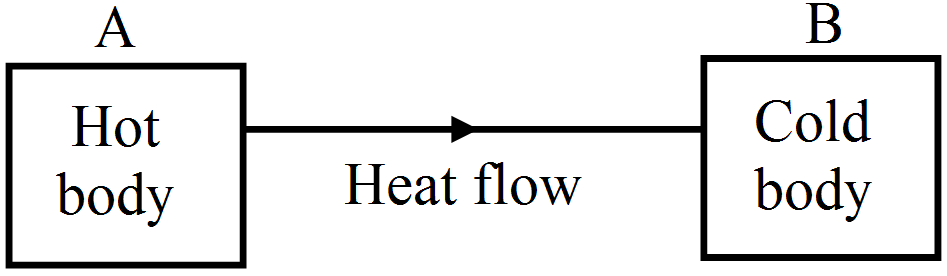
Heat flows from body $A$ to body $B$ because temperature of body $A$ is higher. At thermal equilibrium, $\text{T}_\text{A}'=\text{T}_\text{B}'$
| $A$ in equilibrium with $C$ |
$A$ in equilibrium with $B$ |
| $B$ in equilibrium with $C$ |
View full question & answer→MCQ 581 Mark
For a gas, $y = 1.4$ then atomicity, $C_p$ and $C_v$ of the gas are:
- A
Monoatomic $\frac52\text{R},\frac32\text{R}$
- B
Monoatomic $\frac72\text{R},\frac52\text{R}$
- ✓
Diatomic $\frac72\text{R},\frac52\text{R}$
- D
Triatomic $\frac72\text{R},\frac52\text{R}$
AnswerCorrect option: C. Diatomic $\frac72\text{R},\frac52\text{R}$
View full question & answer→MCQ 591 Mark
If $150J$ of heat is added to a system and the work done by the system is $110J,$ then change in internal energy will be:
- ✓
$40J.$
- B
$110J.$
- C
$150J.$
- D
$260J.$
AnswerCorrect option: A. $40J.$
View full question & answer→MCQ 601 Mark
An ideal gas undergoes four different processes from thesame initial state $($Fig.$)$. Four processes are adiabatic, isothermal, isobaric and isochoric. Out of $1, 2, 3$ and $4$ whichone is adiabatic.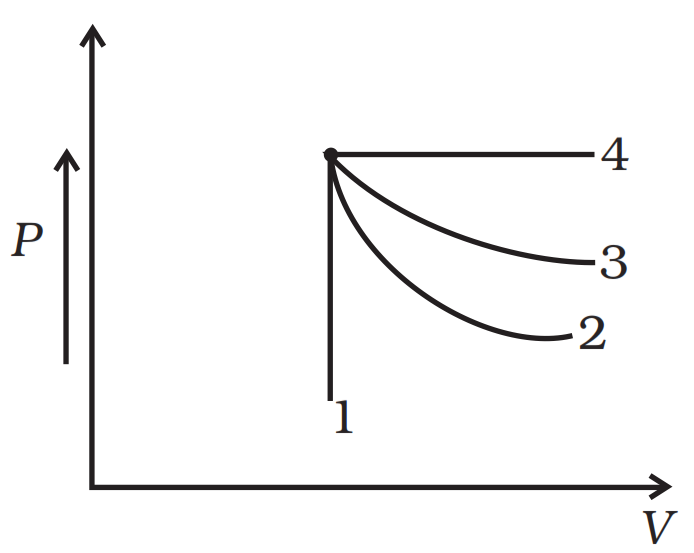
Answer$4$ is isobaric process, $1$ is isochoric. out of $3$ and $2, 3$ has the smaller slope $($magnitude$)$ hence is isothermal. Remaining process $2$ is adiabatic.
View full question & answer→MCQ 611 Mark
A mixture of gases undergoing explosive chemical reaction:
- A
Is not in equilibrium state during explosion.
- B
May have variable temperature and pressure values during explosion.
- C
Finally the gas will attained equilibrium state with its surroundings.
- ✓
View full question & answer→MCQ 621 Mark
The efficiency of a Carnot's engine working between steam point and ice point is:
- ✓
$26.81\%$
- B
$29\%$
- C
$30\%$
- D
$10\%$
AnswerCorrect option: A. $26.81\%$
$T_1 = (100 + 273) = 373K$
$T_2 = (0 + 273) = 273K$
Efficiency $(\eta)=1-\frac{\text{T}_2}{\text{T}_1}$
$=1-\frac{273}{373}=\frac{100}{373}$
$\%\eta=\frac{100}{373}\times100$
$=26.81\%$
View full question & answer→MCQ 631 Mark
The given quantity of an ideal gas is at pressure $P$ and absolute Temperature $T.$ The isothermal bulk Modulus of the gas is:
- A
$\frac{2}{4}\text{R}$
- ✓
$\text{P}$
- C
$\frac32\text{P}$
- D
$2\text{P}$
AnswerCorrect option: B. $\text{P}$
View full question & answer→MCQ 641 Mark
A given quantity of an ideal gas is at pressure $P$ and absolute temperature $T.$ The isothermal bulk modulus of the gas is:
- A
$\frac23\text{P}$
- ✓
$\text{P}$
- C
$\frac23\text{P}$
- D
$\text{2P}$
AnswerCorrect option: B. $\text{P}$
$K_i = P =$ the pressure exerted by the gas.
View full question & answer→MCQ 651 Mark
Three copper blocks of masses $M_1, M_2$ and $M_3\ kg$ respectively are brought into thermal contact till they reach equilibrium. Before contact, they were at $T_1, T_2, T_3 (T_1 > T_2 > T_3).$ Assuming there is no heat loss to the surroundings, the equilibrium temprature $T$ is $(s$ is specific heat of copper$)$
- A
$\text{T}=\frac{\text{T}_{1}+\text{T}_{2}+\text{T}_{3}}{3}$
- ✓
$\text{T}=\frac{\text{M}_{1}\text{T}_{1}+\text{M}_{2}\text{T}_{2}+\text{M}_{3}\text{T}_{3}}{\text{M}_{1}+\text{M}_{2}+\text{M}_{3}}$
- C
$\text{T}=\frac{\text{M}_{1}\text{T}_{1}+\text{M}_{2}\text{T}_{2}+\text{M}_{3}\text{T}_{3}}{3(\text{M}_{1}+\text{M}_{2}+\text{M}_{3})}$
- D
$\text{T}=\frac{\text{M}_{1}\text{T}_{1}\text{S}+\text{M}_{2}\text{T}_{2}\text{S}+\text{M}_{3}\text{T}_{3}\text{S}}{\text{M}_{1}+\text{M}_{2}+\text{M}_{3}}$
AnswerCorrect option: B. $\text{T}=\frac{\text{M}_{1}\text{T}_{1}+\text{M}_{2}\text{T}_{2}+\text{M}_{3}\text{T}_{3}}{\text{M}_{1}+\text{M}_{2}+\text{M}_{3}}$
Let the equilibrium tempreature of the system $= T$
Let $\text{T}_{1}\text{T}_{2}<\text{T}<\text{T}_{3}$
As there is no loss to the surrounding.
Heat lost by $\text{M}_{3}=$ Heat gain by $\text{M}_{1}+$ Heat gain by $\text{M}_{2}$
$\text{M}_{3}\text{s}(\text{T}_{3}-\text{T})=\text{M}_{1}\text{s}(\text{T}-\text{T}_{1})+\text{M}_{2}\text{s}(\text{T}-\text{T}_{2})$
$\text{M}_{3}\text{s}\text{T}_{3}-\text{M}_{3}\text{s}\text{T}=\text{M}_{1}\text{s}\text{T}=\text{M}_{1}\text{s}\text{T}-\text{M}_{1}\text{s}\text{T}_{1}+\text{M}_{2}\text{s}\text{T}-\text{M}_{2}\text{s}\text{T}_{2}$
$\text{T}(\text{M}_{3}+\text{M}_{1}+\text{M}_{2})=[\text{M}_{3}\text{T}_{3}+\text{M}_{1}\text{T}_{1}+\text{M}_{2}\text{T}_{2}]$
$\text{T}=\frac{\text{M}_{1}\text{T}_{1}+\text{M}_{2}\text{T}_{2}+\text{M}_{3}\text{T}_{3}}{\text{M}_{1}+\text{M}_{2}+\text{M}_{3}}$
Hence verifies option $(b).$
View full question & answer→MCQ 661 Mark
According to first law of thermodynamics,
- A
Heat neither enters nor leaves the system.
- B
Heat is constant in isothermal system.
- ✓
- D
AnswerFirst law of ther modynamics is the principle of conservation of energy.
View full question & answer→MCQ 671 Mark
An engine has an efficiency of $\frac16$ when the temperature of sink is reduced by $62^\circ C,$ its efficiency is doubled, temperature of the source is:
- A
$37^\circ C.$
- B
$62^\circ C.$
- ✓
$99^\circ C.$
- D
$124^\circ C.$
AnswerCorrect option: C. $99^\circ C.$
View full question & answer→MCQ 681 Mark
The internal energy of an ideal gas depends on:
MCQ 691 Mark
$(\Delta\text{Q}-\Delta\text{W})$ is:
AnswerCorrect option: D. Both $(b)$ and $(c).$
View full question & answer→