MCQ 11 Mark
Find the value of $12.9g - 7.05g.$
- A
$5.84g$
- ✓
$5.8g$
- C
$5.86g$
- D
$5.9g$
AnswerCorrect option: B. $5.8g$
View full question & answer→MCQ 21 Mark
Obtain the dimensional equation for universal gas constant.
- ✓
$[\text{ML}^2\text{T}^{-2}]\text{ mol }^{-1}\text{K}^{-1}$
- B
$[\text{M}^2\text{LT}^{-1}\text{mol }^{-2}\text{K}^{-2}]$
- C
$[\text{ML}^{2}\text{L}\text{T}^{-1}\text{ mol}^{-1}\text{K}^{-1}]$
- D
$[\text{ML}^{3}\text{L}\text{T}^{-1}\text{ mol}^{-1}\text{K}^{-2}]$
AnswerCorrect option: A. $[\text{ML}^2\text{T}^{-2}]\text{ mol }^{-1}\text{K}^{-1}$
According to ideal gas equation for universal gas constant.
i.e., $\text{pV = nR}T,$ where $n$ is the number of moles of gases.
$\text{R}=\frac{(\text{p})(\text{V})}{(\text{n})(\text{T})}=\frac{[\text{ML}^{-1}\text{T}^2][\text{L}^3]}{{[\text{mol}][\text{K}]}}$
$=[\text{ML}^2\text{T}^{-2}\text{mol}^{-1}\text{K}^{-1}]$
View full question & answer→MCQ 31 Mark
Which one of the following is not a unit of British system of units?
MCQ 41 Mark
The quantity having the same unit in all system of unit is:
AnswerTime is the quantity which has the same unit in all systems of unit, i.e. second. Other three quantities, i.e. mass, length and temperature have different units in different systems.
View full question & answer→MCQ 51 Mark
Age of the universe is about $10^{10}$ year, whereas the mankind has existed for $10^6$ year. For how many seconds would the man have existed if age of universe were $1$ day?
- A
$9.2s$
- B
$10.2s$
- ✓
$8.6s$
- D
$10.5s$
AnswerCorrect option: C. $8.6s$
View full question & answer→MCQ 61 Mark
Which of the following has neither units nor dimensions?
MCQ 71 Mark
Dimension formula of $\text{AQ}$, heat supplied to the system is:
- ✓
$\ce{[ML^2T^{-2}]}$
- B
$\ce{[MLT^{-2}]}$
- C
$\ce{[ML^2T^{-1}]}$
- D
$\ce{[MLT^1]}$
AnswerCorrect option: A. $\ce{[ML^2T^{-2}]}$
View full question & answer→MCQ 81 Mark
The dimensions of entropy are:
- A
$[\text{M}^0\text{L}^{-1}\text{T}^0\text{K}]$
- B
$[\text{M}^0\text{L}^{-2}\text{T}^{0}\text{k}^2]$
- C
$[\text{MLT}^{-2}\text{K}]$
- ✓
$[\text{ML}^2\text{T}^{-2}\text{k}^{-1}]$
AnswerCorrect option: D. $[\text{ML}^2\text{T}^{-2}\text{k}^{-1}]$
View full question & answer→MCQ 91 Mark
The length and breadth of a metal sheet are $3.124m$ and $3.002m$ respectively. The area of this sheet up to four correct significant figures is:
- A
$9.37m^2$
- ✓
$9.378m^2$
- C
$9.3782m^2$
- D
$9.378248m^2$
AnswerCorrect option: B. $9.378m^2$
As area $=$ length $\times$ breadth, therefore, as per rules numerical value of area has four significant digits.
View full question & answer→MCQ 101 Mark
Which of the following systems of units is not based on units of mass, length and time alone?
- ✓
$\text{S.I.}$
- B
$\text{MKS}.$
- C
$\text{FPS.}$
- D
$\text{CGS.}$
AnswerCorrect option: A. $\text{S.I.}$
International system $\text{(SI)}$ is not based on units of mass, length and time alone.
View full question & answer→MCQ 111 Mark
Percentage errors in the measurement of mass and speed are 2% and 3%, respectively. The error in the estimation of kinetic energy obtained by measuring mass and speed will be:
AnswerKinetic energy, $\text{K}=\frac{1}{2}\text{mv}^2$ $\therefore\frac{\Delta\text{K}}{\text{K}}\times100=\frac{\Delta\text{m}}{\text{m}}\times100+\frac{2\Delta\text{v}}{\text{v}}\times100$ $=2\%+2\times3\%=8\%$
View full question & answer→MCQ 121 Mark
The pair$(s)$ of physical quantities that have the same dimensions is $($are$):$
- A
Volumetric strain and coefficient of friction.
- B
Disintegration constant of a radioactive substance and frequency of light wave.
- ✓
Heat capacity and gravitational potential.
- D
Planck's constant and torque.
AnswerCorrect option: C. Heat capacity and gravitational potential.
Volumetric strain $\frac{\Delta\text{V}}{\text{V}}=\frac{\text{L}^3}{\text{L}^3}=1$
Coefficient of friction $\mu=\frac{\text{F}}{\text{R}}=\frac{\text{MLT}^{-2}}{\text{MLT}^{-2}}=1$
$\lambda=\frac{0.693}{\text{T}}=\text{T}^{-1}$
$\text{v}=\frac{1}{\text{T}}=\text{T}^{-1}$
Both have same dimensions.
Heat capacity is measured in $\text{cal/kg}$ and gravitational potential is measured in $\text{joule/ kg.}$ Both have the same dimensions $\ce{[L^2T^{-2}]}$.
View full question & answer→MCQ 131 Mark
If the size of bacteria is $1u$, then the number of bacteria in $1m$ length will be:
View full question & answer→MCQ 141 Mark
Which of the following is a dimensional constant?
MCQ 151 Mark
If $C$ represents capacitance and $R$ represents resistance, then the unit of $\ce{CR^2}$ are:
$A.$ Henry
$B.$ Volt $-$ Second/ Ampere
$C.$ Volt/ ampere
$D.$ Joule/ampere$^2$
- A
$A$ and $B$
- B
$B$ and $D$
- ✓
$A , B$ and $D$
- D
AnswerCorrect option: C. $A , B$ and $D$
We know that $\frac{\text{L}}{\text{R}}=\text{t}$ and $\text{RC}=\text{t}$
$\frac{\text{L}}{\text{R}}=\text{RC}$ or $\text{CR}^2=\text{L}$
Unit of $\ce{CR^2}$ are the same as unit of $L,$ which is henry.
From $\text{e}=\text{L}=\frac{\text{edt}}{\text{dI}}=\frac{\text{Volt sec}}{\text{Ampere}}$
$\text{From}\text{U}=\frac{1}{2}\text{LI}^2,\text{L}=\frac{2\text{U}}{\text{I}^2}=\frac{\text{Joule}}{\text{Ampere}^2}$
View full question & answer→MCQ 161 Mark
Which of the following time measuring devices is most precise?
- A
- B
- C
- ✓
An atomic clock. Give reason for your answer.
AnswerCorrect option: D. An atomic clock. Give reason for your answer.
The least count of a wall clock, stop watch, digital watch and atomic clock are $1 \sec, \frac{1}{10}\text{sec},\frac{1}{100}\text{sec}$ and $\frac{1}{10^{13}}\text{sec}$ respectively.
So atomic clock is most precise.
View full question & answer→MCQ 171 Mark
The velocity of a body moving in viscous medium is given by $\text{v}=\frac{\text{A}}{\text{B}}\Big[1-\text{e}^{\frac{-\text{t}}{\text{B}}}\Big]$
- A
$[\text{M}^0\text{L}^0\text{T}^0]$
- ✓
$[\text{M}^0\text{L}^1\text{T}^0]$
- C
$[\text{M}^0\text{L}^1\text{T}^{-2}]$
- D
$[\text{M}^1\text{L}^1\text{T}^{-1}]$
AnswerCorrect option: B. $[\text{M}^0\text{L}^1\text{T}^0]$
View full question & answer→MCQ 181 Mark
Size of the universe is of the order of:
- A
$10^{40}m$
- ✓
$10^{26}m$
- C
$10^{18}m$
- D
$10^{44}m$
AnswerCorrect option: B. $10^{26}m$
View full question & answer→MCQ 191 Mark
When $1m, 1\ kg$ and $1$ min are taken as the fundamental units, the magnitude of the force is $36$ units. What will be the value of this force in $\text{CGS}$ system?
- A
$10^5$ dyne
- ✓
$10^3$ dyne
- C
$10^8$ dyne
- D
$10^4$ dyne
AnswerCorrect option: B. $10^3$ dyne
As, dimensional formula of force $\ce{= [MLT^{-2}]}$
$n_1 = 36, M_1 = 1\ kg, L_1 = 1m, T_1 = 1\ min = 60s$
$n_2= ?, M_2 = 1g, L_2 = 1\ cm, T_2= 1s$
So, conversion of $36$ units into $\text{CGS}$ system
$\text{n}_2=\text{n}_1\Big[\frac{\text{M}_1}{\text{M}_2}\Big]^{\text{a}}\Big[\frac{\text{L}_1}{\text{L}_2}\Big]^{\text{b}}\Big[\frac{\text{T}_1}{\text{T}_2}\Big]^{\text{c}}$
$\text{n}_2=\text{n}_1\Big[\frac{\text{1Kg}}{\text{1g}}\Big]^{\text{1}}\Big[\frac{\text{1m}}{\text{1cm}}\Big]^{\text{1}}\Big[\frac{\text{1 min}}{\text{1 s}}\Big]^{\text{c}}$
$=36\Big[\frac{1000\text{g}}{1\text{g}}\Big]\Big[\frac{100\text{cm}}{1\text{cm}}\Big]^1\Big[\frac{60\text{s}}{1\text{s}}\Big]^{-2}$
$=10^3\text{ dyne}$
View full question & answer→MCQ 201 Mark
If $P, Q, R$ are physical quantities, having different dimensions, which of the following combinations can never be a meaningful quantity?
- ✓
$\frac{(\text{P}-\text{Q})}{\text{R}}$
- B
$\frac{\text{PQ}}{\text{R}}$
- C
$\frac{(\text{PR}-\text{Q}^2)}{\text{R}}$
- D
$\frac{(\text{R}+\text{Q})}{\text{P}}$
AnswerCorrect option: A. $\frac{(\text{P}-\text{Q})}{\text{R}}$
In option $(a)$ and $(e)$ there is term $(P - Q)$ and $(R + Q)$ as different physical quantities can never be added or subtracted so option $(a)$ and $(e)$ can never be meaningful.
In option $(b)$, the dimension of $PQ$ may be equal to dimension of $R$ so option $(b)$ can be possible. Similarly dimensions of $PR$ and $Q^2$ may be equal and gives the possibility of option $(d)$.
In option $(c)$, there is no addition subtraction gives the possibilities of option $(c)$.
Hence, verifies the right option $(a)$ and $(e)$.
View full question & answer→MCQ 211 Mark
The dimensional formula for latent heat is:
- ✓
$\ce{M^0L^2T^{-1}}$
- B
$\ce{ML^2T^{-1}}$
- C
$\ce{MLT^{-2}}$
- D
$\ce{ML^2T^{-2}}$
AnswerCorrect option: A. $\ce{M^0L^2T^{-1}}$
View full question & answer→MCQ 221 Mark
If $R$ and $L$ represent resistance and self$-$inductance respectively, which of the following combinations has the dimensions of frequency?
- ✓
$\frac{\text{R}}{\text{L}}$
- B
$\frac{\text{L}}{\text{R}}$
- C
$\sqrt{\frac{\text{R}}{\text{L}}}$
- D
$\sqrt{\frac{\text{L}}{\text{R}}}$
AnswerCorrect option: A. $\frac{\text{R}}{\text{L}}$
View full question & answer→MCQ 231 Mark
Which of the following is not a physical quantity?
MCQ 241 Mark
View full question & answer→MCQ 251 Mark
Which one of the following physical quantities is not a fundamental quantity?
- A
- B
Thermodynamic temperature.
- C
- ✓
View full question & answer→MCQ 261 Mark
A device which is used for measurement of length to an accuracy of about $10^{-4}m,$ is:
- A
- B
- C
- ✓
Either $(a)$ or $(b).$
AnswerCorrect option: D. Either $(a)$ or $(b).$
View full question & answer→MCQ 271 Mark
Which of the following are not a unit of time?
AnswerCorrect option: D. $A$ and $C$
Parsec and light year are those practical units which are used to measure large distances.
For example:
The distance between sun and earth or other celestial bodies.
So they are the units of length not time. Here, second and year represent time.
$1$ light year $($distance that light travels in $1$ year with speed $= 3 \times 10^8m/s.) = 9.46 \times 10^{11}m$ And $1$ par see $= 3.08 \times 10^{16}m$
View full question & answer→MCQ 281 Mark
The number of significant figures in $0.06900$ is:
AnswerIn the number $0.06900,$ two zeroes before six are not significant figure and two zero on right side of $9$ are significant figures. Significant figures are underlined, so verifies option $(b).$
View full question & answer→MCQ 291 Mark
Dimensions of gravitational constant are:
- ✓
$\text{M}^{-1}\text{L}^3\text{T}^{-2}$
- B
$\text{M}^{-2}\text{L}^3\text{T}^{-1}$
- C
$\text{M}^{3}\text{L}^{-1}\text{T}^{-2}$
- D
$\text{M}^{-1}\text{L}^2\text{T}^{-3}$
AnswerCorrect option: A. $\text{M}^{-1}\text{L}^3\text{T}^{-2}$
From $\text{F}=\frac{\text{G}\text{m}_1\text{m}_2}{\text{r}^2}$
$\text{G}=\frac{\text{F}\text{r}^2}{\text{m}_1\text{m}_2}=\frac{(\text{MLT}^{-2})\text{L}^2}{\text{M}^2}=[\text{M}^{-1}\text{L}^3\text{T}^{-2}]$
View full question & answer→MCQ 301 Mark
$\text{SI}$ unit of capacitance is:
AnswerCorrect option: C. $\ce{coulomb (volt)^{-1}}$
$\text{SI}$ unit of capacitance is coulomb $\ce{(volt)^{-1}}$. However, $\text{ohm-second}$ is the unit of inductance, $Wb$ is the unit of magnetic flux and $\ce{A-m^2}$ is the unit of magnetic moment.
View full question & answer→MCQ 311 Mark
We measure the period of oscillation of a simple pendulum. In successive measurements, the readings turn out to be $2.63s, 2.56s$ and $2.42s.$ Calculate the mean absolute error.
- ✓
$0.076s$
- B
$0.42s$
- C
$0.92s$
- D
$0.10s$
AnswerCorrect option: A. $0.076s$
View full question & answer→MCQ 321 Mark
Which of the following sets cannot enter into the list of fundamental quantities in any system of units?
- ✓
Length, time and velocity.
- B
Length, mass and velocity.
- C
- D
AnswerCorrect option: A. Length, time and velocity.
Length, time and velocity can be deduced from one another. Therefore, they cannot enter into the list of fundamental quantities in any system.
View full question & answer→MCQ 331 Mark
The numbers $2.745$ and $2.735$ on rounding off to $3$ significant figures will give:
- A
$2.75$ and $2.74.$
- B
$2.74$ and $2.73.$
- C
$2.75$ and $2.73.$
- ✓
$2.74$ and $2.74.$
AnswerCorrect option: D. $2.74$ and $2.74.$
Key concept: While rounding off measurements, we use the following rules by convention:
- If the digit to be dropped is less than $5,$ then the preceding digit is left unchanged.
- If the digit to be dropped is more than $5,$ then the preceding digit is raised by one.
- If the digit to be dropped is $5$ followed by digits other than zero, then the preceding digit is raised by one.
- If digit to be dropped is $5$ or $5$ followed by zeros, then preceding digit is left unchanged, if it is even.
- If digit to be dropped is $5$ or $5$ followed by zeros, then the preceding digit is raised by one, if it is odd.
Units and Measurements,
Let us round off $2.745$ to $3$ significant figures.
Here the digit to be dropped is $5,$ then preceding digit is left unchanged, if it is even.
Hence on rounding off $2.745,$ it would be $2.74.$
Now consider $2.737,$ here also the digit to be dropped is $5,$ then the preceding digit is raised by one, if it is odd. Hence on rounding off $2.735$ to $3$ significant figures, it would be $2.74.$ View full question & answer→MCQ 341 Mark
The surface area of a solid cylinder of radius $2.0\ cm$ and height $A \ cm$ is equal to $1.5 \times 10^4(mm)^2$. Here, $A$ refers to:
- A
$0.9\ cm$
- ✓
$10\ cm$
- C
$30\ cm$
- D
$15\ cm$
AnswerCorrect option: B. $10\ cm$
View full question & answer→MCQ 351 Mark
View full question & answer→MCQ 361 Mark
Which of the following quantities can be written in $\text{SI}$ units in $\ce{kg^2 m^2 A^{-2}S^{-3}}?$
Answer$\text{R}=\text{M}^1\text{L}^2\text{T}^{-3}\text{A}^{-2}\dots$ from
$\text{R}=\frac{\text{V}}{\text{I}}=\frac{\frac{\text{W}}{\text{q}}}{\text{I}}=\frac{\text{ML}^2\text{T}^{-2}}{\text{AT A}}=[\text{M}^1\text{L}^2\text{T}^{-3}\text{A}^{-2}]$
$\text{C}=\frac{\text{q}}{\text{V}}=\frac{\text{q}}{{\frac{\text{W}}{\text{q}}}}=\frac{\text{q}^2}{\text{W}}=\frac{(\text{AT})^2}{\text{ML}^2\text{T}^{-2}}=[\text{M}^{-1}\text{L}^{-2}\text{T}^{4}\text{A}^{2}]$
$\text{I}=\frac{\text{E}}{\frac{\text{dI}}{\text{dt}}}=\frac{\frac{\text{W}}{\text{q}}}{\frac{\text{dI}}{\text{dt}}}=\frac{\text{ML}^2\text{T}^{-2}\text{T}}{\text{AT A}}=[\text{ML}^2\text{T}^{-2}\text{T}^{-2}]$
Now $\text{ RC}=[\text{M}^1\text{L}^2\text{T}^{-3}\text{T}^{-2}][\text{M}^{-1}\text{L}^{-2}\text{T}^{4}\text{T}^2]=\text{T}^{1}$
And $\frac{\text{L}}{\text{R}}=\frac{[\text{ML}^2\text{T}^{-2}\text{A}^{-2}]}{[\text{M}^1\text{L}^2\text{T}^{-3}\text{A}^{-2}]}=\text{T}^1$
View full question & answer→MCQ 371 Mark
Number of degrees present in one radian is:
- A
$58^\circ$
- ✓
$57.3^\circ$
- C
$56.3^\circ$
- D
$56^\circ$
AnswerCorrect option: B. $57.3^\circ$
We know that,
$\pi\text{ radian}=180^{\circ}$
$1\text{ radian}=\frac{180}{\pi}=\frac{180}{22}\times7=57.3^{\circ}$
View full question & answer→MCQ 381 Mark
Calculate the relative errors in measurement of mass $1.02\text{g}\pm0.01\text{g}$ and $9.89\text{g}\pm0.01\text{g}$
- A
$\pm1\%$ and $\pm0.2\%$
- ✓
$\pm1\%$ and $\pm0.1\%$
- C
$\pm2\%$ and $\pm0.3\%$
- D
$\pm3\%$ and $\pm0.4\%$
AnswerCorrect option: B. $\pm1\%$ and $\pm0.1\%$
View full question & answer→MCQ 391 Mark
Force $(F)$ and density $(d)$ are related as $\text{F}=\frac{\alpha}{\beta+\sqrt{\text{d}}}$ Then, the dimensions of a and $B$ are:
- A
$[\text{M}^{\frac{3}{2}}\text{L}^{\frac{-1}{2}}\text{T}^{-2}],[\text{ML}^{-3}\text{T}^0]$
- ✓
$[\text{M}^{\frac{3}{2}}\text{L}^{\frac{-1}{2}}\text{T}^{-2}],[\text{M}^{\frac{1}{2}}\text{L}^{\frac{-3}{2}}\text{T}^0]$
- C
$[\text{M}^2\text{L}^2\text{T}^{-1}],[\text{ML}^{-1}\text{T}^{\frac{-3}{2}}]$
- D
$[\text{M LT}^{-2}],[\text{ML}^{-2}\text{T}^{\frac{-2}{3}}]$
AnswerCorrect option: B. $[\text{M}^{\frac{3}{2}}\text{L}^{\frac{-1}{2}}\text{T}^{-2}],[\text{M}^{\frac{1}{2}}\text{L}^{\frac{-3}{2}}\text{T}^0]$
View full question & answer→MCQ 401 Mark
- A
- B
Ampere$-$second.
- C
- ✓
$B$ and $C$
AnswerCorrect option: D. $B$ and $C$
Unit of charge $=$ Coulomb $\ce{= Ampere \times Sec.}$
View full question & answer→MCQ 411 Mark
The density of a cube is measured by measuring its mass and the length of its sides. If the maximum errors in the measurement of mass and length are $3\%$ and $2\%$ respectively, then the maximum error in the measurement of density is:
View full question & answer→MCQ 421 Mark
Which of the following measurements is most precise?
- ✓
$5.00\ mm.$
- B
$5.00\ cm.$
- C
$5.00m.$
- D
$5.00\ km.$
AnswerCorrect option: A. $5.00\ mm.$
All the measurements are upto two places of decimal, least unit is $mm.$
so $5.00\ mm$ measurement is most precise.
Hence, verifies answer $(a).$
View full question & answer→MCQ 431 Mark
To determine the number of significant figures, scientific notation is
- A
$a^b$
- ✓
$a \times 10^b$
- C
$a \times 10^2$
- D
$a \times 10^4$
AnswerCorrect option: B. $a \times 10^b$
View full question & answer→MCQ 441 Mark
The mean length of an object is $5\ cm.$ Which of the following measurements is most accurate?
- ✓
$4.9\ cm.$
- B
$4.805\ cm.$
- C
$5.25\ cm.$
- D
$5.4\ cm.$
AnswerCorrect option: A. $4.9\ cm.$
Error or absolute error
$|\Delta\text{a}_1|=|5-4.9|=0.1\text{cm},\ |\Delta\text{a}_2|=|5-4.805|=0.195\text{cm}$
$|\Delta\text{a}_3|=|5-5.25|=0.25\text{cm},\ |\Delta\text{a}_4|=|5-5.4|=0.4\text{cm}$
$|\Delta\text{a}_1|$ is minimum.
Hence verifies option $(a).$
View full question & answer→MCQ 451 Mark
Which physical quantities have same dimension?
MCQ 461 Mark
The dimensions of capacitance are $($where $Q$ is the dimension of charge$):$
AnswerCorrect option: A. $\ce{M^{-1}L^{-2}T^2Q^2}$
View full question & answer→MCQ 471 Mark
If $\ce{P, Q, R}$ are physical quantities, having different dimensions, which of following combinations can never be meaningful quantity?
- ✓
$\Big(\frac{\text{P}-\text{Q}}{\text{R}}\Big)$
- B
$\text{PQ}-\text{R}$
- C
$\frac{\text{PQ}}{\text{R}}$
- D
$\frac{\text{PR}-\text{Q}^2}{\text{R}}$
AnswerCorrect option: A. $\Big(\frac{\text{P}-\text{Q}}{\text{R}}\Big)$
View full question & answer→MCQ 481 Mark
The velocity $v$ of a particle is given in terms of time $t$ is:
- A
$\text{L}^2;\text{TLT}^{-2}$
- B
$\text{LT}^2;\text{LT};\text{L}$
- ✓
$\text{LT}^{-2};\text{L};\text{T}$
- D
$\text{L};\text{LT};\text{T}^2$
AnswerCorrect option: C. $\text{LT}^{-2};\text{L};\text{T}$
As $c$ is added to $t,$ therefore, $c$ has the dimensions of $[T]$
As $,\frac{\text{b}}{\text{t}}=\text{v}$
$\therefore\text{b}=\text{v}\times\text{t}=\text{LT}^{-1}\times\text{T}=[\text{L}]$
From $\text{v}=\text{at},\text{a}=\frac{\text{v}}{\text{t}}=\frac{\text{LT}^{-1}}{\text{T}}=[\text{LT}^{-2}]$
View full question & answer→MCQ 491 Mark
A dimensionless quantity:
AnswerA dimensionless quantity may have a unit. For example, angle has a unit but is dimensionless.
View full question & answer→MCQ 501 Mark
The length and breadth of a rectangular sheet are $16.2\ cm$ and $10.1\ cm,$ respectively. The area of the sheet in appropriate significant figures and error is:
AnswerCorrect option: A. $164\pm3\text{cm}^2$
View full question & answer→MCQ 511 Mark
Give force $=\frac{\alpha}{\text{Density}+\beta^3}$ What are the dimensions of $\alpha,\beta$
- A
$[\text{ML}^2\text{T}^{-2}][\text{ML}^{\frac{-1}{3}}]$
- B
$[\text{M}^2\text{L}^4\text{T}^{-2}],[\text{M}^{\frac{1}{3}}\text{L}^{-1}]$
- ✓
$[\text{M}^2\text{L}^{-2}\text{T}^{-2}][\text{M}^{\frac{1}{3}}\text{L}^{-1}]$
- D
$[\text{M}^2\text{L}^{-2}\text{T}^{-2}][\text{ML}^{-2}]$
AnswerCorrect option: C. $[\text{M}^2\text{L}^{-2}\text{T}^{-2}][\text{M}^{\frac{1}{3}}\text{L}^{-1}]$
Dimensions of $\beta^3=$ Dimensions of density $=[\text{ML}^{-3}]$
$\beta=[\text{M}^{\frac{1}{3}}\text{L}^{-1}]$
Also, $\alpha=\text{Force}\times\text{Density}$
$=[\text{MLT}^{-2}][\text{ML}^{-3}]$
$=[\text{M}^2\text{L}^{-2}\text{T}^{-2}]$
View full question & answer→MCQ 521 Mark
In the gas equation $\Big(\text{p}+\frac{\text{a}}{\text{V}^2}\Big)(\text{V}-\text{b})=\text{RT}$ the dimensions of a are:
- A
$[\text{ML}^3\text{T}^{-2}]$
- B
$[\text{M}^{-1}\text{L}^3\text{T}^{-1}]$
- ✓
$[\text{ML}^5\text{T}^{-2}]$
- D
$[\text{M}^{-1}\text{L}^{-5}\text{T}^2]$
AnswerCorrect option: C. $[\text{ML}^5\text{T}^{-2}]$
View full question & answer→MCQ 531 Mark
In the standard equation $S_n=\text{u}+\frac{\text{a}}{2}[2\text{n}-1],$ what dimensions do you view for $S_n?$
- A
$\ce{M^{\circ} L^1 T^{\circ}}$
- B
$\ce{M^{\circ} L^{-1} T^1}$
- ✓
$\ce{M^{\circ} L^1 T^{-1}}$
- D
$\ce{M^{\circ} L^{\circ} T^1}$
AnswerCorrect option: C. $\ce{M^{\circ} L^1 T^{-1}}$
View full question & answer→MCQ 541 Mark
The units of electrical permittivity are:
- ✓
$\ce{N^{-2} m^{-2} C^2}$
- B
$\ce{{Nm}^{-2} {C}^2}$
- C
$\ce{{C}^2 /{Nm}^2}$
- D
$\ce{{n} / {Cm}^2}$
AnswerCorrect option: A. $\ce{N^{-2} m^{-2} C^2}$
$\text{F}=\frac{1}{4\pi\in}\frac{\text{q}_1\text{q}_2}{\text{r}^2}$
$\in\text{ = }\frac{\text{q}_1\text{q}_2}{4\pi\text{Fr}^2}$
$=\frac{\text{C}^2}{\text{Nm}^2}$
$=\text{N}^{-2}\text{m}^{-2}\text{C}^2$
View full question & answer→MCQ 551 Mark
On the basis of dimensions, decide which of the following relations for the displacement of a particle undergoing simple harmonic motion is not correct:
- A
$\text{y}=\frac{\text{a}\sin2\pi\text{t}}{\text{T}}.$
- B
$\text{y}=\text{a}\sin\text{vt}.$
- C
$\text{y}=\frac{\text{a}}{\text{T}}\sin\Big(\frac{\text{t}}{\text{a}}\Big).$
- ✓
$B$ and $C$
AnswerCorrect option: D. $B$ and $C$
The argument of trigonometric functions $(\sin, \cos$ etc.$)$ should be di mensionless.
$y$ is displacement and according to the principle of homegeneity of dimensions $\ce{LHS}$ and $\ce{RHS}.$
$[\text{Y}]=[\text{L}],[\text{a}]=[\text{L}]$
$\Big[\frac{2\pi\text{t}}{\text{T}}\Big]=\frac{[\text{T}]}{[\text{T}]}=[\text{T}^0]$
$[\text{vt}]=[\text{v}][\text{t}]=[\text{LT}^{-1}][\text{T}]=[\text{L}]$
$\Big[\frac{\text{a}}{\text{T}}\Big]=\frac{[\text{a}]}{[\text{T}]}=\frac{[\text{L}]}{[\text{T}]}=[\text{LT}^{-1}]$
$\Big[\frac{\text{t}}{\text{a}}\Big]=[\text{L}^{-1}\text{T}]$
$[\text{LHS}]\neq[\text{RHS}]$
Hence, $(c)$ is not the correct option.
$\Rightarrow\text{LHS}\neq\text{RHS}.$
So, option $(b)$ is also not correct.
View full question & answer→MCQ 561 Mark
The physical quantities not having same dimensions are:
AnswerCorrect option: A. Momentum and Planck's constant.
Momentum $\text{= mv}=[\text{MLT}^{-1}]$
Planck's constant $=\text{h}=\frac{\text{E}}{\text{V}}=\frac{\text{ML}^2\text{L}^{-2}}{\text{T}^{-1}}$
View full question & answer→MCQ 571 Mark
To reduce the least count error, instruments need higher:
MCQ 581 Mark
The dimensional formula of Avagadro's number is:
- A
$\ce{[M^1L^1T^1]}$
- ✓
$\ce{[mole^{-1}]}$
- C
$\ce{[mole]}$
- D
$\ce{[M^0L^1T^0]}$
AnswerCorrect option: B. $\ce{[mole^{-1}]}$
View full question & answer→MCQ 591 Mark
If momentum $(P),$ area $(A)$ and time $(T)$ are taken to be fundamental quantities, then energy has the dimensional formula:
- A
$(\text{P}^1\text{A}^{-1}\text{T}^1).$
- B
$(\text{P}^2\text{A}^{1}\text{T}^1).$
- C
$(\text{P}^1\text{A}^\frac{-1}{2}\text{T}^1).$
- ✓
$(\text{P}^1\text{A}^\frac{1}{2}\text{T}^{-1}).$
AnswerCorrect option: D. $(\text{P}^1\text{A}^\frac{1}{2}\text{T}^{-1}).$
According to the problem, fundamental quantities are momentum $(p),$ area $(A)$ and time $(T)$ and we have to express energy in these fundamental quantities.
Let energy $E$,
$\text{E}\propto\text{p}^\text{a}\text{A}^\text{A}\text{T}^\text{c}\Rightarrow\text{E}=\text{kp}^\text{a}\text{A}^\text{A}\text{T}^\text{c}$
where, $k$ is dimensionless constant of proportionality.
Dimensional formula of energy, $[\text{E}]=[\text{ML}^2\text{T}^{-2}]$ and $[\text{p}]=[\text{MLT}^{-1}]$
$[\text{A}]=[\text{L}^2],\ [\text{T}]=[\text{T}]$ and $[\text{E}]=[\text{K}][\text{p}]^\text{a}[\text{A}]^\text{b}[\text{T}]^\text{c}$
Putting all the dimensions, we get
$\text{ML}^2\text{T}^2=[\text{MLT}^{-1}]^\text{a}[\text{L}^2]^\text{b}[\text{T}]^\text{c}$
$\text{M}^\text{a}\text{L}^{\text{a}+2\text{b}}\text{T}^{\text{-a}+\text{c}}$
According to the principle of homogeneity of dimensions, we get,
$\text{a}=1\ \ \ ...(\text{i)}$
$\text{a}+2\text{b}=2\ \ \ ...(\text{ii)}$
$-\text{a}+\text{c}=-2\ \ \ ...(\text{iii)}$
By solving these equations $(i), (ii)$ and $(iii),$ we get
$\text{a}=1,\ \text{b}=\frac{1}{2},\ \text{c}=-1$
Dimensional formula for $E$ is $[\text{p}^1\text{A}^\frac{1}{2}\text{t}^{-1}].$
View full question & answer→MCQ 601 Mark
Which of the following pairs of physical quantities does not have same dimensional formula?
- A
- B
Angular momentum and Planck’s constant.
- ✓
Tension and surface tension.
- D
Impulse and linear momentum.
AnswerCorrect option: C. Tension and surface tension.
- $\text{Work}=\text{F}\times\Delta\text{x}=[\text{MLT}^2][\text{L}]=[\text{ML}^2\text{T}^2]$
Torque$=$ force$\times$ distance $=[\text{ML}^2\text{T}^2]$
- Angular momentum $=\text{mvr}=[\text{M}][\text{LT}^1][\text{L}]=[\text{ML}^2\text{T}^1]$
Planck's constant $=\frac{\text{E}}{\text{V}}=\frac{[\text{ML}^2\text{T}^{-2}]}{[\text{T}^{-1}]}=[\text{ML}^2\text{T}^{-1}]$
- Tension $($force$)= [\text{MLT}^{-2}]$
Surface tension $=\frac{\text{force}}{\text{length}}=\frac{[\text{MLT}^{-2}]}{[\text{L}]}=[\text{ML}^0\text{T}^{-2}]$
- Impulse $=\text{F}\times\Delta\text{t}=[\text{MLT}^{-2}][\text{T}]=[\text{MLT}^{-1}]$
Momentum $=$ mass$\times$ velocity $=[\text{M}][\text{LT}^{-1}]=[\text{MLT}^{-1}]$
So, among the above pairs only tension and surface tension does not have same dimensional formula. They both sound similar but they both have different meaning and different applications. View full question & answer→MCQ 611 Mark
The dimensions of energy per unit volume are the same as those of:
MCQ 621 Mark
Photon is quantum of radiation with energy $E = hν$ where $ν$ is frequency and $h$ is Planck’s constant. The dimensions of $h$ are the same as that of:
AnswerCorrect option: D. $B$ and $C$
We know that energy of radiation, $E = hv.$
So, we have to compare $h$ with dimensional formula of each option.
$[\text{h}]=\frac{[\text{E}]}{[\text{v}]}=\frac{\text{force}\times\text{displacement}}{\text{frequency}}$
$=\frac{[\text{ML}^2\text{T}^{-2}]}{[\text{T}^{-1}]}=[\text{ML}^2\text{T}^{-1}]$
- Dimension of linear impulse,
$[\text{I}]=[\text{Ft}]=[\text{MLT}^{-2}][\text{T}]=[\text{MLT}^{-1}]$
where, t is the time interval.
- Dinmension of angular impulse,
$[\text{J}]=[\text{I}\omega]=[\text{ML}^2][\text{T}^{-1}]=[\text{ML}^2\text{T}^{-1}]$
- Dimension of angular momentum,
$[\text{P}]=[\text{mv}]=[\text{M}][\text{LT}^{-1}]=[\text{ML}\text{T}^{-1}]$
- Dimension of angular momentum,
$[\text{L}]=[\text{mvr}]=[\text{M}][\text{LT}^{-1}][\text{L}]=[\text{ML}^2\text{T}^{-1}]$
Hence, dimension of angular impulse and angular momentum is same as Planck's constant $(h).$ View full question & answer→MCQ 631 Mark
In $4700m,$ significant digits are:
View full question & answer→MCQ 641 Mark
Which of the following has same dimension as that of Planck constant?
Answer$\text{As, }\text{E}=\text{hv}$ or $\text{h}=\frac{\text{E}}{\text{V}}=\Big[\frac{\text{ML}^2\text{T}^{-2}}{\text{T}^{-1}}\Big]=[\text{ML}^2\text{T}^{-1}]$
Angular momentum $=\text{mvr}=[\text{M}][\text{LT}^{-1}][\text{L}]=[\text{ML}^2\text{T}^{-1}]$
View full question & answer→MCQ 651 Mark
If the value of force is $100N$ and value of acceleration is $0.001\ ms^{-2}$, what is the value of mass in this system of units?
- A
$10^3\ kg$
- B
$10^4\ kg$
- ✓
$10^5\ kg$
- D
$10^6\ kg$
AnswerCorrect option: C. $10^5\ kg$
View full question & answer→MCQ 661 Mark
Which of the technique$(s)$ is/ are not used for measuring time intervals?
- A
- B
- ✓
- D
Decay of elementary particles.
AnswerSpring oscillator cannot be used to meausre time intervals. But in electrical oscillator electrical oscillations are produced in $L-C$ circuit and oscillators are maintained with the help of transistor. $1$ us can be measured with these oscillators.
Atomic clock are based on periodic vibrations taking place within the atoms.
Decay of elementary particles: The life span of particles varies from $10^{-16}$ to $10^{-24}$. By making use of their decay times, very small time intervals can be measured.
View full question & answer→MCQ 671 Mark
The number of significant figures in $3400$ is:
AnswerIn $x = 3400,$ zero are not significant. Therefore, number of significant figure $= 2.$
View full question & answer→MCQ 681 Mark
Equivalent resistance of two resistors $\text{R}_1=100\pm312$ and $\text{R}_2=200\pm4\Omega$ in series is:
- A
$(250\pm7)\Omega$
- B
$(320\pm6)\Omega$
- ✓
$(300\pm7)\Omega$
- D
$(300\pm1)-\Omega$
AnswerCorrect option: C. $(300\pm7)\Omega$
View full question & answer→MCQ 691 Mark
The $SI$ units of magnetic field is:
View full question & answer→MCQ 701 Mark
The mass and volume of a body are $4.237g$ and $2.5\ cm^3$, respectively. The density of the material of the body in correct significant figures is:
- A
$1.6048g\ cm^{-3}$.
- B
$1.69g\ cm^{-3}$.
- ✓
$1.7g\ cm^{-3}$.
- D
$1.695g\ cm^{-3}$.
AnswerCorrect option: C. $1.7g\ cm^{-3}$.
The significant figures in given numbers $4.237g$ and $2.5\ cm^3$ are four and two respectively so result must have only two significant figures.
$\text{Density}=\frac{\text{mass}}{\text{volume}}=\frac{4.237}{2.5},$ Density $= 1.6948 = 1.7g\ cm^{-3}$ rounding off upto $2$ significant figures.
View full question & answer→MCQ 711 Mark
Which of the following statement is incorrect regarding mass?
AnswerCorrect option: B. The $SI$ unit of mass is candela.
View full question & answer→MCQ 721 Mark
Which of the following have same dimensions?
- A
Specific heat and latent heat.
- ✓
- C
Moment of inertia and moment of momentum.
- D
Tension and surface tension.
View full question & answer→MCQ 731 Mark
Which of the following is not a dimensional constant?
- A
- ✓
$\pi$
- C
- D
Gas constant $(R).$
View full question & answer→MCQ 741 Mark
On checking the dimensional consistency of equation, it is based on the principle of:
- A
Homogeneity of equations.
- ✓
Homogeneity of dimensions.
- C
Homogeneity of expressions.
- D
AnswerCorrect option: B. Homogeneity of dimensions.
View full question & answer→MCQ 751 Mark
A is the fundamental quantity. Here, $A$ refers to:
AnswerMass is the fundamental quantity as it does not depend upon other physical quantities. However, other three quantities, i.e. velocity, acceleration and linear momentum are not fundamental quantities as these show their dependency on fundamental quantities.
View full question & answer→MCQ 761 Mark
How many wavelength of $Kr^{86}$ are there in $1m?$
- A
$1553164.13.$
- ✓
$1650763.73.$
- C
$2348123.73.$
- D
$652189.63.$
AnswerCorrect option: B. $1650763.73.$
The number of wavelengths of $Kr^{86}$ in $1 m$ is $1650763.73.$
View full question & answer→MCQ 771 Mark
The SI units of the universal gravitational constant G are:
- A
$\text{kg}\text{ m}^2\text{ s}^{-2}$
- B
$\text{kg}^{-1}\text{m}^3\text{s}^{-2}$
- ✓
$\text{Nm}^2\text{kg}^{-2}$
- D
$\text{N }\text{kg}^2\text{m}^{-2}$
AnswerCorrect option: C. $\text{Nm}^2\text{kg}^{-2}$
(C) $\text{Nm}^2\text{kg}^{-2}$
View full question & answer→MCQ 781 Mark
Measure of two quantities along with the precision of respective measuring instrument is: $\text{A} = 2.5\text{ms}^{-1} \pm 0.5\text{ms}^{-1}$ $\text{B} = 0.10\text{s} \pm 0.01\text{s}$ The value of $A B$ will be,
- ✓
$(0.25 \pm 0.08)\text{m}.$
- B
$(0.25 \pm 0.5)\text{m}.$
- C
$(0.25 \pm 0.05)\text{m}.$
- D
$(0.25 \pm 0.135)\text{m}$
AnswerCorrect option: A. $(0.25 \pm 0.08)\text{m}.$
$\text{A}=(2.5\pm0.5)\text{ms}^{-1}$
$\text{B}=(0.10\pm0.01)\text{s}$
$\text{X}=\text{AB}=2.5\times0.10=0.25$
$\frac{\Delta\text{x}}{\text{x}}=\frac{\Delta\text{A}}{\text{A}}+\frac{\Delta\text{B}}{\text{B}}$
$\frac{\Delta\text{x}}{\text{x}}=\frac{0.5}{2.5}+\frac{0.01}{0.10}$
$\frac{\Delta\text{x}}{\text{x}}=\frac{0.075}{0.25},\Delta\text{x}=0.007\cong0.008$
$($Rounding off upto $2$ significant figures$)$
$\therefore\text{AB}=(2.5\pm0.08)\text{m}.$
Hence, verifies the option $(a).$
View full question & answer→MCQ 791 Mark
Which one of the following quantities has not been expressed in proper units?
AnswerCorrect option: C. Energy: $\ce{kgm/ s}$
Energy $= \ce{[M^1L^2T^{-2}] = Kgm^2g^{-2}}$
View full question & answer→MCQ 801 Mark
Choose the correct option.
- A
$3.00 - 25 = -5.0$
- ✓
$3.00 - 2.5 = 0.50$
- C
$3.00 + 25 = 5.50$
- D
$3.00 + 2.5 = 5.500$
AnswerCorrect option: B. $3.00 - 2.5 = 0.50$
View full question & answer→MCQ 811 Mark
Young’s modulus of steel is $1.9 \times 10^{11} \ce{N/m^2}$. When expressed in $\ce{CGS}$ units of $\ce{dynes/cm^2}$, it will be equal to $\ce{(1N = 10^5 dyne, 1m^2 = 10^4cm^2)}$.
- A
$1.9 × 10^{10}$.
- B
$1.9 × 10^{11}$.
- ✓
$1.9 × 10^{12}$.
- D
$1.9 × 10^{13}$.
AnswerCorrect option: C. $1.9 × 10^{12}$.
According to the problem,
Young's modulus, $\ce{Y = 1.9 \times 10^{11} N/m^2}$
$1 N$ in $SI$ system of units $= 10^5$ dyne in $\ce{C.G.S}$ system.
Hence, $\ce{Y = 1.9 \times 10^{11} \times 10^5 dyne/m^2}$
In $\ce{C.G.S}.$ length is measured in unit $'cm',$ so we should also convert m into $cm.$
$\therefore\text{Y}=1.9\times10^{11}\Big(\frac{10^5\text{dyne}}{10^4\text{cm}^2}\Big)$
$[\because1\text{m}=100\text{cm}]$
$=1.9\times10^{12}\ \text{dyne/cm}^2$
View full question & answer→MCQ 821 Mark
Which of the following has unit but no dimension?
AnswerAngle has unit of radian but has no dimensions because,
$\theta=\frac{\text{l}}{\text{r}}$
i.e., it is the ratio of two quantities of same dimensions.
View full question & answer→MCQ 831 Mark
The sum of the numbers $436.32, 227.2$ and $0.301$ in appropriate significant figures is:
- A
$663.821.$
- ✓
$664.$
- C
$663.8.$
- D
$663.82.$
AnswerCorrect option: B. $664.$
The result of an addition or subtraction in the number having different precisions should be reported to the same number of decimal places as present in the number having the least number of decimal places.
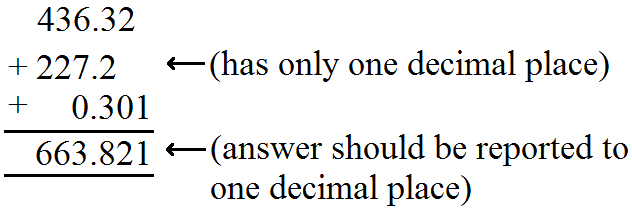
The final result should, therefore, be rounded off to one decimal place, i.e. $664.$ View full question & answer→MCQ 841 Mark
If the unit of force is $100N,$ unit of length is $10m$ and unit of time is $100s$. What is the unit of mass in this system of units?
- ✓
$10^5\ kg$
- B
$10^7\ kg$
- C
$10^2\ kg$
- D
$10^9\ kg$
AnswerCorrect option: A. $10^5\ kg$
View full question & answer→MCQ 851 Mark
Which of the following combinations have the dimensions of time? L, C, R represent inductance, capacitance and resistance respectively?
AnswerCorrect option: B. $\sqrt{\text{LC}}$
Explanation: (B) $\sqrt{\text{LC}}$
We know that:
$\text{R}=[\text{M}^{1}\text{L}^{2}\text{T}^{-3}\text{A}^{-2}]$
$\text{L}=[\text{M}^{1}\text{L}^{2}\text{T}^{-2}\text{A}^{-2}]$
$\text{C}=[\text{M}^{1}\text{L}^{-2}\text{T}^{4}\text{A}^{2}]$
$\therefore\text{RC}=\text{T}\text{ and }\sqrt{\text{LC}}=\text{T}$
View full question & answer→MCQ 861 Mark
The surface area of a solid cylinder of radius $2.0\ cm$ and height $A \ cm$ is equal to $1.5 \times 10^4(mm)^2$. Here, $A$ refers to:
- A
$0.9\ cm$
- ✓
$10\ cm$
- C
$30\ cm$
- D
$15\ cm$
AnswerCorrect option: B. $10\ cm$
View full question & answer→MCQ 871 Mark
The damping force on an oscillator is directly proportional to the velocity. The unit of the constant of proportionality is:
- A
$\ce{kg ms^{-1}}$
- B
$\ce{kg ms^{-2}}$
- ✓
$\ce{kg s^{-1}}$
- D
$\ce{kg s}$
AnswerCorrect option: C. $\ce{kg s^{-1}}$
Given, damping force $\times$ velocity
$\text{F}\propto\text{v}\Rightarrow\text{F}=\text{kv}$
$\Rightarrow\text{k}=\frac{\text{F}}{\text{v}}$
Unit of $\text{k}=\frac{\text{Unit of F}}{\text{Unit of v}}=\frac{\text{kg }\text{-ms}^{-2}}{\text{ms}^{-1}}=\text{kg s}^{-1}$
View full question & answer→MCQ 881 Mark
You measure two quantities as $\text{A} = 1.0 \text{m}\pm 0.2 \text{m},\ \text{B} = 2.0 \text{m}\pm 0.2 \text{m}.$ We should report correct value for $\sqrt{\text{AB}}$ as:
- A
$1.4 \text{m}\pm 0.4\text{m.}$
- B
$1.41\text{m} \pm 0.15 \text{m}.$
- C
$1.4\text{m} \pm 0.3 \text{m}.$
- ✓
$1.4\text{m} \pm 0.2 \text{m}.$
AnswerCorrect option: D. $1.4\text{m} \pm 0.2 \text{m}.$
According to the problem, $\text{A}=1.0\text{m}\pm0.2\text{m},\ \text{B}=2.0\text{m}\pm0.2\text{m}$
Let, $\text{Z}=\sqrt{\text{AB}}=\sqrt{(1.0)(2.0)}=1.414\text{m}$
Rounding off to two significant digits $Z = 1.4m$
$\text{AS}\ \frac{\Delta\text{Z}}{\text{Z}}=\frac{1}{2}\frac{\Delta\text{A}}{\text{A}}+\frac{1}{2}\frac{\Delta\text{B}}{\text{B}}$
$=\frac{1}{2}\Big(\frac{0.2\text{m}}{1\text{m}}\Big)+\frac{1}{2}\Big(\frac{0.2\text{m}}{2\text{m}}\Big)=0.15$
$\Rightarrow\Delta\text{Z}=\text{Z}(0.15)=1.4\text{m}(0.15)=0.212$
Rounding off to one significant digit, $\Delta\text{Z}=0.2\text{m}$
The correct value for $\sqrt{\text{AB}}=1.4\pm0.2\text{m}.$
View full question & answer→MCQ 891 Mark
Which of the following ratios express pressure?
- ✓
$\frac{\text{Force}}{\text{Area}}.$
- B
$\frac{\text{Energy}}{\text{Volume}}.$
- C
$A$ and $B$
- D
$\frac{\text{Force}}{\text{Volume}}.$
AnswerCorrect option: A. $\frac{\text{Force}}{\text{Area}}.$
Let us first express the relation of pressure with other physical quantities one by one with the help of dimensional analysis.
We know that pressure,
- $\frac{\text{Force}}{\text{Area}}=\frac{[\text{MLT}^{-2}]}{[\text{L}^2]}=[\text{ML}^{-1}\text{T}^{-2}]$
So, this ratio express pressure (In fact this ratio actually represents pressure).
- $\frac{\text{Energy}}{\text{Area}}=\frac{[\text{ML}^{2}\text{T}^{-2}]}{[\text{L}^2]}=[\text{MT}^{-2}]$
Dimensions of this ratio are not same as pressure, so this ratio does not express pressure.
- $\frac{\text{Energy}}{\text{Volume}}=\frac{[\text{ML}^{2}\text{T}^{-2}]}{[\text{L}^3]}=[\text{ML}^{-1}\text{T}^{-2}]$
Dimensions of this ratio is the same as pressure, so this ratio also express pressure.
- $\frac{\text{Force}}{\text{Volume}}=\frac{[\text{ML}\text{T}^{-2}]}{[\text{L}^3]}=[\text{ML}^{-2}\text{T}^{-2}]$
Dimensions of this ratio are not same as pressure, so this ratio does not express pressure. View full question & answer→MCQ 901 Mark
If Planck’s constant $(h)$ and speed of light in vacuum $(c)$ are taken as two fundamental quantities, which one of the following can, in addition, be taken to express length, mass and time in terms of the three chosen fundamental quantities?
$A.$ Mass of electron $(m_e).$
$B.$ Universal gravitational constant $(G).$
$C.$ Charge of electron $(e).$
$D.$ Mass of proton $(m_p).$
- A
$A$ and $B$
- B
$A$ and $C$
- ✓
$B$ and $C$
- D
$A , B$ and $D$
AnswerCorrect option: C. $B$ and $C$
Dimension of
$\text{h}=\frac{\text{E}}{\text{v}}=\frac{[\text{ML}^2\text{T}^{-1}]}{[\text{T}^{-1}]}=[\text{ML}^2\text{T}^{-1}]$
$\text{c}=\frac{\text{s}}{\text{t}}=[\text{LT}^{-1}]$
$\text{G}=\frac{\text{Fr}^2}{\text{M}_1\text{M}_2}=\frac{[\text{ML}^3\text{T}^{-2}]}{[\text{M}][\text{M}]}=[\text{M}^{-1}\text{L}^3\text{T}^{-2}]$
$\text{hc}=[\text{ML}^2\text{T}^{-1}]\times[\text{LT}^{-1}]=[\text{ML}^3\text{T}^{-2}]$
$\frac{\text{hc}}{\text{G}}=\frac{[\text{ML}^3\text{T}^{-2}]}{[\text{M}^{-1}\text{L}^3\text{T}^{-1}]}=[\text{M}^2]$
$\text{M}=\sqrt{\frac{\text{hc}}{\text{G}}}=\Big[\text{h}^\frac{1}{2}\text{c}^\frac{1}{2}\text{G}^\frac{-1}{2}\Big]$
$\frac{\text{h}}{\text{c}}=\frac{[\text{ML}^2\text{T}^{-1}]}{[\text{LT}^{-1}]}=[\text{ML}]=\sqrt{\frac{\text{hc}}{\text{G}}}\times\text{L}$
$\text{L}=\frac{\text{h}}{\text{c}}\times\sqrt{\frac{\text{G}}{\text{hc}}}=\frac{\sqrt{\text{Gh}}}{\text{C}^\frac{3}{2}}=\Big[\text{G}^\frac{1}{2}\text{h}^\frac{1}{2}\text{c}^\frac{-3}{2}\Big]$
$\text{c}=[\text{LT}^{-1}]=\Big[\text{G}^\frac{1}{2}\text{h}^\frac{1}{2}\text{c}^\frac{-3}{2}\text{T}^{-1}\Big]$
$\text{T}=\Big[\text{G}^\frac{1}{2}\text{h}^\frac{1}{2}\text{c}^{-\frac{3}{2}-1}\Big]=\Big[\text{G}^\frac{1}{2}\text{h}^\frac{1}{2}\text{c}^{\frac{-5}{2}}\Big]$
Hence, physical quantities $(a, b$ and $d)$ can be used to represent $\ce{L, M, T}$ in terms of the choosen fundamental quantities.
View full question & answer→MCQ 911 Mark
The length and breadth of a rectangular sheet are $16.2\ cm$ and $10.1\ cm,$ respectively. The area of the sheet in appropriate significant figures and error is:
- ✓
$164 \pm 3 \text{cm}^2$.
- B
$163.62 \pm 2.6 \text{cm}^2.$
- C
$163.6 \pm 2.6 \text{cm}^2.$
- D
$163.62 \pm 3 \text{cm}^2.$
AnswerCorrect option: A. $164 \pm 3 \text{cm}^2$.
$1=16.2\text{cm }\Delta^1=0.1$
$\text{b}=10.1\text{cm}\ \Delta\text{b}=0.1$
$1=16.2\pm0.1$
$\text{b}=10.1\pm0.1$
$\text{A}=\text{Area}=1\times\text{b}=16.2\times10.1=163.62\text{cm}^2$
$=164\text{cm}^2\ ($in significant figures$)$
$\frac{\Delta\text{A}}{\text{A}}=\frac{\Delta\text{l}}{\text{l}}+\frac{\Delta\text{b}}{\text{b}}=\frac{0.1}{16.2}+\frac{0.1}{10.1}$
$\frac{\Delta\text{A}}{164}=\frac{10.1\times0.1+16.2\times0.1}{16.2\times10.1}$
$\Delta\text{A}=164\Big(\frac{1.01+1.62}{163.62}\Big)$
$\Delta\text{A}=2.63\text{cm}^2$
Now rounding off upto significant figures in $\Delta^1$ and $\Delta^\text{b}$ i.e., one
$\Delta\text{A}=3\text{cm}^2$
$\text{A}=(164\pm3)\text{cm}^2$. Hence, verifies the option $(a).$
View full question & answer→MCQ 921 Mark
Among the given following system of unit which is not based on unit of mass, length and time?
- A
$\text{CGS}$
- B
$\text{FPS}$
- C
$\text{MKS}$
- ✓
$\text{SI}$
AnswerCorrect option: D. $\text{SI}$
View full question & answer→MCQ 931 Mark
Number of fermi in one metre is:
- A
$10^6F$
- B
$10^{17}F$
- ✓
$10^{15}F$
- D
$10^{14}F$
AnswerCorrect option: C. $10^{15}F$
$1$ fermi $(F) = 10^{-15}$m
OR
$1\text{m}=\frac{1}{10^{-15}}=10^{15}\text{F}$
View full question & answer→MCQ 941 Mark
$N$ divisions on the main scale of a vernier calipers coincide with $(N + 1)$ divisions on the vernier scale. If each division on the main scale is of a unit, determine the least count of instrument.
- ✓
$\frac{\text{a}}{(\text{N}+1)}$
- B
$\frac{3\text{a}}{4(\text{N}+1)}$
- C
$\frac{\text{a}}{(\text{N}+1)^2}$
- D
$\Big(\frac{\text{a}}{\text{N}+1}\Big)^2$
AnswerCorrect option: A. $\frac{\text{a}}{(\text{N}+1)}$
View full question & answer→MCQ 951 Mark
The number of particles crossing per unit area perpendicular to $X-$axis in unit time is: $\text{N}=-\text{D}\frac{\text{n}_2-\text{n}_1}{\text{x}_2-\text{x}_1}$ Where $n_1$ and $n_2$ are number of particles per unit volume for the value of $x_1$ and $x_2$ respectively. The dimensions of diffusion constant $D$ are:
- A
$\text{M}^{0}\text{L}\text{T}^2$
- B
$\text{M}^{0}\text{L}^2\text{T}^{-4}$
- C
$\text{M}^{0}\text{L}\text{T}^{-3}$
- ✓
$\text{M}^{0}\text{L}^2\text{T}^{-1}$
AnswerCorrect option: D. $\text{M}^{0}\text{L}^2\text{T}^{-1}$
Since $N$ is no. of particles per unit area per unit time, thus its dimensions are $\text{M}^{0}\text{L}^2\text{T}^{-1}$.
$n_1$ and $n_2$ are no. f particles per unit volume. Thus they have the dimensions $\text{M}^{0}\text{lL}^{-3}$.
$x$ has dimension of length, i.e $L.$
Thus, $D$ has dimensions of $\frac{\text{Nx}}{\text{n}}=\frac{\text{M}^{0}\text{lL}^2\text{T}^{-1}\text{L}}{\text{M}^{0}\text{lL}^{-3}}=\text{L}^2\text{T}^{-1}$
View full question & answer→MCQ 961 Mark
A wire has a mass $0.3 \pm 0.003\text{g},$ radius $0.5 \pm 0.005\text{mm}$ and length $6 \pm 0.06\text{cm}.$ The maximum percentage error in the measurement of its density is
View full question & answer→MCQ 971 Mark
Which of the following sets have different dimensions?
- ✓
Dipole moment, Electric field and Electric flux.
- B
Pressure, Young's modulus, Stress.
- C
- D
Emf, Potential difference and potential.
AnswerCorrect option: A. Dipole moment, Electric field and Electric flux.
Heat, work and energy are same things, so they have same dimensions.
$\ce{Emf,}$ potential difference and potential have the same dimensions.
$\text{Pressure}=\frac{\text{force}}{\text{area}},\text{stress}=\frac{\text{force}}{\text{area}}$
$\text{Y}=\frac{\text{Stress}}{\text{Strain}}=\frac{\frac{\text{force}}{\text{area}}}{\text{dimensionless}}=\frac{\text{force}}{\text{ area}}$
So, they have same dimensions.
But dimension of Dipole moment $= \ce{[M^0L^1T^1A^1]}$
Dimenslion of electric field $= \ce{[M^1L^1T^{-3}-A^{-1}]}$
and dimension of electric flux $= \ce{[M^1L^3T^{-3}-A{-1}]}$
Hence they are different.
View full question & answer→MCQ 981 Mark
Which of the following has metre kelvin as the unit?
MCQ 991 Mark
Among the given following units which one is not unit of length?
MCQ 1001 Mark
The solid angle subtended by the periphery of an area $1\ cm^2$ at a point situated symmetrically at a distance of $5\ cm$ from the area is:
- A
$2 \times 10^{-2}$ steradian.
- ✓
$4 \times 10^{-2}$ steradian.
- C
$6 \times 10^{-2}$ steradian.
- D
$8 \times 10^{-2}$ steradian.
AnswerCorrect option: B. $4 \times 10^{-2}$ steradian.
Solid angle, $\text{d}\Omega=\frac{\text{dA}}{\text{r}^2}=1\text{cm}^2/(\text{ 5cm})^2$
$=0.04$ steradian
$=4\times10^{-2}$ steradian
View full question & answer→MCQ 1011 Mark
The length of a rod is $(11.05\pm0.05)\text{cm}.$ What is the total length of $2$ such rods?
AnswerCorrect option: D. $(22.1\pm0.10)\text{cm}$
View full question & answer→MCQ 1021 Mark
If the length of a rectangle l = 10.5cm, breadth b= 2.1cm and minimum possible measurement by scale = 0.1cm, then the area is:
- ✓
22.0cm$^2$
- B
21.1cm$^2$
- C
22.05cm$^2$
- D
22cm$^2$
AnswerCorrect option: A. 22.0cm$^2$
Area of rectangle, A = Length × Breadth A = lb = 10.5 × 2.1= 22.05cm$^2$ Minimum possible measurement of scale = 0.1cm. So, area measured by scale = 22.0cm$^2$.
View full question & answer→MCQ 1031 Mark
In the formula $x = 3 yz^2, x$ and $z$ have dimensions of capacitance and magnetic induction, respectively. The dimensions of $y$ in $\ce{MKS}$ system are:
- A
$[\text{M}^{-2}\text{L}^{-2}\text{T}^{4}\text{A}^{4}]$
- B
$[\text{M}^{-3}\text{L}^{-3}\text{T}^4\text{A}^5]$
- ✓
$[\text{M}^{-3}\text{L}^{-2}\text{T}^8\text{A}^4]$
- D
$[\text{M}^{-1}\text{L}^{-4}\text{T}^2\text{A}^4]$
AnswerCorrect option: C. $[\text{M}^{-3}\text{L}^{-2}\text{T}^8\text{A}^4]$
Given, $[x] =$ capacitance $=[\text{M}^{-1}\text{L}^{-2}\text{T}^4\text{A}^2]$
[Z] = magnetic induction $[\text{MA}^{-1}\text{T}^{-2}]$
So, $[\text{y}]=\frac{[\text{M}^{-1}\text{L}^{-2}\text{T}^{4}\text{A}^2]}{[\text{MA}^{-1}\text{T}^{-2}]^2}=[\text{M}^{-3}\text{L}^{-2}\text{T}^{8}\text{A}^{4}]$
View full question & answer→MCQ 1041 Mark
The ratio of the volume of the atom to the volume of the nucleus is of the order of:
- ✓
$10^{15}$
- B
$10^{25}$
- C
$10^{20}$
- D
$10^{10}$
AnswerCorrect option: A. $10^{15}$
Radius of atom = $10^{-10}$m Radius of nucleus = $10^{-15}$m $\text{Ratio}=\frac{10^{-10}}{10^{-15}}=10^5$ Ratio of volume $=(10^5)^3=10^{15}$
View full question & answer→