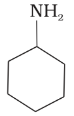
MCQ 11 Mark
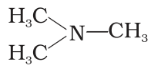
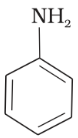
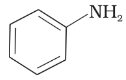
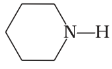
Out of the following, the strongest base in aqueous solution is:
AnswerWhen we compare the basicity of the aliphatic amines, we would expect the basicity of tertiary amines to be the greatest, followed by secondary amine and then primary amine.
But this is not so. The order of basicity is
$NH_3 <$ primary amine $\sim$ tertiary amine $<$ secondary amine
This is because:
- Steric hindrance: The size of an alkyl group is more than that of a hydrogen atom. So, an alkyl group would hinder the attack of a hydrogen atom, thus decreasing the basicity of the molecule. So, the more the number of alkyl groups attached, lesser will be its basicity.
- Solvation of ions: When amines are dissolved in water, they form protonated amines. Also, the number of possibilities for hydrogen bonding also increases. More the number of hydrogen bonding more is the hydration that is released in the process of the formation of hydrogen bonds.
The combined effect of the pushing effect of the alkyl group $(+I$ effect$),$ steric hindrance and the salvation of amines causes the basicity order to be $($basicity of tertiary is almost the same as that of primary$).$
$NH_3 $< primary amine $\sim$ tertiary amine $<$ secondary amine
So, here Dimethylamine is the strongest base. View full question & answer→MCQ 21 Mark
Which one of the amine have highest boiling point?
AnswerPrimary amines have higest boiling point because of $2$ hydrogen atom, more hydrogen bonding occur.
View full question & answer→MCQ 31 Mark
Decreasing order of basicity of the three isomers of nitro aniline is:
- A
$P −$ nitroaniline $> o −$ nitroaniline $> m −$ nitroaniline.
- B
$P −$ nitroaniline $> m −$ nitroaniline $> o −$ nitroaniline.
- ✓
$M −$ nitroaniline $> p − $nitroaniline $> o −$ nitroaniline.
- D
$M −$ nitroaniline $> o −$ nitroaniline $> p −$ nitroaniline.
AnswerCorrect option: C. $M −$ nitroaniline $> p − $nitroaniline $> o −$ nitroaniline.
Nitro group is an electron$-$withdrawing group. It mainly withdraws electrons from the ortho and para positions.
Therefore para isomer is less basic than meta isomer.
Ortho substituted anilines are generally weaker bases than aniline irrespective of the electron releasing or electron$-$withdrawing nature of the substituent.
Hence decreasing order of basicity of the isomers of nitroaniline:
$M −$ nitroaniline $> p −$ nitroaniline $> o −$ nitroaniline
View full question & answer→MCQ 41 Mark
How many lone pairs of electrons does the nitrogen atom of amines have?
AnswerThe nitrogen of $\mathrm{NH}_3$ forms $\mathrm{sp}^3$ hybridised orbitals and also a valency of three $($as it is attached to three hydrogen atoms$).$
This results is one the orbitals having a lone pair of electrons, resulting in one unshared electron pair on nitrogen.
View full question & answer→MCQ 51 Mark
Reduction of alkyl nitriles in presence of $\mathrm{LiAlH}_4$ Gives:
AnswerReduction of alkyl nitriles in presence of $\mathrm{LiAlH}_4$ Gives Alkyl Amines.
Alkyl and aryl cyanides $($nitriles$)$ can be reduce by $(\mathrm{LiAlH}_4)$ or catalytic hydrogenation.
View full question & answer→MCQ 61 Mark
Arrange the following compounds in increasing order of basicity$:\ \mathrm{CH}_3 \mathrm{NH}_2,\left(\mathrm{CH}_3\right)_2 \mathrm{NH}, \mathrm{NH}_3, \mathrm{C}_6 \mathrm{H}_5 \mathrm{NH}_2$
- A
$\mathrm{C}_6 \mathrm{H}_5 \mathrm{NH}_2<\mathrm{NH}_3<\left(\mathrm{CH}_3\right)_2 \mathrm{NH}<\mathrm{CH}_3 \mathrm{NH}_2$
- B
$\mathrm{CH}_3 \mathrm{NH}_2<\left(\mathrm{CH}_3\right)_2 \mathrm{NH}<\mathrm{NH}_3<\mathrm{C}_6 \mathrm{H}_5 \mathrm{NH}_2$
- ✓
$\mathrm{C}_6 \mathrm{H}_5 \mathrm{NH}_2<\mathrm{NH}_3<\mathrm{CH}_3 \mathrm{NH}_2<\left(\mathrm{CH}_3\right)_2 \mathrm{NH}$
- D
$\left(\mathrm{CH}_3\right)_2 \mathrm{NH}<\mathrm{CH}_3 \mathrm{NH}_2<\mathrm{NH}_3<\mathrm{C}_6 \mathrm{H}_5 \mathrm{NH}_2$
AnswerCorrect option: C. $\mathrm{C}_6 \mathrm{H}_5 \mathrm{NH}_2<\mathrm{NH}_3<\mathrm{CH}_3 \mathrm{NH}_2<\left(\mathrm{CH}_3\right)_2 \mathrm{NH}$
View full question & answer→MCQ 71 Mark
Which of the following is more appropriate reason for aniline being less basic than aliphatic amines?
- A
- B
- ✓
Positive mesomeric effect
- D
Negative mesomeric effect
AnswerCorrect option: C. Positive mesomeric effect
$\mathrm{NH}_2$ gives $e^-$ away from the group.
So $e^-$ density of $N$ decrease and hence less available for Protonation. So less Basicity.
In aliphatic amines, no mesomerism $($resonance$)$ takes place. Thus it has more electrons available for donation thus shows more basic property.
View full question & answer→MCQ 81 Mark
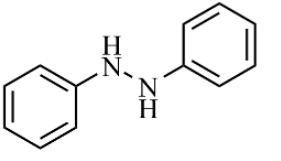
Diphenyl hydrazine is same as:
AnswerDiphenyl hydrazine is same as hydrazobenzene.
Two phenyl groups are attached to two nitrogen atoms of hydrazine.
View full question & answer→MCQ 91 Mark
Which of the following is a primary arylalkyl amine?
- A
$ \mathrm{CH}_3 \mathrm{NH}_2 $
- ✓
$ \mathrm{C}_6 \mathrm{H}_5 \mathrm{CH}_2 \mathrm{NH}_2 $
- C
$ \mathrm{C}_6 \mathrm{H}_5 \mathrm{NH}_2 $
- D
$ \left(\mathrm{C}_6 \mathrm{H}_5\right)_2 \mathrm{NH} $
AnswerCorrect option: B. $ \mathrm{C}_6 \mathrm{H}_5 \mathrm{CH}_2 \mathrm{NH}_2 $
Since it should be primary, it should have an alkyl/aryl group attached to the $NH_2$ molecule, and because it is arylalkyl, the nitrogen should be linked to an $sp^3$ hybridised benzyl carbon rather than to an aryl carbon.
View full question & answer→MCQ 101 Mark
The strongest base among the following is:
AnswerLesser the stability of the species ion, more basic be the given species.
As $\mathrm{NH}_2{ }^{-}\ ($amide ion$)$ is the least stable species ion. Thus, it is the most basic species.
View full question & answer→MCQ 111 Mark
Which of the following would not react with benzene sulphonyl chloride in $\text{aq. NaOH}\ ?$
AnswerCorrect option: C. $N, N -$ dimethyl aniline
$N, N -$ dimethyl aniline does not contain $H$ attached to nitrogen.
Hence, it would not react with benzene sulphonyl chloride in aqueous $\text{NaOH}.$
View full question & answer→MCQ 121 Mark
Which of the following reactions are correct?
$i.$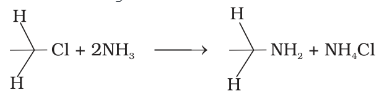
$ii.$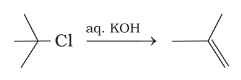
$iii.$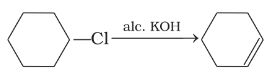
$iv.$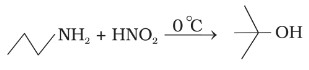
- A
$i$ and $ii$
- ✓
$i$ and $iii$
- C
$i$ and $v$
- D
$ii$ and $iii$
AnswerCorrect option: B. $i$ and $iii$
$(i)$ Is a nucleophilic substitution reaction.
$(iii)$ Is an elimination reaction. View full question & answer→MCQ 131 Mark
The reagents that can be used to convert benzenediazonium chloride to benzene are $.......$
$a. \mathrm{SnCl}_2 / \mathrm{HCl} $
$b. \mathrm{CH}_3 \mathrm{CH}_2 \mathrm{OH} $
$c. \mathrm{H}_3 \mathrm{PO}_2 $
$d. \mathrm{LiAlH}_4 $
- A
$a$ and $b$
- B
$a$ and $c$
- ✓
$b$ and $c$
- D
$a$ and $d$
AnswerCorrect option: C. $b$ and $c$
Certain mild reducing agents like hypophosphorous acid $($phosphinic acid$)$ or ethanol reduce diazonium salts to arenes and themselves get oxidised to phosphorous acid and ethanol, respectively.
$\text{Ar}\stackrel{+}{\hbox{N}}_2\text{C}\stackrel{-}{\hbox{l}}+\text{H}_3\text{PO}_2+\text{H}_2\text{O}\xrightarrow{\ \ \ \ \ }\text{ArH}+\text{N}_2+\text{H}_3\text{PO}_3+\text{HCl}$
$\text{Ar}\stackrel{+}{\hbox{N}}_2\text{C}\stackrel{-}{\hbox{l}}+\text{CH}_3\text{CH}_2\text{OH}\xrightarrow{\ \ \ \ \ \ \ \ }\text{ArH}+\text{N}_2+\text{CH}_3\text{CHO}+\text{HCl}$
View full question & answer→MCQ 141 Mark
Which of the following represents the decreasing order of basic strength of amines in the gas phase?
- ✓
Tertiary amine $>$ Secondary amine $>$ Primary amine.
- B
Tertiary amine $>$ Primary amine $>$ Secondary amine.
- C
Primary amine $>$ Secondary amine $>$ Tertiary amine.
- D
Secondary amine $>$ Tertiary amine $>$ Primary amine.
AnswerCorrect option: A. Tertiary amine $>$ Secondary amine $>$ Primary amine.
The following represents the decreasing order of basic strength of amines in the gas phase.
Tertiary amine $>$ secondary amine $>$ primary amine
This is due $+I\ ($electron releasing$)$ effect of alkyl groups.
With an increase in the number of alkyl groups, the electron density on $N$ increases and the lone pair of electrons can be easily donated.
View full question & answer→MCQ 151 Mark
Which one of the following is the strongest base in aqueous solution?
MCQ 161 Mark
Among the following which is not correct?
AnswerCorrect option: B. Aniline is more basic than pyridine.
View full question & answer→MCQ 171 Mark
Among the following amines, the strongest Bronsted base is __________.
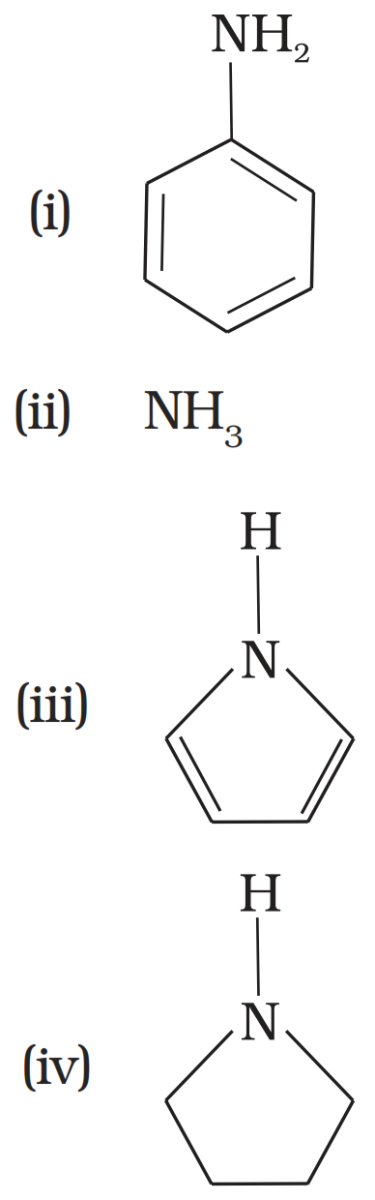
Answer
Aniline is weaker base than $NH_3$ due to delocalization of lone pair of electrons on the N-atom into the benzene ring. Pyrrole (c) is not at all basic because the lone pair of electrons on N-atom is donated towards aromatic sextet formation. Therefore, pyrrolidine (d) has a strong tendency to accept a proton and is hence, the strongest base. View full question & answer→MCQ 181 Mark
Which of the folllowing catalysts are used in the preparation amines by the reduction of isonitriles:
AnswerThe carbon $-$ nitrogen triple bond in a nitrile can also be reduced by reaction with hydrogen gas in the presence of a variety of metal catalysts like palladium, platinum or nickel.
View full question & answer→MCQ 191 Mark
Which of the following is not a classification of amines?
AnswerAmines may be classified as primary, secondary or tertiary depending on whether $1, 2$ or $3$ hydrogen atoms of $\mathrm{NH}_3$ are replaced by alkyl/aryl groups respectively.
Quaternary ammonium compounds are a different class of compounds where all four hydrogen atoms of ammonium salts are replaced by alkyl/aryl groups.
View full question & answer→MCQ 201 Mark
Which of the following reagents would not be a good choice for reducing an aryl nitro compound to an amine?
- A
$H_2($excess$)/$ Pt.
- ✓
$\ce{LiAlH_4}$ in ether.
- C
$Fe$ and $\text{HCl}$
- D
$Sn$ and $\text{HCl}.$
AnswerCorrect option: B. $\ce{LiAlH_4}$ in ether.
Aryl nitro compound cannot be converted into amine using $\ce{LiAlH_4}$ in ether.
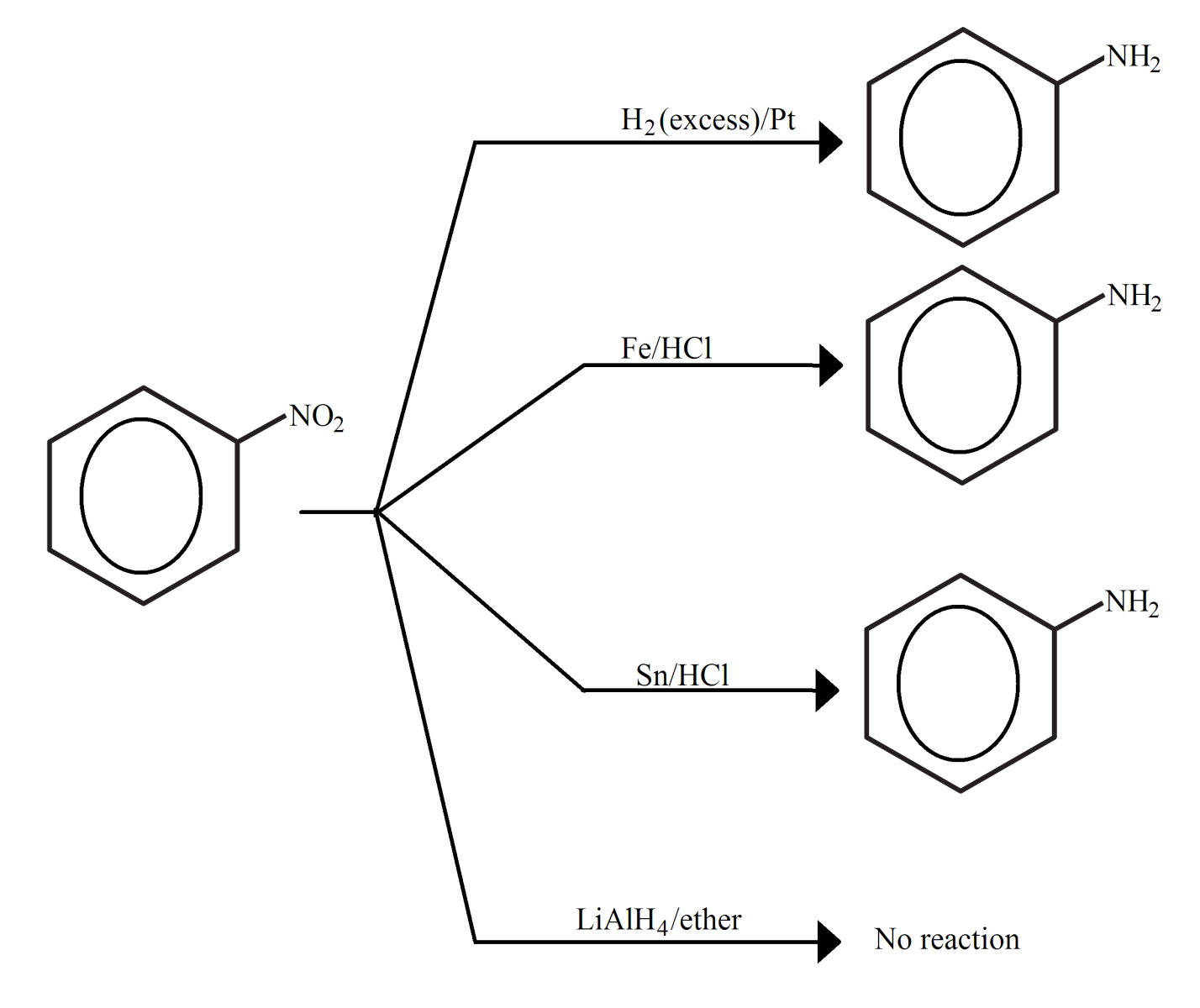
View full question & answer→MCQ 211 Mark
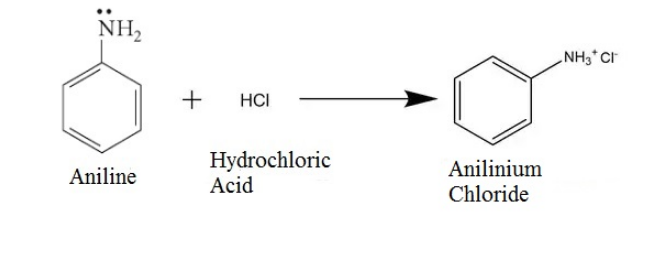
Aniline dissolves in $\text{HCl}$ due to the formation of:
AnswerAniline is basic in nature and $\text{HCl}$ is an acid. So, acid - base reaction will take place.
In aniline, the lone pair of electrons is partially delocalized into the benzene ring and is thus, available for protonation by an acid.
Hence, aniline dissolves in acid like $\text{HCl}$ forming anilinium chloride salt.
View full question & answer→MCQ 221 Mark
The correct order of boiling points of the following amines $\mathrm{C}_4 \mathrm{H}_9 \mathrm{NH}_2,\left(\mathrm{C}_2 \mathrm{H}_5\right)_2 \mathrm{NH}, \mathrm{C}_2 \mathrm{H}_5 \mathrm{\sim N}\left(\mathrm{CH}_3\right)_2$ is:
- A
$ \mathrm{C}_2 \mathrm{H}_5 \mathrm{N}\left(\mathrm{CH}_3\right)_2>\left(\mathrm{C}_2 \mathrm{H}_5\right)_2 \mathrm{NH}>\mathrm{C}_4 \mathrm{H}_9 \mathrm{NH}_2 $
- B
$ \left(\mathrm{C}_2 \mathrm{H}_5\right)_2 \mathrm{NH}>\mathrm{C}_2 \mathrm{H}_5 \mathrm{N}\left(\mathrm{CH}_3\right)_2>\mathrm{C}_4 \mathrm{H}_9 \mathrm{NH}_2 $
- ✓
$ \mathrm{C}_4 \mathrm{H}_9 \mathrm{NH}_2>\left(\mathrm{C}_2 \mathrm{H}_5\right)_2 \mathrm{NH}>\mathrm{C}_2 \mathrm{H}_5 \mathrm{N}\left(\mathrm{CH}_3\right)_2 $
- D
$ \left(\mathrm{C}_2 \mathrm{H}_5\right)_2 \mathrm{NH}>\mathrm{C}_4 \mathrm{H}_9 \mathrm{NH}_2>\mathrm{C}_2 \mathrm{H}_5 \mathrm{N}\left(\mathrm{CH}_3\right)_2 $
AnswerCorrect option: C. $ \mathrm{C}_4 \mathrm{H}_9 \mathrm{NH}_2>\left(\mathrm{C}_2 \mathrm{H}_5\right)_2 \mathrm{NH}>\mathrm{C}_2 \mathrm{H}_5 \mathrm{N}\left(\mathrm{CH}_3\right)_2 $
Because $\mathrm{C}_4 \mathrm{H}_9 \mathrm{NH}_2$ is primary amine and can form hydrogen bonding more than secondary amine $\left(\mathrm{C}_2 \mathrm{H}_5\right)_2 \mathrm{NH}$ and tertiary amine $\mathrm{C}_2 \mathrm{H}_5 \mathrm{N}\left(\mathrm{CH}_3\right)_2$. More hydrogen bonding leads to strong bonding between the molecules, hence increases the boiling point.
View full question & answer→MCQ 231 Mark
The correct order of increasing basic nature for the bases $\mathrm{NH}_3, \mathrm{CH}_3 \mathrm{NH}_2$ and $\left(\mathrm{CH}_3\right)_2 \mathrm{NH}$ is?
- A
$ \left(\mathrm{CH}_3\right)_2 \mathrm{NH}<\mathrm{NH}_3<\mathrm{CH}_3 \mathrm{NH}_2 $
- ✓
$ \mathrm{NH}_3<\mathrm{CH}_3 \mathrm{NH}_2<\left(\mathrm{CH}_3\right)_2 \mathrm{NH} $
- C
$ \mathrm{CH}_3 \mathrm{NH}_2<\left(\mathrm{CH}_3\right)_2 \mathrm{NH}<\mathrm{NH}_3 $
- D
$ \mathrm{CH}_3 \mathrm{NH}_2<\mathrm{NH}_3<\left(\mathrm{CH}_3\right)_2 \mathrm{NH} $
AnswerCorrect option: B. $ \mathrm{NH}_3<\mathrm{CH}_3 \mathrm{NH}_2<\left(\mathrm{CH}_3\right)_2 \mathrm{NH} $
$\left(\mathrm{H}_3 \mathrm{C}\right)_2 \mathrm{NH}, \mathrm{CH}_3 \mathrm{NH}_2, \mathrm{NH}_3$
Among the above molecules $\ce{(CH_3)_2NH}$ is most basic as two electron donating group are attached to it which increase its basicity is $ \mathrm{NH}_3<\mathrm{CH}_3 \mathrm{NH}_2<\left(\mathrm{CH}_3\right)_2 \mathrm{NH} $
View full question & answer→MCQ 241 Mark
By the presence of a halogen atom in the ring, basic properties of aniline is:
AnswerBy the presence of a halogen atom in the ring, basic properties of aniline is increased because it is more electronegative so donation of electron will be easy, so basicity increases.
View full question & answer→MCQ 251 Mark
The test used to distinguish primary, secondary and tertiary amines is:
AnswerCorrect option: D. $\mathrm{C}_6 \mathrm{H}_5 \mathrm{SO}_2 \mathrm{Cl}$
View full question & answer→MCQ 261 Mark
When only two hydrogen atoms are attached to the nitrogen of an amine, it is classified as a $........$ amine.
AnswerWhen an amine has two hydrogen atoms individually bonded to the nitrogen, it means that the third group is an alkyl or aryl substituent. This is called as a primary or $1^\circ $ amine as only one $H$ atom is replaced.
View full question & answer→MCQ 271 Mark
Benzyl amine is $........$ basis than aniline while ethyl amine is $.......$ basis than diethyl amine
AnswerBenzyl amine is more basic than anniline.
while ethyl amine is less basic than diethyl amine.
View full question & answer→MCQ 281 Mark
For the successful diazotization of arylamines, how many mole of mineral acid $\left(\mathrm{HCl}\right.$ or $\left.\mathrm{H}_2 \mathrm{SO}_4\right)$ are required for each mole of the amine?
View full question & answer→MCQ 291 Mark
The best reagent for converting$, 2-$phenylpropanamide into $1-$phenylethanamine is $.........$
- A
excess $H_2/ Pt.$
- ✓
$\ce{NaOH/ Br_2}.$
- C
$\ce{NaBH_4}/$ methanol.
- D
$\ce{LiAlH_4}/$ ether.
AnswerCorrect option: B. $\ce{NaOH/ Br_2}.$
$\text{CH}_3-\text{CH}-\text{CONH}_2\xrightarrow[\text{(Hofmann's bromamide reaction)}]{\text{Br}_2/\text{N}_\text{a}\text{OH}}\text{CH}_3-\text{CH}-\text{NH}_2\\\ \ \ \ \ \ \ \ \ \ \ \ \ |\ \ \ \ \ \ \ \ \ \ \ \ \ \ \ \ \ \ \ \ \ \ \ \ \ \ \ \ \ \ \ \ \ \ \ \ \ \ \ \ \ \ \ \ \ \ \ \ \ \ \ \ \ \ \ \ \ \ \ \ \ \ \ \ \ \ \ \ \ \ \ \ \ \ \ \ \ \ \ \ \ \ |\\\ \ \ \ \ \ \ \ \ \ \ \ \text{C}_6\text{H}_5\ \ \ \ \ \ \ \ \ \ \ \ \ \ \ \ \ \ \ \ \ \ \ \ \ \ \ \ \ \ \ \ \ \ \ \ \ \ \ \ \ \ \ \ \ \ \ \ \ \ \ \ \ \ \ \ \ \ \ \ \ \ \ \ \ \ \ \ \ \ \ \ \ \ \text{C}_6\text{H}_5\\2-\text{Phenylpropanamide}\ \ \ \ \ \ \ \ \ \ \ \ \ \ \ \ \ \ \ \ \ \ \ \ \ \ \ \ \ \ \ \ \ \ \ \ \ \ \ \ 1-\text{Phenyletanamine}$
View full question & answer→MCQ 301 Mark
The most reactive amine towards dilute hydrochloric acid is __________.
Answer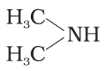
The greater will be the strength of base, the greater will be its reactivity towards dilute HCl. Hence, $(CH_3)_2NH$ has the highest basic strength as it has the highest reactivity. View full question & answer→MCQ 311 Mark
What is the expected geometry of $\ce{CH_3- NH - CH_3}\ ?$
Answer$\ce{CH_3 - NH - CH_3}$ is an amine in which two hydrogen atoms are replaced by methyl groups.
The hybridisation of $N$ atom of amines is same as that of ammonia, and is also expected to have a pyramidal geometry, with $N$ at the apex and the groups $\ce{CH_3, H}$ and $\ce{CH_3}$ occupying the corners of a trigonal base.
View full question & answer→MCQ 321 Mark
The lower aliphatic amines are gases with $........$ odour.
View full question & answer→MCQ 331 Mark
Which of the following is the correct order of the boiling points?
- ✓
Propane $<$ Ethylamine $<$ Ethyl alcohol.
- B
Ethylamine $<$ Propane $<$ Ethyl alcohol.
- C
Ethylamine $<$ Ethyl alcohol $<$ Propane.
- D
Propane $<$ Ethyl alcohol $<$ Ethylamine.
AnswerCorrect option: A. Propane $<$ Ethylamine $<$ Ethyl alcohol.
The following is the correct order of the boiling points.
propane $<$ ethylamine $<$ ethyl alcohol
In general, amines have higher boiling points than alkanes but lower boiling points than alcohols.
View full question & answer→MCQ 341 Mark
Which of the following is the $\text{IUPAC}$ name of the compound in which one hydrogen of ammonia is replaced by an ethyl group?
AnswerEthylamine and aminoethane are the names of $\mathrm{CH}_3 \mathrm{CH}_2 \mathrm{NH}_2$ according to the common system and second system respectively.
In the $\text{IUPAC}$ system, the naming is done by replacing the $'e\ ’$ of the alkane by amine.
View full question & answer→MCQ 351 Mark
When methyl iodide treated with ammonia, the product obtained is:
MCQ 361 Mark
Among the following compounds nitrobenzene, benzene, aniline and phenol, the strongest basic behaviuor in acid medium is exhibited by:
AnswerBecause the $N$ atom in aniline has a lone pair to donate and also due to $+I$ effect of $-\mathrm{NH}_2$ group
View full question & answer→MCQ 371 Mark
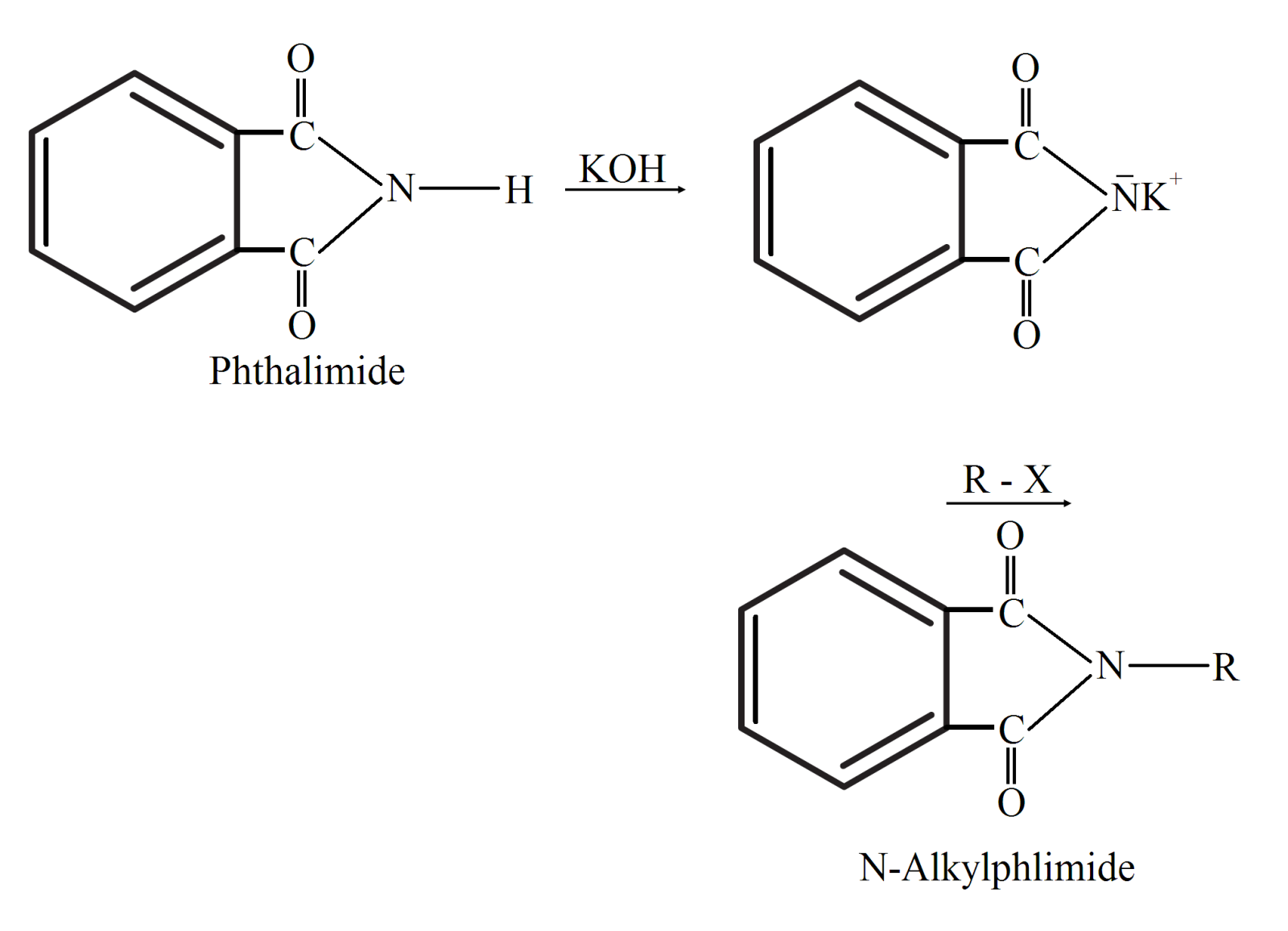
The source of nitrogen in Gabriel synthesis of amines is $.........$
- A
Sodium azide$, \ce{NaN_3}.$
- B
Sodium nitrite$, \ce{NaNO_2}.$
- C
Potassium cyanide$, \text{KCN}.$
- ✓
Potassium phthalimide$, \mathrm{C}_6 \mathrm{H}_4(\mathrm{CO})_2 \mathrm{\sim N}^{-} \mathrm{K}^{+}$
AnswerCorrect option: D. Potassium phthalimide$, \mathrm{C}_6 \mathrm{H}_4(\mathrm{CO})_2 \mathrm{\sim N}^{-} \mathrm{K}^{+}$
Gabriel synthesis is used for the preparation of primary amines. Phthalimide on treatment with ethanolic potassium hydroxide forms potassium salt of phthalimide which on heating with alkyl halide followed by alkaline hydrolysis produces the corresponding primary amine. Aromatic primary amines cannot be prepared by this method because aryl halides do not undergo nucleophilic substitution with the anion formed by phthalimide.
View full question & answer→MCQ 381 Mark
Which of the following cannot be prepared by Sandmeyer’s reaction?
$a.$ Chlorobenzene.
$b.$ Bromobenzene.
$c.$ Iodobenzene.
$d.$ Fluorobenzene.
- A
$a$ and $b$
- B
$a$ and $c$
- C
$b$ and $c$
- ✓
$c$ and $d$
AnswerCorrect option: D. $c$ and $d$
Chloro and bromo arenes are easily prepared by Sandmeyer’s reaction. Iodoarenes are prepared by simply warming the diazonium salt solution with aqueous $KI$ solution.
Fluoroarenes are prepared by Balz$-$Schiemann reaction.
All other reagents give aniline.
View full question & answer→MCQ 391 Mark
The correct order of the basic strength of methyl substitited amines in aqueous solution is:
- ✓
$ \left(\mathrm{CH}_3\right)_2 \mathrm{NH}>\mathrm{CH}_3 \mathrm{NH}_2>\left(\mathrm{CH}_3\right)_3 \mathrm{N} $
- B
$ \left(\mathrm{CH}_3\right)_3 \mathrm{N}>\mathrm{CH}_3 \mathrm{NH}_2>\left(\mathrm{CH}_3\right)_2 \mathrm{NH} $
- C
$ \left(\mathrm{CH}_3\right)_3 \mathrm{N}>\left(\mathrm{CH}_3\right)_2 \mathrm{NH}>\mathrm{CH}_3 \mathrm{NH}_2 $
- D
$ \mathrm{CH}_3 \mathrm{NH}_2>\left(\mathrm{CH}_3\right)_2 \mathrm{NH}>\left(\mathrm{CH}_3\right)_3 \mathrm{N} $
AnswerCorrect option: A. $ \left(\mathrm{CH}_3\right)_2 \mathrm{NH}>\mathrm{CH}_3 \mathrm{NH}_2>\left(\mathrm{CH}_3\right)_3 \mathrm{N} $
In aqueous solution, electron donating inductive effect, solvation effect $(H-$bonding$)$ and steric hindrance all together affect basic strength of substituted amines.
Basic character:
$(\text{CH}_3)_2\text{NH}>\text{CH}_3\text{NH}_2>(\text{CH}_3)_3\text{N}\\ \ \ \ \ \ \ \ \ \ 2^\circ\ \ \ \ \ \ \ \ \ \ \ \ \ \ \ \ \ \ 1^\circ\ \ \ \ \ \ \ \ \ \ \ \ \ \ \ \ 3^\circ$
View full question & answer→MCQ 401 Mark
$\mathrm{C}_4 \mathrm{H}_{11} \mathrm{\sim N}(\mathrm{X})+\mathrm{HNO}_2 \rightarrow \mathrm{C}_4 \mathrm{H}_{10} \mathrm{O}\left(3^{\circ}\right.$ alcohol$)$ Hence$, X$ will not give:
Answer$X$ does not undergo carbylamine reaction because this reaction requires only primary amine. In the above question the amine is secondary amine because $X$ is attached to the amine.
View full question & answer→MCQ 411 Mark
Which is the strongest base?
AnswerCorrect option: C. Propan $- 2 -$ amine
View full question & answer→MCQ 421 Mark
Amongest the following the most basic compound is:
MCQ 431 Mark
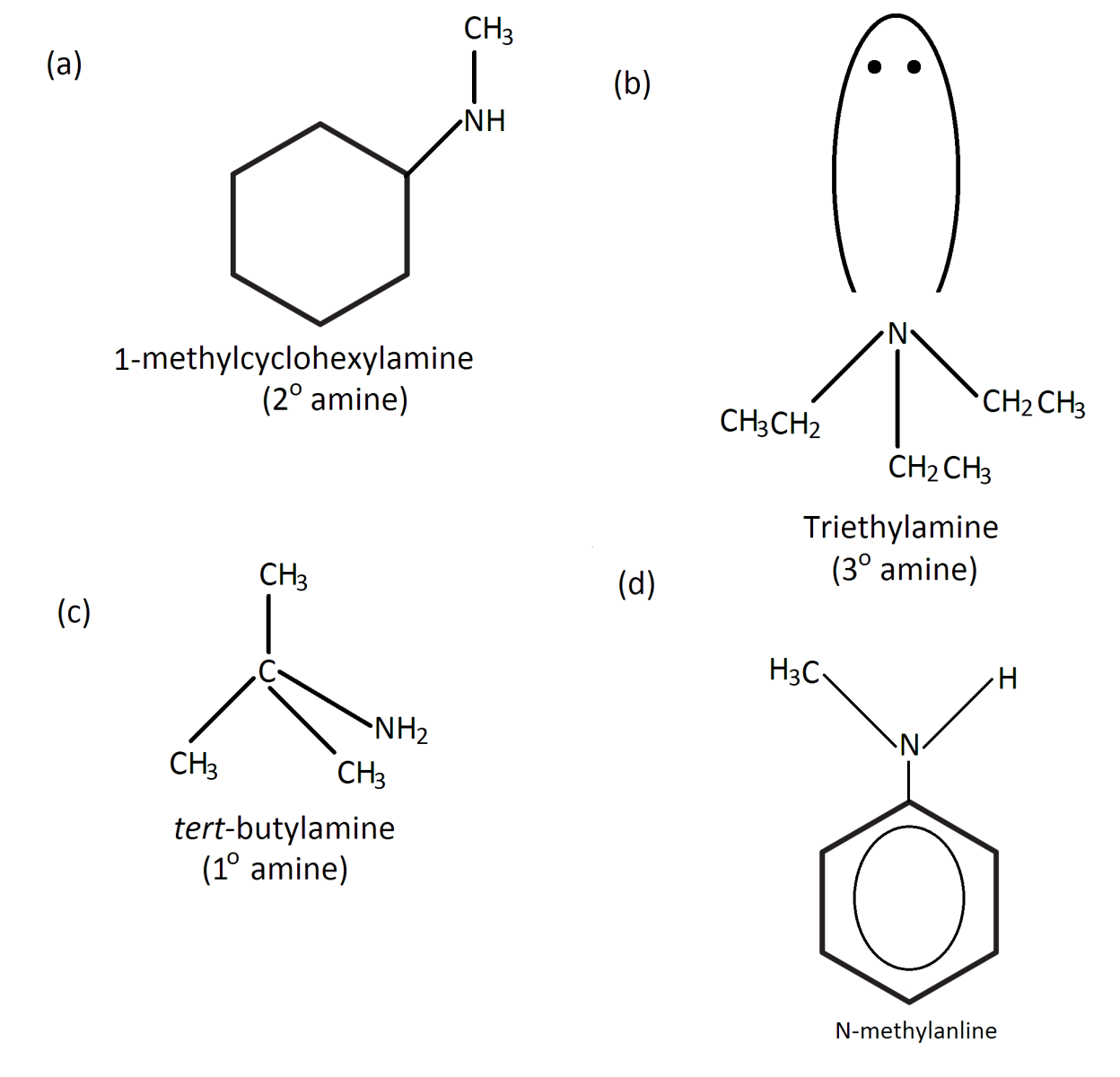
Which of the following is a $3^\circ $ amine?
AnswerThe structure of given amines are as follows:
View full question & answer→MCQ 441 Mark
Alkyl and aryl amines are prepared using which of the following reducing agent.
- ✓
$\ce{LiAlH_4}$
- B
$H_2$
- C
$\ce{NaBH_4}$
- D
Both $A$ and $B$
AnswerCorrect option: A. $\ce{LiAlH_4}$
Alkyl and aryl cyanides $($nitriles$)$ can be reduced to their corresponding primary amines using lithium aluminium hydride $\ce{(LiAlH_4)}$ or catalytic hydrogenation.
View full question & answer→MCQ 451 Mark
The molecule which does not exhibit strong hydrogen bonding is:
AnswerThe molecule which does not exhibit strong hydrogen bonding is diethylether $\mathrm{CH}_3-\mathrm{O}-\mathrm{CH}_3$.
Hydrogen bonding is possible when $H$ atom is attached to an electronegative $N,O$ or $F$ atom.
View full question & answer→MCQ 461 Mark
What is the geometry of ammonia molecule?
AnswerThe nitrogen atom of ammonia undergoes hybridisation to form $4\ sp^3$ orbitals. Three of these overlap with $s$ orbital of $H$ forming three $N-H$ bonds.
This results in a pyramidal geometry with $N$ atom at the apex and three $H$ atoms at the corners of a triangle base.
View full question & answer→MCQ 471 Mark
Hoffmann Bromamide Degradation reaction is shown by $........$
- A
$\ce{ArNH_2}$
- ✓
$\ce{ArCONH_2}$
- C
$\ce{ArNO_2}$
- D
$\ce{ArCH_2NH_2}$
AnswerCorrect option: B. $\ce{ArCONH_2}$
Hoffmann developed a method for preparation of primary amines by treating an amide with bromine in an aqueous or ethanolic solution of sodium hydroxide. In this degradation reaction, migration of an alkyl or aryl group takes place from carbonyl carbon of the amide to the nitrogen atom.
View full question & answer→MCQ 481 Mark
In coupling reactions, diazonium ion acts as:
AnswerIn coupling reaction, diazonium ion acts as electrophile because in diazonium salt $+ve$ charge is there on nitrogen and thus nitrogen is electron deficient.
View full question & answer→MCQ 491 Mark
The product of the following reaction is $.........$
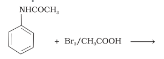
$i.$ $ ii. $
  $iii.$
  $ iv.$
- ✓
$i$ and $ii$
- B
$i$ and $iii$
- C
$ii$ and $iii$
- D
$i$ and $iv$
AnswerCorrect option: A. $i$ and $ii$
View full question & answer→MCQ 501 Mark
Which of the following is obtained by reducing methyl cyanide with $\ce{Na + C_2H_5OH}\ ?$
AnswerSodium in alcohol is a strong reducing agent and reduces nitriles to amines.
$\mathrm{CH}_3-\mathrm{CN}+\mathrm{Na}+\mathrm{C}_2 \mathrm{H}_5 \mathrm{OH} \rightarrow \mathrm{C}_2 \mathrm{H}_5-\mathrm{NH}_2$
This reaction is also known as Mendius Reduction.
View full question & answer→MCQ 511 Mark
Which of these alkyl halides can be used to prepare amines using Gabriel phthalimide synthesis?
AnswerCorrect option: B. $1 -$ bromo $- 3 -$ methylpentane
View full question & answer→MCQ 521 Mark
Which of the following is most basic?
AnswerBenzylamine $\mathrm{C}_6 \mathrm{H}_5 \mathrm{CH}_2 \mathrm{NH}_2$ is more basic because benzyl group is electron donating group due to $+I$ effect.
So it is able to increase electron density of $N$ of $-NH_2$ group.
Thus due to higher electron density rate of donation of a free pair of electron is increased $I.e$ basic character is higher While phenyl and nitro group are electron withdrawing group so they are able to decrease the electron density of $N$ of $−NH_2$ group. Hence they are less basic.
View full question & answer→MCQ 531 Mark
The correct statement among the following is:
AnswerCorrect option: C. The order of boiling point of isomeric amines is primary $>$ secondary $>$ tertiary.
- Boiling point of amines have high boiling point due to presence of hydrogen bonding between amine molecules.
- But the boiling point decreases with increase in alkyl groups attached to the $N$ atom, because the number of $H$ atoms present for hydrogen bonding decreases.
View full question & answer→MCQ 541 Mark
Aniline and methyl amine can be differentiated by:
AnswerCorrect option: B. Diazotisation followed by coupling with phenol.
Phenol react with aniline to give diazonium salt by coupling but Methyl amine not react with phenolss.
View full question & answer→MCQ 551 Mark
In order to prepare a $1^\circ $ amine from an alkyl halide with simultaneous addition of one $CH_2$ group in the carbon chain, the reagent used as source of nitrogen is $........$
- A
Sodium amide$, \ce{NaNH_2}$.
- B
Sodium azide$, \ce{NaN_3}$
- ✓
Potassium cyanide$, \text{KCN}.$
- D
Potassium phthalimide, $\mathrm{C}_6 \mathrm{H}_4(\mathrm{CO})_2 \mathrm{\sim N}^-K^{+}$.
AnswerCorrect option: C. Potassium cyanide$, \text{KCN}.$
$\text{KCN}$ is used to increase number of carbon atoms.
$\text{RX + KCN}\xrightarrow{\ \ \ \ \ \ }\text{RCN}+\text{KX}$
$\text{R}-\text{CN}+4\text{H}\xrightarrow[]{\text{H}_2/\text{Raney Ni}}\text{RCH}_2\text{NH}_2$
View full question & answer→MCQ 561 Mark
$\ce{C_3H_9N}$ cannot represent:
- A
$10$ amine
- B
$20$ amine
- C
$30$ amine
- ✓
AnswerQuaternary salts of ammonia contain atleast $4$ carbon atoms
Here we are given only $3$ carbon atoms
So, it cannot represent a quaternary salt
View full question & answer→MCQ 571 Mark
In the diazotization of aryl amines with sodium nitrite and hydrochloric acid, an excess of hydrochloric acid is used primarily to :
- ✓
Supress the concentration of free aniline available for coupling.
- B
Supress hydrolysis of phenol.
- C
Ensure a stoichiometric amount of nitrous acid.
- D
Neutralise the base liberated.
AnswerCorrect option: A. Supress the concentration of free aniline available for coupling.
If excess $\text{HCl}$ is not used, the arene diazonium salt will react with free aniline to form azo compound.
Excess $\text{HCl}$ forms hydrochloride salt of aniline. This prevents azo coupling.
View full question & answer→MCQ 581 Mark
By heating ammonium chloride with two equivalents of formaldehyde it forms:
Answer$6 \mathrm{HCHO}+4 \mathrm{NH}_4 \mathrm{Cl} \rightarrow\left(\mathrm{CH}_{26}\right) \mathrm{N}_4+4 \mathrm{HCl}+6 \mathrm{H}_2 \mathrm{O}$
So Methylamine is formed
View full question & answer→MCQ 591 Mark
Identify the most basic compound from the following.
MCQ 601 Mark
What is the decreasing order of basicity?
- A
$ \mathrm{NH}_3 > \mathrm{C}_2 \mathrm{H}_5 \mathrm{NH}_2 > \left(\mathrm{C}_2 \mathrm{H}_5\right)_2 \mathrm{NH} > \left(\mathrm{C}_2 \mathrm{H}_5\right)_3 \mathrm{~N} $
- B
$ \left(\mathrm{C}_2 \mathrm{H}_5\right)_3 \mathrm{~N} > \left(\mathrm{C}_2 \mathrm{H}_5\right)_2 \mathrm{NH} > \mathrm{C}_2 \mathrm{H}_5 \mathrm{NH}_2 > \mathrm{NH}_3 $
- ✓
$ \left(\mathrm{C}_2 \mathrm{H}_5\right)_2 \mathrm{NH} > \mathrm{C}_2 \mathrm{H}_5 \mathrm{NH}_2 > \left(\mathrm{C}_2 \mathrm{H}_5\right)_3 \mathrm{N} > \mathrm{NH}_3 $
- D
$ \left(\mathrm{C}_2 \mathrm{H}_5\right)_2 \mathrm{NH} > \mathrm{C}_2 \mathrm{H}_5 \mathrm{NH}_2 > \mathrm{NH}_3 > \left(\mathrm{C}_2 \mathrm{H}_5\right)_3 \mathrm{N}$
AnswerCorrect option: C. $ \left(\mathrm{C}_2 \mathrm{H}_5\right)_2 \mathrm{NH} > \mathrm{C}_2 \mathrm{H}_5 \mathrm{NH}_2 > \left(\mathrm{C}_2 \mathrm{H}_5\right)_3 \mathrm{N} > \mathrm{NH}_3 $
View full question & answer→MCQ 611 Mark
Basic strength of different alkyl amines depends upon:
AnswerThe basic strength of different alkyl amines depends on many factors like:
- $+I$ effect is the polarization of a sigma bond due to electron donating effect of adjacent groups or atoms.
- In water, the ammonium salts of primary and secondary amines undergo solvation effects due to hydrogen bonding to a much greater degree than ammonium salts of tertiary amines.
- Steric effect is the effect faced by incoming group or hydrogen by the already present bulky $−R$ groups on the Nitrogen atom.
View full question & answer→MCQ 621 Mark
Benzylamine is a stronger base than $......$
View full question & answer→MCQ 631 Mark
Which compound is a secondary alcohol?
AnswerCorrect option: B. Butan $- 2 - ol$
Butan $- 2 - ol$ is a secondary alcohol. The $−OH$ group is attached to a $C$ atom which is attached to $2$ other $C$ atoms and $1 H$ atom.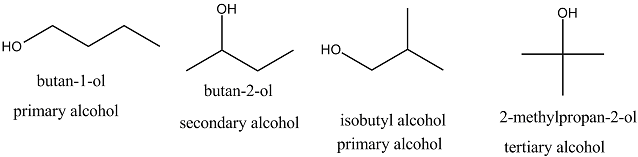
View full question & answer→MCQ 641 Mark
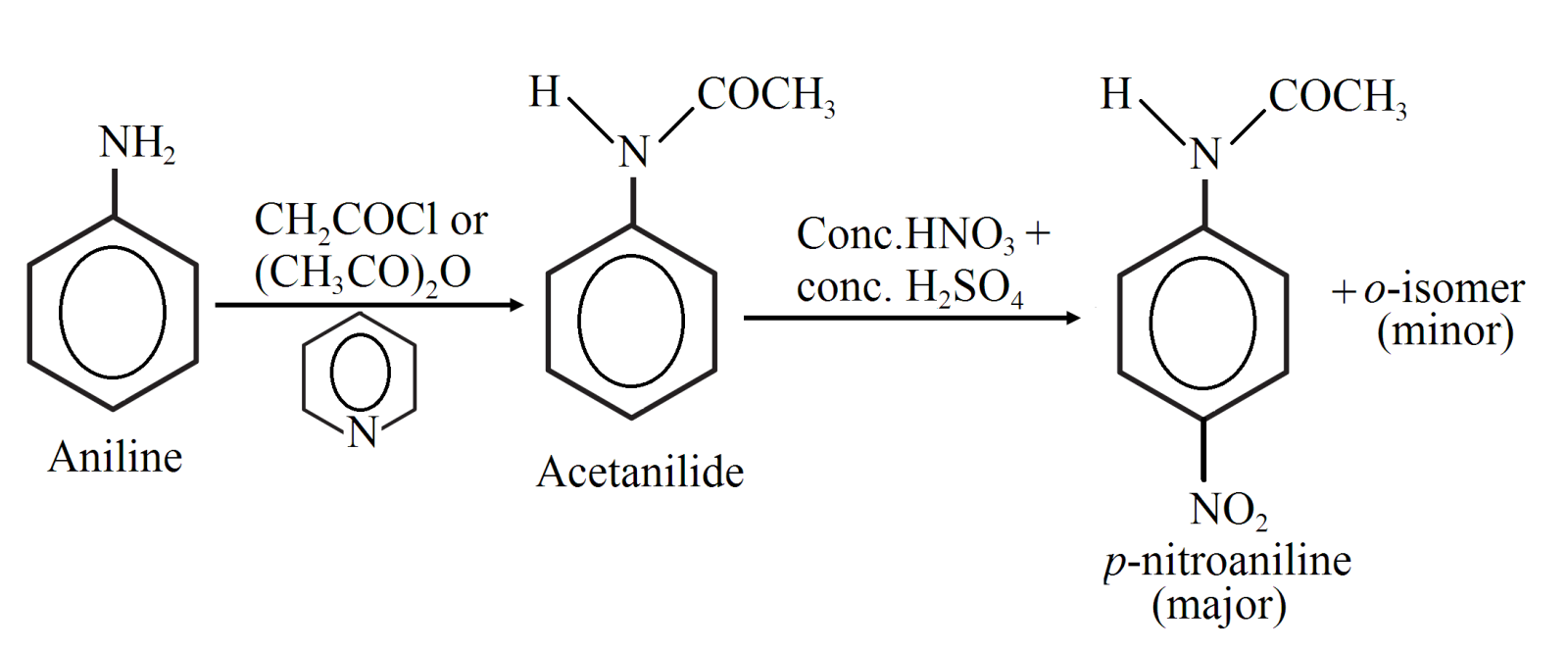
Under which of the following reaction conditions, aniline gives $p-$nitro derivative as the major product?
$a.$ Acetyl chloride/ pyridine followed by reaction with conc$. \ce{H_2SO_4} +$ conc$. \ce{HNO_3}$
$b.$ Acetic anyhdride/ pyridine followed by conc$. \ce{H_2SO_4} +$ conc$. \ce{HNO_3}.$
$c.$ Dil$. \text{HCl}$ followed by reaction with conc$. \ce{H_2SO_4} +$ conc$. \ce{HNO_3}.$
$d.$ Reaction with conc$. \ce{HNO_3} +$ con$c.\ce{H_2SO_4}$
- ✓
$a$ and $b$
- B
$a$ and $c$
- C
$b$ and $c$
- D
$b$ and $d$
AnswerCorrect option: A. $a$ and $b$
Aniline or reaction with acetyl chloride or acetic anhydride in the presence of pyridine produces $N-$acetyl aniline which is a ortho, para directing group which on further reaction with nitrating mixture $($cone$.\ce{HNO_3}+$ conc$. \ce{H_2SO_4})$ produces $p-$nitroaniline preferentially as shown below:
View full question & answer→MCQ 651 Mark
The correct $\text{IUPAC}$ name for $\text{CH}_2=\text{CHCH}_2\text{NHCH}_3$ is:
AnswerCorrect option: D. $N-$methylprop$-2-en-1-$amine.
View full question & answer→MCQ 661 Mark
The first organic compound synthesized in the laboratory from an inorganic compound is:
- A
$\mathrm{NH}_4 \mathrm{NCO}$
- ✓
$\mathrm{NH}_2-\mathrm{CO}-\mathrm{NH}_2$
- C
$\mathrm{CH}_3 \mathrm{COOH}$
- D
$\mathrm{CH}_4$
AnswerCorrect option: B. $\mathrm{NH}_2-\mathrm{CO}-\mathrm{NH}_2$
The first organic compound synthesized in the laboratory from an inorganic compound is urea which is $\mathrm{NH}_2\mathrm{CO}\mathrm{NH}_2$.
View full question & answer→MCQ 671 Mark
The diazonium salts are the reaction product in presence of excess of mineral acid with nitrous acid and:
AnswerThe diazonium salts are the reaction product in presence of excess of mineral acid with nitrous acid and primary aromatic amine.
View full question & answer→MCQ 681 Mark
Which of the following amines can be prepared by Gabriel synthesis.
$a.$ Isobutyl amine.
$b. 2-$ Phenylethylamine.
$c. N-$methylbenzylamine.
$d.$ Aniline.
- ✓
$a$ and $b$
- B
$a$ and $c$
- C
$b$ and $c$
- D
$a$ and $d$
AnswerCorrect option: A. $a$ and $b$
Only primary aliphatic amines such as $(a) \left(\mathrm{CH}_3\right)_2 \mathrm{CH}-\mathrm{CH}_2 \mathrm{NH}_2$ and $\mathrm{C}_6 \mathrm{H}_5 \mathrm{CH}_2 \mathrm{NH}_2 (b)$ can be prepared by Gabriel synthesis. $2^{\circ}$ amines, i.e., $\mathrm{C}_6 \mathrm{H}_5 \mathrm{CH}_2 \mathrm{NHCH}_3$ (C) and $1^{\circ}$ amine, $\mathrm{C}_6 \mathrm{H}_5 \mathrm{NH}_2 (d),$ however, cannot be prepared.
View full question & answer→MCQ 691 Mark
The correct most basicity in amines is:
- A
$\mathrm{C}_4 \mathrm{H}_5 \mathrm{NH}_2$
- B
$\mathrm{CH}_3 \mathrm{NH}_2$
- C
$\left(\mathrm{CH}_3\right)_2 \mathrm{NH}$
- ✓
$\left(\mathrm{CH}_3\right)_3 \mathrm{~N}$
AnswerCorrect option: D. $\left(\mathrm{CH}_3\right)_3 \mathrm{~N}$
The observed order in the case of lower members is found to be as secondary $>$ primary $>$ tertiary.
This anomalous behavior of tertiary amines is due to steric factors i.e. crowding of alkyl groups cover nitrogen atom from all sides and thus makes it unable for protonation.
Thus the relative strength is in order $\mathrm{CH}_3 \mathrm{NH}_2<\left(\mathrm{CH}_3\right)_2 \mathrm{NH}>\left(\mathrm{CH}_3\right)_3 \mathrm{N}$
View full question & answer→MCQ 701 Mark
The correct decreasing order of basic strength of the following species is $........ \mathrm{H}_2 \mathrm{O}, \mathrm{NH}_3, \mathrm{OH}^{-}, \mathrm{NH_2}^{-}$
- ✓
$\mathrm{NH_2}^{-} > \mathrm{OH}^{-} > \mathrm{NH}_3 > \mathrm{H}_2 \mathrm{O}$
- B
$\mathrm{OH}^{-} > \mathrm{NH_2}^{-} > \mathrm{H}_2 \mathrm{O} > \mathrm{NH}_3$
- C
$\mathrm{NH}_3 > \mathrm{H}_2 \mathrm{O} > \mathrm{NH_2}^{-} > \mathrm{OH}^{-}$
- D
$\mathrm{H}_2 \mathrm{O} > \mathrm{NH}_3 > \mathrm{OH}^{-} > \mathrm{NH}_2$
AnswerCorrect option: A. $\mathrm{NH_2}^{-} > \mathrm{OH}^{-} > \mathrm{NH}_3 > \mathrm{H}_2 \mathrm{O}$
Basic strength depends upon the electron donating capacity of the central atom, here amide is most basic due to presence of negative charge and two lone pair of electrons on nitrogen atom.
View full question & answer→MCQ 711 Mark
A compound $A$ has molecular formula $\ce{C_7H_7NO}.$ On treatment with $Br_2$ and $\text{KOH},$ A gives an amine $B$ which gives carbylamine test$. B$ upon diazotization and coupling with phenol gives an azo dye$. A$ can be:
- A
$\mathrm{C}_6 \mathrm{H}_5 \mathrm{CONHCOCH}_3$
- ✓
$\mathrm{C}_6 \mathrm{H}_5 \mathrm{CONH}_2$
- C
$\mathrm{C}_6 \mathrm{H}_5 \mathrm{NO}_2$
- D
$\mathrm{O}, \mathrm{m}$ or $\mathrm{p}-\mathrm{C}_6 \mathrm{H}_4\left(\mathrm{NH}_2\right) \mathrm{CHO}$
AnswerCorrect option: B. $\mathrm{C}_6 \mathrm{H}_5 \mathrm{CONH}_2$
According to the reactions given for compound $B, B$ should be aniline as it gives carbylamine test and also couples with phenol to form dye.
The action of $Br_2$ and $\text{KOH}$ is Hoffmann bromamide reaction in which aniline is formed.
Therefore$, A$ should be an amide.
Thus$, A$ is $\mathrm{C}_6 \mathrm{H}_5 \mathrm{CONH}_2$.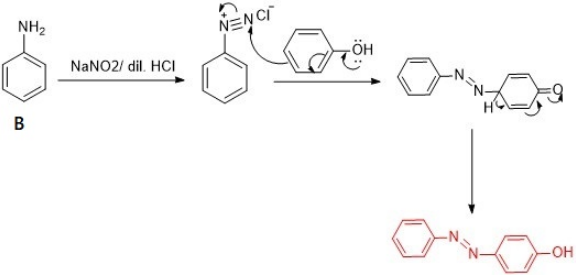
View full question & answer→MCQ 721 Mark
Which of the following is an arylalkyl amine?
- A
$ \mathrm{C}_6 \mathrm{H}_5 \mathrm{NHC}_6 \mathrm{H}_5 $
- B
$ \mathrm{C}_6 \mathrm{H}_5 \mathrm{NH}_2 $
- ✓
$ \left(\mathrm{C}_6 \mathrm{H}_5 \mathrm{CH}_2\right) \mathrm{NH} $
- D
$ \left(\mathrm{C}_6 \mathrm{H}_5\right)_3 \mathrm{\sim N} $
AnswerCorrect option: C. $ \left(\mathrm{C}_6 \mathrm{H}_5 \mathrm{CH}_2\right) \mathrm{NH} $
Arylalkyl amines are aromatic amines which are side chain substituted, i.e., the nitrogen is not directly attached to the phenyl group but to a side chain of the benzene ring.
In $ \left(\mathrm{C}_6 \mathrm{H}_5 \mathrm{CH}_2\right) \mathrm{NH} ,$ there are two same groups attached to the nitrogen where it is attached to a benzyl carbon, instead of an aryl carbon.
View full question & answer→MCQ 731 Mark
In the diazotisation of aniline with sodium nitrite and hdrochloric acid, an excess of hydrochloric acid is used primarily to:
- ✓
Suppress the concentration of free aniline available for coupling.
- B
Suppress hydrolysis of phenol.
- C
Insure a stoichiometric amount of nitrous acid.
- D
Neutralize the base liberated.
AnswerCorrect option: A. Suppress the concentration of free aniline available for coupling.
Excess of $\text{HCl}$ is used to convert free aniline to aniline hydrochloride. Other wise free aniline would undergo coupling reaction with benzene diazonium chloride
View full question & answer→MCQ 741 Mark
Gabriel phthalimide synthesisis used in the preparation of:
- ✓
$1^\circ $ amine
- B
$2^\circ $ amine
- C
$3^\circ $ amine
- D
$4^\circ $ amine
AnswerCorrect option: A. $1^\circ $ amine
The chemical reaction used for transforming primary alkyl halides into primary amines is called Gabriel phthalimide synthesis. It uses potassium phthalimide.
Therefore, Gabriel phthalimide synthesis is used in the preparation of $1^\circ$ amide.
View full question & answer→MCQ 751 Mark
Amine that can't be prepared by Gabriel phthalimide synthesis is:
AnswerGabriel phthalamide cannot be used to prepare aromatic amines since aromatic halides donot undergo nucleophilic subsitution from the salt formed by phthalamide.
View full question & answer→MCQ 761 Mark
In the nitration of benzene using a mixture of conc$. \ce{H_2SO_4}$ and conc$. \ce{HNO_3},$ the species which initiates the reaction is $.......$
- A
$\text{NO}_2$
- B
$\text{NO}^+$
- ✓
$\text{NO}_2^+$
- D
$\text{NO}_2^-$
AnswerCorrect option: C. $\text{NO}_2^+$
$NO_2\ ($Nitronium ion$)$ electrophile initiates the process of nitration. It is obtained as:
$\text{H}_2\text{SO}_4(\text{conc.})\xrightarrow{\ \ \ \ \ \ \ \ }\text{H}^++\text{HSO}_4^-$
$\text{H}^++\text{HNO}_3\xrightarrow{\ \ \ \ \ \ \ }\text{H}_2\text{NO}_3^+$
$\text{H}_2\text{NO}_3^+\xrightarrow{\ \ \ \ \ \ \ }\text{NO}_2^++\text{H}_2\text{O}$
View full question & answer→MCQ 771 Mark
Amines are more basic than:
Answer$\ce{-OH, -COOR, -COC}$ group
View full question & answer→MCQ 781 Mark
Which of the following orders is correct regarding the basic strength of subsituted aniline ?
- A
$P -$ nitroaniline $> p -$ aminobenzaldehyde $> p-$ bromoaniline.
- B
$P -$ nitroaniline $< p -$ bromoaniline $< p -$ aminobenzaldehyde.
- ✓
$P -$ nitroaniline $< p -$ aminobenzaldehyde $< p -$ bromoaniline.
- D
$P -$ nitroaniline $> p -$ aminobenzaldehyde $< p -$ bromoaniline.
AnswerCorrect option: C. $P -$ nitroaniline $< p -$ aminobenzaldehyde $< p -$ bromoaniline.
Nitro group is strong electron withdrawing group.
Hence$, p -$ nitroaniline is least basic.
Halogens and aldehydes are weakly deactivating or weak electron withdrawing groups.
The order of the ability to withdraw electron density is nitro $>$ aldehyde $>$ bromine.
Higher is the ability of the substituent to withdraw electrons, lower is the basicity of amine.
Hence, the order of basicity is
$P -$ nitroaniline $< p -$ amino benzaldehyde $< p -$ bromoaniline.
View full question & answer→MCQ 791 Mark
Which is most basic among the following?
- A
$ \mathrm{CH}_3 \mathrm{NH}_2 $
- B
$ \mathrm{CH}_3 \mathrm{CH}_2 \mathrm{NH}_2$
- C
$\mathrm{NH}_3$
- ✓
$\left(\mathrm{CH}_3\right)_2 \mathrm{CHNH}_2$
AnswerCorrect option: D. $\left(\mathrm{CH}_3\right)_2 \mathrm{CHNH}_2$
The basic character of a compound is determined by the stability of the conjugate acid.
Among the following alternatives$, D$ will be the most basic due to stabilization of the conjugate acid by the positive inductive as well as the hyperconjugation effect of the two methyl groups
View full question & answer→MCQ 801 Mark
Which of the following has the maximum value of $\text{pkb}?$
- A
$ \left(\mathrm{CH}_3\right)_2 \mathrm{NH} $
- B
$ \left(\mathrm{CH}_3 \mathrm{CH}_2\right)_2 \mathrm{NH} $
- ✓
$ \mathrm{C}_6 \mathrm{H}_5-\mathrm{NH}-\mathrm{C}_6 \mathrm{H}_5 $
- D
$ \mathrm{C}_6 \mathrm{H}_5-\mathrm{NH}-\mathrm{CH}_3 $
AnswerCorrect option: C. $ \mathrm{C}_6 \mathrm{H}_5-\mathrm{NH}-\mathrm{C}_6 \mathrm{H}_5 $
In the compound mentioned in part $C,$ the lone pair of nitrogen is in conjugation with both the phenyl rings.
So, they are greatly dispersed and are not available for donation.
As a result, the compound $C$ is least basic.
Least basic means least $Kb$ value and least $Kb$ value means highest $\text{pKb}$ value.
View full question & answer→MCQ 811 Mark
Methylamine reacts with $H\ce{NO_2}$ to form $........$
- A
$\ce{CH_3-O-N=O}$
- B
$\ce{CH_3-O-CH_3}$
- ✓
$\ce{CH_3OH}$
- D
$\ce{CH_3CHO}$
AnswerCorrect option: C. $\ce{CH_3OH}$
$\text{R}-\text{NH}_2+\text{HNO}_2\xrightarrow{\ \ \ \ \text{NaNO}_2+\text{HCI}\ \ \ }[\text{R}-\stackrel{+}{\hbox{N}}_2\text{C}\stackrel{-}{\hbox{l}}]\xrightarrow{\ \ \text{H}_2\text{O}\ \ }\text{ROH}+\text{N}_2+\text{HCl}$
View full question & answer→MCQ 821 Mark
Which of the following names of amines belong strictly to the common system?
AnswerIn the common system, aliphatic amines are named by prefixing the alkyl group to amine, i.e., alkylamine. In case of two different alkyl groups, it is named by listing the alkyl groups in alphabetical order before the word amine, just like in ethylmethylamine. Aniline is a common name but is also accepted by $\text{IUPAC}.$
View full question & answer→MCQ 831 Mark
Which of the following is not an amine?
- ✓
$NH_3$
- B
$\ce{CH_3NH_2}$
- C
$\ce{C_6H_5NH_2}$
- D
$\ce{CH_3NHCH_3}$
AnswerCorrect option: A. $NH_3$
Amines are clearly defined as ‘derivatives’ of ammonia obtained by replacement of one or more $H$ atoms by an alkyl/aryl group.
Therefore$, NH_3$ itself is not an amine, but the base compound for all amines.
View full question & answer→MCQ 841 Mark
Which of the following is the weakest Brönsted base?
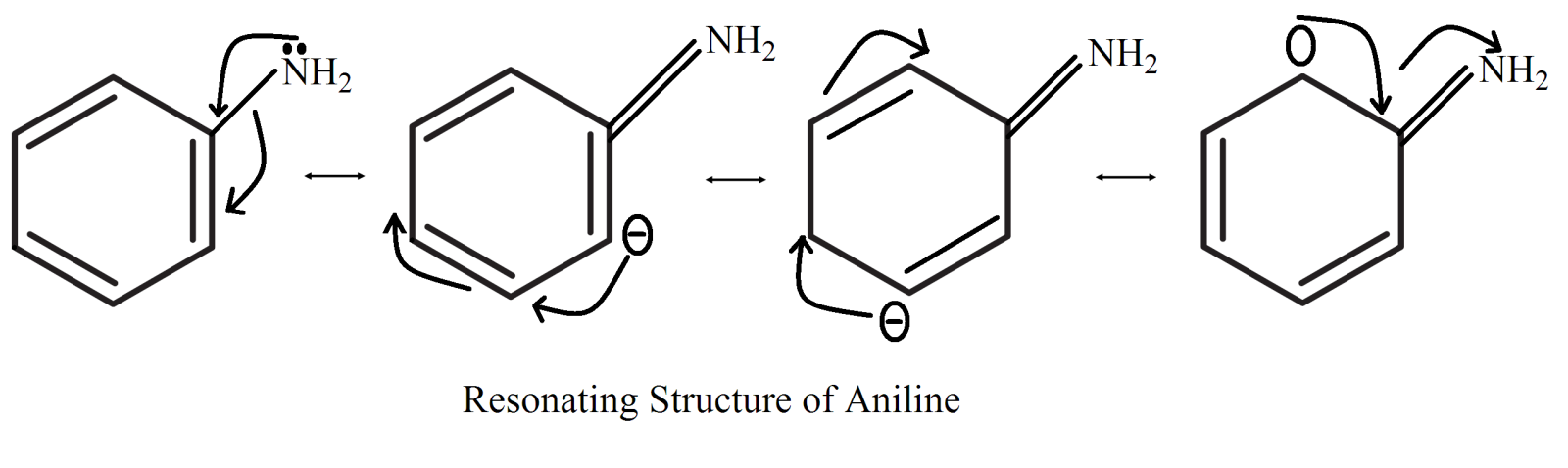
AnswerDue to delocalization of lone pair of electrons on the $N-$atom into the benzene ring$, \mathrm{C}_6 \mathrm{H}_5 \mathrm{NH}_2$ is the weakest base.
Resonating Structure of Aniline.
View full question & answer→MCQ 851 Mark
Benzylamine may be alkylated as shown in the following equation: $\text{C}_6\text{H}_5\text{CH}_2\text{NH}_2+\text{R}-\text{X}\xrightarrow{\ \ \ \ \ \ \ \ }\text{C}_6\text{H}_5\text{CH}_2\text{NHR}$ Which of the following alkylhalides is best suited for this reaction through $\mathrm{S}_{\mathrm{N}}{_1}$ mechanism?
- A
$\mathrm{CH}_3 \mathrm{Br}$
- B
$\mathrm{C}_6 \mathrm{H}_5 \mathrm{Br}$
- ✓
$\mathrm{C}_6 \mathrm{H}_5 \mathrm{CH}_2 \mathrm{Br}$
- D
$\mathrm{C}_2 \mathrm{H}_5 \mathrm{Br}$
AnswerCorrect option: C. $\mathrm{C}_6 \mathrm{H}_5 \mathrm{CH}_2 \mathrm{Br}$
$\mathrm{S}_{\mathrm{N}}{_1}$ reaction proceeds through the formation of carbocation since in $\mathrm{C}_6 \mathrm{H}_5 \mathrm{CH}_2 \mathrm{Br}$ benzyl carbocation is formed which is stabilized by resonance.
View full question & answer→MCQ 861 Mark
How many primary amines can be formulated by $\ce{C_3H_9N}$ and how many $1^\circ $ hydrogen are associated with carbon atoms of each compound?
- A
Two primary amines $[3, 6]$
- B
One primary amine $[3]$
- C
Three primary amines $[3, 6, 6]$
- ✓
Two primary amines $[5, 6]$
AnswerCorrect option: D. Two primary amines $[5, 6]$
Two primary amines$, n$ propyl amine and iso propyl amine can be formulated with molecular formula $\ce{C_3H_9N}$
In n propyl amine, five primary hydrogens are attached with carbon atoms.
In isopropyl amine, six primary hydrogen atoms are attached with carbon atoms.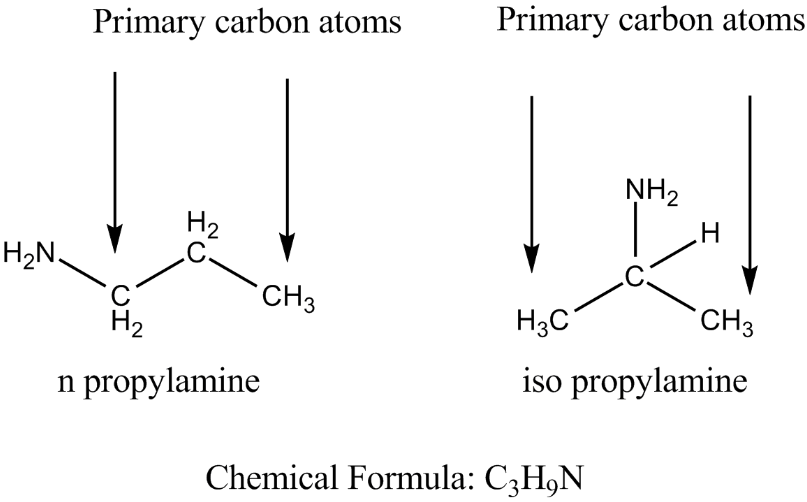
View full question & answer→MCQ 871 Mark
Which of the following statements is correct?
- A
Methyl amine is slightly acidic.
- B
Methyl amine is less basic than ammonia.
- ✓
Methyl amine is less basic than dimethyl amine.
- D
Methyl amine is less basic than aniline.
AnswerCorrect option: C. Methyl amine is less basic than dimethyl amine.
Dimethyl amine $\ce{(Me_2NH)}$ is more basic than $\ce{MeNH_2},$ due to $(+I)$ effect of two $(Me)$ groups.
View full question & answer→MCQ 881 Mark
Based on the concept of the hydration of protonated amines, which of the following represents correct order of decreasing basic strength of amines?
- ✓
Primary amine $>$ secondary amine $>$ tertiary amine.
- B
Tertiary amine $>$ primary amine $>$ secondary amine.
- C
Tertiary amine $>$ secondary amine $>$ primary amine.
- D
Primary amine $>$ tertiary amine $>$ secondary amine.
AnswerCorrect option: A. Primary amine $>$ secondary amine $>$ tertiary amine.
Based on the concept of the hydration of protonated amines, the following represents the correct order of decreasing basic strength of amines
primary amine $>$ secondary amine $>$ tertiary amine
This is the same order in which the degree of hydrogen bond formation, the extent of hydration and the stabilisation of protonated amines decrease.
View full question & answer→MCQ 891 Mark
Identify the statement about the basic nature of amines.
- A
Alkylamines are weaker bases than ammonia.
- B
Arylamines are stronger bases than alkyl amines.
- ✓
Secondary aliphatic amines are stronger bases than primary aliphatic amines.
- D
Tertiary aliphatic amines are weaker bases than arylamines.
AnswerCorrect option: C. Secondary aliphatic amines are stronger bases than primary aliphatic amines.
The lone pair of the electron on nitrogen atom present is arylamines is less available for protonation partly due to $-I$ effect of a phenyl group and mostly due to resonance.
Hence aryl amines are weaker bases than alkyl amines.
Also, the secondary amines are a stronger base than the primary amines as the number of alkyl groups attached to the nitrogen atoms are more in secondary alkyl amines.
View full question & answer→MCQ 901 Mark
The reaction $\text{Ar}\stackrel{+}{\hbox{N}_2}\text{Cl}^-\xrightarrow{\ \ \text{Cu/HCl}\ \ \ }\text{ArCl}+\text{N}_2+\text{CuCl}$ is named as:
Answer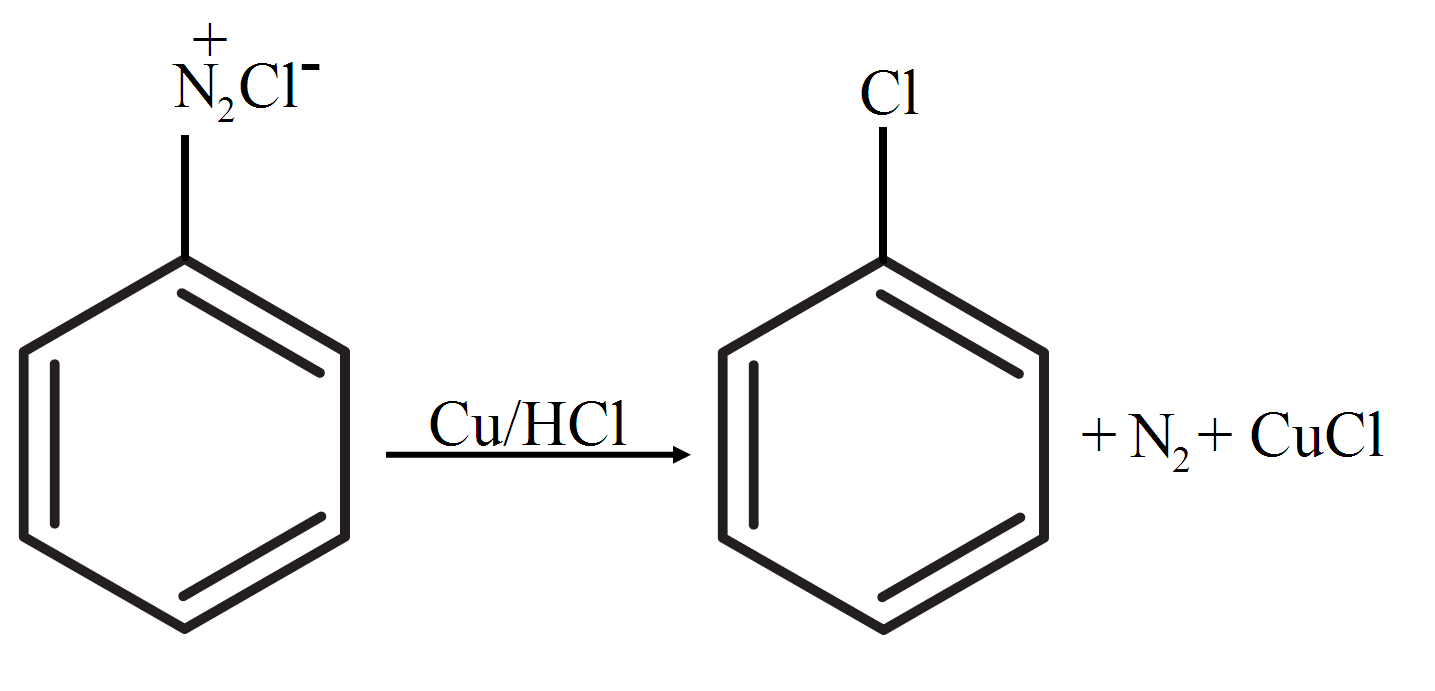
is named Gatterman reaction.
View full question & answer→MCQ 911 Mark
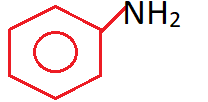
The compound shown is a $.......$ amine.
- ✓
$1^\circ $ aryl
- B
$1^\circ $ arylalkyl
- C
$2^\circ $ aryl
- D
$2^\circ $ arylalkyl
AnswerCorrect option: A. $1^\circ $ aryl
Only one hydrogen atom is replaced by an aromatic group, in which the nitrogen is directly linked to the $s p^2$ hybridised carbon of benzene ring. Hence, it is a primary aromatic aryl amine.
View full question & answer→MCQ 921 Mark
Diazo coupling is useful to prepare some:
AnswerThe first use of diazonium salts was to produce water$-$fast dyed fabrics by immersing the fabric in an aqueous solution of the diazonium compound, followed by immersion in a solution of the coupler $($the electron $-$ rich ring that undergoes electrophilic substitution$).$
The major applications of diazonium compounds remains in the dye and pigment industry.
View full question & answer→MCQ 931 Mark
What is the bond angle in ammonia molecule?
- A
$106.5^\circ $
- ✓
$107^\circ $
- C
$108^\circ $
- D
$109.5^\circ $
AnswerCorrect option: B. $107^\circ $
The bond angle for a standard tetrahedral geometry is $109.5^\circ .$ But the ammonia molecule contains a lone electron pair on nitrogen.
As it is closer to the $N$ atom than the other orbitals, it creates a repulsive effect and pushes the Hydrogen atoms close to each other, thus reducing the bond angle to $107^\circ .$
View full question & answer→MCQ 941 Mark
Which of the following compound will not undergo azo coupling reaction with benzene diazonium chloride.
AnswerDiazonium cation is a weak electrophile and hence reacts with electron rich compounds containing electron donating groups such as $-\mathrm{OH},-\mathrm{NH}_2$ and $-\mathrm{OCH}_3$ groups and not with compounds containing electron withdrawing groups such as $-\mathrm{NO}_2,$ etc.
View full question & answer→MCQ 951 Mark
The correct increasing order of basic strength for the following compounds is $.......$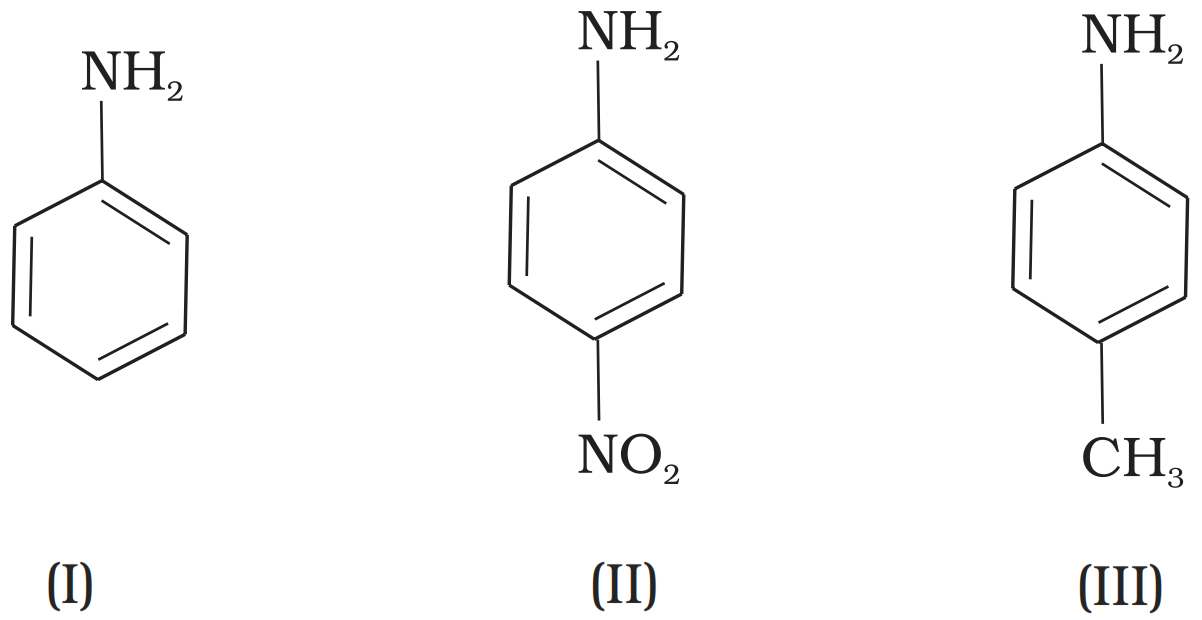
- A
$\text{II < III < I.}$
- B
$\text{III < I < II.}$
- C
$\text{III < II < I.}$
- ✓
$\text{II < I < III.}$
AnswerCorrect option: D. $\text{II < I < III.}$
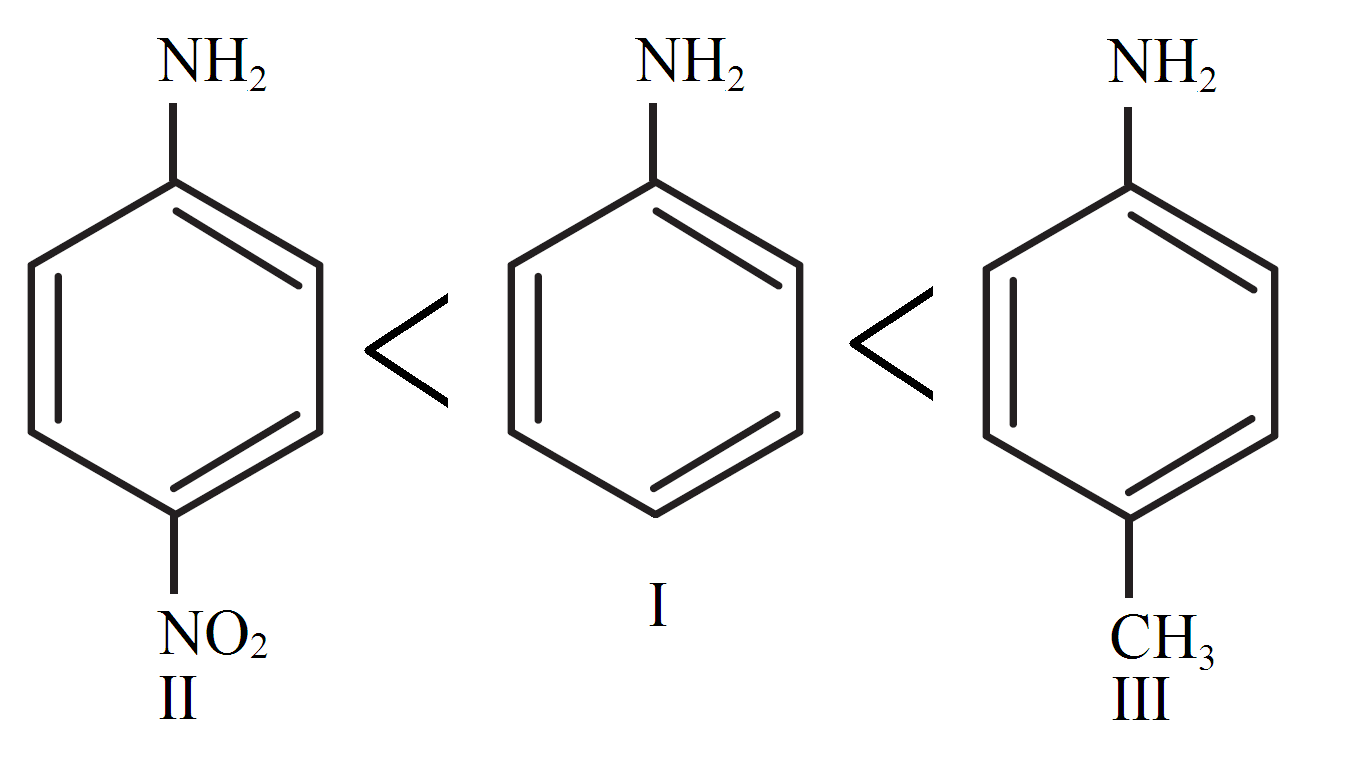
Electron withdrawing group decreases the basic strength while electron releasing groups increases the basic strength of aniline.
View full question & answer→MCQ 961 Mark
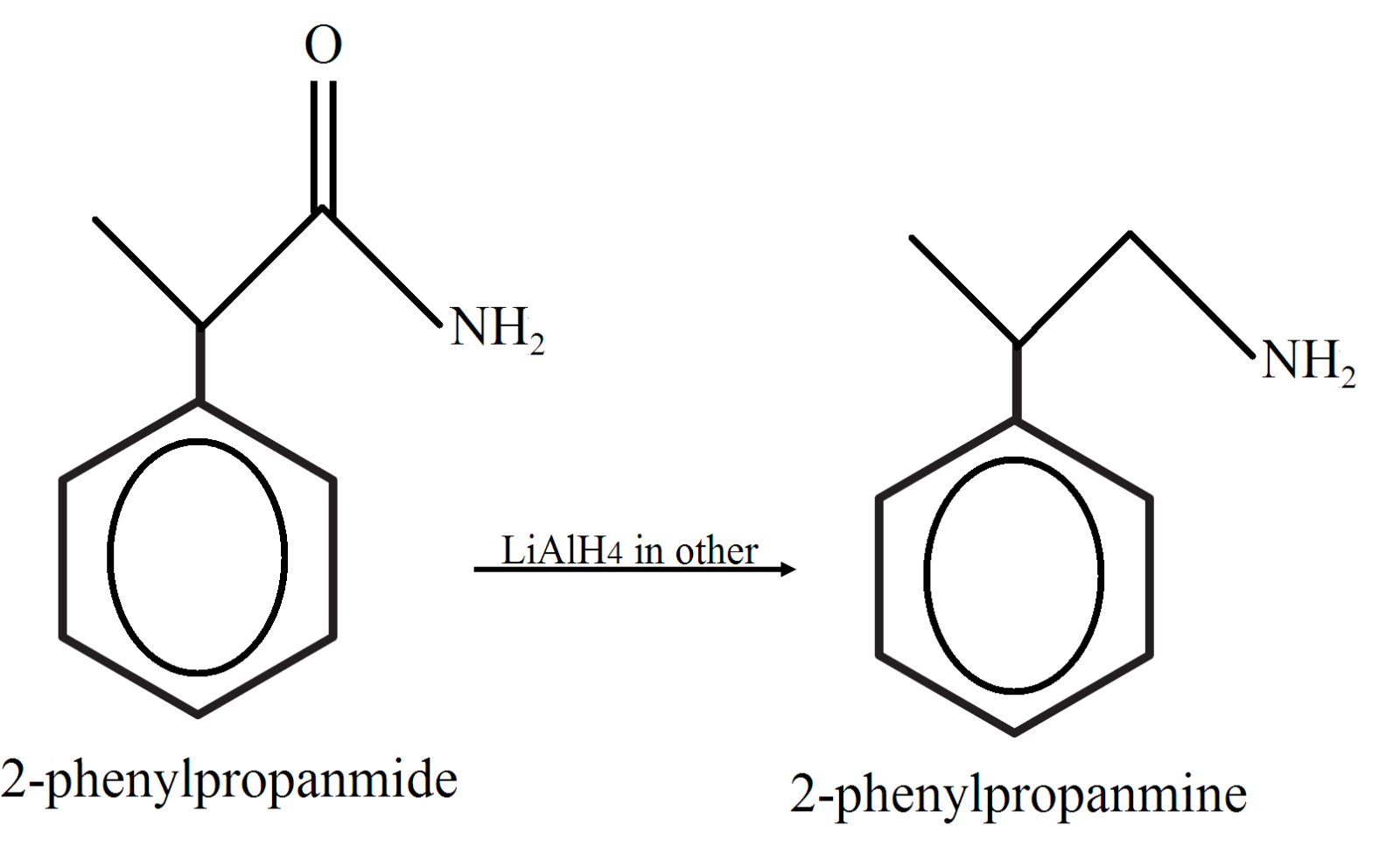
The best reagent for converting $2-$phenylpropanamide into $2-$phenylpropanamine is $........$
AnswerCorrect option: D. $\mathrm{LiAlH}_4$ in ether.
The best reagent for converting $2-$phenylpropanamide into $2-$phenylpropanamine is $\mathrm{LiAlH}_4$ in ether. Reaction is as given below:
View full question & answer→MCQ 971 Mark
Which of the following explode on heating?
Answersome experiments describe on calcium and barium azid and tetrazene, which explode while they are solid.
The explosion of the molten azides is due to self heating of the liquid.
Explosion is facilitated by the presence of an inert gas above the decomposing liquid self heating of the liquid azides is due to the retention of heat products of reaction near the surface.
View full question & answer→MCQ 981 Mark
$\text{A 55- kDa}$ protien was acid hydrolysed to obtain a misture of amino acids. How many amino acids could be present in the solution?
- A
$550$
- ✓
$500$
- C
$1000$
- D
$1100$
View full question & answer→MCQ 991 Mark
Nitrobenzene when reduced with tin and hydrochloric acid, i.e., in acidic medium, the product formes is:
AnswerNitrobenzene is reduced to phenylammonium ions using a mixture of tin and concentrated hydrochloric acid.
The mixture is heated under reflux in a boiling water bath for about half an hour.
Under the acidic conditions, rather than getting phenylamine directly, you instead get phenylammonium ions formed.
View full question & answer→MCQ 1001 Mark
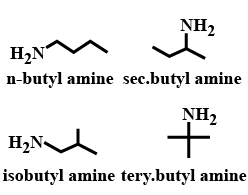
How many primary amines are possible for the formula $\mathrm{C}_4 \mathrm{H}_{11} \mathrm{N}\ ?$
AnswerFour primary amines are possible for this structure.
View full question & answer→MCQ 1011 Mark
The correct order of basic strength is:
- A
$\mathrm{C}_6 \mathrm{H}_5 \mathrm{NH}_2>\mathrm{CH}_3 \mathrm{NH}_2>\mathrm{NH}_3$
- B
$\mathrm{CH}_3 \mathrm{NH}_2>\mathrm{C}_6 \mathrm{H}_5 \mathrm{NH}_2>\mathrm{NH}_3$
- ✓
$\mathrm{CH}_3 \mathrm{NH}_2>\mathrm{NH}_3>\mathrm{C}_6 \mathrm{H}_5 \mathrm{NH}_2$
- D
$\mathrm{NH}_3=\mathrm{CH}_3 \mathrm{NH}_2=\mathrm{C}_6 \mathrm{H}_5 \mathrm{NH}_2$
AnswerCorrect option: C. $\mathrm{CH}_3 \mathrm{NH}_2>\mathrm{NH}_3>\mathrm{C}_6 \mathrm{H}_5 \mathrm{NH}_2$
To determine the order of basicity of amines, we have to check for the availability of lone pair, means how easily the lone pair on the nitrogen atom is available for the attack of an electrophile.
$\mathrm{NH}_3 :-$ it has lone pair which is available on it.
$\mathrm{CH}_3 \mathrm{NH}_2 $- there is positive inductive effect of methyl group, so electron density on nitrogen is more than that of $\mathrm{NH}_3.$
$\mathrm{C}_6 \mathrm{H}_5 \mathrm{NH}_2$ - the lone pair of nitrogen is taking part in resonance with benzene ring, so it is least available to the attack of an electrophile compared to others.
So, the order is $\mathrm{CH}_3 \mathrm{NH}_2>\mathrm{NH}_3>\mathrm{C}_6 \mathrm{H}_5 \mathrm{NH}_2$.
View full question & answer→MCQ 1021 Mark
$N −$ Ethyl pthalimide on hydrolysis gives:
AnswerThe alkaline hydrolysis of $N -$ ethylpthalimide gives ethyl amine.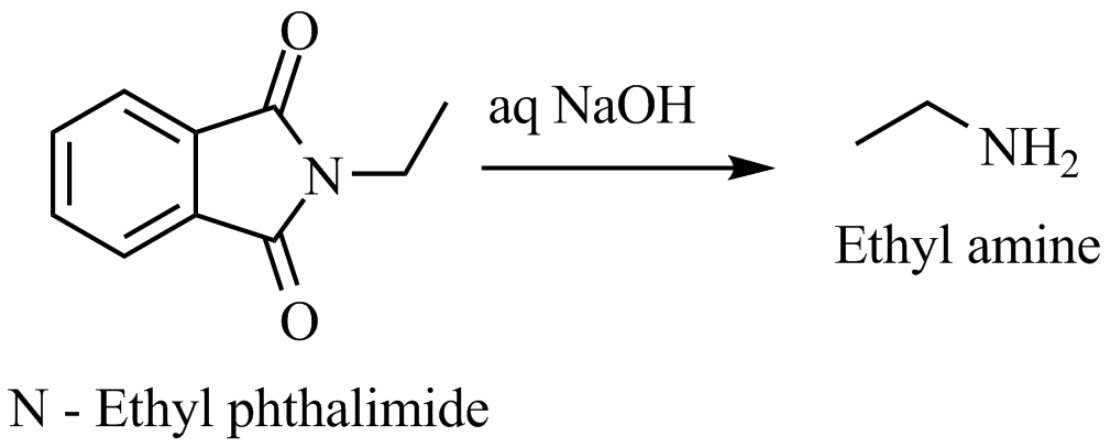
View full question & answer→MCQ 1031 Mark
The boiling point of amines are higher than that of hydrocarbon because:
AnswerCorrect option: D. Both $A$ and $B$
Amines have higher boiling points than hydrocarbons, as $C - N$ bond in amines is more polar than a $C - C$ bond in hydrocarbons.
Due to the polar nature of amines it forms intermolecular $H -$ bonds and exists as associated molecules.
Thus, its boiling point is higher than that of hydrocarbons.
View full question & answer→MCQ 1041 Mark
When two alkyl groups are attached to the nitrogen atom in an amine, it is known as a $.......$ amine.
AnswerAmines are classified as secondary or $2^\circ $ when two of the hydrogen atoms of ammonia are replaced by an alkyl group and the third $H$ remains attached as it is.
View full question & answer→MCQ 1051 Mark
The correct order of basicity for $\text{PYRROLE (A), PYRIDINE (B), PIPERIDINE(C)}$ is:
- A
$\text{A > B > C}$
- ✓
$\text{C > B > A}$
- C
$\text{B > C > A}$
- D
$\text{C > A > B}$
AnswerCorrect option: B. $\text{C > B > A}$
View full question & answer→MCQ 1061 Mark
Which compound does not give positive test in Lassaigne's test for nitrogen?
AnswerIn Lassaigne's test, the organic compound is fused with sodium.
Carbon and nitrogen present in the organic compound gives sodium cyanide $\text{(NaCN)}.$
This is further used in the test for nitrogen.
Hydrazine $\left(\mathrm{H}_2 \mathrm{N}-\mathrm{NH}_2\right)$ do not contain carbon. It cannot form $\text{NaCN}$ on fusion with sodium.
Hence, hydrazine cannot give Lassaigne's test for nitrogen.
View full question & answer→MCQ 1071 Mark
The reaction$:\ \left[\mathrm{C}_2 \mathrm{H}_5 \mathrm{Br}+\mathrm{NH}_3\right]$ is in fact an example of:
- A
- ✓
Nucleophilic substitution only
- C
Ammonolysis as well as nucleophilic substitution
- D
AnswerCorrect option: B. Nucleophilic substitution only
View full question & answer→MCQ 1081 Mark
Mendius reaction involves the:
- A
Reduction of aldehydes to give alcohols.
- ✓
Reduction of nitriles with sodium and ethanol.
- C
- D
AnswerCorrect option: B. Reduction of nitriles with sodium and ethanol.
$\text{R}-\text{C}\equiv\text{N}\xrightarrow[\text{mendius reduction}]{\text{Na}+\text{EtOH}}\text{RCH}_2\text{NH}_2$
View full question & answer→MCQ 1091 Mark
Carbonyl compound and primary Amine react together to form which type of compound?
MCQ 1101 Mark
Which of the following compounds has the lowest boiling point?
AnswerCorrect option: D. $N, N -$ dimethylmethanamine
$N, N -$ dimethylmethanamine will have the lowest boiling points as it cannot form hydrogen bonds.
Other amines can form hydrogen bonds and have higher boiling points.
View full question & answer→MCQ 1111 Mark
Amines are almost colourless but develop colour on keeping in the air for a long time, because:
- ✓
They are readily oxidised in air to form coloured oxidation product.
- B
They react with oxygen present in air in very less amount.
- C
They regain color in presence of air.
- D
AnswerCorrect option: A. They are readily oxidised in air to form coloured oxidation product.
Amines are basic compound.
They are colourless but develop colour on keeping in the air for a long time because they react readily air and get oxidised.
View full question & answer→MCQ 1121 Mark
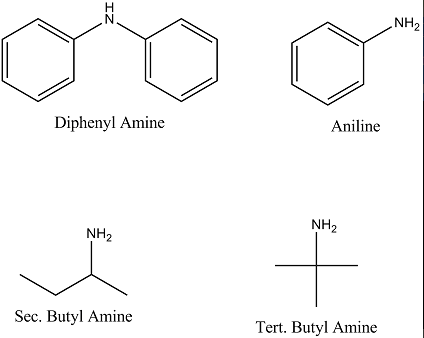
Which of the following is a secondary amine?
AnswerDiphenyl amine is aromatic secondary amine$. N$ atom is attached to two aryl groups and one $H$ atom.
Aniline is aromatic primary amine.
Sec. butyl amine and tert. butyl amine are aliphatic primary amines.
View full question & answer→MCQ 1131 Mark
A mixture containing primary, secondary and tertiary amine is treated with diethyl oxalate. Choose the correct statement:
- A
The distillate of the mixture after treatment mainly contains $1^\circ $ amines.
- ✓
Tertiary amine do not react with diethyl oxalate.
- C
This is Hinsberg method of separating $1^\circ , 2^\circ $ and $3^\circ $ amines.
- D
$3^\circ $ amine is removed by filtration.
AnswerCorrect option: B. Tertiary amine do not react with diethyl oxalate.
View full question & answer→MCQ 1141 Mark
Which of the following compounds is the weakest Brönsted base?
Answerii
 Explanation:
Phenol is the weakest Bronsted base as it is the strongest acid among the four choices given above. Stronger the acid weaker is its conjugate base.
View full question & answer→MCQ 1151 Mark
Which of the following compound gives secondary amine on reduction?
AnswerHere carbylamine is given secondary amine.
View full question & answer→MCQ 1161 Mark
Which of the following represents the correct order of basic strength?.
- ✓
Aniline $>$ diphenylaniline $>$ triphenylaniline.
- B
Triphenylaniline $>$ diphenylaniline $>$ aniline.
- C
Triphenylaniline $>$ aniline $>$ diphenylaniline.
- D
Aniline $>$ triphenylaniline $>$ diphenylaniline.
AnswerCorrect option: A. Aniline $>$ diphenylaniline $>$ triphenylaniline.
The following represents the correct order of basic strength
aniline $>$ diphenylaniline $>$ triphenylaniline
When hydrogen atoms of the amino group of arylamines are replaced by electron withdrawing phenyl groups, the basic character of the resulting amine decreases.
View full question & answer→MCQ 1171 Mark
Among the following amines, which one has the highest $pK_b$ value in aqueous solution?
- A
- B
$N, N -$ dimethylaniline
- C
- ✓
Answer$+$Inductive effct increases the electron density on nitrogen thus makes it more basic while $+R$ effect involves the lone pair of $N$ in conjugation thereby reduces its basicity.
Therefore aniline are less basic than alkyl amines and secondary aniline are more basic than aniline.
Highest $pK_b$ means least basic nature
View full question & answer→MCQ 1181 Mark
Best method for preparing primary amines from alkyl halides without changing the number of carbon atoms in the chain is:
- A
Hoffmann Bromamide reaction.
- ✓
Gabriel phthalimide synthesis.
- C
- D
Reaction with $NH_3$.
AnswerCorrect option: B. Gabriel phthalimide synthesis.
View full question & answer→MCQ 1191 Mark
Amongst the following, the most basic compound is:
AnswerAliphatic amines are stronger bases as compared to aromatic amines.
This is because in aromatic amines, the lone pair on nitrogen is involved in delocalization with aromatic ring.
Benzyl amine is an aliphatic amine, whereas other given amines are aromatic amines.
Hence, among the given amines, benzyl amine $(\mathrm{C}_6 \mathrm{H}_5 \mathrm{CH}_2 \mathrm{NH}_2)$ is the strongest base.
View full question & answer→MCQ 1201 Mark
The correct order of basicity of amines in water is:
- ✓
$ \left(\mathrm{CH}_3\right)_2 \mathrm{NH} > \left(\mathrm{CH}_3\right)_3 \mathrm{N} > \mathrm{CH}_3 \mathrm{NH}_2 $
- B
$ \mathrm{CH}_3 \mathrm{NH}_2 > \left(\mathrm{CH}_3\right)_2 \mathrm{NH} > \left(\mathrm{CH}_3\right)_3 \mathrm{N} $
- C
$ \left(\mathrm{CH}_3\right)_3 \mathrm{N} > \left(\mathrm{CH}_3\right)_2 \mathrm{NH} > \mathrm{CH}_3 \mathrm{NH}_2 $
- D
$ \left(\mathrm{CH}_3\right)_3 \mathrm{N} > \mathrm{CH}_3 \mathrm{NH}_2 > \left(\mathrm{CH}_3\right)_2 \mathrm{NH} $
AnswerCorrect option: A. $ \left(\mathrm{CH}_3\right)_2 \mathrm{NH} > \left(\mathrm{CH}_3\right)_3 \mathrm{N} > \mathrm{CH}_3 \mathrm{NH}_2 $
$ \left(\mathrm{CH}_3\right)_2 \mathrm{NH} > \left(\mathrm{CH}_3\right)_3 \mathrm{N} > \mathrm{CH}_3 \mathrm{NH}_2 $
As basicity of amines in water is determined by the tendency of donating electrons and $3$ degree amines will have the highest $+I$ effect Leading to greater electron density followed by $2$ degree and primary amines
View full question & answer→MCQ 1211 Mark
In the following compounds, the decreasing order of basic strength will be:
- ✓
$ \left(\mathrm{C}_2 \mathrm{H}_5\right)_2 \mathrm{NH} > \mathrm{C}_2 \mathrm{H}_5 \mathrm{NH}_2 > \mathrm{NH}_3 $
- B
$ \left(\mathrm{C}_2 \mathrm{H}_5\right)_2 \mathrm{NH} > \mathrm{NH}_3 > \mathrm{C}_2 \mathrm{H}_5 \mathrm{NH}_2 $
- C
$ \mathrm{NH}_3 > \mathrm{C}_2 \mathrm{H}_5 \mathrm{NH}_2 > \left(\mathrm{C}_2 \mathrm{H}_5\right)_2 \mathrm{NH} $
- D
$ \mathrm{C}_2 \mathrm{H}_5 \mathrm{NH}_2 > \mathrm{NH}_3 > \left(\mathrm{C}_2 \mathrm{H}_5\right)_2 \mathrm{NH} $
AnswerCorrect option: A. $ \left(\mathrm{C}_2 \mathrm{H}_5\right)_2 \mathrm{NH} > \mathrm{C}_2 \mathrm{H}_5 \mathrm{NH}_2 > \mathrm{NH}_3 $
$ \left(\mathrm{C}_2 \mathrm{H}_5\right)_2 \mathrm{NH} > \mathrm{C}_2 \mathrm{H}_5 \mathrm{NH}_2 > \mathrm{NH}_3 $
Basic strength order
$\left(\mathrm{CH}_3 \mathrm{CH}_2\right)_2 \mathrm{NH}>\mathrm{CH}_3 \mathrm{CH}_2 \mathrm{NH}_2>\mathrm{NH}_3$
$2^\circ $ amine$, 1^\circ $ amine
Alkyl group shows $+I$ effect, and hence increases basicity.
View full question & answer→MCQ 1221 Mark
Which of the following compound is the strongest base?
AnswerMethyl amine is the strongest base.
View full question & answer→MCQ 1231 Mark
In aqueous solution $.......$ amines are unexpectedly less basic than the others.
AnswerIn aqueous solution tertiary amines are unexpectedly less basic than the others.
This is due to steric factor and solvation of ions.
View full question & answer→MCQ 1241 Mark
The conversion of primary aromatic amines into diazonium salts is known as:
AnswerDiazonium ions are prepared by diazotization, a procedure in which a primary aromatic amine $\ce{(ArNH_2)}$ is treated with a source of nitrous acid $\ce{(HNO_2)}.$
Typically this involves adding sodium nitrite $\ce{(NaNO_2)}$ to an aqueous acidic solution containing the amine.

View full question & answer→MCQ 1251 Mark
Aniline is soluble in which of the following organic reagents?
AnswerAniline is soluble in, all organic solvents like alchol ether and benzene this is because of low polarity in amines and not a stronger intermolecular $H -$ bonding in itself.
View full question & answer→MCQ 1261 Mark
The basicity of aniline is less than that of cyclohexylamine. This is due to:
- A
$-R$ effect of $\ce{−NH_2}$ group
- B
$-I$ effect of $\ce{−NH_2}$ group
- ✓
$+R$ effect of $\ce{NH_2}$ group
- D
AnswerCorrect option: C. $+R$ effect of $\ce{NH_2}$ group
The basicity of aniline is less than that of cyclohexylamine because of $+R$ effect of $\ce{NH_2}$ group in aniline.
View full question & answer→MCQ 1271 Mark
Which of the following forms unstable diazonium ion when treated with $\ce{NaNO_2}$ in aqueous $\text{HCl}\ ?$
AnswerAromatic diazonium salts are stable if kept cold $(0 - 5^\circ C)$ and in solution, but they often decompose violently when isolated.
Their stability $($compared to alkane diazonium salts$)$ is due in part to resonance stabilization of the diazonium ion and in part to the very high energy of the aryl cation that would result from the loss of $N_2$$(g).$
Therefore except ethylamine all other given compounds forms stable diazonium ion when treated with $\ce{NaNO_2}$ in aqueous $\text{HCl}.$
Which of the following forms unstable diazonium ion when treated with $\ce{NaNO_2}$ in aqueous $\text{HCl}\ ?$
View full question & answer→MCQ 1281 Mark
Amines are the derivatives of:
AnswerAmines are derivative of ammonia, wherein one or more hydrogen atoms have been replaced by a substituent such as an alkyl or aryl group $($these may respectively be called alkylamines and arylamines; in which both types of substituent are attached to one nitrogen atom may be called alkylarylamines$).$
View full question & answer→MCQ 1291 Mark
Aromatic amines are insoluble in water because:
- ✓
Due to the larger hydrocarbon part which tends to retard the formation of $H -$ bonds.
- B
Due to the larger hydrocarbon part which tends to retard the formation of $H -$ Nbonds.
- C
Due to the larger hydrocarbon part which tends to retard the formation of $H -$ Cbonds.
- D
AnswerCorrect option: A. Due to the larger hydrocarbon part which tends to retard the formation of $H -$ bonds.
Aromatic amines are insoluble in water because of large hydrocarbon part $($hydrophobic$)$ part which retards the formation of $H -$ bonding.
View full question & answer→MCQ 1301 Mark
Among the following which one is most basic?
- A
$\ce{NH_3}$
- B
$\ce{CH_3NH_2}$
- ✓
$\ce{CH_3CH_2NH_2}$
- D
$\ce{C_6H_5NH_2}$
AnswerCorrect option: C. $\ce{CH_3CH_2NH_2}$
The basicity of the among compounds is due to the presence of lone pair on Nitrogen.
$\ce{CH_3CH_2NH_2}$ is more basic than $\ce{NH_3}$ because of electron$-$donating group in $\ce{CH_3CH_2NH_2}$ increases the electron density on nitrogen atom.
$\ce{CH_3NH_2}$ is less basic than $\ce{CH_3CH_2NH_2}$ because of ethyl group present in ethylamine which increases electron density on $N$ in ethylamine and attracts $H^+$ better than methylamine.
$\ce{C_6H_5NH_2}$ is less basic than ethylamine because in $\ce{C_6H_5NH_2}$ the lone pair of electron on nitrogen is less available for protonation. It is delocalised into the Benzene ring by resonance.
In ethylamine no such delocalisation takes place.
Hence, among them $\ce{CH_3CH_2NH_2}$ is most basic.
View full question & answer→MCQ 1311 Mark
Factors responsible for base strength comparison of amines in aqueous solution?
AnswerThe basicity of amines depend upon its ability to donate the lone pair of electrons on nitrogen.
Order of basicity of amines in aqueous solution is,
$\ce{NH_3} <$ Primary amines$\ce{(RNH_2)} <$ Tertiary amines$\ce{(R_3N)} <$ Secondary amines$\ce{(R_2NH)}$
This is due to the combined effect of $+I$ effect of alkyl group, steric hindrance caused by alkyl groups and solvation of amines through $H -$ bonding.
The power to donate lone pair of electrons increases as the number of alkyl groups increase.
Therefore, making $\ce{R_3N}$ most basic, followed by $\ce{R_2NH}$ and $\ce{RNH_2}.$
But as the number of alkyl groups increase, the steric hindrance caused by them also increases.
Thus, decreasing the electron donating power of amines.
Hence, making $\ce{RNH_2}$ most basic followed by $\ce{R_2NH}$ and $\ce{R_3N}.$
Solvation is the formation of protonated amines when they are dissolved in water.
As the number of $H -$ atoms on nitrogen increases the possibility of $H -$ bonding also increases, providing greater stability to the amine.
Thus, primary amine $\ce{(RNH_2)}$ is more stable than secondary amine $\ce{(R_2NH)},$ which is more stable than tertiary amine $\ce{(R_3N)}.$
The combined effect of these three factors give the observed order of basicity of amines in aqueous solution.
View full question & answer→MCQ 1321 Mark
A $\left[\mathrm{Cr}\left(\mathrm{H}_2 \mathrm{O}\right)_6\right]^{3+}$ typically absorbs at around $574\ nm.$ It is allowed to react with ammonia to form a new complex $\left[\mathrm{Cr}\left(\mathrm{NH}_3\right)_6\right]^{3+}$ that should have absorption at:
- A
$800\ nm$
- ✓
$462\ nm$
- C
$620\ nm$
- D
$574\ nm$
AnswerCorrect option: B. $462\ nm$
View full question & answer→MCQ 1331 Mark
Which of the following reactions belong to electrophilic aromatic substitution?
$a.$ Bromination of acetanilide.
$b.$ Coupling reaction of aryldiazonium salts.
$c.$ Diazotisation of aniline.
$d.$ Acylation of aniline.
- ✓
$a$ and $b$
- B
$a$ and $c$
- C
$b$ and $c$
- D
$b$ and $d$
AnswerCorrect option: A. $a$ and $b$
Acylation is a nucleophilic substitution reaction in which $H$ atom of $-\mathrm{NH}_2$ is replaced by acyl group. Diazotisation is also a nucleophilic substitution reaction.
View full question & answer→MCQ 1341 Mark
Tertiary butyl amine is a:
- ✓
$1^\circ $ amine
- B
$2^\circ $ amine
- C
$3^\circ $ amine
- D
AnswerCorrect option: A. $1^\circ $ amine
Tertiary butyl amine is a primary amine as it contains $\mathrm{R}-\mathrm{NH}_2$ group.
If only one hydrogen of ammonia is replaced by one alkyl group then it is primary amine.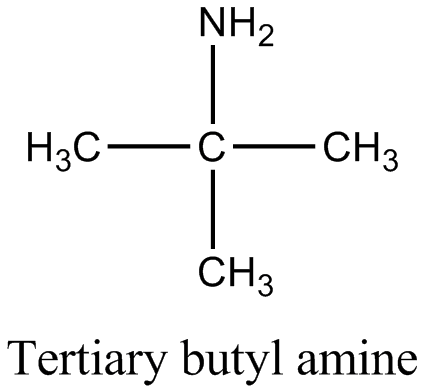
View full question & answer→MCQ 1351 Mark
When ammonium cyanate is heated for a long time, the product is:
AnswerWhen ammonium cyanate is heated urea is first formed
$\text{NH}_4\text{CNO}\ \ \ \ \ \ \ \xrightarrow{\text{Heat}}\text{NH}_2\text{CONH}_2\\^\text{Ammonium Cyanate}\ \ \ \ \ \ \ \ \ \ ^\text{urea}$
Urea on further heating gives biuret
$\text{NH}_2\text{CONH}_2\xrightarrow{\text{Heat}}\text{NH}_2\text{CONHCONH}_2+\text{NH}_3\\ \ \ \ \ \ \ \ \ \ \ \ \ \ \ \ \ \ \ \ \ \ \ \ \ \ \ \ \ \ \ \ \ \ \ \ \ \ \ \ \ \ \ \ ^\text{Biuret}$
View full question & answer→MCQ 1361 Mark
Which of the following species are involved in the carbylamine test?
$a. \ce{R-NC}$
$b. \ce{CHCl_3}$
$c. \ce{COCl_2}$
$d. \ce{NaNO_2 + HCl}$
- ✓
$a$ and $b$
- B
$a$ and $c$
- C
$b$ and $c$
- D
$b$ and $d$
AnswerCorrect option: A. $a$ and $b$
Carbylamine reaction: Amine on reaction with a mixture of $\ce{CHCl_3}$ and $\text{KOH}$ produces alkyl isocyanate.
$\mathrm{R}-\mathrm{NH}_2+\mathrm{CHCl}+3 \mathrm{KOH}^{-} \rightarrow \mathrm{RNC}+3 \mathrm{KCl}+3 \mathrm{H}_2 \mathrm{O}$ Only $\text{RNC}$ and $\mathrm{CHCl}_3$ are involved in carbylamine reaction.
View full question & answer→MCQ 1371 Mark
When pure aniline is kept in air then $......$ colour is obtained.
View full question & answer→MCQ 1381 Mark
Reduction of aromatic nitro compounds using $Fe$ and $\text{HCl}$ gives __________.
View full question & answer→MCQ 1391 Mark
Number of isomeric primary amines obtained from $\mathrm{C}_4 \mathrm{H}_{11} \mathrm{N}$ are:
AnswerThe possible isomers are
$ \mathrm{CH}_3 \mathrm{CH}_2 \mathrm{CH}_2 \mathrm{CH}_2 \mathrm{NH}_2 $
$ \left(\mathrm{CH}_3\right)_2-\mathrm{CH}-\mathrm{CH}_2 \mathrm{NH}_2 $
$ \left(\mathrm{CH}_3\right)_3-\mathrm{NH}_2 $
$ \mathrm{CH}_3-\mathrm{CH}\left(\mathrm{NH}_2\right) \mathrm{CH}_2-\mathrm{CH}_3 $
View full question & answer→MCQ 1401 Mark
Which amino acid in present only in bacteria and cyanobacteria?
AnswerAmino acid present only in bacteria and cyanobacteria is diaminopimellic acid.
The amino acid only in bacteria and blue algea are methaionine, diaminopimellic, aspartic acid, glutamic acid.
View full question & answer→MCQ 1411 Mark
Which one of the following is the weakest base?
- A
$\left(\mathrm{C}_2 \mathrm{H}_5\right)_3 \mathrm{\sim N}$
- B
$\left(\mathrm{C}_2 \mathrm{H}_5\right)_2 \mathrm{NH}$
- C
$\mathrm{C}_2 \mathrm{H}_5 \mathrm{NH}_2$
- ✓
$\mathrm{NH}_3$
AnswerCorrect option: D. $\mathrm{NH}_3$
The $+I$ effect increases with increase in the alkyl group. Therefore the basic strength will be the highest in $\left(\mathrm{C}_2 \mathrm{H}_5\right)_3 \mathrm{\sim N}$ and least in $\mathrm{NH}_3$.
Therefore the decreasing order of basic strength in gas phase will be $\left(\mathrm{C}_2 \mathrm{H}_5\right)_3 \mathrm{N}>\left(\mathrm{C}_2 \mathrm{H}_5\right)_2 \mathrm{NH}>\mathrm{C}_2 \mathrm{H}_5 \mathrm{NH}_2>\mathrm{NH}_3$.
View full question & answer→MCQ 1421 Mark
Tertiary amines have lowest boiling points amongst isomeric amines because:
- A
They have highest molecular mass.
- ✓
They do not form hydrogen bonds.
- C
They are more polar in nature.
- D
They are most basic in nature.
AnswerCorrect option: B. They do not form hydrogen bonds.
Primary and secondary amines can form hydrogen bonds whereas tertiary amines fail to do so. Hence, their boiling points are lowest.
View full question & answer→MCQ 1431 Mark
Aromatic amines are generally:
AnswerAromatic amines are
- Less basic
- Lone pair of $N$ involve in ring resonance
- Are toxic in nature.
View full question & answer→MCQ 1441 Mark
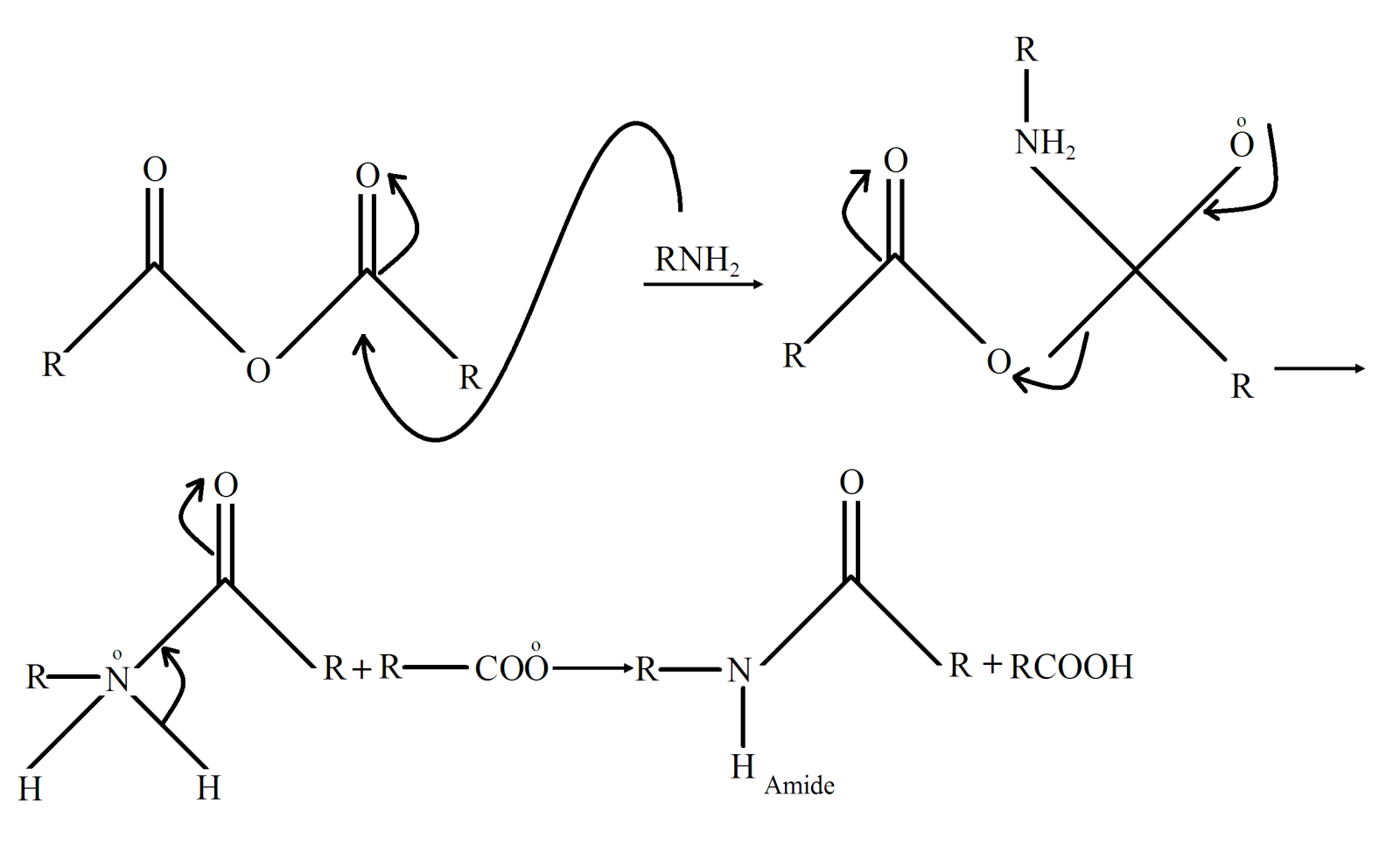
Acid anhydrides on reaction with primary amines give $.......$
AnswerAcid anhydride on reaction with primary amine produces amide as:
View full question & answer→MCQ 1451 Mark
the gas evolved when Methylamine reacts with nitrous acid is $.......$
AnswerCorrect option: B. $\mathrm{N}_2$
Primary aliphatic amines react with nitrous acid to form aliphatic diazonium salts which being unstable, liberate nitrogen gas quantitatively and alcohol.
View full question & answer→MCQ 1461 Mark
The relative basics strenghts of $\mathrm{NH}_3, \mathrm{CH}_3 \mathrm{NH}_2$ and $\mathrm{NF}_3$ are in the order:
- ✓
$\mathrm{CH}_3 \mathrm{NH}_2>\mathrm{NH}_3>\mathrm{NF}_3$
- B
$\mathrm{NF}_3>\mathrm{CH}_3 \mathrm{NH}_2>\mathrm{NH}_3$
- C
$\mathrm{NH}_3>\mathrm{CH}_3 \mathrm{NH}_2>\mathrm{NF}_3$
- D
$\mathrm{NF}_3>\mathrm{CH}_3 \mathrm{NH}_2=\mathrm{NH}_3$
AnswerCorrect option: A. $\mathrm{CH}_3 \mathrm{NH}_2>\mathrm{NH}_3>\mathrm{NF}_3$
$\mathrm{CH}_3-$ group is electron donating group.
F is electron withdrawing group.
So $\mathrm{CH}_3 \mathrm{NH}_2$ is more basic. $\mathrm{NH}_3$ is more basic than $\mathrm{NF}_3$ because $H$ is not a withdrawing group. $\mathrm{NF}_3$ is less basic.
$\therefore$ Basic nature order $=\mathrm{CH}_3 \mathrm{NH}_2>\mathrm{NH}_3>\mathrm{NF}_3$
View full question & answer→MCQ 1471 Mark
Ethyl nitrite on reduction with $\text{Sn/ HCI}$ gives:
- A
$ \mathrm{C}_2 \mathrm{H}_5 \mathrm{NH}_2+\mathrm{HNO}_2 $
- B
$ \mathrm{C}_2 \mathrm{H}_5 \mathrm{NH}_2+\mathrm{H}_2 \mathrm{O} $
- ✓
$ \mathrm{C}_2 \mathrm{H}_5 \mathrm{OH}+\mathrm{NH}_4 \mathrm{OH} $
- D
$ \mathrm{C}_2 \mathrm{H}_5 \mathrm{OH}+\mathrm{NaNO}_2 $
AnswerCorrect option: C. $ \mathrm{C}_2 \mathrm{H}_5 \mathrm{OH}+\mathrm{NH}_4 \mathrm{OH} $
View full question & answer→MCQ 1481 Mark
The compound $\mathrm{CH}_3 \mathrm{NHC}_6 \mathrm{H}_5$ is a $........$ amine.
AnswerSince the compound consists of a benzene ring, it invariably is an aromatic amine. Moreover, it also contains an alkyl methyl group beside the phenyl group and this makes it a mixed amine.
View full question & answer→MCQ 1491 Mark
Which of the following is the most suitable classification for $\mathrm{C}_6 \mathrm{H}_5 \mathrm{NHCH}_3?$
AnswerIn the given amine, there are two substituents, one methyl group and one phenyl group.
Hence, it is a secondary aryl amine and since both the substituent groups are different, it is a mixed amine.
View full question & answer→MCQ 1501 Mark
Which compound is different from the others?
- ✓
- B
Pentan $- 2 -$ one
- C
$2 -$ Pentanone
- D
AnswerMethyl ethyl ketone $(\text{CH}_3-\text{ C}-\text{CH}_2-\text{CH}_3)\\ \ \ \ \ \ \ \ \ \ \ \ \ \ \ \ ||\\ \ \ \ \ \ \ \ \ \ \ \ \ \ \ \text{O}$ is different from the others.
Methyl ethyl ketone $($also called butanone$)$ contains $4C$ atoms.
Pentan$-2-$one$, 2-$pentanone and methyl propyl ketone are different names of same compound $(\text{CH}_3-\text{ C}-\text{CH}_2-\text{CH}_2-\text{CH}_3)\\ \ \ \ \ \ \ \ \ \ \ \ \ \ \ \ ||\\ \ \ \ \ \ \ \ \ \ \ \ \ \ \ \text{O}$ which contains $5C$ atoms.
View full question & answer→MCQ 1511 Mark
Methyl cyanide on reaction with sodium and $\mathrm{C}_2 \mathrm{H}_5 \mathrm{OH}$ forms:
AnswerMethyl cyanide on reaction with sodium and ethanol forms ethylamine.
$\text{CH}_3-\text{C}\equiv\text{N}+4[\text{H}]\xrightarrow{\text{Na}/\text{ethanol}}\text{CH}_3-\text{CH}_2-\text{NH}_2$
In this reaction, the nitrile group is hydrogenated to form a primary amine.
This is a useful method to increase the length of a carbon chain in preparing a primary amine which contains one more carbon atom than the alkyl halide from which alkyl cyanide is obtained.
View full question & answer→MCQ 1521 Mark
Gabriel's phthalimide synthesis is used for the preperation of:
AnswerGabriel phthalimide synthesis is used for the preparation of aliphatic primary amines. Since ethanamine is the only primary amine among the given compounds,
View full question & answer→MCQ 1531 Mark
Ethyl isocyanide on reduction with sodium and alcohol gives:
AnswerEthylamine possesses two hydrogen atoms that can form hydrogen bonds wheras diethylamine having only one hydrogen atom is capable of forming only one hydrogen bond.
View full question & answer→MCQ 1541 Mark
Term tertiary, secondary and primary amine represents the:
- A
- B
Nature of $C$ atom
- ✓
Degree of substitution on nitrogen
- D
AnswerCorrect option: C. Degree of substitution on nitrogen
Amines are derivatives of ammonia.
If one hydrogen of ammonia is replaced by an alkyl group, it is called a primary amine.
If two hydrogens of ammonia are replaced by alkyl groups, it is called a secondary amine.
If three hydrogens of ammonia are replaced by alkyl groups, it is called a tertiary amine.
So, tertiary, secondary, and primary amine represents the degree of substitution on the nitrogen.
View full question & answer→MCQ 1551 Mark
Which of the following is an Incorrect statement about benzenediazonium chloride?
AnswerCorrect option: C. Alkyl diazonium salts are more stable than arenediazonium salts.
View full question & answer→MCQ 1561 Mark
Which of the following is the most basic amine?
- A
$\ce{CH_3− NH_2}$
- B
$\ce{ClCH_2NH_2}$
- C
$\ce{Cl_2CH −NH_2}$
- ✓
$\ce{CCl_3 − NH_2}$
AnswerCorrect option: D. $\ce{CCl_3 − NH_2}$
$\ce{CCl_3 − NH_2}$ this is most basic amine.
View full question & answer→MCQ 1571 Mark
Which of the following is more basic than aniline?
AnswerAlthough both are primary amines, the nitrogen lone pair of electrons are involved in resonance with the aromatic benzene and are less available to accept a proton whereas benzylamine is an aliphatic amine with a larger $\mathrm{K}_{\mathrm{b}}$ than aniline.
View full question & answer→MCQ 1581 Mark
Which of the following should be most volatile?

AnswerExplanation: b. IV.
1° and 2° amines have higher boiling points due to intermolecular H-bonding (and hence less volatile than 3° amines and hydrocarbons of comparable molecular mass).
View full question & answer→MCQ 1591 Mark
Reduction of nitrobenzene by which of the following reagent gives aniline?
$\text{Sn/ HCl}$
$\text{Fe/ HCl}$
$\ce{H_2-Pd}$
$\ce{Sn/ NH_4OH}$
- ✓
$a,b$ and $c$
- B
$a,b,c$ and $d$
- C
$a$ and $b$
- D
$b,c$ and $d$
AnswerCorrect option: A. $a,b$ and $c$
Nitro compounds are reduced to amines by passing hydrogen gas in the presence of finely divided nickel, palladium or platinum and also by reduction with metals in acidic medium.
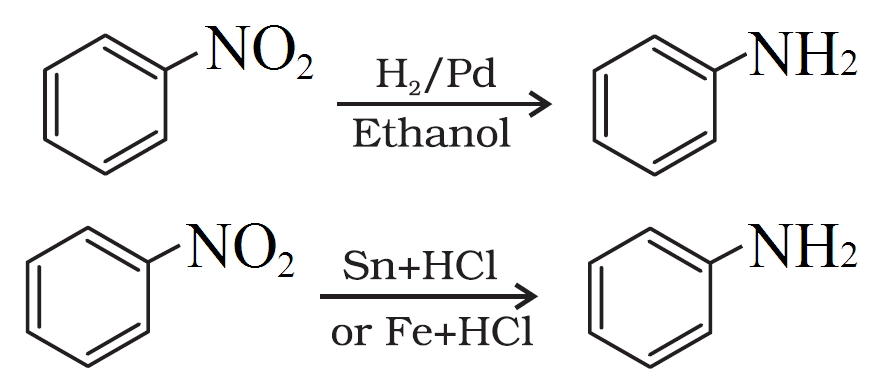
View full question & answer→MCQ 1601 Mark
Acetonitrile on reduction gives:
AnswerCyanides on reduction give $1$ amine.
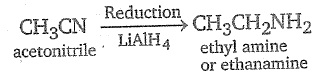
View full question & answer→MCQ 1611 Mark
Which of the following methods of preparation of amines will give same number of carbon atoms in the chain of amines as in the reactant?
AnswerCorrect option: A. Reaction of nitrite with $\mathrm{LiAlH}_4$.
Only treatment of amide with $\mathrm{Br}_2$ is aqueous solution of $\text{NaOH}$ will give an amine with lesser number of carbon atoms than in the reactant while $\mathrm{RCONH}_2 \mathrm{Br}_2 / \mathrm{NaOH} \mathrm{RNH}_2$ all the remaining reactions given an amine with the same number of carbon atoms as in the reactant.
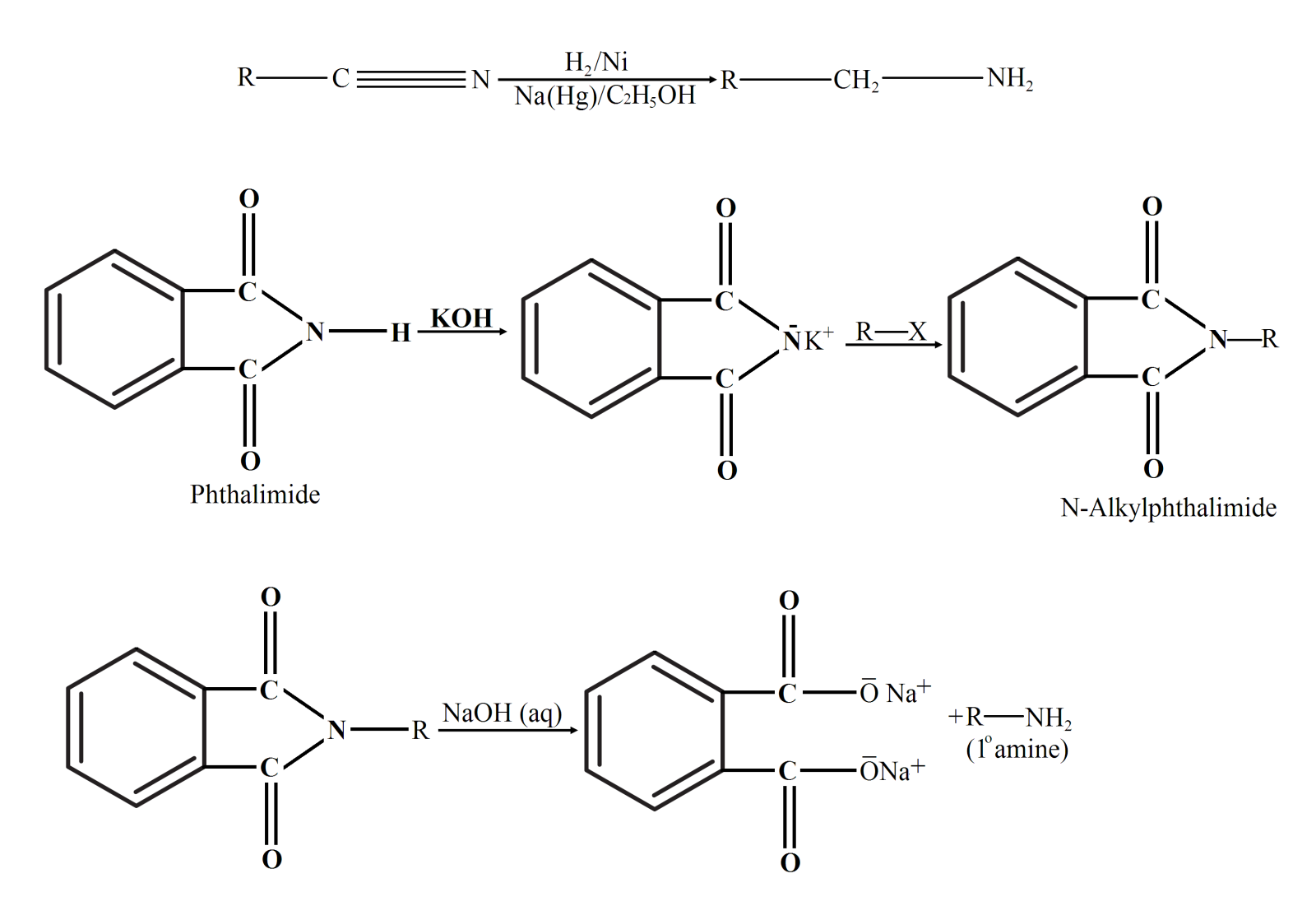
View full question & answer→MCQ 1621 Mark
Amongst the following, the strongest base in aqueous medium is $.........$
- A
$\mathrm{CH}_3 \mathrm{NH}_2$
- B
$\mathrm{NCCH}_2 \mathrm{NH}_2$
- ✓
$\left(\mathrm{CH}_3\right)_2 \mathrm{NH}$
- D
$\mathrm{C}_6 \mathrm{H}_5 \mathrm{NHCH}_3$
AnswerCorrect option: C. $\left(\mathrm{CH}_3\right)_2 \mathrm{NH}$
Due to the electron releasing nature of alkyl group, it $(R)$ pushes electrons towards nitrogen and thus makes the unshared electron pair more available for sharing with the proton of the acid. Moreover, the substituted ammonium ion formed from the amine gets stabilised due to dispersal of the positive charge by the $+I$ effect of the alkyl group. Hence, alkylamines are stronger bases than ammonia.
Thus, the basic nature of aliphatic amines should increase with increase in the number of alkyl groups.
View full question & answer→MCQ 1631 Mark
Which of the following compound$(s)$ will not dissolve in an alkali solution after it has undergone reaction with Hinsberg's reagent?
AnswerCorrect option: C. $N -$ methyl ehtanamine
Hinsberg reagent is Benzenesulphonyl chloride $\left(\mathrm{C}_6 \mathrm{H}_5 \mathrm{SO}_2 \mathrm{Cl}\right)$. It reacts with primary and secondary amines to form sulphonamides.
It reacts with primary amine to form acidic compound which is soluble in alkali because hydrogen $(H)$ attached to nitrogen$(N)$ in sulphonamide is strongly acidic due to presence of stronf electron withdrawing sulphonyl group.
Now, out of the options given in the question, only isopropyl amine is a primary amine. Dimethyl amine and $N -$ methyl ethaneamine are secondary amines and $N, N -$ dimethylaniline is tertiary amine.
View full question & answer→MCQ 1641 Mark
Amongst the given set of reactants, the most appropriate for preparing $2^\circ $ amine is $......$
- A
$2^{\circ} \mathrm{R}-\mathrm{Br}+\mathrm{NH}_3$.
- B
$2^{\circ} \mathrm{R}-\mathrm{Br}+\mathrm{NaCN}$ followed by $\mathrm{H}_2 / \mathrm{Pt}$.
- C
$1^{\circ} \mathrm{R}-\mathrm{NH}_2+\mathrm{RCHO}$ followed by $\mathrm{H}_2 / \mathrm{Pt}$.
- ✓
$1^{\circ} \mathrm{R}-\mathrm{Br}(2 \mathrm{~mol})+$ potassium phthalimide followed by $\mathrm{H}_3 \mathrm{O}^{+} /$heat.
AnswerCorrect option: D. $1^{\circ} \mathrm{R}-\mathrm{Br}(2 \mathrm{~mol})+$ potassium phthalimide followed by $\mathrm{H}_3 \mathrm{O}^{+} /$heat.
$\text{R}-\text{NH}_2+\text{O}=\text{HCR}\xrightarrow[\text{animation}]{\text{Reductive}}\text{R}-\text{N}=\text{CHR}\xrightarrow[\text{Reductiion}]{\text{H}_2/\text{pt}}\text{RNH}-\text{CH}_2\text{R}$
View full question & answer→MCQ 1651 Mark
The correct order of basicity of the given compounds is:
- A
$\mathrm{CH}_3 \mathrm{CH}_2 \mathrm{NH}_2<\mathrm{HO}\left(\mathrm{CH}_2\right)_3 \mathrm{NH}_2<\mathrm{HO}\left(\mathrm{CH}_2\right)_2 \mathrm{NH}_2.$
- B
$\mathrm{CH}_3 \mathrm{CH}_2 \mathrm{NH}_2<\mathrm{HO}\left(\mathrm{CH}_2\right)_3 \mathrm{NH}_2>\mathrm{HO}\left(\mathrm{CH}_2\right)_2 \mathrm{NH}_2.$
- ✓
$\mathrm{CH}_3 \mathrm{CH}_2 \mathrm{NH}_2>\mathrm{HO}\left(\mathrm{CH}_2\right)_3 \mathrm{NH}_2>\mathrm{HO}\left(\mathrm{CH}_2\right)_2 \mathrm{NH}_2.$
- D
$\mathrm{CH}_3 \mathrm{CH}_2 \mathrm{NH}_2>\mathrm{HO}\left(\mathrm{CH}_2\right)_3 \mathrm{NH}_2<\mathrm{HO}\left(\mathrm{CH}_2\right)_2 \mathrm{NH}_2.$
AnswerCorrect option: C. $\mathrm{CH}_3 \mathrm{CH}_2 \mathrm{NH}_2>\mathrm{HO}\left(\mathrm{CH}_2\right)_3 \mathrm{NH}_2>\mathrm{HO}\left(\mathrm{CH}_2\right)_2 \mathrm{NH}_2.$
The correct order of basicity of the given compounds is as follows:
$\mathrm{CH}_3 \mathrm{CH}_2 \mathrm{NH}_2>\mathrm{HO}\left(\mathrm{CH}_2\right)_3 \mathrm{NH}_2>\mathrm{HO}\left(\mathrm{CH}_2\right)_2 \mathrm{NH}_2$
$OH$ group is an electron withdrawing group and hence, it increases the partial positive charge on $N$ atom.
Therefore, lone pair of $N$ cannot be easily donated and also, the basicity decreases.
As the number of carbon atoms between $−OH$ group and amino group increases, the electron withdrawing capacity of $−OH$ group on amine $N$ decreases and basicity increases.
View full question & answer→