For the circuit shown in the diagram below:
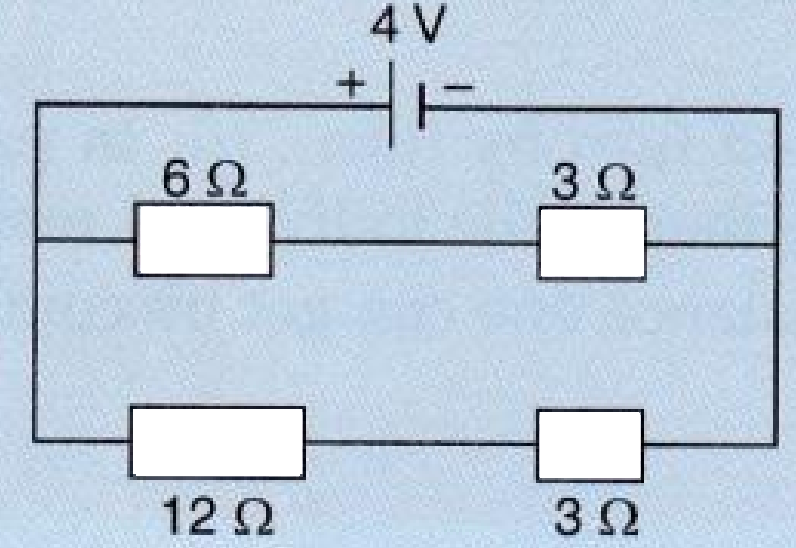
What is the value of :
Current through $6 Ω$ resistor?
Potential difference across $12 Ω$ resistor?
What is the value of :
Current through $6 Ω$ resistor?
Potential difference across $12 Ω$ resistor?
Download our app for free and get started
As per the circuit
$V = 4V$
Total resistance in line $1 = R_1 = 6 + 3 = 3$ ohm
Total resistance in line $2 = R_2 = 12 + 3 = 15$ ohm
Current through $6\Omega$ resistor = current through line $1=\frac{\text{=V}}{\text{R}_1}=\frac{4}{9}=0.44\Omega$
p.d. across line $2$ is $4V$
current through line $2=\frac{\text{V}}{\text{R}_2}=\frac{4}{15}\Omega$
p.d. across $12\Omega$ resistor $=\frac{4}{15}\times12=3.2\text{V}$
$V = 4V$
Total resistance in line $1 = R_1 = 6 + 3 = 3$ ohm
Total resistance in line $2 = R_2 = 12 + 3 = 15$ ohm
Current through $6\Omega$ resistor = current through line $1=\frac{\text{=V}}{\text{R}_1}=\frac{4}{9}=0.44\Omega$
p.d. across line $2$ is $4V$
current through line $2=\frac{\text{V}}{\text{R}_2}=\frac{4}{15}\Omega$
p.d. across $12\Omega$ resistor $=\frac{4}{15}\times12=3.2\text{V}$

Download our appand get started for free
Experience the future of education. Simply download our apps or reach out to us for more information. Let's shape the future of learning together!No signup needed.*
Similar Questions
- 1In which of the following cases more electrical energy is consumed per hour?View Solution
- A current of $1$ ampere passed through a resistance of $300$ ohms.
- A current of $2$ amperes passed through a resistance of $100$ ohms.
- 2The electrical resistivities of five substances A, B, C, D and E are given below:View Solution
$\begin{matrix}\text{B}&110\times10^{-8}\Omega\text{ m}\\\text{C}&2.60\times10^{-8}\Omega\text{ m}\\\text{D}&10.0\times10^{-8}\Omega\text{ m}\\\text{E}&1.70\times10^{-8}\Omega\text{ m}\end{matrix}$ - 3View SolutionIn 10s, a charge of 25C leaves a battery, and 200j of energy are delivered to an outside circuit as a result.
- What is the p.d. across the battery?
- What current flows from the battery?
- 4Calculate the area of cross-section of a wire if its length is 1.0m, its resistance is $23 Ω$ and the resistivity of the material of the wire is $1.84\times10 Ω\ \text{m}.$View Solution
- 5The electrical resistivities of four materials P, Q, R and S are given below:View Solution
$\begin{matrix}\text{P}&6.84\times10^{-8}\Omega\text{m}\\\text{Q}&1.70\times10^{-8}\Omega\text{m}\\\text{R}&1.0\times10^{15}\Omega\text{m}\\\text{S}&11.0\times10^{-7}\Omega\text{m}\end{matrix}$
Which material will you use for making:- Heating element of electric iron.
- Connecting wires of electric iron.
- Covering of connecting wires?
- 6What possible values of resultant resistance one can get by combining two resistances, one of value $2$ ohm and the other $6$ ohm?View Solution
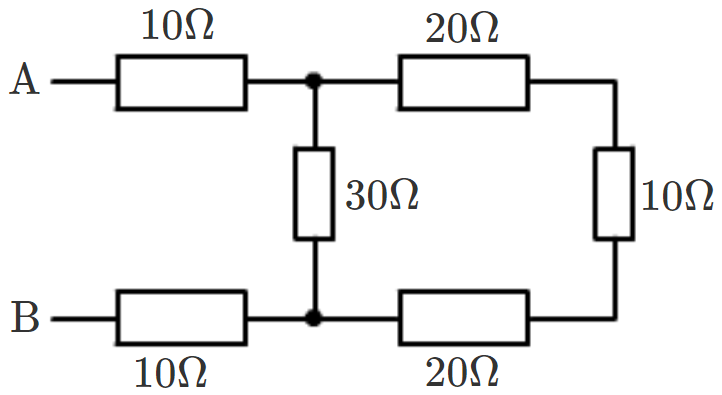
- 7View SolutionWhat is the resistance between A and B in the figure given below?
- 8View SolutionDistinguish between resistance and resistivity.
- 9You are given one hundred $1 \Omega $ resister. What is the smallest and largest resistance you can make in a circuit using these?View Solution
- 10If the charge on an electron is $1.6 \times 10$ coulombs, how many electrons should pass through a conductor in $1$ second to constitute $1$ ampere current?View Solution