Questions

6 Marks Question

Take a timed test

60 questions · self-marked practice — reveal the answer and mark yourself.

Question 16 Marks
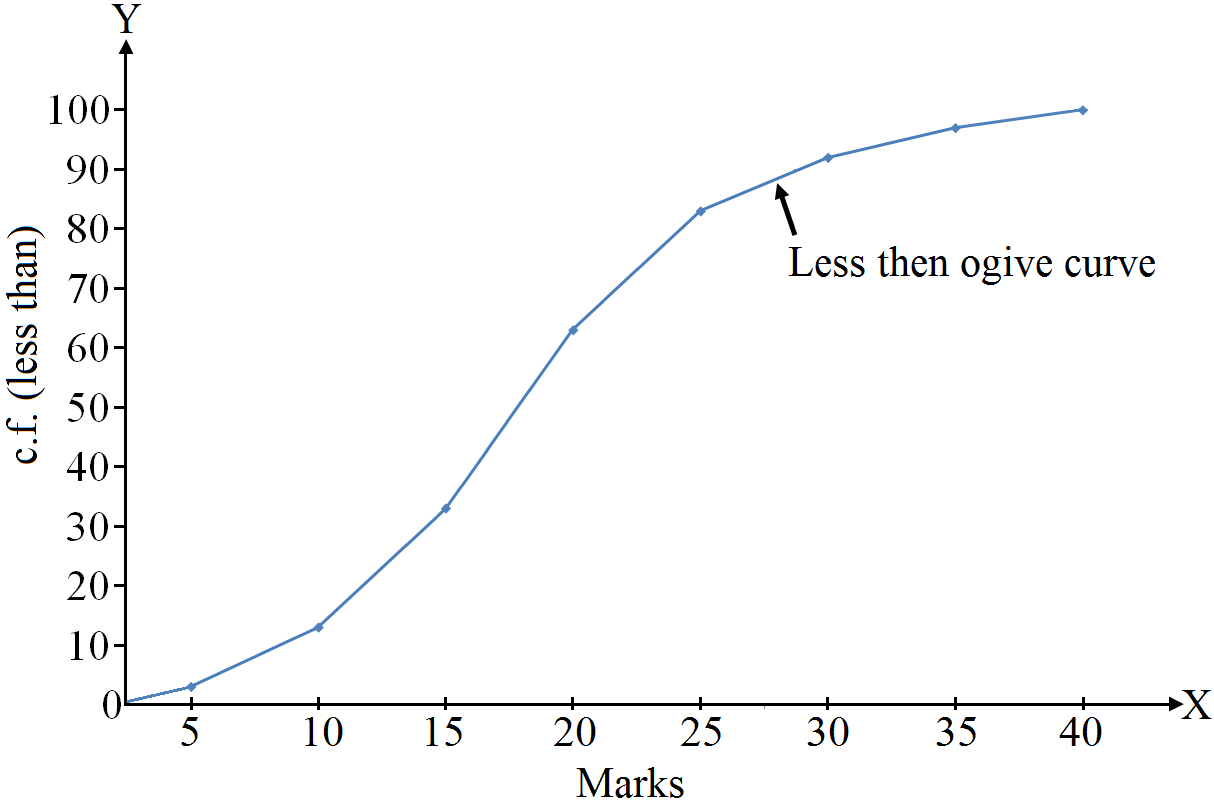
Draw a less than ogive curve on the basis of the given data:
Marks
0-5
5-10
10-15
15-20
20-25
25-30
30-35
35-40
No. of Students
3
10
20
30
20
9
5
3
Answer
Firstly, we will convert the given data into less than frequency distribution.
Marks
c.f. (Less than)
Less than 5
3
Less than 10
13
Less than 15
33
Less than 20
63
Less than 25
83
Less than 30
92
Less than 35
97
Less than 40
100
View full question & answer
Question 26 Marks
The minimum temperature of Shimla in the last week of December is given below.
Date
Tempreature
25th Dec
3ºC
26th Dec
-1ºC
27th Dec
-2ºC
28th Dec
2ºC
29th Dec
4ºC
30th Dec
-3ºC
31th Dec
-4ºC
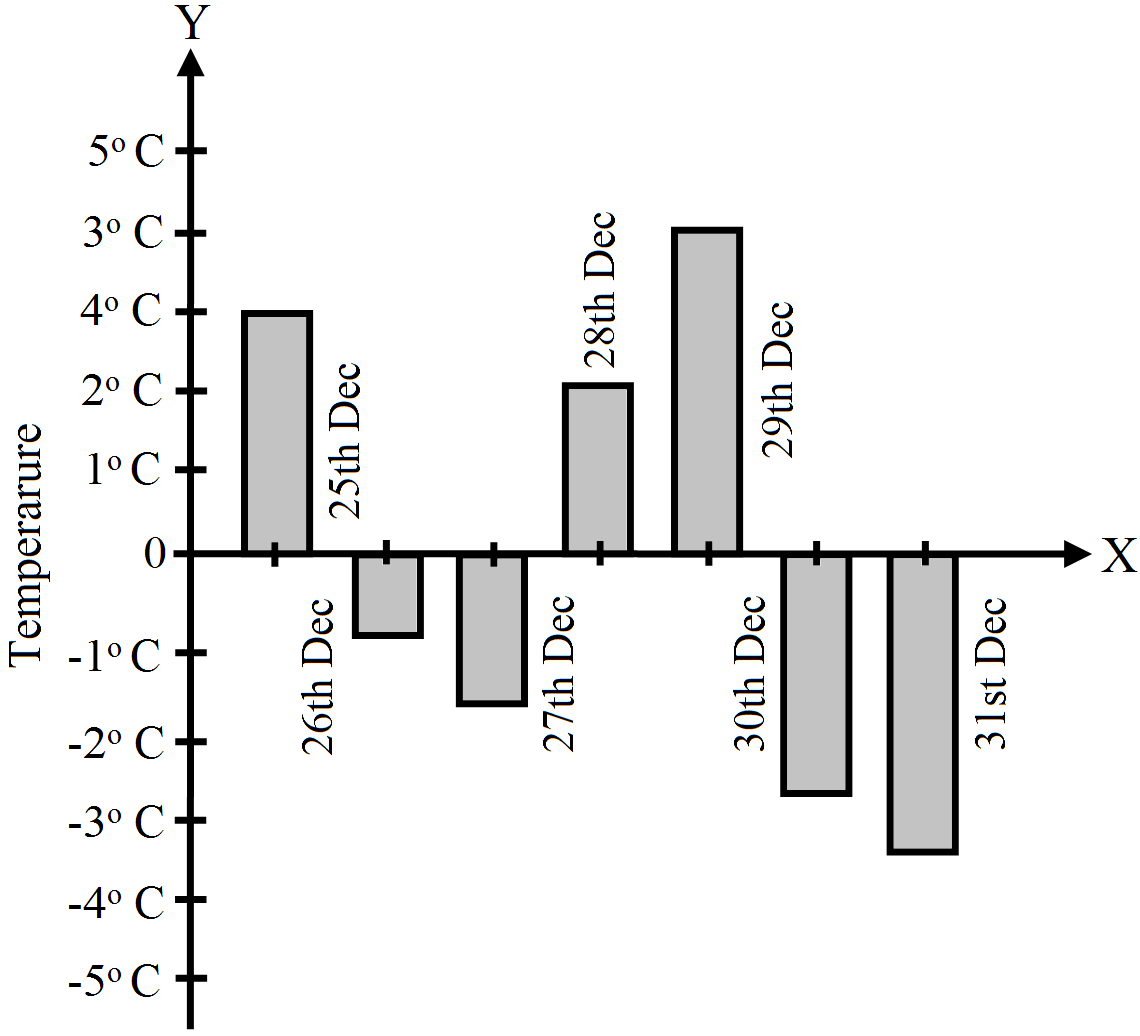
Represent the above data with the help of suitable diagram.
Answer
The temperature is positive, as well as, negative. So, this data can be presented with the help of sub-divided bar diagram.
The diagrammatic representation of the given data is shown below:
View full question & answer
Question 36 Marks
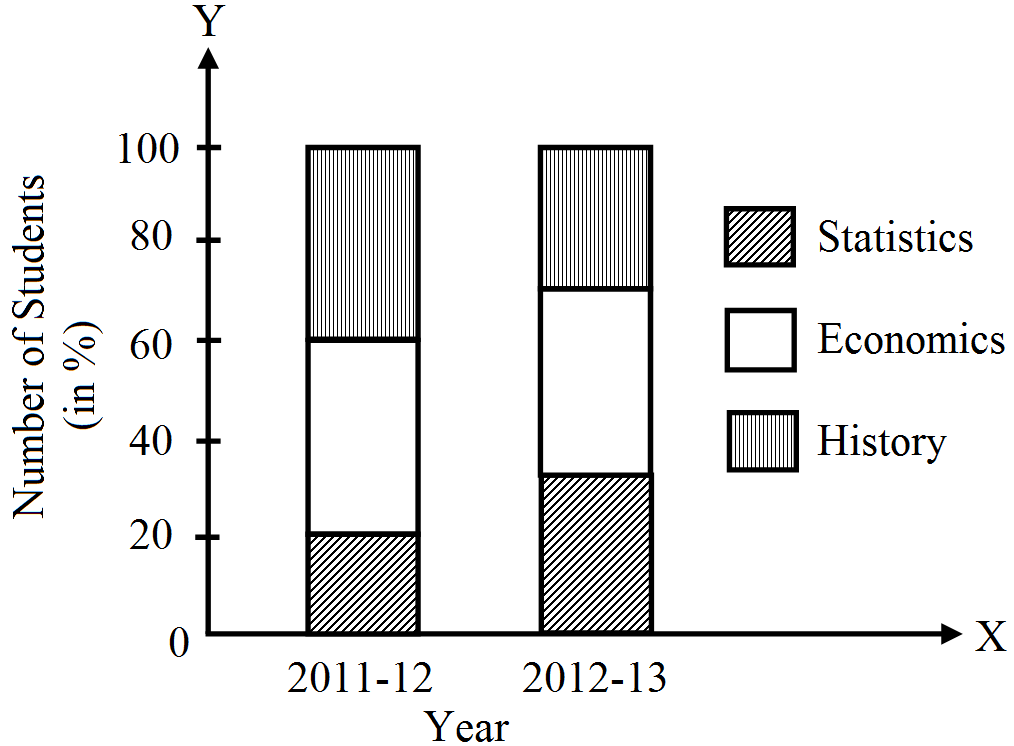
Present the following data by a percentage sub-divided bar diagram.
Number of Students (in '000)
Subject
2011-12
2012-13
Statistics
25
30
Economics
40
42
History
35
28
Answer
First, we prepare a percentage table.
Percentage Table
 
2011-12
2012-13
Subject
Number of Students (in '000)
Percent
Number of Students (in '000)
Percent
Statistics
25
25
30
30
Economics
40
40
42
42
History
35
35
28
28
Total
100
100
100
100
Now, we draw bars of equal length (100%) corresponding to each year. Then, each bar is divided according to percentage of different years.
A percentage sub-divided bar diagram of given data is shown below:
View full question & answer
Question 46 Marks
What are the essentials of a good statistical table?
Answer
S. No.
Component
Description
1.
Title
Title is a brief and clear explanation of the contains of the table.
2.
Table Number
A number is assigned to a table for easy identification when man tables are included.
3.
Date
Date of the creation of the table should be indicated.
4.
Row Designations
Each row of the table is given a brief name, usually provided in the first column. Such a name is known as a "stub", and the column is known as the "stub column".
5.
Column Headings
Each column is given a heading to explain the nature of the figures included in each column. Such names are known as "captions" or "headings".
6.
Body of the table
Data is entered into the main body and should be created for easy identification of each data items. Numeric values are often ordered in either ascending or descending order.
7.
Unit of Measurement
The unit of measurement of the values in the table body should be indicated.
8.
Sources
The tables should provide the primary and secondary sources for the data below the body of the table.
9.
Footnotes and References
Addition details for clarifying the contents of the table.
View full question & answer
Question 56 Marks
The Indian Sugar Mills Association reported that sugar production during the first fortnight of December, 2001 was about 3,87,000 tonnes, as against 3,78,000 tonnes during the same fortnight last year (2000). The off-take of sugar from factories during the first fortnight of December, 2001 was 2,83,000 tonnes for internal consumption and 41,000 tonnes for exports as against 1,54,000 tonnes for internal consumption and nil for exports during the same fortnight last season. Present the data in tabular form.
Answer
As in the question, sugar production is given for two years. For presenting the data in tabular form, data should be categorised in different parts namely-month, year. Total production, off-take for internal consumption and off-take for exports.
The given data is tabulated below:
Suger Production in India
Month, Year
Total Production (in tonnes)
Off-take for Internal Consumption (in tonnes)
Off-take Exports (in tonnes)
December, 2000
3,78,000
1,54,000
-
December, 2001
3,87,000
2,83,00
41,000
View full question & answer
Question 66 Marks
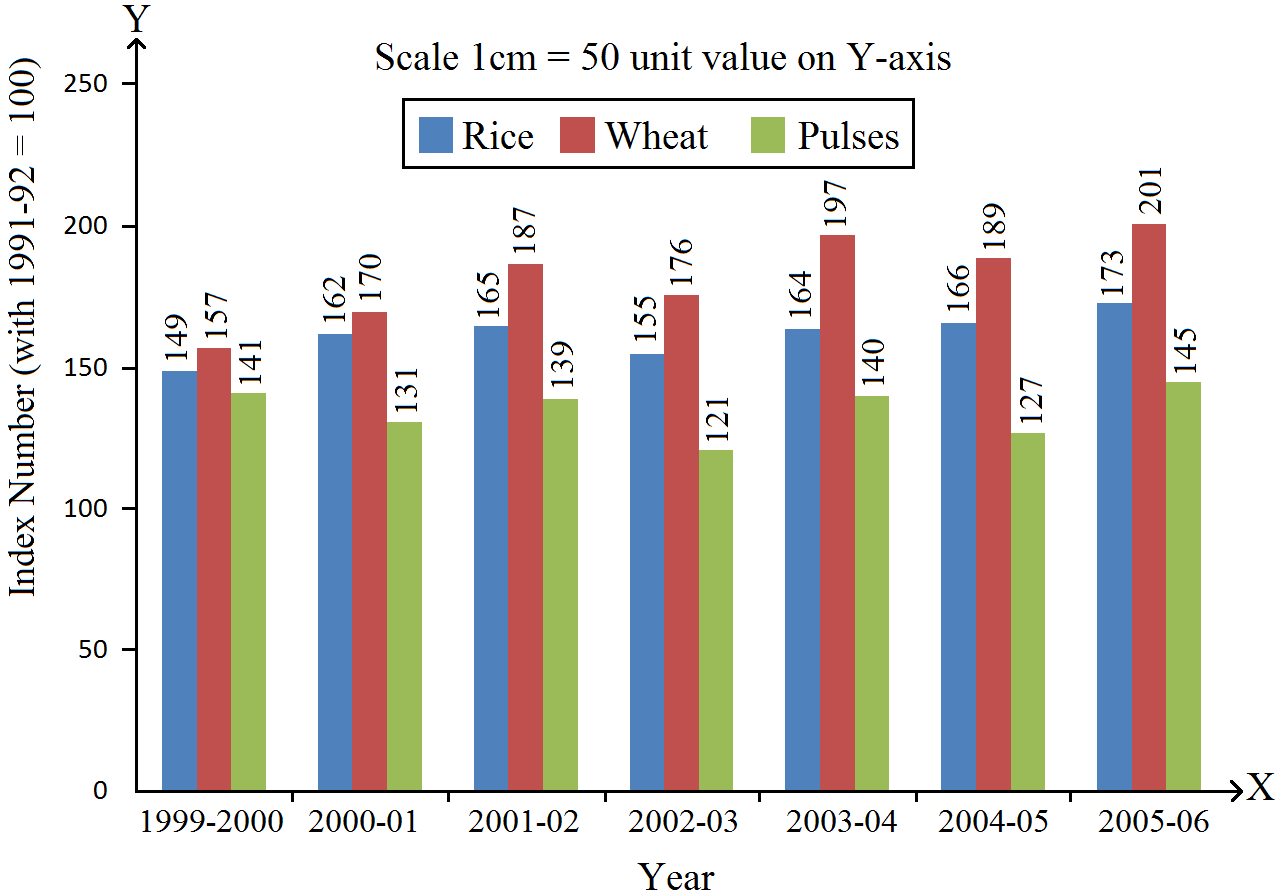
Represent the following data by an appropriate bar diagram.
Index Numbers of Agricultural Production

(base 1991-92 = 100 and figures of the nearest of unit value)
Foodgrains
Year
Rice
Wheat
Pulses
1999-2000
149
157
141
2000-01
162
170
131
2001-02
165
187
139
2002-03
155
176
121
2003-04
164
197
140
2004-05
166
189
127
2005-06
173
201
145
Answer
The above table shows data related to three variables, therefore it is represented through a multiple bar diagram.
The bar diagram showing index number of agricultural production is given below:
View full question & answer
Question 76 Marks
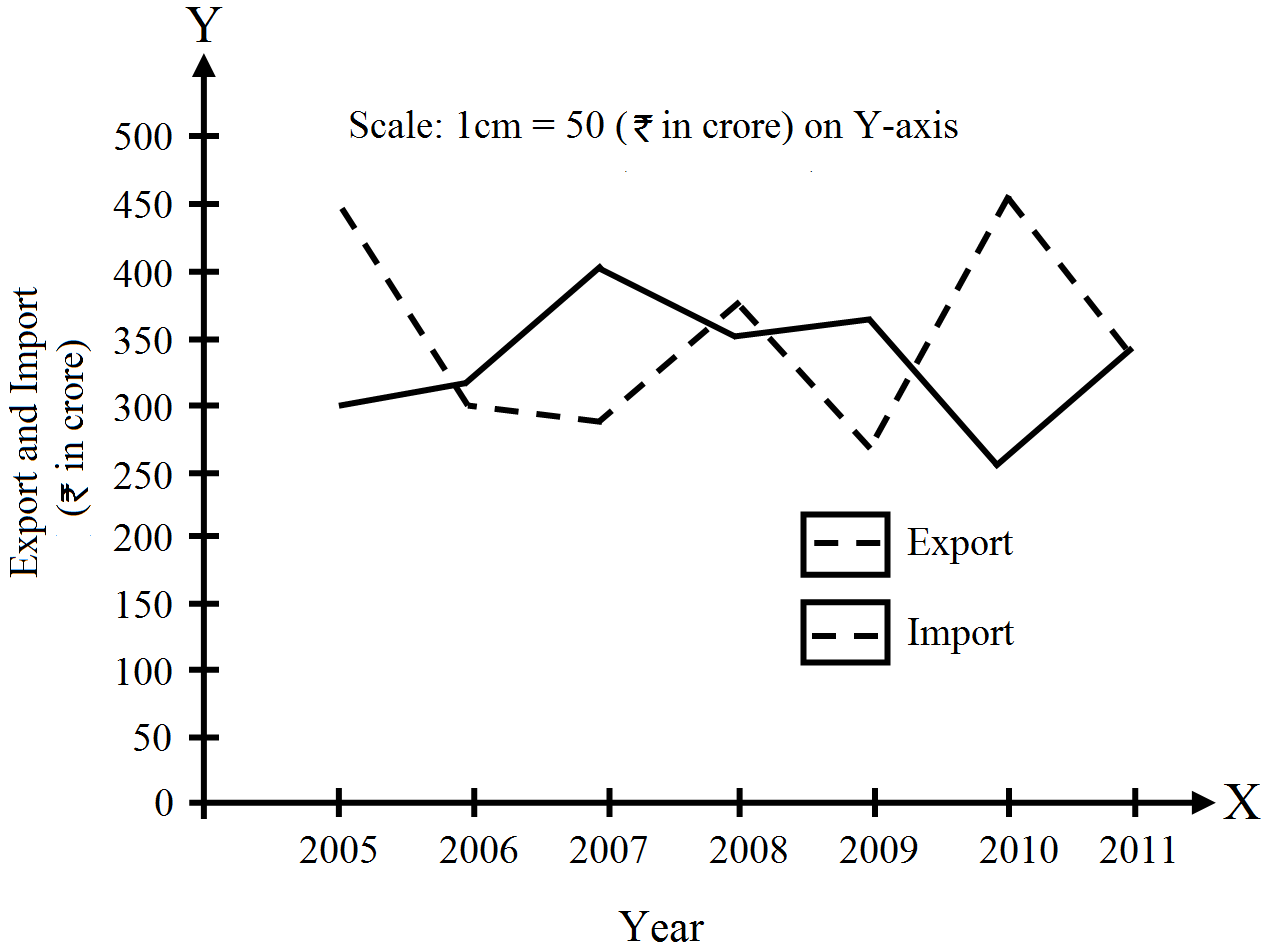
Represent the following information through a time series graph.
Year
2005
2006
2007
2008
2009
2010
2011
Export (₹ in crore)
300
320
400
350
360
250
340
Imort (₹ in crore)
450
300
280
375
330
450
325
Answer
Graph showing exports and imports from year 2005 to 2011 is given below:
View full question & answer
Question 86 Marks
Compare tabular presentation of data with diagrammatic presentation of data.
Answer
  1. Tabular presentation of data presents data in rows and columns, whereas diagrammatic presentation of data translates the abstract ideas shown in numbers into more concrete form, easy to comprehend.
  2. Tabulation organises data for further statistical treatment and decision making but the diagrams may be less accurate but are comparatively more effective than tables in presenting the data.
  3. Tabular presentation can be done by using one-way, two-way on three-way classification depending upon the number of characteristics involved, whereas there are various kinds of diagrams which are commonly used like geometric diagram, frequency diagram, arithmetic line graph etc.
View full question & answer
Question 96 Marks
Total production of foodgrains of India was 2,500 lakh tonnes during 2015-16. Out of total production, the production of rice, wheat and other crops was 1,000, 900 and 600 lakh tonnes respectively. The percentage contribution of these crops was estimated 40%, 36% and 24%, respectively.
Present this data in tabular form along with its main parts.
Answer
This data can be tabulated as below:
Productions of Foodgrains in India

(2015-16)
Foodgrains
Total Production (in lakh tonne)
Production (in %)
Rice
1000
40
Wheat
900
36
Other crops
600
24
Total
2500
100
Note: Other foodgrains include other cereal crops.
View full question & answer
Question 106 Marks
Explain briefly the advantages and limitations of graphical presentation of data.
Answer
The following are the advantages of graphical presentation:
  1. Simple Form: It presents the complex data in a simple or understandable form.
  2. Forecasting: It is used for forecasting, interpolation and extrapolation. This helps to assess the future changes in the value of the variable.
  3. Study of Variations: With the help of graphs, we can study the variations in the values of variables and can take corrective actions.
  4. Attractive: Graphical presentation helps to present the data in an attractive manner which makes it interesting and impressive.
  5. Essay Comparison: Graphical presentation of data facilitates easy comparison between the values of the data.
  6. Universal Utility: Graphical presentation is popularly used in journal, news papers, board meeting, etc to give the required information to the general users.
  7. Helpful in Computing Statistical Averages: Statistical averages such as median, quartile, deciles, etc can be easily computed with the help of graphical presentation.
Graphical presentation of data suffers from the following limitations:
  1. Actual/ Precise Values are not Disclosed Graphical presentation merely shows the tendency and fluctuations. Actual and precise values are not disclosed through a graphical presentation, so it does not show precise values.
  2. Lead to Wrong Conclusions It may sometimes suggest wrong conclusions and give misleading information.
  3. Limited Information Graphical presentation can be used to depict only one or two characteristics. Because of this, only limited information can be presented through this presentation.
View full question & answer
Question 116 Marks
Give steps for making frequency polygon.
Answer
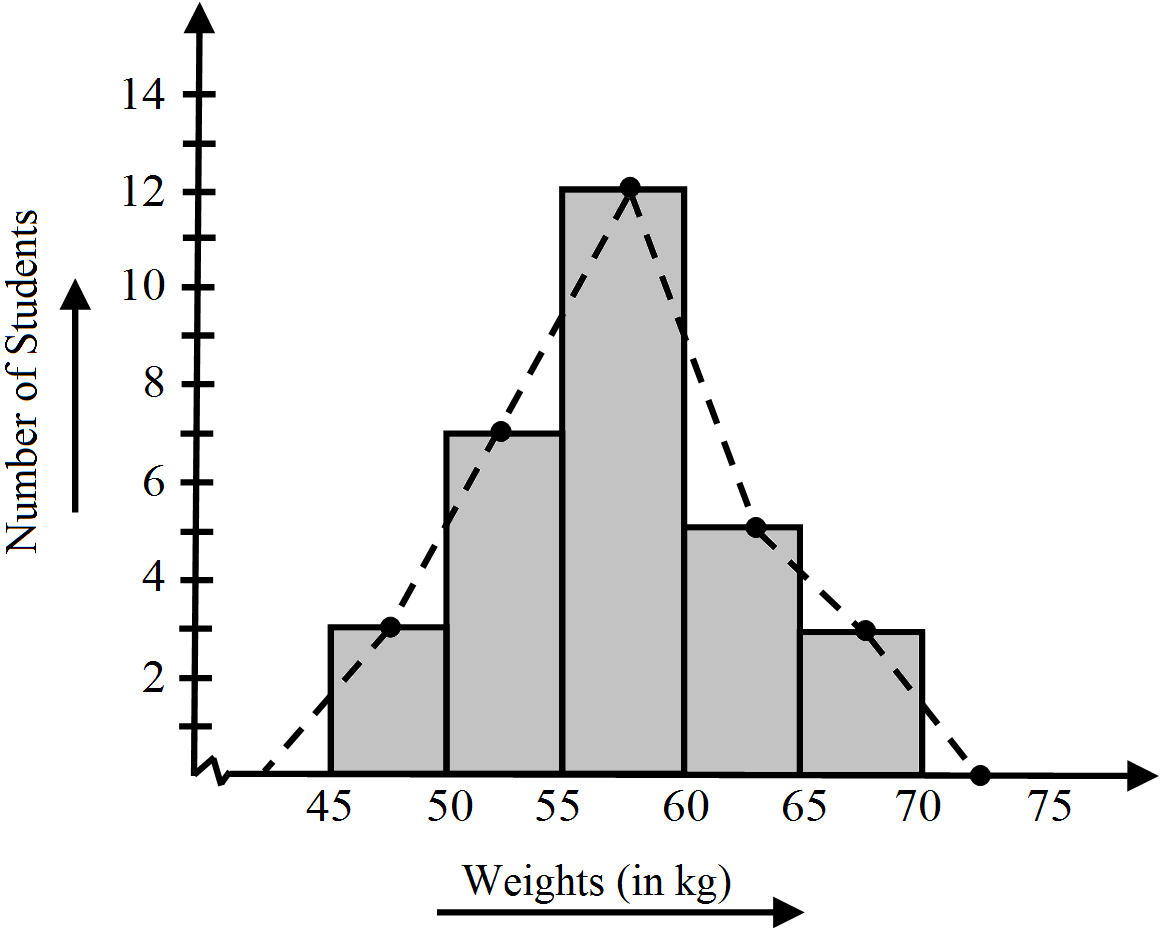
A frequency polygon can also be converted back into a histogram by drawing vertical lines from the bounds of the classes shown on the horizontal axis, and then connecting them with horizontal lines at the hieghts of the polygon at each mid-point. Frequency Polygon can be drawn in two ways:Method:
  1. Draw a suitable Histogram as explain in the previous section following all the basic principles.
  2. Get the mid points of the upper horizontal side of each rectangle.
  3. Join these mid points of the adjacent rectangles of the histogram by straight lines.
  4. Ends of the frequency polygon are to be extended to mid point of classes at both sides.
  5. Labelling should be properly done and scale of measurement should be clearly shown.
An example is shown below.
View full question & answer
Question 126 Marks
Explain briefly the advantages and limitations of graphical presentation of data.
Answer
The following are the advantages of graphical presentation:
  1. Simple Form: It presents the complex data in a simple or understandable form.
  2. Forecasting: It is used for forecasting, interpolation and extrapolation. This helps to assess the future changes in the value of the variable.
  3. Study of Variations: With the help of graphs, we can study the variations in the values of variables and can take corrective actions.
  4. Attractive: Graphical presentation helps to present the data in an attractive manner which makes it interesting and impressive.
  5. Essay Comparison: Graphical presentation of data facilitates easy comparison between the values of the data.
  6. Universal Utility: Graphical presentation is popularly used in journal, news papers, board meeting, etc to give the required information to the general users.
  7. Helpful in Computing Statistical Averages: Statistical averages such as median, quartile, deciles, etc can be easily computed with the help of graphical presentation.
Graphical presentation of data suffers from the following limitations:
  1. Actual/ Precise Values are not Disclosed Graphical presentation merely shows the tendency and fluctuations. Actual and precise values are not disclosed through a graphical presentation, so it does not show precise values.
  2. Lead to Wrong Conclusions It may sometimes suggest wrong conclusions and give misleading information.
  3. Limited Information Graphical presentation can be used to depict only one or two characteristics. Because of this, only limited information can be presented through this presentation.
View full question & answer
Question 136 Marks
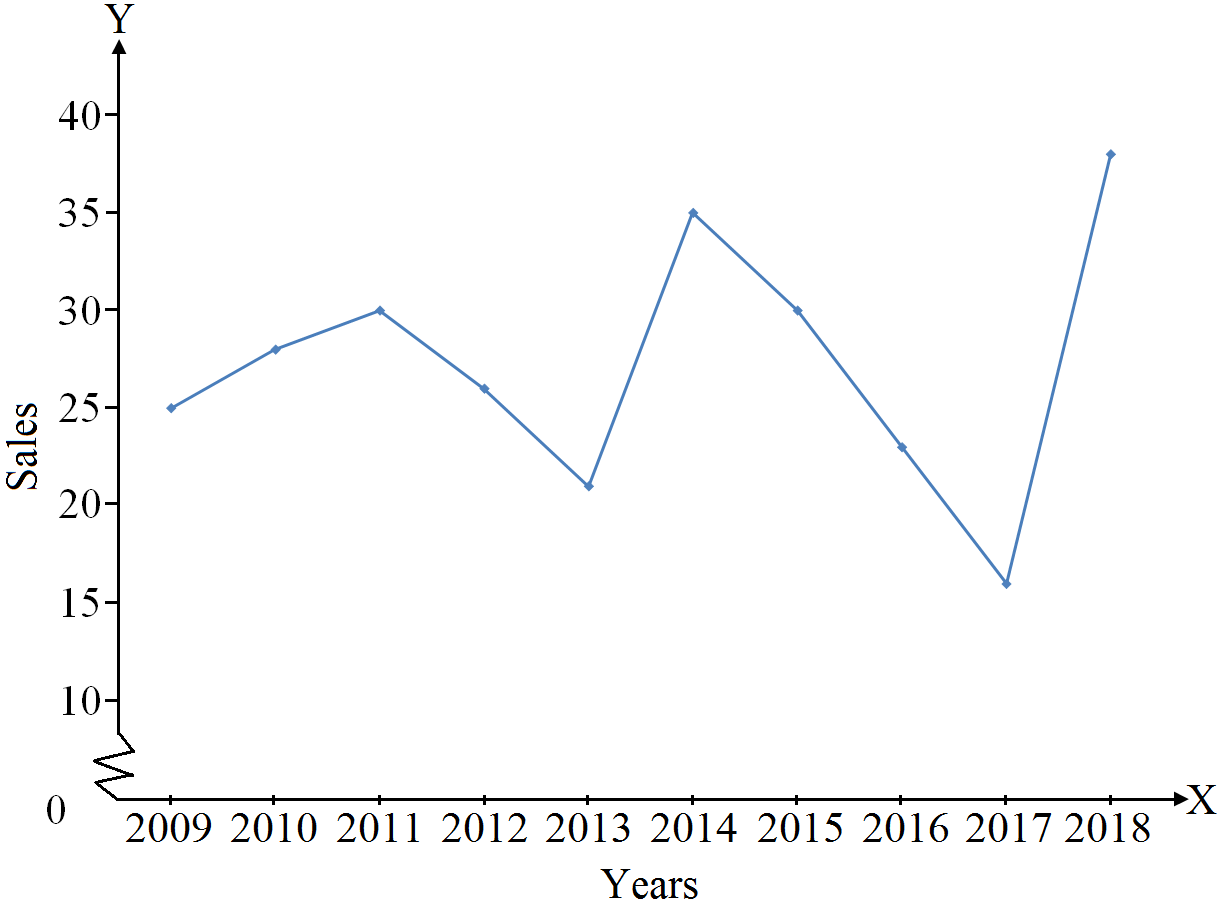
Represent the following data by a graph using false base line:
Years
2009
2010
211
2012
2013
2014
2015
2016
2017
2018
Sales in '000 (₹)
25
28
30
26
21
35
30
23
16
38
Answer
Time Series Graph
View full question & answer
Question 146 Marks
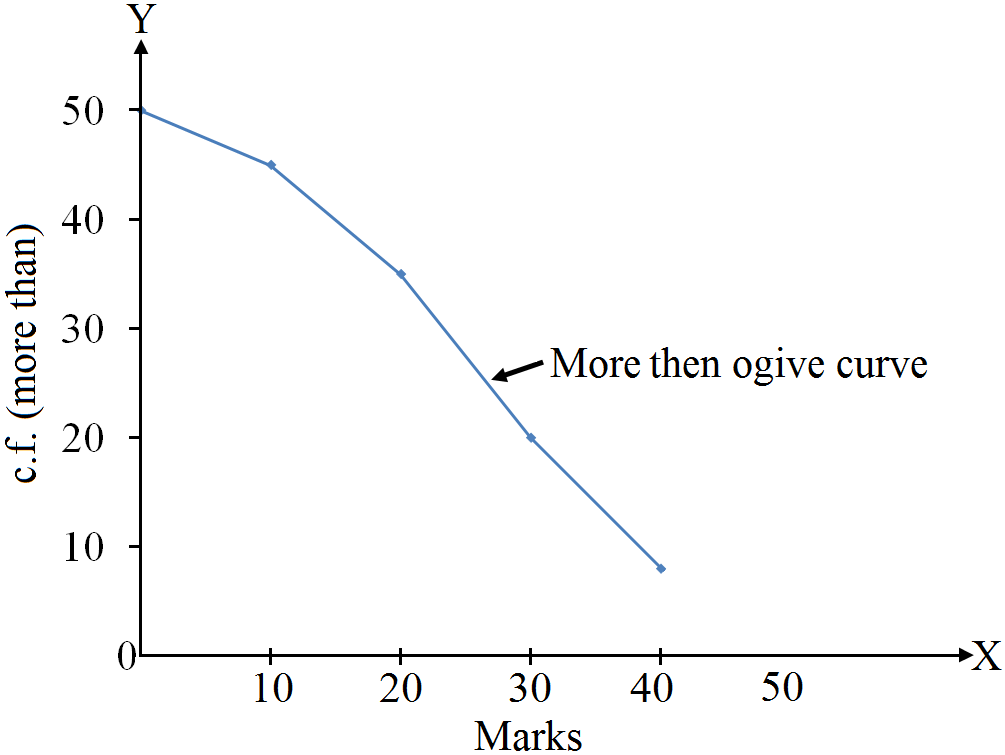
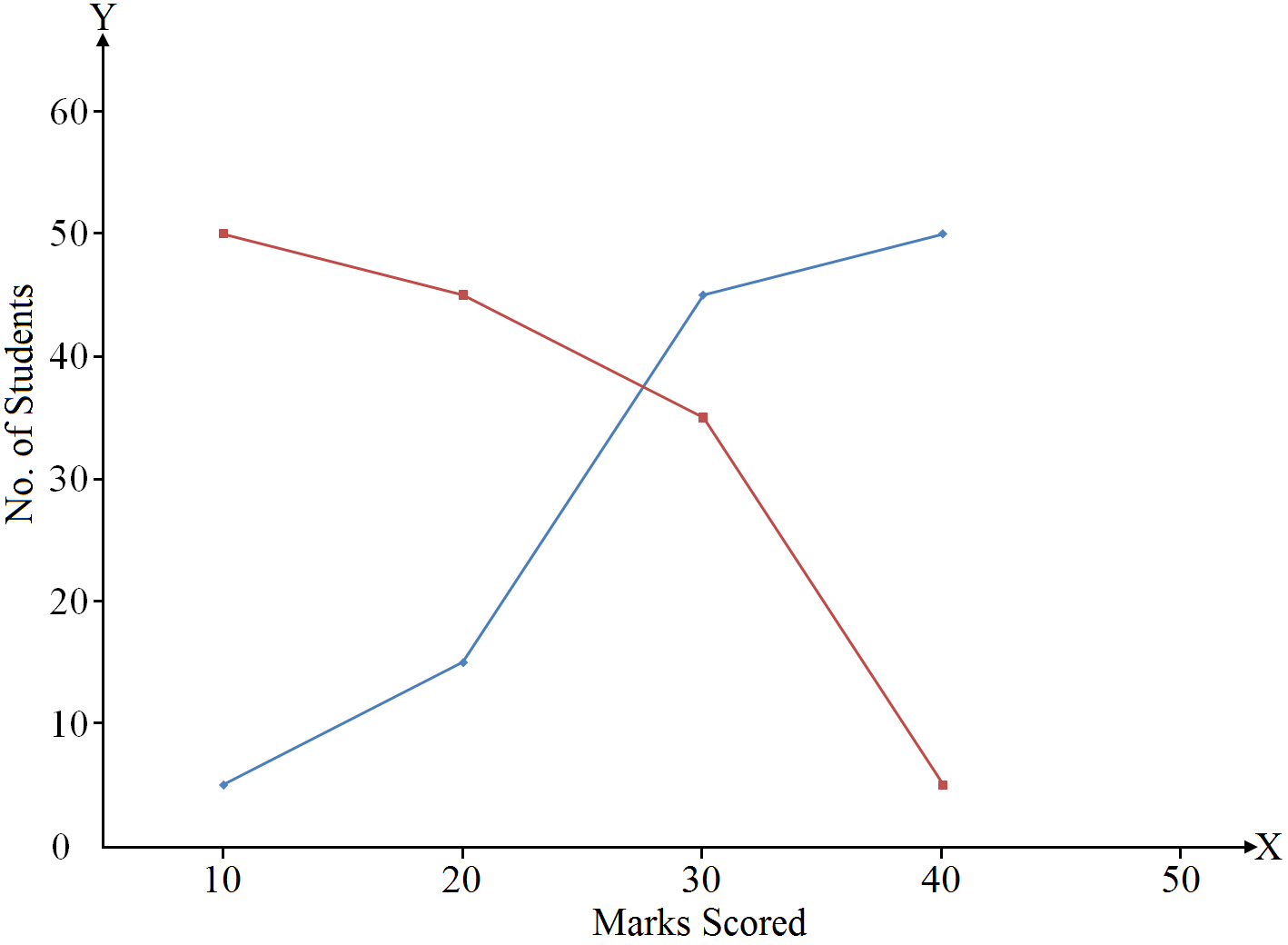
Draw a more than ogive curve on the basis of the given data:
Marks
0-10
10-20
20-30
30-40
40-50
No. of Students
5
10
15
12
8
Answer
Firstly, we will convert the given data into more than frequency distribution.
Marks
c.f. (more than)
More than 0
50
More than 10
45
More than 20
35
More than 30
20
More than 40
8
View full question & answer
Question 156 Marks
In a trip, organised by a college, there were 80 people, each of whom paid ₹ 15.50 on an average. There were 60 students, each of whom paid ₹ 16. Members of teaching staff were charged at a higher rate, the number of servants (all males) were 6 and they were not charged anything. The number of females were 20% of the total and there was only one female staff member. Tabulate this information.
Answer
Total participants = 80 Number of students = 60 Number of servants = 6$\therefore$ Number of teaching staff = 80 - (60 + 6) = 14
Number of female teaching staff = 1$\therefore$ Number of female teaching staff = 14 - 1 = 13
Total Number of females = 80 × 20% = 16 Number of female students = 16 - 1 = 15 Total contribution = 80 × 15.50 = ₹ 1240 Contribution from students = 60 × 16 = ₹ 960 Contribution from teaching staff = 1240 - 960 = ₹ 280$\therefore$ Contribution per head in teaching staff $=\frac{280}{14}$
= ₹ 20 Now, this information can be tabulated as below:
  Sex      
Participants
Male
Females
Total
Conteibution per Head
Total Contribution
Students
45
15
60
16
960
Teaching Staff
13
1
14
20
280
Servants
6
-
6
-
-
Total
64
6
80
15.50
1240
View full question & answer
Question 166 Marks
What is procedure of drawing histogram in case of unequal class interval?
Answer
When class intervals are unequal, we follow the steps given below:
  1. Take the class which has the lowest class interval.
  2. Do not adjust the frequencies of the lowest class.
  3. Frequencies of other classes are adjusted according to the lowest class interval.
  4. Formula for adjusting frequency is:
$\frac{\text{Frequency of the given class}\ \times\ \text{Lowest class interval}}{\text{Class Interval of given class}}$
  1. Keep the width of the rectangle according to class interval of the concerned class and length of the rectangle according to the adjusted frequency.
View full question & answer
Question 176 Marks
Explain briefly different types of graphs.
Answer
Different types of graphs are explained below:
  1. Line Frequency Graph: Line diagrams consist in drawing vertical lines, length of each line being equal to frequency. The values of variate x are presented on a suitable scale along y-axis. Line diagrams facilitate comparison but they are not attractive to see.
  2. Histograms: These graphs are used to graph grouped data. It is one of the most popular and commonly used devices · for charting continuous frequency distribution. It consists of erecting a series of adjacent vertical rectangles on the section of X-axis with bases of equal width of the corresponding class intervals and the heights are so taken that the area of the rectangle are equal to the frequency of the corresponding classes.
  3. Frequency Polygons: A frequency polygon is formed by marking the mid-point at the top of horizontal bars and then joining these dots by a series of straight lines. The frequency polygons are formed as a closed figure with the horizontal axis, therefore a series of straight lines are drawn from the mid-point of the top base of the first and the last rectangles to the midpoint falling on the horizontal axis of the next outlaying interval with zero frequency.
  4. Frequency Curve: It is described as a smooth frequency polygon. A frequency curve is described in terms of its (i) symmetry (skewness) and (ii) degree of peakedness (kurtosis).Two frequency distributions can also be compared by superimposing two or more frequency curves provided the width of their class intervals and the total number of frequencies are equal for the given distributions. Even if the distributions to be compared differ in terms of total frequencies, they still can be compared by drawing per cent frequency curves where the vertical axis measures the per cent class frequencies and not the absolute frequencies.
  5. Time Series Graph: When information is arranged over a period of čime, it is called time series graph. In it, time (hour, day/date, week, month, year, etc.) is plotted along x-axis and the value of the variable (time series data) along y-axis. A line graph by joining these plotted points, thus, obtained is called arithmetic line graph (time series graph).
View full question & answer
Question 186 Marks
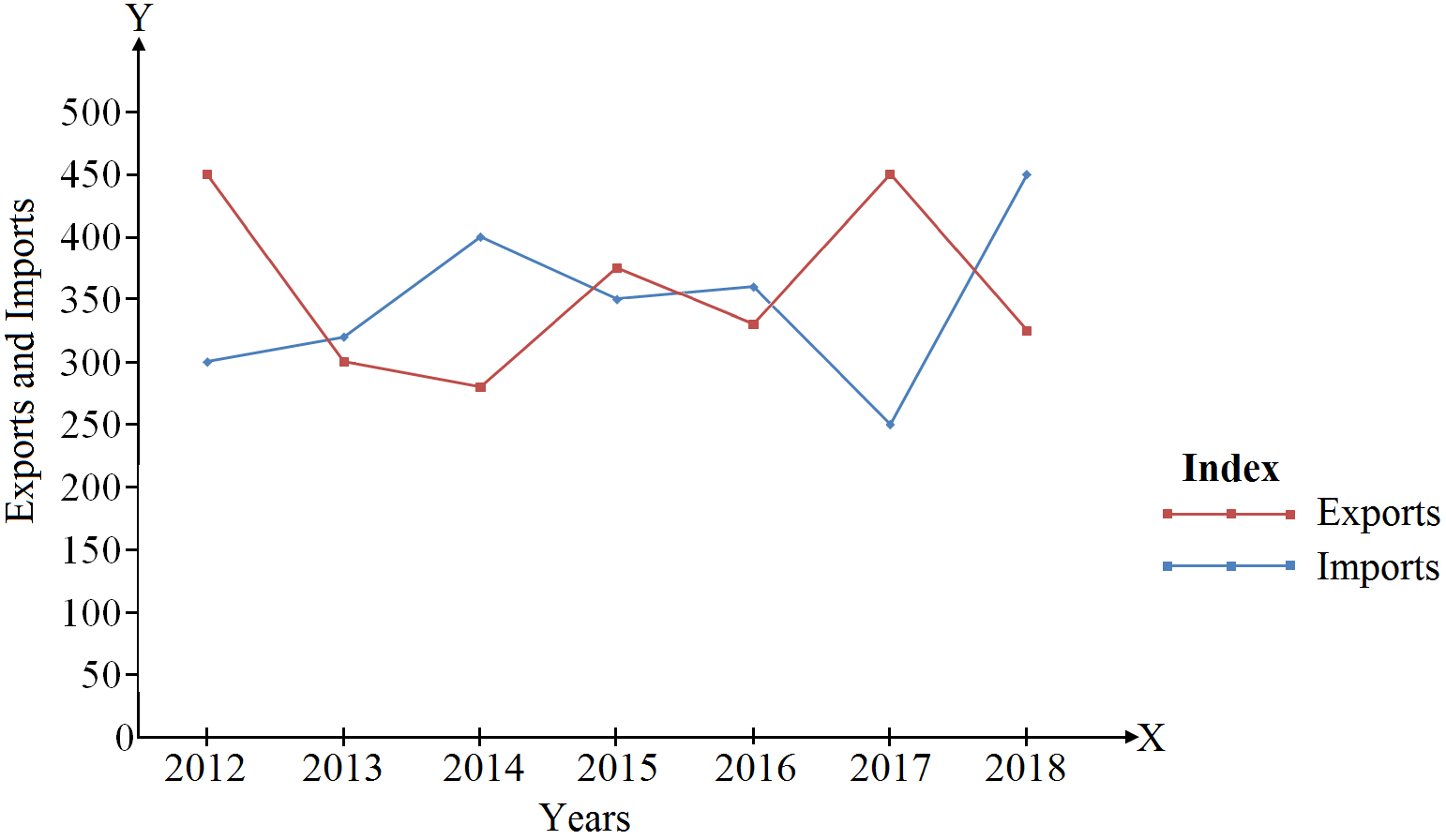
Represent the following information through a time series graph:
Years
2012
2013
2014
2015
2016
2017
2018
Exports (in crores ₹)
300
320
400
350
360
250
450
Imaports (in crores ₹)
450
300
280
375
330
450
325
Answer
Export and Import Graph
View full question & answer
Question 196 Marks
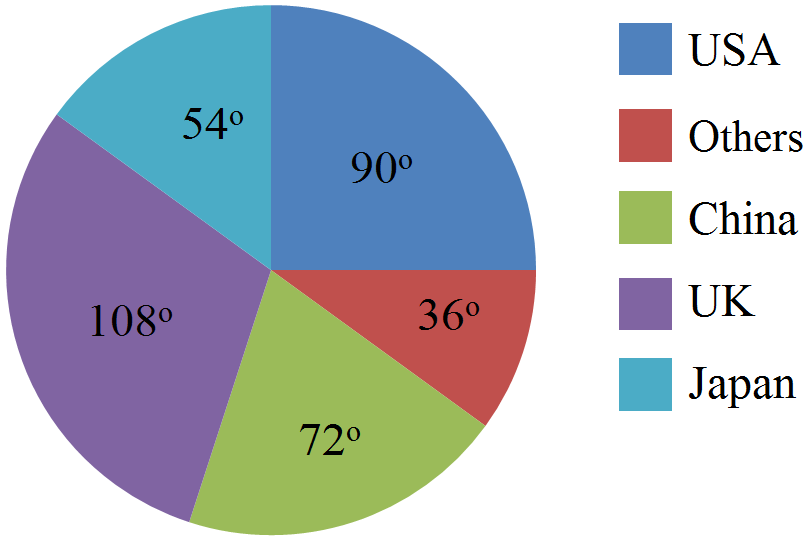
Direction of export is shown in the following table. Prepare a pie diagram to show the percentage distribution of export.
Cuntry
Export (in %)
USA
25
Japan
15
UK
30
China
20
Others
10
Answer
For constructing a pie diagram, it is necessary to convert the percentage into angles of different degree. This conversion is shown below:
Cuntry Percentage of Export Degree of Angles
USA 25 $\frac{25}{100}\times360^\circ=90^\circ$
Japan 15 $\frac{15}{100}\times360^\circ=54^\circ$
UK 30 $\frac{30}{100}\times360^\circ=180^\circ$
China 20 $\frac{20}{100}\times360^\circ=72^\circ$
Others 10 $\frac{10}{100}\times360^\circ=36^\circ$
Total 100 $360^\circ$
A pie diagram to show percentage distribution export is given below:
View full question & answer
Question 206 Marks
Which type of diagram is recommended to present:
  1. Components of family expenditure.
  2. Balance of payments in an economy.
  3. Profits or losses of a company.
  4. Production of Rice in Punjab in five years.
  5. Composition of students in a school by their marks in four years.
  6. Birth rate and death rate of five countries.
Answer
  1. Pie diagram.
  2. Deviation Bar diagram.
  3. Deviation Bar diagram.
  4. Simple bar diagram.
  5. Percentage bar diagram.
  6. Multiple Bar diagram.
View full question & answer
Question 216 Marks
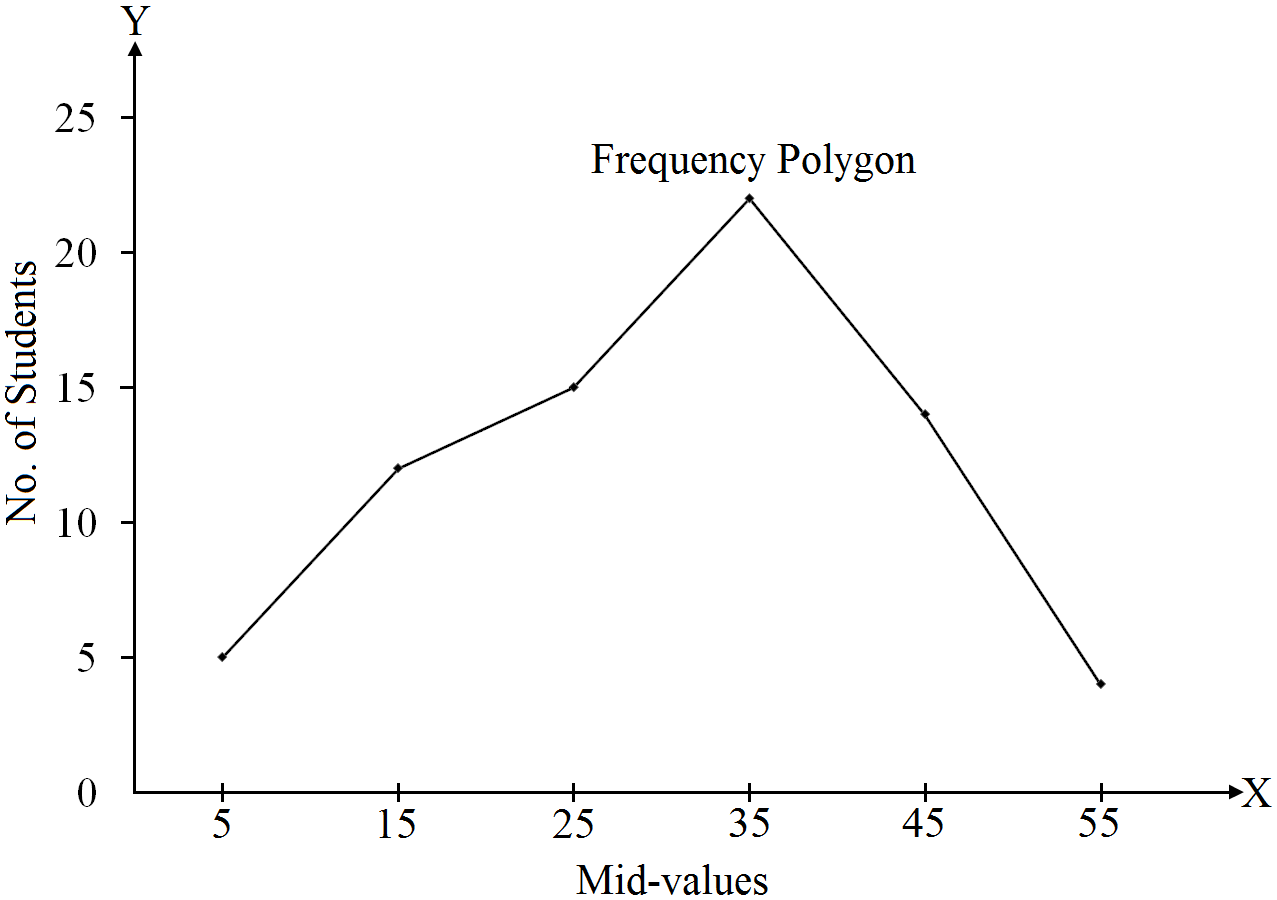
Draw a frequency polygon using mid-values from the following table:
Marks
0-10
10-20
20-30
30-40
40-50
50-60
No. of Students
5
12
15
22
14
4
Answer
Marks
Mid-value
f
0-10
5
5
10-20
15
12
20-30
25
15
30-40
35
22
40-50
45
14
50-60
55
4
View full question & answer
Question 226 Marks
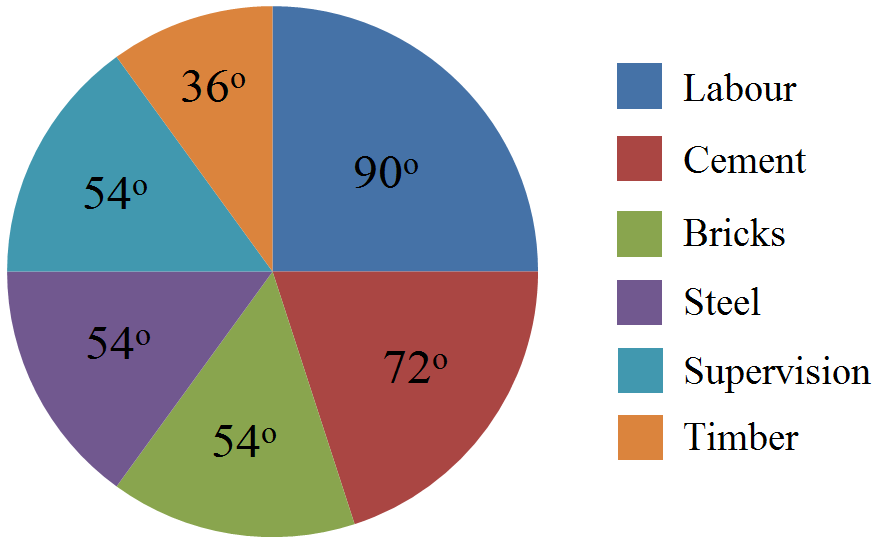
Construct a pie diagram to represent the cost of construction of a house in Delhi.
Itens
Expenditure (in %)
Labour
25
Bricks
15
Cement
20
Steel
15
Timber
10
Supervision
15
Answer
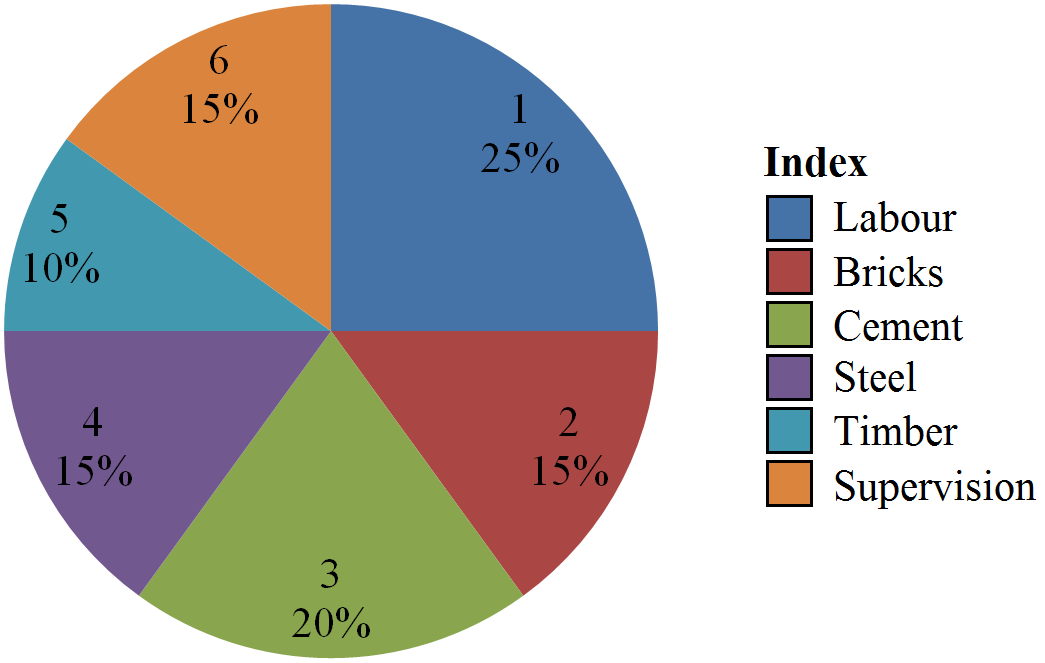
For constructing a pie diagram, it is necessary to convert the percentage into angles of different degree.This conversion is shown below:
Itens Expenditure (in %) Expenditure in Degree
Labour 25 $\frac{25}{100}\times360^\circ=90^\circ$
Bricks 15 $\frac{15}{100}\times360^\circ=54^\circ$
Cement 20 $\frac{20}{100}\times360^\circ=72^\circ$
Steel 15 $\frac{15}{100}\times360^\circ=54^\circ$
Timber 10 $\frac{10}{100}\times360^\circ=36^\circ$
Supervision 15 $\frac{15}{100}\times360^\circ=54^\circ$
Total 100 $360^\circ$
A pie diagram to show cost of construction of a house in Delhi is given below:
View full question & answer
Question 236 Marks
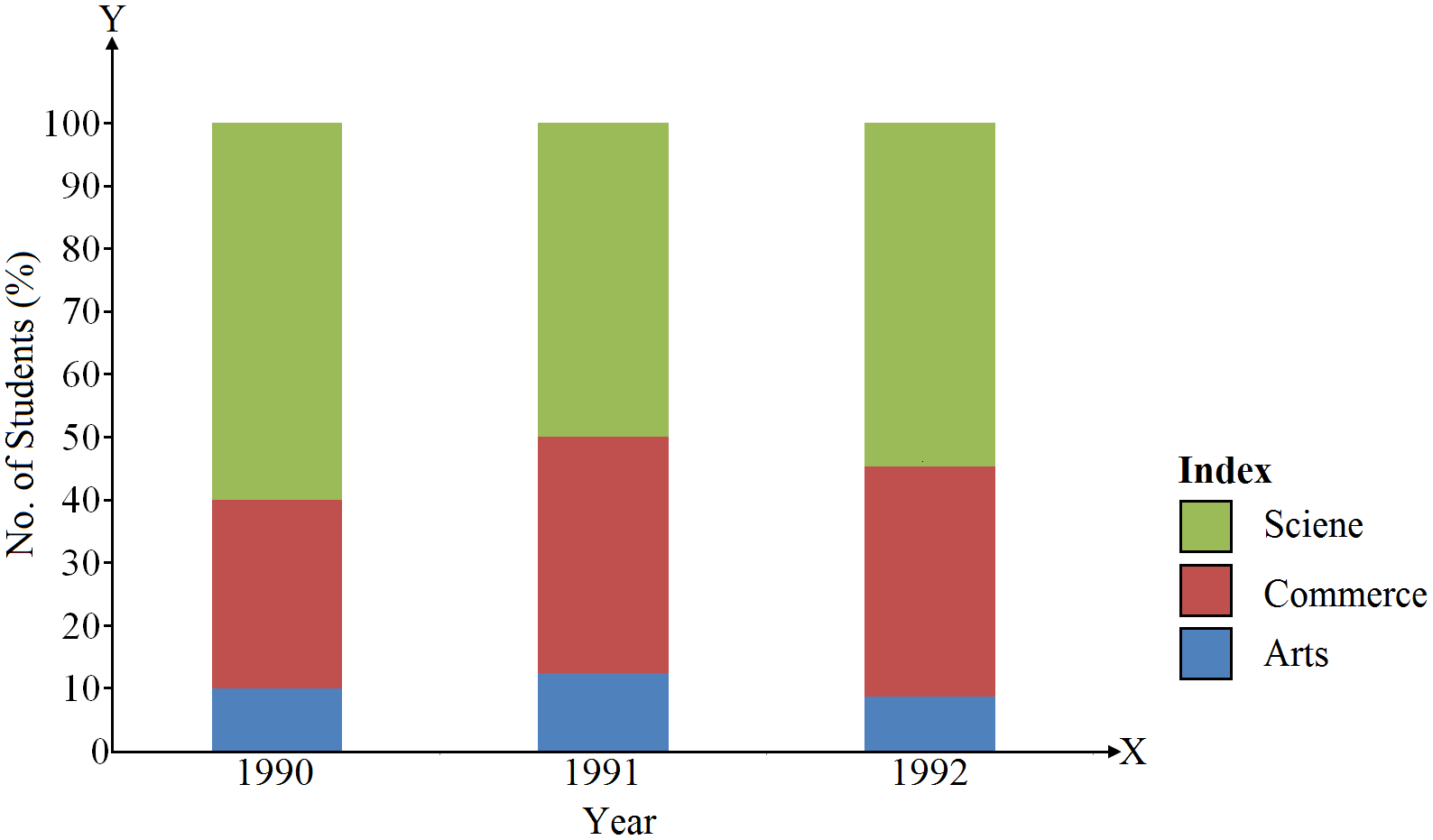
Make a percentage sub-divided bar diagram.
Year
Arts
Commerce
Science
1990
100
300
600
1991
150
450
600
1992
130
550
820
Answer
Years $\rightarrow$
Subjects $\downarrow$
1990 % 1991 % 1992 %
Arts 100 10 150 12.5 130 8.7
Commerce 300 30 450 37.5 550 36.6
Science 600 60 600 50.0 820 54.7
Total 1000 100 1200 100 1500 100
Percentage sub-divided bar diagram.
View full question & answer
Question 246 Marks
Differentiate between diagrammatic and tabular presentation of data.
Answer
S. No.
Diagrammatic Presentation of Data
Tabular Presentation of Data.
1.
Diagrams and Graphs are meant for a lay man.
Tables are meant for statisticians for the purpose of further analysis.
2.
Diagrams give only an approximate idea.
Tables contain precise figures. Exact values can be read from tables.
3.
Diagrams can be more easily compared, and can be interpreted by a layman.
Comparison and interpretations of tables can only be done by statisticians and it is a difficult task.
4.
Diagrams and graphs cannot present much information.
Tables can present more information.
5.
Diagrams are more attractive and have a visual appeal.
Tables are dry for a layman (may be attractive to a statistician).
View full question & answer
Question 256 Marks
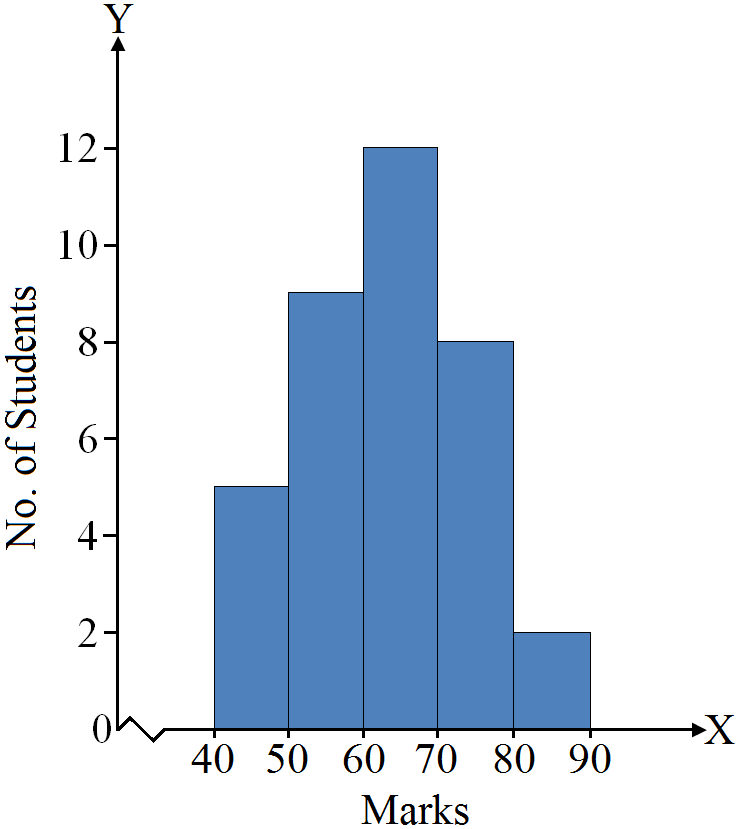
The frequency distribution of marks obtained by students in a class test is given below:
Marks (Midpoints)
45
55
65
75
85
No. of Students
5
9
12
8
2
Draw a Histogram from the above distribution.
Answer
Histogram
Marks (Midpoints)
40-50
50-60
60-70
70-80
80-90
No. of Students (f)
5
9
12
8
2
View full question & answer
Question 266 Marks
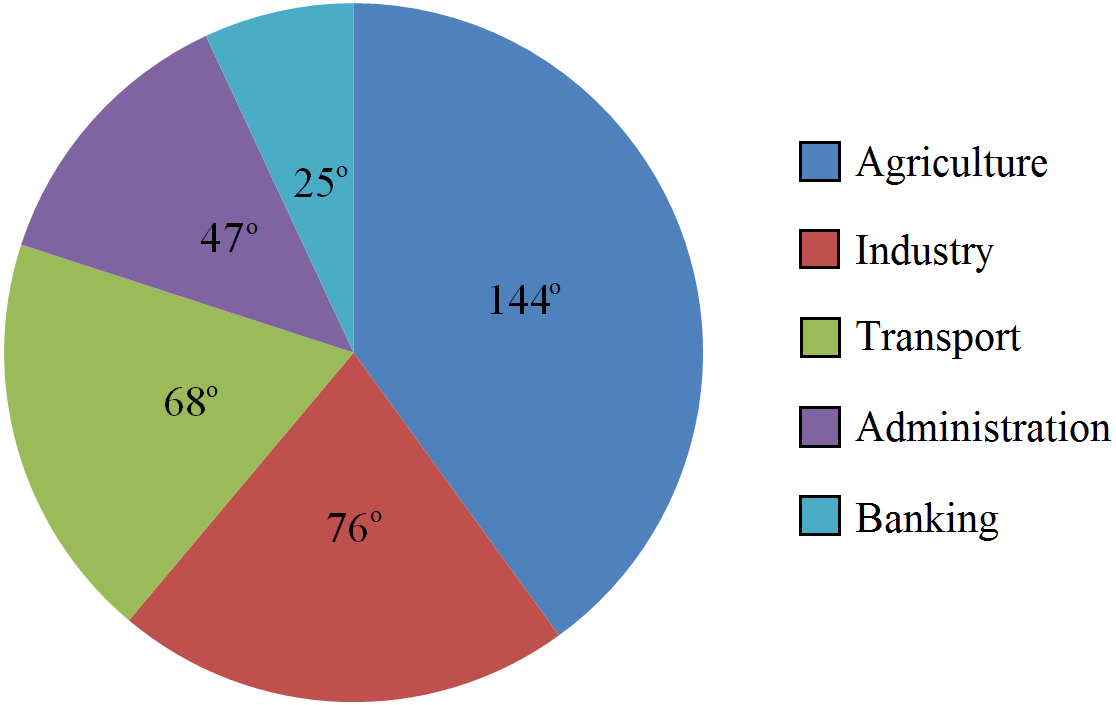
Construct a pie-diagram from the following table:
Items
Agriculture
Industry
Transport
Administration
Banking
Percentage
40
21
19
13
07
Answer
Items
Angles
Agriculture
40 × 3.6° = 144°
Industry
21 × 3.6° = 75.6 = 76°
Transport
19 × 3.6°= 68.4 = 68°
Administration
13 × 3.6° = 46.8 = 47°
Banking
7 × 3.6° = 25.2 = 25°
View full question & answer
Question 276 Marks
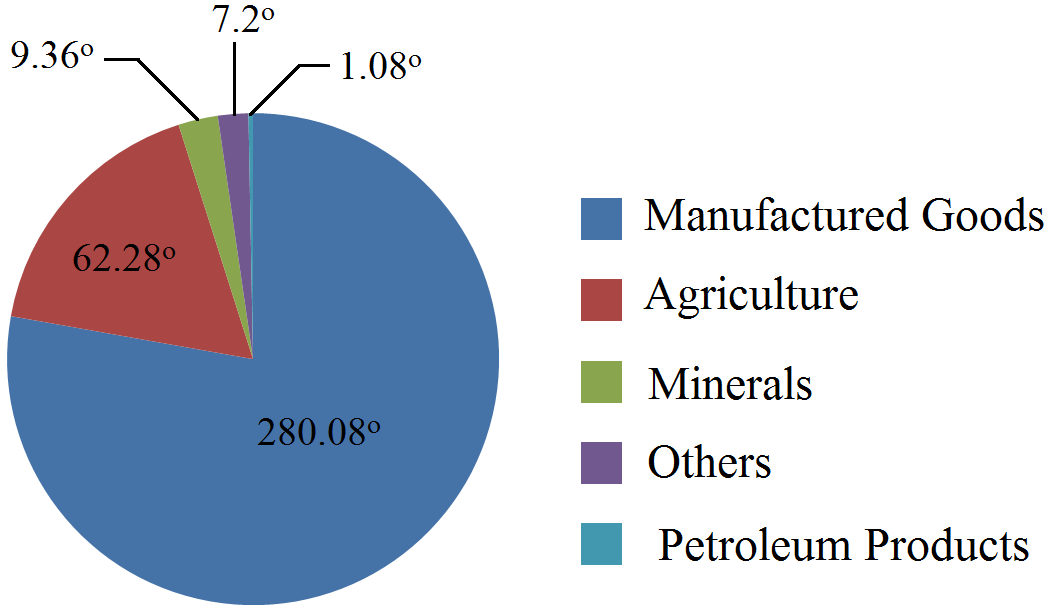
Percentage distribution of export of India is given below. Construct a pie diagram using this data.
Commodity Group
Export (in %)
Agriculture
17.3
Minerals
2.6
Manufactured goods
77.8
Petroleum products
0.3
Others
2.0
Total
100
Answer
For constructing a pie diagram, it is necessary to convert the percentage into angles of different degree. This conversion is shown below:
Commodity Group Export (in %) Degree of Angles
Agriculture 17.3 $\frac{17.3}{100}\times360^\circ=62.28^\circ$
Minerals 2.6 $\frac{2.6}{100}\times360^\circ=9.36^\circ$
Manufactured goods 77.8 $\frac{77.8}{100}\times360^\circ=280.08^\circ$
Petroleum products 0.3 $\frac{0.3}{100}\times360^\circ=1.08^\circ$
Others 2.0 $\frac{2.0}{100}\times360^\circ=7.2^\circ$
Total 100 $360^\circ$
A pie diagram showing percentage of exports of given data is shown below:
View full question & answer
Question 286 Marks
Differentiate between Simple table and complex table with examples.
Answer
Simple and complex tables: The distinction between simple and complex table is based on the number of characteristics studied.
In a simple table only one character is shown. Hence this type of table is also known as one-way table. On the other hand in a complex table two or more characteristics are shown. When two characteristics are shown such a table is known as two-way table or double tabulation.
Example of one way table: Number of employees in state bank according to age group.
Age (in years) No. of employees
Below 25 3
25-35 2
35-45 2
Above 45 3
Example of two-way table: Number of employees of state bank in different age groups according to sex.
Age (in years)
Employees
Total
Males
Females
Below 25
3
2
5
25-35
4
5
9
35-45
5
6
11
Above 45
2
3
5
Total
14
16
30
When three or more characteristics are represented in the same table is called three-way tabulation. As the number of characteristics increases, the tabulation becomes so complicated and confusing.
View full question & answer
Question 296 Marks
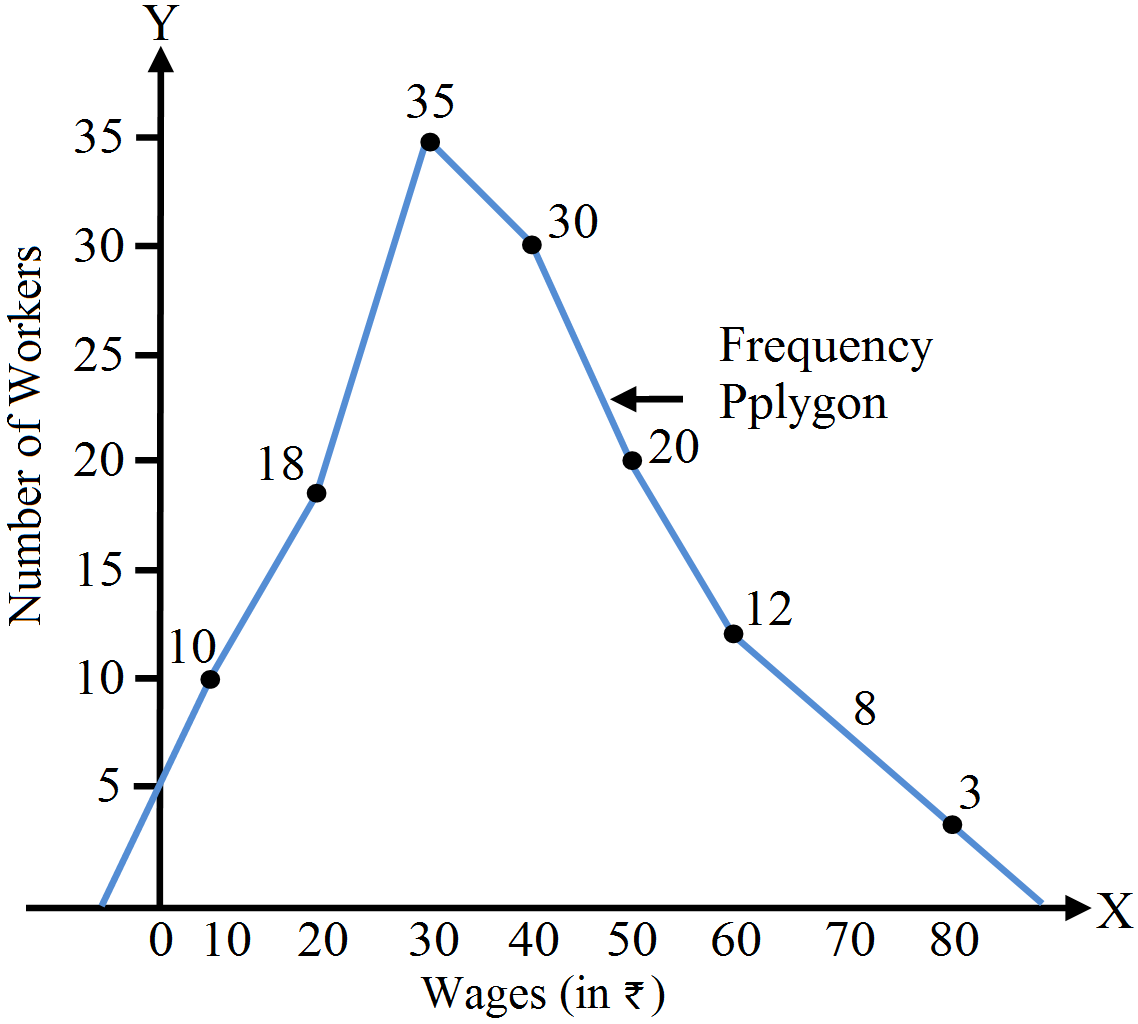
Construct a frequency polygon without using histogram for the following data.
Wages (in ₹)
Number of Workers (f)
0-10
10
10-20
18
20-30
35
30-40
30
40-50
20
50-60
12
60-70
8
70-80
3
Answer
To construct a frequency polygon without histogram the following values will be plotted.
Mid Value (X)
Number of Workers (f)
5
10
15
18
25
35
35
30
45
20
55
12
65
8
75
3
View full question & answer
Question 306 Marks
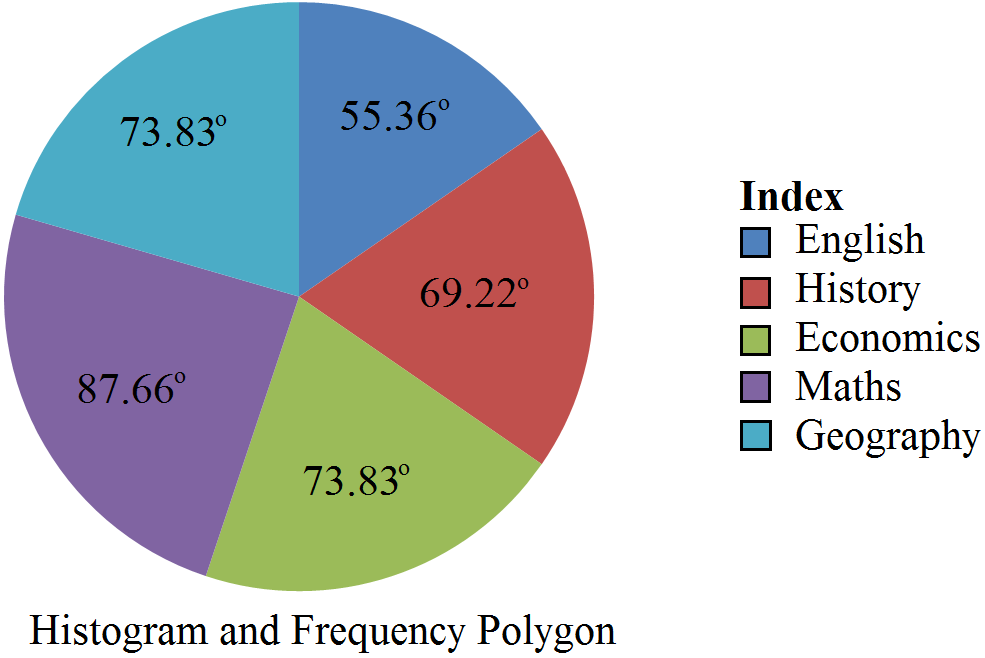
Following table shows the marks obtained by a student. Draw a pie diagram to represent the data:
Subject:
English
Histoty
Economics
Maths
Geogtaphy
Marks:
60
75
80
95
80
Answer
Subject
Marks
%
Angle °
English
60
15.38
55.36°
History
75
19.23
69.22°
Economics
80
20.51
73.83°
Maths
95
24.35
87.66°
Geography
80
20.51
73.83°
View full question & answer
Question 316 Marks
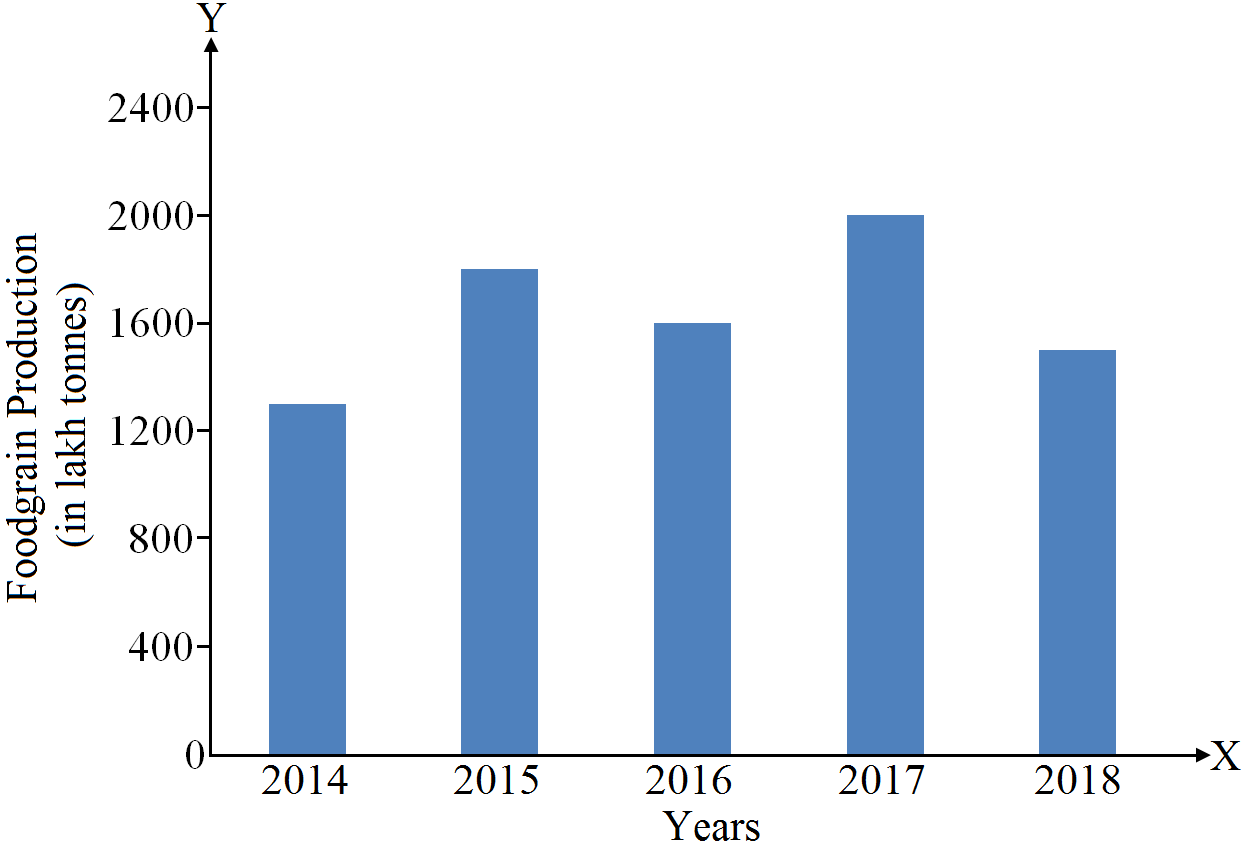
Represent the following data with the help of an appropriate bar diagram.
Years
2014
2015
2016
2017
2018
Foodgrain production in India (in lakh tonnes)
1300
1800
1600
2000
1500
Answer
Simple Bar Diagram
View full question & answer
Question 326 Marks
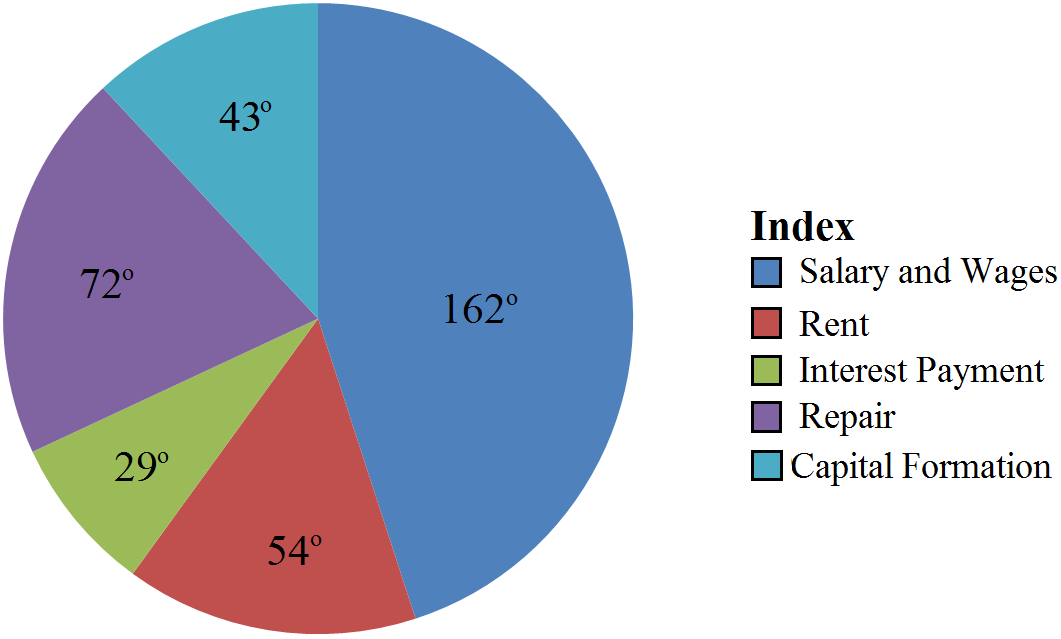
Use pie diagram to represent the following data.
Expenditure item Amount ₹
Salary and Wages 45,000
Rent 15,000
Interest Patment 8,000
Repair 20,000
Capital Formation 12,000
Answer
Expenditure Item
Amount (₹)
%
Angle (°)
Salary and Wages
45,000
45
162°
Rent
15,000
15
54°
Interest Patment
8,000
8
29°
Repair
20,000
20
72°
Capital Formation
12,000
12
43°
Total
1,00,000
100
360°
View full question & answer
Question 336 Marks
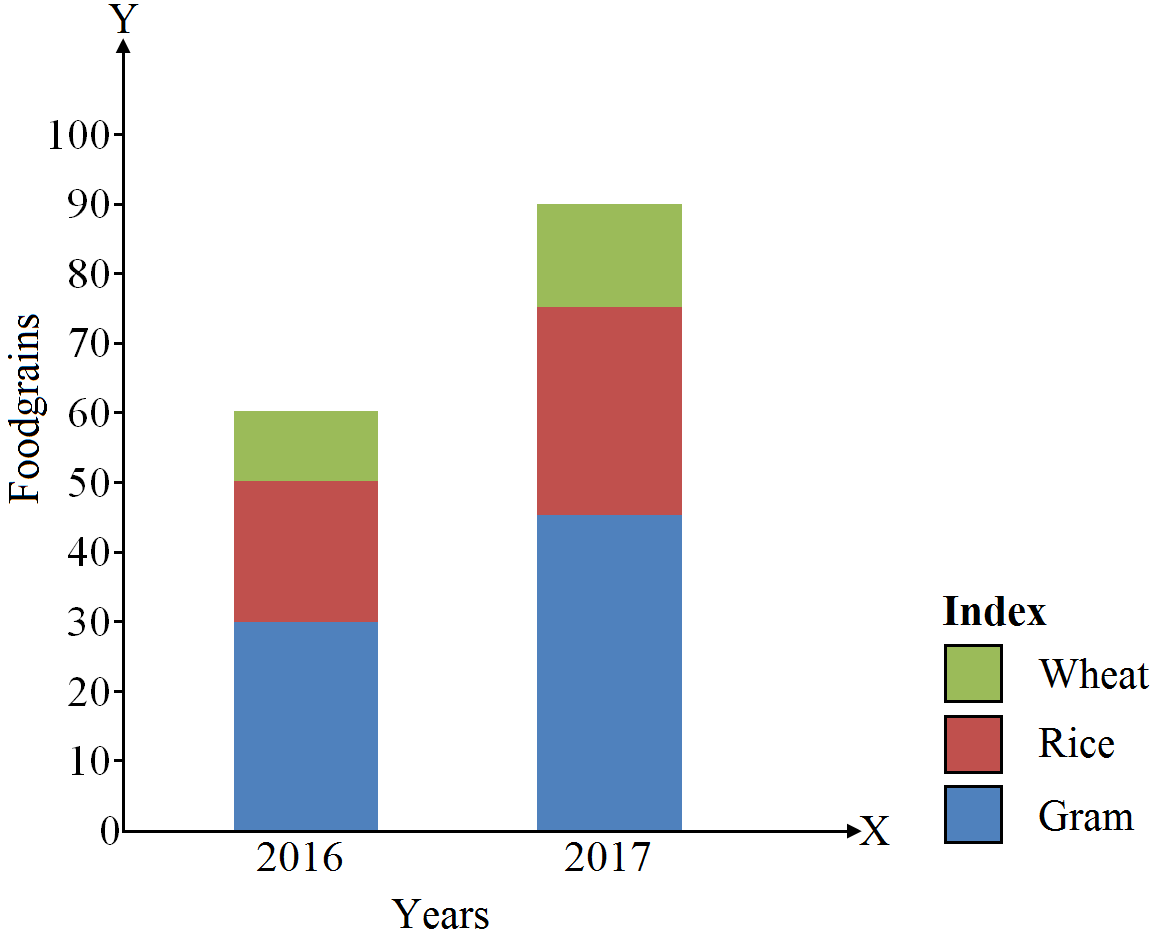
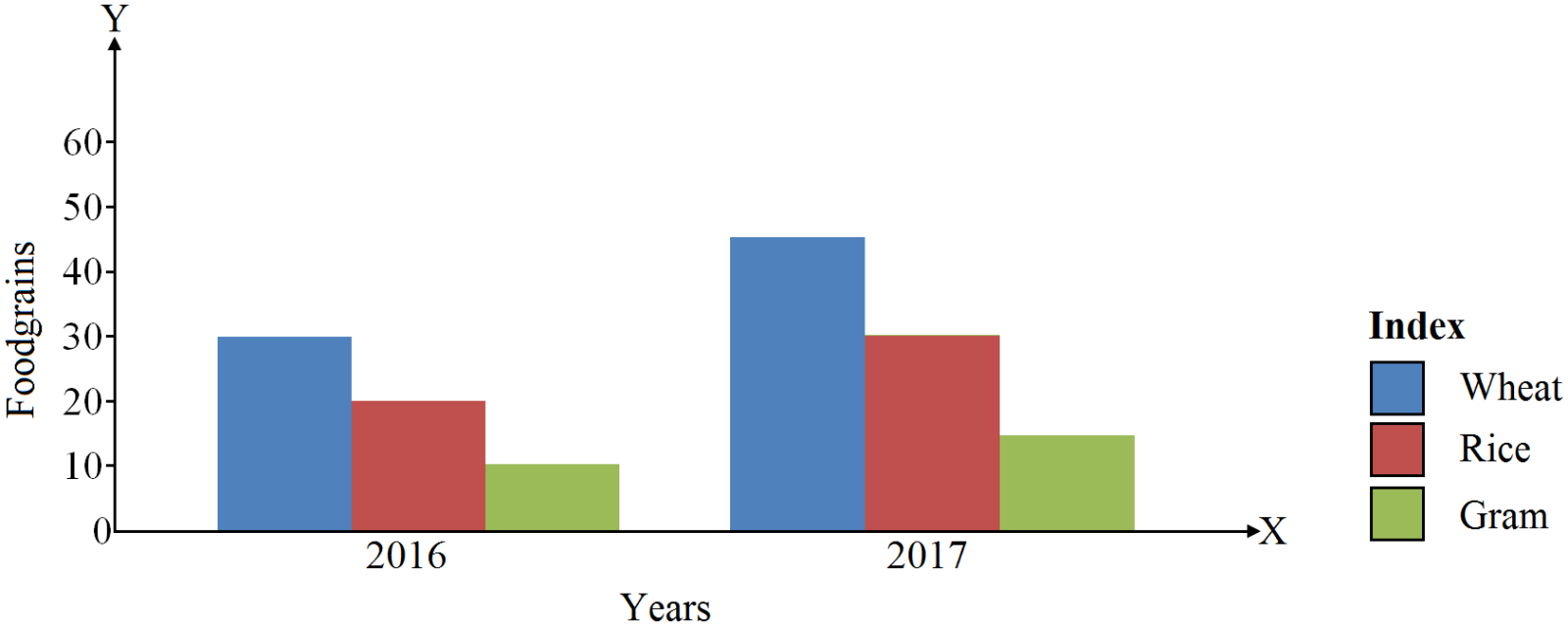
Present the following data on the production of foodgrains in the form of:
  1. Sub-divided Bar Diagram.
  2. Multiple Bar Diagram.
Production
Year
Wheat
Rice
Gram
Total
2016
30
20
10
60
2017
45
30
15
90
Answer
  1. Sub-divided Bar Diagram
  1. Multiple Bar Diagram
​​​​​​​
View full question & answer
Question 346 Marks
What are the essentials of a good statistical table? Using an imaginary example, indicate different parts of a table.
Answer
The preparation of a good table is an art. The purpose of tabulation must always be kept in mind before the preparation of a statistical table. A good statistical table must contain at least the following components.
In general, a statistical table consists of the following eight parts. They are as follows:
  1. Table Number: Each table must be given a number. Table number helps in distinguishing one table from other tables. Usually tables are numbered according to the order of their appearance in a chapter. For example, the first table in the first chapter of a book should be given number 1.1 and second table of the same chapter be given 1.2 Table number should be given at its top or towards the left of the table.
  2. Title of the Table: Every table should have a suitable title. It should be short & clear. Title should be such that one can know the nature of the data contained in the table as well as where and when such data were collected. It is either placed just below the table number or at its right
  3. Caption: Caption refers to the headings of the columns. It consists of one or more column heads. A caption should be brief, concise and self-explanatory, Column heading is written in the middle of a column in small letters.
  4. Stub: Stub refers to the headings of rows.
  5. Body: This is the most important part of a table. It contains a number of cells. Cells are formed due to the intersection of rows and column. Data are entered in these cells.
  6. Head Note: The head-note (or prefactory note) contains the unit of measurement of data. It is usually placed just below the title or at the right hand top corner of the table.
  7. Foot Note: A foot note is given at the bottom of a table. It helps in clarifying the point which is not clear in the table. A foot note may be keyed to the title or to any column or to any row heading. It is identified by symbols such as *,+,@,£ etc.
  8. Source Note: The source note shows the source of the data presented in the table. Reliability and accuracy of data can be tested to some extent from the source note. It shows the name of the author, title, volume, page, publisher's name, year and place of publication of the book or journal from which data are complied.
'THE TITLE'
Prefatory Notes:
 
Box Head
Row Captions
Calumn Captions
Stub Entries
The Body
Foot Notes
Source Note Solution
View full question & answer
Question 356 Marks
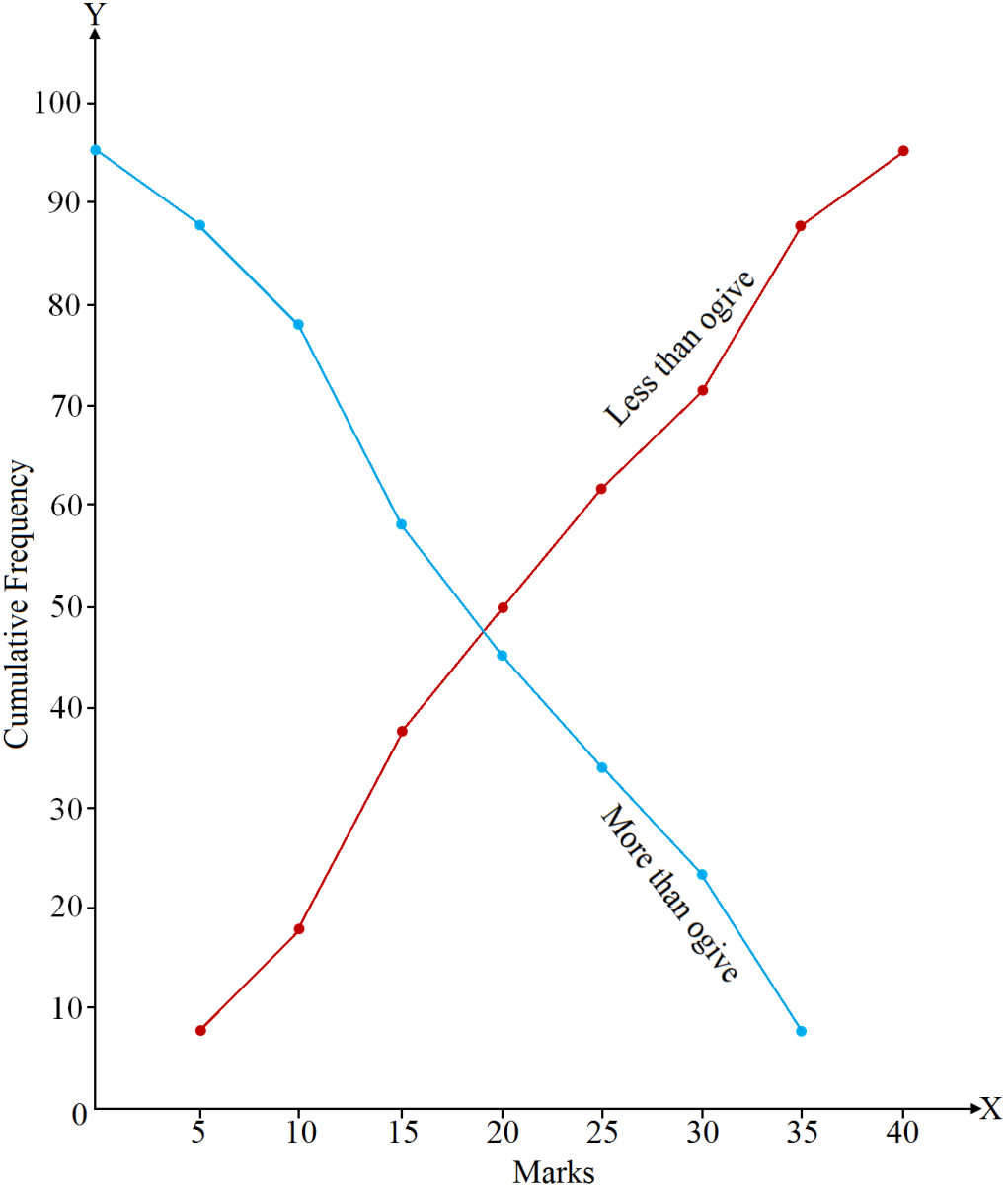
Draw less than and more than ogive (cumulative frequency curve) using the following data:
Marks
0-5
5-10
10-15
15-20
20-25
25-30
30-35
35-40
No. of Students
7
10
20
13
12
10
15
8
Answer
Marks
c.f. (less than)
Less than 5
7
Less than 10
17
Less than 15
37
Less than 20
50
Less than 25
62
Less than 30
72
Less than 35
87
Less than 40
95
 
Marks
c.f. (more than)
More than 0
95
More than 5
88
More than 10
78
More than 15
58
More than 20
45
More than 25
33
More than 30
23
More than 35
8
View full question & answer
Question 366 Marks
Explain different types of frequency curves with an example.
Answer
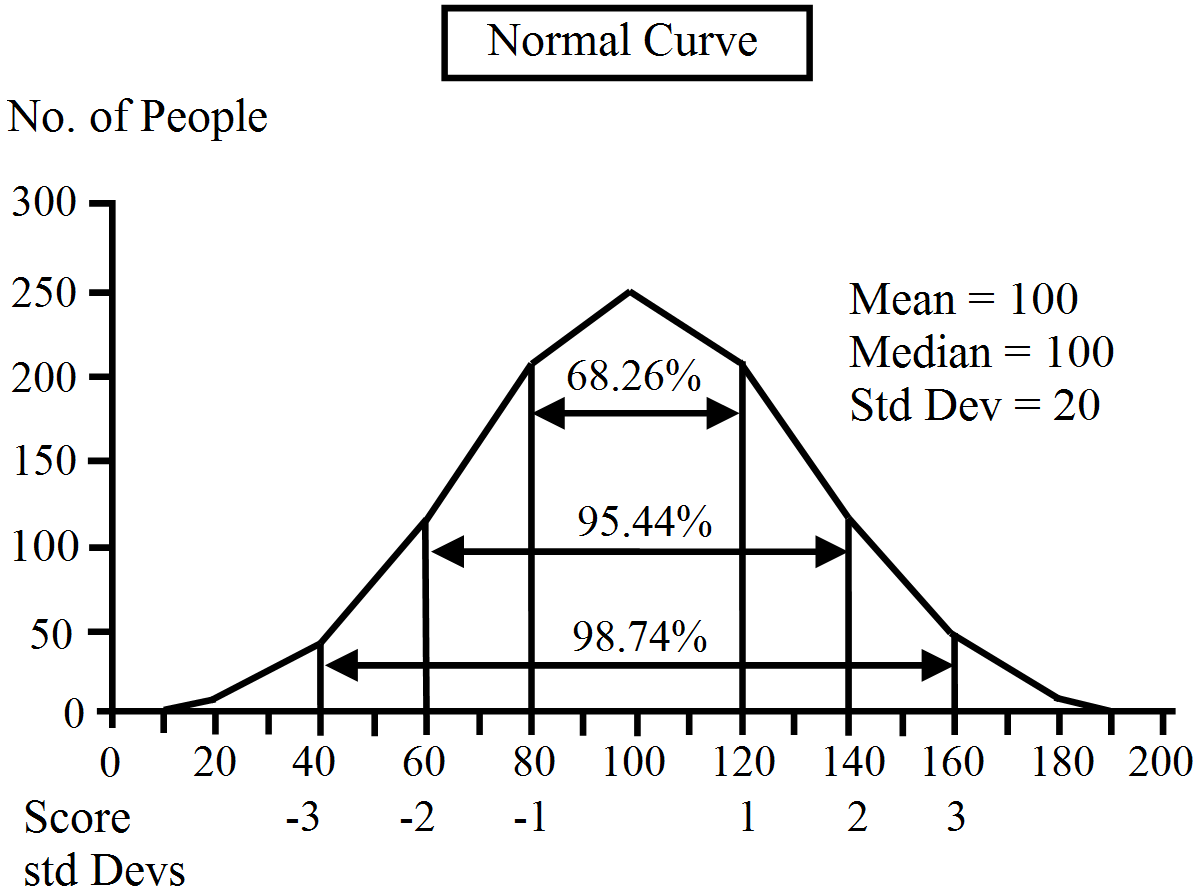
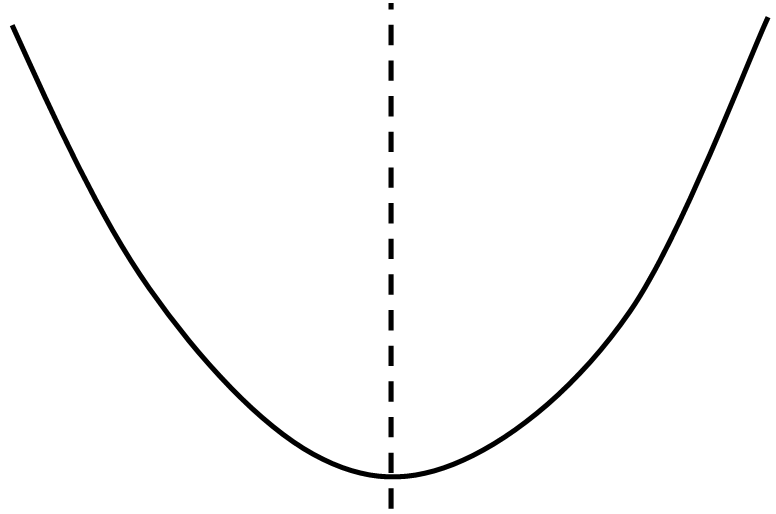
  1. Normal Curve: In this curve, highest frequency is at the centre and both tails on the left and right hand side are in identical fashion. It is a unimodal curve in which mean, median and mode are equal. It is also known as bell shaped or symmetrical curve. It is shown below:


Normal Curve Showing the Percent of Cases Lying Within 1, 2, and 3 Standard Deviations from the Mean.
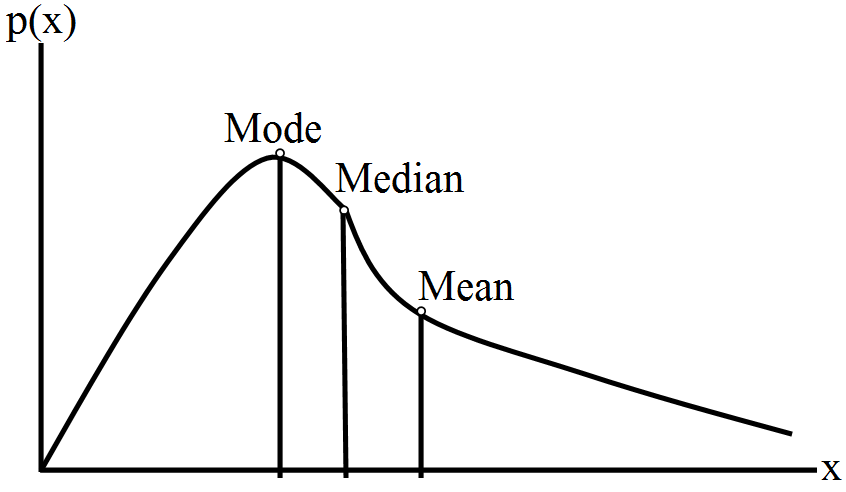
  1. Positively Skewed Curve: It is asymmetrical curve which has a tail on the left hand side of the graph and frequencies are more for the higher values of the data. The left tail is longer, the mass of the distribution is concentrated on the right of the figure. It has relatively few low values. The distribution is said to be left-skewed. It is shown below:
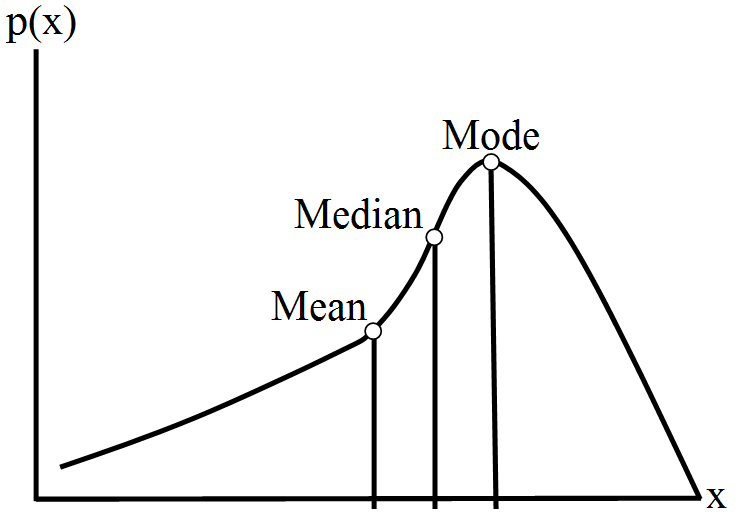
  1. Negatively Skewed Curve: It is asymmetrical curve which has a tail on the right hand side of the graph and frequencies are more for the lower values of the data. These histograms have the curve on the left side of the distribution. If the right tail is longer, the mass of the distribution is concentrated on the left. It has relatively few low values. It is shown below:
  1. Symmetrical Distribution Curve: It is like normal curve but normal curve is unimodal. We can say it to be twins of normal curves. In this curve, highest frequencies are at two places one at a lower value and other at a higher extreme value and hence, it is also called bimodal curve of symmetrical distribution. It is shown below:
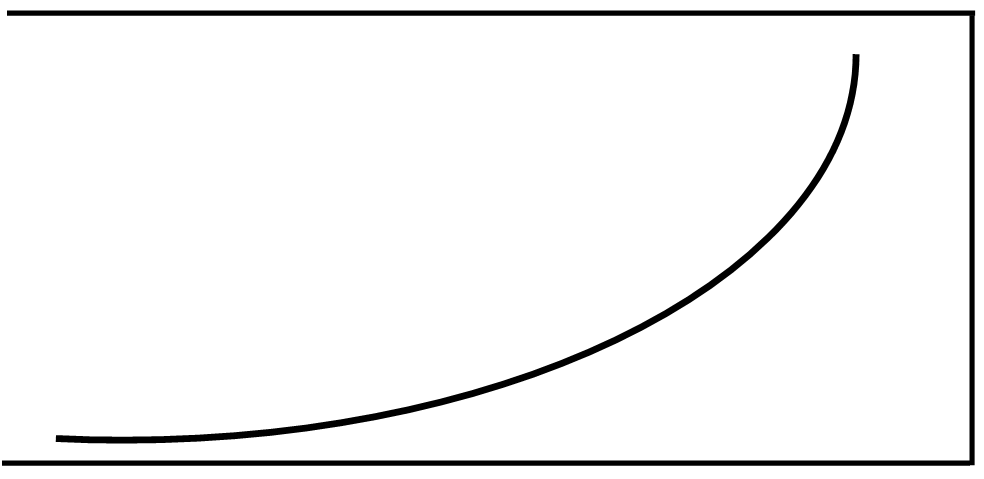
  1. J Shaped Curve: When class frequencies running maximum towards higher values and not at the centre, it gives a J shaped frequency curve. It is called so because it appears like English Letter J. It is shown below:
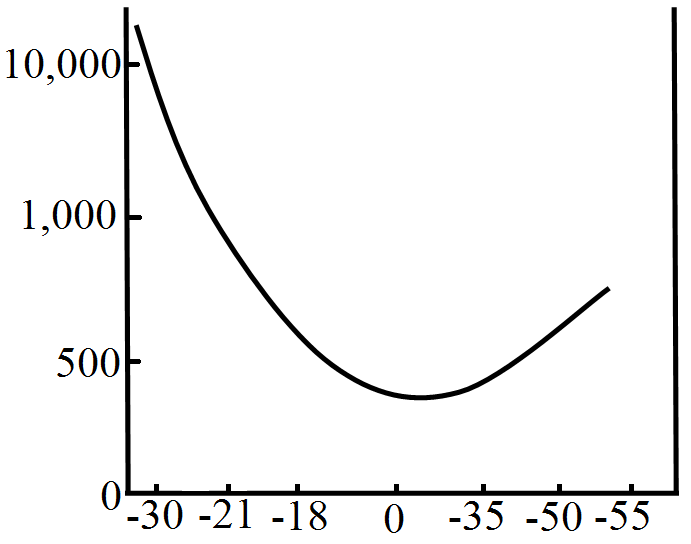
  1. U Shaped Curve: In this case, maximum frequency is at the ends of the data and minimum are the centre. It is shown below:
  1. Reverse J Shaped Curve: When class frequencies are running up to a maximum at one end and not at the centre and it is lower end not higher one, it gives inverse J shaped curve. It is shown below:
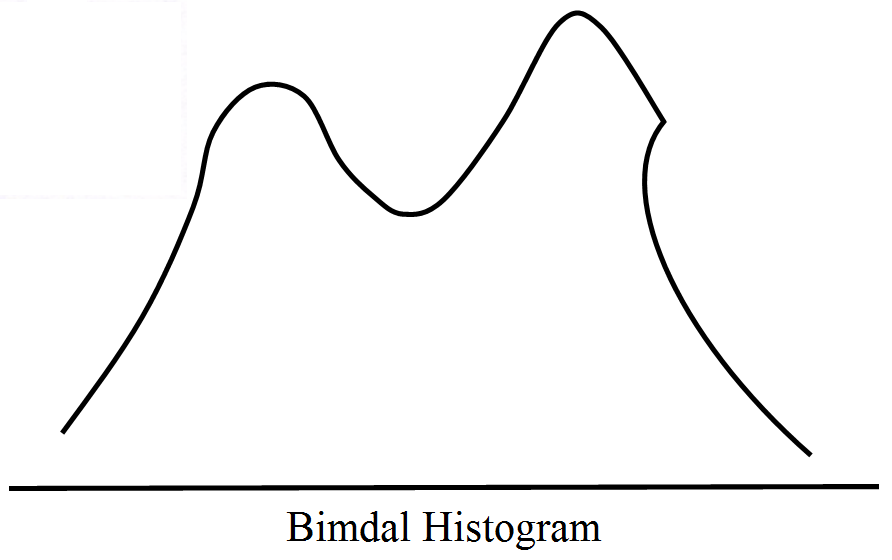
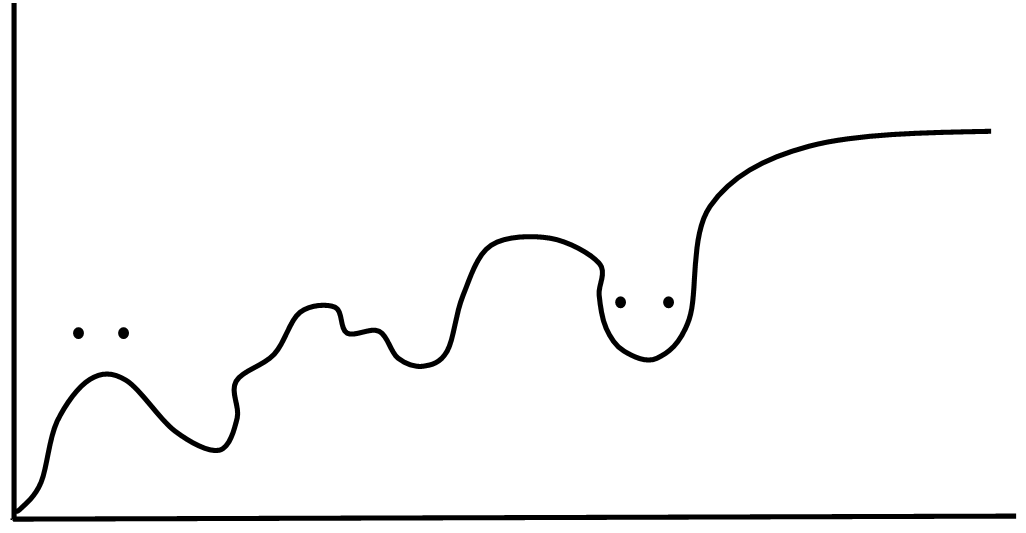
  1. Mixed Curve: Sometimes, it is difficult to find a trend in the frequencies. The frequencies rise and fall at different intervals. It is called Mixed Curve. There cannot be one particular shape of mixed curve. It is also called non monotonic curve because it does not show any particular pattern. One example is shown below:
View full question & answer
Question 376 Marks
Briefly explain the guidelines for preparing a good table.
Answer
A good table is one which is able to convey the required information effectively. The guidelines for preparing a good table are stated below:
  1. Simple and Compact: The table should be simple and compact, so that it should not create confusion in the mind of the user.
  2. Focus Attention on Main Comparisons: The data in the table should be arranged so that it focuses attention on the main comparisons and clearly exhibits the relationship between various related items. For this, different fonts of lettering (italic, bold, capital letters, etc) may be used.
  3. Complete and Self-Explanatory: A table should be complete and self-explanatory. It should contain all the essential parts of a table. Also, in the preparation of table, use of abbreviations should be avoided. Only common abbreviations should be used.
  4. Attractive: A table should be designed so that it is neither too long or narrow, nor too broad or short. If the data is very large, it should not be crowded in a single table, rather a number of different tables of reasonable size and shape should be prepared. All this helps in attractive presentation of data.
  5. Accurate and Free from Errors: The data contained in the table should be accurate and free from errors. For this, the entries in the table should be checked and re-checked.
  6. Classification According to a Specific Attribute: The classification of data in a table should be according to a specific attribute.
View full question & answer
Question 386 Marks
Discuss the merits and limitation of diagrams.
Answer
Merits:
  1. Attractive and Impressive: Diagrams are attractive and impressive.
  2. Simple and easily understandable: Diagrams are easy and simple to understand. Knowledge of mathematics is not required to understand diagrams.
  3. Useful in Comparison: Diagrams prove very useful in comparing data from one year to another or otherwise.
  4. Helps in forecasting: It helps us to predict future values on the basis of past statistics.
  5. Save time effort and energy: By simplifying data, diagrams save time, energy and effort.
  6. Diagrams are useful in all fields: From sports to education to medical and engineering, in all fields we make use of diagrams. They are specifically useful for policy formulation and decision making.
Limitations: Diagrams are a very useful tool in presentation of data but they cannot be a substitute for classification or tabulation. It is not free from limitations.
  1. Diagrams do not present the small differences properly.
  2. These can easily be misused.
  3. Only artist can draw multi-dimensional diagrams.
  4. In statistical analysis, diagrams are of no use.
  5. Diagrams are just supplement to tabulation.
  6. Only a limited set of data can be presented in the form of diagram.
  7. Diagrammatic presentation of data is a to more time consuming process.
  8. Diagrams present preliminary a conclusions.
View full question & answer
Question 396 Marks
What are the main objectives of tabulation? Do all tables fulfill these objectives?
Answer
After the collection of data, the next step is to present them in some suitable form-statistical table is one of them. Tabulation enables the numerical facts to be presented in such a way that their analysis, interpretation and subsequent computation become easier. Decision makers neither have the opportunity nor have enough time to go through bulky data. They want the information in a precise form so that conclusions can be want the information in a precise form so that conclusions can be drawn from them without much wastage of time and energy. Tabulation is thought to be useful tool in this respect. The condensed facts presented in table can be easily visualized and the needed information can be easily sorted out. The comparability of the data increases significantly when they are placed side by side in a table. This also helps the establishment of relationship between different phenomena. Tabulation paves the way for further condensation of the data by presenting them in suitable forms for mathematical treatment. Statistics is the study of large numbers. The study of a large number of cases is difficult unless some process of condensing the information is available The principal objectives of tabulation are stated below:
  1. To make complex data simple: When data are arranged systematically in a table, such data become more meaningful and can be easily understood.
  2. To facilitate comparison: When different data sets are presented in tables it becomes possible to compare them.
  3. To economize space: A statistical table furnishes maximum information relating to the study in minimum space. Statistical tables conserve space and reduce explanatory and descriptive statements to a minimum.
  4. To make data fit for analysis and interpretation: Tabulation serves as a link between the collection of data on the one hand and analysis of such data on the other. In other words, after tabulating the data, it becomes possible to find out their averages, dispersion and correlation. Such statistical measures are necessary for their interpretation.
  5. To provide reference: A statistical table can be used as a source of reference for other studies of similar nature.
  6. Memorizing effect: The visualization of relations and process of comparison are greatly facilitated by tables. Tabulated data can be more easily remembered than data that are not tabulated.
  7. Facilitates Detection of errors: A tabular arrangement facilitates the summation of items and the detection of errors and omissions and Statistical tables provide a basis for computations.
No, not all tables fulfill these objectives. Only tables drawn keeping essentials of a good table fulfill these objectives.
View full question & answer
Question 406 Marks
What is an ogive? How is it constructed?
Answer
A frequency distribution gives the number of observations that lie in any class interval whereas the cumulative frequency distribution gives the number of frequencies that lie below any mark or above any given mark. When derived from a frequency distribution, the cumulative frequency distribution of one kind gives the number of observations less than the lower boundaries of the successive class and the cumulative frequency distribution of the second kind gives the number of observations that exceed the lower boundaries of the class which are respectively known as the less than and greater than the cumulative frequency distribution. If we draw frequency polygon to the above two distribution we get cumulative frequency polygon (less than & greater than). If we draw a frequency curve to the above two distribution in the same graph, we get cumulative frequency curve or Ogive.Steps Involved:
  1. Find the cumulative frequencies of the given frequencies by "less than method' or 'more than method' as you need.
  2. Less than type cumulative frequencies will give less than type ogive and more type cumulative frequencies will give less than type ogive.
  3. Variable under study is taken on X-axis.
  4. Cumulative Frequencies are taken on Y-axis.
  5. Both the axis should be clearly labeled and scale of measurement should be clearly shown.
  6. Various points are plotted on graph.
  7. By joining these points we get ogive or cumulative frequency curve.
View full question & answer
Question 416 Marks
Draw a histogram from the following data.
Marks
Number of Students
10-20
5
20-30
10
30-40
12
40-60
28
60-80
20
80-110
24
Answer
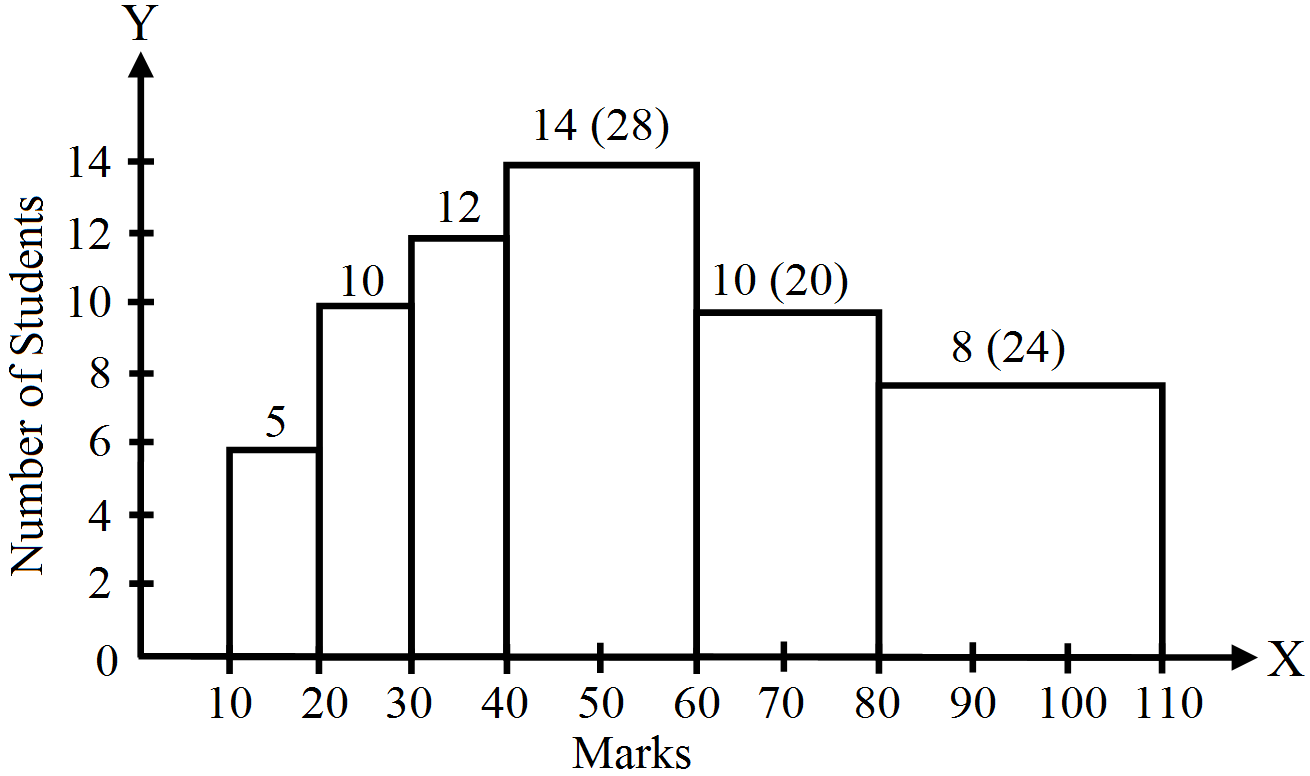
The above distribution has unequal class intervals. Therefore, the frequencies will be adjusted.
Frequency distribution of given data with adjusted frequencies is shown below:
Marks Number of Students Adjusted Frequency
10-20 5 $\frac{10}{10}\times5=5$
20-30 10 $\frac{10}{10}\times10=10$
30-40 12 $\frac{10}{10}\times12=12$
40-60 28 $\frac{10}{20}\times28=14$
60-80 20 $\frac{10}{20}\times20=10$
80-110 24 $\frac{10}{30}\times24=8$
Histogram based on above distribution is shown below:
View full question & answer
Question 426 Marks
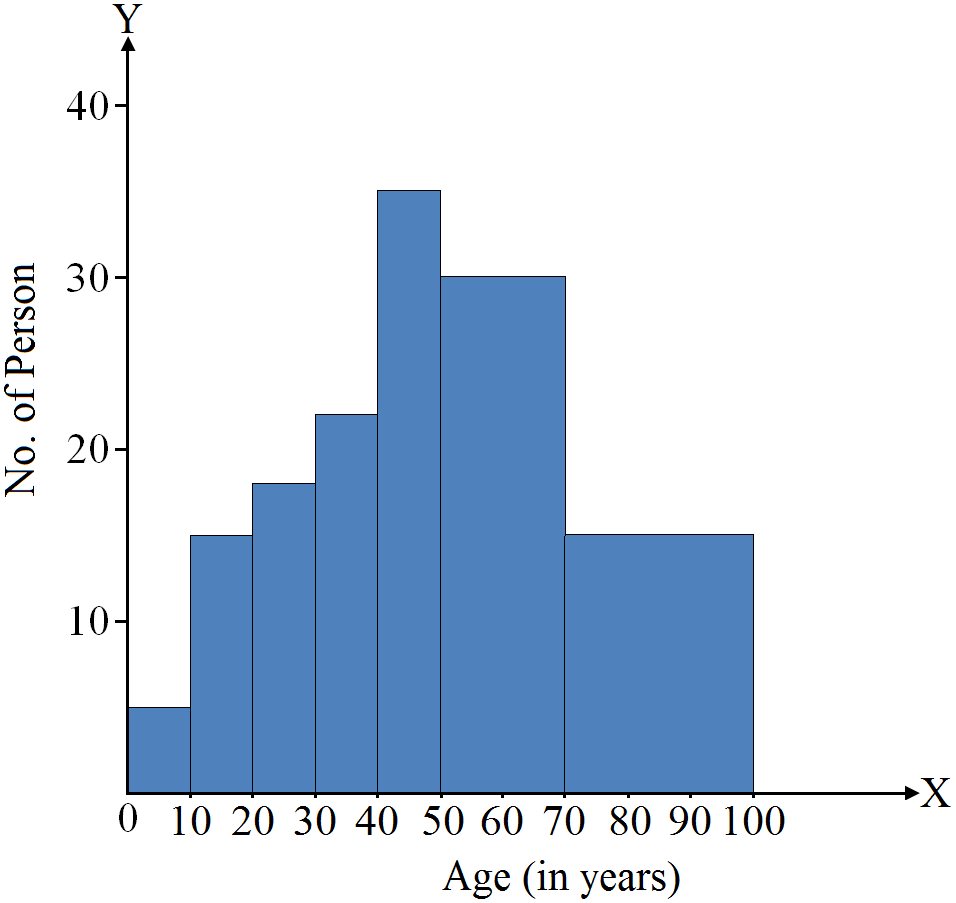
Draw a histogram of the following data:
Age (in years)
0-10
10-20
20-30
30-40
40-50
50-70
70-100
No. of Persons
5
15
18
22
35
30
15
Answer
Age (in years) No. of Persons Adjusted Frequency
0-10 5 $\frac{0}{10}\times5=5$
10-20 15 $\frac{10}{10}\times15=15$
20-30 18 $\frac{10}{10}\times18=18$
30-40 22 $\frac{10}{10}\times22=22$
40-50 35 $\frac{10}{10}\times35=35$
50-70 30 $\frac{10}{20}\times30=15$
70-100 15 $\frac{10}{30}\times15=5$
Histogram in case of unequal class intervals:
View full question & answer
Question 436 Marks
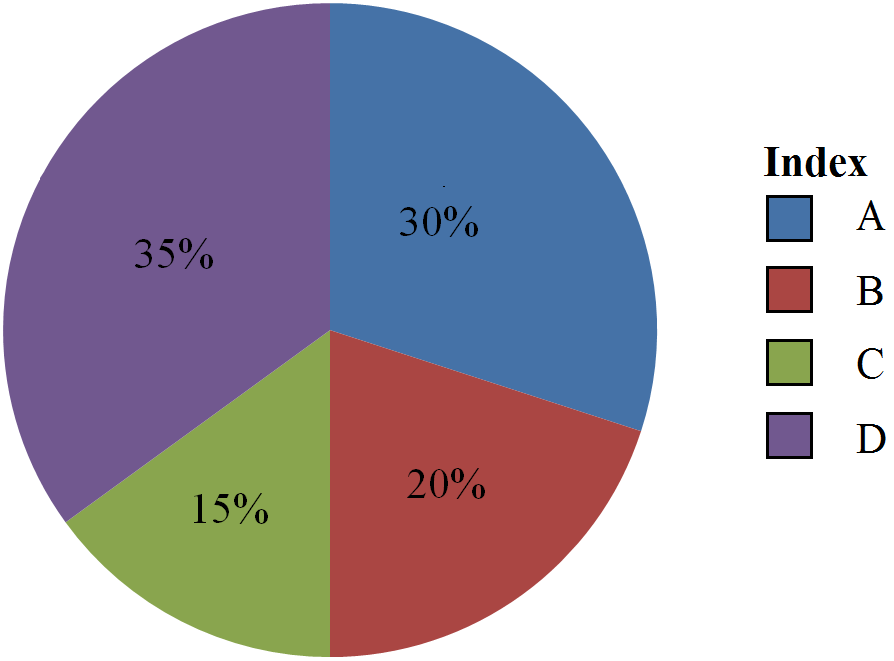
Draw a pie diagram for the following data:
Items
A
B
C
D
Expenditure of family in percentage
30
20
15
35
Answer
Items
% of expenditure
Angular component
A
30
30 × 3.6° = 108°
B
20
20 × 3.6° = 72°
C
15
15 × 3.6° = 54°
D
35
35 × 3.6° = 126°
Total
100
360°
View full question & answer
Question 446 Marks
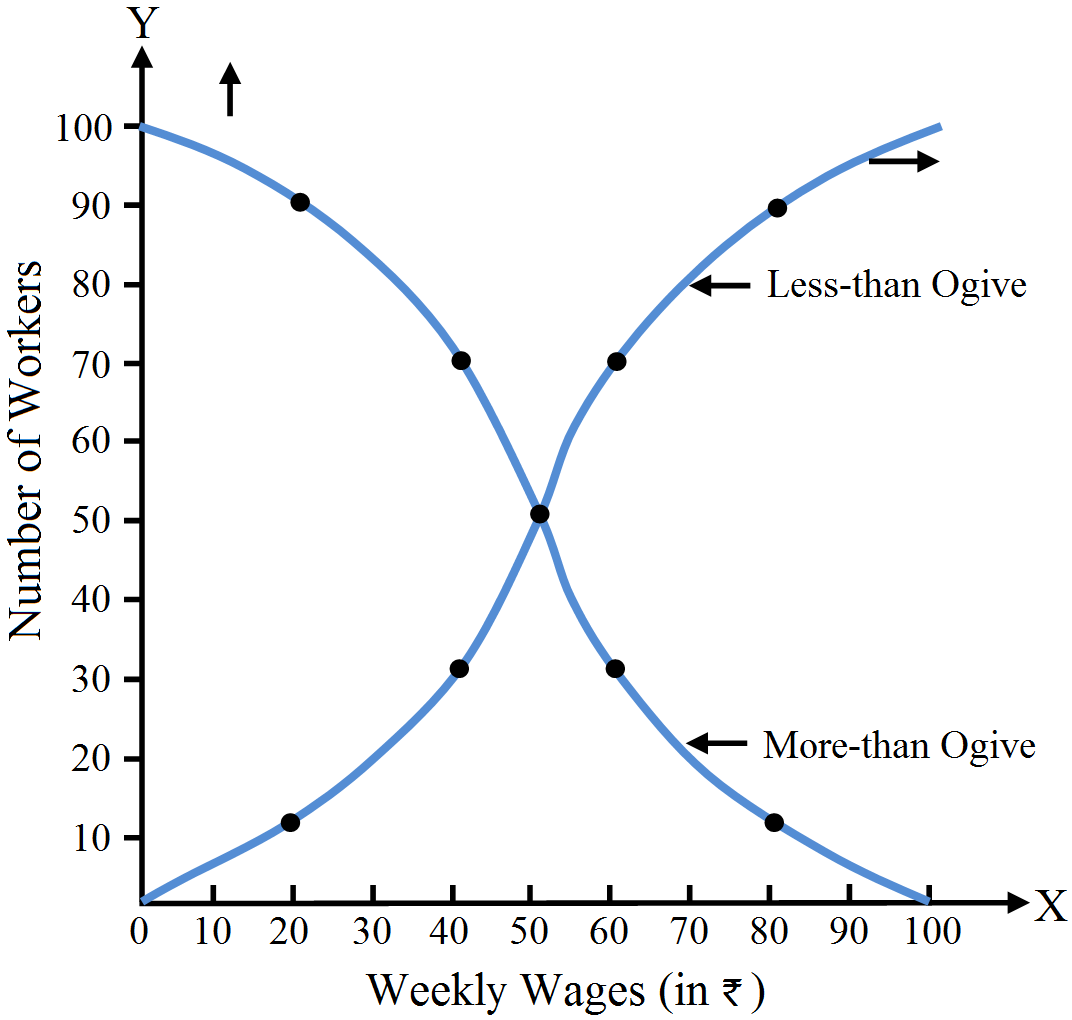
Draw the 'less-than' and 'more-than'ogive from the data given below:
Weekly Wages (in ₹)
Number of Workers
0-20
10
20-40
20
40-60
40
60-80
20
80-100
10
Answer
For less-than and more-than ogives we will have to prepare less-than and more-than frequency distributions.
Less-than Distribution
More-than Distribution
 
Weekly Wages (in ₹)
Number of Workers
Weekly Wages (in ₹)
Number of Workers
Less than 20
10
More than 10
100
Less than 40
30
More than 20
90
Less than 60
70
More than 40
70
Less than 80
90
More than 20
30
Less than 100
100
More than 10
10
The 'less-than' and ‘more-than' ogives of the given data are shown below:
View full question & answer
Question 456 Marks
Explain merits and demerits of graphic presentation.
Answer
Merits:
  1. Attractive and Impressive: Graphs are attractive and impressive.
  2. Simple and easily understandable: Graphs are easy and simple to understand. Knowledge of mathematics is not required to understand graphs.
  3. Useful in Comparison: Graphs prove very useful in comparing data from one year to another or otherwise.
  4. Helps to understand trend: Graphs help us to understand trend in a variable.
  5. Helps to measure statistical averages: Graphs are used to measure some statistical tools like median, mode, quartiles and correlation etc. (Helps to understand shape of the distribution: We can use graphical presentation to understand if a curve is normal or skewed; if it is upward sloping or downward sloping etc.
  6. Helps in forecasting: It helps us to predict future values on the basis of past statistics.
  7. Graphs are useful in all fields: From sports to education to medical and engineering, in all fields we make use of graphs. They are specifically useful for policy formulation and decision making.
Disadvantages of Graphic Presentation:
  1. Time Consuming: Graph making is a time consuming task.
  2. Layman Can't Understand: A layman cannot understand and interpret the data represented graphically.
  3. Not suitable for all types of data: Graphs are not suitable for all types of data.
View full question & answer
Question 466 Marks
Enumerate the features of a good diagrammatic presentation.
Answer
A good diagrammatic presentation should have the following features:
  1. The presentation should be attractive.
  2. It should communicate the required information effectively.
  3. The presentation should be accurate.
  4. The diagrams drawn to present the data should be proportionate in height and width.
  5. As far as possible, the diagrammatic presentation should be self-explanatory. Words and calculation should be avoided in a diagrammatic presentation.
  6. The presentation should be simple and easy to understand.
  7. The size of the diagram should be proportionate to the size of the paper.
  8. In diagrammatic presentation, vertical diagrams should be preferred over horizontal presentation.
  9. A diagrammatic presentation should be accompanied with suitable headings.
  10. The scale of the presentation should be carefully selected and should be indicated along with the presentation.
  11. Different colours and signs should be used for presenting data on different variables. In this presentation, diagrams should be drawn either from left to right or from bottom to top.
  12. The data on the basis of which the diagrams are drawn, should be clearly mentioned.
View full question & answer
Question 476 Marks
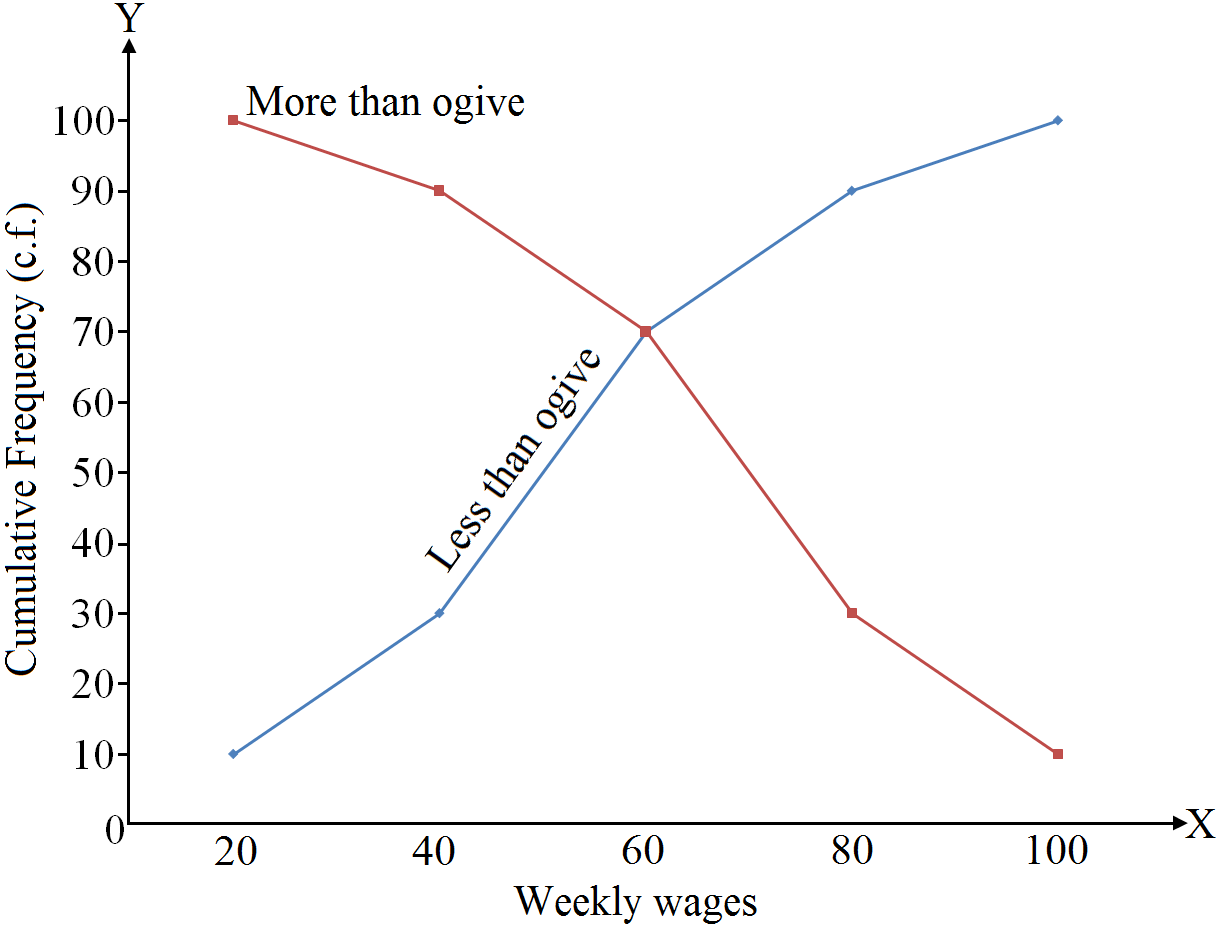
Draw 'less than' and 'more than' ogive curves from the following:
Weekly Wages
0-20
20-40
40-60
60-40
80-100
No. od Workers
10
20
40
20
10
Answer
Weekly wages
No. of workers
c.f. (less than
c.f. (more than)
0-20
10
10
100
20-40
20
30
90
40-60
40
70
70
60-80
20
90
30
80-100
10
100
10
 
$\Sigma\text{f}=100$
   
View full question & answer
Question 486 Marks
Explain in brief steps involved in construction of a pie diagram.
Answer
Different steps in construction of a pie diagram are given below:
  1. Convert all the values as a percentage of total value.
  2. Convert the various observations in percent) in the data set into corresponding degrees in the circle by multiplying each by 3.6 (360%100).
  3. If you wish to convert the values directly into degrees, you can use a formula.
  4. Draw a circle of appropriate size with a compass. Size of circle depends on space available and number of sub items in pie diagram. If two or more pie chart are beings drawn which are to be compared then radii of all these must be equal.
  5. Draw points on the circle according to the size of each portion of the data with the help of a protractor and join each of these points to the center of the circle. It is a common practice to keep the largest components at 12 O'clock position in the circle.
  6. Different components should be distinguished from each other by using either different shades or colours.
  7. A proper index explaining shades or colours used for different items should be drawn.
View full question & answer
Question 496 Marks
Plot the time series graph for the given information:
Years
2015
2016
2017
2018
2019
Exports (₹ in '000)
50
100
120
80
40
Profit (₹ in '000)
10
40
80
50
90
View full question & answer
Question 506 Marks
Represent the following data with the help of an appropriate bar diagram.
Years
2014
2015
2016
2017
2018
Foodgrain production in India (in lakh tonnes)
1300
1800
1600
2000
1500
Answer
Simple Bar Diagram
View full question & answer
Question 516 Marks
What are the essential parts of a statistical table? Explain any four.
Answer
A good table should essentially have the following parts:
  1. Table number.
  2. Title.
  3. Caption or Column Head.
  4. Stub or Row Head.
  5. Body of the table.
  6. Source note.
  7. Foot note.
  • Table Number is essential for the purpose of identification. If in a chapter more than one table is presented then it is essential to number them like 2.1, 2.2 ......, etc. It is given at the top of the table.
  • Title tells us about the content of the table. It has to be short, clear and carefully worded. It is placed below the table number.
  • Caption At the top of each of the column in a table a column designation is provided to explain the columns. This is known as "Caption” or “Column Head”.
  • Stub Each row of the table has to be given a heading. The designation of the heading to the rows is called “Stub”. The left most column of the table is known as Stub with Stub Head and Stub Entries.
View full question & answer
Question 526 Marks
What are different types of tables? Explain with examples.
Answer
  1. On the basis of construction:
Simple table: It is a table which reflects only one variable at a time. It is very simple to draw. It is also called one-way table. Its example is given below:
Number of Employees in an organization according to age Group
Age (in Year) No. of Employees
Below 25 50
25-35 67
35-45 43
45-55 15
5 and above 5
Total 180
  1. Complex tables: It is a table which represents two or more variables in one table. It may be two way or three way or more than type of variables.
  1. Two-way table: It represents two variables. An example of two way table is given below:
Tables showing grades of boys and girls of class
 
Grade
A
B
C
Total
Boys
13
25
11
49
Girls
7
20
6
33
Total
20
45
17
82
  1. Three-Way Table gives information regarding three mutually dependent and inter-related questions. For example, from one-way table, we get information about age, and from two-way iable, we get information about the number of male and female available in various grades. A three way table is showing.
  • Population in various division.
  • Their sex-wise distribution
  • Their position of literacy.
Division
Three-Way Table
Population (Millions)
Male
Female
Tatal
Litrarate
Illiterate
Total
Literate
Illiterate
Total
Literate
Illiterate
Total
Delhi


Mumbai


Chennai


Kolkata


  1. Higher Order Tables: Manifold (or Higher Order) Table: Such tables provide information about a large number of interrelated characteristics in the data set.
State
Neonatal Mortality
Post-neonatak Mortality
Child Mortality (12-47 months)
Male
Female
F/ M ratio
Male
Female
F/ M ratio
Male
Female
F/ M ratio
Northern region


Delhi
36.2
30.3
0.83
24.1
34.1
1.41
13.6
21.2
1.56
Haryana
47.1
37.6
0.80
28.8
45.9
1.59
18.4
34.2
2.34
Hinmachal Pradesh
41.6
34.4
0.83
25.6
28.5
1.11
17.6
25.3
1.44
Punjab
32.9
27.0
0.82
22.8
22.1
0.97
12.7
23.0
1.81
North-central region


Bihar
64.0
50.0
0.78
37.3
42.4
1.13
34.5
53.5
1.55
Madhya Pradesh
63.1
49.5
0.78
36.5
43.4
1.19
46.7
56.8
1.22
Rajansthan
43.3
42.0
0.97
31.3
37.5
1.20
26.5
42.2
1.59
Uttar Pradesh
71.1
68.3
0.96
41.5
51.6
1.24
38.5
65.5
1.70
Eastern region


Assam
63.0
47.9
0.76
37.9
36.4
0.96
52.9
59.6
1.13
 
View full question & answer
Question 536 Marks
What guidelines will you keep in mind while constructing a diagram?
Answer
The following general guidelines are taken into consideration while preparing diagrams:
  1. Title: Each diagram should have a suitable title. It may be given either at the top of the diagram or below it. The title must convey the main theme which the diagram intends to portray.
  2. Size: The size and portion of each component of a diagram should be such that all the relevant characteristics of- the data are properly displayed and can be easily understood.
  3. Proportion of length and breadth: An appropriate proportion between the length and breadth of the diagram should be maintained. As such there are no fixed rules about the ratio of length to width.
  4. Proper scale: There are again no fixed rules for selection of scale. The diagram should neither be too small nor too large. The scale for the diagram should be decided after taking into consideration the magnitude of data and the size of the paper on which it is to be drawn. The scale showing the values as far as possible should be in even numbers or in multiples of 5, 10, 20, and so on. The scale should specify the size of the unit and the nature of data it represents, for example, 'millions of tonnes', in ₹ thousand, and the like. The scale adopted should be indicated on both vertical and horizontal axes if different scales are used. Otherwise, it can be indicated at some suitable place on the graph paper.
  5. Footnotes and source note: To clarify or elucidate any points which need further explanation but cannot be shown in the graph, footnotes are given at the bottom of the diagrams.
  6. Index: A brief index explaining the different types of lines, shades, designs, or colours used in the construction of the diagram should be given to understand its contents.
  7. Simplicity: Diagrams should be prepared in such a way that they can be understood easily. To keep it simple, too much information should not be loaded in a single diagram as it may create confusion. Thus if the data are large, then it is advisable to prepare more than one diagram, each depicting some identified characteristic of the same data.
View full question & answer
Question 546 Marks
Draw less than and more than ogive (cumulative frequency curve) using the given data:
Marks Scored
10-20
20-30
30-40
40-50
No. of Students
5
10
30
5
Answer
Firstly, we will convert the given data into less than and more than frequency distribution.
Marks Scored
Number of Students
c.f. (less than)
c.f. (more than)
10-20
5
5
50
20-30
10
15
45
30-40
30
45
35
40-50
5
50
5
View full question & answer
Question 556 Marks
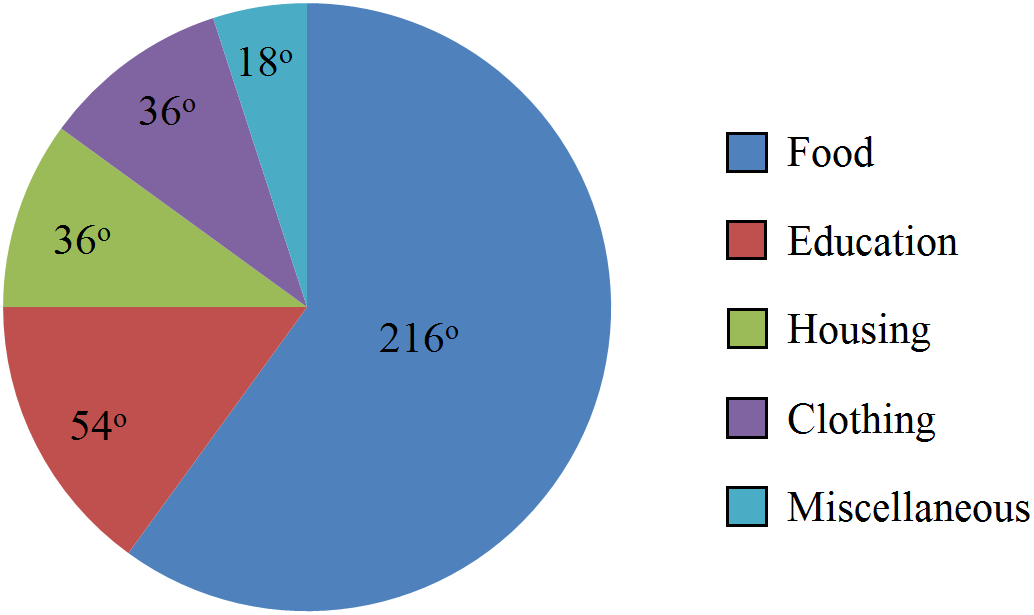
Draw pie diagram to represent the following information of expenditure by a family:
Items of Expenditure Food Education Housing Clothing Miscellaneous
% age of total expenditure 60 15 10 10 5
Answer
Items of expenditure % age of total expenditure Angular component
Food 60 60 × 3.6º = 160º
Education 15 15 × 3.6º = 54º
Housing 10 10 × 3.6º = 36º
Clothing 10 10 × 3.6º = 36º
Miscellaneous 5 5 × 3.6º = 18º
Total 100 360º
View full question & answer
Question 566 Marks
Construct a pie diagram to represent the cost of construction of a house in Delhi:
Items
Labour
Bricks
Cement
Steel
Timber
Supervision
Expenditure (%)
25
15
20
15
10
15
Answer
Items
Expenditure
Angular component
Labour
25
25 × 3.6° = 90°
Bricks
15
15 × 3.6° = 54°
Cement
20
20 × 3.6° = 72°
Steel
15
15 × 3.6° = 54°
Timber
10
10 × 3.6° = 36°
Supervision
15
15 × 3.6° = 54°
Total
100
360°
View full question & answer
Question 576 Marks
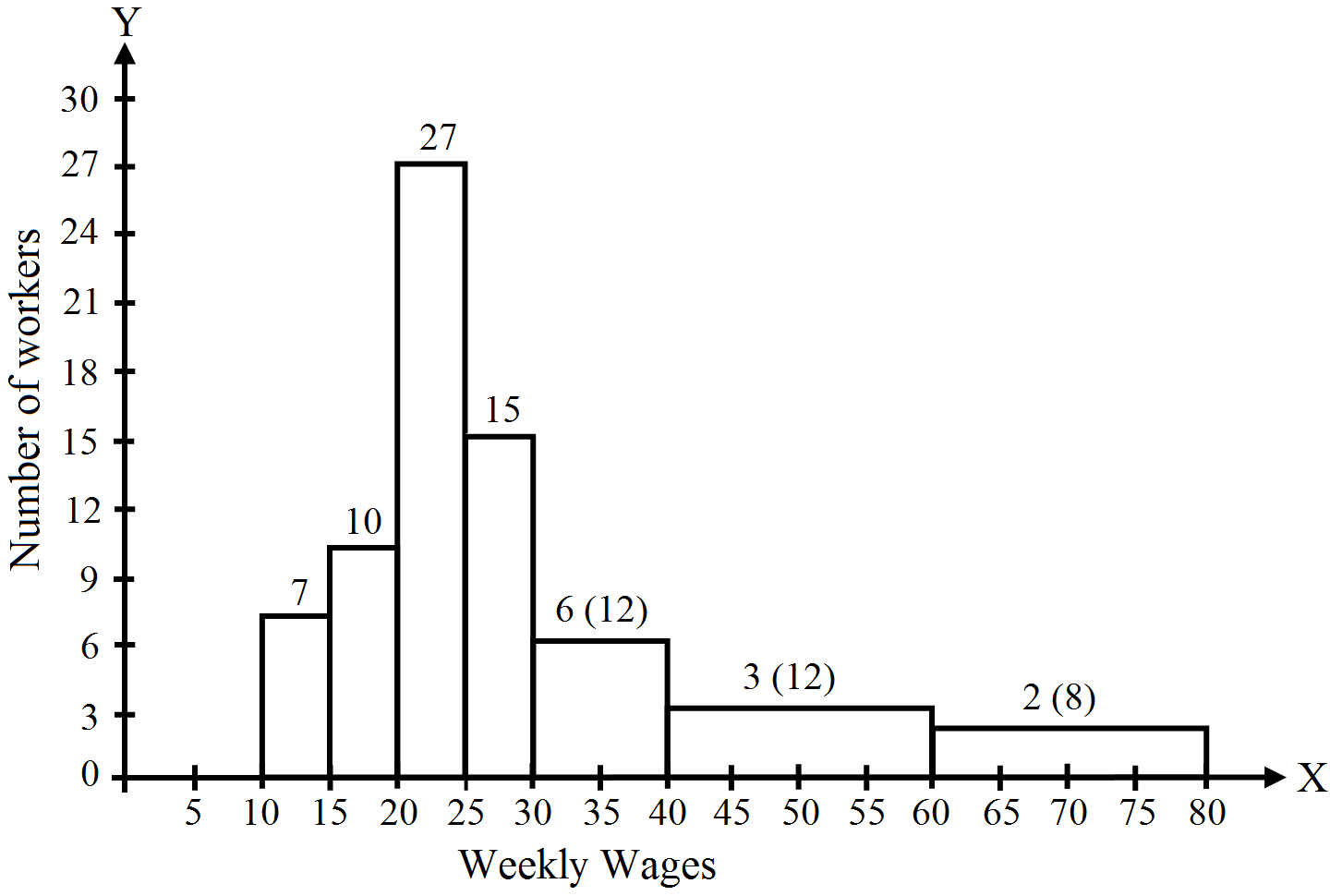
Present the following data in the form of histogram.
Weekly wages (in ₹)
Number of Woekers
10-15
7
15-20
10
20-25
27
25-30
15
30-40
12
40-60
12
60-80
8
Answer
As per the question, unequal distribution of weekly wages are given. Before plotting histogram, first of all we should adjust the frequency.
Frequency distribution of given data with adjusted frequencies is shown below:
Weekly wages (in ₹)
Number of Woekers
Adjusted Frequency
10-15
7
$\frac{5}{5}\times7=7$
15-20
10
$\frac{5}{5}\times10=10$
20-25
27
$\frac{5}{5}\times27=27$
25-30
15
$\frac{5}{5}\times15=15$
30-40
12
$\frac{5}{10}\times12=6$
40-60
12
$\frac{5}{20}\times12=3$
60-80
8
$\frac{5}{20}\times8=2$
A histogram in case of unequal class intervals is shown below:

Note:
  • Adjusted Frequency $=\frac{\text{Minimum Interval }\times\text{ Class Frequency}}{\text{Class Internal}}$
  • Fingures in bracket show actual frequency.
View full question & answer
Question 586 Marks
With the given data below, draw a histogram and a frequency polygon:
Marks
0-10
10-20
20-30
30-40
40-50
No. of Students
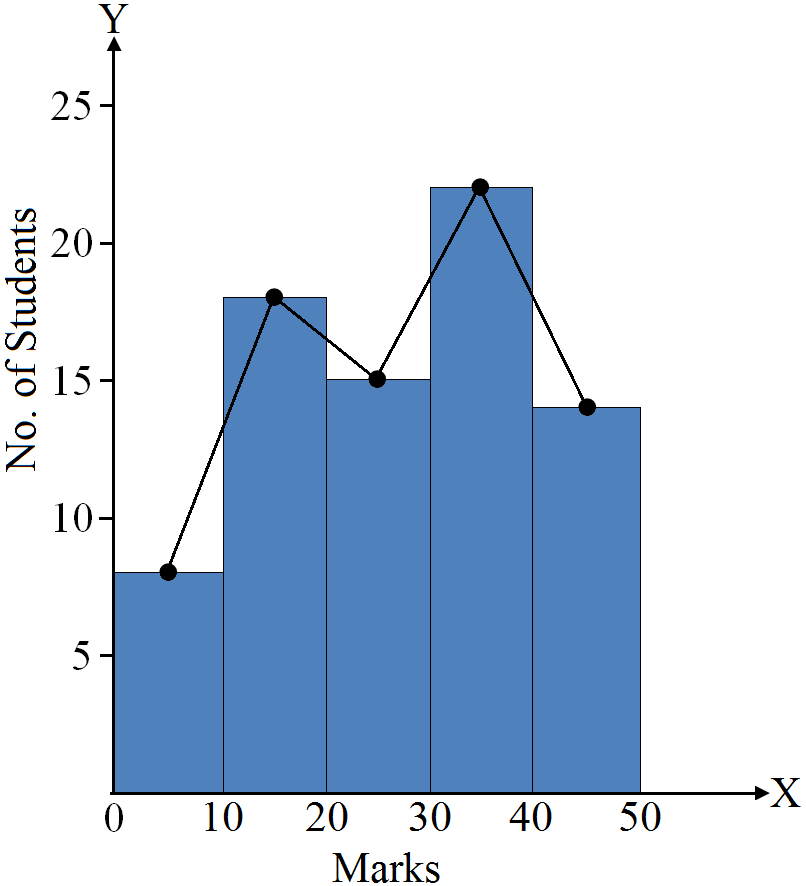
8
18
15
22
14
Answer
Histogram and Frequency Polygon
View full question & answer
Question 596 Marks
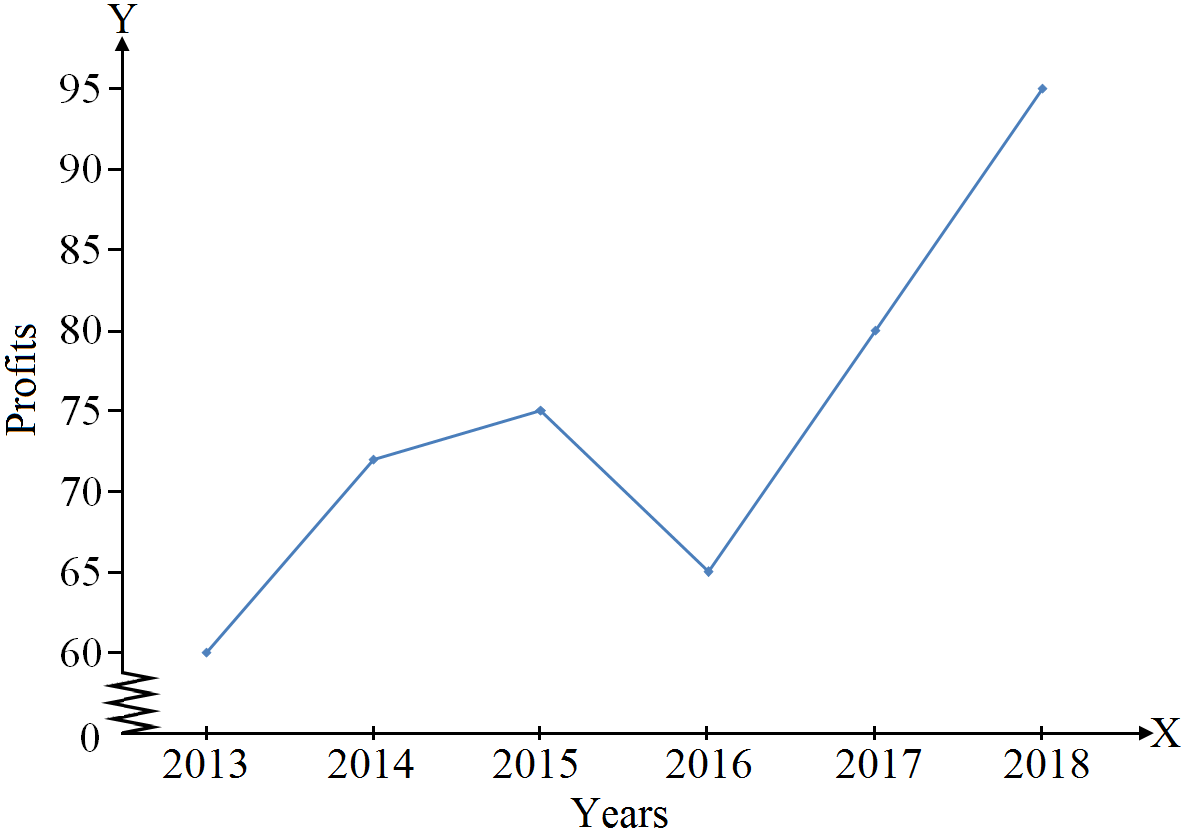
Represent the following data of annual profits of a firm through a time series graph:
Years
2013
2014
2015
2016
2017
2018
Profits (in '000 ₹)
60
72
75
65
80
95
Answer
Time Series Graph
View full question & answer
Question 606 Marks
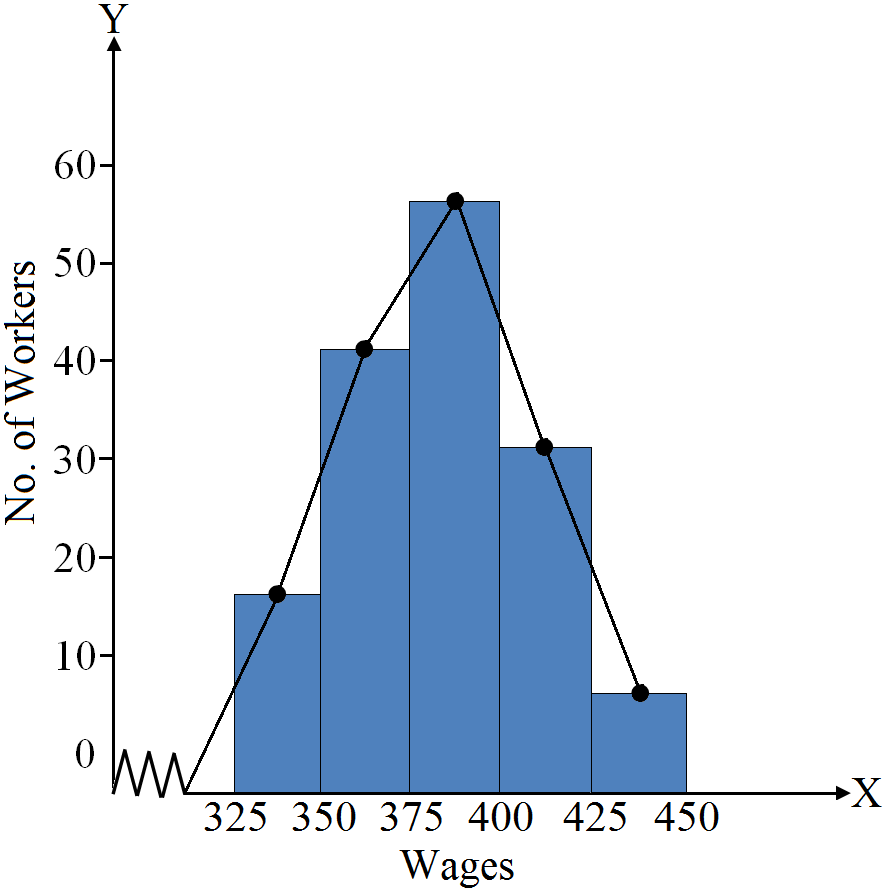
Represent the following data by means of a frequency polygon:
Wages (in ₹)
325-350
350-375
375-400
400-425
425-450
No. of woekers
20
45
60
35
10
Answer
Wages (in ₹)
No. of Worlers (f)
325-350
20
350-375
45
375-400
60
400-425
35
425-450
10
View full question & answer