Questions

5 Marks Questions

Take a timed test

46 questions · self-marked practice — reveal the answer and mark yourself.

Question 15 Marks
  1. Following are the transition metal ions of $3d$ series:
$Ti^{4+}, V^{2+}, Mn^{3+}, Cr^{3+}$

$($Atomic numbers : $Ti = 22, V = 23, Mn = 25, Cr = 24)$

Answer the following:
  1. Which ion is most stable in an aqueous solution and why?
  2. Which ion is a strong oxidising agent and why?
  3. Which ion is colourless and why?
  1. Complete the following equations:
  1. $2\text{ }\text{MnO}_4^-+16\text{ }\text{H}^++5\text{ }\text{S}^{2-}\xrightarrow{\text{ }\text{ }\text{ }\text{ }\text{ }\text{ }\text{ }\text{ }\text{ }\text{ }\text{ }}$
  1. $\text{KMnO}_4\xrightarrow{\text{ }\text{ }\text{ }\text{ }\text{ }\text{heat}\text{ }\text{ }\text{ }\text{ }\text{ }}$
Answer
  1.  
  1. $Cr^{3+},$ half filled $t^3\ 2g$
  2. $Mn^{3+},$ due to stable $d^5$ configuration in $Mn^{2+}$
  3. $Ti^{4+},$ No unpaired electrons
  1.  
  1. $2MnO_4^- + 16H^+ +5S^{2-}\longrightarrow 5S + 2Mn^{2+} + 8H_2O$
  2. $2KMnO^4 \longrightarrow K_2MnO_4 + MnO_2 + O_2$
View full question & answer
Question 25 Marks
Match the catalysts given in Column I with the processes given in Column II.
 
Column I (Catalyst)
 
Column II (Process)
(i)
Ni in the presence of hydrogen
(a)
Zieglar Natta catalyst
(ii)
$Cu_2Cl_2$
(b)
Contact process
(iii)
$V_2O_5$
(c)
Vegetable oil to ghee
(iv)
Finely divided iron
(d)
Sandmeyer reaction
(v)
$TiCl_4 + Al (CH_3)_3$
(e)
Haber’s Process
 
 
(f)
Decomposition of $KClO_3$
Answer
 
Column I (Catalyst)
 
Column II (Process)
(i)
Ni in the presence of hydrogen
(c)
Vegetable oil to ghee
(ii)
$Cu_2Cl_2$
(d)
Sandmeyer reaction
(iii)
$V_2O_5$
(b)
Contact process
(iv)
Finely divided iron
(e)
Haber’s Process
(v)
$TiCl_4 + Al (CH_3)_3$
(a)
Zieglar Natta catalyst
Explanation:
Catalyst $\rightarrow$ Process
$Ni$ in presence of $H_2\rightarrow$ Vegetable oil to ghee
$Cu_2Cl_2\rightarrow$ Sandmayer reaction
$V_2O_5\rightarrow$ Contact process
Finely divided iron $\rightarrow$ Haber’s process
$TiCl_4+ Al(CH_3)_3\rightarrow$ Zieglar Natta catalyst
View full question & answer
Question 35 Marks
Answer the following questions: Give chemical reactions for the following observations:
  1. Potassium permanganate is a good oxidising agent in basic medium.
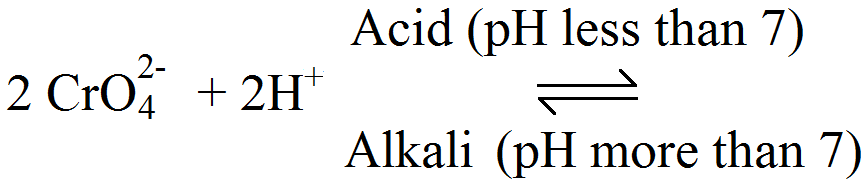
  2. Inter convertibility of chromate ion and dichromate ion in aqueous solution depends upon pH of the solution.
  3. Potassium permanganate is thermally unstable at 513K.
Answer
  1. ​​​​​
$\ \ \ \ \ \ \ \ \ \ \text{MnO}^-_4+2\text{H}_2\text{O}+3\text{e}^-\xrightarrow{ \ \ \ \ \ \ \ \ \ \ }\text{MnO}_2+4\text{OH}\times2\\ \ \ \ \ \ \ \ \ \ \ \ \ \ \ \ \ \ \ \ \ \ \ \ \ \ \ \ \ \ \text{I}^-+6\text{OH}\xrightarrow{\ \ \ \ \ \ \ \ \ \ \ }\text{IO}^-_3+3\text{H}_2\text{O}+6\text{e}^-\\\underline{\overline{2\text{MnO}^-_4+\text{I}^-+\text{H}-2\text{O}\xrightarrow{ \ \ \ \ \ \ \ \ \ }\text{IO}^-3+2\text{MnO}_2+2\text{OH}^-}}$
  1.  
  1.  
$2\text{KMnO}_4\xrightarrow{613\text{ K}}\text{K}_2\text{MnO}_4+\text{MnO}_2+\text{O}_2$
View full question & answer
Question 45 Marks
  1. Complete the following chemical reaction equations:
i. $\text{MnO}_{4(aq)}^{-}+\text{C}_{2}\text{O}_{4(aq)}^{2-}+\text{H}^{+}_{(aq)}\rightarrow$

ii. $\text{Cr}_{2}\text{O}_{7(aq)}^{2-}+\text{Fe}^{2+}_{(aq)}+\text{H}_{(aq)}^{+}\rightarrow$
  1. Explain the following observations about the transition/inner transition elements:
  1. There is in general an increase in density of element from titanium (Z=22) to copper (Z=29).
  2. There occurs much more frequent metal-metal bonding in compounds of heavy transition elements (3rd series).
  3. The members in the actinoid series exhibit a larger number of oxidation states than the corresponding members in the lanthanoid series.
Answer
  1.  
i. $\text{5C}_{2}\text{O}_{4}^{2-}+\text{2MnO}_{4}^{-}+\text{16H}^{+}\rightarrow\text{2Mn}^{2+}+\text{8H}_{2}\text{O}+\text{10CO}_{2}$

ii. $\text{Cr}_{2}\text{O}_{7}^{2-}+\text{14H}^{+}+\text{6Fe}^{2+}\rightarrow\text{2Cr}^{3+}+\text{6Fe}^{3+}+\text{7H}_{2}\text{O}$
  1.  
  1. Because of decrease in atomic size from titanium to copper.
  2. Because of high enthalpies of atomization of heavy transition elements.
  3. Because of comparable energies of 5f ,6d and 7s orbitals in the actinoid series.
View full question & answer
Question 55 Marks
  1. Describe the general trends in the following properties of the first series of the transition elements:
  1. Stability of +2 oxidation state.
  2. Formation of oxometal ions.
  1. Assign reason for each of the following:
  1. Transition elements exhibit variable oxidation states.
  2. Transition metal ions are usually coloured.
Answer
  1.  
  1. The stability increases with an increase in atomic number from Mn to Zn. Sc does not exhibit, Ti, V and Cr exhibit but are not stable.
  2. Corresponding to the highest oxidation state (3d+4s) electrons, the stability of oxometal cations increases from Ti to Mn, therefore there is practically no oxometal cation.
  1.  
  1. This is due to the incomplete filling of d-orbitals involved in their oxidation processes.
  2. Due to the presence of unpaired electrons or d-d transition.
View full question & answer
Question 65 Marks
  1. Why do transition elements show variable oxidation states?
  1. Name the element showing maximum number of oxidation states among the first series of transition metals form Sc (Z=21) to Zn (Z=30).
  2. Name the element which shows only +3 oxidation state.
  1. What is lanthanoid contraction? Name an important alloy which contains some of the lanthanoid metals.
Answer
  1. Because of incomplete filling of d-orbitals.
  1. Mn.
  2. Scandium (Sc).
  1. There is a steady decrease in the size of atoms/ions with increase in atomic number in lanthanoid. Misch metal.
View full question & answer
Question 75 Marks
a. i. How is the variability in oxidation states of transition metals different from that of the p-block elements?
ii. Out of $Cu ^{+}$and $Cu ^{2+}$, which ion is unstable in aqueous solution and why?
iii. Orange colour of $Cr _2 O _7{ }^{2-}$ ion changes to yellow when treated with an alkali. Why?
b. Chemistry of actinoids is complicated as compared to lanthanoids. Give two reasons.
Answer
a.
i. In p block elements the difference in oxidation state is 2 and in transition metals the difference is 1.
ii. $Cu ^{+}$, due to disproportionation reaction/low hydration enthalpy.
iii. Due to formation of chromate ion/ $CrO _4{ }^{2-}$ ion, which is yellow in colour.
b. Actinoids are radioactive, actinoids show wide range of oxidation states.
View full question & answer
Question 85 Marks
Answer the following questions:
Describe the preparation of potassium permanganate from pyrolusite ore. Write balanced chemical equation for one reaction to show the oxidizing nature of potassium permanganate.
Answer
Conversion of pyrolusite $(MnO_2)$ into potassium manganate $(K_2MnO_4).$
$2\text{MnO}_2+4\text{KOH}+\text{O}_2\xrightarrow{\ \ \ \ \ \ \ \ \ \ \ }2\text{K}_2\text{MnO}_4+2\text{H}_2\text{O}$
Electrolytic oxidation:
$\text{K}_2\text{MnO}^-_4\rightleftharpoons2\text{K}'+\text{MnO}^{2-}_4$
At anode: $\text{MnO}^{2-}_{4}\xrightarrow{\ \ \ \ \ \ \ \ \ }\text{MnO}^-_4+\text{e}^-$
At cathode: $\text{H}^++\text{e}^-\xrightarrow{\ \ \ \ \ \ \ \ \ }\text{H},2\text{H}\xrightarrow{\ \ \ \ \ \ \ \ \ }\text{H}_2$
It oxidises oxalate to carbon dioxide $(CO_2)$ in acidic medium.
$\ \ \ \ \ \ \ \ \ \ \ \ \ \ \ \ \text{Mno}^-_4+8\text{H}^++5\text{e}\xrightarrow{\ \ \ \ \ \ \ \ \ }\text{Mn}^{2+}+4\text{H}-2\text{O}]\times2\\ \ \ \ \ \ \ \ \ \ \ \ \ \ \ \ \ \ \ \ \ \ \ \ \ \ \ \ \ \ \ \ \ \ \ \ \ \ \ \ \ \ \ \ \ \ \ \ \text{C}_2\text{O}^2_4\xrightarrow{\ \ \ \ \ \ \ \ \ }2\text{CO}_2+2\text{e}^-]\times5\\\underline{\overline{2\text{MnO}^-_4+5\text{C}_2\text{O}^{2-}_4+16\text{H}^+\xrightarrow{\ \ \ \ \ \ \ \ \ \ }2\text{Mn}^{2+}+10\text{CO}_2+8\text{H}_2\text{O}}}$
View full question & answer
Question 95 Marks
Match the compounds/elements given in Column I with uses given in Column II.
 
Column I (Compound/element)
 
Column II (Use)
(i)
Lanthanoid oxide
(a)
Production of iron alloy
(ii)
Lanthanoid
(b)
Television screen
(iii)
Misch metal
(c)
Petroleum cracking
(iv)
Magnesium based alloy is constituent of
(d)
Lanthanoid metal + iron
(v)
Mixed oxides of lanthanoids are employed
(e)
Bullets
 
 
(f)
In X-ray screen
Answer
 
Column I (Compound/element)
 
Column II (Use)
(i)
Lanthanoid oxide
(b)
Television screen
(ii)
Lanthanoid
(a)
Production of iron alloy
(iii)
Misch metal
(d)
Lanthanoid metal + iron
(iv)
Magnesium based alloy is constituent of
(e)
Bullets
(v)
Mixed oxides of lanthanoids are employed
(c)
Petroleum cracking
Explanation:

Compound/ element- use
  1. Lanthanoid oxide /television screen
  2. Lanthanoid – production of iron alloy
  3. Misch metal- Lanthanoid metal + iron
  4. Magnesium based alloy- bullets
  5. Mixed oxide of lanthanoids are employed – petroleum cracking.
View full question & answer
Question 105 Marks
Match the property given in Column I with the element given in Column II.
 
Column I (Property)
 
Column II (Element)
(i)
Lanthanoid which shows $+4$ oxidation state
$(a)$
$Pm$
(ii)
Lanthanoid which can show $+2$ oxidation state
$(b)$
$Ce$
(iii)
Radioactive lanthanoid
$(c)$
$Lu$
(iv)
Lanthanoid which has $4f^7$ electronic configuration in +3 oxidation state
$(d)$
$Eu$
(v)
Lanthanoid which has $4f^{14}$ electronic configuration in +3 oxidation state
$(e)$
$Gd$
 
 
$(f)$
$Dy$
Answer
 
Column I (Property)
 
Column II (Element)
(i)
Lanthanoid which shows $+4$ oxidation state
(b)
$Ce$
(ii)
Lanthanoid which can show $+2$ oxidation state
(d)
$Eu$
(iii)
Radioactive lanthanoid
(a)
$Pm$
(iv)
Lanthanoid which has $4f^7$ electronic configuration in +3 oxidation state
(e)
$Gd$
(v)
Lanthanoid which has $4f^{14}$ electronic configuration in +3 oxidation state
(c)
$Lu$
Explanation:
  1. Lanthanoid shows $+4$ oxidation state- Cerium $(Ce)$
  2. Lanthanoid shows $+2$ oxidation state- Europium $(Eu)$
  3. Radioactive lanthanoid – Promethium $(Pm)$
  4. Lanthanoid having $4f^7$ configuration in $+3$ states – Gadolinium $(Gd)$
  5. Lanthanoid having $4f^{14}$ configuration in $+3$ states – Lutetium $(Lu)$
View full question & answer
Question 115 Marks
Comment on the statement that elements of the first transition series possess many properties different from those of heavier transition elements.
Answer
The properties of the elements of the first transition series differ from those of the heavier transition elements in many ways.
  1. The atomic sizes of the elements of the first transition series are smaller than those of the heavier elements (elements of 2ndand 3rdtransition series).
However, the atomic sizes of the elements in the third transition series are virtually the same as those of the corresponding members in the second transition series. This is due to lanthanoid contraction.
  1. +2 and +3 oxidation states are more common for elements in the first transition series, while higher oxidation states are more common for the heavier elements.
  2. The enthalpies of atomisation of the elements in the first transition series are lower than those of the corresponding elements in the second and third transition series.
  3. The melting and boiling points of the first transition series are lower than those of the heavier transition elements. This is because of the occurrence of stronger metallic bonding (M-M bonding).
  4. The elements of the first transition series form low-spin or high-spin complexes depending upon the strength of the ligand field. However, the heavier transition elements form only low-spin complexes, irrespective of the strength of the ligand field.
View full question & answer
Question 125 Marks
  1. Account for the following:
  1. Transition metals show variable oxidation states.
  2. $Zn, Cd$ and $Hg$ are soft metals.
  3. $E^o$ value for the $Mn^{3+}/Mn^{2+}$ couple is highly
positive $(+ 1·57\ V)$ as compared to $Cr^{3+}/Cr^{2+}.$
  1. Write one similarity and one difference between the chemistry of lanthanoid and actinoid elements.
Answer
  1.  
  1. Availability of partially filled d-orbitals/comparable energies of ns and $(n-1)$ d orbitals.
  2. Completely filled d-orbitals/absence of unpaired d electrons cause weak metallic bonding.
  3. Because $Mn^{2+}$ has $d^5 $ as a stable configuration whereas $Cr^{3+}$ is more stable due to stable $t^3\ 2g.$
  1. Similarity- both are stable in $+3$ oxidation state/both show contraction/irregular electronic configuration.
Difference- actinoids are radioactive and lanthanoids are not/actinoids show wide range of oxidation states but lanthanoids don’t.
View full question & answer
Question 135 Marks
Answer the following questions:
Is the variability in oxidation number of transition elements different from that of non–transition elements? Illustrate with examples.
Answer
In transition elements, the oxidation states differ from each other by unity, e.g., $Fe^{3+}$ and $Fe^{2+}$ etc., while in non-transition elements (p-block elements), the oxidation states differ by two, e.g., $Pb^{4+}$ and $Pb^{2+}$, etc. In transition elements the higher oxidation states are more stable for the heavier elements in a group, e.g., $Mo(VI)$ is more stable than $Cr(VI)$ whereas in non-transition elements (p-block elements), the lower oxidation states are more stable for heavier elements due to inert pair effect, e.g., $Pb(II)$ is more stable than $Pb(IV)$
View full question & answer
Question 145 Marks
  1. Account for the following:
  1. $Mn_2O_7$ is acidic whereas $MnO$ is basic.
  2. Though copper has completely filled d-orbital $(d^{10})$ yet it is considered as a transition metal.
  3. Actinoids show wide range of oxidation states.
  1. Write the preparation of potassium permanganate from pyrolusite ore $(MnO_2).$
Answer
  1.  
  1. Because of higher oxidation state $(+7)$ of $Mn.$
  2. Because it has one unpaired electron in 3d orbital in its $+2$ oxidation state / or it has incompletely filled d-orbital in $+2$ oxidation state.
  3. Because of comparable energies of $5f, 6d$ and $7s$ orbitals.
  1. $2\text{MnO}_2\text{ }+\text{ }4\text{KOH}\text{ }+\text{ }\text{O}_2\xrightarrow{\text{ }\text{ }\text{ }\text{ }\text{ }\text{ }\text{ }\text{ }\text{ }\text{ }\text{ }\text{ }\text{ }\text{ }}2\text{K}_2\text{MnO}_4\text{ }+\text{ }2\text{H}_2\text{O}$
$3\text{MnO}_4\text{ }^{2-}+\text{ }4\text{H}^+\text{ }\xrightarrow{\text{ }\text{ }\text{ }\text{ }\text{ }\text{ }\text{ }\text{ }\text{ }\text{ }\text{ }\text{ }\text{ }\text{ }}2\text{MnO}_4\text{ }^-+\text{MnO}_2+\text{ }2\text{H}_2\text{O}$
View full question & answer
Question 155 Marks
a. Account for the following:
i. Copper (I) compounds are white whereas Copper (II) compounds are coloured.
ii. Chromates change their colour when kept in an acidic solution.
iii. $Zn , Cd , Hg$ are considered as d-block elements but not as transition elements.
b. Calculate the spin-only moment of $Co ^{2+}( Z =27)$ by writing the electronic configuration of Co and $Co ^{2+}$.
Answer
  1.  
i. $Cu ^{+1}\left(3 d^{10}\right)$ compounds are white because of absence of unpaired electrons while $Cu ^{+2}\left(3 d^9\right)$ compounds are coloured due to unpaired $e ^{-} /$shows dd transition.
ii. Chromate $\left( CrO _4^{2-}\right)$ changes to dichromate $\left( Cr _2 O _7{ }^{2-}\right)$ ion in acidic medium.
iii. Due to completely filled d-orbitals in their ground state as well as in oxidized state.
  1. $Co = [Ar]4s^2 3d^7, Co^{+2} = [Ar]3d^7​​​​​​​$
$\mu=\sqrt{\text{n(n}+2)}$

$=\sqrt{3(3+2)}=\sqrt15=3.92\text{ B.M.}$
View full question & answer
Question 165 Marks
  1. The elements of 3d transition series are given as:
$Sc \ Ti V \ Cr \ Mn \ Fe \ Co \ Ni \ Cu \ Zn$

Answer the following:
  1. Which element has the highest m.p. and why?
  2. Which element is a strong oxidising agent in $+3$ oxidation state and why?
  3. Which element is soft and why?
  1. Write the equations involved in the preparation of Potassium dichromate from Sodium chromate$\left( Na _2 CrO _4\right)$.
Answer
  1.  
a. $Cr$ , because of maximum no. of unpaired electrons cause strong metallic bonding.
b. $Mn$ , because it attains stable half -filled $3 d^5$ configuration in $+2$ oxidation state.
c. $Zn $, because of no unpaired electron in d-orbital.
  1. $2\text{Na}_2\text{CrO}_4\text{ }+\text{ }2\text{H}^+\xrightarrow{\text{ }\text{ }\text{ }\text{ }\text{ }\text{ }}\text{ }\text{Na}_2\text{Cr}_2\text{O}_7\text{ }+\text{ }2\text{Na}^+\text{ }+\text{ }\text{H}_2\text{O}$
$\text{Na}_2\text{Cr}_2\text{O}_7\text{ }+\text{ }2\text{KCl}\xrightarrow{\text{ }\text{ }\text{ }\text{ }\text{ }\text{ }\text{ }\text{ }\text{ }\text{ }\text{ }}\text{ }\text{K}_2\text{Cr}_2\text{O}_7\text{ }+\text{ }2\text{NaCl}$
View full question & answer
Question 175 Marks
  1. Complete the following equations:
  1. $\text{Cr}_{2}\text{O}_{7}^{2-}+\text{2OH}^{-}\rightarrow$
  2. $\text{MnO}_{4}^{-}+\text{4H}^{+}+\text{3e}^{-}\rightarrow$
  1. Account for the following:
  1. Zn is not considered as a transition element.
  2. Transition metals form a large number of complexes.
  3. The $E ^{\circ}$ value for the $Mn ^{3+} / Mn ^{2+}$ couple is much more positive than that for $Cr ^{3+} / Cr ^{2+}$ couple.
Answer
  1.  
  1. $\text{Cr}_{2}\text{O}_{7}^{2-}+\text{2OH}^{-}\rightarrow\text{2CrO}_{4}^{2-}+\text{H}_{2}\text{O}$
  2. $\text{MnO}_{4}^{-}+\text{4H}^{+}+\text{3e}^{-}\rightarrow\text{MnO}_{2}+\text{2H}_{2}\text{O}$
  1.  
  1. $Zn/Zn^{2+}$ has fully filled d orbitals.
  2. This is due to smaller ionic sizes/higher ionic charge and availability of d orbitals.
  3. because $Mn ^{+2}$ is more stable $\left(3 d^5\right)$ than $Mn ^{3+}\left(3 d^4\right) . Cr ^{+3}$ is more stable due to $t _2 g^3 / d ^3$ configuration.
View full question & answer
Question 185 Marks
Assign reasons for the following:
i. The enthalpies of atomisation of transition elements are high.
ii. The transition metals and many of their compounds act as good catalyst.
iii. From element to element the actinoid contraction is greater than the lanthanoid contraction.
iv. The $E ^0$ value for the $Mn ^{3+} / Mn ^{2+}$ couple is much more positive than that for $Cr ^{3+} / Cr ^{2+}$.
v. Scandium $(Z=21)$ does not exhibit variable oxidation states and yet it is regarded as a transition element.
Answer
i. Because of larger number of unpaired electrons in their atoms they have stronger interatomic interaction and hence stronger bonding between atoms resulting in higher enthalpies of atomisation.
ii. Because of their ability to adopt multiple oxidation states and to form complexes.
iii. Because of poorer shielding by $5 f$ electrons than that by $4 f$ electrons, actinoid contraction is greater than the lanthanoid contraction.
iv. Much larger third inonisation energy of Mn (where the required change is $d^5$ to $d^4$ ) is mainly responsible for this.
v. Because of the presence of incomplete d-orbital $\left(3 d^1 4 s^2\right)$ in its ground state.
View full question & answer
Question 195 Marks
  1. With reference to structural variability and chemical reactivity, write the differences between lanthanoids and actinoids.
  2. Name a member of the lanthanoid series which is well known to exhibit $+4$ oxidation state.
  3. Complete the following equation:
$\text{MnO}_{4}^{-}+\text{8H}^{+}+\text{5e}^{-}\rightarrow$
  1. Out of $Mn^{3+}$ and $Cr^{3+}$, which is more paramagnetic and why?
(Atomic nos: $Mn = 25, Cr = 24).$
Answer
  1.  
Lanthanoids
Actinoids
Atomic/ionic radii does not show much variation/+3 is the most common oxidation state, in few cases $+2 \& +4.$
Atomic/ionic radii show much variation/Besides +3 oxidation state they exibit $+4,+5,+6,+7$ also.
They are quite reactive.
Highly reactive in finely divided state.
  1. Cerium $(Ce^{4+}).$
  2. $\text{MnO}_{4}^{-}+\text{8H}^{+}+\text{5e}^{-}\rightarrow\text{Mn}^{2+}+\text{4H}_{2}\text{O}$.
  3. $Mn^{3+}$ is more paramgnetic.
Because $Mn ^{3+}$ has 4 unpaired electrons $\left(3 d^4\right)$ therefore more paramagnetic whereas $Cr ^{3+}$ has 3 unpaired electrons $\left(3 d^3\right)$.
View full question & answer
Question 205 Marks
  1. Give reasons for the following:
i. $Mn ^{3+}$ is a good oxidizing agent.
ii. $E ^{\circ} m ^{2+} / M$ values are not regular for first row transition metals. (3d series)
iii. Although ' $F$ ' is more electronegative then ' O ', the highest Mn fluoride is $Mnf _4$, whereas the highest oxide is $Mn _2 O _7$.
  1. Complete the following equations:
$\text{2CrO}_{4}^{2}+\text{2H}^{+}\rightarrow$

$\text{KMnO}_{4}\xrightarrow{heat}$
Answer
  1.  
i. $Mn ^{3+}\left(3 d^4\right)$ good electron acceptor as resulting species is more stable $\left(3 d^5\right)$
ii. The $E^{\circ}\left( M ^{2+} / M \right)$ values are not regular which can be explained from the irregular variation of ionisation enthalpies $\left(\Delta iH _1+\Delta i H _2\right)$, sublimation enthalpies and hydration enthalpies.
iii. Due to multiple bond formation ability of oxygen with Mn in $Mn _2 O _7$.
  1.  
  1. $2CrO_4^{2-} + 2H^+ \rightarrow Cr_2O_7^{2-}+ H_2O.$
  2. $2KMnO_4$​​​​​​​ $\xrightarrow{Heat} K_2MnO_4 + MnO_2 + O_2.$
View full question & answer
Question 215 Marks
a. Account for the following:
i. Mn shows the highest oxidation state of +7 with oxygen but with fluorine it shows the highest oxidation state of +4 .
ii. $Cr ^{2+}$ is a strong reducing agent.
iii. $Cu ^{2+}$ salts are coloured while $Zn ^{2+}$ salts are white.
b. Complete the following equations:
$2\text{MnO}_{2} + 4\text{KOH} + \text{O}_{2} \xrightarrow{\Delta}$

$\text{Cr}_{2}\text{O}^{2-}_{7}+ 14\text{H}^{+} + 6\text{I}^{-}\xrightarrow{}$
Answer
i. Ability of oxygen to form multiple bond with Mn metal.
ii. $Cr ^{2+}$ is oxidized to $Cr ^{3+}$ which has stable $d ^3 / t ^3{ }_{2 g}$ orbital configuration.
iii. $Cu ^{2+}$ has unpaired electron while $Zn ^{2+}$ has no unpaired electron.
$2\text{MnO}_{2} + 4\text{KOH} +\text{ O}_{2}\xrightarrow{\text{ }\text{ }\text{ }\text{ }\text{ }\text{ }\text{ }\text{ }\text{ }\Delta\text{ }\text{ }\text{ }\text{ }\text{ }\text{ }\text{ }\text{ }} 2\text{K}_{2}\text{MnO}_{4} + 2\text{H}_{2}0 $
$\text{Cr}_{2}\text{O}_{7}^{2-}+14\text{H}^{ +}+6\text{I}^{ -}\xrightarrow{\text{ }\text{ }\text{ }\text{ }\text{ }\text{ }\text{ }\text{ }\text{ }\text{ }\text{ }\text{ }\text{ }\text{ }\text{ }\text{ }\text{ }\text{ }\text{ }\text{ }\text{ }\text{ }}2\text{Cr}^{3+}+7\text{H}_{2}\text{O} +3\text{I}_{2}$
View full question & answer
Question 225 Marks
  1. How do you prepare:
  1. $K_2MnO_4$ from $MnO_2?$
  2. $Na_2Cr_2O_7$ form $Na_2CrO_4?$
  1. Account for the following:
  1. $Mn^{2+}$ is more stable than $Fe^{2+}​​​​​​​$​​​​​​​ towards oxidation to $+3$ state.
  2. The enthalpy of atomization is lowest for Zn in 3d series of the transition elements.
  3. Actinoid elements show wide range of oxidation states.
Answer
 
  1. $\text{2MnO}_{2}+\text{4KOH}+\text{O}_{2}\rightarrow\text{2K2MnO}_{4}+\text{2H}_{2}\text{O}$
  2. $\text{2Na}_{2}\text{CrO}_{4}+\text{2H}^{+}\rightarrow\text{Na}_{2}\text{Cr}_{2}\text{O}_{7}+\text{2Na}^{+}+\text{H}_{2}\text{O}$
  3. Because of $3d^5$ (half filled) stable configuration of $Mn^{2+.}$​​​​​​​
  4. Because in zinc there is no unpaired electron/there is no contribution from the inner d electrons.
  5. Because of comparable energies of 7s, 6d and 5f orbitals.
View full question & answer
Question 235 Marks
Mention the type of compounds formed when small atoms like H, C and N get trapped inside the crystal lattice of transition metals. Also give physical and chemical characteristics of these compounds.
Answer
Interstitial compounds are formed when small atoms like H, C or N are trapped inside the crystal lattices of metal. They are usually non-stoichiometric and are neither typically ionic nor covalent.
The principal physical and chemical characteristics of these compounds are as follows:
  1. They have high melting points, higher than those of pure metals.
  2. They are very hard, some borides approach diamond in hardness.
  3. They retain metallic conductivity.
  4. They are chemically inert.
View full question & answer
Question 245 Marks
Answer the following questions:
a. The figure given alongside illustrates the first ionization enthalpies of first, second and third series of transition elements. Answer the question that follows:
b. Which series amongst the first, second and third series of transition elements have the highest first ionization enthalpy and why?
c. Separation of lanthanoid elements is difficult. Explain.
d. $Sm ^{2+}, Eu ^{2+}$ and $Yb ^{2+}$ ions in solutions are good reducing agents but an aqueous solution of $Ce ^{4+}$ is a good oxidising agent. Why?
Answer
a. Third series has the highest first ionization energy due to poorest shielding effect of the fully filled 4 fsubshell.
b. This is due to lanthanoid contraction.
c. $Sm ^{2+}, Eu ^{2+}$ and $Yb ^{2+}$ ions are good reducing agents as they tend to acquire common oxidation state of +3 shown by lanthanoids by the loss of one electron while $Ce ^{4+}$ gains one electron to attain +3 . Hence, $Ce ^{4+}$ is an oxidising agent.
View full question & answer
Question 255 Marks
Answer the following questions:
Write balanced equations to represent what happens when.
  1. $Cu^{2+}$​​​​​​​ is treated with KI.
  2. Acidified potassium dichromate solution is reacted with iron (II) solution. (ionic equation).
Answer
  1. $2\text{Cu}^{2+}4\text{I}^-\xrightarrow{\ \ \ \ \ \ \ \ }2\text{Cr}^{3+}+7\text{H}_2\text{O}$
$\text{Cr}_2\text{O}^{2-}_7+14\text{H}^++6\text{e}^-\xrightarrow{ \ \ \ \ \ \ \ \ }2\text{Cr}^{3+}+7\text{H}_2\text{O}$
  1. $\text{Fe}^{2+}\xrightarrow{\ \ \ \ \ \ \ \ \ }\text{Fe}^{3+}+\text{e}^-]\times6$
$\text{Cr}_2\text{O}^{2-}_+6\text{Fe}^{2+}+14\text{H}^+\xrightarrow{\ \ \ \ \ \ \ \ \ }2\text{Cr}^{3+}+6\text{Fe}^{3+}+7\text{H}_2+\text{O}$
View full question & answer
Question 275 Marks
Match the statements given in Column I with the oxidation states given in Column II.
 
Column I
 
Column II
$(i)$
Oxidation state of $Mn$ in $MnO2$ is
$(a)$
$+2$
$(ii)$
Most stable oxidation state of $Mn$ is
$(b)$
$+3$
$(iii)$
Most stable oxidation state of $Mn$ in oxides is
$(c)$
$+4$
$(iv)$ Characteristic oxidation state of lanthanoids is
$(d)$
$+5$
    $(e)$ $+7$
Answer
 
Column I
 
Column II
$(i)$
Oxidation state of $Mn$ in $MnO2$ is
$(c)$
$+4$
$(ii)$
Most stable oxidation state of $M$n is
$(a)$
$+2$
$(iii)$
Most stable oxidation state of $Mn$ in oxides is
$(e)$
$+5$
$(iv)$ Characteristic oxidation state of lanthanoids is
$(b)$
$+3$
Explanation:
  1. Oxidation state of Mn in $MnO_2$ is $+4$
  2. Most stable oxidation state of Mn is $+2$
  3. Most stable oxidation state of Mn in oxides is is $+7$
  4. Characteristic oxidation state of lanthanoid is $+3$
View full question & answer
Question 285 Marks
Answer the following questions: For $M^{2+}/M$ and $M^{3+}/M^{2+}$^ systems, $E^\circ $ values for some metals are as follows:
$Cr^{2+}/Cr = - 0.9 V$ $Cr^{3+}/Cr^{2+} = - 0.4 V$
$Mn^{2+}/Mn = 0 1.2 V$ $Mn^{3+}/Mn^{2+} = +1.5 V$
$Fe^{2+}/Fe = - 0.4 V$ $Fe^{3+}/Fe^{2+} = +0.8 V$
Use this data to comment upon:
  1. The stability of $Fe^{3+}$​​​​​​​^ in acid solution as compared to that of $Cr^{3+}$​​​​​​​^ and $Mn^{3+}.$
  2. The ease with which iron can be oxidised as compared to the similar process for either Cr or Mn metals.
Answer
a. Higher the reduction potential of a species, greater is the ease with which it undergo reduction. Among these pairs, $Mn ^{3+} / Mn ^{2+}$ has largest positive reduction potential. Hence $Mn ^{3+}$ can be easily reduced to $Mn ^{2+}$ i.e., $Mn ^{3+}$ is least stable. $Cr ^{3+} / Cr ^{2+}$ has a negative $E ^{\circ}$ value, therefore, $Cr ^{3+}$ is most stable. $Fe ^{3+} / Fe ^{2+}$ has a positive value but small. Hence, $Fe ^{3+}$ is more stable than $Mn ^{3+}$ but less stable than $Cr ^{3+}$.
b. Lower the reduction potential or higher the oxidation potential of a species, greater is the ease with which it undergo oxidation. Among these pairs, $Mn ^{2+} / Mn$ has the most negative reduction potential or most positive oxidation potential. Therefore, it will be most easily oxidised. Thus, the decreasing order of their ease of oxidation is $Mn > Cr > Fe$.
View full question & answer
Question 295 Marks
Match the properties given in Column I with the metals given in Column II.
 
Column I (Property)
 
Column II (Metal)
$(i)$
Element with highest second ionisation enthalpy
$(a)$
$Co$
$(ii)$
Element with highest third ionisation enthalpy
$(b)$
$Cr$
$(iii)$
$M$ in $M$ $(CO)6$ is
$(c)$
$Cu$
$(iv)$
Element with highest heat of atomisation
$(d)$
$Zn$
   
$(e)$
$Ni$
Answer
 
Column I (Property)
 
Column II (Metal)
$(i)$
Element with highest second ionisation enthalpy
$(c)$
$Cu$
$(ii)$
Element with highest third ionisation enthalpy
$(d)$
$Zn$
$(iii)$
$M$ in $M$ $(CO)6$ is
$(b)$
$Cr$
$(iv)$
Element with highest heat of atomisation
$(e)$
$Ni$
Explanation:
  1. $Cu^+ = 3d^{10}$ witch is very stable configuration due to full-filled orbitals.Hense, removal of second electron requires veryhigh energy.
  2. $Zn^{2+} = 3d^{10}$ witch is very stable configuration.Hense, removal of thirdelectron requires veryhigh energy.
  3. Metal carbonyl with farmula $M(CO)_6$ is $Cr(CO)_6.$
  4. Nickel is the elementswith highest heat of atomization
View full question & answer
Question 305 Marks

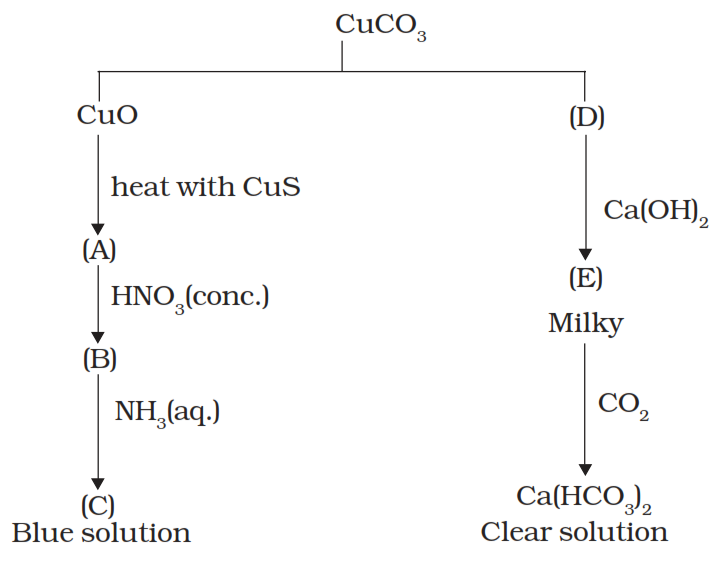
Identify $A$ to $E$ and also explain the reactions involved.
Answer
$A = CuB = Cu(NO_3)_2$
$C = [Cu(NH_3)_4](NO_2)_2$
$D = CO_2$
$E = CaCO_3$
$F = Cu_2[Fe(CN)_6]$
$G = Ca(HCO_3)_2$
$\text{CuCO}_3\rightarrow\text{CuO}+\text{CO}_2\\ \ \ \ \ \ \ \ \ \ \ \ \ \ \ \ \ \ \ \ \ \ \ \ \ \ \ \ \ \ \ \ \ \ \ ^{\text{(D)}}$
$\text{CuO}+\text{CuS}\rightarrow\text{Cu}+\text{SO}_2\\ \ \ \ \ \ \ \ \ \ \ \ \ \ \ \ \ \ \ \ \ \ \ \ \ \ \ \ \ ^{\text{(A)}}$
$\text{Cu}+\text{4HNO}_3\text{(Conc.)}\rightarrow[\text{Cu(NO}_3)_2+2\text{NO}+2\text{H}_2\text{O}\\ \ \ \ \ \ \ \ \ \ \ \ \ \ \ \ \ \ \ \ \ \ \ \ \ \ \ \ \ \ \ \ \ \ \ \ \ \ \ \ \ \ \ \ \ \ \ \ \ \ \ ^\text{(B)}$
$\text{Cu}^{2+}+\text{NH}_3\rightarrow[\text{Cu(NH}^3)^4]\\ \ \ \ ^\text{(B)} \ \ \ \ \ \ \ \ \ \ \ \ \ \ \ \ \ \ \ \ \ \ \ \ \ \ \ \ \ \ ^\text{(C)}$
$\text{Ca(OH})_2+\text{CO}_2\rightarrow\text{CaCO}_3+\text{H}_2\text{O}\\ \ \ \ \ \ \ \ \ \ \ \ \ \ \ \ \ \ \ \ \ ^\text{(D)} \ \ \ \ \ \ \ \ \ \ \ \ \ ^\text{(E)}$
$\text{CaCO}_3+\text{H}_2\text{O}+\text{CO}_2\rightarrow\text{Ca(HCO}_3)_2$
View full question & answer
Question 315 Marks
A mixed oxide of iron and chromium,$ FeOCr_2O_3$ is fused with sodium carbonate in the presence of air to form a yellow coloured compound $(A)$. On acidification the compound $(A)$ forms an orange coloured compound $(B)$, which is a strong oxidising agent.
  1. Identify the compounds $(A)$ and $(B).$
  2. Write balanced chemical equation for each step.
Answer
  1. Compound A: Sodium chromate $(Na_2CrO_4).$
Compound B: Sodium dichromate $(Na_2Cr_2O_7).$
  1. $4\text{FeOCr}_2\text{O}_3+8\text{Na}_2\text{CO}_3+7\text{O}_2\xrightarrow{\ \ \ \ \ }8\text{Na}_2\text{CrO}_4+2\text{Fe}_2\text{O}_3+8\text{CO}_2\\\ \ \ \ \ \ \ \ \ \ \ \ \ \ \ \ \ \ \ \ \ \ \ \ \ \ \ \ \ \ \ \ \ \ \ \ \ \ \ \ \ \ \ \ \ \ \ \ \ \ \ \ \ \ \ \ \ \ \ \ \ \ \ \ \ \ \ \ \ \text{(A)}$
$2\text{Na}_2\text{CrO}_4+2\text{H}^+\xrightarrow{\ \ \ \ \ }\text{Na}_2\text{Cr}_2\text{O}_7+2\text{Na}^++\text{H}_2\text{O}\\ \ \ \ \ \ \ \ \ \ \ \ \ \ \ \ \ \ \ \ \ \ \ \ \ \ \ \ \ \ \ \ \ \ \ \ \ \ \ \ \ \ \ \ \text{(B)}$
View full question & answer
Question 325 Marks
  1. Write the steps involved in the preparation of:
  1. $K_2Cr_2O_7$_ from $Na_2CrO_{4.}$​​​​​​​
  2. $KMnO_4$​​​​​​​_ from $K_2MnO_{4.}$
  3. Calomel from corrosive sublimate.
  1. What is meant by lanthanoid contraction? What effect does it have on the chemistry of the elements which follow lanthanoids?
Answer
a.
i. $2 Na _2 CrO _4+ H _2 SO _4$ (conc.) $\rightarrow Na _2 CrO _4+ Na _2 SO _4+ H _2 O$.
$Na _2 Cr _2 O _7+2 KCl \rightarrow K _2 Cr _2 O ^7+2 NaCl$.
ii. $2 MnO _2+4 KOH + O _2 \rightarrow 2 K_2 MnO _4+2 H _2 O$.
At anode: $MnO _4{ }^{2-} \rightarrow MnO _4^{-+}+ e ^{-}$.
iii. $HgCl _2+ SnCl _2 \rightarrow Hg _2 Cl _2 \downarrow+ SnCl _4$.
b. The filling of 4 f before 5 d orbital results in a regular decrease in atomic radii called lanthanoid contraction.
Due to lanthanoid contraction the radii of the members of (5d) series are almost same as those of the corresponding members of the (4d) series which results into similarity in properties.
View full question & answer
Question 335 Marks
i. Name the element of 3d transition series which shows maximum number of oxidation states. Why does it show so?
ii. which transition metal of 3 d series has positive $E ^{\circ}\left( M ^{2+} / M \right)$ value and why?
iii. Out of $Cr ^{3+}$ and $Mn ^{3+}$, which is a stronger oxidizing agent and why?
iv. Name a member of the lanthanoid series which is well known to exhibit +2 oxidation state.
v. Complete the following equation:
$MnO_4^{-}+8 H^{+}+5 e^{-} \rightarrow$
Answer
i. Mn , because of presence of 5 unpaired electrons in 3 d subshell.
ii. Cu , because enthalpy of atomisation and ionisation enthalpy is not compensated by enthalpy of hydration.
iii. $Mn ^{3+}$, because $Mn ^{2+}$ is more stable due to its half filled $\left(3 d^5\right)$ configuration.
iv. $Eu ^{+2}( Eu )$.
v. $MnO _4^{-}+8 H ^{+}+5 e -\rightarrow Mn ^{2+}+4 H _2 O$.
View full question & answer
Question 345 Marks
Match the solutions given in Column I and the colours given in Column II.
 
Column I
(Aqueous solution of salt)
 
Column II
(Colour)
$(i)$
$FeSO_4.7H_2O$
$(a)$
Green
$(ii)$
$NiCl_2.4H_2O$
$(b)$
Light pink
$(iii)$
$MnCl_2.4H_2O$
$(c)$
Blue
$(iv)$
$CoCl_2.6H_2O$
$(d)$
Pale green
$(v)$
$Cu_2Cl_2$
$(e)$
Pink
 
 
$(f)$
Colourless
Answer
 
Column I
(Aqueous solution of salt)
 
Column II
(Colour)
$(i)$
$FeSO_4.7H_2O$
$(d)$ Pale green
$(ii)$
$NiCl_2.4H_2O$
$(a)$
Green
$(iii)$
$MnCl_2.4H_2O$
$(b)$
Light pink
$(iv)$
$CoCl_2.6H_2O$
$(e)$
Pink
$(v)$
$Cu_2Cl_2$
$(f)$
Colourless
Explanation:
  1. $FeSO_47H_2O –$ Pale green
  2. $NiCl_24H_2O -$ Green
  3. $MnCl_24H_2O -$ Light Pink
  4. $CoCl_26H_2O -$ Pink
  5. $Cu_2Cl_2–$ Colourless
View full question & answer
Question 355 Marks
The elements of $3d$ transition series are given as:
$Sc\ Ti\ V\ Cr\ Mn\ Fe\ Co\ Ni\ Cu\ Zn.$
Answer the following:
  1. Write the element which shows maximum number of oxidation states. Give reason.
  2. Which element has the highest m.p?
  3. Which element shows only $+ 3$ oxidation state?
  4. Which element is a strong oxidizing agent in $+ 3$ oxidation state and why?
Answer
  1. Mn. It has maximum unpaired electrons.
  2. $Cr.$
  3. $Sc.$
  4. Manganese. $Mn^{3+}$ to $Mn^{2+}$ results in the stable half filled $(d^5)$ configuration.
View full question & answer
Question 365 Marks
  1. What may be the possible oxidation states of the transition metals with the following d electronic configurations in the ground state of their atoms:
$3d^34s^2, 3d^54s^2 $and $3d^6 4s^3$^. Indicate relative stability of oxidation states in each case.
  1. Write steps involved in the preparation of (i) $Na_2CrO_4 $from chromite ore and (ii) K_2MnO_4 from pyrolusite ore.
Answer
  1. $3 d^3 4 s^2$ (Vanadium): Oxidation states $+2,+3,+4,+5$
    Stable oxidation state: +4 as $VO ^{2+},+5$ as $VO _4{ }^{3-}$.
    $3 d^5 4 s^2$ (Manganese): Oxidation states $+2,+3,+4,+5,+6,+7$.
    Stable oxidation states: +2 as $Mn ^{2+},+7$ as $MnO _4^{-}$
    $3 d^6 4 s^2$ (Iron): Oxidation states $+2,+3$
    Stable oxidation state: $+2$ in acidic medium, $+3$ in neutral or in alkaline medium.
    1. $4FeCr_2O_4 + 8Na_2CO_3 + 7O_2 \rightarrow 8Na_2CrO_4 + 2Fe_2O_3 + 8CO_2.$
    2. $2MnO_2 + 4KOH + O_2 \rightarrow 2K_2MnO_4 + 2H_2O.$
View full question & answer
Question 375 Marks
Answer the following questions:
Assign reasons for the following:
  1. In the series Sc $(Z = 21)$ to Zn $(Z = 30),$ the enthalpy of atomisation of Zn is the lowest.
  2. Zr and Hf have almost identical radii.
  3. Transition metals show variable oxidation states.
  4. The $E^\circ M^{2+}/M$ value for copper is positive $(+0.34 V).$
Answer
  1. In the formation of metallic bonds, no electrons from 3d-orbitals are involved in case of zinc, while in all other metals of the 3d series, electrons from the d-orbitals are always involved in the formation of metallic bonds. That is why, the enthalpy of atomisation of zinc is the lowest in the series.
  2. This is due to filling of 4f orbitals which have poor shielding effect (lanthanoid contraction).
  3. Transition elements show variable oxidation states because electrons in ns and (n - 1) d-orbitals are available for bond formation as they have nearly same energy.
  4. This is because the sum of enthalpies of sublimation and ionisation is not balanced by hydration enthalpy.
View full question & answer
Question 385 Marks
Describe the preparation of potassium permanganate. How does the acidified permanganate solution react with (i) iron(II) ions (ii) $SO_2$ and (iii) oxalic acid? Write the ionic equations for the reactions.
Answer
Potassium permanganate ($KMnO_4$) is prepared by the fusion of a mixture of pyrolusite ($MnO_2$), potassiufn hydroxide and oxygen, first green coloured potassium manganate is formed. $2\text{MnO}_2+4\text{KOH}+\text{O}_2\rightarrow2\text{K}_2\text{MnO}_4+2\text{H}_2\text{O}$. The potassium manganate is extracted by water, which then undergoes disproportionation in neutral or acidic solution to give potassium permanganate.
Electrolytically:
$3\text{MnO}_4^{2-}+4\text{H}^+\rightarrow2\text{MnO}^-_4+\text{MnO}_2+2\text{H}_2\text{O}$
In acidic medium of dilute sulphuric acid, $KMnO_4​​​​​​​$ acts as strong oxidising agent arid it reacts as:
$\text{MnO}_4^{-}+8\text{H}^++5\text{e}^-\rightarrow\text{Mn}^{2+}+4\text{H}_2\text{O}$
  1. Iron (II) solution: Ferrous ($Fe^{2+}​​​​​​​$​​​​​​​) ion solution to ferric ($Fe^{3+}​​​​​​​$​​​​​​​) ion solution
$\text{MnO}_4^{-}+8\text{H}^++5\text{e}^-\rightarrow\text{Mn}^{2+}+4\text{H}_2\text{O}\\ \ \ \ \ \ \ \ \ \ \ \ \ \ \ \ \ \ \ \ \ \ \ \ \ \ 5\text{Fe}^{2+}\rightarrow5\text{Fe}^{3+}+5\text{e}^{-}\\\overline{\text{MnO}_4^{-}+5\text{Fe}^{2+}+8\text{H}^+\rightarrow\text{Mn}^{2+}+5\text{Fe}^{3+}+4\text{H}_2\text{O}}$
  1. Sulphur dioxide ($SO_2$)
$[\text{MnO}^-_4+8\text{H}^++5\text{e}^-\rightarrow\text{mn}^{2+}+4\text{H}_2\text{O}]\times2\\10\text{H}_2\text{O}+5\text{SO}_2\rightarrow5\text{SO}^{2-}_4+2\text{Mn}^{2+}+10\text{e}^-\\ \overline{2\text{MnO}^-_4+5\text{SO}_2+2\text{H}_2\text{O}\rightarrow5\text{SO}^{2-}_4+2\text{Mn}^{2+}+4\text{H}^+}$
  1. Oxalic acid
$[\text{MnO}^-_4+8\text{H}^++5\text{e}^-\rightarrow\text{Mn}^{2+}+4\text{H}_2\text{O}] \times2\\ \ \ \ \ \ \ \ \ \ \ \ \ \ \ \ \ \ \ \ \ \ \ \ \ \ \ \ \ \ \text{COO}^-\\ \ \ \ \ \ \ \ \ \ \ \ \ \ \ \ \ \ \ \ \ \ \ \ \ \ \ \ 5|\rightarrow10\text{CO}_2+10\text{e}^-\\\ \ \ \ \ \ \ \ \ \ \ \ \ \ \ \ \ \ \ \ \ \ \ \ \ \ \ \text{COO}^-\\\overline{2\text{MnO}_4^-+16\text{H}^++5\text{C}_2\text{O}_4^{2-}\rightarrow2\text{Mn}^{2+}+10\text{CO}_2+8\text{H}_2\text{O}}$
View full question & answer
Question 395 Marks
  1. Complete the following chemical equations:
  1. $\text{Cr}_{2}\text{O}_{7}^{2-}\text{(aq)}+\text{H}_{2}\text{S}\text{(g)}+\text{H}^{+}\text{(aq)}\rightarrow$
  2. $\text{Cu}^{2+}\text{(aq)}+\text{I}^{-}\text{(aq)}\rightarrow$
  1. How would you account for the following:
  1. The oxidising power of oxoanions are in the order $VO^+_2 < Cr_2O^{2–}_7 –_4.$
  2. The third ionisation enthalpy of manganese (Z = 25) is exceptionally high.
  3. $Cr^{2+}$ is a stronger reducing agent than $Fe^{2+}.$
Answer
  1.  
  1. $\text{Cr}_{2}\text{O}_{7}^{2-}+\text{3H}_{2}\text{S}+\text{8H}^{+}\rightarrow\text{2Cr}^{3+}+\text{7H}_{2}\text{O}+\text{3S}$.
  2. $\text{2Cu}^{2+}+\text{4I}^{-}\rightarrow\text{Cu}_{2}\text{I}_{2}+\text{I}_{2}$.
  1.  
  1. It is due to increasing stability of lower species to which they are reduced.
  2. Because removing $3^{rd} e^-$ from extra stable $3d^5$ configuration is difficult in case of Mn.
  3. Because $d^3$ of $Cr^{2+} $is more stable than $d_5$ of $Fe^{3+}.$
View full question & answer
Question 405 Marks
  1. Account for the following:
i. Mn shows the highest oxidation state of +7 with oxygen but with fluorine it shows the highest oxidation state of +4 .
ii. $Cr ^{2+}$ is a strong reducing agent.
iii. $Cu ^{2+}$ salts are coloured while $Zn ^{2+}$ salts are white.
  1. Complete the following equations:
    1. $2\text{MnO}_{2} + 4\text{KOH} + \text{O}_{2} \xrightarrow{\Delta}$
    2. $\text{Cr}_{2}\text{O}^{2-}_{7}+ 14\text{H}^{+} + 6\text{I}^{-}\rightarrow.$
Answer
    1. Ability of oxygen to form multiple bond with Mn metal.
    2. $Cr^{2+}$ is oxidized to $Cr^{3+}$​​​​​​​ which has stable $d^3/t^3_{2g}​​​​​​​$​​​​​​​orbital configuration.
    3. $Cu^{2+}​​​​​​​$​​​​​​​ has unpaired electron while $Zn^{2+}​​​​​​​$​​​​​​​ has no unpaired electron.
    1. $2\text{MnO}_{2} + 4\text{KOH} +\text{ O}_{2}\xrightarrow{\text{ }\text{ }\text{ }\text{ }\text{ }\text{ }\text{ }\text{ }\text{ }\Delta\text{ }\text{ }\text{ }\text{ }\text{ }\text{ }\text{ }\text{ }} 2\text{K}_{2}\text{MnO}_{4} + 2\text{H}_{2}0 $
    2. $\text{Cr}_{2}\text{O}_{7}^{2-}+14\text{H}^{ +}+6\text{I}^{ -}\xrightarrow{\text{ }\text{ }\text{ }\text{ }\text{ }\text{ }\text{ }\text{ }\text{ }\text{ }\text{ }\text{ }\text{ }\text{ }\text{ }\text{ }\text{ }\text{ }\text{ }\text{ }\text{ }\text{ }}2\text{Cr}^{3+}+7\text{H}_{2}\text{O} +3\text{I}_{2}$
View full question & answer
Question 415 Marks
Answer the following questions:
Give reasons:
  1. d-block elements exhibit more oxidation states than f-block elements.
  2. Orange solution of potassium dichromate turns yellow on adding sodium hydroxide to it.
  3. Zirconium (Z = 40) and Hafnium (Z = 72) have almost similar atomic radii.
Answer
  1. d–block elements exhibit more oxidation states because of less energy gap between d and s subshell whereas f-block elements have large energy gap between f and d subshell.
  2. On adding NaOH, pH of solution increases and the orange colour of the solution changes to yellow due to conversion of dichromate ion to chromate ion.
$\text{Cr}_2\text{O}^{2-}_7+2\text{OH}^-\rightleftharpoons2\text{CrO}^{2-}_4+\text{H}_2\text{O}\\\text{Dichromate}\ \ \ \ \ \ \ \ \ \ \ \ \ \text{Chromate}\\\text{(Orange)}\ \ \ \ \ \ \ \ \ \ \ \ \ \ \ \ \ \ \ (\text{yellow})$
  1. This is due to filling of 4f-orbitals which have poor shielding effect (Lanthanoid contraction).
View full question & answer
Question 425 Marks
  1. Account for the following:
  1. Transition metals form large number of complex compounds.
  2. The lowest oxide of transition metal is basic whereas the highest oxide is amphoteric or acidic.
  3. $E^\circ $ value for the $Mn^{3+}/Mn^{2+}$ couple is highly positive (+1.57 V) as compare to $Cr^{3+}/Cr^{2+}. 56/1/1 9.$
  1. Write one similarity and one difference between the chemistry of lanthanoid and actinoid elements.
Answer
i. Due to small size and high ionic charge/availability of d orbitals.
ii. Higher is the oxidation state higher is the acidic character/as the oxidation state of a metal increases, ionic character decreases.
iii. Because $Mn ^{2+}$ has $d ^5$ as a stable configuration whereas $Cr ^{3+}$ is more stable due to stable $t ^3 2 g$.
b. Similarity-both are stable in +3 oxidation state/both show contraction/irregular electronic configuration.
Difference- actinoids are radioactive and lanthanoids are not/actinoids show wide range of oxidation states but lanthanoids don't.
View full question & answer
Question 435 Marks
  1. Give three points of difference between lanthanoids and actinoids.
  2. Give reason and select one atom/ion which will exhibit asked property:
  1. $Sc^{3+}$ or $Cr^{3+}​​​​​​​$ (Exhibit diamagnetic behaviour).
  2. $Cr$ or $Cu$ (High melting and boiling point).
Answer
  1.  
S. No.
Lanthanoids
Actinoids
1.
Most of them are not radioactive.
All are radioactive.
2.
Don’t show a wide range of oxidation state.
Show a wide range of oxidation states.
3.
Most of their ions are colourless.
Most of their ions are coloured.
  1.  
  1. $Sc^{+3}$, because of absence of unpaired electron.
  2. Cr, because of presence of strong intermetallic bonding than Cu.
View full question & answer
Question 445 Marks
  1. Complete the following chemical equations for reactions:
i. $\text{MnO}_{4(aq)}^{-}+\text{S}_{2}\text{O}_{3(aq)}^{2-}+\text{H}_{2}\text{O}_{(l)}\rightarrow$
ii. $\text{Cr}_{2}\text{O}^{-}_{7(aq)}+\text{H}_{2}\text{S}_{(g)}+\text{H}^{+}_{(aq)}\rightarrow$
  1. Give an explanation for each of the following, observations:
  1. The gradual decrease in size (actinoid contraction) from element to element is greater among the .actinoids than that among the lanthanoids (lanthanoid contraction).
  2. The greatest number of oxidation states are exhibited by the members in the middle of a transition series.
  3. With the same d-orbital configuration $(d^4) Cr^{2+}$ ion is a reducing agent but $Mn^{3+}$ ion is an oxidising agent.
Answer
  1.  
i. $\text{8MnO}^{-}_{4}+\text{3S}_{2}\text{O}^{2-}_{3}+\text{H}_{2}\text{O}\rightarrow\text{8MnO}_{2}+\text{6SO}_{4}^{2-}+\text{2KOH}$

ii. $\text{Cr}_{2}\text{O}_{7}^{2-}+\text{3H}_{2}\text{S}+\text{8H}^{+}\rightarrow\text{2Cr}^{3+}+\text{3S}+\text{7H}_{2}\text{O}$
  1.  
  1. Because 5f electrons provide poor shielding from element to element in the actinoid series than 4f electrons in lanthanoid series
  2. Because of the involvement of both (n-l) d and ns electrons in bonding.
  3. $Cr ^{2+}$ is reducing as its configuration changes from $d ^4$ to $d ^3$, the latter having a half-filled $t_{2 g}$ level. On the other hand the change from $Mn ^{2+}$ to $Mn ^{3+}$ results in the half-filled $\left( d ^5\right)$ configuration which has extra stability.
View full question & answer
Question 455 Marks
  1. Complete the following chemical equations:
  1. $ \text{MnO}_{4}^{-}\text{(aq)}+\text{S}_{2}\text{O}_{4}\text{(aq)}+\text{H}_{2}\text{O}\text{(l)}\rightarrow$
  2. $\text{Cr}_{2}\text{O}_{4}^{2-}\text{(aq)}+\text{Fe}^{2+}\text{(aq)}+\text{H}^{+}\text{(aq)}\rightarrow$
  1. Explain the following observations:
  1. $La^{3+} (Z = 57)$ and $Lu^{3+} (Z = 71)$ do not show any colour in solutions.
  2. Among the divalent cations in the first series of transition elements, manganese exhibits the maximum paramagnetism.
  3. $Cu^+$ ion is not known in aqueous solutions.
Answer
  1.  
  1. $8MnO_4^- + 3S_2O_3^{2-} + H_2O 8MnO_2 + 6SO_4^{2-} + 2OH^-.$
  2. $Cr_2O_7^{2-} + 14H^+ + 6Fe^{2+} 2Cr^{3+} + 6Fe^{3+} + 7H_2O.$
  1.  
i. In $La ^{3+}$, there is no $f$ electrons while in $Lu ^{3+}$, there is presence of $f ^{14} /$ absence of unpaired electron/due to d-d transition.
ii. $Mn ^{2+}$ has $3 d^5$ configuration having 5 unpaired electrons.
ii. $Cu ^{+}$undergoes disproportionation in aqueous solution.
Alternate answer

$2Cu^+​​​​​​​$ $\rightarrow$ $Cu^{2+} + Cu.$
View full question & answer
Question 465 Marks
  1. A blackish brown coloured solid ‘A’ when fused with alkali metal hydroxides in presence of air, produces a dark green coloured compound ‘B’, which on electrolytic oxidation in alkaline medium gives a dark purple coloured compound C. Identify A, B and C and write the reactions involved.
  2. What happens when an acidic solution of the green compound (B) is allowed to stand for some time? Give the equation involved. What is this type of reaction called?
Answer
  1. $\begin{matrix}\text{A}=\text{MnO}_2,& \text{B}=\text{K}_2\text{MnO}-4,&\text{C}=\text{KMnO}-4,\\\text{Pyrolusito ore}&\text{Potassium}&\text{Potassium}\\&\text{manganate}&\text{perManganate}\end{matrix}$
Reactions involved:
$2\text{MnO}_2+4\text{KOH}+\text{O}_2\xrightarrow{\ \ \ \ \ \ \ \ \ }2\text{K}-2\text{MnO}-4+2\text{H}_2\text{O}$
$\text{MnO}^2_4\xrightarrow[\text{In alkaline solution }]{\text{Electrolytic oxidation}}2\text{MnO}^-_4+\text{e}^-\\\text{Manganate ion}\ \ \ \ \ \ \ \ \ \ \ \ \ \ \ \text{Permanganate ion}\$\text{Green})\ \ \ \ \ \ \ \ \ \ \ \ \ \ \ \ \ \ \ \ \ \ \ \ \ \ \ \ (\text{Purple})$
  1. In acidic medium $\mathrm{K}_2 \mathrm{MnO}_4$ changes to given purple cploured compound along with black precipitate.
$3\text{MnO}^{2-}_4+4\text{H}^+\xrightarrow{\ \ \ \ \ \ \ \ \ \ }2\text{MnO}^-_4+\text{MnO}_2+2\text{H}_2\text{O}\\\text{Green}\ \ \ \ \ \ \ \ \ \ \ \ \ \ \ \ \ \ \ \ \ \ \ \ \ \ \ \ \text{Purple}\ \ \ \ \ \text{Black}\\\text{Compound}\ \ \ \ \ \ \ \ \ \ \ \ \ \ \ \ \ \ \ \text{Compound}$
This type of reaction is called disproportionation reactio.
View full question & answer
5 Marks Questions - Chemistry STD 12 Science Questions - Vidyadip