Question 15 Marks
The transverse displacement of a string (clamped at its both ends) is given by
$\text{y}(\text{x, t})=0.06\sin\Big(\frac{2\pi}{3}\text{x}\Big)\cos(120\pi\text{ t})$
where x and y are in m and t in s. The length of the string is 1.5m and its mass is $3.0 \times 10^{–2}kg$.
Answer the following:
Interpret the wave as a superposition of two waves travelling in opposite directions. What is the wavelength, frequency, and speed of each wave?
AnswerA wave travelling along the positive x-direction is given as: $\text{y}_1=\text{a}\sin(\omega\text{t}-\text{kx})$The wave travelling along the negative x-direction is given as:
$\text{y}_2=\text{a}\sin(\omega\text{t}-\text{kx})$ The superposition of these two waves yields: $\text{y}=\text{y}_1+\text{y}_2=\text{a}\sin(\omega\text{t}-\text{kx})-\text{a}\sin(\omega\text{t}-\text{kx})$
$=\text{a}\sin(\omega\text{t})\cos(\text{kx})-\text{a}\sin(\text{kx})\cos(\omega\text{t})-\text{a}\sin(\omega\text{t})\cos(\text{kx})-\text{a}\sin(\text{kx})\cos(\omega\text{t})$
$=-2\text{a}\sin(\text{kx})\cos(\omega\text{t})$
$=-2\text{a}\sin\Big(\frac{2\pi}{\lambda}\text{x}\Big)\cos(2\pi\text{ vt})\ \dots(\text{i})$ The transverse displacement of the string is given as: $\text{y}(\text{x, t})=0.06\sin\Big(\frac{2\pi}{3}\text{x}\Big)\cos(120\pi\text{ t})\ \dots(\text{ii})$ Comparing equations (i) and (ii), we have: $\frac{2\pi}{\lambda}=\frac{2\pi}{3}$
$\therefore$ Wavelength, $\lambda=3\text{m}$ It is given that: $120\pi=2\pi\text{v}$ Frequency, $\text{v} = 60\text{Hz}$ Wave speed, $\text{v}=\text{v}\lambda$
$=60\times3=180\text{m/s}$
View full question & answer→Question 25 Marks
A pipe $20cm$ long is closed at one end. Which harmonic mode of the pipe is resonantly excited by a $430Hz$ source? Will the same source be in resonance with the pipe if both ends are open? (speed of sound in air is $340m s^{–1}$).
AnswerFirst (Fundamental); No
Length of the pipe, l = 20cm = 0.2m
Source frequency = $n^{th}$ normal mode of frequency, $ν_n= 430Hz$
Speed of sound, $v = 340m/ s$
In a closed pipe, the $n^{th}$ normal mode of frequency is given by the relation:
$\text{v}_\text{n}=(2\text{n}-1)\frac{\text{v}}{4\text{l}}$ n is an interger = 0, 1, 2, 3
$430=(2\text{n}-1)\frac{340}{4\times0.2}$
$2\text{n}-1=\frac{430\times4\times0.2}{340}=1.01$
$2\text{n}=2.01$
$\text{n}\sim1$
Hence, the first mode of vibration frequency is resonantly excited by the given source. In a pipe open at both ends, the $n^{th}$ mode of vibration frequency is given by the relation:
$\text{v}_\text{n}=\frac{\text{nv}}{2\text{l}}$
$\text{n}=\frac{2\text{lv} _n}{\text{v}}$
$=\frac{2\times0.2\times430}{340}=0.5$
View full question & answer→Question 35 Marks
A wire stretched between two rigid supports vibrates in its fundamental mode with a frequency of $45Hz$. The mass of the wire is $3.5 \times 10^{–2}kg$ and its linear mass density is $4.0 \times 10^{–2}kg m^{–1}$. What is
- The speed of a transverse wave on the string,
- The tension in the string?
Answer
- Mass of the wire, $m = 3.5 \times 10^{–2}kg$
Linear mass density, $\mu=\frac{\text{m}}{\text{l}}=4.0\times10^2\text{kg m}^{-1}$
Frequency of vibration, v = 45Hz
$\therefore$ length of the wire, $\text{l}=\frac{\text{m}}{\mu}=\frac{3.5\times10^{-2}}{4. 0\times10^{-2}}=0.875\text{m}$
The wavelength of the stationary wave $(\lambda)$ is related to the length of the wire by the relation:
$\lambda=\frac{2\text{l}}{\text{m}}$
where,
n = Number of nodes in the wire
For fundamental node, n = 1:
$\lambda=2\text{l}$
$\lambda=2\times0.875=1.75\text{m}$
The speed of the transverse wave in the string is given as:
$\text{v}=\text{v}\lambda=45\times1.75=78.75\text{m/s}$
- The tension produced in the string is given by the relation:
$\text{T}=\text{v}^2\mu$
$=(78.75)^2\times4.0\times10^{-2}=248.06\text{N}$ View full question & answer→Question 45 Marks
For the wave described in Exercise 15.8, plot the displacement (y) versus (t) graphs for x = 0, 2 and 4cm. What are the shapes of these graphs? In which aspects does the oscillatory motion in travelling wave differ from one point to another: amplitude, frequency or phase?
AnswerAll the waves have different phases. The given transverse harmonic wave is: $\text{y}(\text{x, t})=3.0\sin\Big(36\text{t}+0.018\text{x}+\frac{\pi}{4}\Big)\ \dots(\text{i})$ For x = 0, the equation reduces to: $\text{y}(\text{x, t})3.0\sin\Big(36\text{t}+\frac{\pi}{4}\Big)$ Also, $\omega=\frac{2\pi}{\text{t}}=36\text{ rad/s}^{-1}$ $\therefore\ \text{t}=\frac{\pi}{18}\text{s}$ Now, plotting y vs. t graphs using the different values of t, as listed in the given table
| t (s) |
0 |
T/8 |
2T/7 |
3T/8 |
4T/8 |
5T/8 |
6T/8 |
7T/8 |
| y (cm) |
$\frac{3}{\sqrt{2}}$ |
3 |
$\frac{3}{\sqrt{2}}$ |
0 |
$-\frac{3}{\sqrt{2}}$ |
–3 |
$-\frac{3}{\sqrt{2}}$ |
0 |
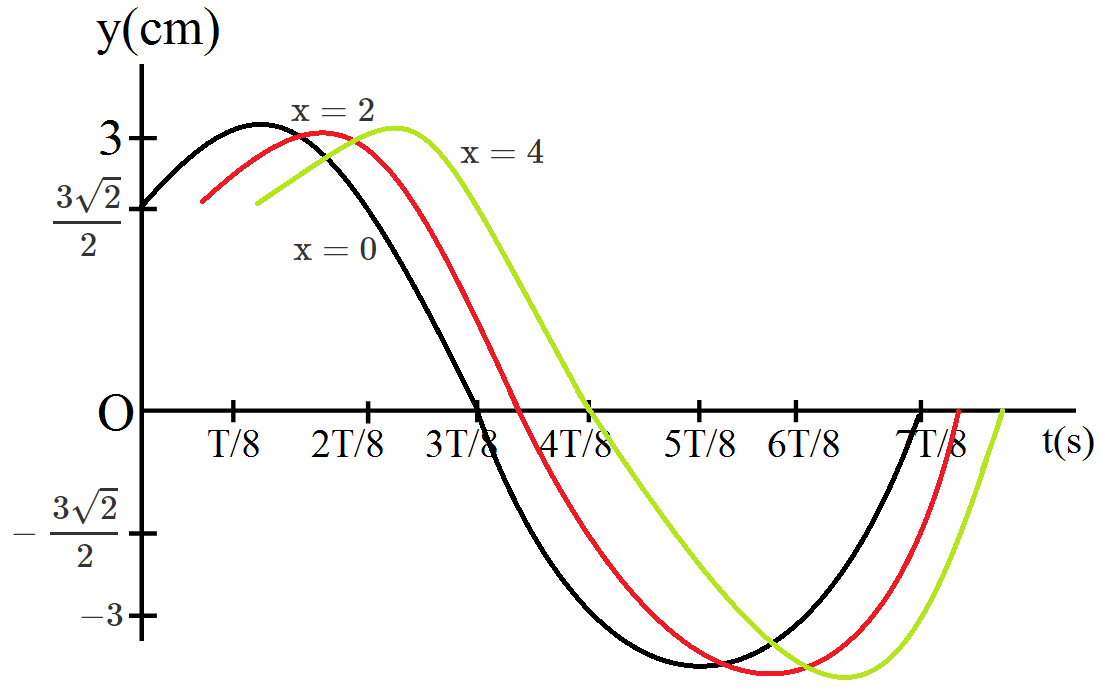
View full question & answer→Question 55 Marks
One end of a long string of linear mass density $8.0 \times 10^{–3}kg m^{–1}$ is connected to an electrically driven tuning fork of frequency $256Hz$. The other end passes over a pulley and is tied to a pan containing a mass of $90kg$. The pulley end absorbs all the incoming energy so that reflected waves at this end have negligible amplitude. At $t = 0$, the left end (fork end) of the string $x = 0$ has zero transverse displacement $(y = 0)$ and is moving along positive y-direction. The amplitude of the wave is $5.0cm$. Write down the transverse displacement y as function of x and t that describes the wave on the string.
AnswerThe equation of a travelling wave propagating along the positive y-direction is given by the displacement equation: $\text{y}(\text{x, t})=\text{a}\sin(\text{wt}-\text{kx})\ \dots(\text{i})$ Linear mass density, $\mu=8.0\times10^{-3}\text{kg m}^{-1}$ Frequency of the tuning fork, ν = 256Hz Amplitude of the wave, a = 5.0cm = 0.05m …(ii) Mass of the pan, m = 90kg Tension in the string, T = mg = 90 \times 9.8 = 882N The velocity of the transverse wave v, is given by the relation: $\text{v}=\sqrt{\frac{\text{t}}{\mu}}$
$=\frac{882}{8.0\times10^{-3}}=332\text{m/s}$ Angular Frequency, $\omega=2\pi\text{v}$
$=2\times3.14\times256$
$=1608.5=1.6\times10^3\text{ rad/s}\ \dots(\text{iii})$ Wanelength, $\lambda=\frac{\text{v}}{\text{v}}=\frac{332}{256}\text{m}$
$\therefore$ Propagation constant, $\text{k}=\frac{2\pi}{\lambda}$
$=\frac{2\times3.14}{\frac{332}{256}}=4.84\text{m}^{-1}\ \dots(\text{iv})$Substituting the values from equations (ii), (iii) and (iv) in equatio (i) we get the displacement equation:
$\text{y}(\text{x, t})=0.05\sin(1.6\times10^3\text{t}-4.84\text{x})\text{m}.$
View full question & answer→Question 65 Marks
A transverse harmonic wave on a string is described by
$\text{y}(\text{x, t})=3.0\sin\big(36\text{t}+0.018\text{x}+\frac{\pi}{4}\big)$
where x and y are in cm and t in s. The positive direction of x is from left to right.
Is this a travelling wave or a stationary wave?
If it is travelling, what are the speed and direction of its propagation?
AnswerYes; Speed = 20 m/s, Direction = Right to left
Explanation:
Given,
$\text{y}(\text{x, t})=3\sin\big(36\text{t}+0.018\text{x}+\frac{\pi}{4}\big)$
We know, the equation of a progressive wave travelling from right to left is:
$\text{y}(\text{x, t})=\text{a}\sin(\omega\text{t}+\text{kx}+\phi)\ \dots(2)$
Comparing equation (1) to equation (2), we see that it represents a wave travelling from right to left and also we get:
$\text{a}=3\text{cm},\omega=36\text{rad/s},\text{k}=0.081\text{cm and }\phi=\frac{\pi}{4}$
Therefore the speed of propagation, $\text{v}=\frac{\omega}{\text{k}}=\frac{36}{0.018}=20\text{m/s}$
View full question & answer→Question 75 Marks
Use the formula $\text{v}=\sqrt{\frac{\gamma\text{P}}{\rho}}$ to explain why the speed of sound in air:
Increases with humidity.
AnswerLet $v_m$ and $v_d$ be the speed of sound in moist air and dry air respectively.
Let $\rho_\text{m}$ and $\rho_\text{d}$ be the densities of the moist air and dry air respectively.
Take the relation:
$\text{v}=\sqrt{\frac{\gamma\rho}{\rho}}$
Hence, the speed of sound in moist air is:
$\text{v}_\text{m}=\sqrt{\frac{\gamma\rho}{\rho_\text{m}}}\ \dots(\text{i})$
And the speed of sound in dry air is:
$\text{v}_\text{d}=\sqrt{\frac{\gamma\rho}{\rho_\text{d}}}\ \dots(\text{ii})$
On dividing equations (i) and (ii), we get:
$\frac{\text{v}_\text{m}}{\text{v}_\text{d}}=\sqrt{\frac{\gamma\rho}{\rho_\text{m}}\times\frac{\rho_\text{d}}{\gamma\rho}}=\frac{\rho_\text{d}}{\rho_\text{m}}$
However, the presence of water vapour reduces the density of air, i.e.,
$\rho_\text{d}<\rho_\text{m}$
$\therefore\ \text{v}_\text{m}>\text{v}_\text{d}$
Hence, the speed of sound in mois air is greater than it is in dry air.
Thus, in gaseous medium, the speed of sound increases with humidity.
View full question & answer→Question 85 Marks
Use the formula $\text{v}=\sqrt{\frac{\gamma\text{P}}{\rho}}$ to explain why the speed of sound in air:
Increases with temperature,
AnswerTake the relation:
$\text{v}=\sqrt{\frac{\gamma\text{P}}{\rho}}\ \dots(\text{i})$
or one mole of any ideal gas, the equation can be written as:
PV = RT
$\text{P}=\frac{\text{RT}}{\text{V}}\ \dots(\text{ii})$
Substituting equation (ii) in equation (i), we get:
$\text{v}=\sqrt{\frac{\gamma\text{RT}}{\text{VP}}}=\sqrt{\frac{\gamma\text{RT}}{\text{M}}}\ \dots(\text{iii})$
where,
mass, $\text{M}=\rho\text{V}$ is a constant
γ and R are also constants
We conclude from equation (iii) that $\text{v}\propto\sqrt{\text{T}}$
Hence, the speed of sound in a gas is directly proportional to the square root of the temperature of the gaseous medium, i.e., the speed of the sound increases with an increase in the temperature of the gaseous medium and vice versa.
View full question & answer→Question 95 Marks
Use the formula $\text{v}=\sqrt{\frac{\gamma\text{P}}{\rho}}$ to explain why the speed of sound in air:
Is independent of pressure,
AnswerTake the relation:
$\text{v}=\sqrt{\frac{\gamma\text{P}}{\rho}}\ \dots(\text{i})$
where,
Density, $\rho=\frac{\text{Mass}}{\text{Volume}}=\frac{\text{M}}{\text{V}}$
M = Molecular weight of the gas
V = Volume of the gas
Hence, equation (i) reduces to:
$\text{v}=\sqrt{\frac{\gamma\text{PV}}{\text{M}}}\ \dots(\text{ii})$
Now from the ideal gas equation for n = 1:
PV = RT
For constant T, PV = Constant
Since both M and $\gamma$ are constants, v = Constant
Hence, at a constant temperature, the speed of sound in a gaseous medium is independent of the change in the pressure of the gas.
View full question & answer→Question 105 Marks
A steel rod $100cm$ long is clamped at its middle. The fundamental frequency of longitudinal vibrations of the rod are given to be $2.53 kHz$. What is the speed of sound in steel?
AnswerLength of the steel rod, l = 100cm = 1m Fundamental frequency of vibration, $ν = 2.53 kHz = 2.53 \times 10^3Hz$ When the rod is plucked at its middle, an antinode (A) is formed at its centre, and nodes (N) are formed at its two ends, as shown in the given figure.
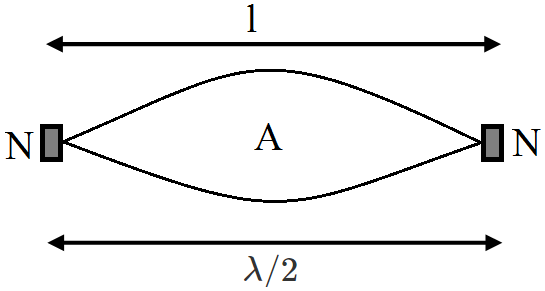
The distance between two successive nodes is $\frac{\lambda}{2} .$
$\therefore\ \text{I}=\frac{\lambda}{2}$ $\lambda=2\text{l}=2\times1=2\text{m}$
The speed of sound in steel is given by the relation: $\text{v}=\text{v}\lambda$ $=5.06\times10^3\text{m/s}$ $=2.53\times10^3\times2$ $=5.06\text{km/s}$ View full question & answer→Question 115 Marks
Two sitar strings $A$ and $B$ playing the note ‘Ga’ are slightly out of tune and produce beats of frequency $6Hz$. The tension in the string $A$ is slightly reduced and the beat frequency is found to reduce to $3Hz$. If the original frequency of A is $324Hz$, what is the frequency of $B$?
AnswerFrequency of string $A, f_A=324 H z$
Frequency of string $B=f_B$
Beat's frequency, $\mathrm{n}=6 \mathrm{~Hz}$
Beat's frequency is given as:
$\mathrm{n}=\left|\mathrm{f}_{\mathrm{A}}+-\mathrm{f}_{\mathrm{B}}\right|$
$6=324+-\mathrm{f}_{\mathrm{B}}$
$\mathrm{f}_{\mathrm{B}}=330 \mathrm{~Hz} \text { or } 318 \mathrm{~Hz}$
Frequency decreases with a decrease in the tension in a string. This is because frequency is irectly proportional to the square root of tension. It is given as:
$\mathrm{v} \propto \text { Underroot } \mathrm{T}$
Hence, the beat frequency cannot be 330 Hz
$\therefore \mathrm{f}_{\mathrm{B}}=318 \mathrm{~Hz}$
View full question & answer→Question 125 Marks
A metre-long tube open at one end, with a movable piston at the other end, shows resonance with a fixed frequency source (a tuning fork of frequency 340Hz) when the tube length is 25.5cm or 79.3cm. Estimate the speed of sound in air at the temperature of the experiment. The edge effects may be neglected.
AnswerFrequency of the turning fork, ν = 340Hz Since the given pipe is attached with a piston at one end, it will behave as a pipe with one end closed and the other end open, as shown in the given figure.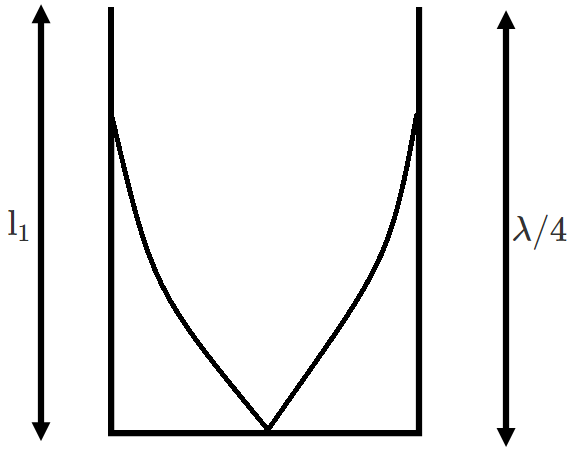
Such a system produces odd harmonics. The fundamental note in a closed pipe is given by the relation: $\text{l}_1=\frac{\pi}{4}$ where, length of pipe, $\text{l}_1=25.5\text{cm}=0.255\text{m}$ $\therefore\ \lambda=4\text{l}_1=4\times0.255=1.02\text{m}$ The speed of the sound is given by the relation: $\text{v}=\text{v}\lambda=340\times1.02=346.8\text{m/s}$ View full question & answer→Question 135 Marks
A narrow sound pulse (for example, a short pip by a whistle) is sent across a medium.
(a) Does the pulse have a definite,
- frequency,
- wavelength,
- speed of propagation?
(b) If the pulse rate is 1 after every 20s, (that is the whistle is blown for a split of second after every 20s), is the frequency of the note produced by the whistle equal to 1/20 or 0.05Hz?
Answer(a)
- No
- No
- Yes
(b) No
Explanation:
- The narrow sound pulse does not have a fixed wavelength or frequency. However, the speed of the sound pulse remains the same, which is equal to the speed of sound in that medium.
- The short pip produced after every 20s does not mean that the frequency of the whistle is 1/20 or 0.05Hz. It means that 0.05Hz is the frequency of the repetition of the pip of the whistle.
View full question & answer→Question 145 Marks
The transverse displacement of a string (clamped at its both ends) is given by
$\text{y}(\text{x, t})=0.06\sin\Big(\frac{2\pi}{3}\text{x}\Big)\cos(120\pi\text{ t})$
where x and y are in m and t in s. The length of the string is $1.5m$ and its mass is $3.0 \times 10^{–2}kg$.
Answer the following:
Determine the tension in the string.
AnswerThe velocity of a transverse wave travelling in a string is given by the relation:
$\text{v}=\sqrt{\frac{\text{T}}{\mu}}\ \dots(\text{i})$
Where,
Velocity of the transverse wave, v = 180m/ s
Mass of the string, $m = 3.0 \times 10^{-2}kg$
Length of the string, l = 1.5m
Mass per unit length of the string, $\mu=\frac{\text{m}}{\text{l}}$
$=\frac{3.0}{1.5}\times10^{-2}$
$=2\times10^{-2}\text{kg m}^{-1}$
Tension in the string = T
From equation (i), tension can be obtained as:
$\text{T}=\text{v}^2\mu$
$=(180)^2\times2\times10^{-2}$
$=648\text{N}$
View full question & answer→Question 155 Marks
A bat is flitting about in a cave, navigating via ultrasonic beeps. Assume that the sound emission frequency of the bat is $40 kHz$. During one fast swoop directly toward a flat wall surface, the bat is moving at $0.03$ times the speed of sound in air. What frequency does the bat hear reflected off the wall?
AnswerUltrasonic beep frequency emitted by the bat, $ν = 40 kHz$
Velocity of the bat, $v_b = 0.03v$
where, v = velocity of sound in air
The apparent frequency of the sound striking the wall is given as:
$\text{v}'=\Big(\frac{\text{v}}{\text{v}-\text{v}_\text{b}}\Big)\text{v}$
$=\Big(\frac{\text{v}}{\text{v}-0.03\text{v}}\Big)\times40$
$=\frac{40}{0.97}\text{kHz}$
This frequency is refiected by the stationary wall (vs) toward the bat.
The frequency (v'') of the received sound is given by the relation:
$\text{v}''=\Big(\frac{\text{v}+\text{v}_0}{\text{v}}\Big)\text{v}'$
$=\Big(\frac{\text{v}+0.03\text{v}}{\text{v}}\Big)\times\frac{40}{0.97}$
$=\frac{1.03\times40}{0.97}=42.47\text{kHz}$
View full question & answer→Question 165 Marks
For the wave on a string described in Exercise 15.11, do all the points on the string oscillate with the same,
- Frequency,
- Phase,
- Amplitude?
AnswerFor the wave on the string described in questions we have seen that l = 1.5m and $\lambda=3\text{m}.$ So, it is clear that $\lambda=\frac{\lambda}{2}$ and for a string clamped at both ends, it is possible only when both ends behave as nodes and there is only one antinode in between i.e., whole string is vibrating in one segment only.
- Yes, all the sring particles, except nodes, vibrate with the same frequency v = 60Hz.
- As all string particles lie in one segment, all of them are in same phase.
- Amplitude varies from particle to particle. At antinode, amplitude = 2A = 0.06m. It gradually falls on going towards nodes and at nodes, and at nodes, it is zero.
View full question & answer→Question 175 Marks
A train, standing in a station-yard, blows a whistle of frequency $400Hz$ in still air. The wind starts blowing in the direction from the yard to the station with a speed of $10m s^{–1}$. What are the frequency, wavelength, and speed of sound for an observer standing on the station’s platform? Is the situation exactly identical to the case when the air is still and the observer runs towards the yard at a speed of $10m s^{–1}$? The speed of sound in still air can be taken as $340m s^{–1}$.
AnswerFor the stationary observer: 400Hz; 0.875m; 350m/ s
For the running observer: Not exactly identical
For the stationary observer:
Frequency of the sound produced by the whistle, ν = 400Hz
Speed of sound = 340m/ s
Velocity of the wind, v = 10m/ s
As there is no relative motion between the source and the observer, the frequency of the sound heard by the observer will be the same as that produced by the source, i.e., 400Hz.
The wind is blowing toward the observer. Hence, the effective speed of the sound increases by 10 units, i.e.,
Effective speed of the sound, $v_e = 340 + 10 = 350m/ s$
The wavelength $(\lambda)$ of the sound heard by the observer is given by the relation:
$\lambda=\Big(\frac{\text{v}_\text{e}}{\text{V}}\Big)-=\frac{350}{400}=0.875\text{m}$
For the running observer:
Velocity of the observer, $v_0 = 10m/ s$
The observer is moving toward the source. As a result of the relative motions of the source and the observer, there is a change in frequency (V').
This is given by the relation:
$\text{v}'=\Big(\frac{\text{v}+\text{v}_0}{\text{v}}\Big)\text{v}$
$=\Big(\frac{340+10}{340}\Big)\times400=411.76\text{Hz}$
Since the air is still, the effective speed of sound = 340 + 0 = 340m/s
The source is at rest. Hence, the wavelength of the sound will not change, i.e., λ remains 0.875m.
Hence, the given two situations are not exactly identical.
View full question & answer→Question 185 Marks
A travelling harmonic wave on a string is described by
$\text{y}(\text{x, t})=7.5\sin\Big(0.0050\text{x}+12\text{t}+\frac{\pi}{4}\Big)$
What are the displacement and velocity of oscillation of a point at x = 1cm, and t = 1s? Is this velocity equal to the velocity of wave propagation?
AnswerThe given harmonic wave is:
$\text{y}(\text{x, t})=7.5\sin\Big(0.0050\text{x}+12\text{t}+\frac{\pi}{4}\Big)$
For x = 1cm and t = 1s,
$\text{y}=(1,1)=7.5\sin\Big[0.0050+12+\frac{\pi}{4}\Big]$
$=7.5\sin\Big[12.0050+\frac{\pi}{4}\Big]$
$=7.5\sin\theta$
Where, $\theta=12.0050+\frac{\pi}{4}=12.0050+\frac{3.14}{4}=12.79\text{ rad}$
$=\frac{180}{3.14\times12.79}=732.81^\circ$
$\therefore\ \text{y}=(1,1)=7.5\sin[732.81^\circ]$
$=7.5\sin(90\times8+12.81^\circ)$
$=7.5\sin(12.81^\circ)$
$=7.5\times0.2217$
$=1.6629\approx1.663\text {cm}$
The velocity of the oscillation at a given point and time is given as:
$\text{v}=\frac{\text{d}}{\text{dt}}\text{y}(\text{x, t})=\frac{\text{d}}{\text{dt}}\Big[7.5\sin\big(0.0050\text{x}+12\text{t}+\frac{\pi}{4}\big)\Big]$
$=7.5\times12\cos\Big(0.0050\text{x}+12\text{t}+\frac{\pi}{4}\Big)$
At x = 1cm and t = 1s:
$\text{v}=\text{y}(1, 1)=90\cos\Big(12.005+\frac{\pi}{4}\Big)$
$=90\cos(732.81^\circ)=90\cos(90\times8+12.81^\circ)$
$=90\cos(12.81^\circ)$
$=90\times0.975=87.75\text{cm/s}$
Now, the equation of a propagating wave is given by:
$\text{y}(\text{x, t})=\text{a}\sin(\text{kx}+\text{wt}+\phi)$
Where,
$\text{k}=\frac{2\pi}{\lambda}$
$\therefore\ \lambda=\frac{2\pi}{\text{k}}$
And $\omega=2\pi\text{ v}$
$\therefore\ \text{v}=\frac{\omega}{2\pi}$
Speed $=\text{v}=\text{v}\lambda=\frac{\omega}{\text{k}}$
Where
$\omega=12\text{ rad/s}$
$\text{k}=0.0050\text{m} ^{-1}$
$\therefore\ \text{v}=\frac{12}{0.0050}=2400\text{cm/s}$
$\therefore$ Hence, the velocity of the wave oscillation at x = 1cm and t = 1s is not equal to the velocity of the wave propagation.
View full question & answer→Question 195 Marks
A train, standing at the outer signal of a railway station blows a whistle of frequency $400Hz$ in still air.
- What is the frequency of the whistle for a platform observer when the train (a) approaches the platform with a speed of $10m s^{–1}$, (b) recedes from the platform with a speed of $10m s^{–1}$?
- What is the speed of sound in each case? The speed of sound in still air can be taken as $340m s^{–1}$.
Answer
- (a) Frequency of the whistle, ν = 400Hz
Speed of the train, $v_T= 10m/ s$
Speed of sound, $v = 340m/ s$
The apparent frequency (v') of the whistle as the train approaches the platform is given by the
relation:
$\text{v}'=\Big(\frac{\text{v}}{\text{v}-\text{v}_\text{r}}\Big)\text{v}$
$=\Big(\frac{340}{340-10}\Big)\times400=412.12\text{Hz}$
(b) The apparent frequency (v') of the whistle as the train recedes from the platform is given by the relation:
$\text{v}''=\Big(\frac{\text{v}}{\text{v}-\text{v}_\text{r}}\Big)\text{v}$
$=\Big(\frac{340}{340+10}\Big)\times400=388.57\text{Hz}$
- The apparent change in the frequency of sound is caused by the relative motions of the source and the observer. These relative motions produce no effect on the speed of sound. Therefore, the speed of sound in air in both the cases remains the same, i.e., 340m/ s.
View full question & answer→Question 205 Marks
Earthquakes generate sound waves inside the earth. Unlike a gas, the earth can experience both transverse $( S )$ and Iongitudinal ( $P$ ) sound waves. Typically the speed of $S$ wave is about $4.0 km s ^{-1}$, and that of $P$ wave is $8.0 km s ^{-1}$. A seismograph records P and S waves from an earthquake. The first P wave arrives 4 min before the first S wave. Assuming the waves travel in straight line, at what distance does the earthquake occur?
AnswerLet $v_S$ and $v_P$ be the velocities of S and P waves respectively.
Let L be the distance between the epicentre and the seismograph.
We have:
$L = v_St_S …(i)$
$L = v_Pt_P …(ii)$
Where,
$t_S $and $t_P$ are the respective times taken by the S and P waves to reach the seismograph from the epicentre
It is given that:
$v_P = 8km/ s$
$v_S = 4km/ s$
From equations (i) and (ii), we have:
$v_S t_S = v_P t_P$
$4t_S = 8t_P$
$t_S = 2 t_P …(iii)$
It is also given that:
$t_S – t_P = 4 min = 240s$
$2t_P – t_P = 240$
$t_P = 240$
And $t_S = 2 \times 240 = 480s$
From equation (ii), we get:
$L = 8 \times 240$
$= 1920km$
Hence, the earthquake occurs at a distance of 1920km from the seismograph.
View full question & answer→Question 215 Marks
The transverse displacement of a string (clamped at its both ends) is given by
$\text{y}(\text{x, t})=0.06\sin\Big(\frac{2\pi}{3}\text{x}\Big)\cos(120\pi\text{ t})$
where x and y are in m and t in s. The length of the string is $1.5m$ and its mass is $3.0 \times 10^{–2}kg$.
Answer the following:
Interpret the wave as a superposition of two waves travelling in opposite directions. What is the wavelength, frequency, and speed of each wave?
AnswerA wave travelling along the positive x-direction is given as: $\text{y}_1=\text{a}\sin(\omega\text{t}-\text{kx})$The wave travelling along the negative x-direction is given as:
$\text{y}_2=\text{a}\sin(\omega\text{t}-\text{kx})$ The superposition of these two waves yields: $\text{y}=\text{y}_1+\text{y}_2=\text{a}\sin(\omega\text{t}-\text{kx})-\text{a}\sin(\omega\text{t}-\text{kx})$ $=\text{a}\sin(\omega\text{t})\cos(\text{kx})-\text{a}\sin(\text{kx})\cos(\omega\text{t})-\text{a}\sin(\omega\text{t})\cos(\text{kx})-\text{a}\sin(\text{kx})\cos(\omega\text{t})$ $=-2\text{a}\sin(\text{kx})\cos(\omega\text{t})$ $=-2\text{a}\sin\Big(\frac{2\pi}{\lambda}\text{x}\Big)\cos(2\pi\text{ vt})\ \dots(\text{i})$ The transverse displacement of the string is given as: $\text{y}(\text{x, t})=0.06\sin\Big(\frac{2\pi}{3}\text{x}\Big)\cos(120\pi\text{ t})\ \dots(\text{ii})$ Comparing equations (i) and (ii), we have: $\frac{2\pi}{\lambda}=\frac{2\pi}{3}$
$\therefore$ Wavelength, $\lambda=3\text{m}$ It is given that: $120\pi=2\pi\text{v}$ Frequency, $\text{v} = 60\text{Hz}$ Wave speed, $\text{v}=\text{v}\lambda$ $=60\times3=180\text{m/s}$
View full question & answer→Question 225 Marks
A pipe $20cm$ long is closed at one end. Which harmonic mode of the pipe is resonantly excited by a $430Hz$ source? Will the same source be in resonance with the pipe if both ends are open? (speed of sound in air is $340m s^{–1}$).
AnswerFirst (Fundamental); No
Length of the pipe, l = 20cm = 0.2m
Source frequency = $n^{th}$ normal mode of frequency, $ν_n= 430Hz$
Speed of sound, v = 340m/ s
In a closed pipe, the $n^{th}$ normal mode of frequency is given by the relation:
$\text{v}_\text{n}=(2\text{n}-1)\frac{\text{v}}{4\text{l}}$ n is an interger = 0, 1, 2, 3
$430=(2\text{n}-1)\frac{340}{4\times0.2}$
$2\text{n}-1=\frac{430\times4\times0.2}{340}=1.01$
$2\text{n}=2.01$
$\text{n}\sim1$
Hence, the first mode of vibration frequency is resonantly excited by the given source. In a pipe open at both ends, the $n^{th}$ mode of vibration frequency is given by the relation:
$\text{v}_\text{n}=\frac{\text{nv}}{2\text{l}}$
$\text{n}=\frac{2\text{lv} _n}{\text{v}}$
$=\frac{2\times0.2\times430}{340}=0.5$
View full question & answer→Question 235 Marks
A wire stretched between two rigid supports vibrates in its fundamental mode with a frequency of $45Hz$. The mass of the wire is $3.5 \times 10^{–2}kg$ and its linear mass density is $4.0 \times 10^{–2}kg m^{–1}$. What is
- The speed of a transverse wave on the string,
- The tension in the string?
Answer
- Mass of the wire, $m = 3.5 \times 10^{–2}kg$
Linear mass density, $\mu=\frac{\text{m}}{\text{l}}=4.0\times10^2\text{kg m}^{-1}$
Frequency of vibration, v = 45Hz
$\therefore$ length of the wire, $\text{l}=\frac{\text{m}}{\mu}=\frac{3.5\times10^{-2}}{4. 0\times10^{-2}}=0.875\text{m}$
The wavelength of the stationary wave $(\lambda)$ is related to the length of the wire by the relation:
$\lambda=\frac{2\text{l}}{\text{m}}$
where,
n = Number of nodes in the wire
For fundamental node, n = 1:
$\lambda=2\text{l}$
$\lambda=2\times0.875=1.75\text{m}$
The speed of the transverse wave in the string is given as:
$\text{v}=\text{v}\lambda=45\times1.75=78.75\text{m/s}$
- The tension produced in the string is given by the relation:
$\text{T}=\text{v}^2\mu$
$=(78.75)^2\times4.0\times10^{-2}=248.06\text{N}$ View full question & answer→Question 245 Marks
For the wave described in Exercise 15.8, plot the displacement (y) versus (t) graphs for x = 0, 2 and 4cm. What are the shapes of these graphs? In which aspects does the oscillatory motion in travelling wave differ from one point to another: amplitude, frequency or phase?
AnswerAll the waves have different phases. The given transverse harmonic wave is: $\text{y}(\text{x, t})=3.0\sin\Big(36\text{t}+0.018\text{x}+\frac{\pi}{4}\Big)\ \dots(\text{i})$ For x = 0, the equation reduces to: $\text{y}(\text{x, t})3.0\sin\Big(36\text{t}+\frac{\pi}{4}\Big)$ Also, $\omega=\frac{2\pi}{\text{t}}=36\text{ rad/s}^{-1}$ $\therefore\ \text{t}=\frac{\pi}{18}\text{s}$ Now, plotting y vs. t graphs using the different values of t, as listed in the given table
| t (s) |
0 |
T/8 |
2T/7 |
3T/8 |
4T/8 |
5T/8 |
6T/8 |
7T/8 |
| y (cm) |
$\frac{3}{\sqrt{2}}$ |
3 |
$\frac{3}{\sqrt{2}}$ |
0 |
$-\frac{3}{\sqrt{2}}$ |
–3 |
$-\frac{3}{\sqrt{2}}$ |
0 |
View full question & answer→Question 255 Marks
One end of a long string of linear mass density $8.0 \times 10^{–3}kg m^{–1}$ is connected to an electrically driven tuning fork of frequency $256Hz$. The other end passes over a pulley and is tied to a pan containing a mass of $90kg$. The pulley end absorbs all the incoming energy so that reflected waves at this end have negligible amplitude. At $t = 0$, the left end (fork end) of the string $x = 0$ has zero transverse displacement $(y = 0)$ and is moving along positive y-direction. The amplitude of the wave is $5.0cm$. Write down the transverse displacement y as function of x and t that describes the wave on the string.
AnswerThe equation of a travelling wave propagating along the positive y-direction is given by the displacement equation: $\text{y}(\text{x, t})=\text{a}\sin(\text{wt}-\text{kx})\ \dots(\text{i})$ Linear mass density, $\mu=8.0\times10^{-3}\text{kg m}^{-1}$ Frequency of the tuning fork, ν = 256Hz Amplitude of the wave, a = 5.0cm = 0.05m …(ii) Mass of the pan, m = 90kg Tension in the string, T = mg = 90 \times 9.8 = 882N The velocity of the transverse wave v, is given by the relation: $\text{v}=\sqrt{\frac{\text{t}}{\mu}}$
$=\frac{882}{8.0\times10^{-3}}=332\text{m/s}$ Angular Frequency, $\omega=2\pi\text{v}$
$=2\times3.14\times256$
$=1608.5=1.6\times10^3\text{ rad/s}\ \dots(\text{iii})$ Wanelength, $\lambda=\frac{\text{v}}{\text{v}}=\frac{332}{256}\text{m}$
$\therefore$ Propagation constant, $\text{k}=\frac{2\pi}{\lambda}$
$=\frac{2\times3.14}{\frac{332}{256}}=4.84\text{m}^{-1}\ \dots(\text{iv})$Substituting the values from equations (ii), (iii) and (iv) in equatio (i) we get the displacement equation:
$\text{y}(\text{x, t})=0.05\sin(1.6\times10^3\text{t}-4.84\text{x})\text{m}.$
View full question & answer→Question 265 Marks
Find the velocity of source, when the frequency appears to be (a) double (b) half, the original frequency to a stationary listener.
AnswerHere, $\nu_\text{S}=?$
$\nu_\text{L}=0,$
Case (a) v' = 2v. It is possible if source is approaching the stationary listener, i.e., $\nu_\text{S}$ is +.
As $\text{V}'=\frac{\nu-\nu_\text{L}}{\nu-\nu_\text{S}}\text{V}$
$\therefore 2\text{V}=\frac{\nu}{\nu-\nu_\text{S}}\text{V}$
$\nu_\text{S}=\frac{\nu}{2}$
Thus, source should approach the listener with half the velocity of sound propagation.
Case (b) $\text{V}'=\frac{\text{V}}{2}.$ It is possible if source is receding away from the stationary listener, i.e., $\nu_\text{S}$ is negative and $\nu_\text{L}=0.$
$\therefore \text{V}'=\Big(\frac{\nu}{\nu+\nu_\text{s}}\Big)\text{V}$
$\frac{\text{V}}{2}=\Big(\frac{\nu}{\nu+\nu_\text{s}}\Big)\text{V}$
$\nu_\text{s}=\nu$
Thus, the source should recede away from the listener with the velocity of sound propagation.
View full question & answer→Question 275 Marks
A tuning fork vibrating with a frequency of 512Hz is kept close to the open end of a tube filled with water The water level in the tube is gradually lowered. When the water level is 17cm below the open end, maximum intensity of sound is heard. If the room temperature is 20° C, calculate
- Speed of sound in air at room temperature
- Speed of sound in air at 0° C
- If the water in the tube is replaced with mercury, will there be any difference in your observations?
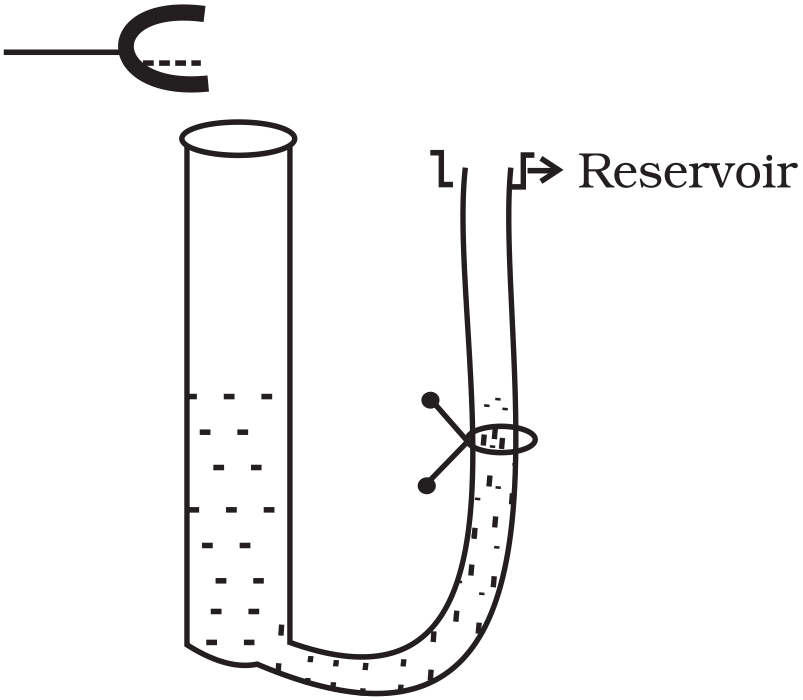
Answer
- If a pipe partially filled with water whose upper surface of the water acts as a reflecting surface of a closed organ pipe. If the length of the air column is varied until its natural frequency equals the frequency of the fork, then the column resonates and emits a loud note.
The frequency of tuning fork,f = 512Hz.
For observation of first maxima of intensity,
- We know that $\text{v}\propto\sqrt{\text{T}}$
where tempreature (T) is in kwlcin.
$\frac{\text{v}_{20}}{\text{v}_0}=\sqrt{\frac{273+20}{273+0}}=\sqrt{\frac{293}{273}}$
$\frac{\text{v}_{20}}{\text{v}_0}=\sqrt{1.073}=1.03$
$\text{v}_0=\frac{\text{v}_{20}}{1.03}=\frac{348.16}{1.03}=338\text{m/ s}$
- The resonance will still be observed for 17cm length of air column above mercury. However, due to more complete reflection of sound waves at mercury surface, the intensity of reflected sound increases.
View full question & answer→Question 285 Marks
The length of a sonometer wire between two fixed ends is $110cm$. Where should the two bridges be placed so as to divide the wire into three segments, whose fundamental frequencies are in the ratio $1 : 2 : 3$?
AnswerHere, total length of the wire
$1 = 110cm$
$V_1: V_2: V_3 = 1 : 2 : 3$
If $l_1, l_2, l_3$ are the length of these three parts as $\text{V}\propto\frac{1}{\text{l}}$
$\therefore \text{l}_2:\text{l}_2:\text{l}_3=\frac{1}{1}:\frac{1}{2}:\frac{1}{3}$
$=6:3:2$
Sum of the ratios = 11
$\therefore \text{l}_1=\frac{\text{L}}{1\text{l}}\times6=\frac{110}{11}\times6=60\text{cm}$
$\text{l}_2=30\text{cm}$
$\text{l}_3=20\text{cm}$
Hence, the bridges should be placed at 60cm and 90cm from the zero end of the wire.
View full question & answer→Question 295 Marks
Bullets are fired at regular intervals of 10 seconds from an armoured car. A is moving with a speed of 30m/s towards B. At what interval will an officer seated in car B and dashing with a speed of 60m/s towards A hear the report? Velocity of sound = 330m/s.
AnswerLet T' and T represent the apparent and true periods respectively.
$\therefore \text{V}'=\frac{1}{\text{T}'}$ and $\text{V}=\frac{1}{\text{T}}$
We know, $\text{V}'=\Big(\frac{\nu-\omega+\text{u}_0}{\nu-\omega+\text{u}_\text{s}}\Big)\text{V}$
$\text{T}=\text{T}\Big(\frac{\nu-\omega+\text{u}_\text{s}}{\nu-\omega+\text{u}_0}\Big)$
Given: $\text{T}=10\text{s},\text{u}_0=30\text{ms}^{-1}$
$\nu=330\text{m/s}$ and
$\text{u}_\text{s}=60\text{ms}^{-1},\omega=10\text{m/s}$
Putting the respective values we have,
$\text{T}'=10\times\Big(\frac{330-10-30}{330-10+60}\Big)$
$=10\times\Big(\frac{290}{380}\Big)=\frac{290}{38}=7.6\text{s}$
View full question & answer→Question 305 Marks
- Describe various modes of vibration in an open ends organ pipe.
- Show that the ratio of frequencies of different harmonics with the first harmonics in open pipe is $1 : 2 : 3$
- In an open organ pipe, the fundamental frequency is $30Hz$. If the organ pipe is closed at one end then what will be the fundamental frequency?
Answer
- An open organ pipe is open at both ends. Therefore, an antinode is formed at each end.
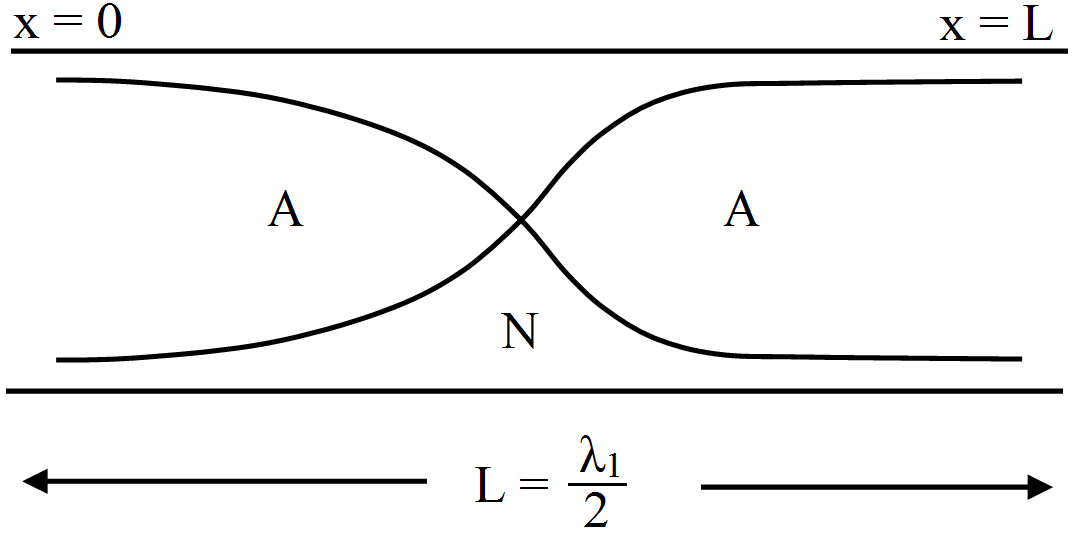
$\lambda=\frac{2\text{L}}{\text{n}}$
Where n = 1, 2, 3,.....
- First normal node of vibration
Let $\lambda_1$ be the wavelength of stationary waves set up in the open organ pipe corresponding to n = 1
$\lambda_1=\frac{2\text{L}}{1}\Rightarrow\text{L}=\frac{\lambda_1}{2}$
$\text{v}_1=\frac{\text{v}}{\lambda_1}=\frac{\text{v}}{2\text{L}}$
This is the lowest frequency of vibration and is called fundamentak frequency.
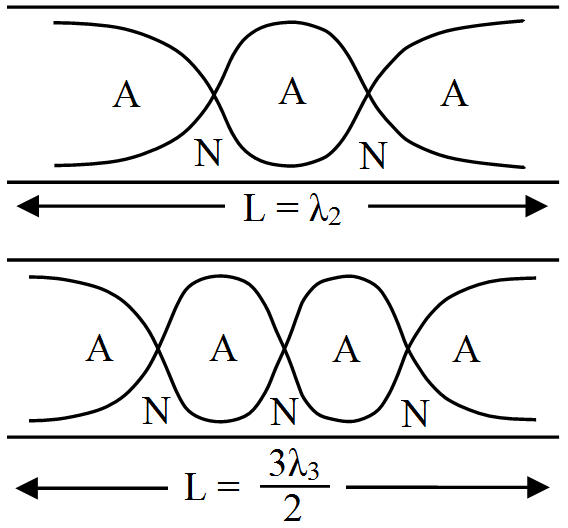
- Second normal mode of vibration $\lambda_2=\frac{2\text{L}}{2}=\text{L}$
$\text{v}_2=\frac{\text{v}}{\lambda_2}=\frac{\text{v}}{\text{L}}$
$\Rightarrow\text{v}_2=\frac{2\text{v}}{\text{L}}=2\text{v}_1\text{ i.e. }\text{v}_2=2\text{v}_1$
- Third normal mode of vibration $\lambda_3=\frac{2\text{L}}{3}=\text{L}\Rightarrow \text{L}=\frac{3\lambda_3}{2}$
$\text{v}_3=\frac{\text{v}}{\lambda_3}=\frac{3\text{v}}{2\text{L}}$
$\Rightarrow\text{v}_3=3\text{v}_1$
- From (i), (ii) and (iii), we have $v_1 : v_2 : v_3 = 1 : 2 : 3$
In an open organ pipe, fundamentak frequency $v_1 = 30Hz$
Let for closed organ pipe, fundamental frequency is $V'_1$.
We know that the fundamental frequency for open organ pipe, $\text{v}_1=\frac{\nu}{2\text{L}}$ and for closed organ pipr, $\text{v}'_1=\frac{\nu}{4\text{L}}$
$\therefore\frac{\text{v}_1}{\text{v}'_1}=\frac{\nu}{2\text{L}}\times\frac{4\text{L}}{\nu}$
$\Rightarrow \text{v}'_1=\frac{\text{v}_1}{2}=\frac{30\text{Hz}}{2}=15\text{Hz}$ View full question & answer→Question 315 Marks
Explain why?
- Inspite of formula $\nu=\sqrt{\frac{\gamma\text{P}}{\rho}},$ the speed of sound in air independent of pressure.
Where $\gamma=$ ratio of specific heats i.e., $\gamma =\frac{\text{C}_\text{p}}{\text{C}_\nu},$ $\rho=$ density, P = pressure.
- Bats can ascertain distances, directions, nature and the size of the obstacles without any "eyes”.
Answer
- $\nu=\sqrt{\frac{\gamma \text{P}}{\rho}}$
Speed of sound in air $\nu=\sqrt{\frac{\gamma \text{RT}}{\text{mV}}.\text{V}}$
where $\rho=$ Density of gas $=\frac{\text{m}}{\text{V}}$
$\Rightarrow\nu=\sqrt{\frac{\gamma\text{RT}}{\text{m}}}=\text{Constant}$
PV = RT at constant temprerature, PV = constant, $\rho =\frac{\text{m}}{\text{V}}$
- Bats can heard ultrasonic vibrations, i.e. whose frequency is greater than 20KHz that cannot be heard by human ear that is why bat can ascertain distances, directions, nature and the size of the obstacles without any "eyes”.
View full question & answer→Question 325 Marks
Two tuning forks A and B give 5 beats/sec. A resounds with a closed column of air 15cm long and B with an open column 30.5cm long. Calculate their frequencies (neglect end correction).
Answer$\text{V}_1=\frac{\nu}{4\times15},\text{V}_2=\frac{\nu}{2\times30.5}=\frac{\nu}{61}$
$m = \text{V}_1-\text{V}_2=\frac{\nu}{60}-\frac{\nu}{61}=\nu\times\frac{1}{61\times60}$
$5=\frac{\nu}{61\times60}$
$=\nu=5\times16\times60\text{cm/s}$
$\therefore \text{V}_1=\frac{\nu}{60}=\frac{5\times61\times60}{60}=305\text{Hz}$
$\text{V}_2=\frac{\nu}{61}=\frac{5\times60\times61}{61}=300\text{Hz}$
View full question & answer→Question 335 Marks
The amplitude of a wave disturbed propagating in the positive x direction is given by
$\text{y}=\frac{1}{1+\text{x}^2}$ at t = 0 and $\text{y}=\frac{1}{1+(\text{x}-1)^2}$ at t = 2s
where x and y in metre. The shape of disturbance does not change during the propagation. What is the velocity of the wave?
AnswerAt t = 0, $\text{y}=\frac{1}{1+\text{x}^2}$
$\therefore 1+\text{x}^2=\frac{1}{\text{y}}$
$\text{x}^2=\frac{1}{\text{y}}-1=\frac{1-\text{y}}{\text{y}}\text{x}=\Big(\frac{1-\text{y}}{\text{y}}\Big)^{\frac{1}{2}}$
At t = 2s, $\text{y}=\frac{1}{[1+(\text{x}-1)^2]}$
$1+(\text{x}-1)^2=\frac{1}{\text{y}}$
$(\text{x}-1)^2=\frac{1}{\text{y}}-1=\frac{1-\text{y}}{\text{y}}$
$(\text{x}-1)=\Big(\frac{1-\text{y}}{\text{y}}\Big)^{\frac{1}{2}}$
$\Rightarrow \text{x}=1+\Big(\frac{1-\text{y}}{\text{y}}\Big)^{\frac{1}{2}}$
Since, $v=\frac{\text{x}_2-\text{x}_1}{\text{t}_2-\text{t}_1}$
$\therefore v=\frac{1}{20}=0.5\text{ms}^{-1}$
View full question & answer→Question 345 Marks
The intensities due to two sources of sound are $I_0$ and $4I_0$. What is the intensity at a point where the phase difference between two waves is:
- $0^\circ$
- $\frac{\pi}{2}$
- $\pi?$
AnswerIf $a_1$ and $a_2$ are the amplitudes of two waves, then the resultant amplitude is given by
$\text{A}=\sqrt{\text{a}^2_1+\text{a}^2_2+2\text{a}_1\text{a}_2\cos\phi},$
where $\phi$ is the phase difference between two waves
Now, $\text{A}^2=\text{a}^2_1+\text{a}^2_2+2\text{a}_1\text{a}_2\cos\phi$
Expressing this equation in terms of intensity.
$\text{I}=\text{I}_1+4\text{I}_2+2\sqrt{\text{I}_1}\sqrt{\text{I}_2}\cos\phi$
- $\text{I}=\text{I}_0+4\text{I}_0+2\sqrt{\text{I}_0}\sqrt{4\text{I}_0}\cos0^\circ=9\text{I}_0$
- $\text{I}=\text{I}_0+4\text{I}_0+2\sqrt{\text{I}_0}\sqrt{4\text{I}_0}\cos\frac{\pi}{2}=5\text{I}_0$
- $\text{I}=\text{I}_0+4\text{I}_0+2\sqrt{\text{I}_0}\sqrt{4\text{I}_0}\cos\pi=\text{I}_0.$
View full question & answer→Question 355 Marks
A transverse harmonic wave on a string is described by
$\text{y}(\text{x, t})=3.0\sin\big(36\text{t}+0.018\text{x}+\frac{\pi}{4}\big)$
where x and y are in cm and t in s. The positive direction of x is from left to right.
Is this a travelling wave or a stationary wave?
If it is travelling, what are the speed and direction of its propagation?
AnswerYes; Speed = 20 m/s, Direction = Right to left
Explanation:
Given,
$\text{y}(\text{x, t})=3\sin\big(36\text{t}+0.018\text{x}+\frac{\pi}{4}\big)$
We know, the equation of a progressive wave travelling from right to left is:
$\text{y}(\text{x, t})=\text{a}\sin(\omega\text{t}+\text{kx}+\phi)\ \dots(2)$
Comparing equation (1) to equation (2), we see that it represents a wave travelling from right to left and also we get:
$\text{a}=3\text{cm},\omega=36\text{rad/s},\text{k}=0.081\text{cm and }\phi=\frac{\pi}{4}$
Therefore the speed of propagation, $\text{v}=\frac{\omega}{\text{k}}=\frac{36}{0.018}=20\text{m/s}$
View full question & answer→Question 365 Marks
Differentiate the following:
- Wave velocity and particle velocity.
- Harmonics and overtones.
Answer
-
|
Wave velocity
|
Particle velocity
|
|
The velocity of wave motion through a particular medium is constant. It depends only on the nature of the medium, does not depends upon its frequency or wavelength or intensity.
|
Velocity of the particles during their vibration is different at different position.
|
-
|
Harmonics
|
Overtones
|
|
Harmonics are the notes/ seconds of frequency equal to or an integral multiple of fundamental frequency (n). Thus, first, second, third, ... harmonics have frequencies n, 2n, 3n, ... respectively.
|
Overtones are the notes/ seconds of frequency twice/ thrice/ four times ... the fundamental frequency (n). Thus, first, second, third, ... overtones have frequencies 2n, 3n, 4n, ... respectively and so on.
|
View full question & answer→Question 375 Marks
What is meant by beats? Discuss graphical method of formation of beats.
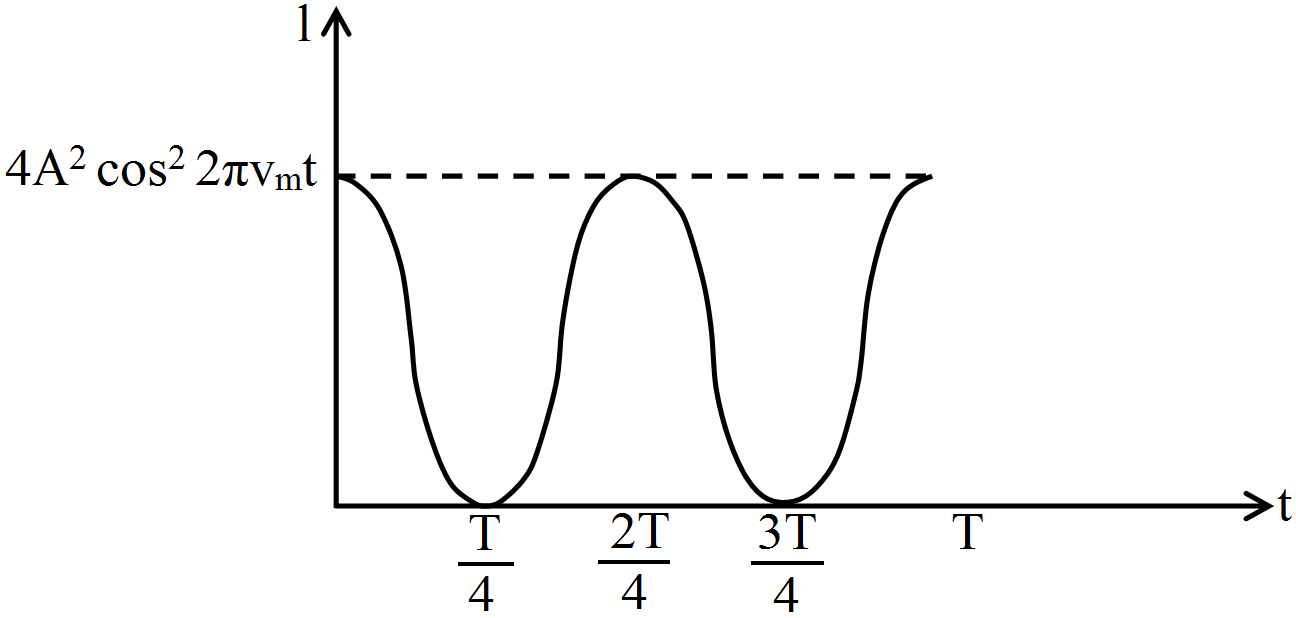
AnswerBeats: The waxing and waning of sound due to interaction between two slightly different frequencies. If $v_1$ and $v_2$ are the two frequencies, $V_b = lv_1- v_2l$. Beats are heard only when $lv_1- v_2l <10$, since the sound persist in our ears for $\frac{1}{10}\text{th}$ of a second. As a result of the super-position of the nearly equal frequencies, a varying amplitude is formed which varies with time as $2\text{A}\cos2\pi\text{v}_\text{m}\text{t}$ where $\text{v}_\text{m}=\frac{\text{v}_1-\text{v}_2}{2}$ Intensity $=4\text{A}^2\cos^22\pi\nu_\text{m}\text{t}$ The intensity pattern can be shown as below.
View full question & answer→Question 385 Marks
Use the formula $\text{v}=\sqrt{\frac{\gamma\text{P}}{\rho}}$ to explain why the speed of sound in air:
Increases with humidity.
AnswerLet $v_m$ and $v_d$ be the speed of sound in moist air and dry air respectively.
Let $\rho_\text{m}$ and $\rho_\text{d}$ be the densities of the moist air and dry air respectively.
Take the relation:
$\text{v}=\sqrt{\frac{\gamma\rho}{\rho}}$
Hence, the speed of sound in moist air is:
$\text{v}_\text{m}=\sqrt{\frac{\gamma\rho}{\rho_\text{m}}}\ \dots(\text{i})$
And the speed of sound in dry air is:
$\text{v}_\text{d}=\sqrt{\frac{\gamma\rho}{\rho_\text{d}}}\ \dots(\text{ii})$
On dividing equations (i) and (ii), we get:
$\frac{\text{v}_\text{m}}{\text{v}_\text{d}}=\sqrt{\frac{\gamma\rho}{\rho_\text{m}}\times\frac{\rho_\text{d}}{\gamma\rho}}=\frac{\rho_\text{d}}{\rho_\text{m}}$
However, the presence of water vapour reduces the density of air, i.e.,
$\rho_\text{d}<\rho_\text{m}$
$\therefore\ \text{v}_\text{m}>\text{v}_\text{d}$
Hence, the speed of sound in mois air is greater than it is in dry air.
Thus, in gaseous medium, the speed of sound increases with humidity.
View full question & answer→Question 395 Marks
An organ pipe of length L open at both ends is found to vibrate in its first harmonic when sounded with a tuning fork of 480Hz. What should be the length of a pipe closed at one end, so that it also vibrates in its first harmonic with the same tuning fork?
AnswerFor first harmonic of open organ pipe $\text{L}=\frac{\lambda}{2}$ $\Rightarrow\lambda=2\text{L}\Rightarrow\frac{\text{v}}{f_0}=2\text{L}\Rightarrow(\text{f}_0)_\text{open}=\frac{\text{v}}{2\text{L}}$ Where v is speed of the sound wave in air. For first harmonic of closed organ pipe $\text{L}'=\frac{\lambda}{4}$ $\Rightarrow\lambda=4\text{L}'\Rightarrow\frac{\text{v}}{\text{f}_0}=4\text{L}'\Rightarrow(\text{f}_0)_\text{close}=\frac{\text{v}}{4\text{L}'}$ $\Rightarrow\lambda=4\text{L}'\Rightarrow\frac{\text{v}}{2\text{L}}=\frac{\text{v}}{4\text{L}'}$ [$\therefore$ speed remains constant] $\Rightarrow\frac{\text{L}'}{\text{L}}=\frac{2}{4}=\frac{1}{2}\Rightarrow\text{L}'=\frac{\text{L}}{2}$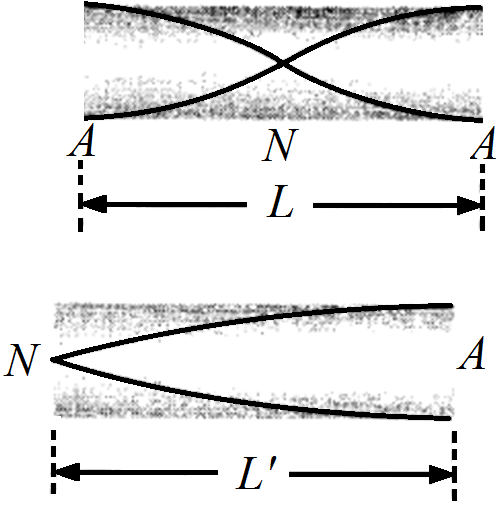
View full question & answer→Question 405 Marks
What is the amplitude, wavelength and velocity of the wave represented by
$\phi(\text{x, t})=5\sin(6\pi\text{t}-4\text{x})?$
AnswerThe given equation is
$\phi (\text{x, t})= 5\sin(6\pi\text{t}-4\text{x})$
$=5\sin2\pi\Big(3\text{t}-\frac{4\text{x}}{2\pi}\Big)$
Comparing it with standard equation
$\phi (\text{x, t})=\text{r}\sin2\pi\Big(\frac{\text{t}}{\text{T}}-\frac{\text{x}}{\lambda}\Big)$
We obtain, r = 5, i.e., amplitude = 5m
$\frac{1}{\text{T}}=3$ or $\text{v}=3\text{Hz}$
$\frac{1}{\lambda}=\frac{4}{2\pi}$
$\lambda=\frac{\pi}{2},$ i.e., wavelength $=\frac{\pi}{2}\text{m}$
As velocity,
$\nu=\text{v}\lambda$
$\therefore \nu=3\times\frac{\pi}{2}=\frac{3}{2}\times\frac{22}{7}$
$=\frac{33}{7}\text{ms}^{-1}$
$=4.71\text{ms}^{-1}$
View full question & answer→Question 415 Marks
The third overtone of a closed organ pipe is found to be in unison with the first overtone of an open pipe. Find the ratio of the lengths of the pipes.
AnswerLet $n_1$ be the frequency of the closed pipe and $n_2$ of the open pipe and $l_1, l_2$ their corresponding lengths.
$\nu=4\text{l}_1\text{n}_1=2\text{l}_2\text{n}_2$
$\text{n}_1=\frac{\nu}{4\text{l}_1}$ and $\text{n}_2=\frac{\nu}{2\text{l}_2}$
Third overtone of the closed pipe (seventh harmonic) = $7n_1$
First oYertone of the open pipe = $2n_2$
Given: $7\text{n}_1=2\text{n}_2$ or $\frac{7\nu}{4\text{l}_1}=\frac{2\nu}{2\text{l}_2}$ or $\frac{\text{l}_1}{\text{l}_2}=\frac{7}{4}$
View full question & answer→Question 425 Marks
A sitar wire is under a tension of 40N and the length between the bridges is 70cm. A 5m sample of the wire has a mass of 1.0g. Deduce the speed of transverse waves on the wire, frequency of the fundamental and the frequency of the first two harmonics.
Answer$\text{T}=40\text{N},$
$\mu=\frac{1.0\text{gm}}{5\text{m}}=\frac{10^{-3}\text{kg}}{5\text{m}}$
$=0.0002\text{kg/m}$
$\text{l}=70\text{cm}=0.7\text{m}$
$\text{c}=\sqrt{\frac{\text{T}}{\mu}}=\sqrt{\frac{40}{0.0002}}=447.2\text{ms}^{-1}$
$\text{v}_1=\frac{1}{2\text{l}}\sqrt{\frac{\text{T}}{\mu}}=\frac{447.2}{2\times0.7}=\frac{447.2}{1.4}$
$=319.4\text{Hz}$
$\text{v}_2=\frac{2}{2\text{l}}\sqrt{\frac{\text{T}}{\mu}}=638.8\text{Hz}$
$\text{v}_3=\frac{3}{2\text{l}}\sqrt{\frac{\text{T}}{\mu}}=958.2\text{Hz}$
View full question & answer→Question 435 Marks
Wavelength of two notes in air are $\frac{80}{195}\text{m}$ and $\frac{80}{193}\text{m}.$ Each note produces five beats per second with a third note of a fixed frequency. Calculate the velocity of sound in air.
AnswerHere given that, $\lambda_1=\frac{80}{195}\text{m}$ and $\text{l}_2=\frac{80}{193}\text{m}.$
If v, and v, be the corresponding frequencies and $v$ be the velocity of sound in air, then
$\text{v}_1=\frac{v}{\lambda_1}=\frac{195v}{80}$
$\text{v}_2=\frac{v}{\lambda_2}=\frac{193v}{80}$
This shown that $v_1 > v_2$.
Let the frequency of third note be v, then
$\text{v}_1-\text{v}=5$ and $\text{v}-\text{v}_2=5$
$\therefore \text{v}_1-\text{v}_2=10$
$\frac{195v}{80}-\frac{193v}{80}=10$
$\Rightarrow20v=80\times10$
$v=400\text{m/ sec}.$
View full question & answer→Question 445 Marks
Show that a function
$\text{y}(\text{x, t})=\text{A}\sin(\text{kx}-\omega\text{t})+\text{B}\cos(\text{kx}-\omega\text{t})$
represents a progressive wave. What is the amplitude, wavelength, velocity and initial phase angle of the wave?
AnswerThe given function is
$\text{y}(\text{x, t})=\text{A}\sin(\text{kx}-\omega\text{t})+\text{B}\cos(\text{kx}-\omega\text{t}).$
Let us put $\text{A}=\text{a}\cos\phi$ and $\text{B}=\text{a}\sin\phi,$ where $\text{a}=\sqrt{\text{A}^2+\text{B}^2}$ and $\tan \phi=\frac{\text{B}}{\text{A}}.$ Then, the above function may be expressed as
$\text{y}(\text{x, t})=\text{a}\cos\phi\sin(\text{kx}-\omega\text{t})\\+\text{a}\sin\phi\cos(\text{kx}-\omega\text{t})$
$\text{y}(\text{x, t})=\text{a}\sin(\text{kx}-\omega\text{t}+\phi)$
As it is a single sinusoidal function of space and time, it is representing the equation of a harmonic progressive wave.
Amplitude of wave $=\text{a}=\sqrt{\text{A}^2+\text{B}^2}$
Wavelength of wave $=\lambda=\frac{2\pi}{\text{k}}.$
wave velocity $=v=\text{v}\lambda=\frac{\text{v}}{2\pi}.\frac{2\pi}{\text{k}}=\frac{\text{v}}{\text{k}}.$
and initial phase angle of the wave $=\phi,$ where $\phi=\tan^{-1}\Big(\frac{\text{B}}{\text{A}}\Big).$
View full question & answer→Question 455 Marks
Show that the velocity of sound increases by $61cm/s$ for every $1^\circ C$.
Answer$\frac{\nu\text{t}}{\nu_0}=\sqrt{\frac{\text{T}}{\text{T}_0}}=\sqrt{\frac{273+\text{t}}{273+0}},$
where $v_t, v_0$ are the velocities of sound at $T$ and $T_0$ respectively.
$\therefore\frac{\nu_\text{t}}{\nu_0}=\Big(1+\frac{\text{t}}{273}\Big)^{\frac{1}{2}}=1+\frac{1}{2}\times \frac{\text{t}}{273}$ (neglecting higher powers)
$\therefore \nu_\text{t}=\nu_0\Big(1+\frac{\text{t}}{546}\Big)=\nu_0+\nu_0\frac{\text{t}}{546}$
$\therefore \nu_\text{t}-\nu_0=\frac{\nu_0\text{t}}{546}=\frac{332\times1}{546}$
$=0.608=61\text{cm/s}$
Thus, the velocity of sound increases by 61cm/s for every 1°C (or 1K) rise in the temperature.
View full question & answer→Question 465 Marks
Use the formula $\text{v}=\sqrt{\frac{\gamma\text{P}}{\rho}}$ to explain why the speed of sound in air:
Increases with temperature,
AnswerTake the relation:
$\text{v}=\sqrt{\frac{\gamma\text{P}}{\rho}}\ \dots(\text{i})$
or one mole of any ideal gas, the equation can be written as:
PV = RT
$\text{P}=\frac{\text{RT}}{\text{V}}\ \dots(\text{ii})$
Substituting equation (ii) in equation (i), we get:
$\text{v}=\sqrt{\frac{\gamma\text{RT}}{\text{VP}}}=\sqrt{\frac{\gamma\text{RT}}{\text{M}}}\ \dots(\text{iii})$
where,
mass, $\text{M}=\rho\text{V}$ is a constant
γ and R are also constants
We conclude from equation (iii) that $\text{v}\propto\sqrt{\text{T}}$
Hence, the speed of sound in a gas is directly proportional to the square root of the temperature of the gaseous medium, i.e., the speed of the sound increases with an increase in the temperature of the gaseous medium and vice versa.
View full question & answer→Question 475 Marks
A copper wire is held at the two ends by rigid supports. At 30°C, the wire is just taut, with a negligible tension, find the speed of the transverse waves in this wire at 10°C.
$\alpha=1.7\times10^{-5}/^{\circ}\text{C},$
$\text{Y}=1.3\times10^{11}\text{N/m}^2,$
$\rho=9\times10^3\text{kg/m}^3.$
AnswerLet $\text{dl}=l \alpha\theta\text{ or }\frac{\text{dl}}{\text{l}}=\alpha\theta$
$\text{Y}=\frac{\frac{\text{F}}{\text{A}}}{\frac{\text{dl}}{\text{l}}}=\frac{\text{fl}}{\text{Adl}}$
$\frac{\text{F}}{\text{A}}=\frac{\text{Ydl}}{\text{l}}=\text{Y}\alpha \theta$
$=1.3\times10^{11}\times1.7\times10^{-5}\times20$
$\therefore \frac{\text{F}}{\text{A}}=4.42\times10^7$
$\nu=\sqrt{\frac{\text{T}}{\text{m}}}=\sqrt{\frac{\text{F}}{\text{A}\rho}},$ where F = T
and $=\sqrt{\frac{4.42\times10^7}{9\times10^3}}=70\text{m/s}$
View full question & answer→Question 485 Marks
From the equation $\text{y}=\text{r} \sin\frac{2\pi}{\lambda}(\nu\text{t}-\text{x})$ establish the relation between particle velocity, and wave velocity.
Answer$\text{y}=\text{r} \sin\frac{2\pi}{\lambda}(\nu\text{t}-\text{x})$
Velocity of particle
$\text{u}(\text{x},\text{t})=\frac{\text{d}}{\text{dt}}[\text{y}(\text{x,}\text{t})]$
$=\frac{\text{d}}{\text{dt}}\Big[\text{r}\sin\big\{\frac{2\pi}{\lambda}(\nu\text{t}-\text{x})\big\}\Big]$
$\text{u}(\text{x,t})=\frac{2\pi}{\lambda}\nu\Big[\text{r}\cos\big\{\frac{2\pi}{\lambda}(\nu\text{t}-\text{x})\big\}\Big]\dots(1)$
Also, $\frac{\text{d}}{\text{dx}}[\text{y}(\text{x},\text{t})]=\text{r}\cos\Big\{\frac{2\pi}{\lambda}(\nu\text{t}-\text{x})\Big\}\dots(2)$
Dividing (1) and (2), we get
$\frac{\text{u}(\text{x},\text{t})}{\frac{\text{d}}{\text{dx}}\{\text{y}(\text{x},\text{t}\})}=-\nu$
$\text{or }\text{u}(\text{x},\text{t})=-\nu\frac{\text{d}}{\text{dx}}\{\text{y}(\text{x},\text{t})\}$
View full question & answer→Question 495 Marks
Use the formula $\text{v}=\sqrt{\frac{\gamma\text{P}}{\rho}}$ to explain why the speed of sound in air:
Is independent of pressure,
AnswerTake the relation:
$\text{v}=\sqrt{\frac{\gamma\text{P}}{\rho}}\ \dots(\text{i})$
where,
Density, $\rho=\frac{\text{Mass}}{\text{Volume}}=\frac{\text{M}}{\text{V}}$
M = Molecular weight of the gas
V = Volume of the gas
Hence, equation (i) reduces to:
$\text{v}=\sqrt{\frac{\gamma\text{PV}}{\text{M}}}\ \dots(\text{ii})$
Now from the ideal gas equation for n = 1:
PV = RT
For constant T, PV = Constant
Since both M and $\gamma$ are constants, v = Constant
Hence, at a constant temperature, the speed of sound in a gaseous medium is independent of the change in the pressure of the gas.
View full question & answer→Question 505 Marks
The air columns (of resonance tubes) $100cm$ and $101cm$ long give $17$ beats in $20$ seconds, when each is sounding its fundamental note. Calculate velocity of sound.
AnswerHere, length of first air column,
$l_1 = 100cm = 1m$
length of other air column
$l_2 = 101cm = 1.01m$
No. of beats per second, $\text{n}=\frac{17}{20}$
Suppose v is the velocity of sound.
Let $v_1, v_2$ be the fundamental frequencies of vibration of two air columns
$\therefore \text{V}_1=\frac{\nu}{4\text{l}_1}=\frac{\nu}{4\times1}=\frac{\nu}{4}$
and $\text{V}_2=\frac{\nu}{4\times1.01}=\frac{\nu}{4.04}$
As per question $\text{V}_1-\text{V}_2=\text{n}$
$\therefore \frac{\nu}{4}-\frac{\nu}{4.04}=\frac{17}{20}$
$\nu=343.4\text{ms}^{-1}$
View full question & answer→