Question 12 Marks
In the special reaction for $ICl$, identify the oxidant and the reductant? Denote oxidation states of the species.
Answer$\stackrel{0}I _2+\stackrel{+5}KClO _3 \longrightarrow \stackrel{+1-1}{l C l}+ KlO _3$ Potassium chlorate, $KClO_3$ is the oxidising agent or oxidant and iodine is the reducing agent or reductant.
View full question & answer→Question 22 Marks
Which will be more reactive?
(a) $ClF_3$ or $ClF$,
(b) $BrF_5$ or $BrF$
Answer$ClF_3$ is more reactive than $ClF$, while $BrF_5$ is more reactive than BrF. Both $ClF_3$ and $BrF_5$ are unstable compared to $ClF$ and $BrF$ respectively due to steric hindrance hence are more reactive.
View full question & answer→Question 32 Marks
Which halogen has tendency to form more interhalogen compounds?
AnswerThe halogen fluorine (F) has the maximum tendency to form more interhalogen compounds as it has a small size and more electronegativity.
View full question & answer→Question 42 Marks
Which halogen (X) will have maximum number of other halogen (X ) attached?
AnswerThe halogen Iodine (I) will have the maximum number of other halogens attached.
View full question & answer→Question 52 Marks
What will be the names of the following compounds: ICl, BrF?
AnswerICl : Iodine monochloride
BrF : Bromine monofluoride
View full question & answer→Question 62 Marks
Why does fluorine combine with other halogens to form maximum number of fluorides?
AnswerSince fluorine is the most electronegative element and has the smallest atomic radius compared to other halogen fluorine forms maximum number of fluorides.
View full question & answer→Question 72 Marks
Name two gases used in war.
AnswerPhosgene : $COCl_2$
Mustard gas: $Cl – CH_2 – CH_2 – S – CH_2 – CH_2 – Cl$
View full question & answer→Question 82 Marks
What is the action of concentrated $H_2SO_4$ on (a) $HBr$ (b) $HI$
AnswerConcentrated sulphuric acid oxidises hydrobromic acid to bromine.$2HBr + H_2SO_4 \rightarrow Br_2 + SO_2 + 2H_2O$
It oxidises hydroiodic acid to iodine.
$2HI + H_2SO_4 \rightarrow I_2 + SO_2 + 2H_2O$
View full question & answer→Question 92 Marks
Dioxygen is paramagnetic in spite of having an even number of electrons. Explain.
AnswerDioxygen is a covalently bonded molecule.
The paramagnetic behaviour of $O_2$ can be explained with the help of molecular orbital theory.
Electronic configuration $O_2$
$KK \sigma (2s)^2 \sigma (2s)^2 \sigma ^*(2p_z)^2 \pi (2p_x)^2 \pi (2p_x)^2 \pi (2p_y)^2\pi ^*(2p_x)^1 \pi ^*(2p_y)^1$. Presence of two unpaired electrons in antibonding orbitals explains paramagnetic nature of dioxygen.
View full question & answer→Question 102 Marks
Which form of sulphur shows paramagnetic behaviour?
AnswerIn the vapour state, sulphur partly exists as $S_2$ molecule, which has two unpaired electrons in the antibonding $\pi ^*$ orbitals like $O_2$. Hence it exhibits paramagnetism.
View full question & answer→Question 112 Marks
AnswerThe property of some elements to exist in two or more different forms in the same physical state is called allotropy.
View full question & answer→Question 122 Marks
Show hydrogen bonding in the above molecule with the help of a diagram.
Question 132 Marks
Which of the following possesses hydrogen bonding? $H_2S, H_2O, H_2Se, H_2Te$
Answer
- Oxygen being more electronegative, is capable of forming hydrogen bonding in the compound $H_2O$.
- The other elements $S, Se$ and $Te$ of Group $16$, being less electronegative do not form hydrogen bonds.
- Thus, hydrogen bonding is not present in the other hydrides $H_2S, H_2Se$ and $H_2Te$.
View full question & answer→Question 142 Marks
Oxygen forms only $OF_2$ with fluorine while sulphur forms $SF_6$. Explain. Why?
Answer
- Oxygen combines with the most electronegative element fluorine to form $OF_2$ and exhibits positive oxidation state $(+ 2)$. Since, oxygen does not have vacant J-orbitals it cannot exhibit higher oxidation states.
- Sulphur has vacant d-orbitals and hence can exhibit + $6$ oxidation state to form $SF_6$.
View full question & answer→Question 152 Marks
The first member of the a group usually differs in properties from the rest of the members of the group. Why?
AnswerThe first member of a group usually differs in properties from the rest of the members of the group for the following reasons :
- Its small size
- High electronegativity
- Absence of vacant d-orbitals in its valence shell.
View full question & answer→Question 162 Marks
Noble gases have very low melting and boiling points. Why?
AnswerNoble gases are monoatomic, the only type of interatomic interactions which exist between them are weak van der Waals forces. Therefore, they can be liquefied at very low temperatures and have very low melting or boiling points.
View full question & answer→Question 172 Marks
Oxygen has less negative electron gain enthalpy than sulphur. Why?
Answer- Oxygen has a smaller atomic size than sulphur.
- It is more electronegative than sulphur.
- It has a larger electron density.
- Due to high electron density, oxygen does not accept the incoming electron easily and therefore has less electron gain enthalpy than sulphur.
View full question & answer→Question 182 Marks
What is the oxidation state of xenon in the following compounds?
$XeOF_4, XeO_3, XeF_5, XeF_4, XeF_2.$
Answer
| Compound |
Oxidation state of Xe |
| $XeOF_4$ |
$+ 6$ |
| $XeO_3$ |
$+ 6$ |
| $XeF_6$ |
$+ 6$ |
| $XeF_4$ |
$+ 4$ |
| $XeF_2$ |
$+ 2$ |
View full question & answer→Question 192 Marks
Match the following
$A – B$
$XeOF_2$_ – Xenon trioxydifluoride
$XeO_2F_2 $– Xenon monooxydifluoride
$XeO_3F_2$ – Xenon dioxytetrafluoride
$XeO_2F_4$ – Xenon dioxydifluoride
Answer$XeOF_2$ – Xenon monooxydifluoride
$XeO_2F_2$ – Xenon dioxydifluoride
$XeO_3F_2$ – Xenon trioxydifluoride
$XeO_2F_4$– Xenon dioxytetrafluoride
View full question & answer→Question 202 Marks
Complete the following.
1. $ICl_3 + H_2O …….. + …….. + ICl$
2.$ I_2 + KClO_3 ……. + KIO_2$_
3. $BrCl + H_2O ……. + HCl$
4.$ Cl_2 + ClF_3 ……..$
5. $H_2C = CH_2 + ICl …….$
6. $XeF_4 + SiO_2 ……. + SiF_4$_
7. $XeF_6 + 6H_2O …….. + HF$
8. $XeOF_4 + H_2O ……. + HF$
Answer1. $2 ICl _3+3 H _2 O \rightarrow 5 HCl + HIO _3+ ICl$
2. $I _2+ KClO _3 \rightarrow ICl + KIO _3$
3. $BrCl + H _2 O \rightarrow HOBr + HCl$
4. $Cl _2+C1F_3 \rightarrow 3 CIF$
5. $CH _2= CH _2+ ICl \rightarrow CH _2 I - CH _2 Cl$
6. $2 XeF _6+ SiO _2 \rightarrow 2 XeOF _4+ SiF _4$
7. $XeF _6+3 H _2 O \rightarrow XeO _3+6 HF$
8. $XeOF _4+ H _2 O \rightarrow XeO _2 F_2+2 HF$
View full question & answer→Question 212 Marks
Give two uses of chlorine.
AnswerChlorine is used for :
- for sterilization of drinking water.
- bleaching wood pulp required for the manufacture of paper and rayon, cotton and textiles are also bleached using chlorine.
- in the manufacture of organic compounds like $CHCl _3, CCl _4$ DDT, dyes and drugs.
- in the extraction of metals like gold and platinum.
- in the manufacture of refrigerant like Freon (i.e., $CCl _2 F_2$ ).
- in the manufacture of several poisonous gases like mustard gas $\left( Cl ^{-} C _2 H _4- S - C _2 H _4- Cl \right)$, phosgene $\left( COCl _2\right)$ used in warfare.
- in the manufacture of tear gas $\left( CCl _3 NO _2\right)$.
View full question & answer→Question 222 Marks
Write the reaction of conc. $H_2SO_4$ with sugar.
AnswerConcentrated sulphuric acid when added to sugar, it is dehydrated giving carbon.$C _{12} H _{22} O _{11} \stackrel{\text { conc. } H _2 SO _4}{\longrightarrow} 12 C +11 H _2 O$
The carbon that is left behind is called sugar charcoal and the process is called char.
View full question & answer→Question 232 Marks
Give one example showing reducing property of ozone.
AnswerOzone decomposes to liberate nascent oxygen, hence it is a powerful oxidising agent. $O _{3(g)} \rightarrow O _{2(g)}+$ OFor example
(i) It oxidises lead sulphide ( PbS ) to lead sulphate $\left( PbSO _4\right)$.
$pbS_{(s)}+4 O_{3(g)} \rightarrow PbSO_{(s)}+4 O_{2(g)}$
(ii) Potassium iodide, Kl is oxidised to iodine, $I _2$ in the solution.
$2 Kl_{(aq)}+H_2 O_{(1)}+O_{3(g)} \rightarrow 2 KOH_{(aq)}+I_{2(s)}+O_{2(g)}$
View full question & answer→Question 242 Marks
The pKa values of $HCl$ is $-7.0$ and that of $HI$ is $-10.0$. Which is the stronger acid?
AnswerFor $HCl _1 pK _{ a }=-7.0$, hence its dissoClation constant is, $K _{ a }=1 \times 10^{-7}$.
For $HI _{ a }=-10.0$, hence its dissoClation constant is $K _{ a }=1 \times 10^{-7}$. Hence HCl dissoClates more than HI .
Therefore HCl is a stronger acid than HI .
View full question & answer→Question 252 Marks
What is the oxidation state of S in $H_2SO_4$.
AnswerThe oxidation state of $S$ in $H_2SO_4$ is + $6$.$(+2) \quad(+6) \quad(-8)$
$\begin{array}{lll} \ \ H _2 \ \ \ \ & S \ \ \ \ \ & O _4\end{array}$
View full question & answer→Question 262 Marks
Write the names of allotropic forms of selenium.
AnswerSelenium has two allotropic forms as follows :
(i) Red (non-metallic) form
(ii) Grey (metallic) form
View full question & answer→Question 272 Marks
What is the action of bromine on magnesium metal?
AnswerBromine reacts instantly with magnesium metal to give magnesium bromide.$
Mg _{( s )}+ Br _{2( l )} \longrightarrow MgBr _{2( s )}\ \ (Magnesium \ bromide)
$
View full question & answer→Question 282 Marks
Give two uses of $ClO_2$
Answer(i) $ClO_2$ is used as a bleaching agent for paper pulp and textiles.
(ii) It is also used in water treatment.
View full question & answer→Question 292 Marks
Name two gases which deplete ozone layer.
AnswerNitrogen oxide (NO) released from exhaust systems of car or supersonic jet aeroplanes and chlorofluorocarbons (Freons) used in aerosol sprays and refrigerators deplete ozone layer.
View full question & answer→Question 302 Marks
What is the oxidation state of $Te$ in $TeO_2$?
AnswerThe oxidation state of $Te$ in $TeO_2$ is $+ 4.$
View full question & answer→Question 312 Marks
Write the order of the thermal stability of the hydrides of group $16$ elements.
AnswerThe thermal stability of the hydrides of group $16$ elements decreases in the order of $H_2O > H_2S > H_2Se > H_2Te$.
View full question & answer→Question 322 Marks
Helium and neon do not form compounds with fluorine. Why?
AnswerHelium and Neon do not contain d-orbitals in their respective valence shells and hence their electrons cannot be promoted to higher energy levels like other elements in group 18. Therefore, helium and neon do not form compounds with fluorine.
View full question & answer→Question 332 Marks
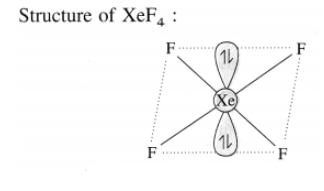
Give the method of preparation of $XeF _4$ and its structure
AnswerFor the preparation of $XeF _4$ :
The covalent bond between dissimilar atoms, $I$ and $Cl$ atoms in $ICl$ is weaker than between similar atoms in $I _2$.
View full question & answer→Question 342 Marks
What is the action of
(i) $H _2 O$ and
(ii) $PF _5$ on $XeF _2$ ?
Answer(i) Action of $H _2 O$ (Hydrolysis):
$XeF _2$ undergoes hydrolysis to form $HF$.
$2 XeF _2+2 H _2 O \rightarrow 4 HF +2 Xe + O _2$
(ii) Reaction with $PF _5$ :
$XeF _2$ forms adducts on reaction with $PF _5$.
$XeF _2+ PF _5 \rightarrow XeF _2 \cdot PF _5$
View full question & answer→Question 352 Marks
Explain $IC1$ is more reactive than $I2.$
Answer
- in interhalogen compound $ICl$ and $I_2$ the atoms are bonded by covalent bonds.
- The covalent bond between dissimilar atoms, $I$ and $Cl$ atoms in $ICl$ is weaker than between similar atoms in $I_2.$
- Therefore bond dissociation enthalpy of ICl bond is less than that of $I_2$ bond.
Hence $ICl$ is more reactive than $I_2.$
View full question & answer→Question 362 Marks
Give the disproportionation reactions given by the following :
(i) $BrF$
(ii) $ClF _3$
(iii) $ICl _3$
Answer(i) $5 BrF \longrightarrow 2 Br _2+ BrF _5$
(ii) $2 ClF _3 \longrightarrow CIF _2^{+}+ CIF _4^{-}$
(iii) $ICl _3 \xrightarrow{341 K } ICl + Cl _2$
View full question & answer→Question 372 Marks
What are the uses of interhalogen compounds?
AnswerThe uses of interhalogen compounds are as follows :
- $ICl$ is used as a halogenating agent and also in the estimation of iodine number of fats and oils.
- In the preparation of polyhalides, interhalogen compounds are used.
- $ClF_3 $ and $BrF_3$_ are widely used as fluorinating agent. They are used in the separation of $^{235}U$ isotope by fluorinating. $^{235}U_{(S)} + 3ClF_{3(l)} – ^{235}UF_{6(g)} + 3ClF_{(g)}$
- In propellants $ClF_3 $ and $IF_3 $ are used as oxidisers.
- They are used as non$-$aqueous solvents.
- The $XX’$ interhalogen compounds are used as a catalyst for the oxidation of As$(III)$
View full question & answer→Question 382 Marks
Give one fluorinating reaction given by inter-halogen compounds.
AnswerInterhalogen compounds like $ClF _3, BrF _3$, etc. are very reactive and they are strong fluorinating agents.
$U _{( S )}+3 ClF _{3(1)} \rightarrow UF _{6( g )}+3 ClF _{( g )}$
View full question & answer→Question 392 Marks
Give the addition reaction given by interhalogen compounds.
AnswerInterhalogen compounds give addition reactions with unsaturated hydrocarbons.
$\begin{aligned}
& CH _2= CH _2+ XX ^{\prime} \rightarrow CH _2 X - CH _2 X ^{\prime} \\
& CH _2= CH _2+ ICl \rightarrow CH _2 I - CH _2 Cl
\end{aligned}$
View full question & answer→Question 402 Marks
Discuss the hydrolysis reactions given by interhalogen compounds.
AnswerInterhalogen compounds undergo hydrolysis and form haloacids of lower halogen and oxyacid of higher halogen in interhalogen compounds.
$\begin{aligned}
& BrCl + H _2 O \rightarrow HOBr + HCl \\
& 5 ICl +3 H _2 O \rightarrow HIO _3+5 HCl +2 I _2 \\
& 2 ICl +3 H _2 O \rightarrow HIO _3+5 HCl + ICl
\end{aligned}$
View full question & answer→Question 412 Marks
Which are the different types of interhalogen compounds?
Answer(i) The general compositions of interhalogen compounds are $XX ^{\prime}, XX _3^{\prime}, XX _5^{\prime}$ and $XX _7^{\prime}$ where halogen $X$ is more electropositive and has larger size than another halogen $X ^{\prime}$. For example,
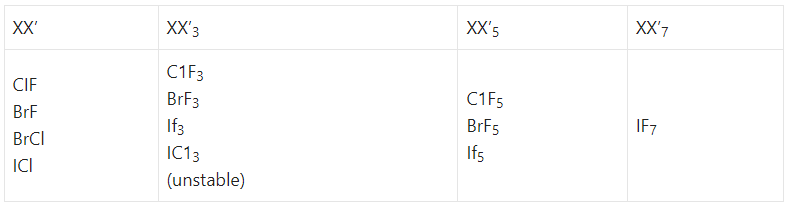
(ii) As the ratio of radii of $X$ and $X^{\prime}$ increases, the number of atoms of $X^{\prime}$ per molecule of interhalogen compound increases. For example, iodine having the largest size with fluorine of the smallest size forms stable $IF _7$. View full question & answer→Question 422 Marks
What are the general compositions of interhalogen compounds?
Answer(i) The general compositions of interhalogen compounds are $XX ^{\prime}, XX _3{ }_3, XX _5^{\prime}$ and $XX _7^{\prime}$ where halogen $X$ is more electropositive and has larger size than another halogen $X ^{\prime}$. For example,
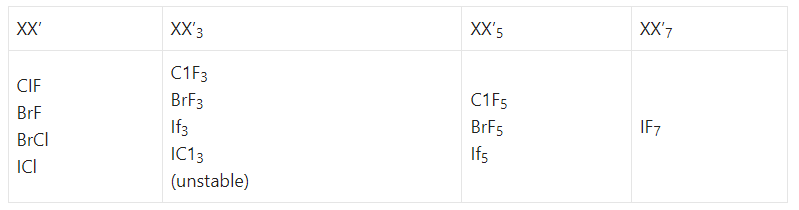
(ii) As the ratio of radii of $X$ and $X^{\prime}$ increases, the number of atoms of $X^{\prime}$ per molecule of interhalogen compound increases. For example, iodine having the largest size with fluorine of the smallest size forms stable $IF _7$. View full question & answer→Question 432 Marks
What are the uses of hydrogen chloride (hydrochloric acid)?
AnswerHydrogen chloride (OR hydrochloric acid) is used :- in the manufacture of chlorine and ammonium chloride,
- to manufacture glucose from com, starch
- to manufacture dye
- in mediClne and galvanising
- as an important reagent in the laboratory
- to extract glue from bones and for the purification of bone black.
- for dissolving metals, $Fe +2 HCl _{( aq )} \rightarrow FeCl _2+ H _{2( g ) Z }$
View full question & answer→Question 442 Marks
Write the reactions of hydrochloric acid with the following :
(a) $NaHSO _3$
(b) $NaHCO _3$
(c) $CaO$
(d) $Mg ( OH )_2$
(e) $NaOH$.
Answer(a) $NaHSO _3+ HCl \rightarrow NaCl + H _2 O + SO _2$
(b) $NaHCO _3+ HCl \rightarrow NaCl + H _2 O + CO _2$
(c) $CaO +2 HCl \rightarrow CaCl _2+ H _2 O$
(d) $Mg ( OH )_2+2 HCl \rightarrow MgCl _2+2 H _2 O$
(e) $NaOH + HCl \rightarrow NaCl + H _2 O$
View full question & answer→Question 452 Marks
What is aquaria? What is the action of aquaria on (i) Au and (ii) Pt?
AnswerA mixture of three parts of concentrated $HCl$ solution and one part of concentrated $HNO _3$ solution is known as aquaria.>
Aquaregia dissolves almost all substances including noble metals like gold, platinum.
This high solubility is due to the formation of nascent chlorine.
$3 HCl + HNO _3 \longrightarrow 2 H _2 O + NOCl +2[ Cl ]$
(i) $2 Au +2 HCl +6[ Cl ] \longrightarrow 2 HAuCl _4$
$O R$
(Chloroauric acid)
$Au +4 H ^{+}+ NO _3^{-}+4 Cl ^{-} \longrightarrow$
$AuCl _4^{-}+2 H _2 O + NO$
(ii)
$\begin{aligned}
& 3 Pt +16 H ^{+}+4 NO _3^{-}+18 Cl ^{-} \longrightarrow \\
& 3 PtCl _6^{2-}+4 NO +8 H _2 O
\end{aligned}$
View full question & answer→Question 462 Marks
What is hydrochloric acid?
AnswerAn aqueous solution of hydrogen chloride is called hydrochloric acid.
It is acidic in nature. It is a strong acid and dissociates almost completely.
$HCl _{( aq )}+ H _2 O \rightarrow H _3 O ^{+}{ }_{( aq )}+ Cl ^{-}{ }_{( aq )} Ka _{ a }=10^7$
View full question & answer→Question 472 Marks
What are the physical properties of hydrogen chloride gas?
Answer- Hydrogen chloride is a colourless gas with a pungent odour.
- It is heavier than air.
- Hydrogen chloride on liquefication forms a colourless liquid having boiling point 189 K and on freezing it forms white solid crystals having melting point 159 K.
- Hydrogen chloride is highly soluble in water.
View full question & answer→Question 482 Marks
Who prepared hydrochloric acid first?
AnswerGlauber in 1648 , first prepared hydrochloric acid by heating common salt $NaCl$ with concentrated $H _2 SO _4$.
$2 NaCl + H _2 SO _4(\text { conc. }) \xrightarrow{\Delta} Na _2 SO _4+2 HCl$
View full question & answer→Question 492 Marks
Write the formulae of tear gas, phosgene and mustard gas.
Answer| Substance | Tear gas | Phosgene | Mustard gas |
| Formula | $CCl _3 NO _2$ | $COCl _2$ | $Cl - C _2 H _4- S - C _2 H _4- Cl$ |
View full question & answer→Question 502 Marks
Explain disinfecting action of chlorine.
###
Chlorine is used for the sterilization of water. Explain.
Answer(i) Since chlorine has an ability of killing harmful micro-organisms, it acts as a good disinfecting agent.
(ii) This ability is due to the oxidising nature of chlorine which produces nascent oxygen in aqueous solutions.
$\begin{aligned} & H _2 O + Cl _2 \rightarrow HCl + HOCl
\\ & HOCl \rightarrow HCl +[ O ]\end{aligned}$
View full question & answer→Question 512 Marks
Explain the bleaching action of chlorine.
Answer(i) Chlorine acts as a powerful bleaching agent due to its oxidising nature.
(ii) In moist conditions or in the presence of water it forms unstable hypochlorous acid, HOCl which decomposes giving nascent oxygen which oxidises the vegetable colouring matter of green leaves, flowers, litmus, indigo, etc.
$\begin{aligned} & Cl 2+ H 2 O \rightarrow HCl + HOCl
\\ & HOCl \rightarrow HCl +[ O ]\end{aligned}$
Vegetable coloured matter + [O] → colourless matter.
View full question & answer→Question 522 Marks
What is the action of chlorine on
(i) methane and
(ii) ethylene?
Answer(i) With methane, chlorine forms substituted products.
$\begin{aligned}
& CH _4+ Cl _2 \xrightarrow{\text { U.V. }} CH _3 Cl + HCl \\
& CH _3 Cl +\underset{\text { excess }}{ Cl _2} \longrightarrow CH _2 Cl _2+ HCl \\
& CH _2 Cl _2+ Cl _2 \longrightarrow CHCl _3+ HCl \\
& CHCl _3+ Cl _2 \longrightarrow CCl _4+ HCl
\end{aligned}$
(ii) With unsaturated hydrocarbons, chlorine forms addition products.
$\begin{aligned}
& CH _2= CH _2+ Cl _2 \xrightarrow{\text { room temp. }} CH _2 Cl - CH _2 Cl \\
& \text { Ethylene Ethylene dichloride } \\
& \text { (1,2-Dichloroethane) } \\
&
\end{aligned}$
View full question & answer→Question 532 Marks
What is the reaction of chlorine with ammonia?
Answer
- Chlorine reacts with the excess of ammonia to form ammonium chloride, $NH_4Cl$ and nitrogen.
$3 Cl _2+\underset{\text { (excess) }}{8 NH _3} \longrightarrow 6 NH _4 Cl + N _2$
- When chlorine is in excess, then with ammonia it forms explosive nitrogen trichloride, $NCl_3.$
$\underset{\text { (excess) }}{3 NH _2}+3 NCl + NCl _3$
View full question & answer→Question 542 Marks
What is the action of chlorine on
(i) hydrogen
(ii) hydrogen sulphide?
###
Give two reactions to show the affinity of hydrogen towards chlorine.
Answer(i) Since chlorine has high affinity for hydrogen, it forms hydrogen chloride in the presence of sunlight.
$H _2+ Cl _2 \xrightarrow{h v} 2 HCl$
(ii) Chlorine reacts with hydrogen sulphide to form hydrogen chloride and sulphur.
$H _2 S + Cl _2 \rightarrow 2 HCl + S$
View full question & answer→Question 552 Marks
What is the action of $Cl _2$ on the following:
(i) $P _4$
(ii) $As$
(iii) $Sb$
(iv) $B$
(v) S.
Answer(i) $P _4+6 Cl _2 \rightarrow 4 PCl _3$ and $P _4+10 Cl _2 \rightarrow 4 PCl _5$
(ii) $2 As +3 Cl _2 \rightarrow 2 AsCl _3$
(iii) $2 Sb +3 Cl _2 \rightarrow 2 SbCl _3$
(iv) $2 B +3 Cl _2 \rightarrow 2 BCl _3$
(v) $S _8+4 Cl _2 \rightarrow 4 S _2 Cl _2$
Sulphur monochloride
View full question & answer→Question 562 Marks
What is the action of chlorine on the following :
(i) $Na$
(ii) $K$
(iii) $Ca$
(iv) $Fe$
(v) A1
(vi) Cu?
Answer(i) $2 Na + Cl _2 \rightarrow 2 NaCl$
(ii) $2 K + Cl _2 \rightarrow 2 KCl$
(iii) $Ca + Cl _2 \rightarrow CaCl _2$
(iv) $2 Fe +3 Cl _2 \xrightarrow{\Delta} 2 FeCl _3$
(v) $2 A 1+3 Cl _2 \xrightarrow{\Delta} 2 A1Cl _3$
(vi) $Cu + Cl _2 \rightarrow CuCl _2$
View full question & answer→Question 572 Marks
What are the physical properties of chlorine?
AnswerThe physical properties of chlorine are as follows :
- It is greenish-yellow gas with a suffocating and pungent smell and is heavier than air.
- It is a poisonous gas.
- When liquefied, chlorine forms a greenish-yellow liquid which has boiling point 239 K.
- Chlorine is soluble in water and the solution is called chlorine water.
View full question & answer→Question 582 Marks
How is chlorine manufactured by the electrolytic process?
Answer- On a large scale chlorine is obtained by an electrolytic process.
- The electrolyte is brine, a concentrated solution of NaCl.
- Nelson’s two compartments diaphragm cell is used for electrolysis in which stout graphite rod is used as an anode while U shaped steel vessel is used as a cathode.
- Reactions :
$\begin{aligned} & NaCl \rightarrow Na ^{+}+ Cl ^{-}
\\ & H _2 O \rightleftharpoons H ^{+}+ OHAt \text { cathode : }
\\ & 2 H _2 O +2 e ^{-} \rightarrow H _2+2 HH ^{-}
\\ & Na ^{+}+ OH ^{-} \rightarrow NaOHAt \text { anode : }
\\ & 2 Cl \rightarrow 2 Cl +2 e ^{-}
\\ & 2 Cl \rightarrow Cl _{2( g )}\end{aligned}$
View full question & answer→Question 592 Marks
How is chlorine manufactured by Deacon’s process?
AnswerIn Deacon's process, chlorine is manufactured by oxidising hydrogen chloride gas by atmospheric oxygen in the presence of $CuCl _2$ as a catalyst at $723 K$.
$4 HCl _{( g )}+ O _{2( g )} \xrightarrow[723 K ]{ CuCl _2} 2 H _2 O _{( g )}+2 Cl _{2( g )}$
View full question & answer→Question 602 Marks
How is chlorine obtained from rock salt or NaCl?
AnswerRock salt or $NaCl$ in the presence of $MnO _2$ and concentrated $H _2 SO _4$ forms chlorine.
The reaction takes place in two steps.
Step 1 :
$4 NaCl +4 H _2 SO _4 \longrightarrow 4 NaHSO _4+4 HCl$
Step 2 :
$MnO _2+4 HCl \longrightarrow MnCl _2+2 H _2 O + Cl _2$
Final reaction :
$\begin{aligned}
& 4 NaCl + MnO _2+4 H _2 SO _4 \longrightarrow \\
& 4 NaHSO _4+ MnCl _2+2 H _2 O + Cl _2
\end{aligned}$
View full question & answer→Question 612 Marks
How is chlorine obtained from HCl?
AnswerChlorine is obtained by the oxidation of hydrochloric acid by various oxidising agents:
(i) $MnO _2+4 HCl \xrightarrow{\Delta} MnCl _2+2 H _2 O + Cl _2$
Manganese dioxide
$\begin{aligned} & \text { (ii) } 2 KMnO _4+16 HCl \longrightarrow \\ & \underset{\text { permanganate }}{\text { Potassium }} \quad 2 KCl +2 MnCl _2+8 H _2 O +5 Cl _2 \\ & \end{aligned}$
View full question & answer→Question 622 Marks
What happens when,
$(i) SO _3$ gas is passed through water
$(ii)$ Concentrated sulphuric acid is added to sugar?
Answer$(i) SO_3$ gas is passed through water
$(ii)$ Concentrated sulphuric acid is added to sugar?
Answer:
$(i) SO_3$_ dissolves in water and forms sulphuric acid, $H _2 SO _4$.
$SO _{3( g )}+ H _2 O _{(1)} \rightarrow H _2 SO _{4( aq )}$
$(ii)$ Concentrated sulphuric acid when added to sugar, it is dehydrated giving carbon.
$C _{12} H _{22} O _{11} \xrightarrow{\text { conc. } H _2 SO _4} 12 C +11 H _2 O$.
View full question & answer→Question 632 Marks
Mention the conditions to maximize the yield of $H _2 SO _4$ by contact process.
Answer
- In the contact process of the manufacture of sulphuric acid, $SO_2$ is oxidised to $SO_3$ by heating the mixture on the heterogeneous catalyst $V_2O_5.$
$2 SO _{2( g )}+ O _{2( g )} \rightleftharpoons 2 SO _{3( g )} \Delta H =-196.6 kJ$
- The forward reaction is exothermic and there is a decrease in number of moles and volume.
- The optimum conditions to maximise the yield of $H_2SO_4$ are pressure of $2$ bar and temperature around $720 K.$
View full question & answer→Question 642 Marks
In the dissociation of $H_2SO_4$ in water, why is the second dissociation constant smaller than the first?
Answer
- $H _2 SO _4$ is a dibasic acid. In aqueous, solution it dissociates in two steps as follows :
$ H _2 SO _{4( aq )} \rightleftharpoons H ^{+}{ }_{( aq )}+ HSO ^{-}{ }_{4( aq )} Ka _1>10$
$ HSO _{( aq )} \rightleftharpoons H ^{+}( aq )+ SO ^{2-}{ }_{4( aq )} Ka _2=1.2 \times 10^{-2}$
- Neutral $H _2 SO _4$ molecule has more tendency to lose proton $(H^+)$ than anionic Lowry$-$Bronsted base $HSO -4$.
- Therefore second dissociation constant $Ka_2$ is smaller than first dissociation constant $Ka_1.$
View full question & answer→Question 652 Marks
What is the action of hot and concentrated $H _2 SO _4$ on
(i) $FeSO _4$ and
(ii) $HI$ ?
Answer- $FeSO _4$ is oxidised to $Fe _2\left( SO _4\right)_3$ by hot and concentrated $H _2 SO _4$. $2 FeSO 4+2 H 2 SO 4 \rightarrow \Delta Fe 2( SO 4) 3+ SO 2+2 H 2 O$
- $Hl$ is oxidised to $I 2$ by hot and concentrated $H 2 S 04$.
\92 HI + H _2 SO _4 \rightarrow 2 H _2 O + SO _2+ I _2$
View full question & answer→Question 662 Marks
Write the reactions of the following with concentrated $H _2 SO _4$ :
(i) $NaCl$
(ii) $KNO _3$
(iii) $CaF _2$.
Answer(i) $NaCl + H _2 SO _{4 \text { conc. }} \rightarrow NaHSO _4+ HCl$
(ii) $2 KNO _3+ H _2 SO _{4 \text { conc. }} \rightarrow K _2 SO _4+2 HNO _3$
(iii) $CaF _2+ H _2 SO _{4 \text { conc. }} \rightarrow CaSO _4+2 HF$.
View full question & answer→Question 672 Marks
Why is sulphuric acid a strong acid?
AnswerSulphuric acid ionises in an aqueous solution in two steps as follows:
Step 1:
\9\begin{aligned}
& H _2 SO _{4( aq )}+ H _2 O _{( l )} \longrightarrow \\
& H _3 O ^{+}{ }_{( aq )}+ HSO _{4 \text { (aq) }}^{-} K_{ a }>10 \\
&
\end{aligned}$
Step 2 :
$\begin{aligned}
& HSO _{4( aq )}^{-}+ H _2 O _{( l )} \longrightarrow \\
& H _3 O _{\text {(aq) }}^{+}+ SO _4^{2-}\left(\text { (aq) } K_{ a }=1.2 \times 10^{-2}\right. \\
&
\end{aligned}$
The larger value of $K _{ a }\left( K _{ a }>10\right)$ shows more dissociation of the acid into $H _3 O ^{+}$and $H _2 SO _4$. Thus $H _2 SO _4$ is a strong acid.
View full question & answer→Question 682 Marks
How is a solution of $H _2 SO _4$ prepared from concentrated sulphuric acid solution?
AnswerConcentrated $H_2SO_4$ dissolves in water with the evolution of a large amount of heat.
Generally a dilute solution is prepared by adding water to the concentrated solution.
In case of concentrated $H_2SO_4$, since its specific gravity is higher, the added water remains on the surface of it and due to evolution of heat, a glass vessel cracks at the interface.
Hence concentrated $H_2SO_4$_ must be added slowly into fine stream of water with constant stirring to obtain a dilute $H_2SO_4$ solution.
View full question & answer→Question 692 Marks
Explain, the nature of $S - O$ bond in $SO _2$.
AnswerIn $SO_2,$ sulphur atom is $sp^2$^ hybridised forming three hybrid orbitals.
In $SO_2,$ each oxygen atom is bonded to sulphur by a $\sigma $ and a $\pi $ bond. Hence in $SO_2$ there are two \sigma and two $\pi$ bonds.
a bonds are formed by $sp^2-p$ overlap while one of n bonds is due to $p\pi -p\pi $ overlaps and other is due to $p\pi -p\pi $ overlap.
But both $S-O$ bonds are identical due to resonance and has bond length $143 \ pm.$
View full question & answer→Question 702 Marks
Complete the following reactions :
(i) $SO _{2( g )}+ Cl _{2( g )} \xrightarrow{\text { charcoal }}$
(ii) $S O _{2( g )}+ O _{2( g )} \xrightarrow[ V _2 O _5]{\Delta}$
Answer(i) $SO _{2( g )}+ Cl _{2( g )} \xrightarrow{\text { charcoal }} SO _2 Cl _2$
sulphuryl chloride
(ii) $2 SO _{2( g )}+ O _{2( g )} \xrightarrow[ V _2 O _5]{\Delta} 2 SO _3$
View full question & answer→Question 712 Marks
Give reactions to show that $SO _2$ gas acts as a reducing agent.
AnswerSulphur dioxide $(SO_2)$ acts as a reducing agent in the presence of moisture.
- Sulphur dioxide, $SO_2$ reduces halogens $(X^\circ )$ to haloacids $(X^{1-}).$
$I_2 + 2H_2O + SO_{2 }\rightarrow 2HI + H_2SO_4$
- $SO_2$_ gas when passed through an acidified solution of $KMnO_4$ it is decolourised due to reduction $(Mn^{7+} to Mn^{2+}).$
$2KMnO_4 + 2H_2O + 5SO_2 \rightarrow K_2SO_4 + 2MnSO_4 + 2H_2SO_4$
- Sulphur dioxide $(SO_2)$ reduces $Fe^{3+} $ to $Fe^{2+}$
$2FeCl_3 + SO_2 + 2H_2O \rightarrow 2FeCl_2 + H_2SO_4 + 2HCl$
View full question & answer→Question 722 Marks
What happens when an excess of $SO _2$ is passed through sodium hydroxide solution?
AnswerWhen $SO _2$ gas is passed through sodium hydroxide solution $( NaOH )$, it forms sodium sulphite, $Na _2 SO _3$ which further with excess of $SO _2$ forms sodium hydrogen sulphite, $NaHSO _3$.
$\begin{aligned}
& 2 NaOH + SO _2 \rightarrow Na _2 SO _3+ H _2 O \\
& Na _2 SO _3+ H _2 O + SO _2 \rightarrow 2 NaHSO _3
\end{aligned}$
View full question & answer→Question 732 Marks
What are the uses of ozone?
AnswerUses of Ozone :
- Ozone sterilises drinking water by oxidising germs and bacteria present in it.
- It is used as a bleaching agent for ivory, oils, starch, wax and delicate fabrics like silk.
- Ozone is used to purify the air in crowded places like Clnema halls, railways, tunnels, etc.
- In industry, ozone is used in the manufacture of synthetic camphor, potassium permanganate, etc.
View full question & answer→Question 742 Marks
Ozone depletion is a major environmental problem. Explain.
Answer- The depletion of ozone layer increases the amount of ultraviolet radiation reaching the Earth.
- This has caused an increase in the rate of skin cancer, eye cataracts and damage to the genetic as well as immune system.
- Thus, ozone depletion has become a major environ-mental problem.
View full question & answer→Question 752 Marks
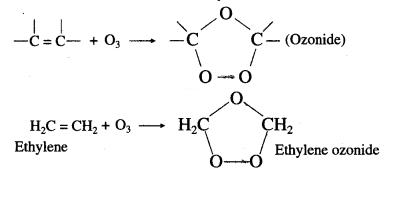
What is the action of ozone on unsaturated hydrocarbons? Give reaction.
AnswerOzone with unsaturated hydrocarbons form ozonides.
View full question & answer→Question 762 Marks
How do the coolents in refrigerants deplete the concentration of ozone?
Answer
- The coolents used in refrigerants are generally chlorofluorocarbons, $CFCs$ also known as Freon, for example $CF_2Cl_2.$
- $CFCs$ have very long lifetime about $20$ to $100$ years.
- $CF_2Cl_2$_ undergoes photochemical decomposition giving free radicals which react and destroy ozone.$ CF _2 Cl _2 \xrightarrow{h \nu} CF _2 Cl \cdot+ Cl \cdot$
$ Cl \cdot+ O _3 \longrightarrow ClO \cdot+ O _2$
$ ClO \cdot+ O _3 \longrightarrow Cl \cdot+2 O _2$
Thus $Cl-$ propagates the destruction of ozone in the atmosphere. View full question & answer→Question 772 Marks
How do exhaust systems of cars and supersonic jet aeroplanes deplete the concentration of ozone layer?
AnswerThe exhaust gases from cars and supersonic jet aeroplanes contain nitric oxide (NO), which combines with ozone in the atmosphere forming oxygen.
$NO + O _3 \rightarrow NO _2+ O _2$
Hence the concentration of ozone is depleted in the upper layer of the atmosphere.
View full question & answer→Question 782 Marks
How does ozone protect the people of the earth?
AnswerOzone layer in the upper atmosphere absorbs the harmful high energetic UV radiations of the Sun and protects the earth. The ultraviolet radiations damage plant and animal life on earth.
View full question & answer→Question 792 Marks
What is meant by ozone depletion?
AnswerThe thinning of the ozone layer in the upper atmosphere is called ozone depletion. This thinning has been more pronounced in the polar regions, especially over the Antarctica.
View full question & answer→Question 802 Marks
Explain laboratory preparation of ozone.
Answer
- When a slow dry stream of oxygen is passed through a silent electric discharge, oxygen is converted into ozone $($about $10\%). $ The mixture is called ozonised oxygen. $3 O _2 \xrightarrow{\text { electric } \text { discharge }} 2 O _3 \Delta H=+142 kJ$
- It is an endothermic reaction.
- Silent electric discharge prevents the decomposition of ozone.
View full question & answer→Question 812 Marks
How is ozone formed naturally?
Answer- In the atmosphere, ozone is naturally formed through photochemical reactions.
- Oxygen present in the lower mesosphere on the absorption of solar radiations, is dissociated into two oxygen atoms which oxidise oxygen to ozone.
- One atomic oxygen combines with molecular oxygen to form $O _3$.
$\begin{aligned} & O _2 \xrightarrow{\text { U.V. light }} O + O
\\ & O _2+ O \longrightarrow O _3\end{aligned}$
View full question & answer→Question 822 Marks
What is ozone umbrella?
###
Explain Ozone as a protective umbrella for UV from sun.
AnswerThe stratospheric pool of ozone which is a layer above earth’s surface and protects from harmful high energetic ultraviolet (UV) rays is called the ozone umbrella or ozonosphere.
View full question & answer→Question 832 Marks
What are oxides? How are they classified? Give examples.
###
What are the different types of oxides? Give example.
AnswerThe oxides are binary compounds in which one element is oxygen and another may be a metal or a non-metal.
They are classified as follows :- acidic oxides, $CO _2, SO _2$, etc.
- Basic oxides, $CaO , BaO$, etc.
- Amphoteric oxides, $Al _2 O _3, ZnO$, etc.
- Neutral oxides, $NO , N _2 O , CO$, etc.
View full question & answer→Question 842 Marks
What are the uses of dioxygen?
AnswerThe uses of dioxygen are as follows :- Dioxygen is essential for sustaining life. It is used in hospitals for artificial respiration.
- It is used in oxy-hydrogen $\left(2800^{\circ} C \right)$ and oxy-acetylene $\left(3200^{\circ} C \right)$ torches used for cutting and welding metals.
- Oxygen cylinders are used in hospitals, for high altitude flying and in mountaineering.
- It is used in the combustion of fuels. In rockets, hydrazine in oxygen is used as a fuel as it provides tremendous thrust.
View full question & answer→Question 852 Marks
Write the reactions for the decomposition of following oxides on heating :
(i) $HgO$
(ii) $Ag _2 O$
(iii) $PbO _2$
(iv) $H _2 O _2$.
Answer(i) $2 HgO _{( s )} \xrightarrow{\text { heat }} 2 Hg + O _{2( g )}$
(ii) $2 Ag _2 O _{( s )} \xrightarrow{\text { heat }} 4 Ag + O _{2( g )}$
(iii) $2 PbO _{2( s )} \xrightarrow{\text { heat }} 2 PbO _{( s )}+ O _{2( g )}$
(iv) $2 H _2 O _{2( aq )} \xrightarrow[ MnO _2]{\text { heat }} 2 H _2 O _{( l )}+ O _{2( g )}$
View full question & answer→Question 862 Marks
How is oxygen prepared by thermal decomposition of certain metallic oxides?
Answer(i) $2 Ag _2 O _{( s )} \xrightarrow{\text { heat }} 4 Ag + O _{2( g )}$
(ii) $2 HgO _{\text {(s) }} \xrightarrow{\text { heat }} 2 Hg + O _{2( g )}$
(iii) $2 PbO _{2( s )} \xrightarrow{\text { heat }} 2 PbO _{( s )}+ O _{2( g )}$
View full question & answer→Question 872 Marks
How does the acid strength of the halogen oxoacids vary?
AnswerThe acid strength of the halogen oxoacids increases with increase in the oxidation state of the halogen.
$\begin{aligned}
& \stackrel{1+}{ HClO }<\underset{3+}{ HClO _2}<\underset{ HClO _3}{4+} \stackrel{7+}{ HClO _4} \\
& \left( K _{ a }=3.5 \times 10^{-8}\right) \quad\left( K _{ a } \gg 1\right) \\
&
\end{aligned}$
View full question & answer→Question 882 Marks
How do
(i) oxidising power and
(ii) thermal stability of oxyacids (or oxoacids) of halogens vary?
Answer(i) Oxidising power of oxyacids of halogens decreases as the oxidation number of halogens increases.
$\begin{aligned}
& \stackrel{1+}{ HClO }>\stackrel{3+}{ HClO _2}>\stackrel{5+}{ HClO _3}>\stackrel{7+}{ HClO _4} \\
& \text { (or } HOCl > HOClO > HOClO _2> HOClO _3 \text { ) } \\
&
\end{aligned}$
(ii) The thermal stability of oxyacids of halogens increases with the increase in the oxidation state of halogen. Hence the increasing order of thermal stability is,
View full question & answer→Question 892 Marks
Write molecular formulae and structure of the following compounds :
(1) Peroxy monosulphuric acid
(2) Pyrosulphuric aCld
Question 902 Marks
What are the different oxyacids of sulphur?
AnswerSulphurous acid: $H _2 SO _3$
Sulphuric acid (Oil of vitriol): $H _2 SO _4$
Di or pyrosulphuric acid or oleum $H _2 S _2 O _7$
Peroxy monosulphuric acid or Caro's acid $H _2 SO _5$
Peroxy sulphuric acid (or Marshall's acid: $H _2 S _2 O _8$
Thiosulphuric acid $H _2 S _2 O _3$
View full question & answer→Question 912 Marks
Explain the reactivity of halogens with metals.
Answer- All halogens react with metals instantly to give metal halides.
- Down the group reactivity decreases from fluorine to iodine.
- $2 Na _{( s )}+ Cl _{2(1)} \rightarrow 2 NaCl _{( s )}, Mg _{( s )}+ Br _{2( s )} \rightarrow MgBr _{2( s )}$
- Halogens being highly electronegative, the metal-halogen bonds are ionic and ionic character decreases down the group. For example $M - F > M - Cl > M - Br > M - I$.
- The metal halides with higher oxidation state of the metal are more covalent than the halides with lower oxidation state of metal. For example $SnCl _4, PbCl _4, SbCl _5$ and $UF _6$ are more covalent than
View full question & answer→Question 922 Marks
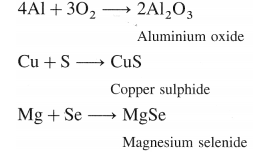
What is the action of metals on group 16 elements?
AnswerMetals react with O, S, Se to form oxides, sulphides and selenides respectively.
View full question & answer→Question 932 Marks
Explain the reactivity of Group 18 towards halogens.
Answer- Group 18 elements are chemically inert.
- However, inert elements like krypton and xenon react directly with fluorine under appropriate conditions to give their fluorides. For example,
$Xe _{( g )}+ F _{2( g )} \xrightarrow[1 atm ]{673 K } XeF _{2( s )}$ - The xenon fluorides $XeF _2, XeF _4$ and $XeF _6$ are colourless crystalline solids which sublime at 298 K.
- These fluorides are strong fluorinating agents.
View full question & answer→Question 942 Marks
Explain the reactivity of halogens towards other halogens.
###
What are interhalogen compounds?
Answer- The halogens have a tendency to combine amongst themselves forming different compounds called interhalogen compounds.
- Interhalogens are of the type $X X, X X_3^{\prime}, X X_5^{\prime}$ and $X X_7^{\prime}$ where X is larger size halogen than $X^{\prime}$.
- They are covalent, diamagnetic, reactive and good oxidising agents.
- Preparation :
$\begin{aligned} & Cl _2+ F _2 \xrightarrow{437 K } 2 ClF
\\ & Br _2+3 F _2 \xrightarrow{\Delta} 2 BrF _3\end{aligned}$
View full question & answer→Question 952 Marks
Explain the reactivity of halogens towards oxygen.
Answer- Halogens with oxygen form many oxides with different oxidation states of halogens.
- Fluorine forms $O _2 F _2$ and $OF _2$.
- Chlorine forms oxides like $\stackrel{1+}{ Cl _2 O }, \stackrel{3+}{ Cl _2} O _3, \stackrel{5+}{ Cl }_2 O _5, \stackrel{6+}{ ClO _3}, \stackrel{7+}{ Cl _2} O _7$ All oxides are oxidising agents.
- Bromine forms oxides like $Br _2 O , BrO _2, BrO _3$ and iodine forms $I _2 O _4, I _2 O _5, I _2 O _7$
View full question & answer→Question 962 Marks
Arrange the halogen acids in the decreasing order of :
(1) thermal stability
(2) acidic strength.
Answer(1) Thermal stability : As the atomic size increases from F to I, the bond dissociation enthalpy of H-X decreases.
Thus, the thermal stability of hydrogen halides decreases down the group in the order HF > HCl > HBr > HI
(2) ACldic strength : Since, the bond dissociation enthalpy of H-X decreases down the group, the acidic strength varies in the order HI > HBr > HCl > HF
View full question & answer→Question 972 Marks
Why is $HF$ a weaker acid than $HCl _2$
Answer- The H-F bond is stronger than H-Cl bond.
- Hence, HF ionises less readily than HCl in $H _2 O$, to give $H ^{+}$ ions.
Therefore, HF is a weaker acid than HCl.
View full question & answer→Question 982 Marks
Why is HCl a weaker acid than HI?
Answer- Bond length of HCl is less than HI.
- Cl is more electronegative than I.
- Hence bond strength of HCl is more than HI.
- Therefore HCl dissociates less than HI, which makes HCl a weaker acid than HI.
View full question & answer→Question 992 Marks
Explain the reducing character of hydrogen halides.
Answer- The reducing character of hydrogen halides increases from HF to HI.
- HF does not show any reducing property while HI is a strong reducing agent.
- H-X bond strength and thermal stability of hydrogen halides decrease from HF to HI.
Unlike other hydrogen halides, HF does not dissociate releasing hydrogen, hence HF is not a reducing agent.
View full question & answer→Question 1002 Marks
Explain the acidic strength of halo acids.
####
Write a short note on the acidic strength of hydrogen halides.
Answer- The aCldic strength of haloaClds vary in the following order, $HF < HCl < BHr < HI$
- The stability of hydrogen halides decreases down the group. $HF > HCl > HBr > HI$.
This is because from F to I, atomic size increases and bond dissociation enthalpy of H-X decreases.
View full question & answer→Question 1012 Marks
Among the hydrides of group 16, water shows unusual properties. Why?
Answer- Oxygen being more electronegative, the O-H bond is more polar and there arises association of $H _2 O$ molecules through intermolecular hydrogen bonding.
- The other hydrides of group 16 do not form H bonds and hence exist as discrete molecules.
- As a result, water shows unusual properties like high B.P, high thermal stability and weaker acidic character as compared to the other hydrides of group 16.
View full question & answer→Question 1022 Marks
Give reasons: $H _2 S$ has a lower boiling point than $H _2 O$.
Answer- Hydrogen bonding and molecular association are not present in $H _2 S$.
- The $H _2 O$ molecules are associated with each other through intermolecular hydrogen bonding.
- Hence, $H _2 S$ has a lower boiling point than $H _2 O$.
View full question & answer→Question 1032 Marks
"The reducing power of the hydrides of group 16 elements increases from $H _2 S$ to $H _2 Te$ ". Explain.
Answer- Except $H _2 O$, all hydrides of group 16 elements are reducing agents.
- reducing power increases from $H _2 S$ to H2Te.
- reducing power of the hydrides is due to their less stability and tendency to dissociate, which increases from $H _2 S$ to $H _2 Te$.
View full question & answer→Question 1042 Marks
$H _2 S$ is less acidic than $H _2 Te$, why?
AnswerSulphur is more electronegative than Tellurium.
Bond energy of $S-H$ in $H _2 S$ is $\left(347 \ kJ \ mol ^{-1}\right)$ more than the bond energy of $Te-H$
$\left(238 \ kJ \ mol ^{-1}\right)$.
Hence $H _2 Te$. dissociates more giving $ H + \left(\right.$ or $\left.H _3 O ^{+}\right)$ than $H _2 S$ in the solution. Therefore $H _2 S$ is less acidic than $H _2 Te$.
View full question & answer→Question 1052 Marks
What is the oxidation state of $S$ in the following:
(a) $S _8$
(b) $HSO _4^{-}$
(c) $K _2 S _2 Og$ ?
Answer(a) Oxidation state of $S$ in, $S _8$ is zero.
(b) $\operatorname{In} HSO _4^{-}$it is +6
(c) in $K _2 S _2 O _8$ it is +6
View full question & answer→Question 1062 Marks
Giving suitable reasons, arrange the hydrides of group 16 elements in the decreasing order of their thermal stability.
Answer- The thermal stability of hydrides decreases in the order of $H _2 O > H _2 S > H _2 Se > H _2 Te$.
- Since atomic size increases from O to Te, the tendency to form hydride bond, M-H decreases.
- Hence M-H bond in O-H is the strongest and in Te-H the weakest. Therefore thermal stability decreases from $H _2 O$ to $H _2 Te$.
View full question & answer→Question 1072 Marks
Explain the reactivity of group 16 elements with hydrogen.
Answer- All the elements of group 16 react with hydrogen and form hydrides of the type $H _2 M$ where M = O, S, Se, Te and Po. For example $H _2 O , H _2 S , H _2 Se , H _2$Te and $H _2 Po$.
- The hydrides of these elements show regular trends in their physical and chemical properties.z
View full question & answer→Question 1082 Marks
Why does xenon being a noble gas form compounds with other elements?
AnswerXenon forms compounds with other elements due to the following reasons :
- Xenon has large atomic size and lower ionisation enthalpy.
- The paired electrons of the valence shell can be unpaired and promoted to the empty d-orbitals.
- The unpaired electrons are shared with fluorine or oxygen atoms to form covalent compounds with higher oxidation states.
View full question & answer→Question 1092 Marks
What is the oxidation state of oxygen in compounds
(i) $O _2 F _2$ and
(ii) $H _2 O _2$ ?
Answer(i) $\operatorname{In} O _2 F _2$, the oxidation state of oxygen is +1 .
$\begin{gathered}
1-1+1+1- \\
( F - O - O - F )
\end{gathered}$
(ii) $In H _2 O _2$, the oxidation state of oxygen is -1 .
$\begin{gathered}1+1-1-1+ \\
( H - O - O - H )\end{gathered}$
View full question & answer→Question 1102 Marks
Why does fluorine show anomalous behaviour?
AnswerFluorine exhibits anomalous behaviour as compared to other halogens in the group.
The reasons for anomalous behaviour of fluorine are as follows :
- the smallest size of fluorine
- the highest electronegativity
- low bond dissoClation enthalpy of F-F bond
- non-availability of d-orbitals in its valence shell.
View full question & answer→Question 1112 Marks
Oxygen generally exhibits an oxidation state of -2 , whereas the other members of its family show oxidation states of $+2,+4$ and +6 as well. Explain.
Answer- The electronic configuration of oxygen is $Is^2 2 s^2 2 p^4$.
- It has two half filled p-orbitals and no d-orbitals for exCltation of electrons. Hence it cannot show higher oxidation states.
- Oxygen being highly electronegative, it mostly shows an oxidation state of – 2 only.
- Other members of the family like sulphur, have vacant d-orbitals, thereby giving four and six half- filled orbitals for bonding.
- Furthermore, they can combine with more electronegative elements.
- Hence, they show oxidation states of $+2,+4$ and 4- 6 also.
View full question & answer→Question 1122 Marks
Why does oxygen show anomalous behaviour?
###
Oxygen differs from the rest of the members of the family. Explain
AnswerOxygen is the first element of group 16.
Reasons for anomalous behaviour of oxygen :- It has the smallest size in the group.
- It has the highest electronegativity ($3.5$).
- It does not have vacant d-orbitals like other elements in group 16.
View full question & answer→Question 1132 Marks
Why do melting and boiling points of halogens increase on moving down the group?
Answer- The atomic size of halogens increases on moving down the group and hence the strength of van der Waals forces between the molecules also increases.
- In the lighter elements, F and Cl, these forces are weak, hence they are gases at room temperature and possess low melting and boiling points.
- In the heavier elements of the group, the van der Waals forces become stronger. Thus, bromine is a liquid and iodine is a solid and they possess higher melting and boiling points.
View full question & answer→Question 1142 Marks
Explain the trend in the bond dissociation enthalpies of halogen molecules.
Answer- The bond dissociation enthalpies of halogen molecules decrease down the group with an increase in atomic size.
- However, the bond dissociation enthalpy of fluorine is lower than that of chlorine and bromine because the F – F bond is weak.
- The bond dissociation enthalpies of the halogen molecules decreases in the order,
$Cl - Cl > Br - Br > F - F > I -1$..
View full question & answer→Question 1152 Marks
How do halogens react with other solvents and with hydrocarbons?
Answer - Halogens are soluble in various organic solvents such as chloroform, carbon disulphide and carbon tetrachloride
- All halogens react with hydrocarbons and form mono or multisubstituted compounds.
- The reactivity decreases down the group from fluorine to iodine.
$\begin{aligned} & CH _4+2 F _2 \rightarrow C +4 HF
\\ & C +2 F _2 \rightarrow CF _4
\\ & CH _4+ Cl _2 \rightarrow CCl _4+4 HCl \end{aligned}$
View full question & answer→Question 1162 Marks
Explain reactions of halogens with water.
Answer- Halogens react with water forming halo acids and haloxyaClds.
- The reactivity decreases from fluorine to iodine.
- $\begin{aligned} & 2 F _2+2 H _2 O \rightarrow 4 HF + O _2
\\ & 3 F _2+3 H _2 O \rightarrow 6 HF + O _3
\\ & X _{2( g )}+ H _2 O _{(1)} \rightarrow HX _{( aq )}+ HOX ( X = Cl , Br ) \\ & \end{aligned}$
View full question & answer→Question 1172 Marks
In case of group 18 elements, explain the variation in melting and boiling points.
AnswerMelting points and boiling points :- Group 18 elements have very low melting points and boiling points.
- The melting points and boiling points increase down the group from He to Rn.
- As the size of the atoms increases on moving down the group, the magnitude of the van der Waals forces increase from He to Rn.
- Thus, the melting and boiling points increase from He to Rn. Helium has the lowest boiling point $(4.2 K )$ of any known substance.
- The boiling points increase in the order He $He < Ne < Ar < Kr < Xe < Rn$
View full question & answer→Question 1182 Marks
Explain the following in the case of group 17 elements :
(i) Density
(ii) Melting and boiling point
AnswerDensity :
- Down the group, density of halogens increases.
- This is, because down the group, van der Waals forces of intermolecular attraction increase, and hence tendency for agglomerisation increases. Therefore density increases.
Melting point and boiling point :
- Halogens have low melting points and boiling points.
- Melting points and boiling points increase down the group.
View full question & answer→Question 1192 Marks
Why do halogens possess very high values of electronegativity? Arrange the halogens in the order of decreasing electronegativity.
Answer- Since halogens have eletronic configuration, $n s^2$ ,$n p^5$, they have tendency to accept one electron to complete an octet.
- Group 17 elements have the lowest atomic radii and high effective nuclear charge.
- Therefore halogens have high values of electronegativity.
- The decreasing order of electronegativity is, $F > Cl > Br > I$
View full question & answer→Question 1202 Marks
Why are atomic radii of noble gases larger than those of halogens?
Answer- Halogens (F to At) are in group 17 while noble gas (He to Rn) are in group 18.
- Generally, atomic radii decrease on moving from left to right in a period, hence atomic radii of noble gases are expected to be smaller than those of halogens.
- Due to the crowding of eight electrons in the valence shell, electron density increases and there is an appreciable electronic repulsion between them.
- To decrease this repulsion and electronic density, the volume of valence shell increases.
Therefore atomic radii of noble gases are larger than those of halogens.
View full question & answer→Question 1212 Marks
How does the atomic radii and ionisation enthalpy vary across a period?
Answer- The atomic or ionic radii decreases across a period with increase in atomic number and increase in the effective nuclear charge $\left(Z_{\text {eff }}\right)$.
- The ionisation enthalpy also increases across a period with increase in atomic number. This is due to addition of electrons to the same shell, while moving across a period.
- Inert element at the end of period has the highest value of ionisation enthalpy.
View full question & answer→Question 1222 Marks
Explain the variation in (1) ionisation enthalpy and (2) electron gain enthalpy in group 18 elements.
Answer(1) Ionisation enthalpy :- In general, group 18 elements have high values of ionisation enthalpy.
- In a period, each noble gas has the highest ionisation enthalpy.
- The noble gases have electronic configuration, $n s^2 n p^6$, they have complete octet with paired electrons and very stable closed-shell electronic configuration. Therefore high energy is required to remove the electron from valence shell.
- Down the group ionisation enthalpy decreases.
(2) Electron gain enthalpy :- Group 18 elements have electronic configuration $n s^2 n p^6$ and complete octet of electrons, hence they have no tendency to accept electrons.
- Therefore, they have a large positive electron gain enthalpy.
View full question & answer→Question 1232 Marks
Explain the trend in atomic radius of group 18 elements.
Answer- The atomic radii of group 18 elements is larger than the atomic radii of group 17 elements.
- Down the group from He to Xe, atomic radii increases due to increase in the number of quantum shells.
- The atomic radii increase in the order $He < Ne < Ar < Kr < XeZ$
View full question & answer→Question 1242 Marks
Fluorine has higher electronegativity but less electron gain enthalpy. Explain.
Answer- Halogens have the highest values for electronegativity due to their small atomic radii and high nuclear charge.
- Fluorine has the highest electronegativity due to its small size.
- In fluorine due to strong inter electronic repulsions in the relatively small 2p orbitals and higher electron density, there is not much attraction of the nucleus for the incoming electron.
- Thus the electron gain enthalpy of fluorine is less in spite of higher electronegativity.
View full question & answer→Question 1252 Marks
Bromine has the highest negative electron gain enthalpy as compared to other elements of 4th period. Explain.
Answer- As compared to other elements (K to Kr) of 4th period, bromine (Br) has the lowest atomic size.
- It has electronic configuration, $35 Br [ Ar ]^{18} 3 d^{10} 4 s^2 4 p^5$.
- It has seven valence electrons and it needs one electron to complete octet.
- Hence Br has the strongest tendency to gain an electron and energy released is maximum in the period. $Br _{( g )}+ e ^{-} \rightarrow Br _{( g )} \Delta_{ eg } H =-325 kJ mol ^{-1}$
Therefore Br has the highest electron gain enthalpy as compared to other elements of 4th period. View full question & answer→Question 1262 Marks
Oxygen has low electron gain enthalpy in group 16 elements. Explain.
Answer- Oxygen has low atomic size.
- It has high electronegativity $(3.5)$.
- It has high electron density.
- The incoming electron is repelled due to high electron density hence oxygen has less negative value of electron gain enthalpy as compared to other group 16 elements. $O _{( g )}+ e ^{-} \rightarrow O ^{-}{ }_{( g )} \Delta_{ eg } H =-141 kJ mol ^{-1}$
View full question & answer→Question 1272 Marks
How does the general electronic configuration of groups 16, 17 and 18 vary?
AnswerThe general electronic configuration of group 16 elements is $n s^2 n p^4$, group 17 is $n s^2 n p^5$ and group 18 is $n s^2 n p^6$. Group 16 has two electrons less than the stable electronic configuration of the nearest noble gas. while group 17 has one electron less than the stable electronic configuration of the nearest noble gas.
View full question & answer→Question 1282 Marks
How do noble gases occur?
Answer- The most important source of noble gases is the atmosphere where they make up about $1 \%$ by volume of air. Argon is the major constituent.
- All noble gases occur in nature except Radon. Radon is a decay product of radioactive ${ }^{226} Ra$..
- Helium on a large scale is obtained from natural gas. Helium and neon are found in the minerals pitchblende, monazite and cleveite.
- Xenon and Radon are the rarest noble gases.
View full question & answer→Question 1292 Marks
How do selenium, tellurium and poloniumoccur?
AnswerSelenium and tellurium are found as metal selenides and tellurides in sulphide ores. Polonium occurs in nature as a decay product of thorium and uranium metals.
View full question & answer→Question 1302 Marks
AnswerSulphur forms 0.034 \% by mass of the earth’s crust. In the combined form it occurs as follows :- Sulphides : Galena (PbS), Zinc blende (ZnS), Copper pyrites $\left( CuFeS _2\right)$
- Sulphates : Gypsum $\left( CaSO _4 \cdot 2 H _2 O \right)$, Epsom salt $\left( MgSO _4 \cdot 7 H _2 O \right)$, Baryte $\left( BaSO _4\right)$
View full question & answer→Question 1312 Marks
Which is the most abundant element on the earth?
Answer(i) Oxygen is the most abundant of all the elements on the earth.
(ii) $46.6 \%$ by mass of earth's crust contains oxygen and oxygen forms $20.95 \%$ by volume of air.
View full question & answer→Question 1322 Marks
Name the elements in groups 16, 17 and 18. What is the oxygen family?
AnswerGroup 16 elements :
Oxygen $\left({ }_8 O \right)$; Sulphur $\left({ }_{16} S \right)$; Selenium ( $\left.{ }_{34} Se \right)$; Tellurium( $\left.{ }_{52} Te \right)$; Polonium ( ${ }_{84} Po$ )
Group 17 elements :
Fluorine $(9 F )$; Chlorine $\left({ }_{17} Cl \right)$; Bromine $(35 Br )$; lodine $(53 l )$; Astatine $\left({ }_{85} At\right.$ ).
Group 18 elements :
Helium : (2 $He$ ) Neon (10 Ne), Argon ( $\left.{ }_{18} Ar \right)$, Krypton ( ${ }_{36} Kr$ ), Xenon(54Xe), Radon ( ${ }_{86} Rn$ )
The group 16 is called the oxygen family.
View full question & answer→Question 1332 Marks
Mention the symbols and atomic numbers of p-block elements. Also show the positions in the periods and groups.
Question 1342 Marks
What factors influence the properties of p-block elements?
Answer- atomic and ionic radii
- ionisation enthalpy
- electron gain enthalpy (or electron affinity)
- electronegativity
- the presence or absence of electrons in d or d and orbitals in the p-block elements. m
View full question & answer→Question 1352 Marks
What are p-block elements?
AnswerThe elements in which the differentiating electron (last filling electron) enters the p-orbital of the outermost shell of the atoms are called p-block elements. The elements of groups 16, 17 and 18 are p-block elements.
View full question & answer→