Questions · Page 3 of 5

[2 Mark Questions]

Question 1012 Marks
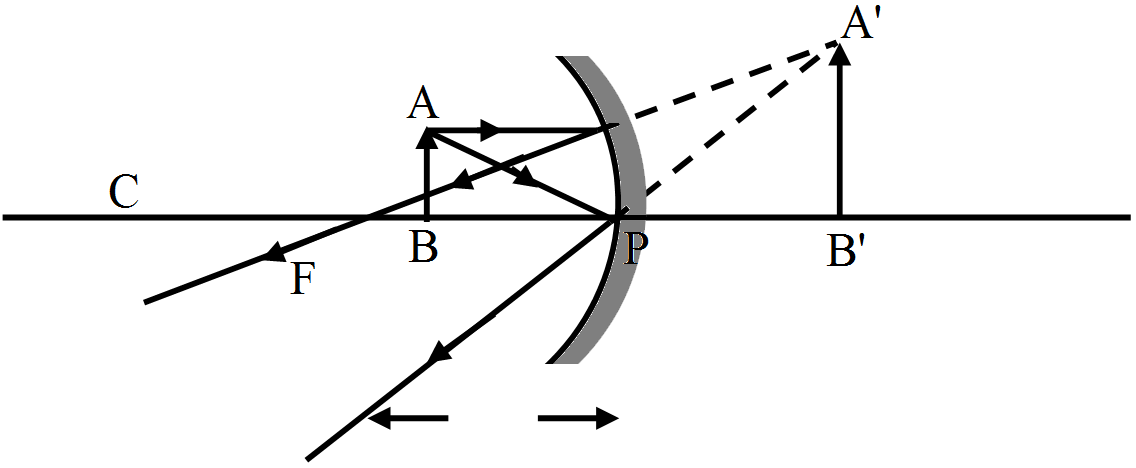
Explain why, concave mirrors are used as shaving mirrors.
Answer
Concave mirrors are used as shaving mirrors. This is because when the face is placed close to a concave mirror (so that the face is within its focus) the concave mirror produces a magnified and erect image of the face. Since a large image of the face is seen in the concave mirror, it becomes easier to make a smooth shave.
View full question & answer
Question 1022 Marks
Draw a ray diagram showing how a concave mirror can be used to produce a real, inverted and diminished image of an object.
View full question & answer
Question 1032 Marks
Briefly describe how you would find the focal length of a concave mirror quickly but approximately.
Answer
When the object is at a considerable distance (or at infinity) from a concave mirror, then its image is formed at the focus. This fact can be used to find out the focal length of a concave mirror quickly but approximately.We focus a distant object (several metres away) like a window or tree on a screen by using a concave mirror whose focal length is to be determined. The sharp image of window or tree will be formed at the focus of the concave mirror. That is, the distance of image (or screen) from the concave mirror will be equal to the focal length of concave mirror. This distance can be measured with a scale. It will give us the approximate focal length of the concave mirror.
View full question & answer
Question 1042 Marks
Draw ray diagrams showing the image formation by a convex mirror when an object is placed:
At finite distance from the mirror.
View full question & answer
Question 1052 Marks
What are the important differences between looking at a photograph of your face and looking at yourself in a plane mirror?
Answer
A image of our face in a plane mirror is laterally inverted, so left is right and right is left. However, in a photograph of our face this is not the case. A mirror surface is smooth, so the reflection by a mirror is a regular reflection. A parallel beam of light incident on it, gets scattered by making reflected rays in different directions.
View full question & answer
Question 1062 Marks
What is the difference between a real image and a virtual image? Give one example of each type of image.
Answer
Real image can be obtained on a screen because light rays actually pass through a real image but virtual image cannot be formed on screen because light rays do not actually pass through a virtual image.
Example:
The image formed on a cinema screen is an example of real image.
The image formed by a plane mirror is a virtual image.
View full question & answer
Question 1072 Marks
Draw a ray diagram to show the formation of a real diminished image of an object by a convex lens. In your diagram, the position of object and image with respect to the principal focus should be shown clearly.
View full question & answer
Question 1082 Marks
What is the magnification produced by a rear view mirror fitted in vehicles?
Answer
The convex mirror forms virtual, erect and diminished image of the object and rearview mirror also form some type of image.
Therefore, magnification (m) produced by a rear view mirror fitted in vehicles is less than one i.e., m < 1.
Magnification (m) $=\frac{\text{Image height}}{\text{Objects height}}$
View full question & answer
Question 1092 Marks
Why do we prefer a convex mirror as a rear-view mirror in vehicles?
Answer
Convex mirrors give a virtual, erect, and diminished image of the objects placed in front of them. They are preferred as a rear-view mirror in vehicles because they give a wider field of view, which allows the driver to see most of the traffic behind him.
View full question & answer
Question 1102 Marks
It is desired to obtain an erect image of an object, using concave mirror of focal length of 12cm.
Will the image be smaller or larger than the object? Draw ray diagram to show the formation of image in this case.
Answer
The image will larger than the object.
View full question & answer
Question 1112 Marks
With the help of a ray diagram, determine the position, nature and size of the image formed of an object placed at the centre of curvature of a concave mirror.
Answer
When an object is placed at the centre of curvature (C) of a concave mirror, the image formed is:
  1. At the centre of curvature (C).
  2. Real and inverted.
  3. Of same size as the object.
View full question & answer
Question 1122 Marks
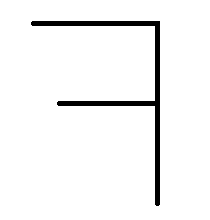
The letter F is placed in front of a plane mirror:
  1. How would its image look like when seen in a plane mirror?
  2. What is the name of the phenomenon involved?
Answer
  1.  
  1. Lateral inversion.
View full question & answer
Question 1132 Marks
Give two uses of a convex mirror. Explain why you would choose convex mirror for these uses.
Answer
Two uses of convex mirror:
  1. A convex mirror is used as a rear-view mirror in vehicles because it forms erect and dimished images of the objects and has a wider field of view.
  2. Big convex mirrors are used as security mirror in shops so that a large number of goods displayed in the shop can be seen in the convex mirror.
View full question & answer
Question 1142 Marks
Write down the magnification formula for a lens in terms of object distance and image distance. How does this magnification formula for a lens differ from the corresponding formula for a mirror?
Answer
Magnification (m) fomula for a lens is:$\text{m}=\frac{\text{v}(\text{distance of image})}{\text{u}(\text{distance of object})}$
Magnification fomula for a mirror has a minus sign (-) but the Magnification fomula for a lens has to minus sign. Magnification fomula for a mirror is: $\text{m}=-\frac{\text{v}(\text{distance of image})}{\text{u}(\text{distance of object})}$
View full question & answer
Question 1152 Marks
If a ray of light enters from alcohol to air. The refractive index of alcohol is 1.36. Calculate the speed of light in alcohol with respect to air.
Answer
Speed of light in vacuum $=3 \times 10^8 m / s$.
$\text { Refractive index }(\mu)=\frac{c \text { (speed of light in vaccum) }}{v \text { (speed of light in alcohol) }}$
$\Rightarrow 1.36=\frac{3 \times 10^8}{\text { speed of light in alcohol }}$
$\Rightarrow$ speed of light in alcohol $=\frac{3 \times 10^8}{1.36}$
$\therefore$ speed of light in alcohol $=2.21 \times 10^8 m / s$
speed of light in alcohol with respect to air is $2.21 \times 10^8 ms^{-1}$
View full question & answer
Question 1162 Marks
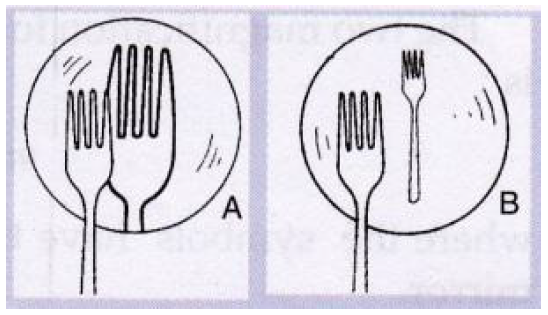
The diagrams show the appearance of a fork when placed in front of and close to two mirrors A and B, turn by turn.
  1. Which mirror is convex.
  2. Which mirror is concave.
Give reasons for your choice.
Answer
  1. Mirror B is convex, as it forms a small image.
  2. Mirror A is concave, as it forms a large image.
View full question & answer
Question 1172 Marks
A concave mirror produces three times magnified real image of an object placed at 10 cm in front of it. Where is the image located?
Answer
Distance of object from concave mirror (u) = -10 cm. Magnification (m) = 3$\text{m} = \frac{-\text{v}}{\text{u}}$
v = -mu = -(3) × (-10) = -30 cm.
View full question & answer
Question 1182 Marks
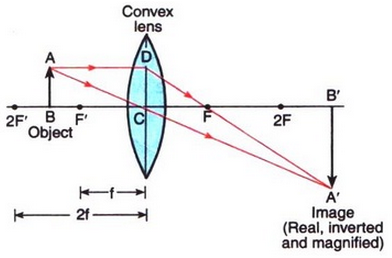
Draw a ray diagram to show the formation of a real magnified image by a convex lens. (In your sketch the position of object and image with respect to the principal focus of lens should be shown clearly).
Answer
Formation of real magnified image by a convex lens.
View full question & answer
Question 1192 Marks
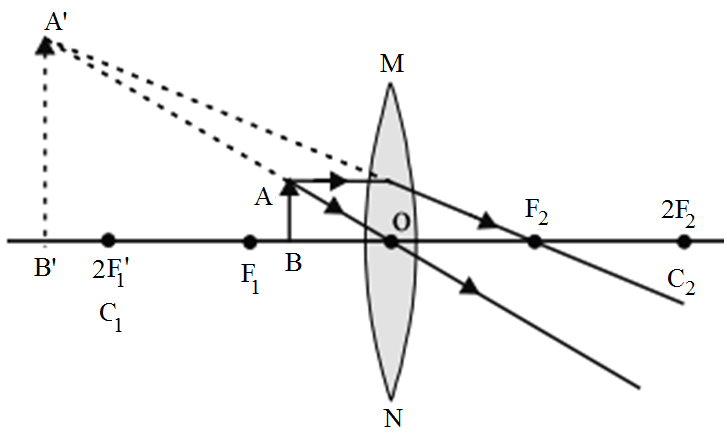
Identify the device used as a spherical mirror or lens in following cases, when the image formed is virtual and erect in each case.Object is placed between the focus and device, image formed is enlarged and on the same side as that of the object.
Answer
Convex lens is used.
View full question & answer
Question 1202 Marks
State and define the SI unit of power of a lens.
Answer
The power of the lens is the reciprocal of the focal length of the lens. The SI unit of the power is diopter. it is denoted by D.
View full question & answer
Question 1212 Marks
A wall reflects light and a mirror also reflects light. What difference is there in the way they reflect light?
Answer
A wall has a rough surface, so the reflection by a wall is a diffuse reflection. A parallel beam of light incident on it is reflected in different directions.
View full question & answer
Question 1222 Marks
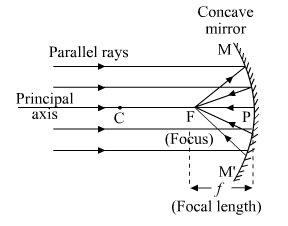
Explain with a suitable diagram, how a concave mirror converges a parallel beam of light rays. Mark clearly the pole, focus and centre of curvature of concave mirror in this diagram.
Answer

All the light rays which are parallel to the principal axis of a concave mirror, converge at the the principal focus (F) after reflection from the mirror. Since a concave mirror converges a parallel beam of light rays, it is also called a converging mirror.
View full question & answer
Question 1232 Marks
What is the unit of power of a lens? Define the unit of power of a lens.
Answer
Unit of power of a lens is dioptre. One dioptre is the power of a lens whose focal length is 1 metre.
View full question & answer
Question 1242 Marks
A convex lens is immersed in a liquid of refractive index greater than that of glass. How will the nature of lens change?
Answer
If n decreases, f increases. So if you immerse the convex lens in a liquid whose refractive index is greater than refractive index of material of lens then it will change its nature and become concave lens and thus it will start diverging the rays rather than focusing them on a single point.
View full question & answer
Question 1252 Marks
Describe with the help of a diagram, the nature, size and position of the image formed when an object is placed beyond the centre of curvature of a concave mirror.
Answer
When an object is placed beyond the centre of curvature (C) of a concave mirror, the image is:
  1. Between the focus and centre of curvature.
  2. Real and inverted.
  3. Smaller than the object (or diminished).
View full question & answer
Question 1262 Marks
Identify the device used as a spherical mirror or lens in following cases, when the image formed is virtual and erect in each case.Object is placed between infinity and device, image formed is diminished and between focus and optical centre on the same side as that of the object.
Answer
Concave lens is used.
View full question & answer
Question 1272 Marks
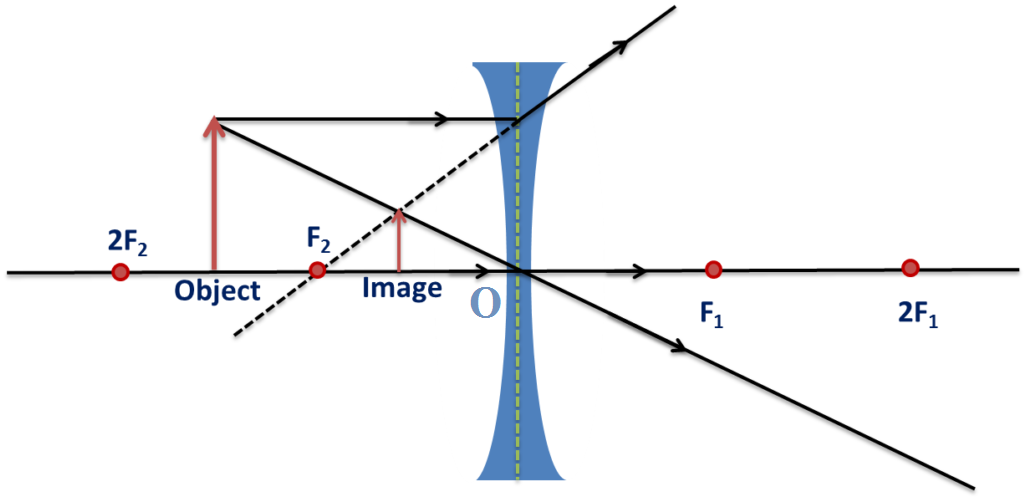
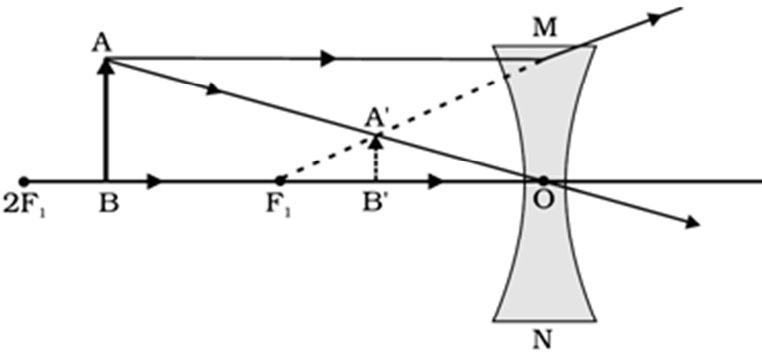
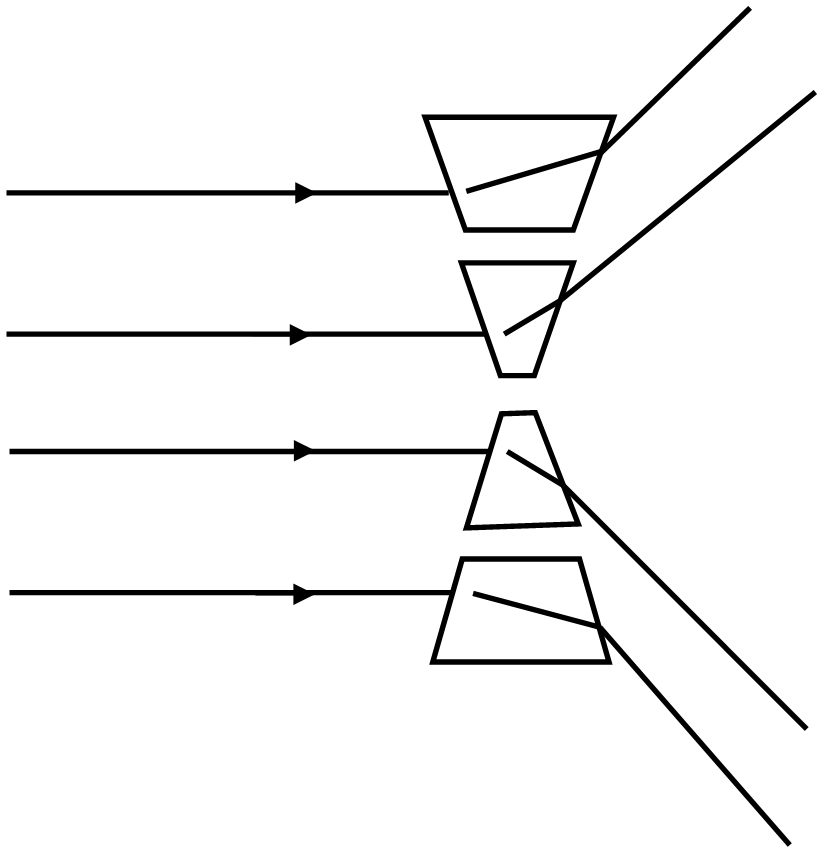
With the help of a ray diagram explain why a concave lens diverges the rays of a parallel beam of light.
Answer
Concave lens, like any other lens works on the principle of refraction. We can divide a lens into tiny pieces which resemble a triangular prism. When a ray of light falls on it, due to the shape of the lens piece, the light refracts either inwards our outwards. Concave lens is such that it is thicker outside and thinner inside (opposite to that of a convex lens), so the light rays are refracted outwards and thus they diverge.
View full question & answer
Question 1282 Marks
Light enters from air to glass having refractive index 1.50. What is the speed of light in the glass? The speed of light in vacuum is $3 \times 10^8 m s ^{-1}$.
Answer
Refractive index of a medium, $n _{ m }=$ Speed of light in vacuum/Speed of light in the medium
Speed of light in vacuum, $c =3 \times 10^8 ms^{-1}$
Refractive index of glass, $n _{ g }=1.50$
Speed of light in the glass, $v=$ Speed of light in vacuum/ Refractive index of glass
$=c / ng_{g}$
$=3 \times 10^8 / 1.50=2 \times 10^8 m^{s-1}$
View full question & answer
Question 1292 Marks
Name the lens which always forms a virtual image of an object.
Answer
A concave lens always forms the virtual image of an object.
View full question & answer
Question 1302 Marks
A convex lens forms a real and inverted image of a needle at a distance of 50 cm from it. Where is the needle placed in front of the convex lens if the image is equal to the size of the object? Also, find the power of the lens.
Answer
v = + 50 cm
Since image is real and of same size. The position of image should be double the focal length.
Hence, the object should be at 2f.
V = 2f = 50, f = 25 cm.
Power = 1/f = 100/25 = 4D
View full question & answer
Question 1312 Marks
When an object is placed at a distance of 36cm from a convex lens, an image of the same size as the object is formed. What will be the nature of image formed when the object is placed at a distance of:
  1. 10cm from the lens?
  2. 20cm from the lens?
Answer
  1. The image will be virtual and magnified. We know that a convex lens forms the image of the same size as that of the object when the object is placed at 2f. Thus, the focal length of the lens is 13cm. In this case, the object is placed between the focus​(f) and the optic centre. This position of the object results in the formation of a virtual and magnified image.
  2. The image will be real and magnified because the object is placed between 2f and f.
View full question & answer
Question 1322 Marks
A doctor has prescribed a corrective lens of power +1.5 D. Find the focal length of the lens. Is the prescribed lens diverging or converging?
Answer
p = +1.5 D$\text{f}=\frac{100}{\text{p}} \ \text{cm}=\frac{100}{1.5}$
$=\frac{1000}{15}=+66.67 \ \text{cm}=+0.67 \ \text{m}$
As the focal length is +ve, it is convex lens. Hence, it is a converging lens.
View full question & answer
Question 1332 Marks
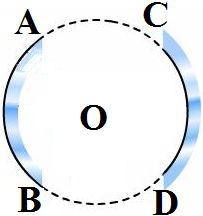
AB and CD, two spherical mirrors, form parts of a hollow spherical ball with its centre at O as shown in the diagram. If arc $\text{AB}=\frac{1}{2}$ arc CD, what is the ratio of their focal lengths? State which of the two mirrors will always form virtual image of an object placed in front of it and why.
Answer
The ratio of the focal lengths of mirrors AB and CD will be equal to one as both the mirrors are part of same spherical ball. Hence, their radius of curvature and focal length will be same. The mirror AB will always form a virtual image when object is placed infront of it because mirror AB is a conex mirror.
View full question & answer
Question 1352 Marks
List some things that concave lens and convex mirror have in common.
Answer
Both, concave lens and convex mirror, diverge parallel rays of light coming from infinity (parallel to the principal axis).
View full question & answer
Question 1362 Marks
A 5cm tall object is placed perpendicular to the principal axis of a convex lens of focal length 18cm at a distance of 12cm from it. Use lens formula to determine the position, size and nature to the image formed.
Answer
$\text{h}_0=5\text{cm},\text{ u}=-30\text{cm},\text{ v}=?,\text{ f}=+10\text{cm}$$\frac{1}{\text{v}}-\frac{1}{\text{u}}=\frac{1}{\text{f}}$
$\frac{1}{\text{v}}-\frac{1}{(-30)}=\frac{1}{10}$
${\text{v}}=15\text{cm}$
$\text{m}=\frac{\text{v}}{\text{u}}$
$\text{m}=\frac{15}{(-30)}$
$\text{m}=-\frac{1}{2}$
$\text{m}=\frac{\text{v}}{\text{u}}=\frac{\text{h}_\text{i}}{\text{h}_0}$
$-\frac{1}{2}=\frac{\text{h}_\text{i}}{5}$
$\text{h}_\text{i}=-\frac{5}{2}$
$\text{h}_\text{i}=-2.5\text{cm}$
View full question & answer
Question 1372 Marks
  1. Find the nature, position and magnification of the images formed by a convex lens of focal length 0.20 m if the object is placed at a distance of:
  1. 0.50m
  2. 0.25m
  3. 0.15m
  1. Which of the above cases represents the use of convex lens in a film projector, in a camera, and as a magnifying glass?
Answer
  1. f = 0.20m
  1. u = 0.05m
Lens formula, $\frac{1}{\text{v}}-\frac{1}{\text{u}}=\frac{1}{\text{f}}$

$\frac{1}{\text{v}}-\frac{1}{-0.50}=\frac{1}{0.20}$

$\frac{1}{\text{v}}=\frac{1}{0.20}-\frac{1}{0.50}$

$\text{v}=0.33\text{m}$

Image is formed 0.33m behind the lens.

$\text{m}=\frac{\text{v}}{\text{u}}=\frac{0.33}{-0.50}=-0.66$

Image is real and inverted.
  1. $\text{u}=-0.25\text{m}$
Lens formula, $\frac{1}{\text{v}}-\frac{1}{\text{u}}=\frac{1}{\text{f}}$

$\frac{1}{\text{v}}-\frac{1}{-0.25}=\frac{1}{0.20}$

$\frac{1}{\text{v}}=\frac{1}{0.20}-\frac{1}{0.25}$

$\text{v}=1\text{m}$

Image is formed 1m behind the lens.

$\text{m}=\frac{\text{v}}{\text{u}}=\frac{1}{-0.25}=-4$

Image is real and inverted.
  1. $\text{u}=-0.15\text{m}$
Lens formula, $\frac{1}{\text{v}}-\frac{1}{\text{u}}=\frac{1}{\text{f}}$

$\frac{1}{\text{v}}-\frac{1}{-0.15}=\frac{1}{0.20}$

$\frac{1}{\text{v}}=\frac{1}{0.20}-\frac{1}{0.15}$

$\text{v}=-0.60\text{m}$

Image is formula 0.60m in front of the lens.

$\text{m}=\frac{\text{v}}{\text{u}}=\frac{-0.6}{-0.15}=+4$

Image is virtual and erect.
  1. Film projector, Case (ii)
Camera, Case (i)

Magnifying glass, Case (iii)
View full question & answer
Question 1382 Marks
Which type of mirror is used in a solar furnace? Support your answer with reason.
Answer
Concave mirror is used in a solar furnace. The solar furnace is placed at the focus of a large concave reflector. When parallel rays of light from the sun fall on the surface of the concave mirror, rays gets reflected and meet at the focus of the mirror due to the converging nature of concave mirror. Thus, the furnace kept at the focus becomes very hot. Even steel can be melted in this furnace.
View full question & answer
Question 1392 Marks
What do you understand by the power of a lens? Name one factor on which the power of a lens depends.
Answer
Power of a lens is a measure of the degree of convergence or divergence of light rays falling in it. Power of a lens depends of its focal length.
View full question & answer
Question 1402 Marks
Refractive indices of four media A, B, C and D are given below:
Medium
Refractive index
A
B
C
D
1.33
1.44
1.52
1.65
In which of these four media is the speed of light:
  1. Maximum, and
  2. Minimum?
Answer
The refractive index of a medium is related to the speed of light as follows:$\text{Refractive index}=\frac{\text{Speed of light in vacuum}}{\text{speed of light in a mediums}}$
Since the speed of light in vacuum is a constant, the refractive index becomes inversely proportional to the speed of light in a medium.
  1. The speed of light is maximum in a medium that has the lowest refractive index, i.e., medium A.
  2. The speed of light is minimum in a medium that has the highest refractive index, i.e., medium D.
View full question & answer
Question 1412 Marks
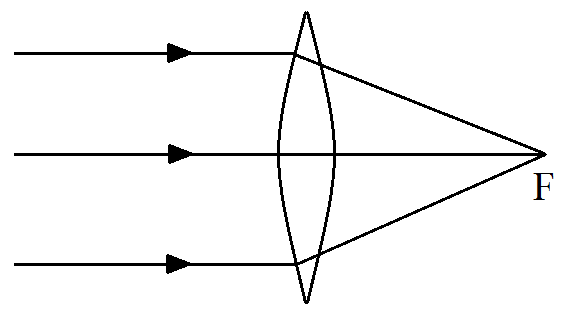
What type of lens is shown in the diagram on the right? What will happen to the parallel rays of light? Show by completing the ray diagram.
Answer
The lens shown in convex. the parallel rays will converge to a point called focus (F).
View full question & answer
Question 1422 Marks
How could you find the focal length of a convex lens rapidly but approximately?
Answer
To determine the focal length of a convex lens, we put the convex lens in a holder and keep it in front of a distant object like a window or tree, so that the rays coming from the window pass through it. A cardboard screen is put behind the lens. We change the distance of the screen from the convex lens until a clear inverted image of the window is formed on the screen. Measure the distance of the screen from the lens with a scale. This distance will be the focal length of convex lens.
View full question & answer
Question 1432 Marks
Which kind of mirror is used in the headlights of a car? Why is it used for this purpose?
Answer
Concave mirror is used in the headlights of a car. This is because when a lighted bulb is placed at the focus of a concave mirror reflector, then the diverging light rays of the bulb are collected by the concave reflector and then reflected to produce a strong, parallel-sided beam of light (which travels a considerable distance in the darkness of night).
View full question & answer
Question 1442 Marks
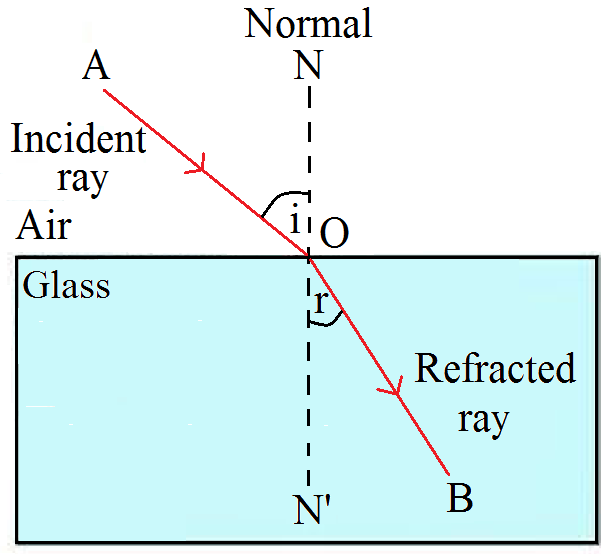
State and explain the laws of refraction of light with the help of a labelled diagram.
Answer
Laws of refraction,

First law: According to the first law of refraction, the incident ray, the refracted ray and the normal at the point of incidence, all lie in the same.
Second law: According to the second law of refraction, the ratio of the angle of incidence to the point of incidence, all lie in the same plane.
View full question & answer
Question 1452 Marks
Define:
  1. Principal focus of a concave mirror.
  2. Focal length of a concave mirror.
Answer
  1. Principal focus of a concave mirror: The principal focus of a concave mirror is a point on its principal axis to which all the light rays which are parallel and close to the axis, converge after reflection from the concave mirror.
  2. Focal length of a concave mirror: The focal length of a concave mirror is the distance between its pole and the principal focus.
View full question & answer
Question 1462 Marks
A communications satellite in orbit sends a parallel beam of signals down to earth. If these signals obey the same laws of reflection as light and are to be focussed onto a small receiving aerial, what should be the best shape of the metal 'dish' used to collect them?
Answer
A communications satellite sends a parallel beam of signals down to the Earth. If these signals are to be focussed onto a small receiving aerial, then the best shape of the metal dish that can be used to collect them would be concave. The metal dish will behave like a concave mirror, which is a converging mirror.
View full question & answer
Question 1472 Marks
Why does a beam of light when it enters glass at an angle? Why does it not bend if it inters the glass at right angles?
Answer
When a beam of light enters glass at an angle, the speed changes and therefore the direction of light changes i.e., bending of light occurs. When a beam of light falls at right angles to the surface of glass, all parts of light waves reach the glass at the same time, enter the glass at the same time and hence slow down at the same time. Due to this no change in direction of light takes place i.e., bending of light does not take place.
View full question & answer
Question 1482 Marks
Name the two types of spherical mirrors. What type of mirror is represented by the:
  1. Back side of a shining steel spoon?
  2. Front side of a shining steel spoon?
Answer
Two types of spherical mirrors are:
  1. Concave mirror.
  2. Convex mirror.
Type of mirror represented by the:
  1. Back side of a shining steel spoon – convex mirror.
  2. Front side of a shining steel spoon – concave mirror.
View full question & answer
Question 1492 Marks
The boy walks towards the mirror at a speed of 1m/ s. At what speed does his image approach him?
Answer
When the boy walks towards the mirror at a speed of 1m/ s, his image will also appear to move towards the mirror at the same speed of 1m/ s. So, the speed at which his image approach him will be 2m/ s + 2m/ s = 4m/ s.
View full question & answer
Question 1502 Marks
The following table gives the refractive indices of a few media,
 
1
2
3
4
5
Medium:
Water
Crown glass
Rock salt
Ruby
Diamond
Refractive index:
1.33
1.52
1.54
1.71
2.42
Use this table to give an example of:
  1. A medium pair so that light speeds up when it goes from one of these medium to another.
  2. A medium pair so that light slows down when it goes from one of these medium to another.
Answer
  1. Light speeds up as it travels from a denser medium to a rarer one, ie., from a medium with a higher refractive index to one with a lower refractive index. An example would be the medium pair of diamond and water, where light travels from diamond to water.
  2. Using the same argument, light slows down as it travels from a medium with a lower refractive index to one with a higher refractive index. Therefore, the medium pair of crown glass and ruby can be taken as an example, where light moves from the crown glass to the ruby.
View full question & answer