Questions · Page 2 of 5

[2 Mark Questions]

Question 512 Marks
List some things that convex lens and concave mirror have in common.
Answer
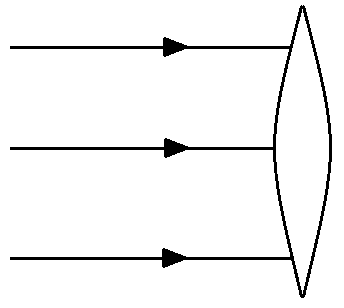
Both, convex lens and concave mirror, converge parallel rays of light coming from infinity (parallel to the principal axis) at the focus.
View full question & answer
Question 522 Marks
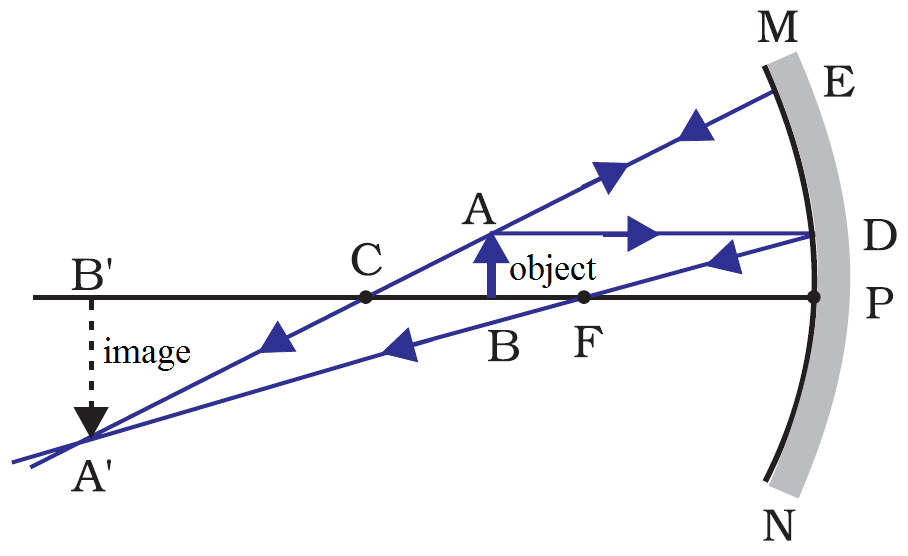
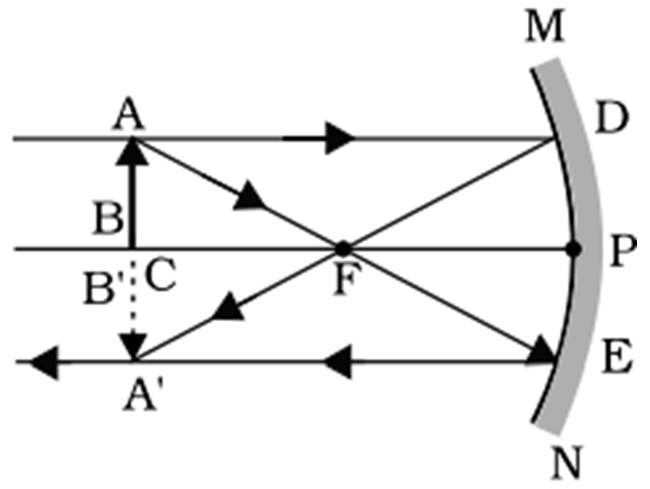
An object is placed just outside the principal focus of concave mirror. Draw a ray diagram to show how the image is formed, and describe its size, position and nature.
Answer

The image is real, inverted and magnified. It is formed beyond the centre of curvature of the mirror.
View full question & answer
Question 532 Marks
Draw a diagram to represent a convex mirror. On this diagram mark principal axis, principal focus F and the centre of curvature C if the focal length of convex mirror is 3cm.
View full question & answer
Question 542 Marks
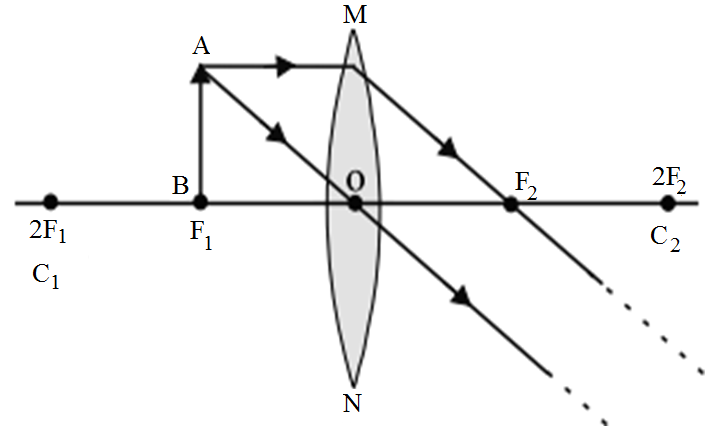
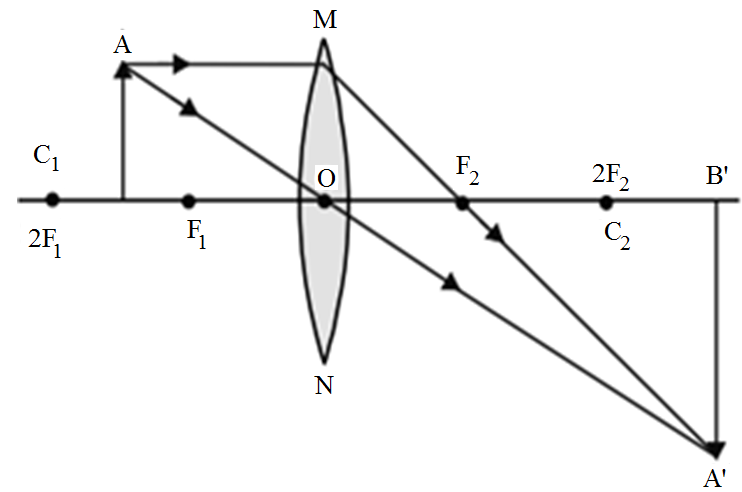
Draw ray diagrams showing the image formation by a convex lens when an object is placed:Between focus and twice the focal length of the lens.
Answer
The enlarged, real and inverted image forms beyond focus $2F_2$ on the other side of the object when the object is placed between focus $F_1$ and twice the focal length of the lens.
View full question & answer
Question 552 Marks
What is the position of image when an object is placed at a distance of 10cm from a convex lens of focal length 10cm?
Answer
U = -10cm, f = 10cm We have,$\frac{1}{\text{v}}-\frac{1}{\text{u}}=\frac{1}{\text{f}}$
$\frac{1}{\text{v}}-\frac{1}{-10}=\frac{1}{10}$
$\frac{1}{\text{v}}=0$
$\text{v}=\frac{1}{0}=\infty$
At infinity.
View full question & answer
Question 562 Marks
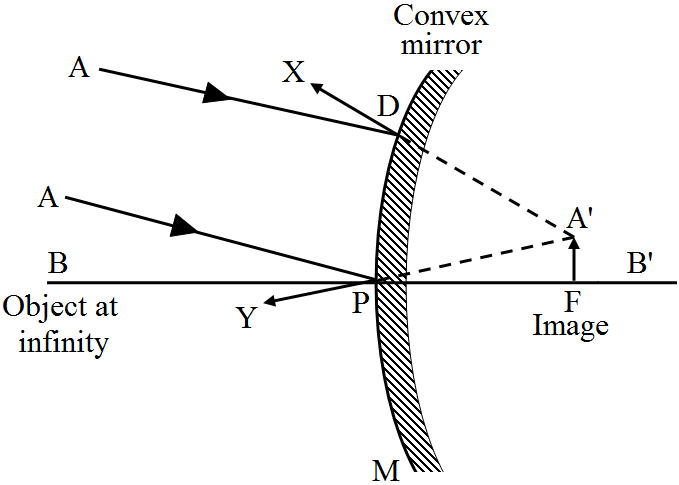
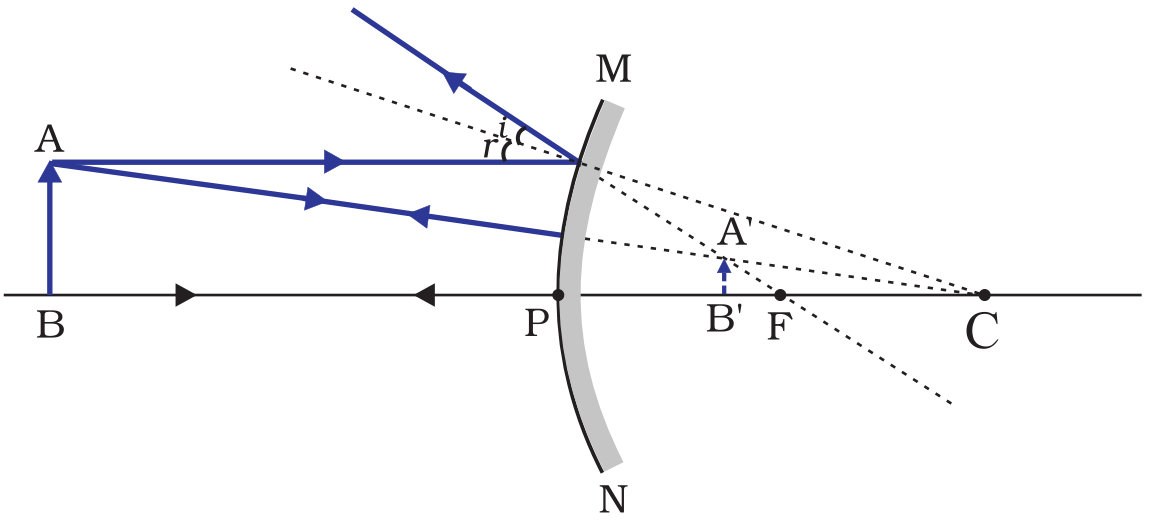
Draw ray diagrams showing the image formation by a concave mirror when an object is placed:
At centre of curvature of the mirror.
Answer
The image formation by a concave mirror when an object is placed between focus and centre of curvature of the mirror at centre of curvature of the mirror.
View full question & answer
Question 572 Marks
An object is placed at the following distance from a convex lens of focal length 15cm:
  1. 35cm
  2. 30cm
  3. 20cm
  4. 10cm
Which position of the object will produce:
  1. A magnified real image?
  2. A magnified virtual image?
  3. A diminished real image?
  4. An image of same size as the object?
Answer
  1. The object should be placed at 20cm because a convex mirror forms a real, magnified image when an object is placed between f and 2f.
  2. The object should be placed at 10cm because a convex mirror forms a virtual, magnified image when an object is placed placed between f(focus) and the optic centre
  3. The object should be placed at 35cm because a convex mirror forms a real, diminished image when an object is placed beyond 2f.
  4. The object should be placed at 30cm because a convex mirror forms a real image of the same size when an object is placed at 2f.
View full question & answer
Question 582 Marks
A ray of light travelling in air enters obliquely into water. Does the light ray bend towards the normal or away from the normal? Why?
Answer
The light ray bends towards the normal. When a ray of light travels from an optically rarer medium to an optically denser medium, it gets bent towards the normal. Since water is optically denser than air, a ray of light travelling from air into the water will bend towards the normal.
View full question & answer
Question 592 Marks
A doctor has prescribed a corrective lens of power, -1.5D. Find the focal length of the lens. Is the prescribed lens diverging or converging?
Answer
$\text{P}=-1.5\text{D}$$\text{P}=\frac{1}{\text{f}}$
$\text{f}=\frac{1}{\text{P}}=\frac{1}{(-0.5)}=-0.66\text{m}=-66.6\text{m}$
Since focal length is negative, it is a diverging lens.
View full question & answer
Question 602 Marks
Your eye contains a convex lens. Why is it unwise to look at the sun?
Answer
It is unwise to look at the sun because the convex lens focusses a lot of sun rays into our eyes and this may damage them.
View full question & answer
Question 612 Marks
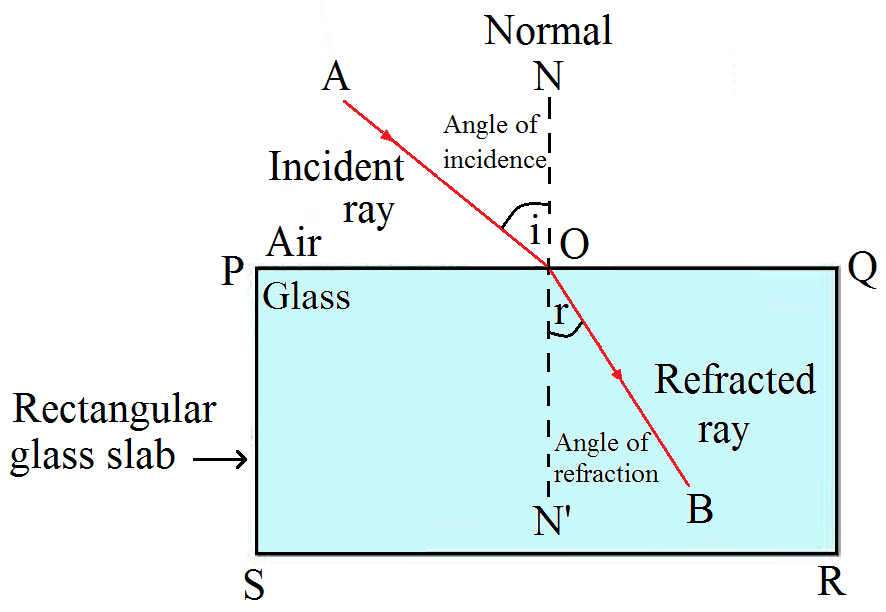
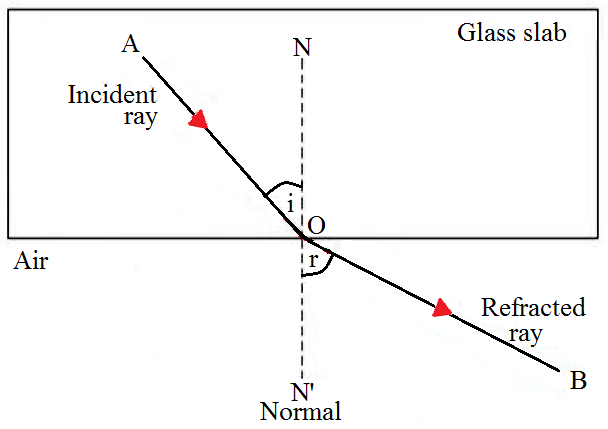
What is meant by ‘refraction of light’? Draw a labelled ray diagram to show the refraction of light.
Answer

The change in direction of light when it passes from one medium to another obliquely, is called refraction of light.
View full question & answer
Question 622 Marks
An object is placed at a distance of 6cm from a convex mirror of focal length 12cm. Find the position and nature of the image.
Answer
u = -6cm, f = 12cm, v = ? We know that $\frac{1}{\text{v}}+\frac{1}{\text{u}}=\frac{1}{\text{f}}$
$\Rightarrow\frac{1}{\text{v}}+\frac{1}{-6}=\frac{1}{12}$
$\Rightarrow\frac{1}{\text{v}}=\frac{1}{12}+\frac{1}{6}=\frac{3}{12}=\frac{1}{4}$
$\therefore\text{v}=\frac{1}{4}\text{cm}$
Image will be formed 4cm the mirror. Since the image is formed behind the convex mirror, it is virtual and erect.
View full question & answer
Question 632 Marks
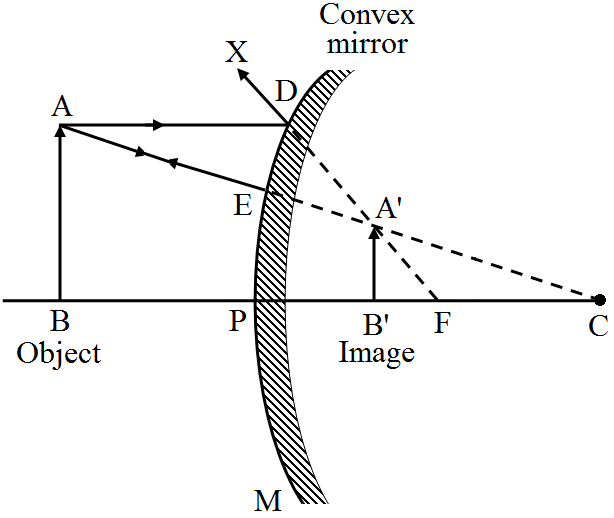
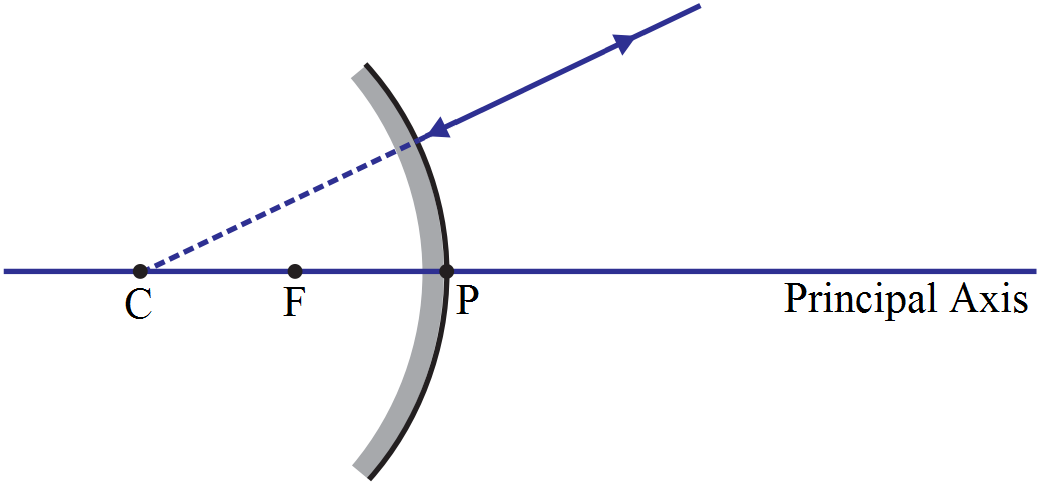
Draw a labelled ray diagram to show the formation of image of an object by a convex mirror. Mark clearly the pole, focus and centre of curvature on the diagram.
Answer
Virtual and erect.

Formation of image by a convex mirror when the object is at infinity palced any where between the pole of mirror the pole of mirror and infinity.

Formation of image by a convex mirror when the object is at infinity (Iarge distance).
View full question & answer
Question 642 Marks
Three convex lenses are available having focal lengths of 4cm, 40cm and 4m respectively. Which one would you choose as a magnifying glass and why?
Answer
Converx lens having 4cm focal length-because it will produce greatest magnification.
View full question & answer
Question 652 Marks
An object lies at a distance of 2f from a concave lens of focal length f. Draw a ray-diagram to illustrate the image formation.
View full question & answer
Question 662 Marks
The speed of light in water is $2.25 \times 10^8 m / s$. If the speed of light in vacuum be $3 \times 10^8 m / s$, calculate the refractive index of water.
Answer
solution Speed of light in vacuum $=3.0 \times 10^8 m / s$
Speed of light in water $=2.25 \times 10^8 m / s$
Refractive index of water $=$ ?
We know that
Refractive index of water $=\frac{\text { Speed of light in vacuum }}{\text { Speed of light in water }}$
Refractive index of water $=\frac{3 \times 10^8}{2.25 \times 10^8}=1.33$
View full question & answer
Question 672 Marks
You are provided with two lenses of focal lengths 10cm and 20cm. Which of the two lenses would you suggest to obtain greater convergence on refracted light? Justify your choice.
Answer
Given that,
$f_1=10 cm=0.1 m$
$f_2=20 cm=0.2 m$
Power of convergence is given by,
$p=\frac{1}{f}$
So, $\frac{1}{0.1}=10 D$
$p_2=\frac{1}{0.2}=5 D$
Since $p _1> p _2$
So the lens with focal length 10 cm has greater convergence of refracted light.
View full question & answer
Question 682 Marks
State two factors on which the lateral displacement of the emergent ray depends.
Answer
Factors on which the lateral displacement depends are:
  1. Angle of incidence.
  2. Thickness of glass slab.
  3. Refractive index of glass slab.
View full question & answer
Question 692 Marks
The focal length of a lens is +150mm. What kind of lens is it and what is its power?
Answer
$\text{f}=+150\text{mm}=+0.15\text{m}$It is a convex lens since its focal length is positive.
$\text{P}=\frac{1}{\text{f}}=\frac{1}{0.15}=+6.66\text{D}$
View full question & answer
Question 702 Marks
State the uses of plane mirrors.
Answer
Uses of Plane mirrors:
  1. Plane mirrors are used to see ourselves. The mirrors on our dressing table and in bathrooms are plane mirrors.
  2. Plane mirrors are fitted at blind turns of some busy roads so that drivers can see the vehicles coming from the other side and prevent accidents.
  3. Plane mirrors are used to make periscopes.
  4. Plane mirrors are fixed on the inside walls of certain shops to make them look bigger.
View full question & answer
Question 712 Marks
Identify the device used as a spherical mirror or lens in following cases, when the image formed is virtual and erect in each case.Object is placed between infinity and device, image formed is diminished and between pole and focus, behind it.
Answer
Convex mirror is used.
View full question & answer
Question 722 Marks
Which kind of mirrors are used in the headlights of a motorcar and why?
Answer
Concave mirrors are used in headlights of car. The position of the is placed nearer to the focus of the concave. The reason is that the main purpose of the head lights is to focus or show the light for larger area as much as possible and to send a beam of light infront of the car. Because light from a source comes in all directions (diffration) and in case of head lights we don't want to face the light towards us. And we want to change the direction of those rays which are coming to us to travel along the road. This problem is solved by placing light source or bulb at the focus of the concave mirror because the light rays coming from focus towards the mirror after reflection goes parallel to principal axis or along the road.
View full question & answer
Question 732 Marks
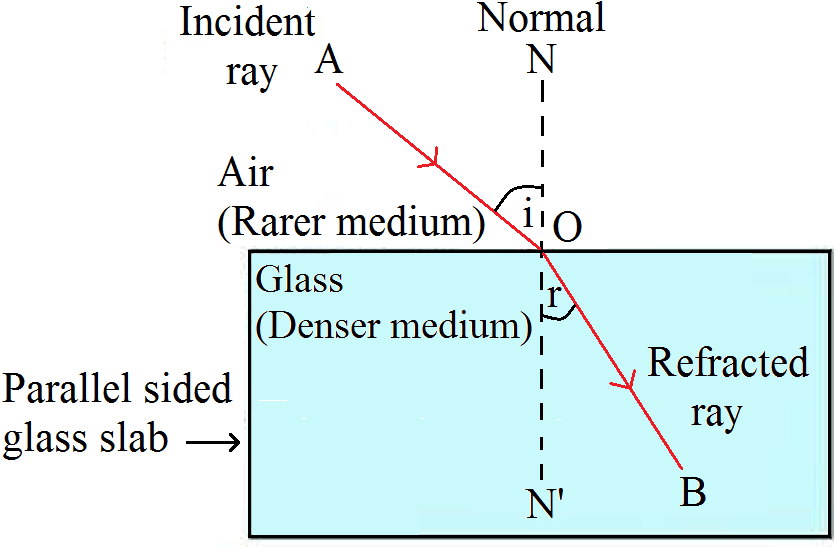
Draw a labelled ray diagram to show how a ray of light is refracted when it passes:
  1. From air into an optically denser medium.
  2. From an optically denser medium into air.
Answer
  1. Ray of light travelling from air into an optically denser medium.
  1. Ray of light travelling from an optically denser medium into air.
View full question & answer
Question 742 Marks
A convex mirror used as a rear-view mirror in a car has a radius of curvature of 3m. If a bus is located at a distance of 5m from this mirror, find the position of image. What is the nature of the image?
Answer
R = 3m, u = 5m,$\frac{\text{R}}{2}=\frac{3}{2}=1.5\text{cm}$
We know that$\frac{1}{\text{v}}+\frac{1}{\text{u}}=\frac{1}{\text{f}}$
$\Rightarrow\frac{1}{\text{v}}+\frac{1}{-5}=\frac{1}{1.5}$
$\Rightarrow\frac{1}{\text{v}}=\frac{1}{-5}+\frac{2}{3}=\frac{3+10}{15}=\frac{13}{10}$
$\therefore \text{v}=\frac{15}{13}\text{m}=1.15\text{cm}$
The image is formed 1.15m behind the mirror. The image is virtual and erect.
View full question & answer
Question 752 Marks
Identify the device used as a spherical mirror or lens in following cases, when the image formed is virtual and erect in each case.
Object is placed between device and its focus, image formed is enlarged and behind it.
Answer
Concave mirror is used.
View full question & answer
Question 762 Marks
If the magnification of a body of size 1m is 2, what is the size of the image?
Answer
sOLution Size of object, $h _1=1 m$
Magnification, $m =2$
Size of image, $h _2=$ ?
$m=\frac{h_2}{h_1}$
$2=\frac{h_2}{1}$
$h_2=2 m$
View full question & answer
Question 772 Marks
Explain what is meant by a virtual, magnified image.
Answer
A virtual magnified image is the one which cannot be taken on a screen and whose size is larger than that of the object.
View full question & answer
Question 782 Marks
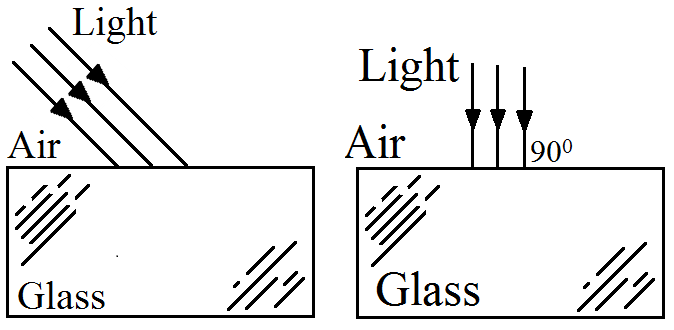
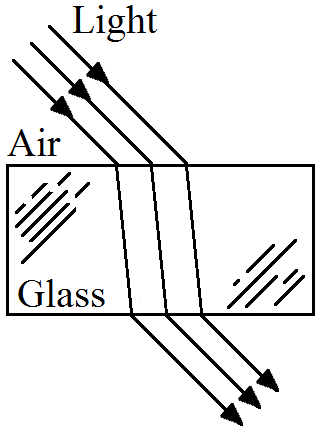
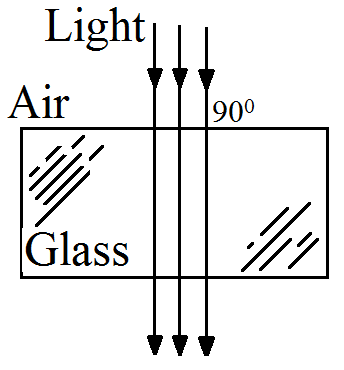
Draw and complete the following diagrams to show what happens to the beams of light as they enter the glass block and then leave it:
Answer

When a beam of light rays enters the glass block, it gets refracted. It bends towards the normal. Also, when these light rays leave the block, they bend away from the normal.

When light rays fall normally on the surface of the glass block, there is no bending of rays; the rays travel straight.
View full question & answer
Question 792 Marks
What is the position of the image when an object is placed at a distance of 20cm from a concave mirror of focal length 20cm?
Answer
Object distance, u = -20cm Focal length, f = -20cm (concave mirror) lmage distance, v = ?$\frac{1}{\text{v}}+ \frac{1}{\text{u}}=\frac{1}{\text{f}}$
$\Rightarrow\frac{1}{\text{v}}+ \frac{1}{(-20)}=\frac{1}{\text{(-20)}}$
$\Rightarrow \frac{1}{\text{v}}=0$
$\therefore \text{v}=\text{infinity}$
View full question & answer
Question 802 Marks
Draw ray diagrams showing the image formation by a convex lens when an object is placed:
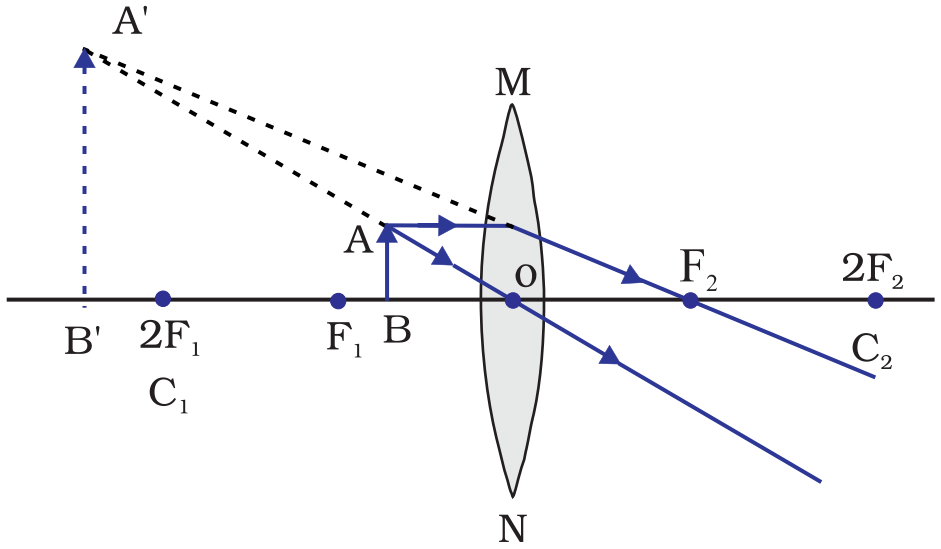
Between optical centre and focus of the lens.
Answer
The enlarged, virtual and erect image forms beyond $2 F_1$ in the same side of object when the object is placed between optical centre and focus $F _1$ of the lens.
View full question & answer
Question 812 Marks
A boy with a mouth 5cm wide stands 2m away from a plane mirror. Where is his image and how wide is the image of his mouth?
Answer
The image will form 2m behind the mirror and the width of the image of boy’s mouth will be 5cm.
View full question & answer
Question 822 Marks
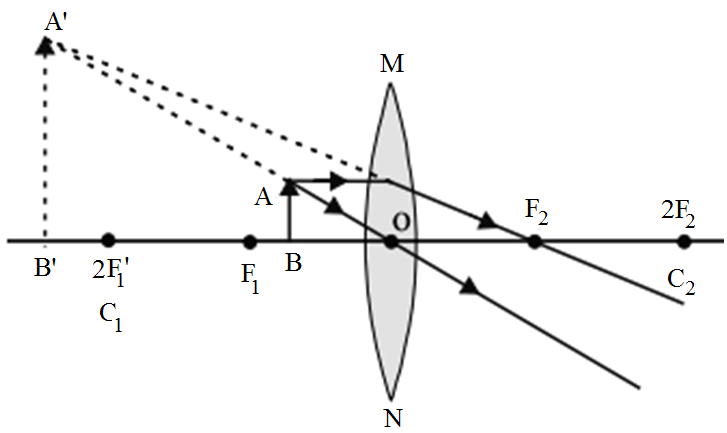
Discuss the case when a convex lens forms a virtual and enlarged image.
Answer
When the object is placed between optical centre and the focus of the convex lens a virtual and enlarged image is formed.
View full question & answer
Question 832 Marks
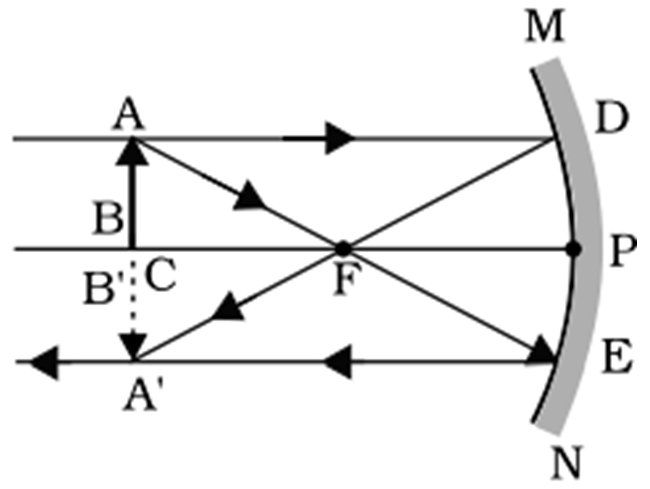
Why does a ray of light passing through the centre of curvature of a concave mirror gets reflected along same path after reflection?
Answer
A ray of light passing through the centre of curvature of a concave mirror retraces its path (gets reflected along the same path), because as the ray of light passes through centre of curvature of a concave mirror it strikes the mirror along the normal i.e. it incidences on to the mirror at 90 degree. Hence the incident ray coincides with the normal.
Therefore angle of incidence = 0 so, as we know according to law of reflection.
angle of reflection = 0, hence the angle of reflection too become zero degree, thus ray of light retraces its path.
View full question & answer
Question 842 Marks
A convex lens of power 5D and a concave lens of power 7.5D are placed in contact with each other. What is the:
  1. Power of this combination of lenses?
  2. Focal length of this combination of lenses?
Answer
$P_1=+D, P_2=-7.5 D$
a. Power of combination,
$P=P_1+P_2$
$=+5 D+(-7.5 D)=-2.5 D$
b. Focal length of the combination,
$f=\frac{1}{P}=\frac{1}{-2.5}=-0.4 m=-40 cm$
View full question & answer
Question 852 Marks
What is meant by:
Draw diagram to show the action of convex mirror on a beam of parallel light rays. Mark on this diagram principal axis, focus F, centre of curvature C, pole P and focal length ƒ, of the convex mirror.
View full question & answer
Question 862 Marks
When a fork is seen through lenses A and B one by one, it appears as shown in the diagrams. What is the nature of (i) lens A, and (ii) lens B? Give reason for your answer.
Answer
When the fork is seen through lens A, it appears to be diminished. Such diminished object is observed when it is placed near a concave lens. Therefore, lens A is concave, i.e., diverging in nature. When the fork is seen through lens B, it appears to be enlarged. Such enlarged image is formed by a convex lens when an object is placed between the lens and its focus. Therefore, lens B is a convex, i.e., converging in nature.
View full question & answer
Question 872 Marks
How does the light have to enter the glass:
  1. To produce a large amount of bending?
  2. For no refraction to happen?
Answer
  1. To produce a large amount of bending, the light ray has to enter the glass with a large angle of incidence.
  2. For no refraction, the light ray has to enter the glass perpendicularly.
View full question & answer
Question 882 Marks
Define and show on a diagram, the following terms relating to a concave mirror:
  1. Aperture.
  2. Radius of curvature.
Answer
  1. Aperture means diameter of concave mirror of a spherical mirror.
  2. Radius of curvature is radius of sphere whose mirror forms a part.
View full question & answer
Question 892 Marks
Draw ray diagrams showing the image formation by a convex lens when an object is placed:
At the focus of the lens.
Answer
The real, inverted and highly magnified image forms at infinity on the other side of the object when the object is placed at the focus of the lens.
View full question & answer
Question 902 Marks
Light enters from air into diamond which has a refractive index of 2.42. Calculate the speed of light in diamond. The speed of light in air is $3.0 \times 10^8 ms^{-1}$.
Answer
Given,
Refractive index of diamond $=2.42$
Speed of light in air $=3.0 \times 10^8 m / s$
We know that,
Refractive index of diamond $=\frac{\text { Speed of light in air }}{\text { Speed of light in diamond }}$
$2.42=\frac{3 \times 10^8}{\text { Speed of light diamond }}$
Speed of light diamond $=1.239 \times 10^8 m / s$
View full question & answer
Question 912 Marks
Describe with the help of a ray-diagram, the size, nature and position of the image formed by a convex lens when an object is placed beyond 2f in front of the lens.
Answer
When an object is placed beyond 2f in front of a convex lens, then the image formed is between f and 2f on the other side of the lens, it is real, inverted and smaller than the object.
View full question & answer
Question 922 Marks
With the help of a diagram, show how when light falls obliquely on the side of a rectangular glass slab the emergent ray is parallel to the incident ray.
View full question & answer
Question 932 Marks
At what distance from a converging lens of focal length 12cm must an object be placed in order that an image of magnification 1 will be produced?
Answer
$\text{f}=12\text{cm}$$\text{m}=1$
$\text{m}=\frac{\text{v}}{\text{u}}=1$
$\text{v}=\text{u}$
Lens formula, $\frac{1}{\text{v}}-\frac{1}{\text{u}}=\frac{1}{\text{f}}$
Putting the value of v, u and f
$\frac{1}{\text{u}}-\frac{1}{-\text{u}}=\frac{1}{12}$ (image distance is negative)
$\frac{2}{\text{u}}=\frac{1}{12}$
$\text{u}=24\text{cm}$
The object should be placed at a distance of 24cm to from the lens (on the left side).
View full question & answer
Question 942 Marks
Why does a driver prefer to use a convex mirror as a rear-view mirror in a vehicle?
Answer
A driver prefers to use a convex mirror as a rear-view mirror because:
  1. A convex mirror always produces an erect image of the objects.
  2. A convex mirror has wider field of view.
View full question & answer
Question 952 Marks
Where must the object be placed for the image formed by a converging lens to be:
  1. Real, inverted and smaller than the object?
  2. Real, inverted and same size as the object?
  3. Real, inverted and larger than the object?
  4. Virtual, upright and larger than the object?
Answer
  1. Beyond 2F.
  2. At 2F.
  3. Between F and 2F.
  4. Between F and optical centre.
View full question & answer
Question 962 Marks
The refractive index of water with respect to vacuum is $\frac{4}{3}$ and refractive index of vacuum with respect to glass is $\frac{2}{3}$ If the speed the speed of light in glass is $2 \times 10^8 ms^{-1}$, find the speed of light in (i) vacuum, (ii) water.
Answer
Refractive index of water w.r.t air $=\frac{4}{3}$$\text{n}_\text{wa}=\frac{\text{v}_\text{a}}{\text{v}_\text{w}}$
$\frac{4}{3}=\frac{3\times10^8}{\text{v}_\text{w}}$
On calculating we get velocity of light in water -$-2.25 \times 10^8 m / s$
View full question & answer
Question 972 Marks
A pencil when dipped in water in a glass tumbler appears to be bent at the interface of air and water. Will the pencil appear to be bent to the same extent, if instead of water we use liquids like, kerosene or turpentine. Support your answer with reason.
Answer
We know that pencil appears to be bent at the interface of air and water because of refraction of light. The degree of refraction depends on refractive index of a given liquid. Refractive indices of kerosene, water and other liquids would be different. Hence, degree of bend would be different in case of different liquids.
View full question & answer
Question 982 Marks
If the magnification of an image formed by a mirror is positive, what does it mean?
Answer
It means that both the object and the image formed by a spherical mirror (concave or convex) are erect (I.e., upright). An erect image is always virtual. Thus, positive magnification indicates that the image formed by a spherical mirror is virtual.
Linear magnification (m): Linear magnification produced by a mirror is the ratio of the size of the image formed (denoted by h') to the ratio of the size of the object.
View full question & answer
Question 992 Marks
How is the reflection of light ray from a plane mirror different from the refraction of light ray as it enters a block of glass?
Answer
In case of reflection, the angle of reflection is equal to the angle of incidence. On the other hand, in case of refraction, the angle of refraction is not equal to the angle of incidence.
View full question & answer
Question 1002 Marks
The lens A produces a magnification of, -0.6 whereas lens B produces a magnification of +0.6:
  1. What is the nature of lens A?
  2. What is the nature of lens B?
Answer
  1. Convex lens (since image is real, inverted and diminished).
  2. Concave lens (since image is virtual, erect and diminished).
View full question & answer
[2 Mark Questions] - Page 2 - Science STD 10 Questions - Vidyadip