Questions

5 Marks Questions

Take a timed test

32 questions · self-marked practice — reveal the answer and mark yourself.

Question 15 Marks

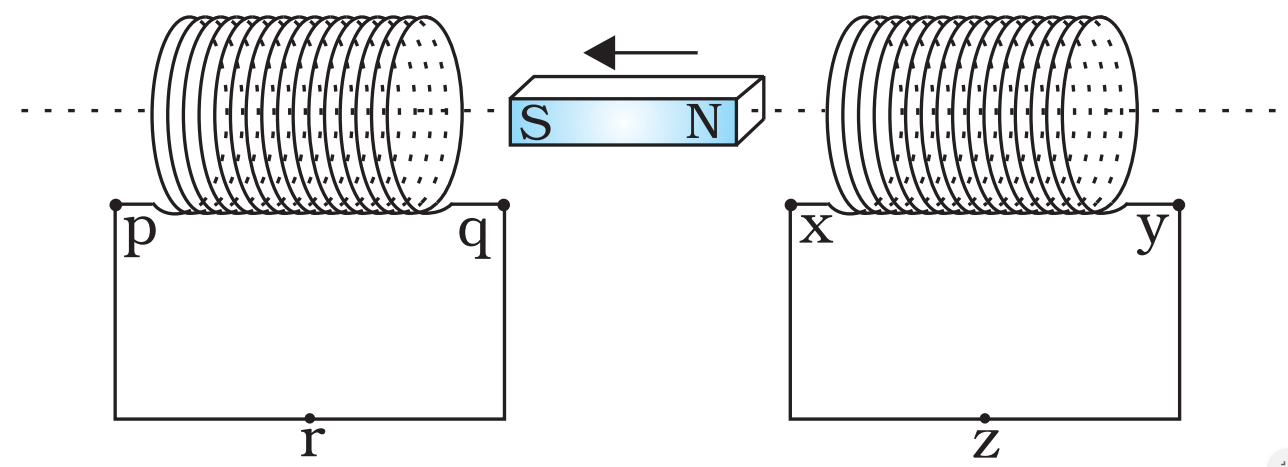
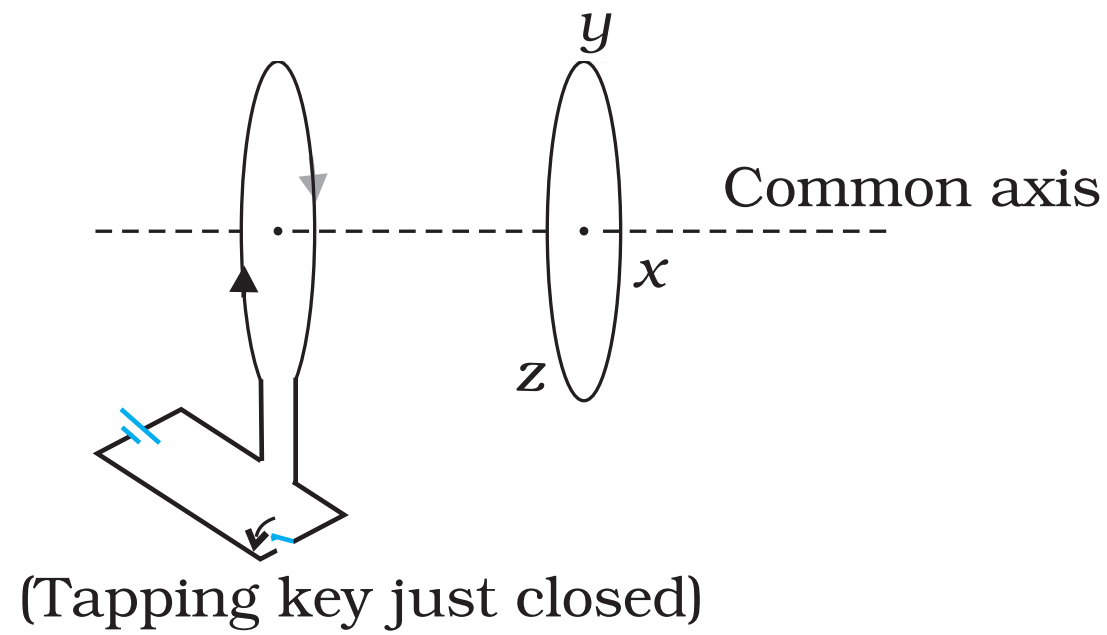
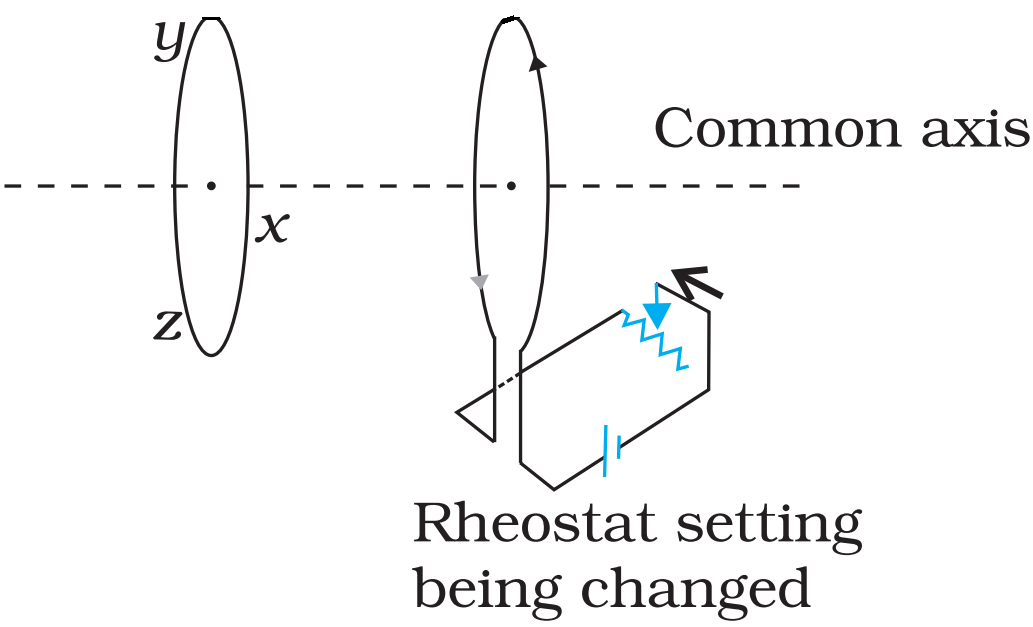
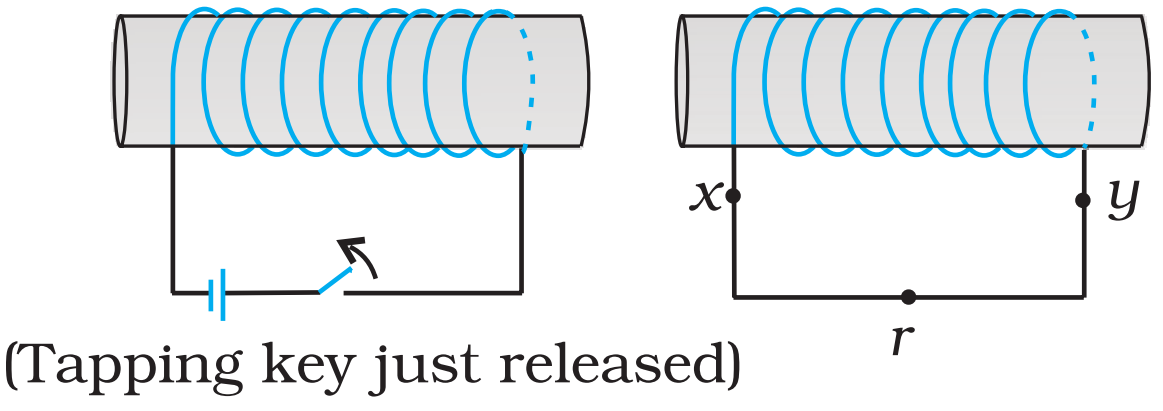
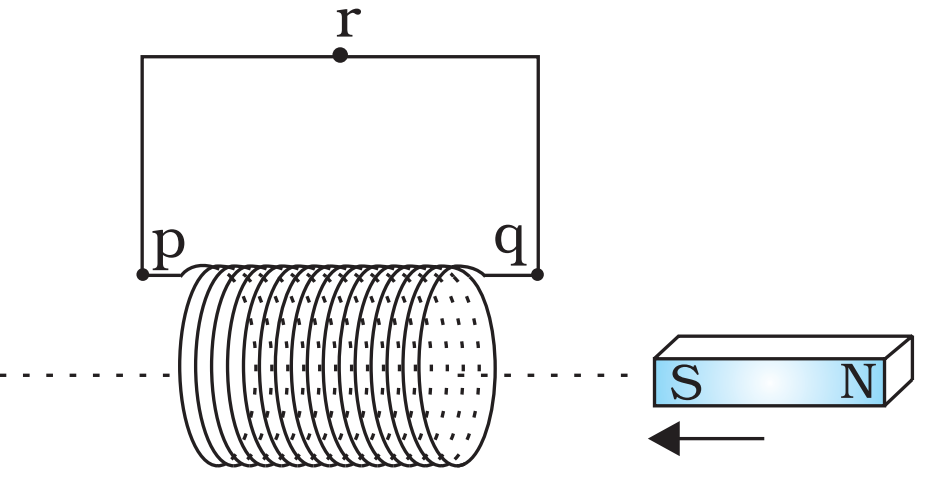
Predict the direction of induced current in the situations described by the following Figs. (a) to (f).
  1.  
  1.  
  1.  
  1.  
  1.  
  1.  
Answer
The direction of the induced current in a closed loop is given by Lenz's law. The given pairs of figures show the direction of the induced current when the North pole of a bar magnet is moved towards and away from a closed loop respectively.
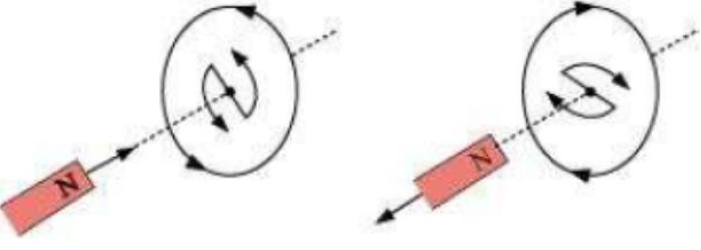
Using Lenz's rule, the direction of the induced current in the given situations can be predicted as follows:
  1. The direction of the induced current is along qrpq.
  2. The direction of the induced current is along prqp.
  3. The direction of the induced current is along yzxy.
  4. The direction of the induced current is along zyxz.
  5. The direction of the induced current is along xryx.
  6. No current is induced since the field lines are lying in the plane of the closed loop.
View full question & answer
Question 25 Marks
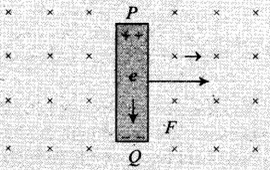
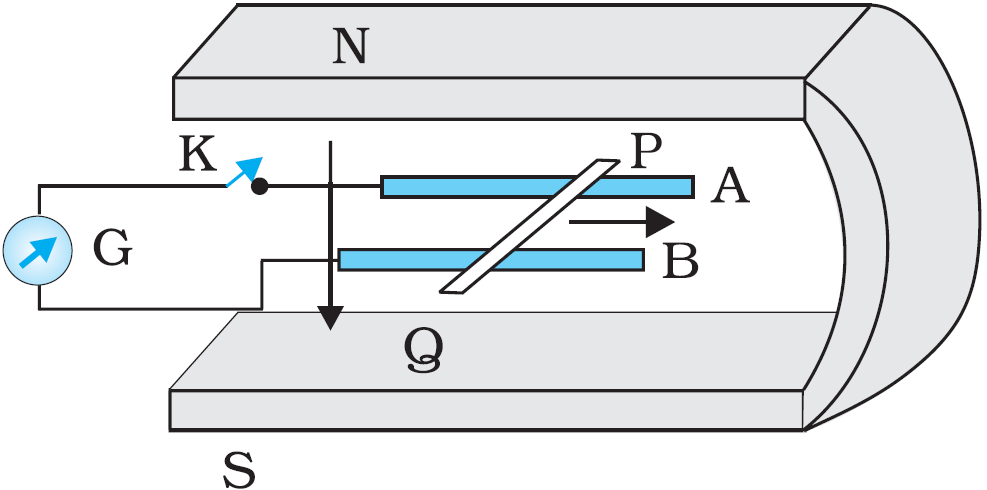
Figure shows a metal rod PQ resting on the smooth rails AB and positioned between the poles of a permanent magnet. The rails, the rod, and the magnetic field are in three mutual perpendicular directions. A galvanometer G connects the rails through a switch K. Length of the rod = 15cm, B = 0.50T, resistance of the closed loop containing the rod = 9.0mΩ. Assume the field to be uniform.
  1. Suppose K is open and the rod is moved with a speed of $12cms^{-1}$ in the direction shown. Give the polarity and magnitude of the induced emf.
  1. Is there an excess charge built up at the ends of the rods when K is open? What if K is closed?
  2. With K open and the rod moving uniformly, there is no net force on the electrons in the rod PQ even though they do experience magnetic force due to the motion of the rod. Explain.
  3. What is the retarding force on the rod when K is closed?
  4. How much power is required (by an external agent) to keep the rod moving at the same speed $(= 12cms^{–1})$ when K is closed? How much power is required when K is open?\
  5. How much power is dissipated as heat in the closed circuit? What is the source of this power?
  6. What is the induced emf in the moving rod if the magnetic field is parallel to the rails instead of being perpendicular?
Answer
Length of the rod, l = 15cm = 0.15m
Magnetic field strength, B = 0.50T
Resistance of the closed loop, $\text{R}=9\text{m}\Omega=9\times10^{-3}\Omega$
  1. Induced emf = 9mV; polarity of the induced emf is such that end P shows positive while end Q shows negative ends.
Speed of the rod, v = 12cm/s = 0.12m/s
Induced emf is given as:
$e = Bvl$
$= 0.5 × 0.12 × 0.15$
$= 9 \times 10^{-3}v$
$= 9mV$
The polarity of the induced emf is such that end P shows positive while end Q shows negative ends.
  1. Yes; when key K is closed, excess charge is maintained by the continuous flow of current.
    When key K is open, there is excess charge built up at both ends of the rods.
    When key K is closed, excess charge is maintained by the continuous flow of current.
  2. Magnetic force is cancelled by the electric force set-up due to the excess charge of opposite nature at both ends of the rod.
    There is no net force on the electrons in rod PQ when key K is open and the rod is moving uniformly. This is because magnetic force is cancelled by the electric force set-up due to the excess charge of opposite nature at both ends of the rods.
  3. Retarding force exerted on the rod, F = IBl
Where,
I = Current flowing through the rod
$=\frac{\text{e}}{\text{R}}=\frac{9\times10^{-3}}{9\times10^{-3}}=1\text{A}$
$\therefore F = 1 × 0.5 × 0.15$
$= 75 \times 10^{-3}N$
  1. 9 mW; no power is expended when key K is open.
    Speed of the rod, v = 12cm/s = 0.12m/s
    Hence, power is given as:
    $P = Fv$
    $= 75 \times 10^{-3} \times 0.12$
    $= 9 \times 10^{-3}W$
    $= 9mW$
    When key K is open, no power is expended.
  2. 9 mW; power is provided by an external agent.
    Power dissipated as heat $= I^2R$
    $= (1)2 \times 9 \times 10^{-3}$​​​​​​​
    $= 9mW$
    The source of this power is an external agent.
  3. Zero In this case, no emf is induced in the coil because the motion of the rod does not cut across the field lines.
View full question & answer
Question 35 Marks
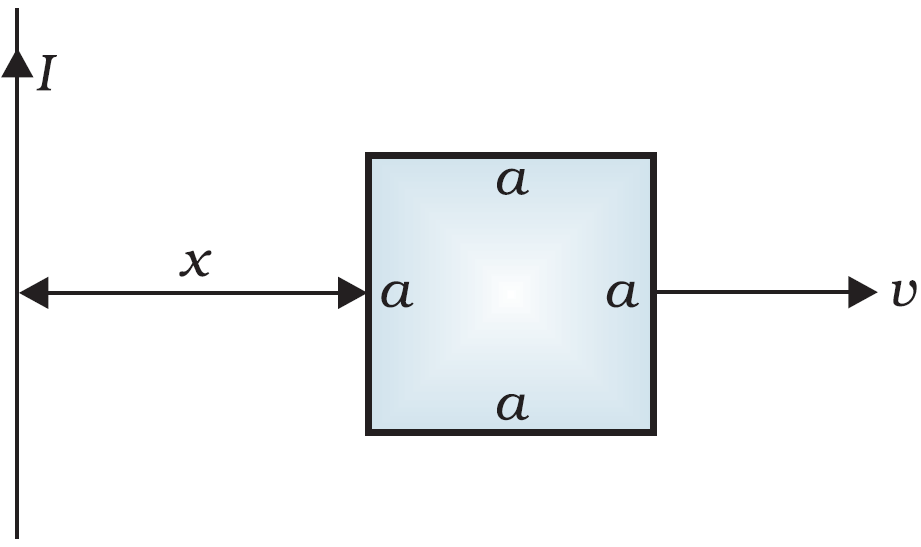
  1. Obtain an expression for the mutual inductance between a long straight wire and a square loop of side a as shown in Fig.
  2. Now assume that the straight wire carries a current of 50A and the loop is moved to the right with a constant velocity, v = 10\m/s. Calculate the induced emf in the loop at the instant when x = 0.2m. Take a = 0.1m and assume that the loop has a large resistance.
Answer
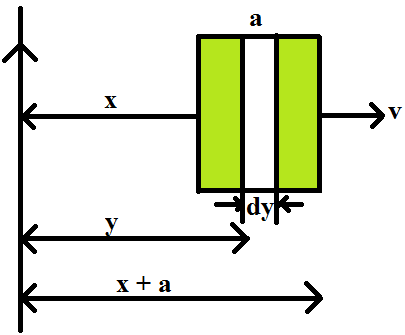
  1. Take a small element dy in the loop at a distance y from the long straight wire (as shown in the given figure).
Magnetic flux associated with element dy, $\text{d}\phi=\text{BdA}$
Where,
dA = Area of element dy = ady
B = Magnetic field at distance y
$=\frac{\mu_0\text{I}}{2\pi\text{y}}\text{s}$
I = Current in the wire
$\mu_0=\text{Permeability of free space}=4\pi\times10^{-7}\text{Tm}\text{A}^{-1}$
$\therefore\ \text{d}\phi=\frac{\mu_0\text{Ia}}{2\pi}\frac{\text{dy}}{\text{y}}\text{s}$
$\phi=\frac{\mu_0\text{Ia}}{2\pi}\int\frac{\text{dy}}{\text{y}}$
y tends from x to a + x.s
$\therefore\ \phi=\frac{\mu_0\text{I}\text{a}^{\text{a}+\text{x}}}{2\pi}\int_{\text{x}}\frac{\text{dy}}{\text{y}}$
$=\frac{\mu_0\text{Ia}}{2\pi}\big[\log_{\text{e}}\text{ y}\big]_{\text{x}}^{\text{a}+\text{x}}$
$=\frac{\mu_0\text{Ia}}{2\pi}\log_{\text{e}}\Big(\frac{\text{a}+\text{x}}{\text{x}}\Big)$
For mutual inductance M, the flux is given as:
$\phi=\text{mI}$
$\therefore\ \text{mI}=\frac{\mu_0\text{Ia}}{2\pi}\log_{\text{e}}\Big(\frac{\text{a}}{\text{x}}+1\Big)$
$\text{m}=\frac{\mu_0\text{a}}{2\pi}\log_{\text{e}}\Big(\frac{\text{a}}{\text{x}}+1\Big)$
  1. Emf induced in the loop, $\text{e}=\text{B}'\text{av}\Big(\frac{\mu_0}{2\pi}\Big)\text{av}$ Given,
I = 50A
x = 0.2m
a = 0.1m
v = 10m/s
$\text{BQv}=\frac{\text{M}\text{v}^2}{\text{r}}$
$\therefore\ \text{B}2\pi\text{r}\lambda\text{r}^2=\frac{\text{Mv}}{\text{r}}$
$\text{v}=\frac{\text{B}2\pi\text{r}\lambda\text{r}^2}{\text{M}}$
$\text{For }\text{r}\leq\text{a}\text{ and }\text{a}<\text{R},\ \text{we get}:$
$(\text{i})=-\frac{2\text{B}_0\text{a}^2\lambda}{\text{MR}}\text{k}$
$e = 5 \times 10^{-5}V$
View full question & answer
Question 45 Marks
Suppose the loop in Exercise 6.4 is stationary but the current feeding the electromagnet that produces the magnetic field is gradually reduced so that the field decreases from its initial value of 0.3T at the rate of $0.02T s^{–1}.$ If the cut is joined and the loop has a resistance of 1.6Ω, how much power is dissipated by the loop as heat? What is the source of this power?
Answer
Sides of the rectangular loop are 8cm and 2cm.
Hence, area of the rectangular wire loop,
A = length × width
$= 8 \times 2 = 16cm^2$
$= 16 \times 10^{-4}m^2$
Initial value of the magnetic field, $B^r = 0.3T$
Rate of decrease of the magnetic field, $\frac{\text{dB}}{\text{dt}}=0.02\text{T/s}$
Emf developed in the loop is given as:
$\text{e}=\frac{\text{d}\phi}{\text{dt}}$
$\text{d}\phi=$ Change in flux through the loop area
= AB
$\therefore\ \text{e}=\frac{\text{d(AB)}}{\text{dt}}=\frac{\text{AdB}}{\text{dt}}$
$= 16 \times 10^{-4} \times 0.02 = 0.32 $
$\therefore 10^{-4}V$
Resistance of the loop, $\text{R}=1.6\Omega$
The current induced in the loop is given as:
$\text{i}=\frac{\text{r}}{\text{R}}$
$=\frac{0.32\times10^{-4}}{1.6}=2\times10^{-5}\text{A}$
Power dissipated in the loop in the form of heat is given as:
$P = i^2R$
$= (2 \times 10^{-5})^2 \times 1.6$
$= 6.4 \times 10^{-10} W$
The source of this heat loss is an external agent, which is responsible for changing the magnetic field with time.
View full question & answer
Question 55 Marks
It is desired to measure the magnitude of field between the poles of a powerful loud speaker magnet. A small flat search coil of area $2cm^2$ with 25 closely wound turns, is positioned normal to the field direction, and then quickly snatched out of the field region. Equivalently, one can give it a quick 90º turn to bring its plane parallel to the field direction). The total charge flown in the coil (measured by a ballistic galvanometer connected to coil) is 7.5mC. The combined resistance of the coil and the galvanometer is 0.50Ω. Estimate the field strength of magnet.
Answer
Area of the small flat search coil, $A = 2cm^2 = 2 \times 10^{-4}m^2$
Number of turns on the coil, $N = 25$
Total charge flowing in the coil, $Q = 7.5mC = 7.5 \times 10^{-3}C$
Total resistance of the coil and galvanometer, $\text{R}=0.50\Omega$
Induced current in the coil,
$\text{I}=\frac{\text{Induced emf (e)}}{\text{R}}\ \ \ .....(\text{i})$
Induced emf is given as:
$\text{e}=-\text{N}\frac{\text{d}\phi}{\text{dt}}\ \ \ ....(2)\text{s}$
Where,
$\text{d}\phi=$ Charge in flux
Combining equations (1) and (2), we get
$\text{I}=-\frac{\text{N}\frac{\text{d}\phi}{\text{dt}}}{\text{R}}$
$\text{Idt}=-\frac{\text{N}}{\text{R}}\text{d}\phi\ \ \ ....(3)$
Initial flux through the coil, $\phi_{\text{i}}=\text{BA}$
Where,
B = Magnetic field strength
Final flux through the coil, $\phi_{\text{f}}=0$
Integrating equation (3) on both sides, we have
$\Big(\text{Idt}=\frac{-\text{N}^{\phi_{\text{f}}}}{\text{R}_{\phi_{\text{f}}}}\Big)\text{d}\phi$
But total charge, $\text{Q}=\int\text{Idt}.$
$\therefore\ \text{Q}=\frac{-\text{N}}{\text{R}}(\phi_{\text{f}}-\phi_{\text{f}})=\frac{-\text{N}}{\text{R}}(-\phi_{\text{f}})=+\frac{\text{N}\phi_{\text{i}}}{\text{R}}$
$\text{Q}=\frac{\text{NBA}}{\text{R}}$
$\therefore\ \text{B}=\frac{\text{QR}}{\text{NA}}$
$=\frac{7.5\times10^{-3}\times0.5}{25\times2\times10^{-4}}=0.75\text{T}$
Hence, the field strength of the magnet is 0.75 T.
View full question & answer
Question 65 Marks
A long solenoid with 15 turns per cm has a small loop of area $2.0 cm^2$ placed inside the solenoid normal to its axis. If the current carried by the solenoid changes steadily from 2.0A to 4.0A in 0.1s, what is the induced emf in the loop while the current is changing?
Answer
Number of turns on the solenoid = 15turns/cm = 1500turns/m
Number of turns per unit length, n = 1500turns
The solenoid has a small loop of area, $A = 2.0cm^2 = 2 x 10^{-4}m^2$
Current carried by the solenoid changes from 2A to 4A.
$\therefore$ Change in current in the solenoid, $di = 4 - 2 = 2A$
Change in time, dt $= 0.1s$
Induced emf in the solenoid is given by Faraday's law as:
$\text{e}=\frac{\text{d}\phi}{\text{dt}}\ \ \ \ \ .......(\text{i})$
Where,
$\phi=$ Induced flux through the small loop
$= BA ....(ii)$
B = Magnetic field
$=\mu_{0}\text{ni}$
$\mu_0=$ Permeability of free space
$=4\pi\times10^{-7}\text{ H/m}$
Hence, equation (i) reduces to:
$\text{e}=\frac{\text{d}}{\text{dt}}(\text{BA})$
$=\text{A}\mu_{0}\text{n}\times\Big(\frac{\text{di}}{\text{dt}}\Big)$
$=2\times10^{-4}\times4\pi\times10^{-7}\times1500\times\frac{2}{0.1}$
$= 7.54 \times 10^{-6} V$
Hence, the induced voltage in the loop is $7.54 \times 10^{-6} V.$
View full question & answer
Question 75 Marks
A square loop of side 12 cm with its sides parallel to $X$ and $Y$ axes is moved with a velocity of $8 \mathrm{cms}^{-1}$ in the positive $x$-direction in an environment containing a magnetic field in the positive z-direction. The field is neither uniform in space nor constant in time. It has a gradient of $10^{-3} \mathrm{~T} \mathrm{~cm}^{-1}$ along the negatilve x -direction (that is it increases by $10^{-3} \mathrm{~T} \mathrm{~cm}^{-1}$ as one moves in the negative $x$-direction), and it is decreasing in time at the rate of $10^{-3} \mathrm{Ts}^{-1}$. Determine the direction and magnitude of the induced current in the loop if its resistance is $4.50 \mathrm{~m} \Omega$.
Answer
Side of the square loop, $s = 12cm = 0.12m$
Area of the square loop, $A = 0.12 \times 0.12 = 0.0144m^2$​​​​​​​
Velocity of the loop, $v = 8cm/s = 0.08m/s$
Gradient of the magnetic field along negative x-direction,
$\frac{\text{dB}}{\text{dx}}=10^{-3}\text{T}\text{cm}^{-1}=10^{-1}\text{T}\text{m}^{-1}$
And, rate of decrease of the magnetic field,
$\frac{\text{dB}}{\text{dx}}=10^{-3}\text{T}\text{s}^{-1}$
Resistance of the loop, $\text{R}=4.5\Omega=4.5\times10^{-3}\Omega$
Rate of change of the magnetic flux due to the motion of the loop in a non-uniform magnetic field is given as:
$\frac{\text{d}\phi}{\text{dt}}=\text{A}\times\frac{\text{dB}}{\text{dx}}\times\text{v}$
$= 144 \times 10^{-4}m^2 \times 10^{-1} \times 0.08$
$= 11.52 \times 10^{-5}Tm^2s^{-1}$
Rate of change of the flux due to explicit time variation in field B is given as:
$\frac{\text{d}\phi^{\text{r}}}{\text{dt}}=\text{A}\times\frac{\text{dB}}{\text{dx}}$
$= 144 \times 10^{-4} \times 10^{-3}$
$= 1.44 \times 10^{-5} Tm^2s^{-1}$
Since the rate of change of the flux is the induced emf, the total induced emf in the loop can be calculated as:
$e = 144 \times 10^{-5} + 11.52 \times 10^{-5}$
$= 12.96 \times 10^{-5}V$
$\therefore\ \text{Induced current},\ \text{i}=\frac{\text{e}}{\text{R}}\text{s}$
$\text{s}=\frac{12.96\times10^{-5}}{1.5\times10^{-3}}$
$i = 2.88 \times 10^{-2}A$
Hence, the direction of the induced current is such that there is an increase in the flux through the loop along positive z-direction.
View full question & answer
Question 85 Marks
Ram is a student of class X in a village school. His uncle gifted him a bicycle with a dynamo fitted in it. He was very excited to get it. While cycling during night, he could light the bulb and see the objects on the road. He however, did not know this device works. He asked this question to his teacher. the teacher considered it an opportunity to explain the working to the whole class.
Answer the following question:
  1. State the principle and working of a dynamo.
  2. Write two values each displayed by Ram and his school teacher.
Answer
  1. Principle: Whenever a coil is rotated in a magnetic field, an emf is induced in it due to the change in magnetic flux linked with it.
Working - As the coil rotates, its inclination$(\theta ) $ with respect to the field changes.

Hence sinusoidal/varying emf$( = \text{e}_{o}\sin \omega\text{t}) $ is obtained./May also be explained graphically.
  1. Values Ram - Scientific aptitude, curiosity, keenness to learn, positive approach, etc.
Teacher - Dedication, concern for students, depth of knowledge, generous, positive attitude towards queries, motivational approach.
View full question & answer
Question 95 Marks
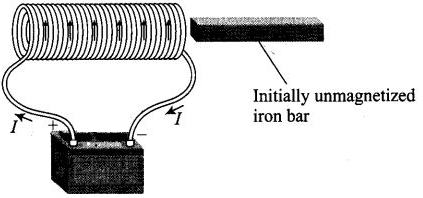
A solenoid is connected to a battery so that a steady current flows through it. If an iron core is inserted into the solenoid, will the current increase or decrease? Explain.
Answer
This problem is based on Lenz’s law and according to this law, the direction of induced emf or current in a circuit is such as to oppose the cause that produces it.

When the iron core is inserted in the current carrying solenoid, the magnetic field increases due to the magnetisation of iron core and hence the flux increases.
So, the emf induced in the coil must oppose this increase in flux, so the current induced in the coil in such a direction that it will oppose the increasing magnetic field which can be done by making decrease in current. So, the current will decrease.
View full question & answer
Question 105 Marks

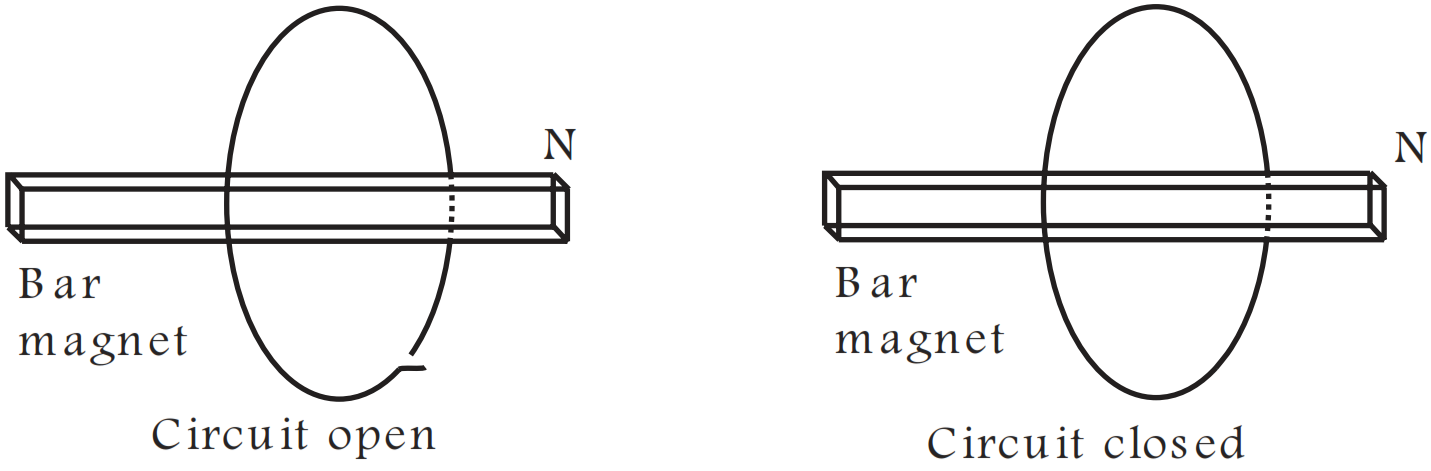
Consider a magnet surrounded by a wire with an on/off switch S (Fig). If the switch is thrown from the off position (open circuit) to the on position (closed circuit), will a current flow in the circuit? Explain.
Answer
Key concept: The total number of magenetic lines of force passing notmally through an area placed in a magnetic field is equal to the magnetic flux linked with that area. $\phi_\text{m}=\vec{\text{B}}.\vec{\text{A}}=\text{BA}\cos\theta$ ($\theta$ is the angle between area vector and magnetic field vector) Whenever the number fo magnetic lines of force (magnetic flux) passing through a circuit changes an emf is produced in the circuit called induced emf. The induced emf persists only as long as there is a change or cutting of flux. The induced emf is given by rate of change of magnetic flux linked with the circuit i.e, $\text{e}=-\frac{\text{d}\phi}{\text{dt}}$. so flux linked will change when either magnetic field, area or the angle between B and A changes. If the switch is closed, the circuit will complete. But to induce emf in the circuit, we need:
  1. A changing magnetic field, but the bar magnet is stationary so it is not possible in this situation.
  2. A changing area, which is also not possible because area is also constant as coil is not expanding or compressed.
  3. Angle between B bar and A bar changes, which is also not possible in this situation because orientation of bar magnet and coil is fixed.
Thus, no change in magnetic flux linked with coil occur, hence no electromotive force is induced in the coil and hence no current will flow in the circuit.
View full question & answer
Question 115 Marks
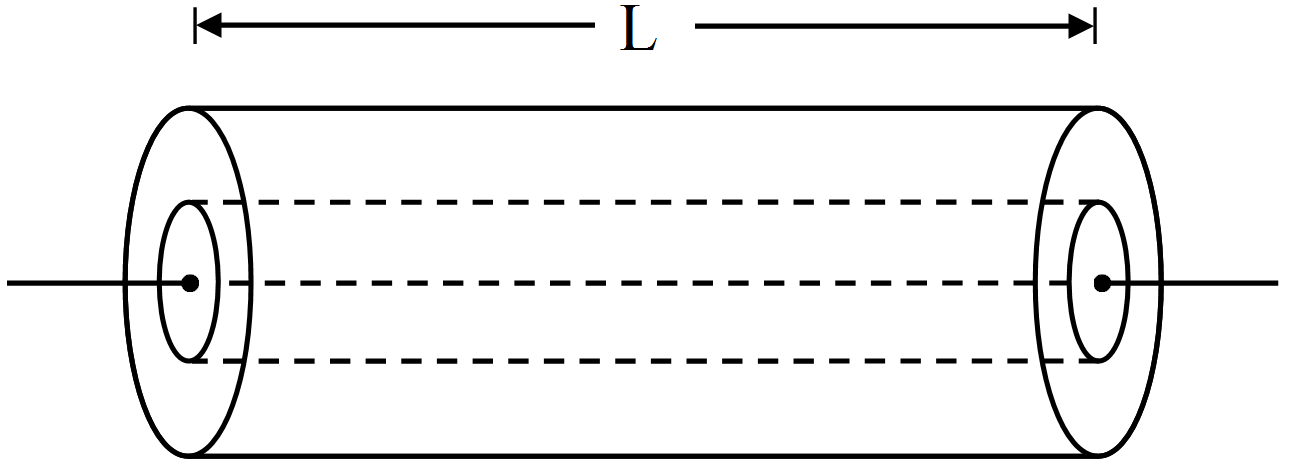
Figure shows two long coaxial solenoids, each of length ‘L’. The outer solenoid has an area of cross-section $A_1$ and number of turns/ length $n_1$ The corresponding values for the inner solenoid are $A_2$ and $n_2$ Write the expression for self-inductance $L_1, L_2$ of the two coils and their mutual inductance M. Hence show that $\text{M} < \sqrt{\text{L}_2\text{L}_2}.$
Answer
Self-inductance of a solenoid of length L
$=\mu_{0}\text{n}^{2}\text{AL}$ where n is number of turns per metre.
$\text{L}_1=\mu_{0}\text{n}^{2}_1\text{A}_1\text{L}$
and $\text{L}_2=\mu_{0}\text{n}^{2}_2\text{A}_2\text{L}$
If $l_1$ is the current in outer solenoid, then magnetic field at axis, $\text{B}_1=\mu_0\text{n}_1\text{l}_1$
Magnatic flux linked with the secondary coil
$\varphi_2=(\text{n}_2\text{L})\text{B}_1\text{A}_2=(\text{n}_2\text{L})(\mu_0\text{n}_1\text{I}_1)$
$​​\text{A}_2=\mu_0\text{n}_1\text{n}_2\text{LA}_2\text{I}_1$
$\text{M}=\frac{\varphi_2}{\text{I}_1}=\mu_0\text{n}_1\text{n}_2\text{LA}_2\dots(\text{i})$
$\text{Now},\text{L}_1\text{L}_2=(\mu_0\text{n}_1^{2}\text{A}_1\text{L}),(\mu_0\text{n}_2^{2}\text{A}_2\text{L}),$
$\sqrt{\text{L}_1\text{L}_2}=\mu_0\text{n}_1\text{n}_2\text{L}\sqrt{\text{A}_1\text{A}_2}$
$\text{As}\text{ A}_2<\text{A}_1,\text{A}_2,\sqrt{\text{A}_1\text{A}_2}$
$\therefore\text{M}<\sqrt{\text{L}_1\text{L}_2}$
View full question & answer
Question 125 Marks
There are two coils A and B seperated by some distance. If a current of 2A flows through A, a magnetic flux of $10^{-2}$Wb passes through B (no current through B). If no current passes through A and a current of 1A passes through B, what is the flux through A?
Answer
Key concept: Total flux linked with the secondary (coil B due to current in the primary coil A) is $\text{N}_2\phi_2$,
and $\text{N}_2\phi_2\propto\text{i}_1$
$\Rightarrow\ \text{N}_2\phi_2=\text{Mi}_1$
Where, $N_1 -$ Number of turns in primary; $N_2 -$ Number of turns in secondary; $f_2 -$ Flux linked with each turn of secondary; $i_1 -$ Current flowing through primary; M - Coefficient of mutual induction of mutual inductance.
So, according to the above relation, the mutual inductance of coil B with respect to coil A is
$\text{M}_{21}=\frac{\text{N}_2\phi_2}{\text{I}_1}$
According to the problem, total flux $\text{N}_2\phi_2=10^{-2}\text{Wb}$.
Hence, the Mutual inductance $=\frac{10^{-2}}{2}=5\text{mH}$
As we know thta matual inductance is same for both the coils with respect to each other, So,
$M_{21} = M_{12}$
And let $\text{N}_1\phi_1$ is the total flux through A if no current passes through A.
$\text{N}_1\phi_1=\text{M}_{12}\text{I}_2=5\text{mH}\times1\text{A}=5\text{m Wb}$.
View full question & answer
Question 135 Marks
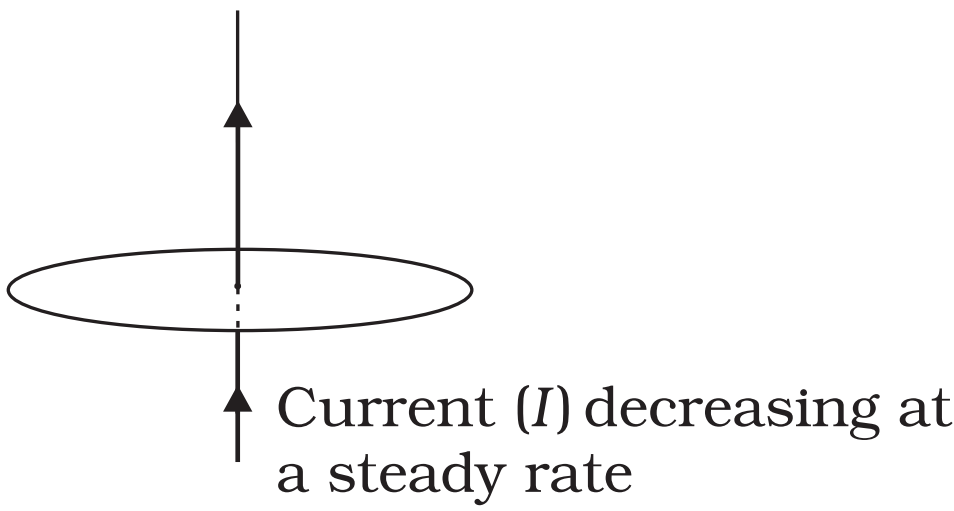
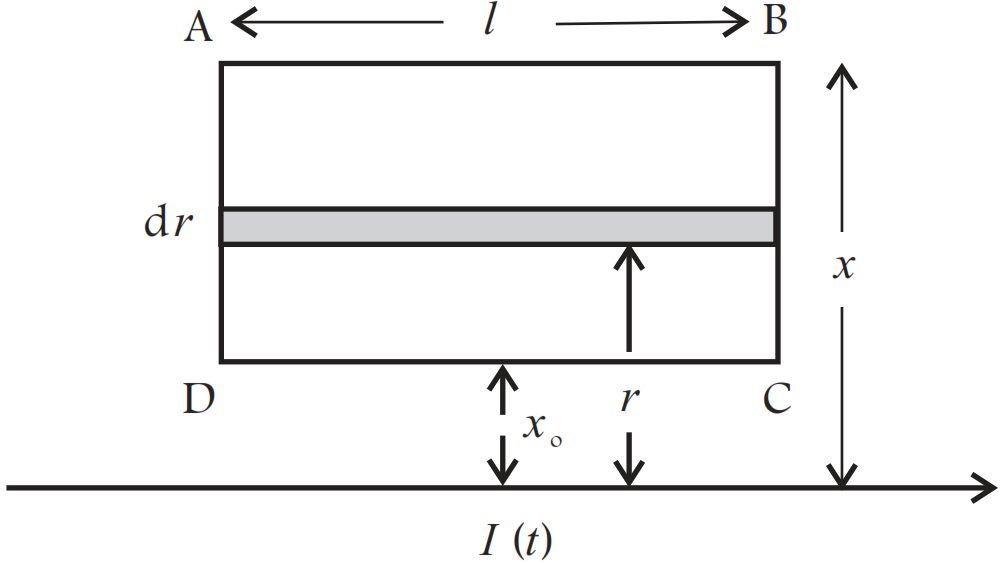
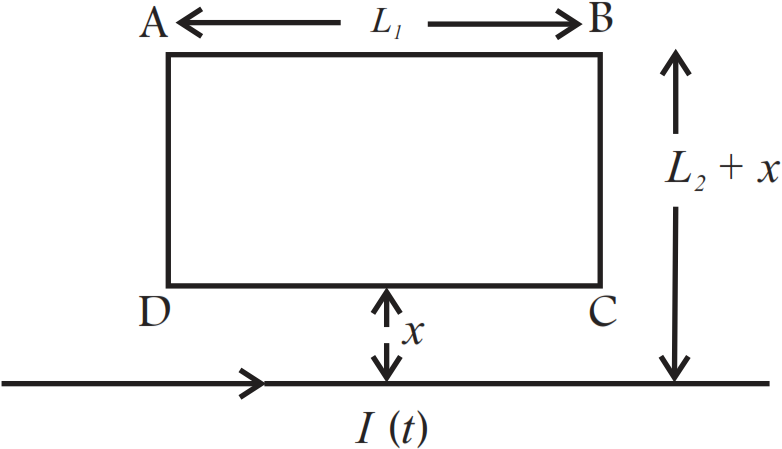
Consider an infinitely long wire carrying a current I (t), with $\frac{\text{dI}}{\text{dt}}=\lambda=\text{constant}$. Find the current produced in the rectangular loop of wire ABCD if its resistance is R (Fig).
Answer
To approach these types of problems integration is very useful to find the total magnetic flux linked with the loop.
Let us first consider an elementary strip of length l and width dr at a distance r from an infinite long current carrying wire. The magnetic field at strip due to current carrying wire is given by,
$\vec{\text{B}}\text{(r)}=\frac{\mu_0\text{I}}{2\pi\text{r}}$ (out of paper)
Area of the elementary strip is, dA = l.dr
So, total flux through the loop is
$\phi_\text{m}=\vec{\text{B}}.\vec{\text{A}}=\frac{\mu_0\text{I}}{2\pi}\text{I}\int_{\text{x}_0}^{\text{x}}\frac{\text{dr}}{\text{r}}=\frac{\mu_0\text{Il}}{2\pi}\text{ln}\frac{\text{x}}{\text{x}_0}\ .....(\text{i})$
The emf induced can be obtained by differentiating the eq. (i) w.r.t. t and then applying Ohm's law
$\text{I}=\frac{\in}{\text{R}}$
And $|\in|=\frac{\text{d}\phi}{\text{dt}}$
We have, indueced current
$\text{I}=\frac{1}{\text{R}}\frac{\text{d}\phi}{\text{dt}}=\frac{\mu_0\text{l}}{2\pi}\frac{\lambda}{\text{R}}\text{in}\frac{\text{x}}{\text{x}_0}\ \ \bigg(\because\frac{\text{dI}}{\text{dt}}=\lambda\bigg)$
View full question & answer
Question 145 Marks
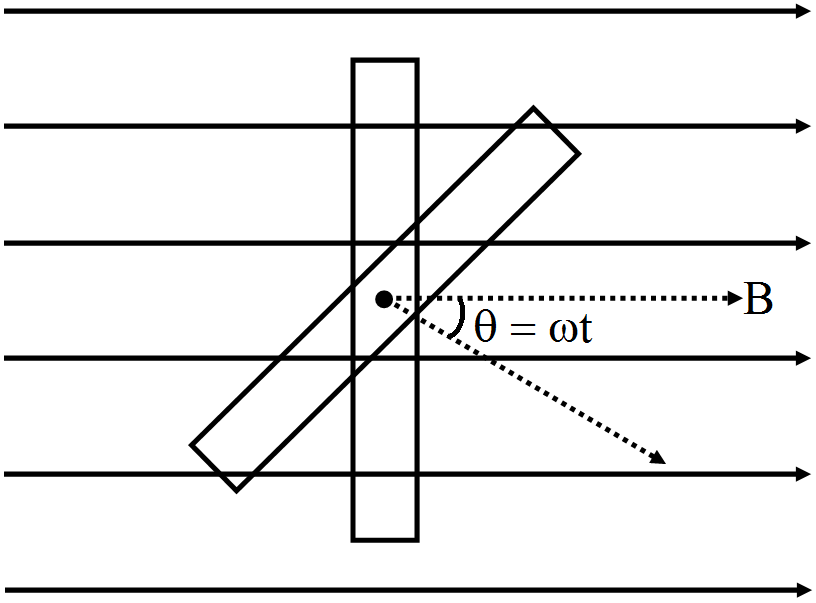
A coil of number of turns N, area A is rotated at a constant angular speed ω, in a uniform magnetic field B and connected to a resistor R. Deduce expression for:
  1. Maximum emf induced in the coil.
  2. Power dissipation in the coil.
Answer
Suppose initially the plane of coil is perpendicular to the magnetic field B. When coil rotates with angular speed $\omega,$ then after time t, the angle between magnetic field $\vec{\text{B}}$ and normal to plane of coil is:
$\theta=\omega\text{t}$ $\therefore$ At this instant magnetic flux linked with the coil $\phi=\text{BA}\cos\omega\text{t}$ If coil constants, N-turns, then emf induced in the coil $\varepsilon=-\text{N}\frac{\text{d}\phi}{\text{dt}}=-\text{N}\frac{\text{d}}{\text{dt}}(\text{BA}\cos\omega\text{t})$ $=+\text{NBA}\omega\sin\omega\text{t}\dots(\text{i})$ $\therefore$ For maximum value of emf $\varepsilon$ $\sin\omega\text{t}=1$ $\therefore$ Maximum emf induced, $\varepsilon_{\text{max}}=\text{NBA}\omega$
View full question & answer
Question 155 Marks
A long solenoid 'S' has 'n' turns per meter, with diameter 'a'. At the centre of this coil we place a smaller coil of 'N' turns and diameter 'b' (where b < a). If the current in the solenoid increases linearly, with time, what is the induced emf appearing in the smaller coil. Plot graph showing nature of variation in emf, if current varies as a function of $mt^2 +C.$
Answer
Magnetic field due to a solenoid is given by, $B = \mu _0ni$ where signs are as usual.
In this problem the current is varying with time. Due to this an emf is induced in the coil of radius b.
Magnetic flux in smaller coil is
$\phi_\text{m}=\text{NBA}$
where, $\text{A}=\phi\text{B}^2$
Applyinf Faraday's law of EMI, we have
So, $\text{e}=\frac{-\text{d}\phi}{\text{dt}}=\frac{-\text{d}}{\text{dt}}(\text{NBA})$
$=-\text{N}\pi\text{b}^2\frac{\text{d}(B)}{\text{dt}}$
where, $\text{B}=\mu_0\text{Ni}$
$\Rightarrow\ \text{e}=-\text{N}\pi\text{b}^2\mu_0\text{n}\frac{\text{di}}{\text{dt}}$
Since, current varies as a function of time, so
$\text{i}\text{(t)}=\text{mt}^2+\text{C}$
$\Rightarrow\ \text{e}=-\text{Nn}\pi\mu_0\text{b}^2\frac{\text{d}}{\text{dt}}(\text{mt}^2+\text{C})$
By solving this equation we get, $\text{e}=-\mu_0\text{Nn}\pi\text{b}^2 2\text{mt}$
Negative sign singnifies opposite nature of induced emf. The magnitude of emf vaies with time as shown in figure.
View full question & answer
Question 165 Marks
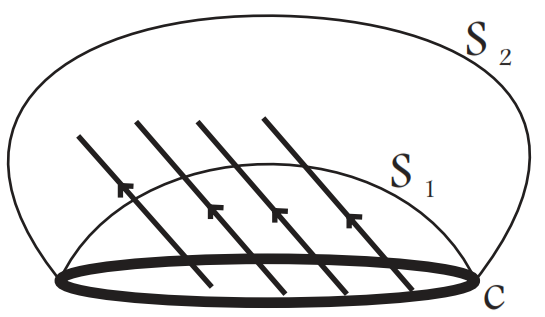
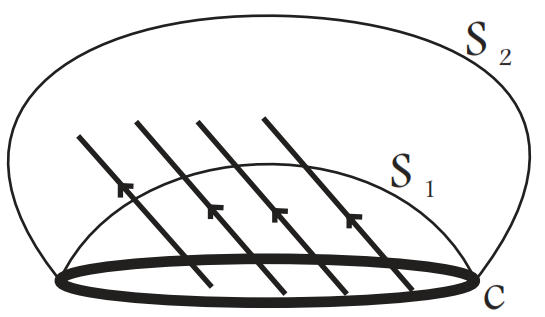
Consider a closed loop C in a magnetic field (Fig). The flux passing through the loop is defined by choosing a surface whose edge coincides with the loop and using the formula $\phi=\text{B}_1.\text{dA}_1+\text{B}_2.\text{dA}_2+ .....$. Now if we chose two different surfaces $S_1$ and $S_2$ having C as their edge, would we get the same answer for flux. Jusity your answer.
Answer
We would get the same answer for magnetic flux. Let us discuss its reason in detail. The magnetic flux linked with the surface can be considered as the number of magnetic field lines passing through the surface. So, let $\text{d}\phi=\text{B.dA}$ represents magnetic lines in an area A to B.
Magnetic field cannot end or start in space, this property of magnetic field lines based upon the concept of continuity. Therefore the number of lines passing through surface $S_1$ must be the same as the number of lines passing through the surface $S_2.$ Therefore, in both the cases we get the same magnetic flux.

Important point: Magnetic field lines can neither be originated nor be destroyed in space. This property is based on the concept of continuity.
View full question & answer
Question 175 Marks
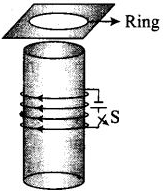
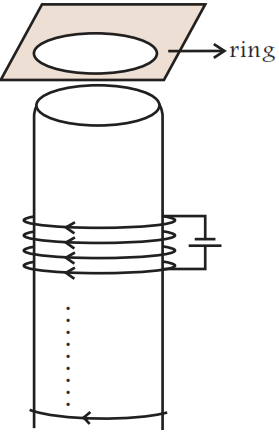
Consider a metal ring kept (supported by a cardboard) on top of a fixed solenoid carrying a current I (see Fig). The centre of the ring coincides with the axis of the solenoid. If the current in the solenoid is switched off, what will happen to the ring?
Answer
This problem is based on Lenz’s law and according to this law, the direction of induced emf or current in a circuit is such as to oppose the cause that produces it.

When the switch is opened, current in the circuit of solenoid stops flowing. Initially there is some magnetic flux linked with the solenoid and now if current in the circuit stops, the magnetic flux falls to zero or we can say that magnetic flux linked through the ring decreases. According to Lenz’s law, this decrease in flux will be opposed and the ring experiences downward force towards the solenoid.
This happen because the current i decrease will cause a clockwise current (as seen from the top in the ring in figure) to increase the decreasing flux. This can be done if the direction of induced magnetic field is same as that of solenoid. This makes the opposite sense of flow of current in the ring (when viewed from the bottom of the ring) and solenoid forming opposite magnetic pole in front of each other.
Hence, they will-attract each other but as ring is placed at the cardboard it could not be able to move downward.
View full question & answer
Question 185 Marks
A rectangular loop of wire ABCD is kept close to an infinitely long wire carrying a current $\text{I}(\text{t})=\text{I}_0\Big(1-\frac{\text{t}}{\text{T}}\Big)$ for 0 and I(0) = 0 for t > T (Fig). Find the total charge passing through a given point in the loop, in time T. The resistance of the loop is R.
Answer
To find the charge that passes through the circuit first we have to find the relation between instantaneous current and instantaneous magnetic flux linked with it. The emf induced can be obtained by differentiating the expression of magnetic flux linked w.r.t. t and then applying Ohm's law, we get
$\text{I}=\frac{\text{E}}{\text{R}}=\frac{1}{\text{R}}\frac{\text{d}\phi}{\text{dt}}$
According to the problem electric current is given as a function of time.
$\text{I(t)}=\frac{\text{dQ}}{\text{dt}}\text{ or }\frac{\text{dQ}}{\text{dt}}=\frac{1}{\text{R}}\frac{\text{d}\phi}{\text{dt}}$
Integrating the variable separately in the form of differential equation for finding the charge Q that passed in time t, we have
$\text{Q}(\text{t}_1)=\text{Q}(\text{t}_2)=\frac{1}{\text{R}}\big[\phi(\text{t}_1)-\phi(\text{t}_2)\big]$
$\phi(\text{t}_1)\text{L}_1\frac{\mu_0}{2\pi}\int_\text{x}^{\text{L}_2+\text{x}}\frac{\text{dx}'}{\text{x}'}\text{I}(\text{t}_1)$ [Refer to the Eq. (i) of answer no. 25]
$=\frac{\mu_0\text{L}_1}{2\pi}\text{I}(\text{t}_1)\text{in}\frac{\text{L}_2+\text{x}}{\text{x}}$
Therefore the magnitude of charge is
$\text{Q}=\frac{1}{\text{R}}[\phi(\text{T})-\phi(0)]$
$\text{Q}=\frac{\mu_0\text{L}_1}{2\pi}\text{ in }\frac{\text{L}_2+\text{x}}{\text{x}}[\text{I}(\text{T})-\text{I}(0)]$
Now I(T) = 0 and I(0) = 1.
$\therefore\ \text{Q}=\frac{\mu_0\text{L}_1}{2\pi}\text{I}_0\text{ in }\bigg(\frac{\text{L}_2+\text{x}}{\text{x}}\bigg)$
This is the required expression.
View full question & answer
Question 195 Marks
Consider a metal ring kept on top of a fixed solenoid (say on a carboard) (Fig). The centre of the ring coincides with the axis of the solenoid. If the current is suddenly switched on, the metal ring jumps up. Explain.
Answer
This problem is based on Lenz’s law and according to this law, the direction of induced emf or current in a circuit is such as to oppose the cause that produces it.
Initially there is no flux linked with the ring or we can say that initially flux through the ring is zero. When the switch is closed current start flowing in the circuit, magnetic flux is linked through the ring. Thus increase in flux takes place. According to Lenz’s law, this increase will be resisted and this can happen if the ring moves away from the solenoid.

This happen because the flux increases will cause an anticlockwise current (as seen from the top in the ring in figure.), i.e., opposite direction to that in the solenoid.
This makes the same sense of flow of current in the ring (when viewed from the bottom of the ring) and solenoid forming same magnetic pole in front of each other. Hence, they will repel each other and the ring will move upward.
View full question & answer
Question 205 Marks
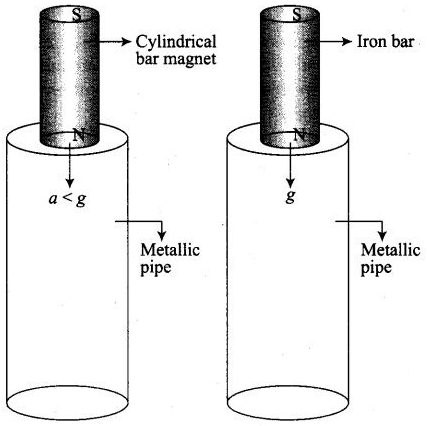
Consider a metallic pipe with an inner radius of 1cm. If a cylindrical bar magnet of radius 0.8cm is dropped through the pipe, it takes more time to come down than it takes for a similar unmagnetised cylindrical iron bar dropped through the metallic pipe. Explain.
Answer
Key concept: Lem's Law.
This law gives the direction of induced emf/induced current. According to this law, the direction of induced emf or current in a circuit is such as to oppose the cause that produces it. This law is based upon the law of conservation of energy.
Eddy Current. When a changing magnetic flux is applied to a bulk piece of conducting material, then circulating currents called eddy currents are induced in the material. Because the resistance of the bulk conductor is usually low, eddy currents often have large magnitudes and heat up the conductor.
When a cylindrical bar magnet is dropped through the metallic pipe flux linked with the cylinder changes and consequently eddy currents are produced in the metallic pipe. According to Lenz’s law, these currents will oppose the motion of the magnet, which is the cause of induction.

Therefore, magnet’s downward acceleration will be less than the acceleration due to gravity g. On the other hand, an un-magnetised iron bar will not produce eddy currents and will fall with acceleration due to gravity g.
Thus, the magnet will take more time to come down than it takes for a similar un-magnetised cylindrical iron bar dropped through the metallic pipe, so, magnetised magnet takes more time.
View full question & answer
Question 215 Marks
A wire in the form of a tightly wound solenoid is connected to a DC source, and carries a current. If the coil is stretched so that there are gaps between successive elements of the spiral coil, will the current increase or decrease? Explain.
Answer
Key concept: Lenz's Law:
This law gives the direction of induced emf/induced current. According to this law, the direction of induced emf or current in a circuit is such as to oppose the cause that produces it. This law is based upon the law of conservation of energy.
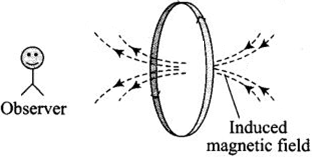
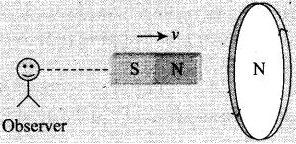
  1. When AT-pole of a bar magnet moves towards the coil, the flux associated with the loop increases and an emf is induced in it. Since the circuit of loop is closed, induced current also flows in it.
  2. Cause of this induced current, is approach of north pole and therefore to oppose the cause, i.e., to repel the approaching north pole, the induced current in loop is in such a direction so that the front face of loop behaves as north pole. Therefore induced current as seen by observer O is in anticlockwise direction (figure).

According to the given situation as the coil is stretched so that there are gaps between successive elements of the spiral coil, i.e., the wires are pulled apart which lead to the flux leak through the gaps. According to Lenz’s law, the emf induced in these spirals must oppose this decrease in magnetic flux, which can be done by an increase in current. So, the current will increase.
View full question & answer
Question 225 Marks
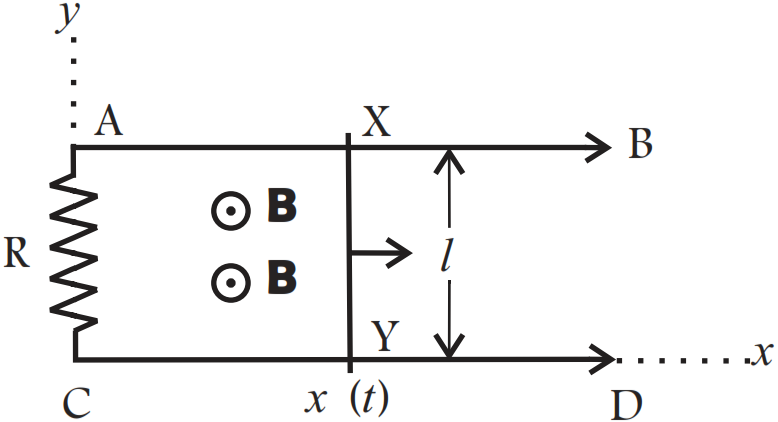
A conducting wire XY of mass m and neglibile resistance slides smoothly on two parallel conducting wires as shown in Fig. The closed circuit has a resistance R due to AC. AB and CD are perfect conductors. There is a magnetic field $\text{B}=\text{B}(\text{t})\hat{\text{k}}$.
  1. Write down equation for the acceleration of the wire XY.
  2. If B is independent of time, obtain v(t), assuming $v(0) = u_0.$
  3. For (b), show that the decrease in kinetic energy of XY equals the heat lost in R.
Answer
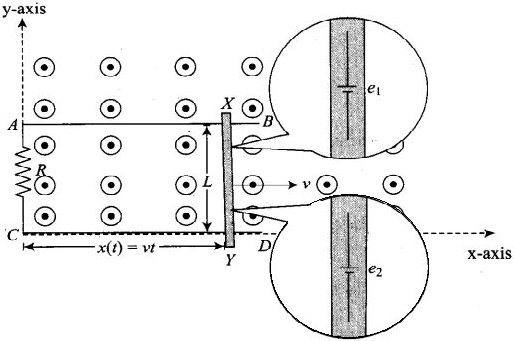
First we have to analyse the situation as shown in the figure. Let the parallel wires are at y = 0 and y = L and are placed along x-axis. Wire XY is along y-axis.
At t = 0, wire AB starts from x = 0 and moves with a velocity v. Let at time t, wire is at x(t) = vt.
(Where, x(t) is the displacement as a function of time).
Let us redraw the diagram as shown below.

The magnetic flux linked with the loop is given by
$\phi_\text{m}=\vec{\text{B}}=\vec{\text{A}}=\text{BA}\cos\theta$
And as we know both $\vec{\text{A}}$ (area vector) and $\vec{\text{B}}$ (magnetic field vector) are directed along z-axis. So angle between them is 0.
So, $\cos0^\circ=1\ \ (\because\ \theta= 0^\circ)$
$\Rightarrow \ \phi_\text{m}=\text{BA}$
At any instant fo time t,
Magenetic flux $\phi_\text{m}=\text{B}\text{(t)}(1\times\text{x(t)})$
Emf induced due to change in magnetic field
$\text{e}_1=-\frac{\text{d}\phi}{\text{dt}}$
$\Rightarrow\ \text{e}_1=-\frac{\text{dB(t)}}{\text{dt}}\text{lx(t)}$
Emf induced due to motion
$\text{e}_2=\text{Blv}$
$\text{e}_2=\text{B(t)}\text{lv(t)}(-\hat{\text{j}})$
Total emf in the circuit = emf due to change in field (along XYAC) + the motional emf across XY
$\text{E}=-\frac{\text{d}\phi}{\text{dt}}=-\frac{\text{dB(t)}}{\text{dt}}\text{lx(t)}-\text{B(t)}\text{lv(t)}$
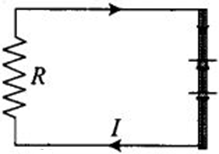
Electric current inc clockwise (as shown in equivalent diagram) is given by
$\text{I}=\frac{\text{E}}{\text{R}}$

The force acting on the conductor is given by $\text{F}=\text{ilB}\sin90^\circ=\text{ilB}$
Substituting the values, we have
$\text{Force}=\frac{\text{IB(t)}}{\text{R}}\bigg[-\frac{\text{dB(t)}}{\text{dt}}\text{Ix(t)}-\text{B(t)}\text{Iv(t)}\bigg]\hat{\text{i}}$
Applying Newton's second law of motion,
$\text{m}\frac{\text{d}^2\text{x}}{\text{dt}^2}=-\frac{\text{I}^2\text{B(t)}}{\text{R}}\frac{\text{dB}}{\text{dt}}\text{x(t)}-\frac{\text{I}^2\text{B}^2\text{(t)}}{\text{R}}\frac{\text{dx}}{\text{dt}}\ .....(\text{i})$
which is the reuired equation.
If B is independent of time, i.e., B = Constant
or $\frac{\text{dB}}{\text{dt}}=0$
Substituting the above value in Eq (i), we have
$\frac{\text{d}^2\text{x}}{\text{dt}^2}+\frac{\text{I}^2\text{B}^2}{\text{mR}}\frac{\text{dx}}{\text{dt}}=0$
or $\frac{\text{dv}}{\text{dt}}+\frac{\text{I}^2\text{B}^2}{\text{mR}}{\text{v}}=0$
Integtaring using variable separable from of differntial equation, we have
$\text{v}=\text{A exp}\bigg(\frac{-\text{I}^2\text{B}^2\text{t}}{\text{mR}}\bigg)$
Applying given conditions, at $t = 0, v = u_0$
$\text{v(t)}=\text{u}_0\text{exp}\bigg(\frac{\text{I}^2\text{B}^2\text{t}}{\text{mR}}\bigg)$
This is the required equation.
Since the power consumption is given by $p = I^2R$
Here, $\text{I}^2\text{R}=\frac{\text{B}^2\text{I}^2\text{v}^2(\text{t})}{\text{R}^2}\times\text{R}$
$=\frac{\text{B}^2\text{I}^2}{\text{R}}\text{u}_0^2\text{exp}\bigg(\frac{-2\text{I}^2\text{B}^2\text{t}}{\text{mR}}\bigg)$
Now, energy consumed in time interval dt is given by energ consumed $= pdt = I^2Rdt.$ Therefore, total energy consumed in time t,
$\int_0^\text{t}\text{I}^2\text{Rdt}=\frac{\text{B}^2\text{I}^2}{\text{R}}\text{u}_0^2\frac{\text{mR}}{2\text{I}^2\text{B}^2}\bigg[1-\text{e}^{-\Big(\frac{\text{I}^2\text{B}^2\text{t}}{\text{mr}}\Big)}\bigg]$
$=\frac{\text{m}}{2}\text{u}_0^2=\frac{\text{m}}{2}\text{v}^2(\text{t})$
= decrease in kinetic energy.
This proves that the decrease in kinetic energy of XY equals the heat lost in R.
View full question & answer
Question 235 Marks
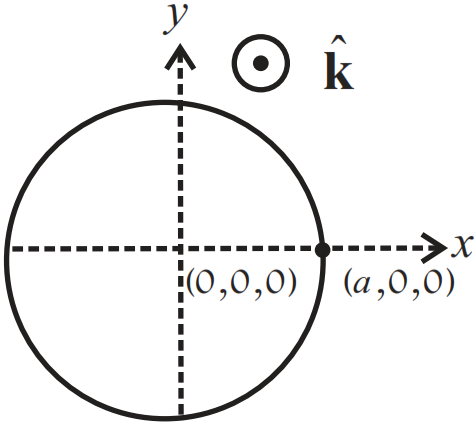
A magnetic field in a certain region is given by $\text{B}=\text{B}_0\cos(\omega\text{t})\hat{\text{k}}$ and a coil of radius a with resistance R is placed in the x-y plane with its centre at the origin in the magnetic field (see Fig). Find the magnitude and the direction of the current at (a, 0, 0) at $\text{t}=\frac{\pi}{2\omega},\text{t}=\frac{\pi}{\omega} \text{ and }\text{t}=\frac{3\pi}{2\omega}$.
Answer
Key concept:
First law: When ever the number of magnetic lines of force(magnetic flux) passing through a circuit changes, an emf is produced in the circuit called induced emf. The induced emf persists only as long as there is a change or cutting of flux.
Second law: The induced emf is given by the rate of change of magnetic flux linked with the circuit, i.e., $\text{e}=-\frac{\text{d}\phi}{\text{dt}}$. For n Turns $\text{e}=-\frac{\text{N d}\phi}{\text{dt}}$; Negative sign indicates that induced emf (e) apposes the change of flux.
First we need to find out the flux passing through the rign at any instant and that is given by
$\phi_\text{m}-\vec{\text{B}}.\vec{\text{A}}=\text{BA}\cos\theta$
And as we know both $\vec{\text{A}}$ (area vector) and $\vec{\text{B}}$ (magnetic field vector) are directed along z-axis. So, angle between them is 0.
So, $\cos\theta=1\ (\because\ \theta=0)$
$\Rightarrow\ \phi_\text{m}=\text{BA}$
Area of coil of radius $\text{a}=\pi\text{a}^2$
$\in=\text{B}_0(\pi\text{a}^2)\cos\omega\text{t}$
By Faraday's law of eletromagnetic induction,
Magnitude of induced emf is given by
$\in=\text{B}_0(\pi\text{a}^2)\omega\sin\omega\text{t}$
This causes flow of induced emf is given by
$\text{I}=\frac{\text{B}_0(\pi\text{a}^2)\omega\sin\omega\text{t}}{\text{R}}$
Now, the value of current at different instants,
  1. $\text{t}=\frac{\pi}{2\omega}$
$\text{I}=\frac{\text{B}_0(\pi\text{a}^2)\omega}{\text{R}}\text{ along}\hat{\text{j}}$

Because $\sin\omega\text{t}=\sin\Big(\omega\frac{\pi}{2\omega}\Big)=\sin\frac{\pi}{2}=1$
  1. $\text{t}=\frac{\pi}{\omega},\text{I}=\frac{\text{B}_0(\pi\text{a}^2)\omega}{\text{R}}=0$
$\sin\omega\text{t}=\sin\Big(\omega\frac{\pi}{\omega}\Big)=\sin{\pi}=0$
  1. $\text{t}=\frac{3}{2}\frac{\pi}{\omega}$
$\text{I}=\frac{\text{B}(\pi\text{a}^2)\omega}{\text{R}}\text{along}-\hat{\text{j}}$

$\sin\omega\text{t}=\sin\Big(\omega.\frac{3\pi}{2\omega}\Big)=\sin\frac{3\pi}{2}=-1$
View full question & answer
Question 245 Marks
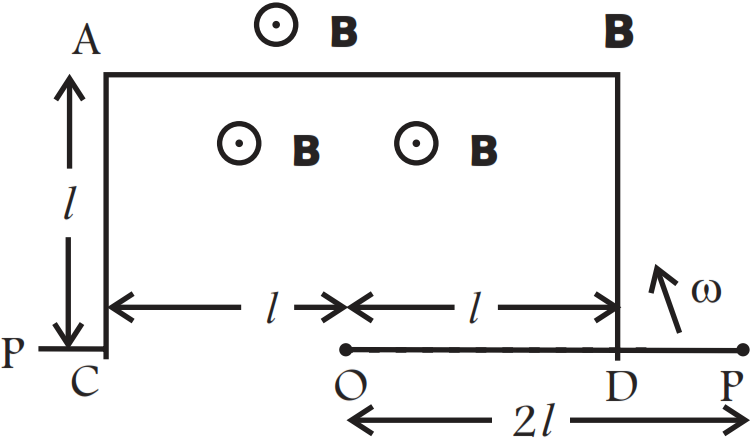
ODBAC is a fixed rectangular conductor of negilible resistance (CO is not connnected) and OP is a conductor which rotates clockwise with an angular velocity $\omega$ (Fig). The entire system is in a uniform magnetic field B whose direction is along the normal to the surface of the rectangular conductor ABDC. The conductor OP is in electric contact with ABDC. The rotating conductor has a resistance of $\lambda$ per unit length. Find the current in the rotating conductor, as it rotates by 180º.
Answer

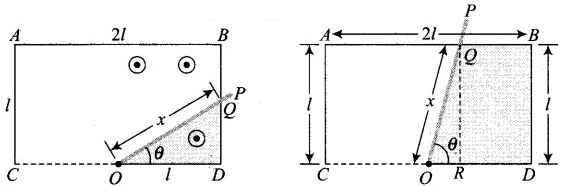
Key concept: When the conductor OP is rotated, then the rate of change if area hence the rate of change of flux can be considered uniform from $0<\theta <\frac{\pi}{4};\frac{\pi}{4}<\theta<\frac{3\pi}{4}\text{ and }\frac{3\pi}{4}<\theta<\frac{\pi}{2}$.
  1. Let us first assume the position of rotating conductor at time interval
$\text{t}=0 \text{ to }\text{t}=\frac{\pi}{4\omega}\Big(\text{or}\frac{\text{T}}{8}\Big)$

The rod OP will make contact with the side BD. Let the length OQ of the contact after some time interval t such that $0<\text{t}<\frac{\pi}{4\omega}$ or $0<\text{t}<\frac{\text{T}}{8}$ be x. The flux through the area ODQ is,
$\phi_\text{m}=\text{BA}=\text{B}\Big(\frac{1}{2}\times\text{QD}\times\text{OD}\Big)=\Big(\frac{1}{2}\times\text{l}\tan\theta\times\text{l}\Big)$
$\Rightarrow\ \phi_\text{m}=\frac{1}{2}\text{Bl}^2\tan\theta,\text{where}\theta=\omega\text{t}$
By applying Faraday's law of EMI,
Thus, the magnitude of the emf induced is $|\in|=\Big|\frac{\text{d}\phi}{\text{dt}}\Big|=\frac{1}{2}\text{Bl}^2\omega\sec^2\omega\text{t}$
The current induced in the circuit will be $\text{I}=\frac{\in}{\text{R}}$ where, R is the where $\text{R}\propto\lambda$.
$\text{R}=\lambda\text{x}=\frac{\lambda\text{l}}{\cos\omega\text{t}}$
$\therefore\ \text{I}=\frac{1}{2}\frac{\text{Bl}^2\omega}{\lambda\text{l}}\sec^2\omega\text{t}\cos\omega\text{t}=\frac{\text{Bl}\omega}{2\lambda\cos\omega\text{t}}$
  1. Now let the rod OP will make contact with the side AB. And the length of OQ of the contact after some time interval t such that $\frac{\pi}{4\omega}<\text{t}<\frac{3\phi}{4\omega}$ or $\frac{\text{T}}{8}<\text{t}<\frac{3\text{t}}{8}$ be x. The flux though the area OQBD is,
$\phi_\text{m}=\Big(\text{l}^2+\frac{1}{2}\frac{\text{l}^2}{\tan\theta}\Big)\text{B}$
where, $\theta=\omega\text{t}$
Thus, the magnitude of emf indueced in loop is
$|\in|=\Big|\frac{\text{d}\phi}{\text{dt}}\Big|=\frac{\text{Bl}^2\omega\sec^2\omega\text{t}}{2\tan^2\omega\text{t}}$
The current induced in the circuit in the circuit is $\text{I}=\frac{\in}{\text{R}}=\frac{\in}{\lambda\text{x}}=\frac{\in\sin\omega\text{t}}{\lambda\text{l}}=\frac{1}{3}\frac{\text{Bl}\omega}{\lambda\sin\omega\text{t}}$
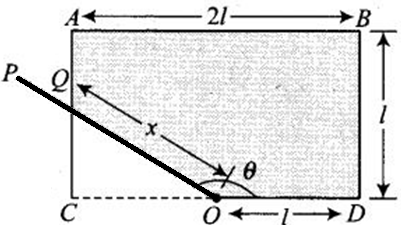
  1. Similarly, for time interval $\frac{3\pi}{4\omega}<\text{t}<\frac{\pi}{\omega}\text{ or }\frac{3\text{T}}{8}<\text{t}<\frac{\text{T}}{2}$, the rod will be in touch with AC.

The flux through OQABD is given by
$\phi_\text{m}=\bigg(2\text{l}^2-\frac{\text{l}^2}{1\tan\omega\text{t}}\bigg)\text{B}$
And the magnitude of emf generated in loop is given by
$\in=\frac{\text{d}\phi}{\text{dt}}=\frac{\text{B}\omega\text{l}^2\sec^2\omega\text{t}}{1\tan^2\omega\text{t}}$
$\text{I}=\frac{\in}{\text{R}}=\frac{\in}{\lambda\text{x}}=\frac{1}{2}\frac{\text{BI}\omega}{\lambda\sin\omega\text{t}}$
These are the required expressions.
View full question & answer
Question 255 Marks
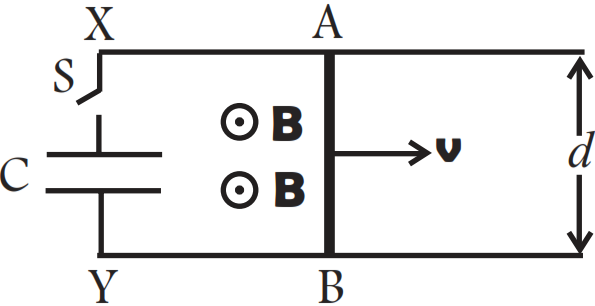
Find the current in the sliding rod AB (resistance = R) for the arrangement shown in Fig. B is constant and is out of the paper. Parallel wires have no resistance. v is constant. Switch S is closed at time t = 0.
Answer
This is the similar problem as we discussed above. Here, a conductor of length d moves with speed v, perpendicular to the magnetic field B as shown in figure. Due to this a motional emf is induced across two ends of rod (e = vBd). Since, switch S is closed at time t = 0, capacitor is charged by this potential difference. Let Q(t) be the charge on the capacitor and current flows from A to B. Now, the induced current
$\text{I}=\frac{\text{dQ}}{\text{dt}}=\frac{\text{Bvd}}{\text{R}}-\frac{\text{Q}}{\text{RC}}$
$\frac{\text{Q}}{\text{RC}}+\frac{\text{dQ}}{\text{dt}}=\frac{\text{Bvd}}{\text{R}}$
$\text{Q}+\text{RC}\frac{\text{dQ}}{\text{dt}}=\text{vBC}\ \ (\text{let vBdC}=\text{A})$
$\text{Q}+\text{RC}\frac{\text{Q}}{\text{dt}}\text{A}$
$\frac{\text{dQ}}{\text{A}-\text{Q}}=\frac{1}{\text{RC}}\text{dt}$
By integrating we have
$\int\limits_0^\text{Q}\frac{\text{dQ}}{\text{A}-\text{Q}}=\frac{1}{\text{RC}}\int\limits_0^\text{t}\text{dt}[\text{ln}(\text{A}-\text{Q})-\text{ln}\text{A}]=\frac{\text{t}}{\text{RC}}$
in $\frac{\text{A}-\text{Q}}{\text{A}}=-\frac{\text{t}}{\text{RC}}$
$\frac{\text{A}-\text{Q}}{\text{A}}=\text{e}^{\frac{-\text{t}}{\text{RC}}}$
${\text{Q}}={\text{A}}\Big(1-\text{e}^{\frac{-\text{t}}{\text{RC}}}\Big)$
Current in the rod,
$\text{I}=\frac{\text{dQ}}{\text{dt}}=\frac{\text{d}}{\text{dt}}\Big[\text{A}\Big(1-\text{e}^{\frac{-\text{t}}{\text{Rc}}}\Big)\Big]$
$=-\text{A}\Big(1-\text{e}^{\frac{-\text{t}}{\text{Rc}}}\Big)\Big(-\frac{1}{\text{RC}}\Big)$
$\text{I}=\frac{\text{vBd}}{\text{R}}\text{e}^{\frac{-\text{t}}{\text{RC}}}$
View full question & answer
Question 265 Marks
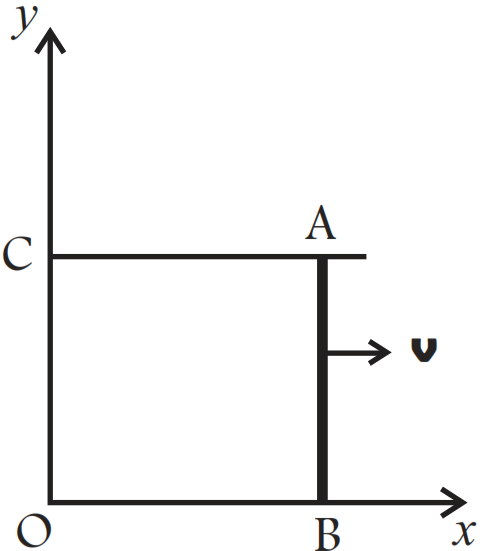
A magnetic field $\text{B}=\text{B}_0\sin(\omega\text{t})\hat{\text{k}}$ covers a large region where a wire AB slides smoothly over two parallel conductors separated by a distance d (Fig.). The wires are in the x-y plane. The wire AB (of length d) has resistance R and the parallel wires have negligible resistance. If AB is moving with velocity v, what is the current in the circuit. What is the force needed to keep the wire moving at constant velocity?
Answer
Key concept: In this problem the emf induced across AB is motional emf due to its motion, and emf induced by change in magnetic flux linked with the loop change due to change of magnetic field.
Due to motion: e = Blv
Due to change in magnetic flux: $\text{e}=-\text{N}\frac{\text{d}(\phi_\text{B})}{\text{dt}}$
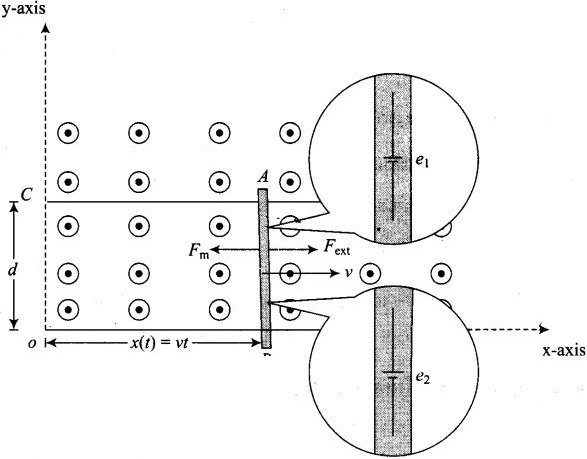
First we have to analyse the situation as shown in the figure, Let the parallel wires are at y = 0 and y = d and placed along x-axis. Wire AB is along y-axis.
Let us redraw the diagram as shown below.

At t = 0, wire AB starts from x = 0 and moves with a velocity v. Let at time t, wire is at x(t) = vt
(where, x(t) is the dispacement as a function of time).
Now, the motional emf across AB is
$\text{e}_1=\frac{\text{B}}{\text{v}}$
$\Rightarrow\ \text{e}_1=\big(\text{B}_0\sin\omega\text{t}\big)\text{vd}(-\hat{\text{j}})$
and emf due to change in field (along OBAC)
$\text{e}_2=-\frac{\text{d}(\phi_\text{B})}{\text{dt}}$
$\phi_\text{B}=(\text{B}_0\sin\omega\text{t})(\text{x}(\text{t})\text{d}) \ \ (\text{where, area A}=\text{xd})$
$\text{e}_2=-\text{B}_0\omega\cos\omega\text{tx}(\text{t})\text{d}$
Total emf in the circuit = emf due to change in field (along OBAC) + the motional emf across AB
$\text{e}_1+\text{e}_2=-\text{B}_0\text{d}\big[\omega\text{x}\cos(\omega\text{t})+\text{v}\sin(\omega\text{t})\big]$
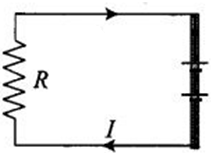
The equivalent electrical diagram is shown in the diagram below.

Electric current in clockwise direction is given by
$=\frac{\text{B}_0\text{d}}{\text{R}}(\omega\text{x}\cos\omega\text{t}+\text{v}\sin\omega\text{t})$
The force acting on the conductor is given by $\text{F}=\text{ilB}\sin90^\circ=\text{ilB}$.
Substituting the values,
$\vec{\text{F}_\text{M}}=\frac{\text{B}_0\text{d}}{\text{R}}(\omega\text{t}\cos\omega\text{t}+\text{v}\sin\omega\text{t})(\text{d})(\text{B}_0\sin\omega\text{t})(-\hat{\text{j}})$
External force needed on wire is along positive x-axis to keep moving it with constant velocity is given by,
$\vec{\text{F}}_\text{ext}=\frac{\text{B}_0\text{d}}{\text{R}}(\omega\text{t}\cos\omega\text{t}+\text{v}\sin\omega\text{t})\sin\omega\text{t}$
This is the required expression for force.
View full question & answer
Question 275 Marks
A magnetic field B is confined to a region r ≤ a and points out of the paper (the z-axis), r = 0 being the centre of the circular region. A charged ring (charge = Q) of radius b, b > a and mass m lies in the x-y plane with its centre at the origin. The ring is free to rotate and is at rest. The magnetic field is brought to zero in time Δt. Find the angular velocity ω of the ring after the field vanishes.
Answer
Key concept: According to the law of EMI, when magnetic field changes in the circuit, then magnetic flux linked with the circuit also changes and this changing magnetic flux leads to an induced emf in the circuit. Here, magnetic field decreases which causes induced emf and hence, electric field around the ring.The torque experienced by the ring produces change in angular momentum.
As the magnetic field is brought to zero in time At, the magnetic flux linked with the ring also reduces from maximum to zero. This, in turn, induces an emf in ring as discussed above. The induces emf causes the induced electric field E around the ring.
By the relation between electric field and potential we get,
$\text{The induved emf}=\text{Electric fired E}\times(2\pi\text{b})(\text{because V}=\text{E}\times\text{d})\ .....(\text{i})$
By Faraday's law of EMI
$|\in|=\frac{\text{d}\phi}{\text{dt}}=\text{A}\frac{\text{dB}}{\text{dt}}$
$|\in|=\frac{\text{B}\pi\text{a}^2}{\Delta\text{t}}\text{S}\ .....(\text{ii})$
From Eqs. (i) and (ii), we have
$2\pi\text{bE}=\in=\frac{\text{B}\pi\text{a}^2}{\Delta\text{t}}$
As we know the electric force experienced by the charged ring, $F_e = QE$
This force try to rotate the coil, and the torque is given by
Torque = b × Force
$\tau=\text{QEb}=\text{Q}\bigg[\frac{\text{B}\pi\text{a}^2}{2\pi\text{b}\Delta\text{t}}\bigg]\text{b}$
$\Rightarrow\ \tau=\text{Q}\frac{\text{Ba}^2}{2\Delta\text{t}}$
If $\Delta\text{L}$ is the change in angular momentum,
$\Delta\text{L}=\text{Torque}\times\Delta\text{t}=\text{Q}\frac{\text{Ba}^2}{2}$
Since, initial angular momentum = 0
And $\text{Torque}\times\Delta\text{t}=\text{Change in angular momentum}$
Final angular momentum $=\text{mb}^2\omega=\frac{\text{QBa}^2}{2}$
Where $mb^2 = I$ (Moment of inertia of ring)
$\omega=\frac{\text{QBa}^2}{2\text{mb}^2}$
On rearranging the terms, we have the required expression of angular speed.
View full question & answer
Question 285 Marks
A metallic ring of mass m and radius l (ring being horizontal) is falling under gravity in a region having a magnetic field. If z is the vertical direction, the z-component of magnetic field is $\text{B}_\text{z}=\text{B}_0(1+\lambda\text{z})$. If R is the resistance of the ring and if the ring falls with a velocity v, find the energy lost in the resistance. If the ring has reached a constant velocity, use the conservation of energy to determine v in terms of $\text{m},\text{B},\lambda$ and acceleration due to gravity g.
Answer
In this problem a relation is established between induced current, power lost and velocity acquired by freely falling ring.
The magnetic flux linked with the metallic ring of mass m and radius l ring being horizontal falling under gravity in a region having a magnetic field whose z-component of magnetic field is $\text{B}_\text{z}=\text{B}_0(1+\lambda\text{z})$ is,
$\phi_\text{m}=\text{B}_\text{z}(\pi\text{l}^2)=\text{B}_0(1+\lambda\text{z})(\pi\text{l})$
Applying Faraday's law of EML, we have emf induced given by $\frac{\text{d}\phi}{\text{dt}}$ = rate of change of flux. Also, by Ohm's law
$\text{B}_0(\pi\text{l}^2)\lambda\frac{\text{dz}}{\text{dt}}=\text{IR}$
We have $\text{I}=\frac{\pi\text{l}^2\text{B}_0\lambda}{\text{R}}\text{v}$
Energy lost/second $=\text{I}^2\text{R}=\frac{(\pi\text{l}^2\lambda)^2\text{B}_0^2\text{v}^2}{\text{R}}$
Rate of change of $\text{PE}=\text{mg}\frac{\text{dz}}{\text{dt}}=\text{mgv}$ [as kinetic energy is constant for v = constant]
According to the law of conservation of energy
Thus, $\text{mgv}=\frac{(\pi\text{l}^2\lambda\text{B}_0)^2\text{v}^2}{\text{R}}\text{ or v}=\frac{\text{mgR}}{(\pi\text{l}^2\lambda\text{B}_0)^2}$
This is the required exspression of velocity.
View full question & answer
Question 295 Marks
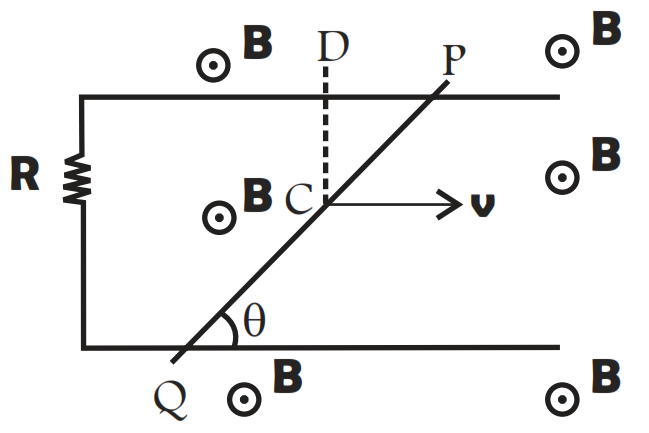
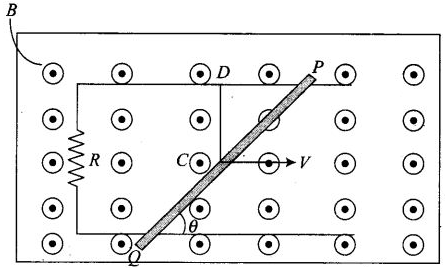
Find the current in the wire for the configuration shown in Fig. Wire PQ has negligible resistance. B, the magnetic field is coming out of the paper. θ is a fixed angle made by PQ travelling smoothly over two conducting parallel wires seperated by a distance d.
Answer
Key concept: This problem is based upon the motional emf.
Consider a conducting rod of length l moving with a uniform velocity v perpendicular to a uniform magnetic field B bar, directed into the plane of the paper. Let the rod be moving to the right as shown in figure. The conducting electrons also move to the right as they are trapped within the rod.

Conducting electrons experience a magnetic force $F_m = ev_B$​​​​​​​. So they move from P to Q within the rod. THe end P of the rod becomes positively charged while end Q becomes negatively charged, hence an electric field is set up within the rod which opposes the further downward movement of electrons, i.e., an equilibrium is reached and in equilibrium $F_e = F_m$, i.e.,
eE = evB or E = vB ⇒ Induced emf $\text{e}=\text{El}=\text{Bvl}\Big[\text{E}=\frac{\text{V}}{\text{l}}\Big]$
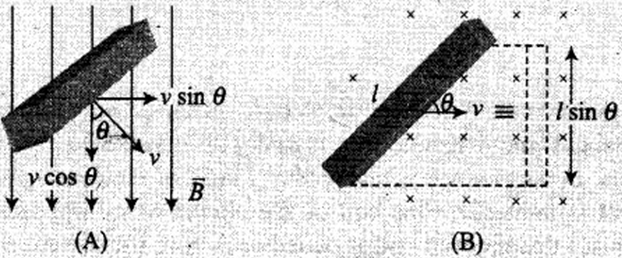
If rod is moved by making an angle $\theta$ with the direction of magnetic field or length. Induced emf,
$\text{e}=\text{Bvl}\sin\theta$

Emf induced across PQ due ti its motion of change in magnetic flux linked with the loop change due to the change of enclosed area.
The induced electric field E along the dotted line CD (Perpendicular to both $\vec{\text{v}}$ and $\vec{\text{B}}$ and along $\vec{\text{v}}\times\vec{\text{B}}$) = vB
Therefore, the motional emf along
PQ = (length PQ) × (field along PQ)
$={\text{length PQ}}\times(\text{vB}\sin\theta)$
$=\Big(\frac{\text{d}}{\sin\theta}\Big)\times(\text{vB}\sin\theta)=\text{vBd}$

This induced emf make flow of current in closed circuit of resistance R.
$\text{I}=\frac{\text{dvB}}{\text{R}}$ and is independent of $\theta$.
View full question & answer
Question 305 Marks

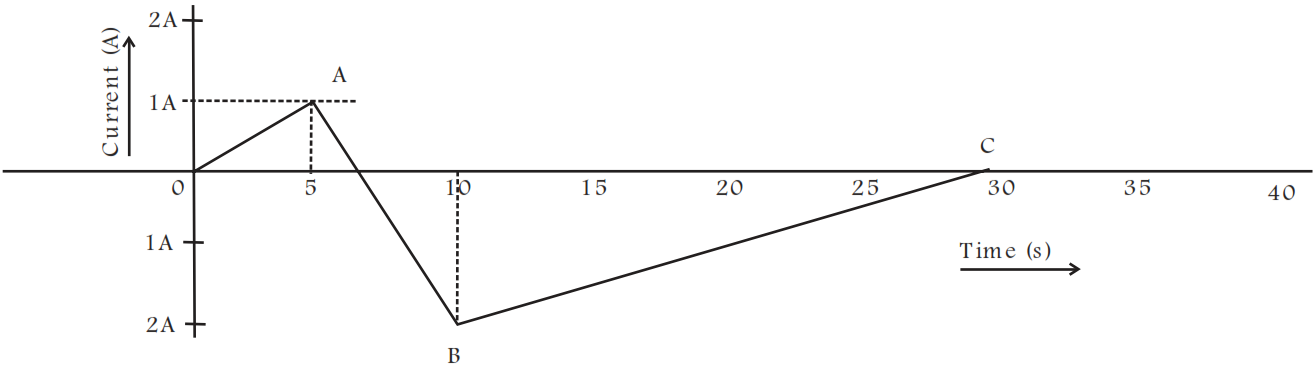
A (current vs time) graph of the current passing through a solenoid is shown in Fig. For which time is the back electromotive force (u) a maximum. If the back emf at t = 3s is e, find the back emf at t = 7s, 15s and 40s. OA, AB and BC are straight line segments.
Answer
Key concept: Whenever the electric current passing through a coil or circuit changes, the magnetic flux linked with it will also change. As a result of this, in accordance with 'Faraday's laws of electromagnetic induction, an emf is induced in the coil or the circuit which opposes the change that causes this induced emf is called back emf, the current so produced in the coil is called induced current. The induced emf is given by, $\in=-\frac{\text{d}(\text{N}\phi_\text{B})}{\text{dt}}$ $\in=-\text{L}\frac{\text{dl}}{\text{dt}}$ Thus, negative sign indicates that induced emf (e) apposes any change (increase of decrease) of current in the coil. When the rate of change of current is maximum, then back emf in solenoid is (u) a maximum. This occurs in AB part of the graph. So, maximum back emf will be obtained between 5s < t < 10s. Since, the back emf at t = 3s is e. Also, the rate of change of current at t = 3, and slope (s) of OA $(\text{from t}=0\text{s to t}=5\text{s})=\frac{1}{5}\frac{\text{A}}{\text{S}}$. So, we have If $\text{u}=\text{L}\frac{1}{5}\Big(\text{for t}=3\text{s},\frac{\text{dI}}{\text{dt}}=\frac{1}{5}\Big).$ where, L is a constant (coefficient of self-induction). And emf is $\in=-\text{L}\frac{\text{dI}}{\text{dt}}$ Similarly, we have for other values. For $5\text{s}<\text{t}<10\text{s},\text{u}_1=-\text{L}\frac{3}{5}=-\frac{3}{5}\text{L}=-3\text{e}$ Thus, at $\text{t}=7\text{s},\text{u}_1=-3\text{e}$ For $10\text{s}<\text{t}<30\text{s}$ $\text{u}_2=\text{L}\frac{2}{20}=\frac{\text{L}}{10}=\frac{1}{2}\text{e}$ for $\text{t}>30\text{s},\text{u}_2=0$ Thus, the back emf ar t = 7s, 15s and 40s are $-3\text{e},\frac{\text{e}}{2}$ and 0 respectively.
View full question & answer
Question 315 Marks
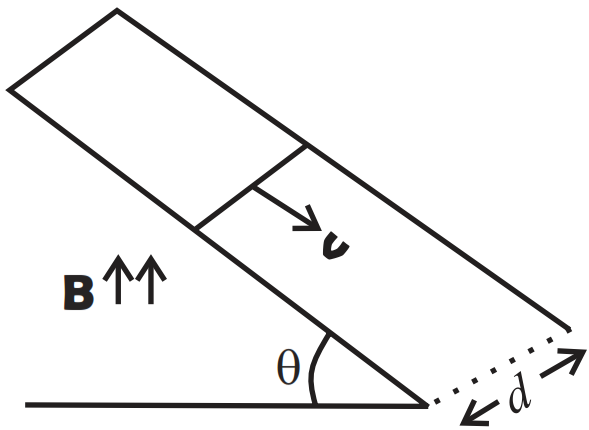
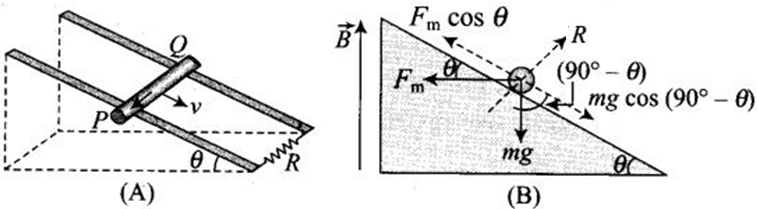
A rod of mass m and resistance R slides smoothly over two parallel perfectly conducting wires kept sloping at an angle θ with respect to the horizontal (Fig). The circuit is closed through a perfect conductor at the top. There is a constant magnetic field B along the vertical direction. If the rod is initially at rest, find the velocity of the rod as a function of time.
Answer

Let us first divide the magnetic field in the components one is along the inclined plane $=\text{B}\sin\theta$ and other component of magnetic field is perpendicular the plane $=\text{B}\cos\theta$.
Now, the conductor moves with speed v perpendicular to $\text{B}\cos\theta$, component of magnetic field. This causes motional emf across two ends of rod, which is given by $=\text{v}(\text{B}\cos\theta)\text{d}$.

This makes flow of induced current $\text{i}=\frac{\text{v}(\text{B}\cos\theta)\text{d}}{\text{R}}$ where R is the resistance of roq. Now, current carrying rod experience a magnetic force which is given by $F_m =$ iBd (horizontally in backward direction). Now, the copmpnent of magnetic force parallel to the inclined palne along upward direction $=\text{F}_\text{m}\cos\theta=\text{iBd}\cos\theta=\Big(\frac{\text{v}(\text{B}\cos\theta)\text{d}}{\text{R}}\Big)\text{bd}\cos\theta$
Where, $\text{v}=\frac{\text{dx}}{\text{dt}}$
Also, the component of weight (mg) parallel to inclined plane along downward direction $=\text{mg}\sin\theta$.
Now, by Newton's second law of motion
$\text{m}\frac{\text{d}^2\text{x}}{\text{dt}^2}=\text{mg}\sin\theta-\frac{\text{B}\cos\theta\text{d}}{\text{R}}\Big(\frac{\text{dx}}{\text{dt}}\Big)\times(\text{Bd})\cos\theta$
$\Rightarrow\ \frac{\text{dv}}{\text{dt}}=\text{g}\sin\theta-\frac{\text{B}^2\text{d}^2}{\text{mR}}(\cos\theta)^2\text{v}$
$\Rightarrow\ \frac{\text{dv}}{\text{dt}}+\frac{\text{B}^2\text{d}^2}{\text{mR}}(\cos\theta)^2\text{v}=\text{g}\sin\theta$
But, this is the linear diffrential equation.
On solving, we get
$\text{v}=\frac{\text{g}\sin\theta}{\frac{\text{B}^2\text{d}^2\cos^2\theta}{\text{mR}}}+\text{A exp}\bigg(-\frac{\text{B}^2\text{d}^2}{\text{mR}}(\cos^2\theta)\text{t}\bigg)$
A is a constant to be determined by initial conditions.
The required expression of velocity as a function of time is given by
$=\frac{\text{mgR}\sin\theta}{{\text{B}^2\text{d}^2\cos^2\theta}}\bigg(1-\text{exp}\bigg(-\frac{\text{B}^2\text{d}^2}{\text{mR}}(\cos^2\theta)\text{t}\bigg)\bigg)$
View full question & answer
Question 325 Marks
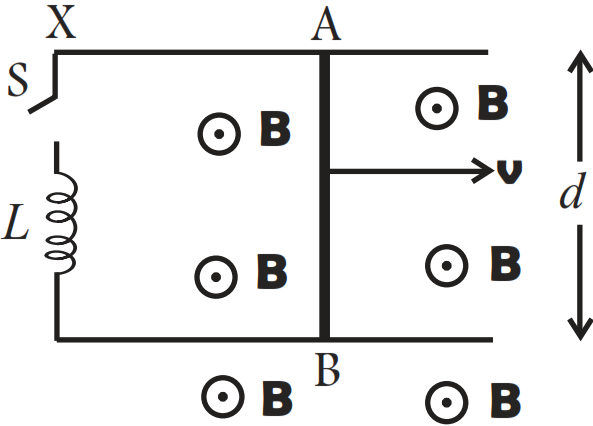
Find the current in the sliding rod AB (resistance = R) for the arrangement shown in Fig. B is constant and is out of the paper. Parallel wires have no resistance. v is constant. Switch S is closed at time t = 0.
Answer
This is the similar problem as we discussed above. Here, a conductor of length d moves with speed v, perpendicular to magnetic field B as shown in figure. Due to this an motional emf is induced across two ends of rod (e = vBd). Since, switch S is closed at time t = 0. current start growing in inductor by the potential difference due to motional emf.
By applying KVL in the given circuit, we have
$-\text{L}\frac{\text{dl}}{\text{dt}}+\text{vBd}=\text{IR}\text{ or }\text{L}\frac{\text{dl}}{\text{dt}}+\text{IR}=\text{vBd}$
This is the linear differential equation. On solving, we get
$\text{I}=\frac{\text{vBd}}{\text{R}}+\text{Ae}^{\frac{-\text{Rt}}{2}}$
at t = 0, I = 0
$\Rightarrow\ \text{A}=-\frac{\text{vBd}}{\text{R}}\Rightarrow\ \text{I}=\frac{\text{vBd}}{\text{R}}\Big(1-\text{e}^{\frac{-\text{Rt}}{\text{L}}}\Big)$
This is the required expression of current.
View full question & answer