Questions

3 Marks Question

Take a timed test

45 questions · self-marked practice — reveal the answer and mark yourself.

Question 13 Marks
What physical quantity is the same for X - rays of wavelength $10^{-10}\ m$, red light of wavelength 6800 Å and radiowaves of wavelength 500m?
Answer
The speed of light ($3\times10^8$ m/s) in a vacuum is the same for all wavelengths. It is independent of the wavelength in the vacuum.
View full question & answer
Question 23 Marks
Use the formula $\lambda _m\ T = 0.29\ cm\ K$ to obtain the characteristic temperature ranges for different parts of the electromagnetic spectrum. What do the numbers that you obtain tell you?
Answer
A body at a particular temperature produces a continous spectrum of wavelengths. In case of a black body, the wavelength corresponding to maximum intensity of radiation is given according to Planck's law. It can be given by the relation,
$\lambda_\text{m}=\frac{0.29}{\text{T}}\text{cm} \ \text{K}$
Where,
$\lambda_\text{m}=$ maximum wavelength
T = temperature
Thus, the temperature for different wavelengths can be obtained as:
$\text{For} \ \lambda_\text{m}=10^{-4} \ \text{cm}; \ \text{T}=\frac{0.29}{10^{-4}}=2900\ ^\circ\text{K}$
$\text{For} \ \lambda_\text{m}=5\times10^{-5} \ \text{cm}; \ \text{T}=\frac{0.29}{5\times10^{-5}}=5800\ ^\circ\text{K}$
$\text{For} \ \lambda_\text{m}=10^{-6} \ \text{cm}; \ \text{T}=\frac{0.29}{10^{-6}}=290000\ ^\circ\text{K}$ and so on.
The numbers obtained tell us that temperature ranges are required for obtaining radiations in different parts of an electromagnetic spectrum. As the wavelength decreases, the corresponding temperature Increases.
View full question & answer
Question 33 Marks
How are electromagnetic waves produced? What is the source of energy carried by a propagating electromagnetic wave? Identify the electromagnetic radiations used:
  1. In remote switches of household electronic devices.
  2. As diagnostic tool in medicine.
Answer
Electromagnetic waves are produced by accelerated/oscillating charges which produces oscillating electric field and magnetic field (which regenerate each other). Source of energy: Energy of the accelerated charge. (or the source that accelerates the charges).Identification:
  1. X -rays.
  2. Infrared radiation.
View full question & answer
Question 43 Marks
  1. Identify the part of the electromagnetic spectrum which is:
  1. Suitable for radar system used in aircraft navigation,
  2. Produced by bombarding a metal target by high-speed electrons.
  1. Why does a galvanometer show a momentary deflection at the time of charging or discharging a capacitor? Write the necessary expression to explain this observation.
Answer
  1.  
  1. Microwaves.
  2. X-rays.
  1. Due to conduction current in the connecting wires and a displacement current between the plates $\text{I}_{d} = \in_{o}\frac{\text{d}\phi_{\text{E}}}{\text{dt}}.$
View full question & answer
Question 53 Marks
Identify the following electromagnetic radiations as per the wavelengths given below.
Write one application of each.
  1. $10^{–3}nm$
  2. $10^{–3} m$
  3. $1 nm$
Answer
  1. $10^{-3}nm$:- X-rays/γ-rays
Use: Medical/crystallography/transmutation.
  1. $10^{-3}m$: Microwave/short radio wave
Use: Oven/communication.
  1. 1nm: UV-rays/X-rays
Use: Water purification/medical.
View full question & answer
Question 63 Marks
Name the following constituent radiations of electromagnetic spectrum which
  1. produce intense heating effect.
  2. is absorbed by the ozone layer in the atmosphere.
  3. is used for studying crystal structure.
Write one more application forr each of these radiations.
Answer
  1. Radiation: Infrared
Application: night vision/Thermal Sensor/Green house effect/relieve in muscular pain/in remote control devices.
  1. Radiation: U.V radiation
Application: food preservation/water purification/forensic science/sterilization of surgical instruments.
  1. Radiation: X-rays
Application: Medical diagonosis/detection of mechanical fault/radio therapy detectors/study of crystal structure.
View full question & answer
Question 73 Marks
Write the order of frequency range and one use of each of the following electromagnetic radiations:
  1. Microwaves.
  2. Ultra-violet rays.
  3. Gamma rays.
Answer
  1. Microwaves-frequency range $10^9$ to $10^{12} Hz$. Application–Radar system/aircraft navigation/microwave ovens.
  2. UV Rays–Frequency range $10^{14}$ to $10^{17} Hz.$ Application–Purification of water/Preservation of food items.
  3. Gamma rays–Frequency range $10^{18}$ to $10^{22} Hz.$ Application–Nuclear reactions.
View full question & answer
Question 83 Marks
  1. Which segment of electromagnetic waves has highest frequency? How are these waves produced ? Give one use of these waves.
  2. Which em waves lie near the high-frequency end of visible part of em spectrum? Give its one use. In what way this component of light has harmful effects on humans?
Answer
  1. $\gamma\text{ }\text{rays}.$
Produced in nuclear reactions and emitted by radioactive decay of nucleus.

Used in medicine to destroy cancer cells.
  1. Ultra violet rays
Used in LASIK eye surgery, UV lamps to kill germs in water purifier.

Causes sunburn/skin cancer/harms eyes when exposed to direct UV rays.
View full question & answer
Question 93 Marks
  1. How are electromagnetic waves produced? Explain.
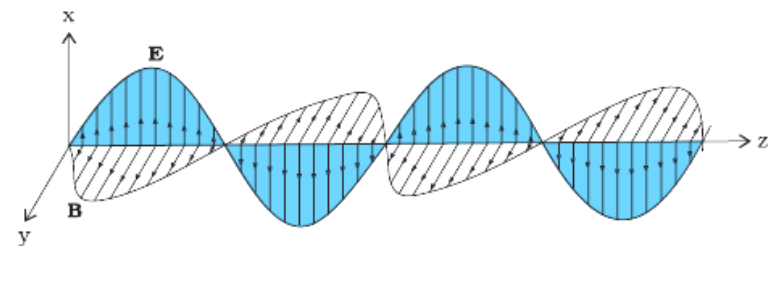
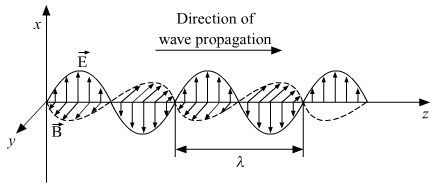
  2. A plane electromagnetic wave is travelling through a medium along the +ve z-direction. Depict the electromagnetic wave showing the directions of the oscillating electric and magnetic fields.
Answer
  1. Electromagnetic waves are formed as a result of accelerating (electric) charges under electric field. Electric charge exhibit electrostatic behaviour and once they start moving magnetic effects come into play. As a result of this a duality is established which is called electromagnetism. The electromagnetic waves are emitted by those charged particles. These waves move with the velocity of light
  2. The cross product of electric and magnetic field vectors i.e.$\vec{E}\times\vec{B}$ gives the direction in which the wave travels.
It is given that wave is propagating along the +z-axis. This means that electric field vector is oscillating in positive x- direction and magnetic field vector in positive y-direction.
The propagation of electromagnetic wave in +z direction is shown here:
View full question & answer
Question 103 Marks
Write Maxwell’s generalisation of Ampere’s Circuital Law. Show that in the process of charging a capacitor, the current produced within the plates of the capacitor is
$\text{i} = \varepsilon_{\circ}\frac{^{\text{d}\Phi}\text{E}}{\text{dt}}$where$\Phi_{E}$ is the electric flux produced during charging of the capacitor plates.
Answer
Ampere’s circuital law is given by as $\phi\overrightarrow{\text{B}}.\overrightarrow{\text{dl}} = \mu_0\text{i}_{c}$
But for a circuit containing capacitor, during its charging/discharging the current within the plates of the capacitor varies,(producing displacement current $i_d$). Therefore, the above equation, as generalised by Maxwell, is given as $\phi\overrightarrow{\text{B}}.\overrightarrow{\text{dl}} = \mu_\circ\text{i}_{c} + \mu_\circ\text{i}_{d}$
During the process of charging of capacitor, electric flux $(\phi_{\in})$ between the plates of capacitor changes with time, which produces the current within the plates of capacitor. This current, being proportional to $\frac{\text{d}\Phi_{\in}}{\text{dt}}$ we have $\text{i} = \varepsilon_{\circ}\frac{^{\text{d}}\Phi_{\in}}{\text{dt}}$
View full question & answer
Question 113 Marks
Name the parts of the electromagnetic spectrum which is:
  1. Suitable for radar systems used in aircraft navigation.
  2. Used to treat muscular strain.
  3. Used as a diagnostic tool in medicine.
Write in brief, how these waves can be produced.
Answer
  1. Microwave
Production: Klystron/magnetron/Gunn diode.
  1. Infrared Radiation
Production: Hot bodies/vibrations of atoms and molecules.
  1. X-Rays
Production: Bombarding high energy electrons on metal target/x-ray tube/inner shell electrons.
View full question & answer
Question 123 Marks
Answer the following:
  1. Name the em waves which are used for the treatment of certain forms of cancer. Write their frequency range.
  2. Thin ozone layer on top of stratosphere is crucial for human survival. Why?
  3. Why is the amount of the momentum transferred by the em waves incident on the surface so small?
Answer
  1.  X rays /$\gamma$ rays
Range: $10^{18}$ to $10^{22} Hz$​​​​​​​
  1. It absorbs the ultraviolet radiations from the sun and prevents it from reaching the earth’s surface.
  2. Due to the large value of speed of light; momentum transferred $p=\frac{u}{c}$ where u is the energy transferred and c is the speed of light.
View full question & answer
Question 133 Marks
How are em waves produced by oscillating charges? Draw a sketch of linearly polarised em waves propagating in the Z-direction. Indicate the directions of the oscillating electric and magnetic fields.
Answer

A charge oscillating with some frequency, produces an oscillating electric field in space, which in turn produces an oscillating magnetic field perpendicular to the electric field, this process goes on repeating, producing em waves in space perpendicular to both the fields.

Directions of $\overrightarrow{\text{E}}$and $\overrightarrow{\text{B}}$are perpendicular to each other and also perpendicular to direction of propagation of em waves.
View full question & answer
Question 143 Marks
  1. State Ampere's circuital law, expressing it in the integral form.
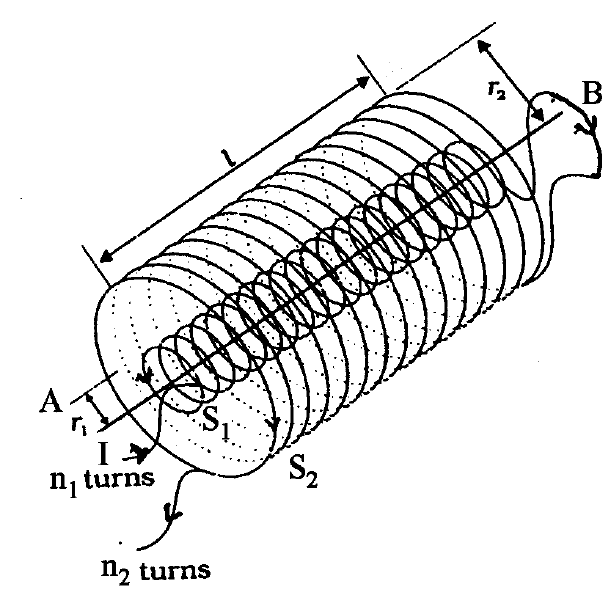
  2. Two long coaxial insulated solenoids, $S_1$ and $S_2$ of equal lengths are wound one over the other as shown in the figure. A steady current "I" flow through the inner solenoid $S_1$ to the other end B , which is connected to the outer solenoid $\mathrm{S}_2$ through which the same current "I" flows in the opposite direction so as to come out at end A. If $\mathrm{n}_1$ and $\mathrm{n}_2$ are the number of terms per unit length, find the magnitude and direction of the net magnetic field at a point (i) inside on the axis and (ii) outside the combined system.
Answer
  1. Statement of law
Expression of the law in integral form:
$\oint\overrightarrow{\text{B}}.\overrightarrow{\text{d}l} =\mu_{0}i$
  1. $\text{B} = μ_{o}\text{€n I}$
Magnitude of net magnetic field inside the combined system on the axis,
$B =B_1 - B_2$
$\Rightarrow\text{B} = \mu_{o}(\text{n}_{1} - \text{n}_{2})\text{I}$
Outside the combined system, the net magnetic field is zero.
View full question & answer
Question 153 Marks
Answer the following:
  1. Name the em waves which are suitable for radar systems used in aircraft navigation- Write the range of frequency of these waves.
  2. If the earth did not have atmosphere, would its average surface temperature be higher or lower than what it is now? Explain.
  3. An em wave exerts pressure on the surface on which it is incident. Justify.
Answer
  1. Microwaves
Frequency range: $10^{10}$ to $10^{12}\ Hz.$​​​​​​​
  1. Average surface temperature will be lower, Because there will be no green house effect in absence of atmosphere.
  2. Since electromagnetic waves carry both energy and momentum, therefore, they exert pressure on the surface on which they are incident.
View full question & answer
Question 163 Marks
Write any four characteristics of electromagnetic waves. Give two uses each of (i) Radio-waves (ii) Micro-waves.
Answer
Characteristics:
  1. $\overline{\text{E}}$ and $\overline{\text{B}}$ are mutually perpendicular and also perpendicular to the direction of propagation.
  2. Transverse in nature.
  3. Travels with the speed of light in free space for all frequencies.
  4. Doesn’t require a material medium to propagate.
  5. Energy is equally shared between $\overline{\text{E}}$ and $\overline{\text{B}}$.
  6. Exerts radiation pressure.
  7. Produced by accelerated/Oscillating charge.
USES:
  1. Radio waves: Cellular Phone/Television/Wireless communication.
  2. Micro waves: Radar/Micro wave Oven/Satellite Communicatio.
View full question & answer
Question 173 Marks
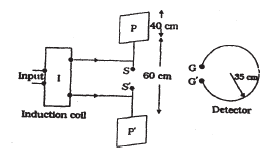
Draw a labelled diagram of Hertz’s experimental set-up to produce electromagnetics waves. Explain the generation of electromagnetic waves using this set-up.
Answer

Labeled diagram:

Explanation: The interrupting currents in the induction coils produces sudden high voltage across S and S' which ionises the air in the gap creativity electrons and ions. These electrons and ions oscillate back and forth between S and S' and produce oscillating electric and magnetic fields in mutually perpendicular directions. This results in production of e.m. waves.
View full question & answer
Question 183 Marks
  1. Identify the part of the electromagnetic spectrum used in (i) radar and (ii) eye surgery. Write their frequency range.
  2. Prove that the average energy density of the oscillating electric field is equal to that of the oscillating magnetic field.
Answer
  1. The microwave range of the electromagnetic spectrum with frequency range 1.6 to 300GHz and wavelength range 187 to 10 mm are used in operating radar and ultraviolet range with frequency $8 \times 10^{14}Hz$ to $10^{16}Hz$ and wave length 400nm to 10nm are used in eye surgery.
  1. Energy density in the electric field is
$\text{U}_\text{E}=\frac{1}{2}\in_0\text{E}^2$

Energy density in magnetic field is

$\text{U}_\text{B}=\frac{1}{2\mu_0}\text{B}^2$

We know E = Bc

$\text{c}=\frac{1}{\sqrt{\in_\text{o}\mu_\text{o}}}$

$\text{U}_\text{E}=\frac{1}{2}\in_0(\text{c}\text{B})^2=\frac{1}{2}\in_0\Big(\frac{1}{\in_0\mu_0}\Big)\text{B}^2=\frac{\text{B}^2}{2\mu_0}$

now, $\text{U}_\text{E}=\text{U}_\text{B}$
View full question & answer
Question 193 Marks
  1. Write the expression for the speed of light in a material medium of relative permittivity $\varepsilon_\text{r}$ and relative magnetic permeability $\mu_\text{r}.$
  2. Write the wavelength range and name of the electromagnetic waves which are used in:
  1. Radar systems for aircraft navigation,
  2. Earth satellites to observe the growth of the crops.
Answer
  1. Speed of light in medium,
$\upsilon=\frac{1}{\sqrt{\mu\in}}=\frac{1}{\sqrt{\mu_0\mu_\text{r}\in_0\in_\text{r}}}$
  1.  
  1. Microwave range, 0.1mt - 1mm,
$(10^{-3}m - 10^{-1}m)$
  1. Infrared waves range 1mm - 700nm.
View full question & answer
Question 203 Marks
A point charge is moving along a straight line with a constant velocity u. Consider a small area A perpendicular to the direction of motion of the charge (El). Calculate the displacement current through the area when its distance from the charge is x. The value of x is not large so that the electric field at any instant is essentially given by Coulomb's law.
Answer
$\text{E}=\frac{\text{Kq}}{\text{x}^2}$ [from coulomb's law]
$\phi_\text{E}=\text{EA}=\frac{\text{KqA}}{\text{x}^2}$
$\text{l}_\text{d}=\in_0\frac{\text{d}\phi\text{E}}{\text{dt}}=\in_0\frac{\text{d}}{\text{dt}}\frac{\text{kqA}}{\text{x}^2}=\in_0\text{KqA}=\frac{\text{d}}{\text{dt}}\text{x}^{-2}$
$=\in_0\times\frac{1}{4\pi\in_0}\times\text{q}\times\text{A}\times-2\times\text{x}^{-3}\times\frac{\text{dx}}{\text{dt}}=\frac{\text{qAv}}{2\pi\text{x}^3}$
View full question & answer
Question 213 Marks
Is the colour of 620nm light and 780nm light same? Is the colour of 620nm light and 621nm light same? How many colours are there in white light?
Answer
White light is a composition of seven colours. These are violet, indigo, blue, green, yellow, orange and red, collectively known as VIBGYOR. Spectrum of white light consists of sever colour bands. Each band consists of some range of wavelengths or frequencies.
For orange colour: (590nm to 620nm)
For red colour: (620nm to 780nm)
So, the colour of 620nm and 780nm lights may be different. But the colour of 620nm light and 621nm light is same.
View full question & answer
Question 223 Marks
A wire carries an alternating current $\text{i}=\text{i}_0\sin\omega\text{t}.$ Is there an electric field in the vicinity of the wire?
Answer
When an alternating current passes through a conductor, the changing magnetic field create a changing electric field outside it. An electromagnetic field is radiated from the surface of the conductor. There is a time-varying electric ield outside the conductor. Hence, there is a time-varying electric field in the vicinity of the wire.
View full question & answer
Question 233 Marks
A parallel-plate capacitor of plate-area A and plate separation d is joined to a battery of emf $\in$ and internal resistance R at t = 0. Consider a plane surface of area $\frac{\text{A}}{2}$ parallel to the plates and situated symmetrically between them. Find the displacement current through this surface as a function of time.
Answer
$\text{E}=\frac{\text{Q}}{\in_0\text{A}}$ (Electric field)
$\phi=\text{E.A.}=\frac{\text{Q}}{\in_0\text{A}}\frac{\text{A}}{2}=\frac{\text{Q}}{\in_02}$
$\text{i}_0=\in_0\frac{\text{d}\phi_\text{E}}{\text{dt}}=\in_0\frac{\text{d}}{\text{dt}}\Big(\frac{\text{Q}}{\in_02}\Big)$
$=\frac{1}{2}\Big(\frac{\text{dQ}}{\text{dt}}\Big)$
$=\frac{1}{2}\frac{\text{d}}{\text{dt}}\Big(\text{ECe}^{\frac{-\text{t}}{\text{RC}}}\Big)$
$=\frac{1}{2}\text{EC}-\frac{1}{\text{RC}}\text{e}^{\frac{-\text{t}}{\text{RC}}}$
$=\frac{-\text{E}}{2\text{R}}\text{e}^{\frac{-\text{td}}{\text{R}\text{E}_0\lambda}}$
View full question & answer
Question 243 Marks
A plane electromagnetic wave travels in vacuum, along the Y-direction. Write down the:
  1. Ratio of the magnitudes,
  2. The direction, of its electric and magnetic field vectors.
Answer
  1. $\frac{\text{B}}{\text{E}}=$ speed of light (c = 3 × 10⁸m/ s),
  2. $\vec{\text{K}},\vec{\text{E}},\vec{\text{B}}$ form a right handed system. As wave propagation vector $(\vec{\text{K}})$ is along Y-axis; electric field $(\vec{\text{E}})$ must be along Z-axis and magnetic field $\vec{\text{B}}$ along X-axis.
View full question & answer
Question 253 Marks
The sunlight reaching Earth has maximum electric field of $810Vm^{-1}.$ What is the maximum magnetic field in this light?
Answer
$\text{E}_0=810\text{V/m},\text{ B}_0=?$
We know, $\text{B}_0=\mu_0\in_0\text{CE}_0$
Putting the values,
$\text{B}_0=4\pi\times10^{-7}\times8.85\times10^{-12}\times3\times10^8\times810$
$\text{B}_0=27010.9\times10^{-10}$
$\text{B}_0=2.7\times10^{-6}\text{T}$
$\text{B}_0=2.7\mu\text{T}$
View full question & answer
Question 263 Marks
The magnetic field in a plane electromagnetic wave is given by $\text{B}=(200\mu\text{T})\sin\Big[\big(4.0\times10^{15}\text{s}^{-1}\big)\Big(\text{t}-\frac{\text{x}}{\text{c}}\Big)\Big]$ Find the maximum electric field and the average energy density corresponding to the electric field.
Answer
$\text{B}=(200\mu\text{T})\sin\Big[\big(4.0\times10^{15}\text{s}^{-1}\big)\Big(\text{t}-\frac{\text{x}}{\text{c}}\Big)\Big]$$\text{B}_0=200\mu\text{T}$
$\text{E}_0=\text{C}\times\text{B}_0$
$\text{E}_0=200\times10^{-6}\times3\times10^{8}$
$\text{E}_0=6\times10^4$
Average energy density $=\frac{1}{2\mu_0}\text{B}_0^2=\frac{\big(200\times10^{-6}\big)^2}{2\times4\pi\times10^{-7}}$
$=\frac{4\times10^{-8}}{8\pi\times10^{-7}}=\frac{1}{20\pi}=0.0159=0.016$
View full question & answer
Question 273 Marks
Which constituent radiation of the electromagnetic spectrum is used:
  1. In RADAR,
  2. To photograph internal parts of a human body,
  3. For taking photographs of the sky during night and foggy conditions?
Give one reason for your answer in each case.
Answer
  1. Microwaves: Are used in RADAR because they go straight and are not absorbed by the atmosphere.
  2. X-rays: Are used to photograph the internal parts of human body because they can penetrate light elements (flesh).
  3. Infrared radiations: Are used for taking photographs of sky during light and foggy conditions because they penetrate fog and are not absorbed by the atmosphere.
View full question & answer
Question 283 Marks
What do electromagnetic waves consist of ? Explain on what factors does its velocity in vacuum depend?
Answer
Electromagnetic waves consist of mutually perpendicular electric and magnetic field vectors. Its velocity in vacuum is given by:
$\text{C}=\frac{1}{\sqrt{\mu_0\varepsilon_0}}$ is same for all electromagnetic waves.
In other words its velocity in vacuum does not depend on any factor.
View full question & answer
Question 293 Marks
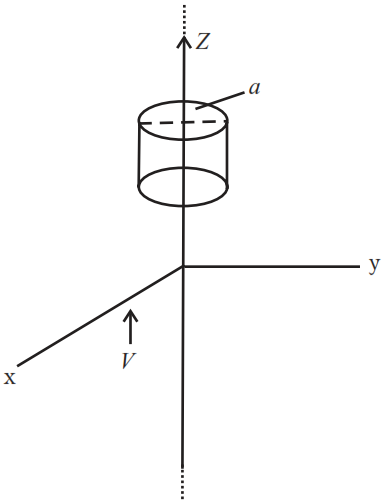
An infinitely long thin wire carrying a uniform linear static charge density λ is placed along the z-axis. The wire is set into motion along its length with a uniform velocity $\text{v}=\text{v}\hat{\text{k}}_\text{z}$. Calculate the poynting vector $\text{S}=\frac{1}{\mu_0}(\text{E}\times\text{B})$.
Answer
The electric field due to infinitely long thin wire
$\vec{\text{E}}=\frac{\lambda\hat{\text{e}}_\text{s}}{2\pi\in_0\text{a}}\hat{\text{j}}$
Magnetic field due to the wire, $\vec{\text{B}}=\frac{\mu_0\text{i}}{2\pi\text{a}}\hat{\text{i}}$
Equivalent current flowing through the wire, $\text{i}=\lambda\text{v}$
Hence $\vec{\text{B}}=\frac{\mu_0\lambda\text{v}}{2\pi\text{v}}\hat{\text{i}}$
$\therefore\ \vec{\text{S}}=\frac{1}{\mu_0}\big[\vec{\text{E}}\times\vec{\text{B}}\big]=\frac{1}{\mu_0}\bigg[\frac{\lambda}{2\pi\in_0\text{a}}\hat{\text{j}}\times\frac{\mu_0\lambda\text{v}}{2\pi\text{a}}\hat{\text{i}}\bigg]$
$\Rightarrow\ \vec{\text{S}}=\frac{\lambda^2\text{v}}{4\pi^2\in_0\text{a}^2}(\hat{\text{j}}\times\hat{\text{i}})=-\frac{\lambda^2\text{v}}{4\pi^2\in_0\text{a}^2}\hat{\text{k}}$
View full question & answer
Question 303 Marks
A laser beam has intensity $2.5 \times 10^{14}Wm^{-2}$. Find amplitudes of electric and magnetic fields in the beam.
Answer
$\text{I}=2.5\times10^{14}\text{W/m}^2$
We know, $\text{I}=\frac{1}{2}\in_0\text{E}^2_0\text{C}$
$\text{E}^2_0=\frac{2\text{I}}{\in_0\text{C}}$ or $\text{E}_0=\sqrt{\frac{2\text{I}}{\in_0\text{C}}}$
$\text{E}_0=\sqrt{\frac{2\times2.5\times10^{14}}{8.85\times10^{-12}\times3\times10^8}}$
$\text{E}_0=0.4339\times10^9$
$\text{E}_0=4.33\times10^8\text{N/c}$
$\text{B}_0=\mu_0\in_0\text{CE}_0$
$\text{B}_0=4\times3.14\times10^{-7}\times8.854\times10^{-12}\times3\times10^8\times4.33\times10^8$
$\text{B}_0=1.44\text{T}$
View full question & answer
Question 313 Marks
A capacitor is connected to an alternating-current source. Is there a magnetic field between the plates?
Answer
When an alternating-current source is connected to a capacitor, the electric field between the plates of the capacitor keeps on changing with the applied voltage. Due to the changing electric field, a magnetic field exists in between the plates of the capacitor.
View full question & answer
Question 323 Marks
Using $\text{B}=\mu_0\text{H},$ find the ratio $\frac{\text{E}_0}{\text{H}_0}$ for a plane electromagnetic wave propagating through vacuum. Show that it has the dimensions of electric resistance. This ratio is a universal constant called the impedance of free space.
Answer
$\text{B}=\mu_0\text{H}$
$\text{H}=\frac{\text{B}}{\mu_0}$
$\frac{\text{E}_0}{\text{H}_0}=\frac{\frac{\text{B}_0}{(\mu_0\in_0\text{C})}}{\frac{\text{B}_0}{\mu_0}}=\frac{1}{\in_0\text{C}}$
$=\frac{1}{8.85\times10^{-12}\times3\times10^8}$
$=376.6\Omega=377\Omega$
$\text{Dimension}\frac{1}{\in_0\text{C}}=\frac{1}{\big[\text{LT}^{-1}\big]\big[\text{M}^{-1}\text{L}^{-3}\text{T}^{4}\text{A}^2\big]}$
$=\frac{1}{\text{M}^{-1}\text{L}^{-2}\text{T}^{3}\text{A}^2}=\text{M}^1\text{L}^2\text{T}^{-3}\text{A}^{-2}=[\text{R}]$
View full question & answer
Question 333 Marks
Can an electromagnetic wave be polarised?
Answer
An electromagnetic wave is a transverse wave, thus, it can be polarised. An unpolarised wave consists of many independent waves, whose planes of vibrations of electric and magnetic fields are randomly oriented. They are polarised by restricting the vibrations of the electric field vector or magnetic field vector in one direction only.
View full question & answer
Question 343 Marks
Identify the following electromagnetic radiations as per the wavelengths given below.
  1. $10^{-3}nm$
  2. $10^{-3}m$
  3. 1nm
Write one application of each.
Answer
  1. $10^{-3}nm →$ gamma radiation.
Application: Radio therapy or to initiate nuclear reactions.
  1. $10^{-3}m →$ microwaves.
Application: In RADAR for aircraft navigation.
  1. 1nm → X-ray.
Application: In medical science for detection of fractures, stones in kidney, gallbladder etc.
View full question & answer
Question 353 Marks
Identify the following electromagnetic radiations as per the frequencies given below:
  1. $10^{20}Hz$
  2. $10^9Hz$
  3. $10^{11}Hz$
Write one application of each.
Answer
  1. $10^{20}Hz →$ γ-radiation,
Application: For treatment of cancer.
  1. $10^9Hz →$ Radio waves,
Application: For broadcasting radio-programmes to long distances.
  1. $10^{11}Hz →$ Microwaves,
Application: For cooking in microwave oven.
View full question & answer
Question 363 Marks
  1. Name the em waves which are suitable for radar systems used in aircraft navigation. Write the range of frequency of these waves.
  2. If the earth did not have atmosphere, would its average surface temperature be higher or lower than what it is now? Explain.
  3. An em wave exerts pressure on the surface on which it is incident. Justify.
Answer
  1. Frequency range $10^{10}Hz$ to $10^{12}Hz.$
  2. Average surface temperature will be lower. This is because there will be no greenhouse effect in absence of atmosphere.
  3. An electromagnetic wave exerts pressure on the surface on which it is incident because these waves carry both energy and momentum.
View full question & answer
Question 373 Marks
What happens to the intensity of light from a bulb if the distance from the bulb is doubled? As a laser beam travels across the length of a room, its intensity essentially remains constant. What geomatrical characteristic of LASER beam is responsible for the constant intensity which is missing in the case of light from the bulb?
Answer
We know intensity of light from a point source $\text{I}\alpha\frac{1}{\text{r}^2}$, r is the distance from point source.
As the distance is doubled, so the intensity becomes one-fourth the initial value. But in case of laser it does not spread, so its intensity remain same.
Some geometrical characteristics of LASER beam which are responsible for the constant intensity is,
  1. Unidirection.
  2. Monochromatic.
  3. Coherent light.
  4. Highly collimated.
These characteristics are missing in the case of normal light from the bulb.
View full question & answer
Question 383 Marks
Double - convex lenses are to be manufactured from a glass of refractive index 1.55, with both faces of the same radius of curvature. What is the radius of curvature required if the focal length is to be 20cm?
Answer
Refractive index of glass, µ = 1.55
Focal length of the double-convex lens, f = 20 cm
Radius of curvature of one face of the lens $= R_1$
Radius of curvature of the other face of the lens $= R_2$​​​​​​​
Radius of curvature of the double-convex lens = R
$\therefore \ \text{R}_1=\text{R} \ \text{and} \ \text{R}_2=-\text{R}$
The value of R can be calculated as:
$\frac{1}{\text{f}}=(\mu-1)\Big[\frac{1}{\text{R}_1}-\frac{1}{\text{R}_2}\Big]$
$\frac{1}{20}=(1.55-1)\Big[\frac{1}{\text{R}}+\frac{1}{\text{R}}\Big]$
$\frac{1}{20}=0.55\times\frac{2}{\text{R}}$
$\therefore \ \text{R}=0.55\times2\times20=22 \ \text{cm}$
Hence, the radius of curvature of the double-convex lens is 22 cm.
View full question & answer
Question 393 Marks
You are given a 2μF parallel plate capacitor. How would you establish an instantaneous displacement current of 1mA in the space between its plates?
Answer
The capacitance of capacitor $\text{C}=2\mu\text{F}$,
Displacement current $I_d = 1mA$
Charge in capacitor, q = CV
$\text{I}_\text{d}\text{dt}=\text{Cdv}\ \ \big[\because\ \text{q}=\text{it}\big]$
or $\text{I}_\text{d}=\text{C}\frac{\text{dV}}{\text{dt}}$
$1\times10^{-3}=2\times10^{-6}\times\frac{\text{dV}}{\text{dt}}$
or $\frac{\text{dV}}{\text{dt}}=\frac{1}{2}\times10^{3}=500\text{V/s}$
Hence by applying a varying potential difference of 500V/s, we would produce a displacement current of desired value.
View full question & answer
Question 403 Marks
Consider the situation of the previous problem. Define displacement resistance $\text{R}_\text{d}=\frac{\text{V}}{\text{i}_\text{d}}$ of the space between the plates, where V is the potential difference between the plates and $i_d$ is the displacement current. Show that $R_d$ varies with time as $\text{R}_\text{d}=\text{R}\big(\text{e}^{\text{t}/\tau}-1\big)$
Answer
$\text{E}=\frac{\text{Q}}{\in_0\text{A}}$ (Electric field)
$\phi=\text{E.A.}=\frac{\text{Q}}{\in_0\text{A}}\frac{\text{A}}{2}=\frac{\text{Q}}{\in_02}$
$\text{i}_0=\in_0\frac{\text{d}\phi_\text{E}}{\text{dt}}=\in_0\frac{\text{d}}{\text{dt}}\Big(\frac{\text{Q}}{\in_02}\Big)$
$=\frac{1}{2}\Big(\frac{\text{dQ}}{\text{dt}}\Big)$
View full question & answer
Question 413 Marks
Even though an electric field E exerts a force qE on a charged particle yet the electric field of an EM wave does not contribute to the radiation pressure (but transfers energy). Explain.
Answer
The electric field of an electromagnetic wave is an oscillation field. It exerts electric force on a charged particle, but this electric force averaged over an integral number of cycles is zero, since its direction changes every half cycle. Hence, electric field is not responsible for radiation pressure though it transfer the energy. In fact, radiation pressure appears as a result of the action of the magnetic field of the wave on the electric currents induced by the electric field of the same wave.
View full question & answer
Question 423 Marks
Can an electromagnetic wave be deflected by an electric field or a magnetic field?
Answer
No, an electromagnetic wave cannot be deflected by an electric field or a magnetic field. This is because according to Maxwell's theory, an electromagnetic wave does not interact with the static electric field and magnetic field. Even if we consider the particle nature of the wave, the photon is electrically neutral. So, it is not affected by the static magnetic and electric fields.
View full question & answer
Question 433 Marks
When can a charge act as a source of electromagnetic wave? How are the directions of electric and magnetic field vectors, in an electromagnetic wave related to each other and to the direction of propagation of the wave?
Which physical quantity, if any, has the same value for waves belonging to the different parts of the electromagnetic spectrum?
Answer
Source of Electromagnetic Waves: The source of electromagnetic waves is an accelerated (or decelerated) charge or an oscillating LC circuit. In an electromagnetic wave, the electric field vector $\vec{\text{E}}$ and magnetic field vector $\vec{\text{B}}$ are mutually perpendicular and also perpendicular to direction of wave propagation such that wave propagation vector $\vec{\text{K}}$ electric field vector $\vec{\text{E}}$ and magnetic field vector $\vec{\text{B}}$ form a right handed orthogonal system.
The speed of waves in vacuum is the same for different parts of electromagnetic spectrum.
View full question & answer
Question 443 Marks
Show that the radiation pressure exerted by an EM wave of intensity I on a surface kept in vacuum is I/c.
Answer
Let us consider a surface exposed to electromagnetic radiation. The radiation is falling normally on the surface. Further, intensity of radiation is I and area of surface exposed to radiation is A.
E = Energy received by surface per second = I.A
N = Number of photons received by surfece per second
$\text{N}=\frac{\text{E}}{\text{E}_\text{photon}}=\frac{\text{E}\lambda}{\text{hc}}=\frac{\text{IA}\lambda}{\text{hc}}$
Let the surface is perfectly absorbing, $\Delta\text{P}_\text{one photon}=\frac{\text{h}}{\lambda}$
$\Rightarrow\ \text{F}=\text{N}\times\Delta\text{P}_\text{one photon}=\frac{\text{IA}}{\text{c}}$
Also, Pressure $\text{P}=\frac{\text{F}}{\text{A}}=\frac{\text{I}}{\text{c}}$
View full question & answer
Question 453 Marks
The magnetic field of a beam emerging from a filter facing a floodlight is given by $B_0 = 12 \times 10^{-8}\sin (1.20 \times 10^7z - 3.60 \times 10^{15}t) T.$ What is the average intensity of the beam?
Answer
The standard equation of magnetic field can be expressed as $\text{B}=\text{B}_0\sin\omega\text{t}$.
We are given equation
$\text{B}=12\times10^{-8}\sin(120\times10^{7}\text{z}-3.60\times10^{\frac{1}{5}}\text{t})\text{t}$
On comparing this equation with standard equation, we get
$\text{B}_0=12\times10^{-8}\text{T}$
The average intensity of the beam
$\text{I}_\text{av}=\frac{1}{2}\frac{\text{B}_0^2}{\mu_0}.\text{c}=\frac{1}{2}\times\frac{(12\times10^{-8})^2\times3\times10^8}{4\pi\times10^{-7}}$
$=1.71\frac{\text{W}}{\text{m}^2}$
View full question & answer