Question 13 Marks
Light of wavelength 5000 Å falls on a plane reflecting surface. What are the wavelength and frequency of the reflected light? For what angle of incidence is the reflected ray normal to the incident ray?
Answer
View full question & answer→Wavelength of incident light, $\lambda$ = 5000 $Å = 5000 \times 10^{-10} m$
Speed of light, $c = 3 \times 10^8 m$
Frequency of incident light is given by the relation,
$\text{v}=\frac{\text{c}}{\lambda}$
$=\frac{3\times10^8}{5000\times10^{-10}}=6\times10^{14}\text{Hz}$
The wavelength and frequency of incident light is the same as that of reflected ray.
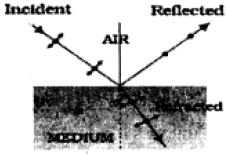
Hence, the wavelength of reflected light is 5000 Å and its frequency is $6 \times 10^{14} Hz$. When reflected ray is normal to incident ray, the sum of the angle of Incidence, $\angle\text{i}$ and angle of reflection, $\angle\text{r}$ is 90°.
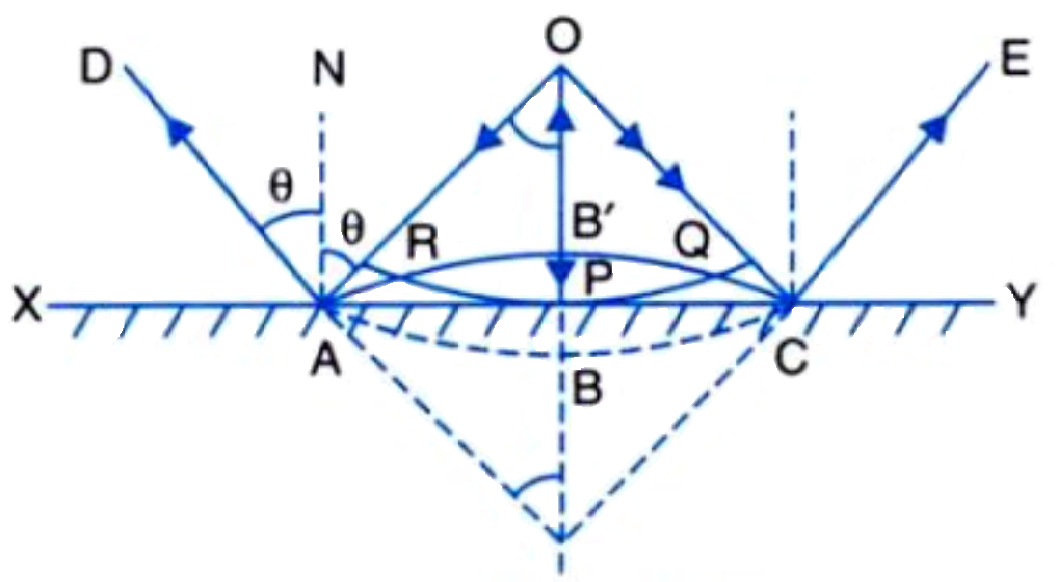
According to the law of reflection, the angle of incidence is always equa I to the angle of reflection. Hence, we can write the sum as:
$\angle\text{i}+\angle\text{r}=90$
$\angle\text{i}+\angle\text{i}=90$
$\angle\text{i}=\frac{90}{2}=45^\circ$
Therefore, the angle of incidence for the given condition is 45°.
Speed of light, $c = 3 \times 10^8 m$
Frequency of incident light is given by the relation,
$\text{v}=\frac{\text{c}}{\lambda}$
$=\frac{3\times10^8}{5000\times10^{-10}}=6\times10^{14}\text{Hz}$
The wavelength and frequency of incident light is the same as that of reflected ray.
Hence, the wavelength of reflected light is 5000 Å and its frequency is $6 \times 10^{14} Hz$. When reflected ray is normal to incident ray, the sum of the angle of Incidence, $\angle\text{i}$ and angle of reflection, $\angle\text{r}$ is 90°.
According to the law of reflection, the angle of incidence is always equa I to the angle of reflection. Hence, we can write the sum as:
$\angle\text{i}+\angle\text{r}=90$
$\angle\text{i}+\angle\text{i}=90$
$\angle\text{i}=\frac{90}{2}=45^\circ$
Therefore, the angle of incidence for the given condition is 45°.