Question 13 Marks
A steel wire has a length of $12.0m$ and a mass of $2.10kg$. What should be the tension in the wire so that speed of a transverse wave on the wire equals the speed of sound in dry air at $20^\circ C = 343m s^{–1}$.
AnswerLength of the steel wire, l = 12m
Mass of the steel wire, m = 2.10kg
Velocity of the transverse wave, v = 343m/ s
Mass per unit length, $\mu=\frac{\text{m}}{\text{l}}=\frac{2.10}{12}=0.175\text{kg m}^{-1}$
For tension T, velocity of the transverse wave can be obtained using the relation:
v = underroot, $\Big(\frac{\text{T}}{\mu}\Big)$
$\therefore\ \text{T}=\text{v}_2\ \mu$
$= (343)^2 \times 0.175 = 20588.575\approx 2.06 \times 10^4\text{N}$
View full question & answer→Question 23 Marks
A bat emits ultrasonic sound of frequency $1000 kHz$ in air. If the sound meets a water surface, what is the wavelength of (a) the reflected sound, (b) the transmitted sound? Speed of sound in air is $340m s^{–1}$ and in water $1486m s^{–1}$.
AnswerFrequency of the ultrasonic sound, $ν = 1000 kHz = 10^6Hz$
Speed of sound in air, $v_a = 340m/ s$
The wavelength $(\lambda_\text{r})$ of the reflected sound is given by the relation:
$\lambda_\text{r}=\frac{\text{v}}{\text{V}}$
$=\frac{340}{10^6}=3.4\times10^{-4}\text{m}$
Frequency of the ultrasonic sound, $ν = 1000 kHz = 10^6Hz$
Speed of sound in water, $v_w = 1486m/ s$
The wavelength of the transmitted sound is given as:
$\lambda_\text{r}=\frac{1486}{10^6}=1.49\times10^{-3}\text{m}$
View full question & answer→Question 33 Marks
A hospital uses an ultrasonic scanner to locate tumours in a tissue. What is the wavelength of sound in the tissue in which the speed of sound is $1.7km s^{–1}$? The operating frequency of the scanner is $4.2$ MHz.
AnswerSpeed of sound in the tissue, $v = 1.7km/ s = 1.7 \times 10^3m/ s$
Operating frequency of the scanner, $ν = 4.2 MHz = 4.2 \times 10^6Hz$
The wavelength of sound in the tissue is given as:
$\lambda=\frac{v}{v}$
$=\frac{1.7\times10^3}{4.2\times10^6}=4.1\times10^{-4}\text{m}$
View full question & answer→Question 43 Marks
A SONAR system fixed in a submarine operates at a frequency $40.0 kHz$. An enemy submarine moves towards the $SONAR$ with a speed of $360km h^{–1}$. What is the frequency of sound reflected by the submarine? Take the speed of sound in water to be $1450m s^{–1}.$
AnswerThe frequency of SONAR received by enemy submarine will be further reflected back to SONAR which it will receive again with a different frequency.
SONAR frequency$(V_s) = 40kHz = 40 \times 10^3Hz$
Speed of enemy submarine$(V_o) = 360km/h$
$=360\times\frac{5}{18}=100\text{m/s}$
Speed of sound in water = 1450m/s
Apparent frequency received by submarine is
$\text{f}'=\Big\{\frac{\text{V}+\text{V}_\text{o}}{\text{V}}\Big\}\text{f}=\Big\{\frac{1450+100}{1450}\Big\}\times40=42.76\text{kHz}$
Now, the reflected wave have a different frequency,
$\text{f}"=\Big\{\frac{\text{V}}{\text{V}-\text{V}_\text{o}}\Big\}\text{f}'=\Big\{\frac{1450}{1450-100}\Big\}\times42.76=45.93\text{kHz}$
View full question & answer→Question 53 Marks
A string of mass 2.50kg is under a tension of 200N. The length of the stretched string is 20.0m. If the transverse jerk is struck at one end of the string, how long does the disturbance take to reach the other end?
AnswerMass of the string, M = 2.50kg
Tension in the string, T = 200N
Length of the string, 1 = 20.0m
Mass per unit length, $\mu=\frac{\text{M}}{\text{L}}=\frac{2.50}{20}=0.125\text{kg m}^{-1}$
The velocity (v) of the transverse wave in the string is given by the relation:
$\text{v}=\sqrt{\frac{\text{T}}{\mu}}$
$=\sqrt{\frac{200}{0.125}}=\sqrt{1600}=40\text{m/s}$
Time taken by the disturbance to reach the other end, t = l/v = 20/40 = 0.50s
View full question & answer→Question 63 Marks
A stone dropped from the top of a tower of height 300 m splashes into the water of a pond near the base of the tower. When is the splash heard at the top given that the speed of sound in air is $340 m s ^{-1} ?\left(g=9.8 m s ^{-2}\right)$
AnswerHere, $h =300 m, g =9.8 m s ^{-2}$ and velocity of sound, $v =340 m s ^{-1}$
Let $t_1$ be the time taken by the stone to reach at the surface of pond.
Then using $\text{s}=\text{ut}+\frac{1}{2}\text{at}^2\frac{1}{2}\text{at}^2$
$\Rightarrow\text{h}=0\times\text{t}+\frac{1}{2}\text{gt}^2_1$
$\therefore\ \text{t}_1=\sqrt{\frac{2\times300}{9.8}}=7.82\text{s}$
Also if t_2 is the time taken by the sound to reach at a height h, then
$\text{t}_2=\frac{\text{h}}{\text{v}}=\frac{300}{340}=0.88\text{s}$
$\therefore$ Total time after which sound of splash is heard $= t_1 + t_2$
$=7.82+0.88=8.7\text{s}$
View full question & answer→Question 73 Marks
A travelling harmonic wave on a string is described by
$\text{y}(\text{x, t})=7.5\sin\Big(0.0050\text{x}+12\text{t}+\frac{\pi}{4}\Big)$
Locate the points of the string which have the same transverse displacements and velocity as the x = 1cm point at t = 2s, 5s and 11s.
AnswerPropagation constant is related to wavelength as:
$\text{k}=\frac{2\pi}{\lambda}$
$\therefore\ \lambda=\frac{2\pi}{\lambda}=\frac{2\times3.14}{0.0050}$
$=1256\text{cm}=12.56$
Therefore, all the points at distances $\text{n}_\lambda,$ (n = ± 1, ± 2.... and so on) i.e. ± 12.56m, ± 25.12m, … and so on for x = 1cm, will have the same displacement as the x = 1cm points at t = 2s, 5s, and 11s.
View full question & answer→Question 83 Marks
Two strings of the same material and length under the same tension may vibrate with different fundamental frequency. Why?
AnswerThe frequency of vibration of string is
given by $\text{n}=\frac{1}{2\text{l}}\sqrt{\frac{\text{T}}{\text{m}}}$
m (mass per unit length) $=\frac{\text{mass}}{\text{length}}=\frac{\text{volume}\times\text{density}}{\text{l}}$
$=\frac{\pi\text{r}^2\text{l}\times\rho}{\text{l}}=\pi\text{r}^2\rho$
$=\pi\Big(\frac{\text{D}}{2}\Big)^2\rho=\frac{\pi\text{D}^2}{4}\rho$
$\text{n}=\frac{1}{2\text{l}}\sqrt{\frac{4\text{T}}{\pi\text{D}^2\rho}}=\frac{1}{\text{Dl}}\sqrt{\frac{\text{T}}{\pi\rho}}$
$\therefore \text{n}\propto\frac{1}{\text{D}}$ (when l, T, $\rho$ are same)
or nD = constant or $n_1D_1 = n_2D_2$
Hence the two strings may vibrate with different frequencies when they have different diameters.
View full question & answer→Question 93 Marks
Write the applications of beats.
AnswerBeats are used to:
- Determine an unknown frequency by listening to the beat frequency $\Delta \text{v}.$ Then unknown frequency $\text{v}'=\text{v}+\Delta\text{v}$ where $v$ is known and it is close to the unknown frequency. Exact values of $v$ is found by loading and filling the turning fork of unknown frequency from which $+$ or $-$ sign is chosen;
- Tune musical instruments by sounding them together and reducing beats number to zero.
- Make a sound rich in musical effect by deliberate introduction of beats between different musical instruments.
- To produce very low frequency pulses which otherwise cannot be produced. Beat frequency is the low frequency sound.
- Receive radio programme by superheterodyne method.
- Detect harmful gases in mines.
View full question & answer→Question 103 Marks
A wave pulse is travelling on a string of linear mass density $1.0 g / cm$ under a tension of 1 kg wt. Calculate time taken by the pulse to travel a distance of 50 cm on the string. Take $g =10 m / s ^2$.
AnswerHere $\mu=1\text{g/cm}$
$=10^{-3}\text{kg/}10^{-2}\text{m}=106{-1}\text{kg/m}$
$\text{T}=1\text{kg wt}=10\text{N}$
$\nu=\frac{\text{T}}{\mu}=\sqrt{\frac{10}{10^{-1}}}=10\text{m/s}$
Time taken $\text{t}=\frac{\text{distance}}{\text{velocity}}=\frac{0.5}{10}=0.05\text{s}$
View full question & answer→Question 113 Marks
The intensity of sound in a normal conversation at home is about $3 \times 10^{-6} Wm ^{-2}$ and the frequency of normal human voice is about $1000 Hz$ . Find the amplitude of waves, assuming that the air is at standard conditions.
AnswerAt standard conditions $(STP)$
density $(\rho)$ of air $=1.29\text{kg m}^{-3}$
velocity of sound, $\vartheta=332.5\text{ms}^{-1}$
Now $\text{I}=2\pi^2\rho\text{n}^2\text{A}^2\vartheta$
where $\text{n}=1000\text{Hz}, \text{ I}=3\times10^{-6}\text{Wm}^{-2}$
$\therefore \text{A}=\frac{1}{\pi\text{n}}\sqrt{\frac{\text{I}}{2\pi\vartheta}}$
$=\frac{1}{3.142\times1000}\times\sqrt{\frac{3\times10^{-6}}{2\times1.29\times332.5}}$
$=1.88\times10^{-8}\text{m}$
Note that the amplitude of sound waves in normal conversation is extremely small.
View full question & answer→Question 123 Marks
Set up a relation between speed of sound in a gas and root mean square velocity of the molecules of that gas.
AnswerSpeed of sound in a gas $v=\sqrt{\frac{\gamma\text{P}}{\rho}}\ \dots(\text{i})$
According to kinetic theory of gases, root mean square velocity (C) of molecules of gas is obtained from the relation
$\text{P}=\frac{1}{3}\rho\text{C}^2,\ \text{C}=\sqrt{\frac{2\text{P}}{\rho}}\ \dots \text{(ii)}$
Dividing (i) by (ii), we get
$\frac{v}{\text{V}}=\sqrt{\frac{\gamma}{3}}$
$v=\sqrt{\frac{\gamma}{3}}\times\text{C}$
This the required relation.
View full question & answer→Question 133 Marks
A train standing at the outer signal of a railway station blows a whistle of frequency $400$ Hz still air. The train begins to move with a speed of $10 m s ^{-1}$ towards the platform. What is the frequency of the sound for an observer standing on the platform? (sound velocity in air $=330 m s ^{-1}$ )
Answer$\text{v}_0=400\text{Hz}\ \ \ \ \ \ \ \text{v}_\text{s}=10\text{m/ s}$
Velocity of sound in air $\text{v}_\text{a}=330\text{m/ s}$
Apparent frequency by observer standing on platform
$\text{v}'\frac{\text{v}_\text{a}}{(\text{v}_\text{a}-\text{v}_\text{s})}\text{v}_0=\frac{330\times400}{(330-10)}$
$\text{v}'=\frac{330\times400}{320}=\frac{825}{2}=412.4\text{Hz}$
View full question & answer→Question 143 Marks
An open pipe is suddenly closed at one end with the result that the frequency of sound harmonic of the closed pipe is found to be higher by 100Hz than the fundamental frequency of the open pipe. Calculate the fundamental frequency of the open pipe.
AnswerFundamental frequency of open pipe is
$\text{v}_0=\frac{v}{2\text{l}}$
Frequency of second harmonic of closed pipe of same length is
$\text{v}_\text{c}=\frac{3v}{4\text{l}}=\frac{3}{2}\Big(\frac{\nu}{2\text{l}}\Big)$
$=\frac{3}{2}\text{v}_0$
Given $\text{v}_\text{c}=\text{v}_0+100$ or $\frac{3}{2}\text{v}_0=\text{v}_0+100$
$\Rightarrow \frac{3}{2}\text{v}_0-\text{v}_0=100$
$\Rightarrow \frac{\text{v}_0}{2}=100$
$\therefore \text{v}_0=200\text{Hz}.$
View full question & answer→Question 153 Marks
Calculate the speed of sound in a gas in which two waves of wavelengths 1.00m and 1.01m produce 10 beats in 3 seconds.
AnswerLet $v=$ speed of sound in a gas
Frequencies of two waves is
$\text{v}_1=\frac{v}{\lambda_1}=\frac{v}{1.00}$
$\text{v}_2=\frac{v}{\lambda_2}=\frac{v}{1.01}$
Given $\text{v}_1-\text{v}_2=\frac{10}{3}$
$\frac{u}{1.00}-\frac{v}{1.01}=\frac{10}{3}$
$\frac{0.01v}{1\times1.01}=\frac{10}{3}$
$\therefore v=\frac{10\times1\times1.01}{3\times0.01}=336.7\text{ms}^{-1}$
View full question & answer→Question 163 Marks
A set of $25$ tuning forks is arranged in order of decreasing frequency. Each fork gives $3$ beats with succeeding one. The first fork is octave of the last. Calculate the frequency of the first and $16^{\text {th }}$ fork.
AnswerLet frequency of last tuning fork be $n$
$\therefore$ Frequency of $1^{\text {st }}$ tuning fork $=2 n$;
Frequency of $2^{\text {nd }}$ tuning fork $=[2 n-3]$
Frequency of $3^{\text {rd }}$ tuning fork $=(2 n-6)=2 n-3(3-1)$ and
Sum of 25 tuning fork frequencies
$=2 n-3(25-1)=n$
$\therefore n=72$
Hence, frequency of $1^{\text {st }}$ tuning fork $=2 n =144 Hz$
and frequency of $16^{\text {th }}$ fork $=144-3(16-1)=99 Hz$
View full question & answer→Question 173 Marks
A wire having linear density of $0.05 gcm ^{-1}$ is stretched between two rigid supports with a tension of $4.5 \times 10^7$ dynes. It is observed that me wire resonates at a frequency of $420 Hz$ . The next higher frequency at which the wire resonates is 490 Hz . Find the length of the wire.
AnswerLet $420Hz$ be the pth harmonic, then 490Hz is the (p + 1)th harmonic.
Therefore,
$420=\frac{\text{p}}{2\text{L}}\sqrt{\frac{\text{T}}{\text{m}}}\ \dots(\text{i})$
$\therefore490=\frac{\text{p}+1}{2\text{L}}\sqrt{\frac{\text{T}}{\text{m}}}\ \dots(\text{ii})$
Dividing (ii) by (i), we get
$\frac{490}{420}=\frac{\text{p}+1}{\text{p}}$
$\Rightarrow \text{p}=6.$
Substituting this value of P in eqn. (i), we get
$420=\frac{6}{2\text{L}}\times \sqrt{\frac{4.5\times10^7}{0.05}}$
which give $\text{L}=214.3\text{cm}$
View full question & answer→Question 183 Marks
Find the frequency of note emitted by a string of length $10\sqrt{10}\text{cm},$ under tension of 3.14kg. Radius of string is 0.5mm and density = 9.8g/cc.
AnswerHere $\text{l}=10\sqrt{10}\text{cm}=0.1\sqrt{10}\text{m}$
$\text{T}=3.14\text{kg wt}=3.14\times9.8\text{N}$
$\text{D}=2\text{r}=2\times0.5\text{mm}$
$=1\text{mm}=0.001\text{m}$
$\rho=9.8\text{g/cc}=9.8\times10^3\text{kg/m}^3$
As $\text{V}=\frac{1}{\text{lD}}\sqrt{\frac{\text{T}}{\pi\rho}}$
$\text{V}=100\text{Hz}$
View full question & answer→Question 193 Marks
Two tuning forks A and B when sounded together give 4 beats/ sec, A in unison with the note emitted by a length 0.96m of a sonometer wire under a certain tension while B is in unison with 0.97m of the same wire under the same tension. Find the frequencies of the forks.
AnswerLet the frequency of the fork A be n. Since A is in unison with a smaller length of the sonometer wire than B which is in unison with a larger length of the wire, the frequency of fork A should be larger than that of B.
$\therefore$ frequency of fork B = (v - 4)Hz
Now v × 0.96 = (v - 4)(0.97)
$\frac{\text{v}-4}{\text{v}}=\frac{96}{97}$
$1-\frac{4}{\text{v}}=1-\frac{1}{97}$
$\frac{4}{\text{v}}=\frac{1}{97}$
$\text{v}=4\times97=388\text{Hz}$
$\therefore$ The frequency of fork A = 388Hz
and that of B = 384Hz.
View full question & answer→Question 203 Marks
A bat emits ultrasonic sound of frequency $100\ KHz$ in air. If this sound meets a water surface, what is the wave length of $(a)$ the reflected sound, $(b)$ transmitted sound? Speed of sound in air $=340 ms^{-1}$ and in water $=1486\ ms^{-1}$.
Answer
- $\text{V}=100\ \text{kHz}$
$=100\times10^3\text{Hz},$
$\nu=340\ \text{ms}^{-1}$
But $\lambda=\frac{\nu}{\text{V}}=\frac{330}{100\times10^3}=3.30\times10^{-3}\text{m}$
- $\nu$ in water =$ 1486\ ms^{-1}$
$\therefore \lambda=\frac{\nu}{\text{V}}=\frac{1486}{10^5}$
$=1.486\times10^{-2}\text{m}$ View full question & answer→Question 213 Marks
If the frequency of a tuning fork is 256Hz and speed of sound in air is 320m/s, find how far does the sound travel when the fork executes 64 vibrations?
Answer$\lambda =\frac{\text{u}}{\text{v}}$
$=\frac{320\text{m/s}}{256\text{s}^{-1}}$
$=\frac{320}{256}\text{m}$
Distance covered in n viberations $=\text{n}\lambda$
$=\frac{64\times320}{256}$
$=80\text{m}$
View full question & answer→Question 223 Marks
A set of 65 turning forks is so arranged that each gives $3$ beats per second with the previous one and the last sounds the octave of first. Find the frequency of first and last forks?
AnswerAccording to the given problem the frequency of the last fork is the octave of the first, i.e., if the frequency of first fork is n, then the frequency of last fork is $2n$. This shows that the forks are in increasing frequency order. As each fork gives $3$ beats with previous are, hence frequencies are:
$n,(n+3),(n+2 \times 3),(n+3 \times 3), \ldots .2 n$
In forms an A.P.
$\therefore a_n=a+(n-1) d \text { or } 2 n=n+(65-1) 3$
By solving we get
$n=192 \text { and } 2 n=384$
Frequency of first and last forks are 192 and 384 respectively.
View full question & answer→Question 233 Marks
List the differences between a progressive and a stationary wave.
Answer
|
S. No.
|
Progressive Wave
|
Stationary Wave
|
|
1.
|
All particles have same phase and amplitude.
|
Amplitude varies with position.
|
|
2.
|
Speed of motion is same.
|
Speed varies with position.
|
|
3.
|
Energy is transported.
|
Energy is not transported.
|
|
4.
|
Same change in pressure and density is with every point.
|
Pressure and density varies with point.
|
View full question & answer→Question 243 Marks
The length of a sonometer wire is $0.75$ m and density $9 \times 10^3 kg / m ^3$. It can bear a stress of $8.1 \times 10^8 N / m ^2$ without exceeding the elastic limit. What is the fundamental frequency that can be produced in the wire?
AnswerLet a be the area of cross section of the wire l = 0.75m,
$\rho=9\times10^3\text{kg/m}^3$
Stress $= 8.1 \times 10^8N/m^2$
$\text{v}=\frac{1}{2\text{l}}\sqrt{\frac{\text{T}}{\mu}}=\frac{1}{2\text{l}}\sqrt{\frac{\text{Stress}\times\text{a}}{\text{a.l.}\rho}}$
$=\frac{1}{2\times0.75}\sqrt{\frac{8.1\times10^8}{9\times10^3\times0.75}}$
$=230.94\text{Hz}$
View full question & answer→Question 253 Marks
Two loudspeakers have been installed in an open space to listen to a speech. When both the loudspeakers are in operation, a listener sitting at a particular place receives a very feeble sound. Why? What will happen if one loudspeaker is kept off?
AnswerWhen the distance between two loudspeakers from the position of listener is an odd multiple of $\frac{\lambda}{2},$ then due to destructive interference between sound waves from two loudspeakers, a feeble sound is heard by the listener. When one loudspeaker is kept off, no interference is will take place and the listener will hear the full sound of the operating loudspeaker.
View full question & answer→Question 263 Marks
A steel wire has a length of $12.0 m$ and a mass of $2.10 kg$ . What should be the tension in the wire so that speed of a transverse wave on the wire equals the speed of sound in dry air at $20^{\circ} C =343 m s ^{-1}$.
AnswerLength of the steel wire, l = 12m
Mass of the steel wire, m = 2.10kg
Velocity of the transverse wave, v = 343m/ s
Mass per unit length, $\mu=\frac{\text{m}}{\text{l}}=\frac{2.10}{12}=0.175\text{kg m}^{-1}$
For tension T, velocity of the transverse wave can be obtained using the relation:
v = underroot, $\Big(\frac{\text{T}}{\mu}\Big)$
$\therefore\ \text{T}=\text{v}_2\ \mu$
$= (343)^2 \times 0.175 = 20588.575\approx 2.06 \times 10^4\text{N}$
View full question & answer→Question 273 Marks
Find the temperature at which the speed of sound in oxygen will be the same as that in nitrogen at 20°C. Given that molar masses of oxygen and nitrogen are 32 and 28 respectively. Both gases are assumed to be ideal.
AnswerWe know that both oxygen and nitrogen are diatomic gases having same value of constant
$\gamma =1.40$
We know that $v=\sqrt{\frac{\gamma \text{RT}}{\text{M}}}.$ As speed of sound in oxygen at T K is same as the speed of sound in nitrogen at T’ = 20 °C = 293K, hence
$v=\sqrt{\frac{\gamma \text{RT}}{\text{M}_{\text{N}_2}}}=\sqrt{\frac{\gamma\text{RT}'}{\text{M}_{\text{N}_2}}}$
$\Rightarrow\text{T}=\text{T}'\frac{\text{M}_{\text{o}_2}}{\text{M}_{\text{N}_2}}=\frac{293\times32}{28}$
$=33\text{K} \text{ or }60^\circ \text{C}.$
View full question & answer→Question 283 Marks
A source of sound is coming towards a stationary observer with a constant velocity. Deduce the formula for the apparent frequency heard by observer.
AnswerLet S and O be the source and observer. If v is the frequency of sound with velocity v released by the source, then number of waves will be received by the observer at rest. When the source approaches the stationary observer, the number of waves received increases due to the apparent shortening of the wavelength.
Wavelength perceived
$\lambda'=\frac{\text{velocity of sound w.r.t. moving source}}{\text{frequency}}$
$\therefore\lambda'=\frac{\nu-\nu_\text{s}}{\text{V}}$
Using, $\lambda'=\frac{\nu}{\text{V}'}$ we get,
and $\frac{\nu}{\text{V}'}=\frac{\nu-\nu_\text{s}}{\text{V}};\text{V}'=\text{V}\Big(\frac{\nu}{\nu-\nu_\text{s}}\Big)$
View full question & answer→Question 293 Marks
Two identical steel wires are under tension and are in unison. When the tension in one of the wires is increased by $1$ percent, $4$ beats per second is heard. Find the original frequency of the wires.
AnswerBy unison of the wires, we mean that they have the same frequency of vibration. Since they are identical in linear density and length, they must be under the same tension to be in unison.
Let the tension in one wire be increased to $\text{T}_1=\frac{101\text{T}}{100}$
where T is the original tension. Let $v_1$ be the new fundamental frequency.
Now, $\frac{\text{v}_1}{\text{v}}=\sqrt{\frac{\text{T}_1}{\text{T}}}=\sqrt{\frac{101}{100}}$
But $v_1 > v$ and $v_1 - v = 4$
$\therefore \frac{\text{v}+4}{\text{v}}=\sqrt{\frac{101}{100}}$
$1+\frac{4}{\text{v}}=\Big(1+\frac{1}{100}\Big)^{\frac{1}{2}}\approx1+\frac{1}{200}$
$\therefore \frac{4}{\text{v}}=\frac{1}{200}$
$\text{v}=800\text{Hz}$
View full question & answer→Question 303 Marks
Two sound waves originating from the same source, travel along different paths in air and then meet at a point. If the source vibrates at a frequency of 1kHz and one path is 83cm longer than the other, what will be the nature of interference? The speed of sound in air is 332m/s.
AnswerWavelength of sound wave is
$\lambda=\frac{v}{\text{v}}=\frac{332}{1\times10^3}=0.332\text{m}$
Phase difference between the waves arriving at point of observation is
$\phi=\frac{2\pi}{\lambda}\Delta\text{x}$
$=\frac{2\pi\times0.83}{0.332}=5\pi$
Since phase difference is an odd multiple of $\pi,$ the interference is destructive.
View full question & answer→Question 313 Marks
The second overtone of an open pipe has the same frequency as the first overtone of a closed pipe $2m$ long. What is the length of the open pipe?
AnswerLet $L_0$ be the length of the open pipe. The fundamental frequency of the pipe is given by
$\text{v}_0=\frac{v}{\lambda_\text{f}}=\frac{v}{2\text{L}_0},v=$ velocity of sound in air
The second overtone of the open pipe has a frequency
$3\text{v}_0=\frac{3v}{2\text{L}_0}\text{Hz}$
The length of the closed pipe $L_C = 2m$
The frequency of the fundamental omitted by the closed pipe
$\text{v}_\text{c}=\frac{v}{\lambda}=\frac{v}{4\text{L}_\text{c}}$
The first overtone of the closed pipe has a frequency
$3\text{v}_\text{c}=\frac{3u}{4\text{L}_\text{c}}=\frac{3v}{4\times2}$
$=\frac{3v}{8}\text{Hz}$
Now, $3\text{v}_0=3\text{v}_0$ or $2\text{L}_0=8$ or $\text{L}_0=4\text{m}$
View full question & answer→Question 323 Marks
A tuning fork A, marked 512Hz, produces 5 beats per second, where sounded with another unmarked tuning fork B. If B is loaded with wax the number of beats is again 5 per second. What is the frequency of the tuning fork B when not loaded?
AnswerWhen the prong of B is loaded with wax, its frequency becomes less than the original frequency.
If we assume that the original frequency of B is 507, then on loading its frequency will be less than 507. The beats between A and B will be more than 5.
If we assume that the original frequency of B is 517, then on loading its frequency will be less than 517. The beats between A and B may be equal to 5.
Hence the frequency of the tuning fork B when not loaded should be 517.
View full question & answer→Question 333 Marks
Given below are some examples of wave motion. State in each case if the motion is transverse, longitudinal or a combination of both.
- Motion of a kink in a long coil spring produced by displacing one end of the spring sideways.
- Wave produced in a cylinder containing water by moving its piston back and forth.
- Wave produced by a motorboat sailing in water.
- Ultrasonic waves in air produced by a vibrating crystal.
Answer
- Longitudinal wave.
- Transverse wave.
- Combination of both.
- Longitudinal wave.
View full question & answer→Question 343 Marks
The following equation represents standing wave set up in medium,
$\text{y}=4\cos\frac{\pi\text{x}}{5}\sin40\pi\text{t},$
where x and y are in cm and t in sec. Find out the amplitude and the velocity of the two component waves and calculate the distance between adjacent nodes. What is the velocity of a medium particle at x = 3cm at time $\frac{1}{8}\text{sec}$?
AnswerThe given equation of stationary wave is
$\text{y}=4\cos\frac{\pi\text{x}}{3}\sin40\pi\text{t}$
or $\text{y}=2\times2\cos\frac{2\pi\text{x}}{6}\sin\frac{2\text{x}(120)\text{t}}{6}\ \dots{\text{(i)}}$
We know that $\text{y}=2\text{a}\cos\frac{2\pi\text{x}}{\lambda}\sin\frac{2\text{x}v\text{t}}{\lambda}\ \dots(\text{i})$
By comparing tow equations, we get
$\text{a}=2\text{cm}, \lambda=6\text{cm}$ and $v=220\text{cm/ sec}.$
The component waves are:
$\text{y}_1=\text{a}\sin\frac{2\pi}{\lambda}(v\text{t}-\text{x})$ and $\text{y}_2=\text{a}\sin\frac{2\pi}{\lambda}(v\text{t}+\text{x})$
Distance between two adjacent nodes $=\frac{\lambda}{2}=\frac{6}{2}=3\text{cm}.$
Particle velocity $\frac{\text{dy}}{\text{dt}}=4\cos\frac{\pi\text{x}}{3}\cos(40\pi\text{t}).40\pi$
$=160\cos\frac{\pi\text{x}}{3}\cos40\pi\text{t}$
$=160\pi\cos\frac{\pi\text{x}}{3}\cos\Big(40\pi\times \frac{1}{8}\Big)=160 \pi$ $[\because \cos\pi=\cos5\pi=-1]$
Hence, particle velocity = 160cm/ sec.
View full question & answer→Question 353 Marks
A sound wave travelling along a string is described by $\text{y}(\text{x, t})=5\times10^{-3}\sin(80\text{x}-3\text{t})$ in which numerical constants are in $S.I$. unit. Calculate.
- The amplitude.
- The wave length.
- The period and frequency of the wave.
Answer$\text{y}(\text{x, t})=5\times10^{-3}\sin(80\text{x}-3\text{t})$
On comparing the equation with
$\text{y}(\text{x, t})=\text{A}\sin(\text{kx}-\omega\text{t})$
Amplitufe $= 5 \times 10^{-3}m$
$\text{k}=80, \therefore \lambda=\frac{2\pi}{80}\text{m}=\frac{\pi}{40}\text{m}$
$\omega=3(\text{i.e.})2\pi\text{v}=\frac{2\pi}{\text{T}}=3$
$\therefore$ Time period $=\text{T}=\frac{2\pi}{3}\text{seconds}$
Frequency, $\text{v}=\frac{3}{2\pi}\text{Hz}$
View full question & answer→Question 363 Marks
Calculate the velocity of sound in a gas, in which two wavelengths 2.04m and 2.08m produce 20 beats in 6 seconds.
AnswerHere, wavelength ofone wave, $\lambda_1=2.04\text{m}$
Wavelength of the second wave $\lambda_2=2.08\text{m}$
Let velocity of sound in tie gas $=\nu\text{ms}^{-1}$
Frequency of one wave $=\text{V}_1$
Frequency of second wave $=\text{V}_2$
$\therefore \text{V}_1=\frac{\nu}{\lambda_1}=\frac{\nu}{2.04}$
and $\text{V}_2=\frac{\nu}{\lambda_2}=\frac{\nu}{2.08}$
No. of beats produced per second
$\text{n}=\frac{20}{6}$
As $\text{V}_1-\text{V}_2=\text{n}$
$\therefore\frac{\nu}{2.04}-\frac{\nu}{2.08}=\frac{20}{6}$
$\frac{\nu(2.08-2.04)}{2.04\times2.08}=\frac{20}{6}$
$\nu=353.6\text{ms}^{-1}.$
View full question & answer→Question 373 Marks
An underwater swimmer sends a sound signal to the surface. It produces $5$ beats per second when compared with the fundamental note of a pipe 20 cm long closed at one end. What is the wavelength of sound in water? Given velocities of sound in air and water are $360 ms^{-1}$ and $1500 ms^{-1}$ respectively.
AnswerThe frequency of the fundamental tone of the pipe is
$\text{n}=\frac{v_\text{a}}{4\text{L}}$
$=\frac{360}{4\times0.02}=450\text{Hz}$
$\therefore$ The frequency of sound signal $=450\pm5=445\text{Hz}$ or $455\text{Hz}$ Since the frequency remains unchanged when sound travels from water to air, the frequency of the sound signal in water is either $445 Hz$ or $455 Hz$. Hence the wavelength in water is either
$\frac{1500}{445}=3.371\text{m}$
$\frac{1500}{445}=3.297\text{m}$
View full question & answer→Question 383 Marks
What is the nature of sound waves in air? How is the speed of sound waves in atmosphere affected by the:
- Humidity.
- Temperature?
AnswerSound waves are longitudinal in nature velocity of sound,
$\text{v}=\sqrt{\frac{\lambda\text{P}}{\rho}}$
- For moist air, values of both $\lambda$ and $\rho$ are less than the corresponding values for dry air.
$\therefore$ speed of sound in moist air tends to increases due to effect of density $\Big(\text{v}\propto\frac{1}{\sqrt{\rho}}\Big)$ but tends to decrease due to effect of $\lambda (\text{v}\propto\sqrt{\lambda}).$
However the effect of is more than that of $\lambda.$ Hence speed of sound increases with humidity.
- Speed of sound increases with increases of tem perature $(\text{v}\propto\sqrt{\text{T}}).$
View full question & answer→Question 393 Marks
In an experiment, it was found that the string vibrates in $3$ loops when 'x' g was as mass of placed on the scale pan. What must be placed on the pan to make the string vibrate in 9 loops?
AnswerFrequency of vibration of string vibrating in P loops is
$\text{v}=\frac{\text{P}}{2\text{l}}\sqrt{\frac{\text{T}}{\mu}}$
$TP^2 =$ constant
$\text{T}_1\text{P}^2_1=\text{T}_2\text{P}^2_2$
$\text{T}_2=\text{T}_1\Big(\frac{\text{P}_1}{\text{P}_2}\Big)^2$
$=\text{x}\Big(\frac{3}{9}\Big)^2=\text{x}\frac{9}{81}=\frac{\text{x}}{9}$
View full question & answer→Question 403 Marks
A transverse harmonic wave travelling on a string is described by $\text{y}(\text{x, t}) = 3.0\sin \Big[(36\text{t}+0.018\text{x})+\frac{\pi}{4}\Big]$ where $x$ and $y$ are in $cm$ and $t$ in sec. The positive direction of $x$ is from left to right.
- What is its amplitude and frequency?
- What is the initial phase at the origin?
- What is the least distance between to successive crest in the wave?
Answer
- Travelling wave speed $=\frac{\omega}{\text{k}}=\frac{36}{0.018}$
$=\frac{36}{18}\times10^3$
$=2\times10^3\text{cms}^{-1}$
It travels along the negatice $x-$axis or from right of left.
- Amplitude $= 3\ cm$
Frequency $=\frac{\omega}{2\pi}=\frac{36}{2\pi}$
$=\frac{18}{\pi}\text{Hz}$
- Initial phase $=\frac{\pi}{4}$
- Distabce betweeb successive crests $=\lambda =\frac{2\pi}{\text{k}}$
$=\frac{2\pi}{0.018}=3.5\text{m}$ View full question & answer→Question 413 Marks
QUESIION A bat emits ultrasonic sound of frequency 1000 kHz in air. If the sound meets a water surface, what is the wavelength of (a) the reflected sound, (b) the transmitted sound? Speed of sound in air is $340 m s ^{-1}$ and in water $1486 m s ^{-1}$.
View full question & answer→Question 423 Marks
In a sonometer cord of length 24.7cm, resonance occurs with a tuning fork of frequency 256Hz. Deduce the velocity of the waves over the cord. At what length will resonance be observed with tuning fork of frequency 453Hz?
Answer$\text{c}=\text{v}\times2\text{l}$
$=256\times2\times24.7\text{cms}^{-1}$
$=12646\text{cms}^{-1}=126.46\text{ms}^{-1}$
$\lambda'=\frac{\text{c}}{\text{v}}=\frac{126.46}{453}=0.279\text{m}$
$\lambda'=2\text{l}$
$\text{l}'=\frac{\lambda'}{2}=\frac{0.279}{2}\text{m}$
$=0.1395\text{m}$
View full question & answer→Question 433 Marks
A progressive and a stationary wave have frequency $300Hz$ and the same wave velocity $360m/s.$ Calculate.
- The phase difference between two points on the progressive wave which are $0.4m$ apart,
- The equation of motion of progressive wave if its amplitude is $0.02m$,
- The eugation of the stationary wave if its amplitude is $0.01m$ and
- The distance between consecutive nodes in the stationary wave.
AnswerWave velocity $v=360\text{m/s}$
Frequency n $=300\text{Hz}$
$\therefore$ wavelength $\lambda=\frac{\text{V}}{\text{f}}=\frac{360}{300}=1.2\text{m}$
- The phase difference between two points at a distance one wavelength apart is $2\pi.$ Phase difference between points $0.4m$ apart is given by:
$=\frac{2\pi}{\lambda}\times0.4=\frac{2\pi}{1.2}\times0.4=\frac{2\pi}{3}\text{radians}$
- The equation of motion of a progressive wave is:
$\text{y}=\text{A}\sin2\pi\Big(\frac{\text{t}}{\text{T}}-\frac{\text{x}}{\lambda}\Big)$
In the case given
$\text{y}=0.02\sin2\pi\Big(300\text{t}-\frac{\text{x}}{1.2}\Big)$
- The equation of the stationary wave is:
$\text{y}=2\text{A}\cos\frac{2\pi\text{x}}{\lambda}\sin\frac{2\pi\text{t}}{\text{T}}$
Here $2\text{A}=2\times0.01=0.02$
$\lambda=1.2\text{m}$
$\frac{1}{\text{T}}=300\text{Hz}$
$\therefore \text{y}=0.02\cos\frac{2\pi\text{x}}{1.2}\sin600\pi\text{t}$
- The distance between the two consecutive nodes in the stationary wave is given by:
$\frac{\lambda}{2}=\frac{1.2}{2}\text{m}=0.6\text{m}$ View full question & answer→Question 443 Marks
A hospital uses an ultrasonic scanner to locate tumours in a tissue. What is the wavelength of sound in the tissue in which the speed of sound is $1.7km s^{–1}$? The operating frequency of the scanner is $4.2 MHz.$
AnswerSpeed of sound in the tissue, $v=1.7 km / s =1.7 \times 10^3 m / s$
Operating frequency of the scanner, $v=4.2 MHz =4.2 \times 10^6 Hz$
The wavelength of sound in the tissue is given as:
$\lambda=\frac{v}{v}$
$=\frac{1.7\times10^3}{4.2\times10^6}=4.1\times10^{-4}\text{m}$
View full question & answer→Question 453 Marks
Define kinetic energy density of a wave. Derive an expression for its maximum value. Using it, prove that the intensity of the wave is, $\text{I}=\frac{1}{2}\rho \omega^2\text{A}^2\nu.$
Ans.
AnswerFor a travalling wave, $\text{y}=\text{A}\sin\sin(\omega\text{t}-\text{Kx}),$ be the displacement. The velocity of particles is given by $\nu_\text{p}=\frac{\text{dy}}{\text{dt}}=\omega\text{A}(\omega\text{t}-\text{Kx})$
K.E. per unit valume
$=\frac{1}{2}\frac{\text{m}}{\text{V}}\nu^2=\frac{1}{2}\rho\nu^2$
$=\frac{1}{2}\rho\omega^2\text{A}^2\cos^2(\omega\text{t}-\text{Kx})$
$\therefore$ K.E. density defined as K.E. per unit volume is given by $\frac{1}{2}\rho\omega^2\text{A}^2\cos^2(\omega\text{t}-\text{Kx}).$
Maximum value of energy density $=\frac{1}{2}\rho\omega^2\text{A}^2.$
Intensity is the energy falling per unit area per unit time.
So, $\text{T}=\frac{\Delta \text{E}}{\Delta \text{ts}}=\frac{\text{P}}{\text{S}}$
$\therefore \text{I}=\frac{\frac{1}{2}\rho\omega^2\text{A}^2.\text{S}\Delta\text{x}}{\text{S}\Delta\text{t}}$
$=\frac{1}{2}\rho \omega^2\text{A}^2\nu$
View full question & answer→Question 463 Marks
A tuning fork A makes $5$ beats with a tuning fork B of frequency $255Hz$. A is filled, and then beats occur at shorter interval. Find the original frequency of A.
AnswerThe frequencies of the two differ by 5. The frequency of tuning fork B = 255Hz. When A is filled, the beats frequency increases. So the initial frequency of A should be more than that of B.
$\therefore$ $V_A - V_B = 5$
$V_A = 5 + V_B = 5 + 255$
$= 260Hz$
View full question & answer→Question 473 Marks
A standing wave is represented by $\text{y}=2\text{A}\sin\text{kx}\cos\omega\text{t}.$ If one of the component waves is $\text{y}_1=\text{A}\sin(\omega\text{t}-\text{kx}),$ what is the equation of the second component wave?
AnswerAs $2\sin\text{A}\cos\text{B}=\sin(\text{A}+\text{B})+\sin(\text{A}-\text{B})$
$\text{y}=2\text{A}\sin\text{kx}\cos\omega\text{t}$
$\text{A}\sin(\text{kx}+\omega\text{t})+\text{A}\sin(\text{kx}-\omega\text{t})$
According to superposition principle,
$\text{y}=\text{y}_1+\text{y}_2;$
and $\text{y}_1=\text{A}\sin(\omega\text{t}-\text{kx})=-\text{A}\sin(\text{kx}-\omega\text{t})$
$\therefore \text{y}_2=\text{y}-\text{y}_1=2\text{A}\sin\text{kx}\cos\omega\text{t}+\text{A}\sin(\text{kx}-\omega\text{t})$
$=\text{A}\sin(\text{kx}+\omega\text{t})+2\text{A}\sin(\text{kx}-\omega\text{t})$
$=\text{a}\sin(\text{kx}+\omega\text{t})-2\text{A}\sin(\omega\text{t}-\text{kx}).$
View full question & answer→Question 483 Marks
List down the properties required by a function to represent a travelling wave.
Answer
- Any wave function should be represented by position and time. $y = f(x, t).$
- It should be periodic and simple harmonic. Considering the wave to move with a velocity $v$, the function can be represented by $\text{x}\mp\nu\text{t}'-'$ sign refers to the motion along $+ve x-$axis and $'+\ '$ sign refers to the motion along $-ve x-$axis.
View full question & answer→Question 493 Marks
A light wave is reflected from the mirror. The incident and the reflected waves superimpose to form stationary wave, but the nodes and anti-nodes are not seen. Why?
AnswerThe distance between successive nodes or anti-nodes is $\frac{\lambda}{2}.$ The wavelength $(\lambda)$ of the light is of the order of $10^-m$, so the distance between successive nodes or antinodes is also of the order of $10^{-7}m$. Since this distance is very small and cannot be detected by the eye or by an ordinary optical instrument, Hence nodes and antinodes are not seen.
View full question & answer→Question 503 Marks
Transverse waves are generated in two uniform steel wires $A$ and $B$ of diameters $10^{-3} m$ and $0.5 \times 10^{-3} m$ respectively, by attaching their free end to a vibrating source of frequency $500 Hz$ . Find the ratio of the wavelengths if they are stretched with the same tension.
AnswerThe density $\rho$ of a wire of mass M, length L and diameter 'd' is given by$\rho=\frac{4\text{M}}{\pi\text{d}^2\text{L}}=\frac{4\text{m}}{\pi\text{d}^2}$
Now $v_\text{A}=\sqrt{\frac{\text{T}}{\text{m}_\text{A}}}$ and $v_\text{B}=\sqrt{\frac{\text{T}}{\text{m}_\text{B}}}$
$\therefore \frac{v_\text{A}}{v_\text{B}}=\sqrt{\frac{\text{m}_\text{B}}{\text{m}_\text{A}}}=\frac{\text{d}_\text{B}}{\text{d}_\text{A}}$
but $v\text{A}=\text{v}\lambda_\text{A}$ and $v_\text{A}=\text{v}\lambda_\text{B}'$ n being the frequency of the source.
Hence $\frac{\lambda_\text{A}}{\lambda_\text{B}}=\frac{v_\text{A}}{v_\text{B}}=\frac{\text{d}_\text{B}}{\text{d}_\text{A}}$
$=\frac{0.5\times10^{-3}}{10^{-3}}=0.5$
View full question & answer→Question 513 Marks
A SONAR system fixed in a submarine operates at a frequency $40.0 kHz$ . An enemy submarine moves towards the $SONAR$ with a speed of $360 km h ^{-1}$. What is the frequency of sound reflected by the submarine? Take the speed of sound in water to be $1450 m s ^{-1}$.
AnswerThe frequency of SONAR received by enemy submarine will be further reflected back to SONAR which it will receive again with a different frequency.
$SONAR$ frequency $(V_s) = 40kHz = 40 \times 10^3Hz$
Speed of enemy submarine($V_o$) = 360km/h
$=360\times\frac{5}{18}=100\text{m/s}$
Speed of sound in water = 1450m/s
Apparent frequency received by submarine is
$\text{f}'=\Big\{\frac{\text{V}+\text{V}_\text{o}}{\text{V}}\Big\}\text{f}=\Big\{\frac{1450+100}{1450}\Big\}\times40=42.76\text{kHz}$
Now, the reflected wave have a different frequency,
$\text{f}"=\Big\{\frac{\text{V}}{\text{V}-\text{V}_\text{o}}\Big\}\text{f}'=\Big\{\frac{1450}{1450-100}\Big\}\times42.76=45.93\text{kHz}$
View full question & answer→Question 523 Marks
Define standing wave. Displacement of a string in which standing wave is formed is given as $\text{y}=(20\sin157\text{x}\cos314\text{t})$ Find:
- Amplitude of individual waves.
- Velocity of wave.
AnswerA standing wave is a pattern generated due to the superposition of two waves moving in opposite direction. It has varying amplitude.
$\text{Y} =20\sin157\text{x}\cos314\text{t}$
On comparison with $\text{Y}=2\text{A}\sin\text{kx}\cos\omega\text{t}$
We have,
- Amplitude $= 10$ units.
- Velocity of wave $=\frac{\omega}{\text{k}}=\frac{314}{157}=2\text{ units}.$
View full question & answer→Question 533 Marks
From a cloud at an angle of 30° to the horizontal, we hear the thunder clap 8 s after seeing the lightening flash. What is the height of the cloud above the ground if the velocity of sound in air is 330m/s?
AnswerHere, $\theta=30^\circ,$
$\text{t}=8\text{s},$
$\nu=330\text{m/s},$
$\text{h}=?$
Distance of cloud,$\text{s}=\nu\times\text{t}=330\times8\text{m}$
As $\theta$ is angle with horizontal therefore, height of cloud (h) is given by
$\frac{\text{h}}{\text{s}}=\sin\theta,$
$\text{h}=\text{s}\sin\theta=330\times8\sin30^\circ$
$=330\times8\times\frac{1}{2}$
$=1320\text{m}=1.320\text{km}$
View full question & answer→Question 543 Marks
What are standing waves? Discuss graphical method for formation of standing waves on stretched strings.
AnswerStanding waves are the pattern of waves produced when two waves moving in opposite direction interact. They do not transport energy.
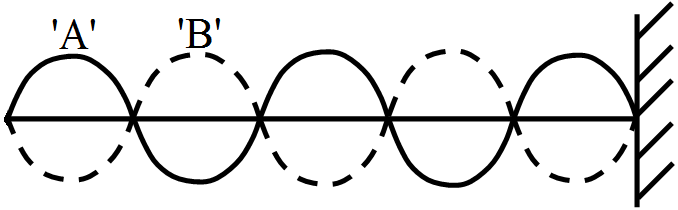
If a wave ‘A’ is made to hit a rigid support, there will be a reflected wave 'B' from the rigid support. As the two waves are super imposed, there will be a standing wave (as shown) produced.
It can be represented by the equation, $\text{y}=2\text{A}\sin\text{kx}\cos\omega\text{t}$indicating a position varying amplitude $(2\text{A}\sin\text{kx})$ View full question & answer→Question 553 Marks
What is the nature of sound waves in air? How is the speed of sound waves in atmosphere affected by the $(i)$ humidity $(ii)$ temperature?
AnswerLongitudinal.
- Increases with increase in humidity.
- Increases with increase in temperature.
View full question & answer→Question 563 Marks
A string of mass 2.50kg is under a tension of 200N. The length of the stretched string is 20.0m. If the transverse jerk is struck at one end of the string, how long does the disturbance take to reach the other end?
AnswerMass of the string, M = 2.50kg
Tension in the string, T = 200N
Length of the string, 1 = 20.0m
Mass per unit length, $\mu=\frac{\text{M}}{\text{L}}=\frac{2.50}{20}=0.125\text{kg m}^{-1}$
The velocity (v) of the transverse wave in the string is given by the relation:
$\text{v}=\sqrt{\frac{\text{T}}{\mu}}$
$=\sqrt{\frac{200}{0.125}}=\sqrt{1600}=40\text{m/s}$
Time taken by the disturbance to reach the other end, t = l/v = 20/40 = 0.50s
View full question & answer→Question 573 Marks
Consider the wave $\text{y}(\text{x, t})=2.2\cos(300\text{t}-0.24\text{x}).$ If the units for $y, t$ and $x$ are $mm, s$ and $m$ respectively, deduce:
- The amplitude.
- The frequency.
- The wavelength.
- The wave velocity.
- The amplitude of particle velocity.
AnswerThe given wave equation is $\text{y(x, t)} = 2.2\cos(300\text{t}-0.24\text{x})$
The equation is of the type $\text{y(x, t)} = \text{A}\cos(\omega\text{t}-\text{kx})$
Comparing the two equations, we obtain
- Amplitude wave $\text{A}=2.2\text{mm}=2.23\times10^{-3}\text{m}$
- $\omega=300\text{rad s}^{-1}$
$\therefore$ Frequency $\text{v}=\frac{\omega}{2\pi}=\frac{300}{2\pi}=47.7\text{Hz}$
- $\text{k}=0.24\text{m}^{-1}$
$\therefore$ wavetength $\lambda=\frac{2\pi}{\text{K}}=\frac{2\pi}{0.24}=26.2\text{m}$
- $\therefore$ Wave velocity $v=\text{v}\lambda=47.7\times26.2=1250\text{ms}^{-1}$
- Amplitude of particle velocity $=\text{A}\omega=2.2\times10^{-3}\times300=0.66\text{mm}.$
View full question & answer→Question 583 Marks
On a certain day, speed of sound in air is 350m/s. What is the frequency of fundamental note in a closed pipe of length 0.5m? Also find the frequency of second overtone.
AnswerHere v = 350m/s, l = 0.5m
$\therefore$ For closed pipe fundamental frequency
$\text{v}=\frac{u}{4\text{l}}=\frac{350}{4\times0.5}=175\text{Hz}$
Frequency of second overtone = 5v = 5 × 175
= 875Hz
View full question & answer→Question 593 Marks
Explain the Doppler's effect.
AnswerWhenever there is a relative motion between a source of sound and the listener, the apparent frequencies of sound heard by the listener is different from the actual frequency of sound emitted by the source.
For sound the observed frequency v' is given by
$\text{v}'=\Big(\frac{v+v_0}{v+v_\text{s}}\Big)\text{v}$
View full question & answer→Question 603 Marks
A source and an observer are approaching one another with velocity $4 m / s$. If the true frequency is $1200 Hz$ , deduce the observed frequency under the following conditions:
i. All velocity is in the source alone.
ii. All velocity is in the observer alone.
Take the velocity of sound waves in air to be $340 ms^{-1}$.
Answer
- $\text{v}'=\text{v}\Big(\frac{\nu}{\nu-\nu_\text{s}}\Big)=1200\Big(\frac{340}{336}\Big)\text{ft}$
$=1214.28\text{Hz}$
- $\text{v}'=\text{v}\Big(\frac{\nu+\nu_0}{\nu_0}\Big)=1200\Big(\frac{344}{340}\Big)$
$=1214.11\text{Hz}$ View full question & answer→Question 613 Marks
A stone dropped from the top of a tower of height 300 m splashes into the water of a pond near the base of the tower. When is the splash heard at the top given that the speed of sound in air is $340 m s ^{-1} ?\left(g=9.8 m s ^{-2}\right)$
AnswerHere, $h =300 m, g =9.8 m s ^{-2}$ and velocity of sound, $v =340 m s ^{-1}$ Let $t _1$ be the time taken by the stone to reach at the surface of pond.
Then using $\text{s}=\text{ut}+\frac{1}{2}\text{at}^2\frac{1}{2}\text{at}^2$
$\Rightarrow\text{h}=0\times\text{t}+\frac{1}{2}\text{gt}^2_1$
$\therefore\ \text{t}_1=\sqrt{\frac{2\times300}{9.8}}=7.82\text{s}$
Also if $t_2$ is the time taken by the sound to reach at a height h, then
$\text{t}_2=\frac{\text{h}}{\text{v}}=\frac{300}{340}=0.88\text{s}$
$\therefore$ Total time after which sound of splash is heard $= t_1 + t_2$_
$=7.82+0.88=8.7\text{s}$
View full question & answer→Question 623 Marks
A policeman on duty detects a drop of 15% in the pitch of the horn of a motor car as it crosses him. If the velocity of sound is 330m/sec, calculate the speed of the car.
AnswerBefore crossing source is moving towards listener,
$\therefore \text{V}'=\frac{\text{u}\text{V}}{\nu-\nu_\text{s}}\ \dots(\text{i})$
After crossing, source is moving away from listener
$\therefore \text{V}''=\frac{\text{u}\text{V}}{\nu+\nu_\text{s}}\dots(\text{ii})$
Dividing (ii) by (i), we get
$\frac{\text{V}'}{\text{V}''}=\frac{\nu-\nu_\text{s}}{\nu+\nu_\text{s}}$
Drop of 15% means
$\frac{\text{V}'}{\text{V}''}=\frac{85}{100}$
$\frac{85}{100}=\frac{330-\nu_\text{s}}{330+\nu_\text{s}}$
$\nu_\text{s}=26.7\text{m/s}$
View full question & answer→Question 633 Marks
- If the successive overtones of vibrating string are $280Hz$ and $350Hz$, what is the frequency of the fundamental note?
- If the amplitude of a sound wave is tripled, by how many $dB$ will the intensity level increases?
Answer
- Here $nv = 280Hz$
and $(n + 1)v = 350Hz$
$\therefore (n + 1)v - nv$
$= 350 - 280 = 70$
$v = 70Hz$
- Here $\frac{\text{a}_2}{\text{a}_1}=3$
$\therefore \frac{\text{I}_2}{\text{I}_1}=\Big(\frac{\text{a}_2}{\text{a}_1}\Big)^2=9$
Now, $\log_{10}\Big(\frac{\text{I}_2}{\text{I}_1}\Big)=10\log_{10}\Big(\frac{\text{I}_2}{\text{I}_1}\Big)$
$=10\log_{10}(9)=10\log_{10}3^2\\=20\log_{10}3=\log_{10}3^{20}$
$\therefore \frac{\text{I}_2}{\text{I}_1}=3^{20}$
$\text{I}_2=3^{20}\text{I}_1.$ View full question & answer→Question 643 Marks
An open pipe is suddenly closed at one end with the result that the frequency of the $3rd$ harmonic of the closed pipe is found to be higher by 100Hz than the fundamental frequency of the open pipe. What is the fundamental frequency of open pipe?
Answer$\text{v}_0=\frac{\text{v}}{2\text{L}}\ \dots(1)$
where $n_0$ = fundamental frequency of open pife. Frequency of third harmonic of closed pipe is
$\text{v}_\text{c}=3\Big(\frac{\nu}{4\text{L}}\Big)\ \dots(2)$
$\frac{(2)}{(1)}$ gives $=\frac{\text{v}_\text{c}}{\text{v}_0}=\frac{3}{2}$ or $v_\text{c}=\frac{2}{2}\text{v}_0\ \dots(3)$
Also $\text{v}_\text{c}-\text{v}_0=100$ (given)
$\frac{3}{2}\text{v}_0-\text{v}_0=100$
$\frac{\text{v}_0}{2}=100$
$\text{v}_0=200\text{Hz}.$
View full question & answer→Question 653 Marks
Compare the velocities of sound in hydrogen $\left( H _2\right)$ and carbon dioxide $\left( CO _2\right)$. The ratio $(\gamma)$ of specific heats of $H _2$ and $CO _2$ are respectively $1.4$ and $1.3 .$
Answer$\vartheta=\sqrt{\frac{\gamma_1\text{P}}{\rho_1}}$ and $\text{J}_2=\sqrt{\frac{\gamma _2\text{P}}{\rho_2}}$
$\frac{\vartheta_1}{\vartheta_2}=\sqrt{\frac{\gamma_1\rho_2}{\gamma_2\rho_1}}$
Since density of a gas is proportional to its molecular weight,
$\frac{\rho_2}{\rho_1}=\frac{44.01}{2.016}=21.83$
$\frac{\vartheta_1}{\vartheta_2}=\sqrt{\frac{1.4}{1.3}\times21.83}=4.85$
Velocity of sound in hydrogen in 4.85 times that in carbon dioxide.
View full question & answer→Question 663 Marks
A travelling harmonic wave on a string is described by
$\text{y}(\text{x, t})=7.5\sin\Big(0.0050\text{x}+12\text{t}+\frac{\pi}{4}\Big)$
Locate the points of the string which have the same transverse displacements and velocity as the x = 1cm point at t = 2s, 5s and 11s.
AnswerPropagation constant is related to wavelength as:
$\text{k}=\frac{2\pi}{\lambda}$
$\therefore\ \lambda=\frac{2\pi}{\lambda}=\frac{2\times3.14}{0.0050}$
$=1256\text{cm}=12.56$
Therefore, all the points at distances $\text{n}_\lambda,$ (n = ± 1, ± 2.... and so on) i.e. ± 12.56m, ± 25.12m, … and so on for x = 1cm, will have the same displacement as the x = 1cm points at t = 2s, 5s, and 11s.
View full question & answer→Question 673 Marks
A steel wire has a length of $12 m$ and a mass of $2.10 kg$ . What will be the speed of a transverse wave on this wire when a tension of $2.06 \times 10^4 N$ is applied?
Answerl = 12M (Total mass) =2.10kg
$\text{m}=\frac{\text{M}}{\text{l}}=\frac{2.1}{12}\text{T}=2.06\times10^4\text{N}$
$\therefore\text{v}\sqrt{\frac{\text{T}}{\text{m}}}\sqrt{\frac{2.06\times10^4\times12}{2.10}}=\sqrt{\frac{1236\times10^4}{105}}$
$=\sqrt{11.77}\times10^2=3.43\times10^2$
$\text{v}=343.0\text{m/ s}$
View full question & answer→Question 683 Marks
Equation of a wave travelling on a string is $\text{Y}=0.1\sin (300 \text{t}-0.01\text{x})$
Here $x$ is in $cm$ and $t$ is in seconds. Find :
- Wavelength of the wave.
- Time taken by the wave to travel $1m.$
AnswerSince $K = 0.01cm^{-1},$
We get $\frac{2\pi}{\lambda}=0.01$
or $\lambda =\frac{2\pi}{0.01}=628\text{cm}$
Since $\omega=300,$
$\text{T}=\frac{2\pi}{300}$ for travelling $\lambda$
Time for travelling $1m$
$=\frac{\text{T}}{\lambda \text{ in m}}=\frac{2\pi}{300\times6.28}$
$=\frac{1}{300}=3.33\text{ms}$
View full question & answer→Question 693 Marks
A wave travelling along a string is described by,
$
y(x, t)=0.005 \sin (80.0 x-3.0 t) \text {, }
$
in which the numerical constants are in SI units $\left(0.005 m , 80.0 rad m ^{-1}\right.$, and $3.0 rad s ^{-1}$ ). Calculate (a) the amplitude, (b) the wavelength, and (c) the period and frequency of the wave. Also, calculate the displacement $y$ of the wave at a distance $x=30.0 cm$ and time $t=20 s ?$
AnswerOn comparing this displacement equation with Eq. (14.2),
$
y(x, t)=a \sin (k x-\omega t),
$
we find
(a) the amplitude of the wave is $0.005 m =5 mm$.
(b) the angular wave number $k$ and angular frequency $\omega$ are
$
k=80.0 m ^{-1} \text { and } \omega=3.0 s ^{-1}
$
We, then, relate the wavelength $\lambda$ to $k$ through Eq. (14.6),
$
\begin{aligned}
\lambda & =2 \pi / k \\
& =\frac{2 \pi}{80.0 m ^{-1}} \\
& =7.85 cm
\end{aligned}
$
(c) Now, we relate $T$ to $\omega$ by the relation
$
\begin{aligned}
T & =2 \pi / \omega \\
& =\frac{2 \pi}{3.0 s ^{-1}} \\
& =2.09 s
\end{aligned}
$
and frequency, $v=1 / T=0.48 Hz$
The displacement $y$ at $x=30.0 cm$ and time $t=20 s$ is given by
$
\begin{aligned}
y & =(0.005 m ) \sin (80.0 \times 0.3-3.0 \times 20) \\
& =(0.005 m ) \sin (-36+12 \pi) \\
& =(0.005 m ) \sin (1.699) \\
& =(0.005 m ) \sin \left(97^{\circ}\right) \simeq 5 mm
\end{aligned}
$
View full question & answer→