MCQ 11 Mark
If the projection of $\vec{\text{a}}=\hat{\text{i}}-2\hat{\text{j}}+3\hat{\text{k}}$ on $\vec{\text{b}}=2\hat{\text{i}}+\lambda\hat{\text{k}}$ is zero, then the value of $\lambda$ is :
- A
$0$
- B
$1$
- ✓
$\frac{-2}{3}$
- D
$\frac{-3}{2}$
AnswerCorrect option: C. $\frac{-2}{3}$
Since, two non zero vector $\vec{\text{a}}\ \ \ \vec{\text{b}}$ are i.e.,
$\vec{\text{a}}=\hat{\text{i}}-2\hat{\text{j}}+3\hat{\text{k}}$
$\vec{\text{b}}=2\hat{\text{i}}+\lambda\hat{\text{k}}$
$\vec{\text{a}}.\vec{\text{b}}=0$
$(\hat{\text{i}}-2\hat{\text{j}}+3\hat{\text{k}}).(2\hat{\text{i}}+\lambda\hat{\text{k}})=0$
$2+3\lambda=0$
$-2=3\lambda$
$\lambda=\frac{-2}{3}$
View full question & answer→MCQ 21 Mark
$\overrightarrow{\text{r}} = \overrightarrow{\text{x}}{\hat{\text{i}}}+ \overrightarrow{\text{y}}{\hat{\text{j}}}$ is the equation of:
View full question & answer→MCQ 31 Mark
A set of vectors taken in a given order gives a closed polygon. Then the resultant of these vectors is:
MCQ 41 Mark
Two or more vectors having the same initial point are:
AnswerTwo or more vectors having same initial points are known as $Co-$initial vectors.
View full question & answer→MCQ 51 Mark
- A
- ✓
- C
Neither scalar nor vector
- D
View full question & answer→MCQ 61 Mark
If the curve $ay+x^2=7$ and $x^3=y,$ cut orthogonally at $(1, 1)$ then the value of a is:
View full question & answer→MCQ 71 Mark
If $\theta$ is the angle between the vectors $2\hat{\text{i}}-2\hat{\text{j}}+4\hat{\text{k}}$ and $3\hat{\text{i}}+\hat{\text{j}}+2\hat{\text{k}},$ then $\sin\theta=$
- A
$\frac{2}{3}$
- ✓
$\frac{2}{\sqrt{7}}$
- C
$\frac{\sqrt{2}}{7}$
- D
$\sqrt{\frac{2}{7}}$
AnswerCorrect option: B. $\frac{2}{\sqrt{7}}$
Let :
$\vec{\text{a}}=2\hat{\text{i}}-2\hat{\text{j}}+4\hat{\text{k}}$
$\vec{\text{b}}=3\hat{\text{i}}+\hat{\text{j}}+2\hat{\text{k}}$
$|\vec{\text{a}}|=\sqrt{2^2+(-2)^2+4^2}$
$=\sqrt{4+4+16}$
$=\sqrt{24}$
$=2\sqrt{6}$
$\Big|\vec{\text{b}}\big|=\sqrt{3^2+1^2+2^2}$
$=\sqrt{9+1+4}$
$=\sqrt{14}$
$\vec{\text{a}}\times\vec{\text{b}}=\begin{vmatrix}\hat{\text{i}}&\hat{\text{j}}&\hat{\text{k}}\\2&-2&4\\3&1&2 \end{vmatrix}$
$=-8\hat{\text{i}}+8\hat{\text{j}}+8\hat{\text{k}}$
$\big|\vec{\text{a}}\times\vec{\text{b}}\big|=\sqrt{64+64+64}$
$=\sqrt{192}$
$=8\sqrt{3}$
Let $\theta$ be the angle between $\vec{\text{a}}$ and $\vec{\text{b}}.$
$\big|\vec{\text{a}}\times\vec{\text{b}}\big|=|\vec{\text{a}}|\big|\vec{\text{b}}\big|\sin\theta$
$\Rightarrow8\sqrt{3}=(2\sqrt{6})(\sqrt{14})\sin\theta$
$\Rightarrow\sin\theta=\frac{8\sqrt{3}}{4\sqrt{21}}$
$=\frac{2}{\sqrt{7}}$
$\Rightarrow\theta=\sin^{-1}\Big(\frac{2}{\sqrt{7}}\Big)$
View full question & answer→MCQ 81 Mark
Which of the given qualities is a vector:
AnswerSpeed is a vector quantity as it has both magnitude and direction. Time, weight, volume have only magnitude and no direction. they all are scalar quantity.
View full question & answer→MCQ 91 Mark
If vectors $(\text{x}-2)\ \vec{\text{a}}+\vec{\text{b}}$ and $(2\text{x}+1)\ \vec{\text{a}}-\vec{\text{b}}$ are parallel then $x:$
- ✓
$\frac{1}{3}$
- B
$3$
- C
$-3$
- D
$\frac{-1}{3}$
AnswerCorrect option: A. $\frac{1}{3}$
As vectors $(x - 2) a + b$ and $(2x + 1) a - b$ are parallel.
$\frac{\text{x}-2}{2\text{x}+1}=-1$
$\Rightarrow\text{x} - 2=-2\text{x}-1$
$\therefore\text{x}=\frac{1}{3}$
View full question & answer→MCQ 101 Mark
Choose the correct answer from the given four options. Projection vector of $\vec{\text{a}}$ on $\vec{\text{b}}$ is:
- ✓
$\bigg(\frac{\vec{\text{a}}\cdot\vec{\text{b}}}{|\vec{\text{b}}|^2}\bigg)\vec{\text{b}}$
- B
$\frac{\vec{\text{a}}\cdot\vec{\text{b}}}{|\vec{\text{b}}|}$
- C
$\frac{\vec{\text{a}}\cdot\vec{\text{b}}}{|\vec{\text{a}}|}$
- D
$\bigg(\frac{\vec{\text{a}}\cdot\vec{\text{b}}}{|\vec{\text{a}}|^2}\bigg)\vec{\text{b}}$
AnswerCorrect option: A. $\bigg(\frac{\vec{\text{a}}\cdot\vec{\text{b}}}{|\vec{\text{b}}|^2}\bigg)\vec{\text{b}}$
Projection vector of $\vec{\text{a}}$ on $\vec{\text{b}}$ is given by $\vec{\text{a}}\cdot\frac{\vec{\text{b}}}{|\vec{\text{b}}|}\vec{\text{b}}=\bigg(\frac{\vec{\text{a}}\cdot\vec{\text{b}}}{|\vec{\text{b}}|^2}\bigg)\vec{\text{b}}$
View full question & answer→MCQ 111 Mark
The unit vector in the direction of $\overrightarrow{\text{a}}$ is:
AnswerCorrect option: A. $\frac{\vec{\text{a}}}{\mid\vec{\text{a}\mid}}$
Consider the given vector $\vec{\text{a}}.$ Unit vector $\hat{\text{a}}$
View full question & answer→MCQ 121 Mark
Choose the correct answer from the given four options. Assume that in a family, each child is equally likely to be a boy or a girl. A family with three children is chosen at random. The probability that the eldest child is a girl given that the family has at least one girl is :
- A
$\frac{1}{2}$
- B
$\frac{1}{3}$
- C
$\frac{2}{3}$
- ✓
$\frac{4}{7}$
AnswerCorrect option: D. $\frac{4}{7}$
Here, $S=\{\text{(B, B, B),(G, G, G),(B, G, G),(G, B, G),(G, G, B),(G . B, B),(B, G, B),(B, B . G)}\}$
$E _1=$ Event that a family has atleast one girl, then
$E_1=\{\text{(G, B, B),(B, G, B),(B, B . G),(G, G, B),(B, G, G),(G . B, G),(G, G, G)}\}$
$E _2=$ Event that the eldest child is a girl, then
$E_2=\{\text{(G, B, B),(G, G, B),(G, B, G)(G, G, G)}\}$
$\therefore\text{E}_1\cup\text{E}_2=\left\{(\text{G},\text{B},\text{B}),(\text{G},\text{G},\text{B}),(\text{G},\text{B},\text{G}),(\text{G},\text{G},\text{G})\right\}$
$\therefore\text{P}\Big(\frac{\text{E}_2}{\text{E}_1}\Big)=\frac{\text{P}(\text{E}_1\cap\text{E}_2)}{\text{P}(\text{E}_1)}$
$=\frac{\frac{4}{8}}{\frac{7}{8}}=\frac{4}{7}$
View full question & answer→MCQ 131 Mark
If $\vec{\text{a}}$ and $\vec{\text{b}}$ are unit vectors,then the greatest value of $\sqrt{3}\big|\vec{\text{a}}+\vec{\text{b}}\big|+\big|\vec{\text{a}}-\vec{\text{b}}\big|$ is :
AnswerWe have
$\sqrt{3}\big|\vec{\text{a}}+\vec{\text{b}}\big|+\big|\vec{\text{a}}-\vec{\text{b}}\big|$
$=\sqrt{3}\times\sqrt{|\vec{\text{a}}|^2+\big|\vec{\text{b}}\big|^2+2|\vec{\text{a}}|\big|\vec{\text{b}}\big|\cos\theta}+\sqrt{|\vec{\text{a}}|^2+\big|\vec{\text{b}}\big|^2-2|\vec{\text{a}}|\big|\vec{\text{b}}\big|\cos\theta}$
$=\sqrt{3}\times\sqrt{1^2+1^2+2\times1\times1\cos\theta}+\sqrt{1^2+1^2-2\times1\times1\cos\theta}\ ($As $\vec{\text{a}}$ and $\vec{\text{b}}$ unit vectors$)$
$=\sqrt{3}\times\sqrt{2+2\cos\theta}+\sqrt{2-2\cos\theta}$
$=\sqrt{3}\times\sqrt{2(1+\cos\theta)}+\sqrt{2(1-\cos\theta)}$
$=\sqrt{3}\times\sqrt{2\times2\cos^2\frac{\theta}{2}}+\sqrt{2\times2\sin^2\frac{\theta}{2}}$
$=2\sqrt{3}\cos\frac{\theta}{2}+2\sin\frac{\theta}{2}$
$=2\big(\sqrt{3}\cos\frac{\theta}{2}+\sin\frac{\theta}{2}\big)$
$=2\times2\big(\frac{\sqrt{3}}{2}\cos\frac{\theta}{2}+\frac{1}{2}\sin\frac{\theta}{2}\big)$
$=2\times2\big(\sin\frac{\pi}{3}\cos\frac{\theta}{2}+\cos\frac{\pi}{3}\sin\frac{\theta}{2}\big)$
$=4\sin\big(\frac{\pi}{3}+\frac{\theta}{2}\big)$
Now, maximum value of $\sin\text{a}=1$
$\Rightarrow $ Maximum value of $\sin\big(\frac{\pi}{3}+\frac{\theta}{2}\big)=1$
$\Rightarrow $ Maximum value of $4\sin\big(\frac{\pi}{3}+\frac{\theta}{2}\big)=4$
$\therefore$ Maximum velue of $\sqrt{3}\big|\vec{\text{a}}+\vec{\text{b}}\big|+\big|\vec{\text{a}}-\vec{\text{b}}\big|=4$
View full question & answer→MCQ 141 Mark
If the vectors $\hat{\text{i}}-2\text{x}\hat{\text{j}}+3\text{y}\hat{\text{k}}$ and $\hat{\text{i}}+2\text{x}\hat{\text{j}}-3\text{y}\hat{\text{k}}$ are perpendicular, then the locus of $(x,y)$ is :
AnswerLet, $\vec{\text{a}}=\hat{\text{i}}-2\text{x}\hat{\text{j}}+3\text{y}\hat{\text{k}}$ and $\vec{\text{b}}=\hat{\text{i}}+2\text{x}\hat{\text{j}}-3\text{y}\hat{\text{k}}$
It is given that the vectors are perpendicular. so, their dot product is zero.
$\vec{\text{a}}.\vec{\text{b}}=0$
$\Rightarrow\big(\hat{\text{i}}-2\text{x}\hat{\text{j}}+3\text{y}\hat{\text{k}}\big).\big(\hat{\text{i}}+2\text{x}\hat{\text{j}}-3\text{y}\hat{\text{k}}\big)=0$
$\Rightarrow1-4\text{x}^2-9\text{y}^2=0$
$\Rightarrow4\text{x}^2+9\text{y}^2=1$
Dividing both sides by $36,$ we get
$\frac{\text{x}^2}{9}+\frac{\text{y}^2}{4}=1$
This is an ellipse.
View full question & answer→MCQ 151 Mark
If $\vec{\text{a}},\vec{\text{b}},\vec{\text{c}}$ are three non$-$coplanar vectors, then $\big(\vec{\text{a}}+\vec{\text{b}}+\vec{\text{c}}\big).\big[\big(\vec{\text{a}}+\vec{\text{b}}\big)\times\big(\vec{\text{a}}+\vec{\text{c}}\big)\big]$ equals:
- A
$0$
- B
$\big[\vec{\text{a}}\vec{\text{b}}\vec{\text{c}}\big]$
- C
$2\big[\vec{\text{a}}\vec{\text{b}}\vec{\text{c}}\big]$
- ✓
$-\big[\vec{\text{a}}\vec{\text{b}}\vec{\text{c}}\big]$
AnswerCorrect option: D. $-\big[\vec{\text{a}}\vec{\text{b}}\vec{\text{c}}\big]$
$\big(\vec{\text{a}}+\vec{\text{b}}+\vec{\text{c}}\big).\big[\big(\vec{\text{a}}+\vec{\text{b}}\big)\times\big(\vec{\text{a}}+\vec{\text{c}}\big)\big]$
$=\big(\vec{\text{a}}+\vec{\text{b}}+\vec{\text{c}}\big).\big(\vec{\text{a}}\times\vec{\text{a}}+\vec{\text{a}}\times\vec{\text{c}}+\vec{\text{b}}\times\vec{\text{a}}+\vec{\text{b}}\times\vec{\text{c}}\big)$
$=\big(\vec{\text{a}}+\vec{\text{b}}+\vec{\text{c}}\big).\big(\vec{\text{a}}\times\vec{\text{c}}+\vec{\text{b}}\times\vec{\text{a}}+\vec{\text{b}}\times\vec{\text{c}}\big)$
$=0+0+\big[\vec{\text{a}}\vec{\text{b}}\vec{\text{c}}\big]+\big[\vec{\text{b}}\vec{\text{a}}\vec{\text{c}}\big]+0+0+0+\big[\vec{\text{c}}\vec{\text{b}}\vec{\text{a}}\big]+0$
$=-\big[\vec{\text{a}}\vec{\text{b}}\vec{\text{c}}\big]$
View full question & answer→MCQ 161 Mark
If $\overline{\text{a}},\overline{\text{b}},\overline{\text{c}}$ are unit vectors such that $\overline{\text{a}}+\overline{\text{b}}+\overline{\text{c}}+\overline{\text{c.a}}=$
- A
$\frac{3}{2}$
- ✓
$-\frac{3}{2}$
- C
$\frac{1}{2}$
- D
$-\frac{1}{2}$
AnswerCorrect option: B. $-\frac{3}{2}$
View full question & answer→MCQ 171 Mark
If $\mid\text{a}\times\text{b}\mid=4$ and $\mid\text{a.b}\mid=2$ then $\mid{\text{a}}\mid^2\mid{\text{b}}\mid^2$ is equal to:
View full question & answer→MCQ 181 Mark
Let $\vec{\text{a}},\vec{\text{b}},\vec{\text{c}}$ be three unit vectors, such that $\big|\vec{\text{a}}+\vec{\text{b}}+\vec{\text{c}}\big|=1$ and $\vec{\text{a}}$ is perpendicular to $\vec{\text{b}}.$ If $\vec{\text{c}}$ makes angle $\alpha$ and $\beta$ with $\vec{\text{a}}$ and $\vec{\text{b}}$ respectively, then $\cos\alpha+\cos\beta=$
- A
$-\frac{3}{2}$
- B
$\frac{3}{2}$
- C
$1$
- ✓
$-1$
AnswerGiven that $\vec{\text{a}},\vec{\text{b}}$ and $\vec{\text{c}}$ are unit vectors.
So, $|\vec{\text{a}}|=1,\big|\vec{\text{b}}\big|=1$ and $\vec{\text{c}}=1.$
Since $\vec{\text{a}}$ and $\vec{\text{b}}$ are mutually perpendicular,
$\vec{\text{a}}.\vec{\text{b}}=0$
Now,
$\big|\vec{\text{a}}+\vec{\text{b}}+\vec{\text{c}}\big|=1$
$\Rightarrow\big|\vec{\text{a}}+\vec{\text{b}}+\vec{\text{c}}\big|^2=1$
$\Rightarrow|\vec{\text{a}}|^2+\big|\vec{\text{b}}\big|^2+|\vec{\text{c}}|^2+2\vec{\text{a}}.\vec{\text{b}}+2\vec{\text{b}}.\vec{\text{c}}+2\vec{\text{c}}.\vec{\text{a}}=1$
$\Rightarrow1+1+1+2(0)+2|\vec{\text{a}}|\big|\vec{\text{b}\big|}\cos\beta+2|\vec{\text{c}}||\vec{\text{a}}|\cos\alpha=1$
$\Rightarrow3+2(\cos\alpha+\cos\beta)=1$
$\Rightarrow2(\cos\alpha+\cos\beta)=-2$
$\Rightarrow\cos\alpha+\cos\beta=-1$
View full question & answer→MCQ 191 Mark
$\big(\vec{\text{a}}+2\vec{\text{b}}-\vec{\text{c}}\big).\big\{\big(\vec{\text{a}}-\vec{\text{b}}\big)\times\big(\vec{\text{a}}-\vec{\text{b}}-\vec{\text{c}}\big)\big\}$ is equal to:
- A
$\big(\vec{\text{a}}\vec{\text{b}}\vec{\text{c}}\big)$
- B
$2\big(\vec{\text{a}}\vec{\text{b}}\vec{\text{c}}\big)$
- ✓
$3\big(\vec{\text{a}}\vec{\text{b}}\vec{\text{c}}\big)$
- D
$0$
AnswerCorrect option: C. $3\big(\vec{\text{a}}\vec{\text{b}}\vec{\text{c}}\big)$
$\big(\vec{\text{a}}+2\vec{\text{b}}-\vec{\text{c}}\big).\big\{\big(\vec{\text{a}}-\vec{\text{b}}\big)\times\big(\vec{\text{a}}-\vec{\text{b}}-\vec{\text{c}}\big)\big\}$
$=\big(\vec{\text{a}}+2\vec{\text{b}}-\vec{\text{c}}\big).\big(\vec{\text{a}}\times\vec{\text{a}}-\vec{\text{a}}\times\vec{\text{b}}-\vec{\text{a}}\times\vec{\text{c}}-\vec{\text{b}}\times\vec{\text{a}}+\vec{\text{b}}\times\vec{\text{b}}+\vec{\text{b}}\times\vec{\text{c}}\big)$
$=\big(\vec{\text{a}}+2\vec{\text{b}}-\vec{\text{c}}\big).\big(-\vec{\text{a}}\times\vec{\text{b}}-\vec{\text{a}}\times\vec{\text{c}}+\vec{\text{a}}\times\vec{\text{b}}+\vec{\text{b}}\times\vec{\text{c}}\big)$
$=\big(\vec{\text{a}}+2\vec{\text{b}}-\vec{\text{c}}\big).\big(-\vec{\text{a}}\times\vec{\text{c}}+\vec{\text{b}}\times\vec{\text{c}}\big)$
$=\big[\text{a}\text{b}\text{c}\big]+2\big[\text{a}\text{b}\text{c}\big]$
$=3\big[\text{a}\text{b}\text{c}\big]$
View full question & answer→MCQ 201 Mark
If $\big[2\vec{\text{a}}+4\vec{\text{b}}\vec{\text{c}}\vec{\text{d}}\big]=\lambda\big[\vec{\text{a}}\vec{\text{c}}\vec{\text{d}}\big]+\mu\big[\vec{\text{b}}\vec{\text{c}}\vec{\text{d}}\big],$ then $\lambda+\mu=$
AnswerWe have
$\big[2\vec{\text{a}}+4\vec{\text{b}}\vec{\text{c}}\vec{\text{d}}\big]=\lambda\big[\vec{\text{a}}\vec{\text{c}}\vec{\text{d}}\big]+\mu\big[\vec{\text{b}}\vec{\text{c}}\vec{\text{d}}\big]$
$\Rightarrow\big[\big(2\vec{\text{a}}+4\vec{\text{b}}\big]\times\vec{\text{c}}\big].\vec{\text{d}}=\lambda\big[\vec{\text{a}}\vec{\text{c}}\vec{\text{d}}\big]+\mu\big[\vec{\text{b}}\vec{\text{c}}\vec{\text{d}}\big] ($By definition of scalar triple product$)$
$\Rightarrow\big[\big(2\vec{\text{a}}\times\vec{\text{c}}\big)+\big(4\vec{\text{b}}\times\vec{\text{c}}\big)\big].\vec{\text{d}}=\lambda\big[\vec{\text{a}}\vec{\text{c}}\vec{\text{d}}\big]+\mu\big[\vec{\text{b}}\vec{\text{c}}\vec{\text{d}}\big]$
$\Rightarrow\big(2\vec{\text{a}}\times\vec{\text{c}}\big).\vec{\text{d}}+\big(4\vec{\text{b}}\times\vec{\text{c}}\big).\vec{\text{d}}=\lambda\big[\vec{\text{a}}\vec{\text{c}}\vec{\text{d}}\big]+\mu\big[\vec{\text{b}}\vec{\text{c}}\vec{\text{d}}\big]$
$\Rightarrow\big[2\vec{\text{a}}\vec{\text{ c }}\vec{\text{d}}\big]+\big[4\vec{\text{b}}\vec{\text{ c }}\vec{\text{d}}\big]=\lambda\big[\vec{\text{a}}\vec{\text{ c }}\vec{\text{d}}\big]+\mu\big[\vec{\text{b}}\vec{\text{ c }}\vec{\text{d}}\big]$
$\Rightarrow2\big[\vec{\text{a}}\vec{\text{c}}\vec{\text{d}}\big]+4\big[\vec{\text{b}}\vec{\text{c}}\vec{\text{d}}\big]=\lambda\big[\vec{\text{a}}\vec{\text{c}}\vec{\text{d}}\big]+\mu\big[\vec{\text{b}}\vec{\text{c}}\vec{\text{d}}\big]$ $\big(\therefore\big[\lambda\vec{\text{a}}\vec{\text{b}}\vec{\text{c}}\big]=\lambda\big[\vec{\text{a}}\vec{\text{b}}\vec{\text{c}}\big]$ for any scaler $\lambda\big)$
Comparing both sides, we get
$\lambda=2$
$\mu=4$
$\therefore\lambda+\mu=2+4=6$
View full question & answer→MCQ 211 Mark
A unit vector perpendicular to both $\hat{\text{i}}+\hat{\text{j}}$ and $\hat{\text{j}}+\hat{\text{k}}$ is:
- A
$\hat{\text{i}}-\hat{\text{j}}+\hat{\text{k}}$
- B
$\hat{\text{i}}+\hat{\text{j}}+\hat{\text{k}}$
- C
$\frac{1}{\sqrt{3}}\big(\hat{\text{i}}+\hat{\text{j}}+\hat{\text{k}}\big)$
- ✓
$\frac{1}{\sqrt{3}}\big(\hat{\text{i}}-\hat{\text{j}}+\hat{\text{k}}\big)$
AnswerCorrect option: D. $\frac{1}{\sqrt{3}}\big(\hat{\text{i}}-\hat{\text{j}}+\hat{\text{k}}\big)$
Let:
$\vec{\text{a}}=\hat{\text{i}}+\hat{\text{j}}+0\hat{\text{k}}$
$\vec{\text{b}}=0\hat{\text{i}}+\hat{\text{j}}+\hat{\text{k}}$
$\therefore\vec{\text{a}}\times\vec{\text{b}}=\begin{vmatrix}\hat{\text{i}}&\hat{\text{j}}&\hat{\text{k}}\\1&1&0\\0&1&1 \end{vmatrix}$
$=\hat{\text{i}}-\hat{\text{j}}+\hat{\text{k}}$
$\Rightarrow\big|\vec{\text{a}}\times\vec{\text{b}}\big|=\sqrt{1+1+1}$
$=\sqrt{3}$
Unit vector perpendicular to $\vec{\text{a}}$ and $\vec{\text{b}}=\frac{\vec{\text{a}}\times\vec{\text{b}}}{\big|\vec{\text{a}}\times\vec{\text{b}}\big|}=\frac{\hat{\text{i}}-\hat{\text{j}}+\hat{\text{k}}}{\sqrt{3}}$
Disclaimer: The answer given for this question in the textbook is incorrect.
View full question & answer→MCQ 221 Mark
The ratio in which $2x + 3y + 5z = 1$ divides the line joining the points $(1, 0, -3)$ and $(1, -5, 7)$ is:
- ✓
$5 : 3$
- B
$3 : 2$
- C
$2 : 1$
- D
$1 : 3$
AnswerCorrect option: A. $5 : 3$
View full question & answer→MCQ 231 Mark
Choose the correct answer from the given four options. The value of $\lambda$ for which the vectors $3\hat{\text{i}}-6\hat{\text{j}}+\hat{\text{k}}$ and $2\hat{\text{i}}-4\hat{\text{j}}+\lambda\hat{\text{k}}$ are parallel, is:
- ✓
$\frac{2}{3}$
- B
$\frac{3}{2}$
- C
$\frac{5}{2}$
- D
$\frac{2}{5}$
AnswerCorrect option: A. $\frac{2}{3}$
As the vectors $3\hat{\text{i}}-6\hat{\text{j}}+\hat{\text{k}}$ and $2\hat{\text{i}}-4\hat{\text{j}}+\lambda\hat{\text{k}}$ are parallel
$\therefore\frac{3}{2}=\frac{-6}{-4}=\frac{1}{\lambda}$
$\Rightarrow\lambda=\frac{2}{3}$
View full question & answer→MCQ 241 Mark
What is the length of the longer diagonal of the parallelogram constructed on $5\vec{\text{a}}+2\vec{\text{b}}$ and $\vec{\text{a}}-3\vec{\text{b}}$ if it is given that $|\vec{\text{a}}|=2\sqrt{2},\big|\vec{\text{b}}\big|=3$ and the angle between $\vec{\text{a}}$ and $\vec{\text{b}}$ is $\frac{\pi}{4}\ ?$
- A
$15$
- B
$\sqrt{113}$
- ✓
$\sqrt{593}$
- D
$\sqrt{369}$
AnswerCorrect option: C. $\sqrt{593}$
Let $\text{ABCD}$ be a parallelogram in which
side $\overrightarrow{\text{AB}}=\overrightarrow{\text{DC}}=5\vec{\text{a}}+2\vec{\text{b}}$
and $\overrightarrow{\text{AD}}=\overrightarrow{\text{BC}}=\vec{\text{a}}-3\vec{\text{b}}$
and diagonals are $AC$ and $BD.$
Now, $\overrightarrow{\text{AC}}=\overrightarrow{\text{AB}}+\overrightarrow{\text{BC}}$
$=\big(5\vec{\text{a}}+2\vec{\text{b}\big)}+\big(\vec{\text{a}}-3\vec{\text{b}}\big)$
$=6\vec{\text{a}}-\vec{\text{b}}$
$\therefore\big|\overrightarrow{\text{AC}}\big|=\big|6\vec{\text{a}}-\vec{\text{b}\big|}$
$=\sqrt{|6\vec{\text{a}}|^2+\big|\vec{\text{b}}\big|^2-2\times|6\vec{\text{a}}|\times\big|\vec{\text{b}}\big|\cos\theta}$
$=\sqrt{36|\vec{\text{a}}|^2+\big|\vec{\text{b}}\big|^2-12\times|\vec{\text{a}}|\times\big|\vec{\text{b}}\big|\cos\frac{\pi}{4}}$
$=\sqrt{36|2\sqrt{2}|^2+|3|^2-12\times|2\sqrt{2}|\times|3|\times\frac{1}{\sqrt{2}}}$
$=\sqrt{288+9-72}$
$=\sqrt{225}=15\text{ units}$
$\overrightarrow{\text{BD}}=\overrightarrow{\text{BA}}+\overrightarrow{\text{BD}}$
$=-\overrightarrow{\text{AB}}+\overrightarrow{\text{BD}}$
$=-\big(5\vec{\text{a}}+2\vec{\text{b}}\big)+\big(\vec{\text{a}}-3\vec{\text{b}}\big)$
$=-4\vec{\text{a}}-5\vec{\text{b}}$
$\therefore|\overrightarrow{\text{BD}}|=\big|-4\vec{\text{a}}-5\vec{\text{b}}\big|$
$=\big|4\vec{\text{a}}+5\vec{\text{b}}\big|$
$=\sqrt{|4\vec{\text{a}}|^2+|5\vec{\text{b}}|^2+2|4\vec{\text{a}}|\times|5\vec{\text{b}|}\cos\theta}$
$=\sqrt{16|\vec{\text{a}}|^2+25\big|\vec{\text{b}}\big|^2+40\times|\vec{\text{a}}|\times\big|\vec{\text{b}}\big|\cos\frac{\pi}{4}}$
$=\sqrt{16|2\sqrt{2}|^2+25|3|^2+40\times|2\sqrt{2}|\times|3|\times\frac{1}{\sqrt{2}}}$
$=\sqrt{128+25+240}$
$=\sqrt{593}\text{ units}$
Therefore, the larger diagonal $=\sqrt{593}$
View full question & answer→MCQ 251 Mark
If $a, b, c$ are position vectors of the vertices of a $\Delta\text{ABC}$ then $\overrightarrow{\text{AB}}+\overrightarrow{\text{BC}}+\overrightarrow{\text{CA}}=$
AnswerIf we join head to tail all the vectors, then we end up at the initial point where we started, that is vertice $A.$ the net sum is $0.$
View full question & answer→MCQ 261 Mark
vectors $\vec{\text{a}}$ and $\vec{\text{b}}$ are inclined at angle $\theta=120^\circ.$ if $|\vec{\text{a}}|=1,\big|\vec{\text{b}}\big|=2,$ then $\big[\big(\vec{\text{a}}+3\vec{\text{b}}\big)\times\big(3\vec{\text{a}}-\vec{\text{b}}\big)\big]^2$ is equal to:
Answer$\big(\vec{\text{a}}+3\vec{\text{b}}\big)\times\big(3\vec{\text{a}}-\vec{\text{b}}\big)$
$=3\big(\vec{\text{a}}\times\vec{\text{a}}\big)-\vec{\text{a}}\times\vec{\text{b}}+9\big(\vec{\text{b}}\times\vec{\text{a}}\big)-3\big(\vec{\text{b}}\times\vec{\text{b}}\big)$
$=3(0)-\vec{\text{a}}\times\vec{\text{b}}-9\big(\vec{\text{a}}\times\vec{\text{b}}\big)-3(0)$
$=-10\big(\vec{\text{a}}\times\vec{\text{b}}\big)$
Now,
$\big|\big(\vec{\text{a}}\times3\vec{\text{b}}\big)\times\big(3\vec{\text{a}}-\vec{\text{b}}\big)\big|^2$
$=\big|-10\big(\vec{\text{a}}\times\vec{\text{b}}\big)\big|^2$
$=100\big|\big(\vec{\text{a}}\times\vec{\text{b}}\big)\big|^2$
$=100|\vec{\text{a}}|^2\big|\vec{\text{b}}\big|^2\sin^2120$
$=100(1)^2(2)^2\Big(\frac{\sqrt{3}}{2}\Big)^2$
$=400\times\frac{3}{4}$
$=300$
View full question & answer→MCQ 271 Mark
A point from a vector starts is called and where it ends is called its:
- A
Terminal point, endpoint.
- ✓
Initial point, terminal point
- C
- D
AnswerCorrect option: B. Initial point, terminal point
View full question & answer→MCQ 281 Mark
If the position vectors of $P, Q$ are respectively $5a + 4b$ and $3a - 2b$ then $\vec{\text{QP}}=$
- ✓
$2a + 6b$
- B
$2a − 6b$
- C
$2a + 5b$
- D
$2a − 5b$
AnswerCorrect option: A. $2a + 6b$
View full question & answer→MCQ 291 Mark
The summation of two unit vectors is a third unit vector, then the modulus of the difference of the unit vector is:
- ✓
$\sqrt{3}$
- B
$1-\sqrt{3}$
- C
$1+\sqrt{3}$
- D
$-\sqrt{3}$
AnswerCorrect option: A. $\sqrt{3}$
View full question & answer→MCQ 301 Mark
If $\vec{\text{a}},\vec{\text{b}},\vec{\text{c}}$ are any three mutualy perpendicular vectors of equal magnitude a, then $\big|\vec{\text{a}}+\vec{\text{b}}+\vec{\text{c}}\big|$ is equal to
- A
$\text{a}$
- B
$\sqrt{2}\text{a}$
- ✓
$\sqrt{3}\text{a}$
- D
$2\text{a}$
AnswerCorrect option: C. $\sqrt{3}\text{a}$
Given that
So, $|\vec{\text{a}}|=\big|\vec{\text{b}}\big|=|\vec{\text{c}}|=\text{a}\dots(1)$
Since they are mutually perpendicular,
$\vec{\text{a}}.\vec{\text{b}}=\vec{\text{b}}.\vec{\text{c}}=\vec{\text{c}}.\vec{\text{a}}=0\dots(2)$
Now,
$\big|\vec{\text{a}}+\vec{\text{b}}+\vec{\text{c}}\big|^2=|\vec{\text{a}}|^2+\big|\vec{\text{b}}\big|^2+|\vec{\text{c}}|^2+2\vec{\text{a}}.\vec{\text{b}}+2\vec{\text{b}}.\vec{\text{c}}+2\vec{\text{c}}.\vec{\text{a}}$
$=\text{a}^2+\text{a}^2+\text{a}^2+0+0+0 [$using $(1)$ and $(2)]$
$=3\text{a}^2$
$\therefore\big|\vec{\text{a}}+\vec{\text{b}}+\vec{\text{c}}\big|=\sqrt{3}\text{a}$
View full question & answer→MCQ 311 Mark
If $\vec{a}\ \text{and}\ \vec{b}$ are two collinear vectors, then which of the following are incorrect:
- A
$\vec{b}=\lambda\vec{a},\ \text{for some scalar}\ \lambda$
- B
$\vec{a}=\pm\vec{b}$
- C
The respective components of $\vec{a}\ \text{and}\ \vec{b}$ are proportional.
- ✓
Both the vectors $\vec{a}\ \text{and}\ \vec{b}$ have same direction, but different magnitudes.
AnswerCorrect option: D. Both the vectors $\vec{a}\ \text{and}\ \vec{b}$ have same direction, but different magnitudes.
If $\vec{a}\ \text{and}\ \vec{b}$ are two collinear vectors, then they are parallel. Therefore, we have: $\vec{b}=\lambda\vec{a}\ (\text{For some scalar}\ \lambda)$ $\text{If}\ \lambda=\pm1,\ \text{then}\ \vec{a}=\pm\vec{b}$ $\text{If}\ \vec{a}=a_1\hat{i}+a_2\hat{j}+a_3\hat{k}\ \text{and}\ \vec{b}$ $=b_1\hat{i}+b_2\hat{j}+b_3\hat{k}, \text{then}\ \vec{b}=\lambda\vec{a}.$ $\Rightarrow{b_1}\hat{i}+b_2\hat{j}+b_3\hat{k}=\lambda\big({a_1}\hat{i}+a_2\hat{j}+a_3\hat{k}\big)$ $\Rightarrow{b_1}\hat{i}+b_2\hat{j}+b_3\hat{k}=\big(\lambda{a_1}\big)\hat{i}+\big(\lambda{a_2}\big)\hat{j}+\big(\lambda{a_3}\big)\hat{k}$ $\Rightarrow{b_1}=\lambda{a_1,}\ b_2=\lambda{a_2,}\ b_3=\lambda{a_3}$$\Rightarrow\frac{b_1}{a_1}=\frac{b_2}{a_2}=\frac{b_3}{a_3}=\lambda$
Thus, the respective components of $\vec{a}\ \text{and}\ \vec{b}$ are proportional. However, vectors $\vec{a}\ \text{and}\ \vec{b}$ can have different directions. Hence, the statement given in D is incorrect. The correct answer is D.
View full question & answer→MCQ 321 Mark
If $\big|\vec{\text{a}}\times\vec{\text{b}}\big|=4,\big|\vec{\text{a}}.\vec{\text{b}}\big|=2,$ then $|\vec{\text{a}}|^2\big|\vec{\text{b}}\big|^2=$
View full question & answer→MCQ 331 Mark
$\text{The value of}\ \hat{\text{i}}\cdot(\hat{\text{j}}\times\hat{\text{k}})+\hat{\text{j}}\cdot(\hat{\text{i}}\times\hat{\text{k}})+\hat{\text{k}}\cdot(\hat{\text{i}}\times\hat{\text{j}})\ \text{is}$
Answer$\hat{\text{i}}\cdot\Big(\hat{\text{j}}\times\hat{\text{k}}\Big)+\hat{\text{j}}\cdot\Big(\hat{\text{i}}\times\hat{\text{k}}\Big)+\hat{\text{k}}\cdot\Big(\hat{\text{i}}\times\hat{\text{j}}\Big)$
$=\hat{\text{i}}\cdot\hat{\text{i}}+\hat{\text{j}}\cdot\Big(-\hat{\text{j}}\Big)+\hat{\text{k}}\cdot\hat{\text{k}}$
$=1-\hat{\text{j}}\cdot\hat{\text{j}}+1$
=1-1+1
=1
The correct answer is C.
View full question & answer→MCQ 341 Mark
Choose the correct answer:$\text{Let}\ \vec{\text{a}}\ \text{and}\ \vec{\text{b}}$ be two unit vectors and $\theta$ is the angle between them. Then $\vec{\text{a}}+\vec{\text{b}}$ is a unit vector if,
- A
$\theta=\frac{\pi}{4}$
- B
$\theta=\frac{\pi}{3}$
- C
$\theta=\frac{\pi}{2}$
- ✓
$\theta=\frac{2\pi}{3}$
AnswerCorrect option: D. $\theta=\frac{2\pi}{3}$
$\text{Let}\ \vec{\text{a}}\ \text{and}\ \vec{\text{b}}$ be two unit vectors and $\theta$ be the angle between them.
$\text{Then},\ \big|\vec{\text{a}}\big|=\Big|\vec{\text{b}}\Big|=1.$
$\text{Now},\ \vec{\text{a}}+\vec{\text{b}}$ is a unit vector if $\Big|\vec{\text{a}}+\vec{\text{b}}\Big|=1.$
$\Big|\vec{\text{a}}+\vec{\text{b}}\Big|=1$
$\Rightarrow\Big(\vec{\text{a}}+\vec{\text{b}}\Big)^2=1$
$\Rightarrow\Big(\vec{\text{a}}+\vec{\text{b}}\Big)\cdot\Big(\vec{\text{a}}+\vec{\text{b}}\Big)=1$
$\Rightarrow\vec{\text{a}}.\vec{\text{a}}+\vec{\text{a}}.\vec{\text{b}}+\vec{\text{b}}.\vec{\text{a}}+\vec{\text{b}}.\vec{\text{b}}=1$
$\Rightarrow\Big|\vec{\text{a}}\Big|^2+2\vec{\text{a}}.\vec{\text{b}}+\Big|\vec{\text{b}}\Big|^2=1$
$\Rightarrow1^2+2\Big|\vec{\text{a}}\Big|\Big|\vec{\text{b}}\Big|\cos\theta+1^2=1$
$\Rightarrow1+2.1.1\cos\theta+1=1$
$\Rightarrow\cos\theta=-\frac{1}{2}$
$\Rightarrow\theta=-\frac{2\pi}{3}$
Hence, $\vec{\text{a}}+\vec{\text{b}}$ is a unit vector if $\theta=\frac{2\pi}{3}.$
The correct answer is D.
View full question & answer→MCQ 351 Mark
The projection of the vector $\hat{\text{i}}+\hat{\text{j}}+\hat{\text{k}}$ along the vector of $\hat{\text{j}}$ is:
AnswerLet $\vec{\text{a}}=\hat{\text{i}}+\hat{\text{j}}+\hat{\text{k}}$ and $\vec{\text{b}}=\hat{\text{j}}$
The projection of $\vec{\text{a}}$ on $\vec{\text{b}}$ is $\frac{\vec{\text{a}}.\vec{\text{b}}}{\big|\vec{\text{b}}\big|}$
$=\frac{\big(\hat{\text{i}}+\hat{\text{j}}+\hat{\text{k}}\big).\hat{\text{j}}}{|\hat{\text{j}}|}$
$=\frac{0+1+0}{1}$
$=1$
View full question & answer→MCQ 361 Mark
The position vectors of the points $\text{A, B, C}$ are $2\hat{\text{i}}+\hat{\text{j}}-\hat{\text{k}},\ 3\hat{\text{i}}-2\hat{\text{j}}+\hat{\text{k}}$ and $\hat{\text{i}}+4\hat{\text{j}}-3\hat{\text{k}}$ respectively. These points,
- ✓
Form an isosceles triangle.
- B
- C
- D
AnswerCorrect option: A. Form an isosceles triangle.
Given : Position vectors of $\text{A, B, C}$ are $2\hat{\text{i}}+\hat{\text{j}}-\hat{\text{k}},\ 3\hat{\text{i}}-2\hat{\text{j}}+\hat{\text{k}}$ and $\hat{\text{i}}+4\hat{\text{j}}-3\hat{\text{k}}$.
Then,
$\overrightarrow{\text{AB}}=\big(3\hat{\text{i}}-2\hat{\text{j}}+\hat{\text{k}}\big)-\big(2\hat{\text{i}}+\hat{\text{j}}-\hat{\text{k}}\big)$
$=\hat{\text{i}}-3\hat{\text{j}}+2\hat{\text{k}}$
$\overrightarrow{\text{BC}}=\big(\hat{\text{i}}+4\hat{\text{j}}-3\hat{\text{k}}\big)-\big(3\hat{\text{i}}-2\hat{\text{j}}+\hat{\text{k}}\big)$
$=-2\hat{\text{i}}+6\hat{\text{j}}-4\hat{\text{k}}$
$\overrightarrow{\text{CA}}=\big(2\hat{\text{i}}+\hat{\text{j}}-\hat{\text{k}}\big)-\big(\hat{\text{i}}+4\hat{\text{j}}-3\hat{\text{k}}\big)$
$=\hat{\text{i}}-3\hat{\text{j}}+2\hat{\text{k}}$
Now, $\Big|\overrightarrow{\text{AB}}\Big|=\sqrt{1^2+(-3)^2+2^2}$
$=\sqrt{1+9+4}$
$=\sqrt{14}$
$\Big|\overrightarrow{\text{CA}}\Big|=\sqrt{1^2+(-3)^2+2^2}$
$=\sqrt{1+9+4}$
$=\sqrt{14}$
$\Big|\overrightarrow{\text{BC}}\Big|=\sqrt{(-2)^2+6^2+(-4)^2}$
$=\sqrt{4+36+16}$
$=\sqrt{56}$
$\therefore\Big|\overrightarrow{\text{AB}}\Big|=\Big|\overrightarrow{\text{CA}}\Big|$
Hence, the triangle is isosceles as two of its sides are equal.
View full question & answer→MCQ 371 Mark
If $\mid\text{a}\mid=5,\mid\text{b}\mid=13$ and $\mid\text{a}\times{\text{b}}\mid=25$ find $a.b:$
- A
$\underline{+}10$
- B
$\underline{+}40$
- ✓
$\underline{+}60$
- D
$\underline{+}25$
AnswerCorrect option: C. $\underline{+}60$
View full question & answer→MCQ 381 Mark
If $\vec{\text{a}}$ and $\vec{\text{b}}$ are unit vectors, then which of the following values of $\vec{\text{a}}.\vec{\text{b}}$ is not possible?
- ✓
$\sqrt{3}$
- B
$\frac{\sqrt{3}}{2}$
- C
$\frac{1}{\sqrt{2}}$
- D
$\frac{-1}{2}$
AnswerCorrect option: A. $\sqrt{3}$
It is given that $\vec{\text{a}}$ and $\vec{\text{b}}$ are unit vectors.
$\Rightarrow|\vec{\text{a}}|=\big|\vec{\text{b}}\big|=1$
Now,
$\vec{\text{a}}.\vec{\text{b}}$
$=|\vec{\text{a}}|\big|\vec{\text{b}}\big|\cos\theta$
$=(1)(2)\cos\theta$
$=\cos\theta$
The range of $\cos\theta$ is $[-1,1].$
$\therefore\sqrt{3}$ is not a possible value of $\cos\theta$ as it is greater than $1.$
View full question & answer→MCQ 391 Mark
If $G$ is the intersection of diagonals of a parallelogram $\text{ABCD}$ and $O$ is any point, then $\overrightarrow{\text{OA}}+\overrightarrow{\text{OB}}+\overrightarrow{\text{OC}}+\overrightarrow{\text{OD}}=$
- A
$2\overrightarrow{\text{OG}}$
- ✓
$4\overrightarrow{\text{OG}}$
- C
$5\overrightarrow{\text{OG}}$
- D
$3\overrightarrow{\text{OG}}$
AnswerCorrect option: B. $4\overrightarrow{\text{OG}}$
Let us consider the point $O$ as origin.
$G$ is the mid $-$ point of $AC.$
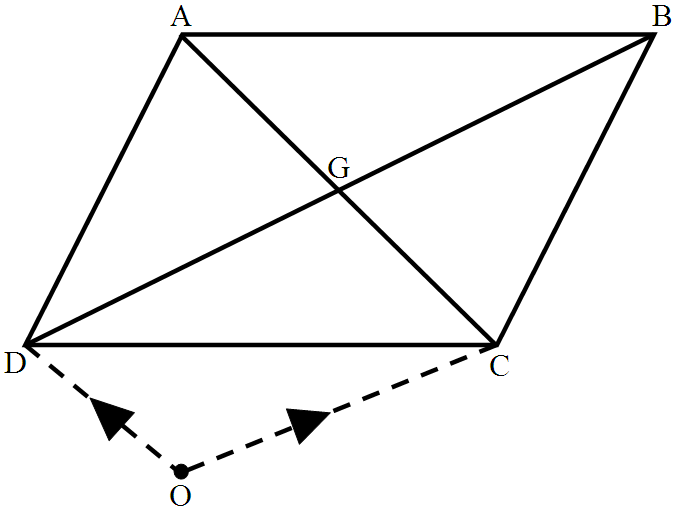
$\therefore\ \overrightarrow{\text{OG}}=\frac{\overrightarrow{\text{OA}}+\overrightarrow{\text{OC}}}2$
$2\overrightarrow{\text{OG}}=\overrightarrow{\text{OA}}+\overrightarrow{\text{OC}}\ \dots(1)$
Also, $G$ is the mid $-$ point $\text{BD}$
$\therefore\ \overrightarrow{\text{OG}}=\frac{\overrightarrow{\text{OB}}+\overrightarrow{\text{OD}}}2$
$2\overrightarrow{\text{OG}}=\overrightarrow{\text{OB}}+\overrightarrow{\text{OD}}\ \dots(2)$
On adding $(1)$ and $(2)$ we get,
$2\overrightarrow{\text{OG}}+2\overrightarrow{\text{OG}}=\overrightarrow{\text{OA}}+\overrightarrow{\text{OB}}+\overrightarrow{\text{OC}}+\overrightarrow{\text{OD}}$
$4\overrightarrow{\text{OG}}=\overrightarrow{\text{OA}}+\overrightarrow{\text{OB}}+\overrightarrow{\text{OC}}+\overrightarrow{\text{OD}}$
$\therefore\overrightarrow{\text{OA}}+\overrightarrow{\text{OB}}+\overrightarrow{\text{OC}}+\overrightarrow{\text{OD}}=4\overrightarrow{\text{OG}}$ View full question & answer→MCQ 401 Mark
The vectors $2\hat{\text{i}}+3\hat{\text{j}}-4\hat{\text{k}}$ and $\text{a}\hat{\text{i}}+\text{b}\hat{\text{j}}+\text{c}\hat{\text{k}}$ are perpendicular if :
- A
$a = 2, b = 3, c = -4$
- ✓
$a = 4, b = 4, c = 5$
- C
$a = 4, b = 4, c = -5$
- D
$a = -4, b = 4, c = -5$
AnswerCorrect option: B. $a = 4, b = 4, c = 5$
It is given that vectors $2\hat{\text{i}}+3\hat{\text{j}}-4\hat{\text{k}}$ and $\text{a}\hat{\text{i}}+\text{b}\hat{\text{j}}+\text{c}\hat{\text{k}}$ are perpendicular.
So, their dot product is zero.
$\Rightarrow2\text{a}+3\text{b}-4\text{c}=0$
$(\text{b})\text{a}=4;\text{b}=4;\text{c}=5$
$\Rightarrow2(4)+3(4)-4(5)=0$
$8+12-20=0$
$0=0,$ which is true.
View full question & answer→MCQ 411 Mark
The resultant of two concurrent forces $\vec{\text{nOP}}$ and $\vec{\text{mOQ}}$ is $(\text{m+n})\vec{\text{OR.}}$ Then $R$ divides $PQ$ in the ratio:
- ✓
$m : n$
- B
$n : m$
- C
$1 : n$
- D
$m : 1$
AnswerCorrect option: A. $m : n$
Applying Section Formula
$\text{R}=\frac{\text{KQ}+\text{P}}{\text{K}+1}$
$(\text{K+1})\text{R = KQ + P}$
$\text{K+1}=\frac{\text{m+n}}{\text{n}}$
$\text{K}=\frac{\text{m}}{\text{n}}$
View full question & answer→MCQ 421 Mark
If $\vec{\text{a}}$ is a non$-$zero of magnitude $'a\ '$ and $\lambda$ is a non$-$zero scalar, then $\lambda\vec{\text{a}}$ is a unit vector if:
AnswerCorrect option: D. $\text{a}=\frac{1}{|\lambda|}$
Given that
$|\vec{\text{a}}|=\text{a};$
Now $,|\lambda\vec{\text{a}}|=1$
$\Rightarrow|\lambda||\vec{\text{a}}|=1$
$\Rightarrow|\lambda|\text{a}=1$
$\Rightarrow\text{a}=\frac{1}{|\lambda|}$
View full question & answer→MCQ 431 Mark
$\text{ABCD}$ is a parallelogram with $AC$ and $BD$ as diagonals. Then, $\overrightarrow{\text{AC}}-\overrightarrow{\text{BD}}=$
- A
$4\overrightarrow{\text{AB}}$
- B
$3\overrightarrow{\text{AB}}$
- ✓
$2\overrightarrow{\text{AB}}$
- D
$\overrightarrow{\text{AB}}$
AnswerCorrect option: C. $2\overrightarrow{\text{AB}}$
Given: $\text{ABCD},$ a parallelogram with diagonals $AC$ and $BD.$
Then, $\overrightarrow{\text{AC}}=\overrightarrow{\text{AB}}+\overrightarrow{\text{BC}}$
$\overrightarrow{\text{AD}}=\overrightarrow{\text{AB}}+\overrightarrow{\text{BD}}$
$\Rightarrow \overrightarrow{\text{BD}}=\overrightarrow{\text{AD}}-\overrightarrow{\text{AB}}$
$\therefore\overrightarrow{\text{AC}}-\overrightarrow{\text{BD}}=\overrightarrow{\text{AB}}+\overrightarrow{\text{BC}}-\overrightarrow{\text{AD}}+\overrightarrow{\text{AB}}=2\overrightarrow{\text{AB}}$
$\Big[\because\ \overrightarrow{\text{AD}}=\overrightarrow{\text{BC}}\Big]$
View full question & answer→MCQ 441 Mark
Choose the correct answer from the given four options. The number of vectors of unit length perpendicular to the vectors $\vec{\text{a}}=2\hat{\text{i}}+\hat{\text{j}}+\hat{2\text{k}}$ and $\vec{\text{b}}=\hat{\text{j}}+\hat{\text{k}}$ is:
AnswerThe number of vectors of unit length perpendicular to the vectors $\vec{\text{a}}$ and $\vec{\text{b}}$ is $\vec{\text{c}} \ ($say$) \ i.e., \vec{\text{c}}=\pm(\vec{\text{a}}\times\vec{\text{b}})$
So, there will be two vectors of unit length perpendicular to the vectors $\vec{\text{a}}$ and $\vec{\text{b}}.$
View full question & answer→MCQ 451 Mark
Can two different vectors have the same magnitude:
AnswerTwo vectors can have the same magnitude.
Magnitude of vector $i - 2j + k$ is equal to magnitude of vector $2i + j - k.$
View full question & answer→MCQ 461 Mark
The value of $\hat{\text{i}}.\big(\hat{\text{j}}\times\hat{\text{k}}\big)+\hat{\text{j}}.\big(\hat{\text{i}}\times\hat{\text{k}}\big)+\hat{\text{k}}.\big(\hat{\text{i}}\times\hat{\text{j}}\big),$ is:
Answer$\hat{\text{i}}.\big(\hat{\text{j}}\times\hat{\text{k}}\big)+\hat{\text{j}}.\big(\hat{\text{i}}\times\hat{\text{k}}\big)+\hat{\text{k}}.\big(\hat{\text{i}}\times\hat{\text{j}}\big)$
$=\hat{\text{i}}.\hat{\text{i}}+\hat{\text{j}}.(-\hat{\text{j}})+\hat{\text{k}}.\hat{\text{k}}$
$=|\hat{\text{i}}|^2-|\hat{\text{j}}|^2+|\hat{\text{k}}|^2$
$=1-1+1$
$=1$
View full question & answer→MCQ 471 Mark
If $\theta$ is the angle between two vectors $\vec{\text{a}}$ and $\vec{\text{b}},$ then $\vec{\text{a}}.\vec{\text{b}}\geq0$ only when:
AnswerCorrect option: B. $0\leq\theta\leq\frac{\pi}{2}$
$\vec{\text{a}}.\vec{\text{b}}\geq0$
$\Rightarrow|\vec{\text{a}}|\big|\vec{\text{b}}\big|\cos\theta\geq0$
$\Rightarrow\cos\theta\geq0$
$\Rightarrow0\leq\theta\leq\frac{\pi}{2}$
View full question & answer→MCQ 481 Mark
If $\vec{\text{a}}$ is any vector, then $\big(\vec{\text{a}}\times\hat{\text{i}}\big)^2+\big(\vec{\text{a}}\times\hat{\text{j}}\big)^2+\big(\vec{\text{a}}\times\hat{\text{k}}\big)^2=$
- A
$\vec{\text{a}}^2$
- ✓
$2\vec{\text{a}}^2$
- C
$3\vec{\text{a}}^2$
- D
$4\vec{\text{a}}^2$
AnswerCorrect option: B. $2\vec{\text{a}}^2$
Let $\vec{\text{a}}={\text{a}}_1\hat{\text{i}}+{\text{a}}_2\hat{\text{j}}+{\text{a}}_3\hat{\text{k}}$
$\vec{\text{a}}\times\hat{\text{i}}=\begin{vmatrix}\hat{\text{i}}&\hat{\text{j}}&\hat{\text{k}}\\\text{a}_1&\text{a}_2&\text{a}_3\\1&0&0 \end{vmatrix}$
$=\text{a}_3\hat{\text{j}}-\text{a}_2\hat{\text{k}}$
$\Rightarrow\big(\vec{\text{a}}\times\hat{\text{i}}\big)^2=\big(\text{a}_3\hat{\text{j}}-\text{a}_2\hat{\text{k}}\big)^2$
$={\text{a}_3}^2|\hat{\text{j}}|^2+{\text{a}_2}^2|\hat{\text{k}}|^2-2\text{a}_3\text{a}_2\big(\hat{\text{j}}.\hat{\text{k}}\big)$
$={\text{a}_3}^2+{\text{a}_2}^2$ $\big(\because\hat{\text{j}}.\hat{\text{k}}=0\dots(1)\big)$
$\therefore\vec{\text{a}}\times\hat{\text{j}}=\begin{vmatrix}\hat{\text{i}}&\hat{\text{j}}&\hat{\text{k}}\\\text{a}_1&\text{a}_2&\text{a}_3\\0&1&0 \end{vmatrix}$
$=-\text{a}_3\hat{\text{i}}+\text{a}_1\hat{\text{k}}$
$\Rightarrow\big(\vec{\text{a}}\times\hat{\text{j}}\big)^2=\big(-\text{a}_3\hat{\text{i}}+\text{a}_1\hat{\text{k}}\big)^2$
$={\text{a}_3}^2|\hat{\text{i}}|^2+{\text{a}_1}^2|\hat{\text{k}}|^2-2\text{a}_3\text{a}_2\big(\hat{\text{i}}.\hat{\text{k}}\big)$
$={\text{a}_3}^2+{\text{a}_1}^2$ $(\because\hat{\text{i}}.\hat{\text{k}}=0)\dots(2)$
$\therefore\vec{\text{a}}\times\hat{\text{k}}=\begin{vmatrix}\hat{\text{i}}&\hat{\text{j}}&\hat{\text{k}}\\\text{a}_1&\text{a}_2&\text{a}_3\\0&0&1 \end{vmatrix}$
$=\text{a}_2\hat{\text{i}}-\text{a}_1\hat{\text{j}}$
$\Rightarrow\big(\vec{\text{a}}\times\hat{\text{k}}\big)^2=\big(\text{a}_2\hat{\text{i}}-\text{a}_1\hat{\text{j}}\big)^2$
$={\text{a}_2}^2|\hat{\text{i}}|^2+{\text{a}_1}^2|\hat{\text{j}}|^2-2\text{a}_1\text{a}_2\big(\hat{\text{i}}.\hat{\text{j}}\big)$
$={\text{a}_2}^2+{\text{a}_1}^2$ $(\because\hat{\text{i}}.\hat{\text{j}}=0)\dots(3)$
Adding $(1), (2)$ and $(3),$ we get
$\big(\vec{\text{a}}\times\hat{\text{i}}\big)^2+\big(\vec{\text{a}}\times\hat{\text{j}}\big)^2+\big(\vec{\text{a}}\times\hat{\text{k}}\big)^2$
$={\text{a}_3}^2+{\text{a}_2}^2+{\text{a}_3}^2+{\text{a}_1}^2+{\text{a}_2}^2+{\text{a}_1}^2$
$=2\big({\text{a}_1}^2+{\text{a}_2}^2+{\text{a}_3}^2\big)$
$=2\vec{\text{a}}^2$ $\big(\because|\vec{\text{a}}|=\sqrt{{\text{a}z_1}^2+{\text{a}_2}^2+{\text{a}_3}^2}\big)$
View full question & answer→MCQ 491 Mark
In a regular hexagon $\text{ABCDEF}, \overrightarrow{\text{AB}}=\vec{\text{a}},\ \overrightarrow{\text{BC}}=\vec{\text{b}}$ and $\overrightarrow{\text{CD}}=\vec{\text{c}}$. Then, $\overrightarrow{\text{AE}}=$
- A
$\vec{\text{a}}+\vec{\text{b}}+\vec{\text{c}}$
- B
$2\vec{\text{a}}+\vec{\text{b}}+\vec{\text{c}}$
- ✓
$\vec{\text{b}}+\vec{\text{c}}$
- D
$\vec{\text{a}}+2\vec{\text{b}}+2\vec{\text{c}}$
AnswerCorrect option: C. $\vec{\text{b}}+\vec{\text{c}}$
Given a regular hexagon $\text{ABCDEF}, \overrightarrow{\text{AB}}=\vec{\text{a}},\ \overrightarrow{\text{BC}}=\vec{\text{b}}$ and $\overrightarrow{\text{CD}}=\vec{\text{c}}$.
Then,
In $\triangle{\text{ABC}}$, we have
$\overrightarrow{\text{AC}}=\vec{\text{a}}+\vec{\text{b}}$
In $\triangle{\text{ACD}}$, we have
$\overrightarrow{\text{AC}}+\overrightarrow{\text{CD}}=\overrightarrow{\text{AD}}$
$\Rightarrow\overrightarrow{\text{AD}}=\overrightarrow{\text{AC}}+\vec{\text{c}}$
$\Rightarrow\overrightarrow{\text{AD}}=\vec{\text{a}}+\vec{\text{b}}+\vec{\text{c}}$
Again, in $\triangle{\text{ADE}}$, we have
$\overrightarrow{\text{AE}}=\overrightarrow{\text{AD}}+\overrightarrow{\text{DE}}$
$\Rightarrow\overrightarrow{\text{AE}}=\vec{\text{a}}+\vec{\text{b}}+\vec{\text{c}}-\vec{\text{a}}$
$\Rightarrow\overrightarrow{\text{AE}}=\vec{\text{b}}+\vec{\text{c}}$
Hence option $(c).$
View full question & answer→MCQ 501 Mark
If $\vec{\text{a}}$ and $\vec{\text{b}}$ are two collinear vectors, then which of the follwoing are incorrect?
- A
$\vec{\text{b}}=\lambda\vec{\text{a}}$ for some scalar $\lambda$
- B
$\vec{\text{a}}=\pm\vec{\text{b}}$
- C
The respective components of $\vec{\text{a}}$ and $\vec{\text{b}}$ are proportional.
- ✓
Both the vectors $\vec{\text{a}}$ and $\vec{\text{b}}$ have the same direction but different magnitudes.
AnswerCorrect option: D. Both the vectors $\vec{\text{a}}$ and $\vec{\text{b}}$ have the same direction but different magnitudes.
If $\vec{\text{a}}$ and $\vec{\text{b}}$ are collinear vectors, then they are parallel.
Therefore, we have $\vec{\text{b}}=\lambda\vec{\text{a}}$, for some scalar $\lambda$.
If $\lambda=\pm1$
$\Rightarrow\vec{\text{a}}=\pm\vec{\text{b}}$
If $\vec{\text{b}}=\text{b}_1\hat{\text{i}}+\text{b}_2\hat{\text{j}}+\text{b}_3\hat{\text{k}}$ and $\vec{\text{a}}=\text{a}_1\hat{\text{i}}+\text{a}_2\hat{\text{j}}+\text{a}_3\hat{\text{k}}$.
Then,
$\vec{\text{b}}=\lambda\vec{\text{a}}$
$\Rightarrow\ \text{b}_1\hat{\text{i}}+\text{b}_2\hat{\text{j}}+\text{b}_3\hat{\text{k}}=\lambda\big(\text{a}_1\hat{\text{i}}+\text{a}_2\hat{\text{j}}+\text{a}_3\hat{\text{k}}\big)$
$\Rightarrow\ \text{b}_1\hat{\text{i}}+\text{b}_2\hat{\text{j}}+\text{b}_3\hat{\text{k}}=(\lambda\text{a}_1)\hat{\text{i}}+(\lambda\text{a}_2)\hat{\text{j}}+(\lambda\text{a}_3)\hat{\text{k}}$
$\Rightarrow\ \text{b}_1=\lambda\text{a}_1,\ \text{b}_2=\lambda\text{a}_2,\ \text{b}_3=\lambda\text{a}_3$
$\Rightarrow\ \frac{\text{b}_1}{\text{a}_1}=\frac{\text{b}_2}{\text{a}_2}=\frac{\text{b}_3}{\text{a}_3}=\lambda$
Thus, the respective components of $\vec{\text{a}}$ and $\vec{\text{b}}$ can have different directions.
Hence, the statement given in $(d)$ is incorrect.
View full question & answer→MCQ 511 Mark
Let $G$ be the centroid of $\triangle{\text{ABC}}$. if $\overrightarrow{\text{AB}}=\vec{\text{a}},\overrightarrow{\text{AC}}=\vec{\text{b}}$, then the bisector $\overrightarrow{\text{AG}}$, in terms of $\vec{\text{a}}$ and $\vec{\text{b}}$ is,
- A
$\frac{2}3\big(\vec{\text{a}}+\vec{\text{b}}\big)$
- B
$\frac{1}6\big(\vec{\text{a}}+\vec{\text{b}}\big)$
- ✓
$\frac{1}3\big(\vec{\text{a}}+\vec{\text{b}}\big)$
- D
$\frac{1}2\big(\vec{\text{a}}+\vec{\text{b}}\big)$
AnswerCorrect option: C. $\frac{1}3\big(\vec{\text{a}}+\vec{\text{b}}\big)$
Taking $A$ as origin. Then, position vector of $A, B$ and $C$ are $\vec0,\vec{\text{a}}$ and $\vec{\text{b}}$ respectively.
Then, Centroid $G$ has position vector $\frac{\vec0+\vec{\text{a}}+\vec{\text{b}}}3=\frac{\vec{\text{a}}+\vec{\text{b}}}3$
Therefore, $\text{AG}=\frac{\vec{\text{a}}+\vec{\text{b}}}3-\vec0=\frac{\vec{\text{a}}+\vec{\text{b}}}3$
View full question & answer→MCQ 521 Mark
If $\theta$ is an acute angle and the vector $(\sin\theta)\hat{\text{i}}+(\cos\theta)\hat{\text{j}}$ is perpendicular to the vector $\hat{\text{i}}-\sqrt{3}\hat{\text{j}},$
- A
$\frac{\pi}{6}$
- B
$\frac{\pi}{5}$
- C
$\frac{\pi}{4}$
- ✓
$\frac{\pi}{3}$
AnswerCorrect option: D. $\frac{\pi}{3}$
The given vectors are perpendicular.
so, their dot product is zero.
$\big[(\sin\theta)\hat{\text{i}}+(\cos\theta)\hat{\text{j}}\big].\big(\hat{\text{j}}-\sqrt{3}\hat{\text{j}}\big)=0$
$\Rightarrow\sin\theta-\sqrt{3}\cos\theta=0$
$\Rightarrow\sin\theta=\sqrt{3}\cos\theta$
$\Rightarrow\tan\theta=\sqrt{3}$
$\Rightarrow\theta=\frac{\pi}{3} ($because $\theta$ is acute$)$
View full question & answer→MCQ 531 Mark
The curve $y-x:$
AnswerCorrect option: B. A horizontal tangent $($parallel to $x-$axis$)$
View full question & answer→MCQ 541 Mark
If three points $A, B$ and $C$ have position vectors $\hat{\text{i}}+\text{x}\hat{\text{j}}+3\hat{\text{k}},\ 3\hat{\text{i}}+4\hat{\text{j}}+7\hat{\text{k}}$ and $\text{y}\hat{\text{i}}-2\hat{\text{j}}-5\hat{\text{k}}$ respectively are collinear, then $(x, y) =$
- ✓
$(2, -3)$
- B
$(-2, 3)$
- C
$(-2, -3)$
- D
$(2, 3)$
AnswerCorrect option: A. $(2, -3)$
Given position vector of $A, B$ and $C$ are $\hat{\text{i}}+\text{x}\hat{\text{j}}+3\hat{\text{k}},\ 3\hat{\text{i}}+4\hat{\text{j}}+7\hat{\text{k}}$ and $\text{y}\hat{\text{i}}-2\hat{\text{j}}-5\hat{\text{k}}$. Then,
$\overrightarrow{\text{AB}}=3\hat{\text{i}}+4\hat{\text{j}}+7\hat{\text{k}}-\hat{\text{i}}-\text{x}\hat{\text{j}}-3\hat{\text{k}}$
$=2\hat{\text{i}}+(4-\text{x})\hat{\text{j}}+4\hat{\text{k}}$
$\overrightarrow{\text{BC}}=\text{y}\hat{\text{i}}-2\hat{\text{j}}-5\hat{\text{k}}-3\hat{\text{i}}-4\hat{\text{j}}-7\hat{\text{k}}$
$=(\text{y}-3)\hat{\text{i}}-6\hat{\text{j}}-12\hat{\text{k}}$
Since, the given vectors are collinear.
$\therefore\ \overrightarrow{\text{AB}}=\lambda\overrightarrow{\text{BC}}$
$\Rightarrow\ 2\hat{\text{i}}+(4-\text{x})\hat{\text{j}}+4\hat{\text{k}}=\lambda(\text{y}-3)\hat{\text{i}}-6\lambda\hat{\text{j}}-12\lambda\hat{\text{k}}$
$\Rightarrow\ 2=\lambda(\text{y}-3),\ (4-\text{x})=-6\lambda,\ 4=-12\lambda$
$\Rightarrow\ 2=\lambda(\text{y}-3),\ (4-\text{x})=-6\lambda,\ \lambda=-\frac{1}3$
$\Rightarrow\ 2=-\frac{1}3(\text{y}-3),\ (4-\text{x})=-6\times\Big(-\frac{1}3\Big)$
$\Rightarrow\ -6=\text{y}-3,\ 4-\text{x}=2$
$\Rightarrow\ \text{y}=-3,\ \text{x}=2$
View full question & answer→MCQ 551 Mark
Choose the correct answer
If $\theta$ is the angle between two vectors $\vec{\text{a}}\ \text{and}\ \vec{\text{b}},\ \text{then}\ \vec{\text{a}}\cdot\vec{\text{b}}\geq0$ only when,
AnswerCorrect option: B. $0\leq\theta\leq\frac{\pi}{2}$
Let $\theta$ be the angle between two vectors $\vec{\text{a}}\ \text{and}\ \vec{\text{b}}.$Then, without loss of generality, $\vec{\text{a}}\ \text{and}\ \vec{\text{b}}$ are non-zero vectors so that $|\vec{\text{a}}|\ \text{and}\ \Big|\vec{\text{b}}\Big|$ are positive
It is known that $\vec{\text{a}}\cdot\vec{\text{b}}=|\vec{\text{a}}| \Big|\vec{\text{b}}\Big|\cos\theta.$
$\therefore\vec{\text{a}}\cdot\vec{\text{b}}\geq0$
$\Rightarrow|\vec{\text{a}}| \Big|\vec{\text{b}}\Big|\cos\theta\geq0$
$\Rightarrow\cos\theta\geq0\ \ \ \Big[\big|\vec{\text{a}}\big|\ \text{and}\ \Big|\vec{\text{b}}\Big|\ \text{are positive}\Big]$
$\Rightarrow0\leq\theta\leq\frac{\pi}{2}$
Hence, $\vec{\text{a}}.\vec{\text{b}}\geq0\ \text{when}\ 0\leq\theta\leq\frac{\pi}{2}.$
The correct answer is B.
View full question & answer→MCQ 561 Mark
Which of the following holds true for a vector quantity:
- A
- B
- ✓
A vector has both direction and magnitude
- D
A vector can never be negative
AnswerCorrect option: C. A vector has both direction and magnitude
A quantity which has both magnitude and direction is called a vector quantity. The quantity which has only magnitude but no direction is called a scalar quantity.
View full question & answer→MCQ 571 Mark
Choose the correct answer
If $\theta$ is the angle between any two vectors $\vec{\text{a}}\ \text{and}\ \vec{\text{b}}, \text{then}\ |\vec{\text{a}}\cdot\vec{\text{b}}|=|\vec{\text{a}}\times\vec{\text{b}}|\ \text{when}\ \theta$ is equal to
- A
- ✓
$\frac{\pi}{4}$
- C
$\frac{\pi}{2}$
- D
$\pi$
AnswerCorrect option: B. $\frac{\pi}{4}$
Let $\theta$ be the angle between two vectors $\vec{\text{a}}\ \text{and}\ \vec{\text{b}}.$
Then, without loss of generality, $\vec{\text{a}}\ \text{and}\ \vec{\text{b}}$ are non-zero vectors, so that $\big|\vec{\text{a}}\big|\ \text{and}\ \Big|\vec{\text{b}}\Big|$ are position.
$\Big|\vec{\text{a}}\cdot\vec{\text{b}}\Big|=\Big|\vec{\text{a}}\times\vec{\text{b}}\Big|$
$\Rightarrow\big|\vec{\text{a}}\big|\Big|\vec{\text{b}}\Big|\cos\theta=\big|\vec{\text{a}}\big|\Big|\vec{\text{b}}\Big|\sin\theta$
$\Rightarrow\cos\theta=\sin\theta\ \ \ \Big[\big|\vec{\text{a}}\big|\ \text{and}\ \Big|\vec{\text{b}}\Big|\Big]\ \text{are positive}$
$\Rightarrow\tan\theta=1$
$\Rightarrow\theta=\frac{\pi}{4}$
Hence, $\Big|\vec{\text{a}}.\vec{\text{b}}\Big|=\Big|\vec{\text{a}}\times\vec{\text{b}}\Big|$ when $\theta$ is equal to $\frac{\pi}{4}.$
The correct answer is B.
View full question & answer→MCQ 581 Mark
If $y = x:$
- ✓
$0.32$
- B
$0.032$
- C
$5.68$
- D
$5.968$
AnswerCorrect option: A. $0.32$
View full question & answer→MCQ 591 Mark
Choose the correct answer from the given four options. If $|\vec{\text{a}}|=4$ and $-3\leq\lambda\leq2,$ then the range of $|\lambda\vec{\text{a}}|$ is :
- A
$[0,8]$
- B
$[-12,8]$
- ✓
$[0,12]$
- D
$[8,12]$
AnswerCorrect option: C. $[0,12]$
We have $|\vec{\text{a}}|=4$ and $-3\leq\lambda\leq2$
Now $|\lambda\vec{\text{a}}|=|\lambda||\vec{\text{a}}|=4|\lambda|$
Now $-3\leq\lambda\leq2$
$\Rightarrow0\leq|\lambda|\leq3$
$\Rightarrow0\leq4|\lambda|\leq12$
$\Rightarrow0\leq|\lambda\vec{\text{a}}|\leq12$
View full question & answer→MCQ 601 Mark
For any three vectors $\vec{\text{a}},\vec{\text{b}},\vec{\text{c}}$ the expression $\big(\vec{\text{a}}-\vec{\text{b}}\big).\big\{\big(\vec{\text{b}}-\vec{\text{c}}\big)\times\big(\vec{\text{c}}-\vec{\text{a}}\big)\big\}$ equals:
- A
$\big[\vec{\text{a}}\vec{\text{b}}\vec{\text{c}}\big]$
- B
$2\big[\vec{\text{a}}\vec{\text{b}}\vec{\text{c}}\big]$
- C
$\big[\vec{\text{a}}\vec{\text{b}}\vec{\text{c}]}^2$
- ✓
AnswerWe have
$\big(\vec{\text{a}}-\vec{\text{b}}\big).\big[\big(\vec{\text{b}}-\vec{\text{c}}\big)\times\big(\vec{\text{c}}-\vec{\text{a}}\big)\big]$
$=\big(\vec{\text{a}}-\vec{\text{b}}\big).\big[\big(\vec{\text{b}}-\vec{\text{c}}\big)\times\vec{\text{c}}-\big(\vec{\text{b}}-\vec{\text{c}}\big)\times\vec{\text{a}}\big]$
$=\big(\vec{\text{a}}-\vec{\text{b}}\big).\big(\vec{\text{b}}\times\vec{\text{c}}-\vec{\text{c}}\times\vec{\text{c}}-\vec{\text{b}}\times\vec{\text{a}}+\vec{\text{c}}\times\vec{\text{a}}\big)$
$=\big(\vec{\text{a}}-\vec{\text{b}}\big).\big(\vec{\text{b}}\times{\vec{\text{c}}}-0-\vec{\text{b}}\times\vec{\text{a}}+\vec{\text{c}}\times\vec{\text{a}}\big)$
$=\big(\vec{\text{a}}-\vec{\text{b}}\big).\big(\vec{\text{b}}\times\vec{\text{c}}\big)-\big(\vec{\text{a}}-\vec{\text{b}}\big).\big(\vec{\text{b}}\times\vec{\text{a}}\big)+\big(\vec{\text{a}}-\vec{\text{b}}\big).\big(\vec{\text{c}}\times\vec{\text{a}}\big)$
$=\vec{\text{a}}.\big(\vec{\text{b}}\times\vec{\text{c}}\big)-\vec{\text{b}}\big(\vec{\text{b}}\times\vec{\text{c}}\big)-\vec{\text{a}}\big(\vec{\text{b}}\times\vec{\text{a}}\big)\\+\vec{\text{b}}.\big(\vec{\text{b}}\times\vec{\text{a}}\big)+\vec{\text{a}}.\big(\vec{\text{c}}\times\vec{\text{a}}\big)-\vec{\text{b}}.\big(\vec{\text{c}}\times\vec{\text{a}}\big)$
$=\big[\vec{\text{a}}\vec{\text{b}}\vec{\text{c}}\big]-0-0+0+0-\big[\vec{\text{b}}\vec{\text{c}}\vec{\text{a}}\big]$ $\big(\therefore\big[\vec{\text{b}}\vec{\text{b}}\vec{\text{c}}\big]=\big[\vec{\text{a}}\vec{\text{b}}\vec{\text{a}}\big]=\big[\vec{\text{b}}\vec{\text{b}}\vec{\text{a}}\big]=0\big)$
$=\big[\vec{\text{a}}\vec{\text{b}}\vec{\text{c}}\big]-\big[\vec{\text{a}}\vec{\text{b}}\vec{\text{c}}\big]$ $\big(\therefore\big[\vec{\text{a}}\vec{\text{b}}\vec{\text{c}}\big]=\big[\vec{\text{b}}\vec{\text{c}}\vec{\text{a}}\big]=\big[\vec{\text{c}}\vec{\text{a}}\vec{\text{b}}\big]\big)$
$=0$
View full question & answer→MCQ 611 Mark
If $\vec{\text{a}},\ \vec{\text{b}},\ \vec{\text{c}}$ are three non-zero vectors, no two of which are collinear and the vector $\vec{\text{a}}+\vec{\text{b}}$ is collinear with $\vec{\text{c}}$, $\vec{\text{b}}+\vec{\text{c}}$ is collinear with $\vec{\text{a}}$, then $\vec{\text{a}}+\vec{\text{b}}+\vec{\text{c}}=$
- A
$\vec{\text{a}}$
- B
$\vec{\text{b}}$
- C
$\vec{\text{c}}$
- ✓
Answer$\vec{\text{a}}+\vec{\text{b}}$ is collinear with $\vec{\text{c}}$
$\therefore\ \vec{\text{a}}+\vec{\text{b}}=\text{x}\vec{\text{c}}\ \dots(1)$
where $x$ is scalar and $\text{x}\neq0$.
$\vec{\text{b}}+\vec{\text{c}}$ is collinear with $\vec{\text{a}}$
$\vec{\text{b}}+\vec{\text{c}}=\text{y}\vec{\text{a}}\ \dots(2)$
$y$ is scalar and $\text{y}\neq0$
Substracting $(2)$ from $(1)$ we get,
$\vec{\text{a}}-\vec{\text{c}}=\text{x}\vec{\text{c}}-\text{y}\vec{\text{a}}$
$\vec{\text{a}}(1+\text{y})=(1+\text{x})\vec{\text{c}}$
As given $\vec{\text{a}},\ \vec{\text{c}}$ are not collinear,
$\therefore\ 1+\text{y}=0$ and $1+\text{x}=0$
$\text{y}=-1$ and $\text{x}=-1$
Putting the value of $x$ in equation $(1)$
$\vec{\text{a}}+\vec{\text{b}}=-\vec{\text{c}}$
$\vec{\text{a}}+\vec{\text{b}}+\vec{\text{c}}=0$
View full question & answer→MCQ 621 Mark
Area of a rectangle having vertices A, B, C and D with position vectors $-\hat{i}+\frac{1}{2}\hat{j}+4\hat{k},\ \hat{i}+\frac{1}{2}\hat{j}+4\hat{k},$ $\hat{i}-\frac{1}{2}\hat{j}+4\hat{k}\ \text{and} \ -\hat{i}-\frac{1}{2}\hat{j}+4\hat{k},$
Answer$\text{Given:}\ \text{ABCD is a rectangle}$
$ \text{Now} \ \ \overrightarrow{\text{AB}}\ $ = Position vector of point B - Position vector of point A
$=\hat{i}+\frac{1}{2}\hat{j}+4\hat{k}-\bigg(-\hat{i}+\frac{1}{2}\hat{j}+4\hat{k}\bigg)$ $=\hat{i}+\frac{1}{2}\hat{j}+4\hat{k}+\hat{i}-\frac{1}{2}\hat{j}-4\hat{k}$
$=2\hat{i}+0\hat{j}+0\hat{k}$
$\therefore \ \text{AB}=\bigg|{\overrightarrow{\text{AB}}\bigg|}\ \ =\sqrt{4+0+0}=\sqrt{4}=2$
$\text{And}\ \ \overrightarrow{\text{AD}}$ = Position vector of point D - Position vector of point A
$=-\hat{i}-\frac{1}{2}\hat{j}+4\hat{k}-\bigg(-\hat{i}+\frac{1}{2}\hat{j}+4\hat{k}\bigg)$ $=-\hat{i}-\frac{1}{2}\hat{j}+4\hat{k}+\hat{i}-\frac{1}{2}\hat{j}-4\hat{k}$
$=0\hat{i}-\hat{j}+0\hat{k}$
$\therefore\ \text{AD}=\bigg|\overrightarrow{\text{AD}}\bigg|=\sqrt{0+1+0}=\sqrt{1}=1$
$\therefore\ $ Area of rectangle ABCD = Length x Breadth = AB × AD = 2 × 1 = 2 eq. units
Therefore, option (C) is correct.
View full question & answer→MCQ 631 Mark
Which of the below given is a vector quantity:
- A
$8\ kg$
- B
$4$ seconds
- ✓
$6$ Newton
- D
$90 \mathrm{~cm}^3$
AnswerCorrect option: C. $6$ Newton
$6$ Newton is a vector quantity as it is a force. Force is a vector quantity which has both magnitude and direction.
View full question & answer→MCQ 641 Mark
If $\text{ABCDEF}$ is a regular hexagon, then $\overrightarrow{\text{AD}}+\overrightarrow{\text{EB}}+\overrightarrow{\text{FC}}$ equals,
- A
$2\overrightarrow{\text{AB}}$
- B
$\vec0$
- C
$3\overrightarrow{\text{AB}}$
- ✓
$4\overrightarrow{\text{AB}}$
AnswerCorrect option: D. $4\overrightarrow{\text{AB}}$
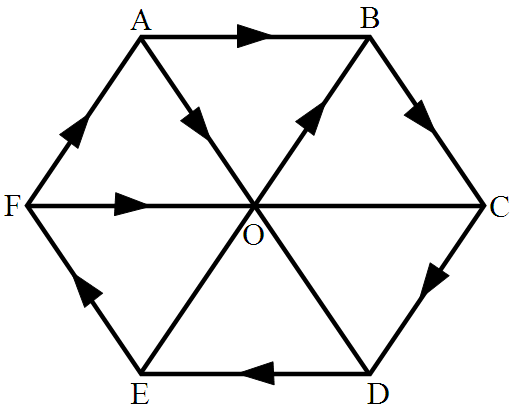
$\overrightarrow{\text{AD}}=2\overrightarrow{\text{BC}}$
$\overrightarrow{\text{EB}}=2\overrightarrow{\text{FA}}$
$\overrightarrow{\text{FC}}=2\overrightarrow{\text{AB}}$
$\overrightarrow{\text{AD}}+\overrightarrow{\text{EB}}=2\Big(\overrightarrow{\text{BC}}+\overrightarrow{\text{FA}}\Big)$
$=2\Big(\overrightarrow{\text{AO}}+\overrightarrow{\text{FA}}\Big)$ $\Big(\because\ \overrightarrow{\text{BC}}=\overrightarrow{\text{AO}}\Big)$
In triangle $\text{AOF},$
$\overrightarrow{\text{FA}}+\overrightarrow{\text{AO}}+\overrightarrow{\text{FO}}=0$
$\therefore\ \overrightarrow{\text{FA}}+\overrightarrow{\text{AO}}=-\overrightarrow{\text{FO}}$
$\therefore\overrightarrow{\text{AD}}+\overrightarrow{\text{EB}}=-2\overrightarrow{\text{FO}}$
And $\overrightarrow{\text{AB}}=-\overrightarrow{\text{FO}}$
$\therefore\overrightarrow{\text{AD}}+\overrightarrow{\text{EB}}=2\overrightarrow{\text{AB}}$
$\therefore\overrightarrow{\text{AD}}+\overrightarrow{\text{EB}}+\overrightarrow{\text{FC}}$
$=2\overrightarrow{\text{AB}}+2\overrightarrow{\text{AB}}$
$=4\overrightarrow{\text{AB}}$ View full question & answer→MCQ 651 Mark
If $\vec{\text{a}},\vec{\text{b}},\vec{\text{c}}$ and $\vec{\text{d}}$ are the position vector of points $\text{A, B, C, D}$ such that no three of them are collinear and $\vec{\text{a}}+\vec{\text{c}}=\vec{\text{b}}+\vec{\text{d}}$, then $\text{ABCD}$ is a,
AnswerGiven :
$\vec{\text{a}}+\vec{\text{c}}=\vec{\text{b}}+\vec{\text{d}}$
$\Rightarrow\vec{\text{c}}-\vec{\text{d}}=\vec{\text{b}}-\vec{\text{a}}$
$\Rightarrow\overrightarrow{\text{AB}}=\overrightarrow{\text{DC}}$
And $\vec{\text{a}}+\vec{\text{c}}=\vec{\text{b}}+\vec{\text{d}}$
$\Rightarrow\vec{\text{c}}-\vec{\text{b}}=\vec{\text{d}}-\vec{\text{a}}$
$\Rightarrow\overrightarrow{\text{AD}}=\overrightarrow{\text{BC}}$
Also, since $\vec{\text{a}}+\vec{\text{c}}=\vec{\text{b}}+\vec{\text{d}}$
$\Rightarrow\frac{1}2\big(\vec{\text{a}}+\vec{\text{c}}\big)=\frac{1}2\big(\vec{\text{b}}+\vec{\text{d}}\big)$
So, position vector of mid $-$ point of $\text{BD} =$ position vector of mid $-$ point of $\text{AC}.$
Hence diagonals bisect each other.
The given $\text{ABCD}$ is a parallelogram.
View full question & answer→MCQ 661 Mark
A vector whose initial and terminal points coincide, is:
AnswerThe vector whose initial and terminals points are coincide has the length $0.$
we call it to be a zero vector and the zero vector no has the particular direction,
so that it can be assigned in any direction.
View full question & answer→MCQ 671 Mark
Forces $3\overrightarrow{\text{OA}},\ 5\overrightarrow{\text{OB}}$ act along $OA$ and $OB$. If their resultant passes through $C$ on $AB,$ then,
AnswerCorrect option: C. $3AC = 5CB$
Draw $ON,$ the perpendicular to the line $AB$
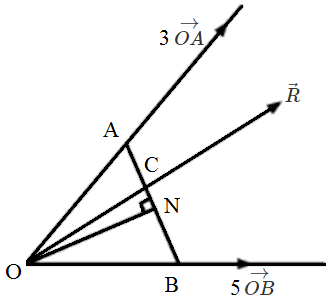
Let $\vec{\text{i}}$ be the unit vector along $\text{ON}$
The resultant force $\vec{\text{R}}=3\overrightarrow{\text{OA}}+5\overrightarrow{\text{OB}}\ \dots(1)$
The angles between $\vec{\text{i}}$ and the forces $\vec{\text{R}},\ 3\overrightarrow{\text{OA}},\ 5\overrightarrow{\text{OB}}$ are $\angle\text{CON},\ \angle\text{AON},\ \angle\text{BON}$ respectively.
$\vec{\text{R}}.\vec{\text{i}}=3\overrightarrow{\text{OA}}.\vec{\text{i}}+5\overrightarrow{\text{OB}}.\vec{\text{i}}$
$\Rightarrow\text{R}.1.\cos\angle\text{CON}$
$=3\overrightarrow{\text{OA}}.1.\cos\angle\text{AON}+5\overrightarrow{\text{OB}}.1.\cos\angle{\text{BON}}$
$\text{R}.\frac{\text{ON}}{\text{OC}}=3\text{OA}\times\frac{\text{ON}}{\text{OA}}+5\text{OB}\frac{\text{ON}}{\text{OB}}$
$\frac{\text{R}}{\text{OC}}=(3+5)$
$\text{R}=8\overrightarrow{\text{OC}}$
We know that,
$\overrightarrow{\text{OA}}=\overrightarrow{\text{OC}}+\overrightarrow{\text{CA}}$
$\Rightarrow3\overrightarrow{\text{OA}}=3\overrightarrow{\text{OC}}+3\overrightarrow{\text{CA}}\ \dots(\text{i})$
$\overrightarrow{\text{OB}}=\overrightarrow{\text{OC}}+\overrightarrow{\text{CB}}$
$\Rightarrow5\overrightarrow{\text{OB}}=5\overrightarrow{\text{OC}}+5\overrightarrow{\text{CB}}\ \dots(\text{ii})$
On adding $(i)$ and $(ii)$ we get,
$3\overrightarrow{\text{OA}}+5\overrightarrow{\text{OB}}=8\overrightarrow{\text{OC}}+3\overrightarrow{\text{CA}}+5\overrightarrow{\text{CB}}$
$\vec{\text{R}}=8\overrightarrow{\text{OC}}+3\overrightarrow{\text{CA}}+5\overrightarrow{\text{CB}}$
$8\overrightarrow{\text{OC}}=8\overrightarrow{\text{OC}}+3\overrightarrow{\text{CA}}+5\overrightarrow{\text{CB}}$
$\Big|3\overrightarrow{\text{AC}}\Big|=\Big|5\overrightarrow{\text{CB}}\Big|$
$\Rightarrow3\overrightarrow{\text{AC}}=5\overrightarrow{\text{CB}}$ View full question & answer→MCQ 681 Mark
The Polygon Law of Vector Addition is simply an extension of:
- A
Parallelogram Law of Vector Addition
- ✓
Triangular Law of Vector Addition
- C
Both $A$ and $B$
- D
AnswerCorrect option: B. Triangular Law of Vector Addition
The Polygon Law of Vector Addition is simply an extension of Triangular Law of Vector Addition.
Here, we take into consideration more than two sides unlike in triangular law of vector addition.
View full question & answer→MCQ 691 Mark
If $\theta$ is the angle between any two vectors $\vec{\text{a}}$ and $\vec{\text{b}},$ then $\big|\vec{\text{a}}.\vec{\text{b}}\big|=\big|\vec{\text{a}}\times\vec{\text{b}}\big|$ when $\theta$ is equal to:
- A
$0$
- ✓
$\frac{\pi}{4}$
- C
$\frac{\pi}{2}$
- D
$\pi$
AnswerCorrect option: B. $\frac{\pi}{4}$
Let $\theta$ be the angle between $\vec{\text{a}}$ and $\vec{\text{b}}.$
We know
$\big|\vec{\text{a}}\times\vec{\text{b}}\big|=|\vec{\text{a}}|\big|\vec{\text{b}}\big|\sin\theta$
$\vec{\text{a}}.\vec{\text{b}}=|\vec{\text{a}}|\big|\vec{\text{b}}\big|\cos\theta$
$\Rightarrow\big|\vec{\text{a}}.\vec{\text{b}}\big|=\big||\vec{\text{a}}|\big|\vec{\text{b}}\big|\cos\theta\big|=|\vec{\text{a}}|\big|\vec{\text{b}}\big||\cos\theta|$
Given: $\big|\vec{\text{a}}.\vec{\text{b}}\big|=\big|\vec{\text{a}}\times\vec{\text{b}}\big|$
$\Rightarrow|\vec{\text{a}}|\big|\vec{\text{b}}\big||\cos\theta|=|\vec{\text{a}}|\big|\vec{\text{b}}\big|\sin\theta$
$\Rightarrow|\cos\theta|=\sin\theta$
$\Rightarrow\theta=\frac{\pi}{4}$
View full question & answer→MCQ 701 Mark
If points $\text{A}(60\hat{\text{i}}+3\hat{\text{j}}),\ \text{B}(40\hat{\text{i}}-8\hat{\text{j}})$ and $\text{C}(\text{a}\hat{\text{i}}+52\hat{\text{j}})$ are collinear, then a is equal to,
AnswerGiven: Three points $\text{A}(60\hat{\text{i}}+3\hat{\text{j}}),\ \text{B}(40\hat{\text{i}}-8\hat{\text{j}})$ and $\text{C}(\text{a}\hat{\text{i}}+52\hat{\text{j}})$ are collinear.
Then, $\overrightarrow{\text{AB}}=\lambda\overrightarrow{\text{BC}}$
We have, $\overrightarrow{\text{AB}}=\big(40\hat{\text{i}}-8\hat{\text{j}}\big)-\big(60\hat{\text{i}}+3\hat{\text{j}}\big)$
$=-20\hat{\text{i}}-11\hat{\text{j}}$
$\overrightarrow{\text{BC}}=\big(\text{a}\hat{\text{i}}-52\hat{\text{j}}\big)-\big(40\hat{\text{i}}-8\hat{\text{j}}\big)$
$=(\text{a}-40)\hat{\text{i}}-44\hat{\text{j}}$
Therefore, $\overrightarrow{\text{AB}}=\lambda\overrightarrow{\text{BC}}$
$\Rightarrow-20\hat{\text{i}}-11\hat{\text{j}}=\lambda(\text{a}-40)\hat{\text{i}}-\lambda44\hat{\text{j}}$
$\Rightarrow\lambda(\text{a}-40)=-20,\ -44\lambda=-11\Rightarrow\lambda=\frac{1}4$
$\Rightarrow\text{a}-40=-80$
$\Rightarrow\text{a}=-40$
View full question & answer→MCQ 711 Mark
The Polygon Law of Vector Addition is simply an extension of $.............?$
- A
Parallelogram Law of Vector Addition
- ✓
Triangular Law of Vector Addition
- C
Both $A$ and $B$
- D
AnswerCorrect option: B. Triangular Law of Vector Addition
The Polygon Law of Vector Addition is simply an extension of Triangular Law of Vector Addition.
Here we take into consideration more than two sides unlike in triangular law of vector addition.
View full question & answer→MCQ 721 Mark
If two or more vectors are parallel to the same line, irrespective of their magnitudes and directions, then they are:
AnswerCollinear vectors are two or more vectors which are parallel to the same line irrespective of their magnitude and direction.
View full question & answer→MCQ 731 Mark
If $\vec{\text{a}}$ and $\vec{\text{b}}$ be two unit vectors and $\theta$ the angle between them, than $\vec{\text{a}}+\vec{\text{b}}$ is a unit vector if $\theta=$
- A
$\frac{\pi}{4}$
- B
$\frac{\pi}{3}$
- C
$\frac{\pi}{2}$
- ✓
$\frac{2\pi}{3}$
AnswerCorrect option: D. $\frac{2\pi}{3}$
We have
$|\vec{\text{a}}|=1$ and $\big|\vec{\text{b}\big|}=1$
Now, $\big|\vec{\text{a}}+\vec{\text{b}}\big|=1$
$\Rightarrow|\vec{\text{a}}|^2+\big|\vec{\text{b}\big|}^2+2\vec{\text{a}}.\vec{\text{b}}=1$
$\Rightarrow1+1+2|\vec{\text{a}}|\big|\vec{\text{b}}\big|\cos\theta=1$
$\Rightarrow2+2\cos\theta=1$
$\Rightarrow2\cos\theta=-1$
$\Rightarrow\cos\theta=\frac{-1}{2}$
$\Rightarrow\theta=\frac{2\pi}{3}$
View full question & answer→MCQ 741 Mark
The distance of the point $(-3, 4, 5)$ from the origin:
AnswerCorrect option: B. $5\sqrt{2}$
View full question & answer→MCQ 751 Mark
The vector component of $\vec{\text{b}}$ perpendicular to $\vec{\text{a}}$ is:
- A
$\big(\vec{\text{b}}.\vec{\text{c}}\big)\vec{\text{a}}$
- ✓
$\frac{\vec{\text{a}}\times\big(\vec{\text{b}}\times\vec{\text{a}}\big)}{|\vec{\text{a}}|^2}$
- C
$\vec{\text{a}}\times\big(\vec{\text{b}}\times\vec{\text{a}}\big)$
- D
AnswerCorrect option: B. $\frac{\vec{\text{a}}\times\big(\vec{\text{b}}\times\vec{\text{a}}\big)}{|\vec{\text{a}}|^2}$
The vector component of $\vec{\text{b}}$ perpendicular to $\vec{\text{a}}$ is
$=\frac{\vec{\text{a}}\times\big(\vec{\text{b}}\times\vec{\text{a}}\big)}{|\vec{\text{a}}|^2}$
View full question & answer→MCQ 761 Mark
If $\mid\text{a}\mid=4$ and $-3\underline{<}\lambda\underline{<}2$ then the range of $\mid\lambda\text{a}\mid$ is:
- A
$[0, 8]$
- B
$[-12, 8]$
- ✓
$[0, 12]$
- D
$[8, 12]$
AnswerCorrect option: C. $[0, 12]$
View full question & answer→MCQ 771 Mark
What is the value of $x$ and $y,$ if $2i + 3j = xi + yj:$
- A
$4, 9$
- B
$3, 2$
- ✓
$2, 3$
- D
$0, 0$
AnswerCorrect option: C. $2, 3$
$2i + 3j = xi + yj$
On comparing the two equations, we have,
$x = 2$ and $y = 3$
View full question & answer→MCQ 781 Mark
Choose the correct answer from the given four options. For any vector $\vec{\text{a}},$ the value of $(\vec{\text{a}}\times\hat{\text{i}})^2+(\vec{\text{a}}\times\hat{\text{j}})^2+(\vec{\text{a}}\times\hat{\text{k}})^2$ is :
- A
$\vec{\text{a}}^2$
- B
$3\vec{\text{a}}^2$
- C
$4\vec{\text{a}}^2$
- ✓
$2\vec{\text{a}}^2$
AnswerCorrect option: D. $2\vec{\text{a}}^2$
Let $\vec{\text{a}}^2=\text{x}\hat{\text{i}}+\text{y}\hat{\text{j}}+\text{z}\hat{\text{k}}$
$\therefore\vec{\text{a}}^2=\text{x}^2+\text{y}^2+\text{z}^2$
$\therefore\ \vec{\text{a}}\times\vec{\text{i}}\begin{vmatrix}\hat{\text{i}}&\hat{\text{j}}&\hat{\text{k}} \\\text{x}&\text{y}&\text{z}\\1&0&0 \end{vmatrix}$
$=\hat{\text{i}}[0]-\hat{\text{j}}[-\text{z}]+\hat{\text{k}}[-\text{y}]$
$=\text{z}\hat{\text{j}}-\text{y}\hat{\text{k}}$
$\therefore\ (\vec{\text{a}}\times\hat{\text{i}})=(\text{z}\hat{\text{j}}-\text{y}\hat{\text{k}})(\text{z}\hat{\text{j}}-\text{y}\hat{\text{k}})$
$=\text{y}^2+\text{z}^2$
Similarly, $(\vec{\text{a}}\times\hat{\text{j}})^2=\text{x}^2+\text{z}^2$
And $(\vec{\text{a}}\times\hat{\text{k}})^2=\text{x}^2+\text{y}^2$
$\therefore\ (\vec{\text{a}}\times\hat{\text{i}})^2+(\vec{\text{a}}\times\hat{\text{j}})^2+(\vec{\text{a}}\times\hat{\text{k}})^2$
$=\text{y}^2+\text{z}^2+\text{x}^2+\text{z}^2+\text{x}^2+\text{y}^2$
$2(\text{x}^2+\text{y}^2+\text{z}^2)=2\vec{\text{a}}^2$
View full question & answer→MCQ 791 Mark
Choose the correct answer from the given four options. If $\vec{\text{a}},\vec{\text{b}},\vec{\text{c}}$ are three vectors such that $\vec{\text{a}}+\vec{\text{b}}+\vec{\text{c}}=\vec{0}$ and $|\vec{\text{a}}|=2,|\vec{\text{b}}|=3$ and $|\vec{\text{c}}|=5,$ then the value of $\vec{\text{a}}\cdot\vec{\text{b}}+\vec{\text{b}}\cdot\vec{\text{c}}+\vec{\text{c}}\cdot\vec{\text{a}}$ is:
AnswerCorrect option: C. $-19.$
Here, $\vec{\text{a}}+\vec{\text{b}}+\vec{\text{c}}=\vec{0}$ and $\vec{\text{a}}^2=4,\vec{\text{b}}^2=9,\vec{\text{c}}^2=25$
$\therefore(\vec{\text{a}}+\vec{\text{b}}+\vec{\text{c}})\cdot(\vec{\text{a}}+\vec{\text{b}}+\vec{\text{c}})=0$
$\Rightarrow\vec{\text{a}}^2+\vec{\text{a}}\cdot\vec{\text{b}}+\vec{\text{a}}\cdot\vec{\text{c}}+\vec{\text{b}}\cdot\vec{\text{a}}+\vec{\text{b}}^2+\vec{\text{b}}\cdot\vec{\text{c}}+\vec{\text{c}}\cdot\vec{\text{a}}+\vec{\text{c}}\cdot\vec{\text{b}}+\vec{\text{c}}^2=0$
$\Rightarrow\vec{\text{a}}+\vec{\text{b}}+\vec{\text{c}}+2(\vec{\text{a}}\cdot\vec{\text{b}}+\vec{\text{b}}\cdot\vec{\text{c}}+\vec{\text{c}}\cdot\vec{\text{a}})=0$ $[\because\vec{\text{a}}\cdot\vec{\text{b}}=\vec{\text{b}}\cdot\vec{\text{a}}]$
$\Rightarrow4+9+25+2(\vec{\text{a}}\cdot\vec{\text{b}}+\vec{\text{b}}\cdot\vec{\text{c}}+\vec{\text{c}}\cdot\vec{\text{a}})=0$
$\Rightarrow\vec{\text{a}}\cdot\vec{\text{b}}+\vec{\text{b}}\cdot\vec{\text{c}}+\vec{\text{c}}\cdot\vec{\text{a}}=0$
$\Rightarrow\frac{-38}{2}=-19$
View full question & answer→MCQ 801 Mark
If the points $A$ and $B$ are $(1, 2, -1),$ and $(2, 1, -1)$ respectively, then $ \vec{ \text{AB }} $ is:
- A
$\hat{\text{i}}+\hat{\text{j}}$
- ✓
$\hat{\text{i}}-\hat{\text{j}}$
- C
$2\hat{\text{i}}+\hat{\text{j}}-\hat{\text{k}}$
- D
$\hat{\text{i}}+\hat{\text{j}}+\hat{\text{k}}$
AnswerCorrect option: B. $\hat{\text{i}}-\hat{\text{j}}$
$ \vec{ \text{AB}}=\langle{2-1, 1-2,-1+1}\rangle$
$=\langle{1, -1, 0}\rangle$
$\therefore \vec{ \text{AB}}=\hat{\text{i}}-\hat{\text{j}}$
View full question & answer→MCQ 811 Mark
$\big[\vec{\text{a}}\vec{\text{b}}\vec{\text{a}}\times\vec{\text{b}}\big]+\big(\vec{\text{a}}.\vec{\text{b}}\big)^2=$
- ✓
$\big|\vec{\text{a}}\big|^2\big|\vec{\text{b}}\big|^2$
- B
$\big|\vec{\text{a}}+\vec{\text{b}}\big|^2$
- C
$\big|\vec{\text{a}}\big|^2+\big|\vec{\text{b}}\big|^2$
- D
$2\big|\vec{\text{a}}\big|^2\big|\vec{\text{b}}\big|^2$
AnswerCorrect option: A. $\big|\vec{\text{a}}\big|^2\big|\vec{\text{b}}\big|^2$
We have
$\big[\vec{\text{a}}\vec{\text{b}}\vec{\text{a}}\times\vec{\text{b}}\big]+\big(\vec{\text{a}}.\vec{\text{b}}\big)^2$
$=\big(\vec{\text{a}}\times\vec{\text{b}}\big).\big(\vec{\text{a}}\times\vec{\text{b}}\big)+\big(\vec{\text{a}}.\vec{\text{b}}\big)^2$
$=\big|\big(\vec{\text{a}}\times\vec{\text{b}}\big)\big|^2+\big(\vec{\text{a}}.\vec{\text{b}}\big)^2$
$=\big(\big|\vec{\text{a}}\big|\big|\vec{\text{b}}\big|\sin\theta\big)^2+\big(\big|\vec{\text{a}}\big|\big|\vec{\text{b}}\big|\cos\theta\big)^2$
$=\big|\vec{\text{a}}\big|^2\big|{\text{b}}\big|^2\sin^2\theta+\big|\vec{\text{a}}\big|^2\big|\vec{\text{b}}\big|^2\cos^2\theta$
$=\big|\vec{\text{a}}\big|^2\big|\vec{\text{b}}\big|^2\big(\sin^2\theta+\cos^2\theta\big)$
$=\big|\vec{\text{a}}\big|^2\big|\vec{\text{b}}\big|^2$
View full question & answer→MCQ 821 Mark
Choose the correct answer from the given four options. Find the value of $\lambda$ such that the vectors $\vec{\text{a}}=2\hat{\text{i}}+\lambda\hat{\text{j}}+\hat{\text{k}}$ and $\vec{\text{a}}=\hat{\text{i}}+2\hat{\text{j}}+3\hat{\text{k}}$ are orthogonal:
- A
$0$
- B
$1$
- C
$\frac{3}{2}$
- ✓
$-\frac{5}{2}$
AnswerCorrect option: D. $-\frac{5}{2}$
Given two non$-$zero vectors $\vec{\text{a}}$ and $\vec{\text{b}}$ are orthogonal
$\therefore\ \vec{\text{a}}\cdot\vec{\text{b}}=0$
$\therefore\ (2\hat{\text{i}}+\lambda\hat{\text{j}}+\hat{\text{k}})\cdot(\hat{\text{i}}+2\hat{\text{j}}+\hat{3\text{k}})=0$
$\Rightarrow2+2\lambda+3=0$
$\Rightarrow\lambda=-\frac{5}{2}$
View full question & answer→MCQ 831 Mark
If the vectors $3\hat{\text{i}}+\lambda\hat{\text{j}}+\hat{\text{k}}$ and $2\hat{\text{i}}-\hat{\text{j}}+8\hat{\text{k}}$ are perpendicular, then $\lambda$ is equal to :
- A
$-14$
- B
$7$
- ✓
$14$
- D
$\frac{1}{7}$
AnswerIt is given that vectors $3\hat{\text{i}}+\lambda\hat{\text{j}}+\hat{\text{k}}$ and $2\hat{\text{i}}-\hat{\text{j}}+8\hat{\text{k}}$ are perpendicular.
So, their dot product is zero.
$\big(3\hat{\text{i}}+\lambda\hat{\text{j}}+\hat{\text{k}}\big).\big(2\hat{\text{i}}-\hat{\text{j}}+8\hat{\text{k}}\big)=0$
$\Rightarrow6-\lambda+8=0$
$\Rightarrow14-\lambda=0$
$\therefore\lambda=14$
View full question & answer→MCQ 841 Mark
Choose the correct answer from the given four options. The vectors $\lambda\hat{\text{i}}+\hat{\text{j}}+2\hat{\text{k}},\ \hat{\text{i}}+\lambda\hat{\text{j}}-\hat{\text{k}}$ and $2\hat{\text{i}}-\hat{\text{j}}+\lambda\hat{\text{k}}$ are coplanar if :
- ✓
$\lambda=-2$
- B
$\lambda=0$
- C
$\lambda=1$
- D
$\lambda=-1$
AnswerCorrect option: A. $\lambda=-2$
Let $\vec{\text{a}}=\lambda\hat{\text{i}}+\hat{\text{j}}+2\hat{\text{k}},\ \vec{\text{b}}=\hat{\text{i}}+\lambda\hat{\text{j}}-\hat{\text{k}}$ and $\vec{\text{c}}=2\hat{\text{i}}-\hat{\text{j}}+\lambda\hat{\text{k}}$
For $\vec{\text{a}},\vec{\text{b}}$ and $\vec{\text{c}}$ to be coplanar,
$\begin{vmatrix}\lambda&1&2 \\1&\lambda&-1\\2&-1&\lambda \end{vmatrix}=0$
$\Rightarrow\lambda(\lambda^2-1)-1(\lambda+2)+2(-1-2\lambda)=0$
$\Rightarrow\lambda^3-\lambda-\lambda-2-2-4\lambda=0$
$\Rightarrow\lambda^3-6\lambda-4=0$
$\Rightarrow(\lambda+2)(\lambda^2-2\lambda-2)=0$
$\Rightarrow\lambda=-2$ or $\lambda=\frac{2\pm\sqrt{12}}{2}$
$\Rightarrow\lambda=-2$ or $\lambda=1\pm\sqrt{3}$
View full question & answer→MCQ 851 Mark
Let $\vec{\text{a}}$ and $\vec{\text{b}}$ be two unit vectors and a be the angle between them. Then, $\vec{\text{a}}+\vec{\text{b}}$ is a unit vector if :
AnswerCorrect option: C. $\text{a}=\frac{2\pi}{3}$
$\vec{\text{a}}$ and $\vec{\text{b}}$ are unit vectors.
$\Rightarrow|\vec{\text{a}}|=\big|\vec{\text{b}}\big|=1\dots(1)$
Now,
$\vec{\text{a}}.\vec{\text{b}}=|\vec{\text{a}}|\big|\vec{\text{b}}\big|\cos\text{a}$
$\Rightarrow\vec{\text{a}}.\vec{\text{b}}=\cos\text{a}\dots(2)$
$[$using $(1)]$
Given that
$\Big|\vec{\text{a}}+\vec{\text{b}}\big|=1$
Squaring both sides, we get
$\big|\vec{\text{a}}+\vec{\text{b}}\big|^2=1$
$\Rightarrow|\vec{\text{a}}|^2+\big|\vec{\text{b}}\big|^2+2\vec{\text{a}}.\vec{\text{b}}=1$
$\Rightarrow1+1+2\cos\text{a}=1\ [$using $(1)$ and $(2)]$
$\Rightarrow2+2\cos\text{a}=1$
$\Rightarrow2\cos\text{a}=-1$
$\Rightarrow\cos\text{a}=\frac{-1}{2}$
$\Rightarrow\text{a}=\frac{2\pi}{3}$
View full question & answer→MCQ 861 Mark
If $\vec{\text{a}}$ and $\vec{\text{b}}$ are unit vectors inclined at an angle $\theta,$ then the value of $\big|\vec{\text{a}}-\vec{\text{b}}\big|$ is:
- ✓
$2\sin\frac{\theta}{2}$
- B
$2\sin\theta$
- C
$2\cos\frac{\theta}{2}$
- D
$2\cos\theta$
AnswerCorrect option: A. $2\sin\frac{\theta}{2}$
$\vec{\text{a}}.\vec{\text{b}}=|\vec{\text{a}}|\big|\vec{\text{b}}\big|\cos\theta$
$=1\times1\cos\theta ($Because $\vec{\text{a}}$ and $\vec{\text{b}}$ are unit vectors$)$
$=\cos\theta\dots(1)$
$\big|\vec{\text{a}}-\vec{\text{b}}\big|^2=|\vec{\text{a}}|^2+\big|\vec{\text{b}}\big|^2-2\vec{\text{a}}.\vec{\text{b}}$
$=1+1-2\cos\theta [$using $(1)]$
$=2-2\cos\theta$
$=2(1-\cos)$
$=2\big(2\sin^2\frac{\theta}{2}\big)$
$=4\sin^2\frac{\theta}{2}$
$\therefore\big|\vec{\text{a}}-\vec{\text{b}}\big|=2\sin\frac{\theta}{2}$
View full question & answer→MCQ 871 Mark
The value of $\big[\vec{\text{a}}-\vec{\text{b}},\vec{\text{b}}-\vec{\text{c}},\vec{\text{c}}-\vec{\text{a}}\big],$ where $\big|\vec{\text{a}}\big|=1,\big|\vec{\text{b}}\big|=5,\big|\vec{\text{c}}\big|=3,$ is:
AnswerWe have
$\big[\vec{\text{a}}-\vec{\text{b}},\vec{\text{b}}-\vec{\text{c}},\vec{\text{c}}-\vec{\text{a}}\big]$
$=\big(\big(\vec{\text{a}}-\vec{\text{b}}\big)\times\big(\vec{\text{b}}-\vec{\text{c}}\big)\big).\big(\vec{\text{c}}.\vec{\text{a}}\big) ($By definition of scalar triple product$)$
$=\big(\big(\vec{\text{a}}-\vec{\text{b}}\big)\times\vec{\text{b}}-\big(\vec{\text{a}}-\vec{\text{b}}\big)\times\vec{\text{c}}\big).\big(\vec{\text{c}}-\vec{\text{a}}\big)$
$=\big(\vec{\text{a}}\times\vec{\text{b}}-\vec{\text{b}}\times{\vec{\text{b}}}-\vec{\text{a}}\times\vec{\text{c}}+\vec{\text{b}}\times\vec{\text{c}}\big).\big(\vec{\text{c}}-\vec{\text{a}}\big)$
$=\big(\vec{\text{a}}\times\vec{\text{b}}-0-\vec{\text{a}}\times\vec{\text{c}}+\vec{\text{b}}\times\vec{\text{c}}\big).\big(\vec{\text{c}}-\vec{\text{a}}\big)$
$=\big(\vec{\text{a}}\times\vec{\text{b}}\big).\big(\vec{\text{c}}-\vec{\text{a}}\big)-\big(\vec{\text{a}}\times\vec{\text{c}}\big).\big(\vec{\text{c}}-\vec{\text{a}}\big)+\big(\vec{\text{b}}\times\vec{\text{c}}\big).\big(\vec{\text{c}}-\vec{\text{a}}\big)$
$=\big(\vec{\text{a}}\times\vec{\text{b}}\big).\vec{\text{c}}-\big(\vec{\text{a}}\times\vec{\text{b}}\big).\vec{\text{a}}-\big(\vec{\text{a}}\times\vec{\text{c}}\big).\vec{\text{c}}+\big(\vec{\text{a}}\times\vec{\text{c}}\big).\vec{\text{a}}+\big(\vec{\text{b}}\times\vec{\text{c}}\big).\vec{\text{c}}\big(\vec{\text{b}}\times\vec{\text{c}}\big)\\.\vec{\text{a}}\big[\vec{\text{a}}\vec{\text{b}}\vec{\text{c}}\big]-\big[\vec{\text{a}}\vec{\text{b}}\vec{\text{a}}\big]-\big[\vec{\text{a}}\vec{\text{c}}\vec{\text{c}}\big]+\big[\vec{\text{a}}\vec{\text{c}}\vec{\text{a}}\big]+\big[\vec{\text{b}}\vec{\text{c}}\vec{\text{c}}\big]-\big[\vec{\text{b}}\vec{\text{c}}\vec{\text{a}}\big]$
$=\big[\vec{\text{a}}\vec{\text{b}}\vec{\text{c}}\big]-0+0+0-\big[\vec{\text{a}}\vec{\text{b}}\vec{\text{c}}\big]$ $\big(\therefore\big[\vec{\text{a}}\vec{\text{b}}\vec{\text{c}}\big]=\big[\vec{\text{b}}\vec{\text{c}}\vec{\text{a}}\big]=\big[\vec{\text{c}}\vec{\text{a}}\vec{\text{b}}\big]\big)$
$=0$
View full question & answer→MCQ 881 Mark
If $\vec{\text{a}} $ lies in the plane of vectors $\vec{\text{b}}$ and $\vec{\text{c}},$ then which of the following is correct?
- ✓
$\big[\vec{\text{a}}\vec{\text{b}}\vec{\text{c}}\big]=0$
- B
$\big[\vec{\text{a}}\vec{\text{b}}\vec{\text{c}}\big]=1$
- C
$\big[\vec{\text{a}}\vec{\text{b}}\vec{\text{c}}\big]=3$
- D
$\big[\vec{\text{b}}\vec{\text{c}}\vec{\text{a}}\big]=1$
AnswerCorrect option: A. $\big[\vec{\text{a}}\vec{\text{b}}\vec{\text{c}}\big]=0$
If $\vec{\text{a}}$ lies in the plane of vectors $\vec{\text{b}}$ and $\vec{\text{c}},$ then $\vec{\text{a}},\vec{\text{b}},\vec{\text{c}}$ will lie in the same plane$, i.e.$ they will be coplanar.
$\therefore \big[\vec{\text{a}}\vec{\text{b}}\vec{\text{c}}\big]=0$
View full question & answer→MCQ 891 Mark
Which of the following is not a vector quantity:
AnswerDensity is a scalar quantity as it has only magnitude but no direction. Speed, force, velocity has both magnitude and direction.
$\therefore$ They all are vectors.
View full question & answer→MCQ 901 Mark
If one point on the vector $2i − 4j − k$ is $(2, 1, 3),$ the other point is ?
- A
$(−4, 3, 2)$
- B
$(4, −3, −2)$
- C
$(3, 2, 1)$
- ✓
$(4, −3, 2)$
AnswerCorrect option: D. $(4, −3, 2)$
Let the other point on the vector $2i − 4j − k$ be $(x, y, z).$
Given point on the vector is $(2, 1, 3).$
Thus the vector is represented as
$(2, − 4, − 1) = (x, y, z) − (2, 1, 3)$
$(2, − 4, − 1) = (x − 2, y − 1, z − 3)$
Equating the corresponding points we get $2 = x − 2, −4 = y − 1,−1 = z − 3$
$\Rightarrow x = 4, y = −3, z = 2$
View full question & answer→MCQ 911 Mark
What is the magnitude of vector $-3i + 5j:$
- ✓
$\sqrt{34}$
- B
$\sqrt{32}$
- C
$\sqrt{8}$
- D
$\sqrt{16}$
AnswerCorrect option: A. $\sqrt{34}$
Vector$, V = -3i + 5j$
Magnitude of the vector$, V$
$\mid\text{v}\mid=\sqrt{{(-3)^2}+5^2}$
$=\sqrt{(9+25)}$
$=\sqrt{34}$
View full question & answer→MCQ 921 Mark
If $\vec{\text{a}}+\vec{\text{b}}+\vec{\text{c}}=\vec{0},|\vec{\text{a}}|=3,\big|\vec{\text{b}}\big|=5,|\vec{\text{c}}|=7,$then the angle between $\vec{\text{a}}$ and $\vec{\text{b}}$ is :
- A
$\frac{\pi}{6}$
- B
$\frac{2\pi}{3}$
- C
$\frac{5\pi}{3}$
- ✓
$\frac{\pi}{3}$
AnswerCorrect option: D. $\frac{\pi}{3}$
Given, $|\vec{\text{a}}|=3,\big|\vec{\text{b}}\big|=5$ and $|\vec{\text{c}}|=7\dots(1)$
Let $\theta$ be the angle between $\vec{\text{a}}$ and $\vec{\text{b}}.$
Given that
$\vec{\text{a}}+\vec{\text{b}}+\vec{\text{c}}=0$
$\Rightarrow\vec{\text{a}}+\vec{\text{b}}=-\vec{\text{c}}$
$\Rightarrow\big|\vec{\text{a}}+\vec{\text{b}}\big|=|-\vec{\text{c}}|^2$
$\Rightarrow|\vec{\text{a}}|^2+\big|\vec{\text{b}}\big|^2+2\vec{\text{a}}.\vec{\text{b}}=|\vec{\text{c}}|^2$
$\Rightarrow2\vec{\text{a}}.\vec{\text{b}}=|\vec{\text{c}}|^2-|\vec{\text{a}}|^2-\big|\vec{\text{b}}\big|^2$
$\Rightarrow2\vec{\text{a}}.\vec{\text{b}}=7^2-3^3-5^2\ [$using $(1)]$
$\Rightarrow2\vec{\text{a}}.\vec{\text{b}}=15$
$\Rightarrow2|\vec{\text{a}}|\big|\vec{\text{b}}\big|\cos\theta=15$
$\Rightarrow2(3)(5)\cos\theta=15\ [$using $(1)]$
$\Rightarrow\cos\theta=\frac{1}{2}$
$\therefore\theta=\frac{\pi}{3}$
View full question & answer→MCQ 931 Mark
If $\vec{\text{a}}=\hat{\text{i}}+\hat{\text{j}}-\hat{\text{k}},\vec{\text{b}}=-\hat{\text{i}}+2\hat{\text{j}}+2\hat{\text{k}}$ and $\vec{\text{c}}=-\hat{\text{i}}+2\hat{\text{j}}-\hat{\text{k}},$ then a unit vector normal to the vectors $\vec{\text{a}}+\vec{\text{b}}$ and $\vec{\text{b}}-\vec{\text{c}}$ is :
- ✓
$\hat{\text{i}}$
- B
$\hat{\text{j}}$
- C
$\hat{\text{k}}$
- D
AnswerCorrect option: A. $\hat{\text{i}}$
$\vec{\text{a}}+\vec{\text{b}}=0\hat{\text{i}}+3\hat{\text{j}}+\hat{\text{k}}$
$\vec{\text{b}}-\vec{\text{c}}=0\hat{\text{i}}-0\hat{\text{j}}+3\hat{\text{k}}$
$\big(\vec{\text{a}}\times\vec{\text{b}}\big)\times\big(\vec{\text{b}}-\vec{\text{c}}\big)=\begin{vmatrix}\hat{\text{i}}&\hat{\text{j}}&\hat{\text{k}}\\0&3&1\\0&0&3 \end{vmatrix}$
$=9\hat{\text{i}}$
$\big|\big(\vec{\text{a}}+\vec{\text{b}}\big)\times\big(\vec{\text{b}}-\vec{\text{c}}\big)\big|=9|\hat{\text{i}}|$
$=9(1)$
$=9$
Unit vector perpendicular to both $\vec{\text{a}}+\vec{\text{b}}$ and $\vec{\text{b}}-\vec{\text{c}}=\frac{\big(\vec{\text{a}}+\vec{\text{b}}\big)\times\big(\vec{\text{b}}-\vec{\text{c}}\big)}{\big|\big(\vec{\text{a}}+\vec{\text{b}}\big)\times\big(\vec{\text{b}}-\vec{\text{c}}\big)\big|}$
$=\frac{9\hat{\text{i}}}{9}$
$=\hat{\text{i}}$
View full question & answer→MCQ 941 Mark
Let $a, b$ and $c$ be vectors with magnitudes $3, 4$ and $5$ respectively and $a + b + c = 0,$ then the values of $a.b + b.c + c.a$ is:
View full question & answer→MCQ 951 Mark
The equation of tangent to the curve $y\left(1+x^2\right)=2-x, w$ here it crosses $x-$axis is:
- ✓
$x + 5y = 2$
- B
$x - 5y = 2$
- C
$5x - y = 2$
- D
$5x + y = 2$
AnswerCorrect option: A. $x + 5y = 2$
View full question & answer→MCQ 961 Mark
The values of $x$ for which the angle between $\vec{\text{a}}=2\text{x}^2\hat{\text{i}}+4\text{x}\hat{\text{j}}+\hat{\text{k}},\vec{\text{b}}=7\hat{\text{i}}-2\hat{\text{j}}+\text{x}\hat{\text{k}}$ is obtuse and the angle between $\vec{\text{b}}$ and the $z-$ axis is acute and less than $\frac{\pi}{6}$ are :
- A
$\text{x} > \frac{1}{2}$ or $\text{x} < 0$
- ✓
$0 < \text{x} < \frac{1}{2}$
- C
$\frac{1}{2} < \text{x} < 15$
- D
$\phi$
AnswerCorrect option: B. $0 < \text{x} < \frac{1}{2}$
$\vec{\text{a}}=2\text{x}^2\hat{\text{i}}+4\text{x}\hat{\text{j}}+\hat{\text{k}}, \vec{\text{b}}=7\hat{\text{i}}-2\hat{\text{j}}+\text{x}\hat{\text{k}}$
Let the angle between vector $a $ and vector $b$ be $A$.
$\therefore\cos\text{A}=\frac{\vec{\text{a}}.\vec{\text{b}}}{|\vec{\text{a}}|\big|\vec{\text{b}}\big|}=\frac{\big(2\text{x}^2\hat{\text{i}}+4\text{x}\hat{\text{j}}+\hat{\text{k}}\big).\big(7\hat{\text{i}}-2\hat{\text{j}}+\text{x}\hat{\text{k}}\big)}{\big|2\text{x}^2\hat{\text{i}}+4\text{x}\hat{\text{j}}+\hat{\text{k}}\big|\big|7\hat{\text{i}}-2\hat{\text{j}}+\text{x}\hat{\text{k}}\big|}$
$=\frac{14\text{x}^2-8\text{x}+\text{x}}{\sqrt{4\text{x}^4+16\text{x}^2+1}\sqrt{49+4+\text{x}^2}}$
$=\frac{14\text{x}^2-8\text{x}+\text{x}}{\sqrt{4\text{x}^4+16\text{x}^2+1}\sqrt{53+\text{x}^2}}$
Now, $\angle\text{A}$ is an obtuse angle.
$\therefore\cos\text{A} < 0$
$\Rightarrow\frac{14\text{x}^2-7\text{x}}{\sqrt{4\text{x}^4+16\text{x}^2+1}\sqrt{53+\text{x}^2}}<0$
$\Rightarrow14\text{x}^2-7\text{x} < 0$
$\Rightarrow2\text{x}^2-\text{x} < 0$
$\Rightarrow\text{x}(2\text{x}-1) < 0$
$\Rightarrow\text{x} < 0\ \ \ 2\text{x}-1>0$ or $\text{x} > 0\ \ \ 2\text{x}-1<0$
$\Rightarrow\text{x} < 0\ \ \ \text{x} > \frac{1}{2}$ or $\text{x} > 0\ \ \ \text{x}<\frac{1}{2}$
$\Rightarrow\text{x} > 0\ \ \ \text{x} < \frac{1}{2}\ ($As there cannot be any number less than zero and greater than $\frac{1}{2})$
$\Rightarrow\text{x}\in(0,\frac{1}{2})\dots(1)$
Let the equation of the $z-$ axis be $\text{z}\hat{\text{k}}.$
And let the angle between $\vec{\text{b}}$ and $z-$ axis be $B.$
$\therefore\cos\text{B}=\frac{\big(7\hat{\text{i}}-2\hat{\text{j}}+\text{x}\hat{\text{k}}\big).\big(\text{z}\hat{\text{k}}\big)}{\big|7\hat{\text{i}}-2\hat{\text{j}}+\text{x}\hat{\text{k}}\big|\big|\text{z}\hat{\text{k}}\big|}$
$=\frac{\text{xz}}{\text{z}\sqrt{49+4+\text{x}^2}}$
$=\frac{\text{x}}{\sqrt{53+\text{x}^2}}$
Now, angle $B$ is acute and less than $\frac{\pi}{6}.$
$\therefore0 < \frac{\text{x}}{\sqrt{53+\text{x}^2}} < \cos\frac{\pi}{6}$
$\Rightarrow0 < \text{x} < \frac{\sqrt{3}}{2}\sqrt{53+\text{x}^2}\dots(2)$
From $(1)$ and $(2)$ we get
$0 < \text{x} < \frac{1}{2}$
View full question & answer→MCQ 971 Mark
Choose the correct answer from the given four options. The position vector of the point which divides the join of points $2\vec{\text{a}}-3\vec{\text{b}}$ and $\vec{\text{a}}+\vec{\text{b}}$ in the ratio $3 : 1$ is :
- A
$\frac{3\vec{\text{a}}-2\vec{\text{b}}}{2}$
- B
$\frac{7\vec{\text{a}}-8\vec{\text{b}}}{4}$
- C
$\frac{3\vec{\text{a}}}{4}$
- ✓
$\frac{5\vec{\text{a}}}{4}$
AnswerCorrect option: D. $\frac{5\vec{\text{a}}}{4}$
Let the given points be $\text{A}(2\vec{\text{a}}-3\vec{\text{b}})$ and $\text{B}(\vec{\text{a}}+\vec{\text{b}})$
Let $C$ divides $AB$ in ratio $3 : 1$
Now the position vector of a point $C$ dividing the line segment joining the points $P$ and $Q,$ whose position vectors are $p$ and $q$ in the ratio $m : n$ internally, is given by $\frac{\text{m}\vec{\text{q}}+\text{n}\vec{\text{p}}}{\text{m}+\text{n}}$
$\therefore$ Position vector $\text{C}=\frac{3(\vec{\text{a}}+\vec{\text{b}})+1(\vec{2\text{a}}-3\vec{\text{b}})}{3+1}$
$\Rightarrow\text{C}=\frac{5\vec{\text{a}}}{4}$
View full question & answer→MCQ 981 Mark
Four forces act on a point object. The object will be in equilibrium, if:
AnswerCorrect option: D. They form a closed figure of $4$ sides when added as Polygon law
The equilibrium condition is obtained when the net force acting on the body is zero.
and a closed polygon of $4$ sides will give the resultant force as zero and forcing acting will be in the same plane.
View full question & answer→MCQ 991 Mark
The vector $\vec{\text{b}}=3\hat{\text{i}}+4\hat{\text{k}}$ is to be written as the sum of a vector $\vec{\alpha}$ parallel to $\vec{\text{a}}=\hat{\text{i}}+\hat{\text{j}}$ and $a$ vector $\vec{\beta}$ perpendicular to $\vec{\text{a}}.$ Then $\vec{\alpha}=$
- ✓
$\frac{3}{2}\big(\hat{\text{i}}+\hat{\text{j}}\big)$
- B
$\frac{2}{3}\big(\hat{\text{i}}+\hat{\text{j}}\big)$
- C
$\frac{1}{2}\big(\hat{\text{i}}+\hat{\text{j}}\big)$
- D
$\frac{1}{3}\big(\hat{\text{i}}+\hat{\text{j}}\big)$
AnswerCorrect option: A. $\frac{3}{2}\big(\hat{\text{i}}+\hat{\text{j}}\big)$
Let :
$\vec{\alpha}=\text{a}_1\hat{\text{i}}+\text{a}_2\hat{\text{j}}+\text{a}_3\hat{\text{k}}$
$\vec{\beta}=\text{b}_1\hat{\text{i}}+\text{b}_2\hat{\text{j}}+\text{b}_3\hat{\text{k}}$
Now,
$\vec{\text{b}}=3\hat{\text{i}}+4\hat{\text{k}}=\vec{\alpha}+\vec{\beta}\ ($Given$)$
$\Rightarrow3\hat{\text{i}}+0\hat{\text{j}}+4\hat{\text{k}}=(\text{a}_1+\text{b}_1)\hat{\text{i}}+(\text{a}_2+\text{b}_2)\hat{\text{j}}+(\text{a}_3+\text{b}_3)\hat{\text{k}}$
$\Rightarrow\text{a}_1+\text{b}_1=3;\text{a}_2+\text{b}_2=0;\text{a}_3+\text{b}_3=4$
$\Rightarrow\text{a}_1+\text{b}_1=3;\text{a}_2=-\text{b}_2;\text{a}_3+\text{b}_3=4\dots(1)$
$\vec{\text{a}}=\hat{\text{i}}+\hat{\text{j}}\ ($Given$)$
Also, $\vec{\alpha}$ is parallrl to $\vec{\text{a}}.$
$\Rightarrow\vec{\alpha}\times\vec{\text{a}}=\vec{0}$
$\Rightarrow\begin{vmatrix}\hat{\text{i}}&\hat{\text{j}}&\hat{\text{k}}\\\text{a}_1&\text{a}_2&\text{a}_3\\1&1&0\end{vmatrix}=\vec{0}$
$\Rightarrow-\text{a}_3\hat{\text{i}}+\text{a}_3\hat{\text{j}}+(\text{a}_1-\text{a}_2)\hat{\text{k}}=0\hat{\text{i}}+0\hat{\text{j}}+0\hat{\text{k}}$
$\Rightarrow\text{a}_3=0;\text{a}_1-\text{a}_2=0$
$\Rightarrow\text{a}_3=0;\text{a}_1=\text{a}_2\dots(2)$
Since $\vec{\beta}$ is perpendicular to $\vec{\text{a}},$ we get
$\Rightarrow\vec{\beta}.\vec{\text{a}}=0$
$\Rightarrow\big(\text{b}_1\hat{\text{i}}+\text{b}_2\hat{\text{j}}+\text{b}_3\hat{\text{k}}\big).\big(\hat{\text{i}}.\hat{\text{j}}\big)=0$
$\Rightarrow\text{b}_1+\text{b}_2=0$
$\Rightarrow\text{b}_1=-\text{b}_2\dots(3)$
Solving $(1), (2)$ and $(3),$ we get
$\text{a}_1=\frac{3}{2};\text{a}_2=\frac{3}{2};\text{a}_3=0$
$\therefore\vec{\alpha}=\text{a}_1\hat{\text{i}}+\text{a}_2\hat{\text{j}}+\text{a}_3\hat{\text{k}}$
$=\frac{3}{2}\hat{\text{i}}+\frac{3}{2}\hat{\text{j}}+0\hat{\text{k}}$
$=\frac{3}{2}\big(\hat{\text{i}}+\hat{\text{j}}\big)$
View full question & answer→MCQ 1001 Mark
Choose the correct answer from the given four options. The vector in the direction of the vector $\hat{\text{i}}-2\hat{\text{j}}+2\hat{\text{k}}$ that has magnitude $9$ is :
- A
$\hat{\text{i}}-2\hat{\text{j}}+2\hat{\text{k}}$
- B
$\frac{\hat{\text{i}}-2\hat{\text{j}}+2\hat{\text{k}}}{3}$
- ✓
$3(\hat{\text{i}}-2\hat{\text{j}}+2\hat{\text{k}})$
- D
$9(\hat{\text{i}}-2\hat{\text{j}}+2\hat{\text{k}})$
AnswerCorrect option: C. $3(\hat{\text{i}}-2\hat{\text{j}}+2\hat{\text{k}})$
Let $\vec{\text{a}}=\hat{\text{i}}-2\hat{\text{j}}+2\hat{\text{k}}$
Any vector in the direction of a vector is given by $\frac{\vec{\text{a}}}{|\vec{\text{a}}|}$
$=\frac{\hat{\text{i}}-2\hat{\text{j}}+2\hat{\text{k}}}{\sqrt{1^2+2^2+2^2}}=\frac{\hat{\text{i}}-2\hat{\text{j}}+2\hat{\text{k}}}{3}$
$\therefore$ Vector in the direction of with magnitude $9$ is
$9\cdot\frac{\vec{\text{a}}}{|\vec{\text{a}}|}=9\cdot\frac{\hat{\text{i}}-2\hat{\text{j}}+2\hat{\text{k}}}{3}$
$=3(\hat{\text{i}}-2\hat{\text{j}}+2\hat{\text{k}})$
View full question & answer→MCQ 1011 Mark
The vector $(\cos\text{a}\cos\beta)\hat{\text{i}}+(\cos\text{a}\sin\beta)\hat{\text{j}}+(\sin\text{a})\hat{\text{k}}$ is a:
AnswerLet $\vec{\text{a}}=(\cos\text{a}\cos\beta)\hat{\text{i}}+(\cos\text{a}\sin\beta)\hat{\text{j}}+(\sin\text{a})\hat{\text{k}}$
$|\vec{\text{a}}|=\sqrt{\cos^2\text{a}\cos^2\beta+\cos^2\text{a}\sin^2\beta+\sin^2\text{a}}$
$=\sqrt{\cos^2\text{a}(\cos^2\beta+\sin^2\beta)+\sin^2\text{a}}$
$=\sqrt{\cos^2\text{a}(1)+\sin^2\text{a}}$
$=\sqrt{\cos^2\text{a}+\sin^2\text{a}}$
$=\sqrt{1}$
$=1$
So, $\vec{\text{a}}$ is a unit vector.
View full question & answer→MCQ 1021 Mark
If $u, v, w$ are non$-$coplanar vector and $p, q$ are real numbers, then the equality $\text{[3u pv pw] - [pv w qw] - [2w qv qu] = 0}$ holds for:
- ✓
Exactly two values of $(p, q)$
- B
More than but not all values of $(p, q)$
- C
All values of $(p, q)$
- D
Exactly one values of $(p, q)$
AnswerCorrect option: A. Exactly two values of $(p, q)$
View full question & answer→MCQ 1031 Mark
If $|\vec{\text{a}}|=\big|\vec{\text{b}}\big|,$ then $\big(\vec{\text{a}}+\vec{\text{b}}\big).\big(\vec{\text{a}}-\vec{\text{b}}\big)=$
AnswerGiven that
$|\vec{\text{a}}|=|\vec{\text{a}}|$
$\Rightarrow\big(\vec{\text{a}}+\vec{\text{b}}\big).\big(\vec{\text{a}}-\vec{\text{b}}\big)=|\vec{\text{a}}|^2-\big|\vec{\text{b}}\big|^2$
$|\vec{\text{a}}|^2-|\vec{\text{a}}|^2$
$=0$
View full question & answer→MCQ 1041 Mark
Which of the following represents coinitial vector:
- A
$c, d$
- B
$m, b$
- C
$b, d$
- ✓
Both $(a)$ and $(b)$
AnswerCorrect option: D. Both $(a)$ and $(b)$
View full question & answer→MCQ 1051 Mark
The position vectors of $P$ and $Q$ are respectively $a$ and $b.$ If $R$ is a point on $PQ, PQ$ such that $PR = 5PQ,$ then the position vector of $R$ is:
- ✓
$5b − 4a$
- B
$5b + 4a$
- C
$4b − 5a$
- D
$4b + 5a$
AnswerCorrect option: A. $5b − 4a$
Given condition
$PR = 5PQ$
$R − P = 5(Q − P)$
$R = 5Q − 5P + P$
$R = 5Q − 4P$
$R = 5b − 4a$
View full question & answer→MCQ 1061 Mark
If $\vec{\text{a}}$ be the position vector whose tip is $(5, -3)$ find the coordinates of a point $B$ such that $\vec{\text{AB}}=\vec{\text{a}}$ the coordinates of $A$ being $(4, -1):$
- ✓
$(9, -4)$
- B
$(-9, -4)$
- C
$(9, 4)$
- D
AnswerCorrect option: A. $(9, -4)$
View full question & answer→MCQ 1071 Mark
Let $\vec{\text{a}}=\text{a}_1\hat{\text{i}}+\text{a}_2\hat{\text{j}}+\text{a}_3\hat{\text{k}},\vec{\text{b}}=\text{b}_1\hat{\text{i}}+\text{b}_2\hat{\text{j}}+\text{b}_3\hat{\text{k}}$ and $\vec{\text{c}}=\text{c}_1\hat{\text{i}}+\text{c}_2\hat{\text{j}}+\text{c}_3\hat{\text{k}}$ be three zero vectors such that $\vec{\text{c}}$ is a unit vector perpendicular to both $\vec{\text{a}}$ and $\vec{\text{b}}.$ If the angle between $\vec{\text{a}}$ and $\vec{\text{b}}$ is $\frac{\pi}{6},$ then $\begin{vmatrix}\text{a}_1&\text{a}_2&\text{a}_3\\\text{b}_1&\text{b}_2&\text{b}_3\\\text{c}_1&\text{c}_2&\text{c}_3 \end{vmatrix}^2$ is equal to :
AnswerCorrect option: C. $\frac{1}{4}\big|\vec{\text{a}}\big|^2\big|\vec{\text{b}}\big|^2$
We have
$\begin{vmatrix}\text{a}_1&\text{a}_2&\text{a}_3\\\text{b}_1&\text{b}_2&\text{b}_3\\\text{c}_1&\text{c}_2&\text{c}_3 \end{vmatrix}^2$
$=\big[\big(\vec{\text{a}}\times\vec{\text{b}}\big).\vec{\text{c}}\big]^2\ ($By definition of scalar triple product$)$
$=\big[\big|\big(\vec{\text{a}}\times\vec{\text{b}}\big)\big|\big|\vec{\text{c}}\big|\cos0^\circ\big]^2$
$\big(\therefore\vec{\text{a}}\times\vec{\text{b}}$ is parallel to vector $\vec{\text{c}}$ as $\vec{\text{c}}$ is perpendicular to both $\vec{\text{a}}$ and $\vec{\text{b}}\big)$
$=\big(\big|\vec{\text{a}}\big|\big|\vec{\text{b}}\big|\sin\frac{\pi}{6}\big)^2$
$\big(\therefore\big|\vec{\text{c}}\big|=1$ and angle between $\vec{\text{a}}$ and $\vec{\text{b}}$ is $\frac{\pi}{6}\big)$
$=\big|\vec{\text{a}}\big|^2\big|\vec{\text{b}}\big|^2\big(\frac{1}{2}\big)^2$
$=\frac{1}{4}\big|\vec{\text{a}}\big|^2\big|\vec{\text{b}}\big|^2$
View full question & answer→MCQ 1081 Mark
For non$-$zero vectors $\vec{\text{a}},\vec{\text{b}}$ and $\vec{\text{c}}$ the relation $\big|\big(\vec{\text{a}}\times\vec{\text{b}}\big).\vec{\text{c}}\big|=\big|\vec{\text{a}}\big|\big|\vec{\text{b}}\big|\big|\vec{\text{c}}\big|$ holds good, if:
- A
$\vec{\text{a}}.\vec{\text{b}}=\vec{\text{b}}.\vec{\text{c}}=0$
- B
$\vec{\text{a}}.\vec{\text{b}}=0=\vec{\text{c}}.\vec{\text{a}}$
- ✓
$\vec{\text{a}}.\vec{\text{b}}=\vec{\text{b}}.\vec{\text{c}}=\vec{\text{c}}.\vec{\text{a}}=0$
- D
$\vec{\text{b}}.\vec{\text{c}}=\vec{\text{c}}.\vec{\text{a}}=0$
AnswerCorrect option: C. $\vec{\text{a}}.\vec{\text{b}}=\vec{\text{b}}.\vec{\text{c}}=\vec{\text{c}}.\vec{\text{a}}=0$
we have
$\big|\big(\vec{\text{a}}\times\vec{\text{b}}\big).\vec{\text{c}}\big|$
$=\big|\big(\vec{\text{a}}\times\vec{\text{b}}\big)\big|\big|\vec{\text{c}}\big|\big|\cos\theta\big|$
$=\big|\big(\vec{\text{a}}\times\vec{\text{b}}\big)\big|\big|\vec{\text{c}}\big| ($If $\theta=0^\circ$ or $180^\circ,$ i.e. vectors $\vec{\text{a}}\times\vec{\text{b}}$ and $\vec{\text{c}}$ are parallel$)$
$=\big|\big(\big|\vec{\text{a}}\big|\big|\vec{\text{b}}\big|\sin\alpha\big)\big|\big|\vec{\text{c}}\big|$
$=\big|\vec{\text{a}}\big|\big|\vec{\text{b}}\big|\big|\vec{\text{c}}\big| ($If $\alpha=90^\circ,$ i. e. vectors $\vec{\text{a}}$ and $\vec{\text{b}}$ are perpendicular$)$
$\therefore\big|\big(\vec{\text{a}}\times\vec{\text{b}}\big).\vec{\text{c}}\big|=\big|\vec{\text{a}}\big|\big|\vec{\text{b}}\big|\big|\vec{\text{c}}\big| ($If vectors $\vec{\text{a}},\vec{\text{b}},\vec{\text{c}}$ are perpendicular to each other$)$
Thus, the relation $\big|\big(\vec{\text{a}}\times\vec{\text{b}}\big).\vec{\text{c}}\big|=\big|\vec{\text{a}}\big|\big|\vec{\text{b}}\big|\big|\vec{\text{c}}\big|$ holds good if $\vec{\text{a}}.\vec{\text{b}}=0,\vec{\text{b}}.\vec{\text{c}}=0$ and $\vec{\text{c}}.\vec{\text{a}}=0.$
View full question & answer→MCQ 1091 Mark
Line passing through $(3, 4, 5)$ and $(4, 5, 6)$ has direction ratios:
- ✓
$1,1,1$
- B
$\sqrt{3},\sqrt{3},\sqrt{3}$
- C
$\frac{-1}{\sqrt{3}},\frac{1}{\sqrt{3}},\frac{1}{\sqrt{3}}$
- D
$7,9,11$
AnswerCorrect option: A. $1,1,1$
Given points $(3, 4, 5)$ and $(4, 5, 6)$ The are given as $(4 - 3, 5 - 4, 6 - 5) = (1, 1, 1)$
View full question & answer→MCQ 1101 Mark
If $\vec{\text{a}},\vec{\text{b}},\vec{\text{c}}$ are non $-$ coplanar vectors, then $\frac{\vec{\text{a}}.\big(\vec{\text{b}}\times\vec{\text{c}}\big)}{\big(\vec{\text{c}}\times\vec{\text{a}}\big).\vec{\text{b}}}+\frac{\vec{\text{b}}.\big(\vec{\text{a}}\times\vec{\text{c}}\big)}{\vec{\text{c}}.\big(\vec{\text{a}}\times\vec{\text{b}}\big)}$ is equal to :
AnswerWe have
$\frac{\vec{\text{a}}.\big(\vec{\text{b}}\times\vec{\text{c}}\big)}{\big(\vec{\text{c}}\times\vec{\text{a}}\big).\vec{\text{b}}}+\frac{\vec{\text{b}}.\big(\vec{\text{a}}\times\vec{\text{c}}\big)}{\vec{\text{c}}.\big(\vec{\text{a}}\times\vec{\text{b}}\big)}$
$\frac{\big[\vec{\text{a}}\vec{\text{b}}\vec{\text{c}}\big]}{\big[\vec{\text{c}}\vec{\text{a}}\vec{\text{b}}\big]}+\frac{\big[\vec{\text{b}}\vec{\text{a}}\vec{\text{c}}\big]}{\big[\vec{\text{c}}\vec{\text{a}}\vec{\text{b}}\big]}\ ($By definition of scalar tiple product$)$
$=\frac{\big[\vec{\text{a}}\vec{\text{b}}\vec{\text{c}}\big]}{\big[\vec{\text{a}}\vec{\text{b}}\vec{\text{c}}\big]}+\frac{-\big[\vec{\text{a}}\vec{\text{b}}\vec{\text{c}}\big]}{\big[\vec{\text{a}}\vec{\text{b}}\vec{\text{c}}\big]}\ ($Change in cyclic order of vectors changes the sign of the scalar triple product$)$
$=1-1$
$=0$
View full question & answer→MCQ 1111 Mark
Answer
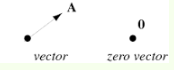
Zero vector, is a vector of length $0,$ and thus has all components equal to zero. It is the additive identity of the additive group of vectors.
Thus, it has zero magnitude and arbitrary direction. View full question & answer→MCQ 1121 Mark
$\big(\vec{\text{a}}+\vec{\text{b}}\big).\big(\vec{\text{b}}+\vec{\text{c}}\big)\times\big(\vec{\text{a}}+\vec{\text{b}}+\vec{\text{c}}\big)=$
- A
$0$
- B
$-\big[\vec{\text{a}}\vec{\text{b}}\vec{\text{c}}\big]$
- C
$2\big[\vec{\text{a}}\vec{\text{b}}\vec{\text{c}}\big]$
- ✓
$\big[\vec{\text{a}}\vec{\text{b}}\vec{\text{c}}\big]$
AnswerCorrect option: D. $\big[\vec{\text{a}}\vec{\text{b}}\vec{\text{c}}\big]$
We have
$\big(\vec{\text{a}}+\vec{\text{b}}\big).\big(\vec{\text{b}}+\vec{\text{c}}\big)\times\big(\vec{\text{a}}+\vec{\text{b}}+\vec{\text{c}}\big)$
$=\big(\vec{\text{a}}+\vec{\text{b}}.\big[\big(\vec{\text{b}}+\vec{\text{c}}\big)\times\vec{\text{a}}+\big(\vec{\text{b}}+\vec{\text{c}}\big)\times\vec{\text{b}}+\big(\vec{\text{b}}+\vec{\text{c}}\big)\times\vec{\text{c}}\big]$
$=\big(\vec{\text{a}}+\vec{\text{b}}\big).\big(\vec{\text{b}}\times\vec{\text{a}}+\vec{\text{c}}\times\vec{\text{a}}+\vec{\text{b}}\times\vec{\text{b}}+\vec{\text{c}}\times\vec{\text{b}}+\vec{\text{b}}\times\vec{\text{c}}+\vec{\text{c}}\times\vec{\text{c}}\big)$
$=\big(\vec{\text{a}}+\vec{\text{b}}\big).\big(\vec{\text{b}}\times\vec{\text{a}}+\vec{\text{c}}\times\vec{\text{a}}+0+\vec{\text{c}}\times\vec{\text{b}}+\vec{\text{b}}\times\vec{\text{c}}+0$
$=\big(\vec{\text{a}}+\vec{\text{b}}\big).\big(\vec{\text{b}}\times\vec{\text{a}}+\vec{\text{c}}\times\vec{\text{a}}-\vec{\text{b}}\times\vec{\text{c}}+\vec{\text{b}}\times\vec{\text{c}}\big)$
$=\big(\vec{\text{a}}+\vec{\text{b}}\big).\big(\vec{\text{b}}\times\vec{\text{a}}+\vec{\text{c}}\times\vec{\text{a}}\big)$
$=\vec{\text{a}}\big(\vec{\text{b}}\times\vec{\text{a}}\big)+\vec{\text{b}}.\big(\vec{\text{b}}\times\vec{\text{a}}\big)+\vec{\text{a}}.\big(\vec{\text{c}}\times\vec{\text{a}}\big)+\vec{\text{b}}.\big(\vec{\text{c}}\times\vec{\text{a}}\big)$
$=0+0+0+\big[\vec{\text{b}}\vec{\text{c}}\vec{\text{a}}\big]$
$=\big[\vec{\text{b}}\vec{\text{c}}\vec{\text{a}}\big]$
$=\big[\vec{\text{a}}\vec{\text{b}}\vec{\text{c}}\big]$
View full question & answer→MCQ 1131 Mark
If $\vec{\text{a}}=2\hat{\text{i}}-3\hat{\text{j}}+5\hat{\text{k}},\vec{\text{b}}=3\hat{\text{i}}-4\hat{\text{j}}+5\hat{\text{k}}$ and $\vec{\text{c}}=5\hat{\text{i}}-3\hat{\text{j}}-2\hat{\text{k}},$ then the volume of the parallelopiped with contermious edges $\vec{\text{a}}+\vec{\text{b}},\vec{\text{b}}+\vec{\text{c}},\vec{\text{c}}+\vec{\text{a}}$ is:
AnswerWe have $\vec{\text{a}}+\vec{\text{b}}=\big(2\hat{\text{i}}-3\hat{\text{j}}+5\hat{\text{k}}\big)+\big(3\hat{\text{i}}-4\hat{\text{j}}+5\hat{\text{k}}\big)=5\hat{\text{i}}-7\hat{\text{j}}+10\hat{\text{k}}$ $\vec{\text{b}}+\vec{\text{c}}=\big(3\hat{\text{i}}-4\hat{\text{j}}+5\hat{\text{k}}\big)\big(5\hat{\text{i}}-3\hat{\text{j}}-2\hat{\text{k}}\big)=8\hat{\text{i}}-7\hat{\text{j}}+3\hat{\text{k}}$ $\vec{\text{c}}+\vec{\text{a}}=\big(5\hat{\text{i}}-3\hat{\text{j}}-2\hat{\text{k}}\big)+\big(2\hat{\text{i}}-3\hat{\text{j}}+5\hat{\text{k}}\big)=7\hat{\text{i}}-6\hat{\text{j}}+3\hat{\text{k}}$ We know that the volume of parallelopiped whose three adjacent adges are $\vec{\text{a}}+\vec{\text{b}},\vec{\text{b}}+\vec{\text{c}}$ and $\vec{\text{c}}+\vec{\text{a}}$ is equal to: We have $\big[\vec{\text{a}}+\vec{\text{b}}\vec{\text{b}}+\vec{\text{c}}\vec{\text{c}}+\vec{\text{a}}\big]=\begin{vmatrix}5&-7&10\\8&-7&3\\7&-6&3\end{vmatrix}$ $=5(-21+18)+7(24-21)+10(-48+49)$ $=(5\times-3)+(7\times3)+(10\times1)$ $=16$ $\therefore$ volume of parallelopiped $=\big|16\big|=16$ Disclaimer: None of the given option is correct.
View full question & answer→MCQ 1141 Mark
If $\vec{\text{a}},\vec{\text{b}},\vec{\text{c}} $ are three non $-$ coplanar mutually perpendicular unit vectors, then $\big[\vec{\text{a}}\vec{\text{b}}\vec{\text{c}}\big],$ is :
AnswerCorrect option: A. $\pm 1$
We have
$\big[\vec{\text{a}}\vec{\text{b}}\vec{\text{c}}\big]$
$=\big(\vec{\text{a}}\times\vec{\text{b}}\big).\vec{\text{c}}$
$=\big|\vec{\text{a}}\times\vec{\text{b}}\big|\big|\vec{\text{c}}\big|\cos0^\circ$ or $\big|\vec{\text{a}}\times{\vec{\text{b}}}\big|\big|\vec{\text{c}}\big|\cos180^\circ$
$\big(\therefore\vec{\text{a}},\vec{\text{b}},\vec{\text{c}}$ are perpendicular to each other$)$
$=\big|\vec{\text{a}}\times\vec{\text{b}}\big|$ or $-\big|\vec{\text{a}}\times\vec{\text{b}}\big|$
$\big(\therefore\big|\vec{\text{c}}\big|=1,\cos0^\circ=1$ and $\cos180^\circ=-1\big)$
$=\big|\vec{\text{a}}\big|\big|\vec{\text{b}}\big|\sin90^\circ$ or $-\big|\text{a}\big|\big|\vec{\text{b}}\big|\sin90$
$\big(\therefore\vec{\text{a}} $ is perpendicular to $\vec{\text{b}})$
$=1 $ or $-1 \big(\therefore\big|\vec{\text{a}}\big|=1$ and $\big|\vec{\text{b}}\big|=1\big)$
$=\pm1$
View full question & answer→MCQ 1151 Mark
If $ \overrightarrow {\text{ a }}$ is vector of magnitude $x, m$ is non$-$zero scalar and $\text{m}\overrightarrow {\text{a}}$ is a unit vector then $x$ in terms of $m$ is:
- A
$\text{m}=\text{x}$
- B
$\text{x}=\mid{\text{m}}\mid$
- ✓
$\text{x}=\frac{1}{\mid\text{m}\mid}$
- D
$\text{x}=\frac{\text{m}}{2}$
AnswerCorrect option: C. $\text{x}=\frac{1}{\mid\text{m}\mid}$
Given, $\mid\text{m}\vec{\text{a}}\mid=1$
$\Rightarrow\mid\text{m}\mid\mid\vec{\text{a}}\mid=1$
$\Rightarrow\mid\text{m}\mid\text{x}=1$
$\Rightarrow\text{x}=\frac{1}{\mid\text{m}\mid}$
Remember, modulus can never be negative.
View full question & answer→MCQ 1161 Mark
Point $(4, 0)$ lies on $..........?$
- A
$\vec{\text{XO}}$
- B
$\vec{\text{YO}}$
- ✓
$\vec{\text{OX}}$
- D
$\vec{\text{OY}}$
AnswerCorrect option: C. $\vec{\text{OX}}$
View full question & answer→MCQ 1171 Mark
Let the vectors $\vec{a}\ \text{and}\ \vec{b}$ be such that $|\vec{a}|=3\ \text{and}\ \big|\vec{b}\big|=\frac{\sqrt{2}}{3},\ \text{then}\ \vec{a}\times\vec{b}$ is a unit vector, if the angle between $\vec{a}\ \text{and}\ \vec{b}\ \text{is}$
- A
$\pi/6$
- ✓
$\pi/4$
- C
$\pi/3$
- D
$\pi/2$
AnswerCorrect option: B. $\pi/4$
$\text{Given:}\ \ \big|\vec{a}\big|=3,\big|\vec{b}\big|=\frac{\sqrt{2}}{3}\ \text{and}\ \vec{a}\times\vec{b}$ is a unit vector.
$\Rightarrow\ \ \big|\vec{a}\times\vec{b}\big|=1\ $ $\Rightarrow\ \big|\vec{a}\big|.\Big|\vec{b}\Big|\ \text{sin}\ \theta=1,\ \text{where}\ \theta\ \text{is the angle between}\ \vec{a}\ \text{and}\ \vec{b}.$
$\Rightarrow\ \ 3\bigg(\frac{\sqrt{2}}{3}\bigg)\ \text{sin}\ \theta=1$ $\Rightarrow\ \sqrt{2}\ \text{sin}\ \theta=1\ \Rightarrow\ \ \text{sin}\ \theta=\frac{1}{\sqrt{2}}$
$\Rightarrow\ \text{sin}\ \theta=\text{sin}\frac{\pi}{{4}}\ \ \Rightarrow\ \theta=\frac{\pi}{4}$
Therefore, option (B) is correct.
View full question & answer→MCQ 1181 Mark
Choose the correct answer from the given four options. The angle between two vectors $\vec{\text{a}}$ and $\vec{\text{b}}$ with magnitudes $\sqrt{3}$ and $4,$ respectively, and $\vec{\text{a}}\cdot\vec{\text{b}}=2\sqrt{3}$ is:
- A
$\frac{\pi}{6}$
- ✓
$\frac{\pi}{3}$
- C
$\frac{\pi}{2}$
- D
$\frac{5\pi}{2}$
AnswerCorrect option: B. $\frac{\pi}{3}$
Here, $|\vec{\text{a}}|=\sqrt{3},|\vec{\text{b}}|=4$ and $\vec{\text{a}}\cdot\vec{\text{b}}=2\sqrt{3} [$given$]$
We know that, $\vec{\text{a}}\cdot\vec{\text{b}}=|\vec{\text{a}}||\vec{\text{b}}|\cos\theta$
$\Rightarrow2\sqrt{3}=\sqrt{3}.4.\cos\theta$
$\Rightarrow\cos\theta=\frac{2\sqrt{3}}{4\sqrt{3}}=\frac{1}{2}$
$\therefore\theta=\frac{\pi}{3}$
View full question & answer→MCQ 1191 Mark
If in a $\triangle\text{ABC}, \text{A}=(0,0),\ \text{B}=(3,3\sqrt3),\ \text{C}=(-3\sqrt3,3),$ then the vecctor of magnitude $2\sqrt2$ units directed along $AO,$ where $O$ is the circumcenter of $\triangle\text{ABC}$ is,
- ✓
$(1-\sqrt3)\hat{\text{i}}+(1+\sqrt3)\hat{\text{j}}$
- B
$(1+\sqrt3)\hat{\text{i}}+(1-\sqrt3)\hat{\text{j}}$
- C
$(1+\sqrt3)\hat{\text{i}}+(\sqrt3-1)\hat{\text{j}}$
- D
AnswerCorrect option: A. $(1-\sqrt3)\hat{\text{i}}+(1+\sqrt3)\hat{\text{j}}$
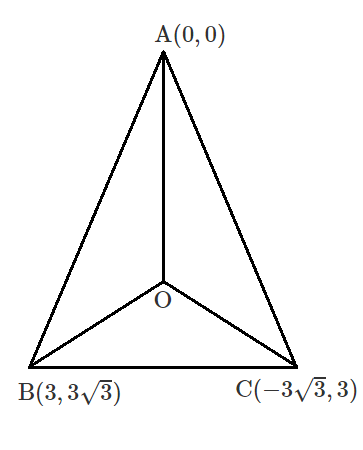
$\Big|\overrightarrow{\text{AO}}\Big|=2\sqrt2$
$\Big|\overrightarrow{\text{AO}}\Big|=\Big|\overrightarrow{\text{BO}}\Big|=\Big|\overrightarrow{\text{CO}}\Big|=2\sqrt2=\text{R}$
Let the position vector of $O$ be $\text{x}\hat{\text{i}}+\text{y}\hat{\text{j}}$
$\Big|\overrightarrow{\text{AO}}\Big|=\sqrt{\text{x}^2+\text{y}^2}$
$\therefore\ \text{x}^2+\text{y}^2=8\ \dots(1)$
Also, $\Big|\overrightarrow{\text{BO}}\Big|=\Big|\overrightarrow{\text{CO}}\Big|$
$\sqrt{(\text{x}-3)^2+(\text{y}-3\sqrt3)^2}$
$=\sqrt{(\text{x}+3\sqrt3)^2+(\text{y}-3)^2}$
$\text{x}^2-6\text{x}+9+\text{y}^2-6\sqrt3\text{y}+27$
$=\text{x}^2+6\sqrt3\text{x}+27+\text{y}^2-6\text{y}+9$
$\text{y}(6-6\sqrt3)=\text{x}(6\sqrt3+6)$
$\text{y}=\frac{\text{x}(1+\sqrt3)}{(1-\sqrt3)}\ \dots(2)$
Substituting y from $(2)$ in $(1)$ we get,
$(1-\sqrt3)^2\text{x}^2+(1+\sqrt3)^2\text{x}^2=8(1-\sqrt3)^2$
$\text{x}^2\times8=8(1-\sqrt3)^2$
$\text{x}=1-\sqrt3$
$\text{y}=1+\sqrt3$
$\therefore$ The position vector of $O$ is $(1-\sqrt3)\hat{\text{i}}+(1+\sqrt3)\hat{\text{j}}$
$\overrightarrow{\text{AO}}=(1-\sqrt3)\hat{\text{i}}+(1+\sqrt3)\hat{\text{j}}$ View full question & answer→MCQ 1201 Mark
If the vectors $4\hat{\text{i}}+11\hat{\text{j}}+\text{m}\hat{\text{k}},7\hat{\text{i}}+2\hat{\text{j}}+6\hat{\text{k}}$ and $\hat{\text{i}}+5\hat{\text{j}}+4\hat{\text{k}}$ are coplanar, then $m =$
AnswerLet
$\vec{\text{a}}=4\hat{\text{i}}+11\hat{\text{j}}+{\text{m}}\hat{\text{k}}$
$\vec{\text{b}}=7\hat{\text{i}}+2\hat{\text{j}}+6\hat{\text{k}}$
$\vec{\text{c}}=\hat{\text{i}}+5\hat{\text{j}}+4\hat{\text{k}}$
We know that vectors $\vec{\text{a}},\vec{\text{b}}$ and $\vec{\text{c}}$ are coplanar if their scalar triple product is zero, i.e. $\big[\vec{\text{a}}\vec{\text{ b }}\vec{\text{c}}\big]=0$
$\Rightarrow\begin{vmatrix}4&11&\text{m}\\7&2&6\\1&5&4 \end{vmatrix}=0$
$\Rightarrow 4(8-30)-11(28-6)+\text{m}(35-2)=0$
$\Rightarrow-88-242+33\text{m}=0$
$\Rightarrow33\text{m}=330$
$\therefore\text{m}=10$
View full question & answer→MCQ 1211 Mark
If $\vec{\text{r}}.\vec{\text{a}}=\vec{\text{r}}.\vec{\text{b}}=\vec{\text{r}}.\vec{\text{c}}=0$ for some non $-$ zero vector $\vec{\text{r}},$ then the value of $\big[\vec{\text{a}}\vec{\text{ b }}\vec{\text{c}}\big],$ is :
AnswerIf $\vec{\text{r}}.\vec{\text{a}}=0$ for some non-zero vector $\vec{\text{r}},$ then either $\vec{\text{a}}$ is a zero $-$ vector or it is perpendicular to $\vec{\text{r}}.$
If one of $\vec{\text{a}},\vec{\text{b}},\vec{\text{c}}$ is zero, then $\big[\vec{\text{a}}\vec{\text{b}}\vec{\text{c}}\big]=0$
If all $\vec{\text{a}},\vec{\text{b}}$ and $\vec{\text{c}}$ are non $-$ zero, then they must be coplanar as they are perpendicular to vector $\vec{\text{r}}.$
$\therefore\big[\vec{\text{a}}\vec{\text{b}}\vec{\text{c}}\big]=0$
View full question & answer→MCQ 1221 Mark
If $\vec{\text{a}}$ and $\vec{\text{b}}$ are two unit vectors inclined at an angle $\theta$, such that $\big|\vec{\text{a}}+\vec{\text{b}}\big|<1,$ then:
AnswerCorrect option: D. $\frac{2\pi}{3}<\theta<\pi$
We have
$\big|\vec{\text{a}}+\vec{\text{b}}\big|<1$
$\Rightarrow\sqrt{|\vec{\text{a}}|^2+\big|\vec{\text{b}}\big|^2+2|\vec{\text{a}}|\times\big|\vec{\text{b}}\big|\cos\theta<1}$
$\Rightarrow\sqrt{1^2+1^2+2\times1\times1\times\cos\theta<1}$
$\Rightarrow\sqrt{2+2\cos\theta}<1$
$\Rightarrow\sqrt{2(1+\cos\theta)}<1$
$\Rightarrow\sqrt{2\times2\cos^2\frac{\theta}{2}}<1$
$\Rightarrow2\big|\cos\frac{\theta}{2}\big|<1$
$\Rightarrow\big|\cos\frac{\theta}{2}\big|<\frac{1}{2}$
$\Rightarrow\frac{\pi}{3}<\frac{\theta}{2}<\frac{2\pi}{3}$
$\Rightarrow\frac{2\pi}{3}<\theta<\frac{4\pi}{3}$
But here $\theta$ cannot be more than $\pi.$
View full question & answer→MCQ 1231 Mark
A person travels $12\ km$ in the southward direction and then travels $5\ km$ to the right and then travels $15\ km$ toward the right and finally travels $5\ km$ towards the east, how far is he from his starting place?
- A
$5.5\ km$
- ✓
$3\ km$
- C
$13\ km$
- D
$6.4\ km$
AnswerCorrect option: B. $3\ km$
View full question & answer→MCQ 1241 Mark
The position vector of the point $(1, 2, 0)$ is:
- A
$i + j +k$
- B
$i + 2j + k$
- ✓
$i + 2j$
- D
$2j + k$
AnswerCorrect option: C. $i + 2j$
View full question & answer→MCQ 1251 Mark
Two vectors each of magnitudes $1$ unit are inclined at $60^{\circ}$ to each other. The difference of the vectors has a magnitude $............?$
- A
$0$ units
- B
$1$ units
- ✓
$2$ units
- D
$3$ units
AnswerCorrect option: C. $2$ units
View full question & answer→MCQ 1261 Mark
If the angle between the vectors $\text{x}\hat{\text{i}}+3\hat{\text{j}}-7\hat{\text{k}}$ and $\text{x}\hat{\text{i}}-\text{x}\hat{\text{j}}+4\hat{\text{k}}$ is acute, then $x$ lies in the interval:
- A
$(-4, 7)$
- B
$[-4, 7]$
- ✓
$R - [-4, 7]$
- D
$R - (4, 7)$
AnswerCorrect option: C. $R - [-4, 7]$
Let $\theta$ be the angle between $\vec{\text{a}}$ and $\vec{\text{b}}.$
$\cos\theta=\frac{\vec{\text{a}}.\vec{\text{b}}}{|\vec{\text{a}}|\big|\vec{\text{b}}\big|}=\frac{\text{x}^2-3\text{x}-28}{\sqrt{\text{x}^2+3^2+49}\sqrt{\text{x}^2+\text{x}^2+4^2}}$
For $\theta$ to be acute,
$\cos\theta>0$
$\Rightarrow\text{x}^2-3\text{x}-28>0$
$\Rightarrow(\text{x}-7)(\text{x}+4)>0$
$\Rightarrow\text{x}\in(-\infty,-4)\cup(7,\infty)$
$\Rightarrow\text{x}\in\text{R}-[-4,7]$
View full question & answer→MCQ 1271 Mark
If the position vectors of $P$ and $Q$ are $\hat{\text{i}}+3\hat{\text{j}}-7\hat{\text{k}}$ and $5\hat{\text{i}}-2\hat{\text{j}}+4\hat{\text{k}}$ then the cosine of the angle getween $\overrightarrow{\text{PQ}}$ and $y-$axis is:
- A
$\frac{5}{\sqrt{162}}$
- B
$\frac{4}{\sqrt{162}}$
- ✓
$-\frac{5}{\sqrt{162}}$
- D
$\frac{11}{\sqrt{162}}$
AnswerCorrect option: C. $-\frac{5}{\sqrt{162}}$
$\overrightarrow{\text{PQ}}=\overrightarrow{\text{OQ}}-\overrightarrow{\text{OP}}$
$=5\hat{\text{i}}-2\hat{\text{j}}+4\hat{\text{k}}-\big(\hat{\text{i}}+3\hat{\text{j}}-7\hat{\text{k}}\big)$
$=4\hat{\text{i}}-5\hat{\text{j}}+11\hat{\text{k}}$
The unit vector along $y-$axis is $\hat{\text{j}}.$
Let $\theta$ be the required angle.
$\cos\theta=\frac{\overrightarrow{\text{PQ}}.\hat{\text{j}}}{\big|\overrightarrow{\text{PQ}}\big|\big|\hat{\text{j}}\big|}$
$=\frac{-5}{\sqrt{16+25+121}\sqrt{1}}$
$=\frac{-5}{\sqrt{162}}$
View full question & answer→MCQ 1281 Mark
find the coordinate of the tip of the position vector which is equivalent to $\overrightarrow{\text{AB}}$ where the coordinates of $A$ and $B$ are $(-1, 3)$ and $(-2, 1)$ respectively:
- A
$(+1, +2)$
- B
$(+1, -2)$
- C
$(-1, +2)$
- ✓
$(-1, -2)$
AnswerCorrect option: D. $(-1, -2)$
View full question & answer→MCQ 1291 Mark
If $a + b + c = 0,$ then $a \times b =$
- A
$c \times a$
- B
$b \times c$
- C
$0$
- ✓
Both $(a)$ and $(b)$
AnswerCorrect option: D. Both $(a)$ and $(b)$
View full question & answer→MCQ 1301 Mark
The orthogonal projection of $\vec{\text{a}}$ on $\vec{\text{b}}$ is:
- A
$\frac{\big(\vec{\text{a}}.\vec{\text{b}}\big)\vec{\text{a}}}{|\vec{\text{a}}|^2}$
- ✓
$\frac{\big(\vec{\text{a}}.\vec{\text{b}}\big)\vec{\text{b}}}{\big|\vec{\text{b}}\big|^2}$
- C
$\frac{\vec{\text{a}}}{|\vec{\text{a}}|}$
- D
$\frac{\vec{\text{b}}}{\big|\vec{\text{b}}\big|}$
AnswerCorrect option: B. $\frac{\big(\vec{\text{a}}.\vec{\text{b}}\big)\vec{\text{b}}}{\big|\vec{\text{b}}\big|^2}$
The orthogonal projection of $\vec{\text{a}}$ on $\vec{\text{b}}$ is
$=\frac{\big(\vec{\text{a}}.\vec{\text{b}}\big)\vec{\text{b}}}{\big|\vec{\text{b}}\big|^2}$
View full question & answer→MCQ 1311 Mark
Choose the correct answer from the given four options. If $\vec{\text{a}},\vec{\text{b}},\vec{\text{c}}$ are unit vectors such that $\vec{\text{a}}+\vec{\text{b}}+\vec{\text{c}}=0,$ then the value of $\vec{\text{a}}\cdot\vec{\text{b}}+\vec{\text{b}}\cdot\vec{\text{c}}+\vec{\text{c}}\cdot\vec{\text{a}}$ is:
- A
$1.$
- B
$3.$
- ✓
$-\frac{3}{2}.$
- D
AnswerCorrect option: C. $-\frac{3}{2}.$
We have $\vec{\text{a}}+\vec{\text{b}}+\vec{\text{c}}=0$
$\Rightarrow(\vec{\text{a}}+\vec{\text{b}}+\vec{\text{c}})(\vec{\text{a}}+\vec{\text{b}}+\vec{\text{c}})=0$
$\Rightarrow\vec{\text{a}}^2+\vec{\text{a}}\cdot\vec{\text{b}}+\vec{\text{a}}\cdot\vec{\text{c}}+\vec{\text{b}}\cdot\vec{\text{a}}+\vec{\text{b}}^2+\vec{\text{b}}\cdot\vec{\text{c}}+\vec{\text{c}}\cdot\vec{\text{a}}+\vec{\text{c}}\cdot\vec{\text{b}}+\vec{\text{c}}^2=0$
$\Rightarrow\vec{\text{a}}^2+\vec{\text{b}}^2+\vec{\text{c}}^2+2(\vec{\text{a}}\cdot\vec{\text{b}}+\vec{\text{b}}\cdot\vec{\text{c}}+\vec{\text{c}}\cdot\vec{\text{a}})=0$ $[\because\vec{\text{a}}\cdot\vec{\text{b}}=\vec{\text{b}}\cdot\vec{\text{a}},\vec{\text{b}}\cdot\vec{\text{c}}=\vec{\text{c}}\cdot\vec{\text{b}} $ and $\vec{\text{c}}\cdot\vec{\text{a}}=\vec{\text{a}}\cdot\vec{\text{c}}]$
$\Rightarrow1+1+1+2(\vec{\text{a}}\cdot\vec{\text{b}}+\vec{\text{b}}\cdot\vec{\text{c}}+\vec{\text{c}}\cdot\vec{\text{a}})=0$
$\Rightarrow\vec{\text{a}}\cdot\vec{\text{b}}+\vec{\text{b}}\cdot\vec{\text{c}}+\vec{\text{c}}\cdot\vec{\text{a}}=-\frac{3}{2}$
View full question & answer→MCQ 1321 Mark
Which of the following represents equal vectors:
- A
$a, c$
- ✓
$b, d$
- C
$b, c$
- D
$m, d$
AnswerCorrect option: B. $b, d$
View full question & answer→MCQ 1331 Mark
If $\vec{\text{a}}=2\hat{\text{i}}-3\hat{\text{j}}-\hat{\text{k}}$ and $\vec{\text{b}}=\hat{\text{i}}+4\hat{\text{j}}-2\hat{\text{k}},$ then $\vec{\text{a}}\times\vec{\text{b}}$ is:
- A
$10\hat{\text{i}}+2\hat{\text{j}}+11\hat{\text{k}}$
- ✓
$10\hat{\text{i}}+3\hat{\text{j}}+11\hat{\text{k}}$
- C
$10\hat{\text{i}}-3\hat{\text{j}}+11\hat{\text{k}}$
- D
$10\hat{\text{i}}-2\hat{\text{j}}-10\hat{\text{k}}$
AnswerCorrect option: B. $10\hat{\text{i}}+3\hat{\text{j}}+11\hat{\text{k}}$
$\vec{\text{a}}\times\vec{\text{b}}=\begin{vmatrix}\hat{\text{i}}&\hat{\text{j}}&\hat{\text{k}}\\2&-3&-1\\1&4&-2 \end{vmatrix}$
$=10\hat{\text{i}}+3\hat{\text{j}}+11\hat{\text{k}}$
View full question & answer→MCQ 1341 Mark
A unit vector along the direction $\hat{\text{i}}+\hat{\text{j}}+\hat{\text{k}}$ has a magnitude:
- A
$\sqrt{3}$
- B
$\sqrt{2}$
- ✓
$1$
- D
$0$
AnswerA unit vector along any direction always has magnitude.
View full question & answer→MCQ 1351 Mark
Namita walks $14$ metres towards west, then turns to her right and walks $14$ metres and then turns to her left and walks $10$ metres. Again turning to her left she walks $14$ metres.What is the shortest distance $($in metres$)$ between her starting point and the present position?
AnswerSo, shortest distance $= 24$
View full question & answer→MCQ 1361 Mark
Four persons $P, Q, R$ and $S$ are initially at the four corners of a square side $d.$ Each person now moves with a constant speed $v$ in such a way that $P$ always moves directly towards $Q, Q$ towards $R, R$ towards $S,$ and $S$ towards $P.$ The four persons will meet after time.
- A
$\frac{\text{d}}{2\text{v}}$
- ✓
$\frac{\text{d}}{\text{v}}$
- C
$\frac{\text{3d}}{2\text{v}}$
- D
AnswerCorrect option: B. $\frac{\text{d}}{\text{v}}$
Here, velocity components will be $v \cos 45=\frac{\text{v}}{\sqrt{2}}$
And, displacement will be $\frac{\text{d}}{\sqrt{2}}$
So time taken will be
$\text{t}=\frac{\text{d}}{\text{v}}$
$=\frac{\frac{\text{d}}{\sqrt{2}}}{\frac{\text{v}}{\sqrt{2}}}$
$=\frac{\text{d}}{\text{v}}$
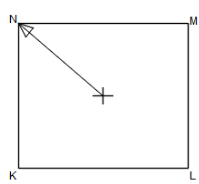
View full question & answer→MCQ 1371 Mark
If $\vec{\text{a}}.\hat{\text{i}}=\vec{\text{a}}.\big(\hat{\text{i}}+\hat{\text{j}}\big)=\vec{\text{a}}.\big(\hat{\text{i}}+\hat{\text{j}}+\hat{\text{k}}\big)=1.$then $\vec{\text{a}}=$
AnswerCorrect option: B. $\hat{\text{i}}$
Let $\vec{\text{a}}=\text{a}_1\hat{\text{i}}+\text{a}_2\hat{\text{j}}+\text{a}_3\hat{\text{k}}$
$\vec{\text{a}}.\hat{\text{i}}=\text{a}_1$
and $\vec{\text{a}}.\big(\hat{\text{i}}+\hat{\text{j}}\big)=\text{a}_1+\text{a}_2$
and $\vec{\text{a}}.\big(\hat{\text{i}}+\hat{\text{j}}+\hat{\text{k}}\big)=\text{a}_1+\text{a}_2+\text{a}_3$
Given,
$\vec{\text{a}}.\hat{\text{i}}=\vec{\text{a}}.\big(\hat{\text{i}}+\hat{\text{j}}\big)=\vec{\text{a}}.\big(\hat{\text{i}}+\hat{\text{j}}+\hat{\text{k}}\big)=1$
$\Rightarrow\text{a}_1=\text{a}_1+\text{a}_2=\text{a}_1+\text{a}_2+\text{a}_3=1$
$\Rightarrow\text{a}_1=1,\text{a}_2=0,\text{a}_3=0$
So, $\vec{\text{a}}=\text{a}_1\hat{\text{i}}+\text{a}_2\hat{\text{j}}+\text{a}_3\hat{\text{k}}=1\hat{\text{i}}+0\hat{\text{j}}+0\hat{\text{k}}=\hat{\text{i}}$
View full question & answer→MCQ 1381 Mark
The unit vector perpendicular to the plane passing through points $\text{P}\big(\hat{\text{i}}-\hat{\text{j}}+2\hat{\text{k}}\big),\text{Q}\big(2\hat{\text{i}}-\hat{\text{k}}\big)$ and $\text{R}\big(2\hat{\text{j}}+\hat{\text{k}}\big)$ is :
- ✓
$2\hat{\text{i}}+\hat{\text{j}}+\hat{\text{k}}$
- B
$\sqrt{6}\big(2\hat{\text{i}}+\hat{\text{j}}+\hat{\text{k}}\big)$
- C
$\frac{1}{\sqrt{6}}\big(2\hat{\text{i}}+\hat{\text{j}}+\hat{\text{k}}\big)$
- D
$\frac{1}{6}\big(2\hat{\text{i}}+\hat{\text{j}}+\hat{\text{k}}\big)$
AnswerCorrect option: A. $2\hat{\text{i}}+\hat{\text{j}}+\hat{\text{k}}$
The vector $\overrightarrow{\text{PQ}}\times\overrightarrow{\text{PR}}$ is perpendicular to the vectors $\overrightarrow{\text{PQ}}$ and $\overrightarrow{\text{PR}}.$
$\therefore$ Required unit vector $=\frac{\overrightarrow{\text{PQ}}\times\overrightarrow{\text{PR}}}{\big|\overrightarrow{\text{PQ}}\times\overrightarrow{\text{PR}}\big|}$
Now,
$\overrightarrow{\text{PQ}}=\text{P.V}$ of $\text{Q}-\text{P.V}.$ of ${P}$
$=\hat{\text{i}}+\hat{\text{j}}-3\hat{\text{k}}$
$\overrightarrow{\text{PR}}=\text{P.V}$ of $\text{R}-\text{P.V}.$ of ${P}$
$=-\hat{\text{i}}+3\hat{\text{j}}-\hat{\text{k}}$
$\therefore\overrightarrow{\text{PQ}}\times\overrightarrow{\text{PR}}=\begin{vmatrix}\hat{\text{i}}&\hat{\text{j}}&\hat{\text{k}}\\1&1&-3\\-1&3&-1 \end{vmatrix}$
$=8\hat{\text{i}}+4\hat{\text{j}}+4\hat{\text{k}}$
$=4\big(2\hat{\text{i}}+\hat{\text{j}}+\hat{\text{k}}\big)$
$\Rightarrow\big|\overrightarrow{\text{PQ}}\times\overrightarrow{\text{PR}}\big|$
$=\sqrt{64+16+16}$
$=\sqrt{96}$
$=4\sqrt{6}$
Required unit vector $=\frac{\overrightarrow{\text{PQ}}\times\overrightarrow{\text{PR}}}{\big|\overrightarrow{\text{PQ}}\times\overrightarrow{\text{PR}}\big|}$
$=\frac{4\big(2\hat{\text{i}}+\hat{\text{j}}+\hat{\text{k}}\big)}{4\sqrt{6}}$
$=\frac{1}{\sqrt{6}}\big(2\hat{\text{i}}+\hat{\text{j}}+\hat{\text{k}}\big)$
View full question & answer→MCQ 1391 Mark
If $a, b, c$ are unit vectors such that $a + b + c = 0,$ then the value of $a.b + b.c + c.a$ is:
AnswerCorrect option: C. $-\frac{3}{2}$
View full question & answer→MCQ 1401 Mark
If $\vec{\text{x}}$ is a vector in the direction of $(2, -2, 1)$ of magnitude $6$ and $\vec{\text{y}}$ is a vector in the direction of $(1, 1, -1)$ of magnitude $\sqrt{3}$ then $\mid\vec{\text{x}}+2\vec{\text{y}}\mid=$
- A
$40$
- B
$\sqrt{35}$
- C
$\sqrt{17}$
- ✓
$2\sqrt{10}$
AnswerCorrect option: D. $2\sqrt{10}$
They given $x$ directionwe need to find unit vector in that direction and multiply with the magnitude of $x$ they given $y$ directionwe need to find unit vector in that direction and multiply with the magnitude of $\vec{\text{x}}\text{y}$
$\frac{{6}\Big(2\hat{\text{i}}-2\hat{\text{j}}+\hat{\text{k}}\Big)}{3},\vec{\text{y}}=\frac{{\sqrt{3}}\Big(\hat{\text{i}}+\hat{\text{j}}-\hat{\text{k}}\Big)}{\sqrt{3}},$
so $\mid\vec{\text{x}}+2\vec{\text{y}}\mid=\mid6\hat{\text{i}}-2\hat{\text{j}}\mid=\sqrt{40}=2\sqrt{10}$
View full question & answer→MCQ 1411 Mark
The vectors $\vec{\text{a}}$ and $\vec{\text{b}}$ satisfy the equation $2\vec{\text{a}}+\vec{\text{b}}=\vec{\text{p}}$ and $\vec{\text{a}}+2\vec{\text{b}}=\vec{\text{q}},$ where $\vec{\text{p}}=\hat{\text{i}}+\hat{\text{j}}$ and $\vec{\text{q}}=\hat{\text{i}}-\hat{\text{j}}.$ If $\theta$ is the angle between $\vec{\text{a}}$ and $\vec{\text{b}},$ then :
- A
$\cos \theta = \frac{4}{5}$
- B
$\sin \theta = \frac{1}{\sqrt{2}}$
- ✓
$\cos \theta = -\frac{4}{5}$
- D
$\cos \theta = -\frac{3}{5}$
AnswerCorrect option: C. $\cos \theta = -\frac{4}{5}$
Given that
$2\vec{\text{a}}+\vec{\text{b}}=\vec{\text{p}}\dots(1)$
$\vec{\text{a}}+2\vec{\text{b}}=\vec{\text{q}}\dots(2)$
Solving these two we get
$\vec{\text{a}}=\frac{2\vec{\text{p}}-\vec{\text{q}}}{3},\vec{\text{b}}=\frac{2\vec{\text{q}}-\vec{\text{p}}}{3}$
And we have
$\vec{\text{p}}=\hat{\text{i}}+\hat{\text{j}}$ and $\vec{\text{q}}=\hat{\text{i}}-\hat{\text{j}}$
Substituting the values of $\vec{\text{p}}$ and $\vec{\text{q}},$ we get
$\vec{\text{a}}=\frac{2\vec{\text{p}}-\vec{\text{q}}}{3}=\frac{2\big(\hat{\text{i}}+\hat{\text{j}}\big)-\big(\hat{\text{i}}-\hat{\text{j}}\big)}{3}=\frac{\hat{\text{i}}+3\hat{\text{j}}}{3}$
$\Rightarrow|\vec{\text{a}}|=\frac{1}{3}\sqrt{1+9}=\frac{\sqrt{10}}{3}$
$\vec{\text{b}}=\frac{2\vec{\text{q}}-\vec{\text{p}}}{3}=\frac{2\big(\hat{\text{i}}-\hat{\text{j}}\big)-\big(\hat{\text{i}}+\hat{\text{j}}\big)}{3}=\frac{\hat{\text{i}}-3\hat{\text{j}}}{3}$
$\Rightarrow\big|\vec{\text{b}}\big|=\frac{1}{3}\sqrt{1+9}=\frac{\sqrt{10}}{3}$
$\vec{\text{a}}.\vec{\text{b}}=\frac{1}{9}(1-9)=\frac{-8}{9}$
We know that
$\vec{\text{a}}.\vec{\text{b}}=|\vec{\text{a}}|\big|\vec{\text{b}}\big|\cos\theta$
$\Rightarrow\frac{-8}{9}=\frac{\sqrt{10}}{3}\times\frac{\sqrt{10}}{3}\cos\theta$
$\Rightarrow\frac{-8}{9}=\frac{10}{9}\cos\theta$
$\Rightarrow\cos\theta=\frac{-8}{9}\times\frac{9}{10}=\frac{-4}{5}$
View full question & answer→MCQ 1421 Mark
The magnitude of the vector $6i + 2j + 3k$ is equal to:
View full question & answer→MCQ 1431 Mark
If $\text{OACB}$ is a parallelogram with $\overrightarrow{\text{OC}}=\vec{\text{a}}$ and $\overrightarrow{\text{AB}}=\vec{\text{b}},$ then $\overrightarrow{\text{OA}}=$
- A
$\big(\vec{\text{a}}+\vec{\text{b}}\big)$
- B
$\big(\vec{\text{a}}-\vec{\text{b}}\big)$
- C
$\frac{1}2\big(\vec{\text{b}}-\vec{\text{a}}\big)$
- ✓
$\frac{1}2\big(\vec{\text{a}}-\vec{\text{b}}\big)$
AnswerCorrect option: D. $\frac{1}2\big(\vec{\text{a}}-\vec{\text{b}}\big)$
Given a parallelogram $\text{OABC}$ such that $\overrightarrow{\text{OC}}=\vec{\text{a}}$ and $\overrightarrow{\text{AB}}=\vec{\text{b}}$. Then,
$\overrightarrow{\text{OB}}+\overrightarrow{\text{BC}}=\overrightarrow{\text{OC}}$
$\Rightarrow\ \overrightarrow{\text{OB}}=\overrightarrow{\text{OC}}-\overrightarrow{\text{BC}}$
$\Rightarrow\ \overrightarrow{\text{OB}}=\overrightarrow{\text{OC}}-\overrightarrow{\text{OA}}$ $\Big[\because\overrightarrow{\text{BC}}=\overrightarrow{\text{OA}}\Big]$
$\Rightarrow\ \overrightarrow{\text{OB}}=\vec{\text{a}}-\overrightarrow{\text{OA}}\ \dots(1)$
Therefore,
$\overrightarrow{\text{OA}}+\overrightarrow{\text{AB}}=\overrightarrow{\text{OB}}$
$\Rightarrow\ \overrightarrow{\text{OA}}+\vec{\text{b}}=\vec{\text{a}}-\overrightarrow{\text{OA}}\ [$Using $(1)]$
$\Rightarrow\ 2\overrightarrow{\text{OA}}=\vec{\text{a}}-\vec{\text{b}}$
$\Rightarrow\ \overrightarrow{\text{OA}}=\frac{1}2\big(\vec{\text{a}}-\vec{\text{b}}\big)$
View full question & answer→MCQ 1441 Mark
The scalar product of $5i + j - 3k$ and $3i - 4j + 7k$ is:
AnswerLet $A = 5i + j – 3k$
$B = 3i – 4j + 7k$
$A.B = (5i + j - 3k) (3i - 4j + 7k)$
$= 5.3 + 1.(-4) + (-3).7$
$= 15 - 4 - 21$
$= -10$
View full question & answer→MCQ 1451 Mark
Choose the correct answer from the given four options.
If $|\vec{{\text{a}}}|=10,|\vec{{\text{b}}}|=2$ and $\vec{{\text{a}}}\cdot\vec{{\text{b}}}=12,$ then value of $|\vec{{\text{a}}}\times\vec{\text{b}}|$ is :
AnswerHere, $|\vec{{\text{a}}}|=10,|\vec{{\text{b}}}|=2$ and $\vec{{\text{a}}}\cdot\vec{\text{b}}=12\ [$given$]$
$\therefore\vec{{\text{a}}}\cdot\vec{\text{b}}=|\vec{{\text{a}}}||\vec{{\text{b}}}|\cos\theta$
$12=10\times2\cos\theta$
$\Rightarrow\cos\theta=\frac{12}{20}=\frac{3}{5}$
$\Rightarrow\sin\theta=\sqrt{1-\cos\theta}$
$=\sqrt{1-\frac{9}{25}}$
$\sin\theta=\pm\frac{4}{5}$
$\therefore|\vec{{\text{a}}}\times\vec{{\text{b}}}|=|\vec{{\text{a}}}\|\vec{{\text{b}}}\|\sin\theta|$
$=10\times2\times\frac{4}{5}$
$=16$
View full question & answer→MCQ 1461 Mark
In triangle ABC (Fig 10.18), which of the following is not true:
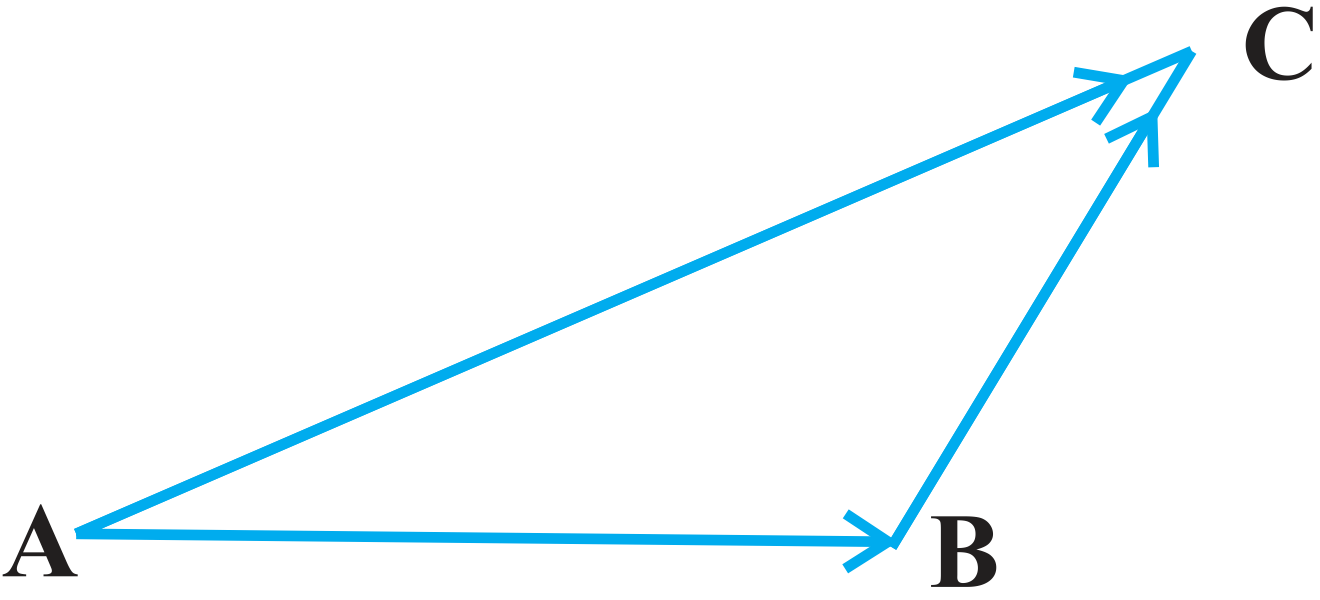
- A
$\overrightarrow{\text{AB}}+\overrightarrow{\text{BC}}+\overrightarrow{\text{CA}}=\vec{0}$
- B
$\overrightarrow{\text{AB}}+\overrightarrow{\text{BC}}-\overrightarrow{\text{AC}}=\vec{0}$
- ✓
$\overrightarrow{\text{AB}}+\overrightarrow{\text{BC}}-\overrightarrow{\text{CA}}=\vec{0}$
- D
$\overrightarrow{\text{AB}}-\overrightarrow{\text{CB}}+\overrightarrow{\text{CA}}=\vec{0}$
AnswerCorrect option: C. $\overrightarrow{\text{AB}}+\overrightarrow{\text{BC}}-\overrightarrow{\text{CA}}=\vec{0}$
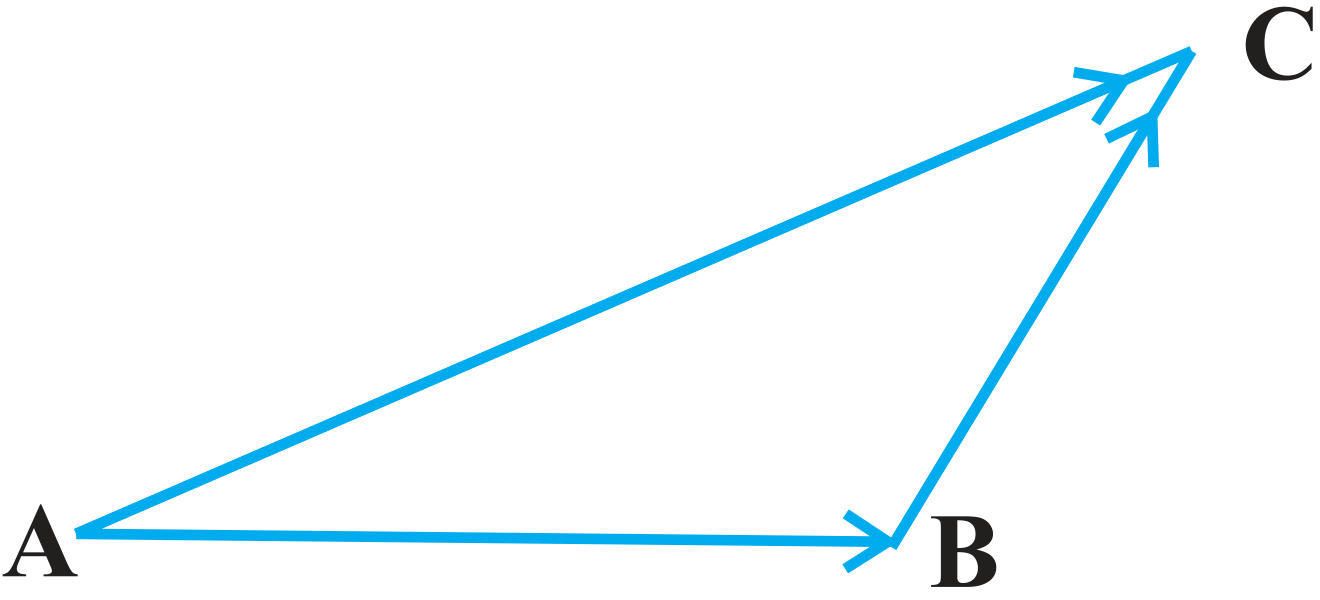 On applying the triangle law of addition in the given triangle, we have:
$\overrightarrow{\text{AB}}+\overrightarrow{\text{BC}}=\overrightarrow{\text{AC}}\ \ \ \ \ \ \ \ \ ....(1)$
$\Rightarrow\overrightarrow{\text{AB}}+\overrightarrow{\text{BC}}=-\overrightarrow{\text{CA}}$
$\Rightarrow\overrightarrow{\text{AB}}+\overrightarrow{\text{BC}}+\overrightarrow{\text{CA}}=\vec{0}\ \ \ \ ....(2)$
$\therefore$ The equation given in alternative A is true.
$\overrightarrow{\text{AB}}+\overrightarrow{\text{BC}}=\overrightarrow{\text{AC}}$
$\Rightarrow\overrightarrow{\text{AB}}+\overrightarrow{\text{BC}}-\overrightarrow{\text{AC}}=\vec{0}$
$\therefore$ The equation given in alternative B is true.
From equation (2), we have:
$\overrightarrow{\text{AB}}-\overrightarrow{\text{CB}}+\overrightarrow{\text{CA}}=\vec{0}$
$\therefore$ The equation given in alternative D is true.
Now, consider the equation given in alternative C:
$\overrightarrow{\text{AB}}+\overrightarrow{\text{BC}}-\overrightarrow{\text{CA}}=\vec{0}$
$\Rightarrow\overrightarrow{\text{AB}}+\overrightarrow{\text{BC}}=\overrightarrow{\text{CA}}\ \ \ \ ....(3)$
From equations (1) and (3), we have:
$\overrightarrow{\text{AC}}=\overrightarrow{\text{CA}}$
$\Rightarrow\overrightarrow{\text{AC}}=-\overrightarrow{\text{AC}}$
$\Rightarrow\overrightarrow{\text{AC}}+\overrightarrow{\text{AC}}=\vec{0}$
$\Rightarrow2\overrightarrow{\text{AC}}=\vec{0}$
$\Rightarrow\overrightarrow{\text{AC}}=\vec{0},$ which is not true.
Hence, the equation given in alternative C is incorrect.
The correct answer is C. View full question & answer→MCQ 1471 Mark
If $\vec{\text{a}}.\vec{\text{b}}=\vec{\text{a}}.\vec{\text{c}}$ and $\vec{\text{a}}\times\vec{\text{b}}=\vec{\text{a}}\times\vec{\text{c}}.\vec{\text{a}}\neq0,$ then :
AnswerCorrect option: A. $\vec{\text{b}}=\vec{\text{c}}$
$\vec{\text{a}}.\vec{\text{b}}=\vec{\text{a}}.\vec{\text{c}}$
$\Rightarrow\vec{\text{a}}.\vec{\text{b}}-\vec{\text{a}}.\vec{\text{c}}=0$
$\Rightarrow\vec{\text{a}}.\big(\vec{\text{b}}-\vec{\text{c}}\big)=0$
Let $\theta$ be the angle between $\vec{\text{a}}$ and $\big(\vec{\text{b}}-\vec{\text{c}}\big)$
$|\vec{\text{a}}|\big|\big(\vec{\text{b}}-\vec{\text{c}}\big)\big|\cos\theta\dots(1)$
and $\vec{\text{a}}\times\vec{\text{b}}=\vec{\text{a}}\times\vec{\text{c}}$
$\Rightarrow\vec{\text{a}}\times\vec{\text{b}}-\vec{\text{a}}\times\vec{\text{c}}=0$
$\Rightarrow\vec{\text{a}}\times\big(\vec{\text{b}}-\vec{\text{c}}\big)=0$
Then, $|\vec{\text{a}}|\big|\big(\vec{\text{b}}-\vec{\text{c}}\big)\big|\sin\theta=0\dots(2)$
Here, it is given that $\vec{\text{a}}\neq0$
Therefore, for eq. $(1)$ and eq. $(2)$ to be $0$
We have,
$\big|\big(\vec{\text{b}}-\vec{\text{c}}\big)\big|\cos\theta=0$
For $\big|\big(\vec{\text{b}}-\vec{\text{c}}\big)\big|\cos\theta=0,$ one of $\big|\big(\vec{\text{b}}-\vec{\text{c}}\big)\big|$ or $\cos\theta$ must be $0$
Case $1$ :
Let $\cos\theta=0$
$\Rightarrow\theta=90^\circ$
$\Rightarrow\sin\theta=1$
if $\big|\big(\vec{\text{b}}-\vec{\text{c}}\big)\big|\sin\theta=0$ and $\sin\theta=1$
Then $\big|\big(\vec{\text{b}}-\vec{\text{c}}\big)\big|=0$
$\Rightarrow\vec{\text{b}}=\vec{\text{c}}$
Case $2$ :
Let $\big|\big(\vec{\text{b}}-\vec{\text{c}}\big)\big|=0$
$\Rightarrow\vec{\text{b}}=\vec{\text{c}}$
Hence, $\vec{\text{b}}=\vec{\text{c}}$
View full question & answer→MCQ 1481 Mark
The value of $\big(\vec{\text{a}}\times\vec{\text{b}}\big)^2$ is:
- A
$|\vec{\text{a}}|^2+\big|\vec{\text{b}}\big|^2-\big(\vec{\text{a}}.\vec{\text{b}}\big)^2$
- ✓
$|\vec{\text{a}}|^2\big|\vec{\text{b}}\big|^2-\big(\vec{\text{a}}.\vec{\text{b}}\big)^2$
- C
$|\vec{\text{a}}|^2+\big|\vec{\text{b}}\big|^2-2\big(\vec{\text{a}}.\vec{\text{b}}\big)$
- D
$|\vec{\text{a}}|^2+\big|\vec{\text{b}}\big|^2-\vec{\text{a}}.\vec{\text{b}}$
AnswerCorrect option: B. $|\vec{\text{a}}|^2\big|\vec{\text{b}}\big|^2-\big(\vec{\text{a}}.\vec{\text{b}}\big)^2$
$\big(\vec{\text{a}}.\vec{\text{b}}\big)^2+\big|\vec{\text{a}}\times\vec{\text{b}}\big|^2$
$=\big(|\vec{\text{a}}|\big|\vec{\text{b}}\big|\cos\theta\big)^2+\big(|\vec{\text{a}}|\big|\vec{\text{b}}\big|\sin\theta\big)^2$
$=|\vec{\text{a}}|^2\big|\vec{\text{b}}\big|^2(\cos^2\theta+\sin^2\theta)$
$=|\vec{\text{a}}|^2\big|\vec{\text{b}}\big|^2$ (1)
$=|\vec{\text{a}}|^2\big|\vec{\text{b}}\big|^2$
$\therefore\big|\vec{\text{a}}\times\vec{\text{b}}\big|^2=|\vec{\text{a}}|^2\big|\vec{\text{b}}\big|^2-\big(\vec{\text{a}}.\vec{\text{b}}\big)^2$
Thus, the value of $\big(\vec{\text{a}}\times\vec{\text{b}}\big)^2$ is $|\vec{\text{a}}|^2\big|\vec{\text{b}}\big|^2-\big(\vec{\text{a}}.\vec{\text{b}}\big)^2.$
View full question & answer→MCQ 1491 Mark
If $\vec{\text{a}},\vec{\text{b}}$ represent the diagonals of a rhombus, then:
- A
$\vec{\text{a}}\times\vec{\text{b}}=\vec{0}$
- ✓
$\vec{\text{a}}.\vec{\text{b}}=0$
- C
$\vec{\text{a}}.\vec{\text{b}}=1$
- D
$\vec{\text{a}}\times\vec{\text{b}}=\vec{\text{a}}$
AnswerCorrect option: B. $\vec{\text{a}}.\vec{\text{b}}=0$
We know that the diagonals in a rhombus $\vec{\text{a}}$ and $\vec{\text{b}}$ are perpendicular.
Therefore, their dot product is zero.
$\Rightarrow\vec{\text{a}}.\vec{\text{b}}=0$
View full question & answer→MCQ 1501 Mark
In figure, which of the following is not true?
- A
$\overrightarrow{\text{AB}}+\overrightarrow{\text{BC}}+\overrightarrow{\text{CA}}=\vec0$
- B
$\overrightarrow{\text{AB}}+\overrightarrow{\text{BC}}-\overrightarrow{\text{AC}}=\vec0$
- ✓
$\overrightarrow{\text{AB}}+\overrightarrow{\text{BC}}-\overrightarrow{\text{CA}}=\vec0$
- D
$\overrightarrow{\text{AB}}-\overrightarrow{\text{CB}}+\overrightarrow{\text{CA}}=\vec0$
AnswerCorrect option: C. $\overrightarrow{\text{AB}}+\overrightarrow{\text{BC}}-\overrightarrow{\text{CA}}=\vec0$
We have, $\text{LHS} = \overrightarrow{\text{AB}}+\overrightarrow{\text{BC}}-\overrightarrow{\text{AC}}$
$=\overrightarrow{\text{AC}}-\overrightarrow{\text{CA}}$ $\Big[\because\overrightarrow{\text{AB}}+\overrightarrow{\text{BC}}=\overrightarrow{\text{AC}}\Big]$
$=-\overrightarrow{\text{CA}}-\overrightarrow{\text{CA}}$
$=-2\overrightarrow{\text{CA}}$
So, $\text{LHS}\neq\text{RHS}$
Hence, It is not true.
View full question & answer→MCQ 1511 Mark
If $\vec{\text{a}},\ \vec{\text{b}}$ are the vectors forming consecutive sides of a regular hexagon $\text{ABCDEF},$ then the vector representing side $CD$ is,
- A
$\vec{\text{a}}+\vec{\text{b}}$
- B
$\vec{\text{a}}-\vec{\text{b}}$
- ✓
$\vec{\text{b}}-\vec{\text{a}}$
- D
$-\big(\vec{\text{a}}+\vec{\text{b}}\big)$
AnswerCorrect option: C. $\vec{\text{b}}-\vec{\text{a}}$
Let $\text{ABCDEF}$ be a regular hexagon such that $\overrightarrow{\text{AB}}=\vec{\text{a}}$ and $\overrightarrow{\text{BC}}=\vec{\text{b}}$.
We know, $AD$ is parallel to $BC$ such that $AD = 2BC.$
$\therefore\ \overrightarrow{\text{AD}}=2\overrightarrow{\text{BC}}=2\vec{\text{b}}$
In $\triangle{\text{ABC}}$, we have
$\overrightarrow{\text{AB}}+\overrightarrow{\text{BC}}=\overrightarrow{\text{AC}}$
$\Rightarrow\ \vec{\text{a}}+\vec{\text{b}}=\overrightarrow{\text{AC}}$
In $\triangle{\text{ACD}}$, we have
$\overrightarrow{\text{AC}}+\overrightarrow{\text{CD}}=\overrightarrow{\text{AD}}$
$\Rightarrow\overrightarrow{\text{CD}}=\overrightarrow{\text{AD}}-\overrightarrow{\text{AC}}$
$\Rightarrow\overrightarrow{\text{CD}}=2\vec{\text{b}}-\big(\vec{\text{a}}+\vec{\text{b}}\big)$
$\Rightarrow\overrightarrow{\text{CD}}=\vec{\text{b}}-\vec{\text{a}}$
View full question & answer→MCQ 1521 Mark
If $A(6, 3, 2), B(5, 1, 4), C(3, −4, 7), D(0, 2, 5)$ are four points, then projection of $CD$ on $AB$ is:
- ✓
$-\frac{13}{7}$
- B
$-\frac{13}{7}$
- C
$-\frac{3}{13}$
- D
$-\frac{7}{13}$
AnswerCorrect option: A. $-\frac{13}{7}$
View full question & answer→MCQ 1531 Mark
The vector equation of the plane passing through $\vec{\text{a}},\ \vec{\text{b}},\ \vec{\text{c}},$ is $\vec{\text{r}}=\alpha\vec{\text{a}}+\beta\vec{\text{b}}+\gamma\vec{\text{c}}$, provided that,
AnswerCorrect option: B. $\alpha+\beta+\gamma=1$
Given: A plane passing through $\vec{\text{a}},\ \vec{\text{b}},\ \vec{\text{c}}$.
$\Rightarrow $ Lines $\vec{\text{a}}-\vec{\text{b}}$ and $\vec{\text{c}}-\vec{\text{a}}$ lie on the plane.
The parmetric equation of the plane can be written as :
$\vec{\text{r}}=\vec{\text{a}}+\lambda_1\big(\vec{\text{a}}-\vec{\text{b}}\big)+\lambda_2\big(\vec{\text{c}}-\vec{\text{a}}\big)$
$\vec{\text{r}}=\vec{\text{a}}(1+\lambda_1+\lambda_2)-\lambda_1\vec{\text{b}}+\lambda_2\vec{\text{c}}$
Given that $\vec{\text{r}}=\alpha\vec{\text{a}}+\beta\vec{\text{b}}+\gamma\vec{\text{c}}$
$\therefore\alpha+\beta+\gamma=1+\lambda_1-\lambda_2-\lambda_1+\lambda_2$
$\alpha+\beta+\gamma=1$
View full question & answer→MCQ 1541 Mark
The system of vectors $i, j, k$ is:
View full question & answer→MCQ 1551 Mark
The direction cosines $l, m$ and $n$ of two lines are connected by the relations $l + m + n = 0, l m = 0,$ then the angles between them is:
- ✓
$\frac{\pi}{3}$
- B
$\frac{\pi}{4}$
- C
$\frac{\pi}{2}$
- D
$0$
AnswerCorrect option: A. $\frac{\pi}{3}$
View full question & answer→MCQ 1561 Mark
$\mid\text{a}\times\text{b}\mid^2+\mid\text{a.b}\mid^2=144$ and $\mid\text{a}\mid=4$ then $\mid\text{b}\mid$ is equal to:
View full question & answer→MCQ 1571 Mark
The vector $\cos\alpha\cos\beta\hat{\text{i}}+\cos\alpha\sin\beta\hat{\text{j}}+\sin\alpha\hat{\text{k}}$ is a,
View full question & answer→MCQ 1581 Mark
If $O$ and $O\ '$ are circumcenter and orthocenter of $\triangle{\text{ABC}}$ , then $\overrightarrow{\text{OA}}+\overrightarrow{\text{OB}}+\overrightarrow{\text{OC}}$ equals,
- A
$2\overrightarrow{\text{OO}\ '}$
- ✓
$\overrightarrow{\text{OO}\ '}$
- C
$\overrightarrow{\text{O}\ '\text{O}}$
- D
$2\overrightarrow{\text{O}\ '\text{O}}$
AnswerCorrect option: B. $\overrightarrow{\text{OO}\ '}$
Given : $O$ be the circumcentre an $O\ '$ be the orthocenter of $\triangle{\text{ABC}}$.
Let $G$ be the centroid of the triangle.
We know that $O, G$ and $H$ are collinear and by geometry $\overrightarrow{\text{O}\ '\text{G}}=2\overrightarrow{\text{OG}}$.
This yields, $\overrightarrow{\text{O}\ '\text{O}}=\overrightarrow{\text{O}\ '\text{G}}+\overrightarrow{\text{GO}}=2\overrightarrow{\text{GO}}+\overrightarrow{\text{GO}}=3\overrightarrow{\text{GO}}$
In other words $\overrightarrow{\text{OO}\ '}=3\overrightarrow{\text{GO}}$
Since, $\overrightarrow{\text{OG}}=\frac{\vec{\text{a}}+\vec{\text{b}}+\vec{\text{c}}}3$
$\therefore\overrightarrow{\text{OO}\ '}=3\times\frac{\vec{\text{a}}+\vec{\text{b}}+\vec{\text{c}}}3=\vec{\text{a}}+\vec{\text{b}}+\vec{\text{c}}$
$=\overrightarrow{\text{OA}}+\overrightarrow{\text{OB}}+\overrightarrow{\text{OC}}$
View full question & answer→MCQ 1591 Mark
If $\hat{\text{i}},\hat{\text{j}},\hat{\text{k}}$ are unit vectors, then
- A
$\hat{\text{i}}.\hat{\text{j}}=1$
- ✓
$\hat{\text{i}}.\hat{\text{i}}=1$
- C
$\hat{\text{i}}\times\hat{\text{j}}=1$
- D
$\hat{\text{i}}\times\big(\hat{\text{j}}\times\hat{\text{k}}\big)=1$
AnswerCorrect option: B. $\hat{\text{i}}.\hat{\text{i}}=1$
View full question & answer→MCQ 1601 Mark
Choose the correct answer from the given four options. The vectors from origin to the points $A$ and $B$ are $\vec{\text{a}}=2\hat{\text{i}}-3\hat{\text{j}}+2\hat{\text{k}}$ and $\vec{\text{b}}=2\hat{\text{i}}+3\hat{\text{j}}+\hat{\text{k}},$ respectively, then the area of the triangle $\text{OAB}$ is :
- A
$340$
- B
$\sqrt{25}$
- C
$\sqrt{229}$
- ✓
$\frac{1}{2}\sqrt{229}$
AnswerCorrect option: D. $\frac{1}{2}\sqrt{229}$
$\therefore$ Area of $\triangle\text{OAB}=\frac{1}{2}|\overrightarrow{\text{OA}}\times\overrightarrow{\text{OB}}|$
$=\frac{1}{2}|(2\hat{\text{i}}-3\hat{\text{j}}+2\hat{\text{k}})\times(2\hat{\text{i}}+3\hat{\text{j}}+\hat{\text{k}})|$
$=\frac{1}{2}\begin{vmatrix}\hat{\text{i}}&\hat{\text{j}}&\hat{\text{k}} \\2&-3&2\\2&3&1 \end{vmatrix}$
$=\frac{1}{2}|[\hat{\text{i}}(-3-6)-\hat{\text{j}}(2-4)+\hat{\text{k}}(6+6)]|$
$=\frac{1}{2}|-9\hat{\text{i}}+2\hat{\text{j}}+12\hat{\text{k}}|$
$\therefore$ Area of $\triangle\text{OAB}=\frac{1}{2}\sqrt{81+4+144}$
$=\frac{1}{2}\sqrt{229}$
View full question & answer→MCQ 1611 Mark
Point $(4, 0)$ lies on:
- A
$\vec{\text{XO}}$
- B
$\vec{\text{YO}}$
- ✓
$\vec{\text{OX}}$
- D
$\vec{\text{OY}}$
AnswerCorrect option: C. $\vec{\text{OX}}$
$\vec{\text{XO}}$ is positive $x-$axis, so $(4, 0)$ lies on it.
View full question & answer→MCQ 1621 Mark
Choose the correct answer from the given four options. The vector having initial and terminal points as $(2, 5, 0)$ and $(–3, 7, 4),$ respectively is :
- A
$-\hat{\text{i}}+12\hat{\text{j}}+4\hat{\text{k}}$
- B
$-5\hat{\text{i}}+2\hat{\text{j}}-4\hat{\text{k}}$
- ✓
$-5\hat{\text{i}}+2\hat{\text{j}}+4\hat{\text{k}}$
- D
$\hat{\text{i}}+\hat{\text{j}}+\hat{\text{k}}$
AnswerCorrect option: C. $-5\hat{\text{i}}+2\hat{\text{j}}+4\hat{\text{k}}$
Given points are $(2, 5, 0)$ and $(–3, 7, 4).$
Thus, the required vector $=(-3-2)\hat{\text{i}}+(7-5)\hat{\text{j}}+(4-0)\hat{\text{k}}$
$=-5\hat{\text{i}}+2\hat{\text{j}}+4\hat{\text{k}}$
View full question & answer→MCQ 1631 Mark
If $\text{AD, BE}$ and $\text{CF}$ are $\triangle\text{ABC},$ then $\vec{\text{AD}}+\vec{\text{BE}}+\vec{\text{CF}}$
AnswerCorrect option: A. $\vec{0}$
View full question & answer→MCQ 1641 Mark
The equation of normal to the curve $3x^2 - y^2 = 8$ which is parallel to the line $x + 3y = 8$ is:
AnswerCorrect option: C. $\text{x + 3y} \underline{+} 8 = 0$
View full question & answer→MCQ 1651 Mark
What is direction of vector $\vec{\text{a}}$ if it is multiplied with $-\lambda$:
View full question & answer→MCQ 1661 Mark
If $\vec{a}$ is a nonzero vector of magnitude 'a' and $\lambda$ a nonzero scalar, then $\lambda\ \vec{a}$ is unit vector if
- A
$\lambda=1$
- B
$\lambda=-1$
- C
$a=\big|\lambda\big|$
- ✓
$a=1/\big|\lambda\big|$
AnswerCorrect option: D. $a=1/\big|\lambda\big|$
Given: $ \vec{a}$ is a non-zero vector of magnitude a $ \Rightarrow\ \ \ |\vec{a}|=1$
Also given $\lambda\neq0\ \text{and}\ \lambda\vec{a}$ is a unit vector.
$\Rightarrow\ \ |\lambda\vec{a}|=1\ \Rightarrow\ \ |\lambda|\big|\vec{a}\big|=1$
$\Rightarrow\ \ \ \ \ \ |\lambda|a=1\ \ \Rightarrow\ \ a=\frac{1}{|\lambda|}$
Therefore, option (D) is correct.
View full question & answer→MCQ 1671 Mark
Which of the following represents collinear but not equal vectors:
- ✓
$a, c$
- B
$b, d$
- C
$b, m$
- D
Both $(a)$ and $(b)$
AnswerCorrect option: A. $a, c$
View full question & answer→MCQ 1681 Mark
If $\vec{a}$ and $\vec{b}$ are two vectors such that $|\vec{a}|=1,|\vec{b}|=2$ and $\vec{a} \cdot \vec{b}=\sqrt{3}$, then the angle between $2 \vec{a}$ and $-\vec{b}$ is:
- A
$\frac{\pi}{6}$
- B
$\frac{\pi}{3}$
- C
$\frac{5 \pi}{6}$
- D
$\frac{11 \pi}{6}$
AnswerWe have, $|\vec{a}|=1,|\vec{b}|=2$ and $\vec{a} \cdot \vec{b}=\sqrt{3}$
As, $\vec{a} \cdot \vec{b}=|a||b| \cos \theta$
$(2 \vec{a}) \cdot(-\vec{b})=|2 \vec{a}||-\vec{b}| \cos \theta$
$\Rightarrow-2(\vec{a} \cdot \vec{b})=2|\vec{a}||\vec{b}| \cos \theta \Rightarrow \cos \theta=\frac{-(\vec{a} \cdot \vec{b})}{|\vec{a}||\vec{b}|}=\frac{-\sqrt{3}}{2}$
$\therefore \quad$ Angle between $2 \vec{a}$ and $-\vec{b}=\pi-\frac{\pi}{6}$ or $\pi+\frac{\pi}{6}=\frac{5 \pi}{6}$ or $\frac{7 \pi}{6}$
View full question & answer→MCQ 1691 Mark
The unit vector perpendicular to both vectors $\hat{i}+\hat{k}$ and $\hat{i}-\hat{k}$ is:
AnswerLet the required vector be $x \hat{i}+y \hat{j}+z \hat{k}$.
Then, $x^2+y^2+z^2=1$ .............(i)
Also, $(x \hat{i}+y \hat{j}+z \hat{k}) \cdot(\hat{i}+\hat{k})=0$
$\Rightarrow \quad x+z=0 ........(ii)$
And $(x \hat{i}+y \hat{j}+z \hat{k}) \cdot(\hat{i}-\hat{k})=0$
$\Rightarrow x - z =0 .........(iii)$
Solving (ii) and (iii), we get $x=z=0$
$\therefore \quad$ From (i), $y^2=1 \Rightarrow y= \pm 1$
So, required vector is $\pm \hat{j}$.
View full question & answer→MCQ 1701 Mark
Let $\vec{a}$ be any vector such that $|\vec{a}|=a$. The value of $|\vec{a} \times \hat{i}|^2+|\vec{a} \times \hat{j}|^2+|\vec{a} \times \hat{k}|^2$ is :
- A
$a^2$
- B
$2 a^2$
- C
$3 a^2$
- D
$0$
AnswerLet $\vec{a}=x \hat{i}+y \hat{j}+z \hat{k}$, then $a^2=x^2+y^2+z^2$
Now, $\vec{a} \times \hat{i}=z \hat{j}-y \hat{k} \Rightarrow|\vec{a} \times \hat{i}|^2=y^2+z^2$
Similarly, $|\vec{a} \times \hat{j}|^2=x^2+z^2$ and $|\vec{a} \times \hat{k}|^2=x^2+y^2$
$\therefore \quad$ Required sum $=2 x^2+2 y^2+2 z^2=2 a^2$
View full question & answer→MCQ 1711 Mark
For any two vectors $\vec{a}$ and $\vec{b}$, which of the following statements is always true?
- A
$\vec{a} \cdot \vec{b} \geq|\vec{a}||\vec{b}|$
- B
$\vec{a} \cdot \vec{b}=|\vec{a}||\vec{b}|$
- ✓
$\vec{a} \cdot \vec{b} \leq|\vec{a}||\vec{b}|$
- D
$\vec{a} \cdot \vec{b}<|\vec{a}||\vec{b}|$
AnswerCorrect option: C. $\vec{a} \cdot \vec{b} \leq|\vec{a}||\vec{b}|$
$\vec{a} \cdot \vec{b} \leq|\vec{a}||\vec{b}|$
View full question & answer→MCQ 1721 Mark
The position vectors of points $P$ and $Q$ are $\vec{p}$ and $\vec{q}$ respectively. The point $R$ divides line segment $P Q$ in the ratio $3: 1$ and $S$ is the mid-point of line segment $P R$. The position vector of $S$ is
- A
$\frac{\vec{p}+3 \vec{q}}{4}$
- B
$\frac{\vec{p}+3 \vec{q}}{8}$
- C
$\frac{5 \vec{p}+3 \vec{q}}{4}$
- D
$\frac{5 \vec{p}+3 \vec{q}}{8}$
AnswerGiven, position vector of $P$ is $\overrightarrow{O P}=\vec{p}$ and position vector of $Q$ is $\overrightarrow{O P}=\vec{p}$, where $O$ is origin.
Point $R$ divides $P Q$ in ratio $3: 1$.
So, position vector of point $R$ is $\overrightarrow{O R}=\frac{3 \overrightarrow{O Q}+\overrightarrow{O P}}{4}=\frac{3 \vec{q}+\vec{p}}{4}$
Also, $S$ is the mid-point of $P R$.
So, $\overrightarrow{O S}=\frac{\overrightarrow{O P}+\overrightarrow{O R}}{2}=\frac{\vec{p}+\frac{3 \vec{q}+\vec{p}}{4}}{2}=\frac{5 \vec{p}+3 \vec{q}}{8}$
View full question & answer→MCQ 1731 Mark
The vectors $\vec{a}=2 \hat{i}-\hat{j}+\hat{k}, \vec{b}=\hat{i}-3 \hat{j}-5 \hat{k}$ and $\vec{c}=-3 \hat{i}+4 \hat{j}+4 \hat{k}$ represents the sides of
AnswerCorrect option: D. a right$-$angled triangle
Given, $\vec{a}=2 \hat{i}-\hat{j}+\hat{k}, \vec{b}=\hat{i}-3 \hat{j}-5 \hat{k}$
and $\vec{c}=-3 \hat{i}+4 \hat{j}+4 \hat{k}$, then
$|\vec{a}|=\sqrt{4+1+1}=\sqrt{6},$
$|\vec{b}|=\sqrt{1+9+25}=\sqrt{35}$ and
$|\vec{c}|=\sqrt{9+16+16}=\sqrt{41}$
since,$|\vec{c}|^2=|\vec{a}|^2+|\vec{b}|^2$
$\therefore \quad$ It is a right $-$ angled triangle.
View full question & answer→MCQ 1741 Mark
The value of $\lambda$ for which two vectors $2 \hat{i}-\hat{j}+2 \hat{k}$ and $3 \hat{i}+\lambda \hat{j}+\hat{k}$ are perpendicular is
AnswerDot product of two mutually perpendicular vectors is zero.
$(2 \hat{i}-\hat{j}+2 \hat{k}) \cdot(3 \hat{i}+\lambda \hat{j}+\hat{k})=0$
$\Rightarrow 2 \times 3+(-1) \lambda+2 \times 1=0$
$\Rightarrow 6-\lambda+2=0$
$\Rightarrow \lambda=8$
View full question & answer→MCQ 1751 Mark
If $(\hat{i}+\lambda \hat{j}) \times(5 \hat{i}+3 \hat{j}+\sigma \hat{k})=0$, what are the values of $\lambda$ and $\sigma$ ?
- ✓
$\lambda=\frac{3}{5}, \sigma=0$
- B
$\lambda=\frac{5}{3}, \sigma=5$
- C
$\lambda=3, \sigma=0$
- D
(cannot be found as there are two unknowns and only one equation)
AnswerCorrect option: A. $\lambda=\frac{3}{5}, \sigma=0$
$\lambda=\frac{3}{5}, \sigma=0$
View full question & answer→MCQ 1761 Mark
For which of these vectors is the projection on the $y$-axis zero?
(i) $2 \hat{j}$ (ii) $-5 \hat{k}$ (iii) $\hat{i}-4 \hat{k}$
View full question & answer→MCQ 1771 Mark
If $\vec{a}=4 \hat{i}+6 \hat{j}$ and $\vec{b}=3 \hat{j}+4 \hat{k}$, then the vector form of the component of $\vec{a}$ along $\vec{b}$ is
- A
$\frac{18}{5}(3 \hat{i}+4 \hat{k})$
- ✓
$\frac{18}{25}(3 \hat{j}+4 \hat{k})$
- C
$\frac{18}{5}(3 \hat{i}+4 \hat{k})$
- D
$\frac{18}{25}(4 \hat{i}+6 \hat{j})$
AnswerCorrect option: B. $\frac{18}{25}(3 \hat{j}+4 \hat{k})$
Given, $\vec{a}=4 \hat{i}+6 \hat{j}$ and $\vec{b}=3 \hat{j}+4 \hat{k}$
$\vec{a} \cdot \vec{b}=(4 \hat{i}+6 \hat{j}) \cdot(3 \hat{j}+4 \hat{k})$
$=4 \times 0+6 \times 3+0 \times 4$
$=18$
$|\vec{b}|=\sqrt{(3)^2+(4)^2}$
$=\sqrt{9+16}$
$=5$
$\therefore |\vec{b}|^2=5^2=25$
Vector component of $\vec{a}$ along $\vec{b}$
$=\left(\frac{\vec{a} \cdot \vec{b}}{|\vec{b}|^2}\right) \vec{b}$
$=\frac{18}{25}(3 \hat{j}+4 \hat{k})$.
View full question & answer→MCQ 1781 Mark
$A B C D$ is a rhombus whose diagonals intersects at $E$. Then $\overrightarrow{E A}+\overrightarrow{E B}+\overrightarrow{E C}+\overrightarrow{E D}$ equals to
- A
$\overrightarrow{0}$
- B
$\overrightarrow{ AD }$
- C
$2 \overrightarrow{B D}$
- D
$2 \overrightarrow{A D}$
View full question & answer→MCQ 1791 Mark
The magnitude of the vector $6 \hat{i}-2 \hat{j}+3 \hat{k}$ is
AnswerGiven vector is $6 \hat{ i }-2 \hat{ j }+3 \hat{k}$
$\therefore \text { Its magnitude }=\sqrt{6^2+(-2)^2+3^2}$
$=\sqrt{36+4+9}$
$=\sqrt{49}$
$=7 \text { units }$
View full question & answer→MCQ 1801 Mark
If $\theta$ is the angle between two vectors $\vec{a}$ and $\vec{b}$, then $\vec{a} \cdot \vec{b} \geq 0$ only when
AnswerGiven, $\vec{a} \cdot \vec{b} \geq 0 \Rightarrow|\vec{a}||\vec{b}| \cos \theta \geq 0$
Assuming $|\vec{a}| \neq 0$ and $|\vec{b}| \neq 0$
$
\Rightarrow \cos \theta \geq 0 \quad[\because|\vec{a}| \geq 0,|\vec{b}| \geq 0] \Rightarrow \theta \in\left[0, \frac{\pi}{2}\right]
$
View full question & answer→MCQ 1811 Mark
The value of $(\hat{i} \times \hat{j}) \cdot \hat{j}+(\hat{j} \times \hat{i}) \cdot \hat{k}$ is:
AnswerSince, $\hat{ i } \times \hat{ j }=\hat{ k }$ and $\hat{ j } \times \hat{ i }=-\hat{ k }$
$
\therefore \quad(\hat{i} \times \hat{j}) \cdot \hat{j}+(\hat{j} \times \hat{i}) \cdot \hat{k}=\hat{k} \cdot \hat{j}+(-\hat{k}) \cdot \hat{k}=0-\hat{k} \cdot \hat{k}=-1$
View full question & answer→MCQ 1821 Mark
The value of $p$ for which the vectors $2 \hat{i}+p \hat{j}+\hat{k}$ and $-4 \hat{i}-6 \hat{j}+26 \hat{k}$ are perpendicular to each other, is :
- ✓
$3$
- B
$-3$
- C
$-\frac{17}{3}$
- D
$\frac{17}{3} \quad$
AnswerGiven vector are $2 \hat{i}+p \hat{j}+\hat{k}$ and $-4 \hat{i}-6 \hat{j}+26 \hat{k}$.
Since, the given vectors are perpendicular to each other.
$\therefore \quad(2 \hat{i}+p \hat{j}+\hat{k}) \cdot(-4 \hat{i}-6 \hat{j}+26 \hat{k})=0$
$\Rightarrow 2 \times(-4)+p \times(-6)+1 \times(26)=0$
$\Rightarrow -8-6 p+26=0$
$\Rightarrow -6 p+18=0$
$\Rightarrow -6 p=-18$
$\Rightarrow p=3 .$
View full question & answer→MCQ 1831 Mark
The projection of vector $\hat{i}$ on the vector $\hat{i}+\hat{j}+2 \hat{k}$ is:
- A
$\frac{1}{\sqrt{6}}$
- B
$\sqrt{6}$
- C
$\frac{2}{\sqrt{6}}$
- D
$\frac{3}{\sqrt{6}}$
AnswerLet, $\vec{a}=\hat{i}$ and $\vec{b}=\hat{i}+\hat{j}+2 \hat{k}$
We know that, projection of vector $\vec{a}$ on $\vec{b}=\frac{\vec{a} \cdot \vec{b}}{|\vec{b}|}$
$
=\frac{\hat{i} \cdot(\hat{i}+\hat{j}+2 \hat{k})}{\sqrt{1^2+1^2+2^2}}=\frac{1}{\sqrt{6}}$
View full question & answer→MCQ 1841 Mark
If $\vec{a}, \vec{b}$ and $(\vec{a}+\vec{b})$ are all unit vectors and $\theta$ is the angle between $\vec{a}$ and $\vec{b}$, then the value of $\theta$ is :
- ✓
$\frac{2 \pi}{3}$
- B
$\frac{5 \pi}{6}$
- C
$\frac{\pi}{3}$
- D
$\frac{\pi}{6}$
AnswerCorrect option: A. $\frac{2 \pi}{3}$
Given, $|\vec{a}|=|\vec{b}|=|\vec{a}+\vec{b}|=1$
Now, $|\vec{a}+\vec{b}|^2=|\vec{a}|^2+|\vec{b}|^2+2|\vec{a}||\vec{b}| \cos \theta$
$\Rightarrow 1^2=1^2+1^2+2 \cdot 1 \cdot 1 \cos \theta$
$\Rightarrow \cos \theta=\frac{-1}{2}$
$\Rightarrow \theta=\cos ^{-1}\left(\frac{-1}{2}\right)$
$\Rightarrow \theta=\frac{2 \pi}{3}$
View full question & answer→MCQ 1851 Mark
A unit vector along the vector $4 \hat{i}-3 \hat{k}$ is
- A
$\frac{1}{7}(4 \hat{i}-3 \hat{k})$
- ✓
$\frac{1}{5}(4 \hat{i}-3 \hat{k})$
- C
$\frac{1}{\sqrt{7}}(4 \hat{i}-3 \hat{k})$
- D
$\frac{1}{\sqrt{5}}(4 \hat{i}-3 \hat{k})$
AnswerCorrect option: B. $\frac{1}{5}(4 \hat{i}-3 \hat{k})$
Let $\vec{v}=4 \hat{i}-3 \hat{k}$
$\therefore|\vec{v}|=\sqrt{4^2+(3)^2}$
$=\sqrt{16+9}=\sqrt{25}=5$
Now, $\hat{v}=$ unit vector along $\vec{v}$
$=\frac{\vec{v}}{|\vec{v}|}=\frac{1}{5}(4 \hat{i}-3 \hat{k})$
View full question & answer→MCQ 1861 Mark
If $\vec{a}+\vec{b}=\hat{i}$ and $\vec{a}=2 \hat{i}-2 \hat{j}+2 \hat{k}$, then $|\vec{b}|$ equals:
- A
$\sqrt{14}$
- ✓
$3$
- C
$\sqrt{12}$
- D
$\sqrt{17}$
Answer$\text {Given, } \hat{a}+\hat{b}=\hat{i} $ and $ \vec{a}=2 \hat{i}-2 \hat{j}+2 \hat{k}$
$\Rightarrow 2 \hat{i}-2 \hat{j}+2 \hat{k}+\vec{b}=\hat{i} $
$\Rightarrow \vec{b}=\hat{i}-(2 \hat{i}-2 \hat{j}+2 \hat{k})$
$\Rightarrow -\hat{i}+2 \hat{j}-2 \hat{k}$
$\therefore|\vec{b}|=\sqrt{(-1)^2+(2)^2+(-2)^2}$
$=\sqrt{1+4+4}$
$=\sqrt{9}$
$=3$
View full question & answer→MCQ 1871 Mark
If $\text{A B C D}$ is a parallelogram and $A C$ and $B D$ are its diagonals, then $\overrightarrow{A C}+\overrightarrow{B D}$ is:
- A
$2 \overrightarrow{D A}$
- B
$2 \overrightarrow{A B}$
- ✓
$2 \overrightarrow{B C}$
- D
$2 \overrightarrow{B D}$
AnswerCorrect option: C. $2 \overrightarrow{B C}$
Given, $A B C D$ is a parallelogram, then $A B \| C D$ and $B C \| D A$
$\overrightarrow{A C}=\overrightarrow{A B}+\overrightarrow{B C} [$Triangle law of addition$]$
$\overrightarrow{B D}=\overrightarrow{B C}+\overrightarrow{C D} [$Triangle law of addition$]$
$\therefore \overrightarrow{A C}+\overrightarrow{B D}=\overrightarrow{A B}+\overrightarrow{B C}+\overrightarrow{B C}+\overrightarrow{C D}$
$=\overrightarrow{A B}+2 \overrightarrow{B C}-\overrightarrow{A B} \quad[\because \overrightarrow{A B}=-\overrightarrow{C D}]$
$=2 \overrightarrow{B C}
$
View full question & answer→MCQ 1881 Mark
Two vectors $\vec{a}=a_1 \hat{i}+a_2 \hat{j}+a_3 \hat{k}$ and $\vec{b}=b_1 \hat{i}+b_2 \hat{j}+b_3 \hat{k}$ are collinear if
- A
$a_1 b_1+a_2 b_2+a_3 b_3=0$
- B
$\frac{a_1}{b_1}=\frac{a_2}{b_2}=\frac{a_3}{b_3}$
- ✓
$a_1=b_1, a_2=b_2, a_3=b_3$
- D
$a_1+a_2+a_3=b_1+b_2+b_3$
AnswerCorrect option: C. $a_1=b_1, a_2=b_2, a_3=b_3$
$a_1=b_1, a_2=b_2, a_3=b_3$
View full question & answer→MCQ 1891 Mark
If two vectors $\vec{a}$ and $\vec{b}$ are such that $|\vec{a}|=2,|\vec{b}|=3$ and $\vec{a} \cdot \vec{b}=4$, then $|\vec{a}-2 \vec{b}|$ is equal to
- A
$\sqrt{2}$
- ✓
$2 \sqrt{6}$
- C
- D
$2 \sqrt{2}$
AnswerCorrect option: B. $2 \sqrt{6}$
$\|\vec{a}-2 \vec{b}|^2=(\vec{a}-2 \vec{b}) \cdot(\vec{a}-2 \vec{b})$
$=\vec{a} \cdot \vec{a}-4 \vec{a} \cdot \vec{b}+4 \vec{b} \cdot \vec{b}$
$=|\vec{a}|^2-4 \vec{a} \cdot \vec{b}+4|\vec{b}|^2$
$=4-16+36$
$=24$
$\therefore|\vec{a}-2 \vec{b}|$
$=2 \sqrt{6}$
View full question & answer→MCQ 1901 Mark
The scalar projection of the vector $3 \hat{ i }-\hat{ j }-2 \hat{ k }$ on the vector $\hat{i}+2 \hat{j}-3 \hat{k}$ is
- A
$\frac{7}{\sqrt{14}}$
- B
$\frac{7}{14}$
- C
$\frac{6}{13}$
- D
$\frac{7}{2}$
AnswerScalar projection of $\vec{a}$ on $\vec{b}=\frac{\vec{a} \cdot \vec{b}}{|\vec{b}|}$ Scalar projection of $3 \hat{i}-\hat{j}-2 \hat{k}$ on vector $\hat{i}+2 \hat{j}-3 \hat{k}$
$
=\frac{(3 \hat{i}-\hat{j}-2 \hat{k}) \cdot(\hat{i}+2 \hat{j}-3 \hat{k})}{1 \hat{i}+2 \hat{j}-3 \hat{k} \mid}=\frac{7}{\sqrt{14}}$
View full question & answer→MCQ 1911 Mark
If $\hat{i}, \hat{j}, \hat{k}$ are unit vectors along three mutually perpendicular directions, then
- A
$\hat{i} \cdot \hat{j}=1$
- B
$\hat{i} \times \hat{j}=1$
- C
$\hat{ i } \cdot \hat{ k }=0$
- D
$\hat{ i } \times \hat{ k }=0$
AnswerSince, $\hat{i}, \hat{j}, \hat{k}$ are mutually perpendicular to each other.
$
\therefore \hat{ i } \cdot \hat{ k }=0
$
View full question & answer→MCQ 1921 Mark
if the projection of $\dot{a}=\hat{i}-2 \hat{j}+3 \hat{k}$ on $\vec{b}=2 \hat{i}+\lambda \hat{k}$ is zero, then the value of $\lambda$ is
- A
$0$
- B
- ✓
$\frac{-2}{3}$
- D
$\frac{-3}{2}$
AnswerCorrect option: C. $\frac{-2}{3}$
Here, $\vec{a}=\hat{i}-2 \hat{j}+3 \hat{k}, \vec{b}=2 \hat{i}+\lambda \hat{k}$
Since, projection of $\vec{a}$ on $\vec{b}=0$
$\Rightarrow \frac{\vec{a} \cdot \vec{b}}{|\vec{b}|}=0$
$\Rightarrow \frac{(\hat{i}-2 \hat{j}+3 \hat{k}) \cdot(2 \hat{i}+\lambda \hat{k})}{\sqrt{2^2+\lambda^2}}=0$
$\Rightarrow \frac{2+3 \lambda}{\sqrt{4+\lambda^2}}=0$
$\Rightarrow 2+3 \lambda=0$
$\Rightarrow \lambda$
$=-\frac{2}{3}$
View full question & answer→MCQ 1931 Mark
$A B C D$ is a rhombus, whose diagonals intersect at $E$. Then $\overrightarrow{E A}+\overrightarrow{E B}+\overrightarrow{E C}+\overrightarrow{E D}$ equals
- A
$\overrightarrow{0}$
- B
$\overrightarrow{A D}$
- C
$2 \overrightarrow{B C}$
- D
$2 \overrightarrow{A D}$
Answer$\overrightarrow{E A}+\overrightarrow{E B}+\overrightarrow{E C}+\overrightarrow{E D}=\overrightarrow{E A}+\overrightarrow{E B}-\overrightarrow{E A}-\overrightarrow{E B}$
[As diagonals of a rhombus bisect each other] $=\overrightarrow{0}$
View full question & answer→MCQ 1941 Mark
The value of $p$ for which $p(\hat{i}+\hat{j}+\hat{k})$ is a unit vector is
- A
$0$
- B
$\frac{1}{\sqrt{3}}$
- C
- D
$\sqrt{3}$
AnswerLet $\vec{a}=(\hat{i}+\hat{j}+\hat{k})$
So, unit vector of $\vec{a}=\frac{\hat{i}+\hat{j}+\hat{k}}{\sqrt{1+1+1}}=\frac{1}{\sqrt{3}}(\hat{i}+\hat{j}+\hat{k})$
$\therefore \quad$ The value of $p$ is $\frac{1}{\sqrt{3}}$.
View full question & answer→MCQ 1951 Mark
If $|\vec{a}|=3,|\vec{b}|=4$, then the value of $\lambda$ for which $\vec{a}+\lambda \vec{b}$ is perpendicular to $\vec{a}-\lambda \vec{b}$, is
- A
$\frac{9}{16}$
- ✓
$\frac{3}{4}$
- C
$\frac{3}{2}$
- D
$\frac{4}{3}$
AnswerCorrect option: B. $\frac{3}{4}$
Given that, $|\vec{a}|=3,|\vec{b}|=4$ and $\vec{a}+\lambda \vec{b}$ is perpendicular to $\vec{a}-\lambda \vec{b}$.
$\therefore(\vec{a}+\lambda \vec{b}) \cdot(\vec{a}-\lambda \vec{b})=0$
$\Rightarrow \vec{a} \cdot \vec{a}-\vec{a} \cdot \vec{b} \lambda+\lambda \vec{b} \cdot \vec{a}-\lambda^2 \vec{b} \cdot \vec{b}=0$
$\Rightarrow|\vec{a}|^2-\lambda^2|\vec{b}|^2=0$
$\Rightarrow \lambda^2=\frac{|\vec{a}|^2}{|\vec{b}|^2}$
$\Rightarrow \lambda=\frac{|\vec{a}|}{|\vec{b}|}=\frac{3}{4}$
View full question & answer→MCQ 1961 Mark
The vectors from origin to the points $A$ and $B$ are $\vec{a}=2 \hat{i}-3 \hat{j}+2 \hat{k}$ and $\vec{b}=2 \hat{i}+3 \hat{j}+\hat{k}$, respectively, then the area of triangle $O A B$ (in sq. units) is
- A
$\sqrt{340}$
- B
$\sqrt{325}$
- C
$\sqrt{229}$
- ✓
$\frac{1}{2} \sqrt{229}$
AnswerCorrect option: D. $\frac{1}{2} \sqrt{229}$
(d) : $\vec{a}=2 \hat{i}-3 \hat{j}+2 \hat{k}$ and $\vec{b}=2 \hat{i}+3 \hat{j}+\hat{k}$
$
\vec{a} \times \vec{b}=\left|\begin{array}{ccc}
\hat{i} & \hat{j} & \hat{k} \\
2 & -3 & 2 \\
2 & 3 & 1
\end{array}\right|=-9 \hat{i}+2 \hat{j}+12 \hat{k}
$
Area of $\triangle O A B=\frac{1}{2}|\vec{a} \times \vec{b}|$
$
=\frac{1}{2} \sqrt{81+4+144}=\frac{1}{2} \sqrt{229} \text { sq. units }
$
View full question & answer→MCQ 1971 Mark
The vector having initial and terminal points as $(2,5,0)$ and $(-3,7,4)$ respectively is
- A
$-\hat{i}+12 \hat{j}+4 \hat{k}$
- B
$5 \hat{i}+2 \hat{j}-4 \hat{k}$
- ✓
$-5 \hat{i}+2 \hat{j}+4 \hat{k}$
- D
$\hat{i}+\hat{j}+\hat{k}$
AnswerCorrect option: C. $-5 \hat{i}+2 \hat{j}+4 \hat{k}$
(c) : Let $A(2,5,0)$ and $B(-3,7,4)$
$
\begin{aligned}
\therefore \quad \text { Required vector } & =(-3-2) \hat{i}+(7-5) \hat{j}+(4-0) \hat{k} \\
& =-5 \hat{i}+2 \hat{j}+4 \hat{k}
\end{aligned}
$
View full question & answer→MCQ 1981 Mark
Find the projection of the vector $\hat{i}+3 \hat{j}+7 \hat{k}$ on the vector $2 \hat{i}-3 \hat{j}+6 \hat{k}$.
Answer(a) : Let $\vec{a}=\hat{i}+3 \hat{j}+7 \hat{k}$ and $\vec{b}=2 \hat{i}-3 \hat{j}+6 \hat{k}$.
Now, projection of $\vec{a}$ on $\vec{b}=\frac{\vec{a} \cdot \vec{b}}{|\vec{b}|}$
$
=\frac{(\hat{i}+3 \hat{j}+7 \hat{k}) \cdot(2 \hat{i}-3 \hat{j}+6 \hat{k})}{\sqrt{2^2+(-3)^2+6^2}}=\frac{2-9+42}{\sqrt{4+9+36}}=\frac{35}{7}=5
$
View full question & answer→MCQ 1991 Mark
Find the value of $\lambda$ so that the vectors $2 \hat{i}-4 \hat{j}+\hat{k}$ and $4 \hat{i}-8 \hat{j}+\lambda \hat{k}$ are perpendicular.
Answer(b): The given vectors are perpendicular if their dot product vanishes, i.e.,
$
\begin{aligned}
& (2 \hat{i}-4 \hat{j}+\hat{k}) \cdot(4 \hat{i}-8 \hat{j}+\lambda \hat{k})=0 \\
\Rightarrow & 8+32+\lambda=0 \Rightarrow \lambda=-40
\end{aligned}
$
View full question & answer→MCQ 2001 Mark
Find the value of $\lambda$ for which the vectors $3 \hat{i}-6 \hat{j}+\hat{k}$ and $2 \hat{i}-4 \hat{j}+\lambda \hat{k}$ are parallel.
- ✓
$\frac{2}{3}$
- B
$\frac{-3}{2}$
- C
$\frac{-2}{3}$
- D
$\frac{3}{2}$
AnswerCorrect option: A. $\frac{2}{3}$
(a) : $\vec{a}=3 \hat{i}-6 \hat{j}+\hat{k}$ and $\vec{b}=2 \hat{i}-4 \hat{j}+\lambda \hat{k}$
Since, $\vec{a}$ and $\vec{b}$ are parallel $\quad \therefore \quad \vec{a} \times \vec{b}=\overrightarrow{0}$
$
\begin{aligned}
\Rightarrow & \left|\begin{array}{ccc}
\hat{i} & \hat{j} & \hat{k} \\
3 & -6 & 1 \\
2 & -4 & \lambda
\end{array}\right|=\overrightarrow{0} \\
\Rightarrow & (-6 \lambda+4) \hat{i}-(3 \lambda-2) \hat{j}+(-12+12) \hat{k}=\overrightarrow{0} \\
\Rightarrow & (-6 \lambda+4) \hat{i}+(2-3 \lambda) \hat{j}=0 \hat{i}+0 \hat{j}
\end{aligned}
$
Comparing coefficients of $\hat{i}$ and $\hat{j}$, we get $-6 \lambda+4=0$ and $2-3 \lambda=0 \Rightarrow \lambda=2 / 3$
View full question & answer→MCQ 2011 Mark
If $\vec{a}, \vec{b}, \vec{c}$ are unit vectors such that $\vec{a}+\vec{b}+\vec{c}=\overrightarrow{0}$, then the value of $\vec{a} \cdot \vec{b}+\vec{b} \cdot \vec{c}+\vec{c} \cdot \vec{a}$ is
- A
$\frac{3}{2}$
- B
$3$
- ✓
$\frac{-3}{2}$
- D
$-3$
AnswerCorrect option: C. $\frac{-3}{2}$
We have $\vec{a}, \vec{b}, \vec{c}$ are unit vectors.
Therefore, $|\vec{a}|=1,|\vec{b}|=1$ and $|\vec{c}|=1$
Also, $\vec{a}+\vec{b}+\vec{c}=\overrightarrow{0} ($given$)$
$\Rightarrow |\vec{a}+\vec{b}+\vec{c}|^2=0$
$\Rightarrow |\vec{a}|^2+|\vec{b}|^2+|\vec{c}|^2+2(\vec{a} \cdot \vec{b}+\vec{b} \cdot \vec{c}+\vec{c} \cdot \vec{a})=0$
$\Rightarrow 1+1+1+2(\vec{a} \cdot \vec{b}+\vec{b} \cdot \vec{c}+\vec{c} \cdot \vec{a})=0$
$\Rightarrow 3+2(\vec{a} \cdot \vec{b}+\vec{b} \cdot \vec{c}+\vec{c} \cdot \vec{a})=0$
$\Rightarrow (\vec{a} \cdot \vec{b}+\vec{b} \cdot \vec{c}+\vec{c} \cdot \vec{a})=-\frac{3}{2}$
View full question & answer→MCQ 2021 Mark
If $(2 \hat{i}+6 \hat{j}+27 \hat{k}) \times(\hat{i}+p \hat{j}+q \hat{k})=\overrightarrow{0}$, then which of the following is true?
- A
$p=6, q=27$
- ✓
$p=3, q=\frac{27}{2}$
- C
$p=6, q=\frac{27}{2}$
- D
$p=3, q=27$
AnswerCorrect option: B. $p=3, q=\frac{27}{2}$
(b) : Given,
$\left|\begin{array}{lll}\hat{i} & \hat{j} & \hat{k} \\ 2 & 6 & 27 \\ 1 & p & q\end{array}\right|=0$
$
\begin{array}{ll}
\Rightarrow & \hat{i}(6 q-27 p)-\hat{j}(2 q-27)+\hat{k}(2 p-6)=0 \\
\Rightarrow & 6 q-27 p=0,2 q-27=0 \text { and } 2 p-6=0 \\
\Rightarrow & q=\frac{27}{2} \text { and } p=3 .
\end{array}
$
View full question & answer→MCQ 2031 Mark
If $|\vec{a}|=4$ and $-3 \leq \lambda \leq 3$, then which of the following is the range of $|\lambda \vec{a}|$ ?
(i) $[0,8]$
(ii) $[-12,8]$
(iii) $[0,12]$
Answer(b) : We have, $-3 \leq \lambda \leq 3 \Rightarrow|\lambda| \leq 3$
Now, $|\lambda||\vec{a}| \leq 3|\vec{a}| \Rightarrow|\lambda \vec{a}| \leq 12$
$\therefore \quad$ Range of $|\lambda \vec{a}|$ is $[0,12]$
View full question & answer→MCQ 2041 Mark
The position vector of the point which divides the joining of points $2 \vec{a}-3 \vec{b}$ and $\vec{a}+\vec{b}$ in the ratio $3: 1$ is
AnswerCorrect option: D. $\frac{5 \vec{a}}{4}$
Given points are $2 \vec{a}-3 \vec{b}$ and $\vec{a}+\vec{b}$.
Given ratio $=3: 1$
$\therefore$ Required vector $=\frac{(2 \vec{a}-3 \vec{b}) \times 1+(\vec{a}+\vec{b}) \times 3}{3+1}$
$=\frac{2 \vec{a}-3 \vec{b}+3 \vec{a}+3 \vec{b}}{4}$
$=\frac{5}{4} \vec{a}$
View full question & answer→MCQ 2051 Mark
The angle between two vectors $\vec{a}$ and $\vec{b}$ with magnitudes $\sqrt{3}$ and 4 , respectively and $\vec{a} \cdot \vec{b}=2 \sqrt{3}$ is
- A
$\frac{\pi}{6}$
- ✓
$\frac{\pi}{3}$
- C
$\frac{\pi}{2}$
- D
$\frac{5 \pi}{2}$
AnswerCorrect option: B. $\frac{\pi}{3}$
(b) : We have $\vec{a} \cdot \vec{b}=2 \sqrt{3},|\vec{a}|=\sqrt{3},|\vec{b}|=4$
Let $\theta$ be the angle between $\vec{a}$ and $\vec{b}$.
$
\begin{array}{ll}
\therefore & \vec{a} \cdot \vec{b}=|\vec{a}||\vec{b}| \cos \theta \\
\Rightarrow & 2 \sqrt{3}=\sqrt{3} \cdot 4 \cdot \cos \theta \quad \Rightarrow \cos \theta=\frac{1}{2} \Rightarrow \theta=\frac{\pi}{3}
\end{array}
$
View full question & answer→MCQ 2061 Mark
The direction ratios of the vector $3 \vec{a}+2 \vec{b}$, where $\vec{a}=\hat{i}+\hat{j}-2 \hat{k}$ and $\vec{b}=2 \hat{i}-4 \hat{j}+5 \hat{k}$ are
- A
$7,5,4$
- ✓
$7,-5,4$
- C
$-7,5,4$
- D
$7,5,-4$
AnswerCorrect option: B. $7,-5,4$
We have, $\vec{a}=\hat{i}+\hat{j}-2 \hat{k}, \vec{b}=2 \hat{i}-4 \hat{j}+5 \hat{k}$
$\therefore 3 \vec{a}+2 \vec{b}=3(\hat{i}+\hat{j}-2 \hat{k})+2(2 \hat{i}-4 \hat{j}+5 \hat{k})$
$=(3 \hat{i}+3 \hat{j}-6 \hat{k})+(4 \hat{i}-8 \hat{j}+10 \hat{k})$
$=7 \hat{i}-5 \hat{j}+4 \hat{k}$
$\therefore$ The direction ratios of the vector $3 \vec{a}+2 \vec{b}$ are $7,-5,4$.
View full question & answer→MCQ 2071 Mark
Area of a parallelogram whose adjacent sides are represented by the vectors $2 \hat{i}-3 \hat{k}$ and $4 \hat{j}+2 \hat{k}$ is
- ✓
$4 \sqrt{14}$ sq. units
- B
$2 \sqrt{7}$ sq. units
- C
$4 \sqrt{7}$ sq. units
- D
$4 \sqrt{19}$ sq. units
AnswerCorrect option: A. $4 \sqrt{14}$ sq. units
Let $\vec{a}=2 \hat{i}-3 \hat{k}$ and $\vec{b}=4 \hat{j}+2 \hat{k}$
The area of a parallelogram with $\vec{a}$ and $\vec{b}$ as its adjacent sides is given by $|\vec{a} \times \vec{b}|$.
Now, $\vec{a} \times \vec{b}=\left|\begin{array}{ccc}\hat{i} & \hat{j} & \hat{k} \\ 2 & 0 & -3 \\ 0 & 4 & 2\end{array}\right|=12 \hat{i}-4 \hat{j}+8 \hat{k}$
$ \therefore |\vec{a} \times \vec{b}|=\sqrt{(12)^2+(-4)^2+(8)^2}=\sqrt{144+16+64}$
$\quad=\sqrt{224}=4 \sqrt{14} \text { sq. units. } $
View full question & answer→MCQ 2081 Mark
The value of $p$ for which $p(\hat{i}+\hat{j}+\hat{k})$ is a unit vector is
- A
- ✓
$\frac{1}{\sqrt{3}}$
- C
- D
$\sqrt{3}$
AnswerCorrect option: B. $\frac{1}{\sqrt{3}}$
(b) : Let $\vec{a}=(\hat{i}+\hat{j}+\hat{k})$
So, unit vector of $\vec{a}=\frac{\hat{i}+\hat{j}+\hat{k}}{\sqrt{1+1+1}}=\frac{1}{\sqrt{3}}(\hat{i}+\hat{j}+\hat{k})$
$\therefore \quad$ The value of $p$ is $\frac{1}{\sqrt{3}}$.
View full question & answer→MCQ 2091 Mark
If $|\vec{a}|=10,|\vec{b}|=2$ and $\vec{a} \cdot \vec{b}=12$, then the value of $|\vec{a} \times \vec{b}|$ is
Answer$|\vec{a}|=10,|\vec{b}|=2, \vec{a} \cdot \vec{b}=12$
We know that, $\vec{a} \cdot \vec{b}=|\vec{a}||\vec{b}| \cos \theta$
$\Rightarrow 12=10 \times 2 \cos \theta$
$\Rightarrow \cos \theta=\frac{3}{5}$
$\therefore \sin \theta=\frac{4}{5}$
Now, $|\vec{a} \times \vec{b}|=|\vec{a}||\vec{b}| \sin \theta=10 \times 2 \times \frac{4}{5}=16$
View full question & answer→MCQ 2101 Mark
Let $\vec{a}$ and $\vec{b}$ are unit vectors enclosing an angle $\theta$ and $|\vec{a}+\vec{b}|<1$. Which of the following is true?
$(i) \theta=\frac{\pi}{2}$
$(ii) \theta<\frac{\pi}{3}$
$(iii)\pi \geq \theta>\frac{2 \pi}{3}$
$(iv) \cos \theta<-\frac{1}{2}$
- A
Only $(i)$
- B
Only $(ii)$
- ✓
Only $(iii)$ and $(iv)$
- D
AnswerCorrect option: C. Only $(iii)$ and $(iv)$
$|\vec{a}+\vec{b}|<1$
$\Rightarrow|\vec{a}+\vec{b}|^2<1$
$\Rightarrow|\vec{a}|^2+|\vec{b}|^2+2 \vec{a} \cdot \vec{b}<1$
$\Rightarrow 1+1+2 \vec{a} \cdot \vec{b}<1 [\because|\vec{a}|=|\vec{b}|=1]$
$\Rightarrow \vec{a} \cdot \vec{b}<-\frac{1}{2}$
$\Rightarrow|\vec{a}||\vec{b}| \cos \theta<-\frac{1}{2}$
$\Rightarrow 1 \times 1 \times \cos \theta<-\frac{1}{2}$
$\Rightarrow \cos \theta<-\frac{1}{2}$
$\Rightarrow-1 \leq \cos \theta<-\frac{1}{2}$
$\Rightarrow \pi \geq \theta>\frac{2 \pi}{3}$
View full question & answer→MCQ 2111 Mark
If $\vec{b}$ and $\vec{c}$ are any two non-collinear unit vectors and $\vec{a}$ is any vector, then find the value of $(\vec{a} \cdot \vec{b}) \vec{b}+(\vec{a} \cdot \vec{c}) \vec{c}+\frac{\vec{a} \cdot(\vec{b} \times \vec{c})}{|\vec{b} \times \vec{c}|} \cdot(\vec{b} \times \vec{c})$.
AnswerCorrect option: C. $\vec{a}$
(c) : Let $\vec{b}=\hat{i}$ and $\vec{c}=\hat{j}$ and $\vec{a}=a_1 \hat{i}+a_2 \hat{j}+a_3 \hat{k}$ Now, $\vec{a} \cdot \vec{b}=a_1, \vec{a} \cdot \vec{c}=a_2$ and $\vec{a} \cdot \frac{\vec{b} \times \vec{c}}{|\vec{b} \times \vec{c}|}=\vec{a} \cdot \hat{k}=a_3$
$
\begin{aligned}
\therefore \quad & (\vec{a} \cdot \vec{b}) \vec{b}+(\vec{a} \cdot \vec{c}) \vec{c}+\frac{\vec{a} \cdot(\vec{b} \times \vec{c})}{|\vec{b} \times \vec{c}|}(\vec{b} \times \vec{c}) \\
\quad & =a_1 \vec{b}+a_2 \vec{c}+a_3 \hat{k}=a_1 \hat{i}+a_2 \hat{j}+a_3 \hat{k}=\vec{a}
\end{aligned}
$
View full question & answer→MCQ 2121 Mark
If $\vec{a}$ and $\vec{b}$ are two unit vectors inclined to $x-$axis at angles $30^{\circ}$ and $120^{\circ}$ respectively, then $|\vec{a}+\vec{b}|$ equals
- A
$\sqrt{\frac{2}{3}}$
- ✓
$\sqrt{2}$
- C
$\sqrt{3}$
- D
AnswerCorrect option: B. $\sqrt{2}$
Clearly, angle between $\vec{a}$ and $\vec{b}$ is $\frac{\pi}{2}$.
$\Rightarrow \vec{a} \cdot \vec{b}=0$
$\therefore|\vec{a}+\vec{b}|^2=|\vec{a}|^2+|\vec{b}|^2+2 \vec{a} \cdot \vec{b}=1+1+0=2$
$\Rightarrow|\vec{a}+\vec{b}|=\sqrt{2}$
View full question & answer→MCQ 2131 Mark
$(\hat{i}+\hat{j}) \times(\hat{j}+\hat{k}) \cdot(\hat{k}+\hat{i})$ is equal to
Answer$(\hat{i}+\hat{j}) \times(\hat{j}+\hat{k}) \cdot(\hat{k}+\hat{i})=(\hat{i} \times \hat{j}+\hat{i} \times \hat{k}+\hat{j} \times \hat{k}) \cdot(\hat{k}+\hat{i})$
$=(\hat{k}-\hat{j}+\hat{i}) \cdot(\hat{k}+\hat{i})=\hat{k} \cdot \hat{k}+\hat{i} \cdot \hat{i} \quad(\because \hat{i} \cdot \hat{j}=\hat{j} \cdot \hat{k}=\hat{k} \cdot \hat{i}=0)$
$=|\hat{k}|^2+|\hat{i}|^2=1+1=2$
View full question & answer→MCQ 2141 Mark
If $\vec{a}=2 \hat{i}+\hat{j}+3 \hat{k}$ and $\vec{b}=3 \hat{i}+5 \hat{j}-2 \hat{k}$, then $|\vec{a} \times \vec{b}|$ is equal to
- ✓
$\sqrt{507}$
- B
$\sqrt{506}$
- C
$\sqrt{508}$
- D
$\sqrt{509}$
AnswerCorrect option: A. $\sqrt{507}$
(a): We have, $\vec{a} \times \vec{b}=\left|\begin{array}{ccc}\hat{i} & \hat{j} & \hat{k} \\ 2 & 1 & 3 \\ 3 & 5 & -2\end{array}\right|$
$
=\hat{i}(-2-15)-(-4-9) \hat{j}+(10-3) \hat{k}=-17 \hat{i}+13 \hat{j}+7 \hat{k}
$
Hence, $|\vec{a} \times \vec{b}|=\sqrt{(-17)^2+(13)^2+(7)^2}=\sqrt{507}$
View full question & answer→MCQ 2151 Mark
Let $\vec{a}$ and $\vec{b}$ are non-collinear. If $\vec{c}=(x-2) \vec{a}+\vec{b}$ and $\vec{d}=(2 x+1) \vec{a}-\vec{b}$ are collinear, then find the value of $x$.
- A
$\frac{2}{3}$
- B
$\frac{-1}{3}$
- C
$\frac{-2}{3}$
- ✓
$\frac{1}{3}$
AnswerCorrect option: D. $\frac{1}{3}$
We have, $\vec{c}=(x-2) \vec{a}+\vec{b}, \vec{d}=(2 x+1) \vec{a}-\vec{b}$ are collinear, then $\vec{c}=m \vec{d}$ where $m$ is any scalar.
$\Rightarrow \quad(x-2) \vec{a}+\vec{b}=m((2 x+1) \vec{a}-\vec{b})$
$\Rightarrow \quad-m=1 $
$\Rightarrow m=-1$ and $m(2 x+1)=x-2 $
$\Rightarrow-2 x-1=x-2 $
$\Rightarrow x=\frac{1}{3}$
View full question & answer→MCQ 2161 Mark
Which of these are the direction cosines of the vector $-2 \hat{i}+\hat{j}-5 \hat{k}$ ?
- A
$\left(\frac{2}{\sqrt{30}}, \frac{1}{\sqrt{30}}, \frac{5}{\sqrt{30}}\right)$
- ✓
$\left(\frac{-2}{\sqrt{30}}, \frac{1}{\sqrt{30}}, \frac{-5}{\sqrt{30}}\right)$
- C
$\left(-\frac{2}{\sqrt{30}},-\frac{1}{\sqrt{30}}, \frac{-5}{\sqrt{30}}\right)$
- D
AnswerCorrect option: B. $\left(\frac{-2}{\sqrt{30}}, \frac{1}{\sqrt{30}}, \frac{-5}{\sqrt{30}}\right)$
(b): We have, $\vec{a}=-2 \hat{i}+\hat{j}-5 \hat{k}$
Direction cosines of the given vector are
$
\left.\begin{array}{rl}
\left(\frac{-2}{\sqrt{(-2)^2+(1)^2+(-5)^2}}, \frac{1}{\sqrt{(-2)^2+(1)^2+(-5)^2}}\right. ,\frac{-5}{\sqrt{(-2)^2+(1)^2+(-5)^2}}
\end{array}\right)
$
$
=\left(\frac{-2}{\sqrt{4+1+25}}, \frac{1}{\sqrt{4+1+25}}, \frac{-5}{\sqrt{4+1+25}}\right)
$
$\therefore$ Direction cosines are $\left(\frac{-2}{\sqrt{30}}, \frac{1}{\sqrt{30}}, \frac{-5}{\sqrt{30}}\right)$
View full question & answer→MCQ 2171 Mark
If $\vec{u}=\hat{i}+2 \hat{j}, \vec{v}=-2 \hat{i}+\hat{j}$ and $\vec{w}=4 \hat{i}+3 \hat{j}$, then find scalars $x$ and $y$ such that $\vec{w}=x \vec{u}+y \vec{v}$.
- A
$x=4, y=-2$
- ✓
$x=2, y=-1$
- C
$x=3, y=5$
- D
$x=-5, y=2$
AnswerCorrect option: B. $x=2, y=-1$
We have, $\vec{w}=x \vec{u}+y \vec{v}$
$\Rightarrow 4 \hat{i}+3 \hat{j}=x(\hat{i}+2 \hat{j})+y(-2 \hat{i}+\hat{j})$
$\Rightarrow \quad(x-2 y-4) \hat{i}+(2 x+y-3) \hat{j}=\overrightarrow{0}$
$\Rightarrow x-2 y-4=0$ and $2 x+y-3=0$
$\Rightarrow x=2$ and $ y=-1$
View full question & answer→MCQ 2181 Mark
The magnitude of each of the two vectors $\vec{a}$ and $\vec{b}$, having the same magnitude such that the angle between them is $60^{\circ}$ and their scalar product is $\frac{9}{2}$, is
AnswerGiven, $|\vec{a}|=|\vec{b}|, \theta=60^{\circ}$ and $\vec{a} \cdot \vec{b}=\frac{9}{2}$
Now, $\cos \theta=\frac{\vec{a} \cdot \vec{b}}{|\vec{a}||\vec{b}|}$
$\Rightarrow \cos 60^{\circ}=\frac{9 / 2}{|\vec{a}|^2} $
$\Rightarrow \frac{1}{2}=\frac{9 / 2}{|\vec{a}|^2}$
$\Rightarrow|\vec{a}|^2=9 $
$\Rightarrow|\vec{a}|=3 $
$\therefore|\vec{a}|=|\vec{b}|=3$
View full question & answer→MCQ 2191 Mark
If $\vec{a}=2 \hat{i}+\hat{j}+3 \hat{k}, \vec{b}=-\hat{i}+2 \hat{j}+\hat{k}$ and $\vec{c}=3 \hat{i}+\hat{j}+2 \hat{k}$, then the value of $\vec{a} \cdot(\vec{b} \times \vec{c})$ is
AnswerHere, $\vec{a}=2 \hat{i}+\hat{j}+3 \hat{k}, \vec{b}=-\hat{i}+2 \hat{j}+\hat{k}$ and $\vec{c}=3 \hat{i}+\hat{j}+2 \hat{k}$
Now, $\vec{b} \times \vec{c}=\left|\begin{array}{ccc}\hat{i} & \hat{j} & \hat{k} \\ -1 & 2 & 1 \\ 3 & 1 & 2\end{array}\right|=3 \hat{i}+5 \hat{j}-7 \hat{k}$
$\therefore \vec{a} \cdot(\vec{b} \times \vec{c})=(2 \hat{i}+\hat{j}+3 \hat{k}) \cdot(3 \hat{i}+5 \hat{j}-7 \hat{k})$
$=2 \times 3+1 \times 5+3 \times(-7)$
$=6+5-21=-10$
View full question & answer→MCQ 2201 Mark
If $|\vec{a}-\vec{b}|=|\vec{a}|=|\vec{b}|=1$, then the angle between $\vec{a}$ and $\vec{b}$ is
- ✓
$\frac{\pi}{3}$
- B
$\frac{3 \pi}{4}$
- C
$\frac{\pi}{2}$
- D
$\frac{\pi}{6}$
AnswerCorrect option: A. $\frac{\pi}{3}$
(a) : Given, $|\vec{a}-\vec{b}|=|\vec{a}|=|\vec{b}|=1$
$
\Rightarrow|\vec{a}-\vec{b}|^2=|\vec{a}|^2+|\vec{b}|^2-2 \vec{a} \cdot \vec{b} \Rightarrow 1=1+1-2|\vec{a}||\vec{b}| \cos \theta
$
(Here $\theta$ is angle between $\vec{a}$ and $\vec{b}$ )
$
\Rightarrow \cos \theta=\frac{1}{2} \Rightarrow \theta=\frac{\pi}{3}
$
View full question & answer→MCQ 2211 Mark
If the angle between $\hat{i}+\hat{k}$ and $\hat{i}+\hat{j}+a \hat{k}$ is $\frac{\pi}{3}$ then the value of $a$ is
- A
$2$
- B
$-4$ or $0$
- ✓
$0$
- D
$2$ or $-2$
AnswerWe have, $\cos \frac{\pi}{3}=\frac{(\hat{i}+\hat{k}) \cdot(\hat{i}+\hat{j}+a \hat{k})}{\sqrt{2} \sqrt{1+1+a^2}}$
$\Rightarrow \frac{1}{2}=\frac{1+a}{\sqrt{2} \sqrt{2+a^2}}$
$\Rightarrow \frac{1}{4}=\frac{(1+a)^2}{2\left(2+a^2\right)} ...(i)$
$\Rightarrow 2+a^2=2\left(1+a^2+2 a\right)$
$\Rightarrow a^2+4 a=0$
$\Rightarrow a=0,-4$
But $a=-4$ does not satisfy equation $(i),$
Hence, the required value of $a$ is $0$.
View full question & answer→MCQ 2221 Mark
Which of the following is the vector in the direction of the vector $\hat{i}-2 \hat{j}+2 \hat{k}$ that has magnitude $9\ ?$
- A
$\hat{i}-2 \hat{j}+2 \hat{k}$
- B
$\frac{\hat{i}-2 \hat{j}+2 \hat{k}}{3}$
- ✓
$3(\hat{i}-2 \hat{j}+2 \hat{k})$
- D
$9(\hat{i}-2 \hat{j}+2 \hat{k})$
AnswerCorrect option: C. $3(\hat{i}-2 \hat{j}+2 \hat{k})$
Let $\vec{a}=\hat{i}-2 \hat{j}+2 \hat{k}$
$\therefore|\vec{a}|=\sqrt{1+4+4}=\sqrt{9}=3$
$\therefore$ Required vector $=\frac{9(\hat{i}-2 \hat{j}+2 \hat{k})}{3}=3(\hat{i}-2 \hat{j}+2 \hat{k})$
View full question & answer→MCQ 2231 Mark
If $A$ and $B$ are the points $(-3,4,-8)$ and $(5,-6,4)$ respectively, then find the ratio in which $y z$-plane divides $\overrightarrow{A B}$.
- A
$5: 2$
- B
$7: 5$
- ✓
$3: 5$
- D
$5: 3$
AnswerCorrect option: C. $3: 5$
(c) : Let $\vec{a}=-3 \hat{i}+4 \hat{j}-8 \hat{k}, \vec{b}=5 \hat{i}-6 \hat{j}+4 \hat{k}$
Let $C(\vec{c})$ be the point in $y z$-plane which divides $\overrightarrow{A B}$ in the ratio $r: 1$ internally.
Then, $0=\frac{5 r-3}{r+1} \quad(\because$ In $y z$-plane, $x=0)$
$\Rightarrow \quad 5 r-3=0 \Rightarrow r=\frac{3}{5}$
Thus required ratio is $3: 5$
View full question & answer→MCQ 2241 Mark
The projection of the vector $\vec{a}=2 \hat{\imath}+3 \hat{\jmath}+2 \hat{k}$ on the vector $\vec{b}=\hat{i}+2 \hat{j}+\hat{k}$ is
- ✓
$\frac{10}{\sqrt{6}}$
- B
$\frac{10}{\sqrt{3}}$
- C
$\frac{5}{\sqrt{6}}$
- D
$\frac{5}{\sqrt{3}}$
AnswerCorrect option: A. $\frac{10}{\sqrt{6}}$
(a): We have, $\vec{a}=2 \hat{i}+3 \hat{j}+2 \hat{k}$ and $\vec{b}=\hat{i}+2 \hat{j}+\hat{k}$
$
\therefore \quad \vec{a} \cdot \vec{b}=(2 \hat{i}+3 \hat{j}+2 \hat{k}) \cdot(\hat{i}+2 \hat{j}+\hat{k})=2+6+2=10
$
and $|\vec{b}|=\sqrt{1^2+2^2+1^2}=\sqrt{6}$
Hence, projection of $\vec{a}$ on $\vec{b}$ is $\frac{\vec{a} \cdot \vec{b}}{|\vec{b}|}=\frac{10}{\sqrt{6}}$.
View full question & answer→MCQ 2251 Mark
If $\vec{a}=2 \hat{i}-\hat{j}+2 \hat{k}$ and $\vec{b}=4 \hat{i}+4 \hat{j}-2 \hat{k}$ then find the angle between the vectors $\vec{a}$ and $\vec{b}$.
- A
- B
$\frac{\pi}{3}$
- ✓
$\frac{\pi}{2}$
- D
$\frac{\pi}{4}$
AnswerCorrect option: C. $\frac{\pi}{2}$
(c) : We have, $\vec{a}=2 \hat{i}-\hat{j}+2 \hat{k}$ and $\vec{b}=4 \hat{i}+4 \hat{j}-2 \hat{k}$
Now, $\vec{a} \cdot \vec{b}=(2 \hat{i}-\hat{j}+2 \hat{k}) \cdot(4 \hat{i}+4 \hat{j}-2 \hat{k})$
$=8-4-4=0$. Therefore, $\vec{a} \cdot \vec{b}=0$
$
\Rightarrow \cos \theta=0
$
So, angle between $\vec{a}$ and $\vec{b}$ is $\frac{\pi}{2}$.
View full question & answer→MCQ 2261 Mark
If $A B C D$ is a rhombus, whose diagonals intersect at $E$, then $\overrightarrow{E A}+\overrightarrow{E B}+\overrightarrow{E C}+\overrightarrow{E D}$ equals
- ✓
$\overrightarrow{0}$
- B
$\overrightarrow{A D}$
- C
$2 \overrightarrow{B C}$
- D
$2 \overrightarrow{A D}$
AnswerCorrect option: A. $\overrightarrow{0}$
(a) : $\overrightarrow{E A}+\overrightarrow{E B}+\overrightarrow{E C}+\overrightarrow{E D}$
$
=\overrightarrow{E A}+\overrightarrow{E B}-\overrightarrow{E A}-\overrightarrow{E B}
$ [As diagonals of a rhombus bisect each other]
$=\overrightarrow{0}$
View full question & answer→MCQ 2271 Mark
$(\vec{a} \cdot \hat{i})^2+(\vec{a} \cdot \hat{j})^2+(\vec{a} \cdot \hat{k})^2$ is equal to
- A
- B
$|\vec{a}|$
- C
$-\vec{a}$
- ✓
$|\vec{a}|^2$
AnswerCorrect option: D. $|\vec{a}|^2$
(d) : Let $\vec{a}=x \hat{i}+y \hat{j}+z \hat{k} \Rightarrow(\vec{a} \cdot \hat{i})^2=x^2$
Similarly, $(\vec{a} \cdot \hat{j})^2=y^2$ and $(\vec{a} \cdot \hat{k})^2=z^2$
$
\therefore \quad(\vec{a} \cdot \hat{i})^2+(\vec{a} \cdot \hat{j})^2+(\vec{a} \cdot \hat{k})^2=x^2+y^2+z^2=|\vec{a}|^2
$
View full question & answer→MCQ 2281 Mark
Which of the following is the magnitude of the vector $\vec{a}=3 \hat{i}-2 \hat{j}+6 \hat{k}$ ?
Answer(b) : Here, $\vec{a}=3 \hat{i}-2 \hat{j}+6 \hat{k}$
$\therefore \quad$ Its magnitude $=|\vec{a}|$
$
=\sqrt{3^2+(-2)^2+6^2}=\sqrt{9+4+36}=\sqrt{49}=7
$
View full question & answer→MCQ 2291 Mark
Find the sum of the vectors $\vec{a}=\hat{i}-2 \hat{j}+\hat{k}$, $\vec{b}=-2 \hat{i}+4 \hat{j}+5 \hat{k}$ and $\vec{c}=\hat{i}-6 \hat{j}-7 \hat{k}$.
AnswerCorrect option: A. $-4 \hat{j}-\hat{k}$
The given vectors are
$\vec{a}=\hat{i}-2 \hat{j}+\hat{k},$
$\vec{b}=-2 \hat{i}+4 \hat{j}+5 \hat{k},$
$\vec{c}=\hat{i}-6 \hat{j}-7 \hat{k}$
$\therefore$ Required sum $=\vec{a}+\vec{b}+\vec{c}$
$=(\hat{i}-2 \hat{j}+\hat{k})+(-2 \hat{i}+4 \hat{j}+5 \hat{k})+(\hat{i}-6 \hat{j}-7 \hat{k})$
$=-4 \hat{j}-\hat{k}$
View full question & answer→