Questions · Page 3 of 3

[5 marks Questions]

Question 1015 Marks
Name the main organs of the human digestive system in the order they participate in the process of digestion. Describe how digestion of carbohydrates and proteins take place in our body.
Answer
Firstly the food start breaking down from salivary glands then passes to bolus which doesit contained it mucus then it started to go to stomach it has gastric juice supplied from liver then gets digested in velli and to energy to blood and waste to large intestine and does comes through anus.
View full question & answer
Question 1025 Marks
Mention the major events during photosynthesis.
Answer
1. Photolysis: With the help of light energy, oxygen evolving Z-complex splits up water into its components- protons ( $H ^{+}$), electrons ( $e ^{-}$) and oxygen.
$2 H_2 O \xrightarrow[Mn, Ca, Cl]{OEC} O_2+4 H^{+}+4 e^{-}$
2. Absorption of Light Energy: Chlorophyll absorbs light energy.
3. Primary Reaction: Chlorophyll converts the absorbed light energy into chemical energy. It is called primary reaction of photosynthesis. It builds up ATP with the help of excited electrons.
4. Formation of Reducing Power: Coenzyme NADP ${ }^{+}$is changed to reduced form of NADPH.
$NADP^{+}+H^{+}+2 e^{-} \rightarrow NADPH$
5. Reduction of $CO _2$ : Carbon dioxide is reduced enzymatically with the help of NADPH and ATP to form carbohydrates.
$6 CO_2+12 NADPH+18 ATP \rightarrow C_6 H_{12} O_6+12 NADP^{+}+18 ADP+18 Pi$
View full question & answer
Question 1035 Marks
Explain the three pathways of breakdown in living organisms.
Answer
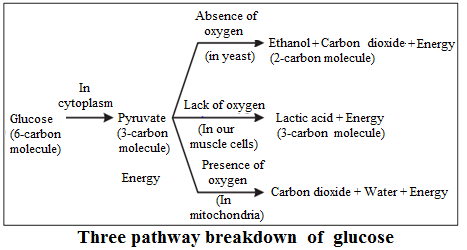
Cellular respiration is the process of breakdown of food substances into simpler ones to release the stored energy. On the basis of presence or absence of oxygen, it can occur through aerobic or anaerobic pathway.
i. Aerobic respiration: Glucose in the presence of oxygen (air), breaks down to carbon dioxide and water with release of large amount of energy. It occurs in three steps, glycolysis, citric acid cycle and ETC.

Glycolysis is breakdown of glucose into pyruvate. It is oxygen independent pathway occurs in cytoplasm. Pyruvate is decarboxylated into acetyl coA in cytoplasm only.
Citric acid cycle is the second phase of cellular respiration in which acetyl Co are enzymatically oxidized into carbon dioxide and the released energy is stored in NADH and $FADH _2$.
Electron transport chain includes downhill flow of electrons to final electron acceptor (Oxygen, which is then reduced into water) through a chain of membranebound carriers to facilitate the uphill transport of protons across a proton-impermeable membrane and ATP synthesis.
Enzymes of citric acid cycle are present in mitochondrial matrix while the electron transport chain is present in inner mitochondrial membrane, hence, the last two phases of aerobic respiration takes place in mitochondria only.
ii. Anaerobic respiration: Glycolysis is breakdown of glucose into pyruvate. It is oxygen independent pathway and is common to both aerobic and anaerobic respiration. Fate of pyruvate depends on oxygen availability. Anaerobic respiration can occur via lactic acid fermentation or alcohol fermentation.
- Alcohol fermentation due to limited oxygen availability, pyruvate remains in cytoplasm where pyruvate decarboxylase and alcohol dehydrogenase enzymes carry out the second phase of anaerobic respiration and produce ethanol and carbon dioxide with limited amount of energy being released.
- Lactic acid fermentation due to limited oxygen availability, pyruvate remains in cytoplasm where it is broken down into lactic acid with limited amount of energy being released.
View full question & answer
Question 1045 Marks
What is the difference between excretion and defecation? Explain the process of excretion in humans.
Answer
Excretion: Excretion is the process of eliminating waste products of metabolism and other non-useful materials.In humans, the two major excretory processes are the formation of urine in the kidneys and the formation of carbon dioxide (a human's abundant metabolic waste) molecules as a result of respiration, which is then exhaled from the lungs. These waste products are eliminated by urinationand exhalation respectively.
Defecation: Defecation is the final act of digestion by which organisms eliminate solid, semisolid or liquid wastematerial (feces) from the digestive tract via the anus. Humans expel feces with a frequency varyingfrom a few times daily to a few times weekly. Waves of muscular contraction known as peristalsis inthe walls of the colon move fecal matter through the digestive tract towards the rectum. Undigestedfood may also be expelled this way; this process is called egestion.
Human excretory system:
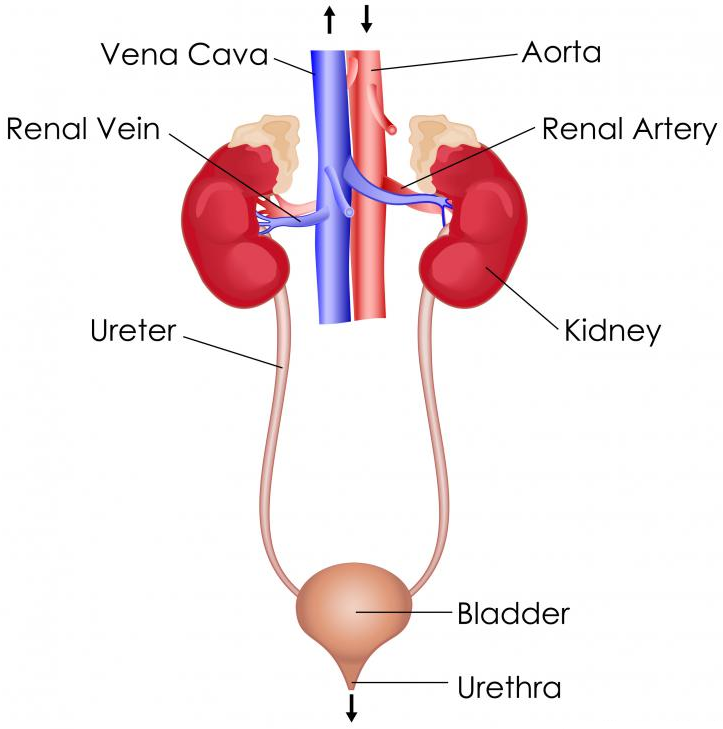
  1. Kidneys: Kidneys are the main organ of the human excretory system. They are the primary excretory organ in humans.They are divided into three regions- the renal cortex which is the outer layer, the renal medulla which is the inner layer and the renal pelvis which is responsible for carrying the urine from the kidney to the ureter. The functional unit of a kidney is called the nephron.
  2. Ureters: There is one ureter that comes out of each kidney as an extension of the renal pelvis. The ureter is a thin muscular tube that carries urine from the kidneys to the bladder.
  3. Urinary bladder: It is a sac-like structure that is lined with smooth muscle layer and is responsible for storage of urine till it is expelled from the body by micturition. Micturition is the act of expelling urine from the body. The bladder receives urine from the ureters, one from each kidney. The level of the urinary bladder placement in the body differs in men and women.
  4. Urethra: This is a tube that arises from the urinary bladder and functions to expel urine to the outside by micturition.
View full question & answer
Question 1055 Marks
Describe the alimentary canal of man.
Answer
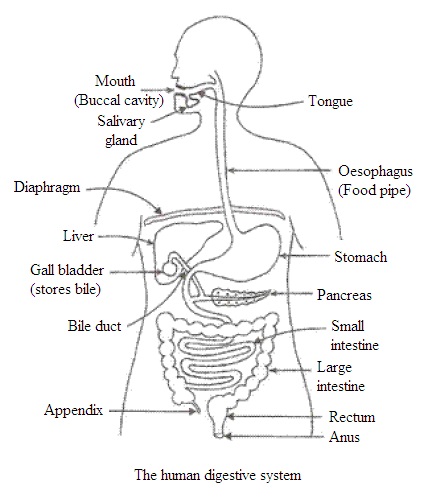
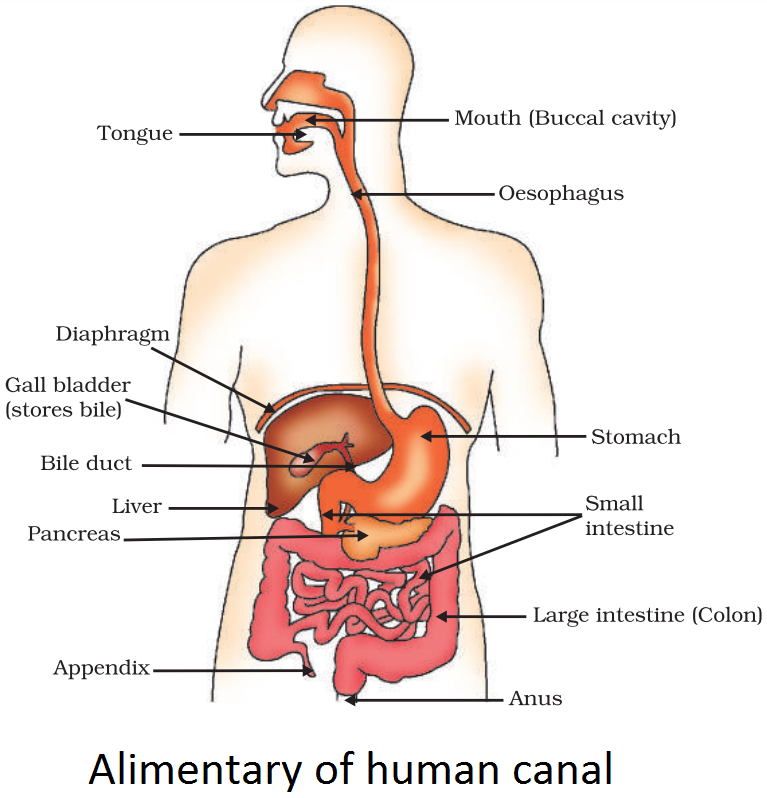
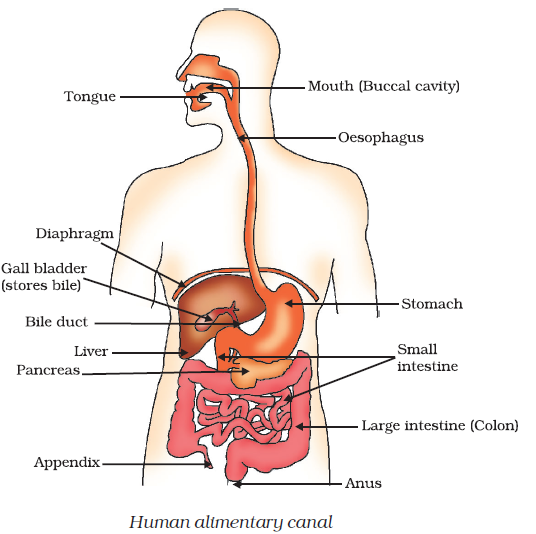
Human alimentary canal consists of organs of digestion which are namely, in sequence, mouth, oesophagus, stomach, small intestine, large intestine and anus.
Mouth cavity: It is the oral cavity inside mouth, containing teeth, tongue and three pairs of salivary glands.
Pharynx: The oral cavity opens into the pharynx. It is the part where food passage and air passage cross each other.
Oesophagus: It is a long muscular, tube that passes through thoracic cavity and diaphragm into abdominal cavity and carries the food down to the stomach by peristalsis.
Stomach: The stomach is a thick-walled, J-shaped organ present on the left side of the abdominal cavity and is continuous with the esophagus above and the duodenum of the small intestine below.
Small intestine: The pyrolic valve of Stomach leads to a tubular structure called as small intestine. It has three divisions, i.e., duodenum, jejunum and ileum.
Large intestine: The ileoceacal valve of small intestine leads to large intestine, which can be divided into two parts as anterior colon and posterior rectum.
The rectum opens at the anus, which in turn serves as site of defecation, the expulsion of feces.
View full question & answer
Question 1065 Marks
Draw a labelled diagram of the human digestive system. With the help of this diagram, describe the process of digestion of food in man (humans).
Answer
Digestion of food in human beings: Digestion of food begins in the mouth. The mouth cavity contains teeth, tongue and salivary glands. The teeth cut the food into small pieces, chew and grind it. This is called physical digestion. Salivary glands produce saliva which mixes with the food. This involves chemical digestion of food. The saliva contains an enzyme called salivary amylase which digests the starch and converts it into maltose sugar. Mouth opens into a small funnel shaped area called pharynx which leads to a long tube called oesophagus. It carries the food down into the stomach.
The wall of oesophagus is muscular. When the slightly digested food enters the food pipe, the walls of the oesophagus starts contraction and expansion movements called peristaltic movements which push the food into the stomach. Digestion does not take place in the oesophagus. The glands present on the walls of the stomach secrete gastric juice that contains hydrochloric acid, the enzyme pepsin and mucus. A small amount of gastric lipase is also present that breaks down the fats present in the food. Gastric juice is acidic due to the presence of HCl which is necessary for the pepsin to become active and converts the proteins into peptones.
The mucus protects the stomach walls from HCl. From the stomach, the partially digested food goes into the small intestine through sphincter muscle. Small intestine is divided into two parts: Duodenum and Ileum.
Duodenum receives the secretions of two glands, liver and pancreas through a common duct. Liver secretes bile which is alkaline and contains salts to emulsify the fats (or lipids). The bile secreted by the liver is stored in the gall bladder. Pancreas secretes pancreatic juice which contains trypsin, lipase and pancreatic amylase. Trypsin digests the proteins, lipase emulsifies the fats and pancreatic amylase breaks down the starch. Thus, small intestine is the site of complete digestion of carbohydrates, proteins and fats. The walls of ileum secrete succus entericus which completes the digestion process.
View full question & answer
Question 1075 Marks
Describe the mechanism of urine formation in human excretory system. Draw a labelled diagram to illustrate your answer.
Answer
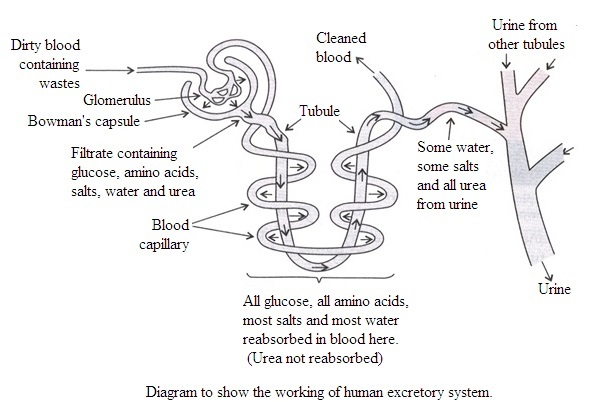
Urine formation: The dirty blood containing waste like urea enters the glomerulus which filters the blood. During filtration, the substance like glucose, amino acids, salts, water, urea etc present in the blood pass into Bowman’s capsule and then enter the tubule of nephron. When the filtrate containing useful substances as well as the waste substances passes through the tubule, the useful substances like glucose, amino acids, most salts and water are reabsorbed into the blood through blood capillaries surrounding the tubule. Only the waste substances like urea, some unwanted salts and excess water remains behind in the tubule. This yellowish liquid is called urine.
View full question & answer
Question 1085 Marks
Explain the mechanism of photosynthesis.
Answer
Mechanism of Photosynthesis:
Photosynthesis is formation of organic food from carbon dioxide and water with the help of sunlight inside chlorophyll containing cells. Oxygen is produced as by-product.
$6\text{CO}_2+12\text{H}_2\text{O}\xrightarrow[\ \text{Sunlight}\ ]{\ \text{Chlorophyll}}\text{C}_6\text{H}_{12}\text{O}_6+6\text{H}_2\text{O}+6\text{O}_2\uparrow\\\ \ \ \ \ \ \ \ \ \ \ \ \ \ \ \ \ \ \ \ \ \ \ \ \ \ \ \ \ \ \ \ \ \ \ \ \ \ \ \ \ \ \ \ \ \ \ \text{Glucose}$
Oxygen comes from water. Hydrogen of water is used to reduce carbon dioxide to form carbohydrate.
$2\text{H}_2\text{O}\xrightarrow[\ \text{Chlorophyll}]{\ \text{light energy}\ }2\text{H}_2+\text{O}_2$
$\text{CO}_2+2\text{H}_2\xrightarrow{\ \text{energy}\ }[\text{CH}_2\text{O}]+\text{H}_2\text{O}\\\ \ \ \ \ \ \ \ \ \ \ \ \ \ \ \ \ \ \ \ \ \ \ \ \ \ \ \ \ \text{Carbohydrate}$
Actually, photosynthesis occurs in two steps, photochemical and biochemical.
  1. Photochemical Phase (Light or Hill Reaction): The reactions of this phase are driven by light energy. They are of two types- photolysis of water and formation of assimilatory power.
  1. Photolysis of Water. Light energy splits up water into its components. $Mn ^{2+}, CL$ and $Ca ^{2+}$ are required for this.
$2\text{H}_2\text{O}\xrightarrow[\ \text{Mn, Cl, Ca}\ ]{\ \ \text{light}\ \ }\text{O}_2+4\text{H}^{+}+4\text{e}^{-}$
  1. Formation of Assimilatory Power: Light energy absorbed by chlorophyll molecules is used in synthesis of ATP and NADPH.
Both ATP and $NADPH_2$ together form assimilatory power.
$\text{ADP}+\text{Pi}+\text{energy}\xrightarrow{\ \ \ \ }\text{ATP}$
$\text{NADP}^{+}+2\text{e}^{-}+2\text{H}^{+}\xrightarrow{\ \ \ \ }\text{NADPH}+\text{H}^{+}\ \ (\text{NADPH}_2)$
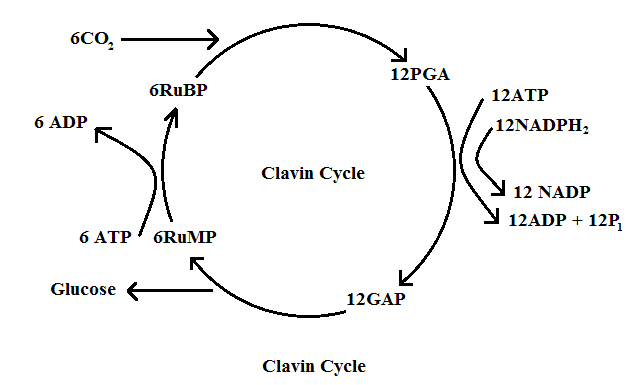
  1. Biosynthetic Phase (Dark or Blackman’s Reaction). It is actually light independent reaction which can occur both in light as well as in dark. It requires the energy and reducing power contained in assimilatory power of light reaction. Common pathway of biosynthetic phase is Calvin cycle. Carbon dioxide combines with ribulose bisphosphate in the presence of enzyme ribulose biphosphate carboxylase or rubisco. It produces two molecules of phosphoglyceric acid (PGA).
$\text{RuBP}+\text{CO}_2\xrightarrow{\ \text{rubisco}\ }2\text{PGA}$
  1.  In the presence of ATP, phosphoglyceric acid is reduced by $NADPH _2$ to form glyceraldehyde phosphate (GAP).
    $PGA+ATP+NADPH 2 \rightarrow GAP+NADP+ADP+Pi$
  1. A part of glyceraldehyde phosphate is changed into dihydroxyacetone phosphate. The two condense and form glucose. Ribulose biphosphate is regenerated to combine with carbon dioxide again. Glucose undergoes condensation to form reserve carbohydrate called starch.
  2. Other inorganic Raw Materials: Synthesis of carbohydrates during photosynthesis is a mechanism to form food materials for body building and releasing energy.

Plants also require a number of other inorganic raw materials or minerals from soil for building other, e.g., nitrogen, phosphorus, iron, sulphur, magnesium, etc. Nitrogen and sulphur are required for building proteins. Phosphorus is required for synthesis of nucleotides. Minerals are absorbed in the form of ions, e.g., $NO _2{ }^{-}$and $NH _4{ }^{+}$for nitrogen. Some bacteria convert atmospheric nitrogen into compounds of nitrogen. Parts of them become available to plants.
View full question & answer
Question 1095 Marks
Describe the process of urine formation in kidneys.
Answer
Mechanism of Urine Formation: It has four components - glomerular filtration, selective reabsorption, tubular
secretion and concentration.
1. Glomerular Filtration: Blood flows in glomerulus under pressure due to narrowness of efferent arteriole. As a result it undergoes pressure filtration or ultrafiltration. All small volume solutes (e.g., urea, uric acid, amino acids, hormones, glucose, ions, vitamins) and water are filtered out and enter the Bowman's capsule. The product is called nephric or glomerular filtrate. Its volume is $125 ml / min$ ( 180 litres/ day).
2. Reabsorption: Nephric filtrate is also called primary urine. It passes into proximal convoluted tubule. The peritubular capillaries around PCT reabsorb all the useful components of nephric filtrate, e.g, glucose, amino acids, vitamins C, calcium, potassium, sodium, chloride, bicarbonate and water ( $75 \%$ ). Selective reabsorption also occurs in the region of distal convoluted tubule. The amount of water absorption depends upon amount of excess water present in the body and the amount of dissolved waste to be excreted.
3. Tubular Secretion (Augmentation): It occurs mostly in the distal convoluted tubule which is also surrounded by peritubular capillaries. Smaller amount of tubular secretion also takes place in the area of proximal convoluted tubule. Tubular secretion is active secretion of waste products by the blood capillaries into the urinary tubule. It ensures removal of all the waste products from blood, viz.,' urea, uric acid, creatinine. Extra salts, $K ^{+}$and $H ^{+}$are also secreted into urinary tubule to maintain a proper concentration and pH of the urine.
4. Concentration of the Urine: $75 \%$ of water content of nephric filtrate is reabsorbed in the region of proximal convoluted tubule. Some $10 \%$ of water passes out of the filtrate through osmosis in the area of loop of Henle. It is because loops of Henle are immersed in hyper-osmotic interstitial fluid, Further concentration takes place in the area of collecting tubes in the presence of hormone called antidiuretic hormone (ADH) or vasopressin. The hormone is secreted only when concentrated urine is to be passed out. It is not secreted when a person drinks a lot of water. Absence of antidiuretic hormone produces a dilute urine. Hormone action, therefore, maintains osmotic concentration of body fluids. Deficiency of ADH causes excessive, repeated, dilute urination (diabetes insipidus).
View full question & answer
Question 1105 Marks
Explain the digestion of chapati in human beings. Draw a diagram depicting human alimentary canal.
Answer
Chapati is written down as food so,
  1. The first step is done by the teeth to crush it into smaller pieces.
  2. Then the saliva has salivary amylase enzymes which breaks down the starch in the food to give sugar and it also wets the food to make the passage of food down the alimentary canal easier Peristaltic movement occurs all along the gut till the food reaches the stomach.
  3. In the stomach the digestive functions are taken care by the gastric glands present in the walls of the stomach, the gastric glands secrete hydrochloric acid an enzyme called pepsin and mucus.
  4. And then the food reaches the small intestine longest part of thealimentary canal, the small intestine recieves the secretions of the liver and pancreas which help in the digestion of food , the juice secreted by the liver is called bile juice and the juice secreted by the pancreas is called pancreatic juice.
​​​​​​​In the inner lining of the small intestine there are finger like projections called the villi which absorb the digested food and the remaining undigested food that enters the large intestine it absorbs water from it, the villi are present here also.
Thus, the digestion of chapati is completed. The diagram is given below: ​​​​​​​
View full question & answer
Question 1115 Marks
Describe the working of human blood circulatory system with the help of a suitable diagram which shows all the steps involved.
Answer

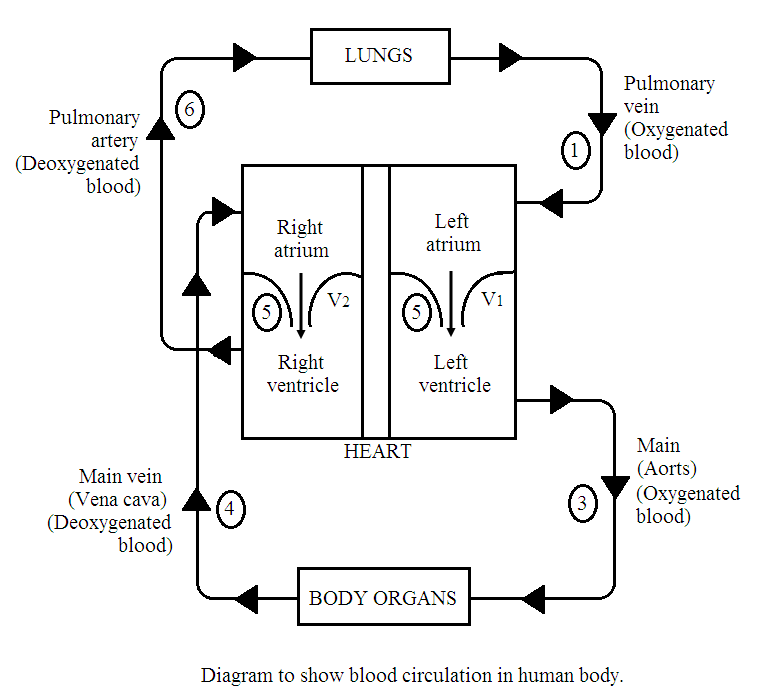
Working of Human blood circulatory system takes place in the steps below:
  1. When the muscles of all the four chambers are relaxed, the pulmonary vein brings the oxygenated blood from the lungs in the left atrium of the heart.
  2. When the left atrium contracts, the oxygenated blood is pushed into the left ventricle through valve V .
  3. When the left ventricle contracts, the oxygenated blood enters the main artery called aorta from which it goes to the different body organs through small branches called arterioles and capillaries.
  4. The main artery carries the blood to all the organs of the body head, arms etc except the lungs. The oxygenated blood gives off oxygen, digested food and dissolved materials to the body cells. The carbon-dioxide produced in the cells enters the blood. The deoxygenated blood enters main vein called vena cava which carried it to the right atrium of the heart.
  5. When the right atrium contracts, the deoxygenated blood enters right ventricle through valve V .
  6. When the right ventricle contracts, the deoxygenated blood enters the lungs through pulmonary artery and releases carbon-dioxide and absorbs fresh oxygen from air. The blood becomes oxygenated again and is sent to the left atrium of heart by pulmonary vein for circulation in the body. This whole process is repeated continuously.
View full question & answer
Question 1125 Marks
Describe the process of nutrition in Draw labelled diagrams to show the various steps in the nutrition in Amoeba.
Answer
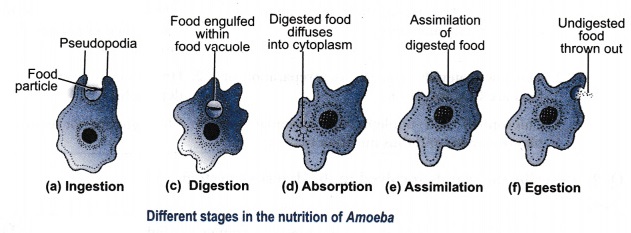
Nutrition in amoeba: Nutrition in amoeba involves the following steps
  1. Ingestion? Amoeba has no mouth for ingestion of food. It ingests the food by using its pseudopodia. The food is engulfed with little water to form a food vacuole.
  2. Digestion? The food is digested by digestive enzymes present in the cytoplasm which breaks the food into small soluble molecules by chemical reactions.
  3. Absorption? The digested food is absorbed directly into the cytoplasm by diffusion. The digested food spreads out from the food vacuole into the whole cell and after absorption the food vacuole disappears.
  4. Assimilation? Food is used to obtain energy through respiration and the remaining part of the food is used for growth.
  5. Egestion? The undigested food collects inside the cell and the cell membrane ruptures. Through this, the undigested food is thrown out of the body.
View full question & answer
Question 1135 Marks
How do carbohydrates, fats and proteins get digested in human beings?
Answer
  1. Carbohydrates: The digestion of carbohydrates begins in the mouth. The human saliva contains an enzyme called salivary amylase which digests the starch present in the food into maltose sugar. The slightly digested carbohydrates when reaches the small intestine, pancreatic amylase present in the pancreatic juice breaks down the starch. The intestinal juice of the small intestine completes the digestion of carbohydrates and finally coverts it into glucose.
  2. Fats: The process of digestion of fats begins in the stomach. The glands of stomach secrete a small amount of gastric lipase that breaks down the fats present in the food. From the stomach the partially digested food goes into small intestine where the pancreatic lipase breaks down the emulsified fats. The walls of small intestine secrete intestinal juice which converts the fats into fatty acids and glycerol.
  3. Proteins: The digestion of proteins begins in the stomach. The glands of the stomach secrete gastric juice which contains an enzyme called pepsin. Pepsin converts the proteins into peptones. Pancreatic juice contains trypsin which digests the proteins into peptides and the intestinal juice completes the process of digestion of proteins thus converting it into amino acids.
View full question & answer
[5 marks Questions] - Page 3 - Science STD 10 Questions - Vidyadip