Questions · Page 2 of 3

[5 marks Questions]

Question 515 Marks
Why do we need a proper transportation system in plants?
Answer
Plants need vascular bundles for transport the food, minerals and water. When water and minerals are absorbed by the roots, then this cannot be direct reach to the upper parts of plants. So xylem tissue takes them and transport it to the upper part of plant like shoot, stem and mainly for leaves for preparing food by photosynthesis. If roots do work of absorption of water and minerals then it also needs energy. For example if we do any work then we need energy to do that work. It is same with the roots. They need their food for energy. When leaves do photosynthesis and form food, then this cannot directly get by the roots. So phloem is used for transporting the food from leaves to roots. Hence plants need transporting system. But bryophtes do not need this system because they are thallophytes.
View full question & answer
Question 525 Marks
Excretion is different in multi-cellular organisms as compared to unicellular organisms. How?
Answer
The number of cells in the body varies with different organisms. In some lower forms of life (Example: Euglena, Amoeba) The body is formed of a single cell; these organism are described as unicellular. In a unicellular organism, all life activities are carried out by itself with its internal structures. The intracellular structures are called the organelles
In the vast majority of plants and animals, the body is made up of numerous cells. They are called multicellular organisms. A multicellular organism is actually an aggregation of cells. Here a group of cells functions in a same way to form a tissue or an organ (Example: Xylem vessels, cork cells, cells in the skin). Multicellular organisms have a great capacity to survive than unicellular organisms.
View full question & answer
Question 535 Marks
How are oxygen and carbon-dioxide exchanged in our body during respiration?
Answer
During the process of ‘breathing in’ the air sacs or alveoli of the lungs get filled with air containing oxygen. The alveoli are surrounded by capillaries carrying blood so the oxygen of air diffuses from the alveoli walls into the blood from where it is carried to all the parts of the body.As the blood passes through the tissues of the body, the oxygen present in it diffuses into the cells. This oxygen combines with the digested food to release energy. Carbon-dioxide gas is produced as a waste product during respiration in the cells of the body tissues which diffuses into the blood. Blood carries the carbon-dioxide back to the lungs where it diffuses into the alveoli.
View full question & answer
Question 545 Marks
What substances are contained in pancreatic juice? What are their functions?
Answer
Pancreatic juice contains digestive enzymes? Pancreatic Amylase, trypsin and lipase.Functions:
Pancreatic amylase: The enzyme amylase breaks down the starch. Trypsin: Trypsin digests the proteins. Lipase: Lipase breaks down the emulsified fats.
View full question & answer
Question 555 Marks
How do carbohydrates, proteins and fats get digested in human beings?
Answer
Digestion of carbohydrates: Digestion of carbohydrates begins from buccal cavity. Salivary amylase converts starch into sugar. Other complex carbohydrates are converted into glucose in the small intestine.
Digestion of Proteins: Protein is partially digested in the stomach. For this, stomach secretes the enzyme pepsin. In small intestine, pancreatic juice provides the enzymes trypsin and chymotrypsin. These enzymes complete the digestion of proteins.
Digestion of Fats: Digestion of fats takes place in small intestine. Bile; from liver; emulsifies the fat. Due to this, fat is broken into small globules. This makes it easier for the enzyme to digest fat. Lipase is the enzyme which converts fat into glycerol and fatty acid.
View full question & answer
Question 565 Marks
If a person holds his breath after expiration for about 25sec, would there be occurrence of any exchange of respiratory gases in the lungs during this period? Explain.
Answer
Yes there will be exchange of respiratory gases. If a person holds his breath for 25 seconds after expiration, It is so because, even after we exhale, some amount of air remains in the lungs. This volume of air is called as residual volume which has a quantity of about 1200ml. So even if a person hasn't inhale the air for 25 seconds, then also this residual volume will continue gaseous exchange in lungs for some time. But if this period last some more longer, then this can be lethal.
View full question & answer
Question 575 Marks
Where does anaerobic respiration occur in human body?
Answer
Anaerobic respiration is a type of respiration that takes place in the absence of oxygen and aerobic respiration. The steps of anaerobic respiration have some similarities to aerobic respiration. Both forms start their process with glycolysis, which is the beginning of carbohydrate catabolism, or the breakdown of larger molecules into smaller ones.Anaerobic respiration takes place in the fluid portion of the cytoplasm of cells, away from the mitochondria or any other organelles. It begins with glycolysis, which breaks apart glucose and generates energy and a compound known as pyruvate, and also includes fermentation, which breaks down the pyruvate for more energy.
View full question & answer
Question 585 Marks
The transport system in plants consists of two kinds of tissues X and Y. The tissue X is made up of living cells and consists of two components A and B. The component A has tiny pores in its end walls and contains only cytoplasm but no nucleus. On the other hand, component B has cytoplasm as well as nucleus. The tissue Y is made up of dead cells and consists of two components C and D. The component C has open ends whereas component D does not have open ends. In flowering plants, either only C or both C and D transport water but D is the only water conducting tissue in non - flowering plants.
  1. What is (i) tissue X, (ii) component A and (iii) component B?
  2. What is (i) tissue Y, (ii) component C and (iii) component D?
Answer
  1.  
  1. The tissue X is phloem. Phloem is made of living cells and helps in the transport of food from leaves to other parts of the body.
  2. A sieve tube, which forms the phloem, has tiny pores in its end walls and contains only cytoplasm. It does not have any nucleus. Hence, component A is a sieve tube.
  3. Companion cell is a component of phloem and has cytoplasm as well as nucleus. Hence, component B is a companion cell.
  1.  
  1. Tissue Y is xylem. It is made of dead cells and helps in the transport of water and minerals from the soil via roots to the rest of the plant body.
  2. Xylem vessel is a component of xylem and has open ends. Hence, component C is xylem.
  3. Tracheid does not have open ends. Hence, component D is a tracheid.
View full question & answer
Question 595 Marks
Breathing cycle is an essential process for the exchange of gases’. Justify this statement.
Answer
The breathing cycle involves inhalation and exhalation of air due to alternate expansion and contraction of thoracic cavity. Thus it is a rhythmic process. But exchange of gases is a continuous process as it takes place between the blood and each and every cell, by diffusion. Imagine a situation when we stop breathing, that is there will be no intake of oxygen and no release out of $CO _2$. In that situation, oxygen supply will be stopped in our body and there will be continuous accumulation of $CO _2$ inside the body. This can be fatal and the person may die because of suffocation. That is why it is said that breathing cycle is an essential process for the exchange of gases.
View full question & answer
Question 605 Marks
Some sugar solution is taken in a test-tube and a little of substance X in powder form is added to it. The mouth of test - tube is closed with a cork and allowed to stand for sometime. On opening the cork, a characteristic smell of substance Y is obtained and a gas Z is also observed to be formed. The gas Z extinguishes a burning matchstick.
  1. What could be X, Y and Z?
  2. What is the process of converting sugar into substance Y by the action of X known as?
  3. What type of respiration is exhibited by X in the above process?
Answer
  1.  
  1. X is yeast.
  2. Y is ethanol.
  3. Z is carbon-dioxide.
  1. Fermentation is the process of converting sugar into substance Y by the action of X.
  2. Anaerobic respiration is exhibited by X in the above process.
View full question & answer
Question 615 Marks
Explain with a schematic representation the exchange of gases in tissues.
Answer
When we take in we take in Oxygen, which achieves the lung alveoli. Oxygen at that point diffuses into the blood of the encompassing vessels from the alveoli which have a high grouping of Oxygen by dispersion. This oxygenated blood is then dispersed to all the body cells by heart. In the wake of providing oxygen to the body cells, the blood gathers carbon dioxide which is created by cell respiration in the cells. The tissues or cells have a high grouping of $CO _2$ than the blood so carbon dioxide diffuses from high focus to low fixation. The blood conveys carbon dioxide to lung alveoli. The trading of gasses happens in the alveoli and tissues. The oxygen breathed in is transported to every one of the parts of the body while carbon dioxide delivered to the cells is gathered from the cells and breathed out.
View full question & answer
Question 625 Marks
X is a wild animal which eats only the flesh of other animals whereas Y is a domestic animal which feeds mainly on green grass.
  1. What are animals like X known as?
  2. What are animals Y known as?
  3. Which animal, X or Y, has a longer small intestine? Why?
  4. Name one animal which is like X.
  5. Name one animal which is like Y.
Answer
  1. Animals like X are known as carnivores.
  2. Animals like Y are known as herbivores.
  3. Animals like X have longer small intestine as they are grass eating animals and they need long intestine to digest the cellulose present in the grass.
  4. Lion is a carnivore.
  5. Cow is an herbivore.
View full question & answer
Question 635 Marks
When a person puts food in his mouth, then teeth cut it into small pieces, chew and grind it. The glands A in the mouth secrete a substance B which is mixed with the food by tongue. The substance B contains an enzyme C which starts the digestion of food in the mouth. The slightly digested food from the mouth goes down a tube D. The special type of movements E in the walls of tube D push the food into stomach for further digestion. The stomach wall secretes gastric juice containing three substance F, G and H. One of the functions of F is to kill bacteria which may enter the stomach with food. The substance G protects the inside layer of stomach from the damaging effect of substance F whereas substance H is and enzyme for digestion. The partially digested food then enters into small intestine for further digestion.
  1. What is Gland A, Substance B and Enzyme C?
  2. Name the tube D.
  3. What is the movement E known as?
  4. What are F, G and H?
Answer
  1.  
  1. Gland A is salivary gland.
  2. Substance B is saliva.
  3. Enzyme C is salivary amylase.
  1. Tube D is oesophagus.
  2. The movement E is known as peristaltic movement.
  3. (i) F is hydrochloric acid, G is mucus and H is pepsin.
View full question & answer
Question 645 Marks
Platelets help in clotting of blood at injured side. Draw a flow diagram of this process.
Answer
The injured cells and the platelets disintegrate at the site of the wound and release thrombokinase or thromboplastin.
Thrombokinase with the help of calcium ions converts prothrombin of the plasma into thrombin.
Thrombin in the presence of calcium ions reacts with the soluble fibrinogen and converts it into insoluble fibrin. Fibrin is a solid substance which forms threads and a meshwork at the site of the wound.
Blood cells are trapped in the network of the fibrin. The blood shrinks and squeezes out the rest of the plasma in the form of a clear liquid. The solid mass which is left behind is called a clot or thrombus.
View full question & answer
Question 655 Marks
When a person eats sugary food, then organisms A present in his mouth act on sugar to produce a substance B. The substance B first dissolves the calcium salts from the top part C of the tooth and then from its middle part D forming holes E. These holes ultimately reach the part F in the lower part of tooth which contains nerves and blood vessels. The substance B irritates the nerve endings inside the tooth causing toothache.
  1. What are (i) organisms A, and (ii) substance B?
  2. What are (i) part C, and (ii) part D, of tooth known as?
  3. By what name are the holes E in the tooth known?
  4. Name the part F of the tooth.
  5. What will happen if organisms A reach part F of the tooth known?
Answer
  1.  
  1. Organism A is bacteria.
  2. Substance B is acid.
  1.  
  1. Part C is the tooth enamel.
  2. part D is the dentine of the tooth.
  1. The small holes, E, are known as cavities.
  2. F is the pulp of the tooth.
  3. When a bacterium (organism A) reaches the pulp (part F) of the tooth, it irritates the nerve endings and causes toothache.
View full question & answer
Question 665 Marks
Second stage of urine formation is called selective re-absorption. Why?
Answer
The second stage of urine formation, tubular re-absorption, is called selective re-absorption The filtrate enters the kidney in the proximal tubule. This region of the kidney is special because many things can be removed from the filtrate. These valuable things are recollected, or reabsorbed, by the body.
Glucose, certain salts, vitamins, hormones, and amino acids are restored to the body and will not be included in urine. Sometimes, if the body has too much of something then the extra sugar or salt will stay in the filtrate. For example, diabetics with high levels of blood glucose may have glucose in their urine since it cannot all be reabsorbed. The filtrate after reabsorption is like pre-urine.
View full question & answer
Question 675 Marks
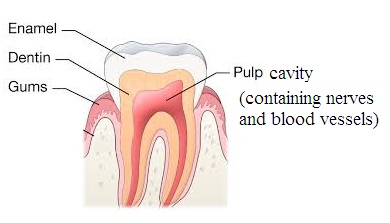
Describe the parts of our tooth with the help of a labelled diagram.
Answer
The tooth has hard outer covering called enamel. The part of tooth below enamel is called dentine inside which is the pulp cavity. The pulp cavity contains nerves and blood vessels.
View full question & answer
Question 685 Marks
Explain the term dialysis.
Answer
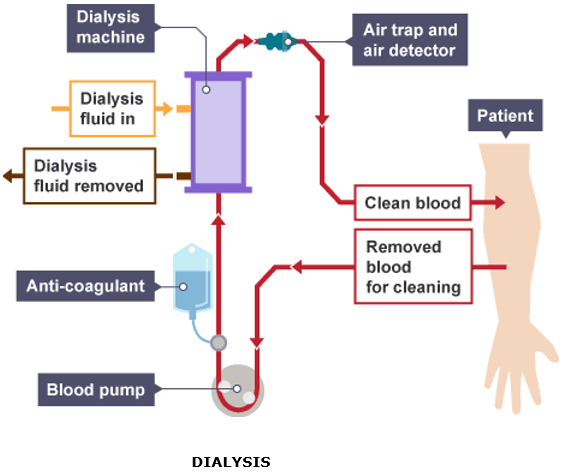
Dialysis is the process of removing nitrogenous wastes and excess water from the body by using a clinical device, called as artificial kidney and a dialyzing fluid. When kidney function decreases to a critical level or complications arise, a person may need to start dialysis.
There are two main types of dialysis, hemodialysis and peritoneal dialysis.
Hemodialysis uses a machine and a filter to remove waste products and water from the blood.
Peritoneal dialysis uses a fluid (dialysate) that is placed into the patient's abdominal cavity to remove waste products and fluid from the body.
View full question & answer
Question 695 Marks
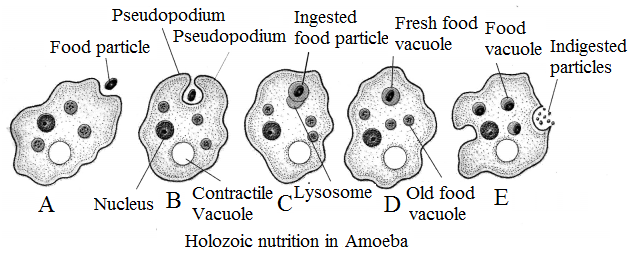
A unicellular animal P having no fixed shape ingests a food particle by forming temporary finger-like projections Q. The food particle is engulfed with a little surrounding water to form a temporary stomach R inside it. The chemicals S from surrounding cytoplasm enter into R and break down food into small and soluble molecules by chemical reactions. The digested food is absorbed directly into cytoplasm by the process T. The undigested food is thrown out of the body by the rupture of a cell organelle U in a process called V.
  1. Name the unicellular animal P.
  2. What are (i) Q, and (ii) R?
  3. Name (i) chemical S, and (ii) process T.
  4. Name (i) organelle U, and (ii) process V.
Answer
  1. The unicellular animal P is Amoeba.
  2. Q is pseudopodia and R is the food vacuole.
  3. Chemical S is the digestive enzyme and Process T is diffusion.
  4. Organelle U is cell membrane and Process V is egestion.
View full question & answer
Question 705 Marks
Name the raw materials required for photosynthesis. How do plants obtain these raw materials?
Answer
The raw materials for photosynthesis are carbon-dioxide and water. The green plants take carbon-dioxide from air for photosynthesis. The carbon-dioxide gas enters the leaves of the plants through the stomata present on their surface. The water required by the plants for photosynthesis is absorbed by the roots of the plants from the soil through the process of osmosis. The water absorbed by the roots is transported upwards through the xylem vessels to the leaves where it reaches the photosynthetic cells and utilized in photosynthesis.
View full question & answer
Question 715 Marks
Distinguish between photosynthesis and respiration.
Answer
Differences between Cellular Respiration and Photosynthesis:
 
Cellular Respiration
Photosynthesis
1.
Occurs in all living organisms.
Occurs only in all green plants, algae, and in some bacteria.
2.
The entire process occurs in Mitochondria.
The entire process occurs in Chloroplasts.
3.
Glucose and oxygen are the reactants of this process.
Carbon dioxide, water, and light energy are the reactants of this process.
4.
In this process, food particles are broken down to release energy.
In this process, food is synthesis by capturing the energy.
5.
It is an exergonic reaction as energy is released.
It is an endothermic reaction as it requires energy.
6.
This process does not require sunlight since cellular respiration occurs all the time.
This process requires sunlight since photosynthesis occurs only in the presence of sunlight.
7.
The chemical reaction of cellular Respiration is:
$C_6 H_{12} O_6+6 O_2 \rightarrow 6 CO_2+6 H_2 O$
The chemical reaction of photosynthesis is:
$6 CO_2+6 H_2 O \rightarrow C_6 H_{12} O_6+6 O_2$
View full question & answer
Question 725 Marks
Plants absorb water from the soil. How does this water reach to the top of the tree? Explain in detail.
Answer
The soil is the richest source of raw materials for the plant like nitrogen, phosphorous, water and other minerals. Water is essential for all physiological activities of the plant. The absorption of all these substances occurs through a part of the plant called roots.
Water from the soil first goes to the roots. Plant roots cannot pump water itself but they actively transfer nutrient ions to the low parts of a vascular structure which is continuous with a structure called xylem. Xylem consists of long, dead plant cells that form upright tubes. Water flows after the ions.
The plant transport system moves raw materials from roots and energy from leaves. This is done by two independent conducting tubes called xylem which transports water and minerals from the soil and phloem transports the food from leaves to other parts of plants. vessels tracheids of xylem tissue, stem, leaves, and roots form a continuous water conducting channel reaching to all parts of the plant. The difference of concentration of ions in roots and soil, help water to enter roots from the soil to eliminate this difference(caused by root cells take up ions from soil). This maintains the steady movement of water upwards via roots.
the pressure of the absorbed water from the roots make the water to move upward. but this pressure is still not so affective to move it to the top. to move minerals n water to the top, transpiration is used. during transpiration, water loses from the leaves which creates a low pressure of water. which in turn pulls the water upward.
View full question & answer
Question 735 Marks
Explain the principle of dialysis with the help of a labelled diagram.
Answer
Principle of Dialysis: The blood from an artery in the patients arm is made to flow into the dialyser of a dialysis machine made of long tubes of selective permeable membrane (like cellulose) which are coiled in a tank containing dialysing Solution. The dialysing Solution contains water, glucose and salts in similar concentrations to those in normal blood. As the patient’s blood passes through the dialysing Solution most of the waste like urea present in it pass through the selectively permeable cellulose tubes into the dialysing Solution. The clean blood is pumped back into a vein of the patients arm.
View full question & answer
Question 745 Marks
Classify the following into herbivores, carnivores and omnivores:
Lion, Man, Dog, Goat, Crow, Elephant, Snake, Hawk, Rabbit, Deer.
Answer
Lion Carnivore
Man Omnivore
Dog Omnivore
Goat Herbivore
Crow Omnivore
Elephant Herbivore
Snake Carnivore
Hawk Carnivore
Rabbit Herbivore
Deer Herbivore
View full question & answer
Question 755 Marks
Describe the flow of blood through the heart of human beings.
Answer
Human heart has four completely separated chambers which allow two completely separated circuits of oxygenated and deoxygenated blood; hence the name, double circulation.
The pulmonary circuit includes flow of blood through heart-lung-heart while systemic circuit includes heart-rest of the body-heart. This ensures that left side of heart receives and pumps only oxygenated blood while the right side receives and pumps only deoxygenated blood.
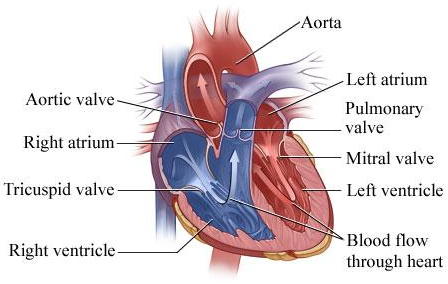
Two pulmonary veins come from each lung and pass $O_2$ -rich blood to left atrium. The left ventricle pumps blood into the aorta which in turn branches and delivers blood to the major body regions and organs. The anterior vena cava collects deoxygenated blood from the head, chest, and arms and enters the right atrium while the inferior vena cava collects blood from the lower body regions. Both venae cavae pass the deoxygenated blood to the right atrium. Blood from right atrium enters right ventricle and pulmonary arteries carry deoxygenated blood from right ventricle to lungs for oxygenation.
View full question & answer
Question 765 Marks
The human body has an organ A which acts as a double pump. The oxygenated blood coming from the lungs through a blood vessel B enters the upper left chamber C of the double pump. When chamber C contracts, then blood goes into lower left chamber D. The contraction of chamber D forces the blood to go into a blood vessel E which supplies oxygenated blood to all the organs of the body (except the lungs). The deoxygenated blood coming out of the body organs is taken by a blood vessel F to the right upper chamber G of pumping organ. Contraction of chamber G forces the deoxygenated blood into right lower chamber H. And finally the contraction of chamber H sends the deoxygenated blood into lungs through a blood vessel I.
  1. What is organ A?
  2. Name the blood vessel (i) B (ii) E (iii) F, and (iv) I.
  3. What are chambers (i) C, and (ii) D?
  4. What are chambers (i) G and (ii) H?
Answer
  1. Heart is the organ in the human body that acts as a double pump. Hence, organ A represents the heart.
  2.  
  1. The oxygenated blood from the lungs enters the left atrium (chamber C) via the blood vessel called pulmonary vein (B). Hence, B is pulmonary vein.
  2. The contraction of left ventricle (chamber D) forces the blood into the blood vessel called aorta (E), which supplies the oxygenated blood to the organs of the body, except the lungs. Hence, E is aorta.
  3. From the body tissues, the deoxygenated blood is transported back to the heart into the right upper chamber called right atrium (G), by the vena cava (F). Hence, F is vena cava.
  4. Contraction of chamber G (right atrium) forces the deoxygenated blood into the lower right chamber called right ventricle (H). Finally, the contraction of H (right ventricle), sends the deoxygenated blood into the lungs through the blood vessel called pulmonary artery (I). Hence, I represent pulmonary artery.
  1.  
  1. The chamber C represents left atrium.
  2. The chamber D represents left ventricle.
  1.  
  1. The chamber G represents right atrium.
  2. The chamber H represents right ventricle.
View full question & answer
Question 775 Marks
The liquid connective tissue A circulates in our body continuously without stopping. This tissue contains a pigment B which imparts it a colour C. The tissue A consists of four components D, E, F and G. The component D fights infection and protects us from diseases. The component E helps in the clotting of tissue A if a person gets a cut. The component F is a liquid which consists mainly of water with many substances dissolved in it and component G carries oxygen from the lungs to all the parts of the body.
  1. What is (i) tissue A, (ii) pigment B and (iii) colour C?
  2. Name (i) D, (ii) E, (iii) F and (iv) G.
  3. Name one substance (other than oxygen) which is transported by tissue A in the human body.
  4. Which two components of tissue A are the cells without nucleus?
  5. Name any two organisms (animals) which do not have liquid like A in their body.
Answer
  1.  
  1. Blood is the liquid connective tissue that circulates in our body continuously without stopping. Hence, A is blood.
  2. Our blood contains a pigment called haemoglobin, which imparts it a red colour. Hence, pigment B is haemoglobin and colour C is red.
  3. Our blood contains a pigment called haemoglobin, which imparts it a red colour. Hence, pigment B is haemoglobin and colour C is red.
  1.  
  1. White blood cells, fight infection and protect us from diseases. Hence, D refers to white blood cells.
  2. Platelets are the component of blood, which help in the clotting of blood (A). Hence, E refers to platelets.
  3. Plasma is a liquid, which consists mainly of water with many substances dissolved in it. Hence, F refers to plasma.
  4. Red blood cells carry oxygen from the lungs to all the parts of the body. Hence, G refers to red blood cells.
  1. Blood also carries the digested food from the small intestine to all other parts of the body.
  2. E (platelets) and G (Red blood cells) are the cells without nucleus.
  3. Amoeba and grasshopper do not have blood (A) like liquid in their body.
View full question & answer
Question 785 Marks
Consider the following chemical reactions which take place in different organisms/ tissues under various conditions:
  1. Glucose → Respiration → Respiration Ethanol + Carbon-dioxide + Energy.
  2. Glucose → Respiration → Respiration Carbon-dioxide + Water + Energy.
  3. Glucose → Respiration → Respiration Lactic acid + Energy.
  1. Name one organism which respires according to equation (i) above.
  2. Name one organism which respires according to equation (ii) above.
  3. When and where does respiration represented by equation (iii) above take place?
  4. Which equation/ equations represent aerobic respiration?
  5. Which equation/ equations represent anaerobic respiration?
  6. Which of the above reactions produces the maximum amount of energy?
Answer
  1. Yeast shows anaerobic respiration.
  2. Humans show aerobic respiration.
  3. In humans beings, during high muscular activity, the respiration represented by equation (iii) occurs. It occurs in the muscle tissue.
  4. Equation (ii) represents aerobic respiration.
  5. Equation (i) represents anaerobic respiration.
  6. Aerobic respiration, i.e. the reaction represented by equation (ii), produces maximum amount of energy.
View full question & answer
Question 795 Marks
Differentiate between left lung and right lung of humans.
Answer
Difference Between Right And Left Lung:
 
Characteristics
Right Lung
Left Lung
1.
Position
Situated on the right side of the respiratory system
Situated on the left side of the respiratory system
2.
Structure
Wider and shorter
Narrow and long
3.
Lobe
Three
Two
4.
Base Shape
Concave
Less concave than the right lung
5.
Bronchus
2 bronchi
Single
6.
Weight
Heavy
Light
7.
Provides space for
Liver
Heart
8.
Number of fissures
Two
One
9.
Type of fissure
One horizontal and one oblique
One oblique
10.
Weight in grams
700
650
View full question & answer
Question 805 Marks
Explain the process of nutrition in Amoeba.
Answer
  1. Ingestion: (L. ingestus - taken in). It is taking in of solid food with the help of temporary or permanent mouth. Amoeba can ingest food particles from any point on its surface. Paramoecium (another unicellular organism) has fixed point for the same. Amoeba captures food with the help of temporary finger-like processes called pseudopodia. Paramoecium has small hair-like processes called cilia. Beating of cilia creates current in water that pushes food particle through cytostome or cell mouth. The process of ingestion of solid food particle by a cell or unicellular organism is called phagocytosis.
As soon as Amoeba comes in contact with a food particle or prey, it throws pseudopodia all around the same. The tips of encircling pseudopodia fuse and the prey comes to lie in a vesicle or phagosome.
  1. Digestion: It is conversion of complex insoluble food ingredients into simple absorbable form. Digestion can be intracellular or intercellular. Intercellular digestion occurs in a digestive tract. Intracellular digestion takes place in the cytoplasm of cells. Here, a lysosome fuses with phagosome to produce a food vacuole, also called gastriole or temporary stomach. Reaction of food vacuole is acidic at first and alkaline later on. Digestion of food occurs with the help of digestive enzymes brought by lysosome. It changes complex insoluble substances of food into simpler absorbable substances.
  2. Absorption: The digested simple and soluble substances pass out of food vacuole into the surrounding cytoplasm.
  3. The absorbed food materials are converted into various constituents of protoplasm including food reserve.
  4. (L. egestus - discharge): It is throwing of undigested components of food out of the body. In Amoeba, the old food vacuole with heavier undigested material reaches the rear end, passes to the surface, fuses with surface membrane and throws out the undigested materials. The process is called egestion. Paramoecium has a definite cytopyge or cell anus.
View full question & answer
Question 815 Marks
There is a pair of bean-shaped organs P in the human body towards the back, just above the waist. A waste product Q formed by the decomposition of unused proteins in the liver is brought into organ P through blood by an artery R. The numerous tiny filters S present in organ P clean the dirty blood by removing the waste product Q. The clean blood goes into circulation through a vein T. The waste substance Q, other waste salts, and excess water form a yellowish liquid U which goes from organ P into a bag-like structure V through two tubes W. This liquid is then thrown out of the body through a tube X.
  1. What is (i) organ P and (ii) waste substance Q?
  2. Name (i) artery R, and (ii) vein T.
  3. What are tiny filters S known as?
  4. Name (i) liquid U, (ii) structure V, (iii) tubes W and (iv) tube X.
Answer
  1.  
  1. Kidneys are bean shaped organs in the human body, towards the back of the body, just above the waist. Hence, organs P are kidneys.
  2. Urea is the waste product that is formed by the decomposition of unused proteins in the liver. Hence, the waste substance Q represents urea.
  1.  
  1. Urea (substance Q) is brought into kidney (organ P) through blood by an artery called renal artery. Hence, R represents renal artery.
  2. The numerous tiny filters called nephrons (S) present in the kidneys (organ P), clean the dirty blood by removing the waste product Q (urea). The clean blood then goes into circulation through T, i.e. renal vein. Hence, vein T represents the renal vein.
  3. The tiny filters S are known as nephrons.
  4. The waste substance Q (urea), other waste salts and excess water form yellowish liquid called urine (U). Urine goes from organ P (kidney) into a bag-like structure V, i.e. urinary bladder, through two tubes W, called ureters. This urine is then thrown out of the body through tube X, called urethra.
    Hence, (i) the liquid U is urine, (ii) structure V is urinary bladder, (iii) tubes W is ureters, and (iv) tube X is the urethra.
View full question & answer
Question 825 Marks
State one difference between artificial kidney and natural kidney?
Answer
 
KIDNEY
ARTIFICIAL KIDNEY
1.
Kidney is the naturally developed excretory organ located in the body of humans.
Artificial kidney is the man-made device.
2.
Excretion of urine by kidneys is done naturally when body fluids are filtered.
Artificial kidneys are use it to dispose urine in patients who is kidneys are completely damaged.
3.
Kidneys have the capacity of reabsorption to maintain iconic balance in the body.
Artificial kidney does not have the reabsorption capacity to maintain iconic balance in the body.
4.
Functioning of kidneys is stimulated by the nervous system and hormones in the body.
The functioning of artificial kidney is done with the help of the machine.
5.
The natural kidney continuously receives the blood and water, filter them and keep the body away from toxic wastes by the process of excretion.
The artificial kidney is the device used in kidney damage persons only from time to time, under supervision of a specialist doctor.
6.
Kidneys are made up of nephrons.
Artificial kidneys are made with cellophane tubes.
View full question & answer
Question 835 Marks
Valves are present in between the auricles and ventricles of the heart. Give one reason.
Answer
The heart features four types of valves which regulate the flow of blood through the heart. These valves permit blood flow only in one direction, and prevent back flow of blood. The four types of valves are:
  1. Tricuspid Valve: This valve separates the right atrium from the right ventricle, and regulates the blood flow between them. Tricuspid valves allow blood to flow from the right atrium into the right ventricle, and prevent back flow of the same.
  2. Pulmonary Valve: This valve separates the right ventricle from the left pulmonary artery. These valves prevent the control the flow of blood from the right ventricle into the left pulmonary artery.
  3. Mitral Valve: Bicuspid valve or Mitral valve separates the left ventricle from the left atrium.
  4. Aortic Valve: This valve separates the left ventricle from the aorta, and controls the blood flow from the ventricle into the rest of the body.
View full question & answer
Question 845 Marks
Draw a schematic representation of transport and exchange of oxygen and carbon dioxide during transportation of blood in human beings and label on it, Lung capillaries, Pulmonary artery to lungs Aorta to body, Pulmonary veins from lungs.
View full question & answer
Question 855 Marks
With a schematic diagram, explain the overall process of respiration.
Answer
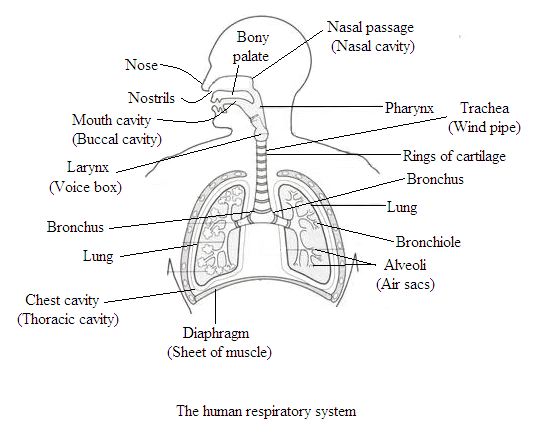
The primary organs of therespiratory system are the lungs, which function to take in oxygen and expel carbon dioxide as we breathe. The gas exchangeprocess is performed by the lungs and respiratory system. Air, a mix of oxygen and other gases, is inhaled.
View full question & answer
Question 865 Marks
Differentiate between an artery and a vein.
Answer
 
Artery
Vein
1.
Direction of Flow: It carries blood from heart to an organ.
It brings blood from an organ towards the heart.
2.
Speed: Blood flow is rapid in artery.
Blood flow is slow in vein.
3.
Jerks: Blood flows with jerks.
Blood flows smoothly.
4.
Pressure: Blood flows under pressure.
There is little pressure.
5.
Internal Valves: They are absent.
Internal valves are present to prevent back flow.
6.
Wall: It is thick and elastic.
It is comparatively thinner and little elastic.
7.
Lumen: Narrow.
Wide.
8.
Type of Blood: Artery carries oxygenated blood except pulmonary arteries.
Vein carries deoxygenated blood except pulmonary veins.
9.
Occurrence: It is deep seated.
It is superficial.
10.
Collapsibility: Artery is not collapsible.
Vein is collapsible.
11.
Blood After Death: It does not contain blood after death.
Vein is full of blood even after death.
View full question & answer
Question 875 Marks
Explain the process of breathing in man.
Answer
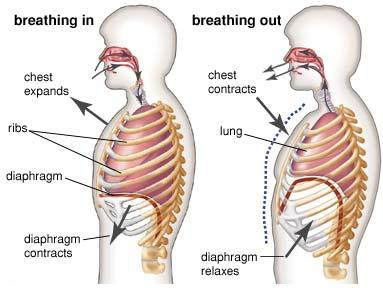
Breathing or the process of taking in fresh air and releasing foul air can be easily observed because thorax shows alternate expansion and contraction. It is involuntary though it can be prevented for a brief period. Rate of breathing is controlled by respiratory centre of brain. Expansion of thorax causes fresh air to be drawn in. Contraction of thorax causes foul air to be expelled. Therefore, breathing consists of two steps, inspiration and expiration.
  1. Inspiration or Inhalation: It is bringing of fresh air into lungs for exchange of gases. During inhalation, thoracic cavity enlarges due to two types of inspiratory muscles, phrenic and external intercostals. Phrenic muscles straighten the diaphragm by moving its curved part downwards. It increases length of thorax. Contraction of external intercostal muscles pushes the rib cage in outward and upward direction. It increases girth of thorax. Being air tight, increase in size of thoracic cavity causes expansion of lungs. It decreases air pressure in the lungs. As a result outside air rushes into lungs through external nostrils, nasal cavities, internal nostrils, pharynx, larynx, trachea, bronchi, bronchioles to alveoli. While passing through respiratory tract, the incoming air is:
  • Filtered by hair present in anterior part of nasal cavities.
  • Cleansed of dust and microbes throughout respiratory tract by lysozyme, mucus and cilia.
  • Air conditioned (bringing temperature of inhaled air to that of body) with the help of blood capillaries present below nasal epithelium.
  • Moistened by water vapours from wet epithelium.
  1. Exchange of Gases: It occurs in the alveoli. Fresh air has high concentration of oxygen and a very low concentration of carbon dioxide. As a result, oxygen diffuses from alveolar air to blood present in capillaries around the alveoli. Carbon dioxide diffuses from blood into alveolar air.
View full question & answer
Question 895 Marks
With a schematic diagram, explain the overall process of respiration in animals.
Answer
Respiration is a cellular process which occurs in each and every cell of body. It starts with glycolysis- a reaction in which breakdown of glucose occurs. Glucose gets converted into pyruvic acid. The process of glycolysis takes place in cytoplasm.
Now this pyruvic acid enters into mitochondria via link reaction in which it gets converted into acetyl-CoA. Now this acetyl-CoA enters in the mitochondria where it performs kreb's cycle in mitochindrial matrix. All the ATP and NADH2 and FADH2 produced till now performs ETS cycle (Electron transport chain) which is located in the mitochondrial membranes. Finally it undergoes oxidative phosphorylation and ATPs are released.

GLYCOLYSIS(in cytoplasm) → LINK REACTION(in cytoplasm) → KREB
CYCLE(mitochondrial matrix) → ELECTRON TRANSPORT SYSTEM
(mitochondrial membrane) → OXIDATIVE PHOSPHORYLATION(mitochondrial membrane).
View full question & answer
Question 905 Marks
Describe the exchange of gases which takes place in the leaves of a plant:
  1. During daytime.
  2. At night.
Answer
  1. During daytime when photosynthesis occurs, oxygen is produced. The leaves use some of this oxygen for respiration and the rest of oxygen diffuses out into the air. Carbon-dioxide produced by respiration is all used up in photosynthesis by leaves during the daytime. Even more carbon-dioxide is taken in from air. Thus, the net gas exchange in leaves during daytime is: Oxygen diffuses out Carbon-dioxide diffuses in.
  2. At night time, when no photosynthesis occurs and hence no oxygen is produced, oxygen from air diffuses in leaves to carry out respiration. Carbon dioxide produced by respiration diffuses out into air. So, the net gas exchange in leaves at night is: Oxygen diffuses in Carbon-dioxide diffuses out.
View full question & answer
Question 915 Marks
The partially digested food coming from the stomach of a person enters a long and narrow organ A in his body. The organ A receives the secretion of two glands: liver and pancreas. Liver secretes a greenish - yellow liquid B which is normally stored in the organ C. Pancreas secretes pancreatic juice which contains three digestive enzymes D, E and F. The intestinal juice completes the process of digestion of food. The inner wall of organ A has millions of tiny finger - like projections G which help in the rapid absorption of digested food into blood stream. The undigested part of food then passes into wider tube H which absorbs most of the water from undigested food. The last part of tube H called I stores this undigested food (or waste) for some time. The undigested food is then passed out though opening J as faeces in the process known as K.
  1. Name the organ A.
  2. Name liquid B and organ C.
  3. What are the digestive enzymes D, E and F?
  4. Name the projections G present on the inner wall of organ A.
  5. Name Tube H, Part I, Opening J and Process K.
Answer
  1. The organ A is small intestine.
  2. Liquid B is bile and Organ C is gall bladder.
  3. The digestive enzymes D, E and F are Amylase, Trypsin and Lipase, respectively.
  4. The projections G are villi that are present on the inner wall of organ A.
  5. Tube H is the large intestine, Part I is the rectum, Opening J is the anus and The process K is egestion or defecation.
View full question & answer
Question 925 Marks
There are five animals P, Q, R, S and T. The animal P always lives in water and has gills for breathing. The animal Q can stay in water as well as on land and can breathe both, through moist skin and lungs. The animal R lives in soil and breathes only through its skin. The animal S lives on land and breathes through spiracles and tracheae. And animal T lives in water and breathes through its cell membrane.
  1. Which of the animals could be Amoeba?
  2. Which of the animals could be frog?
  3. Which animal could be fish?
  4. Which animal could be grasshopper?
  5. Which animal could be earthworm?
Answer
  1. T is Amoeba.
  2. Q is frog.
  3. P is fish.
  4. S is grasshopper.
  5. R is earthworm.
View full question & answer
Question 935 Marks
Explain how deoxygenated blood travel from body to lung for purification. Draw well-labeled diagram in support of your answer.
Answer
Double circulation is the circulation of blood through heart twice while supplying the blood to the whole body. In double circulation, there are two loops or circuits where the blood travels to heart.
Systemic circulation: First stage of systemic circulation starts from left atrium to left ventricle. This transfers the oxygen rich blood to aorta for the supply to various parts of the body. Later, the veins and venules collect the blood from various parts of the body. This blood is rich in carbon dioxide than oxygen and is known as deoxygenated blood. Deoxygenated blood is poured into superior vena cava then to right atrium. Right atrium passes the blood to right ventricle for pulmonary circulation.
Pulmonary circulation: The pulmonary artery collects the blood from right ventricle and passes to lungs for oxygenation. Lungs collects the deoxygenated blood supplied to it and purifies. Then the oxygenated blood is pumped back to left atrium of the heart through the pulmonary vein. Left atrium passes the blood to left ventricles where they pump the oxygenated blood to aorta for systemic circulation.
The double circulation maintains a strict separation of oxygenated and deoxygenated blood. Thus it ensures the high supply of oxygen and improves the body efficiency.
View full question & answer
Question 945 Marks
How does food prepared by leaves is utilized by roots? Explain.
Answer
The food for plants is prepared by the green leaves by the process of photosynthesis. The leaves are the food production centres. Using the sunlight and Carbon dioxide they synthesize food through photosynthesis in the chloroplasts. Every part of plant body like the roots and stem also require food for its functioning so the food prepared by the leaves must be transported to different parts of the plant. All of this takes place through the vascular tissues of the plants. The process of transportation of carbohydrates (sugar) produced by the leaves to other parts of the plant is known as translocation. It is done through Phloem tissues. The movement of carbohydrates in phloem is bidirectional.
View full question & answer
Question 955 Marks
What is the difference between external and internal respiration.
Answer
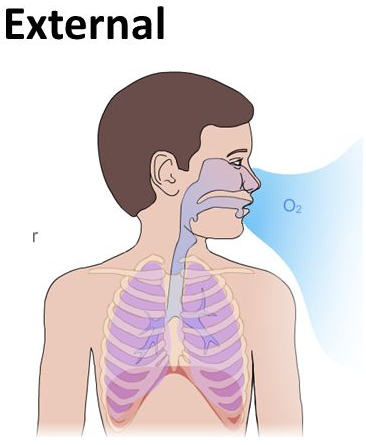
EXTERNAL RESPIRATION:
  • It is a physiological process.
  • It takes place along the respiratory surface along the lungs.
  • also known as breathing.
  • It is a process during which oxygen is taken up by capillaries of lung alveoli and carbon dioxide is released from blood.
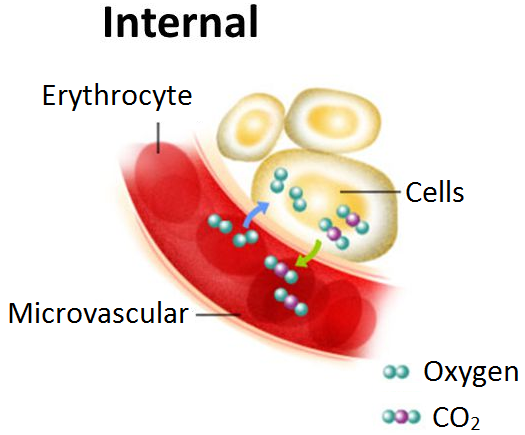
INTERNAL RESPIRATION:
  • It is a biological process.
  • takes place within the cells( i.e.., at cellular level).
  • It is the process in which oxygen is released to tissues or living cells and carbon dioxide is absorbed by the blood.
View full question & answer
Question 965 Marks
An organism X having breathing organs A lives on land. When organism X goes under water, it cannot survive for a long time unless carrying an oxygen cylinder. On the other hand, the organism Y having breathing organs B always lives in water and if taken out of water, it dies after a short while. A third organism Z having breathing organs C and D which lives on the banks of ponds, lakes and rivers can survive on land as well as in water equally well.
  1. What could organism X be? Name the breathing organs A.
  2. What could organism Y be? Name the breathing organs B.
  3. What could organism Z be? Name the breathing organs C and D.
  4. Out of X, Y and Z, which organism is.
  1. Amphibian,
  2. Aquatic,
  3. Terrestrial?
Answer
  1. Organism X could be a human being. The breathing organs A are lungs.
  2. Organism Y could be a fish. The breathing organs B are gills.
  3. Organism Z could be a frog. The breathing organ C is skin and D are lungs.
  4.  
  1. Z is an amphibian.
  2. Y is an aquatic organism.
  3. X is a terrestrial organism.
View full question & answer
Question 985 Marks
A, B and C are three living organisms. The organism A is a unicellullar fungus which can live without air. It is used in the commercial production of an organic compound P from molasses. The organism B is a unicellular animal which lives in water and feeds and moves by using pseudopodia. It breathes through an organelle Q. The organism C is a tiny animal which acts as a carrier of malarial parasite. It breathes and respires through a kind of tiny holes R and air - tubes S in its body.
  1. What are organisms A, B and C?
  2. Name P, Q, R and S.
  3. Which organism/ organisms undergo aerobic respiration?
  4. Which organism/ organisms undergo anaerobic respiration?
Answer
  1.  
  1. Organism A is yeast.
  2. AmoebaOrganism B is .
  3. C is mosquito.Organism.
  1.  
  1. P is alcohol.
  2. breathes through the cell membrane.Amoeba Q is the cell membrane because
  3. R is spiracle.
  4. S is tracheae.
  1.  
  1. Organisms B and C undergo aerobic respiration.
  2. Organism A, i.e. yeast, undergoes anaerobic respiration.
View full question & answer
Question 995 Marks
Name the conducting structures present in plants.
Answer
The conducting tissues in plants are xylem and phloem. 'Xylem' and 'phloem' are vascular tissues which are present in plants for the 'conduction of water and minerals'.
Xylem transports sap or water to the different parts of the plant. Phloem is the tissue that transports food prepared by the leaves to all parts of the plant. The xylem and phloem transport water and food internally within the plants.
These tissues are further made up of cells which may be living as well as dead cells and also other tissues that help these conducting tissues to do their work.
View full question & answer
Question 1005 Marks
State the location of salivary glands.
Answer
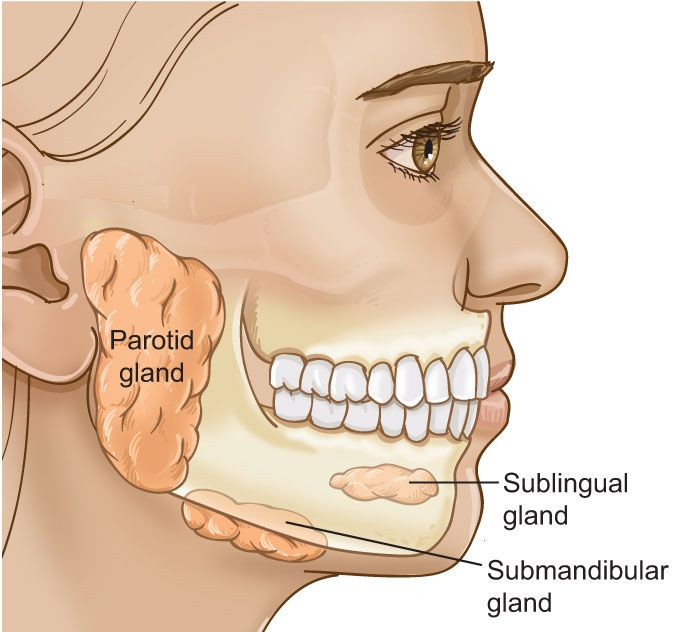
The salivary glands in mammals are exocrine glands that produce saliva through a system of ducts. Humans have three paired major salivary glands (parotid, submandibular, and sublingual) as well as hundreds of minor salivary glands. Salivary glands can be classified as serous, mucous or seromucous (mixed).
There are 3 major salivary glands:
  1. Parotid Gland: Parotid glands are the largest salivary gland. Each gland is approximately 6cm long. They are located within each of our cheeks. In our oral cavity they are responsible for the secretion of about 20% of saliva.
  2. Sublingual gland: It is the smallest of the major salivary glands. They are located under the tongue. Approximately 5% of the saliva comes from these glands.
  3. Submandibular gland: These glands are located beneath the lower jaw, outside the oral cavity. This is the movable part of our jaw. It is the second largest salivary gland and produces approx. 65-70% of saliva.
View full question & answer
[5 marks Questions] - Page 2 - Science STD 10 Questions - Vidyadip