MCQ 11 Mark
Assertion : A parallel plate capacitor is connected across battery through a key. A dielectric slab of constant K is introduced between the plates. The energy which is stored becomes K times.
Reason : The surface density of charge on the plate remains constant or unchanged.
- A
If both assertion and reason are true and the reason is the correct explanation of the assertion.
- B
If both assertion and reason are true but reason is not the correct explanation of the assertion.
- ✓
If assertion is true but reason is false.
- D
If the assertion and reason both are false.
AnswerCorrect option: C. If assertion is true but reason is false.
If assertion is true but reason is false.
View full question & answer→MCQ 21 Mark
Assertion : The tyres of aircraft's are slightly conducting.
Reason : If a conductor is connected to ground, the extra charge induced on conductor will flow to ground.
- A
If both assertion and reason are true and the reason is the correct explanation of the assertion.
- ✓
If both assertion and reason are true but reason is not the correct explanation of the assertion.
- C
If assertion is true but reason is false.
- D
If the assertion and reason both are false.
AnswerCorrect option: B. If both assertion and reason are true but reason is not the correct explanation of the assertion.
(b) If both assertion and reason are true but reason is not the correct explanation of the assertion.
View full question & answer→MCQ 31 Mark
Assertion : Circuit containing capacitors should be handled cautiously even when there is no current.
Reason : The capacitors are very delicate and so quickly break down..
- A
If both assertion and reason are true and the reason is the correct explanation of the assertion.
- B
If both assertion and reason are true but reason is not the correct explanation of the assertion.
- ✓
If assertion is true but reason is false.
- D
If the assertion and reason both are false.
AnswerCorrect option: C. If assertion is true but reason is false.
(c) If assertion is true but reason is false.
View full question & answer→MCQ 41 Mark
Assertion : The lightening conductor at the top of high building has sharp pointed ends.
Reason : The surface density of charge at sharp points is very high resulting in setting up of electric wind.
- ✓
If both assertion and reason are true and the reason is the correct explanation of the assertion.
- B
If both assertion and reason are true but reason is not the correct explanation of the assertion.
- C
If assertion is true but reason is false.
- D
If the assertion and reason both are false.
AnswerCorrect option: A. If both assertion and reason are true and the reason is the correct explanation of the assertion.
(a) If both assertion and reason are true and the reason is the correct explanation of the assertion.
View full question & answer→MCQ 51 Mark
Assertion : The force with which one plate of a parallel plate capacitor is attracted towards the other plate is equal to square of surface density per e per unit area.
Reason : The electric field due to one charged plate of the capacitor at the location of the other is equal to surface density per e.
- A
If both assertion and reason are true and the reason is the correct explanation of the assertion.
- B
If both assertion and reason are true but reason is not the correct explanation of the assertion.
- C
If assertion is true but reason is false.
- ✓
If the assertion and reason both are false.
AnswerCorrect option: D. If the assertion and reason both are false.
(d) If the assertion and reason both are false.
View full question & answer→MCQ 61 Mark
Assertion : At a point in space, the electric field points towards north. In the region, surrounding this point the rate of change of potential will be zero along the east and west.
Reason : Electric field due to a charge is the space around the charge
- A
If both assertion and reason are true and the reason is the correct explanation of the assertion.
- ✓
If both assertion and reason are true but reason is not the correct explanation of the assertion.
- C
If assertion is true but reason is false.
- D
If the assertion and reason both are false.
AnswerCorrect option: B. If both assertion and reason are true but reason is not the correct explanation of the assertion.
(b) If both assertion and reason are true but reason is not the correct explanation of the assertion.
View full question & answer→MCQ 71 Mark
Assertion : Conductors having equal positive charge and volume, must also have same potential.
Reason : Potential depends only on charge and volume of conductor.
- A
If both assertion and reason are true and the reason is the correct explanation of the assertion.
- B
If both assertion and reason are true but reason is not the correct explanation of the assertion.
- C
If assertion is true but reason is false.
- ✓
If the assertion and reason both are false.
AnswerCorrect option: D. If the assertion and reason both are false.
(d) If the assertion and reason both are false.
View full question & answer→MCQ 81 Mark
Assertion : The whole charge of a conductor cannot be transferred to another isolated conductor.
Reason : The total transfer of charge from one to another is not possible
- A
If both assertion and reason are true and the reason is the correct explanation of the assertion.
- B
If both assertion and reason are true but reason is not the correct explanation of the assertion.
- C
If assertion is true but reason is false.
- ✓
If the assertion and reason both are false.
AnswerCorrect option: D. If the assertion and reason both are false.
(d) If the assertion and reason both are false.
View full question & answer→MCQ 91 Mark
Assertion : On going away from a point charge or a small electric dipole, electric field decreases at the same rate in both the cases.
Reason : Electric field is inversely proportional to square of distance from the charge or an electric dipole.
- A
If both assertion and reason are true and the reason is the correct explanation of the assertion.
- B
If both assertion and reason are true but reason is not the correct explanation of the assertion.
- C
If assertion is true but reason is false.
- ✓
If the assertion and reason both are false.
AnswerCorrect option: D. If the assertion and reason both are false.
(d) If the assertion and reason both are false.
View full question & answer→MCQ 101 Mark
Assertion : The surface charge densities of two spherical conductors of different radii are equal. Then the electric field intensities near their surface are also equal.
Reason : Surface charge density is equal to charge per unit area.
- A
If both assertion and reason are true and the reason is the correct explanation of the assertion.
- ✓
If both assertion and reason are true but reason is not the correct explanation of the assertion.
- C
If assertion is true but reason is false.
- D
If the assertion and reason both are false.
AnswerCorrect option: B. If both assertion and reason are true but reason is not the correct explanation of the assertion.
(b) If both assertion and reason are true but reason is not the correct explanation of the assertion.
View full question & answer→MCQ 111 Mark
Assertion : If a point charge q is placed in front of an infinite grounded conducting plane surface, the point charge will experience a force.
Reason : This force is due to the induced charge on the conducting surface which is at zero potential.
- ✓
If both assertion and reason are true and the reason is the correct explanation of the assertion.
- B
If both assertion and reason are true but reason is not the correct explanation of the assertion.
- C
If assertion is true but reason is false.
- D
If the assertion and reason both are false.
AnswerCorrect option: A. If both assertion and reason are true and the reason is the correct explanation of the assertion.
(a) If both assertion and reason are true and the reason is the correct explanation of the assertion.
View full question & answer→MCQ 121 Mark
Assertion : Charge is quantized
Reason : Charge, which is less than 1 C is not possible
- A
If both assertion and reason are true and the reason is the correct explanation of the assertion.
- B
If both assertion and reason are true but reason is not the correct explanation of the assertion.
- ✓
If assertion is true but reason is false.
- D
If the assertion and reason both are false.
AnswerCorrect option: C. If assertion is true but reason is false.
(c) If assertion is true but reason is false.
View full question & answer→MCQ 131 Mark
Assertion : Mass of ion is slightly differed from its element.
Reason : Ion is formed, when some electrons are removed or added so mass changes
- ✓
If both assertion and reason are true and the reason is the correct explanation of the assertion.
- B
If both assertion and reason are true but reason is not the correct explanation of the assertion.
- C
If assertion is true but reason is false.
- D
If the assertion and reason both are false.
AnswerCorrect option: A. If both assertion and reason are true and the reason is the correct explanation of the assertion.
(a) If both assertion and reason are true and the reason is the correct explanation of the assertion.
View full question & answer→MCQ 141 Mark
Assertion : Charge is invariant.
Reason : Charge does not depends on speed of frame of reference.
- ✓
If both assertion and reason are true and the reason is the correct explanation of the assertion.
- B
If both assertion and reason are true but reason is not the correct explanation of the assertion.
- C
If assertion is true but reason is false.
- D
If the assertion and reason both are false.
AnswerCorrect option: A. If both assertion and reason are true and the reason is the correct explanation of the assertion.
(a) If both assertion and reason are true and the reason is the correct explanation of the assertion.
View full question & answer→MCQ 151 Mark
Assertion : A charged capacitor is disconnected from a battery. Now if its plate are separated farther, the potential energy will fall.
Reason : Energy stored in a capacitor is equal to the work done in charging it.
- A
If both assertion and reason are true and the reason is the correct explanation of the assertion.
- B
If both assertion and reason are true but reason is not the correct explanation of the assertion.
- C
If assertion is true but reason is false.
- ✓
If assertion is false but reason is true.
AnswerCorrect option: D. If assertion is false but reason is true.
(d) If assertion is false but reason is true.
View full question & answer→MCQ 161 Mark
Assertion : The capacity of a given conductor remains same even if charge is varied on it.
Reason : Capacitance depends upon nearly medium as well as size and shape of conductor.
- ✓
If both assertion and reason are true and the reason is the correct explanation of the assertion.
- B
If both assertion and reason are true but reason is not the correct explanation of the assertion.
- C
If assertion is true but reason is false.
- D
If the assertion and reason both are false.
AnswerCorrect option: A. If both assertion and reason are true and the reason is the correct explanation of the assertion.
(a) If both assertion and reason are true and the reason is the correct explanation of the assertion.
View full question & answer→MCQ 171 Mark
Assertion : Annihilation of electron and positron is an example of decay of charges.
Reason : In the process of annihilation an electron and a positron combine to give a gamma particle.
- A
If both assertion and reason are true and the reason is the correct explanation of the assertion.
- B
If both assertion and reason are true but reason is not the correct explanation of the assertion.
- C
If assertion is true but reason is false.
- ✓
If assertion is false but reason is true.
AnswerCorrect option: D. If assertion is false but reason is true.
(d) If assertion is false but reason is true.
View full question & answer→MCQ 181 Mark
Assertion : When charges are shared between any two bodies, no charge is really lost, but some loss of energy does occur.
Reason : Some energy disappears in the form of heat, sparking etc.
- A
If both assertion and reason are true and the reason is the correct explanation of the assertion.
- ✓
If both assertion and reason are true but reason is not the correct explanation of the assertion.
- C
If assertion is true but reason is false.
- D
If the assertion and reason both are false.
AnswerCorrect option: B. If both assertion and reason are true but reason is not the correct explanation of the assertion.
(b) If both assertion and reason are true but reason is not the correct explanation of the assertion.
View full question & answer→MCQ 191 Mark
Assertion : Dielectric breakdown occurs under the influence of an intense light beam.
Reason : Electromagnetic radiations exert pressure.
- A
If both assertion and reason are true and the reason is the correct explanation of the assertion.
- ✓
If both assertion and reason are true but reason is not the correct explanation of the assertion.
- C
If assertion is true but reason is false.
- D
If the assertion and reason both are false.
AnswerCorrect option: B. If both assertion and reason are true but reason is not the correct explanation of the assertion.
(b) If both assertion and reason are true but reason is not the correct explanation of the assertion.
View full question & answer→MCQ 201 Mark
Assertion : If a proton and an electron are placed in the same uniform electric field. They experience different acceleration.
Reason : Electric force on a test charge is independent of its mass.
- A
If both assertion and reason are true and the reason is the correct explanation of the assertion.
- ✓
If both assertion and reason are true but reason is not the correct explanation of the assertion.
- C
If assertion is true but reason is false.
- D
If the assertion and reason both are false.
AnswerCorrect option: B. If both assertion and reason are true but reason is not the correct explanation of the assertion.
(b) If both assertion and reason are true but reason is not the correct explanation of the assertion.
View full question & answer→MCQ 211 Mark
Assertion : Electric lines of force cross each other.
Reason : Electric field at a point superimpose to give one resultant electric field.
- A
If both assertion and reason are true and the reason is the correct explanation of the assertion.
- B
If both assertion and reason are true but reason is not the correct explanation of the assertion.
- C
If assertion is true but reason is false.
- ✓
If assertion is false but reason is true.
AnswerCorrect option: D. If assertion is false but reason is true.
(d) If assertion is false but reason is true.
View full question & answer→MCQ 221 Mark
Four metallic plates each with a surface area of one side
A are placed at a distance
d from each other. The plates are connected as shown in the circuit diagram. Then the capacitance of the system between a and b is
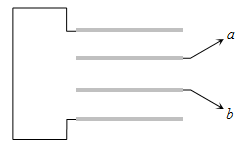
- A
$\frac{3 \varepsilon_0 A}{d}$
- B
$\frac{2 \varepsilon_0 \mathrm{~A}}{\mathrm{~d}}$
- C
$\frac{2 \varepsilon_0 \mathrm{~A}}{3 \mathrm{~d}}$
- ✓
$\frac{3 z_0 \mathrm{~A}}{2 \mathrm{~d}}$
AnswerCorrect option: D. $\frac{3 z_0 \mathrm{~A}}{2 \mathrm{~d}}$
(d)$\frac{3 z_0 \mathrm{~A}}{2 \mathrm{~d}}$
View full question & answer→MCQ 231 Mark
Assertion : If three capacitors of capacitance $C_1 < C_2 < C_3$ are connected in parallel then their equivalent capacitance $C_p > C_s$
Reason :$\frac{1}{C_P}=\frac{1}{C_1}+\frac{1}{C_2}+\frac{1}{C_3}$
- A
If both assertion and reason are true and the reason is the correct explanation of the assertion.
- B
If both assertion and reason are true but reason is not the correct explanation of the assertion.
- ✓
If assertion is true but reason is false.
- D
If the assertion and reason both are false.
AnswerCorrect option: C. If assertion is true but reason is false.
(c) If assertion is true but reason is false.
View full question & answer→MCQ 241 Mark
Assertion : A metallic shield in form of a hollow shell may be built to block an electric field.
Reason : In a hollow spherical shield, the electric field inside it is zero at every point.
- ✓
If both assertion and reason are true and the reason is the correct explanation of the assertion.
- B
If both assertion and reason are true but reason is not the correct explanation of the assertion.
- C
If assertion is true but reason is false.
- D
If the assertion and reason both are false.
AnswerCorrect option: A. If both assertion and reason are true and the reason is the correct explanation of the assertion.
(a) If both assertion and reason are true and the reason is the correct explanation of the assertion.
View full question & answer→MCQ 251 Mark
Assertion : Electrons move away from a low potential to high potential region.
Reason : Because electrons has negative charge
- ✓
If both assertion and reason are true and the reason is the correct explanation of the assertion.
- B
If both assertion and reason are true but reason is not the correct explanation of the assertion.
- C
If assertion is true but reason is false.
- D
If the assertion and reason both are false.
AnswerCorrect option: A. If both assertion and reason are true and the reason is the correct explanation of the assertion.
(a) If both assertion and reason are true and the reason is the correct explanation of the assertion.
View full question & answer→MCQ 261 Mark
Assertion : If the distance between parallel plates of a capacitor is halved and dielectric constant is made three times, then the capacitor becomes 6 times.
Reason : Capacity of the capacitor does not depend upon the nature of the material.
- A
If both assertion and reason are true and the reason is the correct explanation of the assertion.
- ✓
If both assertion and reason are true but reason is not the correct explanation of the assertion.
- C
If assertion is true but reason is false.
- D
If the assertion and reason both are false.
AnswerCorrect option: B. If both assertion and reason are true but reason is not the correct explanation of the assertion.
(b) If both assertion and reason are true but reason is not the correct explanation of the assertion.
View full question & answer→MCQ 271 Mark
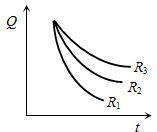
Three identical capacitors are given a charge Q each and they are then allowed to discharge through resistance $R_1, R_2$ and $R_3$. Their charges, as a function of time shown in the graph below. The smallest of the three resistance is
- A
$\mathrm{R}_3$
- B
$\mathrm{R}_2$
- ✓
$\mathrm{R}_1$
- D
AnswerCorrect option: C. $\mathrm{R}_1$
(c) $\mathrm{R}_1$
View full question & answer→MCQ 281 Mark
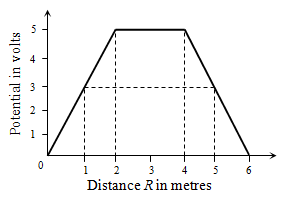
The variation of potential with distance R from a fixed point is as shown below. The electric field at R = 5 m is
MCQ 291 Mark
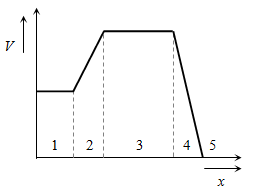
The figure gives the electric potential
V as a function of distance through five regions on x-axis. Which of the following is true for the electric field
E in these regions
- A
$\mathrm{E}_1>\mathrm{E}_2>\mathrm{E}_3>\mathrm{E}_4>\mathrm{E}_5$
- ✓
$E_1=E_3=E_5$ and $E_2$
- C
$\mathrm{E}_2=\mathrm{E}_4=\mathrm{E}_5$ and $\mathrm{E}_1<\mathrm{E}_3$
- D
$\mathrm{E}_1<\mathrm{E}_2<\mathrm{E}_3<\mathrm{E}_4<\mathrm{E}_5$
AnswerCorrect option: B. $E_1=E_3=E_5$ and $E_2$
$E_1=E_3=E_5$ and $E_2$
View full question & answer→MCQ 301 Mark
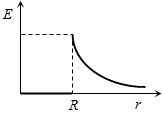
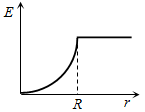
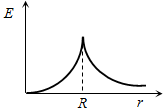
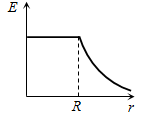
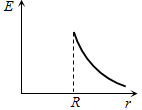
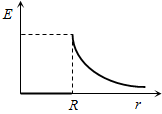
Which of the following graphs shows the variation of electric field E due to a hollow spherical conductor of radius R as a function of distance from the centre of the sphere
Answer(a)
View full question & answer→MCQ 311 Mark
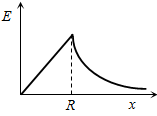
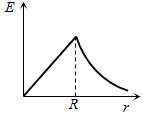
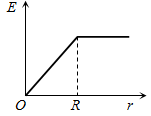
The electric field due to a uniformly charged sphere of radius R as a function of the distance from its centre is represented graphically by
Answer(b)
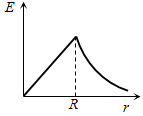
View full question & answer→MCQ 321 Mark
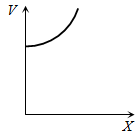
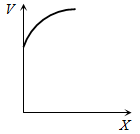
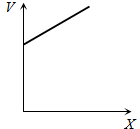
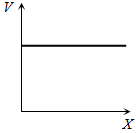
What physical quantities may X and Y represent ? (Y represents the first mentioned quantity)
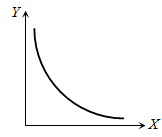
- A
Pressure v/s temperature of a given gas (constant volume)
- B
Kinetic energy v/s velocity of a particle
- C
Capacitance v/s charge to give a constant potential
- ✓
Potential v/s capacitance to give a constant charge
AnswerCorrect option: D. Potential v/s capacitance to give a constant charge
(d) Potential v/s capacitance to give a constant charge
View full question & answer→MCQ 331 Mark
Between the plates of a parallel plate capacitor a dielectric plate is introduced just to fill the space between the plates. The capacitor is charged and later disconnected from the battery. The dielectric plate is slowly drawn out of the capacitor parallel to the plates. The plot of the potential difference across the plates and the length of the dielectric plate drawn out is
Answer(b)
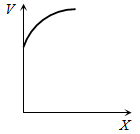
View full question & answer→MCQ 341 Mark
Figure $(a)$ shows two capacitors connected in series and joined to a battery. The graph in figure $(b)$ shows the variation in potential as one moves from left to right on the branch containing the capacitors, if
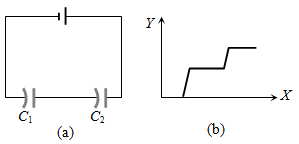
View full question & answer→MCQ 351 Mark
A $4 \ mF$ capacitor, a resistance of $2.5 \ MW$ is in series with $12 V$ battery. Find the time after which the potential difference across the capacitor is $3$ times the potential difference across the resistor. $[$Given ln$(2)= 0.693]$
- ✓
$13.86 s$
- B
$6.93 s$
- C
$7 s$
- D
$14 s$
AnswerCorrect option: A. $13.86 s$
$13.86 s$
View full question & answer→MCQ 361 Mark
A network of four capacitors of capacity equal to $C_1=C, C_2=2 C, C_3=3 C$ and $C_4=40$ are conducted in a battery as shown in the figure. The ratio of the charges on $\mathrm{C}_2$ and $\mathrm{C}_4$ is
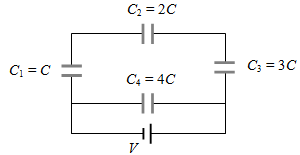
- A
$\frac{22}{3}$
- ✓
$\frac{3}{22}$
- C
$\frac{7}{4}$
- D
$\frac{4}{7}$
AnswerCorrect option: B. $\frac{3}{22}$
$\frac{3}{22}$
View full question & answer→MCQ 371 Mark
A fully charged capacitor has a capacitance ‘C’. It is discharged through a small coil of resistance wire embedded in a thermally insulated block of specific heat capacity ‘s’ and mass ‘m’. If the temperature of the block is raised by ‘ ∆T ’, the potential difference ‘V’ across the capacitance is
AnswerCorrect option: B. $\sqrt{\frac{2 m s \Delta T}{C}} \quad$
(b) $\sqrt{\frac{2 m s \Delta T}{C}} \quad$
View full question & answer→MCQ 381 Mark
The plates of a parallel plate condenser are pulled apart with a velocity v. If at any instant their mutual distance of separation is d, then the magnitude of the time of rate of change of capacity depends on d as follows
AnswerCorrect option: B. $\frac{1}{\mathrm{~d}^2}$
(b) $\frac{1}{\mathrm{~d}^2}$
View full question & answer→MCQ 391 Mark
The plates of a capacitor are charged to a potential difference of 320 volts and are then connected across a resistor. The potential difference across the capacitor decays exponentially with time. After 1 second the potential difference between the plates of the capacitor is 240 volts, then after 2 and 3 seconds the potential difference between the plates will be
MCQ 401 Mark
In the given figure each plate of capacitance
C has partial value of charge
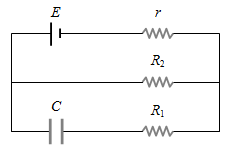
- A
$C E$
- B
$\frac{\mathrm{CER}_1}{\mathrm{R}_2-\mathrm{r}}$
- ✓
$\frac{\mathrm{CER}_2}{\mathrm{R}_2+\mathrm{r}}$
- D
$\frac{\mathrm{CER}_1}{R_1-r}$
AnswerCorrect option: C. $\frac{\mathrm{CER}_2}{\mathrm{R}_2+\mathrm{r}}$
(c)$\frac{\mathrm{CER}_2}{\mathrm{R}_2+\mathrm{r}}$
View full question & answer→MCQ 411 Mark
A capacitor of capacitance $C_1=1 \mathrm{mF}$ can with stand maximum voltage $\mathrm{V}_1=6 \mathrm{kV} \ ($kilo $-$ volt$)$ and another capacitor of capacitance $\mathrm{C}_2=3 \mathrm{mF}$ can withstand maximum voltage $\mathrm{V}_2=4 \mathrm{kV}$. When the two capacitors are connected in series, the combined system can withstand a maximum voltage of
- A
$4 kV$
- B
$6 kV$
- ✓
$8 kV$
- D
$10 kV$
AnswerCorrect option: C. $8 kV$
$8kV$
View full question & answer→MCQ 421 Mark
Consider the situation shown in the figure. The capacitor
A has a charge
q on it whereas
B is uncharged. The charge appearing on the capacitor
B a long time after the switch is closed is
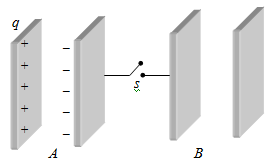
MCQ 431 Mark
For the circuit shown, which of the following statements is true
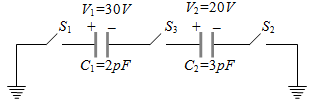
- A
with $S_1$ closed $V_1=15 \mathrm{~V}, \mathrm{~V}_2=20 \mathrm{~V}$
- B
With ${ }^{S_3}$ closed $V_1=V_2=25 V_0$
- C
With $S_1$ and $S_2$ closed $V_1=V_2=0$
- ✓
with $S_1$ and ${ }^{S_3}$ closed, $V_1=30 \mathrm{~V}, V_2=20 \mathrm{~V}$
AnswerCorrect option: D. with $S_1$ and ${ }^{S_3}$ closed, $V_1=30 \mathrm{~V}, V_2=20 \mathrm{~V}$
(d) with $S_1$ and ${ }^{S_3}$ closed, $V_1=30 \mathrm{~V}, V_2=20 \mathrm{~V}$
View full question & answer→MCQ 441 Mark
In an isolated parallel plate capacitor of capacitance C, the four surface have charges $Q_1, Q_2, Q_3$ and Q_4$ as shown. The potential difference between the plates is
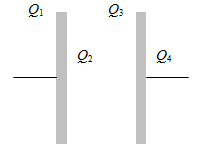
AnswerCorrect option: C. $\frac{Q_2-Q_s}{2 C}$
(c)$\frac{Q_2-Q_s}{2 C}$
View full question & answer→MCQ 451 Mark
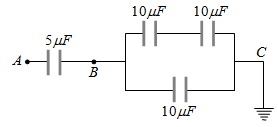
In the given circuit if point
C is connected to the earth and a potential of +2000 V is given to the point
A, the potential at
B is
MCQ 461 Mark
There is a uniform electric field of strength $10^3 \mathrm{~V} / \mathrm{m}$ along y-axis. A body of mass 1g and charge $10^{-6}$ C is projected into the field from origin along the positive x-axis with a velocity 10m/s. Its speed in m/s after 10s is (Neglect gravitation)
- A
- B
$5^{\sqrt{2}}$
- ✓
$10^{\sqrt{2}}$
- D
AnswerCorrect option: C. $10^{\sqrt{2}}$
(c) $10^{\sqrt{2}}$
View full question & answer→MCQ 471 Mark
Condenser A has a capacity of 15μF when it is filled with a medium of dielectric constant 15. Another condenser B has a capacity of 1 μF with air between the plates. Both are charged separately by a battery of 100 V. After charging, both are connected in parallel without the battery and the dielectric medium being removed. The common potential now is
MCQ 481 Mark
A parallel plate capacitor of capacitance C is connected to a battery and is charged to a potential difference V. Another capacitor of capacitance 2C is connected to another battery and is charged to potential difference 2V. The charging batteries are now disconnected and the capacitors are connected in parallel to each other in such a way that the positive terminal of one is connected to the negative terminal of the other. The final energy of the configuration is
- A
- B
$\frac{25 \mathrm{CV}^2}{6}$
- ✓
$\frac{3 \mathrm{CV}^2}{2}$
- D
$\frac{9 \mathrm{CV}^2}{2}$
AnswerCorrect option: C. $\frac{3 \mathrm{CV}^2}{2}$
(c) $\frac{3 \mathrm{CV}^2}{2}$
View full question & answer→MCQ 491 Mark
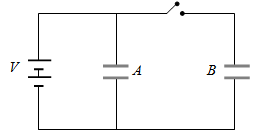
Figure given below shows two identical parallel plate capacitors connected to a battery with switch S closed. The switch is now opened and the free space between the plate of capacitors is filled with a dielectric of dielectric constant 3. What will be the ratio of total electrostatic energy stored in both capacitors before and after the introduction of the dielectric
MCQ 501 Mark
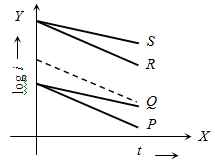
In an RC circuit while charging, the graph of in
i versus time is as shown by the dotted line in the diagram figure, where
i is the current. When the value of the resistance is doubled, which of the solid curve best represents the variation of in
i versus time
MCQ 511 Mark
Two identical point charges are placed at a separation of d. P is a point on the line joining the charges, at a distance x from any one charge. The field at P is E, E is plotted against x for values of x from close to zero to slightly less than d. Which of the following represents the resulting curve
MCQ 521 Mark
Two condensers of capacities 2C and C are joined in parallel and charged upto potential V. The battery is removed and the condenser of capacity C is filled completely with a medium of dielectric constant K. The p.d. across the capacitors will now be
- ✓
$\frac{3 V}{K+2}_{}$
- B
$\frac{3 \mathrm{~V}}{\mathrm{~K}}$
- C
$\frac{\mathrm{V}}{\mathrm{K}+2}$
- D
$\frac{\mathrm{V}}{\mathrm{k}}$
AnswerCorrect option: A. $\frac{3 V}{K+2}_{}$
(a) $\frac{3 V}{K+2}_{}$
View full question & answer→MCQ 531 Mark
Equipotential surfaces are shown in figure. Then the electric field strength will be
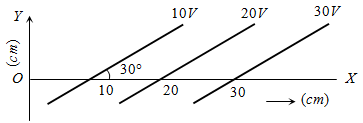
- A
100 Vm$^{-1}$ along X-axis
- B
100 Vm$^{-1}$ along Y-axis
- ✓
200 Vm$^{-1}$ at an angle $120^{\circ}$ with X-axis
- D
50 Vm$^{-1}$ at an angle $120^{\circ}$ with X-axis
AnswerCorrect option: C. 200 Vm$^{-1}$ at an angle $120^{\circ}$ with X-axis
(c) 200 Vm$^{-1}$ at an angle $120^{\circ}$ with X-axis
View full question & answer→MCQ 541 Mark
Change Q on a capacitor varies with voltage V as shown in the figure, where Q is taken along the X-axis and V along the Y-axis. The area of triangle OAB represents
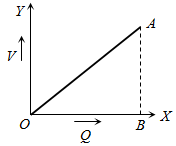
- A
- B
- C
Magnetic field between the plates
- ✓
Energy stored in the capacitor
AnswerCorrect option: D. Energy stored in the capacitor
Energy stored in the capacitor
View full question & answer→MCQ 551 Mark
An infinite number of identical capacitors each of capacitance 1 μF are connected as in adjoining figure. Then the equivalent capacitance between A and B is
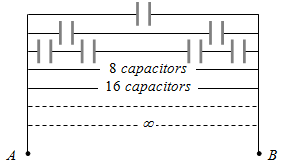
MCQ 561 Mark
To form a composite 16Μf, 1000 V capacitor from a supply of identical capacitors marked 8 μF, 250 V we require a minimum number of capacitors
MCQ 571 Mark
Five identical plates each of area A are joined as shown in the figure. The distance between the plates is d. The plates are connected to a potential difference of V volts. The charge on plates 1 and 4 will be
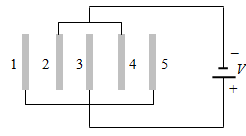
- A
$\frac{z_0 \mathrm{AV}}{\mathrm{d}} \cdot \frac{2 z_0 \mathrm{AV}}{\mathrm{d}}$
- B
$\frac{z_0 \mathrm{AV}}{\mathrm{d}} \cdot \frac{2 z_0 \mathrm{AV}}{\mathrm{d}}$
- ✓
$\frac{z_0 A V}{d} \cdot \frac{-2 z_0 A V}{d}$
- D
$\frac{-z_0 \mathrm{AV}}{\mathrm{d}} \cdot \frac{-2 z_0 \mathrm{AV}}{\mathrm{d}}$
AnswerCorrect option: C. $\frac{z_0 A V}{d} \cdot \frac{-2 z_0 A V}{d}$
(c) $\frac{z_0 A V}{d} \cdot \frac{-2 z_0 A V}{d}$
View full question & answer→MCQ 581 Mark
A parallel plate capacitor is connected to a battery. The plates are pulled apart with a uniform speed. If $x$ is the separation between the plates, the time rate of change of electrostatic energy of capacitor is proportional to
- ✓
$x^{-2}$
- B
$ x$
- C
$x^{-1}$
- D
$x^2$
AnswerCorrect option: A. $x^{-2}$
$x^{-2}$
View full question & answer→MCQ 591 Mark
Capacitance of a capacitor made by a thin metal foil is 2μF. If the foil is folded with paper of thickness 0.15 mm, dielectric constant of paper is 2.5 and width of paper is 400 mm , then length of foil will be
MCQ 601 Mark
A dielectric slab of thickness d is inserted in a parallel plate capacitor whose negative plate is at x = 0 and positive plate is at x = 3d. The slab is equidistant from the plates. The capacitor is given some charge. As one goes from 0 to 3d
- A
The magnitude of the electric field remains the same
- B
The direction of the electric field remains the same
- C
The electric potential increases continuously
- ✓
View full question & answer→MCQ 611 Mark
A parallel plate air capacitor has a capacitance of 100 μμF. The plates are at a distance d apart. If a slab of thickness t( t ≤ d) and dielectric constant 5 is introduced between the parallel plates, then the capacitance will be
MCQ 621 Mark
Four charges equal to – Q are placed at the four corners of a square and a charge q is at its centre. If the system is in equilibrium the value of q is
- A
$-\frac{Q}{4}(1+2 \sqrt{2})$
- ✓
$\frac{\mathrm{Q}}{4}(1+2 \sqrt{2})$
- C
$-\frac{\mathrm{Q}}{2}(1+2 \sqrt{2})$
- D
$\frac{Q}{2}(1+2 \sqrt{2})$
AnswerCorrect option: B. $\frac{\mathrm{Q}}{4}(1+2 \sqrt{2})$
(b) $\frac{\mathrm{Q}}{4}(1+2 \sqrt{2})$
View full question & answer→MCQ 631 Mark
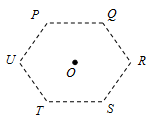
Six charges, three positive and three negative of equal magnitude are to be placed at the vertices of a regular hexagon such that the electric field at
O is double the electric field when only one positive charge of same magnitude is placed at
R. Which of the following arrangements of charges is possible for
P,
Q,
R,
S,
T and
U respectively
MCQ 641 Mark
Two point charges (+Q) and (-2Q) are fixed on the X-axis at positions a and 2a from origin respectively. At what positions on the axis, the resultant electric field is zero
- A
Only x = $\sqrt{2} a$
- ✓
Only x = -$\sqrt{2} a$
- C
Both x = ±$\sqrt{2} a$
- D
x = $\frac{3a}{2}$ only
AnswerCorrect option: B. Only x = -$\sqrt{2} a$
(b)Only x = -$\sqrt{2} a$
View full question & answer→MCQ 651 Mark
A piece of cloud having area 25 $\times 10^6 \mathrm{~m}^2$ and electric potential of $10^5$ volts. If the height of cloud is 0.75 km, then energy of electric field between earth and cloud will be
View full question & answer→MCQ 661 Mark
A point charge of 40 stat coulomb is placed 2 cm in front of an earthed metallic plane plate of large size. Then the force of attraction on the point charge is
MCQ 671 Mark
A solid conducting sphere having a charge Q is surrounded by an uncharged concentric conducting hollow spherical shell. Let the potential difference between the surface of the solid sphere and that of the outer surface of the hollow shell be V. If the shell is now given a charge of –3Q, the new potential difference between the same two surfaces is
MCQ 681 Mark
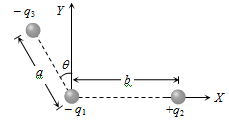
Three charges $-\mathrm{q}_1,+\mathrm{q}_2$ and $-q_3$ are placed as shown in the figure. The x-component of the force on $-q_3$ is proportional to
- A
$\frac{q_2}{b^2}-\frac{q_s}{a^2} \sin \theta$
- B
$\frac{\mathrm{q}_2}{\mathrm{~b}^2}-\frac{\mathrm{q}_{\mathrm{3}}}{\mathrm{a}^2} \cos \theta$
- ✓
$\frac{q_2}{b^2}+\frac{q_3}{a^2} \sin \theta$
- D
$\frac{q_2}{b^2}-\frac{q_3}{a^2} \cos \theta$
AnswerCorrect option: C. $\frac{q_2}{b^2}+\frac{q_3}{a^2} \sin \theta$
(c) $\frac{q_2}{b^2}+\frac{q_3}{a^2} \sin \theta$
View full question & answer→MCQ 691 Mark
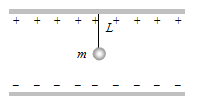
A small sphere carrying a charge ‘q’ is hanging in between two parallel plates by a string of length L. Time period of pendulum is $T_0$. When parallel plates are charged, the time period changes to T . The ratio $\frac{T}{T_0}$ is equal to
- A
$\left(\frac{\mathrm{g}+\frac{\mathrm{qE}}{\mathrm{m}}}{\mathrm{g}}\right)^{1 / 2}$
- B
$\left(\frac{\mathrm{g}}{\mathrm{g}+\frac{\mathrm{qE}}{\mathrm{m}}}\right)^{3 / 2}$
- ✓
$\left(\frac{g}{g+\frac{q E}{m}}\right)^{1 / 2}$
- D
AnswerCorrect option: C. $\left(\frac{g}{g+\frac{q E}{m}}\right)^{1 / 2}$
(c) $\left(\frac{g}{g+\frac{q E}{m}}\right)^{1 / 2}$
View full question & answer→MCQ 701 Mark
An elementary particle of mass m and charge +e is projected with velocity v at a much more massive particle of charge Ze, where Z > 0. What is the closest possible approach of the incident particle
- ✓
$\frac{\mathrm{Ze}^2}{2 \pi \varepsilon_0 \mathrm{mv}^2}$
- B
$\frac{\mathrm{Ze}}{4 \pi \varepsilon_0 \mathrm{mv}^2}$
- C
$\frac{\mathrm{Ze}^2}{8 \pi \varepsilon_0 \mathrm{mv}^2}$
- D
$\frac{\mathrm{Ze}}{8 \pi \varepsilon_0 \mathrm{mv}^2}$
AnswerCorrect option: A. $\frac{\mathrm{Ze}^2}{2 \pi \varepsilon_0 \mathrm{mv}^2}$
(a) $\frac{\mathrm{Ze}^2}{2 \pi \varepsilon_0 \mathrm{mv}^2}$
View full question & answer→MCQ 711 Mark
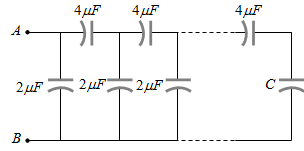
A finite ladder is constructed by connecting several sections of 2μF,4 μF capacitor combinations as shown in the figure. It is terminated by a capacitor of capacitance
C. What value should be chosen for
C such that the equivalent capacitance of the ladder between the points
A and
B becomes independent of the number of sections in between
MCQ 721 Mark
Two equal point charges are fixed at x = -a and x = +a on the x-axis. Another point charge Q is placed at the origin. The Change in the electrical potential energy of Q, when it is displaced by a small distance x along the x-axis, is approximately proportional to(a) (b) (c) (d)
MCQ 731 Mark
The electric potential at a point (x, y) in the x - y plane is given by V = -kxy. The field intensity at a distance r from the origin varies as
- A
$r^2$
- ✓
- C
$\frac{1}{r}$
- D
$\frac{1}{r^2}$
View full question & answer→MCQ 741 Mark
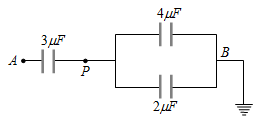
In the figure a potential of + 1200 V is given to point A and point B is earthed, what is the potential at the point P
MCQ 751 Mark
A uniform electric field pointing in positive x-direction exists in a region. Let A be the origin, B be the point on the x-axis at x = +1 cm and C be the point on the y-axis at y = +1 cm. Then the potentials at the points A, B and C satisfy
- A
$V_A<V_B$
- ✓
$V_A>V_B$
- C
$V_A<V_C$
- D
$V_A>V_C$
AnswerCorrect option: B. $V_A>V_B$
(b) $V_A>V_B$
View full question & answer→MCQ 761 Mark
Consider two points 1 and 2 in a region outside a charged sphere. Two points are not very far away from the sphere. If E and V represent the electric field vector and the electric potential, which of the following is not possible
- A
$\left|\overrightarrow{\mathrm{E}_1}\right|=\left|\overrightarrow{\mathrm{E}_2}\right|, V_1=V_2$
- B
$\left|\overrightarrow{\mathrm{E}_1}\right|\neq\left|\overrightarrow{\mathrm{E}_2}\right|, {V_1}\neq{V_2}$
- C
$\left|\overrightarrow{\mathrm{E}_1}\right|\neq\left|\overrightarrow{\mathrm{E}_2}\right|, V_1=V_2$
- ✓
$\left|\overrightarrow{\mathrm{E}_1}\right|=\left|\overrightarrow{\mathrm{E}_2}\right|, {V_1}\neq{V_2}$
AnswerCorrect option: D. $\left|\overrightarrow{\mathrm{E}_1}\right|=\left|\overrightarrow{\mathrm{E}_2}\right|, {V_1}\neq{V_2}$
(d) |$\left|\overrightarrow{\mathrm{E}_1}\right|=\left|\overrightarrow{\mathrm{E}_2}\right|, {V_1}\neq{V_2}$
View full question & answer→MCQ 771 Mark
Charge q is uniformly distributed over a thin half ring of radius R. The electric field at the centre of the ring is
- ✓
$\frac{q}{2 \pi^2 \varepsilon_0 R^2}$
- B
$\frac{q}{4 \pi^2 \varepsilon_0 R^2}$
- C
$\frac{q}{4 \pi \varepsilon_0 R^2}$
- D
$\frac{q}{2 \pi \varepsilon_0 R^2}$
AnswerCorrect option: A. $\frac{q}{2 \pi^2 \varepsilon_0 R^2}$
(a) $\frac{q}{2 \pi^2 \varepsilon_0 R^2}$
View full question & answer→MCQ 781 Mark
The electric field in a region is radially outward with magnitude E = $A \gamma_0$. The charge contained in a sphere of radius $\gamma_0$ centered at the origin is (a) (b)(c) (d)
- A
$\frac{1}{4 \pi \varepsilon_0} \mathrm{~A} \gamma_0{ }^3$
- ✓
$4 \pi \varepsilon_0 A \gamma_0{ }^3$
- C
$\frac{4 \pi \varepsilon_0 A}{\gamma_0}$
- D
$\frac{1}{4 \pi \varepsilon_0} \frac{\mathrm{A}}{\gamma_0{ }^3}$
AnswerCorrect option: B. $4 \pi \varepsilon_0 A \gamma_0{ }^3$
(b) $4 \pi \varepsilon_0 A \gamma_0{ }^3$
View full question & answer→MCQ 791 Mark
Electric potential is given by $V=6 x-8 x y^2-8 y+6 y z-4 z^2$T, hen electric force acting on 2C point charge placed on origin will be
View full question & answer→MCQ 801 Mark
The charge on 500 cc of water due to protons will be
AnswerCorrect option: B. 2.67 $\times {10}{^7 C}$
(b) 2.67 $\times {10}{^7 C}$
View full question & answer→MCQ 811 Mark
A negatively charged plate has charge density of 2 $\times 10^{-6} \mathrm{C} / \mathrm{m}^2$. The initial distance of an electron which is moving toward plate, cannot strike the plate, if it is having energy of 200 eV
View full question & answer→MCQ 821 Mark
A non-conducting solid sphere of radius R is uniformly charged. The magnitude of the electric field due to the sphere at a distance r from its centre
- A
Increases as r increases for r < R
- B
Decreases as r increases for 0 < r < ∞
- C
Decreases as r increases for R < r < ∞
- ✓
View full question & answer→MCQ 831 Mark
A positively charged thin metal ring of radius R is fixed in the xy - plane with its centre at the O. A negatively charged particle P is released from rest at the point (0, 0, $z_0$), where $z_0>0$. Then the motion of P is
- A
Periodic for all values of $z_0$ satisfying 0 < $z_o<\infty$
- B
Simple harmonic for all values of satisfying 0 < $z_o<R$
- C
Approximately simple harmonic provided $z_o<<R$
- ✓
View full question & answer→MCQ 841 Mark
An electric line of force in the xy plane is given by equation $x^2+ y^2 =1$. A particle with unit positive charge, initially at rest at the point x = 1, y = 0 in the xy plane
- A
- B
Will move along straight line
- ✓
Will move along the circular line of force
- D
Information is insufficient to draw any conclusion
AnswerCorrect option: C. Will move along the circular line of force
(c) Will move along the circular line of force
View full question & answer→MCQ 851 Mark
A positively charged ball hangs from a silk thread. We put a positive test charge $q_0$ at a point and measure F/$q_0$, then it can be predicted that the electric field strength E
- ✓
$>\mathrm{F} / \mathrm{q}_0$
- B
$=\mathrm{F} / \mathrm{q}_0$
- C
$<\mathrm{F} / \mathrm{q}_0$
- D
AnswerCorrect option: A. $>\mathrm{F} / \mathrm{q}_0$
(a) $>\mathrm{F} / \mathrm{q}_0$
View full question & answer→MCQ 861 Mark
A charged particle q is shot towards another charged particle Q which is fixed, with a speed v. It approaches Q upto a closest distance r and then returns. If q were given a speed 2v, the closest distances of approach would be

MCQ 871 Mark
A solid metallic sphere has a charge +3Q. Concentric with this sphere is a conducting spherical shell having charge -Q. The radius of the sphere is a and that of the spherical shell is b(b > a). What is the electric field at a distance R(a < R < b) from the centre
- A
$\frac{Q}{2 \pi \varepsilon_0 R}$
- B
$\frac{3 Q}{2 \pi \varepsilon_0 R}$
- ✓
$\frac{3 Q}{4 \pi \varepsilon_0 R^2}$
- D
$\frac{4 Q}{4 \pi \varepsilon_0 R^2}$
AnswerCorrect option: C. $\frac{3 Q}{4 \pi \varepsilon_0 R^2}$
(c) $\frac{3 Q}{4 \pi \varepsilon_0 R^2}$
View full question & answer→MCQ 881 Mark
Two equal charges q of opposite sign separated by a distance 2a constitute an electric dipole of dipole moment p. If P is a point at a distance r from the centre of the dipole and the line joining the centre of the dipole to this point makes an angle θ with the axis of the dipole, then the potential at P is given by (r >> 2a) (Where p = 2qa)
- ✓
$V=\frac{p \cos \theta}{4 \pi \varepsilon_0 r^2}$
- B
$V=\frac{p \cos \theta}{4 \pi \varepsilon_0 r}$
- C
$V=\frac{p \sin \theta}{4 \pi \varepsilon_0 r}$
- D
$V=\frac{\mathrm p \cos \theta}{2 \pi \varepsilon_0 r^2}$
AnswerCorrect option: A. $V=\frac{p \cos \theta}{4 \pi \varepsilon_0 r^2}$
(a) $V=\frac{p \cos \theta}{4 \pi \varepsilon_0 r^2}$
View full question & answer→MCQ 891 Mark
A point charge q is placed at a distance a/2 directly above the centre of a square of side a. The electric flux through the square is
- A
$\frac{q}{\varepsilon_0}$
- B
$\frac{\mathrm{q}}{\pi \varepsilon_0}$
- C
$\frac{\mathrm{q}}{4 \varepsilon_0}$
- ✓
$\frac{\mathrm{q}}{6 \varepsilon_0}$
AnswerCorrect option: D. $\frac{\mathrm{q}}{6 \varepsilon_0}$
(d) $\frac{\mathrm{q}}{6 \varepsilon_0}$
View full question & answer→MCQ 901 Mark
Two infinitely long parallel wires having linear charge densities $\lambda_1$ and $\lambda_2$ respectively are placed at a distance of R metres. The force per unit length on either wire will be $\left(\mathrm{K}=\frac{1}{4 \pi \varepsilon_0}\right)$
- A
$\mathrm{K} \frac{2 \lambda_1 \lambda_2}{\mathrm{R}^2}$
- ✓
$\mathrm{K} \frac{2 \lambda_1 \lambda_2}{\mathrm{R}}$
- C
$\mathrm{K} \frac{\lambda_1 \lambda_2}{\mathrm{R}^2}$
- D
$\mathrm{K} \frac{\lambda_1 \lambda_2}{\mathrm{R}}$
AnswerCorrect option: B. $\mathrm{K} \frac{2 \lambda_1 \lambda_2}{\mathrm{R}}$
(b) $\mathrm{K} \frac{2 \lambda_1 \lambda_2}{\mathrm{R}}$
View full question & answer→MCQ 911 Mark
Two identical thin rings each of radius R meters are coaxially placed at a distance R meters apart. If $Q_1$ coulomb and $Q_2$ coulomb are respectively the charges uniformly spread on the two rings, the work done in moving a charge qfrom the centre of one ring to that of other is
- A
- ✓
$\frac{q\left(Q_1-Q_2\right)(\sqrt{2}-1)}{\sqrt{2} 4 \pi \varepsilon_0 R}$
- C
$\frac{q \sqrt{2}\left(Q_1+Q_2\right)}{4 \pi \varepsilon_0 R}$
- D
$\frac{q\left(Q_1+Q_2\right)(\sqrt{2}+1)}{\sqrt{2} \cdot 4 \pi \varepsilon_0 R}$
AnswerCorrect option: B. $\frac{q\left(Q_1-Q_2\right)(\sqrt{2}-1)}{\sqrt{2} 4 \pi \varepsilon_0 R}$
(b) $\frac{q\left(Q_1-Q_2\right)(\sqrt{2}-1)}{\sqrt{2} 4 \pi \varepsilon_0 R}$
View full question & answer→MCQ 921 Mark
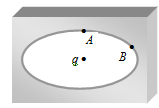
An ellipsoidal cavity is carved within a perfect conductor. A positive charge q is placed at the centre of the cavity. The points A and B are on the cavity surface as shown in the figure. Then
MCQ 931 Mark
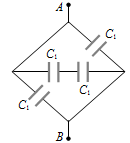
Four identical capacitors are connected as shown in diagram. When a battery of 6 V is connected between A and B, the charge stored is found to be 1.5$\mu C$. The value of $C_1$ is
- A
2.5 $\mu F$
- B
15 $\mu F$
- C
1.5 $\mu F$
- ✓
0.1 $\mu F$
AnswerCorrect option: D. 0.1 $\mu F$
(d) 0.1 $\mu F$
View full question & answer→MCQ 941 Mark
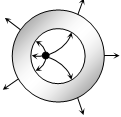
A metallic shell has a point charge ‘q’ kept inside its cavity. Which one of the following diagrams correctly represents the electric lines of forces
Answer(c)
View full question & answer→MCQ 951 Mark
Three capacitors of capacitance 1 mF, 2 mF and 3 mF are connected in series and a potential difference of 11 V is applied across the combination. Then, the potential difference across the plates of 1 mF capacitor is
MCQ 961 Mark
Effective capacitance between A and B in the figure shown is (all capacitance are in mF)
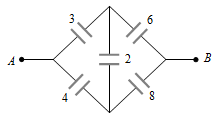
AnswerCorrect option: D. $\frac{14}{3} \mu \mathrm{F}$
(d) $\frac{14}{3} \mu \mathrm{F}$
View full question & answer→MCQ 971 Mark
Three capacitors 2, 3 and 6 mF are joined in series with each other. What is the minimum effective capacitance
MCQ 981 Mark
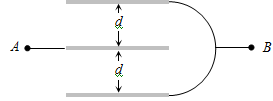
Three plates of common surface area A are connected as shown. The effective capacitance will be
- A
$\frac{\varepsilon_0 \mathrm{~A}}{\mathrm{~d}}$
- B
$\frac{3\varepsilon_0 A}{d}$
- C
$\frac{3}{2} \cdot \frac{\varepsilon_0\mathrm{~A}}{\mathrm{~d}}$
- ✓
$\frac{2 \varepsilon_0 A}{d}$
AnswerCorrect option: D. $\frac{2 \varepsilon_0 A}{d}$
(d) $\frac{2 \varepsilon_0 A}{d}$
View full question & answer→MCQ 991 Mark
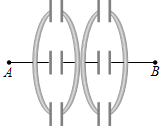
All six capacitors shown are identical, Each can withstand maximum 200 volts between its terminals. The maximum voltage that can be safely applied between A and B is
MCQ 1001 Mark
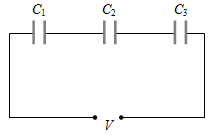
In the figure, three capacitors each of capacitance 6 pF are connected in series. The total capacitance of the combination will be
- A
9 $\times {10^{-12}F}$
- B
6 $\times {10^{-12}F}$
- C
3$\times {10^{-12}F}$
- ✓
2$\times {10^{-12}F}$
AnswerCorrect option: D. 2$\times {10^{-12}F}$
(d) 2$\times {10^{-12}F}$
View full question & answer→MCQ 1011 Mark
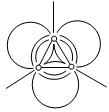
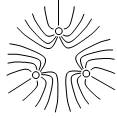
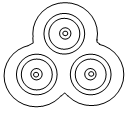
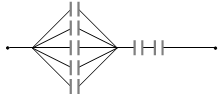
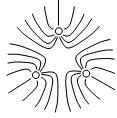
Three positive charges of equal value q are placed at the vertices of an equilateral triangle. The resulting lines of force should be sketched as in
Answer(c)
View full question & answer→MCQ 1021 Mark
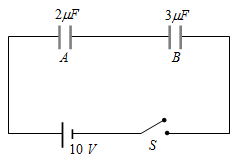
Two capacitors A and B are connected in series with a battery as shown in the figure. When the switch S is closed and the two capacitors get charged fully, then
- A
The potential difference across the plates of A is 4V and across the plates of B is 6V
- ✓
The potential difference across the plates of A is 6V and across the plates of B is 4V
- C
The ratio of electrical energies stored in A and B is 2 : 3
- D
The ratio of charges on A and B is 3 : 2
AnswerCorrect option: B. The potential difference across the plates of A is 6V and across the plates of B is 4V
(b) The potential difference across the plates of A is 6V and across the plates of B is 4V
View full question & answer→MCQ 1031 Mark
Two capacitors of capacitance 2 μF and 3μF are joined in series. Outer plate first capacitor is at 1000 volt and outer plate of second capacitor is earthed (grounded). Now the potential on inner plate of each capacitor will be
MCQ 1041 Mark
A series combination of three capacitors of capacities 1μF, 2 μF and 8 μF is connected to a battery of e.m.f. 13 volt. The potential difference across the plates of 2 μF capacitor will be
MCQ 1051 Mark
A capacitor of capacity $C_1$ is charged upto V volt and then connected to an uncharged capacitor of capacity $C_2$. Then final potential difference across each will be
AnswerCorrect option: C. $\frac{C_1 V}{C_1+C_2}$
(c) $\frac{C_1 V}{C_1+C_2}$
View full question & answer→MCQ 1061 Mark
Three capacitors each of capacity 4μF are to be connected in such a way that the effective capacitance is 6 μF. This can be done by
- A
Connecting them in parallel
- ✓
Connecting two in series and one in parallel
- C
Connecting two in parallel and one in series
- D
Connecting all of them in series
AnswerCorrect option: B. Connecting two in series and one in parallel
Connecting two in series and one in parallel
View full question & answer→MCQ 1071 Mark
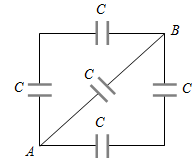
In the figure shown, the effective capacitance between the points A and B, if each has capacitance C, is
- ✓
- B
$\frac{C}{3}$
- C
- D
$\frac{C}{2}$
View full question & answer→MCQ 1081 Mark
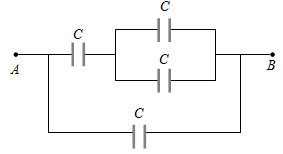
Four equal capacitors, each of capacity C, are arranged as shown. The effective capacitance between A and B is
- A
$\frac{5}{8}F$
- B
$\frac{3}{5}C$
- ✓
$\frac{5}{3}C$
- D
$C$
AnswerCorrect option: C. $\frac{5}{3}C$
(c) $\frac{5}{3}C$
View full question & answer→MCQ 1091 Mark
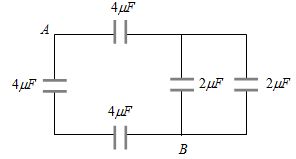
In the circuit as shown in the figure the effective capacitance between A and B is
MCQ 1101 Mark
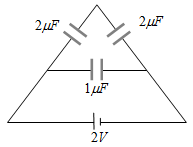
The charge on any one of the 2 μF capacitors and 1 μF capacitor will be given respectively (in μC ) as
MCQ 1111 Mark
Two capacitors of 1mF and 2mF are connected in series, the resultant capacitance will be
- A
- ✓
$\frac{2}{3}\mu F$
- C
$\frac{3}{2}\mu F$
- D
AnswerCorrect option: B. $\frac{2}{3}\mu F$
(b) $\frac{2}{3}\mu F$
View full question & answer→MCQ 1121 Mark
A capacitor of 10mF charged up to 250 volts is connected in parallel with another capacitor of 5mF charged up to 100 volts. The common potential is
MCQ 1131 Mark
Two capacitors of capacitances 3 μF and 6 μF are charged to a potential of 12 V each. They are now connected to each other, with the positive plate of each joined to the negative plate of the other. The potential difference across each will be
MCQ 1141 Mark
Three capacitors of 2μF, 3μF and 6μF are joined in series and the combination is charged by means of a 24 volt battery. The potential difference between the plates of the 6 μF capacitor is
MCQ 1151 Mark
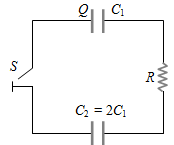
Two capacitors $\mathrm{C}_1$ and $\mathrm{C}_2=2 \mathrm{C}_1$ are connected in a circuit with a switch between them as shown in the figure. Initially the switch is open and $\mathrm{C}_1$ holds charge Q. The switch is closed. At steady state, the charge on each capacitor will be
View full question & answer→MCQ 1161 Mark
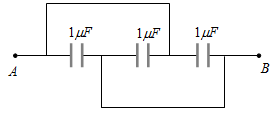
The equivalent capacitance in the circuit between A and B will be
(a) (b) (c) (d)
MCQ 1171 Mark
A parallel plate capacitor has capacitance C. If it is equally filled with parallel layers of materials of dielectric constants $\mathrm{K}_1$ and $\mathrm{K}_2$ its capacity becomes $C_1$. The ratio of $C_1$ to $C$ is
AnswerCorrect option: D. $\frac{2K_1K_2}{K_1+K_2}$
(d) $\frac{2K_1K_2}{K_1+K_2}$
View full question & answer→MCQ 1181 Mark
A 20F capacitor is charged to 5V and isolated. It is then connected in parallel with an uncharged 30F capacitor. The decrease in the energy of the system will be
MCQ 1191 Mark
Two capacitors ${C}_1=2 \mu{F}$ and ${C}_6=2 \mu{F}$ in series, are connected in parallel to a third capacitor${C}_3=4 \mu{F}$. This arrangement is then connected to a battery of e.m.f. = 2V, as shown in the figure. How much energy is lost by the battery in charging the capacitors
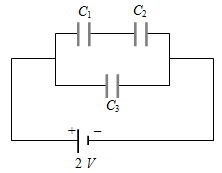
AnswerCorrect option: B. ${11}\times{10^{-6}}J$
(b) ${11}\times{10^{-6}}J$
View full question & answer→MCQ 1201 Mark
Consider a parallel plate capacitor of 10 μF (micro-farad) with air filled in the gap between the plates. Now one half of the space between the plates is filled with a dielectric of dielectric constant 4, as shown in the figure. The capacity of the capacitor changes to
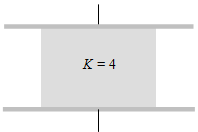
MCQ 1211 Mark
Three capacitors of capacitance 3 μF , 10 μF and 15 μF are connected in series to a voltage source of 100V. The charge on 15 μF is
MCQ 1221 Mark
In the figure a capacitor is filled with dielectrics. The resultant capacitance is
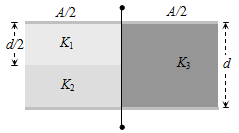
- A
$\frac{2 \varepsilon_0 \mathrm{~A}}{\mathrm{~d}}\left[\frac{1}{\mathrm{k}_1}+\frac{1}{\mathrm{k}_2}+\frac{1}{\mathrm{k}_2}\right]$
- B
$\frac{z_0 \mathrm{~A}}{\mathrm{~d}}\left[\frac{1}{\mathrm{k}_1}+\frac{1}{\mathrm{k}_2}+\frac{1}{\mathrm{k}_2}\right]$
- C
$\left.\frac{2 \varepsilon_0 \mathrm{~A}}{\mathrm{~d}} \mathrm{k}_1+\mathrm{k}_2+\mathrm{k}_3\right]$
- ✓
View full question & answer→MCQ 1231 Mark
Two capacitors of 10 μF and 20 μF are connected in series with a 30V battery. The charge on the capacitors will be, respectively
MCQ 1241 Mark
Equivalent capacitance between A and B is
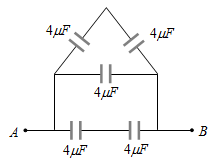
MCQ 1251 Mark
The effective capacitance between the points P and Q of the arrangement shown in the figure is
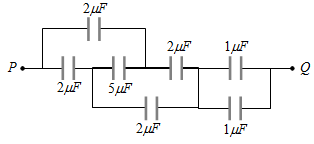
- A
$\frac{1}{2}\mu F$
- ✓
$1\mu F$
- C
$2\mu F$
- D
$1.33\mu F$
AnswerCorrect option: B. $1\mu F$
(b) $1\mu F$
View full question & answer→MCQ 1261 Mark
In the circuit shown here $C_1=6\mu F,C_2=3\mu F$ and battery B = 20V. The switch $S_1$ is first closed. It is then opened and afterwards $S_2$ is closed. What is the charge finally on $C_2$
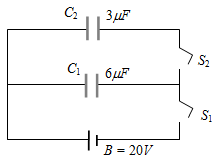
View full question & answer→MCQ 1271 Mark
A parallel plate capacitor of area A, plate separation d and capacitance C is filled with three different dielectric materials having dielectric constants $k_1,k_2$ and $k_3$ as shown. If a single dielectric material is to be used to have the same capacitance C in this capacitor, then its dielectric constant k is given by
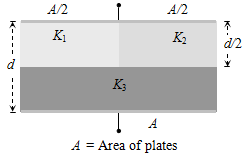
- A
$\frac{1}{k}=\frac{1}{k_1}+\frac{1}{k_2}+\frac{1}{2k_3}$
- ✓
$\frac{1}{k}=\frac{1}{k_1+k_2}+\frac{1}{2k_3}$
- C
$k=\frac{k_1k_2}{k_1+k_2}+2k_3$
- D
$k=k_1+k_2+2k_3$
AnswerCorrect option: B. $\frac{1}{k}=\frac{1}{k_1+k_2}+\frac{1}{2k_3}$
(b) $\frac{1}{k}=\frac{1}{k_1+k_2}+\frac{1}{2k_3}$
View full question & answer→MCQ 1281 Mark
In the circuit here, the steady state voltage across capacitor C is a fraction of the battery e.m.f. The fraction is decided by
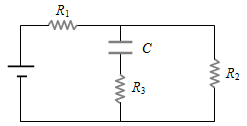
- A
$R_1$ only
- ✓
$R_1$ and $R_2$ only
- C
$R_1$ and $R_2$
- D
$R_1,R_2$ and $R_3$
AnswerCorrect option: B. $R_1$ and $R_2$ only
(b) $R_1$ and $R_2$ only
View full question & answer→MCQ 1291 Mark
Ten capacitor are joined in parallel and charged with a battery up to a potential V. They are then disconnected from battery and joined again in series then the potential of this combination will be
MCQ 1301 Mark
A potential difference of 300 volts is applied to a combination of 2.0mF and 8.0mF capacitors connected in series. The charge on the 2.0mF capacitor is
- A
$2.4\times{10^{-4}}C$
- ✓
$4.8\times{10^{-4}}C$
- C
$7.2\times{10^{-4}}C$
- D
$9.6\times{10^{-4}}C$
AnswerCorrect option: B. $4.8\times{10^{-4}}C$
(b) $4.8\times{10^{-4}}C$
View full question & answer→MCQ 1311 Mark
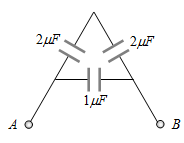
What is the effective capacitance between A and B in the following figure
MCQ 1321 Mark
When two identical capacitors are in series have 3mF capacitance and when parallel 12mF. What is the capacitance of each
MCQ 1331 Mark
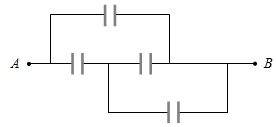
In the circuit shown in figure, each capacitor has a capacity of 3μF. The equivalent capacity between A and B is
- A
$\frac{3}{4}\mu F$
- B
3$\mu F$
- C
6$\mu F$
- ✓
5$\mu F$
AnswerCorrect option: D. 5$\mu F$
(d) 5$\mu F$
View full question & answer→MCQ 1341 Mark
The equivalent capacitance of three capacitors of capacitance $C_1,C_2$ and $C_3$ are connected in parallel is 12 units and product $C_1 \cdot C_2 \cdot C_3=48$. When the capacitors $C_1$ and $C_2$ are connected in parallel, the equivalent capacitance is 6 units. Then the capacitance are
View full question & answer→MCQ 1351 Mark
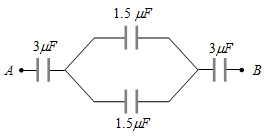
The capacitance between the points A and B in the given circuit will be
MCQ 1361 Mark
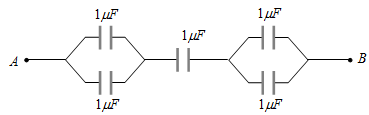
The equivalent capacitance between A and B is
MCQ 1371 Mark
In the given network capacitance, $C_1=10\mu F, C_2 = 5\mu F$ and $C_=4\mu F$. What is the resultant capacitance between A and B
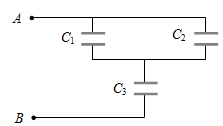
View full question & answer→MCQ 1381 Mark
A capacitor of 20 μF is charged to 500 volts and connected in parallel with another capacitor of 10 μF and charged to 200 volts. The common potential is
MCQ 1391 Mark
In the given figure the capacitors $C_1,C_3,C_4,C_5$ have a capacitance 4mF each if the capacitor $C_2$ has a capacitance 10mF, then effective capacitance between A and B will be
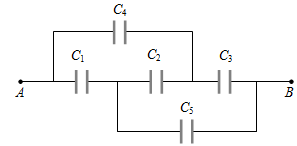
View full question & answer→MCQ 1401 Mark
Three plates A, B, C each of area $50\ cm^2$ have separation 3mm between A and B and 3mm between B and C The energy stored when the plates are fully charged is
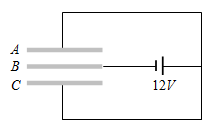
- A
$1.6\times 10^{-9} J$
- ✓
$2.1\times 10^{-9} J$
- C
$5\times 10^{-9} J$
- D
$7\times 10^{-9} J$
AnswerCorrect option: B. $2.1\times 10^{-9} J$
$2.1\times 10^{-9} J$
View full question & answer→MCQ 1411 Mark
The resultant capacitance of given circuit is
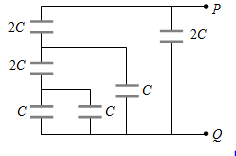
MCQ 1421 Mark
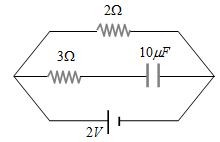
The charge on a capacitor of capacitance 10 μF connected as shown in the figure is
MCQ 1431 Mark
The combined capacity of the parallel combination of two capacitors is four times their combined capacity when connected in series. This means that
- ✓
Their capacities are equal
- B
Their capacities are 1 μF and 2 μF
- C
Their capacities are 0.5 μF and 1 μF
- D
Their capacities are infinite
AnswerCorrect option: A. Their capacities are equal
Their capacities are equal
View full question & answer→MCQ 1441 Mark
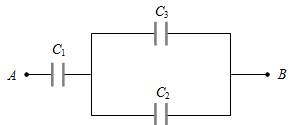
The combination of capacitors with $C_1=3\mu F, C_2=4\mu F$ and $C_3=2\mu F$ is charged by connecting AB to a battery. Consider the following statements
I. Energy stored in $C_1$ = Energy stored in $C_2$ + Energy stored in $C_3$
II. Charge on $C_1$ = Charge on $C_2$ + Charge on $C_3$
III. Potential drop across $C_1$ = Potential drop across $C_2$ = Potential drop across $C_3$
Which of these is/are correct
View full question & answer→MCQ 1451 Mark
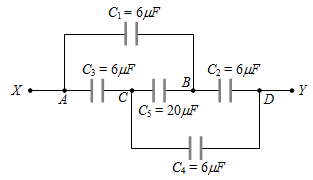
What is the effective capacitance between points X and Y
MCQ 1461 Mark
A 10 μF capacitor is charged to a potential difference of 50 V and is connected to another uncharged capacitor in parallel. Now the common potential difference becomes 20 volt. The capacitance of second capacitor is
MCQ 1471 Mark
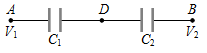
Two condensers $C_1$ and $C_2$ in a circuit are joined as shown in figure. The potential of point A is $V_1$ and that of B is$V_1$. The potential of point D will be
- A
$\frac{1}{2}\left(V_1+V_2\right)$
- B
$\frac{C_2 V_1+C_1 V_2}{C_1+C_2}$
- ✓
$\frac{C_1 V_1+C_2 V_2}{C_1+C_2}$
- D
$\frac{C_2 V_1-C_1 V_2}{C_1+C_2}$
AnswerCorrect option: C. $\frac{C_1 V_1+C_2 V_2}{C_1+C_2}$
(c) $\frac{C_1 V_1+C_2 V_2}{C_1+C_2}$
View full question & answer→MCQ 1481 Mark
A 10 $\mu \mathrm{F}$ capacitor and a 20 $\mu \mathrm{F}$ capacitor are connected in series across a 200 V supply line. The charged capacitors are then disconnected from the line and reconnected with their positive plates together and negative plates together and no external voltage is applied. What is the potential difference across each capacitor
AnswerCorrect option: B. $\frac{800}{9} \mathrm{~V}$
(b) $\frac{800}{9} \mathrm{~V}$
View full question & answer→MCQ 1491 Mark
Choose the incorrect statement from the following: When two identical capacitors are charged individually to different potentials and connected parallel to each other after disconnecting them from the source
- A
Net charge equals the sum of initial charges
- B
The net energy stored in the two capacitors is less than the sum of the initial individual energies
- C
The net potential difference across them is different from the sum of the individual initial potential difference
- ✓
The net potential difference across them equals the sum of the individual initial potential differences
AnswerCorrect option: D. The net potential difference across them equals the sum of the individual initial potential differences
The net potential difference across them equals the sum of the individual initial potential differences
View full question & answer→MCQ 1501 Mark
A capacitor of capacitance 5$\mu F$ is connected as shown in the figure. The internal resistance of the cell is 0.5 Ω. The amount of charge on the capacitor plate is
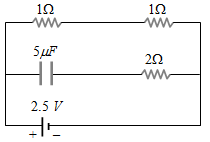
- A
0 $\mu C$
- B
5 $\mu C$
- ✓
10 $\mu C$
- D
25 $\mu C$
AnswerCorrect option: C. 10 $\mu C$
(c)10 $\mu C$
View full question & answer→MCQ 1511 Mark
Three identical capacitors are combined differently. For the same voltage to each combination, the one that stores the greatest energy is
- A
Two in parallel and the third in series with it
- B
- ✓
- D
Two in series and third in parallel with it
View full question & answer→MCQ 1521 Mark
In the adjoining figure, four capacitors are shown with their respective capacities and the P.D. applied. The charge and the P.D. across the 4μF capacitor will be
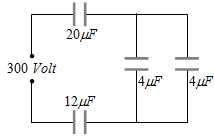
MCQ 1531 Mark
Four capacitors are connected as shown in the figure. Their capacities are indicated in the figure. The effective capacitance between points x and y is (in μF)
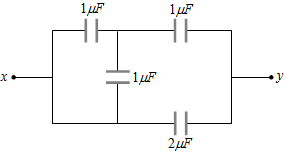
- A
$\frac{5}{6}$
- B
$\frac{7}{6}$
- ✓
$\frac{8}{3}$
- D
AnswerCorrect option: C. $\frac{8}{3}$
(c) $\frac{8}{3}$
View full question & answer→MCQ 1541 Mark
Three capacitors of 2.0, 3.0 and 6.0 μF are connected in series to a 10 V source. The charge on the 3.0 μF capacitor is
MCQ 1551 Mark
Four capacitors are connected in a circuit as shown in the figure. The effective capacitance in μF between points A and B will be
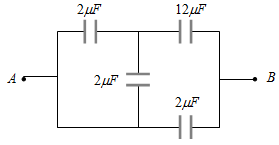
MCQ 1561 Mark
Three capacitors each of 6μF are available. The minimum and maximum capacitances which may be obtained are
MCQ 1571 Mark
A condenser of capacity $C_1$ is charged to a potential $V_0$. ThVe electrostatic energy stored in it is $U_0$. It is connected to another uncharged condenser of capacity $C_2$ in parallel. The energy dissipated in the process is
- ✓
$\frac{{c}_2}{{c}_1+{c}_2} {U}_0$
- B
$\frac{{c}_1}{{c}_1+{c}_2} {U}_0$
- C
$\left(\frac{C_1-C_2}{C_1+C_2}\right) U_0$
- D
$\frac{\mathrm{C}_1 \mathrm{C}_2}{2\left(\mathrm{C}_1+\mathrm{C}_2\right)} \mathrm{U}_0$
AnswerCorrect option: A. $\frac{{c}_2}{{c}_1+{c}_2} {U}_0$
(a) $\frac{{c}_2}{{c}_1+{c}_2} {U}_0$
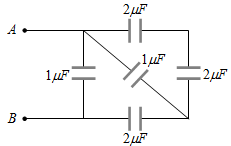
View full question & answer→MCQ 1581 Mark
The total capacity of the system of capacitors shown in the adjoining figure between the points A and B is
MCQ 1591 Mark
Four capacitors are connected as shown in the equivalent capacitance between the points P and Q is
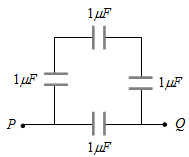
- A
- B
$\frac{1}{4}\mu F$
- C
$\frac{3}{4}\mu F$
- ✓
$\frac{4}{3}\mu F$
AnswerCorrect option: D. $\frac{4}{3}\mu F$
(d) $\frac{4}{3}\mu F$
View full question & answer→MCQ 1601 Mark
Two identical parallel plate capacitors are connected in series to a battery of 100 V. A dielectric slab of dielectric constant 4.0 is inserted between the plates of second capacitor. The potential difference across the capacitors will now be respectively
MCQ 1611 Mark
Two capacitors of 3pF and 6pF are connected in series and a potential difference of 5000 V is applied across the combination. They are then disconnected and reconnected in parallel. The potential between the plates is
- A
- ✓
- C
2.25 $\times 10^6 \ V$
- D
1.1 $\times 10^6\ V$
View full question & answer→MCQ 1621 Mark
A capacitor 4 μF charged to 50 V is connected to another capacitor of 2 μF charged to 100 V with plates of like charges connected together. The total energy before and after connection in multiples of ($10^{-2}J$) is
View full question & answer→MCQ 1631 Mark
A condenser of capacitance 10 μF has been charged to 100 volts. It is now connected to another uncharged condenser in parallel. The common potential becomes 40 volts. The capacitance of another condenser is
MCQ 1641 Mark
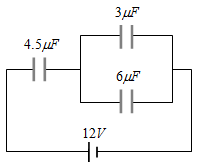
In the circuit shown in the figure, the potential difference across the 4.5mF capacitor is
MCQ 1651 Mark
0.2 Fcapacitor is charged to 600 V by a battery. On removing the battery, it is connected with another parallel plate condenser of 1F. The potential decreases to
MCQ 1661 Mark
A condenser having a capacity of 6mF is charged to 100 V and is then joined to an uncharged condenser of 14 μF and then removed. The ratio of the charges on 6mF and 14mF and the potential of 6mF will be
- A
$\frac{6}{14}$ and 50 volt
- B
$\frac{14}{6}$ and 30 volt
- ✓
$\frac{6}{14}$ and 30 volt
- D
$\frac{14}{6}$ and 0 volt
AnswerCorrect option: C. $\frac{6}{14}$ and 30 volt
(c) $\frac{6}{14}$ and 30 volt
View full question & answer→MCQ 1671 Mark
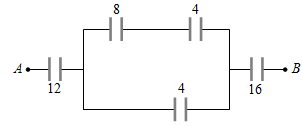
What is the equivalent capacitance between A and B in the given figure (all are in farad)
- A
$\frac{13}{18} F$
- B
$\frac{48}{13} F$
- C
$\frac{1}{31} F$
- ✓
$\frac{240}{71} F$
AnswerCorrect option: D. $\frac{240}{71} F$
(d) $\frac{240}{71} F$
View full question & answer→MCQ 1681 Mark
In the following circuit, the resultant capacitance between A and B is 1mF. Then value of C is
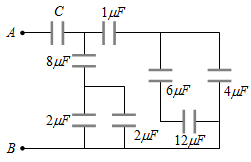
(a) (b) (c) (d)
- A
$\frac{32}{11}$ μF
- B
$\frac{11}{32}$ μF
- C
$\frac{23}{32}$ μF
- ✓
$\frac{32}{23}$ μF
AnswerCorrect option: D. $\frac{32}{23}$ μF
(d) $\frac{32}{23}$ μF
View full question & answer→MCQ 1691 Mark
The resultant capacitance between A and B in the following figure is equal to
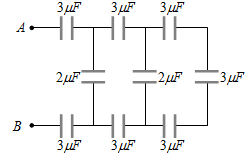
MCQ 1701 Mark
In the connections shown in the adjoining figure, the equivalent capacity between A and B will be
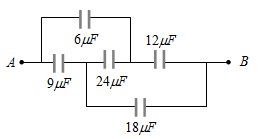
MCQ 1711 Mark
A capacitor having capacitance C is charged to a voltage V. It is then removed and connected in parallel with another identical capacitor which is uncharged. The new charge on each capacitor is now
MCQ 1721 Mark
A 4 μF condenser is connected in parallel to another condenser of 8 μF. Both the condensers are then connected in series with a 12 μF condenser and charged to 20 volts. The charge on the plate of 4 μF condenser is
MCQ 1731 Mark
Two capacitors each of capacity 2 μF are connected in parallel. This system is connected in series with a third capacitor of 12 μF capacity. The equivalent capacity of the system will be
MCQ 1741 Mark
A parallel plate capacitor is made by stacking n equally spaced plates connected alternately. If the capacitance between any two plates is C then the resultant capacitance is
MCQ 1751 Mark
Four plates of the same area of cross-section are joined as shown in the figure. The distance between each plate is d. The equivalent capacity across A and B will be
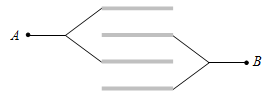
- A
$\frac{2 \varepsilon_0 A}{d}$
- ✓
$\frac{3 \varepsilon_0 A}{d}$
- C
$\frac{3 \varepsilon_0 A}{2d}$
- D
$\frac{ \varepsilon_0 A}{d}$
AnswerCorrect option: B. $\frac{3 \varepsilon_0 A}{d}$
(b) $\frac{3 \varepsilon_0 A}{d}$
View full question & answer→MCQ 1761 Mark
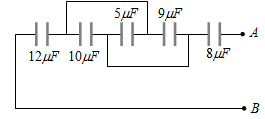
The capacities and connection of five capacitors are shown in the adjoining figure. The potential difference between the points A and B is 60 volts . Then the equivalent capacity between A and B and the charge on 5μF capacitance will be respectively
MCQ 1771 Mark
Two condensers of capacities 1μF and 2 μF are connected in series and the system is charged to 120 volts. Then the P.D. on 1 μF capacitor (in volts) will be
MCQ 1781 Mark
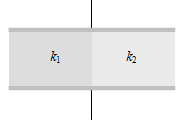
A parallel plate condenser is filled with two dielectrics as shown. Area of each plate is $A \ metre^2$ and the separation is t metre . The dielectric constants are $k_1$ and $k_2$ respectively. Its capacitance in farad will be
- A
$\frac{\varepsilon_0{A}}{t}\left({k}_1+{k}_2\right)$
- ✓
$\frac{z_0 \mathrm{~A}}{\mathrm{t}} \cdot \frac{\mathrm{k}_1+\mathrm{k}_2}{2}$
- C
$\frac{2 \varepsilon_0 \mathrm{~A}}{t}\left(k_1+k_2\right)$
- D
$\frac{z_0 \mathrm{~A}}{\mathrm{t}} \cdot \frac{\mathrm{k}_1-\mathrm{k}_2}{2}$
AnswerCorrect option: B. $\frac{z_0 \mathrm{~A}}{\mathrm{t}} \cdot \frac{\mathrm{k}_1+\mathrm{k}_2}{2}$
(b) $\frac{z_0 \mathrm{~A}}{\mathrm{t}} \cdot \frac{\mathrm{k}_1+\mathrm{k}_2}{2}$
View full question & answer→MCQ 1791 Mark
The capacities of two conductors are $C_1$ and $C_2$ and their respective potentials are $V_1$ and $V_2$. If they are connected by a thin wire, then the loss of energy will be given by
- A
$\frac{C_1 C_2\left(V_1+V_2\right)}{2\left(C_1+C_2\right)}$
- B
$\frac{C_1 C_2\left(V_1-V_2\right)}{2\left(C_1+C_2\right)}$
- ✓
$\frac{C_1 C_2\left(V_1-V_2\right)^2}{2\left(C_1+C_2\right)}$
- D
$\frac{\left(C_1+C_2\right)\left(V_1-V_2\right)}{C_1 C_2}$
AnswerCorrect option: C. $\frac{C_1 C_2\left(V_1-V_2\right)^2}{2\left(C_1+C_2\right)}$
(c) $\frac{C_1 C_2\left(V_1-V_2\right)^2}{2\left(C_1+C_2\right)}$
View full question & answer→MCQ 1801 Mark
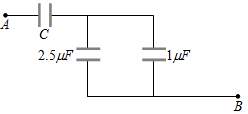
The equivalent capacitance between A and B in the figure is 1 μF. Then the value of capacitance C is
MCQ 1811 Mark
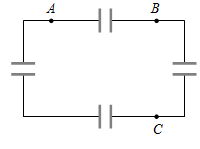
Four capacitors of each of capacity 3μF are connected as shown in the adjoining figure. The ratio of equivalent capacitance between A and B and between A and C will be
MCQ 1821 Mark
A capacitor of capacity $C_1$ is charged to the potential of $V_0$. On disconnecting with the battery, it is connected with a capacitor of capacity $C_2$ as shown in the adjoining figure. The ratio of energies before and after the connection of switch S will be
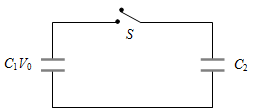
- ✓
$(C_1+C_2) / C_1$
- B
$C_1/(C_1+C_2)$
- C
$C_1C_2$
- D
$C_1/C_2$
AnswerCorrect option: A. $(C_1+C_2) / C_1$
(a) $(C_1+C_2) / C_1$
View full question & answer→MCQ 1831 Mark
Two capacitors of capacities $C_1$ and $C_2$ are charged to voltages $V_1$ and $V_2$ respectively. There will be no exchange of energy in connecting them in parallel, if
AnswerCorrect option: C. $V_1=V_2$
(c) $V_1=V_2$
View full question & answer→MCQ 1841 Mark
2Two capacitors connected in parallel having the capacities $C_1$ and $C_1$ are given ‘q’ charge, which is distributed among them. The ratio of the charge on $C_1$ and $C_2$ will be
- ✓
$\frac{C_1}{C_2}$
- B
$\frac{C_2}{C_1}$
- C
$C_1C_2$
- D
$\frac{1}{C_1C_2}$
AnswerCorrect option: A. $\frac{C_1}{C_2}$
(a) $\frac{C_1}{C_2}$
View full question & answer→MCQ 1851 Mark
Two capacitors of equal capacity are first connected in parallel and then in series. The ratio of the total capacities in the two cases will be
MCQ 1861 Mark
Three capacitors of capacity $C_1,C_2,C_3$ are connected in series. Their total capacity will be
AnswerCorrect option: C. $(C_1^{-1}+C_2^{-1}+C_3^{-1})^{-1}$
(c) $(C_1^{-1}+C_2^{-1}+C_3^{-1})^{-1}$
View full question & answer→MCQ 1871 Mark
Three capacitances of capacity 10 μF, 5 μF and 5 μF are connected in parallel. The total capacity will be
MCQ 1881 Mark
Two capacitances of capacity $C_1$ and $C_2$ are connected in series and potential difference V is applied across it. Then the potential difference across $C_1$ will be
- A
${V} \frac{C_2}{C_1}$
- B
$V \frac{C_1+C_2}{C_1}$
- ✓
$V \frac{C_2}{C_1+C_2}$
- D
$V \frac{C_1}{C_1+C_2}$
AnswerCorrect option: C. $V \frac{C_2}{C_1+C_2}$
(c) $V \frac{C_2}{C_1+C_2}$
View full question & answer→MCQ 1891 Mark
The capacitor of capacitance 4 μF and 6 μF are connected in series. A potential difference of 500 volts is applied to the outer plates of the two capacitor system. The potential difference across the plates of capacitor of 4 μF capacitance is
MCQ 1901 Mark
Two condensers of capacity 0.3 μF and 0.6 μF respectively are connected in series. The combination is connected across a potential of 6 volts . The ratio of energies stored by the condensers will be
- A
$\frac{1}{2}$
- ✓
- C
$\frac{1}{4}$
- D
View full question & answer→MCQ 1911 Mark
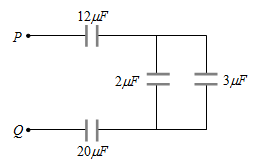
In the circuit diagram shown in the adjoining figure, the resultant capacitance between P and Q is
MCQ 1921 Mark
2μF capacitance has potential difference across its two terminals 200 volts. It is disconnected with battery and then another uncharged capacitance is connected in parallel to it, then P.D. becomes 20 volts. Then the capacity of another capacitance will be
MCQ 1931 Mark
In an adjoining figure are shown three capacitors $C_1,C_2$ and $C_3$ joined to a battery. The correct condition will be (Symbols have their usual meanings)
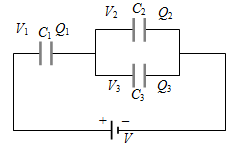
- A
$Q_1=Q_2=Q_3$ and $V_1=V_2=V_3=V$
- B
$Q_1=Q_2+Q_3$ and $V=V_1+V_2+V_3$
- ✓
$Q_1=Q_2+Q_3$ and $V=V_1+V_2$
- D
$Q_2=Q_3$ and $V_2=V_3$
AnswerCorrect option: C. $Q_1=Q_2+Q_3$ and $V=V_1+V_2$
(c) $Q_1=Q_2+Q_3$ and $V=V_1+V_2$
View full question & answer→MCQ 1941 Mark
Two capacitors each of 1μF capacitance are connected in parallel and are then charged by 200 volts d.c. supply. The total energy of their charges (in joules) is
MCQ 1951 Mark
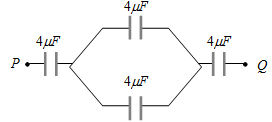
Four condensers each of capacity 4μF are connected as shown in figure. $V_P-V_Q=15$ $volts$. The energy stored in the system is
View full question & answer→MCQ 1961 Mark
Three capacitors of capacitances 3 μF, 9μF and 18 μF are connected once in series and another time in parallel. The ratio of equivalent capacitance in the two cases $\left(\frac{\mathrm{C}_8}{\mathrm{C}_{\mathrm{p}}}\right)$ will be
View full question & answer→MCQ 1971 Mark
The condensers of capacity $C_1$ and $C_2$ are connected in parallel, then the equivalent capacitance is
- ✓
$C_1+C_2$
- B
$\frac{C_1C_2}{C_1+C_2}$
- C
$\frac{C_1}{C_2}$
- D
$\frac{C_2}{C_1}$
AnswerCorrect option: A. $C_1+C_2$
(a) $C_1+C_2$
View full question & answer→MCQ 1981 Mark
A capacitor is charged to 200 volt it has 0.1 coulomb charge. When it is discharged, energy will be
MCQ 1991 Mark
Seven capacitors each of capacity 2μF are to be so connected to have a total capacity $\frac{10}{11}\mu F$. Which will be the necessary figure as shown
Answer(a)
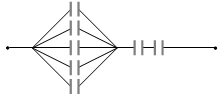
View full question & answer→MCQ 2001 Mark
Three equal capacitors, each with capacitance $C$ are connected as shown in figure. Then the equivalent capacitance between $A$ and $B$ is
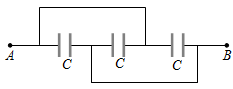
- A
$C$
- ✓
$3C$
- C
$\frac{C}{3}$
- D
$\frac{3C}{2}$
View full question & answer→MCQ 2011 Mark
Four condensers are joined as shown in the adjoining figure. The capacity of each is 8 μF. The equivalent capacity between the points A and B will be
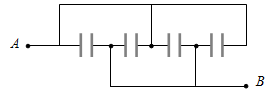
MCQ 2021 Mark
The capacitor of capacitance 4μF and 6 μF are connected in series. A potential difference of 500 volts applied to the outer plates of the two capacitor system. Then the charge on each capacitor is numerically
MCQ 2031 Mark
A parallel plate capacitor with air as medium between the plates has a capacitance of 10 μF. The area of capacitor is divided into two equal halves and filled with two media as shown in the figure having dielectric constant $\mathrm{k}_1=2$ and $\mathrm{k}_2=4$. The capacitance of the system will now be
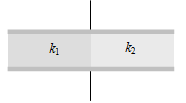
View full question & answer→MCQ 2041 Mark
Three capacitors are connected to D.C. source of 100 volts shown in the adjoining figure. If the charge accumulated on plates of $C_1,C_2$ and $C_3$ are $q_a,q_b,q_c,q_d,q_e$aand $q_f$ respectively, then
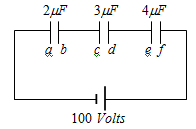
AnswerCorrect option: D. $q_b=q_d=q_f$
(d) $q_b=q_d=q_f$
View full question & answer→MCQ 2051 Mark
n identical condensers are joined in parallel and are charged to potential V. Now they are separated and joined in series. Then the total energy and potential difference of the combination will be
- A
Energy and potential difference remain same
- ✓
Energy remains same and potential difference is nV
- C
Energy increases n times and potential difference is nV
- D
Energy increases n times and potential difference remains same
AnswerCorrect option: B. Energy remains same and potential difference is nV
Energy remains same and potential difference is nV
View full question & answer→MCQ 2061 Mark
Three capacitors each of capacitance 1μF are connected in parallel. To this combination, a fourth capacitor of capacitance 1μF is connected in series. The resultant capacitance of the system is
AnswerCorrect option: D. $\frac{3}{4} \mu \mathrm{F}$
(d) $\frac{3}{4} \mu \mathrm{F}$
View full question & answer→MCQ 2071 Mark
Five capacitors of 10 μF capacity each are connected to a d.c. potential of 100 volts as shown in the adjoining figure. The equivalent capacitance between the points A and B will be equal to
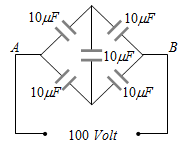
MCQ 2081 Mark
The potentials of the two plates of capacitor are +10V and –10 V. The charge on one of the plates is 40 C. The capacitance of the capacitor is
MCQ 2091 Mark
Two metallic spheres of radii 1 cm and 2 cm are given charges $10^{-2} \mathrm{C}$ and 5 × $10^{-2} \mathrm{C}$ respectively. If they are connected by a conducting wire, the final charge on the smaller sphere is
- A
$3 \times 10^{-2} \mathrm{C}$
- B
$1 \times 10^{-2} \mathrm{C}$
- C
$4 \times 10^{-2} \mathrm{C}$
- ✓
$2 \times 10^{-2} \mathrm{C}$
AnswerCorrect option: D. $2 \times 10^{-2} \mathrm{C}$
(d) $2 \times 10^{-2} \mathrm{C}$
View full question & answer→MCQ 2101 Mark
If the distance between the plates of parallel plate capacitor is halved and the dielectric constant of dielectric is doubled, then its capacity will
MCQ 2111 Mark
The capacity of an air condenser is 2.0 mF. If a medium is placed between its plates. The capacity becomes 12 mF. The dielectric constant of the medium will be
MCQ 2121 Mark
A parallel plate capacitor having a plate separation of $2 \ mm$ is charged by connecting it to a $300 V$ supply. The energy density is
- A
$0.01 \mathrm{~J} / \mathrm{m}^3$
- ✓
$0.1 \mathrm{~J} / \mathrm{m}^3$
- C
$1.0 \mathrm{~J} / \mathrm{m}^3$
- D
$10 \mathrm{~J} / \mathrm{m}^3$
AnswerCorrect option: B. $0.1 \mathrm{~J} / \mathrm{m}^3$
$0.01 \mathrm{~J} / \mathrm{m}^3$
View full question & answer→MCQ 2131 Mark
A 4 mF condenser is charged to 400 V and then its plates are joined through a resistance. The heat produced in the resistance is
MCQ 2141 Mark
If the potential of a capacitor having capacity of $6 \ mF$ is increased from $10 V$ to $20 V,$ then increase in its energy will be
- A
$12 \times 10^{-6} \mathrm{~J}$
- ✓
$9 \times 10^{-4} \mathrm{~J}$
- C
$4 \times 10^{-6} \mathrm{~J}$
- D
$4 \times 10^{-9} \mathrm{~J}$
AnswerCorrect option: B. $9 \times 10^{-4} \mathrm{~J}$
$9 \times 10^{-4} \mathrm{~J}$
View full question & answer→MCQ 2151 Mark
When a lamp is connected in series with capacitor, then
MCQ 2161 Mark
When a dielectric material is introduced between the plates of a charges condenser, then electric field between the plates
- A
- ✓
- C
- D
First increases then decreases
View full question & answer→MCQ 2171 Mark
On increasing the plate separation of a charged condenser, the energy
MCQ 2181 Mark
An air filled parallel plate capacitor has capacity C. If distance between plates is doubled and it is immersed in a liquid then apacity becomes twice. Dielectric constant of the liquid is
MCQ 2191 Mark
A spherical drop of capacitance 1 mF is broken into eight drops of equal radius. Then, the capacitance of each small drop is ......
- A
$\frac{1}{8}\mu F$
- B
- ✓
$\frac{1}{2}\mu F$
- D
$\frac{1}{4}\mu F$
AnswerCorrect option: C. $\frac{1}{2}\mu F$
(c) $\frac{1}{2}\mu F$
View full question & answer→MCQ 2201 Mark
A 40 mF capacitor in a defibrillator is charged to 3000 V. The energy stored in the capacitor is sent through the patient during a pulse of duration 2ms. The power delivered to the patient is
MCQ 2211 Mark
If a dielectric substance is introduced between the plates of a charged air-gap capacitor. The energy of the capacitor will
- A
- ✓
- C
- D
First decrease and then increase
View full question & answer→MCQ 2221 Mark
If eight identical drops are joined to form a bigger drop, the potential on bigger as compared to that on smaller drop will be
MCQ 2231 Mark
A charge of 40 μC is given to a capacitor having capacitance C = 10 μF. The stored energy in ergs is
MCQ 2241 Mark
As in figure shown, if a capacitor C is charged by connecting it with resistance R, then energy is given by the battery will be
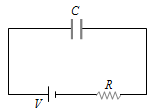
- A
$\frac{1}{2} \mathrm{CV}^2$
- ✓
More than $\frac{1}{2} \mathrm{CV}^2$
- C
Less than $\frac{1}{2} \mathrm{CV}^2$
- D
AnswerCorrect option: B. More than $\frac{1}{2} \mathrm{CV}^2$
(b) More than $\frac{1}{2} \mathrm{CV}^2$
View full question & answer→MCQ 2251 Mark
A parallel plate capacitor carries a charge q. The distance between the plates is doubled by application of a force. The work done by the force is
- A
- B
$\frac{q^2}{C}$
- ✓
$\frac{q^2}{2 C}$
- D
$\frac{q^2}{4 C}$
AnswerCorrect option: C. $\frac{q^2}{2 C}$
(c) $\frac{q^2}{2 C}$
View full question & answer→MCQ 2261 Mark
64 drops of mercury each charged to a potential of 10V. They are combined to form one bigger drop. The potential of this drop will be (Assume all the drops to be spherical)
MCQ 2271 Mark
The work done in placing a charge of $8 \times 10^{-18}$ coulomb on a condenser of capacity 100 micro-farad is
- ✓
$32 \times 10^{-32}Joule$
- B
$16 \times 10^{-32}Joule$
- C
$3.1 \times 10^{-26} Joule$
- D
$ 4\times 10^{-10}Joule$
AnswerCorrect option: A. $32 \times 10^{-32}Joule$
(a) $32 \times 10^{-32}Joule$
View full question & answer→MCQ 2281 Mark
The unit of electric permittivity is
- A
Volt$/m^2$
- B
Joule$/$coulomb
- ✓
Farad$/m $
- D
Henry$/m$
AnswerCorrect option: C. Farad$/m $
Farad$/m$
View full question & answer→MCQ 2291 Mark
A 10 micro-farad capacitor is charged to 500 V and then its plates are joined together through a resistance of 10 ohm. The heat produced in the resistance is
MCQ 2301 Mark
Capacitance of a parallel plate capacitor becomes 4/3 times its original value if a dielectric slab of thickness t = d/2 is inserted between the plates (d is the separation between the plates). The dielectric constant of the slab is
MCQ 2311 Mark
A parallel plate air capacitor is charged and then isolated. When a dielectric material is inserted between the plates of the capacitor, then which of the following does not change
- A
Electric field between the plates
- B
Potential difference across the plates
- ✓
- D
Energy stored in the capacitor
View full question & answer→MCQ 2321 Mark
A capacitor of capacitance 6μF is charged upto 100 volt. The energy stored in the capacitor is
MCQ 2331 Mark
The capacitance of a parallel plate capacitor is 12μF. If the distance between the plates is doubled and area is halved, then new capacitance will be
MCQ 2341 Mark
The energy required to charge a capacitor of 5μF by connecting a d.c. source of 20 kV is
MCQ 2351 Mark
A condenser has a capacity $2\mu F$ and is charged to a voltage of $50 V$. The energy stored is
AnswerCorrect option: D. $ 25 \times 10^3 \mathrm{erg}$
$ 25 \times 10^3 \mathrm{erg}$
View full question & answer→MCQ 2361 Mark
Capacitance (in F) of a spherical conductor with radius 1m is
- ✓
$1.1 \times 10^{-10} $
- B
$10^{-6}$
- C
$9 ×10^{-9}$
- D
$10^{-3}$
AnswerCorrect option: A. $1.1 \times 10^{-10} $
(a) $1.1 \times 10^{-10} $
View full question & answer→MCQ 2371 Mark
64 small drops of mercury, each of radius r and charge q coalesce to form a big drop. The ratio of the surface density of charge of each small drop with that of the big drop is
MCQ 2381 Mark
A conducting sphere of radius 10cm is charged 10μC. Another uncharged sphere of radius 20 cm is allowed to touch it for some time. After that if the sphere are separated, then surface density of charges, on the spheres will be in the ratio of
MCQ 2391 Mark
If $n$ drops, each of capacitance $C,$ coalesce to form a single big drop, then the ratio of the energy stored in the big drop to that in each small drop will be
- A
$ n: 1 $
- B
$ n^{1 / 3}: 1 $
- ✓
$ n^{5 / 3}: 1$
- D
$ n^2: 1$
AnswerCorrect option: C. $ n^{5 / 3}: 1$
$ n^{5 / 3}: 1$
View full question & answer→MCQ 2401 Mark
If there are n capacitors in parallel connected to V volt source, then the energy stored is equal to
AnswerCorrect option: B. $\frac{1}{2} \mathrm{nCV}^2$
(b) $\frac{1}{2} \mathrm{nCV}^2$
View full question & answer→MCQ 2411 Mark
A thin metal plate P is inserted half way between the plates of a parallel plate capacitor of capacitance C in such a way that it is parallel to the two plates. The capacitance now becomes
MCQ 2421 Mark
Putting a dielectric substance between two plates of condenser, capacity, potential and potential energy respectively
- ✓
Increase, decrease, decrease
- B
Decrease, increase, increase
- C
Increase, increase, increase
- D
Decrease, decrease, decrease
AnswerCorrect option: A. Increase, decrease, decrease
Increase, decrease, decrease
View full question & answer→MCQ 2431 Mark
If the distance between parallel plates of a capacitor is halved and dielectric constant is doubled then the capacitance
MCQ 2441 Mark
The electric field between the plates of a parallel plate capacitor when connected to a certain battery I . If the space between the plates of the capacitor is filled by introducing a material of dielectric constant K without disturbing the battery connections, the field between the plates shall be
- A
$KE_0$
- ✓
$E_0$
- C
$\frac{E_0}{K}$
- D
View full question & answer→MCQ 2451 Mark
A parallel plate capacitor has an electric field of $10^5/VM$ between the plates. If the charge on the capacitor plate is 1μC, the force on each capacitor plate is
View full question & answer→MCQ 2461 Mark
Work done by an external agent in separating the parallel plate capacitor is
AnswerCorrect option: C. $\frac{1}{2} \mathrm{CV}^2$
(c) $\frac{1}{2} \mathrm{CV}^2$
View full question & answer→MCQ 2471 Mark
A 10 pF capacitor is connected to a 50 V battery. How much electrostatic energy is stored in the capacitor
- ✓
$1.25\times10^{-8}J$
- B
$2.5 \times10^{-7}J$
- C
$3.5 \times10^{-5}J $
- D
$4.5 \times10^{-2}J$
AnswerCorrect option: A. $1.25\times10^{-8}J$
(a)$1.25\times10^{-8}J$
View full question & answer→MCQ 2481 Mark
A parallel plate air capacitor is charged to a potential difference of V. After disconnecting the battery, distance between the plates of the capacitor is increased using an insulating handle. As a result, the potential difference between the plates
MCQ 2491 Mark
A parallel plate capacitor of capacity $C_0$ is charged to a potential $V_0$
(i) The energy stored in the capacitor when the battery is disconnected and the separation is doubled $E_1$
(ii) The energy stored in the capacitor when the charging battery is kept connected and the separation between the capacitor plates is doubled is $E_2$Then $E_1/E_2$ value is
View full question & answer→MCQ 2501 Mark
The mean electric energy density between the plates of a charged capacitor is (here q = charge on the capacitor and A = area of the capacitor plate)
- ✓
$\frac{\mathrm{q}^2}{2 \varepsilon_0 A^2}$
- B
$\frac{\mathrm{q}}{2 \varepsilon_0 A^2}$
- C
$\frac{\mathrm{q}^2}{2 \varepsilon_0 A}$
- D
AnswerCorrect option: A. $\frac{\mathrm{q}^2}{2 \varepsilon_0 A^2}$
(a) $\frac{\mathrm{q}^2}{2 \varepsilon_0 A^2}$
View full question & answer→MCQ 2511 Mark
A capacitor is used to store 24 watt hour of energy at 1200 volt. What should be the capacitance of the capacitor
MCQ 2521 Mark
The capacity of a parallel plate condenser is 10 μF, when the distance between its plates is 8 cm. If the distance between the plates is reduced to 4 cm, then the capacity of this parallel plate condenser will be
MCQ 2531 Mark
Two spherical conductors A and B of radius a and b (b > a) are placed in air concentrically B is given charge + Q coulomb and A is grounded. The equivalent capacitance of these is
- A
$4 \pi \varepsilon_0 \frac{a b}{b-a}$
- B
$4 \pi \varepsilon_0(\mathrm{a}+\mathrm{b})$
- C
$4 \pi \varepsilon_0 b$
- ✓
$4 \pi \varepsilon_0 \frac{\mathrm{b}^2}{\mathrm{~b}-\mathrm{a}}$
AnswerCorrect option: D. $4 \pi \varepsilon_0 \frac{\mathrm{b}^2}{\mathrm{~b}-\mathrm{a}}$
(d) $4 \pi \varepsilon_0 \frac{\mathrm{b}^2}{\mathrm{~b}-\mathrm{a}}$
View full question & answer→MCQ 2541 Mark
A solid conducting sphere of radius $R_1$ is surrounded by another concentric hollow conducting sphere of radius $R_2$. The capacitance of this assembly is proportional to
- A
$\frac{R_2-R_1}{R_1 R_2}$
- B
$\frac{R_2+R_1}{R_1 R_2}$
- C
$\frac{R_1 R_2}{R_1+R_2}$
- ✓
$\frac{R_1 R_2}{R_1-R_2}$
AnswerCorrect option: D. $\frac{R_1 R_2}{R_1-R_2}$
(d) $\frac{R_1 R_2}{R_1-R_2}$
View full question & answer→MCQ 2551 Mark
A body of capacity 4μF is charged to 80 V and another body of capacity 6μF is charged to 30V. When they are connected the energy lost by 4 μF capacitor is
MCQ 2561 Mark
While a capacitor remains connected to a battery and dielectric slab is applied between the plates, then
- A
Potential difference between the plates is changed
- ✓
Charge flows from the battery to the capacitor
- C
Electric field between the plates increases
- D
Energy store in the capacitor decreases
AnswerCorrect option: B. Charge flows from the battery to the capacitor
Charge flows from the battery to the capacitor
View full question & answer→MCQ 2571 Mark
In a parallel plate capacitor of capacitance C, a metal sheet is inserted between the plates, parallel to them. If the thickness of the sheet is half of the separation between the plates. The capacitance will be
- A
$\frac{\mathrm{C}}{2}$
- B
$\frac{\mathrm{3C}}{2}$
- C
- ✓
View full question & answer→MCQ 2581 Mark
Two conducting spheres of radii 5 cm and 10 cm are given a charge of 15 μC each. After the two spheres are joined by a conducting wire, the charge on the smaller sphere is
MCQ 2591 Mark
Two insulated metallic spheres of 3 μF and 5 μF capacitances are charged to 300 V and 500V respectively. The energy loss, when they are connected by a wire is
MCQ 2601 Mark
The capacity of a parallel plate capacitor with no dielectric substance but with a separation of 0.4 cm is 2 μF. The separation is reduced to half and it is filled with a dielectric substance of value 2.8. The final capacity of the capacitor is
MCQ 2611 Mark
A metallic sheet is inserted between the plates of a parallel plate capacitor. The capacitance of the capacitor
- A
- B
Is independent of the position of the sheet
- C
Is maximum when the metal sheet in the middle
- ✓
View full question & answer→MCQ 2621 Mark
In a capacitor of capacitance 20 μF, the distance between the plates is 2mm. If a dielectric slab of width 1mm and dielectric constant 2 is inserted between the plates, then the new capacitance is
MCQ 2631 Mark
When we touch the terminals of a high voltage capacitor, even after a high voltage has been cut off, then the capacitor has a tendency to
MCQ 2641 Mark
The capacity of a parallel plate condenser is 15μF, when the distance between its plates is 6 cm. If the distance between the plates is reduced to 2 cm, then the capacity of this parallel plate condenser will be
MCQ 2651 Mark
A variable condenser is permanently connected to a 100 V battery. If the capacity is changed from 2μF to 10 μF, then change in energy is equal to
- A
$2 \times 10^{-2} \mathrm{~J}$
- B
$2.5 \times 10^{-2} \mathrm{~J}$
- C
$3.5 \times 10^{-2} \mathrm{~J}$
- ✓
$4 \times 10^{-2} \mathrm{~J}$
AnswerCorrect option: D. $4 \times 10^{-2} \mathrm{~J}$
(d) $4 \times 10^{-2} \mathrm{~J}$
View full question & answer→MCQ 2661 Mark
A 700 pF capacitor is charged by a 50 V battery. The electrostatic energy stored by it is
- A
$17.0 \times 10^{-8} \mathrm{~J}$
- B
$13.6 \times 10^{-9} \mathrm{~J}$
- C
$9.5 \times 10^{-9} \mathrm{~J}$
- ✓
$8.7 \times 10^{-7} \mathrm{~J}$
AnswerCorrect option: D. $8.7 \times 10^{-7} \mathrm{~J}$
(d) $8.7 \times 10^{-7} \mathrm{~J}$
View full question & answer→MCQ 2671 Mark
Sixty-four drops are jointed together to form a bigger drop. If each small drop has a capacitance C, a potential V, and a charge q, then the capacitance of the bigger drop will be
MCQ 2681 Mark
A parallel plate capacitor has a plate separation of 0.01 mm and use a dielectric (whose dielectric strength is 19 KV/mm) as an insulator. The maximum potential difference that can be applied to the terminals of the capacitor is
MCQ 2691 Mark
When a dielectric material is introduced between the plates of a charged condenser then electric field between the plates
MCQ 2701 Mark
If a slab of insulating material $4 \times 10^{-3} m$ thick is introduced between the plates of a parallel plate capacitor, the separation between plates has to be increased by $3.5 \times 10^{-3} m$ to restore the capacity to original value. The dielectric constant of the material will be
View full question & answer→MCQ 2711 Mark
Two protons A and B are placed in space between plates of a parallel plate capacitor charged upto V volts (See fig.) Forces on protons are $F_A$ and $F_B$, then
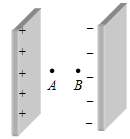
- A
$F_A>F_B$
- B
$F_A<F_B$
- ✓
$F_A=F_B$
- D
AnswerCorrect option: C. $F_A=F_B$
(c) $F_A=F_B$
View full question & answer→MCQ 2721 Mark
The plates of a parallel plate capacitor of capacity 50 μC are charged to a potential of 100 volts and then separated from each other so that the distance between them is doubled. How much is the energy spent in doing so
- ✓
$25 \times 10^{-2}J$
- B
$-12.5 \times 10^{-2}J$
- C
$-25 \times 10^{-2}J$
- D
$12.5 \times 10^{-2}J$
AnswerCorrect option: A. $25 \times 10^{-2}J$
(a) $25 \times 10^{-2}J$
View full question & answer→MCQ 2731 Mark
The ratio of charge to potential of a body is known as
MCQ 2741 Mark
125 identical drops each charged to the same potential of 50 volts are combined to form a single drop. The potential of the new drop will be
MCQ 2751 Mark
A charge of $10^{-9}C$ is placed on each of the 64 identical drops of radius 2cm. They are then combined to form a bigger drop. Find its potential
- ✓
$7.2 \times 10^3V$
- B
$7.2 \times 10^2V$
- C
$1.44 \times 10^2V$
- D
$1.44 \times 10^3V$
AnswerCorrect option: A. $7.2 \times 10^3V$
(a) $7.2 \times 10^3V$
View full question & answer→MCQ 2761 Mark
A capacitor when filled with a dielectric K = 3 has charge $\mathrm{Q}_{0}$, voltage $\mathrm{V}_{0}$ and field $\mathrm{E}_{0}$. If the dielectric is replaced with another one having K = 9 the new values of charge, voltage and field will be respectively
- A
$3 \mathrm{Q}_0, 3 \mathrm{~V}_0, 3 \mathrm{E}_0$
- B
$\mathrm{Q}_0, 3 \mathrm{~V}_0, 3 \mathrm{E}_0$
- C
$\mathrm{Q}_0, \frac{\mathrm{V}_0}{3}, 3 \mathrm{E}_0$
- ✓
$\mathrm{Q}_0, \frac{\mathrm{V}_0}{3}, \frac{\mathrm{E}_0}{3}$
AnswerCorrect option: D. $\mathrm{Q}_0, \frac{\mathrm{V}_0}{3}, \frac{\mathrm{E}_0}{3}$
$\mathrm{Q}_0, \frac{\mathrm{V}_0}{3}, \frac{\mathrm{E}_0}{3}$
View full question & answer→MCQ 2771 Mark
In a spherical condenser radius of the outer sphere is R. The different in the radii of outer and inner sphere in x. Its capacity is proportional to
- A
$\frac{x R}{(R-x)}$
- B
$\frac{x(R-x)}{r}$
- ✓
$\frac{R(R-x]}{x}$
- D
$\frac{R}{x}$
AnswerCorrect option: C. $\frac{R(R-x]}{x}$
(c) $\frac{R(R-x]}{x}$
View full question & answer→MCQ 2781 Mark
The capacity of a condenser in which a dielectric of dielectric constant 5 has been used, is C. If the dielectric is replaced by another with dielectric constant 20, the capacity will become
- A
$\frac{C}{4}$
- ✓
- C
$\frac{C}{2}$
- D
View full question & answer→MCQ 2791 Mark
The radius of a metallic sphere if its capacitance is 1/9 F, is
- A
$10^6 m$
- B
$10^7m$
- ✓
$10^9 m$
- D
$10^8 m$
AnswerCorrect option: C. $10^9 m$
(c) $10^9 m$
View full question & answer→MCQ 2801 Mark
A condenser having a capacity 2.0 micro farad is charged to 200 volts and then the plates of the capacitor are connected to a resistance wire. The heat produced in joules will be
- A
$4 \times 10^4m$
- B
$4 \times 10^{10}m$
- ✓
$4 \times 10^{-2}m$
- D
$2 \times 10^{-2}m$
AnswerCorrect option: C. $4 \times 10^{-2}m$
(c) $4 \times 10^{-2}m$
View full question & answer→MCQ 2811 Mark
Two identical charged spherical drops each of capacitance C merge to form a single drop. The resultant capacitance is
- A
- B
- ✓
Less than 2C but greater than C
- D
AnswerCorrect option: C. Less than 2C but greater than C
Less than 2C but greater than C
View full question & answer→MCQ 2821 Mark
The capacitance of an air filled parallel plate capacitor is 10μμF . The separation between the plates is doubled and the space between the plates is then filled with wax giving the capacitance a new value of $40 \times 10^{-12}$ $farads$. The dielectric constant of wax is
View full question & answer→MCQ 2831 Mark
The energy stored in the condenser is
AnswerCorrect option: B. $\frac{1}{2} Q V$
(b) $\frac{1}{2} Q V$
View full question & answer→MCQ 2841 Mark
The capacity of a parallel plate condenser is 10μF without dielectric. Dielectric of constant 2 is used to fill half the distance between the plates, the new capacitance in μF is
MCQ 2851 Mark
A parallel plate capacitor has circular plates of 0.08m radius and $1.0 \times10^{-3}m$ separation. If a P.D. of 100 volt is applied, the charge will be
- A
$1.8 \times10^{-10}C$
- ✓
$1.8 \times10^{-8}C$
- C
$1.8 \times10^{-20}C$
- D
AnswerCorrect option: B. $1.8 \times10^{-8}C$
(b) $1.8 \times10^{-8}C$
View full question & answer→MCQ 2861 Mark
What is the area of the plates of a 3F parallel plate capacitor, if the separation between the plates is 5mm
- ✓
$1.694 \times 10^9 \mathrm{~m}^2$
- B
$4.529 \times 10^9 \mathrm{~m}^2$
- C
$9.281 \times 10^9 \mathrm{~m}^2$
- D
$12.981 \times 10^9 \mathrm{~m}^2$
AnswerCorrect option: A. $1.694 \times 10^9 \mathrm{~m}^2$
(a) $1.694 \times 10^9 \mathrm{~m}^2$
View full question & answer→MCQ 2871 Mark
A parallel plate condenser with oil between the plates (dielectric constant of oil K = 2) has a capacitance C. If the oil is removed, then capacitance of the capacitor becomes
- A
$\sqrt{2}{C}$
- B
- C
$\frac{C}{\sqrt{2}}$
- ✓
$\frac{C}{2}$
AnswerCorrect option: D. $\frac{C}{2}$
(d) $\frac{C}{2}$
View full question & answer→MCQ 2881 Mark
Two metal spheres of capacitance $C_1$ and $C_2$ carry some charges. They are put in contact and then separated. The final charges $Q_1$ and $Q_2$ on them will satisfy
- A
$\frac{Q_1}{Q_2}<\frac{C_1}{C_2}$
- ✓
$\frac{Q_1}{Q_2}=\frac{C_1}{C_2}$
- C
$\frac{Q_1}{Q_2}>\frac{C_1}{C_2}$
- D
$\frac{Q_1}{Q_2}<\frac{C_2}{C_1}$
AnswerCorrect option: B. $\frac{Q_1}{Q_2}=\frac{C_1}{C_2}$
$\frac{Q_1}{Q_2}=\frac{C_1}{C_2}$
View full question & answer→MCQ 2891 Mark
The force between the plates of a parallel plate capacitor of capacitance C and distance of separation of the plates d with a potential difference V between the plates, is
- ✓
$\frac{\mathrm{CV}^2}{2 \mathrm{~d}}$
- B
$\frac{\mathrm{C}^2 \mathrm{~V}^2}{2 \mathrm{~d}^2}$
- C
$\frac{C^2 V^2}{d^2}$
- D
$\frac{\mathrm{v}^2 \mathrm{~d}}{\mathrm{c}}$
AnswerCorrect option: A. $\frac{\mathrm{CV}^2}{2 \mathrm{~d}}$
(a) $\frac{C V^2}{2 \mathrm{~d}}$
View full question & answer→MCQ 2901 Mark
A 2μF capacitor is charged to 100 volt and then its plates are connected by a conducting wire. The heat produced is
MCQ 2911 Mark
A parallel plate capacitor is first charged and then a dielectric slab is introduced between the plates. The quantity that remains unchanged is
MCQ 2921 Mark
An air capacitor of capacity C = 10μF is connected to a constant voltage battery of 12 V. Now the space between the plates is filled with a liquid of dielectric constant 5. The charge that flows now from battery to the capacitor is
MCQ 2931 Mark
The area of the plates of a parallel plate condenser is A and the distance between the plates is 10 mm. There are two dielectric sheets in it, one of dielectric constant 10 and thickness 6mm and the other of dielectric constant 5 and thickness 4mm. The capacity of the condenser is
- A
$\frac{12}{35} \varepsilon_0 \mathrm{~A}$
- B
$\frac{2}{3} \varepsilon_0 \mathrm{~A}$
- ✓
$\frac{5000}{7}$
- D
$ 1500\varepsilon_0 \mathrm{~A}$
AnswerCorrect option: C. $\frac{5000}{7}$
(c) $\frac{5000}{7}$
View full question & answer→MCQ 2941 Mark
Two spherical conductors each of capacity C are charged to potentials V and – V. These are then connected by means of a fine wire. The loss of energy will be
- A
- B
$\frac{1}{2}CV^2$
- ✓
$CV^2$
- D
$2CV^2$
AnswerCorrect option: C. $CV^2$
(c) $CV^2$
View full question & answer→MCQ 2951 Mark
The capacitance of a parallel plate condenser does not depend on
- A
- B
Medium between the plates
- C
Distance between the plates
- ✓
View full question & answer→MCQ 2961 Mark
A parallel plate capacitor of plate area A and plate separation d is charged to potential V and then the battery is disconnected. A slab of dielectric constant k is then inserted between the plates of the capacitors so as to fill the space between the plates. If Q, E and W denote respectively, the magnitude of charge on each plate, the electric field between the plates (after the slab is inserted) and work done on the system in question in the process of inserting the slab, then state incorrect relation from the following
- A
$Q=\frac{\varepsilon_0 A V}{d}$
- ✓
$\mathrm{W}=\frac{\varepsilon_0 \mathrm{~A} V^2}{2 \mathrm{kd}}$
- C
$E=\frac{V}{k d}$
- D
$\mathrm{W}=\frac{\varepsilon_0 \mathrm{AV}^2}{2 \mathrm{~d}}\left(1-\frac{1}{\mathrm{k}}\right)$
AnswerCorrect option: B. $\mathrm{W}=\frac{\varepsilon_0 \mathrm{~A} V^2}{2 \mathrm{kd}}$
(b) $\mathrm{W}=\frac{\varepsilon_0 \mathrm{~A} V^2}{2 \mathrm{kd}}$
View full question & answer→MCQ 2971 Mark
The capacitance of a metallic sphere will be 1μF, if its radius is nearly
MCQ 2981 Mark
The intensity of electric field at a point between the plates of a charged capacitor
- A
Is directly proportional to the distance between the plates
- B
Is inversely proportional to the distance between the plates
- C
Is inversely proportional to the square of the distance between the plates
- ✓
Does not depend upon the distance between the plates
AnswerCorrect option: D. Does not depend upon the distance between the plates
Does not depend upon the distance between the plates
View full question & answer→MCQ 2991 Mark
The expression for the capacity of the capacitor formed by compound dielectric placed between the plates of a parallel plate capacitor as shown in figure, will be (area of plate = A)
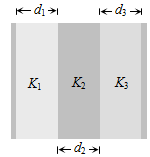
- ✓
$\frac{\varepsilon_{0 A}}{\left(\frac{\mathrm{d}_1}{\mathrm{~K}_1}+\frac{\mathrm{d}_2}{\mathrm{~K}_2}+\frac{\mathrm{d}_3}{\mathrm{~K}_{\mathrm{3}}}\right)}$
- B
$\frac{\varepsilon_0 A}{\left(\frac{d_1+d_2+d_3}{K_1+K_2+K_3}\right)}$
- C
$\frac{\varepsilon_0 A\left(K_1 K_2 K_3\right)}{d_1 d_2 d_3}$
- D
$\varepsilon_0\left(\frac{A K_1}{d_1}+\frac{A K_2}{d_2}+\frac{A K_3}{d_3}\right)$
AnswerCorrect option: A. $\frac{\varepsilon_{0 A}}{\left(\frac{\mathrm{d}_1}{\mathrm{~K}_1}+\frac{\mathrm{d}_2}{\mathrm{~K}_2}+\frac{\mathrm{d}_3}{\mathrm{~K}_{\mathrm{3}}}\right)}$
(a) $\frac{\varepsilon_{0 A}}{\left(\frac{\mathrm{d}_1}{\mathrm{~K}_1}+\frac{\mathrm{d}_2}{\mathrm{~K}_2}+\frac{\mathrm{d}_3}{\mathrm{~K}_{\mathrm{3}}}\right)}$
View full question & answer→MCQ 3001 Mark
A spherical condenser has inner and outer spheres of radii a and b respectively. The space between the two is filled with air. The difference between the capacities of two condensers formed when outer sphere is earthed and when inner sphere is earthed will be
- A
- B
$4 \pi_{\varepsilon_0 a}$
- ✓
$4 \pi_{\varepsilon_0 b}$
- D
$4 \pi \varepsilon_0 a\left(\frac{b}{b-a}\right)$
AnswerCorrect option: C. $4 \pi_{\varepsilon_0 b}$
(c) $4 \pi_{\varepsilon_0 b}$
View full question & answer→MCQ 3011 Mark
The plates of parallel plate capacitor are charged upto 100 V. A 2mm thick plate is inserted between the plates. Then to maintain the same potential difference, the distance between the plates is increased by 1.6 mm. The dielectric constant of the plate is
MCQ 3021 Mark
The outer sphere of a spherical air capacitor is earthed. For increasing its capacitance
- A
Vacuum is created between two spheres
- ✓
Dielectric material is filled between the two spheres
- C
The space between two spheres is increased
- D
The earthing of the outer sphere is removed
AnswerCorrect option: B. Dielectric material is filled between the two spheres
Dielectric material is filled between the two spheres
View full question & answer→MCQ 3031 Mark
As shown in the figure, a very thin sheet of aluminium is placed in between the plates of the condenser. Then the capacity
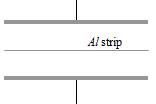
MCQ 3041 Mark
The diameter of each plate of an air capacitor is 4 cm. To make the capacity of this plate capacitor equal to that of 20 cm diameter sphere, the distance between the plates will be
- A
${ }^4 \times 10^{-3} \mathrm{~m}$
- ✓
${ }^1 \times 10^{-3} \mathrm{~m}$
- C
$1$ $cm$
- D
${ }^1 \times 10^{-3} \mathrm{~m}$
AnswerCorrect option: B. ${ }^1 \times 10^{-3} \mathrm{~m}$
(b)$ 1 \times10^{-3}{~m}$
View full question & answer→MCQ 3051 Mark
A parallel plate capacitor has a capacity C. The separation between the plates is doubled and a dielectric medium is introduced between the plates. If the capacity now becomes 2C, the dielectric constant of the medium is
MCQ 3061 Mark
A light bulb, a capacitor and a battery are connected together as shown here, with switch S initially open. When the switch S is closed, which one of the following is true
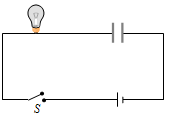
- ✓
The bulb will light up for an instant when the capacitor starts charging
- B
The bulb will light up when the capacitor is fully charged
- C
The bulb will not light up at all
- D
The bulb will light up and go off at regular intervals
AnswerCorrect option: A. The bulb will light up for an instant when the capacitor starts charging
(a) The bulb will light up for an instant when the capacitor starts charging
View full question & answer→MCQ 3071 Mark
An air capacitor is connected to a battery. The effect of filling the space between the plates with a dielectric is to increase
- A
The charge and the potential difference
- B
The potential difference and the electric field
- C
The electric field and the capacitance
- ✓
The charge and the capacitance
AnswerCorrect option: D. The charge and the capacitance
The charge and the capacitance
View full question & answer→MCQ 3081 Mark
The capacitance of an air capacitor is 15 μF the separation between the parallel plates is 6mm. A copper plate of 3mm thickness is introduced symmetrically between the plates. The capacitance now becomes
MCQ 3091 Mark
A capacitor is kept connected to the battery and a dielectric slab is inserted between the plates. During this process
- A
- B
Work is done at the cost of the energy already stored in the capacitor before the slab is inserted
- ✓
Work is done at the cost of the battery
- D
Work is done at the cost of both the capacitor and the battery
AnswerCorrect option: C. Work is done at the cost of the battery
Work is done at the cost of the battery
View full question & answer→MCQ 3101 Mark
An uncharged capacitor is connected to a battery. On charging the capacitor
- A
All the energy supplied is stored in the capacitor
- ✓
Half the energy supplied is stored in the capacitor
- C
The energy stored depends upon the capacity of the capacitor only
- D
The energy stored depends upon the time for which the capacitor is charged
AnswerCorrect option: B. Half the energy supplied is stored in the capacitor
Half the energy supplied is stored in the capacitor
View full question & answer→MCQ 3111 Mark
The distance between the plates of a parallel plate capacitor is d. A metal plate of thickness d/2 is placed between the plates. The capacitance would then be
MCQ 3121 Mark
The electric field between the two spheres of a charged spherical condenser
- A
- B
- C
Increases with distance from the centre
- ✓
Decreases with distance from the centre
AnswerCorrect option: D. Decreases with distance from the centre
Decreases with distance from the centre
View full question & answer→MCQ 3131 Mark
Between the plates of a parallel plate condenser there is 1mm thick paper of dielectric constant 4. It is charged at 100 volt. The electric field in volt/metre between the plates of the capacitor is
MCQ 3141 Mark
The two metallic plates of radius r are placed at a distance d apart and its capacity is C. If a plate of radius r/2 and thickness d of dielectric constant 6 is placed between the plates of the condenser, then its capacity will be
MCQ 3151 Mark
When a slab of dielectric material is introduced between the parallel plates of a capacitor which remains connected to a battery, then charge on plates relative to earlier charge
- A
- B
- ✓
- D
May be less or more depending on the nature of the material introduced
View full question & answer→MCQ 3161 Mark
The distance between the circular plates of a parallel plate condenser 40mm in diameter, in order to have same capacity as a sphere of radius 1 metre is
MCQ 3171 Mark
A capacitor with air as the dielectric is charged to a potential of 100 volts. If the space between the plates is now filled with a dielectric of dielectric constant 10, the potential difference between the plates will be
MCQ 3181 Mark
A parallel plate capacitor is charged and the charging battery is then disconnected. If the plates of the capacitor are moved further apart by means of insulating handles, then
- A
The charge on the capacitor increases
- B
The voltage across the plates decreases
- C
The capacitance increases
- ✓
The electrostatic energy stored in the capacitor increases
AnswerCorrect option: D. The electrostatic energy stored in the capacitor increases
The electrostatic energy stored in the capacitor increases
View full question & answer→MCQ 3191 Mark
A frictionless dielectric plate S is kept on a frictionless table T. A charged parallel plate capacitance C (of which the plates are frictionless) is kept near it. The plate S is between the plates. When the plate S is left between the plates
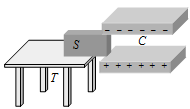
- A
It will remain stationary on the table
- B
It is pulled by the capacitor and will pass on the other end
- ✓
It is pulled between the plates and will remain there
- D
All the above statements are false
AnswerCorrect option: C. It is pulled between the plates and will remain there
(c) It is pulled between the plates and will remain there
View full question & answer→MCQ 3201 Mark
The dielectric constant k of an insulator cannot be
MCQ 3211 Mark
Two metallic charged spheres whose radii are 20 cm and 10 cm respectively, have each 150 micro - coulomb positive charge. The common potential after they are connected by a conducting wire is
- ✓
$9 × 10^6volts$
- B
$4.5 × 10^6volts$
- C
$1.8 × 10^6volts$
- D
$13.5 × 10^6volts$
AnswerCorrect option: A. $9 × 10^6volts$
$9 × 10^6volts$
View full question & answer→MCQ 3221 Mark
Force acting upon a charged particle kept between the plates of a charged condenser is F. If one plate of the condenser is removed, then the force acting on the same particle will become
MCQ 3231 Mark
One plate of parallel plate capacitor is smaller than other, then charge on smaller plate will be
- A
- B
- ✓
- D
Will depend upon the medium between them
View full question & answer→MCQ 3241 Mark
N identical spherical drops charged to the same potential V are combined to form a big drop. The potential of the new drop will be
AnswerCorrect option: D. $V ×{N}^{2 / 3}$
(d)$V ×{N}^{2 / 3}$
View full question & answer→MCQ 3251 Mark
A capacitor of capacity C is connected with a battery of potential V in parallel. The distance between its plates is reduced to half at once, assuming that the charge remains the same. Then to charge the capacitance upto the potential V again, the energy given by the battery will be
- A
$\mathrm{CV}^2 / 4$
- B
$\mathrm{CV}^2 / 2$
- C
$3 \mathrm{CV}^2 / 4$
- ✓
$\mathrm{CV}^2$
AnswerCorrect option: D. $\mathrm{CV}^2$
(d) $\mathrm{CV}^2$
View full question & answer→MCQ 3261 Mark
Force of attraction between the plates of a parallel plate capacitor is
- ✓
$\frac{q^2}{2 \varepsilon_0 A K}$
- B
$\frac{q^2}{\varepsilon_0 A K}$
- C
$\frac{q}{2 \varepsilon_0 A}$X
- D
$\frac{q^2}{2 \varepsilon_0 A^2 K}$
AnswerCorrect option: A. $\frac{q^2}{2 \varepsilon_0 A K}$
(a) $\frac{q^2}{2 \varepsilon_0 A K}$
View full question & answer→MCQ 3271 Mark
The capacity and the energy stored in a parallel plate condenser with air between its plates are respectively $C_0$ and $W_0$. If the air is replaced by glass (dielectric constant = 5) between the plates, the capacity of the plates and the energy stored in it will respectively be(a) (b)(c) (d)
- A
$5C_0,5W_0$
- ✓
$5 C_0, \frac{W_0}{5}$
- C
$\frac{\mathrm{C}_0}{5}, 5 \mathrm{~W}_0$
- D
$\frac{C_0}{5}, \frac{W_0}{5}$
AnswerCorrect option: B. $5 C_0, \frac{W_0}{5}$
(b) $5 C_0, \frac{W_0}{5}$
View full question & answer→MCQ 3281 Mark
There is an air filled 1 pF parallel plate capacitor. When the plate separation is doubled and the space is filled with wax, the capacitance increases to 2pF. The dielectric constant of wax is
MCQ 3291 Mark
The true statement is, on increasing the distance between the plates of a parallel plate condenser
- A
The electric intensity between the plates will decrease
- B
The electric intensity between the plates will increase
- ✓
The electric intensity between the plates will remain unchanged
- D
The P.D. between the plates will decrease
AnswerCorrect option: C. The electric intensity between the plates will remain unchanged
The electric intensity between the plates will remain unchanged
View full question & answer→MCQ 3301 Mark
In a parallel plate condenser, the radius of each circular plate is 12 cm and the distance between the plates is 5mm. There is a glass slab of 3mm thick and of radius 12 cm with dielectric constant 6 between its plates. The capacity of the condenser will be
MCQ 3311 Mark
The distance between the plates of a parallel plate condenser is 8mm and P.D. 120 volts. If a 6mm thick slab of dielectric constant 6 is introduced between its plates, then
- A
The charge on the condenser will be doubled
- B
The charge on the condenser will be reduced to half
- C
The P.D. across the condenser will be 320 volts
- ✓
The P.D. across the condenser will be 45 volts
AnswerCorrect option: D. The P.D. across the condenser will be 45 volts
The P.D. across the condenser will be 45 volts
View full question & answer→MCQ 3321 Mark
A parallel plate condenser has a capacitance 50μF in air and 110μF when immersed in an oil. The dielectric constant ‘k’ of the oil is
MCQ 3331 Mark
The distance between the plates of a parallel plate condenser is 4mm and potential difference is 60 volts. If the distance between the plates is increased to 12mm, then
- ✓
The potential difference of the condenser will become 180 volts
- B
The P.D. will become 20 volts
- C
The P.D. will remain unchanged
- D
The charge on condenser will reduce to one third
AnswerCorrect option: A. The potential difference of the condenser will become 180 volts
The potential difference of the condenser will become 180 volts
View full question & answer→MCQ 3341 Mark
Between the plates of a parallel plate condenser, a plate of thickness $t_1$ and dielectric constant $k_1$ is placed. In the rest of the space, there is another plate of thickness $t_2$ and dielectric constant $t_2$. The potential difference across the condenser will be
- ✓
$\frac{\mathrm{Q}}{\mathrm{A} \varepsilon_{\mathrm{c}}}\left(\frac{\mathrm{t}_1}{\mathrm{k}_1}+\frac{\mathrm{t}_2}{\mathrm{k}_2}\right)$
- B
$\frac{\varepsilon_0 \mathrm{Q}}{\mathrm{A}}\left(\frac{\mathrm{t}_1}{\mathrm{k}_1}+\frac{\mathrm{t}_2}{\mathrm{k}_2}\right)$
- C
$\frac{\mathrm{Q}}{\mathrm{A} \varepsilon_0}\left(\frac{\mathrm{k}_1}{\mathrm{t}_1}+\frac{\mathrm{k}_2}{\mathrm{t}_2}\right)$
- D
$\frac{\varepsilon_0 \mathrm{Q}}{\mathrm{A}}\left(\mathrm{k}_1 \mathrm{t}_1+\mathrm{k}_2 \mathrm{t}_2\right)$
AnswerCorrect option: A. $\frac{\mathrm{Q}}{\mathrm{A} \varepsilon_{\mathrm{c}}}\left(\frac{\mathrm{t}_1}{\mathrm{k}_1}+\frac{\mathrm{t}_2}{\mathrm{k}_2}\right)$
(a) $\frac{\mathrm{Q}}{\mathrm{A} \varepsilon_{\mathrm{c}}}\left(\frac{\mathrm{t}_1}{\mathrm{k}_1}+\frac{\mathrm{t}_2}{\mathrm{k}_2}\right)$
View full question & answer→MCQ 3351 Mark
A capacitor of capacity C has charge Q and stored energy is W. If the charge is increased to 2Q, the stored energy will be
MCQ 3361 Mark
The radii of two metallic spheres P and Q are $r_1$ and $r_2$ respectively. They are given the same charge. If $r_1>r_2$. then on connecting them with a thin wire, the charge will flow
- A
- B
- C
Neither the charge will flow from P to Q nor from Q to P
- ✓
The information is incomplete
AnswerCorrect option: D. The information is incomplete
(d) The information is incomplete
View full question & answer→MCQ 3371 Mark
A parallel plate condenser is connected with the terminals of a battery. The distance between the plates is 6mm. If a glass plate (dielectric constant K = 9) of 4.5 mm is introduced between them, then the capacity will become
MCQ 3381 Mark
The respective radii of the two spheres of a spherical condenser are 12 cm and 9 cm. The dielectric constant of the medium between them is 6. The capacity of the condenser will be
MCQ 3391 Mark
The area of each plate of a parallel plate capacitor is $100 \mathrm{~cm}^2$ and the distance between the plates is 1mm. It is filled with mica of dielectric 6. The radius of the equivalent capacity of the sphere will be
View full question & answer→MCQ 3401 Mark
Can a metal be used as a medium for dielectric
MCQ 3411 Mark
The capacity of a spherical conductor in MKS system is
- A
$\frac{R}{4 \pi \varepsilon_0}$
- B
$\frac{4 \pi \varepsilon_0}{R}$
- ✓
$4 \pi \varepsilon_0 R$
- D
$4 \pi \varepsilon_0 R^2$
AnswerCorrect option: C. $4 \pi \varepsilon_0 R$
(c) $4 \pi \varepsilon_0 R$
View full question & answer→MCQ 3421 Mark
The radius of two metallic spheres A and B are $r_1$ and $r_2$ respectively $\left(r_1>r_2\right)$. They are connected by a thin wire and the system is given a certain charge. The charge will be greater
- A
On the surface of the sphere B
- ✓
On the surface of the sphere A
- C
- D
AnswerCorrect option: B. On the surface of the sphere A
(b) On the surface of the sphere A
View full question & answer→MCQ 3431 Mark
The capacity of a parallel plate capacitor increases with the
MCQ 3441 Mark
64 drops each having the capacity C and potential V are combined to form a big drop. If the charge on the small drop is q, then the charge on the big drop will be
MCQ 3451 Mark
Eight drops of mercury of equal radii possessing equal charges combine to form a big drop. Then the capacitance of bigger drop compared to each individual small drop is
MCQ 3461 Mark
When air in a capacitor is replaced by a medium of dielectric constant K, the capacity
- A
- ✓
- C
Increases $K^2$ times
- D
View full question & answer→MCQ 3471 Mark
If the dielectric constant and dielectric strength be denoted by k and x respectively, then a material suitable for use as a dielectric in a capacitor must have
MCQ 3481 Mark
The capacitance of a spherical condenser is 1μF. If the spacing between the two spheres is 1mm, then the radius of the outer sphere is
MCQ 3491 Mark
A parallel plate condenser is immersed in an oil of dielectric constant 2. The field between the plates is
- A
Increased proportional to 2
- ✓
Decreased proportional to $\frac{1}{2}$
- C
Increased proportional to $\sqrt2$
- D
Decreased proportional to $\frac{1}{\sqrt2}$
AnswerCorrect option: B. Decreased proportional to $\frac{1}{2}$
(b) Decreased proportional to $\frac{1}{2}$
View full question & answer→MCQ 3501 Mark
1000 small water drops each of radius r and charge q coalesce together to form one spherical drop. The potential of the big drop is larger than that of the smaller drop by a factor of
MCQ 3511 Mark
Eight small drops, each of radius r and having same charge q are combined to form a big drop. The ratio between the potentials of the bigger drop and the smaller drop is
MCQ 3521 Mark
The capacity of a parallel plate condenser is C. Its capacity when the separation between the plates is halved will be
- A
$4C$
- ✓
$2C$
- C
$\frac{C}{2}$
- D
$\frac{C}{4}$
View full question & answer→MCQ 3531 Mark
No current flows between two charged bodies connected together when they have the same
AnswerCorrect option: D. Potential or $\frac{Q}{C}$ ratio
(d) Potential or $\frac{Q}{C}$ ratio
View full question & answer→MCQ 3541 Mark
The energy of a charged capacitor resides in
- ✓
- B
- C
Neither in electric nor magnetic field
- D
Neither in electric nor magnetic field
View full question & answer→MCQ 3551 Mark
The capacity of parallel plate condenser depends on
- A
- B
- C
The potential applied across the plates
- ✓
The separation between the plates
AnswerCorrect option: D. The separation between the plates
The separation between the plates
View full question & answer→MCQ 3561 Mark
If a spherical conductor comes out from the closed surface of the sphere then total flux emitted from the surface will be
- ✓
$\frac{1}{\varepsilon_0} \times$ (the charge enclosed by surface)
- B
$\varepsilon_0 \times$ (charge enclosed by surface)
- C
$\frac{1}{4 \pi \varepsilon_0} \times$ (charge enclosed by surface)
- D
AnswerCorrect option: A. $\frac{1}{\varepsilon_0} \times$ (the charge enclosed by surface)
(a) $\frac{1}{\varepsilon_0} \times$ (the charge enclosed by surface)
View full question & answer→MCQ 3571 Mark
A charge q is placed at the centre of a cube. Then the flux passing through one face of cube will be
- A
$\frac{q}{\varepsilon_0}$
- B
$\frac{q}{2 \varepsilon_0}$
- C
$\frac{q}{4 \varepsilon_0}$
- ✓
$\frac{q}{6 \varepsilon_0}$
AnswerCorrect option: D. $\frac{q}{6 \varepsilon_0}$
(d) $\frac{q}{6 \varepsilon_0}$
View full question & answer→MCQ 3581 Mark
The potential gradient at which the dielectric of a condenser just gets punctured is called
MCQ 3591 Mark
A condenser of capacity 50μF is charged to 10 volts. Its energy is equal to
- ✓
$ 2.5 \times 10^{-3} joule$
- B
$ 2.5 \times 10^{-4} joule$
- C
$5\times 10^{-2} joule$
- D
$1.2 \times 10^{-8} joule$
AnswerCorrect option: A. $ 2.5 \times 10^{-3} joule$
(a) $2.5 \times 10^{-3} joule$
View full question & answer→MCQ 3601 Mark
A capacitor is charged by using a battery which is then disconnected. A dielectric slab is then slipped between the plates, which results in
- A
Reduction of charge on the plates and increase of potential difference across the plates
- B
Increase in the potential difference across the plate, reduction in stored energy, but no change in the charge on the plates
- ✓
Decrease in the potential difference across the plates, reduction in the stored energy, but no change in the charge on the plates
- D
AnswerCorrect option: C. Decrease in the potential difference across the plates, reduction in the stored energy, but no change in the charge on the plates
Decrease in the potential difference across the plates, reduction in the stored energy, but no change in the charge on the plates
View full question & answer→MCQ 3611 Mark
The energy of a charged capacitor is given by the expression (q = charge on the conductor and C = its capacity)
AnswerCorrect option: A. $\frac{q^2}{2 C}$
(a) $\frac{q^2}{2 C}$
View full question & answer→MCQ 3621 Mark
The capacity of a condenser is $4 \times 10^{-6}$ farad and its potential is 100 valts. The energy released on discharging it fully will be
View full question & answer→MCQ 3631 Mark
The insulated spheres of radii $R_1$ and $R_2$ having charges $Q_1$and $Q_2$ respectively are connected to each other. There is
AnswerCorrect option: D. A decrease in the energy of the system unless $Q_1R_2=Q_2R_1$
(d) A decrease in the energy of the system unless $Q_1R_2=Q_2R_1$
View full question & answer→MCQ 3641 Mark
Which one statement is correct ? A parallel plate air condenser is connected with a battery. Its charge, potential, electric field and energy are $Q_0, V_0, E_0$ and $U_0$ respectively. In order to fill the complete space between the plates a dielectric slab is inserted, the battery is still connected. Now the corresponding values Q, V, E and U are in relation with the initially stated as
- A
$Q>Q_0$
- B
$U>U_0$
- C
$V>V_0$
- ✓
$a,b$
View full question & answer→MCQ 3651 Mark
In a charged capacitor, the energy resides
- A
- B
Both the positive and negative charges
- ✓
The field between the plates
- D
Around the edge of the capacitor plates
AnswerCorrect option: C. The field between the plates
The field between the plates
View full question & answer→MCQ 3661 Mark
The energy stored in a condenser of capacity C which has been raised to a potential V is given by
- A
$\frac{1}{2}CV$
- ✓
$\frac{1}{2}CV^2$
- C
- D
$\frac{1}{2VC}$
AnswerCorrect option: B. $\frac{1}{2}CV^2$
(b) $\frac{1}{2}CV^2$
View full question & answer→MCQ 3671 Mark
If two conducting spheres are separately charged and then brought in contact
- A
The total energy of the two spheres is conserved
- ✓
The total charge on the two spheres is conserved
- C
Both the total energy and charge are conserved
- D
The final potential is always the mean of the original potentials of the two spheres
AnswerCorrect option: B. The total charge on the two spheres is conserved
The total charge on the two spheres is conserved
View full question & answer→MCQ 3681 Mark
Two insulated charged spheres of radii 20 cm and 25 cm respectively and having an equal charge Q are connected by a copper wire, then they are separated
- A
Both the spheres will have the same charge Q
- B
Charge on the 20 cm sphere will be greater than that on the 25 cm sphere
- ✓
Charge on the 25 cm sphere will be greater than that on the 20 cm sphere
- D
Charge on each of the sphere will be 2Q
AnswerCorrect option: C. Charge on the 25 cm sphere will be greater than that on the 20 cm sphere
Charge on the 25 cm sphere will be greater than that on the 20 cm sphere
View full question & answer→MCQ 3691 Mark
A sphere of radius R has a uniform distribution of electric charge in its volume. At a distance x from its centre, for x < R, the electric field is directly proportional to
- A
$\frac{1}{X^2}$
- B
$\frac{1}{X}$
- ✓
$X$
- D
$X^2$
View full question & answer→MCQ 3701 Mark
The electric intensity due to an infinite cylinder of radius R and having charge q per unit length at a distance r(r > R) from its axis is
- A
Directly proportional to $r^2$
- B
Directly proportional to $r^3$
- ✓
Inversely proportional to r
- D
Inversely proportional to $r^2$
AnswerCorrect option: C. Inversely proportional to r
(c) Inversely proportional to r
View full question & answer→MCQ 3711 Mark
The electric flux for Gaussian surface A that enclose the charged particles in free space is (given $q_1$ = –14 nC, $q_2$ = 78.85 nC, $q_3$ = – 56 nC)
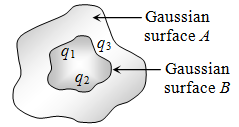
- ✓
$10^3 \mathrm{Nm}^2 \mathrm{C}^{-1}$
- B
$10^3 \mathrm{CN}^{-1} \mathrm{~m}^{-2}$
- C
$6.32 \times 10^3 \mathrm{Nm}^2 \mathrm{C}^{-1}$
- D
$6.32 \times 10^3 \mathrm{CN}^{-1} \mathrm{~m}^{-2}$
AnswerCorrect option: A. $10^3 \mathrm{Nm}^2 \mathrm{C}^{-1}$
(a) $10^3 \mathrm{Nm}^2 \mathrm{C}^{-1}$
View full question & answer→MCQ 3721 Mark
Two infinite plane parallel sheets separated by a distance d have equal and opposite uniform charge densities σ. Electric field at a point between the sheets is
AnswerCorrect option: B. $\frac{\sigma}{\varepsilon_0}$
(b) $\frac{\sigma}{\varepsilon_0}$
View full question & answer→MCQ 3731 Mark
An electric dipole is put in north-south direction in a sphere filled with water. Which statement is correct
- A
Electric flux is coming towards sphere
- B
Electric flux is coming out of sphere
- ✓
Electric flux entering into sphere and leaving the sphere are same
- D
Water does not permit electric flux to enter into sphere
AnswerCorrect option: C. Electric flux entering into sphere and leaving the sphere are same
Electric flux entering into sphere and leaving the sphere are same
View full question & answer→MCQ 3741 Mark
Gauss’s law is true only if force due to a charge varies as
- A
$\mathrm{r}^{-1}$
- ✓
$\mathrm{r}^{-2}$
- C
$\mathrm{r}^{-3}$
- D
$\mathrm{r}^{-4}$
AnswerCorrect option: B. $\mathrm{r}^{-2}$
(b) $\mathrm{r}^{-2}$
View full question & answer→MCQ 3751 Mark
Consider the charge configuration and spherical Gaussian surface as shown in the figure. When calculating the flux of the electric field over the spherical surface the electric field will be due to
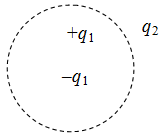
- A
$q_2$
- B
Only the positive charges
- ✓
- D
$+q_1$ and $-q_1$
View full question & answer→MCQ 3761 Mark
Shown below is a distribution of charges. The flux of electric field due to these charges through the surface S is
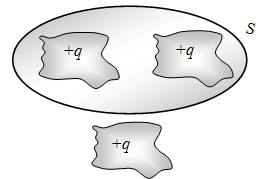
- A
$3q/\varepsilon_0$
- ✓
$2q/\varepsilon_0$
- C
$q/\varepsilon_0$
- D
AnswerCorrect option: B. $2q/\varepsilon_0$
(b) $2q/\varepsilon_0$
View full question & answer→MCQ 3771 Mark
A charge q is located at the centre of a cube. The electric flux through any face is
- ✓
$\frac{4 \pi q}{6\left(4 \pi \varepsilon_0\right)}$
- B
$\frac{\pi q}{6\left(4 \pi \varepsilon_0\right)}$
- C
$\frac{q}{6\left(4 \pi \varepsilon_0\right)}$
- D
$\frac{2 \pi q}{6\left(4 \pi \varepsilon_0\right)}$
AnswerCorrect option: A. $\frac{4 \pi q}{6\left(4 \pi \varepsilon_0\right)}$
(a) $\frac{4 \pi q}{6\left(4 \pi \varepsilon_0\right)}$
View full question & answer→MCQ 3781 Mark
If the electric flux entering and leaving an enclosed surface respectively is $\phi_1$ and $\phi_2$ the electric charge inside the surface will be
- A
($\phi_1$ + $\phi_2)\varepsilon_0 $
- ✓
$(\phi_2- \phi_1)\varepsilon_0 $
- C
$(\phi_1 + \phi_2)/\varepsilon_0 $
- D
$ (\phi_2- \phi_1 )/ \varepsilon_0 $
AnswerCorrect option: B. $(\phi_2- \phi_1)\varepsilon_0 $
(b) $(\phi_2- \phi_1)\varepsilon_0 $
View full question & answer→MCQ 3791 Mark
An electric dipole of moment $\vec{p}$ placed in a uniform electric field $\vec{E}$ has minimum potential energy when the angle between $\vec{p}$ and $\vec{E}$ is
- ✓
- B
$\frac{\pi}{2}$
- C
$\pi$
- D
$\frac{3\pi}{2}$
View full question & answer→MCQ 3801 Mark
The inward and outward electric flux for a closed surface in units of $N-m^2/C$ are respectively $8\times10^3$ and $4\times10^3$ Then the total charge inside the surface is [where $\varepsilon_0$ = permittivity constant]
AnswerCorrect option: D. $-4\times10^3\varepsilon_0C$
(d) $-4\times10^3\varepsilon_0C$
View full question & answer→MCQ 3811 Mark
A molecule with a dipole moment p is placed in an electric field of strength E. Initially the dipole is aligned parallel to the field. If the dipole is to be rotated to be anti-parallel to the field, the work required to be done by an external agency is
MCQ 3821 Mark
Gauss’s law should be invalid if
- A
There were magnetic monopoles
- ✓
The inverse square law were not exactly true
- C
The velocity of light were not a universal constant
- D
AnswerCorrect option: B. The inverse square law were not exactly true
The inverse square law were not exactly true
View full question & answer→MCQ 3831 Mark
$q1,q2,q3$ and $q4$ are point charges located at points as shown in the figure and S is a spherical Gaussian surface of radius R. Which of the following is true according to the Gauss’s law
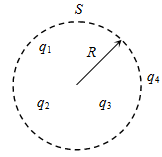
- A
$\oint_s(\overrightarrow{E_1}+\overrightarrow{E_2}+\overrightarrow{E_3}) \cdot d \vec{A}=\frac{q_1+q_2+q_3}{2 z_0}$
- ✓
$\oint_s(\overrightarrow{E_1}+\overrightarrow{E_2}+\overrightarrow{E_3}) \cdot d \vec{A}=\frac{q_1+q_2+q_8}{\varepsilon_0}$
- C
$\oint_s(\overrightarrow{E_1}+\overrightarrow{E_2}+\overrightarrow{E_3}) \cdot d \vec{A}=\frac{\left(q_1+q_2+q_s+q_4\right)}{\varepsilon_0}$
- D
AnswerCorrect option: B. $\oint_s(\overrightarrow{E_1}+\overrightarrow{E_2}+\overrightarrow{E_3}) \cdot d \vec{A}=\frac{q_1+q_2+q_8}{\varepsilon_0}$
$\oint_s(\overrightarrow{E_1}+\overrightarrow{E_2}+\overrightarrow{E_3}) \cdot d \vec{A}=\frac{q_1+q_2+q_8}{\varepsilon_0}$
View full question & answer→MCQ 3841 Mark
The S.I. unit of electric flux is
MCQ 3851 Mark
Electric charge is uniformly distributed along a long straight wire of radius 1mm. The charge per cm length of the wire is Q coulomb. Another cylindrical surface of radius 50 cm and length 1m symmetrically encloses the wire as shown in the figure. The total electric flux passing through the cylindrical surface is
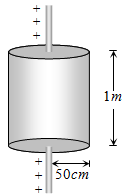
- A
$\frac{Q}{\varepsilon_0}$
- ✓
$\frac{100 Q}{\varepsilon_0}$
- C
$\frac{10Q}{(\pi\varepsilon_0)}$
- D
$\frac{100Q}{(\pi\varepsilon_0)}$
AnswerCorrect option: B. $\frac{100 Q}{\varepsilon_0}$
(b) $\frac{100 Q}{\varepsilon_0}$
View full question & answer→MCQ 3861 Mark
According to Gauss’ Theorem, electric field of an infinitely long straight wire is proportional to
- A
$r$
- B
$\frac{1}{r^2}$
- C
$\frac{1}{r^3}$
- ✓
$\frac{1}{r}$
AnswerCorrect option: D. $\frac{1}{r}$
(d) $\frac{1}{r}$
View full question & answer→MCQ 3871 Mark
It is not convenient to use a spherical Gaussian surface to find the electric field due to an electric dipole using Gauss’s theorem because
- A
Gauss’s law fails in this case
- ✓
This problem does not have spherical symmetry
- C
Coulomb’s law is more fundamental than Gauss’s law
- D
Spherical Gaussian surface will alter the dipole moment
AnswerCorrect option: B. This problem does not have spherical symmetry
This problem does not have spherical symmetry
View full question & answer→MCQ 3881 Mark
A charge q is placed at the centre of the open end of cylindrical vessel. The flux of the electric field through the surface of the vessel is
- A
- B
$\frac{q}{\varepsilon_0}$
- ✓
$\frac{q}{2 \varepsilon_0}$
- D
$\frac{2 q}{\varepsilon_0}$
AnswerCorrect option: C. $\frac{q}{2 \varepsilon_0}$
(c) $\frac{q}{2 \varepsilon_0}$
View full question & answer→MCQ 3891 Mark
A point charge +q is placed at the centre of a cube of side L. The electric flux emerging from the cube is
- ✓
$\frac{q}{\varepsilon_0}$
- B
- C
$\frac{6 \mathrm{qL}^2}{\varepsilon_0}$
- D
$\frac{q}{6 \mathrm{~L}^2\varepsilon _0}$
AnswerCorrect option: A. $\frac{q}{\varepsilon_0}$
(a) $\frac{q}{\varepsilon_0}$
View full question & answer→MCQ 3901 Mark
Eight dipoles of charges of magnitude e are placed inside a cube. The total electric flux coming out of the cube will be
- A
$\frac{8 e}{\varepsilon_0}$
- B
$\frac{16 e}{\varepsilon_0}$
- C
$\frac{e}{\varepsilon_0}$
- ✓
View full question & answer→MCQ 3911 Mark
A cube of side l is placed in a uniform field E, where E = E$\hat{l}$. The net electric flux through the cube is
View full question & answer→MCQ 3921 Mark
Electric field at a point varies as $r^0$ for
- A
- B
- ✓
A plane infinite sheet of charge
- D
A line charge of infinite length
AnswerCorrect option: C. A plane infinite sheet of charge
(c) A plane infinite sheet of charge
View full question & answer→MCQ 3931 Mark
An electric charge q is placed at the centre of a cube of side α. The electric flux on one of its faces will be
- ✓
$\frac{q}{6 \varepsilon_0}$
- B
$\frac{q}{\varepsilon_0 a^2}$
- C
$\frac{q}{4 \pi \varepsilon_0 a^2}$
- D
$\frac{q}{\varepsilon_0}$
AnswerCorrect option: A. $\frac{q}{6 \varepsilon_0}$
(a) $\frac{q}{6 \varepsilon_0}$
View full question & answer→MCQ 3941 Mark
Total electric flux coming out of a unit positive charge put in air is
- A
$\varepsilon_0$
- ✓
$\varepsilon_0^{-1}$
- C
$(4p\varepsilon_0)^{-1}$
- D
$4π\varepsilon_0$
AnswerCorrect option: B. $\varepsilon_0^{-1}$
(b) $\varepsilon_0^{-1}$
View full question & answer→MCQ 3951 Mark
For a given surface the Gauss's law is stated as $\oint \mathrm{E} . \mathrm{ds}=0.$ From this we can conclude that
- A
E is necessarily zero on the surface
- B
E is perpendicular to the surface at every point
- ✓
The total flux through the surface is zero
- D
The flux is only going out of the surface
AnswerCorrect option: C. The total flux through the surface is zero
(c) The total flux through the surface is zero
View full question & answer→MCQ 3961 Mark
The electric field due to an electric dipole at a distance r from its centre in axial position is E. If the dipole is rotated through an angle of 90° about its perpendicular axis, the electric field at the same point will be
MCQ 3971 Mark
What is the angle between the electric dipole moment and the electric field strength due to it on the equatorial line
- A
$0^\circ$
- B
$90^{\circ}$
- ✓
$180^{\circ}$
- D
AnswerCorrect option: C. $180^{\circ}$
$180^{\circ}$
View full question & answer→MCQ 3981 Mark
Two charges $+3.2 \times10^{-19}C$ and$ -3.2 \times10^{-19}C$ kept 2.4 Å apart forms a dipole. If it is kept in uniform electric field of intensity $4 \times10^5\ volt/m$ then what will be its electrical energy in equilibrium
- A
$+ 3 \times10^{-23}J $
- ✓
$-3 \times10^{-23}J$
- C
$-6 \times10^{-23}J$
- D
$-2 \times10^{-23}J$
AnswerCorrect option: B. $-3 \times10^{-23}J$
(b) $-3 \times10^{-23}J$
View full question & answer→MCQ 3991 Mark
When an electric dipole $\overrightarrow{\mathrm{p}}$ is placed in a uniform electric field $\overrightarrow{\mathrm{E}}$ then at what angle between $\overrightarrow{\mathrm{p}}$ and $\overrightarrow{\mathrm{E}}$ the value of torque will be maximum
View full question & answer→MCQ 4001 Mark
Two electric dipoles of moment P and 64 P are placed in opposite direction on a line at a distance of 25 cm. The electric field will be zero at point between the dipoles whose distance from the dipole of moment P is
- ✓
- B
$\frac{25}{9}$ cm
- C
- D
$\frac{4}{13}$ cm
View full question & answer→MCQ 4011 Mark
A region surrounding a stationary electric dipoles has
- A
- ✓
- C
Both electric and magnetic fields
- D
No electric and magnetic fields
View full question & answer→MCQ 4021 Mark
An electric dipole is kept in non-uniform electric field. It experiences
- ✓
- B
- C
- D
Neither a force nor a torque
View full question & answer→MCQ 4031 Mark
An electric dipole consisting of two opposite charges of $2 \times 10^{-6} \mathrm{C}$ each separated by a distance of 3 cm is placed in an electric field of $2 \times 10^5$ N/C. The maximum torque on the dipole will be
- A
$12 \times 10^{-1} \mathrm{~N} \mathrm{~m}$
- ✓
${ }^{12} \times 10^{-3} \mathrm{~N} \mathrm{~m}$
- C
$24 \times 10^{-1} \mathrm{~N} \mathrm{~m}$
- D
$24 \times 10^{-3} \mathrm{~N} \mathrm{~m}$
AnswerCorrect option: B. ${ }^{12} \times 10^{-3} \mathrm{~N} \mathrm{~m}$
(b) ${ }^{12} \times 10^{-3} \mathrm{~N} \mathrm{~m}$
View full question & answer→MCQ 4041 Mark
The distance between the two charges +q and -q of a dipole is r. On the axial line at a distance d from the centre of dipole, the intensity is proportional to
- A
$\frac{q}{d^2}$
- B
$\frac{qr}{d^2}$
- C
$\frac{q}{d^3}$
- ✓
$\frac{qr}{d^3}$
AnswerCorrect option: D. $\frac{qr}{d^3}$
(d) $\frac{qr}{d^3}$
View full question & answer→MCQ 4051 Mark
The ratio of electric fields on the axis and at equator of an electric dipole will be
MCQ 4061 Mark
Intensity of an electric field E due to a dipole, depends on distance r as
- A
$E ∝\frac{1}{r^4}$
- ✓
$E ∝ \frac{1}{r^3}$
- C
$ E ∝ \frac{1}{r^2}$
- D
$ E ∝\frac{1}{r}$
AnswerCorrect option: B. $E ∝ \frac{1}{r^3}$
(b) $E ∝ \frac{1}{r^3}$
View full question & answer→MCQ 4071 Mark
An electric dipole has the magnitude of its charge as q and its dipole moment is p. It is placed in a uniform electric field E. If its dipole moment is along the direction of the field, the force on it and its potential energy are respectively
MCQ 4081 Mark
The potential at a point due to an electric dipole will be maximum and minimum when the angles between the axis of the dipole and the line joining the point to the dipole are respectively
MCQ 4091 Mark
The distance between $\mathrm{H}^{+}$ and $\mathrm{Cl}^{-}$ ions in HCl molecule is 1.28 Å. What will be the potential due to this dipole at a distance of 12 Å on the axis of dipole(a) (b) (c) (d)
View full question & answer→MCQ 4101 Mark
Electric potential at an equatorial point of a small dipole with dipole moment P (r, distance from the dipole) is
- ✓
- B
$\frac{p}{4 \pi \varepsilon_0 r^2}$
- C
$\frac{p}{4 \pi \varepsilon_0 r^3}$
- D
$\frac{2 p}{4 \pi \varepsilon_0 r^3}$
View full question & answer→MCQ 4111 Mark
The electric intensity due to a dipole of length 10 cm and having a charge of 500μC, at a point on the axis at a distance 20 cm from one of the charges in air, is
- ✓
$6.25 \times 10^7$ N/C
- B
$ 9.28 \times 10^7$ N/C
- C
$ 9.28 \times 10^7$ N/C
- D
$20.5 \times 10^7$ N/C
AnswerCorrect option: A. $6.25 \times 10^7$ N/C
(a) $6.25 \times 10^7$ N/C
View full question & answer→MCQ 4121 Mark
An electric dipole in a uniform electric field experiences (When it is placed at an angle θ with the field)
MCQ 4131 Mark
A point Q lies on the perpendicular bisector of an electrical dipole of dipole moment p. If the distance of Q from the dipole is r (much larger than the size of the dipole), then electric field at Q is proportional to
- A
$p^{-1}$ and $r^{-2}$
- B
p and $r^{-2}$
- C
$p^2$ and $r^{-3}$
- ✓
p and $r^{-3}$
AnswerCorrect option: D. p and $r^{-3}$
(d)p and $r^{-3}$
View full question & answer→MCQ 4141 Mark
An electric dipole is placed in an electric field generated by a point charge
- A
The net electric force on the dipole must be zero
- B
The net electric force on the dipole may be zero
- C
The torque on the dipole due to the field must be zero
- ✓
The torque on the dipole due to the field may be zero
AnswerCorrect option: D. The torque on the dipole due to the field may be zero
The torque on the dipole due to the field may be zero
View full question & answer→MCQ 4151 Mark
If $E_a$ be the electric field strength of a short dipole at a point on its axial line and $E_e$ that on the equatorial line at the same distance, then
- A
$E_e=2E_a$
- ✓
$E_a=2E_e$
- C
$E_a=E_e$
- D
AnswerCorrect option: B. $E_a=2E_e$
(b) $E_a=2E_e$
View full question & answer→MCQ 4161 Mark
Two opposite and equal charges $4 ×10^{-8}$ coulomb when placed $2\times 10^{-2}$ cm away, form a dipole. If this dipole is placed in an external electric field $4 ×10^{8}$ newton/coulomb, the value of maximum torque and the work done in rotating it through 180° will be
- A
$64 \times 10^{-4}Nm$ and $64 \times 10^{-4}J$
- B
$32 \times 10^{-4}Nm $ and $32 \times 10^{-4}J$
- C
$ 64 \times 10^{-4}Nm$ and $32 \times 10^{-4}J$
- ✓
$32 \times 10^{-4}Nm $ and $ 64 \times 10^{-4}J$
AnswerCorrect option: D. $32 \times 10^{-4}Nm $ and $ 64 \times 10^{-4}J$
(d) $32 \times 10^{-4}Nm$ and $ 64 \times 10^{-4}J$
View full question & answer→MCQ 4171 Mark
The electric field at a point on equatorial line of a dipole and direction of the dipole moment
- A
- ✓
Will be in opposite direction
- C
- D
AnswerCorrect option: B. Will be in opposite direction
Will be in opposite direction
View full question & answer→MCQ 4181 Mark
The torque acting on a dipole of moment $\vec P$ in an electric field $\vec E$ is
- A
$ \vec P.\vec E $
- ✓
$ \vec P\times\vec E $
- C
- D
$ \vec E\times\vec P$
AnswerCorrect option: B. $ \vec P\times\vec E $
(b) $ \vec P\times\vec E $
View full question & answer→MCQ 4191 Mark
Electric charges q, q, -2q are placed at the corners of an equilateral triangle ABC of side l. The magnitude of electric dipole moment of the system is
- A
- B
- ✓
$\sqrt{3} \mathrm{ql}$
- D
AnswerCorrect option: C. $\sqrt{3} \mathrm{ql}$
(c) $\sqrt{3} \mathrm{ql}$
View full question & answer→MCQ 4201 Mark
An electric dipole is placed along the x - axis at the origin O. A point P is at a distance of 20 cm from this origin such that OP makes an angle $\frac{\pi}{3}$ with the x-axis. If the electric field at P makes an angle θ with the x-axis, the value of θ would be
AnswerCorrect option: B. $\frac{\pi}{3}+\tan ^{-1}\left(\frac{\sqrt{3}}{2}\right)$
(b) $\frac{\pi}{3}+\tan ^{-1}\left(\frac{\sqrt{3}}{2}\right)$
View full question & answer→MCQ 4211 Mark
An electric dipole of moment p is placed at the origin along the x-axis. The electric field at a point P, whose position vector makes an angle θ with the x -axis, will make an angle ..... with the x -axis, where tanα = $\frac{1}{2} \tan \theta$
View full question & answer→MCQ 4221 Mark
A given charge is situated at a certain distance from an electric dipole in the end-on position experiences a force F. If the distance of the charge is doubled, the force acting on the charge will be
MCQ 4231 Mark
The electric potential at a point on the axis of an electric dipole depends on the distance r of the point from the dipole as
- A
$\alpha_{\frac{1}{r}}$
- ✓
$\alpha_{\frac{1}{r^2}}$
- C
$\alpha$ $r$
- D
$\alpha_{\frac{1}{r^3}}$
AnswerCorrect option: B. $\alpha_{\frac{1}{r^2}}$
(b) $\alpha_{\frac{1}{r^2}}$
View full question & answer→MCQ 4241 Mark
An electric dipole of moment p is placed in the position of stable equilibrium in uniform electric field of intensity E. It is rotated through an angle θ from the initial position. The potential energy of electric dipole in the final position is
MCQ 4251 Mark
A bullet of mass 2 gm is having a charge of 2μC. Through what potential difference must it be accelerated, starting from rest, to acquire a speed of 10 m/s
MCQ 4261 Mark
An electron and a proton are at a distance of 1$A^0$. The moment of this dipole will be (C X m)
- A
$1.6 \times10^{19}$
- ✓
$1.6 \times10^{-29}$
- C
$3.2 \times10^{19}$
- D
$3.2 \times10^{29}$
AnswerCorrect option: B. $1.6 \times10^{-29}$
(b) $1.6 \times10^{-29}$
View full question & answer→MCQ 4271 Mark
The electric field due to a dipole at a distance r on its axis is
- A
Directly proportional to $r^3$
- ✓
Inversely proportional to $r^3$
- C
Directly proportional to $r^2$
- D
Inversely proportional to $r^2$
AnswerCorrect option: B. Inversely proportional to $r^3$
(b) Inversely proportional to $r^3$
View full question & answer→MCQ 4281 Mark
A hollow metallic sphere of radius R is given a charge Q. Then the potential at the centre is
- A
- ✓
$\frac{1}{4 \pi \varepsilon_0} \frac{\mathrm{Q}}{\mathrm{R}}$
- C
$\frac{1}{4 \pi \varepsilon_0} \cdot \frac{2 Q}{R}$
- D
$\frac{1}{4 \pi \varepsilon_0} \frac{Q}{2 R}$
AnswerCorrect option: B. $\frac{1}{4 \pi \varepsilon_0} \frac{\mathrm{Q}}{\mathrm{R}}$
(b)$\frac{1}{4 \pi \varepsilon_0} \frac{\mathrm{Q}}{\mathrm{R}}$
View full question & answer→MCQ 4291 Mark
If an electron moves from rest from a point at which potential is $50$ volt to another point at which potential is $70$ volt, then its kinetic energy in the final state will be
AnswerCorrect option: B. $3.2 \times 10^{-18} \mathrm{~J}$
$3.2 \times 10^{-18} \mathrm{~J}$
View full question & answer→MCQ 4301 Mark
Charges 4Q, q and Q and placed along x-axis at positions x = 0, x = l/2 and x = l, respectively. Find the value of q so that force on charge Q is zero
MCQ 4311 Mark
At a point 20 cm from the centre of a uniformly charged dielectric sphere of radius 10 cm, the electric field is 100 V/m. The electric field at 3 cm from the centre of the sphere will be
MCQ 4321 Mark
Two infinitely long parallel conducting plates having surface charge densities +σ and -σ respectively, are separated by a small distance. The medium between the plates is vacuum. If $\varepsilon_0$ is the dielectric permittivity of vacuum, then the electric field in the region between the plates is
- A
- B
$\frac{\sigma}{2 \varepsilon_0}$ volts/meter
- ✓
$\frac{\sigma}{\varepsilon_0}$ volts/meter
- D
$\frac{2\sigma}{ \varepsilon_0}$ volts/meter
AnswerCorrect option: C. $\frac{\sigma}{\varepsilon_0}$ volts/meter
(c) $\frac{\sigma}{\varepsilon_0}$ volts/meter
View full question & answer→MCQ 4331 Mark
Three infinitely long charge sheets are placed as shown in figure. The electric field at point P is
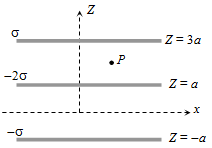
- A
$\frac{2 \sigma}{\varepsilon_0} \widehat{\mathrm{k}}$
- ✓
$-\frac{2 \sigma}{\varepsilon_0} \hat{\mathrm{k}}$
- C
$\frac{4 \sigma}{\varepsilon_0} \hat{\mathrm{k}}$
- D
$-\frac{4 \sigma}{\varepsilon_0} \hat{\mathrm{k}}$
AnswerCorrect option: B. $-\frac{2 \sigma}{\varepsilon_0} \hat{\mathrm{k}}$
(b) $-\frac{2 \sigma}{\varepsilon_0} \hat{\mathrm{k}}$
View full question & answer→MCQ 4341 Mark
Two thin wire rings each having a radius R are placed at a distance d apart with their axes coinciding. The charges on the two rings are +q and -q. The potential difference between the centres of the two rings is
- A
- B
$\frac{Q}{4 \pi \varepsilon_0}\left[\frac{1}{R}-\frac{1}{\sqrt{R^2+d^2}}\right]$
- C
$\frac{Q R}{4 \pi \varepsilon_0 d^2}$
- ✓
$\frac{Q}{2 \pi \varepsilon_0}\left[\frac{1}{R}-\frac{1}{\sqrt{R^2+d^2}}\right]$
AnswerCorrect option: D. $\frac{Q}{2 \pi \varepsilon_0}\left[\frac{1}{R}-\frac{1}{\sqrt{R^2+d^2}}\right]$
(d) $\frac{Q}{2 \pi \varepsilon_0}\left[\frac{1}{R}-\frac{1}{\sqrt{R^2+d^2}}\right]$
View full question & answer→MCQ 4351 Mark
Two point charges +8q and -2q are located at x = 0 and x = L respectively. The location of a point on the x-axis at which the net electric field due to these two point charges is zero is
MCQ 4361 Mark
A charged ball B hangs from a silk thread S, which makes an angle θ with a large charged conducting sheet P, as shown in the figure. The surface charge density σ of the sheet is proportional to
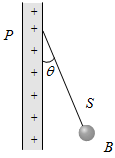
MCQ 4371 Mark
To charges $q_1$ and $q_2$ are placed 30 cm apart, shown in the figure. A third charge $q_3$ is moved along the arc of a circle of radius 40 cm from C to D. The change in the potential energy of the system is $\frac{\mathrm{q}_{\mathrm{g}}}{4 \pi \varepsilon_0} \mathrm{k}$, where k is
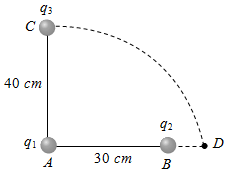
- ✓
$8q_2$
- B
$8q_1$
- C
$6q_2$
- D
$6q_1$
AnswerCorrect option: A. $8q_2$
(a) $8q_2$
View full question & answer→MCQ 4381 Mark
As per this diagram a point charge +q is placed at the origin O. Work done in taking another point charge -Q from the point A [co-ordinates (0, a) ] to another point B [co-ordinates (a, 0)] along the straight path AB is
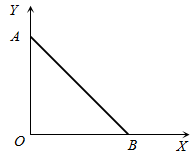
- ✓
- B
$\left(\frac{-q Q}{4 \pi \varepsilon_0} \frac{1}{a^2}\right) \sqrt{2} \mathrm{a}$
- C
$\left(\frac{q Q}{4 \pi \varepsilon_0} \frac{1}{a^2}\right) \frac{a}{\sqrt{2}}$
- D
$\left(\frac{q Q}{4 \pi \varepsilon_0} \frac{1}{a^2}\right) \sqrt{2} \mathrm{a}$
View full question & answer→MCQ 4391 Mark
The dielectric strength of air at NTP is $3\times 10^6 V/m$ then the maximum charge that can be given to a spherical conductor of radius 3 m is
- A
$3\times 10^{-4}C$
- ✓
$3\times 10^{-3}C$
- C
$3\times 10^{-2}C$
- D
$3\times 10^{-1}C$
AnswerCorrect option: B. $3\times 10^{-3}C$
(b) $3\times 10^{-3}C$
View full question & answer→MCQ 4401 Mark
An electron experiences a force equal to its weight when placed in an electric field. The intensity of the field will be
- A
$1.7 \times10^{-11}N/C$
- B
$5.0 \times10^{-11}N/C$
- ✓
$5.5 \times10^{-11}N/C$
- D
AnswerCorrect option: C. $5.5 \times10^{-11}N/C$
(c) $5.5 \times10^{-11}N/C$
View full question & answer→MCQ 4411 Mark
A pendulum bob of mass $30.7\times 10{-6}$ kg and carrying a charge $2\times 10{-8}$ C is at rest in a horizontal uniform electric field of 20000 V/m. The tension in the thread of the pendulum is (g = 9.8 $m/s^2$)
- A
$3\times10^{-4}N$
- B
$4\times10^{-4}N$
- ✓
$5\times10^{-4}N$
- D
$6\times10^{-4}N$
AnswerCorrect option: C. $5\times10^{-4}N$
(c) $5\times10^{-4}N$
View full question & answer→MCQ 4421 Mark
A square of side ‘a’ has charge Q at its centre and charge ‘q’ at one of the corners. The work required to be done in moving the charge ‘q’ from the corner to the diagonally opposite corner is
- ✓
- B
$\frac{\mathrm{Qq}}{4 \pi \epsilon_0 a}$
- C
$\frac{\mathrm{Qq} \sqrt{2}}{4 \pi \epsilon_0 \mathrm{a}}$
- D
$\frac{\mathrm{Qq}}{2 \pi \epsilon_0 a}$
View full question & answer→MCQ 4431 Mark
Infinite charges of magnitude $q$ each are lying at $x =1, 2, 4, 8...$ meter on $X-$axis. The value of intensity of electric field at point $x = 0$ due to these charges will be
- ✓
$12 \times 10^9 \mathrm{q} \mathrm{N} / \mathrm{C}$
- B
- C
$6 \times 10^9 \mathrm{q} \mathrm{N} / \mathrm{C}$
- D
$ 4 \times 10^9 \mathrm{q} / \mathrm{N} / \mathrm{C}$
AnswerCorrect option: A. $12 \times 10^9 \mathrm{q} \mathrm{N} / \mathrm{C}$
$12 \times 10^9 \mathrm{q} \mathrm{N} / \mathrm{C}$
View full question & answer→MCQ 4441 Mark
In a certain charge distribution, all points having zero potential can be joined by a circle S. Points inside S have positive potential and points outside S have negative potential. A positive charge, which is free to move, is placed inside S
- A
It will remain in equilibrium
- B
It can move inside S, but it cannot cross S
- ✓
It must cross S at some time
- D
It may move, but will ultimately return to its starting point
AnswerCorrect option: C. It must cross S at some time
It must cross S at some time
View full question & answer→MCQ 4451 Mark
Figure shows three points A, B and C in a region of uniform electric field $\vec E$. The line AB is perpendicular and BC is parallel to the field lines. Then which of the following holds good. Where $V_A,V_B$ and $V_C$ represent the electric potential at points A, B and C respectively
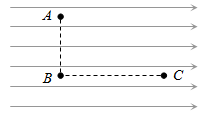
- A
$V_A=V_B=V_C$
- ✓
$V_A=V_B>V_C$
- C
$V_A=V_B<V_C$
- D
$V_A>V_B=V_C$
AnswerCorrect option: B. $V_A=V_B>V_C$
(b) $V_A=V_B>V_C$
View full question & answer→MCQ 4461 Mark
The points resembling equal potentials are
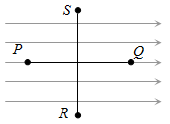
MCQ 4471 Mark
A table tennis ball which has been covered with conducting paint is suspended by a silk thread so that it hang between two plates, out of which one is earthed and other is connected to a high voltage generator. This ball
- A
Is attracted towards high voltage plate and stays there
- B
- ✓
Swing backward and forward hitting each plate in turn
- D
Is attracted to earthed plate and stays there
AnswerCorrect option: C. Swing backward and forward hitting each plate in turn
Swing backward and forward hitting each plate in turn
View full question & answer→MCQ 4481 Mark
Equipotential surfaces associated with an electric field which is increasing in magnitude along the x-direction are
- ✓
Planes parallel to yz-plane
- B
Planes parallel to xy-plane
- C
Planes parallel to xz-plane
- D
Coaxial cylinders of increasing radii around the x-axis
AnswerCorrect option: A. Planes parallel to yz-plane
Planes parallel to yz-plane
View full question & answer→MCQ 4491 Mark
Point charge $\mathrm{q}_1=2 \mu \mathrm{C}$ and $\mathrm{q}_2=-1 \mu \mathrm{C}$ are kept at points x = 0 and x = 6 respectively. Electrical potential will be zero at points
View full question & answer→MCQ 4501 Mark
Charges q, 2q, 3q and 4q are placed at the corners A, B, C and D of a square as shown in the following figure. The direction of electric field at the centre of the square is along
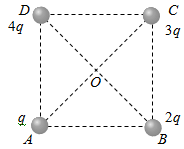
MCQ 4511 Mark
In the following diagram the work done in moving a point charge from point P to point A, B and C is respectively as $W_A$, $W_B$ and $W_C$ , then
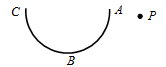
- A
$W_A$ = $W_B$ = $W_C$
- ✓
$W_A$ = $W_B$ = $W_C$ = 0
- C
$W_A$ > $W_B$ > $W_C$
- D
$W_A$ < $W_B$ < $W_C$
AnswerCorrect option: B. $W_A$ = $W_B$ = $W_C$ = 0
(b) $W_A$ = $W_B$ = $W_C$ = 0
View full question & answer→MCQ 4521 Mark
Four charges +Q, -Q, +Q, -Q are placed at the corners of a square taken in order. At the centre of the square
MCQ 4531 Mark
The potential at a distance R/2 from the centre of a conducting sphere of radius R will be
- A
- B
$\frac{Q}{8 \pi \varepsilon_0 R}$
- ✓
$\frac{Q}{4 \pi \varepsilon_0 R}$
- D
$\frac{Q}{2 \pi \varepsilon_0 R}$
AnswerCorrect option: C. $\frac{Q}{4 \pi \varepsilon_0 R}$
(c) $\frac{Q}{4 \pi \varepsilon_0 R}$
View full question & answer→MCQ 4541 Mark
A charged particle is suspended in equilibrium in a uniform vertical electric field of intensity 20000 V/m. If mass of the particle is $9.6 \times10^{-16} $kg ,the charge on it and excess number of electrons on the particle are respectively ($g=10m/s^2$)
- ✓
$4.8\times10^{-19}C,3$
- B
$5.8 \times10^{-19}C,4$
- C
$3.8 \times10^{-19}C,2$
- D
$2.8 \times10^{-19}C,1$
AnswerCorrect option: A. $4.8\times10^{-19}C,3$
(a) $4.8\times10^{-19}C,3$
View full question & answer→MCQ 4551 Mark
A charge produces an electric field of 1 N/C at a point distant 0.1 m from it. The magnitude of charge is
- ✓
$1.11 \times 10^{-12} \mathrm{C}$
- B
$9.11 \times 10^{-12} \mathrm{C}$
- C
$7.11 \times 10^{-6} \mathrm{C}$
- D
AnswerCorrect option: A. $1.11 \times 10^{-12} \mathrm{C}$
(a) $1.11 \times 10^{-12} \mathrm{C}$
View full question & answer→MCQ 4561 Mark
The wrong statement about electric lines of force is
- A
These originate from positive charge and end on negative charge
- B
They do not intersect each other at a point
- C
They have the same form for a point charge and a sphere
- ✓
They have physical existence
AnswerCorrect option: D. They have physical existence
They have physical existence
View full question & answer→MCQ 4571 Mark
The electric potential inside a conducting sphere
- A
Increases from centre to surface
- B
Decreases from centre to surface
- ✓
Remains constant from centre to surface
- D
Is zero at every point inside
AnswerCorrect option: C. Remains constant from centre to surface
Remains constant from centre to surface
View full question & answer→MCQ 4581 Mark
Two plates are at potentials –10 V and +30 V. If the separation between the plates be 2 cm. The electric field between them is
MCQ 4591 Mark
If an insulated non-conducting sphere of radius R has charge density ρ. The electric field at a distance r from the centre of sphere (r < R) will be
- A
$\frac{\rho \mathrm{R}}{3 \varepsilon_0}$
- B
$\frac{\rho r}{\varepsilon_0}$
- ✓
$\frac{\rho r}{3\varepsilon_0}$
- D
$\frac{3\rho \mathrm{R}}{\varepsilon_0}$
AnswerCorrect option: C. $\frac{\rho r}{3\varepsilon_0}$
(c) $\frac{\rho r}{3\varepsilon_0}$
View full question & answer→MCQ 4601 Mark
Three point charges are placed at the corners of an equilateral triangle. Assuming only electrostatic forces are acting
- ✓
The system can never be in equilibrium
- B
The system will be in equilibrium if the charges rotate about the centre of the triangle
- C
The system will be in equilibrium if the charges have different magnitudes and different signs
- D
The system will be in equilibrium if the charges have the same magnitudes but different signs
AnswerCorrect option: A. The system can never be in equilibrium
The system can never be in equilibrium
View full question & answer→MCQ 4611 Mark
Two parallel plates separated by a distance of 5mm are kept at a potential difference of 50 V. A particle of mass $10^{-15}$ kg and charge $10^{-11}$ C Centers in it with a velocity $10^{7}$ m/s. The acceleration of the particle will be
- ✓
$10^{8} m/s^2$
- B
$ 5\times10^{5} m/s^2$
- C
$10^{5} m/s^2$
- D
$ 2\times10^{3} m/s^2$
AnswerCorrect option: A. $10^{8} m/s^2$
(a) $10^{8} m/s^2$
View full question & answer→MCQ 4621 Mark
There is 10 units of charge at the centre of a circle of radius 10m. The work done in moving 1 unit of charge around the circle once is
MCQ 4631 Mark
Electric potential of earth is taken to be zero because earth is a good
MCQ 4641 Mark
Value of potential at a point due to a point charge is
- A
Inversely proportional to square of the distance
- B
Directly proportional to square of the distance
- ✓
Inversely proportional to the distance
- D
Directly proportional to the distance
AnswerCorrect option: C. Inversely proportional to the distance
Inversely proportional to the distance
View full question & answer→MCQ 4651 Mark
The work done in carrying a charge of 5μC from a point A to a point B in an electric field is 10mJ. The potential difference $(V_B-V_A)$ is then
View full question & answer→MCQ 4661 Mark
A hollow metal sphere of radius 5cm is charged such that the potential on its surface is 10V. The potential at a distance of 2cm from the centre of the sphere
MCQ 4671 Mark
There are two equipotential surface as shown in figure. The distance between them is r. The charge of –q coulomb is taken from the surface A to B, the resultant work done will be
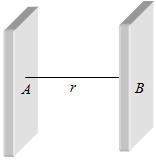
- A
$W=\frac{1}{4 \pi \varepsilon_0} \frac{q}{r}$
- B
$W=\frac{1}{4 \pi \varepsilon_0} \frac{q}{r^2}$
- C
$W=-\frac{1}{4 \pi \varepsilon_0} \frac{q}{r^2}$
- ✓
$W = Zero$
AnswerCorrect option: D. $W = Zero$
(d) $W = Zero$
View full question & answer→MCQ 4681 Mark
When a charge of 3 coulombs is placed in a uniform electric field, it experiences a force of 3000 Newton. Within this field, potential difference between two points separated by a distance of 1 cm is
MCQ 4691 Mark
When a negative charge is taken at a height from earth's surface, then its potential energy
MCQ 4701 Mark
When a positive q charge is taken from lower potential to a higher potential point, then its potential energy will
MCQ 4711 Mark
State which of the following is correct
MCQ 4721 Mark
A drop of $10^{-6} \mathrm{~kg}$ water carries $10^{-6} \mathrm{~C}$ charge. What electric field should be applied to balance its weight (assume $\mathrm{g}=10 \mathrm{~m} / \mathrm{s}^2$)
View full question & answer→MCQ 4731 Mark
Kinetic energy of an electron accelerated in a potential difference of 100 V is
- ✓
$1.6 \times 10^{-17}J$
- B
$1.6 \times 10^{21}J$
- C
$1.6 \times 10^{-29}J$
- D
$1.6 \times 10^{-34}J$
AnswerCorrect option: A. $1.6 \times 10^{-17}J$
(a) $1.6 \times 10^{-17}J$
View full question & answer→MCQ 4741 Mark
A charge of 10 e.s.u. is placed at a distance of 2 cm from a charge of 40 e.s.u. and 4 cm from another charge of 20 e.s.u. The potential energy of the charge 10 e.s.u. is (in ergs)
MCQ 4751 Mark
Work done in moving a positive charge on an equipotential surface is
- A
Finite, positive but not zero
- B
Finite, negative but not zero
- ✓
- D
View full question & answer→MCQ 4761 Mark
The charge given to a hollow sphere of radius 10 cm is $3.2 × 10^{-19}$ coulomb. At a distance of 4 cm from its centre, the electric potential will be
AnswerCorrect option: A. $28.8 \times 10^{-9}$ $\mathrm {volts}$
(a) $28.8 \times 10^{-9}$ $\mathrm {volts}$
View full question & answer→MCQ 4771 Mark
An electron (charge = $1.6 \times 10^{-19}$ coulomb) is accelerated through a potential of 1,00,000 volts. The energy required by the electron is
- A
$1.6 \times 10^{-24}$ joule
- B
$1.6 \times 10^{-14} \mathrm{erg}$
- C
$0.53 \times 10^{-14}$ joule
- ✓
$1.6 \times 10^{-14}$ joule
AnswerCorrect option: D. $1.6 \times 10^{-14}$ joule
(d) $1.6 \times 10^{-14}$ joule
View full question & answer→MCQ 4781 Mark
A particle has a mass 400 times than that of the electron and charge is double than that of a electron. It is accelerated by 5V of potential difference. Initially the particle was at rest, then its final kinetic energy will be
MCQ 4791 Mark
A pellet carrying charge of 0.5 coulombs is accelerated through a potential of 2,000 volts. It attains a kinetic energy equal to
MCQ 4801 Mark
The electric potential at the surface of an atomic nucleus (Z = 50) of radius $9.0 × 10^{-13}$ cm is
- A
- ✓
$ 8 \times10^{6}$ volts
- C
- D
$ 9 \times10^{5}$volts
AnswerCorrect option: B. $ 8 \times10^{6}$ volts
(b) $ 8 \times10^{6}$ volts
View full question & answer→MCQ 4811 Mark
An electron enters in high potential region $V_2$ from lower potential region $V_1$ then its velocity
- ✓
- B
Will change in direction but not in magnitude
- C
No change in direction of field
- D
No change in direction perpendicular to field
View full question & answer→MCQ 4821 Mark
An electron moving with the speed $5 \times 10^6$ per sec is shooted parallel to the electric field of intensity $1 \times 10^3 \mathrm{~N} / \mathrm{C}$. Field is responsible for the retardation of motion of electron. Now evaluate the distance travelled by the electron before coming to rest for an instant (mass of $e=9 \times 10^{-31} \mathrm{Kg}$. charge = $1.6 \times 10^{-19} \mathrm{C}$)
View full question & answer→MCQ 4831 Mark
A point charge is kept at the centre of a metallic insulated spherical shell. Then
- A
Electric field out side the sphere is zero
- B
Electric field inside the sphere is zero
- ✓
Net induced charge on the sphere is zero
- D
Electric potential inside the sphere is zero
AnswerCorrect option: C. Net induced charge on the sphere is zero
Net induced charge on the sphere is zero
View full question & answer→MCQ 4841 Mark
A hollow conducting sphere is placed in an electric field produced by a point charge placed at P as shown in figure. Let $\mathrm{V_A, V_B, V_C}$ be the potentials at points A, B and C respectively. Then
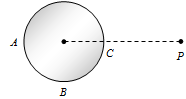
- A
$\mathrm{V}_{\mathrm{C}}>\mathrm{V}_{\mathrm{B}}$
- B
$\mathrm{V}_{\mathrm{B}}>\mathrm{V}_{\mathrm{C}}$
- C
$\mathrm{V}_{\mathrm{C}}>\mathrm{V}_{\mathrm{B}}$
- ✓
$\mathrm{V}_{\mathrm{A}}=\mathrm{V}_{\mathrm{C}}$
AnswerCorrect option: D. $\mathrm{V}_{\mathrm{A}}=\mathrm{V}_{\mathrm{C}}$
(d) $\mathrm{V}_{\mathrm{A}}=\mathrm{V}_{\mathrm{C}}$
View full question & answer→MCQ 4851 Mark
A thin spherical conducting shell of radius R has a charge q. Another charge Q is placed at the centre of the shell. The electrostatic potential at a point p a distance $\frac{R}{2}$ from the centre of the shell is
- A
$\frac{(q+Q)}{4 \pi \varepsilon_0} \frac{2}{R}$
- B
$\frac{2 Q}{4 \pi \varepsilon_0 R}$
- C
$\frac{2 Q}{4 \pi \varepsilon_0 R}-\frac{2 q}{4 \pi \varepsilon_0 R}$
- ✓
$\frac{2 Q}{4 \pi \varepsilon_0 R}+\frac{q}{4 \pi \varepsilon_0 R}$
AnswerCorrect option: D. $\frac{2 Q}{4 \pi \varepsilon_0 R}+\frac{q}{4 \pi \varepsilon_0 R}$
(d) $\frac{2 Q}{4 \pi \varepsilon_0 R}+\frac{q}{4 \pi \varepsilon_0 R}$
View full question & answer→MCQ 4861 Mark
A conducting sphere of radius R = 20 cm is given a charge Q = 16μC. What is $\overrightarrow{\mathrm{E}}$ at centre
- A
${3.6} \times 10^6 \mathrm{~N} / \mathrm{C}$
- B
${1.8} \times 10^6 \mathrm{~N} / \mathrm{C}$
- ✓
$\mathrm{Zero}$
- D
${0.9} \times 10^6 \mathrm{~N} / \mathrm{C}$
AnswerCorrect option: C. $\mathrm{Zero}$
(c) $\mathrm{Zero}$
View full question & answer→MCQ 4871 Mark
A proton is about 1840 times heavier than an electron. When it is accelerated by a potential difference of 1 kV, its kinetic energy will be
MCQ 4881 Mark
A simple pendulum of period T has a metal bob which is negatively charged. If it is allowed to oscillate above a positively charged metal plate, its period will
MCQ 4891 Mark
An α -particle is accelerated through a potential difference of 200V. The increase in its kinetic energy is
MCQ 4901 Mark
Cathode rays travelling from east to west enter into region of electric field directed towards north to south in the plane of paper. The deflection of cathode rays is towards.
MCQ 4911 Mark
An electron having charge ‘e’ and mass ‘m’ is moving in a uniform electric field E. Its acceleration will be
- A
$\frac{\mathrm{e}^2}{\mathrm{~m}}$
- B
$\frac{\mathrm{E}^2 \mathrm{e}}{\mathrm{m}}$
- ✓
$\frac{\mathrm{eE}}{\mathrm{m}}$
- D
$\frac{\mathrm{mE}}{\mathrm{e}}$
AnswerCorrect option: C. $\frac{\mathrm{eE}}{\mathrm{m}}$
(c) $\frac{\mathrm{eE}}{\mathrm{m}}$
View full question & answer→MCQ 4921 Mark
If identical charges (-q) are placed at each corner of a cube of side b, then electric potential energy of charge (+q) which is placed at centre of the cube will be
- A
$\frac{8 \sqrt{2} q^2}{4 \pi \varepsilon_0 b}$
- B
$\frac{-8 \sqrt{2} q^2}{\pi \varepsilon_0 b}$
- C
$\frac{-4 \sqrt{2} q^2}{\pi \varepsilon_0 b}$
- ✓
$\frac{-4 q^2}{\sqrt{3} \pi \varepsilon_0 b}$
AnswerCorrect option: D. $\frac{-4 q^2}{\sqrt{3} \pi \varepsilon_0 b}$
(d) $\frac{-4 q^2}{\sqrt{3} \pi \varepsilon_0 b}$
View full question & answer→MCQ 4931 Mark
The distance between charges $5 \times 10^{-11}C$ and $-2.7 \times 10^{-11}C$ is 0.2 m. The distance at which a third charge should be placed in order that it will not experience any force along the line joining the two charges is
View full question & answer→MCQ 4941 Mark
If 3 charges are placed at the vertices of equilateral triangle of charge ‘q’ each. What is the net potential energy, if the side of equilateral ∆ is l cm
- A
$\frac{1}{4 \pi \varepsilon_0} \frac{\mathrm{q}^2}{l}$
- B
$\frac{1}{4 \pi \varepsilon_0} \frac{\mathrm2{q}^2}{l}$
- ✓
$\frac{1}{4 \pi \varepsilon_0} \frac{\mathrm3{q}^2}{l}$
- D
$\frac{1}{4 \pi \varepsilon_0} \frac{\mathrm4{q}^2}{l}$
AnswerCorrect option: C. $\frac{1}{4 \pi \varepsilon_0} \frac{\mathrm3{q}^2}{l}$
(c) $\frac{1}{4 \pi \varepsilon_0} \frac{\mathrm3{q}^2}{l}$
View full question & answer→MCQ 4951 Mark
A sphere of 4 cm radius is suspended within a hollow sphere of 6 cm radius. The inner sphere is charged to potential 3 e.s.u. and the outer sphere is earthed. The charge on the inner sphere is
MCQ 4961 Mark
A charged particle of mass 0.003 gm is held stationary in space by placing it in a downward direction of electric field of $6 \times 10^4 \mathrm{~N} / \mathrm{C}$. Then the magnitude of the charge is
- A
$5 \times 10^{-4} \mathrm{C}$
- ✓
$5 \times 10^{-10} \mathrm{C}$
- C
$-18 \times 10^{-6} \mathrm{C}$
- D
$-5 \times 10^{-9} \mathrm{C}$
AnswerCorrect option: B. $5 \times 10^{-10} \mathrm{C}$
(b) $5 \times 10^{-10} \mathrm{C}$
View full question & answer→MCQ 4971 Mark
Three charges Q, +q and +q are placed at the vertices of a right-angled isosceles triangle as shown. The net electrostatic energy of the configuration is zero if Q is equal to
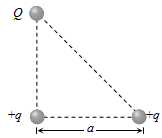
AnswerCorrect option: B. $\frac{-2 q}{2+\sqrt{2}}$
(b) $\frac{-2 q}{2+\sqrt{2}}$
View full question & answer→MCQ 4981 Mark
If $4 \times 10^{20} \mathrm{eV}$ energy is required to move a charge of 0.25 coulomb between two points. Then what will be the potential difference between them
View full question & answer→MCQ 4991 Mark
A charged particle of mass $5 \times 10^{-5} \mathrm{~kg}$ is held stationary in space by placing it in an electric field of strength $10^7 \mathrm{NC}^{-1}$ directed vertically downwards. The charge on the particle is
- A
$-20 \times 10^{-5} \mu \mathrm{C}$
- ✓
$-5 \times 10^{-5} \mu \mathrm{C}$
- C
$5 \times 10^{-5} \mu \mathrm{C}$
- D
$20 \times 10^{-5} \mu \mathrm{C}$
AnswerCorrect option: B. $-5 \times 10^{-5} \mu \mathrm{C}$
(b) $-5 \times 10^{-5} \mu \mathrm{C}$
View full question & answer→MCQ 5001 Mark
A hollow sphere of charge does not produce an electric field at any