Question 13 Marks
Which of the following potential energy curves in cannot possibly describe the elastic collision of two billiard balls? Here r is the distance between centres of the balls.
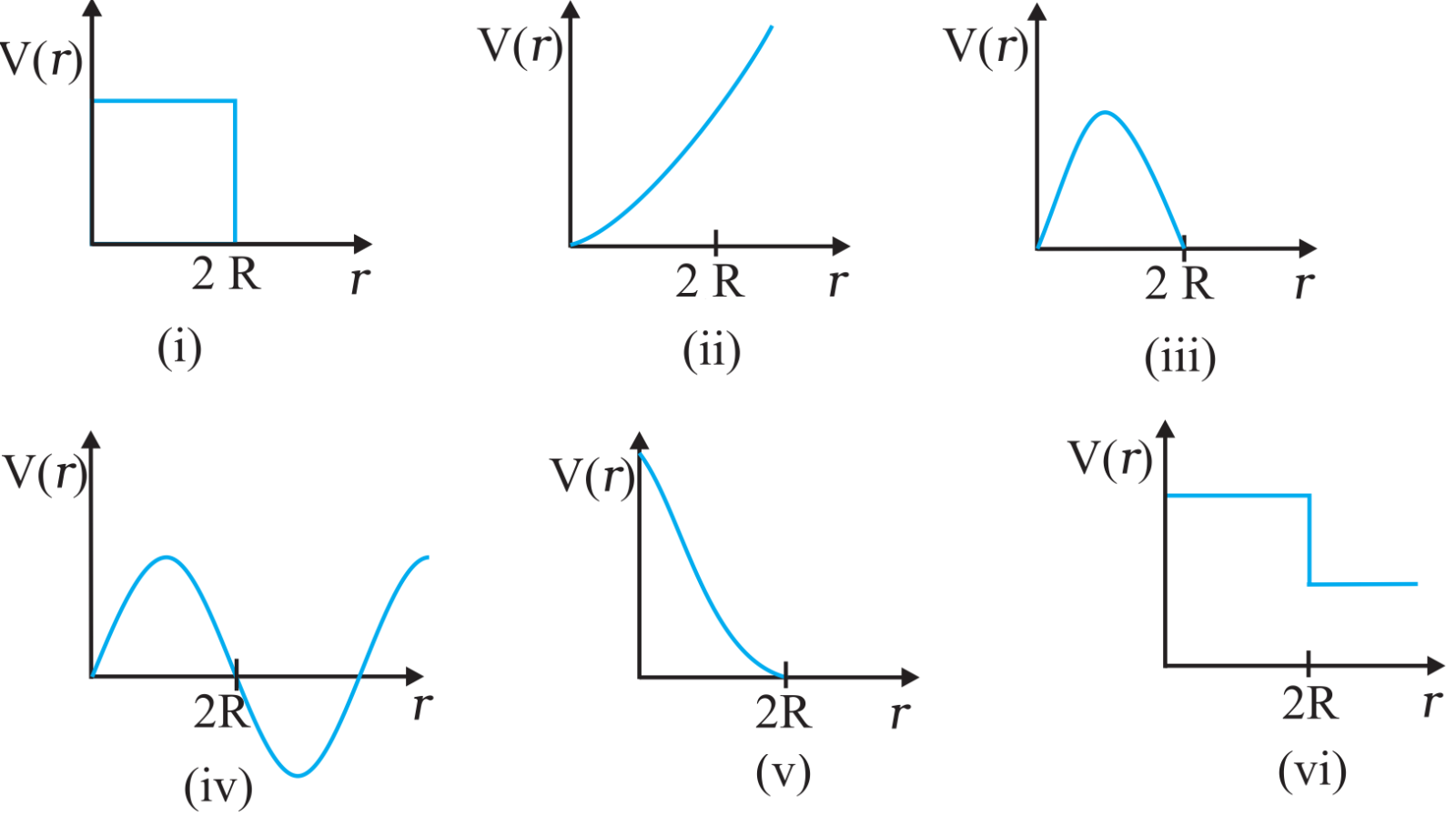
AnswerThe potential energy of a system of two masses is inversely proportional to the separation between them. In the given case, the potential energy of the system of the two balls will decrease as they come closer to each other. It will become zero (i.e., V(r) = 0) when the two balls touch each other, i.e., at r = 2R, where R is the radius of each billiard ball. The potential energy curves given in figures do not satisfy these two conditions. Hence, they do not describe the elastic collisions between them.
View full question & answer→Question 23 Marks
A body of mass 0.5kg travels in a straight line with velocity $\text{v}=\text{ax}^{3/2}$ where $\text{a}=5\text{m}^{-1/2}\text{s}^{-1}.$ What is the work done by the net force during its displacement from x = 0 to x = 2m?
AnswerGiven, Mass of the body, m = 0.5kg Velocity $\text{v} =\text{ax}^{(3/2)}\ ...(\text{i})$ Acceleration $\text{a}=5\text{m}^{–(1/2)}\text{s}^{–1}$ Initial velocity, u(at x = 0) = 0 Final velocity v(at x = 2m) $=\text{a}×2^{(3/2)} = 5\times2^{(3/2)}=10\sqrt{2}\text{m/s}$ Work done, W = Increase in kinetic energy $=\frac{1}{2}\text{m}(\text{v}^2–\text{u}^2)$ $=\frac{1}{2} \times0.5\big [(10\sqrt{2})^2 – (0)^2\big]$ $=\Big(\frac{1}{2}\times 0.5\times10\times10\times2\Big)$ $=50\text{J}$
View full question & answer→Question 33 Marks
A trolley of mass $300kg$ carrying a sandbag of $25kg$ is moving uniformly with a speed of $27km/h$ on a frictionless track. After a while, sand starts leaking out of a hole on the floor of the trolley at the rate of $0.05 kgs^{-1}$. What is the speed of the trolley after the entire sand bag is empty?
AnswerAs the trolley carrying the sand bag is moving uniformly, therefore, external force on the system = 0. When the sand leaks out, it does not lead to the application of any external force on the trolley. Hence, the speed of the trolley shall not change.
View full question & answer→Question 43 Marks
Consider the decay of a free neutron at rest: $n → p + e^-$ Show that the two-body decay of this type must necessarily give an electron of fixed energy and, therefore, cannot account for the observed continuous energy distribution in the β-decay of a neutron or a nucleus.
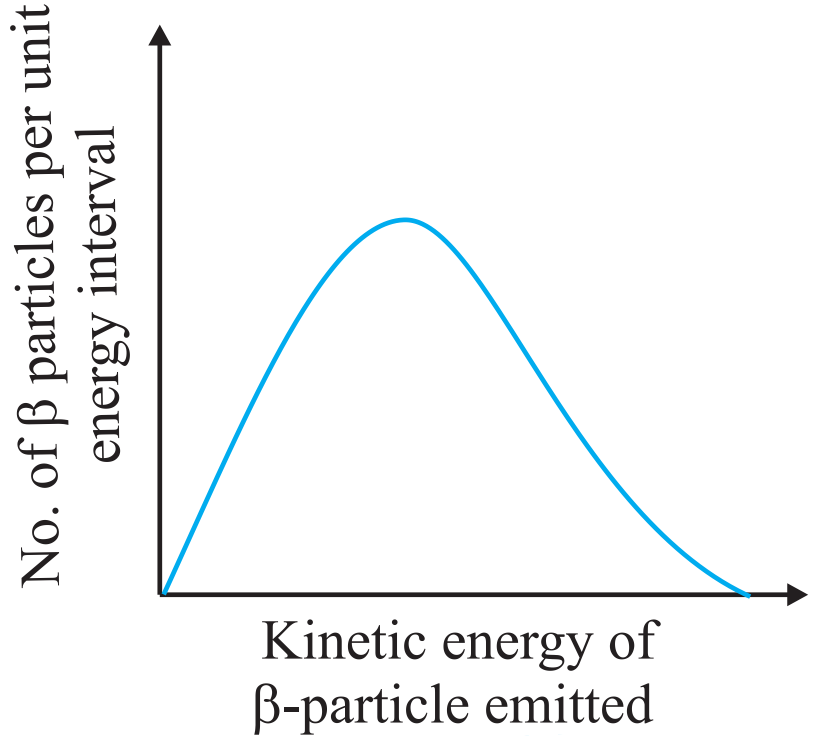
[Note: The simple result of this exercise was one among the several arguments advanced by W. Pauli to predict the existence of a third particle in the decay products of β-decay. This particle is known as neutrino. We now know that it is a particle of intrinsic spin ½ (like $e^-$, p or n), but is neutral, and either massless or having an extremely small mass (compared to the mass of electron) and which interacts very weakly with matter. The correct decay process of neutron is: $n → p + e^- + v]$ AnswerThe decay process of free neutron at rest is given as, $n → p + e^-$ From Einstein’s mass-energy relation, we have the energy of electron as $\Delta\text{mc}^2$ Where, $\Delta\text{m}$ = Mass defect = Mass of neutron - (Mass of proton + Mass of electron) c = Speed of light $\Delta\text{m}$ and c are constants. Hence, the given two-body decay is unable to explain the continuous energy distribution in the $\beta$-decay of a neutron or a nucleus. The presence of neutrino νon the LHS of the decay correctly explains the continuous energy distribution.
View full question & answer→Question 53 Marks
A molecule in a gas container hits a horizontal wall with speed $200ms^{-1}$ and angle 30° with the normal, and rebounds with the same speed. Is momentum conserved in the collision? Is the collision elastic or inelastic?
AnswerThe momentum of the gas molecule remains conserved whether the collision is elastic or inelastic. The gas molecule moves with a velocity of 200m/s and strikes the stationary wall of the container, rebounding with the same speed. It shows that the rebound velocity of the wall remains zero. Hence, the total kinetic energy of the molecule remains conserved during the collision. The given collision is an example of an elastic collision.
View full question & answer→Question 63 Marks
The potential energy function for a particle executing linear simple harmonic motion is given by $\text{V(x)} = \frac{\text{kx}^2}{2},$ where k is the force constant of the oscillator. For $k = 0.5Nm^{-1}$, the graph of V(x) versus x is shown in Show that a particle of total energy 1J moving under this potential must ‘turn back’ when it reaches $\text{x} =\pm 2\text{m}.$
AnswerGiven, Potential energy for a particle executing linear simple harmonic motion is, $\text{V(x)}=\frac{1}{2}\text{kx}^2$
Where, $\text{k}=\frac{1}{2}\text{N/m}$
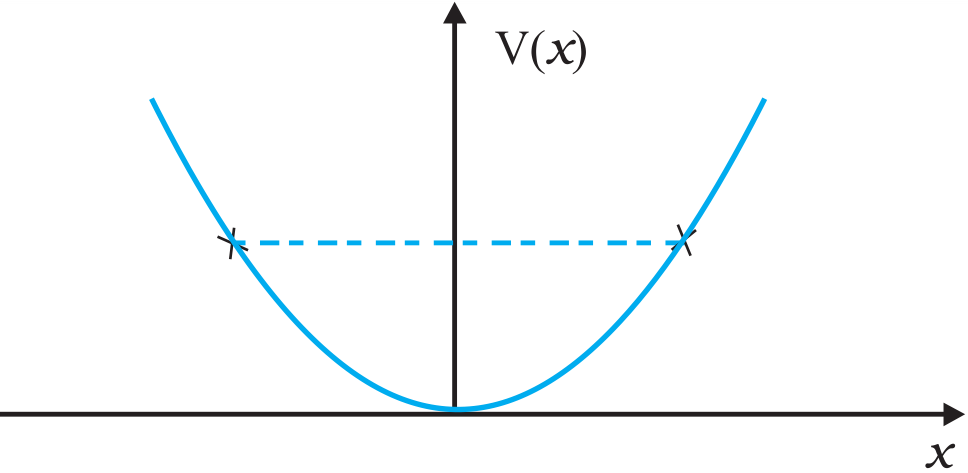
Total energy of particle $E = 1J$
Since at extreme position total energy is potential energy,
$\therefore\text{V}=\frac{1}{2}\text{kx}^2=1\text{J}$
$\Rightarrow\text{x}=\pm\sqrt{\frac{2}{\text{k}}}=\pm\sqrt{4}$
$\Rightarrow\text{x}=\pm2\text{m}$ Hence the results. View full question & answer→Question 73 Marks
The bob A of a pendulum released from 30° to the vertical hits another bob B of the same mass at rest on a table as shown in. How high does the bob A rise after the collision? Neglect the size of the bobs and assume the collision to be elastic.
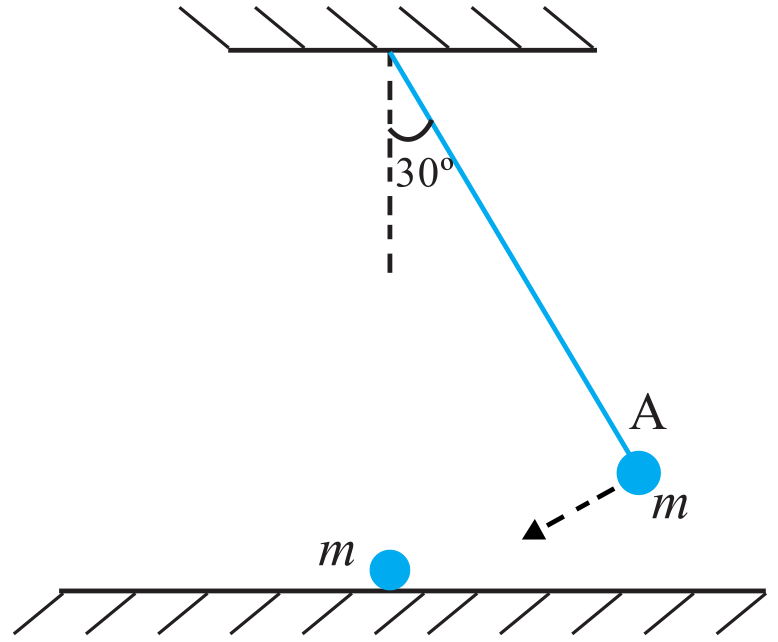
AnswerWhen two bodies of same mass undergo elastic collisions their velocities get interchanged. In the given situation, bob A is moving with certain speed and bob B is at rest. Therefore, after collision, bob A comes to rest and the bob B starts moving with the speed of bob A. The whole momentum of bob A will get transfer to bob B and so bob A, will not rise at all after the second collision. Therefore bob A will come to rest and bob B will keep on moving.
View full question & answer→Question 83 Marks
A raindrop of mass $1.00g$ falling from a height of $1km$ hits the ground with a speed of $50m s^{-1}$. Calculate:
- The loss of $P.E.$ of the drop.
- The gain in $K.E$. of the drop.
- Is the gain in $K.E$. equal to loss of $P.E$.? If not why.
Take $g = 10m s^{-2}$ Answera. Drop $m =0.001 kg, h =1 km=1000 m$ Speed of $v =50 m / s u =0$
b. PE at highest point of drop $= mgh =0.001 \times 10 \times 1000=10 J$ So loss pf $PE =10 J$
Gain in $\text{KE}=\frac{1}{2}\text{mv}^2$
$=\frac{1}{2}\times0.001\times50\times50=1.250$
Gain in = 1.250J
c. Gain in KE is not equal to the loss in $PE$. It is due to the loss of $PE$ or $KE$ against resistance or dragging force of air.
View full question & answer→Question 93 Marks
In an elastic collision of two billiard balls, which of the following quantities remain conserved during the short time of collision of the balls (i.e., when they are in contact).
- Kinetic energy.
- Total linear momentum?
Give reason for your answer in each case.
AnswerWhen two billiard balls collide each other then their linear momentum and kinetic energy remains conserved. Because here it is considered that there is not any non conservative force (like air resistance/ friction on surface etc.) and speed of ball is not so high so that they deformed on collision.
View full question & answer→Question 103 Marks
Why is electrical power required at all when the elevator is descending? Why should there be a limit on the number of passengers in this case?
AnswerWhen elevator is descending then it is not its free fall under gravity it descends with uniform speed. Power is required to decrease the velocity due to free fall. Power of motor or system of an elevator is constant and a limited or specified power can stop the speed of freely falling of passenger along with elevator.
View full question & answer→Question 113 Marks
A stone is dropped from a height ‘h'. Prove that the energy at any point in its path is mgh.
AnswerLet a stone of mass m be dropped from a point A at a height h. P.E. at A = mgh K.E. = 0 Total energy at A = mgh As it reaches B, it would have lost some P.E. and gained K.E. Velocity on reaching 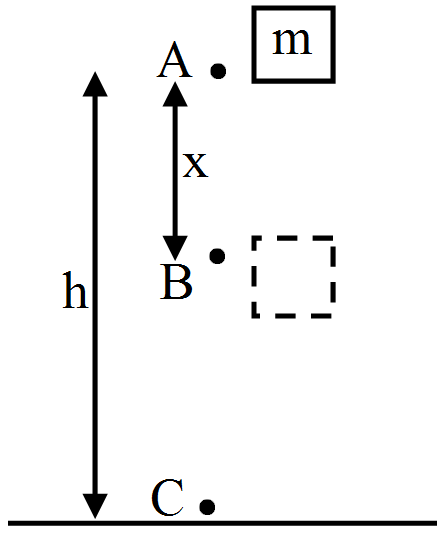 P.E at B = mg (h - x) $\text{K.E}=\frac{1}{2}\text{mv}_\text{B}^2=\frac{1}{2}\text{m}.2\text{gx}=\text{mgx}$ Total energy at B = mg (h – x) + mgx = mgh On reaching the ground C the mass must have gained a velocity $\sqrt{2\text{gx}}$ and the P.E must be zero. P.E. at C = 0 K.E. at $\text{C}=\frac{1}{2}\text{mv}_\text{c}^2=\frac{1}{2}\text{m}(2\text{gh)}=\text{mgh}$ Total energy at C = mgh Thus' it is proved that the total energy at any point in its path is mgh.
 View full question & answer→Question 123 Marks
Two blocks of masses $m_1$ and $m_2$ are connected by a spring of spring constant k. The block of mass $m_2$ is given a sharp impulse so that it acquires a velocity $v_0$ towards right. Find
- The velocity of the centre of mass.
- The maximum elongation that the spring will suffer.
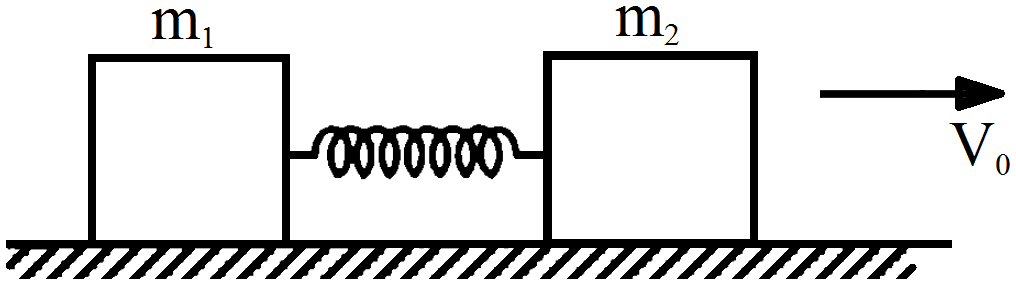
Answer
- $\therefore$ Velocity of centre of mass $=\frac{\text{m}_2\times\text{v}_0+\text{m}_1\times0}{\text{m}_1+\text{m}_2}=\frac{\text{m}_2\text{v}_0}{\text{m}_1+\text{m}_2}$
- The spring will attain maximum elongation when both velocity of two blocks will attain the velocity of centre of mass.
- x → maximum elongation of spring.
Change of kinetic energy = Potential stored in spring.

$\Rightarrow\Big(\frac{1}{2}\Big)\text{m}_2\text{v}_0^2-\Big(\frac{1}{2}\Big)(\text{m}_1+\text{m}_2)\Big(\frac{\text{m}_2\text{v}_0}{\text{m}_1+\text{m}_2}\Big)^2=\Big(\frac{1}{2}\Big)\text{kx}^2$
$\Rightarrow\text{m}_2\text{v}_0^2\Big(1-\frac{\text{m}_2}{\text{m}_1+\text{m}_2}\Big)=\text{kx}^2$
$\Rightarrow\text{x}=\Big(\frac{\text{m}_1\text{m}_2}{\text{m}_1+\text{m}_2}\Big)^{\frac{1}{2}}\times\text{v}_0$ View full question & answer→Question 133 Marks
Light in certain cases may be considered as a stream of particles called photons. Each photon has a linear momentum $\frac{\text{h}}{\lambda}$ where h is the Planck's constant and $\lambda$ is the wavelength of the light. A beam of light of wavelength $\lambda$ is incident on a plane mirror at an angle of incidence $\theta.$ Calculate the change in the linear momentum of a photon as the beam is reflected by the mirror.
Answer$\overrightarrow{\text{P}}_{\text{incidence}}=\Big(\frac{\text{h}}{\lambda}\Big)\cos\theta\hat{\text{i}}-\Big(\frac{\text{h}}{\lambda}\Big)\sin\theta\hat{\text{j}}$ $\overrightarrow{\text{P}}_{\text{Reflected}}=-\Big(\frac{\text{h}}{\lambda}\Big)\cos\theta\hat{\text{i}}-\Big(\frac{\text{h}}{\lambda}\Big)\sin\theta\hat{\text{j}}$ The change in momentum will be only in the x-axis direction. i.e. 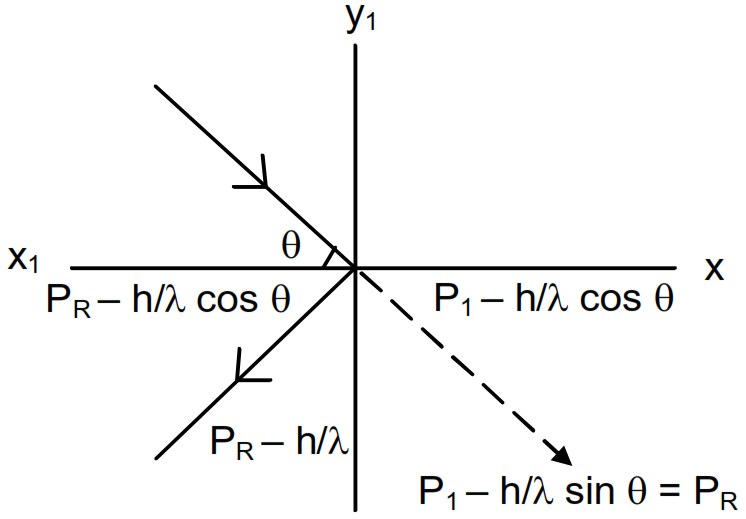 $|\triangle\text{P}|=\Big(\frac{\text{h}}{\lambda}\Big)\cos\theta-\Big(\frac{\text{h}}{\lambda}\Big)\cos\theta=\Big(\frac{\text{2h}}{\lambda}\Big)\cos\theta$
 View full question & answer→Question 143 Marks
What is an elastic collision? What will happen, when
- A heavy body collides with a light mass at rest.
- A light body collides with a heavy mass at rest.
AnswerElastic collision is one in which both momentum and energy are conserved. We know, when two bodies $m_1$ and $m_2$ moving with velocities $u_1$ and $u_2$ collide, their velocities become, $\text{v}_1=\frac{(\text{m}_1-\text{m}_2)\text{u}_1+2\text{m}_2\text{u}_2}{\text{(m}_1+\text{m}_2}$ $\text{v}_2=\frac{\text{m}_2-\text{m}_1)\text{u}_2+2\text{m}_1\text{u}_1}{(\text{m}_1+\text{m}_2)}$
- if $m_1 >> m_2$ and $u_2 = 0$, we get
$\text{v}_1=\frac{\text{m}_1\text{u}_1}{\text{m}_1}=\text{u}_1,\text{v}_2=2\text{u}_1$
- If $m_1 >> m_2$ and $u_1 = 0$, we get
$\text{v}_1=\frac{2\text{m}_2\text{u}_2}{\text{m}_1}, $ as $m_2 << m_1$
$\therefore\text{v}_1\approx0$
$\text{v}_2=-\frac{\text{m}_1\text{u}_2}{\text{m}_1}=-\text{u}_2$ View full question & answer→Question 153 Marks
A block of mass 2 kg is pulled up on a smooth incline of angle $30^{\circ}$ with horizontal. If the block moves with an acceleration of $1 m /$ $s^2$, find the power delivered by the pulling force at a time 4 seconds after motion starts. What is the/ frac delivered during these four seconds after the motion starts?
AnswerThe forces acting on the block are shown in the figure.
Resolving forces parallel to incline, $F - mg \sin \theta= ma$
$F - mg \sin \theta+ ma =2 \times 9.8 \times \sin 30^{\circ}+2 \times 1=11.8 N$
The velocity after 4 seconds $= u + at =0+14=4 m / s$
Power delivered by force at $t=4$
seconds $=$ Force $\times$ velocity $=11.8 N \times 4 s=47.2 W$
The displacement during 4 seconds is given by $v ^2= u ^2+2$ as
$\Rightarrow v ^2=0+2 \times 1 \times s s =8 m$
Work done in 4 seconds $=$ Force x distance $=$ $11.8 \times 8=94.4 J $
$\therefore$ Average power delivered $=\frac{\text { work done }}{\text { time }}=\frac{94.4}{4}=23.6 W$.
View full question & answer→Question 163 Marks
Define power. Obtain an expression for it in terms of force and velocity.
AnswerPower The rate of doing work is called power. $\text{P}=^{\ \ \text{Lt}}_{\Delta\text{t}\rightarrow0}\frac{\Delta\text{W}}{\Delta\text{t}}=\frac{\text{d}\text{W}}{\text{d}\text{t}}$ $=\frac{\text{d}}{\text{d}\text{t}}(\vec{\text{F}}.\vec{\text{S})}=\vec{\text{F}.}\frac{\text{d}\vec{\text{s}}}{\text{dt}}$ $\text{P}=\vec{\text{F}.}\vec{\text{V}}$ $\Rightarrow\text{P}=\text{Fv}$
View full question & answer→Question 173 Marks
Draw a graph showing variation of potential energy, kinetic energy and the total energy of a body freely falling on Earth from a height h.
AnswerGraphs depicting variation of:
- Gravitational potential energy (P.E.).
- Inetic energy (K.E.), and.
- The total sum of potential and kinetic energies for a freely falling body are as shown in adjoining Fig. From the graphs, it is clear that.
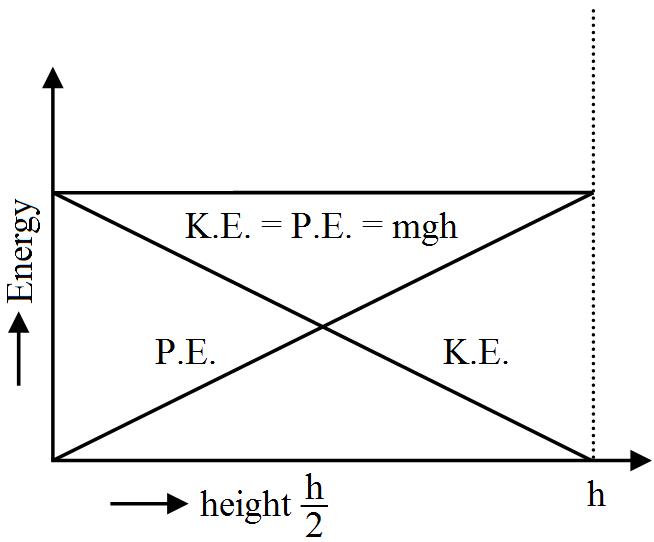
- Gravitational potential energy decreases as the body falls downwards and is zero at the Earth.
- Kinetic energy increases as the body falls downwards and is maximum when the body just strikes the ground.
- The sum of kinetic and potential energies remains constant at all points during its free fall.
View full question & answer→Question 183 Marks
A small block of mass is pressed against a horizontal spring fixed at one end to compress the spring through 5.0cm. When released the block moves horizontally till it leaves the spring. Where will it hit the ground at a distance 2m below the slab? [k = 100N/ m, m = 100g)
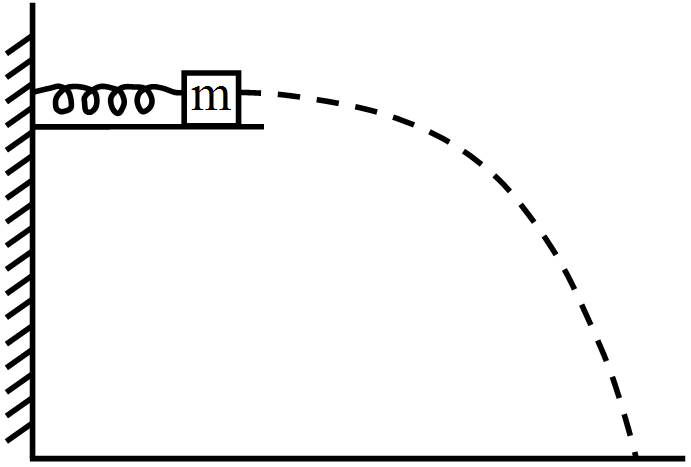
Answer$\frac{1}{2}\text{kx}^2=\frac{1}{2}\text{mv}^2$ $\text{v}=\sqrt{\frac{\text{k}}{\text{m}}}\text{x}^2=\sqrt{\frac{100}{100}\times\frac{25\times10^{-4}}{10^{-3}}}$ $=\sqrt{2.5}\text{ ms}^{-1}$ Height = 2m, $\text{t}=\sqrt{\frac{2\text{h}}{\text{g}}}=\sqrt{0.4}$ Horizontal length conered $=\sqrt{0.4}\times\sqrt{2.5}=1\text{m }$
View full question & answer→Question 193 Marks
The bob of a pendulum is released from a horizontal position. If the length of the pendulum is 1m. What is the speed with which the bob arrives at the lower most point given that it dissipates $10\%$ of it initial energy against air resistance. $(g = 10m/ s^{-2})$.
AnswerLength of pendulum = 1m Potential energy (P.E.) at A = mgh Kinetic energy (K.E.) at $\text{B}=\frac{1}{2}\text{mv}^2$ 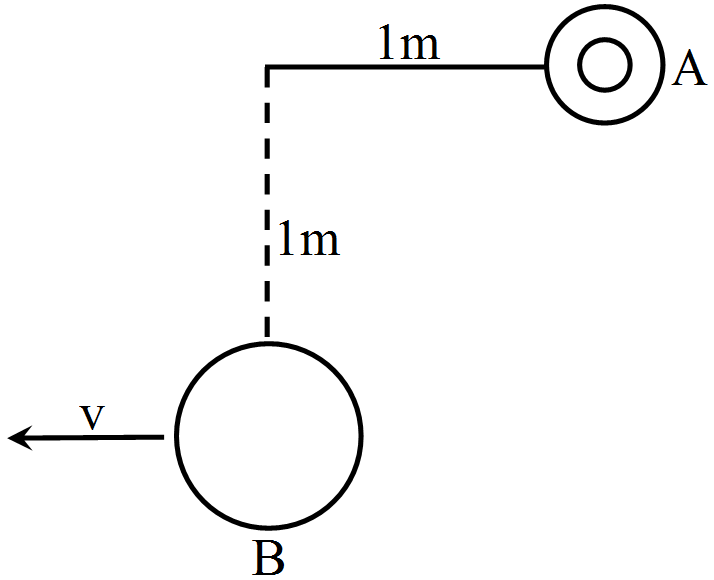
As 10% of P.E dissipated againt air resistance so, $\frac{1}{2}\text{m}\text{v}^2=90\%\text{ of P.E}$ $\Rightarrow\frac{1}{2}\text{m}\text{v}^2=\frac{90}{100}\times\text{mgh}$
$\Rightarrow\text{v}^2= 1.8\times1\times10$
$\Rightarrow\text{v}=\sqrt{18}\text{ms}^{-1}$
$\therefore\text{The speed is }\sqrt{18}\text{ ms}^{-1}$ View full question & answer→Question 203 Marks
Can kinetic energy of a system be increased without applying any external force on the system?
AnswerYes. Let us consider an isolated system of two particles falling towards each other under their mutual gravitational force of attraction. Here, the net force on the system is zero, but the velocities of the particles keep on increasing. Also, the kinetic energy of the system is increased without applying any external force on it.
View full question & answer→Question 213 Marks
What is Einstein's energy-mass equivalence? Explain the energy output of a mass on the basis of this relationship. Give two situations where this relationship can be employed. Also calculate energy released from complete annihilation of $1g$ matter.
AnswerEinstein's energy-mass equivalence relationship states that mass and energy are equivalent. The equivalence relation is given by $E = mc^2$ where 'm' is the mass that disappears. In the case of sun, four hydrogen (lighter) nuclei fuse to form a helium nucleus whose mass is less than the sum of masses of four hydrogen nuclei. This mass difference, called the mass defect $\Delta\text{m}$, it is the source of energy which is released by the sun.Two other examples are:
- Atom bomb based on uncontrolled nuclear fission process.
- To provide electrical energy as in nuclear power plant by controlled nuclear fission process
- In chemical reactions.
Annihilation of 1g of matter is
$E = mc^2$
$=(10^{-3}) \times (3 \times 10^8)^2 = 9 \times 10^{13}J$ View full question & answer→Question 223 Marks
Which of the following potential energy curves in cannot possibly describe the elastic collision of two billiard balls? Here r is the distance between centres of the balls.
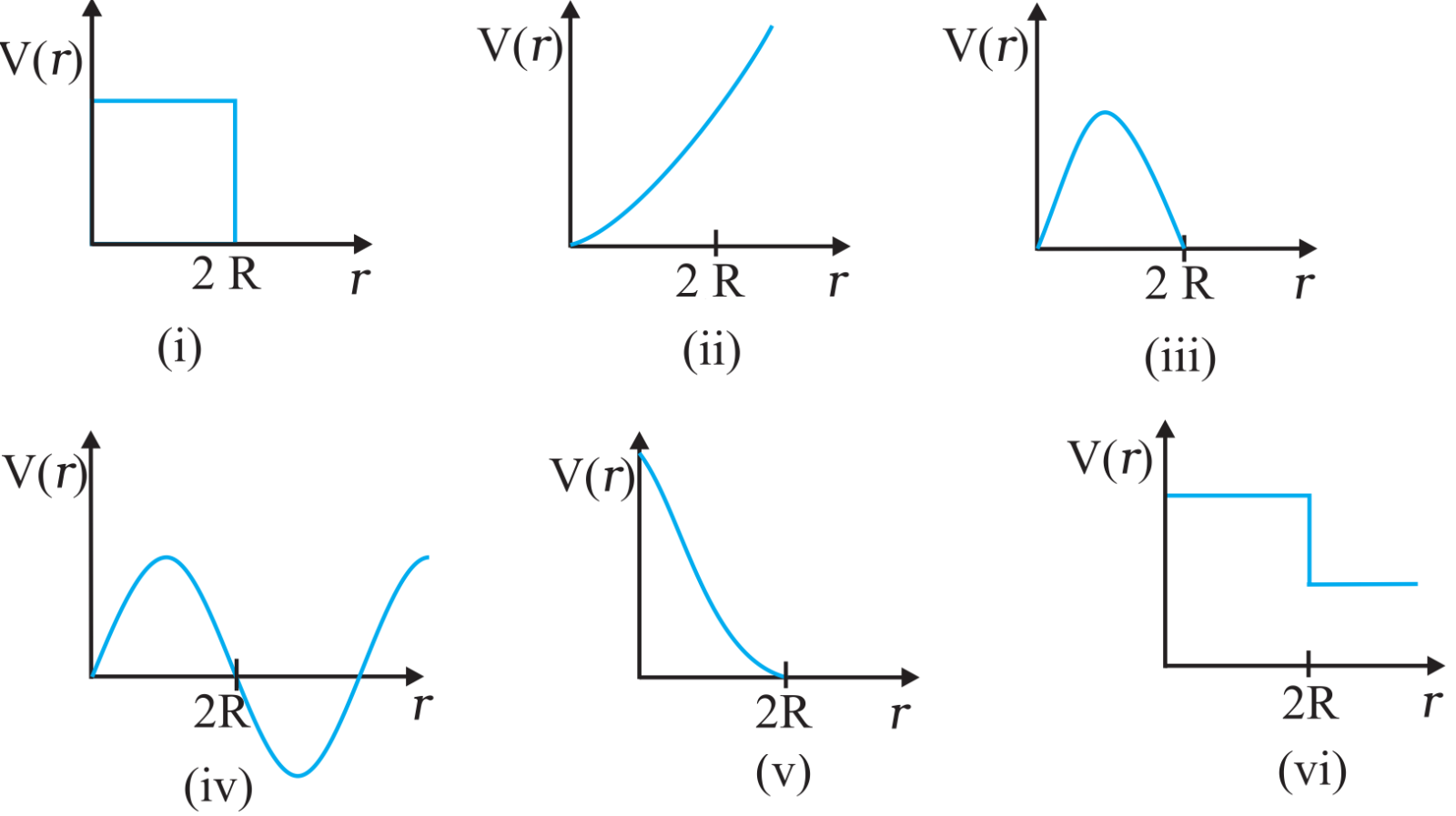
AnswerThe potential energy of a system of two masses is inversely proportional to the separation between them. In the given case, the potential energy of the system of the two balls will decrease as they come closer to each other. It will become zero (i.e., V(r) = 0) when the two balls touch each other, i.e., at r = 2R, where R is the radius of each billiard ball. The potential energy curves given in figures do not satisfy these two conditions. Hence, they do not describe the elastic collisions between them.
View full question & answer→Question 233 Marks
In a children's park, there is a slide which has a total length of 10m and a height of 8.0m (figure). Vertical ladder are provided to reach the top. A boy weighing 200N climbs up the ladder to the top of the slide and slides down to the ground. The average friction offered by the slide is three tenth of his weight. Find
- The work done by the ladder on the boy as he goes up.
- The work done by the slide on the boy as he comes down. Neglect any work done by forces inside the body of the boy.
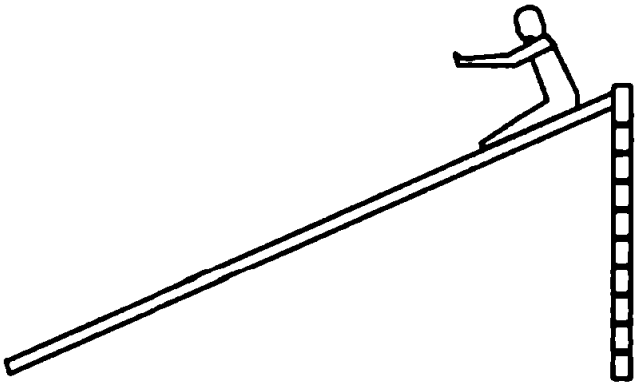
Answer$\ell=10\text{m},\text{h}=8\text{m},\text{mg}=200\text{N}$ $\text{f}=200\times\frac{3}{10}=60\text{N}$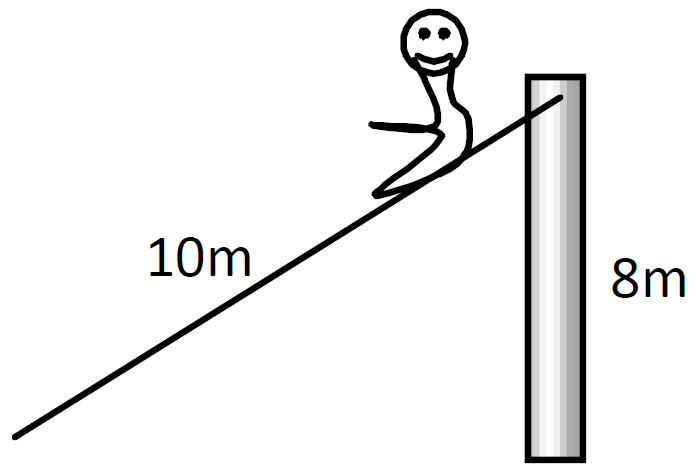
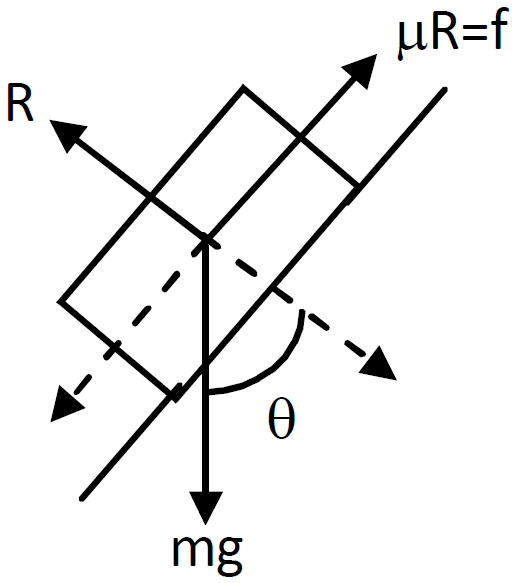
- Work done by the ladder on the boy is zero when the boy is going up because the work is done by the boy himself.
- Work done against frictional force, $\text{W}=\mu\text{RS}=\text{f}\ell$
$=(-60)\times10=-600\text{J}$
Work done by the forces inside the boy is,
$\text{W}_\text{b}=(\text{mg}\sin\theta)\times10$
$=200\times\frac{8}{10}\times10=1600\text{J}$ View full question & answer→Question 243 Marks
Consider the situation of the previous question from a frame moving with a speed v0 parallel to the initial velocity of the block.
- What are the initial and final kinetic energies?
- What is the work done by the kinetic friction?
AnswerThe relative velocity of the ball w.r.t. the moving frame is given by $\text{v}_\text{r}=\text{v}-\text{v}_0$
- Initial kinetic energy of the ball $=\frac{1}{2}\text{mv}_\text{r}^2=\frac{1}{2}\text{m}(\text{v}-\text{v}_0)^2$
Also, final kinetic energy of the ball $=\frac{1}{2}\text{m}(0-\text{v}_0)^2=\frac{1}{2}\text{mv}_0^2$
- Work done by the kinetic friction = final kinetic energy - initial kinetic energy
$=\frac{1}{2}\text{m}(\text{v}_0)^2-\frac{1}{2}\text{m}(\text{v}-\text{v}_0)^2$
$=-\frac{1}{2}\text{mv}^2+\text{mv}\text{v}_0$ View full question & answer→Question 253 Marks
A body is moved along a closed loop. Is the work done in moving the body necessarily zero? If not, state the condition under which work done over a closed path is always zero.
AnswerWork done by a body moving along closed loop can be zero if only conservative force acting on the body during motion. Work done by a body moving along a loop is not zero if any non-conservative force, i.e., frictional, electrostatic, magnetic force are acting on body.
View full question & answer→Question 263 Marks
State and explain Work-Energy theorem.
AnswerWork done on a body is reflected as change in kinetic energy, according to Work-Energy theorem. $\text{W}=\int\text{Fdx}=\int\text{m}\frac{\text{dv}}{\text{df}} \text{dx}$ $=\int\text{mv}\text{ dv}=\Big|\frac{1}{2}\text{mv}^2\Big|^\text{vf}_\text{vi}$ Work done $=\frac{1}{2}\text{m}(\text{v}^2_\text{f}-\text{v}_\text{i}^2)$ $=\frac{1}{2}\text{mv}_\text{f}^2-\frac{1}{2}\text{mv}_\text{i}^2$ Work done = Change in kinetic energy.
View full question & answer→Question 273 Marks
A ball bounces to $80\%$ of its original height. What fraction of its mechanical energy is lost in each bounce?
AnswerIf the mass of the ball is $m$ and its original height is $h$, thus, its initial potential energy will be
$U_i=m g h$
Complete step-by-step solution:
Let the mass of the ball bem and its original height be $h$, thus, its initial potential energy will be given by the equation
$U_i=m g h$
Now, after that one first bounce, the height is going to be $80 \%$ of $h$, i.e. the original height of the ball.
Thus, the final height is
$h_f=\frac{80}{100} \times h=0.80 h$
The final potential energy of the ball after each bounce will be
$U_f=0.80 mgh$
The potential energy lost in each bounce is equal to
$U_i-U_f=m g h-0.80 m g h=0.20 m g h$
Therefore, fraction of the potential energy lost by the ball in each bounce is equal to $: 0.20$
View full question & answer→Question 283 Marks
A block of mass $100g$ is moved with a speed of $5.0m/s$ at the highest point in a closed circular tube of radius $10cm$ kept in a vertical plane. The cross-section of the tube is such that the block just fits in it. The block makes several oscillations inside the tube and finally stops at the lowest point. Find the work done by the tube on the block during the process.
Answer
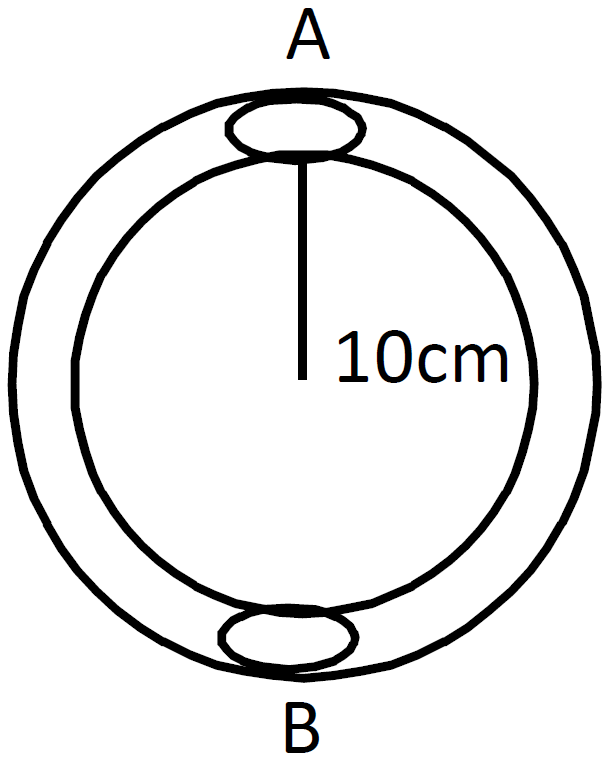
Given, m = 100g = 0.1kg, v = 5m/sec, r = 10cm
Work done by the block = total energy at A - total energy at B
$\Big(\frac{1}{2}\text{mv}^2+\text{mgh}\Big)-0$
$\Rightarrow\text{W}=\frac{1}{2}\text{mv}^2+\text{mgh}-0$
$=\frac{1}{2}\times(0.1)\times25+(0.1)\times10\times(0.2)$[h = 2r = 0.2m]
$\Rightarrow\text{W}=1.25+0.2$
$\Rightarrow\text{W}=1.45\text{J}$
So, the work done by the tube on the body is
$W_t = -1.45J$ View full question & answer→Question 293 Marks
A ball falls on the ground from a height of $2.0m$ and rebounds up to a height of $1.5m$. Find the coefficient of restitution.
AnswerLet the velocity of the ball falling from height $h_1$ be u (when it approaches the ground). Velocity on the ground $\text{u}=\sqrt{2\text{gh}}_1$ Let the velocity of ball when it separates from the ground be v. (Assuming it goes up to height $h_2$) $\Rightarrow\text{v}=\sqrt{2\text{gh}}_2$
$=\sqrt{2\times9.8\times1.5}$ Let the coefficient of restituti be e. We khow, v = eu $\Rightarrow\text{e}=\frac{\sqrt{2\times9.8\times1.5}}{\sqrt{2\times9.8\times2}}=\frac{\sqrt{3}}{2}$ Hence, the coefficient of restitution is $\frac{\sqrt{3}}{2}$
View full question & answer→Question 303 Marks
A simple pendulum consists of a 50cm long string connected to a 100g ball. The ball is pulled aside so that the string makes an angle of 37° with the vertical and is then released. Find the tension in the string when the bob is at its lowest position.
Answer From the figure, $\cos\theta=\frac{\text{AC}}{\text{AB}}$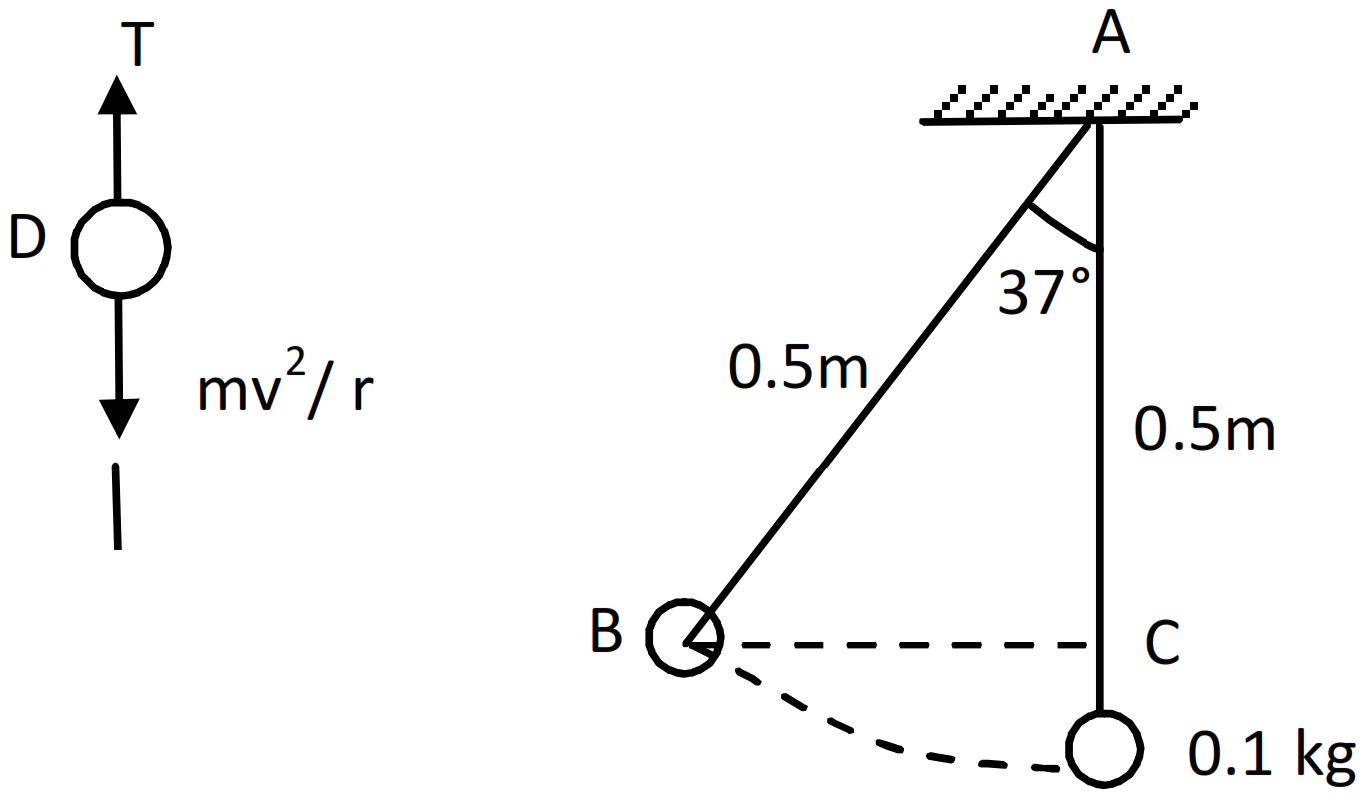
$\Rightarrow\text{AC}=\text{AB}\cos\theta$ $\Rightarrow(0.5)\times(0.8)=0.4$ So, CD = (0.5) - (0.4) = (0.1)m Energy at D = energy at B $\frac{1}{2}\text{mv}^2=\text{mg}(\text{CD})$ $\text{v}^2=2\times10\times(0.1)=2$ So, the tension is given by, $\text{T}=\frac{\text{mv}^2}{\text{r}}+\text{mg}$ $\Rightarrow(0.1)\Big(\frac{2}{0.5}+10\Big)=1.4\text{N}$ View full question & answer→Question 313 Marks
Find the work done in pulling and pushing a roller through $100m$ horizontally when a force of $1500N$ is acting along a chain making an angle of 60° with ground. Assume the floor to be smooth.
AnswerHere, forec F = 1500N and displacement, s = 100m $\theta=60^\circ$
$\therefore$ Work done, $\text{W}=\text{Fs}\cos\theta$
$=1500\times100\times\cos60^\circ$
$=1500\times100\times\frac{1}{2}$
$=75000\text{J}$
$=75\text{KJ}$
View full question & answer→Question 323 Marks
A ball of mass m, moving with a speed $2v_0$, collides inelastically $(e > 0)$ with an identical ball at rest. Show that: For head-on collision, both the balls move forward.
AnswerLet the $v_1, v_2$_ are the velocities of the two balls after the collision. Now by the principle of law of conservation of momentum. $\text{mv}_0=\text{mv}_1+\text{mv}_2$
$2\text{v}_0=\text{v}_1+\text{v}_2\ ...(\text{i})$
$\text{e}=\frac{\text{v}_2-\text{v}_1}{\text{v}_0+\text{v}_0}$
$\text{v}_2-\text{v}_1=2\text{ev}_0$ From (i) $\text{v}_1=-\text{v}_2+2\text{v}_0$
$\text{v}_1=-\text{v}_1-2\text{ev}_0+2\text{v}_0$
$2\text{v}_1=2\text{v}_0-2\text{ev}_0$
$\text{v}_1=\text{v}_0(1-\text{e})$
$\because\ \text{e}<1 v_0$_ is positive so the direction of $v_1$ is same as $v_0$ or $v_1$ is in forward direction. Hence proved.
View full question & answer→Question 333 Marks
An inclined plane $(\theta)$ has its topmost point at a height 'h'. Prove that the work done to bring a mass to the ground level either vertically or along the inclined surface is equal and is mgh. Also prove that the velocity of the mass at the lowermost point is $\sqrt{2\text{gh}}$.
AnswerIn path I. $\text{a}=\sin\theta,\text{u}=0$ 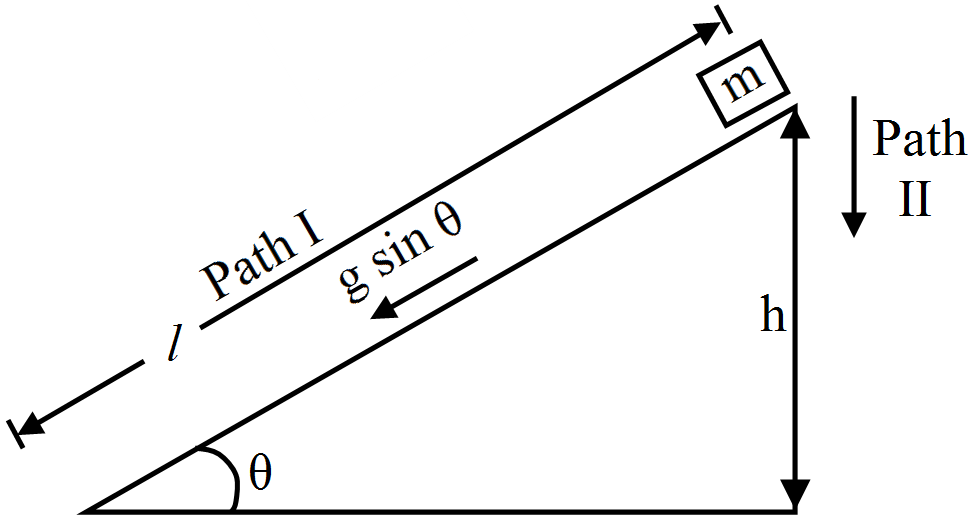 $\text{v}^2=0+2\text{g}\sin\theta\text{ l}$ $=2\text{ g}\sin\theta\frac{\text{h}}{\sin\theta}=2\text{gh}$ Change in Kinetic energy $= \frac{1}{2}\text{mv}^2-0=\frac{1}{2}\text{m}2\text{gh}=\text{mgh}$ Work done = Change in K.E. = mgh In path II. Gravitational force does work. Work done = mgh This will be converted into kinetic energy. $\frac{1}{2}\text{mv}^2=\text{mgh},\text{v}=\sqrt{2\text{gh}}$
 View full question & answer→Question 343 Marks
A small block of mass 'm' is pressed against a horizontal spring fixed at one end to compress the spring through 5.0cm. When released the block moves horizontally till it leaves the spring. Where will it hit the ground at a distance 2m below the slab? $[\text{k}=100\frac{\text{N}}{\text{m}}=100\text{g}]$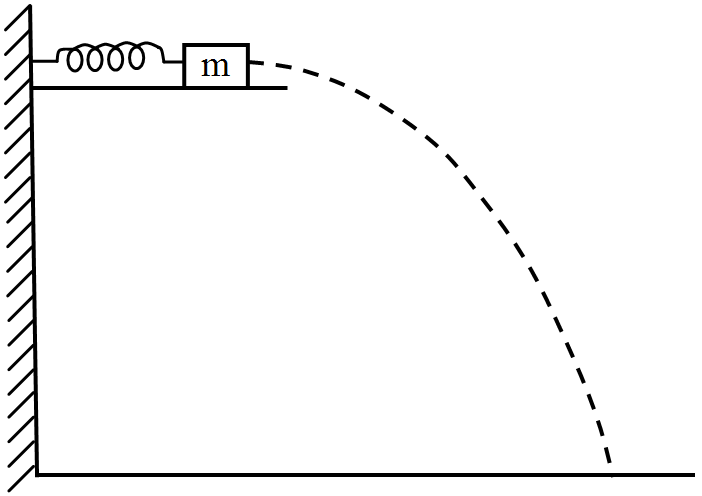
AnswerHere $\frac{1}{2}\text{kx}^2=\frac{1}{2}\text{m}\upsilon^2$ $\upsilon=\sqrt{\frac{\text{k}}{\text{m}}\text{x}^2}$ $=\sqrt{\frac{100}{100}\times\frac{25\times10^{-4}}{10^{-3}}}\text{ms}^{-1}$ $=\sqrt{2.5}\text{ms}^{-1}$ Height = 2m; $\text{t}=\sqrt{\frac{2\text{h}}{\text{g}}}$ $=\sqrt{0.4}\text{ms}^{-1}$
View full question & answer→Question 353 Marks
A block weighing 10N travels down a smooth curved track AB joined to a rough horizontal surface (figure). The rough surface has a friction coefficient of 0.20 with the block. If the block starts slipping on the track from a point 1.0m above the horizontal surface, how far will it move on the rough surface?
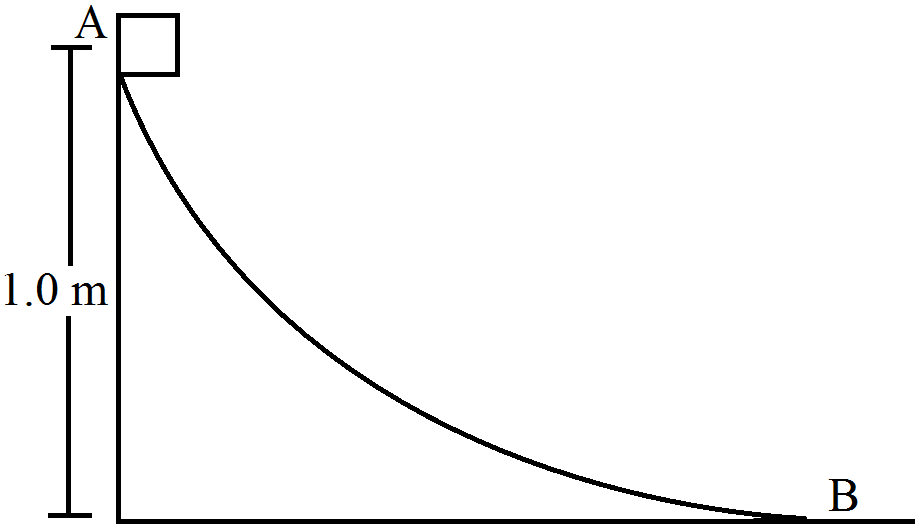
Answer
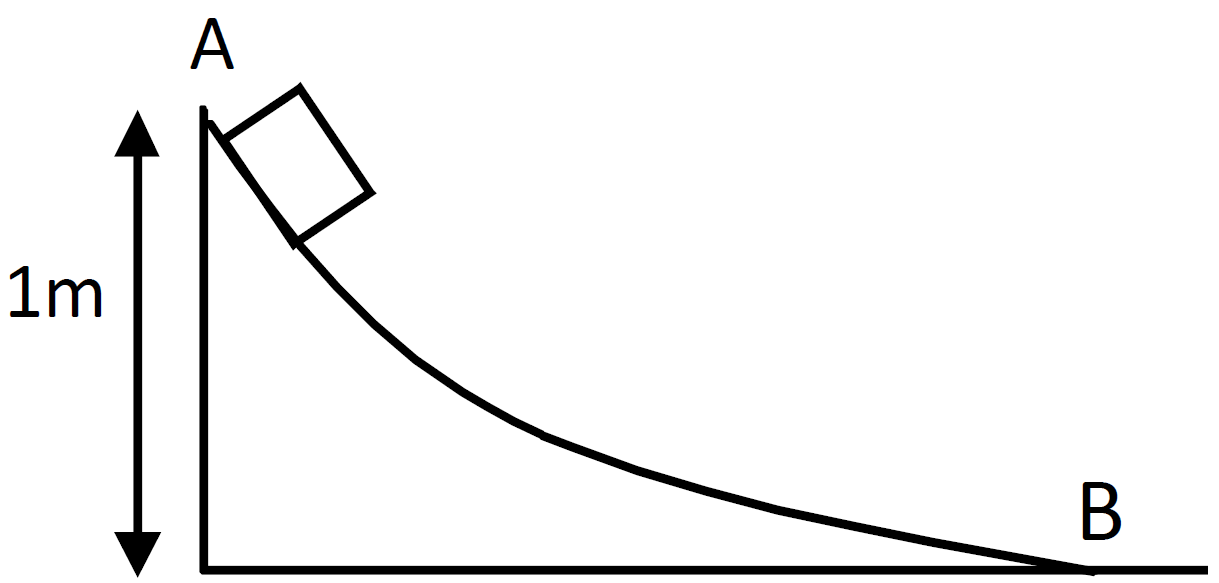 $\text{mg}=10\text{N},\mu=0.2,\text{H}=1\text{m},\text{u}=\text{v}=0$
change in P.E. = work done.
Increase in K.E.
⇒ w = mgh = 10 × 1 = 10J
Again, on the horizontal surface the fictional force
$\text{F}=\mu\text{R}=\mu\text{mg}$
$=0.2\times10=2\text{N}$
So, the K.E. is used to overcome friction
$\Rightarrow\text{S}=\frac{\text{W}}{\text{F}}=\frac{10\text{J}}{2\text{N}}=5\text{m}$ View full question & answer→Question 363 Marks
When you lift a box from the floor and put it on an almirah the potential energy of the box increases, but there is no change in its kinetic energy. Is it a violation of conservation of energy?
AnswerNo Work done in lifting the box increases the potential energy of the box. During lifting at every point, the force applied by us on the box in the upward direction is equal to the gravitational force acting on the box in the downward direction. Therefore, there is no change in the velocity of the box. As a result, the kinetic energy of the box will not change.
View full question & answer→Question 373 Marks
A body of mass 2kg is at rest at a height of 10m above the ground. Calculate its potential energy and kinetic energy after it has fallen through half the height. Also find the velocity at this instant.
AnswerTotal energy at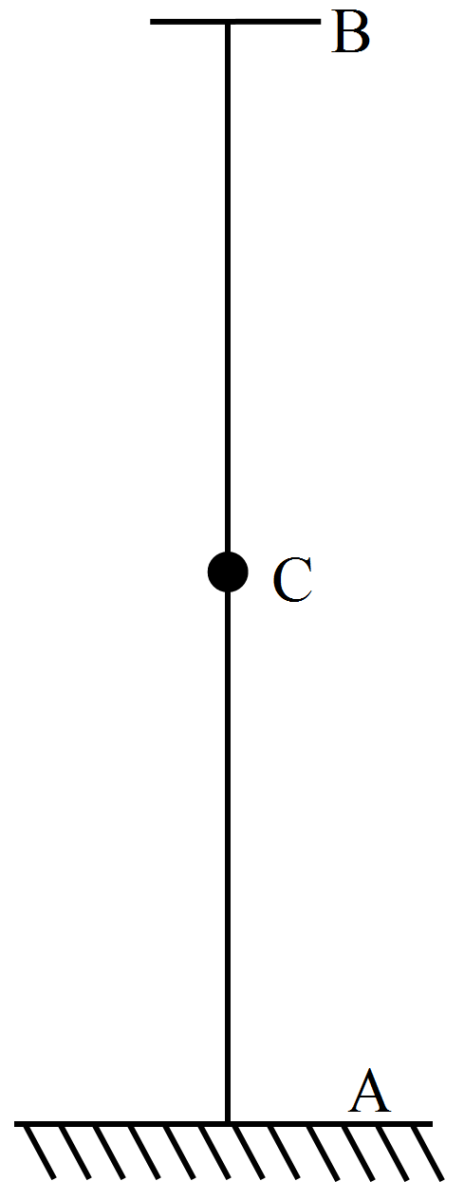
B = kinetic energy + potential energy = 0 + mgh = 2 × 9.8 × 10 = 196J As it descends half the height, it loses potential energy which is given by $=\text{mg}\frac{\text{h}}{2}=\frac{1}{2}\text{mgh}=98\text{J}$ $\therefore$ Its potential energy at C = (196 - 98) = 98J The loss of potential energy = gain in kinetic energy = 196 - 98 = 98 J But $\text{K.E.}=\frac{1}{2}\text{m}\text{v}^2$ $\therefore\frac{1}{2}\times2\times\text{v}^2$ $=98\Rightarrow\text{v}^2=98$ $\text{v}=7\sqrt{2}\text{m/ s}$ View full question & answer→Question 383 Marks
A body falls towards earth in air. Will its total mechanical energy be conserved during the fall? Justify
AnswerFor a body falling freely under gravity. The mechanical energy is not conserved because some part of mechanical energy utilized against force of friction of air molecules which is non conservative force. But if a body is falling freely under gravity in vacuum, the total mechanical energy remain conserved.
View full question & answer→Question 393 Marks
A body of mass 0.5kg travels in a straight line with velocity $\text{v}=\text{ax}^{3/2}$ where $\text{a}=5\text{m}^{-1/2}\text{s}^{-1}.$ What is the work done by the net force during its displacement from x = 0 to x = 2m?
AnswerGiven, Mass of the body, m = 0.5kg Velocity $\text{v} =\text{ax}^{(3/2)}\ ...(\text{i})$ Acceleration $\text{a}=5\text{m}^{–(1/2)}\text{s}^{–1}$ Initial velocity, u(at x = 0) = 0 Final velocity v(at x = 2m) $=\text{a}×2^{(3/2)} = 5\times2^{(3/2)}=10\sqrt{2}\text{m/s}$ Work done, W = Increase in kinetic energy $=\frac{1}{2}\text{m}(\text{v}^2–\text{u}^2)$ $=\frac{1}{2} \times0.5\big [(10\sqrt{2})^2 – (0)^2\big]$ $=\Big(\frac{1}{2}\times 0.5\times10\times10\times2\Big)$ $=50\text{J}$
View full question & answer→Question 403 Marks
A trolley of mass $300kg$ carrying a sandbag of $25kg$ is moving uniformly with a speed of $27km/h$ on a frictionless track. After a while, sand starts leaking out of a hole on the floor of the trolley at the rate of $0.05 kgs^{-1}$. What is the speed of the trolley after the entire sand bag is empty?
AnswerAs the trolley carrying the sand bag is moving uniformly, therefore, external force on the system = 0. When the sand leaks out, it does not lead to the application of any external force on the trolley. Hence, the speed of the trolley shall not change.
View full question & answer→Question 413 Marks
Define an electron volt. Express it in terms of joule.
AnswerElectron Volt. Electron volt is the amount of energy possessed by an electron in falling through a potential difference of 1 volt. $m=4 \mathrm{Kg}, u=0, F=16 \mathrm{~N}, \mathrm{t}=10 \mathrm{Sec} F=\mathrm{ma}, 16=4 a, a=4 \mathrm{~m} / \mathrm{s}^2 \mathrm{~V}=\mathrm{u}+\mathrm{at}=0+4(10) \mathrm{V}=40 \mathrm{~m} / \mathrm{s}$ K.E. of the body at end of 10 sec. $\text{E}=\frac{1}{2}\text{mv}^2$
$=\frac{1}{2}\times4\times(40)^2$ $=3200\text{J}$
View full question & answer→Question 423 Marks
How will you find work done by a variable force? What is the significance of F-x graph?
AnswerWork done is the product of force and displacement. When a variable force acts on the body, the displacement x is split into small parts dx and the work is estimated for each part. Since force is continuous in variation, the net work done will be $\int\text{Fdx}$ in the limits $x = x_i$ to $x = x_f$.
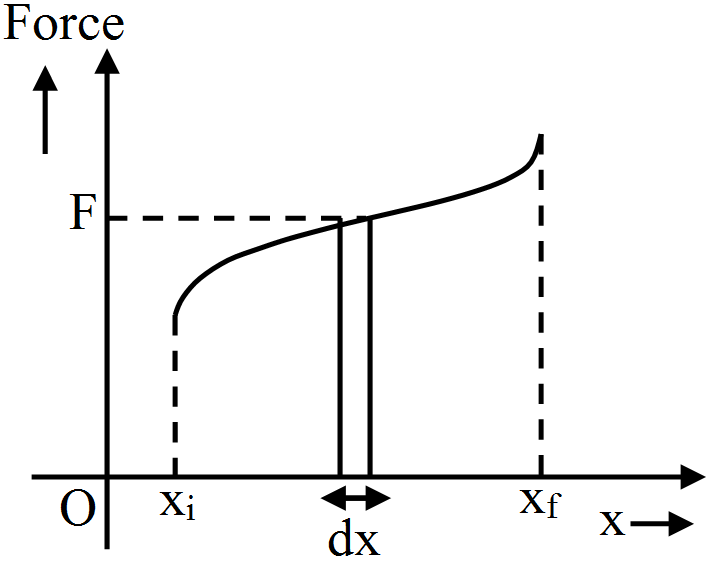
Since $\int\text{Fdx}$ geometrically is the area below the graph of F with x, the area below signifies work done in the displacement by the variable force acting. View full question & answer→Question 433 Marks
A ball is given a speed v on a rough horizontal surface. The ball travels through a distance l on the surface and stops.
- What are the initial and final kinetic energies of the ball?
- What is the work done by the kinetic friction?
Answer
- Initial kinetic energy of the ball, $\text{K}_\text{i}=\frac{1}{2}\text{mv}^2$
Here, m is the mass of the ball.
The final kinetic of the ball is zero.
Work done by the kinetic friction is equal to the change in kinetic energy of the ball.
- $\therefore$ Work done by the kinetic friction $=\text{K}_\text{f}-\text{K}_\text{i}$
$=0-\frac{1}{2}\text{mv}^2$
$=-\frac{1}{2}\text{mv}^2$ View full question & answer→Question 443 Marks
What are the conditions so that transfer of kinetic energy is maximum during a collision?
AnswerFor maximum transfer of kinetic energy during a collision, following conditions should be fulfilled.
- The collision should be a head on collision.
- The collision should be perfectly elastic.
- The target body should be at rest.
- The mass of the striking body and the target body should be exactly same.
View full question & answer→Question 453 Marks
An adult weighing 600N raises the centre of gravity of his body by 0.25m while taking each step of 1m length in jogging. If he jogs for 6km, calculate the energy utilised by him in jogging assuming that there is no energy loss due to friction of ground and air. Assuming that the body of the adult is capable of converting 10% of energy intake in the form of food, calculate the energy equivalents of food that would be required to compensate energy utilised for jogging.
AnswerEnergy used up by raising the centre of gravity by 0.25m by jogger in one step = mgh mg = 600N h = 0.25m $\therefore$ Number of steps in $6\text{Km}=\frac{600\text{m}}{1\text{m}}=600\text{ steps}$ Energy utilised in $6000\text{m}=6000\times600\times0.25\text{J}$ Since 10% of energy utilised in jogging. $\therefore$ Energy utilised in jogging $=\frac{10}{100}\times6000\times600\times0.25$ $=360000\times0.25$ $=90000\text{J}=9\times10^4\text{J}$
View full question & answer→Question 463 Marks
A block of mass $250g$ is kept on a vertical spring of spring constant $100N/m$ fixed from below. The spring is now compressed to have a length $10cm$ shorter than its natural length and the system is released from this position. How high does the block rise? Take $g =10m/s^2$.
Answer
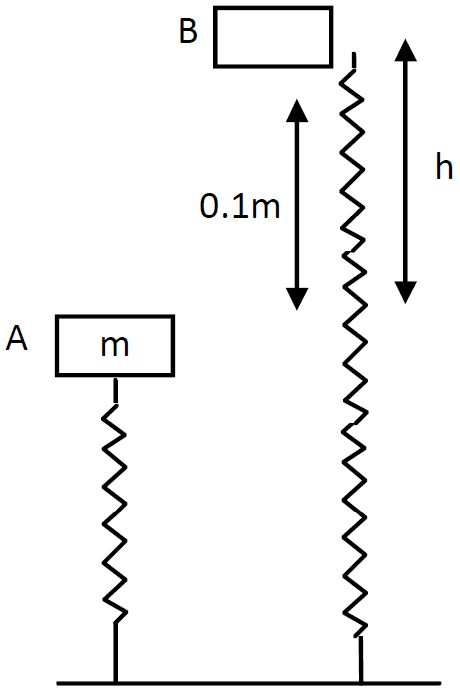
m = 250g = 0.250kg,
k = 100N/ m, m = 10cm = 0.1m
$g = 10m/ \sec^2$
Applying law of conservation of energy,
$=\frac{1}{2}\text{kx}^2=\text{mgh}$
$\Rightarrow\text{h}=\frac{1}{2}\Big(\frac{\text{kx}^2}{\text{mg}}\Big)$
$=\frac{100\times(0.1)^2}{2\times0.25\times10}$
$=0.2\text{m}=20\text{cm}$ View full question & answer→Question 473 Marks
Two masses, one 'n' times as heavy as the other, have equal kinetic energy. What is the ratio of their momenta?
AnswerSince $\text{p}=\sqrt{2\text{mE}_\text{k}}$
$\text{E}_\text{k}=\frac{\text{p}^2}{2\text{m}}$ As $E_k$_ is constant
$\therefore\text{p}\propto\sqrt{\text{m}}$ Cleariy, $\frac{\text{p}_1}{\text{p}_2}=\frac{\sqrt{\text{nm}}}{\sqrt{\text{m}}}=\frac{\sqrt{\text{n}}}{1}$
$\Rightarrow\text{p}_1:\text{p}_2=\sqrt{\text{n}}:1$
View full question & answer→Question 483 Marks
A particle is released from the top of an incline of height h. Does the kinetic energy of the particle at the bottom of the incline depend on the angle of incline? Do you need any more information to answer this question in Yes or No?
AnswerNo, the kinetic energy of the particle at the bottom of the inclined plane does not depend on the angle of inclination. When the particle reaches the ground, all its potential energy, while at the top of the inclined plane, is converted into kinetic energy. As we know that kinetic energy depends only on the height of the particle, it will be the same for different angles of inclination. No, we do not need any other information to answer this question.
View full question & answer→Question 493 Marks
Discuss elastic collision in one dimension. Obtain expression for velocities of two bodies after such a collision.
AnswerOne dimensional elastic collision is one in which both momentum and K.E. are conserved and the body moves in the same line of motion even after the collision. If $m_1 , m_2$ are the masses, $u_1 u_2$ are the initial velocities and $v_1 v_2$ are the final velocities, then $\text{m}_1\text{u}_1+\text{m}_2\text{u}_2=\text{m}_1\text{v}_1+\text{m}_2\text{v}_2\cdots\text{(i)}$
$\frac{1}{2}\text{m}_1\text{u}_1^2+\text{m}_2\text{u}_2^2=\frac{1}{2}\text{m}_1\text{v}_1^2+\frac{1}{2}\text{m}_2\text{v}_2^2\cdots\text{(ii)}$ (i.e.,) $\text{m}_1(\text{v}_1^2-\text{u}_1^2)=\text{m}_2(\text{v}_2^2-\text{u}_2^2)\text{ from(ii)}$
$\text{m}_1(\text{v}_1-\text{u}_1)=\text{m}_2(\text{v}_2-\text{u}_2)\text{ from (i)}$ Dividing both sides $\text{v}_1+\text{u}_1=\text{v}_2+\text{u}_2$
$\text{v}_1=\text{v}_2+\text{u}_2-\text{u}_1$ subtitutiong in (i) we have, $\text{m}_1\text{u}_1+\text{m}_2\text{u}_2=\text{m}_1(\text{v}_2+\text{u}_2-\text{u}_1)+\text{m}_2\text{v}_2$
$2\text{m}_1\text{u}_1+\text{u}_2(\text{m}_2-\text{m}_1)=\text{v}_2(\text{m}_1+\text{m}_2)$
$\therefore\text{v}_2=\frac{\text{u}_2(\text{m}_2-\text{m}_1)+2\text{m}_1\text{u}_1}{(\text{m}_1+\text{m}_2)}$
View full question & answer→Question 503 Marks
Two springs have force constants $K_1$ and $K_2 (K_1 > K_2)$. On which spring is more work done when they are stretched by the same force?
Answer$\text{K}_1=\frac{\text{F}}{\text{x}_1}$ and $\text{K}_2=\frac{\text{F}}{\text{x}_2}$ Since $K_1 > K_2$
$\therefore x_1 < x_2$_ $\text{W}_1=\frac{1}{2}\text{K}_1\text{x}_1^2$ and $\text{W}_2=\frac{1}{2}\text{K}_2\text{x}_2^2$
$\frac{\text{W}_1}{\text{W}_2}=\frac{\frac{1}{2}\text{K}_1\text{x}_1^2}{\frac{1}{2}\text{K}_2\text{x}_2^2}=\frac{\Big(\frac{\text{F}}{\text{x}_1}\Big)\times\text{x}_1^2}{\Big(\frac{\text{F}}{\text{x}_2}\Big)\times\text{x}_2^2}=\frac{\text{x}_1}{\text{x}_2}$ As $ x_1 < x_2$
$\therefore W_1 < W_2 W_2 > W_1$
View full question & answer→Question 513 Marks
A particle is moving in a circular path of radius r with constant speed. Due to change in the direction of motion of the particle continuously, the velocity of the particle is changing. But thekinetic energy of the particle remains the same. Explain why.
AnswerKinetic energy is given by Since $\vec{\upsilon}.\vec{\upsilon}=\text{v}^2$, a scalar quantity, so it is the speed which is taken into account while calculating the kinetic energy of the particle. As the speed is constant, so kinetic energy of the particle will also remain constant.
View full question & answer→Question 523 Marks
A sphere of mass 'm' moving with a velocity u hits another stationary sphere of same mass at rest. If e is the coefficient of restitution. Find the ratio of the velocities of two spheres after the collision.
AnswerAccording to law of conservation of momentaum, $\text{mu}=\text{m}\upsilon_1+\text{m}\upsilon_2$ $\upsilon_1+\upsilon_2=\text{u}$ Also $\upsilon_1-\upsilon_2=-\text{eu}$ Solving eqn. (i) and (ii), we get $\upsilon_1=\frac{\text{u}(1-\text{e})}{2}$ and $\upsilon_2=\frac{\text{u}(1+\text{e})}{2}$ The ratio of velocities, $\frac{\upsilon_1}{\upsilon_2}=\Big(\frac{1-\text{e}}{1+\text{e}}\Big)$.
View full question & answer→Question 533 Marks
A block of mass 30.0kg is being brought down by a chain. If the block acquires a speed of 40.0cm/s in dropping down 2.00m, find the work done by the chain during the process.
AnswerGiven m = 30kg, v = 40cm/sec = 0.4m/sec, s = 2m From the free body diagram, the force given by the chain is,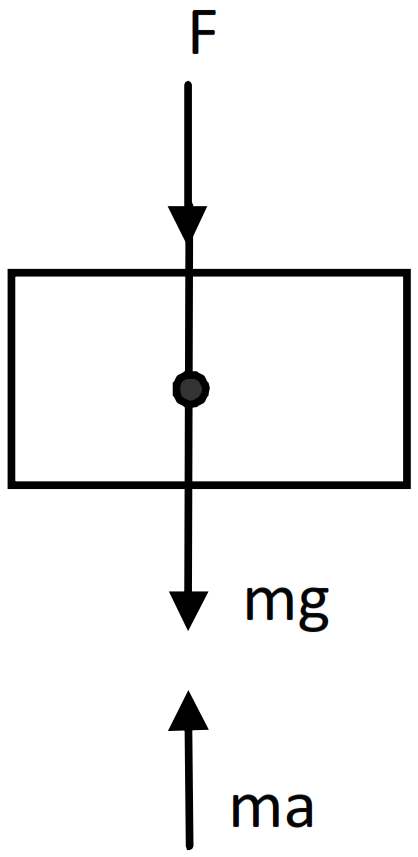
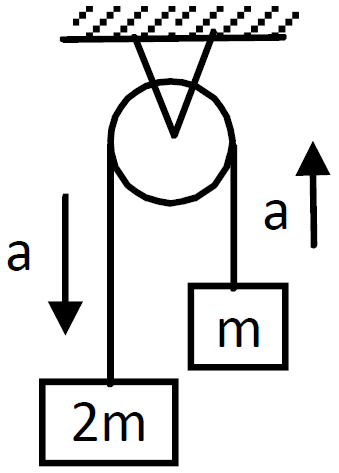
F = (ma - mg) = m(a - g) [where a = acceleration of the block] $\text{a}=\frac{\text{v}^2-\text{u}^2}{2\text{s}}$ $=\frac{0.16}{0.4}=0.04\text{m}/\text{sec}^2$ So, work done $\text{W}=\text{Fs}\cos\theta=\text{m}(\text{a}-\text{g})\text{s}\cos\theta$ $\Rightarrow\text{W}=30(0.04-9.8)\times2$ $\Rightarrow\text{W}=-585.5$ $\Rightarrow\text{W}=-586\text{J}$ So, $\text{W}=-586\text{J}$
View full question & answer→Question 543 Marks
Suppose the average mass of raindrops is $3.0 \times 10^{-5} kg$ and their average terminal velocity $9 m s { }^{-1}$. Calculate the energy transferred by rain to each square metre of the surface at a place which receives 100 cm of rain in a year.
AnswerEnergy transferred by rain to surface of earth is kinetic energy The velocity of rain or water is $9 m / s$ For mass $m =$ volume $\times$ density $=$ Area of base $\times$ height $\times p =1 m^2 \times 1 m \times 1000=1000 kg$ So, energy transferred by 100 cm rainfall
View full question & answer→Question 553 Marks
A car of mass 1000kg travels up an incline of 1 in 25 at a constant velocity of 50km/ h. What power does the car engine have to develop if there is a resistive force of 300 N opposing the motion?
Answer$\sin\theta=\frac{1}{25}$. force along inclination due to gravitational Force $=\text{mg}\sin\theta$ Resistive force = 300 Net force to overcome $=300+1000\times10\times\sin\theta$ $=300+1000\times10\times\frac{1}{25}=700\text{ N}$ $\text{Power}=\vec{\text{F}}.\vec{\text{v}}=700\times50\times\frac{1000}{3600}=9722.22\text{ J/sec}$
View full question & answer→Question 563 Marks
Define kinetic energy. Prove that K.E. associated with a mass 'm' moving with velocity v $\frac{1}{2}\text{mv}^2$.
AnswerKinetic energy is defined as the energy associated with a body under motion. $\text{W}=\int\text{Fdx}=\int\text{m}\frac{\text{dv}}{\text{dt}}\text{dx}=\int\text{mv}\text{ dv}=\frac{1}{2}\text{mv}^2$ The work done is transformed as kinetic energy for anybody capable of moving.
View full question & answer→Question 573 Marks
One end of a spring of natural length h and spring constant k is fixed at the ground and the other is fitted with a smooth ring of mass m which is allowed to slide on a horizontal rod fixed at a height h (figure). Initially, the spring makes an angle of 37° with the vertical when the system is released from rest. Find the speed of the ring when the spring becomes vertical.
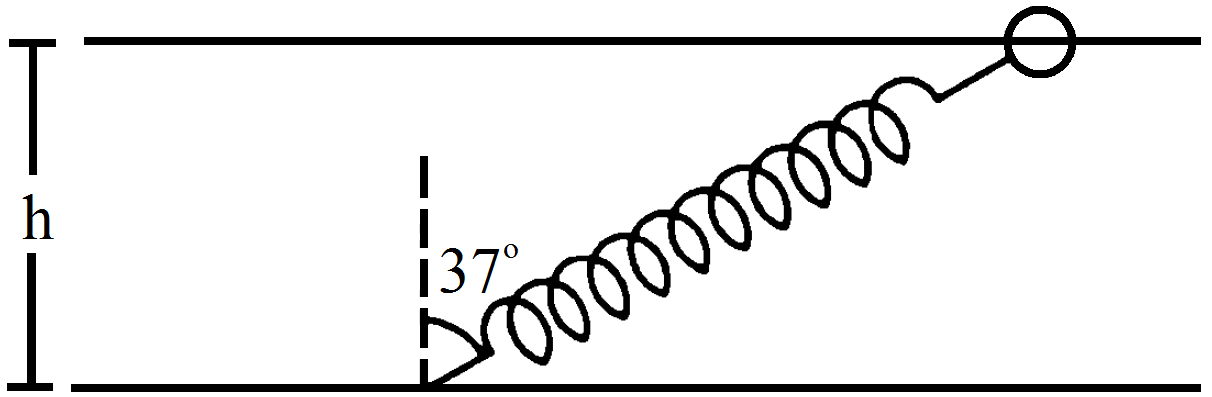
Answer
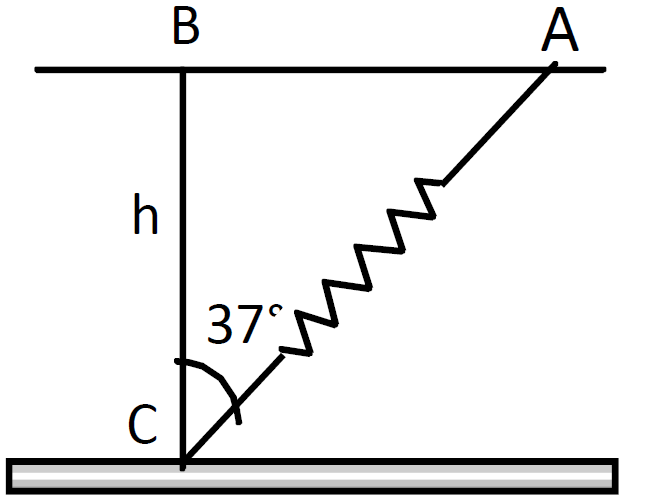 $\theta=37^\circ,$ l = h = natural length
Let the velocity when the spring is vertical be ‘v’.
$\cos=37^\circ=\frac{\text{BC}}{\text{AC}}=0.8=\frac{4}{5}$
$\text{AC}=(\text{h}+\text{x})=\frac{5\text{h}}{4}$ (because BC = h)
So, $\text{x}=\frac{5\text{h}}{4}-\text{h}=\frac{\text{h}}{4}$
Applying work energy principle $=\frac{1}{2}\text{kx}^2+\frac{1}{2}\text{mv}^2$
$\Rightarrow\text{v}=\text{x}\sqrt{\Big(\frac{\text{k}}{\text{m}}\Big)}=\frac{\text{h}}{4}\sqrt{\frac{\text{k}}{\text{m}}}$ View full question & answer→Question 583 Marks
Give example of a situation in which an applied force does not result in a change in kinetic energy.
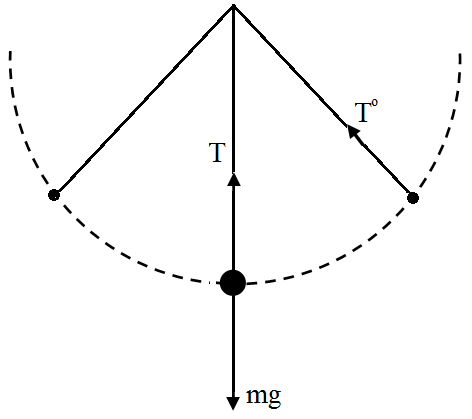
AnswerAssume a ball tied to a string and is moving in a vertical circle. Work done by tension force will be zero and hence tension force will not cause any change in KE of ball. Because at any instant of time the displacement is tangential and the force is central in nature, i.e., tension in the string and the small displacement at any instant are perpendicular to each other.
View full question & answer→Question 593 Marks
A body of mass 'M' at rest is struck by a body of mass 'm'. Show that the fraction of K.E. of mass m transferred to the struck particle is $\frac{4\text{mM}}{(\text{m}+\text{M})^2}.$
Answer$\mathrm{m}_1=\mathrm{m} \mathrm{u}_1=u \mathrm{~m}_2=\mathrm{M} \mathrm{u}_2=0, \mathrm{v}_2$= ? $\text{v}_2=\frac{2\text{m}_1\text{u}_1}{\text{m}_1+\text{m}_2}+\frac{\text{m}_2+\text{u}_2}{\text{m}_1+\text{m}_2}$
$=\frac{2\text{mu}}{\text{m}+\text{M}}+0=\frac{2\text{m}\text{u}}{\text{m}+\text{M}}$ K.E of body stuck after collision, $\text{E}_2=\frac{1}{2}\text{m}_2\text{v}_2^2=\frac{1}{2}\text{M}\Big(\frac{2\text{m}\text{u}}{\text{m}+\text{M}}\Big)^2$
$=\frac{2\text{M}\text{m}^2\text{u}^2}{(\text{m}+\text{M})^2}$ Initial K.E., $\text{E}_1=\frac{1}{2}\text{m}_1\text{u}_1^2=\frac{1}{2}\text{m}\text{u}^2$
$\therefore$ fraction of initial K.E. transferred $\frac{\text{E}_2}{\text{E}_1}=\frac{2\text{M}\text{m}^2\text{u}^2}{(\text{m}+\text{M})^2\Big(\frac{1}{2}\text{m}\text{u}^2\Big)}$
$=\frac{4\text{m}\text{M}}{(\text{m}+\text{M})^2}$
View full question & answer→Question 603 Marks
Figure shows a light rod of length l rigidly attached to a small heavy block at one end and a hook at the other end. The system is released from rest with the rod in a horizontal position. There is a fixed smooth ring at a depth h below the initial position of the hook and the hook gets into the ring as it reaches there. What should be the minimum value of h so that the block moves in a complete circle about the ring?
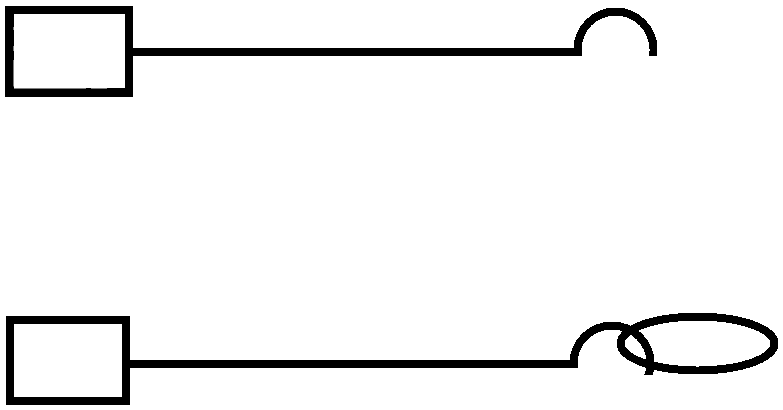
Answer
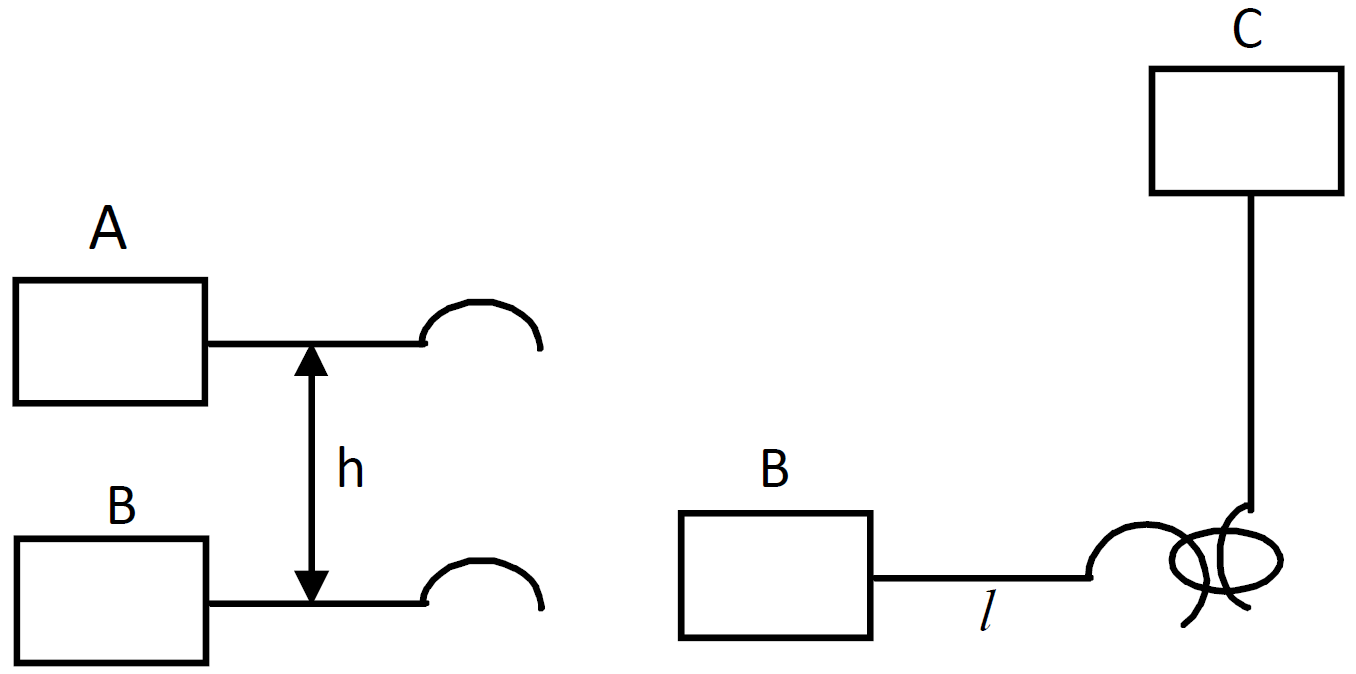 The minimum velocity required to cross the height point $\text{c}=\sqrt{2\text{gl}}$
Let the rod released from a height h.
Total energy at A = total energy at B
$\text{mgh}=\frac{1}{2}\text{mv}^2$
$\text{mgh}=\frac{1}{2}\text{m}(2\text{gl})$
[Because v = required velocity at B such that the block makes a complete circle.]
So, h = l View full question & answer→Question 613 Marks
Consider the decay of a free neutron at rest: $n → p + e^-$ Show that the two-body decay of this type must necessarily give an electron of fixed energy and, therefore, cannot account for the observed continuous energy distribution in the β-decay of a neutron or a nucleus. 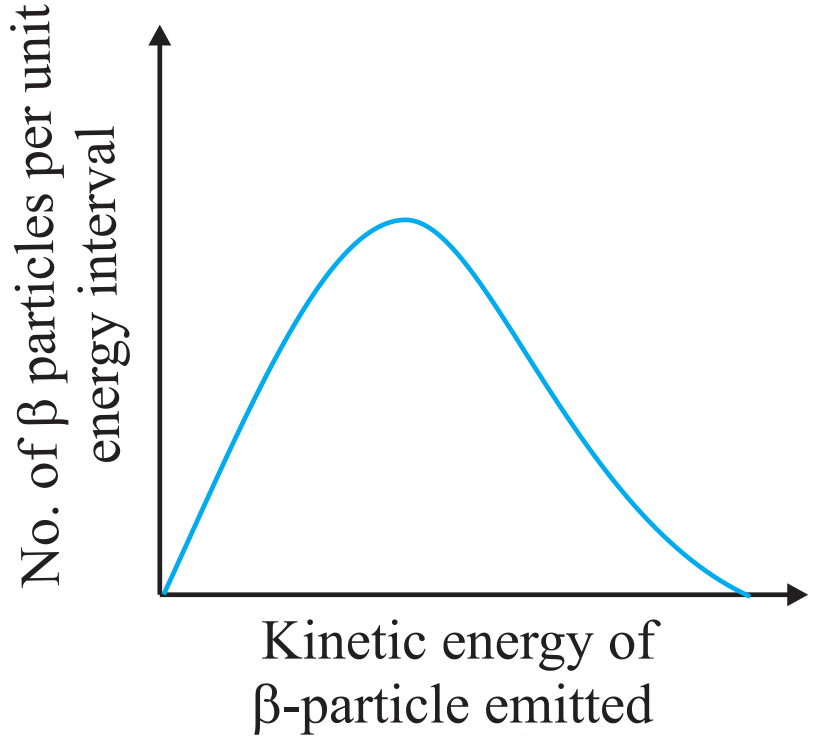 [Note: The simple result of this exercise was one among the several arguments advanced by W. Pauli to predict the existence of a third particle in the decay products of β-decay. This particle is known as neutrino. We now know that it is a particle of intrinsic spin ½ (like $e^-$, p or n), but is neutral, and either massless or having an extremely small mass (compared to the mass of electron) and which interacts very weakly with matter. The correct decay process of neutron is: n → p + $e^-$ + v]
 AnswerThe decay process of free neutron at rest is given as, $n → p + e^-$ From Einstein’s mass-energy relation, we have the energy of electron as $\Delta\text{mc}^2$ Where, $\Delta\text{m}$ = Mass defect = Mass of neutron - (Mass of proton + Mass of electron) c = Speed of light $\Delta\text{m}$ and c are constants. Hence, the given two-body decay is unable to explain the continuous energy distribution in the $\beta$-decay of a neutron or a nucleus. The presence of neutrino νon the LHS of the decay correctly explains the continuous energy distribution.
View full question & answer→Question 623 Marks
Work done by a force is given by $\text{W}=\vec{\text{F}.}\vec{\text{S}}\text{ Where}\vec{\text{ F}}$ is the force and $\vec{\text{S}}$is the displacement. Show that:
- Work done is also equal to change in K.E.
- Work done is also equal to change in potential energy using this expression.
Answer
-

m = mass of body at rest
$\vec{\text{ds}}$ = small displacement in the direction of force Small amount of work done by force
$\text{dW}=\vec{\text{F}}.\vec{\text{ds}}$
$=\text{FdS}\cos0^\circ=\text{FdS}$
If is acceleration Produced in the body, then
$\vec{\text{F}}=\text{m}\vec{\text{a}}=\text{m}\frac{\text{dv}}{\text{dt}}$
$\text{dW}=\bigg(\text{m}\frac{\text{dv}}{\text{dt}}\bigg).\text{dS}=\text{m}\bigg(\frac{\text{dS}}{\text{dt}}\bigg)\text{dv}$
$=\text{mv}\text{ dv}$
Total work done by the force
$\text{W}=\int_\limits{0}^{\text{v}}\text{vdv}=\text{m}\bigg[\frac{\text{v}^2}{2}\bigg]_0^\text{v}$
$\text{W}=\frac{1}{2}\text{mv}^2$
- F = mg
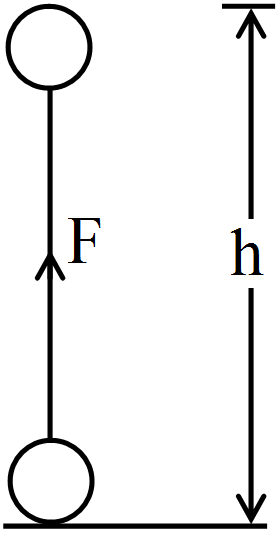
As the distance is moved in the direction of force applied
Work done = Force distance
W = F × h = mgh View full question & answer→Question 633 Marks
Water falling from a 50m high fall is to be used for generating electric energy. If $1.8 x 10^5kg$ of water falls per hour and half the gravitational potential energy can be converted into electric energy, how many 100W lamps can be lit?
Answer$h =50 m, m =1.8 \times 10^5 kg / hr , P =100$ watt, P.E. $= mgh =1.8 \times 10^5 \times 9.8 \times 50=882 \times 10^5 J / hr$ Because, half the energy is converted into electricity. Electrical energy $=\frac{1}{2}\text{P.E.}$ $= 441 \times 10^5 J/hr$
So, power in watt (J/sec) is given by $=\frac{441\times10^5}{3600}$
$\therefore$ number of $100W$ lamps,
that can be lit $=\frac{441\times10^5}{3600\times100}=122.5\approx122$
View full question & answer→Question 643 Marks
Two masses 10 kg and 20 kg are connected by a massless spring. A force of 200 N acts on 20 kg mass. At the instant when the 10 kg mass has an acceleration $12 \mathrm{~m} / \mathrm{s}^2$, what will be the energy stored in the spring? (Given $\mathrm{k}=2400 \mathrm{~N} /$ $\mathrm{m})$.
Answer
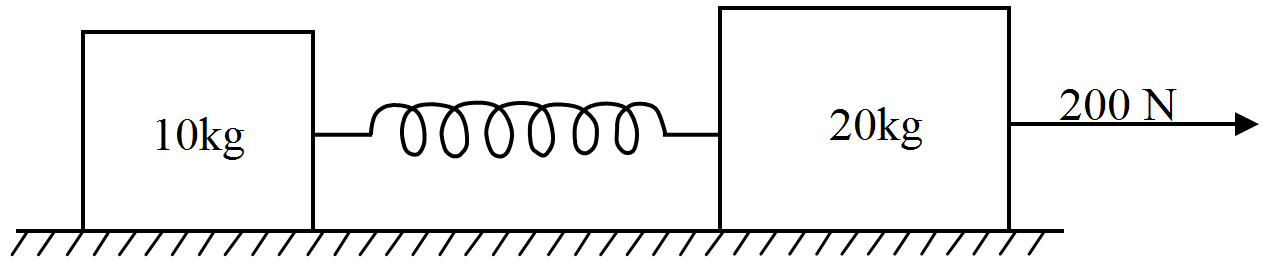
Since F = ma
⇒ F = 10 × 12 = 120N
$\therefore\text{x}=\frac{1}{20}$
Energy stored in the spring, $\text{E}=\frac{1}{20}\text{kx}^2$
$\Rightarrow\text{E}=\frac{1}{2}\times2400\times\big(\frac{1}{20}\big)^2$
$\text{E}=\frac{1}{2}\times2400\times\frac{1}{400}=3\text{J}$. View full question & answer→Question 653 Marks
A body of mass 3kg makes an elastic collision with anthor body at rest and continues to move in the original direction with a speed equal to one-third of its original speed. Find the mass of the second body.
AnswerHere, $m _1=3 kg$ Let $u _1= x ms ^{-1}$ and $m _2= m _1 kg_{ u _2=0 \text {, }}$
$\text{v}_1=\frac{\text{x}}{3}\text{ms}^{-1}$
Since collision is elastic, so both momentaum and K.E. remain conserved.
According to law of conservation of linear momentau, $\text{m}_1\text{u}_1+\text{m}_1\text{v}_1+\text{m}_2\text{v}_2$
$3\text{x}+0=\frac{3\text{x}}{\text{x}_3}+\text{m}\text{v}_2$
$\text{m}\text{v}_2=2\text{x}\cdots(1)$ According to the law of conservation of KE.,
$\frac{1}{2}\text{m}_1\text{u}_1^2+\frac{1}{2}\text{m}_1\text{v}_1^2+\frac{1}{2}\text{m}_2\text{v}_2^2$
$\frac{1}{3}\text{x}^2+0=\frac{1}{2}\times3\frac{\text{x}^2}{9}+\frac{1}{2}\text{m}\text{v}_2^2$
$\text{m}\text{v}_2^2=\frac{8\text{x}^2}{3}\cdots(2)$ Dividing (2) by (1), $\text{v}_2=\frac{4\text{x}}{3}$
Put this value in eqn. (1). we get $\text{m}\times\frac{4\text{x}}{3}=2\text{x}$
$\text{m}=\frac{3}{2}=1.5\text{kg}$. Thus, mass of second body is 1.5kg.
View full question & answer→Question 663 Marks
A $60kg$ man skating with a speed of $10m/s$ collides with a $40kg$ skater at rest and they cling to each other. Find the loss of kinetic energy during the collision.
Answer$\text { Mass of the man }=m_1=60 \mathrm{~kg} \text { Speed of the man }=v_1$=$10 \mathrm{~m} / \mathrm{s} \text { Mass of the skater }=m_2=40 \mathrm{~kg} \text { let its velocity }=\mathrm{v}^{\prime} \therefore$
$60 \times 10+0=100 \times \mathrm{v}^{\prime} \Rightarrow \mathrm{v}^{\prime}=6 \mathrm{~m} / \mathrm{s} \text { loss in } \Delta \mathrm{KE}=\frac{1}{2} \mathrm{~m}_1 \mathrm{v}_1^2-\frac{1}{2}\left(\mathrm{~m}_1+\mathrm{m}_2\right) \mathrm{v}^2$
$\text { K.E. }=\left(\frac{1}{2}\right) 60 \times(10)^2-\left(\frac{1}{2}\right) \times 100 \times 36=1200 \mathrm{~J}$
View full question & answer→Question 673 Marks
Two bodies make an elastic head-on collision on a smooth horizontal table kept in a car. Do you expect a change in the result if the car is accelerated on a horizontal road because of the noninertial character of the frame? Does the equation "Velocity of separation = Velocity of approach" remain valid in an accelerating car? Does the equation "Final momentum = Initial momentum" remain valid in the accelerating car?
AnswerIn case car is accelerated it would affect velocity of both bodies,
- In this case the change in velocity would affect velocity of both bodies. (body moving in direction of car would slow down and other one moving in opposite direction would speed up in case car is accelerated)
- Velocity of separation would be equal to velocity of approach. As only change would be in velocity but everything would remain same.
- Yes final momentum would be still equal to initial momentum as with increase in velocity of one body the velocity of other body does decrease.
View full question & answer→Question 683 Marks
A molecule in a gas container hits a horizontal wall with speed $200ms^{-1}$ and angle $30°$ with the normal, and rebounds with the same speed. Is momentum conserved in the collision? Is the collision elastic or inelastic?
AnswerThe momentum of the gas molecule remains conserved whether the collision is elastic or inelastic. The gas molecule moves with a velocity of 200m/s and strikes the stationary wall of the container, rebounding with the same speed. It shows that the rebound velocity of the wall remains zero. Hence, the total kinetic energy of the molecule remains conserved during the collision. The given collision is an example of an elastic collision.
View full question & answer→Question 693 Marks
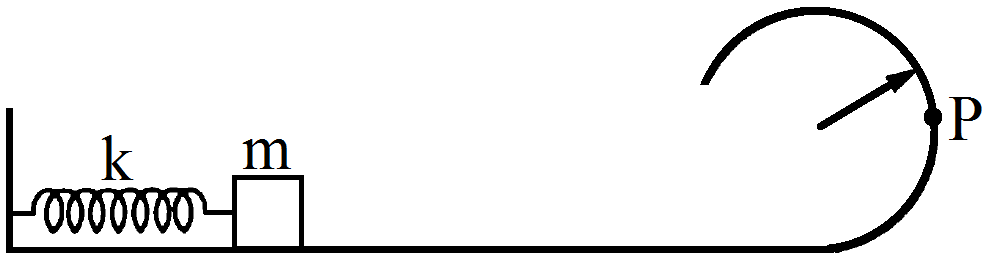
Figure shows a smooth track, a part of which is a circle of radius R. A block of mass m is pushed against a spring of spring constant k fixed at the left end and is then released. Find the initial compression of the spring so that the block presses the track with a force mg when it reaches the point P, where the radius of the track is horizontal.
Answer
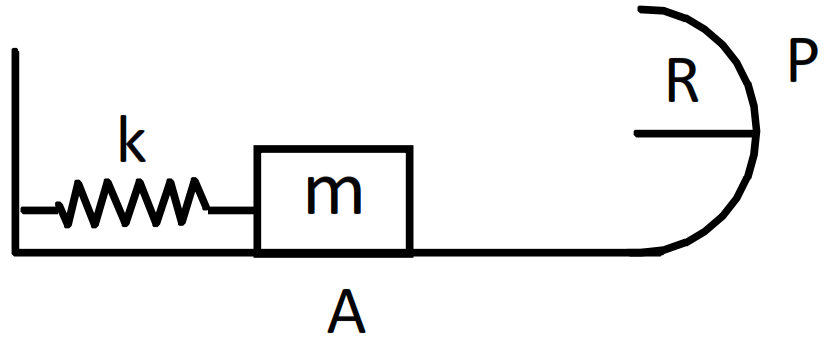
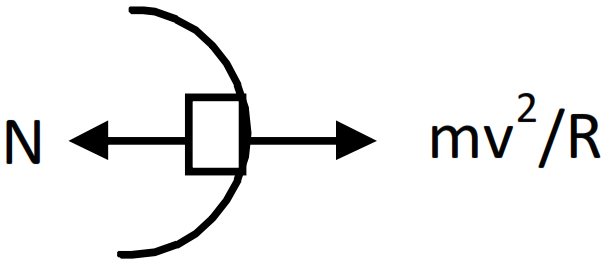
Given, N = mg
As shown in the figure, $\frac{\text{mv}^2}{\text{R}}=\text{mg}$
$\Rightarrow\text{v}^2=\text{gR}\ \dots(1)$
Total energy at point A = energy at P
$\frac{1}{2}\text{kx}^2=\frac{\text{mgR}+2\text{mgR}}{2}$ [because $v^2$ = gR]
$\Rightarrow\text{x}^2=\frac{{3\text{mgR}}}{\text{k}}$
$\Rightarrow\text{x}=\sqrt{\frac{{3\text{mgR}}}{\text{k}}}$ View full question & answer→Question 703 Marks
An engine is attached to a wagon through a shock absorber of length 1.5 m . The system with a total mass of $50,000 \mathrm{~kg}$ is moving with a speed of $36 \mathrm{~km} \mathrm{~h}^{-1}$ when the brakes are applied to bring it to rest. In the process of the system being brought to rest, the spring of the shock absorber gets compressed by 1.0 m . If $90 \%$ of energy of the wagon is lost due to friction, calculate the spring constant.
Answer$\text{KE}=\frac{1}{2}\text{mv}^2$ $\text{m}=50,000\text{kg}$ $\text{v}=36\times\frac{5}{18}\text{m/ s}=10\text{m/ s}$ $\text{KE}=\frac{1}{2}\times50,000\times10\times10$ $\text{KE}=2500000\text{J}$ 90% of KE of wagon lost due to friction by breaks only 10% are passed to spring. KE of spring = 10% of KE wagon $\frac{1}{2}\text{kx}^2=\frac{10}{100}\times2500000$ $\text{x}=1\text{m}$ $\frac{1}{2}\text{k}\times1\times1=250000$ $\text{K}=500000=5\times10^5\text{N/m}$
View full question & answer→Question 713 Marks
A small block of mass 100g is pressed against a horizontal spring fixed at one end to compress the spring through 5.0cm (figure). The spring constant is 100N/m. When released, the block moves horizontally till it leaves the spring. Where will it hit the ground 2m below the spring?
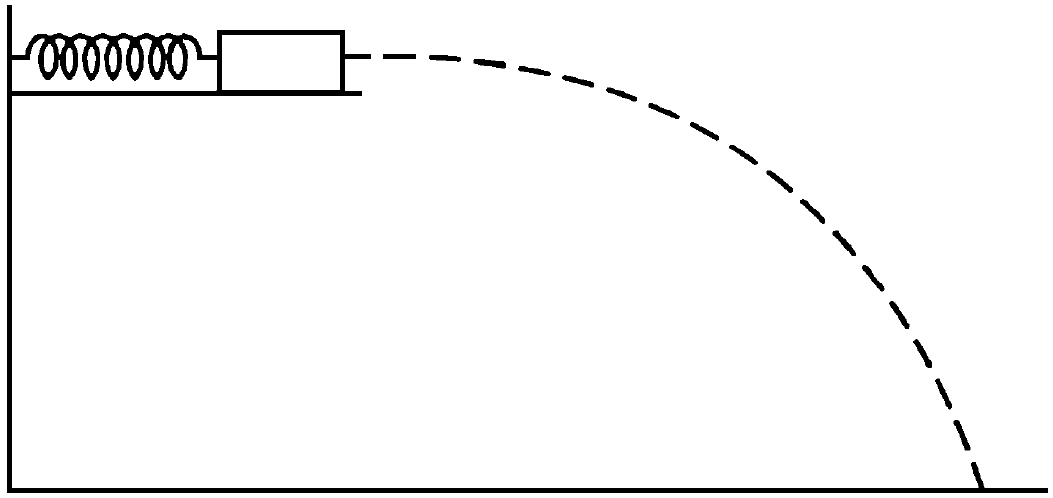
Answer
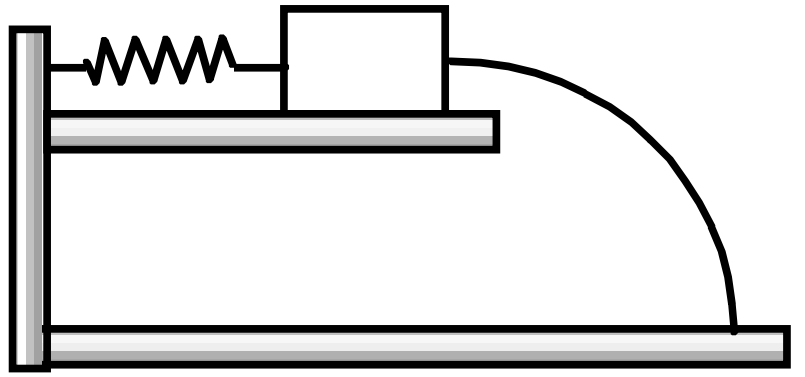 m = 100g = 0.1kg, x = 5cm = 0.05m, k = 100N/m
When the body leaves the spring, let the velocity be v,
$\frac{1}{2}\text{mv}^2=\frac{1}{2}\text{k}\text{x}^2$
$\Rightarrow\text{v}=\text{x}\sqrt{\frac{\text{k}}{\text{m}}}$
$\Rightarrow0.05\times\sqrt{\frac{100}{0.1}}=1.58\text{m}/\text{sec}$
For the projectile motion, $\theta=0^\circ,\text{Y}=-2$
Now, $\text{Y}=(\text{u}\sin\theta)\text{t}-\frac{1}{2}\text{gt}^2$
$\Rightarrow-2=\Big(\frac{-1}{2}\Big)\times9.8\times\text{t}^2$
$\Rightarrow\text{t}=0.63\text{sec}$
So, $\text{x}=(\text{u}\cos\theta)\text{t}$
$\Rightarrow1.58\times0.63=1\text{m}$ View full question & answer→Question 723 Marks
A body of mass $1.0kg$ initially at rest is moved by a horizontal force of $0.5N$ on a smooth frictionless table. Calculate the work done by the force in $10s$ and show that this is equal to the change in kinetic energy of the body.
AnswerAcceleration of a body, $\mathrm{a}=\frac{\mathrm{F}}{\mathrm{m}}=\frac{0.5}{1.0}=0.5 \mathrm{~ms}^{-2}$ Distance travelled, $\mathrm{s}=\mathrm{ut}+\frac{1}{2} \mathrm{at}^2$
$\mathrm{s}=0+\frac{1}{2} \times 0.5(10)^2=25 \mathrm{~m}$ Work done $=\mathrm{F} \times \mathrm{s}=0.5 \times 25=12.5 \mathrm{~J} \mathrm{v}=\mathrm{u}+$ at $0+0.5 \times 10=5 \mathrm{~ms}^{-1}$ Change in, $\mathrm{KE}=\frac{1}{2} \mathrm{~m}\left(\mathrm{v}^2-\mathrm{u}^2\right)=\frac{1}{2} \times 1.0\left(5^2-0\right)=12.51$
View full question & answer→Question 733 Marks
The potential energy function for a particle executing linear simple harmonic motion is given by $\text{V(x)} = \frac{\text{kx}^2}{2},$ where k is the force constant of the oscillator. For $k = 0.5Nm^{-1}$, the graph of V(x) versus x is shown in Show that a particle of total energy $1J$ moving under this potential must ‘turn back’ when it reaches $\text{x} =\pm 2\text{m}.$
AnswerGiven, Potential energy for a particle executing linear simple harmonic motion is, $\text{V(x)}=\frac{1}{2}\text{kx}^2$ Where, $\text{k}=\frac{1}{2}\text{N/m}$
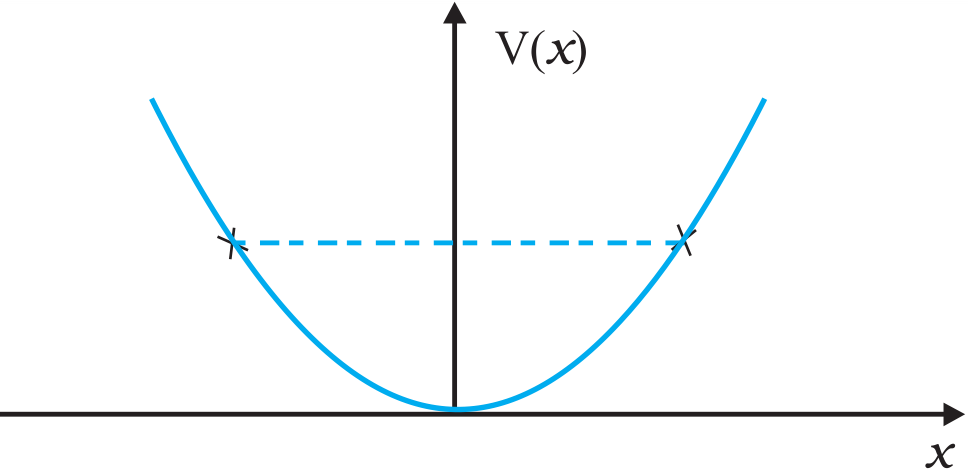
Total energy of particle E = 1J
Since at extreme position total energy is potential energy, $\therefore\text{V}=\frac{1}{2}\text{kx}^2=1\text{J}$ $\Rightarrow\text{x}=\pm\sqrt{\frac{2}{\text{k}}}=\pm\sqrt{4}$ $\Rightarrow\text{x}=\pm2\text{m}$ Hence the results. View full question & answer→Question 743 Marks
In one-dimensional elastic collision of equal masses, the velocities are interchanged. Can velocities in a onedimensional collision be interchanged if the masses are not equal?
AnswerNo, it’s not possible as total momentum is to be constant thus if heavy body is at rest and light body is moving the light body will move back with same speed in opposite direction. If a heavy body strikes a lighter body at rest the light body would start moving with double as velocity of heavy body but the heavy body would retain its velocity.
View full question & answer→Question 753 Marks
A vertical spring with constant $200N/ m$ has a light platform on its top. When a $500g$ mass is kept on the platform spring compresses $2.5cm$. Mass is now pushed down $7.50cm$ further and released. How far above later position will the mass fly? $(g = 10ms^{-2})$.
AnswerWhen the external force is removed after the push, the mass gets detached when spring obtain its natural length and say, mass m rises h height from the pushed position.
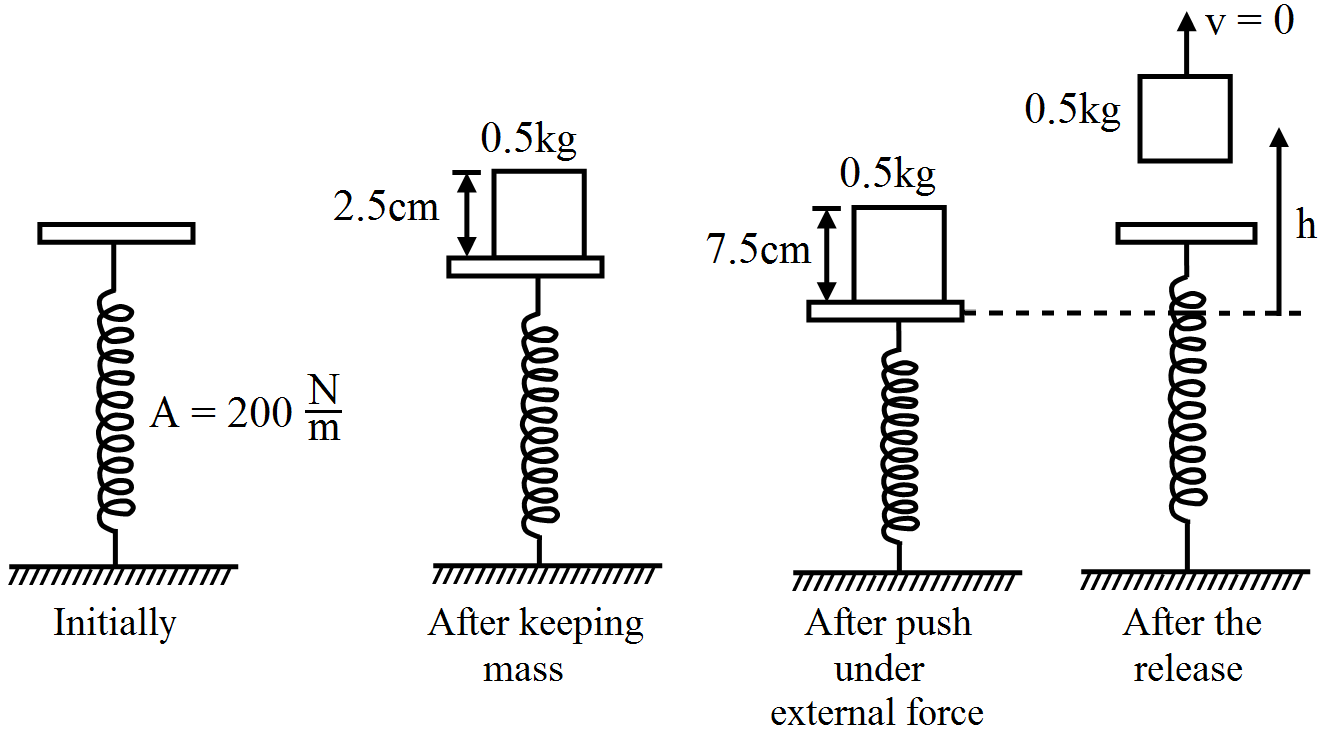
Loss in Potential energy of spring = Gain in gravitational potential energy. $\frac{1}{2}\text{k}[\text{x}^2]=\text{mgh}$ $\frac{1}{2}\times200[0.1]^2$ = 0.5 × 10 × h 1 = 5h ⇒ h = 0.2m View full question & answer→Question 763 Marks
The spring constant of the spring shown in figure is $250N/m.$ Find the maximum compression of the spring. 
AnswerGiven: K = spring constant = 250N/ m Considering a non-elastic collision between blocks. The combined mass moves with the velocity v. $m_1v_1 + m_2v_2 = (m_1 + m_2 )v = ( 5 + 1 ) v 5 \times 15 + 0 = 6v$
$\Rightarrow \text{v}=\frac{75}{6}\text{m/ s}$ Applying conservation of energy, $\frac{1}{2}(\text{m}_1\text{m}_2)\text{v}^2=\frac{1}{2}\text{k}\text{x}^2$
where, x = maximum compression of the spring.
$\Rightarrow6\times\frac{75}{6}\times\frac{75}{6}=250\times\text{x}^2$
$\Rightarrow\text{x}^2=\frac{5625}{250\times6}=\frac{5625}{1500}=3.75$
$\Rightarrow\text{x}=1.93\text{m}$
View full question & answer→Question 773 Marks
The bob A of a pendulum released from 30° to the vertical hits another bob B of the same mass at rest on a table as shown in. How high does the bob A rise after the collision? Neglect the size of the bobs and assume the collision to be elastic.
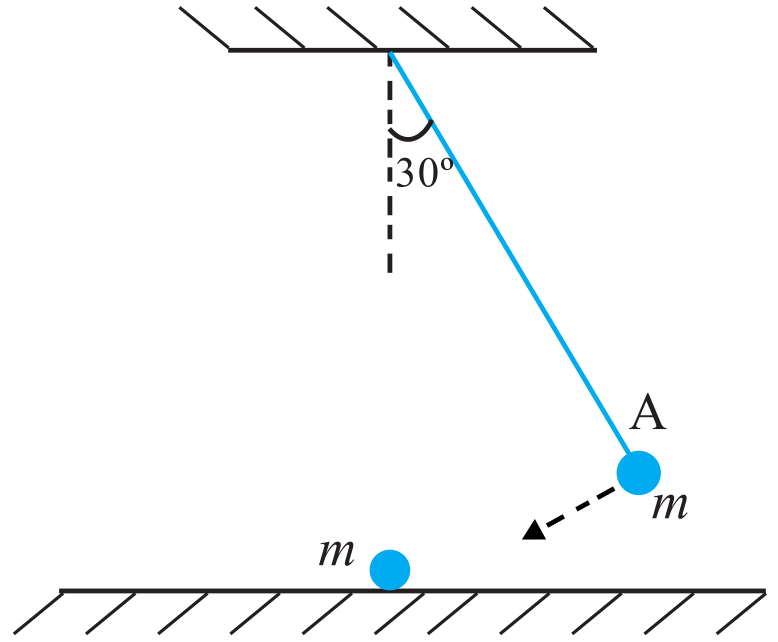
AnswerWhen two bodies of same mass undergo elastic collisions their velocities get interchanged. In the given situation, bob A is moving with certain speed and bob B is at rest. Therefore, after collision, bob A comes to rest and the bob B starts moving with the speed of bob A. The whole momentum of bob A will get transfer to bob B and so bob A, will not rise at all after the second collision. Therefore bob A will come to rest and bob B will keep on moving.
View full question & answer→Question 783 Marks
A rough inclined plane is placed on a cart moving with a constant velocity u on horizontal ground. A block of mass M rests on the incline. Is any work done by force of friction between the block and incline? Is there then a dissipation of energy?
AnswerAs block is at rest on inclined plane as shown in figure.
; background:rgba(220,220,220,0.5))
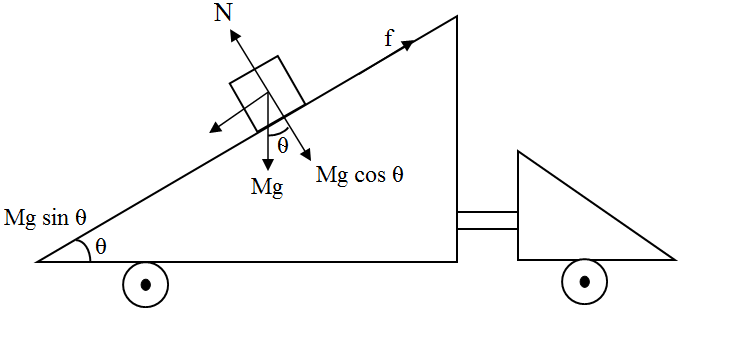
Force of friction on body is due to the tendency of block M to slide Mg sinq down over the inclined plane. As there is no displacement in block so work done
f by and block is zero. As there is no work, so no dissipation of energy takes place.
View full question & answer→Question 793 Marks
Two bodies A and B having masses me and my respectively have equal kinetic energies. If $p_A$ and $P_B$ are their respective momentaa, then prove that the ratio of momenta is equal to the square root of ratio of respective masses.
AnswerLet $v_A$ and $v_B$_ be the velocities of A and B respectively. Since their kinetic energies are equal, $\therefore\frac{1}{2}\text{m}_\text{A}\upsilon_\text{A}^2=\frac{1}{2}\text{m}_\text{B}\upsilon_\text{B}^2$
$\text{m}_\text{A}\upsilon_\text{A}^2=\text{m}_\text{B}\upsilon_\text{B}^2$
$(\text{m}_\text{A}\upsilon_\text{A})\upsilon_\text{A}=(\text{m}_\text{B}\upsilon_\text{B})\upsilon_\text{B}$
$\text{p}_\text{A}\upsilon_\text{A}=\text{p}_\text{B}\upsilon_\text{B}\Rightarrow\frac{\text{p}_\text{A}}{\text{p}_\text{B}}=\frac{\upsilon_\text{B}}{\upsilon_\text{A}}$ From equation (i), $\frac{\upsilon_\text{A}^2}{\upsilon_\text{B}^2}=\frac{\text{m}_\text{B}}{\text{m}_\text{A}}$
$\frac{\upsilon_\text{A}}{\upsilon_\text{B}}=\sqrt{\frac{\text{m}_\text{B}}{\text{m}_\text{A}}}$ From equation (ii), $\frac{\text{p}_\text{A}}{\text{p}_\text{B}}=\sqrt{\frac{\text{m}_\text{A}}{\text{m}_\text{B}}}$
View full question & answer→Question 803 Marks
Figure shows a particle sliding on a frictionless track which terminates in a straight horizontal section. If the particle starts slipping from the point A, how far away from the track will the particle hit the ground?
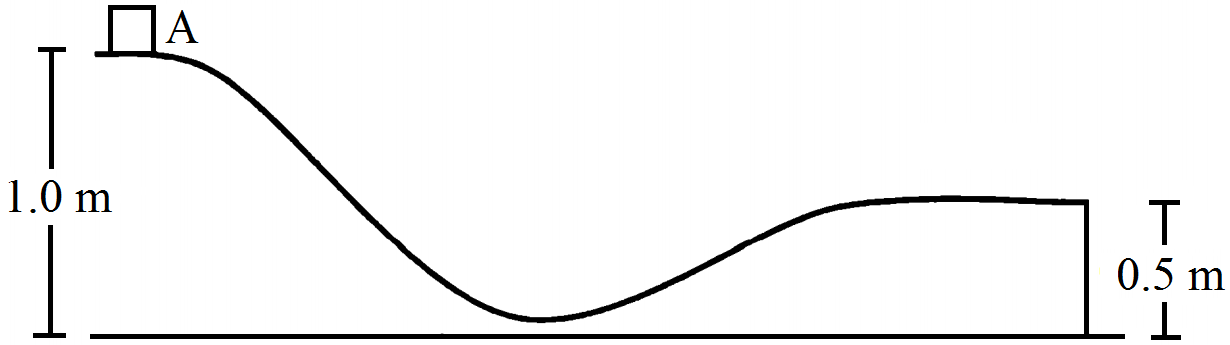
Answer
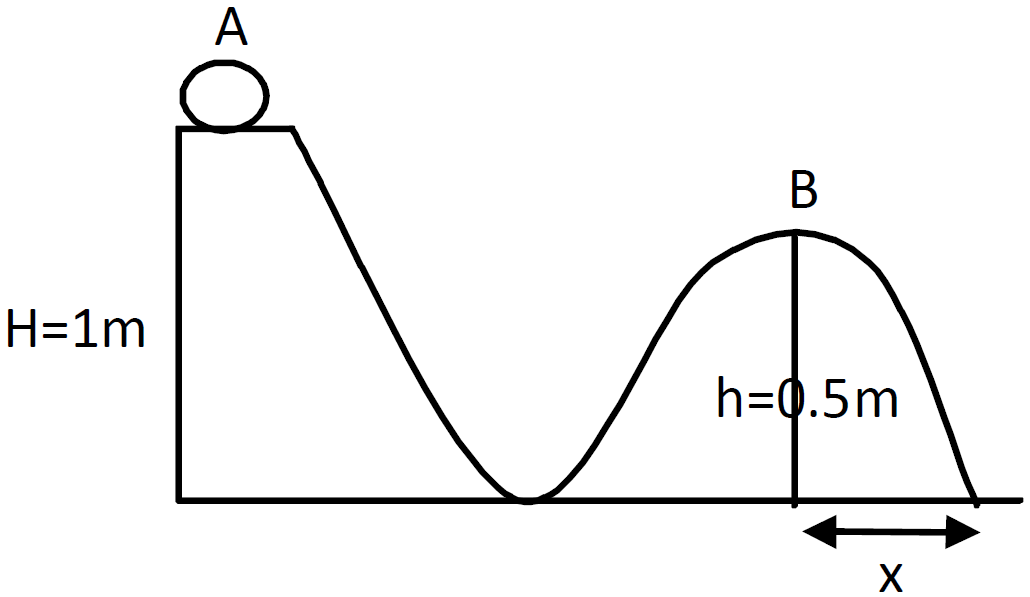
H = 1m, h = 0.5mApplying law of conservation of Energy for point A & B
$\text{mgH}=\frac{1}{2}\text{mv}^2+\text{mgh}$
$\Rightarrow\text{g}=\frac{1}{2}\text{v}^2+0.5\text{g}$
$\Rightarrow\text{v}^22(\text{g}-0.59)=\text{g}$
$\Rightarrow\text{v}=\sqrt{\text{g}}=3.1\text{m}/\text{s}$
After point B the body exhibits projectile motion for which
$\theta=0^\circ,\text{v}=-0.5$
So, $-0.5=(\text{u}\sin\theta)\text{t}-\Big(\frac{1}{2}\Big)\text{gt}^2$
$\Rightarrow0.5=4.9\ \text{t}^2$
$\Rightarrow\text{t}=0.31\text{sec}$
So, $\text{x}=(\text{v}\cos\theta)\text{t}$
$=3.1\times3.1=1\text{m}$
So, the particle will hit the ground at a horizontal distance in from B. View full question & answer→Question 813 Marks
Figure shows a spring fixed at the bottom end of an incline of inclination $37^\circ$. A small block of mass 2kg starts slipping down the incline from a point 4.8m away from the spring. The block compresses the spring by 20cm, stops momentarily and then rebounds through a distance of 1m up the incline. Find.
- The friction coefficient between the plane and the block.
- The spring constant of the spring. Take $g = 10m/s^2.$
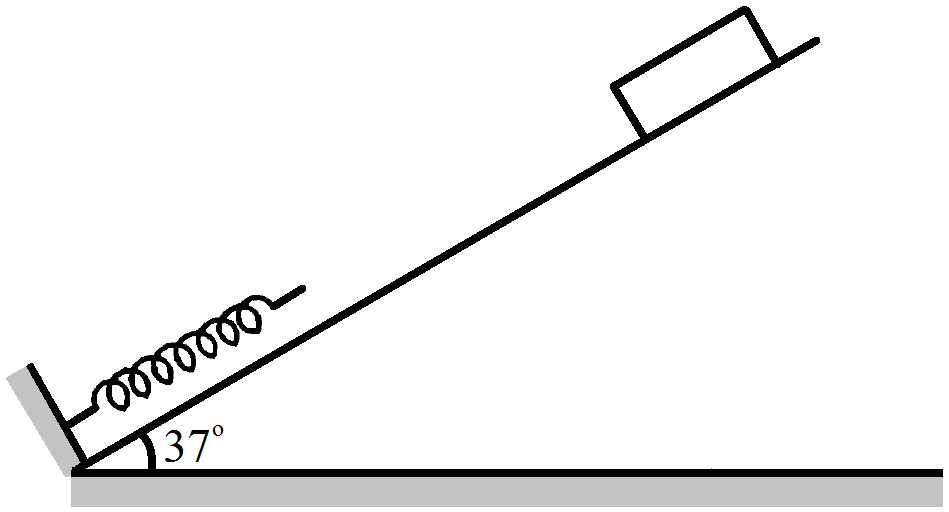
Answer
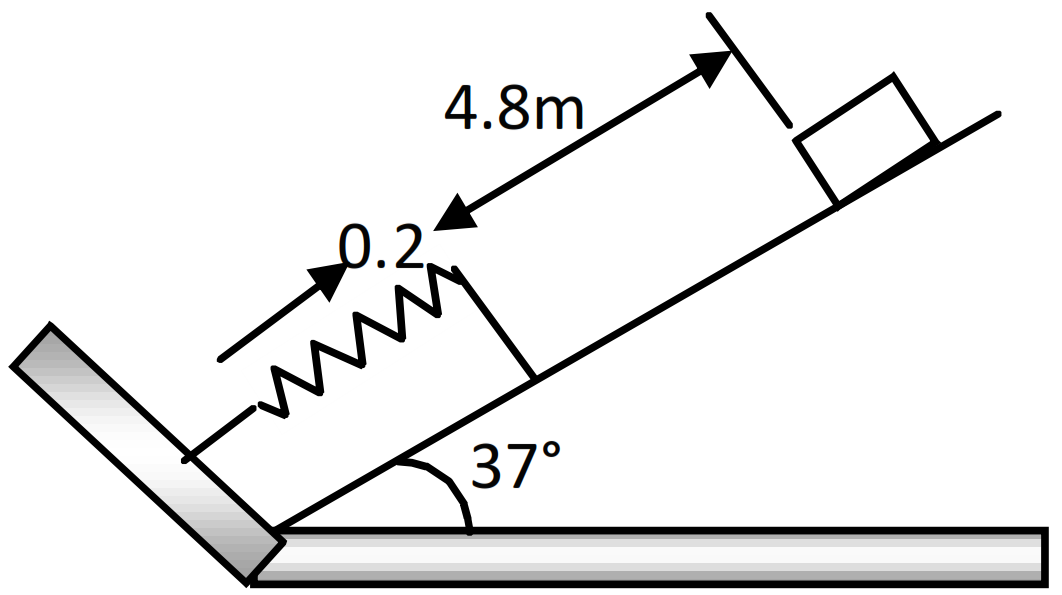
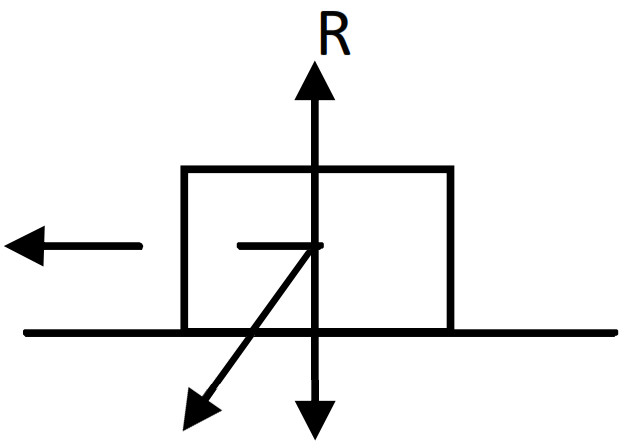
$m = 2kg, s_1 = 4.8m, R = 20cm = 0.2m, s_2 = 1m,$
$\sin37^\circ=0.60=\frac{3}{5},\theta=37^\circ,$
$ \cos37^\circ=.79=0.8=\frac{4}{5},\text{g}=10\text{m}/\text{sec}^2$
Applying work – Energy principle for downward motion of the body
$0-0=\text{mg}\sin37^\circ\times5-\mu\text{R}\times5-\frac{1}{2}\text{kx}^2$
$\Rightarrow20\times(0.60)\times1-\mu\times20\times(0.80)\times1+\frac{1}{2}\text{k}(0.2)^2=0$
$\Rightarrow60-80\mu-0.02\text{k}=0$
$\Rightarrow80\mu+0.02\text{k}=60\ \dots(1)$
Similarly, for the upward motion of the body the equation is,
$0-0=(-\text{mg}\sin37^\circ)\times1-\mu\text{R}\times1+\frac{1}{2}\text{k}(0.2)^2$
$\Rightarrow-20\times(0.60)\times1-\mu\times20\times(0.80)\times1+\frac{1}{2}\text{k}(0.2)^2=0$
$\Rightarrow-12-16\mu+0.02\text{K}=0\ \dots(2)$
Adding equation (i) & equation (ii), we get $96\mu=48$
$\Rightarrow\mu=0.5$
Now putting the value of $\mu$ in equation (1), K = 1000N/m View full question & answer→Question 823 Marks
On complete combustion a litre of petrol gives off heat equivalent to $3 × 10⁷J$. In a test drive a car weighing $1200kg$. including the mass of driver, runs $15km$ per litre while moving with a uniform speed on a straight track. Assuming that friction offered by the road surface and air to be uniform, calculate the force of friction acting on the car during the test drive, if the efficiency of the car engine were $0.5$
AnswerEfficiency of car engine $=0.5 \therefore$ Energy given by car by 1 litre of petrol $=0.5 \times 3 \times 10^7=1.5 \times 10^7$ Work done by car in $15 \mathrm{~km}=\mathrm{F} . \mathrm{s}=\mathrm{f} \times 15000 \mathrm{~J}\{\mathrm{~s}=15 \mathrm{~km}=15000 \mathrm{~m} / \mathrm{l}\}$ This work done by car in only against force of friction as car is going horizontally only, $\mathrm{f} \times 15000=1.5 \times 10^7 \therefore \mathrm{f}=\frac{1.5 \times 10^7}{15000}=10^3 \mathrm{~N}$
View full question & answer→Question 833 Marks
A mass m displaces in a straight line, guided by a machine delivering constant power. Prove that the displacement (x) is proportional to $\text{t}^\frac{3}{2}$
AnswerPower = Constant Fv = Constant $\text{m}\frac{\text{dv}}{\text{dt}}\text{v}=\text{Constant}\text({K})$ $\int\text{vdv}=\frac{\text{k}}{\text{m}}\int\text{dt}$ $\frac{\text{v}^2}{2}=\frac{\text{k}}{\text{m}}\text{t}$ $\text{v}^2=\frac{2\text{k}}{\text{m}}\text{t}\Rightarrow\text{v}=\sqrt{\frac{2\text{k}}{\text{m}}}\text{t}$ $\frac{\text{dx}}{\text{dt}}=\sqrt{\frac{2\text{k}}{\text{m}}}\int\text{t}^\frac{1}{2}\text{dt}$ $\text{x}=\sqrt{\frac{2\text{k}}{\text{m}}}\frac{\text{t}^\frac{3}{2}}{\frac{3}{2}}$ $=\frac{2}{3}\sqrt{\frac{2\text{k}}{\text{m}}}\text{t}^\frac{3}{2}$
View full question & answer→Question 843 Marks
A body of mass M at rest is struck by a moving body of mass m. Show that the fraction of the initial kinetic energy of moving mass m transferred to the struck body is $4Mm /(m + M)^2.$
AnswerHere, $m_1 = m, m_2 = Mu_1 = u$ (say) and $u_2 = 0.$
View full question & answer→Question 853 Marks
A constant force of 2.50N accelerates a stationary particle of mass 15g through a displacement of 2.50m. Find the work done and the average power delivered.
Answer
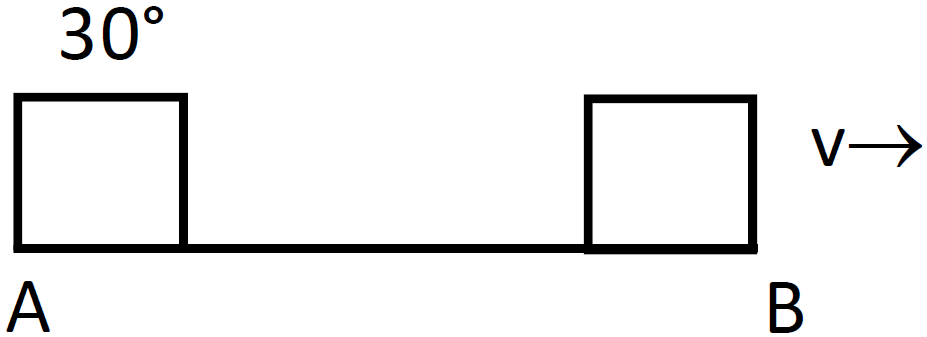 F = 2.50N, S = 2.5m, m = 15g = 0.015kg.
So, $\text{w} =\text{F} \times \text{S}$
$\Rightarrow\text{a}=\frac{\text{F}}{\text{m}}=\frac{2.5}{0.015}$
$=\frac{500}{3}\text{m/s}^2$
$=\text{F}\times\text{S}\cos0^\circ$ (acting along the same line)
$=2.5\times2.5=6.25\text{J}$
Let the velocity of the body at b = U. Applying work-energy principle $\frac{1}{2}\text{mv}^2-0=6.25$
$\Rightarrow\text{V}=\sqrt{\frac{6.25\times2}{0.015}}=28.86\text{m/sec}$
So, time taken to travel from A to B.
$\Rightarrow\text{t}=\frac{\text{v-u}}{\text{a}}=\frac{28.86\times3}{500}$
$\therefore$ Average power $=\frac{\text{W}}{\text{t}}=\frac{6.25\times500}{(28.86)\times3}=36.1$ View full question & answer→Question 863 Marks
What is the amount of work done by
- A weightlifter in holding a weight of 120 kg on his shoulder for 30 s, and.
- A locomotive against gravity, if it is travelling on a level plane?
Question 873 Marks
Calculate the power of a motor which is capable of raising of water in 5 min from a well 120m deep.
AnswerHere, the volume of water raised V = 2000)L Density of water $\rho=1\text{kg/ L} $ $\therefore$ Mass of water raised $\text{m}=\text{V}\rho=2000\times1=2000\text{kg}$ Power$\text{P}=\frac{\text{W}}{\text{t}}$ $=\frac{\text{mgh}}{\text{t}}$ $=\frac{2000\times9.8\times120}{5\times60}$ $=7840\text{W}$ $=7.840\text{kW}$ $[1\text{kW}=1000\text{W}]$
View full question & answer→Question 883 Marks
A uniform chain of mass m and length l overhangs a table with its two third part on the table. Find the work to be done by a person to put the hanging part back on the table.
Answer
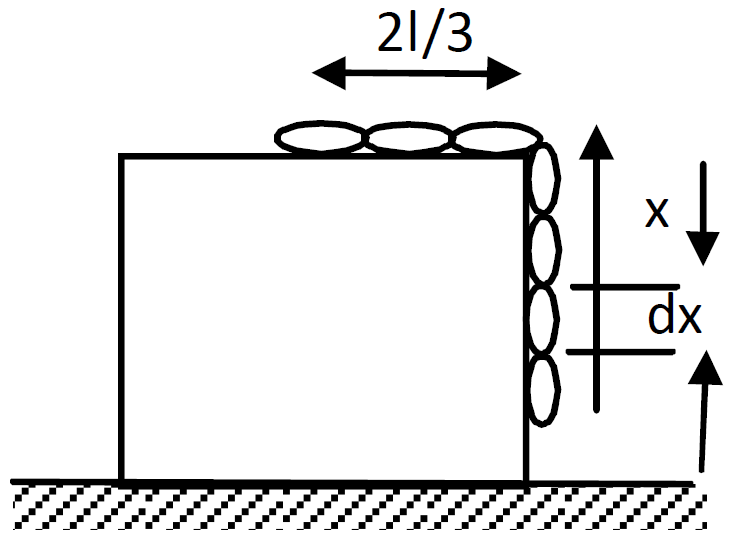 Let ‘dx’ be the length of an element at a distance × from the table
mass of ‘dx’ length $=\Big(\frac{\text{m}}{\ell}\Big)\text{dx}$
Work done to put dx part back on the table,
$\text{W}=\Big(\frac{\text{m}}{\ell}\Big)\text{dx }\text{g(x)}$
So, total work done to put $\frac{\ell}{3}$ part back on the table,
$\text{W}=\int\limits_0^{\frac{1}{3}}\Big(\frac{\text{m}}{\ell}\Big)\text{gx dx}$
$\Rightarrow\text{W}=\Big(\frac{\text{m}}{\ell}\Big)\text{g}\Big[\frac{\text{x}^2}{2}\Big]_0^\frac{\ell}{3}$
$\Rightarrow\frac{\text{mg}\ell^2}{18\ell}=\frac{\text{mg}\ell}{18}$ View full question & answer→Question 893 Marks
When an apple falls from a tree what happens to its gravitational potential energy just as it reaches the ground? After it strikes the ground?
AnswerWhen an apple falls from a tree, its gravitational potential energy decreases as it reaches the ground. After it strikes the ground, its potential energy will remain unchanged.
View full question & answer→Question 903 Marks
A particle of mass m moves on a straight line with its velocity varying with the distance travelled according to the equation $\text{v}=\text{a}\sqrt{\text{x}},$ where a is a constant. Find the total work done by all the forces during a displacement from x = 0 to x = d.
AnswerGiven, $\text{v}=\text{a}\sqrt{\text{x}},$ (uniformly accelerated motion) Displacement $\text{s} =\text{d} – 0 =\text{d}$ Putting $\text{x} = 0, \text{v}_1= 0$ Puttin $\text{x}=\text{d},\text{v}_2=\text{a}\sqrt{\text{d}}$ $\text{a}=\frac{\text{v}_2^2-\text{u}_2^2}{2\text{s}}$ $=\frac{\text{a}^2\text{d}}{2\text{d}}=\frac{\text{a}^2}{2}$ Force $\text{F}=\text{ma}=\frac{\text{ma}^2}{2}$ Work done $\text{W}=\text{Fs}\cos\theta$ $\text{W}=\frac{\text{ma}^2}{2}\times\text{d}=\frac{\text{ma}^2\text{d}}{2}$
View full question & answer→Question 913 Marks
The pulley shown in figure has a radius of 20cm and moment of inertia $0.2kg-m^2$. The string going over it is attached at one end to a vertical spring of spring constant 50N/m fixed from below, and supports a 1kg mass at the other end. The system is released from rest with the spring at its natural length. Find the speed of the block when it has descended through 10cm. Take g $= 10m/s_2$. 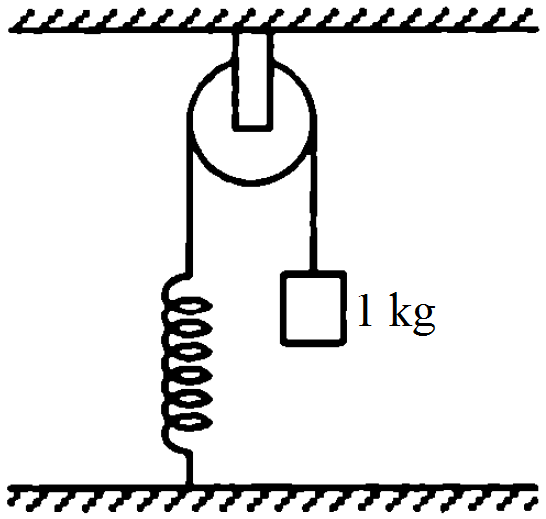
Answer
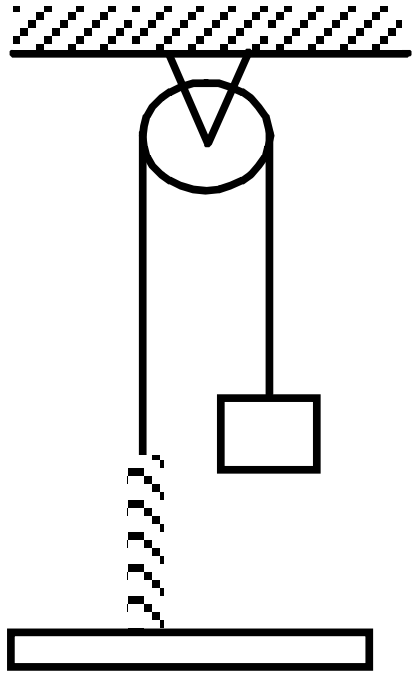
$l = 0.2kg-m^2, r = 0.2m, K = 50N/m,$
$m = 1kg, g = 10ms^2, h = 0.1m$
Therefore applying laws of conservation of energy
$\text{mgh}=\frac{1}{2}\text{mv}^2+\frac{1}{2}\text{kx}^2$
$\Rightarrow1=\frac{1}{2}\times1\times\text{v}^2+\frac{1}{2}\times0.2\times\frac{\text{v}^2}{0.04}\\+\Big(\frac{1}{2}\Big)\times50\times0.01$ $(\text{x}=\text{h})$
$\Rightarrow1=0.5\text{v}^2+2.5\text{v}^2+\frac{1}{4}$
$\Rightarrow\text{3v}^2=\frac{3}{4}$
$\Rightarrow\text{v}=\frac{1}{2}=0.5\text{m/s}.$ View full question & answer→Question 923 Marks
A block of mass 5.0kg is suspended from the end of a vertical spring which is stretched by 10cm under the load of the block. The block is given a sharp impulse from below so that it acquires an upward speed of 2.0m/s. How high will it rise? Take g = $10m/s^2.$
Answer$m =5 kg, x =10 cm=0.1 m, v =2 m / sec , h =? G =10 m / sec ^2$
So, $\text{k}=\frac{\text{mg}}{\text{x}}=\frac{50}{0.1}=500\text{N}/\text{m}$
Total energy just after the blow $\text{E}=\frac{1}{2}\text{mv}^2+\frac{1}{2}\text{kx}^2\ \dots(1)$
Total energy a a height h $=\frac{1}{2}\text{k}(\text{h}-\text{x})^2+\text{mgh}\ \dots(2)$
$=\frac{1}{2}\text{mv}^2+\frac{1}{2}\text{kx}^2$
$=\frac{1}{2}\text{k}(\text{h}-\text{x})^2+\text{mgh}$ On, solving we can get, H = 0.2m = 20cm
View full question & answer→Question 933 Marks
An electric fan of mass $2kg$ falls from the ceiling of a lift moving down with uniform speed of $2ms^{-1}$. It hits the floor of the lift (length of the lift = $2m$) and does not rebound. How much heat will be produced by the impact?
AnswerMass of the fan, $\mathrm{m}=2 \mathrm{~kg}$ Length of the elevator, $\mathrm{h}=2 \mathrm{~m}$. The kinetic energy acquired by the fan during its fall is: $\mathrm{E}=$ $\mathrm{mgh}=2 \times 9.8 \times 2=39.2 \mathrm{~J}$ The amount of heat produced will also be 39.2 J , as in accordance with the law of conservation of energy, whole of the kinetic energy will be converted into heat.
View full question & answer→Question 943 Marks
A particle of mass 4m which is at rest explodes into three fragments. Two of these fragments each of mass m, are found to move with a speed of v, each in mutually perpendicular direction. What is the total energy released in this process?
Answer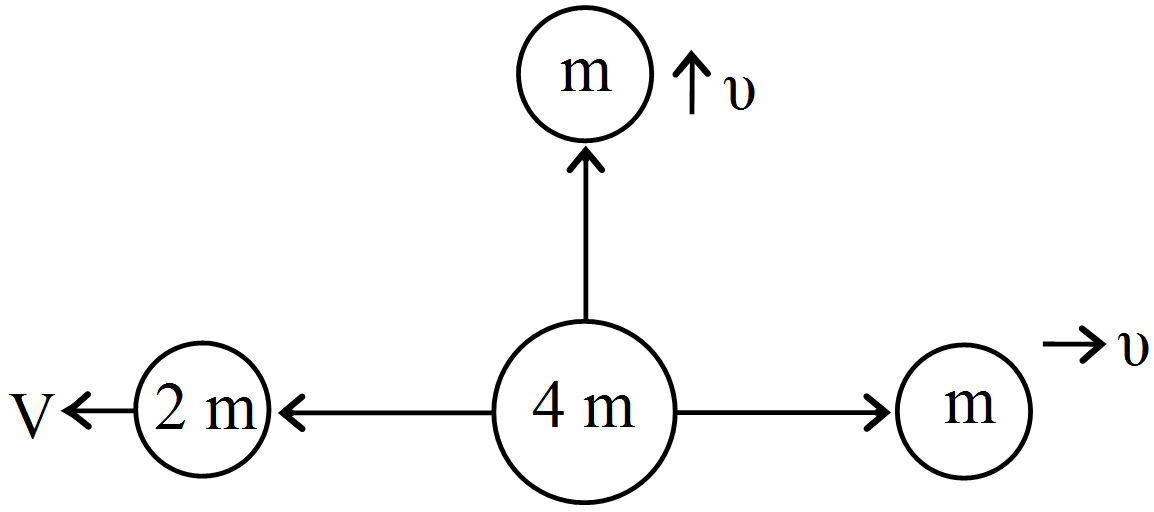 $\sqrt{2}\text{ mv}=(2\text{m})\text{V}$ $\text{V}=\frac{\text{v}}{\sqrt{2}}$ Total K.E. $=\frac{1}{2}\text{mv}^2+\frac{1}{2}\text{mv}^2+\frac{1}{2}(2\text{m})\frac{\text{v}^2}{2}$ $=\frac{3}{2}\text{mv}^2$
 View full question & answer→Question 953 Marks
Can normal force do a nonzero work on an object. If yes, give an example. If no, give reason.
AnswerYes. Let us consider an elevator accelerating upward with a body placed in it. In this case, the normal reaction offered by the floor of the elevator on the body is greater than the weight of the body acting in the downward direction. If a person is observing this from the ground, then, for him, the normal reaction is doing a positive work, as the elevator is moving upward.
View full question & answer→Question 963 Marks
A simple pendulum of length lm has a wooden bob of mass $1kg$. It is struck by a bullet of mass $10^{-2}kg$ moving with a speed of $2 \times 10^2m/ sec$. The bullet gets embedded into the bob. Obtain the height to which the bob rises before swinging back.
AnswerMomentum of the bullet = $10^{-2} \times 2 \times 10^2kg\ ms^{-1}$ Momentum with bob after collision = $(10^{-2} + 1)$. v Since momentum is conserved $\text{v}=\frac{2}{(1.01)}\text{ ms}^{-1}$ According to conservation of energy $\frac{1}{2}(\text{M}+\text{m})\text{v}^2=\text{M}+\text{m})\text{ gh}$
$\therefore\text{h}=\frac{\text{v}^2}{2\text{g}}=\bigg(\frac{2}{1.01}\bigg)^2\times\frac{1}{20}$ $=0.196\text{ m}=0.2\text{ m}$
View full question & answer→Question 973 Marks
A body of mass $2\ kg$ is initially at rest. A constant force of $5\ N$ acts on it for $10\ s.$ Calculate the average power of the force.
AnswerHere, $m = 2\ kg, u = 0, F = 5\ N, t = 10\ s,$
View full question & answer→Question 983 Marks
A block of mass M is pulled along a horizontal surface by applying a force at an angle with horizontal. Coefficient of friction between block and surface is u. If the block travels with uniform velocity, find the work done by this applied force during ú displacement d of the block.
AnswerThe forces acting on the block are shown in Figure. As the block moves with uniform velocity the forces add up to zero.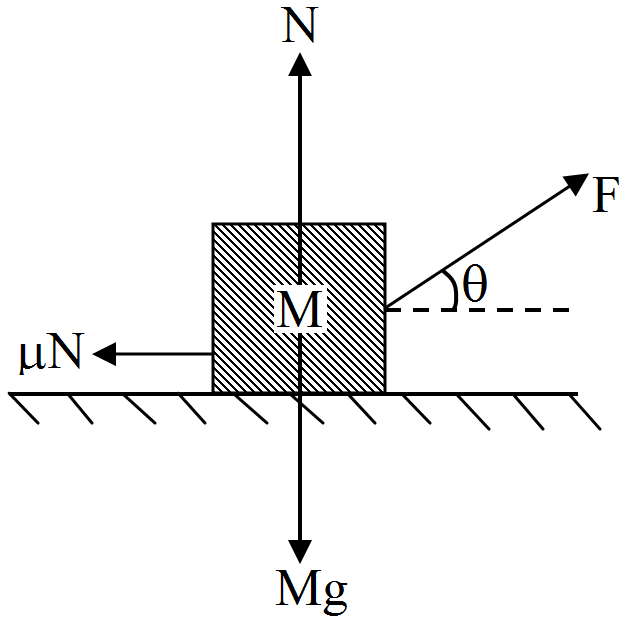
$\therefore\text{F}\cos\theta=\mu\text{N}\cdots\text{(i)}$ $\text{F}\sin\theta+\text{N}=\text{mg}\cdots\text{(ii)}$ Eliminating N from equation (i) and (ii), $\text{F}\cos\theta=\mu(\text{Mg}-\text{F}\sin\theta)$ $\text{F}=\frac{\mu\text{Mg}}{\cos\theta+\mu\sin\theta}$ Work done by this force during a displacement d $\text{W}=\text{F}.\text{d}\cos\theta=\frac{\mu\text{Mgd}\cos\theta}{\cos\theta+\mu\sin\theta}$ View full question & answer→Question 993 Marks
- What is the scale factor of human relative to monkey in relation to heartbeats?
- What is the monkey's heart rate?
Answer
- Human heart rate is about 70 beats/ min and scale factor is 2.5.
- Monkey's heart rate = 70 ~ 2.5 = 175.
View full question & answer→Question 1003 Marks
If stretch in a spring of force constant k is doubled, calculate:
- Ratio of final to initial force in the spring.
- Ratio of elastic energies stored in the two cases.
- Work done in changing to the state of double stretch.
Answer
- For a given spring F = kx
$\therefore\frac{\text{F}_2}{\text{F}_1}=\frac{\text{kx}_2}{\text{kx}_1}=\frac{2\text{x}}{\text{x}}=2$
- For a given spring, $\text{U}=\frac{1}{2}\text{kx}^2$
$\frac{\text{U}_2}{\text{U}_1}=\frac{\frac{1}{2}\text{kx}_2^2}{\frac{1}{2}\text{kx}_1^2}=\frac{(2\text{x})^2}{\text{x}^2}=4$
- Since work done in stretching the spring is stored in the spring in the form of elastic potential energy of the spring, therefore,
$\text{W}=\text{U}_2-\text{U}_1=\frac{1}{2}\text{kx}_2^2-\frac{1}{2}\text{kx}_1^2$
$\Rightarrow\text{W}=\frac{1}{2}\text{k}\Big[(2\text{x})^2-\text{x}^2\Big]=\frac{3}{2}\text{kx}^2$ View full question & answer→Question 1013 Marks
To simulate car accidents, auto manufacturers study the collisions of moving cars with mounted springs of different spring constants. Consider a typical simulation with a car of mass $1000 \ kg$ moving with a speed $18.0 \ km / h$ on a smooth road and colliding with a horizontally mounted spring of spring constant $5.25 \times 10^3 N m ^{-1}$. What is the maximum compression of the spring?
AnswerAt maximum compression the kinetic energy of the car is converted entirely into the potential energy of the spring.
The kinetic energy of the moving car is
$K=\frac{1}{2} m v^2$
$=\frac{1}{2} \times 10^3 \times 5 \times 5$
$K=1.25 \times 10^4 J$
where we have converted $18 \ km h ^{-1}$ to $5 m s ^{-1}$ [It is useful to remember that $36 \ km h ^{-1}=10 m s ^{-1}$.
At maximum compression $x_m$, the potential energy $V$ of the spring is equal to the kinetic energy $K$ of the moving car from the principle of conservation of mechanical energy.
$V=\frac{1}{2} k x_m^2$
$=1.25 \times 10^4 J$
We obtain
$x_m=2.00 m$
We note that we have idealised the situation.
The spring is considered to be massless.
The surface has been considered to possess negligible friction.
View full question & answer→Question 1023 Marks
A woman pushes a trunk on a railway platform which has a rough surface. She applies a force of $100 N$ over a distance of $10 m.$ Thereafter, she gets progressively tired and her applied force reduces linearly with distance to $50 N.$ The total distance through which the trunk has been moved is $20 m.$ Plot the force applied by the woman and the frictional force, which is $50 N$ versus displacement. Calculate the work done by the two forces over $20 m.$
Answer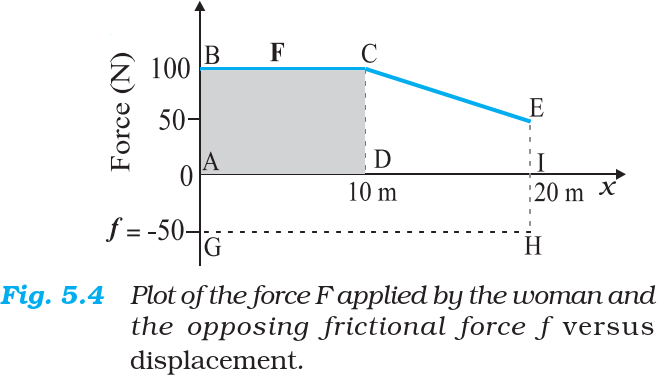
The plot of the applied force is shown in Fig. $5.4.$ At $x=20 m , F=50 N (\neq 0)$.
We are given that the frictional force $f$ is $| f |=50 N$.
It opposes motion and acts in a direction opposite to $F$.
It is therefore, shown on the negative side of the force axis.
The work done by the woman is
$W_F \rightarrow$ area of the rectangle $\text{ABCD} +$ area of the trapezium $\text{CEID}$
$W_F=100 \times 10+\frac{1}{2}(100+50) \times 10$
$=1000+750$
$=1750 J$
The work done by the frictional force is
$W_f \rightarrow$ area of the rectangle $\text{AGHI}$
$W_f=(-50) \times 20$
$=-1000 J$
The area on the negative side of the force axis has a negative sign. View full question & answer→Question 1033 Marks
It is well known that a raindrop falls under the influence of the downward gravitational force and the opposing resistive force. The latter is known to be proportional to the speed of the drop but is otherwise undetermined. Consider a drop of mass $1.00 g$ falling from a height $1.00 \ km$. It hits the ground with a speed of $50.0\ m s ^{-1}. (a)$ What is the work done by the gravitational force? What is the work done by the unknown resistive force?
Answer$(a)$ The change in kinetic energy of the drop is
$\Delta K=\frac{1}{2} m v^2-0$
$=\frac{1}{2} \times 10^{-3} \times 50 \times 50$
$=1.25 J$
where we have assumed that the drop is initially at rest.
Assuming that $g$ is a constant with a value $10\ m / s ^2$,
the work done by the gravitational force is,
$W_g =m g h$
$ =10^{-3} \times 10 \times 10^3$
$ =10.0 J$
$(b)$ From the work$-$energy theorem
$\Delta K=W_g+W_r$
where $W_r$ is the work done by the resistive force on the raindrop.
Thus $W_r =\Delta K-W_g$
$ =1.25-10$
$ =-8.75 J$
is negative.
View full question & answer→Question 1043 Marks
Slowing down of neutrons: In a nuclear reactor a neutron of high speed (typically $10^7 m s ^{-1}$ ) must be slowed to $10^3 m s ^{-1}$ so that it can have a high probability of interacting with isotope ${ }_{92}^{235} U$ and causing it to fission. Show that a neutron can lose most of its kinetic energy in an elastic collision with a light nuclei like deuterium or carbon which has a mass of only a few times the neutron mass. The material making up the light nuclei, usually heavy water $\left( D _2 O \right)$ or graphite, is called a moderator.
AnswerThe initial kinetic energy of the neutron is
$
K_{1 i}=\frac{1}{2} m_1 v_{1 i}^2
$
while its final kinetic energy from Eq. (5.26)
$
K_{1 f}=\frac{1}{2} m_1 v_{1 f}^2=\frac{1}{2} m_1\left(\frac{m_1-m_2}{m_1+m_2}\right)^2 v_{1 i}^2
$
The fractional kinetic energy lost is
$
f_1=\frac{K_{1 f}}{K_{1 i }}=\left(\frac{m_1-m_2}{m_1+m_2}\right)^2
$
while the fractional kinetic energy gained by the moderating nuclei $K_{2 f} / K_{l i}$ is
$
\begin{array}{c}
f_2=1-f_1 \text { (elastic collision) } \\
=\frac{4 m_1 m_2}{\left(m_1+m_2\right)^2}
\end{array}
$
One can also verify this result by substituting from Eq. (5.27).
For deuterium $m_2=2 m_1$ and we obtain $f_1=1 / 9$ while $f_2=8 / 9$. Almost $90 \%$ of the neutron's energy is transferred to deuterium. For carbon $f_1=71.6 \%$ and $f_2=28.4 \%$. In practice, however, this number is smaller since head-on collisions are rare.
View full question & answer→