Question 13 Marks
Just as precise measurements are necessary in science, it is equally important to be able to make rough estimates of quantities using rudimentary ideas and common observations. Think of ways by which you can estimate the following (where an estimate is difficult to obtain, try to get an upper bound on the quantity): The total mass of rain-bearing clouds over India during the Monsoon.
AnswerDuring monsoons, a metrologist records about 215 cm of rainfall in India i.e., the height of water column, $\mathrm{h}=215 \mathrm{~cm}$ $=2.15 \mathrm{~m}$ Area of country, $\mathrm{A}=3.3 \times 10^{12} \mathrm{~m}^2$
Hence, volume of rain water, $\mathrm{V}=\mathrm{A} \times \mathrm{h}=7.09 \times 10^{12} \mathrm{~m}^3$ Density of water, $\mathrm{p}=1 \times 10^3 \mathrm{~kg} \mathrm{~m}^{-3}$
Hence, mass of rain water $=\mathrm{p} \times \mathrm{V}=7.09 \times 10^{15} \mathrm{~kg}$ Hence, the total mass of rain-bearing clouds over India is approximately $7.09 \times 10^{15} \mathrm{~kg}$
View full question & answer→Question 23 Marks
Explain this common observation clearly: If you look out of the window of a fast moving train, the nearby trees, houses etc. seem to move rapidly in a direction opposite to the train’s motion, but the distant objects (hill tops, the Moon, the stars etc.) seem to be stationary. (In fact, since you are aware that you are moving, these distant objects seem to move with you).
AnswerLine of sight is defined as an imaginary line joining an object and an observer’s eye. When we observe nearby stationary objects such as trees, houses, etc. while sitting in a moving train, they appear to move rapidly in the opposite direction because the line of sight changes very rapidly. On the other hand, distant objects such as trees, stars, etc. appear stationary because of the large distance. As a result, the line of sight does not change its direction rapidly.
View full question & answer→Question 33 Marks
Just as precise measurements are necessary in science, it is equally important to be able to make rough estimates of quantities using rudimentary ideas and common observations. Think of ways by which you can estimate the following (where an estimate is difficult to obtain, try to get an upper bound on the quantity): The number of air molecules in your classroom.
AnswerLet the volume of the room be V. One mole of air at NTP occupies 22.4 li.e., $22.4 \times 10^{-3} \mathrm{~m}^3$ volume. Number of molecules in one mole $=6.023 \times 10^{23} \therefore$ Number of molecules in room of volume V
$=6.023 \times 10^{23} / 22.4 \times 10^{-3} \mathrm{~V}=134.915 \times 10^{26} \mathrm{~V}=1.35 \times 10^{28} \mathrm{~V}$
View full question & answer→Question 43 Marks
The Sun is a hot plasma (ionized matter) with its inner core at a temperature exceeding 107K, and its outer surface at a temperature of about 6000K. At these high temperatures, no substance remains in a solid or liquid phase. In what range do you expect the mass density of the Sun to be, in the range of densities of solids and liquids or gases? Check if your guess is correct from the following data : mass of the Sun = 2.0 × 1030kg, radius of the Sun = 7.0 × 10⁸m.
AnswerMass of the Sun, $M = 2.0 \times 10^{30}kg$ Radius of the Sun, $R = 7.0 \times 10^8m$
Density, $\rho= ?$
$\rho=\frac{\text{mass}}{\text{volume}}=\frac{\text{M}}{\frac{4}{3}\pi\text{R}^3}=\frac{3\text{M}}{4\pi\text{R}^3}=\frac{3\times2.0\times10^{30}}{4\times3.14(7\times10^8)^3}$
$=1.392\times10^3\text{Kg/m}^3$
The density of the Sun is in the density range of solids and liquids. This high density is attributed to the intense gravitational attraction of the inner layers on the outer layer of the Sun.
View full question & answer→Question 53 Marks
A calorie is a unit of heat (energy in transit) and it equals about $4.2 J$ where $1J = 1kg m^2 s^{–2}$. Suppose we employ a system of units in which the unit of mass equals $\alpha\text{ kg},$ the unit of length equals $\beta\text{ m},$ the unit of time is $\gamma\text{ s}.$ Show that a calorie has a magnitude $4.2\ \alpha^{-1}\ \beta^{-2}\ \gamma^2$ in terms of the new units.
AnswerGiven that, 1 Calorie =$4.2 J = 4.2Kg m^2 s^{-2} …… (i)$ As new unit of mass $\alpha\text{ kg}$$\therefore\ 1\text{kg}=1/\alpha$ new unit of mass
Similarly, $1\text{m}=\beta^{-1}$ new unit of length$1\text{s}=\gamma^{-1}$ new unit of time
Putting these values in (i), we get 1 calorie = 4.2 ($\alpha^{-1}$ new unit of mass)($\beta^{-1}$ new unit of length)$^2$($\gamma^{-1}$ new unit of time)$^{-2}=4.2\ \alpha^{-1}\beta^{-2}\ \gamma^{2}$ new unit of energy (Proved)
View full question & answer→Question 63 Marks
A physical quantity P is related to four observables a, b, c and d as follows:$\text{P}=\text{a}^3\text{b}^3/\big(\sqrt{\text{c}}\text{ d}\big)$
The percentage errors of measurement in a, b, c and d are 1%, 3%, 4% and 2%, respectively. What is the percentage error in the quantity P ? If the value of P calculated using the above relation turns out to be 3.763, to what value should you round off the result ?
Answer$\text{P}=\frac{\text{a}^3\text{b}^2}{(\sqrt{\text{c}}\text{ d})}$Maximum fractional error in P is given by
$\frac{\Delta\text{P}}{\text{P}}=\pm\Big[3\frac{\Delta\text{a}}{\text{a}}+2\frac{\Delta\text{b}}{\text{b}}+\frac{1}{2}\frac{\Delta\text{c}}{\text{c}}+\frac{\Delta\text{d}}{\text{d}}\Big]\\=\pm\Big[3\Big(\frac{1}{100}\Big)+2\Big(\frac{3}{100}\Big)+\frac{1}{2}\Big(\frac{4}{100}\Big)+\frac{2}{100}\Big]$
$=\pm\frac{13}{100}=\pm0.13$
Percentage error in $\text{P}=\frac{\Delta\text{P}}{\text{P}}\times100=\pm0.13\times100=\pm13\%$
Percentage error in P = 13%
Value of P is given as 3.763.
By rounding off the given value to the first decimal place, we get P = 3.8.
View full question & answer→Question 73 Marks
The length, breadth and thickness of a rectangular sheet of metal are $4.234m, 1.005m$, and $2.01cm$ respectively. Give the area and volume of the sheet to correct significant figures.
AnswerGiven that, length, $\mathrm{I}=4.234 \mathrm{~m}$ breadth, $\mathrm{b}=1.005 \mathrm{~m}$ thickness, $\mathrm{t}=2.01 \mathrm{~cm}=2.01 \times 10^{-2} \mathrm{~m}$ Area of the sheet $=2(\mathrm{l} \times 0$ $+\mathrm{b} \times \mathrm{t}+\mathrm{t} \times \mathrm{l})=2(4.234 \times 1.005+1.005 \times 0.0201+0.0201 \times 4.234)=2(4.3604739)=8.7209478 \mathrm{~m} 2$ As area can contain a maximum of three significant digits, therefore, rounding off, we get Area $=8.72 \mathrm{~m}^2$ Also, volume $=1 \times \mathrm{b} \times \mathrm{t}$ $V=4.234 \times 1.005 \times 0.0201=0.0855289=0.0855 \mathrm{~m}^3($ Significant Figures $=3)$
View full question & answer→Question 83 Marks
Just as precise measurements are necessary in science, it is equally important to be able to make rough estimates of quantities using rudimentary ideas and common observations. Think of ways by which you can estimate the following (where an estimate is difficult to obtain, try to get an upper bound on the quantity): The mass of an elephant.
AnswerConsider a ship of known base area floating in the sea. Measure its depth in sea $\left(\right.$ say $\left.\mathrm{d}_1\right)$. Volume of water displaced by the ship, $\mathrm{Vb}=\mathrm{Ad}_1$ Now, move an elephant on the ship and measure the depth of the ship $\left(\mathrm{d}_2\right)$ in this case. Volume of water displaced by the ship with the elephant on board, $\mathrm{V}_{\mathrm{be}}=\mathrm{Ad}_2$ Volume of water displaced by the elephant $=A d_2-A d_1$ Density of water $=D$ Mass of elephant $=A D\left(d_2-d_1\right)$
View full question & answer→Question 93 Marks
A SONAR (sound navigation and ranging) uses ultrasonic waves to detect and locate objects under water. In a submarine equipped with a SONAR, the time delay between generation of a probe wave and the reception of its echo after reflection from an enemy submarine is found to be $77.0s$. What is the distance of the enemy submarine? (Speed of sound in water = $1450m s^{–1}$).
AnswerLet the distance between the ship and the enemy submarine be ' S '. Speed of sound in water $=1450 \mathrm{~m} / \mathrm{s}$ Time lag between transmission and reception of Sonar waves $=77 \mathrm{~s}$ In this time lag, sound waves travel a distance which is twice the distance between the ship and the submarine (2S). Time taken for the sound to reach the submarine = $1 / 2$ $\times 77=38.5 \mathrm{~s}$
$\therefore$ Distance between the ship and the submarine $(S)=1450 \times 38.5=55825 \mathrm{~m}=55.8 \mathrm{~km}$
View full question & answer→Question 103 Marks
When the planet Jupiter is at a distance of 824.7 million kilometers from the Earth, its angular diameter is measured to be 35.72” of arc. Calculate the diameter of Jupiter.
AnswerDistance of Jupiter from the Earth, $D = 824.7 \times 10^6km = 824.7 \times 10^9m$ Angular diameter $= 35.72^“ = 35.72 \times 4.874 \times 10^{-6}$ rad Diameter of Jupiter = d Using the relation,$\theta=\frac{\text{d}}{\text{D}}$
$\text{d}=\theta\text{ D}=824.7\times10^9\times35.72\times4.872\times10^{-6}$
$= 143520.76 \times 10^3\text{m} = 1.435 \times 10^5\text{Km}$
View full question & answer→Question 113 Marks
Precise measurements of physical quantities are a need of science. For example, to ascertain the speed of an aircraft, one must have an accurate method to find its positions at closely separated instants of time. This was the actual motivation behind the discovery of radar in World War II. Think of different examples in modern science where precise measurements of length, time, mass etc. are needed. Also, wherever you can, give a quantitative idea of the precision needed.
AnswerIt is indeed very true that precise measurements of physical quantities are essential for the development of science. For example, ultra-shot laser pulses (time interval ∼ $10^{–15} s$) are used to measure time intervals in several physical and chemical processes. X-ray spectroscopy is used to determine the inter-atomic separation or inter-planer spacing. The development of mass spectrometer makes it possible to measure the mass of atoms precisely.
View full question & answer→Question 123 Marks
A new unit of length is chosen such that the speed of light in vacuum is unity. What is the distance between the Sun and the Earth in terms of the new unit if light takes 8min and 20s to cover this distance?
AnswerDistance between the Sun and the Earth = Speed of light × Time taken by light to cover the distance Given that in the new unit, speed of light = 1 unit Time taken, t = 8min 20s = 500s$\therefore$ Distance between the Sun and the Earth = 1 × 500 = 500 units
View full question & answer→Question 133 Marks
The farthest objects in our Universe discovered by modern astronomers are so distant that light emitted by them takes billions of years to reach the Earth. These objects (known as quasars) have many puzzling features, which have not yet been satisfactorily explained. What is the distance in km of a quasar from which light takes 3.0 billion years to reach us?
AnswerTime taken by quasar light to reach Earth $=3$ billion years $=3 \times 10^9$ years $=3 \times 10^9 \times 365 \times 24 \times 60 \times 60$ s Speed of light $=3 \times 10^8 \mathrm{~m} / \mathrm{s}$ Distance between the Earth and quasar $=\left(3 \times 10^8\right) \times\left(3 \times 10^9 \times 365 \times 24 \times 60 \times 60\right)=283824 \times$ $10^{20} \mathrm{~m}=2.8 \times 10^{22} \mathrm{~km}$
View full question & answer→Question 143 Marks
The principle of ‘parallax’ in section $2.3.1$ is used in the determination of distances of very distant stars. The baseline AB is the line joining the Earth’s two locations six months apart in its orbit around the Sun. That is, the baseline is about the diameter of the Earth’s orbit $\approx 3 \times 10^{11}m$. However, even the nearest stars are so distant that with such a long baseline, they show parallax only of the order of $1”$ (second) of arc or so. A parsec is a convenient unit of length on the astronomical scale. It is the distance of an object that will show a parallax of $1”$ (second of arc) from opposite ends of a baseline equal to the distance from the Earth to the Sun. How much is a parsec in terms of metres?
AnswerDiameter of Earth's orbit $=3 \times 10^{11} \mathrm{~m}$ Radius of Earth's orbit, $\mathrm{r}=1.5 \times 10^{11} \mathrm{~m}$ Let the distance parallax angle be1" $=$ $4.847 \times 10^{-6} \mathrm{rad}$. Let the distance of the star be D . Parsec is defined as the distance at which the average radius of the Earth's orbit subtends an angle of $1^{\prime \prime} \therefore$ We have $\theta=\frac{\mathrm{I}}{\mathrm{D}}$
$\text{D}=\frac{\text{r}}{\theta}=\frac{1.5\times10^{11}}{4.847\times10^{-6}}$
$=0.309\times10^{-6}\approx3.09\times10^{16}\text{m}$
Hence, 1 parsec $\approx3.09\times10^{16}\text{m}.$
View full question & answer→Question 153 Marks
The photograph of a house occupies an area of $1.75cm^2$ on a $35mm$ slide. The slide is projected on to a screen, and the area of the house on the screen is $1.55m^2$. What is the linear magnification of the projector-screen arrangement.
AnswerArea of the house on the slide $=1.75 \mathrm{~cm}^2$ Area of the image of the house formed on the screen $=1.55 \mathrm{~m}^2=1.55 \times$ $10^4 \mathrm{~cm}^2$ Arial magnification, $\mathrm{m}_{\mathrm{a}}=$ Area of Image/Area of Object $=(1.55 / 1.75) \times 10^4 .$
$\therefore$ Linear magnifications, $\mathrm{m}_l=$ underroot $\mathrm{m}_{\mathrm{a}}$
$=\sqrt{\frac{1.55}{1.75}\times10^4}=94.11$
View full question & answer→Question 163 Marks
Find the dimensions of the following quantities
- Acceleration.
- Angle.
- Density.
- Kinetic energy.
- Gravitational constant.
- Permeability.
Answer
- Acceleration $=\frac{\text{Velocity}}{\text{Time}}$
$\therefore[\text{Acceleration}]=\frac{[\text{Velocity}]}{[\text{Time}]}=\frac{[\text{LT}^{-1}]}{[\text{T}]}=[\text{LT}^{-2}]$
- $\text{Angle}=\frac{\text{Distance}}{\text{Distance}}$
$\therefore$ angle is dimensionless
- $\text{Density}=\frac{\text{Mass}}{\text{Volume}}$
$\therefore[\text{Density}]=\frac{[\text{Mass}]}{[\text{Volume}]}$
$\therefore[\text{Density}]=\frac{[\text{Mass}]}{[\text{Volume}]}=\frac{[\text{M}]}{[\text{L}^3]}=[\text{ML}^{-3}]$
- Kinetic energy $=\frac{1}{2}\text{Mass}\times\text{Velocity}^2$
$\therefore$ [Kinetic energy] $=[\text{Mass}]\times[\text{Velocity}]^2=[\text{ML}^2\text{T}^{-2}]$
- Constant of gravitation occurs in Newton's law of gravitation:
$\text{F}=\text{G}\frac{\text{m}_1\text{m}_2}{\text{d}^2}$
$\therefore[\text{G}]=\frac{[\text{F}][\text{d}^2]}{[\text{m}_1][\text{m}_2]}$
$=\frac{\text{MLT}^{-2}\text{L}^2}{[\text{M}][\text{M}]}=[\text{M}^{-1}\text{L}^3\text{T}^{-2}]$
- Permeability occurs in Ampere's law of force:
$\Delta\text{F}=\mu\frac{(\text{i}_1\Delta\text{l}_1)(\text{i}_2\Delta\text{l}_2)\sin\theta}{\text{r}^2}$
$\therefore[\mu]=\frac{[\Delta\text{F}][\text{r}^2]}{[\text{i}_1\Delta\text{l}_1][\text{i}_2\Delta\text{l}_2]}$
$=\frac{[\text{MLT}^{-2}]}{[\text{AL}][\text{AL}]}=[\text{MLT}^{-2}\text{A}^{-2}]$ View full question & answer→Question 173 Marks
Why length, mass and time are chosen as base quantities in mechanics?
AnswerIn mechanics, length, mass and time are chosen as the base quantities because
- There is nothing simpler to length, mass and time.
- All other quantities in mechanics can be expressed in terms of length, mass and time.
- Length, mass and time cannot be derived from one another.
View full question & answer→Question 183 Marks
Just as precise measurements are necessary in science, it is equally important to be able to make rough estimates of quantities using rudimentary ideas and common observations. Think of ways by which you can estimate the following (where an estimate is difficult to obtain, try to get an upper bound on the quantity): The total mass of rain-bearing clouds over India during the Monsoon.
AnswerDuring monsoons, a metrologist records about 215 cm of rainfall in India i.e., the height of water column, $\mathrm{h}=215 \mathrm{~cm}$ $=2.15 \mathrm{~m}$ Area of country, $\mathrm{A}=3.3 \times 10^{12} \mathrm{~m}^2$ Hence, volume of rain water, $\mathrm{V}=\mathrm{A} \times \mathrm{h}=7.09 \times 10^{12} \mathrm{~m}^3$ Density of water, $\mathrm{p}=1 \times 10^3 \mathrm{~kg} \mathrm{~m}^{-3}$ Hence, mass of rain water $=\mathrm{p} \times \mathrm{V}=7.09 \times 10^{15} \mathrm{~kg}$ Hence, the total mass of rain-bearing clouds over India is approximately $7.09 \times 10^{15} \mathrm{~kg}$
View full question & answer→Question 193 Marks
Express the average distance of earth from the sun in:
- Light year.
- Par sec.
AnswerAverage distance of earth from the sun is $(r) \frac{1.496\times10^{11}}{9.46\times10^{15}}=1.58\times10^{-5}\text{ ly}$ Also, $\text{r}=\frac{1.496\times10^{11}}{3.08\times10^{16}}\text{per sec}$ $=4.86\times10^{-6}\text{per sec}$
View full question & answer→Question 203 Marks
A physical quantity Q is given by$\text{Q}= \frac{\text{A}^2\text{B}^\frac{3}{2}}{\text{C}^{+4}\text{D}^\frac{1}{2}}$
The percentage error in A, B, C, D are 1%, 2%, 4%, 2% respectively. Find the percentage error in Q.
Answer$\% \text{ error in} \text{ Q}=2 \Big(\frac{\text{dA}}{A}\times100\Big)+\frac{3}{2}\Big(\frac{\text{dB}}{\text{B}}\times100\Big)$ $+4\Big(\frac{\text{dC}}{\text{C}}\times100\Big)+\frac{1}{2}\Big(\frac{\text{dB}}{\text{D}}\times100\Big) $ $= 2\times1+\frac{3}{2}\times2+4\times4+\frac{1}{2}\times2$ $=2+3+16+1= 22\%$
View full question & answer→Question 213 Marks
E, m, I and G denote energy, mass, angular momentum and gravitational constant respectively. Determine the dimensions of $\frac{\text{El}^2}{\text{m}^5\text{G}^2}$
AnswerDimensions of $\text{E}=[\text{M}\text{L}^2\text{T}^{-2}]$ Dimensions of $\text{l}=[\text{ML}^2\text{T}^{-2}]$ Dimensions of $\text{m}=[\text{M}]$ Dimensions of $\text{G}=[\text{M}^{-1}\text{L}^{3}\text{T}^{-2}]$ $\therefore$ Dimensions of $\frac{\text{El}^2}{\text{m}^5\text{G}^2}$ $=\frac{[\text{ML}^2\text{T}^{-2}]{[\text{ML}^2\text{T}^{-2}]^2}}{[\text{M}]^5[\text{M}^{-1}\text{L}^{3}\text{T}^{2}]^{-2}}=1$ Thus $\frac{\text{El}^2}{\text{m}^5\text{G}^2}$is dimensionless.
View full question & answer→Question 223 Marks
How many astronomical units (A.U.) make 1 parsec?
AnswerAccording to the definition, 1 parsec is equal to the distance at which 1AU long arc subtends an angle of 1s. $\text{But}\ \ 1''=\frac{1}{3600}\times\frac{\pi}{180}\text{rad}$ $\therefore1\text{parsec}=\frac{3600\times180}{\pi}\text{AU}$ $=206265\text{AU}\approx2\times10^5\text{AU}$
View full question & answer→Question 233 Marks
Why do we have different units for the same physical quantity?
AnswerBecause, bodies differ in order of magnitude significantly in respect to the same physical quantity. For example, interatomic distances are of the order of angstroms, inter-city distances are of the order of km, and interstellar distances are of the order of light year.
View full question & answer→Question 243 Marks
Explain this common observation clearly: If you look out of the window of a fast moving train, the nearby trees, houses etc. seem to move rapidly in a direction opposite to the train’s motion, but the distant objects (hill tops, the Moon, the stars etc.) seem to be stationary. (In fact, since you are aware that you are moving, these distant objects seem to move with you).
AnswerLine of sight is defined as an imaginary line joining an object and an observer’s eye. When we observe nearby stationary objects such as trees, houses, etc. while sitting in a moving train, they appear to move rapidly in the opposite direction because the line of sight changes very rapidly. On the other hand, distant objects such as trees, stars, etc. appear stationary because of the large distance. As a result, the line of sight does not change its direction rapidly.
View full question & answer→Question 253 Marks
The wavelength 1 associated with a moving particle depends upon its mass m, its velocity v and Planck's constant h. Show dimensional relation between them.
AnswerSuppose wavelength à associated with a moving particle depends upon (i) its mass (m), (ii) its velocity (v) and (iii) Planck's constant (r)where, k is a dimensionless constant.
Writing dimensions of various terms,
We get:
$[\text{M}^0\text{L}^1\text{T}^0]=[\text{M}]^{\text{a}}[\text{LT}^{-1}]^{\text{b}}[\text{ML}^2\text{T}^{-1}]^{\text{c}}$
$=\text{M}^{\text{a}+\text{c}}\text{L}^{\text{b}+\text{2c}}\text{T}^{-\text{b}-\text{c}}$
Comparing power of M, L and T on two sides of equation,
We have:
$\text{a}+\text{c}=0,\text{b}+\text{2c}=1,-\text{b}-\text{c}=0$
We get:
$\text{a}=-1,\text{b}=-1,\text{c}=+1$
Hence, the relation becomes $\lambda=\frac{\text{kh}}{\text{mv}}$
View full question & answer→Question 263 Marks
The density of a cylindrical rod was measured by using the formula: $\rho=\frac{4\text{m}}{\pi\text{D}^2\text{l}}$
AnswerThe percentage errors in m, D and l are 1%, 1.5% and 0.5%. Calculate the percentage error in the calculated value of density. $\text{Density }\rho=\frac{4\text{m}}{\pi\text{D}^2\text{l}}$ $\therefore\Big(\frac{\Delta\rho}{\rho}\Big)_{\text{max}}=\frac{\Delta\text{m}}{\text{m}}+2\frac{\Delta\text{D}}{\text{D}}+\frac{\Delta\text{l}}{\text{l}}$ But, $\frac{\Delta\text{m}}{\text{m}}=1\%,\frac{\Delta\text{D}}{\text{D}}=1.5\%\text{ and }\frac{\Delta\text{l}}{\text{l}}=0.5\%$ $\therefore$ Maximum percentage error in calculated value of density $\Big(\frac{\Delta\rho}{\rho}\Big)_{\text{max}}=1\%+2\times1.5\%+0.5\%$ $=(1+3+0.5)\%=4.5\%$
View full question & answer→Question 273 Marks
The radius of curvature of a concave mirror measured by spherometer is given by $\text{R}=\frac{\text{I}^2}{6\text{h}}+\frac{\text{h}}{2}.$ The values of land h are 4cm and 0.065cm respectively. Compute the error in measurement of radius of curvature.
AnswerHere l = 4cm, $\Delta\text{I}=0.1\text{cm}$ (least count of the metre scale) Here l is the distance between the legs of the spherometer. h = 0.065cm, Ah = 0.001cm = (least count of the spherometer) $\text{As }\text{R}=\frac{\text{I}^2}{6\text{h}}+\frac{\text{h}}{2}$ Considering the magnitude only, We get: $\frac{\Delta\text{R}}{\text{R}}=2\frac{\Delta\text{I}}{\text{I}}+\frac{\Delta\text{h}}{\text{h}}+\frac{\Delta\text{h}}{\text{h}}$ $=2(\frac{\Delta\text{I}}{\text{I}}+\frac{\Delta\text{h}}{\text{h}})$ $=2\times\frac{0.1}{4}+\frac{2\times0.001}{0.065}$ $=0.05+0.03=0.08\%$
View full question & answer→Question 283 Marks
The sides of a rectangle are $(10.5\pm0.2)\text{cm}$ and $(52\pm0.1)\text{m}$ Calculate its perimeter with error limits.
Answer$\text{Given},\text{l}=(10.5\pm0.2)\text{cm},$ $\text{b}=(5.2\pm0.1)\text{cm}$ Perimeter of a rectangle $\text{p}=2(\text{l}+\text{b})$ $=2(10.5+5.2)=3.14\text{cm}$ $\Delta\text{p}=\pm(\Delta\text{l}+\Delta\text{b})$ $=\pm2(0.2+0.1)=\pm0.6$ Perimeter of a rectangle $=(31.4\pm0.6)\text{cm}$
View full question & answer→Question 293 Marks
The length, breadth and thickness of a rectangular sheet of metal are $4.234m, 1.005m$ and $2.01cm$ respectively. Calculate the surface area and volume of the sheet to correct significant figures.
AnswerLength $(l)=4.234 \mathrm{~m}$ Breadth $(b)=1.005 \mathrm{~m}$ Thickness $(\mathrm{h})=2.01 \mathrm{~cm}=0.0201 \mathrm{~m}$ Surface area of the sheet $=2(\mathrm{lb}+\mathrm{bh}+$
$\mathrm{lh})=2(4.234 \times 1.005+1.005 \times 0.0201+4.234 \times 0.0201)=8.7209478$. As the lowest significant figure in the given measurement is 3 (that of thickness) the volume and area should be expressed in 3 significant figures only. $\therefore$ Surface area $=8.72 \mathrm{~m}^2$ Volume of the sheet $=1 \times \mathrm{b} \times \mathrm{h}=4.234 \times 1.0050 .0201=0.0855289 \mathrm{~m}^3=0.086 \mathrm{~m}^3$ Length (l) $=4.234 \mathrm{~m}$ Breadth $(\mathrm{b})=1.005 \mathrm{~m}$ Thickness $(\mathrm{h})=2.01 \mathrm{~cm}=0.0201 \mathrm{~m}$ Surface area of the sheet $=2(\mathrm{lb}+\mathrm{bh}+\mathrm{lh})=$
$2(4.234 \times 1.005+1.005 \times 0.0201+4.234 \times 0.0201)=8.7209478$. As the lowest significant figure in the given measurement is 3 (that of thickness) the volume and area should be expressed in 3 significant figures only.
$\therefore$ Surface area $=8.72 \mathrm{~m}^2$ Volume of the sheet $=1 \times \mathrm{b} \times \mathrm{h}=4.234 \times 1.0050 .0201=0.0855289 \mathrm{~m}^3=0.086 \mathrm{~m}^3$
View full question & answer→Question 303 Marks
If the velocity of light (c), the constant of gravitation (G) and Planck's constant (h) be chosen as the fundamental units, find the dimensions of mass, length and time in the new system.
AnswerLet us write the dimensions of c, G and h in terms of M, L and T. $\text{Let}\text{M}=\text{Kc}^a\text{G}^b\text{h}^\text{y},$ where K is constant $\text{[M]}=\text{[LT}^{-1}]^\alpha\text{[M}^{-1}\text{[L}^3\text{T}^{-2}]^\beta\text{[ML}^2\text{T}^{-1}]^\gamma$ $=\text{[M}^{-\beta+\gamma}\text{L}^{\alpha+3\beta+2\gamma}\text{T}^{-\alpha-2\gamma}]$ Comparing the powers of M, L and T on both the sides, we have: $-\beta+\gamma=1$ $\alpha+3\beta+2\gamma=0$ $-\alpha-2\beta-\gamma=0$ Solving these equations, we get, $\alpha=\frac{1}{2},\beta=\frac{-1}{2},\gamma=\frac{1}{2}$ $\therefore \text{M}=\text{Kc}^\frac{1}{2}\text{G}^\frac{1}{2}\text{h}^\frac{1}{2}$ Taking$\text{K}=\text{I},$ we can write $\text{M}=_\text{c}^\frac{1}{2}\text{G}^{\frac{-1}{2}}\text{h}^\frac{1}{2}$ Similary,we can prove that. $\text{L}=_\text{c}^\frac{-3}{2}\text{G}^\frac{1}{2}\text{h}^\frac{1}{2}$ $\text{T}=_\text{c}^\frac{-5}{2}\text{h}^\frac{1}{2}\text{G}^\frac{1}{2}$
View full question & answer→Question 313 Marks
For a glass prism of refracting angle 60°, the minimum angle of deviation $D_m$ is found to be 36° with a maximum error of 1.05°. When a beam of parallel light is incident on the prism, find the range of experimental value of refractive index $'μ'.$ It is known that the refractive index $'μ'$ of the material of the prism is given by: $\mu=\frac{\sin\Big(\frac{\text{A}+\text{D}_\text{m}}{2}\Big)}{\sin\frac{\text{A}}{2}}$
AnswerError in calculated $D_m$ is $\pm1.05^{\circ}$ Given $\mu=\frac{\sin\Big(\frac{\text{A}+\text{D}_\text{m}}{2}\Big)}{\sin\frac{\text{A}}{2}}$ $\mu=\frac{\sin\Big(\frac{36^{\circ}\pm1.05}{2}}{\sin\Big(\frac{60}{2}\Big)}=\frac{\sin\Big(\frac{37.05}{2}\Big)}{\sin30^{\circ}}$ $=\frac{\sin(18.525)}{\frac{1}{2}}\text{or}\frac{\sin(17.475^{\circ})}{\frac{1}{2}}$
$\Rightarrow2\times0.755\text{ or }2\times0.73$
$\Rightarrow1.51\text{ or }1.46$ Here range of $\mu$ is $1.46\leq\mu\leq1.51$
View full question & answer→Question 323 Marks
By using the method of dimension, check the accuracy of the following formula : $ \text{T}=\frac{\text{rh}\rho\text{g}}{2\cos\theta},$where T is the surface tension, h is the height of the liquid,$\rho$ is the density of the liquid, g acceleration due to gravity $\theta$ angle of contact, and r is the radius of the tube.
AnswerIn order to find out the accuracy of the given equation we shall compare the dimensions of T and $\frac{\text{rh}\rho\text{g}}{2\cos\theta}$ $\text{T}=\frac{\text{force}}{\text{length}}=\frac{[\text{MLT}^{-2}]}{[\text{L}]}$ Dimension of $\frac{\text{rh}\rho\text{g}}{2\cos\theta}=[\text{L][L][ML}^{-3}][\text{LT}^{-2}]$ $(2\cos\theta$ has no dimension$)$The dimensions of both the sides are the same and hence the equation is correct.
View full question & answer→Question 333 Marks
Check by the method of dimensional analysis whether the following relations are correct. $\text{v}=\sqrt{\frac{\text{P}}{\text{D}}}$ where $v =$ velocity of sound and $P =$ pressure, $D =$ density of medium $\text{n}=\frac{1}{21}\sqrt{\frac{\text{F}}{\text{m}}},$ where $n =$ frequency of vibration $l =$ legnth of the string $F =$ Stretching force $m =$ mass per unit length of the string.
Answer
- $[\text{R.H.S}]=\sqrt{\frac{[\text{P}]}{\text{[D]}}}=\sqrt{\frac{[\text{ML}^{-1}\text{T}^{-2}]}{[\text{ML}^{-3}]}}=[\text{LT}^{-1}]$
$[\text{L.H.S}]=[\text{v}]=[\text{LT}^{-1}]$
$[\text{R.H.S.}]=[\text{L.H.S.}]$
Hence, the relation is correct.
- $[\text{R.H.S.}]=\frac{1}{[\text{l}]}\sqrt{\frac{[\text{F}]}{[\text{m}]}}$
$=\frac{1}{\text{L}}\sqrt{\frac{\text{MLT}^{-2}}{\text{ML}^{-1}}}=\frac{1}{\text{L}}[\text{LT}^{-1}]=[\text{T}^{-1}]$
$[\text{L.H.S.}]=\Big[\frac{1}{\text{Time}}\Big]=\frac{1}{\text{T}}=[\text{T}^{-1}]$
Hence, the relation is correct. View full question & answer→Question 343 Marks
A planet moves around the sun in a circular orbit. The time period of revolution $T$ of the planet depends on
- Radius of the orbit $(R)$.
- Mass of the sun $M$.
- Gravitational constant $G$.
Show dimensionally that $\text{T}^2\propto\text{R}^3$ Answer$\text{T}\propto\text{R}^\text{a}\text{M}^\text{b}\text{G}^\text{c}$ $\text{Or }\text{T}=\text{KR}^\text{a}\text{M}^\text{b}\text{G}^\text{c},$Where is constant substituting the dimension on both sides, we have $[\text{T]}=[\text{L]}^\text{a}[\text{M]}^\text{b}[\text{M}^{-1}\text{L}^3\text{T}^{-2}]^\text{c}$ $[\text{M}^o\text{L}^o\text{T}]=[\text{M}^\text{b-c}\text{L}^\text{a+3c}\text{T}^\text{-2c}]$ Comparing the power of $M, L$ and $T$, We get: $\text{b}-c=0$ $\text{a+3c=0}$ $-2\text{c=1}$ On solving, We get: $\text{a}=\frac{3}{2},\text{b}=\frac{-1}{2},\text{c}=\frac{-1}{2}$ $\text{T}=\text{KR}^\frac{3}{2}\text{M}^\frac{1}{2}\text{G}^{\frac{-1}{2}}$ $\text{T}\propto\text{R}^\frac{3}{2}$ $\text{T}^2\propto\text{R}^3$
View full question & answer→Question 353 Marks
The volume of a liquid flowing out per second of a pipe of length l and radius r is written by a student as, $\text{v}=\frac{\pi}{8}\frac{\text{Pr}^4}{\eta\text{l}}$ where P is the pressure difference between the two ends of the pipe and $\eta$ is coefficent of viscosity of the liquid having dimensional formula $ML^{-1} T^{-1}$. Check whether the equation is dimensionally correct.
AnswerIf dimensions of LHS of an equation is equal to dimensions of RHS, then equation is said to be dimensionally correct. According to the problem, the volume of a liquid flowing out per second of a pipe is given by $\text{V}=\frac{\pi}{8}\frac{\text{pr}^2}{\eta\text{l}}$ (where, V = rate of volume of liquid per unit time) Dimension of given physical quantities, $[\text{V}]=\frac{\text{Dimension of volume}}{\text{Dimension of time}}=\frac{[\text{L}^3]}{[\text{T}]}=[\text{L}^3\text{T}^{-1}],[\text{p}]=[\text{ML}^{-1}\text{T}^{-2}],$ $[\eta]=[\text{ML}^{-1}\text{T}^{-1}],[\text{l}]=[\text{L}],[\text{r}]=[\text{L}]$
$\text{LHS}=[\text{V}]=\frac{[\text{L}^3]}{[\text{T}]}=[\text{L}^3\text{T}^{-1}]$
$\text{RHS}=\frac{[\text{ML}^{-1}\text{T}^{-2}]\times[\text{L}^4]}{[\text{ML}^{-1}\text{T}^{-1}]\times[\text{L}]}=[\text{L}^3\text{T}^{-1}]$ Dimensionally, L.H.S. = R.H.S. Therefore, equation is correct dimensionally.
View full question & answer→Question 363 Marks
Compute the following with regards to significant figures.
- $4.6\times0.128$
- $\frac{0.9995\times1.53}{1.592}$
- $876+0.4382$
Answer
- $4.6 \times 0.128 = 0.5888 = 0.59$
The result has been rounded off to have two significant digits $($as in $4.6)$
- $\frac{0.9995\times1.53}{1.592}=0.96057=0.961$
- $876 + 0.4382 = 876.4382 = 876 .$
As, there is no decimal point in $876$, therefore, result of addition has been rounded off to no decimal point. View full question & answer→Question 373 Marks
The radius of curvature of a concave mirror measured by spherometer is $\text{R}=\frac{\text{l}^2}{6\text{h}}+\frac{\text{h}}{2}$ The values of 1 and h are 4cm and 0.065cm respectively. Compute the error in measurement of radius of curvature.
AnswerWe are given: $\text{l}=4\text{cm},\Delta\text{l}=0.1\text{cm}$ (least count of the metre scale) here l is the distance between the legs of the spherometer. $\text{R}=\frac{\text{l}^2}{6\text{h}}+\frac{\text{h}}{2}$ $\therefore\frac{\Delta\text{R}}{\text{R}}=\frac{2\Delta\text{l}}{\text{l}}+\Big(-\frac{\Delta\text{h}}{\text{h}}\Big)+\frac{\Delta\text{h}}{\text{h}}$ Considering the magnitudes only, We get: $\frac{\Delta\text{R}}{\text{R}}=2\frac{\Delta\text{l}}{\text{l}}+\frac{\Delta\text{h}}{\text{h}}+\frac{\Delta\text{h}}{\text{h}}$ $=2\Big(\frac{\Delta\text{l}}{\text{l}}+\frac{\Delta\text{h}}{\text{h}}\Big)$ $=2\times\frac{0.1}{4}+\frac{2\times0.001}{0.065}=0.05+0.03=0.08.$
View full question & answer→Question 383 Marks
Some measurements are taken for the period of oscillations of a simple pendulum. In successive measurements, the readings turn out to be $2.63s, 2.56s, 2.42s, 2.71s$ and $2.80s$. Calculate the absolute errors, relative error and percentage error.
Answer
- Mean value of time period,
$\text{T}=\frac{2.63+2.56+2.42+2.71+2.80}{5}$
$=2.62\text{sec}$
- Absolute error in time period
$\Delta\overline{\text{T}}=\frac{0.01+0.06+0.20+0.09+0.18}{5}=0.11\text{ sec}$
- Relative error, $\frac{\Delta\overline{\text{T}}}{\overline{\text{T}}}=\frac{0.11}{2.62}=0.04$
Percentage error, $\frac{\Delta\text{T}}{\text{T}}\times100=0.04\times100=4\%$ View full question & answer→Question 393 Marks
Just as precise measurements are necessary in science, it is equally important to be able to make rough estimates of quantities using rudimentary ideas and common observations. Think of ways by which you can estimate the following (where an estimate is difficult to obtain, try to get an upper bound on the quantity): The number of air molecules in your classroom.
AnswerLet the volume of the room be V . One mole of air at NTP occupies 22.4 I i.e., $22.4 \times 10^{-3} \mathrm{~m}^3$ volume. Number of molecules in one mole $=6.023 \times 10^{23} \therefore$ Number of molecules in room of volume $\mathrm{V}=6.023 \times 10^{23} / 22.4 \times 10^{-3} \mathrm{~V}=$ $134.915 \times 10^{26} \mathrm{~V}=1.35 \times 10^{28} \mathrm{~V}$
View full question & answer→Question 403 Marks
Given that the time period T of oscillation of a gas bubble from an explosion under water depends upon P, d and E where P is the static pressure, d the density of water and E is the total energy of explosion, find dimensionally a relation for T.
AnswerWe are given that: T = f(P, d, E) Assuming that $T = kP^ad^bE^c$ and substituting dimensions of all the quantities involved, We have:$[\text{T}]=[\text{M}\text{L}^{-1}\text{T}^{-2}]^{\text{a}}[\text{ML}^{-3}]^{\text{b}}[\text{M}\text{L}^2\text{T}^{-2}]^{\text{c}}$
Equating powers of M, L and T on both sides, We have:$\text{a}+\text{b}+\text{c}=0$
$-\text{a}-3\text{b}+2\text{c}=0$
$-2\text{a}-2\text{c}=1$
$\text{a}=\frac{-5}{6}\text{, b}=\frac{1}{2}\text{, c}=\frac{1}{3}$
$\therefore\text{T}=\text{k}\text{ P}^{\frac{-5}{6}}\text{ d}^{\frac{1}{2}}\text{ E}^{\frac{1}{3}}$
Or $\text{T}=\text{k}\Bigg(\frac{\text{d}^{\frac{1}{2}}\text{ E}^{\frac{1}{3}}}{\text{P}^{\frac{5}{6}}}\Bigg)$
This os the required relation for T.
View full question & answer→Question 413 Marks
State the principle of homogeneity of dimensions. Test the dimensional homogeneity of the following equation: $\text{h}=\text{h}_0+\text{v}_0\text{t}+\frac{1}{2}\text{gt}^2.$
AnswerPrinciple of Homogenity: All terms of any physical relation must have the same dimensions. $[\text{h}] = \text{L}$$[\text{h}_0] = \text{L}$
$[\text{v}_0\text{t}] = \text{LT}^{-1} \text{T} = \text{L}$
$[\frac{1}{2}\text{gt}^2] = \text{LT}^{-2}\text{T}^2 = \text{L}$
So, the equation is dimensionally correct.
View full question & answer→Question 423 Marks
Deduce by the method of dimensions, an expression for the energy of a body executing S.H.M. assuming that the energy of the body depends upon (a) the mass m (b) the frequency v and (c) the amplitude of vibration a.
Answer$\text{E}\propto \text{m}^\alpha\text{v}^\beta\alpha^\gamma$ Or $\text{E}= \text{Em}^\alpha\text{v}^\beta \text{a}^\gamma,$where $\text{K}$ is constant Writing the dimensions of both the sides we have $[\text{ML}^2\text{T}^2]= [\text{M}]^\alpha[\text{L}]^\gamma[\text{T}^{-1}]^\beta$. $[\text{ML}^2\text{T}^2]= [\text{M}^\alpha\text{L}^\gamma\text{T}^{-\beta}]$ Comparing the powers $\text{M, L and T,}$ We get: $\alpha = 1, \beta= 2\text{ and }\gamma= 2.$ Putting the values of $\alpha,\ \beta, \ \gamma $ We have $\text{E}=\text{K mv}^2\alpha^2$
View full question & answer→Question 433 Marks
The length, breadth and thickness of a block of metal were measured with the help of a Vernier Callipers. The measurements are: $\text{l}=(5.250\pm0.001)\text{cm}$ $\text{b}=(3.450\pm0.001)\text{cm}$ $\text{t}=(1.740\pm0.001)\text{cm}$ Find the percentage error in volume of the block.
AnswerVolume of the block is given by: $\text{V}=\text{l b t}$ Relative error in the volume of block, $\frac{\Delta\text{V}}{\text{V}}=\frac{\Delta\text{l}}{\text{l}}+\frac{\Delta\text{b}}{\text{b}}+\frac{\Delta\text{t}}{\text{t}}$ $\Delta\text{l}=0.001\text{cm}\text{ l}=5.250\text{cm}$ $\Delta\text{b}=0.001\text{cm},\text{ b}=3.450\text{cm}$ $\Delta\text{t}=0.001\text{cm,}\text{ t}=1.740\text{cm}$ $\therefore\frac{\Delta\text{V}}{\text{V}}=\frac{0.001}{5.250}+\frac{0.001}{3450}+\frac{0.001}{1.740}$ $=0.0019+0.00289+0.00575=0.00954$ $\therefore\text{Error}=\frac{\Delta\text{V}}{\text{V}}\times100\%$ $=0.00954\times100\%=0.9\%\simeq1\%$
View full question & answer→Question 443 Marks
Given that the amplitude of the scattered light is:
- Directly proportional to that of incident light.
- Directly proportional to the volume of the scattering dust particle.
- Inversely proportional to its distance from the scattering particle.
- Dependent upon the wavelength $(\lambda)$ of the light. Show that the intensity of scattered light varies as $1$.
Answer$\therefore$ Let us write $\text{A}_\text{s}=\text{K}\text{A}_\text{i}^\text{a}\text{V}^\text{b}\text{x}^\text{c}\lambda^\text{d}$ It is clear from the statement of the equation. $\text{a}=\text{I}$ $\text{b}=\text{I}$ $\text{c}=\text{I}$ $\therefore\text{A}_\text{s}=\text{KA}^1_\text{i}\text{V}_\text{x}^{1-1}\lambda^\text{d}$ Write the dimensions on both the sides and equatin powrs of $M,l$ and $T$, We have. $\text{[L]}=\text{[L]}\text{[L}^3]\text{[L}^{-1}]\text{[L}^\text{d}]$ $=\text{[L}^{3+\text{d}}]$ $\text{A}_\text{s}\propto\frac{1}{\lambda2}$ But intensity. $\therefore$$(\text{I}_\text{s})\propto\frac{1}{\lambda4}$
View full question & answer→Question 453 Marks
What is meant by parallax? How can we find the distance of a nearby star by parallax method?OR
Given measurement $a_1, a_2, a_3$________ $a_n$. With the help of these, explain absolute error, relative error and percent -age error.
AnswerParallax is the name given to change in the position of an object w.r.t. fixed background, when object is seen from different positions. Suppose A is the position of planet at any time. Let $\angle\text{FAN}=\theta_1$ between direction of light from distant star 'F' and near by star ‘N’. $\angle\text{FAN}=\angle\text{ANS}=\theta_1$ after six months planet is at B, $\angle\text{FBN}=\theta_2$ again $\angle\text{FBN}=\angle\text{BNS}=\theta_2$ From figure $\angle\text{ANB}=\angle\text{ANS}+\angle\text{BNS}$ $=\theta_1+\theta_2$ This is the angle which the nearby star N subtends on orbital diameter of planet. $\text{angle}=\frac{\text{arc}}{\text{radius}}$ $\theta_1+\theta_2=\frac{\text{AB}}{\text{AN}}$ $\text{AB}=2\text{AS}=2\text{AU}$ $=2\times1.5\times10^{11}=3\times10^{11}$ If $(\theta_1+\theta_2)$ is known (radians) then AN can be calculated.OR
Absolute error: Let the physical quantity be measured 'n' times, where $a_1, a_2, ... a_n$, be the measured values. The arithmetic mean.
$\text{a}_{\text{m}}=\frac{\text{a}_1+\text{a}_2+\dots+\text{a}_{\text{n}}}{\text{n}}$ $\text{a}_{\text{m}}=\frac{1}{\text{n}}\sum\limits^{\text{n}}_{\text{i}=1}\text{a}_{\text{i}}$ Arithmetic mean am is taken as the best possible/true value of the quantity. By definition of absolute error:$\Delta\text{a}_1=\text{a}_\text{m}-\text{a}_1$
$\Delta\text{a}_2=\text{a}_\text{m}-\text{a}_2$
$ \ \vdots\\\Delta\text{a}_\text{n}=\text{a}_{\text{m}}-\text{a}_\text{n}$
Meanb absolute error: $\Delta\text{a}_{\text{mean}}=\frac{|\Delta\text{a}_1|+|\Delta\text{a}_2|+\dots+[\Delta\text{a}_\text{}\text{n}]}{\text{n}}$ $=\frac{1}{\text{n}}\times\sum\limits^{\text{n}}_{\text{i}=1}|\Delta\text{a}_{\text{i}}|$ Relative error: It is the ratio of mean absolute error to mean value of quantity measured. $\delta_\text{a}=\frac{\text{mean absolute error}}{\text{mean value}}=\frac{\Delta\text{a}_{\text{mean}}}{\text{a}_\text{n}}$when relative/ fractional error is expressed in percentage, we call it percentage error.
$\therefore\text{Percentage error},\delta_\text{a}=\frac{\Delta\text{a}_{\text{mean}}}{\text{a}_\text{m}}\times100\%$
View full question & answer→Question 463 Marks
The Sun is a hot plasma (ionized matter) with its inner core at a temperature exceeding 107K, and its outer surface at a temperature of about 6000K. At these high temperatures, no substance remains in a solid or liquid phase. In what range do you expect the mass density of the Sun to be, in the range of densities of solids and liquids or gases? Check if your guess is correct from the following data : mass of the Sun = 2.0 × 1030kg, radius of the Sun = 7.0 × 10⁸m.
AnswerMass of the Sun, $M = 2.0 \times 10^{30}kg$ Radius of the Sun, $R = 7.0 \times 10^8m$
Density, $\rho= ?$
$\rho=\frac{\text{mass}}{\text{volume}}=\frac{\text{M}}{\frac{4}{3}\pi\text{R}^3}=\frac{3\text{M}}{4\pi\text{R}^3}=\frac{3\times2.0\times10^{30}}{4\times3.14(7\times10^8)^3}$
$=1.392\times10^3\text{Kg/m}^3$
The density of the Sun is in the density range of solids and liquids. This high density is attributed to the intense gravitational attraction of the inner layers on the outer layer of the Sun.
View full question & answer→Question 473 Marks
A calorie is a unit of heat (energy in transit) and it equals about $4.2 J$ where $1J = 1kg m^2 s^{–2}$. Suppose we employ a system of units in which the unit of mass equals $\alpha\text{ kg},$ the unit of length equals $\beta\text{ m},$ the unit of time is $\gamma\text{ s}.$ Show that a calorie has a magnitude $4.2\ \alpha^{-1}\ \beta^{-2}\ \gamma^2$ in terms of the new units.
AnswerGiven that, 1 Calorie = $4.2 J = 4.2Kg m^2 s^{-2}$ …… (i) As new unit of mass $\alpha\text{ kg}$ $\therefore\ 1\text{kg}=1/\alpha$ new unit of mass Similarly, $1\text{m}=\beta^{-1}$ new unit of length $1\text{s}=\gamma^{-1}$ new unit of time Putting these values in (i), we get 1 calorie = 4.2 ($\alpha^{-1}$ new unit of mass)($\beta^{-1}$ new unit of length)$^2(\gamma^{-1}$ new unit of time)$^{-2} =4.2\ \alpha^{-1}\beta^{-2}\ \gamma^{2}$ new unit of energy (Proved)
View full question & answer→Question 483 Marks
The two specific heat capacities of a gas are measured as $\text{C}_\text{p} = (12.28 \pm 0.2) $ units and $\text{C}_\text{v} = (3.97 \pm 0.3)$ units. Find the value of the gas constant R.
AnswerHere, $\text{C}_\text{p} = (12.28 \pm 0.2) $ And $\text{C}_\text{v} = (3.97 \pm 0.3)$ We know that: $\text{C}_\text{p}-\text{C}_\text{v}=\text{R}$ $(12.28\pm0.2)\pm(3.97\pm0.3)=\text{R}$ $\Rightarrow(12.28-3.97)\pm(0.2\pm0.3)=\text{R}$ $\Rightarrow(8.31\pm0.5)=\text{R}$ Hence $\text{R}=(8.31\pm0.5)\text{ units}$
View full question & answer→Question 493 Marks
Write the dimensional formula for the following:
- Wein’s constant.
- Planck's constant.
- Specific heat.
- Latent heat.
- Rydberg's constant.
Answer
- $[\text{M}^0\text{LT}^0\text{K}]$
- $[\text{ML}^2\text{T}^{-1}]$
- $[\text{M}^0\text{L}^{2}\text{T}^{-2}\text{K}^{-1}]$
- $[\text{M}^0\text{L}^2\text{T}^{-2}]$
- $[\text{M}^0\text{L}^{-1}\text{T}^0].$
View full question & answer→Question 503 Marks
A physical quantity P is related to four observables a, b, c and d as follows: $\text{P}=\text{a}^3\text{b}^3/\big(\sqrt{\text{c}}\text{ d}\big)$ The percentage errors of measurement in a, b, c and d are 1%, 3%, 4% and 2%, respectively. What is the percentage error in the quantity P ? If the value of P calculated using the above relation turns out to be 3.763, to what value should you round off the result ?
Answer$\text{P}=\frac{\text{a}^3\text{b}^2}{(\sqrt{\text{c}}\text{ d})}$ Maximum fractional error in P is given by $\frac{\Delta\text{P}}{\text{P}}=\pm\Big[3\frac{\Delta\text{a}}{\text{a}}+2\frac{\Delta\text{b}}{\text{b}}+\frac{1}{2}\frac{\Delta\text{c}}{\text{c}}+\frac{\Delta\text{d}}{\text{d}}\Big]\\=\pm\Big[3\Big(\frac{1}{100}\Big)+2\Big(\frac{3}{100}\Big)+\frac{1}{2}\Big(\frac{4}{100}\Big)+\frac{2}{100}\Big]$ $=\pm\frac{13}{100}=\pm0.13$ Percentage error in $\text{P}=\frac{\Delta\text{P}}{\text{P}}\times100=\pm0.13\times100=\pm13\%$ Percentage error in P = 13% Value of P is given as 3.763. By rounding off the given value to the first decimal place, we get P = 3.8.
View full question & answer→Question 513 Marks
Express unified atomic mass unit in kg.
AnswerThe unified atomic mass unit is the standard unit that is used for indicating mass on an atomic or molecular scale (atomic mass). One unified atomic mass unit is approximately the mass of one nucleon (either a single proton or neutron) and is numerically equivalent to 1g/mol. It is defined as one- twelfth of the mass of an unbound neutral atom of carbon-12 in its nuclear and electronic ground state.
View full question & answer→Question 523 Marks
A small error in the measurement of the quantity having the highest power (in a given formula) will contribute maximum percentage error in the value of the physical quantity to whom it is related. Explain why?
Answer$\text{Let}\text{ Z}=\text{A}^{\text{m}}\times\text{B}^{\text{n}}\times\text{C}^{\text{l}}$ Where $\text{m}>\text{n}>\text{l}$ $\therefore$ Maximum fractional error in Z is given by: $\frac{\Delta\text{Z}}{\text{Z}}=\text{m}.\frac{\Delta\text{A}}{\text{A}}+\text{n}.\frac{\Delta\text{B}}{\text{B}}+\text{l}.\frac{\Delta\text{C}}{\text{C}}$ As $\text{m}>\text{n}>\text{l}$ $\therefore\text{m}\times\frac{\Delta\text{A}}{\text{A}}$ will contribute the maximum percentage error in the value of A.
View full question & answer→Question 533 Marks
The displacement of a progressive wave is represented by $\text{y} = \text{A} \sin(\omega \text{t} – \text{k x} ),$ where $x$ is distance and $t$ is time. Write the dimensional formula of $(i) \omega$ and $(ii) k.$
AnswerWe have to apply principle of homogeneity to solve this problem. Principle of homogeneity states that in a correct equation, the dimensions of each term added or subtracted must be same, i.e., dimensions of $\text{LHS}$ and $\text{RHS}$ should be equal. According to the problem, $\text{y}=\text{A}\sin(\omega\text{t}-\text{kx})$ Here $y = [L]$ hence $\text{A}\sin(\omega\text{t}-\text{kx})=[\text{L}]$ Here $A = [L]$, which peak value of $y$ So, $\omega\text{t}-\text{kx}$ Should be dimensionless,
- $[\omega\text{t}]=\text{constant}$
$\Rightarrow[\omega]=[\text{T}^{-1}]$
- $[\text{Kx}] = \text{Constant}$
$\Rightarrow[\text{k}]=[\text{L}^{-1}]$ View full question & answer→Question 543 Marks
The number of particles crossing per unit area perpendicular to x-axis in unit time N is given by: $\text{N}=-\text{D}\Big(\frac{\text{n}_2-\text{n}_1}{\text{x}_2-\text{x}_1}\Big),$ where $n_1$ and $n_2$ are the number of particles per unit volume at $x_1$ and $x_2$ respectively. Deduce the dimensional formula for D.
Answer$\text{D}=-\text{N}\Big(\frac{\text{x}_2-\text{x}_1}{\text{n}_2-\text{n}_1}\Big)[\text{N}]=\text{L}^{-2}\text{T}^{-1}$ $[\text{D}]=\frac{\text{L}^{-2}\text{T}^{-1}\text{L}}{\text{L}^{-3}}$ $=\text{L}^2\text{T}^{-1},[\text{x}_2]=[\text{x}_1]=\text{L}$ $[\text{n}_2]=[\text{n}_1]=\frac{\text{N}_0}{\text{L}_3}=\text{L}^{-3}$
View full question & answer→Question 553 Marks
The length, breadth and thickness of a rectangular sheet of metal are $4.234m, 1.005m$, and $2.01cm$ respectively. Give the area and volume of the sheet to correct significant figures.
AnswerGiven that, length, $\mathrm{I}=4.234 \mathrm{~m}$ breadth, $\mathrm{b}=1.005 \mathrm{~m}$ thickness, $\mathrm{t}=2.01 \mathrm{~cm}=2.01 \times 10^{-2} \mathrm{~m}$ Area of the sheet $=2(\mathrm{I} \times 0$ $+\mathrm{b} \times \mathrm{t}+\mathrm{t} \times \mathrm{l})=2(4.234 \times 1.005+1.005 \times 0.0201+0.0201 \times 4.234)=2(4.3604739)=8.7209478 \mathrm{~m} 2$ As area can contain a maximum of three significant digits, therefore, rounding off, we get Area $=8.72 \mathrm{~m}^2$ Also, volume $=1 \times \mathrm{b} \times \mathrm{t}$ $V=4.234 \times 1.005 \times 0.0201=0.0855289=0.0855 \mathrm{~m}^3($ Significant Figures $=3)$
View full question & answer→Question 563 Marks
Density $\rho$ or a piece of an object of mass m and volume V is given by the formula $\rho=\frac{\text{m}}{\text{v}}$ If $\text{m}=(375.32\pm0.01)\text{g}$ and $\text{V}=(136.41\pm0.01)\text{cm}^3,$ find percentage error in $\rho.$
Answer$\rho=\frac{\text{m}}{\text{v}},$ density $'\rho'$ of a piece $\text{m}=(375.32\pm0.01)\text{g}$ $\text{V}=(136.41\pm0.01)\text{cm}^3$ $\frac{\text{dm}}{\text{m}}=\frac{0.01}{375.32}=0.0000266$ $\frac{\text{dV}}{\text{V}}=\frac{0.01}{136.41}=0.0000733$ $\frac{\Delta\rho}{\rho}=\frac{\Delta\text{m}}{\text{m}}+\frac{\Delta\text{V}}{\text{V}}$ $=0.0000266+0.0000733$ $=0.0000999$ Percentage error $=\frac{\Delta\rho}{\rho}\times100\%=0.01\%$
View full question & answer→Question 573 Marks
Just as precise measurements are necessary in science, it is equally important to be able to make rough estimates of quantities using rudimentary ideas and common observations. Think of ways by which you can estimate the following (where an estimate is difficult to obtain, try to get an upper bound on the quantity): The mass of an elephant.
AnswerConsider a ship of known base area floating in the sea. Measure its depth in sea $\left(\right.$ say $\left.\mathrm{d}_1\right)$. Volume of water displaced by the ship, $\mathrm{Vb}=\mathrm{Ad}_1$ Now, move an elephant on the ship and measure the depth of the ship ( $\mathrm{d}_2$ ) in this case. Volume of water displaced by the ship with the elephant on board, $\mathrm{V}_{\mathrm{be}}=\mathrm{Ad}_2$ Volume of water displaced by the elephant $=A d_2-A d_1$ Density of water $=D$ Mass of elephant $=A D\left(d_2-d_1\right)$
View full question & answer→Question 583 Marks
Find the value of $60W$ on a system having $100g, 20cm$ and $1$ min as the fundamental units.
Answer$n_1 = 60W$, power is $[M^1L^2T^{-3}]$ In first system, $M_1 = 1kg, L_1 = 1m$, and $T_1 = 1s$ In second system $M_2 = 100g, L^2 = 20m$, And $T_2 = 1 min = 60s $$\text{So, }\text{n}_2=\text{n}_1\Big[\frac{\text{M}_1}{\text{M}_2}\Big]\Big[\frac{\text{L}_1}{\text{L}_2}\Big]^1\Big[\frac{\text{T}_1}{\text{T}_2}\Big]^{-3}$
$=60\Big[\frac{1000\text{g}}{100\text{g}}\Big]\Big[\frac{100\text{cm}}{20\text{cm}}\Big]\Big[\frac{1\text{s}}{60\text{s}}\Big]^{-3}$
$=60\times\frac{1000}{100}\times\frac{100}{20}\times\frac{100}{20}\times60\times60\times60$
$=3.24\times10^9\text{ units}$
View full question & answer→Question 593 Marks
If $x = at^2 + bt + c$, where x is displacement as a function of time. Write the dimensions of a b and c.
AnswerAll the terms should have the same dimension:
$\therefore[\text{a}]=\Big[\frac{\text{x}}{\text{t}^2}\Big]\text{s}=[\text{LT}^{-2}]$
$[\text{b}]=\Big[\frac{\text{x}}{\text{t}}\Big]\text{s}=[\text{LT}^{-1}]$
$[\text{c}]=[\text{x}]=[\text{L}]$
View full question & answer→Question 603 Marks
Experiments show that the frequency (n) of a tuning fork depends upon the length (I) of the prong, the density (d) and the Young's modulus (Y) of its material. From dimensional considerations, find a possible relation for the frequency of the tuning fork.
Answer$\text{Let n }= \text{Kl}^\text{a}\text{d}^\text{b}\text{y}^\text{c}, $ Where $\text{K}$ Substituting the dimension of all the quantities involved We have: $[\text{T}^{-1}]= [\text{L}]^\text{a}[\text{ML}^{-3}]^\text{b}[\text{ML}^{-1}\text{T}^{-2}]^\text{c}$ $ [\text{M}^0\text{L}^0\text{T}^{-1}]= [\text{M}] ^{(\text{b+c})}[\text{L}]^{\text{a-3b-c}}[\text{T}] ^{-2\text{c}}$ Comparing powers of M, L and T we get $\text{b+c = 0}$ $\text{a}-3\text{b}-\text{c}=0$ $-2\text{c}= -1$ Or $\text{a = }-1, \text{b}= \frac{-1}{2} \text{ and c} =\frac{1}{2}$ This gives $\text{n}= \text{Kl}^{-1}\text{d}^\frac{-1}{2}\text{y}\frac{1}{2}$ Or $\text{n}= \frac{\text{K}}{1}\sqrt{\frac{\text{y}}{\text{d}}}$
View full question & answer→Question 613 Marks
A SONAR (sound navigation and ranging) uses ultrasonic waves to detect and locate objects under water. In a submarine equipped with a SONAR, the time delay between generation of a probe wave and the reception of its echo after reflection from an enemy submarine is found to be $77.0s$. What is the distance of the enemy submarine? (Speed of sound in water = $1450m s^{–1}$).
AnswerLet the distance between the ship and the enemy submarine be ‘S’. Speed of sound in water = $1450m/s$ Time lag between transmission and reception of Sonar waves = 77s In this time lag, sound waves travel a distance which is twice the distance between the ship and the submarine (2S). Time taken for the sound to reach the submarine = $1/2 × 77 = 38.5s$
$\therefore$ Distance between the ship and the submarine (S) = $1450 × 38.5 = 55825m = 55.8km$
View full question & answer→Question 623 Marks
The density p of a piece of metal of a mass m and volume V is given by the formula = $\frac{\text{M}}{\text{V}}.,$ If $\text{m} = 375.32 \pm0.01\text{g},$ and $\text{V} = 136.41\pm 0.01\text{cm}^3$ Find % error in $\rho$
AnswerGiven $dm = 0.01g$ and $d = 0.01cm^3$ The error in mass, $\frac{\text{dm}}{\text{m}}=\frac{0.01}{375.32}$ $=0.0000266$ and error in volume $\frac{\text{dv}}{\text{V}}=\frac{0.1}{136.41}$
$=0.0000733$ As density is a function of both mass and volume the error in its value should be sum of the errors in the mass and volume.
$\therefore\frac{\text{dm}}{\text{m}}+\frac{\text{dv}}{\text{V}}$
$=(0.0000266+0.0000733)$ % error in $\rho=\frac{\text{dp}}{\text{p}}\times100\%$ $=0.0000999\times100\%$ $=0.0099\%$
View full question & answer→Question 633 Marks
In the expression $P = El^2 m^{-5} G^{-2}, E, m, l$ and $G$ denote energy, mass, angular momentum and gravitational constant, respectively. Show that $P$ is a dimensionless quantity.
AnswerAccording to the problem, expression is $\text{P}=\text{El}^2\text{m}^{-5}\text{G}^{-2}$ where E is energy $[\text{E}]=[\text{ML}^2\text{T}^{-2}],$ m is mass [m] = [M], L is angular momentum $[\text{L}] = [\text{ML}^2 \text{T}^{-1}],$ G is gravitational constant $[\text{G}] = [\text{M}^{-1}\text{L}^2\text{T}^{-2}]$ Substituting dimensions of each physical quantity in the given expression, $[\text{P}]=[\text{ML}^2\text{T}^{-2}]\times[\text{ML}^2\text{T}^{-1}]^2\times[\text{M}]^{-5}\times[\text{M}^{-1}\text{L}^3\text{T}^{-2}]^{-2}$ $=[\text{M}^{1+2-5+2}\text{L}^{2+4-6}\text{T}^{-2-2+4}]$ $=[\text{M}^0\text{L}^0\text{T}^0]$ This shows that P is a dimensionless quantity.
View full question & answer→Question 643 Marks
The distance of the Sun from the Earth is $1.496 \times 10^{11}m$ (i.e., 1 A.U.). If the angular diameter of the Sun is 2000”, find the diameter of the Sun.
Answer
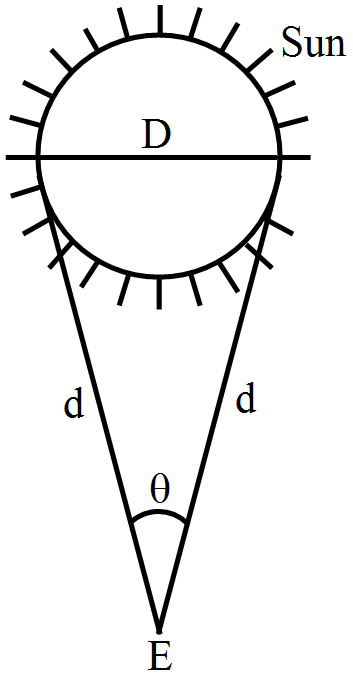
Here, $\theta=2000''=\frac{2000}{3600}\times\frac{\pi}{180}\text{rad}$
$=9.7\times10^{-3}\text{rad}$
$\text{d}=1.496\times10^{11}\text{m}$
From the figure,
$\theta=\frac{\text{D}}{\text{d}}$
$\therefore\text{D}=\theta\text{d}$
$=9.7\times10^{-3}\times1.496\times{10}^{11}$
$=1.45\times10^{9}\text{m}$ View full question & answer→Question 653 Marks
The radius of a sphere is measured as $(2.1 \pm 0.5) \text{cm}$ calculate its surface area with error limits.
AnswerRadius of the sphere $=(2.1 \pm 0.5) \text{cm}$ $\therefore\text{r}=2.1\text{ and }\Delta\text{r}=\pm0.5$ $\text{S.A.}=4\pi\text{r}^2=4\times3.14\times2.1\times2.1$ $=55.4\text{cm}^2$ As per the principle of error $\frac{\Delta\text{s}}{\text{s}}=\pm2.\frac{\Delta\text{r}}{\text{r}}$ $\frac{\Delta\text{s}}{55.4}=\pm\frac{2\times0.5}{2.1}$ $\therefore\Delta\text{s}=\pm26.4\text{cm}$ $\therefore$ Error limits are $\pm26.4\text{cm}$ $\therefore$ Surface area of the sphere $=(55.4\pm26.4)\text{cm}^2$
View full question & answer→Question 663 Marks
Reynold's number $N_R$(a dimensionless quantity) determines the condition of laminar flow of a viscous liquid through a pipe. $N_R$ is a function of the density of the liquid 'r', its average speed is 'y' and the coefficient of viscosity of the liquid is 'h'. If N, is given directly proportional to 'd' (the diameter of the pipe), show from dimensional consideration that $\text{N}_\text{R}\propto \frac{\text{dp}\rho}{\eta}$ the unit of '$\eta$' in SI system is kg $m^{-1}s^{-1}$?
AnswerAs the Reynold's Number $N_R$ depends on density p, average speed v and coefficient ofviscosity I, then let us say.$\text{N}_\text{R}\propto \rho^\text{a}\text{v}^b\eta^\text{c}$
Again is proportional to the diameter of the pipe , combining the two we have . $\text{N}_\text{R}\propto \rho ^\text{a}\text{v}^\text{b}\eta^\text{c}\text{d}$
$\text{N}_\text{R }= \text{ K} \rho^\text{a} \text{v}^\text{b}\eta^\text{c}\text{d}$
We write ,$[\text{N}_\text{R}]= [\text{M}^0\text{L}^0\text{T}^0]$
$[\rho]= [\text{MK}^{-3}]$
$[\text{v}]= [\text{LT}^{-1}]$
$[\eta] = [ \text{ML}^{-1} \text{T}^{-1}]$
$[\text{d}]= [\text{L}]$
Syubstituting the dimension in (i), we have ,$[\text{M}^0\text{L}^0\text{T}] = [\text{ML}^{-3}]^\text{a}[\text{LT}^{-1}]^\text{b}[\text{ML}^{-1}\text{T}^{-1}]^\text{c}[\text{L}]$
$= \text{M}^{(\text{a+c})} \text{L }^{(-3\text{a+b+c+1})}\text{T}^{(\text{-b-c})}$
Comparing the dimensions of M,L and T, we have,$\text{a+c}=0$
$-3\text{a+b-c+1=0}$
$-\text{b}-\text{c} =0$
On simplifying, we get$\text{c}= -1$
$\text{b}=1$
$\text{a}=1$
Therefore, the relation(i) becomes$\text{N}_\text{R} =\text{K}\rho^1 \text{v}^1\eta^{-1}\text{d}$
$\text{N}_\text{R}=\text{K}\rho^1\text{v}^1\eta^{-1}\text{d}$
$\text{N}_\text{R} = \text{K}\rho\frac{\text{vd}}{\eta}$
$\text{N}_\text{R} = \propto\rho\frac{\text{vd}}{\eta}$
View full question & answer→Question 673 Marks
The number of particles crossing per unit area perpendicular to x-axis in unit time N is given by: $\text{N}=-\text{D}\Big(\frac{\text{n}_2-\text{n}_1}{\text{x}_2-\text{x}_1}\Big)\text{s}$ where $n_1$ and $n_2$ are the number of particles per unit volume at $x_1$ and $x_2$ respectively. Deduce the dimensional formula for D.
Answer$\text{D}=-\text{N}\Big(\frac{\text{x}_2-\text{x}_1}{\text{n}_2-\text{n}_1}\Big)\text{s}$
$[\text{N}]=\frac{\text{N}_0}{[\text{L}^2\text{T}]}=[\text{L}^{-2}\text{T}^{-1}]$
$[\text{D}]=\frac{[\text{L}^{-2}\text{T}^{-1}\text{L}]}{[\text{L}^{-3}]}=[\text{L}^2\text{T}^{-1}]$
$[\text{x}_2]=[\text{x}_1]=[\text{L}]$ And $[\text{n}_2]=[\text{n}_1]=\frac{\text{N}_0}{[\text{L}^{-3}]}$
View full question & answer→Question 683 Marks
When the planet Jupiter is at a distance of $824.7$ million kilometers from the Earth, its angular diameter is measured to be $35.72$” of arc. Calculate the diameter of Jupiter.
AnswerDistance of Jupiter from the Earth, $D=824.7 \times 10^6 \mathrm{~km}=824.7 \times 10^9 \mathrm{~m}$ Angular diameter $=35.72^{\prime \prime}=35.72 \times 4.874 \times$ $10^{-6} \mathrm{rad}$ Diameter of Jupiter $=\mathrm{d}$ Using the relation,
$\theta=\frac{\text{d}}{\text{D}}$ $\text{d}=\theta\text{ D}=824.7\times10^9\times35.72\times4.872\times10^{-6}$ $= 143520.76 \times 10^3\text{m} = 1.435 \times 10^5\text{Km}$
View full question & answer→Question 693 Marks
The radius of curvature of a concave mirror, measured by a spherometer is given by: $\text{R}=\frac{\text{l}^2}{6\text{h}}+\frac{\text{h}}{2}$ The value of l and h are 4.0cm and 0.065cm respectively where l is measured by a metre scale and h by the spherometer. Find the relative error in the measurement of R.
AnswerGiven that I - 4cm and Al = 0.1cm (least count of the metre scale) here l is the distance between the legs of the spherometer. As $\text{R}=\frac{\text{l}^2}{6\text{h}}+\frac{\text{h}}{2}$ $\therefore\frac{\Delta\text{R}}{\text{R}}=\frac{2\Delta\text{l}}{\text{l}}+\Big(-\frac{\Delta\text{h}}{\text{h}}\Big)+\frac{\Delta\text{h}}{\text{h}}$ $\Rightarrow\frac{\Delta\text{R}}{\text{R}}=2\frac{\Delta\text{l}}{\text{l}}+\frac{\Delta\text{h}}{\text{h}}+\frac{\Delta\text{h}}{\text{h}}$ (Considering the magnitude only) $=2\Big(\frac{\Delta\text{l}}{\text{l}}+\frac{\Delta\text{h}}{\text{h}}\Big)=2\Big(\frac{0.1}{4}\Big)+2\times\Big(\frac{0.001}{0.065}\Big)$ $=0.05+0.03=0.08$
View full question & answer→Question 703 Marks
A body travels uniformly a distance of $(13.8 \pm 0.2)\text{m}$ in a time $(4.0 \pm 0.3) \text{s}.$ What is the velocity of the body within error limits?
AnswerHere, $\text{S}=(13.8\pm0.2)\text{cm},\text{t}=(4.0\pm0.3)\text{s}$ $\therefore\text{V}=\frac{13.8}{4.0}=3.45\text{ms}^{-1}$ Also $\frac{\Delta\text{V}}{\text{V}}=\pm\Big(\frac{\Delta\text{S}}{\text{S}}+\frac{\Delta\text{t}}{\text{t}}\Big)$ $=\pm\Big(\frac{0.2}{13.8}+\frac{0.3}{4.0}\Big)=\pm0.0895$ $\Delta\text{V}=\pm0.3$ (rounding off to one place of decimal) $\text{V}=(3.45\pm0.3)\text{ms}^{-1}$
View full question & answer→Question 713 Marks
A laser signal is beamed towards the planet Venus from Earth and its echo is received 8.2 minutes later. Calculate the distance of Venus from the Earth at that time.
AnswerWe know that speed of laser light $\text{c}=3\times10^8\text{m}/\text{ s}$ Time of echo, t = 8.2 minutes = 8.2 × 60 seconds If distance of venus be d, then $\text{t}=\frac{2\text{d}}{\text{c}}$ $\text{d}=\frac{1}{2}\text{ct}=\frac{1}{2}\times3\times10^8\times8.2\times60\text{m}$ $=7.38\times10^{10}\text{m}=7.4\times10^{10}\text{m}.$
View full question & answer→Question 723 Marks
Precise measurements of physical quantities are a need of science. For example, to ascertain the speed of an aircraft, one must have an accurate method to find its positions at closely separated instants of time. This was the actual motivation behind the discovery of radar in World War II. Think of different examples in modern science where precise measurements of length, time, mass etc. are needed. Also, wherever you can, give a quantitative idea of the precision needed.
AnswerIt is indeed very true that precise measurements of physical quantities are essential for the development of science. For example, ultra-shot laser pulses (time interval ∼ $10^{–15}\ s$) are used to measure time intervals in several physical and chemical processes. X-ray spectroscopy is used to determine the inter-atomic separation or inter-planer spacing. The development of mass spectrometer makes it possible to measure the mass of atoms precisely.
View full question & answer→Question 733 Marks
If two resistances of values $\text{R}_1=(2.0\pm0. 1)12$ and $\text{R}_2=(12.3\pm0.2)\Omega$ are put (i) in parallel and (ii) in series, find the error in the equivalent resistance.
Answer$\text{R}_1=2,\Delta\text{R}_1=0.1,$ $\text{R}_\text{s}=\text{R}_1+\text{R}_2=14.3$ $\text{R}_2=12.3,\Delta\text{R}_2=0.2,$ $\Delta(\text{R}_1+\text{R}_2)=\Delta\text{R}_\text{s}=0.3$ In series$\text{R}_\text{s}=(\text{R}_1+\text{R}_2)\pm\Delta(\text{R}_1+\text{R}_2)$ $=(14.3\pm0.3)\Omega$ In parallel,$\frac{1}{\text{R}}=\frac{1}{\text{R}_1}+\frac{1}{\text{R}_2}=\frac{\text{R}_1+\text{R}_2}{\text{R}_1\text{R}_2}$ $\therefore\text{R}=\frac{\text{R}_1\text{R}_2}{\text{R}_1+\text{R}_2}=\frac{\text{R}_1\text{R}_2}{\text{R}_\text{s}}$ $\frac{\Delta\text{R}}{\text{R}}=\frac{\Delta\text{R}_1}{\text{R}_1}+\frac{\Delta\text{R}_2}{\text{R}_2}+\frac{\Delta\text{R}_\text{s}}{\text{R}_\text{s}}$ $\Delta\text{R}=\text{R}\bigg[\frac{\Delta\text{R}_1}{\text{R}_1}+\frac{\Delta\text{R}_2}{\text{R}_2}+\frac{\Delta\text{R}_\text{s}}{\text{R}_\text{s}}\bigg]$ $\Rightarrow\text{R}=\frac{24.6}{14.3}=1.72$ $\Delta\text{R}=\text{R}(\frac{0.1}{2}+\frac{0.2}{12.3}+\frac{0.3}{14.3})$ $=\text{R(0.05+0.016+0.020)}$ $=1.72(0.08)=0.13$ R (in parallel)$=(1.72\pm0.13)\Omega$
View full question & answer→Question 743 Marks
To find the value of 'g' by using a simple pendulum, the following observations were made: Length of thread $\text{l} = (100 \pm 0.1)\text{cm}$ Time period of oscillation $\text{T} = (2 ± 0.1)\text{sec}$ Calculate the maximum permissible error in measurement of 'g'. Which quantity should be measured more accurately and why?
AnswerHere, $\text{l}=(100\pm0.1)\text{cm}$ Time period of oscillation $\text{T}=(2\pm0.1)\text{sec}$ $\text{T}=2\pi\sqrt{\frac{\text{l}}{\text{g}}}$ $\text{T}^2=4\pi^2\times\frac{\text{l}}{\text{g}}$ $\therefore\text{g}=\frac{4\pi^2\text{l}}{\text{T}^2}$ As per the principle of error, $\frac{\Delta\text{g}}{\text{g}}=\pm\Big(\frac{\Delta\text{l}}{\text{l}}+2\frac{\Delta\text{T}}{\text{T}}\Big)$ $\frac{\Delta\text{g}}{\text{g}}=\pm\Big(\frac{\Delta\text{0.1}}{100}+2\times\frac{0.1}{2} \Big)$ $\Delta\text{g}=\pm9.8\times0.101=\pm0.99$ $\therefore$ Maximum permissible error in the measurement of $\text{g}=\pm0.99$ . Time period of the pendulum should be measured more accurately as $\text{g}\propto\frac{1}{\text{T}^2}.$
View full question & answer→Question 753 Marks
A new unit of length is chosen such that the speed of light in vacuum is unity. What is the distance between the Sun and the Earth in terms of the new unit if light takes 8min and 20s to cover this distance?
AnswerDistance between the Sun and the Earth = Speed of light × Time taken by light to cover the distance Given that in the new unit, speed of light = 1 unit Time taken, t = 8min 20s = 500s $\therefore$ Distance between the Sun and the Earth = 1 × 500 = 500 units
View full question & answer→Question 763 Marks
In an experiment, refractive index of glass was observed to be $1.45, 1.56, 1.54, 1.44, 1.54$ and $1.53$. Calculate:
- Mean value of refractive index.
- Mean absolute error.
- Fractional error.
- Percentage error.
Express the result in terms of absolute error and percentage error. Answer
- Mean value of $\mu$
$=\frac{1.45+1.56+1.54+1.44+1.54+1.53}{6}$
$\mu=1.51$
- Mean absolute error $=\frac{\text{sum of absolute error}}{6}$
$\Delta\overline{\mu}=\frac{0.06+0.05+0.03+0.07+0.03+0.02}{6}$
$=\frac{0.26}{6}=0.0433=0.04$
- Fractional error $=\frac{\Delta\overline{\mu}}{\mu}=\frac{0.04}{1.51}$
$=0.02649=0.03$
- Percentage error $=\frac{\Delta\overline{\mu}}{\mu}\times100=3\%$
$\mu=1.51\pm0.04$ in terms of absolute error.
Also, $\mu=1.51\pm3\%$ in terms of $\%$ error. View full question & answer→Question 773 Marks
It is known that the period T of a magnet of magnetic moment M vibrating in a uniform magnetic field of intensity H depends upon M, H and I where I is the moment of inertia of the magnet about its axis of oscillations. Show that T = $2\pi\sqrt{\frac{\text{I}}{\text{MH}}}.$
AnswerLet us first write the dimensions of various physical quantities involved, Moment of Inertia, $I = [ML^2]$ Magnetic moment has the units $Am^2$, therefore, $M = [M^0L^2A]$ Magnetic field intensity, H has the units newton per ampere metre. $\text{[H]}=\frac{\text{netwon}}{\text{A-M}}=\text{MLT}^{-2}\text{L}^{-1}\text{A}^{-1}$
$\text{H}=\text{[MT}^{-2}\text{A}^{-1}]$
$\text{T}=\text{KI}^\text{a}\text{M}^\text{b}\text{H}^\text{c}.$ Where K is constant of proportionality, $\text{[T]}=\text{[ML}^2]^\text{a}\text{[L}^2\text{A}]^\text{b}\text{[MT}^{-2}\text{A}^{-1}]^\text{c}$
$=\text{[M}^\text{a+b}\text{L}^\text{2a+2b}\text{T}^{-2\text{c}}\text{A}^\text{+b-c}]$ Equating powers of M. L and T and A on both the sides, we have, $\text{a+c}=0$
$2(\text{a+b)}=0$
$\Rightarrow\text{a+b}=0,-2\text{c}=1$ and $-\text{c+b}=0$ Solving these equations ,we get, $\text{a}=\frac{1}{2},\text{b}=\frac{-1}{2},\text{c}=\frac{-1}{2}$
$\therefore \text{T}=\text{KI}^\frac{1}{2}\text{M}^{\frac{-1}{2}}\text{H}^{\frac{-1}{2}}$ It can be proved experimentally that $\text{K}=2\pi$
$\therefore \text{T}=2\pi\sqrt{\frac{\text{I}}{\text{MH}}}$
View full question & answer→Question 783 Marks
Write the dimensions of:
- Linear density.
- Power.
- Impulse.
- Velocity gradien.
- Mass per unit area.
- Kinetic energy.
- Angular acceleration.
- Couple.
- Moment of force.
- Work done.
Answer$i. \left[M L^{-1} T^0\right)$
$ii. \left[\mathrm{ML}^2 \mathrm{~T}^{-3}\right]$
$iii. \left[M L T^{-1}\right)$
$iv. \left[\mathrm{M}^0 \mathrm{~L}^0 \mathrm{~T}^{-1}\right]$
$v. \left[\mathrm{ML}^{-2} \mathrm{~T}^0\right)$
$vi. \left[M^1 L^2 T^{-2}\right]$
$vii. \left[M^0 L^0 \mathrm{~T}^{-2}\right]$
$viii. \left[\mathrm{ML}^2 \mathrm{~T}^{-2}\right]$
$ix. \left[\mathrm{ML}^2 \mathrm{~T}^{-2}\right]$
$x. \left[\mathrm{ML}^2 \mathrm{~T}^{-2}\right]$.
View full question & answer→Question 793 Marks
Find an expression for viscous force $F$ acting on a tiny steel ball of radius $r$ moving in a viscous liquid of viscosity $n$ with a constant speed $v$ by the method of dimensional analysis.
AnswerIt is given that viscous force $F$ depends on:
- Radius $r$ of steel ball.
- Coefficient of viscosity $n$ of viscous liquid.
- Speed $v$ of the ball.
$\text{i.e}.,\text{F}=\text{k}\text{r}^{\text{a}}\eta^{\text{b}}\text{v}^{\text{c}}$ where $k$ is dimensionless constant
Dimensional formula of force
$\text{F}=[\text{MLT}^{-2}],\text{r}=[\text{L}]$
$\eta=[\text{M}^1\text{L}^{-1}\text{T}^{-1}]\text{ and }\text{v}=[\text{LT}^{-1}]$
We have:
$[\text{MLT}^{-2}]=[\text{L}^{\text{a}}][\text{M}^1\text{L}^{-1}\text{T}^{-1}]^{\text{b}}[\text{LT}^{-1}]^{\text{c}}$
$=[\text{M}^{\text{a}}\text{L}^{\text{a}-\text{b}+\text{c}}\text{T}^{-\text{b}-\text{c}}]$
Comparing powers of $M, L$ and $T$ on either side of equation,
We get:
$\text{a}=1$
$\text{a}-\text{b}+\text{c}=1$
$-\text{b}-\text{c}=2$
On solving, these above equations,
We get,
$\text{a}=1,\text{b}=1$ and $\text{c}=1$
Hence, the relation becomes
$\text{F}=\text{kr}\eta\text{v}$ View full question & answer→Question 803 Marks
If the length and time period of an oscillating pendulum have errors of 1% and 2% respectively, what is the error in the estimate of g?
AnswerWe know $\text{T}=2\pi\sqrt{\frac{\text{l}}{\text{g}}}$ Or $\text{T}^2=4\pi^2\frac{\text{l}}{\text{g}}$ $\text{g}=4\pi^2\frac{\text{l}}{\text{T}^2}$ $\therefore\frac{\Delta\text{g}}{\text{g}}=\frac{\Delta\text{l}}{\text{l}}+2\frac{\Delta\text{T}}{\text{T}}$ % error in g = 1% + 2 × 2% = 5%
View full question & answer→Question 813 Marks
The radius of the Earth is $6.37 \times 10^6\ m$ and its mass is $5.975 \times 10^{24}\ kg$. Find the Earth's average density to appropriate significant figures.
AnswerRadius of the earth $(R) = 6.37 \times 10^6m$ Volume of the earth $(\text{V})=\frac{4}{3}\pi\text{R}^3\text{m}^3$
$=\frac{4}{3}\times(3.142)\times(6.37\times10^6)^3\text{m}^3$
Average density $(\text{D})=\frac{\text{Mass}}{\text{Volume}}=\frac{\text{M}}{\text{V}}=0.005517\times10^{6}\text{kg}\text{m}^{-3}$
The density is accurate only up to three significant figures which is the accuracy of the least accurate factor, namely, the radius of the earth.
View full question & answer→Question 823 Marks
Why has second been defined in terms of periods of radiations from cesium$-133$?
AnswerSecond has been defined in terms of periods of radiation, because
- This period is accurately defined.
- This period is not affected by change of physical conditions like temperature, pressure and volume etc.
- The unit is easily reproducible in any good laboratory.
View full question & answer→Question 833 Marks
A capacitor of capacitance $\text{C}=(2.0\pm0.1)\mu\text{F}$ is charged to a voltage$\text{V}=(20\pm0.5)\text{V}$ Calculate the charge Q with error limits.
Answer$\text{Q}=\text{CV}=2.0\times20=40\mu\text{C}$ $=40\times10^{-6}\text{C}$ $\frac{\Delta\text{Q}}{\text{Q}}=\frac{\Delta\text{C}}{\text{C}}+\frac{\Delta\text{V}}{\text{V}}$ $=\frac{0.1}{2.0}+\frac{0.5}{20}=\frac{3}{40}$ $\Delta\text{Q}=\frac{3}{40}\times\text{Q}=\frac{3}{40}\times10^{-6}=3\mu\text{C}$ Hence, $\text{Q}=(40\pm3.0)\times10^{-6}\text{C}$
View full question & answer→Question 843 Marks
The orbital velocity v of a satellite may depend on its mass m, distance r from the centre of Earth and acceleration due to gravity g. Obtain an expression for orbital velocity.
AnswerLet orbital velocity of satellite be given by the relation $v = k\ m^ar^bg^c$ where k is a dimensionless constant and a, b and c are the unknown powers. Writing dimensions on two sides of equation, we have:$[\text{M}^0\text{L}^1\text{T}^{-1}=[\text{M}]^{\text{a}}[\text{L}]^{\text{b}}[\text{LT}^{-2}]^{\text{c}}$
$=[\text{M}^{a}\text{L}^{\text{b}+\text{c}}\text{T}^{-2\text{c}}]$
Applying principle of homogeneity of dimensional equation,
We find that:
$\text{a}=0$
$\text{b}+\text{c}=1$
$-2\text{c}=-1$
On solving these equations,
We find that:
$\text{a}=0,\text{b}=+\frac{1}{2}\text{ and }\text{c}=+\frac{1}{2}$
$\therefore\text{v}=\text{k}\text{r}^{\frac{1}{2}}\text{g}^{\frac{1}{2}}$
Or $\text{v}=\text{k}\sqrt{\text{rg}}.$
View full question & answer→Question 853 Marks
The farthest objects in our Universe discovered by modern astronomers are so distant that light emitted by them takes billions of years to reach the Earth. These objects (known as quasars) have many puzzling features, which have not yet been satisfactorily explained. What is the distance in km of a quasar from which light takes $3.0$ billion years to reach us?
AnswerTime taken by quasar light to reach Earth $=3$ billion years $=3 \times 10^9$ years $=3 \times 10^9 \times 365 \times 24 \times 60 \times 60$ s Speed of light $=3 \times 10^8 \mathrm{~m} / \mathrm{s}$ Distance between the Earth and quasar $=\left(3 \times 10^8\right) \times\left(3 \times 10^9 \times 365 \times 24 \times 60 \times 60\right)=283824 \times$ $10^{20} \mathrm{~m}=2.8 \times 10^{22} \mathrm{~km}$
View full question & answer→Question 863 Marks
In the relation $\text{p}=\Big(\frac{\text{a}}{\text{b}}\Big)^{\text{e}^{-\Big(\frac{\text{az}}{\theta}\Big)}},\text{p}$ is the pressure, Z is the distance, and is the temperature. What is the dimensional formula of p?
AnswerSince, ${\text{e}^{-\Big(\frac{\text{aZ}}{\theta}\Big)}}$is dimensionless, We have $\frac{\text{aZ}}{\theta}=1$ Or $\text{a}=\frac{\theta}{\text{Z}}=\frac{\text{K}}{\text{L}}=[\text{L}^{-1}\text{K}]$ We find that $\frac{\text{a}}{\text{b}}=$ dimensions of p and $\text{b} = [\text{ML}^{-1}\text{T}^{-2}].$ Therefore, dimensional formula of p is obtained as $\text{p}=\frac{\text{a}}{[\text{ML}^{-1}\text{T}^{-2}]}=\frac{[\text{L}^{-1}\text{K}]}{[\text{ML}^{-1}\text{T}^{-2}]}$ $=[\text{M}^{-1}\text{L}^0\text{T}^2\text{K}]$
View full question & answer→Question 873 Marks
The radius of the Earth is $6.37 × 10⁶m$ and its average density is $5.517 \times 10^3kg m^{-3}$. Calculate the mass of earth to correct significant figures.
Answer$\text{Mass}=\text{Volume}\times\text{density}$ Volume of earth $=\frac{4}{3}\pi\text{R}^3=\frac{4}{3}\times3.142\times(6.37\times10^6)^3\text{m}^3$ Mass of earth $=\frac{4}{3}\times3.142\times(6.37\times10^6)^3\times5.517\times10^3\text{kg}$ $=5974.01\times10^{21}\text{kg}=5.97401\times10^{24}\text{kg}$
The radius has three significant figures and the density has four. Therefore, the final result should be rounded upto three significant figures. Hence, mass of the earth = $5.97 \times 10^{24}kg$.
View full question & answer→Question 883 Marks
The measured value of length, breadth and height of a block of wood along with maximum permissible errors are expressed as follows:$\text{I}=12.80\pm0.01\text{cm},$ $\text{b}=10.12\pm0.01\text{cm}$ $\text{h}=5.26\pm0.01\text{cm}$ Calculate the percentage error in the volume of the block.
AnswerGiven: $ \text{I}\pm\Delta\text{I}=10.08\pm0.01\text{cm}$ $\text{b}\pm\Delta\text{b}=10.12\pm0.01\text{cm}$ $\text{h}\pm\Delta\text{h}=5.62\pm0.01\text{cm}$ Volume of the block (V) $=\text{I}\times\text{b}\times\text{h}$ $\therefore$ Percentage error in the volume is given by $=\frac{\Delta\text{V}}{\text{V}}=(\frac{\Delta\text{I}}{\text{I}}+\frac{\Delta\text{b}}{\text{b}}+\frac{\Delta\text{h}}{\text{h}})\times100\%$ $=(\frac{0.01}{12.08}+\frac{0.01}{10.12}+\frac{0.01}{5.62})\times100\%$ $=(0.000827+0.000988+0.00178)\times100\%$ $=0.003585\times100\%=0.3585\%$
View full question & answer→Question 893 Marks
The principle of ‘parallax’ in section $2.3.1$ is used in the determination of distances of very distant stars. The baseline AB is the line joining the Earth’s two locations six months apart in its orbit around the Sun. That is, the baseline is about the diameter of the Earth’s orbit $\approx 3 \times 10^{11} \mathrm{~m}$. However, even the nearest stars are so distant that with such a long baseline, they show parallax only of the order of $1”$ (second) of arc or so. A parsec is a convenient unit of length on the astronomical scale. It is the distance of an object that will show a parallax of $1”$ (second of arc) from opposite ends of a baseline equal to the distance from the Earth to the Sun. How much is a parsec in terms of metres?
AnswerDiameter of Earth's orbit $=3 \times 10^{11} \mathrm{~m}$ Radius of Earth's orbit, $\mathrm{r}=1.5 \times 10^{11} \mathrm{~m}$ Let the distance parallax angle be $1^{\prime \prime}=$ $4.847 \times 10^{-6} \mathrm{rad}$. Let the distance of the star be D. Parsec is defined as the distance at which the average radius of the Earth's orbit subtends an angle of 1”.
$\therefore$ We have $\theta=\frac{\text{r}}{\text{D}}$ $\text{D}=\frac{\text{r}}{\theta}=\frac{1.5\times10^{11}}{4.847\times10^{-6}}$ $=0.309\times10^{-6}\approx3.09\times10^{16}\text{m}$ Hence, 1 parsec $\approx3.09\times10^{16}\text{m}.$
View full question & answer→Question 903 Marks
An experiment measured quantities a, b, c and then x is calculated by using the relation $\text{x}=\frac{\text{ab}^2}{\text{c}^3}$ If the percentage errors in measurements of a, b and care $\pm1\%, \pm2\% \text{ and } \pm 1.5\%$ respectively, then calculate the maximum percentage error in value of x obtained.
AnswerGiven: $\text{x}=\frac{\text{ab}^2}{\text{c}^3}$ $\therefore\Big(\frac{\Delta\text{x}}{\text{x}}\Big)_{\text{max}}=\frac{\Delta\text{a}}{\text{a}}+2\frac{\Delta\text{b}}{\text{b}}+3\frac{\Delta\text{c}}{\text{c}}$ But $\frac{\Delta\text{a}}{\text{a}}=\pm1\%,\frac{\Delta\text{b}}{\text{b}}=\pm2\%$ And $\frac{\Delta\text{c}}{\text{c}}=\pm1.5\%$ $\therefore\Big(\frac{\Delta\text{x}}{\text{x}}\Big)_{\text{max}}=1\%+2\times2\%+3\times1.5\%$ $=(1+4+4.5)\%=9.5\%$
View full question & answer→Question 913 Marks
It is known that the period T of a magnet of magnetic moment M vibrating in a uniform magnetic field of intensity B depends upon M, B and I where I is the moment of inertia of the magnet about its axis of oscillations. Show that: $\text{T}=2\pi\sqrt{\frac{\text{I}}{\text{MB}}}$
AnswerWe first note that the dimension of I are [$ML^2$]. Also the magnetic moment has the units $Am^2$ so that its dimensions can be written as [$AL^2$] where A stands for the dimensions of the electric current. Finally the magnetic field vector B has the units newton (per ampere metre) so that its dimensions can be written as: $[\text{B}]=\frac{[\text{MLT}^{-2}]}{[\text{A}][\text{L}]}=[\text{MT}^{-2}\text{A}^{1}]$ We know assume that: $\text{T}=\text{k}\text{ l}^{\text{a}}\text{ M}^{\text{b}}\text{ B}^{\text{c}}$ Substituting dimensions of all the quantities involved, We have: $[\text{T}]=[\text{ML}^2]^{\text{a}}[\text{AL}^2]^{\text{b}}[\text{MT}^{-2}\text{A}^{-1}]^{\text{c}}$
$=[\text{M}^{\text{a}+\text{c}}\text{L}^{\text{2a}+\text{2b}\text{T}^{-2\text{c}}}\text{A}^{\text{b}-\text{c}}]$ Equating powers of M, L, T and A on both sides, we have a + c = 0, 2(a + b) = 0, -2c = 1, b - c = 0. From the first three equations we get $\text{c}=\frac{-1}{2}, \text{a}=\frac{1}{2}$ and $\text{b}=\frac{-1}{2}$ These values are consistent with the fourth equations. Thus: $\text{a}=\frac{1}{2},\text{b}=\frac{-1}{2}$ and $\text{c}=\frac{-1}{2}$
$\therefore\text{T}=\text{k }\text{l}^{\frac{1}{2}}\text{ M}^{\frac{-1}{2}}=\text{k}\sqrt{\frac{\text{I}}{\text{MB}}}$ Experiments show that $\text{k}=2\pi$ Therefore $\text{T}=2\pi\sqrt{\frac{\text{I}}{\text{MB}}}$
View full question & answer→Question 923 Marks
Show dimensionally that the frequency n of transverse waves in a string of length / and mass, per unit length z under a tension T is given by n = $\frac{\text{K}}{l}\sqrt{\frac{\text{T}}{\text{m}}}.$
AnswerLet us suppose that: $\text{n}= \text{Kl}^\text{a}\text{T}^\text{b}\text{m}^\text{c}$ where K is a dimensionless constant and a, b, c arc unknown powers to be found. Writing the dimension of all the quantities involved, we get $[\text{T}^{-1}] = [\text{L}] ^\text{a}[\text{MLT}^{-2}]^\text{b}[\text{ML}^{-1}]^\text{c}$ Or $[\text{T}^{-1}]= $ L, M and T on both sides we have $\text{a + b} -\text{c}=0,\text{b + c = 0 } \text{and }\text{a }= -1$ On simplifying , we get $\text{b}= \frac{1}{2}, \text{c}= -\frac{1}{2}, \text{a}= -\text{1}$ $\therefore \text{n}= \text{Kl}^{-1}\text{T}\frac{1}{2}\text{m}\frac{-1}{2}$ $\text{or }\text{n}= \frac{\text{K}}{\text{l}}\sqrt{\frac{\text{T}}{\text{m}}}$
View full question & answer→Question 933 Marks
The frequency $'f\ '$ of vibration of a stretched string depends upon:
- Its length
- The mass per unit length $'m\ '$
- The Tension $'T\ '$ in the string.
- Obtain dimensionally an expression for frequency $'f\ ’.$
AnswerLet us suppose that $\mathrm{f}=\mathrm{Kl}^{\mathrm{a}} \mathrm{T}^{\mathrm{b}} \mathrm{m}^{\mathrm{c}}$ where $K$ is a dimensionless constant and $\mathrm{a}, \mathrm{b}, \mathrm{c}$ are unknown powers to be determined. Writing the dimension of all the quantities involved, We get : Comparing powers $\mathrm{L}, \mathrm{M}$ and $T$ on both sides, we have $a+b-c=0, b+c=0$ and $-2 b=-1$ On simplifying,
We get: $\text{B}=\frac{1}{2},\text{c}=-\frac{1}{2},\text{a}=-1$
$\therefore\text{f}=\text{Kl}^{-1}\text{T}^{\frac{1}{2}}\text{m}^{\frac{-1}{2}}$ $\Rightarrow\text{f}=\frac{\text{K}}{\text{L}}\sqrt{\frac{\text{T}}{\text{m}}}$
View full question & answer→Question 943 Marks
A function $\text{f}(\theta)$ is defined as: $\text{f}(\theta)=1-\theta+\frac{\theta^2}{2!}-\frac{\theta^3}{3!}+\frac{\theta^4}{4!}$ Why is it necessary for q to be a dimensionless quantity?
Answer$\theta$ is represented by angle which is equal to $\frac{\text{arc}}{\text{radius}}$ so angle $\theta$ is dimensionless physical quantity. First term is 1 which is dimensionless, next term contain only powers of $\theta$, as $\theta$ is dimensionless so their powers will also be dimensionless. Hence, each term in R.H.S. expression are dimensionless so left hand side $\text{f}(\theta)$ must be dimensionless.
View full question & answer→Question 953 Marks
Consider a sunlike star at a distance of 2 parsecs. When it is seen through a telescope with 100 magnification, what should be the angular size of the star? Sun appears to be $\Big(\frac{1}{2}\Big)^0$ from the earth. Due to atmospheric fluctuations, eye can’t resolve objects smaller than 1 arc minute.
AnswerSun's angular diameter from the earth is $\Big(\frac{1}{2}\Big)^\circ$ at 1AU. Angular diameter of the sun like star at a distance of 2 parsecs $=\frac{\Big(\frac{1}{2}\Big)^\circ}{2\times2\times10^5}=\Big(\frac{1}{8}\times10^{-5}\Big)^\circ$ $=\Big(\frac{1}{8}\times10^{-5}\Big)^\circ\times60'=7.5\times10^{-5}\text{arcmin}$ When the sun like star is seen through a telescope with magnification 100, the angular diameter of the star. $=100\times7.5\times10^{-5}=7.5\times10^{-3}\ \text{arcmin}$ But eye cannot resolve smaller than 1 arcmin due to atmospheric fluctuations. So angular size of sun like star appears as 1 arcmin.
View full question & answer→Question 963 Marks
The speed of light in air is $3.00 \times 10^8 \mathrm{~ms}^{-1}$. The distance travelled by light in one year (i.e., 365 days $=3.154 \times 10^7 \mathrm{~s}$ ) is known as light year. A student calculates one light year $=9.462 \times 10^{15} \mathrm{~m}$. Do you agree with the student? If not, write the correct value of one light year.
AnswerOne light year $=$ speed $\times$ time $=9.462 \times 10^{15} \mathrm{~m}$. When two physical quantities are multiplied, the significant figures retained in the final result should not be greater than the least number of significant figures in any of the two quantities. Since, in this case significant figures in one quantity $\left(3.00 \times 10^8 \mathrm{~ms}^{-1}\right)$ are 3 and the significant figures in the other quantity ( $\left.3.154 \times 10^7 \mathrm{~s}\right)$ are 4 , therefore, the final result should have 3 significant figures. Thus, the correct value of one light year $=9.46 \times 10^{15} \mathrm{~m}$.
View full question & answer→Question 973 Marks
The diameter of a wire as measured by a screw gauge was found to be $1.328, 1.330, 1.325, 1.334$ and $1.336\ cm$. Calculate
- Mean value of diameter.
- Absolute error in each measurement.
- Mean absolute error.
- Fractional error.
- Percentage error.
- Diameter of wire.
Answer
- Mean value of diameter,
$\text{D}_\text{m}=\frac{1.328+1.330+1.325+1.326+1.334+1.336}{6}$
$=\frac{7.979}{6}=13298=1.330$
$[$rounding off to three decimal places$]$
- Absolute error in different observations are:
$\Delta\text{D}_1=|1.330-1.328|=0.002\text{cm}$
$\Delta\text{D}_2=|1.330-1.330|=0\text{cm}$
$\Delta\text{D}_3=|1.330-1.325|=\pm0.005\text{cm}$
$\Delta\text{D}_4=|1.330-1.326|=0.004\text{cm}$
$\Delta\text{D}_5=|1.330-1.334|=\pm0.004\text{cm}$
$\Delta\text{D}_6=|1.330-1.336|=\pm0.006\text{cm}$
- Mean absolute error
$\Delta\text{D}_{\text{mean}}=\frac{|\Delta\text{D}_1|+|\Delta\text{D}_2|+|\Delta\text{D}_3|+|\Delta\text{D}_\text{4}|+|\Delta\text{D}_5|+|\Delta\text{D}_6|}{6}$
$=\frac{0.002+0+0.005+0.004+0.004+0.004+0.006}{6}$
$=\frac{0.021}{6}=0.0035=0.004 ($rounding off to $3$ decimal places$)$
- Fractional error $=\frac{\Delta\text{D}_{\text{mean}}}{\text{D}}=\pm\frac{0.004}{1.330}=\pm0.003$
- Percentage error $=\pm0.003\times100\%=\pm0.3\%$
- Diameter of wire $=(1.330\pm0.03)\text{cm}$
Or $\text{D}=1.330\text{cm}\pm0.3\%$ View full question & answer→Question 983 Marks
$\text{P.A.M}$. Dirac, a great physicist of $20^{th}$ century found that from the following basic constants, a number having dimensions of time can be constructed:
- Charge on electron $(e)$
- Permittivity of free space $(e)$
- Mass of electron $(m)$
- Mass of proton $(m)$
- Speed of light $(c)$
- Universal gravitational constant $(G)$
Obtain Dirac's number, given that the desired number is proportional to $\text{m}_\text{p}^{-1}$ and $\text{m}^{-2}_\text{e}$ What is the significance of this number? AnswerLet $X$ be the desired number,
Then: $\text{X}=\text{k}\text{ e}^{\text{u }}\in_0^{\text{x}}\text{ m}^{-2}_\text{e}\text{ m}^{-1}_{\text{p}}\text{ c}^{\text{y}}\text{ G}^{\text{z}}\dots(\text{i})$
Here $k$ is a dimensionless constant and $x, y, z$ and $u$ are unknowns,
whose value is to be obtained from the principle of homogeneity of dimensions.
Now $[\text{X}]=[\text{M}^0\text{L}^0\text{T}^1\text{Q}^0]$
$[\text{e}]=[\text{M}^0\text{L}^0\text{T}^0\text{Q}^1]$
$[\in_0]=[\text{M}^{-1}\text{L}^{-3}\text{T}^2\text{Q}]$
$[\text{C}]=[\text{M}^0\text{L}\text{T}^{-1}]$
$[\text{G}]=[\text{M}^{-1}\text{L}^3\text{T}^{-2}]$
Substituting dimensions of parameters involved in equation $(i),$
We get: $[\text{M}^0\text{L}^0\text{T}^1\text{Q}^0]$
$=\text{Q}^{\text{u}}[\text{M}^{-1}\text{L}^{-3}\text{T}^2\text{Q}^2]^{\text{x}}\text{M}^{-2}\text{M}^{-1}[\text{LT}^{-1}]^{\text{y}}[\text{M}^{-1}\text{L}^3\text{T}^{-2}]\text{z}$
$=[\text{M}^{-\text{x}-3-\text{z}}\text{L}^{-3\text{x}+\text{y}+\text{3z}}\text{T}^{2\text{x}-\text{y}+\text{2z}}\text{Q}^{\text{u}+2\text{x}}]$
From the principle of homogeneity of dimensions $-\text{x} - 3 - \text{z} = 0 ... (\text{ii})$
$- 3\text{x} + \text{y} + 3\text{z} = 0 \dots (\text{iii})$
$2\text{x} - \text{y} - 2\text{z} = 1\dots(\text{iv})$
$\text{u} + 2\text{x} = 0\dots(\text{v})$ Solving equations. $(ii), (iii), (iv)$ and $(v)$
We get: $\text{u}=+4,\text{x}=-2\text{ y}=-3\text{ z}=-1$
$\therefore\text{x}=\text{ke}^{4}\in^{-2}_0\text{ m}_\text{e}^{-2}\text{ m}_{\text{p}}^{-1}\text{ c}^{-3}\text{G}^{-1}$ Or $\text{x}=\frac{\text{ke}^4}{\in^2_0\text{ m}^2_\text{e}\text{ m}_{\text{p}}\text{ c}^3\text{G}}$
Experiments show that, $\text{k}=\frac{1}{16\pi^2}$
Hence, $\text{x}=\frac{\text{e}^4}{16\pi^2\in^2_0\text{ m}^2_\text{e}\text{ m}_\text{p}\text{c}^3\text{G}}$
View full question & answer→Question 993 Marks
The photograph of a house occupies an area of $1.75cm^2$ on a $35mm$ slide. The slide is projected on to a screen, and the area of the house on the screen is $1.55m^2$. What is the linear magnification of the projector-screen arrangement.
AnswerArea of the house on the slide $=1.75 \mathrm{~cm}^2$ Area of the image of the house formed on the screen $=1.55 \mathrm{~m}^2=1.55 \times$ $10^4 \mathrm{~cm}^2$ Arial magnification, $\mathrm{m}_{\mathrm{a}}=$ Area of Image/Area of Object $=(1.55 / 1.75) \times 10^4 $
$\therefore$ Linear magnifications, $\mathrm{m}_l=$ underroot $\mathrm{m}_{\mathrm{a}}=\sqrt{\frac{1.55}{1.75} \times 10^4}=94.11$
View full question & answer→Question 1003 Marks
The earth-moon distance is about $60$ earth radius. What will be the diameter of the earth (approximately in degrees) as seen from the moon?
AnswerAs the distance between moon and earth is greater than radius of earth, then radius of earth can be treated as an arc. 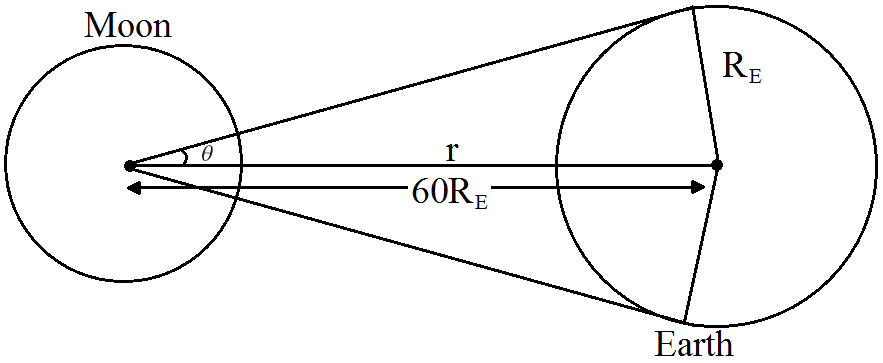
According to the problem, $R_E$ = length of arc Distance between moon and earth = $60R_E$ So, angle subtended at distance r due to an arc of length l is $\theta_\text{E}=\frac{\text{l}}{\text{r}}=\frac{2\text{R}_\text{E}}{60\text{R}_\text{E}}=\frac{1}{30}\text{rad}$ $=\frac{1}{30}\times\frac{180^\circ}{\pi}\text{degree}=\frac{6^\circ}{3.14}\text{degree}=1.9^\circ\approx2^\circ$ Hence, angle subtended by diameter of the earth $2\theta=2^\circ.$ View full question & answer→Question 1013 Marks
To determine acceleration due to gravity, the time of 20 oscillations of a simple pendulum of length 100cm was observed to be 40s. Calculate the value of g and maximum percentage error in the measured value of g.
Answer$\text{T}=2\pi\sqrt{\frac{1}{\text{g}}}\text{or}\text{g}=4\pi\frac{1}{\text{T}^2}$ Given $\text{I}=100\text{cm,}\text{T}=\frac{40}{20}=2.0\text {s}$ $\therefore\text{g}=4\times(3.14)^2\times\frac{100}{(2.0)^2}$ $=985.9\text{cm}\text{s}^{-2}$ Let us now calculate the maximum error, $\text{g}=4\pi\bigg(\frac{\text{I}}{\text{T}^2}\bigg)$ $=4\pi^2\frac{\text{I}}{\big(\frac{\text{I}}{20}\big)^2}\bigg(\text{taking T=}\frac{\text{t}}{20}\bigg)$ $\text{or g}=\frac{4\pi^2\text{I}\times(20)^2}{\text{t}^2}$ Taking log on both sides, We get: $\text{log g}=\text{log 4+2 log} \pi+\text{log} -2 \log \text{t}+2 \text{log 20}$ differenting both the sides: $\frac{\Delta\text{g}}{\text{g}}=\frac{\Delta\text{I}}{\text{I}}-2\frac{\Delta\text{t}}{\text{t}}$ $\text{I}=100\text{cm}$ (least count of the metre scale) Maximum error in g $=\frac{0.1}{100}+2\times\frac{0.1}{40}$ $=0.001+0.005=0.006$ $=0.006\times100\%=0.6\%$ Here 0.1 % is the error in the measurement of length, and 0.5% is the error in the measurement of time. Therefore, time needs more careful measurement.
View full question & answer→Question 1023 Marks
How will you convert a physical quantity from one unit system to another by method of dimensions?
AnswerIf a given quantity is measured in two different unit system, then $Q = n_1u_1 = n_2u_2$ Let the dimensional formula of the quantity be [$M^aL^bT^c$) Then we have: $\text{n}_1[\text{M}_1^{\text{a}}\text{L}_1^{\text{b}}\text{T}_1^{\text{c}}]=\text{n}_2[\text{M}_2^{\text{a}}\text{L}^{\text{b}}_2\text{T}^{\text{c}}_2]$
Here $M_1,L_1,T_1$ are the fundamental unit of mass, length and time in first unit system and $M_2,L_2,T_2$ in the second unit system. $\text{Hence},\text{n}_2=\text{n}_1\Big[\frac{\text{M}_1}{\text{M}_2}\Big]^\text{a}\Big[\frac{\text{L}_1}{\text{L}_2}\Big]^\text{b}\Big[\frac{\text{T}_1}{\text{T}_2}\Big]^\text{c}$
This relation helps us to convert a physical quantity from one unit system to another.
View full question & answer→Question 1033 Marks
The voltage across a lamp is $(6.0 \pm 0.1)$ volt and the current passing through it is $(4.0 \pm 0.2)$ ampere. Find the power consumed by the lamp.
AnswerPower, $\text{P}=\text{V}\times\text{I}$ $\text{P}=6\times4=24\text{ watt}$ Here $\Delta\text{V}=\pm0.1\text{ volts}$ And $\Delta\text{I}=\pm1.6\text{A}$ As per the principle of error, $\therefore\frac{\Delta\text{P}}{\text{P}}=\pm\Big(\frac{\Delta\text{V}}{\text{V}}+\frac{\Delta\text{I}}{\text{I}}\Big),$ $\frac{\Delta\text{P}}{24}=\pm\Big(\frac{0.1}{6}+\frac{0.2}{4}\Big)$ $\frac{\Delta\text{P}}{24}=\pm\frac{0.8}{12}$ $\therefore\Delta{\text{P}}=\pm1.6\text{ watt}$ $\therefore$ Power the error limits is $(24\pm1.6)\text{ watt}$
View full question & answer→Question 1043 Marks
Find the value of $60W$ on a system having $100g, 20cm$ and $1$ minute as the fundamental units.
AnswerHere $n_1=60 \mathrm{~W}$. Obviously, the physical quantity is power whose dimensional formula is $\left[M^1 L^2 T^{-3}\right]$. The first system, in which unit of power is 1 watt, is SI system in which $M=1 \mathrm{~kg} \mathrm{~L}_1=1 \mathrm{~m}$ and $T_1=1 \mathrm{~s}$ in second system, $\mathrm{M}_2=100 \mathrm{~g}, \mathrm{~L}_2=20 \mathrm{~cm}$ and $\mathrm{T}_2=1 \mathrm{~min}=60 \mathrm{~s}$.
$\therefore\text{n}_2=\text{n}_1\Big[\frac{\text{M}_1}{\text{M}_2}\Big]^1\Big[\frac{\text{L}_1}{\text{L}_2}\Big]^2\Big[\frac{\text{T}_1}{\text{T}_2}\Big]^{-3}$
$=60\Big[\frac{1\text{kg}}{100\text{g}}\Big]^1\Big[\frac{1\text{m}}{20\text{cm}}\Big]^2\Big[\frac{1\text{s}}{1\text{min}}\Big]^{-3}$
$=60\Big[\frac{1000\text{g}}{100\text{g}}\Big]^1\Big[\frac{100\text{cm}}{20\text{cm}}\Big]^2\Big[\frac{1\text{s}}{60\text{s}}\Big]^{-3}$
$=60\times\frac{1000}{100}\times\frac{100}{20}\times\frac{100}{20}\times60\times60\times60$
$=3.24\times10^9\text{units}$
View full question & answer→Question 1053 Marks
From parallax measurement, the sun is found to be at a distance of about 400 times the earth-moon distance. Estimate the ratio of sun-earth diameters.
AnswerFrom parallax measurement given that Sun is at a distance of about 400 times the earth-moon distance, hence, $\frac{\text{r}_\text{Sun}}{\text{r}_\text{moon}}=400$ (Suppose, here r stands for distance and D for diameter) Sun and moon both appear to be of the same angular diameter as seen from the earth. $\therefore\frac{\text{D}_\text{Sun}}{\text{r}_{\text{Sun}}}=\frac{\text{D}_\text{moon}}{\text{D}_\text{moon}}\Rightarrow\frac{\text{D}_\text{Sun}}{\text{D}_\text{moon}}=400$ But $\frac{\text{D}_\text{earth}}{\text{D}_\text{moon}}=4\Rightarrow\frac{\text{D}_\text{Sun}}{\text{D}_\text{earth}}=100$
View full question & answer→Question 1063 Marks
Which of the following length measurement is most accurate and why?
- $4.00\ cm$
- $0.004\ mm$
- $40.00\ cm$
Answer$\frac{\Delta\text{x}}{\text{x}}=\frac{0.01}{4.00}=0.0025$ $\frac{\Delta\text{x}}{\text{x}}=\frac{0.00}{0.004}=0.25$ $\frac{\Delta\text{x}}{\text{x}}=\frac{0.01}{40.00}=0.00025$ The last observation has the least fractional error and hence, it is more accurate.
View full question & answer→Question 1073 Marks
By using the method of dimension, check the accuracy of the following $\text{T}=\frac{\text{rh } \rho\text{g}}{2\cos\theta}$ where T is the surface tension, h is the height of the liquid in a capillary tube, $\rho$ is the density of the liquid, g is the acceleration due to gravity, $\theta$ is the angle of contact, and r is the radius of the capillary tube.
AnswerIn order to find out the accuracy of the given equation we shall compare the dimensions: $\text{Of T and } \frac{\text{rh }\rho\text{g}}{2\cos\theta}$ The dimensions of surface tensions, $\text{T}=\frac{\text{force}}{\text{legnth}}=\frac{[\text{MLT}^{-2}]}{[\text{L}]}=[\text{MT}^{-2}]$ The dimensions of $\frac{\text{rh }\rho\text{g}}{2\cos\theta}=[\text{L}][\text{L}][\text{ML}^{-3}][\text{LT}^{-2}]=[\text{MT}^{-2}]$ $(2\cos\theta$ is dimensionless$)$ The dimensions of both the sides are the same and hence the equation is correct.
View full question & answer→Question 1083 Marks
If the unit of force is 100N, unit of length is 10m and unit of time is 100s, what is the unit of mass in this system of units?
AnswerDimension of force $=[\text{M}^1\text{L}^1\text{T}^2]=100\text{N}\ ...(\text{i})$ Dimension of length $=[\text{L}^1]=10\text{m}\ ...(\text{ii})$ Dimension of time $=[\text{T}^1]=100\text{s}\ ...(\text{iii})$ Substituting (ii), (iii) in (i) $\text{M}\times(10)\times(100)^{-2}=100$ $\frac{10\text{M}}{100\times100}=100$ $\text{M}=10^5\text{Kg L}=10^1\text{m}$ $\text{F}=10^2\text{N}\ \ \text{T}=10^2\text{sec}$
View full question & answer→Question 1093 Marks
The voltage across a lamp is $\text{V}=(6.0\pm0.1)$ Volt and the current passing through it $\text{I}=(4\pm0.2)$ ampere. Find the power consumed by the electric lamp. Given that power, P = VI
AnswerAs, $\text{V}=(6.0\pm0.1)\text{V},\text{I}=(4.0\pm0.2)\text{A}$ Power, $\text{P}=\text{VI}=6.0\times4.0=24\text{W}$ And maximum error in power measurement $\frac{\Delta\text{P}}{\text{P}}=\frac{\Delta\text{V}}{\text{V}}+\frac{\Delta\text{I}}{\text{I}}=\frac{0.1}{6.0}+\frac{0.2}{4.0}$ $=0.017+0.050=0.067$ $\Delta\text{P}=0.067\times\text{P}$ $=0.067\times24=1.6\text{W}$ Power consumed by the electric lamp within error limit is $(24\pm1.6)\text{W}.$
View full question & answer→Question 1103 Marks
Write the dimensions of the following:
- Gravitational potential.
- Variable force.
- Pressure gradient.
- Moment of inertia.
- Buoyant force.
- Angular momentum.
- Work done by torque.
- Moment of momentum.
- Moment of force.
- Pressure energy.
Answer$i. \left[\mathrm{M}^0 \mathrm{~L}^2 \mathrm{~T}^{-2}\right]$
$ii. \left[\mathrm{MLT}^{-2}\right]$
$iii. \left[\mathrm{ML}^{-2} \mathrm{~T}^{-2}\right]$
$iv. \left[\mathrm{ML}^2 \mathrm{~T}^0\right]$
$v.\left[\mathrm{MLT}^{-2}\right]$
$vi. \left[\mathrm{ML}^2 \mathrm{~T}^{-1}\right]$
$vii. \left[\mathrm{ML}^2 \mathrm{~T}^{-2}\right)$
$viii. \left[\mathrm{ML}^2 \mathrm{~T}^{-2}\right]$
$ix. \left[\mathrm{ML}^2 \mathrm{~T}^{-2}\right]$
$\mathrm{x} .\left[\mathrm{ML}^2 \mathrm{~T}^{-2}\right]$
View full question & answer→Question 1113 Marks
The force experienced by a mass moving with a uniform speed v in a circular path of radius r experiences a force which depends on its mass, speed and radius. Prove that the relation is $\text{f} = \frac{\text{mv}^2} {\text{r}} $
Answer$\text{f }\infty\text{ m}^{a}\text{v}^{\text{b}}\text{r}^{\text{c}}$ $[\text{f}]=[\text{m}]^{\text{a}}[\text{v}]^{\text{b}}[\text{r}]^{\text{c}}$ $\text{MLT}^{-2}=\text{M}^{\text{a}}[\text{LT}^{-1}]^{\text{b}}\text{L}^{\text{c}}$ Equaiting the powers of $\text{M}:1=\text{a}$ $\text{L}:1=\text{b}+\text{c}$ $\text{T}:-2=-\text{b}$ Solve the equation to get a = 1, b = 2, c = -1, therefore, $\text{f}=\frac{\text{mv}^2}{\text{r}}$ is the correct relation.
View full question & answer→Question 1123 Marks
The length and breadth of a rectangular block are 25.2cm and 16.8cm, which have both been measured to an accuracy of 0.1cm. Find the area of the rectangular block.
AnswerHere, $\text{l}=(25.2\pm0.1)\text{cm}$ $\text{b}=(16.8\pm0.1)\text{cm}$ Area $=\text{l}\times\text{b}=25.2\times16.8=423.4\text{cm}^2$ As per the principle of error, $\frac{\Delta\text{A}}{\text{A}}=\pm\Big(\frac{\Delta\text{P}}{\text{P}}+\frac{\Delta\text{b}}{\text{b}}\Big)$ $\Rightarrow\frac{\Delta\text{A}}{423.4}=\pm\Big(\frac{0.1}{25.2}+\frac{0.1}{16.8}\Big)$ $\Rightarrow\Delta\text{A}=\pm\frac{423.4\times0.1\times42}{25.2\times16.8}$ $\Rightarrow\Delta\text{A}=\pm4.2\text{cm}^2$ Hence the area with error limit $=(423.4\pm4.2)\text{cm}^2$
View full question & answer→Question 1133 Marks
The force experienced by a mass moving with a uniform speed v in a circular path of radius experiences a force which depends on its mass, speed and radius. Prove that the relation is $\text{f}=\frac{\text{mv}^2}{\text{r}}$
Answer$\text{f}\propto\text{m}^{\text{a}}\text{v}^{\text{b}}\text{r}^{\text{c}}$ $\therefore[\text{f}]=\text{k}[\text{m}]^{\text{a}}[\text{LT}^{-1}]^{\text{b}}[\text{L}]^{\text{c}}$ Where k is a constant Or $[\text{MLT}^{-2}]=[\text{M}]^{\text{a}}[\text{LT}^{-1}]^{\text{b}}[\text{L}]^{\text{c}}$ Compare the powers of M, L and T we have a = 1, b + c = 1 and -b = -2 Solving above equations, we get a = 1, b = 2 and c = -1 $\text{f} = \text{kM}^1\text{v}^2\text{r}^{-1}$ Or $\text{f}=\text{k}\frac{\text{mv}^{2}}{\text{r}}$ Here $\text{K}=1$ $\therefore\text{f}=\frac{\text{mv}^2}{\text{r}}$
View full question & answer→Question 1143 Marks
It is a well known fact that during a total solar eclipse the disk of the moon almost completely covers the disk of the Sun. From this fact and from the information you can gather from examples $2.3$ and $2.4$, determine the approximate diameter of the moon.
AnswerThe position of the Sun, Moon, and Earth during a lunar eclipse is shown in the given figure. 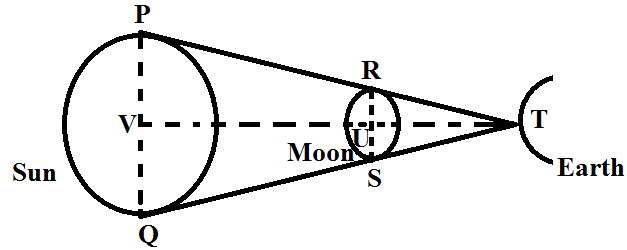
Distance of the Moon from the Earth $=3.84 \times 10^8 m$
Distance of the Sun from the Earth $=1.496 \times 10^{11} m$
Diameter of the Sun $=1.39 \times 10^9 m$ It can be observed that $\triangle TRS$ and $\triangle TPQ$ are similar.
Hence, it can be written as: PQ/RS = VT/UT $1.39 \times 10^9 / RS$
$= 1.496 \times 10^{11}/3.84 \times 10^8$
$RS = (1.39 \times 3.84/1.496) \times 10^6$
$= 3.57 \times 10^6m$
Hence, the diameter of the Moon is $3.57 \times 10^6 m$ View full question & answer→Question 1153 Marks
The parallax of a heavenly body measured from two points diametrically opposite on earth's equator is 60 second. If the radius of earth is $6.4 \times 10^6 \mathrm{~m}$, determine the distance of the heavenly body from the centre of earth. Convert this distance in A.U. Given $1 \mathrm{~A} . \mathrm{U} .=1.5 \times 10^{11} \mathrm{~m}$.
AnswerGiven, $\text{R}=6.4\times10^{6}\text{m}$ $\therefore\text{D}=2\text{R}=2\times6.4\times10^{6}\text{m}$ $=12.8\times10^{6}\text{m}$ $\theta=60\text{ seconds}=\frac{1^{\circ}}{60}=\frac{\pi}{180}\times\frac{1}{60}\text{ radian}$
The distance of heavenly body from earth is given by: $\text{r}=\frac{\text{D}}{\theta}=\frac{12.8\times10^{6}}{\pi}\times180\times60$ $=\frac{12.8\times180\times60\times10^6}{3.142}$
$\Rightarrow\text{ r}=4.399\times10^{10}\text{m}$ Or, $\text{r}=\frac{4.399\times10^{10}}{1.5\times10^{11}}\text{A.U.}=0.293\text{A.U}$
View full question & answer→Question 1163 Marks
In Searle's experiment, the diameter of the wire as measured by a screw guage of least count 0.001cm is 0.500cm. The length, measured by a scale of least count 0.1cm is 110.0cm. When a weight of 40N is suspended from the wire, its extension is measured to be 0.125cm by a micrometer of least count 0.001cm. Find the Young's modulus of the material of the wire from this data.
AnswerYoung's modulus of the material of the wire is given as: $\text{Y}=\frac{\text{Normal stress}}{\text{Longitudinal strain}}=\frac{\frac{\text{F}}{\text{A}}}{\frac{\text{l}}{\text{L}}}$ $=\frac{\text{FL}}{\text{A.l}}$ $=\frac{\text{F.l}}{\frac{\pi\text{d}^2}{4}\times\text{l}}=\frac{4\text{Fl}}{\pi\text{d}^2\text{l}}$ Here, $\text{F}=40\text{N},\text{L}=110\text{cm}=1.1\text{m}$ $\text{l}=0.125\text{cm}=0.00125\text{m}$ And $\text{d}=0.500\text{cm}=0.005\text{m}$ $\therefore\text{Y}=\frac{4\times40\times1.1}{0.00125\times3.14(0.005)^2}$ $=2.2\times10^{11}\text{N}/\text{ m}^2$ Now $\frac{\Delta\text{Y}}{\text{Y}}=\frac{\Delta\text{L}}{\text{L}}+\frac{\Delta\text{l}}{\text{l}}+2\frac{\Delta\text{d}}{\text{d}}$ $\frac{\Delta\text{Y}}{2.2\times10^{11}}=\frac{0.1}{110}\times\frac{0.001}{0.125}+2\frac{0.001}{0.5}$ $=\frac{1}{1100}+\frac{1}{125}+\frac{1}{250}$ $\therefore\Delta\text{Y}=2.2\times10^{11}\times\Big[\frac{1}{1100}+\frac{1}{125}+\frac{1}{250}\Big]$ $=0.10758\times10^{11}$ $=10.758\times10^{9}\text{N}/\text{ m}^2$ Hence the Young's modulus of the wire is: $=(2.2\times10^{11}\pm10.758\times10^{9})\text{N}/\text{ m}^2$
View full question & answer→Question 1173 Marks
Einstein’s mass $-$ energy relation emerging out of his famous theory of relativity relates mass $(m)$ to energy $(E)$ as $E = mc^2$, where $c$ is speed of light in vacuum. At the nuclear level, the magnitudes of energy are very small. The energy at nuclear level is usually measured in MeV, where $1MeV = 1.6 \times 10^{-13}J$; the masses are measured in unified atomic mass unit $(u)$ where $1u = 1.67 \times 10^{-27}kg$.
- Show that the energy equivalent of $1u$ is $931.5MeV$.
- A student writes the relation as $1u = 931.5MeV$. The teacher points out that the relation is dimensionally incorrect. Write the correct relation.
Answer
- We can apply Einstein’s mass$-$energy relation in this problem, $E = mc^2$, to calculate the energy equivalent of the given mass.
Here, $1\ \text{amu}=1\text{u}=1.67\times10^{-27}\text{kg}$
Applying $E = mc^2$
Energy $\text{E}=(1.67\times10^{-27})(3\times10^8)\text{J}=1.67\times9\times10^{-11}\text{J}$
$\text{E}=\frac{1.67\times9\times10^{-11}}{1.6\times10^{-13}}\text{MeV}$
$=939.4\text{MeV}\approx931.5\text{MeV}$
- $\text{As E}=\text{mc}^2\Rightarrow\text{m}=\frac{\text{E}}{\text{c}^2}$
According to this, $1\text{u}=\frac{931.5\text{MeV}}{\text{c}^2}$
Hence the dimensionally correct relation $1\ \text{amu}\times\text{c}^2=1\text{u}\times\text{c}^2=931.5\text{MeV}$ View full question & answer→Question 1183 Marks
A book with many printing errors contains four different formulas for the displacement $y$ of a particle undergoing a certain periodic motion:
- $\text{y}=\text{a}\sin2\pi\text{ t/T}$
- $\text{y}=\text{a}\sin \text{vt}$
- $\text{y}=(\text{a/T})\sin\text{t/a}$
- $\text{y}=(\text{a}\sqrt{2})(\sin2\pi\text{t/T}+\cos2\pi\text{t/T})$
$(a =$ maximum displacement of the particle, $v =$ speed of the particle. $T =$ time$-$period of motion$)$. Rule out the wrong formulas on dimensional grounds. AnswerThe displacement $y$ has the dimension of length, therefore, the formula for it should also have the dimension of length. Trigonometric functions are dimensionless and their arguments are also dimensionless. Based on these considerations now check each formula .
- $\frac{2\pi\text{t}}{\text{T}}=\frac{\text{T}}{\text{T}}=1=(\text{M}^0\text{L}^0\text{T}^0)\ \ \dots$ dimensionless
- $\text{vt}=(\text{LT}^{-1})(\text{T})=\text{L}=\big[\text{M}^0\text{L}^0\text{T}^0\big]\ \ \dots$ not dimensionless
- $\frac{\text{t}}{\text{a}}=\frac{\text{T}}{\text{L}}=[\text{L}^{-1}\text{T}^1]\ \ \dots$ not dimensionless
- $\frac{2\pi\text{t}}{\text{T}}=\frac{\text{T}}{\text{T}}=1=\big[\text{M}^0\text{L}^0\text{T}^0\big]\ \ \dots$ dimensionless
dimensionally. The formulas in $(ii)$ and $(iii)$ are dimensionally wrong. View full question & answer→Question 1193 Marks
The radius of atom is of the order of $\mathring{\text{A}}$ and radius of nucleus is of the order of fermi. How many magnitudes higher is the volume of atom as compared to the volume of nucleus?
AnswerAccording to the question, Radius of atom $1\mathring{\text{A}}=10^{-10}\text{m}$ Radius of nucleus $\approx1\ \text{fermi}=10^{-15}\text{m}$ Volume of atom $\text{V}_\text{Atom}=\frac{4}{3}\pi\text{R}^3_\text{A}$ Volumev of nucleus $\text{V}_\text{nucleus}=\frac{4}{3}\pi\text{R}^3_\text{N}$
$\frac{\text{V}_\text{Atom}}{\text{V}_\text{Nucleus}}=\frac{\frac{4}{3}\pi\text{R}^3_\text{A}}{\frac{4}{3}\pi\text{R}^3_\text{N}}=\Big(\frac{\text{R}_\text{A}}{\text{R}_\text{N}}\Big)^3=\Big(\frac{10^{-10}}{10^{-15}}\Big)^3=10^{15}$ Mass of one mole of $_6C^{12}$ atom = 12g Number of atoms in one mole = Avogadro's number = $6.023 \times 10^{23}$
$\therefore$ Mass of one $_6C^{12}$ atom $=\frac{12}{6.023\times10^{23}}\text{g}$
$1\ \text{amu}=\frac{1}{12}\times\text{mass of one}\ _6\text{C}^{12}\ \text{atom}$
$\therefore1\text{ amu}=\Big(\frac{1}{12}\times\frac{12}{6.023\times10^{23}}\Big)\text{g}=1.67\times10^{-24}\text{g}$ $=1.67\times10^{-27}\text{kg}\ \ (\because1\text{g}=10^{-3}\text{kg})$
View full question & answer→Question 1203 Marks
It is a well known fact that during a total solar eclipse the disk of the moon almost completely covers the disk of the sun. The distance of moon ( $r_{\mathrm{ME}}$ ) and sun ( $\mathrm{r}_{\mathrm{SE}}$ ) from the earth surface is $3.84 \times 10^8 \mathrm{~m}$ and $1.496 \times 10^{11} \mathrm{~m}$ while the diameter of Sun is $1.390 \times 10^9 \mathrm{~m}$. Determine the approximate diameter of the moon.
AnswerDistance of moon from the earth $\left(r_{\mathrm{ME}}\right)=3.84 \times 10^8 \mathrm{~m}$. Distance of sun from the earth $\left(\mathrm{r}_{\mathrm{SE}}\right)=1.496 \times 10^{11} \mathrm{~m}$ Diameter of sun $(D)=1.39 \times 10^9 \mathrm{~m}$ During the total solar eclipse, the sun is completely covered by the disk of the moon. $\therefore$ Angular diameter of the moon $=$ Angular diameter of the sun $\frac{\mathrm{d}}{r_{\mathrm{ME}}}=\frac{\mathrm{D}}{\mathrm{r}_{\mathrm{SE}}}$
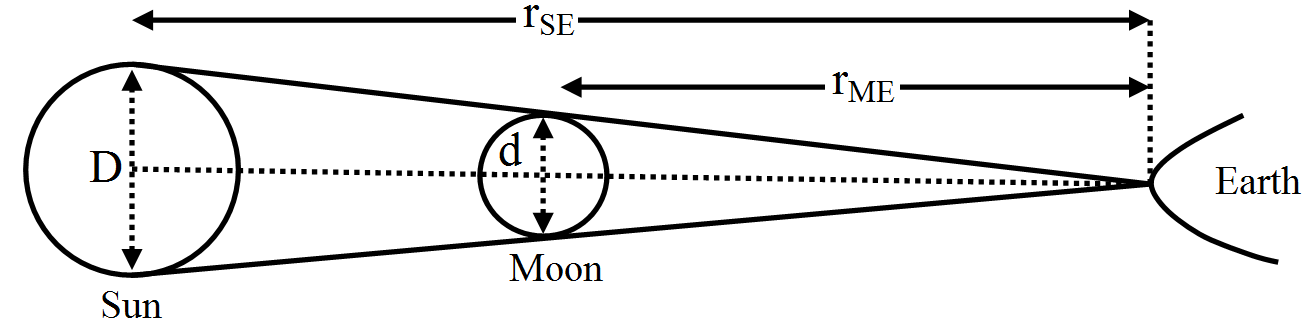
$\text{d}=\text{D}\times\frac{\text{r}_{\text{ME}}}{\text{r}_{\text{ME}}}$ $=1.39\times10^9\times\frac{3.84\times10^8}{1.496\times10^{11}}$ $=3.5679\times10^6\text{m}=3567.9\times10^3$ $=3567.9\text{km}$ View full question & answer→Question 1213 Marks
Mars has approximately half of the earth’s diameter. When it is closest to the earth it is at about $\frac{1}{2}$ A.U. from the earth. Calculate what size it will appear when seen through the same telescope.
AnswerGiven that $\frac{\text{D}_\text{mars}}{\text{D}_\text{earth}}=\frac{1}{2}\ \ \ ...(\text{i})$ where D represents diameter. We know that, $\frac{\text{D}_\text{earth}}{\text{D}_\text{sun}}=\frac{1}{100}$ $\therefore\ \frac{\text{D}_\text{mars}}{\text{D}_\text{sun}}=\frac{1}{2}\times\frac{1}{100}$ [from Eq. (i)] At 1AU Sun's diameter $=\Big(\frac{1}{2}\Big)^\circ$ $\therefore$ Diameter of Mars $=\frac{1}{2}\times\frac{1}{200}=\Big(\frac{1}{400}\Big)^\circ$ At $\frac{1}{2}$AU, Mars' diameter $=\frac{1}{400}\times2^\circ=\Big(\frac{1}{200}\Big)^\circ$ With 100 magnification, Mars' diameter $=\frac{1}{200}\times100^\circ=\Big(\frac{1}{2}\Big)^\circ=30'$ This is larger than resolution limit due to atmospheric fluctuations. Hence, it looks magnified.
View full question & answer→Question 1223 Marks
A new system of units is proposed in which unit of mass is $\alpha\text{kg},$ unit of length $\beta$ m and unit of time $\gamma\text{ s}.$ How much will $5J$ measure in this new system?
AnswerDimension of Energy $=[\text{ML}^2\text{T}^{-2}]$ $\text{n}_2\text{u}_2=\text{n}_1\text{u}_1$ $\text{n}_2=\text{n}_1\frac{\text{u}_1}{\text{u}_2}=\text{n}_1\Big[\frac{\text{M}_1}{\text{M}_2}\Big]^1\Big[\frac{\text{L}_1}{\text{L}_2}\Big]^2\Big[\frac{\text{T}_1}{\text{T}_2}\Big]^{-2} n_2$ = New system of unit = ? $n_1$ = S.I system of unit = 5J $\text{M}_2=\alpha\ \text{kg},\ \ \ \text{M}_1=1\text{kg}$ $\text{L}_2=\beta\text{m},\ \ \ \ \ \text{L}_1=1\text{m}$ $\text{T}_2=\gamma\text{s},\ \ \ \ \text{T}_1=1\text{ second}$ $\text{n}_2=5\Big[\frac{1\text{kg}}{\alpha\text{kg}}\Big]^1\Big[\frac{1\text{m}}{\beta\text{m}}\Big]^2\Big[\frac{1\text{ sec}}{\gamma\text{ sec}}\Big]^{-2}$ $\text{n}_2=5\Big[\alpha^{-1}\beta^{-2}\gamma^2\Big]$ New system $=\frac{\gamma^2}{\alpha\beta^2}\ \text{or}\ \Big[\alpha^{-1}\beta^{-2}\gamma^2\Big]$
View full question & answer→Question 1233 Marks
The nearest star to our solar system is $4.29$ light years away. How much is this distance in terms of parsecs? How much parallax would this star (named Alpha Centauri) show when viewed from two locations of the Earth six months apart in its orbit around the Sun?
AnswerDistance of the star from the solar system $=4.29$ ly 1 light year is the distance travelled by light in one year 1 light year $=$ Speed of light $\times 1$ year $=3 \times 10^8 \times 365 \times 24 \times 60 \times 60=94608 \times 10^{11} \mathrm{~m}$
$\therefore 4.29 \mathrm{ly}=405868.32 \times 10^{11} \mathrm{~m}$
$\because 4.29 \mathrm{ly}=405868.32 \times 10^{11} / 3.08 \times 10^{16}=1.32$ parsec $\theta=\frac{\mathrm{d}}{\mathrm{D}}$ where, Diameter of Earth's orbit, $\mathrm{d}=3 \times 10^{11} \mathrm{~m}$ Distance of the star from the earth, $\mathrm{D}=405868.32 \times 10^{11} \mathrm{~m}$
$\therefore \theta=3 \times 10^{11} / 405868.32 \times 10^{11}=7.39 \times 10^{-6} \mathrm{rad}$ But, $1 \mathrm{\sec}=4.85 \times 10^{-6} \mathrm{rad} $
$\therefore 7.39 \times 10^{-6} \mathrm{rad}=7.39 \times 10^{-}6 / 4.85 \times 10^{-6}=1.52$
View full question & answer→Question 1243 Marks
A force of $(2500 \pm 5)$ N is applied over an area of $(0.32 \pm 0.02) \text{m}^2.$ Calculate the pressure exerted over the area.
AnswerHere force, $\text{F}=(2500\pm5)\text{N}$ and area $\text{A}=(0.32\pm0.02)\text{m}^2$ Pressure $\text{P}=\frac{\text{F}}{\text{A}}$ $\text{P}=\frac{2500}{0.32}$ $\therefore\text{P}=7812.5\text{Nm}^{-2}$ As per the principle of error, $\Rightarrow\frac{\Delta\text{P}}{\text{P}}=\pm\Big(\frac{\Delta\text{F}}{\text{F}}+\frac{\Delta\text{A}}{\text{A}}\Big)$ $\Rightarrow\frac{\Delta\text{P}}{7812.5}=\pm\Big(\frac{5}{2500}+\frac{0.02}{0.32}\Big)$ $\Rightarrow\Delta\text{P}=\pm7812.5\Big(\frac{1}{500}+\frac{1}{16}\Big)$ $=\pm7812.5\times\frac{516}{8000}=\pm503.9\text{Nm}^{-2}$ Hence, the pressure with error limit $= (7812.5 \pm 503.9) \text{Nm}^{-2}$
View full question & answer→Question 1253 Marks
Calculate focal length of a spherical mirror from the following observations: object distance $\text{u} = (50.1 \pm 0.5)\text{cm}$ and image distance $\text{v} = (20.1 \pm0.2)\text{cm} .$
AnswerAs $\frac{1}{\text{f}}=\frac{1}{\text{u}}+\frac{1}{\text{v}}=\frac{\text{v}+\text{u}}{\text{uv}}$ $\therefore\text{f}=\frac{\text{uv}}{\text{u}+\text{v}}=\frac{(50.1)(20.1)}{(50.1+20.1)}=14.3\text{cm}$ Also, $\frac{\Delta\text{f}}{\text{f}}=\pm\Big[\frac{\Delta\text{u}}{\text{u}}+\frac{\Delta\text{v}}{\text{v}}+\frac{\Delta\text{u}+\Delta\text{v}}{\text{u}+\text{v}}\Big]$ $=\pm\Big[\frac{0.5}{50.1}+\frac{0.2}{20.1}+\frac{0.5+0.2}{50.1+20.1}\Big]$ $\frac{\Delta\text{f}}{\text{f}}=\pm\Big[\frac{1}{100.2}+\frac{1}{100.5}+\frac{0.7}{70.2}\Big]$ $=\pm[0.0098+0.00995]+0.00997]$ $\Delta\text{f}=0.02990\times\text{f}=0.0299\times14.3$ $=0.428\text{cm}=0.4\text{cm}$ $\therefore\text{f}=(14.3\pm0.4)\text{cm}$
View full question & answer→Question 1263 Marks
Why length, mass and time are chosen as base quantities in mechanics?
AnswerNormally each physical quantity requires a unit or standard for its specification, so it appears that there must be as many units as there are physical quantities. However, it is not so. It has been found that if in mechanics we choose arbitrarily units of any three physical quantities we can express the units of all other physical quantities in mechanics in terms of these. So, length, mass and time are chosen as base quantities in mechanics because.
- Length, mass and time cannot be derived from one another, that is these quantities are independent.
- All other quantities in mechanics can be expressed in terms of length, mass and time.
View full question & answer→Question 1273 Marks
The mass of a box measured by a grocer’s balance is $2.300\ kg$. Two gold pieces of masses $20.15g$ and $20.17g$ are added to the box. What is
- The total mass of the box,
- The difference in the masses of the pieces to correct significant figures
AnswerMass of grocer's box $= 2.300\ kg$ Mass of gold piece $I = 20.15g = 0.02015\ kg$ Mass of gold piece $II = 20.17g = 0.02017\ kg$
- Total mass of the box $= 2.3 + 0.02015 + 0.02017 = 2.34032\ kg$ In addition, the final result should retain as many decimal places as there are in the number with the least decimal places. Hence, the total mass of the box is $2.3\ kg.$
- Difference in masses $= 20.17 - 20.15 = 0.02g$ In subtraction, the final result should retain as many decimal places as there are in the number with the least decimal places.
View full question & answer→Question 1283 Marks
Experiments show that the frequency (n) of a tuning fork depends upon the length (l) of the prong, the density (d) and the Young's modulus (Y) of its material. From dimensional considerations, find a possible relation for the frequency of a tuning fork.
AnswerWe are given that $\text{n}=\text{f}(\text{l},\text{d},\text{Y})$ Assuming that $\text{n}=\text{k}\text{l}^{\text{a}}\text{d}^{\text{b}}\text{Y}^{\text{c}}$ And substituting dimensions of all the quantities involved, We have: $[\text{T}^{-1}]=[\text{L}]^{\text{a}}[\text{ML}^{-3}]^{\text{b}}[\text{ML}^{-1}\text{T}^{-2}]^{\text{c}}$ Equating powers of M, L and T on Both sides, We have, $\text{b}+\text{c}=0$ $\text{a}-3\text{b}-\text{c}=0$ $-2\text{c}=-1$ These give $\text{c}=\frac{1}{2},\text{b}=-\frac{1}{2}\text{ and }\text{a}=-1$ $\therefore\text{n}=\text{kl}^{-1}\text{d}^{\frac{-1}{2}}\text{Y}^{\frac{1}{2}}$ Or $\text{n}=\frac{\text{k}}{\text{l}}\sqrt{\frac{\text{Y}}{\text{d}}}$ This is the required relation for the frequency of a tunning fork.
View full question & answer→Question 1293 Marks
One mole of an ideal gas at standard temperature and pressure occupies $22.4$ L (molar volume). What is the ratio of molar volume to the atomic volume of a mole of hydrogen? (Take the size of hydrogen molecule to be about $1\mathring{\text{A}}$). Why is this ratio so large?
AnswerRadius of hydrogen atom, $r =0.5 \AA=0.5 \times 10^{10} m$
Volume of hydrogen atom $=4 / 3 \pi r ^3=(4 / 3) \times(22 / 7) \times(0.5 \times$ $\left.10^{-10}\right)^3=0.524 \times 10^{-30} m^3$
Now, 1 mole of hydrogen contains $6.023 \times 10^{23}$ hydrogen atoms.
$\therefore$ Volume of 1 mole of hydrogen atoms, $V _{ a }=6.023 \times 10^{23} \times 0.524 \times 10^{-30}=3.16 \times 10^{-7} m^3$
Molar volume of 1 mole of hydrogen atoms at STP, $V _{ m }=22.4 L=22.4 \times 10^{-3} m^3$
$\therefore \frac{V_{m}}{V_{a}}=\frac{22.4 \times 10^{-3}}{3.6 \times 10^{-7}}=7.08 \times 10^4$
Hence, the molar volume is $7.08 \times 10^4$ times higher than the atomic volume.
For this reason, the inter-atomic separation in hydrogen gas is much larger than the size of a hydrogen atom.
View full question & answer→Question 1303 Marks
Estimate the average mass density of a sodium atom assuming its size to be about $2.5 \mathring{\text{A}}.$ (Use the known values of Avogadro’s number and the atomic mass of sodium). Compare it with the mass density of sodium in its crystalline phase: $970kg m^{–3}. $Are the two densities of the same order of magnitude? If so, why?
AnswerDiameter of sodium atom = Size of sodium atom $=2.5 \mathring A
$
Radius of sodium atom, $r =\left(\frac{1}{2}\right) \times 2.5 \mathring A=1.25 \mathring A=1.25 \times 10^{-10} m$
Volume of sodium atom, $V =\left(\frac{4}{3}\right) \pi r ^3=\left(\frac{4}{3}\right) \times 3.14 \times\left(1.25 \times 10^{-10}\right)^3= V _{\text {Sodium }}$
According to the Avogadro hypothesis,one mole of sodium contains $6.023 \times 10^{23}$
atoms and has a mass of 23 g or $23 \times 10^{-3} kg .$
$ \therefore$ Mass of one atom $=23 \times 10^{-3} / 6.023 \times 10^{23} Kg = m _1$
Density of sodium atom, $\rho=\frac{ m _1}{V_{\text {sodium }}}$ Substituting the value from above,
we get Density of sodium atom, $\rho=4.67 \times 10^{-3} Kg m ^{-3}$
It is given that the density of sodium in crystalline phase is $970 kg m ^{-3}$.
Hence, the density of sodium atom and the density of sodium in its crystalline phase are not in the same order.
This is because in solid phase, atoms are closely packed.
Thus, the inter-atomic separation is very small in the crystalline phase.
View full question & answer→Question 1313 Marks
A physical quantity X is related to four measurable quantities a, b, c and d as follows: $\text{X}=\text{a}^2\text{b}^3\text{c}^\frac{5}{2}\text{d}^{-2}.$ The percentage error in the measurement of a, b, c and d are 1%, 2%, 3% and 4%, respectively. What is the percentage error in quantity X? If the value of X calculated on the basis of the above relation is 2.763, to what value should you round off the result.
Answer$\because\frac{\Delta\text{X}}{\text{X}}\times100=\pm\Big[2\frac{\Delta\text{a}}{\text{a}}+3\frac{\Delta\text{b}}{\text{b}}+\frac{5}{2}\frac{\Delta\text{c}}{\text{c}}+2\frac{\Delta\text{d}}{\text{d}}\Big]\times100$ $\frac{\Delta\text{X}}{\text{X}}\times100=\pm\Big[\frac{2\times1}{100}+\frac{3\times2}{100}+\frac{5}{2}\times\frac{3}{100}+\frac{2\times4}{100}\Big]\times100$ $=\pm\frac{100}{100}\Big[2+6+\frac{15}{2}+8\Big]$ $\frac{\Delta\text{x}}{\text{x}}\times100=\pm\Big[16+\frac{15}{2}\Big]=\pm\Big[\frac{32+15}{2}\Big]=\pm\frac{47}{2}=\pm23.5\%$Mean absolute error $=\pm\frac{235}{100}=\pm0.235$
= 0.24 (rounding off in significant figure)
Again rounding off X = 2.763 in two significant figure = 2.8.
View full question & answer→Question 1323 Marks
A man walking briskly in rain with speed v must slant his umbrella forward making an angle $\theta$ with the vertical. A student derives the following relation between $\theta$ and v: $\tan \theta = \text{v}$ and checks that the relation has a correct limit: as $\text{v}\rightarrow 0,\ \theta \rightarrow0,$ as expected. (We are assuming there is no strong wind and that the rain falls vertically for a stationary man). Do you think this relation can be correct? If not, guess the correct relation.
AnswerIncorrect; on dimensional ground The relation is $\tan\theta=\text{v}$ Dimension of $R.H.S = M^0L^1T^{-1}$ Dimension of $L.H.S = M^0L^0T^0$ ($\because$ The trigonometric function is considered to be a dimensionless quantity) Dimension of R.H.S is not equal to the dimension of L.H.S. Hence, the given relation is not correct dimensionally. To make the given relation correct, the R.H.S should also be dimensionless. One way to achieve this is by dividing the R.H.S by the speed of rainfall v'. Therefore, the relation reduces to $\tan \theta=\frac{\text{v}}{\text{v }'}.$ This relation is dimensionally correct.
View full question & answer→Question 1333 Marks
Time for $20$ oscillations of a pendulum is measured as $t_1 = 39.6s; t_2 = 39.9s; t_3 = 39.5s$. What is the precision in the measurements? What is the accuracy of the measurement?
Answer$t_1 = 39.6s, t_2 = 39.9s$, and $t_3 = 39.5s$ The least count of instrument is 0.1s Hence precision (LC) = 0.1s Mean value of time for 20 oscillations $=\frac{39.6+39.9+39.5}{3}=\frac{119.0}{3}=39.7\text{s}$ Absolute errors in measurement $|\Delta\text{t}_1|=|\bar{\text{t}}-\text{t}_1|=|39.7-39.6|=|0.1|=0.1\text{s}$
$|\Delta\text{t}_2|=|\bar{\text{t}}-\text{t}_2|=|39.7-39.9|=|0.2|=0.2\text{s}$
$|\Delta\text{t}_3|=|\bar{\text{t}}-\text{t}_3|=|39.7-39.5|=|0.2|=0.2\text{s}$
$\therefore$ Mean absolute error $=\frac{0.1+0.2+0.2}{3}=\frac{0.5}{3}\cong0.2\text{s}$
$\therefore$ Accuracy of measurement $=\pm0.2\text{s}.$
View full question & answer→Question 1343 Marks
A famous relation in physics relates ‘moving mass’ m to the ‘rest mass’ mo of a particle in terms of its speed v and the speed of light, c. (This relation first arose as a consequence of special relativity due to Albert Einstein). A boy recalls the relation almost correctly but forgets where to put the constant c. He writes: $\text{m}=\frac{\text{m}_0}{(1-\text{v}^2)^{1/2}}.$ Guess where to put the missing c.
AnswerGiven the relation, $m=\frac{m_0}{\left(1-v^2\right)^{1 / 2}}$. Dimension of $m=M^1 L^0 T^0$ Dimension of $m_0=M^1 L^0 T^0$ Dimension of $v=M^0 L^1 T^{-}$ ${ }^1$ Dimension of $\mathrm{v}^2=\mathrm{M}^0 \mathrm{~L}^2 \mathrm{~T}^{-2}$ Dimension of $\mathrm{c}=\mathrm{M}^0 \mathrm{~L}^1 \mathrm{~T}^{-1}$ The given formula will be dimensionally correct only when the dimension of L.H.S is the same as that of R.H.S. This is only possible when the factor, $\left(1-v^2\right)^{1 / 2}$ is dimensionless i.e., $\left(1-v^2\right)$ is dimensionless. This is only possible if $v^2$ is divided by $\mathrm{c}^2$. Hence, the correct relation is $\mathrm{m}=\mathrm{m}_0\left(\frac{1-\mathrm{v}^2}{\mathrm{c}^2}\right)^{\frac{1}{2}}$
View full question & answer→Question 1353 Marks
Consider a simple pendulum, having a bob attached to a string, that oscillates under the action of the force of gravity. Suppose that the period
of oscillation of the simple pendulum depends on its length $(l),$ mass of the bob $(m)$ and acceleration due to gravity $(g)$. Derive the expression for its time period using method of dimensions.
AnswerThe dependence of time period $T$ on the quantities $l, g$ and $m$ as a product may be written as :
$T=k P^r g^y m^z$
where $k$ is dimensionless constant and $x, y$ and $z$ are the exponents.
By considering dimensions on both sides, we have
${\left[ L ^0 M ^0 T ^1\right]=\left[ L ^1\right]^x\left[ L ^1 T ^{-2}\right]^y\left[ M ^1\right]^z}$
$= L ^{x \neq y} T ^{2 y} M ^z$
On equating the dimensions on both sides, we have
$x+y=0 ;-2 y=1 \text {; and } z=0$
So that $x=\frac{1}{2}, y=-\frac{1}{2}, z=0$
Then, $T=k\ l^\frac{1}{2} g^\frac{1}{2}$
or, $T=k \sqrt{\frac{l}{g}}$
Note that value of constant $k$ can not be obtained by the method of dimensions.
Here it does not matter if some number multiplies the right side of this formula,
because that does not affect its dimensions.
Actually, $k=2 \pi$ so that $T=2 \pi \sqrt{\frac{l}{g}}$
View full question & answer→