MCQ 11 Mark
On heating, some solid substances change from solid to vapour state without passing through liquid state. The technique used for the purification of such solid substances based on the above principle is known as
Answera
($1$) Sublimation : It is the purification technique based on principle that on heating, some solid substances change from solid to vapour state without passing through liquid state.
($2$) Distillation : It is used to separate volatile liquids from non-volatile impurities and the liquids having sufficient difference in their boiling point.
($3$) Chromatography : It is based on separation by using stationary and mobile phase.
($4$) Crystallization : It is based on difference in the solubilities of the compound and impurities in a suitable solvent.
View full question & answer→MCQ 21 Mark
In Lassaigne's extract of an organic compound, both nitrogen and sulphur are present, which gives blood red colour with $Fe ^{3+}$ due to the formation of-
AnswerCorrect option: C. $NaSCN$
c
In case nitrogen and sulphur both are present in an organic compound, sodium thiocyanate is formed, it give blood red colour and no prussian blue since there are no free cyanide Ions
$Na + C + N + S \rightarrow NaSCN$
$Fe ^{+3}+ SCN ^{\ominus} \longrightarrow[ Fe ( SCN )]^{2+}$
View full question & answer→MCQ 31 Mark
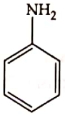
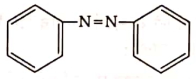
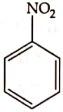
The Kjeldahl's method for the estimation of nitrogen can be used to estimate the amount of nitrogen in which one of the following compounds?
Answerb
Kjeldahl's method is not applicable to the compounds containing nitrogen having nitro and azo group and nitrogen present in the ring (pyridine), as nitrogen of these compounds does not change to ammonium sulphate under these conditions.

View full question & answer→MCQ 41 Mark
A liquid compound ($x$) can be purified by steam distillation only if it is
- A
Not steam volatile, immiscible with water
- ✓
Steam volatile, immiscible with water
- C
Not steam volatile, miscible with water
- D
Steam volatile, miscible with water
AnswerCorrect option: B. Steam volatile, immiscible with water
b
Steam distillation technique is applied to separate the substances which are steam volatile and immiscible with water.
View full question & answer→MCQ 51 Mark
Paper chromatography is an example of
- A
- B
Adsorption chromatography
- ✓
- D
Thin layer chromatography
Answerc
Paper chromatography: The principle involved is partition chromatography wherein the substances are distributed or partitioned between liquid phases. One phase is the water, which is held in the pores of the filter paper used; and other is the mobile phase which moves over the paper.
View full question & answer→MCQ 61 Mark
In Duma's method for estimation of nitrogen, $0.25\, g$ of an organic compound gave $40 \,mL$ of nitrogen collected at $300\, K$ temperature and $725\, mm$ pressure. If the aqueous tension at $300\, K$ is $25\, mm,$ the percentage of nitrogen in the compound is
- ✓
$16.76$
- B
$15.76$
- C
$17.36$
- D
$18.20$
AnswerCorrect option: A. $16.76$
a
Mass of organic compound $=0.25\, \mathrm{g}$
Experimental values, At $STP.$
$V_{1}=40 \,\mathrm{mL}$
$V_{2}=?$
$T_{1}=300 \,\mathrm{K}$
$T_{2}=273 \,\mathrm{K}$
$P_{1}^{2}=725-25=700\, \mathrm{mm}$
$P_{2}=760\, \mathrm{mm}$
$\frac{P_{1} V_{1}}{T_{1}}=\frac{P_{2} V_{2}}{T_{2}}$
$V_{2}=\frac{P_{1} V_{1} T_{2}}{T_{1} P_{2}}=\frac{700 \times 40 \times 273}{300 \times 760}=33.52\, \mathrm{mL}$
$22400\, \mathrm{mL}$ of $\mathrm{N}_{2}$ at $STP$ weighs $=28\, \mathrm{g}$
$\therefore 33.52\, \mathrm{mL}$ of $\mathrm{N}_{2}$ at $STP$ weighs $=\frac{28 \times 33.52}{22400}$
$=0.0419\; \mathrm{g}$
$\%$ of $\mathrm{N}=\frac{\text { Mass of nitrogen at STP }}{\text { Mass of organic compound taken }} \times 100$
$=\frac{0.0419}{0.25} \times 100=16.76 \%$
View full question & answer→MCQ 71 Mark
In the Kjeldahl's method for estimation of nitrogen present in a soil sample, ammonia evolved from $0.75\, g$ of sample neutralized $10\, mL$ of $1\, M \,H_2SO_4.$ The percentage of nitrogen in the soil is
- ✓
$37.33$
- B
$45.33$
- C
$35.33$
- D
$43.33$
AnswerCorrect option: A. $37.33$
a
$\because M \times V(m l)=m \,m o l$
$10\, \mathrm{m} \,\mathrm{mol} \,\mathrm{H}_{2} \mathrm{SO}_{4}=20\, \mathrm{m}\, \mathrm{mol}$ of $\mathrm{NH}_{3}$
$\left[\mathrm{H}_{2} \mathrm{SO}_{4}+2 \mathrm{NH}_{3} \longrightarrow\left(\mathrm{NH}_{4}\right)_{2} \mathrm{SO}_{4}\right]$
$1\, \mathrm{mol}\; \mathrm{NH}_{3}$ contains $14 \,\mathrm{g}$ nitrogen $20 \times 10^{-3}\, \mathrm{mol}\; \mathrm{NH}_{3}$ contains $14 \times 20 \times 10^{-3}$ nitrogen
$0.75\, \mathrm{g}$ of sample contains
$\%$ Nitrogen $=\frac{14 \times 20 \times 10^{-3}}{0.75} \times 100=37.33 \%$
View full question & answer→MCQ 81 Mark
Nitrogen detection in an organic compound is carried out by Lassaigne's test. The blue colour formed corresponds to which of the following formulae ?
- A
$Fe_3[Fe(CN)_6]_2$
- ✓
$Fe_4[Fe(CN)_6]_3$
- C
$Fe_4[Fe(CN)_6]_2$
- D
$Fe_3[Fe(CN)_6]_3$
AnswerCorrect option: B. $Fe_4[Fe(CN)_6]_3$
b
$N a+C+N\stackrel{\Delta}{\rightarrow} N a C N$
$2 \mathrm{NaCN}+\mathrm{FeSO}_{4} \longrightarrow \mathrm{Fe}(\mathrm{CN})_{2}+\mathrm{Na}_{2} \mathrm{SO}_{4}$
$F e(C N)_{2}+4 N a C N \longrightarrow N a_{4}\left[F e(C N)_{6}\right]$
$3 N a_{4}\left[F e(C N)_{6}\right]+4 F e^{3+} \longrightarrow F e_{4}\left[F e(C N)_{6}\right]_{3}+12 N a^{+}$
It is ferri-ferrocyanide
View full question & answer→MCQ 91 Mark
A mixture of $ZnC{l_2}$ and $PbC{l_2}$ can be separated by
Answerb
A mixture of $ZnCl _2$ and $PbCl _2$ is a non- homogeneous mixture.
Hence, they can be separated using method of crystallization.
View full question & answer→MCQ 101 Mark
A mixture of methyl alcohol and acetone can be separated by
- A
- ✓
- C
- D
Distillation under reduced pressure
Answerb
Fractional distillation
$B.P.$ of methanol and acetone are $338 \,K$ and $330\, K$ which have boiling points very close to each other and hence they are separated by fractional distillation method.
View full question & answer→MCQ 111 Mark
Mixture of sand and sulphur may best be separated by
AnswerCorrect option: D. Dissolving in $C{S_2}$ and filtering
d
Mixture of sand and sulphur may best be separated by Dissolving in $C{S_2}$ and filtering.
Collect the residue (Sand and Sulphur powder) and dissolve it in Carbon disulphide ($C{S_2}$). Sulphur dissolves in carbon disulphide but sand is insoluble in carbon disulphide. Filter the solution and evaporate it to get sulphur. Sand is dried on filter paper.
View full question & answer→MCQ 121 Mark
To differentiate between carbon-$12$, carbon- $13$ and carbon- $14$, the instrument that you would use in
- A
- B
Atomic absorption spectrometer
- ✓
- D
View full question & answer→MCQ 131 Mark
$p-$ nitrophenol and $o-$ nitrophenol are separated by
- A
- B
Fractional crystallisation
- C
- ✓
Answerd
(d) $o-$ nitro phenol has intra molecular hydrogen bonding, while $p-$ nitrophenol has intermolecular hydrogen bonding (comparitively stronger). Due to this reason, the boiling point of $o-$ nitrophenol is found quite less than that of $p-$ nitrophenol. Hence, $o-$ nitrophenol is steam volatile and can be separated from $p-$ nitrophenol by steam distillation.
View full question & answer→MCQ 141 Mark
The study of organic compounds even at present is done separate from other compounds because
- A
The formation of organic compounds is not based on chemical combination
- B
Organic compounds are covalent
- ✓
Catenation is the main characteristics
- D
It is the easiest method of study
AnswerCorrect option: C. Catenation is the main characteristics
View full question & answer→MCQ 151 Mark
A mixture of camphor and benzoic acid can be separated by
- ✓
- B
- C
- D
Extraction with a solvent
Answera
Aqueous solution of $NaHCO _3$ can be used to separate benzoic acid from its mixture with camphor. Benzoic acid forms water soluble sodium benzoate with $NaHCO _3$. So, A mixture of camphor and benzoic acid can be easily separated by Chemical method.
View full question & answer→MCQ 161 Mark
A mixture of sand and iodine can be separated by
Answerb
(b) Iodine shows sublimation and hence volatalizes on heating, the vapour condenses on cooling to give pure iodine.
View full question & answer→MCQ 171 Mark
Accurate determination of atomic masses is done with the instrument called as
- A
- ✓
- C
Atomic absorption spectrometer
- D
Answerb
(b) Atomic masses, determined by the mass spectrometer.
View full question & answer→MCQ 181 Mark
In Aniline & water mixture, Aniline can be seperate by
- ✓
- B
- C
- D
Distillation under reduced pressure
Answera
Steam distillation is a separation process which consists in distilling water together with other volatile and non-volatile components.
The steam distillation process works on the principle that when a mixture of two or more undissolved liquids are heated, while ensuring that the surfaces of both liquids are in contact with the atmosphere, the vapor pressure exerted by the system increases.
This is because it now becomes the sum of the vapor pressures of all of the components of the mixture combined together.
This allows for evaporation of elements with high boiling points at much lower temperatures merely by allowing them to form a mixture with water.
Aniline is separated from a mixture by using this method.
View full question & answer→MCQ 191 Mark
Which of the following is incorrect ?
AnswerCorrect option: D. In soap industry, glycerol is separated by fractional distillation method
View full question & answer→MCQ 201 Mark
In Carius method $0.099 \,g$ organic compound gave $0.287\, g$ $AgCl$. The percentage of chlorine in the compound will be
- A
$28.6$
- ✓
$71.7$
- C
$35.4$
- D
$64.2$
AnswerCorrect option: B. $71.7$
b
(b) $\%$ of chlorine = $\frac{{35.5}}{{143.5}} \times \frac{{{\rm{Mass\, of }}\,AgCl}}{{{\rm{Mass \,of \,substance}}}} \times 100$
= $\frac{{35.5}}{{143.5}} \times \frac{{0.287}}{{{\rm{0}}{\rm{.099}}}} \times 100 = 71.71\% $.
View full question & answer→MCQ 211 Mark
In the qualitative analysis of nitrate a brown ring is formed due to the formation of
- A
$N{O_2}$
- B
$FeS{O_4}N{O_2}$
- C
${N_2}O.FeS{O_4}$
- ✓
$FeS{O_4}.NO$
AnswerCorrect option: D. $FeS{O_4}.NO$
d
(d)Nitrates on reaction with conc. ${H_2}S{O_4}$ and $FeS{O_4}$ give a brown ring due to formation of $FeS{O_4}.NO$ or $[Fe{({H_2}O)_5}NO]S{O_4}$.
View full question & answer→MCQ 221 Mark
In organic compounds, nitrogen is tested in Lassaigne's test as
- A
$NaN{H_2}$
- ✓
$NaCN$
- C
$NaN{O_2}$
- D
$NaN{O_3}$
AnswerCorrect option: B. $NaCN$
View full question & answer→MCQ 231 Mark
If on adding $FeCl_3$ solution to acidified Lassaigne solution, of organic compound a blood redcolouration is producted, it indicates the presence of
- A
$S$
- B
$N$
- ✓
$N$ and $S$
- D
$S$ and $Cl$
AnswerCorrect option: C. $N$ and $S$
c
$\mathrm{Na}+\mathrm{S}+\mathrm{C}+\mathrm{N} \rightarrow \mathrm{NaSCN} \quad \stackrel{\mathrm{Fe}^{+3}}{\longrightarrow}$ Blood red
colouration $[NCERT\,XI\,pg.\# \,355]$
View full question & answer→MCQ 241 Mark
In a Lassaignes’s test for sulphur in the organic compound with sodium nitroprusside solution the purple colour formed is due to
- ✓
${[Fe{(CN)_5}NOS]^{4 - }}$
- B
${{[Fe{{(CN)}_{5}}S]}^{2-}}$
- C
${{[Fe{{(CN)}_{5}}NOS]}^{2-}}$
- D
${{[Fe{{(CN)}_{6}}]}^{4-}}$
AnswerCorrect option: A. ${[Fe{(CN)_5}NOS]^{4 - }}$
a
During the preparation of Lassaigne's extract, sulphur from the organic compound reacts with sodium to form sodium sulphide. It gives a purple colour with sodium nitroprusside due to the formation of sodium thionitroprusside.
View full question & answer→MCQ 251 Mark
Copper $(II)$ ions gives reddish brown precipitate with potassium ferrocyanide. The formula of the precipitate is
- A
$Cu_4[Fe(CN)_6]$
- ✓
$Cu_2[Fe(CN)_6]$
- C
$Cu_3[Fe(CN)_6]$
- D
$Cu_3[Fe(CN)_6]_2$
AnswerCorrect option: B. $Cu_2[Fe(CN)_6]$
View full question & answer→MCQ 261 Mark
In Lassaigne’s test the organic compound is fused with $Na$ followed by extraction with distilled water. Which of the following is not the product of this fusion reaction
- A
$NaX$
- B
$NaCN$
- ✓
$NaNC$
- D
$Na_2S$
AnswerCorrect option: C. $NaNC$
View full question & answer→MCQ 271 Mark
A compound contains $C = 90\% $ and $H = 10\% $. Empirical formula of the compound is
- A
${C_3}{H_{10}}$
- B
$C{H_2}$
- C
${C_3}{H_2}$
- ✓
${C_3}{H_4}$
AnswerCorrect option: D. ${C_3}{H_4}$
d
(d)
| Elements |
No. of Moles |
Simple ratio |
|
$C = 90\%$
|
$90/12 = 7.5$
|
$ 7.5/7.5 = 1 × 3 = 3$
|
|
$H = 10\%$
|
$10/1 = 10$
|
$10/7.5 = 1.33 × 3 = 4$
|
Empirical formula = ${C_3}{H_4}$
View full question & answer→MCQ 281 Mark
An organic compound contains $C = 36\% $ $H = 6\% $ and rest oxygen. Its Empirical formula is
- ✓
$C{H_2}O$
- B
${C_2}{H_3}{O_3}$
- C
$C{H_2}{O_2}$
- D
${C_2}{H_2}{O_2}$
AnswerCorrect option: A. $C{H_2}O$
a
Element $\%$ No. of Moles Simple Ratio
|
$C$
|
$36$
|
$36/12 = 3$
|
$3/3 = 1$
|
|
$H$
|
$6$
|
$6/1 = 6$
|
$6/3 = 2$
|
|
$O$
|
$58$
|
$58/16 = 3.62$
|
$3.62/3 = 1$
|
Therefore, Empirical formula =$C{H_2}O$
View full question & answer→MCQ 291 Mark
In the estimation of sulphur organic compound on treating with conc. $HN{O_3}$ is converted to
- A
$S{O_2}$
- B
${H_2}S$
- ✓
${H_2}S{O_4}$
- D
$S{O_3}$
AnswerCorrect option: C. ${H_2}S{O_4}$
c
(c)In carius method sulphur of organic compound is converted in to ${H_2}S{O_4}$
$S+{{H}_{2}}O+3O\,\underset{HN{{O}_{3}}}{\mathop{\xrightarrow{\Delta }}}\,{{H}_{2}}S{{O}_{4}}$
View full question & answer→MCQ 301 Mark
$0.24 \,g$ of an organic compound gave $0.22\, g$ $C{O_2}$ on complete combustion. If it contains $1.66\%$ hydrogen, then the percentage of $C$ and $O$ will be
- A
$12.5$ and $36.6$
- ✓
$25$ and $75$
- C
$25$ and $36.6$
- D
$25$ and $80$
AnswerCorrect option: B. $25$ and $75$
b
(b) $\%$ of $C$ = $\frac{{12}}{{44}} \times \frac{{{\text{Mass of }}C{O_2}}}{{{\text{Mass of substance}}}} \times 100$
= $\frac{{12 \times 0.22}}{{44 \times 0.24}} \times 100 = 25; \,C = 25, \,H = 1.66$
Total = $26.6 = 100 -26.6 = 73.4.$
View full question & answer→MCQ 311 Mark
An organic compound contains $C = 74.0\% ,$ $H = 8.65\% $ and $N = 17.3\% $. Its Empirical formula is
- A
${C_5}{H_8}N$
- B
${C_{10}}{H_{12}}N$
- ✓
${C_5}{H_7}N$
- D
${C_{10}}{H_{14}}N$
AnswerCorrect option: C. ${C_5}{H_7}N$
c
(b)
Element No. of Moles Simple Ratio
$C = 74$
|
$74/12 = 6.1$
|
$6.1/1.2 = 5.08$ or $5$
|
$H = 8.65$
|
$8.65/1= 8.65$
|
$8.6/1.2 = 7.16$ or $7$
|
$N = 17.3$
|
$17.3/14 = 1.2$
|
$1.2/1.2 =$ $1$ or $1$
|
Therefore Empirical formula $ = {C_5}{H_7}N$.
View full question & answer→MCQ 321 Mark
Empirical formula of a compound is ${C_2}{H_5}O$ and its molecular weight is $90$. Molecular formula of the compound is
- A
${C_2}{H_5}O$
- B
${C_3}{H_6}{O_3}$
- ✓
${C_4}{H_{10}}{O_2}$
- D
${C_5}{H_{14}}O$
AnswerCorrect option: C. ${C_4}{H_{10}}{O_2}$
c
(c)Empirical formula mass =${C_2}{H_5}O$ = $24+ 5 +16= 45.$
$n = \frac{{{\rm{Mol}}{\rm{. mass}}}}{{{\rm{Emp}}{\rm{. mass}}}} = \frac{{90}}{{45}} = 2$
Mol. formula = ${({C_2}{H_5}O)_2} = {C_4}{H_{10}}{O_2}$.
View full question & answer→MCQ 331 Mark
An organic compound contains $C = 38.8\% ,$ $H = 16\% $ and $N = 45.2\% $. Empirical formula of the compound is
- ✓
$C{H_3}N{H_2}$
- B
$C{H_3}CN$
- C
${C_2}{H_5}CN$
- D
$C{H_2}{(NH)_2}$
AnswerCorrect option: A. $C{H_3}N{H_2}$
a
(a)
Element No. of Moles Simple Ratio
|
$C = 38.8$
|
$38.8/12 = 3.2$
|
$1$
|
|
$H = 16$
|
$16/1 = 16$
|
$5$
|
|
$N = 45.2$
|
$45.2/14 = 3.2$
|
$1$
|
Therefore, Empirical formula =$C{H_5}N$ or $C{H_3}N{H_2}$.
View full question & answer→MCQ 341 Mark
In Kjeldahl's method for the estimation of nitrogen, the formula used is
- A
$\% N = \frac{{1.4\,{\rm{ }}V{\rm{ }}W}}{N}$
- B
$\% N = \frac{{1.4\,{\rm{ }}N{\rm{ }}W}}{V}$
- C
$\% N = \frac{{V{\rm{ }}N{\rm{ }}W}}{{1.8}}$
- ✓
$\% N = \frac{{1.4{\rm{ }}V{\rm{ }}N}}{W}$
AnswerCorrect option: D. $\% N = \frac{{1.4{\rm{ }}V{\rm{ }}N}}{W}$
d
(d) $\%$ of $N = \frac{{1.4 \times V \times N}}{W}$
where $V$ = Volume of acid used
$N$ = Normality of acid, $W$ = Weight of substance
View full question & answer→MCQ 351 Mark
An organic compound gave $C = 92.31\%$ and $H = 7.69\% $. If molecular weight of the compound is $78$, its molecular formula is
- ✓
${C_6}{H_6}$
- B
${C_7}{H_7}$
- C
${C_6}{H_{18}}$
- D
${C_8}{H_{20}}$
AnswerCorrect option: A. ${C_6}{H_6}$
a
(a)
| Elements |
No. of Moles |
Simple ratio |
| $C = 92.31$ |
$92.31/12 = 7.96$ |
$1$ |
| $H = 7.69$ |
$7.69/1 = 7.69$ |
$1$ |
Hence, $CH$
Empirical formula mass of $CH = 13$
$n = \frac{{{\rm{Mol}}{\rm{. mass}}}}{{{\rm{Emp}}{\rm{.}}\,{\rm{mass}}}} = \frac{{78}}{{13}} = 6$
Molecular formula = ${(CH)_6} = {C_6}{H_6}$.
View full question & answer→MCQ 361 Mark
An organic compound gave the following results $C = 53.3\% ,{\rm{ }}H = 15.6,{\rm{ }}N = 31.1\% ,$ mol. wt. = $45$, What is molecular formula of the compound ?
- A
${C_2}{H_5}{N_2}$
- B
${C_2}{H_5}N$
- ✓
${C_2}{H_7}N$
- D
${C_2}{H_6}N$
AnswerCorrect option: C. ${C_2}{H_7}N$
c
(c)
Element No. of Moles Simple Ratio
$ C = 53.3$
|
$53.3/12 = 4.44$
|
$2$
|
$H = 15.6$
|
$15.6/1 = 15.6$
|
$7$
|
$N = 31.1$
|
$31.1/14 = 2.22$
|
$1$
|
Hence, formula = ${C_2}{H_7}N$ or $(C{H_3}C{H_2}N{H_2})$
View full question & answer→MCQ 371 Mark
A compound has $50\%$ carbon, $50\%$ oxygen and approximate molecular weight is $290$. Its molecular formula is
- A
$CO$
- B
${C_4}{O_3}$
- ✓
${C_{12}}{O_9}$
- D
${C_3}{O_3}$
AnswerCorrect option: C. ${C_{12}}{O_9}$
c
(c)
| Elements |
simple ratio |
| $C=50$ |
$50/12=4$ |
| $0=50$ |
$50/16=3$ |
Empirical formula mass = $96$ Empirical formula = ${C_4}{O_3}$
$n = \frac{{290}}{{96}} = 3$
Molecular formula = ${({C_4}{O_3})_3} = {C_{12}}{O_9}$
View full question & answer→MCQ 381 Mark
On analysis, a saturated hydrocarbon is found to contain $83.70 $ percent carbon and $16.30\%$ hydrogen. The empirical formula will be (at. wt. of $C=12,$ at. wt. of $H = 1$)
- A
${C_3}{H_6}$
- B
${C_3}{H_8}$
- ✓
${C_3}{H_7}$
- D
${C_6}{H_{12}}$
AnswerCorrect option: C. ${C_3}{H_7}$
c
(c)
| Element |
No. of moles |
Simple ratio |
|
$C = 83.7\%$
|
$83.7/12 = 6.9$ |
$6.9/6.9 = 1 × 3 = 3$ |
| $H= 16.3\%$ |
$16.3/1 = 16.3$ |
$16.3/0.9 = 2.3 × 3 = 7$ |
Empirical formula =${{C}_{3}}{{H}_{7}}$ .
View full question & answer→MCQ 391 Mark
An organic compound has $C = 60\%$, $H = 13.3\%$ and $O = 26.7\%$. Its empirical formula will be
- A
${C_3}{H_6}O$
- B
${C_2}{H_6}{O_2}$
- C
${C_4}{H_8}{O_2}$
- ✓
${C_3}{H_8}O$
AnswerCorrect option: D. ${C_3}{H_8}O$
d
(d)
Elements $\%$ No. of moles Simple ratio
|
$C$
|
$60\%$
|
$60/12 = 5 $
|
$3.01$
|
|
$ H$
|
$13.3\%$
|
$13.3/1 = 13.3$
|
$8.01$
|
|
$O$
|
$26.7\%$
|
$26.7/16 = 1.66$
|
$1$
|
Empirical formula =${{C}_{3}}{{H}_{8}}O$ .
View full question & answer→MCQ 401 Mark
A hydrocarbon has $C=85.72\%$ and remaining $H$. The hydrocarbon is
- ✓
${C_2}{H_4}$
- B
${C_2}{H_6}$
- C
${C_2}{H_2}$
- D
$C{H_4}$
AnswerCorrect option: A. ${C_2}{H_4}$
a
(a)
Element $\%$ No. of moles Simple ratio
$C$
|
$ 85.72\%$
|
$85.72/12$
|
$7.14 = 1$
|
$H$
|
$14.18\%$
|
$14.18/1$
|
$14.18 = 2$
|
Empirical formula =${{C}_{2}}{{H}_{4}}$ .
View full question & answer→MCQ 411 Mark
$64 \,gm$ of an organic compound contains $24\, gm$ of carbon, $8\,gm$ of hydrogen and the rest oxygen. The empirical formula of the compound is
- A
$C{H_2}O$
- B
${C_2}{H_4}O$
- ✓
$C{H_4}O$
- D
${C_2}{H_8}{O_2}$
AnswerCorrect option: C. $C{H_4}O$
c
(c)
Elements No. of moles Simple ratio
|
$C$
|
$(24\,gm)$
|
$24/12 = 2$
|
$ 1$
|
|
$ H $
|
$(8\,gm)$
|
$8/1 = 8$
|
$4$
|
|
$O$
|
$(32\,gm)$
|
$32/16 = 2$
|
$1$
|
Empirical formula = $C{{H}_{4}}O$
View full question & answer→MCQ 421 Mark
An organic compound with $C = 40\%$ and $H = 6.7\%$ will have the empirical formula
- A
$C{H_2}$
- ✓
$C{H_2}O$
- C
${C_3}{H_6}{O_3}$
- D
${C_2}{H_4}{O_2}$
AnswerCorrect option: B. $C{H_2}O$
b
(b)
Elements No. of moles Simple ratio
|
$C = 40\%$
|
$40/12$
|
$3.33$
|
$1$
|
|
$H = 6.7\%$
|
$6.7/1$
|
$6.7$
|
$2$
|
|
$O = 53.3\%$
|
$5.33/16$
|
$3.33$
|
$1$
|
Thus, Empirical formula =$C{{H}_{2}}O$
View full question & answer→MCQ 431 Mark
$0.2595\,g$ of an organic substance in a quantitative analysis yielded $0.35\, g$ of the barium sulphate. The percentage of sulphur in the substance is.....$g$
- ✓
$18.52$
- B
$182.2$
- C
$17. 5 $
- D
$175.2$
AnswerCorrect option: A. $18.52$
a
(a) $\% \,\,{\rm{of}}\,\,{\rm{S}} = \frac{{{\rm{32}}}}{{{\rm{233}}}} \times \frac{{{\rm{wt}}{\rm{.}}\,\,{\rm{of}}\,\,BaS{O_4}}}{{{\rm{wt}}{\rm{.}}\,\,{\rm{of}}\,\,{\rm{organic}}\,\,\,{\rm{compound}}}} \times 100$
$ = \frac{{32}}{{233}} \times \frac{{0.35}}{{0.2595}} \times 100 = 18.52\% \,\,gm$.
View full question & answer→MCQ 441 Mark
Percentage composition of an organic compounds is as follows: $C = 10.06$, $H = 0.84$, $Cl = 89.10$. Which of the following corresponds to its molecular formula if the vapour density is $ 60.0$
- A
$C{H_2}C{l_2}$
- ✓
$CHC{l_3}$
- C
$C{H_3}Cl$
- D
AnswerCorrect option: B. $CHC{l_3}$
b
(b) Molecular of weight of $CHC{l_3}$ is $120$
View full question & answer→MCQ 451 Mark
The percentage of ${N_2}$ in urea is about
- A
$18.05$
- B
$28.29$
- ✓
$46.66$
- D
$85.56$
AnswerCorrect option: C. $46.66$
c
(c) Urea $(N{H_2}CON{H_2})$ has molecular wt. $60$ and wt. of Nitrogen is $28$
In $ 60 \,gm$ of urea nitrogen present =$ 28 \,gm$
In $100 \,gm$ of urea nitrogen present = $ 2800/60= 46.66\%$
View full question & answer→MCQ 461 Mark
An organic compound containing carbon hydrogen and oxygen contains $52.20\%$ carbon and $13.04\%$ hydrogen. Vapour density of the compound is $23$. Its molecular formula will be
- ✓
${C_2}{H_6}O$
- B
${C_3}{H_8}O$
- C
${C_4}{H_8}O$
- D
${C_5}{H_{10}}O$
AnswerCorrect option: A. ${C_2}{H_6}O$
a
(a)Molecular weight = V.D. $\times 2 = 23 \times 2 = 46$
Molecular weight of ${C_2}{H_6}O = 46$
View full question & answer→MCQ 471 Mark
The Empirical formula of a compound is $C{H_2}O$ and its molecular weight is $120$. The molecular formula of the compound is
- A
${C_2}{H_4}{O_2}$
- B
${C_3}{H_6}{O_3}$
- ✓
${C_4}{H_8}{O_4}$
- D
$C{H_2}O$
AnswerCorrect option: C. ${C_4}{H_8}{O_4}$
c
(c)Molecular weight of ${C_4}{H_8}{O_4}$ is $120$.
View full question & answer→MCQ 481 Mark
A compound has an empirical formula ${C_2}{H_4}O$. An independent analysis gave a value of $132.16$ for its molecular mass. What is the correct molecular formula
- A
${C_4}{H_4}{O_5}$
- B
${C_{10}}{H_{12}}$
- C
${C_7}{O_3}$
- ✓
${C_6}{H_{12}}{O_3}$
AnswerCorrect option: D. ${C_6}{H_{12}}{O_3}$
d
(d)Empirical formula weight ${C_2}{H_4}O$
$ = (12 \times 2 + 4 + 16) = 44$
Molecular formula $ = \frac{{{\rm{mol}}{\rm{. wt}}}}{{{\rm{eq}}{\rm{. formula wt}}{\rm{.}}}} \times \, Emp. Formula$
$ = \frac{{132.1}}{{44}} \times {\rm{Emperical \,formula}}$
$ = 3 \times {C_2}{H_4}O = {C_6}{H_{12}}{O_3}$
View full question & answer→MCQ 491 Mark
An organic compound has an empirical formula $C{H_2}O$, its vapour density is $45$. The molecular formula of the compounds is
- A
$C{H_2}O$
- B
${C_2}{H_5}O$
- C
${C_2}{H_2}O$
- ✓
${C_3}{H_6}{O_3}$
AnswerCorrect option: D. ${C_3}{H_6}{O_3}$
d
(d)Mol. wt = $2 \times $ Vap. Density $ = 2 \times 45 = 90$
Empirical formula weight $ = 12 + 2 + 16 = 30$
$\therefore \,\,\,n = \frac{{{\rm{mol}}{\rm{. wt}}{\rm{.}}}}{{{\rm{empirical \,formula \,wt}}{\rm{.}}}}$
$ = \frac{{90}}{{30}} = 3$
$\therefore $ Molecular formula of the compounds
$ = {(C{H_2}O)_3}$ $ = {C_3}{H_6}{O_3}$
View full question & answer→MCQ 501 Mark
Which of the following pair of the species has the same percentage of carbon
- A
$C{H_3}COOH$and ${C_2}{H_5}OH$
- B
${C_6}{H_{12}}{O_6}$ and ${C_{12}}{H_{22}}{O_{11}}$
- C
$HCOOCH_3$ and ${C_{12}}{O_{22}}{H_{11}}$
- ✓
$CH_3COOH$ and ${C_6}{H_{12}}{O_6}$
AnswerCorrect option: D. $CH_3COOH$ and ${C_6}{H_{12}}{O_6}$
d
(d) $C{H_3}COOH$ and ${C_6}{H_{12}}{O_6}$ both have same percentage of carbon i.e. $40\%$.
View full question & answer→MCQ 511 Mark
In Kjeldahl’s method of estimation of $N$, $CuS{O_4}$ acts as
Answerc
Kjeldahl's method depends upon the fact that most of the organic compounds containing nitrogen are quantitatively decomposed to give $\left( NH _4\right)_2 SO _4$ when heated strongly with conc. $H _2 SO _4$. In this method $CuSO _4$ acts as catalytic agent.
View full question & answer→MCQ 521 Mark
When $32.25\,gm$ ethyl chloride dehydro halogenated, if gives $50\%$. Alkene, what is the mass of product.......$gm$ (atomic mass of chlorine = $35.5$)
Answerd
(d) ${{C}_{2}}{{H}_{5}}Cl$$\xrightarrow{-HCl}{{C}_{2}}{{H}_{4}}$
$64.5$ $28$
$32.25$ $28$
$64.5 \,gm$ ${C_2}{H_5}Cl$ gives $28 \,gm$ of ${C_2}{H_4}$
$32.25\,gm$ ${C_2}{H_5}Cl$ gives $ = \frac{{28 \times 32.25}}{{64.5}}$ = $14 \,gm$ of ${C_2}{H_4}$
Obtained product is $50\%$ so mass of obtained alkene $ = \frac{{14}}{2} = 7\,gm$
View full question & answer→MCQ 531 Mark
A gas mixture contains $50\%$ helium and $50\%$ methane by volume. What is the percent by weight of methane in the mixture.......$\%$
- A
$19.97$
- B
$0.05$
- C
$50$
- ✓
$80$
Answerd
(d) Solution contain $He + C{H_4}$
Their mol. wt = $4 + 16 = 20$
% wt of $C{H_4} = \frac{{{\rm{wt \,of \,}}C{H_4}}}{{{\rm{Total \,wt}}}} \times 100 = \frac{{16}}{{20}} \times 100 = 80.0\% $
View full question & answer→MCQ 541 Mark
$0.5 \,g$ of hydrocarbon gave $0.9 \,g$ water on combustion. The percentage of carbon in hydrocarbon is
- A
$75.8$
- ✓
$80$
- C
$56.6$
- D
$28.6$
Answerb
(b) $\%$ of $H = \frac{2}{{18}} \times \frac{{{\rm{wt\,}}{\rm{.of\,}}\,{H_2}O}}{{{\rm{wt\,}}{\rm{. of \,organic\, compound}}}} \times 100$
$ = \frac{2}{{18}} \times \frac{{0.9}}{{0.5}} \times 100 = 20\,\% $
Since percentage of hydrogen is $20$. Therefore, remaining is carbon i.e. $80\%.$
View full question & answer→MCQ 551 Mark
In Kjeldahl’s method, the nitrogen present in the organic compound is quantitatively converted into
Answerd
(d) In Kjeldahl’s method, the nitrogen is estimated in the form of ammonia, which is obtained by heating compounds with $NaOH$.
$C{H_3}CON{H_2} + NaOHC \overset {\Delta} \longrightarrow {H_3}COONa + {H_2}O + N{H_3}$
View full question & answer→MCQ 561 Mark
A hydrocarbon contains $10.5 \,gm$ carbon and $ 1\,gm$ hydrogen. Its $2.4 \,gm $ has $1 \,litre$ volume at $1 \,atm$ and ${127\,^o}C$, hydrocarbon is
- ✓
${C_6}{H_7}$
- B
${C_6}{H_8}$
- C
${C_5}{H_6}$
- D
AnswerCorrect option: A. ${C_6}{H_7}$
a
(a) $C = 10.5\,\,gm = \frac{{10.5}}{{12}}mol = 0.87\,\,mol$
$H = 1\,\,gm = \frac{1}{1} = 1\,\,mol$
$\therefore \,{({C_{0.87}}{H_1})_7} = {C_{6.09}}{H_7} \approx {C_6}{H_7}$
$PV = nRT$; $PV = \frac{w}{m}RT$
$1 \times 1 = \frac{{2.4}}{m} \times 0.082 \times 400$
$m = 2.4 \times 0.082 \times 400$$ = 78.42 \approx 79$.
View full question & answer→MCQ 571 Mark
$58$ $ml$ of $\frac{N}{5}{H_2}S{O_4}$ are used to neutralize ammonia given by $1$ $g$ of organic compound. Percentage of nitrogen in the compound is
- A
$34.3$
- B
$82.7$
- ✓
$16.2$
- D
$21.6$
AnswerCorrect option: C. $16.2$
c
(c) $\% \,\,{\text{of}}\,\,N\, = $$\frac{{1.4 \times {\text{Normality of acid }} \times {\text{ Volume of acid}}}}{{{\text{Mass of substance}}}}$
$ = \frac{{1.4 \times 1 \times 58}}{{1 \times 5}} = 16.2$.
View full question & answer→MCQ 581 Mark
Which of the following statement is correct ?
- A
$\alpha - D-$ glucose & $\beta - D - $ glucose are enantiomers
- B
Glycine is optically active.
- C
Cellulose on hydrolysis yields $\alpha - D-$ glucose
- ✓
In Duma's method nitrogen present in compound is estimated as $N_2$
AnswerCorrect option: D. In Duma's method nitrogen present in compound is estimated as $N_2$
View full question & answer→MCQ 591 Mark
$2.18\,gm$ of an organic compound containg sulphur produces $0.12\,g$ of $BaSO_4$. The percentage.........$\%$ of sulphur in the compound is ?
- A
$7.26$
- B
$8.98$
- C
$10$
- ✓
$6.42$
AnswerCorrect option: D. $6.42$
d
$\mathrm{MM}$ of $\mathrm{AgBr}=108+80=188\, \mathrm{gmol}^{-1}$
$\% \mathrm{S}=\frac{32}{233} \times \frac{1.02}{2.18} \times 100=6.42 \%$
View full question & answer→MCQ 601 Mark
In carius method of estimation of halogen $0.15\,g$ of an organic compound gave $0.12\, g$ of $AgBr$. Find out the percentage......$\%$ of bromine in the compound
- ✓
$34.04$
- B
$58.20$
- C
$9.24$
- D
$0.12$
AnswerCorrect option: A. $34.04$
a
Use given formula $\% \mathrm{Br}=\frac{80 \times \mathrm{W}_{\mathrm{AgBr}} \times 100}{188 \times \mathrm{W}_{\mathrm{org.compd.}} \text {}}$
View full question & answer→MCQ 611 Mark
In the estimation of nitrogen by KJeldahl's method, $2.8\,g$ of an organic compound required $20$ milli mol of $H_2SO_4$ for the complete neutralisation of $NH_3$ gas evolved. The percentage of nitrogen in the sample is?........$\%$
Answera
Percentage of $\mathrm{N}=\frac{1.4 \times \mathrm{mEq} . \text { of } \mathrm{H}_{2} \mathrm{SO}_{4} \text { used to neutralise } \mathrm{NH}_{3}}{\text { Weight of compound }}$
millimoles of $\mathrm{H}_{2} \mathrm{SO}_{4}=20$
milliequivalent of $\mathrm{H}_{4} \mathrm{SO}_{4}=20 \times 2=40$
Percentage of $\mathrm{N}$ in the sample $=\frac{1.4 \times 40}{2.8}=20 \%$
View full question & answer→MCQ 621 Mark
The adsorbent used in adsorption chromatography $1$s/are
$A$. silica gel $B$. alumina $C$. quick lime $D$. magnesia
Choose the most appropriate answer from the options given below :
- A
$B$ only
- B
$C$ and $D$ only
- ✓
$A$ and $B$ only
- D
$A$ only
AnswerCorrect option: C. $A$ and $B$ only
c
The most common polar and acidic support used is adsorption chromatography is silica. The surface silanol groups on their supported to adsorb polar compound and work particularly well for basic substances. Alumina is the example of polar and basic adsorbent that is used in adsorption chromatography.
View full question & answer→MCQ 631 Mark
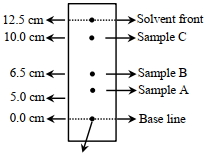
Using the given figure, the ratio of $R_t$ values of sample $A$ and sample $\mathrm{C}$ is $\mathrm{x} \times 10^{-2}$. Value of $\mathrm{x}$ is . . . . . . . .
(Image)
Samples $(A, B, C)$
Fig : Paper chromatography of Samples
Answera
$R_r \text { of } A=\frac{5}{12.5} \quad R_r \text { of } C=\frac{10}{12.5}$
$\text { Ratio }=\frac{R_{f(A)}}{R_{f(C)}}=\frac{1}{2}=0.5 \text { or } 50 \times 10^{-2}$
View full question & answer→MCQ 641 Mark
Which of the following statements are correct?
$A$. Glycerol is purified by vacuum distillation because it decomposes at its normal boiling point.
$B$. Aniline can be purified by steam distillation as aniline is miscible in water.
$C$. Ethanol can be separated from ethanol water mixture by azeotropic distillation because it forms azeotrope.
$D$. An organic compound is pure, if mixed $M.P$. is remained same.
Choose the most appropriate answer from the options given below :
- A
$A, B, C$ only
- ✓
$A, C, D$ only
- C
$B, C, D$ only
- D
$A, B, D$ only
AnswerCorrect option: B. $A, C, D$ only
b
Option $(B)$ is incorrect because aniline is immisible in water.
View full question & answer→MCQ 651 Mark
The correct statements among the following, for a "chromatography" purification method is:
AnswerCorrect option: C. $R_f$ of a polar compound is smaller than that of a non-polar compound.
c
Non polar compounds are having higher value of $R_f$ than polar compound.
View full question & answer→MCQ 661 Mark
Methods used for purification of organic compounds are based on:
- A
neither on nature of compound nor on the impurity present.
- B
- ✓
nature of compound and presence of impurity.
- D
presence of impurity only.
AnswerCorrect option: C. nature of compound and presence of impurity.
c
Organic compounds are purified based on their nature and impruity present in it.
View full question & answer→MCQ 671 Mark
Which of the following nitrogen containing compound does not give Lassaigne's test ?
Answerd
Hydrazine $\left(\mathrm{NH}_2-\mathrm{NH}_2\right)$ have no carbon so does not show Lassaigne's test.
View full question & answer→MCQ 681 Mark
Match List $I$ with List $II$
| List-$I$ (Compound) |
List-$II$ (Colour) |
| $A$ $\mathrm{Fe}_4\left[\mathrm{Fe}(\mathrm{CN})_6\right]_3 \cdot \mathrm{xH}_2 \mathrm{O}$ |
$I$ Violet |
| $B$ $\left[\mathrm{Fe}(\mathrm{CN})_5 \mathrm{NOS}\right]^{4-}$ |
$II$ Blood Red |
| $C$ $[\mathrm{Fe}(\mathrm{SCN})]^{2+}$ |
$III$ Prussian Blue |
| $D$ $\left(\mathrm{NH}_4\right)_3 \mathrm{PO}_4 \cdot 12 \mathrm{MoO}_3$ |
$IV$ Yellow |
Choose the correct answer from the options given below :
- ✓
$A-III, B-I, C-II, D-IV$
- B
$A-IV, B-I, C-II, D-III$
- C
$A-II, B-III, C-IV, D-I$
- D
$A-I, B-II, C-III, D-IV$
AnswerCorrect option: A. $A-III, B-I, C-II, D-IV$
a
$\mathrm{Fe}_4\left[\mathrm{Fe}(\mathrm{CN})_6\right]_3 \cdot \mathrm{xH}_2 \mathrm{O} \rightarrow \text { Prussian Blue }$
${\left[\mathrm{Fe}(\mathrm{CN})_5 \mathrm{NOS}\right]^{4-} \rightarrow \text { Violet }}$
${[\mathrm{Fe}(\mathrm{SCN})]^{2+} \rightarrow \text { Blood Red }}$
$\left(\mathrm{NH}_4\right)_3 \mathrm{PO}_4 \cdot 12 \mathrm{MoO}_3 \rightarrow \text { Yellow }$
View full question & answer→MCQ 691 Mark
Given below are two statements :
Statement $(I)$ : Kjeldahl method is applicable to estimate nitrogen in pyridine.
Statement $(II)$ : The nitrogen present in pyridine can easily be converted into ammonium sulphate in Kjeldahl method.
In the light of the above statements, choose the correct answer from the options given below.
- ✓
Both Statement $I$ and Statement $II$ is false
- B
Statement $I$ is false but Statement $II$ is true
- C
Both Statement $I$ and Statement $II$ is true
- D
Statement $I$ is true but Statement $II$ is false
AnswerCorrect option: A. Both Statement $I$ and Statement $II$ is false
a
Nitrogen present in pyridine can not be estimated by Kjeldahl method as the nitrogen present in pyridine can not be easily converted into ammonium sulphate.
View full question & answer→MCQ 701 Mark
The technique used for purification of steam volatile water immiscible substance is:
- A
- B
Fractional distillation under reduced pressure
- C
- ✓
Answerd
Steam distillation is used for those liquids which are insoluble in water, containing non-volatile impurities and are steam volatile.
View full question & answer→MCQ 711 Mark
Chromatographic technique/s based on the principle of differential adsorption is/are
$A$. Column chromatography
$B$. Thin layer chromatography
$C$. Paper chromatography
Choose the most appropriate answer from the options given below:
- A
$B$ only
- B
$A$ only
- ✓
$A$ & $B$ only
- D
$C$ only
AnswerCorrect option: C. $A$ & $B$ only
View full question & answer→MCQ 721 Mark
On a thin layer chromatographic plate, an organic compound moved by $3.5 \mathrm{~cm}$, while the solvent moved by $5 \mathrm{~cm}$. The retardation factor of the organic compound is____ $\times 10^{-1}$
Answerb
Retardation factor $=\frac{\text { Distance travelled by sample/organic compound }}{\text { Distance travelled by solvent }}$ $=\frac{3.5}{5}=7 \times 10^{-1}$
View full question & answer→MCQ 731 Mark
Which among the following purification methods is based on the principle of "Solubility" in two different solvents?
Answerd
Different Extraction
Different layers are formed which can be separated in funnel. (Theory based).
View full question & answer→MCQ 741 Mark
'Adsorption' principle is used for which of the following purification method?
- A
Extractiondd manage bookmarks
- ✓
- C
- D
Answerb
Principle used in chromotography is adsorption.
View full question & answer→MCQ 751 Mark
Match List $I$ with List $II$
| LIST $I$ (Technique) |
LIST $II$ (Application) |
| $A$. Distillation |
$I$. Separation of glycerol from spent-lye |
| $B$. Fractional distillation |
$II$Aniline - Water mixture |
| $C$. Steam distillation |
$III$Separation of crude oil fractions |
| $D$. Distillation under reduced pressure |
$IV$.ChloroformAniline |
Choose the correct answer from the options given below:
- A
$A-IV, B-I, C-II, D-III$
- ✓
$A-IV, B-III, C-II. D-I$
- C
$A-I. B-II, C-IV, D-III$
- D
$A-II, B-III. C-I, D-IV$
AnswerCorrect option: B. $A-IV, B-III, C-II. D-I$
b
Fact $(NCERT)$
View full question & answer→MCQ 761 Mark
The fragrance of flowers is due to the presence of some steam volatile organic compounds called essential oils. These are generally insoluble in water at room temperature but are miscible with water vapour in vapour phase. $A$ suitable method for the extraction of these oils from the flowers is
- A
- B
distillation under reduced pressure
- C
- ✓
Answerd
Steam distillation technique is applied to separate substances which are steam volatile and are immiscible with water.
View full question & answer→MCQ 771 Mark
Appearance of blood red colour, on treatment of the sodium fusion extract of an organic compound with $\mathrm{FeSO}_4$ in presence of concentrated $\mathrm{H}_2 \mathrm{SO}_4$ indicates the presence of element/s
AnswerCorrect option: C. $\mathrm{N}$ and $\mathrm{S}$
c
$\mathrm{Fe}^{2+} \xrightarrow[\text { Conc. } \mathrm{H}_2 \mathrm{SO}_4]{\mathrm{H}^{+}} \mathrm{Fe}^{+3}$
$\mathrm{Fe}^{+3} \xrightarrow{-\mathrm{SCN}} \mathrm{Fe}(\mathrm{SCN})_3($ blood red colour $)$
Appearance of blood red colour indicates presence of both nitrogen and sulphur.
View full question & answer→MCQ 781 Mark
The Lassiagne's extract is boiled with dil $\mathrm{HNO}_3$ before testing for halogens because,
- A
$\mathrm{AgCN}$ is soluble in $\mathrm{HNO}_3$
- B
Silver halides are soluble in $\mathrm{HNO}_3$
- C
$\mathrm{Ag}_2 \mathrm{~S}$ is soluble in $\mathrm{HNO}_3$
- ✓
$\mathrm{Na}_2 \mathrm{~S}$ and $\mathrm{NaCN}$ are decomposed by $\mathrm{HNO}_3$
AnswerCorrect option: D. $\mathrm{Na}_2 \mathrm{~S}$ and $\mathrm{NaCN}$ are decomposed by $\mathrm{HNO}_3$
d
If nitrogen or sulphur is also present in the compound, the sodium fusion extract is first boiled with concentrated nitric acid to decompose cyanide or sulphide of sodium during Lassaigne's test
View full question & answer→MCQ 791 Mark
Lassaigne's test is used for detection of :
- A
Nitrogen and Sulphur only
- B
Nitrogen, Sulphur and Phosphorous Only
- C
Phosphorous and halogens only
- ✓
Nitrogen, Sulphur, phosphorous and halogens
AnswerCorrect option: D. Nitrogen, Sulphur, phosphorous and halogens
d
Lassaigne's test is used for detection of all element $\mathrm{N}, \mathrm{S}, \mathrm{P}, \mathrm{X}$
View full question & answer→MCQ 801 Mark
In Kjeldahl's method for estimation of nitrogen, $\mathrm{CuSO}_4$ acts as :
Answerb
Kjeldahl's method is used for estimation of $\mathrm{N}_1$ trogen where $\mathrm{CuSO}_4$ acts as a catalyst.
View full question & answer→MCQ 811 Mark
Following Kjeldahl's method, $1 \mathrm{~g}$ of organic compound released ammonia, that neutralised $10$ $\mathrm{mL}$ of $2 \mathrm{M} \ \mathrm{H}_2 \mathrm{SO}_4$. The percentage of nitrogen in the compound is_________ $\%$.
Answerb
$\mathrm{H}_2 \mathrm{SO}_4+2 \mathrm{NH}_3 \rightarrow\left(\mathrm{NH}_4\right)_2 \mathrm{SO}_4$
Millimole of $\mathrm{H}_2 \mathrm{SO}_4 \rightarrow 10 \times 2$
So Millimole of $\mathrm{NH}_3=20 \times 2=40$
Organic $\rightarrow$ $\mathrm{NH}_3$
Compound 40 Millimole
$\therefore$ Mole of $\mathrm{N}=\frac{40}{1000}$
wt. of $\mathrm{N}=\frac{40}{1000} \times 14$
$\%$ composition of $\mathrm{N}$ in organic compound
$=\frac{40 \times 14}{1000 \times 1} \times 100$
$=56 \%$
View full question & answer→MCQ 821 Mark
Using column chromatography, mixture of two compounds ' $A$ ' and ' $B$ ' was separated. '$A$' eluted first, this indicates ' $B$ ' has
- A
low $R_f$, weaker adsorption
- B
high $R _{ f }$, stronger adsorption
- C
high $R_f$, weaker adsorption
- ✓
low $R _{ f }$, stronger adsorption
AnswerCorrect option: D. low $R _{ f }$, stronger adsorption
d
If any component eluted second then it means that its $R_f$ value is low and its adsorption is stronger
$R _{ f }=\frac{\text { distance covered by substance from base line }}{\text { total distance covered by solvent from base line }}$
View full question & answer→MCQ 831 Mark
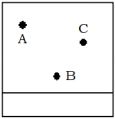
Thin layer chromatography of a mixture shows the following observation:
The correct order of elution in the silica gel column chromatography is
- ✓
$A,C,B$
- B
$B,C,A$
- C
$C,A,B$
- D
$B,A,C$
AnswerCorrect option: A. $A,C,B$
a
According to the observation,$A$ is more mobile and interacts with the mobile phase more than $C$, and $C$ is more drawn to the mobile phase than $B$.
Hence, the correct order of elution in the silico gel column chromatography is $- B < C < A$

View full question & answer→MCQ 841 Mark
Three organic compounds $A , B$ and $C$ were allowed to run in thin layer chromatography using hexane and gave the following result (see figure). The $R_f$ value of the most polar compound is $............\,\times 10^{-2}$
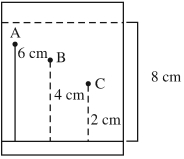
Answerb
More $R _{ f }$, less its polarity
$R _{ f }=\frac{\text { Distance travelled by compound ' } X \text { ' }}{\text { Distance travelled by solvent ' } Y '}$
$=\frac{2}{8}=0.25=25 \times 10^{-2}$
View full question & answer→MCQ 851 Mark
On complete combustion, $0.492\,g$ of an organic compound gave $0.792\,g$ of $CO _2$.The $\%$ of carbon in the organic compound is $..................$ (Nearest integer)
Answerd
weight of $C$ in $0.792\,gm CO _2$
$=\frac{12}{44} \times 0.792=0.216$
$\% \text { of } C \text { in compound }=\frac{0.216}{0.492} \times 100$
$=43.90 \%$
Ans:$44$
View full question & answer→MCQ 861 Mark
$0.5\,g$ of an organic compound $(X)$ with $60 \%$ carbon will produce $........\times 10^{-1}\, g$ of $CO _2$ on complete combustion.
Answerb
Percentage of Carbon
$=\frac{12}{44} \times \frac{\text { mass of } CO _2 \text { formed }}{\text { mass of compound taken }} \times 100$
$60=\frac{12}{44} \times \frac{\text { mass of } CO _2 \text { formed }}{0.5} \times 100$
Mass of $CO _2$ formed $=\frac{60 \times 44 \times 0.5}{12 \times 100}\,g$
$=1.1 \text { gram }$
$=11 \times 10^{-1} \text { gram }$
View full question & answer→MCQ 871 Mark
$0.400\,g$ of an organic compound $( X )$ gave $0.376\,g$ of $AgBr$ in Carius method for estimation of bromine. $\%$ of bromine in the compound $( X )$ is $.........$.(Given: Molar mass $AgBr =188\,g\,mol ^{-1} Br =80\,g$ $\left.mol ^{- I }\right)$
Answerd
mole of $AgBr =\frac{0.376}{188}$
mole of $Br ^{-}=$mole of $AgBr =\frac{0.376}{188}$
mass of $Br ^{-}=\frac{0.376}{188} \times 80$
$\%$ of $Br ^{-}=\frac{0.376 \times 80}{188 \times 0.4} \times 100=40 \%$
View full question & answer→MCQ 881 Mark
Match List $I$ with List $II$
| List $I$ Element detected |
List $II$ Reagent used/Product formed |
| $A$ Nitrogen |
$I.$ $Na _2\left[ Fe ( CN )_5 NO \right]$ |
| $B$ Sulphur |
$II.$ $AgNO _3$ |
| $C$ Phosphorous |
$III.$ $Fe _4\left[ Fe ( CN )_6\right]_3$ |
| $D$ Halogen |
$IV.$ $\left( NH _4\right)_2 MoO _4$ |
Choose the correct answer from the options given below:
- A
$A-II, B-IV, C-I, D-III$
- B
$A-IV, B-II, C-I, D-III$
- C
$A-II, B-I, C-IV, D-III$
- ✓
$A-III, B-I, C-IV, D-II$
AnswerCorrect option: D. $A-III, B-I, C-IV, D-II$
d
Nitrogen detection by lassaigne's method
$Na + C + N \rightarrow NaCN$
$6 NaCN + FeSO _4 \rightarrow Na _4\left[ Fe ( CN )_6\right]+ Na _2 SO _4$
$Na _4\left[ Fe ( CN )_6\right]+ Fe ^{3+} \rightarrow Fe _4\left[ Fe ( CN )_6\right]_3$
(Prussian blue)
Sulphur detection by Sodium nitroprusside
$Na _2\left[ Fe ( CN )_5 NO \right]+ Na _2 S \rightarrow Na 4\left[ Fe ( CN )_5 NOS \right]$
$\text { [Purple }]$
Phosphorus detection by ammonium molybdate
$Na _3 PO _4+3 HNO _3 \rightarrow H _3 PO _4+3 NaNO _3$
$H _3 PO _4+12\left( NH _4\right)_2 MoO _4+21 HNO _3 \rightarrow$
$\left( NH _4\right)_3 PO _4 .12 MoO _3+21 NH _4 NO _3+12 H _2 O$
$\text { (canary yellow) }$
$\text { Halogen give specific coloured ppt with }$
$AgNO _3( aq )$
$NaCl + AgNO _3( aq ) \rightarrow AgCl + NaNO _3$
$\text { (White) }$
$NaBr + AgNO _3( aq ) \rightarrow AgBr + NaNO _3$
$\text { (Pale yellow) }$
$NaI + AgNO _3( aq ) \rightarrow AgI + NaNO _3$
$\text { (Yellow) }$
View full question & answer→MCQ 891 Mark
Match List $I$ with List $II$:
| List $I$ (Mixture) |
List $II$ (Separation Technique) |
| $A$ $CHCl _3+ C _6 H _5 NH _2$ |
$I$ Steam distillation |
| $B$ $C _6 H _{14}+ C _5 H _{12}$ |
$II$ Differential extraction |
| $C$ $C _6 H _5 NH _2+ H _2 O$ |
$III$ Distillation |
| $D$ Organic compound in $H _2 O$ |
$IV$ Fractional distillation |
- A
$A-IV, B-I, C-III, D-II$
- ✓
$A-III, B-IV, C-I, D-II$
- C
$A-II, B-I, C-III, D-IV$
- D
$A-III, B-I, C-IV, D-II$
AnswerCorrect option: B. $A-III, B-IV, C-I, D-II$
b
| List $I$ (Mixture) |
List $II$ (Separation Technique) |
| $A$ $CHCl _3+ C _6 H _5 NH _2$ |
$I$ Distillation |
| $B$ $C _6 H _{14}+ C _5 H _{12}$ |
$II$ Fractional distillation |
| $C$ $C _6 H _5 NH _2+ H _2 O$ |
$III$ Steam distillation |
| $D$ Organic compound in $H _2 O$ |
$IV$ Differential extraction |
NCERT $(XI)$ Vol. $2$ Page No. $359, 360. $
View full question & answer→MCQ 901 Mark
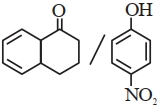
Match items of column $I$ and $II$
| Column $I$ (Mixture of compounds) |
Column $II$ (Separation Technique) |
| $A$ $H _2 O / CH _2 Cl _2$ |
$I$ Crystallization |
| $B$ $Image$ |
$II$ Differential solvent extraction |
| $C$ Kerosene/Naphthalene |
$III$ Column chromatography |
| $D$ $C _6 H _{12} O _6 / NaCl$ |
$IV$ Fractional Distillation |
Correct match is :
- A
$A-(iii), B-(iv), C-(ii), D-(i)$
- B
$A-(i), B-(iii), C-(ii), D-(iv)$
- ✓
$A-(ii), B-(iii), C-(iv), D-(i)$
- D
$A-(ii), B-(iv), C-(i), D-(iii)$
AnswerCorrect option: C. $A-(ii), B-(iii), C-(iv), D-(i)$
c
$A$. $H _2 O / CH _2 Cl _2 \rightarrow$ $ii$, $CH _2 Cl _2> H _2 O$ (density) so they can be separated by differential solvent extraction.$B$.
$C.$ Kerosene / Naphthalene $\rightarrow$ iv. Fractional distillation.
Due to different B.P. of kerosene and Naphthalene it can be separated by fractional distillation.
$D.$ $C _6 H _{12} O _6 / NaCl \rightarrow$ i. Crystallization.
$NaCl$ (ionic compound) can be crystallized.
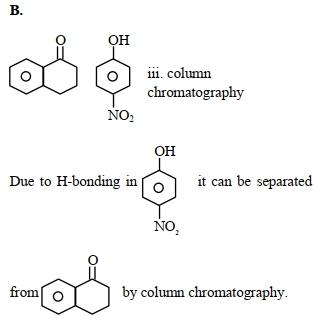
View full question & answer→MCQ 911 Mark
Which of the following statement is correct for paper chromatography ?
- A
Water present in the mobile phase gets absorbed by the paper which then forms the stationary phase.
- ✓
Water present in the pores of the paper forms the stationary phase.
- C
Paper sheet forms the stationary phase.
- D
Paper and water present in its pores together form the stationary phase.
AnswerCorrect option: B. Water present in the pores of the paper forms the stationary phase.
b
In paper chromatography, a special quality paper known as chromatography paper is used. Paper contains water trapped in it, which acts as the stationary phase.
View full question & answer→MCQ 921 Mark
Prolonged heating is avoided during the preparation of ferrous ammonium sulphate to
Answera
Prolonged heating will cause oxidation of $Fe ^{+2}$ to $Fe ^{+3}$.
View full question & answer→MCQ 931 Mark
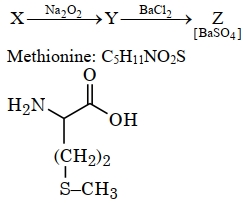
In Carius tube, an organic compound ' $X$ ' is treated with sodium peroxide to form a mineral acid ' $Y$ '. The solution of $BaCl _2$ is added to ' $Y$ ' to form a precipitate ' $Z$ '. ' $Z$ ' is used for the quantitative estimation of an extra element. ' $X$ ' could be:
Answerd
View full question & answer→MCQ 941 Mark
In sulphur estimation. $0.471\,g$ of an organic compound gave $1.4439\,g$ of barium sulphate.The percentage of sulphur in the compound is $.............$(Nearest Integer)(Given: Atomic mass Ba: $137 u : S : 32 u , O : 16 u$ )
Answerb
$\%$ sulphur $=\frac{32}{233} \times \frac{\text { weight of } BaSO _4 \text { formed }}{\text { weight of organic compound }} \times 100$
$=\frac{32}{233} \times \frac{1.4439}{0.471} \times 100$
$=42.10$
Nearest integer $42$
View full question & answer→MCQ 951 Mark
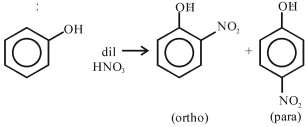
Phenol on reaction with dilute nitric acid, gives two products. Which method will be most effective for large scale separation ?
- A
Chromatographic separation
- B
Fractional Crystallisation
- ✓
- D
Answerc
Para product has higher boiling point than ortho as intermolecular $H$-bond is possible in former, where as intramolecular $H$-bond is possible in ortho product.
Steam distillation can separate them as ortho product is steam volatile.
View full question & answer→MCQ 961 Mark
Match List$-I$ with List$-II$
| List$-I$ |
List$-II$ |
| $(A)$ Chloroform and Aniline |
$(I)$ Steam distillation |
| $(B)$ Benzoic acid and Napthalene |
$(II)$ Sublimation |
| $(C)$ Water and Aniline |
$(III)$ Distillation |
| $(D)$ Napthalene and Sodium chloride |
$(IV)$ Crystallisation |
- A
$(A)-(IV), (B)-(III), (C)-(I), (D)-(II)$
- B
$(A)-(III), (B)-(I), (C)-(IV), (D)-(II)$
- C
$(A)-(III), (B)-(IV), (C)-(II), (D)-(I)$
- ✓
$(A)-(III), (B)-(IV), (C)-(I), (D)-(II)$
AnswerCorrect option: D. $(A)-(III), (B)-(IV), (C)-(I), (D)-(II)$
d
$(A)$ Chloroform + Aniline $\rightarrow$ $(III)$ Distillation
$(B)$ Benzoic acid + Napthalene $\rightarrow$ $(IV)$ Crystallisation
$(C)$ Water + Aniline $\rightarrow$ $(I)$ Steam distillation
$(D)$ Napthalene + Sodium chloride $\rightarrow$ $(II)$ Sublimation
View full question & answer→MCQ 971 Mark
Given below are two statements : One is labelled as Assertion $A$ and the other is labelled as Reason $R$
Assertion $A$ : Thin layer chromatography is an adsorption chromatography.
Reason $R$: A thin layer of silica gel is spread over a glass plate of suitable size in thin layer chromatography which acts as an adsorbent. In the light of the above statements, choose the correct answer from the options given below.
- ✓
Both $A$ and $R$ are true and $R$ is the correct explanation of $A.$
- B
Both $A$ and $R$ are true but $R$ is $NOT$ the correct explanation of $A$
- C
$A$ is true but $R$ is false
- D
$A$ is false but $R$ is true
AnswerCorrect option: A. Both $A$ and $R$ are true and $R$ is the correct explanation of $A.$
a
Theory based
Thin layer chromoatography $(TLC)$ is another type of adsorption chromatography, which involve sepration of substance of a mixture ovel a thin layer of an adsorbent coated on glass plate. A thin layer (about $0.2\,mm$ thick) of an adsorbent (silica gel) or (Alumina) in spread overa glass plate of suitable size. Hence Assertion $(A)$ is correct and Reason $(R)$ is correct explanation of $(A)$
View full question & answer→MCQ 981 Mark
During the qualitative analysis of salt with cation $y ^{2+}$, addition of a reagent $( X )$ to alkaline solution of the salt gives a bright red precipitate. The reagent $( X )$ and the cation $\left( y ^{2+}\right)$ present respectively are .... .
- ✓
Dimethylglyoxime and $Ni ^{2+}$
- B
Dimethylglyoxime and $Co ^{2+}$
- C
Nessler's reagent and $Hg ^{2+}$
- D
Nessler's reagent and $Ni ^{2+}$
AnswerCorrect option: A. Dimethylglyoxime and $Ni ^{2+}$
a
$Ni ^{2+}+ DMG ^{-} \rightarrow\left[ Ni ( DMG )_{2}\right] \downarrow$
(Bright red precipitate)
View full question & answer→MCQ 991 Mark
Given below are two statements :
Statement $I :$ In 'Lassaigne's Test, when both nitrogen and sulphur are present in an organic compound, sodium thiocyanate is formed.
Statement $II :$ If both nitrogen and sulphur are present in an organic compound, then the excess of sodium used in sodium fusion will decompose the sodium thiocyanate formed to give $NaCN$ and $Na _{2} S$.
In the light of the above statements, choose the most appropriate answer from the options given below...
- ✓
Both Statement $I$ and Statement $II$ are correct.
- B
Both Statement $I$ and Statement $II$ are incorrect.
- C
Statement $I$ is correct but Statement $II$ is incorrect.
- D
Statement $I$ is incorrect but Statement $II$ is correct.
AnswerCorrect option: A. Both Statement $I$ and Statement $II$ are correct.
a
Both statement $I$ and statement $II$ are correct.
View full question & answer→MCQ 1001 Mark
The formula of the purple colour formed in Laissaigne's test for sulphur using sodium nitroprusside is ......
- A
$NaFe \left[ Fe ( CN )_{6}\right]$
- B
$Na \left[ Cr \left( NH _{3}\right)_{2}\left( NCS _{4}\right]\right.$
- C
$Na _{2}\left[ Fe ( CN )_{5}( NO )\right]$
- ✓
$Na _{4}\left[ Fe ( CN )_{5}( NOS )\right]$
AnswerCorrect option: D. $Na _{4}\left[ Fe ( CN )_{5}( NOS )\right]$
d
$Na _{2} S + Na _{2}\left[ Fe ( CN )_{5} NO \right] \rightarrow Na _{4}\left[ Fe ( CN )_{5} NO _{5}\right]$
View full question & answer→MCQ 1011 Mark
The separation of two coloured substances was done by paper chromatography. The distances travelled by solvent front, substance $A$ and substance $B$ from the base line are $3.25\,cm .2 .08$ $cm$ and $1.05\,cm$. respectively. The ratio of $R_{f}$ values of $A$ to $B$ is$.........$
Answerd
$\frac{ R _{ F _{ A }}}{ R _{ F _{ B }}}=\frac{\frac{2.08}{3.25}}{\frac{1.05}{3.25}}=\frac{2.08}{1.05} \simeq 2$
View full question & answer→MCQ 1021 Mark
$0.2\, g$ of an organic compound was subjected to estimation of nitrogen by Dumas method in which volume of $N _{2}$ evolved (at STP) was found to be $22.400 \,mL$. The percentage of nitrogen in the compound is $.......$. [nearest integer] (Given: Molar mass of $N _{2}$ is $28\, mol ^{-1}$. Molar volume of $N _{2}$ at STP : $22.4\, L$ )
Answera
weight of organic compound $=0.2\, g$
$\text { mass of } N _{2}( g ) \text { evolved }=\frac{22.4 \times 10^{-3}}{22.4} \times 28$
$=28 \times 10^{-3} \,g$
$\% \text { of } N =\frac{28 \times 10^{-3}}{0.2} \times 100=14$
View full question & answer→MCQ 1031 Mark
On complete combustion $0.30 \,g$ of an organic compound gave $0.20\, g$ of carbon dioxide and $0.10\, g$ of water. The percentage of carbon in the given organic compound is $.....$ (Nearest Integer)
Answera
$C _{ x } HyOz +\left( x +\frac{ y }{4}-\frac{ z }{2}\right) O _{2} \rightarrow xCO _{2}+\frac{ y }{2} H _{2} O$
$0.3g\quad\quad\quad\quad\quad\quad\quad\quad0.2g\quad\quad\quad0.1g$
$\frac{ n _{ CO _{2}}}{ n _{ H _{2} O }}=\frac{ x }{ y / 2}=\frac{0.2 / 44}{.1 / 18}$
$\frac{2 x }{ y }=\frac{36}{44}=\frac{9}{11}$
$x =\frac{9 y }{22}$
$\frac{ n _{ C _{ x } H _{ y } O_{ z } }}{ nCO _{ 2 } }=\frac{1}{ x }$
$\frac{0.3 }{12 x + y +16 z } \times \frac{44}{0.2}=\frac{1}{ x }$
$66 x =12 x + y +16 z$
$54 x = y +16 z$
$\frac{54 \times 9 y }{22}- y =16 z$
$\frac{464 y }{22}=16 z$
$z =\frac{29 y }{22}$
$C _{ x } H _{ y } O _{z}= C _{ x } H _{ y } O _{z}$
$C _{\frac{9 y}{22}} H _{ y } O _{\frac{29 y}{22}}^{22}$
$C _{9} H _{22} O _{29}$
$\,\%$ of $C =\frac{12 \times 9}{(12 \times 9+22+29 \times 16)} \times 100=\frac{108}{594} \times 100$
$18.18 \,\%$
View full question & answer→MCQ 1041 Mark
$0.25\, g$ of an organic compound containing chlorine gave $0.40\, g$ of silver chloride in Carius estimation. The percentage of chlorine present in the compound is $.....$ [in nearest integer]
(Given: Molar mass of $Ag$ is $108\, g \,mol ^{-1}$ and that of $Cl$ is $35.5 \,g\, mol ^{-1}$ )
Answera
wt. of organic compound $=0.25 \,g$
mass of $Cl =\frac{35.5}{143.5} \times 0.4\, g$
mass $\%$ of $Cl$ in the organic compound
$=\frac{35.5 \times 0.4}{143.5 \times 0.25} \times 100$
$=39.58 \,\%$
View full question & answer→MCQ 1051 Mark
The complete combustion of $0.492\, g$ of an organic compound containing $'C', 'H'$ and $'O'$ gives $0.793\, g$ of $CO _{2}$ and $0.442\,g$ of $H _{2} O$. The percentage of oxygen composition in the organic compound is .... (nearest integer)
Answerd
Mole of $CO _{2}=$ Moles of $C =\frac{0.793}{44}$
Weight of ' $C$ ' $=\frac{0.793}{44} \times 12=0.216 \,gm$
Moles of ' $H ^{\prime}=\frac{0.442}{18} \times 2$
Weight of ' $H ^{\prime}=\frac{0.442}{18} \times 2 \times 1=0.049 \,gm$
$\therefore$ Weight of ' $O$ ' $=0.492-0.216-0.049=0.227\, gm$ $\,\%$ of ' ${ }^{\prime}{ }^{\prime}=\frac{0.227}{0.492} \times 100=46.13\, \%$
View full question & answer→MCQ 1061 Mark
In the estimation of bromine, $0.5\, g$ of an organic compound gave $0.40\, g$ of silver bromide. The percentage of bromine in the given compound is $.....\,\%$ (nearest integer)
(Relative atomic masses of $Ag$ and $Br$ are $108\, u$ and $80\, u$, respectively).
Answerd
$O . C \longrightarrow AgBr$
$0.5\, g \quad 0.4\, g$
$mol$ of $Br = mol$ of $AgBr =\frac{0.4}{188}$
$\%\, Br =\%\, Br =\frac{\frac{0.4}{188} \times 80}{0.5} \times 100$
$=34.04\, \%$
View full question & answer→MCQ 1071 Mark
While estimating the nitrogen present in an organic compound by Kjeldahl's method, the ammonia evolved from $0.25\,g$ of the compound neutralized $2.5\,mL$ of $2\,M\,H _{2} SO _{4}$. The percentage of nitrogen present in organic compound is $......$
Answerb
$\% N =\frac{1.4\left( N _{1} V _{1}\right)}{\text { mass of organic compound }}$
$\% N =\frac{1.4(2.5 \times 2 \times 2)}{0.25}=56$
View full question & answer→MCQ 1081 Mark
In Carius method of estimation of halogen. $0.45\,g$ of an organic compound gave $0.36\,g$ of $AgBr$. Find out the percentage of bromine in the compound.Molar masses : $AgBr =188 g mol ^{-1}: Br =80 g mol ^{-1}$ )
- ✓
$34.04 \%$
- B
$40.04 \%$
- C
$36.03 \%$
- D
$38.04 \%$
AnswerCorrect option: A. $34.04 \%$
a
Mass of organic compound $=0.45\,gm$
Mass of $AgBr$ obtained $=0.36\,gm$
$\therefore$ Moles of $AgBr =\frac{0.36}{188}$
$\therefore$ Mass of Bromine $=\frac{0.36}{188} \times 80=0.1532\,gm$
$\therefore \% Br$ in compound $=\frac{0.1532}{0.45} \times 100=34.04 \%$
View full question & answer→MCQ 1091 Mark
On complete combustion of $0.492\,g$ of an organic compound containing $C , H$ and $O , 0.7938\,g$ of $CO _{2}$ and $0.4428\,g$ of $H _{2} O$ was produced. The $\%$ composition of oxygen in the compound is $........$
Answera
$0.492\,g$ of $C _{ x } H _{ y } O _{z}$
Gives $0.7938\,g\,CO _{2}=0.018$ moles
$0.4428\,g\,H _{2} O =0.0246$ moles
So moles of $C =0.018 \Rightarrow 0.216\,g$
Moles of $H =0.049 \Rightarrow 0.049\,g$
$\therefore$ wt. of Oxygen $=0.492-0.216-0.049$
$\%$ of Oxygen $=\frac{0.227}{0.492} \times 10046$ (approx.)
View full question & answer→MCQ 1101 Mark
A sample of $0.125\,g$ of an organic compound when analysed by Duma's method yields $22.78\,mL$ of nitrogen gas collected over $KOH$ solution at $280\,K$ and $759\,mm\,Hg$. The percentage of nitrogen in the given organic compound is.(Nearest integer).
$(a)$ The vapour pressure of water at $280 K$ is $14.2$ $mm Hg$
$(b)$ $R =0.082 L$ atm $K ^{-1} mol ^{-1}$
Answera
$V =22.78\,ml , T =280\,K$
$P _{\text {total }}=759\,mmHg$
$P _{ N _{2}}=759-14.2=744.8\,mmHg$
$n _{ N _{2}}=\frac{744.8 \times 22.78}{760 \times 1000 \times 0.082 \times 280}=0.00097$
$W _{\text {Nitrogen }}=0.02716$
$\% N =\frac{0.02716}{0.125} \times 1000=21.728$
View full question & answer→MCQ 1111 Mark
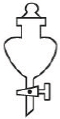
Which of the following is structure of a separating finnel?
Answera
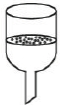
It is used to separate liquid-liquid mixture which is immiscible with different densities.
View full question & answer→MCQ 1121 Mark
$Fe ^{3+}$ cation gives a prussian blue precipitate on addition of potassium ferrocyanide solution due to the formation of.
- A
$\left[ Fe \left( H _{2} O \right)_{6}\right]_{2}\left[ Fe ( CN )_{6}\right]$
- B
$Fe _{2}\left[ Fe ( CN )_{6}\right]_{2}$
- C
$Fe _{3}\left[ Fe ( OH )_{2}( CN )_{4}\right]_{2}$
- ✓
$Fe _{4}\left[ Fe ( CN )_{6}\right]_{3}$
AnswerCorrect option: D. $Fe _{4}\left[ Fe ( CN )_{6}\right]_{3}$
d
$4 Fe ^{3+}+3\left[ Fe ( CN )_{6}\right]^{-4} \underset{\text { Prussian Blue }}{\longrightarrow} Fe _{4}\left[ Fe ( CN )_{6}\right]_{3}$
View full question & answer→MCQ 1131 Mark
Kjeldahl's method was used for the estimation of nitrogen in an organic compound. The ammonia evolved from $0.55\, g$ of the compound neutralised $12.5\, mL$ of $1\, M \,H _{2} SO _{4}$ solution. The percentage of nitrogen in the compound is $.....$ (Nearest integer)
Answerd
Meq of $H _{2} SO _{4}$ used by $NH _{3}=12.5 \times 1 \times 2=25$
$\%$ of $N$ in the compound $=\frac{25 \times 10^{-3} \times 14 \times 100}{0.55}=63.6$
View full question & answer→MCQ 1141 Mark
In chromotography technique, the purification of compound is independent of
AnswerCorrect option: D. Physical state of the pure compound
d
In chromotography technique, the purification of a compound is independent of the physical
View full question & answer→MCQ 1151 Mark
Given below are two statements
Statement $-I :$ Retardation factor $\left( R _{ f }\right)$ can be measured in meter/centimeter.
Statement $-II :$ $R _{ f }$ value of a compound remains constant in all solvents.
Choose the most appropriate answer from the options given below
- A
Statement$-I$ is true but statement$-II$ is false
- B
Both statement$-I$ and statement$-II$ are true
- ✓
Both statement$-I$ and statement$-II$ are false
- D
Statement$-I$ is false but statement-II is true
AnswerCorrect option: C. Both statement$-I$ and statement$-II$ are false
c
$R _{ f }=$ retardation factor
Distance travelled by the substance from
$R _{ f }=\frac{\text { reference line }( c \cdot m )}{\text { Distan ce travelled by the solvent from }}$
reference line $(c.m)$
Note : $R _{ f }$ value of different compounds are different.
View full question & answer→MCQ 1161 Mark
Using the provided information in the following paper chromatogram the calculate $R _{ f }$ value of $A$ .......... $\times 10^{-1}$
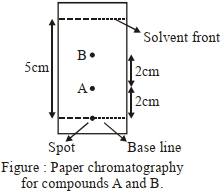
Answerc
$R _{ f }=\frac{\text { Distance travelled by compound }}{\text { Distance travelled by solvent }}$
on chromatogram distance travelled by cmopound is $\rightarrow 2 \,cm$
Distance travelled by solvent $=5\, cm$
So $R _{ f }=\frac{2}{5}=4 \times 10^{-1}=0.4$
View full question & answer→MCQ 1171 Mark
Given below are two statements : one is labelled as Assertion $(A)$ and the other is labelled as Reason $(R)$ :
Assertion $(A) :$ A simple distillation can be used to separate a mixture of propanol and propanone.
Reason $(R) :$ Two liquids with a difference of more than $20^{\circ} \mathrm{C}$ in their boiling points can be separated by simple distillations.
In the light of the above statements, choose the most appropriate answer from the options given below:
- A
$(A)$ is false but $(R)$ is true.
- B
Both $(A)$ and $(R)$ are correct but $(R)$ is not the correct explanation of $(\mathrm{A})$
- C
$(A)$ is true but $(R)$ is false
- ✓
Both $(A)$ and $(R)$ are correct and $(R)$ is the correct explanation of $(\mathrm{A})$
AnswerCorrect option: D. Both $(A)$ and $(R)$ are correct and $(R)$ is the correct explanation of $(\mathrm{A})$
d
Both assertion $\&$ reason are correct $\&$ $(\mathrm{R})$ is the correct explanation of $(A)$
View full question & answer→MCQ 1181 Mark
Which purification technique is used for high boiling organic liquid compound (decomposes near its boiling point)?
- A
- B
- C
- ✓
Reduced pressure distillation
AnswerCorrect option: D. Reduced pressure distillation
d
Reduced pressure distillation used for the purification of high boiling organic liquids which decomposes at or below their boiling point.
View full question & answer→MCQ 1191 Mark
Match List$-I$ with List$-II$
| List$-I$ Test/Reagents/Observation(s) |
List$-II$ Species detected |
| $(a)$ Lassaigne's Test |
$(i)$ Carbon |
| $(b)\;Cu ( II )$ oxide |
$(ii)$ Sulphur |
| $(c)$ Silver nitrate |
$(iii)\;N , S , P ,$ and halogen |
| $(d)$ The sodium fusion extract gives black precipitate with acetic acid and lead acetate |
$(iv)$ Halogen Specifically |
The correct match is
- A
$(a)-(iii), (b)-(i), (c)-(ii), (d)-(iv)$
- B
$(a)-(i), (b)-(iv), (c)-(iii), (d)-(ii)$
- ✓
$(a)-(iii), (b)-(i), (c)-(ii),(d)-(ii)$
- D
$(a)-(i), (b)-(ii), (c)-(iv), (d)-(iii)$
AnswerCorrect option: C. $(a)-(iii), (b)-(i), (c)-(ii),(d)-(ii)$
c
Match List :-
| $(a)$ Lassaigne's Test |
$(iii)$ $N , S , P ,$ and halogen |
| $(b)$ $Cu ( II )$ oxide |
$(i)$ Carbon |
| $(c)$ Silver nitrate |
$(iv)$ Halogen Specifically |
| $(d)$ The sodium fusion extract gives black precipitate with acetic acid and lead acetate |
$(ii)$ Sulphur |
View full question & answer→MCQ 1201 Mark
Complete combustion of $750\, g$ of an organic compound provides $420\, g$ of $CO _{2}$ and $210\, g$ of $H _{2} O$. The percentage composition of carbon and hydrogen in organic compound is $15.3$ and ............. respectively. (Round off to the Nearest Integer)
Answerc
$44 gm CO _{2}$, have $12 gm$ carbon
So, $420 gm CO _{2} \Rightarrow \frac{12}{44} \times 420$
$\Rightarrow \frac{1260}{11} gm$ carbon
$\Rightarrow 114.545$ gram carbon
So, $\%$ of carbon $=\frac{114.545}{750} \times 100$
$=15.3 \%$
$18 gm H _{2} O \Rightarrow 2 gm H _{2}$
$210 gm \Rightarrow \frac{2}{18} \times 210$
$=23.33 gm H _{2}$
$So , \% H _{2} \Rightarrow \frac{23.33}{750} \times 100=3.11 \%$
$\approx 3 \%$
View full question & answer→MCQ 1211 Mark
Nitrogen can be estimated by Kjeldahl's method for which of the following compound?
Answerb
Kjeldahl method is not applicable to compounds containing nitrogen in nitrogroup, Azo groups and nitrogen present in the ring (e.g Pyridine) as nitrogen of these compounds does not change to Ammonium sulphate under these conditions.
View full question & answer→MCQ 1221 Mark
In the sulphur estimation, $0.471\, \mathrm{~g}$ of an organic compound gave $1.44\, \mathrm{~g}$ of barium sulphate. The percentage of sulphur in the compound is $......\%$. (Nearest integer)
(Atomic Mass of $\mathrm{Ba}=137 \,\mathrm{u})$
Answerb
Molecular mass of $\mathrm{BaSO}_{4}=233 \,\mathrm{~g}$
$\because 233 \,g\,\mathrm{BaSO}_{4}$ contain $\rightarrow 32\, \mathrm{~g}$ sulphur
$\therefore 1.44\, \mathrm{~g} \,\mathrm{BaSO}_{4}$ contain $\rightarrow \frac{32}{233} \times 1.44\, \mathrm{~g}$ sulphur
given : $0.471\, \mathrm{~g}$ of organic compound
$\%$ of $\mathrm{S}=\frac{32 \times 1.44}{233 \times 0.471} \times 100=41.98 \,\% \approx 42\, \%$
View full question & answer→MCQ 1231 Mark
In Carius method for estimation of halogens, $0.2\, \mathrm{~g}$ of an organic compound gave $0.188 \,\mathrm{~g}$ of $\mathrm{AgBr}$. The percentage of bromine in the compound is ...... . (Nearest integer)
[Atomic mass: $\mathrm{Ag}=108, \mathrm{Br}=80$ ]
Answerc
$\mathrm{n}_{\mathrm{AgBr}}=\frac{0.188 \mathrm{~g}}{188 \mathrm{~g} / \mathrm{mol}}=10^{-3}\, \mathrm{~mol}$
$\Rightarrow \mathrm{n}_{\mathrm{Br}}=\mathrm{n}_{\lambda_{\mathrm{kBt}}}=0.001\, \mathrm{~mol}$
$\Rightarrow \text { mass }_{\mathrm{Bz}}=(0.001 \times 80) \,\mathrm{gm}=0.08 \,\mathrm{gm}$
$\Rightarrow \text { mass } \%=\frac{0.08 \times 100}{0.2}=40 \,\%$
View full question & answer→MCQ 1241 Mark
The number of moles of $\mathrm{CuO}$, that will be utilized in Dumas method for estimation nitrogen in a sample of $57.5 \,\mathrm{~g}$ of $\mathrm{N}, \mathrm{N}$-dimethylaminopentane is $.....\,\times 10^{-2} .$ (Nearest integer)
- A
$1963$
- B
$8510$
- ✓
$1125$
- D
$7412$
AnswerCorrect option: C. $1125$
c
Moles of $\mathrm{N}$ in $\mathrm{N}, \mathrm{N}$ - dimethylaminopentane
$=\left(\frac{57.5}{115}\right)=0.5\, \mathrm{~mol}$
$\Rightarrow \mathrm{C}_{7} \mathrm{H}_{17} \mathrm{~N}+\frac{45}{2} \mathrm{CuO} \rightarrow 7 \mathrm{CO}_{2}+\frac{17}{2} \mathrm{H}_{2} \mathrm{O}+\frac{1}{2} \mathrm{~N}_{2}+\frac{45}{2} \mathrm{Cu}$
$\frac{\mathrm{n}_{\mathrm{cuo}} \text { reacted }}{\left(\frac{45}{2}\right)}=\frac{\mathrm{n}_{\mathrm{C_7} \mathrm{H}_{17} \mathrm{N}} \text { reacted }}{1}$
$\Rightarrow \mathrm{n}_{\mathrm{C} \mathrm{u} O}$ reacted $=\left(\frac{45}{2}\right) \times 0.5=11.25$
View full question & answer→MCQ 1251 Mark
Given below are two statements:
Statement $I :$ A mixture of chloroform and aniline can be separated by simple distillation.
Statement $II :$ When separating aniline from a mixture of aniline and water by steam distillation aniline boils below its boiling point. In the light of the above statements, choose the most appropriate answer from the options given below.
- A
Statement$-I$ is false but Statement $II$ is true
- B
Both Statement$-I$ and Statement $II$ are false
- C
Statement$-I$ is true but Statement $II$ is false
- ✓
Both Statement$-I$ and Statement $II$ are true
AnswerCorrect option: D. Both Statement$-I$ and Statement $II$ are true
d
Statement $1: B.P.$ of chloroform $=334 K$
$B.P.$ of aniline $=457 K$
thus can be seprated of simple distillation.
Statement $2 :$ Mixture of aniline and water seprated by simple distillation.
View full question & answer→MCQ 1261 Mark
Which of the following is $'a'$ $FALSE$ statement ?
AnswerCorrect option: B. Carius method is used for the estimation of nitrogen in an organic compound
b
Carius method is used in the estimation of halogen in organic compounds.
View full question & answer→MCQ 1271 Mark
Which of the following compound is added to the sodium extract before addition of silver nitrate for testing of halogens?
Answera
For testing of halogens, Nitric acid is added to the sodium extract because if $CN ^{-}$ or $S ^{2-}$ are present then they will be oxidised and removed before the test of halides.
View full question & answer→MCQ 1281 Mark
Acidic ferric chloride solution on treatment with excess of potassium ferrocyanide gives a Prussian blue coloured colloidal species. It is :
- A
$\mathrm{Fe}_{4}\left[\mathrm{Fe}(\mathrm{CN})_{6}\right]_{3}$
- B
$\mathrm{K}_{5} \mathrm{Fe}\left[\mathrm{Fe}(\mathrm{CN})_{6}\right]_{2}$
- C
$\mathrm{HFe}\left[\mathrm{Fe}(\mathrm{CN})_{6}\right]$
- ✓
$\mathrm{KFe}\left[\mathrm{Fe}(\mathrm{CN})_{6}\right]$
AnswerCorrect option: D. $\mathrm{KFe}\left[\mathrm{Fe}(\mathrm{CN})_{6}\right]$
d
$\mathrm{FeCl}_{3}+\mathrm{K}_{4}\left[\mathrm{Fe}(\mathrm{CN})_{6}\right](\text { excess })$
$\quad\quad\quad\downarrow$
$\mathrm{K} \mathrm{Fe}\left[\mathrm{Fe}(\mathrm{CN})_{6}\right]$
Colloidal species
View full question & answer→MCQ 1291 Mark
In Carius method, halogen containing organic compound is heated with fuming nitric acid in the presence of :
- ✓
$\mathrm{AgNO}_{3}$
- B
$\mathrm{HNO}_{3}$
- C
$\mathrm{BaSO}_{4}$
- D
$\mathrm{CuSO}_{4}$
AnswerCorrect option: A. $\mathrm{AgNO}_{3}$
a
Organic compound is heated with fuming nitric acid in the presence of silver nitrate in carius method.
Lunar caustic $\left(\mathrm{AgNO}_{3}\right)$ is used as reagent hare to distinguish $\mathrm{Cl}^{-}, \mathrm{Br}$ and $\mathrm{I}^{-}$respectively as follows.
$\mathrm{Cl}^{-}(\mathrm{aq}) \stackrel{\mathrm{AgNO}_{3}}{\longrightarrow} \mathrm{AgCl} \downarrow_{\mathrm{ppt}}$ white
$\mathrm{Br}^{-}(\mathrm{aq})\stackrel{\mathrm{AgNO}_{3}}{\longrightarrow} \mathrm{AgBr} \downarrow_{\mathrm{ppt}} \mathrm{pale}$ yellow
$\mathrm{I}^{-}(\mathrm{aq}) \stackrel{\mathrm{AgNO}_{3}}{\longrightarrow} \mathrm{AgNO}_{3} \mathrm{AgI} \downarrow_{\mathrm{ppt}}$ Dark yellow
View full question & answer→MCQ 1301 Mark
In Duma's method of estimation of nitrogen, $0.1840 \,g$ of an organic compound gave $30 \,mL$ of nitrogen collected at $287\, K$ and $758\, mm$ of $Hg$ pressure. The percentage composition of nitrogen in the compound is ...... . (Round off to the Nearest Integer). [Given : Aqueous tension at $287\, K =14 \,mm$ of $Hg$ ]
Answerb
In Duma's method of estimation of Nitrogen.
$0.1840\, gm$ of organic compound gave $30 \,mL$ of nitrogen which is collected at $287\, K$ And $758\,mm$ of $Hg$.
Given ; Aqueous tension at $287 \,K =14 \,mm$ of $Hg$. Hence actual pressure $=(758-14)$
$=744\, mm \text { of } Hg \text { . }$
Volume of nitrogen at $STP =\frac{273 \times 744 \times 30}{287 \times 760}$
$V =27.935 \,mL$
$\because 22400 mL$ of $N _{2}$ at STP weighs $=28\, gm .$
$\therefore 27.94 mL$ of $N _{2}$ at STP weighs $=$
$\left(\frac{28}{22400} \times 27.94\right)\, gm$
$=0.0349 \,gm$
Hence $=\left(\frac{0.0349}{0.1840} \times 100\right)$
$=18.97\, \%$
Rond off. Answer $=19 \,\%$
View full question & answer→MCQ 1311 Mark
The transformation occurring in Duma's method is given below :
$\mathrm{C}_{2} \mathrm{H}_{7} \mathrm{~N}+\left(2 \mathrm{x}+\frac{\mathrm{y}}{2}\right) \mathrm{CuO} \rightarrow \mathrm{x\,CO}_{2}+\frac{y}{2} \mathrm{H}_{2} \mathrm{O}+\frac{\mathrm{z}}{2} \mathrm{~N}_{2}+\left(2\, \mathrm{x}+\frac{\mathrm{y}}{2}\right) \mathrm{Cu}$
The value of $y$ is ...... .(Integer answer)
Answerb
$\mathrm{C}_{2} \mathrm{H}_{7} \mathrm{~N}+\left(2 \mathrm{x}+\frac{\mathrm{y}}{2}\right) \mathrm{CuO} \rightarrow \mathrm{x} \mathrm{CO}_{2}+\frac{\mathrm{y}}{2} \mathrm{H}_{2} \mathrm{O}+\frac{\mathrm{z}}{2} \mathrm{~N}_{2}+\left(2 \mathrm{x}+\frac{\mathrm{y}}{2}\right) \mathrm{Cu}$
On balancing
$\mathrm{C}_{2} \mathrm{H}_{7} \mathrm{~N}+\frac{15}{2} \mathrm{CuO} \rightarrow 2 \mathrm{CO}_{2}+\frac{7}{2} \mathrm{H}_{2} \mathrm{O}+\frac{1}{2} \mathrm{~N}_{2}+\frac{15}{2} \mathrm{Cu}$
On comparing
$\mathrm{y}=7$
View full question & answer→MCQ 1321 Mark
When $0.15\, \mathrm{~g}$ of an organic compound was analyzed using Carius method for estimation of bromine, $0.2397 \,\mathrm{~g}$ of $AgBr$ was obtained. The percentage of bromine in the organic compound is $.....$ (Nearest integer)
[Atomic mass : Silver $=108$, Bromine $=80]$
Answerd
Moles of $\mathrm{Br}=$ Moles of $\mathrm{AgBr}$ obtained
$\Rightarrow \quad$ Mass of $\mathrm{Br}=\frac{0.2397}{188} \times 80\, \mathrm{~g}$
therefore $\%$ Br in the organic compound
$=\frac{W_{\text {Br }}}{W_{T}} \times 100$
$=\frac{0.2397 \times 80}{188 \times 0.15} \times 100=0.85 \times 80$
$=68$
$\Rightarrow$ Nearest integer is $'68^{\prime}$
View full question & answer→MCQ 1331 Mark
$0.8\, \mathrm{~g}$ of an organic compound was analysed by Kjeldahl's method for the estimation of nitrogen. If the percentage of nitrogen in the compound was found to be $42\, \%$, then $....\,\mathrm{mL}$ of $1\, \mathrm{M}$ $\mathrm{H}_{2} \mathrm{SO}_{4}$ would have been neutralized by the ammonia evolved during the analysis.
Answerd
Organic compound : $0.8 \,\mathrm{gm}$
wt. of $\mathrm{N}=\left(\frac{42}{100} \times 0.8\right)\, \mathrm{gm}$
mole of $N=\frac{42 \times 0.8}{100 \times 14}=\frac{2.4}{100}\, \mathrm{~mol}$
moles of $\mathrm{NH}_{3}=\frac{2.4}{100}$
$2 \mathrm{NH}_{3}+\mathrm{H}_{2} \mathrm{SO}_{4} \rightarrow\left(\mathrm{NH}_{4}\right)_{2} \mathrm{SO}_{4}$
$\quad\downarrow\quad\quad\quad\downarrow$
$\frac{2.4}{100}$ $mole$ $\quad\frac{1.2}{100}$ $mole$
For $\mathrm{H}_{2} \mathrm{SO}_{4} \quad \frac{1.2}{100}=1 \times \mathrm{V}(\ell)$
$\Rightarrow \mathrm{V}_{\mathrm{H}_{2} \mathrm{SO}_{4}}=\frac{1.2}{100} \,\ell=12 \,\mathrm{~m} \ell$
View full question & answer→MCQ 1341 Mark
An organic compound is subjected to chlorination to get compound A using $5.0\, \mathrm{~g}$ of chlorine. When $0.5\, \mathrm{~g}$ of compound $\mathrm{A}$ is reacted with $\mathrm{AgNO}_{3}$ [Carius Method], the percentage of chlorine in compound $A$ is $.....$ when it forms $0.3849$ $g$ of $\mathrm{AgCl}$. (Round off to the Nearest Integer)
(Atomic masses of $\mathrm{Ag}$ and $\mathrm{Cl}$ are $107.87$ and $35.5$ respectively)
Answera
$\mathrm{n}_{\mathrm{cl}} \text { in compound }=\mathrm{n}_{\mathrm{AgCl}}=\frac{0.3849 \mathrm{~g}}{(107.87+35.5)}\, \mathrm{g} / \mathrm{mol}$
$\Rightarrow \text { mass of chlorine }=\mathrm{n}_{\mathrm{Cl} } \times 35.5=0.0953\, \mathrm{gm}$
$\Rightarrow\, \% \text { wt of chlorine }=\frac{0.0953}{0.5} \times 100$
$\quad=19.06\, \%$
View full question & answer→MCQ 1351 Mark
A flask contains a mixture of isohexane and $3 -$ methylpentane. One of the liquids boils at $63^{\circ} \mathrm{C}$ while the other boils at $60^{\circ} \mathrm{C} .$ What is the best way to seprate the two liquids and which one will be distilled out first?
- A
simple distillation, $3-$methylpentane
- B
simple distillation, isohexane
- ✓
fractional distillation, isohexane
- D
fractional distillation, $3-$methylpentane
AnswerCorrect option: C. fractional distillation, isohexane
c
Liquid which have less difference in boiling point can be isolated by fractional distillation and liquid with less boiling point will be isolated first.
View full question & answer→MCQ 1361 Mark
Glycerol is separated in soap industries by
- A
- B
- ✓
Distillation under reduced pressure
- D
AnswerCorrect option: C. Distillation under reduced pressure
c
Glycerol is separated by reduced pressure distillation in soap industries.
View full question & answer→MCQ 1371 Mark
In Carius method of estimation of halogen, $0.172\, g$ of an organic compound showed presence of $0.08\, g$ of bromine. Which of these is the correct structure of the compound:
- ✓
- B
$H _{3} C - CH _{2}- Br$
- C
- D
$H _{3} C - Br$
Answera
In Carius method
mass of organic compound $=0.172 gm$ mass of Bromine $=0.08 gm$
Hence $\%$ of Bromine $=\frac{0.08}{0.172} \times 100$
$=46.51 \%$
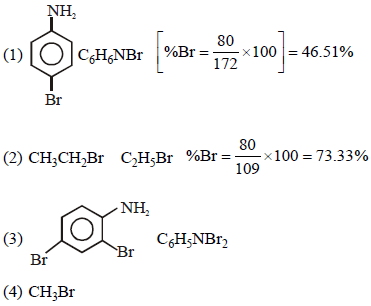
View full question & answer→MCQ 1381 Mark
The Kjeldahl method of Nitrogen estimation fails for which of the following reaction products $?$
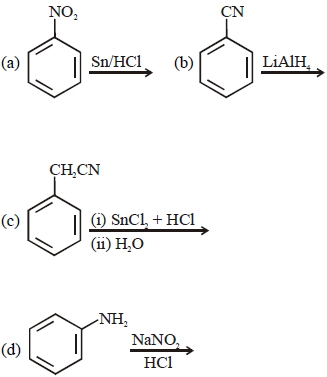
- A
$a$ and $d$
- ✓
$c$ and $d$
- C
$a, c$ and $d$
- D
$b$ and $c$
AnswerCorrect option: B. $c$ and $d$
b
Kjeldahl method is used for $N$ estimation But not given by 'Diazo' compounds
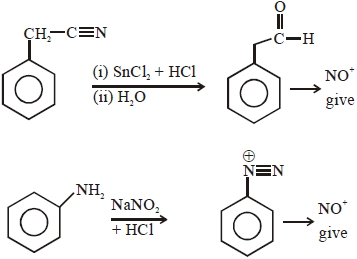
View full question & answer→MCQ 1391 Mark
In an estimation of bromine by Carius method,$1.6\, g$ of an organic compound gave $1.88 \,g$ of $AgBr$. The mass percentage of bromine in the compound is..........
(Atomic mass, $Ag =108, Br =80\, g\, mol ^{-1}$ )
Answera
Carius method
$\%$ of $Br =\frac{\text { wt of } AgBr }{\text { wt. of organic compound }} \times 100 \times \frac{\text { molar mass of Br }}{\text { AgBr }}$
$=\frac{1.88}{1.6} \times \frac{80}{188} \times 100=\frac{15040}{300.8}=50 \%$
View full question & answer→MCQ 1401 Mark
A chromatography column, packed with silica gel as stationary phase, was used to separate a mixture of compounds consisting of $(A)$ benzanilide $(B)$ aniline and $(C)$ acetophenone. When the column is eluted with a mixture of solvents, hexane: ethyl acetate $(20: 80),$ the sequence of obtained compounds
- A
$(\mathrm{B}),(\mathrm{C})$ and $(\mathrm{A})$
- ✓
$(\mathrm{C}),(\mathrm{A})$ and $(\mathrm{B})$
- C
$(\mathrm{A}),(\mathrm{B})$ and $(\mathrm{C})$
- D
$(\mathrm{B}),(\mathrm{A})$ and $(\mathrm{C})$
AnswerCorrect option: B. $(\mathrm{C}),(\mathrm{A})$ and $(\mathrm{B})$
b
Benzanilide $\rightarrow$ Ph-NH-CO-Ph $(\mu=2.71 \mathrm{D})$
Aniline $\rightarrow \mathrm{Ph}-\mathrm{NH}_{2}$, $(\mu=1.59 \mathrm{D})$
Acetophenone $\rightarrow$ Ph-O-CH $_{3}$ ( $\mu=3.05 \mathrm{D}$ )
Dipole moment : ${C}>{A}>{B}$
Hence the sequence of obtained compounds is $(\mathrm{C})\;,(\mathrm{A})$ and $(\mathrm{B})$
View full question & answer→MCQ 1411 Mark
The correct match between items $I$ and $II$ is
| Item $-I$ (Mixture) |
Item $-II$ (Separation method) |
| $(a)$ $H_2O :$ Sugar |
$p.$ Sublimation |
| $(b)$ $H_2O :$ Aniline |
$q.$ Recrystallization |
| $(c)$ $H_2O :$ Toluene |
$r.$ Stem distillation |
| |
$s.$ Differential extraction |
- A
$a - d, b -r, c -p$
- ✓
$a -q, b -r, c -s$
- C
$a -r, b -p, c -s$
- D
$a -q, b -r, c -p$
AnswerCorrect option: B. $a -q, b -r, c -s$
b
(mixture) $\quad\quad\quad\quad$ (seperation method)
$H _2 O : \text { Sugar } \Rightarrow \text { Recrystallization }$
$H _2 O : \text { Aniline } \Rightarrow \text { Steam distillation }$
$H _2 O \text { : Toluene } \Rightarrow \text { Differential extraction }$
View full question & answer→MCQ 1421 Mark
An organic compound is estimated through Dumus method and was found to evolve $6\,mole$ of $CO_2\,\,4\,moles$ of $H_2O$ and $1\,mole$ of nitrogen gas. The formula of the compound is
- A
$C_{12}H_8N$
- B
$C_{12}H_8N_2$
- ✓
$C_6H_8N_2$
- D
$C_6H_8N$
AnswerCorrect option: C. $C_6H_8N_2$
c
$CO_2 = 6\,mole,\,N_1 = 1\,mole$
$C_{atom}= 6,\,N_{atom} = 2$
Hence $C_6H_8N_2$
View full question & answer→MCQ 1431 Mark
$25\, g$ of an unknown hydrocarbon upon burning produces $88\, g$ of $CO_2$ and $9\, g$ of $H_2O$. This unknown hydrocarbon contains.
- ✓
$24\,g$ of carbon and $1\, g$ of hydrogen
- B
$22\,g$ of carbon and $3\, g$ of hydrogen
- C
$18\,g$ of carbon and $7\, g$ of hydrogen
- D
$20\,g$ of carbon and $5\, g$ of hydrogen
AnswerCorrect option: A. $24\,g$ of carbon and $1\, g$ of hydrogen
a
$\mathop {{C_x}{H_y}}\limits_{\left( {\frac{{25}}{M}} \right)} + \left( {x + \frac{y}{4}} \right){O_2} \to \mathop {\mathop {xC{O_2}}\limits_{x \times \frac{{25}}{M}} }\limits_{ = 2} + \mathop {\mathop {\frac{y}{2}{H_2}O}\limits_{\frac{y}{2} \times \frac{{25}}{M}} }\limits_{ = 0.5} $
$C\,\,\,\,\,\,\,\,\,\,\,x \times \frac{{25}}{M} = 2$
$H\,\,\,\,\,\,\,\,\,\,\,y \times \frac{{25}}{M} = 1$
$C_{2y}H_y \equiv 24\,y\,gm\,C + y\,gm\,H$
or
$24 : 1$ ratio by mass
View full question & answer→MCQ 1441 Mark
The correct match between item $I$ and item $II$ is
| Item $I$ |
Item $II$ |
| $(a)$ Benzaldehyde |
$(p)$ Mobile phase |
| $(b)$ Alumina |
$(q)$ Adsorbent |
| $(c)$ Acetonitrile |
$(r)$ Adsorbate |
- A
$a\, \to \,q,\,\,b \to \,p,\,\,c \to r$
- ✓
$a\, \to \,r,\,\,b \to \,q,\,\,c \to p$
- C
$a\, \to \,q,\,\,b \to \,r,\,\,c \to p$
- D
$a\, \to \,p,\,\,b \to \,r,\,\,c \to q$
AnswerCorrect option: B. $a\, \to \,r,\,\,b \to \,q,\,\,c \to p$
b
Acetonitrile is used as mobile phase for most of the reverse chromatography. Benzaldehyde is adsorbed on alumina.
View full question & answer→MCQ 1451 Mark
Two compounds $I$ and $II$ are eluted by column chromato-graphy(adsorption of $I> II$). Which one of the following is a correct statement?
- A
$II$ moves slower and has higher $R_f$ value than $I$
- ✓
$II$ moves faster and has higher $R_f$ value than $I$
- C
$I$ moves faster and has higher $R_f$ value than $II$
- D
$I$ moves slower and has higher $R_f$ value than $I$
AnswerCorrect option: B. $II$ moves faster and has higher $R_f$ value than $I$
b
Since, adsorption of $I > II$, $I$ is firmly attached to column (stationary phase). Hence, it will move slowly and will move little distance. Also $II$ is loosely attached to column (stationary phase). Hence, it will move faster and will move large distance
View full question & answer→MCQ 1461 Mark
Which of the following statements is not true about partition chromatography ?
- A
Mobile phase can be a gas
- ✓
Stationary phase is a finely divided solid adsorbent
- C
Separation depends upon equilibration of solute between a mobile and a stationary phase
- D
Paper chromatography is an example of partition chromatography
AnswerCorrect option: B. Stationary phase is a finely divided solid adsorbent
b
Partition chromatography is the process of separation where by the component of the mixture get distributed into two phases that may be liquid-liquid, liquid gas but not to solid-gas.
View full question & answer→MCQ 1471 Mark
The distillation technique most suited for separating glycerol from spent-lye in the soap industry is:
- A
- ✓
Distillation under reduced pressure.
- C
- D
AnswerCorrect option: B. Distillation under reduced pressure.
b
Spent-lye and glycerol are separated by distillation under reduced pressure.
Under the reduced pressure the liquid boil at low temperature and the temperature of decomposition will not reach. e.g. glycerol boils at $290^{\circ} \mathrm{C}$ with decomposition but at reduced pressure it boils at $180^{\circ} \mathrm{C}$ without decomposition.
View full question & answer→MCQ 1481 Mark
An organic compound contains $C,$ $H$ and $S$. The minimum molecular weight of the compound containing $8\%$ sulphur is........$g\,mo{l^{ - 1}}$ (atomic weight of $S = 32\,amu$ )
Answerc
$\% $ of Sulphur
$ = \frac{{wt.\,of\,Sulphur}}{{wt.\,of\,Organic\,Compound}} \times 100$
$8 = \frac{{32}}{{Wt.\,of\,compound}} \times 100$
$\therefore \,Wt.\,of\,compound = \frac{{32}}{8} \times 100 = 400\,g\,mo{l^{ - 1}}\,$
View full question & answer→MCQ 1491 Mark
In Carius method of estimation of halogens, $250 \,mg$ of an organic compound gave $141 \,mg$ of $AgBr.$ The percentage of bromine in the compound is :
(at. mass $Ag =108; Br = 80$)
Answerc
Mass of substance $=250 \mathrm{mg}=0.250 \mathrm{g}$
Mass of $A g B r=141 \mathrm{mg}=0.141 \mathrm{g}$
$1\; mole$ of $A g B r=1\; g$ atom of $B r$
$188 g$ of $A g B r=80 g$ of $B r$
$188 g$ of $A g B r$ contain bromine $=80 g$
$0.141 g$ of $A g B r$ contain bromine $=\frac{80}{188} \times 0.141$
This much amount of bromine present in $0.250 \mathrm{g}$ of organic compound
$\because \%$ of bromine $=\frac{80}{188} \times \frac{0.414}{0.250} \times 100=24 \%$
View full question & answer→MCQ 1501 Mark
Match the organic compounds in column $-I$ with the Lassaigne's test results in column $-II$ appropriately
| Column $-I$ |
Column $-II$ |
| $(A)$ Aniline |
$(i)$ Red colour with $FeCl_3$ |
| $(B)$ Benzene sulfonic acid |
$(ii)$ Violet colour with sodium nitroprusside |
| $(C)$ Thiourea |
$(iii)$ Blue colour with hot and acidic solution of $FeSO_ 4$ |
- A
$A - (ii); B - (iii) ; C - (i)$
- B
$A - (iii); B - (i) ; C - (ii)$
- ✓
$A - (iii); B - (ii) ; C - (i)$
- D
$A - (ii); B - (i) ; C - (iii)$
AnswerCorrect option: C. $A - (iii); B - (ii) ; C - (i)$
c
$(c)$ In Lassaigne's test, fusion with sodium take place and following species formed respectively.
$(a)$ Aniline $\to $ $CN^-$
$(b)$ Benzene sulfonic acid $\to $ (figure)
$(c)$ Thiourea $\to $ $S^{2-}$
Reaction of $CN^-$ with hot and acidic solution of $FeSO_4$ lead to formation of $Fe_4[Fe(CN)_6]_3$ which is blue in colour. It contains iron in both $II$ and $III$ oxidation state.
Reaction of $S^{2-}$ with sodium nitroprusside
$N{a_2}S + N{a_2}[Fe{(CN)_5}NO] \to \mathop {N{a_4}[Fe{{(CN)}_5}NOS]}\limits_{(violet\,in\,colour)} $
Phenoxide ion on reacting with $FeCl_3$ give red colour with $FeCl_3$.

View full question & answer→MCQ 1511 Mark
$1.4\,kg$ of an organic compound was digested according to Kjeldahl 's method and the ammonia evolved was absorbed in $60\,mL$ of $M/10\,\,H_2SO_4$ solution. The excess sulphuric acid required $20\,mL$ of $M/10\,\,NaOH$ solution for neutralization. The percentage of nitrogen in the compound is
Answera
Mili equivalents of $H_2SO_4$
$ = 60 \times \frac{{M \times 2}}{{10}} = 12$
Mili equivalents of $NaOH = 20 \times \frac{M}{{10}} = 2$
Mili equivalents of $N{H_3} = 12 - 2 = 10$
$\% \,$ of nitrogen $ = \frac{{1.4 \times (N \times V)N{H_3}}}{{(Wt.\,of\,organic\,compound)}}$
$\frac{{1.4 \times 10}}{{1.4}} = 10$
View full question & answer→MCQ 1521 Mark
For the estimation of nitrogen, $1.4\, g$ of an organic compound was digested by Kjeldahl method and the evolved ammonia was absorbed in $60\, mL$ of $\frac{M}{10}$ sulphuric acid. The unreacted acid required $20\, mL$ of $\frac{M}{10}$ sodium hydroxide for complete neutralization. The percentage of nitrogen in the compound is .....$\%$
Answerb
$\%$ of $N=\frac{1.4 \times \text { meq.of acid }}{\text { mass of organic compound }}$
meq. of $H_{2} S O_{4}=60 \times \frac{M}{10} \times 2=12$
meq. of $N a O H=20 \times \frac{M}{10}=2$
meq. of acid consumed $=12-2=10$
$\therefore \% \quad N=\frac{1.4 \times 10}{1.4}=10 \%$
View full question & answer→MCQ 1531 Mark
For which of the following compounds Kjeldahl method can be used to determine the percentage of Nitrogen ?
Answerc
Kjeldahl's method is not applicable for cpmpounds containing nitrogen in nitro and azo groups and nitrogen present in the ring. Because nitrogen of these compounds does not change to ammonium sulphate under these conditions.
Hence only Alanine can be used to determine percentage of nitrogen.
$\underset{Alanine}{\mathop{\begin{matrix}
{{H}_{2}}N-CH-COOH \\
|\,\,\,\,\,\,\,\,\, \\
\,\,\,\,\,\,\,\,\,CH{{(C{{H}_{3}})}_{2}} \\
\end{matrix}}}\,$
View full question & answer→MCQ 1541 Mark
Which of the following compounds is not expected to show Lassaignes' test for nitrogen ?
- A
- ✓
Hydroxylamine hydrochloride
- C
- D
AnswerCorrect option: B. Hydroxylamine hydrochloride
b
Lassaigne's test is used for the detection of nitrogen and given by all nitrogenous compound except diazo $\rlap{-} (\,\,N = N\rlap{-} )$ compounds.
This test is shown only by the compounds containing $C$ and $N$ both hence hydroxyl amine hydrochloride $(H_2NOH .HCl)$ will not perform this test
View full question & answer→MCQ 1551 Mark
Which of the following statements is incorrect ?
- ✓
$Fe^{3+}$ ion also gives blood red colour with $SCN^-$ ion.
- B
$Fe^{2+}$ ion also gives blood red colour with $SCN^-$ ion.
- C
On passing $H_2S$ into $Na_2ZnO_2$ solution a white ppt of $ZnS$ is formed.
- D
Cupric ion reacts with excess of ammonia solution to give deep blue colour of $[Cu(NH_3)_4]^{2+}$ ion
AnswerCorrect option: A. $Fe^{3+}$ ion also gives blood red colour with $SCN^-$ ion.
a
Only $Fe^{3+}$ ion gives blood red colouration with $SCN^-$ ion.
$F{e^{3 + }} + SC{N^ - }\, \to \,\mathop {{{[Fe(SCN)]}^{2 + }}}\limits_{{\text{(dark red)}}} $
View full question & answer→MCQ 1561 Mark
Identify the binary mixture$(s)$ that can be separated into individual compounds, by differential extraction, as shown in the given scheme.
$(A)$ $C _6 H _5 OH$ and $C _6 H _5 COOH$
$(B)$ $C _6 H _5 COOH$ and $C _6 H _5 CH _2 OH$
$(C)$ $C _6 H _5 CH _2 OH$ and $C _6 H _5 OH$
$(D)$ $C _6 H _5 CH _2 OH$ and $C _6 H _5 CH _2 COOH$
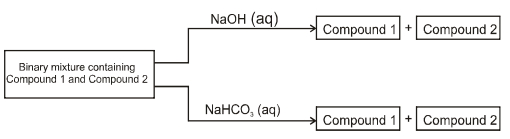
- ✓
$(B,D)$
- B
$(B,C)$
- C
$(A,D)$
- D
$(C,D)$
AnswerCorrect option: A. $(B,D)$
a
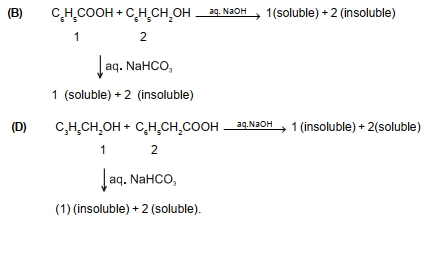
View full question & answer→MCQ 1571 Mark
An organic compound on analysis gave the following results : $C = 54.5\%, \,O = 36.4\%, \,H = 9.1\%$. The Empirical formula of the compound is
- A
$C{H_3}O$
- ✓
${C_2}{H_4}O$
- C
${C_3}{H_4}O$
- D
${C_4}{H_8}O$
AnswerCorrect option: B. ${C_2}{H_4}O$
b
(b)
Element No. of Moles Simple Ratio
|
$C = 54.5$
|
$54.5/12 = 4.54$
|
$2$
|
|
$H = 9.1$
|
$9.1/1 = 9.1$
|
$4$
|
|
$O = 36.4$
|
$36.4/16 = 2.27$
|
$1$
|
Hence, $C_2H_4O$.
View full question & answer→MCQ 1581 Mark
Chromatography is a valuable method for the separation, isolation, purification and identification of the constituents of a mixture and it is based on general principle of
MCQ 1591 Mark
Chromatography is used for the purification of
Answerd
Chromatography can be used for the purification of organic compound whose phase is either solid, or liquid or gas. Usually the organic compound (solid or liquid) is dissolved in appropriate solvent and is purified by column chromatography. Gaseous compounds can be purified by gas chromatography.
View full question & answer→MCQ 1601 Mark
The latest technique for the purification of organic compounds is
Answerb
(b) Chromatography is the latest technique for the purification of organic compounds. Chromatography are of various type viz. Column chromatography, gas chromatography, paper chromatography etc.
View full question & answer→MCQ 1611 Mark
AnswerCorrect option: B. Mixture of conc. ${H_2}S{O_4}$ and conc. $HN{O_3}$
b
(b) The mixture of conc. ${H_2}S{O_4}$ and conc. $HN{O_3}$ is called nitrating mixture. It is used in the nitration of aryl compounds.
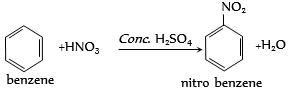
View full question & answer→MCQ 1621 Mark
To seprate different fractions of crude oil in petroleum industry, the method used is
- A
- B
- ✓
Reduced pressure distillation
- D
AnswerCorrect option: C. Reduced pressure distillation
View full question & answer→MCQ 1631 Mark
Aniline-water mixture can be separated by
Answera
Steam distillation is a separation process which consists in distilling water together with other volatile and non-volatile components.
The steam distillation process works on the principle that when a mixture of two or more undissolved liquids are heated, while ensuring that the surfaces of both liquids are in contact with the atmosphere, the vapor pressure exerted by the system increases.
This is because it now becomes the sum of the vapor pressures of all of the components of the mixture combined together.
This allows for evaporation of elements with high boiling points at much lower temperatures merely by allowing them to form a mixture with water.
Aniline is separated from a mixture by using this method.
View full question & answer→MCQ 1641 Mark
Answerb
The liquids which decompose at its boiling point can be purified by vacuum distillation. Glycerol decomposes at its boiling point $(563\, K$ ). It can be distilled by vacuum distillation without decomposition at $453 \,K$ and under $12\, mm \,Hg$ pressure.
View full question & answer→MCQ 1651 Mark
Aniline-water mixture can be separated by
Answera
Steam distillation is a separation process which consists in distilling water together with other volatile and non-volatile components. The steam distillation process works on the principle that when a mixture of two or more undissolved liquids are heated, while ensuring that the surfaces of both liquids are in contact with the atmosphere, the vapor pressure exerted by the system increases. This is because it now becomes the sum of the vapor pressures of all of the components of the mixture combined together. This allows for evaporation of elements with high boiling points at much lower temperatures merely by allowing them to form a mixture with water. Aniline is separated from a mixture by using this method.
View full question & answer→MCQ 1661 Mark
Which element is estimated by Carius method
Answerc
(c)Halogen is estimated by carius method.
View full question & answer→MCQ 1671 Mark
Which of the following is the best scientific method to test the presence of water in a liquid
- ✓
Use of anhydrous copper sulphate
- B
- C
- D
AnswerCorrect option: A. Use of anhydrous copper sulphate
a
(a)Anhydrous $CuS{O_4}$ is used to test presence of water in any liquid because it changes its colour white to blue.
View full question & answer→MCQ 1681 Mark
Lassaigne’s test is used to detect
MCQ 1691 Mark
In Lassaigne’s test the organic compound is fused with Na followed by extraction with distilled water. Which of the following is not the possible product of this fusion reaction
- A
$NaX$
- B
$NaCN$
- ✓
$NaNC$
- D
$N{a_2}S$
AnswerCorrect option: C. $NaNC$
View full question & answer→MCQ 1701 Mark
The presence of halogen, in an organic compounds, is detected by
Answerc
(c)Halogens are detected by Beilstein’s test. In this test, a copper wire is dipped in original solution and heated in a bunsen burner flame. Green colour is imparted to the flame, due to the formation of a volatile copper halide. This proves the presence of halogen.
View full question & answer→MCQ 1711 Mark
Lassaigne's test is not used for the detection of which element?
MCQ 1721 Mark
Lassaigne's test is not used for the detection of the element_______in the organic compound
MCQ 1731 Mark
Lassaigne's test for nitrogen is negative for which compound ?
- A
$Et-NH_2$
- B
$CH_3-NH_2$
- C
- ✓
$H_2N-NH_2$
AnswerCorrect option: D. $H_2N-NH_2$
View full question & answer→MCQ 1741 Mark
A blood red colour is obtained when ferric chloride solution reacts with
- A
$KCN$
- ✓
$KSCN$
- C
$K_4[Fe(CN)_6]$
- D
$K_3[Fe(CN)_6]$
AnswerCorrect option: B. $KSCN$
View full question & answer→MCQ 1751 Mark
During detection of phosphorus in an organic compound, yellow precipitate is formed due to the formation of
- A
$(NH_4)_3PO_4$
- B
$Mg_2P_2O_7$
- ✓
$(NH_4)_3PO_4.12MoO_3$
- D
$(NH_4)_2MoO_4$
AnswerCorrect option: C. $(NH_4)_3PO_4.12MoO_3$
c
The organic compound is fused with sodium peroxide. The fused mass is then extracted with water.
The aqueous solution so obtained is boiled with concentrated nitric acid, and ammonium molybdate solution is added to it.
A yellow solution or precipitate indicates the presence of phosphorus in the organic compound.
The yellow precipitate is of ammonium phosphomolybdate
$2 \mathrm{P}+3 \mathrm{Na}_{2} \mathrm{O}_{2}+\mathrm{O}_{2} \stackrel{\text { fusion }}{\mathrm{air}} \rightarrow 2 \mathrm{Na}_{3} \mathrm{PO}_{4}$
$\mathrm{Na}_{3} \mathrm{PO}_{4}+12\left(\mathrm{NH}_{4}\right)_{3} \mathrm{MoO}_{4}+21 \mathrm{HNO}_{3}$
$\begin{aligned}\left(\mathrm{NH}_{4}\right)_{3} \mathrm{PO}_{4} \cdot 12 \mathrm{MoO}_{3}+& 21 \mathrm{NH}_{4} \mathrm{NO}_{3} \\ \text { canary yellow } &+12 \mathrm{H}_{2} \mathrm{O} \end{aligned}$
View full question & answer→MCQ 1761 Mark
Formula which represents a simple ratio of atoms of different elements present in a molecule of the substance is called
Answerb
Empirical Formula - A formula that gives the simplest whole-number ratio of atoms in a compound. Obtain the mass of each element present in grams.
Determine the number of moles of each type of atom present. Divide the number of moles of each element by the smallest number of moles. Convert numbers to whole numbers.
View full question & answer→MCQ 1771 Mark
Actual number of atoms of different elements present in a molecule of a compound is given by
Answera
The chemical formula which represents the actual number of atoms of each element present in a molecule is known as molecular formula.
View full question & answer→MCQ 1781 Mark
On complete combustion $1.4 \,gm$ hydrocarbon gave $1.8\, gm$ water. Empirical formula of the hydrocarbon is
- A
$CH$
- ✓
$C{H_2}$
- C
$C{H_3}$
- D
$C{H_4}$
AnswerCorrect option: B. $C{H_2}$
b
(b) $1.8\,gm$ water obtained from $1.4\,gm$ hydrocarbon
$\therefore $ $18\,gm$ water obtained from -$\frac{{1.4}}{{1.8}} \times 18 = 14$ $gm$.
Empirical formula Mass = $14$
$\therefore $ Empirical formula = $C{H_2}$.
View full question & answer→MCQ 1791 Mark
An appropriate method for molecular weight determination of chloroform is
MCQ 1801 Mark
Molecular weight of an organic acid is given by
- ✓
Equivalent weight $\times$ basicity
- B
$\frac{{{\rm{Equivalent \,weight}}}}{{{\rm{Basicity}}}}$
- C
$\frac{{{\rm{Basicity}}}}{{{\rm{Equivalent \,weight}}}}$
- D
Equivalent weight $\times$ valency
AnswerCorrect option: A. Equivalent weight $\times$ basicity
a
(a) Mol. mass of an acid $=$ Equivalent wt. $× $ basicity.
View full question & answer→MCQ 1811 Mark
$60 \,g$ of a compound on analysis gave $C = 24\,{\rm{ }}g,$ $H = 4\,{\rm{ }}g$ and $O = 32\, g$. Its Empirical formula is
- A
${C_2}{H_4}{O_2}$
- B
${C_2}{H_2}O$
- C
$C{H_2}{O_2}$
- ✓
$C{H_2}O$
AnswerCorrect option: D. $C{H_2}O$
d
(d)
Element No. of Moles Simple Ratio
|
$C = 24$
|
$24/12 = 2$
|
$1$
|
|
$H=4$
|
$4/1 = 4$
|
$ 2$
|
|
$O = 32$
|
$32/16 = 2$
|
$1$
|
Therefore $C{H_2}O$.
View full question & answer→MCQ 1821 Mark
The vapour density of the methyl ester of an organic monocarboxylic acid is $37$. What is the molecular weight of the acid
Answerd
(d) Molecular mass = $2 \times V.D. = 2 \times 37 = 74$.
View full question & answer→MCQ 1831 Mark
Empirical formula of a hydrocarbon containing $80\%$ carbon and $20\%$ hydrogen is
- A
$CH$
- B
$C{H_2}$
- ✓
$C{H_3}$
- D
$C{H_4}$
AnswerCorrect option: C. $C{H_3}$
c
(c)
| Elements |
No.of moles |
Simple ratio |
| $C = 80\%$ |
$80/12 = 6.66$ |
$1$ |
| $H = 20\%$ |
$20/1 = 20$ |
$3$ |
ence, Empirical Formula = $C{H_3}$.
View full question & answer→MCQ 1841 Mark
Which of the following relations gives the value of $n$ =
- A
$\frac{{{\rm{Moleculer \,Mass}}}}{{{\rm{Atomic \,Mass}}}}$
- ✓
$\frac{{{\rm{Molecular \,Mass}}}}{{{\rm{Empirical \,Mass}}}}$
- C
$\frac{{{\rm{Empirical \,Mass}}}}{{{\rm{Molecular \,Mass}}}}$
- D
AnswerCorrect option: B. $\frac{{{\rm{Molecular \,Mass}}}}{{{\rm{Empirical \,Mass}}}}$
b
(b)$n = \frac{{{\rm{Molecular}}\,\,{\rm{mass}}}}{{{\rm{Emperical}}\,\,{\rm{mass}}}}$
View full question & answer→MCQ 1851 Mark
In kjeldahl’s method, $CuS{O_4}$ acts as
Answerd
(d)Kjeldahl’s method depends upon the fact that most of the organic compounds containing nitrogen are quantitatively decomposed to give ${(N{H_4})_2}S{O_4}$when heated strongly with conc. ${H_2}S{O_4}$. In this method $CuS{O_4}$ acts as catalytic agent.
View full question & answer→MCQ 1861 Mark
An organic compound has been found to possess the Empirical formula $C{H_2}O$ and molecular weight $90$. The molecular formula of it is $(C = 12,\,\,H = 1,\,{\rm{and}}\,\,O = 16)$
- ✓
${C_3}{H_6}{O_3}$
- B
$C{H_2}O$
- C
${C_2}{H_6}{O_2}$
- D
${C_2}{H_2}O$
AnswerCorrect option: A. ${C_3}{H_6}{O_3}$
a
(a) Molecular weight of ${C_3}{H_6}{O_3}$ is $90$.
View full question & answer→MCQ 1871 Mark
If we want to study relative arrangement of atoms in a molecule we study
MCQ 1881 Mark
Quantitative measurement of nitrogen in an organic compounds is done by the method
Answerd
(d)Kjeldahl's and Duma’s methods are used for the quantitative estimation of nitrogen in an organic compound. In the Kjeldahl method, the nitrogen element of organic compound is changed to the ammonia.
View full question & answer→MCQ 1891 Mark
Dumas method involves the determination of nitrogen content in the organic compound in the form of
- A
$NH_3$
- ✓
$N_2$
- C
$NaCN$
- D
$(NH_4)_2SO_4$
Answerb
Dumas' method involves the determination of nitrogen content in the organic compound in the form of nitrogen $\left( N _2\right)$. Organic compound is oxidized with cupric oxide in an atmosphere of carbon dioxide which gives free nitrogen along-with carbon dioxide and water.
View full question & answer→MCQ 1901 Mark
Kjeldahl's method is used in the estimation of
Answera
Kjeldahl's method is used for the estimation of nitrogen. The organic compound is heated with conc. $H _2 SO_4$ in the presence $K _2 SO _4$ and a little $CuSO _4$ to convert all the nitrogen into $\left( NH _4\right) 2 SO _4 \cdot K _2 SO _4$ raises the boiling point of $H _2 SO _4$ while $CuSO _4$ catalyzes the reaction.
View full question & answer→MCQ 1911 Mark
How will you separate a solution (miscible) of benzene $ + CHC{l_3}$
Answerc
(c)Distillation particularly fractional distillation because the boiling point of benzene $({80\,^o}C)$ and chloroform $({61.5\,^o}C)$ are close.
Fractional distillation involves repeated distillations and condensations, in a fractionating column. As a result of distillation and condensation at each point of the fractionating column, the vapours rising up become richer in more volatile component and the liquid falling back into the flask becomes richer in less volatile component. Thus, the low boiling liquid distils first while the higher boiling liquid distils afterwards.
View full question & answer→MCQ 1921 Mark
Which of the following compound can be separated by steam distillation method
- ✓
Steam volatile but insoluble in water
- B
Steam volatile but soluble in water
- C
Steam non volatile but sparingly soluble in water
- D
Lquid in steam but solid in water
AnswerCorrect option: A. Steam volatile but insoluble in water
a
Steam distillation is employed for those liquids which are insoluble in water, containing non-volatile impurities and are steam volatile.
View full question & answer→MCQ 1931 Mark
If $N$ and $S$ are present in an organic compound during Lassaigne test, then both changes into
AnswerCorrect option: B. $NaSCN$
b
(b) When sulphur and nitrogen both are present in organic compound during Lassaigne's Test, both changes into "sodium thiocyanate". $(NaSCN)$ which gives a blood red colouration with Ferric ion.
$3NaCNS + FeC{l_3} \to \mathop {\mathop {Fe{{(CNS)}_3}}\limits_{{\rm{Ferric sulpho cyanide}}} }\limits_{{\rm{(Blood red colour)}}} + 3NaCl$
View full question & answer→MCQ 1941 Mark
$'A'$ is
$\mathop {Salt\,\,'A'}\limits_{(Colourless)} \,\,\xrightarrow{{Cu}}$ Blue solution
$\mathop {Salt\,\,'A'}\limits_{(Colourless)} \,\,\xrightarrow[{(aq)}]{{HCl}}$ White ppt
$\mathop {Salt\,\,'A'}\limits_{(Colourless)} \,\,\xrightarrow[{{H_2}S{O_4}}]{{Conc.}}$ Brown fumes
- A
$Cu(NO_3)_2$
- B
$KNO_3$
- C
$Pb(NO_3)_2$
- ✓
Answerd
$A{g^ + }NO_3^ - \,\xrightarrow{{Cu}}Ag\, + \,C{u^{ + 2}}$ (Blue)
$A{g^ + }NO_3^ - \,\xrightarrow{{HCl}}Ag\,Cl\, \downarrow $ (White)
$A{g^ + }NO_3^ - \,\xrightarrow[{{H_2}S{O_4}}]{{Conc.}}N{O_2}\, \uparrow $ (Brown)
View full question & answer→MCQ 1951 Mark
An organic compound on analysis gave $C = 48\, gm$, $H = 8 \,gm$ and $N = 56\, gm$. Volume of $1.0\, g$ of the compound was found to be $200 \,ml$ at $NTP$. Molecular formula of the compound is
AnswerCorrect option: A. ${C_4}{H_8}{N_4}$
a
(a)
Element $\%$ No. of Moles Simple Ratio
|
$C$
|
$48$
|
$48/12 = 4$
|
$1$
|
|
$H$
|
$8$
|
$8/1 = 8$
|
$2$
|
|
$N$
|
$56$
|
$56/14 = 4$
|
$1$
|
Empirical formula = $C{H_2}N$
Empirical formula mass = $28$
Now, $ 200 \,ml$ of compound = $1 \,gm$
$22400\, ml$ of compound $\frac{1}{{200}} \times 22400 = 112$
$n = \frac{{12}}{2} = 6$
Therefore, Molecular formula $ = {(C{H_2}N)_4} = {C_4}{H_8}{N_4}$.
View full question & answer→MCQ 1961 Mark
A compound gave $80\%$ carbon and $20\%$ hydrogen on analysis. The compound is possibly
- A
${C_6}{H_6}$
- B
${C_2}{H_5}OH$
- ✓
${C_2}{H_6}$
- D
$CHC{l_3}$
AnswerCorrect option: C. ${C_2}{H_6}$
c
(c)
Element No. of Moles Simple Ratio
|
$C = 80$
|
$ 80/12 = 6.66$
|
$1$
|
|
$H = 20$
|
$20/1 = 20$
|
$3$
|
Hence Formula = $CH_3$ or $C_2H_6$
View full question & answer→MCQ 1971 Mark
An organic compound contains $C$, $H$ and $O$ in the proportion of $6 : 1 : 8$ by weight, respectively. Its vapour density is $30$. Its molecular formula will be
- ✓
${C_2}{H_4}{O_2}$
- B
$C{H_4}O$
- C
$C{H_2}O$
- D
${C_3}HO$
AnswerCorrect option: A. ${C_2}{H_4}{O_2}$
a
(a)
Elements No. of moles Simple ratio
$C$
|
$6$
|
$6/12 = 0.5 = 1$
|
$1$
|
$H$
|
$1$
|
$1/1 = 1 = 2$
|
$2$
|
$O$
|
$8$
|
$8/16 = 0.5 = 1$
|
$1$
|
Thus, Empirical formula = $C{H_2}O$
Empirical formula mass = $30$
Mol. mass = $2 \times$ V.D. = $2 \times 30 = 60$
$n = \frac{{60}}{{30}} = 2$
Mol. formula = ${(C{H_2}O)_2} = {C_2}{H_4}{O_2}$.
View full question & answer→MCQ 1981 Mark
An organic compound has $\%$ of $C$ and $\%$ of $H$ in the ratio $6 : 1$ and $\%$ of $C$ and $\%$ of $O$ in the ratio $3 : 4$. The compound is
- ✓
$HCHO$
- B
$C{H_3}OH$
- C
$C{H_3}C{H_2}OH$
- D
$(COOH)_2$
AnswerCorrect option: A. $HCHO$
a
An organic compound has $C$ and $H$ percentage in the ratio $6: 1$ by mass and $C$ and $O$ percentage in the ratio $3: 4$ by mass. Thus, the compound will contain $6 \,g$ of $C$ for each $g$ of $H$ and $8 \,g$ of $O$. The atomic masses of $C , H$ and $O$ are $12\,g / mol , 1\, g / mol , 16\, g / mol$ respectively.
The number of moles of $C =\frac{6 / g }{12 g / mol }=0.5\, mol$.
The number of moles of $H =\frac{1 / g }{1 g / mol }=1 \,mol$.
The number of moles of $O =\frac{8 / g }{16 g / mol }=0.5 \,mol$.
The mole ratio $C : H : O =0.5: 1: 0.5=1: 2: 1$
Hence, the compound is $CH _2 O$ or $HCHO$
View full question & answer→MCQ 1991 Mark
A compound of carbon hydrogen and nitrogen contains three elements in the respective ratio of $9 : 1 : 35$ grams. The Empirical formula for the compound is
- A
${C_2}{H_4}N$
- ✓
${C_3}{H_4}N$
- C
${C_3}{H_6}N$
- D
${C_2}{H_6}N$
AnswerCorrect option: B. ${C_3}{H_4}N$
b
In a certain compound, the ratio of $C : H : N =9: 1: 35$
Molar ratio of $C: H: N=\frac{9}{12}: \frac{1}{1}: \frac{3.5}{14}=0.75: 1: 0.25$
$=\frac{0.75}{0.25}: \frac{1}{0.25}: \frac{0.25}{0.25}$
$=3: 4: 1$
Thesefore, the empirical formula is $C _3 H _4 N$
View full question & answer→MCQ 2001 Mark
In Victor Mayer’s method $0.2\, gm$ of an organic substance displaced $56 \,ml$ of air at $STP$ the molecular weight of the compound
Answerc
(c ) Molecular mass
$n = \frac{{M.wt}}{{E.F.wt}} = \frac{{146}}{{73}} \times 22400$
$ = \frac{{0.2}}{{56}} \times 22400 = 80$.
View full question & answer→MCQ 2011 Mark
How much % sulphur is present in organic compound if on analysis $0.53 \,gm$ of this compound gives $1.158\, gm$ of $BaS{O_4}$
- A
$10\%$
- B
$15\%$
- C
$20\%$
- ✓
$30\%$
AnswerCorrect option: D. $30\%$
d
(d) Percentage of sulphur $ = \frac{{32}}{{233}} \times \frac{{{\rm{mass\, of }}\,BaS{O_4}}}{{{\rm{mass \,of \,organic\, compound}}}} \times 100$
$ = \frac{{32}}{{233}} \times \frac{{1.158}}{{0.53}} \times 100 = 30\% $
View full question & answer→MCQ 2021 Mark
An organic compound contains $49.3\%$ carbon $6.84\%$ hydrogen and its vapour density is $73$. Molecular formula of the compound is
- A
${C_3}{H_5}{O_2}$
- ✓
${C_6}{H_{10}}{O_4}$
- C
${C_3}{H_{10}}{O_2}$
- D
${C_4}{H_{10}}{O_2}$
AnswerCorrect option: B. ${C_6}{H_{10}}{O_4}$
b
(b)
| Elements |
No. of Moles |
Simple ratio |
| $C = 12$ |
$49.3/12 = 4.1$ |
$4.1/2.7 = 13 \times 2 = 2.6 = 3$ |
| $H = 1$ |
$6.84/1 = 6.84$ |
$6.84/2.7 = 2.5 \times 2 = 5$ |
| $O = 16$ |
$43.86/16 = 2.7$ |
$2.7/2.7 = 1 \times 2 = 2$ |
Empirical formula = ${C_3}{H_5}{O_2}$
E.F. wt. = $12 \times 3 + 1 \times 5 + 16 \times 2 = 73$
Molecular wt = $V.D. \times 2 = 73 \times 2 = 146$
$n = \frac{{M.wt}}{{E.F.wt}} = \frac{{146}}{{73}} = 2$
Molecular formula $= (E.F)n = {({C_3}{H_5}{O_2})_2} = {C_6}{H_{10}}{O_4}$.
View full question & answer→MCQ 2031 Mark
$0.0833\,mol$ of carbohydrate of empirical formula $C{H_2}O$ contain $1\,g$ of hydrogen. The molecular formula of the carbohydrate is
AnswerCorrect option: D. ${C_6}{H_{12}}{O_6}$
d
(d) $0.0833$ mole carbohydrate has hydrogen = $1\,g$
$\therefore $ $1$ mole carbohydrate has hydrogen $ = \frac{1}{{0.0833}} = 12\,g$
Empirical Formula $(C{H_2}O)$ has hydrogen $ = 2\,g$
Hence $n = \frac{{12}}{2} = 6$
Hence molecular formula of carbohydrate $ = {(C{H_2}O)_6} = {C_6}{H_{12}}{O_6}$
View full question & answer→MCQ 2041 Mark
An alkane has a $C/H-$ ratio (by mass) of $5.1428$. Its molecular formula is
- A
${C_5}{H_{12}}$
- ✓
${C_6}{H_{14}}$
- C
${C_8}{H_{18}}$
- D
${C_7}{H_{10}}$
AnswerCorrect option: B. ${C_6}{H_{14}}$
b
(b) The ratio of $C/H$ in an alkane is $5.1428.$
Alkanes have General formula ${C_n}{H_{2n + 2}}$
The mass ratio of $\frac{C}{H}$ is $\frac{{12n}}{{2n + 2}}$ or $\frac{{6n}}{{n + 1}}$
$\frac{{6n}}{{n + 1}} = 5.1428$
$6n = 5.1428n + 5.1428 = 0.8572n + 5.1428$
$n = \frac{{5.1428}}{{0.8572}} = 6$
molecular formula $ = {C_6}{H_{2n + 2}} = {C_6}{H_{14}}$.
View full question & answer→MCQ 2051 Mark
$0.1\,gm$ of organic compound was analysed by Kjeldahl's method. In analysis produced $NH_3$ absorbed in $30\, ml\, N/5\, H_2SO_4$ . The remaining acid required $20\, ml\, N/10\, NaOH$ for neutralisation. Calculate percentage.......$\%$ of nitrogen in organic compound
Answerb
$\left\{ \begin{gathered}
{\text{Total m}} \cdot {\text{e}}.{{\text{H}}_2}{\text{S}}{{\text{O}}_4} = {\text{m e}}{\text{. ofN}}{{\text{H}}_3} + {\text{m }}{\text{.e}}{\text{. of NaOH}} \hfill \\
{{\text{N}}_1} \times {{\text{V}}_1} = {\text{me of N}}{{\text{H}}_3} + {{\text{N}}_2}{{\text{V}}_2} \hfill \\
\end{gathered} \right\}$
$\frac{1}{5} \times 30 = {\text{m}} \cdot {\text{e of N}}{{\text{H}}_3} + \frac{1}{{10}} \times 20$
$6 = {\text{m}} \cdot {\text{e}} \cdot {\text{ of N}}{{\text{H}}_3} = 2{\text{ }}$
${\text{me}}{\text{. of N}}{{\text{H}}_3} = 6.2 = 4$
$\% {\text{N}} = \frac{{1.4 \times {{\text{M}}_2}{\text{S}}{{\text{O}}_4}{\text{ neutralised by N}}{{\text{H}}_3}}}{{\text{W}}}$
$ = \frac{{1.4 \times 4}}{{0.1}} = 56\% $
View full question & answer→MCQ 2061 Mark
$0.3\,g$ of an organic compound gave $50\,ml$. of nitrogen collected at $300\,K$ and $715 \,mm$ pressure in Dumas method. Calculate the percentage......$\%$ of nitrogen in the compound (aqueous tension of water at $300\, K$ is $15\, mm$)
- A
$46.67$
- ✓
$17.46$
- C
$56$
- D
$28$
AnswerCorrect option: B. $17.46$
View full question & answer→MCQ 2071 Mark
$0.5\,g$ of an organic compound containing phosphorous was heated with conc. $HNO_3$ in the carius tube. The phosphoric acid thus formed was precipitated with magnesia mixture $[MgNH_4PO_4]$ which on ignition gave residue of $1.0\, g$ of magnesium pyrophosphate $(Mg_2P_2O_7)$. The percentage......$\%$ of phosphorous in the organic compound is
- ✓
$55.85$
- B
$29.72$
- C
$19.18$
- D
$20.5$
AnswerCorrect option: A. $55.85$
a
$\mathrm{P}+\mathrm{HNO}_{3} \rightarrow \mathrm{H}_{3} \mathrm{PO}_{4} \underset{\left(\mathrm{NH}_{4} \mathrm{Cl}+\mathrm{MgCl}_{2}\right)}{\longrightarrow} \underset{\mathrm{Mg}_{2} \mathrm{P}_{2} \mathrm{O}_{7}}{\stackrel{\mathrm{MgNH}_{4}}{\Delta}}\left(\mathrm{P}_{4}\right)$
Magnesium pyrrophosphate
Molecular weight of $\mathrm{Mg}_{2} \mathrm{P}_{2} \mathrm{O}_{7}=(24 \times 2+31 \times 2+16 \times 7)=222 \mathrm{g} / \mathrm{mol} .$
$\therefore \%$ of $\mathrm{P}=\frac{62}{222} \times \frac{\mathrm{W} \text { eight of } \mathrm{Mg}_{2} \mathrm{P}_{2} \mathrm{O}_{7}}{\text { Weight of compound }} \times 100=\frac{62}{222} \times \frac{1.0}{0.5} \times 100=55.85 \%$
View full question & answer→MCQ 2081 Mark
In carius method of estimation of halogen $0.15\,g$ of an organic compound gave $0. 12\,g$ of $AgBr$. Find out the percentage.....$\%$ of bromine in the compound
- ✓
$34.04$
- B
$58.20$
- C
$9.24$
- D
$0.12$
AnswerCorrect option: A. $34.04$
a
Mass of Bromine $=80 \mathrm{u}$
Mass of $\mathrm{AgBr}=188 \mathrm{u}$
Weight of $\mathrm{AgBr}=0.12 \mathrm{g}$
Weight of organic compound = 0.15g
Percentage of Bromine $=\frac{\text { Molar Mass of Bromine }}{\text { Molar Mass of } \mathrm{AgBr}} \times \frac{\text { Weight of } \mathrm{AgBr}}{\text { Weight of organic compound }} \times 100$
Percentage of Bromine $=\frac{80}{188} \times \frac{0.12}{0.15} \times 100=34.04 \%$
Hence, option $\mathrm{A}$ is correct answer.
View full question & answer→MCQ 2091 Mark
The Lassaigne's extract is boiled with conc. $HNO_3$ while testing for halogens. By doing so it
- ✓
decomposes $Na_2S$ and $NaCN,$ formed
- B
helps in the precipitation of $AgCl$
- C
increases the solubility product of $AgCl$
- D
increases the concentration of $NO_3^-$ ions
AnswerCorrect option: A. decomposes $Na_2S$ and $NaCN,$ formed
a
$\mathrm{Na}_{2} \mathrm{S}$ and $\mathrm{NaCN},$ if present in the extract, will be
decomposed to $\mathrm{H}_{2} \mathrm{S}$ and $\mathrm{HCN}$ by $HNO_{3}$
$\mathrm{NaCN}+\mathrm{HNO}_{3} \rightarrow \mathrm{NaNO}_{3}+\mathrm{HCN}$
$\mathrm{Na}_{2} \mathrm{S}+2 \mathrm{HNO}_{3} \rightarrow 2 \mathrm{NaNO}_{3}+\mathrm{H}_{2} \mathrm{S}$
These will escape from the solution and will not interfere with the test for halogens.
View full question & answer→MCQ 2101 Mark
In Dumas' method of estimation of nitrogen $0.35\, g$ of an organic compound gave $55\, mL$ of nitrogen collected at $300\, K$ temperature and $715\, mm$ pressure. The percentage composition of nitrogen in the compound would be (aqueous tension at $300\, K = 15\, mm$).
- A
$15.45$
- ✓
$16.45$
- C
$17.45$
- D
$14.45$
AnswerCorrect option: B. $16.45$
b
$\frac{p_{1} V_{1}}{T_{1}}=\frac{p_{2} V_{2}}{T_{2}}$
Where, $\mathrm{p}_{2}=$ pressure of $\mathrm{N}_{2}$ at $\mathrm{STP}=760\, \mathrm{mm}$
$\mathrm{T}_{2}=$ Temperature of $\mathrm{N}_{2}$ at $\mathrm{STP}=273\, \mathrm{K}$
$V_{2}=?$
Volume of $\mathrm{N}_{2}$ at $\mathrm{STP}$ (by Gas equation)
$\left(\frac{\rho-\rho_{1}}{t+273}\right) V_{1} \times \frac{273}{160}=V_{2}$
Where $\mathrm{p}_{1}=\rho-\rho_{1}$
$\rho=715\, \mathrm{mm}$ (pressure at which $\mathrm{N}_{2}$ collected)
$\rho_{1}=$ aqueous tension of water $=15\, \mathrm{mm}$
$T_{1}=t+273=300\, k$
$\mathrm{V}_{1}=55\, \mathrm{mL}=$ volume of moist nitrogen in nitrometer $\therefore V_{2}=\frac{(715-15) \times 55}{300} \times \frac{273}{760}=40.098\, \mathrm{mL}$
$\%$ of nitrogen in given compound
$=\frac{28}{22400} \times \frac{V_{2}}{W} \times 100$
$=\frac{2}{22400} \times \frac{46.09}{0.35} \times 100$
$=16.45 \%$
View full question & answer→MCQ 2111 Mark
Camphor is often used in molecular mass determination because
- ✓
- B
It is solvent for organic substances
- C
- D
It has a very high cryoscopic constant
Answera
(a) Due to its volatile nature camphor is often used in molecular mass determination.
View full question & answer→MCQ 2121 Mark
An organic compound containing $C, H$ and $N$ gave following analysis : $C = 40\%$, $H = 13.33\%$ and $N = 46.67\%$. Its empirical formula would be
- A
${C_2}{H_7}{N_2}$
- B
$C{H_5}N$
- ✓
$C{H_4}N$
- D
${C_2}{H_7}N$
AnswerCorrect option: C. $C{H_4}N$
c
(c) Element No. of moles Simple ratio
|
$C = 40\%$
|
$40/12$
|
$3.33$
|
$1$
|
|
$H = 13.33\%$
|
$13.33/1$
|
$13.33$
|
$4$
|
|
$N = 46.67\%$
|
$46.67/14$
|
$3.33$
|
$1$
|
Thus formula $C{H_4}N$.
View full question & answer→MCQ 2131 Mark
Lassaigne's test for the detection of nitrogen fails in
- A
$N{H_2}CONHN{H_2}.HCl$
- ✓
$N{H_2}N{H_2}.HCl$
- C
$N{H_2}CON{H_2}$
- D
${C_6}{H_5}NHN{H_2}.HCl$
AnswerCorrect option: B. $N{H_2}N{H_2}.HCl$
b
(b) Some compound like hydrazine $(N{H_2}N{H_2})$ although contain nitrogen, they do not respond lassaigne's test because they do not have any carbon & hence $NaCN$ is not formed.
View full question & answer→MCQ 2141 Mark
The most suitable method of separation of $1 :1$ mixture of $ortho$ and $para-$ nitrophenols is
Answerc
The ortho and para isomers can be separated by steam distillation $o-$Nitrophenol is steam volatile due to intramolecular hydrogen bonding while $p-$nitro phenol is less volatile due to intermolecular hydrogen bonding which cause association of molecule.
View full question & answer→MCQ 2151 Mark
Prussian blue is formed when
- A
Ferrous sulphate reacts with $FeC{l_3}$
- ✓
Ferric sulphate reacts with ${K_4}\left[ {Fe{{(CN)}_6}} \right]$
- C
Ferrous ammonium sulphate reacts with $FeC{l_3}$
- D
Ammonium sulphate reacts with $FeC{l_3}$
AnswerCorrect option: B. Ferric sulphate reacts with ${K_4}\left[ {Fe{{(CN)}_6}} \right]$
b
(b) $F{e_2}\,{(S{O_4})_3} \to 2F{e^{3 + }} + 3SO_4^{2 - }$
${K_4}[Fe{(CN)_6}] + 2F{e^{3 + }} \to \mathop {F{e_4}{{[Fe{{(CN)}_6}]}_3}}\limits_{{\rm{Prussion}}\,{\rm{blue}}} $.
View full question & answer→MCQ 2161 Mark
Which is incorrect for paper chromatography
Answerb
In case of paper chromatography, there are both stationary and dynamic phases present. So, the statement that tt is a stationary phase is incorrect.
View full question & answer→MCQ 2171 Mark
In Lassaigne's test for the detection of halogens, the sodium fusion extract is first boiled with concentrated nitric acid. This is
- A
- ✓
to decompose $Na_2S$ and $NaCN$, if present
- C
to dissolve $Ag_2S$
- D
to dissolve $AgCN$, if formed
AnswerCorrect option: B. to decompose $Na_2S$ and $NaCN$, if present
b
If the organic compound also contains nitrogen or sulphur, the Lassaigne's extract on boiling with dil. $HNO_3$ decomposes sodium cyanide or sodium sulphide formed during fusion.
$NaCN+HN{{O}_{3}}\to NaN{{O}_{3}}+HCN\uparrow $
$N{{a}_{2}}S+2HN{{O}_{3}}\to 2NaN{{O}_{3}}+{{H}_{2}}S\uparrow $
If cyanide and sulphide ions are not decomposed, they will react with silver nitrate and hence will interfere with the test.
$NaCN+AgN{{O}_{3}}\to \underset{\begin{smallmatrix}
Silver \\
cyanide
\\
(White\,ppt.)
\end{smallmatrix}}{\mathop{AgCN}}\,+NaN{{O}_{3}}$
$N{{a}_{2}}S+2AgN{{O}_{3}}\to \underset{\begin{smallmatrix}
Silver \\
sulphide
\\
(Black\,ppt.)
\end{smallmatrix}}{\mathop{A{{g}_{2}}S}}\,+2NaN{{O}_{3}}$
View full question & answer→MCQ 2181 Mark
The Lassaigne’s extract is boiled with dil. $HNO_3$ before testing for halogens because
- A
Silver halides are soluble in $HNO_3$
- ✓
$Na_2S$ and $NaCN$ are decomposed by $HNO_3$
- C
$Ag_2S$ is soluble in $HNO_3$
- D
$AgCN$ is soluble in $HNO_3$
AnswerCorrect option: B. $Na_2S$ and $NaCN$ are decomposed by $HNO_3$
b
$Na_2S$ and $NaCN$, formed during fusion with metallic sodium, must be removed before adding $AgNO_3$, otherwise black ppt. due to $Na_2S$ or white precipitate due to $AgCN$ will be formed and thus white precipitate of $AgCl$ will not be identified easily.
$N{a_2}S + 2AgN{O_3} \to 2NaN{O_3} + \mathop {A{g_2}S}\limits_{Black} \downarrow $
$NaCN + AgN{O_3} \to NaN{O_3} + \mathop {AgCN}\limits_{White} \downarrow $
$NaCl + AgN{O_3} \to NaN{O_3} + \mathop {AgCl}\limits_{white} \downarrow $
$N{a_2}S + 2HN{O_3}\xrightarrow{{boil}}2NaN{O_3} + {H_2}S \uparrow $
$NaCN + HN{O_3}\xrightarrow{{boil}}NaN{O_3} + HCN \uparrow $
View full question & answer→MCQ 2191 Mark
The emperical formula of compound is $C{H_2}O$. If its molecular weight is $180$. The molecular formula of the compound is
- A
${C_3}{H_6}{O_3}$
- B
${C_4}{H_8}{O_4}$
- ✓
${C_6}{H_{12}}{O_6}$
- D
${C_5}{H_{10}}{O_5}$
AnswerCorrect option: C. ${C_6}{H_{12}}{O_6}$
c
(c) Molecular formula = (Emperical formula)$n$
$n = \frac{{{\text{Molecular}}\,\,\,{\text{weight}}}}{{{\text{Emperical}}\,\,\,{\text{formula}}\,\,\,{\text{wt}}.}} = \frac{{180}}{{30}} = 6$
$ = {(C{H_2}O)_6} = {C_6}{H_{12}}{O_6}$
View full question & answer→MCQ 2201 Mark
If a compound on analysis was found to contain $C = 18.5\%$, $H = 1.55\%$, $Cl = 55.04\%$, $O = 24.81\%$, then its empirical formula is
- ✓
$CHClO$
- B
$C{H_2}ClO$
- C
${C_2}{H_2}OCl$
- D
$ClC{H_2}O$
AnswerCorrect option: A. $CHClO$
a
(a)
| Elements |
No. of moles |
Simple ratio |
| $C = 18.5\%$ |
$18.5/12 = 1.54 $ |
$1$ |
| $H = 1.55\%$ |
$1.55/1 = 1.55 $ |
$1$ |
| $Cl = 55.04\%$ |
$55.04/35.5 = 1.55 $ |
$1$ |
| $O = 24.81\%$ |
$24.81/16 = 1.55 $ |
$1$ |
Hence, formula = $CHClO$.
View full question & answer→MCQ 2211 Mark
Copper wire test for halogens is known as
Answerb
Beilstein's test : Organic compounds containing halogens when heated over $Cu$ wire loop give blue or green colour flame due to formation of volatile copper halides.
View full question & answer→MCQ 2221 Mark
Beilstein test is used for the estimation of which one of the following elements?
- A
$S$
- ✓
$Cl$
- C
$C$ and $H$
- D
$N$
Answerb
Beilstein's test is used for halogens .
View full question & answer→MCQ 2231 Mark
An organic compound having molecular mass $60$ is found to contain $C = 20\%$, $H= 6.67\%$ and $N=46.67\%$ while rest is oxygen. On heating it gives $N{H_3}$ along with a solid residue. The solid residue give violet colour with alkaline copper sulphate solution. the compound is
- A
$C{H_3}NCO$
- B
$C{H_3}CON{H_2}$
- ✓
${(N{H_2})_2}CO$
- D
$C{H_3}C{H_2}CON{H_2}$
AnswerCorrect option: C. ${(N{H_2})_2}CO$
c
The ratio of the number of gram atoms among $C , H , N$ and $O$ is,
$C : H : N : O =\frac{20}{12}: \frac{6.67}{1}: \frac{46.67}{14}: \frac{26.66}{16}=1: 4: 2: 1$
Empirical formula $= CH _4 N _2 O$. So, empirical weight $=60 \,g$.
Given, molecular weight $=60\, g$.
Molecular formula $=(\text { Empirical formula })_{ n }$
$n =\frac{\text { Molecular weight }}{\text { Empirical weight }}=\frac{60}{60}=1$
So, molecular formula is $\left( NH _2\right)_2 CO$.
View full question & answer→MCQ 2241 Mark
The compound formed in the positive test for nitrogen with the lassaigne solution of an organic compounds is
- A
$Fe{(CN)_3}$
- B
$N{a_3}[Fe{(CN)_6}]$
- ✓
$F{e_4}{[Fe{(CN)_6}]_3}$
- D
$N{a_4}[Fe{(CN)_5}NOS]$
AnswerCorrect option: C. $F{e_4}{[Fe{(CN)_6}]_3}$
c
(c) $F{e_4}{[Fe{(CN)_6}]_3}$ compound formed in the positive test for nitrogen with the lassaigne solution of an organic compounds.
View full question & answer→MCQ 2251 Mark
In a compound $C, H$ and $N$ atoms are present in $9 : 1 : 3.5$ by weight. Molecular weight of compound is $108$. Molecular formula of compound is
- A
${C_2}{H_6}{N_2}$
- B
${C_3}{H_4}N$
- ✓
${C_6}{H_8}{N_2}$
- D
${C_9}{H_{12}}{N_3}$
AnswerCorrect option: C. ${C_6}{H_8}{N_2}$
c
(c) Molecular weight of compound $= 108$
${C^{12}} \to 12 \times 6 = 72$
${H^1} \to 1 \times 8 = 8$
${N^{14}} \to 14 \times 2 = 28$
Total molecular weight $= 108$
$\therefore $ Molecualr formula $ = {C_6}{H_8}{N_2}$
View full question & answer→MCQ 2261 Mark
In Duma's method for estimation of nitrogen, $0.25\,g$ of an organic compound gave $40\,mL$ of nitrogen collected at $300\,K$ temperature and $725\,mm$ pressure. If the aqueous tension at $300\,K$ is $25\,mm$ , the percentage of nitrogen in the compound is
- A
$18.20$
- ✓
$16.76$
- C
$15.76$
- D
$17.36$
AnswerCorrect option: B. $16.76$
b
Given:
$\mathrm{m}=0.25 \mathrm{g}, \mathrm{V}_{1}=40 \mathrm{ml}, \mathrm{T}_{1}=300 \mathrm{K}, \mathrm{P}_{1}=725 \mathrm{mm}-25 \mathrm{mm}=700 \mathrm{mm}$
$\mathrm{P}_{0}=760 \mathrm{mm}, \mathrm{T}_{0}=273 \mathrm{K}, \mathrm{V}_{0}=?$
$\mathrm{V}_{0}=\frac{\mathrm{P}_{1} \mathrm{V}_{1}}{\mathrm{T}_{1}} \times \frac{\mathrm{T}_{\mathrm{o}}}{\mathrm{P}_{0}}=\frac{700 \mathrm{mm} \times 40 \mathrm{ml}}{300 \mathrm{K}} \times \frac{273 \mathrm{K}}{760 \mathrm{mm}}=33.53 \mathrm{ml}$
At STP, 22400 ml of nitrogen occupies 22400 ml.
22400mL OF $\mathrm{N}_{2}$ at STP weighs $=28 \mathrm{gm}$
Hence the mass of nitrogen which corresponds to $33.53 \mathrm{ml}$ is $\frac{28 \mathrm{g} \times 33.53 \mathrm{ml}}{22400 \mathrm{ml}}=0.0419 \mathrm{g}$.
The percentage of nitrogen is $0.0419 \mathrm{g} \times \frac{100}{0.25 \mathrm{g}}=16.76 \%$
Hence, the correct option is B.
View full question & answer→MCQ 2271 Mark
In Duma's method of estimation of nitrogen $0.35\,g$ of an organic compound gave $55\,ml$ of nitrogen collected at $300\,K$ temp. and $715\,mm$ pressure. The percentage of nitrogen in compound is (aqueous tension at $300\,K = 15\,mm$)
- A
$15.45$
- ✓
$16.45$
- C
$17.45$
- D
$14.45$
AnswerCorrect option: B. $16.45$
b
From 715mm pressure, subtract aqueous tension 15mm to obtain pressure of nitrogen. $\mathrm{P}=715-15=700 \mathrm{mm} \mathrm{Hg}$
Volume of nitrogen at STP $=\frac{\mathrm{V} \times \mathrm{P} \times 273}{(\mathrm{T}) \times 760}$
Volume of nitrogen at STP $=\frac{55 \times 700 \times 273}{(300) \times 760}=46 \mathrm{mL}$
Percent of nitrogen $=\frac{\text { vol of } \mathrm{N}_{2} \text { at } \mathrm{STP}}{\text { wt of organic compound }} \times \frac{28}{22400} \times 100$
Percent of nitrogen $=\frac{46}{0.35} \times \frac{28}{22400} \times 100=16.45 \%$
The percentage composition of nitrogen in the compound would be $16.45 \%$
View full question & answer→