Questions · Page 2 of 5

[3 Mark Questions]

Question 513 Marks
a. What is the focal length of the lens used in sunglasses?
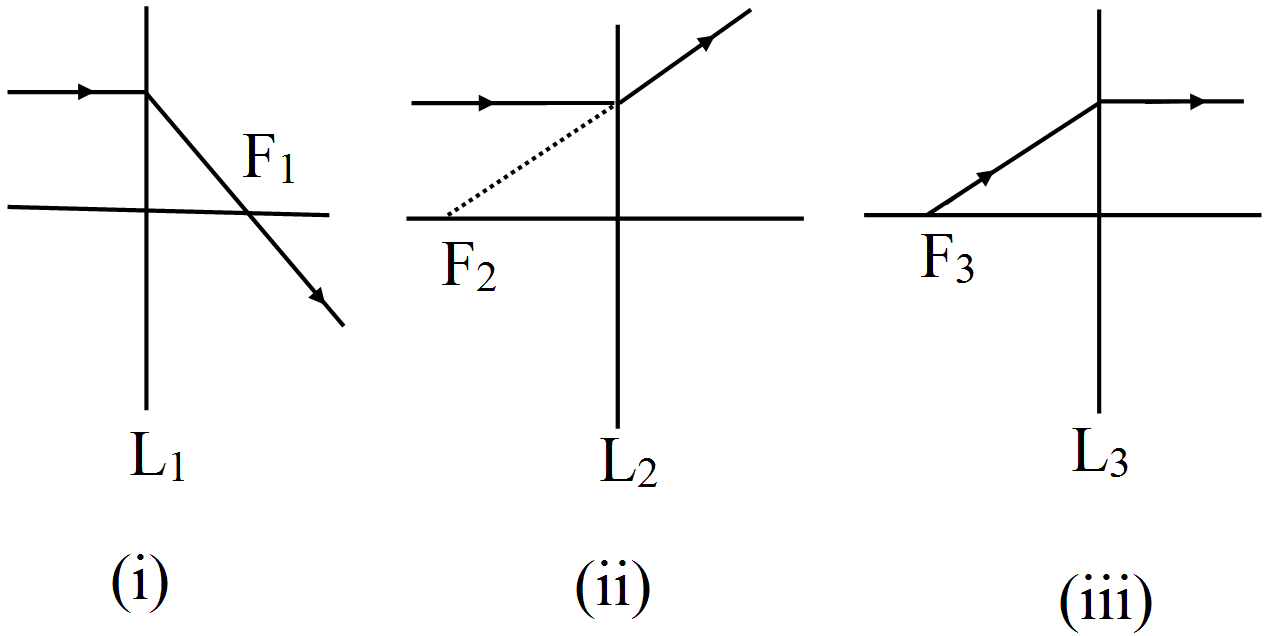
b. The following figures show the path of light rays through three lenses marked $L_1, L_2$, and $L_3$ and their focal points $F_1, F_2$, and $F_3$, respectively. Identify the nature of lenses.
Answer
a. The focal length of a Sunglass lens is theoretically infinite. It is because the radii of curvatures of the front and back surfaces are equal.
b. Lens $L_1: f_1$
Lens $L_2: f_2$
Lens $L _3: f _3$
onvex lens because concave lens can never form virtual and magnified image of an object and convex lens form such image only when the object is placed between the optical centre and principle focus of the convex lens.
View full question & answer
Question 523 Marks
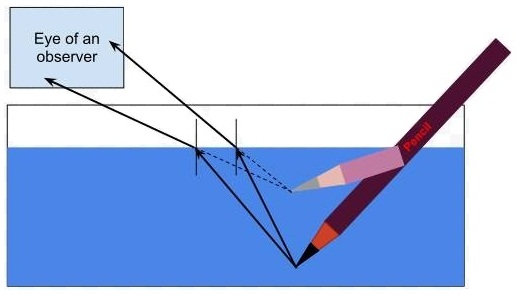
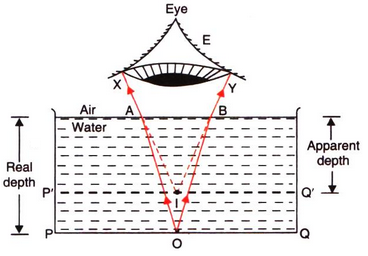
With the help of a labelled diagram, explain why a tank full of water appears less deep than it actually is.
Answer
If we look into a tank of water, it appears to be less deep than it really is. This is due to the refraction of light which takes place when light rays pass from the tank of water into air. When we look into the tank, we do not see the actual bottom of the tank, we see a virtual image of the bottom of the pool which is formed by the refraction of light coming from the water into the air.
View full question & answer
Question 533 Marks
Two lenses of power -3.5D and + 1D are placed in contact. Find the total power of the combination of lens. Calculate the focal length of this combination.
Answer
Power $P_1=-3.5 D ; P_2=+1 D$ Total power $=P_1+P_2=-3.5 D+1 D \Rightarrow$ Total power $(P)=-2.5 D$. Now; $P$ (in diopter) $=\frac{1}{f \text { (in meters) }} \Rightarrow-2.5=\frac{1}{f(\text { in meters) }}$
$\Rightarrow\text{f (in meters)}=\frac{-1}{2.5}=\frac{-1}{\frac{5}{2}}$
$\Rightarrow\text{f (in meters)}=-\frac{2}{5}=-0.4\text{m}$
Now 1m = 100cm ⇒ -0.4m = -40cm Hence the focal length of lens is -40cm.
View full question & answer
Question 543 Marks
A diverging mirror of radius of curvature 40cm forms an image which is half the height of the object. Find the object and image positions.
Answer
R = 40cm$\text{f}=\frac{\text{R}}{2}=\frac{40}{2}=20\text{cm}$
Image is half the height of the object.$\text{i.e.}\ \text{m}=-\frac{\text{v}}{\text{u}}=\frac{\text{h}_2}{\text{h}_1}$
$\Rightarrow \text{u}=-2\text{v}$
know,$\frac{1}{\text{v}}+\frac{1}{\text{u}}=\frac{1}{\text{f}}$
$\Rightarrow\frac{1}{\text{v}}+\frac{1}{(-2\text{v})}=\frac{1}{20}$
$\Rightarrow\frac{1}{\text{v}}-\frac{1}{2\text{v}}=\frac{1}{20}$
$\Rightarrow\frac{1}{2\text{v}}=\frac{1}{20}$
$\therefore \text{v}=10\text{cm}$
$\text{u}=-2\text{v}=-2\times10=-20\text{cm}$
So, the object is palced 20cm in front of the mirror and the image is formed 10cm the mirror.
View full question & answer
Question 553 Marks
A concave lens has focal length 15cm. At what distance should the object from the lens be placed so that it forms an image at 10cm from the lens? Also find the magnification produced by the lens.
Answer
f = -15cm v = -10cm Lens formula, $\frac{1}{\text{v}}-\frac{1}{\text{u}}=\frac{1}{\text{f}}$$\frac{1}{-10}-\frac{1}{\text{u}}=\frac{1}{-15}$
$\frac{1}{\text{u}}=-\frac{1}{10}+\frac{1}{15}$
$\frac{1}{\text{u}}=\frac{-1}{30}$
${\text{u}}=-30\text{cm}$
Object should be placed at a distance of 60cm on the left side of the lens.$\text{m}=\frac{\text{v}}{\text{u}}=\frac{-10}{-30}=+0.33$
View full question & answer
Question 563 Marks
The image of a candle flame formed by a lens is obtained on a screen placed on the other side of the lens. If the image is three times the size of the flame and the distance between lens and image is 80cm, at what distance should the candle be placed from the lens? What is the nature of the image at a distance of 80cm and the lens?
Answer
The image is real as only the real image can be taken on the screen.Here, image distance, v = +80cm
Magnification, m = -3
Object distance, u = ?
Now, magnification, $\text{m}=\frac{\text{v}}{\text{u}}\Rightarrow\ -3=\frac{80}{\text{u}}\ \text{or u }=\frac{-80}{3}\text{cm}$
Nature of image will be real, magnified and inverted. The image will be formed beyond 2F.
By using lens formula,
$\frac{1}{\text{v}}-\frac{1}{\text{u}}=\frac{1}{\text{f}}$
$\Rightarrow\ \frac{1}{\text{f}}=\frac{1}{80}-\frac{3}{-80}=\frac{1}{20}\text{ or f }=20\text{cm}$
Focal length is positive so, the lens is convex.
View full question & answer
Question 573 Marks
The radius of curvature of a convex mirror used as a rear view mirror in a moving car is 2.0m. A truck is coming from behind it at a distance of 3.5m. Calculate (a) position, and (b) size, of the image relative to the size of the truck. What will be the nature of the image?
Answer
R = 2m,$\text{f}=\frac{\text{R}}{2}=1\text{m}$
u = -3.5m We konw that
  1. $\frac{1}{\text{v}}+\frac{1}{\text{u}}=\frac{1}{\text{f}}$
$\Rightarrow\frac{1}{\text{v}}+\frac{1}{(-3.5)}=\frac{1}{1}$
$\Rightarrow\frac{1}{\text{v}}=1+\frac{1}{3.5}=1+\frac{10}{30}=1+\frac{2}{7}=\frac{9}{7}$
$\therefore \text{v}=\frac{7}{9}=0.77\text{m}$
$\text{u}=-2\text{v}=-2\times10=-20\text{cm}$
So, the image is fomed 0.77m in behind the mirror.
  1. Now, $\text{m}=\frac{\text{v}}{\text{u}}=\frac{0.77}{(-3.5)}=\frac{\frac{7}{9}}{3.5}=\frac{1}{4.5}$
AS m is positive, so image formed is virtual and efect.
View full question & answer
Question 583 Marks
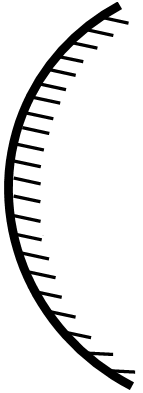
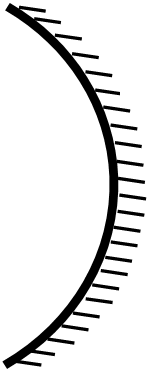
Which of the following are concave mirrors and which convex mirrors?
Shaving mirrors, Car headlight mirror, Searchlight mirror, Driving mirror, Dentist’s inspection mirror, Torch mirror, Staircase mirror in a double-decker bus, Make-up mirror, Solar furnace mirror, Satellite TV dish, Shop security mirror.
Answer
Shaving mirror: Concave mirror.
Car headlight mirror: Concave mirror.
Searchlight mirror: Concave mirror.
Driving mirror: Convex mirror.
Dentist’s inspection mirror: Concave mirror.
Torch mirror: Concave mirror.
Staircase mirror in a double-decker bus: Convex mirror.
Make-up mirror: Concave mirror.
Solar furnace mirror: Concave mirror.
Satellite TV dish: Concave mirror.
Shop security mirror: Convex mirror.
View full question & answer
Question 593 Marks
Distinguish between a convex and a concave mirror.
Answer
 
BASIS FOR COMPARISON
CONVEX MIRROR
CONCAVE MIRROR1.
1.
Meaning
Convex mirror implies the mirror whose reflecting surface is away from the center of curvature.
Concave mirror refers to the mirror whose reflecting surface is towards the center of curvature.
2.
Shape
3.
Center of curvature
Lies behind the mirror.
Lies in front of the mirror.
4.
Type
Diverging mirror.
Converging mirror.
5.
Image
Virtual image is formed.
Real or virtual image is formed.
6.
Used as
Rear view mirrors in cars and bikes.
Reflectors in projectors, searchlights etc.
View full question & answer
Question 603 Marks
What is a spherical mirror? Distinguish between a concave mirror and a convex mirror.
Answer
A spherical mirror is that mirror whose reflecting surface is the part of a hollow sphere of glass. The spherical mirrors are of two types:
  • Concave mirrors and convex mirrors.
  • Difference between concave mirror and convex mirror.
A concave mirror is that spherical mirror in which the reflection of light takes place at concave surface (or bent-in surface), whereas a convex mirror is that spherical miror in which the reflection of light takes place at the convex surface (or bulging out surface). Concave mirror converges the parallel rays of light that fall on it, whereas convex mirror diverges the parallel rays of light that fall on it.
View full question & answer
Question 613 Marks
A concave lens of 20cm focal length forms an image 15cm from the lens. Compute the object distance.
Answer
u = -20cm v = -15cm (Virtual image) Lens formula, $\frac{1}{\text{f}}=\frac{1}{\text{v}}-\frac{1}{\text{u}}$$\frac{1}{-15}-\frac{1}{\text{u}}=\frac{1}{-20}$
$\frac{1}{\text{u}}=-\frac{1}{15}+\frac{1}{20}$
$\frac{1}{\text{u}}=\frac{-1}{60}$
$\text{u}=-60\text{cm}$
Object distance is 60cm towards the left of the lens.
View full question & answer
Question 623 Marks
The optical prescription for a pair of spectacles is:
Right eye: 3.50D, Left eye: 4.00D
  1. Are these lenses thinner at the middle or at the edges?
  2. Which lens has a greater focal length?
  3. Which is the weaker eye?
Answer
  1. These lenses are thinner at the middle because they are concave lens. Further, concave lens has negative power.
  2. Lens for right eye has greater focal length because power is inversely proportional to focal length.
  3. Left eye is weaker because it has a correction with a lens of lower focal length.
View full question & answer
Question 633 Marks
A man holds a spherical shaving mirror of radius of curvature 60cm, and focal length 30cm, at a distance of 15cm, from his nose. Find the position of image, and calculate the magnification.
Answer
Radius of curvature, R = -60cm (concave mirror) f = -30cm, u = -15cm We have$\frac{1}{\text{v}}+\frac{1}{\text{u}}=\frac{1}{\text{f}}$
$\frac{1}{\text{v}}=\frac{1}{15}+\frac{1}{-30}$
$\frac{1}{\text{v}}=\frac{1}{30}$
$\text{v}=30\text{cm}$
$\text{m}=-\frac{\text{v}}{\text{u}}$
$\text{m}=-\frac{30}{-15}$
$\text{m}=2$
So, the iamge is formed 30cm behinf the mirrior and the magnification is +2.
View full question & answer
Question 643 Marks
A student uses a lens of focal length -50cm. What is the nature of the lens and its power?
Answer
Since the focal length is negative, therefore the lens is concave lens because the focal length of concave lens is negative. P (in diopter) $=\frac{1}{\text{f (in meters)}}$When $\text{f}=-50\text{cm}=-0.5\text{m}$
$\text{P}=\frac{1}{\text{f (in m)}}=\frac{1}{-0.5}=-2\text{D}$
Lens is concave.
View full question & answer
Question 653 Marks
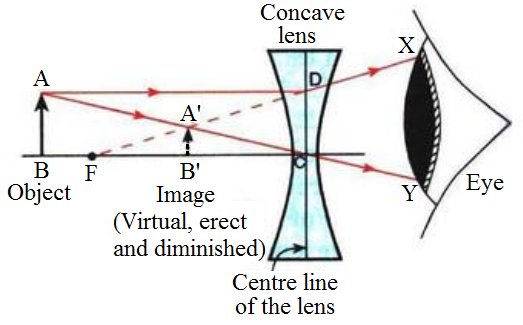
With the help of a diagram, explain why the image of an object viewed through a concave lens appears smaller and closer than the object.
Answer
  1. Smaller.
  2. Bigger.
Image is virtual in both the cases.


As shown by the diagram the image of an object-viewed thrpogh a concave lens appears smaller and closer than the object.
View full question & answer
Question 663 Marks
An object is 2m from a lens which forms an erect image one-fourth (exactly) the size of the object. Determine the focal length of the lens. What type of lens is this?
Answer
Given, Object distance (u) = -2m Image distance (v) = ? Magnification (m) = 0.25 (one-fourth of the size of the image) Focal length (f) = ?$\text{Magnification(m)}=\frac{\text{v}}{\text{u}}$
$\text{v}=-0.5\text{m}$
Putting these values in lens formula, we get,$\frac{1}{\text{v}}-\frac{1}{\text{u}}=\frac{1}{\text{f}}$
$\Rightarrow\frac{1}{-0.5}-\frac{1}{-2}=\frac{1}{\text{f}}$
$\Rightarrow\frac{1}{-0.5}+\frac{1}{2}=\frac{1}{\text{f}}$
$\Rightarrow\frac{1}{\text{f}}=\frac{1}{2}-\frac{1}{0.5}$
$\Rightarrow\frac{1}{\text{f}}=\frac{1}{2}-\frac{10}{5}$
$\Rightarrow\frac{1}{\text{f}}=\frac{-3}{2}$
$\Rightarrow\text{f}=-0.66\text{m}$
Negative sign of focal length shows that lens is diverging in nature. Hence, it is a concave lens.
View full question & answer
Question 673 Marks
When an object is placed at a distance of 50cm from a concave spherical mirror, the magnification produced is,$-\frac{1}{2}$ Where should the object be placed to get a magnification of, $-\frac{1}{5}?$
Answer
Case 1:$\text{u}= -50\text{cm},$
$\text{m}=-\frac{1}{2}$
$\text{m}=-\frac{\text{v}}{\text{u}}$
$-\frac{1}{2}=\frac{\text{v}}{-50}$
$\text{v}=-25\text{cm}$
We know$\frac{1}{\text{v}}+\frac{1}{\text{u}}=\frac{1}{\text{f}}$
$\Rightarrow\frac{1}{-25}+\frac{1}{-50}=\frac{1}{\text{f}}$
$\Rightarrow\frac{-3}{-50}=-\frac{1}{\text{f}}$
$\Rightarrow\text{f}=\frac{-50}{3}\text{cm}$
Case 2:
$\text{m}=\frac{1}{2}$
$\text{f}=\frac{-50}{3}$
$\text{m}=-\frac{1}{5}=-\frac{\text{v}}{\text{u}}$
$\text{v}=-\frac{\text{u}}{5}$
Now,$\frac{1}{\text{v}}+\frac{1}{\text{u}}=\frac{1}{\text{f}}$
$\frac{5}{\text{u}}+\frac{1}{\text{u}}=\frac{-3}{50}$
$\frac{6}{\text{u}}=-\frac{-3}{50}$
$\text{u}=\frac{600}{-3}=-100\text{cm}$
View full question & answer
Question 683 Marks
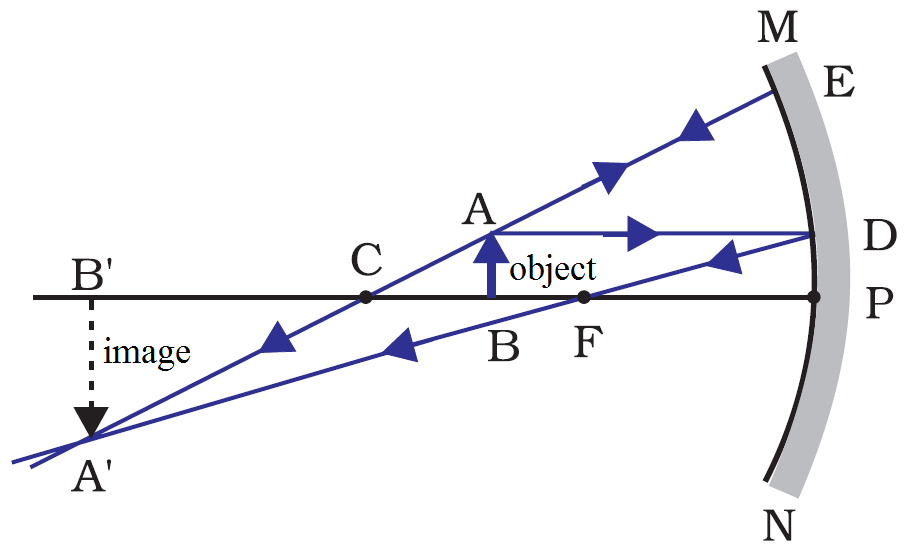
Draw ray-diagrams to show the formation of images when the object is placed in front of a concave mirror (converging mirror):
  1. Between its pole and focus.
  2. Between its centre of curvature and focus Describe the nature, size and position of the image formed in each case.
Answer
  1. When the object is palced between the pole and focus of a concave mirror a mangnified image is formed.
  1. When the object is palced between the focus and the centre of the curvature of a concave mirror a mangnified image is formed.
​​​​​​​​​​​​​​
View full question & answer
Question 693 Marks
Two lenses have power of
  1. +2D
  2. –4D
What is the nature and focal length of each lens?
Answer
The relation between Focal length (f) and Power (P) of a lens is given by$\text{f (in m)}=\frac{1}{\text{p}}$
Sign convention for f and P:
  • Convex Lens: Positive (+)
  • Concave Lens: Negative (-)
Case 1: P = +2D Nature: Converging lens (or Convex lens) Focal length: $\text{f}=\frac{1}{2}=+0.5\text{m}$ 1m = 100cm = 50cm. Hence the focal length is 50cm. Case 2: P = -4D Nature: Diverging lens (or Concave lens) Focal length: $\text{f}=\frac{1}{-4}=0.25\text{m}$$1\text{m}=100\text{cm}\Rightarrow0.25\text{m}=25\text{cm.}$
Hence the focal length is -25cm
View full question & answer
Question 703 Marks
An object 2cm tall is placed on the axis of a convex lens of focal length 5cm at a distance of 10m from the optical centre of the lens. Find the nature, position and size of the image formed. Which case of image formation by convex lenses is illustrated by this example?
Answer
$h_1=2 cm f =5 cm u =-10 m=-1000 cm \frac{1}{v}-\frac{1}{u}=\frac{1}{f}$
$\frac{1}{\text{v}}-\frac{1}{1000}=\frac{1}{5}$
$\frac{1}{\text{v}}=\frac{1}{5}-\frac{1}{1000}$
$\frac{1}{\text{v}}=\frac{200-1}{1000}=\frac{199}{1000}$
$\text{v}=5.02\text{cm}$
The image is formed 5.02cm behind the convex lens and is real and inverted.$\text{m}=\frac{\text{v}}{\text{u}}=\frac{5.02}{-1000}=-0.005$
$\text{m}=\frac{\text{h}_2}{\text{h}_1}=-0.005$
$\frac{\text{h}_2}{2}=-0.005$
$\text{h}_2=-0.01\text{cm}$
Since the object distance is much greater than the focal length, this example illustrates the case when the object is place.
View full question & answer
Question 713 Marks
An object 2cm tall stands on the principal axis of a converging lens of focal length 8cm. Find the position, nature and size of the image formed if the object is:
  1. 12cm from the lens.
  2. 6 cm from the lens.
Answer
$h_1 = 2cm$
f = 8cm
  1. u = -12cm
Lens formula , $\frac{1}{\text{v}}-\frac{1}{\text{u}}=\frac{1}{\text{f}}$

$\frac{1}{\text{v}}-\frac{1}{12}=\frac{1}{8}$

$\frac{1}{\text{v}}=\frac{1}{24}$

$\text{v}=24\text{cm}$

Image is 24cm behind the lens.

$\text{m}=\frac{\text{v}}{\text{u}}=\frac{\text{h}_2}{\text{h}_1}$

$\frac{24}{-12}=\frac{\text{h}_2}{2}$

$\text{h}_2=-4\text{cm}$

Image is 4cm hight, real and inverted.
  1. u = -6cm
Lens formula, $\frac{1}{\text{v}}-\frac{1}{\text{u}}=\frac{1}{\text{f}}$

$\frac{1}{\text{v}}-\frac{1}{-6}=\frac{1}{8}$

$\frac{1}{\text{v}}=-\frac{1}{24}$

$\text{v}=-24\text{cm}$

Image is 24cm in front of the lens.

$\text{m}=\frac{\text{v}}{\text{u}}=\frac{\text{h}_2}{\text{h}_1}$

$\frac{-24}{-6}=\frac{\text{h}_2}{2}$

$\text{h}_2=8\text{cm}$

Image is 8cm high, virtual and erect.
View full question & answer
Question 723 Marks
An object is kept at a distance of 100cm from each of the above lenses. Calculate the (i) image distance and (ii) magnification in each of the two cases.
Answer
To find the image for convex lens,$\text{u}=-100\text{cm}$
$\text{f}=50\text{cm}$
$\text{v}=\frac{(\text{f }\times\text{ u})}{(\text{f}-\text{u})}=100\text{cm}$
magnification is 1 for concave lens,$\text{u}=-100\text{cm}$
$\text{f}=-25\text{cm}$
$\text{v}=\frac{-(\text{f }\times\text{ u})}{(\text{f}+\text{u})}=-20\text{cm}$
magnification is $\frac{\text{v}}{\text{u}}$ that's $\frac{20}{100}$ So, $\text{m}=0.2$
View full question & answer
Question 733 Marks
Size of image of an object by a mirror having a focal length of 20cm is observed to be reduced to $\frac{1}{3}\text{rd}$ of its size. At what distance the object has been placed from the mirror? What is the nature of the image and the mirror?
Answer
Since image size is $\frac{1}{3}$ of object size, so image distance is $\frac{1}{3}$ of object distance because $\frac{\text{h}'}{\text{h}}=\frac{\text{v}}{\text{u}}$ Using the mirror formula, we can calculate object distance and image distance,$\frac{1}{\text{v}}+\frac{1}{\text{u}}=\frac{1}{\text{f}}$
or, $\frac{3}{\text{u}}-\frac{1}{\text{u}}=-\frac{1}{20}$ or, $\frac{3-1}{\text{u}}=-\frac{1}{20}$ or, $\text{u}=-40\text{cm}$ Using this, we can find image distance:$\frac{1}{\text{v}}+\frac{1}{\text{u}}=\frac{1}{\text{f}}$
or, $\frac{1}{\text{v}}-\frac{1}{40}=-\frac{1}{20}$ or, $\frac{1}{\text{v}}=-\frac{1}{20}+\frac{1}{40}$ or, $\frac{-2+1}{40}=-\frac{1}{40}$But above value of image distance does not match with our initial assumption. This means that the mirror is not a concave mirror but a convex mirror. Let us calculate with the assumption that it is a convex mirror.
$\frac{1}{\text{v}}+\frac{1}{\text{u}}=\frac{1}{\text{f}}$
or, $\frac{1}{\text{v}}-\frac{1}{40}=-\frac{1}{20}$ or, $\frac{1}{\text{v}}=-\frac{1}{20}+\frac{1}{40}=\frac{3}{40}$ or, $\text{v}=\frac{40}{3}\text{cm}$Nature of mirror: convex mirror.
Nature of image: Smaller than object, erect and virtual.
View full question & answer
Question 743 Marks
A man sits in an optician's chair looking into plane mirror which is 2m away from him and views the image of a chart which faces the mirror and is 50cm behind his head. How far away from his eyes does the chart appear to be?
Answer
Distance between the man and the mirror = 2cm.
Distance between man and chart = 50cm. = 0.5m.
Distance between chart and mirror = 0.5m. + 2m. = 2.5m.
Distance between mirror and the image of the chart = 2.5m.
Distance between man and the image of chart = Distance between man and the mirror +
Distance between mirror and the image of the chart = 2m. + 2.5m. = 4.5m.
View full question & answer
Question 753 Marks
Describe the New Cartesian Sign Convention used in optics. Draw a labelled diagram to illustrate this sign convention.
Answer
According to the New Cartesian Sign Convention:
  1. All the distances are measured from pole of the mirror as origin.
  2. Distances measured in the same direction as that of incident light are taken as positive.
  3. Distances measured against the direction of incident light are taken as negative.
  4. Distances measured upward and perpendicular to the principal axis are taken as positive.
  5. Distance measured downward and perpendicular to the principal axis are taken as negative.
View full question & answer
Question 763 Marks
Give two uses of concave mirrors. Explain why you would choose concave mirrors for these uses.
Answer
Uses of concave mirror.
  1. Concave mirrors are used as shaving mirrors. This is because when the face is placed close to a concave mirror (so that the face is within its focus) the concave mirror produces a magnified and erect image of the face. Since a large image of the face is seen in the concave mirror, it becomes easier to make a smooth shave.
  2. Concave mirrors are used by dentists to see the large images of the teeth of patients. This is because when a tooth is within the focus of a concave mirror, then an enlarged image of the tooth is seen in the mirror. Due to this, it becomes easier to locate the defect in the tooth.
View full question & answer
Question 773 Marks
A concave mirror produces three times enlarged virtual image of an object placed at 10cm in front of it. Calculate the radius of curvature of the mirror.
Answer
m = 3 (virtual image) u = -10cm R = ? We know that$\text{m}=-\frac{\text{v}}{\text{u}}$
$3=-\frac{\text{-v}}{(-10)}$
$\text{v}=30\text{cm}$
and$\frac{1}{\text{v}}+\frac{1}{\text{u}}=\frac{1}{\text{f}}$
$\frac{1}{30}+\frac{1}{(-10)}=\frac{1}{\text{f}}$
$\frac{-20}{300}=\frac{1}{\text{f}}$
$\frac{1}{\text{f}}=-15\text{cm}$
Radius of ourvature=R=2f$=2\times(-15)=-30\text{cm}$
View full question & answer
Question 783 Marks
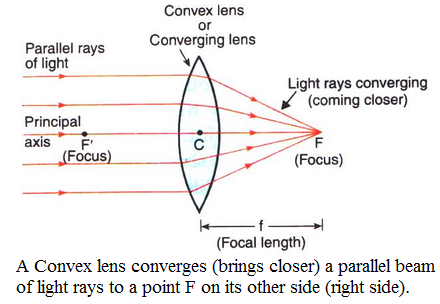
  1. Draw a diagram to show how a converging lens focusses parallel rays of light?
  2. How would you alter the above diagram to show how a converging lens can produce a beam of parallel rays of light.
Answer
  1. When rays of light from a distant object pass through a converging lens, the light rays converge at the focus of lens.

A convex lens converges (brings closer) a parallel beam of light rays to a point F on its other side (right side).
  1. When rays of light come from the focus of lens, the emergent rays of light get parallel to the principal axis.
View full question & answer
Question 793 Marks
What can you see in a completely dark room? If you switch on an electric bulb in this dark room as a light source, explain how you could now see:
  1. The electric bulb.
  2. A piece of white paper.
Answer
When we see in a completely dark room, we are not able to see anything because there is no light in the dark room.
  1. We can see bulb due to the light emitted by the bulb.
  2. We can see a piece of white paper because it reflects the light from the bulb falling on it.
View full question & answer
Question 803 Marks
When an object is placed 10cm in front of lens A, the image is real, inverted, magnified and formed at a great distance. When the same object is placed 10cm in front of lens B, the image formed is real, inverted and same size as the object:
  1. What is the focal length of lens A?
  2. What is the focal length of lens B?
  3. What is the nature of lens A?
  4. What is the nature of lens B?
Answer
  1. The focal length of lens A is 10cm as only a converging lens forms a real, inverted, magnified image at great distance when object is placed at the focus of the lens.
  2. The focal length of lens B is 5cm as only a converging lens forms a real, inverted and same size image of object when the object is placed at 2F position of the lens.
  3. Lens A is a converging (convex) lens as only a converging lens forms a real image.
  4. Lens B is a converging (convex) lens as only a converging lens forms a real image.
View full question & answer
Question 813 Marks
An arrow 2.5cm high is placed at a distance of 25cm from a diverging mirror of focal length 20cm. Find the nature, position and size of the image formed.
Answer
$h_1= 2.5cm$, u = -25cm, f = 20cm We know that$\frac{1}{\text{v}}+\frac{1}{\text{u}}=\frac{1}{\text{f}}$
$\Rightarrow\frac{1}{\text{v}}+\frac{1}{-25}=\frac{1}{20}$
$\therefore\text{v}=\frac{9}{100}\text{cm}=11.1\text{cm}$
The image is formed 11.1cm behind the convex mirror. Now,$\text{m}=\frac{\text{v}}{\text{u}}=\frac{\text{h}_2}{\text{h}_1}$
$\Rightarrow -\frac{11.1}{(-25)}=\frac{\text{h}_2}{2.5}$
${\text{h}_2}=\frac{11.1\times2.5}{25}=1.11\text{cm}$
The image is virtual, erect and 1.11cm tall.
View full question & answer
Question 823 Marks
A 2.0cm tall object is placed 40 cm from a diverging lens of focal length 15cm. Find the position and size of the image.
Answer
$h_1=2 cm u =-40 cm f =-15 cm \frac{1}{v}-\frac{1}{u}=\frac{1}{f}$
$\frac{1}{\text{v}}=-\frac{1}{15}-\frac{1}{40}$
$\frac{1}{\text{v}}=\frac{-11}{120}$
$\text{v}=-10.90\text{cm}$
$\text{m}=\frac{\text{v}}{\text{u}}=\frac{\text{h}_2}{\text{h}_1}$
$\frac{-10.09}{-40}=\frac{\text{h}_2}{2}$
$\text{h}_2=0.54\text{cm}$
View full question & answer
Question 833 Marks
Explain with the help of a labelled ray diagram, why a pencil partly immersed in water appears to be bent at the water surface. State whether the bending of pencil will increase or decrease if water is replaced by another liquid which is optically more dense than water. Give reason for your answer.
Answer
A pencil placed in water appears to be bent because of refraction of light. The refraction causes an apparent shift in the position of the part of the pencil within the water.
View full question & answer
Question 843 Marks
A convex lens of focal length 25cm and a concave lens of focal length 10cm are placed in close contact with one another.
  1. What is the power of this combination?
  2. What is the focal length of this combination?
  3. Is this combination converging or diverging?
Answer
$\text{f}_1=25\text{cm}=0.25\text{m}$$\text{P}_1=\frac{1}{\text{f}_1}=\frac{1}{0.25}=4\text{D}$
$\text{f}_2=-10\text{cm}=-0.1\text{m}$
$\text{P}_2=\frac{1}{\text{f}_2}=\frac{1}{-0.1}=-10\text{D}$
  1. Power of the combination,
$\text{P}=\text{P}_1+\text{P}_2$
$=4\text{D}+(-10\text{D})$
$=-6\text{D}$
  1. Focal length of the combination,
$\text{f}=\frac{1}{\text{P}}=\frac{1}{-6}=-0.1666\text{m}=-16.66\text{cm}$
  1. The combination has negative focal length, so it is diverging.
View full question & answer
Question 853 Marks
Give the position, size and nature of image formed by a concave lens when the object is placed:
  1. Anywhere between optical centre and infinity.
  2. At infinit.
Answer
  1. When the object is placed anywhere between optical centre and infinity, the image is formed between optical centre and focus. It is diminished, virtual and erect.
  2. When the object is placed at infinity, the image is formed at focus. It is highly diminished, virtual and erect.
View full question & answer
Question 863 Marks
A small object is so placed in front of a convex lens of 5cm focal length that a virtual image is formed at a distance of 25cm. Find the magnification
Answer
f = 5cm v = -25cm (Virtual image) Lens formula, $\frac{1}{\text{v}}-\frac{1}{\text{u}}=\frac{1}{\text{f}}$$\frac{1}{-25}-\frac{1}{\text{u}}=\frac{1}{5}$
$\frac{1}{\text{u}}=-\frac{1}{25}-\frac{1}{5}=-\frac{6}{25}$
$\text{u}=-\frac{25}{6}\text{cm}$
Magnification, $\text{m}=\frac{\text{v}}{\text{u}}=\frac{-25}{-\frac{25}{6}}=+6$
View full question & answer
Question 873 Marks
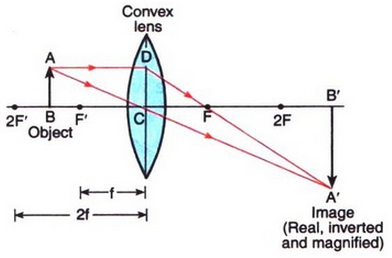
Describe with the help of a ray-diagram, the formation of image of a finite object placed in front of a convex lens between f and 2f Give two characteristics of the image so formed.
Answer
If object is placed in between f and 2f, the image will form on the other side of the lens beyond 2f as shown below. Characteristics of image formed:
  • Image formed is real and inverted.
  • Image formed is magnified.
View full question & answer
Question 883 Marks
A convex lens of focal length 6cm is held 4cm from a newspaper which has print 0.5cm high. By calculation, determine the size and nature of the image produced.
Answer
f = 6cm u = -4cm $h _1=0.5 cm$ Lens formula, $\frac{1}{\text{v}}-\frac{1}{\text{u}}=\frac{1}{\text{f}}$$\frac{1}{\text{v}}-\frac{1}{-4}=\frac{1}{6}$
$\frac{1}{\text{v}}=\frac{1}{6}-\frac{1}{4}=\frac{2-3}{12}$
$\text{v}=-12\text{cm}$
$\text{m}=\frac{\text{v}}{\text{u}}=\frac{\text{h}_2}{\text{h}_1}$
$\frac{-12}{-4}=\frac{\text{h}_2}{0.5}$
$\text{h}_2=1.5\text{cm}$
Image is 1.5cm high, virtual, erect and magnified.
View full question & answer
Question 893 Marks
What is the difference between regular reflection of light and diffuse reflection of light? What type of reflection of light takes place from:
  1. A cinema screen.
  2. A plane mirror.
  3. A cardboard.
  4. Still water surface of a lake
Answer
In regular reflection, a parallel beam of incident light is reflected as a parallel beam in one direction; while in diffuse reflection, a parallel beam of incident light is reflected in different directions.
  1. Regular reflection.
  2. Regular reflection.
  3. Diffuse reflection.
  4. Regular reflection.
View full question & answer
Question 903 Marks
Name the type of mirror used in the following situations.
  1. Headlights of a car.
  2. Side/rear-view mirror of a vehicle.
  3. Solar furnace.
Support your answer with reason.
Answer
  1. Concave mirror, to get powerful and parallel beams of light.
  2. Convex mirror because it always gives an erect image and enables the driver to view much larger area.
  3. Concave or parabolic mirror because it can concentrate sunlight at the focus to produce heat in the solar furnace.
View full question & answer
Question 913 Marks
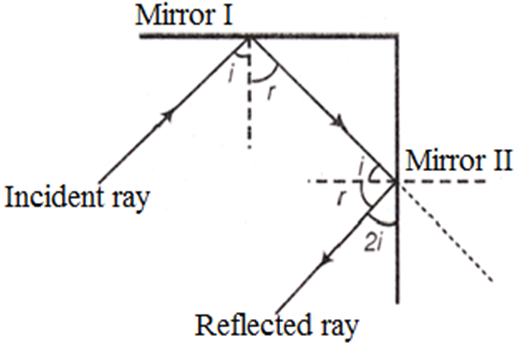
Under what condition in an arrangement of two plane mirrors, incident ray and reflected ray will always be parallel to each other, whatever may be angle of incidence. Show the same with the help of diagram.
Answer
When two plane mirrors are placed at right angle with each other, then the incident ray and reflected ray will always be parallel to each other, irrespective of the angle of incidence.
View full question & answer
Question 923 Marks
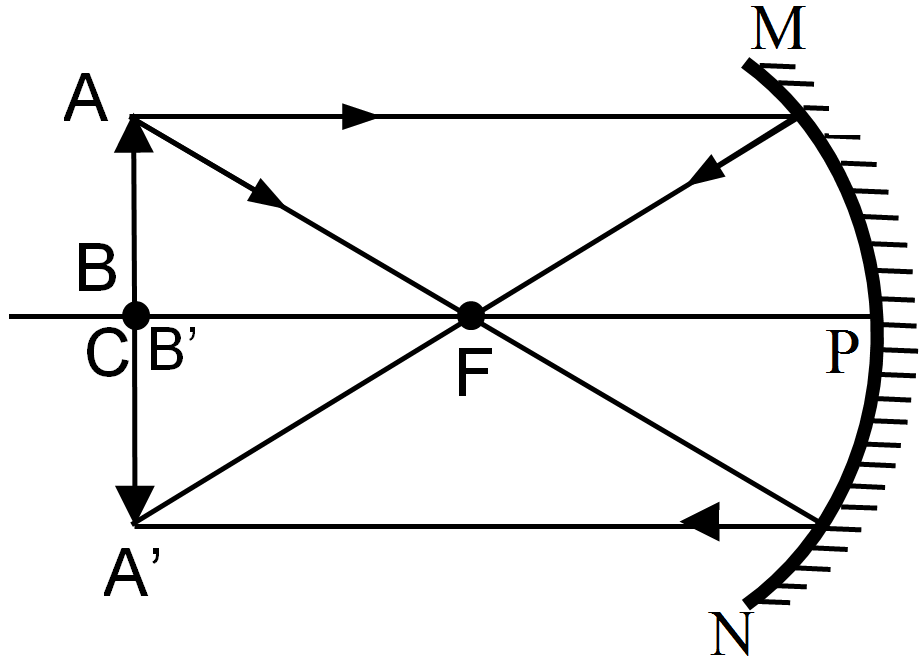
An object 2cm in size is placed 30cm in front of a concave mirror of focal length 15cm. At what distance from the mirror should a screen be placed in order to obtain a sharp image? What will be the nature and the size of the image formed? Draw a ray diagram to show the formation of the image in this case.
Answer
$\text{u}=-30$$\text{f}=-15$
$\frac{1}{\text{u}}+\frac{1}{\text{v}}=\frac{1}{\text{f}}$
$\frac{-1}{30}+\frac{1}{\text{v}}=\frac{-1}{15}$
$\frac{1}{\text{v}}=\frac{-1}{15}+\frac{1}{30}$
$\frac{1}{\text{v}}=\frac{-1}{30}$
${\text{v}}=-30$
Therefore the screen must be placed 30cm in front of the mirror
Now, the object is kept at 30cm which is equal to twice the focal length that is 2f
Also r that is distance between centre and pole = 2f
Therefore the object is kept at the centre so the image formed will also be of 2cm, real and inverted.
View full question & answer
Question 933 Marks
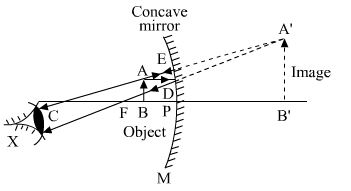
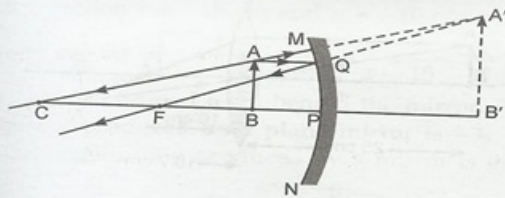
We wish to obtain an erect image of an object, using a concave mirror of focal length 15 cm. What should be the range of distance of the object from the mirror? What is the nature of the image? Is the image larger or smaller than the object? Draw a ray diagram to show the image formation in this case.
Answer
Object must be placed in front of concave mirror between its pole and principal focus at a distance less than 15 cm. The image formed will be virtual and erect. The size of the image is larger the object. The ray diagram is as follows:
View full question & answer
Question 943 Marks
Two lenses A and B have focal lengths of +20cm and, -10cm, respectively.
  1. What is the nature of lens A and lens B?
  2. What is the power of lens A and lens B?
  3. What is the power of combination if lenses A and B are held close together?
Answer
$f _{ A }=+20 cm=+0.2 m f _{ B }=-10 cm=-0.1 m$
  1. Lens A is a convex lens (positive focal length) and lens B is a concave lens (negative focal length).
  2. $\text{P}_\text{A}=\frac{1}{\text{f}_\text{A}}=\frac{1}{+0.2}=+5\text{D}$
$\text{P}_\text{B}=\frac{1}{\text{f}_\text{B}}=\frac{1}{-0.1}=-10\text{D}$
  1. Power of combination,
P = PA + PB = +5D + (-10D) = -5D
View full question & answer
Question 953 Marks
State and explain the New Cartesian Sign Convention for spherical lenses.
Answer
New Cartesian Sign Convention for spherical lenses:
  1. All the distances are measured from the optical centre of the lens.
  2. The distances measured in the same direction as that of incident light are taken as positive.
  3. The distances measured against the direction of incident light are taken as negative.
  4. The distances measured upward and perpendicular to the principal axis are taken as positive.
  5. The distances measured downward and perpendicular to the principal axis are taken as negative.
View full question & answer
Question 963 Marks
An object is placed 20cm from (a) a converging lens, and (b) a diverging lens, of focal length 15cm. Calculate the image position and magnification in each case.
Answer
u = -20cm
  1. f = 15cm (for converging lens)
$\frac{1}{\text{v}}-\frac{1}{\text{u}}=\frac{1}{\text{f}}$

$\frac{1}{\text{v}}-\frac{1}{-20}=\frac{1}{15}$

$\frac{1}{\text{v}}=\frac{1}{15}-\frac{1}{20}$

$\frac{1}{\text{v}}=\frac{1}{60}$

$\text{v}=60\text{cm}$

$\text{m}=\frac{\text{v}}{\text{u}}=\frac{60}{-20}=-3$
  1. f = -15cm(for diverging lens)
$\frac{1}{\text{v}}-\frac{1}{\text{u}}=\frac{1}{\text{f}}$

$\frac{1}{\text{v}}-\frac{1}{-20}=\frac{1}{-15}$

$\frac{1}{\text{v}}=-\frac{1}{15}-\frac{1}{20}$

$\frac{1}{\text{v}}=-\frac{1}{15}-\frac{1}{20}$

$\frac{1}{\text{v}}=\frac{-7}{60}$

$\text{v}=-8.57\text{cm}$

$\text{m}=\frac{-\text{v}}{\text{u}}=\frac{-8.57}{-20}=+0.42$
View full question & answer
Question 973 Marks
A converging lens of focal length 5cm is placed at a distance of 20cm from a screen. How far from the lens should an object be placed so as to form its real image on the screen?
Answer
f = 5cm u = -20cm v = +v (Since image is real) Lens formula, $\frac{1}{\text{v}}-\frac{1}{\text{u}}=\frac{1}{\text{f}}$$\frac{1}{\text{v}}-\frac{1}{-20}=\frac{1}{5}$
$\frac{1}{\text{v}}=\frac{1}{5}-\frac{1}{20}$
$\frac{1}{\text{v}}=\frac{4-1}{20}=\frac{3}{20}$
$\text{v}=6.66$
View full question & answer
Question 983 Marks
An object 50cm tall is placed on the principal axis of a convex lens. Its 20cm tall image is formed on the screen placed at a distance of 10cm from the lens. Calculate the focal length of the lens.
Answer
Height of object (h) = 50cm Height of image (h') = -20cm (real and inverted) Distance of image from the lens (v) = 10cm Distance of object from the lens (u) = ? Focal length of the lens (f) = ? We know, magnification (m) of the lens is given by,$\text{m}=\frac{\text{v}}{\text{u}}=\frac{\text{h}'}{\text{h}}$
Thus, substituting the values of v, h and h', we get,$\frac{10}{\text{u}}=\frac{-20}{50}$
${\text{u}}=\frac{-5}{2}\times10$
$\therefore\ \text{u}=-25\text{cm}$
Using the lens formula,$\frac{1}{\text{v}}-\frac{1}{\text{u}}=\frac{1}{\text{f}}$
$\Rightarrow \frac{1}{10}-\frac{1}{-25}=\frac{1}{\text{f}}$
$\Rightarrow \frac{1}{10}+\frac{1}{25}=\frac{1}{\text{f}}$
$\Rightarrow\frac{5+2}{50}=\frac{1}{\text{f}}$
$\Rightarrow\frac{7}{50}=\frac{1}{\text{f}}$
$\Rightarrow\text{f}=\frac{50}{7}$
$\Rightarrow\text{f}=7.14\text{cm}$
View full question & answer
Question 993 Marks
A 5.0cm tall object is placed perpendicular to the principal axis of a convex lens of focal length 20cm. The distance of the object from the lens is 30cm By calculation determine.
  1. The position and
  2. The size of the image formed.
Answer
According to the question; Object distance = -30cm; Image distance = vcm; Focal length = 20cm By lens formula;$\frac{1}{\text{v}}-\frac{1}{\text{u}}=\frac{1}{\text{f}}$
$\Rightarrow\frac{1}{\text{v}}-\frac{1}{-30}=\frac{1}{20}$
$\Rightarrow\frac{1}{\text{v}}=\frac{1}{20}-\frac{1}{30}$
$\Rightarrow\frac{1}{\text{v}}=\frac{30-20}{600}=\frac{10}{600}$
$\Rightarrow\frac{1}{\text{v}}=\frac{1}{60}$
$\Rightarrow\text{v}=60\text{cm.}$
Therefore image is formed at 60cm in right of lens. Now; Height of object Height of object $h_1=5 cm$;; Magnification $=\frac{\text{h}_2}{\text{h}_1}=\frac{\text{v}}{\text{u}}$ Putting values of v and u Magnification $=\frac{\text{h}_2}{5}=\frac{60}{-30}$$\Rightarrow\frac{\text{h}_2}{5}=-2$
$\Rightarrow\text{h}_2=-2\times5=10$
Height of image is 10cm. Negative sign means image is real and inverted.
View full question & answer
Question 1003 Marks
What would your image look like if you stood dose to a large:
  1. Convex mirror?
  2. Concave mirror?
Give reasons for your answer.
Answer
  1. Our image will be diminished, virtual and erect. This is because when the object lies anywhere between the pole and inifinity, the concave mirror forms a diminished, virtual and erect image.
  2. Our image will be enlarged, virtual and erect. This is because when the object lies within the focus of a concave mirror, it forms an enlarged, virtual and erect image.
View full question & answer