Question 15 Marks
- It is known that density r of air decreases with height y as $\rho_0\text{e}^{-\frac{\text{y}}{\text{y}_0}}$ where $\rho=1.25\text{kg m}^{-3}$ is the density at sea level, and $y_0$ is a constant. This density variation is called the law of atmospheres. Obtain this law assuming that the temperature of atmosphere remains a constant (isothermal conditions). Also assume that the value of g remains constant.
- A large He balloon of volume $1425m^3$ is used to lift a payload of 400kg. Assume that the balloon maintains constant radius as it rises. How high does it rise? [Take $y^0 = 8000m$ and $rHe = 0.18 kgm^{–3}$].
AnswerVolume of the balloon, $V = 1425m^3$ Mass of the payload, $m = 400kg$ Acceleration due to gravity, $g = 9.8 m/ s^2 y_0 = 8000m$
$\rho_{\text{He}}=0.18\text{kg m}^{-3}$
$\rho_0=1.25\text{kg m}^{-3}$ Density of the balloon $=\rho$ Density $(\rho)$ of air decreases with height (y) as: $\rho=\rho_0\text{e}^{\frac{\text{y}}{\text{y}}}$
$\frac{\rho}{\rho_ 0}=\text{e}^{-\frac{\text{y}}{\text{y}_0}}\ ...(1)$ This density variation is called the law of atmospherics. It can be inferred from equation (i) that the rate of decrease of density with height is directly proportional to $(\rho)$ i.e., $-\Big(\frac{\text{d}\rho}{\text{dy}}\Big)\propto\rho$
$\Big(\frac{\text{d}\rho}{\text{dy}}\Big)=-\text{k}\rho$
$\Big(\frac{\text{d}\rho}{\rho}\Big)=-\text{K dy}$ Where, k is the constant of proportionality Height changes from 0 to y, while density changes from $\rho_0$ to $(\rho)$ Integrating the sides between these limits, we get: $\int_{\rho_0}^{\rho}\frac{\text{d}\rho}{\rho}=-\int_{0}^{\text{y}}\text{kdy}$
$[\log_\text{e}\rho]^\rho_{\rho_0}=-\text{ky}$
$\log_\text{e}\frac{\rho}{\rho_0}=-\text{ky}$
$\frac{\rho}{\rho_0}\text{e}^{-\text{ky}}\ ...(2)$ Comparing equations (i) and (ii), we get: $\text{y}=\frac{1}{\text{K}}$
$\text{K}=\frac{1}{\text{y}_0}\ ...(3)$ From equations (i) and (iii), we get $\rho=\rho_0\text{e}^{\frac{-\text{y}}{\text{y}_0}}$ Density $\rho=\frac{\text{mass}}{\text{volume}}$
$=\frac{\text{mass of the paylod}+\text{mass of helium}}{\text{volume}}$
$\frac{(\text{m}+\text{V}\rho_{\text{He}})}{\text{V}}$
$=\frac{(400+1425\times0.18)}{1425}$
$=0.46\text{kg m}^{-3}$ From equations (ii) and (iii), we can obtain y as: $\rho=\rho_0\text{e}^{\frac{-\text{y}}{\text{y}_0}}$
$\log_\text{e}\Big(\frac{\rho}{\rho_0}\Big)=\frac{-\text{y}}{\text{y}_0}$
$\therefore\text{y}=-8000\times\log_\text{e}\Big(\frac{0.46}{1.25}\Big)$
$=-8000\times(-1)$
$=8000\text{m}=8\text{km}$ Hence, the balloon will rise to a height of 8km.
View full question & answer→Question 25 Marks
What is the excess pressure inside a bubble of soap solution of radius 5.00 mm , given that the surface tension of soap solution at the temperature $\left(20^{\circ} \mathrm{C}\right)$ is $2.50 \times 10-2 \mathrm{Nm}^{-1}$ ? If an air bubble of the same dimension were formed at depth of 40.0 cm inside a container containing the soap solution (of relative density 1.20 ), what would be the pressure inside the bubble? ( 1 atmospheric pressure is $1.01 \times 105 \mathrm{~Pa})$.
AnswerExcess pressure inside the soap bubble is 20 Pa ; Pressure inside the air bubble is $1.06 \times 10^5 \mathrm{~Pa}$ Soap bubble is of radius, $\mathrm{r}=5.00 \mathrm{~mm}=5 \times 10^{-3} \mathrm{~m}$ Surface tension of the soap solution, $\mathrm{S}=2.50 \times 10^{-2} \mathrm{Nm}^{-1}$ Relative density of the soap solution $=1.20 \therefore$ Density of the soap solution, $\rho=1.2 \times 10^3 \mathrm{~kg} / \mathrm{m}^3$ Air bubble formed at a depth, $\mathrm{h}=40 \mathrm{~cm}$ $=0.4 \mathrm{~m}$ Radius of the air bubble, $\mathrm{r}=5 \mathrm{~mm}=5 \times 10^{-3} \mathrm{~m} 1$ atmospheric pressure $=1.01 \times 10^5 \mathrm{~Pa}$ Acceleration due to gravity, $g=9.8 \mathrm{~m} / \mathrm{s}^2$ Hence, the excess pressure inside the soap bubble is given by the relation: $\mathrm{p}=\frac{2}{\mathrm{r}}=\frac{2 \times 2.5 \times 10^{-2}}{\left(5 \times 10^{-3}\right.}$ $=10 \mathrm{pa}$ Therefore, the excess pressure inside the air bubble is 10 Pa . At a depth of 0.4 m , the total pressure inside the air bubble $=$ Atmospheric pressure $+\mathrm{hpg}+P=1.01 \times 10^5+0.4 \times 1.2 \times 10^3 \times 9.8+10=1.06 \times 10^5 \mathrm{~Pa}$ Therefore, the pressure inside the air bubble is $1.06 \times 10^5 \mathrm{~Pa}$.
View full question & answer→Question 35 Marks
Glycerine flows steadily through a horizontal tube of length 1.5 m and radius 1.0 cm . If the amount of glycerine collected per second at one end is $4.0 \times 10^{-3} \mathrm{~kg} \mathrm{~s}^{-1}$, what is the pressure difference between the two ends of the tube? (Density of glycerine $=1.3 \times 103 \mathrm{~kg} \mathrm{~m}^{-3}$ and viscosity of glycerine $=0.83 \mathrm{~Pa}$ ). [You may also like to check if the assumption of laminar flow in the tube is correct].
AnswerLength of the horizontal tube, l = 1.5m Radius of the tube, r = 1cm = 0.01m Diameter of the tube, d = 2r = 0.02m Glycerine is flowing at a rate of $4.0 \times 10^{–3}kg s^{–1}. M = 4.0 \times 10^{–3}kg s^{–3}$ Density of glycerine $\rho=1.3\times10^3\text{kg/ m}^{-3}$ Viscosity of glycerine $\eta=0.83\text{pa/ s}$ Volume of glycerine flowing per sec: $\text{V}=\frac{\text{M}}{\rho}$
$=\frac{4\times10^{-3}}{(1.3\times10^3)}=3.08\times10^{-6}\text{m}^3\text{s}^{-1}$ According to Poiseville’s formula, we have the relation for the rate of flow: $\text{V}=\frac{\pi\text{pr}^4}{8\eta\text{l}}$ Where, p is the pressure difference between the two ends of the tube $\therefore\text{P}=\frac{\text{V}8\eta\text{l}}{\pi\text{r}^4}$
$=3.08\times10^{-6}\times8\times0.83\times\frac{1.5}{[\pi\times(0.01)^4]}$
$=9.8\times10^2\text{pa}$ Reynolds’ number is given by the relation: $\text{R}=\frac{4\text{PV}}{\pi\text{d}\eta}$
$=4\times1.3\times10^3\times\frac{3.08\times10^{-6}}{(\pi\times0.02\times0.83)}$
$=0.3$ Reynolds’ number is about 0.3. Hence, the flow is laminar.
View full question & answer→Question 45 Marks
- What is the largest average velocity of blood flow in an artery of radius $2×10 – 3m$ if the flow must remain lanimar?
- What is the corresponding flow rate ? (Take viscosity of blood to be $2.084 × 10⁻³ Pa/ s$).
AnswerRadius of the artery, $\mathrm{r}=2 \times 10^{-3} \mathrm{~m}$ Diameter of the artery, $\mathrm{d}=2 \times 2 \times 10^{-3} \mathrm{~m}=4 \times 10^{-3} \mathrm{~m}$ Viscosity of blood, $\mathrm{n}=$ $2.084 \times 10^{-3} \mathrm{~Pa} / \mathrm{s}$ Density of blood, $\rho=1.06 \times 10^3 \mathrm{~kg} / \mathrm{m}^3$ Reynolds' number for laminar flow, $\mathrm{N}_{\mathrm{R}}=2000$ The largest average velocity of blood is given by the relation: $\mathrm{V}_{\mathrm{arg}}=\mathrm{N}_{\mathrm{R}} \eta / \rho \mathrm{d}=\frac{2000 \times 2.084 \times 10^{-3}}{\left(1.06 \times 10^3 \times 4 \times 10^{-3}\right)}=0.983 \mathrm{~m} / \mathrm{s}$ Therefore, the largest average velocity of blood is $0.983 \mathrm{~m} / \mathrm{s}$. (b) Flow rate is given by the relation: $\mathrm{R}=\pi \mathrm{r}^2 \mathrm{~V}_{\mathrm{avg}}=3.14 \times\left(2 \times 10^{-}\right.$ $\left.{ }^3\right)^2 \times 0.983=1.235 \times 10^{-5} \mathrm{~m}^3 \mathrm{~s}^{-1}$ Therefore, the corresponding flow rate is $1.235 \times 10^{-5} \mathrm{~m}^3 \mathrm{~s}^{-1}$.
View full question & answer→Question 55 Marks
Explain why A spinning cricket ball in air does not follow a parabolic trajectory.
AnswerA spinning cricket ball has two simultaneous motions – rotatory and linear. These two types of motion oppose the effect of each other. This decreases the velocity of air flowing below the ball. Hence, the pressure on the upper side of the ball becomes lesser than that on the lower side. An upward force acts upon the ball. Therefore, the ball takes a curved path. It does not follow a parabolic path.
View full question & answer→Question 65 Marks
Figure (a) shows a thin liquid film supporting a small weight = $4.5 \times 10^{–2}N$. What is the weight supported by a film of the same liquid at the same temperature in Fig. (b) and (c)? Explain your answer physically.
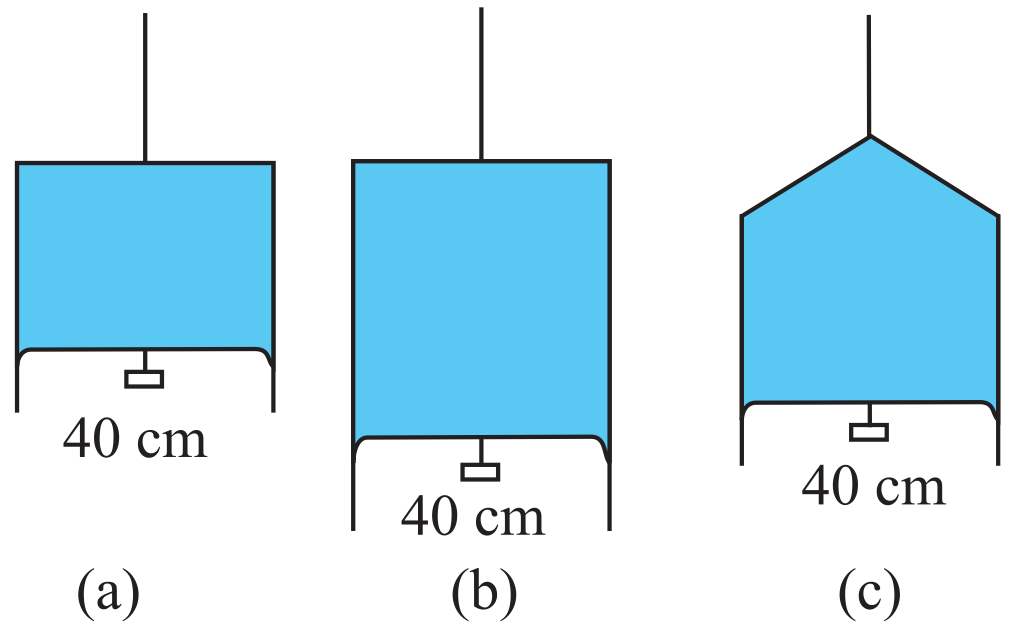
AnswerTake case (a): The length of the liquid film supported by the weight, l = 40cm = 0.4cm The weight supported by the film, $W = 4.5 \times 10^{–2}N$ A liquid film has two free surfaces. Surface tension $=\frac{\text{W}}{2\text{l}}=4.5\times\frac{10^{-2}}{2\times0.4}=5.625\times10^{-2}\text{Nm}^{-1}$ In all the three figures, the liquid is the same. Temperature is also the same for each case. Hence, the surface tension in figure (b) and figure (c) is the same as in figure (a), i.e., $5.625 \times 10^{–2}N m^{–1}$. Since the length of the film in all the cases is 40cm, the weight supported in each case is $4.5 \times 10^{–2}N$.
View full question & answer→Question 75 Marks
Toricelli’s barometer used mercury. Pascal duplicated it using French wine of density $984kg m^{–3}$. Determine the height of the wine column for normal atmospheric pressure.
AnswerDensity of mercury, $\rho_1= 13.6\times10\text{kg/m}$
Height of the mercury column, h = 0.76m.
Density of French wine, $\rho_2=984\text{kg/ m}^3$
Height of the French wine column = $h_2$
Acceleration due to gravity, $g = 9.8m/s^2$
The pressure in both the columns is equal, i.e.,
Pressure in the mercury column.
= Pressure in the French wine column.
$\rho_1\text{h}_1\text{g}=\rho_2\text{h}_2\text{g}$
$\text{h}_2=\frac{\rho_1\text{h}_1}{\rho_2}$
$=\frac{13.6\times10^3\times0.76}{986}$
$10.5\text{m}$
Hence, the height of the French wine column for normal atmospheric pressure is 10.5m.
View full question & answer→Question 85 Marks
A $50kg$ girl wearing high heel shoes balances on a single heel. The heel is circular with a diameter $1.0cm$. What is the pressure exerted by the heel on the horizontal floor?
AnswerGiven, Weight of the girl = 50kg = 490N Circular diameter of the heel = $1.0cm = 10^{-2}m$ Area of the heel is given by, $\text{A}=\frac{1}{4}\pi\text{D}^2=\frac{1}{4}\pi\times10^{-4}\text{m} ^2$
Therefore, the pressure exerted by the heel on the ground is given by, $\text{P}=\frac{\text{W}}{\text{A}}=\frac{490}{\frac{1}{4}\pi\times10^{-4}}=6.2\times10^6\text{N}/\text{m}^2$
View full question & answer→Question 95 Marks
The cylindrical tube of a spray pump has a cross-section of $8.0cm^2$ one end of which has $40$ fine holes each of diameter $1.0mm$. If the liquid flow inside the tube is $1.5m\ min^{–1}$, what is the speed of ejection of the liquid through the holes?
AnswerArea of cross-section of the spray pump, $A_1 = 8cm^2 = 8 \times 10^{-4}m^2$ Number of holes, n = 40 Diameter of each hole, $d = 1mm = 1 \times 10^{–3}m$ Radius of each hole, $\text{r}=\frac{\text{d}}{2}=0.5\times^{-3}\text{m}$ Area of cross-section of each hole, $\text{a}=\pi\text{r}^2=\pi(0.5\times10^{-3})^2\text{m}^2$ Total area of 40 holes, $A_2= n \times a$
$=40\times\pi(0.5\times10^{-3})^2\text{m}^2$
$=31.41\times10^{-6}\text{m}^2$ Speed of flow of liquid inside the tube, $V_1= 1.5m/ min = 0.025m/ s$ Speed of ejection of liquid through the holes = V_2 According to the law of continuity, we have: $A_1V_1 = A_2V_2$_ $\text{V}_2=\frac{\text{A}_1\text{V}_1}{\text{A}_2}$
$=8\times10^{-4}\times\frac{0.025}{(31.61\times10^{-6})}$
$=0.633\text{m}/ \text{s}$
View full question & answer→Question 105 Marks
In deriving Bernoulli’s equation, we equated the work done on the fluid in the tube to its change in the potential and kinetic energy.
- What is the largest average velocity of blood flow in an artery of diameter 2 × 10⁻³m if the flow must remain laminar?
- Do the dissipative forces become more important as the fluid velocity increases? Discuss qualitatively.
Answer
- Diameter of the artery, $d = 2 \times 10^{-3}m$
Viscosity of blood, $n = 2.084 x 10^{-3} kg/ m^3$
Density of blood, $p = 1.06 \times 10^3 kg/ m^3$
Reynolds' number for laminar flow, $N_R = 2000$
The largest average velocity of blood is given as:
$V_{arg} = N_Rn/ pd$
$=\frac{2000\times2.084\times10^{-3}}{1.06\times10^3\times2\times10^{-3}}$
= 1.966 m/ s
Therefore, the largest average velocity of blood is 1.966 m/ s.
- As the fluid velocity increases, the dissipative forces become more important. This is because of the rise of turbulence. Turbulent flow causes dissipative loss in a fluid.
View full question & answer→Question 115 Marks
A plane is in level flight at constant speed and each of its two wings has an area of $25m^2$. If the speed of the air is $180km/ h$ over the lower wing and $234km/ h$ over the upper wing surface, determine the plane’s mass. (Take air density to be 1kg $m^{–3}$).
AnswerThe area of the wings of the plane, $A = 2 \times 25 = 50m^2$ Speed of air over the lower wing, $V_1 = 180 km/ h = 50m/ s$ Speed of air over the upper wing, $V_2 = 234km/ h = 65m/ s$ Density of air, $\rho=1\text{kg m}^{-3}$ Pressure of air over the lower wing = $P_1$ Pressure of air over the upper wing= $P_2$ The upward force on the plane can be obtained using Bernoulli’s equation as: $\text{p}_1+\Big(\frac{1}{2}\Big)\rho\text{v}_1^2=\text{p}_2+\Big(\frac{1}{2}\Big)\rho\text{v}_2^2$
$\text{p}_1-\text{p}_2=\Big(\frac{1}{2}\Big)\ \rho\ (\text{V}_2^2-\text{V}_1^2)\ ...(1)$ The upward force (F) on the plane can be calculated as: $(\text{p}_1-\text{p}_2)\text{A}=\Big(\frac{1}{2}\Big)\ \rho\ (\text{V}_2^2-\text{V}_1^2)\text{A}$
$=\Big(\frac{1}{2}\Big)\times1\times(65^2-50^2)\times50$
$=43125\text{N}$ Using Newton’s force equation, we can obtain the mass (m) of the plane as: F = $\therefore\text{m}=\frac{43125}{9.8}=4400.51\text{kg}$
$\sim4400\text{kg}$ Hence, the mass of the plane is about 4400kg.
View full question & answer→Question 125 Marks
Two narrow bores of diameters 3.0 mm and 6.0 mm are joined together to form a U-tube open at both ends. If the Utube contains water, what is the difference in its levels in the two limbs of the tube ? Surface tension of water at the temperature of the experiment is $7.3 \times 10^{-2} \mathrm{~N} \mathrm{~m}^{-1}$. Take the angle of contact to be zero and density of water to be $1.0 \times 103 \mathrm{~kg} / \mathrm{m}^{-3}\left(\mathrm{~g}=9.8 \mathrm{~m} / \mathrm{s}^{-2}\right)$.
AnswerDiameter of the first bore, $d_1 = 3.0mm = 3 \times 10^{–3}m$ Hence, the radius of the first bore, $\text{r}_1=\frac{\text{d}_1}{2}=1.5\times10^{-3}\text{m}$ Diameter of the first bore, $d_2 = 6.0mm = 6 \times 10^{–3}mm$ Hence, the radius of the first bore, $\text{r}_2=\frac{\text{d}_2}{2}=3\times^{-3}\text{m}$ Surface tension of water, $s = 7.3 \times 10^{–2}N m^{–1}$ Angle of contact between the bore surface and water, $\upsilon=0$ Density of water, $\rho=1.0\times10^3\text{kg/ m}^{-3}$ Acceleration due to gravity, $g = 9.8m/ s^2$ Let $h_1$ and $h_2$ be the heights to which water rises in the first and second tubes respectively. These heights are given by the relations: $\text{h}_1=2\text{s}\cos\theta/\text{r}_1\rho\text{g}\ ...(1)$
$\text{h}_2=2\text{s}\cos\theta/ \text{r}_2\rho\text{g}\ ...(2)$ The difference between the levels of water in the two limbs of the tube can be calculated as: $=\frac{2\text{s}\cos\theta}{\text{r}_1\rho\text{g}}-\frac{2\text{s}\cos\theta}{\text{r}_2\rho\text{g}}$
$=\frac{2\cos\theta}{\rho\text{g}}\Big[\frac{1}{\text{r}_1}-\frac{1}{\text{r}_2}\Big]$ = $4.966 \times 10^{-3}m = 4.97mm$ Hence, the difference between levels of water in the two bores is 4.97mm.
View full question & answer→Question 135 Marks
In the previous problem, if $15.0cm$ of water and spirit each are further poured into the respective arms of the tube, what is the difference in the levels of mercury in the two arms? (Specific gravity of mercury = $13.6$)
AnswerHeight of the water column, $h_1 = 10 + 15 = 25cm$ Height of the spirit column, $h_2 = 12.5 + 15 = 27.5cm$ Density of water,$\rho_1= 1\text{g cm}^{-3} $ Density of spirit, $\rho_2= 0.8\text{g cm}^{–3 }$ Density of mercury = $13.6g\ cm^{–3}$ Let h be the difference between the levels of mercury in the two arms. Pressure exerted by height h, of the mercury column: $=\text{h}\rho\text{g}=\text{h}\times13.6\text{g}\ ...(1)$ Difference between the pressures exerted by water and spirit: $=\text{h}_1\rho_1\text{g}-\text{h}_1\rho_1\text{g}$ = $g(25 \times 1 – 27.5 \times 0.8) = 3g$ …… (ii) Equating equations (i) and (ii), we get: $13.6hg = 3g h = 0.220588 = 0.221cm$ Hence, the difference between the levels of mercury in the two arms is 0.221cm.
View full question & answer→Question 145 Marks
Mercury has an angle of contact equal to $140°$ with soda lime glass. A narrow tube of radius $1.00mm$ made of this glass is dipped in a trough containing mercury. By what amount does the mercury dip down in the tube relative to the liquid surface outside? Surface tension of mercury at the temperature of the experiment is $0.465N m^{-1}$. Density of mercury = $13.6 \times 10^3kg m^{-3}$.
AnswerTerminal speed = 5.8 cm/ s Viscous force = $3.9 \times 10^{–10}N$ Radius of the given uncharged drop, $r = 2.0 \times 10^{–5}m$ Density of the uncharged drop, $\rho=1.2\times10^3\text{kg m}^{-3}$ Viscosity of air, $\eta=1.8\times10^{-5}\text{pa}$ Density of air $(\rho_0)$ can be taken as zero in order to neglect buoyancy of air.
Acceleration due to gravity, $g = 9.8 m/ s^2$ Terminal velocity (v) is given by the relation: $\text{v}=2\text{r}^2\times(\rho-\rho_0)\text{g}/\ 9\eta$
$=\frac{2\times(2\times10^{-5})^2(1.2\times10^3-0)\times9.8}{(9\times1.8\times10^{-5})}$ = $5.8 \times 10^{-2} m/ s = 5.8cm s^{-1}$ Hence, the terminal speed of the drop is $5.8cm/ s^{–1}$. The viscous force on the drop is given by: $\text{F}=6\pi\eta\text{rv}$
$\therefore F = 6 \times 3.14 \times 1.8 \times 10^{-5} \times 2 \times 10^{-5} \times 5.8 \times 10^{-2} = 3.9 \times 10^{-10} N$ Hence, the viscous force on the drop is $3.9 \times 10^{–10}N$.
View full question & answer→Question 155 Marks
In Millikan’s oil drop experiment, what is the terminal speed of an uncharged drop of radius $2.0 \times 10^{–5}m$ and density $1.2 \times 10^3 kg m^{–3}$. Take the viscosity of air at the temperature of the experiment to be $1.8 \times 10^{–5} Pa\ s$. How much is the viscous force on the drop at that speed ? Neglect buoyancy of the drop due to air.
AnswerTerminal speed = 5.8cm/ s; Viscous force = $3.9 \times 10^{-10} N$ Radius of the given uncharged drop, $r = 2.0 \times 10^{-5}m$ Density of the uncharged drop, $\rho=1.2\times10^3\text{kg m}^{-3}$ Viscosity of air, = $1.8 \times 10^{-5}Pa/ s$ Density of air $(P_o)$ can be taken as zero in order to neglect buoyancy of air. Acceleration due to gravity, $g = 9.8m/ s^2$ Terminal velocity (v) is given by the relation: $\text{v}=\frac{2\text{r}^2\times(\rho-\rho_0)\text{g}}{9\eta}$ $=\frac{2\times(2.0\times10^{-5})^2(.2\times10^3-0)\times9.8}{9\times1.8\times10^{-5}}$ $=5.807\times10^{-2}\text{m/ s}^{-1}$ $=5.8\text{cm/ s}^{-1}$Hence, the terminal speed of the drop is $5.8cm s^{–1}$
The viscous force on the drop is given by:
$\text{F}=6\pi\eta\text{rv}$
$\therefore\text{F}=6\times3.14\times1.8\times10^{-5}\times2.0\times10^{-5}\times5.8\times10^{-2}$
$=3.9\times10^{-10}\text{N}$
Hence, the various force on the drop is $3.9\times10^{-10}\text{N}$
View full question & answer→Question 165 Marks
- What is the largest average velocity of blood flow in an artery of radius $2 \times 10 – 3m$ if the flow must remain lanimar?
- What is the corresponding flow rate ? (Take viscosity of blood to be $2.084 \times 10–3 Pa/ s$).
AnswerRadius of the artery, $\mathrm{r}=2 \times 10^{-3} \mathrm{~m}$ Diameter of the artery, $\mathrm{d}=2 \times 2 \times 10^{-3} \mathrm{~m}=4 \times 10^{-3} \mathrm{~m}$ Viscosity of blood, $\mathrm{n}=$ $2.084 \times 10^{-3} \mathrm{~Pa} / \mathrm{s}$ Density of blood, $\rho=1.06 \times 10^3 \mathrm{~kg} / \mathrm{m}^3$ Reynolds' number for laminar flow, $\mathrm{N}_{\mathrm{R}}=2000$ The largest average velocity of blood is given by the relation: $\mathrm{V}_{\mathrm{arg}}=\mathrm{N}_{\mathrm{R}} \eta / \rho \mathrm{d}$
$=\frac{2000 \times 2.084 \times 10^{-3}}{\left(1.06 \times 10^3 \times 4 \times 10^{-3}\right)}$
$=0.983 \mathrm{~m} / \mathrm{s}$ Therefore, the largest average velocity of blood is $0.983 \mathrm{~m} / \mathrm{s}$. (b) Flow rate is given by the relation:
$\mathrm{R}=\pi \mathrm{r}^2 \mathrm{~V}_{\mathrm{avg}}$
$=3.14 \times\left(2 \times 10^{-3}\right)^2 \times 0.983=1.235 \times 10^{-5} \mathrm{~m}^3 \mathrm{~s}^{-1}$ Therefore, the corresponding flow rate is $1.235 \times 10^{-5} \mathrm{~m}^3 \mathrm{~s}^{-1}$.
View full question & answer→Question 175 Marks
Considering the pressure p to be proportional to the density, find the pressure p at a height h if the pressure on the surface of the earth is $p_0$.
AnswerLet $p_0$ is the density of air on surface of earth.$\because$ pressure p at a point is sirectly proportional to density.
$\therefore\ \text{p }\alpha\ \rho\text{ or }\frac{\text{p}}{\text{p}_0}=\frac{\rho}{\rho_0}\text{ or }\rho=\Big(\frac{\text{p}}{\text{p}_0}\Big)\rho_{0}\ ...(\text{ii})$
$\text{dp}=\rho\text{gdh}$ form (i)
$(\rho$ is density of air in atmosphere$)$
$\text{dp}=-\Big(\frac{\text{p}}{\text{p}_0}\Big)\rho_0\text{gdh}$
$\Rightarrow\frac{\text{dp}}{\text{p}}=\frac{-\rho\text{og}}{\text{p}_{\text{i0}}}\text{dh}$
Integrating both sides $\int\limits^{\text{p}}_{\text{p}_0}\log\text{p dp}=-\int\limits^{\text{h}}_0\frac{\rho_0\text{g}}{\text{p}_0}$$\log\Big(\frac{\text{p}}{\text{p}_0}\Big)=\frac{-\rho_0}{\text{p}_0}\text{gh}\ ...(\text{iii})$
$\Rightarrow\frac{\text{p}}{\text{p}_0}=\text{e}^{-\frac{\rho_0\text{gh}}{\text{p}_0}}$
$\Rightarrow\text{p}=\text{p}_0{\text{e}}^{\frac{-\text{p}_0\text{gh}}{\text{p}_0}}$
View full question & answer→Question 185 Marks
Explain why A spinning cricket ball in air does not follow a parabolic trajectory.
AnswerA spinning cricket ball has two simultaneous motions – rotatory and linear. These two types of motion oppose the effect of each other. This decreases the velocity of air flowing below the ball. Hence, the pressure on the upper side of the ball becomes lesser than that on the lower side. An upward force acts upon the ball. Therefore, the ball takes a curved path. It does not follow a parabolic path.
View full question & answer→Question 195 Marks
Figure (a) shows a thin liquid film supporting a small weight = $4.5 \times 10^{–2}N$. What is the weight supported by a film of the same liquid at the same temperature in Fig. (b) and (c)? Explain your answer physically.
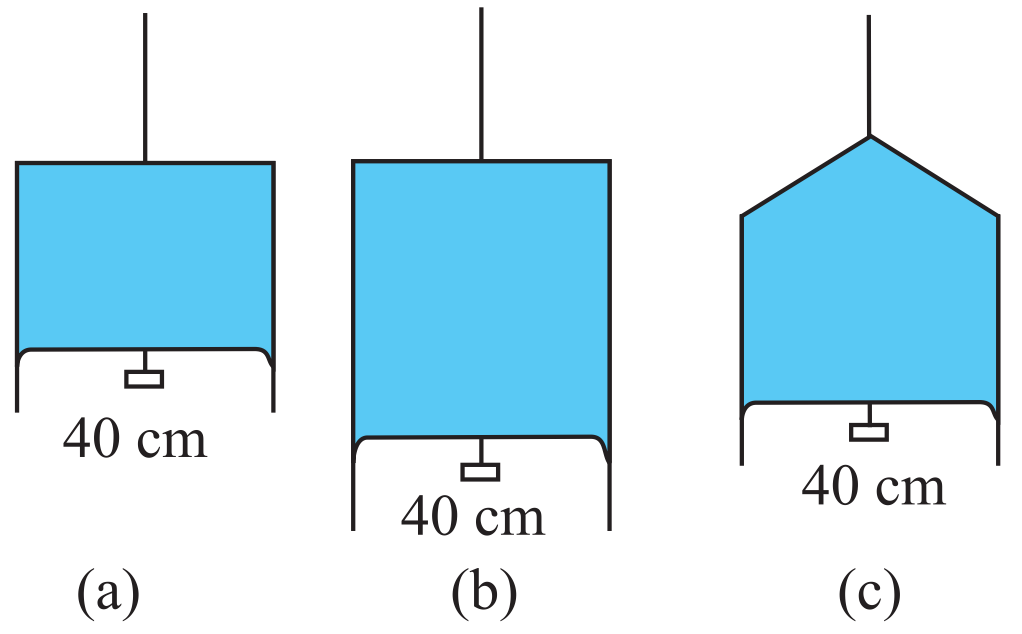
AnswerTake case (a): The length of the liquid film supported by the weight, l = 40cm = 0.4cm The weight supported by the film, $W = 4.5 \times 10^{–2}N$ A liquid film has two free surfaces. Surface tension $=\frac{\text{W}}{2\text{l}}=4.5\times\frac{10^{-2}}{2\times0.4}=5.625\times10^{-2}\text{Nm}^{-1}$ In all the three figures, the liquid is the same. Temperature is also the same for each case. Hence, the surface tension in figure (b) and figure (c) is the same as in figure (a), i.e., $5.625 \times 10^{–2}N m^{–1}$. Since the length of the film in all the cases is 40cm, the weight supported in each case is $4.5 \times 10^{–2}N$.
View full question & answer→Question 205 Marks
Toricelli’s barometer used mercury. Pascal duplicated it using French wine of density $984kg m^{–3}$. Determine the height of the wine column for normal atmospheric pressure.
AnswerDensity of mercury, $\rho_1= 13.6\times10\text{kg/m}$
Height of the mercury column, h = 0.76m.
Density of French wine, $\rho_2=984\text{kg/ m}^3$
Height of the French wine column = $h_2$
Acceleration due to gravity, $g = 9.8m/s^2$
The pressure in both the columns is equal, i.e.,
Pressure in the mercury column.
= Pressure in the French wine column.
$\rho_1\text{h}_1\text{g}=\rho_2\text{h}_2\text{g}$
$\text{h}_2=\frac{\rho_1\text{h}_1}{\rho_2}$
$=\frac{13.6\times10^3\times0.76}{986}$
$10.5\text{m}$
Hence, the height of the French wine column for normal atmospheric pressure is 10.5m.
View full question & answer→Question 215 Marks
A $50kg$ girl wearing high heel shoes balances on a single heel. The heel is circular with a diameter $1.0cm$. What is the pressure exerted by the heel on the horizontal floor?
AnswerGiven, Weight of the girl = 50kg = 490N Circular diameter of the heel = $1.0cm = 10^{-2}m$ Area of the heel is given by,$\text{A}=\frac{1}{4}\pi\text{D}^2=\frac{1}{4}\pi\times10^{-4}\text{m} ^2$
Therefore, the pressure exerted by the heel on the ground is given by,$\text{P}=\frac{\text{W}}{\text{A}}=\frac{490}{\frac{1}{4}\pi\times10^{-4}}=6.2\times10^6\text{N}/\text{m}^2$
View full question & answer→Question 225 Marks
The cylindrical tube of a spray pump has a cross-section of $8.0cm^2$ one end of which has $40$ fine holes each of diameter $1.0mm$. If the liquid flow inside the tube is $1.5m\ min^{–1}$, what is the speed of ejection of the liquid through the holes?
AnswerArea of cross-section of the spray pump, $A_1=8 \mathrm{~cm}^2=8 \times 10^{-4} \mathrm{~m}^2$ Number of holes, $\mathrm{n}=40$ Diameter of each hole, d $=1 \mathrm{~mm}=1 \times 10^{-3} \mathrm{~m}$ Radius of each hole, $\mathrm{r}=\frac{\mathrm{d}}{2}=0.5 \times^{-3} \mathrm{~m}$ Area of cross-section of each hole,
$\mathrm{a}=\pi \mathrm{r}^2=\pi\left(0.5 \times 10^{-3}\right)^2 \mathrm{~m}^2$ Total area of 40 holes, $\mathrm{A}_2=\mathrm{n} \times \mathrm{a}=40 \times \pi\left(0.5 \times 10^{-3}\right)^2 \mathrm{~m}^2$
$=31.41 \times 10^{-6} \mathrm{~m}^2$
Speed of flow of liquid inside the tube, $\mathrm{V}_1=1.5 \mathrm{~m} / \mathrm{min}=0.025 \mathrm{~m} / \mathrm{s}$ Speed of ejection of liquid through the holes $=$ $\mathrm{V}_2$ According to the law of continuity, we have: $\mathrm{A}_1 \mathrm{~V}_1=\mathrm{A}_2 \mathrm{~V}_2 \mathrm{~V}_2=\frac{\mathrm{A}_1 \mathrm{v}_1}{\mathrm{~A}_2}$
$=8 \times 10^{-4} \times \frac{0.025}{\left(31.61 \times 10^{-6}\right)}$
$=0.633 \mathrm{~m} / \mathrm{s}$
View full question & answer→Question 235 Marks
In deriving Bernoulli’s equation, we equated the work done on the fluid in the tube to its change in the potential and kinetic energy.
- What is the largest average velocity of blood flow in an artery of diameter $2 × 10⁻³m$ if the flow must remain laminar?
- Do the dissipative forces become more important as the fluid velocity increases? Discuss qualitatively.
Answer
- Diameter of the artery, $d = 2 \times 10^{-3}m$
Viscosity of blood, $n = 2.084 x 10^{-3} kg/ m^3$
Density of blood, $p = 1.06 \times 10^3 kg/ m^3$
Reynolds' number for laminar flow, $N_R = 2000$
The largest average velocity of blood is given as:
$V_{arg} = N_Rn/ pd$
$=\frac{2000\times2.084\times10^{-3}}{1.06\times10^3\times2\times10^{-3}}$
= 1.966 m/ s
Therefore, the largest average velocity of blood is $1.966 m/ s$.
- As the fluid velocity increases, the dissipative forces become more important. This is because of the rise of turbulence. Turbulent flow causes dissipative loss in a fluid.
View full question & answer→Question 245 Marks
Derive expression for rate of flow of fluid as measured by venturimeter.
AnswerLet $\rho=$ Density of liquid flowing through the pipe$\rho_\text{m}=$ Density of liquid in U tube,
$a_1, a_2$ = Area of cross-section of tubes A and B respectively $P_1, P_2$ = Pressure at A and B respectively. 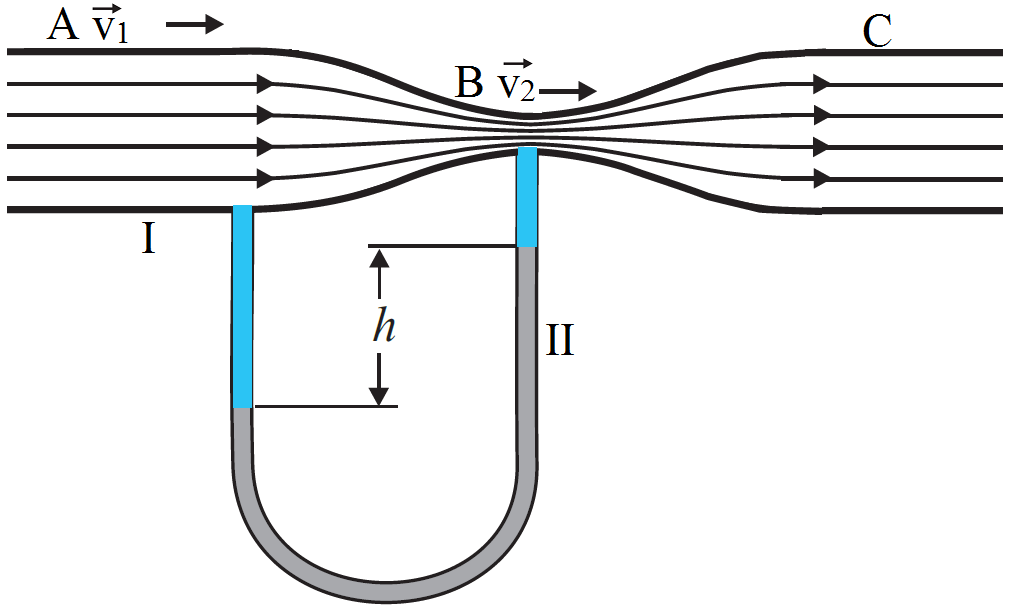
Let V be the volume of liquid flowing per second (i.e. rate of flow of liquid) through the pipe. According to the equation of continuity. $V = a_1v_1 = a_2v_2$
$\therefore\frac{\text{a}_1}{\text{a}_2}=\frac{\text{v}_2}{\text{v}_1}$ and $\text{v}_1=\frac{\text{V}}{\text{a}_1};\text{v}=\frac{\text{V}}{\text{a}_2}$
Using Bernoulli's equation for horizontal flow liquid,$\text{P}_1+\frac{1}{2}\rho\text{v}^2_1=\text{P}_2+\frac12\rho\text{v}^2_2$
$\text{P}_1-\text{P}_2=\frac{1}{2}\rho(\text{v}^2_2-\text{v}^2_1)$
$\Rightarrow\text{P}_1-\text{P}_2=\frac12\rho\text{v}^2_1\Big[\frac{\text{v}^2_2}{\text{v}^2_1}-1\Big]$
$=\frac{1}{2}\rho\text{v}^2_1\Big(\frac{\text{a}^2_1}{\text{a}^2_2}-1\Big)\dots(\text{i})$
This pressure difference cause the liquid in the arm II of U tube connected at the narrow tube B to rise in comparison to the other arm I. The difference in height 'h' of two arms of U tube measures the pressure difference.$\therefore\text{P}_1-\text{P}_2=\text{h}\rho\text{mg}\dots{\text{(ii)}}$
From (i) and (ii), we have,$\text{h}\rho\text{mg}=\frac12\rho\nu^2_1\Big(\frac{\text{a}^2_1}{\text{a}^2_2}-1\Big)$
Or $\text{v}_1=\sqrt{\frac{2\text{h}\rho\text{mg}}{\rho}}\Big(\frac{\text{a}^2_1}{\text{a}^2_2}-1\Big)^{-\frac12}$ It is the expression for speed of the liquid in the wider tube. View full question & answer→Question 255 Marks
- What is the phenomenon of capillarity? Derive an expression for the rise of liquid in a capillary tube.
- What will happen if the length of the capillary tube is smaller than the height to which the liquid rises? Explain briefly.
Answer
- Phenomenon of Capillarity: Any liquid rises in a capillary tube to compensate for the excess pressure. The height gained in a tube of radius r by a liquid of density p and angle of contact $\theta$ is,
$\text{h}=\frac{2\sigma\cos\theta}{\text{r}\rho\text{g}}$
For mercury, $\theta$ being obtuse there is a drop in the level. In a capillary tube of insufficient length, the liquid rises to the level available and then forms a meniscus of higher radius.
A liquid rises in a capillary tube to compensate for the excess pressure in level with the liquid in the container (A). Let R be the radius of the meniscus at A. Then excess pressure will be $\frac{2\sigma}{\text{R}}$ where $\sigma$ is the surface tension. If the pressure is compensated by h column of liquid rise, then,
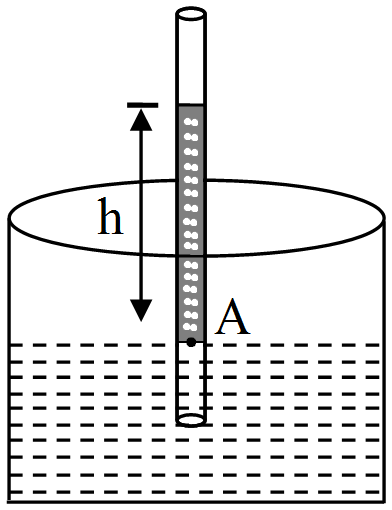
$\text{h}\rho\text{g}=\frac{2\sigma}{\text{R}}$
$\therefore\text{h}=\frac{2\sigma}{\text{R}\rho\text{g}}$
From figure (ii), $\frac{\text{r}}{\text{R}}=\cos\theta$
$\Rightarrow\text{R}=\frac{\text{r}}{\cos\theta}$
$\therefore\text{h}=\frac{2\sigma\cos\theta}{\text{r}\rho\text{g}}$
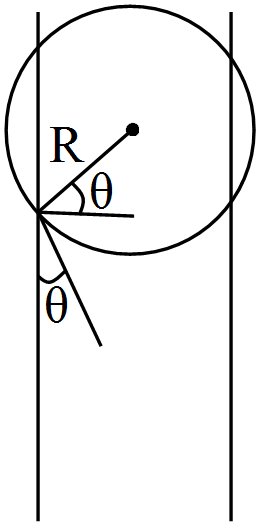
- The liquid will rise to the level available and form a meniscus of larger radius due to lesser uncompensated excess pressure.
View full question & answer→Question 265 Marks
A $16cm^3$ volume of water flows per second through a capillary tube of radius r сm and of length 1cm when connected to a pressure head of h cm of water. If a tube of the same length and radius $\frac{\text{r}}{2}$ is connected to the same pressure head, find the mass of water flowing per minute through the tube.
AnswerHere, $V_1 = 16cm^3/ \sec$;$\text{P}_1=\text{h}\rho\text{g};\text{r}_1=\text{r};\text{l}_1=\text{l} $
$\text{V}_2=?;\text{l}_2=\text{l};\text{r}_2=\frac{\text{r}}{2};\text{P}_2=\text{h}\rho\text{g};$
So, $\text{P}_1=\text{P}_2$ Now, $\text{V}_1=\frac{\pi\text{P}_1\text{r}^4_1}{8\eta\text{l}_1}$ and $\text{V}_2=\frac{\pi\text{P}_2\text{r}^4_2}{8\eta\text{l}_2}$$\therefore\frac{\text{V}_2}{\text{V}_1}=\frac{\text{P}_2}{\text{P}_2}\times\frac{\text{r}^4_2}{\text{r}^4_1}\times\frac{\text{l}_1}{\text{l}_2}$
$=\Big(\frac12\Big)=\frac{1}{16}$
$\text{V}_2=\frac{16}{16}=1\text{cm}^3/\text{s}$
Volume of water flowing per minute,$=1\times60$
$=60\text{cm}^3/\text{min}$
$\therefore$ Mass of water flowing per minute,
= 60gm
View full question & answer→Question 275 Marks
Air is streaming past a horizontal air plane wing such that its speed is $120ms^{-1}$ over the upper surface and $90ms^{-1}$ at the lower surface. If the density of air is $1.3kg m^{-3}$, find the difference in pressure between the top and bottom of the wing. If wing is $10m$ long and has an average width of $2m$, calculate the gross lift of the wing.
AnswerGiven, $v_2 = 120m/ s, v_1 = 90m/ s$, $\rho_\text{a}=1.3\text{kg/m}^{3,}$$\text{h}_1=10\text{m},\text{a}_1=10\times2=20\text{m}^2$
According to Bernoulli's theorem,$\frac{\text{P}_1}{\rho}+\text{gh}_1+\frac12\text{v}^2_1=\frac{\text{P}_2}{\rho}+\text{gh}_2+\frac12\text{v}^2_2$
For the horizontal flow, $\text{h}_1=\text{h}_2$$\therefore\frac{\text{P}_1}{\rho}+\frac12\text{v}^2_1=\frac{\text{P}_2}{\rho}+\frac12\text{v}^2_2$
Given, $\text{v}_1=90\text{m/s},\text{ v}_2=120\text{m/s},$ $\rho=1.3\text{kg/m}^3$
$\therefore\frac{\text{P}_1-\text{P}_2}{\rho}=\frac12(\text{v}^2_2-\text{v}^2_1)$
$(\text{P}_1-\text{P}_2)=\frac{\rho(\text{v}^2_2-\text{v}^2_1)}{2}$
$=1.3\times\frac{(14400-8100)}{2}=\frac{1.3\times6300}{2}$
$\text{P}_1-\text{P}_2=4.095\times10^3\text{N/m}^2$
It is the pressure difference between the top and the bottom of the wing. Gross lift of wing = $(P_1 - P_1)$ × Area of the wing = $4.095 \times 10^3 \times 10 \times 2 = 8.190 \times 10^4N$
View full question & answer→Question 285 Marks
A plane is in level flight at constant speed and each of its two wings has an area of $25m^2$. If the speed of the air is $180km/ h$ over the lower wing and $234km/ h$ over the upper wing surface, determine the plane’s mass. (Take air density to be $1kg m^{–3}$).
AnswerThe area of the wings of the plane, $A = 2 \times 25 = 50m^2$ Speed of air over the lower wing, $V_1 = 180 km/ h = 50m/ s$ Speed of air over the upper wing, $V_2 = 234km/ h = 65m/ s$ Density of air, $\rho=1\text{kg m}^{-3}$ Pressure of air over the lower wing = $P_1$ Pressure of air over the upper wing= $P_2$ The upward force on the plane can be obtained using Bernoulli’s equation as:$\text{p}_1+\Big(\frac{1}{2}\Big)\rho\text{v}_1^2=\text{p}_2+\Big(\frac{1}{2}\Big)\rho\text{v}_2^2$
$\text{p}_1-\text{p}_2=\Big(\frac{1}{2}\Big)\ \rho\ (\text{V}_2^2-\text{V}_1^2)\ ...(1)$
The upward force (F) on the plane can be calculated as:$(\text{p}_1-\text{p}_2)\text{A}=\Big(\frac{1}{2}\Big)\ \rho\ (\text{V}_2^2-\text{V}_1^2)\text{A}$
$=\Big(\frac{1}{2}\Big)\times1\times(65^2-50^2)\times50$
$=43125\text{N}$
Using Newton’s force equation, we can obtain the mass (m) of the plane as: F = $\therefore\text{m}=\frac{43125}{9.8}=4400.51\text{kg}$
$\sim4400\text{kg}$
Hence, the mass of the plane is about 4400kg.
View full question & answer→Question 295 Marks
Define surface tension and surface energy. Write units and dimensions of surface tension. Also prove that surface energy numerically equal to the surface tension.
AnswerSurface Tension : Force on unit length of an imaginary line drawn on the surface of the liquid is called surface tension. Its S.I. unit is $Nm^{-1}$ and its dimension is [$ML^0T^2$). Surface Energy: Energy possessed by the surface of the liquid is called surface energy. Change in surface energy is the product of surface tension and change in surface area under constant temperature. Let S = Surface tension of soap solution d = Length of the wire PQ l = length of wire PQ
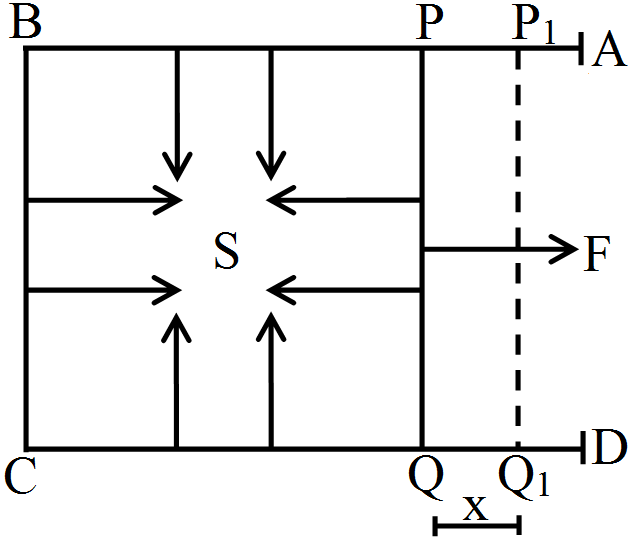
Surface tension acts on both the free surfaces of film. Hence, total inward force on wire PQ F = S × 2I Increase in area of the film $PQ\ Q_1P_1=\Delta\text{A}=2=(\text{l}\times\text{x})$
Work done in stretching film is, W = Force applied × Distance moved$=(\text{S}\times2\text{l})\times\text{x}=\text{S}\times(\text{2l}\text{ x})$
$=\text{S}\times\Delta\text{A}(\because2\text{l x}=\Delta\text{A})$
This work done is stored in the film as this surface energy.$\text{E}=\text{W}=\text{S}\times\Delta\text{A}$
$\Rightarrow\text{S}=\frac{\text{W}}{\Delta\text{A}}$
If increase in area is unity then, $\Delta\text{A}=1$$\text{S}=\text{W}$
$\therefore$ Surface tension of a liquid is numerically equal to surface energy of the liquid surface. View full question & answer→Question 305 Marks
If a liquid is flowing through a horizontal tube, write down the formula for the volume of the liquid flowing per second through it. Water is flowing through a horizontal tube of radius $2r$ and length $1m$ at a rate of $60L/s$, when connected to a pressure difference of h cm of water. Another tube of same length but radius is connected in series with this tube and the combination is connected to the same pressure head. Find out the pressure difference across each tube and the rate of flow of water through the combination.
AnswerThe volume of the liquid flowing per second through a horizontal tube, $\text{V}=\frac{\pi}{8}.\frac{\text{pr}^4}{\eta\text{l}}$ Where, r = radius of the tube, l = lenghth of the tube, P = pressure difference acreoss the two ends of the tube and$\eta=$ coefficient of vilosity of the liquid
$\because\text{V}=\frac{\pi}{8}\cdot\frac{\text{pr}^4}{\eta\text{l}}$
In first case,$=\frac{\pi}{8}\cdot\frac{\text{h}\rho\text{g}(2\text{r})^4}{\eta\text{l}}[\because\text{p}=\text{h}\rho\text{g}]$
$\frac{\pi}{8}\cdot\frac{\text{h}\rho\text{g}(2r)^4}{\eta\text{l}}=60\dots\text{(i)}$
In IInd case, the volume of liquid flowing per second $V_1$ through each tube is equal$\text{V}_1=\frac{\pi\rho_1}{8}\frac{\rho_1(2\text{r})^4}{\eta\text{l}}=\frac{\pi\rho_2(\text{r})^4}{8\eta\text{l}}\dots{(\text{ii})}$
$\because\rho_1+\rho_2=\text{h}\rho\text{g}\dots\text{(iii)}[\text{given]}$
From equation (ii),$\rho_1=\frac{\rho_2}{16}$
Putting this value of $\rho_2$ into equation (ii)$\text{V}_1=\frac{\pi}{8}\cdot\frac{16\text{h}\rho\text{g}}{17}\cdot\frac{\text{r}^4}{\eta\text{l}}$
$=\frac{1}{17}\cdot\frac{\pi}{8}\cdot\frac{\text{h}\rho\text{g}}{\eta\text{l}}(2\text{r})^4$
$=\frac{1}{17}\times60$ [using equation (i)]
$=3.53\text{L/s}$
View full question & answer→Question 315 Marks
- Define viscosity. Write SI units of coefficient of viscosity.
- Define terminal velocity. Establish an expression for it.
Answer
- Viscosity: The opposing force that exists between the layers of a liquid and the inner walls of the tube in which it flows, is called viscous drag or viscous force and the property is called viscosity. The viscous force directly depends on the area of the layer and the velocity gradient.
$\text{F}=-\eta\text{A}\frac{\text{dv}}{\text{dx}}$
The negative(-) sign shows the opposing nature and n refers to the coefficient of viscosity. The SI unit of coefficient of viscosity is $Nsm^{-2}$.
- Terminal Velocity: The constant velocity with which a body drops down after initial acceleration in a dense liquid or fluid is called terminal velocity. This is attained when the apparent weight is compensated by the viscous force. It is given by,
$\text{v}=\frac29\frac{\text{r}^2\text{g}}{\eta}(\rho-\sigma),$ where $\rho$ and $\sigma$ are densities of the body and liquid respectively, n is the coefficient of viscosity of the liquid and r is the radius of the spherical body.
Expression for velocity of streamlined flow: The net force on the sphere becomes zero as the viscous force equals the apparent weight (weight in air-upthrust).
Consider a lengthy column of a dense liquid like glycerine. As the ball or spherical ball is dropped in it, the forces experienced are,
- Weight (W) $=\text{mg}=\frac43\pi\text{r}^3\rho\text{g}$
Where $\rho$ is the density of ball.
- Upthrust due to buoyancy, $F_T$ = Weight of the medium displaced
$=\frac{4}{3}\pi\text{r}^3\rho_\text{l}\text{g}$
Where p, is the density of liquid.
- Viscous force, $\text{F}_\text{v}=6\pi\eta\text{ rv} $
Where v is the terminal velocity.
When terminal velocity is attained, acceleration should be zero and the net force should be zero.
$\therefore\text{mg}-\text{F}_\text{T}-\text{F}_\text{v}=0$
$\Rightarrow\frac43\pi\text{r}^3\rho\text{g}-\frac43\pi\text{r}^3\rho_\text{l}\text{g}-6\pi\eta\text{ rv}=0$
$\therefore\text{v}=\frac{\frac43\pi\text{r}^3\text{g}(\rho-\rho_\text[l]}{6\pi\eta\text{ r}}$
$=\frac{2}{9}\frac{\text{r}^2\text{g}(\rho-\rho_\text{l})}{\eta}$ View full question & answer→Question 325 Marks
State Bernoulli's theorem. Using it how can you explain the functioning of a venturimeter to find velocity of flow of liquid through a tube?
AnswerBernoulli's Theorem. For an incompressible, non viscous, irrotational liquid having streamlined flow, the sum of the pressure energy, kinetic energy and potential energy per unit mass is a constant, i.e.,$\frac{\text{P}}{\rho}+\frac{\text{v}^2}{2}+\text{gh}=\text{constant}$
$\frac{\text{P}}{\rho\text{g}}+\frac{\text{v}^2}{2\text{g}}+\text{h}=\text{constant}$
A liquid is said to be irrotational if the angular momentum about any point in the liquid is zero. A wheel or disc in it will not rotate. 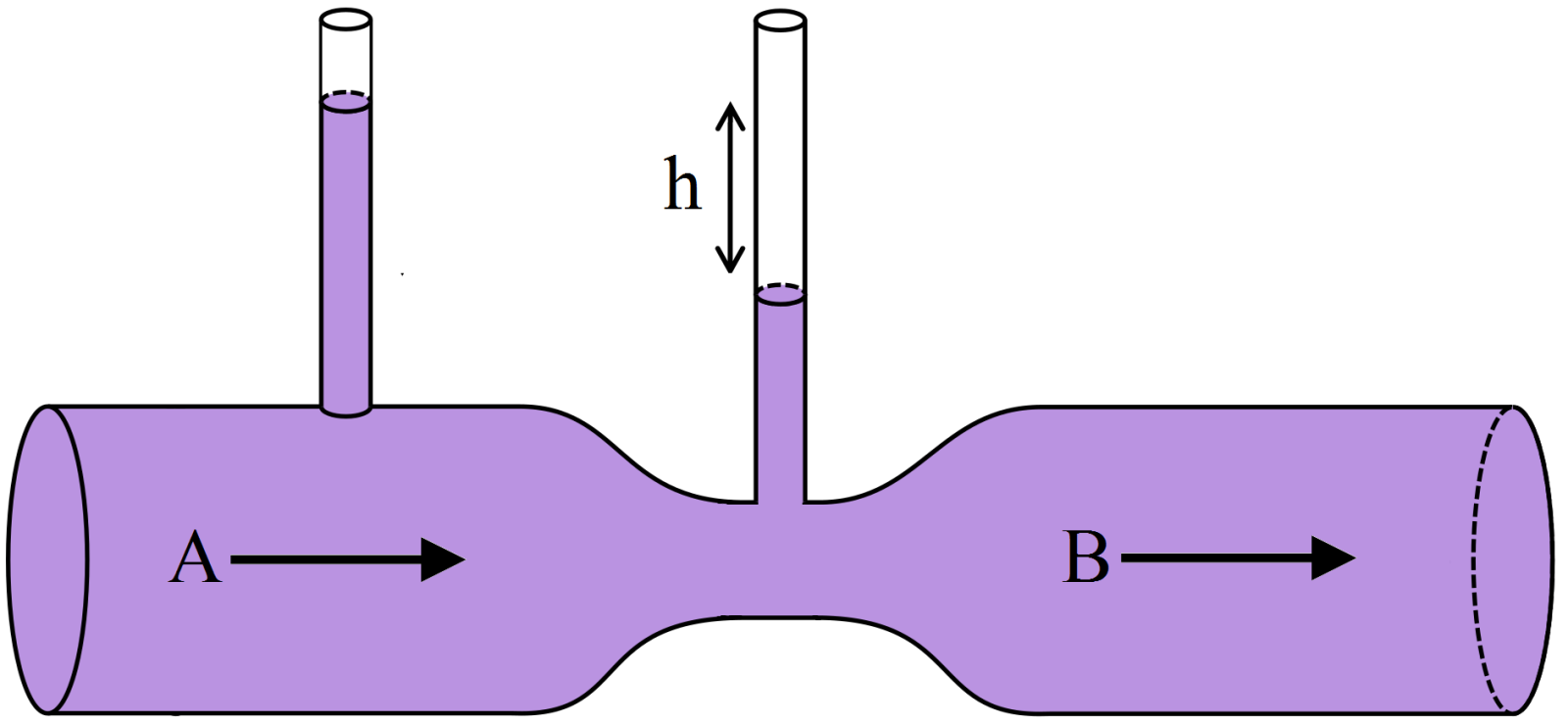 Given: $\text{a}_1=0.36\pi\text{cm}^2,\text{a}_2=0.04\pi\text{m}^2,\text{h}=1\text{m}.$ Since, c.s.a. at B is less velocity will be more and pressure will be less. The difference in pressure is $\text{P}_1-\text{P}_2=\text{h}\rho\text{g}.$ Applying Bernoulli's theorem,$\frac{\text{P}_1}{\rho\text{g}}+\frac{\text{v}^2_1}{\text{ 2}\text{g}}=\frac{\text{P}_2}{\rho\text{g}}+\frac{\text{v}^2_2}{\text{2g}}$
$\Rightarrow\frac{\text{P}_1-\text{P}_2}{\rho\text{g}}=\frac{\text{v}^2_2-\text{v}^2_1}{\text{2g}}$
$\therefore\text{v}^2_2-\text{v}^2_1=2\text{gh}$
$\because$ for streamlined flow, $\text{a}_1\text{v}_1=\text{a}_2\text{v}_2$
$\text{v}^2_2-\frac{\text{a}^2_2\text{v}^2_2}{\text{a}^2_1}=2\text{gh}$
$\Rightarrow\text{v}^2_2=2\text{gh}\begin{pmatrix}\frac{1}{1-\Bigg(\frac{\text{a}^2_2}{\text{a}^2_2}\Bigg)}\end{pmatrix}$
$\Rightarrow\text{v}_2=\sqrt{\frac{2\text{2gh}\text{a}^2_1}{\text{a}^2_1-\text{a}^2_2}}=5\text{m/s}$ View full question & answer→Question 335 Marks
Water stands at a depth H in a tank, whose side walls are vertical. A hole is made on one of the walls at a depth h below the water surface. Find at what distance from the foot of the wall does the emerging stream of water strike the floor and for what value of h this range is maximum.
Answer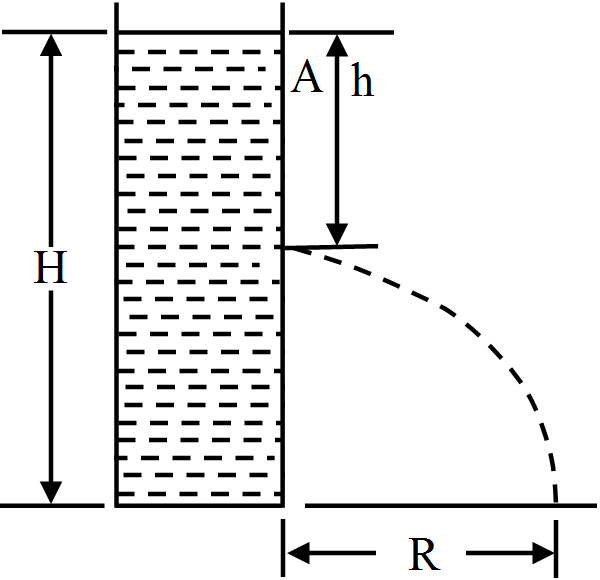
The situation is shown in fig. Here, we have,$\upsilon_\text{A}=\sqrt{2\text{gh}}\dots\text{(i)}$
$(\text{H}-\text{h})=\frac12\text{gt}^2\dots\text{(ii)} $
The distance R is given by$\text{R}=\upsilon_\text{A}\times\text{t}\dots\text{(iii)}$
From equation (ii) $\text{t}=\sqrt{\Big(\frac{2(\text{H}-\text{h})}{\text{g}}\Big)}\dots\text{(iv)}$ Substituting the value of $v_A$ from equation (1) and the value of t from equation (4) in equation (3), we get,$\text{R}=\sqrt{(2\text{gh})}\times\sqrt{\Big\{\frac{2(\text{H}-\text{h})}{\text{g}}\Big\}}$
$=\sqrt{\{\text{h}(\text{H}-\text{h}\}}.$
The range R will be maximum when$\frac{\text{dR}}{\text{dh}}=0$
$\therefore2\cdot\frac12\text{h}^{-\frac12}(\text{H}-\text{h})^{\frac12}\cdot\frac12(\text{H}-\text{h})^{-\frac12}=0$
Solving we get $\text{h}=\frac{\text{H}}2$ View full question & answer→Question 345 Marks
Two narrow bores of diameters $3.0mm$ and $6.0mm$ are joined together to form a U-tube open at both ends. If the U-tube contains water, what is the difference in its levels in the two limbs of the tube ? Surface tension of water at the temperature of the experiment is $7.3 \times 10^{–2}N m^{–1}$. Take the angle of contact to be zero and density of water to be $1.0 \times 103kg/ m^{–3} (g = 9.8m/ s^{–2})$.
AnswerDiameter of the first bore, $d_1 = 3.0mm = 3 \times 10^{–3}m$ Hence, the radius of the first bore, $\text{r}_1=\frac{\text{d}_1}{2}=1.5\times10^{-3}\text{m}$ Diameter of the first bore, $d_2 = 6.0mm = 6 \times 10^{–3}mm$ Hence, the radius of the first bore, $\text{r}_2=\frac{\text{d}_2}{2}=3\times^{-3}\text{m}$ Surface tension of water, $s = 7.3 \times 10^{–2}N m^{–1}$^ Angle of contact between the bore surface and water, $\upsilon=0$ Density of water, $\rho=1.0\times10^3\text{kg/ m}^{-3}$ Acceleration due to gravity, $g = 9.8m/ s^2$ Let $h_1$ and $h_2$_be the heights to which water rises in the first and second tubes respectively. These heights are given by the relations:$\text{h}_1=2\text{s}\cos\theta/\text{r}_1\rho\text{g}\ ...(1)$
$\text{h}_2=2\text{s}\cos\theta/ \text{r}_2\rho\text{g}\ ...(2)$
The difference between the levels of water in the two limbs of the tube can be calculated as:$=\frac{2\text{s}\cos\theta}{\text{r}_1\rho\text{g}}-\frac{2\text{s}\cos\theta}{\text{r}_2\rho\text{g}}$
$=\frac{2\cos\theta}{\rho\text{g}}\Big[\frac{1}{\text{r}_1}-\frac{1}{\text{r}_2}\Big]$
$= 4.966 \times 10^{-3}m = 4.97mm$ Hence, the difference between levels of water in the two bores is 4.97mm.
View full question & answer→Question 355 Marks
What is viscosity? What are the factors affecting viscous force in a liquid flowing in a tube? Derive the relation for the velocity upto which the liquid can have streamlined flow.
AnswerViscosity: The opposing force that exists between the layers of a liquid and the inner walls of the tube in which it flows is called viscous drag or viscous force and the property is called viscosity. The viscous force directly depends on the area of the layer and the velocity gradient.$\text{F}=-\eta\text{A}\frac{\text{dv}}{\text{dx}}$
-ve sign shows the opposing nature n refers to coefficient of viscosity. Factors affecting viscosity:
- Increase in temperature decreases viscosity.
- Increase in pressure increases viscosity in liquids. In water, it decreases while in gases it remains same.
Expression for velocity of streamlined flow: The net force on the sphere becomes zero as the viscous force equals the apparent weight (weight in air-upthrust). Consider a lengthy column of a dense liquid like glycerine. As the ball or spherical ball is dropped in it, the forces experienced are,
- Weight $=\text{mg}=\frac{4}{3}\pi\text{r}^3\rho\text{g}$
where $\rho-$ density of ball
- Upthrust, $\text{U}=\frac43\pi\text{r}^3\rho_\text{l}\text{g}$
Where $\rho_\text{l}-$ densicy of liquid
- Viscous force, $\text{F}_\text{v}=6\pi\eta\text{ rv}$
Where v - terminal velocity
When terminal velocity is attained, acceleration should be zero and the ner force should be zero.$\therefore\text{mg}-\text{U}-\text{F}_\text{v}=0$
$\Rightarrow\frac43\pi\text{r}^3\rho\text{g}-\frac43\pi\text{r}^3\rho_\text{l}\text{g}-6\pi\eta\text{ rv}=0$
$\therefore\text{v}=\frac{\frac43\pi\text{r}^3\text{g}(\rho-\rho_\text{l})}{6\pi\eta\text{r}}=\frac29\frac{\text{r}^2\text{g}(\rho-\rho_\text{l})}{\eta}$ View full question & answer→Question 365 Marks
Compute the volume in $\mathrm{m}^3$ of a life preserver of SG $0.20$ , which, when worn by a boy weighing $60 kg$ and having SG equal to $0.9$ , will just support him, if $\frac{3}{2}$ of his body is submerged in freshwater of density $1000 \mathrm{~kg} \mathrm{~m}^{-3}$. Assume that the life preserver is completely submerged.
AnswerThe weight of the boy $W_b$ and the weight of the preserver $W_p$ acting downward are just balanced by the upward buoyant force of the preserver $B_p$ and the buoyant force of the boy $B_b$. Therefore,$\text{W}_\text{b}+\text{W}_\text{p}=\text{B}_\text{b}+\text{B}_\text{p}\dots\text{(i)}$
But $\text{B}_\text{b}=\text{V}_\text{b}\ \rho_\omega\text{g},\text{W}_\text{b}$$=\text{V}_\text{b}\ \rho_\text{b}\text{ g}=60\times\text{g}$
and $\text{B}_\text{p}=\text{V}_\text{p }\rho_\omega\text{g},\text{W}_\text{P}=\text{V}_\text{P}\ \rho_\text{p}\text{g}$ where g is the acceleration due to gravity. V and $\rho$ denote volume and density respectively.$\rho_\text{b}=0.9\times1000=900\text{kg m}^{-3}$
$\rho_\text{p}=0.20\times1000=200\text{kg m}^{-3}$ and $\text{V}_\text{b}=\frac{\text{W}_{b}}{\text{g}\rho\text{g}}$
From equation (i), we have$\frac34\text{V}_\text{b}\ \rho_\omega\text{g}+\text{V}_\text{p}\ \rho_\omega\text{g}=\text{W}_\text{b}+\text{V}_\text{p}\ \rho_\text{p}\text{g}$
$\frac34\frac{\text{W}_\text{b}}{\text{g}\rho_\text{b}}\rho_\omega\text{g}+\text{V}_\text{P}\rho_\omega\text{g}=60\times\text{g}+\text{V}_\text{P}\ \rho_\text{p}\text{ g}$
$\frac34\times\frac{60\times\text{g}}{\rho_\text{b}}\rho_\omega+\text{V}_\text{p}\rho_\omega\ \text{g}$
$=60\text{g}+\text{V}_\text{p}\ \rho_\text{p}\text{ g}$
$45\frac{\rho_\omega}{\rho_\text{b}}+\text{V}_\text{p}\rho_\omega\text{g}=60+\text{V}_\text{p}\ \rho_\text{p}$
$\text{V}_\text{p}(\rho_\omega-\rho_\text{p})=60-45\frac{\rho_\omega}{\rho_\omega}$
$=60-\frac{45\times1000}{900}=10$
$\text{V}_\text{p}=\frac{10}{\rho_\omega-\rho_\text{p}}=\frac{10}{800}$
$=1.25\times10^{-2}\text{m}^3$
Volume of the life preserver = $0.0125m^3$.
View full question & answer→Question 375 Marks
If a number of little droplets of water, each of radius r, coalesce to form a single drop of radius R, and the energy released is converted into kinetic energy then find out the velocity acquired by the bigger drop.
AnswerLet n be the number of little droplets which coalesce to form single drop. Then, Volume of n little droplets = Volume of single drop$\text{n}\times\frac43\pi\text{r}^3=\frac43\pi\text{R}^3$ or $\text{nr}^3=\text{R}^3$
Decrease in surface area$=\text{n}\times4\pi\text{r}^2-4\pi\text{R}^2$
$=4\pi[\text{nr}^2-\text{R}^2]=4\pi\Big[\frac{\text{nr}^3}{\text{r}}-\text{R}^2\Big]$
$=4\pi\Big[\frac{\text{R}^3}{\text{r}}-\text{R}^2\Big]=4\pi\text{R}^3\Big[\frac{1}{\text{r}}-\frac{1}{\text{R}}\Big]$
The energy released, E = Surface tension × decrease in surface area$=4\pi\text{SR}^3\Big[\frac{1}{\text{r}}-\frac{1}{\text{R}}\Big]$
The mass of bigger drop,$\text{M}=\frac{4}{3}\pi\text{R}^3\times1$
$=\frac43\pi\text{R}^3$
$\therefore\text{E}=\frac43\pi\text{SR}^34.3\Big[\frac{1}{\text{r}}-\frac{1}{\text{R}}\Big]$
$=3\text{SM}\Big[\frac{1}{\text{r}}-\frac{1}{\text{R}}\Big]$ $\Big[\because\text{M}=\frac43\pi\text{R}^3\Big]$
$\because$ K.E. of bigger drop = Energy released
$\frac12\text{MV}^2=3\text{SM}\Big[\frac{1}{\text{r}}-\frac{1}{\text{R}}\Big]$
$\therefore\text{V}=\sqrt{6\text{S}\Big(\frac{\text{R}-\text{r}}{\text{Rr}}\Big)}$
View full question & answer→Question 385 Marks
In the previous problem, if $15.0cm$ of water and spirit each are further poured into the respective arms of the tube, what is the difference in the levels of mercury in the two arms? (Specific gravity of mercury = $13.6$)
AnswerHeight of the water column, $h_1=10+15=25 \mathrm{~cm}$ Height of the spirit column, $h_2=12.5+15=27.5 \mathrm{~cm}$ Density of water, $\rho_1=1 \mathrm{~g} \mathrm{~cm}^{-3}$ Density of spirit, $\rho_2=0.8 \mathrm{~g} \mathrm{~cm}^{-3}$ Density of mercury $=13.6 \mathrm{~g} \mathrm{~cm}^{-3}$ Let h be the difference between the levels of mercury in the two arms. Pressure exerted by height $h$, of the mercury column:
$=\mathrm{h} \rho \mathrm{~g}=\mathrm{h} \times 13.6 \mathrm{~g} \ldots(1)$
Difference between the pressures exerted by water and spirit: $=\mathrm{h}_1 \rho_1 \mathrm{~g}-\mathrm{h}_1 \rho_1 \mathrm{~g}$ $=\mathrm{g}(25 \times 1-27.5 \times 0.8)=3 \mathrm{~g} . . . .$. . (ii) Equating equations (i) and (ii), we get: $13.6 \mathrm{hg}=3 \mathrm{~g} \mathrm{~h}=0.220588=0.221 \mathrm{~cm}$ Hence, the difference between the levels of mercury in the two arms is $0.221 cm$.
View full question & answer→Question 395 Marks
The manual of a car instructs the owner to inflate the tyres to a pressure of $200k$ Pa:
- What is the recommended gauge pressure?
- What is the recommended absolute pressure?
- If, after the required inflation of the tyres, the car is driven to a mountain peak, where the atmospheric pressure is $10\%$ below that at sea level. What will the tire gauge read?
Answer
- Manual reads gauge pressure,
$\therefore\text{P}_\text{g}=200\text{k P}\text{a}$
- Absolute pressure, $\text{P}=\text{P}\text{a}+\text{P}_\text{g}$
$=101\text{k P}\text{a}+200\text{k P}\text{a}$
$=301\text{k P}_\text{a}$
- At the peak of the mountain, $P_a$ is only 90k Pa. If the absolute pressure is not altered, then gauge pressure,
$=\text{P}-\text{P}_\text{a}$
$=301\text{k Pa}-90\text{k Pa}$
$=211\text{k Pa}$ View full question & answer→Question 405 Marks
Mercury has an angle of contact equal to $140^{\circ}$ with soda lime glass. A narrow tube of radius $1.00$ mm made of this glass is dipped in a trough containing mercury. By what amount does the mercury dip down in the tube relative to the liquid surface outside? Surface tension of mercury at the temperature of the experiment is $0.465 \mathrm{~N} \mathrm{~m}^{-1}$. Density of mercury $=13.6 \times 10^3 \mathrm{~kg} \mathrm{~m}^{-3}$.
AnswerTerminal speed $=5.8 \mathrm{~cm} / \mathrm{s}$ Viscous force $=3.9 \times 10^{-10} \mathrm{~N}$ Radius of the given uncharged drop, $\mathrm{r}=2.0 \times 10^{-5} \mathrm{~m}$ Density of the uncharged drop, $\rho=1.2 \times 10^3 \mathrm{~kg} \mathrm{~m}^{-3}$ Viscosity of air, $\eta=1.8 \times 10^{-5}$ pa Density of air $\left(\rho_0\right)$ can be taken as zero in order to neglect buoyancy of air.
Acceleration due to gravity, $\mathrm{g}=9.8 \mathrm{~m} / \mathrm{s}^2$ Terminal velocity $(\mathrm{v})$ is given by the relation:v $=2 \mathrm{r}^2 \times\left(\rho-\rho_0\right) \mathrm{g} / 9 \eta$ $=\frac{2 \times\left(2 \times 10^{-5}\right)^2\left(1.2 \times 10^3-0\right) \times 9.8}{\left(9 \times 1.8 \times 10^{-5}\right)}$ $=5.8 \times 10^{-2} \mathrm{~m} / \mathrm{s}=5.8 \mathrm{~cm} \mathrm{~s}^{-1}$ Hence, the terminal speed of the drop is $5.8 \mathrm{~cm} / \mathrm{s}^{-1}$. The viscous force on the drop is given by: $\mathrm{F}=6 \pi \eta \mathrm{rv}$
$\therefore \mathrm{F}=6 \times 3.14 \times 1.8 \times 10^{-5} \times 2 \times 10^{-5} \times 5.8 \times 10^{-2}=3.9 \times 10^{-10} \mathrm{~N}$ Hence, the viscous force on the drop is $3.9 \times 10^{-}$ ${ }^{10} \mathrm{~N}$.
View full question & answer→Question 415 Marks
State and prove Bernoulli's theorem.
AnswerAccording to Bernoulli's theorem, for an incompressible, non-viscous liquid having streamlined flow, the sum of pressure head, velocity head and gravitational head is a constant, i.e., $\frac{\text{P}}{\rho\text{g}}+\frac{\text{v}^2}{2\text{g}}+\text{h}=\text{constant}$ Consider an incompressible non-viscous liquid entering the cross-section $A_1$ at A with a velocity $v_1$ and coming out at a height $h_2$ at B with velocity $v_2$. The P.E. and K.E. increase since h, and v, are more than $h_1$ and $v_1$ respectively. This is done by the pressure doing work on the liquid. If $P_1$ and $P_2$ are the pressure at A and B, for a small displacement at A and B, The work done on the liquid at $A = (P_1 A_1) \Delta\text{x}_1=\text{P}_1\text{A}_1\text{v}\Delta\text{t}$
The work done by the liquid at B,$\Delta\text{x}_2=-(\text{P}_2\text{A}_2)$
$\Delta\text{x}_2=-\text{P}_2\text{A}_2\text{V}\Delta\text{t}$
The work done on the liquid at (Considering a small time $\Delta\text{t}$ so that area may be same) Net work done by pressure $=(\text{P}_1-\text{P}_2)\text{Av }\Delta\text{ t}$ since $A_1v_1 = A_2v_2$ From conservation of energy,
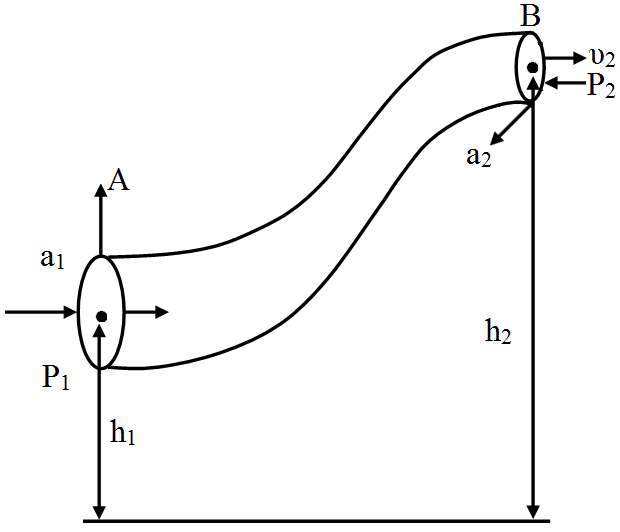
$(\text{P}_1-\text{P}_2)\text{Av}\Delta\text{t}=\text{Change in }(\text{K.E.}+\text{P.E.})$
$(\text{P}_1-\text{P}_2)\text{A}\text{v}\Delta\text{t}$
$=\text{Av}\rho\Delta\text{tg}(\text{h}_2-\text{h}_1)+\frac{1}{2}\text{Av}\Delta\text{t}\rho(\text{v}_2^2-\text{v}^2_1)$
$\therefore\text{P}_1-\text{P}_2=\rho\text{g}(\text{h}_2-\text{h}_1)+\frac{\rho}{2}(\text{v}^2_2-\text{v}^2_1)$
(i.e.) $\text{P}_1+\rho\text{gh}_1+\frac{\rho}{2}\text{v}^2_1=\text{P}_1+\rho\text{gh}_2+\frac{\rho}{2}\text{v}^2_2$$\therefore\frac{\text{P}}{\rho\text{g}}+\text{h}+\frac{\text{v}^2}{\text{2g}}=\text{constant}.$ View full question & answer→Question 425 Marks
- Define critical velocity of liquid flow and state the factors affecting the critical velocity of liquid.
- Define terminal velocity. Establish an expression for it for a spherical body falling through a viscous medium.
Answer
- Critical velocity is the maximum velocity of flow up to which a liquid can have streamlined flow in a tube.
Factors affecting critical velocity:
- Coefficient of viscosity of liquid.
- Density of liquid.
- Diameter of pipe through which liquid is flowing.
- Terminal Velocity: The constant velocity with which a body drops down after initial acceleration in a dense liquid or fluid is called terminal velocity. This is attained when the apparent weight is compensated by the viscous force. It is given by, $\nu=\frac29\frac{\text{r}^2\text{g}}{\text{}\eta}(\rho-\sigma),$ where $\rho$ and $\sigma$ are densities of the body and liquid respectively, n is the coefficient of viscosity of the liquid and r is the radius of the spherical body.
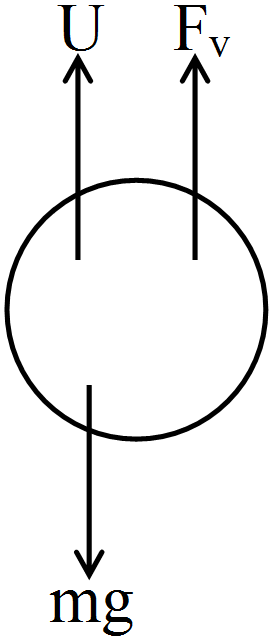
Consider a lengthy column of a dense liquid like glycerine. As the ball or spherical ball is dropped in it, the forces experienced are,
- Weight $=\text{mg}=\frac43\pi\text{a}^3\rho\text{g}$
Where $\rho-$ density of ball
- Upthrust, $\text{U}=\frac43\pi\text{a}^3\rho'\text{g}$
Where $\rho'-$ density of liquid
- Viscous force $\text{F}_\text{v}=6\pi\eta\text{ a}\rho'\text{v}_\text{t}$
Where $v_t$ - terminal velocity
When terminal velocity is attained, acceleration should be zero and the net force should be zero.
$\therefore\text{mg}-\text{U}-\text{F}_\text{v}=0$
$\Rightarrow\frac43\pi\text{a}^3\rho\text{g}-\frac43\pi\text{a}^3\rho_\text{l}\text{g}-6\pi\eta\text{ av}=0$
$\therefore\text{v}_\text{t}=\frac{\frac43\pi\text{a}^2\text{g}(\rho-\rho')}{6\pi\eta\text{ a}}$
$=\frac29\frac{\text{a}^2\text{g}(\rho-\rho')}{\eta}$
Thus, terminal velocity depends upon:
- Square of radius of the body.
- Coefficient of viscosity of the medium.
- Density of the body and the medium.
View full question & answer→Question 435 Marks
If a number of little droplets of water of surface tension S, all of the same radius r combine to form a single drop of radius R and the energy released is converted into K.E. Find the velocity acquired by the bigger drop. If the energy released is converted into heat, find the rise in temperature.
AnswerVolume of bigger drop = n × volume of a smaller drop So, $\frac43\pi\text{R}^3=\text{n}\times\frac43\text{ or }\text{n}=\frac{\text{R}^3}{\text{r}^3}\dots\text{(i)}$ Mass of the bigger drop,$\text{m}=\frac43\pi\text{R}^3\times1=\frac43\pi\text{R}^3\dots\text{(ii)}$
The energy released,$\Delta\text{W}=4\pi\text{S}(\text{nr}^2-\text{R}^2)$
$=4\pi\text{S}\Big[\frac{\text{R}^3}{\text{r}^3}\text{r}^2-\text{R}^2\Big]$
$=4\pi\text{SR}^3\Big[\frac{1}{\text{r}}-\frac{1}{\text{R}}\Big]$
$=3\text{S}\times\frac43\pi\text{R}^3\Big[\frac{1}{\text{r}}-\frac{1}{\text{R}}\Big]$
$=3\text{Sm}\Big[\frac{1}{\text{r}}-\frac{1}{\text{R}}\Big]\Big(\because\frac{4}{3}\pi\text{R}^3=\text{m}\Big)$
As, per equation,$\Delta\text{W}=\frac{1}{2}\text{m v}^2=3\text{Sm}\Big[\frac{1}{\text{r}}-\frac{1}{\text{R}}\Big]$
Or $\text{v}=\sqrt{6\text{S}\Big[\frac{1}{\text{r}}-\frac{1}{\text{R}}\Big]}=\sqrt{\frac{6\text{S}(\text{R}-\text{r})}{\text{r R}}}$ Quantity of heat produced,$\text{dH}=\frac{\Delta\text{W}}{\text{J}}=\frac{3\text{S}}{\text{J}}\text{m}\Big(\frac{1}{\text{r}}-\frac{1}{\text{R}}\Big)$
Heat taken by water, Where J = Joules Mechanical equivalent of heat. dH = Mass × Specific heat Rise in temp.$=\text{m}\times1\times\Delta\theta$
$\therefore\text{m}\Delta\theta=\frac{3\text{Sm}}{\text{J}}\Big(\frac{1}{\text{r}}-\frac{1}{\text{R}}\Big)$
$\Delta\theta=\frac{3\text{S}}{\text{J}}\Big(\frac{1}{\text{r}}-\frac{1}{\text{R}}\Big)$
View full question & answer→Question 445 Marks
- Show that the pressure exerted by a liquid column is proportional to its height.
- State Pascal's law.
Answer
- Consider a liquid of density p contained in a vessel in equilibrium of rest.
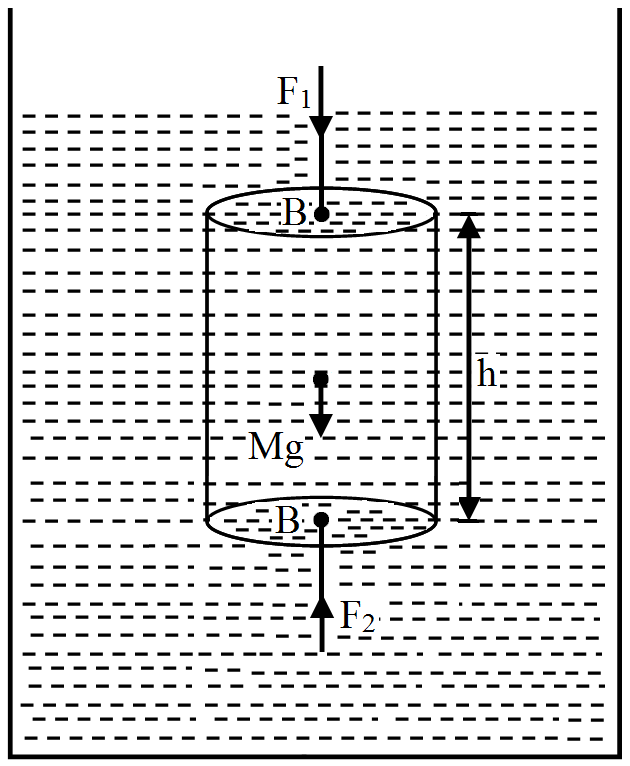
Let A and B be two points inside the liquid at a vertical distance h.
Let $P_1$ and $P_2$ be the pressure of liquids at points A and B respectively.
$F_1 = P_1A$, acting vertically downward on the top face of the cylinder.
$F_2 = P_2A$, acting vertically upwards on the lower face of the cylinder.
weight, $\text{Mg}=\text{A}\text{h}\rho\text{g}$ where A is cross-sectional area of the cylinder
As the liquid is in equilibrium of rest. Therefore, imaginary cylinder of liquid is also in equilibrium state of rest.
$\therefore\text{F}_1+\text{Mg}-\text{F}_2=0$
$\Rightarrow\text{P}_1\text{A}+\text{Ah}\rho\text{g}-\text{P}_2\text{A}=0$
$\Rightarrow\text{P}_2-\text{P}_1=\text{h}\rho\text{g}$
If $P_l$ = pressure exerted by a liqued column at point B.
$\Rightarrow\text{P}_\text{l}=\text{P}_2-\text{P}_1=\text{h}\rho\text{g}$
This shown that the pressure exerted by a liquid column is proportional to its height.
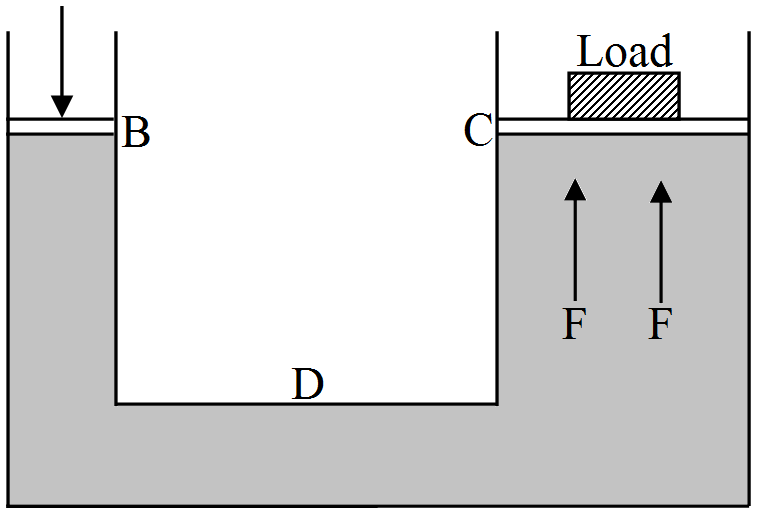
- Pascal's law: It states that the pressure in a liquid at rest is the same at all point if they are at the same level.
View full question & answer→Question 455 Marks
- Define streamline.
- Write any two properties of streamlines.
- Draw streamlines for a clockwise spinning sphere.
- Derive equation of continuity.
Answer
- Streamline is the actual path followed by the procession of particles in a steady flow, which may be straight or curved such that tangent to it at any point indicates the direction of flow of a liquid at that point.
- Two properties of streamlines are-
- Two streamlines can never cross each other.
- The greater is the crowding of streamlines at a place, the greater will be the velocity of liquid particles at that place and vice-versa.
-
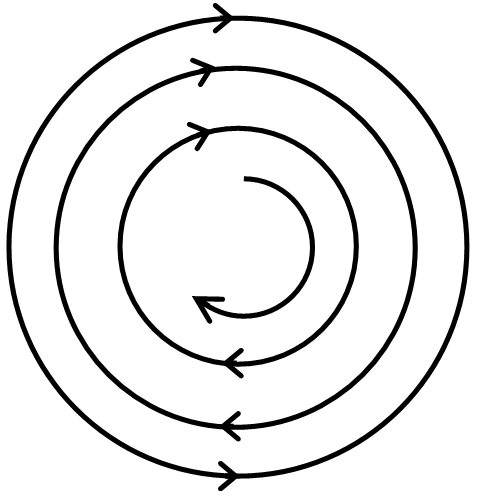
Due to spinning sphere, concentric streamlines are formed.
-
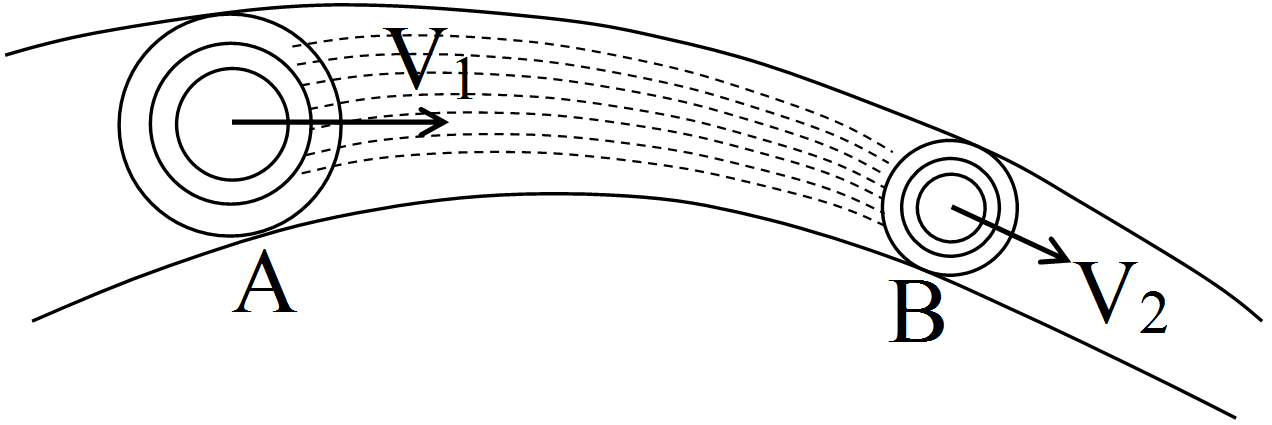
Volume of liquid entering per second at $A = a_1v_1$
Mass of liquid entering per second at $A = a_1v_1p_1$
Similarly, mass of liquid leaving per second at $B = a_2v_2p_2$
If there is no loss of liquid in tube and the flow is steady then,
Mass of liquid entering per second at A = Mass of liquid leaving per second at B $a_1v_1p_1 = a_2v_2p_2$
If liquid is incompressible then,
$P_1 = P_2$
$a_1v_1 = a_2v_2$
av = constant
This is the equation of continuity. View full question & answer→Question 465 Marks
A non-viscous liquid of constant density $1000 \mathrm{~kg} \mathrm{~m}^{-3}$ flows in a streamline motion along a tube of variable crosssection. The tube is a kept inclined in the vertical plane as shown in figure. The area of cross-section of the tube at two points $P$ and $Q$ at heights of 2 m and 5 m are respectively, $4 \times 10^{-3} \mathrm{~m}^2$ and $8 \times 10^{-3} \mathrm{~m}^2$. The velocity of the liquid at point $P$ is $1 \mathrm{~m} \mathrm{~s}^{-1}$. Find the work done per unit volume by the pressure and the gravity forces as the fluid flows from point $P$ to $Q$.
AnswerGiven, $\rho=100\text{kg/m}^3,\text{ v}_1=1\text{m/s,}$ $\text{a}_1=4\times10^{-3}\text{m}^2,$$\text{a}_2=8\times10^{-3}\text{m}^2,\text{ h}_1=2\text{m},$ $\text{ h}_2=5\text{m}$
Apply Bernoull's theorem,$\text{p}_1+\frac{1}{2}\rho\text{v}_1^2\rho\text{h}_1=\text{p}_2+\frac12\rho\text{v}^2_2+\text{g}\rho\text{h}_2$
$(\text{p}_1-\text{p}_2)=\frac12\rho(\text{v}^2_2-\text{v}^2_1)+\rho\text{g}(\text{h}_2-\text{h}_1)$
Where, $(p_1 - p_2)$ = Work done by pressure per unit volume, i.e. $\Big(\frac{\text{W}}{\text{Volume}}\Big)_\text{p}=\frac12\rho(\text{v}^2_2-\text{v}^2_1)+\rho\text{g}(\text{h}_2-\text{h}_1)\dots\text{(i})$
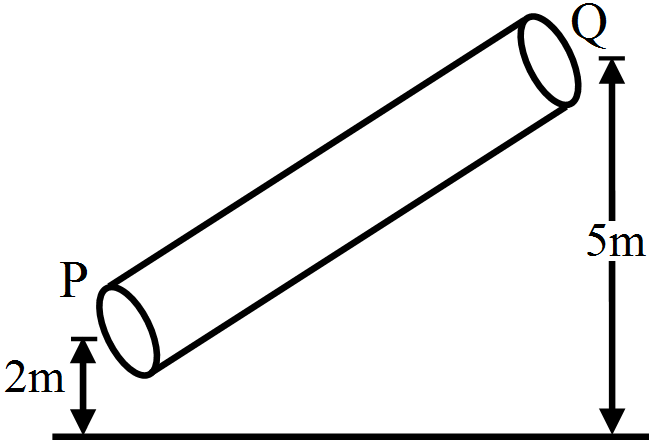
From equation of continuity,$\text{a}_1\text{v}_1=\text{a}_2\text{v}_2$
$\text{v}_2=\frac{\text{a}_1\text{v}_1}{\text{a}_2}$
$=\frac{4\times10^{-3}\times1}{8\times10^{-3}}=0.5\text{m/s}$
$\Big(\frac{\text{W}}{\text{Volume}}\Big)_\text{p}=\frac12\times1000[0.25-1]+1000\times10(5-2)$
$=-375+30,000$
$=29,625\text{J/m}^3$
Work done per unit volume by the gravitational force,$=\rho\text{g}(\text{h}_1-\text{h}_2)$
$=100\times10(2-5)$
$=-3\times10^4\text{J/m}^3$ View full question & answer→Question 475 Marks
A fully loaded Boeing aircraft has a mass of $3.3 \times 10^5kg$. Its total wing area is $500m^2$. It is in level flight with a speed of $960km/h$.
- Estimate the pressure difference between the lower and upper surfaces of the wings.
- Estimate the fractional increase in the speed of the air on the upper surface of the wing relative to the lower surface. [Density of air = $1.2kg m^{-3}$].
AnswerThe pressure difference should balance the weight of the Boeing aircraft.$\therefore\Delta\times\text{Area}=3.3\times10^5\times9.8$
$\Delta\text{P}=\frac{3.3\times10^5\times9.8}{500}$
$\Delta\text{P}=6.5\times10^3\text{N m}^{-2}$
The gravitational head difference between the upper and lower surface can be neglected. The pressure difference $=\Delta\text{P}=\frac{\rho}{2}(\text{v}^2_2-\text{v}^2_1),$ where $v_1$ and $v_2$ are the speeds at above and lower surface.$\therefore\text{v}_2-\text{v}_1=\frac{2\Delta\text{P}}{\rho(\text{v}_2+\text{v}_1)}$
$\text{v}_\text{av}=\frac{\text{v}_2+\text{v}_1}{2}$
$960\text{km/hr}=960\times\frac{5}{18}=266.67\text{m/s}$
$\therefore\frac{\text{v}_2-\text{v}_1}{\text{v}_{\text{av}}}=\frac{\Delta\text{P}}{\rho\text{v}^2_\text{av}}$
$\frac{\text{v}_2-\text{v}_1}{\text{v}_{\text{av}}}=\frac{6.65\times10^3}{1.2\times(266.67)^2}=0.0761$
View full question & answer→Question 485 Marks
- Derive an expression for the excess pressure inside a soap bubble.
- State Bernoulli's theorem.
Answer
-
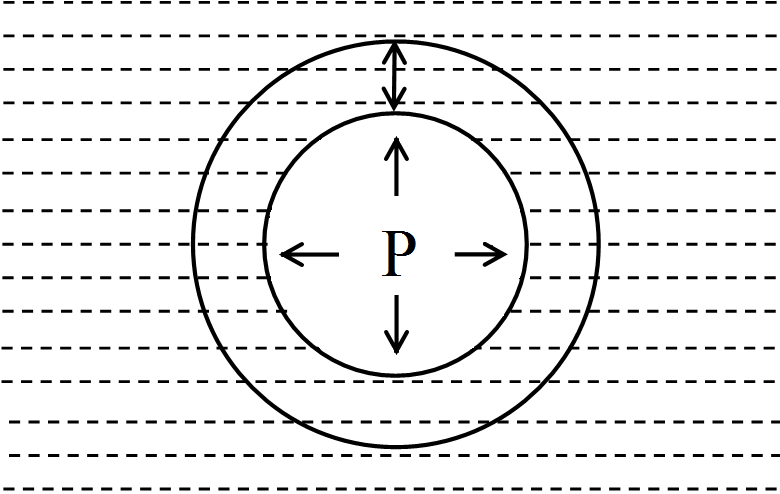
Consider a bubble of radius R with $\sigma$ the surface tension of liquid. Excess pressure inside the bubble,
$P = P_i - P_0$
($\because$ air bubble has only one free surface)
$\delta\text{R}=$ Small increase in radius of bubble due to excess pressure
Work done,
W = Force × Displacement
= (Excess pressure × Area) × Increase in radius
$=\text{P}\times4\pi\text{R}^2\times\delta\text{R}$
Increase in surface area of bubble,
= Final surface area - Initial surface area
$=4\pi(\text{R}+\delta\text{R})^2-4\pi\text{R}^2$
$=8\pi\text{R}(\delta\text{R})$ $($Neglecting $\delta\text{R}^2)$
$\therefore\text{P}\times4\pi\text{R}^2\times\delta\text{R}=8\pi\text{R}(\delta\text{R})\times\sigma$
Increase in P.E. = Increase in surface area × Surface tension
$=8\pi\text{R}(\delta\text{R})\times\sigma$
Since the drop is in equilibrium.
$\therefore\text{P}\times\text{R}^2\times\delta\text{R}=8\pi\text{R}(\delta\text{R})\times\sigma$
$\text{P}=\frac{2\sigma}{\text{R}}$
- Bernoulli's Theorem: For an incompressible, non-viscous, irrotational liquid having streamlined flow, the sum of the pressure energy, kinetic energy and potential energy per unit mass is a constant, i.e.,
$\frac{\text{P}}{\rho}+\frac{\text{V}^2}{2}+\text{gh}=\text{constant}$
$\Rightarrow\frac{\text{P}}{\rho\text{g}}+\frac{\text{V}^2}{2\text{q}}+\text{h}=\text{constant}$ View full question & answer→Question 495 Marks
Show that if n equal rain droplets falling through air with equal steady velocity of $10cm s^{-1}$ coalesce, the resultant drop attains a new terminal velocity of $10n^{2/3}cm s^{-1}$.
AnswerVolume of a bigger drop = n × Volume of a smaller drop$\frac43\pi\text{R}^3=\text{n}\times\frac{4}{3}\pi\text{r}^3$ or $\text{R}^3=\text{nr}^3$ or $\text{R}=\text{n}^{\frac13}\text{r}$
Terminal velocity of a small droplet is given by,$\text{v}_\text{s}=\frac29\frac{\text{r}^2}{\eta}(\rho-\rho')\text{g}\dots\text{(i)}$
Terminal velocity of a bigger drop is given by,$\text{v}_\text{b}=\frac29\frac{\text{R}^2}{\eta}(\rho-\rho')\text{g}\dots\text{(ii)}$
Divinding equation (ii) by equation (i) we get $\frac{\text{v}_\text{b}}{\text{v}_\text{s}}=\frac{\text{R}^2}{\text{r}^2}$ But $\text{R}=\text{n}^{\frac13}\text{r}$ and $\text{v}_\text{s}=10\text{cm/s}$$\text{v}_\text{b}=\text{v}_\text{s}\times\Big(\frac{\text{R}^2}{\text{r}^2}\Big)=10\times\frac{\text{n}^{\frac23}\text{r}^2}{\text{r}^2}$
$\text{v}_\text{b}=10\text{n}^{\frac23}\text{cm/s}$
View full question & answer→Question 505 Marks
A vessel filled with water is kept on a weighing pan and the scale adjusted to zero. A block of mass M and density $\rho$ is suspended by a massless spring of spring constant k. This block is submerged inside into the water in the vessel. What is the reading of the scale?
AnswerConsider the diagram. Beaker filled with water is placed on weighing pan and then scale is adjusted to zero.
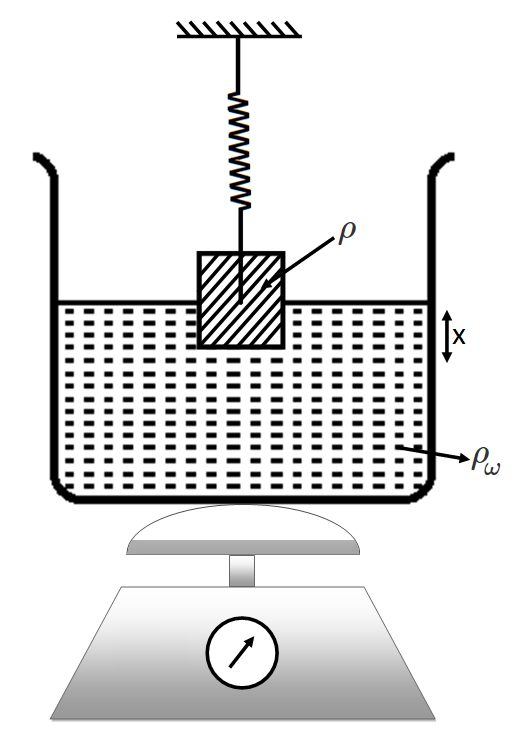
At the block is submerged in water the bouyant force (upward) acts on the block by water. This bouyant force acts as reaction force. So, by newton's third law block will apply reaction force downward due to which reading on scale increases equal to the buoyant force = $Vp\ _wg$
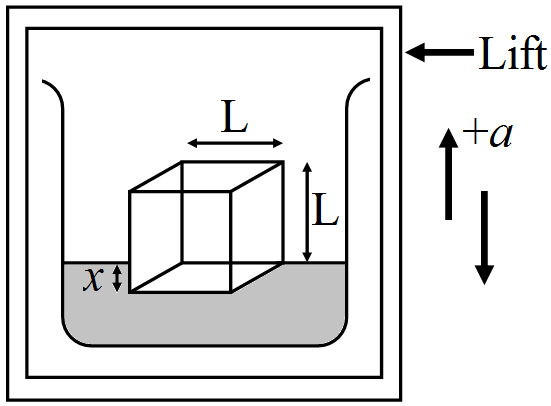
V = Volume of water displaced By block Pw = density of water Mass of block = M = Vp or $\text{V}=\frac{\text{M}}{\text{P}}$$\therefore$ Reading of weighing scale $=\frac{\text{M}}{\rho}\cdot\text{p}_\text{w}\text{g}=\frac{\text{p}_\text{w}}{\text{p}}\text{Mg}$ View full question & answer→